Category: Obedience

  • How Do We Cleanse and Purify to Submit to God?

    To submit to God, we need to cleanse our hands and purify our hearts. This daily devotional looks at how we cleanse and purify ourselves through humility.

    Nuggets

    • We cleanse our hands by confessing our sins and allowing the blood of Christ cleanse us.
    • We need to purify our hearts because that is where our character comes from.
    • We are not submitting to God when we focus on the joy of this world.
    • Our ability to submit hinges on our ability to humble ourselves.

    Devotions in the Approach to Knowing God series

    We ended our last devotion talking about Murray’s assertion that we can resist the devil because we are not forced to sin. What came next was Murray’s statement that said, “The thought that you can succeed in keeping your hand and heart clean is a constant inspiration to persevere.”

    Resource

    Isn’t that encouraging! Aren’t there so many times we feel we can’t resist the devil, so we aren’t clean? Let’s dig in.

    Let’s Put It into Context #1

    Godliness, equated with the Old Testament term fear of the Lord, is an attitude of reverence that is promoted by walking in His Spirit and obeying God’s laws and commandments and produces a moral likeness of God.

    Let’s Put It into Context #2

    Nuggets from the previous devotions in the series:

    • Knowing God is more than just thinking there is some Power Who created this universe.
    • We are to understand; but knowing God does not mean we will be able to understand everything.
    • We begin to know God when we diligently pursue knowing Him and doing His Will.
    • It is our duty to surrender our will to God by submitting to Him.
    • Some think that God requiring our obedience is a string to the gift, but it isn’t.
    • If submitting to God is required, why isn’t it easier to accomplish?
    • We resist the devil when we obey God’s laws and commandments.
    • We can only resist the devil through God’s power.
    • We are told God never leaves us, but we are to turn to Him.

    How Do We Cleanse Our Hands When We Submit to God?

    “… Cleanse your hands, you sinners, and purify your hearts, you double-minded” (Jas. 4: 8 ESV)

    We cleanse our hands by confessing our sins and allowing the blood of Christ cleanse us.

    No, this isn’t talking about washing our hands here. It is talking about being clean.

    • Cleanness has to do with the Israelites remaining holy.
    • Holy means to be set apart, perfect, and pure.
    • The perfected state indicates the combination of the graces which, when all are present, form spiritual wholeness or completeness.
    • Purity means we are without the stain of sin.

    Hmmm. We got from the cleanse to the purify.

    Well, there is a progression. “If we confess our sins, he is faithful and just to forgive us our sins and to cleanse us from all unrighteousness” (I Jn. 1: 9 ESV).

    It isn’t something we do on the outside, like washing our hands. It is the blood of Jesus washing our hearts to get the sin out of it.

    We have to make the decision to submit to God. Then He cleanses us from sin.

    We have to make the decision to submit to God. Then He cleanses us from sin.

    Let’s look at this another way. Yes, God is calling us to change. He isn’t in the business of fire insurance.

    God doesn’t want us to confess Him as Sovereign God and not gain His character. That isn’t submitting.

    God wants us to cut out the sin in our lives. We can’t hold on to our sinful ways and think God will give us salvation. Salvation is deliverance from evil and the consequences of sins to replace them with good and eternal life.

    Spurgeon put it this way. He wrote, “If you do the devil’s work with your hands, do not expect the Lord to fill them with His blessing.”

    Resource

    Ooo, baby. How many times do we do that? We expect God to take our lip service and ignore our clinging to our sins.

    We talked about the consequences of this before. We had a devotion entitled What Do You Mean All Disciples Won’t Get into Heaven?

    Scary, isn’t it?

    We said that, if we don’t put into practice God’s laws and commandments, we are going to show that we don’t think they are important enough to follow. We don’t think we have to submit to God and do them.

    To read a related devotion, click the button below.

    Instead, we are to genuinely ask forgiveness of our sins. Candlish wrote, “The sins we confess are so forgiven that we are cleansed from all unrighteousness with regard to them. The forgiveness is so free, so frank, so full, so unreserved, that it purges our bosom of all reserve, all reticence, all guile; in a word, ‘of all unrighteousness.’ And it is so because it is dispensed in faithfulness and righteousness; ‘He is faithful and just in forgiving our sins.’”

    Resource

    Elaine-speak. God doesn’t sorta forgive us of our sins. It isn’t just a surface forgive.

    God does a deep cleanse. It isn’t just part of them — it is all of them. It is such a deep cleans that it gets down to the sparkly clean of righteousness. Righteous means we are free from sin because we are following God’s moral laws.

    That means it is a true repentance. Repentance is acknowledging our separation from God and expressing sorrow for breaking God’s laws and commandments by making the commitment to changing ourselves through obedience so that we no longer do the wrong things.

    We not only ask forgiveness for our sins, but we also turn away from them. We give them up because we know they are breaking God’s laws and commandments.

    So, we submit to God’s laws and commandments.

    It is a deep clean. Not only our sins are purged, but also the guilt of our sins is washed away. Yeah, carting around that guilt can sometimes be just as bad as the initial sin.

    Not only our sins are purged, but also the guilt of our sins is washed away.

    How Do We Purify Our Hearts When We Submit to God?

    “… purify your hearts, you double-minded” (Jas. 4: 8 ESV)

    We need to purify our hearts because that is where our character comes from.

    Our heart is very important in our faith. The greatest commandment says, “And you shall love the Lord your God with all your heart and with all your soul and with all your mind and with all your strength” (Mk. 12: 30 ESV).

    Glossary

    Why is the heart so important that it was listed first? It was written in the Expository Discourses that “The fountainhead of all that enters into human history and character, is the heart.”

    Resource

    Jesus explained it this way. “And he said, “What comes out of a person is what defiles him. For from within, out of the heart of man, come evil thoughts, sexual immorality, theft, murder, adultery, coveting, wickedness, deceit, sensuality, envy, slander, pride, foolishness. All these evil things come from within, and they defile a person’” (Mk. 7: 20-23 ESV).

    Jesus was trying to tell the Pharisees that we can’t just make it a surface religion. Our faith has to lead to a relationship with God.

    A relationship with God has to lead to a change in our character. That is going to have a major impact on us.

    Ooo, baby. Why does Jesus mention this first? What harm does our thoughts do to anyone else? And isn’t that mind, not heart? Sadler wrote, “So that out of the heart, out of the unseen and unthinkable depths within, proceed the evil thoughts which become evil acts within before they are incarnated, as it were, in some evil deed without.”

    Resource

    The evil thoughts lead to evil actions.

    Covetousness is a greed for wealth and possessions. This greed makes the object into an idol. An idol is an object of worship in any form that takes from God the worship that is His due.

    Worshiping an idol means we are not submitting to God.

    Chamfort called covetousness a form of mental gluttony. We want an excess of honor, but we get there by selfishness

    Resource

    Non-believers are identified in Scriptures by the term wicked. That means they are sinful.

    We can’t have a double-mind. We can’t say we are a disciple but then choose to keep committing sins. That means we are trying to serve God and Satan.

    That doesn’t end well.

    Why Do We Want Our Laughter Turned into Mourning?

    “Be miserable and mourn and weep. Let your laughter be turned to mourning and your joy to gloom” (Jas. 4: 9 ESV)

    We are not submitting to God when we focus on the joy of this world.

    Whoa. Wait a second here. Isn’t it supposed to be the other way around. Aren’t we supposed to be sad and then get happy?

    This really isn’t talking about that. Remember when we were studying the Beatitudes, we asked why disciples were blessed if they mourned.

    To read a related devotion, click the button below.

    We said that, when we sin, we should mourn that we have broken God’s laws and commandments. True repentance means we are broken because we have sinned against God.

    That doesn’t lead to laughing and joy.

    We only purify our hearts when we get the sin out. We are not going to be fixing to get it out if it brings us warm, fuzzy feelings.

    Mouton wrote that the weeping moderates the joy. That brings us back to being sober and even-keeled, not jumping from one extreme to another.

    Resource

    Glossary

    How Do We Humble Ourselves When We Submit to God?

    “Humble yourselves before the Lord, and he will exalt you” (Jas. 4: 10 ESV)

    Our ability to submit hinges on our ability to humble ourselves. Humility is a character trait that diminishes pride and places dependence on God while holding a modest view of our importance with respect to others.

    Turnbull contends that the submission stems from the humility. You don’t start with submission and become humble. You start with the humble, that facilitates the submission.

    Resource

    Spurgeon put it this way. He wrote, “The right position of a Christian is to walk with lowly humility, before God, and with meekness towards his fellow-Christians.”

    Resource

    That is what Jesus was talking about when He said, “So the last shall be first, and the first last: for many be called, but few chosen” (Mt. 20: 16 KJV).

    To read a related devotion, click the button below.

    God doesn’t ask us to be humble to cut us down. He is asking us to put the correct emphasis on our worship to Him.

    HowDoWeCleanseAndPurityToSubmitToGodPin

    Making the Connections

    So, let’s put all of this together. The humble shall be rewarded because they are submitting to God. Those that are prideful won’t be rewarded.

    Salvation is given to those who are truly repentant and will submit to God. There may be some who have made a profession of faith but haven’t submitted. They will not enter Heaven.

    We cleanse and purify when we choose to submit. Submitting gets us to the purity, but choosing gets us to the submitting.

    How Do We Apply This?

    So, how do we keep clean and pure? Murray wrote, “Only ‘resist evil,’ only stand firm, only try, and whatever of good you in your better moments crave will come to you, and abide with you, as the light of the sun to-day comes to the earth, elicting its manifold fruitage, and illuminating it from pole to pole. Yea, your life shall be like a globe belted and zoned with expressions of life; and never shall there be an hour when some portion of it shall not be in flower and fruitfulness.”

    Resource

    Keep making the decisions to live for God. If you feel bombarded by Satan, do it one decision at a time. Don’t focus on all the decisions that Satan is having you make. Make one decision for God and celebrate it.

    What do I mean celebrate? I am talking about praising God for bringing you through.

    Use God bringing you through that decision to encourage you in the next decision. He always tells us to remember how He provided.

    Glossary

    Submitting is a choice. It unlocks many benefits. But our sins need to be forgiven so that we are clean and pure.

    Father God. Mankind brought sin into this world by disobeying You. In response, You designed the Plan of Salvation so that we could be forgiven if we submit ourselves to You. This plan includes our being cleansed and purified. That is only done through obedience to Your laws and commandments and resisting Satan. Help us to live for You. Amen.

    The ABCDs of Salvation

    If you have not become a believer in Christ, please read through the
    Plan of Salvation and prayerfully consider what God is asking you to do.

    A – admit our sins
    B – believe His Son Jesus is our Redeemer
    C – confess God as Sovereign Lord

    D – demonstrate that commitment by making any changes needed in our lives to
    live the way in which God has called us

    The Disciple’s Job Description

    What do you think?

    Leave me a comment below (about this or anything else) or head over to my Facebook group for some interactive discussion.

    If you don’t understand something and would like further clarification, please contact me.

    If you have not signed up for the email daily or weekly providing the link to the devotions and the newsletter, do so below.

    If God has used this devotion to speak with you, consider sharing it on social media.

  • How Are We to Submit to God?

    We submit to God by resisting the devil. This daily devotional looks at how we can resist Satan by drawing near to God.

    Nuggets

    • We resist the devil when we obey God’s laws and commandments.
    • We can only resist the devil through God’s power.
    • We are told God never leaves us, but we are to turn to Him.

    Devotions in the Approach to Knowing God series

    The last thing we talked about in the last devotion was why isn’t it easier to submit to God? We said it comes down to a choice.

    Spurgeon felt that, when we look at the big picture, the choice is obvious. He wrote, “Knowing as we do that all these things work together for our good, and that we never endure a [challenge] more than our heavenly Father knows to be needful, we are bound to submit ourselves cheerfully to all that He appoints.”

    Resource

    But how do we put words into action? James went on to tell us how to do that.

    Let’s Put It into Context #1

    Godliness, equated with the Old Testament term fear of the Lord, is an attitude of reverence that is promoted by walking in His Spirit and obeying God’s laws and commandments and produces a moral likeness of God.

    Let’s Put It into Context #2

    Nuggets from the previous devotions in the series:

    • Knowing God is more than just thinking there is some Power Who created this universe.
    • We are to understand; but knowing God does not mean we will be able to understand everything.
    • We begin to know God when we diligently pursue knowing Him and doing His Will.
    • It is our duty to surrender our will to God by submitting to Him.
    • Some think that God requiring our obedience is a string to the gift, but it isn’t.
    • If submitting to God is required, why isn’t it easier to accomplish?

    Let’s Put It into Context #3

    Who is Satan? We know Satan and the demons that followed him when he rebelled were cast out of heaven (Jude 1: 6).

    Satan does have some power. He can “inflame the evil desires of the soul.” We do now he is devious in his dealings with us.

    One thing about Satan is he doesn’t give up. He is a persistent devil, trying to get us to defy God.

    Griffin believed that Satan is jealous of mankind. He envies our happiness.

    I’m not totally convinced of that. I think he envies God more than is.

    We do know that Satan knows us well. He has had lots of practice in getting us to deny God.

    Resource

    Person of Interest

    We Submit to God by Resisting the Devil

    “Submit yourselves therefore to God. Resist the devil, and he will flee from you” (Jas. 4: 7 ESV)

    We resist the devil when we obey God’s laws and commandments.

    Satan is very good at trying to get us to disobey God’s laws and commandments. He is very crafty at devising challenges — that may or may not look like a challenge — to get us to not submit to God’s Will.

    We have to understand what God is asking us to do by reading His Word and listening to the promptings of the Holy Spirit. Then, we have to make the choice to do what He is telling us.

    What makes it a challenge Satan can use against us is when we expect the “… all things God works for the good of those who love him …” (Rom. 8: 28 NIV) to only be good things. Couple that with “… he will not allow you to be tempted beyond what you are able …” (I Cor. 10: 13 CSB), we expect smooth sailing to be the norm.

    But are we really submitting to God’s Will if it isn’t challenging us with something that isn’t our will?

    Are we really submitting to God’s Will if it isn’t challenging us with something that isn’t our will?


    Something Turnbull said got me thinking. He wrote, “Wherein we are taught whither all our strivings must tend, even to the withstanding of Satan, with whom we have continual war, and therefore ought we wholly to bend ourselves with all might against him.”

    Resource

    How many times does it cross our minds that we are in continual war with Satan? Some say God isn’t around because we can’t see Him. The same holds true for Satan.

    Think of it this way. We make many choices during the course of the day. Every time we make a choice that is counter to God’s Will, we haven’t resisted the devil.

    No, we may not feel Satan fighting for us to choose his option. But he is. “For we are not fighting against flesh-and-blood enemies, but against evil rulers and authorities of the unseen world, against mighty powers in this dark world, and against evil spirits in the heavenly places” (Eph. 6: 12 NLT).

    To read devotions in the Armor of God series, click the appropriate button below.

    To me, it goes back to the concept that salvation isn’t a one-time shot. Salvation is deliverance from evil and the consequences of sins to replace them with good and eternal life.

    Yes, upon conversion, we are changed from being spiritually dead to spiritually alive. Spiritual death is the separation from God that occurred as a consequence of Adam and Eve’s original sin. The spiritually alive are those who have ABCDed, so they are no longer separated from God.

    The ABCDs of Salvation

    If you have not become a believer in Christ, please read through the
    Plan of Salvation and prayerfully consider what God is asking you to do.

    A – admit our sins
    B – believe His Son Jesus is our Redeemer
    C – confess God as Sovereign Lord

    D – demonstrate that commitment by making any changes needed in our lives to
    live the way in which God has called us

    The Disciple’s Job Description

    But then we have to work out our salvation on the Sanctification Road. We have to go from being milk babies to steak adults. We have to be perfected.

    Sanctification is the transformation of mind, body, and soul, which begins with regeneration, gradually changes our nature through the promptings of the Holy Spirit, and ends with perfected state of spiritual wholeness or completeness. Regeneration is the change in us that God brings about when we go from being spiritually dead to spiritually alive.

    Glossary

    One way Satan gets us to not submit to God is to make us content with sin. Spurgeon said that we are to “… resist the secret spirit of evil as well as its outward acts.”

    Resource

    It isn’t just what we do. It is what we think.

    I don’t know about you, but lately Satan has been throwing a lot of challenging thoughts into my mind. I don’t know how many times I’ve stopped myself and said, “God, I choose to submit to You. Get these thoughts out of my head, please.”

    Bottom line is we can’t be passive in our salvation. We have to fight to stay in God’s Will.

    No, it isn’t going to be easy. Satan is all around us in our souls and in society. That means inside and outside are under attack. We have to strap on God’s armor and fight.

    Resource

    Can We Really Resist the Devil?

    We can only resist the devil through God’s power.

    Let’s go at this from another way. There was a study done that said people — even disciples of Christ — do not believe that Satan is real.

    How can we say Satan is not real when James point blank tells us to “… resist the devil …” (Jas. 4: 7 ESV)?

    We believe that God does not lie.

    • In hope of eternal life, which God, who never lies, promised before the ages began” (Ti. 1: 2 ESV).
    • God is not man, that he should lie, or a son of man, that he should change his mind. Has he said, and will he not do it? Or has he spoken, and will he not fulfill it?” (Num. 23: 19 ESV).

    God supervised the writing of Scriptures. “All Scripture is inspired by God and is profitable for teaching, for rebuking, for correcting, for training in righteousness” (II Tim. 3: 16 CSB).

    The New Living Translation expands on that to show us what is meant. “All Scripture is inspired by God and is useful to teach us what is true and to make us realize what is wrong in our lives. It corrects us when we are wrong and teaches us to do what is right” (II Tim. 3: 16 NLT).

    So, if we know God cannot lie and we know that God inspired the Scriptures, that means we can believe it when we say we can resist the devil.

    There is another reason why we can resist the devil. Murray wrote, “No one is compelled to sin.” We are not forced to do wrong.

    Resource

    It is our choice to submit to God or not resist the devil. Murray said that this leads to “… the hopefulness of morality.” Morality is the principles that inform the behavior — the virtue.

    That leads into our discussion for the next devotion.

    It is our choice to submit to God or not resist the devil.

    We Submit to God by Drawing Near to Him

    “Draw near to God, and he will draw near to you …” (Jas. 4: 8 ESV)

    We are told God never leaves us, but we are to turn to Him.

    Okay, how are we supposed to draw near to Someone Who isn’t really here? God is a spirit, not a physical being.

    Spurgeon said one of the ways of drawing near to God is to be obedient. It means we have to be actively seeking Him.

    Resource

    Searching for and Seeking God

    Hearing His Word (Rom. 10: 17).
    Reading His Word (Rev. 1: 3).
    Praying to Him (Heb. 4: 16).
    Studying His Word (Ac. 17: 11).
    Meditating on His Word (Ps. 1: 1-2).
    Memorizing His Word (Ps. 119: 11).

    Drawing near to God means we don’t bombard Him with questions so that we understand everything completely. It is putting all circumstances into God’s hands and going with the flow.

    We do this by opening our hearts to God.

    HowAreWeToSubmitToGodPin

    Making the Connections

    Shape warned us about playing around with sin. We can’t find ways to say that God condones it. We can’t assert that we will only try it out once.

    We need to shut sin and the devil down the first time. We can’t toy with sin, thinking we can decide when and how often we sin — and how we can turn it off.

    We have to realize we are always susceptible to Satan’s temptations. That is why we need God’s power to help us resist the devil.

    How Do We Apply This?

    So, how to we submit to God? We need to:

    • Grow in faith and knowledge (II Pet. 3: 18).
    • Increase our prayer life.
    • Study God’s Word to find God’s character through virtues and godliness.
    • Follow God’s laws and commandments, not try to rewrite them.
    • Follow the promptings of the Holy Spirit.
    • Strap on the armor and fight as He directs.
    • Find like-minded believers to encourage us in our trials.
    • Have a sober disposition
    • Always be watching
    • Remember and utilize past experiences to prepare and encourage us for current trials.
    • Fight Satan — or we will die.

    Resource

    We have to always remember that Satan has already lost the war. There still may be pitched battles, but God will be victorious in the end.

    We need to submit to the Winner.

    Father God. We submit to You. Strengthen us so that we can resist the devil. We pray that we choose You every time. Forgive us when we don’t. Amen.

    What do you think?

    Leave me a comment below (about this or anything else) or head over to my Facebook group for some interactive discussion.

    If you don’t understand something and would like further clarification, please contact me.

    If you have not signed up for the email daily or weekly providing the link to the devotions and the newsletter, do so below.

    If God has used this devotion to speak with you, consider sharing it on social media.

  • Surrendering Our Will to God

    In order to know God, we must submit our will to Him. That is difficult for us to do, though. This daily devotional looks at why we should submit to God and why we don’t.

    Nuggets

    • It is our duty to surrender our will to God by submitting to Him.
    • Some think that God requiring our obedience is a string to the gift, but it isn’t.
    • If submitting to God is required, why isn’t it easier to accomplish?

    Devotions in the Approach to Knowing God series

    I have been thinking about doing a devotion on this topic for a while. Let’s face it. We don’t like the concept.

    Surrender. Submit.

    Oh, yeah. This is going to be a big topic, so we may be roosting here for a couple of devotions. Besides, God is taking me on a whole different path than originally planned.

    So, buckle in. God is in control.

    I know. We like to be in control. We don’t like people telling us what to do or not do. We don’t like someone else calling the shots.

    But here comes God.

    Let’s Put It into Context #1

    Godliness, equated with the Old Testament term fear of the Lord, is an attitude of reverence that is promoted by walking in His Spirit and obeying God’s laws and commandments and produces a moral likeness of God.

    Let’s Put It into Context #2

    Nuggets from the previous devotions in the series:

    • Knowing God is more than just thinking there is some Power Who created this universe.
    • We are to understand; but knowing God does not mean we will be able to understand everything.
    • We begin to know God when we diligently pursue knowing Him and doing His Will.

    Why Should We Submit to God?

    “Submit yourselves therefore to God. Resist the devil, and he will flee from you” (Jas. 4: 7 ESV)

    It is our duty to surrender our will to God by submitting to Him.

    Why must we submit to God? He is worthy of our worship. This is, Patterson noted, because of “… His rightful supremacy, His unerring wisdom, His unsullied justice, His irresistible power, His generous love, and His unswerving faithfulness, alike to the threatenings and the promises which He addresses to His creatures.”

    Even though Sovereign God is supreme, He care about those He would have submit to Him. Patterson also wrote, “In dealing with men as sinners, the offended, but most merciful, Majesty of heaven has proposed certain terms as those on which alone He will receive any guilty soul into peace and favour with Himself.”

    Resource

    There is only one way to God. “Jesus answered, ‘I am the way and the truth and the life. No one comes to the Father except through me’” (Jn. 14: 6 NIV).

    Salvation is a gift. Salvation is deliverance from evil and the consequences of sins to replace them with good and eternal life.

    Oh, I know. We have a hard time accepting gifts. We can usually overcome that for Christmas and birthdays.

    But to have someone give us a gift just because? And a but-we-don’t-deserve-this-expensive-gift at that?!?

    The gift of salvation is a very expensive gift! The price was Jesus’ life.

    No, we don’t deserve the gift of salvation. But God wants to give it to us because of His grace and mercy. Grace is a free and unmerited gift from Heavenly Father given through His Son, Jesus Christ that enables salvation and spiritual healing to believers by the work of the Holy Spirit. God’s mercy is the unexpected way God responds in love to our needs.

    We tell ourselves that salvation shouldn’t be free. We convince ourselves that we need to clean up our acts because we are so unworthy of the gift.

    Yes, we are unworthy. No, there is nothing we can do to make us worthy.

    All we can do is accept this wonderful gift of salvation.

    Yes, we are unworthy. No, there is nothing we can do to make us worthy. All we can do is accept this wonderful gift of salvation.

    Then, Why Don’t We Want to Submit to God?

    Some think that God requiring our obedience is a string to the gift. It isn’t.

    We like to think that gifts should have no strings attached. And we see the requirement of submission as a very big string.

    We just don’t fully get it. God is Sovereign God, Who made us. It is on His timetable that we leave this life.

    That gives him the authority to be in control. He calls the shots.

    Part of the problem is we want to be our own master. That was what the original sin was all about, isn’t it? Adam and Eve wanted to be able to choose what they could and could not do. They also wanted the wisdom they thought this fruit could give them.

    Glossary

    Spurgeon gave us a list of things that keep us from submitting to God. He wrote, “… lusting, envy, strife, contention, jealousy, anger, all these things declare that the heart is not submissive, but remains violently self-willed and rebellious. Those who are still wrathful, proud, contentious, and selfish, are evidently unsubdued.” Spurgeon reminded us that we will not be given salvation if we do not submit.

    Resource

    Hunter said that our salvation must be built on our acceptance of God’s truths. It doesn’t matter that we don’t fully understand everything.

    Resource

    Ouch. What about all those who want to rewrite Scriptures? We don’t like this being classified as a sin, so we want God to change His mind about it being Evil.

    That isn’t submission, guys. That isn’t respecting the Sovereign God.

    That is wanting our way, not God’s.

    God isn’t going to accept that. Scott addressed this. He wrote, “We may object; we may try to find excuses for disobedience, but till we thus unreservedly submit to God, He will treat us as rebels against His authority.

    Resource

    When we do sin, we don’t want to get caught. We really don’t want to get punished.

    That, too, is not submitting to the Will of God. We want to be able to do what we want to do with no consequences.

    Doesn’t. Work. That. Way.

    Why is submitting to God so hard? Adam wrote, “The natural heart rebels against a gratuitous justification, against the renunciation of every personal claim, and the acceptance of a salvation for which we are wholly indebted to the mercy of God and the merit of Jesus.”

    Resource

    Why Isn’t It Easier to Submit?

    If submitting to God is required, why isn’t it easier to accomplish?

    Whoa. I have to think about this sentence. Hunter wrote, “There is no truth clearer to the thoughtful mind than this, that nothing can be beyond the notice or the power of God; and yet there is no truth less practically received by a large part of mankind.”

    Resource

    We keep saying it is hard to understand God. The His-ways-are-higher-than-ours verses (Isa. 55: 8-9) seem to back that up.

    Even the definition of faith talks about believing without fully understanding. Faith is the conviction that the doctrines revealed in God’s Word are true, even if we do not understand all aspects of them, a belief which impacts our lives.

    But what Hunter is saying it is crystal clear that God is in charge. Nothing slips by His observation. There is nothing that is out of the scope of His power.

    We know that because of the omnis: Omnipotent means God is all-powerful. Omniscience means God is all-knowing.

    To read a related devotion, click on the appropriate button below.

    I think that God’s all-knowing and all-powerful is very clear to believers. We have experienced it.

    It isn’t clear to non-believers because they haven’t experienced it.

    It comes down to being our choice. Are we going to trust God enough to put everything in His hands and control?

    We have to trust the one to whom we are submitting. That one is Sovereign God.

    Why can we trust Him? He designed the Plan of Salvation to restore our relationships with Him.

    God took the initiative. God planned it all out. God ponied up the sacrifice.

    Why do we see submission to Someone Who would do all of that for us wrong?

    We are to unconditionally surrender to whatever God has for us in our plan. Spurgeon wrote, “Knowing as we do that all these things work together for our good, and that we never endure a smart more than our heavenly Father knows to be needful, we are bound to submit ourselves cheerfully to all that He appoints. Though no trial for the present is joyous, but grievous, yet ought we to resign ourselves to it because of its after results.”

    In what are we supposed to submit ourselves to God? In all things.

    • When our wonderful job is taken away from us.
    • When our beloved person is no longer around.
    • When things don’t turn out the way we planned.
    UnconditionallySurrender

    Making the Connections

    Manton wrote that we need to submit all three of our hearts to God: our carnal heart, our proud heart, and our revolting heart. If we see sin as sin, it is easier to submit our carnal hearts to His holiness.

    Submitting our proud hearts to His mercy is going to take a little more work. As insecure as we are, we usually do have a significant amount of pride.

    It is our revolting hearts that is the hardest to surrender to God. They are diametrically opposite to what God wants.

    Resource

    Too bad we generally don’t realize the peace and rest we get when we submit to God. Spurgeon wrote, “He never commands us to do that which, in the long run, can be injurious to us; nor does He forbid us anything which can be to our real advantage.”

    Resource

    That should alleviate most of our rebellious arguments for not submitting to God. One of the sermons I read brought up the fact that Adam was more of a slave outside of the Garden of Eden than he was inside it.

    Resource

    But it is hard to convince ourselves of that, isn’t it?

    SurrenderingOurWillToGodPin

    How Do We Apply This?

    We have to submit our all to God when we ABCD. ABCDing does not give us a pass to go on sinning.

    Patterson reminded us that there are things we need to do. We much change our character to imitate God’s. We have to dump our pride.

    The ABCDs of Salvation

    If you have not become a believer in Christ, please read through the
    Plan of Salvation and prayerfully consider what God is asking you to do.

    A – admit our sins
    B – believe His Son Jesus is our Redeemer
    C – confess God as Sovereign Lord

    D – demonstrate that commitment by making any changes needed in our lives to
    live the way in which God has called us

    The Disciple’s Job Description

    Resource

    Glossary

    It comes down to it is a choice to know God. Yes, we must submit to God’s Will, but it is our choice.

    Father God. We submit to You. We don’t do this only because You are the Sovereign God Who made us. We do this also because You are love. You give us so much more – eternal life – than You ask from us – obedience. Thank You. Amen.

    What do you think?

    Leave me a comment below (about this or anything else) or head over to my Facebook group for some interactive discussion.

    If you don’t understand something and would like further clarification, please contact me.

    If you have not signed up for the email daily or weekly providing the link to the devotions and the newsletter, do so below.

    If God has used this devotion to speak with you, consider sharing it on social media.

  • How Does God’s Expectations for Us Lead to Godliness?

    God has given us what His expectations for us are. We’ve look at that several times. This daily devotional reviews and synthesizes those to give us a foundation for future devotions.

    Devotions in the Review 101: Godliness series

    We’ve talked several times about what God expects from us. We’ve called it our job description. We’ve called it characteristics and expectations.

    The foundation of all of them is they tell us how we are to be godly.

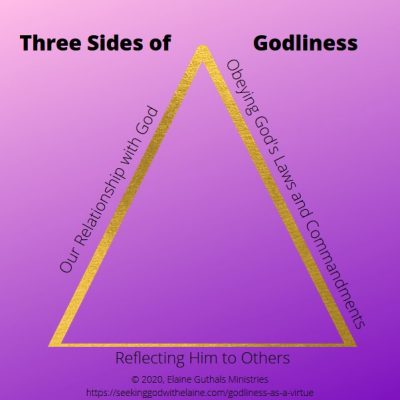
    So, I thought that the last review would be what we’ve said before. This time, we are going to shuffle it through our three sides of godliness.

    • Our Relationship with God
    • Obeying God’s Laws and Commandments
    • Reflecting Him to Others

    It will give us a foundation on which to build this year.

    Our Relationship with God

    • The defining aspect of being God’s elect is we are all to be holy (What Is Expected of Disciples?).
    • It is only through faith that disciples attempt to imitate Jesus and exhibit true compassion, pity, and love (What Is Expected of Disciples?).
    • God loves those who love and submit to Him (What Is Expected of Disciples?).
    • We follow God’s opinions, not our own (What Else Is Expected of Disciples?).
    • We have to work on every characteristic as a package deal. So, on the Sanctification Road, we should run everything we do through the greatest commandments. Is what we are going to say going to keep those commandments or break them? Does our attitudes foster patience, forbearance, gentleness, etc.? If we don’t love, we don’t have the right attitudes (What Else Is Expected of Disciples?).
    • What I think the “… don’t sound a trumpet before you, …” (Mt. 6: 2 CSB) means is religion isn’t to be show (Disciples and Charitableness).
    • Religion and its rituals are not what God wants. God didn’t want the circumcision without the holiness. He doesn’t want baptism without the holiness. There is no purity in the artificial or that which is designed to impress the worldview people (The Nominal Disciple).
    • God doesn’t want this to just be an outward religion. He wants it to be an inward transformation (The Nominal Disciple).
    • What Jesus was about was true religion — how it should be. We were created to worship the Father. We were made to be like Him (Disciples and Charitableness).
    • What Paul was trying to get across was that circumcision is surface. God is looking for obedience, submission, and service. God is looking for a change in heart (The Nominal Disciple).
    • Jesus warned us about motivation. His would have been a radical viewpoint in that day and age. The norm those days was to show you were religious by advertising how you were giving alms, praying, and fasting. Prayer and fasting are personal. Jesus told us that almsgiving should be, too (Disciples and Charitableness).
    • God wants to see evidence that we have chosen Him. That evidence is our obedience. We have to live like we were converted. We have to do the progression. We have to undergo the sanctification. We have to submit (The Nominal Disciple).
    • Humility means we have a real perspective about ourselves. But we have to realize that we should focus on our character, not our intelligence. We have to change our character to imitate God (What Is Expected of Disciples?).
    • While we are in the process of being sanctified, we use charity to become more like God. We are to conduct our charitable activities for His honor and glory (Disciples and Charitableness).
    • We have to be consistent. If we say we are disciples of God, we have to live obediently and not have double standards (The Nominal Disciple).
    • We have to be genuine when we ABCD. We have to truly submit to God. We have to obey His laws and commandments (The Nominal Disciple).

    The ABCDs of Salvation

    If you have not become a believer in Christ, please read through the
    Plan of Salvation and prayerfully consider what God is asking you to do.

    A – admit our sins
    B – believe His Son Jesus is our Redeemer
    C – confess God as Sovereign Lord

    D – demonstrate that commitment by making any changes needed in our lives to
    live the way in which God has called us

    The Disciple’s Job Description

    • We need to build our relationship with God by working out our salvation (How Do We Work Out Our Salvation?).
    • We have to determine what we believe so that we can answer questions when asked what we believe (How Do We Work Out Our Salvation?).
    • Being a living sacrifice means that we offer God our everyday lives, which He can use as a witness to non-believers (How Do Non-Preachers Proclaim the Gospel?).

    Obeying Laws and Commandments

    • If we are righteous, we are imitating God. That would mean we are judging the situation as He would judge it (Disciples’ Duty to the Poor).
    • Bag the pride (A To Do List for Life).
    • Pick friends that are humble (A To Do List for Life).
    • Don’t be a smart alack (A To Do List for Life).
    • Think about what you are doing, and do what is right (A To Do List for Life).
    • No matter how loving we are, we have to change to imitate God’s loving. That means we have to get to heart level (What Else Is Expected of Disciples).
    • Some think disciples have to be doormats. That isn’t true. God knows we will encounter spiritual warfare — especially as we do more for Him. He is looking for boldness with humility (What Else Is Expected of Disciples?).
    • We are to do the charitable acts through mercy (Disciples and Charitableness).
    • We like to think that we are successful because of our knowledge and skills. Paul told us that the only thing we should boast about is God (The Lenient Judgment of Others).
    • John 7: 24 tells us we are to judge based on righteous judgment. What if it is how we live our lives? What if this means we are not supposed to judge surface, but we are supposed to judge deep down? We are not to pass judgment on people, but we are supposed to determine if they are following God’s laws and commandments. No, no one is going to be 100% perfect. We have to determine if we need to witness to them (The Lenient Judgment of Others).
    JudgeOnRighteousJudgment
    • We are not to let other lead us astray (The Lenient Judgment of Others).
    • Most importantly, our job is to preach the gospel and make disciples. How can we do that if we don’t determine if they have admitted their sins, believed on Jesus, and confessed God as Sovereign Lord? (The Lenient Judgment of Others).
    • We have to judge situations. We have to judge intent of people’s actions. If we don’t, we may be headed off the straight and narrow (The Lenient Judgment of Others).
    • Our actions do not depend on what other’s actions are (A To Do List for Life).

    Reflecting Him to Others

    • Help the needy saints (A To Do List for Life).
    • Be hospitable (A To Do List for Life).
    • Don’t be enemies with your enemies (A To Do List for Life).
    • Whatever emotions someone is experiencing, experience those, too (A To Do List for Life).
    • Get along with one another (A To Do List for Life).
    • Don’t hold back on love. Don’t pick and choose who you are going to love. Just do it (A To Do List for Life).
    • God expects us to have a heartfelt sympathy for others (What Is Expected of Disciples?).
    • To be a true disciple, pity and love must follow repentance (What Is Expected of Disciples?).
    • Love is expressed through kindness. Kindness is the action (What Is Expected of Disciples?).
    • We don’t argue — if we answer at all (What Else Is Expected of Disciples).
We don’t pay back evil with evil (What Else Is Expected of Disciples?).
    • Not only do we have a modest demeanor, but we also elevate others (What Is Expected of Disciples?).
    • We’ve got to stand firm patiently (What Else Is Expected of Disciples).
    • We shouldn’t participate in the quarrel in the first place (What Else Is Expected of Disciples?).
    • Forbearance is not only forgiving another, but it is also going the extra distance to meet them halfway (What Else Is Expected of Disciples?).
    • We not only give up the right to retaliate, but we also initiate the forgiveness. Plus, we give up the hurt feelings (What Else Is Expected of Disciples?).
    • We need to forgive for our sake, not necessarily theirs (What Else Is Expected of Disciples?).
    • Why can’t everyone just love everyone else? Sin bashed that (What Else Is Expected of Disciples?).
    • But worldview people don’t want disciples to love them enough to warn them about their future (What Else Is Expected of Disciples?).
    • We have to be concerned enough about the poor for action (Disciples’ Duty to the Poor).
    • Family was to take care of family. God has a plan for our help for others. First, we are to help our biological family (Disciples’ Duty to the Poor).
    • Instead of a brother being reduced to an alien, we have an alien elevated to the status of brother (Disciples’ Duty to the Poor).
    • God calls His children to support each other. No, not everyone is a child of God (Disciples’ Duty to the Poor).
    • Jesus called charity work the way we practice our righteousness (Disciples and Charitableness).
    • Jesus told His disciple to not be judgmental of private individuals. It is not talking about public individuals (The Lenient Judgment of Others).
    • Jesus knew we so often jump to conclusions. We see things as we are, not necessarily as the situation is. We can’t just make snap judgments (The Lenient Judgment of Others).
    • We’ve got to lead with love and compassion, not judgment (The Lenient Judgment of Others).
    • People believing the worldview equate disciples saying “sin no more” as judging. Isn’t it more that we are concerned for the spiritual condition of your hearts and lives? Telling someone to “sin no more” is not judging them. It is the ultimate expression of love (The Lenient Judgment of Others).
    • We are to use our experiences when we witness. If I say this is something that happened to me or helped me in my walk as a disciple (it’s proved itself), you would be more open to trying it for yourself (The Nominal Disciple).
    • Jesus explicitly tells His disciples – of which we are one – they are to witness to non-believers (How Do Non-Preachers Proclaim the Gospel?).
    • We have to be prepared to defend what we believe and why we believe it (How Do Non-Preachers Proclaim the Gospel?).
    HowDoesGodsExpectationsForUsLeadToGodlinessPin

    Making the Connections

    That is a lot of bullet points. If you are like me, you need it synthesized. So, let’s try this.

    1. Submit to God and follow God’s opinions, not our own, by exhibiting obedience, submission, and service (What Is Expected of Disciples?; What Else Is Expected of Disciples; The Nominal Disciple).
    2. Be holy because of a sincere, inward transformation (What Is Expected of Disciples?; The Nominal Disciple).
    3. Imitate Jesus through faith and righteousness by exhibiting true compassion, pity, and love (What Is Expected of Disciples?; What Else Is Expected of Disciples; Disciples and Charitableness; Disciples’ Duty to the Poor).
    4. Build our relationship with God by genuinely ABCDing and working out our salvation by navigating the Sanctification Road (What Else Is Expected of Disciples; How Do We Work Out Our Salvation?).
    5. Expand God’s kingdom by witnessing to by preaching His gospel and making disciples (The Lenient Judgment of Others)
    6. Follow God’s laws and commandments and use them to judge situations (A To Do List for Life; The Lenient Judgment of Others).
    7. Perform charitable acts to fellow disciples and non-believers alike with love, forgiveness, and forbearance (Disciples and Charitableness; What Else Is Expected of Disciples?).

    Okay, that is a start. We’ll be adding to it and modifying it as we go this year.

    Father God. We want to be holy and righteous like You. We want to be godly. Help us with our redo so that we can become what You want us to be – like You. Amen.

    What do you think?

    Leave me a comment below (about this or anything else) or head over to my Facebook group for some interactive discussion.

    If you don’t understand something and would like further clarification, please contact me.

    If you have not signed up for the email daily or weekly providing the link to the devotions and the newsletter, do so below.

    If God has used this devotion to speak with you, consider sharing it on social media.

  • The Form of Godliness

    Godliness has two forms: inward and outward. This daily devotion looks at how godliness needs to have an aspect of spontaneity.

    Nuggets

    • Godliness has a dual form as it should be both an inwardly and outwardly expression.
    • The quest for godliness is to be spontaneous, not calculated for our gain.
    • Unfortunately, some can have a false form of godliness because they are not committed to Sovereign God.

    Devotions in the Review 101: Godliness series

    Godliness is a huge term. It may be difficult for some to wrap their heads around.

    Maybe it will be easier for us to understand if we look at how it is expressed. Let’s see if we can quantify it some.

    Let’s Put It into Context

    Godliness, equated with the Old Testament term fear of the Lord, is an attitude of reverence that is promoted by walking in His Spirit and obeying God’s laws and commandments and produces a moral likeness of God. The fear of the Lord means awe, reverence and love, not terror.

    The Dual Form of Godliness

    “For this very reason, make every effort to supplement your faith with virtue, and virtue with knowledge, and knowledge with self-control, and self-control with steadfastness, and steadfastness with godliness, and godliness with brotherly affection, and brotherly affection with love. For if these qualities are yours and are increasing, they keep you from being ineffective or unfruitful in the knowledge of our Lord Jesus Christ” (II Pet. 1: 5-8)

    Godliness has a dual form as it should be both an inward and outward expression.

    I know we talked about these verses in the last devotion — and a whole series a couple of months ago. We talked about how these elements help us grow.

    Let’s look at now from the lens of what these tell us about godliness itself.

    Maclaren argued that it is appropriate for us to list godliness both with virtues and graces. He reminded us that “the fundamental idea is reverence toward God.”

    Resource

    Then Maclaren said something interesting. He said that the reverence should be all-encompassing: inward and outward.

    The inward expression of godliness is communion with God. Prayer is a two-way communication with God. Even if we are praying with our mouths, we are praying with our hearts. Our inward expression of godliness also manifests itself in confession, praise, and worship.

    The outward expression is our acts of service for God. Service is an act based on belief in God that comes from a response of worship by acknowledging His power through our submission. The Homilist noted this was directed toward mankind.

    Resource

    The way I read Maclaren’s sermon is that godliness is made up of the communication and the acts of service.

    Maclaren felt that we go from faith to godliness by the following:

    • Strength to resist temptations
    • Duty to tell the difference between good and evil
    • Self-control to discipline ourselves
    • Perseverance to increase patience

    Thompson noted that we possess that reverence of God because we love His holiness. Holiness is more than a character trait; it is purity, dedication, and commitment that lead to being set apart.

    This respect, according to Thompson, is “… a reverence for dignity, station, greatness, power, which is cold and formal and distant.”

    Resource

    The outward expression implies a love for God’s laws and commandments. We acknowledge His control in our lives.

    The Spontaneity of Godliness

    “And without faith it is impossible to please him, for whoever would draw near to God must believe that he exists and that he rewards those who seek him” (Heb. 11: 6 ESV)

    The quest for godliness is to be spontaneous, not calculated for our gain.

    Thompson’s definition of godliness had an interesting twist. He cited Robinson, saying that godliness is a “… reverence toward God which is a spontaneous feeling of the heart in view of His character (see in Robinson).”

    Resource

    I don’t see Thompson as meaning we should get a wild hair and jump on the godliness bandwagon. I am think he is meaning that it shouldn’t exclusively have an external stimulus.

    An external stimulus would take on the form described by the Homilist. There, “… respect for the right, compassion for the miseries, and a loving desire for the happiness of all” would cause us to act.

    Resource

    We have to pursue godliness because of an internal stimulus. Thompson said we are pursuing godliness because of Who God is and because it leads us to blessedness. Blessedness means we have been perfected.

    Abernethy described the inward stimuli. He wrote they must constitute a reverence for God’s majesty, a recognition of His glory, and love, gratitude, and respect.

    Resource

    We are pursuing godliness because it leads to eternal life. Eternal life is the promise of living eternally – even if we have died in this life – because we have admitted our sins, believed Jesus as Savior and Redeemer, and confessed God as Sovereign Lord.

    One day, we will see God face to face. We need to be ready for that by ABCDing. We need to have being going from faith to God-likeness.

    One day, we will see God face to face.

    A False Form of Godliness

    “These people always cause trouble. Their minds are corrupt, and they have turned their backs on the truth. To them, a show of godliness is just a way to become wealthy” (I Tim. 6: 5 ESV)

    Unfortunately, some can have a false form of godliness because they are not committed to Sovereign God.

    Paul told us point blank that pursuit of godliness will bring persecution. That makes us wonder why people pursue godliness for gain.

    No, the road to godliness is not easy. “Indeed, all who desire to live a godly life in Christ Jesus will be persecuted” (II Tim. 3: 12 ESV).

    RoadToGodlinessNotEasy

    One would think that verse would scare away anyone who is not fully committed to the Sovereign God. But it doesn’t.

    There are some that are pursuing godliness for some external gain. This is more like Paul was taking about in First Timothy 6: 5. “To them, a show of godliness is just a way to become wealthy” (I Tim. 6: 5 NLT). They are using it to be a means to an end.

    They may have an outward appearance of being righteous. Righteous means we are free from sin because we are following God’s moral laws.

    But inwardly, they have not submitted to the Sovereign God. Not. Going. To. Fly.

    We are commanded to become godly. Kollock wrote, “We are unequivocally commanded to assume the form of godliness; to testify by external acts our allegiance to the Lord; and to attend on those ordinances and sacraments which He surely did not appoint that we might with impunity neglect them.”

    Resource

    See what that says? Testify. Witness. Witnessing means we tell non-believers that Jesus can be their personal Savior, even though that may be considered our perspectives and opinions.

    We have to tell others what Sovereign God has done in our lives. That is in our job descriptions.

    The Disciple’s Job Description

    Complete Job Description

    Individual Descriptions

    Job Duty #4
    Proclaim the Gospel (Mark 16: 15)

    Job Duty #6
    Make Disciples (Matthew 28: 19-20)

    We can’t hide the fact that we have submitted our lives to the Sovereign God. Kollock wrote that we can’t just worship Him in our hearts. Why?

    The inward expression of godliness has to bubble out to be an outward expression of godliness. “For with the heart one believes and is justified, and with the mouth one confesses and is saved” (Rom. 10: 10 ESV).

    See. In, then out.

    The flip side of that is that it cannot be an out without the in. We cannot believe being a good person will gain admission to Heaven. A person who has not changed to possess the nature of God and follow the commands of God is not godly.

    To read a related devotion, click the button below.

    There is another form of false godliness. The Homilist wrote, “There is often a great deal of external worship where there is no godly devotion.” We’ve called this being a nominal disciple. Nominal disciples are those boasting they loved God without even trying to imitate Him — those who dig on religion and its rituals without having a change in heart.

    Resource

    TheFormOfGodlinessPin

    Making the Connections

    Abernethy contended that godliness is a support of the virtues. Our ability to become godly and to obtain those virtues all stem from obeying God’s laws and commandments.

    Resource

    Hamer must have agreed. He wrote, “It is no easy thing, under all circumstances, to look calmly and trustfully up to the throne of the living God, and cheerfully commit all our life to His fashioning and to His keeping: it is no easy thing at all times to trace the gentleness of His grace in the ways of providence.

    Resource

    When we become disciples of Christ, we have to consider godliness our duty. We no longer have the choice of whether we will or will not become godly.

    That is part of the package for which we signed up.

    How Do We Apply This?

    Now that we know the form, we know how to get there. Paul told us to “But you, man of God, flee from these things, and pursue righteousness, godliness, faith, love, endurance, and gentleness” (I Tim. 6: 11 CBS).

    Yes, this sounds like the Sanctification Road. “But sanctify the Lord God in your hearts …” (I Pet. 3: 15 KJV).

    Looking back over this, the two forms make sense to me. We have to be totally committed. Not just doing lip service to God (at best) while doing wonderful social work. We can’t be praising God at the top of our lungs, and be doing nothing to tell of His love to others.

    We have to be totally committed to being like God.

    Loving Father. We don’t want to be just giving You lip service. We don’t want our worship to be praise only. We want inward and outward forms of godliness. We want to totally be like You. Amen.

    What do you think?

    Leave me a comment below (about this or anything else) or head over to my Facebook group for some interactive discussion.

    If you don’t understand something and would like further clarification, please contact me.

    If you have not signed up for the email daily or weekly providing the link to the devotions and the newsletter, do so below.

    If God has used this devotion to speak with you, consider sharing it on social media.

  • Godliness: The Parent of Contentment

    There is a benefit of becoming godly. We gain contentment. This daily devotional looks at how giving God priority in our lives and following His laws and commandments makes us godly, which brings contentment.

    Nuggets

    • When we become godly and gain contentment because we have the character we were intended to have.
    • In order to accomplish our redo, we have to give God the priority in every area of our lives.
    • Godliness, along with contentment, comes from being obedient to God’s laws and commandments.

    Devotions in the Review 101: Godliness series

    We are executing a redo this year because we want a better result. We want to be more like God, which will bring us contentment.

    Ooo, baby! The year has just begun, and we already know we will need lots of contentment this year!!!

    Let’s Put It into Context

    Godliness, equated with the Old Testament term fear of the Lord, is an attitude of reverence that is promoted by walking in His Spirit. The fear of the Lord means awe, reverence and love, not terror.

    We spent a whole series looking at contentment. Some of the things were learned were the following:

    • God has commanded all disciples be content in our situations.
    • Knowing God and being like God will be us contentment.
    • We like to think that godliness and holiness are synonymous, but sometimes, we like to think those are just a short distance from sin.
    • We know what makes us content and what doesn’t.
    • It matters whether we are content or not.
    • We have to look at our employment as it — whatever we are doing — is ordained by God.
    • God wants us to be working toward what He wants us to be working toward.

    To read a devotion in the Contentment Leads to Tranquility series, click on the appropriate button below.

    How Is Godliness Related to Contentment?

    “Now there is great gain in godliness with contentment” (I Tim. 6: 6 ESV)

    When we become godly, we gain contentment. This is because we have the character we were intended to have.

    Godliness fosters contentment because we become like God. When God originally created us, He made us this way. However, we changed after Adam and Eve committed the original sin.

    Becoming godly takes us back to the way we were originally created. It means we possess spiritual life, not spiritual death. Spiritual death is the separation from God that occurred as a consequence of Adam and Eve’s original sin. The spiritually alive are those who have ABCDed, so they are no longer separated from God.

    However, godliness can produce contentment in this life. Sibthorp listed one of the benefits as “… the improvement of his judgment, his discrimination, his mental faculties.” Our lives have more contentment because of this improvement.

    Resource

    Beattie explained how that can be. Leading godly lives eliminates sorrows in life. Yes, there will be sorrow, but godliness brings joy to life. “Restore to me the joy of your salvation, and uphold me with a willing spirit” (Ps. 51: 12 ESV).

    Resource

    Godliness Obtained through the Gospel

    In order to accomplish our redo, we have to give God the priority in every area of our lives. It also means growing in the three sides of godliness.

    We want to be like God. In order to do that, we follow the gospel, “… because the object of the revelation of Christ in the gospel is to show us the character of God in the person of a man, and thereby set us a pattern for us to copy — and by offering grace to all, by which they may be able to copy that pattern, to make them Godlike by making them like Christ.” That means we have to seek God

    Resource

    It will take hearing His Word, reading it, studying it, meditating on it, and memorizing it. All through that, we need to be in prayer, asking God to provide the meaning.

    Searching for and Seeking God

    Hearing His Word (Rom. 10: 17).
    Reading His Word (Rev. 1: 3).
    Praying to Him (Heb. 4: 16).
    Studying His Word (Ac. 17: 11).
    Meditating on His Word (Ps. 1: 1-2).
    Memorizing His Word (Ps. 119: 11).

    Godliness Obtained through Obedience to the Laws and Commandments

    Godliness, along with contentment, comes from being obedient to God’s laws and commandments. That is because the laws and commandments show us God’s character.

    As we follow them, our character changes to be like Him. It becomes second nature to us.

    Look at it this way. Our three sides of godliness follow the greatest commandments.

    “‘Teacher, which is the great commandment in the Law?” And he said to him, ‘You shall love the Lord your God with all your heart and with all your soul and with all your mind. This is the great and first commandment. And a second is like it: You shall love your neighbor as yourself’” (Mt. 22: 36-39 ESV).

    • If we love God, we will build our relationships with Him.
    • If we love God, we will obey His laws and commandments.
    • If we love others, we will reflect Him to others
    GodlinessFollowsGreatestCommandments

    In How Does Dedication Help Consistency?, we said that this is how Christian perfection is achieved. Our character is changed to be like His.

    Godliness breeds contentment because our relationships with God is where they should be. Becoming more like God brings us peace that allows us to be satisfied.

    Newton must have thought the same way because he had an interesting definition of godliness. He said godliness is “… real, vital, experimental, practical religion — genuine Christianity — a religion concerning God, the great, the wise, the blessed God.”

    Resource

    We can understand the vital part. It has to be a 24/7/365 relationship.

    Experimental? When something is experimental, it is untested. That means it isn’t the final product.

    Well, doesn’t that fit? We are still a work in progress. We are being tested.

    No, we won’t be a finished product until we are perfected. The perfected state indicates the combination of the graces which, when all are present, form spiritual wholeness or completeness.

    Glossary

    We are not going to be perfect until we are called home. Until then, we will get things right sometimes.

    Sometimes, we will not. That’s why it is experimental.

    GodlinessTheParentOfGodlinessPin

    Making the Connections

    “But he said to me, ‘My grace is sufficient for you, for my power is made perfect in weakness.’ Therefore I will boast all the more gladly of my weaknesses, so that the power of Christ may rest upon me” (II Cor. 12: 9 ESV)

    Smith had an interesting sermon. Its title was Enough. He wrote, “The godly man hath found that which all the world doth seek, that is, enough.”

    Resource

    We are content with what God has given us. Why?

    It isn’t about what He has given us. It is about being in a relationship with Him.

    Some of us may find perfection in the next year. One thing brought home to Adam and I this year — as with so many others — we aren’t guaranteed next year — or even tomorrow.

    Unless Jesus comes to call us home, the majority will still be here this time next year. We have to find enough.

    Enough is going to be different this year, just like it was the year before — and every year before that.

    Each year has its own enough. We have to see what God’s plan says enough is for us this year.

    How Do We Apply This?

    We work to know God as Maclaren said: “… His character, His heart, His relations to us, His thoughts of good concerning us sufficiently for all intellectual and for all practical purposes.”

    Resource

    Berry said that we have to do this by being in Christ. Our evaluations of ourselves need the framework of God is calling us to be saints. Saint means holy one who has been set apart.

    Resource

    So, if we are in a redo year, what is God going to think about that?

    Lewis gave us an idea. He wrote, “The Saviour sees, not merely what we are, but what we may become, and as fidelity is the highest element of moral worth, He estimates the value of men, not by what they do, but by their fidelity — by the proportion which exists between their power and their performance. The lisping prayer of a little child may thus be of greater value in God’s estimation, than the highest song which ever rose from an angel’s heart.”

    Resource

    Oh, don’t get me wrong. God is not delusional about us. He sees us exactly as we are.

    But what isn’t all. God sees us bought by the blood and changed into someone like His Son.

    So, this year we are not going to focus on how we have messed up in the past. (He has forgiven us of those sins when we asked.)

    We aren’t going to focus on what is wrong with us now.

    We are going to focus on what God wants us to be. Like Him.

    Father God. We are humbled that You give us second chances. In fact, You forgive us again and again when we ask. Lord, we want to grow to be more like You. We want to follow Your laws and commandments because we have Your character. We can only do that through You changing us. Amen.

    What do you think?

    Leave me a comment below (about this or anything else) or head over to my Facebook group for some interactive discussion.

    If you don’t understand something and would like further clarification, please contact me.

    If you have not signed up for the email daily or weekly providing the link to the devotions and the newsletter, do so below.

    If God has used this devotion to speak with you, consider sharing it on social media.

  • Starting Anew: Redo for Godliness

    When we sin, we need a redo to get back to godliness. Luckily, God allows that. This daily devotional looks at the fear of the Lord as the foundation of godliness and how we will be looking at that throughout the year.

    Nuggets

    • After we start getting better at disciplining ourselves, we need to put godliness into practice.
    • God makes us new creatures so we can have a redo.
    • We shouldn’t focus on the sin; instead, our focus needs to be on our Redeemer and His call for us.
    • Fear of the Lord, the Old Testament term is the same concept called godliness in the New Testament.
      • We begin to put the fear of the Lord into correct perspective when we realize what God has done for us.

    Devotions in the Review 101: Godliness series

    A couple of months ago, we looked at how we are to be children of God. That can be a difficult concept — ask Nicodemus.

    Glossary

    We said that Paul really didn’t explain it much better to some peoples’ estimation. “Therefore, if anyone is in Christ, he is a new creation. The old has passed away; behold, the new has come” (II Cor. 5: 17 ESV).

    I found a really great quote by Vaughan helped me understand. He wrote, “This image does not convey the idea of a perfectly new being, but of an old being begun again, that it may do better.”

    Resource

    God makes us new creatures, so we get to have a redo.

    Most of us are probably jumping up and down with joy because we didn’t get it right the first time. Well, we begin a new year today. This is our opportunity for a redo.

    I told you last year when we were looking at self-discipline, I thought God would be saying, “You need to work on this sin, that sin, and the other sin.”

    God didn’t. He told me I needed to mature my faith. I feel like I did mature last year. I hope you did, too.

    So, new year — new word.

    When we did Godliness as a Virtue, I did (what I thought was) a really neat graphic on the three sides of godliness.

    • Our Relationship with God
    • Obeying God’s Laws and Commandments
    • Reflecting Him to Others

    To read a related devotion, click the button below.

    Triangle

    What better place to go next?! After we start getting better at disciplining ourselves, we need to put that into practice.

    The thing is, I still don’t see God as saying, “So now we are going to get around to work on this sin, that sin, and the other sin.” Oh, yes. That is going to be the how.

    The what, though, is how do I become more like Him? That is the focus.

    Our goal is to have God’s character — to be godly.

    We talked in How Are God’s Messengers Supposed to Respond, that a lot of times, we focus solely on our relationship and what we have to do to get back into obedience. I want to reshare this nugget.

    To read a related devotion, click the button below.

    Robinson wrote, “It never helps anyone to begin desperately to study his wickednesses with a view to outroot them. It is better for him to keep looking at God. The objective study of Christ, His life, character, etc., is far safer and more profitable for growth in grace than any painful act of self-examination.”

    Resource

    We shouldn’t focus on the sin. Our focus needs to be on our Redeemer and His call for us.

    This has been rummaging around in my mind since August, so I have a little better head start this year for where I think God is leading me — and you since you have chosen to come along for the ride.

    In all honesty, I can’t say I am any better organized. I have a lot of things in the drafts folder, but there is no real schedule — yet.

    Let’s start out with what we know about godliness. Our discussions started out calling it fear of the Lord, the Old Testament term. The same concept is called godliness in the New Testament.

    Let’s Put It into Context

    Godliness, equated with the Old Testament term fear of the Lord, is an attitude of reverence that is promoted by walking in His Spirit. The fear of the Lord means awe, reverence and love, not terror.

    The glossary page is a little lacking.

    • The fear of the Lord means reverence and love, not terror (What Does Fear of the Lord Mean?).
      • Our following God’s laws and commandments shows that we fear God (Finding Favor by Acknowledging God).
      • When we fear God and give honor to Him, we want to serve Him (What Constitutes an Obedient Disciple?).
      • Walking in the Spirit should promote the fear of the Lord (What Does It Mean to Walk in the Spirit?).
      • The New Testament term godliness is equated with the Old Testament term fear of the Lord (Godliness as a Virtue).
      • God’s intent is us loving Him, and we show that love by obeying Him. Obedience means we not only hear God’s Word but also follow His instructions (Can We Change the Scriptures?).

    We have a whole year to rectify that. So, let’s start by working on the foundation.

    Fear of the Lord: The Foundation of Godliness

    “Fear of the Lord is the foundation of true wisdom. All who obey his commandments will grow in wisdom” (Ps. 111: 10 NLT)

    Let’s start with fear of the Lord. That is the Old Testament term, which is the foundation for the New Testament. So, let’s build the foundation.

    Maccolloch expanded our definition. He wrote fear of the Lord denotes “… affection of reverence, which arises in the mind by means of the contemplation of the grandeur and dominion, the power and righteousness, with the other Divine excellences of Jehovah. It adores His greatness; it venerates His purity; it respects His omniscience; it does homage to His goodness; it stands in awe of His power; it honours His justice, and is solicitous to avoid His displeasure.”

    Resource

    Hmmm. I don’t know if I would have used the word affection to describe it. A fondness seems shallower than what I would associate with reverence.

    The grandeur, dominion, power, and righteousness fit with God.

    • “Splendor and majesty are before him; strength and joy are in his place” (I Chron. 16: 27 CSB).
    • “Now we have this treasure in clay jars, so that this extraordinary power may be from God and not from us” (II Cor. 4: 7 CSB).
    • “Now he is far above any ruler or authority or power or leader or anything else—not only in this world but also in the world to come” (Eph. 1: 21 NLT).
    • “And be found in him, not having a righteousness of my own that comes from the law, but that which comes through faith in Christ, the righteousness from God that depends on faith” (Phil. 3: 9 ESV).

    It also speaks of some other words about which we’ve talked: purity, omniscience, goodness, justice.

    • “Create in me a clean heart, O God, and renew a right spirit within me” (Ps. 51: 10 ESV).
    • “For whenever our heart condemns us, God is greater than our heart, and he knows everything” (I Jn. 3: 20 ESV)
    • “The LORD passed before him and proclaimed, “The LORD, the LORD, a God merciful and gracious, slow to anger, and abounding in steadfast love and faithfulness” (Ex. 34: 6 ESV).
    • “Therefore the Lord waits to be gracious to you, and therefore he exalts himself to show mercy to you. For the Lord is a God of justice; blessed are all those who wait for him” (Isa. 30: 18 ESV).

    That means the fear of the Lord is an awe and reverence to which God is due. We should want to always possess this toward Him.

    So, what does that mean for us? “What then shall we say to these things? If God is for us, who can be against us?” (Rom. 8: 31 ESV).

    Spurgeon said that this fear “… dwells with it [love] in harmony.” He doesn’t want us to keep our distance. He wants communion.

    Resource

    We begin to put the fear of the Lord into correct perspective when we realize what God has done for us. “For God so loved the world that he gave his one and only Son, that whoever believes in him shall not perish but have eternal life” (Jn. 3: 16 NIV).

    God actually had His Son be born as a human being so that He would be the Sacrifice to pay the penalty for our sins. Sins are actions by humans that disobey God and break one of His reasonable, holy, and righteous laws and commandments, goes against a purpose He has for us, or follows Satan’s promptings.

    Wow.

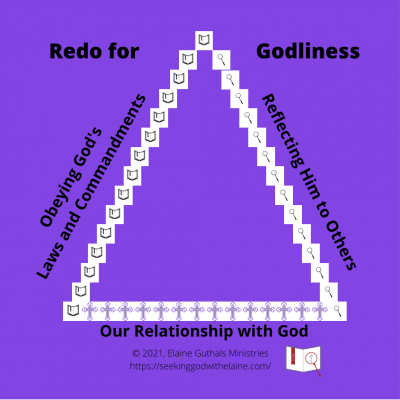
    RedoForGodliness

    So, Where Is Our Road Taking Us This Year?

    • I think I am going to start out looking at all the verses that talk about godliness.
    • Then we will talk about ungodliness. I want to look at the term days of Noah as it applies to the end days. This would fall under Obeying God’s Laws and Commandments.
    • We also need to look again/further into Who God and Jesus are. How can we imitate them if we don’t really know Who They are? This addresses Our Relationship with God.
    • Transitioning from being ungodly to being godly could straddle Obeying God’s Laws and Commandments and Our Relationship with God.
    • Working on being godly could straddles all three categories.

    As usual, things may change as I dig into the topics. We’ll just have to see where this takes us.

    Father God. It is our prayer and desire to become more like You. That is Your Will for us, and You have made us so that we can grow. Help us this year as we do a redo. Grow us in the areas You know we need. Amen.

    StartingAnewPin

    What do you think?

    Leave me a comment below (about this or anything else) or head over to my Facebook group for some interactive discussion.

    If you don’t understand something and would like further clarification, please contact me.

    If you have not signed up for the email daily or weekly providing the link to the devotions and the newsletter, do so below.

    If God has used this devotion to speak with you, consider sharing it on social media.

  • Finding Jesus

    When Mary and Joseph found Jesus in Jerusalem, He was in the temple asking questions of the teachers. This daily devotional looks at why Jesus was where God wanted Him to be and why He went back to Nazareth with His family.

    Nuggets

    • While Mary and Joseph were on the way home to Nazareth, Jesus was in the Bible school at the temple.
    • Jesus was exactly where God wanted Him to be.
    • Jesus went back to Nazareth and submitted Himself to obeying Mary and Joseph.

    Devotions in the Passover Trip to Jerusalem series

    Finding Jesus

    Why in the world would Jesus stay in Jerusalem when He knew that Mary and Joseph were leaving? Well, He had his reasonings. Let’s look.

    Let’s Put It into Context

    “After those days were over, as they were returning, the boy Jesus stayed behind in Jerusalem, but his parents did not know it” (Lk. 2: 43 CSB)

    Mary and Joseph had gone to the Passover Festival and taken the 12-year-old Jesus. Everything went smoothly until the trip home.

    The caravan left without Jesus. They went up to 20 miles without missing Him.

    Mary and Joseph returned to Jerusalem to look for Jesus.

    Reunited with Jesus

    “After three days, they found him in the temple sitting among the teachers, listening to them and asking them questions. And all those who heard him were astounded at his understanding and his answers” (Lk 2: 46-47 CSB)

    While Mary and Joseph were on the way home to Nazareth, Jesus was in the Bible school at the temple.

    I am sure Mary and Joseph were looking in perfectly acceptable places. They probably started with the place they stayed. They would have gone to other friends and family members’ homes.

    It is easy to armchair coach and say, “Well, why didn’t You start there?” I doubt I would have started at the temple.

    However, it is logical that Jesus would have been at the temple. He would have been home there. We don’t know how much He remembered of Heaven, but He did know He was God’s Son. If nothing else, Mary would have told Him that.

    But look at what Jesus was doing. He wasn’t praying. He wasn’t singing and worshiping.

    Jesus was at the Bible school. He was there to learn.

    What?! The Son of God having to learn????

    Trumbull addressed that. He wrote, “Although He was the Son of God, He felt the need of Bible study; and, feeling that need, He went into the Bible school, where the need could be met. If there is a man nowadays who thinks that he doesn’t need Bible study, or that it is beneath his dignity to be in the Bible school, he either seems to suppose that he knows more than Jesus knew, or he seems to count it hardly safe to be on the same plane with the Son of God.”

    Resource

    In a way it amazes me that the teachers would have put up with three days of questions from Someone Who was not their student. Wouldn’t they have questioned any child being there for three days? I am sure it wasn’t a common occurrence — someone wanting to go to school that wasn’t supposed to be there.

    It probably went on for such an extended time because Jesus fascinated them. “And all those who heard him were astounded at his understanding and his answers” (Lk 2: 41-47 CSB). I bet this was especially true if this was the first time Jesus would have been considered old enough to attend Passover.

    It makes us wonder if the teachers were questioning how Someone so knowledgeable could have come out of Nazareth. I mean, they were the teachers in THE temple. How would other teachers know more than they did?

    But they were teachers. We are instructed to grow. “Rather, you must grow in the grace and knowledge of our Lord and Savior Jesus Christ …” (II Pet. 3: 18 NLT).

    Even Jesus was expected to grow. We do know from our recent study of Isaiah that it was prophesied that the Christ Child would grow.

    • “Then a shoot will grow from the stump of Jesse, and a branch from his roots will bear fruit” (Isa. 11: 1 CSB).
    • “For he grew up before him like a young plant, and like a root out of dry ground; he had no form or majesty that we should look at him, and no beauty that we should desire him” (Isa. 53: 2 ESV)
.

    To read a related devotion, click the appropriate button below.

    Growing takes place inside and outside of our homes. Outside growth means we are also to make sure they are engaged in corporate worship. Trumbull wrote, “Prayer and praise and reverence and devotion, and obedience and right being and right doing in all things at home, and worship and attentive hearing in the House of God, are duties which parents ought to see that their children attend to.”

    Resource

    Trumbull’s brief words give us a good snapshot of Jesus’ character. He does have a holy disposition. William of Auvergne wrote, “A holy disposition is the source and fountain of all goodness: the soft wax out of which is moulded the image of love, purity, obedience (James 3:17).”

    Resource

    I know. How can Jesus Who is also God grow to know Himself better? I think the obvious answer is that He had to be the example for us. We had to show us how we are to grow.

    I think the other part is that things were not as they were. Jesus is no longer in Heaven with God.

    Jesus still wanted to communicate with God. He could no longer do it “face to face” — whatever that entailed.

    That brings up a great point. How do we grow closer to God when we don’t feel as close to God?

    We do what Trumbull said.

    • Prayer
    • Praise
    • Reverence
    • Devotion
    • Obedience
    • Right being and right doing in all things at home
    • Worship and attentive hearing in the House of God

    Resource

    We will always learn something. One of my Ladies explained it perfectly once. She said that, yes, we may be reading the same words for the umpteenth time. But we are different people this time. They mean something different to us.

    Clark brought up a good point. Jesus was showing humility, allowing the recognized teachers of this world to teach Him.

    Resource

    I am sure, though, that it was a two-way street. He was teaching them in His answers.

    Why Was It Necessary for Jesus to be in His Father’s House?

    “When his parents saw him, they were astonished, and his mother said to him, ‘Son, why have you treated us like this? Your father and I have been anxiously searching for you.’ ‘Why were you searching for me?’ he asked them. ‘Didn’t you know that it was necessary for me to be in my Father’s house?’ But they did not understand what he said to them” (Lk 2: 48-50 CSB)

    Jesus was exactly where God wanted Him to be.

    I don’t know what I would say to Adam if he had been missing three days when he was 12. It might have been some version of “How could you do this to us?”

    Longwill reminded us that just because our kids may be mini me’s, it doesn’t mean they don’t have different interests. They are their own persons.

    Resource

    Some of us might question why this whole incident wasn’t considered a sin. The fifth commandment says, “Honor your father and your mother so that you may have a long life in the land that the Lord your God is giving you” (Ex. 20: 12 CSB).

    I think this falls under the two greatest commandments. “‘Teacher, which is the great commandment in the Law?’ And he said to him, ‘You shall love the Lord your God with all your heart and with all your soul and with all your mind.  This is the great and first commandment.  And a second is like it: You shall love your neighbor as yourself. On these two commandments depend all the Law and the Prophets’” (Mt. 22: 36-40 ESV).

    In Elaine speak, what this is telling us is that, whenever we come across a dilemma, we should resolve it by loving God and doing His Will. That does not give us a license to sin, but neither does that allow us to not do what He is telling us.

    It is easy to start biting on Mary. Shouldn’t she have remembered that Jesus was just on loan to her from Sovereign God?

    Brooks thought Mary’s response was typical of someone who had been entrusted a great responsibility. The response is especially expected when the person is as conscientious as Mary appeared.

    Some of us get lost in the jobs we are supposed to do, don’t we? We can’t separate ourselves from it.

    Brooks explained it this way. He wrote, “Such people are people who have realized responsibility more than they have realized God.” Ouch.

    Resource

    We put more emphasis on our actions and our abilities than for Whom we are performing the tasks. Simply, we take our focus off God.

    We can get where Mary was coming from at that point. Yes, Jesus was right where He should be in His Father’s house. No, He shouldn’t have stayed without telling them.

    All Mary saw was it wasn’t Jesus’ time – yet. He was only 12. Ministry started when you were 30. He had 18 to continue to grow — under her tutelage.

    We have to realize God is Sovereign Lord of the kids, too. He doesn’t ignore them until they are 30 and ministry age. He can — and will — use them if it furthers His kingdom.

    I think we had to have been there to see if Jesus was talking back to Mary or trying to ease her mind. “‘Why were you searching for me?’ he asked them. ‘Didn’t you know that it was necessary for me to be in my Father’s house?’” (Lk. 2: 49 CSB).

    This just popped into my head. I wonder if, up until this time, Jesus was basically being a normal kid. He wasn’t focused on His future.

    But on this trip, by seeing and being in the temple, Jesus really committed to completing the Plan of Salvation. Everything He did from here on out was preparation for His ministry.

    I wonder if that is why this is included in the Scriptures. Jesus had a choice. Was He going to complete the Plan of Salvation or not?

    God wanted us to see where Jesus chose His plan. Yeah, starting His ministry at 30 was the act of starting His ministry.

    But God wanted us to see that, right before Jesus reached adulthood, He chose to be the Suffering Savior.

    JesusChose

    Still, Jesus Went Back Home

    “Then he went down with them and came to Nazareth and was obedient to them …” (Lk 2: 51 CSB)

    Jesus went back to Nazareth. He submitted Himself to obeying Mary and Joseph.

    It seems a little strange that in one verse Jesus is saying He is right where He is supposed to be and the next verse He goes back to where He was.

    I think this is where obey Your parents comes into play. I think Jesus also realized He needed to finish growing.

    Probably, what is meant here is much deeper than the simple words. Jesus was going home to learn more about what human domestic life was all about.

    Let’s face it. When we are kids in single digits, we don’t look around us and evaluate what is happening except how it impacts us.

    We have to grow up to see how the home runs. We can then start really looking at family relationships. Then we start learning about relationships outside of the family structure.

    I love what Brooke said. He wrote, “He gives no sanction to the error of those who think that in separation from all domestic and social ties they can live more purely and worship God with a more entire devotion; that a systematic contempt for all the bonds which bind mother to son, and wife to husband, is a proof of the highest spirituality; whose spiritual religion consists in a denial of the natural piety of the heart, and whose efforts for a reformation of human nature are founded on a denial of human nature.”

    Resource

    We can’t separate ourselves totally from the world. We are to be in the world but not of the world. That means we are to grow to have the human nature that God has given us while giving up the human nature Satan wants us to have.

    Wordsworth brought up a good point. He wrote, “The only acts recorded of Christ’s childhood are acts of obedience — to God His heavenly Father, also to His earthly parents.”

    Resource

    That is what Jesus’ life was all about. He submitted to His parents and fulfilled the laws and commandments.

    Jesus submitted to His Father and saved us from being separated from God.

    FindingJesusPin

    Making the Connections

    Trumbull said it best. He wrote, “Jesus won the favour of man by seeking the favour of God.”

    Resource

    Jesus couldn’t have been the Messiah aligned with the religious machine of the day. He was here to right what was wrong.

    All His life, Jesus showed how God wants us to be. We are to be obedient and submissive — always to God, sometimes to others.

    How Do We Apply This?

    It is easy to lose Jesus. When we start focusing on this world, we let Him slip away.

    We find Jesus by searching for Him and seeking Him.

    Searching for and Seeking God

    Hearing His Word (Rom. 10: 17).
    Reading His Word (Rev. 1: 3).
    Praying to Him (Heb. 4: 16).
    Studying His Word (Ac. 17: 11).
    Meditating on His Word (Ps. 1: 1-2).
    Memorizing His Word (Ps. 119: 11).

    We always know where we are going to find Jesus — in the temple. We find Him by repenting.

    Loving Father. Forgive us when we take our eyes off of You. Forgive us when we value this world over our relationships with Jesus. Lead us back to You. Amen.

    What do you think?

    Leave me a comment below (about this or anything else) or head over to my Facebook group for some interactive discussion.

    If you don’t understand something and would like further clarification, please contact me.

    If you have not signed up for the email daily or weekly providing the link to the devotions and the newsletter, do so below.

    If God has used this devotion to speak with you, consider sharing it on social media.

  • The Prophecy of a Meek Savior

    Usually when we think of a leader, we think of a charismatic leader. The Christ Child, instead, was prophesied to be meek. This daily devotional looks at why the Christ Child did not fit Jewish expectations and how we are to imitate Him.

    Nuggets

    • Isaiah said the attributes of beauty and majesty were not associated with the Christ Child.
    • We have no physical description of Jesus.
    • Jesus did not come rolling in as some big, bombastic personality but as a servant.
    • God does things His own way.
    • It isn’t about what we look like or what we do or don’t do.

    Devotions in the Prophecy of the Christ Child series

    We’ve talked before about how the Jews were looking for a military Messiah. Pastor John said Sunday that they were probably looking for a knight in shining armor to come riding in and save the day.

    Resource

    When we think about their expectations, we generally stop there. But I bet there was more to it.

    Wouldn’t they have also been looking for some charismatic, larger-than-life leader?

    That isn’t exactly the words Isaiah used to describe the Christ Child. Let’s take a look.

    Let’s Put It into Context

    The Holman Bible Dictionary defines prophecy as “reception and declaration of a word from the Lord through a direct prompting of the Holy Spirit and the human instrument thereof.”

    Resource

    Prophecy is a divine revelation to mankind through the Holy Spirit of a future event. This was God telling us that we would be delivered.

    Let’s Put It into Context #2

    Meekness is a personality trait exhibiting a mild or moderate disposition that places dependence on God.

    Most of the newer versions translate the word that used to be meek as humble. That term is more recognizable to most.

    Meekness does have components of other familiar words. They are gentleness, patience, perseverance, longsuffering, endurance, faith, holiness, and love.

    Peace is also a component of meekness. We cannot be meek unless we are forgiving and have patience.

    But that does not mean that we are to be doormats. The meekness must be accompanied by boldness. The definition of meekness talks of controlled power. This touches on self-control.

    To read a related devotion, click the appropriate button below.

    Jesus wasn’t a doormat, and we are to imitate Him. Hambleton wrote, “He is a Lamb in meekness; He is the Lion of the tribe of Judah in strength. His work required a very undaunted spirit, and He never quaked with fear, nor trembled with alarm.”

    Resource

    Why are disciples called to be humble and meek? This is how we submit to God. It is also how we imitate Him.

    Glossary

    How Did Prophecy Foretell a Meek Savior?

    “He had no beauty or majesty to attract us to Him, nothing in His appearance that we should desire Him” (Isa. 53: 2 NIV)

    Say what?!? Nothing He could use as a calling card to hook people in?

    Oh, no. When we are looking for a leader, they have to at least look presentable. They have to have an appearance with which we are comfortable.

    Majesty? We generally think they should have an air of confidence about them. They shouldn’t waffle.

    Not the Christ Child. Isaiah said the attributes of beauty and majesty were not associated with the Christ Child.

    AttributesNotAssociated

    How Did Jesus Fulfill the Prophecy?

    I would argue that this prophecy was fulfilled because we have no evidence to the contrary.

    We have no physical description of Jesus. There is nothing to back up His fulfilling this prophecy – but there is nothing to refute it either.

    You would think that if Jesus were the most beautiful person to ever walk the face of the earth, we would still be hearing about it. We aren’t.

    It sounds like Jesus was considered an ordinary person. It wasn’t His looks, smarts, or bank account that made Him the Christ Child.

    I would argue that it was Jesus’ temperament that did.

    Jesus, the Meek Messiah

    “For who is the greater, one who reclines at table or one who serves? Is it not the one who reclines at table? But I am among you as the one who serves” (Lk. 22: 27 ESV)

    Jesus did not come rolling in as some big, bombastic personality. He came in as a servant.

    I hope I can say this right. It wasn’t about Jesus the Man. It was about the message.

    The message was mankind has messed up and become separated from God. God didn’t want that condition to continue.

    It was about Jesus the Message. The message was that God loved us so much, He sent Jesus to pay the penalty for our sins.

    The message is all about God’s grace and love.

    Let’s go about it a different way.

    The message is all about God’s grace and love.

    God’s Standard Operating Procedure

    “Jesus looked at them and said, ‘With man this is impossible, but with God all things are possible’ (Mt. 19: 26 CSB)

    We have it set in our minds how we think God is going to operate. We think He can’t do the impossible and won’t do the unlikely.

    Ooo, baby. Are we wrong!

    God gave a virgin a Baby Son. He had 12 men who were uneducated and uninfluential build His church. He has me writing daily devotionals so others can read them.

    God doesn’t follow standard means. He does things His own way.

    Why wouldn’t God use the most confident, the best looking, the totally “with it” person to spearhead His ministries?

    The ministry isn’t about the minister. It is about God.

    When we are confident, beautiful, and “with it,” we tend to forget about God. We may even think we are working under our own steam.

    Jesus knew He wasn’t on earth fulfilling His own plan. He was here accomplishing the Plan of Salvation.

    If you have not admitted that your relationship is not right with God,

    have not asked Jesus to be your Lord and Savior,

    and have not confessed your sins,

    please read through the Plan of Salvation and prayerfully consider what God is asking you to do.

    But wasn’t that part of the point, too? We don’t have to look a certain way to be a child of God. We don’t have to have a specific IQ. We don’t even have to clean up our acts before we come to God for salvation.

    To read a related devotion, click the button below.

    Bogg put it this way. He wrote, “By His appearing in the humble, suffering state He teaches us how very insignificant in the sight of God, and in the eyes of true wisdom, are all the possessions of this world and all the flattering distinctions of a present state.”

    Resource

    It’s All about Character

    “But the Lord said to Samuel, ‘Do not look on his appearance or on the height of his stature, because I have rejected him. For the Lord sees not as man sees: man looks on the outward appearance, but the Lord looks on the heart’” (I Sam. 16: 7 ESV)

    It isn’t about what we look like or what we do or don’t do. We’ve known this ever since David was anointed king. God told Samuel the outside appearance doesn’t matter.

    It is about our relationship with Sovereign God. Are we submitting to Him? Are we obedient to Him?

    It is about whether we are changing our character to be like His.

    Jesus submitted and was obedient — straight down the line. He did not sin at all.

    Parker put it this way. He wrote, “It was not a beauty of form, it was the beauty of expression. It was not the beauty of statuary, it was the beauty of life.”

    Resource

    Bersier made a very interesting statement. He wrote, “His [Jesus’] extraordinary sobriety of thought and of language is the best proof that His was not the supreme effort of the human soul aspiring towards the infinite. It is the revelation of God who tells man just as much as it is necessary for him to know and no more.”

    Resource

    We don’t want to read that as we only have to do enough to get our feet into Heaven. Elaine-speak says God wants us to tell others about His plans in simple, heartfelt words. God wants everyone to understand His message.

    Screen Shot 2020-12-21 at 11.45.32 PM

    Making the Connections

    God is going to use His disciples to expand His kingdom. He will use us regardless of what we look like, regardless of where we came from, regardless of the unlimited number of qualifications we can slap on it.

    God looks at our heart. He sees what we are really like inside. He sees our character.

    The gospel isn’t rocket science. We don’t have to have an IQ score of 200 to be able to figure it out.

    God doesn’t want us to figure it out. He wants us to believe in Him.

    How Do We Apply This?

    We are called to imitate Jesus. He was meek. That means we must be meek.

    Remember, we said meekness is made of gentleness, patience, perseverance, longsuffering, endurance, faith, holiness, and love. That seems like a good place to start.

    God is more concerned with our character than our appearances. He wants us to be following Him.

    Father God. We want to have Jesus’ meek character. We want to be gentle and patient. We want to persevere through all we are called to endure in this life. Through it all, we want You to find us faithful and holy. Amen.

    The ABCDs of Salvation

    If you have not become a believer in Christ, please read through the
    Plan of Salvation and prayerfully consider what God is asking you to do.

    A – admit our sins
    B – believe His Son Jesus is our Redeemer
    C – confess God as Sovereign Lord

    D – demonstrate that commitment by making any changes needed in our lives to
    live the way in which God has called us

    The Disciple’s Job Description

    Searching for and Seeking God

    Hearing His Word (Rom. 10: 17).
    Reading His Word (Rev. 1: 3).
    Praying to Him (Heb. 4: 16).
    Studying His Word (Ac. 17: 11).
    Meditating on His Word (Ps. 1: 1-2).
    Memorizing His Word (Ps. 119: 11).

    Related Links

    Related Links

    Related Links

    Artist

    Related Links

    I have created a worksheet of the questions above. Click on the button below to access it.

    Don’t know what your spiritual gifts are?

    Take this Spiritual Gifts Inventory

    The Disciple’s Job Description

    Complete Job Description

    Individual Description

    The Disciple’s Job Description

    Complete Job Description

    Individual Description

    Job Duty #4
    Proclaim the Gospel (Mark 16: 15)

    Job Duty #6
    Make Disciples (Matthew 28: 19-20)

    It Was Enough
    Vocalist: Elaine Guthals
    Keyboard: Chris Vieth

    What do you think?

    Leave me a comment below (about this or anything else) or head over to my Facebook group for some interactive discussion.

    If you don’t understand something and would like further clarification, please contact me.

    If you have not signed up for the email daily or weekly providing the link to the devotions and the newsletter, do so below.

    If God has used this devotion to speak with you, consider sharing it on social media.

  • Obey: The Choice Is Ours

    It comes down to obeying God. This daily devotional reviews how we obey and disobey Him – as we are given a choice on what we want to do.

    Devotions in the Self-Discipline Review series

    All year, we’ve been looking at self-discipline. We looked at self-discipline as the operational plan for self-control because it talked about improvement.

    We are reviewing everything and hopefully putting all of the building blocks together. What I am doing is going through all of the devotions for the year and pulling out the nuggets.

    I am formatting this as a glossary page. If I already have one, I will combine them later.

    When I pulled the nuggets on obedience, I got enough for a complete devotion. But I realized that I wasn’t pulling the nuggets on obey. When I pulled those, they also were an entire devotion.

    God created us, and mankind disobeyed Him two chapters later. But God didn’t turn His back on us (The Promise of Forgiveness).

    How We Obey

    • God wants all of us to turn back and obey Him (Being Content Because We Are Godly).

    • We are to obey God and ask forgiveness for being sinners – and we then are purified (Who Can Learn God’s Truth?).

    • We are all to obey because God tells us to do so. What is this all about? It is about submitting to the authority figure. God wants us to do that. Do what they tell us to do. Don’t talk back. Don’t do the opposite of what they say. Obey (An Unjust World).

    • When we confess God as Sovereign Lord, we have to submit to His Will. We have to obey what He tells us to do and not to do (What Do You Mean All Disciples Won’t Get into Heaven?).

    • We need to crucify the sin in our lives. We need to put it to death so that we submit to God and obey Him (How Are We Debtors to God?).

    • We’ve got to obey God’s directions — even if we don’t fully understand them (Isaiah’s Message about the Baby).

    • God wants us to repent. God wants our relationships with Him to be restored. In order to restore our relationship, we have to obey Him (What Happens When We Repent?).

    • God wants to use this stability we find in Him to grow closer to Him, increasing growth in godliness. He wants us to obey Him and serve Him (What Is Truth?).

    • We grow when we are obeying God – especially through trials. Obeying God means Satan has less and less influence over people (Spiritual Freedom).

    • We want to have a pure conscience — a conscience where we have not disobeyed God in any way. We want to work toward obeying Him completely (In Support of Widows).

    • As we cut out that sin and obey God’s laws and commandments, we begin to imitate Him. That changes our hearts so that our character is like His (What Is Truth?).

    • Because we love Him, we want to do what He wants us to do. We show that by spending time with Him in prayer and obeying His laws and commandments (Love and Obedience: The Last Two Steps in Salvation).

    • We have to turn. We have to repent and give up our love of sin – even our pet sin. We have to obey God’s laws and commandments (Comprehending Christ’s Love).

    • The laws show us God’s character. They show us how to imitate Him. If we obey the laws, we grow in holiness and righteousness (Where Is Jesus?).

    • When we are buried in the Word, we are keeping it fresh in our minds. We are looking for ways to obey God’s laws and commandment – and ways to not disobey God’s commandments (The Holy Spirit within Us).

    • If God gave the laws and commandments, He can judge if they have been obeyed or broken (God’s Judgment of Sin).

    • We need to obey God’s Word when He gives us instructions about worship. God is not interested in religion that is for show. He wants very much to have a relationship with us (Worshiping God the Right Way).

    • We choose what attitude we are going to exhibit. We want to choose an attitude pleasing to God. Obeying and submitting to Him is pleasing to Him (An Unjust World).

    • We have to make sure we are obeying God, not following the worldview (Jesus the Liberator).

    • We are to obey through love (Asking for Prayers).

    • We have to be willing to work through the tough times as well as the good times. We have to always be willing to lose our lives in His name. We should want to obey and lose our lives rather than disobey and keep it (Asking for Prayers).

    • The promptings of the Holy Spirit. It does help us to do a better job of obeying God (How Does God Adopt Us?).

    • We have to remember that God’s Will is that we obey His laws and commandments. We need to focus on our eternal life, not this life. To find how that specifically translate to our lives, we must seek God (Asking for Prayers).

    • We are called to obey God. That directive starts at conversion, not when we get to Heaven (What Is Purity to a Disciple?).

    • If we can’t listen to our parents, how are we going to obey God? (Instructing Our Children).

    See Also

    How We Disobey

    • Before He even created us — before we even disobeyed — God designed the Plan of Salvation. He knew we would mess us and wrote Plan A accordingly (The Foundation of the Church).

    • We needed redeemed because Adam and Eve chose not to obey God. This allowed sin into the world (What Is Election?).

    • The second mind-boggling item is how deep God’s love is for us. Even though we willfully disobeyed Him, He doesn’t just turn His back on us. He still loves us (Comprehending Christ’s Love).

    • It is God’s invitation. We are the ones who disobeyed Him, but He is the one inviting us back into the fold (What Happens When We Repent?).

    • We disobey God when we don’t follow His laws and commandments. We disobey when He tells us to move somewhere, do something, or don’t do something – and we don’t, don’t, or do (Truth in Freedom).

    • We benefit when we obey the law, whether we are circumcised or not. If we disobey the law, we can lose what we have (The Nominal Disciple).

    • If the Israelites wanted to worship in the temple, they needed to worship outside the temple by obeying God’s laws and commandments (How Does Dedication Help Consistency?).

    • We are called to obey all the laws and commandments, not just the ones we think are still relative (Did Jesus or His Blood Redeem Us?).

    • We will not incite God’s wrath when we are obeying Him. That means we need to know what His laws and commandments are. To find out what those are, we need to seek God (Old Testament Reasons for Judgment).

    • We can’t just say we are disciples and not live that way. We have to obey God’s laws and commandments (What Is Religious Freedom).

    • Denying that we sin is not repentance. Asking God for salvation without changing our character and lifestyle is not repentance. Picking and choosing which of God’s laws and commandments we are going to obey — and which we are going to continue to break — is not repentance (A Sincere Acceptance of Salvation).

    • If we sin, it is because we have chosen to disobey God. There isn’t anyone else we can blame. It is us (The Enticement of Sin).

    • God does not commanded us to let people disobey Him — we are to try to help them see His love for them. Our disciple’s job description says that our duties are to proclaim His gospel and make disciples (How Are Disciples Supposed to Treat People?).

    • Satan is going to try to capture us so that we don’t obey God. If we are disobeying God, he doesn’t have to go after us (Spiritual Freedom).

    • We like to think that, after conversion, believers won’t be judged. We will if we abandon our profession of faith — if we willfully choose to disobey (Will There Be a Judgment Day?).

    • Whatever the sin, the root is our sinful nature against our spiritual nature. We are disobeying God’s laws and commandments regardless if we are lying, stealing, or murdering someone (Will Everyone Have a Judgment Day?).

    • We need help because it is in our human nature to disobey God. Ever since Adam and Eve sinned and Satan has been ruling this world, we’ve chosen to be independent and in control of our own lives (The Holy Spirit within Us).

    • Completely. If we aren’t completely obeying God, we aren’t completely submitting to God (What Do You Mean All Disciples Won’t Get into Heaven?).

    • Part of the reason was they nominal disciples was because they were very boastful. Another part was they thought that being God’s chosen people gave them a pass where they didn’t have to obey God’s laws and commandments (The Nominal Disciple).

    See Also

    We Are Given the Choice

    • Just as God isn’t a dictator in making us worship Him, He is not a dictator in making us serve Him. He allows us to choose. Oh, there are consequences when we choose to not obey God. It is still our choice (How Are God’s Messengers Supposed to Respond?).

    • What we get to choose is whether we are going to obey God or not (Will There Be a Judgment Day?).

    • We need to choose to obey God. The book of our lives will be read one day (The Reward of Faithfulness).

    • When the trials come, that is going to be our test. That is when we will have to make up our minds if we are truly going to follow God and obey His laws and commandments (Are We Proactive or Reactive?).

    • Let’s roost on stumbling blocks a second. A stumbling block is anything that tempts someone be disobedient to God. Let’s think of it this way. A trial gets dropped in our lap. Doubts can be a huge stumbling block. Misunderstanding what God’s Word actually says is right up there too. Another toe-stubber is our stubbornness in giving up our pet sin. If we love God’s laws and commandments, we want to obey them. So when the drop occurs, we are ready for it. Not only are we ready for the drop, we know all the nuances associated with the law .

    • It is normal to have doubts. We tend to think of that as a bad thing. Not having the fear of falling short means it doesn’t mean much to us. I read this to say we aren’t doubting that God is Sovereign Lord. We aren’t doubting our salvation. We are doubting whether we are loving as God does. We are questioning whether we are obeying Him in everything we are supposed to. The intent there is to make sure our relationships with the Sovereign God are strong. God wants that (How Are Disciples Supposed to be Rested?).

    Divine Intervention in Obeying

    • Jesus accused Satan of being a murderer and a liar. Well, he did murder mankind when he succeeded in getting Adam and Eve to disobey. We are spiritually dead. He accomplished it through a lie (Acting Free).

    • Jesus glorified God in all He did. He not only obeyed God’s laws and commandments, but He also taught his disciples — and us — to do so also. He did this by submitting to God’s Will, even when it cost Him His life (What Was Jesus’ Mission (Part 1)).

    • God’s grace does not preclude Him from requiring us to obey His laws and commandments. It doesn’t mean He just have to give us the good stuff and not require anything from us. God is not the God of entitlement (Will There Be a Judgment Day?).

    • God does not owe us anything — even if we are made in His image. We disobeyed Him. We let sin into this world. He didn’t have to design the plan of salvation to restore our relationships with Him (Watch the Company We Keep).

    See Also

    We have to be obeying God. We have to show evidence of changed lives. We have to be on the Sanctification Road (Will There Be a Judgment Day?).

    Father. We choose You we choose to obey Your laws and commandments. Help us to do that. Amen.

    What do you think?

    Leave me a comment below (about this or anything else) or head over to my Facebook group for some interactive discussion.

    If you don’t understand something and would like further clarification, please contact me.

    If you have not signed up for the email daily or weekly providing the link to the devotions and the newsletter, do so below.

    If God has used this devotion to speak with you, consider sharing it on social media.