Category: Obedience

  • Jesus Spoke to the Teachers

    Mary and Joseph raised Yeshua in the Jewish faith. This devotional reading looks at the events during Passover when He was twelve.

    Nuggets

    • Yeshua grew up in obscurity in Nazareth.
    • Joseph had been called a righteous man (Mt. 1: 19), and Mary was obedient.
    • It was significant that this event took place when Yeshua was 12 years old.
    • The return home from Passover didn’t go as planned.
    • Yeshua was in the Temple.
    • Yeshua spent His time with the rabbis productively.
    • Yeshua was mission-driven from early on.
    • Luke summarized Yeshua’s life after age 12.

    Luke utilized a writing technique called compressed narrative. He did this to jump from the time Yeshua was an infant to when He was 12 years old.

    Although Joseph chose — under Jehovah’s guidance — not to live in Jerusalem or Bethlehem, that didn’t mean Yeshua didn’t grow up around the Jewish faith, This included trips to Jerusalem.

    Let’s Put It into Context

    To read devotions in The Battle for the Heart theme

    Devotions in the The Birth and Early Childhood of Christ series

    Yeshua Grew

    “There the child grew up healthy and strong. He was filled with wisdom, and God’s favor was on him” (Lk. 2: 40 NLT)

    Yeshua grew up in obscurity in Nazareth.

    Once the family returned to Nazareth, we hear little about Yeshua and His childhood. All we are told is that He grew both in wisdom and in God’s favor.

    While it might seem strange to us that Yeshua didn’t grow up in Jerusalem around the Temple, this allowed Him to have a normal childhood.

    Think about it. There had already been one assassination attempt on Yeshua’s life. And that was before He was a year old.

    Because of His being away from the religious and political places of power, Yeshua was raised as any first-century Jewish boy would have been raised. I think this was to His advantage.
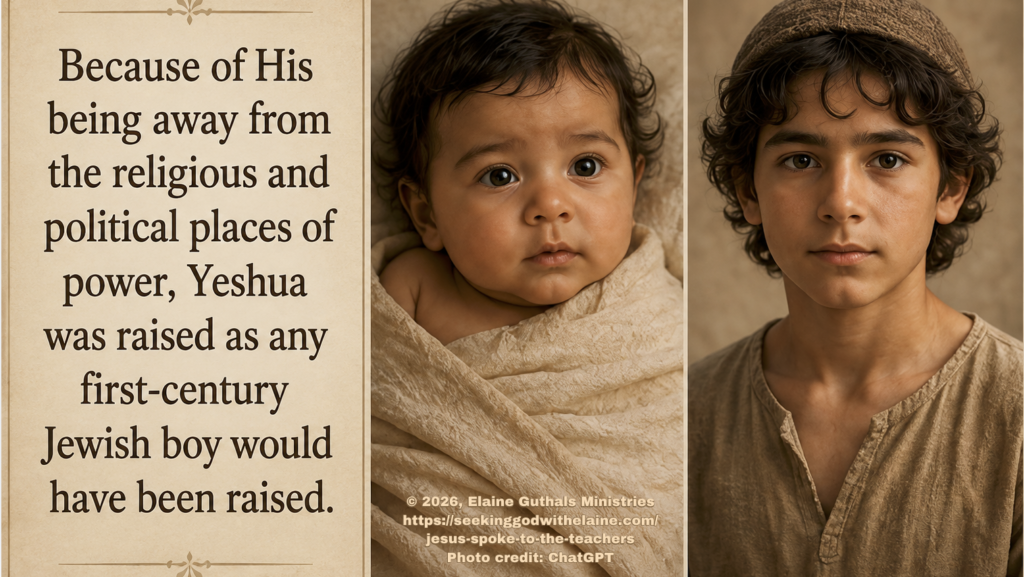
    Yeshua came to earth to be one of us. This upbringing gave Him a good foundation of what it meant to be human. He saw the everyday struggles of good Jewish people trying to retain covenant faithfulness.

    On Their Way to Passover

    “Every year Jesus’ parents went to Jerusalem for the Passover festival. When Jesus was twelve years old, they attended the festival as usual” (Lk. 2: 41-42 NLT)

    Passover

    Joseph had been called a righteous man (Mt. 1: 19), and Mary was obedient.

    Because of that, they went every year to the Passover festival.

    Passover (Pesach – פֶּסַח) is a festival celebrating Israel’s redemption from Egypt.

    Many of us know about Passover. But few of us probably know what that entails.

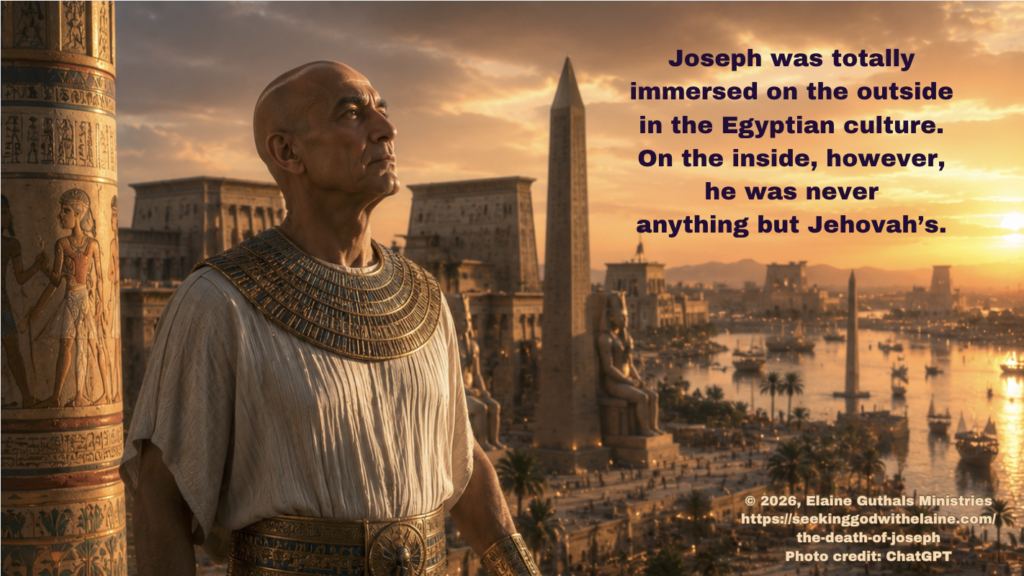
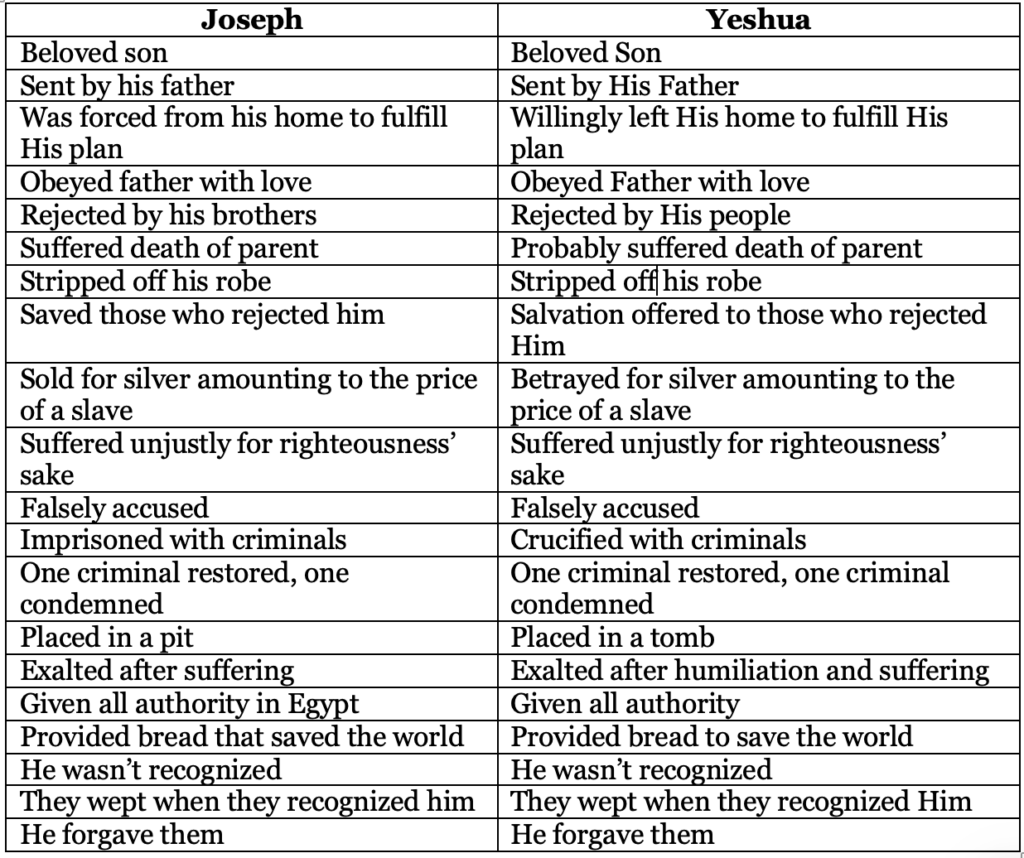
    In Genesis, Joseph was sold by his brothers because of their jealousy and anger. However, that is the means by which Jehovah got Joseph to Egypt so that he could lead the country in preparing for a famine.

    After the famine was over and Joseph and the Pharaoh at the time had died, the Hebrews became slaves to the Egyptians.

    Jehovah sent Moses to lead the people out of Egypt and to the Promised Land. They spent the last night of captivity celebrating the Passover meal.

    When the Israelites and later the Jews celebrated this festival, they were to remember the time when Jehovah freed them from slavery. More importantly, they were to remember how He redeemed and delivered them.

    The festival centered around the lamb that was sacrificed – the Paschal Lamb. This lamb was essential to the story of redemption.

    Passover was one of the pilgrimage festivals. That means all males were to appear before Jehovah. True,  women and children could accompany them – and we can read from the text that every year Mary and Yeshua did accompany Joseph.

    It is in this remembrance that Yeshua grew. He participated in one of the most significant acts of Jewish worship of the entire year.

    Did you see what it said in verse 42? Jesus attended the festival when he was 12 as usual. This wasn’t His first Passover – and it wouldn’t be His last.

    It means it was what the family did to participate in the worship life of Israel.

    Connect some dots here. Every year, Yeshua went to the festival to view the Paschal Lamb – the lamb who – like Him – focused on the imagery of sacrifice. He saw the blood, deliverance, covenant, slavery, redemption and peace all transpiring within the Temple grounds.

    Later, Yeshua would become the Paschal Lamb. “… Christ, our Passover Lamb, has been sacrificed for us” (I Cor. 5:  7 NLT).

    Twelve Years Old

    It was significant that this event took place when Yeshua was 12 years old.

    We think of young Jewish boys participating in their bar mitzvah ceremony at age 13. That wasn’t the practice in first-century Israel. That ceremony didn’t exist then.

    Still, the age traditionally associated with a Jewish boy coming of age was thirteen.

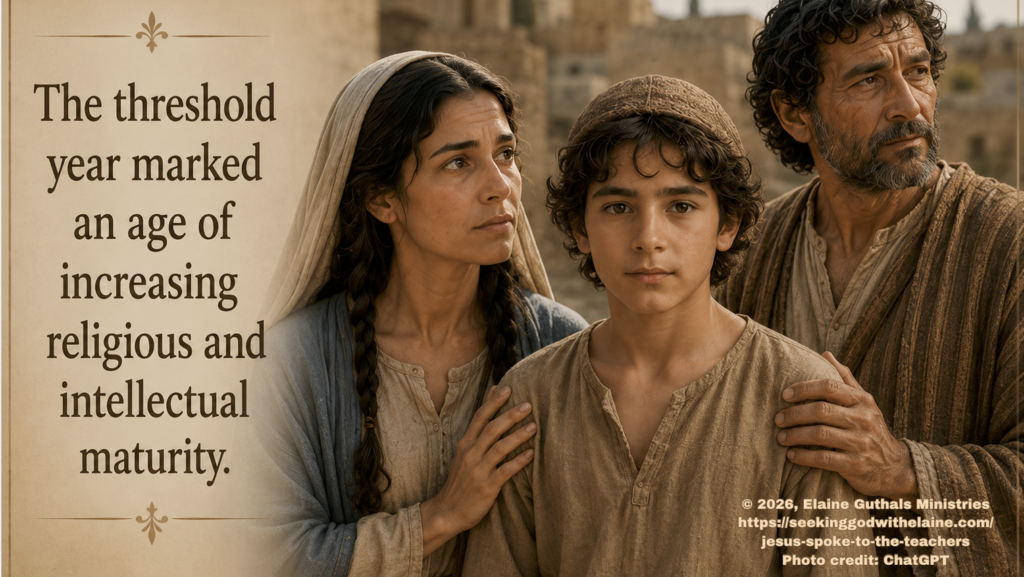
    That would make this a threshold year for Yeshua. It marked an age of increasing religious and intellectual maturity.
    Returning Home

    “After the celebration was over, they started home to Nazareth, but Jesus stayed behind in Jerusalem. His parents didn’t miss him at first, because they assumed he was among the other travelers. But when he didn’t show up that evening, they started looking for him among their relatives and friends” (Lk. 2: 43-44 NLT)

    The return home from Passover didn’t go as planned.

    We may question how Mary and Joseph started home without Yeshua. That probably isn’t that difficult to see when we really look at it.

    It wasn’t like they were going to jump on their donkeys and start home by themselves. We are talking a multi-day trip here. More than likely, they went on foot.

    Probably for pilgrimage festivals, it felt like the village was clearing out. They would have been in a caravan.

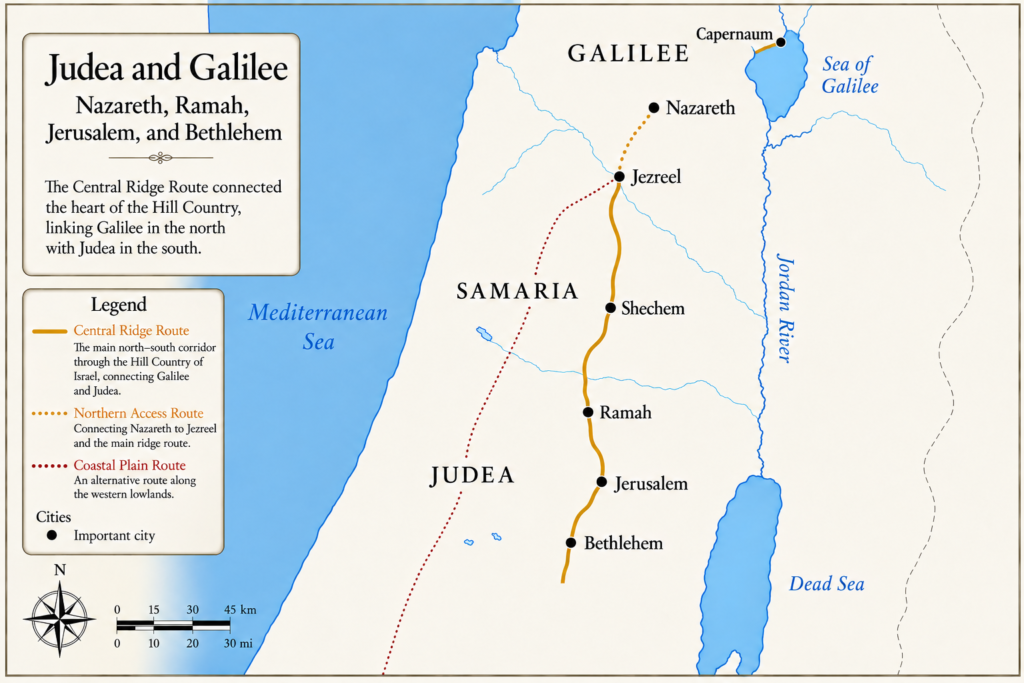
    Caravans from other villages may have been passing through or close by. That would have been especially true when they got on the Central Ridge Route. Their caravan may have joined with other caravans.
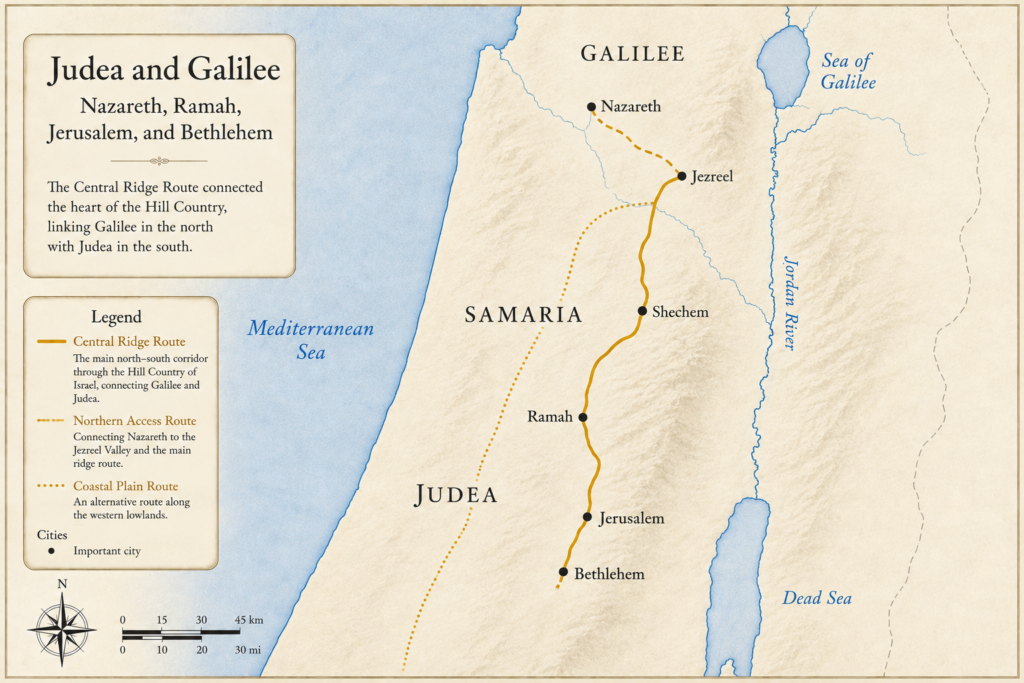
    When they were leaving Jerusalem, that would mean the large caravan they left with would probably have been made up of strangers and other people from Nazareth – including family.

    However it happened, Mary and Joseph didn’t miss Yeshua until the caravan stopped for the night.

    Even if they didn’t know anyone else in the caravan, they would have believed that Yeshua found someone else His age to travel with. Kids do tend to group together, even if they just met.

    Finding Yeshua

    “When they couldn’t find him, they went back to Jerusalem to search for him there. Three days later they finally discovered him in the Temple, sitting among the religious teachers, listening to them and asking questions. All who heard him were amazed at his understanding and his answers” (Lk. 2: 45-47 NLT).

    Three Days Later

    Yeshua was in the Temple.

    Luke said that Mary and Joseph didn’t realize that Yeshua was missing until evening. They wouldn’t have started back in the dark to return to Jerusalem.

    They might have gotten to move faster once they left the caravan and started back. However, they had travel time up to the amount of time they had traveled the day before. More than likely, it was still substantial.

    By the time they found Him in the Temple, they had been separated from Him for all or parts of three days. That means Mary and Joseph could have spent as much as roughly two days searching Jerusalem.

    We have to realize that there were probably still a lot of people in Jerusalem. As a pilgrimage festival, Jews came from all over Judea and Galilee to worship. They even came from Jewish communities outside the land as well. Josephus called it an innumerable multitude.

    Resource

    In another place, Josephus described one Passover in the first century. There had been 256,500 Passover sacrifices, associated with more than 2.7 million participants.

    Resource

    So, it was crowded. Probably not everyone left the day after Passover concluded. Some may have stayed to visit family before returning to their homes.

    Listening, Asking, and Answering

    Yeshua spent His time with the rabbis productively.

    Rabbis taught a little differently than what happens in classrooms today. It was much more interactive than what we are accustomed to.

    The rabbi would sit with his students gathered around him. They would read or recite Scripture. The rabbi would explain its meaning. Students were allowed to ask questions, and he would question them to ensure their understanding.

    The questions the rabbi asked were also geared to determine what their interpretation was. They could also have applied it to particular situations and debated that application and the results.

    Look at how Yeshua interacted with the rabbis. He listened to what they had to say. He asked questions. He apparently answered questions that they had.

    Luke says that Yeshua sat with teachers – plural. It doesn’t sound like a regular teaching session. Still, we don’t know whether they were conducting a formal lesson, discussing Torah, answering questions from pilgrims, or engaged in some other Temple teaching setting.

    All we know is that it appears that Yeshua was making an impression on them.

    That also raises the question as to how much Yeshua remembered. Philippians 2: 7 says “Instead, he gave up his divine privileges; he took the humble position of a slave and was born as a human being” (Phil. 2: 7 NLT).

    We know Yeshua divested Himself of those divine privileges and became human. He did not divest Himself of His divinity.

    What Yeshua was showing was wisdom beyond His years. Luke had already said that Yeshua was growing in wisdom (Lk. 2: 40).

    That is understandable considering He was wisdom.

    • “In him lie hidden all the treasures of wisdom and knowledge” (Col. 2: 3 NLT).
    • “God has united you with Christ Jesus. For our benefit God made him to be wisdom itself. Christ made us right with God; he made us pure and holy, and he freed us from sin” (I Cor. 1: 30 NLT).

    Yeshua’s wisdom was part of His nature – a part of His divine identity. He becomes our wisdom.

    Yeshua’s Mission

    “His parents didn’t know what to think. ‘Son,’ his mother said to him, ‘why have you done this to us? Your father and I have been frantic, searching for you everywhere.’ ‘But why did you need to search?’ he asked. ‘Didn’t you know that I must be in my Father’s house?’ But they didn’t understand what he meant” (Lk 2: 48-50 NLT)

    Yeshua was mission-driven from early on.

    Think about it. Mary, Joseph, and Yeshua came to Jerusalem to remember Jehovah’s redemption of Israel. They found the Redeemer Himself in His Father’s house.
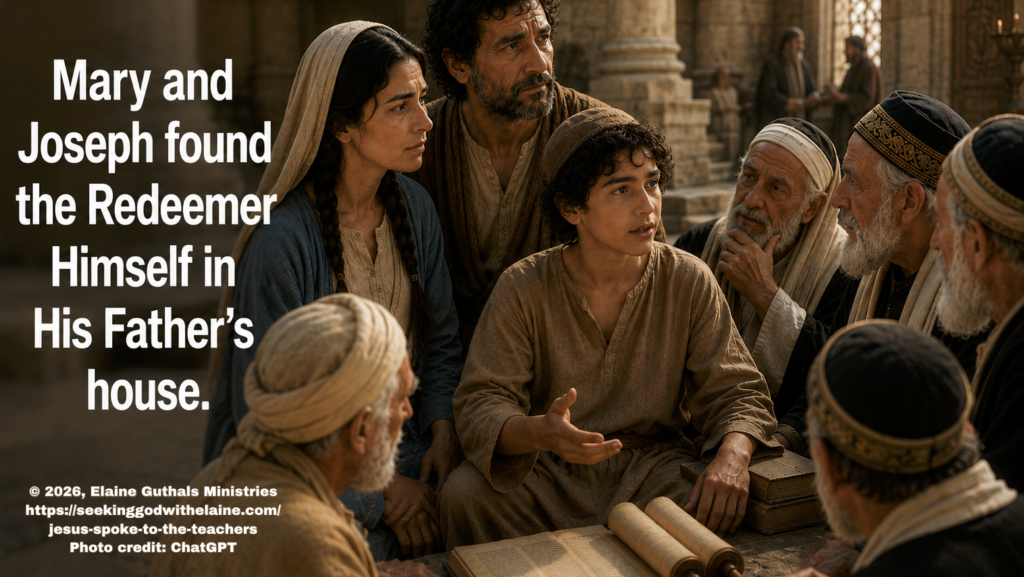
    But right now, they were probably in Momma Bear and Poppa Bear mode. They more than likely couldn’t see past the pain and anxiety.

    It was no accident that Yeshua was in the Temple – even at 12 years old. He was growing up inside the story of redemption that ultimately pointed to Him.

    Take a look at how Yeshua got to that point. Passover → Temple → sacrifice → Father’s house → Yeshua.

    And the first words that we hear that Yeshua spoke were, “… ‘Didn’t you know that I must be in my Father’s house?’” (Lk. 2: 49 NLT).

    Does that mean Yeshua understood at 12 that HE would one day be the Paschal Lamb? Maybe. Maybe not.

    We have hindsight, however. We can see what Yeshua may not have been able to at that time.

    What we do see is that Yeshua was mission-driven from early on. He was always building to the point of Him being the sacrifice (I Cor. 5: 7 NT).

    Yeshua Grew

    “Then he returned to Nazareth with them and was obedient to them. And his mother stored all these things in her heart. Jesus grew in wisdom and in stature and in favor with God and all the people.” (Lk. 2: 51-52 NLT)

    Luke summarized Yeshua’s life after age 12.

    In the end, Yeshua went back to Nazareth. He lived there until He started His ministry.

    We were told one other time that Mary pondered things in her heart. She meditated on what happened here. She probably remembered what Gabriel told her. She remembered prophecy.

    Mary was growing in her faith just as Yeshua grew physically and mentally.

    Why didn’t we get any more insight into Yeshua’s life as He was growing up? That wasn’t the focus.

    The focus should always remain on Yeshua as Savior and Redeemer.

    Making the Connections

    We may think of Passover as just a meal. That meal was always important to the Jews.

    The sacrifices were more important. They were the heart of Passover.

    Passover was part of a seven-day celebration, the Feast of the Unleavened Bread (Deut. 16: 1-8).

    Think about it. Remember, Josephus had recorded 2.7 million participants. True, the lamb covered the family, so the number of lambs was a somewhat lower number.

    Still, it was thousands upon thousands of families. That means thousands upon thousands of lambs.

    All were moving toward the Temple, because that was where the lamb was sacrificed. The Hallel – the Psalms of praise associated with the festival – was being sung. The lambs were joining in, but it was probably a baa of fear. Trumpets were sounding.

    The sacrifice wasn’t a day-long event. Timing was reported in the Mishnah. “On the eves of Passover, when the Paschal lamb must be offered after the daily offering, the daily offering is sacrificed earlier … “

    Resource

    However, later it says that those bringing sacrifices were split into groups: the assembly, congregation, and Israel. The assembly was able to bring their sacrifices in the afternoon.

    Each group entered the Temple courtyard until all in that group were inside. When the court was filled, the doors were closed, and the sacrifice began.

    Rows of priests were described in what appears to be an assembly line. Their job was to pass the blood of the sacrifice from the place of sacrifice to the altar.

    The lamb would be flayed until the sacrificial parts could be removed. These would be placed in a basin (mageis– מַגִּיס) and burned on the altar.

    Each group would remain until all groups concluded their sacrifices. “Then the whole assembly of the community of Israel must slaughter their lamb or young goat at twilight” (Ex. 12: 6 NLT).

    At nightfall, they would return to wherever they were staying and roast their Paschal lamb. The people who had been registered for that particular sacrifice would eat it together with the unleavened bread and bitter herbs.

    I know. Think about getting that many people organized.

    They accomplished it. Year after year after year.

    This was just part of being Israel. It was a celebration of being redeemed.

    Heart Check

    Think about the battle Yeshua is engaged in for your heart. Ask yourself the following questions.

    • Am I growing in wisdom and understanding, or have I become satisfied with what I already know?
    • When circumstances become frightening or overwhelming, do I lose sight of Jehovah’s purposes?
    • Am I willing to put Jehovah’s purposes ahead of my own plans, expectations, and comfort?

    How Do We Apply This?

    • Remember that our lives have a purpose beyond what we can see right now.
    • Stay rooted in Scripture so we recognize truth when we encounter it.
    • Make time to listen, ask questions, and grow in wisdom rather than assuming we already know enough.
    • When life becomes stressful, stop and ask whether we are focused on Jehovah’s purposes or only on our immediate circumstances.

    Father God. Help us to seek You in Your Word. Show us where we have things wrong. Grow us so that we become more and more like You. Amen.

    If you don’t understand something and would like further clarification, please contact me.

    If you have not signed up for the email providing the link to the devotions and the newsletter, do so below.

    If God has used this devotion to speak with you, consider sharing it on social media.

  • The Escape to and Return from Egypt

    The time that Yeshua spent in Egypt is a mystery to us, but it raises many questions. This devotional reading looks at Joseph’s dreams instructing him to go to Egypt and to return.

    Nuggets

    • From a cursory glance, it appears that the timeline in Matthew 2 is different than Luke 2.
    • If we just read Luke 2: 39, grammar alone doesn’t necessarily mean Nazareth was the next stop after the Temple.
    • Matthew was more specific in his timeline telling us about events that Luke didn’t.
    • Does Matthew 2 contradict Luke 2?
    • To me, a more logical explanation is that the Magi arrived at Joseph’s family’s house within a few days of Yeshua’s birth.
    • Joseph immediately acted when told of a threat.
    • Hosea prophesied the escape to Egypt.
    • Because Herod was egotistical and self-centered, he ordered the execution of all boys two years old and younger in Bethlehem when the Magi didn’t return.
    • Prophecy was once again fulfilled with the Massacre of the Innocents.
    • Joseph had another dream.
    • It appears that Joseph wasn’t going back to Nazareth at first.
    • Matthew said the family returned to Nazareth to fulfill prophecy.

    When we last left Mary, Joseph, and Baby Yeshua, they were at the Temple. Mary was completing her purification. Baby Yeshua was presented and redeemed as the firstborn.
     
    There seems to be a conflict between Matthew 2 and Luke 2. When and how did Mary, Joseph, and Baby Yeshua leave Jerusalem/Bethlehem?
     
    We have already covered the Magi. Since we believe that the birth occurred in the animal section of Joseph’s family’s home, the house that the Magi came to could have been theirs.
     
    But Luke was very specific in where the family went after it left Jerusalem.
     
    Stop. Let’s look at what it says.

    Let’s Put It into Context

    To read devotions in The Battle for the Heart theme

    Devotions in the The Birth and Early Childhood of Christ series

    Let’s Put It into Context #2

    Herod the Great was religious but ruthless, powerful but fearful, and magnificent yet miserable.

    Born around 73 BC, Herod was not of Israelite descent but of Edomite descent. In other words, he ruled the Jews but was not of the Davidic line. To make matters worse, he was chosen to be King of the Jews by Octavian Augustus and the Roman Senate around 40 BC.

    Herod’s reign lasted from 37 to 4 BC. While he did maintain stability in the region, his fear of losing power made him a brutal ruler.

    The Temple that stood in Yeshua’s day had undergone a massive expansion under Herod’s rule. He tried to curry the favor of his subjects by rebuilding the Temple and funding public works.

    Yes, Herod built the stage on which Yeshua’s ministry would unfold.

    Leaving

    “When Jesus’ parents had fulfilled all the requirements of the law of the Lord, they returned home to Nazareth in Galilee. There the child grew up healthy and strong. He was filled with wisdom, and God’s favor was on him” (Lk. 2: 39-40 NLT)

    “After the wise men were gone, an angel of the Lord appeared to Joseph in a dream. ‘Get up! Flee to Egypt with the child and his mother,’ the angel said …” (Mt. 2: 13 NLT)

    From a cursory glance, it appears that the timeline in Matthew 2 is different than Luke 2.

    Matthew had Mary, Joseph, and Baby Yeshua leaving Bethlehem to go to Egypt. Luke had them going to the Temple then leaving for Nazareth.

    Review of Luke’s Passage

    If we just read Luke 2: 39, grammar alone doesn’t necessarily mean Nazareth was the next stop after the Temple.

    The Greek says this: Καὶ ὡς ἐτέλεσαν πάντα τὰ κατὰ τὸν νόμον Κυρίου, ἐπέστρεψαν εἰς τὴν Γαλιλαίαν εἰς πόλιν ἑαυτῶν Ναζαρέθ.

    The word we need to focus on is hōs (ὡς). This means when, after, or as.

    Luke’s statement can serve as a summary statement. It links the completion of the required observances to the family’s return to Galilee.

    The one word missing here is immediately. It doesn’t say they went straight back to Nazareth. In fact, it doesn’t give us a clue about any timing.

    What it is saying is, when everything they were required to do was done, they returned.

    To look at Matthew 2 in that light, Mary, Joseph, and Baby Yeshua were required to go to Egypt. They were called back and allowed to return to Nazareth, their own city – their hometown.

    The next verse in Luke’s passage is that Baby Yeshua grew strong. He did that in Egypt as well as in Nazareth. This included wisdom and grace.

    Luke’s account is not strictly chronological, as shown by his transition to the next story in the passage. Yeshua is no longer a baby – He is 12 years old. In fact, Luke uses this compressed narrative in more places than just here (Lk. 3: 19–21; Ac. 5: 42).

    This idea could be strengthened by the use of the word returned. The Greek word used is ἐπέστρεψαν.

    Luke’s goal may have been to show the return of the family to Nazareth – the place they started from before Yeshua’s birth.

    Review of Matthew’s Passage

    Matthew was more specific in his timeline telling us about events that Luke didn’t.

    However, Matthew didn’t give us any time references. It has long been assumed that Mary and Joseph stayed in Bethlehem for up to two years after Yeshua’s birth.

    The age of Yeshua at the Magi’s visit is estimated by the age of the male children killed by Herod. There would have been no need to kill Jewish sons that had reached that age if it was believed Yeshua had just been born.

    However, Herod didn’t ask about the age of the child. He asked when the Magi had seen the star appear (Mt. 2: 7).

    We aren’t given that information, either. We aren’t told that the Magi first saw the star on the night of Yeshua’s birth. They could have seen the star long enough before His birth to allow for travel time so they would arrive right around His birth.

    Some think that Matthew’s use of the Greek word paidion (παιδίον) indicates Yeshua’s age. This word means child. It does not differentiate between infant and toddler.

    It is possible they thought the Messiah should be raised in Bethlehem. Returning to Nazareth before the Magi’s arrival would have entailed a move back to Bethlehem.

    Reconciling the Two Passages

    Does Matthew 2 contradict Luke 2?

    Not necessarily. Luke doesn’t identify the return to Nazareth from Jerusalem as a permanent residence.

    Matthew was more explicit in his language. He noted the family settled in Nazareth permanently after their return from Egypt.

    There is one little hole in Matthew’s passage that could make it sync with Luke. We are not told the location of the house in which the Magi find Baby Yeshua. We assume it was in Bethlehem because that is where the Magi were sent and where the Massacre of the Innocents happened.

    I don’t see Mary and Joseph staying in Bethlehem 40 days, let alone two years. The Magi could have visited Baby Yeshua before they left Bethlehem.

    The house referred to in Matthew could have been Joseph’s family’s house. The word Luke used was kataluma (κατάλυμα). That can mean guest room.

    If we go with Mary and Joseph staying in the animal housing of Joseph’s family’s home because there was no room in the guest room at Yeshua’s birth, they could have still been at the house a couple of days after His birth. Mary and Joseph may have been able to move into the main house after a couple of days.

    The family could have returned to Nazareth. It may have taken Mary a day or two before she felt up to traveling. There was no restriction on her traveling either during her seven days of being unclean or her days of purification.

    Conclusion

    To me, a more logical explanation is that the Magi arrived at Joseph’s family’s house within a few days of Yeshua’s birth.

    The family possibly returned to Nazareth, probably after the circumcision ceremony, but came back to Jerusalem for Mary’s purification offering – the only place that could be performed. Then on the way back to Nazareth, Joseph received the dream to flee to Egypt. Upon returning from there, they again settled in Nazareth.

    We cannot prove that. But we also cannot dismiss it from Scripture. It allows Matthew and Luke to be read in their natural sequence without requiring either writer to have omitted or rearranged something they explicitly said.

    Though it seems like Matthew and Luke are telling different stories, we can believe that all the information given by both is accurate. We don’t have to know exactly what happened. We just have to believe it did.

    Directions to Joseph

    “After the wise men were gone, an angel of the Lord appeared to Joseph in a dream. ‘Get up! Flee to Egypt with the child and his mother,’ the angel said. Stay there until I tell you to return, because Herod is going to search for the child to kill him.’ That night Joseph left for Egypt with the child and Mary, his mother, and they stayed there until Herod’s death. This fulfilled what the Lord had spoken through the prophet: ‘I called my Son out of Egypt’” (Mt. 2: 13-15 NLT)

    Get up!

    Joseph immediately acted when told of a threat.

    Once again, Joseph had a dream from Jehovah. Once again, he was told the actions he should take.

    Once again, Joseph immediately obeyed. Verse 14 says, “That night Joseph left for Egypt with the child and Mary, his mother” (Mt. 2: 14 NLT).

    This shows Joseph’s commitment to raising the Son of God. He wasn’t taking any chances with the Baby’s life.

    Out of Egypt

    Hosea prophesied the escape to Egypt.

    We find a place in God’s Word that prophesied this trip to Egypt. “When Israel was a child, I loved him, and I called my son out of Egypt” (Hos. 11: 1 NLT).

    Yeah, I know. The Jews interpreted this to mean Jehovah calling the nation out of their Egyptian captivity. Matthew, however, applied it to Yeshua.

    Was Matthew wrong to do that? No, many Old Testament prophecies had current application and future application.

    Let’s back up a second — all the way to when Israel was in captivity in Egypt. They thought the nation was Jehovah’s child. “Then you will tell him, ‘This is what the Lord says: Israel is my firstborn son” (Ex. 4: 22 NLT).

    Now come back to Yeshua’s time. “But to all who believed him and accepted him, he gave the right to become children of God. They are reborn — not with a physical birth resulting from human passion or plan, but a birth that comes from God” (Jn. 1: 12-13 NLT).

    The idea that Jehovah sets apart His children runs through all of God’s Word. That is the defining part to being a saint because that is a defining part of being holy.

    Yeshua is the True Israel, the faithful Son, and the One Who succeeded where Israel failed.

    Massacre of the Innocents

    “Herod was furious when he realized that the wise men had outwitted him. He sent soldiers to kill all the boys in and around Bethlehem who were two years old and under, based on the wise men’s report of the star’s first appearance.” (Mt. 2: 16 NLT)

    Because Herod was egotistical and self-centered, he ordered the execution of all boys two years old and younger in Bethlehem when the Magi didn’t return.

    Now we come to a passage that is highly debated — the Massacre of the Innocents.

    Why is the story questioned? There is no other independent evidence that it occurred. Josephus and other historians of that era are silent on this matter.

    If something this big and this atrocious happened, they argue, wouldn’t there be more than one record of it? Or is it folklore based on some other similar incident?

    Some believe the massacre occurred in 5 BC. One reason that timeframe doesn’t work is that Herod died in 4 BC.

    Herod was incensed when the Magi didn’t report back to him Yeshua’s location. Did that stop his murderous plan?

    No. It got worse.

    Herod ordered the execution of all males two years old and under living in the city of Bethlehem and its vicinity. He set the time by when the Magi said the star appeared.

    How could Herod do something so awful? Moore helped explain. He wrote,

    “Herod never thought of our Lord as a human opponent, but as the Messiah. He did not disbelieve the star or the prophecies interpreted by the priests and scribes. He was fighting against God; He thought the prophecies might fail at the last.”

    Resource

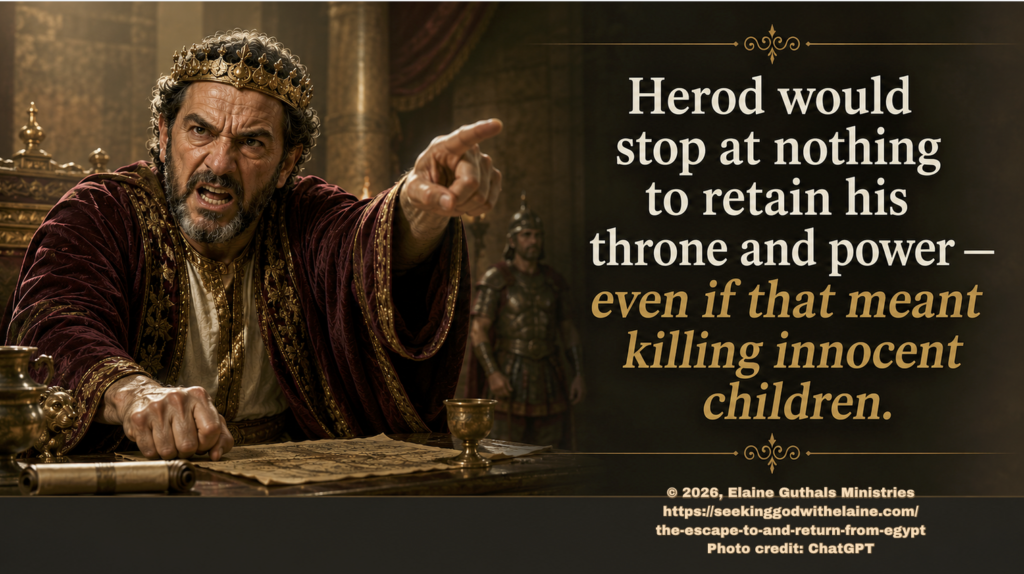
    Herod would stop at nothing to retain his throne and power — even if that meant killing innocent children.

    We think about the horror of the babies being slaughtered. But have we ever thought how many fathers and mothers were killed along with the little ones?

    Think about it. They loved their little ones. Their first instinct would be to protect them. Momma Bear and Poppa Bear mode would kick in big time – with no thought to their own safety.

    They would fight tooth and nail to protect their young one. People with no guilt in killing babies would have no guilt in killing moms and dads.

    Atrocity Foretold

    “Herod’s brutal action fulfilled what God had spoken through the prophet Jeremiah. ‘A cry was heard in Ramah — weeping and great mourning. Rachel weeps for her children, refusing to be comforted, for they are dead’” (Mt. 2: 17-18 NLT)

    Prophecy was once again fulfilled.

    Matthew 2: 18 basically says what Jeremiah 31: 15 says. “This is what the Lord says: ‘A cry is heard in Ramah — deep anguish and bitter weeping. Rachel weeps for her children, refusing to be comforted — for her children are gone’” (Jer. 31: 15 NLT).

    Mourning does cause anguish. The anguish manifests itself as weeping. But mourning called it for what it was: dead instead of gone.

    This is another two-for-one prophecy. Jeremiah was talking about Assyrians and nothing about the Messiah.

    I hear you. We thought this was Bethlehem, not Ramah.

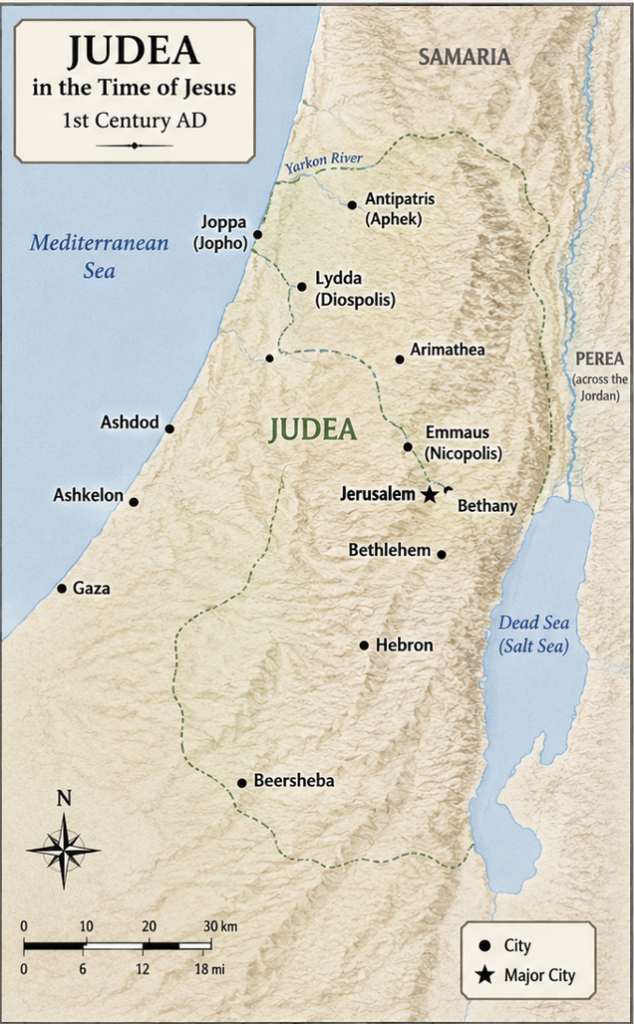
    Well, this goes back to the Babylonian exile. Biblestudy.org tells us the city of Ramah was used as the gathering place for all the exiles who would be taken to Babylon (Jer. 40: 1). It was five miles north of Jerusalem.

    Resource

    But what does this have to do with Rachel? For one thing, Rachel died in childbirth. Another, she was buried in Bethlehem.

    “So Rachel died and was buried on the way to Ephrath (that is, Bethlehem). Jacob set up a stone monument over Rachel’s grave, and it can be seen there to this day” (Gen. 35: 19-20 NLT).

    Another reason is Rachel is seen as the primary mother of Israel. Her grandsons, Ephraim and Manasseh, were the leaders of Israel’s leading tribes.

    Matthew used this to remind his readers something we don’t catch. He was equating the present sorrow to a past sorrow. This showed first-century Jews that the exile wasn’t truly over. The Messiah was entering into that suffering.

    Being Called Back

    “When Herod died, an angel of the Lord appeared in a dream to Joseph in Egypt. ‘Get up!’ the angel said. ‘Take the child and his mother back to the land of Israel, because those who were trying to kill the child are dead’ So Joseph got up and returned to the land of Israel with Jesus and his mother. But when he learned that the new ruler of Judea was Herod’s son Archelaus, he was afraid to go there. Then, after being warned in a dream, he left for the region of Galilee. So the family went and lived in a town called Nazareth. This fulfilled what the prophets had said: “He will be called a Nazarene” (Mt. 2: 19-23 NLT)

    Called through a Dream

    Joseph had another dream.

    Once again, Joseph had a dream. Once again, he obeyed immediately. Joseph was given the all-clear to return home.

    The problem was Archelaus was now ruler. Joseph would have known him as one of Herod the Great’s sons.

    Upon the death of Herod the Great, his kingdom was divided among his sons. Archelaus’ portion included Judea, Samaria, and Idumea. His rule lasted from 4 BC to AD 6.

    Unlike his father, Archelaus was not a king. However, he was cruel and ruthless – as Herod was.

    It was probably because of this, Joseph’s fear in Matthew 2: 22 is understandable.

    Look at that. When told to go, Joseph went. But when he found out who was ruling, he changed plans.

    Nazareth

    It appears that Joseph wasn’t going back to Nazareth at first.

    Let’s put it together. Joseph was going back there, but he was afraid because Archelaus ruled there. Where did Archelaus rule? Judea, Samaria, and Idumea.

    Idumea wasn’t part of Israel, so they weren’t headed there. They wouldn’t have gone to Samaria, either.

    That means they were headed to Judea.

    That meant – to me – that Joseph was taking his family to Bethlehem or Jerusalem.

    Think about it. Mary and Joseph knew they were parents to the Messiah. They probably thought they needed to be in Bethlehem or Jerusalem.

    How does that change our thoughts about the perceived Matthew and Luke discrepancy? Maybe they didn’t go back to Nazareth after Yeshua’s birth. Maybe it was always their intent to stay in Bethlehem or Jerusalem.

    Jehovah, however, makes sure that thing go according to His plan.

    He Will be Called a Nazarene

    Matthew said the family returned to Nazareth to fulfill prophecy.

    We may think Joseph chose to take his family to Nazareth because that was their hometown, as Luke said. However, Joseph had another dream, telling him to go to Galilee.

    The way “… He will be called a Nazarene” (Mt. 2: 23 NLT) is written, it looks like it should be a quote.  It isn’t a direct quote.

    But Matthew did use prophets — plural — describing who said it. That means we have to make the connections.

    What Matthew may have been getting at was that Yeshua fulfilled the Branch prophecy.

    • “Out of the stump of David’s family will grow a shoot — yes, a new Branch bearing fruit from the old root” (Isa. 11: 1 NLT).
    • “‘For the time is coming,’ says the Lord, ‘when I will raise up a righteous descendant from King David’s line. He will be a King who rules with wisdom. He will do what is just and right throughout the land” (Jer. 23: 5 NLT)
    • “Tell him, ‘This is what the Lord of Heaven’s Armies says: Here is the man called the Branch. He will branch out from where he is and build the Temple of the Lord’” (Zech. 6: 12 NLT).

    Melville made an interesting comment. He wrote, “This murder would enable Jesus to live in obscurity until thirty years of age. Brought up at Nazareth, He was regarded as a Nazarite. The slaughter of the innocents would prove His birth at Bethlehem.”

    Resource

    Hmmmm. Did Melvill believe that Mary and Joseph would have chosen to live in Jerusalem – maybe even Bethlehem? If they didn’t have to go through the abject terror of fleeing for Yeshua’s life, they might have chosen to live somewhere else than this obscure village.

    However, it was Nazareth where Jehovah wanted His Son to live. Well, after He got home from Egypt.

    Heart Check

    Think about the battle Yeshua is engaged in for your heart. Ask yourself the following questions.

    • When Jehovah changes my plans, am I willing to trust Him and obey, or do I struggle when I don’t understand what He is doing?
    • When I don’t have all the answers, do I trust what Jehovah has revealed, or do unanswered questions make me doubt His Word?
    • Am I looking for Jehovah to show me the whole path, or am I willing to obey the next step He gives me?

    How Do We Apply This?

    • Obey promptly when Jehovah makes the next step clear, even when I don’t know what comes next.
    • Trust Jehovah with what I cannot understand.
    • Remember that Jehovah is working even when circumstances look chaotic.
    • Don’t let unanswered questions about Scripture shake my confidence in Scripture.
    • Look for the next step, not the whole map.

    Father God. You control everything. You protect us so that Your Will can be accomplished. Thank You that You protected Yeshua so that He could become our Savior. Amen.

    If you don’t understand something and would like further clarification, please contact me.

    If you have not signed up for the email providing the link to the devotions and the newsletter, do so below.

    If God has used this devotion to speak with you, consider sharing it on social media.
  • Jesus Was Presented in the Temple

    There were some important requirements that needed to be fulfilled according to Jehovah’s laws. This devotional reading looks at Yeshua’s circumcision, Mary’s purification offering, and the redemption of the firstborn.

    Nuggets

    • It was important that Yeshua enter the covenant community.
    • Mary and Joseph were both told what the Baby’s name was going to be.
    • Purification is important to Jehovah.
    • Specific instructions were given regarding the purification offering.

    Jehovah had given specific instructions as to what should happen when a baby boy was born. This didn’t change just because His Son was born.

    Let’s Put It into Context

    To read devotions in The Battle for the Heart theme

    Devotions in the The Birth and Early Childhood of Christ series

    Circumcision of Jesus

    “Eight days later, when the baby was circumcised, he was named Jesus, the name given him by the angel even before he was conceived” (Lk. 2: 21 NLT)

    Circumcision

    It was important that Yeshua enter the covenant community.

    When John the Immerser was born, we talked about the circumcision ceremony being where the newborn son entered into the covenant community. The circumcision ceremony is called B’rit Milah (בְּרִית מִילָה).

    The religious ceremony was performed on a son’s eighth day after birth. It was a covenant ceremony, a family celebration, a public declaration of identity, and the official welcoming of a son into God’s covenant people all rolled into one celebration.

    Normally, covenant celebrations were celebrated in the home by the community. But we have to wonder how much not being in Nazareth changed this ceremony.

    True, any family that lived in or may have come to Bethlehem as Joseph did may have come to the ceremony. But we really aren’t sure the reason was Joseph’s family didn’t make room for them in their house. If it was because Mary was a betrothed but unwed pregnant woman, they wouldn’t have gone to the circumcision ceremony either.

    It was important that Yeshua complete the circumcision. It was part of God’s covenant with Abraham. It is the part of the Jew’s responsibility to show agreement with the covenant. It was the physical sign of the covenant that showed the child belonged to Jehovah.

    Yeshua was to be a member of the community and fully entered into it.

    Think about it. Abraham and Ishmael were the first to be circumcised (Gen. 17: 23 NLT). The first son that we are told was circumcised was Isaac (Gen. 21: 4).

    Isaac, too, was to be sacrificed by his father, just as Yeshua was. Through that testing, we saw the love that Jehovah has for us.

    Remember, the number eight represents a new beginning. Yeshua was ushering in a new covenant.

    Was Named Jesus

    Mary and Joseph were both told what the Baby’s name was going to be.

    • “You will conceive and give birth to a son, and you will name him Jesus” (Lk. 1: 30-33 NLT).
    • “And she will have a son, and you are to name him Jesus, for he will save his people from their sins” (Mt. 1: 21 NLT).

    Yeshua’s name – His Hebrew name – is important. Modern versions translate it as Jesus.

    Not really. Yeshua means Joshua.

    It is my opinion that Jehovah wanted His Son to be known by only one name. “There is salvation in no one else! God has given no other name under heaven by which we must be saved” (Ac. 4: 12 NLT).

    Yeshua means God saves – which is Yeshua’s mission.

    It was Jehovah that designed the Plan of Salvation. He determined what He needed to pay the price for our sins. He chose Yeshua to carry out His plan. He put the plan into motion.

    Everything about Yeshua was concentrated on completion His mission of salvation.

    Jesus Presented in the Temple

    “Then it was time for their purification offering, as required by the law of Moses after the birth of a child; his parents took him to Jerusalem to present him to the Lord. The law of the Lord says, ‘If a woman’s first child is a boy, he must be dedicated to the Lord.’ So they offered the sacrifice required in the law of the Lord — ‘either a pair of turtledoves or two young pigeons’” (Lk. 2: 22-24 NLT)

    Purification

    Purification is important to Jehovah.

    Leviticus 12 records the law for purification after childbirth. “The Lord said to Moses, ‘Give the following instructions to the people of Israel. If a woman becomes pregnant and gives birth to a son, she will be ceremonially unclean for seven days, just as she is unclean during her menstrual period. On the eighth day the boy’s foreskin must be circumcised. After waiting thirty-three days, she will be purified from the bleeding of childbirth …’” (Lev. 12: 1-4 NLT).

    There are some don’t-touch instructions and separate instruction is the child is a girl. But these are important for our discussion.

    Doing the math, the purification offering took place 40 days after birth. Hmmm. Forty days seems to pop up occasionally. This was the amount of time

    • it rained during the Flood (Gen. 7: 4, 12, 17).
    • Yeshua was tempted in the wilderness (Mt. 4: 2; Mk. 1: 13; Lk. 4: 2).
    • the mountaintops were visible before Noah opened the ark’s window (Gen. 8: 6).
    • Moses remained on Sinai receiving the law (Ex. 24: 18).
    • Moses spent interceding after the golden calf (Deut. 9: 18, 25; 10: 10).
    • spies explored Canaan (Num.. 13: 25).
    • Goliath challenged Israel (I Sam. 17: 16).
    • it too Elijah to travel to Horeb (I Kgs. 19: 8).
    • Jonah warned Nineveh (Jon. 3: 4).
    • Yeshua remained on earth after His resurrection (Ac. 1: 3).

    There are other occasions where the number 40 is used, but these are the ones that specifically apply to 40 days. The number 40 is used in patterns.

    Although the number 40 is not given a formal definition as a symbolic number, in many cases it signifies something is being tested, purified, judged, prepared, or brought to a transition point.

    Offering

    Specific instructions were given regarding the purification offering.

    “When the time of purification is completed for either a son or a daughter, the woman must bring a one-year-old lamb for a burnt offering and a young pigeon or turtledove for a purification offering. She must bring her offerings to the priest at the entrance of the Tabernacle. The priest will then present them to the Lord to purify her. Then she will be ceremonially clean again after her bleeding at childbirth. These are the instructions for a woman after the birth of a son or a daughter. If a woman cannot afford to bring a lamb, she must bring two turtledoves or two young pigeons. One will be for the burnt offering and the other for the purification offering. The priest will sacrifice them to purify her, and she will be ceremonially clean” (Lev. 12: 6-8 NLT).

    Wait! What???

    I thought Mary presented the offering of a pigeon or turtledove because she was poor. This doesn’t say anything like that.

    Read what it says again. The mother was to bring 1) a one-year-old lamb and 2) a young pigeon or turtledove.

    That wasn’t an either/or type of deal. The lamb was to be a burnt offering. The bird was to be the purification offering.

    Both were needed.

    Stop. Hold the phone. Look at Leviticus 12: 8. “If a woman cannot afford to bring a lamb, she must bring two turtledoves or two young pigeons. One will be for the burnt offering and the other for the purification offering …” (Lev. 12: 8 NLT).

    Go back to what Luke said. “So they offered the sacrifice required in the law of the Lord — ‘either a pair of turtledoves or two young pigeons’” (Lk. 2: 24 NLT).

    Firstborn

    But then Yeshua was also a firstborn. That also required Him being offered to Jehovah and bought back.

    “This is what you must do when the Lord fulfills the promise he swore to you and to your ancestors. When he gives you the land where the Canaanites now live, you must present all firstborn sons and firstborn male animals to the Lord, for they belong to him. … However, you must buy back every firstborn son” (Ex. 13: 11-13 NLT).

    We have to go to Numbers 18: 16 for that. “When they are a month old, you must redeem them at the redemption price set at five shekels of silver, according to the sanctuary shekel, which weighs twenty gerahs” (Num. 18: 16 NLT).

    More math. Five shekels were 20 gerahs per shekel. Later, Jewish sources identify the required five-shekel redemption payment with five sela, or 14.335 grams of pure silver each. That is roughly 72 grams or 2.3 troy ounces of silver.

    The Hebrew phrase mibben-chodesh, however, means from the age of one month, establishing that the redemption requirement began at one month of age rather than requiring the payment on one exact day. That means, by approximately 40 days, Yeshua was already eligible for the redemption payment.

    Therefore, Mary could do the purification offering and they could pay the firstborn price at the same time. But we aren’t specifically told whether Joseph paid the five shekels during the Temple visit.

    Making the Connections

    We may tend to think the Old Testament focused on outside purity. Laws regarding purification and instances of the offerings being presented cement those in our minds.

    That is a wrong assumption. Old Testament purity laws didn’t always assume the Israelites/Jews had sinned.

    While the Old Testament did establish that external/ritual purity was important, it did introduce inner purity and restoration.

    • “But this is the new covenant I will make with the people of Israel after those days,” says the Lord. “I will put my instructions deep within them, and I will write them on their hearts. I will be their God, and they will be my people” (Jer. 31: 33 NLT).
    • “And I will give you a new heart, and I will put a new spirit in you. I will take out your stony, stubborn heart and give you a tender, responsive heart” (Ezek. 36: 26 NLT).

    Yeshua brought the relationship between the two into sharp focus, insisting that outward purity cannot substitute for a purified heart. The New Testament increasingly focused on cleansing the inside.

    Does this mean that outward cleansing is no longer necessary? On the contrary!

    Yeshua focused on our inward appearance matching our outward appearance. This is very close to the biblical concept of integrity.

    Part of the inward – and outward – corruption comes from being tainted with worldly corruption.

    We may have the tendency to combine purity and holiness. While they overlap, they aren’t identical. To simplify it,

    • Purity means freedom from contamination.
    • Holiness means set apart for Jehovah.

    Do you see it? Salvation is given to those who are set apart for Jehovah – those He has made holy. But we are not totally pure even after salvation. We continue to sin.

    And we will continue to sin until the point where purity and holiness combine.

    The progression throughout Scripture is the following.

    • External cleanness
    • Ceremonial cleanness
    • Moral cleanness
    • Clean heart
    • Undivided devotion to Jehovah

    Purity is freedom from contamination – outwardly, morally, and ultimately inwardly – so that a person is undivided, genuine, and fit for relationship with Jehovah.

    Heart Check

    Think about the battle Yeshua is engaged in for your heart. Ask yourself the following questions.

    • Am I more concerned with appearing pure before others than with allowing Yeshua to purify my heart?
    • Do I sometimes mistake outward religious observance for genuine purity of heart?
    • Am I willing to let Yeshua expose the contamination in my heart, or do I prefer to deal only with what others can see?
    • Does what people see on the outside truly reflect what is happening inside my heart?
    • Am I completely devoted to Jehovah, or are there areas of my heart I am still holding back?

    How Do We Apply This?

    • Examine our hearts to determine whether they are pure by Jehovah’s standards.
    • Pursue purity  in order to be obedient to Him.
    • Live with integrity – where our outward appearance matches our inward condition.
    • Guard our hearts to ensure purity.
    • Give Jehovah our whole heart.

    Father God. You never change. What You expected of Abraham, You expected of Mary, Joseph, and Yeshua — and us. Help us be obedient as they were. Amen.

    If you don’t understand something and would like further clarification, please contact me.

    If you have not signed up for the email providing the link to the devotions and the newsletter, do so below.

    If God has used this devotion to speak with you, consider sharing it on social media.
  • An Angel Appeared to Joseph

    Joseph had been considering his actions after he had found out Mary was pregnant by someone else. This devotional reading looks at how Jehovah intervened to ensure His plan was followed.

    Nuggets

    • Dreams were often used as a way for Jehovah to reveal himself to humans.
    • Joseph was reminded of his royal lineage.
    • Jehovah laid out very clearly what option Joseph should pick.
    • The angel made it point-blank clear to Joseph that Mary was not unfaithful to him.
    • Yeshua means God saves – which is Yeshua’s mission.
    • The first-century Jews would know the context of the Messianic prophecy even if we don’t.
    • The Hebrew word ʿalmāh (עַלְמָה) means young woman.
    • How can Yeshua be anything but divine?!?
    • Joseph obeyed immediately.

    When we last left Joseph, he was in a conundrum. Mary, the teenaged girl who he was all but married to, had ended up pregnant – and he wasn’t the father.

    Think of all the emotions he was probably going through. He was angry, heartbroken, and confused  and probably a bit ashamed.

    But Joseph was a righteous man. He wanted to obey Jehovah, but he didn’t want to disgrace Mary.

    Enter Jehovah.

    Let’s Put It into Context

    To read devotions in The Battle for the Heart theme

    Devotions in the Preparing for the Christ Child series

    Jehovah Intervenes

    “As he considered this, an angel of the Lord appeared to him in a dream. ‘Joseph, son of David,’ the angel said, ‘do not be afraid to take Mary as your wife. For the child within her was conceived by the Holy Spirit.  And she will have a son, and you are to name him Jesus, for he will save his people from their sins’” (Mt. 1: 20-21 NLT)

    An Angel Appeared to Him in a Dream

    Dreams were often used as a way for Jehovah to reveal himself to humans.

    Sometimes, angel of the Lord means it is an angel. However, there have been times when angel of the Lord meant Jehovah Himself.

    Matthew never slides in his presentation of the angel to say, “Jehovah said.” He addresses the angel the same way throughout.

    Then again, Matthew didn’t identify the angel as Luke did. It could have been Gabriel – and I would say most likely was.

    But that wasn’t the focus of Matthew’s telling of this dream.

    We see several times in the Book of Genesis alone where Jehovah uses dreams to reveal Himself to humans. We know of His dreams to Joseph.

    We also see that Jehovah also can and will talk with Gentiles. We see that in Abimelech,  Pharaoh, the cupbearer, and the baker.

    We have seen, especially in the dreams in Egypt, symbolism that the dreamer must interpret – or have interpreted for them.

    That is not the case in this dream.

    Did Jehovah have to come to Joseph and explain? Well, not really. He is Sovereign God.

    But He did. Jehovah came to Joseph, explained His purpose, and explained Joseph’s part in it.

    Son of David

    Joseph was reminded of his royal lineage.

    The common way to identify Joseph in first-century Israel was to say that he was Joseph ben Jacob. The angel didn’t do that here – and for a very good reason.

    The angel identified Joseph as Joseph ben David. And not just any David – King David.

    This would not only have reminded Joseph of who he was, but he would have also been reminded of prophecy.  Jeremiah had written, “‘For the time is coming,’ says the Lord, ‘when I will raise up a righteous descendant from King David’s line. He will be a King who rules with wisdom. He will do what is just and right throughout the land’” (Jer. 23: 5 NLT).

    Just as Gabriel used covenant language with Mary to identify Who her Son was, so, too, did the angel in Joseph’s dream. It was important both parents realize the mission of the Son they both would raise.

    Take Mary as Your Wife

    Jehovah laid out very clearly what option Joseph should pick.

    No, it wasn’t an option that Joseph had considered to this point – and we probably wouldn’t have either. Joseph was supposed to marry Mary as planned.

    We have to remember that Mary had spent two to three months with Elizabeth (Lk. 1: 56). We assume that she told Joseph about the baby before she left.

    If not, Mary may have been starting to show by the time she got back from Zechariah and Elizabeth’s house. But then the townspeople would know at the same time Joseph did.

    Think about it. Mary would have left town right after telling Joseph. From what little is said here, we get the impression that he was struggling with what he knew.

    And Mary isn’t there to ease his struggles. She not only can’t reassure him, but she also can’t answer many questions.

    Conceived by the Holy Spirit

    The angel made it point-blank clear to Joseph that Mary was not unfaithful to him.

    The angel made it very clear to Joseph that Mary had not become pregnant by another man. This would have been very important.

    Joseph didn’t have to begin the marriage always questioning who was the father of the child. He didn’t have to worry that Mary would be unfaithful to him again.

    Being human, this may have helped Joseph accept the Baby more readily. He didn’t have to question about Him having another Father.

    Name Him Jesus

    Yeshua means God saves – which is Yeshua’s mission.

    From the very beginning, the angel announced the mission of the Messiah. Yeshua did not come merely to teach, perform miracles, or establish an earthly kingdom. He came to save His people from their sins.

    We consider Yeshua as our Savior – and He is. He willingly gave up His live for us.

    Yet His saving work was never separate from the Father’s purpose. From before the foundation of the world, Jehovah planned humanity’s redemption, and through His Son He accomplished it.

    Yeshua and Immanuel – Jehovah saves because God is with us. The name Yeshua reminds us that salvation belongs to Jehovah from beginning to end.

    By explaining this to Joseph, he realized why the name mattered. Every time he called His name, he would be reminded of the purpose for which this Child had come.

    Joseph would have been reminded of the honor that Jehovah bestowed on him. He entrusted His Son with him to raise and nurture – to love.

    Prophecy Fulfilled

    “All of this occurred to fulfill the Lord’s message through his prophet: ‘Look! The virgin will conceive a child! She will give birth to a son, and they will call him Immanuel, which means “God is with us”’” (Mt. 1: 22-23 NLT)

    Through His Prophet

    First-century Jews familiar with the Scriptures would know the context of the Messianic prophecy even if we don’t.

    Isaiah would have written those words around 734 BC. The nation of Israel was in deep trouble.

    An alliance of kingdoms – Syria under King Rezin and the Northern Kingdom of Israel under King Pekah – wanted King Ahaz of Judah to join the coalition against Assyria. When he refused, Rezin and Pekah tried to invade.

    Enter Isaiah on direction from Jehovah. His message was clear – don’t panic, trust Jehovah.

    Ahaz said, “I won’t trust Jehovah.” In his heart he said, “I’ll trust Assyria.”

    Jehovah was even going to give Ahaz a sign. When Ahaz tried to act humbly and say he wouldn’t ask Him for a sign, Jehovah gave him the sign anyway.

    Now, remember, prophecy usually was for that day and for a future time.

    The sign in Ahaz’s day was that, before a child was old enough to know right from wrong, the two threatening kingdoms would be gone (Isa. 7: 15-16).

    Matthew quoted that verse to show that Israel was again in a crisis. A Child was once again a covenant sign. This Child would be “God with us.”

    Virgin

    The Hebrew word ʿalmāh (עַלְמָה) means young woman of marriageable age.

    Some may believe, since the Hebrew word used means young woman, that Mary might not necessarily have been a virgin. I don’t think so.

    While the word was used to identify a young woman who was of marriageable age, Matthew and Luke both state that Mary hadn’t been with a man and that conception was through the Holy Spirit.

    Jehovah wouldn’t have picked a woman who was sexually active with a man. He wanted the Son to be identified as His Son, not some human’s son.

    It could be possible to identify a lady of marriageable age by using that wording. A girl of marriageable age who was not yet married would have been a virgin.

    The Greek word used to translate Matthew into Hebrew was hē parthenos (παρθένος), meaning the virgin.

    Immanuel

    How can Yeshua be anything but divine?!?

    Long through the ages, people have wanted to deny that Yeshua was the Son of God, that He was divine. They would be wrong.

    For one thing, Yeshua’s birth was foretold. “All right then, the Lord himself will give you the sign. Look! The virgin will conceive a child! She will give birth to a son and will call him Immanuel (which means ‘God is with us’)” (Isa. 7: 14 NLT).

    Another thing, Yeshua Himself told us He was divine. “The Father and I are one” (Jn. 10: 30 NLT).

    There are other verses that are evidence of Yeshua’s divinity.

    • “In the beginning the Word already existed. The Word was with God  and the Word was God.” (Jn. 1: 1 NLT).
    • “For in Christ lives all the fullness of God in a human body” (Col. 2: 9 NLT).
    • “The Son radiates God’s own glory and expresses the very character of God, and he sustains everything by the mighty power of his command. When he had cleansed us from our sins, he sat down in the place of honor at the right hand of the majestic God in heaven” (Heb. 1: 3 NLT).
    • “Then the disciple who had reached the tomb first also went in, and he saw and believed —” (Jn. 20: 8 NLT).
    • “What is he saying? This is blasphemy! Only God can forgive sins!”” (Mk. 2: 7 NLT).
    • “So the Son of Man is Lord, even over the Sabbath!” (Mk. 2: 28 NLT).
    • “Instead, he gave up his divine privileges; he took the humble position of a slave and was born as a human being. When he appeared in human form” (Phil. 2: 7 NLT).

    The meaning of Immanuel is also important. It is God is with us. Jehovah had always wanted to live among us – and He had in the past.

    • In the Garden of Eden
    • In the Tabernacle
    • In the Temple

    Jehovah has always wanted us to have a relationship with Him.

    Joseph Obeyed Immediately

    “When Joseph woke up, he did as the angel of the Lord commanded and took Mary as his wife. But he did not have sexual relations with her until her son was born. And Joseph named him Jesus” (Mt. 1: 24-25 NLT)

    Joseph obeyed immediately.
     
    Once he had guidance from Jehovah, Joseph went through the ketubah. Mary became his wife.
     
    But Matthew included one important aspect. The marriage was not consummated.
     
    This is important. If Joseph would have consummated the marriage, it could have been argued that he was the father of the baby.
     
    In other words, Joseph protected the testimony of Yeshua’s divinity. No one could honestly claim that Joseph was the child’s father. He preserved the integrity of the prophesied sign.
     
    Was Joseph himself the Savior? No. But his actions during the pregnancy and during Yeshua’s childhood raised Him as a. human. That was an important part of Who the Messiah was.
     
    Why did Joseph do what he did – was it just because he was a good person? No. Joseph’s actions showed his belief in the angel’s communication and faith in the One Who sent the angel and designed the Plan of Salvation.

    Making the Connections #1

    Jay said something interesting. He said salvation was from sin. Many think we are saved in sin.

    Resource

    Unfortunately, after we have confessed Yeshua as our Savior and Jehovah as Sovereign God, we can – and do – still sin. It is what we have inherited from Adam and Eve.

    So, if we say we are saved in sin, our lives are full of sin without Yeshua saving us from the disease of sin.

    But we have to turn from sin toward Jehovah. If we keep consciously, purposefully committing sin, have we truly been saved?

    Making the Connections #2

    Many want to make Yeshua into a social savior. Bennet explained that this way – but then shows how He does that. He wrote, “Some would rather that He had come to save them from poverty, pains, death; not knowing that to save from sins is to save from all these.”

    Resource

    Those who champion the Matthew 25 to-do list as the road to salvation believe that we must address physical needs before spiritual needs.

    The last point of what Bennet wrote is true. But how often do people searching for Jehovah realize that?

    Being saved from our sins is the most important aspect of salvation. Is poverty still going to be a part of society? Yes.

    Are we still going to have money problems? Yes – but we have a Savior and Heavenly Father Who will provide for us.

    Heart Check

    Think about the battle Yeshua is engaged in for your heart. Ask yourself the following questions.

    • When Jehovah’s direction doesn’t make sense to me, do I trust Him enough to obey?
    • Am I allowing what I think I know to keep me from hearing what Jehovah is telling me?
    • Do I want Jehovah to explain everything before I am willing to obey?
    • When Jehovah makes His will clear, do I obey immediately—or look for reasons to delay?
    • Am I trusting Yeshua to save me from my sin, or am I trying to make peace with the sin He came to save me from?
    • Have I merely learned about the Christ Child—or am I trusting Him enough to obey Him?

    How Do We Apply This?

    • Trust Jehovah when circumstances are confusing.
    • Check your assumptions against God’s Word.
    • Obey when Jehovah makes the way clear.
    • Remember what Yeshua came to save you from.
    • Let obedience demonstrate your faith.

    Father God. Thank You for providing examples such as Joseph for us to learn from. When our lives are have been upended as his was, let us be obedient, too. Amen.

    If you don’t understand something and would like further clarification, please contact me.

    If you have not signed up for the email providing the link to the devotions and the newsletter, do so below.

    If God has used this devotion to speak with you, consider sharing it on social media.
  • Jesus’ Earthly Father

    We have mentioned Joseph in previous devotions, but we really haven’t been introduced to him. This devotional reading looks the man who was chosen to raise the Messiah as his own.

    Nuggets

    • Matthew used wording to describe Messiah’s birth as a new creation.
    • For all practical purposes, Mary and Joseph were already married.
    • Though not much is known about Joseph, what we do know is that he was a hard-working man.
    • It was important Mary remain a virgin during the betrothal period.
    • Matthew told us how Mary’s child was conceived.
    • Because Joseph was a righteous man, he struggled with how he was going to handle the situation.
    • In today’s society, there is no stigma for being pregnant out of wedlock.
    • In Joseph’s mind, he probably only had two options after he had found out Mary was pregnant.

    We’ve talked several times that Mary was the mother of Yeshua. We’ve mentioned that she was betrothed to Joseph, but we haven’t taken the time to focus on him.
     
    Joseph was an important person in the life of the Messiah. Though he was not Yeshua’s biological father, he was considered His legal father.
     
    What kind of man would Jehovah choose to raise His Son?

    Let’s Put It into Context

    To read devotions in The Battle for the Heart theme

    Devotions in the Preparing for the Christ Child series

    A Baby Was Born

    “This is how Jesus the Messiah was born. His mother, Mary, was engaged to be married to Joseph. But before the marriage took place, while she was still a virgin, she became pregnant through the power of the Holy Spirit (Mt. 1: 18 NLT)

    Jesus the Messiah Was Born

    Matthew used wording to describe Messiah’s birth as a new creation.

    Matthew structured the first chapter of his book to mirror the first book of the Torah – Genesis. This is shown by the Greek words used for Matthew 1: 1 – Biblos geneseōs (Βίβλος γενέσεως) – book of Genesis.

    The first-century Jew would have recognized that. They would have seen what Matthew was saying, “Here begins a new Genesis.” In other words, “Let’s begin again.”

    And that was Yeshua’s mission. He was to restore what sin had broken.

    We can’t overlook the Holy Spirit in both instances. The Holy Spirit that would “… come upon …” Mary (Lk. 1: 35 NLT) was the same one that “…   was hovering over the surface of the waters” (Gen. 1: 2 NLT).

    Mary Was Engaged

    For all practical purposes, Mary and Joseph were already married.

    We call it being engaged. First-century Israel would have called it being betrothed. That commitment was totally different than our commitment today.

    Instead of Joseph buying Mary a ring, he may have given Mary’s father a substantial gift, called a mohar in Hebrew. In later Jewish practice, the financial provisions of the mohar became incorporated into the ketubah — the written marriage contract that outlined the husband’s obligations to his bride and provided for her financial security. This betrothal could occur when the girl was as young as three years old.

    This gift was not considered a payment for the girl. It was to ensure the bride’s financial security. Its purpose was to recognize the bride’s worth.

    By the time Mary and Joseph would have been in the betrothed stage, a large, upfront payment was no longer needed. It was mostly symbolic.

    The betrothal process was not symbolic. It was a true contract between parties. The only way to break the betrothal was to obtain a divorce.

    To Joseph

    Though not much is known about Joseph, what we do know is that he was a hard-working man.

    We are told that Joseph was a carpenter because Matthew 13: 55 and  Mark 6: 3 refer to Yeshua as the carpenter’s son. Even though Jesus would never become a practicing carpenter, Joseph did teach Him the trade (Mt. 13: 55; Mk. 6: 3).

    The Greek word that is translated is carpenter is τέκτων (téktōn). The Hebrew word is ḥārāš (חָרָשׁ). Both are broader than simply a wood carpenter.

    Both words refer to craftsmen, builder, or artisans. That includes wood or stone craftsmen up to general construction.

    Whatever specific skills Joseph possessed, he faithfully taught his trade to Yeshua, who would spend much of His earthly life learning under the care of an ordinary but godly father.

    While She Was Still a Virgin

    It was important Mary remain a virgin during the betrothal period.

    While the couple was considered legally married during the betrothal period, they didn’t live together. This was a separation process — Jehovah is really good at separating those whom He has called from others.

    We’ve already talked about the consequences Mary could have faced (Deut. 22: 21 NLT).

    It was more important that Mary not know a man, whom people could say was the father of Mary’s child. There had to be no doubt that it was a miracle from Jehovah.

    Do I think all the people believed her – if she told them – the baby was the Son of God? No. She was probably subjected to a lot of shame, even if they thought the baby was Joseph’s.

    Through the Power of the Holy Spirit

    Matthew told us how Mary’s child was conceived.

    I know. I see the science-lovers out there jumping up and down. That is not scientifically possible.

    It doesn’t matter that we don’t know exactly how it happened. In fact, it is better what we don’t know for sure. Knowing does not grow faith.

    “Faith shows the reality of what we hope for; it is the evidence of things we cannot see” (Heb. 11: 1 NLT).

    Faith isn’t faith if it is knowledge. It has to be experienced. Faith comes as we experience trials.

    The Complete Jewish Study Bible said that it was a considered a worse sin to commit adultery during the betrothal period than it was when the couple were married.

    Resource

    We have to believe that Jehovah is the God of the impossible.

    Joseph Struggled with the News

    “Joseph, to whom she was engaged, was a righteous man and did not want to disgrace her publicly, so he decided to break the engagement quietly” (Mt. 1: 19 NLT)

    A Righteous Man

    Because Joseph was a righteous man, he struggled with how he was going to handle the situation.

    More importantly than knowing how the Baby was conceived, we know Joseph was devout. He will work to accomplish His plans – through us but not by us. The Hebrew word used was tzaddik (צַדִּיק) – righteous.

    Look at how Joseph handled his dilemma when Mary ended up pregnant. He could have automatically divorced her. He no doubt felt betrayed.

    We’ll find out he was going for mercy even before the intervention came.

    After the Baby was born, Joseph made sure Yeshua was circumcised on time (Lk. 2: 21-40). We know he took his family to Jerusalem when Yeshua was 12 (Lk. 2: 41-52).

    Joseph was a good father to Yeshua.

    Didn’t Want to Disgrace Her Publicly

    In today’s society, there is no stigma for being pregnant out of wedlock.

    There sure was in Mary’s day. Remember, Joseph and Mary were betrothed.

    There sure was in Mary’s day. Remember, Joseph and Mary were betrothed.

    Bradford said that the Mishnah (oral law) in the Tractate Sanhedrin (legal principles and procedures of the Jewish court system) could have sentenced Mary to death in four different ways: stoning, burning, beheading, and strangling.

    However, the penalty for a man having relations with a betrothed woman was stoning.

    Resource

    Being occupied by Rome, they weren’t allowed to put someone to death. I really don’t think that would have kept them from trying to keep the law.

    First-century Jews would not have had the acceptance factor we have in today’s society. Mary would have been shunned and excommunicated at best – mobbed, maybe even beaten, at worst.

    Before you say I don’t know what I’m talking about, think about it. Think Messianic expectations.

    First-century Jews were longing for Messiah to come. Many believed that, before that could happen, they had to repent and return to covenant faithfulness.

    Return to covenant faithfulness would mean that the Jewish people would keep Jehovah’s laws. To many first-century Jews, Mary’s apparent adultery wasn’t merely a private sin. It was a threat to the nation’s hope.

    If many in Israel believed covenant unfaithfulness delayed redemption, then overlooking apparent adultery wasn’t viewed as compassion — it was viewed as compromising God’s holiness.

    That helps explain why Joseph’s choice of mercy was so remarkable.

    Decided to Break the Engagement

    In Joseph’s mind, he probably only had two options after he had found out Mary was pregnant.

    The first option was a public accusation. We’re talking formal accusation before the village elders. That would have triggered an investigation.

    Who would have believed her when Mary said she was having God’s child?

    It would have been a public disgrace. Mary’s reputation would be in smithereens. She would have faced severe economic hardship because of the social ostracism and loss of honor.

    Joseph was planning on choosing the second option. Because he was a righteous man, Joseph would show mercy to Mary and divorce her privately.

    If Joseph hadn’t have gone through with the betrothal, Mary probably would have been up a creek.

    Who would have married her then?

    The other men in the small village probably wouldn’t have looked kindly on an unwed mother. If she couldn’t have found someone else to marry if Joseph ended the betrothal, Mary would have been in a world of hurt.

    While first-century Jewish women did work outside of the home, opportunities were usually limited. That was especially true for women without a husband or supportive family. In Mary’s time, women could have been dependent on men, first her father and then her husband.

    Back to Joseph. He was righteous, a person who conforms to Jehovah’s standards.

    Joseph wasn’t merely outwardly religious. He looked to be obedient in every way.

    Above all, Joseph knew that there was nothing that he could do to become righteous.

    Mary probably still faced a hard enough time even though Joseph stayed by her side. Her reputation could have still been damaged. There would have been a lifelong stigma and shame. Probably there were many friends and family who rejected her.

    Making the Connections #1

    How many times have we been like Joseph? We are placed in some situation that Jehovah has allowed to happen to us and can’t comprehend His purpose.

    We aren’t always called to comprehend. We are called to be obedient.

    Even in cases where we see what He is asking, we can’t doubt that Jehovah is the God of the impossible. He will work to accomplish His plans – through us but not by us.

    Making the Connections #2

    From before Yeshua’s birth, Jehovah stated the mission of the Messiah. He was to “… save his people from their sins’” (Mt. 1: 21 NLT).

    That was the restoration Jehovah was talking about. Unfortunately, it wasn’t the restoration that first-century Jews were expecting as covenant faithfulness.

    Heart Check

    Think about the battle Yeshua is engaged in for your heart. Ask yourself the following questions.

    • Am I willing to obey Jehovah even when I don’t understand what He is doing?
    • Do I trust Jehovah’s character when His plans don’t make sense to me?
    • Have I ever assumed I knew the whole story before seeking Jehovah’s direction?
    • Is my faith based on having all the answers, or on trusting the One Who does?
    • Am I allowing Jehovah to accomplish His purposes through me, even when it requires surrendering my own plans?

    How Do We Apply This?

    • Trust Jehovah’s wisdom even when you cannot see the whole picture.
    • Respond to difficult circumstances with mercy rather than quick judgment.
    • Remember that faith grows through trusting Jehovah, not by knowing every answer.
    • Choose obedience over understanding.
    • Allow Jehovah to accomplish His purposes through your life, even when His plans differ from your own.

    Father God. You choose us to do a variety of tasks to expand your Kingdom. Help us to do those as faithfully and obediently as Joseph did.

    If you don’t understand something and would like further clarification, please contact me.

    If you have not signed up for the email providing the link to the devotions and the newsletter, do so below.

    If God has used this devotion to speak with you, consider sharing it on social media.
  • Jesus’ Birth Foretold

    Gabriel was sent to a small village in Israel to announce another miraculous conception that would occur. This devotional reading looks at the response of a teenager in Nazareth.

    Nuggets

    • When Elizabeth was in the sixth month of her pregnancy, Jehovah sent the same messenger down to earth.
    • This is the second time in Luke 1 that Gabriel has been sent to humans to announce the impending miraculous birth of sons.
    • Nazareth was an insignificant town.
    • Mary’s life was already planned out because she was betrothed to Joseph.
    • We don’t know much about Joseph, either.
    • Mary didn’t know what to think when Gabriel addressed her.
    • Mary had the normal reaction to an angel.
    • Mary’s obedience to Jehovah was recognized.
    • Mary was about to be told she was going to have a baby in an unimaginable way.
    • Mary’s question was not a question of if but how.
    • Just because everyone says it can’t happen doesn’t mean it can’t happen.
    • Mary’s simple response showed her devotion to Jehovah. 

    Gabriel had already been to visit Zechariah to announce the conception of John the Immerser. He was about to make a second visit.

    If John was to prepare the way for Someone coming after him, that Someone’s birth needed announced, also.

    Let’s Put It into Context

    To read devotions in The Battle for the Heart theme

    Devotions in the Preparing for the Christ Child series

    Christ’s Birth Announced to Mary

    “In the sixth month of Elizabeth’s pregnancy, God sent the angel Gabriel to Nazareth, a village in Galilee, to a virgin named Mary. She was engaged to be married to a man named Joseph, a descendant of King David” (Lk. 1: 26-27 NLT)

    In the Sixth Month of Elizabeth’s Pregnancy

    When Elizabeth was in the sixth month of her pregnancy, Jehovah sent the same messenger down to earth.

    The message was the same but in different circumstances: you are going to have a baby. Even though the circumstances made the message a little more unbelievable, Gabriel got a little different reception this time.

    Gabriel

    This is the second time in Luke 1 that Gabriel has been sent to humans to announce the impending miraculous birth of sons.

    We talked, when Gabriel – Gavi’el (גַּבְרִיאֵל) – the mighty messenger from God –  visited Zechariah, that his visit was to bring more than birth announcements. He first visited Daniel in Daniel 8: 16 and Daniel 9: 21-23 to interpret Jehovah’s plan for redemption. Now, he was visiting earth to announce that plan was beginning to be put into motion.

    Nazareth

    Nazareth was an insignificant town.

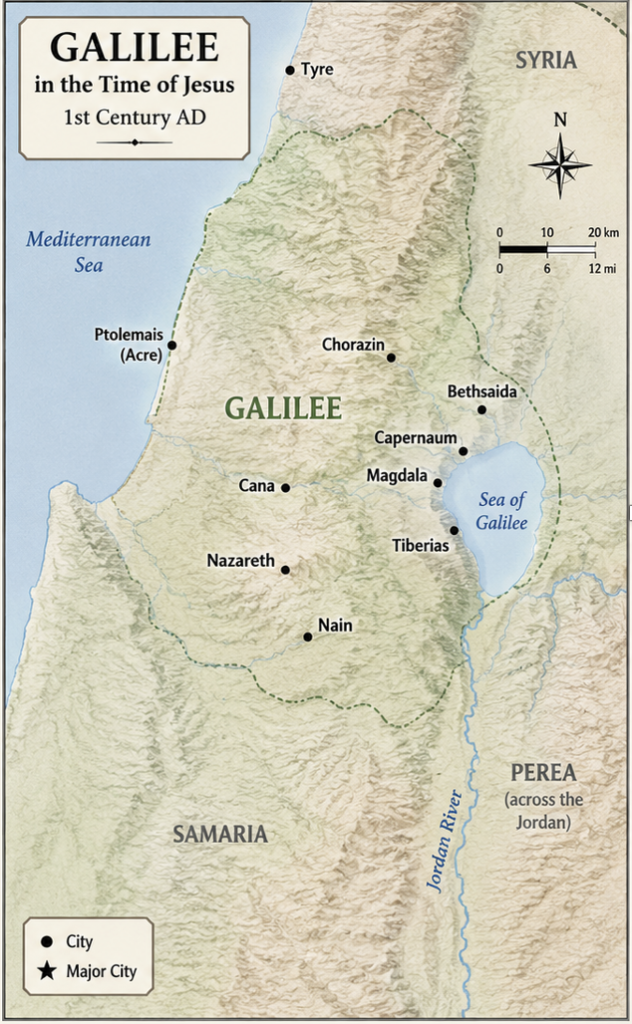
    Nazareth was a small Galilean village in the hills of Lower Galilee. The village probably had 200 to 400 inhabitants. It was tucked into the hills, so there was no trade route associated with it.

    Mary, Engaged to be Married

    Mary’s life was already planned out because she was betrothed to Joseph.

    The woman Gabriel gave this message to was named Mary (Miryam). We learn a couple of important things about her, mainly because she is described to be betrothed.

    The betrothal process had changed from Abraham’s day. In Jewish life it was then a legal institution consisting of two stages.

    The first stage was the betrothal (Kiddushin – נִישּׂוּאִין), also called Erusin (אֵרוּסִין). It was more than our engagement. It included witnesses, a formal declaration, and a transfer of value.

    The betrothal process was formalized through the marriage contract (Ketubah – כְּתוּבָּה). This was a legally binding agreement, which could only be broken through a writ of divorce (get – גֵּט).

    The emphasis had shifted away from the bride price (mohar – מֹהַר), what the groom paid the bride’s father. Instead, it emphasized the husband’s continued financial obligation to the wife if the marriage ended through divorce or death. This protected the bride’s future security.

    It is estimated that she was a teenager. 12 and 15, although there really isn’t enough first-century documents to establish a precise age as the most common.

    Isn’t it wonderful! God uses older people, younger people, and everyone in between!

    Because she was betrothed but not married, Mary was a virgin.

    The marriage, where the union is consummated, was called the Nissuin (נִישּׂוּאִין). This usually occurred a year after the Kiddushin.

    Farningham identified four characteristics that could be associated with the mother of Yeshua.

    • Humility
    • Submission
    • Quietness
    • Fidelity

    Resource

    Mary was chosen because she was a righteous person.

    Joseph

    We don’t know much about Joseph, either.

    Joseph is described as a righteous man (Mt. 1: 19). His character certainly fits the role God entrusted to him as Yeshua’s earthly father.

    Some traditions picture Joseph as considerably older than Mary, though Scripture does not tell us his age.

    We don’t know what happened to Joseph. He just leaves the narrative. Because of that, we assume he died.

    Greetings

    “Gabriel appeared to her and said, ‘Greetings, favored woman! The Lord is with you!’ Confused and disturbed, Mary tried to think what the angel could mean” (Lk. 1: 28-29 NLT)

    Mary didn’t know what to think when Gabriel addressed her.

    Mary had to have been surprised by the appearance of the angel. Then when she heard what he first had to say, she must have been really confused.

    Shalom wouldn’t have troubled Mary as that was the standard greeting. She may or may not have been startled by “Adonai is with you!” If she was blameless (as Joseph was identified [Mt. 1: 19]), she would have known Jehovah never leaves us (Deut. 31: 6).

    What probably troubled Mary was being told of her favored status. Well, think about it. Expecting it would have been prideful – eliminating her from favored status.

    Can’t you just hear it going through her mind, “Who, me? Favored by the Lord? I know He knows my name, but seriously? Blessed?

    We may not realize it, but Gabriel was greeting her as a saint. She would have been favored because she was righteous, not because she was sinless.

    The Message

    “Don’t be afraid, Mary,’ the angel told her, ‘for you have found favor with God! You will conceive and give birth to a son, and you will name him Jesus. He will be very great and will be called the Son of the Most High. The Lord God will give him the throne of his ancestor David. And he will reign over Israel forever; his Kingdom will never end!” (Lk. 1: 30-33 NLT)

    Don’t be Afraid, Mary

    Mary had the normal reaction to an angel.

    Gabriel was smart. He let Mary get over the initial shock of seeing him. People being afraid of heavenly encounters was a normal thing (Gen. 28: 17; Ex. 3: 6; Isa. 6: 5).

    Reassurance was a good thing, Gabriel even called her by name to show he was at the right place at the right time with the right girl.

    You Have Found Favor

    Mary’s obedience to Jehovah was recognized.

    Then Gabriel repeated himself: “… you have found favor with God” (Lk. 1: 30 NLT). On the surface, this was more reassurance.

    That is good, because I am sure what Gabriel had to say next deepened the confusion.

    Bushnell observed that the angel’s words could mean either that God had shown favor to Mary or that Mary had found favor with Him. He favored the latter interpretation, connecting it to her prayers and longing for the Messiah. I’m sure He saw she did have the list Farningham made.

    Resource

    Think about it. Yes, Mary would have had to be blameless as Elizabeth. But if you look at favor as being unmerited favor, that deepens the confusion, also. Mary would probably agree that Jehovah’s favor was unmerited, but she had probably already begun asking herself, “Why me?”

    Conceive and Give Birth to a Son

    Mary was about to be told she was going to have a baby in an unimaginable way.

    A virgin birth? But think back about who is writing this book. Luke was a physician. He knew how babies came. Normally, it wasn’t this way.

    But the doctor lays it all out for everyone to read.

    What Luke wrote was an accurate account of what happened. It may seem impossible, but Luke bought into the belief that “For the word of God will never fail” (Lk. 1: 37 NLT).

    If we were to look at things through the lens of a job description this is the first responsibility. The Messiah had to be a son.

    Questioning in Faith

    “Mary asked the angel, ‘But how can this happen? I am a virgin” (Lk. 1: 34 NLT)

    Mary’s question was not a question of if but how.

    The girl was no dummy. She might have been young, but she knew enough to know how babies were made. There was one important piece of the puzzle that Gabriel was leaving out – the man.

    Mary questioned Gabriel but was submissive throughout (Lk. 1: 34, 38). Look at the second word of her question in verse 34. How, not if. She wasn’t calling God on the fact that she thought it was impossible.

    Understanding how it was going to be accomplished was beyond her. So, she asked, and God rewarded her with an answer. He didn’t have Gabriel tell her exactly how it was going to be done. But Gabriel gave her a detailed explanation of Who would accomplish this.

    Let’s take a step back and see what these verses don’t tell us but do. Yes, it was good that Mary was a virgin, but she also had to have been strong in her faith. Jehovah wasn’t going to entrust the raising of His Son to just anyone. She had to know Sovereign God as her Father.

    Mary had probably heard stories of angels showing up on people’s doorsteps. She never expected it would happen to her, but she didn’t go running. Her relationship with God was such that she knew He would take care of her.

    I don’t say that lightly. The next nine months couldn’t have been easy.

    Mary was and was supposed to be a virgin, but she was having a baby. I bet not only the women talked, but the men also talked.

    No, Mary probably didn’t have an easy life for a while. She would have needed Joseph.

    Immaculate Conception

    “The angel replied, ‘The Holy Spirit will come upon you, and the power of the Most high will overshadow you. So the baby to be born will be holy, and he will be called the Son of God. What’s more, your relative Elizabeth has become pregnant in her old age! People used to say she was barren, but she has conceived a son and is now in her sixth month. For the word of God will never fail!’” (Lk. 1: 35-37 NLT)

    Just because everyone says it can’t happen doesn’t mean it can’t happen.

    Jehovah said, “No man – Me.”

    Let’s look at Gabriel’s answer. He said the Trinity would be present at the conception. The Holy Spirit creates life through the power of Jehovah Who is Father, and they would be creating Yeshua. Yeshua would be divine.

    I love what Parker said. He wrote,

    “In the introduction of Jesus Christ to the world, it would seem as if all laws of nature were to be suspended, that He Himself might be the crowning miracle of the universe. … In the birth of Christ law was not only suspended, but treated as if it had never had any existence, showing how easy it would have been for the Almighty to have founded society upon a totally new basis.”

    Resource

    God knows we have to process things. He knows if we have questions about procedures, it will sometimes take our focus off accomplishing the task successfully. He knows the attitude with which we ask.

    Right after that, Gabriel throws Mary a lifeline. “Mary, you are a virgin, but everyone said Elizabeth was barren. She is going to have a baby, too.”

    Elizabeth was Mary’s relative. Someone she knew and was related to was also going to go through a very special pregnancy.

    We aren’t told how Mary and Elizabeth are related. “And Elisheva your krovah [close, near, female relative] also has conceived a ben in her old age, and this chodesh [month, new moon, or new moon monthly] us hasishi (the sixth) for her who is called barren” (Lk. 1: 36 OJB).

    How can this happen? “For the word of God will never fail” (Lk 1: 37 NLT). We may scratch our head, question the nuts and bolts of how it will work God is going to accomplish things according to His plan.

    Submission

    “Mary responded, ‘I am the Lord’s servant. May everything you have said about me come true.’ And then the angel left her (Lk. 1: 38 NLT)

    Mary’s simple response showed her devotion to Jehovah.

    I love this verse. Teenager though she may be, Mary’s response was, “Bring it on.”

    Mary didn’t say she had to think about it. She didn’t say that she had to run this by Joseph first. She jumped in with both feet.

    Mary accepted the risk, loss of reputation, and misunderstanding.

    Oh, if only we were that quick to accept God’s Will for our lives!

    Mary knew it was going to look bad when she ended up pregnant. She could lose Joseph as her husband, which would probably mean she would never have another shot at happily ever after.

    But Mary didn’t waver. She was ready to be the mom of a Special Baby.

    Making the Connections #1

    Burkitt noted that Mary was chosen because she was a virgin to honor virginity. She was also chosen because she was betrothed to honor marriage.

    Resource

    Since Mary ended up pregnant, it would probably be assumed that she had committed adultery. Deuteronomy 22: 23-27 tells of the punishment for those who were found guilty.

    If the young lady is somewhere that she can scream for help, she wouldn’t be punished. It was assumed there was no one around to rescue her.

    However, if the young lady was in the city, both she and the man would be stoned. It was assumed she didn’t cry out for help.

    To us this seems harsh. We want to say that society had changed, and Mary wouldn’t have been harmed physically.

    Maybe we can argue capital punishment was largely controlled by Rome. That meant the Sanhedrin would have had limited authority to execute.

    That doesn’t change the fact that Jehovah’s laws don’t change. We can’t say for sure what repercussions Mary would have endured.

    Are we saying that Jehovah allowed Mary to sin to get pregnant with His child? No. She didn’t lay with a man. The Holy Spirit impregnated her. We don’t know how that happened, so it is something for our UNR book – understanding not required.

    Making the Connections #2

    We often look at the Hebrew to check if things were translated correctly.

    In the Orthodox Jewish Bible, it shows that the baby’s name would be Yeshua.

    “And in your womb you will conceive and bear BEN [YESHAYAH 7:14] and you will call SHMO YEHOSHUA. [ZECHARYAH 6:11-12]” (Lk. 1: 32 OJB).
     “… Yosef [Ben Dovid] called him by name of Yehoshua [Ben Dovid] …” (Mt. 1: 25 OJB).

    Benner and Robbins both noted the Hebrew name given to the Child was Yehoshua – Joshua. Yeshua (יֵשׁוּעַ) is Aramaic. It means YHWH saves. It became Jesus when transliterated into Latin.

    Resource

    Does that matter? Well, as disciples, we are to do a lot of things in the name of Jesus.

    • “And whatever you do or say, do it as a representative of the Lord Jesus, giving thanks through him to God the Father” (Col. 3: 17 NLT).
    • “You can ask for anything in my name, and I will do it, so that the Son can bring glory to the Father” (Jn. 14: 13 NLT).
    • “You didn’t choose me. I chose you. I appointed you to go and produce lasting fruit, so that the Father will give you whatever you ask for, using my name” (Jn. 15: 16 NLT).
    • “Therefore, go and make disciples of all the nations, baptizing them in the name of the Father and the Son and the Holy Spirit” (Mt 28: 19 NLT).
    • “Peter replied, ‘Each of you must repent of your sins and turn to God, and be baptized in the name of Jesus Christ for the forgiveness of your sins. Then you will receive the gift of the Holy Spirit’” (Ac. 2: 38 NLT).
    • “And there is salvation in no one else, for there is no other name under heaven given among men by which we must be saved” (Ac. 4: 12 NLT).

    Who are we really serving?

    Heart Check

    Think about the battle Yeshua is engaged in for your heart. Ask yourself the following questions.

    • Do I respond to God’s calling with surrender, even when I don’t understand everything?
    • Am I treasuring God’s Word and pondering it in my heart?

    How Do We Apply This?

    • Receive God’s calling with humility, even when you don’t understand every detail.
    • Trust God’s promises instead of your own understanding when
    • He asks you to do something difficult.
    • Ask honest questions in faith, but don’t let unanswered questions keep you from obeying.
    • Remember that God’s favor is His gracious gift, not something you earn.
    • Be willing to surrender your plans when God has a greater purpose for your life.
    • Respond to God’s Word as Mary did—with a heart that says, “I am the Lord’s servant.”

    Father God. We are amazed at the faith of a teenager. We thank You for the example of her faithfulness.  Her trust in You is beautiful. Amen.

    If you don’t understand something and would like further clarification, please contact me.

    If you have not signed up for the email providing the link to the devotions and the newsletter, do so below.

    If God has used this devotion to speak with you, consider sharing it on social media.
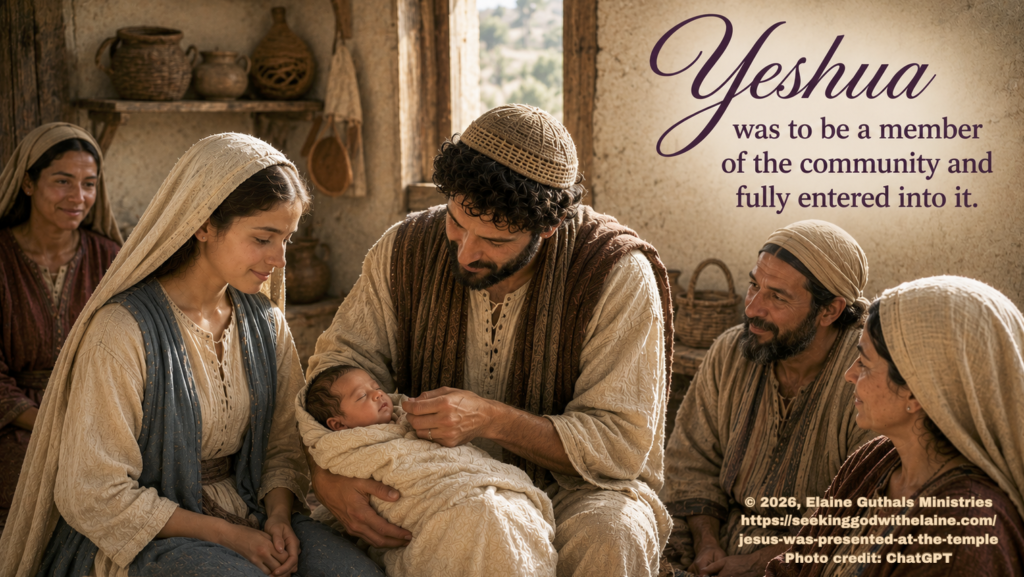
  • Jacob’s Dysfunctional — and Obedient — Family

    This is the last excerpt from Abraham’s Dysfunctional — and Obedient — Family. The full resource will be available soon.

    The complete resource is a character analysis of the ten people we have discussed over these three posts. We look at them to see glimpses of their Sanctification Roads.

    Jacob: How God Broke Him to Bless Him

    Have you ever sat down and taken a look at how complex Jacob was – and yet still feel an affinity for him?
     
    We may be thinking Jacob started out with something we don’t have — he was known from the womb (Gen. 25: 23). But then again, so are we (Jer. 1: 5).
     
    Jacob and his twin Esau struggled in the womb – and many days after that. He came out grasping Esau’s heel (Gen. 25: 26).
     
    His brother’s heel wasn’t the only thing for which Jacob grasped. He grasped for Esau’s birthright as firstborn (Gen. 25: 29-34). Years later, he grasped for the  covenant blessing (Gen. 27).
     
    While we may say that is a good thing because it showed his desire for the covenant, Jacob went about it in the wrong way. He went about it his way, not Jehovah’s way.
     
    Why should we study Jacob’s life? Mercer gave us a good reason. He wrote, “His character was unlike that of the other patriarchs in this: Abraham and Isaac, such as we see them at first, are very much such as we see them at last. But Jacob only becomes his real, that is, his higher self at the last.”

    Resource

    If we take a close look at Jacob’s story, we see that Jehovah broke Jacob to bless him. That may sound strange, but Jehovah often works that way.

    In today’s terms, we might say Jacob was moving from sinner to saint. More accurately, he was navigating his Sanctification Road.

    What Jacob Did Right

    Jacob Believed the Covenant Mattered

    Throughout his life, Jacob deeply wanted Jehovah’s promise. He understood the spiritual significance even when Esau treated it casually.

    The covenant promises, including the birthright and blessing, were more than family inheritance rights to Jacob. They represented Jehovah’s covenant purposes continuing through Abraham and Isaac.

    Jacob accepted that it required effort, and he was willing to patiently work for it. Unfortunately, his methods were deeply flawed.

    Jacob Eventually Learned Dependence upon Jehovah

    By the end of his life, Jacob learned that he could depend on Jehovah. He had gone through many sufferings.

    • Laban deceived Jacob by substituting Leah for Rachel on their wedding night (Gen. 29: 35).
    • Laban changed his wages ten times during Jacob’s employment (Gen. 31: 7).
    • Jacob’s daughter Dinah was raped (Gen. 34: 2), and two of his sons murdered all the men in the town in which the rapist lived (Gen. 34: 25).
    • The love of his life first was barren many years before their first son was born (Gen. 30: 1, 25) and died in childbirth upon the birth of their second child (Gen. 35: 19).
    • Reuben slept with one of Jacob’s concubines (Gen. 35: 22).
    • One day, his favorite son Joseph never came home because, unbeknownst to him, his other sons sold him to traders (Gen. 37).

     Jacob’s life became a long Sanctification Road in which Jehovah stripped away his self-reliance. He showed him that He was in control of situations – as devastating as they were – and could give a good outcome in the end.

    Jacob Remained Connected to the Covenant Promises Even During Exile

    When Jacob fled from Esau’s anger, Jehovah came to him in a dream. In the dream, He reiterated the covenant promises (Gen. 28: 13-14).

    Specific to Jacob, Jehovah promised him His presence and protection. “What’s more, I am with you, and I will protect you wherever you go. One day I will bring you back to this land. I will not leave you until I have finished giving you everything I have promised you” (Gen. 28: 15 NLT).

    We know that Jehovah kept that promise, as Jacob told Leah and Rachel in Genesis 31: 5 that Jehovah had remained with him. He acknowledged that Laban did not harm him because of His provision (Gen. 31: 7).

    Jacob Became a Man of Prayer During Crisis

    When Jacob finally returned to Canaan after twenty years, he came with the intention of reconciling with Esau. He knew Jehovah wanted him to make things right.

    But when Jacob finally turned to Jehovah in prayer, it wasn’t in gratitude for being brought home. It was from fear because Esau was showing up with 400 soldiers.

    And that is where Jacob was broken.

    Jehovah met Jacob personally to wrestle with him. He removed Jacob’s advantages of strategy or strength.

    What did Jacob do?

    He clung.

    He held on to Jehovah because he had nothing else left. In that moment, Jacob learned what it meant to depend fully on Him.

    Jacob accepted that he was helpless and Jehovah was always in control.

    Jacob Ultimately Finished in Faith

    Hebrews listed Jacob as a Hall of Famer. “It was by faith that Jacob, when he was old and dying, blessed each of Joseph’s sons and bowed in worship as he leaned on his staff” (Heb. 11: 21 NLT).

    How we come to salvation is not the main goal. Our relationship with Jehovah at the end of our lives is what is important.

    “But the one who endures to the end will be saved” (Mt. 24: 13 NLT).

    What Jacob Did Wrong

    Jacob Manipulated Situations Instead of Trusting Jehovah’s Timing

    From before he was born, Jacob’s parents knew he was going to be the covenant son. But there are times when he didn’t act like it.

    From birth, Jacob was associated with grasping. He grasped at Esau’s heel — in fact, that is where he got his name.

    That pattern played out in Jacob’s life by his reaching out for what he wanted, often before the right time. To secure what he wanted, Jacob used scheming and manipulation. Jacob acted as though Jehovah’s promise depended on his effort.

    But grasping came at a cost.

    Yes, Jacob obtained the blessing – but immediately, he lost his home. What looked like success became exiled, and he was running for his life.

    Oh, yes. Jacob was exiled to settle his future by obtaining a wife. What may have looked like a setback was a step forward.

    Even years later, he was still trying to manipulate outcomes, still relying on strategy instead of surrender.

    So, Jehovah stepped in – not to destroy him, but to transform him.

    Jacob Favoritism Damaged His Household

    Carrying on his parents’ practice of favoritism, Jacob continued this dysfunctional practice in his family – to heartbreaking outcomes.

    Jacob preferred Rachel over Leah. Some may justify this as Jacob had no intention to marry Leah.

    But that doesn’t excuse Jacob’s treatment of her once they were married. She was his first wife and should have been treated properly.

    Jacob also showed favoritism to Joseph, his and Rachel’s first son. Partially in response to Jacob’s gift to Joseph of a tunic (possibly showing that he was going to give Joseph the firstborn status), Jacob’s sons by his other wives reacted in jealousy and envy. The brothers sold Joseph to slave traders.

    Jacob Allowed Fear to Control His Decisions

    Even after receiving Jehovah’s promises, Jacob didn’t act from settled covenant confidence. He often acted from anxiety and survival instinct.

    One example of this was when Jacob and his family left Haran to return to the Promised Land. Jehovah had told him to return home (Gen. 31: 3). Still, Jacob left secretly when Laban was elsewhere (Gen. 31: 19-20).

    Jacob also showed fear when Esau was approaching after he returned to the Promised Land. Though Jacob had initiated contact with Esau, he probably didn’t expect Esau to bring 400 men with him (Gen. 33: 1).

    Jacob Delayed Full Obedience at Times

    Jacob had promised obedience to Jehovah at Bethel (Gen. 28: 20-21). Still, he slowly grew spiritually. Partially because of that, his sanctification was uneven.

    Jacob Struggled with Unresolved Grief

    We get a hint as to Jacob’s response to what appeared to him to be Joseph’s death.

    “Then Jacob tore his clothes and dressed himself in burlap. He mourned deeply for his son for a long time. His family all tried to comfort him, but he refused to be comforted. ‘I will go to my grave mourning for my son,’ he would say, and then he would weep” (Gen. 37: 34-35 NLT).

    This describes a man who essentially stopped living. He refused comfort. He refused hope. For years.

    This grief hits even harder when we remember that, on the day Rachel gave birth to Benjamin, Jacob expected to welcome another son. Instead, he buried the love of his life.

    A year later, Jacob woke expecting Joseph to return home that evening. Instead, his sons handed him what appeared to be proof that Joseph had been killed.

    The two great loves of Jacob’s life were suddenly gone.

    Jacob allowed the grief to eclipse his trust. Despair dominated where confidence in Jehovah should have been.

    Scripture does not record that Jacob turned to Jehovah for comfort during this season of grief. That is what He wants us to do – come to Him when we are in our worst place.

    But then, it doesn’t say that Jacob blamed Jehovah. That could be one of the worst things we could do.

    The younger Jacob had worked to control outcomes. By this point in his life, he knew that he couldn’t control anything.

    But Jacob had to turn away from trying to control circumstances and turn to Jehovah, Who is always in control.

    What Jacob Teaches Us

    Jacob teaches us that Jehovah works through flawed, imperfect people. We see what sanctification means through Jacob’s story. Jehovah is more than happy meeting us where we are — with the intention of taking us where He wants us to be.
     
    The sanctification process is not meant to be some self-help exercise. It is surrender.
     
    Jacob teaches us that brokenness is often part of sanctification. Sometimes, the sanctification process means discipline. Other times, it means breaking.
     
    Jehovah does not mean to destroy us. He means to reshape our hearts.
     
    God often breaks the self-reliance of His servants before He entrusts them with lasting blessing.
     
    Jacob teaches us that the sanctification process is a life-long process. We are not sanctified overnight. Jehovah shapes us through decades of consequences, fear, labor, exile, grief, and confrontation.
     
    We, too, are brought into struggles. We are shaped through wrestling. We are given the opportunity to prevail.
     
    Jacob teaches us that family dysfunction spreads unchecked. This can even cross generations.

    • Abraham deceived Pharaoh and Abimelech by saying Sarah was his sister.
    • Isaac deceived Abimelech by saying that Rebekah was his sister. Isaac and Rebekah both showed favoritism. Rebekah manipulated circumstances so that Jacob would be blessed.
    • Jacob deceived Isaac by saying he was Esau. Jacob showed favoritism, and his children were divided into maternal camps.
    • Reuben slept with his father’s concubine. Simeon and Levi murdered men. Judah didn’t treat Tamar fairly. All but Benjamin sold Joseph into slavery.

    Jacob shows us that we must stop relying on ourselves. We can’t overpower Jehovah. Like Jacob, we must start depending on Him.
     
    Jacob teaches us that Jehovah remains faithful to His covenant promises even when we are inconsistent in our obedience.
     
    Jacob’s story shows how Jehovah works through human weakness. He chooses, calls, and promises blessings – and then leads us through long seasons of waiting, disappointment, failure, and humbling before the blessing comes to us.
     
    And in the end, we learn what Jacob learned: it was never his story. It was Jehovah’s story of grace.

    Leah: The Unloved Wife Seen by GodTitle

    We usually don’t think of Leah first when we think of Jacob’s wives. We think of his love for Rachel. We think of beauty, romance, and loss.
     
    Leah, on the other hand, was accustomed to being overlooked and unwanted. In some translations, she is described as being plain.
     
    But Leah was never overlooked and unwanted by Jehovah.
     
    As Laban’s oldest daughter, she should have been married first. If the Midrash is correct in that Leah was supposed to marry Esau, her story was even sadder.
     
    Whatever the cause of her weak eyes, the narrative suggests she lived in the shadow of her younger sister’s beauty and desirability.
     
    Yet as she walked her Sanctification Road, Leah became a woman of remarkable spiritual depth and insight. Her story goes beyond her rivalry with Rachel.
     
    Leah’s story becomes a testimony of Jehovah seeing us when others don’t.  He hears us when the world turns a deaf ear to us. He works His covenant purposes through those the world neglects.
     
    We meet Leah when Jacob travels to Haran to find a wife. By the time Leah enters the narrative in Genesis 29: 16-17, Jacob and Laban were determining Jacob’s wages. Jacob asked for Rachel as a wife in Genesis 29: 18.
     
    From then on, Leah’s story is shaped by being second choice to Rachel and enduring Laban’s schemes. But that is not how the story ends.

    What Leah Did Right

    Leah Endured Rejection with Perseverance

    Leah faithfully entered a marriage that began with her and her father’s deception and lacked love. Yet she did not withdraw.  Leah made the best of her marriage with Jacob.

    We are plainly told that Leah was given children because she was unloved (Gen. 29: 31). Rather than retreating in bitterness or despair, Leah continued to live, bear children, and seek meaning in her life.

    Leah endured years of rejection without abandoning her family responsibilities. We are never told that she failed to fulfill her duties as a wife.

    Leah Grew in Spiritual Understanding

    Most importantly, Leah turned to Jehovah, recognizing that He saw her suffering. She repeatedly acknowledged His hand in the birth of her children.

    We see her spiritual growth in the naming of her sons. The meaning of the names showed that she had moved from seeking Jacob’s approval (Gen. 29: 32) to praising Jehovah (Gen. 29: 35).

    Leah Became a Mother of Israel

    In all, Leah had six sons by Jacob. She also had a daughter.

    More importantly, she was the mother of Judah. It was through Judah’s line that David and ultimately the Messiah came.

    The unloved woman was used to ensure the central covenant promise was fulfilled.

    Leah Showed Dignity in Family Conflicts

    Leah’s rivalry with Rachel was intense and painful. Yet we are never told that she used deception or stealing to further her cause.
     
    Leah remained faithful to her role in the family. In fact, she is buried with Abraham, Sarah, Isaac, Rebekah, and Jacob in the cave at Machpelah (Gen. 49: 31).

    What Leah Did Wrong

    Leah Was a Party to the Deception

    Leah was not without fault. She remained silent in the deception that began her marriage.

    True, we don’t know how much choice Leah had in Laban’s scheme. She may have faced difficult consequences if she had not gone along with the deception.

    That doesn’t change the fact that she – like Jacob – pretended to be someone she wasn’t. Jacob sinned when he disguised himself as Esau, and Leah sinned when she disguised herself as Rachel.

    We aren’t inferring anything here. If she would have said, “Hey, I’m Leah,” Jacob would have said, “I’m not marrying you.” That didn’t happen.

    What we do know without a doubt is that Jehovah expects obedience to Him regardless of the situation we are in. We don’t get a pass to ignore His laws because the world will judge us and impose circumstances of their own.

    Leah Initially Sought Fulfillment Primarily in Jacob’s Love

    When she saw the marriage itself didn’t gain her Jacob’s affection, Leah struggled with  her desires to win it. This revealed Leah’s desire for human approval over Jehovah’s.

    Unfortunately, Leah tied her worth to human approval.

    Leah Participated in the Competition for Children

    Leah entered into the baby war when Rachel gave her servant to Jacob. She gave Jacob her servant Zilpah in order to bear more children on her behalf (Gen. 30: 9-13).

    This prolonged the rivalry. It eventually caused the sons to divide into maternal camps. This created even more tension.

    This also shows how broken the family was.

    Still, this is the family through which Jehovah’s covenant with Abraham would pass. This is the family that formed the twelve tribes of Israel.

    Leah Was Not Entirely Free from Bitterness

    At times, Leah’s bitterness did get the best of her. Her bitter comment about Rachel stealing her husband (Gen. 30: 15) was not accurate. If anyone stole Jacob, it was Leah.
     
    We shouldn’t allow bitterness to creep in. Everything that happens to us ultimately is because Jehovah allowed it to happen.
     
    Since Jehovah allowed it to happen, there is a good reason for it. Usually that good is to draw us closer to Him.

    What Leah Teaches Us

    Leah shows us that Jehovah sees what this world overlooks. He wants us when the world does not. He sees us in our deepest pain.

    We are seen because Jehovah is involved in each of our lives. He sees the unloved, overlooked, and quiet suffering.

    And He works there.

    Leah’s story reminds us that sanctification is a process. Growth happens in places of pain, not comfort.

    Rachel: A Woman Deeply Loved, Deeply Longing

    Rachel’s story carries a different kind of weight.
     
    Rachel seems to be one of those women who are more of everything. She is more beautiful, more passionate — and at times it seems more self-centered.
     
    Rachel’s story has it all — love, jealousy, barrenness, faith, and covenant purposes.
     
    She was deeply loved – and yet deeply burdened. Her life was marked by longing.
     
    We met Rachel at the well at Haran. Jacob had just arrived and was looking for his family. Right away, we find out that Jacob had found his wife.

    What Rachel Did Right

    Rachel Inspired Deep, Faithful Love

    Rachel was the love of Jacob’s life. He loved her with an intensity and laser focus.
     
    This speaks to Rachel’s character as well as her beauty. She was someone whom he was willing to wait for, work for, and sacrifice for.

    Rachel Showed Courage in Leaving Home

    Jacob called Leah and Rachel out to the field in which he was working to tell them Jehovah had called him to go home (Gen. 31: 4 NLT). It appears that Jacob allowed them to be in the decision-making process.

    Rachel – as did Leah – agreed to leave Laban’s household and her homeland. This was a huge decision. She was stepping into an unknown future.

    This decision meant that Rachel had to not only trust Jacob, but she also had to trust Jehovah. He was the One Who was giving the call.

    Rachel – and Leah – chose wisely. They chose to follow Jehovah’s call.

    Rachel Experienced Genuine Spiritual Longing

    Sometimes, we may think that Rachel’s desire to have children was based on envy of Leah. I don’t think that is everything.

    Rachel wanted children—not just for herself, but to take part in Jehovah’s covenant family.

    Rachel stayed within the covenant line and desired to belong to what God was doing. In time, she recognized that children came from Jehovah.

    What Rachel Did Wrong

    Rachel May Have Had Some Hand in the Wedding Deception

    Rachel also remained silent in Laban’s deception. Again, we don’t know if Rachel had any more choice than Leah had in Laban’s scheme.

    Where was Rachel on what was supposed to be her wedding night? Was she duped in some way that took her away from the compound? Or did she knowingly participate?

    Rachel Struggled with Envy Toward Leah

    Rachel’s longing turned into desperation. Her bitter demand for children (Gen. 30: 1) revealed how deeply this struggle affected her

    Rachel Used Surrogacy Rather than Waiting on Jehovah

    Instead of waiting, Rachel tried to take control. She gave her servant to Jacob – and intensified the family conflict.

    Rachel Stole Her Father’s Household Idols

    We don’t know the real reason behind why Rachel stole Laban’s teraphim. Whether it was about control, inheritance, or belief, it showed a lack of full trust in Jehovah.

    Rachel then deceived Laban when she hid what she had done.

    Rachel’s faith was real – but it was often mixed with urgency and struggle.

    What Rachel Teaches Us

    Rachel teaches us that longing and faith can grow side by side. Both can be messy.
     
    Rachel’s life reminds us that painful circumstances can distort relationships – but they do not stop God’s purposes.
     
    Jehovah works through real people — people who love, envy, hope, fail, and are still graciously used by God.

    If you don’t understand something and would like further clarification, please contact me.

    If you have not signed up for the email providing the link to the devotions and the newsletter, do so below.

    If God has used this devotion to speak with you, consider sharing it on social media.
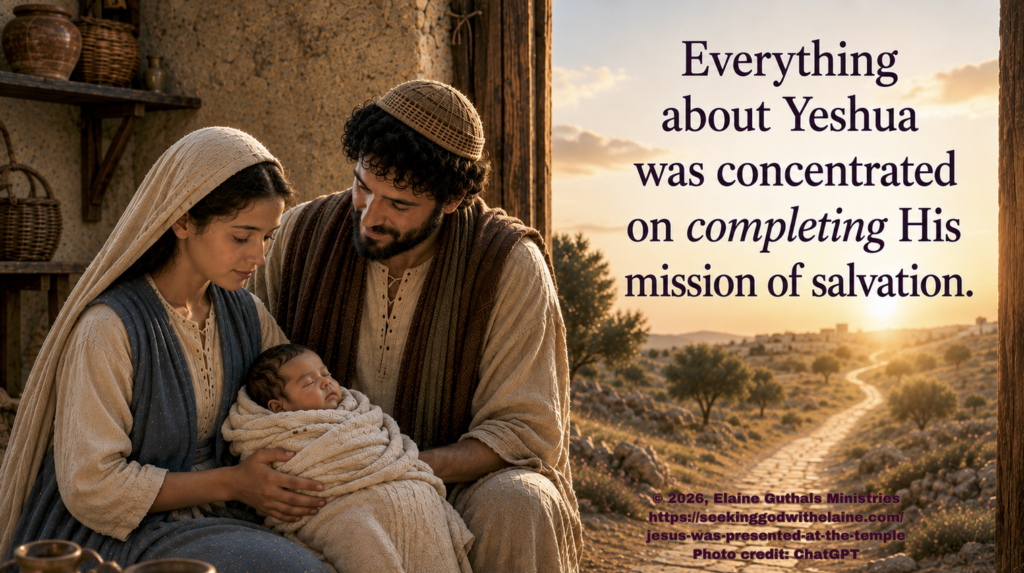
  • Isaac’s Dysfunctional — and Obedient — Family

    isaacs-dysfunctional-and-obedient-family

    We continue our wrapup on Genesis by looking at Isaac’s family. He, Rebekah, and Esau also had their choices to make. 

    We will talk about Jacob as he pertains to their stories, but we are going to wait until the next devotion to look at him and his family. 

    Again, these are excerpts from the book Abraham’s Dysfunctional — and Obedient — Family. It will be coming out soon.

    Isaac: A Quiet Faith in Jewish Interpretations

    For the patriarch who lived the longest, we get the least information about Isaac. His story seems to be buried within his father’s story and his son’s story.

    Between Abraham’s acts of faith and covenant relationship and Jacob’s tumultuous life and transformation, we find Isaac. He was described as meditative — which we would equate to quiet. Jewish interpreters saw him as a model of restraint, endurance, and steady covenant faithfulness.

    Isaac was the long-awaited covenant child. His miraculous birth was a testimony to Jehovah’s faithfulness.

    A testing of Abraham was a significant event in the Book of Genesis: the Akedah ( עֲקֵדָה) — the binding. We don’t know Isaac’s age when this occurred. We do know of his obedience as he willingly submitted to his father’s actions.

    Isaac took Rebekah as his wife. They became the father of Esau and Jacob.

    Isaac’s role in the covenant was inheritance and preservation. Unlike Abraham, he did not leave Mesopotamia. Unlike Jacob, he did not spend years in exile. Isaac’s life is rooted in the land God promised to his descendants.

    What Isaac Did Right

    Isaac Submitted to Jehovah on Mt. Moriah

    It is easy to allow Abraham to overshadow Isaac in Genesis 22. It is Abraham’s story. It was his testing.

    But it was also Isaac’s story. He was being tested, too.

    Would Isaac submit?

    Yes, Isaac did. According to Jewish interpreters, he was an active participant, not just a passive person. His willingness to be bound and placed on the altar showed his surrender to God’s Will.

    Isaac showed faith and trust not only in Abraham, but also in Jehovah Isaac’s story tells us about the blessings in the obedience.

    Isaac Trusted Jehovah Rather than Forced Outcomes

    Genesis 26 tells the story of wells. We — who have water at the touch of a faucet — may not understand the importance of having a well.

    Access to water in a well would have meant the difference between survival and death. Herds and flocks frequently migrated based on the availability of water.

    Yet time and time again, Isaac yielded contested wells to others. Did he — like Abraham — just not want the confrontation?

    Isaac seemed content to move on until he found an area where Jehovah had made room for him — thus the name of the well — Rehoboth. He didn’t follow the worldview where he had to fight for every opportunity.

    Instead, Isaac relied on Jehovah. As he had learned on Mt. Moriah, Jehovah would provide.

    Isaac Preserved Abraham’s Legacy

    Some of the wells in question in the last section weren’t built by Isaac. He preserved Abraham’s legacy by reopening his father’s wells that the Philistines had closed in envy and restoring their names (Gen. 26: 15).

    Yet Isaac was not merely a caretaker of another man’s accomplishments. His servants dug new wells (Gen. 26: 17). God renewed the covenant directly with him, and through him the covenant promises passed to the next generation.

    Isaac preserved Abraham’s legacy as well as established one of his own.

    Isaac Cultivated a Life of Prayer

    We saw Isaac walking in the field, meditating, when Rebekah’s caravan arrived at Abraham’s place.

    Jehovah wants us to meditate on His Word, reflect honestly on our lives, and apply it to draw us closer to his ways. “Blessed is the man who walks not in the counsel of the wicked, nor stands in the way of sinners, nor sits in the seat of scoffers; but his delight is in the law of the Lord, and on his law he meditates day and night” (Ps. 1: 1-2 NLT).

    Meditation is the thoughtful contemplation of what the Holy Spirit has put on our hearts. We have to listen to what He tells us and decide what we are going to do about it.

    Are we going to be obedient and submit to His Will or be disobedient and do things our own way?

    Submitting to Jehovah builds our character. Our reliance on Him takes the focus off us and puts it where it belongs — on Him. We agree to follow God’s plan for our lives because it is better for us.

    More importantly, we show the condition of our hearts. When we pray, meditate, and reflect, we open our hearts to the changes the Holy Spirit is proposing.

    Isaac Demonstrated Marital Faithfulness

    Jehovah wants us to be married to one spouse at a time. Isaac and Rebekah’s marriage may have been arranged; but from the start, Isaac’s love for Rebekah was obvious (Gen. 24: 67 NLT).

    We aren’t told that Isaac took another wife or concubine. He remained faithful to Rebekah.

    Isaac knew when Abraham was choosing a wife for him, his father did so to advance the covenant responsibilities. He knew that the decision of who his wife would be ultimately rested with Jehovah. He showed submission, trust, and contentment in waiting on Jehovah to provide the chosen wife in His timing.

    Isaac Endured Rather than Retaliated

    Isaac showed unusual patience. We see this during the conflict over the wells.

    We also see this in dealing with his family. Esau, as the firstborn, was not acting as a covenant son when he married two Canaanite women (Gen. 26: 34-35). We are not told that Isaac responded to Esau selling his birthright to Jacob.

    What Isaac Did Wrong

    Isaac Repeated Abraham’s Deception

    You would have thought Isaac would have learned from Abraham. Abraham did the same thing as Isaac was trying to do — both tried to pass their wives off as their sister (Gen. 12: 11-13; Gen. 26: 7).

    Fear of circumstances led Isaac to not trust Jehovah. He didn’t believe that He would keep him safe from harm.

    Lack of trust in Jehovah to keep His promises of protecting and providing for us undermine our relationship with Him. We need to cultivate a full and unwavering trust in Him.

    Isaac Showed Favoritism toward Esau

    Isaac’s family was dysfunctional because Isaac favored Esau and Rebekah favored Jacob (Gen. 25: 28). That divided the family and caused conflict between the brothers.

    Isaac’s favoritism stemmed from Esau’s outdoorsman activities. He loved the game that Esau hunted and provided.

    Isaac Failed to Resolve the Family Conflict

    From the time we first heard of the brothers after their birth, we see how the brothers are opposites (Gen. 25: 27 NLT). Scripture records no attempt by Isaac to resolve the conflict. This led to Jacob stealing the birthright and the blessing.

    Instead of easing tensions, Isaac allowed for them to grow.

    The division of Isaac and Rebekah fostered division between Esau and Jacob. The unhealthy environment created consequences that would echo into future generations.

    Isaac’s Patience at Times Became Passivity

    Our strengths can become our weaknesses. Isaac may not have been diligent in reading the situations. Maybe he inherited Abraham avoidance of causing a conflict.

    Whatever the reason, the patriarch didn’t judge the family. He didn’t directly address his sons’ problems.

    Isaac Tried to Give the Covenant Blessing to Esau

    From the time the twins were in Rebekah’s womb, Isaac and Rebekah knew the covenant was to pass to Jacob (Gen. 25: 23 NLT). Yet, Isaac still tried to give the covenant blessing to Esau. At minimum, Isaac appears determined to advance Esau despite God’s choice of Jacob.

    What Isaac Teaches Us

    Isaac teachers us that faithfulness can be quiet and contemplative. It must be a deliberate choice.

    Isaac teaches us that Jehovah is God of the little things as well as the big things. He is looking for our obedience in our everyday lives.

    Isaac teaches us about self-control and waiting for Jehovah’s perfect timing. Pain and division comes when we try to take things into our own hands.

    Isaac teaches us to avoid passivity. Patience must not become neglect.

    Perhaps most importantly, Isaac teaches us the importance of generational faithfulness. Abraham passed down the covenant promises to him. Though he tried to pass those promises on to Esau, he did pass them on to Jacob.

    We must raise our children in the faith. They must make their own choices to be obedient or disobedient to Jehovah; but as parents, we are called to teach our children His ways (Deut. 6: 7 ESV).

    Isaac occupies a unique place among the patriarchs. He was neither called as Abraham was nor transformed as Jacob was. Instead, he quietly endured, prayed, and submitted to God’s Will.

    Still, Isaac showed favoritism, passivity, and moments of fear. Jehovah still remained faithful.

    Jewish interpretation often celebrates Isaac’s quiet strength. Scripture itself presents him as a man of genuine faith whose life helped preserve the covenant line through which the Messiah would eventually come.

    Isaac’s story reminds believers that steady obedience, patient trust, and enduring faithfulness are not lesser forms of spirituality. They are often the very means by which God accomplishes His greatest purposes.

    Rebekah: The Quiet Tragedy of Never Seeing Her Son Again

    When we look at Rebekah, we see a woman who was deeply committed to Jehovah’s covenant. But we also see a woman who took things into her own hands to ensure the covenant was kept.

    This makes Rebekah both influential and complex.

    Rebekah entered the covenant story as the wife chosen for Isaac. Early on we see her intelligence, decisiveness, and spiritual perception. She faced the future by accepting Jehovah’s plan even when she knew nothing about it until the day before.

    Because she agreed to be Isaac’s wife, Rebekah became the covenant matriarch. Still, she experienced decades of infertility. The difficult pregnancy had her turning to God for explanation. This interchange with Jehovah provides knowledge that will affect the whole family.

    But then we see a tragic ending for her story. It is tragic because she just disappears from the narrative. We learn nothing about her death or burial or how she was mourned. It isn’t until her son dies that we learn where she was buried.

    Possibly most tragic is that, when Rebekah sent her son away to save him, she didn’t know that she would never see him again. In ensuring the covenant line progressed as Jehovah had decreed, she gave up the son she loved most.

    Rebekah’s life shows us both the power of faith and the danger of taking our lives into our own hands instead of relying on Jehovah to work through us.

    What Rebekah Did Right

    Rebekah Demonstrated Hospitality

    We meet Rebekah at the well where she went to fill her jug (Gen. 24: 15). When Eliezer asked for a drink of water, she not only gave him some to drink but she also drew water for his camels to drink.

    This gives us a window into her character. She was generous, hardworking, and attentive to others.

    The code of hospitality would have only addressed her conduct with Eliezer. It was through her generosity that she drew water for his camels.

    Some may have trouble relating to this. We tend to not interact with strangers. In that day, however, hospitality was important. There were no restaurants or motels in which travelers could take a break from the road.

    Rebekah also took time out from her original reason for coming to the well to help someone in need. Eliezer wouldn’t have had a jar through which he could draw water from the well.

    Pulling water for ten camels probably took several trips. Rebekah willingly did what was needed until the job was completed.

    Jehovah didn’t make us to not interact with others. We are to love them as ourselves (Mt. 22: 39).

    We are not only to work to support ourselves, but we are also to work to learn more of Him and to expanding Jehovah’s kingdom.

    • “Even while we were with you, we gave you this command: ‘Those unwilling to work will not get to eat’” (II Thess. 2: 10 NLT).
    • “… Work hard to show the results of your salvation, obeying God with deep reverence and fear. For God is working in you, giving you the desire and the power to do what pleases him” (Phil. 2: 12-13 NLT).
    • “Therefore, go and make disciples of all the nations, baptizing them in the name of the Father and the Son and the Holy Spirit. Teach these new disciples to obey all the commands I have given you …” (Mt. 28: 19-20 NLT).
    • “And then he told them, ‘Go into all the world and preach the Good News to everyone’” (Mk. 16: 15 NLT).

    Rebekah had a caring heart that allowed her to serve others.

    Rebekah Responded Willingly to Jehovah’s Leading

    In the Ancient Near East, marriages were arranged by the father or patriarch of the family. Rebekah’s acceptance or rejection of the union would not be something in which she would have a say.

    Eliezer, however, wanted to return to Canaan the next morning. In this, Rebekah’s wishes were consulted (Gen. 24: 58).

    What Eliezer was asking was that Rebekah step boldly into the unknown. She wasn’t alive when Abraham still lived in Haran, so she wouldn’t have known him. More than likely, she would have heard stories about him from her grandfather, Abraham’s brother Nahor.

    Rebekah would have known little about Canaan. We know Abraham had received a news from Nahor’s wife Milcah, so they knew where he was (Gen. 22: 20). While we aren’t told if or when he responded, we can assume he had sent at least one letter to Nahor to tell him where they lived.

    Rebekah’s answer showed faith, trust, and obedience to Jehovah. Old Testament faith was a gift from God that produced conviction that the truths revealed by Jehovah were true, even when they do not fully understand them, and that continually grew into increasing trust, obedience, and conformity to Gods will.

    Rebekah Sought Jehovah During Her Pregnancy

    Rebekah is the only matriarch that we are told had a personal encounter with Jehovah. All of the patriarchs received encounters with Him, but we are never told that they initiated it.

    Rebekah had enough faith to approach Him. Jehovah will gladly answer our petitions in His Will.

    Rebekah Correctly Understood Jehovah’s Choice

    The revelation Jehovah gave Rebekah when she asked was that the older son would serve the younger (Gen. 25: 23). The Ancient Near East custom was that the firstborn son became the leader of the clan.

    Jehovah doesn’t always follow earthly customs. He looks at hearts and determines the amount of submission and obedience to Him. Based on that, He chooses – in this instance who would become the covenant son.

    Rebekah believed what Jehovah had revealed. She didn’t argue that the oldest should become the covenant son. She just accepted God’s Will.

    Rebekah accepted God’s declaration of who the covenant son would be.

    Jehovah Used Rebekah to Preserve the Covenant Line

    Knowing this choice by Jehovah, Rebekah worked to move the covenant story toward His intended outcomes. Though her actions were not what Jehovah wanted, He used them to do just that – ensure the covenant son received the blessing.

    Jehovah uses our faithful and sinful responses to move His kingdom along. He knows our sinful responses do much to grow us closer to Him.

    Jehovah invites and uses imperfect people in His kingdom.

    What Rebekah Did Wrong

    Rebekah Allowed Favoritism to Divide Her Family

    The divide in Isaac’s family started innocently (Gen. 25: 28 NLT). We aren’t told the contributing factors causing Rebekah to love Jacob more as we are with Isaac. But the why doesn’t really matter all that much.

    The important thing is that Isaac and Rebekah both allowed this division to occur. As seen in this story, the consequences can be far reaching.

    Rebekah Chose Manipulation Instead of Trust

    Instead of trying to encourage Isaac not to sin, Rebekah herself committed a sin. She did not trust Jehovah to work circumstances out according to His plan.

    Rebekah knew the outcome – Jacob was to be the covenant son. She was wrong about Jehovah’s method – He had not planned for the blessing to be received through deception.

    Another thing she didn’t know was Jehovah’s timetable. Instead of trusting Him to working it out in His time, she took matters into her own hands. She didn’t trust Him to do what He said.

    Rebekah’s deceptive plan succeeded in securing the covenant blessing for Jacob – but at a price for both.

    Rebekah Encouraged Jacob to Deceive His Father

    Rebekah’s lack of trust caused her to not only act to manipulate events, but she also drug Jacob into the deception.

    Yes, Jacob chose to deceive his father. But his mother planned for and encouraged him to do that.

    Rebekah Underestimated the Consequences

    When Esau realized that Jacob had stolen the blessing, he vowed to kill him. To ensure that didn’t happen, Rebekah encouraged Issac to send Jacob to Haran to find a wife.

    Rebekah probably anticipated the trip would take a couple of months. That would include one month’s travel time each way plus however long it took for Jacob to find a wife.

    Never in Rebekah’s wildest dreams did she anticipate it to be a 20-year trip.

    Never in her wildest dreams did Rebekah realize she would never see her beloved son Jacob again.

    Rebekah’s Actions Contributed to Lasting Family Pain

    It is safe to say that Rebekah’s – and Isaac’s – favoritism tore the family apart. When returning home 20 years later, Jacob was still afraid of Esau and didn’t trust him (Gen. 33: 1).

    Jacob and Isaac’s relationship appears to have remain strained. If Scripture is presented chronologically – which we know isn’t always the case – Jacob did not reconnect with Isaac until after Rachel had died (Gen. 35: 37). That means for 17 years that he had been in Canaan, Jacob didn’t see Isaac.

    Jacob would probably have been devastated that he had not seen his mother again before she died.

    What Rebekah Teaches Us

    Rebekah teaches us that faith and fear can exist side by side. We, like Rebekah, struggle with Jehovah’s timetable.

    Rebekah teaches us that Jehovah doesn’t need our help in completing His plan. Yes, His plan is accomplished through us, but He controls situations and circumstances.

    We don’t have to manipulate situations to force outcomes. Our manipulations cause consequences because it doesn’t show our trust in Jehovah’s ability to keep promises.

    Rebekah teaches us not to show favoritism. In doing so, we imitate Jehovah.

    Perhaps the most sobering lesson is her abrupt disappearance from the covenant story.

    There was no record of either a reunion or death. Rebekah just wasn’t mentioned again.

    That is sad. Rebekah began her covenant journey with such faith and obedience. She ended that journey in silence and heartbreak.

    Still, Rebekah is a fascinating member of the covenant family. She was courageous, perceptive, generous, and influential. Her faith in Jehovah and her belief in His covenant promises are evident.

    Esau: A Man Who Chose the Near over the Eternal

    Esau is probably one of the Bible characters that we want to make into the villain. If Jacob wears the white hat, doesn’t that automatically make Esau’s hat black?

    We really only see Esau three times in Scripture. However, since the first one is him selling his birthright for a meal, his estimation in our eyes tanks. Big time.

    But that is the beginning of Esau’s story, not the entirety of it. Should we just go on first impressions?

    Scripture paints Esau as a capable, emotional, generous, and deeply human figure. Even though he had these good qualities, he had no regard for the covenant.

    Don’t get me wrong. Esau didn’t openly rebel.

    Esau repeatedly chose what was immediate and visible rather than over what was eternal and promised by Jehovah. That is obvious in Esau’s actions.

    As firstborn, it would have usually been to Esau that the birthright would have come. However, Jehovah had already spoken as to which twin He had chosen. Much of Esau’s story centers around his response to the privileges he already possessed but didn’t fully appreciate.

    What Esau Did Right

    Esau Sought to Honor His Father

    It was obvious that Esau desired Isaac’s approval. Isaac requested he prepare a meal of game that he caught (Gen. 27: 3). This meal would be part of the covenant process.

    Esau immediately obeyed.

    Esau Was a Hardworking Provider

    Esau became the founder of the Edomite nation. That showed leadership, not laziness.

    It also show responsibility. Being a leader of other people takes specific skills.

    By worldview standards, Esau was a success. He was the leader of his tribe. He had acquired wealth and influence.

    From a worldly perspective, Esau became everything the birthright appeared to promise. He became wealthy, influential, and the founder of a nation. Yet he did so apart from the covenant.

    Esau Demonstrated Remarkable Forgiveness

    When Jacob deceived Isaac and received the covenant blessing instead of Esau, Esau promised to kill Jacob (Gen. 27: 41). The family had been splintered before.

    It was now torn in two.

    Jacob fled in exile.

    Twenty years later, Jacob was on his way home. Jacob sent a message to Esau,
    informing him of his return (Gen. 32: 3).

    Esau surprised Jacob. He offered him forgiveness. He embraced him and wept.

    When we look at this story, we see one of the most moving reconciliations in Genesis.

    Esau Moved Forward Rather than Lived in Bitterness

    One reason Esau was able to forgive Jacob was that he had moved forward. 

    Some people would have focused on what was lost — the birthright and the blessing. They would work to regain what they lost.

    Esau didn’t become bitter. He didn’t try to get them back.

    Instead, Esau went and built him a life — a successful life.

    What Esau Did Wrong

    Esau Despised His Birthright

    Being firstborn in a family carried many privileges. The firstborn son would receive the blessing, inheritance, status, and prosperity.

    How did Esau despise his birthright? The selling of it was wrong.

    But the covenant birthright is more than just worldly custom. The spiritual aspect didn’t necessarily fit the oldest son. We’ve seen many cases where the firstborn didn’t get it.

    It was based on the condition of the heart, not birth order.

    Even if Esau wouldn’t have sold the birthright, he wouldn’t have been the covenant son. Jehovah had decreed that before.

    Esau Lived by Appetite Rather than Faith

    When Esau got back from hunting, he was hungry.

    But the issue goes beyond that. He was too focused on his today to consider what was best for his tomorrow.

    Esau valued and chose immediate satisfaction over unseen future promises. He went by sight and feelings.

    Esau Showed Little Spiritual Discernment in Marriage

    A fifteen-year-old may act impulsively. But by age forty Esau deliberately chose wives outside the covenant family. Those choices reveal that the disregard shown in his youth had become a settled pattern.

    Esau Wanted the Blessing without Valuing the Covenant

    The blessing was the formal pronouncement that confirmed the heir’s future by conveying authority and leadership.

    Esau seemed to be conflicted. By the time Isaac prepared to bestow the patriarchal blessing, Esau had already sold his birthright and chosen wives outside the covenant.

    Yet he still desired the blessing. His actions suggest that he wanted the privileges of the covenant without embracing the covenant life those privileges required.

    In other words, Esau wanted the advantages of being firstborn without what the firstborn’s covenant role actually was.

    Esau had ample opportunity to demonstrate that he valued the covenant. He showed it was not a priority.

    What Esau Taught Us

    Esau teaches us that our choices do not have to appear as great acts of rebellion. That should make disciples pause.

    We tend to forget that salvation is a three-step process. We get the justification part of the process.

    Some tend to forget the sanctification process or misunderstand it. Paul called it working through our salvation (Phil. 2: 12-13).

    This is where we walk daily with Jehovah. We are not saved because we are Isaac’s son or Abraham’s grandson.

    Esau teaches us that we have to value what Jehovah does. We submit our will to Him. He guides our desires for the things in which He approves.

    Esau teaches us that being a good person isn’t good enough. Sincere emotions isn’t the same thing as spiritual discernment.

    Esau’s story overall is tragic. He was raised to make the choices Jehovah wanted him to make. He obviously had leadership qualities.

    Yet in Scripture, Esau is shown to have made the wrong choices. He chose the
    temporary over the eternal, the seen near over the unseen far.

    Esau’s story warns us about the consequences when we choose the worldview over the Godview. We lose what promises Jehovah has given us. We are not to treat holy things lightly.

    Yet, Esau’s story is an invitation. It invites us to a faith that values Jehovah’s promises above the pressures and appetites of this world.

  • Abraham’s Dysfunctional — and Obedient — Family

    brahams-dysfunctional-and-obedient-family

    To wrap up the Book of Genesis, I thought we would look at Abraham’s family. For a long time, I have thought they were a dysfunctional family.

    Face it, we’ve seen about everything with them. Some things probably surprise us that Jehovah didn’t go, “Deal’s off. The covenant is toast.”

    But for all of their sins, almost all of them lived a life where they obeyed Jehovah.

    What I an going to post here is just an excerpt on Abraham’s part in the covenant family. By the time I get Isaac and Jacob posted here, I hope to have a link for you to purchase the complete book.

    Abraham

    Abraham’s story shows us what it means to be a real, complex, and growing believer. It introduces us to the cost of obedience and how sanctification unfolds over time.

    Abraham was the first of a long line of covenant people. Though his descendants would one day number like the stars in the sky (Gen. 15: 5), his family started out small — just a family learning to walk with Jehovah.

    And that family was far from perfect.

    Each had to choose whether to walk in obedience or follow their own path.

    What can we learn from Abraham’s family about building our character through the sanctification process?

    • Jehovah chooses flawed people.
    • Jehovah works through flawed people.
    • Jehovah sanctifies flawed people.
    • Obedience matters more than perfection.  

    Let’s take a closer look at how this dysfunctional family learned to walk with Jehovah in obedience — not just outwardly, but from the heart.

     Abraham: A Man of Faith Who Learned to Trust God

    What Abraham Did Right

    Abraham Obeyed Jehovah’s Call

    One of Abraham’s greatest strengths was his willingness to obey. In two defining moments, we see that his obedience was immediate.

    In Genesis 12: 4, we are simply told that Abraham did as he was instructed. We aren’t given details about his circumstances – only that he went. Whether he was settled or not, it would have taken time and effort to organize and uproot his household. Yet there is no hesitation recorded – he began obeying immediately.

    Abraham showed us that obedience to Jehovah’s call is not dependent on understanding or comfort. It is a willingness to act when He speaks — even when it changes everything.

    Abraham Believed Jehovah’s Promises

    When Jehovah first called Abraham, He offered him many promises.

    • Make him a great nation
    • Give him many descendants
    • Bless those who bless him
    • Curse those who curse him
    • Make him a blessing to others

    Later, Jehovah added the promise of land. Abraham saw some of these promises begin to be fulfilled.

    While Abraham had other children, he had to wait twenty-five years for the covenant son to be born.

    Many of these promises would not be fulfilled in Abraham’s lifetime. Abraham showed us that Jehovah is faithful to fulfill His promises — whether we see their completion or not.

    Abraham Believed Jehovah’s Promise

    When Jehovah first called Abraham, He offered him many promises.

    • Make him a great nation
    • Give him many descendants
    • Bless those who bless him
    • Curse those who curse him
    • Make him a blessing to others

    Later, Jehovah added the promise of land. Abraham saw some of these promises begin to be fulfilled.

    While Abraham had other children, he had to wait twenty-five years for the covenant son to be born.

    Many of these promises would not be fulfilled in Abraham’s lifetime. Abraham showed us that Jehovah is faithful to fulfill His promises — whether we see their completion or not.

    Abraham Interceded for Others

    Abraham interceded with Jehovah when He told him about the coming destruction of Sodom and Gomorrah. It would be easy to say that he was interceding only for his nephew and his family — and no doubt he was.

    Yet Abraham began his appeal at fifty.

    Abraham was not just thinking about Lot — he was concerned that the righteous would share in the same judgment as the wicked. He hoped that the witness he and Lot had lived before others might have led more people to choose Jehovah when faced with judgment.

    This reveals the compassion Abraham had for those who still lived in a pagan environment.

    Abraham Ultimately Trusted Jehovah Above All Else

    Through the journey to Mt. Moriah, Abraham’s steps never wavered. Though the weight of what he had been asked to do must have been immense, nothing in his actions showed hesitation — even as Isaac began to question what was missing.

    Through it all, Abraham held to one truth: Jehovah will provide.

    This is the kind of unshakable faith to which we are also called.
    bound Isaac and laid him on the altar – still trusting Jehovah (Gen. 22: 9-10).

    What Abraham Did Wrong

    Abraham Acted in Fear Instead of Faith

    Abraham was still learning to trust Jehovah in all things. One example was when he, Sarah, and probably Lot went to Egypt because of a famine. He didn’t lie, but he deceived Pharaoh (Gen. 12: 10-20).

    Jehovah doesn’t disinherit us when we fail. He wants us to get it right the first time, but He is patient and gives us more chances when we don’t endure in the test.

    Abraham acted out of fear again with Abimelech (Gen. 20). We would have thought that he learned.

    Abraham reminds us that faith must be lived out consistently. We are called to trust Jehovah regardless of the circumstances in which we find ourselves.

    Abraham Took Matters into His Own Hands

    Abraham and Sarah had to wait 25 years for Isaac to be born. He was 75 years old when he received the promise — he was 100 when it was fulfilled.

    Sarah either didn’t believe that she would get pregnant, or she got tired of waiting. So, she offered her servant girl to Abraham to have a child through her (Gen. 16).

    As much as Abraham loved Ishmael, Isaac was the covenant son.

    Abraham Didn’t Always Fully Understand Jehovah’s Plan

    Abraham knew what Jehovah had promised him. He just didn’t always see how Jehovah would accomplish it.

    Abraham couldn’t see how the 100-year-old man and the 90-year-old woman could have a child. Since that was physically impossible from a human perspective, he assumed that Eleazar would be his heir (Gen. 15: 2-3), and later that Ishmael would be the one (Gen. 17: 18).

    But Jehovah is the God of the impossible. He is not bound by earthly laws. He transcends those limitations.

    What Abraham Teaches Us

    So, what does Abraham’s walk of faith as a whole teach us? He walked with Jehovah for 100 years.

    We can look back and see his acts of obedience and faith, and we can also his acts of sin. But those acts – whether good or bad — are part of a whole. They are not isolated moments.

    Abraham taught us that he wasn’t chosen because he was stable but because he
    completely surrender his entire life to Him.

    Our journey of faith is not made up of disconnected highs and lows. It is a continuous journey that begins at conversion and ends when we are called home to be with Jehovah.

    There is no time off. There is no lesser moments. We can’t keep some pet sin hidden away from Jehovah’s eyes.

    Sanctification is a process in which we grow. It is filled with testing and failure, but it is also filled with obedience, repentance, and renewal. Jehovah patiently works with us – flawed as we are – to accomplish His perfect purposes.

    Abraham taught us that Jehovah doesn’t wait for functional people. He forms obedient ones.

    From the very beginning, Abraham followed a call that led him into uncertainty. He never imagined that the promise of his son would take 25 years to be fulfilled. He never expected that he would be asked to surrender what He loved most.

    Yet Jehovah did ask that of Abraham — and He may ask that of us.

    Abraham taught us that the covenant didn’t rest on perfection but on faith.

    Abraham went from a worshiper of idols to a worshiper of the One true God. He was neither a flawless saint, nor a reckless sinner.

    Still, Jehovah counted him as righteous – and through him, blessed the entire world.

    Jehovah calls us to obedience. That isn’t obedience only when it is easy. It isn’t obedience when our family allows it.

    We have to always put God first – no ifs, ands, or buts.

    Jehovah will call us to make hard sacrifices. If every choice would be between the easy and the easier, obedience wouldn’t mean anything.

    Sarah: A Woman of Doubt Who Became a Woman of Faith

    What Sarah Did Right

    Sarah Followed Abraham in Faith

    As we said, Sarah left her country and followed her father and husband to an unknown place. Not spelled out, is that meant the future was unknown.

    As Abraham was beginning his journey of faith, Sarah was walking along side of him. We have no indication that Jehovah spoke directly to her, but her faith had to have been present.

    Sarah Showed Courage in Dangerous Situations

    When Abraham acted in fear and deceived Pharaoh (Gen. 12) and Abimelech (Gen. 20), Sarah was placed in a difficult situation. She was forced to be a party in the deception.

    The deception allowed Sarah to be taken away from her husband and forced to live in what could become a dangerous situation.

    Sarah met the challenges of the situations and endured until she was returned to Abraham. She showed resilience in dealing with the terror and uncertainty of the situation.

    Sarah Gave Birth to the Child of Promise

    One of the responsibilities of women at that time was to get married and have children, especially sons. We don’t know what type of pressure societal pressure was put on Sarah or how much pressure she put on herself.

    When Jehovah first called Abraham (75 years old) that he and Sarah (65 years old) in 1885 BC (according to the timeline we’ve been using) He didn’t specifically say he would have a son. It was implied because He said he would have descendants (Gen. 12: 1-3).

    In 1875 BC, Jehovah told the 85-year-old Abraham that he would have a son (Gen. 15: 4). That would have made Sarah 75 years old.

    Finally, in 1861 BC, Jehovah said the child would be born the next year. Abraham was 99 and Sarah was 89.

    The covenant with Jehovah hinged on Abraham and Sarah having a child. Sarah had to wait 25 years for the stigma of her barrenness to be removed. No, she didn’t always remain faithful, but she remained until the covenant promise was fulfilled.

    She Ultimately Believed God’s Promise

    Because of this, Sarah was deemed righteous. “It was by faith that even Sarah was able to have a child, though she was barren and was too old. She believed that God would keep his promise” (Heb. 11: 11 NLT).

    What Sarah Did Wrong

    Sarah Laughed at God’s Promise

    When Jehovah told Abraham that they would have a child the next year, Sarah laughed. She may not have laughed when he told her when he got the call and Genesis 12, but she may have.

    No, it is not good to laugh at Jehovah’s promises, but I can see it as a human reaction. For 24 years, Sarah had been waiting for the embarrassment for the curse of barrenness to be removed. All she had gotten for it was to be 24 years older – and no son.

    Sarah compounded the disrespect to Jehovah of laughing with lying about laughing. She denied that she did (Gen. 18: 15).

    Sarah Tried to Control God’s Timing

    Sarah got impatient waiting for Isaac to be born. In fact, she took matters into her own hands to get the promise fulfilled.

    It was a practice in the Ancient Near East that barren women could use a servant as what we would call a surrogate mother. She chose her servant Hagar to be Abraham’s concubine.

    Sarah Treated Hagar Harshly

    It was Sarah’s decision to give Hagar to Abraham to be his concubine so that a son could be born. But when that plan proved successful, Sarah treated Hagar harshly.

    Sarah may have treated Hagar harshly because she felt inadequate when she couldn’t get pregnant and Hagar did. She could no longer blame their inability to have children on Abraham.

    Sarah was probably reacting to how Hagar’s relationship with her changed. Hagar was now treating her with contempt.

    Still, that didn’t give Sarah license to treat Hagar harshly. They all were in this situation because they did not wait for Jehovah to provide the covenant child.

    The Final Testing of the Covenant Promise

    Jehovah tested Abraham’s faith by requiring him to sacrifice his beloved son Isaac as a burnt offering (Gen. 22: 2 NLT). Abraham didn’t waver but journeyed to the mountain on which Jehovah told him to go.

    An angel of the Lord stopped Abraham from killing his son (Gen. 22: 11-12). Jehovah provided a ram to be sacrificed.

    We aren’t told what Abraham told Sarah — if anything – before he left. We know that Abraham didn’t tell Isaac (Gen. 22: 6-8).

    If Abraham didn’t tell Isaac until he had to bind him, he probably didn’t tell Sarah before they left. But how would she reacted when they got home and told her what Jehovah had asked?

    What Sarah Teaches Us

    Sarah taught us to wait for Jehovah. He will always fulfill his promises on his timetable. He will never be early but he will never be late.

    In our time of instant gratification, it is difficult to wait for God.

    Waiting on God teaches us self-discipline that is a major area. We need to learn on our Sanctification Road when we wait. It puts a brick in our road.

    Sarah, maybe even more than Abraham, taught us what the Sanctification Road is. It is where we develop and endure in our faith. It is the times we are reluctant to follow God’s Will.

    It is a life-long process.

    No, we don’t see Sarah as perfect or blameless. We don’t see her as a staunch believer.

    We see Sarah as someone who chooses to take the next step on the Sanctification Road. She ultimately trusted Jehovah to give her the strength to take that step so she could receive what was promised.

    Sarah taught us to stay on the Sanctification Road regardless of circumstances. The promises may seem delayed or loaded with negative components.

    But we are called to endure to the end (Mt. 24: 13).

    We don’t need faith that has a Hollywood splash. We don’t even need a faith that always remains up.

    We need a persistent faith.

    Honestly, it may have taken Sarah the 25 years before she truly believed in the covenant promise of a son. Oh, she saw Abraham’s promises being fulfilled.

    But this one was hers, also. And she wasn’t given a quick fulfillment to solidify her faith.

    Sarah had to solidify her faith in the face of her shame of barrenness. She had to set her eyes on the promise instead of looking at the struggles.

    Sarah teaches us that we can be deeply human and still choose to trust Jehovah. We can be deeply human and stay on the Sanctification Road until we survive failure.

    Hagar: The Seen and Heard Servant

    What Hagar Did Right

    Hagar Endured Unjust Treatment

    The Ancient Near East had a practice for assuring family lines were continued even if the primary wife was barren. This was not something Sarah thought up on her own.

    Husbands were allowed to take a female slave and have a child/children through her. Sarah saw this practice as a way to gain a son and, hopefully, fulfill Jehovah’s promise (Gen. 16: 2). We aren’t told if Abraham felt any reluctance of this plan. All we are told is he agreed (Gen. 16: 2).

    We also aren’t told how Hagar was chosen for this duty. We don’t know how Sarah presented this her – whether she had any choice in the matter or not. We can assume as a shifchah (שפחה) — also transliterated as šip̄ḥâ – wouldn’t have been given the option.

    Hagar was described as Abraham’s wife –  isha (אִשָּׁה). However, it doesn’t seem that either Abraham or Sarah elevated her in their estimations.

    So, we don’t know Abraham’s treatment of her, and we aren’t told Sarah’s treatment of her until Genesis 16: 6.

    What we do know is Sarah treated her harshly. Did she abuse Hagar? Maybe, although we aren’t given any particulars of the treatment. Harshly does not always equate to abuse.

    Hagar Obeyed Jehovah’s Instruction

    Sarah’s treatment was harsh enough that Hagar ran away and fled to the wilderness. Wilderness represented a place of testing, dependence, and formation. That makes it a place of dependence, return, and restoration.

    Jehovah gave Hagar instructions that she probably didn’t want to hear. “The angel of the Lord said to her, ‘Return to your mistress, and submit to her authority’” (Gen. 16: 9 NLT).

    There are times that Jehovah does tell us to do things we don’t want to do. Abraham sure didn’t want to sacrifice Isaac (Gen. 22: 2).

    But we – as Abraham and Hagar did – need to follow Jehovah’s instructions.

    Hagar Recognized and Named Jehovah

    Yes, Hagar was an Egyptian and, therefore, a Gentile. Jehovah still came to provide for and comfort her.

    Based on the timeline we’ve been using, we estimated that – at this time – Hagar had been with Abraham and Sarah for five to ten years. An observant slave would have had some clue as to the God of her master and mistress. When the angel of the Lord found her beside a spring of water, Hagar recognized that it was either Jehovah or a messenger from Him.

    Hagar Cared Faithfully for Her Son

    It was obvious that Hagar love Ishmael, her son. When Abraham turned them out of his tents, he sent them off with food and water.

    When the water ran out, Hagar placed Ishmael in the shade of a bush (Gen. 21: 16).  She left him there and moved away.

    No, she didn’t do that because she didn’t love him – it was because she did. She didn’t want to watch her son die.

    What Hagar Did Wrong

    Hagar Treated Sarah with Contempt

    We are told that Sarah treated Hagar harshly (Gen. 16: 6). We have some insight as to why. “… But when Hagar knew she was pregnant, she began to treat her mistress, Sarai, with contempt” (Gen. 16: 4 NLT). Her pride stepped in. Insolence was given a breeding ground to flourish.

    Both ladies treated the other badly. Both were wrong.

    We are told that Hagar’s actions began when she knew she was pregnant. It is easy to assume that she scorned Sarah because she became pregnant and Sarah couldn’t.

    Hagar Initially Ran from Her Situation

    Hagar was an escaped slave. As much as we may want to cheer for her freedom, she legally was in the wrong.
     
    When He met her at the spring, Jehovah didn’t elevate Hagar’s status. He called her Sarah’s shifchah – a lowest-level slave. He did not call her an isha (אִשָּׁה) – wife – or even pilegesh (פִּילֶגֶשׁ) – concubine.
     
    While Jehovah came and found Hagar, He really didn’t cut her any slack. Some would think she was entitled to a pass because of the harsh treatment of Sarai against her. Instead in several places in Scripture, He told slaves to obey their masters — and it doesn’t mention how they are being treated (I Pet. 2: 18; Ti. 2: 9; Eph. 6: 5; Col. 3: 22).

    Hagar Didn’t Teach Her Son to Accept the Covenant

    Once Isaac was born, it would have been evident that he was the covenant child. Jehovah had spoken — Hagar and Ishmael should have accepted that.

    Instead, they didn’t. It came to a head at the celebration of Isaac’s weaning. According to the timeline we have been using, he was born in 1860 BC.

    A 16-year-old boy – or older – was mocking a 2-year-old boy? To me, Ishmael was being a bully.

    Hagar’s contempt for Sarah gave Ishmael — in their minds — permission to show contempt for Isaac. Instead of teaching him compassion, it looks like she taught him entitlement and envy, traits Jehovah does not want us to have.

    What Hagar Teaches Us

    Hagar teaches us that Jehovah sees all, even those whom we may overlook. He hears their cries and provides for our needs.

    We may see that time of distress as an impossible situation. Jehovah can rescue is from the impossible as He is the God of the impossible (Mt. 19: 26; Lk. 1: 37; Phil. 4: 13).

    Hagar also teaches us that Jehovah does not save us from the trials we face. Instead, He meets us there and carries us through. He uses these situations to sanctify us, building our faith and trust in and obedience to Him.

    Finally, we see that Hagar teaches us that even suffering can be used to provide Jehovah’s promises. We must focus on Him to provide that which He has planned for us.

    In Hagar’s storyline we see her go from an unknown person to an unseeing servant to someone who is not only seen by Jehovah but sees Him. He doesn’t forget any of His creation.

    Ishmael: A Son of Promise, Yet Outside of the Covenant Life

    What Ishmael Did Right

    Ishmael Survived in a Harsh Wilderness

    After Abraham sent Hagar and Ishmael away, he grew up in the desert of Paran (Gen. 21: 21). This would have been a harsh way of life.

    Instead of a forest as we might picture it, the Wilderness of Paran was a harsh desert landscape. It sported rocks plateaus instead of sand. It had gravel plains instead of grassy meadows. The steep wadis – dry streambeds – and scattered springs did not promote vegetation.

    It would have been an empty land.  It was here that the Wilderness Wanderers would find themselves years later.

    It was in this environment that Ishmael survived – and thrived. He became an archer – an important skill in defending himself, others, and their possessions.

    Wilderness living should have taught Ishmael to value what he has been given.  It would have given him the good with the bad. Jehovah wants us to be content with where we are at and the path that He has for us.

    There would have been an element of uncertainty. The wilderness could potentially take things away from us. We need to know that this world is temporary and should allow it to prepare us for a life with Jehovah.

    Ishmael Honored His Father at Abraham’s Death

    Whatever his feelings about being cast out by Abraham (Gen. 21: 14) and his feelings toward Isaac (Gen. 21: 9), Ishmael still stood with Isaac at Abraham’s burial (Gen. 25: 9).

    Abraham’s love for Ishmael was obvious. He suggested Jehovah consider Ishmael the covenant son (Gen. 17: 18). However, Jehovah had other plans.

    We like to think that Abraham and Ishmael had reconciled. We like to think that, as they grew, Ishmael and Isaac would have been able to have a relationship, if not as brothers at least as friends. That seems to have been the case, or I doubt Ishmael would have been at the burial.

    Jehovah does not want us to hold a grudge, especially when things occur according to His plan. He wants us to let go of the anger, jealousy, and envy that plagues us. We are to put our trust in Him to know what is best for us.

    Ishmael Became a Great People

    Still, Jehovah had plans for Ishmael. He promised Abraham (Gen. 17: 20) and Hagar (Gen. 16: 10) that Ishmael would become a great people. He promised that Ishmael would sire 12 sons, and He promised Hagar that she would have many descendants.

    Jehovah kept his promise. Ishmael’s descendants became some of the people called Arabs today.

    It build our character when we wait on Jehovah’s promises to be fulfilled. We can kick and scream that things are taking too long – but that isn’t going to change Jehovah’s time.

    We need to use the time of waiting to prepare us for the task ahead. Resource management, people management, and gaining new skills may be necessary for what Jehovah has called for us. We need to be willing to put in the work to get prepared for the promise fulfillment.

    What Ishmael Did Wrong

    Ishmael’s Character Was not What Jehovah Wanted

    Jehovah described Ishmael’s character (Gen. 16: 12-13) to Hagar before he was born.

    Ishmael would be a wild man. Jehovah calls for His children to be sober and even keeled.

    Also, Ishmael would be an angry man. It is easy to think that Ishmael’s anger stemmed from Abraham’s treatment of him.

    Because of that anger, Ishmael would be at odds with his neighbors and relatives – everyone. That anger has been – and still is – directed at Isaac and his descendants. Still, the Arab groups struggle to get along.

    Ishmael Mocked Isaac

    That anger – when directed at Isaac – manifested itself in Ishmael mocking Isaac (Gen. 21: 9). A 16- to 19-year-old mocked a 2- to 5-year-old. Those feelings of anger may have stemmed from jealousy and envy because Isaac was the covenant son.

    Jehovah doesn’t want that to be the way humans respond to each other.

    Ishmael Was Caught in Family Conflict

    It is true. Ishmael was caught up in the consequences of Sarah’s and Abraham’s decisions. He had no choice in creating this situation.

    That being said, Ishmael did nothing to eliminate the family conflict. In fact, his actions escalated the conflict – and eventually brought it to a head.

    We each are in situations that we cannot control. What we can control is how we respond to that situation. Are we going to act according to Jehovah’s standards, or are we going to act sinfully?

    Jehovah wants us to have a strong enough relationship with Him to know that, even in the difficult times, that He is with us – next to us and within our hearts.

    What Ishmael Teaches Us

    Ishmael teaches us that God cares for all human – whether we are part of the covenant line or not. All can be seen, heard, and cared for by Jehovah.

    However, unless we admit we are sinners, believe in Yeshua as our Savior, confess Jehovah as Sovereign God and walk with Him daily, we are not blessed – saved.

    Ishmael also teaches us that family conflict and the way we handle it can adversely shape our lives.

    Still, Jehovah provides and protects us through these situations according to His plan.

    Abraham loved Ishmael. Hagar loved Ishmael. Jehovah loved and blessed Ishmael.

    Yet, Ishmael remained outside the covenant line. That is sobering.

    A person can be loved, blessed, protected, and prosperous – and still not be in a covenant relationship with Jehovah.

    This is a lesson that disciples today must learn.

    • Material blessings does not signify covenant membership.
    • Protection does not mean covenant membership has been attained.
    • Family heritage does not guarantee covenant membership.

    If being Abraham’s son wasn’t enough for Ishmael, being Tom, Sally, or Elaine’s child isn’t enough either.

    Having a relationship with Jehovah is a personal experience. We must make our own decisions whether to obey Jehovah or not.

    We have to realize that there are two definitions for the word blessing. One definition is about rewards. The other is about salvation.

    A person can receive real blessings from Jehovah and still need salvation – a personal relationship with Him.

    Jehovah chooses flawed people. He works through us to sanctify us. He is looking for obedience, not perfection.

    Even though Ishmael stood against the covenant, Jehovah kept His promises to Ishmael because he is faithful to His promises.

    To read devotions in the Creating Everything theme, click the button below.

    If you don’t understand something and would like further clarification, please contact me.

    If you have not signed up for the email providing the link to the devotions and the newsletter, do so below.

    If God has used this devotion to speak with you, consider sharing it on social media.

  • The Death of Joseph

    Joseph’s life was coming to an end – as well as the book of Genesis. This devotional reading looks at the end of Joseph’s life and the impact it has on Scripture.

    Nuggets

    • We aren’t told how long Joseph served as Vizier.
    • Joseph calmly faced his death.
    • Joseph had the faith to believe Jehovah would lead them back to the Promised Land, and he wanted to go with them.
    • Joseph, like Jacob, was embalmed.
    the-death-of-joseph

    In a way, it seems like all of Genesis was leading up to Joseph. Creation, the Fall, the do-over, Abraham, Isaac, and Jacob all led to Joseph.

    What began so beautifully soon was devastated by corruption. While humans struggled, Jehovah called a family to show what walking with Him really meant.

    The shining example of this was Joseph. Throughout his life, he stayed true to Jehovah.

    But he, too, was human, and Joseph’s life came to an end.

    Let’s Put It into Context

    To read devotions in the Creating Everything theme, click the button below.

    Devotions in the Joseph the Savior of Israel  series

    The Death of Joseph

    So Joseph and his brothers and their families continued to live in Egypt. Joseph lived to the age of 110. He lived to see three generations of descendants of his son Ephraim, and he lived to see the birth of the children of Manasseh’s son Makir, whom he claimed as his own. ‘Soon I will die,’ Joseph told his brothers, ‘but God will surely come to help you and lead you out of this land of Egypt. He will bring you back to the land he solemnly promised to give to Abraham, to Isaac, and to Jacob.’ Then Joseph made the sons of Israel swear an oath, and he said, ‘When God comes to help you and lead you back, you must take my bones with you.’ So Joseph died at the age of 110. The Egyptians embalmed him, and his body was placed in a coffin in Egypt” (Gen. 50: 22-26 NLT)

    Continued to Live in Egypt

    We aren’t told how long Joseph served as Vizier.

    If Joseph continued to rule until his death, he ruled 80 years. However how long he did rule, Joseph not only saved Egypt from hunger, but he also led with kindness and generosity.

    More importantly, Joseph’s family prospered and grew. It was interesting that Joseph adopted Manasseh’s son Makir just as Jacob had adopted Manasseh.

    Soon I Will Die

    Joseph calmly faced his death.

    I don’t remember reading before the part of Joseph talking to his brothers. Now, he may have been talking to relatives from the tribes of his brothers.

    But it could have been some of his brothers. Since Benjamin was 17 years younger than Joseph, there is a strong possibility that he was still alive.

    Still, Reuben was the oldest, and Joseph was second to the youngest. Both — and all the other nine sons — were born within the second seven years that Jacob worked for Rachel.

    I’ve been writing on the assumption that Reuben was six years older than Joseph. Being, basically, all the same age, there could still have been some alive.

    Whoever he was talking to, Joseph spoke with the calm assurance that Jehovah still reigned.

    Can we read God will surely come to help you as the Egyptian sentiment was beginning to change? Or was Joseph going on what Jehovah told Abraham nearly 300 years earlier?

    “Then the Lord said to Abram, ‘ You can be sure that your descendants will be strangers in a foreign land, or they will be oppressed as slaves for 400 years. But I will punish the nation that enslaved them, and in the end they will come away with great wealth” (Gen. 15: 13-14 NLT).

    Either way, Joseph prophesied the exodus. He was sure Jehovah would keep his word and return them to the Promised Land.

    Take My Bones with You

    Joseph had the faith to believe Jehovah would lead them back to the Promised Land, and he wanted to go with them.

    Joseph didn’t ask his brothers to take him back to Canaan when he died. Did he think the Egyptians wouldn’t let them go?

    Later Jewish tradition claimed something that might seem a little out of left field for us. Tradition says that Joseph’s coffin was sunk in the Nile, and Moses had to hunt for it.

    It is said the Egyptians did that because they believed his presence brought blessing to the land.

    No, Scripture doesn’t say that. But we can see this because this would show the high esteem in which Joseph was held in Egypt. Plus, as he had saved the nation from famine, they may have seen his body blessing their food source.

    Joseph would not have agreed to this pagan thought. That may have played a small part in his request that his bones be taken back to the Promised Land.

    But Joseph knew that one day, the Hebrews would leave Egypt. He wanted his bones to go with them.

    Joseph didn’t want to be left behind any more than Jacob did. So much of his life in Canaan had been stolen from him. Yes, he had done well in Egypt.

    Egypt had been his home for 93 years. He had risen higher than he could imagine — but not higher than he had dreamed.

    Joseph was totally immersed on the outside in the Egyptian culture. On the inside, however, he was never anything but Jehovah’s.

    But Joseph knew that God’s promises lay in Canaan. That was where he wanted to be – even if he was dead.

    Embalmed and Placed in a Coffin in Egypt

    Joseph, like Jacob, was embalmed.

    It is interesting that here Moses did mention Joseph being put in a coffin — ʾārôn (אָרוֹן). That word also means ark. Think Ark of the Covenant.

    The two arks did travel with the Wilderness Wanderers. The Talmud has said that, in the exodus, Joseph’s bones were carried in their ark next to the ark of the covenant. Does that seem strange since contact with a dead person made one unclean?

    Again, Scripture doesn’t say that.

    But to whom did those bones belong? They were the one who was called a foreshadowing of Christ.

    If the tradition was true, the symbolism would be remarkable. I have no trouble seeing Jehovah saying Joseph’s bones are holy — set apart. Whatever Jehovah calls holy is holy.

    If the Ark of the Covenant contained the Law, the other ark contained the bones of one who faithfully even before the Law was given.

    Joseph knew that Jehovah would call the Hebrews out of Egypt. With the two arks, they could see the promise believed and the promise fulfilled.

    The Book of Joshua recorded Joseph being buried in Shechem (Josh. 24: 32). This was part of the land that Jacob bought (Gen. 33: 19) from the sons of Hamor, the father of Shechem, who raped Dinah (Gen. 34: 2).

    In other words, Joseph’s story came full circle. It was to Shechem that Jacob sent Joseph to check on his brothers (Gen. 37: 13).

    Joseph had found his brothers, but he had a destiny to be savior of Israel before he could come back home.

    Making the Connections #1

    We may think Genesis ends in a strange way. It does, and Joseph’s story.

    Joseph never lost his faith. He began right. He ended right.

    Think about it. Not only his brothers discounted Joseph’s dreams, but Jacob did also. Joseph’s faith didn’t waver even though all his loved ones he heaped abuse on him.

    But it may seem to end on a strange note. It does leave a cliffhanger, because Joseph requested that his bones be taken with the Hebrews when they leave Egypt.

    If Genesis is Season 1, it sets up, Season 2 — exodus — perfectly.

    • “When you go, take my bones with you.”
    • “They forgot about Joseph and enslaved the Hebrews.”

    “It was by faith that Joseph, when he was about to die, said confidently that the people of Israel would leave Egypt. He even commanded them to take his bones with them when they left” (Heb. 11: 22 NLT).

    Perhaps this is one reason the Book of Genesis ends with Joseph instead of Judah. Joseph prepares for the next chapter. Judah prepares for the next testament.

    Making the Connections #2

    Does Scripture call Joseph a prototype of Yeshua? No.

    But we can see the pattern – and we know Jehovah works through patterns.

    Making the Connections #3

    What can we learn from Joseph as to how we are to walk with Jehovah?

    Sometimes, it feels like we can identify multiple grievances against us. We are to be forgiving.

    Joseph is Vizier of Egypt, the second in command. But it also seems like he had a very simple faith. We, too, must simply believe.

    Joseph was very benevolent. He showed love and tenderness to his brothers even when he wasn’t sure as to what kind of men they had grown up to be.

    Making the Connections #4

    We’ve seen several times where Jehovah set aside human customs and chose grace. Birth order doesn’t control Jehovah. Biology and science don’t control Jehovah.

    Prominence is given to the obedient, not by worldly standards.

    Jehovah makes his choice by saying who is obedient to Him.

    Making the Connections #5

    When we look at the Book of Genesis as a whole, we see the Plan of Salvation clearly described throughout.

    • When Jehovah said, “Let there be light,” He wasn’t simply creating light — He was unleashing Yeshua, the Light who would invade the darkness and fight for the human heart.
    • Not only is the need for salvation stated in Genesis 3, but the promise of salvation is also given.
    • Humans don’t not have to worry about providing the sacrifice as we are unworthy because Jehovah has promised in Genesis 22 to be the provider and identifies in Genesis 49 the line through which the Sacrifice will come.
    • That Sacrifice – in the form of Yeshua – will suffer as Joseph did in Genesis 37-50 and become Isaiah’s Suffering Servant.

    To read a related devotion, click the button below.

    Resource

    Glossary

    How Do We Apply This?

    Post

    To read a related devotion, click the button below.

    Resource

    Glossary

    The ABCDs of Salvation

    If you have not become a believer in Christ, please read through the
    Plan of Salvation and prayerfully consider what God is asking you to do.

    A – admit our sins
    B – believe His Son Jesus is our Redeemer
    C – confess God as Sovereign Lord

    D – demonstrate that commitment by making any changes needed in our lives to live the way in which God has called us

    The Disciple’s Job Description

    Heading

    Searching for and Seeking God

    Non-believers search for God.
    Disciples seek Him.

    Hearing His Word (Rom. 10: 17)
    Reading His Word (Rev. 1: 3)
    Praying to Him (Heb. 4: 16)
    Studying His Word (Ac. 17: 11)
    Meditating on His Word (Ps. 1: 1-2)
    Memorizing His Word (Ps. 119: 11)

    It Was Enough
    Vocalist: Elaine Guthals
    Keyboard: Chris Vieth

    Person of Interest

    Fun Fact

    Verse Commentary

    Related Links

    Artist

    Related Links

    I have created a worksheet of the questions above. Click on the button below to access it.

    Don’t know what your spiritual gifts are?

    Take this Spiritual Gifts Inventory

    The Disciple’s Job Description

    Complete Job Description

    Individual Description

    The Disciple’s Job Description

    Complete Job Description

    Individual Description

    Job Duty #4
    Proclaim the Gospel (Mark 16: 15)

    Job Duty #6
    Make Disciples (Matthew 28: 19-20)

    If you don’t understand something and would like further clarification, please contact me.

    If you have not signed up for the email providing the link to the devotions and the newsletter, do so below.

    If God has used this devotion to speak with you, consider sharing it on social media.