Category: Faith

  • How Are We to be Children of God?

    In answering the disciples’ question, Jesus told them that they needed to have an attitude of a child. This devotion looks at the characteristics of children so that we can emulate them when depending on our Heavenly Father.

    Nuggets

    • Places a dependence on God is complex.
    • Competence speaks to having the relationships that God wants us to have with Him.
    • We have to believe beyond a shadow of a doubt that what God is telling us is true.
    • Disciples need to not only be connected to God, but we also have to be connected with each other.
    • Building the character of God is what being a disciple is all about.
    • God has a job for each one of us to do.
    • God helps us cope in those times of trials.
    • We do have to control ourselves and our sinful nature, but it is more about God being in total control.

    Devotions in the What I Believe series

    Devotions in the Family category

    Flowers with title How Are We to be Children of God?

    Let’s Put It into Context #1

    Family is, according to the Holman Bible Dictionary, “the basic household unit which provides a person’s central relationships, nurture, and support.”

    Resource

    Let’s Put It into Context #2

    “At that time the disciples came to Jesus and asked, ‘So who is greatest in the kingdom of heaven?’” (Mt. 18: 1 CSB)

    I wonder what the disciples were really asking Jesus when they asked, “… ‘So who is greatest in the kingdom of heaven?’” (Mt. 18: 1 CSB). Asked in the correct way, we could make an argument that there was nothing wrong with the question. If we are asking it to grow closer to God, that is exactly what God wants.

    At least some of the disciples were looking for the military Messiah. If they were asking based on a military assumption, they were heading down the wrong path.

    We know the disciples really didn’t get what the kingdom of God was. They didn’t get that it is eternal or that it is within us in our hearts.

    I think Jesus was addressing ambition here. No, I don’t think He was telling us we shouldn’t try to improve ourselves. We know we are to grow in grace and knowledge (II Pet. 3: 18).

    Jesus was always focused on the spiritual. God wants us to focus more on the spiritual than the physical. The disciples were asking the question wrong.

    It is probably a pretty safe bet that the disciples did not expect Jesus’ answer. Jesus was good at saying the unexpected.

    The Answer

    “He called a small child and had him stand among them. ‘Truly I tell you,’ he said, ‘unless you turn and become like little children, you will never enter the kingdom of heaven. Therefore, whoever humbles himself like this child — this one is the greatest in the kingdom of heaven. And whoever welcomes one child like this in my name welcomes me’” (Mt. 18: 2-5 CSB)

    Sometimes we think we know the answer. It is a simple “be humble like a child” admonition. Humility is a character trait that diminishes pride and places dependence on God while holding a modest view of our importance with respect to others.

    But places a dependence on God is complex. How are we to place a child-like dependence on God?

    I looked up a list of characteristics of children. I found a couple of teach-your-children-this lists.

    I was looking for more of a children-are-this list. The closest thing that I found is a resilient-children-are-this list. It is Mead’s 7 Key Characteristics of Resilient Children. It works.

    Resource

    Competence

    Competence means we know how to do something or have the skills to do it. When we apply it to what Jesus was talking about, we know God.

    That speaks to having the relationships that God wants us to have with Him. It isn’t just about the head knowledge or the ritual of religion.

    It is about calling God our Father. He wants us to have the heart knowledge, not just the head knowledge.
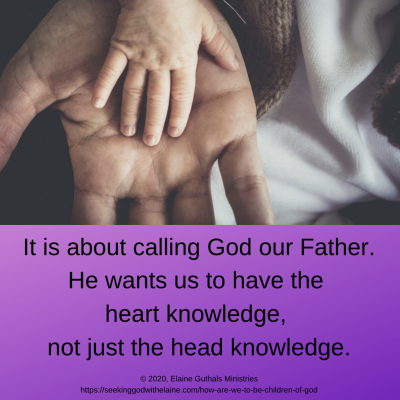
    Parent hand and child hand

    Confidence

    Confidence is about having certainty in something. In churchy words, we say we believe in God. We have to have faith and trust.

    Faith is the belief that the doctrines stated in God’s Word are true, even if we do not understand all aspects of them. Trust is assurance that the promises of God are true.

    Assurance is another good word. It talks about certainty, too.

    Assurance leads to hope. Hope is where we desire for something that we believe is obtainable.

    We have to believe beyond a shadow of a doubt that what God is telling us is true. If He says we are spiritually dead if we haven’t ABCDed and that means we are going to be spending eternity in hell, that is what we have to believe. If He tells us that He wants us to put the devotions we’ve been writing online so others can read them, we have to have the confidence to do that — even if we are shaking in out boots the whole way.

    The ABCDs of Salvation

    If you have not become a believer in Christ, please read through the
    Plan of Salvation and prayerfully consider what God is asking you to do.

    A – admit our sins
    B – believe His Son Jesus is our Redeemer
    C – confess God as Sovereign Lord

    D – demonstrate that commitment by making any changes needed in our lives to
    live the way in which God has called us

    The Disciple’s Job Description

    Connected

    Disciples need to not only be connected to God, but we also have to be connected with each other. God has built a community of believers. We aren’t supposed to be insulated.

    Resource

    But it isn’t just a fellowship thing. We have a job to do.

    • “And he said to them, ‘Go into all the world and proclaim the gospel to the whole creation’” (Mk. 16: 15 ESV).
    • “Go therefore and make disciples of all nations, baptizing them in the name of the Father and of the Son and of the Holy Spirit, teaching them to observe all that I have commanded you. And behold, I am with you always, to the end of the age” (Mt. 28: 19-20 ESV).

    We are to support others. We just said in a recent devotion that disciples provide charity to widows when needed. Charity means showing others love flavored with acts of benevolence. 

    Character

    Building the character of God is what being a disciple is all about. That is why we are on the sanctification road.

    Sanctification is the transformation of mind, body, and soul beginning with regeneration and ending with perfected state of spiritual wholeness or completeness. Regeneration is the change in us that God brings about when we go from being spiritually dead to spiritually alive. The perfected state indicates spiritual wholeness or completeness.

    We are to have the disposition of a child. Our disposition is our temperamental makeup.

    Oh, yeah. That means change.

    Jesus was all about our need to change. That is what conversion is. Conversion is a change of mind, heart, and conduct. We have to have this change to enter the kingdom of God.

    Resource

    Sanctification is a process. Pool said it the best when he wrote “that even converted souls have need of a daily conversion.”

    Resource

    What Jesus was getting at was we need to be trusting and submissive rather than ambitious. That is what we need to turn toward in repentance.

    Glossary

    Contributors

    God didn’t call us to be back-seat Baptists. He wants us to contribute. He has a job for each one of us to do.

    That is why the Great Commission has all of those action words (Mt. 28: 19-20).

    • Go
    • Make
    • Baptize
    • Teach

    To read a related devotion, click the button below.

    God knows that the only way we are going to truly understand some of His ways are by doing them. We have to put them into practice.

    Cope

    Oh, yeah. Being a disciple is not going to be easy. Satan is going to throw all he has at us because he wants to derail us.

    But God helps us cope in those times of trials. We have to know that He is our protector in times of trouble.

    • “There is no one holy like the LORD. There is no one besides you! And there is no rock like our God” (I Sam. 2: 2 CSB).
    • “The Lord is my rock, my fortress, and my deliverer, my God, my rock where I seek refuge, my shield and the horn of my salvation, my stronghold” (Ps. 18: 2 CSB).
    • “He will cover you with his feathers; you will take refuge under his wings. His faithfulness will be a protective shield” (Ps. 91: 4 CSB).

    The thing is, God doesn’t want us to go it alone. He wants us to depend on Him for everything — the big stuff and the little stuff.

    Person sitting on dock

    Control

    That is a good segue to the next topic. We talked at the beginning of the year that I thought about making self-control my word for the year. It is a fruit of the spirit.

    We do have to control ourselves and our sinful nature. We do that through self-discipline.

    But we can’t just think we are in control. Remember, God told me, “Well, Chick, you can’t do self-discipline without Me.”

    It is more about God being in total control. We have to submit to Him.

    Oh, yeah. We think submitting is more of a child thing than an adult thing. But it isn’t. It is a disciple thing.
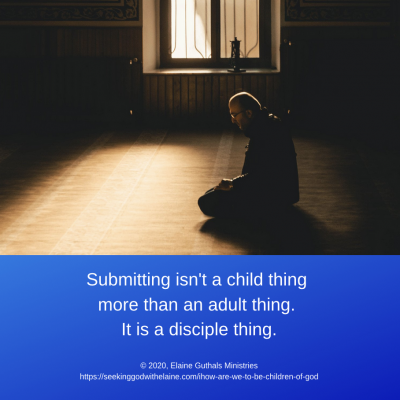
    Person kneeling

    Making the Connections

    We have said before that repentance was turning from sin. Now we know what we are to turn toward — a child-like disposition.

    Don’t worry. Nicodemus had trouble with this you-must-be-born-again/become-a-child directive.

    Paul really didn’t explain it much better to some peoples’ estimation. “Therefore, if anyone is in Christ, he is a new creation. The old has passed away; behold, the new has come” (II Cor. 5: 17 ESV). How can be brand new?

    Vaughan helped us understand. He wrote, “This image does not convey the idea of a perfectly new being, but of an old being begun again, that it may do better.”

    Resource

    With all of the C words up there, we need to add a D Word. We need to be docile. Docile means easily taught.

    Jay noted that we should “not [be] like them in ignorance, not in fickleness, not in waywardness.” We should be willing to be taught and changed.

    Resource

    Making the Connections to Self-Discipline

    Submission is a bad enough word to some worldview people. When we tell them child-like, they may turn around and walk away. How do we describe what God is wanting us to be?

    We’ve been looking at defending our beliefs when we are witnessing. That means we have to be secure enough to convince someone to accept our beliefs.

    Our questions should still serve us to determine on what we need to focus.

    • What does the Scriptures say?
    • What do I believe?
    • Why do I believe the same/differently than the Scriptures?
    • What are the talking points when witnessing to a non-believer?

    Related Links

    I have created a worksheet of the questions above. Click on the button below to access it.

    How Do We Apply This?

    We have to understand that the resistance is in us, not just the worldview people. Vaughan wrote, “We as men fancy ourselves independent and self-sufficient; we must get back to simplicities, self-renunciation, to a babyhood of trust.”

    Resource

    How do we know that we have become child-like? In Jay and Various’ Conversion, it was written, “The change is to be judged of by its effect.” Have we become more dependent on God?

    Resource

    Oh, yes. We have to discuss the elephant in the room. We have to be ready for the discipline for when we mess up. Isn’t that what children do? They push the boundaries or just plain get it wrong — and have to face the consequences.

    Now we know what we are turning to when we turn away from repentance. We just have to do it.

    Father. We come to You as our Father. We come to You as Your children. That means we come in humility and submission. Grow us to be who You want us to be. Refine us until our character matches Yours. Sustain us on this sanctification road and help us to reach our end destination — being perfected in Your sight. Amen.

    What do you think?

    Leave me a comment below (about this or anything else) or head over to my Facebook group for some interactive discussion.

    If you don’t understand something and would like further clarification, please contact me.

    If you have not signed up for the email daily or weekly providing the link to the devotions and the newsletter, do so below.

    If God has used this devotion to speak with you, consider sharing it on social media.

  • Instructing Our Children

    As parents, we try to teach our children our beliefs. However, it seems that they are increasingly rejecting those beliefs. This devotion looks at what advice Solomon gave his son.

    Nuggets

    • Worldview logic says if we are given free will, we should use it – not just believe our parents.
    • Parents got listed right after God because He knows how important being a parent is.
    • We get the garland for listening to our parents.

    Devotions in the What I Believe series

    Devotions in the Family category

    Instructing Our Children
    Who Is the Greatest in the Kingdom of Heaven?

    Flowers with title Instructing Our Children

    My Ladies were supposed to be studying Proverbs during Sunday Morning Bible Study. The lessons have been built on a parent teaching the child about God and His wisdom.

    Wisdom is knowledge, discernment, and good sense that leads to goodness and virtue, which can be applied to life.

    So far, Solomon has told us:

    • It isn’t enough to just have the wisdom — head knowledge isn’t enough.
    • Our wisdom has to align with God’s if we are going to flourish in the world.
    • We are righteous because we are free from sin by following God’s moral laws.
    • Wisdom is to be prized above religion.
    • We get to where God wants us to be by using wisdom to reason out what He is wanting us to understand as we seek Him.
    • Only God gives us lasting wealth and righteousness.
    • The results of wisdom are a closer relationship with God.
    • God judge us daily because He hates sin.

    I put this lesson in the Family folder when it came up. It is kind of a step backwards chapter wise, but it fits better in a family series than it would have in a wisdom series.

    Let’s Put It into Context

    Family is, according to the Holman Bible Dictionary, “the basic household unit which provides a person’s central relationships, nurture, and support.”

    Resource

    Ordinances are an expression of the disciples’ obedience. Marriage is an ordinance.

    Children, Follow Instructions

    “Listen, my son, to your father’s instruction, and don’t reject your mother’s teaching” (Prov. 1: 8 CSB)

    Ooo, baby. This verse is under attack these days. The worldview tells our kids to question most — if not all — of their parents’ beliefs. Why is that?

    It isn’t just because we are given free will. Free will is the ability within us to make decisions, which determine actions that produce character.

    It seems like, a lot of times, that is what our kids are told. Worldview logic says if we are given free will, we should use it – not just believe our parents.

    The underlying goal, though, is for kids to reject the Christian beliefs of their parents. They don’t want all these things their parents have called sin to remain labeled as sin. They want to be able to do what they want and not face any consequences.

    The problem is, however, that they are not just rejecting their parents. They are rejecting God.

    God is the One who labels things a sin. Sin is actions by humans that disobey God and break one of His laws and commandments, goes against a purpose He has for us, or follows Satan’s promptings.

    Okay, I have to check this out. I read that Arnot wrote, “The first and great commandment is the fear of God, and the second, which is next to it and like to it, is obedience to parents.”

    Resource

    Let me process. So, what is a Arnot really trying to say? The fear of the Lord means to love and revere God.

    Glossary

    We know Commandment #1 is “You shall have no other gods before me” (Ex. 20: 3 ESV). But we also know Commandment #2 is “You shall not make for yourself a carved image, or any likeness of anything that is in heaven above, or that is in the earth beneath, or that is in the water under the earth” (Ex. 20: 4 ESV). That has nothing to do with parents.

    Also, Jesus told us what the greatest commandments are. “And one of them, a lawyer, asked him a question to test him. ‘Teacher, which is the great commandment in the Law?’ And he said to him, ‘You shall love the Lord your God with all your heart and with all your soul and with all your mind. This is the great and first commandment. And a second is like it: You shall love your neighbor as yourself’” (Mt. 22: 35-39 ESV).

    That says love others, not obey your parents. So, let’s look at it through the Ten Commandments.

    A while back, I gave my Elaine-speak version. Starting at the top until we get to parents, they are

    • Love God first and foremost.
    • Don’t worship anything but Him.
    • Watch how you use His name.
    • Find a community of people who believe like you do and meet with them regularly.
    • Honor your parents.

    To read a related devotion, click the button below.

    If we look at the top four, they are all about how we show our love to God. We love Him, worship Him, and don’t take His name in vain.

    I can see how that can be grouped as one. Then we get to the parents.

    Oh, wow. Did you see? Parents got listed right after God. He knows how important being a parent is.

    Johnson pointed out that the duties of parents and teachers are analogous. It is the parents’ responsibility to teach their children how to be a person.

    Resource

    We also have a responsibility to teach children about God. Let’s chase a rabbit a second. Don’t think because we have reached a certain age and are no longer children, we are done learning. We can always learn, no matter what age we are.

    Also, family is not just blood. We can adopt anyone into our family. We can teach them, too.

    So, don’t think just because you have no children, you aren’t a teacher. Don’t think that just because you are a teenager or younger, you can’t learn.

    Back to children listening to their parents. They are not going to get a more loving teacher. No one will understand them like a parent does.

    God knows that we need to pass on the lessons we have learned to others. That is how we make the Scriptures real to us. What better place than within the family? That way our family members can really see our faith being lived out.

    Bible

    Head Coverings and Jewelry?

    “for they will be a garland of favor on your head and pendants around your neck” (Prov. 1: 9 CSB)

    Hmmm. Interesting.

    Kids think that having their own way will be very rewarding. Really, it isn’t. Following Satan’s way leads to chaos and hurt.

    A garland was a wreath that was worn on someone’s head. The Holman Bible Dictionary said that “garlands symbolized instruction or the benefit of wisdom.” That is why we see the gods in mythology wearing them.

    Resource

    We get the garland for listening to our parents???? Isn’t that the exact opposite of what kids think? They think the last thing they would earn was a garland for obeying their parents.

    Clarkson listed what obeying parents showed.

    • Humility
    • Their reacting to parents’ love
    • Their acknowledging that wisdom comes with age (and experience)
    • Their acceptance of a natural order.

    Resource

    Listening to our parents (or our employer or someone else) shows we are willing to acknowledge someone who is over us. We recognize that they have some authority over us.

    If we can’t listen to our parents, how are we going to obey God? But that is the premise kids go on, isn’t it? We don’t have to listen to anyone because we can make our own decisions.

    Making the Connections

    The problem with that is God does have laws and commandments. We break the laws, we suffer the consequences.

    God doesn’t want us to just know about the laws and commandments. He wants us to live them.

    Why? The laws and commandments show us God’s character. When we obey them, we become like God.

    That is the goal. God wants us to be like Him.

    How Do We Apply This?

    Raising kids is hard. I was reading a devotion today by a fellow blogger, Tabatha, that tells us six tips the Scriptures give us on how to do that.

    Resource

    I’ve been really lucky. Adam never really rebelled against me. There were other things that we had to deal with, but I didn’t have the problems other parents encounter.

    I just asked Adam why that was. After the initial, “I don’t know,” we figured a couple of things out.

    Adam knew if I told him something, I was shooting straight with him. I wasn’t lying to get him to act or think a certain way. I was giving him the best instructions that I knew.

    Another thing Adam knew was I spoke Adam. I got how he thought through things. I knew the words he used.

    I didn’t just say, “I am the Mom. You will …” unless I really had to for a very good reason. I would cringe every time one of his teachers or someone else would go into dictator mode with him.

    Oh, yes. I wasn’t a perfect parent. I know I’ve told you about the time I tried to get Adam to eat some chicken nuggets I made — Cajun chicken nuggets. It wasn’t pretty.

    My best advice is that we need to establish the relationship with our children. Yes, they have to honor us as parent. Yes, we have to honor them as human beings.

    The parent-child relationship is like any other relationship. It will need give and take. It will need patience and forgiveness.

    It is worth it.

    Father. You have made Yourself our Father. You didn’t need to make us an family when You created us. You wanted us. Even after we disobeyed You, You still wanted us. In fact, as the song says, You didn’t want Heaven without us so You brought Heaven down. Help parents and children to love each other as You do. Give us patience and forgiveness. Most of all, help us teach our children about You so that they may call You Father. Amen.

    What a Beautiful Name
    Vocalist: Elaine Guthals
    Keyboard: Chris Vieth

    What do you think?

    Leave me a comment below (about this or anything else) or head over to my Facebook group for some interactive discussion.

    If you don’t understand something and would like further clarification, please contact me.

    If you have not signed up for the email daily or weekly providing the link to the devotions and the newsletter, do so below.

    If God has used this devotion to speak with you, consider sharing it on social media.

  • In Support of Widows

    Families have a multi-generational component to them. James and Paul discussed how children – and the church – are to support widows. This devotion looks at how God see supporting widows as an indication of faith.

    Nuggets

    • It is intended that disciples provide charity to widows when needed.
    • Paul qualified that families should be the first support for the widows.
    • If we can’t love and support our family, how can we love God?

    Devotions in the What I Believe series

    Devotions in the Family category

    In Support of Widows
    Instructing Our Children
    Who Is the Greatest in the Kingdom of Heaven?

    Flowers with title In Support of Widows

    Society used to be a patriarchal society. Women were restricted to roles within the home and family.

    Jesus, however, elevated women to be equals. No, He didn’t revamp societal structure. He did include them in His kingdom and in His ministry.

    Women still had problems when they became widows. Their financial support and protections were generally gone.

    Peloni explained their hardships. He wrote, “Among the Jews, as among most Oriental races of the ancient world, widows and orphans were of all classes the most liable to plunder and oppression. Their inheritance was often filched from them under forms of law, now that they bad (sic) no strong arm to protect them, by an unjust judge whom they were unable to bribe, or even forcibly wrested from them by some rapacious kinsman or neighbour.”

    This wasn’t what God intended. “You shall not mistreat any widow or fatherless child. If you do mistreat them, and they cry out to me, I will surely hear their cry, and my wrath will burn, and I will kill you with the sword, and your wives shall become widows and your children fatherless” (Ex. 22: 22-24 ESV).

    But how is that supposed to play out? There are some passages in the New Testament that help shed some light on what is intended.

    Let’s Put It into Context

    Family is, according to the Holman Bible Dictionary, “the basic household unit which provides a person’s central relationships, nurture, and support.”

    Resource

    Ordinances are an expression of the disciples’ obedience. Marriage is an ordinance.

    Visit the Widows

    “Religion that is pure and undefiled before God, the Father, is this: to visit orphans and widows in their affliction, and to keep oneself unstained from the world” (Jas. 1: 27 ESV)

    It is intended that disciples provide charity to widows when needed. Charity means showing others love flavored with acts of benevolence. Butler described that as “in any want or distress wherein they need and are capable of our assistance.” That shows others the loving character of God.

    James was well aware that there are destitute and afflicted of every class. His intended recipients, though, are those described as those who need the help the most. He was describing those who are ill or elderly who truly in a dire situation.

    Resource

    We want to make sure we use the right definition of want. James is not talking about what is desired. It is the needy and destitute definition that he is talking about here.

    We also have to look at what is meant by the word visit. It doesn’t mean go, play a game or two of pinochle, catch up on what is going on in everyone’s lives, and go back home.

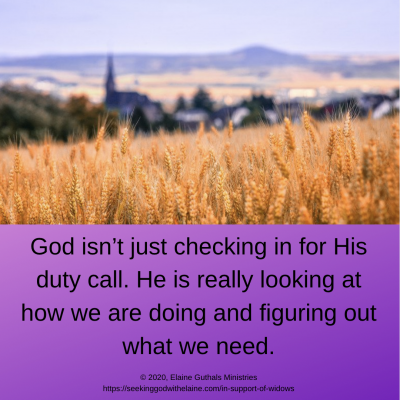
    That isn’t how God visits us — and God does visit us. “You visit the earth and water it; you greatly enrich it; the river of God is full of water; you provide their grain, for so you have prepared it” (Ps. 65: 9 ESV).

    God isn’t just checking in for His duty call. He is really looking at how we are doing and figuring out what we need. Then, He goes about providing that and improve our circumstances.

    Field and church

    Family Provides First

    “Support widows who are genuinely in need. But if any widow has children or grandchildren, let them learn to practice godliness toward their own family first and to repay their parents, for this pleases God. The widow who is truly in need and left all alone has put her hope in God and continues night and day in her petitions and prayers” (I Tim. 5: 3-5 CSB)

    Paul qualified who should be the first support for the widows. He instructed the families to take care of the women within their family who have found themselves widowed.

    Rowland noted that “the idea is that we owe a debt of gratitude to those from whom we have derived existence, and to whom we owe the support, care, and education we have received. We are bound to see that to the utmost of our ability their wants in old age are met.” Mom and Dad took care of my sister and me when we were growing up. We took care of them when they were growing old.

    Resource

    What Paul was getting at here was each family member has rights. We must respect those rights, especially when their situations change. Mothers didn’t lose their rights when fathers died.

    Our character as disciples must first be evident in the home. Macgregor reminds us that “Our tenderest relations, our strongest affections, our highest joys, our deepest sorrows, all are touched by the thought of home.”

    Resource

    Of course, our character is most tested at home. That is generally where we let our guard down. Plus, our family members know us the best, so can sometimes hurt us the worst.

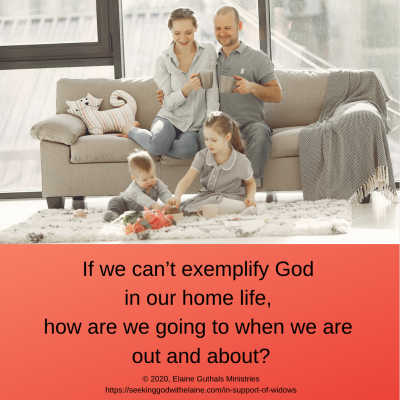
    We still have family responsibilities. That shows how our character is imitating God’s character. If we can’t exemplify God in our home life, how are we going to when we are out and about?

    Family

    No Support, No Faith

    “Command this also, so that they will be above reproach. But if anyone does not provide for his own family, especially for his own household, he has denied the faith and is worse than an unbeliever” (I Tim. 3: 7-8 CSB)

    Paul doesn’t pull any punches, does he? He just lays it out there in plain sight.

    But really, this is what James was saying. “Religion that is pure and undefiled before God, the Father, is this: to visit orphans and widows in their affliction, and to keep oneself unstained from the world” (Jas. 1: 27 ESV).

    If we can’t love and support our family, how can we love God? How can we be true disciples?

    How do we deny the faith? Faith is the belief that the doctrines stated in God’s Word are true, even if we do not understand all aspects of them.

    If we don’t love and support our family, we are saying that the God’s doctrines aren’t true. His love is not true. The Trinity is not true, because that is about family.

    Paul said it again. “But if anyone does not provide for his own family, especially for his own household, he has denied the faith and is worse than an unbeliever” (I Tim. 5: 8 CSB).

    We not only have to believe that God’s doctrines are true, but we also have to believe that He holds us accountable for implementing them. We have to believe that they are supposed to impact our character and influence our daily lives.

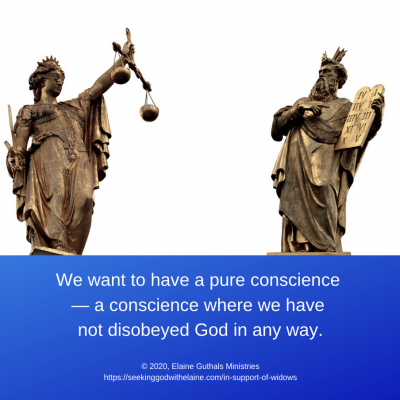
    We want to have a pure conscience — a conscience where we have not disobeyed God in any way. We want to work toward obeying Him completely.

    God and Lady Justice

    Don’t Burden the Church

    “If any believing woman has widows in her family, let her help them. Let the church not be burdened, so that it can help widows in genuine need” (I Tim. 5: 16 CSB)

    At first glance it may seem cold that Paul would say to not burden the church with widow care. I can think of a couple of reasons he may have said that — beyond it being the duty of the family.

    Paul may see it as a way of keeping the family unit in tact. The widows won’t have to give up that to which they have been accustomed. The younger women have the opportunity to thank the widows for all the love and care that they have provided them over the years.

    Church resources can be limited at times. If the family is able to meet the widow’s needs, that does leave those resources free for someone else who may need the help more — like those who have no remaining family.

    I can see Paul not wanting to take the focus off of the spiritual needs. We can’t take our eyes off God to focus on this world. We have to focus on Him.

    Making the Connections

    Tied with the charity is mercy. Disciples’ mercy is a characteristic of compassion for the needs of others, especially those who are in distress. In this way, we show God’s mercy. God’s mercy is the unexpected way God responds in love to our needs.

    If we as disciples say God’s ways are higher than the worldview ways (Isa. 55: 8-9), then we must interact within our families in a higher way than the world interacts with theirs. To do less would be an insult to Christ.

    Making the Connections to Self-Discipline

    We’ve been looking at defending our beliefs when we are witnessing. That means we have to be secure enough to convince someone to accept our beliefs.

    Our questions should still serve us to determine on what we need to focus.

    • What does the Scriptures say?
    • What do I believe?
    • Why do I believe the same/differently than the Scriptures?
    • What are the talking points when witnessing to a non-believer?

    Related Links

    I have created a worksheet of the questions above. Click on the button below to access it.

    How Do We Apply This?

    Somewhere in my reading, I read that we are expected to do the unexpected. We could take that a couple of ways.

    It could mean that what we do to support the widows is supposed to mean something. It is not just a duty.

    It is a service. Service is an act based on belief in God that comes from a response of worship by acknowledging His power through our submission.

    It could also mean that our service is supposed to be over and beyond what is expected. That ties in with the unexpected ways God responds in love.

    How do we deal with multi-generational issues? With patience.

    I got such a charge out of what Talmage said. He wrote, “Prayers in the household will not make up for everything.”

    Resource

    We can’t just pray for God to take care of our widows. We have to be God’s hands and feet and do it.

    We can’t just pray for a cohesive family. We have to work to make it so.

    God has given us families to love, support, and instruct us. We are families through the good times and bad, through the beginning of life and ending of life. We need to follow God’s way through it all.

    Father God. You have given us family. May we love them and support them in the way they need. May this especially be true when circumstances change and our family members find themselves widows. May we show them Your love and provision. Amen.

    What do you think?

    Leave me a comment below (about this or anything else) or head over to my Facebook group for some interactive discussion.

    If you don’t understand something and would like further clarification, please contact me.

    If you have not signed up for the email daily or weekly providing the link to the devotions and the newsletter, do so below.

    If God has used this devotion to speak with you, consider sharing it on social media.
  • Jesus the Liberator

    The Jews that Jesus was talking to couldn’t figure out who He was. This devotion looks at why Jesus was the only One who could provide freedom by accomplishing the plan of salvation.

    Nuggets

    • It was obvious to them that Jesus couldn’t be from God because even Abraham had died.
    • The Jews couldn’t wrap their heads around Jesus saying that those obedient to Him wouldn’t know death.
    • Yes, physical death entered the world when Adam sinned; but more importantly, spiritual death entered the world.
    • We will be blessed when we are obedient.
    • The only way we gain salvation is through obedience to the Truth.

    Devotions in the What I Believe series

    Devotions in the Religious Freedom category

    Flowers with title Jesus the Liberator

    This has seemed like the series that kept on giving. Even so, all good things must come to an end. We are going to finish this one up today!

    In this series, we’ve been talking about the freedom we receive when we accept the gift of salvation. We started out by using a passage in John 8.

    We are again going to pick out verses from that passage — and put them with new ones — to continue to show how Jesus is the reason we receive spiritual freedom.

    For these last three devotions, we have been using Sunday School Times’ A Glorious Liberator as the foundation of the devotions.

    Resource

    Let’s Put It into Context

    Freedom is, according to the Holman Bible Dictionary, “the ability of a person or group to be and do what they want instead of being controlled by another.” It is also referred to as liberty.

    Resource

    We talked about liberty before. We said that it runs the gamut, hitting all the things the worldview stresses.

    • We do what we please with no authority over us.
    • We make our own choices.
    • We don’t have to follow rules or limits.

    To read a related devotion, click the button below.

    A Dying Race

    “Are you greater than our father Abraham who died? And the prophets died. Who do you claim to be?” (Jn. 8: 53 CSB) “Where are your ancestors now? They and the prophets are long dead” (Zech. 1: 5 NLT)

    The Jews were wondering who Jesus was. They tried to get Him to admit that He was a Samaritan and a demon (Jn. 8: 48). They settled on demon because Jesus said, “… if anyone keeps my word, he will never see death” (Jn. 8: 51 CSB).

    It was obvious to them that Jesus couldn’t be from God because even Abraham had died. And if someone wasn’t going to die, it should have been Abraham to their way of thinking.

    Whitelaw called Abraham “the father of the faithful. He believed in God’s promise (Genesis 15:6; Romans 4:20), and became the head of a spiritual progeny who will far outnumber the natural.”

    Resource

    To read a related devotion, click the button below.

    But the Jews took their pride in Abraham being called by God to the extreme. They thought that made Abraham, according to Thomas, the greatest person ever to have lived.

    Where things went south was when that created a whole bunch of pride in them. Abraham’s being the greatest man made them the greatest people.

    Resource

    In other words, they didn’t really see anything special about Jesus.

    “By the sweat of your face you shall eat bread, till you return to the ground, for out of it you were taken; for you are dust, and to dust you shall return” (Gen. 3: 19 ESV)

    The Jews couldn’t wrap their heads around Jesus saying that those obedient to Him wouldn’t know death. Death is just a part of human life.

    Well, at least it had been since the original sin. As punishment, mankind is to return to the dust from which he made (Gen. 2: 7).

    “No one can live forever; all will die. No one can escape the power of the grave. Interlude” (Ps. 89: 48 NLT)

    “And just as it is appointed for man to die once, and after that comes judgment” (Heb. 9: 27 ESV)

    Death will visit everyone. No one is going to live forever in this body.

    I hear you bringing up Enoch. “Enoch walked with God, and he was not, for God took him” (Gen. 5: 24 ESV). The New International Version qualified Enoch’s walk by terming it faithfully performed.

    We read that to mean that God took Enoch to Heaven with Him. What do we know about our heavenly bodies?

    • “Listen, I am telling you a mystery: We will not all fall asleep, but we will all be changed, in a moment, in the twinkling of an eye, at the last trumpet” (I Cor. 15: 51-52 CSB).
    • “Dear friends, we are God’s children now, and what we will be has not yet been revealed. We know that when he appears, we will be like him because we will see him as he is” (I Jn. 3: 2 CSB).

    Okay, so it doesn’t paint a Van Gogh, but it does tell us that there will be changes made. I could see where some would consider that change a type of death because it is considered as shedding this body.

    “When Adam sinned, sin entered the world. Adam’s sin brought death, so death spread to everyone, for everyone sinned” (Rom. 5: 12 NLT)

    What the Jews were concerned with was physical death. Yes, physical death entered the world when Adam sinned.

    More importantly, spiritual death entered the world. Spiritual death is the separation from God that occurred as a consequence of Adam and Eve’s original sin.

    Glossary

    The spiritual death has more lasting consequences. We need life.

    SpiritualDeath

    A Life-Giving Obedience

    “Truly I tell you, if anyone keeps my word, he will never see death” (Jn. 8: 51 CSB)

    The Jews just didn’t get what Jesus was getting at. Jesus was looking at addressing the death part — by focusing on the obedience part.

    Obedience means to hear and carry out the instructions that God gives us. He gives those instructions in a variety of ways:

    • Laws and commandments
    • Individual direction on our specific purposes.

    We want to be obedient. God will reward us greatly if we are.

    “You will be blessed if you obey the commands of the LORD your God that I am giving you today” (Deut. 11: 27 NLT)

    “This is what I told them: ‘Obey me, and I will be your God, and you will be my people. Do everything as I say, and all will be well!’” (Jer. 7: 23 NLT)

    We will be blessed when we are obedient. Blessedness means we have been perfected. The perfected state indicates spiritual wholeness or completeness. It means we have become as Jesus is. It means we have become holy, sanctified, and righteous.

    Let’s look at this way. How does God want us to be obedient?

    God wants us to admit that we have been separated from Him. To rectify that, we need to believe in Jesus as our Savior and Redeemer. Then, we are confessing that God is Sovereign Lord and submit to Him.

    Doing this gains us salvation and regeneration. Salvation is deliverance from evil and the consequences of sins to replace them with eternal life and good. Regeneration is the change in us that God brings about when we go from being spiritually dead to spiritually alive.

    Salvation puts us on the sanctification road. Sanctification is the transformation of mind, body, and soul beginning with regeneration and ending with perfected state of spiritual wholeness or completeness.

    Read that again. Sanctification ends in being perfected. Blessed means perfected. We are blessed when we are obedient.

    Because we are obedient and ABCD, God is our God. We talked before about the promises God gives us when we become His children.

    God’s Promises

    Answers prayer (Ps. 37: 4; Jn. 14: 13)
    Deliverance (Ps. 34: 17; Ps. 50: 15)
    Eternal life (Jn. 3: 16; Rev. 3: 5)
    Faithful (Jer. 29: 12; Rom. 4: 21)
    Fight for us (Ex. 14: 14)
    Knowledge and wisdom (Jas. 1: 5)
    Love (Ps. 145: 9)
    Peace (Isa. 54: 10; Phil. 4: 6-7)
    Presence (Deut. 31: 8; Mt. 28: 20)
    Prosperity (Mal. 3: 10; II Cor. 9: 8)
    Protection (Isa. 43: 2)
    Provision (Mt. 6: 31-33; Phil. 4: 19)
    Salvation (Ps. 27: 1; I Jn. 1: 9)
    Strength (Isa. 49: 29-31; Eph. 3: 16-19)
    Transformation (1 Jn. 3: 2; II Pet. 1: 3-4)

    To read a related devotion, click the button below.

    “But Peter and the apostles answered, “We must obey God rather than men” (Ac. 5: 29 ESV)

    We just have to make sure we are obeying God, not following the worldview. Remember, in Truth in Freedom, we said that we couldn’t serve two masters because it comes down to submission.

    If we are more concerned what our fellow men (read that as worldview people) think the rules should be, we won’t be following God. They follow Satan. If we follow them, we are following Satan.

    “And being made perfect, he became the source of eternal salvation to all who obey him” (Heb. 5: 9 ESV)

    There is only one reasoned we can be perfected. That is because Jesus was perfected first.

    Look at another verse in Hebrews. “God, for whom and through whom everything was made, chose to bring many children into glory. And it was only right that he should make Jesus, through his suffering, a perfect leader, fit to bring them into their salvation” (Heb. 2: 10 NLT).

    Jesus was perfected by His suffering. Cumming wrote, “He could not save but by suffering; He could not ransom us at a less price than His death; and rather than see a world perish, He would not save Himself from being perfected by suffering, that we might be saved from irretrievable perdition.”

    Resource

    I have to process a second. Jesus didn’t sin. He was obedient from day one doing the do’s and don’ts. That wasn’t the issue.

    The issue was the question of whether Jesus would go through with the plan of salvation or not. Well, He could have bowed out. It was His choice to make.

    Ten Thousand Angels
    Vocalist: Elaine Guthals
    Keyboard: Chris Vieth

    But Jesus knew He had to shed His blood to gain our salvation. He had to go through the suffering, pain, and humiliation of hanging on the cross.

    Jesus didn’t do it for Himself. He did it for God and for us. So, He was perfected.

    “You were cleansed from your sins when you obeyed the truth, so now you must show sincere love to each other as brothers and sisters. Love each other deeply with all your heart” (I Pet. 1: 22 NLT)

    The only way we gain salvation is through obedience to the Truth. We know Jesus is the Truth.

    An Ever-Living Savior

    “Jesus said to them, ‘Truly I tell you, before Abraham was, I am’” (Jn. 8: 58 CSB)

    “In the beginning was the Word, and the Word was with God, and the Word was God” (Jn. 1: 1 ESV)

    “And now, Father, glorify me in your own presence with the glory that I had with you before the world existed” (Jn. 17: 5 ESV)

    “He existed before anything else, and he holds all creation together” (Col. 1: 17 NLT)

    “And, ‘You, Lord, laid the foundation of the earth in the beginning, and the heavens are the work of your hands’” (Heb. 1: 10 ESV)

    Before the foundation of the world, God asked Jesus to be our Savior. “For he chose us in him, before the foundation of the world, to be holy and blameless in love before him” (Eph. 1: 4 CSB).

    Glossary

    Jesus made plans to accomplish the Plan long before the plan was put into motion. He was born for that purpose.

    “I am the Living One; I was dead, and now look, I am alive for ever and ever! And I hold the keys of death and Hades” (Rev. 1: 18 NIV)

    Jesus is the liberator because He conquered sin. His death was the sacrifice needed.

    But Jesus not only died, but He rose again to show us that He conquered death. There were eye-witness accounts proving this.

    Now, Jesus has returned to Heaven where He sits at the right hand of God. There He will be for eternity.

    One day, it will be judgment day. Death and Hades will be defeated.

    Making the Connections

    So, we have to decide. Are we going to ABCD — or are we going to choose to reside in hell for eternity?

    It is our choice.

    The ABCDs of Salvation

    If you have not become a believer in Christ, please read through the
    Plan of Salvation and prayerfully consider what God is asking you to do.

    A – admit our sins
    B – believe His Son Jesus is our Redeemer
    C – confess God as Sovereign Lord

    D – demonstrate that commitment by making any changes needed in our lives to
    live the way in which God has called us

    The Disciple’s Job Description

    Making the Connections to Self-Discipline

    We’ve been looking at defending our beliefs when we are witnessing. That means we have to be secure enough to convince someone to accept our beliefs.

    Our questions should still serve us to determine on what we need to focus.

    • What does the Scriptures say?
    • What do I believe?
    • Why do I believe the same/differently than the Scriptures?
    • What are the talking points when witnessing to a non-believer?

    Related Links

    I have created a worksheet of the questions above. Click on the button below to access it.

    How Do We Apply This?

    We have to search for God if we don’t currently know Him. We have to seek Him to strengthen our relationships with Him if we do.

    Searching for and Seeking God

    Hearing His Word (Rom. 10: 17).
    Reading His Word (Rev. 1: 3).
    Praying to Him (Heb. 4: 16).
    Studying His Word (Ac. 17: 11).
    Meditating on His Word (Ps. 1: 1-2).
    Memorizing His Word (Ps. 119: 11).

    Father. Thank you for sending Jesus to liberate us from the consequences of sin. We commit to obey You and submit to Your Will. Amen.

    What do you think?

    Leave me a comment below (about this or anything else) or head over to my Facebook group for some interactive discussion.

    If you don’t understand something and would like further clarification, please contact me.

    If you have not signed up for the email daily or weekly providing the link to the devotions and the newsletter, do so below.

    If God has used this devotion to speak with you, consider sharing it on social media.
  • Freedom from Bondage

    Jesus gives us freedom from bondage. This devotion looks at how He releases us from the bondage of evil deeds, disbelief, and not hearing the truth.

    Nuggets

    • Jesus is the one who saves us from bondage.
    • One of the consequences of the original sin was man became separated from God.
    • Sin took over this world until the point God had had enough.
    • Bondage to sin does change us.
    • Jesus’ life, death, and resurrection has been fully documented.
    • We come to believe in Jesus by faith.
    • If we don’t hear the Truth, we are in bondage to Satan.

    Devotions in the What I Believe series

    Devotions in the Religious Freedom category

    Flowers with title Freedom from Bondage

    We’ve been using Sunday School Times’ sermon entitled Bondage and Freedom to serve as the foundation for the last two devotions. We do still have one point to pick up at the appropriate time.

    In the last devotion, we started also using Sunday School Times’ A Glorious Liberator. I don’t think we are going to be able to complete it in this devotion, either.

    Resource

    Let’s Put It into Context #1

    Freedom is, according to the Holman Bible Dictionary, “the ability of a person or group to be and do what they want instead of being controlled by another.” It is also referred to as liberty.

    Resource

    We talked about liberty before. We said that it runs the gamut, hitting all the things the worldview stresses.

    • We do what we please with no authority over us.
    • We make our own choices.
    • We don’t have to follow rules or limits.

    To read a related devotion, click the button below.

    Let’s Put It into Context #2

    “So if the Son sets you free, you really will be free” (Jn. 8: 36 CSB)

    This was the point from the Spiritual Freedom devotion that we deferred to this discussion.

    Jesus is the one who saves us from bondage. He did this by shedding His blood on the cross so that it was used to pay the penalty for our sins.

    That sacrifice allows us accept the gift of salvation when we believe that Jesus’ death was the only sacrifice that God would accept because Jesus is the only one who never sinned. We are set free by this acceptance.

    • “He drew me up from the pit of destruction, out of the miry bog, and set my feet upon a rock, making my steps secure” (Ps. 40: 2 ESV). While this verse is usually used in reference to trials, it does describe our salvation from hell when we set our feet in the Rock of our salvation.
    • “Out of my distress I called on the LORD; the LORD answered me and set me free” (Ps. 118: 5 ESV). God will always answer when we genuinely make a profession of faith.
    • “For the wages of sin is death, but the free gift of God is eternal life in Christ Jesus our Lord” (Rom. 6: 23 ESV). When we ABCD, we are set free from the punishment if death for our sins.
    • “For the one who was a slave when called to faith in the Lord is the Lord’s freed person; similarly, the one who was free when called is Christ’s slave” (I Cor. 7: 22 NIV). We talked in the last devotion that disciples don’t exchange one captivity for another.

    The bondage from which Jesus saves us has a couple of different aspects. Jesus saves us from the bondage of evil deeds, disbelief, and not hearing the truth.

    The ABCDs of Salvation

    If you have not become a believer in Christ, please read through the
    Plan of Salvation and prayerfully consider what God is asking you to do.

    A – admit our sins
    B – believe His Son Jesus is our Redeemer
    C – confess God as Sovereign Lord

    D – demonstrate that commitment by making any changes needed in our lives to live the way in which God has called us

    The Disciple’s Job Description

    Bondage Because of Evil Deeds

    “You are of your father the devil, and you want to carry out your father’s desires. He was a murderer from the beginning and does not stand in the truth, because there is no truth in him. When he tells a lie, he speaks from his own nature, because he is a liar and the father of lies” (Jn. 8: 44 CSB)

    One of the consequences of the original sin was man became separated from God. The result put us into bondage with Satan. It also unleashed the devastation of sin on mankind.

    That was what Satan was going for — but he used deceptive means to accomplish it. “Then the LORD God said to the woman, ‘What is this that you have done?’ The woman said, ‘The serpent deceived me, and I ate’” (Gen. 3: 13 ESV).

    Did you catch how selfish Adam’s and Eve’s answers were. “Somebody else made me do it.” It is called pass the blame.

    Do you think — in that moment — they realized all they had lost and were sorry for it? That meant sorrow had to have been almost instantaneous.

    What got them to the bite probably wasn’t. It probably took a while to fester.

    Maclaren gave a good explanation. He wrote, “Evil does not spring spontaneously in the unfallen heart. Sin is not, as some would have it, a necessary step in man’s development, nor does it spring from his own nature; it is an importation.”

    Resource

    It is an importation — it is not native to mankind. It is purposefully carried in from someplace else to take root in the new place.

    What is evil? Evil is equated with sin because it is that which goes against God and His purposes.

    Unfortunately, sin took root and multiplied.

    “The LORD saw that the wickedness of man was great in the earth, and that every intention of the thoughts of his heart was only evil continually” (Gen. 6: 5 ESV)

    Sin took over this world until the point God said, “No more.” He had had enough.

    Did you see how bad it was? “… every intention of the thoughts of his heart was only evil continually” (Gen. 6: 5 ESV). This wasn’t an occasional occurrence. I read it as every intention of every thought.

    I just noticed the only evil. The New Living Translation put it as “… consistently and totally evil” (Gen. 6: 5 NLT). Okay, less words than I had — same gist.

    We would say evil was in their hearts 24/7/365. Bondage was total.

    “All these evil things come from within, and they defile a person” (Mk. 7: 23 ESV)

    Usually when we think of bondage, we think of the outward chains. This is describing bondage from within.

    Bondage to sin does change us. It takes us farther and farther away from where God wants us to be.

    No one is free from sin. Everyone in a human body is going to sin.

    People

    “You are a child of the devil and an enemy of everything that is right! You are full of all kinds of deceit and trickery. Will you never stop perverting the right ways of the Lord?” (Ac. 13: 10 NIV).

    What is happening in this verse is Paul (still named Saul) is telling off a sorcerer. The sorcerer is opposing God’s ministry and attempting to turn the audience against Barnabas and Saul.

    The question is pertinent. “… Will you never stop perverting the right ways of the Lord?” (Ac. 13: 10 NIV).

    Satan’s answer is no. He will always try to pervert God’s ways. He will continue to fight until Revelation is fulfilled.

    “But when people keep on sinning, it shows that they belong to the devil, who has been sinning since the beginning. But the Son of God came to destroy the works of the devil” (I Jn. 3: 8 NLT).

    The bottom line is that those who continue to sin belong to Satan. Even if they don’t acknowledge, “I am following Satan” — they are.

    Fisk put it this way. He wrote, “He may be a free member of a free community, but his heart, his intellect, his body, all are bound in unresisting submissiveness to Satan.”

    Resource

    Remember, if we do not make a conscious decision to choose God’s gift of salvation and submit to Him, we have chosen Satan.

    Bondage by Disbelieving the Lord

    “Yet because I tell the truth, you do not believe me” (Jn. 8: 45 CSB)

    Disbelief. Satan tries to use this a lot to get us to not accept the gift of salvation.

    Woman

    “Who has believed our message? To whom has the LORD revealed his powerful arm?” (Isa. 53: 1 NLT).

    Jesus’ life, death, and resurrection has been fully documented. It is all spread out before us to believe. If we don’t believe, we are still in bondage.

    The powerful arm expression, in my way of thinking, is usually expressed as God’s mighty hand and outstretched arm. Meyer said this was referring to “… the active, saving energy of the Most High.”

    Resource

    God brought the Israelites out of Egypt with His outstretched arm (Ex. 6: 6). Part of Mary’s song goes, “He has performed mighty deeds with his arm; he has scattered those who are proud in their inmost thoughts” (Lk. 1: 51 NIV).

    “But you haven’t believed in me even though you have seen me” (Jn. 6: 36 NLT).

    The Jews Jesus was talking to saw Him standing right in front of them. We don’t get that.

    We come to believe in Jesus by faith. Faith is the belief that the doctrines stated in God’s Word are true, even if we do not understand all aspects of them.

    Why is faith important? Bushnell wrote, “The grand distinction of Christianity is that it makes its appeal to faith, and upon that rests the promise of salvation.”

    Resource

    The only way we get salvation is to have the faith to believe what God is telling us. We can’t be skeptical.

    Bible

    Bondage by Not Hearing the Truth

    “The one who is from God listens to God’s words. This is why you don’t listen, because you are not from God” (Jn. 8: 47 CSB)

    We have to listen. As children of God, that is our duty.

    If we don’t hear the Truth, we are in bondage to Satan.

    That means we have to pay attention. The focus has to be there.

    We have to be intentional — my word for last year. We have to be dedicated to seeking God.

    To read a related devotion, click the button below.

    We have to remember. I know. Memorization is hard, but we have to retain what we are hearing and reading.

    “For this people’s heart has become calloused; they hardly hear with their ears, and they have closed their eyes. Otherwise they might see with their eyes, hear with their ears, understand with their hearts and turn, and I would heal them” (Mt. 13: 15 NIV)

    Those in bondage have a calloused heart. The input may or may not come in through the eyes and ears where it may or may not lodge in the heart.

    We’ve said before that obedience has to come from the heart. His laws and commandments are supposed to affect our character or our core – our heart level. We are going for circumcision of the heart.

    Glossary

    Making the Connections

    The gospel is all laid out for us. It is up to us to make a choice.

    In order to make an informed choice, we have to review the evidence. It was written in the Essex Remembrancer that “It is right for every man to sift Christian evidence, but he must do so with humility — there must be a teachable.”

    Resource

    Being teachable means we are to be docile. We’ll looked at that toward the first of the year.

    Docile devotions

    To read a devotion the The Beatitudes Show Us How to be Docile series, click the button below.

    Making the Connections to Self-Discipline

    We’ve been looking at defending our beliefs when we are witnessing. That means we have to be secure enough to convince someone to accept our beliefs.

    Our questions should still serve us to determine on what we need to focus.

    • What does the Scriptures say?
    • What do I believe?
    • Why do I believe the same/differently than the Scriptures?
    • What are the talking points when witnessing to a non-believer?

    Related Links

    I have created a worksheet of the questions above. Click on the button below to access it.

    How Do We Apply This?

    So, if we are going to be docile, that means we are to be studying God’s Word. That means we are seeking God.

    Searching for and Seeking God

    Hearing His Word (Rom. 10: 17).
    Reading His Word (Rev. 1: 3).
    Praying to Him (Heb. 4: 16).
    Studying His Word (Ac. 17: 11).
    Meditating on His Word (Ps. 1: 1-2).
    Memorizing His Word (Ps. 119: 11).

    Remember, we just said we have to be intentional about it. We have to have a focus.

    If we intentionally seek God, we break free of the bondage of sin. We can only find God through Jesus.

    Father. We seek You. Help us find what You would have us know. Amen.

    If you have not admitted that your relationship is not right with God,

    have not asked Jesus to be your Lord and Savior,

    and have not confessed your sins,

    please read through the Plan of Salvation and prayerfully consider what God is asking you to do.

    Related Links

    Related Links

    Related Links

    Artist

    Related Links

    I have created a worksheet of the questions above. Click on the button below to access it.

    Don’t know what your spiritual gifts are?

    Take this Spiritual Gifts Inventory

    The Disciple’s Job Description

    Complete Job Description

    Individual Description

    The Disciple’s Job Description

    Complete Job Description

    Individual Description

    Job Duty #4
    Proclaim the Gospel (Mark 16: 15)

    Job Duty #6
    Make Disciples (Matthew 28: 19-20)

    It Was Enough
    Vocalist: Elaine Guthals
    Keyboard: Chris Vieth

    What do you think?

    Leave me a comment below (about this or anything else) or head over to my Facebook group for some interactive discussion.

    If you don’t understand something and would like further clarification, please contact me.

    If you have not signed up for the email daily or weekly providing the link to the devotions and the newsletter, do so below.

    If God has used this devotion to speak with you, consider sharing it on social media.
  • Truth in Freedom

    Jesus comes as Truth to save us from bondage. This devotion looks at one way that Truth provides us freedom.

    Nuggets

    • The inability to be obedient to the law was to show the Jews that we need a Savior.
    • We aren’t freed from our sins so we can just go on our merry way and keep on doing what we’ve been doing.
    • More than just keeping the do’s and don’ts of the law, it needs to build character.
    • We can’t just sit back and listen to the pastors preach and not do anything.
    • The freedom that the Truth brings does not give us license to continue to sin.

    Devotions in the What I Believe series

    Devotions in the Religious Freedom category

    Flowers with title Truth in Freedom

    In this series, we’ve been talking about the freedom we receive when we accept the gift of salvation. We started out by using a passage in John 8.

    We are going to pick out verses from that passage again to structure our discussion. We are going to put them with new ones to show how Jesus is the reason we receive spiritual freedom. Hopefully, this will tie up all of the previous devotions in a nice bow.

    We’ve been using Sunday School Times’ sermon entitled Bondage and Freedom to serve as the foundation for the last two devotions. We do still have one point to pick up at the appropriate time.

    We are going to use a different sermon for this devotion: Sunday School Times’ A Glorious Liberator. It is going to have to be split. I will put in nuggets from previous devotions, so we don’t have to backtrack too much.

    Resource

    Let’s Put It into Context #1

    Freedom is, according to the Holman Bible Dictionary, “the ability of a person or group to be and do what they want instead of being controlled by another.” It is also referred to as liberty.

    Resource

    We talked about liberty before. We said that it runs the gamut, hitting all the things the worldview stresses.

    • We do what we please with no authority over us.
    • We make our own choices.
    • We don’t have to follow rules or limits.

    To read a related devotion, click the button below.

    Let’s Put It into Context #2

    “Jesus responded, ‘Truly I tell you, everyone who commits sin is a slave of sin’” (Jn. 8: 34 CSB). 

    • Before mankind are children of God, they are sinners. The main issue was Adam and Eve’s disobedience. They did not submit their will and lives to God.
    • Satan was there to nudge them into disobedience. The choice was all theirs.
    • Satan may be sneaky in tempting us, but his objective is deadly. He wants us to remain spiritually dead.
    • It comes down to sin. We disobey God when we don’t follow His laws and commandments. We disobey when He tells us to move somewhere, do something, or don’t do something – and we don’t, don’t, or do.

    It comes down to sin because it does come down to submission. “No one can serve two masters, since either he will hate one and love the other, or he will be devoted to one and despise the other. You cannot serve both God and money” (Mt. 6: 24 CSB).

    At first glance, we may refute that statement. How many of us serve spouses and employers at the same time — even if we don’t call them masters?

    The thing is we don’t serve them equally all the time. We end up juggling. “Oh, yes, honey. I can take you to your doctor’s appointment tomorrow, but I have to work late tonight to finish up this important project first.”

    God doesn’t want to be juggled.

    It seems like, when we are trying to serve two masters, we truly serve one and give the other lip service. Instead, we need to serve as Cooper advised: “… with faithfulness and singleness of heart, with a mind wholly given to his service.” Anything less than wholeheartedly is lip service.

    Resource

    We can’t serve God and Satan because they are polar opposites. Think about it. What are their objectives?

    God is only asking us to give up sin. He is not requiring us to starve or go without shelter. He is going to provide for us. He will give us what we need.

    God wants to give us love and peace. Satan wants to fill us with hatred and chaos — even to the point of murder. There is no way we can serve both.

    But God is asking that we get the obedience to heart level. It has to change our character. That is going to take our full focus.

    Changing our character is the opposite of what Satan wants. Satan, on the other hand, gives us the illusion that he will give us what we want. This illusion creates the bondage.

    Satan wants us to continue in sin. His objective is mankind’s destruction. He wants us to worship him but not for our sakes — for his.

    God requires us to choose a master. We have to choose either to submit to Him or keep going on with Satan’s lies.

    We have to remember that God doesn’t really need us. He could do fine without us.

    We can’t live without Him.

    Truth Brings Freedom

    “You will know the truth, and the truth will set you free” (Jn. 8: 32 CSB).

    • Because this was totally different from what the Jews had grown up believing, Jesus was trying to correct was their reliance on tradition and rituals instead of a relationship with God.
    • Jesus told them that they would “… know the truth, and the truth will set you free” (Jn. 8: 32 CSB) if they would continue in His Word.
    • The Truth will set us free because Jesus is the Truth. He sets us free because He has redeemed us and paid the penalty for our sins.
    • Jesus is Truth, but we don’t gain freedom until we know him. But it is more than just head knowledge. It is heart knowledge.

    Ooo, baby. I have to process this. I pulled the verses the new sermon said to, and I couldn’t quite figure out how all of this went under truth. So, let’s try this. I found this next verse to try to corral the other ones.

    “For sin shall no longer be your master, because you are not under the law, but under grace” (Rom. 6: 14 NIV).

    We have to understand why the law was given. Burder reminded us that the law “… was introduced among the Jews, not that they might be justified by it, but that, by discovering how far they fell short of the obedience it required, they might be more deeply impressed with a sense of their abounding sins; and thus it became a schoolmaster to lead them to Christ (Galatians 3:24), and that so, where sin had abounded, grace might much more abound (Romans 5:20).”

    Did you get all of that?

    • There is no way the Jews — or us — can keep all the laws and the commandments.
    • That inability to be obedient to the law was to show them that we need a Savior.
    • When we search for our Savior, we will find Him.
    • Finding Him will get us access to His grace, which is more abundant than our sins.
    Gavel and law book

    Here we are turning from sin to Truth. That puts us under grace rather than the law.

    “You have been set free from sin and have become slaves to righteousness” (Rom. 6: 18 NIV).

    But we aren’t freed from our sins so we can just go on our merry way and keep on doing what we’ve been doing. We are called to change and worship.

    To read a related devotion, click the button below.

    It isn’t that disciples exchange one captivity for another. Liddon explained it as, “A Christian lives under a system of restrictions and obligations; and yet he is free.”

    Resource

    God is a God of love, not tyranny. He calls us for our good, not His. He is true to us and asks us to be true to Him.

    “But if you are led by the Spirit, you are not under the law” (Gal. 5: 18 ESV).

    Okay, we spent a whole series talking about being walking in the Spirit as He leads.

    • Walking is the term used to describe how we live our lives. It specifically means that we are to live following God’s laws and commands.
    • The flesh is our human nature. It is considered naturally corrupt because it pursues what is pleasing, not necessarily what God commands. It is the root of sin and evil.
    • We gain salvation by the Holy Spirit taking us to the Father using the Son as the way. He does this by interpreting the Scriptures for us.
    • But it is more than just not walking in the flesh anymore. It is not walking under the law, also.
    • More than just keeping the do’s and don’ts of the law, it needs to build character. Building character makes it about who we are and what we believe, not do’s and don’ts.
    • God through His Holy Spirit will have to bring about any changes in us that come from the victories we experience.
    • Our desires are still within us after conversion, which we deal with by working out our salvation.
    • God calls us to give our spiritual nature top billing at all times.

    To read a related devotion, click on the appropriate button below.

    “But the one who looks into the perfect law, the law of liberty, and perseveres, being no hearer who forgets but a doer who acts, he will be blessed in his doing” (Jas. 1: 25 ESV).

    I know. James couldn’t have been any more confusing if he tried.

    Elaine-speak. Being a disciple isn’t a spectator sport. We all have to suit up and be on the field.

    Baseball field

    We’ve got to ABCD and do what God wants us to do. We can’t just sit back and listen to the pastors preach and not do anything. Believing in Jesus as our Savior should make us want to do something.

    The ABCDs of Salvation

    If you have not become a believer in Christ, please read through the
    Plan of Salvation and prayerfully consider what God is asking you to do.

    A – admit our sins
    B – believe His Son Jesus is our Redeemer
    C – confess God as Sovereign Lord

    D – demonstrate that commitment by making any changes needed in our lives to
    live the way in which God has called us

    The Disciple’s Job Description

    “Live as free people, but do not use your freedom as a cover-up for evil; live as God’s slaves” (I Pet. 2: 16 NIV).

    God gives us freedom in a variety of areas. He does give us political and social freedom as well as intellectual freedom, as noted by Liddon.

    Most importantly, God has given us moral freedom. Liddon wrote, “He has broken the chains which fettered the human will, and has restored to it its buoyancy and its power. What had been lost was more than regained in Christ.”

    Resource

    I really like Carpenter’s definition of freedom. He wrote, “Freedom is the educated capacity to live according to the capacity of our being.”

    Resource

    You mean I have the freedom to be a ballerina? I’ve always thought it would be neat to be a ballerina. Twirling around, gracefully moving from one place to another.

    What? There are still limitations on freedom???? What do you mean I have to have the skill??????? Can’t I just point my toes and go???????????

    Well, yes. Carpenter did have to tack on that capacity-of-our-being part.

    The “… cover-up for evil …” (I Pet. 2: 16 NIV) part is interesting. God doesn’t intend salvation to be a bandaid on the boo boos of our sin. He is doing surgery here. He is removing the sin.

    That is why we say we need to change our character. God wants the old out, so it can be replaced by the new.

    The freedom that the Truth brings does not give us license to continue to sin. Oh, we may want to keep our pet sin, but we can’t.

    Making the Connections

    Is it obvious why we need to make a decision? There is only one decision: are we throwing in with Satan or are we submitting to God?

    If we go the Satan route, we will find misery. We will have to pay the consequences for sin.

    If we ABCD, the consequences have been paid for by Jesus. We are assured eternity in Heaven.

    This is why God can expect us to make this decision.

    • God created us.
    • He redeemed us.
    • He knows what is best for us.

    Making the Connections to Self-Discipline

    We’ve been looking at defending our beliefs when we are witnessing. That means we have to be secure enough to convince someone to accept our beliefs.

    Our questions should still serve us to determine on what we need to focus.

    • What does the Scriptures say?
    • What do I believe?
    • Why do I believe the same/differently than the Scriptures?
    • What are the talking points when witnessing to a non-believer?

    Related Links

    I have created a worksheet of the questions above. Click on the button below to access it.

    How Do We Apply This?

    • Make God our priority.
    • Frequently evaluate our relationships with God.
    • Conducting our lives with the right motives.
    • Exhibit a character pleasing to God.
    • Follow God’s laws and commandments as well as the laws our government enforce.
    • Use our resources to expand God’s kingdom.

    The Truth sets us free – when we accept. When we choose God, He chooses us because Jesus died so that we could.

    Father. We hear Your Truth. We accept Your Truth. Amen.

    What do you think?

    Leave me a comment below (about this or anything else) or head over to my Facebook group for some interactive discussion.

    If you don’t understand something and would like further clarification, please contact me.

    If you have not signed up for the email daily or weekly providing the link to the devotions and the newsletter, do so below.

    If God has used this devotion to speak with you, consider sharing it on social media.
  • What Else Is Spiritual Freedom?

    We have been talking about how all of us begin in spiritual bondage. Some find spiritual freedom. This devotion concludes our look at what that spiritual freedom entails.

    Nuggets

    • Jesus came to save everyone.
    • Jesus is Truth, but we don’t gain freedom until we know him, not just know of Him.
    • God adopted us.
    • The worldview is wrong when it argues that we are trading one bondage for another.

    Devotions in the What I Believe series

    Devotions in the Religious Freedom category

    Flowers with title What Else Is Spiritual Freedom?

    After looking at spiritual bondage, we’ve started in the last devotion to look at spiritual freedom. We didn’t get through the list. Let’s remind ourselves what we talked about in the Context #2, and then go on.

    The foundation of these devotions was taken from the Sunday School Times’ sermon entitled Bondage and Freedom.

    Resource

    I am going to take a little deviation, though, from the sermon. The next point is freedom through Christ. I am going to save that point for the Jesus the Liberator devotion. So, let’s go on.

    Let’s Put It into Context #1

    Freedom is, according to the Holman Bible Dictionary, “the ability of a person or group to be and do what they want instead of being controlled by another.” It is also referred to as liberty.

    Resource

    We talked about liberty before. We said that it runs the gamut, hitting all the things the worldview stresses.

    • We do what we please with no authority over us.
    • We make our own choices.
    • We don’t have to follow rules or limits.

    To read a related devotion, click the button below.

    Let’s Put It into Context #2

    • God is the one who sent Jesus to the earth to secure our spiritual freedom.
    • We don’t have to worry that God will give up on us as we continue to battle sin.
    • God calls us to spiritual freedom for a purpose – to further His kingdom.
    • God gives us His Spirit so that we can accomplish the work that He has for us to do.
    • Satan is going to try to capture us so that we don’t obey God.
    • Obeying God means Satan has less and less influence over people.

    God sent Jesus to the earth to secure our spiritual freedom. He has to hack the sin out of each of us – and keep hacking – even when we have ABCDed. We don’t have to worry that God will give up on us as we battle sin.

    God calls us to spiritual freedom for the purpose of furthering His kingdom. He gives us His Spirit to accomplish the work that He has for us to do.

    Satan is going to try to capture us so we disobey God. If we are disobeying God, Satan doesn’t have to go after us.

    Satan’s control over this world is obvious. The division and chaos all come from him. Non-believers don’t see it because they are blinded by Satan’s lies.

    But we don’t see it just by opening our eyes. We have to open the eyes of our hearts.

    Freedom Through the Gospel

    “The scroll of the prophet Isaiah was given to him, and unrolling the scroll, he found the place where it was written: The Spirit of the Lord is on me, because he has anointed me to preach good news to the poor. He has sent me to proclaim release to the captives
and recovery of sight to the blind, to set free the oppressed, to proclaim the year of the Lord’s favor. He then rolled up the scroll, gave it back to the attendant, and sat down. And the eyes of everyone in the synagogue were fixed on him. He began by saying to them, ‘Today as you listen, this Scripture has been fulfilled’ (Lk. 4: 17-21 CSB)

    We just talked about this passage. The passage shows Jesus’ mission and details how He is to interact with society. First, it gives Jesus’ qualification for His mission.

    Jesus’ message was He came to preach to the poor. However, it just isn’t the economically poor. Jesus came to save everyone. We were all poor in spirit because we were spiritually dead.

    Jesus’ purpose was to preach to the brokenhearted. It is reassuring to know that our Savior stands ready to comfort us.

    Jesus’ message is for all people. Regardless of socioeconomic status. Regardless of race. Regardless of ethnicity. Regardless of anything.

    To read a related devotion, click the button below.

    Brooks noted Jesus’ sermon held the following messages.

    • Atonement
    • Forgiveness
    • Emancipation
    • Inheritance

    Resource

    Jesus’ message is for all.

    • “For God so loved the world that he gave his one and only Son, that whoever believes in him shall not perish but have eternal life” (Jn. 3: 16 NIV).
    • “But God showed his great love for us by sending Christ to die for us while we were still sinners” (Rom. 5: 8 NLT).

    This message sets us free. No, most of us don’t have the the modern version of the Roman Empire keeping us in chains.

    We are enslaved by sin. Irving listed two biggies for this day and age: lust and anxiety.

    Resource

    Lust, more than just sexual lust, can be translated as desires. We want something, even though God has forbidden it. When we are anxious, we don’t put faith and trust in God.

    Faith is the belief that the doctrines stated in God’s Word are true, even if we do not understand all aspects of them. Trust is assurance that the promises of God are true.

    Freedom Because of the Truth

    “You will know the truth, and the truth will set you free” (Jn. 8: 32 CSB).

    We’ve established that Satan is a liar. “… He was a murderer from the beginning and does not stand in the truth, because there is no truth in him …” (Jn. 8: 44 CSB).

    We’ve also established that Jesus is Truth. “Jesus answered, ‘I am the way and the truth and the life. No one comes to the Father except through me’” (Jn. 14: 6 NIV).

    Jesus is Truth, but we don’t gain freedom until we know him, not just know of Him. It is more than just head knowledge. It is heart knowledge.

    We have to admit that we are sinners, believe Jesus is our Savior and Redeemer, and confess God as Sovereign Lord.

    The ABCDs of Salvation

    If you have not become a believer in Christ, please read through the
    Plan of Salvation and prayerfully consider what God is asking you to do.

    A – admit our sins
    B – believe His Son Jesus is our Redeemer
    C – confess God as Sovereign Lord

    D – demonstrate that commitment by making any changes needed in our lives to
    live the way in which God has called us

    The Disciple’s Job Description

    God is going to make sure we hear the truth. We’ve got to choose for or against it.

    Only thing, God is not going to force on us to accept the truth. We have to use our free will. Free will is the ability within us to make decisions, which determine actions that produce character.

    Zabriskie and Stowell gave us a list of from what truth frees us. This is just some of the list.

    • Ignorance
    • Error
    • Superstition
    • Death and judgement
    • Ritual
    • Prejudice

    Resource

    Isn’t it wonderful that we can learn the Truth!

    Freedom Through the Spirit

    “For you did not receive a spirit of slavery to fall back into fear. Instead, you received the Spirit of adoption, by whom we cry out, ‘Abba, Father!’” (Rom. 8: 15 CSB).

    Oh, man! This is a rich verse.

    God adopted us. Adoption is the act of grace where God accepts us into His family when Jesus redeems us and changes to be spiritually alive like God. Roberts acknowledged that we feel part of the family.

    Glossary

    Resource

    That means we are not only set free from bondage, but we are also included in the family.

    Spurgeon argued there is some sense of bondage through the a Holy Spirit. This incites fear.

    • Conviction
    • Punishment
    • Works of the law

    Resource

    I love how Beddome described the spirit of bondage. He said that is was “a distressing apprehension of danger, arising from the conviction of sin, which is one of the first effects of the law upon the conscience.”

    Resource

    Isn’t that description? It is an apprehension. We get a feeling. We feel the wrong of sin.

    But it can be a good feeling, too. We feel the conviction of the Holy Spirit.

    Oh, yeah. Conviction is probably going to hurt.

    But it proves God loves us. “For the LORD corrects those he loves, just as a father corrects a child in whom he delights” (Prov. 3: 12 NLT).

    This apprehension is to inspire us to do better. It is get bet us back to being obedient.

    By God adopting us, He gives us freedom — He breaks us out of the bondage. We gain freedom from the consequences of sin. Satan no longer has power over us.

    Loose handcuffs

    Freedom to be Enjoyed

    “But now, since you have been set free from sin and have become enslaved to God, you have your fruit, which results in sanctification — and the outcome is eternal life!” (Rom 6: 22 CSB)

    The worldview is wrong when it argues that we are trading one bondage for another. God’s spirit of bondage — which is really adoption — bears good fruit. Bradley spelled them out for us.

    • No more guilt over sin.
    • No more consequences of sin.
    • No more dominion of sin.
    • No more sin present.


    Resource

    Even better, we start navigating the sanctification road. Sanctification is the transformation of mind, body, and soul beginning with regeneration and ending with perfected state of spiritual wholeness or completeness.

    • Sanctification is the transformation of mind, body, and soul, which begins with regeneration, gradually changes our nature through the promptings of the Holy Spirit, and ends with perfected state of spiritual wholeness or completeness.
    • Regeneration is being changed from spiritually dead to spiritually alive and the internal requickening in us that God brings about through the work of the Holy Spirit to give us new character.
    • Spiritual death is the separation from God that occurred as a consequence of Adam and Eve’s original sin. The spiritually alive are those who have ABCDed, so they are no longer separated from God.
    • The perfected state indicates the combination of the spiritual graces which, when all are present, form spiritual wholeness or completeness.
    • Spiritual graces are worldly morals that have been submitted to God to further His kingdom instead of enhancing this world.

    The ABCDs of Salvation

    If you have not become a believer in Christ, please read through the
    Plan of Salvation and prayerfully consider what God is asking you to do.

    A – admit our sins
    B – believe His Son Jesus is our Redeemer
    C – confess God as Sovereign Lord

    D – demonstrate that commitment by making any changes needed in our lives to
    live the way in which God has called us

    The Disciple’s Job Description

    Glossary

    I really liked the “coherent whole” part. That is what salvation is. Salvation is a whole package from God. If we have genuinely submitted ourselves to His Sovereignty, we get the whole.

    But God works on us in minute degrees. We don’t go from sinful to perfected in a blink of the eye — yet. We have to work out our salvation.

    It is going to feel like we have fits and starts. It may even feel like we run out of gas.

    Eventually, we will get to the other end of the continuum. We will “… all be changed, In a moment, in the twinkling of an eye” (I Cor. 15: 51-52 KJV). Then, we will be perfect.

    The end goal is eternal life. We can start enjoying the thought of that now!

    Vaughn explained it this way. He wrote, “If I have received Christ into my heart, I am a pardoned man, I am a happy man, and I know and feel that I owe all my happiness to Him — therefore I love Him; I cannot choose but love Him; and my first desire is to please Him; to follow Him; to be like Him; to be with Him. My life is to become a life of love.”

    Resource

    We can bask in God’s love.

    WhatElseisSpiritualFreedom

    Making the Connections

    “For freedom, Christ set us free. Stand firm, then, and don’t submit again to a yoke of slavery” (Gal. 5: 1 CSB).

    This was last point in School Times’ sermon. But Perkins summed it up nicely by suggesting a couple of verses.

    Resource

    • “We have been rescued from our enemies so we can serve God without fear” (Lk. 1: 74 NLT).
    • “Everything is pure to those whose hearts are pure. But nothing is pure to those who are corrupt and unbelieving, because their minds and consciences are corrupted” (Ti. 1: 15 NLT).
    • “Through him we have also obtained access by faith into this grace in which we stand, and we rejoice in hope of the glory of God” (Rom. 5: 2 ESV).
    • “Then he said, “Look, I have come to do your will.” He cancels the first covenant in order to put the second into effect” (Heb. 10: 9 NLT).

    God has already rescued us. So, we need to try to remain pure. Praying will help us do that. We really want to do that, because Heaven is waiting for us.

    Making the Connections to Self-Discipline

    If we are thinking of us on the sanctification road, that takes a lot of self-discipline. We may think it is a mindless road, but it isn’t. We have to make conscious decisions to obey God and keep progressing forward.

    We’ve been looking at defending our beliefs when we are witnessing. That means we have to be secure enough to convince someone to accept our beliefs.

    Our questions should still serve us to determine on what we need to focus.

    • What does the Scriptures say?
    • What do I believe?
    • Why do I believe the same/differently than the Scriptures?
    • What are the talking points when witnessing to a non-believer?

    Related Links

    I have created a worksheet of the questions above. Click on the button below to access it.

    How Do We Apply This?

    The great thing is all we have to do is accept. Salvation is a gift through His grace. All we have to do to accept this gift is accept the plan of salvation.

    If you have not admitted that your relationship is not right with God,

    have not asked Jesus to be your Lord and Savior,

    and have not confessed your sins,

    please read through the Plan of Salvation and prayerfully consider what God is asking you to do.

    Then, we, too, will have spiritual freedom.

    Dad. You are Sovereign God — yet You are Dad to Your children. You love us so much that You give us the gift of salvation free of charge. You just ask that we become like You. Help us as we navigate the sanctification road so that we can just that. Amen.

    What do you think?

    Leave me a comment below (about this or anything else) or head over to my Facebook group for some interactive discussion.

    If you don’t understand something and would like further clarification, please contact me.

    If you have not signed up for the email daily or weekly providing the link to the devotions and the newsletter, do so below.

    If God has used this devotion to speak with you, consider sharing it on social media.

  • We Believe

    Okay, I am trying something new today.

    Yes, it has to do with technology. Thank you for being my guinea pigs.

    On a previous post, a reader had commented that I should have a YouTube presence. Truthfully, I had thought about that but didn’t know what I wanted to do.

    I figured the easiest thing to start out with would be the music.

    But, yes, that means a learning curve. For a while, our Praise Team was individually recording our parts so that Pastor Chris could combine them into one presentation.

    Check — I learned how to record.

    It wasn’t until I got this new computer when my old one started going out that I had access to video editing. My new computer has iMovie.

    Okay. I confess. I spent a couple of days trying to figure it out. Remember, I am NOT a techie.

    Then I had to create a YouTube channel. Ooo, baby. My head is spinning.

    But I (think I) succeeded. Check out this song and let me know what you think.

  • But the Man after God’s Own Heart Was a Warrior

    In looking at peace and war, we have to look at David. He not only was a great warrior, but he was also a man after God’s own heart. This devotion looks at the faith he had so that he could be both.

    Nuggets

    • David was widely respected – as a warrior.
    • Even with all the blood on his hands, David was called a man after God’s own heart.
    • It is all about character with God.

    Devotions in the What I Believe series

    Devotions in the Peace and War category

    But the Man after God’s Own Heart Was a Warrior
    Sometimes War Can be Avoided

    Sometimes War Is Judgment
    
Wars as a Sign of the End Times

    Flowers with title But The Man after God's Own Heart Was a Warrior

    David was a major Hall of Famer in the Scriptures. But he committed some blatant sins. On top of that, he was a renowned warrior king.

    How did all of that mesh together to allow David to be called a man after God’s own heart? Let’s take a look.

    Let’s Put It into Context #1

    I am entitling this category Peace and War – but we are only going to touch on the peace as being the opposite of war.

    I am doing this because we have had many discussions about peace. We’ve said peace is an inward tranquility resulting from a balanced life with spiritual order, equity, and truth.

    Glossary

    War, according to the Merriam-Webster Dictionary, is “a state of usually open and declared armed hostile conflict between states or nations.”

    Resource

    Let’s Put It into Context #2

    “But now your kingdom must end, for the LORD has sought out a man after his own heart. The LORD has already appointed him to be the leader of his people, because you have not kept the LORD’s command” (1 Sam. 13: 14 CSB)

    First Samuel 13: 14 is a verse in Samuel’s chastisement of Saul. It occurred during the War of Independence. Bible scholars think that happened after the second year of Saul’s reign.

    The Israelites were battling the Philistines, but it wasn’t going well. The Israelites were going AWOL right and left.

    Saul was waiting for Samuel to show up, but Samuel didn’t come. So, Saul took it upon himself to offer the burnt offering – a big no-no.

    When Samuel showed up, he made a very interesting comment. “Samuel said to Saul, “You have been foolish. You have not kept the command the Lord your God gave you. It was at this time that the Lord would have permanently established your reign over Israel” (I Sam. 13: 13 CSB).

    Oh, wow! Jesus could have been a descendant of Saul instead of David!!!!

    At times, aren’t we more like Saul than David? We give up waiting on God. I wonder how many blessing – huge blessings – we have lost because we took things into our own hands. (Luckily, we don’t have books written about our mistakes.)

    Instead of the ultimate reward, Saul’s reign entered into its sunset. God was done with him as king.

    God wanted someone who was “… a man after his own heart …” (1 Sam. 13: 14 CSB). He found that in David.

    Person of Interest

    But David Was a Warrior

    “As they danced, the women sang: Saul has killed his thousands, but David his tens of thousands.” (I Sam. 18: 7 CSB)

    And to think it all started with a giant. David went to visit his brothers and killed the giant that was terrorizing the army (I Sam. 17).

    Oh, yes. David had some good years with just him and the sheep. Then he got anointed (I Sam. 16). What better way to start showing you are fit to be king than by killing the giant?

    David was widely respected – as a warrior.

    • By his people. “But the men said, ‘You shall not go out. For if we flee, they will not care about us. If half of us die, they will not care about us. But you are worth ten thousand of us. Therefore it is better that you send us help from the city’” (II Sam. 18: 3 ESV).
    • By his enemies. “But the servants of Achish [king of Gath] said to him, ‘Isn’t this David, the king of the land? Isn’t he the one they sing about in their dances: “Saul has slain his thousands, and David his tens of thousands’”?” (I Sam. 21: 11 NIV).

    In a quick look, I didn’t see where David had lost even any of the battles, let alone wars. We would think he lost some battles but always won the wars.

    It was obvious that God was taking care of His people – even in the battles in which they were entangled.

    Soldiers

    Still, David Was a Man after God’s Own Heart

    “After removing him, he raised up David as their king and testified about him, ‘I have found David the son of Jesse to be a man after my own heart, who will carry out all my will.’” (Ac. 13: 22 CSB)

    Even with all the blood on his hands, David was called a man after God’s own heart.

    Oh, yes. David said he wasn’t allowed to build God’s temple ‘… because you are a warrior and have shed blood” (I Chron. 28: 3 NIV).

    David was an interesting warrior. In the Ancient History Encyclopedia, it says, “Scholars have long noted that David’s hopes for his enemies was for them either to be removed or to repent.”

    Resource

    To me, that is not a normal warrior-like mindset. That isn’t blood and guts and win at all cost.

    Our center is considered our hearts. Obedience has to come from the heart. God’s Word is supposed to be a part of us. His laws and commandments are supposed to affect our character or our core – our heart level.

    Glossary

    Oh, yeah. Look at some of his mess ups.

    • Adultery (possibly rape)
    • Murder
    • Polygamy
    • Weak father

    That didn’t change the fact that God chose David.

    Look what the Homiletic Monthly said David was. It was written, “David was a man of fervent piety, of swift repentance, and of the deepest spiritual aspirations.” Piety is defined as reverence and blameless.

    Resource

    What else was David? He was a loyal friend. His friendship with Jonathan was something.

    Some would say he was cavorting with the enemy. However, they were true friends regardless of the situation.

    It was obvious that David loved his children. No, he may have been lacking in the fatherhood abilities, but that didn’t mean the affection wasn’t there.

    It Wasn’t Physical

    “The Lord rewarded me according to my righteousness; he repaid me according to the cleanness of my hands. For I have kept the ways of the Lord and have not turned from my God to wickedness. Indeed, I let all his ordinances guide me and have not disregarded his statutes. I was blameless before him and kept myself from my iniquity” (Ps. 18: 20-23 CSB)

    But it seems that we can’t get over the do’s and the don’ts. We have to create a list of all the offenses we done that go against God’s laws and commandments.

    God doesn’t do that. Oh, yes. He wants us to confess and repent of our sins – and will judge us for any unconfessed sin. Confession is an acceptance that we have sin in our lives by a repentant sinner, a conscious request for forgiveness of that sin, and the commitment of faith that God, as Sovereign Lord, can and will forgive those sins.

    It is all about character with God.

    Yes, it says cleanness. “… he repaid me according to the cleanness of my hands …” Ps. 18: 20 CSB). We’ve talked about that before.

    Glossary

    What it boiled down to is the Israelites were holy because they were clean. They were holy because they followed God’s moral code. Holy means to be set apart, perfect, and pure.

    See what else it says? “The Lord rewarded me according to my righteousness …” Ps. 18: 20 CSB).

    Righteousness is the result of a solid relationship with God built by a sincere life of conscientious obedience to God’s laws and commandments. It is more the right principles under which we live.

    We get to righteousness by navigating the sanctification road. Sanctification is the transformation of mind, body, and soul beginning with regeneration and ending with perfected state of spiritual wholeness or completeness. Regeneration is the change in us that God brings about when we go from being spiritually dead to spiritually alive.

    Yes, sanctification is a process. We are sometimes going to take the scenic road into sin while we are navigating because – even though we are disciples – we are still in the sinful body.

    That is why David had the problems he did. But through it all, he was repentant when he sinned. Repentance is expressing sorrow for breaking God’s laws and commandments by making the commitment to changing ourselves through obedience so that we no longer do the wrong things.

    David wanted his heart to be like God’s heart. He wanted his character to be God’s character. That made him a man after God’s own heart.

    Glossary

    Making the Connections

    David kept God as his priority. A great summary of his life is found in Second Chronicles 28: 1. “Unlike David his father, [Ahaz] did not do what was right in the eyes of the LORD (II Chron. 28: 1 NIV).

    Yes, David went to war. Yes, he sinned. He was good at being a warrior.

    Still, David had peace in his heart because he kept God there. The peace we have from God is inside us. It isn’t the absence of conflict. It is our trust in Him even in the storms.

    Making the Connections to Self-Discipline

    David is a good example of God not throwing up His hands and turning His back on us when we sin. David being a warrior and his blatant sins testify He doesn’t give up on us. We have to have our priorities right, though.

    Those we are witnessing to may have troubles wrapping their heads around that. They may not know David and his circumstances but may substitute someone they know in that role.

    We need to think about what we are going to say when they raise that issue. It is a major issue.

    We’ve been looking at defending our beliefs when we are witnessing. That means we have to be secure enough to convince someone to accept our beliefs.

    Our questions should still serve us to determine on what we need to focus.

    • What does the Scriptures say?
    • What do I believe?
    • Why do I believe the same/differently than the Scriptures?
    • What are the talking points when witnessing to a non-believer?

    Related Links

    I have created a worksheet of the questions above. Click on the button below to access it.

    How Do We Apply This?

    We can be men and women with the heart of God. Go back to the quote I used. There were three things attributed to David.

    • Fervent piety
    • Swift repentance
    • Deepest spiritual aspirations

    We would say that as put God first, be sorry for and changing what is wrong, and do what God wants us to do.

    We can do that.

    Father. We want to be Your children after Your own heart. We want to be warriors when we are engaged in spiritual warfare. We want Your character and Your love to be evident in us. Amen.

    What do you think?

    Leave me a comment below (about this or anything else) or head over to my Facebook group for some interactive discussion.

    If you don’t understand something and would like further clarification, please contact me.

    If you have not signed up for the email daily or weekly providing the link to the devotions and the newsletter, do so below.

    If God has used this devotion to speak with you, consider sharing it on social media.

  • How Can We Heal This Land?

    With the pandemic running wild and getting worse, what can we individually do to heal this world? Growing up, my sister and I sang a song that gives us the answer to that.

    Nuggets

    • It is only after we choose God that we become His people – the elect – the children of God.
    • We are called to imitate God’s character — have compassion, kindness, humility, gentleness, patience, forbearance, forgiveness, and love.
    • There is a three-part process for coming to God for forgiveness: in humility, in prayer, and by seeking.
    • We are told in Scriptures that God hears our prayers.
    • Before God does anything else, He has to forgive the sin that brought the judgment in the first place.
    • God will forgive, and God will heal.
    Flowers with title How Can We Heal This Land?

    The world has been hit by a huge plague for the last several months. People are hurting and dying. This week, two people in my church have tested positive for COVID.

    If My People was one of my favorite songs that my sister and I sang growing up. (And, it was probably the hardest piano part that I could actually play.)

    If My People
    Vocalist: Elaine Guthals
    Keyboard: Louise Guthals Weiss

    It is based on a verse in the Bible — a verse we definitely need as a nation, as a world, to take to heart and do right now. Let’s look at it and the verse right before it.

    “When I shut up the heavens so that there is no rain, or command locusts to devour the land or send a plague among my people. If my people who are called by my name humble themselves, and pray and seek my face and turn from their wicked ways, then I will hear from heaven and will forgive their sin and heal their land. (II Chron. 7: 13-14 ESV)

    Let’s break verse 14 apart and dissect it.

    If My People

    “You have been set apart as holy to the LORD your God, and he has chosen you from all the nations of the earth to be his own special treasure” (Deut. 14: 2 NLT)

    We’ve talk a lot about what it means to be one of God’s My people. God created us and chose mankind to whom to show His love. After we disobeyed Him, He has provided His plan of salvation for all who will accept.

    God brings the plan of salvation to everyone (I Tim. 2: 4). If we don’t choose God, we don’t get the gift of salvation. We aren’t His people.

    But God still leaves us with free will. We still have to choose – daily – whether we are going to follow Him for our lifetime — or even that day — or not.

    It is only after we choose God that we become His people – the elect – the children of God. We choose God and become children of God when we asked Jesus to become our Lord and Savior (Jn. 1: 12). Our faith makes us heirs of God (Gal. 3: 26). Our inheritance is a reward for doing God’s Will.

    The defining aspect of being God’s elect is we are all to be holy. Holy means to be set apart, perfect, and pure.

    God chose us because He loves us. He didn’t choose us because of anything we did or didn’t do with regard to His laws and commandments.

    He chose us because we chose to submit to Him. He adopted us because we put our lives into His hand.

    Glossary

    Which Are Called by My Name

    “everyone who is called by my name, whom I created for my glory, whom I formed and made” (Isa. 43: 7 NIV)

    God’s people bear His name. “So that they may possess the remnant of Edom and all the nations that bear my name – this is the declaration of the LORD; he will do this” (Amos 9: 12 CSB).

    The Jews put great stock in a name. It identified some aspect of the person’s character.

    God has lots of names.

    And these are just some of them.

    We are called to imitate God’s character. We are called to have compassion, kindness, humility, gentleness, patience, forbearance, forgiveness, and love.

    To read a related devotion, click the appropriate button below.

    Glossary

    We become His people by working to change our character to be like His. We do that by having a relationship with Him.

    Person watching sunset

    Shall Humble Themselves

    “Humble yourselves before the Lord, and he will lift you up in honor” (Jas. 4: 10 NLT)

    There is a three-part process for coming to God for forgiveness: in humility, in prayer, and by seeking.

    Yes, we are back to humility. Humility is a character trait stressing dependence on God and a modest view our importance with respect to others.

    Glossary

    But we’ve normally just talked about personal humility. What Second Chronicles 7: 14 is talking about is national humility.

    When all are part of the illness, all have to be part of the cure. Raymond wrote, “NATIONAL TROUBLE SHOULD CAUSE A PEOPLE TO CONSIDER THEIR WAYS, and to seriously reflect upon their national sins.”

    Resource

    We can’t overlook why humility is needed. People have sinned. Sin is actions by humans that disobey God and break one of His laws and commandments, goes against a purpose He has for us, or follows Satan’s promptings.
    Winters called humility a state of mind. We find this humility when we look at God and see what we are not.

    We look and see we have reason to be humble. We look at God’s purity — and see our impurity. We see His perfection — and see why we need to ask forgiveness from God.

    Resource

    God has to see that we are contrite and sorry for the sins we have committed. But be careful. This has to be a genuine sorrow. It can’t be a we’re-only-sorry-because-we-got-caught type of sorry. Or a we’re-only-sorry-so-You-will-take-this-away type.

    Reynolds said that we have to have a godly sorrow. That is one that “… sets the soul God-ward.”

    Resource

    Pray

    “And we are confident that he hears us whenever we ask for anything that pleases him” (I Jn. 5: 14 NLT)

    Prayer is a two-way communication with God. It is how we start and grow our relationships with Him. Winters wrote, “Prayerfulness is one of the main characteristics of a godly life.”

    Resource

    How do we pray? Humbly
    What do we pray? Acknowledging

    We talk to God through prayer, and He talks back through the Holy Spirit. We get to know Him by spending time with Him and communicating with Him. We communicate with Him through prayer.

    We build that faith by spending time with God in prayer. To comprehend, we have to have knowledge. To have knowledge, we have to seek God – hear His Word, read it, study it, meditate on it, and memorize it. All through that, we need to be in prayer, asking God to provide the meaning.

    Our prayers should be about praying to worship God. It is coming to Him as Sovereign God. It is through this fervent, frequent prayer that we grow. We do this when our prayers are focused on God, not on this world and our wants and needs.

    Glossary

    Seek My Face

    “You have said, ‘Seek my face.’ My heart says to you, ‘Your face, LORD, do I seek’” (Ps. 27: 8 NIV)

    Winters christened this passage a philosophy of revival. He wrote, “A revival implies religious declension, and is itself such a waking up of the spiritual life of the Church as leads to the conversion of sinners.”

    Resource

    Was Winters correct!!! The verses that we’ve looked at haven’t pinpointed exactly what those sins were. There are some verses that give us a hint as to what the declension caused.

    • He can withhold the rain (II Chron. 6: 26).
    • He can send a famine in the land (II Chron. 6: 28).
    • He can send pestilence, blight, mildew, locust or caterpillars (II Chron. 6: 28).
    • He can have our enemies besiege us — or the modern-day equivalent (II Chron. 6: 28).
    • He can send a plague (II Chron. 6: 28).
    • He can send sickness (II Chron. 6: 28).

    When these judgments happen, we should seek God. Remember, God wants the relationships. We are His children, not strangers. That is why we are told to seek His face.

    We know how to seek God’s face.

    Searching for and Seeking God

    Hearing His Word (Rom. 10: 17).
    Reading His Word (Rev. 1: 3).
    Praying to Him (Heb. 4: 16).
    Studying His Word (Ac. 17: 11).
    Meditating on His Word (Ps. 1: 1-2).
    Memorizing His Word (Ps. 119: 11).

    Turn from Their Wicked Ways

    “Come, let us return to the LORD; for he has torn us, that he may heal us; he has struck us down, and he will bind us up” (Hos. 6: 1 ESV)

    Let’s chase a rabbit and look at Judas a second. Judas was the disciple who betrayed Jesus.

    To read a related devotion, click the button below.

    The thing is that, after Jesus died on the cross, Judas got bit by the remorse bug. “Then Judas, his betrayer, seeing that Jesus had been condemned, was full of remorse and returned the thirty pieces of silver to the chief priests and elders. ‘I have sinned by betraying innocent blood,’ he said” (Mt. 27: 3-4 CSB).

    Judas got some of the Rs right — regret, remorse. But he didn’t get to the Big R — repentance. Repentance is expressing sorrow for breaking God’s laws and commandments by making the commitment to changing ourselves through obedience so that we no longer do the wrong things.

    Glossary

    Giving back the thirty pieces of silver wasn’t enough. Living a life doing all the do’s and not doing the don’ts wouldn’t have been enough.

    We must confess to God. “Whoever conceals his transgressions will not prosper, but he who confesses and forsakes them will obtain mercy” (Prov. 28: 13 ESV)

    Confession takes humility. No where in the Scriptures does it say Judas prayed to God, asking for forgiveness.

    Then we have to turn away from the sin. We can’t keep giving in to temptation. Being a child of God does not give us license to go on willfully sinning.

    I Will Hear from Heaven

    “But truly God has listened; he has attended to the voice of my prayer” (Ps. 66: 19 ESV)

    We know God sees us. “The eyes of the Lord are in every place, keeping watch on the evil and the good” (Prov. 15: 3 ESV).

    We are told in Scriptures that God hears our prayers.

    • “We know that God does not listen to sinners. He listens to the godly person who does his will” (Jn. 9: 31 NIV).
    • “For the eyes of the Lord are on the righteous, and his ears are open to their prayer. But the face of the Lord is against those who do evil” (I Pet. 3: 12 ESV).
    • “And since we know he hears us when we make our requests, we also know that he will give us what we ask for” (I Jn. 5: 15 NLT).
    • “You will call to me and come and pray to me, and I will listen to you. You will seek me and find me when you search for me with all your heart” (Jer. 29: 12-13 CSB).

    I Will Forgive Their Sin

    “If we confess our sins, he is faithful and just to forgive us our sins and to cleanse us from all unrighteousness” (I Jn. 1: 9 ESV)

    Before God does anything else, He has to forgive the sin that brought the judgment in the first place. It would be useless to allow the sin to go on unforgiven. We wouldn’t gain anything.

    Yes, God is all about the sin. His priority is our spiritual condition.

    God doesn’t want us to be spiritually dead. Spiritual death is the separation from God that occurred as a consequence of Adam and Eve’s original sin.

    Glossary

    Heal Their Land

    “He forgives all my sins and heals all my diseases” (Ps. 103: 3 NLT)

    God will forgive, and God will heal. As Matthew Henry said, “Pardoning mercy makes ways for healing mercy.”

    Resource

    Raymond made a good point — and worldview people will probably argue this point. Whether people pray or not — whether they pray humbly and submissively or not — things will get better.

    Resource

    But at what cost? They are looking at it through the lens of this world and it’s worldview.

    Yes, this world will have pandemics — and then things will get better. There will be hurricane and floods — and then things will get better. We could go on and on.

    But this world will one day go away. “… The earth and the heavens fled from his presence, and there was no place for them” (Rev. 20: 11 NIV).

    The only way this world will be truly healed is when it is replaced with a new Heaven and a new earth – one where sin will no longer reign.

    So, we ABCD. We pray. We obey. We submit.

    The ABCDs of Salvation

    If you have not become a believer in Christ, please read through the
    Plan of Salvation and prayerfully consider what God is asking you to do.

    A – admit our sins
    B – believe His Son Jesus is our Redeemer
    C – confess God as Sovereign Lord

    D – demonstrate that commitment by making any changes needed in our lives to
    live the way in which God has called us

    The Disciple’s Job Description

    What do you think?

    Leave me a comment below (about this or anything else) or head over to my Facebook group for some interactive discussion.

    If you don’t understand something and would like further clarification, please contact me.

    If you have not signed up for the email daily or weekly providing the link to the devotions and the newsletter, do so below.

    If God has used this devotion to speak with you, consider sharing it on social media.