Category: Faith

  • Life from the Cross

    This devotion looks at the last words Jesus spoke while on the cross. They show how He fully submitted to God’s plan for His life. That plan leads to life, not death.

    Nuggets

    • Jesus sacrificed Himself.
    • Jesus still has a job for now and all of eternity.
    • Whatever He did or did not know about the resurrection scheduled to happen, Jesus was still being obedient to the Father.

    Devotions in the Sayings from the Cross series

    Flowers with title Life from the Cross

    If you have been following along on this series — and have paid attention to the devotions in the series — you saw that I originally entitled this one Death from the Cross. (By the time you go back to look, I should have changed them to the correct button.)

    To me, that was logical. I mean, Jesus died.

    But I started processing this while writing Completion from the Cross. That turned things on its ear.

    It didn’t help that I had originally planned on having this one come out on Saturday but got messed up when I had to divide a devotion into two.

    That made death come out on Easter Sunday. That is normally when we think about life.

    So, let’s muddle around and see what we are supposed to learn here.

    Let’s Put It into Context

    “When Jesus had tasted it, he said, “It is finished!” Then he bowed his head and gave up his spirit” (Jn. 18: 30 NLT)

    Probably what got the gears spinning the most from the last devotion was the realization that the plan of salvation was completed on the cross, not at the resurrection.

    Atonement is all about the blood. It isn’t about the waking up from the death sleep.

    Glossary

    How does everything fit together?

    I Submit

    “And Jesus called out with a loud voice, ‘Father, into your hands I entrust my spirit.’ Saying this, he breathed his last” (Lk. 23: 46 CSB)

    Most of the times, when I have heard sermons on this verse, the focus was on the fact that Jesus wasn’t going to die until He said it was time. “No one can take my life from me. I sacrifice it voluntarily. For I have the authority to lay it down when I want to and also to take it up again. For this is what my Father has commanded” (Jn. 10: 18 NLT).

    They didn’t kill Him. He sacrificed Himself.

    And I get that.

    Remember, Jesus was Creator, also. “God created everything through him, and nothing was created except through him” (Jn. 1: 3 NLT). Creation could not kill the Creator without the Creator allowing it.

    This was a real death, not some smoke-and-mirrors trick. It wasn’t a hold-His-breath type of coma.

    Jesus died. “… For this is what my Father has commanded” (Jn. 10: 18 NLT).

    But I see much more in that here’s-my-spirit saying.

    It was Jesus saying, “This plan has been completed. I am now ready to start the next plan.”

    The cross wasn’t about death. It was about new life.

    Cross

    God still had plans for Jesus. Even if there hadn’t have been an earthly resurrection, the soul doesn’t die at death.

    Jesus still has a job for now and all of eternity. Remember Mediator, Advocate, Intercessor?

    Okay, Jesus was probably doing some of that while He was here on earth. But the job was really going to kick in now that He was going back to His Father.

    Did Jesus know God was going to raise Him from the dead? Maybe. Maybe not.

    We know that Jesus gave up some of His divinity when He took on human form. “Instead, he gave up his divine privileges; he took the humble position of a slave and was born as a human being. When he appeared in human form he humbled himself in obedience to God and died a criminal’s death on a cross.” (Phil. 2: 7-8 NLT).

    At that point, Jesus may not have known what would happen tomorrow because He had put down His all-knowing nature. He may have thought He was going straight up to His Father’s throne.

    But it didn’t matter. He said, “… Father, into your hands I entrust my spirit …” (Lk. 23: 46 CSB).

    Whatever He did or did not know about the resurrection scheduled to happen, Jesus was still being obedient to the Father. He was still operating under the principle that Father knows best. He was sure that God has the power, wisdom, and love (Bridge) to work “… in all things … for the good of those who love him, who have been called according to his purpose” (Rom. 8: 28 NIV).

    If God would have left Jesus in the tomb — and resurrection wasn’t needed for atonement — Jesus was good with that. His mission was to pay the price for our sins. He was ready to do that no matter what it took.

    Making the Connections

    Oh, did this just slam you like it slammed me? In this pandemic, we don’t know what tomorrow is going to bring. It may bring life. It may bring death.

    Shouldn’t we be saying, “I put everything in Your hands, Lord”? Our focus should be on God, not on this world. “And what do you benefit if you gain the whole world but lose your own soul?” (Mk. 8; 36 NLT).

    Yes, we still need to social distance. We just have to keep things into perspective.

    Things may not stay rainbows and unicorns for us. We know we grow the most during the struggles. So, bad things do happen.

    We can do all of the social distancing we want. We can take all of the precautions. God alone knows what our plans are going to contain. He has final say, not us.

    We know society has been trying its best to cut God out. Is what we are to learn that this is punishment for that?

    Is what we are to learn that, when God prophesies the end of times, He will bring them about?

    How Do We Apply This?

    Submitting our lives to God bring us more peaceful, joyful lives. Jesus showed us that. We’ve recently talked about peace being an attitude.

    To read a related devotion, click the button below.

    Glossary

    Luke 23: 46 reinforces the fact that the soul does not end at death. Our souls will live on through eternity.

    That means we have to be ready at death whenever and however it comes. We prepare for death and eternity by ABCDing.

    The ABCDs of Salvation

    If you have not become a believer in Christ, please read through the
    Plan of Salvation and prayerfully consider what God is asking you to do.

    A – admit our sins
    B – believe His Son Jesus is our Redeemer
    C – confess God as Sovereign Lord

    D – demonstrate that commitment by making any changes needed in our lives to
    live the way in which God has called us

    The Disciple’s Job Description

    Herbert wrote, “Our dying does not decide our future fate: it is our living which does that; the course we have taken, the choices we have made when opportunities were in our hands, and we used them, or threw them away!”

    Jesus died so we might live. Accepting Him as our Savior and Redeemer gives us spiritual life. Eternal, spiritual life.

    The resurrection was visual proof that the blood did its work. Jesus’ blood broke the hold sin has on us.

    Since we know Jesus conquered death, we know it allowed us to restore our relationship with God. We can now approach God for life.

    Father God. Christ is risen! He has given us life. We admit we are nothing without You. We submit our lives to You. Help us to keep our focus on You. Into Your hands we submit all. Help us to grow in grace and knowledge so that we are prepared for Jesus’ return.

    Crowned or Crucified
    Vocalist: Elaine Guthals
    Keyboard: Chris Vieth

    What do you think?

    Leave me a comment below (about this or anything else) or head over to my Facebook group for some interactive discussion.

    If you don’t understand something and would like further clarification, please contact me.

    If you have not signed up for the email daily or weekly providing the link to the devotions and the newsletter, do so below.

    If God has used this devotion to speak with you, consider sharing it on social media.

  • Abandonment from the Cross

    If God could forsake Jesus on the cross, could He also forsake us? One of the hardest sayings from the cross to hear was when Jesus said that God had forsaken Him. This devotion looks at the reason Jesus felt God had forsaken Him.

    Nuggets

    • We usually associate this abandonment with when Jesus had taken on all of the sins of everyone who had lived, was living, and would live.
    • If Jesus was going to have to go through everything we do, He had to experience the abandonment.
    • The kicker is Jesus was doing His job — He was going through with being the sacrifice.
    • He may he questioning God, but He is still reverencing Him.
    • Jesus was still God on the cross – and He was also still Man.

    Devotions in the Sayings from the Cross series

    Flowers with title Abandonment from the Cross

    I have a confession to make. I am really struggling writing this devotion. I have no idea why. I’ve changed tracks a couple of times. I just don’t know what God wants me — and in extension, you — to learn.

    So, I am just going to dive in and see what comes. I’ll try to make it coherent.

    Let’s Put It into Context

    The words Jesus said were actually an Old Testament passage. They are found in Psalm 22. Now, we don’t know if He said the whole thing. Only the beginning of Psalms 22: 1 was recorded in the gospels.

    We’ve already looked at how applicable the whole Psalm is to Jesus’ time on the cross.

    To read a related devotion, click the button below.

    Abandonment

    “And at three Jesus cried out with a loud voice, ‘Eloi, Eloi, lemá sabachtháni?’ which is translated, ‘My God, my God, why have you abandoned me?’” (Mk. 15: 34 CSB)

    Jesus took it as long as He could. He withstood the pain. He ignored the mockery. He turned a blind eye to the gloaters.

    Then Jesus felt God abandon Him. And He lost it.

    Jesus cried out with a loud voice. He was seriously hurt.

    What was Jesus questioning? The why. “… My God, my God, why have you abandoned me?’” (Mk. 15: 34 CSB emphasis added).

    We usually associate this abandonment with when Jesus had taken on all of the sins of everyone who had lived, was living, and would live. God may not have been able to look on Jesus in this state.

    Miles thought Satan’s demons might have been attacking their Vanquisher. Satan may have seen Jesus on the cross as a victory for his side — if he didn’t know the outcome.

    Novel Experience

    Well, think about it. Jesus had never been abandoned by God before. For some people, they feel that is a frequent occurrence. If Jesus was going to have to go through everything we do, He had to experience the abandonment.

    Because I don’t know if I buy that God couldn’t look at Jesus right then. If He can’t look at sin, how are any of us saved? We are still sinners — even disciples.

    I think it was Jesus had to experience the one thing He hadn’t yet: God, where did You go?

    It doesn’t matter that God said He wouldn’t leave us (Deut. 31: 8). We think we have really messed up, and He’s hit the road. We think He can and will forsake us.

    We had to see Jesus get to the other side of that. We had to see that God wasn’t going to sack His plan just because of our sensibilities.

    Jesus on cross

    Abandonment as Reward???

    The kicker is Jesus was doing His job — He was going through with being the sacrifice. How many times do we think smooth sailing is doing His Will and trials are indications that we messed up?

    And here God forsakes Him.

    Noel put it this way. He wrote, “It is clear that however pious, however convinced of acceptance with God, there can be a state of mind in which a Christian may be deprived of the present sense of the Being of God; and that this will inflict great misery.”

    God tests us. We think of that coming in a valley season. What if it comes in a mountaintop season? We get really confused then.

    We can’t give up on God then, either.

    It’s Personal

    Look how Jesus addressed God. “… My God, my God …” (Mk. 15: 34 CSB). He may he questioning God, but He is still reverencing Him. He still had His faith.

    Not Tom’s God. Not Sally’s God. Not Elaine’s God.

    My God.

    What am I always saying? (Yes, I know I have a tendency to be a broken record at times.)

    God is interested in a relationship, not a religion. He wants it personal.

    But it wasn’t My Father, was it? It was complete submission — even in the pain, even in the abandonment — even whatever came. Jesus was committed to the plan of salvation because His God asked that of Him.

    Grove gave another explanation of why Jesus used this passage as His cry. Not only did the psalm find completion with the Messiah, but it also showed His innocence. Jesus did not commit the sins for which He was dying. He was the substitute.

    Proctor described Jesus as possessing a clinging faith and love. We have to cling. Through the good and the bad. Through the pandemic and the once we get over it.

    God doesn’t leave us in the good times. He doesn’t leave us in the punishments and trials.

    But we have to call Him our Sovereign Lord in order for Him to be My God. We have to have already ABCDed.

    ABCD

    The ABCDs of Salvation

    If you have not become a believer in Christ, please read through the
    Plan of Salvation and prayerfully consider what God is asking you to do.

    A – admit our sins
    B – believe His Son Jesus is our Redeemer
    C – confess God as Sovereign Lord

    D – demonstrate that commitment by making any changes needed in our lives to
    live the way in which God has called us

    The Disciple’s Job Description

    Let’s look at it this way. Jesus was upset about the abandonment. He was quiet about the nails and pain.

    The relationship was the most important thing to Jesus. It needs to be most important with us, too.

    Crosses

    Divine but Man

    Yes, part of the reason God couldn’t abandon Jesus was because Jesus was God. We have to remember, as Noel reminded us, that Jesus was still God on the cross. He was also still Man.

    That doesn’t even get into the Trinity. How could the Three in One be minus One?

    Noel brought up the point that maybe God gave Jesus a glimpse of the wrath He is going to unleash on sin in the future. He loved Jesus too much — and was too respectful of the job He was doing completing the plan of salvation — to pull the punch.

    Making the Connections

    Manton brought up the point that, even though Jesus cried out because God abandoned Him, nothing changed.

    “The Father and I are one” (Jn. 10: 30 NLT) — They still were.
    “The Father loves his Son and has put everything into his hands” (Jn. 3: 35 NLT) — He still does.
    “He is the kind of high priest we need because he is holy and blameless, unstained by sin. He has been set apart from sinners and has been given the highest place of honor in heaven” (Heb. 7: 26 NLT).

    God may have withdrawn His comfort. He did not withdraw His Presence.

    As Foote pointed out, God did not totally abandon Jesus. Jesus did not rebel against God.

    How Do We Apply This?

    God does not abandon His children. No way. No how.

    That means, when we feel He has, we have to re-evaluate. Something on our side needs to change.

    As an aside, we are not going to out-suffer Jesus. We are never, ever going to have it worse than He did.

    Yeah, it is really sad that, at Jesus’ worst point on the cross, it appeared that God abandoned Him. But through it, we know that He will always be with us.

    Father. Your love for Your Son Jesus is evident throughout the Scriptures. Lord, it is almost unthinkable that You love us just as much as You did Him. Help us to be as obedient to You as He was. Amen.

    What do you think?

    Leave me a comment below (about this or anything else) or head over to my Facebook group for some interactive discussion.

    If you don’t understand something and would like further clarification, please contact me.

    If you have not signed up for the email daily or weekly providing the link to the devotions and the newsletter, do so below.

    If God has used this devotion to speak with you, consider sharing it on social media.

  • Why Jesus Became a Man

    Why would Jesus, a member of the Trinity, leave heaven to become a man? Not only did Jesus come to live as a Man, but He also died as a Man. This devotion looks at the rest of the story and why Jesus came.

    Nuggets

    • Jesus took on bodily form so that we could see God.
    • If Jesus came so that we could see God, He came to show us how God wanted us to live.
    • God wants to restore His relationship with us — mankind as a whole and individuality.
    • Jesus trampled death.

    Devotions in the What I Believe series

    Devotions in the Jesus category

    Flowers with title Why Jesus Became a Man

    Usually when I pull up research, there is a whole bunch of it. While I tend to look at the whole verse, every once in a while, there is something that kind of sticks out because it doesn’t fit with where the current devotion is heading. However, it is something I want to address in the future.

    So, I stick it in the drafts folder. This is one of those drafts.

    Maclaren’s sermon Some Reasons Why the Word Because Flesh is one that caught my eye. Oh, yeah. If we are seekers, who know all of the reasons that Jesus became our Savior.

    But remember, we are looking at this through the lens of how we tell others what we believe. So, let’s take a look at some things.

    Let’s Put It into Context

    “Instead, he gave up his divine privileges; he took the humble position of a slave and was born as a human being …” (Phil. 2: 7 NLT)

    This verse has always confused me. The translations I usually read say something like, “Instead he emptied himself by assuming the form of a servant, taking on the likeness of humanity” (Phil. 2: 7 CSB).

    If Jesus emptied Himself, how was He still 100% God?

    The “… gave up his divine privileges …” (Phil. 2: 7 NLT) makes it more understandable. But what does that mean?

    It means that the divine attributes of everlasting, sovereign, all powerful, good, holy and righteous, and love, etc. were removed from His being. Oh, yes. Jesus was still holy, righteous, and loving. It was not at divine level.

    Instead, Jesus was like any other newborn babies. The wisdom wasn’t there. The self-sufficiency wasn’t there. The majesty wasn’t there.

    Probably the biggest of the biggies was “He made the one who did not know sin to be sin for us …” (II Cor. 5: 21 CSB). Jesus was given the opportunity to sin — but He didn’t.

    I think Manton summed it up best. He wrote, “He emptied Himself of the Divine glory, not by ceasing to be what He was, but by assuming something He was not before.”

    There are a lot of great verses about what this entailed for Jesus. Some of them are Psalm 113: 6, John 14: 28, Hebrews 2: 7, Psalm 22: 6, Isaiah 53: 3, and Mark 9: 12.

    Sometimes, I think we believe there was this huge tug of war going on within Jesus — His physical nature against His divine nature. Well, there was.

    That is happening in us, too.

    It is so easy for us to say, “Oh, but Jesus didn’t sin because He could withstand because He was divine.” Didn’t work that way.

    If Jesus was supposed to be us, He couldn’t have His divineness on which to “fall back.” He had to be us so we could see us could do it.

    Remember, Jesus was the substitute — the propitiation — so that we could be redeemed. That means He had to be us — body, soul, and spirit.

    Show Us Who God Is

    “Jesus said to him, ‘Have I been among you all this time and you do not know me, Philip? The one who has seen me has seen the Father. How can you say, ‘Show us the Father’?” (Jn. 14: 9 CSB)

    Jesus took on bodily form so that we could see God. We’ve done a whole series on seeing God.

    To read a related devotion, click the appropriate button below.

    I know, we still don’t see God because Jesus lived a couple of thousand years ago. But we didn’t see Abraham Lincoln either. We didn’t see Charles Darwin.

    Oh, we have pictures of them, so we know they lived???

    We don’t see Julius Caesar. Galileo. Socrates.

    Yes, we know them because what has been written about them has survived.

    We know Jesus because what has been written about Him has survived. Through that, we see God.

    It comes down to whether we are going to believe what we read. We have eye-witness accounts. Are we going to choose to believe them?

    Be an Example

    “Then Jesus told his disciples, “If anyone would come after me, let him deny himself and take up his cross and follow me” (Mt. 16: 24 ESV)

    If Jesus came so that we could see God, He came to show us how God wanted us to live. He came to be an example. We are supposed to imitate Jesus.

    Glossary

    To read a devotion in the What Does It Mean series, click on the appropriate button below.

    I love what Maclaren said. He wrote, “Perfect manhood is dependent manhood.” If Jesus hadn’t been a Man, He couldn’t become a perfect man. We can’t be perfect if we do not submit to God. That was Jesus’ example.

    Glossary

    When we think, for the disciple, perfection is holy, sanctified, and righteous, (How Do Disciples Mourn?), we see that, not only do we need to see the example Jesus gives us, but we also need to imitate Him to pull it off.

    Oh, yes. The road to sanctification is hard. Sanctification is the transformation of mind, body, and soul beginning with regeneration and ending with perfected state of spiritual wholeness or completeness. Regeneration is the change in us that God brings about when we go from being spiritually dead to spiritually alive.

    Restore a Our Relationships with God

    “All this is from God, who through Christ reconciled us to himself and gave us the ministry of reconciliation” (II Cor. 5: 18 ESV)

    We get so caught up in God’s laws and commandments. We — and worldview people — get the mistaken notion that we have to 100% perfect in doing all the do’s and not doing any of the don’ts.

    Problem is, we can’t do that. If we were able to follow God’s law, we wouldn’t need a Savior.

    We can’t, so we do.

    That lowers the priority of obedience. No, it doesn’t take it off the table, but we don’t need law obedience for salvation.

    God wants to restore His relationship with us — mankind as a whole and individuality.

    More than that, Jesus wanted to restore our sonship with God. We just had a couple of devotions on that. Only those who have ABCDed are children of God.

    To read a related devotion, click the appropriate button below.

    Trample Sin

    “He will swallow up death forever! The Sovereign LORD will wipe away all tears. He will remove forever all insults and mockery against his land and people. The LORD has spoken!” (Isa. 25: 8 NLT)

    Sin is when we disobey God and break one of His laws and commandments. These laws and commandments not only show us what we have done wrong, but they also show us the character of God. It is an attitude that encourages us to exercise our free will and not follow God.

    When Adam and Eve disobeyed God, they allowed sin into the world.

    To read a related devotion, click on the appropriate button below.

    We’ve talked multiple times about Jesus’ blood provided the atonement that purified us. That satisfied the penalty for our sins.

    Glossary

    But that isn’t the end of the story. Jesus didn’t just bleed out and stay dead.

    “… Then the men asked, ‘Why are you looking among the dead for someone who is alive? He isn’t here! He is risen from the dead! Remember what he told you back in Galilee, that the Son of Man must be betrayed into the hands of sinful men and be crucified, and that he would rise again on the third day” (Lk. 24: 5-7 NLT).

    Jesus trampled death. Still not the end of the story.

    Sometimes, it is easy to think that is only referring to physical death. It isn’t.

    Jesus is more concerned about our spiritual health than our physical health. Remember, death has three prongs:

    • Physical death
    • Separation from God
    • Spiritual death

    Physical death is low priority because this life is short. Eternity is long. Whether we are separated from God or restored to a relationship with Him is paramount. That decides where we spend eternity.

    When Jesus paid the penalty for our sins, He set a sunset date on sin’s hold on us. Only God knows when that date is.

    Making the Connections

    Jesus became man because He chose to become man. Well, if we are supposed to have— and we do have — free will, He had to have a choice, too.

    He chose us.

    God did not force Jesus to be our Savior. He gave his life willingly. “No one can take my life from me. I sacrifice it voluntarily. For I have the authority to lay it down when I want to and also to take it up again. For this is what my Father has commanded” (Jn. 10: 18 NLT).

    He did this for us.

    In order to do this for us, Jesus has to take on our nature. “For verily he took not on him the nature of angels; but he took on him the seed of Abraham” (Heb. 2: 16 KJV).

    Don’t cross your eyes at verily. All the other versions translated took on as help. To me, took on means Jesus got a body that included a sinful nature. The help, to me, reads assist. That is not what happened.

    Jesus is the only One who could restore our relationship with God.

    Making the Connections to Self-Discipline

    We are also considering what we would say if a non-believer asked us. Here is the worksheet again. What would you tell someone about God forgiving and forgetting sins?

    • What does the Scriptures say?
    • What do I believe?
    • Why do I believe the same/differently than the Scriptures?
    • What are the talking points when witnessing to a non-believer?

    Related Links

    I have created a worksheet of the questions above. Click on the button below to access it.

    How Do We Apply This?

    Searching for and Seeking God

    Hearing His Word (Rom. 10: 17).
    Reading His Word (Rev. 1: 3).
    Praying to Him (Heb. 4: 16).
    Studying His Word (Ac. 17: 11).
    Meditating on His Word (Ps. 1: 1-2).
    Memorizing His Word (Ps. 119: 11).

    The ABCDs of Salvation

    If you have not become a believer in Christ, please read through the
    Plan of Salvation and prayerfully consider what God is asking you to do.

    A – admit our sins
    B – believe His Son Jesus is our Redeemer
    C – confess God as Sovereign Lord

    D – demonstrate that commitment by making any changes needed in our lives to
    live the way in which God has called us

    The Disciple’s Job Description

    Gracious Heavenly Father. You asked, and Jesus accepted. You designed a plan of salvation that only Jesus could accomplish. Thank You He loves us so much that He accomplished the plan at great cost to Himself. He became one of us so that He could be our example. Lord, we claim Jesus as our Savior and Redeemer. Amen.

    What do you think?

    Leave me a comment below (about this or anything else) or head over to my Facebook group for some interactive discussion.

    If you don’t understand something and would like further clarification, please contact me.

    If you have not signed up for the email daily or weekly providing the link to the devotions and the newsletter, do so below.

    If God has used this devotion to speak with you, consider sharing it on social media.

  • How the Righteousness of God Filters to Us

    If God is righteous, how do we become righteous? That process involves a lot of churchy words. This devotion tries to tie all those words together.

    Nuggets

    • When we look at the list of what the righteousness of God is, it bleeds into His righteousness filtering down to us.
    • If righteousness is a gift, it is received through faith.
    • Jesus justifies us when we put our lives in His hand.
    • God did not have to extend grace to us.
    • To redeem us — to pay the price for our sins — Jesus has to suffer.

    Devotions in the God’s Righteousness series

    How the Righteousness of God Filters to Us

    Flowers with title How the Righteousness of God Filters to Us

    Procedural note: When we’ve talked about something before, I’ve been putting a summary of what we’ve already learned in the current devotion. This is 1) to catch new readers up and 2) to review nuggets that will be used in the current devotion to attach new content. That is how we learn.

    I am going to start putting some of that in a glossary. That will save words for you in the current devotion and time for me since I just have to keep the page updated after it is created. I’ll put a button so you can access it. (I may not get all of the glossaries added on this devotion until tomorrow. Sorry.)

    Okay, so I said that I wanted to do a roundup where we put everything into perspective. This is going to be a start of that.

    This is a Sunday School lesson I won’t get to teach. Instead, I am going to get two devotions out of it.

    We’ve been talking a lot of churchy words lately. I wanted to make sure we tied them all together. Let’s see if Romans 3 can get us started in that direction.

    Let’s Put It into Context

    “But now, apart from the law, the righteousness of God has been revealed, attested by the Law and the Prophets” (Rom. 3: 21 CSB)

    One thing we haven’t focused on is everything starts off with God’s righteousness. The Holman Bible Dictionary states that the Hebrews struggled with the concept as much as we do. It states that “God’s righteousness was not a metaphysical property but that dimension of the divine experienced by those within the covenantal community.”

    Basically, what that says is they based what God’s righteousness was off their interaction with Him. Did God fulfill His part of the covenant like He said He would?

    But the Hebrews also saw God as Judge. Now, this is talking about Jesus here. “and he will delight in the fear of the Lord. He will not judge by what he sees with his eyes, or decide by what he hears with his ears; but with righteousness he will judge the needy, with justice he will give decisions for the poor of the earth.
    He will strike the earth with the rod of his mouth; with the breath of his lips he will slay the wicked” (Isa. 11: 3-4 NIV). God is Judge because He was Creator.

    Luckily for us, God wants back the relationship that was lost when the original sin occurred. That is why He designed the plan of salvation.

    If you have not admitted that your relationship is not right with God,

    have not asked Jesus to be your Lord and Savior,

    and have not confessed your sins,

    please read through the Plan of Salvation and prayerfully consider what God is asking you to do.

    When we look at the list of what the righteousness of God is, it bleeds into His righteousness filtering down to us.

    • An attribute of God
    • Given as a gift by God to those who are redeemed by faith in Jesus.
    • Given freely to all who confess Him as Sovereign Lord.
    • Not earned through things we do.
    • Eliminates human unrighteousness.
    • Evident to all.
    • Validated by the law and prophets.

    Faith

    “The righteousness of God is through faith in Jesus Christ to all who believe, since there is no distinction. For all have sinned and fall short of the glory of God” (Rom. 3: 22-23 CSB)

    If righteousness is a gift, it is received through faith. Faith is the belief that the doctrines stated in God’s Word are true, even if we do not understand all aspects of them.

    Glossary

    It is more than a belief. Adeney called it an active trust. “If you keep my commandments, you will abide in my love, just as I have kept my Father’s commandments and abide in his love” (Jn. 15: 10 ESV).

    Because all mankind has sinned (Rom. 3: 23), we needed a plan to restore our relationships with God. Jesus accomplished that plan when He died on the cross. His blood paid the price for our sins.

    Haldane made a good point. He wrote, “The righteousness of Adam or of angels could only be available while it continued to be performed. The moment, therefore, in which they transgressed, the advantages derived from all their previous obedience ceased.”

    We don’t have righteousness without faith in Jesus. “A period of seventy sets of seven has been decreed for your people and your holy city to finish their rebellion, to put an end to their sin, to atone for their guilt, to bring in everlasting righteousness, to confirm the prophetic vision, and to anoint the Most Holy Place” (Dan. 9: 24 NLT emphasis added).

    Adam and Eve said, “We don’t have to listen to God. We want to do our own thing.”

    Then they lost the righteousness they had when they were created. Man can’t be righteous on our own.

    There is only one way to attain righteousness: “… through faith in Jesus Christ …” (Rom. 3: 22 CSB).

    I think we need to hear what Adeney had to say — especially in this changed world. He wrote, “With inspired insight Paul surveyed the condition of mankind, and put his finger at once on its great root evil. This was not poverty, pain, death, but moral corruption. He saw that that was the greatest gospel which could lift men out of the mire of wickedness and set their feet on the rock of righteousness.”

    There is hope for us. We just have to follow God’s plan os salvation.

    We have to be cautious, though. We can’t start thinking that our faith is our righteousness. We don’t want to make our faith a work.

    True, Matthew 25: 31-46 says there has to be evidence of faith. We have to be careful and not think those acts justify us. Belief gets us salvation. Faith produces works that are the result of our obedience. In turn, those works show our faith to others.

    But what is this justification?

    Justification

    “They are justified freely …” (Rom. 3: 24 CSB)

    Jesus justifies us when we put our lives in His hand. Justification means the act of making something righteous before God through forgiveness. We needed this forgiveness because all of us have sinned (Rom. 3: 23). It constitutes a change in our character that is achieved through sanctification.

    The first nugget is justification is free. “For the wages of sin is death, but the free gift of God is eternal life through Christ Jesus our Lord” (Rom. 6: 23 NLT). It is the gift of grace.

    We don’t have to pay for it by cleaning up our acts. We don’t earn it by doing the do’s and not doing the don’ts.

    Boston told us the steps of justification.

    God judges us according to the laws and commandments that He has given.
    Sins are pardoned when we submit to God.

    We accept the gift by submitting to Him. We repent of our sins and obey His laws and commandments.

    Glossary: Repentance
    Glossary: Sin
    Glossary: Forgiveness
    Glossary: Obedience

    Glossary

    Sometimes, we might get a little squirrelly about this being a one-shot gift. Jesus paid the price once — and that was enough to justify us. “For by that one offering he forever made perfect those who are being made holy” (Heb.

    We accept and receive His righteousness.

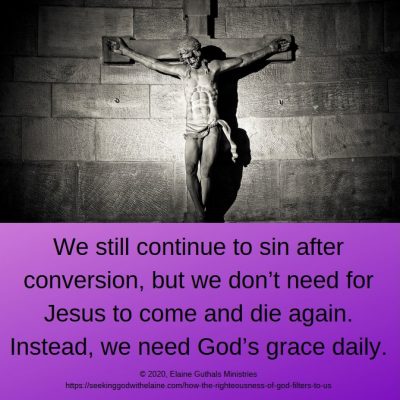
    Yes, we still continue to sin after conversion, but we don’t need for Him to come and die again. Instead, we need God’s grace daily.

    Jesus

    Grace

    “… justified freely by his grace …” (Rom. 3: 24 CSB)

    Grace is the second nugget. Grace is a free and unmerited gift from Heavenly Father given through His Son, Jesus Christ that enables salvation and spiritual healing to believers. Because of God’s infinite grace, He devised the plan of salvation that made Jesus our Redeemer in order to forgive us of our sins.

    Glossary

    One thing we have to get loud and clear is God did not have to extend grace to us. We are not entitled to it. Mankind disobeyed God. He doesn’t have to turn a blind eye to that fact.

    Extend it, God does. He sends the Holy Spirit to prompt us. McGillivray wrote that the only way we can receive this righteousness is through revelation by God.

    What? You don’t think the Holy Spirit skipped you? Have you every felt that this world was broken? Did you ever think you couldn’t do anything to fix it?

    It is. You can’t.

    But where did you go after that? Did you go look for what some scientist (or worse, some celebrity) said was the fix?

    Or did you look to the Creator for what you needed to do?

    Were you so seeped in the world that you didn’t recognize that was the Holy Spirit prompting you?

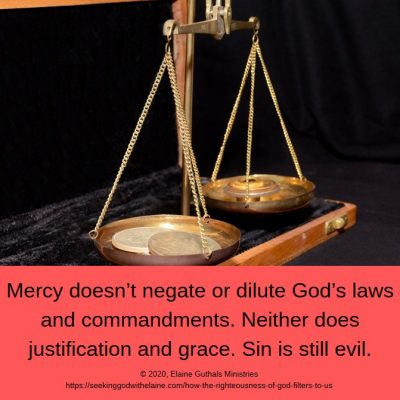
    We talked in the last devotion that mercy doesn’t negate or dilute God’s laws and commandments. Neither does justification and grace. Sin is still evil.

    Scale

    Redemption

    “They are justified freely by his grace through the redemption that is in Christ Jesus” (Rom. 3: 24 CSB)

    Yes, Jesus was 100% man, but there is a huge reason why He was able to fill the role of Redeemer. He is also 100% God.

    To redeem us — to pay the price for our sins — Jesus has to suffer. Greatly.

    That was why Jesus was born on this earth. “‘You are a king, then!’ said Pilate. Jesus answered, ‘You say that I am a king. In fact, the reason I was born and came into the world is to testify to the truth. Everyone on the side of truth listens to me’” (Jn.18: 37 NLT).

    I know. Why would Jesus’ blood pay the price for our sins?

    Glossary

    Well, because that is what God would accept. Jesus was the Perfect sacrifice. “So Christ, having been offered once to bear the sins of many, will appear a second time, not to deal with sin but to save those who are eagerly waiting for him” (Heb. 9: 28 ESV).

    But let’s look at it this way. We were slaves to sin. “Jesus answered them, ‘Truly, truly, I say to you, everyone who commits sin is a slave to sin’” (Jn. 8: 34 ESV).

    Enter Jesus as our Redeemer. “For freedom Christ has set us free; stand firm therefore, and do not submit again to a yoke of slavery” (Gal. 5: 1 ESV).

    That is really telling when we consider Jesus was the substitute for us. How much was Judas paid to betray Jesus. Thirty pieces of silver — the price of a slave.

    We were the slaves. Jesus made Himself a slave when He took our place and took our sins on Him.

    In the next devotion, we will look at propitiation and atonement.

    Father. At times, we look at all You are asking us to do and wonder how we can be obedient to You. We only can with Your help. Help us grow in understanding of how You want us to live. Amen.

    What do you think?

    Leave me a comment below (about this or anything else) or head over to my Facebook group for some interactive discussion.

    If you don’t understand something and would like further clarification, please contact me.

    If you have not signed up for the email daily or weekly providing the link to the devotions and the newsletter, do so below.

    If God has used this devotion to speak with you, consider sharing it on social media.

  • How to Study Scriptures

    Many of us want to study the Scriptures more, but what does that entail? This devotion looks at how we can go about increase our time in God’s Word.

    Nuggets

    • We need to prepare ourselves to read the Scriptures.
    • We need to let worship shape our attitude to read the Scriptures.
    • We need to expect we will be given a personal message from God as we frequently read His Word.
    • We need to diligently study the God’s Word so that we can understand.

    Devotions in the What I Believe series

    Devotions in the The Scriptures category

    Flowers with title How to Study Scriptures

    This devotion is a continuation of the last devotion, where we looked at why to read the Scriptures. Now, we are looking at how.

    How Do We Apply This?

    “Search and read the scroll of the Lord: Not one of them will be missing, none will be lacking its mate, because he has ordered it by my mouth, and he will gather them by his Spirit” (Isa. 34: 16 CSB)

    Many times, we just dive in reading God’s word. We don’t prepare our hearts in any way. Watson gave us a list of how to do that.

    Organize our thoughts first

    We need to think about what we know about the passage of Scripture that we will be reading. That should help us pull up the knowledge blocks so that we can more easily evaluate information from the current read and retain it better.

    Clear our minds of worldly pulls

    Our lives are so hectic that it is difficult sometimes to sit down and focus. We all know we need to eliminate distractions. Maybe we can put on some tunes to help filter out background noise. If our eyes keep going elsewhere, we can use our fingers to help corral them.

    There are other things we need to take into consideration and can do when reading Scriptures.

    Worship first

    We have to approach the Scriptures after we worship. Yes, “… Joshua read aloud all the words of the law…” (Josh. 8: 34 CSB). But first, he “built an altar …” to worship God (Josh. 8: 30 CSB).

    We do this by beginning with a prayer. It is so easy to just pick up the book and read.

    Shape your attitude

    Attitude plays a major part in our devotional time. We should read the Scriptures

    • Reverently
    • Diligently
    • Humbly
    • Submissively
    • Dependently

    Read frequently

    We will get more out of our devotion time if it is not hit and miss. This is especially true if the devotions over several days are about one topic. We leave less time to forget about what we read.

    I don’t know all that I should know. You don’t know all that I should know. No one is exempt from studying the Scriptures.

    Take it seriously

    When I was younger, I really didn’t take a devotional time seriously. It looked like reading Bible stories that I had already read in Sunday School.

    We have to read Scriptures for the right reasons. We have to read it looking to grow our relationship with God and to change our character.

    Read it expectantly

    We have to expect to get something out of our reading. It goes back to attitude again, like we talked about in the last devotion.

    We won’t get anything out of reading Scriptures if we think there is nothing to get.

    Read it personally

    If you can’t tell, I like to look at old sermons and see what I can learn from them. (Remember, with these devotions, God talks to me before He talks to you.) Boardman cautioned us to see what is God telling us (not what he told someone else to tell us).

    Read carefully

    It think at times (four fingers pointing back) we do our daily devotion time to check it off the to-do list. The problem with that is it can make us skin and read quickly.

    We’ve got to make sure we allow ourselves enough time to read the passage thoroughly. Then we have to read it for understanding.

    Hunt

    A lot of times, we hope what we read is self-contained. What I mean by that is all the Bible verses are written out instead of just noted. All the examples are thoroughly described.

    For example, in the last devotion, I made a quick mention of not trying to understand what God is trying to tell us if we are reading with the there-is-no-way-a-donkey-talked attitude. Someone who hasn’t grown up in church but is searching may not get the reference to Balaam and his donkey that talked.

    So, I put the link to the previous devotion where we talked about that. But that mean clicking elsewhere and reading all or part of another devotion.

    To read a related devotion, click the button below.

    I know. It depends on how much time we schedule for our devotional time. (We do schedule, don’t we? We don’t leave it up to just fitting it in, right?)

    But we have to understand what we are reading, or we don’t grow like God wants us to. Sometimes we have to dig deeper to find the meaning.

    Boardman also gave excellent suggestions. We have to understand the Israelites to understand the Scriptures. Where did they live? How did they live? What are the principles of their poetry and prophesy?

    I can say, “yes, yes” to that. Last summer Pastor Delbert has a Sunday night series. It was part geography, part history. It really opened my eyes to meanings of several Bible passages.

    Compare

    When we read one passage of Scripture, we have to think about what other passages say. Do they say the same thing? Do they seemingly contradict? Comparatively — what do other Scriptures say?

    Watch others

    Follow the examples shown in Scriptures — especially the example of Jesus. What can we learn from Moses? Daniel? David? Jonah? Paul? Stephen?

    Look for its application

    It is so easy to read a passage and just read it. We need to read it looking for how we can apply it.

    Newberry reminds us that all Scriptures are applicable to our lives. Some passages we may read and go, “Huh?” We have to make sure we remember God isn’t always talking literally. He is wanting to build our character.

    Maybe it would be easier to apply it if we hooked it on to past knowledge and experiences first. If we think about what we already know, what this is teaching us, and the differences between the two, maybe we will get a clearer picture of what changes we need to make.

    • Look for its directions. Look for the do’s and don’t — especially the implied ones. Romans 2: 11 says, “For there is no favoritism with God.” The implied command is we are to treat everyone equally, as God does.
    • Seek to understand. I know I said it already. I will probably say it a couple of more times so we get it lodged in our brains. We cannot just read to read. This isn’t a novel. It is a textbook. How did you study in school when you read your textbooks? Did you take notes (use a journal now)? Did you have other books for reference (use a Bible dictionary or commentaries)?
    • Make inquiries. Google is good, although we always have to evaluate what we read online. If we don’t understand something, we need to get with our Pastor Chad-types.

    Then we have to figure out ways we can put into practice what we read. How does God want us to act on what we have read?

    Keep track

    Keep a list of Scriptures that talk to us. It not only gives us a list we can access when things aren’t going so well, but it can also show us how God is growing us.

    Read it orderly

    There are different ways we can read the Scriptures. We can start at Genesis and read to Revelation. Some might get bogged down in Leviticus or Numbers, though.

    We can read an Old Testament book and then a New Testament book. That might help some since the New Testament tends to be an easier read.

    One thing I am trying to do is read the Bible chronologically. It starts out in Job and goes through.

    Bottom Line, Though

    In The Reading of the Law, we are given ways to grow our relationships with God.

    • “daily reading of the Bible
    • “attendance on the public ordinances of God’s house
    • “Christian conversation
    • “giving heed to the voices of conscience and the Divine Spirit.”

    I know, I know. You all were looking for some new way to kick start devotion time.

    I get it. Zig Zeigler said something like, “You can’t expect different results by doing the same thing.” We are looking for improved devotional time.

    But we look for some gimmick to help us, some resource by someone we see as a with-it disciple.

    It really doesn’t start there.

    It starts in our hearts. It starts with our dedication. It starts with our relationships with God.

    I know I said a long time ago that I get a lot of mileage out of this graphic.

    Searching for and Seeking God

    Hearing His Word (Rom. 10: 17).
    Reading His Word (Rev. 1: 3).
    Praying to Him (Heb. 4: 16).
    Studying His Word (Ac. 17: 11).
    Meditating on His Word (Ps. 1: 1-2).
    Memorizing His Word (Ps. 119: 11).

    That is what it all boils down to for disciples. We have to hear His Word, read it, study it, meditate on it, and memorize it. All through that, we need to be in prayer, asking God to provide the meaning.

    That isn’t going to change. Props aren’t going to change our desire or our commitment to do that — not really.

    The only thing that is going to get us to where we need to be in reading the Scriptures is our firm desire to want to change to be the disciple God wants us to be.

    Father God. We want to learn of You. We want to be the children and disciples You want us to be. Help us to change our attitudes and priorities. Help us to focus on Your Scriptures and understand them. Help us to hear You telling us what we need to know. Amen.

    What do you think?

    Leave me a comment below (about this or anything else) or head over to my Facebook group for some interactive discussion.

    If you don’t understand something and would like further clarification, please contact me.

    If you have not signed up for the email daily or weekly providing the link to the devotions and the newsletter, do so below.

    If God has used this devotion to speak with you, consider sharing it on social media.

  • Why Should We Study Scriptures?

    If someone asked you why it was important to study the Scriptures, what would you say? This devotion explores several reasons why we should and the benefits we gain when we do study Scriptures.

    Nuggets

    • We have to approach reading the Scriptures with faith.
    • We can’t expect instant understanding when we read Scriptures.
    • Change has to come from our heart.
    • Hiding God’s Word in our hearts has to be pre-trial.
    • When we diligently read the Scriptures, we leave less of an opening for sin to take hold.

    Devotions in the What I Believe series

    Devotions in the The Scriptures category

    Flowers with title Why Should We Study Scriptures?

    I like it when I have a lot of research from which to write my devotions. But then again, when I have over 80 pages, it sometimes get unwieldy. It makes it very difficult to organize at times.

    So, this going to go over two devotions. I hope it flows coherently.

    Let’s Put It into Context

    It is important that we read the Scriptures. Stuart reminded us what we find in God’s Word.

    • Instruction
    • Guidance
    • Encouragement
    • Consolation
    • Delight

    Hodge also gave us a list of reasons to search the Scriptures.

    • Gain knowledge
    • For consolation
    • To become holy

    The Bible is a wonderful book that is an excellent guide to how we should live. But how should we read it?

    How We Should Approach the Scriptures

    “The instruction of the Lord is perfect, renewing one’s life; the testimony of the Lord is trustworthy, making the inexperienced wise” (Ps. 19: 7 CSB)

    We have to approach reading the Scriptures with faith. Faith is the belief that the doctrines stated in God’s Word are true, even if we do not understand all aspects of them. If we approach our reading with the there-is-no-way-a-donkey-talked attitude, we aren’t even trying to understand what God is trying to tell us.

    To read a related devotion, click the button below.

    So, we have to approach every word as being a truth from God. It can happen. It will happen.

    We have to do more than just read God’s Word. We have to think about it. We have to dig for that kernel that God is trying to apply to our lives.

    Watson wrote, “Meditation is the bellows of the affections: ‘While I was musing the fire burned’ (Psalm 39:3).” We can’t expect instant understanding when we read Scriptures. Remember, God’s ways are higher than ours (Isa. 55: 8-9).

    When we read, do we think that it is God speaking to us? Or do we just read it?

    We’ve got to check our arrogance. We can’t read His Word like we are His equals and can just pick it up with no work involved. Our devotional time should not be approached as we are checking it off of our list.

    Yes, it is all about approach. What is our attitude about His laws and commandments? Are we going to listen and obey them? Do we want Him to change us?

    How Does Scriptures Change Us?

    “I have treasured your word in my heart so that I may not sin against you” (Ps. 119: 11 CSB)

    Change has to come from our heart. We are commanded to love God with all our hearts (Deut. 6: 5).

    To read a related devotion, click the button below.

    But it is more than just the emotion of love. It is the hide-in-our-hearts type of love.

    Eyre said it this way. He wrote, “Not merely in his memory, not in the intellectual powers of the mind, but in the city and citadel, where the affections dwell, where reason governs, the home of motive, of principle, and feeling. The memory should be the storehouse of the Divine truth; it is often the very quiver of God, from which He draws His arrows of conviction, and the storehouse where He draws comfort and peace for His people. … Love needed to understand God’s Word.”

    That is what changes us. We make it a part of us.

    The Ouch Factor

    “Afterward, Joshua read aloud all the words of the law — the blessings as well as the curses — according to all that is written in the book of the law” (Josh. 8: 34 CSB)

    We have to remember it is going to hurt. I think too many people want just the prosperity gospel.

    Not going to happen. “More than that, we rejoice in our sufferings, knowing that suffering produces endurance” (Rom. 5: 3 ESV). Smooth sailing is not going to produce endurance.

    Hiding God’s Word in our hearts has to be pre-trial. If we wait for the rough times to start — i.e., when we think we need Him — it is too late.

    Remember, the God’s Word is a sword in the armor. It is our defensive weapon. Do we really want to leave home without it?

    We talked about being pruned. God’s Word does that. “You have already been pruned and purified by the message I have given you” (Jn. 15: 3 NLT).

    To read a related devotion, click the button below.

    But we don’t just hide it away and forget about it. It has a purpose. “… that I may not sin against you” (Ps. 119: 11 CSB). Remember, it is the offensive weapon. It is going to attack when sin turns the corner and gets onto our battlefield. It isn’t going to wait until sin strikes first. It is going to protect us. Haven’t we heard about angel armies?

    What is the main purpose in sanctification? Sanctification is the transformation of mind, body, and soul beginning with regeneration and ending with perfected state of spiritual wholeness or completeness.

    To read a related devotion, click the button below.

    It is to cut sin out of our hearts and lives. How do we know what sin is? We read God’s Word. It helps pinpoint the sin we have in our lives. It tells us how to avoid it.

    Don’t we see the strength that gives us? We are not alone. God is fighting for us (and we already know God has won the war).

    Breastplate

    Diligently

    “It is to remain with him, and he is to read from it all the days of his life, so that he may learn to fear the Lord his God, to observe all the words of this instruction, and to do these statutes” (Deut. 17: 19 CSB)

    Reading the Scriptures diligently unlocks the power of God for us. “Jesus replied, “Your mistake is that you don’t know the Scriptures, and you don’t know the power of God” (Mt. 22: 29 NLT).

    When we diligently read the Scriptures, we leave less of an opening for sin to take hold.

    Scriptures point to Jesus. “You search the Scriptures because you think they give you eternal life. But the Scriptures point to me!” (Jn. 5: 39 NLT).

    Reading the Scriptures show we are dependent on God. We need to depend on Him during the good times and the bad.

    Bible

    But It’s Confusing!

    We think that the Scriptures can be so hard and confusing. We have to read the Scriptures expecting that God will help us understand. “Your hands made me and formed me; give me understanding so that I can learn your commands” (Ps. 119: 73 CSB). I love how the New Living Testament translated it. “… Now give me the sense to follow your commands” (Ps. 119: 73 NLT).

    Yes, it can be confusing because God reveals the meat of His Word only to His children. “For what seems to be God’s foolishness is wiser than men’s wisdom, and what seems to be God’s weakness is stronger than men’s strength” (I Cor. 1: 25 TEV).

    To read a related devotion, click the button below.

    Keith reminded us why it is so hard to diligently study God’s Word. That goes against our human nature. Don’t we easily go into our defense mechanisms? Wouldn’t Satan kick those into high gear when we are trying to cut him out?

    A Meal of the Scriptures?

    “Your words were found, and I ate them. Your words became a delight to me and the joy of my heart, for I bear your name, Lord God of Armies” (Jer. 15: 16 CSB)

    Oh, that sounds funny. How are we going to eat words?

    What happens when we eat something? It goes from outside of us to inside of us.

    But more than that, it becomes a part of us. It molds with us. It nourishes us so that we grow and have strength.

    Angus wrote, “The believing soul turns the words into the nourishment of the spiritual life.”

    Think of it this way. How do we go from milk babies to steak adults? We have to have substantial nourishment in order for us to grow.

    To read a related devotion, click the button below.

    Yep. We have to seek until we find. God isn’t just going to roll His Will and understanding into us. We have to be at the dinner table with knife and fork is the ready position.

    Then we have to eat. Nothing is going to happen if we don’t chew. Can we equate the digesting of the food with meditating?

    But look what else is the outcome. “… Your words became a delight to me and the joy of my heart …” (Jer. 15: 16 CSB). Delight and joy when we feast on God’s Word.

    Making the Connections

    We can’t get obedience to the heart level until we get the Scriptures there. “The law of his God is in his heart; his steps do not slip” (Ps. 37: 31 ESV).

    That makes Stillingfleet’s comment understandable. He wrote, “Truth must be sought, and that with care and diligence, before we find it.”

    We can only find God’s truth when we actively look for it. In the next devotion, we are going to look at some ways to do that.

    Loving Father. You have provided so much for us because You love us. You designed the plan of salvation even before You created us (Eph. 1: 4). You knew we would need Your Word to guide us back to You. You gave, through Your Spirit, Your Word to Moses, Matthew, Peter, John, and Paul. Help us to diligently search the Scriptures to find You. Amen.

    What do you think?

    Leave me a comment below (about this or anything else) or head over to my Facebook group for some interactive discussion.

    If you don’t understand something and would like further clarification, please contact me.

    If you have not signed up for the email daily or weekly providing the link to the devotions and the newsletter, do so below.

    If God has used this devotion to speak with you, consider sharing it on social media.
  • Faith as a Virtue

    Is faith a gift from God, a virtue, or a choice? If we look at faith as the ideal that disciples are to strive for, we become better imitators of God. This devotion discusses whether it is the moral excellence for which we are to strive.

    Nuggets

    • Virtues rest on faith.
    • Faith is a gift, but we have to grow our faith.
    • Faith is a choice.
    Flowers with title Faith as a Virtue

    We are looking at ways we can become mature disciples. Self-Discipline is one of the tools we use to do that. We’ve looked at a wide variety of things so far.

    I thought this week we would look at what our standards should be. We generally think of those as virtues.

    Let’s Put It into Context

    Merriam-Webster Dictionary defines virtue as a “conformity to a standard of right” or “a particular moral excellence.” It is talking about how we conduct ourselves as we live our lives.

    When we think about a virtue, we think about this being something on which we do not compromise. At times, we look at it as a strength of character.

    A disciple knows that our strength of character comes from God. Maclaren wrote, “The strength of the Christian man will manifest itself in ruling outward things, and making them subservient, whether they be sorrowful or joyful, to the highest end of all, even his larger possession of a fuller Divine nature.” God is in control of our “… inclinations, desires, tastes, passions, and the like …”.

    Did you catch that? It is strength of character. Not doormat of character. Some worldview people expect disciples are supposed to be doormats — someone they can run over — especially since we are supposed to be peacemakers.

    To read a related devotion, click the button below.

    Disciples aren’t meant to be mice. God doesn’t want us to be timid. He wants us to be able to stand up for that in which we believe — Him.

    Why do I say this? “This is my command — be strong and courageous! Do not be afraid or discouraged. For the LORD your God is with you wherever you go” (Josh. 1: 9 NLT). God is our strength.

    Back to moral excellence. Paul tells us “Finally brothers and sisters, whatever is true, whatever is honorable, whatever is just, whatever is pure, whatever is lovely, whatever is commendable — if there is any moral excellence and if there is anything praiseworthy — dwell on these things” (Phil. 4: 8 CSB).

    Virtues give us a picture of an ideal person. Putting it into our context, we look for virtues that make us the ideal disciple.

    I googled Christian virtues and got a really long list. We will probably sometime this year come back and pick up some of that list.

    For this week, I want to focus on the list that Peter gave us in Second Peter. Of course, we’ve talked about and around some of them — just not through the lens of them being a virtue.

    Devotions in the Christian Virtues series

    What Is Faith?

    Faith is the belief that the doctrines stated in God’s Word are true, even if we do not understand all aspects of them. Faith is a product of love. We have to have faith to accept God’s love.

    Williams contends that faith is synonymous with trust or belief. Believing in a God that we cannot see takes a lot of faith, trust, and belief. That faith is what secures our salvation.

    Is Faith a Virtue?

    “For this very reason, make every effort to supplement your faith with goodness, goodness with knowledge, knowledge with self-control, self-control with endurance, endurance with godliness, godliness with brotherly affection, and brotherly affection with love” (II Pet. 1: 5-7 CSB)

    Okay. I was thinking that faith is a gift. “For you are saved by grace through faith, and this is not from yourselves; it is God’s gift” (Eph. 2: 8 CSB). I read that as faith is as much of a gift as grace.

    Can faith be a gift if it is a virtue?

    Thompson argued that virtues rest on faith. Jay agreed, calling faith the foundation.

    Is Faith a Gift?

    Maclaren agreed with me that faith is a gift. However, he warned us that “God’s gift does not make my effort unneccssary (sic), but rather demands it as its completion and consequence.” We have to grow our faith.

    Is Faith Not a Gift?

    Gifford disagreed that faith was a gift. Unlike grace and peace, Gifford argues that disciples must put forth an effort to obtain it. He instead called it a promise, writing “he who takes the promises of faith takes the life of God into his soul.”

    I see what Gifford is saying. We have to seek God — but He has already started the Holy Spirit in prompting us.

    Once we do admit our sins, believe that Jesus is our Savior, and confess God as Sovereign Lord, we do have to demonstrate that commitment by obeying Him. Our faith has to grow.

    The ABCDs of Salvation

    If you have not become a believer in Christ, please read through the
    Plan of Salvation and prayerfully consider what God is asking you to do.A – admit our sins

    B – believe His Son Jesus is our Redeemer

    C – confess God as Sovereign Lord

    If you have not become a believer in Christ, please read through the Plan of Salvation and prayerfully consider what God is asking you to do.


    D – demonstrate that commitment by making any changes needed in our lives to

    live the way in which God has called us

    The Disciple’s Job Description

    I don’t think that makes it less than a gift.

    It is kind of like this plant my aunt gave me when I was young. Aunt Irene started a philodendron for me. When Uncle Harry brought it to me (driving the tractor carrying it in this little planter shaped as a cat), it had two little leaves.

    It was a gift. I had to water it and make sure it got sunshine. I had to repot it a couple of times.

    If it wouldn’t have grown, I wouldn’t have had it for 30 years — which I did. If it wouldn’t have grown, it would have died.

    Faith can be a gift — but it is what we do with the gift. We have a duty to grow it.

    If faith doesn’t grow, it dies. Maclaren wrote, “A faith which does not grow into virtue and knowledge, and all the other links in this chain is, if not dead, at least ready to perish if it has not vitality enough to fruit.” God doesn’t want dead. He wants growing.

    Is Faith a Choice?

    We’ve said before that faith is a choice. “I have chosen the way of faithfulness; I have set my heart on your laws” (Ps. 119: 30 NIV). We have to choose to accept the gift.

    We do have to work to grow our faith. Gifford also wrote, “God operates, man must co-operate.” It is our choice to cooperate.

    God just doesn’t give us everything. We have to work for it.

    God just doesn’t give us everything. We have to work for it.

    Is Faith Moral Excellence?

    Gifford argues that, if we consider the limited definition of moral excellence, faith doesn’t fit as a virtue. Instead, he called it an energy.

    On the other hand, Beecher, like Thompson, believed that the virtues comes out of faith.

    Making the Connections

    I think faith is a virtue, a gift, and a choice. God sends His Holy Spirit to us to call us to salvation. We cannot just come to Him. That makes salvation a gift from Him to us.

    I think we need to look at this (and all of the virtues listed) as what makes up the ideal disciple. This is what we are to work toward. That makes it a virtue.

    Are we going to be 100% perfect? No, we are still in these sinful bodies. We make a choice to be faithful, to be virtuous.

    This is what we will be for eternity. Our lives right now are practice for then.

    Okay, let’s look at virtues this way. Williams talked about there being those who just wanted to have the faith/knowledge of God and not the virtues.

    Haven’t we been saying this? Yes, we have to ABC. But we can’t not do the D. This isn’t just fire insurnance.

    We have to get to the righteousness by going through the process of sanctification. However, sanctification is accomplished through obedience. That is doing the do’s and not doing the don’ts.

    Making the Connections to Self-Discipline

    Thompson called virtues “… a courageous tone of mind.” He also challenges us to cultivate these virtues.

    If we can cultivate these virtues — which means we can grow them — we need self-discipline to accomplish that.

    Remember what Paul said? Paul tells us meditate on these things. “Finally brothers and sisters, whatever is true, whatever is honorable, whatever is just, whatever is pure, whatever is lovely, whatever is commendable — if there is any moral excellence and if there is anything praiseworthy — dwell on these things” (Phil. 4: 8 CSB).

    Meditating is one of the ways we seek God. It is just

    Searching for and Seeking God

    Hearing His Word (Rom. 10: 17).
    Reading His Word (Rev. 1: 3).
    Praying to Him (Heb. 4: 16).
    Studying His Word (Ac. 17: 11).
    Meditating on His Word (Ps. 1: 1-2).
    Memorizing His Word (Ps. 119: 11).

    To read Has God Provided Everything We Need?, click the button below.

    Thompson reminded us that, “Much as we may discipline ourselves to virtue, our strength must lie not in ourselves and our purposes, but in God our Saviour.” We’ve said we can’t do self-discipline without God.

    How Do We Apply This?

    We grow our relationship with God.
    We study those virtuous people in the Bible, such as Noah, Paul, and Mary.
    We learn how to control our minds.

    Maclaren wrote that it basically comes down to this: “That is to say, you may cultivate the habit of suppressing yourselves, of stopping your ears to men’s voices, of mastering and coercing circumstances.”

    More of God — less of us. That sounds like good advice.

    Father God. Our goal for this year is to grow in Your grace and knowledge so that we may be more like You. Show us ideal so that we may — with Your guidance — work on changing what needs to be changed. Sanctify us so that we may become righteous in Your eyes. Amen.

    What do you think?

    Leave me a comment below (about this or anything else) or head over to my Facebook group for some interactive discussion.

    If you don’t understand something and would like further clarification, please contact me.

    If you have not signed up for the email daily or weekly providing the link to the devotions and the newsletter, do so below.

    If God has used this devotion to speak with you, consider sharing it on social media.
  • How Are Disciples Pure in Heart?

    How can any of us see God if we are expected to be pure? This devotion looks at how God can expect humans to be pure.

    Nuggets

    • God wants us to get back to where Adam and Eve were before the original sin, which we can through grace.
    • Nothing we can do or give up will purify us.
    • Only God can remove our sins — when we ask and repent of our sins.
    • If we don’t have the pure heart — or at least are not working toward it — we don’t see God.

    Devotions in the The Beatitudes Show Us How to be Docile series

    Flowers with title How Are Disciples Pure in Heart?

    Okay, I am not going to lie. To me, this verse is one of the scariest in the Bible.

    How is anyone — especially me — going to get to see God?

    We aren’t pure. Far from it.

    But we are studying docile, so there is hope for us yet.

    Let’s Put It into Context

    Docile means easily taught. As we grow in our relationship with God, we are blessed.

    Blessedness means we have been perfected. For the disciple, perfection is holy, sanctified, and righteous.

    Holy means to be set apart, perfect, and pure. Sanctification is the process where our lives are changed, and we made holy. Righteousness is the result of a solid relationship with God. Blackall said that righteousness is “living a life in sincere and perfect obedience to all the laws of God.”

    Yep. Here we go with the heart again.

    We talked about the greatest commandment before in How Do We Love God?. Depending on which book you read, it is love the Lord with all your heart, soul, strength, and mind. Heart is always listed first.

    We’ve talked in Peace, Mercy, and Love about God’s peace, mercy and love being at our center. Our center — our innermost being — is considered our hearts. That is our foundation.

    Also, we’ve talked in The Fullness of God’s Love about how Jesus is the Word (Jn. 1: 1) that we are to hide in our hearts (Ps. 119: 11). Jesus is a major part of that foundation.

    In Have We Lost Our First Love?, we talked about how we have to open our hearts to allow Jesus to take full residence within them. We lose our first love when we either don’t allow Him full control or we kick Him out after a while.

    Obedience has to come from the heart. In Getting Obedience to the Heart Level, we said God’s Word is supposed to be a part of us. His laws and commandments are supposed to affect our character or our core – our heart level. If we are to engrave God’s laws and commandments on our hearts, we internalize them, and they change us.

    To read a related devotion, click the appropriate button below.

    When we look up purity in the Holman Bible Dictionary, it sends us to the definition of clean/unclean, which we have also talked about before.

    The Holman Bible Dictionary states that “cleanness was thus fundamental to the establishing and preservation of holiness in the Israelite community.”

    It isn’t just knowing the difference between good and evil. It isn’t just keeping as far away from evil as we can. We have to discipline our minds to remain pure.

    To read a related devotion, click the button below.

    We Are Clean

    “Blessed are the pure in heart …” (Mt. 5: 8 CSB)

    God calls us to be pure in heart. He wants us to get back to where Adam and Eve were before the original sin. We can do that through grace (Caroming).

    Jordan stated that purity is “… the purity of the thoughts and desires” and “… leads to purity of worship” and life. I can see this because it has to incorporate our mind and soul. All of that bubbles out of us as worship.

    We know the concept. “Jesus replied, ‘You must love the Lord your God with all your heart, all your soul, and all your mind’” (Mt. 22: 37 NLT).

    However, God know our hearts are not pure because of the sin in our lives. Hull wrote, “But, there is no purity apart from the absolute authority of God in the affections. Man is not made by negatives.”

    Let’s break that apart. Human nature is not clean. Our hearts will always be wicked (sinful) because of our human nature (Jer. 17: 9).

    Let’s restate that. Our hearts will always be wicked (sinful) unless we ask God in our hearts to purify us. Only God can remove the sin in our lives.

    Look at the “… in the affectations.” There is no purity in the artificial or that which is designed to impress the worldview people.

    We have to have God as Sovereign Lord to have the purity. Nothing we can do or give up will purify us. (Doing the do’s and not doing the don’ts doesn’t make us pure.)

    Think about it this way. The worldview notion is that we have to fight for our success.

    God’s notion is that purity comes from the heart. It is more who we are — our character — than what we do. It is where Jesus and the Holy Spirit live within us.

    We can have motivations that are, in reality, taking us down a wrong path. We can do and do and do that will get us nowhere.

    Only God can remove our sins — when we ask and repent of our sins. He wants to restore our balance.

    Candles

    Seeing God

    “… for they will see God” (Mt. 5: 8 CSB)

    We had a whole series awhile back on seeing God.

    To read devotions in the Seeking God series, click the appropriate button below.

    We generally think of “seeing God” to mean face to face. And we will — whatever that means. We will be in His Presence.

    But we can see God now. We can see

    • How He satisfies our desires.
    • How He gives us hope.
    • How He sustains us through our trials.
    • How He is correcting us when we sin.
    • How He is transforming us through sanctification.
    • How He is fulfilling the promises in His Word.
    • The peace and the joy that He brings.

    But if we don’t have the pure heart — or at least are not working toward it — we don’t see God. He gets lost in the rat race of this world. We take our focus off Him and put it no ourselves and our own lives.

    Water

    Making the Connections

    One thing we don’t focus on is that it is not about us. The only way we begin to become pure is to admit our sins, believe Jesus is our Savior and Redeemer, and confess God as Sovereign Lord.

    The ABCDs of Salvation

    If you have not become a believer in Christ, please read through the
    Plan of Salvation and prayerfully consider what God is asking you to do.A – admit our sins

    B – believe His Son Jesus is our Redeemer

    C – confess God as Sovereign Lord

    If you have not become a believer in Christ, please read through the Plan of Salvation and prayerfully consider what God is asking you to do.


    D – demonstrate that commitment by making any changes needed in our lives to

    live the way in which God has called us

    The Disciple’s Job Description

    Once we do, God call us to have a change of heart. This happens two ways: regeneration and sanctification. Oh, yeah. Churchy words.

    Regeneration is the change in us that God brings about when we go from being spiritually dead to spiritually alive. This change has to be in our hearts.

    It is where God breaks Satan’s hold on us. Only God has the power to do that, and He only does when we admit our sins, believe on Jesus as Redeemer, and confess God as Sovereign Lord.

    To read a related devotion, click the button below.

    We’ve talked a lot about sanctification recently. It can be a little difficult for some to understand.

    Sanctification is “the process of being made holy resulting in a changed life-style for the believer” (Holman Bible Dictionary). We are sanctified through faith. It is the evidence of justification and our conversion and how we get to righteousness.

    It is learning — acquiring wisdom — so that we can grow in grace and knowledge. Sanctification happens at conversion, but it is also a growing process.

    Sanctification separates us from our old lives and builds a new life in Christ. This is done by the work of the Holy Spirit’s promptings.

    The transformation discussed in Romans 12: 2 happens in sanctification. This growth in grace and knowledge changes our nature.

    Sanctification should be a complete deal. It should be mind, body, and soul. We are to submit to God’s loving kindness with all of our being.

    Making the Connections to Self-Discipline

    I love what Caroming said. He wrote, “[Purity] is a living principle, ever powerful, ever resisted, yet never beaten, growing daily in aspirations and likeness, until it is made perfect by seeing Christ as He is, when we shall be like Him, because we shall see Him as He is.”

    It is a living principle. It is growing daily. It is being sanctified.

    Being sanctified is a process built on our learning — our growth. We have to be disciplined in that growth.

    How Do We Apply This?

    Good cautioned us that we can have the purity without the holiness. But it won’t get us anywhere.

    Well, that shoots down the worldview people’s assumption that they can just be good and get to heaven.

    To read a related devotion, click the button below.

    How do we achieve purity? Purity is:

    • “the mind renewed,
    • “the disordered spirit restored, and
    • “conformed to the ‘image of God,’ in righteousness and true holiness.”

    Talk about the outcome of sanctification!

    But it has to be genuine. We must be working to transform ourselves to imitate God. We have to take responsibility for our actions and inactions.

    God calls us to be pure in heart. I think that is another instance of the past, present, and future aspects in one word.

    At conversion, we are made pure because we are given God’s heart. But it is a process to become like Him. That process won’t be complete until we reach heaven.

    God calls us to be pure in heart. Let that be our goal today.

    Father God. We want to have a heart like Yours — pure and holy. Lord, change us until that is accomplished. Amen,

    What do you think?

    Leave me a comment below (about this or anything else) or head over to my Facebook group for some interactive discussion.

    If you don’t understand something and would like further clarification, please contact me.

    If you have not signed up for the email daily or weekly providing the link to the devotions and the newsletter, do so below.

    If God has used this devotion to speak with you, consider sharing it on social media.

  • How Do Disciples Crave Righteousness?

    If docile means easily taught, how can we easily learn righteousness? This devotion looks at how we are to hunger and thirst for righteousness.

    Nuggets

    • Righteousness isn’t about what God will or will not give us; it is all about our choice to be like Him.
    • Righteousness is the ground on which the actions grow.
    • We can be made righteous as it is something we have to learn – and God is more than willing to teach us.

    Devotions in the The Beatitudes Show Us How to be Docile series

    Flowers with title How Do Disciples Crave Righeousness?

    I know. We have talked so much about righteousness lately — and here we are again. Let’s look at it through the lens of being docile this time.

    Let’s Put It into Context

    We are talking in this series about how disciples are to be docile. Docile means easily taught. As we grow in our relationship with God, we are blessed.

    Blessedness means we have been perfected. For the disciple, perfection is holy, sanctified, and righteous.

    Holy means to be set apart, perfect, and pure. Sanctification is the process where our lives are changed, and we made holy. Righteousness is the result of a solid relationship with God. Blackall said that righteousness is “living a life in sincere and perfect obedience to all the laws of God.”

    Let’s do a recap of other devotions before we see what we can add from this verse. We know we learn by taking what we know as a foundation and processing new information in relation to it.

    The definition of righteousness is “the actions and positive results of a sound relationship within a local community or between God and a person or His people” (Holman Bible Dictionary). Instead of just “uprightness,” the original definition was based on fulfilling the covenant and building relationships with God and others.

    In other words, righteousness means being right with God, being holy as He is holy. Being holy is unique to God. Righteousness is what comes out of being holy, having faith, and loving as Jesus does. Being holy produces the righteousness.

    It takes a process to get there. That is called sanctification. We progress in the process by obedience.

    God knew before He created us that we would be disobedient. When we are disobedient, we have to confess our sins and repent in order to receive God’s forgiveness. God was always planning on forgiving us. His goal has always been being reunited with mankind.

    Righteousness is the end goal. It has to come from God. It is all about putting the wisdom we have learned from growing in grace and knowledge into practice so that we are imitators of God. We have changed our character so that we live our lives according to how He calls us.

    To read a related devotion, click the appropriate button below.otion, click the button below.

    Basic Needs

    “Blessed are those who hunger and thirst for righteousness …” (Mt. 5: 6 CSB)

    Hunger and thirst are basic needs. If we don’t eat and drink, we don’t live long.

    We can’t live without God. Oh, yes. There are some saying they are living just fine without Him. They may be now. In the end, they won’t.

    Let’s put a couple of points together. Elliot wrote, “Man may be measured by his desires.” The other is “This law of desire explains our spiritual poverty.”

    Oh, wow. What great statements.

    We talked about desires before. That was how we defined lust.

    Our spiritual poverty is defined by that for which we lust.

    Unfortunately, we generally lust for things of this world. That leads to our spiritual poverty – sinfulness.

    But remember How Do Disciples Mourn? We said that, instead of being complacent with sin, we have to cry out (mourn) when we consider our sins, be genuinely deeply sorry for committing them, and are burdened because we know we will continue to sin while we are here on this earth.

    Maybe spiritual poverty is more than just we’ve sinned.

    We know we will never be able to not sin.
    We feel guilty because of the sins we have committed.
    We know there is nothing we can do to save ourselves.

    We have to desire to be righteous. And what is righteous? Being like God.

    Righteousness isn’t about what God will or will not give us. It is all about our choice to be like Him.

    Chaplin said that righteousness is a “… state of mind and heart …” It isn’t the results of actions. It is the ground out on which the actions grow. Remember rooted and grounded?

    We have to really desire to imitate God. We can’t think that we can do the minimum here. We have to actively strive to imitate God (and not just say we are made in His image imitation).

    To read a related devotion, click the appropriate button below.

    Jordan listed three components to righteousness.

    “(1) A death unto sin;

    “(2) A renunciation of the world;

    “(3) A deliberate choice of God.”

    Wow! Those make really lofty goals for us, right? We have to stop sinning, stop focusing on this world, and start choosing God.

    No biggy, right?

    Please tell me that I am not the only one. I have been reading all these devotions on righteousness and wondering how in the world I am going to do all of that. And not mess up. Frequently.

    How am I going to stop sinning? How am I going to withstand the pull of this life?

    Oh, I want to focus on God. I am doing better than I was, but am I righteous? No way!

    But God says in Matthew 5: 6 that we only have to hunger and thirst, not be perfect.

    What did we say about obedience when we were putting this into context? God knew before He created us that we would be disobedient. God was always planning on forgiving us. He knows we will keep on sinning while we are in these earthly bodies.

    But 1) we have to ask forgiveness. And 2) Just because it is only hunger and thirst, we can’t minimize it.

    So, #1 first. God doesn’t want us to feel like such failures that we give up. There is only one sin that He can’t forgive — and that is unbelief.

    To read a related devotion, click the appropriate button below.

    God wants us to keep trying and working on growing closer to Him. He knows we are going to have fits and starts at first. He also knows we are going to run into problems. He is looking for us to choose Him.

    But #2, we can’t believe that we can purposefully go ahead and keep sinning. We are supposed to strive for righteousness.

    God has to see evidence that we have chosen Him. He wants to make sure we aren’t just buying fire insurance. That evidence is our obedience.

    Stuffed

    “… for they will be filled” (Mt. 5: 6 CSB)

    Oh, wow! Look at that promise. “… for they will be filled” (Mt. 5: 6 CSB).

    We will be made righteous — and not just a little bit. This is total.

    Well, if we are talking hungry and thirsty, getting full means we have enough to eat and drink. If we are talking about our desires, we are going to get what we desire.

    Barker noted that filled meant “satisfied because it quenches the desire of sin.” Won’t that be a glorious day when that promised to us is fulfilled!

    Watson also said that the fullness wasn’t just going to be until the next meal. It was going to be constant. Well, this is from God, isn’t it? He doesn’t do things half heartedly. It is going to be grace, peace, and bliss (Watson).

    Making the Connections

    We can be made righteous. It is something we have to learn. God is more than willing to teach us — if we are docile and let Him.

    A lot of people think God made us so we are children of God — we don’t have to do anything else. It doesn’t work that way. We ran away from home. God puts one condition on taking us back. We have to believe and submit.

    There has to be evidence of that submission. It can’t be just words that we’ve said. We have to show with our lives we are trying to imitate Him.

    Making the Connections to Self-Discipline

    This is going to be a process, folks. God is going to have a lot to do in our sanctification process to change us from holy to righteous. That is going to take discipline on our part.

    How Do We Apply This?

    Yeah, we can desire for righteousness. What is Satan going to do? He is going to throw his whole arsenal at us. Butcher said it this way: “The desire for righteousness is met by the actual presence of sin. Jesus died that sin might be removed.”

    Yeah, we can desire for righteousness. What is Satan going to do? He is going to throw his whole arsenal at us. Butcher said it this way: “The desire for righteousness is met by the actual presence of sin. Jesus died that sin might be removed.”

    We need to hunger and thirst (desire) to do our part in the spiritual warfare. We can only do this by seeking God.

    Searching for and Seeking God

    Hearing His Word (Rom. 10: 17).
    Reading His Word (Rev. 1: 3).
    Praying to Him (Heb. 4: 16).
    Studying His Word (Ac. 17: 11).
    Meditating on His Word (Ps. 1: 1-2).
    Memorizing His Word (Ps. 119: 11).

    To read Has God Provided Everything We Need?, click the button below.

    We need to listen to God and obey everything He tells us. That includes all the tough stuff we would rather not do.

    Chaplin wrote that “it is a desire not merely for doing righteously, but for being righteous.” That means we have to let the sanctification process change our character.

    God is not going to be tricked. We expects us to be genuine — genuinely submissive, genuinely mourning, genuinely obedient. That will make us righteous.

    Loving Father. We hunger for You. We thirst to be like You. Help us to grow through the sanctification process so that we are righteous and ready for our eternal home. Amen.

    What do you think?

    Leave me a comment below (about this or anything else) or head over to my Facebook group for some interactive discussion.

    If you don’t understand something and would like further clarification, please contact me.

    If you have not signed up for the email daily or weekly providing the link to the devotions and the newsletter, do so below.

    If God has used this devotion to speak with you, consider sharing it on social media.

  • What Are the Fruits of Righteousness?

    What does “fruits of righteousness” mean? Fruit is another word for rewards. This daily devotional looks at how God rewards His people for living righteous lives.

    Nuggets

    • We receive the reward of eternal life when we admit our sins, believe on Jesus as Redeemer, confess God as Sovereign Lord and demonstrate that commitment by making any changes needed in our lives to live the way in which God has called us.
    • Peace comes from God.
    • We gain access to Sovereign God by the reconciliation He devised.
    • Joy comes because the peace we find in God gives us hope.

    To read a devotion in the What Is Righteousness? series, click on the appropriate button below.

    Flowers with the title What Are the Fruits of Righteousness?

    God rewards those who do His Will. Romans 2: 6 says, “He will judge everyone according to what they have done” (NLT). Hebrews 11: 6 says, “… that he rewards those who earnestly seek him” (NIV).

    Let’s Put It into Context

    “The fruit of the righteous is a tree of life, and he who wins souls is wise” (Prov. 11: 30 ESV)

    The verse in Proverbs calls the rewards fruit. I see that. Fruit is the produce of trees or vines.

    What are the trees and vines in our lives as disciples? Thomas said that it is what is in our hearts and souls. Cross clarified that by saying, “By this is meant his prayers, his charities, his good example, the virtues which compose his character and adorn his life, and all the efforts and influences by which he shows forth his wisdom in winning souls.” It is our character and how we live our lives for God.

    So, what are the fruit of righteousness?

    The Reward of Eternal Life

    “The fruit of the righteous is a tree of life …” (Prov. 11: 30 ESV)

    “The reward of the righteous is life; the wages of the wicked is punishment” (Prov. 10: 16 CSB)

    When the Bible talks about the tree of life, it is talking about eternal life. We receive that reward when we admit our sins, believe on Jesus as Redeemer, and confess God as Sovereign Lord.

    That is the beginning. Because we are repenting of our sins, we are to demonstrate that commitment by following our job description. Repentance is not only expressing sorrow for things we’ve done wrong but also making the commitment to changing ourselves so that we no longer do the wrong things.

    • Repentance is acknowledging our separation from God and expressing sorrow for breaking God’s laws and commandments by making the commitment to change our sinful ways to ways of righteousness through obedience.
    • Sins are actions by humans that disobey God and break one of His reasonable, holy, and righteous laws and commandments, goes against a purpose He has for us, or follows Satan’s promptings.

      • Holy means to be set apart — because of our devotion to God — to become perfect, and morally pure while possessing all virtues.
        • Perfection means we reach a state of maturity because the combination of the spiritual graces form, when all are present, spiritual wholeness or completeness — holy, sanctified, and righteous.
          • Spiritual graces are worldly morals that have been submitted to God to further His kingdom instead of enhancing this world.
          • Sanctified means to be set free from sin.
        • Pure means not being sinful or having the stain of sin.
      • Righteous means we are free from sin because we are following God’s moral laws.

    The ABCDs of Salvation

    If you have not become a believer in Christ, please read through the
    Plan of Salvation and prayerfully consider what God is asking you to do.

    A – admit our sins
    B – believe His Son Jesus is our Redeemer
    C – confess God as Sovereign Lord

    D – demonstrate that commitment by making any changes needed in our lives to live the way in which God has called us

    The Disciple’s Job Description

    Glossary

    Maclaren put it this way. He said that, “if we are to have the life beyond, we must have its beginnings to-day.” Eternal life is the reward of the righteous lives we live now.

    Resource

    Revelation 2: 7 says, “To the one who conquers I will grant to eat of the tree of life, which is in the paradise of God” (ESV). That indicates that it will be a struggle. Those who overcome will be rewarded.

    We can’t just give lip service. “Oh, yes. We believe in Jesus” — but then live our lives not imitating Him. We have to live a righteous life.

    Watson reminded us that God is looking for sacrifice. No, He isn’t looking for animal kills anymore. He is looking for us to be living sacrifices (Rom. 12: 1).

    Resource

    To read a related devotion, click the appropriate button below.

    Being a living sacrifice is living a righteous life.

    Being a living sacrifice is living a righteous life.

    The Reward of Peace

    “The fruit of that righteousness will be peace; its effect will be quietness and confidence forever” (Isa. 32: 17 NIV)

    Jowett defined peace as a “… general glow of health resulting from the inter-related life of many members, each of whom occupies his appointed place in the spiritual order, and is possessed by the spirit of equity and truth. Peace is the spirit of communion, the genius of co-operation, the cohesion of many members into one pure and indissoluble whole.”

    Resource

    Ooo, baby. That has a lot of components. It implies cooperation, humility, integrity, communication, and cohesiveness. All of that promotes peace.

    Bottom line, though, is peace comes from God. He gives us peace down deep in our soul. It is the product of living for Him. Jowett notes that “we cannot command peace; we can only grow it.”

    Resource

    Isn’t that true? We cannot grow it because, when things start getting difficult for us, we generally lose our peace. It is only when we concentrate on God in those trials that we find peace.

    If we are not living as we should, we don’t have peace. This is because the disobedience brings punishment.

    Johnson put it this way. Peace increases when our spiritual nature is strengthened. This decreases our physical nature.

    Resource

    When we are living to imitate God, we have peace through Jesus (Rom. 5: 1). He justifies us upon conversion, giving us peace. Justification is the act through the merits of Christ that makes us free from sin because we are following God’s moral laws.

    Being made right with God brings up peace. In fact, Macbriar stated it is the first gift after conversion.

    Resource

    God’s love for us promotes that peaceful feeling within us. We know we can come to Him anytime — for forgiveness, for protection, for assurance.

    We know we can come to Him anytime — for forgiveness, for protection, for assurance.

    The Reward of Access and Joy

    “Therefore, since we have been declared righteous by faith, we have peace with God through our Lord Jesus Christ. We have also obtained access through him by faith into this grace in which we stand, and we rejoice in the hope of the glory of God” (Rom. 5: 1-2 CSB)

    Romans 5: 1-2 gives us two other fruits of righteousness: access and joy. Now, we’ve talked access before.

    To read a related devotion, click the appropriate button below.

    Before conversion, we didn’t have access to God. Being spiritually dead, we were not in a relationship with Him. Thank You, God, that is no longer the case!

    We gain access to Sovereign God by the reconciliation He devised. We access the peace provided by our Lord and Savior through following the promptings of the Holy Spirit.

    We have access to God by His Word. We approach Him through prayer and worship.

    • Prayer is a two-way communication with God in which we pour out our soul to Him.
    • Worship is our personal or corporate response of admiration (confession, thanksgiving, praise, etc.) based on our attitude to God’s presence and our imitation of His character.

    This is 24/7/365. God never takes a holiday. He doesn’t keep banker’s hours.

    God is always available when we call on Him.

    Joy comes because the peace we find in God gives us hope. God also gives us strength to overcome the trials we face.

    Psalm 94: 19 says, “When I am filled with cares, your comfort brings me joy” (CSB). Regardless of our circumstances, God gives us peace and joy.

    Most of all, we have joy because we have salvation. This has given us peace, joy, and hope for today, tomorrow, and eternity.

    We have joy because we have salvation. This has given us peace, joy, and hope for today, tomorrow, and eternity.

    Salvation is the gift of life through the deliverance from condemnation and sin to acceptance and holiness and changes us from being spiritually dead to spiritually alive.

    • Holiness is the transcendent excellence of His nature that includes elements of purity, dedication, and commitment that lead to being set apart. Purity means possessing God’s moral character, having eliminated the stain of sin.
    • Spiritual death is the spiritual separation from God that occurred as a consequence of Adam and Eve’s original sin. The spiritually alive are those who have ABCDed, so they are no longer separated from God.

    Glossary

    what-are-the-fruits-of-righteousnessPin

    Making the Connections

    Peace and joy. Those are pretty nice rewards.

    I vote life and access as the best rewards. Eternal life with our Heavenly Father — nothing can beat that!

    We get them through a righteous life. Righteousness is the indwelling goodness that is the result of a solid relationship with God built by a sincere life of conscientious obedience to God’s laws and commandments and from which all virtues flow. That is based on fulfilling the covenant and building relationships with God and others.

    So, getting the rewards is based on doing the relationship with God right. That means searching for and seeking God.

    Making the Connections to Self-Discipline

    How do we seek God? It will take hearing His Word, reading it, studying it, meditating on it, and memorizing it. All through that, we need to be in prayer, asking God to provide the meaning. To accomplish all of those, we will need self-discipline.

    Searching for and Seeking God

    Hearing His Word (Rom. 10: 17).
    Reading His Word (Rev. 1: 3).
    Praying to Him (Heb. 4: 16).
    Studying His Word (Ac. 17: 11).
    Meditating on His Word (Ps. 1: 1-2).
    Memorizing His Word (Ps. 119: 11).

    Choosing to live a righteous life will need discipline. One huge reason is because of the pull this world has on us. We have to be conscious of the decisions we are making.

    How Do We Apply This?

    How do we schedule our quiet time? Is it something we schedule, or do we leave it up to whenever we can fit it in?

    Do we ever schedule an afternoon or a weekend or a couple of days where we go off and commune with God? We’re talking about a time when we can get away — alone — to talk and listen to God. You know, work on the relationship.

    We should have several goals.

    • Have a solid relationship with God.
    • Have the heart of God.
    • Live lives that imitate Him.

    If we do that, we will receive the fruits of righteousness.

    Heavenly Father. Lord, we want to earn the fruits of righteousness. That would mean that we are living as You want us to live. We want to have a solid relationship with You. We want to have Your heart. We want to imitate You. Help us to grow in grace and knowledge of You so that we can accomplish those goals. Amen.

    What do you think?

    Leave me a comment below (about this or anything else) or head over to my Facebook group for some interactive discussion.

    If you don’t understand something and would like further clarification, please contact me.

    If you have not signed up for the email daily or weekly providing the link to the devotions and the newsletter, do so below.

    If God has used this devotion to speak with you, consider sharing it on social media.