Category: Faith

  • What Is Peace?

    Do we feel much peace these days? If we are disciples of Christ, we should. This daily devotional looks at God’s peace and Jesus’ peace and the benefits that we receive.

    Nuggets

    • One of the gifts God gives His people is peace.
    • We get peace because of our relationship with God.
    • Living in harmony with God is a good thing, which brings many good results.
    Flowers with title What Is Peace?

    This year, we are looking at self-discipline. We are using Vincent’s The Lesson of Ripeness sermon to look at the need to grow in our relationship with God. We morphed learning enough to be a teacher into determining some areas we need to grow so we can be mature disciples.

    Vincent made a comment that really struck a chord with me. He wrote, “And time ought to have ripened faith in the sense of restfulness. We count it strange if natural manhood does not bring with it increased composure, tranquillity, balance. Shall we count it any less strange if, with the lapse of time, Christian manhood does not become better poised, more restful and quiet, less easily thrown off its balance?”

    Resource

    We’ve looked at composure. Tranquility has different aspects, so in the last series we looked at contentment. Now, we are going to look at peace.

    Devotions in the Peace Leads to Tranquility series

    Let’s Put It into Context

    We’ve talked about peace several times. Peace is an inward tranquility or composure of the mind resulting from a balanced life with spiritual order, equity, and truth.

    Resource

    Peace isn’t just the absence of conflict. It is a positive condition.

    God wants disciples of Christ to experience peace in the midst of conflict. We can do that when we put our faith and trust in Him.

    Let’s dig a little deeper into what peace is.

    Peace Is a Gift

    “The LORD gives his people strength; the LORD blesses his people with peace” (Ps. 29: 11 CSB)

    We just talked about what a gift is. We said a gift was something that communicates the sentiment and love of the giver while bringing pleasure to the receiver.

    To read a related devotion, click the button below.

    One of the gifts God gives His people is peace. Seeker states that God made us to search for peace. Everyone — believers and non-believers alike — want to have peaceful lives.

    Resource

    But peace only truly comes to God’s people. “… the LORD blesses his people with peace” (Ps. 29: 11 CSB).

    Let’s break that down, starting at the back end. While the New Testament disciples were generally called children of God or the elect, they – and we – are still God’s people. He has special blessings set aside for those who admit their sins, believe in Jesus as their Savior and Redeemer, and confess Him as Sovereign Lord.

    Glossary

    There is an alternate meaning to blessing than that of which we normally think. Blessedness means we have been perfected. The perfected state indicates spiritual wholeness or completeness.

    Glossary

    So, being blessed with peace is all wrapped up in our repenting of our sins, accepting the gift of salvation, being regenerated, and progressing along the Sanctification Road.

    Did I mention peace comes from God? It is a gift — just like grace and faith are.

    I thought that it was interesting that strength preceded peace in this verse. Bridge wrote this about strength He wrote, “How needed this is, for sin has made man weak. He tries to hide his weakness, but in vain. Nor can he heal himself. And after he is converted he still needs God’s strength, “who giveth power to the faint.” He would certainly fall and perish without it.”

    Bridge went on to say that peace came from strength. I can see that. We have to have strength to withstand the onslaught of Satan. “… Your enemy the devil prowls around like a roaring lion looking for someone to devour” (I Pet. 5: 8 NIV).

    Resource

    We get that strength in our relationship with God. The strength prepares us for the peace. If we don’t have a strong relationship, we don’t have strength, meaning we don’t have peace.

    The gift of peace is all tied up in our working out our salvation on the Sanctification Road. We definitely need God’s strength to help us from being blown off course or taking scenic route by way of the exit ramp.

    Christ’s Peace

    “Peace I leave with you. My peace I give to you. I do not give to you as the world gives. Don’t let your heart be troubled or fearful” (Jn. 14: 27 CSB)

    John 14: 27 is one of my favorite verses. But have we ever really sat down and though about what all Jesus’ peace means?

    Melvill wrote about that. He said, “The peace of Christ — enjoyed by Him, and bequeathed to His followers — was not a peace resulting from a sense that sin was forgiven, for He had done ‘no sin, neither was guile found in His mouth.’ It must have been the thorough harmony which there was between His will and the Divine, His perfect acquiescence in every appointment of the Father, His undeviating confidence in His protection, and His imperturbable assurance of His love.”

    Resource

    Oh, did you think that Jesus was going to say the peace was because sin had been defeated? He didn’t mean that.

    Jesus didn’t even mean the peace was because sin had been forgiven. Remember, peace isn’t just the absence of conflict.

    We get peace because of our relationship with God. It is about being holy and separated — at the throne of the Father.

    I want to hammer this point home. We aren’t just separated from the world. We are united with God.

    two people on benches

    We can’t make a profession of faith and not let it change us. We don’t get peace if we do that.

    Uniting with God is the turn we are supposed to take when we repent. Repentance is expressing sorrow for breaking God’s laws and commandments by making the commitment to changing ourselves through obedience so that we no longer do the wrong things.

    Once we totally submit to God and start weeding sin out of our lives, God gives us His peace. “And let the peace that comes from Christ rule in your hearts. For as members of one body you are called to live in peace. And always be thankful” (Col. 3: 15 NLT). The “… rule in your hearts …” part is the relationship. Resource

    What Does Peace Do for Us?

    I know. I know. We always want to know what is in it for us — especially when when we are talking about submitting to God.

    Peace is one of the fruits of the Spirit. Those are the nine areas that cause us to live in harmony with God.

    Living in harmony with God is a good thing. It brings many good results.

    It also helps us to live in harmony with others. We are held in high regard by those around us. Many respect us.

    Parsons noted this peace should produce gratitude and devotedness. This gratitude stems from the results of the peaceful life.

    Resource

    Isaiah 32: 18-20 says, “My people will live in peaceful dwelling places, in secure homes, in undisturbed places of rest. Though hail flattens the forest and the city is leveled completely, how blessed you will be, sowing your seed by every stream, and letting your cattle and donkeys range free” (NIV).

    We may not be owners of cattle and donkeys these days, but we can appreciate what it is saying.

    • Our homes won’t be war zones.
    • We will be safe.
    • We will get our rest.
    • Even in the chaos around us, we will be blessed.
    WhatIsPeacePin

    Making the Connections

    We probably don’t get an accurate picture of what His peace will be like because we filter it through our human nature lens. We would truly know what the peace is like if Adam and Eve hadn’t sinned.

    To read a related devotion, click the button below.

    Making the Connections to Self-Discipline

    Peace is an attitude. We can discipline our attitude.

    Remember, God said we can’t do self-discipline without Him. We have to discipline our attitude by seeking Him.

    Searching for and Seeking God

    Hearing His Word (Rom. 10: 17).
    Reading His Word (Rev. 1: 3).
    Praying to Him (Heb. 4: 16).
    Studying His Word (Ac. 17: 11).
    Meditating on His Word (Ps. 1: 1-2).
    Memorizing His Word (Ps. 119: 11).

    How Do We Apply This?

    Parson’s called peace “… a sweet and delightful composure of mind, which arises from the sense of reconciliation with God.”

    Resource

    That verifies that peace is an attitude. We choose to put our trust in God because of the strength of our relationship.

    To read a related devotion, click the button below.

    We choose to feel peaceful in the storm of the trial.

    Parker said, “There cannot be peace where there cannot be passion.” If passion is a barely controlled emotion, what are we supposed to be passionate about?

    Resource

    We are supposed to be passionate about our Heavenly Father.

    Melvill told us what that passion looks like. He wrote, “If the peace of God reigns in your heart, you will have a consciousness that sin is forgiven; an ever-growing earnestness in striving after holiness; a tranquillity undisturbed by the calamities of life; a hope superior to the terrors of death.”

    Resource

    See, peace gives us tranquility. To get that tranquility, we need to commit to God. We need to submit everything we are to Him.

    In return, we get a peace that passes understanding. Not a bad deal.

    Father God. We submit ourselves to You. We long for Your peace. Help us to feel sheltered in the palm of Your hand when this world throws its chaos at us. We give You our love. Amen.

    What do you think?

    Leave me a comment below (about this or anything else) or head over to my Facebook group for some interactive discussion.

    If you don’t understand something and would like further clarification, please contact me.

    If you have not signed up for the email daily or weekly providing the link to the devotions and the newsletter, do so below.

    If God has used this devotion to speak with you, consider sharing it on social media.

  • Comprehending Christ’s Purpose Through His Love

    Jesus had one purpose when He came to earth – the pay the penalty for our sins. He agreed to the plan of salvation and accomplished it through His everlasting love for us. This devotion looks at how we honor Jesus’ sacrifice and recognize the love of Jesus Christ.

    Nuggets

    • The only reason Paul could boast in Jesus was because Jesus put His love into action.
    • What is mind boggling is Jesus didn’t deserve to go to the cross because He hadn’t sinned.
    • What took Jesus to the cross and held Him there was His everlasting love.

    Devotions in the Comprehending Christ’s Love series

    Flowers with title Comprehending Christ's Purpose Through His Love

    This is it! We are finishing up the Comprehending Christ’s Love series with this devotion. It took a little more time than I imagined it would, but it has been worth it.

    We have been looking at a sermon by Baker entitled Comprehending Christ’s Love. We’ve talked about the dimension of Christ’s love and why we need to comprehend it. Starting in the last devotion, we switched to looking at the purpose.

    Resource

    Let’s Put It into Context

    “And may you have the power to understand, as all God’s people should, how wide, how long, how high, and how deep his love is” (Eph. 3: 18 NLT)

    Here is what we pulled out of the devotions so far.

    • God’s everlasting love means that — no matter what we do — He is going to love us.
    • God loves us so much that He designed a plan to restore our relationship with Him.
    • The purpose God has in saving us is so that we are no longer spiritually dead.
    • Jesus’ love for us is so intense that He willingly gave up His life — gave up Heaven — so His blood could be used as the sacrifice for us.
    • The plan of salvation is open to all mankind.
      • Even as His love for us is going to last forever, God is going to have an agreement with us that will last forever.
    • Because we are children of God, we are heirs of God.
    • We are not called to be children of God by anything we do; it is about what Jesus has already done for us.
    • We may not be able to figure out everything about God, but we have to figure out enough to believe in Him.
    • What God won’t forgive is our continued unbelief.
    • Jesus has a personal love for us.
    • Love is the foundation on which Jesus and God built the plan of salvation.
    • Jesus’ sacrifice on our behalf is the foundation on which we, as disciples of Christ, build.
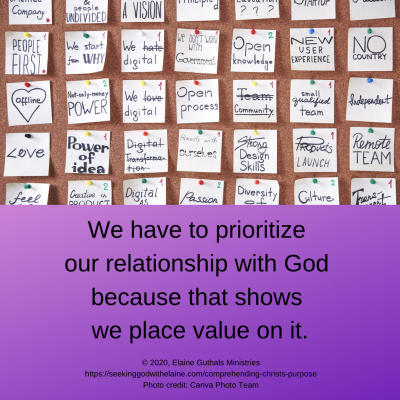
    • We have to prioritize our relationship with God because that shows we place value on it.
    • We can depend on God because He is us changeable.

    Note: The headings in blue are Baker’s words, not mine.

    That they might honour it

    “But far be it from me to boast except in the cross of our Lord Jesus Christ, by which the world has been crucified to me, and I to the world” (Gal. 6: 14 ESV).

    This verse nutshells it for Paul. It isn’t about him. There is only one thing for him to boast about, and it really isn’t about him.

    Paul can boast that Jesus, in His infinite love, saved him and took him out of the rat race of this world.

    Oh, yes. Paul was still eating and breathing. He wasn’t some type of ghost walking around.

    What Paul was saying was this world was not a priority to him. He didn’t have to try to keep up with the Joneses. He could have peace even in a pandemic.

    The only reason Paul — and we — could boast in Jesus was because Jesus put His love into action.

    Crosses

    If Jesus wouldn’t have completed the plan of salvation, I bet He would have still loved us. But we would still be spiritually dead. Spiritual death is the separation from God that occurred as a consequence of Adam and Eve’s original sin.

    Jesus accomplished the plan. He went through with it – even though it called for Him dying on the cross.

    Paul could – and would – boast in the cross because that was where the Sacrifice was made to pay the penalty for our sins. Only by the blood of Jesus are we redeemed.

    Glossary

    Bayley catalogues how the cross of Christ exhibits the glory of God.

    1. The justice of God.
    2. The love of God.
    3. The harmony the justice and the love of God.

    Resource

    What is mind boggling is Jesus didn’t deserve to go to the cross. He hadn’t sinned. There was no penalty that He had to pay for Himself.

    When we think about God giving Moses the instructions for the temple, it started out with the priests asking for forgiveness for themselves (Lev. 16: 6). They had to get their relationship right with God before they could approach God to intercede for the nation of Israel.

    Jesus didn’t have to do that. Jesus had not sinned. There was nothing for which to atone.

    What took Jesus to the cross and held Him there was His everlasting love. He would complete the plan of salvation for us.

    That is why Paul said he didn’t boast (or glory). Bond tells us what that is all about.

    Bond translates the sincere affection that Paul had for what Jesus had done. Paul didn’t have a surface interest but was truly interested because he knew the joy and consolation that came from knowing Jesus and what He did for us.

    Paul knew that overshadowed worldly wisdom and riches that brought worldly honors. He knew that he could do nothing to rival Jesus’ gift. He didn’t feel entitled because he was a Jew – or even the great missionary for God.

    Resource

    I know. We might still be tripped on the cross itself. In a society that is divided about the method of capital punishment – and should we even have it – we might miss the significance of the cross.

    Craufurd helped us understand why the cross. He wrote, “Now the teaching of Christ’s life and death is that God has a heart as well as a mind; that, notwithstanding all appearances to the contrary, love is the source and root of all things — stronger than hate, mightier than sin, more enduring than hell.”

    Resource

    Ooo, baby. If you get a chance, read the whole sermon. Read it out loud with feeling. We’re going to dissect it sometime, but it tells us exactly why the cross.

    Jesus told us time and time again that He wasn’t fulfilling the plan of salvation for Himself. He was doing it for God.

    It is inexpressible love

    So, class. Pop quiz. What did we learn about Christ’s love?

    How deep is Christ’s love for us? God went to Him before we were even created and laid out the plan of salvation for Him.

    Jesus’ immediate response was, “Good plan. Let me know when You are ready for me.”

    It was on this love that God designed the plan of salvation. Jesus put that live into action. Even though Jesus didn’t deserve to die on the cross, He chose to because He lives us and wanted our relationships with God restored.

    That love for us is unchangeable. It doesn’t matter what we do or don’t do, Jesus is going to love us.

    We can do nothing to earn salvation. Salvation is deliverance from evil and the consequences of sins to replace them with eternal life and good. Salvation only occurs through admitting we are separated from God, believing Jesus is our Lord and Savior, confessing God as Sovereign Lord, and demonstrating that commitment by living a submitted life of obedience to God.

    What was Jesus’ sole purpose for coming to the earth? His goal was to complete the plan of salvation so that His blood could pay the penalty for the sins of all mankind who would accept Him.

    Jesus didn’t want us to remain spiritually dead. He wants us spiritually alive. The spiritually alive are those who have ABCDed, so they are no longer separated from God.

    The ABCDs of Salvation

    If you have not become a believer in Christ, please read through the
    Plan of Salvation and prayerfully consider what God is asking you to do.

    A – admit our sins
    B – believe His Son Jesus is our Redeemer
    C – confess God as Sovereign Lord

    D – demonstrate that commitment by making any changes needed in our lives to
    live the way in which God has called us

    The Disciple’s Job Description

    What does it make us when we accept the gift of salvation? We go from being a creation of God made in His image to children of God. We only become His children by ABCDing.

    Jesus still loves non-believers. God still loves them. They are not children and heirs of God.

    How does that impact our day-to-day lives? Jesus is always there for us. He won’t leave us.

    But we have to prioritize our relationship with God. It has to be first and foremost.

    That doesn’t mean we are going to figure everything out. We can’t. We aren’t in God’s pay scale.

    God will, however, reveal to us what we need to know. We just have to submit and believe because God won’t forgive our continued unbelief.

    ComprehendingChristsPurposeThroughHisLovePin1

    Making the Connections

    When we say only boast in the cross, we aren’t saying don’t be proud of your accomplishments. God wants us to be joyful in completing a hard project or a long task. He wants us to celebrate the new things that we have learned.

    What is being said here is don’t flip the pride into the sin category. Don’t think we did it on our own – for our own purpose. We complete our jobs because God has put us there to expand His kingdom.

    We shouldn’t be proud of things that go against God. If something is inconsistent with the cross, we should walk away.

    Newton reminded us that it is all about submission. He wrote, “All glorying consistent with the Cross must be made subservient to it.”

    Resource

    We can glory in the cross because of the victory Jesus experienced on the cross. He beat Satan and his demons. It wasn’t an almost-a-draw victory. It was decisive. It was a no-questions-about-it victory.

    How Do We Apply This?

    • We need to use the cross to get a clear picture of Who Jesus was, what He did for us, and why.
    • We are to imitate Jesus by changing our character to reflect His love, not the world’s.
    • We can use the knowledge of the cross to raise us out of our trials in this world.
    • We can use the cross to let go of this world and submit totally to God.
    • We need to take a realistic evaluation of where we are on the Sanctification Road.

    Resource

    That is it. That is what Christ’s everlasting love is all about. It is about us and our restored relationship with God.

    Restore and/or build that relationship today.

    Searching for and Seeking God

    Hearing His Word (Rom. 10: 17).
    Reading His Word (Rev. 1: 3).
    Praying to Him (Heb. 4: 16).
    Studying His Word (Ac. 17: 11).
    Meditating on His Word (Ps. 1: 1-2).
    Memorizing His Word (Ps. 119: 11).

    Father God. You show us every day that You love us so deeply. You should us that love when You sent Your Son to die for us. You did this when we were still separated from and disobedient to You. Lord, we pray that all will hear those soft promptings of the Holy Spirit and accept Your gift today. Lord, tomorrow night be too late. Reveal Yourself to us so that we may know You and grow to be like You. Amen.

    What do you think?

    Leave me a comment below (about this or anything else) or head over to my Facebook group for some interactive discussion.

    If you don’t understand something and would like further clarification, please contact me.

    If you have not signed up for the email daily or weekly providing the link to the devotions and the newsletter, do so below.

    If God has used this devotion to speak with you, consider sharing it on social media.

  • Comprehending Christ’s Purpose

    Jesus came to earth for one purpose – to fulfill the plan of salvation. We need to accept that gift and grow our relationships with Him. This daily devotional looks at placing value on Jesus’ sacrifice and how we can depend on God.

    Nuggets

    • Jesus’ sacrifice on our behalf is the foundation on which we, as disciples of Christ, build.
    • We have to prioritize our relationship with God because that shows we place value on it.
    • We can depend on God because He is unchangeable.

    Devotions in the Comprehending Christ’s Love series

    Flowers with title Comprehending Christ's Purpose

    This is the third — and last — part in the Comprehending Christ’s Love series. I know you are expecting this. I have to split this into two devotions, also.

    Well, I wouldn’t want it to get a complex since I had to split both of the other two parts.

    We have been looking at a sermon by Baker entitled Comprehending Christ’s Love. We’ve talked about the dimension of Christ’s love and why we need to comprehend it. Now, we are going to be looking at the purpose.

    Resource

    Let’s Put It into Context

    “And may you have the power to understand, as all God’s people should, how wide, how long, how high, and how deep his love is” (Eph. 3: 18 NLT)

    Here is what we pulled out of the devotions so far.

    • God’s everlasting love means that — no matter what we do — He is going to love us.
    • God loves us so much that He designed a plan to restore our relationship with Him.
    • The purpose God has in saving us is so that we are no longer spiritually dead.
    • Jesus’ love for us is so intense that He willingly gave up His life — gave up Heaven — so His blood could be used as the sacrifice for us.
    • The plan of salvation is open to all mankind.
    • Even as His love for us is going to last forever, God is going to have an agreement with us that will last forever.
    • Because we are children of God, we are heirs of God.
    • We are not called to be children of God by anything we do; it is about what Jesus has already done for us.
    • We may not be able to figure out everything about God, but we have to figure out enough to believe in Him.
    • What God won’t forgive is our continued unbelief.
    • Jesus has a personal love for us.
    • Love is the foundation on which Jesus and God built the plan of salvation.

    Note: The headings in purple and blue are Baker’s words, not mine.

    For What Purpose He Expresses This Desire

    I am a firm believer that everything happens for a purpose. Scriptures tell us that. “There is a time for everything, and a season for every activity under the heavens” (Ecc. 3: 1 NIV).

    We can look at that in a couple of ways. We can say that God has everything scheduled on the calendar. I can see this.

    But we can also say that one experience leads to another. I think that is also something God does.

    We know God wants us to grow in grace and knowledge (II Pet. 3: 18). We use building blocks to grow. To me, that means there needs to be a foundation in which this growth occurs.

    Jesus’ sacrifice on our behalf is the foundation on which we, as disciples of Christ, build. It has to start there.

    If we don’t ABCD, we are still spiritually dead. Spiritual death is the separation from God that occurred as a consequence of Adam and Eve’s original sin.

    Once we are spiritually alive, we can begin to grow. The spiritually alive are those who have ABCDed, so they are no longer separated from God.

    Let’s check out what Baker had to say about that growth.

    That they might be able rightly to value it

    “More than that, I also consider everything to be a loss in view of the surpassing value of knowing Christ Jesus my Lord. Because of him I have suffered the loss of all things and consider them as dung, so that I may gain Christ and be found in him, not having a righteousness of my own from the law, but one that is through faith in Christ — the righteousness from God based on faith” (Phil. 3: 8-9 CSB)

    In order to grow our relationship with Jesus, we have to put value on Him. We do that by valuing His sacrifice. When we do, we are adopted by God into His family.

    When is knowledge not just knowledge? In the Scriptures. The knowledge is supposed to lead to growth.

    Hodge helped us understand how we are supposed to approach knowledge. He wrote, “In the Scriptures knowledge is not mere intellectual apprehension; it includes the proper apprehension not only of the object, but of its qualities; and if those qualities be aesthetic or moral, it includes the due apprehension of them, and the state of feelings which answers to them.”

    Resource

    That is just another way to say we need heart knowledge, not head knowledge — but with a twist. We have been saying heart knowledge is believing, not just knowing.

    What Hodge is saying here is that we can’t just do a surface know. Instead, we have to get down to the root.

    • Yes, we have to know that Jesus was a Man. But we also have to know that He is God and He came to show us Who God is.
    • Yes, we have to know that Jesus went around healing the sick and feeding the poor. But we also have to know that His primary purpose was to pay the penalty for our sins so that we may restored our relationships with God.
    • Yes, Jesus wanted us to choose the narrow gate. But we have to know that means justification, adoption, and sanctification.

    Resource

    Glossary

    We have to not only know that Jesus was expecting us to change our character for this life, He was expecting us to prepare for eternal life. That is the sole purpose of the plan of salvation.

    Once we get that knowledge, we begin to value Jesus and what He did. If we value something, we will take care of it. We have to take care of our relationship with God.

    Let’s see what hints we can get from Paul here. We may get tripped on on his wording. “… I also consider everything to be a loss” (Phil. 3: 8-9). We hate being deprived of something.

    I don’t think this is what Paul was really getting at. I don’t think Paul ever felt he had been deprived.

    For Paul, the focus was never on what he gave up or lost. It was always on what he gained.

    Oh, yeah. Paul said he considered it gone but look what he said later. “… I have suffered the loss of all things and consider them as dung …” (Phil. 3: 8 CSB).

    Well, the King James Version also translates the word as dung. All of the other newer versions translate it as garbage or rubbish.

    We get the idea — worthless.

    I think Paul was saying everything else was a lower priority. We have to prioritize our relationship with God because that shows we place value on it. Everything else is less important.

    Board with post-it notes

    Paul knew what he would gain. Manton gave us a list.

    • We will no longer be subject to the wrath of God.
    • We once again will have access to God as we are adopted by God into His family.
    • We will be regenerated.
    • We will receive wisdom, righteousness, sanctification, and redemption. (I Cor. 1: 30).
    • We receive eternal life because we are children and heirs of God.

    Resource

    Glossary

    That they might depend upon it

    “Every good and perfect gift is from above, coming down from the Father of lights, who does not change like shifting shadows” (Jas. 1: 17 CSB).

    We can depend on God because He is unchangeable. When we use our gifts for Him, He rewards us even more.

    Jortin made an interesting observation. He wrote, “All the promises and threatenings contained in the New Testament are conditional, and the condition is plainly expressed.”

    Resource

    We may think God has changed His mind because we don’t see the promises falling as we think they should. What we gloss over is that fulfillment of the promises is based on our choices and our actions.

    The covenant agreement is between two parties — God and us. We have to keep up our end of the agreement.

    Glossary

    God has a purpose for everything. He has plans to accomplish those purposes.

    Those plans are good for us. “‘For I know the plans I have for you,’ declares the LORD, ‘plans to prosper you and not to harm you, plans to give you hope and a future’” (Jer. 29: 11 NIV).

    I think we see plans as more of a goal or a checklist. We see it as actions to check off because God has me down for the job of [fill in the blank].

    I think, many times, those plans come in the form of gifts. I like how Vaughan described gifts. He wrote, “A gift is something that expresses the mind and [indicates] the love of the giver, and at the same time brings happiness to the receiver.”

    Resource

    Oh, yes. The gifts are all about His love.

    We think of the “every good and perfect gift …” (Jas. 1: 17 CSB) as being the ones to “… prosper …” (Jer. 29: 11 NIV) us. We see it as the gift that will make this life more comfortable.

    God gives us the gift of being able to write (so we can create a blog to get His Word out). God gives us the gift of encouragement (so we can support fellow disciples when they are going through trials).

    The focus isn’t on the gift. It is on the Giver.

    The focus isn’t on the gift. It is on what we do with the gift to expand the Giver’s kingdom.

    The gifts are what God gives us so that we can become perfect.

    We know perfect has a different definition than it being exactly the right color, size, usefulness, etc. The perfected state indicates spiritual wholeness or completeness.

    God will provide for us in this life. His priority, though, is eternal life.

    We know we won’t be perfect until we get called home to God. That is where the best gifts are going to be.

    Macmillan made an excellent point that I hadn’t really thought of before. Sunshine, light, heat, wind, air, dew, and rain all come from above. They don’t originate from the earth.

    Resource

    God is the one Who provides for us. Macmillan wrote, “The things that come from above sweeten and ennoble life, reconcile and unite men to one another, and make one family, one loving brotherhood of the human race.”

    Resource

    The things from above unite us. The worldview will never unite us because it is from Satan. Satan is all about chaos and division.

    Unity may be one of the buzz words for 2020, but we have to be very careful. We know the world will be United one day — under the Antichrist.

    Then will come judgment.

    But also, all of God’s plans will come to fruition. We will no longer be separated in any way from Him.

    That is what the plans are about. That is what all the gifts are leading to — our reunion with Him.

    CoomprehendingChristsPurposePin1

    Making the Connections

    God isn’t looking to be an acquaintance. He wants the key to the front door. He wants complete access.

    But God doesn’t want to just be a roommate. He wants priority.

    This isn’t a one-way street. Our making God a priority will net us wonderful gifts.

    How Do We Apply This?

    It comes down to what it will always come down to. We have to ABCD and grow in knowledge and grace. How do we do that?

    The ABCDs of Salvation

    If you have not become a believer in Christ, please read through the
    Plan of Salvation and prayerfully consider what God is asking you to do.

    A – admit our sins
    B – believe His Son Jesus is our Redeemer
    C – confess God as Sovereign Lord

    D – demonstrate that commitment by making any changes needed in our lives to
    live the way in which God has called us

    The Disciple’s Job Description

    Searching for and Seeking God

    Hearing His Word (Rom. 10: 17).
    Reading His Word (Rev. 1: 3).
    Praying to Him (Heb. 4: 16).
    Studying His Word (Ac. 17: 11).
    Meditating on His Word (Ps. 1: 1-2).
    Memorizing His Word (Ps. 119: 11).

    Gracious, loving Heavenly Father. We make You a priority in our lives. Starting right now, we commit to know You even better. We don’t want a surface love for You. We want a deep, abiding love for You. Please reveal Yourself to us. Amen.

    What do you think?

    Leave me a comment below (about this or anything else) or head over to my Facebook group for some interactive discussion.

    If you don’t understand something and would like further clarification, please contact me.

    If you have not signed up for the email daily or weekly providing the link to the devotions and the newsletter, do so below.

    If God has used this devotion to speak with you, consider sharing it on social media.

  • Comprehending the Effects of Salvation

    Because of their great love for us, God designed the plan of salvation and Jesus accomplished it. When we accept the gift of salvation, we receive the effects of it. This devotion looks at the effects of Jesus’ everlasting love and constant peace.

    Nuggets

    • Jesus has a personal love for us.
    • Love is the foundation on which Jesus and God built the plan of salvation.

    Devotions in the Comprehending Christ’s Love series

    Flowers with title Comprehending the Effects of Salvation

    Comprehending the love that Jesus and God have for us is a mind-boggling task. Yet Paul, in Ephesians 3: 18, said he wanted us to understand.

    We have been looking at a sermon by Baker entitled Comprehending Christ’s Love to try to help us.

    Resource

    Strap in. This one is going to meander. Let’s see what we can piece together here.

    Let’s Put It into Context

    “And may you have the power to understand, as all God’s people should, how wide, how long, how high, and how deep his love is” (Eph. 3: 18 NLT)

    Here is what we pulled out of the devotions so far.

    • God’s everlasting love means that — no matter what we do — He is going to love us.
    • God loves us so much that He designed a plan to restore our relationship with Him.
    • The purpose God has in saving us is so that we are no longer spiritually dead.
    • Jesus’ love for us is so intense that He willingly gave up His life — gave up Heaven — so His blood could be used as the sacrifice for us.
    • The plan of salvation is open to all mankind.
    • Even as His love for us is going to last forever, God is going to have an agreement with us that will last forever.
    • Because we are children of God, we are heirs of God.
    • We are not called to be children of God by anything we do; it is about what Jesus has already done for us.
    • We may not be able to figure out everything about God, but we have to figure out enough to believe in Him.
    • What God won’t forgive is our continued unbelief.

    Note: The headings in blue are Baker’s words, not mine.

    That they might comprehend the perpetuity of it

    “Now before the Feast of the Passover, when Jesus knew that his hour had come to depart out of this world to the Father, having loved his own who were in the world, he loved them to the end” (Jn. 13:1 ESV)

    It is mind boggling to think that – even with His impending death — Jesus responded in love to His disciples. He looked at them and exuded love and compassion.

    We know He did that because this passage is talking about the men Jesus called His disciples. They held a special place in Jesus’ heart.

    Jesus called them “… his own who were in the world …” (Jn. 13:1 ESV). Wray wrote that this “… imply[s] a relationship of the dearest and closest kind.”

    Resource

    It is obvious throughout the four gospels that Jesus thought fondly of these common men. He not only spent time with them, but He also instructed them. He answered their questions (Mt. 24: 3) and gave them a more in-depth understanding of the parables He taught (Mt. 13: 36).

    Jesus has a personal love for us. How do we become Jesus’ own? Wray gives us a list.

    • Jesus purchased us — past tense — when He shed His blood to pay for our sins.
    • We become — future tense — His when we surrender ourselves to God’s authority.
    • We are sealed as His.
    • We are Jesus’ reward for His obedience.

    Resource

    Glossary

    Did you see that the verse says that Jesus love them till the end? It might be easy to think that He meant the end of His life.

    I don’t think that’s what Jesus meant. In Matthew 28: 20, He said that He would be with them until the end of the age. Since the age will never end, his love will never end.

    Maclaren argued that “… to the end” (Jn. 13:1 ESV) “… express[ed] the depth and degree rather than the permanence of our Lord’s love.”

    Oh, yes. The disciples would have many sins that they would confess in the future – for which they would have to ask forgiveness. But Jesus was still going to love them. That is the depth of His love.

    That they might exhibit the effects of it in its constraining influence and constant peace

    “Therefore, since we have been justified by faith, we have peace with God through our Lord Jesus Christ. We have also obtained access through him by faith into this grace in which we stand, and we boast in the hope of the glory of God. And not only that, but we also boast in our afflictions, because we know that affliction produces endurance, endurance produces proven character, and proven character produces hope. This hope will not disappoint us” (Rom. 5: 1-5 CSB).

    Love is the foundation on which Jesus and God built the plan of salvation.

    • Jesus justified us. Justification means the act of making something righteous before God.
    • He became the propitiation for us. Propitiation means that a substitute is offered to avoid God’s wrath.
    • He was the atonement for us. Atonement is about repayment for a wrong.
    • He provided for our regeneration. Regeneration is the change in us that God brings about when we go from being spiritually dead to spiritually alive.
    • He sanctified us. Sanctification is the transformation of mind, body, and soul beginning with regeneration and ending with perfected state of spiritual wholeness or completeness.

    Jesus justifies us when we exhibit faith and put our lives in His hand. Faith is the belief that the doctrines stated in God’s Word are true, even if we do not understand all aspects of them.

    We get both of these through God’s grace. Grace is a free and unmerited gift from Heavenly Father given through His Son, Jesus Christ that enables salvation and spiritual healing to believers.

    Because grace has given us faith and justification, it has also given us hope and peace. Hope is where we desire for something that we believe is obtainable. Peace is an inward tranquility resulting from a balanced life with spiritual order, equity, and truth.

    Sunset

    Before salvation, we were spiritually dead. Spiritual death is the separation from God that occurred as a consequence of Adam and Eve’s original sin.

    Jesus loved us so much that He came to be the Sacrifice so that we might become spiritually alive. The spiritually alive are those who have ABCDed, so they are no longer separated from God.

    The ABCDs of Salvation

    If you have not become a believer in Christ, please read through the
    Plan of Salvation and prayerfully consider what God is asking you to do.

    A – admit our sins
    B – believe His Son Jesus is our Redeemer
    C – confess God as Sovereign Lord

    D – demonstrate that commitment by making any changes needed in our lives to
    live the way in which God has called us

    The Disciple’s Job Description

    It is only through Jesus’ love that we have hope. If Jesus is not Lord of our lives, we do not have hope. If Jesus didn’t justify us, we wouldn’t have hope.

    I like how Dykes described hope. He called it “… exultant hope of future glory.” Exultant means it is not run-of-the-mill. Future means we have to wait for it. Glory means it will be worth the wait.

    Resource

    God is the God of Peace. “And the peace of God, which surpasses all understanding, will guard your hearts and your minds in Christ Jesus” (Phil. 4: 7 ESV).

    Jesus is the Prince of Peace. “For to us a child is born, to us a son is given; and the government shall be upon his shoulder, and his name shall be called Wonderful Counselor, Mighty God, Everlasting Father, Prince of Peace” (Isa. 9: 6 ESV).

    This peace is offered to us. Goodrich wrote, “As our conscience has had peace with God by our being put right with God, so now our intellect has peace with God’s revealed truth by being assured of that truth.”

    Resource

    What that tells me is peace grows more peace because we have determined what Truth is. Truth is Jesus. “Jesus answered, ‘I am the way and the truth and the life. No one comes to the Father except through me’” (Jn. 14: 6 NIV). Spurgeon wrote, “Lasting peace must be founded upon everlasting truth.”

    Resource

    Robinson asserted that peace ushers in prosperity. He wrote, “God opens the door of His treasury of promise to the souls He has welcomed into the palace.” God’s promises facilitate peace.

    Resource

    Making the Connections

    I don’t know about you, but my brain hurts. Thinks just seemed to swirl here. Let me see if I can swirl this up into a bow.

    At that specific time, Jesus was still in the world. However, that was not a permanent residence.

    We are also in the world — and that, also, is not a permanent residence.

    Still, God does not immediately call us home when we ABCD. He leaves us in the world. Wray noted, “Eternal life is the gift of God unmerited and free; yet the Christian’s future will be largely influenced by the tone and character of his life on earth.” We are to be in the world, but not of the world.

    Resource

    We have jobs to do while we are here on this earth. We show others God’s love. We demonstrate what Jesus’ love has done for us.

    The jobs we have are meant to expand God’s kingdom. We are meant to follow His laws and commandments.

    When we obey God, we will get His peace. It is a peace that passes all understanding (Phil. 4: 7). It is a mind-boggling peace.

    It is our peace – given to us by the One true God.

    How Do We Apply This?

    Johnson contended that two things just happen in order for us to experience peace.

    1. We have to grow closer to God.
    2. We have to mortify our sins.

    Resource

    Glossary

    We mortify our sins through faith in God. Faith, therefore, brings us peace.

    Resource

    We grow closer to God by searching for Him if we have not submitted to Him. We seek Him if we have. But you know, the road we take is the same. We hear His Word, read it, study it, meditate on it, and memorize it. All through that, we need to be in prayer, asking God to provide the meaning.

    Searching for and Seeking God

    Hearing His Word (Rom. 10: 17).
    Reading His Word (Rev. 1: 3).
    Praying to Him (Heb. 4: 16).
    Studying His Word (Ac. 17: 11).
    Meditating on His Word (Ps. 1: 1-2).
    Memorizing His Word (Ps. 119: 11).

    We look to our loving Heavenly Father.

    Father God. Lord, we look for Your peace. We hide in the palm of Your hand. We search for You and we seek You. Help us to imitate You. Amen.

    ComprehendingTheEffectsofSalvationPostPin

    What do you think?

    Leave me a comment below (about this or anything else) or head over to my Facebook group for some interactive discussion.

    If you don’t understand something and would like further clarification, please contact me.

    If you have not signed up for the email daily or weekly providing the link to the devotions and the newsletter, do so below.

    If God has used this devotion to speak with you, consider sharing it on social media.

  • Comprehending the Plan of Salvation

    The plan of salvation was devised because God loves us. That plan, though, can be mind boggling to us. This devotion looks at how God freely saves and calls us (in that order) to restore our relationships with Him.

    Nuggets

    • We may not be able to figure out everything about God, but we have to figure out enough to believe in Him.
    • The plan of salvation is open to all mankind.
    • Instead of our own merits, we are offered salvation through grace.
    • We are not called to be children of God by anything we do; it is about what Jesus has already done for us.
    • The purpose God has in saving us is so that we are no longer spiritually dead.

    Devotions in the Comprehending Christ’s Love series

    Flowers with title Comprehending the Plan of Salvation

    Comprehending the love that Jesus and God have for us is a mind-boggling task. Yet Paul, in Ephesians 3: 18, said he wanted us to understand.

    We have been looking at a sermon by Baker entitled Comprehending Christ’s Love to try to help us.

    Resource

    Let’s see what we can piece together here.

    Oh, imagine this. This one is going long, too. I will have to break it into two devotions.

    Let’s Put It into Context

    “And may you have the power to understand, as all God’s people should, how wide, how long, how high, and how deep his love is” (Eph. 3: 18 NLT)

    Here is what we pulled out of the devotions so far.

    • God loves us even after we disobeyed Him.
    • God loves us so much that He designed a plan to restore our relationship with Him.
    • God’s everlasting love means that — no matter what we do — He is going to love us.
    • What He won’t forgive is our continued unbelief. He won’t forgive us when we don’t submit to him.
    • Even as His love for us is going to last forever, God is going to have an agreement with us that will last forever.
    • Jesus’ love for us is so intense that He willingly gave up His life — gave up Heaven — so His blood could be used as the sacrifice for us.
    • Because we are children of God, we are heirs of God.

    Note: The headings in purple and blue are Baker’s words, not mine.

    What the Apostle Meant, Desiring the Ephesians Might Comprehend It

    “But I will never stop loving him nor fail to keep my promise to him” (Ps. 89: 33 NLT)

    Isaiah 55: 8-9 tells us that God’s thoughts and ways are way above us. “For my thoughts are not your thoughts, neither are your ways my ways, saith the Lord.
    For as the heavens are higher than the earth, so are my ways higher than your ways, and my thoughts than your thoughts” (Isa. 55: 8-9 KJV).

    If God told us we can’t understand, how can Paul tell us we can comprehend?

    That they might form correct views of the freeness of God’s love

    “He has saved us and called us with a holy calling, not according to our works, but according to his own purpose and grace, which was given to us in Christ Jesus before time began” (II Tim. 1: 9 CSB)

    We may not be able to figure out everything about God, but we have to figure out enough to believe in Him. That means we have to have the correct views of God’s love.

    Because face it. We sometimes try to make God what we want Him to be. “Oh, God doesn’t care who I love.” Well, yes, He does.

    Scriptures tell us He doesn’t want us yoked with non-believers (II Cor. 6: 14). Plus, there is a comprehensive list in Leviticus 18 of unlawful sexual practices.

    “You must never have sexual relations with a close relative, for I am the Lord” (Lev. 18: 6 NLT)

    • your mother (Lev. 18: 7)
    • any of your father’s wives (Lev. 18: 8)
    • your sister or half sister (Lev. 18: 9)
    • your granddaughter (Lev. 18: 10)
    • your stepsister (Lev. 18: 11)
    • your aunt on either side (Lev. 18: 12-14)
    • your daughter-in-law (Lev. 18: 15)
    • your brother’s wife (Lev. 18: 16)
    • both a woman and her daughter or her granddaughter (Lev. 18: 17)

    Jacob should have remembered this one. “While your wife is living, do not marry her sister and have sexual relations with her, for they would be rivals (Lev. 18: 18).

    Most of us are probably going Ewwwwww. But we may not add this one on the list — and we should. “Do not practice homosexuality, having sex with another man as with a woman. It is a detestable sin” (Lev. 18: 22).

    There are more in that chapter that God forbids. I think I have proved my point that yes, God does care who we love.

    Back on track. God’s doesn’t want us to put Him in our box. He wants us to join Him in His box.

    Related Links

    Natalie Grant

    We are called by God. He instigates the calling.

    To some, this may sound like it is limiting who gets called. “No one can come to me unless the Father who sent me draws him …” (Jn. 6: 44 ESV).

    It isn’t. We tend to forget about “For many are called, but few are chosen” (Mt. 22: 14 ESV). We are the ones who choose because of our free will. Free will is the ability within us to make decisions, which determine actions that produce character.

    We are called out of the darkness of sin into Jesus’ light. “When Jesus spoke again to the people, he said, ‘I am the light of the world. Whoever follows me will never walk in darkness, but will have the light of life’” (Jn. 8: 12 NIV).

    We are called by the Holy Spirit. The Spirit uses God’s word and God’s people to convict a non-believer.

    Some may think that God only calls certain people. That is not true. The plan of salvation is open to all mankind.

    Noel address that belief in this way. He wrote, “The invitation runs in the most comprehensive terms, that none may think themselves excluded.”

    Resource

    True, Jesus went to the Jews first. But He didn’t want His disciples to stop there. He wanted them — and us — “… be my witnesses in Jerusalem and in all Judea and Samaria, and to the end of the earth” (Ac. 1: 8 ESV).

    How is this calling accomplished? Noel wrote this happen when “… the Holy Spirit shines into the mind with such irresistible light as convinces the judgment, awakens the conscience, and engages the will to a compliance with every part of its duty.”

    Resource

    God calling us is a hard concept for some to comprehend. We are not called to be children of God by anything we do. It isn’t about our social status, our bank account, our looks, our intelligence, our humility, our generosity — it isn’t about anything we do or don’t do.

    Glossary

    It is about what Jesus has already done for us. Jesus came to earth, died on a cross so that His blood could be shed, and rose again so that we would know the power of God.

    We did nothing to deserve this. In fact, we did the opposite. “But God proves his own love for us in that while we were still sinners, Christ died for us” (Rom. 5: 8 CSB).

    Instead of our own merits, we are offered salvation through grace. Grace is a free and unmerited gift from Heavenly Father given through His Son, Jesus Christ that enables salvation and spiritual healing to believers.

    “For by grace you have been saved through faith. And this is not your own doing; it is the gift of God, not a result of works, so that no one may boast” (Eph. 2: 8-9 ESV).

    We are offered salvation only through grace. There is only one way for our relationships with God to be restored. “Jesus answered, ‘I am the way and the truth and the life. No one comes to the Father except through me’” (Jn. 14: 6 NIV).

    Jesus

    Spurgeon noted that Paul told Timothy that God saved us before He called us. Hmmm. Does that throw a wrench into my way of thinking?

    Does that mean everyone is saved? The order says the salvation happens before we accept or reject the calling. Salvation is deliverance from evil and the consequences of sins to replace them with eternal life and good.

    Spurgeon wrote, “Not in his own experience, not as far as the work of the Holy Spirit goes, but he is saved in God’s purpose, in Christ’s redemption, and in his relationship to his covenant Head; and he is saved, moreover, in this respect, that the work of his salvation is done, and he has only to receive it as a finished work.

    Resource

    Okay. Elaine-speak. Salvation isn’t based on anything we do. I am still a little fuzzy on the “… not as far as the work of the Holy Spirit goes …” part.

    God has a purpose in saving us. That purpose is so that we are no longer spiritually dead. Spiritual death is the separation from God that occurred as a consequence of Adam and Eve’s original sin.

    I think Spurgeon is correct when he said that the plan of salvation was completed, and we accept or rejected a completed plan. We aren’t offered a half-baked plan.

    How does that mesh with Abraham? We talked before that Abraham was counted righteous because he believed God was Sovereign God, God created the universe, and would do what He promised.

    To read a related devotion, click the button below.

    Even though Jesus hadn’t accomplished the plan of salvation in Abraham’s time, Abraham believed in the promise of the Savior. That promise was given way back in Genesis 3: 15.

    God designed the plan of salvation before He created the universe. Before He created mankind. Before mankind sinned. Sin is actions by humans that disobey God and break one of His reasonable, holy, and righteous laws and commandments, goes against a purpose He has for us, or follows Satan’s promptings.

    This salvation is given to us. Spurgeon said it isn’t offered to us. It is given to us.
    So, how does this impact the is-everyone-saved debate? Spurgeon noted that “We ask to have mercy from the well-head of grace, but we ask not even to make the bucket in which it is to be brought to us; Christ is to be the sacred vessel in which the grace of God is to be presented to our thirsty lips.”

    Resource

    Let’s look at it this way. Down home, there is this Caring Cupboard. People can put things in it, and others take out what they need. Right now, it is deemed the garden overflow box. I’ve seen posts on Facebook where people have announced what they put into the box.

    Sally has more tomatoes than she can use. She puts them in the box. Tom loves tomatoes but doesn’t have time to grow them himself. He goes to the box and takes them.

    That is a little different concept than Sally going up to Tom and offering him the tomatoes. True, the end result is the same — Sally gets rid of tomatoes she doesn’t need, and Tom gets tomatoes he wants.

    But the tomatoes are in the box whether or not Tom accepts. Now, Elaine is going to steer clear of the tomatoes all together — and that is her choice.

    It is our choice to accept or reject the plan of salvation. The plan was in place long before we could do anything about it.

    We know about God’s plan of salvation. Still, God calls us through the promptings of the Holy Spirit. Some of us wholeheartedly accept His gift. Some wrestle with the gift and what is expected of us. Others just flat out reject it.

    It is our choice.

    Making the Connections

    The thing about the plan of salvation is that we not only have to grasp it, but we also have to include it in our lives. We’ve talked before about having to take it from head knowledge to heart knowledge.

    I think we need to add feet knowledge, too. We have to act on it.

    How Do We Apply This?

    We have feet knowledge when we ABCD.

    The ABCDs of Salvation

    If you have not become a believer in Christ, please read through the
    Plan of Salvation and prayerfully consider what God is asking you to do.

    A – admit our sins
    B – believe His Son Jesus is our Redeemer
    C – confess God as Sovereign Lord

    D – demonstrate that commitment by making any changes needed in our lives to
    live the way in which God has called us

    The Disciple’s Job Description

    It is more than just the ABC part. We have to do the D part. We have to have it change our character, our habits, and our actions.

    We have to submit to God’s holy plan.

    Father God. You love us so much that You designed this wonderful plan to restore us to You. Help us to comprehend what we need to so that we will accept. Amen.

    What do you think?

    Leave me a comment below (about this or anything else) or head over to my Facebook group for some interactive discussion.

    If you don’t understand something and would like further clarification, please contact me.

    If you have not signed up for the email daily or weekly providing the link to the devotions and the newsletter, do so below.

    If God has used this devotion to speak with you, consider sharing it on social media.
  • Comprehending Christ’s Love

    One thing some of us struggle with is God’s everlasting love. Jesus shares that same love. This daily devotional, the first in a series, looks at the breadth of God’s everlasting love and how it is shown in a covenant relationship with God.

    Nuggets

    • God loves us even after we disobeyed Him.
    • God loves us so much that He designed a plan to restore our relationship with Him.
    • God’s everlasting love means that — no matter what we do — He is going to love us.
    • Even as His love for us is going to last forever, God is going to have an agreement with us that will last forever.

    Devotions in the Comprehending Christ’s Love series

    Oh, man. I haven’t done this in a while. I grabbed something from the drafts folder to do this devotion.

    When I am researching devotions, I like to find sermons that are just outlines. The writer gives you a couple of words for direction and any number of Bible verses.

    I like to go back through and see what was being said. Then I determine if I believe the same thing. (Didn’t we have a whole series where we tried to figure out what we believed and why so we could have an intelligent answer when we witnessed?)

    I found this neat sermon by Baker entitled Comprehending Christ’s Love.

    Resource

    Oh, yeah. Sometimes that can be mind boggling. Let’s see what insight Baker gives us.

    Programming note first: The issue I am having is it is there is a lot of ground to cover. I had already planned on breaking it into a series of three devotions. This one is getting long, so I am going to have to break it. I will have to decide if we are going to start the tranquility – peace – series Monday or hold off a little until this is finished.

    We are going to hold off on the connections and the application until the next devotion. So, this is going to end kind of abruptly. Trust me, it is long enough.

    Let’s Put It into Context

    “And may you have the power to understand, as all God’s people should, how wide, how long, how high, and how deep his love is” (Eph. 3: 18 NLT)

    Baker started with Ephesians 3: 18. We looked at this verse in conjunction with other verses in a devotion entitled The Fullness of God’s Love. We said that Paul wanted to make sure that we got that this was a heart-issue, not a head-issue. We have to understand at the heart-level.

    We can’t try to understand at the head-level. We aren’t God.

    To read a related devotion, click the button below.

    In the title, Baker said he was writing about Christ’s love. In the verse, I read it to be God’s love. So, I talk about both here.

    Let’s see where Baker takes us. Note: The headings are his words, not mine.

    The Dimensions of This Love

    “I revealed myself to those who did not ask for me; I was found by those who did not seek me. To a nation that did not call on my name, I said, ‘Here am I, here am I’” (Isa. 65: 1 NIV)

    The breadth is seen in reaching out Divine mercy to sinners who are far off from God

    “Turn to me and be saved, all the ends of the earth! For I am God, and there is no other” (Isa. 45:22 ESV)

    The first mind-boggling item is how God loves us even after we disobeyed Him. As far as the Scriptures tell us, Adam and Eve had one thing they were supposed to obey – they couldn’t eat the fruit of a certain tree in the Garden.

    Man, did they blow it. They sinned. Sin is actions by humans that disobey God and break one of His laws and commandments, goes against a purpose He has for us, or follows Satan’s promptings.

    Glossary

    But God tells us to repent and be saved. Repentance is expressing sorrow for breaking God’s laws and commandments by making the commitment to changing ourselves through obedience so that we no longer do the wrong things. Salvation is deliverance from evil and the consequences of sins to replace them with eternal life and good.

    If you have not admitted that your relationship is not right with God,

    have not asked Jesus to be your Lord and Savior,

    and have not confessed your sins,

    please read through the Plan of Salvation and prayerfully consider what God is asking you to do.

    Top that off with the mind-boggling fact that God designed the plan of salvation before Adam and Eve ever sinned – before they were even created.

    Glossary

    Why? “… For I am God, and there is no other” (Isa. 45:22 ESV). That is who God is – He is just, holy, and good.

    Hull explained it this way. He wrote, “God’s justice is not merely the infliction of penalty; God’s salvation is not merely deliverance from penalty. … But justice in God is something far grander than the mere exercise of retribution; it is the love of eternal truth, purity, righteousness; and the penalties of untruth, impurity, unrighteousness, are the outflashings of that holy anger which is founded in His love of the right, the pure, and the true. In the same way, God’s salvation is more than the mere deliverance from penalty.”

    Resource

    Because of God’s plan of salvation, we are justified. Justification means the act of making something righteous before God. Jesus justifies us when we put our lives in His hand.

    But we have to turn. We have to repent and give up our love of sin – even our pet sin. We have to obey God’s laws and commandments.

    Person Kneeling at the Cross

    The length of this love reaches from eternity to eternity

    The second mind-boggling item is how deep God’s love is for us. Even though we willfully disobeyed Him, He doesn’t just turn His back on us. He still loves us.

    God loves us so much that He designed a plan to restore our relationship with Him. Why was that necessary?

    God has a low tolerance for sin. “But you are pure and cannot stand the sight of evil. Will you wink at their treachery? Should you be silent while the wicked swallow up people more righteous than they?” (Hab. 1: 13 NLT).

    “The LORD appeared to us in the past, saying: ‘I have loved you with an everlasting love; I have drawn you with unfailing kindness’” (Jer. 31: 3 NIV)

    Everlasting love is a mind-boggling concept. We just talked about the plan of salvation being designed before we were even created. That is, before we even had the opportunity to sin.

    God’s everlasting love means that — no matter what we do — He is going to love us. Yes, He will love us even if we don’t love Him.

    To read a related devotion, click the button below.

    God will forgive anything that we ask of him. He will even forgive our unbelief when we begin believing that He is the One true God.

    What He won’t forgive is our continued unbelief. He won’t forgive us when we don’t submit to him.

    Glossary

    Evans noted that God’s love is “… founded by His Will. His most wise, righteous, and holy Will.”

    Resource

    • We know God is wise. In fact, we know that He is all-knowing.
    • Churchy word alert! Righteous means we are free from sin because we are following God’s moral laws.
    • Holy means to be set apart, perfect, and pure.

    OK, let’s put that in the blender and see if we can mix it up.

    God is holy, and He expects us to be the same way. We do that by being righteous. We have His moral laws to follow, which not only show us what is right, but they also show us His character. He knows whether we follow those laws or not in our hearts.

    Ooo, baby. God is really out of our league. But He still loves us.

    Do you know what the greatest thing is? “… I have loved you …” (Jer. 31: 3 NIV).

    Oh, that is a plural you. But it is also a singular you — as in you, me, Tom, Sally, and Elaine.

    I think what trips is the most is the everlasting part. No, we don’t get the before-the-foundation-of-the-earth part. Neither do we get the for-eternity part.

    We don’t understand because we try to understand based on our past experiences. That is impossible.

    It is mind boggling that God’s loving-kindness was the force that drew us back to Him (Spurgeon). We know we would have lowered the boom on Him if He did to us what we did to Him. We would have been in divorce court.

    Resource

    We forget about God’s mercy. God’s mercy is the unexpected way God responds in love to our needs.

    The mercy is extended to us because of the love. Love is usually a drawing card. Stern, heavy-handed dictatorship isn’t.

    How are we attracted to God? Spurgeon wrote, “The loving-kindness of God as seen in the sacrifice of the Lord Jesus draws men from sin, from self, from Satan, from despair, and from the world. Next, the hope of pardon, free and full, attracts sinners to God.”

    Resource

    Think about what Jesus is saying.

    • “… I have loved you …” (Jer. 31: 3 NIV) when I helped My Father create You (Gen. 1: 26).
    • “… I have loved you …” (Jer. 31: 3 NIV) when I gave up My divinity to come to earth (Phil 2: 7).
    • “… I have loved you …” (Jer. 31: 3 NIV) even when I was beaten until I was unrecognizable (Isa. 52: 14).
    • “… I have loved you …” (Jer. 31: 3 NIV) as I hung upon the cross and My Father turned away from me (Mt. 27: 46).
    • “… I have loved you …” (Jer. 31: 3 NIV) when I rose from the grave (Mt. 28: 6-7).

    Do you know what the best part is? Jesus still loves us as He sits at right hand of God (Heb. 10: 22).

    Jesus — the most worthy — loves us — the most unworthy. Jeremiah told us that Jesus draws us to Him.

    When we couldn’t save ourselves, Jesus provided a way for our salvation. Salvation is deliverance from evil and the consequences of sins to replace them with eternal life and good.

    Church

    “I will make a permanent covenant with them: I will never turn away from doing good to them, and I will put fear of me in their hearts so they will never again turn away from me” (Jer. 32: 40 CSB).

    The Israelites were familiar with the term covenant. Today, we generally call them contracts or agreements. A covenant is an agreement between two parties.

    Glossary

    God wants to have a covenant with us. He offers us a permanent covenant when we accept it.

    Even as His love for us is going to last forever, God is going to have an agreement with us that will last forever. It is a covenant of grace. Grace is a free and unmerited gift from Heavenly Father given through His Son, Jesus Christ that enables salvation and spiritual healing to believers.

    God provides us that gift of salvation because He loves us. He gives it to us in the form of a covenant.

    Gillies helped limit a portion of the mind boggling with regards to the covenant of grace. He wrote, “Its grand end seems to be, to glorify all God’s attributes, indeed, but especially to manifest ‘the exceeding riches of His grace.’”

    Resource

    No one forced God to make this covenant with us. It was all His idea.

    Think about it this way. Adam broke the covenant God had made with Him when he rebelled in the Garden. Satan and some of his fellow angels also rebelled against God. (And it sounds like Satan was a pretty big deal in the angel ranks.)

    God devised a new covenant — the plan of salvation — where we could be restored to His favor and fellowship. The same plan is not extended to the angels-turned-demons. They are forever out of luck.

    This covenant provides everything we need to have our relationship restored. We just have to agree to the terms — ABCD.

    The ABCDs of Salvation

    If you have not become a believer in Christ, please read through the
    Plan of Salvation and prayerfully consider what God is asking you to do.

    A – admit our sins
    B – believe His Son Jesus is our Redeemer
    C – confess God as Sovereign Lord

    D – demonstrate that commitment by making any changes needed in our lives to
    live the way in which God has called us

    The Disciple’s Job Description

    This is going to be a permanent covenant. It is not going to be replaced by another one. It is not going to be modified because we can’t uphold our end — ie., because we can’t stop sinning. Jesus has already fulfilled the human side of it.

    Resource

    This is it, folks.

    It is a holy covenant. Gillies wrote, “First, it preserves unsullied, yea it peculiarly displays the righteousness and holiness of God’s character and government in at all saving sinners, only through the infinite and vicarious sufferings, death, and obedience of the God-man Mediator, in their room, and on their behalf. Secondly, it secures the personal holiness of all who are brought into the covenant.”

    Resource

    The covenant succeeds in restoring us to our relationship with God so that we can have access to His Presence. We are changed so that we may approach Him.

    See what Jeremiah 32: 40 says. God is not going to turn away from us. He isn’t — all of the sudden — going to say we are unworthy. When we genuinely ABCD and strive to live by His laws and commandments, He will never turn away from us.

    Father. We look all around us and see how much You love us. We are awed, and we are humbled. God, You are great! Amen.

    ComprehendingChristsLovePin1

    What do you think?

    Leave me a comment below (about this or anything else) or head over to my Facebook group for some interactive discussion.

    If you don’t understand something and would like further clarification, please contact me.

    If you have not signed up for the email daily or weekly providing the link to the devotions and the newsletter, do so below.

    If God has used this devotion to speak with you, consider sharing it on social media.

  • Being Content in Our Work

    We spend a significant portion of our day focused on our work. If we are not content there, it affects other portions of our lives. This daily devotional looks at how we are to approach our contentment at work and how joy and contentment are interconnected.

    Nuggets

    • We have to look at our employment as it — whatever we are doing — is ordained by God.
    • God wants us to be working toward what He wants us to be working toward.
    • Joy is overarching contentment.

    Devotions in the Contentment Leads to Tranquility series

    Flowers with title Being Content in Our Work

    We look at our jobs as being totally secular (unless we work in a religious capacity). How can God expect us to find contentment in the world?

    Let’s Put It into Context

    The Holman Bible Dictionary defines contentment as “an internal satisfaction which does not demand changes in external circumstances.”

    Resource

    Why Do We Work?

    “The sleep of a laborer is sweet, whether they eat little or much, but as for the rich, their abundance permits them no sleep” (Ecc. 5: 12 NIV)

    Our employment usually does take a significant amount of time and effort. Normal used to be considered 9 to 5. That is when the majority of the business world functions, but that has never been the only time people work.

    There are many jobs that must be covered 24/7 — even 365. Police and medical professions come quickly to mind.

    Some positions are no longer the three-shift variety. Some take 12-hour shifts, like medical professionals and firemen.

    Hopefully, we don’t just work for the money. Oh, yes. We should be responsible for providing for ourselves and our families.

    It helps to like the work. (I know, understatement there.) We have to want to go to work every day.

    Liking our co-workers is also helpful. We spend the majority of our time with them, so getting along helps increase our contentment.

    But I keep thinking back to a devotion we just had. In Spiritual Wisdom Leads to Righteousness, we said that God doesn’t ignore us. Horton wrote, “It is a part of the Lord’s watchful activity and direct connection with all the affairs of human life that He is interested in our business and trade.”

    Resource

    We have to look at our employment as it — whatever we are doing — is ordained by God. “A person’s heart plans his way, but the Lord determines his steps” (Prov. 16: 9 CSB). God has us where we will benefit His kingdom the most.

    To read a related devotion, click the button below.

    Our jobs are also our mission field. It is where we are to “go, therefore, and make disciples of all nations, baptizing them in the name of the Father and of the Son and of the Holy Spirit, teaching them to observe everything I have commanded you …” (Mt. 28: 19-29 CSB).

    Jesus told us we have to start where we are. “But you will receive power when the Holy Spirit has come upon you, and you will be my witnesses in Jerusalem and in all Judea and Samaria, and to the end of the earth” (Ac. 1: 8 ESV).

    Our contentment can increase when we realize that God has a purpose for us to be wherever we are at in the present time. I am firmly convinced that God has at least one person that we must witness to in our lives. We’ve got to be there for that Tom or that Sally. If we aren’t, how are they going to hear?

    Office worker

    Are We to be Goal-Oriented?

    “All of a person’s labor is for his stomach, yet the appetite is never satisfied. What advantage then does the wise person have over the fool? What advantage is there for the poor person who knows how to conduct himself before others? Better what the eyes see than wandering desire. This too is futile and a pursuit of the wind” (Ecc. 6: 7-9 CSB)

    Hmmm. Solomon has an interesting way of wordsmithing, doesn’t he?!

    Let’s look at it in the Contemporary English Version. “We struggle just to have enough to eat, but we are never satisfied” (Ecc. 6: 7 CEV).

    Oh, isn’t that the truth?

    It seems like Solomon is telling disciples of Christ not to be goal-oriented people. But wouldn’t that make us not purpose-driven people, as God has called us to be?

    I can see how we could be able to justify the never-being-satisfied part. I am a big goal-oriented person. I need to have milestones to work toward. It helps keep me focused on doing something because I know what I am supposed to be doing.

    Hopefully, we reach our goals. (If we don’t, we will get real discouraged really fast!)

    But then that means we have to set new goals, right? We always have to keep working toward something.

    I can see how that looks like we aren’t satisfied. Right after I got my bachelor’s degree, my goal switched to getting my master’s degree. Right after I got my master’s degree, my goal switched to get my PhD.

    However, that was just breaking the final goal up into manageable sections. Sometimes, if we just have the overall goal right before us, we get overwhelmed and burned out.

    I think that God wants us to be working toward what He wants us to be working toward. Otherwise, Solomon wouldn’t have said, “Better what the eyes see than wandering desire. This too is futile and a pursuit of the wind” (Ecc. 6: 9 CSB).

    Without goals, we could be pursuing the wind. And we know all about the wind. “The wind blows where it pleases, and you hear its sound, but you don’t know where it comes from or where it is going” (Jn. 3: 8 CSB).

    We don’t want to be the tumbleweed. It is dried up and aimless.

    We want to be productive workers doing God’s work. God uses plans for that. “For I know the plans I have for you,” declares the LORD, “plans to prosper you and not to harm you, plans to give you hope and a future” (Jer. 29: 11 NIV).

    Ocean

    Contentment and Joy

    “And I commend joy, for man has nothing better under the sun but to eat and drink and be joyful, for this will go with him in his toil through the days of his life that God has given him under the sun” (Ecc. 8: 15 ESV)

    Okay, switching to talk about joy may seem a little out of place because when we have been talking about contentment. But let’s think about it a second. Contentment is an internal satisfaction regardless of external circumstances.

    Joy, on the other hand, is “the happy state that results from knowing and serving God.”

    Resource

    Joy is overarching contentment. It all comes from God.

    We may scratch our heads a little over the eat, drink, and be merry part. I see this verse as saying what God sees. We usually equate that with the indulgence part — the sinful part.

    Statham put it into perspective. He wrote, “God makes no distinction either of meats or drinks, provided we use all lawfully, to the just refreshment and strengthening of the body, not to its undue pampering, or mere carnal gratification.”

    Resource

    It is back to moderation again. God doesn’t want us to go to extremes — either way.

    God knows we are going to work hard, sometimes long hours. That was part of the curse. “You will eat from it by means of painful labor all the days of your life. It will produce thorns and thistles for you, and you will eat the plants of the field. You will eat bread by the sweat of your brow until you return to the ground …” ( Gen. 3: 17-19 CSB).

    Because God knows we are going to put in long, hard hours, He made us a day of rest. “So the heavens and the earth and everything in them were completed. On the seventh day God had completed his work that he had done, and he rested on the seventh day from all his work that he had done. God blessed the seventh day and declared it holy, for on it he rested from all his work of creation” (Gen. 2: 1-3 CSB).

    That tells me God doesn’t want us to work 24/7/365. He want us to enjoy our lives. If the fruits of the Spirit are “…love, joy, peace, longsuffering, kindness, goodness, faithfulness, gentleness, self-control…” (Gal. 5: 22-23 NKJV), how can we not enjoy our lives?

    To read a related devotion, click on the appropriate button below.

    Statham noted that we are to “cultivate a cheerful and a happy frame of mind, as opposed to that gloomy, over-anxious, ever-toiling disposition, which you now possess — as is the cold, cheerless mantle of night to the glow and warmth of the midday sun — for this calm and tranquil state shall abide with you, and give you enjoyment in the midst of your labour all the days of your life which God giveth you under the sun.”

    Resource

    Statham connected this to several verses.

    • “Therefore I tell you: Don’t worry about your life, what you will eat or what you will drink; or about your body, what you will wear. Isn’t life more than food and the body more than clothing?” (Mt. 6: 25 CSB).
    • “But seek first the kingdom of God and his righteousness, and all these things will be provided for you” (Mt. 6: 33 CSB).
    • “So, whether you eat or drink, or whatever you do, do all to the glory of God” (I Cor. 10: 31 ESV).
    • “Rejoice in the Lord always; again I will say, rejoice” (Phil. 4: 4 ESV)

    We have to look to God for our contentment and joy.

    BeingContentInOurWorkPin1

    Making the Connections

    I think the thing I got out of this study was that God doesn’t want us to go to extremes. His term for it was sober. Sober is a character trait distinguished by self-control, genuineness, and sound moral judgment. It is a calm and temperate disposition.

    Making the Connections to Self-Discipline

    One of the aspects of sober is self-control. Self-control is the ability to withstand temptations by managing ourselves — our emotions, thoughts, and behaviors.

    We have to use self-discipline to do self-control. Self-discipline is where we manage ourselves so that we can improve.

    How Do We Apply This?

    How do we become more content? We have to put our faith and trust in God. We have to know and believe that He will provide for us what we need.

    No, it may not necessarily be all we want. It will be all we need.

    So, the question becomes how do we grow our faith and trust in God. We have to seek Him.

    Searching for and Seeking God

    Hearing His Word (Rom. 10: 17).
    Reading His Word (Rev. 1: 3).
    Praying to Him (Heb. 4: 16).
    Studying His Word (Ac. 17: 11).
    Meditating on His Word (Ps. 1: 1-2).
    Memorizing His Word (Ps. 119: 11).

    We have to put our lives in God’s hands. He is all-knowing and all-powerful. We have to rely on Him.

    Loving Heavenly Father. We are humbled that You are mindful of us. Lord, we want to improve. We want to be more like You. The only way was can do that is to discipline ourselves so that we can control our sinful nature when temptations come our way. We can’t discipline ourselves without You. Help us to grow in grace and knowledge of You. Amen.

    What do you think?

    Leave me a comment below (about this or anything else) or head over to my Facebook group for some interactive discussion.

    If you don’t understand something and would like further clarification, please contact me.

    If you have not signed up for the email daily or weekly providing the link to the devotions and the newsletter, do so below.

    If God has used this devotion to speak with you, consider sharing it on social media.

  • Being Content Because Our Hearts Are Right

    We alone are in charge of our contentment. That is because contentment comes from our hearts – our foundation. This daily devotional looks at the effect of others on our contentment, when discontentment reigns, and the foundation of our faith.

    Nuggets

    • We know what makes us content and what doesn’t.
    • There are several things that bring us discontentment.
    • It matters whether we are content or not.

    Devotions in the Contentment Leads to Tranquility series

    Flowers with title Being Content Because Our Hearts Are Right

    When we are content, this in our lives go much better. God wants us to get that contentment to the heart level. Let’s take a look at that.

    Let’s Put It into Context

    The Holman Bible Dictionary defines contentment as “an internal satisfaction which does not demand changes in external circumstances.”

    Resource

    Keeping Our Hearts Content

    “The heart knows its own bitterness, and no outsider shares in its joy” (Prov. 14: 10 CSB)

    We used this verse a couple of devotions ago in Spiritual Wisdom Leads Us to be Sensible People. We talked about how Spurgeon was describing someone who was self-contained – the private us.

    To read a related devotion, click the button below.

    Resource

    We were focusing on others not really knowing the real us – only what we show to others. I think that pertains here, too.

    We know that private us that Spurgeon was talking about. We know – and work toward – doing what makes us happy and keeping away from what doesn’t.

    Others may or may not know what that is. We know who we are. We may not always like ourselves, but we know our strengths and our weaknesses.

    Figures – we are with ourselves 24/7/365.

    Let’s roost on “the heart knows its own bitterness …” (Prov. 14: 10 CSB) part.

    Blair noted that there are two sources of either joy or bitterness in the heart.

    • Our own character
    • Our connections with others

    Resource

    We’ve talked a lot about how important our hearts are. We’ve talked before that we have to get things down to the heart level. Obedience has to come from the heart. That makes our character.

    To read a related devotion, click on the appropriate button below.

    Glossary

    Isn’t it sad when, instead of the happiness, we get the discontent because we bring it on ourselves? Maybe we did something stupid. Maybe we really thought it was going to bring us happiness, but it didn’t. Maybe we were feeling guilty about A, and that messed up B.

    Oh, did you catch that I said other don’t really make us content, but they are a source of our contentment or discontentment?

    When Adam is upset about something, this momma bear is not content. I can give him advise to rectify a situation. I can walk him through scenarios of how he could address something.

    In the end, Adam has to make up his own mind what to do and be okay with that. He has to choose to be content with his decisions.

    I don’t know about you, but I need my alone time. This was especially true when I had my 100 meetings a month, but it is still true.

    Quiet. Reflection. Disconnect from stress. Replenish our reserves.

    We don’t know how the Holy Spirit is convicting someone else. We only know how He is convicting us.

    Dove

    Ooo, baby. That can hurt at times!

    We all need to take a minute so we can slow down. If we continually go ninety to nothing, we generally block out the soft promptings of the Holy Spirit.

    Spurgeon gave us some great advice for those times. He wrote, “And remember that the cure for bitterness of heart is to take it to your Lord at once.”

    Resource

    When Discontent Reigns in Our Hearts

    “The disloyal one will get what his conduct deserves, and a good one, what his deeds deserve” (Prov. 14: 14 CSB)

    What causes discontentment in our hearts? How do disciples of Christ deal with discontent?

    There are several things that bring us discontentment. We can become discontent when we don’t deal with something that is bothering us. We know that, but how do we apply that to our journey on the sanctification road?

    The big thing that steals our contentment is unconfessed sin. Unconfessed sin damages our relationship with God, causing the discontent.

    Church

    Sometimes, we may not even know we have sinned. “So then, brothers and sisters, we are not obligated to the flesh to live according to the flesh, because if you live according to the flesh, you are going to die. But if by the Spirit you put to death the deeds of the body, you will live” (Rom. 8: 12-13 CSB).

    When we do know we have sinned, we can become dejected. I don’t know about you, but I really start biting on myself.

    Sometimes, I am so busy slapping myself around, I don’t realize Jesus is up there, bending down to whisper in God’s ear to advocate for me. He is there praying for me.

    You, too.

    Maybe even worse yet is when we become bitter. It is easy to become resentful when things don’t go the way we have planned. We can start blaming God.

    We have to remember that God knows exactly what is going to happen every day for the rest of our lives. He has everything planned out based on the decisions we are going to make.

    The thing is, God knows us — really knows us. “He knows us far better than we know ourselves …” (Rom. 8: 27 MSG).

    We know the verse that comes next. “That’s why we can be so sure that every detail in our lives of love for God is worked into something good” (Rom 8: 28 MSG). All things work together for good.

    Discontent comes when we don’t feel loved. Loneliness can really mess up our outlook. We don’t see what the purpose is for struggling if we have no one with which to share our lives.

    No one could love us as God loves us. He is our Creator.

    God loved us so much that He devised a way for our relationships with Him to be restored. “But God demonstrates his own love for us in this: While we were still sinners, Christ died for us” (Rom. 5: 8 NIV).

    God doesn’t want us to stay in our melancholy state. He wants us to experience His joy. He will help get us there.

    BeingContentBecauseOurHeartsAreRightPin1

    The Foundation of Contentment

    “A joyful heart makes a face cheerful, but a sad heart produces a broken spirit” (Prov. 15: 13 CSB)

    “A joyful heart is good medicine, but a broken spirit dries up the bones” (Prov. 17: 22 CSB)

    It matters whether we are content or not. Our whole outlook on life hangs in the balance. In fact, sometimes, so does our life.

    Melvill reminded us that “The connection between the mind and the body, though not to be explained, is so striking as to force itself upon the notice of the least observant.” We may think that our mind has complete control over the body, but the body will never outrank the mind.

    Resource

    Just wait until our world is rocked, and everything shuts down. We can’t focus on our work. We snap at our loved ones. Our blood pressure goes up. Our stomachs are tied up in knots.

    We know that mental attitude plays an important role when we are sick. A positive attitude is definitely needed for cancer patients. When someone gives up, the results can be devastating.

    Did you see what Solomon said? It all starts with the heart — a joyful heart. That translates to contentment.

    Melvill had a lot of great nuggets. Some of them addressed discontent.

    • “Mental disquietude tells on the health with corroding and devastating power.”
    • “A truly broken spirit is that which is bruised by a sense of sin.”

    But some of them reminded us the discontent can be fleeting.

    • “There is a power in man’s spirit to sustain his infirmity.”
    • “The truth that men have no power of renewing their nature must not be interpreted as implying that men have no power of reforming their lives.”

    Resource

    But it all comes back to our heart — our foundation. Where does Jesus live? In our hearts. Where is the Holy Spirit? In our hearts.

    Making the Connections

    Think that sounds hard? Especially given the state of the world these days????

    Belfrage told us how to accomplish contentment, he wrote, “By ‘a merry heart’ is meant a heart which has been taught by the Spirit of God to seek its happiness in Divine and heavenly objects, which is disposed to look at the bright side of things under the influence of contentment and hope.”

    Resource

    Taught by the Spirit of God. The Holy Spirit is going to teach us.

    Well, doesn’t it make sense? When our hearts are broken that is usually because we are focusing on the world, not God.

    Making the Connections to Self-Discipline

    Our hearts are our foundations. It is our responsibility to make sure the foundation remains sure. To do that, we need to search for and seek God. Discipline helps us do that.

    Searching for and Seeking God

    Hearing His Word (Rom. 10: 17).
    Reading His Word (Rev. 1: 3).
    Praying to Him (Heb. 4: 16).
    Studying His Word (Ac. 17: 11).
    Meditating on His Word (Ps. 1: 1-2).
    Memorizing His Word (Ps. 119: 11).

    How Do We Apply This?

    • Remember, God wants us to be even-keeled. He is not looking for us to go from one extreme to another. The key word here is moderation.
    • We got to work to get our contentment back when it is stolen. We have to figure out what took it and what we have to do to get it back.
    • We have to take care of our own heart. When our contentment is starting to head out the door, we have to determine what we need to do to get it to stay. We have to take care of ourselves.
    • We have to take it to God. Put it at His feet. Crawl into His palm.
    • Paul told us to be like him. He was content whatever. We need to be like Paul.
    • Contentment comes when we pass God’s love to someone else. Be a helper.
    • Remember, God has got this. Leave it in His hands.

    Resource

    I loved the nugget in the Homiletic Review. “Look at your mercies with both eyes; your troubles with only one eye.”

    Resource

    If we can get contentment down to the heart level, it makes it harder for the discontentment to take over. That is because we are rooted and grounded in God — where He wants us to be.

    Father. You want us to be totally focused on You. Unfortunately, we let the cares of this world in — and with that comes discontentment. Lord, help us to keep firmly in Your Will. That will keep us content in Your love. Amen.

    What do you think?

    Leave me a comment below (about this or anything else) or head over to my Facebook group for some interactive discussion.

    If you don’t understand something and would like further clarification, please contact me.

    If you have not signed up for the email daily or weekly providing the link to the devotions and the newsletter, do so below.

    If God has used this devotion to speak with you, consider sharing it on social media.

  • Being Content Because We Are Godly

    Many people today are searching for contentment. They do not realize that we can only find contentment when we are seeking for God with all our hearts. This daily devotional looks at godliness with contentment.

    Nuggets

    • Knowing God and being like God will be us contentment.
    • We like to think that godliness and holiness are synonymous, but sometimes, we like to think those are just a short distance from sin.
    • We won’t be content until we are under God’s standards.

    Devotions in the Contentment Leads to Tranquility series

    We all want to be content in our lives. What we sometimes don’t realize is that we can only find contentment through a relationship with God.

    Sometimes, we lose our contentment because technology just doesn’t like us sometimes. At least, I still have access to the buttons, but this will look different. Hopefully, it won’t be quirky for as long as it was last time.

    Let’s Put It into Context

    The Holman Bible Dictionary defines contentment as “an internal satisfaction which does not demand changes in external circumstances.”

    Resource

    Godliness with Contentment

    “But godliness with contentment is great gain” (I Tim. 6: 6 ESV)

    Godliness, equated with the Old Testament term fear of the Lord, is an attitude of reverence that is promoted by walking in His Spirit. What this verse is saying is an attitude of reverence with internal satisfaction is an increase in wealth.

    Champneys had an interesting definition of godliness. He thought it was frequently defined as the gospel. He wrote, “… the object of the revelation of Christ in the gospel is to show us the character of God in the person of a man, and thereby set us a pattern for us to copy — and by offering grace to all, by which they may be able to copy that pattern, to make them Godlike by making them like Christ.”

    Resource

    I can see that. The gospels are showing us what our attitude is to be — God like.

    Knowing God and being like God will be us contentment. How, you might be asking?

    Think about Who God is. He is love (I Jn. 4: 8). He promotes order and harmony. That produces contentment.

    When we add in God’s mercy, it takes that contentment up a notch. God’s mercy is the unexpected way God responds in love to our needs.

    That mercy is played out when God — the all-powerful, all-knowing, all-seeing Deity — forgives sinful you and me. It is evident in how God provides for us.

    Champneys also said that contentment is found when we truthfully rate our value compared to God’s. Sometimes, we like to think we are gods and goddesses, but we aren’t. When we get passed the feelings of entitlement, we realize the extent of His mercy and love in designing the plan of salvation for our restoration.

    If you have not admitted that your relationship is not right with God,

    have not asked Jesus to be your Lord and Savior,

    and have not confessed your sins,

    please read through the Plan of Salvation and prayerfully consider what God is asking you to do.

    Contentment is a fruit of godliness, as Champneys called it. It does have the power to bring the sinful world back into order as non-believers would want what we have.

    We are going to meander a second, but we will hook back up with contentment. I promise.

    Are Godliness and Holiness Synonymous with Sinfulness?

    “But now you must be holy in everything you do, just as God who chose you is holy. For the Scriptures say, ‘You must be holy because I am holy’” (I Pet. 1: 15-16 NLT)

    We like to think that godliness and holiness are synonymous. But sometimes, we like to think the same thing about sinfulness.

    Holiness is the state of being pure. If we look at godliness as imitating the character of God, He is pure. That also makes godliness the state of being pure.

    Godliness and holiness are synonymous.

    But it doesn’t stop there. Sometimes, we like to think those are just a short distance from sin. That way we don’t have to change much in order to get right with God.

    Wrong. Look how Tillotson explained it. He wrote, “A state of sin and holiness [and therefore godliness] are not like two ways that are just parted by a line, so as a man may step out of the one full into the other; but they are like two ways that lead to two very distant places, and consequently are at a good distance from one another; and the farther any man hath travelled in the one, the farther he is from the other; so that it requires time and pains to pass from the one to the other.”

    Resource

    Think about it. Let’s frame this through the narrow and wide gates. “Enter by the narrow gate. For the gate is wide and the way is easy that leads to destruction, and those who enter by it are many. For the gate is narrow and the way is hard that leads to life, and those who find it are few” (Mt. 7: 13-14 ESV).

    Glossary

    I think, sometimes in our minds, we think of it as a series of gates instead of just two gates. We tooling along on the sanctification road, and a temptation pops up.

    Sanctification is the transformation of mind, body, and soul beginning with regeneration and ending with perfected state of spiritual wholeness or completeness. Temptation is a suggestion in our mind that would lead us to sin rather than following God’s Will. It is also that period of time between conception and execution of doing what is sinful.

    We think that the two gates are right in front of us — side by side. We have to choose right now which gate we are going to go through — the one that continues on the sanctification road or the one that leads to the exit ramp.

    But I think we view the exit ramp as leading to the frontage road. It is going the same direction as we are going. The only difference is it is just running parallel.

    Oh, no. It makes a quick u-turn and leads us back toward the sinful life we left when we ABCDed.

    The ABCDs of Salvation

    If you have not become a believer in Christ, please read through the
    Plan of Salvation and prayerfully consider what God is asking you to do.

    A – admit our sins
    B – believe His Son Jesus is our Redeemer
    C – confess God as Sovereign Lord

    D – demonstrate that commitment by making any changes needed in our lives to
    live the way in which God has called us

    The Disciple’s Job Description

    The narrow gate is the only entrance we want. It is the only entrance that will lead to God.

    We cannot be on a parallel road and just be a good person and get to Heaven. We can’t only believe God exists.

    To read a related devotion, click the appropriate button below.

    We have to admit we are separated from God, believe that Jesus died so that separation could be rectified, confess and submit to God as Sovereign Lord, and demonstrate that commitment by leading godly, holy lives. That is the only way we will find contentment.

    Why Can’t We be Content as Sinners?

    “Actually all of us were like them and lived according to our natural desires, doing whatever suited the wishes of our own bodies and minds. In our natural condition we, like everyone else, were destined to suffer God’s anger” (Eph. 2: 3 GNT)

    It comes down to God’s standards verses Satan’s standards. Our contentment is based on which standards we follow. We won’t find contentment following Satan’s standards. We only find contentment with godliness.

    But if we are good people doing good deeds, why can’t we be content? Oh, we might be content by the world’s standards.

    We won’t be content until we are under God’s standards. If we are still sinners, we will be “… destined to suffer God’s anger” (Eph. 2: 3 GNT).

    God wants all of us to turn back and obey Him. God is a Sovereign “who wants all people to be saved and to come to a knowledge of the truth” (I Tim. 2: 4 NIV).

    We have to make a conscious decision to ABCD. If we do not, we will perish. God doesn’t want that — but will sentence us to the judgment we have earned.

    • “For the wages of sin is death, but the free gift of God is eternal life in Christ Jesus our Lord” (Rom. 6: 23 ESV).
    • “Jesus answered him, “Truly, truly, I say to you, unless one is born again he cannot see the kingdom of God” (Jn. 3: 3 ESV).
    • “The Lord is not slow to fulfill his promise as some count slowness, but is patient toward you, not wishing that any should perish, but that all should reach repentance” (II Pet. 3: 9 ESV).
    • “I saw the dead, both great and small, standing before God’s throne. And the books were opened, including the Book of Life. And the dead were judged according to what they had done, as recorded in the books. The sea gave up its dead, and death and the grave gave up their dead. And all were judged according to their deeds. Then death and the grave were thrown into the lake of fire. This lake of fire is the second death. And anyone whose name was not found recorded in the Book of Life was thrown into the lake of fire” (Rev. 20: 12-15 NLT).

    A life of sin does not lead to contentment. Worldview people may think so because they think they are calling their own shots.

    Instead, they are slaves to Satan.

    • “Jesus answered them, ‘Truly, truly, I say to you, everyone who commits sin is a slave to sin’” (Jn. 8: 34 ESV).
    • “Whoever makes a practice of sinning is of the devil, for the devil has been sinning from the beginning. The reason the Son of God appeared was to destroy the works of the devil” (I Jn. 3: 8 ESV)

    Satan is the master of chaos, not contentment. “Be sober-minded; be watchful. Your adversary the devil prowls around like a roaring lion, seeking someone to devour” (I Pet. 5: 8 ESV).

    We can only find contentment by imitating God.

    Making the Connections

    It is logical that becoming more like God would bring contentment. We are and act in the ways He wants us to, rather than following Satan’s sinful ways.

    God is love and peace. Satan is lies and chaos.

    Making the Connections to Self-Discipline

    If contentment comes by imitating God, we can only do that by knowing Who God is. We learn His character by following His laws and commandments.

    But ooo, baby. That goes against our sinful nature. We have to discipline ourselves to follow Him.

    How Do We Apply This?

    We need to grow in grace and knowledge. We that by searching for and seeking God.

    Luckily, we know that growing to be like God is a process. That process will take the rest of our lives. It is called sanctification.

    God has promised to be with us every step of the way. We can do this — with our hand firmly in His.

    Father. You have provided so much for us. Most importantly, You provide us salvation. You designed a way that our relationships with You could be mended. You ask that we change to become more like You. You even help us do that — because we would not be able to accomplish that on our own. Help us to keep our hand firmly in Yours. Correct us when we pull away toward the lure of this world. Keep bringing us back to the sanctification road so that we complete our journey at Your narrow gate. Amen.

    What do you think?

    Leave me a comment below (about this or anything else) or head over to my Facebook group for some interactive discussion.

    If you don’t understand something and would like further clarification, please contact me.

    If you have not signed up for the email daily or weekly providing the link to the devotions and the newsletter, do so below.

    If God has used this devotion to speak with you, consider sharing it on social media.

  • Spiritual Wisdom Leads to Righteousness

    It is God’s goal for us to reach the end of the sanctification road and gain righteousness. In order to do that, we need wisdom to get us there. This daily devotional looks at how fearing God in our hearts and submitting to His corrections lead to righteousness.

    Nuggets

    • God is all about giving us an orderly life based on His ways.
    • We need to use reflection and evaluation to determine where our hearts are at on the sanctification road — leading us to righteousness.
    • Sometimes, on the sanctification road, God has to correct us.
    • When we are navigating the sanctification road, we are doing what God wants us to do.
    Flowers with title Spiritual Wisdom Leads to Righteousness

    Wisdom and righteousness both come from God. There is a correlation. We’ve discussed this before.

    To read a related devotion, click the button below.

    Let’s see what we can add to that.

    Let’s Put It into Context

    Wisdom is knowledge, discernment, and good sense that leads to goodness and virtue, which can be applied to life.

    So far, Solomon has told us

    • It isn’t enough to just have the wisdom — head knowledge isn’t enough.
    • We get to where God wants us to be by using wisdom to reason out what He is wanting us to understand as we seek Him.
    • The result of wisdom is a closer relationship with God (righteousness), which is to be prized above religion.
    • Our wisdom has to align with God’s if we are going to flourish in the world.
    • We are righteous because we are free from sin by following God’s moral laws.
    • God judge us daily because He hates sin, which causes all of the strife that is in the world today.
    • Sometimes, we try to equate simple with sensible, but it isn’t always.
    • God is allowing people free will at the present time, but that isn’t always going to be the case.

    To read a related devotion, click on the appropriate button below.

    Fear of the Lord Leads to Righteousness

    “The fear of the Lord is what wisdom teaches, and humility comes before honor” (Prov. 15: 33 CSB) Better a little with righteousness than great income with injustice” (Prov. 16: 8 CSB)

    If you’ve read my devotions before, you know I start out with making sure that I remember what all of the words really mean in the Scriptures. We’ve got several here that we’ve talked about and defined before.

    • The fear of the Lord means awe, reverence and love, not terror.
    • Humility is a character trait that diminishes pride and places dependence on God while holding a modest view of our importance with respect to others.
    • Honor means to esteem and respect another because of a good reputation.
    • Righteousness is the result of a solid relationship with God built by a sincere life of conscientious obedience to God’s laws and commandments. It is more the right principles under which we live.

    I know we’ve talked about justice before, but my fuzzy brain this morning isn’t pulling out the definition or if we’ve even discussed injustice. So, we are going to take a minute to look at that.

    According to the Holman Bible Dictionary, justice is “the order God seeks to reestablish in His creation where all people receive the benefits of life with Him.” Justice is the central theme in the Old Testament.

    Resource

    Ooo, baby. That is totally different than the worldview definition. The Merriam-Webster Dictionary defines justice as “the maintenance or administration of what is just especially by the impartial adjustment of conflicting claims or the assignment of merited rewards or punishments.”

    Resource

    The way I read that is God is all about giving us an orderly life based on His ways. The worldview just wants to make sure everyone gets the good things they think should be coming to them. (Face it, these days merit doesn’t mean what it used to mean.)

    What worldview people haven’t figured out yet is that God’s way is the best way. He only deals with us through love.

    Oh, yes. When God corrects us and punishes us, that is done through love. “For the LORD corrects those he loves, just as a father corrects a child in whom he delights” (Prov. 3: 12 NLT).

    So, let’s see if I can get this straight.

    • Reverencing and loving God is what knowledge, discernment, and good sense teaches, and diminished pride and dependence on God comes before esteem and respect (Prov. 15: 33).
    • It is better to have a little with a solid relationship with God than great income without the order and benefits of life with Him (Prov. 16: 8).

    God will give us that wisdom if we ask. “If any of you lacks wisdom, you should ask God, who gives generously to all without finding fault, and it will be given to you” (Jas. 1: 5 NIV).

    Muir noted that this passage is written referring to wisdom as a person. Actually, that should be Person. “God has united you with Christ Jesus. For our benefit God made him to be wisdom itself. Christ made us right with God; he made us pure and holy, and he freed us from sin” (I Cor. 1: 30 NLT).

    Resource

    We get wisdom by asking Jesus into our lives. Yes, we have to ask. God doesn’t force Himself on us.

    SpiritualWisdomLeadsToRighteousnessPin1

    Our Hearts Lead to Righteousness

    “The reflections of the heart belong to mankind, but the answer of the tongue is from the Lord” (Prov. 16: 1 CSB)

    “The Lord has prepared everything for his purpose — even the wicked for the day of disaster. Everyone with a proud heart is detestable to the Lord; be assured, he will not go unpunished” (Prov. 16: 4-5 CSB)

    “A person’s heart plans his way, but the Lord determines his steps” (Prov. 16: 9 CSB)

    Our hearts are important in our journey as a disciple of Christ. We need to use reflection and evaluation to determine where our hearts are at on the sanctification road — leading us to righteousness.

    I really liked the word reflections in verse 1. God wants us to stop and seriously consider where we are in the sanctification road. Sanctification is the transformation of mind, body, and soul beginning with regeneration and ending with perfected state of spiritual wholeness or completeness.

    Two word immediately popped into my mind when I read that. They were meditation and evaluation. We’ve talked about both before.

    Meditation, according to the Holman Bible Dictionary, is “the act of calling to mind some supposition, pondering upon it, and correlating it to one’s own life.”

    Resource

    To me, that is an awful lot like evaluation. But if we look at the Merriam-Webster Dictionary, it says evaluation is “determination of the value, nature, character, or quality of something or someone.”

    Resource

    Okay. I see. Let’s take the Honor the Sabbath Day commandment as our example. We meditate and think about what it means and how it applies to us. Then, we evaluate it to see how it adds value to our lives.

    But it has to be more than a head thing. We can think about it and think about it — and it will come to nothing.

    We have to get it down to our hearts. Yep, we’ve talked about this before.

    Glossary

    But read verse 1 again. “The reflections of the heart belong to mankind, but the answer of the tongue is from the Lord” (Prov. 16: 1 CSB).

    What does the tongue have to do with it? Wardlaw explained this verse by writing that “The meaning appears to be, that whatever thoughts and purposes are in a man’s mind — whatever sentiments it may be his intention to utter, if they are such as are likely to have any influence, or to produce effects of any consequence — they are all under supreme control.”

    Wardlaw used Balaam as an example. Remember when Balak wanted Balaam to curse the Israelites? Balaam wanted to — but God wouldn’t let him.

    To read a related devotion, click the button below.

    Resource

    God is preparing everything for His purposes. Everything happens for a reason — “For everything there is a season, and a time for every matter under heaven” (Ecc. 3: 1 ESV).

    No, God is not forcing us to do anything. We still have free will. Free will is the ability within us to make decisions, which determine actions that produce character.

    But God is all-seeing and all-knowing. He knows every decision we are ever going to make — knew this before we were even born. “Before I formed you in the womb I knew you, and before you were born I consecrated you …” (Jer. 1: 5 ESV).

    To me, that means God is stepping us along the sanctification road to righteousness. Unfortunately, we will take scenic routes and head off the exit ramp, but God will get us back on track. “Everyone with a proud heart is detestable to the Lord; be assured, he will not go unpunished” (Prov. 16: 5 CSB).

    Sparrow took that a different way, though. He believed the everything for its purpose meant “… that eventually the use and condition of every person and thing in the universe will be found to correspond with its character.”

    Resource

    In today’s vernacular, we would say that we will grow into the person we are meant to be. I see that, too.

    Do those concepts have to be mutually exclusive? I don’t think so.

    God’s Just Correction Leads to Righteousness

    “God’s verdict is on the lips of a king; his mouth should not give an unfair judgment. Honest balances and scales are the Lord’s;
all the weights in the bag are his concern” (Prov. 16: 10-11 CSB)

    Sometimes, on the sanctification road, God has to correct us. He is always just when He does that.

    This version translates it as honest balances and scales (NIV, NKJV, CSB, HSCB). Others do just (ESV, NASB, KJV). One says accurate (NLT).

    Let’s go with just for a second. If just is guided by justice, what does that make just balances and scales?

    A just balance and scale would be based on God’s desire to reestablish us in His kingdom. The kingdom of God is a spiritual kingdom that describes His sovereign reign.

    That tells me that God is going to fairly discipline us when we sin. He does this to change our character to be more like His.

    Non-believers may think that God doesn’t care about them and just ignores them. Horton told us that this is not true. He wrote, “It is a part of the Lord’s watchful activity and direct connection with all the affairs of human life that He is interested in our business and trade.”

    Resource

    Disciples can even get into that mindset. I worked in education for 34 years. That wasn’t my mission or anything — like writing these devotions.

    But it was. We have to look at it as — whatever we are doing — is ordained by God. “A person’s heart plans his way, but the Lord determines his steps” (Prov. 16: 9 CSB). God has us where we will benefit His kingdom the most.

    Person working in office

    Loyalty and Faithfulness Lead to Righteousness

    “Iniquity is atoned for by loyalty and faithfulness, and one turns from evil by the fear of the Lord. When a person’s ways please the Lord, he makes even his enemies to be at peace with him” (Prov. 16: 6-7 CSB)

    When we are navigating the sanctification road, we are doing what God wants us to do. That means we are being loyal and faithful to Him.

    We know that iniquity is another name for sin. Sin is actions by humans that disobey God and break one of His reasonable, holy, and righteous laws and commandments, goes against a purpose He has for us, or follows Satan’s promptings.

    When we ABCD, we repent. Repentance is expressing sorrow for breaking God’s laws and commandments by making the commitment to changing ourselves through obedience so that we no longer do the wrong things.

    The ABCDs of Salvation

    If you have not become a believer in Christ, please read through the
    Plan of Salvation and prayerfully consider what God is asking you to do.

    A – admit our sins
    B – believe His Son Jesus is our Redeemer
    C – confess God as Sovereign Lord

    D – demonstrate that commitment by making any changes needed in our lives to
    live the way in which God has called us

    The Disciple’s Job Description

    That means we have experienced regeneration. Regeneration is the change in us that God brings about when we go from being spiritually dead to spiritually alive. That also started us on the sanctification road.

    We stay on the sanctification road by being loyal and faithful. By following God’s laws and commandments and doing what He tells us to do, we progress to righteousness.

    Making the Connections

    The bottom line is that God will reward us when we submit to Him and follow His ways. He will correct us when we don’t.

    How Do We Apply This?

    Furse gave us a really important reminder. He wrote, “We must allow no habits of mind to grow upon us which shall unfit us for making the best opportunities of life when they come.”

    Resource

    It is our choice as to where we are going to let our mind wander. If we keep letting it wander somewhere it shouldn’t, we have formed a habit.

    We have to make sure we remain loyal and faithful. We do that by keeping our heart right. When we need corrected, we need to learn from it.

    The rewards will be phenomenal.

    Father. We want our hearts to be right with You. We want to be navigating the sanctification road so that we are gaining righteousness. Help us to live for you. Amen.

    What do you think?

    Leave me a comment below (about this or anything else) or head over to my Facebook group for some interactive discussion.

    If you don’t understand something and would like further clarification, please contact me.

    If you have not signed up for the email daily or weekly providing the link to the devotions and the newsletter, do so below.

    If God has used this devotion to speak with you, consider sharing it on social media.