Category: Change

  • Renewing Our Inner Person from Anxiety

    It is easy to say, “Don’t be anxious.” It is harder to pull that off. This daily devotional looks at exactly what God is commanding disciples to do and how He plans for us to accomplish that.

    Nuggets

    • God wants us to be focused on Him, not our circumstances.

    • We keep our focus on God by remaining in communication with Him.

    To read devotions in the Redo for Godliness series, click the appropriate button below.

    Devotions in the Growing Our Soul series

    In the last devotion, we said that God renews our peace when we face life’s trials. We got that from the verse that says to “cast all [our] anxiety on him because he cares for [us]” (I Pet. 5: 7 NIV).

    Since we are God’s children, we don’t have to face the anxiety alone. Paul gave us instructions on how to cast our cares on God.

    Let’s Put It into Context

    Here is a running list of what we’ve discussed previously.

    Watch Our Reactions

    “Do not be anxious about anything …” (Phil. 4: 6 ESV)

    God wants us to be focused on Him, not our circumstances.

    You would think that disciples would not have anxiety. We have all of these promises from God.

    • “Let not your hearts be troubled. Believe in God; believe also in me” (Jn. 14: 1 ESV)
    • “Now may the Lord of peace himself give you peace at all times in every way. The Lord be with you all” (II Thess. 3: 16 ESV)
    • “And my God will supply all your needs according to his riches in glory in Christ Jesus” (Phil. 4: 19 CSB)
    • “And we know that for those who love God all things work together for good, for those who are called according to his purpose” (Rom. 8: 28 ESV).

    God says the same things over and over again in Scriptures. “Put your trust in Me.” We need to be dependent on God.

    However, when our world starts to get shaky, the anxiety ramps up. We can’t seem to stop ourselves.

    I can see where Punshon was coming from. He said anxiety was an evil that should be avoided.

    Resource

    Anxiety is caused by taking our focus off of God. It is like we don’t trust Him to do what He has promised — provide for us and take care of us.

    The flip side of that is when we value world view things more than God things. That can cause anxiety as our focus is different than how we are made.

    Punshon made an excellent point. Having anxiety may be a matter of degrees. We have to be even keeled. We can’t take things to the extreme.

    It is okay to mourn a person’s death. We just can’t rail at God for the loss, say we are totally on our own now, or bury our heads in the sand.

    Our anxiety should be tempered by the fact that God has us in the palm of His hand. He is in control.

    Our anxiety should be tempered by the fact that God has us in the palm of His hand. He is in control.

    The modern versions translate it as don’t worry or don’t be anxious. The King James Version tells us to be careful.

    To me, that tells us how to not worry and have anxiety. It means that we watch what situations into which we put ourselves. It has a more proactive action to it.

    Barnett cautioned that we shouldn’t just “…take life as it comes.” We aren’t meant to be victims of circumstances.

    Resource

    Spurgeon wrote, “‘The life is more than meat,’ and the soul than life.” We should not worry over the small stuff or the insignificant stuff. Unfortunately, we do seem to expand a lot of effort worrying about things that are moot points.

    Resource

    When we are anxious over the big things in life, then we really are doing it wrong if we don’t put it in God’s control. It is an indictment of our faith if we aren’t relying on God then.

    Most importantly, we shouldn’t worry over a temporary world. We should keep our focus on eternity.

    The condition of our soul is much more important than what is happening in this life.
    The condition of our soul is much more important than what is happening in this life.

    Look to the Solution

    “… but in everything by prayer and supplication with thanksgiving let your requests be made known to God” (Phil. 4: 6 ESV)

    We keep our focus on God by remaining in communication with Him.

    So, how are we supposed to combat our anxiety?

    • Prayer
    • Supplication
    • Thanksgiving

    We can’t do it by ourselves. We can’t do it with worldly methods. We can’t depend on a significant other or family member.

    We need to go to the Source. “Trust in him at all times, you people; pour out your hearts to him, for God is our refuge” (Ps. 62: 8 NIV).

    Why is this important? Bartlett said, “The prayer of faith is the natural and appointed instrumentality for the repression of over anxiety.

    Resource

    Prayer

    Prayer is a two-way communication with God in which we pour out our soul to Him. Miller said that this is where blessings are sought.

    Resource

    Sometimes, it might be easy to think, if God knows what we are going to ask for even before we ask, why should we have to ask? There are a couple of good reasons.

    If we don’t ask, then it means we are not submitted to God. We may feel we are entitled to what God wants to give us.

    Spurgeon gave another reason. He said that the asking makes the receiving of the mercies sweeter.

    Resource

    It is to our benefit that we pray. It is through the two-way communication that we learn Who God really is. He reveals more of Himself to us than is in the Scriptures.

    But think of it this way. We are praying to the Sovereign God. God’s sovereignty means He has supreme power, giving Him control over all things without accountability to a higher power.

    Shouldn’t that soothe our anxiety?

    We are to pray to God about everything. That means we shouldn’t keep a portion of our lives back from His control.

    Being able to ask God anything does not mean we get to ask Him for a flood of money. It doesn’t mean we get to petition that something not be a sin anymore — or at a minimum, we get a pass.

    We do have to ask in His Will. Our petitions have to be genuine. They have to recognize God as our Creator and Ruler.

    Supplication

    Supplication is our specific requests to God. Miller also said that supplication is where we show our express disapproval of evil.

    Resource

    “… let your requests be made known to God” (Phil. 4: 6 ESV). We can ask God anything.

    Bartlett reminded us what this does and doesn’t mean. He wrote, “Enlightened prayer does not ask for miracle or any change in the Divine will.”

    Resource

    “… let your requests be made known to God” (Phil. 4: 6 ESV). We can ask God anything.

    Brown argued that we should take the foolish and shortsighted requests to God anyway. This happens “so that the proven character of your faith — more valuable than gold which, though perishable, is refined by fire — may result in praise, glory, and honor at the revelation of Jesus Christ” (I Pet. 1: 7 CSB).

    But Brown also reminded us that God is not forced to answer those foolish prayers. We shouldn’t pitch a hissy fit when He doesn’t.

    Resource

    I would add that God is perfectly entitled to give a prayer an answer of no. He isn’t a gum ball machine, where we put in a quarter prayer and get our candy out.

    Thanksgiving

    Instead of being fearful, we should be thankful. Even when our anxiety is at its peak, we should be thankful.

    Spurgeon said that we will receive our blessings only after we have prayed with thanksgiving. The focus has to be on God.

    Resource

    We have a huge reason to be thankful. God responds to us with mercy. God’s mercy is an act of sovereign will that produces an unexpected and undeserved response from God as He responds in love to our needs.

    We were the ones who disobeyed God. If it would have been us, we would have closed up shop and moved far away from the offenders.

    God didn’t banish us forever. Instead — even before He created mankind so we could sin — He designed the Plan of Salvation in order to restore our relationships with Him when we did sin.

    We should be very thankful for that. If our relationships aren’t restored with Him, we will spend eternity in hell.

    To read a related devotion, click on the appropriate button below.

    Miller said something interesting. He said we are to “… draw upon [our] experience as well as [our] faith …” This is where we connect the dots between what God wants us to be and who we are.

    Resource

    But doesn’t that make us even more thankful? We see where God has supported us and sustained us. We learned first-hand that we don’t have to be anxious.

    That is where the gratitude comes in.

    RenewingOurInnerPersonFromAnxietyPin

    Making the Connections

    “And the peace of God, which surpasses all understanding, will guard your hearts and your minds in Christ Jesus” (Phil. 4: 7 ESV)

    Spurgeon acknowledged that we are going to always have trials. We are never going to totally get rid of them.

    Resource

    But those trials bring the peace. When our inner selves are calmed, we go from anxiety to peace.

    How Do We Apply This?

    • Pray for God’s peace that passes all understanding.
    • Pray. There is no limit to what God can do.
    • Pray in faith. Believe in Him.
    • Pray in God’s Will. Don’t ask for things that is against His character and then be surprised — and upset — when He says no.
    • We can get particular with God. Nothing is too big or too small that we can’t take it to Him.
    • We can ask multiple times. It isn’t a once-and-done thing.
    • Always exhibit a thankful attitude.

    Resource

    Bartlett gave us this advice. He wrote, “While we are with God let us think of His goodness in welcoming us, His former gracious answers, His countless undeserved and even unsought blessings.” He also said, “Peace comes by power and power by prayer.”

    Resource

    We should always look to God for guidance and strength. He will hold us in the palm of His hand.

    Father God. We want to rely on You. We can only do that when we keep our focus on You. Keep us in Your Will. Amen.

    What do you think?

    Leave me a comment below (about this or anything else) or head over to my Facebook group for some interactive discussion.

    If you don’t understand something and would like further clarification, please contact me.

    If you have not signed up for the email daily or weekly providing the link to the devotions and the newsletter, do so below.

    If God has used this devotion to speak with you, consider sharing it on social media.

  • Renewing the Inner Person

    In this devotion, we are extending our discussion on the inward and outward expression of our faith. This daily devotional looks at how we renew the inward us daily.

    Nuggets

    • Our inner self is more important than our outer self.
    • God renews our peace when we face life’s trials.
    • God renews our self-esteem when our baggage-wagons get too full.
    • God renews us when we face death looking to Him.

    To read devotions in the Redo for Godliness series, click the appropriate button below.

    Devotions in the Growing Our Soul series

    We’ve been talking about becoming new creations and influencing our souls through sanctification. We are going to talk in this devotion about how we are made new creations — and how we are renewed daily.

    Only we are going to call it the inward us now. That is really what is become new, right? We don’t get new physical bodies. We get new souls.

    It is still us after conversion. God doesn’t flip a switch and make me Sally. I am still Elaine.

    But He does renew us every day. What does that mean?

    Program note: my one three-point devotion is looking like it is going to turn into a three-devotion miniseries within the series.

    Well, God is in control. I just go with the flow.

    Let’s Put It into Context

    Here is a running list of what we’ve discussed previously.

    Getting in Touch with Our Inner Us

    “So we do not lose heart. Though our outer self is wasting away, our inner self is being renewed day by day” (II Cor. 4: 16 ESV)

    Our inner self is more important than our outer self.

    We discussed in the last devotion that we are being sanctified in order to be perfected when we are called to Heaven. If we are not changed, we cannot live with God for eternity. Only those who have been changed to perfection will be admitted to Heaven.

    Paul echoed the first part. Our bodies are dying. It is a consequence of sin. This is termed as the outward us.

    The outward us is not what is going to last. “Love never ends. But as for prophecies, they will come to an end; as for tongues, they will cease; as for knowledge, it will come to an end” (I Cor. 13: 8 CSB).

    The apostle isn’t trash talking our bodies. He is just telling it like it is.

    One day, time is going to be up.

    The outward us isn’t what is important. The inward us is.

    When we ABCD, we are changed from being spiritually dead to spiritually alive. That means we get a new inward us.

    The ABCDs of Salvation

    If you have not become a believer in Christ, please read through the
    Plan of Salvation and prayerfully consider what God is asking you to do.

    A – admit our sins
    B – believe His Son Jesus is our Redeemer
    C – confess God as Sovereign Lord

    D – demonstrate that commitment by making any changes needed in our lives to
    live the way in which God has called us

    The Disciple’s Job Description

    Brown described the inward us as, “In the outward man there dwells an inward man, invisible to the eyes of sense; it loves, believes, hopes, etc., and accomplishes many acts which the outer man cannot do.”

    Resource

    Huntington described the inner us as simple. This is where faith lives.

    It caught my eye when Huntington said that inner life growth helps Heaven start here. He described that as “never satisfied with the holiness attained, its large expectation is that of an unbounded faith, and according to its faith it is done, till this worn-out body is exchanged for the resurrection body, awaking in the Lord’s likeness, and satisfied with it.”

    Resource

    That gives us hope.

    When we think of new every day, we think of God’s mercies (Lam. 3: 23). It is more than that.

    We are renewed every day. This helps us to grow because we never reach perfection here. There is always something new to learn about God. He is always working on our character to make us more like Him.

    Horne gives us a good reminder. It is us that is renewed daily, not the Scriptures. They never change.

    Resource

    To read a related devotion, click on the appropriate button below.

    What does God renew in us daily? Statham gave us a good list. His words are the purple headings.

    Resource

    That Christians fret, but do not faint.

    God renews our peace when we face life’s trials.

    We read that we are to “cast all [our] anxiety on him because he cares for [us]” (I Pet. 5: 7 NIV). Then when our anxiety goes through the roof, we think we are a failure as a disciple.

    That isn’t what this verse says.

    It doesn’t say we aren’t going to have anxiety. It says, when we do, we are supposed to give it to God.

    First Peter 5: 7 doesn’t say we aren’t going to have anxiety. It says, when we do, we are supposed to give it to God.

    Let’s look at it this way. If we connect inward us with new creations, that means we may be plowing new ground here. We could be doing things we’ve never done before — or trying not to do things we’ve always done.

    We’ve opened ourselves up to a lot more possible bad stuff than we had been exposed to before.

    If being successful at following God’s laws and commandments wasn’t an issue, we wouldn’t feel any pressure.

    We want to follow God’s Will! Enter anxiety. That shows how much it means to us to be God’s children.

    Since we are God’s children, we don’t have to face the anxiety alone. We have our Heavenly Father renewing our peace.

    Glossary

    That Christians fail, but do not faint.

    God renews our self-esteem when our baggage-wagons get too full.

    Sometimes we think disciples have to do everything perfectly. We have to be 100% fruit-of-the-Spirit perfect without breaking any laws or commandments.

    Not going to happen, folks. We will still have our share of failures. Statham said that there will be baggage-waggon (sic) captures.

    Do we have a little red wagon that we are carrying our guilt around in? Have we not done a mission project we were supposed to do? Did we do a sin that was really a don’t?

    Satan is going to just jump right on that and milk it for all it is worth.

    Or he will try.

    God renews us daily, so we can’t quit trying. If we give up, Satan has won this battle. We know he won’t win the war against God. We can’t let him capture our baggage-wagons, so that we take our eyes off God.

    Those baggage-wagons are also — many times — going to hinder us from changing our character to be like God’s. We are going to feel unworthy, like we aren’t making enough progress, or that we aren’t making any at all.

    We’ve got to keep our eyes on God. He will tell us if we are making enough success to please Him.

    We have to give our baggage-wagons to God. He will lighten them.

    Those baggage-wagons are also — many times — going to hinder us from changing our character to be like God’s.

    That Christians die, but do not faint.

    God renews us when we face death looking to Him.

    Back to this physical body is dying. It was really hard to give up my Springfield dad a week and a half ago. His physical body gave out.

    He felt the pain. He experienced frustration. But he kept his eye on His Savior and Lord.

    I know where he is right now. He is at the feet of Jesus, gazing up at our Heavenly Father on His throne. (Hopefully, he gave Mom and Dad a thumbs up for me.)

    Dying is not fun. Losing a loved one is hard.

    But it is the stepping stone to something else that is much better.

    RenewingOurInnerPersonPin

    Making the Connections

    Statham made another good observation. This renewal isn’t a Sunday-and-done-for-the-week thing. It is a daily renewal.

    It also isn’t a once-and-done renewal. It is a gradual, daily renewal.

    The kicker, too, is it usually isn’t accomplished by some momentous occurrence. We are called to walk in the Spirit. Walking is the term used to describe how we live our lives.

    Yep, as we do our job. As we raise our kids. As we comfort our friends and family.

    When we share God with whomever we come into contact.

    That is how we renew ourselves. We make the inward us God has turned us into visible through the outward us.

    See, it really isn’t about us. How did we say we gain perfection?

    • By being the best disciple God has ever had?
    • By being the only disciple who did everything right?

    No (especially on the last!).

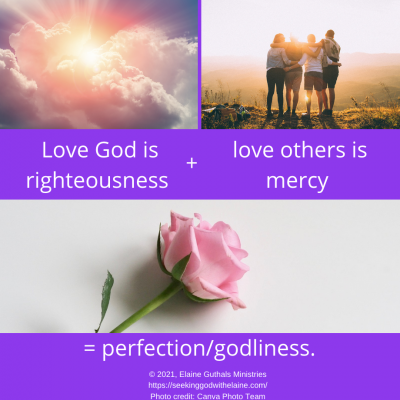
    We’ve talked about the equation before.

    Love God is righteousness + Love people is mercy = perfection/godliness

    Love God is righteousness + Love others is mercy = perfection/godliness

    The focus has to be on God and on others, not us. We renew ourselves by becoming more like Him and serving others.

    How Do We Apply This?

    • We grow when we make seeking God a habit. The constancy stimulates growth.
    • Watkinson said that we must daily “… purify our soul in fellowship at God’s throne.” That way we grow toward God’s righteousness and holiness.
    • We have to make the correct choices as we walk through life.
    • We need to serve others in whatever way God calls us. We need to lead people to Him.

    Resource

    Gamble made a great statement. He wrote, “Conscientious obedience to the will of God will be followed by the advancement of the spiritual life.”

    Resource

    God knows how much work it is going to be to diligently follow Him. He will reward us when we succeed in obeying Him.

    Father God. You accept us even when we do not have the character You require of us. Every day, You work to mold us into the person You want us to be — one who has Your character. Renew us every day. Help us to not faint. Strengthen us when we fret and fail. Carry us home to You when our lives on this earth is finished. Amen.

    What do you think?

    Leave me a comment below (about this or anything else) or head over to my Facebook group for some interactive discussion.

    If you don’t understand something and would like further clarification, please contact me.

    If you have not signed up for the email daily or weekly providing the link to the devotions and the newsletter, do so below.

    If God has used this devotion to speak with you, consider sharing it on social media.

  • Influencing Our Soul

    Becoming a new creation influences the soul – and continues to influence it. This daily devotional looks at how our souls are influenced by sanctification – for now and the future.

    Nuggets

    • Our souls are influenced by being changed through sanctification.
    • We must be changed through sanctification to spend eternity with God.
    • We don’t have to wait for Heaven to begin to be with God.

    To read devotions in the Redo for Godliness series, click the appropriate button below.

    Devotions in the Growing Our Soul series

    This draft had been sitting in the overflow folder. But when I pulled it out the other day to write on it, it didn’t grab me like it once did.

    I found one section of a sermon from the last devotion that I want to dig into a little more. What caught my eye was when Benson wrote, “We must ‘put on the new man,’ a new creature: so called because it influences the whole man, soul and body …”

    Resource

    It gave some scripture passages. I want to see how the soul was influenced.

    Let’s Put It into Context

    Here is a running list of what we’ve discussed previously.

    The Soul Is Influenced by Sanctification

    “Now may the God of peace himself sanctify you completely, and may your whole spirit and soul and body be kept blameless at the coming of our Lord Jesus Christ” (I Thess. 5: 23 ESV)

    Our souls are influenced by being changed through sanctification.

    Paul prayed that his readers would be completely sanctified. That is the goal — that we be completely changed to be like God.

    • Sanctification is the transformation of mind, body, and soul, which begins with regeneration, gradually changes our nature through the promptings of the Holy Spirit, and ends with perfected state of spiritual wholeness or completeness.
    • Regeneration is being changed from spiritually dead to spiritually alive and the internal requickening in us that God brings about through the work of the Holy Spirit to give us new character.
    • Spiritual death is the separation from God that occurred as a consequence of Adam and Eve’s original sin. The spiritually alive are those who have ABCDed, so they are no longer separated from God.
    • The perfected state indicates the combination of the spiritual graces which, when all are present, form spiritual wholeness or completeness.
    • Spiritual graces are worldly morals that have been submitted to God to further His kingdom instead of enhancing this world.

    The ABCDs of Salvation

    If you have not become a believer in Christ, please read through the
    Plan of Salvation and prayerfully consider what God is asking you to do.

    A – admit our sins
    B – believe His Son Jesus is our Redeemer
    C – confess God as Sovereign Lord

    D – demonstrate that commitment by making any changes needed in our lives to
    live the way in which God has called us

    The Disciple’s Job Description

    Glossary

    Ferguson pointed out that sanctification is completing the work that grace began. That makes sense.

    It isn’t about us just doing lip service and saying we believe in God. It is about the change that He brings to us.

    If it wasn’t about the change, then it would be okay if we were just good people. But God calls us to more than that.

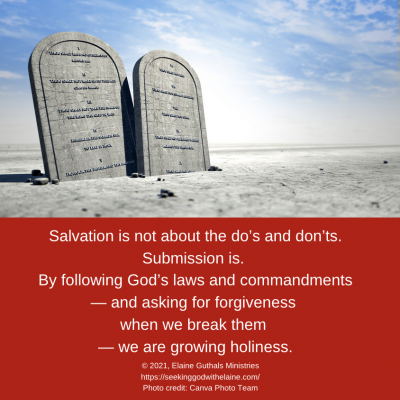
    Salvation is not about the do’s and don’ts. Submission is. By following God’s laws and commandments — and asking for forgiveness when we break them — we are growing holiness.

    Salvation is not about the do’s and don’ts. Submission is. By following God’s laws and commandments — and asking for forgiveness when we break them — we are growing holiness.

    Ferguson intimated what would happen if God did not sanctify us. He wrote, “If God did not carry on His good work in the soul, it would miscarry; and therefore we should pray God to perfect it, and preserve us blameless, that is, free from sin and impurity, till at length we are presented faultless before the throne of His glory with exceeding great joy.”

    Resource

    Dwight pointed out us that we are sanctified through God’s Word and His providence. God’s Providence is His care of us because of His loving nature to provide.

    To read a related devotion, click the button below.

    We are impressed with how God takes care of us — whether we hear of it, read it, or experience it. It isn’t a surface well-wasn’t-that-nice type of deal. It touches us in our soul and makes a lasting impression.

    Dwight reminded us that the process of sanctification begins in — and is a process of sanctifying — the soul. He wrote, “The first sanctifying act of the Spirit of God is employed in regenerating the soul. Succeeding acts of the same nature are employed in purifying it through all the successive periods of life.”

    Resource

    We are focusing on the soul in this devotion. Don’t limit sanctification to that.

    Paul wrote, “… may your whole spirit and soul and body be kept blameless …” (I Thess. 5: 23 ESV). He said sanctification is for the whole enchilada.

    Pearse stressed that sanctification is a surrender. We do not come to Him for salvation to receive forgiveness. We need to be obedient to His Will.

    Resource

    Ooo, baby. That just slammed home for me. I keep seeing our definition of holy — to be set apart, perfect, and morally pure while possessing all virtues. Every once in a while, I ask, well, how are we set apart?

    Jarbo wrote that sanctification is the “separation from that which is common to that which is holy.”

    I just needed a straightforward, clear cut sentence to explain it.

    Building the Soul for Future Residence

    “In him you also are being built together into a dwelling place for God by the Spirit” (Eph. 2: 22 ESV)

    We must be changed through sanctification to spend eternity with God.

    This devotion is an offshoot of the previous devotion. That devotion talked about renewing our mind. Renewing our mind is a part of being a living sacrifice.

    Being a living sacrifice is how we worship God. We worship God in spirit and in truth (Jn. 4: 24).

    That means we worship God with every fiber of our being — including our souls.

    Yes, Paul is talking about the church here. But I think he is also talking about us individually.

    “So then you are no longer strangers and aliens, but you are fellow citizens with the saints and members of the household of God, built on the foundation of the apostles and prophets, Christ Jesus himself being the cornerstone, in whom the whole structure, being joined together, grows into a holy temple in the Lord” (Eph. 2: 19-21 ESV).

    God is in the business of building us right now. He is teaching us the foundation that He gave the apostles and prophets.

    It was in the temple where God made His Presence known. He makes Himself known in our hearts.

    James reminded us that the building is fitted together perfectly on the Cornerstone. Another thing we have to remember is we are “…  fearfully and wonderfully made …” (Ps. 139: 14 ESV).

    Resource

    We are to imitate Jesus. That means we use His words and His deeds to guide off of.

    We build our temple by faith. Faith is the conviction that the doctrines revealed in God’s Word are true, even if we do not understand all aspects of them, a belief which impacts our lives.

    Bayne tied this discussion in with the last section. He wrote, “The Spirit of sanctification makes us a fit habitation for God.”

    Resource

    God carries on His sanctifying work in our souls. If He did not, we would not be changed.

    If we are not changed, we cannot live with God for eternity. Only those who have been changed to perfection will be admitted to Heaven.

    The Soul Is God’s Temple Now

    “If the Spirit of him who raised Jesus from the dead dwells in you, he who raised Christ Jesus from the dead will also give life to your mortal bodies through his Spirit who dwells in you” (Rom. 8: 11 ESV)

    We don’t have to wait for Heaven to begin to be with God.

    Jesus and the Holy Spirit lives in us now. Rye made a great statement. He wrote, “The indwelling of God the Holy Spirit is the common mark of all believers in Christ.”

    Resource

    The Holy Spirit takes up residence in us so that He can sanctify us and change us to be holy.

    Thompson reminded us that, though this body will die, death is not final. We will live for eternity. Will it be in Heaven with God or in hell with Satan?

    Where our new address will be is dependent on whether we have ABCDed.

    Resource

    Resurrection is the end game, but we have to go through regeneration and sanctification first.

    InfluencingOurSoulPin

    Making the Connections

    God wants to influence our lives. He doesn’t want us to just say we are going to follow Him, and then not do it.

    We are to truly live our lives for God. That means submit to Him and obey His laws and commandments. In doing so, we will be changed to be like Him.

    Our commitment to God should be a genuine confession to Him as Sovereign God.

    How Do We Apply This?

    Sanctification is a major component of our redo for godliness. However, it is not consistent. It has its hills and valleys.

    Sanctification is a major component of our redo for godliness. However, it is not consistent. It has its hills and valleys.

    Pearse made a great point. He wrote, “But what we give to God is altogether the result of our knowledge of Him.” We have to know first.

    Resource

    But to know God as our Great Physician means there has to be an illness. To know Him as a comforter means there has to be loss. To know Him as our Rock and the One Who gives us shelter means there has to be storms in life.

    To know God, we need to seek Him.

    Searching for and Seeking God

    Hearing His Word (Rom. 10: 17).
    Reading His Word (Rev. 1: 3).
    Praying to Him (Heb. 4: 16).
    Studying His Word (Ac. 17: 11).
    Meditating on His Word (Ps. 1: 1-2).
    Memorizing His Word (Ps. 119: 11).

    We want God to influence our souls. That will take study on our part.

    Father God. We choose to submit to You. We want to be like You – to have Your character. We commit to seek You so that You may sanctify us. Amen.

    If you have not admitted that your relationship is not right with God,

    have not asked Jesus to be your Lord and Savior,

    and have not confessed your sins,

    please read through the Plan of Salvation and prayerfully consider what God is asking you to do.

    Related Links

    Related Links

    Related Links

    Artist

    Related Links

    I have created a worksheet of the questions above. Click on the button below to access it.

    Don’t know what your spiritual gifts are?

    Take this Spiritual Gifts Inventory

    The Disciple’s Job Description

    Complete Job Description

    Individual Description

    The Disciple’s Job Description

    Complete Job Description

    Individual Description

    Job Duty #4
    Proclaim the Gospel (Mark 16: 15)

    Job Duty #6
    Make Disciples (Matthew 28: 19-20)

    It Was Enough
    Vocalist: Elaine Guthals
    Keyboard: Chris Vieth

    What do you think?

    Leave me a comment below (about this or anything else) or head over to my Facebook group for some interactive discussion.

    If you don’t understand something and would like further clarification, please contact me.

    If you have not signed up for the email daily or weekly providing the link to the devotions and the newsletter, do so below.

    If God has used this devotion to speak with you, consider sharing it on social media.

  • Growing Our Soul

    When we silence our souls, we set ourselves up for growing our souls. This daily devotional looks at the importance of creating this new self.

    Nuggets

    • We are called to take off our old outward life.
    • We put off our old self off through regeneration.
    • We are asked to give up our sinful ways, but we gain so much more when we choose to live as God wants us to live.

    To read devotions in the Redo for Godliness series, click the appropriate button below.

    When we were going through the Silence of the Soul series, I put some things in an overflow file. (It is slightly different than the drafts file, but it is on the same order.)

    When I was looking at it to see what to do this week, I pulled out five files that seemed to hang together. They struck me as talking about growing our souls.

    I know we have talked about all of the topics and, probably, all of the verses. I think God is wanting me — and, by extension, you — to take stock as to how far we’ve come on the journey.

    Let’s also switch this and look at this more through the lens of inward and outward.

    Let’s Put It into Context #1

    We’ve specifically looked at this passage before.

    To read a related devotion, click on the appropriate button below.

    Glossary

    But we’ve also looked at the topics before. In fact, renewing our minds is part of our job description. It is part of being a living sacrifice.

    To read a related devotion, click on the appropriate button below.

    Glossary

    The Disciple’s Job Description

    Let’s Put It into Context #2

    What jumpstarted this reflection on inward and outward changes was Beecher’s sermon entitled Morality the Basis of Piety. It talks about God’s full work in the soul. Beecher wrote, “Truth, in opposition to lies; honesty, in opposition to craft and stealing; purity, in opposition to all manner of corrupt desires; general integrity and uprightness — these are inculcated as the indispensable prerequisites of Christian life.”

    Resource

    What Paul and Beecher were calling us to do is to give up our sinful passions and replace them with passions pleasing to God. We are to be faithful to Him, changing our old lifestyle and opinions. In our dealings with others, we need to be equitable with all. We need to love them as God does.

    We are talking more than reputation here. We are talking character. Reputation is who others think we are; character is who we really are. Beecher called reputation the shadow of our character.

    Getting Rid of Our Old Selves

    “to take off your former way of life, the old self that is corrupted by deceitful desires” (Eph. 4: 22 ESV)

    We are called to take off our old outward life to replace with with an inner life.

    We all know the concept of taking off and putting on clothes. It may get a little fuzzy when we think about taking off the old person and replacing it with someone new.

    Paul had just gotten done with telling the Ephesians in Ephesians 4: 17-20 that he was talking about a Gentile lifestyle. His audience would have known that he meant living without God.

    What Paul was trying to tell the Jews was that they, too, had been living without God. Yep, they probably had a hissy fit on that.

    The problem was that they were banking on the ceremony and rituals to be enough for salvation.

    • Salvation is the gift of life through the deliverance from evil and the consequences of sins to replace them with good and eternal life.
    • The consequences of sin are spiritual death and physical separation from God.
    • Spiritual death is the spiritual separation from God that occurred as a consequence of Adam and Eve’s original sin. The spiritually alive are those who have ABCDed, so they are no longer separated from God.
      • Eternal life is the promise of living eternally – even if we have died in this life – because we have admitted our sins, believed Jesus as Savior and Redeemer, and confessed God as Sovereign Lord.

    Glossary

    The ABCDs of Salvation

    If you have not become a believer in Christ, please read through the
    Plan of Salvation and prayerfully consider what God is asking you to do.

    A – admit our sins
    B – believe His Son Jesus is our Redeemer
    C – confess God as Sovereign Lord

    D – demonstrate that commitment by making any changes needed in our lives to
    live the way in which God has called us

    Changing Our Selves

    “to be renewed in the spirit of your minds” (Eph. 4: 23 ESV)

    We put off our old self through regeneration.

    It may be called renewing your mind, but Eadie reminds us that it is the renewing of the spirit of the mind.

    We’ve talked before that it is still the same us after conversion. God doesn’t suddenly flip a switch and make us into a totally different person.

    The spirit of our mind undergoes regeneration. Regeneration is being changed from spiritually dead to spiritually alive and the internal requickening in us that God brings about through the work of the Holy Spirit to give us new character.

    I am not even sure I am going to be able to do an Elaine-speak on this one. Eadie said that the change “… is ‘in the spirit of the mind,’ in that which gives mind both its bent and its materials of thought. It is not simply in the spirit, as if it lay there in dim and mystic quietude; but it is ‘in the spirit of the mind,’ in the power which, when changed itself, radically alters the entire sphere and business of the inner mechanism.”

    Resource

    Well, that makes sense. We are to worship God in spirit and in truth (Jn. 4: 24).

    I am reading this as it changes the mind control room. It is the power source. It changes what our inclinations are.

    This change has to be made. If we don’t change, we need to go over the steps again and make sure we genuinely ABCDed.

    Putting on Our New Selves

    “and to put on the new self, the one created according to God’s likeness in righteousness and purity of the truth” (Eph. 4: 24 ESV)

    We are asked to give up our sinful ways, but we gain so much more when we choose to live as God wants us to live.

    We don’t just make the decision to believe in God and are done with it. Neither are we expected to renounce everything.

    Watkinson wrote, “It is felt that Christian life is chiefly occupied with sacrifice and resistance; what we forego is the main matter, the great idea being that of renunciation throughout. Out of this negative view, constantly set forth and exaggerated, sprung great evils.”

    Longing for the sinful things we are to give up keeps our eyes off of all that God will open up for us. Watkinson also wrote, “For all that we give up for Christ’s sake, a new world opens to us of fresh interests, activities, and pleasures, and this world we must forthwith claim and realize.”

    Resource

    Asking Jesus to be our Savior and God to be our Sovereign Lord changes our focus and our wants and desires.

    If we do not put on our new selves, we haven’t made a genuine profession of faith. If we don’t focus on God, we may be tempted to slip back into a sinful lifestyle.

    The Weekly Pulpit gives us a list of the new things with which we are now to fill our lives.

    • New thoughts.
    • New motives.
    • New dispositions.
    • New enjoyments.

    Resource

    Martin reminded us that we are not just changing our appearances to the world. We are getting a renewed heart as well as a renewed mind.

    Resource

    True, Martin does say that we have to not neglect our outward character. But that has to stem from a heart changed by God.

    Martin discussed how we sometimes justify our sinful actions even after conversion. I know I have had someone tell me that “that is just how I am made” when she acted in an unChristian-like way to me.

    I thought to myself, “It may be. But that is not how God wants us to act.” We have to change our habits and temperament to reflect God’s.

    GrowingOurSoulPin

    Making the Connections

    In the past, I told you that I thought regeneration was one of those past, present, and future words. For example, we are saved at the moment of conversion, but we aren’t perfected. We have to work through our salvation in this lifetime. Once we get to Heaven, we will truly be saved because we will be perfected and no longer sin.

    I thought regeneration had a similar progression. Now, I don’t think it does.

    We have to make a concrete decision as to whether we are for God or against Him. Are we going to submit to Him or not?

    Regeneration is being changed from spiritually dead to spiritually alive. Our character being changed to be like God is what happens on the Sanctification Road.

    Sanctification is the transformation of mind, body, and soul, which begins with regeneration, gradually changes our nature through the promptings of the Holy Spirit, and ends with the perfected state of spiritual wholeness or completeness. The perfected state indicates the combination of the spiritual graces which, when all are present, form spiritual wholeness or completeness.

    Glossary

    Watkinson reminded us what we have to gain. He wrote, “The Christian life begins with renunciation, but renunciation leading to possession — possession of higher and nobler qualities and characteristics.”

    Resource

    How Do We Apply This?

    While holiness is a gift of God, we have to do our part to cultivate it.

    • Benson reminded us of the Beatitude which says we have to crave righteousness. That means we have to put a priority on doing the morality-graces-holiness progression.
    • If we hunger for the righteousness, that means we eat by having a good prayer life. We need to cultivate a spirit of prayer.

    Resource

    Salvation is not about the do’s and don’ts. Submission is. By following God’s laws and commandments — and asking for forgiveness when we break them — we are growing holiness.

    That growth starts and conversion and goes until we are perfected in Heaven. Happy growing!

    Father God. We know we were so far from what You wanted us to be when we were sinners. Now, we confess You as our Sovereign God and Jesus as our Savior. Grow us to be more like You. Amen.

    What do you think?

    Leave me a comment below (about this or anything else) or head over to my Facebook group for some interactive discussion.

    If you don’t understand something and would like further clarification, please contact me.

    If you have not signed up for the email daily or weekly providing the link to the devotions and the newsletter, do so below.

    If God has used this devotion to speak with you, consider sharing it on social media.

  • Growing in Godliness

    Our goal on the Sanctification Road should be to grow in godliness. This daily devotional looks at how we can train ourselves to grown in godliness and faith.

    Nuggets

    • We want to grow in godliness because God and His Word are real.
    • Growing in godliness means becoming more virtuous.
    • Growing in godliness means we are growing in faith.
    • As we grow, we learn the value of godliness and we gain value in God’s eyes.

    Devotions in the Review 101: Godliness series

    Even though we may feel we have a long way to go on the Sanctification Road, we can take comfort in the fact that we can grow closer to being godly.

    Yes, we can grow to be more God-like. Let’s check it out.

    Let’s Put It into Context

    Godliness, equated with the Old Testament term fear of the Lord, is an attitude of reverence that is promoted by walking in His Spirit. The fear of the Lord means awe, reverence and love, not terror.

    Beecher extended that definition. He said that godliness means “… having a wise view of all the laws of our being and condition, and living in conformity to them.”

    Resource

    Godliness Is a Matter of Training

    “Have nothing to do with irreverent, silly myths. Rather train yourself for godliness” (I Tim. 4: 7 ESV)

    We want to grow in godliness because God and His Word are real.

    Nothing in Scriptures is fiction. The multiple authors did not make up some interesting story to manipulate us.

    God is real. He created the universe. He created mankind.

    All of this was done because God loves us. When we think about I Corinthians 13, we think that is how our marriages should be run.

    Have we ever looked at that as that describes Who God is?

    “Love is patient and kind; love does not envy or boast; it is not arrogant 5 or rude. It does not insist on its own way; it is not irritable or resentful; 6 it does not rejoice at wrongdoing, but rejoices with the truth. 7 Love bears all things, believes all things, hopes all things, endures all things. 8 Love never ends” (I Cor. 13: 4-8 ESV).

    Yep, the only place that breaks down is in verse 5. “… It does not insist on its own way …” (I Cor. 13: 5 ESV).

    God can insist that we do things His way. He is all-powerful, all-knowing, and all-present.

    To read a related devotion, click on the appropriate button below.

    But look what it says. We get to “… train yourself for godliness” (I Tim. 4: 7 ESV).

    Yes, we can change. Yes, it is going to take work.

    Also, it will be a process. Essex Congregational Remembrancer wrote, “This duty includes a strict and impartial inquiry into our own hearts, as to what may be therein likely to prevent our advancement in godliness.”

    Resource

    When we train, that means we have to be committed to the process. We can’t just work on obtaining God’s character once a week.

    It has to become a habit. It has to be engrained in us.

    That also means that we have to look deep inside us. We aren’t talking about a surface change. We are taking about one at the heart level.

    This is also where the watching comes into play. Watchfulness is a continual conscious examination of ourselves and all events so that we may follow God in all things.

    Glossary

    But we have to go through this training. This is the only way we become godly.

    Growing in Godliness

    “For this very reason, make every effort to supplement your faith with goodness, goodness with knowledge, knowledge with self-control, self-control with endurance, endurance with godliness, godliness with brotherly affection, and brotherly affection with love” (I Pet. 1: 5-7 CSB)

    Growing in godliness means becoming more virtuous.

    Ooo, baby. Do these verses sound familiar?

    These are the verses that we used when we talked about the virtues that disciples should possess. We said it was a continuum that culminated in godliness, kindness, and love.

    Devotions in the Christian Virtues series

    These verses are also truly appropriate. They show that we do grow our character.

    We said in Faith as a Virtue that these were not all the virtues on the sit that I found. Sometime this year, we will look at some more of them.

    God will show us where we need to grow to be like Him. However, He wants us to make sure we are always looking for those growth areas.

    So, how do we get to godliness? Perfection, right?

    Well, no. The perfected state indicates the combination of the graces which, when all are present, form spiritual wholeness or completeness. It means we have become as Jesus is. — holy, sanctified, and righteous. That will only happen in Heaven.

    Glossary

    Emmons said we need to be intentional. Do we see a pattern here?

    • Word for 2019: Intentional
    • Word for 2020: Self-discipline
    • Word for 2021: Godliness

    Resource

    It is more than just striving for godliness, though. We have to get it to heart level. We have to make sure our work in finding out what godliness is makes us more like God. We can’t just have head knowledge.

    Gaining the character of God begins with our choice. Yeah, it is going to take work. But if we are diligent, our character does become like His.

    But it has to be more than a new years’ resolution that we forget before we get out of January. It can’t be something we give up in July because it takes so much work. It isn’t one that we will be able to accomplish by December so we will never have to work at it again.

    This is going to be a life-long process. Yeah, we are talking sanctification here.

    ChoiceLifeLongProcess

    Sanctification is the transformation of mind, body, and soul, which begins with regeneration, gradually changes our nature through the promptings of the Holy Spirit, and ends with perfected state of spiritual wholeness or completeness. Regeneration is the change in us that God brings about when we go from being spiritually dead to spiritually alive.

    Glossary

    Champney gave us a real big caution. We can’t let the evaluation process lead to pride or conceit. Instead, the process needs to humble us.

    Resource

    Growing in Faith

    “For everyone who has been born of God overcomes the world. And this is the victory that has overcome the world — our faith” (I Jn. 5: 4 ESV)

    Growing in godliness means we are growing in faith.

    If we really get down to the meat and potatoes of it, when we are growing in godliness, we are really growing in faith. We are strengthening our belief in God.

    Blencowe put it this way. He wrote godliness is “… a real belief in God, the Father, the Son, and the Holy Ghost; our Maker, our Redeemer, and our Sanctifier. It is believing in Him, as He is made known to us in the Bible, in the gospel of Jesus Christ.”

    Resource

    Isn’t that what it is all about? It isn’t that we do the does and don’t do the don’ts. It is our belief in what God has done for us.

    Yes, obedience to God’s laws and commandments is a huge way that we show that belief. Obedience alone is not going to get our ticket to Heaven punched.

    Instead, we have to have faith. We have to be growing in that faith.

    What Do We Gain as We Grow?

    As we grow in godliness, we gain many valuable things and gain in value in God’s eyes.

    We gain temporal blessings when we grow in godliness. We know that “every good gift and every perfect gift is from above, coming down from the Father of lights, with whom there is no variation or shadow due to change” (Jas. 1: 17 ESV).

    We gain a good reputation. Griffith was correct when he wrote that “the discipline of godliness does make a man better inwardly.”

    Resource

    But it also manifests itself into what what the world sees. Our inward godliness informs our actions.

    We’ve talked about how godliness is the parent of contentment. That is because we gain peace as we are living as a God wants us to live. This comes because we start believing that we have been forgiven.

    GrowingInGodlinessPin

    Making the Connections

    Stevens had a great take on our pursuit of godliness. He wrote, “No aim can so call out all the powers of the human mind, and soul, as the aim after God-likeness. For what is godliness? Is it not God-likeness? a seeking to be like God? Yet the question at once arises, How can man be like God? God is infinite, man is finite. Yet with all this disparity, the Bible exhorts us to set the Lord always before us, and to grow up into His likeness.”

    Resource

    That’s right. How are we going to accomplish the impossible?

    Let’s face it. To most of us, it seems like becoming godly isn’t going to happen.

    But Scriptures say, “… With man this is impossible, but with God all things are possible” (Mt. 19: 26 ESV).

    No, we will never be creators, all-knowing and all-seeing.

    But we can imitate God’s moral characteristics. That means we can be holy.

    How Do We Apply This?

    First off, we have to be children of God’s to have a shot at being godly. Boston wrote, “That professor or minister that is not godly can never exercise himself to godliness. It is impossible to act without a principle of acting, and exercise doth naturally require a power of it. He can never exercise himself to running, that wants feet to run with; or to wrestling, who wants arms; nor the ungodly exercise themselves to godliness; on the contrary, ‘an heart they have exercised with covetous practices.’” Just being a good person will never make us godly.

    Resource

    To read a related devotion, click the button below.

    Let’s look at it this way. One of the files in my drafts folder for this year is on the topic of sin being a disease.

    We need a healthy, viable relationship with God.

    The Essex Congregational Remembrancer gave us some really good advice. They wrote, “It is of importance to consider that unless we exercise ourselves unto godliness, so far from making further advances in the Divine life, we shall go backward, not forward.”

    Resource

    We have to grow in our relationships with God. We’ve got to become more like Him.

    Yes, there are days we will go backwards. We always have to try to move forward.

    Gracious Heavenly Father. It brings us great joy to think that we can grow to be like You. Yes, we know from the world’s viewpoint we have a long way to go. You, however, do not look at what we do or do not do. You look at our hearts — our love for You. Help us to grow our faith in You. Amen.

    What do you think?

    Leave me a comment below (about this or anything else) or head over to my Facebook group for some interactive discussion.

    If you don’t understand something and would like further clarification, please contact me.

    If you have not signed up for the email daily or weekly providing the link to the devotions and the newsletter, do so below.

    If God has used this devotion to speak with you, consider sharing it on social media.
  • How Are God’s Messengers Supposed to Respond?

    When Jesus showed up to call Isaiah as His messenger, Isaiah had a choice to make. God knows what He needs for us to do to expand His kingdom, but He gives us free will to agree to do it. This daily devotional looks at how messengers of God should respond to their call.

    Nuggets

    • Isaiah confessed; he was immediately forgiven – then, he was given a job.
    • God knows that this is the way we will grow.
    • When Isaiah asked when his enlistment would be up, Jesus replied, “As long as I need you.”

    Isaiah’s Message from Sovereign God Series

    Flowers with title How Are God's Messengers Supposed to Respond?

    How are we supposed to respond when God calls us to service? Like Isaiah did — send me.

    I picture Isaiah bouncing up and down on his heels, arm up, waving his hand. He is probably making Horshack noises to make sure he has Jesus’ attention.

    Look at it this way. Isaiah is believed to have been young (Jenkins said 18 or 19) when he was called to the ministry. He supposedly had ties to royalty.

    Resource

    The kicker is that Isaiah didn’t ask what this job entailed. There was no, “Where are You sending me?”

    All Isaiah said was he was good to go.

    But I am getting ahead of myself. Let’s recap the first seven verses, and then go on.

    Let’s Put It into Context

    “Then I said: Woe is me for I am ruined because I am a man of unclean lips and live among a people of unclean lips, and because my eyes have seen the King, the Lord of Armies” (Isa. 6: 5 CSB)

    • Isaiah’s message was all about God’s message.
    • This vision of God’s glory has a lot of symbolism, so of course, there is diverse opinions about what the symbolism means.
    • Isaiah knew that he was unworthy of being in the Lord’s presence.
    • God calls to us to do His work, but we have to be listening.

    Isaiah was hanging out in the Temple, and God came to visit. Well, really, it was Jesus.

    As usual with we humans, Isaiah didn’t feel worthy to be in Jesus’ presence. The seraphim took a coal from the altar and cleansed Him.

    Why Does God Call Us to Serve Him?

    “Then I heard the voice of the Lord asking: Who will I send? Who will go for us? I said: Here I am. Send me. And he replied: Go! Say to these people: Keep listening, but do not understand; keep looking, but do not perceive. Make the minds of these people dull; deafen their ears and blind their eyes; otherwise they might see with their eyes and hear with their ears, understand with their minds, turn back, and be healed” (Isa. 6: 8-10 CSB)

    We are called to be God’s servants as He gives us jobs to spread His message throughout the world. We have to follow God’s calling for our lives.

    Okay, here was Isaiah. He was worshipping. God came to him and purified him.

    Then comes the big question. “… Who will I send? …” (Isa. 6: 8 CSB).

    There are a couple of things we can pull out of this. God calls to us to do His work, but we have to be listening. God has a job for us, but we have to be ready.

    Isn’t it amazing that God does care about us? He wants to restore our relationship.

    We have to pay attention to the promptings of the Holy Spirit.

    Look at it this way. Isaiah confessed; he was immediately forgiven. Then, he was given a job.

    True, Jesus didn’t say, “I’ve got a job for you.” He asked the question, “… Who will I send? …” (Isa. 6: 8 CSB).

    Jesus let Isaiah decide for himself that he was going to do the job. Yep. Free will came into play. Free will is the ability within us to make decisions, which determine actions that produce character.

    Just as God isn’t a dictator in making us worship Him, He is not a dictator in making us serve Him. He allows us to choose.

    Oh, there are consequences when we choose to not obey God. It is still our choice.

    God wants us to be His messengers. No, He really doesn’t need us for anything. He wants us to be involved in His ministry.

    Symes has given the best reason that I have come across so far as to why God uses us. He wrote, “He [God] desires intelligent, trustful, loving union with Himself, and it may be that such ends as these are better obtained through human instrumentality than by an overpowering exhibition of the Divine majesty and glory.”

    Resource

    There is another reason. God knows that this is the way we will grow. Isn’t it said that, if you really want to learn something, teach it to someone else?

    It is a little amazing that Jesus had all of the seraphim around Him — and He chooses Isaiah. Men are lower than the angels (Heb. 2: 9) but chosen above them.

    I got a hoot out of what Jenkins said. He wrote, “The Lord’s ordinary manner of appointing His messengers is to select them Himself, and without consulting them send them to do their work.” No, He doesn’t ask for our input.

    Resource

    Sometimes we really don’t understand the full scope of what it meant to be a prophet of the Lord. We get that he was a messenger, but that is an oversimplification.

    Isaiah was a messenger in the sense that he gave God’s words to the people, but he also brought the peoples words to God. So, he was a liaison instead of just a delivery boy.

    Isaiah knew God’s heart in many situations. He hurt and rejoiced with the God he served. He felt for his people, longing for their redemption and hurting at the thought of their judgment.

    We can see Isaiah’s passion and conviction as well as his eagerness to serve and his response to God’s call. This dedication often irritated Isaiah’s audience and came with a cost. Tradition says that Isaiah was executed by order of King Manasseh of Judah. He was sawed in two.

    Isaiah knew what he was getting into, and he was still passionate and dedicated. He out his faith in God.

    Verse 10 is confusing. It kind of makes it sound like Jesus doesn’t want people to be led to salvation. There is nothing further from the truth.

    Cron explained this by saying that “… they would so act that the effect of all his diligence and ingenuity to instruct and reform them would be to render them still more stupid and wicked, and still more the objects of the Lord’s displeasure.”

    Resource

    Okay, still kind of muddy. Let’s look at Scripture.

    • “He replied, “Because the knowledge of the secrets of the kingdom of heaven has been given to you, but not to them.  Whoever has will be given more, and they will have an abundance. Whoever does not have, even what they have will be taken from them” (Mt. 13: 11-12 NIV).
    • “For this people’s heart has become calloused; they hardly hear with their ears, and they have closed their eyes. Otherwise they might see with their eyes, hear with their ears, understand with their hearts and turn, and I would heal them” (Mt. 13: 15 NIV).

    I think Jesus was just warning Isaiah that he wasn’t going to have complete success. There will be those who refused to repent.

    Person

    How Long Are We to Serve God?

    “Then I said, ‘Until when, Lord?’ And he replied: Until cities lie in ruins without inhabitants, houses are without people, the land is ruined and desolate, and the Lord drives the people far away, leaving great emptiness in the land. Though a tenth will remain in the land, it will be burned again. Like the terebinth or the oak that leaves a stump when felled, the holy seed is the stump” (Isa. 6: 11-13 CSB)

    Isaiah did ask when his enlistment would be up. Jesus’ reply focused on the job he was given.

    We don’t really know his reasons for asking this question. We can realize Isaiah was asking in faith. He wasn’t asking about how long he would have to give up life as he knows it. I don’t think he was asking if it will be a quick fix.

    I don’t see Isaiah’s wholehearted response suddenly turning into a qualified one. I think Isaiah was making sure he has all the information that he needs to have to do the work assigned to him.

    Jesus had a two-part response. The first was, “As long as I need you.”

    The second part was, “It isn’t going to be pretty.” There was going to be consequences that hurt. (Remember, Isaiah was prophesying the Babylonian exile.)

    Look at verse 13. Even the remnant was going to feel the punishment. It wasn’t going to be all rainbows and unicorns.

    Let’s roost on the tree stump. The rest of the tree is gone. The stump remains attached to the roots.

    Sometimes, the tree was felled because it was dead. Not always. The tree could still be alive because the trees around it are feeding it nutrients.

    Resource

    Isn’t that a wonderful visualization of what disciples are called to do? We are called to provide life to those who are spiritually dead around us. Spiritual death is the separation from God that occurred as a consequence of Adam and Eve’s original sin.

    We feed them with about the love with which God showers us. Think of the picture of regeneration as the stump has new growth.

    It takes care and nourishment to have the new growth. It takes searching for God and learning about Him to understand that we are spiritually dead without Him.

    HowAreGodsMessengersSupposedtoRespondPin

    Making the Connections

    God has a job for each of us. We won’t all be called to prophesy like Isaiah was.

    We are all called to witness to those who are spiritually dead. When we get the call, we need to do our own Horshack imitations and say, “Here I am. Send me.”

    We can expect the calling to last the rest of our lives.

    How Do We Apply This?

    We have to realize we are the seed to help those who are away from God find their way back.

    I got two important things out of this study. Our relationship with God is necessary. We also have to witness to others.

    A lot of times, we focus solely on our relationship and what we have to do to get back into obedience. Then I read this nugget.

    Robinson wrote, “It never helps anyone to begin desperately to study his wickednesses with a view to outroot them. It is better for him to keep looking at God. The objective study of Christ, His life, character, etc., is far safer and more profitable for growth in grace than any painful act of self-examination.”

    Resource

    We shouldn’t focus on the sin. Our focus needs to be on our Redeemer and His call for us.

    Holy Father. You are holy and righteous. We are not. Yet, You call us to work to expand Your kingdom. We know that, when You call us, You will equip us. We stand ready to do all You ask. Amen.

    What do you think?

    Leave me a comment below (about this or anything else) or head over to my Facebook group for some interactive discussion.

    If you don’t understand something and would like further clarification, please contact me.

    If you have not signed up for the email daily or weekly providing the link to the devotions and the newsletter, do so below.

    If God has used this devotion to speak with you, consider sharing it on social media.

  • How Are We to be Children of God?

    In answering the disciples’ question, Jesus told them that they needed to have an attitude of a child. This devotion looks at the characteristics of children so that we can emulate them when depending on our Heavenly Father.

    Nuggets

    • Places a dependence on God is complex.
    • Competence speaks to having the relationships that God wants us to have with Him.
    • We have to believe beyond a shadow of a doubt that what God is telling us is true.
    • Disciples need to not only be connected to God, but we also have to be connected with each other.
    • Building the character of God is what being a disciple is all about.
    • God has a job for each one of us to do.
    • God helps us cope in those times of trials.
    • We do have to control ourselves and our sinful nature, but it is more about God being in total control.

    Devotions in the What I Believe series

    Devotions in the Family category

    Flowers with title How Are We to be Children of God?

    Let’s Put It into Context #1

    Family is, according to the Holman Bible Dictionary, “the basic household unit which provides a person’s central relationships, nurture, and support.”

    Resource

    Let’s Put It into Context #2

    “At that time the disciples came to Jesus and asked, ‘So who is greatest in the kingdom of heaven?’” (Mt. 18: 1 CSB)

    I wonder what the disciples were really asking Jesus when they asked, “… ‘So who is greatest in the kingdom of heaven?’” (Mt. 18: 1 CSB). Asked in the correct way, we could make an argument that there was nothing wrong with the question. If we are asking it to grow closer to God, that is exactly what God wants.

    At least some of the disciples were looking for the military Messiah. If they were asking based on a military assumption, they were heading down the wrong path.

    We know the disciples really didn’t get what the kingdom of God was. They didn’t get that it is eternal or that it is within us in our hearts.

    I think Jesus was addressing ambition here. No, I don’t think He was telling us we shouldn’t try to improve ourselves. We know we are to grow in grace and knowledge (II Pet. 3: 18).

    Jesus was always focused on the spiritual. God wants us to focus more on the spiritual than the physical. The disciples were asking the question wrong.

    It is probably a pretty safe bet that the disciples did not expect Jesus’ answer. Jesus was good at saying the unexpected.

    The Answer

    “He called a small child and had him stand among them. ‘Truly I tell you,’ he said, ‘unless you turn and become like little children, you will never enter the kingdom of heaven. Therefore, whoever humbles himself like this child — this one is the greatest in the kingdom of heaven. And whoever welcomes one child like this in my name welcomes me’” (Mt. 18: 2-5 CSB)

    Sometimes we think we know the answer. It is a simple “be humble like a child” admonition. Humility is a character trait that diminishes pride and places dependence on God while holding a modest view of our importance with respect to others.

    But places a dependence on God is complex. How are we to place a child-like dependence on God?

    I looked up a list of characteristics of children. I found a couple of teach-your-children-this lists.

    I was looking for more of a children-are-this list. The closest thing that I found is a resilient-children-are-this list. It is Mead’s 7 Key Characteristics of Resilient Children. It works.

    Resource

    Competence

    Competence means we know how to do something or have the skills to do it. When we apply it to what Jesus was talking about, we know God.

    That speaks to having the relationships that God wants us to have with Him. It isn’t just about the head knowledge or the ritual of religion.

    It is about calling God our Father. He wants us to have the heart knowledge, not just the head knowledge.

    Parent hand and child hand

    Confidence

    Confidence is about having certainty in something. In churchy words, we say we believe in God. We have to have faith and trust.

    Faith is the belief that the doctrines stated in God’s Word are true, even if we do not understand all aspects of them. Trust is assurance that the promises of God are true.

    Assurance is another good word. It talks about certainty, too.

    Assurance leads to hope. Hope is where we desire for something that we believe is obtainable.

    We have to believe beyond a shadow of a doubt that what God is telling us is true. If He says we are spiritually dead if we haven’t ABCDed and that means we are going to be spending eternity in hell, that is what we have to believe. If He tells us that He wants us to put the devotions we’ve been writing online so others can read them, we have to have the confidence to do that — even if we are shaking in out boots the whole way.

    The ABCDs of Salvation

    If you have not become a believer in Christ, please read through the
    Plan of Salvation and prayerfully consider what God is asking you to do.

    A – admit our sins
    B – believe His Son Jesus is our Redeemer
    C – confess God as Sovereign Lord

    D – demonstrate that commitment by making any changes needed in our lives to
    live the way in which God has called us

    The Disciple’s Job Description

    Connected

    Disciples need to not only be connected to God, but we also have to be connected with each other. God has built a community of believers. We aren’t supposed to be insulated.

    Resource

    But it isn’t just a fellowship thing. We have a job to do.

    • “And he said to them, ‘Go into all the world and proclaim the gospel to the whole creation’” (Mk. 16: 15 ESV).
    • “Go therefore and make disciples of all nations, baptizing them in the name of the Father and of the Son and of the Holy Spirit, teaching them to observe all that I have commanded you. And behold, I am with you always, to the end of the age” (Mt. 28: 19-20 ESV).

    We are to support others. We just said in a recent devotion that disciples provide charity to widows when needed. Charity means showing others love flavored with acts of benevolence. 

    Character

    Building the character of God is what being a disciple is all about. That is why we are on the sanctification road.

    Sanctification is the transformation of mind, body, and soul beginning with regeneration and ending with perfected state of spiritual wholeness or completeness. Regeneration is the change in us that God brings about when we go from being spiritually dead to spiritually alive. The perfected state indicates spiritual wholeness or completeness.

    We are to have the disposition of a child. Our disposition is our temperamental makeup.

    Oh, yeah. That means change.

    Jesus was all about our need to change. That is what conversion is. Conversion is a change of mind, heart, and conduct. We have to have this change to enter the kingdom of God.

    Resource

    Sanctification is a process. Pool said it the best when he wrote “that even converted souls have need of a daily conversion.”

    Resource

    What Jesus was getting at was we need to be trusting and submissive rather than ambitious. That is what we need to turn toward in repentance.

    Glossary

    Contributors

    God didn’t call us to be back-seat Baptists. He wants us to contribute. He has a job for each one of us to do.

    That is why the Great Commission has all of those action words (Mt. 28: 19-20).

    • Go
    • Make
    • Baptize
    • Teach

    To read a related devotion, click the button below.

    God knows that the only way we are going to truly understand some of His ways are by doing them. We have to put them into practice.

    Cope

    Oh, yeah. Being a disciple is not going to be easy. Satan is going to throw all he has at us because he wants to derail us.

    But God helps us cope in those times of trials. We have to know that He is our protector in times of trouble.

    • “There is no one holy like the LORD. There is no one besides you! And there is no rock like our God” (I Sam. 2: 2 CSB).
    • “The Lord is my rock, my fortress, and my deliverer, my God, my rock where I seek refuge, my shield and the horn of my salvation, my stronghold” (Ps. 18: 2 CSB).
    • “He will cover you with his feathers; you will take refuge under his wings. His faithfulness will be a protective shield” (Ps. 91: 4 CSB).

    The thing is, God doesn’t want us to go it alone. He wants us to depend on Him for everything — the big stuff and the little stuff.

    Person sitting on dock

    Control

    That is a good segue to the next topic. We talked at the beginning of the year that I thought about making self-control my word for the year. It is a fruit of the spirit.

    We do have to control ourselves and our sinful nature. We do that through self-discipline.

    But we can’t just think we are in control. Remember, God told me, “Well, Chick, you can’t do self-discipline without Me.”

    It is more about God being in total control. We have to submit to Him.

    Oh, yeah. We think submitting is more of a child thing than an adult thing. But it isn’t. It is a disciple thing.

    Person kneeling

    Making the Connections

    We have said before that repentance was turning from sin. Now we know what we are to turn toward — a child-like disposition.

    Don’t worry. Nicodemus had trouble with this you-must-be-born-again/become-a-child directive.

    Paul really didn’t explain it much better to some peoples’ estimation. “Therefore, if anyone is in Christ, he is a new creation. The old has passed away; behold, the new has come” (II Cor. 5: 17 ESV). How can be brand new?

    Vaughan helped us understand. He wrote, “This image does not convey the idea of a perfectly new being, but of an old being begun again, that it may do better.”

    Resource

    With all of the C words up there, we need to add a D Word. We need to be docile. Docile means easily taught.

    Jay noted that we should “not [be] like them in ignorance, not in fickleness, not in waywardness.” We should be willing to be taught and changed.

    Resource

    Making the Connections to Self-Discipline

    Submission is a bad enough word to some worldview people. When we tell them child-like, they may turn around and walk away. How do we describe what God is wanting us to be?

    We’ve been looking at defending our beliefs when we are witnessing. That means we have to be secure enough to convince someone to accept our beliefs.

    Our questions should still serve us to determine on what we need to focus.

    • What does the Scriptures say?
    • What do I believe?
    • Why do I believe the same/differently than the Scriptures?
    • What are the talking points when witnessing to a non-believer?

    Related Links

    I have created a worksheet of the questions above. Click on the button below to access it.

    How Do We Apply This?

    We have to understand that the resistance is in us, not just the worldview people. Vaughan wrote, “We as men fancy ourselves independent and self-sufficient; we must get back to simplicities, self-renunciation, to a babyhood of trust.”

    Resource

    How do we know that we have become child-like? In Jay and Various’ Conversion, it was written, “The change is to be judged of by its effect.” Have we become more dependent on God?

    Resource

    Oh, yes. We have to discuss the elephant in the room. We have to be ready for the discipline for when we mess up. Isn’t that what children do? They push the boundaries or just plain get it wrong — and have to face the consequences.

    Now we know what we are turning to when we turn away from repentance. We just have to do it.

    Father. We come to You as our Father. We come to You as Your children. That means we come in humility and submission. Grow us to be who You want us to be. Refine us until our character matches Yours. Sustain us on this sanctification road and help us to reach our end destination — being perfected in Your sight. Amen.

    What do you think?

    Leave me a comment below (about this or anything else) or head over to my Facebook group for some interactive discussion.

    If you don’t understand something and would like further clarification, please contact me.

    If you have not signed up for the email daily or weekly providing the link to the devotions and the newsletter, do so below.

    If God has used this devotion to speak with you, consider sharing it on social media.
  • The Council Had Spoken

    How can we be cooperative when our group is splintered from the inside? This devotion looks at how the Jerusalem Council helped mend the torn group.

    Nuggets

    • We have to let people talk things through – to process.
    • Peter was also saying — without really saying it — that circumcision of the heart was much more important than circumcision of the body.
    • Those we are witnessing to want to know what a God has done lately.
    • By Gentiles doing these four things recommended, Jews may not see Gentiles as unclean.

    Devotions in the What I Believe series

    Devotions in the Cooperation category

    Flowers with title The Council Has Spoken

    It is difficult to be cooperative when we are face threats from outside our group. However, when our group is splintered, cooperation is even more difficult to maintain.

    Peter, Paul, and James handled one such time in the life of the early church. They did so by conducting what is called the Jerusalem Council.

    Let’s see what we can learn from the process.

    Let’s Put It into Context #1

    The Merriam-Webster Dictionary defines cooperation as “the actions of someone who is being helpful by doing what is wanted or asked for” and “association of persons for common benefit.”

    Resource

    Let’s Put It into Context #2

    “Some men came down from Judea and began to teach the brothers, “Unless you are circumcised according to the custom prescribed by Moses, you cannot be saved.” After Paul and Barnabas had engaged them in serious argument and debate, Paul and Barnabas and some others were appointed to go up to the apostles and elders in Jerusalem about this issue. When they had been sent on their way by the church, they passed through both Phoenicia and Samaria, describing in detail the conversion of the Gentiles, and they brought great joy to all the brothers and sisters. When they arrived at Jerusalem, they were welcomed by the church, the apostles, and the elders, and they reported all that God had done with them. But some of the believers who belonged to the party of the Pharisees stood up and said, “It is necessary to circumcise them and to command them to keep the law of Moses” (Ac. 15: 1-5 CSB)

    Don’t you hate it when outsiders come in and stir up trouble? Things are going well, but no. They have to come in and plant doubt and negativity.

    But let’s face. There is always going to be controversies.

    And controversies can be a good thing sometimes. Schaff wrote, “It is through controversy that truth is developed and error defeated.”

    So, the issue isn’t that we have controversy. The issue is how we handle it.

    The church at Antioch had controversies. Antioch was one of the first churches where the gospel was preached to the Gentiles (Ac. 11: 19-23). Up until this time, however, the congregation was unified.

    The problem was some of the Jews couldn’t — wouldn’t give up some Jewish traditions. They had a real problem with circumcision. Circumcision was the outward representation of the acceptance of God’s covenant with Abraham.

    The problem went deeper than just the physical keeping of the covenant. What the controversialists were saying is that all of the laws — including the requirements and penalties — had to be kept.

    Oh, yes. We still have to keep God’s laws and commandments — the moral laws. We do not have to keep the ceremonial laws — the sacrifices and the circumcision.

    Paul, a very vocal opponent, labeled them false teachers. He spent a lot of ink warning the converts not to fall into their line of thinking.

    Don’t skim over “… Paul and Barnabas and some others were appointed to go up to the apostles and elders in Jerusalem about this issue” in Ac. 15: 2 (CSB). Their viewpoint would have been known. They were sent to represent the “no circumcision” side of the debate.

    Where they were sent was the Jerusalem Council. They were going to the top to get the definitive answer. While Paul and Barnabas were well received, the debate on circumcision began.

    Council Established

    “The apostles and the elders gathered to consider this matter. After there had been much debate, Peter stood up and said to them, “Brothers, you are aware that in the early days God made a choice among you, that by my mouth the Gentiles would hear the gospel message and believe. And God, who knows the heart, bore witness to them by giving them the Holy Spirit, just as he also did to us. He made no distinction between us and them, cleansing their hearts by faith. Now then, why are you testing God by putting a yoke on the disciples’ necks that neither our ancestors nor we have been able to bear? On the contrary, we believe that we are saved through the grace of the Lord Jesus in the same way they are” (Ac. 15: 6-11)

    We can pull several things out of this passage. The matter was considered by the apostles and elders — the leadership.

    Fraser pointed out that we know this was now a council by the terminology used. Before, the terminology used was apostles and brethren. Now, it is apostles and elders.

    I, personally, don’t think that means they cut out the followers. We aren’t there yet, but verse 12 says, “The whole assembly became silent and listened …” (Ac. 15: 12 CSB). I don’t think it was just “the apostles and the elders gathered …” (Ac. 15: 6 CSB).

    I don’t think it was an executive session meeting. I think it was a public, open meeting. We have to let people talk things through – to process.

    But the decision was made by the higher ups.

    They talked it out. They considered all sides. This wasn’t something they entered into lightly.

    I have always been surprised that it didn’t include a line about prayer and supplication. Paul himself was the one who said, “do not be anxious about anything, but in everything by prayer and supplication with thanksgiving let your requests be made known to God” (Phil. 4: 6 ESV).

    But when Peter had enough of the debate, he got up (being the leader he had always been) and focused the discussion. He brought it down to what God had already decreed. I don’t think it is coincidence that Acts 15: 1-35 happens after Acts 10: 1-48.

    Peter’s argument contains three points — all of which are facts.

    1. God has already spoken.
    2. The law wasn’t the answer.
    3. Grace is the answer.

    Glossary

    The Gentiles no longer had to change to be what the Jews wanted them to be. They needed to change and be what God wanted them to be.

    People

    Yes, God wants us to remember the past. We always have to evaluate where we are to make sure we are navigating in the right direction on the sanctification road.

    Glossary

    God wants us to use the past to help us grow. He wants us to move on to where He is calling us.

    Thomas made an interesting point. He wrote, “On the other hand, Christianity was preeminently progressive; it made the old a mere starting point. It left Palestine for the world, the Jew for the race, the temple of Jerusalem for the temple of the universe, teaching men everywhere that ‘God is a Spirit,’ etc.”

    Peter said it loud and clear that the former rituals did not save them. Instead, he called them a yoke (Ac. 15: 10) — a hindrance.

    That is what God designed the laws to do. They show us that we cannot save ourselves.

    We all break the laws. Who among us hasn’t told the exact truth when asked if a certain article of clothing was flattering when on someone else — and it really wasn’t?

    Wasn’t that what was being debated? The application of the faith?

    The laws were something we could do to show our love for God. The laws had nothing to do with salvation itself. Salvation is deliverance from evil and the consequences of sins to replace them with eternal life and good.

    We have to make a genuine profession of faith in order to gain salvation. We can’t do anything else.

    What I think was ultimately being discussed here was truth and love. Did they believe salvation was only dependent on the truth that Jesus is our Savior? Did they love enough to accept those who were not like them into the fellowship?

    Peter was also saying — without really saying it — that circumcision of the heart was much more important than circumcision of the body. God wants us to change our character to be like Him, not just our mindset to follow His rules.

    God wants us regenerated. Regeneration is the change in us that God brings about when we go from being spiritually dead to spiritually alive.

    The President Spoke

    “The whole assembly became silent and listened to Barnabas and Paul describe all the signs and wonders God had done through them among the Gentiles. After they stopped speaking, James responded, “Brothers, listen to me. Simeon has reported how God first intervened to take from the Gentiles a people for his name. And the words of the prophets agree with this, as it is written: After these things I will return and rebuild David’s fallen tent. I will rebuild its ruins and set it up again, so that the rest of humanity may seek the Lord — even all the Gentiles who are called by my name — declares the Lord who makes these things known from long ago” (Ac. 15: 22-18 CSB)

    Peter shut the debate down. He showed what God had said.

    Barnabas and Paul silenced them. They showed what God had done. How could they argue against God?

    Don’t we need that sometimes? It is great to read the Bible stories, but those we are witnessing to want to know what a God has done lately. What has he done in our lives on a certain topic?

    James would have been considered the president of the council. Fraser pointed out that he was the best man in that position for this debate because he didn’t have a dog in the fight. Peter did; Paul did; James didn’t.

    James summarized what Peter had said. God had spoken to Peter.

    If they had any doubts after that, James took them back to the Old Testament and the words of the prophets. He quoted Amos 9: 11-12. “… and all the nations
that bear my name …” (Amos 9: 12 CSB).

    It was really important that James stressed that this was God’s Plan A from the beginning. How many times have we already talked about Paul using a lot of ink to get the Jews and the Gentiles to play nicely with each other?

    To read a related devotion, click on the appropriate button below.

    Decision Reached

    “Therefore, in my judgment, we should not cause difficulties for those among the Gentiles who turn to God, but instead we should write to them to abstain from things polluted by idols, from sexual immorality, from eating anything that has been strangled, and from blood. For since ancient times, Moses has had those who proclaim him in every city, and every Sabbath day he is read aloud in the synagogues” (Ac. 15: 19-21 CSB)

    These verses have always kind of confused me. Yes, they get to the decision that circumcision of the body is not required.

    But then James brings up some things that weren’t discussed before. Plus, to me, it seems like he is bringing up laws again. He said they should abstain from the following.

    • Eating foods presented to idols
    • Sexual immorality
    • Eating things that had been strangled
    • Eating blood

    Fraser argued that, by Gentiles doing these four things recommended, Jews may not see Gentiles as unclean. That is a pretty good compromise.

    Glossary

    Making the Connections

    It would be easy to say that there should be no controversies. There should be no division within the church.

    Ooo, baby. Not going to happen.

    We have to know how God wants us to work through the controversies. How does God want us to cooperate? To compromise?

    God does want us to work out compromises to disciples’ problems. We can’t compromise on His laws and commandments, but we can work together for peace of the fellowship.

    Parker brought up another good point. This not only addressed the issue of what was expected by God, but it also showed how new converts would be treated. Was it going to be the Jewish way or the highway?

    Making the Connections to Self-Discipline

    Worldview people may want to debate disciples, thinking they can show us as hypocrites. How can we proclaim the gospel message without sounding like we are “preaching to them” but not getting into an all-out debate?

    We’ve been looking at defending our beliefs when we are witnessing. That means we have to be secure enough to convince someone to accept our beliefs.

    Our questions should still serve us to determine on what we need to focus.

    • What does the Scriptures say?
    • What do I believe?
    • Why do I believe the same/differently than the Scriptures?
    • What are the talking points when witnessing to a non-believer?

    Related Links

    I have created a worksheet of the questions above. Click on the button below to access it.

    How Do We Apply This?

    We have to settle controversies with discussion and cooperation. Top-down edicts (while sometimes are necessary) rarely defuse the contentious situation.

    Coming together to think it through and hash it out is vital. We must always determine what God wants us to do in the situation.

    Look at the model Paul gave us. Most of the time we would think he was a stubborn, opinionated man. Parker wrote, “The man who saved the Church was Paul. There was in him a fine spirit of conciliation as to methods and usages; but when it came to the liberty of Christ, and the independence of the Church, he stiffened into inflexibility, and he ‘gave place by subjection, no, not for an hour.’” Paul knew when to be stubborn and when to be conciliatory.

    Bradford mentioned that the apostles and elders did not rely on letters to settle the issue. They conducted the discussion face to face.

    How many times these days have we gotten an email from a coworker that threw the match on a situation? There are times we need the connection to discuss the situation rather than being at an arm’s length.

    The council came to the correct decision. Only God has the authority to determine how He wants us to operate His church. God isn’t looking for ritual in religion. He is looking for relationship.

    Father. We commit to do Your Will — together as one body of Christ. Help us to do just that. Amen.

    What do you think?

    Leave me a comment below (about this or anything else) or head over to my Facebook group for some interactive discussion.

    If you don’t understand something and would like further clarification, please contact me.

    If you have not signed up for the email daily or weekly providing the link to the devotions and the newsletter, do so below.

    If God has used this devotion to speak with you, consider sharing it on social media.

  • Master, the Tempest Is Raging

    I am numb right now. I have been since Monday night.

    Pastor Chad went home to be with the Lord. This was very unexpected — for us. I’ve heard several “Is this for real?” responses to the email that went out.

    I’ve introduced you to Pastor Chad through things he’s said in his sermons and providing links to them. One of my favorite quotes was the following.


    “Each and every one of us, through the power of the gospel message, have the ability to bring change in this world because, by just simply speaking the gospel, introducing people to God through His Word, people will come to know Him, and peoples’ lives will be transformed. Once you’ve had an encounter with Christ, your life will be transformed. We understand that, if we can introduce people to Christ and they can come to be saved, then the problems of this world will seem like bygone issues.”


    To me, that was Chad’s motto and mission. That was also his charge to us.

    When I texted Chad and told him I was using the quote, I also told him I was modifying it a little from how it came across on the video. I took out a “because” and an “and” and broke it into three sentences. I just have a thing about 89-word sentences. He got a laugh.

    What Does Satan Have to Do with This?

    We had our first post-COVID prayer breakfast Tuesday morning. We were discussing how far our church has come in the two years Chad has been our pastor.

    The comment was made that Satan is trying to tear the church apart.

    I got to thinking. Satan can’t do anything that God does not allow him to do. He cannot disrupt God’s plans.

    This has always been God’s Plan A for Chad’s life and for our church’s life. God doesn’t do Plan Bs.

    We don’t understand why this had to happen. We don’t know why a wife and four young kids are now without their husband and father. We don’t understand why our church is without our leader.

    God lets us come to Him and ask why — when we do so in faith. We have to say His way is always best.

    We may not be told all of the reasons why. God will tell us what we need to know — and that will be good enough.

    Day Off

    I always get things scheduled to broadcast late in the evening. Wednesday night, we are going to have a prayer vigil. It is going to be a rough one.

    I haven’t done this since I have started putting these devotions out here. I am going to take a day off and concentrate on me, Adam, and my church family.

    So, instead of doing a devotion, I am going to leave you with this song. It was one of my favorite hymns growing up.

    It has the message I need to hear right now. (I’ve said before that these devotions start with God talking to me first.)

    Master the Tempest is Raging
    Vocalist: Elaine Guthals
    Keyboard: Louise Guthals Weiss

    Please Pray

    In your prayers, say a prayer for the Williams family and for the church family. Pray that we will move on with a cooperative spirit. Pray that we let God lead us to where He is taking us.

    I’ll be back tomorrow.

  • What Happens When Leaders Change?

    What happens when there is a change in leadership? The rank and file needs reassurance, don’t they? This devotion looks at the time the leadership changed for the Wilderness Wanderers.

    Nuggets

    • It was time for Moses to die.
    • Spoken like a true leader, Moses immediately thought about his successor.
    • Joshua was chosen because he “… has the Spirit in him …” (Num. 27: 18 CSB).
    Flowers with title What Happens When Leaders Change?

    Retirement. Took another job.

    Suddenly, our fearless leader is gone.

    Can we spell unease? How about concern?

    That happened to the Wilderness Wanderers. Moses had led them for 40 years, but he wasn’t going into the Promised Land. Let’s look.

    Let’s Put It into Context

    “Then Moses raised his hand and struck the rock twice with his staff, so that abundant water gushed out, and the community and their livestock drank” (Num. 20: 11 CSB)

    The Wilderness Wanderers had been complaining about the refreshment situation again. They didn’t like the manna and quail and wanted more water.

    God was set to provide them with water. Moses just had to follow directions.

    God did provide them with water. Moses did not follow directions. And it cost him big time.

    Because Moses hit the rock instead of just talking to it, God did not allow him to enter into the Promised Land. No second chance. No negotiations — oh, yes. Moses tried (Deut. 3: 34-35).

    God was judge, jury, and executioner.

    To read a related devotion, click the button below.

    Still, Moses had been a faithful servant. He put up with all the grumbling and complaining.

    God did make one concession.

    A Mountaintop Experience

    “Then the Lord said to Moses, ‘Go up this mountain of the Abarim range and see the land that I have given the Israelites. After you have seen it, you will also be gathered to your people, as Aaron your brother was. When the community quarreled in the Wilderness of Zin, both of you rebelled against my command to demonstrate my holiness in their sight at the waters.’ Those were the Waters of Meribah-kadesh in the Wilderness of Zin” (Num. 27: 12-14 CSB)

    It was time for Moses to die. Aaron had died back in Numbers 20: 28. The way it reads is Aaron humbly submitted to his death.

    Now, it was Moses’ turn.

    In Numbers 27, it just seems like God up and told Moses to go see the Promised Land. We know He didn’t.

    Deuteronomy 3: 26 says, “But the LORD was angry with me because of you, and he would not listen to me. ‘That’s enough!’ he declared. ‘Speak of it no more’” (NLT). Moses tried to negotiate.

    Can you just hear God saying to Moses, “Will you please just shut up about it? No, you are not going into the Promised Land. Your arguing is not going to change My mind.”

    To read a related devotion, click the appropriate button below.

    I bet Moses did feel like he had unfinished business. I mean, he knew those people better than his successor would. The crossing wasn’t going to be easy, and the settling was probably going to be even worse. He probably didn’t want to quit at this point.

    God wasn’t having anything to do with that.

    But God let Moses see the Promised Land. He took him up on a mountain and showed him the land. God allowed to see land of at least four of the tribes: Dan, Naphtali, Ephraim/Manasseh, and Judah.

    Maybe God picked a mountain from which Moses could see for miles and miles. Maybe God used His power to boost Moses’ eyesight. Or maybe He did something totally awesome that took Moses above the land.

    Doesn’t matter. What matters is Moses saw the Promised Land because God allowed it.

    Where Were Moses’ Thoughts?

    “So Moses appealed to the Lord, ‘May the Lord, the God who gives breath to all, appoint a man over the community who will go out before them and come back in before them, and who will bring them out and bring them in, so that the Lord’s community won’t be like sheep without a shepherd’” (Num. 27: 15-17 CSB)

    Spoken like a true leader. Moses was the only leader they knew. They needed to make sure they get the succession right.

    Because, face it, this is the Wilderness Wanderers we are talking about here.

    Yes, God is the Big Boss. But Moses was the up-front man. He was the man the Wilderness Wanderers saw.

    Moses saw his successor as someone who was chosen by God because he had a strong relationship with God. He saw him being a man of integrity.

    No, God didn’t think Moses was being pushy or giving Him orders. God wants us to ask things of Him — even if He is going to do them.

    God immediately picked Joshua. I always considered Joshua to be Moses’ assistant. It seemed logical that Joshua would succeed Moses.

    Moses goes on to give the new man a job description. To some, it may sound a little circular. Let’s break it down.

    “… who will go out before them and come back in before them …” (Num. 27: 17 CSB)

    I see this as the Wilderness Wanderers having a leader that is visible. His actions will be seen by all because the new leader is transparent enough to conduct business out in the open, not behind closed doors.

    “… who will bring them out and bring them in …” (Num. 27: 17 CSB)

    Moses did lead the soldiers — but not like Joshua was going to have to do. I believe, Moses is talking in military terms here. He is describing them as they march out to meet the enemy and return. Military prowess was going to be essential.

    “… so that the Lord’s community won’t be like sheep without a shepherd’” (Num. 27: 17 CSB)

    That sounds familiar, doesn’t it? This is something similar to Matthew 9: 36. “When he saw the crowds, he felt compassion for them, because they were distressed and dejected, like sheep without a shepherd” (Mt. 9: 36 CSB). Jesus said, “I am the good shepherd. The good shepherd lays down his life for the sheep” (Jn. 10: 11 CSB).

    Successor Named

    “The Lord replied to Moses, ‘Take Joshua son of Nun, a man who has the Spirit in him, and lay your hands on him. Have him stand before the priest Eleazar and the whole community, and commission him in their sight. Confer some of your authority on him so that the entire Israelite community will obey him. He will stand before the priest Eleazar who will consult the Lord for him with the decision of the Urim. He and all the Israelites with him, even the entire community, will go out and come back in at his command’” (Num. 27: 18-21 CSB)

    See why Joshua was picked? He “… has the Spirit in him …” (Num. 27: 18 CSB). Where is the Spirit? “Don’t you realize that all of you together are the temple of God and that the Spirit of God lives in you?” (I Cor. 3: 16 NLT).

    Yes, that is New Testament, so try this. “And I will put my Spirit in you so that you will follow my decrees and be careful to obey my regulations” (Ezek. 36: 27 NLT).

    God put His Spirit in His children. Joshua had the Spirit in him. Joshua was a child of God. God picked Joshua.

    It is important that ordination services be public. The Wilderness Wanderers had to see the changing of the guard. They had to see that this was who God had picked and was with for the duration.

    The Wilderness Wanderers always saw that Moses was the spokesperson of God. They needed to see Moses “confer some of [his] authority on [Joshua] so that the entire Israelite community will obey him” (Num. 27: 20 CSB).

    Ordination Day

    “Moses did as the Lord commanded him. He took Joshua, had him stand before the priest Eleazar and the entire community, laid his hands on him, and commissioned him, as the Lord had spoken through Moses” (Num. 27: 22-23 CSB)

    Moses approved. Not that God really had to get Moses’ approval, but God knew Moses would be more content if he knew the Wilderness Wanderers would be in good hands. So, the ordination day went off as planned.

    Making the Connections

    I kept thinking of Moses’ dying with unfinished business like if I died halfway through writing a devotion. It would seem sad and make that devotion a waste.

    But then I thought about those verses in Matthew. “Then two men will be in the field; one will be taken and one left. Two women will be grinding grain with a hand mill; one will be taken and one left. Therefore be alert, since you don’t know what day your Lord is coming” (Mt. 24: 40-42 CSB).

    When Jesus returns, we will leave business unfinished. We can’t always tie things up in a pretty bow.

    We have to be ready. We won’t know the day or time. We will have to keep our ducks in a row — or at least in the same pond. We should live our lives as if He were coming now.

    But think about it this way. Moses was God’s person here on earth. It was to him to whom God gave the law. Moses was the representative of the law for the Wilderness Wanderers.

    If the Promised Land is heaven, the law isn’t going to get us there. The law points to Jesus but does not offer redemption as Jesus does.

    So, Joshua — whose name means Yahweh delivered — would deliver the people into the Promised Land.

    Besides, it wasn’t Joshua — or Moses — delivering the Wilderness Wanderers to the Promised Land. It was God.

    How Do We Apply This?

    We can’t put our trust in Moses. We can’t even put it in Pastor Chad. We have to put our trust in God alone.

    One day, this earth will all be gone. We will either have been called home or Jesus will have returned. That could be today or years from now. We have to be ready. We have to plan and prepare for that day.

    We have to have asked Jesus to be our Lord and Savior.

    If you have not admitted that your relationship is not right with God,

    have not asked Jesus to be your Lord and Savior,

    and have not confessed your sins,

    please read through the Plan of Salvation and prayerfully consider what God is asking you to do.

    We have to be seeking God to strengthen our relationship with Him.

    Seeking God

    Searching for and Seeking God

    Hearing His Word (Rom. 10: 17 NLT).
    Reading His Word (Rev. 1: 3 ESV).
    Praying to Him (Heb. 4: 16 ESV).
    Studying His Word (Ac. 17: 11 NLT).
    Meditating on His Word (Ps. 1: 1-2).
    Memorizing His Word (Ps. 119: 11 NLT).

    To read Has God Provided Everything We Need?, click the button below.

    Are you ready?

    Father. You are a mighty God. You know everything that has happened in the past and what will happen in the future. You know our thoughts as well as our actions. We pray that we are preparing for Your return. Help us to grow closer to You. Amen.

    What do you think?

    Leave me a comment below (about this or anything else) or head over to my Facebook group for some interactive discussion.

    If you don’t understand something and would like further clarification, please contact me.

    If you have not signed up for the email daily or weekly providing the link to the devotions and the newsletter, do so below.

    If God has used this devotion to speak with you, consider sharing it on social media.