Category: Change

  • The Law of Everything Else

    God created us to worship Him. This daily devotional looks at the several forms that disciples of Christ should take to worship Him.

    Nuggets

    • God calls us to worship Him.
    • God calls us to have a relationship with Him.
    • God expects us to live our lives according to His character.

    To read devotions in the Redo for Godliness series, click the appropriate button below.

    Devotions in the Transformed to Perfection series

    Ooo, baby. This devotion is going every which way but where I thought it was going.

    The good thing about looking at different sermons to see what others say is I get their different perspectives.

    The bad thing is you never know what perspective you are going to get. You never know what scenic route you are going to take.

    So, strap in. Come along for the ride. Hopefully, it will make sense when we get to our destination.

    We are going to see what we can gain from these next two verses in Romans 14.

    Let’s Put It into Context #1

    Here is a running list of what we’ve discussed previously.

    Let’s Put It into Context #2

    We’ve talked about what the Sabbath is. We’ve also talked a couple of times about how to observe the Sabbath.

    To read a related devotion, click on the appropriate button below.

    The Sabbath was always a day designed to rest and remember. We are to focus on and worship God.

    The Law of the Sabbath

    “One person judges one day to be more important than another day. Someone else judges every day to be the same. Let each one be fully convinced in his own mind. Whoever observes the day, observes it for the honor of the Lord. Whoever eats, eats for the Lord, since he gives thanks to God; and whoever does not eat, it is for the Lord that he does not eat it, and he gives thanks to God” (Rom. 14: 5-6 CSB)

    God calls us to worship Him.

    Transparency. I had a really hard time reading Wardlaw’s and Robinson’s sermons. Wardlaw had a lot of double negatives.

    Resource

    Both of them were talking about the repeal of the Sabbath.

    I was screaming inside, “No, No, No!!! God wants us to worship Him!!!!!!!”

    It is okay, Chick. God does want us to worship Him. What it is talking about here is God was changing the way they were to worship Him.

    There was almost a visible line — before Christ and after Christ. Before Christ, there was a hope in the salvation to come. After Christ, there was salvation onto which they had to grab.

    The Law of Our Relationship with God

    God calls us to have a relationship with Him.

    God wanted the Jews to change their focus. They were no longer supposed to offer the ceremonial sacrifices to show their devotion to God. They were to live their lives to show their changed character, indicating a deeper relationship with God.

    The burning question is, does that relationship with God have the same rules as observance of the Sabbath did?

    God has an individual relationship with each of us. In my opinion, He builds that relationship based on what we need to get us to His character. That is what happens on each of our Sanctification Roads – making each of them different.

    In a way, you can say it is the same. God is sanctifying us. In a way, you can say it is different. He is sanctifying us differently.

    We kind of addressed this recently. I was working on the newsletter last night — well, this morning (couldn’t sleep). We talked recently about essential doctrines.

    We all see God differently. We can be right or wrong on some things. We know we won’t get everything right!

    We said if we can agree on the bottom line (which Spurgeon called essential doctrines), the others are subsequent to that. One essential doctrine is that we ABCD.

    Resource

    To read a related devotion, click the button below.

    The ABCDs of Salvation

    If you have not become a believer in Christ, please read through the
    Plan of Salvation and prayerfully consider what God is asking you to do.

    A – admit our sins
    B – believe His Son Jesus is our Redeemer
    C – confess God as Sovereign Lord

    D – demonstrate that commitment by making any changes needed in our lives to
    live the way in which God has called us

    The Disciple’s Job Description

    Lyth did say so much isn’t set in stone. He wrote, “Under the Christian dispensation much is left to the determination of a man’s own conscience.”

    Resource

    Lyth gives two caveats:

    • There is no room for doubt.
    • It affects us alone.

    Ooo, baby. Doesn’t Satan try to ramp up our doubts? I think about my own situation right now. I know I’m having these seizures on the left side of my brain. As of yet, I have no idea what is causing them. I have no idea when they started.

    Because of that, I have no idea how concerned I should be about them — really. Should I consider this just something to live with? Or is this something really, really serious?

    That is just Satan trying to worm his way in between God and me. He is trying to cause me to doubt that God can take care of me.

    Satan is not going to get there.

    Others cannot break this freedom. We cannot break their freedom.

    Oh, yes. It is a two-way street on things that God has not specifically decreed. If we expect others to respect our way of thinking, we have to respect theirs.

    The Law of Everything Else

    God expects us to live our lives according to His character.

    Remember, this is only on things that God has not ruled on. We aren’t rewriting Scripture. We aren’t throwing out the laws and commandments.

    Lyth put it this way. He wrote, “It is the right of determining our own conduct in things indifferent.”

    Resource

    We have to be very careful. We still have the sinful nature in us. Satan is going to try to get us to keep sinning.

    We have to daily — sometimes minute by minute — make decisions to follow God’s way. When God hasn’t spelled out what that way actually is, we have to determine what He would do based on His character.

    We spent all of last year talking about the self discipline needed to make the right decisions. We also said, though, that we cannot do that without God.

    We will need that self discipline as we interact with the world. Questions arise all the time as to what is appropriate conduct for disciples. Worldview people are judging us on what they consider is the law.

    If God has not given us a law or commandment on something, we should make decisions based on His character. The What Would Jesus Do? question to get us thinking about the Godview works well.

    This is where the second commandment comes into play. “The second is, Love your neighbor as yourself …” (Mk. 12: 31 CSB). Whatever we do should be based on love.

    Greene said that we need to strongly believe what are duties are in every circumstance. He wrote, “We should reach conclusions concerning right and wrong upon our own responsibility.”

    Resource

    That means we have to know what we believe. Knowing what we believe comes from seeking God. When we do all the steps in seeking God, we get a solid foundation.

    Searching for and Seeking God

    Hearing His Word (Rom. 10: 17).
    Reading His Word (Rev. 1: 3).
    Praying to Him (Heb. 4: 16).
    Studying His Word (Ac. 17: 11).
    Meditating on His Word (Ps. 1: 1-2).
    Memorizing His Word (Ps. 119: 11).

    Making the Connections

    When we are determining how much freedom we have, of course, we need to go to God’s Word. God tells us explicitly how He wants us to live.

    We do have to follow man’s laws. Being children of God do not get us out of following the laws of the land.

    Lyth reminded us we also have to make sure what we do is “not calculated to offend the consciences of others.” Just because something doesn’t break a law or commandment doesn’t mean it is the best thing to do.

    Resource

    How Do We Apply This?

    Lyth gave us a two-point test we can run things through to see if they pass muster

    • Does it give God glory?
    • Will we give God thanks?

    Resource

    So, how do we tie all of this up in a bow? God wants us to worship Him. He wants us to go to His house consistently and praise His name.

    Most importantly, God wants us to live for Him. He wants us to exhibit His character and all that we do. He wants us to show His love and His mercy to others as we interact with them.

    Father God. We praise you as Creator and Sustainer. We long to exhibit Your love and mercy to others. Show us Who You are so that we may imitate You as we witness to others. Amen.

    TheLawOfEverythingElsePin

    What do you think?

    Leave me a comment below (about this or anything else) or head over to my Facebook group for some interactive discussion.

    If you don’t understand something and would like further clarification, please contact me.

    If you have not signed up for the email daily or weekly providing the link to the devotions and the newsletter, do so below.

    If God has used this devotion to speak with you, consider sharing it on social media.

  • The Law of Liberty

    Romans 14: 3-4 is one of those potpourri passages. We have some clean up on strong and weak disciples. Then, we look at the law of liberty.

    Nuggets

    • There is only One true God that we all serve.
    • Being children of God frees us from the stain of sin.

    To read devotions in the Redo for Godliness series, click the appropriate button below.

    Devotions in the Transformed to Perfection series

    When we come to God, we generally want freedom from the sin that we are experiencing. We are burdened by the weight of the desperation and despair we are feeling.

    Only God can break us free from the chains of sin. He offers the salvation freely to all of mankind.

    Let’s see what Paul has to say.

    Let’s Put It into Context

    Here is a running list of what we’ve discussed previously.

    Finishing Up the Weak and Strong Discussion

    “One who eats must not look down on one who does not eat, and one who does not eat must not judge one who does, because God has accepted him. Who are you to judge another’s household servant? Before his own Lord he stands or falls. And he will stand, because the Lord is able to make him stand” (Rom. 14: 3-4 CSB)

    There is only One true God that we all serve.

    These two verses are a continuation of the last two verses. We talked about being weak and strong disciples in the last devotion.

    So, we are going to pull out other things in these verses.

    We get the privilege of serving God. Burn said that is the highest distinction that we can have. We were created and purchased to do just that.

    Resource

    Lyth told us that what Paul is really trying to tell us here is that — regardless of our amount of faith — we serve one God.

    Resource

    One God and unity were big themes in Paul’s letter to the Ephesians. “There is one body and one Spirit — just as you were called to one hope at your calling — one Lord, one faith, one baptism, one God and Father of all, who is above all and through all and in all” (Eph. 4: 4-6 CSB).

    Even more than serving one God, we are all redeemed by the same God. God shows no favoritism (Rom. 2: 11).

    Lyth told us what is required of us after redemption.

    • We get along.
    • We submit to God.
    • We prepare for judgment day.

    I know. Getting along is hard sometimes. I just got done texting my Springfield Mom about something that happened 15 years ago that reared it’s head yesterday.

    Person A, a child, said something that was insensitive to Person B, an adult. It was true, but it shouldn’t have been said.

    But a child has to be taught — especially when they are a literal child. Our roles as adults is to teach.

    Our role as disciples is to not hold a grudge for 15 years. We do need to do better.

    I know. Easier said than done at times. Our defenses pop up without our thinking about it.

    This sensitivity is only something God can give. Nell wrote, “The clearer light of the strong is due to God’s special mercy and their superior advantages.”

    Resource

    Nell reminded us that — if Jesus accepts someone — we should, too. When we don’t accept them, Lyth argues that we are using our standards, not God’s, on which to judge.

    Resource

    Getting to Liberty

    Being children of God frees us from the stain of sin.

    Woo hoo! We got to the liberty part in our Law of Liberty series.

    We begin the explanation with Hayden’s Christian Liberty on Debatable Ground. He started out with the reminder that God’s moral laws do not change.

    What does change is the scene in which they play out. The conditions we live in today are vastly different than they were in Jesus’ day.

    That is why God doesn’t want the laws and commandments to just be a list of do’s and don’ts. He wants them to change our character so that we can apply them in any situation in which we find ourselves.

    Hayden also reminded us that this liberty does not give us license to do anything that we want. He wrote, “Liberty is limited by conscience, by the views of others, by our health, by lack of means, by lack of courage, by hereditary traits and disabilities. We cannot believe what we please, for we are limited by the laws of thought and evidence. We are limited in our conduct by society. No man lives to himself in the trades, the schools, or the professions. We cannot divorce liberty from law.”

    Resource

    Let’s see if we can unpack some of that. We have talked before that some see the Holy Spirit as our conscience.

    To read a related devotion, click the button below.

    The conscience is where we know right from wrong — obedience from sin. Our consciences grow as we experience situations in which we must decide what is right and what is wrong.

    I think that the Holy Spirit is more than just our conscience. Yes, He is there to remind us what is holy and righteous. But the Holy Spirit has other job duties assigned.

    Glossary

    We can’t believe what we please. We can’t rewrite God’s laws and commandments. We can’t say something that God says is a sin isn’t.

    Liberty does not mean we are given a pass to go on sinning. But Hayden said that isn’t just for disciples. He wrote, “What is morally binding upon a Christian man is, in a sense, binding upon everybody. What any man may rightly do as accountable to God, a Christian may do. It will always be the duty of every man to love God and his neighbour, and to put his liberty under the limitations of that reigning principle of love.”

    Resource

    Hmmm. Think about it. Worldview people keep telling disciples God wants us to love others as much as they do. Do they realize they are as accountable to God as we are?

    Hayden wrote we are free to imitate Christ. He is right. We up our game when we become disciples.

    If our morals don't come through submission to God, they are just worldly morals, not spiritual graces. But then we have to grow the spiritual graces to holiness.

    We don’t live for ourselves. We don’t live for the good of our fellow man.

    We live to bring glory and honor to God.

    Even though we find freedom with Christ, Paul calls himself a slave to Christ. I know that isn’t a politically correct word anymore.

    The concept still works for God. He is still the One in control. He calls the shots. We don’t.

    To expand what Hayden wrote, even though Paul called himself a slave to Christ, disciples are freer than those following Satan.

    Hayden also said that “the rights of Christian conscience are above the rights of Christian liberty.” We have to do what is right before we can do what we want to do.

    Resource

    We have to do what God says is right first before we do what we want.

    TheLawOfLibertyPin

    Making the Connections

    “You are being guarded by God’s power through faith for a salvation that is ready to be revealed in the last time” (I Pet. 1: 5 CSB)

    Burn reminded us that we are guarded by God’s power because of our faith. He has promised to sustain us until the end, when He will reveal part three of salvation to those who have worked out their salvation.

    Resource

    How Do We Apply This?

    What happens when there is no clear cut pronouncement of what God says is law? We have to follow what God tells us.

    Burn reminded us that laws might make something right, but circumstances might make something wrong. We’ve got to keep our focus on God.

    There are two things Burn said that we need to do to please God when we find ourselves in conflict.

    • Mind our own business.
    • Make sure we continue to please God.

    Resource

    Hmmm. The thought just hit me that some worldview people think that the laws and commandments tie us down and do not allow us any liberty at all. They would be wrong, wouldn’t they?

    Father God. You are not a dictator. You are a loving Father. You give us freedom from sin. Yes, You give us boundaries. We need boundaries, Lord. Thank You. Amen.

    What do you think?

    Leave me a comment below (about this or anything else) or head over to my Facebook group for some interactive discussion.

    If you don’t understand something and would like further clarification, please contact me.

    If you have not signed up for the email daily or weekly providing the link to the devotions and the newsletter, do so below.

    If God has used this devotion to speak with you, consider sharing it on social media.
  • Submitting to Christ

    We are called to move from the dark to the light. This daily devotional looks at how we submit our character to be like Jesus’.

    Nuggets

    • We need to choose God’s light over the darkness of sin.
    • We need to put on the character of Jesus.

    To read devotions in the Redo for Godliness series, click the appropriate button below.

    Devotions in the Transformed to Perfection series

    In the last devotion, we started talking about the dark as we discussed waking up. We must be actively pursuing our relationships with God.

    In this devotion, we wake up to the light. The Light is Jesus.

    We are transforming to be like Jesus.

    Let’s Put It into Context

    Here is a running list of what we’ve discussed previously.

    Moving from Dark to Light

    “The night is nearly over, and the day is near; so let us discard the deeds of darkness and put on the armor of light” (Rom. 13: 12 CSB)

    We need to choose God’s light over the darkness of sin.

    Darkness can be misleading. It may distort our vision. Dreams which occur in the night may be fantasy.

    We have to move from the darkness to the light. We have to give up sins we have committed and live as God calls us to live.

    God causes us to mourn because of our sins. We realize we are separated from Him because of Adam and Eve’s sin and our own. We realize that we need a change.

    That change brings forgiveness, reconciliation, righteousness, and adoption — and a whole lot more.

    • Forgiveness is, when we ask, God pardons us because we have shown repentance for breaking His laws and commandments.
    • Righteousness is the result of a solid relationship with God built by a sincere life of conscientious obedience to God’s laws and commandments.
    • Adoption is the gift of acceptance into God’s family when Jesus redeems us and changed to be spiritually alive like God.

    Parsons contended that our whole goal on the Sanctification Road is to achieve holiness. This shows our faith is sincere. It changes us so that we will have the nature needed to become citizens of Heaven.

    But it isn’t salvation singular. “… because now our salvation is nearer than when we first believed” (Rom. 13: 13 CSB). We have to be concerned about the salvation of others.

    Faith brings repentance. Repentance is acknowledging our separation from God and expressing sorrow for breaking God’s laws and commandments by making the commitment to changing ourselves through obedience so that we no longer do the wrong things.

    We are called to cast out the darkness and enter the light. We are called to repent of our sins and turn to God.

    It is appropriate that the illustration be that of light and dark. We sleep in the dark. Followers of Satan are in the dark.

    When we repent, we become children of light. Heaven will be light. The Essex Congregational Remembracer noted that all of the doctrines in Scriptures lead to Heaven.

    Resource

    To read a related devotion, click the button below.

    Paul implied that, since the wake-up time is near, we have to be active in transforming ourselves into God’s character. Belfrage explained that as “the distance between faith and complete salvation has been in some instances short. Quickly has the perfection of glory followed the formation of grace, but in other cases there are many years betwixt them. It belongs to Him to regulate this who is the Author and the Finisher of faith.”

    Resource

    Elaine-speak. We don’t know how long our lives will be. We can die after a long illness, or we can be killed instantly in an accident. God gets to choose how long it will be.

    We have to be ready to meet God. We have to be the best us that He has made and transformed.

    Parsons believed that we do this by evaluating our existence. He contended that we have the moral responsibility to examine the past, present, and the future. In fact, he said that this shows we are made in God’s image.

    Glossary

    We start by examining our faith. Faith is the conviction that the doctrines revealed in God’s Word are true, even if we do not understand all aspects of them, a belief which impacts our lives.

    Parsons had a great description of faith. He wrote, “Faith did not arise from the spontaneous influence of your own mind, or from the influence of others. It was the work of God wrought upon you by the ministry of His gospel, the private admonition of a friend, the perusal of His Word, or by affliction. But, whatever the instrumentality, faith is the gift of God.”

    Resource

    Faith doesn’t just pop up one day. It is nothing we do or what anyone else around us does for us. It is all God, calling us to salvation.

    In Romans, the armor is described as armor of light. In Ephesians, it was just described as armor. I think it is the same.

    To read devotions in the Armor of God series, click the appropriate button below.

    Trench said something that got me thinking. He called this time – between Jesus’ coming and His second coming – as the dawn.

    Resource

    I can see that. Dawn is when it is still dark, but the dark is being eliminated by the light. It isn’t daybreak – yet – but the light and dark are coexisting for the moment.

    Really, that is what is happening now. Sin is still in this world, but the light arrived when Jesus came. Disciples are becoming stronger as they navigate the Sanctification Road.

    Putting on Jesus

    “Let us walk with decency, as in the daytime: not in carousing and drunkenness; not in sexual impurity and promiscuity; not in quarreling and jealousy. But put on the Lord Jesus Christ, and make no provision for the flesh to gratify its desires” (Rom. 13: 13-14 CSB)

    We need to put on the character of Jesus.

    Paul used the concept of putting on Jesus several times. “Therefore, if anyone is in Christ, he is a new creation; the old has passed away, and see, the new has come!” (II Cor. 5: 17 CSB). We’ve talked before that we are to become new creations.

    Glossary

    We are to put off our old selves and put on the new. That includes character, habits, thoughts, and opinions.

    Spurgeon talked that this was a covering for nakedness. That nakedness is our sin. Benson came the other way to say we lacked righteousness and salvation.

    Resource

    I’m reading this, and I am thinking of the robe of righteousness. “I will greatly rejoice in the Lord; my soul shall exult in my God, for he has clothed me with the garments of salvation; he has covered me with the robe of righteousness, as a bridegroom decks himself like a priest with a beautiful headdress, and as a bride adorns herself with her jewels” (Isa. 61: 10 ESV emphasis added).

    To me, that fulfills Spurgeon’s clothing for dignity, defensive armor, and all-around clothing.

    Binney thought that I was wrong. He argued that being clothed by righteousness means that our sins are just hidden from God. He posits that this is talking sanctification.

    We are to walk consistently as Jesus would. Walking is the term used to describe how we live our lives. Beveridge wrote that we are to walk soberly, righteously, and godly.

    Resource

    Glossary

    What Paul is saying is that we have to participate in working out our salvation. We can’t  go on autopilot on the Sanctification Road.

    Hall reminded us that “it is not enough to believe.” Head knowledge isn’t enough. Lip service isn’t enough.

    Resource

    We have to confess with our mouths that Jesus Christ is our Savior and Redeemer and God is Sovereign God. We have to live like we believe that.

    That means we have to study the Scriptures so that we know the doctrines. Hall wrote, “All the doctrines of Christianity are intended to expel our native corruption, and raise us nearer to the character and will of God.”

    Resource

    By imitating Christ, we glorify Him. If He has said something is a sin, we agree that it a sin.

    Farrar said that putting on Christ – imitating Him and having Him cleanse us from our sins – is the only way we can stand before God clean.

    Resource

    Yes, there are times that we don’t feel we are worthy. But we are when we put the robe of righteousness on.

    Benson said that we not only put on righteousness, but we also put on wisdom.

    Resource

    Binney made an interesting comment. He said that “… to have Him on is to succeed in the attempt.”

    Resource

    Attempting isn’t good enough. We have to succeed. If we don’t have Jesus on, we haven’t succeeded.

    I know what you are thinking. That is a very obvious statement.

    But think of it this way. “Not everyone who says to me, ‘Lord, Lord,’ will enter the kingdom of heaven, but only the one who does the will of my Father in heaven” (Mt. 7: 21 CSB).

    We think we have succeeded when we ask Jesus to be our Lord and Savior. But it is more than that. To succeed, we have to put Him on — imitate Him — change our character to be like Him.

    Binney described it this way. He wrote that we have to get down to “… the culture of a deep internal sympathy with His Spirit which manifested itself in words and deeds.”

    Resource

    If we don’t have Jesus on, we haven’t succeeded. It would force Him to say we don’t get to enter Heaven.

    My take of how Thomas summed it up is this. Jesus’ character is the garment for our souls.

    Resource

    Sometimes, we have to personate it, as Bartol said. We may not feel like that is totally us at first because we are looking at the difficulties.

    But as we play the part again and again, it becomes us as we put on the meaning and feeling of the character.

    Resource

    SubmittingToChristPin

    Making the Connections

    We can’t think that we will get Christ to come down to our level. Binney wrote, “Christ is not to be put on over the natural man, but the natural man becoming spiritual, a visible Christ comes out as an emanation from within …”

    Resource

    Jesus pulls us up to His level. His level is different than ours.

    Well, Jesus is God — we aren’t. That means there are going to be some things that we can’t imitate. Binney reminded us that we can’t perform miracles.

    How Do We Apply This?

    • Imitate Jesus. There is no way that we can be too much like Him.
    • Sincerely want to be like Jesus.
    • Conduct a study of Jesus — His character, what He taught, what is required, etc.
    • Study God’s Word period.
    • Prepare in private for a public performance.
    • Be committed to succeed.
    • Listen to the Holy Spirit.
    • Don’t give up if you don’t succeed. Ask for forgiveness and take another run at it.
    • Live Jesus’ example, not our interpretation of it.

    Resource

    Submitting to Christ is an important component of our sanctification. We will be blessed when we reach perfection. It brings peace and comfort.

    Father God. We choose to put on the character of Jesus. Help us to be more like Him. Amen.

    What do you think?

    Leave me a comment below (about this or anything else) or head over to my Facebook group for some interactive discussion.

    If you don’t understand something and would like further clarification, please contact me.

    If you have not signed up for the email daily or weekly providing the link to the devotions and the newsletter, do so below.

    If God has used this devotion to speak with you, consider sharing it on social media.

  • Submitting to Wakefulness

    God wants us to have success in navigating the Sanctification Road. This daily devotion looks at what Paul’s terminology of waking has to do with our salvation.

    Nuggets

    • Salvation leads to the Sanctification Road, which leads to Heaven.
    • We must be actively pursuing our relationships with God.
    • Today is the day to accept and work on our salvation.

    To read devotions in the Redo for Godliness series, click the appropriate button below.

    Devotions in the Transformed to Perfection series

    Wow! Romans 13: 11 is a packed verse. I was going to finish out the chapter in this devotion, but I won’t get that far.

    I think I need to start at the end of the verse and mix it up. Let’s dig in.

    Let’s Put It into Context

    Here is a running list of what we’ve discussed previously.

    Salvation Is Near

    “Besides this, since you know the time, it is already the hour for you to wake up from sleep, because now our salvation is nearer than when we first believed” (Rom. 13: 11 CSB)

    Salvation leads to the Sanctification Road, which leads to Heaven.

    When I first read this, my mind went to the fact that judgment day is coming. All non-believers have a limited amount of time to hear the gospel message and believe.

    Belfrage took it another way, one that speaks directly to our transformation on the Sanctification Road. We can’t say, “We’ve got our salvation. We’re done.”

    • Sanctification is the transformation of mind, body, and soul, which begins with regeneration, gradually changes our nature through the promptings of the Holy Spirit, and ends with perfected state of spiritual wholeness or completeness.
    • Regeneration is being changed from spiritually dead to spiritually alive and the internal requickening in us that God brings about through the work of the Holy Spirit to give us new character.
    • The perfected state indicates the combination of the spiritual graces which, when all are present, form spiritual wholeness or completeness.
    • Spiritual graces are worldly morals that have been submitted to God to further His kingdom instead of enhancing this world.

    Glossary

    We’ve talked before about salvation being one of those three-part words. We were saved the instant that God forgave our sins (salvation past).

    But that didn’t mean salvation was over. Our job description says we need to work out our salvation. We do that as we navigate the Sanctification Road (salvation present).

    • Salvation is the gift of life through the deliverance from condemnation and sin to acceptance and holiness and changes us from being spiritually dead to spiritually alive.
    • Sins are actions by humans that disobey God and break one of His reasonable, holy, and righteous laws and commandments, goes against a purpose He has for us, or follows Satan’s promptings.
    • Holiness is the transcendent excellence of His nature that includes elements of purity, dedication, and commitment that lead to being set apart. Purity means possessing God’s moral character, having eliminated the stain of sin.
    • Spiritual death is the spiritual separation from God that occurred as a consequence of Adam and Eve’s original sin. The spiritually alive are those who have ABCDed, so they are no longer separated from God.

    The Disciple’s Job Description

    Complete Job Description

    Individual Description

    Job Duty #2
    Work Out Our Salvation (Philippians 2: 12)

    To read a related devotion, click the button below.

    The ABCDs of Salvation

    If you have not become a believer in Christ, please read through the
    Plan of Salvation and prayerfully consider what God is asking you to do.

    A – admit our sins
    B – believe His Son Jesus is our Redeemer
    C – confess God as Sovereign Lord

    D – demonstrate that commitment by making any changes needed in our lives to
    live the way in which God has called us

    The Disciple’s Job Description

    Glossary

    Yes, we don’t reach the end of the Sanctification Road until we are made perfect. That isn’t going to happen until we reach heaven (salvation future).

    I love what Thomas said. He said that salvation is a process that leads to perfection.

    Resource

    Okay, so the process is working out our salvation on the Sanctification Road. Perfection happens in Heaven.

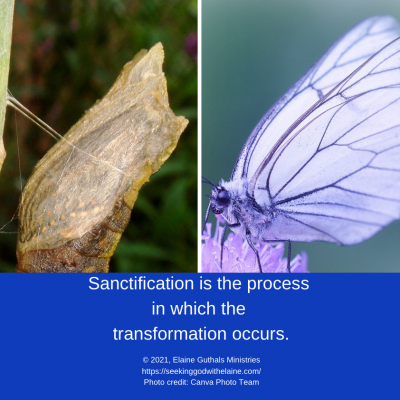
    Sanctification is the process in which the transformation occurs.

    Belfrage stated that we need to exhibit a “… spirit of active goodness, by a reference to many of its precepts, and by detailing the strenuous efforts of its genuine disciples to go on to perfection.”

    Resource

    Three words jump out at me there: active, many, and strenuous. Precepts are talking about the laws and commandments.

    Our salvation requires action on our part. Yes, there are many laws and commandments, but keeping them ensures we are changed to imitate God’s character. It will take strenuous effort to make the transformation.

    Spurgeon argued that this verse is talking about salvation future. This verse is all about eternal glory. The journey to get there started when we believed.

    Resource

    I think it is about both. You can’t have the eternal glory without the salvation. We get the eternal glory when we agree to salvation. They are inseparable.

    Salvation is nearer than we believe. I think that means judgement day is nearer than we think.

    But I also think that means our perfection is nearer than we think. We see ourselves through our failures and sins. We don’t see ourselves as God does.

    God sees our potential. He sees us how we will be in Heaven.

    McMichael listed four responsibilities disciples have. They are

    • “Our relation to God.
    • “Knowledge of salvation.
    • “Duties in our sphere of life.
    • “Influence we exert.”

    Resource

    We are responsible for ensuring our relationship with God is active and growing.

    We are responsible for ensuring our relationship with God is active and growing.

    Who Needs to Wake Up?

    “… it is already the hour for you to wake up from sleep …” (Rom. 13: 11 CSB)

    We must be actively pursuing our relationships with God.

    Parsons was under the impression that sleep referred to non-believers. They are ignorant or forgetful of spiritual things and their true character as made in God’s image. Indifference feeds that condition.

    Resource

    Parry disagreed in calling sleepers non-believers. He said only believers could sleep. Non-believers are dead.

    Resource

    Melvill thought Paul was speaking to active Christians, not non-believers. We could say this was a rally cry for them to change their ways.

    Well, Beeby did say that formalism is a type of delusion. A formalist is a person who gives the appearance of being a disciple, but in reality, isn’t.

    Resource

    We are deluding ourselves when we think that we can earn our way into salvation. We can’t just follow the rituals and give lip service to our relationship with God.

    We are also deluding ourselves if we are banking on our self-righteousness to save us. It won’t. Only Jesus will.

    What Melvill thought Paul was cautioning disciples about was we have to grow as we navigate the Sanctification Road. He wrote, “Spiritual slumber is not necessarily the folding up of every power and faculty, but the not developing them in the necessary degree.”

    Resource

    Melvill thought Paul was telling his readers that the end of the Sanctification Road is near — and you aren’t at the end. There was much more work to be done before perfection could be achieved.

    It could also be describing backsliders. Backsliding is when those who have made a profession of faith return to their sinful lives.

    Parsons equated it to those who have lost their first love. The pull of this world was too much for them.

    To read a related devotion, click on the appropriate button below.

    We know Paul did not shy away from telling people they were missing the boat. He was all about getting believers and non-believers alike into a right relationship with God. He could do that in different levels of strictness.

    Hammond noted that sleep can be caused by a false understanding of atonement and salvation. We aren’t going to understand everything, but what we do understand has to be accurate.

    Resource

    Hammond attributed this to moral weakness or a sinful habit. He stressed our need for self-control.

    When Is It Time?

    “Besides this, since you know the time, it is already the hour for you to wake up from sleep …” (Rom. 13: 11 CSB)

    Today is the day to accept and work on our salvation.

    It could be that Paul said it is nearer than we think is because some believe that Heaven begins here on earth. I know we talked about that once. I doubt I will be able to find which devotion that is in.

    Spurgeon said that true godliness makes us evaluate ourselves — puts the focus, in a sense, on us. It makes us determine if we are accomplishing our duties or not.

    But that looking at ourselves shows us our responsibilities to others. Paul had just been telling us about our duty to love others. We are to be our brother’s keeper.

    Spurgeon made a good point. He wrote, “Paul does not say, ‘If you do not wake you will be lost.’ He speaks in a gospel tone, ‘Now is your salvation nearer than when you believed.’

    Resource

    When we are asleep, it includes an element of unconsciousness. Parry said that sleeping disciples aren’t doing anything religious.

    Resource

    We say that time heals all wounds, but it does not destroy sin. As McMichael said, it doesn’t even take away the guilt. Only God can do that.

    Disciples are called to knowledge. Yes, we are on a lower pay grade than God is, so we won’t know everything.

    But we will be given wisdom. Wisdom is an enlightened acceptance of God’s principles that leads to knowledge, discernment, and good sense that is put into practice through salvation, increasing our goodness and virtue.

    We are to know in order to turn away from the night and enter the day. We are to awake and head toward the day.

    But that means we are to act.

    SubmittingToWakefulnessPin

    Making the Connections

    It is imperative that disciples be active — but not just working out our own salvation. Parsons wrote, “The wakefulness and diligence here summoned has respect not only to our own salvation, but also to the salvation of others. This must be, that the whole of Christian character may be developed, and that the whole of Christian duty may be performed.

    Resource

    We have to be actively pursuing our job description. We are called to preach and make disciples.

    The Disciple’s Job Description

    Complete Job Description

    Individual Description

    Job Duty #4
    Proclaim the Gospel (Mark 16: 15)

    Job Duty #6
    Make Disciples (Matthew 28: 19-20)

    For some, that is a big submission to Christ. We just don’t feel qualified to be labeled a preacher.

    Remember, in Ephesians, Paul combined preacher and teacher. We are all teachers in some form or another, so that makes us preachers.

    Melvill gave us some great words of encouragement. He wrote, “The only Scriptural certainty that a man will be saved is the certainty that he will struggle. Struggling is incipient salvation. It is an intenser struggle which marks a fuller possession. If, then, a man would show that his salvation is nearer, he must also show that he is more wakeful, more in earnest.”

    Resource

    The strong disciple is going to struggle greatly. It’s okay.

    The struggle is going to be worth it. As we grow through the struggles, we gain holiness. We need that holiness for entrance to Heaven.

    How Do We Apply This?

    • Don’t become careless in our walk with God.
    • Constantly work on the transformation to the character of God.
    • Meditate on Him.
    • Don’t sleep spiritually.
    • Show our gratitude to God.
    • Consider what carelessness and inactivity does to our witness.
    • Live so that death is not an urgent situation.
    • Actively prepare for Heaven.

    Resource

    Transforming to perfection is not an easy road. We make it easier by submitting to God.

    Father God. We submit to You, meaning we pledge to keep Your laws and commandments. Grow us as we navigate the Sanctification Road, so that we can be made perfect when You call us home. Amen.

    What do you think?

    Leave me a comment below (about this or anything else) or head over to my Facebook group for some interactive discussion.

    If you don’t understand something and would like further clarification, please contact me.

    If you have not signed up for the email daily or weekly providing the link to the devotions and the newsletter, do so below.

    If God has used this devotion to speak with you, consider sharing it on social media.

  • Submitting to Love

    Submitting to God should be made easy by love. This daily devotion looks at how, by loving others, we fulfill God’s laws and commandments.

    Nuggets

    • God calls us to submit our finances to Him and depend on Him.
    • Love is a debt we will always owe.
    • Love fulfills all the other commandments.

    To read devotions in the Redo for Godliness series, click the appropriate button below.

    Devotions in the Transformed to Perfection series

    In our transformation to perfection, we need to submit to God. To achieve perfection, we need to love.

    Paul talks about this in Romans 13. Let’s take a look.

    Let’s Put It into Context

    Here is a running list of what we’ve discussed previously.

    Submitting Our Finances to God

    “Do not owe anyone anything …” (Rom. 13: 8 CSB)

    God calls us to submit our finances to Him and depend on Him.

    The beginning of this verse has had differing interpretations. Chalmers said some interpret that as pay your debts while others interpret it as don’t get in debt at all.

    I can see don’t get into debt. If we are spending more than we are making, then we could be submitting to this world instead of God. Charters said it also shows our selfishness.

    For many people — me included — there are times that we have to go into debt. There is no way around it.

    God wants us to be good managers of our resources. So, I can also see the pay your bills on time.

    I think it all comes down to living as God wants us to live. We have to submit to Him.

    In my opinion, submitting means committing to live a sin-free life. That includes our finances.

    We want to focus on God, not on the world. We don’t want to submit to the worldview.

    One way we submit to the worldview is when we try to keep up with our neighbors. They get a new car – we get a new car. They remodel their house — we remodel our house. It feeds our pride.

    Why is this so important? Lyth wrote, “[Being in debt] robs the debtor of his independence, and not unfrequently (sic) of his moral principle.”

    Resource

    That could be read as our morals go out the door the more we get into debt. I can see where that could be an issue for some.

    As we get deeper and deeper in debt, we could feel that we are just buried in it. The desperation can lead us to make questionable choices.

    Charters gave us three words to help us when we do get into debt.

    • Diligence.
    • Frugality.
    • Exactness.

    Resource

    What Charters meant when he said exactness was do a budget. He also suggested punctuality was another way to be exact.

    Submitting to Loving One Another

    “Do not owe anyone anything, except to love one another, for the one who loves another has fulfilled the law” (Rom. 13: 8 CSB)

    Love is a debt we will always owe.

    But if we hook the second phrase onto the first, it changes the meaning all together. “Do not owe anyone anything, except to love one another …” (Rom. 13: 8 CSB).

    Lyth contended that we have to be honest with others. But love, he said, was even more than that.

    Resource

    Jesus said loving others was the second greatest commandment. Then He said, “All the Law and the Prophets hang on these two commandments” (Mt. 22: 40 NIV).

    Hambleton reminded us that we “… owe duties to every one, and these you are to fulfil. In every relationship of life you have dues to render, and all your various duties to man result from your supreme duty to God.” Loving others is the second greatest commandment because love should be universal and impartial.

    Resource

    Jesus has paid our debts to God. Therefore, we are to be spreading God’s love to others.

    We are never going to complete the commandment to love others. Regardless of our age and occupation, we will always be called on to go ye into whatever world God directs and tell of Him.

    Krotel took a scenic route. The way I read it is he didn’t limit this to disciples. He said everyone should love one another — even in the relationships we did not choose to enter into.

    As God is our Creator, all have a relationship with Him. We just need that relationship restored.

    Krotel explained, “In the preceding verses Paul speaks of the relation of the subject to the ruler; the citizen to the state. Our birth introduces us to the rights of citizenship, but we are born to duties just as much as to rights; and as long as we remain under the protection of the State, we are bound to render to Caesar the things that are Caesar’s, just as we are bound to render unto God the things that are God’s; and that, as Paul informs us, ‘for conscience’ sake.’ The debts we owe the State are just as binding as any debts we voluntarily contract. And these dues (ver. 7) lead Paul to speak of that greatest debt, loving one another.”

    Resource

    All are to love all.

    Submitting to the Commandments

    “The commandments, Do not commit adultery; do not murder; do not steal; do not covet; and any other commandment, are summed up by this commandment: Love your neighbor as yourself. Love does no wrong to a neighbor. Love, therefore, is the fulfillment of the law” (Rom. 13: 9-10 CSB)

    Love fulfills all the other commandments.

    That doesn’t mean that I show my love for people by working in a homeless shelter or serving on a soup line — so I don’t have to “… Go ye into all the world, and preach the gospel to every creature” (Mk. 16: 15 KJV).

    It means that, if love is the foundation of our actions, we will choose God’s way to fulfill the laws.

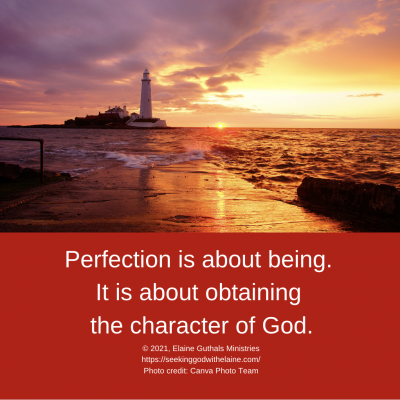
    Perfection is about being. It is about obtaining the character of God.

    It is more than just doing the acts of love. It is to have God’s character of love. It is about imitating God by being like Him.

    Lyth stated that we have to fulfill the law by both the letter and the spirit of it. Emmons said that both the spirit and the letter of the law is fulfilled because it comes out of a pure heart.

    Resource

    Jesus was asked to define who our neighbor was. Through the Parable of the Good Samaritan, He said anyone and everyone.

    To read a related devotion, click on the appropriate button below.

    Butler extended what is meant by loving our neighbor. He said it wasn’t just benevolence — compassion or goodwill. It was also “… seeking the good of others …”

    Way back at the beginning of the year we said that the two greatest commandments added together to form perfection. Butler said that the “… noblest form [of loving our neighbor] is the perfection of God.

    Resource

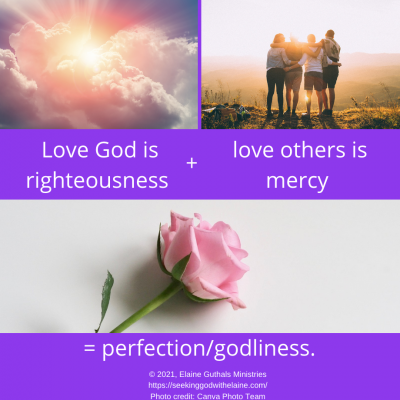
    Love God is righteousness + Love people is mercy = perfection/godliness

    Emmons wrote “If the moral perfection of man consists in conformity to the moral perfection of God, and the moral perfection of God consists in love, then love must be the fulfilling of the law.”

    Resource

    Emmons wrote “If the moral perfection of man consists in conformity to the moral perfection of God, and the moral perfection of God consists in love, then love must be the fulfilling of the law.”

    Resource

    Butter also explained what the as ourselves meant. He wrote, “That it is to bear a certain proportion to our love for ourselves. What this proportion is to be is not easily decided, for affection is not easily measured; but as to actions, the expression of affection, the more others occupy our thoughts the better, provided we neglect not ourselves.”

    Resource

    God is really wanting us to have an active love, not a passive one. Lyth said we do this by seeking the good of others in deed, word, and thought.

    I can see why love has to be active. Mellor said that it is the means of expression or the center of the law. The center has to be shown.

    Resource

    Lyth was right in saying that we need to take every opportunity to love others, which talks to consistency. It must be a sincere love, done to the best of our abilities.

    Resource

    We must make a conscious effort to love others.

    SubmittingToLovePin

    Making the Connections

    Okay, so the way I read what Krotel was saying was that love one another was a commandment all of God’s creations must follow — whether we are children of God or just made in His image.

    Glossary

    God expects us to live in an orderly, peaceful manner. He does want us to benefit from knowing Him.

    How Do We Apply This?

    • Don’t spend money we don’t have.
    • Don’t buy what we don’t need.
    • Don’t borrow money that we have no conceivable way to pay back.
    • Obey God.
    • Love all without qualification.

    Resource

    We are to submit to God through love. In doing so, we fulfill the laws and commandments.

    Father God. We love You. We want to show that love to others by sharing Your gospel message with them. Help us to be strong and secure in You. Amen.

    What do you think?

    Leave me a comment below (about this or anything else) or head over to my Facebook group for some interactive discussion.

    If you don’t understand something and would like further clarification, please contact me.

    If you have not signed up for the email daily or weekly providing the link to the devotions and the newsletter, do so below.

    If God has used this devotion to speak with you, consider sharing it on social media.

  • Submitting to Authority

    In order to transform from worldview people to being like God, we need to learn to submit. This daily devotional looks at our submitting to secular authority.

    Nuggets

    • God has a purpose for secular governments, so we should honor our leaders.
    • Disciples should not fear government leaders if they are following God’s laws and commandments.
    • Disciples are to pay the taxes they owe in order to support the government.

    To read devotions in the Redo for Godliness series, click the appropriate button below.

    Devotions in the Transformed to Perfection series

    Paul told his readers in several places that we should submit to governmental authority. “Remind them to be submissive to rulers and authorities, to be obedient, to be ready for every good work” (Ti. 3: 1 ESV).

    This admonition also occurred in Romans. It is in Romans Part II, the part where we are transforming to be like God.

    In a way, that seems strange. God is telling us to submit to someone else???? That seems a little out of character.

    The Homiletic Monthly contended that our transformation to perfection needs to be connected to our obedience to the government. Let’s dig into what Paul said.

    Let’s Put It into Context

    Here is a running list of what we’ve discussed previously.

    Following Our Secular Leaders

    “Let everyone submit to the governing authorities, since there is no authority except from God, and the authorities that exist are instituted by God. So then, the one who resists the authority is opposing God’s command, and those who oppose it will bring judgment on themselves” (Rom. 13: 1-2 CSB)

    God has a purpose for secular governments, so we should honor our leaders.

    Every nation has its rulers. In the Scriptures, according to Beveridge, those rulers had specific purposes.

    • To ensure that God is worshiped properly.
    • To maintain peace.
    • To impose judgment.

    Resource

    Paul said this is a directive to everyone. He doesn’t say only submit to good leaders. He doesn’t qualify that we have to believe what the leader’s agenda is in order to submit. He doesn’t limit it by ethnicity, race, or religious affiliation.

    In other words, God doesn’t give His people — or any of His creation — a pass from submitting to leaders.

    Glossary

    Lyth did make the statement that this “requires submission in all matters not affecting conscience.” Our submission to God supersedes our submission to leaders only when they are breaking God’s laws and commandments.

    Resource

    What, though, are we submitting to authority? The Homiletic Monthly said that it was our intellect, not a degraded submission.

    This is combining society with the national government. Tyson wrote that this organization helps us from threats from without our community and punishment for those who do wrong from within.

    Resource

    What I think Paul is saying here is the omnipotent God gave the leaders the power to rule. If He didn’t allow them to rule, He wouldn’t have given them the power.

    But Lyth and Sandys put a qualification on it. They said that it must be legitimate authority. That legitimacy has nothing to do with our agreement or disagreement with the leaders.

    Resource

    Whether the government is legitimate or not, the leaders are subject to God.

    It is easy to think that government rule is secular. Still, the Homiletic Monthly wrote, “While we approve not the perversions of depraved legislators — their intemperance, Sabbath desecration, profanity, luxury and ambition — we can, notwithstanding, hold ourselves in dignified yielding to normal law.”

    Resource

    We should respect our leaders. “Honor everyone. Love the brotherhood. Fear God. Honor the emperor” (II Pet. 2: 17 ESV).

    We shouldn’t talk bad about our leaders. “Even in your thoughts, do not curse the king, nor in your bedroom curse the rich, for a bird of the air will carry your voice, or some winged creature tell the matter” (Ecc. 10: 20 ESV).

    I think that there is a reason God wanted leaders to govern. God is not a God of chaos but of order. He wanted us to be organized.

    That thought makes what the Homiletic Monthly said make sense. They felt the application of this discussion is not submission to the secular government. It is all about submission to God.

    God wants to order and organize our lives so that we have the peace needed to worship Him. If we don’t have the peace governments are to provide for us, we won’t have the comfort to worship. That gives governments a divine purpose.

    God wants to order and organize our lives so that we have the peace needed to worship Him.

    Thomas said the leaders have a divine appointment — or they are ordained. Since God has given the heads of state the authority to rule over others, disciples should pray for them.

    Resource

    We have to obey God rather than man when there is conflict. When the rules mesh, we are to follow man’s rules.

    Resource

    Rogers made it clear that God is not advocating or approving a single type of government. He is saying that government should be formed for the good of the people.

    Resource

    We have to remember that this world is temporary, making secular governments temporary. We need to look to God’s government, which will be eternal.

    Doing What Is Right

    “For rulers are not a terror to good conduct, but to bad. Do you want to be unafraid of the one in authority? Do what is good, and you will have its approval. For it is God’s servant for your good. But if you do wrong, be afraid, because it does not carry the sword for no reason. For it is God’s servant, an avenger that brings wrath on the one who does wrong. Therefore, you must submit, not only because of wrath but also because of your conscience.  And for this reason you pay taxes, since the authorities are God’s servants, continually attending to these tasks” (Rom. 13: 3-6 CSB)

    Disciples should not fear government leaders if they are following God’s laws and commandments.

    Yes, wrongdoers should be punished. Disciples are called to be rightdoers. We should not fear punishment.

    But that flips the submitting to authority from submitting to something we don’t want to submitting to what is right. We should have no problem with that.

    Since it is submission to what is right, Thomas said that “‘the new commandment’ is the law of humanity; nothing can justify its violation.” God’s laws should not be broken for any reason.

    Resource

    One thing we have to remember, as Hoadley pointed out, is that being the leader — be it governor or King — does not elevate them above others to the point of servitude.

    Resource

    I think we can take this back to Paul’s discussion about the many parts of the body. All are needed for the body to work to its potential.To read a related devotion, click on the button below.

    To read a related devotion, click the button below.

    Paul said it again. “Therefore, you must submit …” (Rom. 13: 5 CSB). He does not leave any wiggle room. We must submit.

    What Paul is teaching us is obedience. That is an important response to God’s laws and commandments. We are called to do the do’s and not do the don’ts.

    If we can’t obey man’s laws, how are we going to obey God’s?

    The leaders have a responsibility here, too. They have to follow God’s Will.

    If they do not, we are to follow God.

    Sandys brought up the time of the judges. Those were dark times. Still, he argued that it would have been worse if there had been no leadership.

    Probably, our gut reaction to a leader we are questioning as “God’s minister” is to want to overthrow them or get them out of office. Maurice gave us a scenario of why we should rely on God’s judgment. He wrote,

    • “Nero’s will might be devilish; every power which he wielded was Divine. He had been appointed to rule the world which he tormented by Him who loved that world.”
    • “The effect of regarding Nero as a minister of God was, no doubt, to make them patient under his government, and afraid to engage in any mad schemes for subverting it. But this faith gave strength to their cries that the earth might be delivered from all her oppressors, assured them that those cries would not be in vain, and made them welcome their own sufferings as steps towards the redemption.”

    Resource

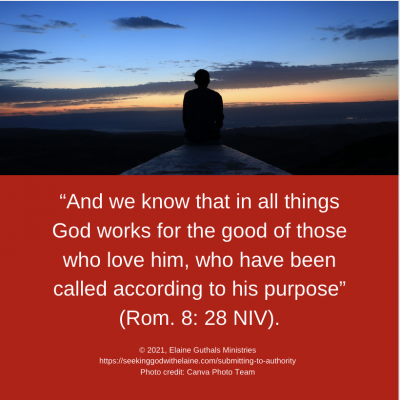
    So, they had a very bad leader, but they grew in their faith because of him. “And we know that in all things God works for the good of those who love him, who have been called according to his purpose” (Rom. 8: 28 NIV).

    All things — even what we consider the bad things.

    And we know that in all things God works for the good of those who love him, who have been called according to his purpose” (Rom. 8: 28 NIV).

    Paying Our Taxes

    “Pay your obligations to everyone: taxes to those you owe taxes, tolls to those you owe tolls, respect to those you owe respect, and honor to those you owe honor” (Rom. 13: 7 CSB)

    Disciples are to pay the taxes they owe in order to support the government.

    Governments cost money. They get that by taxing the citizens. Paul said we should pay our taxes.

    Jesus paid His taxes (Mt. 17: 24-27). Okay, most of us won’t find a fish with our tax money in it like He did. But, focus, He paid what He owed to the government.

    Sandys reminded us that “here, then, is forbidden everything that is disrespectful either in manner or language.” Even if we disagree with the politics of the leaders, God forbids us to scornful and contemptuous toward them.

    Resource

    Bottom line. We owe our leaders respect and honor. No qualifications.

    SubmittingToAuthorityPin

    Making the Connections

    Dalrymple argues that nations, as well as people, have a mission from God. I think Hall gave us what that mission is. Hall wrote, “Religion was designed to train us for heaven, not by unfitting us for the duties of earth, but by enabling us to perform them rightly. Religion would be an injury to the world if it withdrew the best men from it. True piety is nurtured and developed, not by avoiding any portion of our duties as men, but by diligently performing them.”

    Resource

    By performing our job within society, we are preparing ourselves for life in God’s kingdom.

    Kaye reminded us why we have societies. They are to benefit all of us. We find these benefits through mutual patience.

    Because of this, Kaye cautioned us that “our dislikes, then, should not prevent us from rendering due reverence to official dignity, as well as to rank, talent, and all true worth.” Governments have their mission and their purpose. We should respect our leaders.

    Resource

    We are to respect our leaders.

    How Do We Apply This?

    • Evaluate the government to determine if it is promoting good or evil. Good, in the biblical sense, is the workings of God within His people. Evil is equated with sin because it is that which goes against God and His purposes.
    • Remember that no government is infallible.
    • Have a concern for the public interest.
    • Have our worldly morals kicked up to social graces to support that public interest.
    • Promote peace and justice
    • Live a righteous example.

    Resource

    God has provided a framework through which we can find comfort. We should praise Him for this.

    Father God. We submit to those here on earth that You have placed in positions of authority. In doing so, we submit to Your Will. Help us to grow closer to You. Amen.

    What do you think?

    Leave me a comment below (about this or anything else) or head over to my Facebook group for some interactive discussion.

    If you don’t understand something and would like further clarification, please contact me.

    If you have not signed up for the email daily or weekly providing the link to the devotions and the newsletter, do so below.

    If God has used this devotion to speak with you, consider sharing it on social media.

  • Transformed to Good

    In Romans 12, Paul tells us that God wants us to transform into living sacrifices. This daily devotional looks at how we do that by transforming from evil to good through our interactions with others.

    Nuggets

    • Transforming from evil to good means we love each other, not seek vengeance.
    • Transforming from evil to good means our goal is to live peacefully with others.
    • Transforming from evil to good means we become more like God.

    To read devotions in the Redo for Godliness series, click the appropriate button below.

    Devotions in the Transformed to Perfection series

    Romans 12 is about what happens next after salvation. It is all about transforming ourselves from the sinner we were to the disciple we are supposed to be.

    In Scripture terms, that means we go from being evil to being good. When we are good, we are like God.

    Paul is still kind of giving bullet points, but it is a little more fleshed out. To me, it leads to the point – transforming from evil to good.

    Let’s Put It into Context #1

    Here is a running list of what we’ve discussed previously.

    Let’s Put It into Context #2

    • Good, in the biblical sense, is the workings of God within His people.
    • Evil is equated with sin because it is that which goes against God and His purposes.

    When Evil Happens to Us

    “Do not repay anyone evil for evil. Give careful thought to do what is honorable in everyone’s eyes” (Rom. 12: 17 CSB)

    Transforming from evil to good means we love each other, not seek vengeance.

    This verse is really a great Reverse Golden Rule. The Golden Rule says, “Just as you want others to do for you, do the same for them” (Lk. 6: 31 CSB).

    So, instead of “Do unto others as you would have them to do you,” it is “don’t do unto other as they do to you.” Our reactions are not based on their actions.

    Beveridge gave us a bunch of verses that addresses that.

    • “But I say, love your enemies! Pray for those who persecute you!” (Mt. 5: 44 NLT).
    • “This means one must not transgress against and take advantage of a brother or sister in this manner, because the Lord is an avenger of all these offenses, as we also previously told and warned you” (I Thess. 4: 6 CSB).
    • “They must not slander anyone and must avoid quarreling. Instead, they should be gentle and show true humility to everyone” (Ti. 3: 2 NLT).

    According to Beveridge, we also have a duty toward them.

    • “First of all, then, I urge that petitions, prayers, intercessions, and thanksgivings be made for everyone” (I Tim. 2: 1 CSB).
    • “Rejoice with those who rejoice; weep with those who weep” (Rom. 12: 15: CSB)
    • “Therefore, as we have opportunity, let us work for the good of all, especially for those who belong to the household of faith” Gal. 6: 10 CSB).

    Resource

    Lyth was right that, when we retaliate, we take our focus off God and try to do it all ourselves. He also said that retaliation is harmful to our moral development.

    Resource

    We really have to think about how other’s see us. This is important because this is our witness. We are witnessing to others without saying a word.

    Read the last part of the verse again. “… Give careful thought to do what is honorable in everyone’s eyes” (Rom. 12: 17 CSB).

    It doesn’t say be honest. It says what everyone thinks is honorable.

    I can get that. But I also have problems with that.

    I see it like Paul thought. “To the weak I became weak, to win the weak. I have become all things to all people so that by all possible means I might save some” (I Cor. 9: 22 NIV).

    We just have to be careful that we do not compromise God’s laws and commandments to placate worldview people. We have to use God’s definition of love instead of the worldview’s definition of tolerant love.

    A Peaceful Existence

    “If possible, as far as it depends on you, live at peace with everyone” (Rom. 12: 18 CSB)

    Transforming from evil to good means our goal is to live peacefully with others.

    Lyth noted we should maintain an upright, meek, and peaceable spirit. Meekness is a personality trait exhibiting a mild or moderate disposition that places dependence on God.

    That isn’t going to happen all the time. Satan is going to try to stir up trouble.

    Others can be difficult, even contentious. Lyth said that we cannot sacrifice our conscience to promote a false peace.

    Resource

    When Satan stirs up trouble, we have to leave everything in God’s hands. We have to let Him address the situation. We have to respond in the ways God would want us to respond.

    Lyth told us why it is important that we react to our enemies with kindness. He wrote, “You will thus achieve a noble conquest over evil in yourself, and subdue enmity by love.”

    Resource

    When we find ourselves in these situations, we need to exercise patience and wisdom. We can’t appease the worldview people.

    Evans gave us what our goal should be. He wrote, “… we should have a hearty love and value for peace as far as it may be obtained.

    Resource

    Evans admitted that we will not always reach this goal. Still, we are to “turn away from evil and do what is good; seek peace and pursue it” (Ps. 34: 14 CSB).

    Sometimes, life gets in the way. Sometimes, we can’t put the priority on peace. We can’t sacrifice our spiritual graces and holiness to promote peace.

    Evans gave us advice on how to live peacefully with those who are not God’s children. He wrote, “Setting aside the consideration of their religion or their virtuous character, we are obliged by the dictates of nature, and of Christianity too, to study peace with them as our fellow-creatures …”

    • “Give no offense to Jews or to Greeks or to the church of God” (I Cor. 0: 32 ESV).
    • “Know this, my beloved brothers: let every person be quick to hear, slow to speak, slow to anger” (Jas. 1: 19 ESV).

    One thing we have to watch is how we interpret the “if possible …” (Rom. 12: 18 CSB). We can’t use the if possible as an excuse. That doesn’t give us a pass to sin.

    Transforming from Evil to Good

    “Friends, do not avenge yourselves; instead, leave room for God’s wrath, because it is written, Vengeance belongs to me; I will repay, says the Lord. But If your enemy is hungry, feed him. If he is thirsty, give him something to drink. For in so doing you will be heaping fiery coals on his head. Do not be conquered by evil, but conquer evil with good” (Rom. 12: 19-21 CSB)

    Transforming from evil to good means we become more like God.

    Okay. Remember, we were just talking about living in peace with everyone. But there was a qualification of if possible.

    So, if it is not possible, vengeance is not ours. It can’t be.

    “The second [commandment] is, Love your neighbor as yourself. There is no other command greater than these.” (Mk. 12: 31 CSB).

    Love and vengeance are opposites. If we give in to the desire to seek vengeance, we are breaking the law of love.

    But it is more than that. “But I say to you, Love your enemies and pray for those who persecute you” (Mt. 5: 44 ESV).

    But it is even more than that. Look at verse 20. “But If your enemy is hungry, feed him. If he is thirsty, give him something to drink. For in so doing you will be heaping fiery coals on his head” (Rom. 12: 20 CSB).

    We can’t give lip service and say we love our enemies. We have to show it.

    Grant took it another way. He asked some really pointed questions.

    • What if we are wrong about something?
    • Are we trying to get revenge for something that was unintentional?
    • Are we trying to get revenge for something we actually started?
    • Are we starting a new offense?

    The answers to the questions, though, aren’t really important in the grand scheme of things. Grant wrote, “God alone is qualified to apportion the measure of retribution, because He alone has a full and exact view of the injury.”

    Resource

    Wrong or right, intentional or unintentional, we started or they started, new or old — vengeance isn’t on our pay grade. It is on God’s.

    We need to choose what is right and good in order to combat evil.

    • That means not repaying evil with evil.
    • It doesn’t even mean repaying good with good.
    • It definitely doesn’t mean repaying good with evil.
    • It means repaying evil with good.

    Resource

    Clark talked about sacrificing our passions. Remember we started this series talking about being living sacrifices.

    What Clark was talking about was giving up the evil and replacing it with good.

    Resource

    We need to figure out what we are going to do with good and evil. They are both here in this world. Thomas said “that the way to overcome evil is by the force of good.”

    Resource

    I love the last verse, “Do not be conquered by evil, but conquer evil with good” (Rom. 12: 21 CSB).

    We know that — in the end — evil will be conquered by good. That can happen now, too.

    TransformedToGoodPin

    Making the Connections

    When we are in the middle of a trial, we don’t want to sin by kicking back at God for giving us the trial. We grow as the trials teach us Who God is and what we have to change to be like Him. Beveridge wrote, “It is one of the noblest virtues of a Christian to live above injuries.”

    Resource

    Beecher said something else that got me thinking. He wrote, “Those who are called to teach unwelcome truths must make up their minds not to live peaceably. No man can preach the truth faithfully without offending men. Our Master could not do it. The apostles could not.”

    Resource

    So, applying this to me, if I am teaching the truth faithfully, I will offend some people.

    I have to. God’s ways make worldview people anything from uncomfortable to angry.

    But that turns around a worldview person’s statement that disciples need to keep peace with them by leaving them to do whatever they want.

    • Worldview people want to maintain their peace.
    • The gospel will destroy their worldly peace.
    • So, they tell us to not witness to them.
    • Godly peace is much better than worldly peace.

    How Do We Apply This?

    • Live in peace.
    • Don’t offend others.
    • Don’t take offense.
    • Control our tongues.
    • Watch our body language.
    • Look on the positive side.
    • Control our pride, selfishness, anger, hatred, and jealousy.
    • Sometimes, we may have to give up something that is rightfully ours to keep the peace.
    • Watch when we try to joke that we don’t make it offensive.
    • Don’t be a bully.
    • Don’t only find fault in others.
    • Lovingly tell others the hard truths.
    • Overcome evil with kindness.

    Resource

    It all boils down to the fact that we should try to do that which is good. We follow God’s ways. We are obedient to Him.

    We transform to be like Him.

    Father God. We do want to transform ourselves to be living sacrifices for You. While we are doing that on the Sanctification Road, You are perfecting us. Lord, we want to be like You. We want Your moral character. Help us to overcome evil so that we can be like You. Amen.

    The ABCDs of Salvation

    If you have not become a believer in Christ, please read through the
    Plan of Salvation and prayerfully consider what God is asking you to do.

    A – admit our sins
    B – believe His Son Jesus is our Redeemer
    C – confess God as Sovereign Lord

    D – demonstrate that commitment by making any changes needed in our lives to
    live the way in which God has called us

    The Disciple’s Job Description

    What do you think?

    Leave me a comment below (about this or anything else) or head over to my Facebook group for some interactive discussion.

    If you don’t understand something and would like further clarification, please contact me.

    If you have not signed up for the email daily or weekly providing the link to the devotions and the newsletter, do so below.

    If God has used this devotion to speak with you, consider sharing it on social media.
  • Transformed to Harmony

    God wants His children to be unified. This daily devotional looks at how disciples of Christ should love others, which shows itself in our humility.

    Nuggets

    • Disciples are to love one another, especially our brothers and sisters in Christ, so that we can support them when in their needs.
    • We are to rejoice with others in their joy and encourage them in their hardships.
    • Living in harmony with others allows for God’s love to shine through.

    To read devotions in the Redo for Godliness series, click the appropriate button below.

    Devotions in the Transformed to Perfection series

    Disciples should live in harmony with others. Spurgeon gave how we do that an interesting name. He wrote, “Those who are one in the higher life should show their holy unity by true fellow-feeling.”

    Resource

    I love that. Let’s dig in and see how we accomplish that.

    Let’s Put It into Context

    Here is a running list of what we’ve discussed previously.

    Bottom Line Is to Love Others

    “Share with the saints in their needs; pursue hospitality. Bless those who persecute you; bless and do not curse” (Rom. 12: 13-14 CSB)

    Disciples are to love one another, especially our brothers and sisters in Christ, so that we can support them when in their needs.

    I looked at the sermons under this verse, and I wondered how it was mainly talking about us completing the second commandment. When we add it to the first greatest commandment — loving God — disciples gain perfection.

    Glossary

    Love God is righteousness + Love people is mercy = perfection/godliness

    For disciples, our love for each other promotes the unity needed to complete our mission. “Complete my joy by being of the same mind, having the same love, being in full accord and of one mind” (Phil. 2: 2 ESV).

    Love Others

    “By this all people will know that you are my disciples, if you have love for one another” (Jn. 13: 35 ESV)

    Let’s look at Spurgeon’s term fellow-feeling. It gives us insight on how we are to love others.

    Fellow — The definition talks about being on an even plane. “For God does not show favoritism” (Rom. 2: 11 NIV). Dale put it this way: “All men are dear to the heart of God, and therefore they must be dear to us.”

    Resource

    Feeling — We have to get the emotions involved. It means that we have a sympathetic spirit.

    The emotions help us build the relationship with God. They also help us to become invested in the lives of those to whom we are witnessing.

    Love Our Enemies

    “But I say to you, Love your enemies and pray for those who persecute you” (Mt. 5: 44 ESV)

    Wait! What?

    Aren’t we supposed to condemn the bad guys? Surely, not love them!

    It is really hard to love those that are persecuting us. We like to think of persecute as oppressions and abuse — something that we did not do anything to warrant this type of action.

    But persecution is also punishment. We did something to cause this to happen to us.

    Tyson reminded that — sometimes — the persecutor is addressing what s/he feels is a wrong. However, it is up to God to judge our enemies, not us.

    It is our job to try to win them to God. We are to model God’s patience to them.

    God may have a very specific job for them to do. Look at Paul. He had been persecuting the church until God showed him how to use his character and drive to further His kingdom.

    How are they so helpful to God’s kingdom? Tyson wrote, “But the man who persecutes earnestly, feels strongly, and thinks vigorously; and when his violence has somewhat abated his wrath, and he begins to feel in what an unpleasant business he is engaged, he is almost sure to think of some other aspects of the question. The truth may then begin to scintillate within his soul, growing brighter as he pursues the meditation, till, by the grace of the Spirit of truth, his heart relents, his conscience begins its work of self-accusation, and he is won.”

    Resource

    Solomon reminded us that trying to persecute our enemies on our own will lead to harm. We’ve got to follow God’s Will, not our own.

    How do we bless our enemies? Solomon gave us a list.

    • Show appropriate pity.
    • Patiently deal with them.
    • Pray for them.
    • Pardon them — a.k.a. forgive them.
    • At times, support them in some financial way.

    Resource

    God wants us to be unified with others.

    Feeling the Feelings with Others

    “Rejoice with those who rejoice; weep with those who weep” (Rom. 12: 15 CSB).

    We are to rejoice with others in their joy and encourage them in their hardships.

    We can’t just think of ourselves and our own situations. It isn’t about our happiness and misery.

    We need to support and encourage others. In this way, we show them God.

    Abercrombie lists some things in which we can rejoice with others. He wrote, “Every conversion, every time of hallowed fellowship, every act of kindness, all tidings of good being done in any part of the world, fill his heart with joy.”

    Resource

    When we meet others where they are at and address what they are at the time, we build connections. These connections are built into relationships so that we can witness the love of God to others.

    The sympathetic spirit really comes into play here. Dale put it this way. He wrote, “We owe sympathy to other men because it is an effective means of contributing to their moral perfection, and because by withholding it we inflict on them grave moral inquiry.”

    Resource

    The great news is Dale told us sympathy can be developed. We have to be intentional in developing sympathy. Yes, that will take effort.

    Hughes noted, “All done to the distressed under its influence is done by love, hence it is both pleasurable and lasting.” The love means there is no discrimination because of race, ethnicity, or socioeconomic status.

    Resource

    We have to make it about other people so that we build opportunities to witness to them.

    Love Builds Harmony

    “Live in harmony with one another. Do not be proud; instead, associate with the humble. Do not be wise in your own estimation” (Rom. 12: 16 CSB) 

    Living in harmony with others allows for God’s love to shine through.

    One of the major themes in the Book of Ephesians is unity of the believers. That unity encompasses a lot of elements.

    “Therefore I, the prisoner in the Lord, urge you to walk worthy of the calling you have received, with all humility and gentleness, with patience, bearing with one another in love, making every effort to keep the unity of the Spirit through the bond of peace. There is one body and one Spirit — just as you were called to one hope at your calling — one Lord, one faith, one baptism, one God and Father of all, who is above all and through all and in all” (Eph. 4: 1-6 CSB).

    Having pride isn’t the way to go. God calls us to be humble.

    My Ladies and I talked today about pride wanting us to understand everything so that we can say we don’t need God since we have figured it out. That isn’t what God wants.

    God wants us to be humble and submissive to Him. The submissive part means that we don’t sin and give Him the glory He deserves.

    One thing Paul is saying here is we can’t think more highly of ourselves than we are. We have to acknowledge that, without a relationship with God, we are nothing.

    Lyth told us that this high opinion of ourselves presents itself in our opinions, judgment, and plans.

    Resource

    TransformedToHarmonyPin

    Making the Connections

    It is easy to love people when they are lovable — i.e. fit into our expectations and beliefs. Talmage wrote, “When our guests are cheery, and fascinating, and elegant, it is very easy to entertain them; but when we find in them that which is antagonistic to our taste and sentiment, it is a positive triumph when we can be ‘given to hospitality.’”

    Resource

    We need to love them anyway.

    How Do We Apply This?

    • Watch our reactions to those who believe differently than we do. God does not call us to judge them.
    • We should not attempt to control their feelings and actions, therefore, diminishing their joy.
    • See things from their angle.
    • Promote the joy of others by doing all within our means through our words and actions.
    • Make it part of our mission to help the needy and improve the distress of others.
    • Do the work God wants us to do, not what we want to do.
    • Treat all others the same.
    • Diligently seek God.
    • Study examples of faithful men and women.
    • Follow the promptings of the Holy Spirit.
    • Live in unity with others.

    Searching for and Seeking God

    Hearing His Word (Rom. 10: 17).
    Reading His Word (Rev. 1: 3).
    Praying to Him (Heb. 4: 16).
    Studying His Word (Ac. 17: 11).
    Meditating on His Word (Ps. 1: 1-2).
    Memorizing His Word (Ps. 119: 11).

    Resource

    We’ve gotten all the way through the devotion and haven’t really talked about how we are transformed to do that. I think the transformation comes in because the love and harmony we are talking about isn’t the worldly love and harmony.

    We are loving others in the name of the Heavenly Father. We are humble because we know we are nothing without God.

    This shifted focus is where the transformation comes in. But we want to shift to put God as our priority.

    Father God. We want to be like You. As You are love, we want to love others – even our enemies. Help us to be transformed to be like You. Amen.

    The ABCDs of Salvation

    If you have not become a believer in Christ, please read through the
    Plan of Salvation and prayerfully consider what God is asking you to do.

    A – admit our sins
    B – believe His Son Jesus is our Redeemer
    C – confess God as Sovereign Lord

    D – demonstrate that commitment by making any changes needed in our lives to
    live the way in which God has called us

    The Disciple’s Job Description

    What do you think?

    Leave me a comment below (about this or anything else) or head over to my Facebook group for some interactive discussion.

    If you don’t understand something and would like further clarification, please contact me.

    If you have not signed up for the email daily or weekly providing the link to the devotions and the newsletter, do so below.

    If God has used this devotion to speak with you, consider sharing it on social media.
  • Transformed through Trials

    Each of us grows through trials on the Sanctification Road. This daily devotional looks at the joy we have through hope, even in the hardest trials, by remaining in communication with God.

    Nuggets

    • Even in the trials, we can have joy because we have hope.
    • This joyous hope has an element of patience in all circumstances.
    • We should always pray to our Heavenly Father — especially when we are going through trials.

    To read devotions in the Redo for Godliness series, click the appropriate button below.

    Devotions in the Transformed to Perfection series

    This is Paul’s bullet point section of Romans 12. He just highlighted diligence and passion in service. Next, he highlighted hope, patience, and persistence.

    Let’s Put It into Context

    Here is a running list of what we’ve discussed previously.

    Joy Because We Have Hope

    “Rejoice in hope …” (Rom. 12: 12 CSB)

    Even in the trials, we can have joy because we have hope.

    The source of our joy is hope. Hope is a future expectation, called a living hope, based on the confidence that our names will be found in the book of life.

    Thomas called hope an “… instinct of the soul.” He contended that we gain hope when we make progress on the Sanctification Road. When we succeed in growing closer to being the disciples God calls us to be — even though the sanctification steps have included difficult trials — we use that as a springboard for future success.

    Resource

    When we hope, we are believing not only can something good happen, but it can also happen to us. We don’t try to make excuses that we aren’t worthy enough. We are worthy because we have accepted Jesus’ blood as a cover for our sins.

    Thomas said that this hope has to engage all of our being. Well, think about it.

    What if we hope there is a Heaven — but don’t think down in our hearts that there is one? That really isn’t hope — hope that brings us joy.

    Hope can only really come from moral goodness. That moral goodness comes from God.

    Why can we have hope in salvation?

    • Salvation is the gift of life through the deliverance from evil and the consequences of sins to replace them with good and eternal life.
    • The consequences of sin are spiritual death and physical separation from God.
    • Spiritual death is the spiritual separation from God that occurred as a consequence of Adam and Eve’s original sin. The spiritually alive are those who have ABCDed, so they are no longer separated from God.
    • Eternal life is the promise of living eternally – even if we have died in this life – because we have admitted our sins, believed Jesus as Savior and Redeemer, and confessed God as Sovereign Lord.

    The ABCDs of Salvation

    If you have not become a believer in Christ, please read through the
    Plan of Salvation and prayerfully consider what God is asking you to do.

    A – admit our sins
    B – believe His Son Jesus is our Redeemer
    C – confess God as Sovereign Lord

    D – demonstrate that commitment by making any changes needed in our lives to
    live the way in which God has called us

    The Disciple’s Job Description

    Glossary

    We can have hope in salvation because God not only provided the means for it, but He also made it so we could access it. God designed the Plan of Salvation so that Jesus’ death could pay the penalty for our sins.

    God brings this salvation to us by the Holy Spirit. He prompts us as we navigate the trials of life to show us God’s love.

    If we don’t accept God’s gift of salvation, we cannot have true hope and joy. Worldly hope and joy will prove to be fleeting. We must look to God as He is its source.

    If we don’t accept God’s gift of salvation, we cannot have true hope and joy.

    How to Get Through Trials

    “… be patient in affliction …” (Rom. 12: 12 CSB)

    This joyous hope has an element of patience in all circumstances.

    When trials are surrounding us, this hope helps us to not give up. It gives us patience to keep our eyes focused on God through it all.

    We show that focus by continuing to praise God — even in the worst of times.

    • “Why, my soul, are you so dejected? Why are you in such turmoil? Put your hope in God, for I will still praise him, my Savior and my God” (Ps. 42: 5 CSB)
    • “Be thankful in all circumstances, for this is God’s will for you who belong to Christ Jesus” (I Thess. 5: 18 NLT).

    I hear you. “But Chick, these trials are hard.” Yes, they are.

    Satan didn’t develop a brand new trial just for you. “Stand firm against him, and be strong in your faith. Remember that your family of believers all over the world is going through the same kind of suffering you are” (I Pet. 5: 9 NLT).

    Everyone. All over the world.

    No, this may not be talking about the minutiae of the trials. We are all individual people with unique experiences.

    But bottom line, each trial is asking the same questions. Are we going to remain strong in our faith, or are we going to deny God? Are we going to live by God’s laws and commandments or break them?

    Beveridge wrote, “By patience we change them [trials] into mercies as in Job, Joseph, David.” God has a plan and a purpose for these trials. This is how we grow on the Sanctification Road.

    Resource

    We can take heart, even in the hardest of trials. Whatever we suffer, Jesus suffered more.

    God delivered Jesus. He can deliver us.

    God delivered Jesus. He can deliver us.

    Keeping in Constant Touch with God

    “… be persistent in prayer” (Rom. 12: 12 CSB)

    We should always pray to our Heavenly Father — especially when we are going through trials.

    Prayer is a two-way communication with God in which we pour out our soul to Him. We can do this by saying the words out loud or in our hearts.

    Sometimes, I think that we feel like prayer is just a commandment that we can’t keep. We have to switch our mindset. Jortin wrote, “The Scriptures urge a constant and careful performance, then, not only as a duty, but a privilege.”

    Resource

    If it is a privilege, we need to be all in when we pray. Spurgeon wrote, “We must go with our whole soul to God or He will not accept us. We are to pray as if all depended upon our praying.”

    Resource

    Is that a new concept for us? God doesn’t have to accept our prayers. I think we sometimes keep the focus on He is a loving and forgiving God, so that we gloss over what isn’t right about our prayers.

    That means we can’t approach God with an attitude of entitlement. He doesn’t have to answer prayers that really aren’t prayers at all.

    If we go with the attitude of entitlement, it really isn’t a two-way communication with God. It is us demanding what we want regardless.

    When we pray to the Sovereign God, we must pray in meekness, worship, and submission.

    • “Abraham answered and said, ‘Behold, I have undertaken to speak to the Lord, I who am but dust and ashes’” (Gen. 18: 27 ESV).
    • “I prayed, “O my God, I am utterly ashamed; I blush to lift up my face to you. For our sins are piled higher than our heads, and our guilt has reached to the heavens” (Ezra 9: 6 NLT).

    Beveridge and Jortin gave us a list of what we should pray for in the right way.

    • Our lives for eternity.
    • What is good. Good, in the biblical sense, is the workings of God within His people.
    • Our faith to grow.
    • Growth in the spiritual graces.
    • The ability to recognize sin in our lives and deliverance from it.
    • Forgiveness from sin.
    • God’s constant renewal and sanctification
    • Direction for our daily lives.

    Praying with persistence means we aren’t done when we’ve finished the prayer. “But let him ask in faith, with no doubting, for the one who doubts is like a wave of the sea that is driven and tossed by the wind” (Jas. 1: 6 ESV). We need to meditate and do what God calls us to do to accomplish it.

    Still, Jortin called it an effort. I can see where it is hard. Satan is working on us to make sure we fail.

    I see it as the effort means that we make a conscious choice. We have to do something. That something is to always choose God.

    Howat gave a good description of what “pray without ceasing” (I Thess. 5: 17 ESV) means. He said that it isn’t talking about thinking or speaking a prayer. He contends that “… there are prayers that are not spoken or even thought of.”

    Howat argued that this means that our hearts should be right with God. It is the desire to do God’s Will at all times.

    Resource

    That makes sense. While we are in these physical bodies, we are not going to be able to “sin no more.” God isn’t going to judge us on something that there is no way for us to have success.

    We can put wanting to be like Him as our priority.

    We’ve said it isn’t about us doing. It is about us being.

    Perfection is about being. It is about obtaining the character of God.

    It is about our desire to be like God. It is our desire to grow.

    “Pray in the Spirit at all times and on every occasion. Stay alert and be persistent in your prayers for all believers everywhere” (Eph. 6: 18 NLT). Jarvis said we make praying a habit.

    I loved Jarvie’s phrase “The habitual maintenance of a prayerful spirit.” If it is a habit, it does take maintenance. We have to take advantage of the opportunities for prayer and make more opportunities.

    Resource

    Prayer gives us strength. We get that by ensuring our prayers have the components of faith, trust, hope, and love, according to Martin.

    Resource

    TransformedThroughTrialsPin

    Making the Connections

    We are going to have trials. But we can have hope as we go through them.

    • “Then why should we, mere humans, complain when we are punished for our sins?” (Lam. 3: 39 NLT).
    • “What has happened to us is a result of our evil deeds and our great guilt, and yet, our God, you have punished us less than our sins deserved and have given us a remnant like this” (Ezra 9: 13 NIV).

    God is punishing us for our wrongdoings, but He could have punished us so much more. His showing us mercy gives us hope.

    How Do We Apply This?

    • Practice patience.
    • Have a prayerful mindset. Jortin wrote, “We are taught that God is worshipped by the mind and thoughts, and not by external observances.”
    • Don’t miss an opportunity to pray.
    • Don’t give up when we don’t feel our prayers are being answered. (If God is saying no, give that up.)
    • Pray daily.
    • Focus on heavenly thoughts.
    • Worship God 24/7/365.
    • Pray both in private and in public. Neither should be skipped.

    Resource

    We should always expect an answer to our prayer. God can give us that for which we ask.

    Resource

    But that does not mean we will always get the answer we expect. Prayer isn’t a gum ball machine. We don’t put in the quarter and get the gum ball we want every time.

    We would generally not want trials to occur. We may question if that is really the way we grow on the Sanctification Road.

    It is.

    While we are going through the trials, we can have joy and hope. Communicating with God through prayer brings us that.

    Father God. We know that we will have trials. Lord, help us to strengthen our faith, trust, hope, and love. Increasing our hope in You increases our joy. Help us to remain in constant communication with You. Amen.

    What do you think?

    Leave me a comment below (about this or anything else) or head over to my Facebook group for some interactive discussion.

    If you don’t understand something and would like further clarification, please contact me.

    If you have not signed up for the email daily or weekly providing the link to the devotions and the newsletter, do so below.

    If God has used this devotion to speak with you, consider sharing it on social media.

  • Transformed by Persistence

    God calls us to be totally committed to Him. This daily devotional looks at how to respond to transforming our character to serve Him.

    Nuggets

    • In our passionate service for God, we need to exercise perseverance.
    • In our passionate service for God, we need to keep the intensity up for the work God has called us to do.
    • In our passionate service for God, we need to be completely committed to doing the work to which He has called us.

    To read devotions in the Redo for Godliness series, click the appropriate button below.

    Devotions in the Transformed to Perfection series

    When we commit our lives to God, He wants it to be a total commitment. He wants our intensity and passion to complete the service to which He calls us.

    Let’s Put It into Context #1

    Here is a running list of what we’ve discussed previously.

    Let’s Put It into Context #2

    We’ve talked before about the topic of persistence/diligence a couple of times. Diligence is a consistent, persistent effort.

    Devotions in the Moralities Lead to Godliness series

    Devotions in the Consistency Needed for Spiritual Growth series

    Transformed by Passion and Persistence

    “Do not lack diligence in zeal …” (Rom. 12: 11 CSB)

    In our passionate service for God, we need to exercise perseverance.

    In what should we be diligent? Bird identified that as “… everything which occupies our attention, but more particularly our temporal pursuits.

    Resource

    Personally, I don’t think it is more particularly applied to our temporal pursuits. God wants us focused on Him, not this life.

    We have to watch what our end goal is. Our goal shouldn’t be salvation. Our goal should be to become holy.

    Let me explain it this way. I graduated from my six-month secretarial program after I graduated from high school and went into the work force.

    After a year or so, I decided I wanted to go back to school to get my music degree. I was a success. I got my degree.

    I really haven’t done anything with it — job wise — because my end goal wasn’t to get a job. It was to get the degree.

    Our end goal shouldn’t be get obtain salvation/education. It should be to live for God/become holy/get a job.

    Tyson said that we become holy by displaying the spiritual graces in our lives. We talked recently where the worldly morals have to be kicked up to social graces that leads to holiness.

    If our morals don't come through submission to God, they are just worldly morals, not spiritual graces. But then we have to grow the spiritual graces to holiness.

    Devotions in the Moralities Lead to Godliness series

    Resource

    Building character takes a lot of work. Storrs noted that, while we perform the acts of integrity, our hearts are being changed to have integrity.

    Resource

    We should persevere to gain holiness. Garbett wrote, “It can only have its spring in a total change of heart and life, wrought in us by the mighty Spirit of God — in the gift of a new nature with its own spiritual senses and experiences.”

    Resource

    Moore reminded us that God expects us to be industrious. Melvill pointed out that Adam had a job to do before he was ejected from the Garden of Eden.

    Resource

    God has a plan for each of our lives, and we all have work to do to expand His kingdom.

    Morris had an interesting comment on that. He wrote, “God’s appointment does not interfere with our free agency, or release us from responsibility.”

    Resource

    Free agency goes by the name of free will in these devotions. Free will is the ability within us to make decisions, which determine actions that produce character.

    God has a plan for our lives, which includes how He wants us to serve Him. It is up to us to accept or reject that plan. If we reject it, there will be consequences because we have sinned.

    • Sins are actions by humans that disobey God and break one of His reasonable, holy, and righteous laws and commandments, goes against a purpose He has for us, or follows Satan’s promptings.
    • Holy means to be set apart, perfect, and morally pure while possessing all virtues.
    • Righteous means we are free from sin because we are following God’s moral laws.

    Morris also said that our secular work is subordinate to our work for God. We can’t let it take our focus off God. We can’t put Him on the shelf while we go about our daily lives.

    Why? Morris wrote, “A mind thus kept spiritual will be able to make some use of work for the purposes of the soul.” God is more concerned about the condition of our souls than our worldly pursuits.

    Resource

    Caird said what was important was how we perform worldly activities with a spiritual motive. Our morality is shown in our motives, not our actions.

    Our morality is shown in our motives, not our actions.

    Don’t get me wrong. There can be diligence for worldly pursuits. Tyson said it could come from pride, ambition, and selfishness. One name given it is climbing the corporate ladder.

    I like how Caird put it. He wrote, “Religion is a science and an art, a system of doctrines to be believed and a system of duties to be done.”

    Resource

    We don’t have to do anything for salvation except accept the gift. However, sanctification has aspects of being, doing, and suffering. The being is believing in the doctrines.

    Sanctification

    Transformed by Our Fervorous Response

    “… be fervent in the Spirit …” (Rom. 12: 11 CBS)

    In our passionate service for God, we need to keep the intensity up for the work God has called us to do.

    The zeal indicates a fervorous response to the work God calls us to do. We would call it enthusiasm, but I am not sure if that really conveys all we want to say.

    Our joy from being transformed as well as the the evidence of these changes must bubble out from us. Others have to see the changes that are occurring in us.

    The fervor manifests itself into a light that emanates from us. “In the same way, let your light shine before others, so that they may see your good works and give glory to your Father in heaven” (Mt. 5: 16 CSB).

    Fervor and zeal indicate an intensity. We have to be all in for God.

    • “Whatever your hands find to do, do with all your strength, because there is no work, planning, knowledge, or wisdom in Sheol where you are going” (Ecc. 9: 10 CSB).
    • “We must do the works of him who sent me while it is day. Night is coming when no one can work” (Jn. 9: 4 CSB).

    Why is it important that we be fervorous in spirit? Milligan said fervorous is the opposite of lukewarm.

    We don’t want to be lukewarm like the church at Laodicea. “I know all the things you do, that you are neither hot nor cold. I wish that you were one or the other! But since you are like lukewarm water, neither hot nor cold, I will spit you out of my mouth!” (Rev. 3: 15-16 NLT).

    How are we lukewarm? We say we are a disciple but try to rewrite the Scriptures to placate worldview people. We are a back row Baptist [or whatever your denomination is].

    I thought it was interesting that Logan said that a fervent piety “… is not so much a single virtue, as a constellation of virtues. Here reverence, gratitude, faith, hope, love, concentre their rays, and shine with united glory.”

    Piety is defined as the persistent application of moral virtues to our lives because of our supreme love for God. God wants us to completely submit to Him. That means all of the virtues that we possess must be up to His level.  

    Transformed by Service

    “…  serve the Lord” (Rom. 12: 11 CSB)

    In our passionate service for God, we need to be completely committed to doing the work to which He has called us.

    Okay, how did I do the Disciple’s Job Description, and not have serving the Lord as a job duty? Hmmm.

    Lyth said that serving the Lord meant that we are completely committed to His laws and commandments. It is our intent that He be glorified.

    Resource

    Sturgeon gave us essentials of serving God. We have to work in the service project that God has designated. We can’t go off and do our own thing, and expect God to sanction our work.

    Resource

    We not only have to not serve where God hasn’t called us, but we also have to serve God where He does call us. Yes, it might not be where or doing what we had in our plan, but God’s plan is best.

    TransformedToPersistencePin

    Making the Connections

    Did you see what Milligan said? He wrote, “Religion is not a matter of easy acquirement.”

    Resource

    Wait! What?

    Religion — a.k.a. our relationship with God — is a gift that we can either accept or reject. What is hard about that?

    Well, for some people, it can be a hard decision.

    Milligan also said that serving God has its difficulties as well. He described it as a pitched battle with the enemy between us and our reward.

    • Jeremiah 17: 9 says our hearts are deceitful.
    • We’ve got our human nature to fight.
    • Once we become children of God, we can expect the persecution.

    Oh, yeah. I see difficult now.

    It is difficult, but not impossible. Logan said that “piety is the foundation of virtue and morality.” We get there by the transformation of sanctification.

    Resource

    Our persistent application of moral virtues to our lives is the foundation of virtue and morality. Hmmmm. Kind of sounds like a circular definition, doesn’t it?

    But then again, I see it. The application of His moral virtues is the foundation of making our virtues and morality what He wants them to be.

    How Do We Apply This?

    • Pick the right objects to pursue — things God has in our plans.
    • When we do have to pursue worldly things in order to live, make sure God is always our #1 priority.
    • Ensure that our actions are motivated by spiritual graces and motives.
    • Watch our thoughts as they motivate our actions, also.
    • Surrender ourselves to God.
    • Find examples of saints in the Scriptures and in your world to see their fervor.
    • Wait in the Holy Spirit to call us to our mission field.
    • We each can serve God, even if we just pray and support those who are doing the actual work.

    Resource

    We have to remember that it isn’t the number of mountaintop encounters we experiences. It isn’t even about our weekly worship in His house.

    It is about diligently living for God each day.

    Father God. You call us to follow You 24/7/365. You don’t want us to follow You part of the time — only on the weekends — only when we are out. You call us to always —enthusiastically — serve You. Help us to do so. Help us to change our characters to be more like You. Amen.

    What do you think?

    Leave me a comment below (about this or anything else) or head over to my Facebook group for some interactive discussion.

    If you don’t understand something and would like further clarification, please contact me.

    If you have not signed up for the email daily or weekly providing the link to the devotions and the newsletter, do so below.

    If God has used this devotion to speak with you, consider sharing it on social media.