Blog

  • How Are Disciples of Christ to be Merciful to Others?

    If God calls us to be compassionate to others, how does that play out? This daily devotional looks at how we are to be compassionate to believers and non-believers alike.

    Nuggets

    • Disciples are to disciple others mercifully when they sin.
    • We should show mercy to all, regardless of how successful we believe they are.
    • We are to show mercy to those who are enduring persecution.
    • Disciples are to have compassion for the poor.
    • While caring for the sick does not earn us salvation, it shows we are imitating Christ because we are showing mercy.
    • God heals the broken heart, but at times, He uses us to help mend it.

    To read devotions in the Redo for Godliness series, click the appropriate button below.

    Devotions in the Being Merciful Leads to Godliness series

    Disciples of Christ are to be known by their compassion. Mercy should be appropriate to the situation with which the disciples of Christ are addressing.

    But what does that look like? Blair’s sermon gives us a clue as to some areas that apply.

    Resource

    Let’s Put It into Context

    God’s mercy is the unexpected way God responds in love to our needs. Disciples’ mercy is a characteristic of compassion for the needs of others, especially those who are in distress.

    I love Vaughan’s definition of mercy. He wrote, “‘Mercy’ is love to the weak, the unhappy, and the bad.”

    Resource

    How Do We Show Mercy to A Disciple Gone Astray?

    “My brothers and sisters, if any among you strays from the truth, and someone turns him back, let that person know that whoever turns a sinner from the error of his way will save his soul from death and cover a multitude of sins” (Jas. 5: 19-20 CSB)

    Disciples are to disciple others mercifully when they sin.

    Ooo, baby. Don’t we really get judgmental when another disciple sins?

    Oh, yes. Disciples still sin. Deems described it when he wrote, “All the wrongs in the universe begin by a wandering from the truth. This is so in every department of human thought, emotion, and action.”

    Resource

    For disciples, it usually is a small step in the wrong direction. The churchy term is backsliding. That gives a good visual of what occurs.

    It usually is a little compromise. We may think it is a small deviation. Finney called it a conscious decision to to the opposite of what God calls.

    Resource

    Then, it snowballs. We become entrenched in that sin.

    God wants us to support each other. That is especially true in our support of each other’s relationship with Him.

    God doesn’t want us to respond with pride. He wants us to respond with mercy.

    Parker reminded us that, when we are witnessing or discipling someone, we need to start where they are. We need to have a sensitivity when working with them.

    Resource

    We like to think our actions are our own. James debunks that theory. He contends that we should have mutual oversight with each other.

    Scary, isn’t that? We are to take care of the salvation of others. Manton described it as being their conscience.

    Resource

    It is difficult to speak with someone else regarding their sins. We are to do it with gentleness and love.

    Isn’t it wonderful that God doesn’t cut off disciples when we sin? He doesn’t give us one chance after conversion to get it right. He will keep forgiving us when we ask.

    To read a related devotion, click the button below.

    What James is really getting at is we are to be a brotherhood and sisterhood in Christ. This is to be part of our ministry.

    We are to be a brotherhood and sisterhood in Christ.

    Mercy Should Triumph Over Judgment

    “For judgment is without mercy to the one who has not shown mercy. Mercy triumphs over judgment” (Jas. 2: 13 CSB)

    We should show mercy to all, regardless of how successful we believe they are.

    What the first part of James 2 is talking about is showing favoritism. Isn’t it human nature to gravitate to those who are what we consider successful? It may be more than just the clothes that tell us this. Positions can cause us to be deferential.

    God doesn’t want us to do that. Adam wrote, “Everything is to be done in righteousness; and here is the only complete, infallible criterion of righteousness.”

    Resource

    Judgment without mercy is not showing them compassion. It is showing moral superiority.

    God doesn’t want us to think we are superior to others — or consider others superior to us. (Ooo, baby. A lot of people need to hear that today.)

    We are not to show favoritism. We are to obey the second greatest commandment.

    Remember what we said in the last devotion. Love God is righteousness + love others is mercy = perfection/godliness.

    Manton had an interesting take. He wrote, “The condition of men under the covenant of works is very miserable. They meet with justice without any temper of mercy.”

    Resource

    That is true. The covenant of works is Adam’s covenant. Mankind is miserable under it because we are in bondage to sin.

    We are to act in what James calls the law of liberty or the law of freedom. We are to submit to the covenant of grace.

    It is through God’s mercy and grace that we are offered the Plan of Salvation. If we do not accept God’s gift of salvation, He will judge us according to our sin.

    To read a related devotion, click the button below.

    Let’s take it another way. If mercy is love and judgment is condemnation, then it would read this way.

    For condemnation is without love to the one who has not shown love. Love triumphs over condemnation. God is love, and condemnation is sin.

    For sin is without God to the one who has not shown godliness. God triumphs over sin.

    I know that is stretching it — but it really isn’t. God will triumph over sin.

    Being Merciful to Those under Persecution

    “At that time the son born according to the flesh persecuted the son born by the power of the Spirit. It is the same now” (Gal. 4: 29 NIV)

    We are to show mercy to those who are enduring persecution.

    Just because we are disciples of Christ doesn’t mean we won’t be persecuted. Nowhere in Scriptures does it say we are going to have smooth sailing in this life.

    In fact, it says the opposite. “I have said these things to you, that in me you may have peace. In the world you will have tribulation. But take heart; I have overcome the world” (Jn. 16: 33 ESV).

    Jesus also said the trials would come in the form of persecution. “Remember the word that I said to you: ‘A servant is not greater than his master.’ If they persecuted me, they will also persecute you. If they kept my word, they will also keep yours” (Jn. 15: 20 ESV).

    Okay. Let’s back up a second. “If the world hates you, understand that it hated me before it hated you. If you were of the world, the world would love you as its own. However, because you are not of the world, but I have chosen you out of it, the world hates you” (Jn. 15: 18-19 ESV).

    Yes, non-believers will persecute disciples. Maclaren defined the world as “… in Christ’s language, … the aggregate of Godless men.”

    Resource

    No, disciples are still to react mercifully to their persecutors. We are to witness to them.

    Being Merciful to the Poor

    “He who despises his neighbor sins; But he who has mercy on the poor, happy is he” (Prov. 14: 21 NKJV)

    Disciples are to have compassion for the poor.

    We have talked in the past about the disciples’ responsibility to the poor. We said that we have to be concerned enough about the poor for action. God has a plan for our help for others, first helping our biological family. Instead of a brother being reduced to an alien, we have an alien elevated to the status of brother.

    To read a related devotion, click the button below.

    We are told to love our neighbors. There is no qualifier on that command. Their bank account does not play a role in how that should look.

    Being Merciful to the Sick

    “Then they also will answer, saying, ‘Lord, when did we see you hungry or thirsty or a stranger or naked or sick or in prison, and did not minister to you?’” (Mt. 25: 44 ESV)

    While caring for the sick does not earn us salvation, it shows we are imitating Christ because we are showing mercy.

    We’ve talked about this verse before in the context that caring for the sick does not earn us salvation. This is part of the sheep and goats passage. Only those who have ABCDed will be sheep on the right.


    Glossary

    The ABCDs of Salvation

    If you have not become a believer in Christ, please read through the
    Plan of Salvation and prayerfully consider what God is asking you to do.

    A – admit our sins
    B – believe His Son Jesus is our Redeemer
    C – confess God as Sovereign Lord

    D – demonstrate that commitment by making any changes needed in our lives to
    live the way in which God has called us

    The Disciple’s Job Description

    But that does not negate the fact that we are to be merciful to the sick.

    We are instructed to pray for the sick. “And the prayer of faith will save the one who is sick, and the Lord will raise him up. And if he has committed sins, he will be forgiven” (Jas. 5: 15 ESV).

    We are to help the injured. That was the whole point of the parable of the Good Samaritan.

    To read a related devotion, click the button below.

    We are to respond with compassion.

    Being Merciful to Those in Mourning

    “The LORD is near the brokenhearted; he saves those crushed in spirit” (Ps. 34: 18 CSB)

    God heals the broken heart, but at times, He uses us to help mend it.

    God is always close to us. Still, He uses us to comfort those who have lost loved ones.m

    We can do this because we feel for them. We may have experienced something similar to what they are going through.
    Screen Shot 2021-01-19 at 12.05.37 AM

    Making the Connections

    Being merciful to others is a way to show God’s love to them. That means we need to respond how He would respond.

    We are to love always. We are to provide care as need. We are to confront sin as needed.

    That is what godliness is, right? Being God-like.

    How Do We Apply This?

    We love others. Period. End of story.

    Father God. We want to love like You love. We want to be like You in every way. Amen.

    What do you think?

    Leave me a comment below (about this or anything else) or head over to my Facebook group for some interactive discussion.

    If you don’t understand something and would like further clarification, please contact me.

    If you have not signed up for the email daily or weekly providing the link to the devotions and the newsletter, do so below.

    If God has used this devotion to speak with you, consider sharing it on social media.

  • What Are Acts of Mercy?

    If our goal is godliness and being like God, then we need to be merciful. This daily devotional includes discussion of acts of consideration, compassion, prayer, and helpfulness.

    Nuggets

    • God considers how merciful we are when showing us mercy.
    • Disciples of Christ are to be known by their compassion.
    • Righteousness and mercy go hand in hand with prayer.
    • Mercy should be appropriate to the situation with which the disciples of Christ are addressing.

    Devotions in the Being Merciful Leads to Godliness series

    If you have read my devotionals before, you know I like to take outline sermons and dig deeper to see what they can tell us. Surprisingly, I haven’t found many that address godliness yet.

    I did run across one that discusses mercy. To me, being merciful is a big component of being godly.

    It is a sermon by Blair entitled Mercy. I am probably going to have to divide some of these, so it is going to be a little longer than I am originally planning.

    Resource

    Let’s Put It into Context

    God’s mercy is the unexpected way God responds in love to our needs. Disciples’ mercy is a characteristic of compassion for the needs of others, especially those who are in distress.

    Glossary

    To read a related devotion, click the button below.

    What Considerations Does God Have When He Shows Us Mercy?

    “With the merciful you show yourself merciful; with the blameless man you show yourself blameless” (Ps. 18: 25 ESV)

    God considers how merciful we are when showing us mercy.

    The very first sermon I looked at under this verse talked about poetic justice.

    Oh, yeah. I was scratching my head on that one.

    When we think poetic justice, we normally think vindication, not mercy. Retribution is another good word to describe it.

    The concept is we get what we deserve.

    Ooo, baby. That is the direct opposite of mercy. Mercy is, even though we deserve bad things as punishment, God doesn’t give them to us.

    But why do we have to only think of it in negative terms? Why can’t we look at the flip side?

    Look what Chadwick said. He wrote, “With the merciful God is merciful, and with the pure He is pure, and with the froward He is froward. Let us go beyond the physical world into the moral world.”

    Resource

    In a way, God does give us what we deserve. He structures things as we are.

    What did Jesus say? “Give, and it will be given to you; a good measure — pressed down, shaken together, and running over — will be poured into your lap. For with the measure you use, it will be measured back to you” (Lk. 6: 38 CSB).

    To read a related devotion, click the button below.

    We can’t expect to be froward — difficult to deal with — and receive mercy. Why would we demand He show us mercy if we weren’t merciful?

    Hmmm. Back up. We do that, sometimes, don’t we?

    We expect God to only give us the good things. We don’t want to be punished when we disobey Him.

    God loves us too much to let that happen.

    Think about this. Chadwick wrote, “Our idea of God is determined largely by our own character. The vision we have of God in the plain of the intellectual perception is a reflection of our own selves.” Service wrote, “… God shows Himself to every man according to what every man is.

    Resource

    I can see that. We look at things through the lens of our own experiences, knowledge, and opinions. He has to start where we are and grow us.

    We have to flip that. We really need to look at God as Who He is in Scriptures and as He reveals Himself to us.

    We shouldn’t limit God by our own understanding. We aren’t going to understand everything. “Trust in the LORD with all your heart, and do not lean on your own understanding” (Prov. 3: 5 ESV).

    If we are to grow in grace and knowledge (II Pet. 3: 18), that means we don’t know everything today.

    That means we haven’t gotten a full understanding of His mercy.

    I think we shouldn’t limit God on being merciful to just what we see. We are looking at the outside.

    God sees the inside. He also sees us through the blood of His son. He sees what we will be.

    God is more concerned about our spiritual condition than whether we have comfort in this life.

    God is more concerned about our spiritual condition than whether we have comfort in this life.

    How Is Compassion Tied to Mercy?

    “Put on then, as God’s chosen ones, holy and beloved, compassionate hearts, kindness, humility, meekness, and patience” (Col. 3: 12 ESV)

    Disciples of Christ are to be known by their compassion.

    When I did my hashtag search, among all the acts of mercy sections was an act of kindness. In fact, if we look at modern versions, most translate mercy as kindness, compassion, or love.

    I am not sure what I think about that.

    Part of me says, yes, the mercy must go hand in hand with compassion (plus the other two, but we are going to simplify it to compassion). How can we have the characteristic that shows we have pity and concern for the sufferings of others if we don’t have the pity and concern?

    Another part of me hopes that we are not changing the wording to get it out of the churchy word realm — and into the worldview realm. The worldview wants to distance us as far from God as we can.

    So, let’s go back to King James and see how he translated this. “Put on therefore, as the elect of God, holy and beloved, bowels of mercies, kindness, humbleness of mind, meekness, longsuffering” (Col. 3: 12 KJV).

    Oh, yeah. That is why I didn’t use this verse in the first place.

    Check out any term that you are unfamiliar with or on which you need a refresher. Barlow said that bowels of mercies was “… a phrase expressing the effect on the body of strong emotions of pity.” (Gee, how did I know you would need help on that one?)

    Resource

    Glossary

    To read a related devotion, click on the appropriate button below.

    What is really encouraging is Paul said that we can “put on” the compassion, kindness, humility, meekness, and patience. That makes it our choice.

    We can have compassion for others because of similar life experiences. Kindness is fueled by the desire to do good to others. Part of this fuel is our humility and our holding others in higher esteem than ourselves. Meekness and patience/longsuffering are related as both address self-control.

    Resource

    To read a related devotion, click on the appropriate button below.

    Gaining Mercy through Prayer

    “He that followeth after righteousness and mercy findeth life, righteousness, and honour” (Prov. 21: 21 KJV)

    Righteousness and mercy go hand in hand with prayer.

    Solomon said that pursuing righteousness and mercy produces life. Righteousness is the result of a solid relationship with God built by a sincere life of conscientious obedience to God’s laws and commandments.

    It does. Our attainment of righteousness assures us of eternal life.

    We can only get to a solid relationship with God through prayer.

    But look what it says. While we are pursuing righteousness, we should be pursuing mercy.

    I love what Mitchell said. He wrote, “At the Cross of Christ justice and mercy blend, righteousness and grace kiss each other.”

    Resource

    Did you see that? Solomon said we could pursue righteousness and mercy. Again, that is our choice.

    But do you see the connection to the greatest commandments? “‘And you shall love the Lord your God with all your heart and with all your soul and with all your mind and with all your strength.’ The second is this: ‘You shall love your neighbor as yourself.’ There is no other commandment greater than these” (Mk. 12: 30-31 ESV).

    • Love God = righteousness
    • Love others = mercy

    We can only get to that through prayer. Prayer is a two-way communication with God.

    We can’t get through the Sanctification Road to get to righteousness without God. We don’t access God if we don’t pray.

    Glossary

    To read a related devotion, click the button below.

    How Are Disciples to be Helpful When Showing Mercy?

    “if it is to encourage, then give encouragement; if it is giving, then give generously; if it is to lead, do it diligently; if it is to show mercy, do it cheerfully” (Rom. 12: 8 NIV)

    Mercy should be appropriate to the situation with which the disciples of Christ are addressing.

    We live in a complex world these days. People have so many things going on in which Satan is trying to pull them away from God.

    Disciples have to decide what they need at that specific moment. Do they need an encourager or leader? Do they need a tangible something — either time or money or something else?

    We need to have the compassion to determine what they need from us and how we can point them to God.

    This also is contingent on our being prepared. Is the relationship where it should be? Are we prepared to do what we need to do?

    Jesus said we should be cheerful when we are called on to show mercy. How many times does conflict occur because one of us takes something differently than another intended. That means presentation matters.

    Mould said that we need to be all in. He wrote, “What a beautiful illustration of the spirit of our religion, which seeks to bring our whole man, body as well as soul, our very looks as well as our words and actions, into captivity to the obedience of Christ!”

    Resource

    When we approach those whose need our mercy with cheerfulness, we give them what they need. We also show them how God’s provision brings joy.

    WhatAreActsOfMercy

    Making the Connections

    I don’t know about you, but the love God is righteousness + love others is mercy really got me. We need to finish the equation, though.

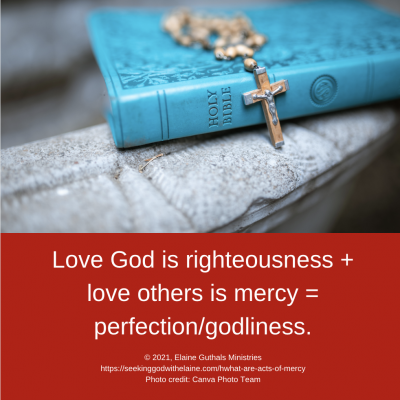
    Love God is righteousness + love others is mercy = perfection/godliness.

    Love God is righteousness + love others is mercy = perfection/godliness.

    How Do We Apply This?

    If we get to choose how we respond (and we do), we can choose to respond with compassion, kindness, humility, meekness, and patience.

    Jess called us to give. In his sermon, Lyth said we give because of “gratitude to God, self-denial, [and] goodwill to man.” He went on to say we do this with “a generous heart, a single eye, [and] a clean hand.”

    Resource

    This has to be a natural result of our salvation. Our mercy is one of the things that bubble out of us.

    Father God. We love You. Our goal is to be righteous and godly like You. Along with that, we need to be merciful to others. Help us to love others. Amen.

    What do you think?

    Leave me a comment below (about this or anything else) or head over to my Facebook group for some interactive discussion.

    If you don’t understand something and would like further clarification, please contact me.

    If you have not signed up for the email daily or weekly providing the link to the devotions and the newsletter, do so below.

    If God has used this devotion to speak with you, consider sharing it on social media.
  • Why Should We Love Our Enemies?

    Jesus made a radical statement when He said that we should love our enemies. This daily devotional looks at how disciples of Christ should take love to a higher level than the worldview.

    Nuggets

    • We are to love others, even those who do not love us — and show them that.
    • We can’t follow the worldview notion of loving those who love us as we are called to more.
    • We are called to be giving and forgiving, not judgmental.

    Devotions in the Luke’s Diagnosis and Prescription series

    In our Sunday Morning Bible Study, we are looking at Luke. At the end of chapter 6 of Luke, the illness discussed is conflict. Here we are looking at the diagnosis and prescription.

    Let’s Put It into Context

    If chapter 6 is all one big sermon, this passage is part of the Sermon on the Plain. This occurred during the beginning of Jesus’ ministry. Previous verses in the chapter give us the Beatitudes and some woes.

    Devotions in the The Beatitudes Show Us How to be Docile series

    Then Jesus has to go and turn things on its ear.

    What Does Loving Our Enemies Really Mean?

    “But I say to you who listen: Love your enemies, do what is good to those who hate you, bless those who curse you, pray for those who mistreat you. If anyone hits you on the cheek, offer the other also. And if anyone takes away your coat, don’t hold back your shirt either. Give to everyone who asks you, and from someone who takes your things, don’t ask for them back. Just as you want others to do for you, do the same for them” (Lk. 6: 27-31 CSB)

    We are to love others, even those who do not love us — and show them that.

    Oh, this is so much against human nature. Jesus tells us that, no matter how others treat us, we are to love them. Let’s unpack these verses and see what that means.

    I always get a chuckle out of the “are you listening” part. Yes, we all have ears, but not all of us really listen.

    But it is more than just listen. Are we listening to respond? Are we going to make that the moment of conversion? Are we going to totally reject the Gospel? Are we going to keep searching so we can make a decision at a later date?

    To read a related devotion, click the button below.

    Then we get to the love part. We know that the second greatest commandment is “… ‘You shall love your neighbor as yourself.’ There is no other commandment greater than these.” (Mk. 12: 31 ESV).

    There are three different ways that God loves us, according to Sproul.

    • Benevolent love
    • Beneficent love
    • Complacent love

    Resource

    The benevolent and beneficent love are directed to all mankind. That is God’s good will and the benefits of common grace.

    No, the complacent love does not follow the worldview definition that we have to be indifferent to people’s actions to show them love. Instead, it means God takes great pleasure or delight in us.

    This love is directed only to His elect.

    To read a related devotion, click on the appropriate button below.

    What Jesus is talking about here is we should love our enemies with a benevolent love. It is about forgiveness, not revenge.

    Isn’t that logical? Revenge and retaliation would be the work of Satan, not God. We don’t want to follow Satan.

    We aren’t to respond in sheer emotions. Instead, we are to respond with our Christian virtue. Bulgur noted, “But in benevolence towards enemies there is additional worth, peculiar grace, for it raises men’s minds, and exalts their affections to the sublimest pitch.”

    Resource

    Wait a minute.

    Doesn’t this contradict what the psalmist said? “Do I not hate those who hate you, Lord, and abhor those who are in rebellion against you? I have nothing but hatred for them; I count them my enemies” (Ps. 139: 21-22 NIV). We are to make sure we are not influenced by those who are rebelling against God.

    Whitley reminded us that loving our enemies does not mean we make them our new BFFs. Jesus wasn’t calling us to the worldview’s complacent love toward them. We aren’t called to approve of their actions. Boston called it loving the person, not the course they have chosen. He wrote, “Those who are not truly and properly our enemies, but in our account and reckoning only are enemies to us.”

    Resource

    Instead, we are to imitate Jesus. He responded in benevolent love. Instead of anger, we are to respond with meekness. Meekness is a personality trait exhibiting a mild or moderate disposition that places dependence on God.

    Glossary

    Remember, our job is to preach God’s gospel and make disciples to expand His kingdom. Spreading Satan’s evil is not going to present the Gospel in the appropriate manner.

    The Disciple’s Job Description

    Complete Job Description

    Individual Description

    Job Duty #4
    Proclaim the Gospel (Mark 16: 15)

    Job Duty #6
    Make Disciples (Matthew 28: 19-20)

    Beecher said that we must love others “in order that you may come into the family of God.” If we don’t love our enemies, we don’t have the Spirit of God in us. Paul said, “You, however, are not in the flesh, but in the Spirit, if indeed the Spirit of God lives in you. If anyone does not have the Spirit of Christ, he does not belong to him” (Rom. 8: 9 CSB).

    Resource

    Seed brought up an interesting point. He wrote, “The great law of nature is an universal, active benevolence to the whole body of rational beings, as far as the sphere of our power extends. We were all sent into the world to promote one another’s happiness, as being all children of the same Father, our Father which is in heaven.”

    Resource

    Seed’s point was that, regardless if we are children of God or just made in His image, we are brothers and sisters. We shouldn’t feel like we should only love those who have made a profession of faith.

    Glossary

    Devotions in the What Is Charity? series

    This section ends with the Golden Rule. We’ve talked about that before, but from Matthew’s Gospel.

    One of the big nuggets we got out of that study was that our responses have to be determined prior to the situations taking place. We have to choose to respond the way in which God wants.

    To read a related devotion, click the button below.

    I have to say this again. Worldview people skew this to read that disciples are supposed to let them think and do whatever they want.

    That definitely isn’t what Jesus said. Jesus expects us to follow God’s laws and commandments. God does not commanded us to let people disobey Him – we are to try to help them see His love for them. 

    Why Isn’t Loving Those Who Love Us Enough?

    “If you love those who love you, what credit is that to you? Even sinners love those who love them. If you do what is good to those who are good to you, what credit is that to you? Even sinners do that. And if you lend to those from whom you expect to receive, what credit is that to you? Even sinners lend to sinners to be repaid in full. But love your enemies, do what is good, and lend, expecting nothing in return. Then your reward will be great, and you will be children of the Most High. For he is gracious to the ungrateful and evil. Be merciful, just as your Father also is merciful” (Lk. 6: 32-36 CSB)

    Spurgeon reminded us that we can’t follow the worldview notion of loving those who love us. We are called to more.

    How Spurgeon explained this was by including an old saying. It goes, “Evil for good is devil-like, evil for evil is beast-like, good for good is man-like, good for evil is God-like.”

    Resource

    It is easy to love those that love us. The right atmosphere is cultivated to grow that love.

    What Jesus was talking about was our expectations. He’s not saying that we shouldn’t expect love to be the product of love.

    Jesus is saying love should be our default, regardless of other people’s actions toward us. Our response should be based on our relationship with Him, no one else. It is a product of Christian virtues.

    Devotions in the Christian Virtues series

    We should help those in need without expecting anything in return — here. We should expect our reward to in eternity.

    Robertson agreed that loving our enemies would not be easy — just as nothing on the Sanctification Road is going to be particularly easy. But he reminds us that “it is not conformity to a creed that is here required, but aspiration after a state.”

    Resource

    Glossary

    Yes, our goal is to be perfect. Not going to happen.

    The perfected state indicates the combination of the graces which, when all are present, form spiritual wholeness or completeness. That is only going to happen in Heaven.

    Glossary

    It is about our being obedient to God’s laws and commandments. We are in a relationship where we are to imitate God’s character because we are children of God.

    Glossary

    One way we are to imitate God is to be merciful. God’s mercy is the unexpected way God responds in love to our needs. Disciples’ mercy is a characteristic of compassion for the needs of others, especially those who are in distress.

    Wilmot-Buxton stressed that this has to come out in our actions, not our words. The best way of showing mercy is showing forgiveness.

    Resource

    Judging, Forgiving, and Giving

    “Do not judge, and you will not be judged. Do not condemn, and you will not be condemned. Forgive, and you will be forgiven. Give, and it will be given to you; a good measure — pressed down, shaken together, and running over — will be poured into your lap. For with the measure you use, it will be measured back to you” (Lk. 6: 37-38 CSB)

    We are called to be giving and forgiving, not judgmental.

    We’ve looked at verse 37 before as well as talked about judging others. Here are the nuggets.

    • We said that Jesus commanded His disciplines to love, not judge.
    • Unfortunately, we not only judge, but we also condemn.
    • Instead, Jesus calls us to forgive.
    • Jesus told His disciple to not be judgmental.
    • We all have sinned.
    • Being lenient in forgiving sin does not mean Jesus wants us to continue in sin.
    • We should be humble, not judging with conceit.
    • We shouldn’t judge those we perceive as weaker than us.
    • We shouldn’t compare ourselves with someone else.
    • We shouldn’t argue about what we believe. Lyth wrote than when we are rigid about trivial matters, we “do not understand the spirituality and liberty of the gospel.”
    • No one — me included — is going to get everything right all the time because we will never understand all of God’s ways (Isa. 55: 8-9).

    While we must concentrate on our own relationships with God, we are called to witness to others. One way we are expected to judge is whether we should witness to them or not. We are not to pass judgment on people, but we are supposed to determine if they are need direction in following God’s laws and commandments.

    To read a related devotion, click the appropriate button below.

    Sanderson gave us a good reminder. He wrote, “God has reserved three prerogatives royal to Himself — vengeance, glory, and judgment.” We don’t want to take over God’s job.

    Resource

    Instead of judging, we need to be forgiving. That goes hand in hand with the loving.

    Verse 38 could be used as evidence of the prosperity gospel. I think that would be taking the verse out of context.

    “Give, and it will be given to you …” (Lk. 6: 38 CSB) is saying, in my opinion, that our love, judgment, and forgiveness will determine how we are loved, judged, and forgiven. Also, when we receive, we are expected to give back.

    The last part is confusing: “… a good measure — pressed down, shaken together, and running over — will be poured into your lap. For with the measure you use, it will be measured back to you” (Lk. 6: 38 CSB).

    • Raleigh said that our giving has to be in proportion to our getting.
    • We don’t become covetous when we give back.
    • We can’t look at it as a duty — especially when we are asked to give all.
    • We give for one reason: God’s glory.
    • This isn’t just talking money; it is also talking of ourselves, our time, and our influence.
    • God tells us the character we should have, not how much we should give.
    • Our reward will be great, but we may not receive it in this lifetime.
    • Being children of God is a reward.
    • The “good measure” does not necessarily equate to men’s gratitude.

    Resource

    What we have to do here is keep our focus on God and eternal things. We shouldn’t be storing up treasure and rewards in this life.

    I know. That is hard. It goes against our human nature.

    We have to keep putting God first.

    WhyShouldWeLoveOurEnemiesPin

    Making the Connections

    If we respond to our enemies in anger and vengeance, we will escalate the hatred. If we respond in benevolent love, we show God’s love. That brings peace and tranquillity.

    That makes the world a much nicer place to live.

    How Do We Apply This?

    • We need to pray for our enemies.
    • We need to pray for ourselves.
    • We should have true pity — sorrow and compassion — toward our enemies.
    • We need only good toward our enemies.
    • We need to keep a lid on our bitterness, anger, and envy.

    Resource

    Father God. You ask us to imitate You to show others Who You are. Lord, sometimes that is hard. We know that You will provide us with the strength and ability to follow Your laws and commandments. Thank You. Amen.

    What do you think?

    Leave me a comment below (about this or anything else) or head over to my Facebook group for some interactive discussion.

    If you don’t understand something and would like further clarification, please contact me.

    If you have not signed up for the email daily or weekly providing the link to the devotions and the newsletter, do so below.

    If God has used this devotion to speak with you, consider sharing it on social media.
  • How Do We Cleanse and Purify to Submit to God?

    To submit to God, we need to cleanse our hands and purify our hearts. This daily devotional looks at how we cleanse and purify ourselves through humility.

    Nuggets

    • We cleanse our hands by confessing our sins and allowing the blood of Christ cleanse us.
    • We need to purify our hearts because that is where our character comes from.
    • We are not submitting to God when we focus on the joy of this world.
    • Our ability to submit hinges on our ability to humble ourselves.

    Devotions in the Approach to Knowing God series

    We ended our last devotion talking about Murray’s assertion that we can resist the devil because we are not forced to sin. What came next was Murray’s statement that said, “The thought that you can succeed in keeping your hand and heart clean is a constant inspiration to persevere.”

    Resource

    Isn’t that encouraging! Aren’t there so many times we feel we can’t resist the devil, so we aren’t clean? Let’s dig in.

    Let’s Put It into Context #1

    Godliness, equated with the Old Testament term fear of the Lord, is an attitude of reverence that is promoted by walking in His Spirit and obeying God’s laws and commandments and produces a moral likeness of God.

    Let’s Put It into Context #2

    Nuggets from the previous devotions in the series:

    • Knowing God is more than just thinking there is some Power Who created this universe.
    • We are to understand; but knowing God does not mean we will be able to understand everything.
    • We begin to know God when we diligently pursue knowing Him and doing His Will.
    • It is our duty to surrender our will to God by submitting to Him.
    • Some think that God requiring our obedience is a string to the gift, but it isn’t.
    • If submitting to God is required, why isn’t it easier to accomplish?
    • We resist the devil when we obey God’s laws and commandments.
    • We can only resist the devil through God’s power.
    • We are told God never leaves us, but we are to turn to Him.

    How Do We Cleanse Our Hands When We Submit to God?

    “… Cleanse your hands, you sinners, and purify your hearts, you double-minded” (Jas. 4: 8 ESV)

    We cleanse our hands by confessing our sins and allowing the blood of Christ cleanse us.

    No, this isn’t talking about washing our hands here. It is talking about being clean.

    • Cleanness has to do with the Israelites remaining holy.
    • Holy means to be set apart, perfect, and pure.
    • The perfected state indicates the combination of the graces which, when all are present, form spiritual wholeness or completeness.
    • Purity means we are without the stain of sin.

    Hmmm. We got from the cleanse to the purify.

    Well, there is a progression. “If we confess our sins, he is faithful and just to forgive us our sins and to cleanse us from all unrighteousness” (I Jn. 1: 9 ESV).

    It isn’t something we do on the outside, like washing our hands. It is the blood of Jesus washing our hearts to get the sin out of it.

    We have to make the decision to submit to God. Then He cleanses us from sin.

    We have to make the decision to submit to God. Then He cleanses us from sin.

    Let’s look at this another way. Yes, God is calling us to change. He isn’t in the business of fire insurance.

    God doesn’t want us to confess Him as Sovereign God and not gain His character. That isn’t submitting.

    God wants us to cut out the sin in our lives. We can’t hold on to our sinful ways and think God will give us salvation. Salvation is deliverance from evil and the consequences of sins to replace them with good and eternal life.

    Spurgeon put it this way. He wrote, “If you do the devil’s work with your hands, do not expect the Lord to fill them with His blessing.”

    Resource

    Ooo, baby. How many times do we do that? We expect God to take our lip service and ignore our clinging to our sins.

    We talked about the consequences of this before. We had a devotion entitled What Do You Mean All Disciples Won’t Get into Heaven?

    Scary, isn’t it?

    We said that, if we don’t put into practice God’s laws and commandments, we are going to show that we don’t think they are important enough to follow. We don’t think we have to submit to God and do them.

    To read a related devotion, click the button below.

    Instead, we are to genuinely ask forgiveness of our sins. Candlish wrote, “The sins we confess are so forgiven that we are cleansed from all unrighteousness with regard to them. The forgiveness is so free, so frank, so full, so unreserved, that it purges our bosom of all reserve, all reticence, all guile; in a word, ‘of all unrighteousness.’ And it is so because it is dispensed in faithfulness and righteousness; ‘He is faithful and just in forgiving our sins.’”

    Resource

    Elaine-speak. God doesn’t sorta forgive us of our sins. It isn’t just a surface forgive.

    God does a deep cleanse. It isn’t just part of them — it is all of them. It is such a deep cleans that it gets down to the sparkly clean of righteousness. Righteous means we are free from sin because we are following God’s moral laws.

    That means it is a true repentance. Repentance is acknowledging our separation from God and expressing sorrow for breaking God’s laws and commandments by making the commitment to changing ourselves through obedience so that we no longer do the wrong things.

    We not only ask forgiveness for our sins, but we also turn away from them. We give them up because we know they are breaking God’s laws and commandments.

    So, we submit to God’s laws and commandments.

    It is a deep clean. Not only our sins are purged, but also the guilt of our sins is washed away. Yeah, carting around that guilt can sometimes be just as bad as the initial sin.

    Not only our sins are purged, but also the guilt of our sins is washed away.

    How Do We Purify Our Hearts When We Submit to God?

    “… purify your hearts, you double-minded” (Jas. 4: 8 ESV)

    We need to purify our hearts because that is where our character comes from.

    Our heart is very important in our faith. The greatest commandment says, “And you shall love the Lord your God with all your heart and with all your soul and with all your mind and with all your strength” (Mk. 12: 30 ESV).

    Glossary

    Why is the heart so important that it was listed first? It was written in the Expository Discourses that “The fountainhead of all that enters into human history and character, is the heart.”

    Resource

    Jesus explained it this way. “And he said, “What comes out of a person is what defiles him. For from within, out of the heart of man, come evil thoughts, sexual immorality, theft, murder, adultery, coveting, wickedness, deceit, sensuality, envy, slander, pride, foolishness. All these evil things come from within, and they defile a person’” (Mk. 7: 20-23 ESV).

    Jesus was trying to tell the Pharisees that we can’t just make it a surface religion. Our faith has to lead to a relationship with God.

    A relationship with God has to lead to a change in our character. That is going to have a major impact on us.

    Ooo, baby. Why does Jesus mention this first? What harm does our thoughts do to anyone else? And isn’t that mind, not heart? Sadler wrote, “So that out of the heart, out of the unseen and unthinkable depths within, proceed the evil thoughts which become evil acts within before they are incarnated, as it were, in some evil deed without.”

    Resource

    The evil thoughts lead to evil actions.

    Covetousness is a greed for wealth and possessions. This greed makes the object into an idol. An idol is an object of worship in any form that takes from God the worship that is His due.

    Worshiping an idol means we are not submitting to God.

    Chamfort called covetousness a form of mental gluttony. We want an excess of honor, but we get there by selfishness

    Resource

    Non-believers are identified in Scriptures by the term wicked. That means they are sinful.

    We can’t have a double-mind. We can’t say we are a disciple but then choose to keep committing sins. That means we are trying to serve God and Satan.

    That doesn’t end well.

    Why Do We Want Our Laughter Turned into Mourning?

    “Be miserable and mourn and weep. Let your laughter be turned to mourning and your joy to gloom” (Jas. 4: 9 ESV)

    We are not submitting to God when we focus on the joy of this world.

    Whoa. Wait a second here. Isn’t it supposed to be the other way around. Aren’t we supposed to be sad and then get happy?

    This really isn’t talking about that. Remember when we were studying the Beatitudes, we asked why disciples were blessed if they mourned.

    To read a related devotion, click the button below.

    We said that, when we sin, we should mourn that we have broken God’s laws and commandments. True repentance means we are broken because we have sinned against God.

    That doesn’t lead to laughing and joy.

    We only purify our hearts when we get the sin out. We are not going to be fixing to get it out if it brings us warm, fuzzy feelings.

    Mouton wrote that the weeping moderates the joy. That brings us back to being sober and even-keeled, not jumping from one extreme to another.

    Resource

    Glossary

    How Do We Humble Ourselves When We Submit to God?

    “Humble yourselves before the Lord, and he will exalt you” (Jas. 4: 10 ESV)

    Our ability to submit hinges on our ability to humble ourselves. Humility is a character trait that diminishes pride and places dependence on God while holding a modest view of our importance with respect to others.

    Turnbull contends that the submission stems from the humility. You don’t start with submission and become humble. You start with the humble, that facilitates the submission.

    Resource

    Spurgeon put it this way. He wrote, “The right position of a Christian is to walk with lowly humility, before God, and with meekness towards his fellow-Christians.”

    Resource

    That is what Jesus was talking about when He said, “So the last shall be first, and the first last: for many be called, but few chosen” (Mt. 20: 16 KJV).

    To read a related devotion, click the button below.

    God doesn’t ask us to be humble to cut us down. He is asking us to put the correct emphasis on our worship to Him.

    HowDoWeCleanseAndPurityToSubmitToGodPin

    Making the Connections

    So, let’s put all of this together. The humble shall be rewarded because they are submitting to God. Those that are prideful won’t be rewarded.

    Salvation is given to those who are truly repentant and will submit to God. There may be some who have made a profession of faith but haven’t submitted. They will not enter Heaven.

    We cleanse and purify when we choose to submit. Submitting gets us to the purity, but choosing gets us to the submitting.

    How Do We Apply This?

    So, how do we keep clean and pure? Murray wrote, “Only ‘resist evil,’ only stand firm, only try, and whatever of good you in your better moments crave will come to you, and abide with you, as the light of the sun to-day comes to the earth, elicting its manifold fruitage, and illuminating it from pole to pole. Yea, your life shall be like a globe belted and zoned with expressions of life; and never shall there be an hour when some portion of it shall not be in flower and fruitfulness.”

    Resource

    Keep making the decisions to live for God. If you feel bombarded by Satan, do it one decision at a time. Don’t focus on all the decisions that Satan is having you make. Make one decision for God and celebrate it.

    What do I mean celebrate? I am talking about praising God for bringing you through.

    Use God bringing you through that decision to encourage you in the next decision. He always tells us to remember how He provided.

    Glossary

    Submitting is a choice. It unlocks many benefits. But our sins need to be forgiven so that we are clean and pure.

    Father God. Mankind brought sin into this world by disobeying You. In response, You designed the Plan of Salvation so that we could be forgiven if we submit ourselves to You. This plan includes our being cleansed and purified. That is only done through obedience to Your laws and commandments and resisting Satan. Help us to live for You. Amen.

    The ABCDs of Salvation

    If you have not become a believer in Christ, please read through the
    Plan of Salvation and prayerfully consider what God is asking you to do.

    A – admit our sins
    B – believe His Son Jesus is our Redeemer
    C – confess God as Sovereign Lord

    D – demonstrate that commitment by making any changes needed in our lives to
    live the way in which God has called us

    The Disciple’s Job Description

    What do you think?

    Leave me a comment below (about this or anything else) or head over to my Facebook group for some interactive discussion.

    If you don’t understand something and would like further clarification, please contact me.

    If you have not signed up for the email daily or weekly providing the link to the devotions and the newsletter, do so below.

    If God has used this devotion to speak with you, consider sharing it on social media.
  • How Are We to Submit to God?

    We submit to God by resisting the devil. This daily devotional looks at how we can resist Satan by drawing near to God.

    Nuggets

    • We resist the devil when we obey God’s laws and commandments.
    • We can only resist the devil through God’s power.
    • We are told God never leaves us, but we are to turn to Him.

    Devotions in the Approach to Knowing God series

    The last thing we talked about in the last devotion was why isn’t it easier to submit to God? We said it comes down to a choice.

    Spurgeon felt that, when we look at the big picture, the choice is obvious. He wrote, “Knowing as we do that all these things work together for our good, and that we never endure a [challenge] more than our heavenly Father knows to be needful, we are bound to submit ourselves cheerfully to all that He appoints.”

    Resource

    But how do we put words into action? James went on to tell us how to do that.

    Let’s Put It into Context #1

    Godliness, equated with the Old Testament term fear of the Lord, is an attitude of reverence that is promoted by walking in His Spirit and obeying God’s laws and commandments and produces a moral likeness of God.

    Let’s Put It into Context #2

    Nuggets from the previous devotions in the series:

    • Knowing God is more than just thinking there is some Power Who created this universe.
    • We are to understand; but knowing God does not mean we will be able to understand everything.
    • We begin to know God when we diligently pursue knowing Him and doing His Will.
    • It is our duty to surrender our will to God by submitting to Him.
    • Some think that God requiring our obedience is a string to the gift, but it isn’t.
    • If submitting to God is required, why isn’t it easier to accomplish?

    Let’s Put It into Context #3

    Who is Satan? We know Satan and the demons that followed him when he rebelled were cast out of heaven (Jude 1: 6).

    Satan does have some power. He can “inflame the evil desires of the soul.” We do now he is devious in his dealings with us.

    One thing about Satan is he doesn’t give up. He is a persistent devil, trying to get us to defy God.

    Griffin believed that Satan is jealous of mankind. He envies our happiness.

    I’m not totally convinced of that. I think he envies God more than is.

    We do know that Satan knows us well. He has had lots of practice in getting us to deny God.

    Resource

    Person of Interest

    We Submit to God by Resisting the Devil

    “Submit yourselves therefore to God. Resist the devil, and he will flee from you” (Jas. 4: 7 ESV)

    We resist the devil when we obey God’s laws and commandments.

    Satan is very good at trying to get us to disobey God’s laws and commandments. He is very crafty at devising challenges — that may or may not look like a challenge — to get us to not submit to God’s Will.

    We have to understand what God is asking us to do by reading His Word and listening to the promptings of the Holy Spirit. Then, we have to make the choice to do what He is telling us.

    What makes it a challenge Satan can use against us is when we expect the “… all things God works for the good of those who love him …” (Rom. 8: 28 NIV) to only be good things. Couple that with “… he will not allow you to be tempted beyond what you are able …” (I Cor. 10: 13 CSB), we expect smooth sailing to be the norm.

    But are we really submitting to God’s Will if it isn’t challenging us with something that isn’t our will?

    Are we really submitting to God’s Will if it isn’t challenging us with something that isn’t our will?


    Something Turnbull said got me thinking. He wrote, “Wherein we are taught whither all our strivings must tend, even to the withstanding of Satan, with whom we have continual war, and therefore ought we wholly to bend ourselves with all might against him.”

    Resource

    How many times does it cross our minds that we are in continual war with Satan? Some say God isn’t around because we can’t see Him. The same holds true for Satan.

    Think of it this way. We make many choices during the course of the day. Every time we make a choice that is counter to God’s Will, we haven’t resisted the devil.

    No, we may not feel Satan fighting for us to choose his option. But he is. “For we are not fighting against flesh-and-blood enemies, but against evil rulers and authorities of the unseen world, against mighty powers in this dark world, and against evil spirits in the heavenly places” (Eph. 6: 12 NLT).

    To read devotions in the Armor of God series, click the appropriate button below.

    To me, it goes back to the concept that salvation isn’t a one-time shot. Salvation is deliverance from evil and the consequences of sins to replace them with good and eternal life.

    Yes, upon conversion, we are changed from being spiritually dead to spiritually alive. Spiritual death is the separation from God that occurred as a consequence of Adam and Eve’s original sin. The spiritually alive are those who have ABCDed, so they are no longer separated from God.

    The ABCDs of Salvation

    If you have not become a believer in Christ, please read through the
    Plan of Salvation and prayerfully consider what God is asking you to do.

    A – admit our sins
    B – believe His Son Jesus is our Redeemer
    C – confess God as Sovereign Lord

    D – demonstrate that commitment by making any changes needed in our lives to
    live the way in which God has called us

    The Disciple’s Job Description

    But then we have to work out our salvation on the Sanctification Road. We have to go from being milk babies to steak adults. We have to be perfected.

    Sanctification is the transformation of mind, body, and soul, which begins with regeneration, gradually changes our nature through the promptings of the Holy Spirit, and ends with perfected state of spiritual wholeness or completeness. Regeneration is the change in us that God brings about when we go from being spiritually dead to spiritually alive.

    Glossary

    One way Satan gets us to not submit to God is to make us content with sin. Spurgeon said that we are to “… resist the secret spirit of evil as well as its outward acts.”

    Resource

    It isn’t just what we do. It is what we think.

    I don’t know about you, but lately Satan has been throwing a lot of challenging thoughts into my mind. I don’t know how many times I’ve stopped myself and said, “God, I choose to submit to You. Get these thoughts out of my head, please.”

    Bottom line is we can’t be passive in our salvation. We have to fight to stay in God’s Will.

    No, it isn’t going to be easy. Satan is all around us in our souls and in society. That means inside and outside are under attack. We have to strap on God’s armor and fight.

    Resource

    Can We Really Resist the Devil?

    We can only resist the devil through God’s power.

    Let’s go at this from another way. There was a study done that said people — even disciples of Christ — do not believe that Satan is real.

    How can we say Satan is not real when James point blank tells us to “… resist the devil …” (Jas. 4: 7 ESV)?

    We believe that God does not lie.

    • In hope of eternal life, which God, who never lies, promised before the ages began” (Ti. 1: 2 ESV).
    • God is not man, that he should lie, or a son of man, that he should change his mind. Has he said, and will he not do it? Or has he spoken, and will he not fulfill it?” (Num. 23: 19 ESV).

    God supervised the writing of Scriptures. “All Scripture is inspired by God and is profitable for teaching, for rebuking, for correcting, for training in righteousness” (II Tim. 3: 16 CSB).

    The New Living Translation expands on that to show us what is meant. “All Scripture is inspired by God and is useful to teach us what is true and to make us realize what is wrong in our lives. It corrects us when we are wrong and teaches us to do what is right” (II Tim. 3: 16 NLT).

    So, if we know God cannot lie and we know that God inspired the Scriptures, that means we can believe it when we say we can resist the devil.

    There is another reason why we can resist the devil. Murray wrote, “No one is compelled to sin.” We are not forced to do wrong.

    Resource

    It is our choice to submit to God or not resist the devil. Murray said that this leads to “… the hopefulness of morality.” Morality is the principles that inform the behavior — the virtue.

    That leads into our discussion for the next devotion.

    It is our choice to submit to God or not resist the devil.

    We Submit to God by Drawing Near to Him

    “Draw near to God, and he will draw near to you …” (Jas. 4: 8 ESV)

    We are told God never leaves us, but we are to turn to Him.

    Okay, how are we supposed to draw near to Someone Who isn’t really here? God is a spirit, not a physical being.

    Spurgeon said one of the ways of drawing near to God is to be obedient. It means we have to be actively seeking Him.

    Resource

    Searching for and Seeking God

    Hearing His Word (Rom. 10: 17).
    Reading His Word (Rev. 1: 3).
    Praying to Him (Heb. 4: 16).
    Studying His Word (Ac. 17: 11).
    Meditating on His Word (Ps. 1: 1-2).
    Memorizing His Word (Ps. 119: 11).

    Drawing near to God means we don’t bombard Him with questions so that we understand everything completely. It is putting all circumstances into God’s hands and going with the flow.

    We do this by opening our hearts to God.

    HowAreWeToSubmitToGodPin

    Making the Connections

    Shape warned us about playing around with sin. We can’t find ways to say that God condones it. We can’t assert that we will only try it out once.

    We need to shut sin and the devil down the first time. We can’t toy with sin, thinking we can decide when and how often we sin — and how we can turn it off.

    We have to realize we are always susceptible to Satan’s temptations. That is why we need God’s power to help us resist the devil.

    How Do We Apply This?

    So, how to we submit to God? We need to:

    • Grow in faith and knowledge (II Pet. 3: 18).
    • Increase our prayer life.
    • Study God’s Word to find God’s character through virtues and godliness.
    • Follow God’s laws and commandments, not try to rewrite them.
    • Follow the promptings of the Holy Spirit.
    • Strap on the armor and fight as He directs.
    • Find like-minded believers to encourage us in our trials.
    • Have a sober disposition
    • Always be watching
    • Remember and utilize past experiences to prepare and encourage us for current trials.
    • Fight Satan — or we will die.

    Resource

    We have to always remember that Satan has already lost the war. There still may be pitched battles, but God will be victorious in the end.

    We need to submit to the Winner.

    Father God. We submit to You. Strengthen us so that we can resist the devil. We pray that we choose You every time. Forgive us when we don’t. Amen.

    What do you think?

    Leave me a comment below (about this or anything else) or head over to my Facebook group for some interactive discussion.

    If you don’t understand something and would like further clarification, please contact me.

    If you have not signed up for the email daily or weekly providing the link to the devotions and the newsletter, do so below.

    If God has used this devotion to speak with you, consider sharing it on social media.

  • Surrendering Our Will to God

    In order to know God, we must submit our will to Him. That is difficult for us to do, though. This daily devotional looks at why we should submit to God and why we don’t.

    Nuggets

    • It is our duty to surrender our will to God by submitting to Him.
    • Some think that God requiring our obedience is a string to the gift, but it isn’t.
    • If submitting to God is required, why isn’t it easier to accomplish?

    Devotions in the Approach to Knowing God series

    I have been thinking about doing a devotion on this topic for a while. Let’s face it. We don’t like the concept.

    Surrender. Submit.

    Oh, yeah. This is going to be a big topic, so we may be roosting here for a couple of devotions. Besides, God is taking me on a whole different path than originally planned.

    So, buckle in. God is in control.

    I know. We like to be in control. We don’t like people telling us what to do or not do. We don’t like someone else calling the shots.

    But here comes God.

    Let’s Put It into Context #1

    Godliness, equated with the Old Testament term fear of the Lord, is an attitude of reverence that is promoted by walking in His Spirit and obeying God’s laws and commandments and produces a moral likeness of God.

    Let’s Put It into Context #2

    Nuggets from the previous devotions in the series:

    • Knowing God is more than just thinking there is some Power Who created this universe.
    • We are to understand; but knowing God does not mean we will be able to understand everything.
    • We begin to know God when we diligently pursue knowing Him and doing His Will.

    Why Should We Submit to God?

    “Submit yourselves therefore to God. Resist the devil, and he will flee from you” (Jas. 4: 7 ESV)

    It is our duty to surrender our will to God by submitting to Him.

    Why must we submit to God? He is worthy of our worship. This is, Patterson noted, because of “… His rightful supremacy, His unerring wisdom, His unsullied justice, His irresistible power, His generous love, and His unswerving faithfulness, alike to the threatenings and the promises which He addresses to His creatures.”

    Even though Sovereign God is supreme, He care about those He would have submit to Him. Patterson also wrote, “In dealing with men as sinners, the offended, but most merciful, Majesty of heaven has proposed certain terms as those on which alone He will receive any guilty soul into peace and favour with Himself.”

    Resource

    There is only one way to God. “Jesus answered, ‘I am the way and the truth and the life. No one comes to the Father except through me’” (Jn. 14: 6 NIV).

    Salvation is a gift. Salvation is deliverance from evil and the consequences of sins to replace them with good and eternal life.

    Oh, I know. We have a hard time accepting gifts. We can usually overcome that for Christmas and birthdays.

    But to have someone give us a gift just because? And a but-we-don’t-deserve-this-expensive-gift at that?!?

    The gift of salvation is a very expensive gift! The price was Jesus’ life.

    No, we don’t deserve the gift of salvation. But God wants to give it to us because of His grace and mercy. Grace is a free and unmerited gift from Heavenly Father given through His Son, Jesus Christ that enables salvation and spiritual healing to believers by the work of the Holy Spirit. God’s mercy is the unexpected way God responds in love to our needs.

    We tell ourselves that salvation shouldn’t be free. We convince ourselves that we need to clean up our acts because we are so unworthy of the gift.

    Yes, we are unworthy. No, there is nothing we can do to make us worthy.

    All we can do is accept this wonderful gift of salvation.

    Yes, we are unworthy. No, there is nothing we can do to make us worthy. All we can do is accept this wonderful gift of salvation.

    Then, Why Don’t We Want to Submit to God?

    Some think that God requiring our obedience is a string to the gift. It isn’t.

    We like to think that gifts should have no strings attached. And we see the requirement of submission as a very big string.

    We just don’t fully get it. God is Sovereign God, Who made us. It is on His timetable that we leave this life.

    That gives him the authority to be in control. He calls the shots.

    Part of the problem is we want to be our own master. That was what the original sin was all about, isn’t it? Adam and Eve wanted to be able to choose what they could and could not do. They also wanted the wisdom they thought this fruit could give them.

    Glossary

    Spurgeon gave us a list of things that keep us from submitting to God. He wrote, “… lusting, envy, strife, contention, jealousy, anger, all these things declare that the heart is not submissive, but remains violently self-willed and rebellious. Those who are still wrathful, proud, contentious, and selfish, are evidently unsubdued.” Spurgeon reminded us that we will not be given salvation if we do not submit.

    Resource

    Hunter said that our salvation must be built on our acceptance of God’s truths. It doesn’t matter that we don’t fully understand everything.

    Resource

    Ouch. What about all those who want to rewrite Scriptures? We don’t like this being classified as a sin, so we want God to change His mind about it being Evil.

    That isn’t submission, guys. That isn’t respecting the Sovereign God.

    That is wanting our way, not God’s.

    God isn’t going to accept that. Scott addressed this. He wrote, “We may object; we may try to find excuses for disobedience, but till we thus unreservedly submit to God, He will treat us as rebels against His authority.

    Resource

    When we do sin, we don’t want to get caught. We really don’t want to get punished.

    That, too, is not submitting to the Will of God. We want to be able to do what we want to do with no consequences.

    Doesn’t. Work. That. Way.

    Why is submitting to God so hard? Adam wrote, “The natural heart rebels against a gratuitous justification, against the renunciation of every personal claim, and the acceptance of a salvation for which we are wholly indebted to the mercy of God and the merit of Jesus.”

    Resource

    Why Isn’t It Easier to Submit?

    If submitting to God is required, why isn’t it easier to accomplish?

    Whoa. I have to think about this sentence. Hunter wrote, “There is no truth clearer to the thoughtful mind than this, that nothing can be beyond the notice or the power of God; and yet there is no truth less practically received by a large part of mankind.”

    Resource

    We keep saying it is hard to understand God. The His-ways-are-higher-than-ours verses (Isa. 55: 8-9) seem to back that up.

    Even the definition of faith talks about believing without fully understanding. Faith is the conviction that the doctrines revealed in God’s Word are true, even if we do not understand all aspects of them, a belief which impacts our lives.

    But what Hunter is saying it is crystal clear that God is in charge. Nothing slips by His observation. There is nothing that is out of the scope of His power.

    We know that because of the omnis: Omnipotent means God is all-powerful. Omniscience means God is all-knowing.

    To read a related devotion, click on the appropriate button below.

    I think that God’s all-knowing and all-powerful is very clear to believers. We have experienced it.

    It isn’t clear to non-believers because they haven’t experienced it.

    It comes down to being our choice. Are we going to trust God enough to put everything in His hands and control?

    We have to trust the one to whom we are submitting. That one is Sovereign God.

    Why can we trust Him? He designed the Plan of Salvation to restore our relationships with Him.

    God took the initiative. God planned it all out. God ponied up the sacrifice.

    Why do we see submission to Someone Who would do all of that for us wrong?

    We are to unconditionally surrender to whatever God has for us in our plan. Spurgeon wrote, “Knowing as we do that all these things work together for our good, and that we never endure a smart more than our heavenly Father knows to be needful, we are bound to submit ourselves cheerfully to all that He appoints. Though no trial for the present is joyous, but grievous, yet ought we to resign ourselves to it because of its after results.”

    In what are we supposed to submit ourselves to God? In all things.

    • When our wonderful job is taken away from us.
    • When our beloved person is no longer around.
    • When things don’t turn out the way we planned.
    UnconditionallySurrender

    Making the Connections

    Manton wrote that we need to submit all three of our hearts to God: our carnal heart, our proud heart, and our revolting heart. If we see sin as sin, it is easier to submit our carnal hearts to His holiness.

    Submitting our proud hearts to His mercy is going to take a little more work. As insecure as we are, we usually do have a significant amount of pride.

    It is our revolting hearts that is the hardest to surrender to God. They are diametrically opposite to what God wants.

    Resource

    Too bad we generally don’t realize the peace and rest we get when we submit to God. Spurgeon wrote, “He never commands us to do that which, in the long run, can be injurious to us; nor does He forbid us anything which can be to our real advantage.”

    Resource

    That should alleviate most of our rebellious arguments for not submitting to God. One of the sermons I read brought up the fact that Adam was more of a slave outside of the Garden of Eden than he was inside it.

    Resource

    But it is hard to convince ourselves of that, isn’t it?

    SurrenderingOurWillToGodPin

    How Do We Apply This?

    We have to submit our all to God when we ABCD. ABCDing does not give us a pass to go on sinning.

    Patterson reminded us that there are things we need to do. We much change our character to imitate God’s. We have to dump our pride.

    The ABCDs of Salvation

    If you have not become a believer in Christ, please read through the
    Plan of Salvation and prayerfully consider what God is asking you to do.

    A – admit our sins
    B – believe His Son Jesus is our Redeemer
    C – confess God as Sovereign Lord

    D – demonstrate that commitment by making any changes needed in our lives to
    live the way in which God has called us

    The Disciple’s Job Description

    Resource

    Glossary

    It comes down to it is a choice to know God. Yes, we must submit to God’s Will, but it is our choice.

    Father God. We submit to You. We don’t do this only because You are the Sovereign God Who made us. We do this also because You are love. You give us so much more – eternal life – than You ask from us – obedience. Thank You. Amen.

    What do you think?

    Leave me a comment below (about this or anything else) or head over to my Facebook group for some interactive discussion.

    If you don’t understand something and would like further clarification, please contact me.

    If you have not signed up for the email daily or weekly providing the link to the devotions and the newsletter, do so below.

    If God has used this devotion to speak with you, consider sharing it on social media.

  • A Three-Step Approach to Knowing God

    In order to become godly, we have to know God. Wagner believed that is a three-step process. This daily devotional looks at the step of knowing God through seeking Him.

    Nuggets

    • Knowing God is more than just thinking there is some Power Who created this universe.
    • We are to understand; but knowing God does not mean we will be able to understand everything.
    • We begin to know God when we diligently pursue knowing Him and doing His Will.

    Devotions in the Approach to Knowing God series

    Wouldn’t it be great if there was a simple process to becoming godly? Bing, bang, boom — we have achieved transformation!

    Wagner seems to think it is that easy. He wrote, “The first [step in the process] requires the exercise of the understanding; the second, the surrender of the will; the third, purity of heart.” What he is saying here is that we need to know God’s character, we have to reconcile with Him, and we have to remain in communion with Him.

    Resource

    Ooo, baby. Maybe that isn’t so easy after all. Let’s dig into the first step: knowing and understanding God.

    Let’s Put It into Context

    Godliness, equated with the Old Testament term fear of the Lord, is an attitude of reverence that is promoted by walking in His Spirit and obeying God’s laws and commandments and produces a moral likeness of God.

    Knowing God Is More than Just Being Acquainted with Him

    “And this is eternal life, that they know you, the only true God, and Jesus Christ whom you have sent” (Jn. 17: 3 ESV)

    Knowing God is more than just thinking there is some Power Who created this universe.

    There are different theories as to how this world was created. The how part doesn’t really matter.

    The most important part of knowing is the Who part. The Sovereign God created the universe and all that is within it.

    Head knowledge of that alone isn’t going to help us in our knowing God to become godly. We aren’t supposed to stress on what kind of a Being God is.

    Instead, we are to strive for spiritual excellence. Thomas described this as “… ‘the fear of the Lord’ and the ‘knowledge of God.’”

    Resource

    We have to have spiritual knowledge of God. Richmond explained that as having “… a competent knowledge of His nature, His attributes, and His will.”

    Resource

    What? You don’t think we can know God because He isn’t here? Think again.

    • “This also comes from the Lord of hosts; he is wonderful in counsel and excellent in wisdom” (Isa. 28: 29 ESV).
    • “Behold, God is exalted in his power; who is a teacher like him? Who has prescribed for him his way, or who can say, ‘You have done wrong’?” (Job 36: 22-23 ESV).
    • “The words of the Lord are pure words, like silver refined in a furnace on the ground, purified seven times” (Ps. 12: 6 ESV)
    • “There is none holy like the Lord; there is none besides you; there is no rock like our God” ( I Sam. 2: 2 ESV).
    • “Therefore the Lord waits to be gracious to you, and therefore he exalts himself to show mercy to you. For the Lord is a God of justice; blessed are all those who wait for him” (Isa. 30: 18 ESV).
    • “If we are faithless, he remains faithful— for he cannot deny himself” (II Tim. 2: 13 ESV)
    • “Know therefore that the Lord your God is God, the faithful God who keeps covenant and steadfast love with those who love him and keep his commandments, to a thousand generations” (Deut. 7: 9 ESV).
    • “And the LORD passed by before him, and proclaimed, The LORD, The LORD God, merciful and gracious, longsuffering, and abundant in goodness and truth” (Ex. 34: 6 KJV). 
    • “But God, being rich in mercy, because of the great love with which he loved us, even when we were dead in our trespasses, made us alive together with Christ — by grace you have been saved” (Eph. 2: 4-5 ESV).

    • “And my God will supply every need of yours according to his riches in glory in Christ Jesus” (Phil. 4: 19 ESV).
    • “The wrath of God is being revealed from heaven against all the godlessness and wickedness of people, who suppress the truth by their wickedness” (Rom. 1: 18 NIV)
    • “Now if you will obey me and keep my covenant, you will be my own special treasure from among all the peoples on earth; for all the earth belongs to me” (Ex. 19: 5 NLT).

    Can it get much plainer than that? Contact me if you need more explanation.

    That being said, we have to realize that Scriptures are only a snapshot of Who God is. It is an introductory course.

    As we navigate the Sanctification Road, God will reveal Himself to us more fully. We will truly know Him as He is.

    Glossary

    We can’t begin to really know God until we have repented. Repentance is acknowledging our separation from God and expressing sorrow for breaking God’s laws and commandments by making the commitment to changing ourselves through obedience so that we no longer do the wrong things.

    It is through this repentance that we gain access to God. We can’t really know God until we can approach Him.

    Glossary

    Knowing God Is More than Understanding Him

    “Making your ear attentive to wisdom and inclining your heart to understanding; yes, if you call out for insight and raise your voice for understanding, if you seek it like silver and search for it as for hidden treasures, then you will understand the fear of the Lord and find the knowledge of God” (Prov. 2: 2-5 ESV)

    We are to understand; but knowing God does not mean we will be able to understand everything.

    Look what Thomas said. He wrote, “Godliness has to do with both the intellect and the heart. It is knowledge and fear.”

    Resource

    To me, that means we are to understand up to a point. However, we don’t have to use our intelligence to figure everything out. There are things we will just have to accept in our heart through faith.

    Both components are necessary for salvation. Salvation is deliverance from evil and the consequences of sins to replace them with good and eternal life.

    We have to understand enough in order to get to the point we realize that we don’t need to understand it all.

    Knowing God Is Seeking Him

    “I love those who love me, and those who seek me diligently find me” (Prov. 8: 17; ESV)

    We begin to know God when we diligently pursue knowing Him and doing His Will.

    God calls us to salvation. We can’t wake up one day, knock on God’s door, and say, “Save us.” Only He can call us to salvation through the promptings of the Holy Spirit.

    Yet, God wants us to take the initiative and seek Him after salvation. He does not force us to grow in grace and knowledge (II Pet. 3: 18).

    We cannot, however, gloss over the fact that seeking Him is a command. “Ask, and it will be given to you; seek, and you will find; knock, and it will be opened to you” (Mt. 7: 7 ESV).

    It doesn’t say seek when we feel like it. It doesn’t say seek when we have everything figured out.

    It says seek to find knowledge of God. Seek to find Him.

    I wonder if we are to take the initiative in seeking God so that our hearts would be more receptive. Arnot wrote, “The Word of God is a vital seed, but it will not germinate unless it be hidden in a softened, receptive heart.”

    Resource

    Our hearts will only be softened and receptive when it is our choice to seek God.

    We seek God by searching His Word. That gives us wisdom. It has to impact our minds and our lives and become our source of life.

    Why is it our source of life? Because it shows us God, Who is the Author and Sustainer of life.

    AThreeStepApproachToKnowingGodPin

    Making the Connections

    “But the wisdom from above is first pure, then peaceable, gentle, open to reason, full of mercy and good fruits, impartial and sincere” (Jas. 3: 17 ESV)

    So, knowing God is more than just being acquainted with Him or understanding Him. It is seeking Him.

    We are seeking the wisdom. The definition of wisdom we have been using is that it is an internal disposition that leads to knowledge, discernment, and good sense that is put into practice through salvation, increasing our goodness and virtue.

    Hambleton had a different take. He wrote that Christ, in the spirit of wisdom, “… must have had a perfect comprehension of God in His nature, qualities, attributes, works, and Ways; He must have had a thorough understanding of the only method by which wretched man could be saved …”

    Resource

    That means if we are going to have wisdom, we need to comprehend God. It is what we should be shooting for, anyway.

    One day we will be like Christ – and have perfect comprehension of God’s “… nature, qualities, attributes, works, and Ways …”

    How Do We Apply This?

    In order to know God, we have to seek Him.

    Searching for and Seeking God

    Hearing His Word (Rom. 10: 17).
    Reading His Word (Rev. 1: 3).
    Praying to Him (Heb. 4: 16).
    Studying His Word (Ac. 17: 11).
    Meditating on His Word (Ps. 1: 1-2).
    Memorizing His Word (Ps. 119: 11).

    Being entrenched in God Word will help us when we encounter temptation. We want to make sure we don’t give into the temptation. If we get more entrenched in our sinful nature, it is harder to know God.

    Father God. We want to know You. We want to know Your nature because it is ours, also. We want to possess the qualities that are Yours. We want to know Your attributes, because that will mean we know You. We want to perform the works You have for us. We want to always walk in Your ways. Amen.

    What do you think?

    Leave me a comment below (about this or anything else) or head over to my Facebook group for some interactive discussion.

    If you don’t understand something and would like further clarification, please contact me.

    If you have not signed up for the email daily or weekly providing the link to the devotions and the newsletter, do so below.

    If God has used this devotion to speak with you, consider sharing it on social media.

  • What Is the Power That Can Make Us Godly?

    Wouldn’t it be great if there was a power available to us to help in our pursuit of being godly? We need all the help we can get, right? This daily devotional looks at how disciples of Christ do have a power available to help us change our character to be more like God.

    Nuggets

    • The reliance on religion alone to appease God is not how He wants us to focus our energies to be godly.
    • The pursuit of godliness has to get down to the heart level.
    • The power has to be substantial because it is making us godly.

    A couple of devotions ago, we talked about the form of godliness. Second Timothy 3: 5 was one of the verses we reviewed because it talks about godliness.

    I was intrigued by the phrase the power that can make them godly. So, into the draft folder it went.

    My initial thought was it is great to have a power to help us in our quest to be more like God. What does that entail, and how do we tap into it? Let’s see if my questions get answered, or God takes us another way.

    Let’s Put It into Context

    Godliness, equated with the Old Testament term fear of the Lord, is an attitude of reverence that is promoted by walking in His Spirit and obeying God’s laws and commandments and produces a moral likeness of God.

    Godliness has a dual form as it should be both an inward and outward expression.

    The inward expression of godliness is communion with God. Prayer is a two-way communication with God. Even if we are praying with our mouths, we are praying with our hearts. Our inward expression of godliness also manifests itself in confession, praise, and worship. We have to pursue godliness because of an internal stimulus.

    The outward expression is our acts of service for God. Service is an act based on belief in God that comes from a response of worship by acknowledging His power through our submission. This is how the inward expression manifests itself in our lives.

    To read a related devotion, click the button below.

    What Is the Power That Can Make Us Godly?

    “They will act religious, but they will reject the power that could make them godly. Stay away from people like that” (II Tim. 3: 5 NLT)

    The reliance on religion alone to appease God is not how He wants us to focus our energies to be godly. True godliness can only come from an inward relationship with Him bubbling out to an external expression.

    Tillotson gave us a good description of what reliance on religion looks like. There is a public profession of faith that includes an enthusiastic response.

    But it is just a show — a pretense. Tillotson described it as being a “… means of religion, without regard to the end and effect of it.”

    Resource

    We want others to think we are mortifying the sin in our lives — but we really aren’t. Mortify means to place a death penalty on our sins.

    Glossary

    What Tillotson is getting at here is the repentance is not genuine. We really aren’t working out our salvation on the Sanctification Road. True submission to God leads to regeneration.

    • Repentance is acknowledging our separation from God and expressing sorrow for breaking God’s laws and commandments by making the commitment to changing ourselves through obedience so that we no longer do the wrong things.
    • Regeneration is the change in us that God brings about when we go from being spiritually dead to spiritually alive.
    • Spiritual death is the separation from God that occurred as a consequence of Adam and Eve’s original sin. The spiritually alive are those who have ABCDed, so they are no longer separated from God.
    • Sanctification is the transformation of mind, body, and soul, which begins with regeneration, gradually changes our nature through the promptings of the Holy Spirit, and ends with perfected state of spiritual wholeness or completeness.

    Glossary

    The ABCDs of Salvation

    If you have not become a believer in Christ, please read through the
    Plan of Salvation and prayerfully consider what God is asking you to do.

    A – admit our sins
    B – believe His Son Jesus is our Redeemer
    C – confess God as Sovereign Lord

    D – demonstrate that commitment by making any changes needed in our lives to
    live the way in which God has called us

    The Disciple’s Job Description

    When the repentance isn’t genuine and the regeneration and sanctification isn’t happening, we don’t tap into the power of godliness.

    Salvation isn’t achieved because this show does not please God. Salvation is deliverance from evil and the consequences of sins to replace them with good and eternal life.

    Glossary

    Tillotson gave us a list of how we tap into the power of godliness.

    • We have to have a genuine relationship with Him.
    • We have to be diligently seeking Him.
    • We have to be committed to doing what God calls us to do, beginning with repentance that impacts how we live our lives.

    How do we practice a good life? Tillotson told us that, too.

    • We are to strive to be pure. Purity means we are without the stain of sin. We do this by modifying our worldly desires, covetousness, and ambition. God calls us to be moderate in everything.
    • We don’t let our passions run away with us. We keep our anger, hatred and malice in check. We don’t envy others. We don’t seek revenge.
    • We watch our words.
    • We strive to have our character defined by virtues, not vices.

    To read a related devotion, click the button below.

    Glossary

    God isn’t looking at a fake conversion. He isn’t in the fire insurance business. He wants us to truly love Him and want to serve Him in the ways He calls.


    God isn’t looking at a fake conversion. He isn’t in the fire insurance business. He wants us to truly love Him and want to serve Him in the ways He calls.


    Getting Godliness to the Heart Level

    The pursuit of godliness has to get down to the heart level. It can’t be mere words.

    Spurgeon’s take on religion alone for godliness is slightly different. He warned us about relying on the ordinances of religion.

    Ordinances are an expression of the disciples’ obedience. Baptism and the Lord’s Supper are ordinances.

    Performing religious ceremonies – even attending religious services — is not the end all and be all. We have to be performing and attending for the right reason — to grow closer to God.

    I love what Spurgeon said. He wrote, “Tongue-godliness is an abomination if the heart be destitute of grace.”

    Resource

    God isn’t looking for tongue–godliness. He is looking for heart–godliness.

    The last thing God wants us to do is to go through the motions of putting on church. He wants us there to worship Him.

    Don’t get me wrong. We shouldn’t misread this to think that we don’t have to attend services at our local churches. Don’t look at this as validation that we can worship on our own.

    While we can and are supposed to worship individually, God calls us to worship corporately. He wants disciples united in fellowship.

    Taylor said something else that was very interesting. Elaine-speak, we can appear to be godly (going though the motions of religion) without being godly. We cannot be godly if we do not have the appearance of being godly.

    Resource

    Let’s simplify that. We can worship God and appear to be godly but not be. We cannot be godly if we do not worship God.

    We can’t expect attendance alone to ensure godliness. We have to let God’s Word into our hearts and change our characters and our lives.

    We can’t expect our Mom and Dad’s religion to cover us. We have to choose God for ourselves.

    We can’t be forced into religion. We have our own free will to guide us in making the choice to serve the One true God.

    But on the flip side, we can’t do without the power. Denying it will get us eternal torment.

    How Do Godliness and Righteousness Fit Together?

    The power has to be substantial because it is making us godly.

    Remember the phrase that started this all was the power that can make them godly. For most of us, that is no easy task.

    Birch said that this is important because “… it is a new birth to righteousness, truth, and love.”

    Resource

    Doesn’t that follow? Righteousness is the result of a solid relationship with God built by a sincere life of conscientious obedience to God’s laws and commandments. If godliness is the attitude of reverence that produces a moral likeness of God, that likeness is righteousness.

    Birch made an excellent observation. Godliness is all about growth. It is about changing our characters so that we are more like God.

    Oh, but here comes Maclaren expanding that. He wrote, “‘Godliness,’ in the New Testament, means not only the disposition which we call piety, but the conduct which flows from it, and which we may call practical religion.” Piety is defined as the persistent application of moral virtues to our lives.

    Resource

    Hmmm. Godliness means not only the temperamental makeup that reflect the moral virtues to our lives. But it also is the persistent application where we move godliness from the internal to the external.

    It is not only thinking like God but also acting like God. It has to be every aspect of our lives and beings.

    We have to turn it all over to God.

    Maclaren argued that words alone do not deny the power. It is our actions that deny the power.

    I heard it once said that our words are who we want to be. Our actions are who we are. If our words do not match our actions, then our words are just manipulative.

    How Do Godliness and Love Fit Together?

    Godliness encompasses love of God and our neighbor.

    Taylor goes a whole different route. He wrote, “The power of godliness is contained in the love of God and our neighbour.”

    Resource

    That is understandable. That reflects the two greatest commandments. “Jesus answered, ‘The most important is, “Hear, O Israel: The Lord our God, the Lord is one. And you shall love the Lord your God with all your heart and with all your soul and with all your mind and with all your strength.” The second is this: “You shall love your neighbor as yourself.” There is no other commandment greater than these’” (Mk. 12: 29-31 ESV).

    Think about it this way.

    • The laws and commandments are to show us God’s character.
    • God character is love (I Jn. 4: 8),
    • Godliness is to produce a moral likeness to God.
    • To be like God, we have to have the character of love, which is shown through loving our neighbors.
    WhatIsThePowerThatCanMakeUsGodlyPin

    Making the Connections

    So, what is this power we are talking about? Spurgeon said it best when he wrote, “God Himself is the power of godliness. The Holy Spirit is the life and force of it.”

    Resource

    If we are just going through the motions of religion, God’s power is nowhere to be seen. We can only be godly if God is front and center.

    Birch took it a step further. As we grow in godliness, we become the personification of God. Others can see God because we are reflecting His character.

    How Do We Apply This?

    Fake words and a fake lifestyle won’t make us godly. Only God can make us godly and righteous. To do that, we have to seek God.

    Searching for and Seeking God

    Hearing His Word (Rom. 10: 17).
    Reading His Word (Rev. 1: 3).
    Praying to Him (Heb. 4: 16).
    Studying His Word (Ac. 17: 11).
    Meditating on His Word (Ps. 1: 1-2).
    Memorizing His Word (Ps. 119: 11).

    We have to be genuine and diligent in wanting to become as He is.

    Father God. Our main goal in life is to become more like You. Our priority is seeking You. Thank You that we have a Power available to us to guide us and help us on the Sanctification Road. That Power is You. Amen.

    What do you think?

    Leave me a comment below (about this or anything else) or head over to my Facebook group for some interactive discussion.

    If you don’t understand something and would like further clarification, please contact me.

    If you have not signed up for the email daily or weekly providing the link to the devotions and the newsletter, do so below.

    If God has used this devotion to speak with you, consider sharing it on social media.

  • In Whose Image Are We Made: God’s or Adam’s?

    We are told that we are made in God’s image. But Genesis says that Seth was made in Adam’s image. This daily devotional looks at, since we are all descendants of Adam’s, whose image in which we were made.

    Nuggets

    • We were originally made holy and perfect as God is — thus, we were made in His image.
    • After Adam and Eve bit, they became unclean.
    • The good news about being made in Adam’s image is we can reclaim being made in God’s image.

    In one of the recent devotions, I came across this verse, and it really hit me. So instead of chasing a rabbit then, I put it in the drafts folder.

    I am sure I have read this before, but I never read it this way. “… [Adam] fathered a son in his own likeness, after his image …” (Gen. 5: 3 ESV).

    Does that mean we are made in Adam’s image, not God’s?

    I think I know the answer I am going to have at the end. But I want to see what how I get there.

    I think this is really important for two reasons. First, I think it is important to our study on godliness. We have to show how all are ungodly.

    Second, I think it is really important to our witnessing. The answer to this will inform the answer we should give when asked whether we all are children of God because we are made in His image.

    Glossary

    So, let’s step through some both sides. We are going to review what we’ve talked about before, look through sermons I have been throwing in the rewrite file, and then look at the verse that threw me.

    Let’s Put It into Context

    “Then God said, “Let us make man in our image, after our likeness …” (Gen. 1: 26 ESV)

    • We were made in God’s image. It was only later that the evil entered into us (Does God Tempt Us?).
    • Yes, we were made in God’s image (Gen. 1: 26). But then it changed. Man disobeyed Him. That changed us (What Is the Relationship between Righteousness and Holiness?).
    • In order to get back to where we were, we have to do the opposite of what Adam and Eve did. We have to obey (What Is the Relationship between Righteousness and Holiness?).
    In order to get back to where we were, we have to do the opposite of what Adam and Eve did. We have to obey.
    • We are to reflect God’s divine nature (What Does Made in His Image Mean?).
    • Mankind are creatures who feel, especially love. However, the worldview definition of love is not as pure as God’s definition of love (How Else Are We Made in His Image?).
    • Yes, we are to love our neighbors (Mk. 12: 31) and our enemies (Mt. 5: 44). But even though we are all made in God’s image, we are not all children of God (Kindness and Love as Virtues).

    Glossary

    Are We Made in God’s Image?

    “So God created man in his own image, in the image of God he created him; male and female he created them” (Gen. 1: 27 ESV)

    Wesley gave us a good summary of the doctrine.

    • We were originally made holy and perfect as God is — thus, we were made in His image.
    • Wesley wrote, “To man, thus upright, God gave a perfect law, to which He required a perfect obedience, which man was capable of rendering.”
    • This included the don’t-eat-the-fruit commandment.
    • Unfortunately, Adam and Eve did bite.
    • That brought on consequences: “His soul died, being separated from God, his body became mortal, and he hastened on to death everlasting.”
    • While we were still in our sinful condition, God sent His Son to be the sacrifice we needed to restore us to our previous relationship with God.

    Resource

    Boardman reminded us that it is our character that changed after the original sin, not our nature. What he meant by that is we still have a soul, even if it is tarnished by sin. If our soul was eliminated, our nature would have changed.

    Resource

    I know. I am struggling with that one.

    I keep calling it our sinful nature. If our nature is unchanged, I should be saying our sinful character.

    Okay, let me go Dictionary Chick a second so I can process this. According to the Merriam-Webster Dictionary, nature is

    • the inherent character or basic constitution
    • a creative and controlling force in the universe
    • an inner force (such as instinct, appetite, desire) or the sum of such forces in an individual

    Resource

    Character is:

    • one of the attributes or features that make up and distinguish an individual
    • the complex of mental and ethical traits marking and often individualizing a person, group, or nation
    • main or essential nature especially as strongly marked and serving to distinguish

    Resource

    I thought it was interesting that character was used to define nature. But then, nature was used to define character.

    I like the third definition of nature. Sin is an inner force, an inner instinct.

    I am sticking with nature.

    Oh, wait. It is clear to see God’s power in us??? Right. Uh huh.

    Most of us are probably thinking, “Not in my life right now.”

    But God’s power is in us if we have Holy Spirit in our hearts. He is working in us.

    Are We Made in Adam’s Image?

    “When Adam had lived 130 years, he fathered a son in his own likeness, after his image, and named him Seth” (Gen. 5: 3 ESV).

    After Adam and Eve bit, they became unclean. Cleanness has to do with the Israelites remaining holy. That means uncleanness is not remaining holy.

    Glossary

    Holy means to be set apart, perfect, and pure. Holiness is more than a character trait; it is purity, dedication, and commitment that lead to being set apart. The perfected state indicates the combination of the graces which, when all are present, form spiritual wholeness or completeness. Purity means we are without the stain of sin.

    Glossary

    Boston felt Job was talking about Adam and Eve in Job 14: 4. “Who can bring a clean thing out of an unclean? There is not one” (Job 14: 4 ESV).

    Resource

    That supports Genesis 5: 3. Since Adam and Eve became unclean when they sinned, that nature was passed along to their children upon their birth.

    Since we are all descendants of Adam and Eve, we are unclean, also. Sin is in us, too, regardless of our actions.

    DescendantsOfAdam

    Oh, yeah. That has brought us down in the world. God made us “… a little lower than the angels and crowned them with glory and honor” (Ps. 8: 5 NIV).

    Raffles called it human depravity. He wrote, “By the phrase, human depravity, we mean that corruption of our nature, whereby we are inclined to sin rather than to holiness.”

    Resource

    Raffles said this depravity is inherent in our nature. He said it is permanent.

    How Do We Get Back to Being Made in God’s Image?

    “And have put on the new self, which is being renewed in knowledge after the image of its creator” (Col. 3: 10 ESV)

    Well, not necessarily. Yes, this depravity will be a component of our nature even after we ABCD.

    The good news about being made in Adam’s image is we can reclaim being made in God’s image.

    Raleigh gave us some comforting words. He wrote, “We are made in the image of God. The image is marred but not erased. We belong to a fallen but also to a rising race. And this is our nobleness that we are still God’s sons, and that we are awakening to this consciousness.”

    Resource

    Reclaiming our status of being made in God’s image is easy. We have to ABCD.

    A major component of the D part is navigating the Sanctification Road. Sanctification is the transformation of mind, body, and soul that begins with regeneration, gradually changes our nature through the promptings of the Holy Spirit, and ends with perfected state of spiritual wholeness or completeness. Regeneration is the change in us that God brings about when we go from being spiritually dead to spiritually alive.

    We can only be sanctified when we have been justified. Justification is the act through the merits of Christ that makes us free from sin because we are following God’s moral laws. Jesus justifies us when we put our lives in His hand.

    The justification only happens because of the propitiation. Propitiation means that a substitute is offered to avoid God’s wrath. That propitiation was Jesus.

    Resource

    Glossary

    And you know the best part? God is going to help us in our quest to getting back to our perfected state. As Raleigh said, God alone knows everything about us. He knows our needs and our desires.

    That means God knows our level of commitment in getting back to being in His image. He knows if we are genuine in our efforts — or if our motivations are skewed.

    Once we are called home and given our new “bodies,” this depravity will be gone. We will be perfected.

    Making the Connections

    Raleigh made another excellent observation. Navigating the Sanctification Road is an internal process. We travel the road by increasing the “… love the Lord your God with all your heart and with all your soul and with all your mind …” part of the greatest commandment (Mk. 12: 30 ESV).

    Those are internal processes. They are between us individually and God.

    Worldview people think they get to judge disciples. They don’t.

    If it is an internal process, others can’t see the progress we are making. They don’t have the superpower of x-ray vision to see inside of us.

    Also, if worldview people are judging us, they are probably not judging us by the standards God will use — our profession of faith in Him and His laws and commandments. Raleigh put it this way: “It is not only that the wrong things are seen, and the weaknesses are noted, but often the right is called the wrong, and treated so.”

    Resource

    How Do We Apply This?

    We need to ABCD.

    The ABCDs of Salvation

    If you have not become a believer in Christ, please read through the
    Plan of Salvation and prayerfully consider what God is asking you to do.

    A – admit our sins
    B – believe His Son Jesus is our Redeemer
    C – confess God as Sovereign Lord

    D – demonstrate that commitment by making any changes needed in our lives to
    live the way in which God has called us

    The Disciple’s Job Description

    The major component of the D part is navigating the Sanctification Road. We do that by seeking God.

    Searching for and Seeking God

    Hearing His Word (Rom. 10: 17).
    Reading His Word (Rev. 1: 3).
    Praying to Him (Heb. 4: 16).
    Studying His Word (Ac. 17: 11).
    Meditating on His Word (Ps. 1: 1-2).
    Memorizing His Word (Ps. 119: 11).

    That is going to be a life-time process. But God will be right there, showing us the path to go.

    So, technically, we are made in both God and Adam’s images. We need to choose to go back to only being made in God’s image.

    Father God. Thank You for making us perfect like You. Thank You for being willing to forgive us when we mucked that up. Lord, we admit we are separated from You because our sinful nature not only has separated us from You but causes us to disobey You. We believe that Jesus came to be the Sacrifice to shed His blood to pay the penalty for our sins. We confess You as Sovereign God and submit to Your Will. We will demonstrate this submission by seeking You by becoming sanctified. We will work to change our characters to be like Yours. Amen.

    What do you think?

    Leave me a comment below (about this or anything else) or head over to my Facebook group for some interactive discussion.

    If you don’t understand something and would like further clarification, please contact me.

    If you have not signed up for the email daily or weekly providing the link to the devotions and the newsletter, do so below.

    If God has used this devotion to speak with you, consider sharing it on social media.

  • What Are the Causes and Effects of Evil? (Part 3)

    In the last devotion, we continued to discuss the fact evil – or sin – is the overarching cause and effect of ungodliness. This daily devotional finishes up our look into how causes and effects of sin promote ungodliness.

    Nuggets

    • We need to remember what God is telling us, so we can focus on what we need to in order to ensure we do not backslide.
    • We shouldn’t just focus on staving the drift of our hearts, souls, and minds — we need to focus on our bodies, also.

    Devotions in In the Days of Noah series

    In the last devotion, we continued to look at the causes and effects of evil. We are going to finish up that discussion in this devotion.

    Let’s Put It into Context #1

    There are two parts to the definition of ungodliness, according to the Merriam-Webster Dictionary. The second part is that it is “contrary to moral law.” This was qualified by the words sinful and wicked.

    The first definition listed, though, is “denying or disobeying God.” It qualifies this by the words impious or irreligious.

    Resource

    Ungodliness is denial of God and refusal of following His laws and commandments, instead living a life engaged in sinfulness.

    Evil is equated with sin because it is that which goes against God and His purposes. Sins are actions by humans that disobey God and break one of His reasonable, holy, and righteous laws and commandments, goes against a purpose He has for us, or follows Satan’s promptings.

    Let’s Put It into Context #2

    • Because Adam and Eve chose to sin, mankind has a sinful nature.
    • Our sinfulness opens us up to God’s wrath.
    • We may think we understand how God did many things and why, but we really don’t.
    • The foundation of the Christian virtues is faith.
    • Our moral corruption is both a cause and effect of evil, though it is mainly an effect.
    • God gives us free will, but He wants us to use that free will to choose Him.
    • Sin has caused mankind’s affections to become corrupt.
    • Our conscience is to help guide us to do what is right, but our sinful nature helps to muddy that picture.

    Mankind’s Memory Is Corrupt

    “We must pay the most careful attention, therefore, to what we have heard, so that we do not drift away” (Heb. 2: 1 NIV)

    The writer of Hebrews warned us that we need to remember what God is telling us. That way we can focus on what we need to in order to ensure we do not backslide.

    There was a time we talked a lot about remembering. That is because God stresses it in His Word.

    Glossary

    We have to remember what it was like before we became disciples — what it was like without Him. Then, He always wants us to remember how far we’ve come on the Sanctification Road and how He has blessed us, protected us, and grown us.

    Why is it important we remember? We see that we can trust His promises. We see that God does provide for us.

    Most importantly, we see how we are becoming more like God.

    Most importantly, we need to remember so we see how we are becoming more like God.

    Oh, what? We want to cover up who we used to be? It won’t be a good witness if we show others how bad of a sinner we were?

    Wrong. We will show how loving and forgiving God really is. We will show that, if God can forgive us, He can and will forgive them.

    But we don’t want to pay attention. There is too much happening in our everyday lives that we don’t have time for a self-examination fest.

    It wouldn’t be pretty anyway.

    We want to bury and ignore. We are ashamed of what we did, so we want to forget about it.

    Owen reminded us that only diligent attention to the Scriptures leads to perseverance in carrying out the laws and commandments. We need to study and watch so we can do what God calls us to do.

    Resource

    If we just sit here and listen to the preacher or read the words on the page/screen, they may not have the impact we need them to have. Besides, it isn’t what we are called to do.

    “If you confess with your mouth, “Jesus is Lord,” and believe in your heart that God raised him from the dead, you will be saved. 10 One believes with the heart, resulting in righteousness, and one confesses with the mouth, resulting in salvation” (Rom. 10: 9-10 CSB).

    Just believing isn’t enough. We have to confess — we have to talk about it.

    Our sinful nature tries to get us to forget what God has done for us. It trie to minimize its importance.

    Rogers called the drifting a “… decay of faith …” I see that as an effect of evil in our lives.

    Resource

    It would have to be a cause of the original sin. Adam and Eve probably were very committed to God right after they were created. We don’t know if Satan had tried to convince Eve — or even Adam — before the Genesis 3 incident.

    I would say Satan probably had been planting ideas to facilitate the drift in Adam and Eve’s minds. He does that in ours, too.

    Mankind’s Body Is Corrupt

    “For I know that nothing good dwells in me, that is, in my flesh. For I have the desire to do what is right, but not the ability to carry it out” (Rom. 7: 18 ESV)

    We shouldn’t just focus on staving the drift of our hearts, souls, and minds — we need to focus on our bodies, also.

    Paul also gave the Romans some other advice. He wrote, “Do not let any part of your body become an instrument of evil to serve sin. Instead, give yourselves completely to God, for you were dead, but now you have new life. So use your whole body as an instrument to do what is right for the glory of God” (Rom. 6: 13 NLT).

    The results of the original sin had devastating effects on our physical bodies. The results of sin are poverty, crime, disease, death just to name a few.

    The results of the original sin had devastating effects on our physical bodies.

    I see you scratching your head as to why I included poverty and crime in the list. Poverty can lead to malnutrition, which leads to disease. Incidents of crime can include cause bodily harm and death to its victims.

    It all boils down to this effect of evil — this physical body is going to die. This was not a cause, however.

    WhatAreTheCausesAndEffectsOfEvilPart3Pin

    Making the Connections

    Let’s look at it this way. The categories we looked at were

    • Mankind has a sinful nature.
    • Mankind’s understanding is corrupt.
    • Mankind’s depravity is great.
    • Mankind’s will is corrupt.
    • Mankind’s conscience is corrupt.
    • Mankind’s memory is corrupt.
    • Mankind’s body is corrupt.

    All of the categories we looked at were the effect of evil. All of the categories – except our bodies – we also the cause of evil. Our bodies did not start decaying until after the original sin.

    Yeah, I did put “yes” on sinful nature. No, we technically did not have a sinful nature until after the original sin.

    But Adam and Eve sinned. If they didn’t have the capacity to sin, they wouldn’t have.

    Something in Adam and Eve’s free will had to dispose them to consider what Satan was telling them. I guess we could make the argument that, if Adam and Eve had perfect understanding, they wouldn’t have sinned.

    Or wouldn’t they have? Isn’t that what free will is all about? They made an informed decision to sin, understanding exactly what God wanted from them.

    How Do We Apply This?

    “For just as in Adam all die, so also in Christ all will be made alive” (I Cor. 15: 22 CSB)

    Yep, all mankind was condemned to have a sinful nature because Adam and Eve were disobedient to God. That is just the way it is.

    No, our decisions don’t just affect us. Sometimes, they do have far-reaching implications.

    Luckily, Someone else made a far-reaching decision. Jesus chose to be the Sacrifice to fix our sinful nature.

    Because Jesus shed His blood, we can go from being spiritually dead to spiritually alive. Spiritual death is the separation from God that occurred as a consequence of Adam and Eve’s original sin. The spiritually alive are those who have ABCDed, so they are no longer separated from God.

    The ABCDs of Salvation

    If you have not become a believer in Christ, please read through the
    Plan of Salvation and prayerfully consider what God is asking you to do.

    A – admit our sins
    B – believe His Son Jesus is our Redeemer
    C – confess God as Sovereign Lord

    D – demonstrate that commitment by making any changes needed in our lives to
    live the way in which God has called us

    The Disciple’s Job Description

    We see someone and think, “Oh, s/he is such a good person.” That determination isn’t based on what we see.

    Unless they have ABCDed, they are still spiritually dead. Our corrupt nature will only be changed by the blood, not what we do or don’t do.

    We address our corrupt nature by ABCDing.

    Yeah, making the decision is the easy part. Then we have to work on changing our nature and obtaining the character of God.

    No, we can’t do that on our own. God has to regenerate us.

    Father God. We admit that, because of Adam and Eve’s decision to disobey You, mankind was separated from You and given a sinful nature. That means we need to ABCD. Lord, we do admit that we are sinners, believe Jesus is our Savior and Redeemer, and confess You as Sovereign God. Help us grow in Your grace and knowledge so that we can change our nature to be more like You. Amen.

    Searching for and Seeking God

    Hearing His Word (Rom. 10: 17).
    Reading His Word (Rev. 1: 3).
    Praying to Him (Heb. 4: 16).
    Studying His Word (Ac. 17: 11).
    Meditating on His Word (Ps. 1: 1-2).
    Memorizing His Word (Ps. 119: 11).

    If you have not admitted that your relationship is not right with God,

    have not asked Jesus to be your Lord and Savior,

    and have not confessed your sins,

    please read through the Plan of Salvation and prayerfully consider what God is asking you to do.

    Related Links

    Related Links

    Related Links

    Artist

    Related Links

    I have created a worksheet of the questions above. Click on the button below to access it.

    Don’t know what your spiritual gifts are?

    Take this Spiritual Gifts Inventory

    The Disciple’s Job Description

    Complete Job Description

    Individual Description

    The Disciple’s Job Description

    Complete Job Description

    Individual Description

    Job Duty #4
    Proclaim the Gospel (Mark 16: 15)

    Job Duty #6
    Make Disciples (Matthew 28: 19-20)

    It Was Enough
    Vocalist: Elaine Guthals
    Keyboard: Chris Vieth

    What do you think?

    Leave me a comment below (about this or anything else) or head over to my Facebook group for some interactive discussion.

    If you don’t understand something and would like further clarification, please contact me.

    If you have not signed up for the email daily or weekly providing the link to the devotions and the newsletter, do so below.

    If God has used this devotion to speak with you, consider sharing it on social media.