Blog

  • The Morality of Being Just

    Disciples should treat others justly and fairly. This will demonstrate how God treats us. This daily devotional looks at how disciples of Christ treat those who are superior, inferior, and equal to them.

    Nuggets

    • God requires that we honor those who have authority over us without denying Him His ultimate authority.
    • We are to treat those over whom we have authority as God would treat us.
    • Bottom line is, regardless of their position in life, we are to treat others as equals.
    • Following the Golden Rule helps us treat others justly.

    To read devotions in the Redo for Godliness series, click the appropriate button below.

    Devotions in the Moralities Lead to Godliness series

    Manton wrote that we must be fair to all with whom we come into contact. This includes superiors, inferiors, and equals.

    Manton discussed that in his sermon entitled The Moralities of Christianity. We are going to step through his sermon and see what we can glean to aid us in redoing our character.

    Resources

    Let’s Put It into Context

    “Finally brothers and sisters, whatever is true, whatever is honorable, whatever is just, whatever is pure, whatever is lovely, whatever is commendable — if there is any moral excellence and if there is anything praiseworthy — dwell on these things” (Phil. 4: 8 CSB)

    The definition of moral, according to the Merriam-Webster Dictionary, is “of or relating to principles of right and wrong in behavior.” Morality, then, is “a doctrine or system of moral conduct.” When it is the plural form — moralities — it is a “particular moral principles or rules of conduct.”

    Resources

    Our morals determine our character. Character, according to the Merriam-Webster Dictionary, is “the complex of mental and ethical traits marking and often individualizing a person, group, or nation.”

    Resource

    The definition we use for just is those men and women who have been regenerated and who live lives showing evidence they are following God’s laws and commandments and fulfilling every moral obligation. Regeneration is the change in us that God brings about through the work of the Holy Spirit when we go from being spiritually dead to spiritually alive.

    Spiritual death is the separation from God that occurred as a consequence of Adam and Eve’s original sin. The spiritually alive are those who have ABCDed, so they are no longer separated from God.

    The ABCDs of Salvation

    If you have not become a believer in Christ, please read through the
    Plan of Salvation and prayerfully consider what God is asking you to do.

    A – admit our sins
    B – believe His Son Jesus is our Redeemer
    C – confess God as Sovereign Lord

    D – demonstrate that commitment by making any changes needed in our lives to
    live the way in which God has called us

    The Disciple’s Job Description

    The Just Treatment of Our Superiors

    “… Then he said to them, ‘Give, then, to Caesar the things that are Caesar’s, and to God the things that are God’s’” (Mt. 22: 21 CSB)

    God requires that we honor those who have authority over us without denying Him His ultimate authority.

    The Pharisees were trying to trap Jesus. They were using their hatred of being ruled by the Romans to do it.

    However, they hated Jesus as much, if not more. Seiss wrote, “Here was a profession of great piety and holiness, conjoined with very inexcusable hatred. The Pharisees were the most pretentious religionists of the day; this no proof of genuine piety. They could not refute Christ, but hated Him.” They wanted to look like they loved God, but their character did not substantiate that.

    Resource

    The Pharisees convincingly sold the dilemma. They teamed up with someone else they hated — the Herodians, who were their enemies — to make it sound like Jesus was telling them which one was correct in their opinion. They poured on just enough flattery.

    But the bottom line was still the same. The Pharisees wanted to trick Jesus.

    I am sure the Pharisees wanted Jesus to say that the church was above the secular government. It isn’t.

    God expects us to acknowledge those in authority and submit to that authority freely. “Let every person be subject to the governing authorities. For there is no authority except from God, and those that exist have been instituted by God” (Rom. 13: 1 ESV).

    True, the government should not enslave people. Neither should it dictate their religious conscience.

    Bersier argued that Christianity shouldn’t align itself with any political party. One, it is not dependent on majority rule. Two, political parties focus on this world, not eternity.

    Resource

    Jesus took their question a step further. He said that, just as the penny was made in Caesar’s likeness, we are made in God’s image. We need to have His character, His morals.

    Glossary

    What Jesus was saying was that the earthly governments have the authority to govern actions of this world. While they have their rights, they cannot govern God.

    Noel wrote, “His rights are supreme, and the rights of the human government terminate where the rights of God begin.” Governments are still subordinate to God.

    Resource

    So, how does this fit with our morality? It think the first, most obvious one is that, if we refuse to submit to authority here on earth, how are we going to submit to the authority of a God we do not see?

    Second, we can’t have the whole we-make-our-own-decisions-no-one-can-tell-us-what-to-do thing going. We have to allow the all-knowing God to inform our decisions.

    To read a related devotion, click on the appropriate button below.

    But we aren’t just talking governments when we say we can have superiors. We are talking employers, parents, spouse, etc. We have to follow God’s laws and commandments and fulfill every moral obligation.

    The Just Treatment of Our Inferiors

    “Masters, deal with your slaves justly and fairly, since you know that you too have a Master in heaven” (Col. 4: 1 CSB)

    We are to treat those over whom we have authority as God would treat us.

    Most of us are not slave owners. We can, however, have people who report to us and who are under our authority.

    Haynes contended that this verse is about respecting the relationship we have with those under our authority. We are all human beings and should be respected as such.

    Resource

    We are all human beings and should be respected as such.

    Byfield presented a good list of how we are unjust in our treatment of our subordinates. When we ask them to preform more than they are able — either through their abilities or sheer time to devote to the project — we are being unjust.

    Another way is when we inconvenience them in order to show our superiority. This could be either by making them perform the task on our timeline regardless of their responsibilities or asking them to do something totally out of “other duties as assigned.”

    Unjust supervisors work their subordinates through breaks — whether lunch breaks or days off. This can even manifest itself as working when we are sick.

    How we treat those over whom we have authority shows them God’s treatment of us. We show His love and provision. We show His concern. It shows evidence we are following God’s laws and commandments.

    Resource

    The Just Treatment of Our Equals

    “Do not owe anyone anything, except to love one another, for the one who loves another has fulfilled the law.” (Rom. 13: 8 CSB)

    Bottom line is, regardless of their position in life, we are to treat others as equals.

    We start by giving others the respect they deserve as creations of God. We give them their due.

    But we are to go beyond that and love them. That is what the second greatest commandment says. “The second is this: ‘You shall love your neighbor as yourself.’” (Mk. 12: 30 ESV).

    Glossary

    Romans 13: 8 tells us that we owe a debt of love. To me, that means we are to love because God loved us enough to design the Plan of Salvation to pay the penalty for our sins.

    Hambleton contended that, if we obey the second greatest commandment, we will give others their due. We will recognize that we have a duty to them.

    How do we pay this debt? Hambleton said it was by loving God.

    Resource

    Remember, grace does not allow us to ignore the laws. The moral laws are still in tact. The ceremonial laws and civil laws have been fulfilled, but we still have to follow the moral laws.

    Krotel said something that got me thinking. He said that our relationship with God is the highest we can have. Some non-believers argue they don’t have one.

    Resource

    But they do. We all do — even without knowing it. God told Jeremiah that, “Before I formed you in the womb I knew you …” (Jer. 1: 5 NIV).

    No, Jeremiah wasn’t the only one who was gifted with this honor. God knows all of us before He forms us.

    God has a relationship with us — even if we don’t acknowledge it.

    That means we have obligations to God. Yes, He gives us the free will to choose whether we are going to fulfill those obligations. Free will is the ability within us to make decisions, which determine actions that produce character.

    Did you see that? Our choices to follow God’s laws and commandments and His Will produces our actions. Our actions make our moral character.

    Krotel said something else that I liked. He wrote, “Love is the inexhaustible fountain out of which all words and deeds of kindness flow. That fountain must ever remain open and full.

    Resource

    The fountain is to run 24/7/36. It comes from God and is inexhaustible.

    This love fulfills the law. The law also tells us what sin is. Thankfully, it leads us to Christ, through Whom we can ask forgiveness.
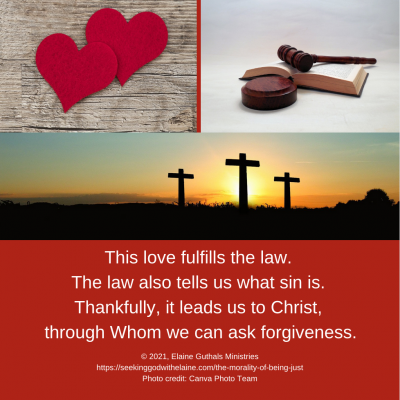
    This love fulfills the law. The law also tells us what sin is. Thankfully, it leads us to Christ, through Whom we can ask forgiveness.

    The Just Treatment of Others as Ourselves

    “Therefore, whatever you want others to do for you, do also the same for them, for this is the Law and the Prophets” (Mt. 7: 12 CSB)

    Following the Golden Rule helps us treat other justly.

    We’ve talked about this verse, known as the Golden Rule, several times. We said

    • Our responses have been determined prior to the situations take place — we have to choose to respond the way in which God wants.
    • The whole law is fulfilled in one word: love.
    • We are to love our neighbors (i.e., everyone) because, when we do, we are imitating God.

    To read a related devotion, click on the appropriate button below.

    Tollotson brought up a good point. He wrote, “The equity of the rule stands upon these foundations.”

    Resource

    If mankind does not love mankind, the equity will not be there. The worldview definition of tolerance as love does not get down to the personal level. It stays on the action level. It can’t be a surface love.

    Tolerating someone else’s actions does not mean we approve of the actions. It does not strengthen a relationship — or even start one in the first place. It leads to staying away from that person.

    That doesn’t lead to love.
    TheMoralityOfBeingJustPin

    Making the Connections

    How we treat others is not a prerequisite for salvation. It is evidence that regeneration has occurred.

    How Do We Apply This?

    • We need to give God our time, talents, hearts, and loved ones — every aspect of our lives.
    • We need to treat others as God treats us.

    Resource

    Father. Relationships are important to us. They are also important to You as we use these relationships to witness to others and disciple them. Help us to treat others how You treat them — with love. Amen.

    What do you think?

    Leave me a comment below (about this or anything else) or head over to my Facebook group for some interactive discussion.

    If you don’t understand something and would like further clarification, please contact me.

    If you have not signed up for the email daily or weekly providing the link to the devotions and the newsletter, do so below.

    If God has used this devotion to speak with you, consider sharing it on social media.

  • The Morality of Honesty

    Manton saw the seriousness in religion. He felt that disciples should be serious also. This daily devotional looks at how that seriousness applies to honesty — and it’s not what we think.

    • Disciples should be trustworthy rather than liars.
    • Disciples should not only walk righteously but should also act righteously.
    • Our morality is about our relationship with the Holy Spirit.
    • Disciples of Christ must focus on God.
    • Disciples of Christ follow God’s laws and commandments to create order.
    • Good lives are defined as being godly.

    Nuggets

    To read devotions in the Redo for Godliness series, click the appropriate button below.

    Devotions in the Moralities Lead to Godliness series

    We are stepping through Manton’s sermon entitled The Moralities of Christianity to see what we can glean to aid us in redoing our character to be more like God’s character.

    Resource

    There is a problem, though. I am totally confused on the verses Manton chose. So, I went to Nave’s Topical Bible and looked up honesty.

    Well, I guess this is the reason we looked at lying during the first devotion of this series. Now, we are going to look at the flip side.

    Let’s Put It into Context

    “Finally brothers and sisters, whatever is true, whatever is honorable, whatever is just, whatever is pure, whatever is lovely, whatever is commendable — if there is any moral excellence and if there is anything praiseworthy — dwell on these things” (Phil. 4: 8 CSB)

    The definition of moral, according to the Merriam-Webster Dictionary, is “of or relating to principles of right and wrong in behavior.” Morality, then, is “a doctrine or system of moral conduct.” When it is the plural form — moralities — it is a “particular moral principles or rules of conduct.”

    Resources

    Our morals determine our character. Character, according to the Merriam-Webster Dictionary, is “the complex of mental and ethical traits marking and often individualizing a person, group, or nation.”

    Resource

    Honest, according to the Merriam-Webster Dictionary, is a “adherence to the facts” and “fairness and straightforwardness of conduct.”

    Resource

    According to the Merriam-Webster Dictionary, to lie is “to make an untrue statement with intent to deceive.” Secker wrote, “Since actions and gestures, as well as words, may be employed to express what we think, they may also be employed to express what we do not think, which is the essence of a lie.

    Resource

    Disciples of Christ Having Trustworthy Morals

    “The LORD detests lying lips, but he delights in people who are trustworthy” (Prov. 12: 22 NIV)

    Disciples should be trustworthy rather than liars.

    Prescott had an interesting take on the connection between truth and lies. He contended that we are being honest if we speak on an issue because we believe it to be true — even if it isn’t.

    What I see Prescott saying is that the intent to deceive was not present, so our words are not lies.

    We have a tendency, however, to sugarcoat things. We try to make them easier to stomach. The problem is we are not being totally honest.

    It is really hard to live with someone who is not being honest. Prescott wrote, “No peace can be where there is no trust.” Lies are a quick way to destroy relationships.

    Resource

    Still, as much as we value honesty, lies abound.

    God, as Truth, despises lies. I am sure one reason is because sin entered this world because of a lie. Newton reported that lying is the sin most warned against in the strongest of terms.

    Resource

    So, a lie is words, actions, and gestures knowingly and voluntarily used to promote something that is not true.

    Dods told us about trustworthiness. He noted that the outcome wasn’t the issue. It is whether, as Dods said, “… we have shown the spirit which above all else a steward should show …”

    Resource

    Hmmm. That isn’t much about trustworthiness.

    Disciples of Christ Having Righteous Morals

    “Those who walk righteously and speak what is right, who reject gain from extortion and keep their hands from accepting bribes, who stop their ears against plots of murder and shut their eyes against contemplating evil” (Isa. 33: 15 NIV)

    Disciples should not only walk righteously but should also act righteously.

    Okay, how much more general can we get than that — live and speak? Luckily, Isaiah does go on to say we shouldn’t extort, accept bribes, or murder. I don’t know about you, but those aren’t everyday temptations in my life.

    But isn’t that how God works? He doesn’t give us a checklist of do’s and don’ts. He wants us to build our character so we have the integrity to make the decisions following His Will.

    God doesn’t give us a checklist of do’s and don’ts. He wants us to build our character so we have the integrity to make the decisions following His Will.

    Spurgeon summarized what “… walk righteously …” (Isa. 33: 15 NIV) meant. He wrote, “The true people of God who in the time of danger will be preserved are a people who display a humble, patient, present faith in God.” We pray and wait for God to act.

    Resource

    But let’s look at it this way. Isaiah talked about our mouths, hands, ears, and eyes.

    We have to keep watch over our tongues. “For ‘Whoever desires to love life and see good days, let him keep his tongue from evil and his lips from speaking deceit’” ( I Pet. 3: 10 ESV).

    We generally think about having clean hands before we eat. Youard noted that the Jews also stressed clean hands before worship.

    Resource

    The explanation as to why clean hands are important is because we use our hands in so many of our activities. Being concerned with keeping our hands clean means we acknowledge that our conduct must be morally clean.

    We can’t go through life with our eyes closed. We can, however, choose to not look on sinful things.

    But where is honesty?

    The Pure Heart of Disciples Show Disciples Being Moral

    “The one who has clean hands and a pure heart, who does not trust in an idol or swear by a false god” (Ps. 24: 4 NIV)

    Our morality is about our relationship with the Holy Spirit.

    Okay, I have to process this. Holland wrote that being moral isn’t about our actions based on a certain standard. Instead, it is about our relationship with the Holy Spirit. He wrote, “As soon as spirit touches spirit there springs up between them a relationship which we call moral.” Our actions that flow from this relationship are considered morally good.

    Okay. Part of me can see that. We aren’t operating under the worldview definition of moral. Instead, we are focusing on the new moral obligation that God expects from us.

    Taking that a step further, Holland wrote, “The Church is a moral conception, a moral condition, by which we are to determine character.” Our character is to flow from our relationship with God.

    Resource

    That character comes from our heart, stressing the need for it to be pure. We want our hearts to be pure because we know how much God hates sin. We want pure hearts like God’s heart.

    As usual, we need to use God’s definition of pure in heart. Our’s usually isn’t the same as His. Youard wrote, “By a pure heart is meant not simply a chaste heart, but an altogether uncorrupt heart, of which chastity is only one of many forms.”

    Resource

    Macmillan wrote, “Impurity in him is caused by the loss of spiritual life. He has broken the law and order of his existence, and his whole nature has disintegrated in an atmosphere of sin.”

    Resource

    The Object on which Disciples of Christ Focus

    “Let your eyes look straight ahead; fix your gaze directly before you” (Prov. 4: 25 NIV)

    Disciples of Christ must focus on God.

    Spurgeon contended that Solomon was not limiting that only our eyes were fixed on God. He believed Solomon meant that all of our bodies need to be focused on God. We need to watch every aspect of our lives to ensure we are in God’s Will.

    Resource

    The way we do that is to choose to imitate Jesus. That has to be our singleness of motive.

    Roberts said that we look straight ahead through faith. Faith is the conviction that the doctrines revealed in God’s Word are true, even if we do not understand all aspects of them, a belief which impacts our lives.

    Woo hoo! Roberts finally mentioned honesty! He wrote, “It [the text] is an exhortation to a close and constant obedience to the revealed will of God, and to the duty of Christian integrity — to an honest, upright, guileless conduct in all our dealings with mankind.”

    Resource

    Pursuing Justice to be Moral

    “Follow justice and justice alone, so that you may live and possess the land the LORD your God is giving you” (Deut. 16: 20 NIV)

    Disciples of Christ follow God’s laws and commandments to create order.

    Justice is order in creation. I would say that would equate to everyone following God’s Will. Therefore, everyone would be benefitting by being children of God.

    Hmmmm. Let’s try this. The just are those men and women who have been regenerated and who live lives showing evidence they are following God’s laws and commandments and fulfilling every moral obligation.

    Okay. Caussin helped us out. He wrote, “To be just is to be all that which an honest man may be, since justice is to give everyone what appertaineth to him.”

    Resource

    Being just is equated with honesty.

    Living Good Lives Means Being Moral

    “Live such good lives among the pagans that, though they accuse you of doing wrong, they may see your good deeds and glorify God on the day he visits us” (I Pet. 2: 12 NIV)

    Good lives are defined as being godly. Good, in the biblical sense, is the workings of God within His people.

    We have to live godly lives no matter with whom we come into contact. We can’t act one way with believers and another way with non-believers. We have to be consistent because we may be witnessing without knowing it.

    Our actions must not depend upon other’s reception of them. They are going to judge us based on worldview definitions. God is going to want us to use His definitions.

    Our actions must not depend upon other's reception of them.

    Arnot defined honest for us. He wrote, “The modern meaning of honest is, that you do not cheat in a bargain; but as used here, and in ancient times generally, it signifies beautiful — first a material and then a moral winsomeness.”

    Resource

    So, what Arnot is really saying is that honest behavior is really good, godly behavior.

    TheMoralityOfHonestyPin

    Making the Connections

    That makes me feel so much better. I was just telling my Insomnia Buddy that, even though these verses were listed under the honesty topic, they generally don’t say anything about honesty.

    That is because I was using the don’t-lie definition. I wasn’t using the be-godly definition.

    But let’s look back. We talked about trustworthy, walking in the Spirit, keeping our eyes fixed on God, being just, and being a good witness.

    To me, that makes the definition of honest as being a genuine child of God.

    How Do We Apply This?

    We can’t expect God to just automatically reward us. He is going to expect us to be trying to imitate Jesus.

    That means we have to strive to be pure in heart. Mottet and Spurgeon told us how to do that.

    • Resist evil thoughts and imaginations.
    • Watch the company we keep.
    • Watch what we read [and I would add what we watch on the screen].
    • Look to God instead of man.
    • Don’t have ulterior motives.
    • Put away sinful things.

    Resource

    We need to continue to pray to God, even if our prayers are not immediately answered. God isn’t a gum ball machine where we put in the quarter and immediately get our candy.

    No, it isn’t going to be easy. Satan will try to derail us whenever he can.

    We have to choose God instead.

    Father God. We do choose You. Help us to be pure in heart. Help us to be honest and genuine. We want Your character. Amen.

    Heading

    Heading

    The ABCDs of Salvation

    If you have not become a believer in Christ, please read through the
    Plan of Salvation and prayerfully consider what God is asking you to do.

    A – admit our sins
    B – believe His Son Jesus is our Redeemer
    C – confess God as Sovereign Lord

    D – demonstrate that commitment by making any changes needed in our lives to
    live the way in which God has called us

    The Disciple’s Job Description

    Searching for and Seeking God

    Hearing His Word (Rom. 10: 17).
    Reading His Word (Rev. 1: 3).
    Praying to Him (Heb. 4: 16).
    Studying His Word (Ac. 17: 11).
    Meditating on His Word (Ps. 1: 1-2).
    Memorizing His Word (Ps. 119: 11).

    If you have not admitted that your relationship is not right with God,

    have not asked Jesus to be your Lord and Savior,

    and have not confessed your sins,

    please read through the Plan of Salvation and prayerfully consider what God is asking you to do.

    Related Links

    Related Links

    Related Links

    Artist

    Related Links

    I have created a worksheet of the questions above. Click on the button below to access it.

    Don’t know what your spiritual gifts are?

    Take this Spiritual Gifts Inventory

    The Disciple’s Job Description

    Complete Job Description

    Individual Description

    The Disciple’s Job Description

    Complete Job Description

    Individual Description

    Job Duty #4
    Proclaim the Gospel (Mark 16: 15)

    Job Duty #6
    Make Disciples (Matthew 28: 19-20)

    It Was Enough
    Vocalist: Elaine Guthals
    Keyboard: Chris Vieth

    What do you think?

    Leave me a comment below (about this or anything else) or head over to my Facebook group for some interactive discussion.

    If you don’t understand something and would like further clarification, please contact me.

    If you have not signed up for the email daily or weekly providing the link to the devotions and the newsletter, do so below.

    If God has used this devotion to speak with you, consider sharing it on social media.

  • The Act of Standing Morally

    God calls one of our actions to be standing firm in His truth and righteousness. This daily devotional looks at how we stand firm for Him.

    Nuggets

    • Disciples are told to stand firm in God’s truth and righteousness.
    • Our actions must be grounded in God’s truth.
    • Our actions must be approved as righteous by God.
    • Hezekiah was rewarded for his righteous actions.

    To read devotions in the Redo for Godliness series, click the appropriate button below.

    Devotions in the Moralities Lead to Godliness series

    Our actions need to follow our Christian morals. One thing we need to do is stand.

    We are stepping through Manton’s sermon entitled The Moralities of Christianity (along with some others) to see what we can glean to aid us in redoing our character to be more like God’s character

    Resource

    Let’s Put It into Context

    “Finally brothers and sisters, whatever is true, whatever is honorable, whatever is just, whatever is pure, whatever is lovely, whatever is commendable — if there is any moral excellence and if there is anything praiseworthy — dwell on these things” (Phil. 4: 8 CSB)

    The definition of moral, according to the Merriam-Webster Dictionary, is “of or relating to principles of right and wrong in behavior.” Morality, then, is “a doctrine or system of moral conduct.” When it is the plural form — moralities — it is a “particular moral principles or rules of conduct.”

    Resources

    Our morals determine our character. Character, according to the Merriam-Webster Dictionary, is “the complex of mental and ethical traits marking and often individualizing a person, group, or nation.”

    Resource

    Standing Firm in Truth to Fight Satan’s Wiles

    “Stand your ground, putting on the belt of truth and the body armor of God’s righteousness” (Eph. 6: 14 NLT)

    Disciples are told to stand firm in God’s truth and righteousness.

    Let’s face it. There will be times when Satan is going to throw everything that he’s got at us. He is going to try to scare us into denying God.

    Paul said, “Stand your ground …” (Eph. 6: 14 NLT). The New International Version translates it as “Stand firm …” (Eph. 6: 14 NIV). The Christian Standard Bible and the Holman Christian Standard Bible just say stand.

    It doesn’t say fight. Well, in a way we can’t. “For we are not fighting against flesh-and-blood enemies, but against evil rulers and authorities of the unseen world, against mighty powers in this dark world, and against evil spirits in the heavenly places” (Eph. 6: 12 NLT).

    But it also doesn’t say leave the battlefield. Our fight is to stand and let God do the fighting. Gouge wrote, “We fight in His name and power, whereas our enemies fight in their own.”

    Resource

    God is more powerful than Satan. He limits Satan’s power. “The Lord said to Satan, ‘Very well, then, everything he has is in your power, but on the man himself do not lay a finger’ …” (Job 1: 12 NLT).

    No, Job didn’t get special treatment. “The temptations in your life are no different from what others experience. And God is faithful. He will not allow the temptation to be more than you can stand. When you are tempted, he will show you a way out so that you can endure” (I Cor. 10: 13 NLT).

    ICor1013

    I know. I have always read that as we can handle everything thrown our way. I have never read that through the lens of God is limiting Satan.

    Isn’t that comforting? Oh, yeah. It may feel bad when we are going through the temptation. Gods doesn’t let it get worse.

    But how does it play out when we are told to stand? Foster and Moore told us what to do by telling us what not to do.

    It will take courage on our part. We can’t tuck tail and run away. We have to remember that God is always with us.

    We can’t break. We can’t give in to the temptation. We have to keep choosing to follow God’s laws and commandments.

    We can’t act rashly. Oh, yeah. Sometimes, we do something just to get the temptation over and done. We have to act in the way in which God wants us to act.

    Moore included that we need to stand orderly. We are not to give in to the chaos Satan manufactures.

    We can’t just not do anything. Moore wrote, “Standing is the attitude of a man awake, watching, prepared for the coming of the enemy at even, at morning, or at cock crow, or at noonday.” God cautions us not to be negligent.

    We can’t give up. If we give up, we give in to Satan and sin. We need to resist.

    Resource

    Gurnall took it a different way. He said we have to stand firm when we are watching for Satan to try something. He cautioned that our entire life is like a dark night through which we have to keep watch.

    Watching assumes that we are in the place in which we are supposed to be. Gurnall described it this way: “Begin at the right end of your work, Christian, by placing your chief care about those main duties to God and man, in His law and gospel, in His worship, and in thy daily course, which when thou hast done, neglect not the circumstantials.” We have to have our priorities straight.

    Resource

    Of course, we have to know our strengths and weaknesses when we are standing. Satan is going to attack the weak areas.

    What Is the Truth in which We Are Standing?

    “… putting on the belt of truth …” (Eph. 6: 14 NLT)

    Our actions must be grounded in God’s truth.

    Let’s work backwards and start with truth first. Gouge said that there are several kinds of truth. They are the following:

    • Truth of judgment
    • Truth of heart
    • Truth of speech
    • Truth of action

    When we are describing our relationship with God to someone who we are witnessing to, we need to make sure we are being honest. We have to faithfully represent Who God is and what He has done for us.

    Gouge told us that truth is necessary because, “without it, no other grace can be of any use.” We have to understand this truth — as much as God wants us to understand — so that we can make our decisions to follow Him.

    Resource

    FaithfullyRepresentGod

    Yep, Satan is going to try to get us to twist things around. That way we are not witnessing to God’s Truth, but to Satan’s lies.

    Now let’s look at that which we are to put on. All the new versions call it a belt. The older ones have some version of “… having your loins girt about with truth …” (Eph. 6: 14 KJV). That is why it is referred to as the girdle of truth.

    The Jews wore a lot of flowing clothes back in Paul’s day. The warriors needed the girdle to keep those clothes out of their way. Burns also said their girdle protected the heart.

    Resource

    These girdles were not just some fabric to keep the tummy tucked. Foster said they included metal — “… plates of iron, brass, or silver …” — for defense. We have to remember that this is a piece of armor.

    Resource

    What Is the Righteousness on which We Are Standing?

    “… putting on … the body armor of God’s righteousness” (Eph. 6: 14 NLT)

    Our actions must be approved as righteous by God.

    Gouge had an interesting definition of righteousness, which is a little different from the one we have been using. We say that righteousness is the result of a solid relationship with God built by a sincere life of conscientious obedience to God’s laws and commandments.

    Gouge wrote, “The righteousness which is here meant. A powerful work of God’s Spirit in the regenerate, whereby they endeavour to approve themselves unto God and man, by performing what God’s law requires.”

    Resource

    I am not exactly sure how to read this. One way is that it is similar to sanctification, a process to change us to have the character of God. The other way is, instead of the result of sanctification, Gouge thought righteousness was the reason why we navigate the Sanctification Road.

    Glossary

    I think I am going to have to consult with someone much smarter than me. Maybe I will get some clarification when we figure out the “putting on” part.

    If righteousness is a breastplate, it is to guard the heart. That is one vital organ in our walk as a disciple. We put it on through repentance.

    Glossary

    Let’s look at it this way. The breastplate protects us from death. If we are children of God, we have been changed from being spiritually dead to spiritually alive.

    Spiritual death is the separation from God that occurred as a consequence of Adam and Eve’s original sin. The spiritually alive are those who have ABCDed, so they are no longer separated from God.

    The ABCDs of Salvation

    If you have not become a believer in Christ, please read through the
    Plan of Salvation and prayerfully consider what God is asking you to do.

    A – admit our sins
    B – believe His Son Jesus is our Redeemer
    C – confess God as Sovereign Lord

    D – demonstrate that commitment by making any changes needed in our lives to
    live the way in which God has called us

    The Disciple’s Job Description

    If we are already spiritually alive, why does our heart need protection? Gouge wrote, “It keeps us from being mortally wounded; for so long as we retain a true purpose and faithful endeavour answerable thereto, we shall never give ourselves over to commit sin.”

    Resource

    Standing Against Satan with Honesty

    “Then Hezekiah turned his face to the wall and prayed to the Lord. He said, ‘Please, Lord, remember how I have walked before you faithfully and wholeheartedly, and have done what pleases you.’ And Hezekiah wept bitterly” (Isa. 38: 2-3 CSB)

    Hezekiah was rewarded for his righteous actions.

    Hmmmm. Okay. Manton took the scenic route on including this verse in the “Satan assaults you with wiles, but your strength lies in downright honesty (Ephesians 6:14; Isaiah 38:2-3) section.

    Here is a little background. Hezekiah, son of Ahaz, was the king Judah. We talked about him in the Isaiah’s Message from Sovereign God message. Some question if he was the present-day baby discussed in Isaiah 7: 14. He was also king when the Assyrians wanted to overthrow him.

    To read a related devotion, click on the appropriate button below.

    In Isaiah 38, Hezekiah was sick. This was right after God had saved Judah from Sennacherib’s attack.

    Hezekiah was really sick. Bennett felt it was either a carbuncle, a painful type of boil, or tonsillitis. They didn’t expect him to live.

    Resource

    We just talked in Still More of God’s Blessings for Merciful Disciples of Christ that it was believed that people were punished through an illness for a sin they had committed. Faithfulness was rewarded with a long life (Ps. 90: 16).

    To read a related devotion, click the button below.

    Hezekiah seemed to buy into that. He faced the wall and cried.

    Shalders thought maybe part of the reason Hezekiah was so upset was because he was a moral man. He wrote, “The very consciousness of his integrity, and of his desire to honour the Lord in the presence of his people, must have added to his distress.”

    Resource

    But Hezekiah also prayed. In essence, he was questioning how he could get sick — in the prime of his life — when he had been faithful. What Hezekiah was probably using as evidence of this faithfulness, according to the Homiletic Magazine’s Hezekiah’s Prayer in Affliction was the following:

    • Hezekiah’s sincerity
    • Simplicity
    • His walk of faith

    Hmmm. Just what we’ve been talking about.

    Resource

    God heard Hezekiah’s prayer and added 15 years to his life. What does this illness and healing teach us?

    • God answers our prayers.
    • We find strength and consolation when we pray to God.
    • God sees our tears.
    TheActOfStandingMorallyPin

    Making the Connections

    Why is telling the truth so important? Gouge reminded us that is how we imitate God. He wrote, “The least measure of grace, seasoned with it, is acceptable to God and so profitable to us.”

    Resource

    Satan will do his best to get us to lie and not believe the truth.

    God’s promises has to inform our action.

    How Do We Apply This?

    We have to make sure we are in the place God wants us to be. I really liked what Moore said. He wrote that we need “… an honest walk before God …”

    Resource

    That walk includes consistently and genuinely seeking God. Gouge warned us that we need to find true righteousness.

    Searching for and Seeking God

    Hearing His Word (Rom. 10: 17).
    Reading His Word (Rev. 1: 3).
    Praying to Him (Heb. 4: 16).
    Studying His Word (Ac. 17: 11).
    Meditating on His Word (Ps. 1: 1-2).
    Memorizing His Word (Ps. 119: 11).

    Gouge also warned us that we need to continually evaluate our lives to make sure we repent of any sin. Unrepented sin tarnishes our righteousness.

    Resource

    Father God. We want our actions to show Your righteousness and truth. We want our character to imitate Yours. Amen.

    What do you think?

    Leave me a comment below (about this or anything else) or head over to my Facebook group for some interactive discussion.

    If you don’t understand something and would like further clarification, please contact me.

    If you have not signed up for the email daily or weekly providing the link to the devotions and the newsletter, do so below.

    If God has used this devotion to speak with you, consider sharing it on social media.

  • Keeping Our Actions and Morals Consistent

    What we do has to come out of who we are. This daily devotional looks at how disciples of Christ use sincerity and a good conscience to ensure our actions are consistent with our Christian character.

    Nuggets

    • In order to be blameless, blessed, and perfect, we need to be sincere and genuine.
    • Our actions should stem from the integrity of a good conscience.

    To read devotions in the Redo for Godliness series, click the appropriate button below.

    Devotions in the Moralities Lead to Godliness series

    Our actions are just as important as our words. It is also important that our actions and our morals are consistent.

    We are stepping through Manton’s sermon entitled The Moralities of Christianity (along with some others) to see what we can glean to aid us in redoing our character to be more like God’s character.

    Resource

    Let’s Put It into Context

    “Finally brothers and sisters, whatever is true, whatever is honorable, whatever is just, whatever is pure, whatever is lovely, whatever is commendable — if there is any moral excellence and if there is anything praiseworthy — dwell on these things” (Phil. 4: 8 CSB)

    The definition of moral, according to the Merriam-Webster Dictionary, is “of or relating to principles of right and wrong in behavior.” Morality, then, is “a doctrine or system of moral conduct.” When it is the plural form — moralities — it is a “particular moral principles or rules of conduct.”

    Resources

    Our morals determine our character. Character, according to the Merriam-Webster Dictionary, is “the complex of mental and ethical traits marking and often individualizing a person, group, or nation.”

    Resource

    Our conscience is the part of our nature that impacts our moral decisions as it points us to what is right and gives us pain or pleasure depending on the choice.

    To read a related devotion, click the button below.

    Being Sincere and Genuine in Our Walk

    “Blessed is the man against whom the LORD counts no iniquity, and in whose spirit there is no deceit” (Ps. 32: 2 ESV)

    In order to be blameless, blessed, and perfect, we need to be sincere and genuine.

    At first glance, we might read blessed as our actions bring us happiness. I don’t think that is the case.

    Blessedness means we have been perfected. The perfected state indicates the combination of the graces which, when all are present, form spiritual wholeness or completeness.

    Glossary

    That makes the rest of the first part of the verse understandable. “Blessed is the man against whom the LORD counts no iniquity …” (Ps. 32: 2 ESV)

    Oops. One more. Iniquities are sins of wanting to be like everyone else instead of God.

    Let’s substitute. The person who is spiritually complete is the one who wants to be like God.

    When we are like God, we aren’t like Satan. Satan is the father of lies (Jn. 8: 44). So, when we are children of God, we don’t lie.

    Glossary

    SpirituallyComplete

    God commands us to be godly. “When Abram was ninety-nine years old, the LORD appeared to him and said, ‘I am God Almighty; walk before me faithfully and be blameless’” (Gen. 17: 1 NIV).

    The King James Version translates the blameless as perfect. Oh, yeah. We are talking about the same thing: blameless, blessed, and perfect — being godly.

    To be godly, we have to take this down to heart level. Taylor wrote, “If [our actions] be single and pure, so is thy heart.” It has to regenerate our hearts.

    Resource

    When are our hearts regenerated? That happens at conversion.

    Regeneration is the change in us that God brings about through the work of the Holy Spirit when we go from being spiritually dead to spiritually alive. Spiritual death is the separation from God that occurred as a consequence of Adam and Eve’s original sin. The spiritually alive are those who have ABCDed, so they are no longer separated from God.

    The ABCDs of Salvation

    If you have not become a believer in Christ, please read through the
    Plan of Salvation and prayerfully consider what God is asking you to do.

    A – admit our sins
    B – believe His Son Jesus is our Redeemer
    C – confess God as Sovereign Lord

    D – demonstrate that commitment by making any changes needed in our lives to
    live the way in which God has called us

    The Disciple’s Job Description

    Taylor brought up another good point. Being blameless has to be coupled with a sincerity of heart. We have to submit to God as Sovereign Lord. We have to genuinely be trying to obey God’s laws and commandments.

    Resource

    We can’t discount sincerity. Yes, we are still going to sin. Yes, God will still forgive us.

    But look at the example of Asa. “Although the pagan shrines were not removed, Asa’s heart remained completely faithful to the LORD throughout his life” (I Kgs. 15: 14 NLT).

    If Asa would have been perfect, he would have removed the idols. He didn’t.

    But it was Asa’s heart that God was concerned about. He still remained completely faithful.

    What? You think that is a contradiction? I don’t.

    God knows we are not going to remove sin from this world. Only He can do that. That will only happen on judgment day.

    The way I read it is God wants us to be faithful in those things in which we have control. Sometimes, He may put it in our plans to try to remove the idols. If He does, we have to choose to be faithful there.

    We need to choose to be completely obedient to God. If we are faithful, it will cover our sins.

    We need to choose to be completely obedient to God. If we are faithful, it will cover our sins.

    It is all about the walk. Walking is the term used to describe how we live our lives. Do we live our lives by choosing to be like God?

    Everything we do is written down in our book of life. We won’t get to cook the books in order to influence God’s judgment on our lives. We have to live godly lives now.

    To read a related devotion, click the button below.

    The Integrity of a Good Conscience

    “For our boast is this, the testimony of our conscience, that we behaved in the world with simplicity and godly sincerity, not by earthly wisdom but by the grace of God, and supremely so toward you” (II Cor. 1: 12 ESV)
 Our actions should stem from the integrity of a good conscience.

    Our conscience is more than just our intelligence. Raleigh wrote, “The moral life is higher than the intellectual, and the dignity of conscience is that it is the governing element in the moral life.”

    Resource

    Oh, yeah. Our consciences can steer us wrong sometimes. We use reasoning to make our judgments.

    Resource

    If we look at the King James Version’s translation of this verse, it says, ‘For our rejoicing is this …” (II Cor. 1: 12 KJV). All the modern versions translate it either as boast or confidence (NLT, NASB, and HCSB).

    I really like the rejoicing. That is tied to worship. We are giving God the recognition that He has helped us to live godly lives.

    I am okay with confidence. We have the assurance that we are living in line with how God wants us to live.

    Boast really doesn’t do it for me. I know Paul says we need to boast in God, but too many times, we follow the worldview opinion and boast in ourselves.

    This is all about glorifying God, worshiping Him. We want to keep us out of it.

    Emmons wrote that we have a clear conscience when we have been obedient for the right reasons.

    Resource

    Robertson had an interesting take. We know we are not going to be perfect in this life because we are still in our sinful bodies. So, Paul wasn’t talking about being perfect/sinless here.

    Paul was talking about something else. Robertson wrote, “He is not speaking of personal character but of ministry; and again not of the blamelessness of his ministry, but of its success.”

    Resource

    Let me process this. God wants us to change our character to be more like His. He wants us to have His morals.

    But God knows that we aren’t going to be 100% fruit-of-the-Spirit perfect. If that was the requirement, no one would make it to Heaven. God wants us to be successful in our ministry.

    But when we witness to others, we aren’t going to have a 100% conversion rate. In fact, there is more to ministry than just witnessing.

    So, that can’t be the definition of successful. How in the world do we show success?

    • We are sincere in seeking Him.
    • We are consistent in seeking Him.
    • We are 100% consistent in asking His forgiveness when we do disobey Him.

    Ooo, baby. Isn’t that totally opposite than what some worldview people think disciples should be? They think we have to be perfect — but by their definition of perfect, i.e., a good person.

    Paul told us that we are judged “… not by earthly wisdom but by the grace of God …” (II Cor. 1: 12 ESV). In order to be godly, we have to imitate God. Anything else is being worldly.

    We wound our way back to being sincere. Burgess wrote, “That sincerity and uprightness of heart in our motives and ends is a sure and infallible sign of our being in the state of grace (1 John 3:21, 22).” He said, basically, that uprightness = obedience.

    Resource

    That sincerity is to give us a simplicity in life. Raleigh describes that as “… singleness of mind, purpose, character, life …” Beard called both sincerity and simplicity virtues.

    Resource

    The focus of that simplicity should be God. If we live “…by the grace of God …” (II Cor. 1: 12 ESV), being judged by that standard will be a piece of cake.

    KeepingOurActionAndMoralsConsistentPin

    Making the Connections

    Let’s look at it this way. Our consciences are internal. In fact, Vaughan stated that “conscience is, perhaps, the greatest power in the world.” He said it perceives everything from words and actions to motives, thoughts, and feelings.

    Resource

    But Paul talked about the testimony of conscience.

    How Do We Apply This?

    Vaughan believed that we can train our conscience. It will take prayer and study of the Scriptures. We need to follow it when it give us godly advice and not follow it when it is ungodly advice. This guidance can be regarding our physical life or spiritual life.

    Resource

    Taylor suggested we daily reaffirm our purpose of following God’s Will, laws, and commandments. We must ensure our love for God and others. He wrote, “An honest heart ever aims at God’s glory directly, whereas a guileful heart ever propounds bad ends of good actions.”

    Resource

    Emmons felt we must be ever mindful of our duty and not be afraid to accomplish it. Oh, yes, our shortcomings may be showcased, but so will God’s love and forgiveness as He uses us to expand His kingdom.

    Resource

    In our walk, we need to be consistent in our moral character. We need to be obedient to Him.

    Father God. You are holy and righteous. We want to be like You. May our actions to bring glory and honor to You. Amen.

    Searching for and Seeking God

    Hearing His Word (Rom. 10: 17).
    Reading His Word (Rev. 1: 3).
    Praying to Him (Heb. 4: 16).
    Studying His Word (Ac. 17: 11).
    Meditating on His Word (Ps. 1: 1-2).
    Memorizing His Word (Ps. 119: 11).

    If you have not admitted that your relationship is not right with God,

    have not asked Jesus to be your Lord and Savior,

    and have not confessed your sins,

    please read through the Plan of Salvation and prayerfully consider what God is asking you to do.

    Related Links

    Related Links

    Related Links

    Artist

    Related Links

    I have created a worksheet of the questions above. Click on the button below to access it.

    Don’t know what your spiritual gifts are?

    Take this Spiritual Gifts Inventory

    The Disciple’s Job Description

    Complete Job Description

    Individual Description

    The Disciple’s Job Description

    Complete Job Description

    Individual Description

    Job Duty #4
    Proclaim the Gospel (Mark 16: 15)

    Job Duty #6
    Make Disciples (Matthew 28: 19-20)

    It Was Enough
    Vocalist: Elaine Guthals
    Keyboard: Chris Vieth

    What do you think?

    Leave me a comment below (about this or anything else) or head over to my Facebook group for some interactive discussion.

    If you don’t understand something and would like further clarification, please contact me.

    If you have not signed up for the email daily or weekly providing the link to the devotions and the newsletter, do so below.

    If God has used this devotion to speak with you, consider sharing it on social media.

  • Why Lying Is a Moralities Issue for Disciples of Christ

    While on the Sanctification Road, disciples of Christ are to change their character to resemble God’s. We do that through ensuring our morals are consistent with His. This daily devotional looks at why lying is opposite to God’s morals.

    Nuggets

    • At times, we make a conscious decision to lie.
    • We should be faithful in keeping our word, or we are liars.
    • We damage our relationships with others when we lie.
    • Those who have asked Jesus to become their Savior are children who should strive to remain truthful.

    To read devotions in the Redo for Godliness series, click the appropriate button below.

    Devotions in the Moralities Lead to Godliness series

    In becoming godly, we are interested in changing our character to have it more resemble God’s. To do that, we will need to determine right from wrong and conduct ourselves based on that system of moral conduct.

    Manton discussed that in his sermon entitled The Moralities of Christianity. We are going to step through his sermon (along with some others) and see what we can glean to aid us in redoing our character.

    Resource

    Let’s Put It into Context

    “Finally brothers and sisters, whatever is true, whatever is honorable, whatever is just, whatever is pure, whatever is lovely, whatever is commendable — if there is any moral excellence and if there is anything praiseworthy — dwell on these things” (Phil. 4: 8 CSB)

    The definition of moral, according to the Merriam-Webster Dictionary, is “of or relating to principles of right and wrong in behavior.” Morality, then, is “a doctrine or system of moral conduct.” When it is the plural form — moralities — it is a “particular moral principles or rules of conduct.”

    Resource

    Our morals determine our character. Character, according to the Merriam-Webster Dictionary, is “the complex of mental and ethical traits marking and often individualizing a person, group, or nation.”

    Resource

    According to the Merriam-Webster Dictionary, to lie is “to make an untrue statement with intent to deceive.”

    Resource

    God commands us to not lie (Lev. 19: 11). When we do, we show that we are children of Satan. “You belong to your father, the devil, and you want to carry out your father’s desires. He was a murderer from the beginning, not holding to the truth, for there is no truth in him. When he lies, he speaks his native language, for he is a liar and the father of lie” (Jn. 8: 44 NIV).

    Sometimes, we do lie. Let’s check out how.

    We Lie by Assertion

    “‘Ananias,’ Peter asked, ‘why has Satan filled your heart to lie to the Holy Spirit and keep back part of the proceeds of the land?’” (Ac. 5: 3 CSB)

    At times, we make a conscious decision to lie.

    The early church held their possessions in common. “Now the entire group of those who believed were of one heart and mind, and no one claimed that any of his possessions was his own, but instead they held everything in common” (Ac. 4: 32 CSB).

    Ananias with Sapphira had sold a possession. Instead of donating the entire proceeds to the early church, they held some back. What is left unsaid here is that they must have pretended that they donated all the money gained.

    The problem was Ananias with Sapphira lied to God, not Peter and the others. “Against you, and you alone, have I sinned; I have done what is evil in your sight …” (Ps. 51: 4 NLT). God is the God of Truth. Anything less is against Him.

    It is against God because it was instigated by Satan, the father of lies. Lechler wrote, “Evil does not exist and grow isolated in the human breast, but is connectively interwoven with the kingdom of evil in the invisible world.” That makes it inexcusable.

    Resource

    Ananias with Sapphira may have thought they hid the lie, but they didn’t. God is all-knowing.

    To read a related devotion, click the button below.

    But look at it this way. The sin was being cloaked in the appearance of service to God. Instead of the godliness they were portraying, Ananias with Sapphira were engaged in sin. It was their conscious decision to lie about their contribution.

    Watkinson said something interesting. He wrote, “The Bible is a book of personalities — it has nothing to do with personifications, streams of tendency, etc. Here the personality of the Holy Spirit is clearly recognised (sic), and Satan is no figure of speech. The resistibility of evil is the greatest moral of the text.”

    Resource

    What I gained out of that was

    • Personality is a compilation of our character. So, the Scriptures are about our character.
    • We can easily see the character of the Holy Spirit, and therefore God.
    • Satan is real.
    • Resisting Satan and his lies is the most important theme of the Scriptures because it is right verses wrong behavior.
    Resisting Satan and his lies is the most important theme of the Scriptures because it is right verses wrong behavior.

    We Lie by Promise

    “What is desirable in a person is his fidelity; better to be a poor person than a liar” (Prov. 19: 22 CSB)

    We should be faithful in keeping our word, or we are liars.

    Solomon talked about fidelity or faithfulness. If we promise to be faithful, we should keep the promise.

    If we don’t plan on keeping our word, we are a liar.

    Arnot has a sermon entitled Circumstances or Character. What he was taking a round about way to say — I think — is our character should not be dependent on the circumstances in which we find ourselves.

    Resource

    The version Wilde used talked about kindness. He wrote, “A man’s kindness is in his heart, not in the measure of the gifts themselves.”

    Resource

    If we substitute character for kindness, we are saying that character is at heart level. It isn’t really measured by the service projects we do.

    We can be doing the service projects for an ulterior motive that has nothing to do with character. That means it isn’t at the heart level.

    We can be doing the service projects for an ulterior motive that has nothing to do with character. That means it isn’t at the heart level.

    Lying Is Detrimental to Our Relationships with Others

    “Therefore, putting away lying, speak the truth, each one to his neighbor, because we are members of one another” (Eph. 4: 25 CSB)

    We damage our relationships with others when we lie.

    Why is lying such as issue with God? God is the God of Truth. Lying is completely opposite of His character.

    Campadelli called lying a habit. Instead, we should take Candlish’s advice. He wrote, “Bear in mind what putting away falsehood really means. It describes a state or frame of mind, a character of the inner man, peculiar to the real Christian, the true believer. If so, it would seem to follow that by speaking truth every man with his neighbour, is meant a habit or mode of speech also peculiar to such a one.”

    Resources

    Once we begin a lie, we may have to keep lying to make sure the lie is not exposed, making it difficult to remember what we’ve said. Woolsey extended this lie to covering up our opinions. If we’ve misrepresented our opinions, we are insincere about the relationship.

    Resource

    Lying hampers communications with others, especially when we intentionally lie about something. When others start to question our integrity, relationships suffer.

    Truth Will be Rewarded

    “He said, ‘They are indeed my people, children who will not be disloyal,’ and he became their Savior” (Isa. 63: 8 CSB)

    Those who have asked Jesus to become their Savior are children who should strive to remain truthful.

    Hmmm. When I started writing this, I hadn’t intended it to be specifically on lying. However, that is where the sermons I research took it.

    Until we get to Isaiah.

    True, Waddington interpreted “… children who will not be disloyal …” (Isa. 63: 8 CSB) as “children that will not lie.” But we finally get to flip the focus.

    Resource

    We have to exhibit truth in our character. This shows that we have a new nature as we are new creations. “Therefore, if anyone is in Christ, the new creation has come: The old has gone, the new is here!” (II Cor. 5: 17 NIV).

    If we were previously children of Satan, who is a liar, we no longer are that creation after we ABCD. We now are children of God. We are children of the Truth.

    The ABCDs of Salvation

    If you have not become a believer in Christ, please read through the
    Plan of Salvation and prayerfully consider what God is asking you to do.

    A – admit our sins
    B – believe His Son Jesus is our Redeemer
    C – confess God as Sovereign Lord

    D – demonstrate that commitment by making any changes needed in our lives to
    live the way in which God has called us

    The Disciple’s Job Description

    Glossary

    Now, don’t read this verse to say that all we have to do to be children of God is to not lie. Jesus doesn’t automatically become our Savior because we are good people.

    In order to become children of God, we have to admit that mankind was separated from God after the original sin, making us sinners; believe Jesus paid the penalty for those sins to become our Savior and Redeemer; confess God as Sovereign God; and demonstrate that commitment by submitting our lives to living following His laws and commandments.

    God demands that we turn away from Satan and his lies and begin following Him. We can’t do that by just being good. It has to be a conscious decision for Him.

    To read a related devotion, click the button below.

    WhyLyingIsAMoralitiesIssueForDisciplesOfChristPin

    Making the Connections

    Morgan reminded us of a couple of verses about truth.

    • “Sanctify them in the truth; your word is truth” (Jn. 17: 17 ESV).
    • “Then you will know the truth, and the truth will set you free” (Jn. 8: 32 NIV).

    Resource

    God is truth. We learn about Who He is by navigating the Sanctification Road.

    Sanctification is the transformation of mind, body, and soul, which begins with regeneration, gradually changes our nature through the promptings of the Holy Spirit, and ends with perfected state of spiritual wholeness or completeness. Regeneration is the change in us that God brings about when we go from being spiritually dead to spiritually alive. Spiritual death is the separation from God that occurred as a consequence of Adam and Eve’s original sin. The spiritually alive are those who have ABCDed, so they are no longer separated from God.

    Glossary

    Lechler reminded us of the significance of understanding Satan is real. It isn’t just a matter of being a moral person. Those who follow his ways will follow him into hell for eternity. Those who do not follow God follow Satan.

    Resource

    To read a devotion in the Hell Does Have Fury series, click on the appropriate button below.

    How Do We Apply This?

    How do we put away lying? Candlish told us to keep our hearts clean. We do that when we follow His laws and commandments.

    Resource

    Glossary

    Because sin to enter our hearts when we allow it, we have to be diligent in keeping it out. We do that by seeking God.

    Searching for and Seeking God

    Hearing His Word (Rom. 10: 17).
    Reading His Word (Rev. 1: 3).
    Praying to Him (Heb. 4: 16).
    Studying His Word (Ac. 17: 11).
    Meditating on His Word (Ps. 1: 1-2).
    Memorizing His Word (Ps. 119: 11).

    Eadie wrote that “Christians are to speak the whole truth without distortion, diminution, or exaggeration.” Instead, we like to justify situations where we think lies are needed, argue that lying shouldn’t be considered a sin, and all sorts of other excuses to decrease our sin.

    Resource

    Instead, we need to always tell the truth, the whole truth, and nothing but the truth. When we do, we have the character of God.

    Father God. You are Truth. Help us to be truthful in all that we do. Sometimes, that truthfulness must be coupled with kindness. Help us to show others Your character. Amen.

    What do you think?

    Leave me a comment below (about this or anything else) or head over to my Facebook group for some interactive discussion.

    If you don’t understand something and would like further clarification, please contact me.

    If you have not signed up for the email daily or weekly providing the link to the devotions and the newsletter, do so below.

    If God has used this devotion to speak with you, consider sharing it on social media.

  • Rejected by His Own People

    Jesus had an active ministry for three years. Luke told us of the time Jesus went home to Nazareth. This daily devotional looks at how and why Jesus was rejected in His hometown.

    Nuggets

    • God expects us to follow His Will in the familiar, even though it might not be easy.
    • At first, the people of Nazareth were amazed.
    • The people of Nazareth became enraged because their amazement was only a surface emotion.

    Devotions in the Luke’s Diagnosis and Prescription series

    Jesus’ ministry encompassed Galilee, Samaria, and Judea. Luke told us of one visit to Nazareth.

    Luke’s diagnosis was the visit did not turn out well because the people of Nazareth held themselves in higher esteem than their need for a Savior. Unfortunately for them, they did need a Savior.

    Let’s Put It into Context

    “Then Jesus returned to Galilee in the power of the Spirit, and news about him spread throughout the entire vicinity. He was teaching in their synagogues, being praised by everyone” (Lk. 4: 14-15 CSB)

    At the end of Luke 3, Jesus was baptized. This would have been a high point for Jesus.

    No, not because Jesus had sinned and needed forgiveness and salvation.

    After Jesus came up from the water, He heard the voice of His Father. God let everyone know that he was pleased with Jesus.

    To read a related devotion, click the button below.

    At the beginning of chapter 4, Jesus is tempted by Satan.

    The accomplishment of those two events heralded the start of Jesus’ ministry. Oosterzee called this sermon in Luke 4: 16-30 Jesus’ first sermon. I don’t see how it could be given what verse 15 says. This may be Jesus’ first recorded sermon, but it wasn’t the first time He got up and preached. Luke tells us that Jesus had already found early success.

    Resource

    Then He went home.

    Who Was Jesus Really?

    “He came to Nazareth, where he had been brought up. As usual, he entered the synagogue on the Sabbath day and stood up to read. The scroll of the prophet Isaiah was given to him, and unrolling the scroll, he found the place where it was written: The Spirit of the Lord is on me, because he has anointed me to preach good news to the poor. He has sent me to proclaim release to the captives and recovery of sight to the blind, to set free the oppressed, to proclaim the year of the Lord’s favor. He then rolled up the scroll, gave it back to the attendant, and sat down. And the eyes of everyone in the synagogue were fixed on him. He began by saying to them, ‘Today as you listen, this Scripture has been fulfilled’” (Lk. 4: 16-21 CSB)

    God expects us to follow His Will in the familiar, even though it might not be easy.

    Yeah, sometimes it is hard to follow God’s Will in the familiar. Martineau wrote, “Never is it so hard to follow and trust a higher inspiration, as amid the crowd of customary things.”

    Resource

    It is especially hard if we are going to change the perception of those who know us. We don’t know a lot about Jesus’ childhood, but we do know that Jesus was treated as Mary and Joseph’s son.

    To read a related devotion, click the button below.

    That means the townspeople would have known Jesus as Joseph’s son. But Jesus knew Who He was.

    Jesus did what was His custom in His ministry: He went to the synagogue to preach. He was making it evident that He came to the Jews first. “He replied, “I was sent only to the lost sheep of the house of Israel” (Mt. 15: 24 CSB).

    Even with all of His concerns about the religion of the day, Jesus wasn’t tearing down the synagogues. He came to fulfill the law and change it into a relationship with God.

    Jesus started with what was. That meant He usually went to the synagogue (Lk. 4: 16). That is why Jesus was at the synagogue on this Sabbath. It was His habit.

    Synagogues weren’t only in Jerusalem. They were all over Judea and in the other countries in which a Jews lived. Though not the temple, they were places of worship and instruction.

    The synagogue was the highest ground in the area. Geikie instructs us that it was the duty of the Jews to attend the three daily services (really two because the afternoon and evening services were combined). Munger added that this day was the Day of Atonement or Yom Kippur, when the priest made the annual sacrifice to ask God to forgive the sins of the nation (Lev. 16: 16-28).

    Resource

    The purpose of that many services was so that the Jews could hear the law. Stapfer told us that the reading of the law was bookended by prayer. Members of the assembly recited the Shema and the 18 blessings. (Only minors were excluded.)

    The law was read by seven members of the assembly. They each read three verses.

    It was the goal to read the law through each year, and the entire Torah being read in three years.

    Commentary followed the reading. Yep, that is where we get the concept of sermons.

    A closing lesson, read by the person who recited the opening prayer, finished it up before the benediction. It, too, was three verses long.

    It was three verses — except when Jesus did the closing lesson in Nazareth. His lesson was two verses long because He added commentary to it.

    Resource

    The passage Jesus read was from Isaiah 61: 1-2. These words are seen as the anointing of the Messiah.

    Resource

    Isaiah did nail the description of Jesus’ ministry. Jesus was filled with the Holy Spirit. “Then Jesus returned to Galilee in the power of the Spirit …” (Lk. 4: 14 CSB)

    Isaiah also got the purpose of Jesus’ ministry right. His main focus was preaching the good news to anyone who would listen. That released the captives, healed the sick, and set free the oppressed. It recognized the neglected.

    Jesus’ message was about an individual forgiveness. While it embraced mankind’s physical ailments, the focus was on our spiritual condition.

    I loved what Munger said. He wrote that Jesus’ message shows us the Heart of God and His purpose for us. This is especially telling if we equate their condition with extreme distress and misery.

    Aren’t those powerful words? Munger said that Jesus cut to the significance of the message. He cut through the religion and ceremony to deliverance and redemption.

    Resource

    To read a related devotion, click on the appropriate button below.

    Isaiah talked about Jesus’ mission was “to proclaim the year of the Lord’s favor (Lk. 4: 19 CSB). It was the day of salvation, when the fullness of time was accomplished.

    Jesus knew exactly Who He was and what His mission was. He was wasn’t apologetic to anyone. He stayed firm in His convictions.

    Then Jesus says those amazing words. “This prophecy has been fulfilled.”

    That is all that was recorded of Jesus’ sermon. But is that all we need to know?

    Jesus knew exactly Who He was and what His mission was. He was wasn’t apologetic to anyone. He stayed firm in His convictions.

    The People of Nazareth Were Amazed

    “They were all speaking well of him and were amazed by the gracious words that came from his mouth; yet they said, ‘Isn’t this Joseph’s son?’ Then he said to them, “No doubt you will quote this proverb to me: ‘Doctor, heal yourself. What we’ve heard that took place in Capernaum, do here in your hometown also.’” He also said, “Truly I tell you, no prophet is accepted in his hometown. But I say to you, there were certainly many widows in Israel in Elijah’s days, when the sky was shut up for three years and six months while a great famine came over all the land. Yet Elijah was not sent to any of them except a widow at Zarephath in Sidon. And in the prophet Elisha’s time, there were many in Israel who had leprosy, and yet not one of them was cleansed except Naaman the Syrian” (Lk. 4: 22-27 CSB)

    At first, the people of Nazareth were amazed.

    Whatever Jesus said, it produced a strong reaction in His listeners. Luke said they started out thinking they were “… gracious words …” (Lk. 4: 22 CSB). Sure, there was some shock and amazement there.

    But they couldn’t see Jesus as anyone but the carpenter’s son. Haweis said they had a problem with that.

    Fairbairn disagreed. He wrote, “The great creative spirits of Israel had never been the sons of a school. The Rabbi was qualified rather than disqualified for his office by a handicraft.”

    Resource

    Gould told what the Elijah and Naaman references meant. He wrote, “Elijah was persecuted, and received only by one poor widow. Naaman was unworthy to be healed till he humbled himself to dip in despised Jordan.”

    Resource

    What Jesus was saying was that only the humble would be fed and healed. Apparently, that was not the people of Nazareth wanted to hear.

    Haweis contended that it was the people who were wanting Jesus to out in a sign and miracle show for them as He had done elsewhere. I just don’t read the verse that way. “Then he said to them …” (Lk. 4: 23 CSB) means Jesus said it.

    Resource

    Most likely, Jesus was reading their hearts and minds. We know He could do that (Mt. 9: 2-4).

    We do demand proof sometimes, don’t we? We can’t get past our mindset to acknowledge what God is really doing in our lives.

    Worse yet, many of the people in Jesus’ day were following Him just for the miracles. That wasn’t His focus.

    To read a related devotion, click the button below.

    Jesus’ focus was their spiritual condition, not their physical condition. Nothing has changed since His resurrection.

    Haweis argued the sign Jesus gave them signs — but only if they accepted His teaching.

    That is what faith is all about. Faith is the conviction that the doctrines revealed in God’s Word are true, even if we do not understand all aspects of them, a belief which impacts our lives.

    We believe without seeing. We believe without understanding.

    Then we get the sign.

    No belief = no sign. The people that day didn’t understand. People still don’t.

    We believe without seeing. We believe without understanding. Then we get the sign.

    The People of Nazareth Became Enraged

    “When they heard this, everyone in the synagogue was enraged. They got up, drove him out of town, and brought him to the edge of the hill that their town was built on, intending to hurl him over the cliff (Lk. 4: 28-29 CSB)

    The people of Nazareth became enraged because their amazement was only a surface emotion.

    Hmmm. Jesus got the crowd riled up telling them prophets were accepted in their hometowns.

    But they can’t blame it on Jesus. The bottom line was they were rejecting Him. He wouldn’t accept their surface acceptance. They rejected anything deeper.

    When we look at Jesus’ mission from the worldview, surface perspective, the people of Nazareth probably thought He wasn’t talking about them. They probably didn’t consider themselves poor, broken-hearted, or captives.

    Spurgeon thought that the problem could have been the crows was thinking Jesus was claiming something that was too outlandishly high. Another possibility was that the townspeople did not think God should provide His rewards as He saw fit. They didn’t think grace should be free.

    Resource

    So, how did the townspeople react? They wanted to kill their Friend and possibly their Relative.

    It makes us pause and wonder if they had ever been on a murderous bent before that day. I really doubt any other service had ended in that manner.

    RejectedByHisOwnPeoplePin

    Making the Connections

    How many of us have run into a non-believer who wants us to soft-pedal the Gospel rather than challenge them with doctrine? Or is that how we feel we have to approach those we are witnessing to so they won’t reject us out of hand?

    We should follow Jesus’ example. Habitual worship leads to holiness and godliness.

    How Do We Apply This?

    We need to follow Jesus’ example. Even though He had problems with religion of the day, He faithfully went to the synagogue. He didn’t let someone else’s relationship status impact His.

    • Jesus didn’t let the flawed Christians stop Him from going to church.
    • Jesus valued the Scriptures. He lived by them.
    • We need to live by the Scriptures, also.

    Luke would have diagnosed the people of Nazareth as ill because they were relying on their religion to be enough for God. They became incensed when Jesus told them it wouldn’t.

    Their prescription was a genuine relationship with the Savior.

    Father God. There are so many times we can be like the people of Nazareth. We can be surface people, looking to the worldview instead of the Godview. Lord, we need a relationship with You just as badly as the people of Nazareth did. Draw us to You, Lord. Amen.

    What do you think?

    Leave me a comment below (about this or anything else) or head over to my Facebook group for some interactive discussion.

    If you don’t understand something and would like further clarification, please contact me.

    If you have not signed up for the email daily or weekly providing the link to the devotions and the newsletter, do so below.

    If God has used this devotion to speak with you, consider sharing it on social media.

  • Still More of God’s Blessings for Merciful Disciples of Christ

    Because we are merciful, God will bless us. This daily devotional will complete our look at how God blesses us when our mercy leads to godliness.

    Nuggets

    • The root of sickness is sin, and God will reward us by comforting us.
    • God blesses His children throughout the generations.
    • God will bless us by providing for our needs.

    To read devotions in the Redo for Godliness series, click the appropriate button below.

    Devotions in the Being Merciful Leads to Godliness series

    We started in the last devotion to look at blessings God gives us for being merciful. Blair indicated there were more.

    Resource

    Let’s Put It into Context

    God’s mercy is the unexpected way God responds in love to our needs. Disciples’ mercy is a characteristic of compassion for the needs of others, especially those who are weak and unhappy.

    The Reward of Comfort in Sickness

    “For I acknowledge my transgressions: and my sin is ever before me” (Ps. 51: 3 KJV)

    The root of sickness is sin, and God will reward us by comforting us.

    This is one of those sections that you really scratch your head, wondering how Blair got from point A (Ps. 51: 3) to point B (“God s comforts in his sickness (Psalm 51:3)”).

    (I know. What is that little s doing there? If it should have been God’s, it should be comfort).

    (Makes me wonder why I like digging into sermons so much.)

    Back on track.

    When we think of sickness, we think of disease and illness. My head is pounding at the moment because a front is going through it. I have a medical procedure scheduled for today.

    God is going to and has been comforting me.

    When we think of sin, we think of rebelliousness. “For I am conscious of my rebellion, and my sin is always before me” (Ps. 51: 3 CSB). We think sin is our choice.

    We think God cannot look on sin. “Your eyes are too pure to look on evil,
and you cannot tolerate wrongdoing. So why do you tolerate those who are treacherous? …” (Hab. 1: 13 CSB).

    So, why did Blair choose a verse about sin when he is talking about sickness and comfort?

    Let’s go Dictionary Chick and see where that leads us.

    Transgressions are sins such as envy and covetousness, where we are not content with being who God has made us and with what God has given us.

    So, Blair saw the sin as an illness. Well, so did the disciples.

    Remember when Jesus healed the blind man? “As he passed by, he saw a man blind from birth. And his disciples asked him, ‘Rabbi, who sinned, this man or his parents, that he was born blind?’” (Jn. 9: 1-2 ESV).

    The disciples were convinced that the blindness was the punishment for sin. Sin = cause; sickness = effect.

    Well, that goes back to the Old Testament. David thought the same.

    “Bless the Lord, O my soul, and forget not all his benefits, who forgives all your iniquity, who heals all your diseases, who redeems your life from the pit, who crowns you with steadfast love and mercy” (Ps. 103: 2-4 ESV). He hooked iniquity and disease together, also.

    We know Paul equated sin with disease. “Therefore, just as sin came into the world through one man, and death through sin, and so death spread to all men because all sinned” (Rom. 5: 12 ESV). Death is the result of illness, which is the result of sin.

    The root of illness is sin, and God will comfort us.

    Wait! What?

    Is comfort really the right word there? Shouldn’t Blair have said punish?

    When I looked up comfort in the Holman Bible Dictionary, all they had was comforter. We know that is the Holy Spirit.

    Resource

    At the very bottom of the definition, it had a link to a verse. “My little children, I am writing these things to you so that you may not sin. But if anyone does sin, we have an advocate with the Father, Jesus Christ the righteous” (I Jn. 2: 1 ESV).

    Read that last part again. “… But if anyone does sin, we have an advocate with the Father, Jesus Christ the righteous” (I Jn. 2: 1 ESV).

    If we do sin — which we will — Jesus is interceding on our behalf. He is standing up for us.

    JesusStandingUpForUs

    Advocates generally aren’t looking to make sure punishment is meted out. They are standing up for someone else’s rights. They are trying to right wrongs.

    I have been Adam’s advocate with the public school system. In order to get him the services he needs, I have had to stand up to people who thought they knew exactly what he needed — but didn’t have a clue because they were basing his plan on their services, not his needs.

    Let’s just say they were glad to see Adam graduate because they would no longer have to deal with me.

    I don’t see God and Jesus getting into a knock down, drag out over you and me. They are on the same page — and that page is good for us. “And we know that for those who love God all things work together for good, for those who are called according to his purpose” (Rom. 8: 28 ESV).

    Wow! Isn’t that a comfort?

    They are working it out how to turn us off the wide path. They are working to get us back on the narrow path.

    Glossary

    Yes, God and Jesus are working it out. It isn’t all up to Them.

    Most of the other versions said “I know my sins.” Just knowing what our sins are doesn’t always mean that we acknowledge them.

    We have to own up to our sins. “Yes, I did this. Yes, this is a sin. Yes, I repent of this sin. Yes, I will do everything in my power to turn away.”

    Glossary

    It might be easy to think that by saying comfort, Blair thought God was going to ignore our sins. He won’t.

    To read a related devotion, click the button below.

    “There are six things that the Lord hates, seven that are an abomination to him: haughty eyes, a lying tongue, and hands that shed innocent blood, a heart that devises wicked plans, feet that make haste to run to evil, a false witness who breathes out lies, and one who sows discord among brothers” (Prov. 6: 16-19 ESV).

    If God hates sin, why would He comfort us?

    I think what it is getting at here is that, once we ask for forgiveness, God will comfort us. Forgiveness is, when we ask, God pardons us because we have broken His laws and commandments and restores our relationship with Him.

    It is a comfort to us that God does forgive us and show us mercy. He should punish us and give us the death penalty, but He doesn’t when we are washed by the blood of the Lamb.

    Glossary

    God knows we are still in these sinful bodies. Therefore, even though we are disciples of Christ, we are going to still sin. “If we confess our sins, he is faithful and just to forgive us our sins and to cleanse us from all unrighteousness” (I Jn. 1: 9 NLT).

    God comforts us by assuring us that He will keep forgiving us when we ask. “I, I am he who blots out your transgressions for my own sake, and I will not remember your sins” (Isa. 43: 25 ESV).

    GodComforts

    As long as we submit to God, He will grow us to be more like Him and comfort us when we miss the mark.

    A Blessing of Posterity

    “He is ever merciful, and lendeth; and his seed is blessed” (Ps. 37: 26 KJV)

    God blesses His children throughout the generations.

    It has always been God’s intent to bless us through the generations. When God entered into the covenant agreement with Abraham, He included all of Abraham’s descendants. “And I will establish my covenant between me and you and your offspring after you throughout their generations for an everlasting covenant, to be God to you and to your offspring after you” (Gen. 17: 7 ESV).

    When things switched to the Messianic covenant, that part didn’t change. “Now to him who is able to do far more abundantly than all that we ask or think, according to the power at work within us, to him be glory in the church and in Christ Jesus throughout all generations, forever and ever. Amen” (Eph. 3: 20-21 ESV). The church will forever be blessed.

    Let’s look at it this way. “Posterity shall serve him; it shall be told of the Lord to the coming generation (Ps. 22: 30 ESV).

    That is logical. Blessedness means we have been perfected. The perfected state indicates the combination of the graces which, when all are present, form spiritual wholeness or completeness.

    Glossary

    We will only be perfected when we reach Heaven. What will be our job description in Heaven? Worshiping God 24/7/365 or however time is measured there.

    God Will Provide When We Are in Need

    “And my God will supply every need of yours according to his riches in glory in Christ Jesus” (Phil. 4: 19 ESV)

    God will bless us by providing for our needs.

    I can see why Blair left this for last. It is kind of like the “other duties as assigned” on a resume.

    But isn’t that comforting to know? Whatever comes up, God will provide what we need. Period. End of discussion.

    What? What God provides isn’t what we were looking for?

    Read Romans 8: 28 again. God is working all things out for the good of His kingdom — and that means that whatever it is, it is good for us, too.

    God is working all things — the good and the bad.

    Oh, we think we get to have final say in our rewards? No, it doesn’t work that way.

    We can’t think that we can delegate God to the position of butler, who has to do everything we say. God is Sovereign God. He is in control, working things for our good.

    Don’t worry. He’s got this.

    StillMoreOfGod'sBlessingsForMercifulDisciplesOfChristPin

    Making the Connections

    How many times do we bite on ourselves because we keep sinning? We feel like such failures because we cannot keep God’s laws and commandments.

    God understands. He is loving and will forgive us.

    How Do We Apply This?

    We need to let God be Sovereign God. That means we submit to His Will. We allow Him to bless us for following His laws and commandments.

    We need to teach our children that He is Sovereign God. He sent His Son to restore our relationships to Him. That takes action on our part — we have to accept His gift of salvation.

    We have to totally submit to God. He is good and will give us what is best for us — even if we don’t think it is.

    God will bless us for showing mercy to others. That will lead to godliness.

    Father God. We praise You for Your mercy. Help us to imitate You and show others Your mercy. Amen.

    What do you think?

    Leave me a comment below (about this or anything else) or head over to my Facebook group for some interactive discussion.

    If you don’t understand something and would like further clarification, please contact me.

    If you have not signed up for the email daily or weekly providing the link to the devotions and the newsletter, do so below.

    If God has used this devotion to speak with you, consider sharing it on social media.

  • More of God’s Blessings for Merciful Disciples of Christ

    Because we are merciful, God will bless us. This daily devotional continues to look at how God blesses us when our mercy leads to godliness.

    Nuggets

    • God will recognize when we treat others mercifully because it brings glory to God.
    • Our enemies are Satan and his followers.

    To read devotions in the Redo for Godliness series, click the appropriate button below.

    Devotions in the Being Merciful Leads to Godliness series

    We started in the last devotion to look at blessings God gives us for being merciful. Blair indicated there were more, which I had though would fit in one more devotion. It didn’t, so we will finish it in the next.

    Resource

    Let’s Put It into Context

    God’s mercy is the unexpected way God responds in love to our needs. Disciples’ mercy is a characteristic of compassion for the needs of others, especially those who are weak and unhappy.

    Poverty not only includes lack of money, but it also encompasses sickness, weakness, fear, helplessness, desolation, and mental challenges.

    The Reward of Honor

    “He has distributed freely; he has given to the poor; his righteousness endures forever; his horn is exalted in honor” (Ps. 112: 9 ESV)

    God will recognize when we treat others mercifully because it brings glory to Him.

    We bring glory to God when we treat others mercifully. Berriman wrote, “Among the various methods of giving glory to God, it is none of the least considerable to celebrate the acts and the reward of His saints.”

    Resource

    We know we are blessed when we give. “In everything I did, I showed you that by this kind of hard work we must help the weak, remembering the words the Lord Jesus himself said: ‘It is more blessed to give than to receive’” (Ac. 20: 35 NIV).

    Barrow argued that it is an express command from God to be merciful to the poor. This indicates their high value to God.

    I can see that. We talked in the last devotion how this ties to “…love your neighbor as yourself …” (Mt. 12: 31 ESV), the second greatest commandment. When we add mercy (loving others) to righteousness (loving God), we get perfection or godliness.

    Glossary

    If it is an express command, we will be rewarded when we fulfill the commands. Since Jesus summed up what God expects in two commandments, we will be rewarded handsomely when we fulfill the commands.

    Now, I know some of you may have jumped up and down when you read, “He has distributed freely; he has given to the poor …” (Ps. 112: 9 ESV). I can just hear you saying that God has not given freely because, if He had, there would be no poor.

    Poverty is a result of sin, not a result of God’s creation. But that is focusing on what the world deems important.

    What God deems important is that He has given us life. He gives us love — even those who do not love Him back. He provides the sun, moon, rain, and food for us.

    Still jumping because you don’t think God does it equally? That is a result of sin again.

    Don’t look at this through a worldview lens.

    It amazes me how many of the modern versions translate mercy as generous. Case in point — Psalms 37: 21. The King James Version says, “… but the righteous sheweth mercy, and giveth” (Ps. 37: 21 KJV).

    Most of the newer versions translate it as some form of giving generously. A couple (NASB, CSB, and HCSB) translate it gracious.

    Gracious is better. The New Oxford Dictionary (of which I couldn’t find a link) defined it as “showing divine grace.”

    Generosity is more about giving abundantly. The closest the Merriam-Webster Dictionary comes is saying it is “characterized by a noble or kindly spirit.”

    Resource

    Mercy isn’t just talking about generosity. We aren’t talking quantity here. We are talking quality — mercy like God’s mercy.

    We can give to all of the Save the Kids, Save the Animals, Save the World organizations we want. If we see it as we are filling a need and making this world a better place, we have gotten our own reward. I don’t think God will credit that to our account.

    If we give generously because we love others as ourselves, love our neighbors, and love our enemies as we are commanded and want to glorify God, we are glorifying God. We know He will bless us.

    Don’t worry. God will take care of us when we do His Will.

    If we give generously because we love others as ourselves, love our neighbors, and love our enemies as we are commanded and want to glorify God, we are glorifying God. We know He will bless us.

    We know Jesus said that when we are merciful to others, we are merciful to Him. “And the King will answer them, ‘Truly I tell you, whatever you did for one of the least of these brothers and sisters of mine, you did for me’” (Mt. 25: 40 CSB).

    Go back to “… but the righteous sheweth mercy, and giveth” (Ps. 37: 21 KJV) a second. We know that God’s righteousness is eternal. The blessings we earn from being merciful will be eternal.

    Steane reminded us that we won’t see the majority of the rewards in this lifetime. They will be reserved for when we get to Heaven.

    Resource

    Deliverance from Enemies

    “The LORD will keep him and preserve him; he will be blessed in the land. You will not give him over to the desire of his enemies” (Ps. 41: 2 CSB)

    Our enemies are Satan and his followers.

    I really struggled with which translation of Psalm 41: 2 I would use. I really liked the New Living Translation of rescue from our enemies.

    But most of the others said some version of “I won’t give them over.” We touched on this a little in the last devotion. God does not promise to deliver us from trouble — He promises to deliver us out of trouble.

    What God is going to deliver us from is the “… desire of [our] enemies “ (Ps. 41: 2 CSB). Our enemy desires our death. He desires us to deny God.

    Pierson argued that disciples have enemies because of the curse God put on in the Garden of Eden at the original sin. “I will put enmity between you and the woman, and between your offspring and her offspring; he shall bruise your head, and you shall bruise his heel” (Gen. 3: 15 ESV).

    Resource

    We usually use that verse to point to the promise of the Messiah. But what if we expand that? We know God is good at using prophecy to refer to multiple time periods.

    The “… her offspring …” reference does not necessarily have to be singular. We are Eve’s offspring. Satan is our enemy, too.

    Jesus said that we would have trials. “I have told you all this so that you may have peace in me. Here on earth you will have many trials and sorrows. But take heart, because I have overcome the world” (Jn. 16: 33 NLT).

    We know that Jesus defined the world as the whole collection of godless men. That is not going to mesh with us.

    “If the world hates you, keep in mind that it hated me first. If you belonged to the world, it would love you as its own. As it is, you do not belong to the world, but I have chosen you out of the world. That is why the world hates you” (Jn. 15: 18-19 NIV).

    We have a natural enemy in Satan and his followers.

    God will protect us from our enemies. “My enemies will retreat when I call to you for help. This I know: God is on my side!” (Ps. 56: 9 NLT).

    Since these are spiritual enemies, God will reward us greatly when we withstand them.

    GodRewardsUs

    Making the Connections

    How does this tie to godliness? Godliness, equated with the Old Testament term fear of the Lord, is reverence in thought, feeling, and conduct that is promoted by walking in His Spirit and obeying God’s laws and commandments and produces a moral likeness of God. 

    Berriman told us. He wrote, “It is said of godliness, or the practice of religion in general, that it has the promise of the life that now is, as well as of that which is to come. But more particularly is that part of godliness, namely bounty to the poor, encouraged to trust in the care and goodness of Providence, even for temporal prosperity (Proverbs 11:24).”

    Resource

    MoreOfGodsBlessingsForMercifulDisciplesOfChristPin

    We have to trust God to bless us and provide for us on His timetable and on His scale.

    Barrow agreed with Berriman on the connection between mercy and godliness. He stated that performing acts of mercy indicate the true character of a truly righteous person.

    Resource

    How Do We Apply This?

    Barrow wrote, “Let us consider that nothing is more conformable to God’s nature, or renders us more like to Him, than beneficence and mercy; and that consequently nothing can be more grateful to Him: that nothing is more disagreeable and contrary to the essential disposition of God, than illiberality and unmercifulness; and therefore that nothing can be more distasteful to Him.”

    Resource

    There is no better way to show we are like God than showing mercy to others. He will reward us for that.

    Father God. We want to imitate You. We want to be generous and loving like You, not as the world is. Thank You for Your protection when our enemies surround us. We know You surround us and are more powerful than they. Lord, we thank You for the blessings. Amen.

    What do you think?

    Leave me a comment below (about this or anything else) or head over to my Facebook group for some interactive discussion.

    If you don’t understand something and would like further clarification, please contact me.

    If you have not signed up for the email daily or weekly providing the link to the devotions and the newsletter, do so below.

    If God has used this devotion to speak with you, consider sharing it on social media.

  • God’s Blessings for Merciful Disciples of Christ

    Because we are merciful, God will bless us. This daily devotional looks at how God blesses us when our mercy leads to godliness.

    Nuggets

    • God does not promise to deliver us from trouble — He promises to deliver us out of trouble.
    • We are blessed when we give generously with the right motivation.
    • God blesses us with peace and tranquility.
    • God rewards us when we share our possessions.

    Devotions in the Being Merciful Leads to Godliness series

    To read devotions in the Redo for Godliness series, click the appropriate button below.

    Blair pointed out that these are external blessings. We are talking above and beyond salvation and even the joy and growth we get from being merciful.

    Resource

    Let’s Put It into Context

    God’s mercy is the unexpected way God responds in love to our needs. Disciples’ mercy is a characteristic of compassion for the needs of others, especially those who are weak and unhappy.

    Parker provided us with a definition of poverty. He wrote, “Sickness, weakness, fear, sense of helplessness, sense of desolation — all these may be brought under the definition of poverty. Some men are poor mentally, needing continual suggestion, direction, and recruital of mind. Want of money is the most superficial kind of poverty.”

    Resource

    Deliverance Out of Trouble

    “Blessed is the one who considers the poor! In the day of trouble the LORD delivers him” (Ps. 41: 1 ESV)

    God does not promise to deliver us from trouble — He promises to deliver us out of trouble.

    Oh, yes. We really like the concept of God not letting us get into any trouble. We don’t see trouble as a blessing.

    Trouble is a blessing.

    I’ve said this before, but Cairns said it so much better. He wrote, “The whole life of the Christian after his conversion is a discipline fitted to purify and exalt his character.”

    Resource

    Once we ABCD, we are no longer spiritually dead. Spiritual death is the separation from God that occurred as a consequence of Adam and Eve’s original sin.

    The ABCDs of Salvation

    If you have not become a believer in Christ, please read through the
    Plan of Salvation and prayerfully consider what God is asking you to do.

    A – admit our sins
    B – believe His Son Jesus is our Redeemer
    C – confess God as Sovereign Lord

    D – demonstrate that commitment by making any changes needed in our lives to
    live the way in which God has called us

    The Disciple’s Job Description

    Individual Description

    We do, however, have to work out our salvation. Salvation is deliverance from evil and the consequences of sins to replace them with good and eternal life. This deliverance is necessitated by the original sin committed by Adam and Eve in the Garden of Eden, which made everyone sinners.

    We do this through the Sanctification Road. Sanctification is the transformation of mind, body, and soul, which begins with regeneration, gradually changes our nature through the promptings of the Holy Spirit, and ends with perfected state of spiritual wholeness or completeness. Regeneration is the change in us that God brings about when we go from being spiritually dead to spiritually alive.

    Glossary

    What God is going to deliver us from is the “… desire of [our] enemies “ (Ps. 41: 2 CSB). Our enemy desires our death. He desires us to deny God.

    That is what from what God is going to deliver us. We aren’t going to know spiritual death because we have denied Satan when we have ABCDed.

    If we look at the rest of Psalm 41, we see that the trouble is sickness and traitorous friends. Unfortunately, we are going to have those in life.

    We have to cut out all of the sin in our lives so we are purified. That is a process, not something that happens at conversion.

    It is in the trouble that we become purified. It is having to rely on God and His provision that grows our submission to Him.

    It is in the trouble that we become purified. It is having to rely on God and His provision that grows our submission to Him.

    Let me say it again. God does not promise to deliver us from trouble — He promises to deliver us out of trouble. Going through the trouble is how we grow.

    But don’t we read Psalm 41: 1 to mean our deliverance is contingent on our showing mercy to the poor?

    Horns contended that “… considers the poor! … (Ps. 41: 1 ESV) has to begin with wisdom. Wisdom is an enlightened acceptance of God’s principles that leads to knowledge, discernment, and good sense that is put into practice through salvation, increasing our goodness and virtue.

    Resource

    Considering the poor God’s way is going to start with our acceptance of God’s principles. We should supply the needs of others after we have ABCDed.

    Sadler made an interesting statement that I have to process. He wrote, “When God commends us, or encourages us to consider the poor and needy, He commands and encourages us to do that for our fellow-creatures which we, as poor and needy dependants on His bounty, ask Him to do for us.”

    Resource

    That is a lot of words to say that we are to ask for others as we are asking for ourselves. What it means is we are to “…love your neighbor as yourself …” (Mt. 12: 31 ESV). Remember, that is the second greatest commandment.

    Glossary

    Oh, yea. I get to say this again. Love God is righteousness + love others is mercy = perfection/godliness.

    Blessings on Our Labors

    “Give generously to them and do so without a grudging heart; then because of this the Lord your God will bless you in all your work and in everything you put your hand to (Deut. 15: 10 NIV)

    We are blessed when we give generously with the right motivation.

    We could all give generously, but we will never eliminate poverty. “For you always have the poor with you …” (Mt. 26: 11 ESV). There will always be work for disciples to do.

    Now I have to process what Waugh said. He wrote, “The very act of charity is accompanied with the most refined complacency; it is answering that sympathy which is born in the heart of every man, and which, unless stifled by unnatural discipline, calls loudly for gratification.”

    Resource

    The complacency is throwing me. Oh, okay. It means self-satisfaction.

    What I get Waugh to be saying is, when we show mercy to others, we gain satisfaction because we are helping others.

    That is fine. God wants us to be satisfied with our work for Him. He doesn’t want us to think it is substandard if it isn’t.

    God’s doesn’t want us to be inordinately proud, either. We have to keep the focus on Him, not us.

    We are blessed for our work for God when it stems from our relationship with Him, when we labor to expand His kingdom, and when we truly love those who are the object of our labors. When we do our best, we receive the best.

    Resource

    Our labors are to include preaching the gospel and making disciples. God will bless our efforts.

    The Disciple’s Job Description

    Individual Description

    Job Duty #4
    Proclaim the Gospel (Mark 16: 15)

    Job Duty #6
    Make Disciples (Matthew 28: 19-20)

    The Reward of Peace

    “King Nebuchadnezzar, please accept my advice. Stop sinning and do what is right. Break from your wicked past and be merciful to the poor. Perhaps then you will continue to prosper” (Dan. 4: 27 NLT).

    • God may bless us with peace and tranquility.

    King Nebuchadnezzar had a dream. It was a scary dream.

    Daniel was asked to interpret the dream. He had to have some consultation from Nebuchadnezzar before he would tell him what it meant.

    The content of the dream isn’t the focus of this discussion. How Daniel approached Nebuchadnezzar is.

    Daniel approached Nebuchadnezzar with concern. He told the king to stop sinning, which he had been doing. Sins are actions by humans that disobey God and break one of His reasonable, holy, and righteous laws and commandments, goes against a purpose He has for us, or follows Satan’s promptings.

    Instead, Nebuchadnezzar was advised to do what was right and be merciful to the poor.

    Blair called this blessing “The staving off of his trouble, and the lengthening of his tranquility.”

    Resource

    I get a couple of things out of it. We have said before that peace was — and is — dependent on our knowing Him as our personal Savior

    To read a related devotion, click on the appropriate button below.

    Not knowing God as our Sovereign Lord and Jesus as our personal Savior is scary.

    Yes, God gives us peace. We aren’t entitled to prosperity. Really, we aren’t entitled to anything. We are promised that God will provide what we need.

    The Reward of Plenty

    “Honor the LORD with your possessions and with the first produce of your entire harvest” (Prov. 3: 9 CSB)

    God rewards us when we share our possessions.

    Scriptures tell us that God will provide abundantly. “The LORD your God will make you abundantly prosperous in all the work of your hand, in the fruit of your womb and in the fruit of your cattle and in the fruit of your ground. For the LORD will again take delight in prospering you, as he took delight in your fathers” (Deut. 30: 9 ESV).

    Thomas argued that receiving abundantly was conditional on giving abundantly. Our abundant receiving is contingent on our mercy.

    Resource

    It is part of our being a living sacrifice to God. “I appeal to you therefore, brothers, by the mercies of God, to present your bodies as a living sacrifice, holy and acceptable to God, which is your spiritual worship” (Rom. 12: 1 ESV).

    Bridges reminded us that giving is a privilege. We give to others as if giving to God.

    Resource

    GodsBlessingsForMercifulDisciplesOfChristPin

    Making the Connections

    What God is rewarding is our successes in becoming more like Him. We are becoming godly. He is going to give us rewards along the way.

    We don’t submit and become godly, then we don’t receive the blessings we could.

    How Do We Apply This?

    So, we want to be merciful in order to receive the blessings. The Homilist gave us a list of how to treat the poor.

    • Respect them as members of the human race.
    • Advocate for their rights as citizens.
    • Ease their suffering.
    • Acknowledge their contributions to society.

    It is all based on our becoming godly. To do that we need to pray, confess our sins, and worship.

    Resource

    We need to possess sympathy and empathy. We need to have God’s character.

    Gracious Heavenly Father. We thank You that we can grow to be like You. We thank You that

    What do you think?

    Leave me a comment below (about this or anything else) or head over to my Facebook group for some interactive discussion.

    If you don’t understand something and would like further clarification, please contact me.

    If you have not signed up for the email daily or weekly providing the link to the devotions and the newsletter, do so below.

    If God has used this devotion to speak with you, consider sharing it on social media.

  • The Manner in which Disciples of Christ Are Merciful

    Scriptures give us clues as to the manner in which disciples of Christ should be merciful. This daily devotional looks at different ways we can facilitate our being merciful.

    Nuggets

    • Being merciful is a choice.
    • Showing mercy and righteousness should be between us and God
    • Being merciful is the opposite of being selfish.
    • We must act with mercy immediately when the situation requires.

    Devotions in the Being Merciful Leads to Godliness series

    To read devotions in the Redo for Godliness series, click the appropriate button below.

    Being merciful is one of the ways that leads to godliness. Since we choose to be merciful, let’s look to see what insight Blair’s sermon gives us.

    Resource

    Let’s Put It into Context

    God’s mercy is the unexpected way God responds in love to our needs. Disciples’ mercy is a characteristic of compassion for the needs of others, especially those who are weak and unhappy.

    Giving Mercy Willingly

    “Each person should do as he has decided in his heart — not reluctantly or out of compulsion, since God loves a cheerful giver” (II Cor. 9: 7 CSB)

    Being merciful is a choice.

    Often, this verse is used to inform our attitude on tithing. But, really, it can be applied to other things.

    We talk a lot about being a disciple involves the many decisions we have to make daily. These decisions are made in the heart.

    Glossary

    We choose whether we are going to show compassion to someone in need or look the other way. We choose whether we give mercy for right reasons or wrong reasons.

    We’ve already talked about “… For with the measure you use, it will be measured back to you” (Lk. 6: 38 CSB). God does give proportionately.

    It really isn’t compassion if we are giving mercy begrudgingly. We can’t think that God is wanting us to act in a totally opposite way than we want to act. It has to be genuine.

    We have to be a genuine disciple. Spurgeon wrote, “Now the professed Christian, who is no giver, or being a giver is not a cheerful giver, is out of order with the system which revolves around the Cross of Christ.”

    Resource

    To show mercy to others, we must both be sympathetic and empathetic toward them. We must not only have the feelings of sorrow toward them, but we must also be willing to understand and share those feelings.

    It is more than just a surface I-am-sorry-you-are-weak-and-unhappy. It is a generous, cheerful hey-do-you-need-an-ear and here-is-some-chicken-soup.

    God requires us to give proportionally. “… Everyone to whom much was given, of him much will be required, and from him to whom they entrusted much, they will demand the more” (Lk. 12: 48 ESV).

    God requires us to give proportionally.

    If you think about it, we’ve all been given much. God gave us grace, salvation, love, mercy — the list goes on and on.

    That means much will be required of us.

    Showing Mercy through Modesty and Humility

    “Be careful not to practice your righteousness in front of others to be seen by them. Otherwise, you have no reward with your Father in heaven” (Mt. 6: 1 CSB)

    Showing mercy and righteousness should be between us and God.

    We are commanded to give, but it is not supposed to be a show. In the King James Version, righteousness is translated alms. The Holman Bible Dictionary says that alms or almsgiving is “… the practice of charitable giving, especially to the poor …”

    Resource

    Hmmm. Excuse me while I connect some dots.

    Righteousness is the result of a solid relationship with God built by a sincere life of conscientious obedience to God’s laws and commandments. The result is we are righteous, free from sin because we are following God’s moral laws.

    When we are righteous, that means we possess godliness. Godliness, equated with the Old Testament term fear of the Lord, is an attitude of reverence that is promoted by walking in His Spirit and obeying God’s laws and commandments and produces a moral likeness of God.

    If we are like God, we have the character traits of mercy and love. We show compassion for the needs of others.

    So, if we substitute mercy for righteousness, it gives it an interesting twist. Be careful not to practice your mercy in front of others to be seen by them.

    Be careful not to practice your mercy in front of others to be seen by them.

    We aren’t to perform our acts of mercy to get recognition from others. We don’t do things so we can get our names on the 6:00 news.

    Our mercy is holding hands with our humility. Humility is a character trait that diminishes pride and places dependence on God while holding a modest view of our importance with respect to others.

    God is the focus, not the act we are performing. Good wrote, “The gift of alms [is] a deed of justice as well as of mercy …”

    Resource

    Now, that adds justice to the mix. A couple devotions back, we said that Mitchell wrote, “At the Cross of Christ justice and mercy blend, righteousness and grace kiss each other.”

    Resource

    Justice is “the order God seeks to reestablish in His creation where all people receive the benefits of life with Him.”

    Resource

    Order. Compassion. Acts of charity. Modesty.

    This is gelling in my mind as mercy needs to be an everyday, normal occurrence. It is par for the course.

    Being Merciful Instead of Selfish

    “If you love those who love you, what credit is that to you? Even sinners love those who love them” (Lk. 6: 32 CSB)

    Being merciful is the opposite of being selfish.

    Okay. Blair titled this section “From a kind and merciful, not from a selfish and mercenary temper (Luke 6:32).”

    So, it kind of seems funny to me that the verse Blair chose is the love-your-enemies verse.

    If our character is like that of God’s, then we love. If we love — even our enemies — through diminished pride, we esteem them higher than ourselves.

    If we hold others with a higher esteem, we are more apt to share with them. That makes us less selfish.

    We can’t show mercy when we are selfish. Mercy is the opposite of lacking consideration for others.

    CantShowMercyWhenSelfish

    Being Merciful without Delay

    “Guard your heart above all else, for it is the source of life (Prov. 4: 23 CSB)

    We must act with mercy immediately when the situation requires.

    What? I don’t get how guarding our hearts help us to be merciful without delay. Maybe I will figure it out as we go along.

    We know how important our hearts are. We are to “love the Lord your God with all your heart and with all your soul and with all your mind and with all your strength” (Mk. 12: 30 NIV). Our heart is our core.

    Glossary

    I found a great quote as to why we should look to our hearts rather than our understanding. Christian Age wrote, “If we ask why the heart is chosen rather than the understanding, the judgment, or memory, we find our answer in the fact that the understanding may be always subject to circumstances, or may be enfeebled by disease; the judgment may be in error, and the memory may fail.” The heart controls our passions and our intellect. All of our conduct comes from the heart.

    Resource

    We know what Scriptures think of mankind’s heart. Our hearts will always be wicked (sinful) because of our human nature (Jer. 17: 9).

    Since our hearts have the propensity to sin, we need to guard them. Yes, sometimes this will need to be a really strict guard.

    In another sermon, Blair explained why we should guard our hearts. He wrote that “the state of the heart determines our moral character.”

    Resource

    I think what Blair was getting at when he wrote mercy without delay was, when we see a situation, we need to immediately act compassionately. Just as we need to guard our hearts, we need to guard our attitudes.

    It is easy to not act mercifully because of circumstances. We’re having a bad day. Our relationship with the person was damaged in the past.

    We need to act compassionately immediately — regardless.

    Being Bountifully Merciful

    “Instruct them to do what is good, to be rich in good works, to be generous and willing to share (I Tim. 6: 18 CSB)

    Our mercy is shown through good works.

    It is great to know that we can be instructed. Our sinful nature may try to convince us we can never be truly merciful. It would be wrong.

    We each have a purpose in this world. We must diligently work to fulfill that purpose.

    That purpose is for us to do good works. “For we are his workmanship, created in Christ Jesus for good works, which God prepared ahead of time for us to do” (Eph. 2: 10 CSB).

    Being merciful is all about doing good works for God.

    GoodWorks

    Being Merciful Because of Gratitude to God

    “I know, my God, that you test the heart and that you are pleased with what is right. I have willingly given all these things with an upright heart, and now I have seen your people who are present here giving joyfully and willingly to you” (I Chron. 29: 17 CSB)

    We show our gratitude to God by being merciful to others.

    God has given us so much. We don’t deserve what He as given us.

    But God loves us and wants to restore our relationships with Him. So, He deals with us mercifully. We can only recognize, as David did, that this mercy comes because of His grace.

    Resource

    We are expected to praise Him by showing that mercy to others.

    When we show mercy to others, we are showing them how God wants to be worshiped. Again, we take David’s example as he contributed to the building fund for the temple.

    Being Merciful As If to Christ Himself

    “And if you give even a cup of cold water to one of the least of my followers, you will surely be rewarded” (Mt. 10: 42 NLT)

    Jesus said that if we are merciful to the least of our brothers and sisters, we are merciful to Him.

    Matthew 10: 42 is a packed verse, isn’t it?

    God gives us our abilities and our possessions. They aren’t just ours. We are to use them for His glory.

    No, it doesn’t have to be much. It could even be a cup of water.

    It reminded me of a hymn that I hadn’t heard for a long time. One of the lines goes, “If just a cup of water I place within your hand, then just a cup of water is all that I demand.”

    We are going to be asked to give back commensurate to what we have been given.

    Related Links

    Larry Ford

    We may think we are giving the water to someone. We are really giving it to Jesus.

    “And the King will answer them, ‘Truly I tell you, whatever you did for one of the least of these brothers and sisters of mine, you did for me’” (Mt. 25: 40 CSB).

    Our act of mercy will be remembered and rewarded. Norwood wrote, “… no humble action in its relation to high principles is lost; but is retained in a future judgment.”

    Resource

    Well, isn’t God omniscient? Isn’t He omnipresent?

    To read a related devotion, click on the appropriate button below.

    God is going to know when we are merciful — or not.

    TheMannerInWhichDisciplesOfChristAreMercifuPin

    Making the Connections

    We need to be merciful to show God’s character. Dale wrote, “The satisfaction is not in the giving, but in the honour which comes to him as the result of it …”

    We need to have the right attitude when we show mercy.

    Resource

    How Do We Apply This?

    • Pray for a spirit of generosity
    • Guard our thoughts and affections.
    • Correct our course immediately when we find ourselves going astray.
    • Focus on God and His plan for us.

    Resource

    I keep thinking through all of this is that God lets us choose. We choose to be His disciples — we choose to be like Him. We need to choose to be merciful like Him.

    Father God. You are so loving. You do not force Yourself on us. Lord, we choose to be Your children. Help us to imitate You. We want to be merciful like You. Amen.

    What do you think?

    Leave me a comment below (about this or anything else) or head over to my Facebook group for some interactive discussion.

    If you don’t understand something and would like further clarification, please contact me.

    If you have not signed up for the email daily or weekly providing the link to the devotions and the newsletter, do so below.

    If God has used this devotion to speak with you, consider sharing it on social media.