Blog

  • What Was John the Baptist’s Message?

    John was consistent in his message. This daily devotional looks how he preached about repentance and forgiveness for our sins.

    Nuggets

    • John the Baptist’s message was needed because sin was in the world.
    • In order to be restored to a relationship with God, we have to repent.
    • When we repent of our sins, God will forgive us and restore our relationships to Him.
    • Baptism is a visual statement that we have asked Jesus to be our Savior and God to be our Sovereign Lord.

    Devotions in the Luke’s Diagnosis and Prescription series

    Devotions in the John the Baptist series

    In the last devotion, we started looking at who John the Baptist was and what was his message. We just had time to give a quick overview of what the message was.

    In this devotion, we are going to flesh out what that message was. Getting the message across was the most important job John had to do.

    Let’s Put It into Context

    Here is a running list of what we’ve discussed previously.

    The Reason for John’s Message

    “He went into all the vicinity of the Jordan, proclaiming a baptism of repentance for the forgiveness of sins” (Lk. 3: 3 CSB)

    John the Baptist’s message was needed because sin was in the world.

    God always knew that mankind was going to disobey Him and let sin into the world. Sins are actions by humans that disobey God and break one of His reasonable, holy, and righteous laws and commandments, goes against a purpose He has for us, or follows Satan’s promptings.

    Glossary

    God created us anyway. With sin, death, crucifixion, and resurrection all in place, He created us anyway.

    The world God created was permanent. It was a paradise that had no illness and death, no anger and hate.

    Then, Adam and Eve committed the original sin.

    Glossary

    God gave man just one restriction. “… You may freely eat of every tree of the garden; but of the tree of the knowledge of good and evil you shall not eat, for in the day that you eat of it you shall die” (Gen. 2: 16-17).

    Satan convinced Eve to not believe and to disobey what God said. Satan said bite; Eve bit; and Adam bit.

    To read a related devotion, click the button below.

    Adam and Eve’s sin unleashed consequences for that act. The consequences of sin are spiritual death and separation from God. The results of sin are poverty, crime, disease, and death — just to name a few.

    How Does That Affect Us?

    Because of Adam and Eve’s original sin, we all begin as sinners. “For all have sinned and fall short of the glory of God” (Rom. 3: 23 CSB).

    We are born not only in the image of God but also in the image of Adam. We have a sinful nature.

    To read a related devotion, click the button below.

    Even if we were able to do all of the do’s and not do any of the don’ts, we would still be sinful because we are separated from God.

    But God created it so that sin would be temporary. His new Heaven and earth — and a new Jerusalem — will be permanent. It will be eternal.

    God had the Plan of Salvation ready to go before He created the universe. He needed a way to restore us to perfect and eliminate the sin.

    PlanReatyToGo

    As soon as Adam and Eve committed the original sin, God said Jesus was coming to be our Savior. “I will put hostility between you and the woman, and between your offspring and her offspring. He will strike your head, and you will strike his heel” (Gen. 3: 15 CSB). God was going to use His power to fix what was destroyed by the original sin.

    To read a related devotion, click on the appropriate button below.

    Our Part of the Plan

    In order to be restored to a relationship with God, we have to repent.

    God was going to use His power to fix things, but we need to do our part. We need to repent.

    Repentance is acknowledging our separation from God and expressing sorrow for breaking God’s laws and commandments by making the commitment to changing ourselves through obedience so that we no longer do the wrong things.

    Glossary

    The Jews thought that, since they were God’s people, they could just sit back and let God do for them. It doesn’t work that way.

    We need to show remorse for disobeying God. We need to want and try to follow His laws and commandments.

    Repentance is our conscious decision to try to do all of that.

    God is not a dictator Who forces His Will upon us. Adam and Eve made the decision to disobey; we need to make the decision to obey.

    Some get hung up on the submission part of repentance. Meharry helped straighten out that line of thinking. He wrote, “Repentance means atonement; atonement demands love; and the harsh, brassy sound of the call to repentance may bring a man face to face with the more mellow, happier music of the spheres of glory — ‘God is love.’”

    Resource

    Atonement is about repayment for a wrong. Only Jesus can make the repayment for us because it requires the shedding of His blood.

    Glossary

    So, let’s do a quick run down.

    • Mankind sinned.
    • God established consequences.
    • God established a repayment plan that cost Him dearly and costs us obedience.
    • We have to accept that repayment plan as be obedient.

    If God did so much for us, shouldn’t we submit to His requirements? I think submitting to God means that we obey God and keep His reasonable, holy, and righteous laws and commandments, follow His purpose for us, and do not follow Satan’s promptings.

    Yep, that is the exact opposite of sin.

    Submitting to God is letting Him call the shots. It is obeying — doing the one thing that Adam and Eve couldn’t do.

    To read a related devotion, click on the appropriate button below.

    God’s Part of the Plan

    When we repent of our sins, God will forgive us and restore our relationships to Him.

    It is right that we do the exact opposite of what Adam and Eve did to restore our relationships with God. In this way we earn His forgiveness.

    Forgiveness is, when we ask, God pardons us because we have shown repentance for breaking His laws and commandments. We accept the pardon by letting go of the guilt and remorse that we feel because we have done something wrong. It is a conscious decision to accept His forgiveness.

    To read a related devotion, click the appropriate button below.

    We just talked about God is adamant that we have to come to salvation His way.

    • “Salvation is found in no one else, for there is no other name under heaven given to mankind by which we must be saved” (Ac. 4: 12 NIV).
    • “You shall have no other gods before me. You shall not make for yourself an image in the form of anything in heaven above or on the earth beneath or in the waters below” (Ex. 20: 3-4 NIV).
    • “Jesus answered, ‘I am the way and the truth and the life. No one comes to the Father except through me’” (Jn. 14: 6 NIV).

    To read a related devotion, click the button below.

    God is Sovereign God and has the power and authority to decide how He will forgive us. He has decreed how that will be.

    It is up to us to follow the plan.

    To read a related devotion, click on the appropriate button below.

    Confirmation of Acceptance of the Plan

    Baptism is a visual statement that we have asked Jesus to be our Savior and God to be our Sovereign Lord.

    We are told in Romans 10: 9-10 that “… if you confess with your mouth that Jesus is Lord and believe in your heart that God raised him from the dead, you will be saved” (Rom. 10: 9-10 ESV). We have to do more than just say in our minds that we are accepting God’s Plan of Salvation.

    We have to make an outward confession that we believe. Still, there is more than that.

    “And Peter said to them, ‘Repent and be baptized every one of you in the name of Jesus Christ for the forgiveness of your sins, and you will receive the gift of the Holy Spirit’” (Ac. 2: 38 ESV).

    Baptism is the symbol of our conversion experience, providing the physical evidence that we have died and been buried to sin and have risen in a new spiritual life with Jesus.

    Hubbard said that John’s baptism was a baptism of repentance. Repentance wasn’t a new concept that John brought with him.

    “if my people who are called by my name humble themselves, and pray and seek my face and turn from their wicked ways, then I will hear from heaven and will forgive their sin and heal their land” (II Chron. 7: 14 ESV).

    What Hubbard said was different about John’s message of repentance was “his language, its directness, and the form with which he clothed his ideas, all showed how radical was the thing he aimed at.”

    Resource

    WhatWasJohnTheBaptistsMessagePin

    Making the Connections

    John’s baptism was not a ceremonial baptism. It was to represent a true form of repentance.

    We have to recognize our sins. That means we have to have been exposed to God’s laws and commandments. Those tell us God’s expectations.

    We have to take the initiative to obtain forgiveness. We have to shout it loud and clear through our voices and our actions.

    How Do We Apply This?

    The ABCDs of Salvation

    If you have not become a believer in Christ, please read through the
    Plan of Salvation and prayerfully consider what God is asking you to do.

    A – admit our sins
    B – believe His Son Jesus is our Redeemer
    C – confess God as Sovereign Lord

    D – demonstrate that commitment by making any changes needed in our lives to
    live the way in which God has called us

    The Disciple’s Job Description

    Father God. We admit that mankind has been separated from You. We believe Jesus is our Savior and Redeemer. We confess You as Sovereign God. We obey You and follow Jesus’ example into baptism. We will live our lives in obedience to You. Amen.

    What do you think?

    Leave me a comment below (about this or anything else) or head over to my Facebook group for some interactive discussion.

    If you don’t understand something and would like further clarification, please contact me.

    If you have not signed up for the email daily or weekly providing the link to the devotions and the newsletter, do so below.

    If God has used this devotion to speak with you, consider sharing it on social media.

  • Who Was John the Baptist?

    John the Baptist played an important part in Jesus’ ministry. This daily devotional looks at his call and an outline of his message.

    Nuggets

    • John’s uniqueness did not disqualify him from being called and used by God.
    • John’s message centered on salvation for his listeners – and for us.

    Devotions in the Luke’s Diagnosis and Prescription series

    Devotions in the John the Baptist series

    This was supposed to be a devotion we did right after the first of the year in the Luke’s Diagnosis and Prescription series. I don’t remember exactly why I didn’t get it pulled off then. I think it was because we had a lot going to get the topic of the year started.

    I do remember that it was really easy to write, because I had a lot of it written. If memory serves me correctly, that was the problem. It was going to be a series, and I needed a one-and-done.

    I am pulling it out now. I need a couple of it-is-mostly-written devotions for the next couple of days. In a few days, my Springfield dad’s celebration of life service is going to occur. I need to have a little more time freed up than usual.

    So, let’s dig into the life and message of John the Baptist. He was an unusual character who had a very important message.

    John’s Call

    “In the fifteenth year of the reign of Tiberius Caesar, while Pontius Pilate was governor of Judea, Herod was tetrarch of Galilee, his brother Philip tetrarch of the region of Iturea and Trachonitis, and Lysanias tetrarch of Abilene, during the high priesthood of Annas and Caiaphas, God’s word came to John the son of Zechariah in the wilderness” (Lk. 3: 1-2 CSB)

    John’s uniqueness did not disqualify him from being called and used by God.

    Luke dated the events by identifying rulers of the time. This is not without its controversy, though.

    Tiberius, a tyrant in his early seventies at that point, began ruling in A.D.14 at the death of Augustus Caesar. Add 15 years to that, it would have been A.D. 29-30.

    It is believed that Jesus began his ministry in A.D. 27. To reconcile the conflicting dates, scholars suppose that Tiberius had been a joint emperor with Augustus Caesar for two years.

    Resource

    There is some question about the inclusion of Lysanias. Some believe him to be dead at this point.

    Resource

    Did anyone else question how Annas and Caiaphas could be around both at the start of John’s ministry and at the end of Jesus’ ministry? Let’s work this out.

    Annas was the father-in-law to Caiaphas and was high priest starting in A.D. 7. His tenure ran for seven years.

    • Matthew records that Jesus only was brought before Caiaphas (Mt. 26: 57).
    • Mark states that the Sanhedrin consisted of “… the high priest, and all the chief priests, the elders, and the scribes …” (Mk. 14: 53 CSB).
    • Luke, himself, described them as “… the elders of the people, both the chief priests and the scribes… ” (Lk. 22: 66 CSB). 
    • John is the one whose account differs.
      • “First they led him to Annas, since he was the father-in-law of Caiaphas, who was high priest that year” (Jn. 18: 13 CSB).
      • “Then Annas sent him bound to Caiaphas the high priest” (Jn. 18: 24 CSB).
      • “Then they led Jesus from Caiaphas to the governor’s headquarters” (Jn. 18: 28 CSB).

    How do we reconcile all of this? Lumby wrote, “It is clear, however, that from the earliest times down to a date after the composition of the Acts of the Apostles, there were often circumstances under which two men were called high priests at the same time. That one who had once been high priest, but had ceased to be in office, would still be called high priest, is evident from that principle which is laid down in several places in the Talmud, that ‘you may elevate in the matter of a sacred thing, or office, but you cannot bring down.’”

    Resource

    Well, we still do that today. Clinton, Bush, Obama, and Trump are still addressed as Mr. President, even though they no longer hold the office. But then again, we don’t always use their titles when talking about them.

    Just because Caiaphas wasn’t always identified as the high priest doesn’t mean he wasn’t. Just because John didn’t say Jesus went before the Sanhedrin doesn’t mean He didn’t.

    It just amazes me how we, these thousands of years later, are convinced we are right and Luke, an eyewitness, is wrong. Come on, people. We are giving our best guess. That doesn’t make it accurate.

    One, Luke does not strike me as someone who would “… ignorantly [make] him alive …” Luke is a professional man of science.

    Two — and most importantly — Scriptures are God-inspired through the Holy Spirit. God is not going to get it wrong.

    Scriptures are God-inspired through the Holy Spirit. God is not going to get it wrong.

    I love the imagery Lynch created. He contrasted Sodom, with its low elevation, with Jerusalem, with its high elevation. Sodom is known for its destruction because of wickedness. Jerusalem is known as a place of worship.

    Resource

    Much is said about John’s lifestyle. Sloan believed that John lived a life of solitude in the wilderness. This harsh existence called him to self denial and humility.

    Resource

    But maybe John wasn’t all that unique of a character. I had never read before that John’s attire resembled that of Elijah. Stanley told us this.

    Resource

    We like to think John was unique in his dietary choices. Geikie begs to differ. The honey isn’t a bad choice, and as Geikie says it was prevalent in the area, we could imagine many people ate it.

    But the same is true for the locust. Geikie reported it was still a dietary staple in his day because, when cooked in butter, it tasted like shrimp.

    Resource

    What is right — and the most important part of all this who, what, where — is the why. The Word of God came to John. This was what John was born to do.

    Unique or not does not change the fact that God called John. He was to prepare the way for the Messiah.

    Resource

    Did you catch that? John was already in the wilderness when God called him. God didn’t call him out to the wilderness.

    God called John out of the wilderness and used him in a mighty way.

    What Was John the Baptist’s Message?

    “He went into all the vicinity of the Jordan, proclaiming a baptism of repentance for the forgiveness of sins” (Lk. 3: 3 CSB)

    John’s message centered on salvation for his listeners – and for us.

    The setting of this passage was by the Jordon River, which is north of Jerusalem. Lynch described the area and noted that the Jordon empties into the Sea of Galilee on its way to the Dead Sea.

    The Jordon River is an important River to the Israelites. Geikie described it as a long, winding river, one that always flows. But more importantly, it signified the border into the Promised Land.

    Resource

    Think about it a second. Stanley said that the area where John was baptizing was the same where Moses viewed the Promised Land before he died. To me, that really solidifies the fact that this is the work of God.

    Resource

    Also, the Jordon River was described by Lynch as the “… river of judgment.” John said that “God sent his Son into the world not to judge the world, but to save the world through him” (Jn. 3: 17 NLT). That is true.

    The Plan of Salvation is all about restoration. But it is about restoration because the judging will come later.

    The Plan of Salvation is all about restoration. But it is about restoration because the judging will come later.

    In disseminating this Word, John was totally obedient. He was committed to his calling, regardless of the risks, regardless of how his message was received.

    John didn’t toot His own horn. He wasn’t arrogant about the fact that he was the herald of the Messiah.

    Hutton said that, instead, John showed his sincerity. That is important. John was modeling how we need to be sincere in our relationships with God. We have to have made a genuine profession of submissive faith.

    Resource

    John’s focus was on the message. It began with God and was about God. There is no more important thing than that.

    Even thought the message came from the all-powerful, all-knowing, all-seeing Sovereign God, it is a simple message. It is about “… a baptism of repentance for the forgiveness of sins” (Lk. 3: 3 CSB).

    To read a related devotion, click the appropriate button below.

    If God has used this devotion to speak with you, consider sharing it on social media.

    • Mankind has sinned. Sins are actions by humans that disobey God and break one of His reasonable, holy, and righteous laws and commandments, goes against a purpose He has for us, or follows Satan’s promptings.
      • We need to repent. Repentance is acknowledging our separation from God and expressing sorrow for breaking God’s laws and commandments by making the commitment to changing ourselves through obedience so that we no longer do the wrong things.
      • When we repent, God will forgive us. Forgiveness is, when we ask, God pardons us because we have broken His laws and commandments and restores our relationship with Him.
      • We have to demonstrate our commitment to God by being baptized. Baptism is the symbol of our conversion experience, providing the physical evidence that we have died and been buried to sin and have risen in a new spiritual life with Jesus.

    Glossary

    It is about right and wrong — good and evil. All the elements is in John’s message. We are going to take a closer look at those elements in the next devotion.

    WhoWasJohnTheBaptistPin

    Making the Connections

    When we think about John’s uniqueness, it does bring up a good point. We would probably look at him today and say, “There is no way God’s going to be able to use him.”

    But God did. God used him in a mighty way.

    God can use us. We may not be as unique as John, but we all have at least one aspect that we think knocks us out of being used by God.

    That is wrong. God uses us for the purpose for which He made us. We can come to Him just as we are.

    How Do We Apply This?

    • We need to come to God as we are for salvation.
    • We need to allow God to change us through sanctification.
    • We need to allow God to use us as we are to expand His kingdom.

    John is an interesting character, from whom we can learn much. May we be as obedient as he was.

    Father God. You have given Jesus as an example to show us how to live our lives for You. You have given John the Baptist to us as an example of how to serve You. May we be faithful in our service to You. Amen.

    What do you think?

    Leave me a comment below (about this or anything else) or head over to my Facebook group for some interactive discussion.

    If you don’t understand something and would like further clarification, please contact me.

    If you have not signed up for the email daily or weekly providing the link to the devotions and the newsletter, do so below.

    If God has used this devotion to speak with you, consider sharing it on social media.
  • How Do We Go from Milk Baby to Steak Adult?

    Once we make a profession of faith, we need to grow to be more like God. This daily devotion looks at how we grow through remembering and proving our commitment to God.

    Nuggets

    • In order to grow, we need to remember the past experiences God has taken us through to know what is in our hearts.
    • In order to grow, we have to prove we are making a genuine profession of faith.

    To read devotions in the Redo for Godliness series, click the appropriate button below.

    Devotions in the Growing Our Soul series

    Sanctification
    Working out our salvation
    Growing from milk babies to steak adults

    Three different ways to discuss the same thing. Officially, it is sanctification.

    Oh, yeah. We’ve talked sanctification lots. But usually when we talk about it, we look at it being how it is The Change.

    Let’s look at it through the renewing our mind lens. I don’t remember looking at this verse for this topic, but let’s see where they take us.

    Let’s Put It into Context #1

    Here is a running list of what we’ve discussed previously.

    Let’s Put It into Context #2

    • Sanctification is the transformation of mind, body, and soul, which begins with regeneration, gradually changes our nature through the promptings of the Holy Spirit, and ends with perfected state of spiritual wholeness or completeness.
    • Regeneration is being changed from spiritually dead to spiritually alive and the internal requickening in us that God brings about through the work of the Holy Spirit to give us new character.
    • Spiritual death is the separation from God that occurred as a consequence of Adam and Eve’s original sin. The spiritually alive are those who have ABCDed, so they are no longer separated from God.
    • The perfected state indicates the combination of the spiritual graces which, when all are present, form spiritual wholeness or completeness.
    • Spiritual graces are worldly morals that have been submitted to God to further His kingdom instead of enhancing this world.

    The ABCDs of Salvation

    If you have not become a believer in Christ, please read through the
    Plan of Salvation and prayerfully consider what God is asking you to do.

    A – admit our sins
    B – believe His Son Jesus is our Redeemer
    C – confess God as Sovereign Lord

    D – demonstrate that commitment by making any changes needed in our lives to
    live the way in which God has called us

    The Disciple’s Job Description

    Glossary

    Wow! Do you see how important it is?

    When the Scriptures use the term milk, they are equating our spiritual life with that of a baby. We can hook this verse to I Corinthians 13: 11. “When I was a child, I spoke like a child, I thought like a child, I reasoned like a child. When I became a man, I gave up childish ways” (I Cor. 13: 11 ESV). The goal is to grow up.

    To read a related devotion, click on the appropriate button below.

    Grow through Remembering

    “Remember how the Lord your God led you all the way in the wilderness these forty years …” (Deut. 8: 2 NIV) 

    In order to grow, we need to remember the past experiences God has taken us through to know what is in our hearts.

    We’ve talked in the past about remembering. In fact, there was a time when it seemed like everything tied to remembering.

    Glossary

    But God is talking about more than something that is lodged in our mind files that we can pull up when we want to feel nostalgic or need a laugh. He is talking about the hard stuff.

    Do you remember the time God wanted you to do this mission project and you didn’t? Why did you balk? What needs to be changed so the next time you will do it?

    Do you remember the time God wanted you to witness to that person? Same questions apply.

    Do you remember the time you committed a major sin? What made it so attractive that you disobeyed God? What changes need to be made?

    We have to do more than remember, though. Jay said we have to apply it. He wrote, “If knowledge is important, memory is important in precisely the same degree; for knowledge is nothing unless it be applied, and it cannot be applied unless it be remembered.”

    Resource

    We’ve talked before how important it is to evaluate where we are on the Sanctification Road. Over the last two years, I’ve come up with a bunch of worksheets to try to help us do that evaluation.

    Worksheets

    God wants us to make conscious decisions to follow Him. In order to do that, we need to know all we can about our relationships with Him.

    God wants us to make conscious decisions to follow Him. In order to do that, we need to know all we can about our relationships with Him.

    Grow through Proving

    “… to humble and test you in order to know what was in your heart, whether or not you would keep his commands” (Deut. 8: 2 NIV) 

    In order to grow, we have to prove we are making a genuine profession of faith.

    See, it isn’t about what is in our minds. It is “… in order to know what was in your heart …” (Deut. 8: 2 NIV).

    The memories may be in our mind, but God is working on our hearts. Watkinson said that He fills our hearts with good things. “And we know that for those who love God all things work together for good, for those who are called according to his purpose” (Rom. 8: 28 ESV).

    This version translates it as test. The New Living Testament says to prove your character.

    That means prove our salvation. We have to prove that we genuinely believe in God as our Heavenly Father and Jesus as our Savior.

    We believe it enough to change our character to reflect Them.

    We show we believe it by making our repentance genuine. Repentance is acknowledging our separation from God and expressing sorrow for breaking God’s laws and commandments by making the commitment to changing ourselves through obedience so that we no longer do the wrong things.

    One of the sermons I read was entitled The Blessing of Temptation. At first, I was going, “No, no, no, no, no.” How could that be a blessing?

    Resource

    Well, it is — if we are successful in withstanding the temptation, isn’t it? It is a way to show we aren’t the milk baby who can’t say no to the shiny sin.

    We want to show God that we are growing. We want to know that we are progressing on the Sanctification Road.

    Howe said that part two is then to forget it. He wrote, “The made soil on which we sow is an inheritance from the past, but we are to add a new layer of soil on which others are to sow.” Use it to grow, but don’t let it cut you off at the knees.

    Resource

    We’ve heard it say that, sometimes, our lives pass before our eyes when we are near death. I know that one day, the books of our lives will be opened, and our lives will then be reviewed.

    That won’t be a movie before our eyes, though. That will be judgment.

    I see this as being a review of all the good things and all of the bad things. Judgment will be based on it all.

    Don’t think this is the judgment as to whether we will get into Heaven or not. That is only based on one thing — have we ABCDed or not.

    We can’t do all the do’s and not do any of the don’ts and get into Heaven if we haven’t asked Jesus to be our Savior.

    Webster called them “… the providential dispensations of Almighty God …” Stark said that shows us His glory.

    God’s grace will be evident. God’s mercy will be on display. Remembering these memories and how God provided will showcase what areas on which we need to work.


    Resource

    • God’s providence is His care of us because of His loving nature to provide.
    • God’s glory is, in part, the product of the adoration created when we praise God and give Him honor.
    • God’s grace is the product of the joy of a life with God and His purity.
    • God’s mercy is an act of sovereign will that produces an unexpected and undeserved response from God as He responds in love to our needs.

    Should we be surprised that God is placing the emphasis on how we are progressing from the milk baby to steak adult? No. His concern is always our spiritual condition. Our comfort in this life is secondary to that.

    Should we be surprised that God is placing the emphasis on how we are progressing from the milk baby to steak adult? No. His concern is always our spiritual condition

    Making the Connections

    The whole purpose of remembering — and of going through the trials, in the first place — is “… to humble and test you in order to know what was in your heart …” (Deut. 8: 2 NIV). God wants to know if we are spiritually dead or spiritually alive.

    Those are the only two options. Are we following God or not? Do we have sin in our lives, or are we forgiven?

    Watkinson wrote, “The moral idea is the grand end to which God governs the race, the nation, and governs us. God seeks to bring men to the knowledge of Himself, to purify them from false love and lusts, to teach them obedience, to make them fit for their great and holy inheritance.”

    Resource

    God is training us for His kingdom. Wadsworth called it a process of discipline. That fits in with our saying the Sanctification Road is a process.

    Glossary

    Resource

    HowDoWeGoFromMilkBabyToSteakAdultPin

    How Do We Apply This?

    • Remember and be thankful for what God has done in the past and for what God will do in the future.
    • Remember and pick out where you have made strides on the Sanctification Road. Celebrate those achievements.
    • Remember and pick out where you still need God to fix you. Pray.
    • Learn from our past mistakes.
    • Obey in all matters.

    Resource

    When we are unbelievers, we can get so caught up with the expectation that we will have to give up every thing we like. That isn’t true.

    It also doesn’t take into account what we will gain. Howe wrote, “And so one way of forgetting the past and leaving the things that are behind is to go and do better things.”

    Resource

    We gain so much when we submit to Sovereign God. We gain growing to be like Him.

    Father God. We look at what you asked us to do, and we become concerned that we will not be able to do what you ask. We forget, unfortunately, that you are there guiding us as we go. You are there, providing us with things that are immensely better as well as within Your well. Help us to imitate you. Amen.

    What do you think?

    Leave me a comment below (about this or anything else) or head over to my Facebook group for some interactive discussion.

    If you don’t understand something and would like further clarification, please contact me.

    If you have not signed up for the email daily or weekly providing the link to the devotions and the newsletter, do so below.

    If God has used this devotion to speak with you, consider sharing it on social media.
  • May 2021 Newsletter

    God tells us about Himself by telling us about Himself. It is all so interconnected together.

    Let’s Put It into Context

    A Spirit and Transcendent

    Because God is a Spirit, He transcends time and space and is superior to whatever being we put Him in a line up with – angel, Satan, demon, human.

    • Since He is a Spirit, one way we worship God by praying to Him.
    • God transcends time and space, yet He chooses to live in us when we imitate His character. He wants a strong, loving relationship with us.
    • God’s thoughts and ways are transcendent to ours, but we must try to imitate Him.

    Mysterious and Incomprehensible 

    Because God is mysterious and incomprehensible, He does keep secrets from us but reveals to us as we either need to know or as we grow to be able to comprehend.

    • We can’t fully understand because He hasn’t fully revealed everything to us.
    • When we feel we must know everything that God knows — that He shouldn’t keep secrets from us — we are not acknowledging His sovereignty. We are elevating ourselves to a place we were never meant to be.
    • God withholds the things from us that we don’t need to know or can’t know. We need to trust Him.

    Omnipotent, Omniscient, and Omnipresent

    God’s omnipotence means God’s power is never ending and goes beyond what we can imagine, making nothing easy or hard for God.

    • Things are either done or not done with Him. That takes it out of whether God can do it. It firmly puts it into it is God’s choice on what to do.
    • God is powerful, but He is not a dictator. He allows us to make our own decisions. We will have to pay the consequences of those decisions, but He doesn’t force Himself on us.
    • God’s holiness makes Him stately. It gives Him His dignity and power.

    God’s omniscience means wisdom is part of God’s essence, making Him alone wise as He does not have to acquire wisdom.

    • God’s wisdom can be seen throughout creation. His governance of man and nature show His greatness. God’s wisdom is sufficient that it puts Him in control.
    • God had, has, and will always have the knowledge, wisdom, and control of His creation because His plan was always in place. He knows from beginning to end. He understands all. His Will will be accomplished.
    • We know God is a thinker and a planner. He doesn’t just spontaneously do something. He knows all — past, present, and future.

    God’s omnipresence means there is no place that God is not.

    • If God is going to be perfect, He has to be omnipresent. He has to exist through all time and space. If He is perfect, He should be eternal. If God is not omnipresent and eternal, then His perfection and His power will be limited. He has to be present to act. He has to be present to create and to sustain the creation. His wisdom must be present.

    Eternal, Self-Existent, and Unchangeable

    Because God is eternal, He inhabits eternity and will continue to rule His creation throughout eternity.

    • God occupies eternity, not just lives eternally. That makes it more of a space than a time.
    • God is Ruler over all things and will be for eternity. He is Sovereign God. From Him all other life flows.
    • God’s immutability is irrevocable. This not only speaks to God’s inability to change, but also to the inability to recall a decision. We see that in the fact that once God said something was a sin, it is always a sin.

    God is self-existent because He was not created by another and is accountable to no other entity.

    • God is self-sufficient because He can do it all — far more than we mere humans can do. There is nothing to which God can be measured. He is much higher than anything. God is self-sufficient because He is in control. He doesn’t need anyone to bring things about. He can.

    God’s unchangeability means He hasn’t changed His mind since before the foundation of the world and won’t for the rest of eternity.

    • Not only can He not change, but He also made the promise never to change if He could. His covenant is secure. Instead of holding the worldview that it would be better if God changed, we actually benefit that He is unchangeable.
    • We generally think that God’s immutability means we don’t have to guess what He is thinking on a subject any given day. It also means that He can’t be corrupted. That means He won’t fail.
    • God’s immutability makes Him dependable. He doesn’t change His mind to manipulate us into doing what He wants. That God is unchanging allows us to build a strong foundation on His Word.

    Sovereign and Pure

    God’s sovereignty means He has supreme power, giving Him control over all things without accountability to a higher power.
    God’s purity stems from the fact that He cannot sin; therefore. He does not have the stain of sin.

    • Sovereign God is clothed by His moral character.
    • God is Sovereign because of His purity.
    • We have to remember that God won’t do anything that is not in His nature. He will remain pure. God is holy and pure, so He cannot tolerate anything less — sin. He loves us, so He can offer us salvation. But there is one unpardonable sin, which I think is unbelief. If we can’t give up our sin and won’t submit our lives to Him, God can’t forgive that. God can’t alter His purity to accept our impurities. He can’t reconcile Himself to sin.
    • Over all of God’s power, over His strength and holiness is His love. God loves us. Our Sovereign God is unique in His forgiveness and His works.
    • Sovereign and Father is almost like a continuum. The majesty and splendor that is on the Ruler’s side, and love and tenderness is on the Father’s side. Power is offset by love and grace. But it isn’t so much a continuum. God does fall at one point one day and on the other side the next. God is at all points at all time.

    Unified and Three in One

    The Trinity is God the Father, God the Son, and God the Holy Spirit, three distinct Persons within one indivisible Divine nature.

    • Scriptures are very clear that there is only one God. There can only be one infinite, omnipotent being that gives life to others. God has no rival or equal.
    • We would never have been told to go proclaim the gospel “… in the name of the Father and of the Son and of the Holy Spirit” (Mt. 28: 19 CSB) if they were not Three in One.

    Jealous and Wrathful

    God’s jealousy means He does not tolerate His creation being unfaithful by worshiping anything other than Him. God’s wrath is the anger He expresses when we break His laws and commandments.

    • In Old Testament times, idols could be anything from wooden carvings, images, or imageless worship. Today, we can worship anything from money, prosperity, celebrities, or science. The concept is still the same.
    • What God looks like isn’t what is important. Who God is and what His character is has to be where we keep our focus.
    • We aren’t going to be a spirit like God until we get our new bodies. So, here in this earth, we have to try to imitate His character. That is the way in which we grow to be like Him. If we boil this down to its elemental aspect, what we are talking about here is worshiping God the right way. That is why we were created.
    • God wants us to focus on Him rather than forming alliances with worldview people.
    • Because God is a jealous God, He will one day pass judgment on us when He “… pour[s] out [His] wrath …” (Zeph. 3: 8 NIV).
    • Judgment will be used to purge this world from the sin that enslaves it. That will restore it to its previous state.
    • God’s wrath will abate when we ask for forgiveness of our sins.

    Glorious and Beautiful

    God’s glory is, in part, the product of the adoration created when we praise God and give Him honor.
    God’s beauty is the aura produced by genuine moral obedience.

    • We have not seen the full display of God’s power.
    • God can’t conceal everything from us, or He wouldn’t get the glory. God can’t conceal everything from us, but He has to have some mystery to receive glory.
    • Mankind was made to glorify God.

    Perfect, Holy, Just, Righteous, Faithful, and True

    God’s perfection refers to His unspotted performance of all the other attributes, making Him spiritually whole and complete.
    God’s holiness is the transcendent excellence of His nature that includes elements of purity, dedication, and commitment that lead to being set apart.
    God’s justice is the order in He provides to creation.
    God’s righteousness is the result of His being pure.
    God’s faithfulness is the constancy He displays in His interaction with mankind based on His character, name, and Word.
    God is both the One, true Sovereign God and one Who only speaks truth itself.

    • God is totally perfect. All of His attributes do link together. He is perfect in them all. Being perfect tells us the status of the other attributes are spiritually whole and complete.
    • God’s way is perfect because of His purity, an aspect of His holiness.
    • Because God is pure — free from sin, He is holy.
    • God can’t show us all of His holiness yet because this life is a trial for the next life. We aren’t in our perfected state yet. That goes along with God can’t and won’t reveal everything to us.
    • God is just because He shows no favoritism.
    • God is just even when He punishes those who break His laws and commandments. It is us that bring the punishment on ourselves, not Him. We choose to break His laws and commandments.
    • His fair treatment of us is not dependent on us. That God is just stems from His mercy and compassion. Paul said that it has nothing to do with us.
    • God is righteous because He is pure and works for us.
    • If righteousness stems from His character — to me — that makes the “right” His character. His character is the holiness. He is holy because He is pure. He is pure because He doesn’t sin.
    • Righteousness is the foundation of salvation. Righteousness originates with God. He shares it with us. Nothing we could do will ever earn us salvation and, therefore, righteousness.
    • God’s whole purpose with the Plan of Salvation is to make us righteous again. We were before the original sin — He wants us to be again.
    • The Gospel is the saving power of God because it infuses a morality of purity and completeness. It shows us Who God is. But it is built on the revelation of what righteousness is. We can’t be saved unless we understand what righteousness is.
    • God wants to shower his righteousness on us.
    • God’s righteousness is based on His purity.
    • We’ve got to love God because He is God. We have to love Him for His character — His attributes — not for the rewards.
    • God is going to be merciful and true regardless of our obedience or disobedience. What we gain by obedience is understanding of His ways.
    • We can choose God for eternity because He is faithful to us. We know this because God has told us this — and He is faithful to His Word. God has promised us that, when we genuinely submit to Him, He will save us and bring us home to Heaven. We can rely in that. He loves us that much.
    • Because of God’s righteousness — His purity in not sinning — we can be justified. We get this justification through our faith that God will be faithful in giving it to us when we submit to Him.
      God keeps His word. It is more than being unchangeable. That is He can’t do anything differently. To me, being faithful is God doesn’t want to do things differently. He chooses to keep His word to us.
    • It does seem like we think most about God’s veracity. That is especially accurate when we couple truth with His faithfulness. I think we see God as the One true God more when we hook it onto His righteousness. All put together, it adds up to God’s perfection.
    • When God promises to do something — or not do something — He does or doesn’t.
    • Truth, along with faithfulness, is the avenue on which mercy is given.
    • Because God is true, He does or doesn’t do something – but sometimes in a totally different way than we anticipate.
    • Mercy doesn’t just come out of His love for us. God shows us mercy because of what He says He will do — and He is true to that word.
    • God does not lie because He is wise. This, coupled with His love and faithfulness, negate the need to lie.

    Loving, Gracious, Compassionate, Merciful, and Forgiving

    God’s love is His all-encompassing favor that He has for us that is not dependent on our actions.
    God’s grace is the product of the joy of a pure life and His love and mercy.
    God’s mercy is an act of sovereign will that produces an unexpected and undeserved response from God as He responds in love to our needs.
    God’s forgiveness is His ability to pardon us even though we have disobeyed Him by breaking His laws and commandments.

    • Love is the foundations of all the other attributes being perfections. If God didn’t love, wisdom, power, and truth wouldn’t be perfect.
    • If goodness is the feeling, mercy is the act. Or maybe it is the springboard.
    • It is only by God’s grace that we gain salvation.
    • If grace is a part of God, mercy is how He.
    • God chooses to show us mercy in order to forgive us of our sins.
    • God chose to forgive us because of His mercy. We didn’t deserve forgiveness, but in His mercy, He chose to give it to us anyway.
    • So if grace is the gift, mercy is the way the gift is given. It is the emotion behind the gift.
    • Mercy is given to us first, then grace. I can see that. The mercy carries with it the element of pity. God pities the sinful state we are in and then provides the grace through which we are saved.
    • God, in His mercy, sent Jesus to be our Savior. That mercy is the start of our salvation.
    • God’s abundant mercy stems from His love.
    • God doesn’t have mercy for only certain sins. God has mercy for all sins.
    • The abundance of God’s mercy impacts God’s forgiveness.

    Providential and Caring

    God’s Providence is His care of us because of His loving nature to provide.

    • It was never in God’s plan to create us and the universe and leave us to our own designs. He always intended to implement the Plan of Salvation so that we might be restored to Him.
    • God will provide for us what we need.
    • God will withhold His provision when we are disobedient.

    Goodness

    God’s goodness is His holy, pure, and righteous behavior.

    • God shows His goodness to believers and non-believers alike. It is one way in which He takes care of those made in His image.
    • I see God’s goodness coming out of His purity. Regardless of the manifestation of His goodness, it stems from His sinlessness.

    Main Nuggets

    • Holiness is the inner expression and glory is the outward expression of God’s character (Attributes of God: Holy).
    • Most of us think “Be still, and know that I am God …” (Ps. 46: 10 ESV) is an invitation. We also sometimes think we will only hear “be still” in times of trials. Instead, we should look at “be still” as a command that we have to obey every day (Promoting Silence in Our Soul).

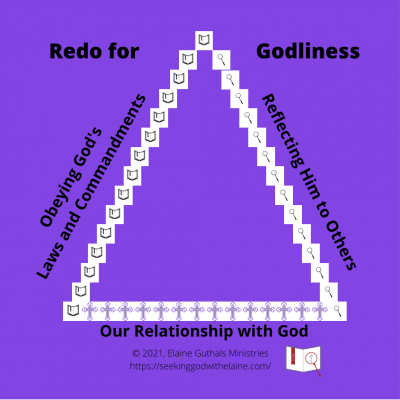
    RedoForGodliness

    Our Relationship with God

    • Silence of our soul starts out with being in the Presence of God. It is a fancy way of saying focus on God (Promoting Silence in Our Soul).

    • God’s work is the actions He takes through us to accomplish His plans, which are accomplished perfectly (Attributes of God: Perfect).

    • We don’t need to know everything that God does. We don’t need to have figured it out, and we don’t need to fully understand (Attributes of God: Glorious).

    • We say God has all these attributes and virtues, but we really don’t know His nature (Attributes of God: Glorious).

    • God’s beauty should be revealed as our inner beauty through our character (Attributes of God: Beautiful).

    • It doesn’t work when we try to bring God down to our unholiness (Attributes of God: Holy).

    • God desires us to have His character (Attributes of God: Holy).

    • When we focus on God, He will give us His peace — that is part of His work. In that way, we can be peaceful like Him — making the work perfect and complete. Complete equals perfect (Attributes of God: Perfect).

    • God wants us to submit to Him because He loves us and we love Him. He wants us to want to have the relationship with Him (Attributes of God: Perfect).

    • We worship God by imitating Him. That means we try to be perfect (Attributes of God: Perfect).

    • We are made in God’s image. That means, even though we may not currently be like Him, we can grow to have His character. We grow by the grace of God (Attributes of God: Perfect).

    • What we cannot forget is that God possesses the morals and attributes He is asking us to possess. That is why we are called to be imitators (Attributes of God: Just).

    • Judgment occurs when we sin. Righteousness is the reward when we don’t sin. The judgment and righteousness God bestows on us is not a negative (Attributes of God: Righteousness).

    • Being right with God brings us joy. We see the perfection. We feel the trustworthiness. We see that His commands are predicated on His Love for us. It makes us love and revere God more (Attributes of God: Righteousness).

    • God requires us to choose to live the way that honors Him (Attributes of God: Faithfulness).

    • It isn’t enough to just know of Him. It isn’t enough to just say we love Him. We have to make a conscious decision to live our lives in the way He wants us to live (Attributes of God: Faithfulness).

    • God wants to know that we’ve had a changed heart. He needs to know that we are submitting to Him. Anything less, we would still be saying, like Adam and Eve, that we don’t have to listen to God. We would be implying that we are — at a minimum — His equal. God is our Creator. He does not have to settle for anything less than our complete obedience (Attributes of God: Faithfulness).

    • We are to choose God because of Who He is, not what we gain from Him (Attributes of God: Faithfulness).

    • The product of our declaring and entwining the gospel with our lives is the change of character to godliness (Attributes of God: True).

    • God’s truth and faithfulness in carrying out His word is the foundation for our hope and trust. We have to have that foundation in order to believe in salvation (Attributes of God: True).

    • If we know God and try to imitate Him, we will imitate His love (Attributes of God: Loving).

    • In order to live correctly, we need to know God and become disciples. We are all made in His image and have the capacity to love in us. But we have to love in His pure way, not the worldview’s tolerant way (Attributes of God: Loving).

    • We are to open ourselves up to others. We need to let them in, and they need to see the real us. If we do that, they see the God we are imitating (Attributes of God: Loving).

    • All are offered the gift of salvation, but it is only given to those who accept it. Justification, adoption, etc. happens only when we turn our lives over to God (Attributes of God: Merciful and Forgiving).

    • If we don’t turn away from the desire to sin, we aren’t saved (Attributes of God: Merciful and Forgiving).

    • The contrast of the idol being fed and Sovereign God not dependent on mankind is huge. Mankind had to do everything for the idol. God doesn’t need a relationship with us. He wants a relationship with us (Attributes of God: Providential and Caring).

    • We can’t delude ourselves into thinking that, since God is a loving God, He is not going to hold us accountable (Attributes of God: Providential and Caring).

    • We have to keep God’s provision in perspective. We are not entitled to anything He gives us. We don’t even deserve it. God provides for us because of His unfailing love. That is just Who He is (Attributes of God: Providential and Caring).

    • God’s being just does not allow Him to accept sinful behavior. God will stay true to His character (Attributes of God: Just).

    • Once we are alone with God, we can truly search for and seek Him. He will spend the time with us to convict us and to answer our questions (Promoting Silence in Our Soul).

    • When we see peace as the absence of conflict, we take our eyes off of God. God wants us to see and know his peace within the conflict (Improving Silence in Our Minds).

    • The listening makes us docile — teachable. That is what God wants (Mastering Silence of the Tongue).

    • Our being in the temple has no bearing with God being in the temple. We could be indifferent, neglectful, or downright rebellious toward God. He will still be God in His temple (The Silence of Cheerfulness and Rejoicing).

    Glossary

    UpToHisLevel

    Obeying God’s Laws and Commandments

    • We aren’t going to keep all of God’s commandments if we don’t love Him (Attributes of God: Faithfulness).

    • God rewards our righteousness and punishes our unrighteousness. In a way, righteousness is its own reward. If righteousness is the result of being free from sin and the product of a solid relationship with Him, that means we have to choose to obey His laws and commandments (Attributes of God: Righteousness).

    • As Creator, He does have control of everything. He has not abdicated that control to anyone. We are accountable to Him (Attributes of God: Just).

    • Following God’s true instructions will bring us to lead godly lives (Attributes of God: True).

    • The whole purpose of Paul’s instruction was to show conformity with God’s previous vows to help us to redo ourselves for godliness. God receives the glory, and we receive salvation (Attributes of God: True).

    • We would say that the laws and the commandments are right. Since we know that the laws and the commandments show us God’s character, we can say that His character is right (Attributes of God: Righteousness).

    • “… Be holy, because I am holy” (I Pet. 1: 16 CSB) is to be our standard (Attributes of God: Holy).

    • We see God’s holiness through His laws and worship (Attributes of God: Holy).

    • If the laws show us holiness and the laws tell how we are expected not to sin, holiness means we are free from the stain of sin. God’s character is, therefore, pure and holy because He does not sin (Attributes of God: Holy).

    • It is our choice to obey God’s laws and commandments. It is arrogant of us to think we can disobey those laws and commandments and not suffer the consequences (Attributes of God: Just).

    • God is not unjust because He passes judgment on our actions (Attributes of God: Just).

    • We can’t gain righteousness just by keeping God’s laws. We’ve got to have the faith that goes with it (Attributes of God: Righteousness).

    • We can’t just do the lip service or just be a good person. Our mind has to be involved. I would add, so does our heart, soul, and strength (Attributes of God: Goodness).

    • God isn’t a dictator. He doesn’t make decrees and expect us to blindly follow them. Instead, God wants us to make conscious, informed decisions as to whether or not we are going to ABCD. Yes, we have an option to reject the Plan of Salvation. In order to make that informed decision, we have to actively listen to God. We have to let Him lead (Mastering Silence of the Tongue).

    • Returning to God broken is more of a concept of our knowing just how much we need God in our lives. We are broken in terms of struggling against and resisting Him (The Silence of Humble of Confession).

    Glossary

    GospelAboutCharacterAndGlory

    Reflecting Him to Others

    • We are to be the outward expression of God’s holiness because we were made to worship Him (Attributes of God: Holy).

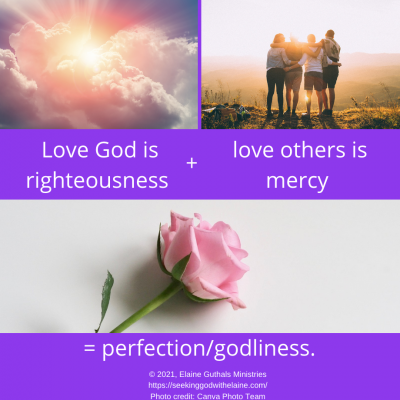
    • If loving God and loving others leads to perfection, we have to embrace God’s love upon conversion and keep it at the forefront of our redo for godliness (Attributes of God: Loving).

    • When we experiment with our faith, we use it to witness to others. We cannot quantify and qualify our faith until we have a good handle on it. What better way to solidify our faith than to share it with others? (Attributes of God: Goodness).

    • If some people believe there is nothing in the Scriptures that pertain to them, they are wrong. The Bible tells us clearly what happens when we choose God and when we don’t (Attributes of God: Faithfulness).

    • If God was the dictator worldview people want to paint Him, they would not have the free will to reject Him. They would be on their knees before Him now (The Rewards and Penalty of the Cross).

    • Worldview people call disciples intolerant when we mention the fact that we can only receive salvation through believing in Jesus. We are restating God’s position, not ours (Belief in the Christ of the Cross is Essential).

    • Whether worldview people think God’s salvation cannot save us or that it is not the only way, really matters not. Either way, they are rejecting God’s salvation. The result will be the same (Belief in the Christ of the Cross is Essential).

    • Religion on its own can’t save us. Church attendance — the ceremony and pageantry of it — means nothing without the personal relationship with God (Belief in the Christ of the Cross is Essential).

    Glossary

    God wants us to genuinely choose Him and His ways.

    To read devotions in the Redo for Godliness series, click the appropriate button below.

  • Renewing Our Inner Person by Being Sober

    A main characteristic of the sinful world is its chaos. Disciples, on the other hand, are called to be sober and even-keeled. This daily devotional looks at how disciples of Christ can use being sober and even-keeled to renew our inner us.

    Nuggets

    • We prepare ourselves for the trials that try to steal our confidence and our relationships with God.

    • Disciples are to be exercising self-discipline to foster sobriety.

    • The foundation of hope is grace that comes when belief is present.

    To read devotions in the Redo for Godliness series, click the appropriate button below.

    Devotions in the Growing Our Soul series

    Have you ever wished salvation was a once-and-done event? God, in all of His magnificence, would proclaim we are now perfect and holy.

    • Holy means to be set apart, perfect, and morally pure while possessing all virtues.
    • The perfected state indicates the combination of the spiritual graces which, when all are present, form spiritual wholeness or completeness.
    • Spiritual graces are worldly morals that have been submitted to God to further His kingdom instead of enhancing this world.

    Glossary

    Everything in us would be magically fixed. Only good things would happen from there on out.

    Doesn’t. Happen. That. Way.

    Instead, we become travelers on the Sanctification Road. It is a bumpy, hilly, curvy road. There is no consistency to it.

    Sanctification is a major component of our redo for godliness. However, it is not consistent. It has its hills and valleys.

    The trials and the testings that come on that road cause us to determine just where we are on our relationship with God. Through them all, we are called to be sober or even-keeled.

    Let’s Put It into Context

    Here is a running list of what we’ve discussed previously.

    Sober is a character trait distinguished by self-control, genuineness, and sound moral judgment.

    Preparing Our Minds for Action

    “Therefore, preparing your minds for action …” (I Pet. 1: 13 ESV)

    We prepare ourselves for the trials that try to steal our confidence and our relationships with God.

    Because we are to be sober and even-keeled, Peter said we should prepare our minds. The King James Version says “… gird up the loins of your mind …” (I Pet. 1: 13 KJV). The sermons I read usually took a tighten-your-belt approach to that.

    I liked the Christian Standard Bible translation. It said “Therefore, with your minds ready for action …” (I Pet. 1: 13 CSB).

    We renew our inner person by training ourselves for what comes our way. We know Satan is going to try to throw things at us. We know God is even going to test us.

    To read a related devotion, click the button below.

    We have to be ready. We are not only to maintain our salvation, but we are also to grow it. We have to be prepared.

    Read this sentence through the lens of renewing our minds as God is teaching us to grow. Parker wrote, “Remember, however little the word of revealed truth is to you, it is God’s greatest and best thought: that it is the divine record concerning yourself and His dear Son ought to make it of infinite importance to you. Therefore, ‘gird up the loins of your mind.’ Tighten the belt. You can do better work, run a better race, or be better ready for fight. Then shall you be fitted for the best service the King demands.”

    Resource

    What did Parker say?

    • There are a lot of things about God that we don’t understand. He has revealed only some to us in His Word.
    • It doesn’t matter if we think something is a biggy or something minuscule. It tells us about God. That makes what He reveals through His Holy Spirit infinitely more than we realize.
    • We need to use what God reveals to us to better our relationships with Him.
    • Because we are His, we will have to be ready to fight whatever Satan throws our way.

    Spurgeon wrote that tightening our belts helps make us consistent. That helps make us determined.

    This is needed because, as Spurgeon wrote, “A true believer should be ready for suffering or service — ready, indeed, for anything.”

    Resource

    I love what Bird had to say. He wrote, “The Christian life is not an outward thing. The mind is the battlefield. Here the battles are lost or won. How much does the mind require bracing up!”

    Resource

    We’ve long said that faith is in the mind. This year, we learned that it isn’t just about doing the do’s and not doing the don’ts. It is about being.

    Perfection is about being. It is about obtaining the character of God.

    Bird reminded us that Christian morality has a nobility about it. We are to have a quiet dignity that breeds patience and diligence.

    • Diligence is a consistent, persistent effort.
    • Patience is a steadfast endurance in opposition without losing a positive attitude.

    To me, that makes a stronger tie with our sobriety. When we think even-keeled, we think patient. When we think sober, we think diligent.

    Vaughan argued that, in order to gird our minds, we need to replace vanity with humility. Humility is a character trait that diminishes pride and places dependence on God while holding a modest view of our importance with respect to others.

    Resource

    Parker said that tightening our belts would help us with our sobriety. It increases our self-control.

    Being Sober-Minded

    “… and being sober-minded …” (I Pet. 1: 13 ESV)

    Disciples are to be exercising self-discipline to foster sobriety.

    Another definition Spurgeon presented for sober besides being moderate was to be watchful. I think that goes hand in hand with being even-keeled.

    Glossary

    We are not to be going to extremes, but we should be grounded in reality. We can focus on God more when we are consistently looking at truth.

    Thomas talked about moral judiciousness. He said that judicious deals with “… our opinions, our affections, our expectations, and speech.”

    Resource

    How does that mesh with soberness? Those are exactly the areas that we should be even keeled as disciples of Christ.

    We need to be self-controlled in each area. If we aren’t controlled by God in our opinions, affections, and speech, we damage our witness. If we aren’t self controlled in our expectations, then we could come across as arrogant and uncaring.

    Rogers made a great point. Sobriety helps us to keep the laws and commandments. He also said it helps us moderate those laws and commandments which we are keeping.

    Resource

    We’ve talked before about how someone may interpret one thing as a sin, but someone else doesn’t. Paul told us not to be stumbling blocks for others (Rom. 14: 13).

    We said it is better to give up some thing that really isn’t a send them to have you or someone else commit the same because of it. There are things that border sinfulness or could lead to sinfulness.

    Resource

    To read a related devotion, click the button below.

    God wants us to be thoughtful about what pleases Him. He wants us to make a conscious decision to follow Him.

    The Foundation of Hope

    “… set your hope fully on the grace that will be brought to you at the revelation of Jesus Christ” (I Pet. 1: 13 ESV)  

    The foundation of hope is grace that comes when belief is present.

    It was interesting that Vaughan equated grace with patience. Grace is a free and unmerited gift from Heavenly Father given through His Son, Jesus Christ that enables salvation and spiritual healing to believers by the work of the Holy Spirit.

    Resource

    The Holman Bible Dictionary also said grace was the “undeserved acceptance and love received from another …” Maclaren called it “… the sum of the felicities of a future life.”

    Resource

    I can see grace being the product of the joy of a life with God.

    I guess God has to have a lot of patience with us when He is giving us the free gift of grace — this undeserved acceptance and love.

    The hope comes because we have the grace. Hope is a future expectation, called a living hope, based on the confidence that our names will be found in the book of life.

    The consistency of sobriety should foster the hope. It brings a harmony to our lives that strengthens us. It calms all the clashing factions in our minds.

    But notice where we get this hope — “… the grace that will be brought to you at the revelation of Jesus Christ” (I Pet. 1: 13 ESV). Hope comes belief in our Savior.

    Maclaren also reminded us that this hope is only maintained by self-discipline. Self-discipline is where we manage ourselves so that we can improve. The self-discipline brings us the self-control, the ability to withstand temptations by managing ourselves — our emotions, thoughts, and behaviors.

    Bright extended that and said we can train this hope. We do that through self-discipline, too.

    Resource

    Whoa! Wait a minute. “… the grace that will be brought to you …” (I Pet. 1: 13 ESV). God does the bringing.

    God is the one who calls us to salvation.

    • Salvation is the gift of life through the deliverance from evil and the consequences of sins to replace them with good and eternal life.
    • The consequences of sin are spiritual death and physical separation from God.
    • Spiritual death is the spiritual separation from God that occurred as a consequence of Adam and Eve’s original sin. The spiritually alive are those who have ABCDed, so they are no longer separated from God.
    • Eternal life is the promise of living eternally – even if we have died in this life – because we have admitted our sins, believed Jesus as Savior and Redeemer, and confessed God as Sovereign Lord.

    The ABCDs of Salvation

    If you have not become a believer in Christ, please read through the
    Plan of Salvation and prayerfully consider what God is asking you to do.

    A – admit our sins
    B – believe His Son Jesus is our Redeemer
    C – confess God as Sovereign Lord

    D – demonstrate that commitment by making any changes needed in our lives to
    live the way in which God has called us

    The Disciple’s Job Description

    Glossary

    God calls everyone to salvation. He doesn’t want one person to perish (I Tim. 2: 4).

    This shows that God wants to bestow His peace on us. He wants to provide an environment in which we can be even-keeled.

    RenewingOurMindByBeingSoberPin

    Making the Connections

    Bird reminded us what the end goal is — holiness. We are sober and even-keeled to be able to navigate the Sanctification Road to achieve holiness and righteousness.

    Resource

    What that entails is obedience. Obedience means to hear, conform to, and carry out the instructions that God gives us.

    To read a related devotion, click on the appropriate button below.

    Disobedience allows the chaos to run unchecked. We need to remain true to Him.

    How Do We Apply This?

    • We are obedient to God’s laws and commandments.
    • We listen to the promptings of the Holy Spirit.
    • We need to choose God’s way.

    Father God. We love You. We choose You and Your ways. Give us grace. Give us strength. Amen.

    What do you think?

    Leave me a comment below (about this or anything else) or head over to my Facebook group for some interactive discussion.

    If you don’t understand something and would like further clarification, please contact me.

    If you have not signed up for the email daily or weekly providing the link to the devotions and the newsletter, do so below.

    If God has used this devotion to speak with you, consider sharing it on social media.
  • Jesus’ Prayer of Submission

    In between the Passover meal and His arrest, Jesus retreated to the Garden of Gethsemane. This daily devotion looks at how that time was His submission to all God had in His plan.

    Nuggets

    • Prayer strengthens us to resist temptation.
    • Jesus showed us how to turn everything over to God.
    • We are to submit to God completely.
    • Jesus’ prayer showed us how much anguish He was in before His arrest.
    • The situation grieved the disciples.

    Devotions in the Luke’s Diagnosis and Prescription series

    The Passover meal had been eaten, and the Lord’s Supper had been instituted. Now, it was time to wait for the show to really start.

    Jesus was going to be arrested that night.

    But just because Jesus was in wait mode didn’t mean He misused the time. To wait is to endure something for however long we are called to do so by the Lord.

    We said in The Silence of Waiting on God that we are called to wait and rest in God, but that doesn’t mean we aren’t doing anything.

    Resting and waiting are actions. They are conscious decisions.

    To read a related devotion, click the button below.

    Battling Temptation

    “Then he withdrew from them about a stone’s throw, knelt down, and began to pray” (Lk. 22: 40 CSB).

    Prayer strengthens us to resist temptation.

    Jesus chose to complete another action. He went to the Garden of Gethsemane in the Mount of Olives to pray.

    Clarkson contended that Peter, James, and John were allowed to go further into the Garden with Jesus than the other eight did because only they were counted as worthy. I don’t think I buy that.

    I think those three formed the inner circle for Jesus. He didn’t have one BFF; He had three. I think they were more the leaders of the disciples.

    True, Thomas had his doubts, and some of the others really aren’t mentioned except in the list of names. But when we get right down to it, all of them ran away.

    Even Peter. Even James. Even John, the beloved.

    Jesus wanted the Big Three to pray for Him. He was going to be praying, sure.

    But Jesus wanted the support. “For where two or three gather in my name, there am I with them” (Mt. 18: 20 NIV).

    There was another reason why Jesus wanted the disciples to pray — it wasn’t just for Him. He wanted them to pray for themselves.

    Temptation is a suggestion in our mind that would lead us to sin rather than following God’s Will. It is also that period of time between conception and execution of doing what is sinful.

    To read a related devotion, click the button below.

    There was a huge battle going on inside of Jesus. Clarkson wrote, “At this point the cross immediately confronted him in all its awful severity, and he knew that this was the time when he must finally resolve to endure everything or to retrace his steps. This, then, was the critical hour; then was ‘the crisis of the world.’”

    Resource

    So, Jesus went where He was supposed to go — to the foot of the throne. He went to have a heart-to-heart talk with His Dad.

    Jesus knew what was facing Him — and what the disciples would be facing — would be a major battle. All the disciples knew for the past three years was going to get ripped out from under them.

    Everyone was to have been praying that night. Only Jesus got the job done.

    A Prayer of Submission

    “Father, if you are willing, take this cup away from me — nevertheless, not my will, but yours, be done” (Lk. 22: 42 CSB)

    Jesus showed us how to turn everything over to God.

    Let’s roost a second on the prayer itself. Thy Will be done. Four simple words. Beautiful words.

    Tough words. Maybe easy to say them. Hard to carry them out.

    Really, that is what God wants in a nutshell. Remember, we said it wasn’t about doing or not doing. Perfection was all about being.

    Perfection is about being. It is about obtaining the character of God.

    The perfected state indicates the combination of the spiritual graces which, when all are present, form spiritual wholeness or completeness. Spiritual graces are worldly morals that have been submitted to God to further His kingdom instead of enhancing this world.

    Look before that. “Father, if you are willing, take this cup away from me — nevertheless, not my will, but yours, be done” (Lk. 22: 42 CSB).

    Clarkson wrote, “Prayer, appropriate at all times, is urgently needed as we enter the shadow of temptation; but it is positively indispensable when the greater trials of our life assail us.”

    Resource

    Jesus knew that there were some temptations that we would only be able to withstand if we were constantly praying. He knew that God was in ultimately in control.

    True, Jesus knew from before the beginning of the world that He was going to be the Sacrifice for our sins. He had no problem with that.

    To read a related devotion, click the button below.

    But I wonder if, in the back of His mind, Jesus thought God would pull an Isaac.

    • “‘Take your son,’ he [God] said, ‘your only son Isaac, whom you love, go to the land of Moriah, and offer him there as a burnt offering on one of the mountains I will tell you about’” (Gen. 22: 2 CSB)
    • “Then Isaac spoke to his father Abraham and said, ‘My father.’ And he replied, ‘Here I am, my son.’ Isaac said, ‘The fire and the wood are here, but where is the lamb for the burnt offering?’ Abraham answered, ‘God himself will provide the lamb for the burnt offering, my son.’ Then the two of them walked on together” (Gen. 22: 7-8 CSB).
    • “Then Abraham reached out and took the knife to slaughter his son” (Gen. 22: 10 CSB).
    • “Then he said, ‘Do not lay a hand on the boy or do anything to him. For now I know that you fear God, since you have not withheld your only son from me.’ Abraham looked up and saw a ram caught in the thicket by its horns. So Abraham went and took the ram and offered it as a burnt offering in place of his son” (Gen. 22: 12-13 CSB).

    Oh, we could probably bet Satan was putting that front and center in Jesus’ mind!

    Didn’t matter. Jesus said, “Your Will, God, whatever.”

    What is the base of a lot of our sins? Clarkson told us that “it is because men are not willing to be what God created them to be, not willing to do what he desires them to do; it is because they want to pursue those lines of thought and of action which he has forbidden, and to find their pleasure and their portion in things which he has disallowed, – that they err from the strait path and begin the course which ends in condemnation and in death.” We say anything but Thy Will be done.

    Resource

    All about Submission

    We are to submit to God completely.

    Clarkson said it was all about the submission. It wasn’t about understanding. It isn’t even about feelings. It isn’t about religious affiliation.

    It is about letting God have His way. Even if He is calling us to do or give up something we don’t want. Even if it is going to hurt.

    Oh, to have Jesus’ character! But that is what this redo for godliness is all about, isn’t it? We want to “… put [ourselves] into harmony with the Divine plan and purpose, so as to say in true submission and surrender, “Thy will be done,” [in order to get] to the very heart of the saint’s ‘higher life’ on earth; this is about as [full] a ‘sanctification’ as can be attained this side [of] heaven.”

    Resource

    Pusey contended that submission to God has two elements.

    • Follow God’s Will perfectly.
    • If something is not His Will, don’t make it your will.

    Pusey felt that if God’s Will was not clear to us, we are free from sin.

    Resource

    Part of me is saying that is logical. The other part is saying don’t use that as a way to try to justify our positions.

    God’s laws and commandments aren’t a strict checklist to determine how many of the do’s did we do — and how many of the don’ts.

    God’s laws and commandments aren’t a strict checklist to determine how many of the do’s did we do — and how many of the don’ts.

    They are to show us God’s character. We are to use what we learn from them to aid us in determining our actions in other situations.

    No where in the Scriptures does it give us instructions on the internet. But it tells us not to lie and steal. There are a lot of lies out there, and many use it as the avenue to steal.

    We’ve got to imitate God’s character. We have to be Him, not do to earn or perfection.

    A Prayer of Anguish

    Being in anguish, he prayed more fervently, and his sweat became like drops of blood falling to the ground” (Lk. 22: 43-44 CSB).

    Jesus’ prayer showed us how much anguish He was in before His arrest.

    Look how much Jesus was hurting in the Garden. The beatings hadn’t started. The crown of thorns hadn’t been jammed on His head yet.

    Jesus is just praying. And “… his sweat became like drops of blood falling to the ground” (Lk. 22: 44 CSB). He was so depleted of energy that an angel had to come minister to Him.

    Eadie contended that the sweat really was bloody. Whether it was or not, He needed divine support.

    Resource
    Eadie’s Our Lord’s Bloody Swear
    https://biblehub.com/sermons/auth/eadie/our_lord’s_bloody_sweat.htm

    Jesus was having major turmoil on facing the cross. Still, He chose to obey His Father, even to death.

    The Inner Circle Even Got It Wrong

    “When he got up from prayer and came to the disciples, he found them sleeping, exhausted from their grief. ‘Why are you sleeping?’ he asked them. ‘Get up and pray, so that you won’t fall into temptation.'” (Lk. 22: 46-47 CSB)

    The situation grieved the disciples.

    Even the Big Three were not allowed to see Jesus’ anguished prayers. Jesus did go back to check on them.

    Unfortunately, they did not do as they were told.

    • “When he reached the place, he told them, ‘Pray that you may not fall into temptation’” (Lk. 22: 40 CSB)
    • “‘Why are you sleeping?’ he asked them. ‘Get up and pray, so that you won’t fall into temptation’” (Lk. 22: 46 CSB).

    We don’t know how long Jesus had been off by Himself praying. We don’t know how long they had been asleep.

    We do know they were given one job — and they messed it up.

    If there was any explanation of why, it was in verse 45. “When he got up from prayer and came to the disciples, he found them sleeping, exhausted from their grief” (Lk. 22: 45 CSB).

    Now, I am not saying this to give them a pass. They disobeyed a direct order from Jesus.

    They didn’t disobey because of doubt or desire to follow Satan. They had anguish in their souls because their Master said that He was going to die.

    No, they haven’t put it all together yet. What they do understand scared them.

    Still, Jesus wanted the disciples to pray for Him. I don’t see how He could have justified it if He went off to pray on His own.

    Jesus was to be our model. When we hurt, we are to pray to God. We are to support and ask for support from our brothers and sisters in Christ.

    It wouldn’t have worked if Jesus would have cut out.

    True, the disciples were Clueless in Gethsemane. But they knew something big — and bad — was up. And they were shaking in their sandals.

    Jesus knew they were going to split. He knew Peter was going to deny Him.

    Still, He had all of His remaining disciples there. He wanted them involved in His ministry — in every aspect of it.

    No, they couldn’t take Jesus’ place. They could be witness to what He did and why for years to come.

    It makes very obvious that God wants us to have a part in expanding His kingdom.

    JesusPrayerOfSubmissionPin

    Making the Connections

    Ooo, baby. Look what Higgins said. He wrote, “Prayer is an arrangement in the economy of infinite wisdom and goodness to meet the daily needs of Human lives.”

    Resource

    Arrangement — positioning
    Economy — wealth and resources
    Wisdom — discernment
    Goodness — righteousness

    Prayer is a positioning in the wealth and resources of infinite discernment and righteousness to meet our daily needs.

    We need to especially pray when we are suffering. When we are able to say “Thy Will be done,” God rewards us with strength.

    How Do We Apply This?

    • When we pray, we need to totally submit to God.
    • We need to pray for faithfulness.
    • We need to pray for others.
    • We can ask for the same thing multiple times.
    • We need to shut the door so we won’t be distracted when we pray.

    Resource


    Lord, I Have Shut the Door
    Vocalist: Elaine Guthals
    Keyboard: Chris Vieth

    Luke’s diagnosis was that we need to pray the same prayer that Jesus did. Thy Will be done. That will go a long way in submitting to God.

    Father God. We submit to You. We want to do Your Will. You have given us laws and commandments to show us how to respond in any situation. Help us to imitate You. Amen.

    What do you think?

    Leave me a comment below (about this or anything else) or head over to my Facebook group for some interactive discussion.

    If you don’t understand something and would like further clarification, please contact me.

    If you have not signed up for the email daily or weekly providing the link to the devotions and the newsletter, do so below.

    If God has used this devotion to speak with you, consider sharing it on social media.

  • Reckless Love

    Hey, guys. I am going to do a music day for this post. I took some time for me today. I needed to reconnect with people rather than just spend time with my iPad.

    We’re going to do the Sunday Morning Bible Study lesson next, then we will get back to the Growing our Soul series.

    Reckless Love
    Vocalist: Elaine Guthals
    Keyboard: Chris Vieth

    RecklessLovePin

    What do you think?

    Leave me a comment below (about this or anything else) or head over to my Facebook group for some interactive discussion.

    If you don’t understand something and would like further clarification, please contact me.

    If you have not signed up for the email daily or weekly providing the link to the devotions and the newsletter, do so below.

    If God has used this devotion to speak with you, consider sharing it on social media.

  • Renewing Our Inner Person from Anxiety

    It is easy to say, “Don’t be anxious.” It is harder to pull that off. This daily devotional looks at exactly what God is commanding disciples to do and how He plans for us to accomplish that.

    Nuggets

    • God wants us to be focused on Him, not our circumstances.

    • We keep our focus on God by remaining in communication with Him.

    To read devotions in the Redo for Godliness series, click the appropriate button below.

    Devotions in the Growing Our Soul series

    In the last devotion, we said that God renews our peace when we face life’s trials. We got that from the verse that says to “cast all [our] anxiety on him because he cares for [us]” (I Pet. 5: 7 NIV).

    Since we are God’s children, we don’t have to face the anxiety alone. Paul gave us instructions on how to cast our cares on God.

    Let’s Put It into Context

    Here is a running list of what we’ve discussed previously.

    Watch Our Reactions

    “Do not be anxious about anything …” (Phil. 4: 6 ESV)

    God wants us to be focused on Him, not our circumstances.

    You would think that disciples would not have anxiety. We have all of these promises from God.

    • “Let not your hearts be troubled. Believe in God; believe also in me” (Jn. 14: 1 ESV)
    • “Now may the Lord of peace himself give you peace at all times in every way. The Lord be with you all” (II Thess. 3: 16 ESV)
    • “And my God will supply all your needs according to his riches in glory in Christ Jesus” (Phil. 4: 19 CSB)
    • “And we know that for those who love God all things work together for good, for those who are called according to his purpose” (Rom. 8: 28 ESV).

    God says the same things over and over again in Scriptures. “Put your trust in Me.” We need to be dependent on God.

    However, when our world starts to get shaky, the anxiety ramps up. We can’t seem to stop ourselves.

    I can see where Punshon was coming from. He said anxiety was an evil that should be avoided.

    Resource

    Anxiety is caused by taking our focus off of God. It is like we don’t trust Him to do what He has promised — provide for us and take care of us.

    The flip side of that is when we value world view things more than God things. That can cause anxiety as our focus is different than how we are made.

    Punshon made an excellent point. Having anxiety may be a matter of degrees. We have to be even keeled. We can’t take things to the extreme.

    It is okay to mourn a person’s death. We just can’t rail at God for the loss, say we are totally on our own now, or bury our heads in the sand.

    Our anxiety should be tempered by the fact that God has us in the palm of His hand. He is in control.

    Our anxiety should be tempered by the fact that God has us in the palm of His hand. He is in control.

    The modern versions translate it as don’t worry or don’t be anxious. The King James Version tells us to be careful.

    To me, that tells us how to not worry and have anxiety. It means that we watch what situations into which we put ourselves. It has a more proactive action to it.

    Barnett cautioned that we shouldn’t just “…take life as it comes.” We aren’t meant to be victims of circumstances.

    Resource

    Spurgeon wrote, “‘The life is more than meat,’ and the soul than life.” We should not worry over the small stuff or the insignificant stuff. Unfortunately, we do seem to expand a lot of effort worrying about things that are moot points.

    Resource

    When we are anxious over the big things in life, then we really are doing it wrong if we don’t put it in God’s control. It is an indictment of our faith if we aren’t relying on God then.

    Most importantly, we shouldn’t worry over a temporary world. We should keep our focus on eternity.

    The condition of our soul is much more important than what is happening in this life.

    The condition of our soul is much more important than what is happening in this life.

    Look to the Solution

    “… but in everything by prayer and supplication with thanksgiving let your requests be made known to God” (Phil. 4: 6 ESV)

    We keep our focus on God by remaining in communication with Him.

    So, how are we supposed to combat our anxiety?

    • Prayer
    • Supplication
    • Thanksgiving

    We can’t do it by ourselves. We can’t do it with worldly methods. We can’t depend on a significant other or family member.

    We need to go to the Source. “Trust in him at all times, you people; pour out your hearts to him, for God is our refuge” (Ps. 62: 8 NIV).

    Why is this important? Bartlett said, “The prayer of faith is the natural and appointed instrumentality for the repression of over anxiety.

    Resource

    Prayer

    Prayer is a two-way communication with God in which we pour out our soul to Him. Miller said that this is where blessings are sought.

    Resource

    Sometimes, it might be easy to think, if God knows what we are going to ask for even before we ask, why should we have to ask? There are a couple of good reasons.

    If we don’t ask, then it means we are not submitted to God. We may feel we are entitled to what God wants to give us.

    Spurgeon gave another reason. He said that the asking makes the receiving of the mercies sweeter.

    Resource

    It is to our benefit that we pray. It is through the two-way communication that we learn Who God really is. He reveals more of Himself to us than is in the Scriptures.

    But think of it this way. We are praying to the Sovereign God. God’s sovereignty means He has supreme power, giving Him control over all things without accountability to a higher power.

    Shouldn’t that soothe our anxiety?

    We are to pray to God about everything. That means we shouldn’t keep a portion of our lives back from His control.

    Being able to ask God anything does not mean we get to ask Him for a flood of money. It doesn’t mean we get to petition that something not be a sin anymore — or at a minimum, we get a pass.

    We do have to ask in His Will. Our petitions have to be genuine. They have to recognize God as our Creator and Ruler.

    Supplication

    Supplication is our specific requests to God. Miller also said that supplication is where we show our express disapproval of evil.

    Resource

    “… let your requests be made known to God” (Phil. 4: 6 ESV). We can ask God anything.

    Bartlett reminded us what this does and doesn’t mean. He wrote, “Enlightened prayer does not ask for miracle or any change in the Divine will.”

    Resource

    “… let your requests be made known to God” (Phil. 4: 6 ESV). We can ask God anything.

    Brown argued that we should take the foolish and shortsighted requests to God anyway. This happens “so that the proven character of your faith — more valuable than gold which, though perishable, is refined by fire — may result in praise, glory, and honor at the revelation of Jesus Christ” (I Pet. 1: 7 CSB).

    But Brown also reminded us that God is not forced to answer those foolish prayers. We shouldn’t pitch a hissy fit when He doesn’t.

    Resource

    I would add that God is perfectly entitled to give a prayer an answer of no. He isn’t a gum ball machine, where we put in a quarter prayer and get our candy out.

    Thanksgiving

    Instead of being fearful, we should be thankful. Even when our anxiety is at its peak, we should be thankful.

    Spurgeon said that we will receive our blessings only after we have prayed with thanksgiving. The focus has to be on God.

    Resource

    We have a huge reason to be thankful. God responds to us with mercy. God’s mercy is an act of sovereign will that produces an unexpected and undeserved response from God as He responds in love to our needs.

    We were the ones who disobeyed God. If it would have been us, we would have closed up shop and moved far away from the offenders.

    God didn’t banish us forever. Instead — even before He created mankind so we could sin — He designed the Plan of Salvation in order to restore our relationships with Him when we did sin.

    We should be very thankful for that. If our relationships aren’t restored with Him, we will spend eternity in hell.

    To read a related devotion, click on the appropriate button below.

    Miller said something interesting. He said we are to “… draw upon [our] experience as well as [our] faith …” This is where we connect the dots between what God wants us to be and who we are.

    Resource

    But doesn’t that make us even more thankful? We see where God has supported us and sustained us. We learned first-hand that we don’t have to be anxious.

    That is where the gratitude comes in.

    RenewingOurInnerPersonFromAnxietyPin

    Making the Connections

    “And the peace of God, which surpasses all understanding, will guard your hearts and your minds in Christ Jesus” (Phil. 4: 7 ESV)

    Spurgeon acknowledged that we are going to always have trials. We are never going to totally get rid of them.

    Resource

    But those trials bring the peace. When our inner selves are calmed, we go from anxiety to peace.

    How Do We Apply This?

    • Pray for God’s peace that passes all understanding.
    • Pray. There is no limit to what God can do.
    • Pray in faith. Believe in Him.
    • Pray in God’s Will. Don’t ask for things that is against His character and then be surprised — and upset — when He says no.
    • We can get particular with God. Nothing is too big or too small that we can’t take it to Him.
    • We can ask multiple times. It isn’t a once-and-done thing.
    • Always exhibit a thankful attitude.

    Resource

    Bartlett gave us this advice. He wrote, “While we are with God let us think of His goodness in welcoming us, His former gracious answers, His countless undeserved and even unsought blessings.” He also said, “Peace comes by power and power by prayer.”

    Resource

    We should always look to God for guidance and strength. He will hold us in the palm of His hand.

    Father God. We want to rely on You. We can only do that when we keep our focus on You. Keep us in Your Will. Amen.

    What do you think?

    Leave me a comment below (about this or anything else) or head over to my Facebook group for some interactive discussion.

    If you don’t understand something and would like further clarification, please contact me.

    If you have not signed up for the email daily or weekly providing the link to the devotions and the newsletter, do so below.

    If God has used this devotion to speak with you, consider sharing it on social media.

  • Renewing the Inner Person

    In this devotion, we are extending our discussion on the inward and outward expression of our faith. This daily devotional looks at how we renew the inward us daily.

    Nuggets

    • Our inner self is more important than our outer self.
    • God renews our peace when we face life’s trials.
    • God renews our self-esteem when our baggage-wagons get too full.
    • God renews us when we face death looking to Him.

    To read devotions in the Redo for Godliness series, click the appropriate button below.

    Devotions in the Growing Our Soul series

    We’ve been talking about becoming new creations and influencing our souls through sanctification. We are going to talk in this devotion about how we are made new creations — and how we are renewed daily.

    Only we are going to call it the inward us now. That is really what is become new, right? We don’t get new physical bodies. We get new souls.

    It is still us after conversion. God doesn’t flip a switch and make me Sally. I am still Elaine.

    But He does renew us every day. What does that mean?

    Program note: my one three-point devotion is looking like it is going to turn into a three-devotion miniseries within the series.

    Well, God is in control. I just go with the flow.

    Let’s Put It into Context

    Here is a running list of what we’ve discussed previously.

    Getting in Touch with Our Inner Us

    “So we do not lose heart. Though our outer self is wasting away, our inner self is being renewed day by day” (II Cor. 4: 16 ESV)

    Our inner self is more important than our outer self.

    We discussed in the last devotion that we are being sanctified in order to be perfected when we are called to Heaven. If we are not changed, we cannot live with God for eternity. Only those who have been changed to perfection will be admitted to Heaven.

    Paul echoed the first part. Our bodies are dying. It is a consequence of sin. This is termed as the outward us.

    The outward us is not what is going to last. “Love never ends. But as for prophecies, they will come to an end; as for tongues, they will cease; as for knowledge, it will come to an end” (I Cor. 13: 8 CSB).

    The apostle isn’t trash talking our bodies. He is just telling it like it is.

    One day, time is going to be up.

    The outward us isn’t what is important. The inward us is.

    When we ABCD, we are changed from being spiritually dead to spiritually alive. That means we get a new inward us.

    The ABCDs of Salvation

    If you have not become a believer in Christ, please read through the
    Plan of Salvation and prayerfully consider what God is asking you to do.

    A – admit our sins
    B – believe His Son Jesus is our Redeemer
    C – confess God as Sovereign Lord

    D – demonstrate that commitment by making any changes needed in our lives to
    live the way in which God has called us

    The Disciple’s Job Description

    Brown described the inward us as, “In the outward man there dwells an inward man, invisible to the eyes of sense; it loves, believes, hopes, etc., and accomplishes many acts which the outer man cannot do.”

    Resource

    Huntington described the inner us as simple. This is where faith lives.

    It caught my eye when Huntington said that inner life growth helps Heaven start here. He described that as “never satisfied with the holiness attained, its large expectation is that of an unbounded faith, and according to its faith it is done, till this worn-out body is exchanged for the resurrection body, awaking in the Lord’s likeness, and satisfied with it.”

    Resource

    That gives us hope.

    When we think of new every day, we think of God’s mercies (Lam. 3: 23). It is more than that.

    We are renewed every day. This helps us to grow because we never reach perfection here. There is always something new to learn about God. He is always working on our character to make us more like Him.

    Horne gives us a good reminder. It is us that is renewed daily, not the Scriptures. They never change.

    Resource

    To read a related devotion, click on the appropriate button below.

    What does God renew in us daily? Statham gave us a good list. His words are the purple headings.

    Resource

    That Christians fret, but do not faint.

    God renews our peace when we face life’s trials.

    We read that we are to “cast all [our] anxiety on him because he cares for [us]” (I Pet. 5: 7 NIV). Then when our anxiety goes through the roof, we think we are a failure as a disciple.

    That isn’t what this verse says.

    It doesn’t say we aren’t going to have anxiety. It says, when we do, we are supposed to give it to God.

    First Peter 5: 7 doesn’t say we aren’t going to have anxiety. It says, when we do, we are supposed to give it to God.

    Let’s look at it this way. If we connect inward us with new creations, that means we may be plowing new ground here. We could be doing things we’ve never done before — or trying not to do things we’ve always done.

    We’ve opened ourselves up to a lot more possible bad stuff than we had been exposed to before.

    If being successful at following God’s laws and commandments wasn’t an issue, we wouldn’t feel any pressure.

    We want to follow God’s Will! Enter anxiety. That shows how much it means to us to be God’s children.

    Since we are God’s children, we don’t have to face the anxiety alone. We have our Heavenly Father renewing our peace.

    Glossary

    That Christians fail, but do not faint.

    God renews our self-esteem when our baggage-wagons get too full.

    Sometimes we think disciples have to do everything perfectly. We have to be 100% fruit-of-the-Spirit perfect without breaking any laws or commandments.

    Not going to happen, folks. We will still have our share of failures. Statham said that there will be baggage-waggon (sic) captures.

    Do we have a little red wagon that we are carrying our guilt around in? Have we not done a mission project we were supposed to do? Did we do a sin that was really a don’t?

    Satan is going to just jump right on that and milk it for all it is worth.

    Or he will try.

    God renews us daily, so we can’t quit trying. If we give up, Satan has won this battle. We know he won’t win the war against God. We can’t let him capture our baggage-wagons, so that we take our eyes off God.

    Those baggage-wagons are also — many times — going to hinder us from changing our character to be like God’s. We are going to feel unworthy, like we aren’t making enough progress, or that we aren’t making any at all.

    We’ve got to keep our eyes on God. He will tell us if we are making enough success to please Him.

    We have to give our baggage-wagons to God. He will lighten them.

    Those baggage-wagons are also — many times — going to hinder us from changing our character to be like God’s.

    That Christians die, but do not faint.

    God renews us when we face death looking to Him.

    Back to this physical body is dying. It was really hard to give up my Springfield dad a week and a half ago. His physical body gave out.

    He felt the pain. He experienced frustration. But he kept his eye on His Savior and Lord.

    I know where he is right now. He is at the feet of Jesus, gazing up at our Heavenly Father on His throne. (Hopefully, he gave Mom and Dad a thumbs up for me.)

    Dying is not fun. Losing a loved one is hard.

    But it is the stepping stone to something else that is much better.

    RenewingOurInnerPersonPin

    Making the Connections

    Statham made another good observation. This renewal isn’t a Sunday-and-done-for-the-week thing. It is a daily renewal.

    It also isn’t a once-and-done renewal. It is a gradual, daily renewal.

    The kicker, too, is it usually isn’t accomplished by some momentous occurrence. We are called to walk in the Spirit. Walking is the term used to describe how we live our lives.

    Yep, as we do our job. As we raise our kids. As we comfort our friends and family.

    When we share God with whomever we come into contact.

    That is how we renew ourselves. We make the inward us God has turned us into visible through the outward us.

    See, it really isn’t about us. How did we say we gain perfection?

    • By being the best disciple God has ever had?
    • By being the only disciple who did everything right?

    No (especially on the last!).

    We’ve talked about the equation before.

    Love God is righteousness + Love people is mercy = perfection/godliness

    Love God is righteousness + Love others is mercy = perfection/godliness

    The focus has to be on God and on others, not us. We renew ourselves by becoming more like Him and serving others.

    How Do We Apply This?

    • We grow when we make seeking God a habit. The constancy stimulates growth.
    • Watkinson said that we must daily “… purify our soul in fellowship at God’s throne.” That way we grow toward God’s righteousness and holiness.
    • We have to make the correct choices as we walk through life.
    • We need to serve others in whatever way God calls us. We need to lead people to Him.

    Resource

    Gamble made a great statement. He wrote, “Conscientious obedience to the will of God will be followed by the advancement of the spiritual life.”

    Resource

    God knows how much work it is going to be to diligently follow Him. He will reward us when we succeed in obeying Him.

    Father God. You accept us even when we do not have the character You require of us. Every day, You work to mold us into the person You want us to be — one who has Your character. Renew us every day. Help us to not faint. Strengthen us when we fret and fail. Carry us home to You when our lives on this earth is finished. Amen.

    What do you think?

    Leave me a comment below (about this or anything else) or head over to my Facebook group for some interactive discussion.

    If you don’t understand something and would like further clarification, please contact me.

    If you have not signed up for the email daily or weekly providing the link to the devotions and the newsletter, do so below.

    If God has used this devotion to speak with you, consider sharing it on social media.

  • Influencing Our Soul

    Becoming a new creation influences the soul – and continues to influence it. This daily devotional looks at how our souls are influenced by sanctification – for now and the future.

    Nuggets

    • Our souls are influenced by being changed through sanctification.
    • We must be changed through sanctification to spend eternity with God.
    • We don’t have to wait for Heaven to begin to be with God.

    To read devotions in the Redo for Godliness series, click the appropriate button below.

    Devotions in the Growing Our Soul series

    This draft had been sitting in the overflow folder. But when I pulled it out the other day to write on it, it didn’t grab me like it once did.

    I found one section of a sermon from the last devotion that I want to dig into a little more. What caught my eye was when Benson wrote, “We must ‘put on the new man,’ a new creature: so called because it influences the whole man, soul and body …”

    Resource

    It gave some scripture passages. I want to see how the soul was influenced.

    Let’s Put It into Context

    Here is a running list of what we’ve discussed previously.

    The Soul Is Influenced by Sanctification

    “Now may the God of peace himself sanctify you completely, and may your whole spirit and soul and body be kept blameless at the coming of our Lord Jesus Christ” (I Thess. 5: 23 ESV)

    Our souls are influenced by being changed through sanctification.

    Paul prayed that his readers would be completely sanctified. That is the goal — that we be completely changed to be like God.

    • Sanctification is the transformation of mind, body, and soul, which begins with regeneration, gradually changes our nature through the promptings of the Holy Spirit, and ends with perfected state of spiritual wholeness or completeness.
    • Regeneration is being changed from spiritually dead to spiritually alive and the internal requickening in us that God brings about through the work of the Holy Spirit to give us new character.
    • Spiritual death is the separation from God that occurred as a consequence of Adam and Eve’s original sin. The spiritually alive are those who have ABCDed, so they are no longer separated from God.
    • The perfected state indicates the combination of the spiritual graces which, when all are present, form spiritual wholeness or completeness.
    • Spiritual graces are worldly morals that have been submitted to God to further His kingdom instead of enhancing this world.

    The ABCDs of Salvation

    If you have not become a believer in Christ, please read through the
    Plan of Salvation and prayerfully consider what God is asking you to do.

    A – admit our sins
    B – believe His Son Jesus is our Redeemer
    C – confess God as Sovereign Lord

    D – demonstrate that commitment by making any changes needed in our lives to
    live the way in which God has called us

    The Disciple’s Job Description

    Glossary

    Ferguson pointed out that sanctification is completing the work that grace began. That makes sense.

    It isn’t about us just doing lip service and saying we believe in God. It is about the change that He brings to us.

    If it wasn’t about the change, then it would be okay if we were just good people. But God calls us to more than that.

    Salvation is not about the do’s and don’ts. Submission is. By following God’s laws and commandments — and asking for forgiveness when we break them — we are growing holiness.

    Salvation is not about the do’s and don’ts. Submission is. By following God’s laws and commandments — and asking for forgiveness when we break them — we are growing holiness.

    Ferguson intimated what would happen if God did not sanctify us. He wrote, “If God did not carry on His good work in the soul, it would miscarry; and therefore we should pray God to perfect it, and preserve us blameless, that is, free from sin and impurity, till at length we are presented faultless before the throne of His glory with exceeding great joy.”

    Resource

    Dwight pointed out us that we are sanctified through God’s Word and His providence. God’s Providence is His care of us because of His loving nature to provide.

    To read a related devotion, click the button below.

    We are impressed with how God takes care of us — whether we hear of it, read it, or experience it. It isn’t a surface well-wasn’t-that-nice type of deal. It touches us in our soul and makes a lasting impression.

    Dwight reminded us that the process of sanctification begins in — and is a process of sanctifying — the soul. He wrote, “The first sanctifying act of the Spirit of God is employed in regenerating the soul. Succeeding acts of the same nature are employed in purifying it through all the successive periods of life.”

    Resource

    We are focusing on the soul in this devotion. Don’t limit sanctification to that.

    Paul wrote, “… may your whole spirit and soul and body be kept blameless …” (I Thess. 5: 23 ESV). He said sanctification is for the whole enchilada.

    Pearse stressed that sanctification is a surrender. We do not come to Him for salvation to receive forgiveness. We need to be obedient to His Will.

    Resource

    Ooo, baby. That just slammed home for me. I keep seeing our definition of holy — to be set apart, perfect, and morally pure while possessing all virtues. Every once in a while, I ask, well, how are we set apart?

    Jarbo wrote that sanctification is the “separation from that which is common to that which is holy.”

    I just needed a straightforward, clear cut sentence to explain it.

    Building the Soul for Future Residence

    “In him you also are being built together into a dwelling place for God by the Spirit” (Eph. 2: 22 ESV)

    We must be changed through sanctification to spend eternity with God.

    This devotion is an offshoot of the previous devotion. That devotion talked about renewing our mind. Renewing our mind is a part of being a living sacrifice.

    Being a living sacrifice is how we worship God. We worship God in spirit and in truth (Jn. 4: 24).

    That means we worship God with every fiber of our being — including our souls.

    Yes, Paul is talking about the church here. But I think he is also talking about us individually.

    “So then you are no longer strangers and aliens, but you are fellow citizens with the saints and members of the household of God, built on the foundation of the apostles and prophets, Christ Jesus himself being the cornerstone, in whom the whole structure, being joined together, grows into a holy temple in the Lord” (Eph. 2: 19-21 ESV).

    God is in the business of building us right now. He is teaching us the foundation that He gave the apostles and prophets.

    It was in the temple where God made His Presence known. He makes Himself known in our hearts.

    James reminded us that the building is fitted together perfectly on the Cornerstone. Another thing we have to remember is we are “…  fearfully and wonderfully made …” (Ps. 139: 14 ESV).

    Resource

    We are to imitate Jesus. That means we use His words and His deeds to guide off of.

    We build our temple by faith. Faith is the conviction that the doctrines revealed in God’s Word are true, even if we do not understand all aspects of them, a belief which impacts our lives.

    Bayne tied this discussion in with the last section. He wrote, “The Spirit of sanctification makes us a fit habitation for God.”

    Resource

    God carries on His sanctifying work in our souls. If He did not, we would not be changed.

    If we are not changed, we cannot live with God for eternity. Only those who have been changed to perfection will be admitted to Heaven.

    The Soul Is God’s Temple Now

    “If the Spirit of him who raised Jesus from the dead dwells in you, he who raised Christ Jesus from the dead will also give life to your mortal bodies through his Spirit who dwells in you” (Rom. 8: 11 ESV)

    We don’t have to wait for Heaven to begin to be with God.

    Jesus and the Holy Spirit lives in us now. Rye made a great statement. He wrote, “The indwelling of God the Holy Spirit is the common mark of all believers in Christ.”

    Resource

    The Holy Spirit takes up residence in us so that He can sanctify us and change us to be holy.

    Thompson reminded us that, though this body will die, death is not final. We will live for eternity. Will it be in Heaven with God or in hell with Satan?

    Where our new address will be is dependent on whether we have ABCDed.

    Resource

    Resurrection is the end game, but we have to go through regeneration and sanctification first.

    InfluencingOurSoulPin

    Making the Connections

    God wants to influence our lives. He doesn’t want us to just say we are going to follow Him, and then not do it.

    We are to truly live our lives for God. That means submit to Him and obey His laws and commandments. In doing so, we will be changed to be like Him.

    Our commitment to God should be a genuine confession to Him as Sovereign God.

    How Do We Apply This?

    Sanctification is a major component of our redo for godliness. However, it is not consistent. It has its hills and valleys.

    Sanctification is a major component of our redo for godliness. However, it is not consistent. It has its hills and valleys.

    Pearse made a great point. He wrote, “But what we give to God is altogether the result of our knowledge of Him.” We have to know first.

    Resource

    But to know God as our Great Physician means there has to be an illness. To know Him as a comforter means there has to be loss. To know Him as our Rock and the One Who gives us shelter means there has to be storms in life.

    To know God, we need to seek Him.

    Searching for and Seeking God

    Hearing His Word (Rom. 10: 17).
    Reading His Word (Rev. 1: 3).
    Praying to Him (Heb. 4: 16).
    Studying His Word (Ac. 17: 11).
    Meditating on His Word (Ps. 1: 1-2).
    Memorizing His Word (Ps. 119: 11).

    We want God to influence our souls. That will take study on our part.

    Father God. We choose to submit to You. We want to be like You – to have Your character. We commit to seek You so that You may sanctify us. Amen.

    If you have not admitted that your relationship is not right with God,

    have not asked Jesus to be your Lord and Savior,

    and have not confessed your sins,

    please read through the Plan of Salvation and prayerfully consider what God is asking you to do.

    Related Links

    Related Links

    Related Links

    Artist

    Related Links

    I have created a worksheet of the questions above. Click on the button below to access it.

    Don’t know what your spiritual gifts are?

    Take this Spiritual Gifts Inventory

    The Disciple’s Job Description

    Complete Job Description

    Individual Description

    The Disciple’s Job Description

    Complete Job Description

    Individual Description

    Job Duty #4
    Proclaim the Gospel (Mark 16: 15)

    Job Duty #6
    Make Disciples (Matthew 28: 19-20)

    It Was Enough
    Vocalist: Elaine Guthals
    Keyboard: Chris Vieth

    What do you think?

    Leave me a comment below (about this or anything else) or head over to my Facebook group for some interactive discussion.

    If you don’t understand something and would like further clarification, please contact me.

    If you have not signed up for the email daily or weekly providing the link to the devotions and the newsletter, do so below.

    If God has used this devotion to speak with you, consider sharing it on social media.