Category: Sin

  • What Does Temptation Mean?

    If sin is the act we commit, how do we decide we are going to commit that act? We call that temptation. This devotion looks at the nature of temptation and how temptation ensnares us into committing the sin.

    Nuggets

    • Temptation is that period of time between conception and execution of doing what is sinful.
    • Temptation is a merely a test, though we focus on the negative side of the test.
    • Temptation is going to happen.

    To read devotions in the Sin and Temptation series, click the appropriate button below.

    What Does Temptation Mean?

    Flowers with title What Does Temptation Mean?

    In anticipation of talking about self-discipline, we are discussing why we need the discipline. The last devotion looked at sin.

    If sin is the act we commit, temptation is how decide we are going to commit that act. Let’s recap sin and then move on to temptation.

    Let’s Put It into Context

    We sin when we willfully do something when we have been told not to do it or don’t do something we have been told to do. We can’t change a sin from being a sin to not being a sin.

    Sin can increase because, once we commit the sin, it is easier for us to commit it again, even if we intend only one instance. This is not good because sin has consequences.

    Growing in knowledge of God helps us to bring the sin to light so that we can get rid of it.

    Nature of Temptation

    “Temptation comes from our own desires, which entice us and drag us away” (Jas. 1: 14 NLT)

    Probably many of us are familiar with Wardlaw’s definition of temptation. “… temptation is to be understood as relating to the state of the mind between the moment of the first entrance of the sinful thought, and the actual commission of the evil; — the state of the mind while the enticement is working within among the hidden desires and appetencies of the heart, exerting there its seductive influence.”

    It is that period of time between conception and execution of doing what is sinful. It’s the we’re-thinking-about-it stage.

    Cox noted that temptation is a merely a test. Are we going to break God’s laws and commandments for our pleasure, or are we going to remain true to Him?

    Yep, a huge test.

    Another point Cox brought up why we think of temptation as more than just a test. “And because, in their intercourse with each other, men are too often bent on provoking that which is evil in each other, rather than on eliciting and strengthening that which is good, the word “temptation” has sunk from its original plane, and has come to signify mainly such testings and trials of character as are designed to draw out the evil that is in us; trials and tests skillfully adapted to our besetting infirmities, and likely to develop the lower and baser qualities of our nature.”

    Let’s talk this through.

    • Sin is within us
    • It battles our desires
    • These battles are the temptations.

    How does it lead us down the wrong path?

    Sin increases our familiarity with it. Situations, opportunities, and objects are placed along our daily walk so that we can get used to them being within our sphere. Sin makes itself “the norm.”

    How many things in society today are considered “normal” that weren’t ten, twenty, thirty years ago?

    Eventually, we start looking at the sin. “Hey, that’s not so bad.” “Look at that. I wish I had that.” “This isn’t hurting anything.”

    But it is that internal battle that is key. “It is the internal desire which gives temptation its power over man.”

    Then, it really starts biting on us. “It isn’t going to hurt if I do this once.” “It has to be okay since it is out here in the open.” “It doesn’t matter if it is good or bad because I really want it.”

    We are like a little kid — we see something, we want it.

    Now remember, sin comes in when we make a conscious decision to do what is wrong. Being tempted is not a sin. But it only isn’t when we squash the sin. If we ignore the temptation, it is a sin.

    After we sin one time, if we are not careful and start doing it more, the sin becomes a habit. We can become entrenched in the sin.

    What Does Scriptures Say about Temptation?

    “And do not bring us into temptation, but deliver us from the evil one” (Mt. 6: 13 CSB)

    “My brethren, count it all joy when ye fall into divers temptations” (Jas. 1: 2 KJV)

    Okay, so which one is it? Bring it on or not?

    Well, one, we don’t have any choice. Temptation is going to happen. Period. Point blank.

    Two, we’ve talked several times about us growing the most during the trials and temptations. If we don’t have them, we don’t grow. If we don’t grow, we don’t grow closer to God.

    But the last thing we want to do is fail the test.

    So, I don’t think it is the issue of whether or not we are going to have the temptations. The issue is whether we are going to fail or succeed.

    Are we going to sin? Or is our faith strong enough to get us through the temptations?
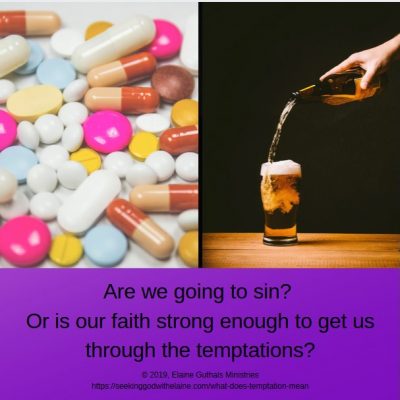
    Are we going to sin? Or is our faith strong enough to get us through the temptations?

    What Does Lust Have to Do with It?

    “But every man is tempted, when he is drawn away of his own lust, and enticed” (Jas. 1: 14 KJV)

    The King James Version and the New American Standard Bible translates the word lust. All the other versions I use translate it desires.

    Remember, the object of desire is more than just sexual lust. But the lust comes from within us.

    A second thing to remember is it is something that is wrong. It breaks God’s laws and commandments.

    We each have our own obsession. We don’t need to be tempted by someone else.

    Even though this temptation comes from deep within us, each disciple experiences temptation.

    Many of the newer translations also talk about the temptations enticing us. The offer of pleasure is, often times, a huge selling-point for the temptation. The offer of an advantage is probably a close second.

    The enticement can lead us to do things that we fully know are wrong. Therefore, whether or not to give into the temptation is a choice, invariably a conscious choice.

    We fully know the sin is wanting us to break one of God’s laws and commandments. The temptation offers us the chance to break that law or commandment. We then make the choice as to whether we will give into the temptation.

    How Does Temptation Enslave Us?

    Manton said that temptation enslaved us through either force or flattery.

    When I was reading over the sermons, I though about that description of how to catch wild animals. It was suggested that, at first, you just put feed out — somewhere outside of their lair. That will get the animals used to coming to the area and getting an item they value.

    Then you slowly start putting up fences, one side at a time. The animals won’t see the fence going up because they will be focused on the food.

    When it is time to put the last side in, put up the side with the gate — but leave the gate off.

    Then, one day, put the gate on and shut the animals in the enclosure. No, the animals did not have any choice in the matter. They were forced into captivity.

    Isn’t that how temptation works? It is force, but it is also trickery.

    Temptation does like to use flattery, though. It loves to promise us pleasures.

    The pleasures won’t stay pleasures for long.

    Making the Connections

    We do have a part in temptation. We are “… drawn away of [our] own lust, and enticed” (Jas. 1: 14 KJV).

    If we are drawn away, that says we start out right. We are on the right path.

    Then we aren’t.

    We are enticed. Our hopes and desires are aroused.

    Hopefully, when things are normal and going along as they should, we are good at keeping temptations in their proper place.

    It is when they get out of place that things start going downhill.

    It is when we can’t — or won’t— stand up to the temptations that we give them traction. That makes us even more vulnerable needed to the temptations.

    How Do We Apply This?

    Here is some questions we can ask ourselves when we are tempted. They are based in Somerville’s questions in Temptation to Sin Not from God.

    • When we realized we were being tempted, what did we feel?
    • Did we hesitate or not?
    • What was trying to stop us from giving into the temptation?
    • What was the most attractive aspect of the temptation?

    When you evaluate the answers, ask yourselves these questions:

    • Did we/Are we going to give in to the temptation?
    • What did or didn’t stop us?
    • Why was/wasn’t that enough to stop us?
    • What do we have to learn from this temptation?
    • What do we need to work on to strengthen this area of our walk?

    Remember, God wants us to study and meditate. So, we have to look at the why and why nots of our actions. We are supposed to grow in our relationship with Him. We can’t do that if we don’t look at our temptations honestly and thoughtfully.

    Father. We are Your children. That makes us susceptible to the workings of Satan trying to get us to deny you. Unfortunately, he uses what is inside us to get us to sin. Help us to quickly be aware of the temptations and to quickly defeat them. We can only defeat them through Your grace and mercy. May we grown closer to You because of these temptations. Amen.

    Related Links

    I have created a worksheet of the questions above. Click on the button below to access it.

    What do you think?

    Leave me a comment below (about this or anything else) or head over to my Facebook group for some interactive discussion.

    If you don’t understand something and would like further clarification, please contact me.

    If you have not signed up for the email daily or weekly providing the link to the devotions and the newsletter, do so below.

    If God has used this devotion to speak with you, consider sharing it on social media.

  • What Is Sin?

    What is sin, and is it still relevant today? This devotion, the first in the Sin and Temptation series, looks at the nature, allure, and consequences of sin.

    Nuggets

    • We sin when we willfully do something when we have been told not to do it or don’t do something we have been told to do.
    • We can’t change a sin from being a sin to not being a sin.
    • Sin can increase because, once we commit the sin, it is easier for us to commit it again, even if we intend only one instance.
    • Growing in knowledge of God helps us to bring the sin to light so that we can get rid of it.
    • Sin has consequences.

    To read devotions in the Sin and Temptation series, click the appropriate button below.

    What Is Sin?

    Flowers with title What Is Sin?

    So, I told you that my word for the year is self-discipline. When I was looking up scriptures associated with that, the only I really liked was about temptation.

    I see that. We have to discipline ourselves not to fall into temptation’s grasp.

    I got to thinking about that. After we become believers, the temptation starts. That temptation used by Satan to get us to commit sins.

    We have to understand about sin and temptation before we can look at how to discipline ourselves to withstand the temptation. So, if we look at sin through the lens of temptation, what do we get?

    Let’s Put It into Context

    “But if we confess our sins to him, he is faithful and just to forgive us our sins and to cleanse us from all wickedness” (I Jn. 1: 9 NLT)

    Some may think sin is not relevant because nothing is considered a sin anymore. However, they would be wrong.

    God still considers a sin a sin. “God is not a man, that he might lie, or a son of man, that he might change his mind. Does he speak and not act, or promise and not fulfill?” (Num. 23: 19 CSB).

    Wait! What? Chick, did you say a couple of paragraphs ago that Christians still sin after they become Christians?

    Yes, I did. No one throws a switch and [read this with a different accent] talks differently, and walks differently, and acts differently – of course not, sugar.

    [Go back to normal now.]

    What some don’t think about is that salvation is a process. Yes, there is the initial you-are-now-saved-so-you-are-spiritually-alive point. Sometimes, we don’t focus as much on the work-out-your-salvation command.

    Well, that does make it harder. Because it makes it …….. work.

    We aren’t going to be totally perfect until heaven. But we have to practice now — you know, practice makes perfect.

    To read a related devotion, click the button below.

    First, let’s take a look at the nature and the consequences of sin. Then we can look at the nature of temptation. Then we will jumble it up together. It is going to take three devotions.

    What Is Sin?

    “We know that we are children of God and that the world around us is under the control of the evil one” (I Jn. 5: 19 NLT)

    Sin is when we disobey God and break one of His laws and commandments. He has specific do’s and don’ts interspersed in His Word. They aren’t hidden from us.

    We would not consider all sin totally, totally evil (like a lie). But all sin comes from the evil one — Satan.

    The issue is when we willfully do something when we have been told not to do it. Or the flip side, we don’t do something we have been told to do.

    The point is, are we obedient to God? Are we living the way He wants us to live? Are we treating others the way He wants us to treat them?

    Yes, sin is whatever God says is a sin. We don’t get a choice in the matter.

    To read a related devotion, click the appropriate button below.

    We can’t change a sin from being a sin to not being a sin. Nor was that Jesus’ intent. “Don’t think that I came to abolish the Law or the Prophets. I did not come to abolish but to fulfill. For truly I tell you, until heaven and earth pass away, not the smallest letter or one stroke of a letter will pass away from the law until all things are accomplished” (Mt. 5: 17-18 CSB).

    God has already spoken. Now, the choice is up to us.

    The Nature of Sin

    Judkin, in his sermon The Nature and Consequences of Sin, gave us five great bullet points on sin. They are the following:

    • “Sin is a gathering evil.”
    • “Sin is a deceiving power.”
    • “Sin is a gradual hardening of the heart.”
    • “Sin is ineffaceable.”
    • “Sin is a contagious evil.”

    Sin can increase because, once we commit the sin, it is easier for us to commit it again, even if we intend only one instance. It may look even more inviting, especially if no consequences were felt.

    This is just one way that sin deceives. Another way is the worldview of “if it brings you pleasure, you need not feel guilty about it.”

    Increased sin and increased deception makes us question whether it really is a sin at all. This line of thinking is turning to question God and His authority over us.

    I know. I had to look up ineffaceable. According to the Merriam-Webster Dictionary, that means that ineradicable. Sin is a permanent mark that cannot be forgotten or removed unless it is by the God Who created us.

    One of the worst things about sin is it is contagious. Someone sees someone else doing something, and they begin to think it is okay.

    But it isn’t. Remember “… not the smallest letter or one stroke of a letter will pass away from the law …” (Mt. 5: 17-18 CSB).

    Sin’s Allure

    In some cases, sin is the easiest way out. In other instances, it is just so appealing. Isn’t the attraction for a lot of sin the pleasure it brings without the guilt?

    Unfortunately, Satan makes sure we have an intense desire for what we should not have or do.

    Bringing Sin to Light

    “Everything exposed by the light is made visible” (Eph. 5: 13 CSB)

    Yes, sin is a part of this body. But our goal is to be growing in grace and knowledge of God (I Pet. 3: 18). Growing in knowledge of God helps us to bring the sin to light so that we can get rid of it.

    This growth will help us become the ones we will be in heaven. That means exhibiting less of the physical, sinful nature and more of the spiritual nature.

    In order to do that, we have to get sin out of our lives. The only way we are going to get sin out is to identify it and ask God to remove it.

    Oh, yeah. It is going to take some work on our part. That is where the self-discipline comes in to play.

    Consequences of Sin

    “For the wages of sin is death, but the free gift of God is eternal life through Christ Jesus our Lord” (Rom. 6: 23 NLT)

    Why is it so important to bring sin to light? It is because sin has consequences.

    We’ve talked before that the consequences of the original sin was spiritual death and separation from God. The results of that sin were poverty, crime, disease, death just to name a few.

    To read a related devotion, click the button below.

    We aren’t going to do much about the results of sin. Yes, wonderful save the kids, save the animals, save the planet groups may make great strides for a limited number of people. But their results remain with a limited amount of people.

    Making the Connections

    We do have hope. “Samuel replied, ‘Don’t be afraid. Even though you have committed all this evil, don’t turn away from following the LORD. Instead, worship the LORD with all your heart’” (I Sam. 12: 20 CSB).

    Fortunately, we can do something about the consequences of sin. All we have to do is our ABCDs.

    How Do We Apply This?

    We have to A) admit our sins, B) believe that Jesus as Redeemer and Savior, C) confess God as Sovereign Lord, and D) demonstrate that commitment by following our job description.

    Plan of Salvation

    If you have not admitted that your relationship is not right with God,

    have not asked Jesus to be your Lord and Savior,

    and have not confessed your sins,

    please read through the Plan of Salvation and prayerfully consider what God is asking you to do.

    The Disciple’s Job Description

    There is only one unpardonable sin. That is not ABCDing.

    To read a related devotion, click the button below.

    Now, once we become believers, that is when Satan starts tempting us. He didn’t have to before because he already had us.

    But now, we are a child of God. He has to do all he can to wreck our witness and turn us from God.

    Hopefully, we can withstand the temptation. We do that by seeking Him even before the temptation starts.

    Searching for and Seeking God

    Hearing His Word (Rom. 10: 17 NLT).
    Reading His Word (Rev. 1: 3 ESV).
    Praying to Him (Heb. 4: 16 ESV).
    Studying His Word (Ac. 17: 11 NLT).
    Meditating on His Word (Ps. 1: 1-2).
    Memorizing His Word (Ps. 119: 11 NLT).

    To read Has God Provided Everything We Need?, click the button below.

    When the temptations come and we fail — which we will — we just need to confess those sins. “But if we confess our sins to him, he is faithful and just to forgive us our sins and to cleanse us from all wickedness” (I Jn. 1: 9 NLT).

    Paul also gave us words of encouragement. “The temptations in your life are no different from what others experience. And God is faithful. He will not allow the temptation to be more than you can stand. When you are tempted, he will show you a way out so that you can endure” (I Cor. 10: 13 NLT).

    See? God is going to help us in every way He know how to help us be successful in resisting the temptation. We just have to put our faith and trust in Him.

    Father. We are sinful people living in a sinful world. Thank You that You have made us a forgiven people. Help us to grow more like You so that, when the temptations do come, we can withstand them and grow even closer to You. Amen.

    What do you think?

    Leave me a comment below (about this or anything else) or head over to my Facebook group for some interactive discussion.

    If you don’t understand something and would like further clarification, please contact me.

    If you have not signed up for the email daily or weekly providing the link to the devotions and the newsletter, do so below.

    If God has used this devotion to speak with you, consider sharing it on social media.

  • Getting on God’s Last Nerve

    What do you think would happen if we succeeded in getting God really, really mad? The Wilderness Wanderers did that when they got to the Promised Land but wouldn’t enter. This devotion looks at God’s and Moses’ responses.

    Nuggets

    • We generally don’t address our sin until God tells us it is time to weed it out.
    • Joshua and Caleb told the Israelites that, whoever God was with, they would win the land.
    • The Israelites didn’t believe God was Who He said He was so, they didn’t believe His promises.
    • God intervened for Joshua and Caleb but wanted to destroy the Israelites.
    • Moses intervened and reminded God what other nations would think.
    Flowers with title Getting on God's Last Nerve

    There was one time when the Wilderness Wanderers really tried God’s patience. In fact, He got very angry at them and threatened to destroy them all. What stopped Him?

    Let’s Put It into Context

    “All the Israelites complained about Moses and Aaron, and the whole community told them, ‘If only we had died in the land of Egypt, or if only we had died in this wilderness!’” (Num. 14: 2 CSB)

    The Wilderness Wanderers were throwing a fit. Technically, this was before they officially became the Wilderness Wanderers. At this point, they have just arrived at the Promised Land — the first time.

    God is the one who ordered the spies to check things out. “The Lord spoke to Moses: ‘Send men to scout out the land of Canaan I am giving to the Israelites. Send one man who is a leader among them from each of their ancestral tribes.’” (Num. 13: 1-2 CSB).

    Why did God go and do that? “I the Lord test the mind and search the heart to give all according to their ways according to the fruit of their doings” (Jer. 17: 10 NRS). We generally don’t address our sin until God tells us it is time to weed it out.

    To read a related devotion, click the button below.

    Twelve spies went out and surveyed the land. They came back and said, “… We went into the land where you sent us. Indeed it is flowing with milk and honey, and here is some of its fruit” (Num. 13: 27 CSB).

    The problem was ten of the spies said the Israelites couldn’t take the country (Num. 13: 31). Not only that, they wanted to go back to Egypt under new leadership (Num. 14: 4)!

    Voice of Reason

    “Then Moses and Aaron fell facedown in front of the whole assembly of the Israelite community. Joshua son of Nun and Caleb son of Jephunneh, who were among those who scouted out the land, tore their clothes and said to the entire Israelite community: ‘The land we passed through and explored is an extremely good land. If the Lord is pleased with us, he will bring us into this land, a land flowing with milk and honey, and give it to us. Only don’t rebel against the Lord, and don’t be afraid of the people of the land, for we will devour them. Their protection has been removed from them, and the Lord is with us. Don’t be afraid of them!’ While the whole community threatened to stone them, the glory of the Lord appeared to all the Israelites at the tent of meeting” (Num. 5-10 CSB)

    Moses and Aaron were no use. They just folded. But then, in a way, maybe it wasn’t their battle to fight.

    Joshua and Caleb were the spies who voted to keep on God’s plan. They had seen the land.

    So, Joshua and Caleb reiterated that, yes, it was as good as the others said. But they reminded the people that they were missing the point.

    The point was, whoever God was with, they would win the land. They were looking at it through the lens of human perspective.

    The Israelites needed to flip it and look at it from God’s viewpoint. “But Jesus looked at them and said to them, ‘With men this is impossible, but with God all things are possible’” (Mt. 19: 26 NKJV).

    Did you see that it was conditional? “If the Lord is pleased with us, he will bring us into this land, a land flowing with milk and honey, and give it to us” (Num. 14: 8 CSB).

    We’ve talked before about God delighting in us. God delights in us because we praise Him and sings a song of joy over us.

    To read a related devotion, click the appropriate button below.

    Oh, that is not what the crowd wanted to hear. They wanted to hear rainbows and unicorns. They wanted to hear a walk in the park.

    The Israelites definitely were not trusting in God. They obviously were not obeying Him.

    How does the crowd respond? “Death to the messengers!”

    Now, I don’t ever remember reading this verse before. “While the whole community threatened to stone them, the glory of the Lord appeared to all the Israelites at the tent of meeting” (Num. 14: 10 CSB).

    God intervened for Joshua and Caleb. He stood in the gap for them.

    Justified Anger

    “The Lord said to Moses, ‘How long will these people despise me? How long will they not trust in me despite all the signs I have performed among them? I will strike them with a plague and destroy them. Then I will make you into a greater and mightier nation than they are’” (Num. 14: 11-12 CSB)

    God vented to Moses. Yes, the Israelites may have wanted a new leader (Num. 14: 4), but they were probably talking as much God as they were Moses.

    What was God’s beef with His people? He said that they rejected Him.

    I know, I know. They saw all of the ten plagues. They saw the Red Sea part before them and then return to drown the Egyptians.

    And now they don’t want to have anything to do with God? They don’t want to trust Him to take care of them???

    Do they have some screws loose???????

    Bottom line is the Israelites didn’t believe God was Who He said He was so they didn’t believe His promises. They didn’t believe His provision.

    All they had to do is believe. The evidence should have been overwhelming. God had every right to be angry.

    Moses Steps into the Gap

    “But Moses replied to the Lord, ‘The Egyptians will hear about it, for by your strength you brought up this people from them. They will tell it to the inhabitants of this land. They have heard that you, Lord, are among these people, how you, Lord, are seen face to face, how your cloud stands over them, and how you go before them in a pillar of cloud by day and in a pillar of fire by night. If you kill this people with a single blow, the nations that have heard of your fame will declare, ‘Since the Lord wasn’t able to bring this people into the land he swore to give them, he has slaughtered them in the wilderness.’ So now, may my Lord’s power be magnified just as you have spoken: The Lord is slow to anger and abounding in faithful love, forgiving iniquity and rebellion. But he will not leave the guilty unpunished, bringing the consequences of the fathers’ iniquity on the children to the third and fourth generation. Please pardon the iniquity of this people, in keeping with the greatness of your faithful love, just as you have forgiven them from Egypt until now’” (Num. 14: 13-19 CSB)

    Moses stepped in between them. I know. The Creator of the universe, mad at His creation, and Moses redirects His attention.

    That is just what Jesus did. He redirected God’s wrath for our sin to Himself.

    No, Moses didn’t have to talk God into — or out of — anything. But we have to pray the prayer and ask. We have to say we are sorry.

    Relationships take two. We can’t expect it to be a one-way give-us-all-the-good-stuff deal.

    Part of me wonders how Moses could step up and defend the Israelites as he did. We have several examples of when Moses just got so frustrated with the Wilderness Wanderers.

    But here, Moses defended them. He loved his people.

    Moses gave a valid point. If God said one thing, and it didn’t turn out that way, it was going to wreck God’s credibility with the surrounding nations.

    Making the Connections

    The people of Israel saw God lead them out of Egypt — and yet they didn’t believe. Did they change?

    “Jesus told him, ‘Unless you people see signs and wonders, you will not believe’” (Jn. 4: 48 CSB).

    When we demand proof that God exists or God is calling us to something — when we demand the miracle — we aren’t looking to increase our faith in Him. Faith is the belief that the doctrines stated in God’s Word are true, even if we do not understand all aspects of them. “Now faith is the reality of what is hoped for, the proof of what is not seen” (Heb. 11: 1 CSB).

    Some try to say that God is a dictator because He won’t just validate our opinions and beliefs. Yet, God let Moses step into the gap. He didn’t chide Moses for saying, “Well, You might want to think about this a moment here.”

    If God is the meany people try to make Him out to being, He would have just swatted Moses out of the way like he was a fly on the counter top.

    Listen to these sentences by Breay. “Sin was the only giant that they had reason to fear. Happy would it have been for the people, had they listened to these arguments.”

    Moses didn’t have to fear God. God will always allow us to come to Him in prayer — even when we have messed up. We have to come in belief that He is the Sovereign Lord.

    How Do We Apply This?

    God allows us to enter into His presence even when we have messed up. He allows us to plead for ourselves. God also wants us to intercede for others.

    When God is calling us to do something – especially if it is a good something – we need to submit to His will. We need to put our faith and trust in Him, even if we can’t see the outcome at the present time.

    When we see others disobey God, we need to love them back into obedience. We shouldn’t judge them. We should intercede for them.

    Father. There are so many times that we look at our world or our current situation and feel overwhelmed. Lord, forgive us when we don’t see Your guiding and protecting hand over us. Forgive us when we are like the Israelites and choose this life over eternal life. Help us to grow in You. Amen.

    What do you think?

    Leave me a comment below (about this or anything else) or head over to my Facebook group for some interactive discussion.

    If you don’t understand something and would like further clarification, please contact me.

    If you have not signed up for the email daily or weekly providing the link to the devotions and the newsletter, do so below.

    If God has used this devotion to speak with you, consider sharing it on social media.

  • When We Give Up on God

    Has there ever been a time when you stopped believing in God? Or did you make a profession of faith but not seek to grow in knowledge of Him? This devotion, the first in the series, looks at God’s expectation that we are to grow enough in our faith to be able to teach others.

    Nuggets

    • God expects us to grow in grace and knowledge of Him (II Pet. 3: 18).
    • We have to keep growing to have that knowledge and a mature faith.
    • God wants us to teach his message, not our own.
    Flowers with title When We Give Up on God

    We have much to say about this, but it is hard to make it clear to you because you no longer try to understand. Hebrews 5: 11 (NIV)

    I saw Hebrews 5: 11 a while back and thought, “Oh, Paul surely wrote Hebrews. This sounds just like what the Energizer Bunny would say.”

    Well, doesn’t it? I mean, Paul didn’t pull any punches. He called it like he saw it. Why waste time calling a rose a zinnia? Fix the problem.

    Let’s see what the writer was talking about.

    Let’s Put It into Context

    “So also Christ glorified not himself to be made an high priest; but he that said unto him, Thou art my Son, to day have I begotten thee” (Heb. 5: 5 NKJV)

    Jesus didn’t elevate Himself to the position of high priest. God did that.

    We don’t get to where we are in life by ourselves. God is in control of all of our knowledge and skills. Anything we do is because He made us to do it.

    Just as Jesus didn’t make high priest on His own, we can’t be saved on our own. We are saved by grace through faith (Eph. 2: 8-9) when we repent.

    But it doesn’t stop there. We have to be obedient. “And having been perfected, He became the author of eternal salvation to all who obey Him, called by God as High Priest according to the order of Melchizedek” (Heb. 5: 9-10 NKJV emphasis added).

    Then the writer slips in a zinger: “of whom we have much to say, and hard to explain, since you have become dull of hearing” (Heb. 5: 11 NKJV). The New International Version is even more pointed: “… you no longer try to understand” (Heb. 5: 11 NIV).

    Ouch.

    No longer try means they made a conscious decision to no longer seek God after they accepted the gift of salvation. They gave up on God. We have to look at the next couple of verses to see what all of this is all about. Doing that is going to take longer than this devotion.


    Growth Over Time

    “For when for the time ye ought to be teachers, ye have need that one teach you again which be the first principles of the oracles of God; and are become such as have need of milk, and not of strong meat” (Heb. 5: 12 NKJV)

    God expects us to grow in grace and knowledge of Him (II Pet. 3: 18). As the writer of Hebrews says, we are to grow from babies to adults.

    That is one of the ways we work out our salvation (Phil. 2: 12). We will be held accountable if we do not grow.

    Second John 2: 8 provides us with incentive to grow. “Look to yourselves, that we do not lose those things we worked for, but that we may receive a full reward” (II Jn. 2: 8 NKJV).

    We’ve said that we learn by hooking new knowledge with that we already know. That means a foundation has to be there.

    It isn’t like we have to learn on our own. We’ve got the Holy Spirit to guide us. We have pastors and teacher to help interpret meaning. We have all sort of resources in stores for sale and on the internet.

    There is no reason why we shouldn’t grow. Remember, James said, “If you need wisdom, ask our generous God, and he will give it to you. He will not rebuke you for asking” (Jas. 1: 5 NLT).

    We give up by not taking advantage of the resources we have. We give up by not putting in the time to do it right.

    Books

    Ought to Be Teachers

    Oh, man. We are supposed to be teachers???? We are supposed to know enough to be teachers??????

    Well, yes. We are supposed to have a mature faith. We have to keep growing to have that knowledge.

    Remember when we were walking through Ephesians, a Paul gave us a list of church leaders? “And his gifts were that some should be apostles, some prophets, some evangelists, some pastors and teachers” (Eph. 4: 11 RSV).

    To read a related devotion, click the button below.

    We give up when we don’t think we know enough to be teachers. The thing is, I have learned so much by teaching my Ladies. What I don’t know, I have to learn first. That is one way I grow in the faith.

    Part of the problem is we aren’t disciplined in our spiritual life. We don’t pray as we should. We don’t study His word as He should.

    My Ladies and I were talking this morning about how we search for and seek God. The meditating and memorizing trip a lot of us up. Study can also be minimal. We get a devotional book (or, yes, you read what I put out here on the internet), and we call it a day. How many times do we take something that flipped a switch for us and look up the topic? Do we even just look up other translations of that one verse?

    Searching for and Seeking God

    Hearing His Word (Rom. 10: 17).
    Reading His Word (Rev. 1: 3).
    Praying to Him (Heb. 4: 16).
    Studying His Word (Ac. 17: 11).
    Meditating on His Word (Ps. 1: 1-2).
    Memorizing His Word (Ps. 119: 11).

    To read Has God Provided Everything We Need?, click the button below.

    Sometimes, we think we should not be teachers because we are committing that same old sin that we’ve always committed. No, that isn’t good.

    When we become a disciple of Christ, we are supposed to be changed. Yes, we get to work out our salvation (Phil. 2: 12), but we have to work at it, not just stay status quo.

    But we have to realize that we won’t be perfect until we hit the pearly gates. If we use our fallibility to keep us from doing what God is calling us to do, that is a sin. God uses the broken people to expand a His kingdom.

    To read a related devotion, click the button below.

    We also have to realize we can be teachers without having the official title. Sometimes, the title is parent. Other times, it is aunt or uncle. Sometimes, it is neighbor.

    To read a related devotion, click the button below.

    Yes, it is scary when we think of what experience we might have to share with others that we are teaching. I am a firm believer that we are given experiences to help others come to know the real, loving God.

    Really, as disciples, we should be prepared to be teachers. Whether it is a class of one or ten or one hundred, we need to grow our faith to the point where we know what we believe and why we believe it.

    Remember our job description. We are to proclaim the gospel (Mk. 16: 15) and make disciples (Mt. 28: 19-20).

    The Disciple’s Job Description

    Complete Job Description

    Individual Descriptions

    Job Duty #4
    Proclaim the Gospel (Mark 16: 15)

    Job Duty #6
    Make Disciples (Matthew 28: 19-20)

    We are supposed to tell others and help them grow in grace and knowledge.

    Oracles of God

    An oracle is a representative of an unknown person who carries the person’s message to the masses. The message could include insights into future events. It could also solve some uncertainty or doubts.

    Isn’t that what God wants from us? We teach God’s message, not our own. He has told us about the end of this world and our eternal home in heaven. He has given us promises so that we do not have to have the uncertainty that is more and more a fixture in our world. We don’t have to doubt because He has shown us His character.

    We give up on God when we don’t carry His message to others. When we allow the worldview to help us form opinions instead of His Word.

    We want to be God’s mouthpieces, not Satan’s.

    In the next devotion, we will look at whether we are milk babies or steak adults. We will also make the connections and apply this to our lives today.

    Father. You have told us time and time again that You want us to grow closer to You. You call this working out our salvation (Phil. 2: 12). You call this growing so that we can become the teachers. Most of all, Lord, You want us to imitate You (Eph. 5: 1). Help us to do just that. Amen.

    What do you think?

    Leave me a comment below (about this or anything else) or head over to my Facebook group for some interactive discussion.

    If you don’t understand something and would like further clarification, please contact me.

    If you have not signed up for the email daily or weekly providing the link to the devotions and the newsletter, do so below.

    If God has used this devotion to speak with you, consider sharing it on social media.

  • How Does Light Expose Sin?

    Paul had been advising the Ephesians what they should and shouldn’t be doing to follow God. He challenges them to help expose sin. This devotion looks at bringing the lost into the light through our witness.

    Nuggets

    • We are to be witnesses to bring others into the light.
    • God brings our sin into the light so we can confess it and get rid of it.
    • Once we get sins out into the light, we can really see them as they are.
    • When we hold our thoughts and actions up to doctrine, we can see where we are living as we should or where we are not.
    Flowers with title How Does Light Expose Sin?

    Paul had told his readers that they should be imitators of God. They could do that by exhibiting His love to all.

    Next, Paul cautions them about ungodly behavior. As a center for pagan worship, Paul knew they would have been tempted to either remain or go back to their former way of life.

    Instead, Paul told them they were to help expose sin. They did this through love. Let’s look at what Paul has to say about this.

    To read a related devotion, click the appropriate button below.

    Bring Them into the Light

    “Have nothing to do with the worthless things that people do, things that belong to the darkness. Instead, bring them out to the light” (Eph. 5: 11 RSV)

    Okay, this is a twist. Paul had said before, “Therefore do not associate with them …” (Eph. 5: 7 RSV). Them — people.

    Here in verse 11, Paul said, “Have nothing to do with the worthless things that people do, things that belong to the darkness …” (Eph. 5: 11 RSV). We are not supposed to associate with the acts themselves, thoughts, items.

    Instead, we are to bring them out into the light. We are to be witnesses.

    If we are going to witness to people, we cannot not associate with them. Otherwise, Jesus would not have eaten with the sinners (Mt. 9: 10-17; Mk. 2: 15-22; Lk. 5: 29-39).

    We just have to be on guard. Satan is going to do his dirtiest.

    Even If Too Bad to Discuss

    “(It is really too shameful even to talk about the things they do in secret)” (Eph. 5: 12 RSV)

    Wait a minute. Wait a minute. Wait a minute.

    Bringing them out into the light means people could conceivably find out about them, right? We won’t like it if it were our sins that were exposed!

    But isn’t God good at doing just that? He digs down and brings the sin up.

    What God is doing is rooting the sin out. He is bringing it to the light so we can confess it and get rid of it.

    Isn’t that what we need to do? If we don’t acknowledge it as a sin, Satan will more than likely work to get us to commit the sin again.

    God wants the evil out of us. He doesn’t it to remain in us. He wants us to be more like He made us.

    Eye

    Light Reveals All

    “And when all things are brought out to the light, then their true nature is clearly revealed” (Eph. 5: 13 RSV)

    Once we get sins out into the light, we can really see them as they are. We can evaluate thoughts and actions against doctrine.

    Satan is going to try to stop us from doing that any way that he can. He is going to try to keep us believing that things are all hunky-dory. He is going to do everything in his power to make the norm acceptable.

    It’s All About Waking Up

    “for anything that is clearly revealed becomes light. That is why it is said,‘Wake up, sleeper, and rise from death, and Christ will shine on you’” (Eph. 5: 14 RSV)

    When we hold something up to the light, we can see all the imperfections. When we hold our thoughts and actions up to doctrine, we can see where we are living as we should or where we are not.

    Have you ever heard that last part of the verse? I don’t think I had — at least I don’t remember it.

    Isaiah 60: 1 says, “Arise, shine; for your light has come, and the glory of the Lord has risen upon you” (RSV).

    Think about it in terms of the Light. Jesus has come to earth and shown us the way we are to live.

    Remember, we have said that glory is the expression of the qualities of God resulting from the authority of God.

    To read a related devotion, click the appropriate button below.

    Making the Connections

    You might be thinking, “But I’ve already made a profession of faith.” Well, the Ephesians had, too. He was writing to the church at Ephesus.

    Paul was preaching to the choir. And he was still hammering it home about grace and redemption.

    Paul knew we would keep being tempted after we asked Jesus to be our Savior. He knew we would keep on sinning.

    In order to help us, Paul gave us instructions as to what to do. “Your word is a lamp for my feet and a light on my path” (Ps. 119: 105 HCSB). It is a lamp — an instrument that funnels the Light where we need it.

    How Do We Apply This?

    So, how do we apply all of this?

    In the last devotion, we said we had to pick our friends carefully. Are we trying to establish a relationship so that we can witness to them? If not, we need to consider putting other friendships as a priority.

    No, that isn’t always an option. Maybe it is a family member. Then, we need to teach them, maybe by lifestyle, how Hod wants us to live. Hopefully, we can work it around to get the words in, also. We’ve talked before where lifestyle witnessing alone isn’t what God is after.

    To read a related devotion, click the button below.

    We’ve got to make sure we are actively witnessing for Christ. Oh, yes. I do not do as good of a job as I should. It is so much easier just to write to faceless people who read my blog than look someone in the eye and say, “Do you know Jesus?” That is the introvert in me.

    But I need to be an extroverted introvert and ask anyway. We need to make sure we are asking the questions. People’s eternal lives are at stake.

    Loving Heavenly Father. We are always going to be tempted. We will always need Your grace. We will always need Your mercy. Help us to bring our sins into the light so that we may confess them and get rid of them. Help us to resist temptation when we are around others who sin. Thank You for sending Your Son to pay the price for our sins. Amen.

    What do you think?

    Leave me a comment below (about this or anything else) or head over to my Facebook group for some interactive discussion.

    If you don’t understand something and would like further clarification, please contact me.

    If you have not signed up for the email daily or weekly providing the link to the devotions and the newsletter, do so below.

    If God has used this devotion to speak with you, consider sharing it on social media.

  • What Sins Are We Supposed to Avoid?

    Paul did not shy away from discussing difficult topics with his readers. If he would have, they – and we – would not have known how God expects us to live. This devotion looks at his continuing advice to the Ephesians on several sins to avoid.

    Nuggets

    • We court God’s anger when we are promiscuous.
    • What God wants is for us to depend on Him to provide what we need.
    • Since impurity is also translated unclean, we are called to be clean, including the mind, heart, tongue, and life.
    • Filthy character shows a lack of respect to God and others because it spreads the filth.
    • Careless words can destroy relationships.
    • Levity not only destroy relationships but also wreck witnesses and alienate searchers.
    Flowers with title What Sins Are We Supposed to Avoid?

    Paul began telling the Ephesians in Chapter 4 how they should should live the lives he told them in the first three chapters. In this section in Chapter 5, he tackled some difficult topics. The main one had to do with how we use our words.

    The thing is, Paul used a funny phrase. He said that there were some sins that the Ephesians “… must not even be named among you …” (Eph. 5: 3 RSV). What he was saying was that he wanted the Ephesians to stay as far away from these sins as they could. Let’s take a look at what he was talking about.

    Three Biggies to Avoid

    “But fornication and all impurity or covetousness must not even be named among you, as is fitting among saints” (Eph. 5: 3 RSV).

    Paul calls out three sins here: fornication, impurity, and covetousness. Two of them seem really specific, but the third one seems more general. Let’s take the specific ones first.

    Fornication

    Fornication is an old word. It is talking about two people who aren’t married who are having sex. God wants sex to be kept for the marriage.

    Why? You want my take? God wanted us to wait until we picked one. He didn’t want us sampling. He wanted it to mean something special.

    Unfortunately, that is another thing Satan messed up. He is in control of this world, and he wants the exact opposite of God. (That is probably one reason why Satan pushes this one so hard — he knows God detests it so much.) So, he wants us to think we can have multiple partners without any commitment.

    Paul knew that sexual temptations would be prominent, so advised that a man and woman marry (I Cor. 7: 2). “God wants you to be holy and completely free from sexual immorality” (I Thess. 4: 3 GNT).

    Part of the problem is that the temptations tie up so much of our mind. Our thoughts readily slide over to clean, polish, water, and grow them.

    We court God’s anger when we are promiscuous (Col. 3: 5-6). “Marriage is to be honored by all and the marriage bed kept undefiled, because God will judge the sexually immoral and adulterers” (Heb. 13: 4 CSB).

    Covetousness

    Covetousness is a greed for wealth and possessions. Hmmm. Satan gets mileage out that one, too, does he?

    Does God want us to not have possessions? No. Does He want us to not have money to pay our bills? No.

    What God wants is for us to depend on Him to provide what we need. Yes, He will. He has promised (Mt. 6: 31-33; Phil. 4: 19).

    Impurity

    To me, the fuzzy one is impurity. Oh, I know what it means (I am Dictionary Chick, aren’t I?). The one is  messed up by something else — it is contaminated by it.

    It just seems that leaves that wide open for interpretation. Maclaren seemed to agree, as he said, “all uncleanness embraces every manifestation in word, look, or deed of the impure spirit.”

    It might be easier to look at it from the flip side. Since impurity is also translated unclean, we are called to be clean. This includes mind, heart, tongue, and life. Well, that sure is all-encompassing!

    This, Not That

    “Let there be no filthiness, nor silly talk, nor levity, which are not fitting; but instead let there be thanksgiving” (Eph. 5: 4 RSV).

    Next, Paul kicked in talking about our speech. He said that our words are as important as our actions are.

    Well, Jesus said the same thing. “I tell you that on the day of judgment people will have to account for every careless word they speak. For by your words you will be acquitted, and by your words you will be condemned” (Mt. 12: 36-37 HCSB).

    Paul tells us not to do a couple of things before he tells us to do this. Let’s look at the “not this” first.

    Filthiness

    Filthy as being unclean fits in the discussion of impure. Unclean words are supposed to go because they clash with the character disciples are building after conversion.

    This is one of the places where it is argued that says we are not to use profanity. It is more than just words, though.

    It is also a filthy character. It is a filthy attitude. So, this is one of those big general words.

    Filthy character shows a lack of respect to God and others because it spreads the filth. Words, especially, spew the filth onto anyone in range.

    Silly Talk

    I got a chuckle out of this being translated silly talk. I think what is meant here is that old saying: loose lips sink ships.

    We need to guard our talk. Careless words can destroy relationships.

    This does not mean “thou shalt not joke.” I truly believe God has a sense of humor. It means weigh the situation and speak appropriately.

    Christians are not called to be sticks in the mud. We are to be filled with God’s joy. “For the kingdom of God is not a matter of eating and drinking, but of righteousness, peace and joy in the Holy Spirit” (Rom. 14: 17 NIV).

    Levity

    Levity can be kind of like silly talk. It is making light of a serious situation.

    This is especially true when we are discussing things that our companion could relate to God. These not only destroy relationships but also wreck witnesses and alienate searchers.

    Thanksgiving

    Paul said that all that bad stuff should be replaced by thanksgiving. Thanksgiving is when we “Declare his glory among the nations, his marvelous works among all the peoples!” (I Chron. 16: 34 ESV). Remember, we said glory is the expression of the qualities of God resulting from the authority of God.

    To read a related devotion, click the appropriate button below.

    Making the Connections

    So, glory has to do with God’s qualities— His character. What were we just talking about? Our character.

    What we are supposed to be doing is imitating God. We talked about that in a recent devotion. We are supposed to be refining our character into His character.

    To read a related devotion, click the button below.

    Oh, man. When I put Ephesians 5: 3 with Ephesians 4: 25-26, I just got so discouraged. How can we live like God wants us to live? It is just so much!

    God answered my question. I have SiriusXM’s The Message on while I write. Tauren Wells’ song God’s Not Done with You was playing. We are a work in progress until we get to heaven.

    Related Links

    Tauren Wells

    But next came Slow Fade from Casting Crowns. “It’s a slow fade when you give yourself away It’s a slow fade when black and white are turned to gray And thoughts invade, choices are made, a price will be paid When you give yourself away People never crumble in a day It’s a slow fade, it’s a slow fade.”

    Related Links

    Casting Crowns

    Later, Lauren Daigle’s Rescue started playing. “You are not hopeless Though you have been broken Your innocence stolen.”

    Then look at the chorus. “There is no distance That cannot be covered Over and over You’re not defenseless I’ll be your shelter I’ll be your armor.” Doesn’t that give you goosebumps?

    Related Links

    Lauren Daigle

    God is going to rescue us from times Satan is tempting us.

    That is exactly how Satan gets us roped into the sin. He keeps chipping away, getting us used to it. It is a slow fade.

    Then, Satan gets us to compromise. He gets us to feel like we can’t stand up — and we are sunk.

    But God isn’t done with us. He is riding to the rescue.

    How Do We Apply This?

    We are called to be pure.

    I know, I know. Sinful human bodies do not facilitate sinlessness.

    Remember, I keep saying grow in grace and knowledge? (II Pet. 3: 18). I have a snazzy graphic.

    Searching for and Seeking God

    Hearing His Word (Rom. 10: 17 NLT).
    Reading His Word (Rev. 1: 3 ESV).
    Praying to Him (Heb. 4: 16 ESV).
    Studying His Word (Ac. 17: 11 NLT).
    Meditating on His Word (Ps. 1: 1-2).
    Memorizing His Word (Ps. 119: 11 NLT).

    To read Has God Provided Everything We Need?, click the button below.

    This, along with the job description, are how we should be getting pure.

    The Disciple’s Job Description

    Wondering how that is going to happen? “You are already clean because of the word which I have spoken to you” (Jn. 15: 3 NASB).

    Who was the Word? “In the beginning was the Word, and the Word was with God, and the Word was God” (Jn. 1: 1 KJV).

    I know. I tripped on that we are already clean back in John. 15: 3. That must be one of those one-word/three-tenses verbs. We were made clean at our conversion, but we are still in the spring-cleaning process. We won’t be totally clean until heaven.

    Think about these three questions a second.

    • What would people think if your thoughts really did show up in bubbles outside your head? Would you be embarrassed?
    • Let’s say we could play back a recording of your words — only the kind of words God likes would be the only ones that you could hear. Would your conversation be heard as usual?
    • What would people think if all of your along time was broadcast on all the TV stations?

    If we had any queasy moments there, we know what we have to work on for next year.it is about time to be picking out our word for next year and setting up our goals (I think we work more to accomplish goals than resolutions).

    Sin should make us queasy. That means we aren’t doing the slow fade to complacency. We need to be intentional in fighting sin.

    Father, thank You for making us Your children and heirs. Help us to be pure in Your sight. Amen.

    What do you think?

    Leave me a comment below (about this or anything else) or head over to my Facebook group for some interactive discussion.

    If you don’t understand something and would like further clarification, please contact me.

    If you have not signed up for the email daily or weekly providing the link to the devotions and the newsletter, do so below.

    If God has used this devotion to speak with you, consider sharing it on social media.

  • Does Jesus Condone Sin If Disciples Sin?

    It is easy to think that Jesus was not successful because He did not stamp out sin when He died on the cross. Disciples still sin, even though they have given their lives to Him as their Savior. This devotion explores whether Jesus is a minister of sin, condoning sin because it is still prevalent in the world today.

    Nuggets

    • While we need to highlight sin so that we can cut it out, the law points out that we can’t rely on us changing ourselves.
    • Jesus was strong – mentally, physically, and spiritually.
    • The purpose of Jesus coming down the first time was to pay the price for our sins, not to eliminate sin.
    • Every day, we make so many decisions that seem to us to be little; however, those small decisions ultimately reflect whether we are following God or not.
    Flowers with title Does Jesus Condone Sin If Disciples Sin?

    Let’s Put It into Context

    Galatians 2 talks about being justified through faith, not through works. We just covered that because we have been walking through Ephesians. The gospel in a nutshell is housed in Ephesians 2: 8-9.

    To read devotions in the Foundations of Salvation series, click the appropriate button below.

    We also just talked about whether God ignored our sins. Nonbelievers sometimes believe that, by God’s “silence” in eliminating and/or punishing sins to their standard, He is saying there really isn’t anything wrong with people’s behaviors.

    To read a related devotion, click the button below.

    Don’t worry. We are going to come at this from a different angle.

    One more background piece, though. We’ve talked before about why disciples keep on sinning after they have admitted their sins, asked Jesus to be our Savior, and confessed God as Sovereign Lord.

    This is because there are three different tenses in one verb in the Bible. There is the past, present, and future – we were justified, we are being justified, we will be justified. We have been justified because our relationship has been restored, and we now can be changed into a spiritual being. We still are, however, a physical, human being.

    To read a related devotion, click the button below.

    Christ a Minister of Sin???

    “But if, while we seek to be justified by Christ, we ourselves also are found sinners, is Christ therefore a minister of sin? Certainly not!” (Gal. 2: 17 NKJV)

    This devotion, I want to talk about verse 17 by itself. What consequences does our continuing to sin have on Jesus and us?

    So, while we are a believer, going along in our Christian walk (“… while we seek to be justified by Christ …” (Gal. 2: 17 NKJV), we still have the capacity to sin. Does that make Christ weak? Does that mean Christ promotes sin? Does that mean Christ really allows sin? Doesn’t that really mean our actions don’t matter? Let’s find some answers to those questions.

    Is Jesus Weak?

    “Jesus understands every weakness of ours, because he was tempted in every way that we are. But he did not sin!” (Heb. 4: 15 CEV).

    Weak? Jesus? Where in the world did you get that idea?

    Jesus knew exactly Who He was — He was the Son of God (Jn. 11: 4). He had every confidence that He could and would succeed in His mission — to be the Savior of the world (Jn. 3: 16).

    Physically, Jesus was a carpenter, which required strength. Yes, He may have gotten to ride in a boat every once in a while, but for the most part, He probably walked. All over. He didn’t exactly stay in one spot.

    Jesus was strong – mentally, physically, and spiritually. That is what He wants for us, also.

    Does Jesus Promote Sin?

    “What shall we say, then? Should we continue to live in sin so that God’s grace will increase?” (Rome 6: 1 GNT)

    I struggled whether promote was really the word I wanted to use. What I mean is, if we don’t sin, God and Jesus don’t get to continue to shower us with the grace. So, wouldn’t Jesus want us to keep sinning so He can appear to be that much more gracious?

    Didn’t Paul just say that? “Law was introduced in order to increase wrongdoing; but where sin increased, God’s grace increased much more” (Rom 5: 20 GNT).

    Oh, no. That isn’t the point. The point is we need to highlight the sin so that we can cut it out. The law points out that we can’t rely on us changing ourselves.

    Mirror

    Sin in our lives is one of the things we are to work on when we are working out our salvation (Disciple’s Job Description #2). We are supposed to be identifying and removing sin from our lives in order to not continue to sin.

    The Disciple’s Job Description

    To access the complete job description, click the button below.

    Job Duty #2
    Work Out Our Salvation (Philippians 2: 12)

    Our lives post-conversion is to prepare us for our lives in eternity. Sin won’t be around in eternity, which is why are are called to be holy. “Since we have these promises, beloved, let us cleanse ourselves from every defilement of body and spirit, bringing holiness to completion in the fear of God” (II Cor. 7: 1 ESV).

    Jesus wants us to kill sin dead in our lives now. Not sorta dead, but dead dead.

    Does Jesus Allow Sin?

    “For everyone has sinned; we all fall short of God’s glorious standard” (Rom. 3: 23 NLT)

    Sin entered the world when Adam and Eve bit when Satan told them to bite. Some may think that, because Jesus “failed” to remove sin from this world when He came the first time, He is allowing it to continue.

    To read a related devotion, click the button below.

    The purpose of Jesus coming down the first time was to pay the price for our sins, not to eliminate sin. He is coming back again someday to eliminate the sins. Until then, we could possibly argue that Jesus is allowing the sin to continue.

    Why is Jesus doing that? Everyone has to hear about the plan of salvation before the end.

    Everyone has to have the opportunity to choose whether they are going to turn their lives over to God or are they going to continue to live for Satan. God will not tell Jesus to grab the cloud and sickle and scoot until all who are going to have turned their lives over to Him.

    Wouldn’t we hate it if God said, “I am getting tired of waiting. Okay, Jesus, go do your thing. We are going to stamp out sin right now. I know Tom, Sally, and Elaine were supposed to do the ABCDs, but I am getting tired of waiting for them. They will just have to lose because they didn’t act fast enough.” No, we are glad God is waiting for everyone who is going to become a believer to become a believer.

    A consequence of that sin continues. This world will be controlled by Satan until Jesus returns. Satan wants sin to abound.

    To read a related devotion, click the button below.

    Do Our Actions Matter?

    “Jesus replied, ‘If you only knew the gift God has for you and who you are speaking to, you would ask me, and I would give you living water’” (Jn. 4: 10 NLT)

    Life is filled up with so many little actions. How many times have we been told that the little things end up being the big things?

    Maybe that is true. Every day, we make so many decisions that seem to us to be little. However, those small decisions ultimately reflect whether we are following God or not.

    I think sometimes, we are so focused on the big things – no, we haven’t murdered anyone lately – that we don’t consider how the small things impact our relationship with God. We try to follow God by loving others, but we end up tolerating their sins.

    Making the Connections

    No, Jesus did not die so that we could continue to sin. Jesus came to this earth to fulfill the law of God. He came to pay the price of our sins.

    Because of that substitution, we can now be free from the consequences of sin. He has secured our pardon.

    How Do We Apply This?

    We have to admit our sins, believe on Jesus as Redeemer, confess God as Sovereign Lord and demonstrate that commitment by following our job description. We have to ask Jesus to be our personal Savior.

    Then we have to live like we have made that decision. We have to make the changes in our lives necessary to become more like Jesus.

    The ABCDs of Salvation

    A – admit our sins

    B – believe His Son Jesus is our Redeemer

    C – confess God as Sovereign Lord

    D – demonstrate that commitment by making any changes needed in our lives to

    live the way in which God has called us

    If you have not become a believer in Christ, please read through the Plan of Salvation and prayerfully consider what God is asking you to do.

    We have to work out our salvation. We have to follow God’s laws and commandments. We have to share our newfound joy with others.

    We have to live a life that is holy – a life that will prepare us for our eternal lives.

    Father God. You are perfect; we are not. Nonbelievers see us rather than You. Lord, help us to show You in us. May we live our lives following Your law and commandments. Our goal is not only to live as You want us to, but also to lead others to You. Amen.

    What do you think?

    Leave me a comment below (about this or anything else) or head over to my Facebook group for some interactive discussion.

    If you don’t understand something and would like further clarification, please contact me.

    If you have not signed up for the email daily or weekly providing the link to the devotions and the newsletter, do so below.

    If God has used this devotion to speak with you, consider sharing it on social media.

  • Does God Ignore Sins?

    Non-believers accuse God of being silent on addressing the brokenness in the world today. While this brokenness is caused by sin, they feel that God’s silence is, in fact, ignoring sinful behavior. This daily devotional looks at how that is the furthest from the truth.

    Nuggets

    • Non-believers are quick to point out that a loving God would not allow this brokenness to go on.
    • Satan tells us a whole variety of things to get us to ignore God and His Word.
    • Satan manipulated words and God’s meaning to trick Eve into sinning, but Adam didn’t need any coercion at all.
    • After the flood, people could no longer say that God was tolerating mankind’s sinful nature.
    • Jesus substituted Himself for us and shed His blood to pay the price for our sins.
    • Jesus rose from the dead and ascended to heaven.
    • Jesus is going to come back as He said.
    Flowers with title Does God Ignore Sins?

    It is obvious to many that this world is broken. Non-believers are quick to point out that a loving God would not allow this brokenness to go on. He would step in and fix things, making their lives much easier and better.

    They believe that, by God’s “silence” in eliminating and/or punishing sins to their standard, He is saying there really isn’t anything wrong with people’s behaviors. Non-believers are wrong.

    God has not changed His mind about what constitutes a sin. It will not happen in the future.

    God does not change. Numbers 23: 19 says, “God is not man, that he should lie, or a son of man, that he should change his mind. Has he said, and will he not do it? Or has he spoken, and will he not fulfill it?” (ESV).

    To read a related devotion, click the button below.

    So, just because there has been a long time between milestones, that doesn’t mean God has given up on what sin is.

    Let’s Put It into Context

    Sins are actions by humans that disobey God and break one of His reasonable, holy, and righteous laws and commandments, goes against a purpose He has for us, or follows Satan’s promptings.

    • Holy means to be set apart — because of our devotion to God — to become perfect, and morally pure while possessing all virtues.
      • Perfection means we reach a state of maturity because the combination of the spiritual graces form, when all are present, spiritual wholeness or completeness — holy, sanctified, and righteous.
        • Spiritual graces are worldly morals that have been submitted to God to further His kingdom instead of enhancing this world.
        • Sanctified means to be set free from sin.
      • Pure means not being sinful or having the stain of sin.
    • Righteous means we are free from sin because we are following God’s moral laws.

    God has these laws and commandments sprinkled all through His Word.

    Paul tells us what sins are in Galatians 5: 19-21, Ephesians 5: 3-6, and I Corinthians 6: 9-10. This is just a partial list. He included sexual immorality, impurity, homosexuality, idolatry/covetousness, jealousy, fits of anger, rivalries, dissensions, divisions, envy, greed, drunkenness, filthiness, and all impurity.

    To read a related devotion, click the button below.

    Satan tells us a whole variety of things to get us to ignore God and His Word. Instead, Satan wants us to listen to Him and do the exact opposite of what God wants.

    By telling us that God no longer cares about the sin because He has abandoned us is a lie. Let’s look at some time periods based on some milestones.

    Ignoring from Garden to Manger

    The righteousness of God is through faith in Jesus Christ to all who believe, since there is no distinction. For all have sinned and fall short of the glory of God; they are justified freely by his grace through the redemption that is in Christ Jesus. God presented him as the mercy seat by his blood, through faith, to demonstrate his righteousness, because in his restraint God passed over the sins previously committed. God presented him to demonstrate his righteousness at the present time, so that he would be just and justify the one who has faith in Jesus” (Rom, 3: 22-26 CSB)

    We’ve talked about Adam and Eve’s original sin a couple of times. In his conversation with Eve, Satan enlarged the don’t eat restriction to every tree in the garden to point out the restriction. 

    Satan manipulated words and God’s meaning to trick Eve into sinning. Adam didn’t need any coercion at all.

    Each of the three received punishment. The serpent was going to be a ground crawler and have a really bland diet of dust (Gen. 3: 14). Eve’s consequences were pain in childbearing and strife in her marriage (Gen. 3: 16). Adam was going to have to work hard — do tough, physical labor to eat. But the ultimate punishment was that mankind would experience physical as well as spiritual death (Gen. 3: 19).

    I wonder how long it took mankind to forget about the original sin and the consequences of getting kicked out of the Garden of Eden. We know that Satan was totally in control of this world.

    We know that because of the account of the world is Noah’s time. “The Lord saw how great the wickedness of the human race had become on the earth, and that every inclination of the thoughts of the human heart was only evil all the time. The Lord regretted that he had made human beings on the earth, and his heart was deeply troubled. So the Lord said, ‘I will wipe from the face of the earth the human race I have created — and with them the animals, the birds and the creatures that move along the ground — for I regret that I have made them’” (Gen. 6: 5-7 NIV).

    God looked down on the sin in this world, judged and convicted it, and established the punishment that would be exacted. Almost everyone was executed by water.

    The only ones spared were Noah and his family. Why? “But Noah found favor in the eyes of the Lord” (Gen. 6: 8 NIV).

    This time when God sentenced mankind, it was more than just an eviction and separation. People could no longer say that God was tolerating mankind’s sinful nature. He lowered the boom.

    The problem was that the perfect Sacrifice had not been given yet. Yes, they had all the animals that were being sacrificed. Head over to Leviticus 1-7 to get the full description.

    But those sacrifices were temporary. Yom Kippur, or the Day of Atonement, occurred on the tenth day of this seventh month (Lev. 23: 26-27).

    The high priest offered “… young bull for a sin offering and a ram for a burnt offering” (Lev. 16: 3 NIV). He was also to take “… two male goats for a sin offering and a ram for a burnt offering” (Lev. 16: 5 NIV). The bull was to atone for the sins of he and his family (Lev. 16: 6, 11).

    Only one of the goats was to be sacrificed as a sin offering (Lev. 16:15-16). The other was released as a scapegoat (Lev. 16: 7-10).

    Yes, the Day of Atonement occurred once a year (Heb. 7: 9). It was just a band aid.

    The world needed the Savior that came to be born in a manger.

    Enter Jesus

    That Savior was Jesus. I 

    Jesus substituted Himself — became the propitiation — for us so He could do the hard stuff, the stuff we would never be able to do. Jesus knew God’s wrath had to be appeased so He shed His blood to pay the price for our sins.

    Jesus did that to become our Redeemer. Redemption allows us to receive forgiveness for our sins. Redemption is where something is used in exchange for something else to gain or regain something.

    Jesus is our Redeemer because He was born of a virgin, making Him 100% God and 100% man; gave His life on the cross for us so that His blood could pay the price for our sins; and because of God’s great might and power, rose from the grave, conquering death and showing He is truly God.

    Jesus had to shed His blood because the blood of the animals was not sufficient to pay the price once and for all. This was possible only because He never sinned.

    Glossary

    Jesus’ blood sacrifice allowed God to forgive us of our sins. Forgiveness is, when we ask, the act of God pardoning us because we have shown repentance for breaking His laws and commandments, which allows us to become holy as He is.

    We accept the pardon by letting go of the guilt and remorse that we feel because we have done something wrong. It is a conscious decision to accept His forgiveness.

    All of this only happened because of God’s great grace. Grace is a free and unmerited gift of love from the Heavenly Father, given through His Son, Jesus Christ, that enables salvation and spiritual healing to believers by the work of the Holy Spirit.

    Because of God’s infinite grace, He devised the Plan of Salvation that made Jesus our Redeemer in order to forgive us of our sins.

    But think of it this way. “I will put enmity between you and the woman, and between your offspring[a] and her offspring; he shall bruise your head, and you shall bruise his heel” (Gen. 3: 15 ESV). The promise was made a long time ago.

    Why is this important? “Vengeance is mine, and recompense, for the time when their foot shall slip; for the day of their calamity is at hand, and their doom comes swiftly” (Deut. 32: 35 ESV).

    In God’s perfect timing, He sent Jesus to be the substitute. He bruised Satan’s head because He signed the warrant for his demise.

    No, Jesus did not abolish sin at that time. What He did was make a way so that our relationship could be restored. God could now deal with the sin.

    Ignoring from Cloud Flyer to Cloud Rider

    Yes, Jesus died on the cross. Yes, Jesus was buried. No, Jesus didn’t stay there. God raised Jesus back to life.

    To read a related devotion, click the appropriate button below.

    Jesus rose from the dead and ascended to heaven. “When the Lord Jesus had finished talking with them, he was taken up into heaven and sat down in the place of honor at God’s right hand” (Mk. 16: 19 NLT).

    To read a related devotion, click the appropriate button below.

    But over 2000 years has gone by since that happened. It is easy for non-believers to say it either didn’t happen or that was a done deal. End of story. There is nothing more to say.

    Disciples know that is not the end of the story.

    does-god-ignore-sinsPin

    Making the Connections

    You see, we know how this is going to end. Jesus is going to come back as He said.

    Satan will be judged. “And the devil who had deceived them was thrown into the lake of fire and sulfur where the beast and the false prophet were, and they will be tormented day and night forever and ever” (Rev. 20: 10 ESV).

    We will also be judged. We will be judged as to whether we have admitted our sins, believed on Jesus as Redeemer, confessed God as Sovereign Lord, and and demonstrated that commitment by following our job description.

    It won’t be on how often we are in church when the doors were open. It won’t be based on how kind we were to others. It will be based on our relationship with God.

    We are going to have to be ready. How do we do that?

    How Do We Apply This?

    The ABCDs of Salvation

    If you have not become a believer in Christ, please read through the
    Plan of Salvation and prayerfully consider what God is asking you to do.

    A – admit our sins
    B – believe His Son Jesus is our Redeemer
    C – confess God as Sovereign Lord

    D – demonstrate that commitment by making any changes needed in our lives to
    live the way in which God has called us

    The Disciple’s Job Description

    Father. At times, we can be so selfish. Like Adam and Eve, we want to have control over what we say and do — and the consequences. While we do control our choices, You control the consequences. Help us to see Your gift of grace as the choice we should make. Help us resist Satan’s temptation. Help us to live for You. Amen.

    What do you think?

    Leave me a comment below (about this or anything else) or head over to my Facebook group for some interactive discussion.

    If you don’t understand something and would like further clarification, please contact me.

    If you have not signed up for the email daily or weekly providing the link to the devotions and the newsletter, do so below.

  • How Are Grace, Redemption, and Forgiveness Connected?

    We’ve been talking about redemption and forgiveness. Grace is the third component in Ephesians 1: 7. This daily devotional looks at how grace is needed for redemption and forgiveness.

    Nuggets

    • The Plan of Salvation was God’s plan all along.
    • Grace is a free and unmerited gift from Heavenly Father given through His Son, Jesus Christ that enables salvation and spiritual healing to believers.
    • Grace doesn’t give us a license to sin.

    To read devotions in the Forgiveness of Sins through Grace by Redemption series, click the appropriate button below.

    Devotions in the The Letter of Paul to the Ephesians series

    Flowers with title How Are Grace, Redemption, and Forgiveness Connected?

    Grace is the third concept listed in Ephesians 1: 7. We’ve previously said that grace is where God provided more than we deserved. Even though we don’t deserve good things, God gives them to us anyway.

    Let’s Put It into Context

    Here is a running list of nuggets for the series.

    Grace

    “In him we have redemption through his blood, the forgiveness of sins, in accordance with the riches of God’s grace” (Eph. 1: 7 NIV).

    The Plan of Salvation was God’s plan all along.

    Jesus didn’t go up to God one day and say, “You know, it is really getting bad down there. We need to do something about it. How about I go down and be the sacrifice for them?”

    No, God went to Jesus and said, “This is the plan.” And Jesus said, “Yes, Sir. That is a good plan.”

    God designed the Plan of Salvation because of “… the riches of [His] grace” (Eph. 1: 7 NIV). Grace is a free and unmerited gift of love from the Heavenly Father, given through His Son, Jesus Christ, that enables salvation and spiritual healing to believers by the work of the Holy Spirit.

    Glossary

    God does this because of His mercy. God’s mercy is an act of sovereign will that produces an unexpected and undeserved response from God as He responds in love to our needs. Even though we deserve bad things as punishment, God doesn’t give them to us.

    What that is saying is God’s love for us is based on the limitless supply of His grace. If it is limitless, then it is also limitless on which and to which the grace is given. God can forgive whatever — and whenever — we ask.

    It also is not a temporary condition. God’s grace is constant. It was the same before the foundation of the world. It will be the same throughout eternity.

    Let’s take that a step further. The whatever also means however much guilt we feel — even how much bitterness —God’s grace can heal all of our broken hearts.

    What Grace Isn’t

    Grace is not God’s band aid just so we can feel better. God’s grace is so our relationship with Him can be restored.

    God’s grace isn’t a warm fuzzy. It isn’t a type of confirmation that we can keep doing what we are doing. We have to live within His Will.

    On the other hand, grace doesn’t give us a license to sin. “What should we say then? Should we continue in sin so that grace may multiply? Absolutely not! How can we who died to sinstill live in it?” (Rom. 6: 1-2 CSB).

    Even though we will continue sinning, we shouldn’t want to continue to sin. We should make changes in our lives so that we are not tempted to sin.

    But when we do sin — and ask God’s forgiveness, God has the grace to forgive us.

    how-are-grace-redemption-and-forgiveness-connectedFB

    Making the Connections

    “… the forgiveness of sin, in accordance with the riches of God’s grace” (Eph. 1: 7 NIV).

    You know me. I have to recap.

    Redemption is where God bestows His gift of grace on us in order to deliver us from sin.

    • Sin is not believing that Jesus is our Savior to save us from our actions by humans that disobey God and break one of His reasonable, holy, and righteous laws and commandments, goes against a purpose He has for us, or follows Satan’s promptings.
      • Holy means to be set apart — because of our devotion to God — to become perfect, and morally pure while possessing all virtues.
        • Perfection means we reach a state of maturity because the combination of the spiritual graces form, when all are present, spiritual wholeness or completeness — holy, sanctified, and righteous.
          • Spiritual graces are worldly morals that have been submitted to God to further His kingdom instead of enhancing this world.
          • Sanctified means to be set free from sin.
        • Pure means not being sinful or having the stain of sin.
        • Virtues are standards of moral excellence.
      • Righteous means we are free from sin because we are following God’s moral laws.

    Glossary

    Redemption allows us to receive forgiveness for our sins. Forgiveness is, when we ask, the act of God pardoning us because we have shown repentance for breaking His laws and commandments, which allows us to become holy as He is.

    • Repentance is acknowledging our separation from God and expressing sorrow for breaking God’s laws and commandments by making the commitment to changing ourselves through obedience so that we no longer do the wrong things.

    Glossary

    We accept the pardon by letting go of the guilt and remorse that we feel because we have done something wrong. It is a conscious decision to accept His forgiveness.

    Because of God’s infinite grace, He devised the Plan of Salvation that made Jesus our Redeemer in order to forgive us of our sins.

    Wow! Do you see all of the connections? If grace was lacking, the redemption and forgiveness wouldn’t happen. If redemption was lacking, forgiveness wouldn’t be enough. If the forgiveness was lacking, the rest would be meaningless.

    And to think this is all freely given. We didn’t do anything to deserve this grace. We don’t deserve the forgiveness — we deserve the punishment.

    But God said He wanted us redeemed. So, He devised a plan that all we have to do is say, I accept.”

    How Do We Apply This?

    We have to hear God’s Word, read it, study it, and meditate on it. This is how we seek God. Then we need to be in prayer, asking God to reveal Himself to us and provide the meaning.

    searching for and seeking God

    Searching for and Seeking God

    Hearing His Word (Rom. 10: 17).
    Reading His Word (Rev. 1: 3).
    Praying to Him (Heb. 4: 16).
    Studying His Word (Ac. 17: 11).
    Meditating on His Word (Ps. 1: 1-2).
    Memorizing His Word (Ps. 119: 11).

    Then we have a decision to make. Are we going to take it on faith and believe it? No, we won’t understand everything. But we have to say to ourselves that it okay that we don’t understand — and mean it.

    We then pray to ask Jesus to be our Lord and Savior and God to be our Sovereign God.

    The ABCDs of Salvation

    If you have not become a believer in Christ, please read through the
    Plan of Salvation and prayerfully consider what God is asking you to do.

    A – admit our sins
    B – believe His Son Jesus is our Redeemer
    C – confess God as Sovereign Lord

    D – demonstrate that commitment by making any changes needed in our lives to live the way in which God has called us

    The Disciple’s Job Description

    We may have prayed that prayer years ago but still struggle with some sin in our lives. God knows that we will continue to sin. But He will also know how we are attempting to live for Him.

    So, we still have to access God’s grace by asking Him to forgive us. My Ladies and I were talking about needing to do that daily.

    Loving Father. Your grace is sufficient to provide us redemption and forgiveness. You provide us salvation. This You do because of Your love for us. You expect us to change our lives to live he way You require. Help us to live for You. Amen.

    What do you think?

    Leave me a comment below (about this or anything else) or head over to my Facebook group for some interactive discussion.

    If you don’t understand something and would like further clarification, please contact me.

    If you have not signed up for the email daily or weekly providing the link to the devotions and the newsletter, do so below.

    If God has used this devotion to speak with you, consider sharing it on social media.

  • What Does Forgiveness of Our Sins Mean?

    Redemption and forgiveness of sin are both mentioned in Ephesians 1: 7. This daily devotional looks at forgiveness of our sins. It also considers how both concepts are related.

    Nuggets

    • Forgiveness is when we give up the bitterness and resentment that we feel because we have been wronged.
    • Sin is a conscious or unconscious act where we disobey God and break one of His laws and commandments.
    • Jesus, our Redeemer, died on the cross so that all sins save one could be forgiven.

    To read devotions in the Forgiveness of Sins through Grace by Redemption series, click the appropriate button below.

    Devotions in the The Letter of Paul to the Ephesians series

    Flowers with the tite What Does Forgiveness of Our Sins Mean?

    We had a devotion on forgiveness a while back. It focused more on you and I forgiving each other, not the forgiveness of our sins.

    To read a related devotion, click the button below.

    Still, the definition of forgiveness can jump start us here.

    Let’s Put It into Context

    Here is a running list of nuggets for the series.

    What Is Forgiveness?

    “In him we have redemption through his blood, the forgiveness of sins, in accordance with the riches of God’s grace” (Eph. 1: 7 NIV).

    Forgiveness is when we give up the bitterness and resentment that we feel because we have been wronged.

    We forgive someone when we make a conscious decision to not seek vengeance.

    That is us forgiving someone else for their wrong. It really doesn’t talk about someone forgiving us when we have done the wrong.

    I think this works a little better.

    Forgiveness is, when we ask, the act of God pardoning us because we have shown repentance for breaking His laws and commandments, which allows us to become holy as He is.

    • Repentance is acknowledging our separation from God and expressing sorrow for breaking God’s laws and commandments by making the commitment to changing ourselves through obedience so that we no longer do the wrong things.
      • Obedience means submitting ourselves to the will of God as it is presented to us and living our lives accordingly.
    • Holy means to be set apart — because of our devotion to God — to become perfect, and morally pure while possessing all virtues.
      • Perfection means we reach a state of maturity because the combination of the spiritual graces form, when all are present, spiritual wholeness or completeness — holy, sanctified, and righteous.
        • Spiritual graces are worldly morals that have been submitted to God to further His kingdom instead of enhancing this world.
        • Sanctified means to be set free from sin.
        • Righteous means we are free from sin because we are following God’s moral laws.
    • Pure means not being sinful or having the stain of sin. 
    • Virtues are standards of moral excellence.

    Glossary

    We accept the pardon by letting go of the guilt and remorse that we feel because we have done something wrong. It is a conscious decision to accept His forgiveness.

    This forgiveness does take two players. God has to do the forgiving because, ultimately no matter what we have done, we have sinned against God. We have to show remorse and change our lifestyle to live as He would have us live.

    How Does That Apply to Sin?

    Sin is a conscious or unconscious act where we disobey God and break one of His laws and commandments.

    Sin is not believing that Jesus is our Savior to save us from our actions by humans that disobey God and break one of His reasonable, holy, and righteous laws and commandments, goes against a purpose He has for us, or follows Satan’s promptings.

    Glossary

    All the sins we have committed will be pardoned and removed when we confess them to God. We have to consciously seek God and confess.

    Jesus, our Redeemer, died on the cross so that all sins except the unpardonable sin could be forgiven. All of the sins committed from Adam to today can be forgiven. All the sins that we will commit from tomorrow to the second that Jesus returns can be forgiven. All we have to do is repent and ask for forgiveness.

    Yes, Jesus paid a high price so that our sins could be forgiven. To us, the forgiveness is free.

    We don’t have to fix ourselves before we can ask for this forgiveness. We don’t have to worry hat we have committed a sin He cannot forgive.

    See, God doesn’t forgive us based on anything we have or haven’t done. God forgives us based on His love for us.

    When God forgives us, we stand before God unblemished. What that means is the scarring that the sin created has been removed.

    We have to do the accepting and get over it. If we feel a lot of guilt even after we have confessed the sin, that could mean that we don’t think that God can forgive that particular sin. He can and will when we genuinely ask for forgiveness and intend to stop committing the sin.

    What One Sin Will God Not Forgive?

    “Therefore I tell you, every sin and blasphemy will be forgiven men, but the blasphemy against the Spirit will not be forgiven. And whoever says a word against the Son of man will be forgiven; but whoever speaks against the Holy Spirit will not be forgiven, either in this age or in the age to come” (Mt. 12: 31-32 RSV).

    Matthew 12: 31-32 talks about only one unpardonable sin – rejecting the witness of the Holy Spirit. We choose whether or not to listen to the promptings of the Holy Spirit as He convicts us and shows us of our need for the Savior. We choose God by listening to those promptings and admitting we are sinners, believing Jesus’ death was God’s gift to make salvation available to us, and confessing that God is now our Lord of lords and King of kings.

    The ABCDs of Salvation

    If you have not become a believer in Christ, please read through the
    Plan of Salvation and prayerfully consider what God is asking you to do.

    A – admit our sins
    B – believe His Son Jesus is our Redeemer
    C – confess God as Sovereign Lord

    D – demonstrate that commitment by making any changes needed in our lives to live the way in which God has called us

    The Disciple’s Job Description

    I used to think that this meant that we refused to believe the Holy Spirit’s prompting regarding salvation. Now, I think it is more than that.

    We can quench the Holy Spirit in more ways than one. While refusing to believe in Jesus as our Savior and Redeemer is a biggy, I think that we can quench the Holy Spirit when we haven’t submitted our lives to God.

    One example of this is when we really aren’t genuine in our repentance at salvation.

    Salvation is the gift of life through the deliverance from condemnation and sin to acceptance and holiness and changes us from being spiritually dead to spiritually alive.

    • Spiritual death is the spiritual separation from God that occurred as a consequence of Adam and Eve’s original sin.
      • The spiritually alive are those who have ABCDed, so they are no longer separated from God.

    Glossary

    God requires that we totally give Him control of our lives. If we don’t, our salvation experience really isn’t genuine.

    No, we aren’t going to never sin again. We are talking attitude here. Have we truly repented and turned from our sinful ways to try to follow God’s Will?

    What Does Redemption Have to Do with Forgiveness?

    We said in the last devotion that redemption is where something is used in exchange for something else to gain or regain something. Through Jesus’ blood, we have redemption of our sins. That allows us to receive forgiveness.

    We said forgiveness is when God pardons us because we have broken His laws and commandments. We accept the pardon by letting go of the guilt and remorse that we feel because we have done something wrong. It is a conscious decision to accept His forgiveness.

    This is not a chicken and egg situation. The redemption had to come first. The payment for our sins had to happen before the forgiveness happens.

    what-does-forgiveness-of-our-sins-meanFB

    Making the Connections

    Is forgiveness of sin separate or a byproduct of redemption? You cannot have the forgiveness without the redemption. Even though we have the redemption, we have to continue to ask for forgiveness because we continue to sin.

    Once we have confessed a sin and received forgiveness, we don’t have to have forgiveness for that sin again — unless we commit it again.

    How Do We Apply This?

    We have to listen to the promptings of the Holy Spirit. We have to accept God’s gift of salvation.

    If you have not admitted that your relationship is not right with God,

    have not asked Jesus to be your Lord and Savior,

    have not confessed your sins, and

    are not demonstrating that by a changed lifestyle,

    please read through the Plan of Salvation and prayerfully consider what God is asking you to do.

    Loving Heavenly Father. We are humbled that You love us enough to send Your Son to be our Redeemer. You love us enough to forgive us of our sins. You want to have a relationship with us and have put the plan into place “… before the foundation of the world …” (Eph. 1: 4). Lord, we admit that we are sinners. We believe Jesus is our Savior and Redeemer. We confess and place our lives under Your control. Help us to live for You. Amen.

    What do you think?

    Leave me a comment below (about this or anything else) or head over to my Facebook group for some interactive discussion.

    If you don’t understand something and would like further clarification, please contact me.

    If you have not signed up for the email daily or weekly providing the link to the devotions and the newsletter, do so below.

    If God has used this devotion to speak with you, consider sharing it on social media.