Category: Sin

  • Who Blinds Us from Believing in God?

    In their case the god of this world has blinded the minds of the unbelievers, to keep them from seeing the light of the gospel of the glory of Christ, who is the likeness of God.
    II Corinthians 4: 4 (RSV)

    Satan is the ruler of this world, even though many people do not believe he exists. He has blinded people so that they do not seek God. This devotion looks at who Satan is and some of his attempts to dethrone God.

    Nuggets

    • Satan, an angel who fell from heaven because because of pride and arrogance, desires to dethrone God.
    • Satan has blinded this world by pride, prejudice, and passion.
    • Satan is the one deceiving people so they do not become believers and disciples of Jesus.
    Flowers with title Who Blinds Us from Believing in God?

    This is one of those devotions that just kind of took off. I am going to end up breaking it up into two So, hang with me on this.

    It seems like non-believers blame God for a lot of things He didn’t do. He didn’t create a world with disease, death, global warming, natural disasters, etc.

    All of that entered as consequences of Adam and Eve committing the original sin. Why did they commit that sin?

    To read
    How Do We Not Bite When Satan Says Bite?
    and
    What Would Have Happened If Adam and Eve Hadn’t Sinned?,
    click the appropriate button below.

    One reason was that Eve was talked into it by Satan. But who is Satan? And why does he have so much control over this world? If the Gospel is the Good News, why isn’t it easier to understand?

    Let’s Put It into Context

    The Bible tells us, though not explicitly, that Satan was an angel (Ezek. 28: 12-18) who fell from heaven because because of pride (Isa. 14: 12-21) and arrogance (I Tim. 3: 6) and a desire to dethrone God. When Satan fell from heaven, which was witnessed by Jesus (Lk. 10: 18), Satan took one third of the angels with him. They are now referred to as demons.

    Instead of ruling in Heaven above God, Satan is ruling this earth (Jn. 8: 44-47; Jn. 12: 31; II Cor. 4: 4; Eph. 2: 2). He uses deception to gain followers. Motivated by hate, he is still seeking to overthrow God by increasing opposition to God.

    Satan’s future is sealed, however. In the end, he will be defeated. Satan will empower a ruler to do signs and wonders. A false prophet will also lead people to worship Satan. A war against God and His people will be fought (Armageddon), where Satan will be defeated, and the ruler and the false prophet will be thrown in a Lake of Fire. After 1000 years of imprisonment, Satan will be released. The cycle will start over where Satan again convinces world leaders to attack Jesus as He rules on earth. This short-lived battle will end up with Satan being cast into the Lake of Fire for eternity.

    This is scary, so I am going to copy it word for word. “According to the Barna Group, the majority of Christians do not believe that Satan or the devil actually exists. However, according to an AP-AOL news poll, up to 97% of evangelical Christians believe that angels exist” (God and Science).

    Why doesn’t the majority of Christians (and non-believers) believe that Satan even exists? How can they not believe in God’s power and majesty?

    Blinded from the Light

    “In their case the god of this world has blinded the minds of the unbelievers …” (I Cor. 4: 4 RSV).

    If the God and Science figures are correct, not even half of the disciples of Jesus see where Satan has deceived this world. Non-believers and the other Christians, however, can’t. Satan has blinded this world by pride, prejudice, and passion.

    The pride comes into play when we believe that our own success, not God’s provision, can provide us with a happy life. Today’s definition of success says we can be masters of our own lives. This is just a delusion as God is Master of all.

    This world has erupted in accusations of prejudice — some instances true; some instances false. This is just a way Satan is using to sew division throughout the world, especially against God’s people.

    Satan is using people’s passion to blind people. While people champion good causes, they fail to realize that many times the cause is really an effect — a consequence of the original sin.

    Lights

    Paul gives us lists of sin in Galatians 5: 19-21, Ephesians 5: 3-6, and I Corinthians 6: 9-10. Following is just a partial list: sexual immorality, impurity, homosexuality, idolatry/covetousness, jealousy, fits of anger, rivalries, dissensions, divisions, envy, greed, drunkenness, filthiness, and all impurity. These are very appealing to many today, even those who claim to be Christians. Satan uses these to tempt disciples of Jesus to renounce Him and Sovereign God.

    To read What Did Jesus’ Baptism Mean?, click on the button below.

    Those That Are Lost

    “… to keep them from seeing the light of the gospel of the glory of Christ, who is the likeness of God” (I Cor. 4: 4 RSV).

    A quick read may make this sound like God is keeping secrets from some people and not inviting them to the salvation party. That is furthest from the truth.

    “God wants everyone to be saved and to know the whole truth, which is, There is only one God, and Christ Jesus is the only one who can bring us to God. Jesus was truly human, and he gave himself to rescue all of us” (I Tim. 2: 4-5 CEV emphasis added).

    But, yeah, it can be confusing sometimes. First of all, God’s ways are higher than our ways (Isa. 55: 8-9). So, how can we understand something that is over our heads?

    Besides, God only introduces Himself to us in the Bible. He waits until we are believers to really start revealing Himself to us.

    Are there people kept from seeing God? Oh, yes, because people are still in darkness.

    We talked about in the last devotion that the glory of God was described as a bright light. Remember, Ezekiel said, “… the brightness of the glory of the LORD” (Ezek. 10: 4 NKJV). When God’s light shines, darkness flees.

    To read How Can God’s Power Change Us?, click the button below.

    Remember the two men on the road to Emmaus? When Jesus first joined them, “… their eyes were kept from recognizing him” (Lk. 24: 16 RSV). Eventually, “… their eyes were opened and they recognized him …” (Lk. 24: 31 RSV). My opinion on this is Jesus wanted to explain everything to them without having to deal with the distraction of risen Savior. I would say He turned the light on, and darkness fled.

    To read What Can We Learn from the Road Trip to Emmaus?, click on the button below.

    But most of the time, it is man lowering the black out shades. The shades may be lowered by indifference or misapprehension. Sometimes, though, we just get too caught up in our troubles to look above them. Or we may feel our past sins disqualify us from seeking God’s light.

    But wait a second. Let’s read that verse again. “In their case the god of this world has blinded the minds of the unbelievers, to keep them from seeing the light of the gospel of the glory of Christ, who is the likeness of God” (II Cor. 4: 4 RSV).

    Ultimately, Satan is the one trying to make sure non-believers don’t turn into believers, believers don’t turn into disciples, and disciples turn away. It isn’t God. Don’t believe that noise.

    City

    Making the Connections (for Now)

    It is easy for some people to discount there is a God because they don’t see Him. In the same vein, they can discount Satan because they can’t see him, either.

    Both are alive and well and working in this world. The difference is one is working for good; the other, evil.

    Satan knows that if he blinds people to God — even if those people don’t make a decision to serve or reject God — the outcome will still be the same. We have to choose God.

    God isn’t going to force us to believe in Him. But a non-decision will condemn us to eternity in the Lake of Fire.

    Don’t be that non-decider.

    If you have not admitted that your relationship is not right with God,

    have not asked Jesus to be your Lord and Savior,

    and have not confessed your sins,

    please read through the Plan of Salvation and prayerfully consider what God is asking you to do.

    Father. When Adam and Eve committed the original sin, they subjected us to a lifetime of deception by Satan. Lord, we don’t want to follow him. We want to follow Your laws and commandments. We want to live the lives You have planned for us. Help us to withstand any temptation Satan throws our way. Give us strength and courage to tell him that we will never deny You. Then, we pray that we live that decision. Amen.

    Related Links

    The God and Science quote used above was obtained from the following website:

    https://www.godandscience.org/doctrine/who_is_satan.html

    What do you think? When was the last time that you know Satan was blinding you from God’s will? What helped you see through his shenanigans? How can you use that in other instances?

    Leave me a comment below (about this or anything else) or head over to my Facebook group for some interactive discussion.

    If you don’t understand something and would like further clarification, please contact me.

    If you have not signed up for the email daily or weekly providing the link to the devotions and the newsletter, do so below.

    If God has used this devotion to speak with you, consider sharing it on social media.

  • From What Are We Saved?

    We are sure of this because Christ was raised from the dead, and he will never die again. Death no longer has any power over him. When he died, he died once to break the power of sin. But now that he lives, he lives for the glory of God.
    (Rom. 6: 9-10 NLT)
    Scripture: Romans 6: 1-15

    With Christ’s death, He broke the power that sin had over His believers. He lives to never die again. He lives, instead, to glorify God. This devotion looks at a limited list of from what His death and triumph over sin has saved us.

    Cliff Notes

    • We are saved from the consequences of death.
    • We are saved from the love of sin.
    • Because we have lost the love of sin, we are saved from the practice of sin.
    • When we give our hearts and minds to God, we are saved from the power of sin.
    Flowers with title From What Are We Saved?

    We are called to life with God. “For we died and were buried with Christ by baptism. And just as Christ was raised from the dead by the glorious power of the Father, now we also may live new lives” (Rom. 6: 4 NLT). Thus, we are saved from a life of sin. We don’t focus on ourselves. Rather we live for God.

    So, it begs the question, from what are we saved? I am sure this is just a limited list, but it hits the high points.

    Death

    We are saved from the consequences of death. We talked in the last devotion that one of the punishments of Adam and Eve’s original sin was death. We mainly talked about physical death.

    To read What Would Have Happened If Adam and Eve Hadn’t Sinned?, click the button below.

    We touched on the fact that spiritual death occurred. That — being removed from God’s presence — is, really, the most important punishment for sin.

    Why is it the most important aspect? Everything else hinges on our relationship with God. If we don’t have a relationship with God, it doesn’t matter if we are doing the do’s and not doing the don’ts. If we aren’t working on our relationship with God, we haven’t changed our focus from the world to Him. If we don’t want a relationship with God, things will ultimately end badly for us.

    Christ’s death has allowed our relationship with God to be restored. He not only triumphed over physical death, but He triumphed over spiritual death.

    Love of Sin

    We are saved from the love of sin. We fix our relationship with God by admitting we are sinners (A), believing that Jesus is our Redeemer (B), and confessing God as our Sovereign Lord (C). We know that “anyone who belongs to Christ is a new person. The past is forgotten, and everything is new” (II Cor. 5: 17 CEV).

    If you have not admitted that your relationship is not right with God,

    have not asked Jesus to be your Lord and Savior,

    and have not confessed your sins,

    please read through the Plan of Salvation and prayerfully consider what God is asking you to do.

    We are new creations, but we are still stuck in our human bodies. We still have the ability to sin.

    As believers, though, we are not going to love sinning as much anymore. Oh, yes. Satan is still going to make it as enticing as he can.

    But sin will have lost its appeal to us. We are going to feel guilty when we sin. We are going to know and acknowledge to ourselves that we shouldn’t have done what we did or that we should have done something else.

    Instead of loving sin, we love God. Since He is love, that bubbles out from us.

    Practice of Sin

    Because we have lost the love of sin, we are saved from the practice of sin. Let’s think about it a second.

    Before the ABCs, we didn’t really know right from wrong the way God looks at it. We may have thought it was okay to do something just because everyone did it.

    Christ’s death has broken us from a daily life of sin. “Do not let any part of your body become an instrument of evil to serve sin. Instead, give yourselves completely to God, for you were dead, but now you have new life” (Rom. 6: 13 NLT).

    Still, Satan tries to tempt us to continue sinning. Once we sin, it is easier to keep sinning. We must resist.

    Have you thought of it from the perspective that we have been raised to life? I really haven’t. It is difficult for me to think that I have been dead because I look at it from the worldview. My heart hasn’t stopped beating; my lungs haven’t stopped pumping.

    But I was dead spiritually. Now, I am raised to a spiritual life.

    We have to stop looking at things only from our understanding. We have to have a Godview, not a worldview.

    We are to give ourselves to God instead of continuing to live lives in sin. “… They gave themselves first to the Lord and then to us, just as God wanted them to do.” (II Cor. 8: 5 CEV). Once we have turned our lives over to Him, He has specific expectations out of us.

    Power of Sin

    When we give our hearts and minds to God, we are saved from the power of sin. “Jesus replied: I tell you for certain that anyone who sins is a slave of sin!” (Jn. 8: 34 CEV). Hear that loud and clear: we are no longer slaves to sin.

    The power of sin is no match for the power of our loving God. “For when we died with Christ we were set free from the power of sin” (Rom. 6: 7 NLT). We do not have to fear that God will somehow be defeated. He is all-powerful.

    We’ve been cut off from sin. “Sin is no longer your master, for you no longer live under the requirements of the law. Instead, you live under the freedom of God’s grace” (Rom. 6: 14 NLT). We now have a new life.

    Making the Connections

    I think we sometimes just say that death has been defeated and the power of sin has been broken. We say that, but we may not believe that deep down.

    It is hard to believe that when we focus on the fact that we as believers still sin. We’ve just got to accept that God can do the things that we have labeled impossible. God reigns.

    Even though sin can be appealing when we look at it through a worldview lens, ultimately, it isn’t. We’ve got to look at it from God’s view.

    Sometimes, though, we forget that Satan has already been defeated. We let him whisper in our ears that he is not down and out. He is.

    So, we have to stand up and say that. We have to boldly say that Satan has been defeated, and that we will not deny God.

    This is easier when we learn to stay away from temptations. “Have nothing to do with the fruitless deeds of darkness, but rather expose them. It is shameful even to mention what the disobedient do in secret” (Eph. 5: 11-12 NIV). Just remember that we are a work in progress.

    Loving God. We, through Adam and Eve’s disobedience, have let sin in the world. You have broken the power of sin and death. Thank You, Lord, for loving us enough to restore our relationship with You. Help us daily to defeat Satan and his temptations. Amen.

    What do you think?

    Leave me a comment below (about this or anything else) or head over to my Facebook group for some interactive discussion.

    If you have not signed up for the email daily or weekly providing the link to the devotions and the newsletter, do so below.

    If God has used this devotion to speak with you, consider sharing it on social media.

  • What Would Have Happened If Adam and Eve Hadn’t Sinned?

    Satan tempted Adam and Eve to disobey God, and they did. This unleashed several punishments, the consequences of which are felt still to this day. This devotion questions where mankind would be if they had not sinned.

    Nuggets

    • Satan convinced Adam and Eve to eat the forbidden fruit.
    • Punishment was meted out to all three.
    • We still feel the consequences of that original sin.
    • If they would not have sinned, Adam and Eve probably would have continued to live in the Garden of Eden with direct contact with God.
    • If they hadn’t sinned, Jesus would not have had to die as a sacrifice for our sins.
    • We may not have known the depth of Jesus’ love for us if He had not had to die.
    Flowers with title What Would Have Happened If Adam and Eve Hadn't Sinned?

    Adam and Eve had a cushy job. They were caretakers of the Garden of Eden. “He gave names to all the livestock, all the birds of the sky, and all the wild animals …” (Gen. 2: 20 NLT). We don’t know how long they were able to enjoy this job.

    God gave man just one restriction. “And the LORD God commanded the man, ‘You are free to eat from any tree in the garden; but you must not eat from the tree of the knowledge of good and evil, for when you eat from it you will certainly die’” (Gen. 2: 16-17 NIV).

    Yep, that didn’t end well. But what would have happened if they hadn’t sinned? Let’s process this.

    Let’s Put It into Context

    “The woman saw that the tree was good for food and delightful to look at, and that it was desirable for obtaining wisdom. So she took some of its fruit and ate it; she also gave some to her husband, who was with her, and he ate it” (Gen. 3: 6 CSB)

    Satan talked Eve into taking a bite, who then offered the fruit to Adam. Adam didn’t put up a fuss at all but just bit. There was punishment for all three of them — and, by extension, us.

    God dealt with Satan first because He knew that was the root of the sin. The serpent was going to be a ground crawler and have a really bland diet of dust (Gen. 3: 14). This is where (most) women got the fear of snakes (Gen. 3: 15). Verse 15 is a prophecy of the coming Messiah.

    Eve was dealt with next. She not only sinned, but she also led others to sin. Her consequences were pain in childbearing and strife in her marriage (Gen. 3: 16). Wives would become subject to their husbands.

    Even though Adam just went with the flow, he encountered punishment, too. (Yes, he was punished for listening to his wife [Gen. 3: 17]). He was going to have to work hard — do tough, physical labor to eat. But the ultimate punishment was that mankind would now know death (Gen. 3: 19).

    To read a related devotion, click the button below.

    Glossary

    Consequences of the Sin

    It is easy to take things literally here. I think we need to really look at what this means.

    The ground was cursed because Adam listened to Eve (Gen. 3: 17). We can look at it as just weeds and challenging farming conditions.

    I think we need to look at this as the Earth as a whole. This is where tornados, hurricanes, famine, drought, flooding, climate change and more came into being. God’s perfect paradise was thrown off kilter because two people got selfish.

    We can look at the punishment on mankind as a whole, too. Since Death entered the picture (Gen, 3: 19), we had to have a cause of death. This is where disease reared it’s ugly head. Everything from wars to I-want-the-money-in-your-wallet-or-I’ll-kill-you also showed up. This is where the body started to just wear out (with the help of accidents).

    But we aren’t just talking physical Death here. We are talking spiritual death, too. Adam and Eve were forced to leave the Garden and God’s presence.

    Family strife started here, but it probably soon escalated outside the family. Yes, Cain kill Abel at the start of Genesis 4, but a lot of times our mindset and personality doesn’t change all that much just because we are talking to non-family. If we feel we are being mistreated in some way by one person who happens to be family, it is easier for us to think more people are mistreating us.

    Let’s just sum it up in a really simple sentence. The consequences of Adam and Eve’s sin are still being felt today in a significant way.

    ConsequencesOfOriginalSin

    If Adam and Eve Hadn’t Sinned

    But what if Adam and Eve didn’t bite? What if they would have overcome the temptation? Temptation is a suggestion in our mind that would lead us to sin rather than following God’s Will. It is also that period of time between conception and execution of doing what is sinful.

    I bet they would have kept on living in the Garden of Eden. They would have kept on being caretakers of the Earth. It wouldn’t have been the back-breaking job that farming became.

    Adam and Eve would have continued to have direct contact with God. “And they heard the sound of the LORD God walking in the garden in the cool of the day …” (Gen. 3: 8 ESV). Yes, it does make it sound like they were on their own during the day. It doesn’t sound like this visit was a first-time occurrence.

    Adam and Eve would have lived in harmony. Marital strife wouldn’t have even been considered. The battle of the sexes wouldn’t have raged. In fact, no conflict would have been par for the course.

    It is probably safe to assume that we would have just grown closer and closer to God. Since we wouldn’t have to focus on the bad stuff, we could have focused on strengthening our relationship with Him.

    Or Would We Have Lived Happily Ever After?

    Hmmmm. Anyone else think that wouldn’t have happened? I don’t.

    Yes, maybe Adam and Eve wouldn’t have sinned. Someone else would have.

    Why do I say this? Before God even created the universe — and us on it — He designed the Plan of Salvation. Jesus was going to come and be our Savior from the get go.

    That mean someone had to disobey God. If it wouldn’t have been Adam and Eve, it would have been someone.

    Glossary

    Because Adam and Eve Sinned

    How do we grow? Is it during the times that are smooth sailing? No, we learn through our trials. We gain assurance of God’s love when we cling to it during the storms of our lives.

    When do we seek God? We seek Him when we need to hang onto Him.

    Would we have grown this close to God if we would have stayed in the Garden? Yes, we’ve had to put up with a lot of bad — some really bad. Did we benefit in the long run?

    If we wouldn’t have sinned, Jesus would not have had to die. Yes, if it would have been us, we would have been saying, “Why couldn’t those crazy kids just do what they were told?”

    Jesus willingly came to be the sacrifice to restore our relationship with God. If He wouldn’t have come, would we know the extent of His love for us? Would we know the extent of God’s?

    Jesus willingly came to be the sacrifice to restore our relationship with God. If He wouldn’t have come, would we know the extent of His love for us? Would we know the extent of God’s?

    Making the Connections

    I think everything happens for a reason. “For everything there is a season, and a time for every matter under heaven” (Ecc. 3: 1 ESV).

    It may not have been Adam and Eve’s reason. It would be hard for us to say it was Jesus’ reason since everything landed on Him.

    I would say it is our reason. God allowed the original sin to happen because this is the way we needed it to happen for the most growth.

    Read through the “a time to” list in Ecclesiastes 3. One of them is “… a time to break down, and a time to build up” (Ecc. 3: 3 ESV). God knows we need to be broken and put back together the right way.

    Look back at Adam. He just went along with what someone else told him was the right thing to do. He still suffered consequences because, even though he was talked into it, he still committed the sin.

    I can’t help but equate that to what we’ve been talking about the last couple of days. The worldview says we are just supposed to tolerate others committing sin. We are being dragged into sin because we don’t want to be seen as the only ones not accepting what everyone else thinks.

    When we hear “subjected to,” we think of the negative connotation of abuse. God did not intend that. He was going for the other definition — being subjected to someone else’s control or rule. If you look at the Proverbs 31 woman, this wasn’t meant to be a bad thing.

    Someone has to be in charge. Too many leaders and no followers is not a good thing.

    It is kind of interesting to me that Eve made a conscious decision to sin, and her punishment focused on women. Adam comes off as kind of a wimp here, but all mankind felt his punishment.

    WhatWouldHaveHappenedIfAdamAndEveHadntSinnedPin

    How Do We Apply This?

    We can be sad that Adam and Eve’s disobedience started all of the bad stuff. We messed up God’s perfect creation.

    But we have to get over it. God allowed things to happen exactly how they needed to happen. If this wouldn’t have been the best way, God would have done things differently.

    It means we have to work twice as hard to make sure our relationship with God is where it needs to be. We need to strive for the Garden closeness without the Garden stroll.

    One day, there will be a new Heaven and earth. We will get to take the Garden strolls again because we will be in His presence. We have to watch and work for that.

    Loving Father. You are in control of everything. Things do not happen because You do not allow them to happen. Everything that happens is because You allow it. You allowed Adam and Eve to sin because You gave them free will. You allow us to choose to sin because of our free will. Lord, forgive us when we choose the way of the world over Your way. Help us to do Your Will in all that we do. We look forward to the day we see you face to face. Amen.

    What do you think?

    Leave me a comment below (about this or anything else) or head over to my Facebook group for some interactive discussion.

    If you don’t understand something and would like further clarification, please contact me.

    If you have not signed up for the email daily or weekly providing the link to the devotions and the newsletter, do so below.

    If God has used this devotion to speak with you, consider sharing it on social media.

  • Does God Remember Our Sins?

    I, I am he who blots out your transgressions for my own sake, and I will not remember your sins
    Isaiah 43; 25 (ESV)
    Scripture: John 3: 1-19

    One of the easiest ways for Satan to wreck our relationship with God and our witness for Him is to get us to think that God does not forget our sins. Even after we have confessed them, sometimes it is hard for us to forgive ourselves, so we think God won’t. This devotion looks at what the Bible tells us about God forgiving and forgetting our sins.

    Cliff Notes

    • God will forgive our sins when we confess them to Him.
    • God does not remember them because of Jesus’ blood and His removing them.
    • We keep remembering them because Satan uses this to wreck our relationship with God and our witness for Him.
    • We may still suffer the consequences of our sins even though they have been forgiven.
    Flowers with titel Does God Remember Our Sins?

    A couple of years ago, I apologized to my In-Law Sister. We had taken a speech class together in school.

    Being the anal person that I am, I always had my speeches done on the due date. I always went first.

    Always – except for one day. I got tired of the expectation that I would go first. I got tired of being the only one to volunteer.

    That day, when the teacher called for volunteers, I didn’t. So, he started calling people. (Now, it is important to note that, if he called on you and you didn’t have your speech done, you got an F for the day.)

    The teacher called on my In-Law Sister, and she didn’t have her speech done. I started biting on myself because I let someone get an F even though I had my speech done.

    How This Affected Me

    Decades later (yes, decades), I was telling this story to one of my co-workers. We were on a retreat.

    We were talking about how, even though I had this job that really wasn’t humanly possible to perform, there was this huge expectation that I would perform it perfectly. She asked about prior expectations.

    I told her the speech story and how I had bit on myself for years because I did not live up to expectations and made someone suffer because of it. That is when I knew I had to apologize to my In-Law Sister.

    I see my In-Law Sister once a year at Thanksgiving. That year, for some reason, she and I were walking alone outside. I got to apologize.

    She did not remember it happening. Didn’t know what in the world I was talking about.

    Oh, yes, she said. She probably didn’t have the speech done and did deserve the F. No, she said, I didn’t deserve to bite myself all these years for something that wasn’t of consequence.

    Bites Because of Sin

    How many times do we bite on ourselves because of a sin we have committed? Oh, yes. We did the crime, so we think we need to do the time.

    Luckily, we have a loving Heavenly Father Who will forgive us when we ask. “But I wipe away your sins because of who I am. And so, I will forget the wrongs you have done” (Isa. 43: 25 CEV). But that doesn’t mean He just automatically forgives us.

    But I wipe away your sins because of who I am. And so, I will forget the wrongs you have done. (Isa. 43: 25 CEV)

    We have to confess it. “But if we confess our sins to God, he can always be trusted to forgive us and take our sins away” (I Jn. 1: 9 CEV).

    We have to acknowledge that we did wrong. We have to want to do better next time. That entails a change of heart.

    But Can We Forgive Ourselves?

    Sometimes, we have confessed it. But we think, isn’t God really going to remember it? We sure do! We keep remembering it because we can’t forgive ourselves.

    No, God isn’t going to remember. “He has removed our sins as far from us as the east is from the west” (Ps. 103: 12 NLT). Out of sight; out of mind.

    How can God do that when He is omniscient? Romans 8: 1 says, “There is therefore now no condemnation for those who are in Christ Jesus” (ESV). Jesus’ blood has covered our sins.

    God no longer condemns us — but we sure continue to condemn ourselves.

    What Does This Mean?

    Satan wants us to keep biting on ourselves. He wants us to not forgive ourselves or forget it.

    If we keep beating ourselves up for doing this, we will think we are unworthy of God. Unusable. Unlovable.

    It wrecks and undermines our relationship with God. It wrecks our witness for Him.

    That is just what Satan wants.

    We usually fall right into Satan’s hands. How can God use me to write a blog because I have done this, this, and this? How can I witness to someone else when I haven’t followed His commandments — and still have trouble with some? How can I love someone else as a fellow believer when I am so unlovable?

    How Do We Apply This?

    The next time Satan sits on our shoulders and whispers in our ears that God hasn’t forgiven us or forgotten the sin, we need to tell him, “I am going to believe God, not you. God said, because I have confessed it, He will forgive it and remove it. So, He did. Go away.”

    Satan doesn’t like it when we quote scripture to him. That means we’ve read it, and it has meant enough to us for it to stick.

    Consequences v. Remembering

    We have to be very careful that we do not mistake suffering the consequences for the sins as remembering the sin. Just because God forgets our sins doesn’t mean He doesn’t punish us.

    God said, “Those whom I love I rebuke and discipline. So be earnest and repent” (Rev. 3: 19 NIV). The discipline is to help us grow.

    Forrest

    Moral of the story, don’t bite on yourself needlessly. If you have confessed the sin, God has forgiven you. Forgive yourself. God can and will continue to use you for His kingdom work.

    Loving Father. You show us both grace and mercy. You have given us more than we deserve. You have also not punished us to the extent we deserve. On top of that, you forget when we do wrong. All of this You have done because You love us. All we can say is thank You, Father. Help us to forgive ourselves. Help us to do the work You have called us to do. Amen

    What do you think? What is a sin you would rather forget? How can you forgive yourself and let it go? Or, how could God use it to further His kingdom?

    Leave me a comment below (about this or anything else) or head over to my Facebook group for some interactive discussion.

    If you have not signed up for the email daily or weekly providing the link to the devotions and the newsletter, do so below.

    If God has used this devotion to speak with you, consider sharing it on social media.

  • How Can We Corral Our Thoughts?

    Why do believers keep on sinning? Wouldn’t it be easier if, after we become believers, we couldn’t sin anymore? But we do, and it seems like we are many times led astray by our thoughts. This daily devotional discusses the ability to keep sinning and how we can corral our thoughts.

    Flowers with title How Can I Corral My Thoughts

    It would be so much easier if sin could be taken out of the picture after we give our lives to God. Or maybe after we’ve been a believer for a certain number of years, we wouldn’t have the battles that we do.

    I used to look at the older believer and be envious. They seemed like they didn’t have these battles. I couldn’t wait until I had “arrived” at that point.

    But believers never arrive while they are on this earth. As the song says, “The Journey is Our Home.”

    Doing What We Don’t Want to Do

    “For I do not understand my own actions. For I do not do what I want, but I do the very thing I hate. Now if I do what I do not want, I agree with the law, that it is good. So now it is no longer I who do it, but sin that dwells within me. For I know that nothing good dwells in me, that is, in my flesh. For I have the desire to do what is right, but not the ability to carry it out. For I do not do the good I want, but the evil I do not want is what I keep on doing. Now if I do what I do not want, it is no longer I who do it, but sin that dwells within me” (Rom. 7: 15-20 ESV)

    Instead, the journey is filled with many trials. They are there because we are now believers. Because we know how what God’s Word says, we know what sin is.

    Sins are actions by humans that disobey God and break one of His reasonable, holy, and righteous laws and commandments, goes against a purpose He has for us, or follows Satan’s promptings.

    • Holy means to be set apart — because of our devotion to God — to become perfect, and morally pure while possessing all virtues.
      • Perfection means we reach a state of maturity because the combination of the spiritual graces form, when all are present, spiritual wholeness or completeness — holy, sanctified, and righteous.
        • Spiritual graces are worldly morals that have been submitted to God to further His kingdom instead of enhancing this world.
        • Sanctified means to be set free from sin.
      • Pure means not being sinful or having the stain of sin.
      • Virtues are standards of moral excellence.
    • Righteous means we are free from sin because we are following God’s moral laws.

    Glossary

    Before salvation, we didn’t know our actions had been wrong in the eyes of God. Our actions were natural for us. How could they be wrong? It seemed they were just our human nature.

    Salvation is the gift of life through the deliverance from condemnation and sin to acceptance and holiness and changes us from being spiritually dead to spiritually alive.

    • Holiness is the transcendent excellence of His nature that includes elements of purity, dedication, and commitment that lead to being set apart.
      • Purity means possessing God’s moral character, having eliminated the stain of sin.
    • Spiritual death is the spiritual separation from God that occurred as a consequence of Adam and Eve’s original sin.
      • The spiritually alive are those who have ABCDed, so they are no longer separated from God.

    The ABCDs of Salvation

    If you have not become a believer in Christ, please read through the
    Plan of Salvation and prayerfully consider what God is asking you to do.

    A – admit our sins
    B – believe His Son Jesus is our Redeemer
    C – confess God as Sovereign Lord

    D – demonstrate that commitment by making any changes needed in our lives to
    live the way in which God has called us

    The Disciple’s Job Description

    Glossary

    What Our Minds Have to Do with It

    Now God has revealed Himself to us. He has shown us what He considers right and wrong. We know and learn with our minds what God’s promises are – but we still have our sinful body. That becomes our continuous battle – mind v. body.

    Really, our faith is in the mind. Faith is a gift from God that enhances the conviction that the doctrines revealed in God’s Word are true, even if we do not understand all aspects of them, a belief which impacts our lives and distinguishes us from others. 

    Glossary

    We can’t see God or call Him on the telephone to talk to Him. We have to reason it out in our minds – and then just believe – that there is a Superior Being in control of the universe.

    Our sinful bodies have to be controlled by our changed minds. We have to “… be transformed by the renewing of your mind …” (Romans 12: 2 NIV). This transformation will take time.

    God saves us instantaneously, but this transformed mind does not happen instantaneously. We have to “… work out [our] own salvation with fear and trembling, for it is God who works in [us], both to will and to work for his good pleasure” (Phil. 2: 12–13 ESV).

    God allows us to understand what we need to so that we can get to the point where we step out in faith and believe.

    Our changed minds have to be controlled by God. If our human nature control us, we disobey God’s law and displease Him. We keep God out of our lives and chose a life led by our human nature.

    how-can-we-corral-our-thoughtsFB

    How Do We Apply This?

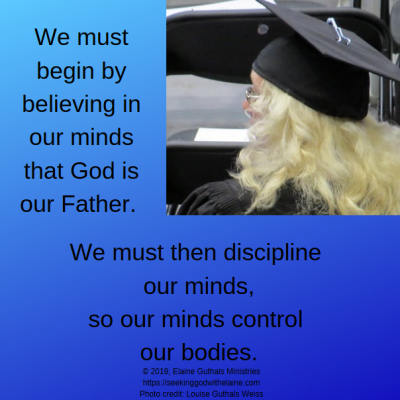
    So, we must begin by believing in our minds that God is our Father. We must then discipline our minds, so our minds control our bodies.

    We must begin by believing in our minds that God is our Father. We must then discipline our minds, so our minds control our bodies.

    Many times, though, our thoughts seem to have a mind of their own. Have you ever thought about something that you know you really shouldn’t? Of course.

    Corralling our minds is hard. It is really, really hard to stop thinking about that something (preaching to the choir here). What can we do?

    Having unwanted thoughts is human. It is not a sin to have them. That is the temptation. Temptation is a suggestion in our mind that would lead us to sin rather than following God’s Will. It is also that period of time between conception and execution of doing what is sinful.

    The sin comes into play depending what we do with the temptations. The sin could be actively thinking about them or putting the thoughts into action.

    Sometimes, we try to stop ourselves from thinking the thoughts we are having. This is called thought suppression.

    Seems impossible sometimes, doesn’t it? In fact, it seems like the more we try not to think about something, the more we end up thinking about it.

    Enter human nature — or, more specifically, Satan’s influence. Telling ourselves to not think about something can trigger us to think about it. Plus, if we are going to evaluate how successful we are in not thinking, couldn’t that trigger the thinking of the unwanted thought?

    We bite on ourselves because we can’t just manhandle the thoughts out of our brains. Sometimes, we think the only success can be cold turkey – permanently.

    We can try to corral our thoughts by setting goals. We can develop (and I have) goals in an attempt to harness our thoughts. The goal could be to decrease the behavior by a certain amount by a certain time.

    The action plan to accomplish that could spell out how we are going to change our environments to eliminate temptations. It could establish milestones so we can celebrate success of reaching certain levels.

    It could be we are going to research the topic to help develop strategies to put the brakes on our brains. Maybe at first, we have to define success as a longer time period between thoughts.

    Sometimes, we substitute something for the unwanted thoughts. Have you ever told yourself that, when the unwanted thoughts slip into the mind, you would think about God and say Bible verses instead? I have.

    The Bible does seem to promote this. “May my meditation be pleasing to him, as I rejoice in the LORD” (Ps. 104: 34 NIV). “I meditate on your precepts and consider your ways” (Ps. 119: 15 NIV). God wants us to think about His ways.

    This substitution is called a distraction strategy. It tells us we have the ability to control our environment and behavior. When we have specific replacement thoughts in mind for when the unwanted thoughts come, we help corral our minds instead of letting them wander.

    Have you seen a correlation between stressful times and the presence of unwanted thoughts? Does it seem like the stress comes and your distraction strategy flies out the window? That would mean we need to avoid stress. Yea, right.

    Struggling with unwanted thoughts and trying to suppress them can make us more anxious and depressed. That increases the stress level.

    Ooo, baby. Can we say vicious circle? Especially if we want these thoughts gone permanently and bite on ourselves for failing!

    Maybe for some thoughts, corralling them means postponing them temporarily. It might be helpful if we set aside time to consider them. If we intentionally think about them, we will be more in control.

    When it is time to think about them, we should dissect them to see what is so attractive about them, not just think them. We can then develop the action plans to address that. It might help to write it all down in a journal.

    It is really hard to corral our thoughts. In a way, we are setting ourselves up for failure. We will have to fight our human, sinful nature until the day God calls us home. God knows that.

    Still, we are called to be obedient. “But be doers of the word, and not hearers only, deceiving yourselves” (Jas. 1: 22 ESV).

    We have to follow through on how God has told us to live. God will help us. He will even help us corral our thoughts.

    Father! My Father! You have accepted us as Your children, and we affirm You as our Father. Lord, even though we are Your children, we have bodies of this world. This causes conflict in our lives. Help us to discipline our minds, Lord, that we can corral our thoughts and obey You. Strengthen us to live according to Your Laws, not according to actions this world will accept. Amen.

    What do you think? What are some of your strategies for controlling your mind? Leave me a comment below (about this or anything else) or head over to my Facebook group for some interactive discussion.

    Related Links

    Related Links

    On researching thought suppression for this devotion, I came across these two articles which I used as the foundation for my devotion.

    Stewart, I, Hooper, N., Walsh, P., O’Keefe, R., Joyce, R., McHugh, L. (2015). Transformation of thought suppression functions via same and opposite relations. Psychological Record, 65(2), 375–399. doi 10.1007/s40732-014-0113-0

    Wegner, D. M. (2011). Setting free the bears: Escape from thought suppression. American Psychologist, 66(8), 671-680. doi: 10.1037/a0024985

    What do you think?

    Leave me a comment below (about this or anything else) or head over to my Facebook group for some interactive discussion.

    If you don’t understand something and would like further clarification, please contact me.

    If you have not signed up for the email daily or weekly providing the link to the devotions and the newsletter, do so below.

    If God has used this devotion to speak with you, consider sharing it on social media.

  • Do We Get to Judge If It Is a Sin or Not?

    Why don’t you judge for yourselves what is right?
    Luke 12: 57 (NIV)
    Scripture: Exodus 20: 1-17

    All through the Bible, God has shown us how He would like us to live by giving us guidelines. In His Word, we can find the answer to any question we have. This devotion discusses how we sometimes struggle if we find conflicting verses.

    Flowers with title Do We Get to Judge If It Is a Sin or Not?

    I truly believe that we can find answers to all our questions in the Bible. No, it might not specifically speak to certain actions, but it does speak to the forces guiding those actions.

    Sometimes, though, we may feel like we get conflicting direction from the Scriptures. For example, many people question if dancing is a sin. Ecclesiastes 3: 4 says that there is “a time to weep and a time to laugh, a time to mourn and a time to dance” (NIV). Psalms 30: 11 says, “You turned my wailing into dancing” (NIV). Psalms 139: 3-4 says, “Let them praise his name with dancing and make music to him with timbrel and harp. For the LORD takes delight in his people; he crowns the humble with victory” (NIV). So, dancing can be used in worship.

    Secular dancing is often questioned because many feel it is associated with the drunkenness and wild parties that are included in Galatians 5: 19-21 with the “… other sins like these …” reference (Gal. 5: 21 NIV). Others point to I Corinthians 15: 33, which says “bad company corrupts good character” (NIV).

    However, Jesus mentioned dancing in the Parable of the Prodigal Son. “Now his older son was in the field, and as he came and drew near to the house, he heard music and dancing” (Lk. 15: 25 ESV). Do you really think Jesus Himself would have mentioned it in a story if it was a sin? Jesus cannot and would not condone a sin.

    And notice – it wasn’t depicting worship. To me, this tells us it could be the circumstances surrounding the dancing is what determines if it is a sin.

    What Does This Mean?

    In the Bible, we can find His Will for our lives by carefully studying His Word, prayerfully asking His guidance, and keeping our hearts open to hear His Will. God does, however, leave the choice to us.

    We have free will to make our own decisions. “I am giving you the choice today between God’s blessing or God’s curse!” (Deut. 11: 26 LB). Do we want to follow His Will? God isn’t a God who will force His authority over us down our throats.

    Carillon

    God gives us the choice to decide whether it will be yea or nay. He is like a parent giving a child advice. It is up to us to take His advice or leave it.

    “‘For I know the plans I have for you,’ declares the LORD, ‘plans to prosper you and not to harm you, plans to give you hope and a future’” (Jer. 29: 11 NIV). God said He had a plan for each of our lives. But that plan was built because He already knew the choices that we would make. The plan wasn’t built on predestination; it was built on our choices that served His kingdom expansion.

    How Do We Apply It?

    “And you will seek Me and find Me, when you search for Me with all your heart. ‘And I will be found by you,’ declares the Lord…” (Jer. 29: 13 NASB).

    God wants us to seek Him to help find the answers to our questions. He makes it easy for us to find Him. All we have to say is, “Hi, Lord,” and He’s there. He is willing to come halfway, but we have to take the first step.

    “Obeying these commandments is not something beyond your strength and reach; for these laws are not in the far heavens, so distant that you can’t hear and obey them, and with no one to bring them down to you; nor are they beyond the ocean, so far that no one can bring you their message; but they are very close at hand — in your hearts and on your lips — so obey them” (Deut. 30: 11-14 LB).

    God gives us encouragement to obey His Will. He wants His Will to be more than do’s and don’ts for us. He wants us to have His Will as the utmost important guide in our lives and have it shape our lives.

    Many times, we want it to be a one-size-fits-all distinction. Is it a sin or isn’t it? It doesn’t always work that way. On the big things, yes, God tells us point blank what to do and what not to do. Other times, He doesn’t. He has us decide if it is something in which we are putting Him first.

    Does that mean that — in certain circumstances — dancing can be a sin and in others it isn’t? I don’t know. Maybe. I think motivations can play a big part in whether it is a sin or not.

    What if God is calling you to witness to someone, and you run the other way and go dancing instead? Not doing what God is calling you to do would be a sin, but wouldn’t that make the dancing sinful?

    Now, one big word of caution here. Our goal is not to finagle sin so it fits our way of thinking. We have to fit our way of thinking — thus, ourselves — to make sure we avoid sin — or confess the sins we commit.

    We do not get to judge if it is a sin or not. That is God’s call.

    Our goal is not to finagle sin, so it fits our way of thinking. We do not get to judge if it is a sin or not. That is God’s call.

    “Choose to love the Lord your God and to obey him and to cling to him, for he is your life and the length of your days …” (Deut. 30: 20 LB).

    So, it all comes down to will we or won’t we? Will we come to Him for the advice? Will we acknowledge that He knows what is best for us? But most importantly, will we listen to His advice?

    Lord. You are the Supreme Ruler of the universe. You know what is best for all of us. You don’t just sit up in heaven watching us try to muddle through down here on earth. You allow us to tap into Your vast knowledge to try to decide what we should do. Lord, You know what is best for us. But Lord, You then let us decide for or against Your advice. Show us, Lord, the advantages for choosing Your ways. Lord, forgive us where we go against Your Will. Thank You for caring so much for us. Amen.

    “Show me the path where I should go, O Lord; point out the right road for me to walk. Lead me; teach me; for you are the God who gives me salvation. I have no hope except in you” (Ps. 25: 4-5 LB).

    What do you think? In what areas do we find the most gray as to whether or not it is a sin? How do you determine if it is nor not? Leave me a comment below (about this or anything else) or head over to my Facebook group for some interactive discussion.

    If you have not signed up for the email daily or weekly providing the link to the devotions and the newsletter, do so below.

    If God has used this devotion to speak with you, consider sharing it on social media.

  • How Did Jesus Restore Peter?

    Peter had denied Jesus and didn’t get a chance to make amends before Jesus was killed. While some of the disciples were fishing, Jesus met them on the beach and had a comforting talk with Peter. This daily devotional looks at how Jesus restored Peter and equipped him for his future ministry.

    Flowes with title How Did Jesus Restore Peter?

    We read where Peter denied Christ three times, then wept bitterly (Mt. 26: 69- 75; Mk. 14: 66-72; Lk. 22: 54-62; Jn. 18: 15-18, 25-27). The next time we read of him is when he is running to the tomb (Jn. 20: 3-10).

    Luke gives one account of Jesus appearing to the disciples, but it doesn’t mention Peter by name (Lk. 24: 36-49). John also doesn’t mention Peter in his account either but talks of two occasions when Jesus met with the disciples (Jn 20: 19-29).

    Let’s Go Fishing

    “When they had finished breakfast, Jesus said to Simon Peter, ‘Simon, son of John, do you love me more than these?’ He said to him, ‘Yes, Lord; you know that I love you.’ He said to him, ‘Feed my lambs'” (Jn. 21: 15 ESV)

    John also relates a story where some of the disciples decided to go fishing. It was Peter’s idea (Jn. 21: 3).

    Peter  must have been heartbroken. He did exactly what he said he wouldn’t do. Then Jesus died, and there was no way for Peter to make it right.

    I have often wondered why the disciples decided to go fishing. Did they go fishing because it was something they liked to do and it relaxed them. They were really stressed, being in fear for their lives and all.

    Or were they going back to their former way of life because they thought their days of fishing for men were over (Mt. 4: 19)?

    Either way, the outcome was still the same. They fished all night, and yet, caught nothing.

    Only when the Lord told them where they should fish, they found 153. Even though there was a large number, “… the net was not torn” (John 21: 11 ESV).

    When they got back to the beach, Jesus already had a fire going. The fish were already cooking.

    Then three times the Lord asked Peter if he loved Him. Three times Peter answered, “you know that I love You” (v. 15, 16, 17 ESV). Jesus answered, “Feed My sheep” (v. 17 ESV).

    Jesus went on to say that when we are young, we go where we want to, but when we are old, someone must lead us where we don’t want to go. At the end of the chapter, Peter asked about John. But Jesus said “… what is that to you? You follow me!” (v. 22 ESV).

    how-did-jesus-restore-peterFB

    Making the Connections

    So many different things can be read into this chapter. Here are professional fishermen who were not catching fish. The Carpenter tells them where to fish, and they catch a sizable amount.

    Isn’t it true that when the Lord sends us to do His work, we are greatly blessed? He goes before us, and when we go to Him, He already has the results of our work.

    He goes before us, and when we go to He, He already has the results of our work.

    But we have to be asked again and again if we love the Lord. It’s not that He doesn’t know we love Him – it’s that we keep it to ourselves. We don’t tell others — even God.

    Then when God tells us where or how He wants us to serve Him, we ask the questions about our parents or our jobs. We make excuses as to why we can’t serve Him the way He wants. We try to tell Him that He doesn’t know what is best for us.

    There are really three different questions that Jesus asked Peter: “… do you truly love me more than these? (v. 15 NIV); “… do you truly love me?” (v. 16 NIV); and “… do you love me?” (v. 17 NIV). One way of looking at these questions is saying they go from being specific to the general “do you love Me” question.

    How Do We Apply This?

    If Jesus were to ask us these questions, would they be in the same order? Would He question our love and build on it, or would He find our love lacking under the scrutiny of specifics?

    BuildOnOrLacking

    Another way is saying verse 17 has the bottom line. Do we love Jesus for who He is — or what He does for us?

    Read verse 18. There are times when God reveals His plan for our lives, and we reject it. We say we are going to go where we want to. We try it on our own — and we fail. Only then do we allow God to lead us where He has been trying to get us to go all along.

    What is our “these” when Jesus asks us if we love Him more than something? Do we love Him more than our fish — our jobs? Do we love Him more than we are afraid of being taken out of our comfort zone? Do we love Him more than having our expectations met? Do we love Him enough to give Him control of our lives?

    Store isle

    Jesus didn’t want the disciples going back to their old way of life. He had plans for them. Peter, especially, had to be assured that Jesus forgave Him.

    Sometimes, we have to be assured also. Jesus will do that. He wants to restore us, also, because He has plans to use us to expand His kingdom.

    Heavenly Father. You know what is best for us in our lives. Yet, when you reveal Your Will to us, we make excuses why we don’t think we can serve You. At times we like to keep You for ourselves instead of sharing Your love with others. Or we put this life above Your eternal life. Help us, Lord, to rely on You and completely trust in Your plan for our lives. Show us areas in our lives that do not hold up under scrutiny. Help us change these areas. Amen.

    What do you think? Most of us probably identify with Peter. Isn’t it wonderful that Jesus will restore us when we ask forgiveness? Leave me a comment below (about this or anything else) or head over to my Facebook group for some interactive discussion.

    If you have not signed up for the email daily or weekly providing the link to the devotions and the newsletter, do so below.

    If God has used this devotion to speak with you, consider sharing it on social media.

  • What Is Evil Anyway?

    O Jerusalem, wash the evil from your heart and be saved. How long will you harbor wicked thoughts?
    Jeremiah 4: 14 (NIV)
    Scripture: Jeremiah 4: 7-17

    We think of evil as something being morally bad or wrong. Believers equate evil with sin. While all sins are not necessarily evil, all evil can generally be categorized as sin. This devotion looks at how we can “… wash evil from our hearts and be saved…” (Jer. 4: 14 NIV).

    Flowes with title What Is Evil Anyway?

    Evil as Actions

    If we think evil is just actions, we tell ourselves we can deal with it better. But if it is just actions, then we have a choice as to whether we will perform the action or not.

    We are very good at rationalizing our actions. We love to tell ourselves that if we don’t do something or do something else, we’re safe. We aren’t sinning.

    Sometimes, we say we just can’t control our actions. We try to use this to justify why we shouldn’t be held accountable for our actions. It wasn’t really us doing the morally bad thing. We even say at times that the devil made us do it.

    The Devil Made Me Do It

    If you google the definition of evil, you also get that it is a powerful force associated with the devil. (See, blame him.) If evil comes from Satan, that puts a whole new slant on the picture.

    We ask, how can we be accountable for what something else is making us do? It is Satan, not us, that is at fault.

    We forget about our free will. A lot of times we think we just have free will as to whether we are going to accept God or reject Him. We don’t see it as we are choosing to accept or reject evil. Plus, we don’t see it as continually choosing. We see it as a one-and-done.

    But isn’t that what we do? Don’t we accept evil (Satan) if we reject God? Aren’t we making that choice several times a day?

    So, it is a choice — our choice. We are in control. We can, and should, be held accountable.

    Our Insides

    The problem is that evil is a manifestation of what is inside us. It is not something we put there. It is in our heart if God is not there.

    Evil is in our hearts if God is not there.

    It does seem like Satan can be more entrenched in some people’s hearts more than others. We all know people who are constantly stirring up turmoil with their deceptions. They live by their own rules and do everything in their power to create contention. It is easy for us to think Satan is ruling their lives.

    A Heart Problem

    Jeremiah 4: 14 says we have to “… wash evil from our hearts and be saved…” (NIV). To me, that talks about a process. Washing means you have to get wet, scrub, rinse, repeat, sometimes repeat a number of times, and dry off.

    That cleansing process won’t start unless we invite God into our hearts as Lord and Savior. It won’t be successful unless we keep scrubbing to get the evil out of the nooks and crannies of our hearts. Then sometimes we have to work on the residue.

    We Think It Through

    Very few times do we just up and sin. Usually, there is a thought process behind it. The thought process might be talking us into the sin. Or it could be rationalizing it after we have sinned. General making of excuses is a popular one.

    I can hear you saying, “But some of us are better at controlling our thoughts than others.” It does seem that way on the outside looking in. But evil does have to come from our wicked thoughts and be condoned by our hearts.

    How Can We Apply This?

    Our goal, then, is to live out Romans 12: 2: “Do not conform yourselves to the standards of this world, but let God transform you inwardly by a complete change of your mind. Then you will be able to know the will of God – what is good and is pleasing to him and is perfect” (GNT).

    Sprinkle that with Proverbs 4: 23: “Keep your heart with all vigilance, for from it flow the springs of life” (ESV). That is no small task.

    Corralling your thoughts does take vigilance. For some, it could necessitate a complete change of mind.

    The main thing we can do is focus – focus on what God tells us in His Word and is telling us in our quiet time with Him. He has guidelines for everyone to follow, but He also works specifically with each of us to grow us to what He has made us to be.

    The main thing we can do is focus – focus on what God tells us in His Word and is telling us in our quiet time with Him.

    Maybe we just start small and say several times a day, “God, wash my heart and mind of evil.” We definitely say it when we feel evil thoughts and actions taking over.

    Yes, that is easier said than done, but it is paramount that we work to do this. Why is this so important? If you look at the Good News Translation for Proverbs 4: 23, it says, “…your life is shaped by your thoughts.” Our thoughts inform our free will, which impacts who we are, what we say, and what we do.

    If our thoughts aren’t focused on God, it is easier for us to allow evil to slip into our hearts and minds and hijack our actions. Focus on God.

    Father, controlling our hearts and minds is a way Satan attempts to keep us from turning every part of us over to You.  Please wash our hearts to rid them of the evil that we have allowed Satan to place in there. Help us to close the harbor of our minds to the wicked thoughts. Focus our thoughts and our energies on become the children You want us to be. Amen.

    What do you think? What strategies have you found that helps you focus on God? Do you agree that evil is in your heart if God is not? Leave me a comment below (about this or anything else) or head over to my Facebook group for some interactive discussion.

    If you have not signed up for the email providing the link to the daily devotion and the monthly newsletter, do so below.

    If God has used this devotion to speak with you, consider sharing it on social media.

  • Does God See Everything We Do?

    The eyes of the Lord are in every place, Watching the evil and the good.
    Proverbs 15: 3 (NASB)
    Scripture: Psalm 139: 1-12

    Sometimes we get crazy ideas about God and sins. We think we can hide our sins from God. “The Lord can’t see what we’re doing because it’s dark and no one is around.” Or “God isn’t going to worry about so small a sin.” This devotion looks at whether God sees everything we do.

    Flowers with title Does God See Everything We Do?

    We come up with a lot of reasons why God won’t pay attention to our sins. But they are all wrong. God, “… whose eyes are open to all the ways of men …” (Jer. 32: 19 NASB), does keep watch over us. He knows when we sin.

    God doesn’t save us and then let us go on our merry way. He wants to support His children (II Chron. 16: 9). He wants to guide us through our temptations.

    Anyway, how can we expect to hide anything from God? This is the all-seeing, all-knowing Jehovah. Doesn’t the Bible say He counts all the hairs on our head (Mt. 10: 30) and counts all our footsteps (Job 31: 4)? And we think He won’t see our sins? Give me a break!

    Hair

    Another crazy idea we get is God really doesn’t care about our sinning because if we didn’t sin, we couldn’t show how wonderful God’s grace is. We know how God turns situations around to His favor. We try to convince ourselves that the sins we commit will be disregarded because God’s name is glorified in the end.

    Does that mean God will sanction our sins? Sorry. We can’t rationalize that way. The Bible clearly says “… be very careful what you do, for the Lord our God will have no part in unrighteousness …” (II Chron. 19: 7 NASB). How can God condone anything that is not right?

    Squirrel in trash bin

    So even though God uses our actions to fulfill His plans, He will not just ignore our sins. The Lord will punish us as He sees fit.

    We also will have a judgment day (II Cor. 5: 10). It isn’t going to be a judgment to see if our grades are good enough to get us into heaven. It will be reward time. Were our actions pleasing to God? Did we follow God’s Will for our lives? Did we even ask Him what His Will was? This is the time we’ll find out if our room in the mansion is in the penthouse or the basement.

    But remember, folks, we are human. We can’t be perfect all the time. Sometimes even though we really are trying to do right, we screw things up anyway. So, what do we do then?

    We confess our sins. We say that what we did was wrong. We say we’ll try harder next time with His help. And He will forgive us. That is what makes God’s grace so wonderful. God cares what happens to us.

    Heavenly Father, the One true God. We ask Your forgiveness of our sins. Please forgive us when we think we can hide our conduct from You. Lord, You are all-seeing, all-knowing, all-loving. You proved how loving You are when You sent Your Son to die so we could ask Your forgiveness. Help us to feel Your loving hand waiting to guide us when we are tempted and know all we have to do is ask for Your help. Lord, we wait to have that sweet fellowship with You again that we have when we are doing Your will. And Lord, we look forward to sharing Your Home through eternity. Amen.

    What do you think? How can we change our mindset to acknowledge sin is sin? Leave me a comment below (about this or anything else) or head over to my Facebook group for some interactive discussion.

    If you have not signed up for the email providing the link to the daily devotion and the monthly newsletter, do so below.

    If God has used this devotion to speak with you, consider sharing it on social media.

  • Are There Good and Bad Sins?

    By no means let any of you suffer as a murderer, or thief, or evil doer, or a troublesome meddler.
    I Peter 4: 15 (NASB)
    Scripture: 1 Peter 4: 1-11

    Many people ask the question, Are there good sins and bad sins? We like to think there are degrees of sin. This devotion looks at if that is the case.

    Flowers with title Are There Good Sins and Bad Sins?

    Degrees of sin. Isn’t it nice to convince ourselves there are degrees of sin? But are there really?

    Of course, there are degrees of sin, right? I mean, a murderer gets a stiffer punishment. That makes it a worse sin than others, right?

    You know all the phrases – ending someone else’s life, cutting someone down in their prime, violence against another human being. We can justify that it is a bad sin.

    But we, at times, say someone murdered our innocence and killed our joy. What if the sin was bullying someone, which caused that person to lose their joy? That isn’t too bad.

    And thieves, they are really bad. They take something that doesn’t belong to them, something for which someone has worked hard and paid good money.

    Thieves not only steal the material possessions, but they also steal the victim’s sense of security. That could have even more far reaching consequences. In some cases, that’s may even be worse than stealing the material possessions.

    An evil doer is truly a bad dude, someone who purposefully does something they know they shouldn’t. They intend to do something wrong. You can forgive someone if they really don’t know their actions are wrong. But if someone knows – and does it anyway – what scum!

    So, it’s comforting to know that I don’t commit the really bad sins. I’m good, right?

    But we’ve heard about sins of omission. What if we are sinning because we just haven’t thought to do something? We are so focused on us, sometimes, that we don’t see how our inactions affect others.

    Flowers

    Oops. A troublesome meddler? You mean a gossip? Sure, you mean someone who tells lies to someone else. No. You mean someone who just sticks the old nose in where it doesn’t belong just to have a story to tell? You’re getting warmer.

    You mean someone who tells a story, even though they really don’t know the facts? Yes.

    We all talk to mutual friends about mutual friends – or maybe even not so mutual friends. But we really have to look at the stories we are telling. Are we putting that person in the best possible light?

    Are we sure every word we are saying is absolutely true – or is it just our version of what went out on the party line? Are we in a position to be judging this person? That is what we are doing.

    But gossiping is such a minor sin compared to the others. (Thank God for different degrees of sin!) Or is it? We may be killing the hearer’s friendship with the person about whom we are talking about. We may be stealing the person’s dignity and integrity. We may be doing the person a great injustice by speaking lies. Troublesome meddler low on the degree of sin list? I don’t think so. They seem pretty equal to me.

    But let’s look at it this way.

    Romans 3: 23 says, “For all have sinned and fall short of the glory of God” (ESV). Romans 3: 10 is along the same line: “As it is written: “None is righteous, no, not one” (ESV). That establishes that we are all sinful.

    The kicker comes in James 2: 10-11. “For whoever keeps the whole law but fails in one point has become accountable for all of it. For he who said, ‘Do not commit adultery,’ also said, ‘Do not murder.’ If you do not commit adultery but do murder, you have become a transgressor of the law” (ESV). Mess up one thing, it is like you did everything wrong. Seriously?

    When God looks at sin, He doesn’t look at it the way we do. Look at Matthew 5: 27-28: “You have heard that it was said, ‘You shall not commit adultery.’ But I say to you that everyone who looks at a woman with lustful intent has already committed adultery with her in his heart” (ESV). Just thinking the sin is the same as committing what we would consider a “worse” sin.

    First John 3:15 is along a similar vein. “Everyone who hates his brother is a murderer …” (ESV). You may not act on the hate, but even if it is in your heart, God considers you a murderer?!?!

    What gives? Why is one equated to another? Doesn’t that make us horrible sinners?

    Whatever the sin, the root is our sinful nature against our spiritual nature. Whatever we commit, it is not how God intended us to be. Is that the equalizing factor?

    The horrible sin is our defiance of God. When we question His Kingship, when we disobey His commands, it really is all just one sin — no matter the actions we have committed.

    God, in His loving, infinite mercy, has provided a way that the payment for those sins have already been made. He sent His Son to pay that price.

    Christ on the cross

    We don’t have to rationalize that our sins really aren’t bad. We don’t have to tear ourselves down because we do mess up.

    Jesus paid the price He did because there was no way we were going to be able to by ourselves.  He redeemed us so that we could once again have access to God. We need to establish and build a relationship with God.

    That includes being obedient to His ways. That includes being sorry for the sins of commission and omission.

    We just need to see them as they are — our sinful nature warring against our spiritual nature.

    Father, our Maker and our Judge. You have told us in Your Word there are no degrees of sin. You have said that “… the wages of [all] sin is death …” (Rom. 6: 23 ESV), and all sin separates us from You. Yet, we convince ourselves there are degrees. In this way, we can make ourselves feel better by thinking You will gloss over what we do because of its minor nature. But, Lord, You don’t. You want us to value others for the beings they are. You want us to see worth in them — just as You see worth in us. Father, help us be better citizens of this world by showing Your love flowing through us to others. Remind us the only thing of value we have in the world is Your salvation. Amen.

    What do you think? Are there degrees in sin? Or is it all considered disobedience to God? Leave me a comment below or head over to my Facebook group for some interactive discussion.

    If you have not signed up for the email providing the link to the daily devotion and the monthly newsletter, do so below.

    If God has used this devotion to speak with you, consider sharing it on social media.