Category: Sin

  • How Are We Debtors to God?

    What did Paul mean when He said we are debtors? He clarified it wasn’t to the flesh, so to whom? This devotion looks at how we are debtors and how we are to mortify sin to determine life or death.

    Nuggets

    • While we are expected to maintain the bodies God created for us, we don’t have to live our lives buried in debt to our human nature.
    • Instead, we are to be crucified with Christ.
    • Death is associated with sin.
    • There is only one way to gain spiritual life – through Jesus.
    • Jesus had to die on the cross so that His blood could pay the penalty for sin.
    • We need to crucify the sin in our lives.
    Flowers with title How Are We Debtors to God?

    We’ve just talked about how God, when breathing life into us, placed spirit within us. Because He created us – and will one day call us back – we are on loan from Him.

    Paul explained that in Romans 8: 12-13. Let’s take a look at what nuggets these two verses have for us.

    To read a related devotion, click the button below.

    Let’s Put It into Context

    “and the dust returns to the earth as it was, and the spirit returns to God who gave it” (Ecc. 12: 7 ESV)

    When I looked up the word debt in the Holman Bible Dictionary, it took me to the word loan. We all know what a loan is. It is when someone allows us to us something on a temporary basis. In other words, they want it back.

    Raikes explained the rights the money lender had over the debtor. It made me think of indentured servants.

    We generally think money — mortgages, credit card debt, car loan, etc. But then neighbors can load us tools, luggage — stuff. There are times the loan is a vehicle.

    Did you know we are on loan? We are here on earth a short amount of time in the scheme of things. We talked a couple of devotions ago how God breaths life into us — but it is temporary.

    • “Then the LORD God formed the man from the dust of the ground. He breathed the breath of life into the man’s nostrils, and the man became a living person” (Gen. 2: 7 NLT).
    • “and the dust returns to the earth as it was, and the spirit returns to God who gave it” (Ecc. 12: 7 ESV).

    Paul used the term debtor to make his point in Romans 8: 12-13. Let’s take a look.

    We Are Debtors

    “Therefore, brethren, we are debtors, not to the flesh, to live after the flesh” (Rom. 8: 12 KJV)

    There is a way we are indebted to our flesh. After all, God created us with bodies that we have to maintain. Remember when Paul was in the throes of being shipwrecked? “So I urge you to take some food. For this is for your survival, since none of you will lose a hair from your head” (Ac. 27: 34 CSB).

    There are ways we have to take care of our bodies.

    • Feed
    • Cloth
    • Maintain health
    • Provide shelter
    • Exercise self-control
    • Practice cleanliness

    Horton’s point — like Paul’s — was that, while we are expected to maintain the bodies God created for us, we don’t have to live our lives buried in debt to our human nature.

    Flesh is considered our human nature and under Satan’s control. “But when people keep on sinning, it shows that they belong to the devil, who has been sinning since the beginning. But the Son of God came to destroy the works of the devil” (I Jn. 3: 8 NLT).

    Glossary

    To read a related devotion, click the appropriate button below.

    Instead, we are to be crucified with Christ. Remember back in Ephesians, Paul wrote, “For we are his workmanship, created in Christ Jesus for good works, which God prepared beforehand, that we should walk in them” (Eph. 2: 10 ESV). We were created in the flesh for a heavenly purpose.

    So, to whom are we debtors? We are quick to say we are debtors to God, Jesus, and the Holy Spirt.

    Spurgeon felt that, since we are God’s creations, we are indebted to obey Him. He explained disciples go from being indebted to His justice to being indebted to His love, power, and mercy.

    However, Spurgeon did list others to whom we are indebted.

    • “… great a cloud of witnesses …” (Heb. 12: 1 ESV) who came before us. He also felt we are indebted to the present and to the future.
    • the poor. He wrote, “The rich are indebted to them, for while the one hoard wealth the other make it.” He noted that, even though the poor struggle in their daily life, many are faithful in serving the church.

    To read a related devotion, click the appropriate button below.

    Winslow made a great point. Why would we be in debt to Satan? He didn’t approach Adam and Eve to make their lives better. His motive was to let sin and its consequences (spiritual death and separation from God) and its results (poverty, crime, disease, death just to name a few) into the world.

    To read a related devotion, click the appropriate button below.

    Death and Life

    “For if ye live after the flesh, ye shall die …” (Rom. 8: 13 KJV)

    The flesh is our human nature. “… live after the flesh …” (Rom. 8: 13 KJV) means we keep on sinning. Paul gave us a partial list in Galatians 5: 19-21.

    “Now the works of the flesh are obvious: sexual immorality, moral impurity, promiscuity, idolatry, sorcery, hatreds, strife, jealousy, outbursts of anger, selfish ambitions, dissensions, factions, envy, drunkenness, carousing, and anything similar. I am warning you about these things — as I warned you before — that those who practice such things will not inherit the kingdom of God” Gal. 5: 19-21 CSB).

    Not too long ago we did a huge study on what sin was and the different things considered sin. Sin is when we disobey God and break one of His laws and commandments.

    To read a related devotion, click on the appropriate button below.

    Burder gave a great description of living after the flesh. He described it as “to obey the orders of our corrupt nature; to gratify its sinful desires without regard to or in contradiction of the will of God.”

    What Burder described is a willful disobedience of God’s laws and commandments. It is choosing to disobey God.

    Death is associated with sin. We’ve talked a couple of different ways this is true. Let’s look at the nuggets associated with those devotions.

    Many times, the sinful state is referred to as being dead. Spiritual death is the separation from God that occurred as a consequence of Adam and Eve’s original sin.

    Even if we do not feel that we have sinned (but we have), those who have not been given salvation are separated from God. All mankind, at birth, are spiritually dead because Adam and Eve’s original sin condemned mankind to spiritual death. Because mankind chose to not follow God’s laws and commandments, mankind is the subject of divine wrath.

    When we ask God to take control of our lives, we pass from eternal death into eternal life. We need Jesus to be our Savior.

    To read a related devotion, click on the appropriate button below.

    There is only one way to gain spiritual life – salvation through Jesus. Salvation is the deliverance from the consequences of sin. It is about obeying and submitting to God.

    Where the law couldn’t save us, Jesus could, changing us from spiritually dead to spiritually alive. Becoming spiritually alive is a part of regeneration. Regeneration is the change in us that God brings about when we go from being spiritually dead to spiritually alive.

    Mortification

    “… but if ye through the Spirit do mortify the deeds of the body, ye shall live” (Rom. 8: 13 KJV)

    Ooo, baby. Isn’t the last part of Romans 8: 13 a mouthful? But I think once we get into it, we’ll say, “Oh, yeah. We know what that means.”

    Burder noted that “to mortify sin is to put it to death, as the magistrates put a felon to death by due course of justice; he is suspected, apprehended, tried, and executed.” See. Told you.

    Wait a minute. Wait a minute. Wait a minute.

    Back up a couple of devotions. We said that Jesus had to die on the cross so that His blood could pay the penalty for sin.

    • Jesus shed His blood for us so that payment could be given for our sins (Does God Help Those Who Help Themselves?).
    • What God needed was a Sacrifice Who’s blood could pay the price for sin once and for all (Completion from the Cross).
    • Only His blood made the perfect sacrifice to make the payment for our sins (Jesus, the Good Shepherd).
    • In order to shed His blood, Jesus was sentenced to die on the cross so that His blood could pay the price for our sins (Completion from the Cross).
    • Jesus’ blood provided the atonement that purified us (Why Jesus Became a Man).
    • If Jesus hadn’t paid the price for our sins with His blood — and we hadn’t accepted the gift of salvation — we wouldn’t have access to God. We access this grace through faith (Is Thankfulness Different from Praise?).

    Glossary

    Winslow had a good explanation of mortification. He said, since it leads to holiness, it was the opposite of the flesh.

    We need to crucify the sin in our lives. We need to put it to death so that we submit to God and obey Him.
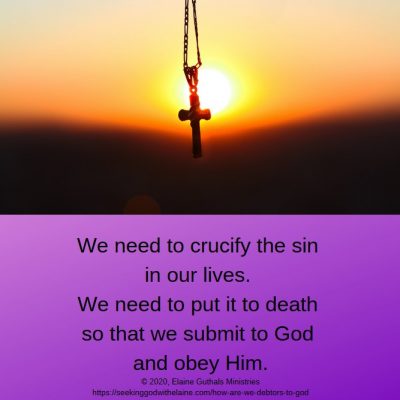
    Cross necklace

    Making the Connections

    I could probably go on talking about this a while, but I think we need to start wrapping this up.

    It is really interesting. Instead of “… we are debtors …” (Rom. 8: 12 KJV),
    some of the newer translations have some version of “… we are not obligated to …” (Rom. 8: 12 CSB, HCSB, NLT). They don’t tell us to what we are obligated.

    True, they get it right that we are not obligated to the flesh. But they miss the “we are obligated to …” part (Rom. 8: 12 ESV, GNT, NASB, NIV, NKJV).

    The “My dear friends, we must not live to satisfy our desires” (Rom. 8: 12 CEV) is only part of the story.

    How Do We Apply This?

    The rest of the story is how we live our lives after we become disciples. We need to humbly submit to God so that we give Him all the reverence due Him.

    Most of all, we need to obey God’s laws and commandments. That how we traverse the sanctification road to become holy and righteous as He is.

    Lord. Help us put sin to death so that we may always imitate and obey You. Amen.

    What do you think?

    Leave me a comment below (about this or anything else) or head over to my Facebook group for some interactive discussion.

    If you don’t understand something and would like further clarification, please contact me.

    If you have not signed up for the email daily or weekly providing the link to the devotions and the newsletter, do so below.

    If God has used this devotion to speak with you, consider sharing it on social media.

  • Does God Really Forgive and Forget Sin?

    We generally buy into the fact that God forgives our sins. It is harder to believe that God forgets them. This devotions looks at if and why God forgives and forgets.

    Nuggets

    • God will forgive our sins if we confess them to Him as Sovereign God.
    • Jesus has to be our Redeemer because we couldn’t — and can’t — redeem ourselves.
    • God does not withdraw the results of sin – poverty, crime, disease, death just to name a few – after we are forgiven.
    • Mercy doesn’t negate or dilute God’s laws and commandments.
    • God has forgiven us and forgotten about our sins, but we haven’t forgiven ourselves.
    • We don’t have to feel guilty once we have asked God’s forgiveness.

    Devotions in the What I Believe series

    Devotions in the God category

    Flowers with title Does God Really Forgive and Forget Sin?

    We generally bite on ourselves for our sins. We know God forgives us, but can we really believe that He forgets our sins?

    We don’t. Why would He?

    Let’s Put It into Context

    “Keep your servant from deliberate sins! Don’t let them control me. Then I will be free of guilt and innocent of great sin” (Ps. 19: 13 NLT)

    Sin is when we disobey God and break one of His laws and commandments. It is an attitude that encourages us to exercise our free will and not follow God. Temptation is that period of time between conception and execution of doing what is sinful.

    When we sin, we need to repent. Repentance is expressing sorrow for breaking God’s laws and commandments. But it is not just feeling sorry for doing those things. It is making the commitment to changing ourselves through obedience so that we no longer do the wrong things. Obedience means to hear and carry out the instructions that God gives us.

    Grace is a free and unmerited gift from Heavenly Father given through His Son, Jesus Christ that enables salvation and spiritual healing to believers. Because of God’s infinite grace, He devised the plan of salvation that made Jesus our Redeemer in order to forgive us of our sins.

    Forgiveness is when God pardons us because we have broken His laws and commandments. We accept the pardon by letting go of the guilt and remorse that we feel because we have done something wrong. It is a conscious decision to accept His forgiveness.

    This pardon brings us salvation. Salvation is the deliverance from the consequences of sin. This deliverance is necessitated by the original sin committed by Adam and Eve in the Garden of Eden, which made everyone sinners.

    To read a related devotion, click on the appropriate button below.

    God Forgives Sin

    “If we confess our sins, he is faithful and just to forgive us our sins and to cleanse us from all unrighteousness” (I Jn. 1: 9 ESV)

    The Holman Bible Dictionary defines forgiveness as “an act of God’s grace to forget forever and not hold people of faith accountable for sins they confess … it is, first of all, the gracious act of God by which believers are put into a right relationship to God and transferred from spiritual death to spiritual life through the sacrifice of Jesus.”

    Look what First John 1: 9 says. “If we confess our sins …” (I Jn. 1: 9 ESV). God will forgive our sins if we confess them to Him as Sovereign God.

    Not if we clean ourselves up first. Not if we are good, kind people.

    To read a related devotion, click the button below.

    How else do we know this? “But God showed his great love for us by sending Christ to die for us while we were still sinners” (Rom. 5: 8 NLT).

    While we were still disobeying God and breaking His laws and commandments, God Sent His Son Jesus to be the Redeemer of mankind. Jesus was born of a virgin, making Him 100% God and 100% man. He gave His life on the cross for us so that His blood could pay the price for our sins. Because of God’s great might and power, Jesus rose from the grave, conquering death and paying the price for our sins.

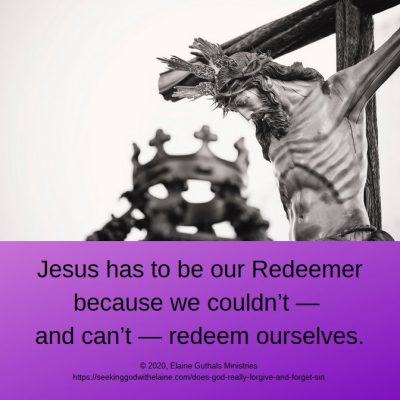
    That brings up another point. Jesus has to be our Redeemer because we couldn’t — and can’t — redeem ourselves.

    Jesus

    We are redeemed because of Jesus’ blood. We’ve talked about the blood before.

    • Atonement is all about the blood.
    • Jesus’ blood provided the atonement – not the obedience, not the sacrifice – the blood.
    • Jesus’ blood purifies us so that we can be forgiven (Heb. 9: 22).
    • Since Jesus’ blood purifies us, it is nothing we do or don’t do – we can’t work or earn our way into heaven.

    To read a related devotion, click the appropriate button below.

    According to the Holman Bible Dictionary, expiation “emphasizes the removal of guilt through a payment of the penalty, while propitiation emphasizes the appeasement or averting of God’s wrath and justice.” If expiation is the act of atonement, the act was dying on the cross. To die, Jesus had to shed His blood.

    The removal of the sin (and guilt) makes us clean. Cleanness in the Bible refers to disciples being holy and pure. This was the original state where Adam and Eve were before the original sin. Through grace, we can again be pure – body, thoughts, and desires.

    God know our hearts are not pure because we still have sin in our lives. Human nature is not clean. Our hearts will always be wicked (sinful) because of our human nature (Jer. 17: 9) – unless ask God in our hearts to purify us. Only God can remove the sin in our lives.

    God’s notion is that purity comes from the heart. It is more who we are – our character – than what we do. It is where Jesus and the Holy Spirit live within us.

    Now, don’t think that just because God forgives us, He automatically removes the consequences of sin — spiritual death and separation from God.

    God does not withdraw the results of sin – poverty, crime, disease, death just to name a few – after we are forgiven. We are going to have to deal with those until Jesus comes back for us. We’re not going to escape the punishment.

    To read a related devotion, click the appropriate button below.

    Mercy Comes into Play

    “He has not dealt with us as our sins deserve or repaid us according to our iniquities” (Ps. 103: 10 CSB)

    Mercy is the unexpected way God responds in love to our needs. Spencer stated that it “… is the intervention of gratuitous goodness. It is benevolence, bending in pity and compassion over the very creature, whose guiltiness has deserved the everlasting abandonment of Heaven.”

    Mercy doesn’t negate or dilute God’s laws and commandments. It does not give us license to go on sinning after conversion. It does not mean there will be no penalties of sin when we do sin.

    It means that God didn’t judge us to the extent He could have. Cross called it more of a delay of punishment.

    God could have kept the consequences to sin in place. We could still be spiritually dead. We could still be separated from Him.

    Instead, God says, “I know Tom, Sally, and Elaine — and all the other humans — deserve to die because they have sinned. I love them too much to see that. So — if they say they are sorry and will submit to Me — I won’t make them suffer the consequences of their sins.”

    We are not entitled to this mercy. We do not deserve it.

    We are guilty.

    What mercies does God give us? Brown gave us a list.

    • “health
    • “food
    • “clothing
    • “home
    • “friends
    • “Bible
    • “Sabbath
    • “sanctuary
    • “means of grace
    • “hope of glory”

    God Forgets Sin

    “For I will forgive their wrongdoing, and I will never again remember their sins” (Heb. 8: 12 CSB)

    Look what else the Holman Bible Dictionary said in its definition of forgiveness. They wrote, “It is also, in this divine dimension, the ongoing gift of God without which our lives as Christians would be ‘out of joint’ and full of guilt.”

    We don’t have to feel guilty once we have asked God’s forgiveness. But that is hard to do, sometimes, isn’t it? God has forgiven us and forgotten about our sins, but we haven’t forgiven ourselves.

    Spurgeon wrote, “Even when sin is forgiven, the memory of it often makes a man go softly all his days. It is therefore a very blessed thought on the part of our God to make the covenant to bear so much ripen our sin and our sinfulness, and especially to make it open with this unconditional promise of infinite love, ‘Then will I sprinkle clean water upon you,’ etc.”

    Remember in Hell Does Have Fury, we said we may have memory on steroids in the eternal life. Things we can’t remember now will be remembered then. Memory is forever.

    To read a related devotion, click the appropriate button below.

    Smyth reminded us that “the record of our life is a line written in the book of things.” God knows everything that we have done.

    Satan tries to tell us that God will not forgive that sin — or worse — He won’t forgive us. Don’t believe Satan’s lies!

    When we confess our sins to God, He forgives and forgets. In my opinion, that sin gets erased from our book.

    Forgiveness is also when we give up the bitterness and resentment that we feel because we have been wronged.

    Making the Connections

    When we ask, God forgives us because He loves us. Spencer wrote, “Mercy is that attribute in which the Deity peculiarly delights.” Because He loves us so much, God shows that through mercy.

    The thing is, though, we are supposed to imitate God. But, as Spencer said, “God has trusted His world to demonstrate His other attributes, but not to demonstrate His mercy.” We can show God’s love, but we can’t His mercy.

    We can’t out-mercy God or even give the same amount.

    Making the Connections to Self-Discipline

    We are also considering what we would say if a non-believer asked us. Here is the worksheet again. What would you tell someone about God forgiving and forgetting sins?

    • What does the Scriptures say?
    • What do I believe?
    • Why do I believe the same/differently than the Scriptures?
    • What are the talking points when witnessing to a non-believer?

    Related Links

    I have created a worksheet of the questions above. Click on the button below to access it.

    How Do We Apply This?

    • We have to ABCD.
    • We have to forgive ourselves.
    • We have to forget.

    Father God. We know You forgive sins. It is so easy to buy into Satan’s lies that there is that one sin (other than the unpardonable sin) that You can’t forgive. Or that You won’t forgive us. You will forgive us when we humbly ask You as Sovereign God to do just that. Thank You for Your love. Amen.

    What do you think?

    Leave me a comment below (about this or anything else) or head over to my Facebook group for some interactive discussion.

    If you don’t understand something and would like further clarification, please contact me.

    If you have not signed up for the email daily or weekly providing the link to the devotions and the newsletter, do so below.

    If God has used this devotion to speak with you, consider sharing it on social media.
  • Can God See Us If We Are Sinners?

    Nuggets

    • Sin created a separation from God.
    • God, however, is right on the other side of the divide.
    • Though God is very accessible to us, He just requires one thing – submission.
    • It is about praying to worship God.
    • Some choose to not submit to and obey God.
    • When you a point where He is not going to come back and convict you anymore, you now have the unpardonable sin.

    Devotions in the What I Believe series

    Devotions in the God category

    Flowers with title Can God See Us If We Are Sinners?

    If God can’t see us because of our sins, how can He save us? How can we approach Him? This devotion looks at what Scriptures say about God seeing us.

    Let’s Put It into Context

    “So God created man in his own image; he created him in the image of God; he created them male and female” (Gen. 1: 27 CSB)

    When God created Adam and Eve, they were made in God’s image (Gen. 1: 27). But things went downhill from there.

    Everything changed when Adam and Eve sinned. Sin is when we disobey God and break one of His laws and commandments.

    God is holy. Holy means to be set apart, perfect, and pure. When applied to God, the Holman Bible Dictionary states “it means to be ‘perfect, transcendent, or spiritually pure, evoking adoration and reverence.’”

    That is how God made us (minus the adoration and reverence). Sin wrecked that. Mankind was no longer sons and daughters of God (Theological Sketch Book).

    But God didn’t want that to last through eternity. He devised the plan of salvation to restore our relationships with Him.

    When we admit our sins, believe on Jesus as Redeemer, confess God as Sovereign Lord and demonstrate that commitment by following our job description, we restore our relationships with God.

    If you have not admitted that your relationship is not right with God,

    have not asked Jesus to be your Lord and Savior,

    and have not confessed your sins,

    please read through the Plan of Salvation and prayerfully consider what God is asking you to do.

    But God Can’t See Sin???

    “But your iniquities have made a separation between you and your God, and your sins have hidden his face from you so that he does not hear” (Isa. 59: 2 ESV)

    Sin did create a separation from God. Mankind no longer had direct access to God. He could no longer hear “… the sound of the Lord God walking in the garden at the time of the evening breeze …” (Gen. 3: 8 CSB).

    We are also told of a chasm between heaven and hell. “Besides all this, a great chasm has been fixed between us and you, so that those who want to pass over from here to you cannot; neither can those from there cross over to us” (Lk. 16: 26 CSB).

    There is a definite divide.

    But what about the second part of that? “… your sins have hidden his face from you so that he does not hear” (Isa. 59: 2 ESV). How can God save us if He can’t see us in our sinful state?

    Contrast with God Is Never Far Away

    “He did this so that they might seek God, and perhaps they might reach out and find him, though he is not far from each one of us” (Ac. 17: 27 CSB)

    God, however, is right on the other side of the divide. Look at these verses.

    • “Draw near to God, and he will draw near to you. Cleanse your hands, sinners, and purify your hearts, you double-minded” (Jas. 4: 8 CSB).
    • “But if from there you seek the LORD your God, you will find him if you seek him with all your heart and with all your soul.” (Deut. 4: 29 NIV).
    • “The LORD is near the brokenhearted; He saves those crushed in spirit” (Ps. 34: 18 HCSB).
    • “Behold, I stand at the door and knock. If anyone hears My voice and opens the door, I will come in to him and dine with him, and he with Me” (Rev. 3: 20 NLT).

    All we have to do is ABC to gain access. We’ve talked about access many times.

    • God has made Himself very accessible to us. He was the one Who devised the plan of salvation to restore His relationship with mankind (What Are Heavenly Places?).
    • It is only through Jesus that we even have access to God. If Jesus hadn’t paid the price for our sins with His blood — and we hadn’t accepted the gift of salvation — we wouldn’t have access to God. We access this grace through faith (Is Thankfulness Different from Praise?).
    • We still have to access God’s grace by asking Him to forgive us. We need to do that daily (How Are Grace, Redemption, and Forgiveness Connected?)
    • Jesus also wants complete access to our hearts. He doesn’t want to leave any inch where Satan can worm his way in to derail us (The Fullness of God’s Love).
    • I like to think of it as there is no floor in heaven. If heaven doesn’t have a floor, there is no barrier between God and us. God has immediate access to us. He can see and hear all of us. He sees us, so He can shine on us (How Can God’s Face Shine on Us?).

    To read a related devotion, click the appropriate button below.

    God is very accessible to us. He just requires one thing – submission. We have to approach Him in faith and reverence. If we don’t do that, He doesn’t have to acknowledge us.

    Who Is Praying?

    “The eyes of the LORD watch over those who do right, and his ears are open to their prayers. But the LORD turns his face against those who do evil” (I Pet. 3: 12 NLT).

    But look at these verses.

    • “This is the confidence we have before him: If we ask anything according to his will, he hears us” (I Jn. 5: 14 CSB).
    • “We know that God doesn’t listen to sinners, but he is ready to hear those who worship him and do his will” (Jn. 9: 31 NLT).
    • “And if you believe, you will receive whatever you ask for in prayer” (Mt. 21: 22 CSB).

    What do we get out of these verses?

    • We have to approach God His way.
    • His way is worship.
    • When we ask something based on our intent is to honor Him, He will grant our prayers.

    No, it isn’t about what high-paying job we are going to get and soulmate we are going to find. It isn’t even about whether Tom, Sally, or Elaine is going to be healed.

    Our prayers should be about praying to worship God. It is coming to Him as Sovereign God.

    Praying hands

    Not Everyone Will Be Saved

    “This is good, and it pleases God our Savior, who wants everyone to be saved and to come to the knowledge of the truth” (I Tim. 2: 3-4 CSB)

    Let’s get down to the underlying issue — in my opinion. God wants everyone to be saved, and He sent Jesus to die while we were still sinners. “But God proves his own love for us in that while we were still sinners, Christ died for us” (Rom. 5: 8 CSB).

    But He doesn’t force salvation on us. Salvation is the deliverance from the consequences of sin.

    We have to repent. Repentance is expressing sorrow for things we’ve done wrong. But it is not just feeling sorry for doing those things. It is making the commitment to changing ourselves through obedience so that we no longer do the wrong things. Obedience means to hear and carry out the instructions that God gives us.

    The underlying issue is some choose to not submit to and obey God. We have free will to do that — or not in this case. “And if it is evil in your eyes to serve the LORD, choose this day whom you will serve, whether the gods your fathers served …, or the gods … in whose land you dwell. But as for me and my house, we will serve the LORD” (Josh. 25: 15 ESV).

    Evil is, according to the Holman Bible Dictionary, “that which is opposed to God and His purposes or that which, defined from human perspectives, is harmful and non-productive.”

    We’ve talked about this before. Disciples equate evil with sin. While all sins are not necessarily evil, all evil can generally be categorized as sin.

    If evil comes from Satan, that puts a whole new slant on the picture. Some say we shouldn’t be held accountable for what something else is making us do. But we forget about our free will.

    So, it is a choice – our choice. We are in control.

    To read a related devotion, click the button below.

    Unfortunately, there are those who will never choose God. Those are the ones from whom God has hidden His face. Remember, we talked about that, too.

    God Closes the Window

    “Seek the LORD while he may be found; call on him while he is near” (Isa. 55: 6 NIV)

    Proverbs 29: 1 says, “If you get more stubborn every time you are corrected, one day you will be crushed and never recover” (GNT). There comes a point where He is not going to come back and convict you anymore.

    But why? Every time God has come to you with salvation, you said no. Well, more than that — you said no more emphatically each time.

    When that point hits, you now have the unpardonable sin. “Therefore I tell you, every sin and blasphemy will be forgiven people, but the blasphemy against the Spirit will not be forgiven. And whoever speaks a word against the Son of Man will be forgiven, but whoever speaks against the Holy Spirit will not be forgiven, either in this age or in the age to come” (Mt. 12: 31-32 ESV).

    To read a related devotion, click the appropriate button below.

    Making the Connections

    We may not have access to God because we have not accepted His gift of salvation, but that doesn’t mean He doesn’t have access to us.

    The way I see it is we have access to the Holy Spirit first for Him to convict us. Then we have access to Jesus, so He can save us.

    Then Jesus ushers us into God’s presence. Can’t we just hear Him? “Father, I have someone I want to introduce to You. This is [Tom, Sally, Elaine, your name]. S/He has just ABCDed. I wanted to make the introduction so as now there is unlimited access to You.”

    Making the Connections to Self-Discipline

    We are also considering what we would say if a non-believer asked us. Here is the worksheet again. What would you say?

    • What does the Scriptures say?
    • What do I believe?
    • Why do I believe the same/differently than the Scriptures?
    • What are the talking points when witnessing to a non-believer?

    Related Links

    I have created a worksheet of the questions above. Click on the button below to access it.

    How Do We Apply This?

    The ABCDs of Salvation

    If you have not become a believer in Christ, please read through the
    Plan of Salvation and prayerfully consider what God is asking you to do.

    A – admit our sins
    B – believe His Son Jesus is our Redeemer
    C – confess God as Sovereign Lord

    D – demonstrate that commitment by making any changes needed in our lives to
    live the way in which God has called us

    The Disciple’s Job Description

    Father. We admit our sins, believe on Jesus as Redeemer, and confess You as Sovereign Lord. We pray that we will demonstrate that commitment by following our job description. As we continue to sin, bring those sins to our minds so that we can confess them. Amen.

    What do you think?

    Leave me a comment below (about this or anything else) or head over to my Facebook group for some interactive discussion.

    If you don’t understand something and would like further clarification, please contact me.

    If you have not signed up for the email daily or weekly providing the link to the devotions and the newsletter, do so below.

    If God has used this devotion to speak with you, consider sharing it on social media.

  • Can We Really Identify God’s Wrath?

    How can we see God’s wrath when we can’t see God? People who suppress the truth about God draw His wrath. This devotion looks at how God’s wrath is revealed against all sin.

    Nuggets

    • Even though we cannot see God, we know when He is angry at our sinfulness.
    • God’s anger is used to help get us back on His track.
    • People suppress the truth by denying God, refusing to acknowledge He is their Creator, and refusing to acknowledge Him as Sovereign Lord.
    Flowers with title Can We Really Identify God's Wrath?

    Wrath, as defined by Holman Bible Dictionary, is “the emotional response to perceived wrong and injustice, often translated ‘anger,’ ‘indignation,’ ‘vexation,’ and ‘irritation.’”

    In God’s Wrath and Mercy, we said that sin, which leads to wrath, is the polar opposite of the Spirit — with which we are supposed to be filled. Sovereign God gets to decide crimes and punishments. There is hope for us because God is rich in mercy (Eph. 2: 4). Mercy comes out of God’s love, which is His character (I Jn. 4: 8).

    To read a related devotion, click the button below.

    God’s Wrath Revealed

    “For God’s wrath is revealed from heaven …” (Rom. 1: 18 CSB)

    Even though we cannot see God, we know when He is angry at our sinfulness. We know that “the eyes of the Lord are everywhere, observing the wicked and the good” (Prob. 15: 3 CSB).

    Also, we know God is a just God. “But the Lord sits enthroned forever; he has established his throne for judgment. And he judges the world with righteousness;
    he executes judgment on the nations with fairness” (Ps. 9: 7-8 CSB).

    God doesn’t lead with passion. “I am not angry. If only there were briers and thorns confronting me! I would march against them in battle; I would set them all on fire” (Isa. 27: 4 NIV).

    Rather, according to Jay, God’s wrath comes out of His nature. It comes from the need to maintain order. If His laws and commandments are broken, consequences must occur.

    The Scriptures have many examples of God’s wrath correcting mankind.

    • God drove Adam and Eve out of the Garden (Gen. 3: 24).
    • The Wilderness Wanderers complained about conditions, and God sent serpents among them to kill them (Num. 21: 6).
    • The Babylonian captivity occurred because of Israel’s unfaithfulness (I Chron. 9: 1).

    Do I need to go on? I could. You get the point.

    God is very fluent in modes of punishment. He doesn’t always immediately default to our death.

    Oh, yeah. Worldview people argue that, if God is love, there would be no consequences.

    Seriously? We really think we would want to submit to a God Who didn’t care what we did? That is just a smokescreen.

    God makes His wrath known. Lyth wrote that God also reveals His anger to us in our conscience, through His Word, and through His care and guidance.

    Thomas reminded us how we can get at times when we get angry. Ooo, baby. It just consumes us sometimes, doesn’t it?

    Luckily, God isn’t that way. God is not vicious and spiteful. God is love (I Jn. 4: 8) and peace (Phil. 4: 7).

    Some worldview people like to think that God is not judging us now and won’t until the end times — if then. We talked about this before. Do not take that to mean God will not judge. He will — if not today, He will in the end.

    To read a related devotion, click the appropriate button below.

    Against All Sin

    “For God’s wrath is revealed from heaven against all godlessness and unrighteousness …” (Rom. 1: 18 CSB)

    It is easy for us to quickly get offended by someone who has angered us. We can be very good at holding grudges.

    Not so with God.

    God’s anger is used to help get us back on His track. He uses it to correct us and as a warning to other sinners. Its purpose is to mold us into being more like Him.

    Go back to verse 18. “For God’s wrath is revealed from heaven against all godlessness and unrighteousness of people who by their unrighteousness suppress the truth” (Rom. 1: 18 CSB). God doesn’t let some sin slide. His wrath is against all sin.

    What is the difference between ungodliness and unrighteousness? We talked about godliness and righteousness in Kindness and Love as Virtues.

    Godliness in the New Testament is equivalent to the Old Testament’s the fear of the Lord, which means reverence and love (What Does Fear of the Lord Mean?). Righteousness is the result of a solid relationship with God built by a sincere life of obedience to God’s laws and commandments (How Do Disciples Crave Righteousness?). Righteousness is the thought or behavior. Godliness is the cause of the thought or behavior.

    So, the godless are those who do not love and reverence God. The unrighteous are those who break His laws and commandments.

    Against Those Who Suppress the Truth

    “For God’s wrath is revealed from heaven against all godlessness and unrighteousness of people who by their unrighteousness suppress the truth” (Rom. 1: 18 CSB)

    Bell defined truth as “… universally the reality as opposed to that which is not real.” He also noted “that sin extinguishes the love and desire for the truth.”

    Oh, yes. There are those who “… suppress the truth” (Rom. 1: 18 CSB). They do that by denying God. They refuse to acknowledge He is their Creator. Worse, they refuse to acknowledge Him as Sovereign Lord.

    Wardlaw argued that people were suppressing the truth by keeping the truth to themselves and refused to live their lives according to that truth.

    Isn’t that sad? They know the truth, but purposefully do not submit to our Sovereign God. Instead, they will endure the torment of hell for eternity.

    To read a devotion in the Hell Does Have Fury series, click on the appropriate button below.

    Some may question how God’s truth can be suppressed. If He is an all-powerful God, how could this happen?

    It happens because God allows it. Boston wrote “… that one cannot hold it prisoner but in unrighteousness, or in rebellion against the God of truth.”

    Making the Connections

    It might be easy for some to say, “Oh, but they just didn’t know.” Doesn’t work that way. Horton reminded us that, “once in Judaism, and since in Christianity, God has maintained a testimony for Himself.”

    We either choose for God or for Satan. We are going to — at some point — want to seek God. Unfortunately, some may not recognize it at as seeking God.

    We are going to think there is something more than this. We are going to recognize the brokenness in this world.

    We are going to have to make a conscious choice.

    Let’s face it. We deserve God’s wrath. We were the ones who are disobedient. Obedience means we not only hear God’s Word but also follow His instructions.

    We have definitely been disobedient.

    How Do We Apply This?

    God created us. He has provided laws and commandments that show us right from wrong. Tyson stated that we owe Him “… perpetual allegiance and service.” It is our moral obligation to submit to God as our Creator and Sovereign Lord.

    We need to search for God if He is not currently our Sovereign Lord. We need to seek to grow closer to Him if He is.

    Searching for and Seeking God

    Hearing His Word (Rom. 10: 17).
    Reading His Word (Rev. 1: 3).
    Praying to Him (Heb. 4: 16).
    Studying His Word (Ac. 17: 11).
    Meditating on His Word (Ps. 1: 1-2).
    Memorizing His Word (Ps. 119: 11).

    God is a loving, forgiving God. He will forgive us when we sincerely admit our sins, believe in Jesus as Savior and Redeemer, and confess Him as Sovereign God.

    The ABCDs of Salvation

    If you have not become a believer in Christ, please read through the
    Plan of Salvation and prayerfully consider what God is asking you to do.A – admit our sins

    B – believe His Son Jesus is our Redeemer

    C – confess God as Sovereign Lord

    If you have not become a believer in Christ, please read through the Plan of Salvation and prayerfully consider what God is asking you to do.


    D – demonstrate that commitment by making any changes needed in our lives to

    live the way in which God has called us

    The Disciple’s Job Description

    If you have not ABCD, please prayerfully consider making today the day.

    Father God. You are Creator. You are all-powerful. The only way Your truth can be suppressed is because You allow it – just as You allowed Adam and Eve to choose to not obey You. Lord, one day Your wrath will be unleashed as You judge all mankind. Lord, we pray for those who are suppressing Your truth and who refuse to acknowledge You as Sovereign Lord. Put disciples in their paths to lead them to You. Amen.

    What do you think?

    Leave me a comment below (about this or anything else) or head over to my Facebook group for some interactive discussion.

    If you don’t understand something and would like further clarification, please contact me.

    If you have not signed up for the email daily or weekly providing the link to the devotions and the newsletter, do so below.

    If God has used this devotion to speak with you, consider sharing it on social media.

  • Is Repentance Necessary?

    Do we really have to repent of our sins? Moses, in his farewell address, told the Wilderness Wanderers the answer to that question. This devotion discusses what that answer is and results of that answer.

    Nuggets

    • Repentance is when we turn things around and obey God’s laws and commandments.
    • God changes our hearts.
    • God wants a real, personal, and genuine change.
    • We have the freedom to choose if we are going to obey God, but we don’t get freedom from the consequences.
    Floweres with title Is Repentance Necessary?

    Moses was winding down his goodbye speech to the Wilderness Wanderers. He got to the call to action. As always, Moses was encouraging them to love God and obey Him.

    First: Repentance

    “When all these things happen to you—the blessings and curses I have set before you—and you come to your senses while you are in all the nations where the Lord your God has driven you, and you and your children return to the Lord your God and obey him with all your heart and all your soul by doing everything I am commanding you today, then he will restore your fortunes, have compassion on you, and gather you again from all the peoples where the Lord your God has scattered you. Even if your exiles are at the farthest horizon, he will gather you and bring you back from there. The Lord your God will bring you into the land your fathers possessed, and you will take possession of it. He will cause you to prosper and multiply you more than he did your fathers” (Deut. 30: 1-5 CSB)

    I love how Moses said that the Wilderness Wanderers would come to their senses. What is he saying in all of this?

    • The Wilderness Wanderers would sin.
    • They would be exiled to a foreign land.
    • They would come to their senses and repent.
    • They would obey God.
    • They would be restored.

    The turning point would be repentance. It was noted that repentance “begin[s] in the humiliation of the heart, and end[s] in the reformation of the life” (The Weekly Pulpit).

    You see, that is what repentance is. Repentance “… conveys specially the notion of changing one’s mind as to things — seeing things in a different light, and then shaping one’s conduct accordingly” (The Weekly Pulpit).

    Repentance is necessary. If the repentance doesn’t happen, the forgiveness doesn’t happen. It can’t be empty words. It has to be real.

    It isn’t enough to just feel sorry about committing sins. Sin is when we disobey God and break one of His laws and commandments. Repentance is when we turn things around and obey God’s laws and commandments.

    It can’t be a temporary fix. We can’t say we will be good and obey until God gets over His mad, and then we will go back to the way we were. It is more than just a comfort when we’ve screwed up (Fuller).

    It has to be a permanent fix. Yes, we are not going to be perfect in obeying the laws and commandments.

    But the permanent fix has to be a permanent mindset change. The Weekly Pulpit also said, “Repentance is a state of mind and heart, but it may be merely a cherished sentiment, in which, as a mere sentiment, the man hopes to find his satisfaction. Such repentance is, and it always must be, ineffective.”

    The mind has to change the lifestyle. There has to be evidence that we have submitted our lives to God’s control. It can’t be just a heart or a head thing. We have to obey His laws and commandments and make it a action thing.

    I know. I feel like I should copy the whole The Weekly Pulpit sermon in here because it had a lot of wonderful quotes.

    Like “The repentance that does nothing is nothing” (The Weekly Pulpit). We’ve got to submit all to God — heart, head, and life.

    If we just feel regret about committing the sins, that may shut us down. We’ve got to get over the guilt and into the redemption part.

    The redemption part only comes from God. But we’ve got to ask a God for forgiveness. We have to show Him that we are genuinely sorry and are willing to change whatever needs changing.

    Bible with crosses

    Second: Circumcision of the Heart

    “The Lord your God will circumcise your heart and the hearts of your descendants, and you will love him with all your heart and all your soul so that you will live. 7 The Lord your God will put all these curses on your enemies who hate and persecute you. 8 Then you will again obey him and follow all his commands I am commanding you today. 9 The Lord your God will make you prosper abundantly in all the work of your hands, your offspring, the offspring of your livestock, and the produce of your land. Indeed, the Lord will again delight in your prosperity, as he delighted in that of your fathers, 10 when you obey the Lord your God by keeping his commands and statutes that are written in this book of the law and return to him with all your heart and all your soul” (Deut. 30: 6-10 CSB)

    How do we change? God changes our hearts. It was called circumcision of the heart.

    Now, we’ve talked about covenant circumcision before. Circumcision was “… performed by the cutting off of the flesh of the foreskin; this was cut off and cast away, to show that the body of the sins of the flesh must be put off …” (Buchanan).

    To read a related devotion, click the appropriate button below.

    By doing this, Israelites showed they agreed with the covenant. Buchanan wrote, “To Israel this covenant was an outward sign that God would give them rest in Canaan; and to all of us it is a sign continued in Christian baptism, and a seal that ‘God is not ashamed to be called their God, for He hath prepared for them a city.’” It was an outward sign of inward grace (Sketches of Four Hundred Sermons.

    There was a penalty for Israelites males who were not circumcised. “If any male is not circumcised in the flesh of his foreskin, that man will be cut off from his people; he has broken my covenant” (Gen. 17: 14 CSB).

    See, God wants us to change our heart. He wants us to cut out the old sin and replace it with His love and grace. He doesn’t want it to just be a ritual or symbolic.

    God wants the change to be real. It has to be personal and genuine.

    We make the change, we get blessings. We don’t make the change, we get curses.

    What are the blessings?

    • We become children of God (Jn. 1: 12).
    • We gain eternal life (Jn. 3: 16).
    • We grow in our relationship with Him (I Pet. 3: 18).
    • We gain all the churchy words: regeneration, justification, holiness, sanctification, and righteousness.

    What are the curses?

    • We continue to be separated from God.
    • We suffer eternal death.

    Our Choice

    “I call heaven and earth as witnesses against you today that I have set before you life and death, blessing and curse. Choose life so that you and your descendants may live, 20 love the Lord your God, obey him, and remain faithful to him. For he is your life, and he will prolong your days as you live in the land the Lord swore to give to your fathers Abraham, Isaac, and Jacob” (Deut. 30: 19-20 CSB)

    Moses laid it all out for the Wilderness Wanderers.

    • Admit
    • Believe
    • Confess
    • Obey

    The choice was theirs. Abraham, Isaac, and Jacob may have been their fathers, but each still had to choose — individually. For or against.

    Blessing or curses.

    God tells us the same thing. Boyd wrote, “But God says them to each of us, to everyone who has a conscience, a sense of right and wrong, and sense to see he ought to do right and shun wrong.” We have to choose daily to obey Him.

    We have the freedom to choose if we are going to obey God, but we don’t get freedom from the consequences. If we don’t choose the blessing, we are going to get the curse. There is no way we are going to avoid the curse if we don’t choose the blessing.

    We’ve talked about free will before. God isn’t going to force Himself on us. We have to choose. If we choose not to choose, we have chosen curses.

    There is only one way to choose the blessings. “Jesus answered, ‘I am the way and the truth and the life. No one comes to the Father except through me’” (Jn. 14: 6 NIV).

    Making the Connections

    Stevens detailed the three lives that are being discussed here.

    “Natural, which consists in the union of the soul and body.
    “Spiritual, which consists in the union of Christ and the soul.
    “Eternal, which consists in the communion of the soul and body with the Triune God through eternity.”

    Everyone gets the natural life. Thing is, we don’t want to be stuck on “go.” If we don’t advance to spiritual life or eternal life, we are stuck in the death part Moses was discussing. We get the curses, not the blessings.

    Making the Connections to Self-Discipline

    Yes, God calls us and the Holy Spirit convicts us to salvation. But we have to choose to search for Him.

    Searching for and Seeking God

    Hearing His Word (Rom. 10: 17).
    Reading His Word (Rev. 1: 3).
    Praying to Him (Heb. 4: 16).
    Studying His Word (Ac. 17: 11).
    Meditating on His Word (Ps. 1: 1-2).
    Memorizing His Word (Ps. 119: 11).

    To read Has God Provided Everything We Need?, click the button below.

    That takes time. It takes diligence. It may take resources that we currently do not have.

    Since it is our choice to search for God, we have to discipline ourselves to accomplish that. Oh, yes. Satan is going to be throwing every obstacle He can in the way.

    We have to committed enough and disciplined enough to withstand whatever Satan sends our way.

    How Do We Apply This?

    Choose life. Choose death. The choice is yours.

    Don’t choose — you have chosen death.

    We have to consciously, purposefully admit our sins, believe Jesus is our Savior and Redeemer, and confess God as our Sovereign Lord. We have to genuinely repent.

    Choose wisely. Choose today.

    ABCD

    Father God. We admit that we are sinners. We believe that You sent Your Son Jesus to die on the cross so that our relationships with You would be restored. We believe that He paid the price for our sins. We confess You as our Sovereign God. Help us to obey Your laws and commandments. Help us to grow in Your grace and knowledge of You. Lord, we choose life today. Amen.

    What do you think?

    Leave me a comment below (about this or anything else) or head over to my Facebook group for some interactive discussion.

    If you don’t understand something and would like further clarification, please contact me.

    If you have not signed up for the email daily or weekly providing the link to the devotions and the newsletter, do so below.

    If God has used this devotion to speak with you, consider sharing it on social media.

    To read a related devotion, click the button below.

    Resource

    Title

    Bible Verse

    Heading

    Post

    To read a related devotion, click the appropriate button below.

    Resource

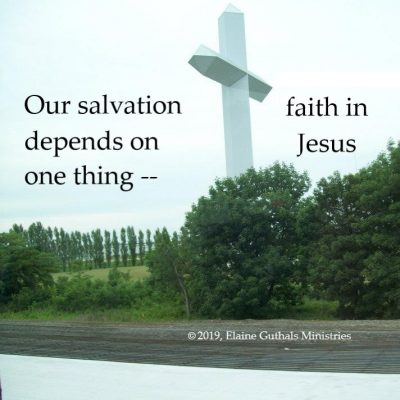
    Cross with words Our salvation depends on one thing -- faith in Jesus

    Title

    Bible Verse

    Heading

    Post

    To read a related devotion, click the button below.

    Resource

    Cemetary with Colossians 3: 1

    Title

    Bible Verse

    Heading

    Post

    To read a related devotion, click the appropriate button below.

    Resource

    Cemetary with Colossians 3: 1

    Title

    Bible Verse

    Heading

    Post

    To read a related devotion, click the button below.

    Resource

    Cross with words Our salvation depends on one thing -- faith in Jesus

    Making the Connections

    Post

    To read a related devotion, click the button below.

    Resource

    Cemetary with Colossians 3: 1

    How Do We Apply This?

    Post

    To read a related devotion, click the button below.

    The ABCDs of Salvation

    If you have not become a believer in Christ, please read through the
    Plan of Salvation and prayerfully consider what God is asking you to do.A – admit our sins

    B – believe His Son Jesus is our Redeemer

    C – confess God as Sovereign Lord

    If you have not become a believer in Christ, please read through the Plan of Salvation and prayerfully consider what God is asking you to do.


    D – demonstrate that commitment by making any changes needed in our lives to

    live the way in which God has called us

    The Disciple’s Job Description

    Searching for and Seeking God

    Hearing His Word (Rom. 10: 17 NLT).
    Reading His Word (Rev. 1: 3 ESV).
    Praying to Him (Heb. 4: 16 ESV).
    Studying His Word (Ac. 17: 11 NLT).
    Meditating on His Word (Ps. 1: 1-2).
    Memorizing His Word (Ps. 119: 11 NLT).

    To read Has God Provided Everything We Need?, click the button below.

    If you have not admitted that your relationship is not right with God,

    have not asked Jesus to be your Lord and Savior,

    and have not confessed your sins,

    please read through the Plan of Salvation and prayerfully consider what God is asking you to do.

    Related Links

    Related Links

    Related Links

    Song

    Related Links

    I have created a worksheet of the questions above. Click on the button below to access it.

    Don’t know what your spiritual gifts are?

    Take this Spiritual Gifts Inventory

    The Disciple’s Job Description

    Complete Job Description

    Individual Description

    It Was Enough
    Vocalist: Elaine Guthals
    Keyboard: Chris Vieth

    What do you think?

    Leave me a comment below (about this or anything else) or head over to my Facebook group for some interactive discussion.

    If you don’t understand something and would like further clarification, please contact me.

    If you have not signed up for the email daily or weekly providing the link to the devotions and the newsletter, do so below.

    If God has used this devotion to speak with you, consider sharing it on social media.

  • Sins Against God

    Nuggets

    • God specifically forbids us to worship idols – something considered a divine being.
    • There is a specific law forbidding consulting someone utilizing supernatural powers.
    • Cleanness is a familiar theme in the Bible, but it is also a complex notion.

    To read devotions in the Walk in the Spirit series, click the appropriate button below.

    Flowers with the title Sins Against God

    In this series, we are talking about walking in the Spirit. In the past two devotions, we have been talking about sexual and moral sins. This devotion looks at sins that destroy our relationship with God.

    Let’s Put It into Context

    First off, we have to have a relationship with God. Mankind used to have a personal, face-to-face (whatever that entailed) relationship with God. We know that because “Then the man and his wife heard the sound of the Lord God walking in the garden at the time of the evening breeze” (Gen. 3: 8 CSB). He was coming to visit.

    But Adam and Eve destroyed that relationship when they let sin into their lives. “So the Lord God sent him away from the garden of Eden to work the ground from which he was taken” (Gen. 3: 23 CSB). He has limits to the unrighteousness He can stand.

    Fortunately, God designed a plan to restore our relationship with Him. God Sent His Son Jesus to be the Redeemer of mankind. Jesus was born of a virgin, making Him 100% God and 100% man. He gave His life on the cross for us so that His blood could pay the price for our sins. Because of God’s great might and power, Jesus rose from the grave, conquering death and paying that price once and for all.

    To read a related devotion, click the button below.

    That plan is offered to us through God’s grace. “For you are saved by grace through faith, and this is not from yourselves; it is God’s gift” (Eph. 2: 8 CSB). It is ours to accept or deny.

    We may feel like our sins are too big or too bad for God to forgive. That is not true. There is only one sin that God will not forgive — and that is unbelief.

    To read a related devotion, click the button below.

    Sins Against God

    There are some sins that show our unbelief in God and His power and authority. Let’s take a look.

    Idolatry

    An idol is, according to the Holman Bible Dictionary,  a “physical or material image or form representing a reality or being considered divine and thus an object of worship.” By worshiping it, we are saying it is holy presence, in control of us, and worthy of our reverence.

    God specifically forbids us to worship idols. Not only that, but the commandment gets a lot of explanation with it.

    “Do not make an idol for yourself, whether in the shape of anything in the heavens above or on the earth below or in the waters under the earth. Do not bow in worship to them, and do not serve them; for I, the Lord your God, am a jealous God, punishing the children for the fathers’ iniquity, to the third and fourth generations of those who hate me, but showing faithful love to a thousand generations of those who love me and keep my commands” (Ex. 20: 4-6 CSB).

    This is all about making God our priority. He alone deserves our love and reverence. We are to worship Him alone.

    This is part of the covenant God made with the Israelites. “For the LORD had made a covenant with the descendants of Jacob and commanded them: “Do not worship any other gods or bow before them or serve them or offer sacrifices to them” (II Kgs. 17: 35 NLT).

    This is really a slap to God. “For my people have committed a double evil: They have abandoned me, the fountain of living water, and dug cisterns for themselves — cracked cisterns that cannot hold water” (Jer. 2: 13 CSB).

    When we abandon God, that is bad enough. But we usually tell Him we not only don’t need Him, but we also don’t want Him. We are telling Him that either we are or something else is more important than Him.

    I know. The cistern reference may be a bit funky for some who have always lived in town. Growing up on the farm and at the house we had cisterns. It is just a tank to store rainwater. We used it to flush toilets.

    Think about digging cisterns for ourselves. That could be backup for when the well doesn’t work. It could be we just want to separate something so this is specific earmarked for something.

    So, how do we equate this to God? “Oh, God isn’t going to answer this prayer, so I have to go out and do ….” “I know God isn’t going to approve of this, so I am just going to circumvent Him by ….”

    Oh, yeah. We do that sometimes.

    Divination

    Divination was “an attempt to contact supernatural powers to determine answers to questions hidden to humans and usually involving the future” (Holman Bible Dictionary).

    There were several different names they were called. The person who practiced divination was called a sorcerer. A medium was “one possessed by (Leviticus 20: 22) or consulting (Deuteronomy 18: 11) a ghost or spirit of the dead, especially for information about the future” (Holman Bible Dictionary).

    There is a specific law forbidding that. “Do not defile yourselves by turning to mediums or to those who consult the spirits of the dead. I am the LORD your God” (Lev. 19: 31 NLT).

    The punishment for being medium was stiff. “A man or woman who is a medium or spiritist among you must be put to death. You are to stone them; their blood will be on their own heads” (Lev. 20: 27 NIV).

    Here is two more verses. “This is what the Lord, your Redeemer who formed you from the womb, says:

    I am the Lord, who made everything;
    who stretched out the heavens by myself;
    who alone spread out the earth;
    who destroys the omens of the false prophets
    and makes fools of diviners;
    who confounds the wise
    and makes their knowledge foolishness” (Isa. 44: 24-25 CSB).

    Oh, wait a second. We just talked about divination. Remember Balaam? Balaam was a soothsayer who practiced divination.

    Roberts stated, “But, as the art of divination was the highest point to which the heathen world had been able to attain in their pursuit of the unseen, so God condescended to meet Balaam, at that special point of spiritual culture, that He might lead him thenceforth to higher forms of truth and nobler modes of worship.”

    To read a related devotion, click the button below.

    God doesn’t want us asking anything else questions we should be asking Him. He is the One Who “… knows all things” (I Jn. 3: 20 CSB). Why wouldn’t we ask Him?

    Uncleanness

    Cleanness is a familiar theme in the Bible, but it is also a complex notion. Good thing for Holman’s Bible Dictionary.

    It does have the physical aspect of no dirt or other defilement. This cleanliness was both personal and environmental.

    But it was still more than that. “Because the mind is an integral aspect of the human personality, cleanness must also be applied to attitudes and motives that govern particular forms of behavior” (Holman Bible Dictionary). This goes into how we live.

    What it boiled down to were the Israelites were holy because they were clean. They were holy because they follow God’s moral code.

    I had always equated the cleanness with the ceremonial cleanness. But if we consider it as being holy, that is still very relevant to us.

    Making the Connections

    All sin, really, is sin against God. Sin was not in this world until Adam and Eve chose to disobey God’s command.

    To read a related devotion, click the appropriate button below.

    This desire to not follow God has just increased since Adam and Eve’s time. The worldview today tells us that we do not have to follow anyone but ourselves – our own desires, our own goals, our own morals.

    There are a lot of people who are going to be in for a rude awakening. One day, hell is going to be their reality.

    To read a devotion in the Hell Does Have Fury series, click on the appropriate button below.

    How Do We Apply This?

    It all starts with ABCDing. We need to admit our sins, believe on Jesus as Redeemer, confess God as Sovereign Lord, and demonstrate that commitment by following our job description.

    The ABCDs of Salvation

    If you have not become a believer in Christ, please read through the
    Plan of Salvation and prayerfully consider what God is asking you to do.A – admit our sins

    B – believe His Son Jesus is our Redeemer

    C – confess God as Sovereign Lord

    If you have not become a believer in Christ, please read through the Plan of Salvation and prayerfully consider what God is asking you to do.


    D – demonstrate that commitment by making any changes needed in our lives to

    live the way in which God has called us

    The Disciple’s Job Description

    No, we won’t be perfect. We will still sin even after conversion. So, we have to keep asking God to forgive us of our sins.

    Yes, God is that forgiving. Well, He did design the plan of salvation, didn’t He? He designed it long before Adam and Eve had sinned, didn’t he? Ephesians 1: 4 says so.

    There is only one sin God won’t forgive. That is when we grieve the Holy Spirit. We do that by not ABCDing.

    Have you asked God to forgive all of your sins? Do so today.

    Sovereign God. You are the Creator of the universe. We disobeyed You because we thought we could do whatever we wanted. We wanted to control ourselves. Lord, we are so humbled that – even after that disobedience – You wanted to restore the relationship with us. You wanted that so much so that You sent Your Son to die to pay the price for those sins. Thank You, Lord. Forgive us when we continue to sin. Prepare us for the day that we will not because we will be with You in Paradise. Amen.

    What do you think?

    Leave me a comment below (about this or anything else) or head over to my Facebook group for some interactive discussion.

    If you don’t understand something and would like further clarification, please contact me.

    If you have not signed up for the email daily or weekly providing the link to the devotions and the newsletter, do so below.

    If God has used this devotion to speak with you, consider sharing it on social media.

  • What Are Moral Sins?

    Paul gives us a list of sins in Galatians 5: 19-21. In the last devotion, we talked about sexual sins. In this devotion, we will discuss moral sins, such as the seven deadly sins, dissension, hatred, jealousy, and selfish ambitions.

    Nuggets

    • Instead of thanking Him and acknowledging His goodness, we puff ourselves up and think we did it all by ourselves.
    • When we desire/lust for something, we aren’t content with what God has given us or desire things for the wrong reasons.
    • Gluttony is talking excess.
    • Disciples are called to be the opposite of slothful people – we are called to be self-disciplined.
    • Anger can be a sin when we violate the commandments to love others.
    • Hatred can bring out violence, which God detests.

    To read devotions in the Walk in the Spirit series, click the appropriate button below.

    Flowers with title What Are Moral Sins?

    In the last devotion, we started talking about works of the flesh. In this devotion, we are going to look at moral sins.

    Moral Sins

    When we talk about moral sins, we generally are talking about the seven deadly sins. These are pride, greed, lust, envy, gluttony, wrath, and sloth. What put them on this list was that they speak to excesses and evolve into other sins as well.

    Galatians 5: 19-21 specifically lists several that I think fall under this category. “… moral impurity, hatreds, strife, jealousy, outbursts of anger, selfish ambitions, dissensions, factions, envy, drunkenness, carousing, and anything similar” (Gal. 5: 19-21 CSB)

    Moral Impurity

    We’re going to talk about pride, lust, gluttony, and sloth here. I know we talked about sexual lust. This is non-sexual lust.

    Pride

    Most of us have a pretty good handle on what the definition of pride is: “undue confidence in and attention to one’s own skills, accomplishments, state, possessions, or position.”

    Now, don’t get me wrong. We have to have confidence in ourselves and our abilities. The problem is when it becomes undue confidence. The Bible talks about two conditions that take it over the top: boasting and arrogance.

    First John 2: 16 says, “For everything in the world — the lust of the flesh, the lust of the eyes, and the pride in one’s possessions — is not from the Father, but is from the world” (CSB). When we take pride in our possessions, we tend to forget that it wasn’t because of our abilities that we have them.

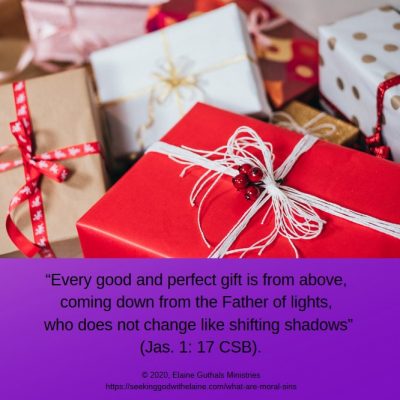
    What we have is a gift from God. “Every good and perfect gift is from above, coming down from the Father of lights, who does not change like shifting shadows” (Jas. 1: 17 CSB).

    gifts

    But instead of thanking Him and acknowledging His goodness, we puff ourselves up and think we did it all by ourselves. We start telling everyone who will listen how good we are.

    The arrogance comes out when “… people will love only themselves and their money. They will be boastful and proud, scoffing at God, disobedient to their parents, and ungrateful. They will consider nothing sacred” (II Tim. 3: 2 NLT).

    Lust

    We talked in the last devotion that lust was translated a couple of devotions ago as desires.

    To read a related devotion, click the appropriate button below.

    We can easily see where that can be something other than sexual lust. We can desire an expensive car, a mansion, or a prestigious job among other things.

    No, just wanting them isn’t bad. It can become a sin a couple of different ways.

    The first way is when we aren’t content with what God has given us. We have to be like Paul. He “… learned to be content whatever the circumstances” (Phil. 4: 11 NIV).

    The second way it becomes a sin is when we desire it for the wrong reasons. If we want it to just “keep up with the Jones,” we are focusing more on the world than on God.

    When we desire/lust for something, we aren’t content with what God has given us or desire things for the wrong reasons.

    Gluttony

    Most of us probably know that gluttony is defined as “… greedy and voracious eating.” Did you know it is also “… associated with stubbornness, rebellion, disobedience, drunkenness, and wastefulness (Deut. 21: 20)”?

    I can see where we can be greedy and voracious in things beyond just eating. This is talking excess again. Pride could be described as excess confidence. Lust can be said to be excessive desires.

    Sloth

    A slothful person is “a loose, undisciplined person” (Holman Bible Dictionary). Disciples are called to be the opposite of slothful people – we are called to be self-disciplined.

    Some would consider the “… drunkenness, carousing, and anything similar” (Gal. 5: 21 CSB) fits under the undisciplined. There are others, also, such as liars and cheaters.

    Starke points out that this is not talking about just taking a drink. It is drinking to the point where we we are no longer in control of our bodies.

    Dissensions

    Strife is “bitter sometimes violent conflict or dissension” (Merriam-Webster Dictionary). That takes out two more words of the list. Strife causes anger.

    Factions is where there is “a party or group (as within a government) that is often contentious or self-seeking” (Merriam-Webster Dictionary).

    We are not called to be contentious. We are called to be unified. We just talked about this — a lot — when we walked through Ephesians.

    Not only are we called to settle our difference amicably, but we are also called to put God’s Will first, not our own selfish desires.

    Hatred of Man

    I am kind of surprised Paul puts this one in and then goes on to identify some of the hatreds in the list. You would think the anger and envy would be under here instead of separate. So, we are going to look at them here.

    Anger is another word for wrath. We’ve talked about the wrath of God before.

    To read a related devotion, click the button below.

    This, however, is man’s wrath. Holman Bible Dictionary defined wrath as “The emotional response to perceived wrong and injustice, often translated ‘anger,’ ‘indignation,’ ‘vexation,’ and ‘irritation.’”

    Anger can be a sin when we violate the commandments to love others. We are to love one another (Jn. 13: 34; Rom. 13: 8; I Pet. 3: 8-9; I Pet. 4: 8; I Jn. 4: 12-13); love our neighbors as ourselves (Lev. 19: 18); and love earnestly (I Jn. 3: 18; Eph. 4: 2-3).

    Yes, Jesus showed anger when He cleaned out the Temple (Mt. 21: 12-17). He had a right to be angry when His Father’s house was defiled. We tend to forget Jesus was angry at the Pharisees when they thought He shouldn’t heal in the Sabbath (Mark 3:5).

    But this is talking about when anger slides into hatred. That would mean it is unresolved.

    Envy can also slide into anger. It is a two-parter. Envy is “a painful or resentful awareness of another’s advantage joined with the desire to possess the same advantage

    It isn’t just I-see-you-have-this-and-I-don’t. It’s I-see-you-have-this-and-I-want-it-too.

    This could be breaking the 10th commandment. “Do not covet your neighbor’s house. Do not covet your neighbor’s wife, his male or female servant, his ox or donkey, or anything that belongs to your neighbor” (Ex. 20: 17 CSB).

    Hatred can bring out violence, which God detests (Ps. 5: 6). It can also bring out the desire for revenge (Rom. 12: 19).

    We can sin when our anger is directed wrong or is just plain wrong. Also, if we’ve overreacted, we may be sinning.

    Jealousy

    Jealousy occurs when we feel have to guard a possession (Merriam-Webster Dictionary). We think we are going to lose something. That really makes us insecure.

    First Corinthians 3: 2-3 says, “I had to feed you with milk, not with solid food, because you weren’t ready for anything stronger. And you still aren’t ready, for you are still controlled by your sinful nature. You are jealous of one another and quarrel with each other. Doesn’t that prove you are controlled by your sinful nature? Aren’t you living like people of the world?” NLT).

    It is this comparison with others where we feel lacking that ignite the quarrels. We feel lacking, so we believe we will not be able to retain something that is important to us.

    The sin is when we cut down our value. Don’t we know we are made in God’s image (Gen. 1: 26)? Can’t we tell that we are “… fearfully and wonderfully made …” (Ps. 139: 14 NIV)?

    But we cut ourselves down … and think there is no way God is going to provide what He promised. God is not going to love us and care for us.

    Wrong. God loves us. How could He not when we see that He has given His Son Whom He loves to die so that our relationships may be restored?

    Selfish ambitions

    Ambition is “an ardent desire for rank, fame, or power” (Merriam-Webster Dictionary). Don’t get me wrong.

    Wanting to better yourself is not wrong. We should seek God to better ourselves so that we are the persons He is calling us to be.

    The sin kicks in when we are selfishly ambition. “Do nothing out of selfish ambition or conceit, but in humility consider others as more important than yourselves” (Phil. 2: 3 CSB).

    That could be when we are seeking to show our skills and knowledge to others. We could think we are so much better than others.

    We get back to the it-is-us mindset, not it-is-God reliance. Yes, that gets us back to the pride and arrogance attitudes.

    Making the Connections

    It seems like, in a lot of these these sins, we are putting our wants and desires over God’s will for our lives. We puff up our estimation of our knowledge and skills. We make decisions for us lives based on our own criteria.

    How Do We Apply This?

    We need to learn to submit to God. My Ladies and I were just talking about that when we had the lesson on Numbers 32.

    To read a related devotion, click the button below.

    How do we submit to God? We have to humbly obey Him. I hadn’t realized it was a military term. We have to obey our Commander’s orders.

    It boils down to it being a choice that we make. Are we going to give God control of our lives? Or are we going to keep it for ourselves?

    Keeping control for ourselves carries stiff consequences. Hopefully, everyone is well aware when they make that decision — or choose to make no decision at all. No decision is the same as choosing against God.

    In the next devotion, we will look at sins against God.

    Father. You call us to be men and women possessing Your character. Help us to live our lives the way You would have them lived. Amen.

    What do you think?

    Leave me a comment below (about this or anything else) or head over to my Facebook group for some interactive discussion.

    If you don’t understand something and would like further clarification, please contact me.

    If you have not signed up for the email daily or weekly providing the link to the devotions and the newsletter, do so below.

    If God has used this devotion to speak with you, consider sharing it on social media.
  • What Are the Works of the Flesh?

    What was Paul talking about when he wrote about works of the flesh? He gave a list of sins we are to avoid. In this devotion, the first of three discussing that lists, looks at sexual sins.

    Nuggets

    • Jesus expanded adultery from the physical act to the wanna-be act.
    • The key words in the discussion of fornication, to me, are moderation, self-control, sound moral judgment, and purity.
    • The promotion of others feeling the lustful desires is just as much a sin as feeling inappropriate desires.
    • The Bible specifically — unequivocally — forbids homosexuality.

    To read devotions in the Walk in the Spirit series, click the appropriate button below.

    Flowers with the title What Are the Works of the Flesh?

    I was all set to give this devotion the title What Are the Sins of the Flesh? That is the terminology I grew up with – sins of the flesh. I googled it and got a whole bunch of verses under the heading sins of the flesh.

    Only two of them were discussing sins. After that, the verses focused on the flesh. We have said that the flesh is our human nature, but that doesn’t tell us what to avoid.

    The two verses really didn’t call it sin, though. They talked about lust of the flesh (I Jn 2: 16 NIV, KJV); desires of the flesh (I Jn 2: 16 ESV); acts of the flesh (Gal. 5: 19 NIV); and works of the flesh (Gal. 5: 19 ESV, KJV). The closest I got was desires of your sinful nature (Gal. 5: 19 NLT).

    So, we have lust/desires and acts/works. My vote is for translations indicating lust/desires.

    Does it make a difference? Did Shakespeare have it right? Would a rose by any other name .…?

    Let’s Put It into Context

    Our flesh is considered naturally corrupt because it pursues what is pleasing, not necessarily what God commands. It is the root of sin and evil.

    My definition of sin is when we disobey God and break one of His laws and commandments. The Holman Bible Dictionary says, “Actions by which humans rebel against God, miss His purpose for their life, and surrender to the power of evil rather than to God.”

    I have described works as generally being considered the good things we do for others. The Holman Bible Dictionary says, “Deeds leading to planned results, both by God and people.”

    To read a related devotion, click the appropriate button below.

    Works are good things. Sins are bad things. So, what is Galatians 5: 19-21 talking about?

    A List of What?

    “Now the works of the flesh are obvious: sexual immorality, moral impurity, promiscuity, idolatry, sorcery, hatreds, strife, jealousy, outbursts of anger, selfish ambitions, dissensions, factions, envy, drunkenness, carousing, and anything similar” (Gal. 5: 19-21 CSB)

    Hmmm. It sure looks like a list of sins to me. Why don’t we look into these more closely to see what makes them sins? It is going to take us a couple of devotions to look at all of these.

    Sexual Sins

    Paul warns us to “Flee sexual immorality! Every other sin a person commits is outside the body, but the person who is sexually immoral sins against his own body” (I Cor. 6: 18 CSB).

    In Galatians 5: 19, the Christian Standard Bible translates it as “… sexual immorality … [and] promiscuity.” To me, those are broad definitions. Let’s see if we can break it up some more.

    Adultery

    Holman Bible Dictionary defines adultery as is the act of unfaithfulness in marriage that occurs when one of the marriage partners voluntarily engages in sexual intercourse with a person of the opposite sex other than the marriage partner.

    The law regarding adultery is found in Exodus 20: 14. “You must not commit adultery” (Ex. 20: 14 NLT). Yep. That makes it one of the Ten Commandments.

    Punishment for those who commit adultery is in Leviticus 20: 10. “If a man commits adultery with his neighbor’s wife, both the man and the woman who have committed adultery must be put to death” (Lev. 20: 10 NLT). This is also in Deuteronomy 22: 22.

    Jesus expanded it from the physical act to the wanna-be act. “But I say, anyone who even looks at a woman with lust has already committed adultery with her in his heart” (Mt. 5: 28 NLT).

    This shows us how important faithfulness in marriage is to God. 1) Don’t even think about cheating. 2) Punishment is meant for both parties. 3) Marriage is a life-time commitment (Mt. 19: 9, Lk. 16: 18, Rom. 7: 2-3).

    Fornication

    Fornication — that is an old-time word. The definition of fornication, according to the Holman Bible Dictionary, is “various acts of sexual immorality, especially being a harlot or whore.”

    Silvester had this to say about fornicators. “The ‘fornicators’ are there also, those sinners against the laws of moral purity which teach us to keep our bodies in temperance, soberness, and chastity.”

    We just talked about temperance. Temperance means, according to Merriam-Webster, “moderation in action, thought, or feeling — restraint.” We were talking self-control. So, this would be controlling our bodies.

    Soberness is interesting. The Holman Bible Dictionary defines sober as “characterized by self-control, seriousness, and sound moral judgment.”

    Chastity means “abstention from unlawful sexual intercourse.” I also like its third definition: “purity in conduct and intention.”

    Regroup. The key words in all of that, to me, are moderation, self-control, sound moral judgment, and purity.

    I am wondering if it was a broad definition to counter the culture at the time. Remember, temple prostitution was a biggy in the Gentile cities.

    Jesus did preach against sexual immorality. “And then he added, ‘It is what comes from inside that defiles you. For from within, out of a person’s heart, come evil thoughts, sexual immorality, theft, murder’” (Mk. 7: 20-21 NLT).

    Defile means “to make ritually unclean.” Cleanness had to do with “… the establishing and preservation of holiness in the Israelite community.”

    Sexual immorality does not lead to holiness (Eph. 5: 3). It leads to God’s anger and judgment. God calls us to be saints — holy and pure.

    Lasciviousness

    Okay, it is olden-times word day. Lasciviousness means an unbridled expression of sexual urges. “They have no sense of shame. They live for lustful pleasure and eagerly practice every kind of impurity” (Eph. 4: 19 NLT).

    We would probably just call it lust today. We said a couple of devotions ago that most of the versions I use translate lust as desires.

    To read a related devotion, click the button below.

    There is one verse that I found that really gives a good example of how we promote lust. “A woman came to meet him dressed like a prostitute, having a hidden agenda” (Prov. 7: 10 CSB).

    The promotion of others feeling the lustful desires is just as much a sin as feeling inappropriate desires. We know that those desires are fueled by revealing clothing, seductive gestures, and inappropriate discussions.

    Homosexuality

    I have read statements from the Bible doesn’t address homosexuality to Jesus doesn’t care who we love. Homosexuality is “sexual preference for and sexual behavior between members of the same sex, considered to be an immoral life-style and behavior pattern throughout the biblical revelation” (Holman Bible Dictionary).

    Yes, specifically — unequivocally — forbids homosexuality. “If a man practices homosexuality, having sex with another man as with a woman, both men have committed a detestable act. They must both be put to death, for they are guilty of a capital offense” (Lev. 20: 13 NLT).

    No, the New Testament did not rewrite that. “Don’t you know that the unrighteous will not inherit God’s kingdom? Do not be deceived: No sexually immoral people, idolaters, adulterers, or males who have sex with males, no thieves, greedy people, drunkards, verbally abusive people, or swindlers will inherit God’s kingdom” (I Cor. 6: 9-10 CSB).

    Making the Connections

    Bottom line of all this: God expects marriage to be between a man and a woman (Gen. 2: 24). He also expects sex only to take place within the marriage (Heb. 13: 4).

    I can kind of see what the translations use the word works. At least with this list, these are actions. Actions are the product of our intention to accomplish something (anything from run to cook a meal).

    This list is the product of our giving in to Satan’s promptings instead of the Holy Spirit’s promptings.

    How Do We Apply This?

    That generally means we have to watch our lustful desires. We have to avoid situations that tempt us. That may be avoiding certain people or certain movies/pictures etc.

    When we get into situations, we need to think about the consequences. We need to really think about what we are doing. Most of all, we have to remain holy.

    Gracious Lord. You call us to be holy. You call us to follow Your laws and commandments. Help us to resist our lustful desire and remain clean in Your eyes. Amen.

    What do you think?

    Leave me a comment below (about this or anything else) or head over to my Facebook group for some interactive discussion.

    If you don’t understand something and would like further clarification, please contact me.

    If you have not signed up for the email daily or weekly providing the link to the devotions and the newsletter, do so below.

    If God has used this devotion to speak with you, consider sharing it on social media.
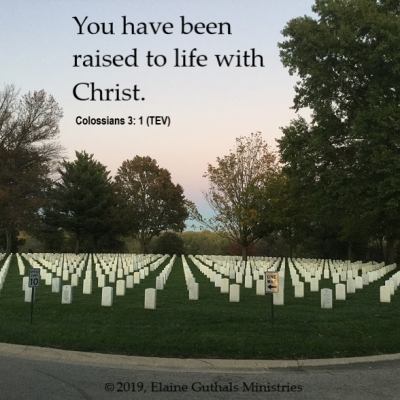
  • When Sin Thinks It’s Won

    What happens when Satan has you right where he wants you? Balak thought Balaam would curse the Wilderness Wanderers. This devotion looks at Balak’s assumption that sin had won.

    Nuggets

    • When we resist God, He will open our eyes to see His displeasure.
    • Balaam’s focus was on this earth, not God.
    • Once we start down the path of sin, we have to face the consequences, even if we have repented.
    • Balak thought he had Balaam right where he wanted him.
    • Sometimes, we have to set aside our opinions and desires and just follow God.

    To read devotions in the title series, click the appropriate button below.

    When Sin Thinks It’s Won

    Flowers with the title When Sin Thinks It's Won

    Balaam was on his way to Balak. He was going to get paid to curse the Wilderness Wanderers. God sent an angel to stand in the gap so Balaam couldn’t go anywhere. Look what happened next.

    The Seer’s Eyes Were Opened

    “Then the Lord opened Balaam’s eyes, and he saw the angel of the Lord standing in the roadway with a drawn sword in his hand. Balaam bowed his head and fell face down on the ground before him. ‘Why did you beat your donkey those three times?’ the angel of the Lord demanded. ‘Look, I have come to block your way because you are stubbornly resisting me. Three times the donkey saw me and shied away; otherwise, I would certainly have killed you by now and spared the donkey.’” (Num. 22: 31-33 NLT)

    Up to now, we may have been able to tell ourselves that Balaam was really attempting to do God’s will. Verse 32 tells us in no uncertain terms that Balaam was stubbornly resisting God’s directions.

    Did you get a chuckle at the angel was so fed up with Balaam, that he was going to do physical harm — but the donkey was going to be saved? Yep, God is going to take care of His creation who obeys Him.

    When we resist God, He will open our eyes to see His displeasure. Up to this point, Balaam had two conversations with God, carried on a conversation with a donkey, and was now carrying on a conversation with an angel. Did it do the trick?

    Repentance

    “Then Balaam confessed to the angel of the Lord, ‘I have sinned. I didn’t realize you were standing in the road to block my way. I will return home if you are against my going.’ But the angel of the Lord told Balaam, ‘Go with these men, but say only what I tell you to say.’ So Balaam went on with Balak’s officials” (Num. 22: 34-35 NLT)

    It took all of those conversations to get Balaam to see he had sinned. He didn’t realize the angel was there.

    Now, it does say that the Lord opened Balaam’s eyes. But part of the problem was they lost focus. Balaam’s focus was on this earth, not God.

    Balaam immediately said that he would return home, if that is what God wanted.

    What? Wait! The angel told Balaam to go on with his plans???? All of this, and Balaam still got to head toward the money???????

    Why? Balaam doesn’t deserve to go through with the plan!

    Sometimes when we sin, we can’t have a do-over. Once we start down the path of sin, we have to face the consequences, even if we have repented.

    Path

    But did Balaam really see it as sin? Maybe he wasn’t really sorry for his sin. Maybe he was sorry for getting caught mistreating his donkey. (How would you feel if the donkey got praised and would have been saved and you didn’t and wouldn’t?) Maybe Balaam was sorry he got caught wanting the money.

    When Sin Thinks It’s Won

    “When King Balak heard that Balaam was on the way, he went out to meet him at a Moabite town on the Arnon River at the farthest border of his land. ‘Didn’t I send you an urgent invitation? Why didn’t you come right away?’ Balak asked Balaam. ‘Didn’t you believe me when I said I would reward you richly?’ Balaam replied, ‘Look, now I have come, but I have no power to say whatever I want. I will speak only the message that God puts in my mouth’” (Num. 22: 36-38 NLT)

    We can see Balak’s arrogance and assumed superiority in verse 36. “… he went out to meet him at a Moabite town on the Arnon River at the farthest border of his land” (Num. 22: 36 NLT). Balak thought he had Balaam right where he wanted him.

    So, Balaam got to where he was going. And Balak immediately started biting on him. “You took too long. You were supposed to be under my power and control.”

    Balaam told Balak to hold his horses. It was interesting that he didn’t give a reason for being “late.” Of course, would you really want to admit to having a conversation with a donkey?

    What Balaam told Balak was not necessarily what he wanted to hear. Just because Balaam was there didn’t mean everything was going to turn out the way Balak envisioned.

    Did you see that? Even though Balaam may have been more than happy to curse Israel, he had to follow God’s lead. Sometimes, we have to set aside our opinions and desires and just follow God.

    Sin thought it had Balaam where he would curse the Wilderness Wanderers for the money. But did it win?

    Making the Connections

    Some people seem to think that, if something is in the Bible, then it is okay. God let Balaam go with Balak to get the money, so it isn’t a sin. It is okay to curse God’s people.

    1. Just because it is in the Bible doesn’t make it okay. There are a lot of don’ts in there. God lists what He considers sin.
    2. We are not to judge. God is. “Do not judge, or you too will be judged” (Mt. 7: 1 NIV).

    Satan judged. Because Balaam was there, Satan thought God’s people would be cursed. Yes, Balaam sinned. Yes, God allowed it.

    That does not give us license to sin. We still have to be obedient to God and His laws and commandments.

    How Do We Apply This?

    In the last two devotions in this series, we haven’t applied what we have been talking about. What should we do?

    • Take responsibility for our actions.
    • When, as an ambassador for God, we get little respect, we are supposed to keep on serving God in the way He calls.
    • We’ve got to do whatever God asks of us.
    • When we start going down the wrong path, we can ask God to come and stand in the gap.
    • We have to genuinely repent and suffer any associated consequences.
    • Our motives and desires have to be God focused.

    So, let’s read some of the nuggets again.

    • Balaam was a typical human, with a touch piety along with a touch apostasy.
    • God always allows us free will to choose between Him and Satan.
    • Still, God will use any and every means to turn us off our sinful path.
    • God allows the trial to happen so we can grow from the experience.
    • The angel stood in the gap between Balaam and sin.
    • When we resist God, He will open our eyes to see His displeasure.
    • Balaam’s focus was on this earth, not God.
    • Once we start down the path of sin, we have to face the consequences, even if we have repented.
    • Sometimes, we have to set aside our opinions and desires and just follow God.

    We need to keep our focus on God so that we don’t slide off the correct path.

    Father. You are so loving and giving toward us. Too many times, we take our eyes off You and put them on the desires of this world. Lord, put an angel in our path. Speak to us through donkeys. Do whatever You need to get our attention. May we quickly and genuinely repent and turn back to You.

    What do you think?

    Leave me a comment below (about this or anything else) or head over to my Facebook group for some interactive discussion.

    If you don’t understand something and would like further clarification, please contact me.

    If you have not signed up for the email daily or weekly providing the link to the devotions and the newsletter, do so below.

    If God has used this devotion to speak with you, consider sharing it on social media.
  • Saved by a Donkey

    Have you ever been in a temptation and felt something was trying to keep you from sinning? God will use any and every means to turn us off our sinful path. In this second devotion in the A Man and His Donkey series, we look at how God allows us free will but still tries to keep us from sinning.

    Nuggets

    • God always allows us free will to choose between Him and Satan.
    • Still, God will use any and every means to turn us off our sinful path.
    • God allows the trial to happen so we can grow from the experience.
    • The angel stood in the gap between Balaam and sin.

    To read devotions in the title series, click the appropriate button below.

    Save By a Donkey

    Flowers with title Saved By a Donkey

    Even though Balaam was a prophet of Jehovah, he was greatly tempted by Balak’s offer of money to curse the Wilderness Wanderers. God intervened to try to keep him on the straight and narrow. Let’s see what happened.

    Let’s Put It into Context

    “Then Balak tried again. This time he sent a larger number of even more distinguished officials than those he had sent the first time.They went to Balaam and delivered this message to him: ‘This is what Balak son of Zippor says: Please don’t let anything stop you from coming to help me. I will pay you very well and do whatever you tell me. Just come and curse these people for me!’” (Num. 22: 15-17 NLT)

    Balak had sent messengers to Balaam to try to get him to curse the Wilderness Wanderers. God had told Balaam no, so he grudgingly sent the messengers home.

    Balak didn’t like that. But since Balaam hadn’t flat out told him no, Balak assumed he could buy him off.

    Well, Maybe

    “But Balaam responded to Balak’s messengers, ‘Even if Balak were to give me his palace filled with silver and gold, I would be powerless to do anything against the will of the Lord my God. But stay here one more night, and I will see if the Lord has anything else to say to me.’ That night God came to Balaam and told him, ‘Since these men have come for you, get up and go with them. But do only what I tell you to do.’ So the next morning Balaam got up, saddled his donkey, and started off with the Moabite officials” (Num. 22: 16-21 NLT)

    The second time Balak sent men to convince Balaam to offer up the curse, he pandered to Balaam’s covetousness. The response Balaam gave can be read as a good response if we read it as “No amount of money will buy me off.”

    But if we read it as “Buddy, you have got to top this if you want me to do what you want,” that is flirting with sin. Satan is going to continue to tempt us when he thinks he has a shot of winning.

    Balaam did fall into this temptation. Balaam got to the point where he didn’t care what God had said. He wanted the money.

    It is surprising that God said that it was okay for Balaam to go with them. However, it is not so surprising as God always allows us free will to choose between Him and Satan.

    God told Balaam to follow His directions. He didn’t change His mind between the two answers. Balaam changed. Balaam had already chosen to take the money.

    One Smart Donkey

    It seems funny that God was angry because He had told Balaam that he could go with the men. But it really isn’t.

    Sometimes, God allows the trial to happen so we can grow from the experience. If He would not allow it, we would not grow closer to Him.

    That doesn’t mean God has to like the situation. He would much rather have us obedient.

    Isn’t it said that of those who have been given much, much will be expected (Lk. 12: 48)? Balaam was given much. He knew God and was a prophet of God. Balaam should have known better.

    And here Balaam goes chasing the money. He was going to go curse the people God had blessed. Yes, the Israelites weren’t any cleaner than Balaam, but God had blessed them.

    God is always angry with unrighteousness. Cox wrote, “And what could the unrighteous leaning of Balaam be but that, in the conflict between his own interests and desires and the will of God, he was permitting his interests and desires to prevail over his sense of duty, suffering the baser elements of his nature to override the promptings of that in him which was highest and best, giving way, in short, to the temptation which Balak had held out before him, and scheming how he might please man without altogether breaking with God.”

    God isn’t going to keep us from sinning. We have to show we are not falling into temptation.

    Why could the donkey see the angel but not Balaam? Cox said it was because Balaam was too preoccupied with the material gain he was going to earn.

    We know that God will fight Satan for us. Isn’t it amazing that sometimes God will fight us for us? “The holy angels are adversaries to sin, and perhaps are employed more than we are aware of in preventing it, particularly in opposing those that have any ill designs against God’s Church and people” (Henry).

    Isn’t that how it goes, though. We are so happy that God is allowing us do to something we know we shouldn’t— and then everything starts to fall apart.

    Oh, we will blame everything but ourselves. It can’t be our fault for choosing the wrong decision.

    Balaam appears to me as someone who was stuck on himself. And he gets corrected by a donkey.

    And remember, Balaam was supposed to be a soothsayer — someone who could see into the future. But the donkey could see the angel when he couldn’t.

    Balaam knew what God wanted. But just knowing isn’t enough. We have to obey. We have to make it part of our character.

    I wonder if Balaam was so hard on the donkey because he knows he really shouldn’t be doing this. Don’t we do that sometimes? When we want something we know we shouldn’t, and are having troubles getting it, don’t we lash out at things and people?

    Donkey

    Out of the Mouth of the Animal

    “Then the Lord gave the donkey the ability to speak. ‘What have I done to you that deserves your beating me three times?’ it asked Balaam. ‘You have made me look like a fool!’ Balaam shouted. ‘If I had a sword with me, I would kill you!’ ‘But I am the same donkey you have ridden all your life,’ the donkey answered. ‘Have I ever done anything like this before?’ ‘No,’ Balaam admitted” (Num. 22: 28-30 NLT)

    I wonder what that poor donkey felt. He was abused for Balaam’s inability to see. Now, he was actually getting to talk back.

    The donkey reminded Balaam they had a history. He had been faithful to Balaam all of Balaam’s life. Now, Balaam was turning on him because he can’t see what the donkey saw.

    Some have said the donkey really didn’t speak. Balaam just had a vision. Cox said that Balaam was a trained animal whisperer, so the donkey “spoke” to him.

    Since Balaam is on the road, it wouldn’t seem like a dream — unless that, too, is part of the dream.

    You know, it doesn’t really matter. What matters is God sent the angel to talk to Balaam. The angel stood in the gap between Balaam and sin.

    Again, Balaam is so focused on himself and his prizes that he doesn’t pay attention to anything else.

    I don’t know which is more amazing — the donkey spoke to Balaam or Balaam carried on a conversation with the donkey. And didn’t think it was strange at all!

    Making the Connections

    Remember back when we were walking through Ephesians, we talked about covetousness. Covetousness is a greed for wealth and possessions. Paul said the law pointed out his covetousness.

    To read a related devotion, click on the appropriate button below.

    Paul was like Balaam? Hmmm. Either Paul wasn’t bitten as bad, or he was better at disciplining Himself.

    So, God used Himself, an angel and a donkey to get Balaam’s attention. “But ask the animals, and they will instruct you; ask the birds of the sky, and they will tell you” (Job 12: 7 CSB).

    In other words, God wants us to be attentive to Him, and He will use whatever means He has to to get us to pay attention. He’s not going to just give up on us.

    True, Balaam isn’t mentioned before this, but remember the words that were used to describe him. A man of integrity. A wise man. A prophet of God with a great relationship with Him. A gifted man.

    Balaam had all of this going for him — and he still caved to Satan. It isn’t about our abilities. It is about our heart. Is our heart right with God?

    Father. Satan is ever willing to tempt us to try to get us to turn from You. He will use anything in his power to do so. Thank You, Lord, that You are more powerful than he is. Help us to withstand him. We know You allow trials to happen so that we may grow. May we always grow toward You. Amen.

    What do you think?

    Leave me a comment below (about this or anything else) or head over to my Facebook group for some interactive discussion.

    If you don’t understand something and would like further clarification, please contact me.

    If you have not signed up for the email daily or weekly providing the link to the devotions and the newsletter, do so below.

    If God has used this devotion to speak with you, consider sharing it on social media.