Category: Sin

  • Judah Started His Family

    With Joseph on his way to Egypt, the story in Genesis switched to Judah. This devotional reading looks his separation from his family.

    Nuggets

    • Judah was doing more than leaving home.
    • Judah was doing more than moving away.
      Judah was moving away from the covenant community.
    • When Judah’s oldest son grew up, Judah found a wife for him, who also became the wife of the second son..
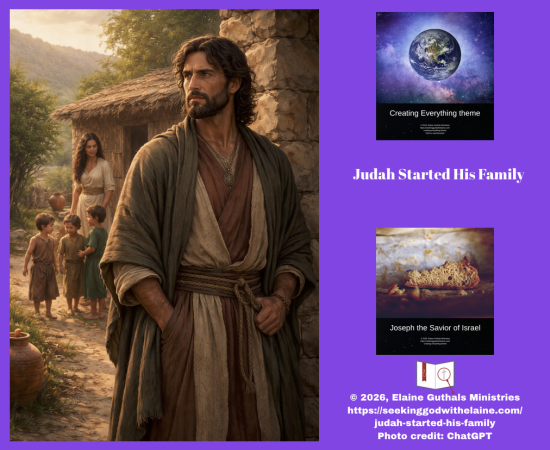
    judah-started-his-family

    There have been a couple of times over the past seven years that I have been posting these devotions on my website that I have had to do a we-interrupt-this-program post. Life got in the way, and I was unable to complete a post.

    At first glance, it seems like Moses interrupted Joseph’s story to give us this little snapshot into Judah’s family life. But it serves a much bigger purpose.

    Let’s dig in.  

    Let’s Put It into Context

    To read devotions in the Creating Everything theme, click the button below.

    Devotions in the Joseph the Savior of Israel  series

    Let’s Put It into Context #2

    In order to know why this chapter is not out of place, we have to remember what happened in Genesis 37. That was the start of the story that will be told over the remaining chapters in Genesis.

    Joseph was betrayed and sold by his brothers. It was the beginning of his descent into suffering.

    Why this chapter here now? Judah presents a stark contrast to Joseph. In this chapter, we will see Judah’s sexual choices. In the next, we will see Joseph’s.

    This chapter is in exactly the position it needs to be because we need to follow Judah on his transformation. Yes, He was the one to suggest selling Joseph instead of killing him.

    But Judah suggested selling Joseph. We see in this chapter how his downward spiral continues.

    Judah Went Out on His Own

    “About this time, Judah left home and moved to Adullam, where he stayed with a man named Hirah. There he saw a Canaanite woman, the daughter of Shua, and he married her. When he slept with her, she became pregnant and gave birth to a son, and he named the boy Er. Then she became pregnant again and gave birth to another son, and she named him Onan. And when she gave birth to a third son, she named him Shelah. At the time of Shelah’s birth, they were living at Kezib” (Gen. 38: 1-5 NLT)

    Judah Left Home

    Judah was doing more than leaving home.

    We have been estimating that Judah was born around 1712 BC to Jacob and Leah. While we don’t know when this story occurred, we do know that it is after 1692 BC. That was when Joseph was sold.

    We may look at the words “… Judah left home …” (Gen 38: 1 NLT) and scratch our heads. Isn’t that what parents are supposed to do – raise our children to move out on their own?

    Well, there are two things we have to take into consideration. The family society in Jacob’s time was built around the clan. It was an extended family household centered on the authority of the patriarch.

    But it went deeper than this. Jehovah’s covenant with Abraham, Isaac, and Jacob was carried through the family line. Judah was part of that covenant family. Remember, the term בְּרִית (berit) refers to a binding agreement or covenant.

    Judah had already participated in resisting Jehovah’s revealed will. When Joseph shared the dreams given to him, his brothers simply did not question them – they rejected them and acted against them. In doing so, they opposed what He had revealed while still remaining with the covenant family.

    Moved to Adullam

    Judah was doing more than moving away.

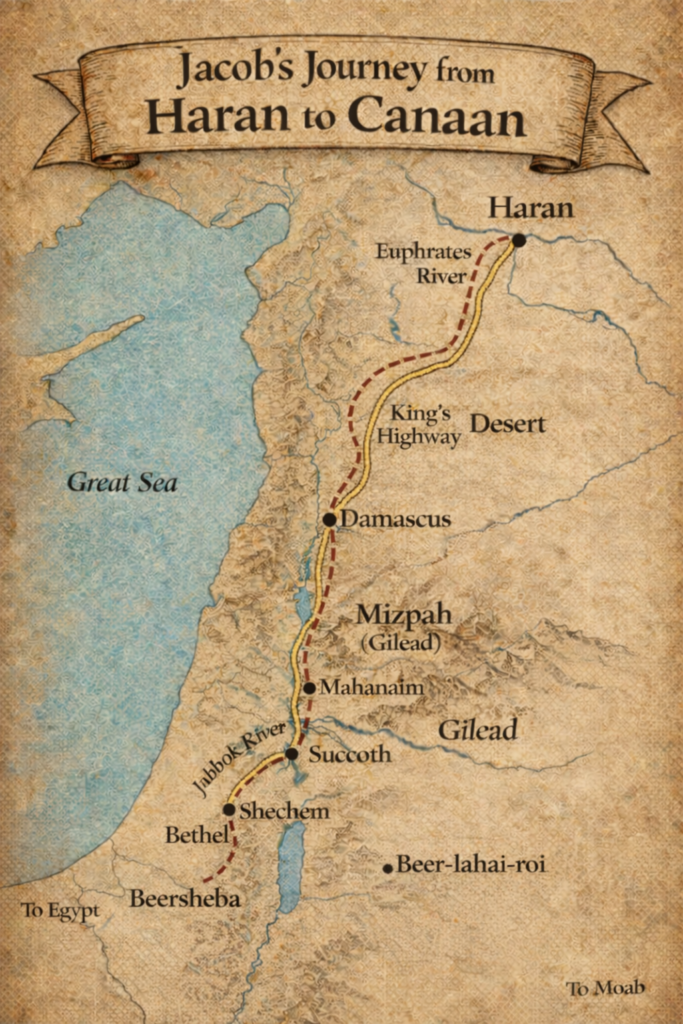
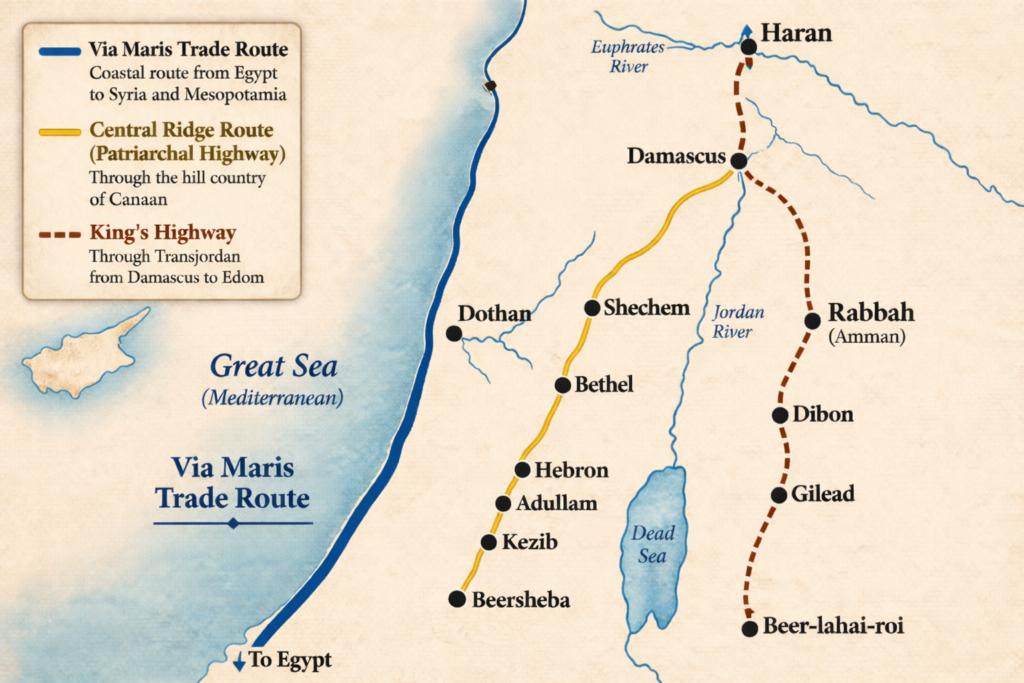
    Adullam wasn’t that far away from Hebron – only about 10 to 15 miles. But we have to look at the Hebrew to catch what is meant.
    Look at this verse in The Schocken Bible. “Now it was at about that time that Yehuda went down, away from his brothers and turned aside to an Adullamite man — his name was Hira” (Gen. 38: 1 TSB).

    Resource

    What verb used in Hebrew is יָרַד (yarad) can means went down. The same pattern was used when Lot went down to Sodom. It shows movement away from a place of blessing or stability.

    It is narrative theology. It is a step out of the covenant center.

    He Married

    Judah was moving away from the covenant community.

    First, Judah met a man named Hirah. When he moved to the area, he stayed with this man.

    Then, Judah found a wife. But there was a problem.

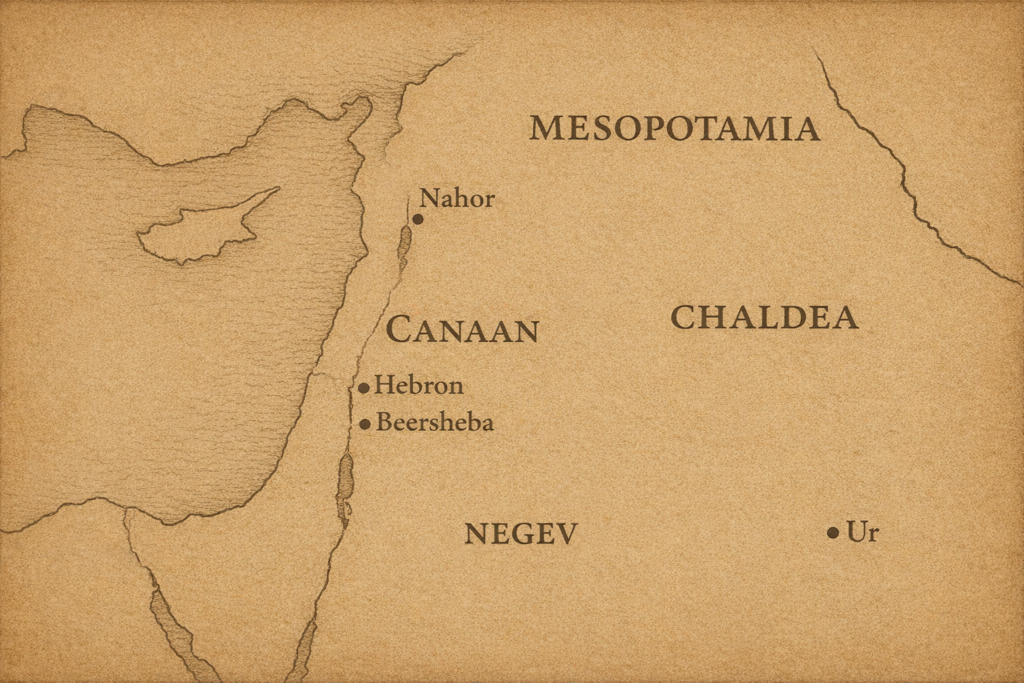
    When Isaac reached marriageable age, Abraham went back to his family in Haran to find a wife for his son. When Jacob was way past marriageable age, Isaac sent him back to Rebekah’s family also.

    Judah didn’t do that. He took a Canaanite woman as a wife. (We don’t know her name. We only know she was Shua’s daughter.)

    In other words, Judah embedded himself among the Canaanites.

    The term כְּנַעֲנִי (kena‘ani) – the word we translate to Canaan — carries both ethnic and moral connotations in Genesis. It represents not just a people group, but a cultural system opposed to covenant values. Judah’s union with a Canaanite woman signals assimilation into that system.

    We know that, when the Israelites came back from their slavery in Egypt, they were directed by Jehovah to not intermarry with the Canaanites. Judah was not under this law, but that was the expectation.

    “When the Lord your God brings you into the land you are about to enter and occupy, he will clear away many nations ahead of you: the Hittites, Girgashites, Amorites, Canaanites, Perizzites, Hivites, and Jebusites. … When the Lord your God hands these nations over to you and you conquer them, you must completely destroy them. Make no treaties with them and show them no mercy. You must not intermarry with them. Do not let your daughters and sons marry their sons and daughters, for they will lead your children away from me to worship other gods …” (Deut. 7: 1-4 NLT).

    Judah Had a Family

    “In the course of time, Judah arranged for his firstborn son, Er, to marry a young woman named Tamar. But Er was a wicked man in the Lord’s sight, so the Lord took his life. Then Judah said to Er’s brother Onan, ‘Go and marry Tamar, as our law requires of the brother of a man who has died. You must produce an heir for your brother.’ But Onan was not willing to have a child who would not be his own heir. So whenever he had intercourse with his brother’s wife, he spilled the semen on the ground. This prevented her from having a child who would belong to his brother. But the Lord considered it evil for Onan to deny a child to his dead brother. So the Lord took Onan’s life, too. Then Judah said to Tamar, his daughter-in-law, ‘Go back to your parents’ home and remain a widow until my son Shelah is old enough to marry you.’ (But Judah didn’t really intend to do this because he was afraid Shelah would also die, like his two brothers.) So Tamar went back to live in her father’s home” (Gen. 38: 6-11 NLT)

    When Judah’s oldest son grew up, Judah found a wife for him, who also became the wife of the second son.

    Er, Judah’s firstborn son, married Tamar. We are given little information on who she was. We assume that she was probably Canaanite.

    That is logical. If Judah found a Canaanite wife for himself, why would he find a covenant wife for his son?

    Still, if she was Canaanite, Tamar was not criticized for that. Only Judah’s failure is noted.

    Once Tamar married Er, she became tied to Judah’s family. Ancient Near Eastern marriage agreements included the transfer of guardianship rights from the father to the husband on the wedding night.

    This is a very important piece of information, especially since Er did not follow Jehovah.

    We aren’t given any specifics. We are just told that Er was רַע (ra‘) – evil or wicked – so that Jehovah took his life.

    Look at the last part – (vaymitehu YHWH). It means He caused him to die. Jehovah took out Er for not following Him.

    That put Tamar in a precarious position. She was widowed and childless. Because of that, provisions were made for a levirate marriage.

    A levirate marriage was required to protect widows and inheritance rights. This was not only a covenant requirement but also an Ancient Near Eastern practice. It is documented in the Code of Hammurabi and on the Nuzi Tablets.

    Because Tamar was childless, Er died without a son to carry on the family line. By providing an heir, land could stay within the clan.

    The practice also provided protection for Tamar. She remained within the family and was provided for and had status. She could also fulfill her Ancient Near Eastern duty of bearing children.

    Judah’s second son, Onan, looked as if he were going to perform his duty and provide Er with an heir. It doesn’t specify, but he would have had to marry Tamar to have relations with her.

    The problem looks to be on the surface that Onan wanted all of the sons he fathered to be his children. So, he did his duty and married Tamar, but he ensured she didn’t get pregnant.

    The root sin may have been that Onan wanted the pleasure without the responsibility. If he didn’t want to father the child, did he marry Tamar?

    Even deeper than that was Onan’s child with Tamar would be considered Er’s heir (therefore receiving the firstborn son inheritance from Judah — not him). With no son attributed to Er, Onan would become the firstborn and inherit.

    We probably don’t realize what a big deal this refusal was. Deuteronomy 25: 7-10 outline the actions the widow was to take if this happens.

    • The widow publicly confronts him
    • She removes his sandal
    • Spits in his face
    • He is shamed as he failed his family, brother, and covenant duty.

    Tamar didn’t have to worry about doing accusing Onan. Jehovah took Onan’s life also.

    Judah’s third son, Shelah, was not at an age where he could marry. Tamar was sent back to her parents’ house.

    But Moses added a little tidbit of information. Judah had no intention of allowing the marriage of Shelah and Tamar. He was afraid that he would suffer the same fate as his two older brothers.

    To me, that reads like Judah thought his sons died because of Tamar’s actions, not their own. His refusal to see the sons’ actions as wrong showed that Judah was not following Jehovah.

    There were several other things Judah of which guilty. He refused the levirate marriage for Shelah and Tamar.

    I almost wrote that Judah broke his promise of the levirate marriage. But he didn’t promise, did he? He deceived Tamar into thinking the marriage would take place.

    In acting that way, Judah put Tamar’s future on hold. She couldn’t remarry. That meant she had no husband to provide for her and give her children.

    That was a legal and moral failure.

    Making the Connections #1

    Inquiring minds may want to know how the levirate marriage compares to the practice of the kinsman-redeemer that we see in the Book of Ruth.

    The levirate marriage applies only to a brother, who is expected to marry the widow of his deceased brother in order to produce an heir in the dead brother’s name. The kinsman-redeemer is a close relative. He acts to restore land, lineage, and family security.

    How are the practices similar?

    • Both function within the clan system.
    • That obligation is required of a close male relative.
    • The purpose for both is to preserve the dead man’s name and maintain inheritance continuity.
    • By protecting the widow, family survival is ensured.
    • Both function within the covenant structure.

    But they were different practices.
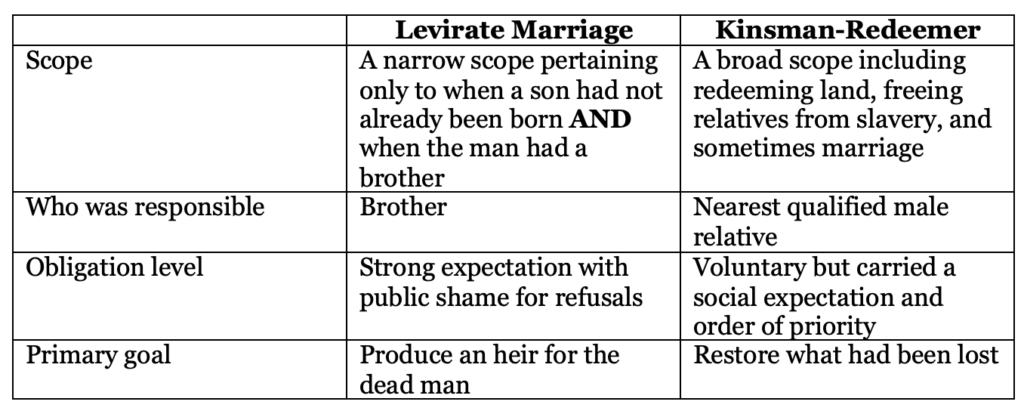
    We can’t miss the fact that both systems provided redemption through substitution. Regardless of the reasons or responsibilities, one man stepped in for a relative. Life is raised and preserved. The name, inheritance, and future is secured.

    Making the Connections #2

    Back to Joseph and Judah. Why was this story told now?

    Joseph’s story is about his actions to preserve the physical life of Jehovah’s people.  Judah’s story is about how Jehovah preserved the covenant seed. We’ll look at that more in the next devotion.

    How Do We Apply This?

    • Faithfully walk the path that leads to Jehovah.

    Father God.Your grace and mercy humble us. Forgive us when we turn away from You. Lead us back into Your fold. Amen.

    If you don’t understand something and would like further clarification, please contact me.

    If you have not signed up for the email providing the link to the devotions and the newsletter, do so below.

    If God has used this devotion to speak with you, consider sharing it on social media.
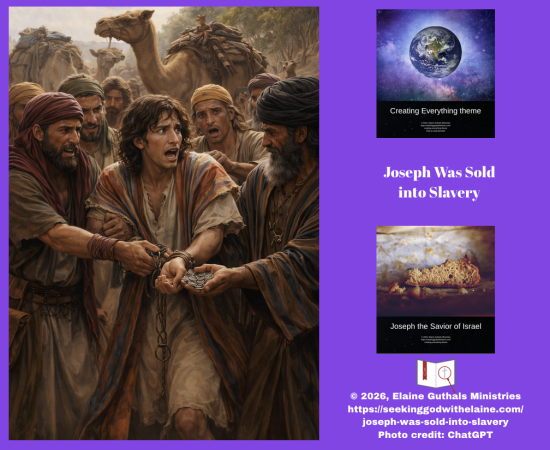
  • Joseph Was Sold into Slavery

    The tension is building in Jacob’s household and is fixing to blow a gasket. This devotional reading looks at what can happen when brothers do nothing to check their anger and jealousy.

    Nuggets

    • Joseph arrived to complete his father’s mission but was betrayed by his brothers.
    • The cistern was built to hold life-giving water; but for Joseph, it became the place where everything was stripped away.
    • The brothers took care of Joseph and sat down to eat. 
    • Trade caravans were a familiar sight along established trade routes.
    • A suggestion was made that saved Joseph’s life.
    • The amount the brothers sold Joseph for is significant.
    • Well, Reuben’s intent was to rescue Joseph, but he didn’t.
    • Once the brothers had betrayed their brother, they had to deceive their father.
    joseph-was-sold-into-slavery

    Joseph arrived at Dothan to accomplish the mission Jacob had given him. “Go to your brothers and see how they and the flocks are doing.” It was supposed to be just a jaunt to Shechem.

    But the brothers weren’t there. They had moved on to Dothan.

    Jacob was obedient to his mission and followed them there. He had no clue what was facing him.

    Let’s Put It into Context

    To read devotions in the Creating Everything theme, click the button below.

    Devotions in the Joseph the Savior of Israel  series

    The Brothers’ Plan Implemented

    “So when Joseph arrived, his brothers ripped off the beautiful robe he was wearing. Then they grabbed him and threw him into the cistern. Now the cistern was empty; there was no water in it. Then, just as they were sitting down to eat, they looked up and saw a caravan of camels in the distance coming toward them. It was a group of Ishmaelite traders taking a load of gum, balm, and aromatic resin from Gilead down to Egypt” (Gen. 37: 23-25 NLT)

    Joseph Arrived

    Joseph arrived to complete his father’s mission but was betrayed by his brothers.

    I would believe that the first thing the brothers did after Joseph arrived and was captured was to take Joseph’s tunic. That would be a symbolic stripping him of his status. Remember, this may have been Jacob’s symbol of making Joseph his firstborn.

    Removing the tunic would have been very important to the brothers. It highlighted their jealousy of him. It helped them bond together in their hatred of Joseph.

    By divesting Joseph of the gift given by their father, they humiliated him. It was also a dig at their father, when they sent it to him to identify Joseph.

    What would it mean to Joseph? Beyond highlighting his brothers’ jealousy and betrayal, it stripped Joseph of his status as favored son. But it also stripped him of his identity.

    Beyond that, it sets the stage for future events. It sets in motion the next phase of Jehovah’s plan. It foreshadows the hardships he will endure in Egypt.

    Threw Him into the Cistern

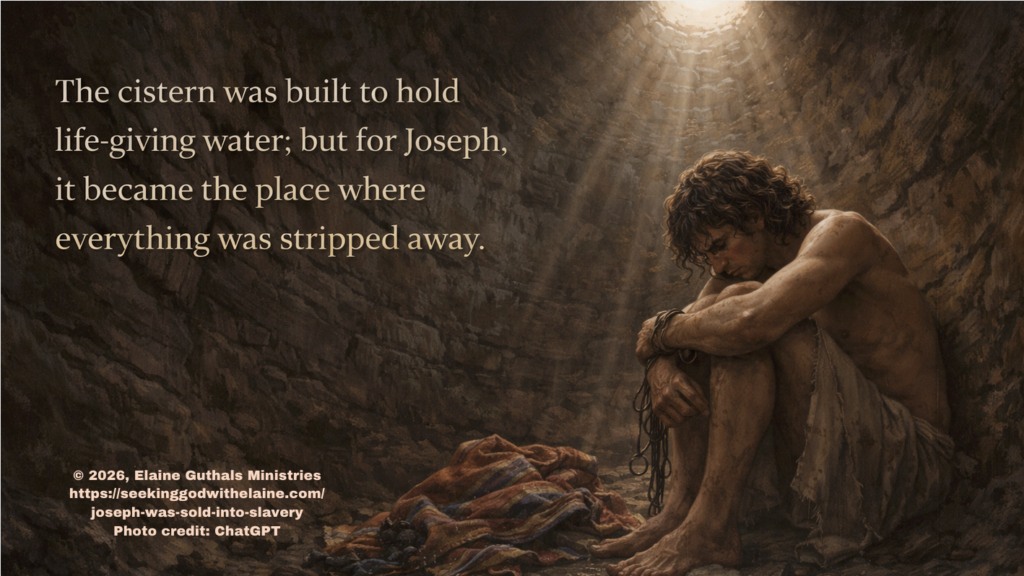
    The cistern was built to hold life-giving water; but for Joseph, it became the place where everything was stripped away.

    If we look at the Hebrew, we see the word bôr – pit. If we use the functional definition, we see that it is a man-made water reservoir – or what we call a cistern.

    Growing up on the farm and at the house in the country subdivision we lived in when Adam was born, we had a cistern. My sister has a cistern at her house.

    In fact, the day my sister hosted the baby shower for Adam, the well ran out of water. If wells can, cisterns can. Just because the tank is buried in the yard doesn’t mean that it has water that can be used.

    We had talked about the brothers moving from Shechem to Dothan probably in search of water and grass. If the cistern was empty, that probably meant it was the dry season.

    In order to catch precious rainwater, people would carve deep chambers into rock and plaster the inside. The bottom of the chamber was probably somewhat roomy, but the top was a narrow opening.

    It was deep enough that Joseph couldn’t climb out of it, but then, it didn’t have a ladder for Joseph to climb down into it. That meant he was thrown into this dark, enclosed space.

    It was in one of those water reservoirs that Joseph was placed. The only way out was for Reuben – or someone else – to lift him out.

    Just as They Were Sitting Down to Eat

    The brothers took care of Joseph and sat down to eat.

    Talk about Jehovah working things in a hurry! It didn’t sound like much time passed at all before Jehovah started the next phase of His plan.

    But kick that around in your mind a second. One minute, the brothers throw Joseph into the pit. The next minute they say, “Let’s eat. I’m starved.”

    Are they laughing? Slapping each other on the back?

    Once again, Joseph is at a totally different place than his brothers.

    Saw a Caravan

    Trade caravans were a familiar sight along established trade routes.

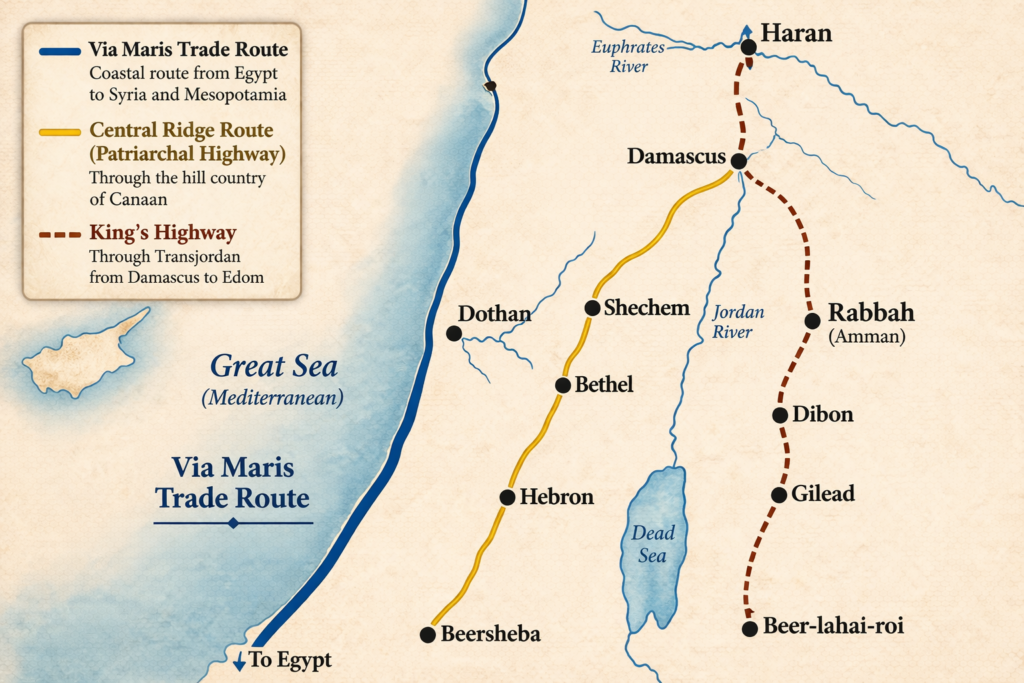
    Trade had been occurring in caravans such as this for a long time. Caravans were specialized traders moving luxury goods across regions. The routes connected Canaan to both Egypt to the south and Mesopotamia to the north.

    We are talking fixed routes established because of water access, safety, and terrain. There were known stops along the way.

    One of the major north-south routes was called the Via Maris. Dothan connected to routes feeding into the Via Maris. To me, that was why it was important to Jehovah’s plan that the brothers and the flocks travel to Dothan for Joseph to follow them.

    So, these traders were moving along an established route. These caravans had regular and predictable movements.

    These traders carried balm, resin, and myrrh. These were used in medicine, perfume, and embalming. Traders also transported slaves, moved labor, and facilitated human exchange.

    The New Living Translation noted the traders were Ishmaelites who were Midianites.

    Wait! What????

    Ishmael was Abraham’s son by Hagar. Midian was Abraham’s son by Keturah.

    The Ishmaelites were major traders at that time. Somewhere along the line, the Ishmaelites began operating together with the Midianites as an interrelated trading people.

    Yep, the brothers sold Joseph to their grandfather’s brothers’ relatives. No, there was no love lost in the family, but come on. Yes, it was a fractured family line.

    Did the Ishmaelites know who the brothers were? Did they know they were buying their kin?

    It probably wouldn’t have mattered if they did or didn’t. They were known as the slave-traders of the period.

    The Midianites were also important to Israel’s history. Those were who Moses would run to after killing the Egyptian.

    Judah Suggested Selling Joseph

    “Judah said to his brothers, ‘What will we gain by killing our brother? We’d have to cover up the crime.  Instead of hurting him, let’s sell him to those Ishmaelite traders. After all, he is our brother — our own flesh and blood!’ And his brothers agreed. So when the Ishmaelites, who were Midianite traders, came by, Joseph’s brothers pulled him out of the cistern and sold him to them for twenty pieces of silver. And the traders took him to Egypt” (Gen. 37: 26-28 NLT)

    A suggestion was made that saved Joseph’s life.

    When Judah saw the traders, he got a brilliant idea. Let’s sell Joseph.

    What made Judah steer away from murder? The first reason was profit. They would gain nothing tangible by Joseph’s death.

    There was still good in Judah. He was, at least, preserving life.

    But then, Joseph was going to Egypt to be the savior of the family. Jesus was from the tribe of Judah.

    It surprises us when we see Jehovah’s plan being carried forward through human betrayal. He will use believers as well as non-believers, good as well as evil to serve His own ends.

    That tells us that Jehovah is in control of every situation. He knows exactly how situations are going to end. He knows the circumstances that will have to be navigated to reach the end.

    But it also tells us that we are not immune from the consequences of our choices when He uses our sin to advance His plan. Joseph’s brothers and their descendants paid dearly for their betrayal.

    Sold Him for Twenty Pieces of Silver

    The amount the brothers sold Joseph for is significant.

    Joseph was sold for 20 shekels of silver. It was the standard price of a young slave in Joseph’s time.

    That was what Joseph would be considered at 17. Also, it was what he would become.

    In fact, Moses wrote in the Law that this was the value of a boy. “A boy between the ages of five and twenty is valued at twenty shekels of silver; a girl of that age is valued at ten shekels of silver” (Lev. 27: 5 NLT).

    We can’t help but think about another Man that was sold for silver. Yeshua was sold for 30 shekels — the price of a slave (Ex. 21: 32).

    Reuben’s Plan Foiled

    “Some time later, Reuben returned to get Joseph out of the cistern. When he discovered that Joseph was missing, he tore his clothes in grief.  Then he went back to his brothers and lamented, ‘The boy is gone! What will I do now?’” (Gen. 37: 29-30 NLT)

    Well, Reuben’s intent was to rescue Joseph, but he didn’t.

    These two verses bring up a question. Where was Reuben when the traders were there?

    In the last devotion, I made the comment that Reuben was going to have to watch Joseph. Just because Joseph was in a cistern, it didn’t mean he was safe. He was in the wilderness.

    But Reuben relied on the cistern construction to contain Joseph. There would be no need to guard him constantly because he could not get out on his own.

    Apparently, Reuben didn’t think his best-laid plans were going to go wrong. They did, and he panicked.

    I wonder what was the focus of Reuben’s question – what was he going to do now? Was he concerned that he couldn’t return Joseph to Jacob? Or was he concerned that he no longer had a peace offering to try to get back in Jacob’s good graces?

    Sent a Message

    “Then the brothers killed a young goat and dipped Joseph’s robe in its blood. They sent the beautiful robe to their father with this message: ‘Look at what we found. Doesn’t this robe belong to your son?’ Their father recognized it immediately. ‘Yes,’ he said, ‘it is my son’s robe. A wild animal must have eaten him. Joseph has clearly been torn to pieces!’ Then Jacob tore his clothes and dressed himself in burlap. He mourned deeply for his son for a long time. His family all tried to comfort him, but he refused to be comforted. ‘I will go to my grave mourning for my son,’ he would say, and then he would weep” (Gen. 37: 31-35 NLT)

    Once the brothers had betrayed their brother, they had to deceive their father.

    One sin usually leads to another. In this case, the brothers had to figure out what they were going to tell their father.

    Way back in Genesis 37: 19, they had decided they would tell their father that Joseph had been killed by a wild animal. They probably took much glee to tear up the tunic and cover it with blood.

    I am this many years old before I realized that the brothers didn’t have the courage to face their father. They sent a message, probably with a servant.

    Did they think that it didn’t make it a lie because they never said, “Joseph was killed by a wild animal”? They let Jacob come up with that deduction himself.

    The brothers should have expected Jacob’s inconsolable sorrow.

    Think about it. If we are right and Rachel died in 1692 BC giving birth to Benjamin, and in 1692, Jacob was led to believe that Joseph was killed by a wild animal, then Jacob had good reason to be inconsolable. No wonder he kept a tighter grip on Benjamin.

    But was Jacob right in not allowing himself to be comforted? Jehovah tells us that the mourners will be comforted (Isa. 61: 2-3).

    Jacob is so consumed by grief that he is not receiving what Jehovah provides. Was Jacob railing against Jehovah for taking Rachel and Joseph from him? Did he lose trust in Him?

    Making the Connections #1

    Okay, let’s taken inventory of the brothers.

    Reuben had slept with one of his father’s concubines. Simeon and Levi had killed the men of Shechem.

    Judah, on the other hand, found the way to save Joseph’s life and put him on the path to Egypt.

    Making the Connections #2

    Something flitted through my mind. We talked about Jacob giving Joseph the tunic around the time of Rachel’s death. It might have been a show of favoritism to his favorite wife’s firstborn son.

    It may have been Jacob’s notice that he was replacing Reuben as the firstborn son. Reuben had mounted a coup to replace Jacob.

    I wonder if Joseph’s age factored into timing. I know sons were given more responsibilities at younger ages than they are now.

    But Joseph may have thought his death was many years down the road. That is, until Rachel died. He may have been planning to make the switch for years. He only had to wait until Joseph was old enough to step up.

    Making the Connections #3

    In all these verses, Benjamin’s name is not spoken. That is because — if Rachel just died — he was an infant.

    Benjamin was never involved in the conflict against Joseph. The issues the boys had with Joseph were not transferred to him.

    Making the Connections #4

    It is interesting to know that Isaac was still alive when Joseph was sold by his brothers. Joseph was sold in 1692 BC. Isaac died in 1680 BC. He lived 12 years after Joseph was gone.

    In fact, Isaac’s death occurred shortly before the transition to Joseph’s story really kicks into gear in Egypt with dream translations.

    How Do We Apply This?

    • Realize how uncertain tomorrow is.
    • Watch how feelings escalate in families.
    • Don’t try to defeat Jehovah.
    • Don’t return too late to do Jehovah’s Will.

    Father God. Our hearts are heavy at what family members can do to each other. But Lord, we are humbled that this was all in Your plan. You worked this to Your good – and our good (Rom. 8: 28). Thank You that You are in control of all our lives. Amen.

    If you don’t understand something and would like further clarification, please contact me.

    If you have not signed up for the email providing the link to the devotions and the newsletter, do so below.

    If God has used this devotion to speak with you, consider sharing it on social media.
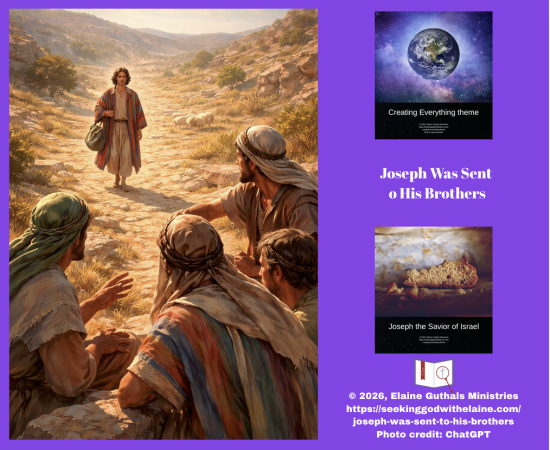
  • Joseph Was Sent to His Brothers

    Joseph continued his life after receiving two revelations from God. This devotional reading looks at how Joseph’s life took a turn for the worst – at the hands of his brothers.

    Nuggets

    • The brothers were doing their job.
    • Joseph obediently followed Jacob’s instructions.
    • Jehovah was positioning Joseph for the future He had for him.
    • The anger that Joseph’s brothers had for him reached a boiling point – without Joseph even saying anything.
    • Only one brother cautioned restraint – but not stopping the plan.
    joseph-was-sent-to-his-brothers

     In the last devotion, we talked about how Jehovah gave Joseph two dreams to tell him of his future. He knew how the story was going to end. People — including his brothers — were going to bow down to him.

    Joseph was fixing to have to hold on tightly to that good ending. He was going to have a long, rocky road to get there.

    Let’s Put It into Context

    To read devotions in the Creating Everything theme, click the button below.

    Devotions in the Joseph the Savior of Israel  series

    Herding the Flock

    “Soon after this, Joseph’s brothers went to pasture their father’s flocks at Shechem” (Gen. 37: 12 NLT)

    The brothers were doing their job.

    Ooo, baby. The brothers were going back to Shechem. The last time that we know they were there, it didn’t begin or end well.

    Jacob had moved his family to Shechem upon return from Paddan-aram. Shechem, the local prince, had raped Jacob and Leah’s daughter Dinah.

    The brothers were furious. After deceiving the men of Shechem to get circumcised after promising future marriages, Simeon and Levi killed all the men of the city.

    How long had men from the neighboring area to forget that horrific event?
    ~1694 BC — Dinah was defiled
    1692 — Joseph received his coat of many colors from his father Jacob.
    1692 — At the age of 17, he was sold into slavery by his brothers (Gen. 37).

    Based on Timeline from

    Something that huge and bloody would live long in people’s minds.

    We don’t know if Jacob still had the land he had bought there. “Jacob bought the plot of land where he camped from the family of Hamor, the father of Shechem, for 100 pieces of silver” (Gen. 33: 19 NLT).

    Jacob may have kept the land for his sheep, but it wasn’t like farms today that have fences for boundaries. Since the soil was thin, shepherds had to move around to find the seasonal grass. That didn’t lend itself to a permanent pastureland.

    The brothers would have shepherded the sheep in guided foraging. They would have gone where the grass was available. If this was the dry season, they may have had to go farther.

    Still, Jacob was always known as being a sojourner in a foreign land. He called Hebron home but was not fully home. He owned land in Shechem but did not have true possession as Canaanites still possessed the land.

    Status Report

    “When they had been gone for some time, Jacob said to Joseph, ‘Your brothers are pasturing the sheep at Shechem. Get ready, and I will send you to them.’  ‘I’m ready to go,’ Joseph replied. ‘Go and see how your brothers and the flocks are getting along,” Jacob said. “Then come back and bring me a report.’  So Jacob sent him on his way, and Joseph traveled to Shechem from their home in the valley of Hebron” (Gen. 37: 13-14 NLT)

    Joseph obediently followed Jacob’s instructions.

    We don’t know how long the brothers had been gone. All we know is that it was long enough for Jacob to want a status report.

    I just have two questions. Why wasn’t Joseph with them? We’ve already said that he worked with the sons of the concubines.

    “… When Joseph was seventeen years old, he tended his father’s flocks. He worked for his half brothers, the sons of his father’s wives Bilhah and Zilpah …” (Gen. 37: 2 NLT).

    If we look closely at that verse, it said Joseph often worked with them. While that word is relative, it wasn’t an everyday occurrence. This is the first time I saw that word.

    There was one reason for the brothers’ anger at the coat Jacob gave Joseph that I didn’t in the last devotion. It was believed that the coat may have been one like those given to people who did no manual labor.

    Shepherds did manual labor. Did that mean Jacob was making him firstborn when he gave him the coat?

    Maybe it was a combination of several things. We do know the overall reason. Jehovah had set up circumstances to happen in the way He wanted.

    What do we know? Jacob wanted an update on his sons and his flocks. Joseph was ready and willing to go get that report for him. Joseph was obedient.

    They Weren’t There

    “When he arrived there, a man from the area noticed him wandering around the countryside. ‘What are you looking for?’ he asked. ‘I’m looking for my brothers,’ Joseph replied. ‘Do you know where they are pasturing their sheep?’ ‘Yes,’ the man told him. ‘They have moved on from here, but I heard them say, “Let’s go on to Dothan.’” So Joseph followed his brothers to Dothan and found them there” (Gen. 37: 15-17 NLT)

    Jehovah was positioning Joseph for the future He had for him.

    Joseph followed the brothers to Shechem. Up to this point, he had done everything Jacob had asked.

    That is where plans went awry. The brothers weren’t at Shechem.

    Like we said, we don’t know the time of the year. It may have been the dry season, forcing them to move on to find water and grass.

    The man who directed Joseph to Dothan was unnamed. That’s okay. The message was much more important than his name.

    So, plans changed. Joseph needed a course correction to Dothan. Jehovah provided that.

    The Brothers’ Saw Joseph Coming

    “When Joseph’s brothers saw him coming, they recognized him in the distance. As he approached, they made plans to kill him. ‘Here comes the dreamer!’ they said. ‘Come on, let’s kill him and throw him into one of these cisterns. We can tell our father, “A wild animal has eaten him.” Then we’ll see what becomes of his dreams!’” (Gen. 37: 18-20 NLT)

    The anger that Joseph’s brothers had for him reached a boiling point – without Joseph even saying anything.

    Up to this point, the brothers probably had just grumbled and done normal sibling rivalry things. If they did something worse, it didn’t make the narrative because it wasn’t important to the story.

    In the last devotion, we talked about that their anger and jealousy had gone to the next level after the divine revelation of the dream. They hated Joseph even more (Gen. 37: 8).

    That is why they identify Joseph as the dreamer. But that is important.

    The brothers were attacking Jehovah and his revelation along with Joseph. They were saying, in essence, “We do not accept whatever form Joseph’s rule would be over us. We would rather kill him than submit to him”

    Keep this in mind. Joseph hadn’t even make it to them yet. He was still off in the distance when they saw him coming (Gen. 37: 18).

    Then their anger and jealousy escalated into attempted murder.

    It is interesting that none of the boys were singled out by name. It doesn’t tell us if Dan got the idea first or Simon.

    It says they made plans. That signifies unity.

    The way it reads is there didn’t have to be any suggestion or discussion. All immediately knew what they were going to do.

    One Dissenter

    “But when Reuben heard of their scheme, he came to Joseph’s rescue. ‘Let’s not kill him,’ he said. ‘Why should we shed any blood? Let’s just throw him into this empty cistern here in the wilderness. Then he’ll die without our laying a hand on him.’ Reuben was secretly planning to rescue Joseph and return him to his father” (Gen. 37: 21-22 NLT)

    Only one brother cautioned restraint – but not stopping the plan.

    Well, maybe Reuben didn’t immediately know what to do with Joseph. Luckily, his cool head squashed the kill plan. Or did he have a cool head?

    I wonder in whose dreamworld throwing Joseph into an empty pit to starve to death makes it better than killing him outright. The pit symbolized death without burial.

    Yes, it says that Reuben was intending to get Joseph out of the pit. How was he going to accomplish that? The other nine brothers wouldn’t have liked it one bit and would have fought him if they found out about it. I am not sure Reuben could have taken on all of them at once.

    On the other hand, alive is usually better than dead in Joseph’s way of thinking.

    Let’s look for a minute at 22-year-old Reuben’s leadership success. We know that Reuben had already slept with his father’s concubine (Gen. 35: 22). His coup had failed.

    Was he going to rescue Joseph and return him to Jacob to get back into Jacob’s good graces? I can see where that may have been a good plan for restoring Jacob’s faith in Reuben.

    It was very risky, though. Reuben would have to keep watch over Joseph in the pit, and I’m not sure he could do that without the others finding out his scheme.

    Wouldn’t it have been easier to confront the brothers with the fact that they were going to murder their brother? Reuben didn’t have that courage. Maybe he secretly wanted that outcome.

    I know. It is hard to be in the minority – especially when there are so many in the majority.

    It just seems to me that Reuben was out of his depth here. He was trying to stop a runaway freight train with his bare hands. His plan didn’t succeed because he wasn’t looking for what was right and true to do.

    Reuben was looking at what could benefit him.

    Jehovah expects us to be obedient regardless the circumstances in this world. We are to set our sights above (Col. 3: 1).

    In reality, what Reuben didn’t have was the righteousness.

    But it also shows why Reuben’s leadership was already fragile, making it feel uncertain or ineffective at times. He was trying to carry the responsibility of the firstborn – knowing he had fallen out of favor – in a very complicated household.

    The intent switches from murder to starvation. The end would probably have been the same with different means.

    Making the Connections #1

    And all Joseph did was follow his father’s directions — go find your brothers and see how it is going.

    Joseph went beyond what he originally thought the job to be. He thought he was just going to Shechem to talk with them. He had to go all the way to Dothan, instead.

    Did Joseph dig in his heels and say he wasn’t going? No, he trotted off to Dothan.

    It was well within Jacob’s rights to because he was their father. More than that, he was the owner of the sheep. Our employers have every right to expect some things from us — even if we don’t like them.

    Making the Connections #2

    Were Joseph’s brothers murderers or not?  No, they didn’t take Joseph’s life – but they planned to do so. Doesn’t that make them murderers?

    What did Yeshua say? “You have heard the commandment that says, ‘You must not commit adultery.’ But I say, anyone who even looks at a woman with lust has already committed adultery with her in his heart” (Mt. 5: 27-28 NLT).

    Robertson explained why this is the case. He wrote,

    “The thought is as bad as the act, because the act would be committed if it could. But if these brethren of Joseph had mourned over and repented of their sin, would we dare to say that the thought would have been as bad as the act? But we do say that the thought in this case was as bad as the act, because it was not restrained or prevented by any regret or repentant feeling; it was merely prevented by the coming in of another passion, it was the triumph of avarice over malice.”

    Resource

    I know. Robertson takes the scenic route in getting to his idea. What it boils down to, to me, is that we are guilty of doing the act by just thinking it – unless we repent and ask forgiveness from Jehovah.

    Making the Connections #3

    Lawson believed that the brothers disrespected Jehovah in their treatment of Joseph.  Yes and no.

    Resource

    Yes, the brothers were wrong to want to kill Joseph. Yes, they were wrong to sell him into slavery.

    But that is what Jehovah wanted to happen. If He could have gotten Joseph there in a smoother manner, I am sure He would have accomplished that.

    How Do We Apply This?

    • Expect persecution for Jehovah’s revelations from those who do not believe.

    Resource

    Father God. Navigating in this world is difficult. We have our own desires. Our family may have other desires for us. Help us to have Your righteousness – walking in the path You have for us Your way. Amen.

    If you don’t understand something and would like further clarification, please contact me.

    If you have not signed up for the email providing the link to the devotions and the newsletter, do so below.

    If God has used this devotion to speak with you, consider sharing it on social media.
  • Esau and His Descendants

    Even though Esau wasn’t the covenant son, he was blessed by Jehovah. This devotional reading looks at how Isaac’s blessing in Genesis 27 was fulfilled.

    Nuggets

    • Our allegiance to God is influenced by the company we keep, especially who we bring in as family.
    • The country of Edom began as Seir.
    • Esau’s genealogy list turned into a clan list.
    • Moses gave us a list of people Esau displaced or assimilated into his clan.
    • Just as the Israelites later did, the Edomites also wanted a king to rule them.
    • Moses ended the chapter by giving a list of leaders.
    esau-and-his-descendants

    We’ve read about the struggles Jacob and Esau had with each other even before they were born.  We knew each were going to go on to found nations of their own.

    They reconciled after Jacob came back from Paddan-aram. Both seemed ready and eager to do just that.

    But did the reconciliation stick? More importantly, did their families become reconciled?

    Let’s dig in.

    Let’s Put It into Context

    To read devotions in the Creating Everything theme, click the button below.

    Devotions in the Jacob the Patriarch series

    Esau’s Wives and Sons

    “This is the account of the descendants of Esau (also known as Edom). Esau married two young women from Canaan: Adah, the daughter of Elon the Hittite; and Oholibamah, the daughter of Anah and granddaughter of Zibeon the Hivite. He also married his cousin Basemath, who was the daughter of Ishmael and the sister of Nebaioth. Adah gave birth to a son named Eliphaz for Esau. Basemath gave birth to a son named Reuel. Oholibamah gave birth to sons named Jeush, Jalam, and Korah. All these sons were born to Esau in the land of Canaan” (Gen. 36: 1-5 NLT)

    Our allegiance to God is influenced by the company we keep, especially who we bring in as family.

    We have talked about Esau’s wives before.

    • “At the age of forty, Esau married two Hittite wives: Judith, the daughter of Beeri, and Basemath, the daughter of Elon. But Esau’s wives made life miserable for Isaac and Rebekah” (Gen. 26: 34-35 NLT).
    • “It was now very clear to Esau that his father did not like the local Canaanite women. So Esau visited his uncle Ishmael’s family and married one of Ishmael’s daughters, in addition to the wives he already had. His new wife’s name was Mahalath. She was the sister of Nebaioth and the daughter of Ishmael, Abraham’s son” (Gen. 28: 8-9 NLT).

    Isaac and Rebekah alone could not dissuade Esau from marrying a Canaanite woman. Esau was without Abraham’s influence for 25 years, so he didn’t have any recent guidance from that area.

    Since that had caused difficulties, Esau also married one of Uncle Ishmael’s daughters.

    There is a big issue of names here. The wives’ names do not match up.

    What gives? More than likely, when the women were first identified, their common name was given. Probably in Genesis 36 — being official lineage names — others are given.

    Another reason for the switch is maybe the women were renamed. This would have following in line with Sairi getting renamed Sarah.

    Could Esau have married within the covenant line? Well, yes. Remember, we talked about the reason why Leah’s eyes were considered weak. The midrash states that Leah was supposed to marry Esau. Upset at his violent and immoral w, we would say she cried her eyes out, making them soft.

    It sounds like it was his choice not to marry the covenant cousin.

    Esau had five sons of whom we know. Could there have been more sons? Couldn’t there have been some daughters? Maybe. Maybe not.

    Bottom line is Esau didn’t choose wives who would bring him closer to Jehovah. In fact, they took him toward the world – even his cousin.

    Living in Seir

    “Esau took his wives, his children, and his entire household, along with his livestock and cattle — all the wealth he had acquired in the land of Canaan — and moved away from his brother, Jacob. There was not enough land to support them both because of all the livestock and possessions they had acquired. So Esau (also known as Edom) settled in the hill country of Seir” (Gen. 36: 6-8 NLT)

    The country of Edom began as Seir.

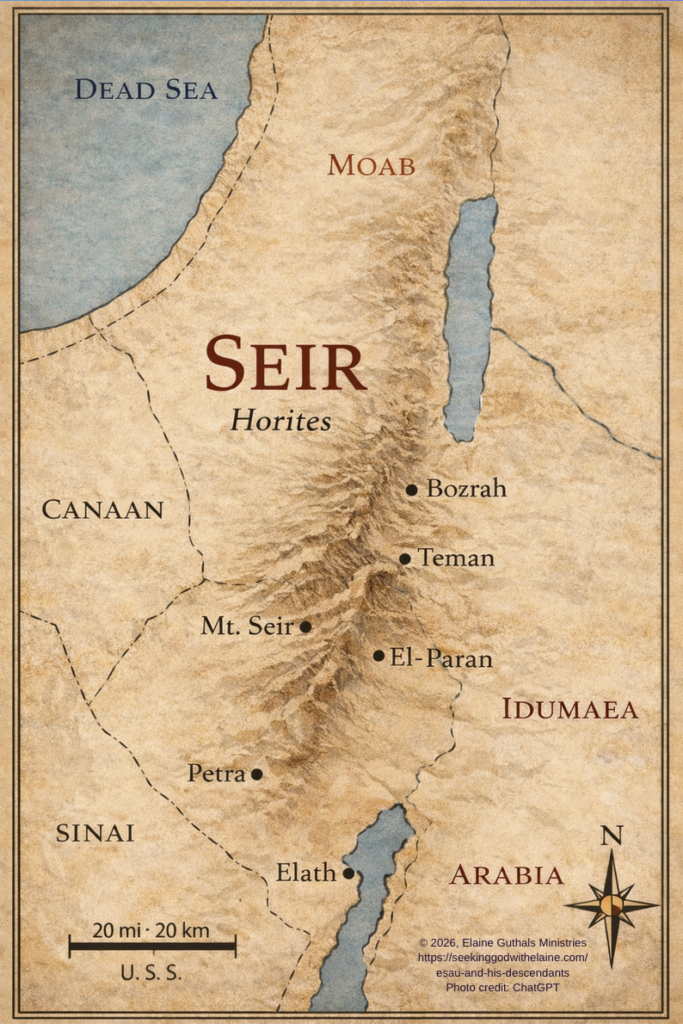
    First, Sauter helped us locate the area. He wrote, “The Edomites controlled an area east of the Arabah, from the Zered to the Gulf of Aqaba. Their capital was Bozrah, which sat in the northern part of their territory.” It is located south of the Dead Sea, reaching into the Arabian Peninsula.

    Resource

    The region did not worship Jehovah. Their god’s name was Qaus (or Qos).

    Okay. Wait a second. I’m confused.

    When Jacob and Esau were breaking up their roadside reunion, Moses said that Esau was going back to Seir. “So Esau turned around and started back to Seir that same day” (Gen. 33: 16 NLT).

    Plus, Esau had already married the women 37 years before Jacob left for Paddan-aram.

    We have to look at this as a summary of Esau’s journey. It is explanation as to how Esau got to be where he was.

    • Married two Canaanite women when he was 40 and still living with Isaac and Rebekah (Gen. 26)
    • Maybe began expanding herd range
    • Started living their with his wives, children, and at least 400 men
    • Going back to Seir (Gen. 33)
    • Fully living there (Gen. 36)

    So, the move happened offstage.

    When it says, “Esau took his wives, his children, and his entire household, along with his livestock and cattle — all the wealth he had acquired in the land of Canaan — and moved away from his brother, Jacob.” (Gen. 36: 6 NLT), it isn’t talking about a current event. It is explaining why the separation exists. It is more like an Abraham/Lot separation (Gen. 13). Too many flocks and herds on too little land.

    Esau’s Descendants

    “This is the account of Esau’s descendants, the Edomites, who lived in the hill country of Seir. These are the names of Esau’s sons: Eliphaz, the son of Esau’s wife Adah; and Reuel, the son of Esau’s wife Basemath. The descendants of Eliphaz were Teman, Omar, Zepho, Gatam, and Kenaz. Timna, the concubine of Esau’s son Eliphaz, gave birth to a son named Amalek. These are the descendants of Esau’s wife Adah. The descendants of Reuel were Nahath, Zerah, Shammah, and Mizzah. These are the descendants of Esau’s wife Basemath. Esau also had sons through Oholibamah, the daughter of Anah and granddaughter of Zibeon. Their names were Jeush, Jalam, and Korah. These are the descendants of Esau who became the leaders of various clans: The descendants of Esau’s oldest son, Eliphaz, became the leaders of the clans of Teman, Omar, Zepho, Kenaz, Korah, Gatam, and Amalek. These are the clan leaders in the land of Edom who descended from Eliphaz. All these were descendants of Esau’s wife Adah. The descendants of Esau’s son Reuel became the leaders of the clans of Nahath, Zerah, Shammah, and Mizzah. These are the clan leaders in the land of Edom who descended from Reuel. All these were descendants of Esau’s wife Basemath. The descendants of Esau and his wife Oholibamah became the leaders of the clans of Jeush, Jalam, and Korah. These are the clan leaders who descended from Esau’s wife Oholibamah, the daughter of Anah. These are the clans descended from Esau (also known as Edom), identified by their clan leaders” (Gen. 36: 9-19 NLT)

    Esau’s genealogy list turned into a clan list.

    I have to put this into perspective.

    • Nation: Edom
    • Tribe: Eliphaz
    • Clan: Amalek

    The clan heads, like Amalek, were semi-nomadic-tribal heads. It is good to know that because Amalek shows up again in Exodus 17 as a fierce enemy of Israel.

    Amalek, Esau’s grandson, was the founder of the Amalekites. They attacked Israel when they were marching to the Promised Alan’s (Ex. 17: 8-16).

    The Amalekites were raiders, not a kingdom. They operated out of the Negev and the wilderness zones.

    Original Peoples of Edom

    “These are the names of the tribes that descended from Seir the Horite. They lived in the land of Edom: Lotan, Shobal, Zibeon, Anah, Dishon, Ezer, and Dishan. These were the Horite clan leaders, the descendants of Seir, who lived in the land of Edom. The descendants of Lotan were Hori and Hemam. Lotan’s sister was named Timna. The descendants of Shobal were Alvan, Manahath, Ebal, Shepho, and Onam. The descendants of Zibeon were Aiah and Anah. (This is the Anah who discovered the hot springs in the wilderness while he was grazing his father’s donkeys.) The descendants of Anah were his son, Dishon, and his daughter, Oholibamah. The descendants of Dishon were Hemdan, Eshban, Ithran, and Keran. The descendants of Ezer were Bilhan, Zaavan, and Akan. The descendants of Dishan were Uz and Aran. So these were the leaders of the Horite clans: Lotan, Shobal, Zibeon, Anah, Dishon, Ezer, and Dishan. The Horite clans are named after their clan leaders, who lived in the land of Seir” (Gen. 36: 20-29 NLT).

    Moses gave us a list of people Esau displaced or assimilated into his clan.

    I know. We get tired of reading names of dead people.

    But family relationships were very important. They wanted to show how they descended from Abraham.

    More importantly, each one of us is important to God. He loves non-believers as He does believers.

    Who are these people? How do they further our story?

    • Before Esau came here to Seir to live, it was inhabited by an indigenous people led by named Seir, a Horite.
    • They likely were cave dwellers.
    • Anah had a daughter named Oholibamah, who married Esau.

    So, that would mean Esau married the granddaughter.

    • Nation: Seir
    • Tribe: Anah
    • Clan: Esau and Oholibamah – if he would have filtered in as Jacob did to Laban.

    What happened later was that Esau’s descendants intermarried and absorbed the Horites. That way of integration and identity merging didn’t always have to follow conquest.

    This is later confirmed. “In earlier times the Horites had lived in Seir, but they were driven out and displaced by the descendants of Esau, just as Israel drove out the people of Canaan when the Lord gave Israel their land.)” (Deut. 2: 12 NLT).

    Rulers of Edom

    “These are the kings who ruled in the land of Edom before any king ruled over the Israelites: Bela son of Beor, who ruled in Edom from his city of Dinhabah. When Bela died, Jobab son of Zerah from Bozrah became king in his place. When Jobab died, Husham from the land of the Temanites became king in his place. When Husham died, Hadad son of Bedad became king in his place and ruled from the city of Avith. He was the one who defeated the Midianites in the land of Moab. When Hadad died, Samlah from the city of Masrekah became king in his place. When Samlah died, Shaul from the city of Rehoboth-on-the-River became king in his place. When Shaul died, Baal-hanan son of Acbor became king in his place. When Baal-hanan son of Acbor died, Hadad became king in his place and ruled from the city of Pau. His wife was Mehetabel, the daughter of Matred and granddaughter of Me-zahab” (Gen. 36: 31-39 NLT)

    Just as the Israelites later did, the Edomites also wanted a king to rule them.

    It is interesting that the Edomites had kings long before Israel did.

    But then it isn’t. Israel was putting their trust in God. The Edomites didn’t have that.

    Leaders of Clans

    “These are the names of the leaders of the clans descended from Esau, who lived in the places named for them: Timna, Alvah, Jetheth, Oholibamah, Elah, Pinon, Kenaz, Teman, Mibzar, Magdiel, and Iram. These are the leaders of the clans of Edom, listed according to their settlements in the land they occupied. They all descended from Esau, the ancestor of the Edomites” (Gen. 36: 40-43 NLT)

    Moses ended the chapter by giving a list of leaders.

    Okay. This is another big list. It is of the chiefs. One of them is named Oholibamah.

    Wait. We’ve already been talking about someone by that name. That someone was Esau’s wife.

    It probably isn’t the same person. This list is of chiefs, but it is also a list of territories or regions.

    This Oholibamah would have been a tribal male.

    Maybe Mrs. Esau’s wife’s descendants formed a clan, became associated with a region, and had a chief that took her name.

    Remember we talked about intermarrying? Absorbing? Esau’s family wasn’t just biological. It was absorbing and organizing existing people.

    So, Genesis 36: 41 is talking about a woman’s clan legacy, not the woman herself.

    Making the Connections #1

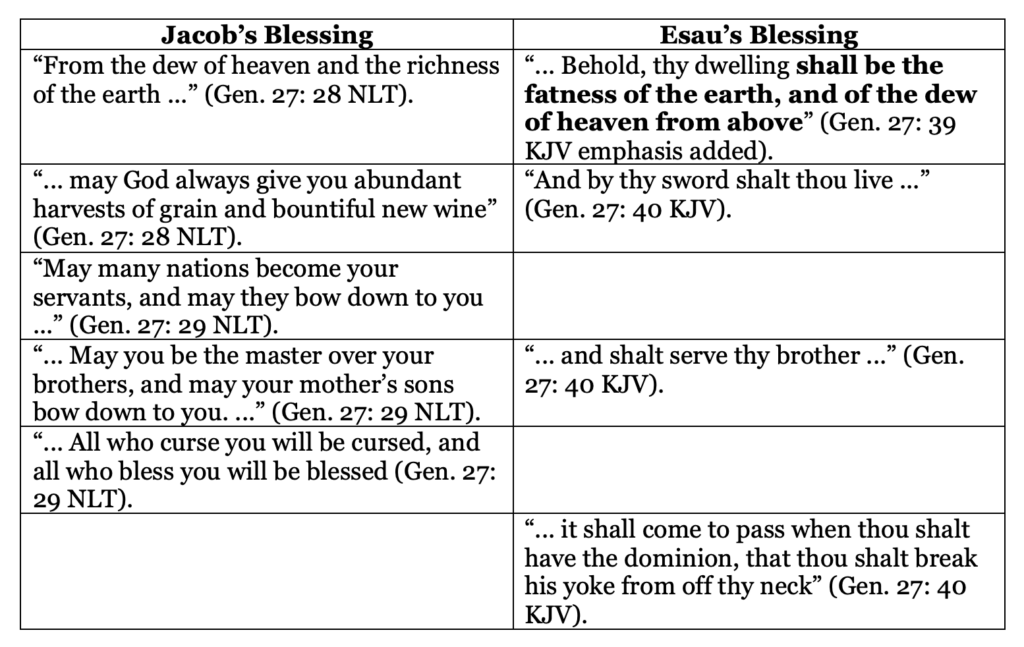
    “Finally, his father, Isaac, said to him [Esau], ‘You will live away from the richness of the earth, and away from the dew of the heaven above. You will live by your sword, and you will serve your brother. But when you decide to break free, you will shake his yoke from your neck’” (Gen. 27: 39-40 NLT)

    Think back to Isaac’s blessing of Esau.

    Yep. Edom stretched into the Arabian Peninsula. That is a scorched, unwelcoming land. Isaac nailed his blessing as prophecy.

    When we read that it sounded like Esau’s descendants just kind of married into and took over the clan, we may say that his descendants didn’t have to live by the sword.

    But Bradford said they did. He explained, “Esau’s descendants didn’t become shepherds……they became conquerors and bands of robbers who descended on caravans that passed through their lands. War was their way of life; war is even at the heart of what is now their religion; Islam.”

    Resource

    It took a while before the final blessing manifested itself. We’re going to talk about that in the next connection.

    Esau did have a large family. He was able to form clans and build a nation, even establishing kings.

    It is obvious to see that Jehovah kept His promise to bless Esau. Was he the covenant son? Well, no, but He had a different purpose for him. Not all blessings look like covenants.

    Making the Connections #2

    Fairy tale stories end with the saying, “And they lived happily ever after.” That doesn’t always happen in real life.

    Esau’s Edom and Jacob’s Israel were often in conflict in future years. In fact, Jews in first-century Israel would have identified Edomites as their enemies.

    That is one reason that it is very appropriate that this chapter be included. It can be used as a political map of the future.

    One of Esau’s descendants was Amalek.

    It is interesting (not really) that Israel is instructed not to attack Edom (Deut. 2: 4-5; 23: 7). Family means something to Jehovah – even rebellious family. He does not want us to respond in the same way to them.

    Jehovah recommends restraint, not retaliation.

    No, that didn’t last much longer than it took Israel to get a king. Saul fought the Edomites (I Sam. 14: 47). David eventually defeated them (II Sam. 8: 13-14).

    Go back to Isaac’s blessing. “You will live by your sword, and you will serve your brother.  But when you decide to break free, you will shake his yoke from your neck’” (Gen. 27: 39-40 NLT emphasis added).

    David may have had a decisive victory, but the Edomites weren’t totally subdued. Hadad escaped to Egypt and came back to haunt Solomon.

    The Edomites revolted during the reign of Jehoram of Judah. They did break off Israel’s yoke.

    But of course, they couldn’t leave Israel alone. In II Chronicles 28: 17, the Edomites attached when Israel was weak. They were on hand when the Babylonians destroyed Jerusalem.

    Yes, that was a brotherly betrayal. But here they were seen as cheering for their destruction (Ps. 137: 7).

    Unfortunately, that isn’t the end.

    • Ezekiel 25: 12-14, 35
    • Amos 1: 11-12
    • Isaiah 34: 63
    • Jeremiah 49: 7-22
    • Malachi 1: 2-4

    Whatever started as a pair of twin brothers ended up with rivalry, hostility, and betrayal.

    Making the Connections #3

    Esau started out with the same opportunities Jacob had. Even if he was not chosen as the covenant son, he could still have been Jehovah’s son.

    Having Isaac as a father and Abraham as a grandfather did not guarantee Esau anything with Jehovah. No elder can make it for us.

    So, instead of one of the chosen, we see Esau in all his pride, violence, evil, and opposition.

    What did it boil down to? The same test Cain had to go through – how do you treat your brother?

    Making the Connections #4

    Doesn’t it seem strange, though Jehovah had promised the land to Israel, that Edom was the first to obtain land? We would think it would have come about the reverse way.

    The problem is we aren’t always on Jehovah’s timetable. He likes to say, “Wait.”

    There are times I think that we don’t put enough honor in the covenant son. Jacob’s descendants put much stock in being Jehovah’s chosen people. Jehovah is most important.

    How Do We Apply This?

    • Be thankful that we are children of Jehovah.
    • Repent when we do not choose Him.

    Father God. You give each of us the same choice to make for ourselves: are we going to obey or disobey You? Help us to make the right decision. Forgive us when we get jealous of those we think You are using to do what we think we could. Help us to rely solely on Your Will. Amen.

    If you don’t understand something and would like further clarification, please contact me.

    If you have not signed up for the email providing the link to the devotions and the newsletter, do so below.

    If God has used this devotion to speak with you, consider sharing it on social media.
  • Dinah’s Defilement Avenged

    A great dishonor had been done to Jacob’s only daughter. This devotional reading looks at what Jacob’s sons did to get vengeance on the men of Shechem.

    Nuggets

    • Dinah’s brothers were not negotiating – they were planning revenge.
    • It wasn’t unheard of having men from other countries completed the circumcision ceremony and became Israelites.
    • Hamor and Shechem convinced the men of the city to agree to the alliance.
    • The circumcision procedure left the men physically weakened, allowing Simon and Levi opportunity to commit an unjust and cruel sin.
    • Jacob finally broke his silence after his sons carried out their vengeance.
    dinahs-defilement-avenged

    When we ended the last devotion, we were learning that Jacob and his sons were in negotiations between and Hamor and Shechem, the man who had defiled Dinah. Shechem said, “No matter what dowry or gift you demand, I will gladly pay it — just give me the girl as my wife” (Gen. 34: 12 NLT).

    Shechem wanted to marry the girl. What would her brothers say and do?

    Let’s Put It into Context

    To read devotions in the Creating Everything theme, click the button below.

    Devotions in the Jacob the Patriarch series

    Jacob’s Sons Respond

    “But since Shechem had defiled their sister, Dinah, Jacob’s sons responded deceitfully to Shechem and his father, Hamor. They said to them, ‘We couldn’t possibly allow this, because you’re not circumcised. It would be a disgrace for our sister to marry a man like you! But here is a solution. If every man among you will be circumcised like we are, then we will give you our daughters, and we’ll take your daughters for ourselves. We will live among you and become one people. But if you don’t agree to be circumcised, we will take her and be on our way’” (Gen. 34: 13-17 NLT)

    Jacob’s Sons Responded Deceitfully

     Dinah’s brothers were not negotiating – they were planning revenge.

    Well, deceit travels from generation to generation. Abraham lied about Sarah. Isaac lied about Rebekah. Jacob lied about so many things.

    Think about the times we’ve talked about deceit and manipulation already.

    • Deceiving Isaac (Gen. 27: 35)
    • Deceived by Laban (Gen. 29)
    • Deceiving Esau (Gen. 33: 14)
    • Used strategic manipulation in Genesis 30 against Laban

    We shouldn’t be surprised the cycle hadn’t been broken.

    No, the sin grew. Where Jacob used deception to receive a blessing, his sons now used deception to carry out vengeance.

    Let’s just stop a second because we really need to make sure we don’t miss this. This is the turning point in the chapter.

    Before this verse, the emphasis was on diplomacy and negotiation. Afterwards, the emphasis is on deception and violence.

    Moses didn’t distinguish between the brothers here. He does name names later, but here it looks like a united front. It is written like all brothers were in on the deception — even Joseph.

    We think our sin is hidden. The problem is sin grows.

    Not only that, but sin also travels. Our response to someone else’s sin can mushroom.

    You’re not Circumcised

    It wasn’t unheard of having men from other countries completed the circumcision ceremony and became Israelites.

    Sit back a second, and let’s take a look at ancient Shechem. It was a fortified settlement. Archaeological evidence shows that it had massive defensive walls with gates and towers.

    Along with the 1,000 to 5,000 residents and surrounding farmland and villages, it functioned as a regional administrative center.  It was on a major north-south trade route, the King’s Highway.

    This would have been a big deal.

    Well, they carried out their revenge by using a big deal. They used a covenant deal – circumcision.

    Yes, Gentiles could become Jewish by being circumcised. But here it became a religious boundary marker. “You’ll only be accepted if you do this.”

    Where was Jacob at in all of this? Was he even at the table? If he was, he gave the boys free reign and stayed silent.

    We don’t know if Jacob approved or disapproved of his sons’ plan. All we know is that he didn’t stop it.

    Convincing the Townsmen

    “Hamor and his son Shechem agreed to their proposal. Shechem wasted no time in acting on this request, for he wanted Jacob’s daughter desperately. Shechem was a highly respected member of his family, and he went with his father, Hamor, to present this proposal to the leaders at the town gate. ‘These men are our friends,’ they said. ‘Let’s invite them to live here among us and trade freely. Look, the land is large enough to hold them. We can take their daughters as wives and let them marry ours. But they will consider staying here and becoming one people with us only if all of our men are circumcised, just as they are. But if we do this, all their livestock and possessions will eventually be ours. Come, let’s agree to their terms and let them settle here among us.’ So all the men in the town council agreed with Hamor and Shechem, and every male in the town was circumcised” (Gen. 34: 18-24 NLT)

    Hamor and Shechem convinced the men of the city to agree to the alliance.

    Hamor and Shechem fell for it. That was because they had dollar signs in their eyes. They thought they were going to steal Jacob’s wealth.

    In that time period, court was held at the town gate. But what we see here is the extent of Hamor’s political authority.

    Hamor and Shechem convinced the townsmen that Jacob and his sons were friends. Would they have let their daughter and sister’s attacker get off scott free? I don’t think so. They would have been gathering their clansmen and riding off to Jacob’s shelters.

    The men of Shechem agreed to the plan because they, too, had dollar signs in their eyes. Not just a little, but “But if we do this, all their livestock and possessions will eventually be ours …” (Gen.  34: 23 NLT emphasis added).

    Hamor and Shechem saw Jacob and his sons as easy marks. Remember how large we said Jacob’s possessions and livestock had to be to be able to split into two camps and still make it look like one camp was all of his wealth?

    Wrong, but I wish the boys would have found another way to avenge Dinah.

    The Deceit Revealed

    “But three days later, when their wounds were still sore, two of Jacob’s sons, Simeon and Levi, who were Dinah’s full brothers, took their swords and entered the town without opposition. Then they slaughtered every male there, including Hamor and his son Shechem. They killed them with their swords, then took Dinah from Shechem’s house and returned to their camp. Meanwhile, the rest of Jacob’s sons arrived. Finding the men slaughtered, they plundered the town because their sister had been defiled there. They seized all the flocks and herds and donkeys—everything they could lay their hands on, both inside the town and outside in the fields. They looted all their wealth and plundered their houses. They also took all their little children and wives and led them away as captives” (Gen. 34: 25-29 NLT)

    The circumcision procedure left the men physically weakened, allowing Simon and Levi opportunity to commit an unjust and cruel sin.

    One man had committed a sin against Dinah. Jacob’s sons were going to take it out on the city – really, the city-state of Shechem.

    Simon and Levi didn’t have to worry about the fortified gate. They didn’t need to be concerned about being outnumbered.

    They got to focus on the killing.

    Only two of Jacob’s sons did the actual killing. All, however, took part in plundering the city, taking livestock, rounding up women and children. Again, Joseph was included in the group.

    Why just the two? One reason is the three of them were offspring of Leah. They were full brothers and sisters.

    What about Reuben, Judah, Issachar, and Zebulun? If Dinah was 15, they would have been 21, 18, 16, and 15. (Simon would have been 20, and Levi would have been 19.) They were also children of Leah?

    You know, reading this again, it doesn’t look like any but Simon and Levi knew that was what they were going to do. “Meanwhile, the rest of Jacob’s sons arrived. Finding the men slaughtered …” (Gen. 34: 27 NLT).

    It seems a little strange that Dinah was at Shechem’s house. The marriage hadn’t taken place. Still, she was kept in Shechem’s household after the assault.

    Was Dinah glad to be going home? Did they have to drag her kicking and screaming out of Shechem’s house? Was she appalled at the bloodshed?

    Regardless of the rescue of Dinah, the way they wreaked their vengeance was a sin. Yes, rape is horrible, but killing the entire male population of the town for the actions of one man is way over the top. All but Shechem were innocent of the crime for which they were punished.

    Don’t even think for one minute that they did it because of their religion. Leale called it a hypocritical pretense of religion. Bush addressed this, too. He wrote, “They knew that if the Shechemites were persuaded to submit to circumcision it would be a mere form, leaving them as to their relation to God just where they were before.”

    Resources

    Jacob’s sons may not have known the plan to steal all of Jacob’s wealth. They did know the men of Shechem weren’t going to be converts to Judaism.

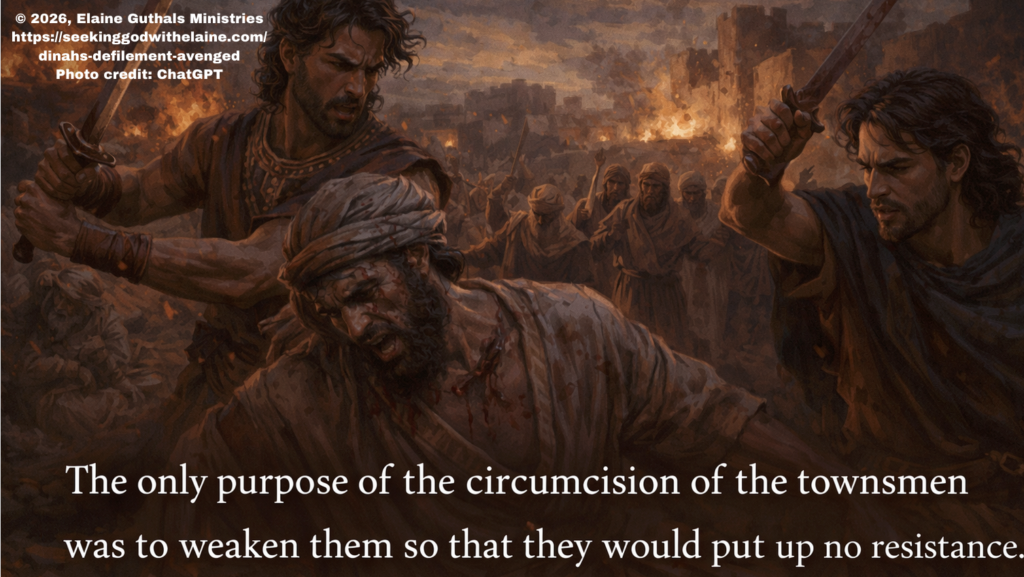
    The only purpose of the circumcision of the townsmen was to weaken them so that they would put up no resistance.

    No, the eye-for-an-eye verse does not justify this (Ex. 21: 24, Lev. 24: 20, and Deut. 19:21). Eye-for-an-eye justice wasn’t about personal vengeance. It was actually a legal principle used by judges to regulate justice and limit retaliation.

    Remember the culture of the day. Clans were very quick to defend their honor with out-of-control retaliation. They wanted to make sure the punishment must not exceed the offense.

    Yep, it sure did in this instance.

    Jacob Finally Weighs In

    “Afterward Jacob said to Simeon and Levi, ‘You have ruined me! You’ve made me stink among all the people of this land — among all the Canaanites and Perizzites. We are so few that they will join forces and crush us. I will be ruined, and my entire household will be wiped out!’ ‘But why should we let him treat our sister like a prostitute?’ they retorted angrily” (Gen. 34: 30-31 NLT)

    Jacob finally broke his silence after his sons carried out their vengeance.

    I can get Jacob’s concerns, and I can get the boys’ anger. Both were right.

    Jacob saw it as life is full of one thing after another. Jesus said that was the way it was going to be. “I have told you all this so that you may have peace in me. Here on earth you will have many trials and sorrows. But take heart, because I have overcome the world” (Jn. 16: 33 ESV).

    We sometimes feel that we have to take everything into our own hands. We don’t wait and let God take care of it.

    But this was bloodshed. This wasn’t self-defense. It was flat out murder.

    And all Jacob was interested in was political retaliation. Now, Jacob would have to live in fear of of that threat.

    Jacob was putting down roots in Shechem. He bought land. Yeah, what shepherd does that?

    But since Jacob didn’t’ step up and say, “Boys, this plan of yours is wrong. It is murder!”, he had to move on.

    Making the Connections #1

    We see the focus on the family honor – which is good to have. But where were the boys’ individual morality? Even Joseph pitched in to ransack the city.

    Were they so blinded by their anger at the dishonor done to Dinah that they lost their honor? Or was this an indication of the condition of their hearts?

    We should never say, “Oh, this was Jacob and his family. Nothing bad like this should ever have happened to him.”

    Remember, it is during experiences like this this that new bricks are laid on our Sanctification Road. Even Jacob – even Reuben – even Joseph – has their own Sanctification Road. It is how we grow closer to Jehovah.

    Making the Connections #2

    This story of violence and dishonor is sandwiched between Bethel stories.

    Jacob and his family had just arrived at the end of Gensis 33. There was just one problem.

    Jacob went to Shechem, not Bethel. Yes, Shechem was the location of Abraham’s first altar. It is where he landed upon reaching the Promised Land.

    But that wasn’t where Jacob was commanded to go. He was supposed to go to Bethel. If we look at our timeline (which we’ll discuss more fully in the next devotion), it looks like Jacob could have stayed in Shechem for over 10 years.

    That isn’t following Jehovah back to Bethel. “And this memorial pillar I have set up will become a place for worshiping God, and I will present to God a tenth of everything he gives me” (Gen. 28: 22 NLT).

    We’ll find out in Genesis 35 that Jehovah clearly commands Jacob to go to Bethel. Good things happen, which we will get into next.

    The takeaway here is that Sovereign God will pull us back when we sin.

    Making the Connections #3

    Let’s look at the escalation of sin.

    • Dinah left the covenant compound.
    • She was met with sexual violence.
    • A political compromise was offered to lull believers into assimilation with non-believers.
    • Jacob’s sons as well as Hamor and Shechem were deceitful.
    • The boys used something sacred as a weapon of violence.
    • Revenge became mass murder.
    • Plundering and enslavement topped whole sad affair.

    So, it started out with the sin of one man. It escalated to a family’s response. A whole town was destroyed.

    How Do We Apply This?

    • Understand no one is above God’s Laws.
    • Don’t allow our grief or anger lead us into sin.

    Resource

    Father God. We say two wrongs don’t make a right. That was especially true in this case — and a whole town suffered because humans think it does. Forgive us when we struck back after suffering a devastating experience. Amen.

    If you don’t understand something and would like further clarification, please contact me.

    If you have not signed up for the email providing the link to the devotions and the newsletter, do so below.

    If God has used this devotion to speak with you, consider sharing it on social media.

  • The Defilement of Dinah

    We’ve made our way to Genesis 34, a chapter that is hard to read. This devotional reading looks at the lust, vengeful violence, and deception caused by one act of sin.

    Nuggets

    • Dinah was the only daughter that we know of born to Jacob.
    • Jacob had moved his family to Shechem upon return from Paddan-aram.
    • Shechem seemed like he wanted to make amends for forcing himself on Dinah.
      Rape, in the Ancient Near East culture, was primarily considered an offense against the woman’s family.
    • Since Shechem had fallen in love with Dinah, a required marriage fit into his plans.
    • Whether Jacob was stunned by the turn of events or biding his time for the boys to get home, he and his household faced a really dreadful calamity.
    • While there was no indication of remorse in the rape of Dinah, a bigger alliance than just a marriage was being offered.
    the-defilement-of-dinah

    This story is one of the saddest ones in God’s Word. We can’t look at it through the lens of today’s society, though. We have to look at it through Ancient Near Eastern culture.

    Even when we get a better idea of the cultural backdrop, we see that the of  actions taken by Shechem can’t be justified.

    But then, the consequences of those actions were not justifiable, either. Let’s jump into this sad story.

    Let’s Put It into Context

    To read devotions in the Creating Everything theme, click the button below.

    Devotions in the Jacob the Patriarch series

    The Defiling of Dinah

    “One day Dinah, the daughter of Jacob and Leah, went to visit some of the young women who lived in the area. But when the local prince, Shechem son of Hamor the Hivite, saw Dinah, he seized her and raped her.But then he fell in love with her, and he tried to win her affection with tender words. He said to his father, Hamor, “Get me this young girl. I want to marry her’” (Gen. 34: 1-4 NLT)

    Dinah Went to Visit

    Dinah was the only daughter that we know of born to Jacob.

    Dinah was the daughter of Jacob and Leah. “Later she gave birth to a daughter and named her Dinah” (Gen. 30: 21 NLT).

    So, where did Dinah come in on the baby war?

    1716 BC – Jacob, 84, was tricked into marrying Leah. He agreed to work seven more years for Rachel
    ~1715 BC — Reuben born (Leah)
    ~1714 BC — Simeon born (Leah)
    ~1713 BC — Levi born (Leah)
    ~1712 BC — Judah born (Leah)
    ~1712 BC — Dan born (Bilhah)
    ~1711 BC — Naphtali born (Bilhah)
    ~1711 BC — Gad born (Zilpah)
    ~1710 BC — Asher born (Zilpah)
    ~1710 BC — Issachar born (Leah)
    ~1709 BC — Zebulun born (Leah)
    ~1709 BC — Dinah born (Leah)
    1709 BC – Joseph was born (Rachel)
    1703 BC – Jacob, 97, and his family left to return to Canaan (Gen. 31: 3)

    Based on Timeline from

    We know that Dinah fit in between Zebulon and Joseph. She would have been around seven when Jacob moved the family back to Canaan.

    The thing is that we don’t know how long Jacob had been in the land. Ness and Kalisch estimated that it was six to eight years. That would have made Dinah around 13 to 15 – marriageable age.

    Resources

    While she was not yet married (which usually happened when they were 15 to 17 years old, she was old enough to —apparently — go out on her own. Dinah interacted socially with Canaanite women of the area.

     Lived in the Area

    Jacob had moved his family to Shechem upon return from Paddan-aram.

    We have to put things into perspective. When we left Jacob in Genesis 33, we had just been told that he had bought some land.

    “Later, having traveled all the way from Paddan-aram, Jacob arrived safely at the town of Shechem, in the land of Canaan. There he set up camp outside the town. Jacob bought the plot of land where he camped from the family of Hamor, the father of Shechem, for 100 pieces of silver” (Gen. 33: 18-19 NLT).

    Jacob would have moved his family to Shechem in 1703 BC. Dinah would have been seven at the time.

    If she was a teenager in this story, that would have put it at least five years at a minimum after the family moved into the area.

    It appears that Dinah had become friendly with other girls in the neighborhood. One day, she paid them a visit. An Ancient Near East teenager would typically do this.

    Leale thought Dinah had developed a curiosity about her new homeland. When we move somewhere new, it is understandable to want to learn that areas customs and way.

    Resource

    But as people who walk with Jehovah, we have to watch very carefully that we aren’t reeled into walking away from Him. The world and its glitter can be very tempting – especially to a teenager.

    Shechem

    Shechem seemed like he wanted to make amends for forcing himself on Dinah.

    We know a couple of things about Shechem.

    • He was a prince.
    • His father’s name was Hamor — remember Jacob – who hadn’t owned land before – had bought this land from the family of Hamor.
    • Hamor was a Hivite.

    We haven’t talked about Hivites before, but they are important in the history of Israel.  This was one of the nations the Israelites were told that Jehovah would clear out of Canaan upon their return from captivity in Egypt (Deut. 7: 1).

    As well as living here at the city of Shechem, Hivites lived in the region of Gibeon. This group tricked Joshua and the Israelites into making a treaty with them (Josh. 9).

    It is believed that the Hivites could be either city-dwelling or agriculturally based. Under local prince’s rule, some cities like Shechem were organized as small kingdoms.

    This is an element that upped the ante a bit. When the marriage proposal was introduced in a couple of verses, Hamor suggestions of intermarriage, shared land, and economic integration were not things Jehovah wanted.

    Why did Jehovah want the Hebrews intermingling with the Canaanite people? “You must not intermarry with them. Do not let your daughters and sons marry their sons and daughters, for they will lead your children away from me to worship other gods. Then the anger of the Lord will burn against you, and he will quickly destroy you” (Deut. 7: 3-4 NLT).

    Israelites tended to adopt Canaanite customs – especially idol worship – when alliances were formed.

    Anyway, back to Shechem.

    Seized and Raped Her

    Rape, in the Ancient Near East culture, was primarily considered an offense against the woman’s family.

    Versions in the Sefaria Library run the gamut on the word used to describe Shechem’s actions toward Dinah.

    • Lay
    • Humbled
    • Mistreated
    • Disgraced/violated
    • Forced/defiled

    Resource

    Some scholars, though, do not think this should be classified as a rape. They point to her silence in trying to defend herself by calling out.

    Did you catch that Dinah said nothing during this whole chapter. But the whole chapter started with her honor and ended with her honor.

    If we go back to the Hebrew for verse 2, we see the words do cry rape. These are

    •          “took her” (lāqaḥ) – forceful taking
    •          “lay with her” (šākab) – sexual relations
    •          “humiliated/defiled” (ʿānâ) – violation or dishonor

    Kadari documented some of the interpretations in the Midrash and Aggadah. I have to be honest. Some of the rabbinical interpretations presented to fill in the gaps – for me – were really out there. One such interpretation noted Dinah’s desire to be noticed as she visited the Canaanite daughters.

    Resource

    Whatever Shechem’s actions were, the outcome had disastrous results for Dinah. Adelman explained. She wrote,

    “In the biblical world of the Ancient Near East, when a virgin had sex out of wedlock — whether seduced or raped — she was devalued in terms of her social status, bringing shame upon the family. Her virginity was crucial in negotiations over bride-price and the familial alliances forged through marriage. In the legal discourse around sexual intercourse with a virgin outside of wedlock, whether she was betrothed to another man or not, the woman was presumed to have consented if she did not cry out in protest in the city or town, and to have been raped if she was taken in the open country where her cries could not have been heard (Deuteronomy 22:23-29).  The woman’s will or testimony was simply not taken into account.”

    Resource

    I keep thinking this may just be another example of Moses’ brevity of information. Whether the act was committed through violence or promiscuity, it was committed.

    The outcome was the same. Dinah’s mohar (bride-price) just went down big time.

    But did it? “Suppose a man has intercourse with a young woman who is a virgin but is not engaged to be married. If they are discovered, he must pay her father fifty pieces of silver. Then he must marry the young woman because he violated her, and he may never divorce her as long as he lives” (Deut. 22: 28-29 NLT).

    Jehovah established consequences that allowed victims to be united in marriage with their violator.

    It was interesting that Kalisch equated this with two other accounts where the women in Abraham’s line were taken by the leaders of the area they were in. Sarah was taken by Pharaoh, and Rebekah was taken by Abimelech.

    The difference, of course, in those two cases were that the men – Abraham and Isaac – lied, saying their wives were their sisters.

    Here, Jacob did everything right (that we can tell). Where the older women were probably taken to establish alliances, this sounds like pure lust on Shechem’s part.

    The difference here, too, was that Dinah was defiled. Sarah and Rebekah weren’t.

    Look at what Kalisch said about this. He wrote,

    “She paid the full penalty of her carelessness. She suffered the fate which Sarah and Rebekah encountered in the land of Pharaoh and of Abimelech; she was seen and taken by the son of the prince; but no angel guarded her innocence; no Divine vision shielded her from disgrace; and she fell a victim to Shechem’s passion. She did not require that immediate protection which her ancestors had enjoyed; she was a maiden, no wife; her father possessed a piece of land within which he was safe; and she belonged to a numerous family well capable of defending their rights.”

    Resource

    This instance turned out very differently. One reason was probably because she was never chosen to bear a covenant son.

    He Fell in Love with Her

    Since Shechem had fallen in love with Dinah, a required marriage fit into his plans.

    But then the plot thickens. Shechem fell in love with Dinah. He wanted her for his wife.

    No, I don’t think that should excuse Shechem; but under other circumstances, that would have been a benefit to a forced marriage.

    Regardless of whether he forced or seduced Dinah, Shechem did the right thing and pursued marriage.

    So, Shechem sent his dad Hamor to negotiate with Jacob so he could have Dinah as his wife. This was normally the way the negotiations worked. It’s called standard patriarchal marriage diplomacy.

    We’ve talked about the marriage negotiations before – and it was negotiations!

    True, a big part was the mohar or bride price. It was a transfer of wealth. It could be silver, animals, or some other valuables.

    No, the Law hadn’t been given yet. But Jehovah is the same yesterday, today, and tomorrow.  I think this forced marriage with the bride-price would have been required anytime the offense occurred.

    Jacob’s Response

    “Soon Jacob heard that Shechem had defiled his daughter, Dinah. But since his sons were out in the fields herding his livestock, he said nothing until they returned. Hamor, Shechem’s father, came to discuss the matter with Jacob. Meanwhile, Jacob’s sons had come in from the field as soon as they heard what had happened. They were shocked and furious that their sister had been raped. Shechem had done a disgraceful thing against Jacob’s family, something that should never be done” (Gen. 34: 5-7 NLT)

    Whether Jacob was stunned by the turn of events or biding his time for the boys to get home, he and his household faced a really dreadful calamity.

    In the New Living Translation in these verses, Jacob is portrayed as someone who wants to keep peaceful relations with those around him. That makes us think of Abraham. We can see his response to the situation stemming from that.

    In the Complete Jewish Bible, though, it says that Jacob had to restrain himself until his sons came back. They are described as saddened and very angry.

    That would put Jacob’s feelings on par with those of his sons.

    But let’s put it into context again. We said that rape, in the Ancient Ner East culture, was primarily considered an offense against the woman’s family. That meant it affected more than just dear old dad. It affected brothers, too.

    Think clan mentality. This was clan business. Honor issues required a family response.

    But remember, Hamor was a prince. Shechem himself was probably a powerful local ruler. Jacob would have been a resident alien.

    Hamor did his part. He went to see Jacob. It sounds like he, too, wanted to make the situation right. He wanted to work the established process.

    If we look at verse 7 in the Orthodox Jewish Bible, it says that the offense was against Israel. Not Jacob. Not his family.

    Against the nation. This is the first time the nation of Israel is addressed. They are starting to get their identity.

    The Negotiations

    “Hamor tried to speak with Jacob and his sons. ‘My son Shechem is truly in love with your daughter,’ he said. ‘Please let him marry her. In fact, let’s arrange other marriages, too. You give us your daughters for our sons, and we will give you our daughters for your sons. And you may live among us; the land is open to you! Settle here and trade with us. And feel free to buy property in the area.’ Then Shechem himself spoke to Dinah’s father and brothers. ‘Please be kind to me, and let me marry her,’ he begged. ‘I will give you whatever you ask. No matter what dowry or gift you demand, I will gladly pay it — just give me the girl as my wife’” (Gen. 34: 8-12 NLT)

    While there was no indication of remorse in the rape of Dinah, a bigger alliance than just a marriage was being offered.

    Hamor didn’t say a word about the rape. He offers a political integration:

    • Intermarriage
    • Shared land
    • Economic cooperation

    Yeah, it sounded like a treaty deal, didn’t it?

    If Hamor wasn’t going to address it, why did Shechem feel he had done something wrong?

    But wasn’t Shechem offering the normal bride price and gifts? Plus, he added he would do whatever was demanded – as long as he got the girl.

    God did not want Jacob’s sons marrying the local girls. It is sad that He allowed it to go to this length to make it so.

    Making the Connections #1

    We all know that sin can bring fairly immediate consequences. Depending on how long a time had occurred from arrival in Shechem to the disastrous visit to Canaanite daughters, this may or may not have been the case.

    But it may have been punishment for sin. Look back at some verses.

    ·      “What’s more, I am with you, and I will protect you wherever you go. One day I will bring you back to this land. I will not leave you until I have finished giving you everything I have promised you” (Gen. 28: 15 NLT).
    ·      “I am the God of Bethel, where you anointed a pillar and where you made a vow to me. Now leave this land at once and go back to your native land” (Gen. 31: 13 NIV).

    Jacob, that night at Bethel, said his condition was that he bring him back to his father’s house (Gen. 28: 21).

    Meyer argued that Jacob was not where he was supposed to be. “God had not said, Go to Shechem; but, “I am the God of Bethel.” Bethel, rather than Shechem, was his appointed goal.”

    Resource

    We can’t bite on Jacob for disobeying Sovereign God when we do the same thing. We either don’t listen or decide to do things our own way.

    Meyer took Jacob’s disobedience one step farther. He set up his new home before the Shechem (just as Lot did before Sodom).

    Making the Connections #2

    Was this Satan trying to get Jacob to disobey Jehovah and allow intermarriage with the Canaanites? Maybe. Maybe not.

    Making the Connections #3

    The issue wasn’t whether or not Shechem loved Dinah. We know he wanted her.

    The issue was that Jacob’s family was not to intermarry with the Canaanites. That is why Abraham sent Eliezer to get Isaac a wife. That is why Jacob went himself.

    The covenant line needed covenant people from Abraham’s extended family to ensure a pure bloodline.

    How Do We Apply This?

    • Recognize that even believers will face trials.
    • Accept that the faith of the parents is not always reflected in their children.

    Resources

    Father God. Sin is a terrible thing. When we sin reacting to a sim, that is worse. Help us to focus on You. Amen.

    If you don’t understand something and would like further clarification, please contact me.

    If you have not signed up for the email providing the link to the devotions and the newsletter, do so below.

    If God has used this devotion to speak with you, consider sharing it on social media.

  • Jacob’s Wedding Ceremony

    The seven years that Jacob had worked for Laban for Rachel’s hand in marriage had gone off without a hitch. This devotional reading looks at how the morning after the wedding ceremony fell apart.

    Nuggets

    • Jacob receives compensation for his seven years of labor for Laban, but it wasn’t the wife on which he agreed.
    • Leah was gaining a husband but not a real marriage.
    • We have to be asking ourselves by this point, where in the world was Rachel?
    • Finally, Rachel was given by Laban to Jacob as his wife.
    jacobs-wedding-ceremony

    The moment Jacob has been waiting for for seven long years was finally here. But it sure didn’t turn out as he planned!

    Let’s Put It into Context

    To read devotions in the Creating Everything theme, click the button below.

    Devotions in the Jacob the Patriarch series

    Let’s Put It into Context #2

    What was an Ancient Near East wedding ceremony like?

    It started with a public feast. That means witnesses — possibly a lot of them if we are talking whole village.

    There was a formal transfer of the bride from her father to the groom. This would have been done in the evening.

    There was nothing like we would see in even first-century Israel. Jacob’s ceremony would have had no rabbi, no chuppah, no standardized liturgy, no ring ceremony, and no glass breaking.

    It would have had a feast (probably for several days), a procession to the groom’s house, the transfer, and the consummation.

    Laban’s Deception

    “Finally, the time came for him to marry her. ‘I have fulfilled my agreement,’ Jacob said to Laban. ‘Now give me my wife so I can sleep with her.’ So Laban invited everyone in the neighborhood and prepared a wedding feast. But that night, when it was dark, Laban took Leah to Jacob, and he slept with her. (Laban had given Leah a servant, Zilpah, to be her maid.)” (Gen. 29: 21-24 NLT)

    Jacob receives compensation for his seven years of labor for Laban, but it wasn’t the wife on which he agreed.

    Now, we get to see a dysfunctional family at its finest. Yes, Jacob was probably saying déjà vu, but each of the characters in this play wanted something they didn’t have.

    They weren’t as easy to herd as the sheep.

    Too bad the Law hadn’t been given yet. “While your wife is living, do not marry her sister and have sexual relations with her, for they would be rivals (Lev. 18: 18 NLT).

    But then, what happened really wasn’t Jacob’s choice, was it?

    Jacob just wanted a wife — and he wanted that wife to be Rachel.

    How come in verse 21, Jacob said, “… give me my wife …” (Gen. 19: 21 NLT)? Why didn’t he name Rachel? Probably, Jacob assumed that wife was not dangling but that it was referring back to the agreement.

    The deceiver had done everything by the book — at least we aren’t told he did anything differently (and I think we would have been). This was the love of his life that he was working for — he wouldn’t screw it up.

    But look at it this way. Jacob had pretended to be the older brother, too. Granted, he was the covenant son.

    Still, the firstborn held special status in the Ancient Near East. That included the women as well as the men.

    We don’t know if Laban always intended to switch Leah for Rachel (or switch her if she hadn’t found a husband by then). Since it was the custom that the older be married first, he conveniently left that out of the agreement. Plus, wouldn’t Jacob know that?

    That Laban knew but didn’t say anything about it when entering into the agreement with Jacob makes it easy to assume the switch was always the plan.

    Whatever his intent and purpose, Laban’s words did not match his actions. He let Jacob think for seven years that he was working for Rachel.

    Look at when the daughter is finally identified. “But that night, when it was dark, Laban took Leah to Jacob, and he slept with her” (Gen. 29: 23 NLT). This was the point of no return. The sun had probably been down a long time, and the oil lamps would have been lit.

    This was definitely Laban’s choice. He took Leah to Joseph instead of Rachel.

    Leah’s Deception

    “But when Jacob woke up in the morning — it was Leah! ‘What have you done to me?’ Jacob raged at Laban. ‘I worked seven years for Rachel! Why have you tricked me?’ ‘It’s not our custom here to marry off a younger daughter ahead of the firstborn,’ Laban replied” (Gen. 29: 25-26 NLT)

    Leah was gaining a husband but not a real marriage.

    Growing up, I just heard about Jacob and Laban. But think about it. Leah and Rachel had to be in on the conspiracy. Let’s take Leah first.

    Leah probably had always had the expectation to be married first. It probably was the custom that the oldest marry first, sometimes delaying a younger daughter’s marriage. Archeological evidence proves that was the preference in the region.

    But look at Laban’s wording. He never said never or forbidden. He just said custom.

    True, family honor was tied up in marriage negotiations. But Laban came off as a deceiver since he didn’t bring up the custom until after the deception.

    It doesn’t seem like Leah had any prospects. Remember, though, that the midrash states that Leah was supposed to marry Esau. That was supposedly the reason behind her weak, soft eyes.

    Huh. Maybe that is why Laban did the switch. He must have thought that Isaac reneged on the deal since Esau was happily married.

    In a way, that makes sense to me. If all her other suitors were turned away or didn’t show up in the first place because she was promised, Laban may have thought her chances were slim to none after he realized that negotiation fell through and Rachel had a fish on the line.

    Still, that doesn’t excuse Laban’s action. Deception is deception regardless of motivation. Or as we say, two wrongs don’t make it right.

    Anyway, Leah must have been in on the conspiracy.

    Leah had to have had strict orders not to open her mouth and give away who she was. The heavy veiling helped the deception.

    I know. We don’t know when the switch occurred. It is easy to think she was switched right before the consummation time.

    I don’t see Laban allowing the wedding night before the transfer.

    But what about the feast? Was Leah veiled then and have to keep her mouth shut for 10 hours maybe? Probably six at the screaming outside. It depended on how long the feast took place.

    The key legal moment was when Laban handed Leah to Jacob for the transfer into the groom’s household. That would have been in the evening, heavily veiled and after the fruit of the vine had flowed freely.

    Instead of getting a husband who loved her, Leah got a husband who didn’t trust her — and it was her fault. She had gone along with the deception.

    Could Jacob have refused Leah? (All he said basically was, “What’s up?) Well, yes and no.

    The bride-price had been paid. It was paid through labor, not money that could just be given back.

    The feast had occurred, as had the transfer and the wedding night. It would have been very catastrophic for Leah if Jacob would have said, “No deal.”

    Don’t forget location. Jacob was around 500 miles on his own. It would have taken anywhere from three to five and a half weeks to make the journey back to Beersheba — one way.

    Double that if he called for reinforcements. And wouldn’t that have gone over like a lead balloon?

    But back to the wedding night. Ancient Near East law — like Hammurabi’s Code composed during 1755–1751 BC — said after transfer and consummation (not the “I do’s” as we know it), it as legally binding.

    The reason for that was it would shame the bride and disgrace the father. (I think that is, in this case, a bit absurd. Shouldn’t both have felt shame for their deception?)

    Jacob said nothing about annulling it. He didn’t reject Leah and give her back.

    So, Jacob and Leah were married. But Leah was used by her father, married to a man who didn’t want or love her, and — in case they weren’t before — became a rival with her sister.

    Put this into context with what happened to Jacob. Isaac was blind, where this took place in the dark. Leah was heavily veiled, where Jacob had props of goat skins covering his smooth skin. Leah passed herself off as Rachel, where Jacob had passed himself off as Esau. The marriage, just like the blessing, was irreversible.

    Rachel’s Deception

    “But wait until the bridal week is over; then we’ll give you Rachel, too — provided you promise to work another seven years for me” (Gen. 29: 25-27 NLT)

    We have to be asking ourselves by this point, where in the world was Rachel?

    God’s Word is glaringly silent on where Rachel was and what she was thinking and feeling.

    Let’s look at some of the options Rachel had. She had a choice between obeying or disobeying her father. I know, integrity says disobey.

    Was that really an option? In that culture, she would not have gotten any support to do that.

    In that culture, daughters were valued within the household, partly because of economic significance. The big reason was she was under the authority of her father until marriage — when guardianship was transferred to the husband. That is why daughters could be used for family alliance-building.

    We know Rebekah had a voice as to when she was leaving (Gen. 24: 57) to go to Hebron or Beersheba (wherever Abraham was). But she didn’t have a say whether she was willing to be married.

    A daughter having a voice was very limited in that culture. But just as Leah was silent, Rachel was silent.

    Did this make Rachel complicit or pressured?

    There is nothing in the Scriptures that says Rachel felt any differently about Jacob than he did for her. So, here is the love of Rachel’s life marrying her sister. Her sister is getting the wedding she always dreamed of having (because it doesn’t say they threw a second big party the next week when Rachel and Jacob finally got to get married).

    Rachel may have known that Laban eventually was going to give her as a wife to Jacob. But she wouldn’t get a feast of her own — and she couldn’t go to the wedding feast they had.

    Think about it. They were having a seven-day wedding celebration — and we know it did go on for seven days. “But wait until the bridal week is over; then we’ll give you Rachel, too …” (Gen. 29: 27 NLT).

    If Leah was veiled, and Rachel showed up, the deception would have been revealed. Oh, wouldn’t that have been priceless?

    Rachel slides up to her cousin Levi and says, “How is it going?” He’s doing this dramatic double take. “Aren’t you supposed to be over there in the wedding party?” So, no. Rachel must have been in seclusion.

    But we never see where Jacob even considered Rachel’s complicity in the deception. He may have thought her hands were tied.

    Rachel could have made it know that she wasn’t the one going into the tent with him. But she kept silent.

    Since the feast did go on a week, it would have been expensive. The community probably couldn’t come to a two-week feast. Besides, they may have considered a second week an extension of the first.

    Yes, all in all, Rachel came out okay. Leah may have gotten the wedding, but Rachel got the honeymoon.

    Seven More Years

    “So Jacob agreed to work seven more years. A week after Jacob had married Leah, Laban gave him Rachel, too. (Laban gave Rachel a servant, Bilhah, to be her maid.) So Jacob slept with Rachel, too, and he loved her much more than Leah. He then stayed and worked for Laban the additional seven years” (Gen. 29: 28-30 NLT)

    Finally, Rachel was given by Laban to Jacob as his wife.

    Kalisch made an interesting observation we might discount at first glance. He said that Laban’ deception destroyed the practice of monogamy within the patriarchs.

    Resource

    I see you jumping up and down over there. No, I am not forgetting Hagar and Keturah.

    Remember, both Hagar and Keturah were concubines. Sarah was first wife.

    Legally, Leah was first wife, and Rachel was second wife. But Leah and Rachel were on equal footing. Rachel wasn’t a concubine.

    How do we know Rachel wasn’t a concubine?

    • Laban gave Rachel to Jacob as his wife.
    • Jacob paid the mohar by seven more years of service.
    • Rachel was called isha, not pilegesh.

    Rachel may have been the intended bride and was the beloved wife, but she was not the first wife except in emotion priority.

    Jacob may have felt there was no issue loving one wife more than the other. After all, he had grown up in a family where Isaac had Esau as his favorite while Rebekah had Jacob as her favorite.

    How would wives be much different!

    Making the Connections #1

    We have to talk about the God factor.

    Does it say that Jacob asked Jehovah who his wife should be? No.

    Is that definite proof that Jacob didn’t? No.

    What is evident throughout the story is that Jehovah was in control.

    Let’s look at it from this way. Jehovah was wanting to build a nation. He had picked Abraham. He had picked Isaac. Now, He had picked Jacob.

    Yes, Jehovah picked Rachel, too. But for reasons only He knows, He decided that she would only have two kids. Yes, Abraham had Isaac, Ishmael, and the five sons of Keturah; and Isaac had Jacob and Esau.

    Still, the nation wasn’t getting anywhere fast on those low numbers — especially when we remember six of Abraham’s sons were not Hebrews.

    Jehovah wanted a big population boost here. He knew that Jacob would only and always see Rachel as his soul mate.

    Jehovah wanted to get the party started.

    No, I don’t know why Jehovah had to go and choose sisters. This is especially true when He later outlawed it (Lev 18: 18).

    And then to add two more concubines on top of that. (Laban gave servants to each of the girls, who became concubines in the baby war.)

    Yes, Jehovah had to do something. Jacob would have been content with just Rachel.

    Jehovah used the situation to further His kingdom by making sure Jacob would have 12 children.

    Making the Connections #2

    Meyer said that marriage should only be “in the Lord.” He gave two verses to illustrate what he meant.

    Resource

    • “You must not intermarry with them. Do not let your daughters and sons marry their sons and daughters” (Deut. 7: 3 NLT).
    • “A wife is bound to her husband as long as he lives. If her husband dies, she is free to marry anyone she wishes, but only if he loves the Lord” (I Cor. 7: 39 NLT).

    What are we to glean from these two verses?

    • Believers should not intermarry with non-believers.
    • The bond of marriage is for life. It can only be broken by the death of a spouse.

    Making the Connections #3

    So, did Laban consider his daughters as property? Maybe. Maybe not.

    As father, Laban was, according to Mendelsohn, the baal — or owner — of his wives and children. He had complete say as to his daughters’ future.

    Resource

    But women were important members of the household. They shared part of the labor, resources, and responsibilities for the wellbeing of the family.

    The family was more of an economic and social unit. This is probably due to the multigenerational nature of the household.

    That doesn’t mean that Laban didn’t love his daughters. We know that “Laban got up early the next morning, and he kissed his grandchildren and his daughters and blessed them. Then he left and returned home” (Gen. 31: 55 NLT emphasis added).

    Kalisch had a good observation about the bride-price. He noted that some may think that, if the bride-price included money, the groom was basically buying his wife as a slave.

    Resource

    Vital to his happiness. Worth more than money. A treasure. Most valuable asset.

    Not slave. Not even servant.

    I think it would be more of a slap in the face if the loss of a valued member if the family was ignored back in those days.

    Many of the fathers of the Ancient Near East funneled a part of the mōhar to the daughter. It was to ensure her future security.

    Unfortunately, Laban did not forward the money to either daughter. He kept it all for himself.

    Making the Connections #4

    We may think lying has no consequences. We would be wrong. We find out what the consequences feel like when the deception is pulled on us.

    Pain is generally associated with being lied to — the severity of it depends on the who, what, when, why, and where. But the hurt from the lie can be devastating.

    The degree of anger is probably in correlation to the degree of pain. Sometimes, it is not even a conscious reaction. We just react.

    That says nothing about the fallout from the deception. Even if there is no physical consequences — like lost wages, lost time, etc. — there can be some variation of lost relationship. Are we really doing to trust that person again?

    Jacob now knew how it felt.

    Is that to say that Jacob hadn’t been on the receiving end of a lie before? Oh, no.

    That means nothing had been more important to him than this.

    And now he knows.

    Making the Connections #5

    We aren’t told how old Leah and Rachel are. But let’s look at the timeline.

    1723 BC – Jacob cheated Esau (both age 77) out of the birthright blessing given by Isaac age 137). He flees Canaan to Paddan-aran to Rebekah’s family. He agrees to work seven years to earn the right to marry Rachel (Gen. 29: 1-20)
    1716 BC – Jacob, 84, was tricked into marrying Leah. He agrees to work seven more years for Rachel
    1709 BC – Jacob, 91, finished working seven years for Rachel and agreed to continuing working for Laban to build up his personal wealth.
    1703 BC – Jacob, 97, and his family left to return to Canaan (Gen. 31: 3)

    Based on Timeline from

    If we go on usual ages, Rachel would have probably been 15 to 17. Leah was older, so she could have been — at a minimum — 16 to 18.

    Jacob could have had been 70 years older than the girls.

    How Do We Apply This?

    • Confessed our sins to God and forgive
    • Obey God’s Word.
    • Make sure our actions do follow our words.
    • Be people of integrity and honesty.
    • Ensure that our actions follow our words.

    Father Good. We can be so deceptive at times. But You take all our choices and work the into Your plan. Thank You. Amen.

    If you don’t understand something and would like further clarification, please contact me.

    If you have not signed up for the email providing the link to the devotions and the newsletter, do so below.

    If God has used this devotion to speak with you, consider sharing it on social media.
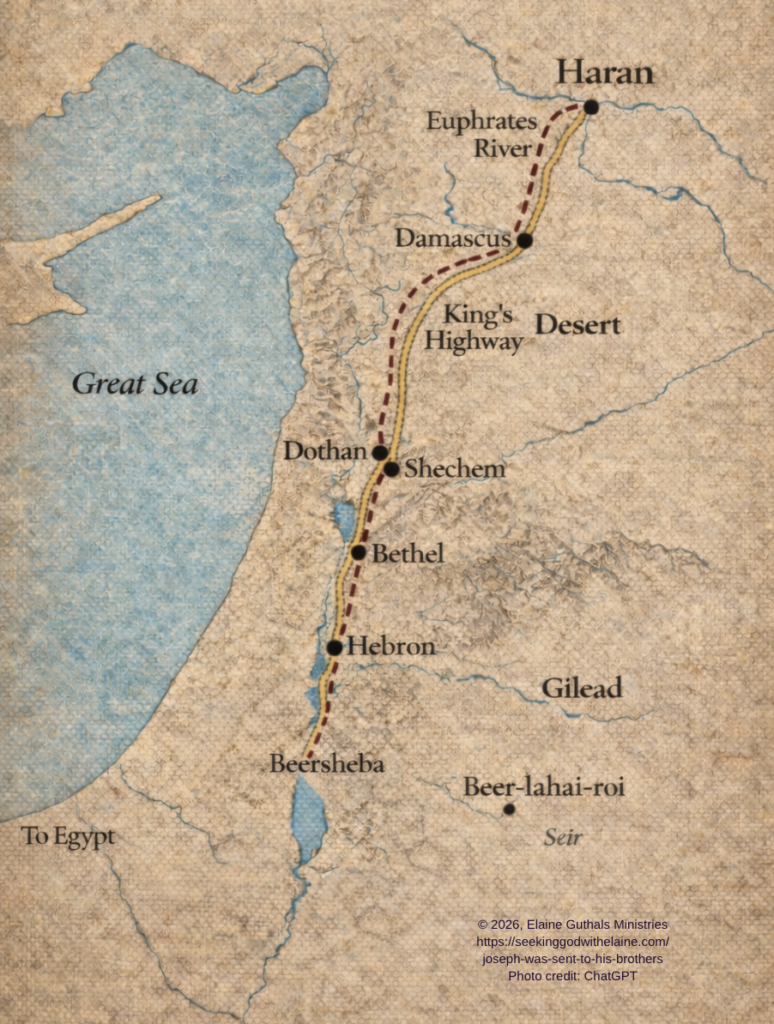
  • Isaac Blessed Esau

    Oh, no! Isaac hadn’t blessed Esau – he had blessed Jacob. This devotional reading looks at how Isaac blessed Esau and Esau’s response.

    Nuggets

    • Timing can be everything, but Jacob almost didn’t have enough time.
    • There were probably several reasons Isaac trebled uncontrollably.
    • As usual, Esau didn’t blame himself.
    • Rebekah championed for a daughter-in-law she would never meet.
    • Rebekah told the truth when warning Jacob.
    • Apparently, Rebekah didn’t want to tell Isaac that Esau was planning murder.
    isaac-blessed-esau

    When we’d left our family, Jacob had just deceived his father, Isaac — at the direction of his mother, Rebekah.

    Jacob’s deception is about to be found out.

    Let’s Put It into Context

    To read devotions in the Creating Everything theme, click the button below.

    Devotions in the Isaac the Patriarch series

    What’s Left for Esau?

    “As soon as Isaac had finished blessing Jacob, and almost before Jacob had left his father, Esau returned from his hunt. Esau prepared a delicious meal and brought it to his father. Then he said, ‘Sit up, my father, and eat my wild game so you can give me your blessing.’ But Isaac asked him, ‘Who are you?’ Esau replied, ‘It’s your son, your firstborn son, Esau.’ Isaac began to tremble uncontrollably and said, ‘Then who just served me wild game? I have already eaten it, and I blessed him just before you came. And yes, that blessing must stand!’ When Esau heard his father’s words, he let out a loud and bitter cry. ‘Oh my father, what about me? Bless me, too!’ he begged. But Isaac said, ‘Your brother was here, and he tricked me. He has taken away your blessing.’ Esau exclaimed, ‘No wonder his name is Jacob, for now he has cheated me twice. First he took my rights as the firstborn, and now he has stolen my blessing. Oh, haven’t you saved even one blessing for me?’ Isaac said to Esau, ‘I have made Jacob your master and have declared that all his brothers will be his servants. I have guaranteed him an abundance of grain and wine — what is left for me to give you, my son?’ Esau pleaded, ‘But do you have only one blessing? Oh my father, bless me, too!’ Then Esau broke down and wept. Finally, his father, Isaac, said to him, ‘You will live away from the richness of the earth, and away from the dew of the heaven above. You will live by your sword, and you will serve your brother. But when you decide to break free, you will shake his yoke from your neck’” (Gen. 27: 30-40 NLT)

    As Soon as Isaac Had Finished Blessing Jacob

    Timing can be everything, but Jacob almost didn’t have enough time.

    ut we still have to deal with Esau.

    I read verse 30 to say that Esau almost caught Jacob coming out of Isaac’s tent. Esau was returning to camp, so he wasn’t ready to give Isaac his meal. He had to prepare it first.

    Esau got the meal prepared, probably humming as he worked. He was about to get what he wanted — wealth with no responsibility.

    Was Esau in for a surprise! Isaac sure was.

    Isaac Trembled Uncontrollably

    There were probably several reasons Isaac trebled uncontrollably.

    We may jump to thinking Isaac was mad when he started to tremble uncontrollably (Gen. 27: 33). He wouldn’t have liked that he was duped.

    Part of me thinks Isaac trembled because he realized he did give the covenant blessing – whether that is what he intended in the first place or not. I remember Pastor Steve describing the experience of Jehovah setting him aside and preaching through him one morning. Or should I clarify, blasting through him.

    That was an awe-inspiring and humbling experience.

    I can also see that Isaac realized just how closely he came to really disobeying Jehovah. He was going to go against what he had been told was His plan.

    Esau’s Blessing

    I can see where Isaac would have wanted to bless Esau, too. But the blessing he gave Jacob was irreversible.

    What more did Isaac have to give? He was limited in what he could do.

    Several translations including the King James Version, however, have it wrong in the first element of the blessing. Let’s compare Jacob’s blessing to Esau’s blessing. They weren’t the same blessing, though sometimes it reads as if they are.

    Both Jacob and Esau can’t have the fatness/richness of the earth and dew from heaven in their blessings!

    Does that mean King James Version translator missed the not, or took it out on purpose?

    Well, we feel sorry for Esau – sort of. We can’t go against God’s Will. Worse, we can’t lead others against God’s Word.

    I think it is more of an issue of mistranslating the Hebrew.

    Look how Genesis 27: 28 starts: “From the dew of heaven and the richness of the earth, may God always give you …” (NLT). It is all about Jehovah’s abundant provision.

    The Hebrew reads almost as the New Living Translation says (as opposed to the King James Version): “From the fatness of the earth shall be your dwelling, and from the dew of heaven above.” “From the fatness of the earth” is a lot different than “… Behold, thy dwelling shall be the fatness of the earth …: (Gen. 27: 39 KJV).

    The biggest difference that the Hebrew tells us is that Jacob’s blessing was talking inheritance. Esau’s blessing was talking habitation.

    We know from Malachi that Esau did live in a desert. “And the Lord replies, ‘This is how I showed my love for you: I loved your ancestor Jacob, but I rejected his brother, Esau, and devastated his hill country. I turned Esau’s inheritance into a desert for jackals’” (Mal. 1: 2-3 NLT).

    I wonder, though, if Isaac was trembling because he knew God wanted Jacob to have the blessing, but he had followed his own will instead of God’s. Was he concerned for his own consequences?

    We should tremble when we know we have willingly brought God’s wrath down upon ourselves.

    Cheated Me Twice

    As usual, Esau didn’t blame himself.

    Esau was right and wrong. “Esau exclaimed, ‘No wonder his name is Jacob, for now he has cheated me twice. First he took my rights as the firstborn, and now he has stolen my blessing’” (Gen. 27: 36 NLT).

    Esau was right that Jacob cheated him out of the blessing because of the way he did it.

    Esau was wrong that Jacob was the reason he wasn’t blessed. That was God’s decision. Isaac got his hopes up when he told him he would bless him anyway.

    Also wrong was that Jacob cheated Esau out of his birthright. Esau sold them to Jacob 62 years prior. He could have said no if he thought more of his responsibilities than his stomach.

    But Esau didn’t want clan leadership. He wanted the wealth.

    Jacob Flees to Paddan-Aram

    “From that time on, Esau hated Jacob because their father had given Jacob the blessing. And Esau began to scheme: ‘I will soon be mourning my father’s death. Then I will kill my brother, Jacob.’ But Rebekah heard about Esau’s plans. So she sent for Jacob and told him, “Listen, Esau is consoling himself by plotting to kill you. So listen carefully, my son. Get ready and flee to my brother, Laban, in Haran. Stay there with him until your brother cools off. When he calms down and forgets what you have done to him, I will send for you to come back. Why should I lose both of you in one day?’ Then Rebekah said to Isaac, ‘I’m sick and tired of these local Hittite women! I would rather die than see Jacob marry one of them’” (Gen. 27: 41-46 NLT)

    Rebekah championed for a daughter-in-law she would never meet.

    Esau Began to Scheme

    Oh, I bet Esau did hate Jacob after this. He didn’t really care about the birthrights because of the responsibility of family leadership that went with it.

    Esau didn’t like that Jacob got the money.

    So, Esau’s solution was to plan to kill Jacob. Isn’t it true that sin snowballs? We commit a little sin, then slide into a bigger one, then a bigger one. Sounds like Esau cut out some slides, though.

    Rebekah stepped in again. She found out that Esau was planning to kill Jacob upon Isaac’s death.

    Rebekah Said to Jacob

    Rebekah told the truth when warning Jacob.

    Rebekah’s first thought would have been of getting Jacob to safety. He was her favorite son.

    Besides, Jacob was the covenant son. Nothing could happen to him, or the covenant would be broken.

    Again, it seems like Rebekah thought she needed to step in and keep the covenant moving in the right direction. Again, she didn’t wait until Jehovah acted.

    Would Esau really have followed through with his threat? We’ll never know.

    Why didn’t Jacob have a wife already? If Esau got married at 40 and this was years after, where was Jacob’s wife?

    Remember, if Isaac was 40 years old when he married Rebekah, Abraham was 140. Since Abraham died at 175, he secured a wife for Isaac 35 years before he died.

    Isaac was securing Jacob’s wife 44 years before he died.

    But, no, none of them were spring chickens.

    Rebekah Said to Isaac

    Apparently, Rebekah didn’t want to tell Isaac that Esau was planning murder.

    Isn’t that like mothers? We want to shield everyone involved in the best way possible. Unfortunately, sometimes that means saying our motive is Plan A – which is true – instead of Plan B – equally true but more painful.

    Is this another form of deception? Is “hiding” an ulterior motive deceptive when both are true?

    Was Rebekah afraid to say that Jacob should go to Paran-Aram for covenant purposes when Isaac had so blatantly ignored the covenant?

    Remember, according to the timeline we’ve been using, Isaac was 137 when he gave the blessings. He died when he was 180. That was 43 years later.

    Based on Timeline from

    Rebekah told Isaac to send Jacob where he was supposed to go to find a wife. But let’s look at different translations of what she said.

    • “… ‘I’m sick and tired of these local Hittite women!’ …” (Gen. 27: 46 NLT).
    • “… ‘I’m sick of my life because of these Hethite girls’ …” (Gen. 27: 46 CSB).
    • “… ‘I am tired of living because of the daughters of Heth’ …” (Gen. 27: 46 NASB).
    • “… ‘I am weary of my life because of the daughters of Heth’ …” (Gen. 27: 46 KJV).

    It is kind of a progression into darkness, isn’t it? Do we have an idea how she was really feeling?

    Let’s go back to the Hebrew. Yes, it is showing the contempt for her life when taken literally.

    • “I am disgusted/weary of my life”
    • “My life is a burden to me.”

    But that is a common Semitic idiom. We would say, “I can’t stand this. I’m miserable.” We might even say, “I’m at the end of my rope.”

    Rebekah might be being a bit of a drama queen. But the question she is posing is a rhetorical question, not a call for suicide intervention. She is talking hyperbolically.

    Finding a non-Canaanite wife was true as Jehovah would not want a marriage with a Canaanite woman in the covenant line. We know how that turned out with Isaac’s wives (Gen. 26: 35). It wasn’t very complimentary.

    Rebekah was talking through her anguish and feeling of urgency, not depression. She was probably overwhelmed and scared stiff.

    If she was trying to ensure the correct covenant line, this shows how much was at stake. It’s planning redemption’s’ story in a very human situation.

    But let’s focus on securing Jacob a covenant wife.

    This time, Isaac wasn’t doing the securing as Abraham did. He wasn’t sending an Eliezer-type to Panan-Aram. He was sending Jacob himself.

    That was because the betrothal process had changed. Jacob not only didn’t have a servant making the arrangement, but he also didn’t have the presents to provide the family of the bride he chose.

    Yeah, Laban was probably really missing that part of the deal.

    But this meant that Jacob didn’t have the formal authority to secure arrangements for a bride. He had to make his own arrangements. Yes, labor was par for the course then.

    This absence of the formal rituals, though, didn’t do Jacob any favors. That opened the door to the deception by Laban.

    What hadn’t changed was securing a marriage partner who was within the family. What hadn’t changed was Jehovah control over both processes.

    Making the Connections #1

    One thing we have to recognize here was that Isaac did not do the opposite of bless. He did not curse Esau.

    Instead, Isaac describe the man that Esau was/would become.

    But it sure does look like a curse if we think anything good is a blessing, anything hard is a curse.

    Esau, like his Uncle Ishmael, would have had a hard life. Both were fighting men.

    I guess it would be natural that the two bloodlines would commingle. In Genesis 25, we talked about Arabs, many of which — but not all — are descendants of Ishmael according to Got Questions. Bradford reminded us that many of which — but not all — are also descendants of Esau. They make up the majority of the population of Muslims.

    Resources

    So, this was part character analysis, part prophecy.

    Making the Connections #2

    Each person in Isaac’s family sinned.

    • Isaac ignored Jehovah’s will in favor of rewarding his favorite son.
    • Rebekah developed a sinful plan to obtain the right thing and encouraged her child to deceive his father.
    • Esau was impulsive and selfish, living only for the day and ignoring his responsibilities to Sovereign God as firstborn.
    • Jacob did not trust in Jehovah to provide His promises.

    How Do We Apply This?

    • Truly love our family, not just have an affection for them.
    • Watch our thoughts.
    • Remember one sin leads to another.
    • Realize that early sins stick with us long into life.
    • Don’t play favorites with your kids.
    • Recognize that Jehovah as our Creator has to the right to do what He wants.

    Resources

    Father God. You have made the family a central part of Your call for us. You place us in families here so we can be a family through eternity. But we are flawed. We quarrel. We are self-centered. Unfortunately, we sin in the way we interact with each other. Forgive us, Lord. Help us to have Your character and treat each other as You would. Amen.

    If you don’t understand something and would like further clarification, please contact me.

    If you have not signed up for the email providing the link to the devotions and the newsletter, do so below.

    If God has used this devotion to speak with you, consider sharing it on social media.
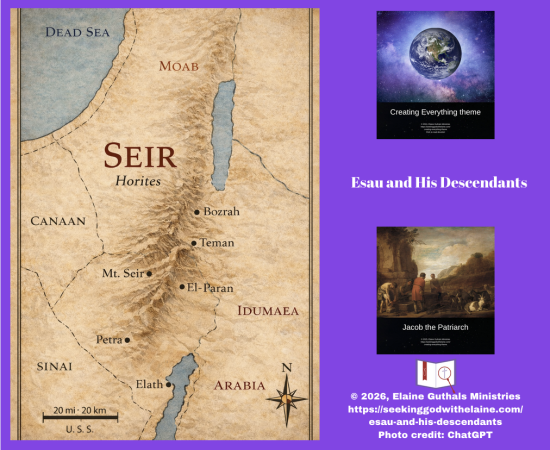
  • Isaac Blessed Jacob

    Isaac started things in motion to bless Esau, but Rebekah came up with a plan so that Jacob could get the blessing. This devotional reading looks at how the deception was carried out.

    Nuggets

    • Jacob followed through with Rebekah’s plan.
    • Jacob deceived Isaac and received the blessing meant for Esau.
    isaac-blessed-jacob

    This story looks like it is each parent was battling so that his/her favorite child would receive the blessing. What was termed blessing ended up being the covenant blessing.

    So, did the covenant son receive it or not?

    Let’s Put It into Context

    To read devotions in the Creating Everything theme, click the button below.

    Devotions in the Isaac the Patriarch series

    Jacob Executes Rebekah’s Plan

    “So Jacob took the food to his father. ‘My father?’ he said. ‘Yes, my son,’ Isaac answered. ‘Who are you — Esau or Jacob?” Jacob replied, ‘It’s Esau, your firstborn son. I’ve done as you told me. Here is the wild game. Now sit up and eat it so you can give me your blessing.’ Isaac asked, ‘How did you find it so quickly, my son?’ ‘The LORD your God put it in my path!” Jacob replied. Then Isaac said to Jacob, ‘Come closer so I can touch you and make sure that you really are Esau.’ So Jacob went closer to his father, and Isaac touched him. ‘The voice is Jacob’s, but the hands are Esau’s,’ Isaac said. But he did not recognize Jacob, because Jacob’s hands felt hairy just like Esau’s. So Isaac prepared to bless Jacob. “But are you really my son Esau?” he asked. ‘Yes, I am,’ Jacob replied. Then Isaac said, ‘Now, my son, bring me the wild game. Let me eat it, and then I will give you my blessing.’ So Jacob took the food to his father, and Isaac ate it. He also drank the wine that Jacob served him” (Gen. 27: 18-25 NLT)

    Jacob followed through with Rebekah’s plan.

    It has long amazed me how a 77-year-old-man could let his mother talk into perpetuating a lie. But perpetuate he did.

    Why?

    • Did Jacob think he was saving his father from sin?
    • Did he think this was what Sovereign God wanted?

    Jacob did everything he could to make himself into Esau. He put on Esau’s favorite clothes. Rebekah put goat skin on his neck and arms. Food was prepared (Gen. 27: 14-17 NLT).

    Did this make Jacob a weak and pliable man, as Leale suggested? Hmmm. Maybe. I mean, he was 77 years old, and he doesn’t question Mom. All he was worried about was getting caught.

    Resource

    Did Jacob see any other way he was going to get what Jehovah had promised him? Probably not. That is usually when we jump right in to get what we know is right.

    But two wrongs don’t make a right.

    Jacob went to see Isaac with substituted meat in hand. Isaac thought something was fishy – and he didn’t think it was the meat.

    Isaac was skeptical that this was his son Esau. We might wonder why he couldn’t definitely distinguish between his sons. It seemed like he could: Esau’s hair but Jacob’s voice.

    Why didn’t Isaac stick to his guns? “You aren’t Esau.”

    Isaac Blessed Jacob

    “Then Isaac said to Jacob, ‘Please come a little closer and kiss me, my son.’ So Jacob went over and kissed him. And when Isaac caught the smell of his clothes, he was finally convinced, and he blessed his son. He said, ‘Ah! The smell of my son is like the smell of the outdoors, which the LORD has blessed! From the dew of heaven and the richness of the earth, may God always give you abundant harvests of grain and bountiful new wine. May many nations become your servants, and may they bow down to you. May you be the master over your brothers, and may your mother’s sons bow down to you. All who curse you will be cursed, and all who bless you will be blessed’” (Gen. 27: 26-29 NLT)

    Jacob deceived Isaac and received the blessing meant for Esau.

    But Isaac gave Jacob the blessing. Yes, that is what God wanted, but He wanted it done His way where it glorified Him.

    The b’rakhah is a prayer that is a blessing. Many of the Jewish blessings start with the same six words, according to Adath Shalom. They are Barukh Ata Adonai, Eloheinu Melekh Ha’olam. In English that reads: Blessed are You, Lord our God, King of the universe.

    Resource

    It starts off with praise, hope, and gratitude — not petition. But what is relevant to this conversation is that the b’rakhah shows finality in a long-settled issue.

    The long-settled issue was that Jacob was the covenant son. It was settled that the plenty and power belonged to Jacob, not Esau.

    Bradford had a great reminder. While Isaac was blessing Jacob, he was probably thinking Esau. That would mean he wanted for Esau, not Jacob

    • Dew
    • Fatness of the earth
    • Abundance of grain and wine
    • Servants
    • Nations below him
    • Master of his brothers
    • Sons
    • Curse those who curse you, bless those who bless you.

    Wait a minute!

    • “… One nation will be stronger than the other; and your older son will serve your younger son” (Gen. 25: 23 NLT).
    • “Then the Lord took Abram outside and said to him, ‘Look up into the sky and count the stars if you can. That’s how many descendants you will have!’” (Gen. 15: 5 NLT).
    • “I will bless those who bless you and curse those who treat you with contempt …” (Gen. 12: 3 NLT).

    Esau was not to be the covenant son! Isaac knew that!!!!

    But think about it. Isaac was thinking Esau, blessing Jacob. That definitely would have been included in Jacob’s covenant blessing. It would have been horrible if it was left out.

    So, it is perfectly appropriate in this blessing – regardless of who Isaac had in mind.

    Bradford told us what Isaac was trying to do. He wrote, “Isaac isn’t trying to say Jacob isn’t the firstborn; he’s just trying to take most of the rights of the firstborn away from Jacob and give them to Esau……just another way to skin a cat.”

    Resource

    So, Bradford thought Isaac knew exactly what he was doing and did it anyway. He may not have thought of Esau as the covenant son, but he wanted all the good stuff for him.

    But the covenant son did get the covenant blessing, despite Isaac’s best efforts. Yes, God’s Will would be done.

    Harper said something interesting. The blessings that Isaac was giving were temporary.

    Resource

    That is true – up until the last three. Dew, fatness of the earth, abundance of grain and wine, servants, and nations below him were all tied to this earthly existence.

    Master over Your Brothers

    Were you squinting at that, too? Why does it say brothers – plural?

    Aren’t Jacob and Esau the only children Isaac and Rebekah had? How can their “… mother’s sons …” (Gen. 27: 29 NLT) bow down to them if there are no other mother’s sons?

    We know earlier in Genesis when it was giving death lists, it would say “After the birth of Son, Dad lived another so many years and had other sons and daughters.”

    We’ve never heard that about Isaac. Moses listed Abraham’s concubine Keturah and her sons. Why wouldn’t he have done the same with Isaac?

    Besides Jewish tradition or ancient writings don’t say anything about other kids. You would have thought somewhere along the line, a descendant this close to Abraham wouldn’t have been left out.

    Well, all through God’s Word brothers and sisters mean more than biological siblings. It can mean anywhere from close relatives and clan members to other believers of the faith.

    What Isaac could have been meaning was that Jacob’s descendants – with Jacob as the representative head – would rule over Esau’s descendants – with Esau as the representative head.

    This does play out in Scripture down the line. Edom is described as Israel’s “brother” nation. “You shall not abhor an Edomite, for he is your brother. You shall not abhor an Egyptian, because you were a sojourner in his land” (Deut. 23: 7 ESV).

    So, this has to be forward-looking. That is what a covenant blessing would do.

    Sons

    At first, I didn’t include sons in this breakout. But then I decided I had better.

    Yes, sons were very important to any family in that society. They would all be concerned about securing the family line.

    But we are talking covenant sons here. “All those listed above include fourteen generations from Abraham to David, fourteen from David to the Babylonian exile, and fourteen from the Babylonian exile to the Messiah” (Mt. 1: 17 NLT).

    Sons were important because they led to Yeshua.

    Curse You and Bless You

    When we think of bless-those-who-bless-you-and-curse-you-who-curse-you in a spiritual context, blessing is equated with salvation. Cursing is associated with being thrown in the lake of fire (Rev. 20: 15).

    That is for eternity.

    If Isaac was giving the covenant blessing – which he was because it was Jacob – he would have been blessing the covenant line. The covenant line culminates in Yeshua and salvation.

    Making the Connections #1

    Jacob got the blessing God wanted him to have. But how did he feel?

    Bradford took a stab at that. He wrote,

    “But, no doubt Jacob felt none of the inner joy and sense of humility before God that should have been present after being anointed as the bearer of the line of covenant promise that was so important for the future of all mankind. For Jacob had done wrong in making sure to obtain it….his deception was sin against God….and his conscience probably dogged him for the rest of his life.”

    Resource

    Does that surprise you? Did you think he would be giddy with joy?

    By his deception, Jacob tainted that which was pure and good.

    Making the Connections #2

    “From the dew of heaven and the richness of the earth, may God always give you abundant harvests of grain and bountiful new wine” (Gen. 27: 28 NLT)

    Jacob’s blessing talked of Jehovah’s provision. But that didn’t mean he didn’t have a big role to play.

    Fertility of the soil and the dew do come from Jehovah. However, it is provided through the answer of prayer.

    We should never take Jehovah’s promises for granted. We must never feel like we are entitled.

    We must praise Jehovah for what only He can do.

    Making the Connections #3

    Rebekah did pay the consequences for her deception. She never saw Jacob again.

    We don’t know when Rebekah died because it isn’t mentioned in God’s Word. It is, though, in Jewish tradition.

    What we do know is that, when Jacob and his family left to return to Canaan (Gen. 31: 3) in 1703 BC, Rebekah was already dead.

    Wait a second! I have to process this.

    c. 1823–1820 BC – Abraham sent Eliezer to Paddan-Aram to find a wife for Isaac (Gen. 24)
    1820 BC – Isaac, at age 40, married Rebekah (Gen. 25: 20)
    1723 BC – Jacob flees Canaan to Paddan-aram to Rebekah’s family (Jacob age 77; Isaac age 137).
    1703 BC – Jacob and his family left to return to Canaan (Gen. 31: 3)

    Tradition says that Rebekah died at age 133. The reason given by Biblical Hermeneutics is that Esau’s attendance to the funeral rather than Jacob carried a great shame. Jacob was supposedly on his way back but hadn’t arrived yet.

    Resource

    We know tradition gets some things right and some things wrong. So, let’s say she died in 1703 BC. That means she was born in 1836 BC. It would have made her 16 when she married Isaac.

    That fits the custom of a marriage age of 15–17 for the bride. That would make Isaac 24 years older than Rebekah.

    Making the Connections #4

    I liked what Watt said about Jacob craving the blessing. But was he right when he said, “JACOB’S CONDUCT PROVES THAT THERE MAY BE MORE RELIGION ON THE LIPS THAN IN THE LIFE (ver. 20)?

    Resource

    So, what is verse 20 about? “Isaac asked, ‘How did you find it so quickly, my son?’ ‘The Lord your God put it in my path!’ Jacob replied.” (Gen. 27: 20 emphasis added).

    What is lip service? “And so the Lord says, ‘These people say they are mine. They honor me with their lips, but their hearts are far from me. And their worship of me is nothing but man-made rules learned by rote’” (Isa. 29: 13 NLT).

    Was Jacob just doing lip service? If he was craving the blessing because for worldly gain, he is just doing lip service.

    But look what Jacob said, “… The Lord your God put it in my path …” (Gen. 27: 20 NLT emphasis added). He invoked the Lord’s provision for a lie.

    Jehovah had nothing to do with Rebekah’s deception. He didn’t tell her to concoct this scheme.

    So, yeah. At this point, we would say Jacob wasn’t a worthy covenant son. He does want it more than Esau, but he wants it on his own terms and in his own way.

    God was going to have to get Jacob’s attention.

    Making the Connections #5

    Do we think we are going to get a get-out-of-jail card for sin? This isn’t the board game Monopoly.

    I like what Bradley said. He wrote,

    “The instant we look at him [Jacob], we are struck with this fact, that the nearer a man is to God, the more God is displeased with any iniquity He sees in him, and the more openly and severely He punishes it. Of all this family, Jacob was the most beloved by Him, but yet, as far as regards this world, he appears to have suffered from this transaction the most bitterly.”

    Resource

    No, it isn’t smooth sailing for believers. We are corrected by Jehovah when we sin.

    Making the Connections #6

    Look what Parker said. He wrote, “Jacob was a destined man; Jacob was destined before he was born; what, then, was his error? Not in feeling, how mysteriously soever, the pressure of his destiny, but in prematurely taking it into his own hands.”

    Resource

    I guess I am tripping over prematurely. Yes, he and Rebekah didn’t do things on Jehovah’s timetable.

    No, Jacob wasn’t ready yet. He needed character building.

    But that explains every new disciple. Jehovah meets us where we are and transforms us into who we need to be.

    We just can’t let our character be built through deception.

    Don’t be Jacob — right thing, wrong way, wrong time.

    Let me do some Elaine-speak on what else Parker said.

    Right is not simply about a single issue. It is about all of the issues and events that make up our lives.

    We can’t make a profession of faith but not transform into a person like Yeshua. We have to do that on our Sanctification Road, not through our own efforts.

    Motivation plays a big role in that. Did Rebekah do what she did to ensure the covenant line — or because she didn’t want the man whose wives disrupted the family get the good stuff?

    Rebekah’s right thing, wrong way perpetuated right thing, wrong way, wrong time.

    Making the Connections #7

    Jacob was right in wanting God’s Will. He was wrong in the way he went about staying in it.

    Esau was wrong to despise God’s Will. He was right that Jacob went the wrong way about getting it.

    Jehovah chose Jacob as the third Patriarch because of several things Mercer listed.

    • Esau was too caught up in day-to-day life.
    • Jacob accepted that he had to work for good, and he patiently and gladly did so.
    • Jacob’s means were never wicked without a good reason.

    We aren’t called disciples because of doing the do’s and not doing the don’ts. We are disciples because we submit to God’s Will. We show His grace by our inadequacies.

    Look at what Mercer said that meant. He wrote, “He [Jacob] was, even in his weakest points, far better fitted to lay the foundations of a family and kingdom than the impulsive and purposeless Esau.”

    Resource

    Mercer also pointed out the contrast between pure Abraham and flawed Jacob. Jehovah used both — just as He uses us.

    Making the Connections #8

    Harper had an interesting take. He wrote,

    “The blessing of Isaac, therefore, must have comprised something more than what we have here recorded; otherwise we may be well assured that Jacob would never have risked so much to obtain it, nor would his mother ever have placed him in so hazardous and perilous a situation.”

    Resource

    I can see that. It was all temporary blessings. However, Jehovah had already said that the older would serve the younger (Gen. 25: 23).

    But wouldn’t Moses have recorded the more spiritual aspects rather than the earthly?

    Making the Connections #9

    Did Jacob think Isaac wasn’t going to bless him as himself? Worse, did he think Isaac was going to curse him?

    We’ll never know, will we?

    How Do We Apply This?

    • Don’t champion a lie or deceitful circumstances.
    • Avoid anything evil.
    • Don’t undermine moral development.
    • Don’t expect Jehovah to justify the sinful means to get to His covenant promises.
    • Realize that early sins stick with us long into life.
    • Don’t sin because of a feeling of entitlement — reply on divine provision.

    Resources

    Father God. This is a great example of how we can plan and scheme, but Your Will will always be done. Forgive us when we get impatient and take things into our own hands. Worse, forgive us when we lie and deceive to get our way. Help us to wait on You. Amen.

    If you don’t understand something and would like further clarification, please contact me.

    If you have not signed up for the email providing the link to the devotions and the newsletter, do so below.

    If God has used this devotion to speak with you, consider sharing it on social media.
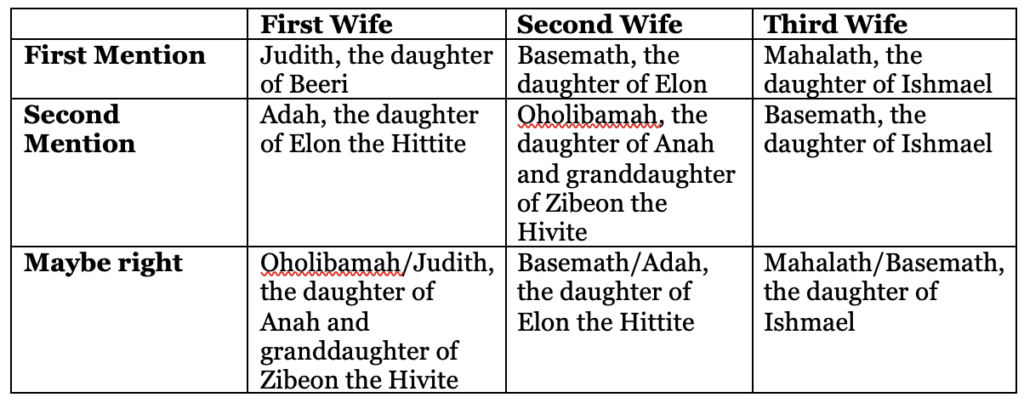
  • Preparing to Bless Esau

    Esau had sold the birthright to Jacob many years before. This devotional reading looks at setting up the blessing.

    Nuggets

    • Isaac was going to go against Jehovah’s decree and give the blessing to Esau.
    • Isaac gave Esau specific instructions.
    • Rebekah stepped up to put things back on the right track, but she went about it the wrong way.
    preparing-to-bless-esau

    Remember, I think Genesis 26 should have gone before Genesis 25. The last part, though, was current and in the right place.

    If we look at the end of Genesis 26, we said that — for what was being discussed in Genesis 26: 34-35 — Esau was then  40, making Isaac 100.

    We are only told in Genesis 27 that Isaac was facing some challenges. But if we look at the timeline we have been using, it tells us how much time has transpired.

    1860 BC — Isaac was born (Gen. 21: 2)
    1800 BC – Jacob and Esau were born (Gen. 25: 24-26)
    1785 BC — Abraham died at the age of 175 (Gen. 25: 7 – 8)
    1785 BC – Esau sold the birth right to Jacob in exchange for lentil stew Jacob was cooking while mourning for Abraham
    1760 BC — Esau at age 40 married Canaanite women (Gen. 26: 34-35), making Isaac 100.
    1723 BC – Jacob cheated Esau out of the birthright blessing given by Isaac. He flees Canaan to Paran-Aman to Rebekah’s family. He agrees to work seven years to earn the right to marry Rachel (Gen. 29: 1-20)
    1680 BC – Isaac died at the age of 180 (Gen. 35: 28-29)

    Resource

    Isaac was 137, and Esau and Jacob were 77.

    Let’s Put It into Context

    To read devotions in the Creating Everything theme, click the button below.

    Devotions in the Isaac the Patriarch series

    Isaac Planned to Give the Blessing to Esau

    “One day when Isaac was old and turning blind, he called for Esau, his older son, and said, ‘My son.’ ‘Yes, Father?’ Esau replied. ‘I am an old man now,’ Isaac said, ‘and I don’t know when I may die. Take your bow and a quiver full of arrows, and go out into the open country to hunt some wild game for me. Prepare my favorite dish, and bring it here for me to eat. Then I will pronounce the blessing that belongs to you, my firstborn son, before I die’” (Gen. 27: 1-4 NLT)

    Isaac was going to go against Jehovah’s decree and give the blessing to Esau.

    Isaac Called for Esau

    Wait! What????

    I thought this had been settled. I thought oldest was going to serve the youngest.

    “And the Lord told her, ‘The sons in your womb will become two nations. From the very beginning, the two nations will be rivals. One nation will be stronger than the other; and your older son will serve your younger son’” (Gen. 25: 23 NLT emphasis added).

    True, God told that to Rebekah. But she and Isaac had a great love story going on. He loved her deeply. “And Isaac brought Rebekah into his mother Sarah’s tent, and she became his wife. He loved her deeply, and she was a special comfort to him after the death of his mother (Gen. 24: 62-67 NLT emphasis added).

    They would have talked.

    Yes, we think this would have gone against the customs of the land. Firstborn rights were par for the course.

    But that isn’t necessarily true. Most importantly, if God said differently, why didn’t Isaac obey?

    Rebekah would have told Esau and Jacob that the older would serve the younger. She would not let Esau get 77 years old and drop this bombshell on him.

    Was it only because Esau was Isaac’s favorite? Our opinions don’t matter to God.

    That includes Isaac and Rebekah. They were not consulted before the decision was made.

    Everyone had 62 years to get used to the idea that Esau sold away his birthright. He was no longer considered firstborn.

    God chooses the one who will be most obedient to Him. That means, Jacob would be the more righteous man.

    That is what is important to God — the condition of our soul. He is more concerned about our spiritual condition.

    Isaac had to have known. Esau had already had two wives who were local women.

    Remember what Moses wrote when he announced to us Esau’s marriages? “But Esau’s wives made life miserable for Isaac and Rebekah” (Gen. 26: 35 NLT).

    But here went Isaac, making the decision for himself. “Then I will pronounce the blessing that belongs to you, my firstborn son, before I die” (Gen. 27: 4 NLT emphasis added).

    Could Isaac just not stand his favorite not getting what most firstborn would get? Was he thinking Jehovah made the wrong decision? Was he thinking He had to follow His own laws?

    “Dedicate to me every firstborn among the Israelites. The first offspring to be born, of both humans and animals, belongs to me” (Ex. 13: 2 NLT).

    Bradford identified what Isaac was doing as tempting Jehovah. He quoted Edersheim when he said, “We do so tempt the Lord when, listening to our own inclinations, we put once more to question that which He has already clearly settled. Where God has decided, NEVER let us doubt, nor lag behind.”

    Resource

    We can’t bite on Isaac too much because we do the same thing. We ignore Jehovah’s decision. We argue that He made the wrong decision. We scream, shout, and tap our foot demanding that He let us have our way — with let not the right word choice.

    How many times have we went our own way — even in worship — and figure Jehovah would bless us anyway?

    We forget Jehovah is Sovereign God. He is our Creator and our Judge, Jury, and Executioner.

    But let’s put this into context – 1700 BC Ancient Near East context.

    • Birthright dealt with a double portion of the inheritance and clan leadership, not birth order.
    • Blessings were a verbal act of conveying legitimacy, destiny, and status. It has been described as The Last Will and Testament.
    • As they were not connected, the two did not have to go to the same son.
    • There was no formal ceremony to formally announce the recipient.
    • Evidence from that time shows the firstborn does not always get both or either.

    We have to remember the main purpose of this practice was ensuing the family line remained stable and intact. (That was one reason we gave as to why Abraham married within his family.)

    If the father was not convinced that the firstborn could provide the stability the line needed, a different son could be – and usually was – chosen. Infertility could play a part as well as adoption.

    Bradford cautioned that the term double portion sounds like a strict, precise measurement. He wrote, “More often, these portions were approximates; a double portion could have been anything from a little bit more than the others, to practically everything of value.”

    Resource

    So, the blessing was distributing the wealth.

    Prepare My Favorite Dish

    Isaac gave Esau specific instructions.

    • Go hunting with your bow
    • Take lots of arrows
    • Go hunting in the open country
    • Snag some wild game
    • Make it like I like it
    • Bring it to me

    We know that meals were a big part of covenants. The blessing was a part of the covenant, so it is logical eating would be a part.

    Rebekah Foiled Isaac’s Plan

    “But Rebekah overheard what Isaac had said to his son Esau. So when Esau left to hunt for the wild game, she said to her son Jacob, ‘Listen. I overheard your father say to Esau, “Bring me some wild game and prepare me a delicious meal. Then I will bless you in the LORD’s presence before I die.” Now, my son, listen to me. Do exactly as I tell you. Go out to the flocks, and bring me two fine young goats. I’ll use them to prepare your father’s favorite dish. Then take the food to your father so he can eat it and bless you before he dies.’ ‘But look,’ Jacob replied to Rebekah, ‘my brother, Esau, is a hairy man, and my skin is smooth. What if my father touches me? He’ll see that I’m trying to trick him, and then he’ll curse me instead of blessing me.’ But his mother replied, ‘Then let the curse fall on me, my son! Just do what I tell you. Go out and get the goats for me!’ So Jacob went out and got the young goats for his mother. Rebekah took them and prepared a delicious meal, just the way Isaac liked it. Then she took Esau’s favorite clothes, which were there in the house, and gave them to her younger son, Jacob. She covered his arms and the smooth part of his neck with the skin of the young goats. Then she gave Jacob the delicious meal, including freshly baked bread” (Gen. 27: 5-17 NLT)

    Rebekah stepped up to put things back on the right track, but she went about it the wrong way.

    Yes, Rebekah was trying to get back to a the-older-will-serve-the-younger blessing. Did she think God needed help?

    Ooo, baby! God does not need our help. He will work His plan His way.

    No, I have no clue how that would have looked in this situation. No animals to shoot in the open country? Esau trip and break a bone?? Somebody show up right before he was to leave that stopped him from going????

    Who knows. Sovereign God could have used any number of things — even a change of heart on Isaac’s part.

    We do know that Jehovah allowed this to happen this way.

    Rebekah’s intervention were for the right reasons – and she clearly thought she was in the right. Her husband, the ruler of the house, was refusing what Jehovah had already ordained.

    Look at Cooper’s proposed other reason. He wrote, “She knew that he [Jacob] was fittest for receiving it. She knew that he highly valued it, not merely for the sake of any worldly benefit annexed to it, but on account of the spiritual promises contained in it. Esau, on the contrary, had repeatedly shown the greatest contempt for the blessing and its promises.”

    Resource

    The deception was sinful. She not only didn’t trust God to keep His promises, but she also lied to get her plan accomplished.

    The ends do not justify the means. Covenant work should not be completed by actions that break Sovereign God’s laws and commandments.

    Just because it ended up with what was supposed to happen happening, it doesn’t mean that there were no consequences. We’ll talk about that later.

    Jacob did question Rebekah about her plan. Well, about how to pull it off. Not once does he say – that was recorded – “This plan is wrong. It is deceitful.”

    Maybe Jacob thought it was okay since Rebekah was willing to take the blame. “But his mother replied, ‘Then let the curse fall on me, my son! Just do what I tell you …” (Gen. 27: 13 NLT).

    Yes, God wants us to take responsibility for our actions. That doesn’t mean Jacob didn’t feel any consequences.

    Why was the food important? Every covenant was ratified through a meal.

    Making the Connections #1

    Why was Isaac so set that the firstborn would get the blessing? Even if he was resigned to Jacob getting the firstborn advantages, he may not have wanted the same thing that happened to him and Ishmael happen to Esau and Jacob.

    Making the Connections #2

    Pearse made a great observation. Remember, we talked about Isaac being a quiet man.

    So, here comes this famine that throws Isaac out of his element. How did he step up? Fearfully with a flat-out lie thrown in.

    Pearse addressed this. He wrote, “They who are weakest need most of all the help of God and have most room for it. They who have no other gifts must make the most of this.”

    Resource

    It appears that Isaac went back to his quiet life. Babies were born; babies grew up. He had finally gotten to where there was room for him to live.

    Not only that, but Isaac got a promise from Sovereign God that he would be blessed.

    And Isaac returns this with ignoring Jehovah’s proclamation. There are times we just want to shake our heads and ask, “What was that man thinking?”

    Making the Connections #3

    One of the hardest things to do on our walk with Jehovah is to wait for Him to work things out and keep His promises. It isn’t just the we-want-things-when-we-want-them attitude.

    It is seeing things only through our limited perspective and not through the God-of-the-impossible perspective. We don’t have to help Him do what we can’t do ourselves.

    It is our thinking that we have to help. Have you ever had a spouse or child that wanted to badly to help you, and you just wanted to scream, “I can do it myself!”

    It doesn’t work in this case.

    Making the Connections #4

    Remember, until Moses came along and got the laws on Mount Sinai, birthright meant that the firstborn was the priest of the family. Do we see Esau in that role? NO!

    Making the Connections #5

    Cooper had another great nugget and a questionable second nugget. He argued,

    “In all cases the Law of God is to be our rule. In no case can we claim the privilege of setting it aside. Rebekah’s sin, however she might excuse it to herself, was sufficient to have ruined her soul; and unquestionably, unless through God’s grace she had afterwards repented and obtained forgiveness, it would have ruined her soul. Such is the case with every sin.”

    Resource

    I agree with the first two sentences. I don’t know about the last two.

    We can’t ignore or even rewrite God’s laws. We are going to break them because we are still sinful people.

    At what point do we lose our salvation? That is above my pay grade.

    There is only one unpardonable sin. That has to do with rejecting salvation.

    Does one unrepented sin strip us of our salvation? Did Rebekah’s choice mean she turned her back on Jehovah?

    I don’t think so.

    I agree that all sin stems from our disobedience to God and His laws. Still, I think the judgment varies – my own opinion – decide what you believe.

    How Do We Apply This?

    • Always listen to Jehovah to ensure our actions follow His Will.
    • Repent of any sin that we have committed.

    Resource

    Father God. Lord, we can be so self-involved at times. We want what we want, even if it is the direct opposite of what You want. Other times, we want what You want — but we go about it in a way You don’t want. Forgive us. Help us to always do Your Will. Amen.

    If you don’t understand something and would like further clarification, please contact me.

    If you have not signed up for the email providing the link to the devotions and the newsletter, do so below.

    If God has used this devotion to speak with you, consider sharing it on social media.