Author: admin

  • Why Should We Listen When Worshiping?

    In Ecclesiastes 5, Solomon continued his discussion of our need to listen. In this chapter, he applied it to worship. Let’s take a look.

    Nuggets

    • When we stop listening to God, we start being irreverent and insincere when — if — we worship Him.
    • God doesn’t want us to make promises to Him that we aren’t going to keep.

    Devotions in  The Meaning of Life series
    Let’s Put It into Context

    Here is a running list of what we’ve discussed previously.

    Don’t Stop Listening When Worshiping

    “Guard your steps when you go to the house of God. Better to approach in obedience than to offer the sacrifice as fools do, for they ignorantly do wrong. Do not be hasty to speak, and do not be impulsive to make a speech before God. God is in heaven and you are on earth, so let your words be few. Just as dreams accompany much labor, so also a fool’s voice comes with many words” (Ecc. 5: 1-3 CSB)

    When we stop listening to God, we start being irreverent and insincere when — if — we worship Him.

    It may generally stem from a carelessness. It isn’t that we don’t give Sovereign God the honor that is due Him. It is a flippancy associated with it.

    We have to worship God properly. Clark notes we may come before God with few words, but we need to come in faith and with boldness.

    Resource

    Hmmm. I don’t know. Am I the only one who is afraid that some are going to think that few words is a pass to coast through worship?

    It isn’t. What it means is we can’t listen if we are talking. We need to zip it and let God do the talking.

    Then again, I like how Burrell interpreted it. He said that it must “… be with a full intention of the heart and not merely with the outward symbols.”

    Resource

    If we have our yapper going, we may or may not have our heart involved. We’ve got to get it down to the heart level for it to make an impact on our character.

    Let’s read verse 1 again in the New Living Translation. “As you enter the house of God, keep your ears open and your mouth shut. It is evil to make mindless offerings to God” (Ecc. 5: 1 NLT).

    The Homilist noted that the person that Solomon was talking here was heading to the temple. So we are talking preparation for worship. It is the time between when our alarm rings and when Pastor Chris says, “Welcome to the service.”

    Resource

    Getting ready should entail more than eating, putting our clothes on, and curling our hair. We have to prepare our hearts.

    We are entering worship for a purpose. That purpose is to meet God there — to spend time with Him.

    Yes, to hear His word. To sing songs to Him.

    But most importantly — to spend time with Him.

    To confess to Him.

    The Homilist gave us some verses that showed us what the sacrifices of fools were.

    • “And they come to you as people come, and they sit before you as my people, and they hear what you say but they will not do it; for with lustful talk in their mouths they act; their heart is set on their gain” (Ezek. 33: 31 ESV).
    • “And the Lord said: ‘Because this people draw near with their mouth and honor me with their lips, while their hearts are far from me, and their fear of me is a commandment taught by men’” (Isa. 29: 13 ESV).
    • “The Pharisee, standing by himself, prayed thus: ‘God, I thank you that I am not like other men, extortioners, unjust, adulterers, or even like this tax collector. I fast twice a week; I give tithes of all that I get’” (Lk. 18: 11-12 ESV).

    That is a good list of how not to worship God. It really doesn’t focus on God at all.

    God wants us to be docile — teachable. We spent a whole series on that.

    Devotions in The Beatitudes Show Us How to be Docile series

    We might be shaking our heads why Solomon threw that verse about dreams in there. Bonnet clarified, “The nature and character of God, the promises, Scripture language, are floating before the closed vision of the pietistic dreamer, and his prayers are a jumble of disjointed things.”

    Resource

    Before you start jumping up and down, think about that. God is a spirit; we are not.

    That means God speaks a totally different language than we do. “Likewise the Spirit helps us in our weakness. For we do not know what to pray for as we ought, but the Spirit himself intercedes for us with groanings too deep for words” (Rom. 8: 26 ESV). Strike one.

    There is no way this person is going to see God because of a closed vision. We have to open the eyes of our heart. To me, that means we have to trust God on things we may think are impossible. Strike two.

    Now, look what a pietistic dreamer this person is. That is someone who thinks they are pious but, news flash, they aren’t. God doesn’t put up with fake believers. Strike three.

    Don’t Stop Listening When Making Vows

    “When you make a vow to God, don’t delay fulfilling it, because he does not delight in fools. Fulfill what you vow. Better that you do not vow than that you vow and not fulfill it. Do not let your mouth bring guilt on you, and do not say in the presence of the messenger that it was a mistake. Why should God be angry with your words and destroy the work of your hands? For many dreams bring futility; so do many words. Therefore, fear God” (Ecc. 5: 4-7 CSB)

    God doesn’t want us to make promises to Him that we aren’t going to keep.

    A huge component of Jewish worship was vows. Burrell stated we also make vows. He wrote, “We promise to do certain things: to be faithful to Christ and His Church, to love our fellow-Christians, to obey those who are over us in Christ, etc. These are vows, pledges given to God, and they should be kept as scrupulously as we would keep a business obligation signed with our own hand.”

    Resource

    Don’t we get into situations where we pray, “Oh, Lord, if You will just get me out of this in one piece, I will do this, that, or the other”? And we may do this consistently. That may be more hit and miss.

    The other is something we probably drop right after the words come out of our mouths.

    The problem is we made a vow. We made a vow to Sovereign God. We broke a vow we made to Sovereign God.

    Yeah, that is a big problem.

    Slade contended we probably make more vows to God than we realize. Yeah, we probably do, because we are always getting into some pickle or another.

    Resource

    What does Solomon say? It is better to keep your mouth shut and not vow than to break your vow.

    Bonnet reminded us that “the vow is a form of prayer. It is a prayer with an obligation.” Prayer is a two-way communication with God in which we pour out our soul to Him.

    Resource

    The obligation kicks it up a notch. Because of that, we shouldn’t make the vows because we are being rash or inconsiderate.

    We really shouldn’t make the vows because we are trying to control or manipulate God. That really isn’t going to work well.
    WhyShouldWeListenWhenWorshipingPin

    Making the Connections

    Ooo. Listen to this.

    “The character of a man’s step is often an index to the state of his soul. There is the slow step of the dull brain and the quick step of the intensely active; there is the step of the proud and the step of the humble, the thoughtless and the reflective. The soul reveals itself in the gait, beats out its own character in the tread.”

    Resource

    I know. Right now, part of me is screaming, “But I am walking about as fast as a 100 year old! That isn’t me!”

    I also know the pain has dulled my mind. I know the seizures have made it hard to process and think — and write. (Sorry if I am not coherent at times. Or I leave something out, not connect the dots, and make it a mystery.)

    But I don’t want that to be an index of the state of my soul. I know this has brought me closer to God because I am clinging to Him.

    Still, I can see what is being said here. We can see how people approach life from how they move through it.

    What is important in life is character. Our character is visible to others in how we live our lives.

    How Do We Apply This?

    Burrell said that we need to be deliberate about worship. Short and sweet is fine as long as it is sincere. Bonnet advised against the asking for the same thing in a variety of ways.

    Resource

    We need to focus on God first in our prayers, and then make our petitions. If we rely on the Spirit to do the talking, we will be talking the same language.

    Father God. We worship You as Sovereign God. We see You as holy and pure and want to imitate You in every way. Help us to be like You. Amen.

    What do you think?

    Leave me a comment below (about this or anything else) or head over to my Facebook group for some interactive discussion.

    If you don’t understand something and would like further clarification, please contact me.

    If you have not signed up for the email daily or weekly providing the link to the devotions and the newsletter, do so below.

    If God has used this devotion to speak with you, consider sharing it on social media.

  • Why Should We Listen When Leading?


    Solomon looked at several areas where we quit listening to God. In this daily devotion, we will look at one area, listening while we are leading others.

    Nuggets

    • We should never stop seeking God’s wisdom when we lead others.

    Devotions in  The Meaning of Life series

    We have trouble is listening to someone else. When we are young, we have trouble listening to parents and teachers. When we are older, we have trouble listening to spouses and employers.

    Unfortunately, dating back to Adam and Eve, mankind has always had trouble listening to God. There — more than anywhere else — we should always listen to what God has to say.

    Throughout the Scriptures they tell us that righteousness/spiritual rules over the flesh/physical. We need to heed those warnings.

    Solomon gave warnings in Ecclesiastes 4 and 5. Let’s dig into Ecclesiastes 4 in this devotion and save Ecclesiastes 5 for the next devotion.

    Let’s Put It into Context

    Here is a running list of what we’ve discussed previously.

    Don’t Stop Listening When Leading

    “Better is a poor but wise youth than an old but foolish king who no longer pays attention to warnings. For he came from prison to be king, even though he was born poor in his kingdom. I saw all the living, who move about under the sun, follow a second youth who succeeds him. There is no limit to all the people who were before them, yet those who come later will not rejoice in him. This too is futile and a pursuit of the wind” (Ecc. 4: 13-16 CSB)

    We should never stop seeking God’s wisdom when we lead others.

    Solomon stated that it was better to be poor than to be a king who didn’t heed other’s warnings.

    In the beginning of Ecclesiastes 4, Solomon has been talking about wealth, power, and rewards for our efforts. What I get from here is the king lost sight of what his advisers were telling him.

    In other words, he quit listening.

    Look how much better off the poor boy was for listening. He came up in the world.

    How much better it is when we listen to God!

    In fact, we can’t quit listening to God if we want what is best for us. He wants to share His wisdom with us.

    • Wisdom is an enlightened acceptance of God’s principles that leads to knowledge, discernment, and good sense that is put into practice through salvation, increasing our goodness and virtue.
      • Discernment means we can evaluate the situation and recognize right from wrong.
      • Salvation is the gift of life through the deliverance from condemnation and sin to acceptance and holiness and changes us from being spiritually dead to spiritually alive.
        • Sins are actions by humans that disobey God and break one of His reasonable, holy, and righteous laws and commandments, goes against a purpose He has for us, or follows Satan’s promptings.
        • Holiness is the transcendent excellence of His nature that includes elements of purity, dedication, and commitment that lead to being set apart.
        • Purity means possessing God’s moral character, having eliminated the stain of sin.
        • Spiritual death is the spiritual separation from God that occurred as a consequence of Adam and Eve’s original sin. The spiritually alive are those who have ABCDed, so they are no longer separated from God.
      • Goodness is imitating God’s holy, pure, and righteous behavior.
        • Holy means to be set apart, perfect, and morally pure while possessing all virtues.
        • Pure means not being sinful or having the stain of sin.
        • Righteous means we are free from sin because we are following God’s moral laws.
      • Virtues are standards of moral excellence.

    Yes, that was a lot of definitions. But I’ve grown up around all of this. Someone may have stumbled on my website and have no clue what God is all about. Or may have a totally different viewpoint than what I have.

    Here’s the thing. God’s wisdom is available to all. As Chalmers wrote, “By the act of training in wisdom’s ways the most tattered and neglected boy who runs upon our pavements do we present the community with that which, in wisdom’s estimation, is of greater price than this gorgeous inhabitant of a palace.”

    Resource

    No one is excluded. Rich or poor. Old or young. Gender doesn’t exclude us. What we’ve done doesn’t exclude us.

    We know that all we need to do is ask God for this wisdom, and He will provide it for us. “Now if any of you lacks wisdom, he should ask God — who gives to all generously and ungrudgingly — and it will be given to him” (Jas. 1: 5 CSB).

    First, we have to become God’s children. We have to ABCD.

    Glossary

    “Now if any of you lacks wisdom, he should ask God — who gives to all generously and ungrudgingly — and it will be given to him” (Jas. 1: 5 CSB).

    Making the Connections

    Chalmers’ wording describing what Solomon is saying here is interesting. He wrote, “Did a king come to take up his residence amongst us — did he shed a grandeur over our city by the presence of his court, and give the impulse of his expenditure to the trade of its population — it were not easy to rate the value and the magnitude which such an event would have on the estimation of a common understanding, or the degree of personal importance which would attach to him who stood a lofty object in the eye of admiring townsmen.”

    Resource

    I know. The quote kind of takes the scenic route getting to the period. Let’s do some Elaine-speak to break it down.

    • The king left his palace, gave up all his kingly trappings, and went to live with his subjects.
    • We can’t put a price tag on that because it is too mind boggling!
    • Wouldn’t that make him even more important in the eyes of his subjects?

    Oh, slam. Let’s compare that to King Jesus.

    • “Instead he emptied himself by assuming the form of a servant, taking on the likeness of humanity. And when he had come as a man, he humbled himself by becoming obedient to the point of death — even to death on a cross” (Phil. 2: 7-8 CSB).
    • “Let us thank God for his priceless gift!” (II Cor. 9: 15 GNT).
    • “Haven’t you read this Scripture: The stone that the builders rejected has become the cornerstone” (Mk. 12: 10 CSB).
    • “The one who rejects me and doesn’t receive my sayings has this as his judge: The word I have spoken will judge him on the last day” (Jn. 12: 48 CSB).

    Yeah, the King of kings did that for us.

    How Do We Apply This?

    The ABCDs of Salvation

    If you have not become a believer in Christ, please read through the
    Plan of Salvation and prayerfully consider what God is asking you to do.

    A – admit our sins
    B – believe His Son Jesus is our Redeemer
    C – confess God as Sovereign Lord

    D – demonstrate that commitment by making any changes needed in our lives to
    live the way in which God has called us

    The Disciple’s Job Description

    Father God. We glorify Your name. Lord, we pray that, when You put us in positions of leadership, we listen to Your authority. Amen.

    WhyShouldWeListenWhenLeadingPin

    What do you think?

    Leave me a comment below (about this or anything else) or head over to my Facebook group for some interactive discussion.

    If you don’t understand something and would like further clarification, please contact me.

    If you have not signed up for the email daily or weekly providing the link to the devotions and the newsletter, do so below.

    If God has used this devotion to speak with you, consider sharing it on social media.

  • The Focus of the Ministry

    Paul was the consummate minister because the focus of his ministry was where it should have been. This daily devotional looks at on Whom the focus of our ministry should be.

    Nuggets

    • We are ministers for Jesus and God, so we should not boast of ourselves.
    • The focus of the ministry is the Plan of Salvation that God designed and carried out through Jesus’ sacrifice.
    • It was Paul’s mission to go where no one had ever gone before to preach the gospel of Christ.

    To read devotions in the Redo for Godliness series, click the appropriate button below.

    Devotions in the Transformed to Perfection series

    Devotions in the On Being a Minister series

    Paul was a devoted minister. He took his call from God very seriously. He spoke about it in Romans 15. Let’s take a look.

    Let’s Put It into Context

    Here is a running list of what we’ve discussed previously.

    The Reason to Boast

    “Therefore I have reason to boast in Christ Jesus regarding what pertains to God” (Rom. 15: 17 CSB)

    We are ministers for Jesus and God, so we should not boast of ourselves.

    Bunting noted that “The gospel is called the gospel of God, and of Christ, both in reference to its Divine authority, and in reference to its subject: it is of God, and it speaks concerning God.”

    Resource

    Yeah. There is no us included in there.

    Oh, we have a part. We are the object of the gospel.

    Okay. I did the define function in Word to make sure object was the right word to use. Some of the synonyms it gave me were whatchamacallit and doodah.

    After I stopped laughing, I got down to it is the point or the intent.

    We tend to think we are the reason for the gospel. We think we are the purpose or the motivation behind the Plan of Salvation.

    God designed the Plan of Salvation because He wants back what Satan took away from Him. He wants us back so we can worship Him again in spirit and in truth. “God is spirit, and those who worship him must worship in spirit and truth” (Jn. 4: 24 ESV).

    Some may think I am nitpicking there, but I don’t think so. God is the focus. He always is the focus. Spiritual things are also the priority.

    Paul knew it wasn’t about him being a great evangelist or missionary. He knew it wasn’t about him meeting the needs of others.

    It was about telling others that God had sent His Son to die on a cross so that His blood might be shed to pay the price to redeem us from our sins.

    The True Focus

    “For I would not dare say anything except what Christ has accomplished through me by word and deed for the obedience of the Gentiles, by the power of miraculous signs and wonders, and by the power of God’s Spirit. As a result, I have fully proclaimed the gospel of Christ from Jerusalem all the way around to Illyricum” (Rom. 15: 18-19 CSB)

    The focus of the ministry is the Plan of Salvation that God designed and carried out through Jesus’ sacrifice.

    Paul did not toot his own horn. He didn’t draw attention to himself.

    Instead, Paul kept the focus on God and what Jesus did on the cross. He kept it on what the gospel is all about.

    There was a good reason for this. Paul knew we would gain nothing by knowing who he was.

    We gain everything by knowing — and believing — who Jesus is. Knowing isn’t enough. We have to make a conscious decision to believe He is our Savior and has secured the forgiveness for our sins by His death and resurrection.

    Paul acknowledged that whatever he accomplished was done through the power of God. God sent His Spirit to fill Paul with power. He took that power and was obedient in speaking and displaying signs and wonders for the Gentiles.

    Are you wondering what signs and wonders those were? It is salvation itself.

    What better sign of God’s power and wonder than His restoring us to Himself?

    But in a way, Satan tries to use signs and wonders against us. Irons wrote, “One of Satan’s artifices is to induce men to attempt to reduce the gospel to a mere system within the reach of human intellect; and in this attempt they have gone far to deny and reject everything supernatural.”

    Resource

    Can’t you hear it? [Insert whiny voice] “But I don’t understand, and it’s supposed to be all about me!”

    The me part is faith. Faith is the conviction that the doctrines revealed in God’s Word are true, even if we do not understand all aspects of them, a belief which impacts our lives.

    The me part is submitting. Submitting to God is actions by humans that obey God and keep His reasonable, holy, and righteous laws and commandments, follow His purpose for us, and do not follow Satan’s promptings. In a nutshell, submitting means committing to live a sin-free life.

    Jones mentioned that Paul preached the whole gospel. He didn’t leave out any of it.

    Resource

    We can’t say, “Oh, we like where murder is a sin, but we don’t like where homosexuality is, too.” We don’t get to pick and choose what is a sin or what isn’t. We don’t get to choose what we will follow or what we won’t.

    Brown brought up a point that kind of slammed home with me. When did Paul start his ministry?

    Resource

    Let’s do some digging in Acts.

    “Ananias went and entered the house. He placed his hands on him and said, ‘Brother Saul, the Lord Jesus, who appeared to you on the road you were traveling, has sent me so that you may regain your sight and be filled with the Holy Spirit.’ At once something like scales fell from his eyes, and he regained his sight. Then he got up and was baptized. And after taking some food, he regained his strength. Saul was with the disciples in Damascus for some time. Immediately he began proclaiming Jesus in the synagogues: ‘He is the Son of God’” (Ac. 9: 17-20 CSB).

    Paul started immediately. I know many will argue that Paul had a good foundation in his previous life to prepare him for being God’s Energizer Bunny.

    Our ministry is about us sharing our story. Whatever experiences we have encountered, God will use them to prepare us for the ministry He has for us.

    Our ministry is about us sharing our story. Whatever experiences we have encountered, God will use them to prepare us for the ministry He has for us.

    I didn’t catch the significance of the reference of “… from Jerusalem all the way around to Illyricum” (Rom. 15: 19 CSB). Bunting said the province of Illyricum was 1,000 miles away from Jerusalem.

    Resource

    In Paul’s day, you probably could have equated it to a trip to Mars for most people. There weren’t planes, trains, and automobiles for fast transportation. Most probably didn’t even have horses.

    Walking would have taken forever.

    It is a descriptive way of Paul’s saying I did what the angel said. “But you will receive power when the Holy Spirit has come on you, and you will be my witnesses in Jerusalem, in all Judea and Samaria, and to the ends of the earth” (Ac. 1: 8 CSB).

    But then again, Paul probably didn’t start out for Illyricum from Jerusalem. Maybe it was from Ephesus. It was probably when he was touring Macedonia.

    Whenever, whatever. The goal was always the same — obedience for the Gentiles. Obedience means salvation. It means faith.

    Blazing New Trails

    “My aim is to preach the gospel where Christ has not been named, so that I will not build on someone else’s foundation, but, as it is written, Those who were not told about him will see, and those who have not heard will understand” (Rom. 15: 20-21 CSB)

    It was Paul’s mission to go where no one had ever gone before to preach the gospel of Christ.

    Paul wasn’t interested in the low-hanging fruit. Beecher stressed he took the hard work.

    Resource

    Paul had to lay a foundation by introducing who God was, why we need God, and what God did for us. Then he had to bring Jesus into the picture.

    Haldane wrote that Paul’s ministry had its purpose. He wrote, “This ambition of the apostle was the means of fulfilling a prophecy with respect to the spread of the gospel in heathen countries. Thus it is that God fulfils His predictions and His purposes.”

    Resource

    We want to do God’s Will. God will use us to further His kingdom.

    TheFocusOfTheMinistryPin

    Making the Connections

    Paul could have gone on and on about the hardships of ministry. We all know he suffered a lot.

    But to Paul, it was an honor to be a minister for God. He was all in. He took the hard in stride.

    Resource

    How Do We Apply This?

    The ABCDs of Salvation

    If you have not become a believer in Christ, please read through the
    Plan of Salvation and prayerfully consider what God is asking you to do.

    A – admit our sins
    B – believe His Son Jesus is our Redeemer
    C – confess God as Sovereign Lord

    D – demonstrate that commitment by making any changes needed in our lives to
    live the way in which God has called us

    The Disciple’s Job Description

    We need to listen to what God is calling us to do, where He says go. It may be “… from Jerusalem all the way around to Illyricum” (Rom. 15: 19 CSB). We need to get on our horse and ride.

    Paul took his ministry very seriously because he knew the lives of the people he taught depended on their acceptance of the message he gave. When people do not accept God’s gift of salvation, they will spend eternity in the torment of hell.

    To read a devotion in the Hell Does Have Fury series, click on the appropriate button below.

    We need to take our ministry seriously, also. Those we share God’s message with need to accept it just as much as those in Paul’s day did.

    We need to keep our focus on God.

    Father God. We need Your salvation. We commit to serving You in whatever ways You call us. We will take Your Plan of Salvation to those who need it. We will focus on You. Amen.

    What do you think?

    Leave me a comment below (about this or anything else) or head over to my Facebook group for some interactive discussion.

    If you don’t understand something and would like further clarification, please contact me.

    If you have not signed up for the email daily or weekly providing the link to the devotions and the newsletter, do so below.

    If God has used this devotion to speak with you, consider sharing it on social media.

  • You Say I am Loved

    Today is a music day.

    Today was an off day.  I woke up way too early and woke up feeling dejected.

    The good news was the doctors didn’t find anything in the MRI (no tumor, no stroke). The bad news was the doctors didn’t find anything in the MRI (no cause for the seizures).

    In order to get more data on where the seizures are coming from, the doctor wants more data on them while they were actually happening. That means I am currently hooked up to a portable EEG monitor.

    I got hooked up yesterday. It really hurt at first. I don’t know why my head was so sensitive, but it was.

    I was supposed to get hooked up Monday. However, the monitor wasn’t talking to the computer, so I had to go back Tuesday.

    It didn’t help that I ended up in the emergency room last week with a migraine, so I had a follow-up visit Tuesday afternoon with the doctor that I went to when all of this started.

    Here I am traipsing in there with my head all wrapped up in gauze. My son is making mummy jokes. My Springfield mom is wondering how many stares I will get. I just want answers.

    I got some. Since I am having more noticeable seizures and migraines since I started taking the medicine that is supposed to prevent seizures and migraines, it is not working for me. She wants to make some changes.

    I came out of that appointment finally feeling feeling confident that someone had my best interest at heart. I felt someone had me.

    I know God always has me. I love the chorus of Lauren Daigle’s song You Say.

    “You say I am loved when I can’t feel a thing
    You say I am strong when I think I am weak
    And you say I am held when I am falling short
    And when I don’t belong, oh You say I am Yours”

    I am God’s, even when I mess up. Even when I look like the bride of Frankenstein.

    God has me.

    You Say
    Vocalist: Elaine Guthals
    Keyboard: Louise Guthals Weiss

    YouSayIAmLovedPin

    What do you think?

    Leave me a comment below (about this or anything else) or head over to my Facebook group for some interactive discussion.

    If you don’t understand something and would like further clarification, please contact me.

    If you have not signed up for the email daily or weekly providing the link to the devotions and the newsletter, do so below.

    If God has used this devotion to speak with you, consider sharing it on social media.

  • We Are All Ministers

    Paul was the consummate minister. We are to be ministers, too. This daily devotional looks at what that means.

    Nuggets

    • We are to share our knowledge with others.
    • We are to be a minister to the unbelieving.

    To read devotions in the Redo for Godliness series, click the appropriate button below.

    Devotions in the Transformed to Perfection series

    Devotions in the On Being a Minister series

    One of Paul’s themes in Romans 14 and the first part of Romans 15 is unity. He talked about putting others before ourselves.

    In this part of Chapter 15, Paul began talking about ministering to others. God called Paul to be a minister to the Gentiles. He calls us to minister to others, also.

    Let’s take a look.

    Let’s Put It into Context

    Here is a running list of what we’ve discussed previously.

    Instructing Others

    “My brothers and sisters, I myself am convinced about you that you also are full of goodness, filled with all knowledge, and able to instruct one another” (Rom. 15: 14 CSB)

    We are to share our knowledge with others.

    Paul was convinced about the goodness of the disciples that made up the Roman church. No, he had never met them.

    However, Paul knew of them. “First, I thank my God through Jesus Christ for all of you, because your faith is proclaimed in all the world” (Rom. 1: 8 ESV).

    It isn’t our goal to have world-wide fame. Our goal is to be different from the world. “If you were of the world, the world would love you as its own; but because you are not of the world, but I chose you out of the world, therefore the world hates you” (Jn. 15: 19 ESV).

    To read a related devotion, click the button below.

    Paul said that the Roman disciples were full of goodness. That means they were imitating God since goodness is one of His attributes.

    • God’s goodness is His holy, pure, and righteous behavior.
    • Holy means to be set apart, perfect, and morally pure while possessing all virtues.
    • Pure means not being sinful or having the stain of sin.
    • Righteous means we are free from sin because we are following God’s moral laws.

    To read a related devotion, click the button below.

    Here is how we are to imitate God. “… Walk as children of light (for the fruit of light is found in all that is good and right and true), and try to discern what is pleasing to the Lord” (Eph. 5: 8-10 ESV).

    To read a related devotion, click the button below.

    Paul told us two chores we are to do as disciples.

    1. We are to be filled with the knowledge ourselves.
    2. We are to help others grow in knowledge.

    Lyth had an interesting term. He called it sanctified ability. That is all he said, because he is an outline type of guy.

    Resource

    So, let’s work this out. Ability is the capacity to do something. We either have the proficiency or the potential to accomplish the goal.

    Our redo for godliness is all about how God is sanctifying us. God is the one who is redoing us.

    • Sanctification is the transformation of mind, body, and soul, which begins with regeneration, gradually changes our nature through the promptings of the Holy Spirit, and ends with perfected state of spiritual wholeness or completeness.
    • Regeneration is being changed from spiritually dead to spiritually alive and the internal requickening in us that God brings about through the work of the Holy Spirit to give us new character.
    • Spiritual death is the separation from God that occurred as a consequence of Adam and Eve’s original sin. The spiritually alive are those who have ABCDed, so they are no longer separated from God.
    • The perfected state indicates the combination of the spiritual graces which, when all are present, form spiritual wholeness or completeness.
    • Spiritual graces are worldly morals that have been submitted to God to further His kingdom instead of enhancing this world.

    Glossary

    The ABCDs of Salvation

    If you have not become a believer in Christ, please read through the
    Plan of Salvation and prayerfully consider what God is asking you to do.

    A – admit our sins
    B – believe His Son Jesus is our Redeemer
    C – confess God as Sovereign Lord

    D – demonstrate that commitment by making any changes needed in our lives to
    live the way in which God has called us

    The Disciple’s Job Description

    So, we might not have the ability right now, but God is working on us to get us to have that ability. Let’s take witnessing, for example.

    We may feel very insecure about being good enough to share Jesus with someone else. God could be putting us in situations where we are having conversations that are preparing us to witness to others.

    We are all called to be witnesses. We can’t leave this to the Pastor Steve-types.

    But think about it. Sanctified ability. We don’t have to be perfect right now. God is in the business of making us perfect. We are a work in progress.

    What we are working on is being ministers for God. Our job description says preach the gospel and make disciples.

    The Disciple’s Job Description

    Complete Job Description

    Individual Description

    Job Duty #4
    Proclaim the Gospel (Mark 16: 15)

    Job Duty #6
    Make Disciples (Matthew 28: 19-20)

    That job description is for everyone. It doesn’t make exceptions. We are all called to be witnesses. To be witnesses, we have to do some form of preaching and making disciples.

    Lyth noted that we need wisdom and humility to discharge these functions. Our primary duty is the salvation of the lost so that God will be glorified.

    • Salvation is the gift of life through the deliverance from condemnation and sin to acceptance and holiness and changes us from being spiritually dead to spiritually alive.
    • Sins are actions by humans that disobey God and break one of His reasonable, holy, and righteous laws and commandments, goes against a purpose He has for us, or follows Satan’s promptings.
    • Holiness is the transcendent excellence of His nature that includes elements of purity, dedication, and commitment that lead to being set apart. Purity means possessing God’s moral character, having eliminated the stain of sin.

    Resource

    Glossary

    We aren’t saved just for ourselves. We are saved so that we can further God’s kingdom. The end result is to bring Him glory and honor.

    We are saved so that we can further God’s kingdom.

    Ministering to Unbelievers

    “Nevertheless, I have written to remind you more boldly on some points because of the grace given me by God to be a minister of Christ Jesus to the Gentiles, serving as a priest of the gospel of God. God’s purpose is that the Gentiles may be an acceptable offering, sanctified by the Holy Spirit” (Rom. 15: 15-15 CSB)

    We are to be a minister to the unbelieving.

    Parsons looked at the many definitions of minister. It can range from someone discharging religious or civil duties as assigned to the person who accomplishes acts of kindness.

    Paul identified himself as a minister of Christ Jesus. Bunting described that not only as the activities performed, but also the character that was molded because of the devotion to the public welfare.

    Resource

    Paul knew what his calling was. He was to go to the Gentiles.

    Oh, I bet Paul did have some Jews in his audience. But that wasn’t who he was told to target.

    Jesus had specific marching orders for Paul. “But the Lord said to Ananias, ‘Go! This man [Paul] is my chosen instrument to proclaim my name to the Gentiles and their kings and to the people of Israel’” (Ac. 9: 15 NIV).

    So, Paul was heading out to talk to people about Jesus who may have never even heard about God before. Talk about a tough assignment!

    The Gentiles would have no clue about the character God would want them to have. Paul would have to model that for them.

    Parsons also described how much the Gentiles needed a Savior. He wrote, “The Gentiles were idolaters, and their hands, in consequence, were rife with the very foulest abominations.” An idol is an object of worship in any form that is below God that takes from God the worship that is His due and is needy and dependent on its worshipers.

    Resource

    When we think about the scope of the Gentiles, it is mind boggling. We have the Israelites/Jews — and we have everyone else, who are referred to as the Gentiles.

    WeAreAllMinistersPin

    Making the Connections

    When we’re talking Christian character (and when don’t I?), we know that all spiritual knowledge and wisdom comes from God. We get it through the Holy Spirit. “When the Spirit of truth comes, he will guide you into all the truth, for he will not speak on his own authority, but whatever he hears he will speak, and he will declare to you the things that are to come” (Jn. 16: 13).

    God will reveal Himself to us. He doesn’t do this all at once. We must be open to look for Him.

    We must be open to where God will grow us. He has a plan for our lives. He has a job for us to do.

    I never expected for Him to say write devotions and put them out on a website. I thought we were going a different way.

    We want to grow to be like God. We want His character. That is what sanctification is all about.

    No, it isn’t easy. It is a process.

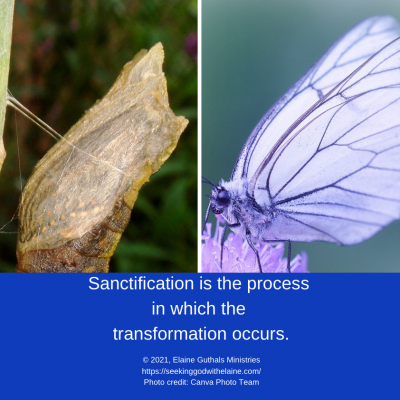
    Sanctification is the process in which the transformation occurs.

    How Do We Apply This?

    How should we start thinking of ourselves as ministers? Probably the easiest way is to figure out how God wants us to minister to the needs of others.

    Don’t get caught in the worldview and this this just means physical needs. Concentrate on the spiritual needs while meeting the physical needs.

    Whatever we do, we are going to want to do what God tells us to do. If we go off on our own — even if it is good work — God won’t bless it. We have to follow God’s lead.

    God has a role for us to play in His kingdom. He will tell us what it is and equip us to play that role. We have to follow His lead.

    Father God. You sent Your Son to be our Savior. But You come to each of us individually, prompting us to accept the gift of salvation. When we do, You call us to be ministers of Your gospel so that others can come to know You. Use us so that we can show them exactly what loving You means and the joy that it brings. Amen.

    What do you think?

    Leave me a comment below (about this or anything else) or head over to my Facebook group for some interactive discussion.

    If you don’t understand something and would like further clarification, please contact me.

    If you have not signed up for the email daily or weekly providing the link to the devotions and the newsletter, do so below.

    If God has used this devotion to speak with you, consider sharing it on social media.

  • August 2021 Newsletter

    Main Nuggets

    • God wants us to change our character so that we can apply the laws and commandments in any situation in which we find ourselves (The Law of Liberty).
    • If we live or die, it doesn’t matter — we do it for the Lord (The Law of Belonging).
    • Having a strong faith does not exclude us from judgment any more than a weak faith act as an excuse (The Law of the Future).
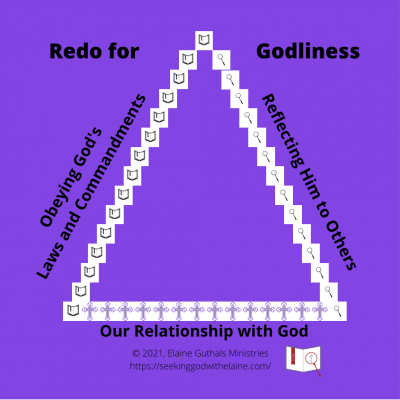
    RedoForGodliness

    Our Relationship with God

    • Only God has full wisdom and knows exactly how everything is and should be. He only tells us a part (The Law of Unity).
    • A disciple weak in faith is separated from Jesus (The Law of Unity).
    • There is only One true God that we all serve (The Law of Liberty).
    • We live to bring glory and honor to God (The Law of Liberty).
    • We are guarded by God’s power because of our faith. He has promised to sustain us until the end, when He will reveal part three of salvation to those who have worked out their salvation (The Law of Liberty).
    • God calls us to worship Him (The Law of Liberty).
    • God calls us to have a relationship with Him (The Law of Liberty).
    • God has an individual relationship with each of us. In my opinion, He builds that relationship based on what we need to get us to His character. That is what happens on each of our Sanctification Roads – making each of them different. In a way, you can say it is the same. God is sanctifying us. In a way, you can say it is different. He is sanctifying us differently (The Law of Liberty).
    • God expects us to live our lives according to His character (The Law of Liberty).
    • We have to know what we believe. Knowing what we believe comes from seeking God. When we do all the steps in seeking God, we get a solid foundation (The Law of Liberty).
    • There is no debate that we are God’s (The Law of Getting Along).
    • We were created to put God first (The Law of Getting Along).
    • God created us to worship Him. He wants us to have a relationship with Him (The Law of Getting Along).
    • God did not give us a personality just to ask us to squash it in submission to Him. God asks us to make Him our top priority (The Law of Getting Along).
    • Someone who is not putting God first is looking at every situation to see how s/he is being impacted (The Law of Getting Along).
    • Our service to God must be voluntarily (The Law of Belonging).
    • If we don’t do complete submission, we won’t achieve complete set apart. If we don’t get complete set apart, we don’t get complete perfection. If we don’t get complete perfection, we don’t get final salvation (The Law of Belonging).
    • Our way of life has to be by God’s rule. Our goal should be to bring Him glory (The Law of Belonging).
    • We need to consider ourselves dead to the world (The Law of Belonging).
    • After we’ve asked God to forgive us of our sins, we can’t hang on to them. We have to forgive ourselves (The Law of Belonging).
    • We have to willingly submit to God because Jesus died for our sins. This is going to be a daily submission (The Law of Submission).
    • Jesus has to be sovereign of our inward and outward lives (The Law of Submission).
    • Jesus is Lord of the dead and the living (The Law of Submission).
    • God is our Judge (The Law of the Future).
    • God judges us every day — He isn’t just waiting for the end (The Law of the Future).
    • Did you ever really think about why Adam and Eve hid after they sinned? They knew God was going to come looking for them to judge them. Not to have their evening chat. Not to share an evening meal. To judge them — they expected to be called on the carpet (The Law of the Future).
    • There is only one standard by which we will all be judged. We should hold ourselves and others to that standard (Don’t Slander Our Good).
    • God wants us to be genuine in serving Him (Don’t Slander Our Good).
    • Some try to fake that they are good. An example is the Pharisees. They thought their religious ceremonies would cut it. Jesus said no. It is about relationship, not ceremony (Don’t Slander Our Good).
    • God doesn’t want us on autopilot. He wants to be our Pilot (Don’t Slander Our Good).
    • The kingdom of God is a soul kingdom so that God can control our character (The State of the Kingdom of God).
    • When we seek first the kingdom of God, that means we submit our whole hearts and lives to God (The State of the Kingdom of God).
    • Righteousness is all about God. It is our relationship with Him. We are justified and freed from sin to follow God’s moral laws (The State of the Kingdom of God).
    • Having joy in all circumstances designates us a child of God. We get the joy from Him as part of our adoption (The State of the Kingdom of God).
    • The joy has to come before the peace. The unbridled happiness that produces the tranquility, not the other way around (The State of the Kingdom of God).
    • We are to have the right qualities to serve Christ (The State of the Kingdom of God).
    • Whoever serves Christ is righteous, peaceful, and joyous. We must possess these three qualities to serve Christ. If we don’t, we don’t really serve Him. We are just going through the motions (The State of the Kingdom of God).
    • God calls us to love Him, praise Him, and serve Him. We will find peace and joy when we do (The State of the Kingdom of God).
    • Humility, love, and faith promote peace (How to Promote Peace).
    • It is that quest for importance that tends to amp up the stress. The humility diminishes the pull of this world and puts our focus on God, creating the environment in which the peace can thrive (How to Promote Peace).
    • Love will also grow in that environment. Not only is God righteousness, but God is also love. Love and peace go hand in hand (How to Promote Peace).
    • We have to be very, very careful. We don’t want to have the focus taken off of God and His work and put onto us and our petty earthly squabbles (How to Promote Peace).
    • We want to make sure we are doing God’s work on His timetable. We don’t want to derail His plan (How to Promote Peace).
    • People are very important to God. Whether they are a strong disciple or a weak disciple today isn’t how He sees them. He sees them as perfected (How to Promote Peace).
      Yes, we may be weak, but we are as God made us. Yes, we may we strong, but we may be fall into temptation and lose our way (How to Promote Peace).
    • We are to imitate Jesus as He submitted to God rather than pleased Himself (Who Do We Please?).
    • This life is secondary. God and our spiritual condition and life are primarily. So, when we say we are to please our neighbor, that doesn’t mean we are letting them remain in sin. We are teaching them to live for God (Who Do We Please?).
    • If we are trying to redo for godliness, we need to redo our character (Who Do We Please?).
    • Scriptures help us transform to His godliness (Using the Scriptures to Build Hope).
    • God is going to get His Word out to those who need it. We all need it (Using the Scriptures to Build Hope).
    • Endurance and encouragement can only come from God when we live our lives imitating Jesus and loving one another (Glorifying God through Patience, Endurance, and Unity).
    • Compromising God’s goodness would mean compromising God’s holiness, purity, and righteousness — meaning we would have the stain of sin because we would not be following God’s moral laws. Can’t do that (Glorifying God through Patience, Endurance, and Unity).
    • Paul said the patience came from knowledge. We jump to us knowing more about God. We gloss over the fact that God knows every one of our sins. Because of Jesus and the fact that we have accepted Him as our Savior and Redeemer, He forgives us of those sins (Glorifying God through Patience, Endurance, and Unity).
    • Imitating Jesus means we have His character. It takes patience and endurance to build it because that is what we are doing on the Sanctification Road (Glorifying God through Patience, Endurance, and Unity).
    • We have one job as a unified body — glorify God (Glorifying God through Patience, Endurance, and Unity).
    • If it isn’t about us, it isn’t about how far we are away from Him. It isn’t how far — it is whether our nose is in the right direction (Glorifying God through Patience, Endurance, and Unity).
    • True joy and peace are blessings of believing in Sovereign God (A Prayer of Hope).
    • Because we have the hope, joy, and peace, we have freedom from the stain of sin (A Prayer of Hope).
    • Hope, joy, and peace can be attained. There is one way to do that — prayer (A Prayer of Hope).
    • God is the author of abundant hope (A Prayer of Hope).
    • Joy, peace, and hope can only come from God (A Prayer of Hope).
    • God gives us hope when we read His Word. Yeah, sometimes it comes through the patience and endurance — not an immediate gift — but He gives it to us (A Prayer of Hope).
    • We can’t have the hope, joy, and peace without God because we can’t be that without God. Those are part of perfection, and perfection is about being. Being is about God (A Prayer of Hope).

    Glossary

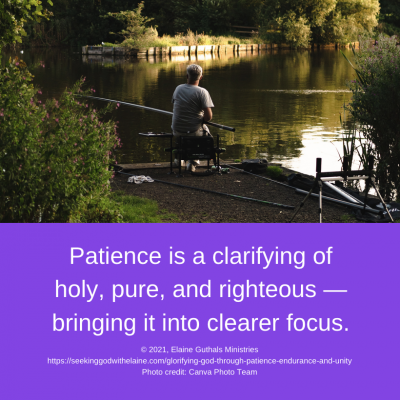
    PatienceClarify

    Obeying God’s Laws and Commandments

    • If we don’t love your neighbors, we haven’t met the foundation of entire law and all the demands of the prophets. It is that important (Who Do We Please?).
      • A disciple strong in faith has a good grasp of spiritual knowledge (The Law of Unity).
      • Being children of God frees us from the stain of sin (The Law of Liberty).
      • We can’t believe what we please. We can’t rewrite God’s laws and commandments. We can’t say something that God says is a sin isn’t. Liberty does not mean we are given a pass to go on sinning (The Law of Liberty).
      • If God has not given us a law or commandment on something, we should make decisions based on His character (The Law of Liberty).
      • Disciples are not to have an opinion on something someone else does if God hasn’t made a law or commandment about it (Guarding against Offense).
      • Something can be unclean to one person that is not unclean to another (Guarding against Offense).
      • Things that are not forbidden and have no moral value cease to be indifferent when they became stumbling blocks and start violating the law of love. They now became the exact opposite of what God wants (Guarding against Offense).
      • Jesus didn’t want them to be all about the ritual. He wanted them — and us to be about the relationship (Don’t Slander Our Good).
      • We don’t want to get bogged down in the observance. We need to focus on the praise and worship (Don’t Slander Our Good).
      • We damage our good ourselves by the choices we make (Don’t Slander Our Good).
      • Sometimes, we use the outward ceremony to mask the inward desolate condition of our hearts. We don’t realize God has 20-20 vision in our hearts (The State of the Kingdom of God).
      • Reputation and character are two different things, but both are important (Don’t Slander Our Good).
      • See what that keeps talking about: moral character. It doesn’t say a word about reputation. Still, reputation is important. We must have credibility with those to whom we are witnessing (Don’t Slander Our Good).
      • If God hasn’t expressly forbidden something, we should just keep our beliefs to ourselves on the indifferent items (Living in Faith and Love).

    Glossary

    Reflecting Him to Others

    • If we look at the Sanctification Road as a continuum, we could be anywhere on our continuum. That means we could be either strong in our faith or weak. But others could be anywhere on their continuum, too. When we are at differing ends, it can be challenging at times (The Law of Unity).
    • The problem is that people interpret Scriptures to mean different things. Some say abstinence is the way to go. Some say faith allows us to do whatever we want (The Law of Unity).
    • We are not to give rise to contentious feelings among disciples (The Law of Unity).
    • We can’t force someone to believe the same way that we do. We shouldn’t make our opinion of the law. This is especially true if it is over something trivial. We shouldn’t break our unity over something that, in comparison, is not important (The Law of Unity).
    • None of us is going to know everything. We shouldn’t force our opinion on someone else when we can be wrong (The Law of Unity).
    • We are not to judge those we consider are spiritually weaker than us. Though they are weak, they are still disciples (The Law of Unity).
    • Sometimes, it is just as easy for the weak to judge the strong (The Law of Unity).
    • God wants all of His children to be unified. Disciples should be patient with each other. We have to remember we are all still capable of sinning. We can still sin — and we will sin (The Law of Unity).
    • A uniting factor should be our sincerity. We should each be genuine in our being a disciple of Christ. It should be our goal to do the do’s and not do the don’ts in order to grow our character to be like God’s. That alone should be a tie that binds us together (The Law of Unity).
    • If Jesus accepts someone — we should, too. When we don’t accept them, we are using our standards, not God’s, on which to judge (The Law of Liberty).
    • God wants us unified with His character. He wants us treating each other as if we were interacting with Him (The Law of Liberty).
    • We were created to interact with each other (The Law of Getting Along).
    • Living for others brings up two words: responsibility and accountability (The Law of Getting Along).
    • Christian rights don’t begin where human passions end (The Law of the Future).
    • We shouldn’t look to the church to make a pronouncement on what should be. It is God’s call, not man’s (The Law of the Future).
    • Every person — living and dead — will bow before God and proclaim Him Sovereign God (The Law of the Future).
    • Just because everyone is going to bow in end doesn’t mean God is going to go ahead and forgive everyone (The Law of the Future).
    • We are only responsible for the plan God has for us. I am not responsible for Adam’s plan, but I was called to witness to him. If I didn’t witness to him, that was on me. If he didn’t ABCD, that was on him (The Law of the Future).
    • Judgment can cause stumbling blocks to be put into place (Guarding against Offense).
    • It becomes a fine line that we walk — our personal liberty (Rom. 14: 1-12) and our love for others (Rom. 14: 13-23). It is all about letting people believe what they believe when it does not violate God’s laws and commandments. It is living together within the church, loving God and each other (Guarding against Offense).
    • When Satan tempts us to judge, he is not tempting us to judge on God’s standards. He is wanting us to judge on some convoluted version. Oh, Satan doesn’t want us to really know what God wants us to do. That would mean we were studying His Word and meditating on it. That is how we seek Him. When we seek Him, we find Him (Guarding against Offense).
    • We are to influence our fellow disciples whether we intend to or not (Guarding against Offense).
    • We need to watch our actions to ensure that we are not bringing spiritual ruin to other disciples (Guarding against Offense).
    • Growing the peace in our lives isn’t easy, either. This will take work. We will have to keep our temper in check. We can’t go out looking for skirmishes (How to Promote Peace).
    • Because God’s disciples are united in peace, His work can be completed in a timely manner (How to Promote Peace).
    • The peace is for us, too, but that is what we extend to others (The State of the Kingdom of God).
      • It is our duty as a disciple to help our fellow disciples in their walks and not cause them to stumble (Living in Faith and Love).
      • Some things are unlawful only to some people (Living in Faith and Love).
      • Let me process through some of the rules Hodge set down for things indifferent that are right or wrong according to the circumstances in which we find ourselves. Would harm come to others? Is it in any way accompanied with a sin? Would any important truth be denied in doing or not doing it? Remember, not forbidden. Maybe even more important, these are not a condition of salvation (Living in Faith and Love).
      • The strong need to help the weak by being a good example to them. Don’t just bite on them. Show them better. Help them to be better (Who Do We Please?).
      • Paul told us we have to make a conscious decision to give up what pleases us and please others (Who Do We Please?).
      • Paul was only talking to the strong. He didn’t say a word to the weak. He didn’t say sign up for strength training. He didn’t call them second-class citizens (Who Do We Please?).
      • We are to teach others about God’s love for us (Who Do We Please?).
      • Every Tom. Every Sally. Every Elaine. No one is exempt from pleasing the neighbor. Neighbor means everyone else. No one is exempt here, either. No one is given a pass (Who Do We Please?).
      • The strong are commanded to build up the weak here — teach the one who is weaker in the faith (Who Do We Please?).
      • Think back to what we we talked about in Chapter 14. Lead with love. Don’t judge. Here, we are adding tolerate another disciple’s weaknesses, encourage them, and seek their strengths (Who Do We Please?).
      • Our greeting must encompass Jesus’ love for all in order to build community (Glorifying God Together).
    RepentanceGenuine

    Miscellaneous

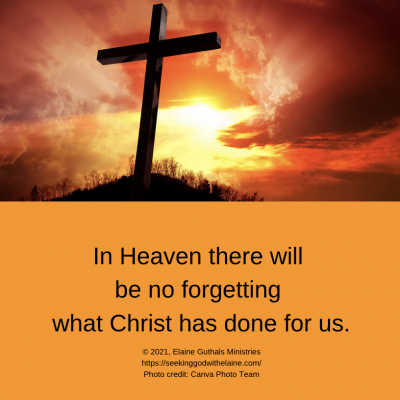
    • If we take the eating thing a step farther, we will no longer need the Lord’s Supper to remind us of Christ’s death and resurrection. That was the whole purpose of the ordinance — our remembering. In Heaven there will be no forgetting what Christ has done for us (The State of the Kingdom of God).
    • We aren’t going to get what we need out of the Scriptures in a single read. We will need to revisit the same passages multiple times until we glean all God has to tell us (Using the Scriptures to Build Hope).
    • The hope is a product of the grace and encouragement. Think — if grace is the mom and encouragement is the dad, what a kid that would be! (Using the Scriptures to Build Hope)
    • It really isn’t our sorrows and difficulties that connect to our hopefulness. Let’s say that again. Our trials do not connect to our hope. We have the hope regardless. We have God’s glorious hope for an eternal life when we are His disciples. Period (Using the Scriptures to Build Hope).

    To read devotions in the Redo for Godliness series, click the appropriate button below.

  • What Is the Better Life?

    Sometimes, it seems like we are programmed to want a better life. This daily devotional looks at what a better life is and how it fits into a meaningful life.

    Nuggets

    • A better life is found by doing good in the Lord and rejoicing.
    • Our past determines our future.

    Devotions in  The Meaning of Life series

    It seems like we are always looking for a better life. We need only to look to God to find it.

    Let’s Put It into Context

    Here is a running list of what we’ve discussed previously.

    A Better Life

    “I know that there is nothing better for them than to rejoice and enjoy the good life. It is also the gift of God whenever anyone eats, drinks, and enjoys all his efforts” (Ecc. 3: 12-13 CSB)

    A better life is found by doing good in the Lord and rejoicing.

    Solomon figured out that there were two things needed for a better life.

    • We need to do good.
    • We need to rejoice.

    Baldwin argued they needed to be in this order, rather than the order Solomon put them in. His reasoning was that we can rejoice only after we do the good.

    Most will read that and see being a good person in that. We do have to follow God’s laws and commandments and love our neighbors. We do that by not murdering them, not stealing from them, not lying to them, etc. Baldwin put it this way. He wrote

    “Doing good is a work of that known excellency in itself, yielding such sweetness and complacency in the practice of it, is so agreeable to the consent and opinion of all mankind in general, and so well pleasing and acceptable with God Himself, the grand Exemplar of doing good, that they must entirely have lost the principles of good nature, of improved reason, and revealed religion, who take care for none but themselves, regard not how it fares with others, so they may live in ease and plenty. Doing good is a public benefit, a great advantage to the world, and to the common state of mankind. Doing good, lastly, is a work of so large and comprehensive an extent, that high and low, rich and poor, learned or unlearned, may improve those talents God hath been pleased to entrust them with to His honour, and to the good of others; so that for me to go about to tell you what it is to do good, and wherein it consists, would be an endless task.”

    Resource

    However, doing good means much more to God than just this corporal good. God is more into the spiritual good. This is the good as opposed to evil.

    • Good, in the biblical sense, is the workings of God within His people.
    • Evil is equated with sin because it is that which goes against God and His purposes.

    God’s #1 priority is our spiritual condition, not the type of life we have in this lifetime. He wants to make sure our relationships with Him are restored.

    We are told time and time again in the Scriptures to rejoice in the Lord.

    • “Rejoice in the Lord always; again I will say, Rejoice” (Phil. 4: 4 ESV)
    • “Be glad in the Lord, and rejoice, O righteous, and shout for joy, all you upright in heart!” (Ps. 32: 11 ESV).
    • “Rejoice always, pray without ceasing, give thanks in all circumstances; for this is the will of God in Christ Jesus for you” (I Thess. 5: 16-18 ESV).

    Rejoicing is a part of worshiping God.

    Jay reminded us that God does not allow intemperance. Temperance is habitual moderation or self-control. He wants us to be self-controlled — sober (which has nothing to do with alcohol) and even-keeled.

    Glossary

    Resource

    We can look at verse 13 as enjoying the fruits of our labors. When we do good in the Lord and worship Him, God rewards us with a joyful life.

    We can look at it this way, too. God wants us to enjoy the fruits of our labors. He wants us to enjoy our lives.

    How are we going to witness to others and invite them to enjoy what we have if we don’t enjoy what we have? If this is the trial run for Heaven, and Heaven is to be a beautiful place, then we should be happy here also.

    God has given us so much. He has forgiven us of so much. There is so much for which we should be thankful.

    When we are, we have a better life. This is because we are putting the focus on God and taking it off ourselves and this world.

    We are putting the focus where it belongs.

    Forever with God

    “I know that everything God does will last forever; there is no adding to it or taking from it. God works so that people will be in awe of him. Whatever is, has already been, and whatever will be, already is. However, God seeks justice for the persecuted” (Ecc. 3: 14-15 CSB)

    Our past determines our future.

    Solomon turned from talking about us and our lives to look at God. There is one bottom line that we can take to the bank.

    “… everything God does will last forever; there is no adding to it or taking from it. …” (Ecc. 3: 14 CSB). God is

    • Eternal.
    • Omnipotent.
    • Omniscient.
    • Omnipresent.
    • Self-existent.
    • Unchangeable.
    • Sovereign.
    • Pure.
    • Holy.
    • Righteous.
    • Faithful.
    • True.
    • Love.

    Parr noted that God does all He does so that we will fear Him. Fear of the Lord means awe, reverence and love, not terror.

    Glossary

    Resource

    Verse 15 can seen like double talk at first glance. I think in today’s vernacular we would say what goes around, comes around. Or history repeats itself.

    We can also look at it from the viewpoint of our futures are built on the decisions we make today. What we choose and what we learn today lays the groundwork for what happens tomorrow.

    How many times have we heard things are cyclical? (Please don’t let that apply to bell-bottom pants!)

    Storrs put it this way. He wrote, “No part of life is isolated, but each period is connected with what has gone before and with what comes after; all are combined to make a vital, organic whole, so that in judging of the present we are really judging the past, as in the day of final adjudication the acts of the bygone years will come up for approval or condemnation before the Judge of all the earth. We are to-day what. we are by means of the past, and the future is conditioned on the present. Life evolves itself out of the present; as the stream at the mouth bears a constant relation to all the streams that have watered the hills, so age is related to youth.”

    Resource

    Think about it. No, the internet is new. But what we do with it isn’t.

    Hacking to steal something from someone else isn’t new. Disseminating false information to damage someone else’s character isn’t new.

    The Homilist noted that both memory and conscience play a major role in a required past. God wants us to remember where we have come from and how He has provided for us in the past. Causation also has a role to play in informing how we grow from our past.

    Resource

    Goodrich reminded us that God will be using the past to judge us come judgment day. We knows our thoughts and actions have been written down, and those books will be opened and read on judgment day.

    Resource

    Glossary

    Talmage stepped up and said, “Wait a minute.” Jesus paid the debt for those sins. God has forgiven us and released us from them.

    Resource

    Greenwood had an interesting sermon on how some in the past have felt that they have outgrown religion. He contended that they, instead, have just renounced it. Instead of leaving it behind as they have matured, they have abandoned it. There is a big difference.

    Resource

    WhatIsTheBetterLifePin

    Making the Connections

    This series is all about the meaning of life. There are two different aspects to that, isn’t there?

    The day-to-day meaning of life really does have a totally different vibe than a looking-back meaning of life. The day-to-day meaning of life seem to take on more of the Mom questions.

    • Are you happy?
    • Are you healthy?
    • Are you getting enough sleep?
    • Do you have enough money?

    The looking-back meaning of life is more big picture.

    • Did I fulfill the purpose I was assigned?
    • Did I make a difference in someone’s life?

    When we look at the purpose God has for us, we need to ask

    • Did I fulfill the purpose God assigned to me?
    • Did I lead someone to Christ?

    How Do We Apply This?

    The ABCDs of Salvation

    If you have not become a believer in Christ, please read through the
    Plan of Salvation and prayerfully consider what God is asking you to do.

    A – admit our sins
    B – believe His Son Jesus is our Redeemer
    C – confess God as Sovereign Lord

    D – demonstrate that commitment by making any changes needed in our lives to
    live the way in which God has called us

    The Disciple’s Job Description

    Searching for and Seeking God

    Hearing His Word (Rom. 10: 17).
    Reading His Word (Rev. 1: 3).
    Praying to Him (Heb. 4: 16).
    Studying His Word (Ac. 17: 11).
    Meditating on His Word (Ps. 1: 1-2).
    Memorizing His Word (Ps. 119: 11).

    What do you think?

    Leave me a comment below (about this or anything else) or head over to my Facebook group for some interactive discussion.

    If you don’t understand something and would like further clarification, please contact me.

    If you have not signed up for the email daily or weekly providing the link to the devotions and the newsletter, do so below.

    If God has used this devotion to speak with you, consider sharing it on social media.

  • What Do We Gain?

    Solomon had a lot of questions. This daily devotional looks at what we gain from our relationship with God.

    Nuggets

    • Our purpose in life is to restore our relationships with God, which is not considered a miserable task.
    • God controls everything according to His plan.
    • God is all about putting eternity in our hearts as His #1 priority is our spiritual condition.

    Devotions in The Meaning of Life series

    Let’s Put It into Context

    Here is a running list of what we’ve discussed previously.

    Keep Them Occupied

    “What does the worker gain from his struggles? I have seen the task that God has given the children of Adam to keep them occupied” (Ecc. 3: 9-10 CSB) 

    Our purpose in life is to restore our relationships with God, which is not considered a miserable task.

    Solomon was really tripping on the concept that God is trying to keep us occupied. Remember, he said that back in Ecclesiastes 1: 13: “… God has given people this miserable task to keep them occupied” (CSB).

    I guess we have to cut the boy some slack. Don’t we all ask the question at some point or other in our lives? What really is the purpose of my life?

    Dalby pointed out “the suggestion, however, is not merely that of physical death, but of the death of hope, the defeat of honest purpose, the fruitlessness of unselfish effort.” That speaks of utter despondency.

    Resource

    We want our lives to have some sort of meaning. We want to be of service to others.

    Now apply that to our relationship with God. When we doubt our relationship with God, that can be good or bad.

    We shouldn’t doubt God. We should be rock solid in knowing Who He is and what He has done for us.

    Doubts do pop up when we don’t know God, and we should. Doubts pop up when we aren’t following Him as we should. They are how He moves us to where He wants us to be.

    The problem is we want all of our questions answered. That isn’t going to happen.

    Dalby put it this way. He wrote, “Not even St. Paul, not even Christ Himself, answers all our questions; but Christianity does give us the certainty that all is well with those who trust in God and do right, and the last word of wisdom as well as of faith is, ‘All things work together for good to them that love God.’ They also serve who only stand and wait. God is with us as He was with our fathers, and our ways of serving Him are as acceptable as theirs, in our hearts are true and our lives pure and earnest.”

    Resource

    Appropriate Time

    “He has made everything appropriate in its time. He has also put eternity in their hearts, but no one can discover the work God has done from beginning to end” (Ecc. 3: 11 CSB)

    God controls everything according to His plan.

    The King James Version translated this as beauty. “He hath made every thing beautiful in his time …” (Ecc. 3: 11 KJV). Many of us think of the beautiful world when we think of what God has made beautiful. Peabody reminded us of the beauty in literature, music, art, and architecture.

    Resource

    Beecher argued that beauty is associated with self-denial as shown by the example of Jesus. He wrote, “… if you introduce [beauty] to the conscience, it draws the conscience upward; if you introduce it into morals, it elevates those morals …”

    Resource

    In the last devotion, we talked about time. Solomon is still carrying on that theme in verse 11.

    God has His timetable. One of my favorite verses is Jeremiah 29: 11. “For I know the plans I have for you, declares the LORD, plans for welfare and not for evil, to give you a future and a hope” (Jer. 29: 11 ESV).

    Everything is tied up in that verse. God has plans for our well-being. This includes our health, happiness, comfort, and safety just to name a few.

    God is in control of all of that.

    Nowhere in God’s plan is it designed for evil. Evil is equated with sin because it is that which goes against God and His purposes.

    On the contrary, God’s purposes for us are good. Good, in the biblical sense, is the workings of God within His people. The good He wants in us is salvation.

    • Salvation is the gift of life through the deliverance from condemnation and sin to acceptance and holiness and changes us from being spiritually dead to spiritually alive.
    • Sins are actions by humans that disobey God and break one of His reasonable, holy, and righteous laws and commandments, goes against a purpose He has for us, or follows Satan’s promptings.
    • Holiness is the transcendent excellence of His nature that includes elements of purity, dedication, and commitment that lead to being set apart. Purity means possessing God’s moral character, having eliminated the stain of sin.
    • Spiritual death is the spiritual separation from God that occurred as a consequence of Adam and Eve’s original sin. The spiritually alive are those who have ABCDed, so they are no longer separated from God.

    The ABCDs of Salvation

    If you have not become a believer in Christ, please read through the
    Plan of Salvation and prayerfully consider what God is asking you to do.

    A – admit our sins
    B – believe His Son Jesus is our Redeemer
    C – confess God as Sovereign Lord

    D – demonstrate that commitment by making any changes needed in our lives to
    live the way in which God has called us

    The Disciple’s Job Description

    Glossary

    This is the way God puts eternity in our hearts.

    Eternity in Our Hearts

    God is all about putting eternity in our hearts as His #1 priority is our spiritual condition.

    The Homilies noted that, because we have eternity in our hearts, disciples have a disconnect with this world. We see how empty this world is.

    Resource

    We also see how unstable the world really is. This instability — while it is around us — does not surround us because our Rock does.

    This instability of the world — while it is around us — does not surround us because our Rock does.

    We long to see God. True, there are times that our physical nature wars with our spiritual nature on this.

    Hopefully, we can agree with Paul. “For me, to live is Christ and to die is gain” (Phil. 1: 21 CSB).

    But we have to remember. The Homilist was right when he said “the character of the human world is to man what he makes of it.”

    Resource

    Elaine-speak. We see the world as we are. If I am a liar, I think everyone is lying to me. We can flip that around. If I am a good person, I can see the good in others.

    Stalker interpreted a theme of the Book of Ecclesiastes as one Paul later picked up. “Set your affection on things above, not on things on the earth” (Col. 3: 2 KJV).

    Resource

    To read a devotion in the On Things Above series, click on the button below.

    Ooo, baby. Solomon doesn’t have much faith in us. Gladden wrote, “The writer of Ecclesiastes argues that man is no better than the beasts; he could scarcely have noted the capacity for progress which man possesses in such a marked degree, and which the beasts do not possess. … Stagnation and decay may indeed overtake tribes and peoples, but only when they forsake the ideals of humanity and turn aside to the worship of that which is beneath them.”

    Resource

    No better than beasts. Forsaking the ideals of humanity. Worshiping that which is beneath us.

    Hmmmm. I wonder what worldview people would think if they would hear Solomon accusing them of that today.

    We have to look to God. He comes to us individually to call us to salvation. It isn’t a family save. It isn’t a denomination save or a national save.

    It is a Tom save, a Sally save, and an Elaine save.

    I thought the last part of the verse was interesting. “… but no one can discover the work God has done from beginning to end” (Ecc. 3: 11 CSB).

    What popped into my mind was beginning of what to end of what? We know God had no beginning and will have no end.

    To read a related devotion, click the button below.

    We do know, however, this earth did have a beginning and will have an end.

    • “In the beginning God created the heavens and the earth” (Gen. 1: 1 CSB).
    • “Then I saw a great white throne and one seated on it. Earth and heaven fled from his presence, and no place was found for them” (Rev. 20: 11 CSB).

    Either way, there is an in-between time. During that time, God will be working.

    Oh, yeah. You and I are sleeping. God isn’t. He’s working.

    We’re fretting. God is silent. He is working.

    One more time. (I know. My nickname is Broken Record.) Jones wrote, “By His Holy Spirit, and by various Christian ministries, He is ever working for the salvation of men from sin.”

    Resource

    WhatDoWeGainPin

    Making the Connections

    So, what do we gain?

    • A relationship with God
    • His love
    • His protection
    • His provision
    • All of His other promises
    • Eternal life

    Isn’t that enough?

    How Do We Apply This?

    • Yes, we are supposed to look backwards and remember, but that doesn’t mean we are supposed to take our eyes off of looking forward and up. We have to keep focused on God.
    • We need to put our trust in God, especially when He asks us to follow His plan for our lives.
    • We have to look to things above, not this world.

    Resource

    Father God. You are an amazing God. You are Sovereign God, yet we gain so much from our relationship with You. Help us to grow to be more like You every day. Amen.

    Programming Note

    I have one more devotion in this grouping on the Sunday Morning Bible Study series lesson. Then, I am going to take a break for a couple of days.

    I ended up in the emergency room this morning. No, it wasn’t a seizure. It was a migraine. It felt like my head was going to explode.

    I’ve had migraines since I was 9 years old. But I’ve had the fake kind — my arm goes numb, my leg goes numb, I can’t walk, I can’t talk, I can’t see.

    I’ve only had the real pain one other time.

    Ooo, baby. Never like this. Did I have it this time!

    So, I am going to take it easy for a three-day weekend. Then I’ll be back — same bat time, same bat channel.

    What do you think?

    Leave me a comment below (about this or anything else) or head over to my Facebook group for some interactive discussion.

    If you don’t understand something and would like further clarification, please contact me.

    If you have not signed up for the email daily or weekly providing the link to the devotions and the newsletter, do so below.

    If God has used this devotion to speak with you, consider sharing it on social media.

  • What Time Is It?

    In the last Sunday Morning Bible Study series devotion, we saw that Solomon thought that everything was futile. This daily devotional looks at how he saw that time has a circular, balanced component that allows for growth.

    Nuggets

    • Life can be ever changing, but God is in control.
    • Balance in our lives must be maintained by submitting the control to God.
    • We have to strengthen the belief in ourselves to strengthen our belief in God.

    Devotions in  The Meaning of Life series

    We have a saying in central Illinois. If you don’t like the weather, stick around five minutes. It will change.

    I kid you not. One day, in the eight hours that I was at work, we had a heat wave, a tornado warning, and the start of a blizzard. I forget how much snow we actually got. I don’t think it ended up to be that much inches wise, but it was white-out conditions.

    Yeah. Anything can happen. Sometimes, we take that as anything will happen.

    We can also look at that as life is a cycle. It is ever changing.

    Let’s look to see how Solomon took it.

    Let’s Put It into Context

    Here is a running list of what we’ve discussed previously.

    Time as a Cycle

    “There is an occasion for everything, and a time for every activity under heaven: a time to give birth and a time to die; a time to plant and a time to uproot; a time to kill and a time to heal; a time to tear down and a time to build; a time to weep and a time to laugh; a time to mourn and a time to dance; a time to throw stones and a time to gather stones; a time to embrace and a time to avoid embracing; a time to search and a time to count as lost; a time to keep and a time to throw away; a time to tear and a time to sew; a time to be silent and a time to speak; a time to love and a time to hate; a time for war and a time for peace” (Ecc. 3: 1-8 CSB)

    Life can be ever changing, but God is in control.

    We normally interpret this passage as meaning life is a cycle. We see this in nature as seasons change throughout the year and then start over as a new year begins.

    It is comforting to know that things do not remain the same. Things can grow. A baby is born and grows.

    I would not have wanted Adam to stay six months old his entire life. Oh, don’t get me wrong. He was the cutest kid at that age.

    I didn’t want to have to feed and carry him his entire life. He couldn’t talk to me in words.

    I would have missed so many laughs with Adam. Who would I have learned how to play Pokémon from if not him? Who would I have gone to watch Iron Man with and all of the rest of the Marvel movies?

    Who would there be to remind me when I get writer’s block to pray? I wouldn’t get texts on my phone with great sayings.

    No matter how much you grow, how tall you get, or the extent of your waistline, God will always be bigger than you.

    That means we can grow as disciples, too. We may not understand everything right out of the chute when we ABCD. We can’t. Not everything is in Scriptures.

    God reveals Himself even more to us after we become His children.

    God reveals Himself even more to us after we become His children.

    The Balance of Time

    Balance in our lives must be maintained by submitting the control to God.

    Goodwin felt that Solomon was talking about balancing our time. He contended that we should not leave things to chance.

    Sunday, according to Goodwin, should be seen as a day of service. Yes, we should serve God daily.

    But Goodwin had a good point. Because we have Sunday set aside as a day of worship, according to Goodwin, “… no man can by possibility live in this country, and not know that prayer and praise are a duty; few men can have failed to have heard of Christ’s Sacraments, however much they may have neglected them.”

    Resource

    In that way, Sunday isn’t just for the disciples. It is a tool for witnessing.

    Unfortunately, it was probably a greater tool back in the day that statement was written than it is now. The lost are not beating on the doors to get in to hear salvation’s story these days.

    That doesn’t mean we should abandon all of the churches. We still need prominent God’s houses in a dark and dying world.

    Field reminded us we don’t have control of when we are born or when we die (Ecc. 3: 2). We do have control of a lot that happens in between.

    Resource

    Much of what happens is based on the choices that we make. Yes, some is based on the choices made by our parents.

    That, however, ends. We take control of our lives when we become adults. We can change our lives.

    What happens to us also happens for a purpose. I have no idea why I am having seizures, but I know God will use it for His purpose.

    Maybe how I reacting to it will be a witness to Him. He may want others to see how I am looking to Him in my search for answers. He may want others to see how I accept whatever answer I eventually find.

    Isn’t that a part of the cycle and balance? It is a part of the submission.

    A Time to Grow

    We have to strengthen the belief in ourselves to strengthen our belief in God.

    I don’t know if I am reading this right, but this is what I got out of it. Walters took a this another way. He took this as there was a period in our lives where we used to be under the influence of Satan.

    Now, we belong to God. We have become His children.

    Because of this, Walters encouraged us to “cultivate earnestness of character.” We have to believe in ourselves, too.

    Resource

    • “And I sent messengers to them, saying, ‘I am doing a great work and I cannot come down. Why should the work stop while I leave it and come down to you?’” (Neh. 6: 3 ESV).
    • “Brothers, I do not consider that I have made it my own. But one thing I do: forgetting what lies behind and straining forward to what lies ahead” (Phil. 3: 13 CSB).

    Let me say it again. We have to strengthen the belief in ourselves to strengthen our belief in God.

    If we think God is wasting His time on us, we won’t accept His gift of salvation.

    Let’s turn this around a little bit, though. What is part of the growth stage? As Macmillion said, we have to have a share of faith and a share of doubt.

    If we don’t doubt where we are at, we won’t want to change. We won’t want to grow.

    Our faith won’t begin or increase if we don’t doubt what the world has to offer. We won’t grow our relationship with God if we don’t believe there can’t be more.

    Resource

    I think this is where the time to kill and time to heal comes in, too. “I have been crucified with Christ. It is no longer I who live, but Christ who lives in me. And the life I now live in the flesh I live by faith in the Son of God, who loved me and gave himself for me” (Gal. 2: 20 ESV).

    Not that long ago, we had a whole series on the Silence of the Soul. Silence is good. We can hear God that way.

    To read a devotion in the Silence of the Soul series, click on the button below.

    WhatTimeIsItPin

    Making the Connections

    Hardman talked about how a husband man would prepare his vineyard. He wrote, “These vineyards were often cultivated on the steep sides of the vales, and the traveller wonders to see under what difficult circumstances he toils, gathering up the stones which lie thickly on the ground, and carrying up soil and building up terraces in which to plant the vines.”

    Resource

    The pebbles are there in the fields. They have to be removed. The husband man has to take the time to remove them. He has to prepare the field.

    We have to prepare the field of our hearts. Sin is the pebbles that has taken up residence. It has to be cut out.

    God is the only One Who can do that. He is the One Who designed the Plan of Salvation. He asked Jesus to be the Sacrifice.

    But we have to prepare our hearts. We have to repent.

    How Do We Apply This?

    Field wrote, “Make it, then, your resolve to live a life of the strictest temperance and purity and virtue, that your days may be long in the land which the Lord your God giveth you.”

    Resource

    • Temperance is habitual moderation or self-control.
    • Purity means possessing God’s moral character, having eliminated the stain of sin.
    • Virtues are standards of moral excellence.

    Goodwin reminded us that there are no changing seasons in Heaven. We have only one job there — worship God.

    There will be no night and day. There will be no spring or fall, summer or winter.

    We will all just be praising the One true God.

    Resource

    We have to be ready. That means we have to ABCD.

    The ABCDs of Salvation

    If you have not become a believer in Christ, please read through the
    Plan of Salvation and prayerfully consider what God is asking you to do.

    A – admit our sins
    B – believe His Son Jesus is our Redeemer
    C – confess God as Sovereign Lord

    D – demonstrate that commitment by making any changes needed in our lives to
    live the way in which God has called us

    The Disciple’s Job Description

    Everything has its proper place in time. God is in control of that place.

    Father God. You are in control of everything. You are in control of time, of the seasons, and of life. We thank You that You do not change. You love us and provide for us when we submit to You. Amen.

    What do you think?

    Leave me a comment below (about this or anything else) or head over to my Facebook group for some interactive discussion.

    If you don’t understand something and would like further clarification, please contact me.

    If you have not signed up for the email daily or weekly providing the link to the devotions and the newsletter, do so below.

    If God has used this devotion to speak with you, consider sharing it on social media.

  • Trusting God in the Even If

    Today is a music day. To read and hear the song, click here.

    I got good news at the doctor’s office today. The MRI did not find anything seriously wrong with me.

    Unfortunately, it didn’t find out what was wrong with me. The next step is to wear a monitor to see if it can record an actual seizure. That should give them the information they need to know.

    So, as promised, today is a music day. The song is Mercy Me’s Even If.

    When I was having the MRI, the technician asked what type of music I wanted played. I said Christian music.

    The first song talked about God being a healer. This was the second song that played.

    God can move mountains, but He doesn’t always choose to do so. Just because He doesn’t doesn’t mean He doesn’t care.

    He saved the three Hebrew boys through the fire. He saved Daniel though the lion’s den. He saved Paul through a shipwreck.

    Even if that isn’t His choice, God is right there with us. He holds us in the palm of His hand. He is surrounding us with His love.

    Right before I got out of the car to go into the appointment, I said it is well with my soul. Does that mean I haven’t been shedding tears lately? No. I have.

    It means I am putting my trust in the God Who is in control.

    Even If
    Vocalist: Elaine Guthals
    Keyboard: Louise Guthals Weiss

    TrustingGodInTheEvenIfPin

    What do you think?

    Leave me a comment below (about this or anything else) or head over to my Facebook group for some interactive discussion.

    If you don’t understand something and would like further clarification, please contact me.

    If you have not signed up for the email daily or weekly providing the link to the devotions and the newsletter, do so below.

    If God has used this devotion to speak with you, consider sharing it on social media.