Category: Witnessing

  • Will There Be a Judgment Day?

    Are we going to be held accountable for our beliefs, thoughts, and actions? This devotion looks at what the Scriptures say about a judgment day.

    Nuggets

    • If we do not choose to follow God, there will be consequences – there will be a judgment day.
    • What God says will happen, will happen.
    • God’s wrath should not be minimized.
    • This judgment is going to fall on two types of people: “… on those who don’t know God and on those who don’t obey the gospel of our Lord Jesus” (II Thess. 1: 8 CSB).
    Flowers with title Will There Be a Judgment Day?

    This year, we are looking at self-discipline. We are using Vincent’s The Lesson of Ripeness sermon to look at the need to grow in our relationship with God. We morphed learning enough to be a teacher into determining some areas we need to grow so we can be mature disciples.

    Resource

    We have been looking at solidifying what we believe. When we witness, we need to be prepared to explain what we believe and why we believe it. We looked at the Scriptures, the Trinity (God, Jesus, and the Holy Spirit), man, salvation, grace, the church, divine ordinances, worship, and God’s kingdom. Now, we are going to look at the end times.

    I have been throwing so many things in the drafts folder for this category. So, I am a little befuddled right now about what I want to do. I think I am going to take the time now to look through some things, so we are going to roost in this category a while. I think this is really important in today’s world.

    In this group of devotions, we are going to look at judgment day.

    Devotions in the What I Believe series

    Devotions in the End Times category
    Judgment Day Focus

    God has laws and commandments that we are to follow. We know that there will be times when we disobey those.

    How is God going to handle that? Will there be a judgment day in the end? If is, what is that going to look like?

    I am not sure what I think it will look like. So, let’s take a couple of devotions to look at what Scriptures say.

    Let’s Put It into Context

    The Holman Bible Dictionary defines judgment day as “time of God’s punishment and refining of the evil in the world, especially of the final, history-ending time of eternal judgment.”

    Resource

    Apostasy means not believing in the state religion or not being a Christian

    Glossary

    When We Choose Against God

    “For if we deliberately go on sinning after receiving the knowledge of the truth, there no longer remains a sacrifice for sins, but a terrifying expectation of judgment and the fury of a fire about to consume the adversaries” (Heb. 10: 26-27 CSB)

    Look at what this says. It talks about a deliberate choice to go on sinning. This has a couple of components.

    Sin is when we disobey God and break one of His laws and commandments. God tells us what the do’s and don’ts are. He doesn’t make us guess.

    Glossary

    Neither does God allow us to choose what is a sin and what isn’t. We can’t change God’s mind as to what should and shouldn’t be a sin.

    What we get to choose is whether we are going to obey God or not. Obedience means to hear and carry out the instructions that God gives us.

    This is called free will. Free will is the ability within us to make decisions that determine actions that produce character.

    Glossary

    • We know that what we are doing goes against God’s Will.
    • We do it (or don’t do it) anyway.

    Look at it again, though. “… after receiving the knowledge of the truth …” (Heb. 10: 26 CSB). The writer of Hebrews is talking about believers. The issue here is that the believers ended up totally rejecting their profession of faith.

    The consequences are huge. “For if we deliberately go on sinning after receiving the knowledge of the truth, there no longer remains a sacrifice for sins” (Heb. 10: 26 CSB). Our admitting our sins, believing Jesus is our Savior and Redeemer, and confessing God as Sovereign Lord must be sincere.

    We just have to realize that, if we do not choose to follow God, there will be consequences. There will be a judgment day.

    We like to think that, after conversion, believers won’t be judged. Dale argues that we will if we abandon our profession of faith — if we willfully choose to disobey.

    The consequences are fearful. Those who practice apostasy will suffer “… a terrifying expectation of judgment and the fury of a fire …” (Heb. 10: 27 CSB).

    Beddome talked about conviction. The Holman Bible Dictionary defines conviction as “a sense of guilt and shame leading to repentance.” Those who practice apostasy don’t show conviction.

    We have to turn conviction into repentance. Repentance is expressing sorrow for breaking God’s laws and commandments and changing our character and actions so that we no longer live a sinful lifestyle.

    Glossary

    But look what else conviction is. The Merriam-Webster Dictionary defines conviction as “a strong persuasion or belief.”

    We have to have a strong conviction in God to deliberately choose obedience. We get that by seeking God.

    Searching for and Seeking God

    Hearing His Word (Rom. 10: 17).
    Reading His Word (Rev. 1: 3).
    Praying to Him (Heb. 4: 16).
    Studying His Word (Ac. 17: 11).
    Meditating on His Word (Ps. 1: 1-2).
    Memorizing His Word (Ps. 119: 11).

    A Consuming Fire

    “Therefore, since we are receiving a kingdom that cannot be shaken, let us be thankful. By it, we may serve God acceptably, with reverence and awe, for our God is a consuming fire.” (Heb. 12: 28-29 CSB)

    A “… terrifying expectation of judgment and the fury of a fire …” (Heb. 10: 27 CSB). “for our God is a consuming fire.” (Heb. 12: 29 CSB).

    How can anyone say hell is not real? “The devil who deceived them was thrown into the lake of fire and sulfur where the beast and the false prophet are, and they will be tormented day and night forever and ever” (Rev. 20: 10 CSB). “And anyone whose name was not found written in the book of life was thrown into the lake of fire” (Rev. 20: 15 CSB).

    To read a devotion in the Hell Does Have Fury series, click on the appropriate button below.

    Those who have not ABCDed should think long and hard about this: “Therefore, since we are receiving a kingdom that cannot be shaken, let us be thankful …” (Heb. 12: 28 CSB). God’s kingdom will not be moved.

    The ABCDs of Salvation

    If you have not become a believer in Christ, please read through the
    Plan of Salvation and prayerfully consider what God is asking you to do.

    A – admit our sins
    B – believe His Son Jesus is our Redeemer
    C – confess God as Sovereign Lord

    D – demonstrate that commitment by making any changes needed in our lives to
    live the way in which God has called us

    The Disciple’s Job Description

    What God says will happen, will happen.

    God says there will be a judgment day. It. Will. Happen.

    Melvill had this to say. He wrote, “The fact that the kingdom cannot be moved is an irresistible proof that the fire cannot be extinguished.”

    God’s wrath should not be minimized. Scriptures say that “… our God is a consuming fire.” (Heb. 12: 29 CSB). Consuming. Not a nice little candle flame. A raging fire consuming. That should make us think twice before we disrespect Him.

    To read a related devotion, click on the appropriate button below.

    Glossary

    God isn’t, some day in the future, going to just say, “I change my mind. I am not angry at sin anymore.” What was a sin will always be a sin (Will There Be a Judgment Day?).

    I see you over there, jumping up and down, and yelling, “What about grace?” Grace is a free and unmerited gift from Heavenly Father given through His Son, Jesus Christ that enables salvation and spiritual healing to believers.

    Glossary

    God’s grace does not preclude Him from requiring us to obey His laws and commandments. It doesn’t mean He just have to give us the good stuff and not require anything from us. God is not the God of entitlement (Will There Be a Judgment Day?).

    We have to seek God’s grace. All we need to do is sincerely ask God to be Lord of our lives. We have to fear and love the Lord. We have to obey Him.

    Norwood made an interesting comment. He noted that grace doesn’t just change our character. It also sustains the change.

    If we do not sustain that character change, God has the authority to judge us. He has the authority to determine the punishment.

    Consuming but Just

    “It is clear evidence of God’s righteous judgment that you will be counted worthy of God’s kingdom, for which you also are suffering, since it is just for God to repay with affliction those who afflict you and to give relief to you who are afflicted, along with us. This will take place at the revelation of the Lord Jesus from heaven with his powerful angels, when he takes vengeance with flaming fire on those who don’t know God and on those who don’t obey the gospel of our Lord Jesus. They will pay the penalty of eternal destruction from the Lord’s presence and from his glorious strength on that day when he comes to be glorified by his saints and to be marveled at by all those who have believed, because our testimony among you was believed” (II Thess. 1: 5-10 CSB)

    I debated how much of this passage to include, because I am about to my word count limit. I decided to put it all in because it shows a couple of things.

    • There is a God.
    • He is just.
    • God will reward those following His Will.
    • The date is set — “… at the revelation of the Lord Jesus from heaven with his powerful angels” (II Thess. 1: 7 CSB) — even if we don’t know what that date is.
    • Those who don’t know God will pay the consequences — i.e., the wicked will be punished.

    This judgment is going to fall on two types of people: “… on those who don’t know God and on those who don’t obey the gospel of our Lord Jesus” (II Thess. 1: 8 CSB).

    I am going to say it over and over. God isn’t into fire insurance. It isn’t enough just to know Him. It isn’t enough just to have made a profession of faith.

    We have to be obeying God. We have to show evidence of changed lives. We have to be on the sanctification road.

    Making the Connections

    God will judge us with a consuming wrath. The fire will burn eternally — but it won’t consume those cast into it. They will be sentenced to suffer the torment for all of eternity.

    Disciples have a little knowledge of that fire now. There is a big difference, though. God’s fire directed toward disciples is a refining fire. It burns it all of the impurities and leaves that of value — our perfection.

    Glossary

    I love what Meyer said. He wrote, “When we yield to God’s love, and open our hearts to Him, He enters into us, and becomes within us a consuming fire, not to ourselves, but to the evil within us. So that, in a very deep and blessed sense, we may be said to dwell with the devouring fire, and to walk amid the eternal burnings.”

    Making the Connections to Self-Discipline

    Many today feel that they should not be judged by God. Unfortunately, one day they will be.

    We’ve been asking these questions all along so we can prepare for when we are asked to defend our beliefs. Here is the worksheet again. How would you convince someone that God will judge as He says in His Word?

    • What does the Scriptures say?
    • What do I believe?
    • Why do I believe the same/differently than the Scriptures?
    • What are the talking points when witnessing to a non-believer?

    Related Links

    I have created a worksheet of the questions above. Click on the button below to access it.

    How Do We Apply This?

    First off, we need to make sure that our relationship is where God wants it to be.

    • Have we ABCDed?
    • Are we working to make our character like that of His?
    • Are we watching for Jesus’ return?

    Then, we need to be serving God by witnessing to others. Time is running out. Judgment day is coming.

    Father. We pray You find us seeking You and working to expand Your kingdom. Amen.

    What do you think?

    Leave me a comment below (about this or anything else) or head over to my Facebook group for some interactive discussion.

    If you don’t understand something and would like further clarification, please contact me.

    If you have not signed up for the email daily or weekly providing the link to the devotions and the newsletter, do so below.

    If God has used this devotion to speak with you, consider sharing it on social media.
  • The Hardest Part of Witnessing

    How did Paul witness to people? Was he the planter, waterer, or harvester? This devotion looks at the role Paul took and why.

    Nuggets

    • Paul had the knowledge to establish a firm foundation.
    • No matter the difficulty or the outcome, we have to be willing to do God’s work where He calls us to do it.
    • God will give us success.
    Flowers with title The Hardest Part of Witnessing

    We like to think of witnessing as a team effort. That can give us more confidence to do the witnessing.

    Generally, we think of the team as one who plants the seed, one who waters, and one who harvests. The planter would have the hardest part, especially if the person had no prior knowledge of God’s love for them.

    Where was Paul on the team?

    Foundation Work

    “My aim is to preach the gospel where Christ has not been named, so that I will not build on someone else’s foundation” (Rom. 15: 20 CSB)

    Hmmm. What happened to the “plants, waters, and harvests” deal? Is Paul not a team player?

    Well, yes, Paul is — but we have to go to First Corinthians 3: 10 to find that out. “According to the grace of God given to me, like a skilled master builder I laid a foundation, and someone else is building upon it. Let each one take care how he builds upon it” (I Cor. 3: 10 ESV). Paul was the one doing the planting.

    So, Paul wanted to be the starter, not the closer. You know. I can see that.

    Paul took the hardest part of witnessing — teaching where there may be no building blocks on which to hook the information.

    Who was Paul? Paul was a Roman citizen born in the city of Tarsus. He was born to a Jewish family.

    Beyond learning at the synagogue school, Paul studied under Gamaliel, a famous rabbi at the time. He was successful in his studies. “I advanced in Judaism beyond many contemporaries among my people, because I was extremely zealous for the traditions of my ancestors” (Gal. 1: 14 CSB).

    A Pharisee (Phil. 3: 5), Paul learned the trade of tentmaking. He was very adamant in supporting himself in his ministry (Ac. 18: 3).

    Being a traditionalist, Paul at first rejected the message of the gospel. His rejection was so strongly that he persecuted believers.

    Then Jesus met Paul on the Damascus Road. The change was immediate. True, believers at first wasn’t sure about his conversion, but they were convinced by his conviction and dedication.

    For me, it comes back to the “… beyond many contemporaries among my people …” (Gal. 1: 14 CSB) part. Paul had the background knowledge of the Scriptures. He had been training for this his whole life to be able to defend the gospel.

    But I have to tell you, I first read this verse and thought, “Is Paul saying this because of pride?” We talked a little in the last devotion about Paul only boasting in Jesus. Did he contradict himself one verse later?

    To read a related devotion, click the button below.

    Paul had the knowledge to establish a firm foundation. Others may not have.

    I’ve said before that my Ladies and I call Paul the Energizer Bunny. He worked and worked to spread the gospel because that is what it took. Laying a foundation is hard work — especially to those that find this a foreign concept, as the Gentiles would

    Also, Jesus gave Paul his marching orders to go to the Gentiles. The Twelve Apostles — because Judas had been replaced by the new guy – focused on witnessing to the Jews. There were a lot less workers witnessing to the Gentiles.

    Paul had to have confidence in himself. Let’s face it, he didn’t have an easy life. All the traveling, no real steady income, distrust from his audience at the beginning of his ministry. If he would have shown any doubts about his calling or his message, he would have been sunk.

    Today, someone has a problem in retail, they demand to see the manager. The “manager” in Paul’s situation would have been one of the Twelve Apostles. But Paul defended himself vehemently when his apostleship was called into question.

    Getting It Anyway

    “but, as it is written, Those who were not told about him will see, and those who have not heard will understand” (Rom. 15: 21 CSB)

    Okay. This is confusing me. It seems like the connection is only in Paul’s mind. So, let’s hook it back with the last verse and take another pass at it.

    “My aim is to preach the gospel where Christ has not been named, so that I will not build on someone else’s foundation, but, as it is written, Those who were not told about him will see, and those who have not heard will understand” (Rom. 15: 20-21 CSB)

    Paul was quoting Isaiah 52: 15. This is part of the Suffering Servant chapter. Isaiah was prophesying how thoroughly Jesus would be beaten. “… his appearance was so disfigured beyond that of any human being and his form marred beyond human likeness” (Isa. 52: 14 NIV). They wouldn’t know Him by looking at Him.

    So, what does that have to do with Paul and his taking the difficult areas to witness?

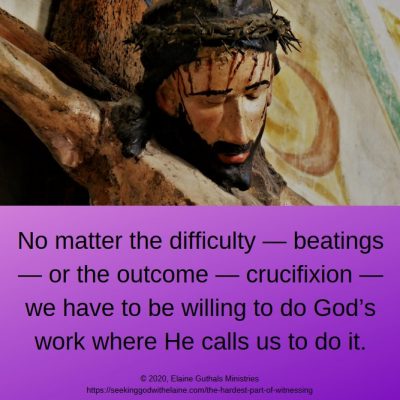
    No matter the difficulty — beatings — or the outcome — crucifixion — we have to be willing to do God’s work where He calls us to do it. Maybe no one has been there before. If we are being called, we need to lay the foundation.

    Jesus on the cross

    God will give us success. Oh, yes. At times, the success may be wrapped in bruises — or worse. But God has said that “…my word that comes from my mouth will not return to me empty, but it will accomplish what I please and will prosper in what I send it to do” (Isa. 55: 11 CSB).

    Making the Connections

    Haldane made a very good point. He wrote, “Whenever the Lord has work to do, He raises up men with a heart to perform it. This, however, is no excuse at any particular time for indifference or want of effort to spread the gospel.”

    God is going to do things on His timing. When the time is right, He will have all the resources ready to get it accomplished. The people are going to be there. Money will be available. Time will not be an issue.

    God’s Will will be done.

    We’ve talked before that every single person will have the opportunity to accept the gospel before Jesus returns. “And this gospel of the kingdom will be preached in the whole world as a testimony to all nations, and then the end will come” (Mt. 24: 14 NLT). Everyone must make a decision.

    To read a related devotion, click the button below.

    Let’s go back to pride a second. We have to have some pride in our work. I mean, we are working in an area that will have eternal consequences. We should be doing our best for our Lord.

    But we do need to be humbled that God is using us. He doesn’t need us. We need Him.

    God will grow us as we do His work. That is how He changes us and refines us.

    How Do We Apply This?

    • We should pray for the desire to do God’s work.
    • We need to go where God calls us.
    • We need to go where we are needed most. Redoing work of others may not be the best use of our time.
    • We can’t shy away from the hard stuff. Satan is going to try to make it all hard.
    • The unwanted jobs can be the most rewarding. Robinson wrote, “The truest ambition is to serve God in the best and most devoted manner.”
    • Sometimes we need to start with the foundation for continuity’s sake.
    • It is okay to want to leave our own mark in doing God’s work — we just have to keep the pride in balance.

    God wants everyone to be saved. “This is good, and it pleases God our Savior, who wants everyone to be saved and to come to the knowledge of the truth” (I Time 2: 3-4 CSB).

    How do they hear but that we tell them?

    Father. We want others to have the joy that we have found in You. We want them to know Your love and provision. Help us to determine our roles in witnessing to others. Give us courage to approach people and the abilities to know what they need from us. Amen.

    What do you think?

    Leave me a comment below (about this or anything else) or head over to my Facebook group for some interactive discussion.

    If you don’t understand something and would like further clarification, please contact me.

    If you have not signed up for the email daily or weekly providing the link to the devotions and the newsletter, do so below.

    If God has used this devotion to speak with you, consider sharing it on social media.
  • Witnessing as God Calls

    Paul was a good witness for God. He could have let his pride get the best of him, but he didn’t. This devotion looks how Paul boasted in God and accomplished what God asked of him.

    Nuggets

    • God gives us all of our abilities.
    • If Paul had anything to do with the things he had accomplished, it was only because he was obedient in what God asked of him.
    • Our strengths are comparable to Paul’s.
    Flowers with title Witnessing as God Calls

    It is the end of the quarter, so my Ladies and I would be finishing up our study of Romans — if we were meeting. We haven’t been able to meet electronically, unfortunately.

    Our church started meeting in the parking lot last weekend — observing social distancing. Hopefully, we can begin meeting again.

    If we are finishing our study, that means Paul is fixing to end his letter to the Romans. In his mind, that probably meant finishing with the encouragement section. At least, he does here.

    Let’s Put It into Context

    “My brothers and sisters, I myself am convinced about you that you also are full of goodness, filled with all knowledge, and able to instruct one another. Nevertheless, I have written to remind you more boldly on some points because of the grace given me by God to be a minister of Christ Jesus to the Gentiles, serving as a priest of the gospel of God. God’s purpose is that the Gentiles may be an acceptable offering, sanctified by the Holy Spirit” (Rom 15: 14-16 CSB)Bible Verse

    Paul made a good pastor. He had a deep affection for his flock — even those he hadn’t met yet. He focused on the goodness within them. He pointed out that they were knowledgeable — as they should be (I Pet. 3: 18).

    One reason Paul had the affection was because he took his mission seriously. He was “… a minister of Christ Jesus to the Gentiles, serving as a priest of the gospel of God …” (Rom. 15: 16 CSB). His mission was to witness — to take the gospel to the Gentiles.

    But Paul’s mission was also to build up the body. He did that by encouraging and admonishing them.

    Paul knew that every ability he received to perform that mission came from God. That was humbling to him.

    Humbling, but he didn’t cower. He boldly preached the gospel of Jesus Christ.

    Jesus Is the Reason

    “Therefore I have reason to boast in Christ Jesus regarding what pertains to God” (Rom. 15: 17 CSB)

    When we are really good at what we do, it is easy to let the pride show. According to the Holman Bible Dictionary, pride is “undue confidence in and attention to one’s own skills, accomplishments, state, possessions, or position.” We can start boasting, which according to the Merriam-Webster Dictionary is “a statement expressing excessive pride in oneself.”

    Some would say that Paul had reason to boast. Jesus Himself gave Paul his marching orders. Paul became one of the driving forces of growing the early church rather than destroying it. Yes, he wrote many of his letters while he was in jail, but those letters make up the bulk of the New Testament.

    Paul, on the other hand, stated that there was only one reason for him to boast: “… in Christ Jesus regarding what pertains to God” (Rom. 15: 17 CSB). His relationship with God was the most important attribute he could possess.

    Faith and abilities — even love — were all given to Paul by God. Paul didn’t have anything on his own. Everything Paul was and accomplished was given to him by God.

    God gives us all of our abilities. We really have nothing to boast about, either.

    Arrows in target

    Doing What We Are Told

    “For I would not dare say anything except what Christ has accomplished through me by word and deed for the obedience of the Gentiles” (Rom. 15: 18 CSB)

    If Paul had anything to do with the things he had accomplished, it was only because he was obedient in what God asked of him. Obedience means to hear and carry out the instructions that God gives us.

    Every disciple is called to be obedient to God’s laws and commandments. By following those standards, our character is changed to imitate Him.

    Glossary

    We are also called individually to follow God’s directions for our lives. Mine is to write devotions and out then out on the internet. Mine is also to lead a Sunday morning Bible study class for some wonderful Ladies. Mine is to use my music to praise Him and encourage others.

    Yes, we think of Paul as just having one big direction from God — running around the countryside telling others about the gospel. But his was also to write letters encouraging the new converts in their walk. His mission was also to encourage those he could.

    Lyth reminded us that Paul didn’t exaggerate. Oh, yes. Our pride wants to puff us up and make it look like we are accomplishing more than we are. Paul didn’t need to exaggerate.

    Evidence Presented

    “by the power of miraculous signs and wonders, and by the power of God’s Spirit. As a result, I have fully proclaimed the gospel of Christ from Jerusalem all the way around to Illyricum” (Rom. 15: 19 CSB)

    God shows His power through signs and wonders. He has given us many signs. The angels told the shepherds that a sign of the Savior would be that they would find Him in a manger. Jesus said His death and resurrection was a sign. He also told us the signs to look for that signify the end of the age.

    To read a related devotion, click the appropriate button below.

    We don’t have to look far to see God’s wonders. The human body that He created with all of its systems is amazing. The world itself a miracle. Think of how quickly it came back after humans had to step back.

    We talked about not long ago how God is omnipotent. Holman Bible Dictionary defines omnipotence as “the state of being all-powerful which theology ascribes to God.”

    God created everything we see — and a lot of things we don’t see. He interconnects things and causes events to produce the outcomes needed to grow our characters. God is eternal and consistent.

    To read a related devotion, click the button below.

    God starts us where we are at. In Paul’s case, that was Jerusalem. He takes us where He wants us to go — in Paul’s case, “… all the way around to Illyricum” (Rom. 15: 19 CSB).

    Where in the world was Illyricum? Well, according to the Holman Bible Dictionary, it was a district, not a city. Today, the area is Serbia (formerly Yugoslavia) and Albania.

    The point Paul was making was God wanted his ministry to encompass the Gentile world — with some overlap into the Jewish world.

    God wants our ministry to encompass our world — wherever He takes us. He wants us to be constantly looking out for the opportunities He opens up for us.

    Our message should be the same as Paul’s:

    • Sinners need to repent and accept God’s gift of salvation.
    • Acceptance of salvation means we must strive to make our character more like God’s.
    • We need to watch for Jesus’ return.

    Paul didn’t do anything by halves. He was totally dedicated to his ministry of proclaiming the gospel. He started soon after his conversion and labored, I’m sure, until the day he died.

    Brown gave us a good overview of Paul’s strengths and challenges. Let’s take a look at what helped Paul in his ministry.

    • His strong faith
    • His love for Christ
    • His love for his fellow man
    • His natural abilities and education
    • The gift of the Holy Spirit
    • His companions
    • His Roman citizenship

    Hmmm. Our strengths are comparable to Paul’s. We may not be citizens of Rome, but we can use our citizenship to spread the gospel to our countrymen.

    I would think the gift of the Holy Spirit is God’s choice. However, He will reward us for our obedience with even more gifts.

    Yes, natural abilities are just there. But suppose my natural ability is running. If I am going to compete in a competition, I still have to train. I have to increase my endurance. I would want to try to get faster.

    In other words, it still takes work.

    Faith, love for God and others, education, friends — those we choose to grow.

    Making the Connections

    Why are people called on missions? Why are signs and wonders given? Lyth said that it was “to make the Gentiles obedient to the gospel.”

    One of our job duties is to proclaim the gospel. “And he said to them, ‘Go into all the world and proclaim the gospel to the whole creation’” (Mk. 16: 15 ESV).
    Think of all Paul accomplished. He was just one man, plugging away for 30 years. Oh, yes. Paul had his companions, but he was the driving force behind the ministry.

    You would think that if anyone would be able to boast, it would be Paul. But he didn’t.

    Paul boasted about God.

    There were probably the good days in the ministry where a number of people made a profession of faith. There were those days when Paul was run out of town.

    There were probably days that were straight travel. In the rain. In the heat. In the cold.

    Paul and his merry men probably had to sleep on the side of the road a time or two. They may have gotten sick and tired of eating whatever their staple was.

    Paul still boasted about God.

    How Do We Apply This?

    Since one of our job duties is to proclaim the gospel, we need to make sure that we are qualified to do that. Lyth gages us three things on which to work:

    • “Recognising good where it already exists.
    • “Humbly putting those who have believed in mind of common duties and privileges.
    • “Seeking the salvation of the unconverted — in the name and for the glory of God.”

    God will call us to the ministry He wants us to perform. He will equip us and pave the way.

    Father God. We are humbled that You love us enough to design the plan of salvation. We are humbled that You will accept our work to expand Your kingdom. Lord, increase our faith and our love for You and our fellow man. Give us the abilities needed to do Your work and help us to learn the rest. Provide committed and supportive fellow workers so that we can work together for Your cause. Help us to use everything available to spread Your love. May You find us working on Your return. Amen.

    To read a related devotion, click the button below.

    The ABCDs of Salvation

    If you have not become a believer in Christ, please read through the
    Plan of Salvation and prayerfully consider what God is asking you to do.

    A – admit our sins
    B – believe His Son Jesus is our Redeemer
    C – confess God as Sovereign Lord

    D – demonstrate that commitment by making any changes needed in our lives to
    live the way in which God has called us

    The Disciple’s Job Description

    Searching for and Seeking God

    Hearing His Word (Rom. 10: 17).
    Reading His Word (Rev. 1: 3).
    Praying to Him (Heb. 4: 16).
    Studying His Word (Ac. 17: 11).
    Meditating on His Word (Ps. 1: 1-2).
    Memorizing His Word (Ps. 119: 11).

    To read Has God Provided Everything We Need?, click the button below.

    If you have not admitted that your relationship is not right with God,

    have not asked Jesus to be your Lord and Savior,

    and have not confessed your sins,

    please read through the Plan of Salvation and prayerfully consider what God is asking you to do.

    Related Links

    Related Links

    Related Links

    Song

    Related Links

    I have created a worksheet of the questions above. Click on the button below to access it.

    Don’t know what your spiritual gifts are?

    Take this Spiritual Gifts Inventory

    The Disciple’s Job Description

    Complete Job Description

    Individual Description

    It Was Enough
    Vocalist: Elaine Guthals
    Keyboard: Chris Vieth

    What do you think?

    Leave me a comment below (about this or anything else) or head over to my Facebook group for some interactive discussion.

    If you don’t understand something and would like further clarification, please contact me.

    If you have not signed up for the email daily or weekly providing the link to the devotions and the newsletter, do so below.

    If God has used this devotion to speak with you, consider sharing it on social media.

  • Receiving the Kingdom

    Just hearing about the kingdom of God isn’t enough. We have to understand. Jesus told the parable about the sower to help us understand how we receive knowledge about the kingdom.

    Nuggets

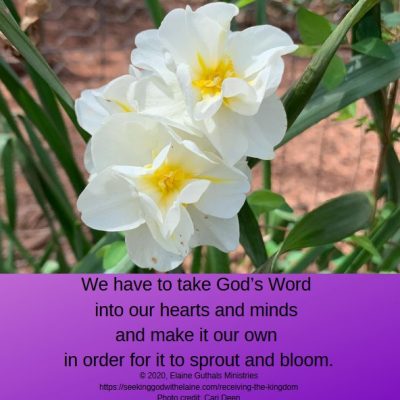
    • We have to take God’s Word into our hearts and minds and make it our own in order for it to sprout and bloom.
    • We can’t receive the Word as a feel-good band aid.
    • God’s Word must be our guide as we keep our thought processes firmly focused on His kingdom.
    • We have to be focused on His kingdom, and not the world around us.

    Devotions in the What I Believe series

    Devotions in the God‘s Kingdom  category

    Flowers with title Receiving the Kingdom

    I wasn’t sure about focusing on this passage. It doesn’t tell us about the kingdom of God.

    But being a farm girl, I have always loved the parable of the sower. It tells us about ourselves and how we receive the Word of God.

    Let’s Put It into Context #1

    According to the Holman Bible Dictionary, the kingdom of God is “God’s kingly rule or sovereignty.” It is interesting that then Old Testament does not talk about it, but the New Testament does.

    Resource

    Instead of it being a physical location, it is also spiritually the kingdom of God describes His sovereign reign. His rule over mankind was extended through the plan of salvation. By ABCDing, we submit our lives to Him.

    The ABCDs of Salvation

    If you have not become a believer in Christ, please read through the
    Plan of Salvation and prayerfully consider what God is asking you to do.

    A – admit our sins
    B – believe His Son Jesus is our Redeemer
    C – confess God as Sovereign Lord

    D – demonstrate that commitment by making any changes needed in our lives to
    live the way in which God has called us

    The Disciple’s Job Description

    Let’s Put It into Context #2

    “Then he told them many things in parables, saying, ‘Consider the sower who went out to sow. As he sowed, some seed fell along the path, and the birds came and devoured them. Other seed fell on rocky ground where it didn’t have much soil, and it grew up quickly since the soil wasn’t deep. But when the sun came up, it was scorched, and since it had no root, it withered away. Other seed fell among thorns, and the thorns came up and choked it. Still other seed fell on good ground and produced fruit: some a hundred, some sixty, and some thirty times what was sown. Let anyone who has ears listen’” (Mt. 13: 3-9 CSB)

    The first recorded parable in the Book of Matthew that Jesus told is the parable of the sower. First, Jesus told the parable, and then He went back and explained it for the disciples.

    Jesus ended the parable by saying, “Let anyone who has ears listen’” (Mt. 13: 9 CSB). Believers are called not only to hear and listen, but to also understand. It is hard to do that if there are distractions in our world and if we struggle with what is being told to us. We must choose to listen to God when He talks to us.

    To read a related devotion, click the button below.

    Scenario #1: Total Rejection

    “When anyone hears the word about the kingdom and doesn’t understand it, the evil one comes and snatches away what was sown in his heart. This is the one sown along the path” (Mt. 13: 19 CSB)

    The first scenario was when the birds came and snatched the seeds away (Mt. 13: 4). That was because the seed fell on ground that had not been prepared for planting.

    Planting is a really good analogy here. We have to take God’s Word into our hearts and minds and make it our own in order for it to sprout and bloom.

    Flowers

    But this doesn’t get that far. God’s Word is not even considered in this scenario. We would say that it goes in one ear and out the other.

    Dods suggested several who may be a part of this scenario. One might be someone who is listening because it is something to do but not really hearing. Someone else, on the other hand, may possess a “… slowness and cold frostiness of nature …” that cannot be penetrated.

    To read a related devotion, click the button below.

    Scenario #2: Couldn’t Have Been

    “And the one sown on rocky ground — this is one who hears the word and immediately receives it with joy. But he has no root and is short-lived. When distress or persecution comes because of the word, immediately he falls away” (Mt. 13: 20-21 CSB)

    The second scenario in Matthew 13: 5-6 gives the Word a little more of a chance to take root — a little. It is actually received well. Jesus said the searcher receives it with joy.

    It just doesn’t have anywhere to get traction. We can’t receive the Word as a feel-good band aid.

    Instead, true searchers really seek God. Dods described it this way: “The man of deeper character receives it with seriousness, reverence, trembling, foreseeing the trials he will be subjected to.”

    To read a related devotion, click the button below.

    We’ve talked a couple of times that, when we learn something new, we have to have building blocks on which to tie that new content. Long time ago, I took a physical science class. It was an overview of chemistry, physics and astronomy.

    I did okay on the astronomy because I had studied that before and I was interested in it.

    The other two topics weren’t pretty. I had no frame of reference. The terminology was Greek to me. It was beyond my capabilities. The worst part was I really didn’t want to be there, but I had to in order to get my degree.

    What this tells me is that — when we can — we shouldn’t just plant the seed. (Oh, yes. There will be times when that is the extent in our plans. And yes, they will have the Holy Spirit there to instruct them.)

    We have to water the seed. We have to help pull weeds.

    This is especially true for those that don’t have the building blocks for learning. Dods described that as “there is not depth of soil for any time to be spent in rooting.” We need to support those searchers.

    To read a related devotion, click the button below.

    Oh, yes. Being more than a planter requires us to really build a relationship with the searcher.

    Maybe one good thing that can come out of this pandemic is our willingness to build true relationships. Before, many people seemed to just want to focus on the relationships within their inner circle. Any relationship outside the circle tended to be a surface relationship.

    Hopefully, now we will be more open to building real relationships with others. Our witness will benefit.

    Scenario #3: Could Have Been

    “Now the one sown among the thorns — this is one who hears the word, but the worries of this age and the deceitfulness of wealth choke the word, and it becomes unfruitful” (Mt. 13: 22 CSB)

    Okay, there is enough dirt to grow the thorns (Mt. 13: 7). But that is the problem. The thorns take up too much of the nutrients in the soil. The seed can’t grow.

    Oh, my. I just had a really interesting image pop into my head. This is like us trying to get over to the cake and punch table at a reception. Only the room is really, really crowded. So, we have to use our shoulders to knock people out of the way just to take a step.

    The thing is, people sometimes shove back when they get shoved. Worst case scenario is when it turns into a free-for-all.

    If things were orderly, we could have our cake and be chowing down in two seconds. But it could take us minutes — or we may never get there — with enough obstacles in our way.

    How many things of this life take our focus off the kingdom? How many obstacles does Satan put in our paths?

    The sad part is that the searcher is genuinely searching for God. This life is too much of a focus, though.

    Oh, I know. Some of the things we go through in life can be real doozies. We can’t shift focus to them from God. We have to keep our focus firmly on His kingdom.

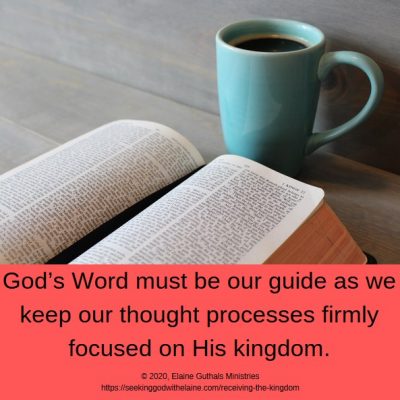
    God’s Word must be our guide as we keep our thought processes firmly focused on His kingdom. We have to be ready to fight back.

    Coffee and Bible

    Dods made another interesting observation. He wrote, “Cutting down the thorns won’t do; still less holding them aside till the seed be sown. It is vain to hope for the only right harvest of a human life if your heart is sown with worldly ambitions, a greedy hasting to be rich, an undue love of comfort, a true earthliness of spirit. One seed only must be sown in you, and it will produce all needed diligence in business as well as all fervour of spirit.”

    To read a related devotion, click the button below.

    We’ve talked before about some people thinking they only need to be kind to others in order to get their ticket punched for heaven. Or doing the do’s and not doing the don’ts. Or just believing there is a God.

    Most of that takes care of following God’s laws. But we are neither fully following them nor following them for the right reasons.

    Plus, it does nothing toward regeneration. Regeneration is the change in us that God brings about when we go from being spiritually dead to spiritually alive. Only admitting our sins, believing Jesus is our Savior and Redeemer, and confessing God as our Sovereign Lord will bring about regeneration.

    We have got to go from spiritually dead to spiritually alive to be allowed in the kingdom of God.

    Scenario #4: Total Acceptance

    “But the one sown on the good ground — this is one who hears and understands the word, who does produce fruit and yields: some a hundred, some sixty, some thirty times what was sown” (Mt. 13: 23 CSB).

    We finally get to the good ground in Matthew 13: 9. Keach gave us the prerequisites for fertile soil:

    “A perfect and sincere heart
    “An obedient heart.
    “A faithful heart.
    “A jealous heart.
    “A fruitful heart.”

    We’ve got to be sincerely seeking God. We have to be focused on His kingdom, and not the world around us. We show that by following His laws and commandments.

    Making the Connections

    I love what Robertson had to say. He wrote, “In the soil of the heart is found all the nutriment of spiritual life, and all the nutriment of the weeds and poisons which destroy spiritual life. And it is this which makes Christian character, when complete, a thing so inestimably precious.”

    It is all there. Yes, all the weeds and poisons are there. We have the free will within us to choose Satan.

    But the free will is also in us to choose God. But it goes beyond that. The soil is fertile so the crops can grow the way they should.

    Glossary

    I know. I have been struggling with this one temptation my entire life. I keep giving into it.

    “In the soil of the heart is found all the nutriment of spiritual life …”

    All of the nutrients are there. No, it isn’t impossible. We are not destined to be failures.

    We are destined to be like Him.

    Making the Connections to Self-Discipline

    We have all at some point or another felt God was “way up there” and we are “way down here.” That may be a feeling common to those being introduced to God’s love.

    We’ve been asking these questions all along so we can prepare for when we are asked to defend our beliefs. Here is the worksheet again. How would you describe God’s love when He is perfect and we are not?

    • What does the Scriptures say?
    • What do I believe?
    • Why do I believe the same/differently than the Scriptures?
    • What are the talking points when witnessing to a non-believer?

    Related Links

    I have created a worksheet of the questions above. Click on the button below to access it.

    How Do We Apply This?

    • We need to look at things from a God’s perspective. He sees us as He made us.
    • We need to seek God faithfully.
    • We have to focus on God and not this world.
    • We need to improve our character to imitate Him.

    Searching for and Seeking God

    Hearing His Word (Rom. 10: 17).
    Reading His Word (Rev. 1: 3).
    Praying to Him (Heb. 4: 16).
    Studying His Word (Ac. 17: 11).
    Meditating on His Word (Ps. 1: 1-2).
    Memorizing His Word (Ps. 119: 11).

    Father. You see us in Your image. You see us as we are supposed to be and will be. Help us to see ourselves through Your eyes. Show us that the good sin is within all of us. Help us to grow closer to You. Amen.

    What do you think?

    Leave me a comment below (about this or anything else) or head over to my Facebook group for some interactive discussion.

    If you don’t understand something and would like further clarification, please contact me.

    If you have not signed up for the email daily or weekly providing the link to the devotions and the newsletter, do so below.

    If God has used this devotion to speak with you, consider sharing it on social media.

  • Conversations with a King

    Jesus spoke about the Kingdom of God frequently without explaining much about it. This devotion looks at two conversations Jesus had that shed a little more light on what He meant.

    Nuggets

    • Jesus’ kingdom is above and beyond what Pilate expected.
    • Jesus earned His kingdom by being God’s Son and by being the Sacrifice for our sins.

    Devotions in the What I Believe series

    Devotions in the God’s Kingdom category

    Flowers with title Conversations with a King

    Jesus spent His ministry talking about His kingdom. His audience, at times, didn’t understand what He was talking about.

    Let’s take a look at two such conversations.

    Let’s Put It into Context

    According to the Holman Bible Dictionary, the kingdom of God is “God’s kingly rule or sovereignty.” It is interesting that then Old Testament does not talk about it, but the New Testament does.

    Resource

    Instead of it being a physical location, it is also spiritually the kingdom of God describes His sovereign reign. His rule over mankind was extended through the plan of salvation. By ABCDing, we submit our lives to Him.

    Not from Around Here

    “‘My kingdom is not of this world,’ said Jesus. ‘If my kingdom were of this world, my servants would fight, so that I wouldn’t be handed over to the Jews. But as it is, my kingdom is not from here’” (Jn. 18: 36 CSB)

    When Jesus was on trial before Pilate, Pilate asked Him point blank, “… ‘Are you the king of the Jews?’” (Jn. 18: 33 CSB).

    True, not all of the continents had been discovered at this time, but if Jesus would have been an earthly king, you would think Pilate would know. I mean, he was with the Roman Empire, who tried to conquer everybody.

    Jesus didn’t answer just ‘yes’ or ‘no.’ Thomson argued that He couldn’t answer that way because of Pilate’s limitations. Pilate, especially as a Roman governor, would be thinking of earthly kingdoms.

    Jesus’ kingdom is above and beyond what Pilate expected. So, Jesus said He wasn’t from around these parts.

    But He let Pilate know — as He let few know — that He was a King.

    Jesus earned His kingdom by being God’s Son and by being the Sacrifice for our sins. The purpose of the kingdom is so that we can be reunited with God in our spiritual form.

    The Jews were looking for the Messiah to set up an earthly kingdom. I bet they had previously thought Jesus would have Pilate on trial, not the other way around!

    That wasn’t what Jesus’ kingdom was about. In fact, Jenyns wrote, “Christ is the only Founder of a religion in the history of mankind which is totally unconnected with all human policy and government, and, therefore, totally unconducive to any worldly purpose whatever …”

    Hoge compared a worldly kingdom with a heavenly kingdom.

    • Worldly
    • Territory
    • Power
    • No inequalities of hereditary rank.
    • Luxury (palaces and ceremonies)
    • Succession to the throne
      elective or hereditary
    • Heavenly
    • Not limited by boundaries.
    • King elects His people.
      No inequalities of hereditary rank.
    • No pomp or insignia of authority, &c.
    • No succession but one immortal
      King reigns through all generations.

    Let’s look at it this way. The kingdom of God is a spiritual kingdom that describes His sovereign reign. Jesus’ kingdom wouldn’t have been from around there because His kingdom is in our hearts. Because His is not a physical, worldly kingdom, the rewards will neither be physical or worldly.

    Brown disagreed. He argued that Jesus’ kingdom is the church. However, he thought it was Christ’s earthly kingdom.

    Can’t Observe the Kingdome

    “When he was asked by the Pharisees when the kingdom of God would come, he answered them, ‘The kingdom of God is not coming with something observable; no one will say, ‘See here!’ or ‘There!’ For you see, the kingdom of God is in your midst’” (Lk. 17: 20-21 CSB)

    Yes, the Pharisees thought there would be a huge war to oust the Romans. They thought it would be loud, violent, and decisive.

    The Pharisees heard Jesus saying He was the Messiah. They didn’t see the fireworks. They especially weren’t seeing the Romans tucking tail and running.

    I love how Jesus answered the Pharisees. “You won’t be able to see it — in fact, you missed it!”

    Does that mean Jesus is the kingdom of God? It sounds that way.

    Lathrop made an interesting observation. He wrote, “The blessings of God’s kingdom are chiefly invisible, and without observation. The rewards which the gospel promises are not earthly and temporal, but heavenly and spiritual.”

    Oh, but don’t we think those blessings should have blinking lights and arrows? We should be able to see them, at a minimum. Don’t we want to show them off to others?

    Instead, Williams said, “it is a kingdom of the mind, the will, the feeling, and the conduct.”

    Making the Connections

    Let’s try to combine. Jesus’ subjects are the church (if that makes the church His kingdom, okay). Right now, His kingdom is in our hearts. Jesus is within us.

    Why am I thinking that? We are Jesus’ subject now. That isn’t going to wait until we get to heaven. He is our Sovereign now.

    Eventually, we will join Jesus wherever His kingdom is. Until then, we have dual citizenship.

    We just have to remember that we are in the world and not of the world. Jesus said that in His prayer for His disciples at the Last Supper. He was not praying for the disciples to be taken out of the world. He asked for a hedge around them to protect them from Satan.

    To read a related devotion, click the button below.

    Another thing we have to think about is God very rarely does things our way. He knows things we don’t know. He has better things in mind for us than we can imagine.

    My Kingdom

    Okay, we are going to chase a rabbit. Remember a couple of devotions ago, we talked about when Jesus was going to come into His kingdom.

    This verse makes it sound like Jesus is already in His kingdom. “‘My kingdom is not of this world,’ said Jesus …” (Jn. 18: 36 CSB). It does not say “my kingdom will not be of this world.” It says isn’t — present tense.

    To read a related devotion, click the button below.

    Making the Connections to Self-Discipline

    We’ve been asking these questions all along so we can prepare for when we are asked. Here is the worksheet again. How would you describe God’s kingdom when it is invisible and contradictory to what we expect?

    • What does the Scriptures say?
    • What do I believe?
    • Why do I believe the same/differently than the Scriptures?
    • What are the talking points when witnessing to a non-believer?

    Related Links

    I have created a worksheet of the questions above. Click on the button below to access it.

    How Do We Apply This?

    The kingdom of God is invisible. One reason is because the kingdom is in our hearts.

    Hoge was correct when he said that, “though this kingdom is not of this world, it is the kingdom the world most needs.”

    Gracious Loving Father. Thy kingdom come. Lord, we pray that You will establish Your kingdoms in us. Amen.

    What do you think?

    Leave me a comment below (about this or anything else) or head over to my Facebook group for some interactive discussion.

    If you don’t understand something and would like further clarification, please contact me.

    If you have not signed up for the email daily or weekly providing the link to the devotions and the newsletter, do so below.

    If God has used this devotion to speak with you, consider sharing it on social media.
  • Forever Worshiping Our Lord

    Disciples will be worshiping out Lord through eternity. This devotion look at how Jesus will be the judge of the living and dead.

    Nuggets

    • Jesus been designated Judge as a reward for His obedience in becoming the Sacrifice for our sins.
    • Everyone will stand before the judgment seat — the living and the dead.
    • Even though it says every knee will bow, it does not mean every person will be saved.
    • We won’t get to the worshiping in heaven part if we don’t worship in this life.

    Devotions in the What I Believe series

    Devotions in the Worship category

    Flowers with title Forever Worshiping Our Lord

    The problem with Paul’s letters is each verse is so jam packed with wonderful nuggets that it fills up a devotion quickly. That is what happened with the previous devotion. It filled up before I had all the verses done. So, I broke what I had been planning on into two devotions.

    Another problem is I woke up with a migraine this morning. I was able to sleep several more hours, but I woke up again with it still there.

    So, this devotion is going to be shorter than normal. That is okay. I have been planning on doing the Final Judgment two series from now. I am going to do a very narrow focus here and hit it harder then.

    Let’s finish out the Sunday Morning Bible Story lessons.

    Let’s Put It into Context

    Worship, according to the Holman Bible Dictionary, is “Human response to the perceived presence of the divine, a presence which transcends normal human activity and is holy.”

    Resource

    According to the Holman Bible Dictionary, the Sabbath is “the day of rest, considered holy to God by His rest on the seventh day after creation and viewed as a sign of the covenant relation between God and His people and of the eternal rest He has promised them.”

    Resource

    Jesus as Judge

    “But you, why do you judge your brother or sister? Or you, why do you despise your brother or sister? For we will all stand before the judgment seat of God” (Rom. 14: 10 CSB)

    We are back talking about being judgmental and censorious. Again, Paul told us not to be critical of others.

    But this time, Jesus is the Judge. He has been designated Judge as a reward for His obedience in becoming the Sacrifice for our sins. When judgment day comes, He will judge the living and the dead. “For he has set a day for judging the world with justice by the man he has appointed, and he proved to everyone who this is by raising him from the dead” (Ac. 17: 31 NLT).

    We finished up the last devotion talking about how Jesus is Lord of the living and dead. That is very important. Paul said that everyone will stand before the judgment seat — the living and the dead. He also does not distinguish between sheep and goats. We all just give an account of ourselves.

    But did we see what Paul did here? He called Jesus God. “I and the Father are one” (Jn, 10: 30 ESV). Paul called them One because Jesus said They are.

    Fulfilling Prophecy

    “For it is written, As I live, says the Lord, every knee will bow to me, and every tongue will give praise to God. So then, each of us will give an account of himself to God” (Rom. 14: 11-12 CSB)

    It was important that Paul establish Jesus’ divinity and His role as judge. Paul was fixing to quote Isaiah 45: 23: “By myself I have sworn; truth has gone from my mouth, a word that will not be revoked: Every knee will bow to me, every tongue will swear allegiance” (CSB). Paul had to identify the Me he was talking about.

    Even though it says every knee will bow, it does not mean every person will be saved (Thomas). Some worldview people may think that because God is love and they are made in His image, that is enough to gain them salvation in the end.

    It isn’t. “Jesus answered, ‘I am the way and the truth and the life. No one comes to the Father except through me’” (Jn. 14: 6 NLT). Salvation only comes through Jesus.

    If we don’t gain freedom from Jesus (Jn. 8: 36), we will be subjected to torment in hell.

    To read a devotion in the Hell Does Have Fury series, click on the appropriate button below.

    Making the Connections

    We won’t get to the worshiping in heaven part if we don’t worship in this life. Once Jesus comes, it is going to be too late to change our minds.

    So, let’s recap what we learned in this series.

    • The fourth commandment instructs us to keep the Sabbath day holy.
    • If Day Seven of creation is the Sabbath — the day we are to worship — and it hasn’t ended because there was no evening listed in Genesis 2, we are to continuously worship the One true God.
    • We worship God because we praise Him as Sovereign God.
    • We are to worship the One true God on the Sabbath and at all times by proclaiming His worth to show that we are in a covenant relation with Him.
    • Everyone is supposed to praise God by shouting joyfully and triumphantly.
    • We are to focus on all things spiritual on the Sabbath.
    • There are three types of worship: personal, family, and corporate.
    • Worship is voluntary. It must be sincere, but it also has to be consistent.
    • The Sabbath was made for man, not the other way around.
    • Sabbath was made for all mankind — Jews and Gentiles. If mankind would have been made for the Sabbath, it would have just been made for the Jews because the Jews were His chosen people.
    • We shouldn’t argue about what we believe.
    • We get to make our choices – even if we choose not to follow Him – but we need to be convinced when we do.
    • No one is excluded – unless they chose to be excluded.
    • We are to worship daily so that the consistency helps us change our character to imitate God.
    • Disciples have to choose to worship God and live accordingly.
    • Worship is a life and death matter.
    • It is all about our frame of mind when we think about death.
    • Described as the cornerstone (Eph. 2: 19) and the head (Col. 1: 18), Jesus is greater than the temple.
    • Jesus came to earth to live and die for us, making Him the master of the living and dead.
    • Jesus has been designated Judge as a reward for His obedience in becoming the Sacrifice for our sins.
    • When judgment day comes, He will judge the living and the dead.
    • Even though it says every knee will bow, it does not mean every person will be saved.

    Making the Connections to Self-Discipline

    We’ve been asking these questions all along so we can prepare for when we are asked. Here is the worksheet again. If someone asked you about worshiping for eternity, what would you tell them?

    • What does the Scriptures say?
    • What do I believe?
    • Why do I believe the same/differently than the Scriptures?
    • What are the talking points when witnessing to a non-believer?

    Related Links

    I have created a worksheet of the questions above. Click on the button below to access it.

    How Do We Apply This?

    To up our worship game, we have to be sincere and consistent. We have to put in the time to do it.

    That doesn’t mean just go to church every time the doors are open. That means we have to faithfully seek God. We have to worship God privately as well as publicly.

    Searching for and Seeking God

    Hearing His Word (Rom. 10: 17).
    Reading His Word (Rev. 1: 3).
    Praying to Him (Heb. 4: 16).
    Studying His Word (Ac. 17: 11).
    Meditating on His Word (Ps. 1: 1-2).
    Memorizing His Word (Ps. 119: 11).

    Heaven right now is filled with praises to God. Think of what it will be like when we all get there. And heaven will ring with Hs praises for all of eternity.

    Don’t miss it.

    The ABCDs of Salvation

    If you have not become a believer in Christ, please read through the
    Plan of Salvation and prayerfully consider what God is asking you to do.

    A – admit our sins
    B – believe His Son Jesus is our Redeemer
    C – confess God as Sovereign Lord

    D – demonstrate that commitment by making any changes needed in our lives to
    live the way in which God has called us

    The Disciple’s Job Description

    Father. We praise You in this life. We can’t wait to praise You face to face for eternity. Amen.

    What do you think?

    Leave me a comment below (about this or anything else) or head over to my Facebook group for some interactive discussion.

    If you don’t understand something and would like further clarification, please contact me.

    If you have not signed up for the email daily or weekly providing the link to the devotions and the newsletter, do so below.

    If God has used this devotion to speak with you, consider sharing it on social media.
  • The Life and Death Matter of Worship

    How can worship be a life and death matter? This devotion looks at how and why we worship.

    Nuggets

    • Disciples have to choose to worship God and live accordingly.
    • It is all about our frame of mind when we think about death.
    • Jesus came to earth to live and die for us, making Him the master of the living and dead.
    • Jesus came to be a servant – to pay the penalty for our sins.

    Devotions in the What I Believe series

    Devotions in the Worship category

    Flowers with title The Life and Death Matter of Worship

    Sometimes, we can convince ourselves that worship isn’t important. Or we try to justify our absence in corporate worship by detailing all of the ways we feel it does not fit what God had in mind.

    Worship is really important to God. In fact, it is a life and death matter.

    Let’s Put It into Context

    Worship, according to the Holman Bible Dictionary, is “Human response to the perceived presence of the divine, a presence which transcends normal human activity and is holy.”

    Resource

    According to the Holman Bible Dictionary, the Sabbath is “the day of rest, considered holy to God by His rest on the seventh day after creation and viewed as a sign of the covenant relation between God and His people and of the eternal rest He has promised them.”

    Resource

    A Consecrated Life

    “If we live, we live for the Lord; and if we die, we die for the Lord. Therefore, whether we live or die, we belong to the Lord” (Rom. 14: 8 CSB)

    Consecration, according to the Holman Bible Dictionary, “refers to persons or things being separated to or belonging to God.” The Merriam-Webster Dictionary agreed with the being part but focused more on the “made or declared sacred” aspect. It was more of a ceremony.

    I can see the why it talks about the process rather than just being a segregated group. We are made separate because we make a conscious decision.

    Don’t get me wrong. We make a lot of involuntary decisions.

    However, disciples have to choose to worship God and live accordingly. Hull wrote that, “In the Christian idea the whole of those marvellous activities that rise from our will are to be one scene of dedication to God.” When temptation comes, we have to choose to follow God’s laws and commandments.

    Those choices show our submission to God no matter what life throws at us. We choose to worship and praise Him.

    Burn told us four area that we have to dedicate to God in order to live a consecrated for the Lord.

    • Intellectual
    • Emotional
    • Practical
    • Spiritual

    Our conscious decisions have to be made after we have looked at what God has done for us and what He will do for us in the future. We have to do that through hearing His Word, reading it, studying it, meditating on it, and memorizing it. All through that, we need to be in prayer, asking God to provide the meaning.

    When we make the decision to worship God, we give Him our love make him and receive love, joy, and hope. We live for Him to make the decision to love, to be joyful, and to have hope.

    Then we have to tell others. We worship God and live for Him by wanting to sharing that love, joy, and hope.

    Bottom line, though, is it is all about the spiritual. Salvation is the deliverance from the consequences of sin. This brings regeneration.

    Regeneration is the change in us that God brings about when we go from being spiritually dead to spiritually alive. That regeneration makes us saints.

    Saint means holy ones. Holy means to be set apart, perfect, and pure. We are consecrated to be holy.

    But what about the dying part? Smith wrote that dying to God means “to have a view to the glory of God in all that pertains to our death.”

    It is all about our frame of mind when we think about death. Are we terrified by it? Do we love this life so much that we aren’t looking forward to it?

    Or do we trust God that, even in our illness and death, He will be praised? Are we looking forward to spending eternity with Him?

    It is all about denying ourselves. “Then Jesus told his disciples, ‘If anyone would come after me, let him deny himself and take up his cross and follow me’” (Mt. 16: 24 ESV).

    Jesus the Conqueror

    “Christ died and returned to life for this: that he might be Lord over both the dead and the living” (Rom. 14: 9 CSB)

    Jesus came to earth to live and die for us. He did this to save us from our sins.

    This makes Jesus the master of the living and dead. Isn’t it comforting that we not only will live with Him forever but also will be reunited with our loved ones?

    Huntington explained it this way. He wrote, “He who rose is the Lord of the living and the dead. They are not two families, but one, because they are all in Him, in spite of the transient curtain that hangs between the departed and ourselves — a curtain that probably has its only substance in the eyes of our flesh.”

    The living and the dead who believe in Jesus are His church. “The church is Christ’s body, the completion of him who himself completes all things everywhere” (Eph. 1: 23 GNT).

    Sibbes explained how Jesus is our Lord. He wrote, Jesus “… is a Lord of the whole man, body and soul. He sits in the throne of conscience. There He prescribes laws to it, pacifies, stablishes, and settles it against all fears. He bows the neck of the inward man, and brings it wholly to be subject to Him.”

    But aren’t we normally just concerned about the living? The dead are that — dead and gone.

    We think the living are the only ones with a future. Oh, yes. We know the whole heaven thing. But don’t we get narrowly focused on this life and forget there is more?

    Nope. Jesus is Lord of the living and the dead. But remember all the different names He had. Mediator, advocate, intercessor, physician, elder brother, forerunner, king, master, head, high priest, captain, and bridegroom.

    Yes, there are some royal aspects in there. But Candlish reminded us that Jesus did not live and die to become Lord. “But He died and rose not that He might be different as Lord from what He was as dying and rising. He is the same yesterday, to-day, and for ever.”

    Jesus came to be a servant. He came to pay the penalty for our sins.

    Making the Connections

    Isn’t God so good at doing that? We think things are going to happen one way.

    But no. God takes it and flips it on its ear.

    And you know what? It is so much better His way.

    It is really comforting that Jesus is Lord of the living and the dead. That really validates our work for Him in this life. It has real meaning.

    Making the Connections to Self-Discipline

    Non-believers may have difficulty believing the whole resurrection/Lord of the living and dead aspect. Part of the reason is because it is beyond our building blocks of knowledge. Another reason is the focus non-believers have on this world.

    We’ve been asking these questions all along so we can prepare for when we are asked. Here is the worksheet again. What would you say about our interactions with others, especially those believe freedom means they do not have to follow God’ laws and commandments?

    • What does the Scriptures say?
    • What do I believe?
    • Why do I believe the same/differently than the Scriptures?
    • What are the talking points when witnessing to a non-believer?

    Related Links

    I have created a worksheet of the questions above. Click on the button below to access it.

    How Do We Apply This?

    We need to

    • Follow God’s laws and commandments.
    • Seek Him.

    Searching for and Seeking God

    Hearing His Word (Rom. 10: 17).
    Reading His Word (Rev. 1: 3).
    Praying to Him (Heb. 4: 16).
    Studying His Word (Ac. 17: 11).
    Meditating on His Word (Ps. 1: 1-2).
    Memorizing His Word (Ps. 119: 11).

    • Learn all that we can about God’s character and how He wants us to live.
    • Commit to following His plans for our lives.
    • Submit totally to Him.
    • Honor God in all we do.
    • Live a consecrated life for Him.
    • Take our focus off this world and focus on our eternal life.
    • Mortify our sins.
    • Put an appropriate emphasis on death — not too much, not too little.
    • Foster a child-like faith in God.

    Mortify means to place a death penalty on our sins.

    Walker asked four questions that I thought, though dated and maybe a little off topic, were excellent questions. So, I updated them, and added some to them, and made a worksheet.

    • How much authority do we give God in our hearts and lives?
    • Other than God’s, whose approval do we seek and why?
    • How do we honor God?
    • What do we value most?
    • What is the quality of our worship to God?
    • How consistent are we in our worship?
    • What is missing in our worship?
    • What will we do to improve our worship?

    Resource

    Related Links

    I have created a worksheet of the questions above. Click on the button below to access it.

    How — and how often — we worship God is a good indication of our spiritual condition. What condition we are in is important.

    Worship is a life and death matter. When Jesus comes to take us home, we want Him to find us worshiping while we are waiting.

    Gracious Heavenly Father. We lift our praises to You. You deserve our praise because You are Sovereign God. Jesus deserves our praises because He willingly became the sacrifice to pay the penalty for our sins. Help us to not only worship You more, but also to worship You more sincerely and correctly. May Jesus find us worshiping You when He comes. Amen.

    What do you think?

    Leave me a comment below (about this or anything else) or head over to my Facebook group for some interactive discussion.

    If you don’t understand something and would like further clarification, please contact me.

    If you have not signed up for the email daily or weekly providing the link to the devotions and the newsletter, do so below.

    If God has used this devotion to speak with you, consider sharing it on social media.
  • Honoring the Lord through Worship

    Nuggets

    • We get to make our choices – even if we choose not to follow Him – but we need to be convinced when we do.
    • God wants us to decide that we want to make decisions pleasing to Him, which trigger actions that change our character to be more like His.
    • Know what we believe without a shadow of a doubt and act on that – consistently.
    • Worship is a life and death matter.

    Devotions in the What I Believe series

    Devotions in the Worship category

    Flowers with title Honoring the Lord Through Worship

    Being inclusive, not judgment, is a way we honor God in our worship. But we have worship sincerely and consistently. This devotion looks at how that is our choice to do so.

    Let’s Put It into Context

    Worship, according to the Holman Bible Dictionary, is “Human response to the perceived presence of the divine, a presence which transcends normal human activity and is holy.”

    Resource

    According to the Holman Bible Dictionary, the Sabbath is “the day of rest, considered holy to God by His rest on the seventh day after creation and viewed as a sign of the covenant relation between God and His people and of the eternal rest He has promised them.”

    Resource

    All In

    “One person judges one day to be more important than another day. Someone else judges every day to be the same. Let each one be fully convinced in his own mind” (Rom. 14; 5 CSB)

    I know I think differently than other people. I connect things differently. Because of that, I may put a different amount of importance on something than someone else does.

    Paul said we are going to do that. We are all different. We have had different experiences. It is part of what makes us, us.

    That is okay. Paul just cautioned that we have to be convinced.

    But is Paul really talking about the Sabbath here? Remember, God created the Sabbath for man, not the other way around.

    When Wardlaw muddled through these verses, he thought there had to be a qualification. If we didn’t qualify this, we might think Paul was telling us we wouldn’t need a day set apart for worship.

    What Wardlaw ended up with was the belief that we are free to observe the Sabbath or not. Which is true.

    God created us with free will. We get to make our choices – even if we choose not to follow Him.

    Wardlaw said something that threw me – and I’m having trouble processing it. He wrote that “… the sabbath was not a peculiarly Jewish institution …” Paul was, he contended, dealing with the last day/first day of the week issue.

    Robertson thought it was a more of an “opening up” of the Sabbath. If Sabbath was a Jewish institution, Gentiles would be excluded in Christianity. That is not what Jesus taught.

    Remember, Romans 14: 1-4 were talking about inclusiveness. No one was excluded – unless they chose to be excluded.

    This also touches on our having differences of opinions. Paul doesn’t bite on us for having those different opinions.

    Instead, Paul said – in my words – “Know what you believe.” And not just knowledge. “… Let each one be fully convinced in his own mind” (Rom. 14; 5 CSB). Know without a shadow of a doubt.

    (And isn’t that what we have been doing in the What I Believe Series!)

    You see, God doesn’t want us ABCing just to have fire insurance. He wants the D. We have to demonstrate that commitment. That commitment has to include changing our character to imitate Him.

    The ABCDs of Salvation

    If you have not become a believer in Christ, please read through the
    Plan of Salvation and prayerfully consider what God is asking you to do.

    A – admit our sins
    B – believe His Son Jesus is our Redeemer
    C – confess God as Sovereign Lord

    D – demonstrate that commitment by making any changes needed in our lives to
    live the way in which God has called us

    The Disciple’s Job Description

    Glossary

    Go back to free will. Free will is the ability within us to make decisions that determine actions that produce character.

    Actions produce character. Decisions produce actions. Free will allow us to make the decisions.

    But God wants us to decide that we want to make decisions pleasing to Him. Those decisions trigger actions that change our character to be more like His.

    That is what sanctification is all about. Sanctification is the transformation of mind, body, and soul beginning with regeneration and ending with perfected state of spiritual wholeness or completeness.

    In order to choose the sanctification road, we have to be all in. We have to be deeply committed.

    Highway

    Act on Convictions

    “Whoever observes the day, observes it for the honor of the Lord. Whoever eats, eats for the Lord, since he gives thanks to God; and whoever does not eat, it is for the Lord that he does not eat it, and he gives thanks to God” (Rom. 14: 6 CSB)

    Know what we believe without a shadow of a doubt and act on that. Consistently.

    Robertson addressed the consistency part. He wrote, “The spiritual intent of Christianity is to worship God every day in the spirit. But had this law been given to the unspiritual Jews, instead of turning every week-day into a Sabbath, they would have transformed every Sabbath into a week-day.”

    God doesn’t want part-time believers. That is why I keep harping on we have to do all the steps in seeking God. (Yes, I am harping on myself, too, here.)

    Searching for and Seeking God

    Hearing His Word (Rom. 10: 17).
    Reading His Word (Rev. 1: 3).
    Praying to Him (Heb. 4: 16).
    Studying His Word (Ac. 17: 11).
    Meditating on His Word (Ps. 1: 1-2).
    Memorizing His Word (Ps. 119: 11).

    Remember what we said in What Is the Sabbath? If Day Seven is the Sabbath — the day we are to worship — and it hasn’t ended, we are to continuously worship the One true God.

    We are to worship daily so that the consistency helps us change our character to imitate God. Being consistent is easier when we are more consistent.

    Lyth reminded us the benefits of being consistent in our worship. It is easier for us to act on fixed principles. That way we don’t waffle. Boy, doesn’t that promote peace.

    Life and Death

    “For none of us lives for himself, and no one dies for himself” (Rom. 14: 7 CSB)

    Oh, doesn’t that contradict what worldview people think? Some don’t think their actions affect anyone but themselves. Some think that there should be no consequences.

    They think wrong.

    Why is worship important? Why is consistency in worship important?

    It is a life and death matter.

    We no doubt have heard the saying that no man is an island. Priestley wrote, “Man himself is but a link, though the highest link, of this great chain, all the parts of which are closely connected by the hand of our Divine Author.”

    It is our job to proclaim the gospel to non-believers and make them disciples. We do this because we love God and love them.

    We do not want to see them remain spiritually dead. If they remain spiritually dead in this life, they will remain spiritually dead throughout eternity.

    “But how can they call on him to save them unless they believe in him? And how can they believe in him if they have never heard about him? And how can they hear about him unless someone tells them?” (Rom. 10: 14 NLT).

    We are witnesses without uttering a single word. My ladies and I discussed before that not only are nonbelievers observing disciples’ actions but also their attitudes and motives to make sure we are real. Elliot said it this way: “Every life is a little Bible — a revelation of God.”

    What I kept thinking about in all of this is that Jesus said some sheep are really going to be goats. “Not everyone who calls out to me, ‘Lord! Lord!’ will enter the Kingdom of Heaven. Only those who actually do the will of my Father in heaven will enter” (Mt. 7: 21 NLT).

    The will of God is that we worship Him. It is that we submit to him.

    Raised hands

    Making the Connections

    The Merriam-Webster Dictionary defines freedom as “the absence of necessity, coercion, or constraint in choice or action.” Unfortunately, some see freedom as the ability to do anything we want.

    Free will gives us freedom, but it is based on a foundation of God’s law and commandments. It isn’t that we can just do anything we want.

    But then again, we must follow the laws of the land. So, while we are free here in America, there is some standards we must follow.

    So, it isn’t that some are against following laws. They just don’t want to follow God’s laws and commandments. There are two things they don’t realize.

    Freedom does not mean there is no consequences. They will still be judged in the end times.

    “So if the Son sets you free, you are truly free” (Jn. 8: 36 NLT). It isn’t just about the consequences of this life. It is about eternal life.

    We have to make sure that we allow differing opinions. Talmage wrote, “While our conscience will not allow us to choose some of these beliefs, we must allow to others the liberty of conscience which we demand for ourselves.”

    We are free to choose to not worship God in the Sabbath — or any other day. We cannot expect God to change His mind and say not worshiping Him is not a sin.

    We cannot let the “we’re not going to worship God in this way” mask the unpardonable sin. If we do that, we will be a goat on the left.

    Making the Connections to Self-Discipline

    We’ve been asking these questions all along so we can prepare for when we are asked. Here is the worksheet again. What would you say about our interactions with others, especially those believe freedom means they do not have to follow God’ laws and commandments?

    • What does the Scriptures say?
    • What do I believe?
    • Why do I believe the same/differently than the Scriptures?
    • What are the talking points when witnessing to a non-believer?

    Related Links

    I have created a worksheet of the questions above. Click on the button below to access it.

    How Do We Apply This?

    We have to

    • Educate ourselves on God’s character, His laws and commandments, and what He is calling us to do.
    • Stop being know-it-all’s and thinking our way is the only way.
    • Be sincere in seeking Him.
    • Grow in grace and knowledge.
    • Be real in our evaluation of ourselves.
    • Concentrate on our points of unity, not our points of division.

    We don’t honor God in worship when we keep our worship to ourselves. We must use that worship to witness to others.

    Loving Heavenly Father. We praise Your name. We give You all honor and glory. Help us to show others Your love through our interactions with them. Amen.

    If you have not admitted that your relationship is not right with God,

    have not asked Jesus to be your Lord and Savior,

    and have not confessed your sins,

    please read through the Plan of Salvation and prayerfully consider what God is asking you to do.

    Related Links

    Related Links

    Related Links

    Song

    Related Links

    I have created a worksheet of the questions above. Click on the button below to access it.

    Don’t know what your spiritual gifts are?

    Take this Spiritual Gifts Inventory

    The Disciple’s Job Description

    Complete Job Description

    Individual Description

    It Was Enough
    Vocalist: Elaine Guthals
    Keyboard: Chris Vieth

    What do you think?

    Leave me a comment below (about this or anything else) or head over to my Facebook group for some interactive discussion.

    If you don’t understand something and would like further clarification, please contact me.

    If you have not signed up for the email daily or weekly providing the link to the devotions and the newsletter, do so below.

    If God has used this devotion to speak with you, consider sharing it on social media.

  • How Are We to Be Inclusive in Our Worship?

    On first read, Roman 14: 1-4 may be somewhat confusing. Bottom line, it is talking about who we should include in worship – especially when things get contentious. This devotion looks at how we shouldn’t be judgmental, but inclusive.

    Nuggets

    • We shouldn’t judge those we perceive as weaker than us.
    • If we think abuse of something is a sin, we do a 180-degree and go for abstinence, but that shows a weak faith.
    • Don’t look down on someone who is serving you.

    Devotions in the What I Believe series

    Devotions in the Worship category

    Flowers with title How Are We to Be Inclusive Our Worship?

    I don’t plan it, but sometimes these devotions fall in line with my Sunday Morning Bible Study lessons. When that happens, I am awed by how God connects things.

    No, my Ladies and I still aren’t meeting yet (oh, how I miss them!), but we were supposed to be studying Romans. How can I pass up looking at Romans?

    Then to have this week’s lesson passage show up on a topic search for the Worship category. Best of both worlds!

    What I saw when I read this passage was who we should include in worship – and who we shouldn’t exclude. Paul supported his position. Let’s take a look.

    Let’s Put It into Context

    Worship, according to the Holman Bible Dictionary, is “Human response to the perceived presence of the divine, a presence which transcends normal human activity and is holy.”

    Resource

    According to the Holman Bible Dictionary, the Sabbath is “the day of rest, considered holy to God by His rest on the seventh day after creation and viewed as a sign of the covenant relation between God and His people and of the eternal rest He has promised them.”

    Resource

    Inclusive, according to the Merriam-Webster Dictionary, means “including everyone, especially: allowing and accommodating people who have historically been excluded (as because of their race, gender, sexuality, or ability).”

    Include Those Who Are Weak

    “Welcome anyone who is weak in faith, but don’t argue about disputed matters” (Rom. 14: 1 CSB)

    Once we admit our sins, believe Jesus as Savior and Redeemer, and confess God as Sovereign God, we start on the sanctification road. Sanctification is the transformation of mind, body, and soul beginning with regeneration and ending with perfected state of spiritual wholeness or completeness.

    The ABCDs of Salvation

    If you have not become a believer in Christ, please read through the
    Plan of Salvation and prayerfully consider what God is asking you to do.

    A – admit our sins
    B – believe His Son Jesus is our Redeemer
    C – confess God as Sovereign Lord

    D – demonstrate that commitment by making any changes needed in our lives to
    live the way in which God has called us

    The Disciple’s Job Description

    Perfection means we have become holy, sanctified, and righteous. Christian perfection is achieving the two greatest commandments: loving God and loving others.

    Glossary

    The road to sanctification is hilly and curvy. It won’t be smooth sailing.

    Because it isn’t smooth sailing, sometimes our faith may be strong. Faith is the belief that the doctrines stated in God’s Word are true, even if we do not understand all aspects of them. But sometimes, our faith may be weak because we are having a really hard time dealing with the trial.

    That doesn’t even get into going from milk babies to steak adults. When the Scriptures use the term milk, they are equating our spiritual life with that of a baby. Disciples are unskilled babes when we have given up reading God’s Word. The Bible tells us what our character should be like to grow us into steak adults.

    To read a related devotion, click the button below.

    But isn’t that what the road to sanctification is? We’ve given it several “names”:

    • Grow from milk babies to steak adults
    • Work out our salvation
    • Become sanctified so we grow to become holy and righteous

    Really, aren’t they all the same thing? We want to grow to be like God.

    Some of us are going to do a better job at it — or we will think someone else is doing a better job than we are. We’ve got to keep some things in mind.

    • We shouldn’t judge those we perceive as weaker than us.
    • We shouldn’t compare ourselves with someone else.
    • We shouldn’t argue about what we believe. Lyth wrote than when we are rigid about trivial matters, we “do not understand the spirituality and liberty of the gospel.”
    • No one — me included — is going to get everything right all the time because we will never understand all of God’s ways (Isa. 55: 8-9).

    If someone is committing a sin, yes. We need to counsel them. “Brothers, if anyone is caught in any transgression, you who are spiritual should restore him in a spirit of gentleness. Keep watch on yourself, lest you too be tempted” (Gal. 6: 1 ESV). We will need to follow God’s directions as to how and when to do that.

    Lyth had some good advice. He reminded us “to give each other credit for sincerity.” We talked about the Beatitude saying we should crave righteousness, not that we had to be 100% fruit of the Spirit perfect.

    Resource

    To read a related devotion, click the button below.

    Remember, the sanctification road is hilly and curvy. Encouragement will work better than contention.

    Highway

    Bottom line, we are commanded to love others. We do that by, as Henry said, denying ourselves. We are patient with them.

    Include Those Who Don’t Do as We Do

    “One person believes he may eat anything, while one who is weak eats only vegetables. One who eats must not look down on one who does not eat, and one who does not eat must not judge one who does, because God has accepted him” (Rom. 14: 2-3 CSB)

    Hmmm. So, this is confusing. “… one who is weak eats only vegetables” (Rom. 14: 2 CSB).

    Okay, I didn’t really become a vegetable eater until I was in my 30s. So, I am kind of scratching my head at this one. There has to be some backstory that I don’t know about.

    Tyson cleared up some confusion. He wrote, “The question was, did Christianity or did it not require abstinence from certain meats, and observance of certain fasts and festivals?”

    I see. This is like Eve and the apple.

    In his conversation with Eve, Satan enlarged the restriction God had given from one tree to every tree in the garden. She countered by telling him they couldn’t touch the tree.

    God didn’t say anything about touching. He just put the restriction on eating.

    To read a related devotion, click the button below.

    But don’t we do that? If we think abuse of something is a sin, we do a 180-degree and go for abstinence.

    Tyson interpreted Paul as saying the person who pushes for abstinence is really just weak in faith. He argued that we don’t understand Jesus’ work in us. If we have a strong faith, we should be able to withstand the testing.

    That takes us back to the milk babies and steak adults. We have to be actively seeking God so that we can have that strong faith.

    Searching for and Seeking God

    Hearing His Word (Rom. 10: 17).
    Reading His Word (Rev. 1: 3).
    Praying to Him (Heb. 4: 16).
    Studying His Word (Ac. 17: 11).
    Meditating on His Word (Ps. 1: 1-2).
    Memorizing His Word (Ps. 119: 11).

    Paul wrote elsewhere, “Therefore, don’t let anyone judge you in regard to food and drink or in the matter of a festival or a new moon or a Sabbath day. These are a shadow of what was to come; the substance is Christ” (Col. 2: 16-17 CSB).

    I’m reading this and am thinking this is getting back to works. We aren’t saved by works. “For it is by grace you have been saved, through faith — and this is not from yourselves, it is the gift of God” (Eph. 2: 8 NIV).

    What I see this saying is that differences of opinions should not undermine unity. Yes, that is a favorite topic of Paul’s. Hmmm. Can we say it is needed?

    Look at verse 3. “… God has accepted him” (Rom. 14: 3 CSB). Yes, we may have differences of opinions, but God has adopted all of us into His family.

    To read a related devotion, click the button below.

    When we sincerely admit our sins, believe in Jesus, and confess God as Sovereign Lord, He accepts us. Other believers cannot reject us.

    We’ve talked about censoriousness before. It is about being critical of others. We are not to pass judgment on people — especially when we use our standards.

    To read a related devotion, click on the appropriate button below.

    Include Those Lower than Us

    “Who are you to judge another’s household servant? Before his own Lord he stands or falls. And he will stand, because the Lord is able to make him stand” (Rom. 14: 4 CSB)

    Okay, this says “… another’s household servant …” (Rom. 14: 4 CSB). What this is saying is, don’t look down on someone who is serving you. We would apply that as meaning a restaurant server, retail clerk, or a bank teller.

    But we could also see this as talking about someone who is in a lower socioeconomic class than we are. It is also talking about a debt collector and a teacher, isn’t it? To me, it is talking about anyone who is performing their job.

    We can look down on people who we feel are beneath us for other reasons. We may think we are so much smarter than they are. Or we look down on them because we disagree with their political opinions. (If you don’t think that is a problem, you haven’t been on Twitter and Facebook lately.)

    One thing we need to remember is we are all servants. We are servants of God.

    Where I used to work, there were four employee classifications and then pay grades within each classifications. God only has one classification: servant.

    Still, there may be different pay grades. God doesn’t reveal things to us the same. Nell described it as, “The clearer light of the strong is due to God’s special mercy and their superior advantages.”

    It is kind of like when we were in school. Tom and I are in an economics class together. I had two semesters of economics. Trust me, I didn’t totally understand everything.

    But Tom did. God knew he was going to be an economist and I wasn’t. So, God gave him the knowledge because that was going to expand His kingdom.

    Maybe Tom’s dad was a economist, so he had heard terminology his whole life. Mine was a farmer. He knew economics as it applied to crops and animals.

    Burn reminded us that is why we were created — to serve God. God has commanded us to love each other, to support each other, to teach each other.

    We all have our job to accomplish in God’s kingdom. Paul gave the classifications. “And his gifts were that some should be apostles, some prophets, some evangelists, some pastors and teachers” (Eph. 4: 11 RSV).

    To read a related devotion, click the button below.

    Making the Connections

    There is a very big connection that we have to make here. Paul is writing to believers. Swing reminded us that man “… is imperfect, and therefore should also be tolerant.”

    Paul was not arguing that we have to be tolerant of sin. A sin was a sin back in Noah’s day. It still was in Jesus’ day. It still is now. It will be until Jesus comes back.

    Making the Connections to Self-Discipline

    Oh, yeah. We are talking relationships here – we’re talking conflict. Yep, that is a definite topic for self-discipline.

    We’ve been asking these questions all along so we can prepare for when we are asked. Here is the worksheet again. What would you say about inclusiveness and unity in our worship?

    • What does the Scriptures say?
    • What do I believe?
    • Why do I believe the same/differently than the Scriptures?
    • What are the talking points when witnessing to a non-believer?

    Related Links

    I have created a worksheet of the questions above. Click on the button below to access it.

    How Do We Apply This?

    • We can’t let differences divide us. That means we can’t make someone else believe the way we do.
    • That will take patience and humility.
    • We have to follow God’s standards, not ours.

    Father God. We want to love like You do. We want to extend that love to all of Your children. Help us to be unified as Your church. In this way we can show those made in Your image that You, indeed, are Love. Amen.

    What do you think?

    Leave me a comment below (about this or anything else) or head over to my Facebook group for some interactive discussion.

    If you don’t understand something and would like further clarification, please contact me.

    If you have not signed up for the email daily or weekly providing the link to the devotions and the newsletter, do so below.

    If God has used this devotion to speak with you, consider sharing it on social media.

  • How Do We Worship Through Praise?

    One element of worship is praise. This devotion looks at different ways we praise God.

    Nuggets

    • Everyone is supposed to shout joyfully and triumphantly praising God.
    • We worship God because we praise Him as Sovereign God.
    • There are three types of worship: personal, family, and corporate.

    Devotions in the What I Believe series

    Devotions in the Worship category

    Flowers with title How Do We Worship Through Praise?

    One element of worship is praise. We can do a variety of things to express praise.

    Let’s Put It into Context #1

    Worship, according to the Holman Bible Dictionary, is “Human response to the perceived presence of the divine, a presence which transcends normal human activity and is holy.”

    Resource

    According to the Holman Bible Dictionary, the Sabbath is “the day of rest, considered holy to God by His rest on the seventh day after creation and viewed as a sign of the covenant relation between God and His people and of the eternal rest He has promised them.”

    Resource

    Praise, according to the Holman Bible Dictionary, is our response to God “to proclaim His merit or worth.”

    Let’s Put It into Context #2

    This psalm was written as a call to worship. The people had been exiled and the temple destroyed. Now, they were back, and the temple had been restored.

    It was time to praise God again.

    All Praise, All the Time

    “Come, let’s shout joyfully to the Lord, shout triumphantly to the rock of our salvation! Let’s enter his presence with thanksgiving; let’s shout triumphantly to him in song” (Ps. 95: 1-2 CSB)

    I am having a real hard time focusing my mind this morning, but the first thing that popped into my mind when I read this verse is that we are still in day seven of creation. We are still in the Sabbath.

    We should still be praising God.

    So, who is verse 1 talking about? That would be everyone. Everyone is supposed to shout joyfully and triumphantly praising God. Everyone is supposed to enter into His presence.

    I hear you. Not everyone wants to enter into God’s presence.

    But that is what He wants. “This is good, and it pleases God our Savior, who wants everyone to be saved and to come to the knowledge of the truth” (I Tim. 2: 3-4 CSB).

    What do we not see in these verses? Along with not seeing this limited to specific people groups such as disciples, we don’t see it limited to a specific time.

    We don’t see God saying this is a Sunday-morning-go-to-meeting response. It isn’t limited to when the church doors are open.

    It is 24/7/365.

    It is to be joyful and triumphant. That will bring us happiness and peace.

    Tuck brought up an interesting idea. If there are limits as to who praises and gives thanks, we think it is limited to disciples. We think the non-believers can’t because God doesn’t accept it. Tuck argues that that notion is not scriptural.

    I guess I can see that. It could be something as simple as an acknowledgement of a beautiful day. It could be a thankfulness that someone was healed or we were protected in an accident.

    No, non-believers aren’t actively engaging in worship when they are doing that. They are, however, giving praise to the Creator.

    Look at the first word of verse 1. Come. We are saying this to each other. It isn’t an edict from God.

    Worship is voluntary. It must be sincere. But it also has to be consistent.

    I know. That is where we get tripped up. We let this world worm its way in and steel our focus off of God.

    Raised hands

    Sovereign God

    “For the Lord is a great God, a great King above all gods. The depths of the earth are in his hand, and the mountain peaks are his. The sea is his; he made it. His hands formed the dry land” (Ps. 95: 3-5 CSB)

    We worship God because we praise Him as Sovereign God. We are to put Him above all other gods — even the gods of money and prestige.

    Why is God a great God? Go back to verse 1 a second. “… the rock of our salvation!” (Ps. 95: 1 CSB). He is steady, and He is strong.

    God doesn’t change. “God is not a man, so he does not lie. He is not human, so he does not change his mind. Has he ever spoken and failed to act? Has he ever promised and not carried it through?” (Num. 23: 19 NLT).

    The greatness of God is also shown through His creation. He made the mountains (Amos 4: 13; Ps. 104: 8), the sea (Ps. 104: 6, Ps. 146: 6), and the dry land — and everything else (Ps. 90: 2; Ps. 104: 5). He continues to sustain and maintain it.

    God is great because He alone is immortal. “He alone can never die, and he lives in light so brilliant that no human can approach him. No human eye has ever seen him, nor ever will. All honor and power to him forever! Amen” (I Tim. 6: 16 NLT).

    We recently talked about the three omnis: omnipotent, omniscience, and omnipresent. God is all-powerful, all-knowing, and all-present.

    To read a related devotion, click on the appropriate button below.

    All Together Now

    “Come, let’s worship and bow down; let’s kneel before the Lord our Maker. For he is our God, and we are the people of his pasture, the sheep under his care. Today, if you hear his voice: Do not harden your hearts as at Meribah, as on that day at Massah in the wilderness” (Ps. 95 6-8 CSB)

    Look how verse 6 starts — verse 1 started the same way. “Come, let’s …” (Ps. 95: 6 CSB). Not you. Not I.

    Us. This is worshiping together. Praising God together.

    Spurt told us that there are three types of worship: personal, family, and corporate. We have to actively pay homage to our Sovereign God through all of these avenues of worship.

    If we only worship in public but not privately — or vice verse (except when we physically cannot get out) — our worship isn’t truly genuine. When we do not share our worship with our family, we are not sharing the gospel in the way God has called us to.

    Yes, we are called to corporate worship. “And let us not neglect our meeting together, as some people do, but encourage one another, especially now that the day of his return is drawing near” (Heb. 10: 25 NLT).

    No, Jesus didn’t condone the religion of the Pharisees. He did not, however, shut down going to the synagogue.

    Where verse 1 focused on the inward worship, verse 6 looked at the outward. shout joyfully and triumphantly. Bow down and kneel.

    What does that tell us?

    • Worship submissively.
    • Worship reverently.
    • Worship positively.

    God can ask for and expect our praise because He is our Creator.

    Maybe we all can’t literally bow down before God because of physical ailments. Every one of us can and must bow our hearts and our minds. We have to submit to His authority.

    That is easy to do when we realize that God is worthy of our worship.

    One day, we will all bow down.

    • “By myself I have sworn; from my mouth has gone out in righteousness a word that shall not return: ‘To me every knee shall bow, every tongue shall swear allegiance’” (Isa. 45: 23 ESV)
    • “For it is written, ‘As I live, says the Lord, every knee shall bow to me, and every tongue shall confess to God’” (Rom. 14: 11 ESV)
    • “So that at the name of Jesus every knee should bow, in heaven and on earth and under the earth” (Phil. 2: 10 ESV).

    I thought the “… Today, if you hear his voice: Do not harden your hearts …” (Ps. 95: 7-8 CSB) was interesting.

    Today. We have the opportunity now. Don’t put worshiping off until tomorrow because tomorrow might be too late.

    Bible and praying hands

    But every day is going to be today. We have to choose daily to worship Him. We have to choose minute by minute if we are going to follow His laws and commandments — which is a form of worship.

    If we hear His voice says a lot. How many times are we so caught up in our physical life that we shut God out? We get on our hamster wheel and don’t let Him into our lives.

    It is worse, though, when we harden our hearts. According to the Holman Bible Dictionary, hardness of the heart means “a stubborn attitude that leads a person to reject God’s will.”

    Yep. Hardness of the heart is an attitude. It is a choice.

    We choose not to hear God’s voice. We ignore the promptings of the Holy Spirit.

    Making the Connections

    Foster listed the elements of true worship.

    • “Profound reverence”
    • “Humility”
    • “Submissive trust and love”
    • “Humble hope.”

    We show God’s merit when we give Him reverence. When we respond in humility, we show that we agree that He is higher than us. Our trust, love, and hope show how much we believe in His love and provision.

    We are to worship the One true God on the Sabbath and at all times by proclaiming His worth to show that we are in a covenant relation with Him.

    Making the Connections to Self-Discipline

    Hardness of the heart is an attitude. It is a choice.

    Don’t choose it.

    But a circumcised heart needs to grow closer to God. That takes self-discipline.

    We’ve been asking these questions all along so we can prepare for when we are asked. Here is the worksheet again. What would you say about praising God in our worship?

    • What does the Scriptures say?
    • What do I believe?
    • Why do I believe the same/differently than the Scriptures?
    • What are the talking points when witnessing to a non-believer?

    Related Links

    I have created a worksheet of the questions above. Click on the button below to access it.

    How Do We Apply This?

    Spurt made an excellent observation. He wrote, “Worship only begins when faith acknowledges the Almighty Creator: it dies away as faith in Him decays; it dies away as He gives place in thought to some purely human imagination respecting how the universe came to be what it actually is.”

    Liddon expanded that. He reminded us that worship ours us in the presence of God. He wrote, “The very first effort of worship implies that God is resuming, has resumed, His true place in our thoughts, that He is no longer jostled out of our mental life by a hundred puny worthless rivals belonging to the world of sense.”

    Foster had a good reminder. “As the face is the index of the emotions, so outward acts are the index of the spiritual feelings within.” Our demeanor must show our reverence to God when we worship Him in praise.

    Sincere worship through praise will help solidify our relationships with God. This will help as we fight the spiritual warfare in our lives.

    Father. We praise Your holy name. We thank You for creating us, loving us, and protecting us. Help us to be more like You. Amen.

    What do you think?

    Leave me a comment below (about this or anything else) or head over to my Facebook group for some interactive discussion.

    If you don’t understand something and would like further clarification, please contact me.

    If you have not signed up for the email daily or weekly providing the link to the devotions and the newsletter, do so below.

    If God has used this devotion to speak with you, consider sharing it on social media.