Category: Witnessing

  • How Do We Keep the Sabbath Holy?

    If the Sabbath is a day of rest where we worship the One true God to show our covenant relationship with Him, how do we keep the Sabbath holy? What happens when we see others have needs? This devotion looks at how Jesus is the Lord of the Sabbath.

    Nuggets

    • When the disciples picked the grain, they were technically harvesting.
    • Jesus reminded the Pharisees that David did something what they would have considered worse.
    • Jesus is greater than the temple.
    • Sabbath was made for all mankind — Jews and Gentiles.
    • God is love, so He wants us to treat His creation with love.
    • The man with the withered hand wasn’t saved because he went to church that morning – he was saved because he interacted with the Savior.
    Devotions in the What I Believe series

    Devotions in the Worship category

    Flowers with title How Do We Keep the Sabbath Holy?

    Jesus always went to the synagogue to worship on the Sabbath day. However, that did not always please the Pharisees. Jesus did not always follow their laws.

    Let’s look at one of their skirmishes.

    Let’s Put It into Context #1

    Worship, according to the Holman Bible Dictionary, is “Human response to the perceived presence of the divine, a presence which transcends normal human activity and is holy.”

    Resource

    According to the Holman Bible Dictionary, the Sabbath is “the day of rest, considered holy to God by His rest on the seventh day after creation and viewed as a sign of the covenant relation between God and His people and of the eternal rest He has promised them.”

    Resource

    Let’s Put It into Context #2

    “At that time Jesus passed through the grainfields on the Sabbath. His disciples were hungry and began to pick and eat some heads of grain. When the Pharisees saw this, they said to him, ‘See, your disciples are doing what is not lawful to do on the Sabbath’” (Mt. 12: 1-2 CSB)

    The Pharisees were always looking for points to trip Jesus up to prove He wasn’t the Messiah. They must have thought they really had Him on this incident.

    When the disciples picked the grain, they were technically harvesting. Harvesting is work.

    The fourth commandment is explicit about no work. “You are to labor six days and do all your work, but the seventh day is a Sabbath to the Lord your God. You must not do any work — you, your son or daughter, your male or female servant, your livestock, or the resident alien who is within your city gates” (Ex. 20: 9-10 CSB)

    How was Jesus going to get out of this one?

    Worse Things Happen

    “He said to them, ‘Haven’t you read what David did when he and those who were with him were hungry: how he entered the house of God, and they ate the bread of the Presence — which is not lawful for him or for those with him to eat, but only for the priests? Or haven’t you read in the law that on Sabbath days the priests in the temple violate the Sabbath and are innocent? I tell you that something greater than the temple is here. If you had known what this means, I desire mercy and not sacrifice, you would not have condemned the innocent. For the Son of Man is Lord of the Sabbath’” (Mt. 12: 3-5 CSB)

    Jesus reminded the Pharisees that David did something what they would have considered worse. When David was on the run, he went to see a priest to ask for food (I Sam. 21: 1).

    Now, Jesus didn’t bite on David for eating the bread of the Presence. According to the Holman Bible Dictionary, Bread of the Presence “… consisted of twelve loaves of presumably unleavened bread, and it was replaced each sabbath.”

    The Bread of the Presence was to be on the table at all times. “Put the Bread of the Presence on the table before me at all times” (Ex. 25: 30 CSB). The table was in the Holy Place.

    To read a related devotion, click the appropriate button below.

    David asked for regular food. He didn’t ask for the Bread of the Presence. “… which is not lawful for him or for those with him to eat, but only for the priests?

    We know that Jesus didn’t come to do away with the laws. “Don’t think that I came to abolish the Law or the Prophets. I did not come to abolish but to fulfill. For truly I tell you, until heaven and earth pass away, not the smallest letter or one stroke of a letter will pass away from the law until all things are accomplished” (Mt. 5: 17-18 CSB).

    So, how did Jesus justify this seemingly contradictory response?

    Someone Greater

    “I tell you that something greater than the temple is here. If you had known what this means, I desire mercy and not sacrifice, you would not have condemned the innocent. For the Son of Man is Lord of the Sabbath’” (Mt. 12: 6-8 CSB)

    Jesus is greater than the temple. Well, of course. He is God.

    Described as the cornerstone (Eph. 2: 19) and the head (Col. 1: 18), Jesus makes the church. The church is nothing without Jesus.

    McLeod brought up some good points. Jesus created the church, which gave it life. He gave it His righteousness. Everything came from Him.

    We have to remember that the temple was God’s baby. He gave specific directions as to how they were to be built.

    We have to remember that we are now His temple. God is the one who makes us.

    For Man

    “Then he told them, ‘The Sabbath was made for man and not man for the Sabbath. So then, the Son of Man is Lord even of the Sabbath’” (Mk. 2: 27-28 CSB)

    Matthew’s statement of “For the Son of Man is Lord of the Sabbath’” (Mt. 12: 8 CSB) is explained in Mark 2: 27. Mark added the concept that the Sabbath was made for man, not the other way around. That makes Jesus the Lord of the Sabbath.

    Let’s think of it this way, like Cohen did. Sabbath was made for all mankind — Jews and Gentiles. If mankind would have been made for the Sabbath, it would have just been made for the Jews because the Jews were His chosen people.

    In the last devotion, we talked about the Sabbath being the day of rest where we worship the One true God to show that we are in a covenant relationship with Him.

    We get to slow down/stop our hectic lives to recharge. We get to fellowship with like-minded believers — well, in normal circumstances.

    Cohen wrote “Jesus is the Lord of the Sabbath, the Proprietor of it, the Owner of it, the Master of it. It is His.” He is the Judge. That means He gets to say what is acceptable and unacceptable actions.

    That is one reason we call it the Lord’s Day.

    But how many times have we heard — or even said — “It’s my life. I’ll decide how I am going to spend my time. I don’t need God to tell me what to do.”

    We want it to be our day.

    We just talked about whether governments have authority over disciples. Jesus told us that God has ordained the idea of a governmental ruling authority. We do have those who have authority over us — and one is God.

    To read a related devotion, click the appropriate button below.

    As Lord of the Sabbath, that means Jesus is above the laws of the Sabbath. It is His choice. Sadler wrote, “Nothing can show the Divine nature of our Lord more clearly than that He is above such a law of God, so that He should modify it, relax it, change it at His pleasure.”

    Healing a Man’s Hand

    “Moving on from there, he entered their synagogue. There he saw a man who had a shriveled hand, and in order to accuse him they asked him, ‘Is it lawful to heal on the Sabbath?’ He replied to them, ‘Who among you, if he had a sheep that fell into a pit on the Sabbath, wouldn’t take hold of it and lift it out? A person is worth far more than a sheep; so it is lawful to do what is good on the Sabbath.’ Then he told the man, ‘Stretch out your hand.’ So he stretched it out, and it was restored, as good as the other. But the Pharisees went out and plotted against him, how they might kill him. (Mt. 12: 9-14 CSB)

    Okay, back to Matthew. But Jesus and His disciples had moved on. They went to the synagogue and see a guy with a withered hand.

    Not one to pass up a learning opportunity, Jesus asked, “If we can’t harvest and work, can we heal?” But Jesus wasn’t only asking about the rules.

    Jesus was asking about their hearts. God is love, so He wants us to treat His creation with love.
    People

    Pearse got me realizing something else about this passage. The man with the withered hand wasn’t saved because he went to church that morning. He was saved because he interacted with the Savior. He talked with Him, listened to Him, and did what He told Him to do.

    Jesus put the man with the withered hand before the law. He valued the man.

    Making the Connections

    We have to be very careful. We cannot say, “Oh, Jesus set that law aside …

    • “So He did it permanently” or
    • “He did it for all of His laws and commandments.”

    Jesus didn’t say it was okay to commit a sin because we want to do what we want to do. We don’t get to judge or pick and choose which laws to follow. God has called us to obedience.

    Jesus put the disciples’ and the man’s needs before the laws. He put us first.

    Making the Connections to Self-Discipline

    God wants us to focus on our relationships with Him and with others. Our relationship with Him is strengthened when we seek Him. That takes self-discipline.

    Our relationships with others also takes self-discipline. Any relationship takes work to strengthen – and that takes time and patience.

    We’ve been asking these questions all along so we can prepare for when we are asked. Here is the worksheet again. What would you say about our interactions with others, especially those who think disciples should be able to ignore God’s laws and commandments?

    • What does the Scriptures say?
    • What do I believe?
    • Why do I believe the same/differently than the Scriptures?
    • What are the talking points when witnessing to a non-believer?

    Related Links

    I have created a worksheet of the questions above. Click on the button below to access it.

    How Do We Apply This?

    • Follow what God tells us to do.
    • If God wants a relationship rather than religion with us, doesn’t He want that to extend to others?
    • Don’t expect God to tell us something isn’t a sin because we don’t want it to be.
    • Help meet the needs of others, while not helping them sin.

    Father. We want to imitate You. We want to show others who You are. Help us grow in Your grace and knowledge. Amen.

    What do you think?

    Leave me a comment below (about this or anything else) or head over to my Facebook group for some interactive discussion.

    If you don’t understand something and would like further clarification, please contact me.

    If you have not signed up for the email daily or weekly providing the link to the devotions and the newsletter, do so below.

    If God has used this devotion to speak with you, consider sharing it on social media.

  • What Is the Sabbath?

    We are commanded in the fourth commandment to keep the Sabbath. But what does keeping it really mean? This devotion looks at what the Sabbath is and how we keep it.

    Nuggets

    • Disciples are commanded to keep the Sabbath day holy.
    • The Sabbath is a day of rest, not a day of business as usual.
    • We are to focus on all things spiritual on the Sabbath.
    • Worship is priority #1.
    Flowers with title What Is the Sabbath?

    This year, we are looking at self-discipline. We are using Vincent’s The Lesson of Ripeness sermon to look at the need to grow in our relationship with God. We morphed learning enough to be a teacher into determining some areas we need to grow so we can be mature disciples.

    Resource

    We have been looking at solidifying what we believe. When we witness, we need to be prepared to explain what we believe and why we believe it. We looked at the Scriptures, the Trinity (God, Jesus, and the Holy Spirit), man, salvation, grace, the church, and divine ordinances. Now, we are going to look at worship.

    Devotions in the What I Believe series

    Devotions in the Worship category

    This series started off as a look at the Sabbath. It quickly expanded to encompass worship and praise.

    We are commanded in the fourth commandment to keep the Sabbath. But what does keeping it really mean? Let’s start off by looking at what the Sabbath is.

    Let’s Put It into Context

    Worship, according to the Holman Bible Dictionary, is “Human response to the perceived presence of the divine, a presence which transcends normal human activity and is holy.”

    According to the Holman Bible Dictionary, the Sabbath is “the day of rest, considered holy to God by His rest on the seventh day after creation and viewed as a sign of the covenant relation between God and His people and of the eternal rest He has promised them.”

    Remember in Order to Preserve

    “Remember the Sabbath day, to keep it holy” (Ex. 20: 8 CSB)

    This is the fourth commandment, and it starts out with the word remember. I guess I had always just thought that the law was established when God gave Moses the Ten Commandments. I thought this fourth commandment meant to establish the Sabbath.

    Right out of the chute, Maurice challenged my thinking of the Sabbath.

    Not from this day forward. Not a new commandment I give you.

    Maurice argued that the remember takes us backwards because the Sabbath has already been established. He was correct.

    “So the heavens and the earth and everything in them were completed. On the seventh day God had completed his work that he had done, and he rested on the seventh day from all his work that he had done. God blessed the seventh day and declared it holy, for on it he rested from all his work of creation” (Gen. 2: 1-3 CSB).

    Disciples are commanded to keep the Sabbath day holy. Holy means to be set apart, perfect, and pure. There were specific laws detailing how the Sabbath was to be celebrated (Dale).

    Clayton gave us a list of how we should observe the Sabbath that will help us to not only not forget the Sabbath, but also will put us in a better position to grow in grace and knowledge.

    • Prepare for it.
    • Make sure we don’t loose our respect of it.
    • Not engage in secular occupations on the Sabbath.
    • Spend the time on religious matters.
    • Maintain a balance between legalism of Sabbath laws and lackadaisical disregard.

    Searching for and Seeking God

    Hearing His Word (Rom. 10: 17).
    Reading His Word (Rev. 1: 3).
    Praying to Him (Heb. 4: 16).
    Studying His Word (Ac. 17: 11).
    Meditating on His Word (Ps. 1: 1-2).
    Memorizing His Word (Ps. 119: 11).

    No Hamster, But No Sloth Either

    “You are to labor six days and do all your work, but the seventh day is a Sabbath to the Lord your God. You must not do any work — you, your son or daughter, your male or female servant, your livestock, or the resident alien who is within your city gates” (Ex. 20: 9-10 CSB)

    The Sabbath is a day of rest. It isn’t supposed to be a day of business as usual.

    However, disciples did have responsibilities for the day.

    Adam called me Hebert on my hamster wheel back when I had 100 meetings a month. So, this tells me I am not supposed to keep up my Herbert on the hamster wheel schedule I did throughout the workweek. I am supposed to hang it up on the Sabbath. But I am not supposed to chill and move as slowly as a sloth, either.

    We are to focus on all things spiritual on the Sabbath. Thompson wrote, “The mind is called away from all its cares and all its common vulgar interests. The man is called to rise out of the changing into the unchanging, out of the temporary into the eternal, out of the low into the infinitely lofty, out of the strife into the deep calm of the eternal peace.”

    How many of us carry our work home with us? Maybe we don’t carry it in a briefcase. Instead, we carry it in our minds.

    We can’t keep our focus on work an inordinate amount of time. We have to have a break.

    But Satan has us convinced that we need to keep spinning on our wheel so we can advance on the corporate ladder or have the material possessions we want. That is just another way Satan has screwed up what God originally planned.

    Seventh Day

    “For the Lord made the heavens and the earth, the sea, and everything in them in six days; then he rested on the seventh day. Therefore the Lord blessed the Sabbath day and declared it holy” (Ex. 20: 11 CSB)

    We can take two things away here.

    • God worked.
    • God rested.

    God didn’t make the angels create the universe. He did not give the order and make Jesus do it.

    God is the Creator.

    We have this day of rest because God rested on the seventh day of creation. No, He wasn’t tired and had to take a nap.

    Still, God stopped working.

    I read something a while back. I thought I threw it in the drafts folder, but of course, I can’t find it when I need it. I can’t give credit to the person who gave me a duh moment.

    Anyway, we read that, at the end of each day of the creation, it says that the morning and evening made that day.

    Let’s reread about Day Seven. “So the heavens and the earth and everything in them were completed. On the seventh day God had completed his work that he had done, and he rested on the seventh day from all his work that he had done. God blessed the seventh day and declared it holy, for on it he rested from all his work of creation” (Gen. 2: 1-3 CSB).

    There is no morning and evening. We know it had a morning because Day 6 had an evening. Day Seven didn’t.

    We are still in Day Seven.

    If Day Seven of creation is the Sabbath — the day we are to worship — and it hasn’t ended, we are to continuously worship the One true God.

    Creation

    That makes worship priority #1. Even over work.

    Oh, isn’t that a kick for those who think we can earn our way into heaven? The workweek is over. Only thing happening now is the church service.

    Making the Connections

    Dale compared the Jewish Sabbath to the Christian’s Lord’s Day. He wrote, “To the idea of the Jewish Sabbath rest was essential, worship was an accident; to the idea of the Christian Sunday worship is essential, rest an accident. The observance of Sunday as a religious institution is a question of privilege, not of duty.

    Making the Connections to Self-Discipline

    Attending worship services takes a commitment. It is a choice we make – and continue to keep making. To do this, we need self-discipline.

    We’ve been asking these questions all along so we can prepare for when we are asked. Here is the worksheet again. What would you say about the purpose and necessity of worship?

    • What does the Scriptures say?
    • What do I believe?
    • Why do I believe the same/differently than the Scriptures?
    • What are the talking points when witnessing to a non-believer?

    Related Links

    I have created a worksheet of the questions above. Click on the button below to access it.

    How Do We Apply This?

    Keep the Sabbath holy — fourth commandment. Break the commandment, it is a sin.

    God tells us to keep the Sabbath. God instructs us to worship.

    Hopefully, churches will be able to open up soon. We can gather to sing praises and fellowship with one another.

    Until then, find an online church. Churches have websites. They also do Facebook live feeds.

    Here are some links if you can’t find any in your area.

    Why do we need to make sure we participate in services and worship? Remember we are in dress rehearsals for eternity.

    The Sabbath is the day of rest where we worship the One true God to show that we are in a covenant relation with Him.

    Father. You deserve our praise. Thank You that You have set time apart so that we can come into Your presence and be restored. Help us to share Your love with all around us. Amen.

    What do you think?

    Leave me a comment below (about this or anything else) or head over to my Facebook group for some interactive discussion.

    If you don’t understand something and would like further clarification, please contact me.

    If you have not signed up for the email daily or weekly providing the link to the devotions and the newsletter, do so below.

    If God has used this devotion to speak with you, consider sharing it on social media.

  • What Is the Lord’s Supper?

    The Lord’s Supper is a divine ordinance, but what does that mean? This devotion looks at the elements of the Lord’s Supper and why it is important to be obedience to Jesus’ instruction to continue the observance.

    Nuggets

    • The bread symbolizes Jesus’ body.
    • Jesus’ blood, represented in the cup, had to be spilled.
    • The Lord’s Supper – and baptism – were symbols of God’s new covenant with His people.

    Devotions in the What I Believe series

    Devotions in the Divine Ordinance category

    Flowers with title What Is the Lord's Supper

    I’ve always liked the story around the Lord’s Supper. “On the night He was betrayed …” “Do this in remembrance of Me.”

    Jesus wanted to leave a lasting observance of what He did for us. We can reflect on the meaning.

    Why is it important that we observe the Lord’s Supper? It is an ordinance.

    Let’s Put It into Context

    We are looking at divine ordinances. Ordinances are an expression of the disciples’ obedience.

    The second ordinance we will consider is the Lord’s Supper. The Holman Bible Dictionary defines the Lord’s Supper “a memorial celebrated by the early church to signify Jesus’ sacrificial death for humankind’s sin.”

    The first Lord’s Supper was part of the Passover meal. God instituted the Passover festival. It was the oldest festival observed by the Jewish people. Jesus and His disciples, being good Jewish men, also observed it.

    Passover preceded the Feast of Unleavened Bread, which commemorated Israel’s escape from their bondage in Egypt.

    The Passover, with the Seder meal, was instituted in Exodus 12. They celebrated it the night before their exodus from Egypt. The Israelites are also commanded to observe the meal in Numbers 9 and Deuteronomy 16.

    The Passover meal ends with a “same bat-time” but a different “bat-channel.” It was always their hope that they would be celebrating Passover next year in Jerusalem. This is significant because that would mean the Messiah had come.

    To read a related devotion, click the button below.

    The Symbol of the Bread

    “As they were eating, Jesus took bread, blessed and broke it, gave it to the disciples, and said, ‘Take and eat it; this is my body’” (Mt. 26: 26 CSB)

    We talked about the symbolism of baptism. The Lord’s Supper also has symbolism.

    The first symbol is the bread. We’ve already talked about that a Jesus was the Bread of Life. “‘I am the bread of life,’ Jesus told them. ‘No one who comes to me will ever be hungry, and no one who believes in me will ever be thirsty again’” (Jn. 6: 35 CSB).

    To read a related devotion, click the button below.

    The bread symbolizes Jesus’ body. The brokenness is important as it was for us that He was broken.

    Irons noted that the focus was to be on Jesus “… the glorious, perfect, complete God-Man.” What is symbolized here is His being the way to salvation.

    Remember, this was after they ate the Passover meal. Lamb, known as the Pascal Lamb, was part of the meal. The lamb was considered a sacrifice for the meal. It was to symbolize the coming Messiah.

    Jesus was also known as the Lamb because He is the Messiah. He was the Sacrifice for our sins.

    When we think of eating, we think of the food nourishing our bodies. It sustains our lives. It not only keeps us healthy but also restores our health. (Can we say chicken soup?)

    Jesus gives us eternal life when we believe in Him. He has restored our health — our relationship with God. Then we remain healthy as we abide in Him.

    For the Passover meal, the Israelites were to eat the whole lamb. That explains what our attitude as a disciple should be — all committed to Jesus. We shouldn’t be a nominal disciple.

    To read a related devotion, click the button below.

    We have to be totally committed to imitating Jesus. That means we try to do the do’s and not do the don’ts.

    Jesus

    The Symbol of the Cup

    “Then he took a cup, and after giving thanks, he gave it to them and said, ‘Drink from it, all of you’” (Mt. 26: 27 CSB)

    When we eat the food, we generally have a drink to go along with it.

    The second symbol in the Lord’s Supper is the cup. It symbolizes the blood shed by Jesus.

    Foster brought up how the juice is extracted from the grapes. The first thing that popped into my mind was a big tub with people jumping in to stomp the grapes. Even if a machine is used, force is utilized.

    Jesus’ blood had to be spilt. It is through His blood that we gained atonement.

    That blood was spilt when the soldiers forcibly drove the nails into Jesus’ hands and feet. They forcibly placed a crown of thorns on His head. Much force was used when the soldiers whipped Jesus.

    Glossary

    The New Covenant

    “For this is my blood of the covenant, which is poured out for many for the forgiveness of sins” (Mt. 26: 28 CSB)

    The Lord’s Supper – and baptism – were symbols of God’s new covenant with His people. It was no longer just for the Jews. Gentiles could be covenant people, also.

    It was no longer based on what God’s people did or didn’t do. It was based on what Jesus did for us.

    The only thing we were required to do is ABCD.

    Glossary

    The ABCDs of Salvation

    If you have not become a believer in Christ, please read through the
    Plan of Salvation and prayerfully consider what God is asking you to do.

    A – admit our sins
    B – believe His Son Jesus is our Redeemer
    C – confess God as Sovereign Lord

    D – demonstrate that commitment by making any changes needed in our lives to
    live the way in which God has called us

    The Disciple’s Job Description

    Making the Connections

    Foster pointed out the simplicity of Jesus’ instructions. “… Take and eat … Drink …” (Mt. 26: 26-27 CSB). Jesus isn’t going to give us instructions without making sure we understand them. Yeah, it may take us a little bit to figure it out.

    But what are we doing when we are trying to figure it out? We are growing closer to Him. We are learning to be the disciples Jesus wants us to be.

    Foster goes on to further identify the purpose of the Lord’s Supper. He wrote, “We are taught that our eating the bread and drinking the cup is a confession of Christ, a pledge to serve our Lord, and an act of fellowship as Christians. But it is, above all, a reception of Christ by faith. Our very act of taking the bread symbolizes the way in which we are to be benefited by Christ. We can not have Christ except as we open our hearts to Him.”

    Making the Connections to Self-Discipline

    We’ve been asking these questions all along so we can prepare for when we are asked. Here is the worksheet again. What would you say about observing the Lord’s Supper?

    • What does the Scriptures say?
    • What do I believe?
    • Why do I believe the same/differently than the Scriptures?
    • What are the talking points when witnessing to a non-believer?

    Related Links

    I have created a worksheet of the questions above. Click on the button below to access it.

    How Do We Apply This?

    Jesus gave us no timeline as to when to observe the Lord’s Supper. He didn’t say daily, weekly, quarterly, or yearly. He just said “… do this in remembrance of me
    (Lk. 22: 19 NIV).

    Well, we could sit there and look at the elements. Maybe we could paint a picture of them.

    If we don’t partake do the Lord’s Supper, it does us no good.

    But we aren’t talking a nice evening meal with the significant other or BFFs. We are talking a revenant ceremony to remember a Savior.

    Jesus said do it. We need to be obedient and do it.

    I like when Foster said that we have to open our hearts to Jesus. Yes, partake of the Lord’s Supper as a remembrance of Him. It should also be as a confirmation of who we are in Him and a commitment to follow Him wherever He calls us. It should be a plea to fix what is wrong in us.

    We have to prepare our hearts and minds to let Jesus in. We can’t close Him out and expect it to be more than just a ceremony.

    We should use this time to evaluate where we are in our journey. The Holy Spirit will nudge us as to what we need to work on. Then, we need the self-discipline to follow His lead.

    Father. We are visual people. You gave us a way to see and experience Jesus’ death. Lord, it takes our concentration to focus on You. Help us to prepare ourselves for the Supper. Help us to use the time to evaluate our lives to determine areas that need our work through Your guidance. Use this time to help us grow closer to You. Amen.

    What do you think?

    Leave me a comment below (about this or anything else) or head over to my Facebook group for some interactive discussion.

    If you don’t understand something and would like further clarification, please contact me.

    If you have not signed up for the email daily or weekly providing the link to the devotions and the newsletter, do so below.

    If God has used this devotion to speak with you, consider sharing it on social media.

  • Is Baptism a Part of Salvation?

    Some believe that baptism is a part of salvation while some don’t. What would you say when you are witnessing? This devotion looks at the role the ordinance of baptism plays in salvation.

    Nuggets

    • First, we have to repent.
    • Confession with our mouth is one thing; baptism is confession with the rest of us.
    • Jesus cleanses us from our sin, and baptism cleanses us from our guilt of our sin.
    • Belief, repentance, and obedience to the gospel cannot be separated – baptism is obedience.

    Devotions in the What I Believe series

    Devotions in the Divine Ordinance category

    Is Baptism a Part of Salvation?
    The Lord’s Supper

    Flowers with title Is Baptism a Part of Salvation?

    Some believe that baptism is a part of salvation. I have always been taught that it isn’t. The question boils down to whether baptism is a part of salvation or act of obedience.

    The goal of this series is to dig in to find the backup for what we believe. When we witness, “this is what I’ve always been taught” doesn’t go over as well as “here are the scripture references that I used to make an informed decision.”

    And face it. Bible verses can seem like they are contradictory. So what are we to believe?

    Let’s Put It into Context #1

    We are looking at divine ordinances. Ordinances are an expression of the disciples’ obedience.

    One of those ordinances is baptism. Baptism, according to the Holman Bible Dictionary, means “the immersion or dipping of a believer in water symbolizing the complete renewal and change in the believer’s life and testifying to the death, burial, and resurrection of Jesus Christ as the way of salvation.”

    Let’s Put It into Context #2

    Baptism is the sign of the acceptance of the New Testament covenant just as circumcision was sign of the acceptance the Old Testament covenant. Covenant circumcision was the physical sign the Israelites agreed with the covenant. Circumcision of the heart is where God changes our hearts.

    To read a related devotion, click the appropriate button below.

    Just as circumcision was a representation of cutting away sins, baptism is a representation of washing away the guilt of sins. Additionally, it is a representation of dying with Christ, being buried, and rising again.

    Buchanan pointed out that both actions occurred at the beginning of the covenant. He felt it was a form of a pledge of faithfulness to the covenant.

    However, some believe that regeneration doesn’t occur until baptism occurs. Regeneration is the change in us that God brings about when we go from being spiritually dead to spiritually alive. This makes baptism an element of salvation.

    Repent and Be Baptized

    “Peter replied, ‘Repent and be baptized, each of you, in the name of Jesus Christ for the forgiveness of your sins, and you will receive the gift of the Holy Spirit’” (Ac. 2: 38 CSB)

    When Peter gave his instructions on what his audience must do to be saved (Ac. 2: 37), his first instruction was to repent. We’ve said that we need to not only repentant because we have broken God’s laws and commandments, but we must also vow to change ourselves.

    Changing ourselves isn’t just keeping the laws and commandments in the future. We must change our character.

    We must change our belief system. We must now accept that Jesus is God’s Son. We must accept that He died to pay the penalty for our sins.

    I know. That is a lot of we musts in a row. But that isn’t optional. It is mandatory for salvation.

    Grammatically, the argument could be made that the conjunction and makes baptism mandatory along with repentance. It indicates it must be taken jointly. Mathematics and logic says all factors must be true.

    Is that the case with baptism and salvation? Is baptism a part of salvation?

    WeMust

    Part of Salvation

    Brownrigg argued that baptism is necessary for salvation. He felt that the cleansing of the baptism was a necessary part of salvation. Repentance doesn’t cleanse us, in his estimation; baptism does. Baptism allowed regeneration because of our contact with living water.

    Not Part of Salvation

    Abbott argued that baptism isn’t forced. He wrote, “Baptism is not a regenerating ordinance, but a sign and symbol of repentance, and a public confession of Christ.”

    We know that Romans 10: 9 says, “If you confess with your mouth, ‘Jesus is Lord,’ and believe in your heart that God raised him from the dead, you will be saved” (CSB). We can’t keep our conversion to ourselves.

    Confession with our mouth is one thing. Baptism is confession with the rest of us. This is how we articulate our faith for others to see. Confession isn’t salvation.

    Baptism Saves Us

    “Baptism, which corresponds to this, now saves you (not as the removal of dirt from the body, but the pledge of a good conscience toward God) through the resurrection of Jesus Christ” (I Pet. 3: 21 CSB)

    Part of Salvation

    If you read the verse as is, it does sorta read that baptism saves us. “Baptism, … now saves you … through the resurrection of Jesus Christ” (I Pet. 3: 21 CSB)

    However, we can’t be selective about what we read, and we can’t take it out of context.

    Not Part of Salvation

    Okay. The this in “… which corresponds to this …” (I Pet. 3: 21 CSB) refers back to First Peter 3: 18-20.

    “For Christ also suffered for sins once for all, the righteous for the unrighteous, that he might bring you to God. He was put to death in the flesh but made alive by the Spirit, in which he also went and made proclamation to the spirits in prison who in the past were disobedient, when God patiently waited in the days of Noah while the ark was being prepared. In it a few — that is, eight people — were saved through water.

    Arnot pointed out that Noah and his family were saved from physical death, not spiritual death. But that doesn’t take in the purpose of the flood. God could have taken an easier road to save them than floating them in a boat.

    But God wasn’t just saving Noah’s family. He was saving His world from sin.

    Arnot said that baptism is “… the cleansing of the conscience from its guilt, so that when God makes inquisition for blood, He finds no spot or wrinkle there; so that the conscience, when put to the question, answers peace to the challenge of the Judge.”

    Ooo, wow. Think of it this way. Jesus cleanses us from our sin, and baptism cleanses us from our guilt of our sin.

    We can’t ignore the “now saves you (not as the removal of dirt from the body, but the pledge of a good conscience toward God) …” (I Pet. 3: 21 CSB) part. The removal of dirt is removal of sin. Baptism doesn’t remove sin.

    The pledge of a good conscience toward God was, using Preece’s analogy, like a couple reciting their wedding vows. They have to say I do. The rings they exchange are the visual confirmation of those vows.

    We have to accept the gift of salvation. Baptism is the visual conformation of that acceptance. Preece wrote, “The act of baptism is an open public renunciation of sin, of sinful pleasures, of the follies of the world.”

    Saved and Condemned

    “Whoever believes and is baptized will be saved, but whoever does not believe will be condemned” (Mk. 16: 16 CSB)

    Clarke made a good point. He argued that belief, repentance, and obedience to the gospel cannot be separated. Baptism is obedience.

    Part of Salvation

    Clarke also argued that “He who believes the doctrine of the gospel when preached to him, and by baptism enters into an obligation to live suitably to that belief, and verifies that obligation by his practice, in a life of virtue, righteousness, and charity — shall be saved ….”

    That brings up another issue. Can we lose our salvation if we done live suitably to that belief? That is for another devotion.

    Not Part of Salvation

    Read the verse again. It does say “Whoever believes and is baptized will be saved …” (Mk. 16: 16 CSB emphasis added).

    But then it says “… but whoever does not believe will be condemned” (Mk. 16: 16 CSB emphasis added). It doesn’t say we will be condemned if we aren’t baptized.

    Condemned means, as it applies here, that non-believers in the final judgment will be found guilty because they have not admitted their sins, have not believed Jesus is their Savior and Redeemer, and have not confessed God as Sovereign Lord.

    Making the Connections

    So, let’s do a recap.

    Part of Salvation

    • Baptism conveys spiritual grace
    • The cleansing of the baptism is a necessary part of salvation.
    • If we selectively read First Peter 3: 21 and take it out of context, it does sorta read that baptism saves us.
    • Belief, repentance, and obedience to the gospel cannot be separated. Baptism is obedience.
    • Through baptism we agree to live a redeemed life.

    Not Part of Salvation

    • Baptism isn’t mandatory.
    • It is a symbol.
    • Baptism doesn’t remove sin.
    • Jesus cleanses us from our sin, and baptism cleanses us from our guilt of sin.
    • Baptism is the visual conformation of salvation.
    • We will not be condemned if we aren’t baptized.

    I don’t see baptism as a part of salvation. It can’t be. Repentant dude didn’t get a pass to get off the cross, be baptized, and get put back on it. Yet, Jesus told him, “… Truly I tell you, today you will be with me in paradise.” (Lk. 23: 43 NLT).

    If repentant dude wasn’t baptized and he was going with Jesus to wherever paradise is, it isn’t a requirement for salvation.

    Making the Connections to Self-Discipline

    I see it more as an act of obedience. If it is obedience, we can exercise self-discipline.

    We’ve been asking these questions all along so we can prepare for when we are asked. Here is the worksheet again. What would you say about baptism being a part of salvation?

    • What does the Scriptures say?
    • What do I believe?
    • Why do I believe the same/differently than the Scriptures?
    • What are the talking points when witnessing to a non-believer?

    Related Links

    I have created a worksheet of the questions above. Click on the button below to access it.

    How Do We Apply This?

    If we haven’t ABCDed, we need to follow God’s promptings.

    The ABCDs of Salvation

    If you have not become a believer in Christ, please read through the
    Plan of Salvation and prayerfully consider what God is asking you to do.

    A – admit our sins
    B – believe His Son Jesus is our Redeemer
    C – confess God as Sovereign Lord

    D – demonstrate that commitment by making any changes needed in our lives to
    live the way in which God has called us

    The Disciple’s Job Description

    If we have ABCDed but not been baptized, we need to find a church of like-minded believers so we can. We want to be obedient.

    Is something about baptism scaring you? Oh, it did me. Buchanan made a valid point that neither covenant circumcision or circumcision of the heart are of value without grace.

    God will give us His grace so that we can be obedient to Him. He’s got us.

    Father. We thank You for salvation. Baptism is one of the ordinances so that we can show our faith in You. Help us to faithfully follow You. Amen.

    What do you think?

    Leave me a comment below (about this or anything else) or head over to my Facebook group for some interactive discussion.

    If you don’t understand something and would like further clarification, please contact me.

    If you have not signed up for the email daily or weekly providing the link to the devotions and the newsletter, do so below.

    If God has used this devotion to speak with you, consider sharing it on social media.

  • What Is Baptism?

    Baptism is a divine ordinance, but what does that mean? What can we learn from different stories in the Scriptures about baptism?

    Nuggets

    • Jesus was baptized so He wouldn’t be disobedient.
    • The story of the eunuch tells us that repentance can cover any sin.
    • The jailor believed immediately — before the sermon — and was baptized immediately, along with his family when they believed.
    • Paul believed and responded, but the focus of his conversion story was on the reality that Jesus died, rose again, and comes to us individually through the Holy Spirit.
    • John’s baptism was good because it was based on repentance, but Jesus’ baptism was better as it is based on salvation.
    Flowers with title What Is Baptism?

    This year, we are looking at self-discipline. We are using Vincent’s The Lesson of Ripeness sermon to look at the need to grow in our relationship with God. We morphed learning enough to be a teacher into determining some areas we need to grow so we can be mature disciples.

    Resource

    We have been looking at solidifying what we believe. When we witness, we need to be prepared to explain what we believe and why we believe it. We looked at the Scriptures, the Trinity (God, Jesus, and the Holy Spirit), man, salvation, grace and the church. Now, we are going to look at divine ordinances.

    Devotions in the What I Believe series

    What Is Baptism?
    Is Baptism a Part of Salvation?
    The Lord’s Supper

    Baptism and the Lord’s Supper (or communion) were constituted so that we can show our faith. They are called divine ordinances or sacraments.

    Let’s Put It into Context

    The Holman Bible Dictionary noted that neither of the terms ordinances or sacraments can be found in the Scriptures. These are the terms we use to describe what baptism and the Lord’s Supper/communion are.

    There is a difference between ordinances and sacraments. Sacraments express the belief that God’s grace is imparted through the observance. Ordinances, on the other hand, are an expression of the disciples’ obedience.

    Baptism, according to the Holman Bible Dictionary, means “the immersion or dipping of a believer in water symbolizing the complete renewal and change in the believer’s life and testifying to the death, burial, and resurrection of Jesus Christ as the way of salvation.”

    Scriptures tell us the stories of several people being baptized. Let’s take a look.

    Jesus

    “And when Jesus was baptized, immediately he went up from the water, and behold, the heavens were opened to him, and he saw the Spirit of God descending like a dove and coming to rest on him” (Mt. 3: 16 ESV)

    I have read a couple places where it says that Jesus instituted baptism. I scratch my head on that one.

    John was baptizing people before Jesus showed up at his river step. “Then people from Jerusalem, all Judea, and all the vicinity of the Jordan were going out to him, and they were baptized by him in the Jordan River, confessing their sins” (Mt. 3: 5-6 CSB).

    Maybe it is believed Jesus instituted it because John was the forerunner of Jesus. If there would have been no Jesus, there would have been no John??? No John means no baptism.

    We’ve already talked about how Jesus honored John the Baptist and his ministry by coming to him for baptism. The 100% God part of Him did not need baptism; the 100% man part of Him did because, as a human, His relationship with God was broken.

    To read a related devotion, click the button below.

    John taught repentance. He taught that baptism showed that repentance and submission to God.

    Jesus didn’t have anything to repent, but being disobedient would have given Him something of which to repent. So, He went to John for baptism.

    The Eunuch

    “And as they were going along the road they came to some water, and the eunuch said, ‘See, here is water! What prevents me from being baptized?’” (Ac. 8: 36 ESV)

    I’ve always liked the story of Philip and the eunuch. They both were dialed into what the Holy Spirit was telling them.

    Look at the eunuch. “… There was an Ethiopian man, a eunuch and high official of Candace, queen of the Ethiopians, who was in charge of her entire treasury. He had come to worship in Jerusalem and was sitting in his chariot on his way home, reading the prophet Isaiah aloud” (Ac. 8: 27-28 CSB).

    This man was a high official in the government. Still, he was searching for God. Jones mentioned that he might have been a descendant of Ham (Noah’s boy).

    The eunuch was searching enough that he went on a road trip to find God. He came to Jerusalem to worship.

    We don’t know how much was found by the eunuch at the temple in Jerusalem. We know he found a scroll with the writings of Isaiah on it.

    Just reading the Scriptures wasn’t enough. It didn’t bring understanding.

    Philip brought understanding when he explained and applied what Isaiah said. The eunuch must have gotten it.

    I think it is interesting that it went straight from the sermon to the baptism. It does not mention the repentance part at all.

    Oh, it has to have been there. “And Peter said to them, ‘Repent and be baptized every one of you in the name of Jesus Christ for the forgiveness of your sins, and you will receive the gift of the Holy Spirit’” (Ac. 2: 38 ESV). Otherwise, Philip wouldn’t have baptized him immediately.

    Philippian Jailor

    “And he took them the same hour of the night and washed their wounds; and he was baptized at once, he and all his family” (Ac. 16: 33 ESV)

    Paul and Silas were in prison — again. They were up at midnight singing. God answered with an earthquake so powerful that it opened the prison doors and loosened the chains.

    Everyone could have escaped.

    The jailor thought they had. If they had, that would cost him his life according to Roman law.

    Paul stopped him. The jailor asked him one simple question: “… ‘Sirs, what must I do to be saved?’” (Ac. 16: 30 CSB).

    I know. Had the jailor been convicted by the singing and prayers? Was it Paul and Silas’ demeanor in adversity? Was God’s display of power enough to convert the jailor? It appears to be.

    The sermon came later. “And they spoke the word of the Lord to him along with everyone in his house” (Ac. 16: 32 CSB).

    The jailor believed immediately — before the sermon. He was baptized immediately, along with his family.

    It is interesting that just a couple verses back, it said the same thing. “A God-fearing woman named Lydia, a dealer in purple cloth from the city of Thyatira, was listening. The Lord opened her heart to respond to what Paul was saying. After she and her household were baptized …” (Ac. 16: 14-15 CSB).

    Spurgeon addressed the statement that the whole household was converted. He wrote, “If we are to have household conversion there must be a household hearing of the Word.”

    Parents can’t make the decision for children to be saved. We each must make that decision on our own.

    Spurgeon said something else that interested me that tied in with a conversion my Springfield mom and I had the other day. “No minister has any right to refuse to baptize any person who professes faith in Jesus Christ, unless there be some glaring fact to cast doubt upon the candidate’s sincerity.”

    Paul

    “And immediately something like scales fell from his eyes, and he regained his sight. Then he rose and was baptized” (Ac. 9: 18 ESV)

    Are you like me? You’ve read the story of Paul’s conversion many times. Yet, we focus on the Hollywood splash of the road meeting and miss the “… then he rose and was baptized” (Ac. 9: 18 ESV) part.

    No, Paul didn’t write this. Luke did. But I think Paul would have been pleased.

    That Paul believed and responded is important. That Jesus died, rose again, and comes to us individually through the Holy Spirit would have been most important to Paul.

    I think Paul would have been pleased with the focus.

    Twelve of John’s Disciples

    “On hearing this, they were baptized in the name of the Lord Jesus” (Ac. 19: 5 ESV)

    When Paul went to Ephesus, he found some disciples that had not received the Holy Spirit. That was because they has been baptized into John’s baptism (Ac. 19: 3).

    Now John’s baptism was good because it was based on repentance. Jesus’ baptism was better. It is based on salvation.

    Just saying we repent of our sins isn’t all we need to do. We need to be obedient and show the world we have made a profession of faith.

    But Jesus’ baptism also provided us with the Holy Spirit. New speculated why they had not yet received the Holy Spirit.

    • Lack of knowledge.
    • Failure in prayer.
    • Lack of consecration to Christ.

    We have to pray to receive the Holy Spirit. New explained it this way. “Christ Himself received it thus — when being baptized He was praying. And He said, ‘Your Heavenly Father will give the Holy Spirit to them that ask Him.’”

    Don’t worry. I had to look up consecration. The Holman Bible Dictionary defines consecration as it “refers to persons or things being separated to or belonging to God. They are holy or sacred. They are set apart for the service of God.”

    Making the Connections

    • Jesus was baptized so He wouldn’t be disobedient.
    • Even though mutilation of the body to make them eunuchs were forbidden in Israel, the eunuch himself was still able to repent of his sins and be baptized. That tells us that repentance can cover any sin.
    • The jailor believed immediately — before the sermon — and was baptized immediately, along with his family when they believed.
    • Paul believed and responded, but the focus of his conversion story was on the reality that Jesus died, rose again, and comes to us individually through the Holy Spirit.
    • John’s baptism was good because it was based on repentance, but Jesus’ baptism was better as it is based on salvation.

    Baptism is the outward expression of our hearts being changed. But it is also a ceremony to show a transformation.

    heart

    Let’s look at it this way. It is finals week here. The graduation ceremony is Friday night.

    Before the ceremony, they are students. After the ceremony — and after successfully finding employment — they are workers.

    The graduation ceremony is an acknowledgement of that change.

    Baptism is an acknowledgment that we are no longer a slave to sin. Instead, we have become holy and regenerated because we have admitted our sins, believed in Jesus as our Savior and Redeemer, and confessed God as Sovereign Lord.

    Making the Connections to Self-Discipline

    We’ve been asking these questions all along so we can prepare for when we are asked. Here is the worksheet again. What would you say about being perfect?

    • What does the Scriptures say?
    • What do I believe?
    • Why do I believe the same/differently than the Scriptures?
    • What are the talking points when witnessing to a non-believer?

    Related Links

    I have created a worksheet of the questions above. Click on the button below to access it.

    How Do We Apply This?

    Martin wrote that three things are needed.

    • Assent of mind
    • Consent of the heart
    • Response of the will

    Baptism has to come after salvation. We work things out in our minds until we get to the point our hearts say God is Sovereign Lord.

    Then we have to respond. We have to make a public profession. Baptism is one way we do that.

    Baptism is a important way to show that we are obedient. It is a promise that we will follow our God.

    Father. You ask that we submit to baptism as a public profession of our faith. We pray that we are obedient in all that You ask us to do. Amen.

    What do you think?

    Leave me a comment below (about this or anything else) or head over to my Facebook group for some interactive discussion.

    If you don’t understand something and would like further clarification, please contact me.

    If you have not signed up for the email daily or weekly providing the link to the devotions and the newsletter, do so below.

    If God has used this devotion to speak with you, consider sharing it on social media.

  • Design of the Temple

    Nuggets

    • We were designed to worship God, which takes faith.
    • Disciples aren’t perfect, but God uses us anyway — to great success.
    • We aren’t supposed to worship idols — we are to worship God and learn of His character.
    • When we believe in and submit to Him, God will provide for our needs.

    Devotions in the What I Believe series

    Devotions in The Church category

    Flowers with title Design of the Temple

    We like to say the church is not a building – it is a people. That is how God sees us. This devotion looks at how people of faith were designed to worship the One true God.

    We have been using a really good sermon by Baker as the foundation of this series. It will mostly provide headings and some verses.

    Baker did tie this section to the previous ones. He wrote, “Then it appears from what has been said, that God is the builder, Christ the foundation, and believers are the materials of this temple.”

    Let’s Put It into Context

    Church, according to the Holman Bible Dictionary, is “the term used in the New Testament most frequently to describe a group of persons professing trust in Jesus Christ, meeting together to worship Him, and seeking to enlist others to become His followers.”

    The door of entrance is faith in Christ (Hebrews 11:6)

    “Now without faith it is impossible to please God, since the one who draws near to him must believe that he exists and that he rewards those who seek him” (Heb. 11: 6 CSB)

    We were designed to worship God. To do that, we have to have faith. Faith is the belief that the doctrines stated in God’s Word are true, even if we do not understand all aspects of them and they are not self-evident.

    We’ve talked about this verse a couple of times. Let’s recap.

    • We’ve got to believe He exists, so He is there for us to seek (Why Should We Seek God?).
    • The foundation of salvation is belief. That has components of faith, access, and reward (Belief: The First Step in Salvation).
    • The first aspect is our comprehension of the subject. It starts with knowledge. We have to know the evidence presented and believe it to be true (Belief: The First Step in Salvation).
    • Our faith is limited to our understanding. And let’s be realistic here. There is much that is beyond our understanding (Belief: The First Step in Salvation).
    • We have to have faith to please God (Why Should We Seek God?).
    • Because our understanding is limited, the second aspect is we have to trust God in what we don’t understand (Belief: The First Step in Salvation).
    • Scriptures also give us evidence to support faith (Belief: The First Step in Salvation).
    • Because we have faith, we seek God (Belief: The First Step in Salvation).
    • We have to have faith that, as we ask in prayer, God will reward us (Belief: The First Step in Salvation).
    • He will reward those who seek Him — no qualifications – but it may not be what we are expecting (Why Should We Seek God?).

    To read a related devotion, click the button below.

    Our sinful nature makes that comprehension process harder. Noel reminded us that sin deadens our ability to identify spiritual things.

    Let’s roost on comprehension a minute. To comprehend, we have to have knowledge. To have knowledge, we have to seek God — hear His Word, read it, study it, meditate on it, and memorize it. All through that, we need to be in prayer, asking God to provide the meaning.

    Searching for and Seeking God

    Hearing His Word (Rom. 10: 17).
    Reading His Word (Rev. 1: 3).
    Praying to Him (Heb. 4: 16).
    Studying His Word (Ac. 17: 11).
    Meditating on His Word (Ps. 1: 1-2).
    Memorizing His Word (Ps. 119: 11).

    But what do we do? “Oh, I’ll read this if it only takes me a minute. Otherwise, I will skim it. I am not going to open my Bible to check anything out. I am not going to think about what is written unless something hits me. I am most definitely not going to think about how it applies to my life.”

    We want to just read what is before us so we can say we’ve spent our time with God today.

    Ministers of the gospel are pillars (Galatians 2:9)

    “When James, Cephas, and John — those recognized as pillars —acknowledged the grace that had been given to me, they gave the right hand of fellowship to me and Barnabas, agreeing that we should go to the Gentiles and they to the circumcised” (Gal. 2: 9 CSB)

    This verse doesn’t mean anything if we don’t know who James, Cephas, and John were.

    James was Jesus’ brother. Although he didn’t believe while Jesus was alive, he was converted after the resurrection. He became the leader of the Jews in Jerusalem. James was known for his cool temperament. Robinson identified James as a careful person.

    Cephas is another of Peter’s names. A fisherman by trade, Peter’s faith was so strong that Jesus called him a rock (Mt. 16:18). He was the only disciple brave enough to jump out of the boat in Matthew 14: 28-31. Peter was impulsive yet sincere. Still, Peter was the unspoken leader of the Apostles.

    To read a related devotion, click on the appropriate button below.

    Also a fisherman, John was the beloved disciple. He was the only one to not become a martyr. He wrote the Gospel of John, three letters, and Revelation. Robinson said that “John was of all the best calculated to labour for spiritual eminence in the converts.” John assumed the care of Mary after Jesus’ crucifixion.

    To read a related devotion, click the button below.

    Conybeare and Howson pointed out that John hadn’t contributed much to the discussion. Only at the end did he show his unity with Paul. They wrote that James, Peter, and John “… stand among the pillars of the Holy Temple; and the Church of God is thankful to learn how contemplation may be united with action, and faith with love in the spiritual life.”

    What we can take away from these men’s lives is they weren’t perfect. They knew their share of failures. They probably wouldn’t have been chosen by the world’s standards.

    God used them anyway — to great success.

    These men had the strength of faith to go from being obscure, unknown, common men to the leaders of the new church.

    You see, God will do that. He uses broken people so His healing power can shine through.

    To read a related devotion, click the button below.

    The ordinances are its windows (Exodus 20:24)

    “Do not make an idol for yourself, whether in the shape of anything in the heavens above or on the earth below or in the waters under the earth” (Ex. 20: 4 CSB)

    According to the Holman Bible Dictionary, an idol is a “physical or material image or form representing a reality or being considered divine and thus an object of worship.” Woods noted that the problem was the symbols became the objects of the devotion.

    Bradley wrote that idolatry is “a giving to something below God of that worship which is due to God alone. It may be outward, or inward; an act of the body, or an act of the mind.” He also cautioned us that idols can take over our lives.

    You have to remember their history. The Wilderness Wanderers has come out of Egypt. Egyptian religions utilized symbolism.

    They were going to Canaan. Canaan had many who worshiped falsely gods.

    Woods argued that, while material images were not okay, mental images based on God’s prior revelations were. The culmination of these revelations were Jesus, who took a human form.

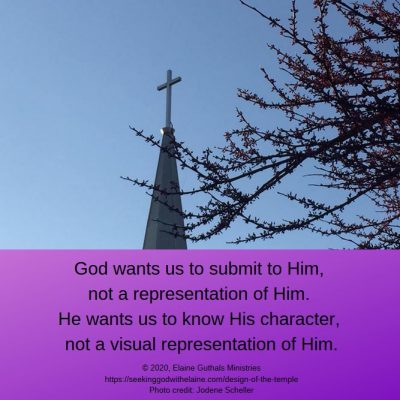
    God wants us to submit to Him, not a representation of Him. He wants us to know His character, not a visual representation of Him.

    Church Steeple

    Boardman put it this way. He wrote, “We must worship God according to His nature; His nature is spiritual, and, therefore, we must worship Him spiritually — spirit-wise, not image-wise; for only what is spiritual in us can worship what is spiritual above us.”

    Its provisions are large and entertaining (Psalm 132:15)

    “I will abundantly bless its food; I will satisfy its needy with bread” (Ps. 132: 15 CSB)

    Okay. A couple of days ago, I shared a meme on my personal Facebook page. It said the membership qualifications for being a Baptist were believing in Jesus and owning a 9 x 13 casserole dish.

    Yes, Baptists love their pot lucks.

    But we are just sharing of the bounty that God has given us. When we believe in and submit to Him, God will provide for our needs.

    Young reminded us that God “… knows every circumstance relative to her [the church] and to every one of her members; [He] is ready to hear all the requests of His people, and to grant them without loss of time.”

    Making the Connections

    Okay. So where do we go from here? Let’s try bullets.

    We were designed to worship God, which takes faith.
    Disciples aren’t perfect, but God uses us anyway — to great success.
    We aren’t supposed to worship idols — we are to worship God and learn of His character.
    When we believe in and submit to Him, God will provide for our needs.

    God alone should be praised. God alone should be worshiped.

    Making the Connections to Self-Discipline

    Worldview people generally do not see, if there is a God that created us, why we need to submit to Him. How would you explain the faith needed to worship God, and not the idols present in this world?

    We’ve been asking these questions all along so we can prepare for when we are asked. Here is the worksheet again. What would you say about being perfect?

    • What does the Scriptures say?
    • What do I believe?
    • Why do I believe the same/differently than the Scriptures?
    • What are the talking points when witnessing to a non-believer?

    Related Links

    I have created a worksheet of the questions above. Click on the button below to access it.

    How Do We Apply This?

    If we have not believed in and submitted our lives to the One true God, we need to do so.

    The ABCDs of Salvation

    If you have not become a believer in Christ, please read through the
    Plan of Salvation and prayerfully consider what God is asking you to do.

    A – admit our sins
    B – believe His Son Jesus is our Redeemer
    C – confess God as Sovereign Lord

    D – demonstrate that commitment by making any changes needed in our lives to
    live the way in which God has called us

    The Disciple’s Job Description

    To worship God, we need to know him. To know him, we need to search for and seek him.

    Being a member of God’s church is about praising our Creator. We are to live our lives so that we imitate Him. We are to submit to His sovereignty.

    Father. We are humbled that You not only designed a way for our relationships with You to be restored, but also You use us to expand Your kingdom. Thank You for making us You church. Grow us so that we may have Your character. Amen.

    What do you think?

    Leave me a comment below (about this or anything else) or head over to my Facebook group for some interactive discussion.

    If you don’t understand something and would like further clarification, please contact me.

    If you have not signed up for the email daily or weekly providing the link to the devotions and the newsletter, do so below.

    If God has used this devotion to speak with you, consider sharing it on social media.

  • The Perfection of the Church

    Nuggets

    • Even though we are called to be perfect, we won’t accomplish that goal in this life.
    • If we could be perfect in this life, Jesus wouldn’t have had to die because we could have saved ourselves.
    • The perfect church is not focusing on our needs, desires, biases, and opinions – we focus on God.
    • When we ABCD, it is an individual choice; but then we become part of a community – the family of God.
    • But love for God alone isn’t enough; we have to love each other.
    • The unity of the church is essential.

    Devotions in the What I Believe series

    Devotions in The Church category

    Flowers with title The Perfection of the Church

    Sometimes, worldview people – and even disciples – think that disciples should be perfect. They shouldn’t break any of God’s laws and commandments. While that should be our goal, unfortunately, the church can’t be perfect here in this life. This devotion looks at how all of that works out.

    I found a really good sermon by Baker that we are going to as the foundation of this series. It will mostly provide headings and some verses.

    Let’s Put It into Context

    Church, according to the Holman Bible Dictionary, is “the term used in the New Testament most frequently to describe a group of persons professing trust in Jesus Christ, meeting together to worship Him, and seeking to enlist others to become His followers.”

    Blessedness means we have been perfected. For the disciple, perfection is holy, sanctified, and righteous.

    Glossary

    Being Perfect

    “Not that I have already reached the goal or am already perfect, but I make every effort to take hold of it because I also have been taken hold of by Christ Jesus” (Phil. 3: 12 CSB)

    We read Matthew 5: 48 and get nervous. “Be perfect, therefore, as your heavenly Father is perfect” (Mt. 5: 48 NIV). We look at ourselves and say, “No way.”

    We take some comfort from what Paul said in Philippians. If he wasn’t perfect yet, we can take heart that we aren’t either.

    So, how do we reconcile the two verses? I mean, Jesus said the words in Matthew so that is the expectation.

    Price described God as perfectly wise, good, holy, and just. He wrote, “Wisdom implies right use of knowledge, and lies in the will as well as in the understanding He acts wisely whose will is directed by right reason.”

    To me, I think that is what perfection here is this life is. We use our knowledge of God to make the decisions to we live in His Will. Our will is directed by our desire to imitate Him.

    Glossary

    Do we get it right every time, so we fit into the world’s definition of being without fault? Unfortunately, we don’t.

    But God knows we aren’t going to be perfect in this life. If Paul can’t, there is no way we can.

    I think this is an instance of the past-present-future meaning. God did make us holy upon conversion. He made us spiritual beings.

    The problem is that we are still stuck in these sinful bodies. Our human nature is going to win sometimes, and we are going to sin. Sin is when we disobey God and break one of His laws and commandments.

    We are not going to be totally perfect — holy, sanctified, and righteous — until we are called home. There is no way perfection is going to happen in this life.

    All the building — The universal Church of Christ (Acts 4:12)

    “There is salvation in no one else, for there is no other name under heaven given to people by which we must be saved” (Ac. 4: 12 CSB)

    Think about it. If we could be perfect in this life, Jesus wouldn’t have had to die because we could have saved ourselves. We can’t so He did.

    If we could be perfect in this life, that would be works-based salvation. That can’t happen. “For it is by grace you have been saved, through faith — and this is not from yourselves, it is the gift of God” (Eph. 2: 8 NIV).

    God’s plan of salvation isn’t about doing the do’s and not doing the don’ts. It is about whether we are spiritually alive or spiritually dead.

    Church steeple

    Our human nature dictates that we are spiritually dead — until we make the conscious decision to admit our sins, believe in Jesus as Savior and Redeemer, and confess God as Sovereign Lord. Only Jesus’ sacrifice could pay the penalty for our sins.

    Jesus told us He was the only way. “Jesus said to him, ‘I am the way, and the truth, and the life. No one comes to the Father except through me’” (Jn. 14: 6 ESV).

    Fitly framed — Is of a spiritual nature (Colossians 2:19)

    “He doesn’t hold on to the head, from whom the whole body, nourished and held together by its ligaments and tendons, grows with growth from God” (Col. 2: 19 CSB)

    Then we come to this verse. Paul liked using the analogy of Christ being the head and the church being the body.

    This one is just confusing. So, let’s back up and take a running start at this.

    If we go back to Colossians 2: 16, we see that Paul was talking about our Christian liberty.

    Paul was talking in these verses about applying that to certain situations. He talked about eating practices and worship practices. Maclaren clarified that the food and drink referred to “… unclean things, things offered to idols, and perhaps the Nazarite vow.”

    Spence reminded us that this reference to the dietary restrictions — and to cleanness — was a throwback to the Mosaic law.

    See, that is the point — cleanness. Cleanness in the Bible refers to disciples being holy and pure.

    When we are perfect, we are clean.

    We get this cleanness through Jesus’ atoning blood. Remember, we said He makes us spiritually alive — and perfect.

    Jesus is the Head of the church. We are the body.

    Lightfoot reminded us to keep in mind the level of knowledge is Paul’s day. We have a different understanding of the nervous system than they did.

    Paul was not talking about an exchange between the head and the body. Davenant reminded us that Jesus provides all necessities to church members. He is Lord and does not need us to be Lord.

    We should not use our current knowledge of the nervous system to try to elevate ourselves. Jesus is God; we aren’t. We need to submit; not insist we are equals.

    It consists of various parts as a building does (Romans 12:4, 5)

    “Now as we have many parts in one body, and all the parts do not have the same function, in the same way we who are many are one body in Christ and individually members of one another” (Rom. 12: 4-5 CSB)

    Expanding on his analogy of the body and the church, Paul reminded readers that there are many parts to the body. Each part has a different function.

    Yep, even the church has conflict. Satan has done a good job of dividing us.

    The perfect church is not focusing on our needs and desires. We don’t look to our biases and opinions.

    We focus on God. We need to focus on our spiritual life, not our physical life.

    That includes working to ensure the church is functioning as God intends. It just be showing worldview people what life as a disciple of God really is like.

    Why Perfect

    Fitly or closely joined to Christ by living faith (Galatians 2:20)

    “I have been crucified with Christ, and I no longer live, but Christ lives in me. The life I now live in the body, I live by faith in the Son of God, who loved me and gave himself for me” (Gal. 2: 20 CSB)

    Spurgeon pointed out how many I’s and me’s are in this verse. He brings up a good point.

    When we ABCD, it is an individual choice. It isn’t ones our parents make for us. Significant others can’t make it for us.

    It is about our faith. We deal with the condition of our spiritual lives.

    The ABCDs of Salvation

    If you have not become a believer in Christ, please read through the
    Plan of Salvation and prayerfully consider what God is asking you to do.

    A – admit our sins
    B – believe His Son Jesus is our Redeemer
    C – confess God as Sovereign Lord

    D – demonstrate that commitment by making any changes needed in our lives to
    live the way in which God has called us

    The Disciple’s Job Description

    Glossary

    Still, God never intended for us to be lone wolfs. He wanted a community, a fellowship — a family.

    To read a related devotion, click the button below.

    Banded to each other by Christian love (1 John 4:7)

    “Dear friends, let us love one another, because love is from God, and everyone who loves has been born of God and knows God” (I Jn. 4: 7 CSB)

    Beecher wrote that Christianity boils down to one word — love. We need to love God. He cautioned that “there are such loose notions of what religion is, that we cannot too urgently hold attention to the fact that in Christ’s kingdom love is a characteristic element of piety; and that when a man is converted genuinely, he must be converted to the spirit of love.” Piety has been translated fear of the Lord, reverence, righteous, and blameless.

    But love for God alone isn’t enough. We have to love each other. That is one of our job duties.

    The Disciple’s Job Description

    Complete Job Description

    Individual Description

    Job Duty #2
    Work Out Our Salvation (Philippians 2: 12)

    We’ve talked about it being more than just on our job description. It is the second greatest commandment.

    These are all set in the Church in exact symmetry and proportion (1 Corinthians 12:12-31)

    “For we were all baptized by one Spirit into one body — whether Jews or Greeks, whether slaves or free — and we were all given one Spirit to drink” (I Cor. 12: 13 CSB)

    The unity of the church is essential. Paisley wrote, “All men in their spirits are seeking this oneness, more or less conscious that it is the food of their spirits, the secret of happiness; in fact, eternal life. Without faith in Christ this oneness is not attained at all, and therefore man’s spirit, starved, stinted of its appropriate nourishment, remains unsatisfied, and is tormented.”

    Unfortunately, some of us would rather keep things as an acquaintance level. Oh, we say we love our fellow disciples but don’t always mean it. Worse yet is to love our fellow man without really loving God.

    We’ve got to love God and one another.

    Yep, we are all totally different people. We were made in God’s image but not with a cookie cutter.

    We know that Jesus’ church will be called together in the end. “After this I looked, and behold, a great multitude that no one could number, from every nation, from all tribes and peoples and languages, standing before the throne and before the Lamb, clothed in white robes, with palm branches in their hands” (Rev. 7: 9 ESV).

    Making the Connections

    “Here there is no Gentile or Jew, circumcised or uncircumcised, barbarian, Scythian, slave or free, but Christ is all, and is in all” (Col. 3: 11 NIV)

    It doesn’t matter who we are, where we live, what we look like, what job we have. If Christ is in us, we are part of the church and are perfect.

    Making the Connections to Self-Discipline

    We’ve been asking these questions all along so we can prepare for when we are asked. Here is the worksheet again. What would you say about being perfect?

    • What does the Scriptures say?
    • What do I believe?
    • Why do I believe the same/differently than the Scriptures?
    • What are the talking points when witnessing to a non-believer?

    Related Links

    I have created a worksheet of the questions above. Click on the button below to access it.

    How Do We Apply This?

    Beecher said that our godliness is determined by how obedient we are in keeping God’s law of love.
    We have to find our similarities — the Spirit of God — to help unite us.
    As with any relationship, it takes work — on all sides.

    Father. You call us to be perfect as You are. We know here in this life we will always fail. From those failures, help us to learn how to grow closer to a You. Amen.

    What do you think?

    Leave me a comment below (about this or anything else) or head over to my Facebook group for some interactive discussion.

    If you don’t understand something and would like further clarification, please contact me.

    If you have not signed up for the email daily or weekly providing the link to the devotions and the newsletter, do so below.

    If God has used this devotion to speak with you, consider sharing it on social media.
  • The Foundation of the Church

    Nuggets

    • The Trinity works together to save us.
    • Jesus was the only spotless
    • Sacrifice that could have been offered that God would accept.
    • We are described in the Scriptures as jars of clay.

    Devotions in the What I Believe series

    Devotions in The Church category

    The Perfection of the Church
    The Design of the Temple

    Flowers with title The Foundation of the Church

    If the church is people adopted into God’s kingdom, this adoption occurred because they accepted salvation. That gift was made possible by the sacrifice Jesus. This devotion looks at how that makes Jesus the foundation of the church.

    Glossary

    I found a really good sermon by Baker that we are going to as the foundation of this series. It will mostly provide headings and some verses.

    Let’s Put It into Context

    Church, according to the Holman Bible Dictionary, is “the term used in the New Testament most frequently to describe a group of persons professing trust in Jesus Christ, meeting together to worship Him, and seeking to enlist others to become His followers.”

    We’ve talked about Jesus as the cornerstone before. Everything is built on Jesus because He is the only way we get reconciled with God. Every time we move forward in our relationship with God, Satan tries harder to attack us. The Holy Spirit lives within us to accomplish the work of regeneration and sanctification.

    To read a related devotion, click the button below.

    The Work of the Trinity

    “He has saved us and called us with a holy calling, not according to our works, but according to his own purpose and grace, which was given to us in Christ Jesus before time began.” (II Tim. 1: 9 CSB)

    It takes all of the Trinity to save us. Let’s look how they work together.

    The Father saved them designedly in Christ (2 Timothy 1:9)

    The plan was God’s design. He didn’t want us to have broken relationships with Him.

    So, before He even created us — before we even disobeyed — God designed the plan of salvation. He knew we would mess up and wrote Plan A accordingly.

    God knew that there would need to be atonement for the sin. The only way that would happen is a blood sacrifice.

    Glossary

    But it couldn’t be just any sacrifice. It had to be a perfect sacrifice.

    The Son saved them positively in Himself (Hebrews 10:14)

    “For by that one offering he forever made perfect those who are being made holy” (Heb. 10: 14 NLT)

    We normally think of the sacrifice as spotless and blameless — which Jesus was. I wonder, though, how often we truly hook that to the definition of perfect. Perfect means holy, sanctified, and righteous.

    Glossary

    I think we get so caught up in what the Sacrifice wasn’t that we don’t focus on what He was. We focus on, “He wasn’t like us,” without focusing on, “We are called to be like Him.”

    We may do this without really realizing it. But how many times do we cut ourselves down when we sin? We tell ourselves we can’t because we are full of sin and He wasn’t. We don’t look at it from the what-are-we-doing-right viewpoint.

    The Spirit saves them apprehensively in Christ (Titus 3:5)

    “he saved us — not by works of righteousness that we had done, but according to his mercy — ​through the washing of regeneration and renewal by the Holy Spirit” (Ti. 3: 5 CSB)

    We’ve talked before about the work of the Holy Spirit in our lives. Two things He works on is regeneration and renewal.

    Regeneration is the change in us that God brings about when we go from being spiritually dead to spiritually alive. Unfortunately, God doesn’t zap us, and we get changed all at once. We have to work out our salvation (Phil. 2: 12). We do that through the help of the Holy Spirit.

    Renewal is similar. It also represents making something new. We many times think about Paul’s talk about renewing our minds by seeking Him. We talked about this when we looked at our disciple’s job description.

    The Disciple’s Job Description

    Complete Job Description

    Our initial confession renews our relationship with God. Then through the Holy Spirit, He renews us daily because we have to change our mindset.

    On Christ the Solid Rock

    “The Lord is my rock, my fortress, and my deliverer, my God, my rock where I seek refuge, my shield and the horn of my salvation, my stronghold” (Ps. 18: 2 CSB)

    Christ, then, is the foundation of the Church (Matthew 16:18)

    “And I also say to you that you are Peter, and on this rock I will build My church, and the gates of Hades shall not prevail against it” (Mt. 16: 18 NKJV)

    Jesus was the only spotless Sacrifice that could have been offered that God would accept. That was because He was rock solid in facing the temptations Satan threw at Him.

    We talked about Jesus telling Peter He would build His church on him in How Is Jesus Our Cornerstone?

    To read a related devotion, click the appropriate button below.

    Because Peter gave the correct answer of “… You are the Christ, the Son of the living God” (Mt. 16: 16 NKJV), he was blessed (Mt. 16: 17 NKJV).

    Blessed doesn’t mean Peter was rewarded and made the foundation of the church. Blessed means that he had been perfected: “But blessed is the one who trusts in the LORD, whose confidence is in him” (Jer. 17: 7 NIV). Scroll back if you need refreshed about what perfected means.

    Peter was given salvation because He made a clear profession of his faith in Jesus.

    Jesus remained the cornerstone on which the church was built. He was building His church on those who professed faith in Him, not on one man.

    He is the foundation of all covenant blessings (Ephesians 1:3).

    “Blessed is the God and Father of our Lord Jesus Christ, who has blessed us with every spiritual blessing in the heavens in Christ” (Eph. 1: 3 CSB)

    We’ve talked about God being blessed. Blessings begin with God, the Father. Spiritual blessings are delivered by the Holy Spirit. The reason we can receive the blessings is because Jesus died for our sins.

    To read a related devotion, click the appropriate button below.

    How does God bless us? “Every good and perfect gift is from above, coming down from the Father of the heavenly lights, who does not change like shifting shadows” (Jas. 1: 17 NIV).

    Of Faith, Hope, Peace, Joy, Comfort, and Glory

    Baker listed what some of those blessings are.

    • “I testified to both Jews and Greeks about repentance toward God and faith in our Lord Jesus” (Ac. 20: 21 CSB)
    • “For God wanted them to know that the riches and glory of Christ are for you Gentiles, too. And this is the secret: Christ lives in you. This gives you assurance of sharing his glory” (Col. 1: 27 CSB).
    • “For Christ himself has brought peace to us. He united Jews and Gentiles into one people when, in his own body on the cross, he broke down the wall of hostility that separated us” (Eph. 2: 14 NLT).
    • “More than that, we also rejoice in God through our Lord Jesus Christ, through whom we have now received reconciliation” (Rom. 5: 11 ESV).
    • “comfort your hearts and establish them in every good work and word” (II Thess. 2: 17 ESV).
    • “All glory to him who alone is God, our Savior through Jesus Christ our Lord. All glory, majesty, power, and authority are his before all time, and in the present, and beyond all time! Amen” (Jude 1: 25 NLT).

    Think of that. Our foundation is built on the blessings of faith, hope, peace, joy, comfort, and glory.

    Remember, glory is the expression of the qualities of God resulting from the authority of God.

    Courthouse dome

    Jars of Clay

    “But we have this treasure in jars of clay, to show that the surpassing power belongs to God and not to us” (II Cor. 4: 7 ESV)

    We are described in the Scriptures as jars of clay. The Holman Bible Dictionary gives an interesting description of clay.

    The clay found in Israel had to be examined to extract foreign objects from it. It then had to be soaked to gain consistency. Finally, it was shaped by the potter into its intended form.

    Oh, man. Did you see the correlations?

    • Foreign objects — sin
    • Soaked — regeneration and sanctification
    • Intended form — perfected

    Making the Connections

    Baker connected Jesus as our Cornerstone to holding the family together.

    • “For he himself is our peace, who has made the two groups one and has destroyed the barrier, the dividing wall of hostility” (Eph. 2: 14 NIV).
    • “You have come to the assembly of God’s firstborn children, whose names are written in heaven. You have come to God himself, who is the judge over all things. You have come to the spirits of the righteous ones in heaven who have now been made perfect” (Heb. 12: 23 NLT).

    Unfortunately, not everyone accepts the gift of salvation and believes Jesus is our Savior and Redeemer. “The stone that the builders rejected has now become the cornerstone” (Ps. 118: 22 NLT).

    That doesn’t diminish the plan or the One Who fulfilled the plan. “Therefore, this is what the Sovereign LORD says: ‘Look! I am placing a foundation stone in Jerusalem, a firm and tested stone. It is a precious cornerstone that is safe to build on. Whoever believes need never be shaken’” (Isa. 28: 16 NLT).

    Making the Connections to Self-Discipline

    We have to make sure we firmly believe in the foundation. “For no one can lay any foundation other than the one already laid, which is Jesus Christ” (I Cor. 3: 11 NIV). If we don’t, there is no need for self-discipline.

    We’ve been asking these questions all along so we can prepare for when we are asked. Here is the worksheet again. What would you say about Jesus being the foundation and the only way to gain salvation?

    • What does the Scriptures say?
    • What do I believe?
    • Why do I believe the same/differently than the Scriptures?
    • What are the talking points when witnessing to a non-believer?

    Related Links

    I have created a worksheet of the questions above. Click on the button below to access it.

    How Do We Apply This?

    The ABCDs of Salvation

    If you have not become a believer in Christ, please read through the
    Plan of Salvation and prayerfully consider what God is asking you to do.

    A – admit our sins
    B – believe His Son Jesus is our Redeemer
    C – confess God as Sovereign Lord

    D – demonstrate that commitment by making any changes needed in our lives to
    live the way in which God has called us

    The Disciple’s Job Description

    Father, we thank You for the gift of salvation. We thank You that Jesus chose to be the Sacrifice on our behalf. We pray that we will live for You daily, striving to become holy and sanctified. Amen.

    What do you think?

    Leave me a comment below (about this or anything else) or head over to my Facebook group for some interactive discussion.

    If you don’t understand something and would like further clarification, please contact me.

    If you have not signed up for the email daily or weekly providing the link to the devotions and the newsletter, do so below.

    If God has used this devotion to speak with you, consider sharing it on social media.
  • The Unbelieving State of the Gentile Church

    In looking at things to solidify what we actually believe, we will be looking at the church for the next several devotions. This devotion looks at the opposite of God’s church – the Gentile church.

    Nuggets

    • As the church is a body of believers in Jesus Christ, the Gentile Church would be those who do not believe that Jesus is the Messiah and Savior of the world.
    • Gentile church members belong to the race of sinners.
    • The Gentile church is under the rule of Satan.
    Flowers with title The Unbelieving State of the Gentile Church

    This year, we are looking at self-discipline. We are using Vincent’s The Lesson of Ripeness sermon to look at the need to grow in our relationship with God. We morphed learning enough to be a teacher into determining some areas we need to grow so we can be mature disciples.

    Resource

    We have been looking at solidifying what we believe. When we witness, we need to be prepared to explain what we believe and why we believe it. We looked at the Scriptures, the Trinity (God, Jesus, and the Holy Spirit), man, salvation, and grace. Now, we are going to look at the church.

    Devotions in the What I Believe series

    Devotions in The Church category

    The Unbelieving State of the Gentile Church
    God’s Adopted Church
    The Foundation of the Church

    The Perfection of the Church
    The Design of the Temple

    I found a really good sermon by Baker that we are going to as the foundation of this series. It will mostly provide headings and some verses. Baker started out describing the opposite of God’s church — the Gentile church.

    Let’s Put It into Context

    Church, according to the Holman Bible Dictionary, is “the term used in the New Testament most frequently to describe a group of persons professing trust in Jesus Christ, meeting together to worship Him, and seeking to enlist others to become His followers.”

    Strangers to God

    “At that time you were without Christ, excluded from the citizenship of Israel, and foreigners to the covenants of promise, without hope and without God in the world” (Eph. 2: 12 CSB)

    As the church is a body of believers in Jesus Christ, the Gentile Church would be those who do not believe that Jesus is the Messiah and Savior of the world. They do not believe in the Trinity: God the Father, God the Son, and God the Holy Ghost.

    In this passage that starts in Ephesians 2: 11, Paul was wanting his readers to remember the time before their conversion. One of his points was we were all in the same unredeemed boat as, in the spiritual sense, we are all uncircumcised Gentiles.

    To read a related devotion, click the appropriate button below.

    Paul’s point was, if we are not “in Christ,” we are “without Christ.” The Gentile church is without Christ.

    One reason the Gentile Church is strangers to God is that they are strangers to His Word. “I have seen the disloyal and feel disgust because they do not keep your word” (Ps. 119: 158 CSB).

    Scriptures paint a good picture of Who God is. As we read the Scriptures, we learn of His character and how He wants us to live.

    Members of the Gentile Church are also strangers to God’s church. “See what great love the Father has given us that we should be called God’s children — and we are! The reason the world does not know us is that it didn’t know him” (I Jn. 3: 1 CSB). We are not a child of God just because we were made in His image.

    Determination of whether we are in the Gentile’s church or God’s church all boils down to the answer to this question: have you admitted your sins, believed in Jesus as Savior and Redeemer, and confessed God as Sovereign Lord. We must make a conscious decision to submit to God to switch churches.

    Differences of Members

    “For I was born a sinner — yes, from the moment my mother conceived me” (Ps. 51: 5 NLT)

    Baker wrote that Gentile church members are “naturally of another race.” That race is the race of sinners. Sinners are people who sin. Sin is when we disobey God and break one of His laws and commandments.

    We all have a sinful nature. “For we know that the law is spiritual, but I am of the flesh, sold as a slave under sin” (Rom. 7: 14 CSB). We are all “of the flesh.”

    The flesh is our human nature. It is considered naturally corrupt because it pursues what is pleasing, not necessarily what God commands.

    Armitage wrote that sin “is seen not with the eyes in the head, but with those of the heart.” God uses the insights that He puts in our hearts through our observations so we can use that, rather than our own understanding, to determine what He is telling us.

    To read a related devotion, click the button below.

    According to Baker, this race of sinners has its own language. “These wicked people are born sinners; even from birth they have lied and gone their own way” (Ps. 58: 3 NLT).

    We are born sinners at birth because we are born spiritually dead. For salvation, God isn’t looking at whether we didn’t do the do’s and did the don’ts. He is looking at whether is Jesus our Savior and have we submitted our lives to Him.

    Under Another’s Rule

    “Satan, who is the god of this world, has blinded the minds of those who don’t believe. They are unable to see the glorious light of the Good News. They don’t understand this message about the glory of Christ, who is the exact likeness of God” (II Cor. 4: 4 NLT)

    The Gentile church is under the rule of Satan. He is presently in control of this world.

    To read a related devotion, click the button below.

    Because they are following Satan instead of God, the Gentile church members are not seeking God’s interests. “For they all seek their own interests, not those of Jesus Christ” (Phil. 2: 21 ESV).

    Unfortunately, members of the Gentile church do not get the same benefits as members of God’s church. Gentile church members are still spiritually dead and slaves to their sin.

    Making the Connections

    “But now you have been united with Christ Jesus. Once you were far away from God, but now you have been brought near to him through the blood of Christ” (Eph. 2: 13 NLT)

    Being a member of the Gentile church puts us far away from God. Wilson described what that meant.

    Wilson wrote, “We are all naturally far from God, not as being out of His reach, or out of His sight, or out of His presence, but as differing from Him, as being out of sympathy with Him — as forgetting or not thinking about Him — as disobeying Him, and disliking Him, and thus having incurred His displeasure.”

    Making the Connections to Self-Discipline

    We’ve been asking these questions all along so we can prepare for when we are asked. Here is the worksheet again. What would you say are the detriments of being a member of the Gentile church?

    • What does the Scriptures say?
    • What do I believe?
    • Why do I believe the same/differently than the Scriptures?
    • What are the talking points when witnessing to a non-believer?

    Related Links

    I have created a worksheet of the questions above. Click on the button below to access it.

    How Do We Apply This?

    The ABCDs of Salvation

    If you have not become a believer in Christ, please read through the
    Plan of Salvation and prayerfully consider what God is asking you to do.

    A – admit our sins
    B – believe His Son Jesus is our Redeemer
    C – confess God as Sovereign Lord

    D – demonstrate that commitment by making any changes needed in our lives to
    live the way in which God has called us

    The Disciple’s Job Description

    Loving Heavenly Father. We are born far from You. Even though we are Your creations made in Your image, our nature is different from Yours. It is different — until we admit our sins, believe Jesus as our Savior, confess You as Sovereign God, and demonstrate that change in nature by obeying Your laws and commandments. Lord, help us show others Your saving love. Amen.

    What do you think?

    Leave me a comment below (about this or anything else) or head over to my Facebook group for some interactive discussion.

    If you don’t understand something and would like further clarification, please contact me.

    If you have not signed up for the email daily or weekly providing the link to the devotions and the newsletter, do so below.

    If God has used this devotion to speak with you, consider sharing it on social media.

  • Is Election Really Mercy?

    Nuggets

    • The Jews thought the Gentiles were their enemies. At a minimum, they thought the Gentiles were so far beneath them.
    • Gentiles were not second-class citizens as they were also loved by the God of love.
    • God gives was a lot of gifts.
    • Election is God’s plan to bring that salvation to His creation, a gift of His grace because of His mercy.

    Devotions in the What I Believe series

    Devotions in The Purpose of Grace category

    Flowers with title Is Election Really Mercy?

    We’ve been talking about election being where God chose us because of His grace. But what part does mercy play in it? This devotion discusses God’s mercy to both the Jews and the Gentiles.

    Let’s Put It into Context #1

    We are looking at election through the lens of grace. Grace is a free and unmerited gift from Heavenly Father given through His Son, Jesus Christ that enables salvation and spiritual healing to believers. The purpose of the gift of grace is to restore God’s relationships with man and eliminate sin.

    Glossary

    The Holman Bible Dictionary defines election as “God’s plan to bring salvation to His people and His world.”

    Let’s Put It into Context #2

    “I don’t want you to be ignorant of this mystery, brothers and sisters, so that you will not be conceited: A partial hardening has come upon Israel until the fullness of the Gentiles has come in. And in this way all Israel will be saved, as it is written, The Deliverer will come from Zion; he will turn godlessness away from Jacob. And this will be my covenant with them when I take away their sins” (Rom. 11: 25-27 CSB)

    If we are going to start at Romans 11: 28, then we start with a dangling pronoun. If we back up to Romans 11: 25, then we start with a mystery.

    Part of the mystery is the wrath and mercy of God. We talked some about this when we were walking through Ephesians.

    To read a related devotion, click the button below.

    At times, it does seem like there are two different sides of God. I think it is more, though, that God is the God of love — until we get on His last nerve.

    Then, God isn’t going to put up with it.

    God is not going to tolerate our thoughts of entitlement. He is going to shut down our abusing His blessings.

    We just never forget God is Sovereign Lord. And God is love.

    The bulk of the mystery is the conversion of the Jews. “Therefore, consider God’s kindness and severity: severity toward those who have fallen but God’s kindness toward you — if you remain in his kindness. Otherwise you too will be cut off. And even they, if they do not remain in unbelief, will be grafted in, because God has the power to graft them in again. For if you were cut off from your native wild olive tree and against nature were grafted into a cultivated olive tree, how much more will these — the natural branches — be grafted into their own olive tree?” (Rom. 11: 22-24 CSB).

    Even though we fell from His grace, God still loved us enough to design the plan of salvation. We just need to believe on Him to be grafted in again (Rom. 11: 23).

    This started out with the Jew. However, when they didn’t believe, the plan of salvation was offered to the Gentiles (i.e., everyone else).

    Once those Gentiles who will be saved are, God will restore the Jews. Parr wrote, “The end of the world shall not be till the Jews are called, and how long after that none yet can tell.”

    We have to remember that the election of the Jews is permanent.

    Enemies for Your Advantage

    “Regarding the gospel, they are enemies for your advantage, but regarding election, they are loved because of the patriarchs” (Rom. 11: 28 CSB)

    Oh, yes. The Jews thought the Gentiles were their enemies. At a minimum, they thought the Gentiles were so far beneath them.

    McNeile had some good points. The early church was formed by Jews who had converted to Christianity. The Gentiles were then taken into the fellowship. The Gentiles did not start the church and incorporate the Jews.

    Paul is making the point here that, even though they were the ones incorporated in, the Gentiles were not second-class citizens. They were also loved by the God of love.

    This was because the converted Gentiles were, well, converted and different from regular Gentiles. Just as those in the Jewish remnant were converted and different from the Jewish nation.

    What was the difference? Truth be known, the difference was now a similarity. Both the converted Jews and converted Gentiles were to imitate the character of God.

    The difference was gone.

    Oh, God was still calling the Jews — His people — to be converted. Election incorporated more than them. If election was to bring salvation to His world, that included Gentiles.

    Man praying

    A Shower of Gifts

    “since God’s gracious gifts and calling are irrevocable” (Rom. 11: 29 CSB)

    God gives was a lot of gifts.

    • “For by grace you have been saved through faith. And this is not your own doing; it is the gift of God” (Eph. 2: 8 ESV emphasis added).
    • “For the wages of sin is death, but the free gift of God is eternal life in Christ Jesus our Lord” (Rom. 6: 23 ESV emphasis added).
    • “And Peter said to them, “Repent and be baptized every one of you in the name of Jesus Christ for the forgiveness of your sins, and you will receive the gift of the Holy Spirit” (Ac. 2: 38 ESV emphasis added).
    • “But the free gift is not like the trespass. For if many died through one man’s trespass, much more have the grace of God and the free gift by the grace of that one man Jesus Christ abounded for many” (Rom. 5: 15 ESV emphasis added).

    Grace, salvation, faith, eternal life, the Holy Spirit, Jesus’ sacrifice. Shouldn’t that be a draw to people?

    Satan wants to convince us that our independence of God should mean more than all of these gifts. He is wrong.

    God doesn’t give the gifts and then take them back. He doesn’t change His mind. “God is not a man, so he does not lie. He is not human, so he does not change his mind. Has he ever spoken and failed to act? Has he ever promised and not carried it through?” (Num. 23: 19 NLT).

    Gifts

    Gifts Because of God’s Mercy

    “As you once disobeyed God but now have received mercy through their disobedience, so they too have now disobeyed, resulting in mercy to you, so that they also may now receive mercy. For God has imprisoned all in disobedience so that he may have mercy on all” (Rom. 11: 30-32 CSB)

    Mercy is the unexpected way God responds in love to our needs. We sure didn’t expect Him to respond to our disobedience with designing the plan of salvation.

    We really didn’t expect God to show His mercy to us by designing the plan of salvation before He even created us — before Adam and Eve committed the original sin.

    Did you catch what Paul was saying here?

    • You/Jews disobeyed
    • You/Jews received mercy through their/Gentiles’ disobedience
    • They/Gentiles disobeyed
    • Resulting in mercy to you/Jews
    • They/Gentiles received mercy

    Hmmm. I followed until Paul threw in the you received mercy for their disobedience before they disobeyed. Yep, Paul lost me right away.

    Parr wrote, “The impiety of the Gentiles was no impediment to their mercy, neither shall the infidelity of the Jews to theirs.”

    Okay. I think I can get that. The Jews — for the most part — didn’t believe Jesus was the Messiah. Because they didn’t, the gospel spread to the Gentiles. “… They were disobedient, so God made salvation available to the Gentiles …” (Rom. 11: 11 CSB).

    Being Gentile did not preclude them from gaining God’s mercy. Instead, the world was blessed because of the Jew’s disobedience/unbelief.

    But that is going to make the Jews jealous. (Oh, yeah. That is so human — don’t want what you have until someone else wants it.)

    So, eventually, the Jews will get it. They will believe Jesus is Messiah and Savior.

    Making the Connections

    Election is God’s plan to bring that salvation to His creation. That means Jews. That means Gentiles. That means all of the Toms, Sallys , and Elaines.

    We didn’t do anything to earn this election. God is giving us the gift of grace because of His mercy.

    Making the Connections to Self-Discipline

    We can’t do anything to earn salvation, so there is no tie to self-discipline there.

    The tie is to growing in faith and knowledge so we can witness.

    We’ve been asking these questions all along so we can prepare for when we are asked. Here is the worksheet again. What would you say about election to the Jews and Gentiles?

    • What does the Scriptures say?
    • What do I believe?
    • Why do I believe the same/differently than the Scriptures?
    • What are the talking points when witnessing to a non-believer?

    Related Links

    I have created a worksheet of the questions above. Click on the button below to access it.

    How Do We Apply This?

    Robinson gave us a good list of how to apply this. His take was our past should impact our future in these ways.

    1. “Promote humility.
    2. “Awaken gratitude.
    3. “Soften our censures.
    4. “Strengthen our hopes of others.”

    But let’s apply that to election.

    1. Humility — We don’t deserve election. We get it only through God’s grace.
    2. Gratitude — If we don’t deserve it, we should be grateful God gives it to us.
    3. Censures — Everyone is provided the opportunity to gain salvation. That levels the playing field, so we shouldn’t be censorious.
    4. Hope — We should not only hope that people go from election to being one of the Elect. But we should also witness to others as God directs to help that become a reality.

    Lord. Each one of Your creation is important to You. Help make them important to us, too, so that we can tell them of Your live for them. Amen.

    What do you think?

    Leave me a comment below (about this or anything else) or head over to my Facebook group for some interactive discussion.

    If you don’t understand something and would like further clarification, please contact me.

    If you have not signed up for the email daily or weekly providing the link to the devotions and the newsletter, do so below.

    If God has used this devotion to speak with you, consider sharing it on social media.