Category: Witnessing

  • What Is Religious Instruction?

    I think I am getting closer to getting my technology problems fixed. Oh, I hope so. Thank you for your patience.

    An important component of witnessing is that others understand the gospel message. This is accomplished through religious instruction. This devotion looks at instruction from both the teacher’s and the learner’s perspective.

    Nuggets

    • If we are the learner, we have to listen to what the content we are studying is telling us.
    • As a teacher helping someone to understand, we need to help them focus.
    • The real teaching has to come from above like the rain.
    • God wants us to remember.
    • God wants us to respect and learn from our parents.

    This year, we are looking at self-discipline. We are using Vincent’s The Lesson of Ripeness sermon to look at the need to grow in our relationship with God. We morphed learning enough to be a teacher into determining some areas we need to grow so we can be mature disciples.

    Resource
    Vincent’s The Lesson of Ripeness
    https://biblehub.com/sermons/auth/vincent/the_lesson_of_ripeness.htm

    We have been looking at solidifying what we believe. When we witness, we need to be prepared to explain what we believe and why we believe it. We have looked at the Scriptures; the Trinity (God, Jesus, and the Holy Spirit); man; salvation; grace; the church; divine ordinances; worship; God’s kingdom; end times; and evangelism and missions. Now, we are going to look at religious education.

    Religion, according to the Holman Bible Dictionary, is “a relationship of devotion or fear of God or gods.” But in order to have that relationship, we must learn of God.

    Resource
    Holman Bible Dictionary’s definition of religion
    https://www.studylight.org/dictionaries/hbd/r/religion.html

    The Holman Bible Dictionary has much information on education in the Bible times. While the Scriptures emphasize religious education should occur, God did not issue a law mandating that.

    We are in a unique position. We need to be both teachers and learners.

    I know. Most of us really don’t see ourselves as teachers. In fact, as I said, we morphed this series from being a teacher into being mature disciples.

    But we are teachers as others watch us as we go about our lives. We may be the only Bible they ever read. Our homes may be the only churches they enter.

    So, we are going to look at both roles. Remember, we are looking at the topics not only from the viewpoint of how we grow, but also through the lens of witnessing.

    Devotions in the What I Believe series

    What I Believe

    What I Believe Series

    Devotions in the Religious Education category

    What Is Religious Instruction?
    Jesus as a Teacher
    Learning from the Holy Spirit
    Learning to be a New Creation
    Using Worship to Educate Our Thoughts

    Let’s Put It into Context

    What is the purpose of education? The Holman Bible Dictionary wrote, “The primary purpose of education among the Jews was the learning of and obedience to the law of God, the Torah.”

    Resource
    Holman Bible Dictionary’s definition of Education in Bible Times
    https://www.studylight.org/dictionaries/hbd/e/education-in-bible-times.html

    To me, religious education is instruction to teach us about the plan of salvation and the character of God, in order to build relationships so that we can imitate Him.

    General Instructions

    “Pay attention, heavens, and I will speak; listen, earth, to the words from my mouth. Let my teaching fall like rain and my word settle like dew, like gentle rain on new grass and showers on tender plants. Remember the days of old; consider the years of past generations. Ask your father, and he will tell you, your elders, and they will teach you” (Deut. 32: 1-2, 7 CSB)

    “Pay attention …” (Deut. 32: 1 CSB)

    First off, we have to pay attention. If we are the learner, we have to listen to what the content we are studying is telling us.

    We don’t learn by osmosis. We can’t just listen.

    We have to figure out what it is intended for us to learn.
    Next, we have to interpret what we think it is saying.
    Then, we have to determine what we believe.
    At times, we may need to dig further.
    Finally, we have to determine how we need to use the content to change our character.

    To access the What God’s Word Said to Me worksheet, use www.seekinggodwithelaine.com/what-gods-word-said-to-me

    We have to put some work into it. We have to assimilate it.

    a teacher helping someone to understand, we need to help them focus. Satan will be trying do all he can to put obstacles in the way. We will need to be encouragers as well as be knowledgeable of the content.

    “Let my teaching fall like rain and my word settle like dew, like gentle rain on new grass and showers on tender plants” (Deut. 32: 2 CSB)

    The real teaching has to come from above like the rain. It has to come from God.

    We talked about the dew in the last devotion. The west winds, which happen in September and October, bring moisture from the Mediterranean Sea. It falls as mist during the night, mistakenly called a dew instead of a gentle mist.

    To read a related devotion, access www.seekinggodwithelaine.com/wisdom-produces-compassion

    A gentle mist isn’t cramming for a test. It isn’t waiting for the last minute to make a profession of faith.

    It is a slow, steady soaking so we can consciously made decisions about what we will believe. Jarman noted the gentleness this represents. God loves us immensely.

    Plants are better watered with the dew rather than the downpour. This is fitting, according to Jarman, as “the operation of the Spirit is always total and entire.”

    Resource
    Jarman’s God’s Doctrine as the Dew
    https://biblehub.com/sermons/auth/jarman/god’s_doctrine_as_the_dew.htm

    Jarman also told us about how the dew transfers from one plant to the next. That is very appropriate for our discussion on religious education. We are to pass our knowledge on to others.

    But look at it this way. What if, as Jarman asked, it has to be a drizzle because there is some deficiency in our obedience to Him? We may need the downpour instead of the drizzle. We’ve said we learn more during the struggles.

    Still, God is so gentle with us. He doesn’t write us off (we reject Him). He gently loves us back into His fold.

    We need to welcome the showers as we receive guidance from God. He will tell us what sin we need to eliminate and how we need to change our character to become more like Him.

    “Remember the days of old; consider the years of past generations …” (Deut. 32: 7 CSB)

    We’ve talked before about how God wants us to remember. God wants us to remember His laws and commandments. He wants us to look back at all the times He has helped us through situations that were impossible for us but possible for Him (Mt. 19: 26).

    To access the Remember glossary, use www.seekinggodwithelaine.com/remember-glossary

    I know. This is the opposite of what the world is telling us lately. It says we have to erase our past.

    We can’t. We have acknowledge our actions. We have to learn from our past. If we don’t acknowledge where we are, we won’t know what all we will need to do to get where we want to be.

    “… Ask your father, and he will tell you, your elders, and they will teach you” (Deut. 32: 7 CSB)

    This is kind of a continuation of erasing history. The past is outdated. Parents made wrong decisions.

    That isn’t how God wants us to operate. God wants us to respect and learn from our parents.

    We shouldn’t think that we can learn everything on our own. We need a teacher.

    That teacher cannot be someone who someone who has no experience or knowledge. Many times, that means someone older than us.

    Interpret for Me

    “ Jeshua, Bani, Sherebiah, Jamin, Akkub, Shabbethai, Hodiah, Maaseiah, Kelita, Azariah, Jozabad, Hanan, and Pelaiah, who were Levites, explained the law to the people as they stood in their places. They read out of the book of the law of God, translating and giving the meaning so that the people could understand what was read” (Neh. 8: 7-8 CSB)

    The important part of the instruction is that the learner has to understand. Oh, no. “‘For my thoughts are not your thoughts, and your ways are not my ways.’
    This is the Lord’s declaration” (Isa. 55: 8 CSB). We aren’t going to understand everything.

    Why is understanding the Scriptures important? Finlayson wrote, “The sacred Scriptures are useful to us in proportion as they help us to worship God more reverently, intelligently, and spiritually; and therefore we truly honour them by diligently seeking to understand their real sense, and to profit by their meaning.”

    Resource
    Finlayson’s The Bible Ought to be Intelligently Understood
    https://biblehub.com/sermons/auth/finlayson/the_bible_ought_to_be_intelligently_understood.htm

    Think about that. We are called to worship God.

    • We aren’t called to know if it was creation or evolution.
    • We aren’t called to know how to fix the social ills of this society.

    We are called to admit our sins, believe in Jesus as Savior and Redeemer, confess God as Sovereign Lord, and demonstrate that commitment by obeying Him.

    Horder wrote, “It is the duty of the pulpit to give the sense of Scripture.” Remember in What Is Missions?, we said that preaching could mean church work as simple as one person talking to another person, telling how to ABCD.

    To read a related devotion, access www.seekinggodwithelaine.com/what-is-missions

    We may think that the Scriptures were written in the King James Version because we no longer use that style of speaking. However, the original text was written in the common language of the day. They would readily understand it.

    True. Scriptures will be difficult for some to understand. “Instead, God has chosen what is foolish in the world to shame the wise, and God has chosen what is weak in the world to shame the strong” (I Cor. 1: 27 CSB).

    That is why God has given us the Holy Spirit to instruct us. “But the Helper, the Holy Spirit, whom the Father will send in My name, He will teach you all things, and bring to your remembrance all that I said to you” (Jn. 14: 26 NASB).

    Making the Connections

    Religious instruction is like any other instruction. Some things we get right away. Sometimes, it takes a while before the lightbulb comes on.

    Parker put it this way. He wrote, “The Word does not always produce an instantaneous effect: the Word has sometimes to filter well down into the thought and into the heart and life …”

    Resource
    Parker’s Doctrine as Rain; Speech as Dew
    https://biblehub.com/sermons/auth/parker/doctrine_as_rain_speech_as_dew.htm

    God will reveal things to us as we need to know them. He will help us understand what we need to know.

    Making the Connections to Self-Discipline

    Some find Scriptures confusing. Others, it seems that they feel they should understand all of it perfectly without reflection. How can we prepare to witness to those feeling that way?

    We’ve been looking at defending our beliefs when we are witnessing. That means we have to be secure enough to convince someone to accept our beliefs.

    Our questions should still serve us to determine on what we need to focus.

    • What does the Scriptures say?
    • What do I believe?
    • Why do I believe the same/differently than the Scriptures?
    • What are the talking points when witnessing to a non-believer?

    Related Links
    I have created a worksheet of the questions above. Access https://seekinggodwithelaine.com/what-i-believe-worksheet

    How Do We Apply This?

    The Homilist felt that religious teaching is gentle, penetrating, and refreshing. That is so true.

    We can’t bulldoze instruction over someone. It has to penetrate our hearts and our lives so we make changes in our lives. That change has to be a positive change in lives.

    Resource
    Homilist’s Genuine Religious Teaching
    https://biblehub.com/sermons/pub/genuine_religious_teaching.htm

    Yes, we have to become teachers and learners. Paster Chad gave us wonderful encouragement.

    “Each and every one of us, through the power of the gospel message, have the ability to bring change in this world because, by just simply speaking the gospel, introducing people to God through His Word, people will come to know Him, and peoples’ lives will be transformed. Once you’ve had an encounter with Christ, your life will be transformed. We understand that, if we can introduce people to Christ and they can come to be saved, then the problems of this world will seem like bygone issues.”

    To listen to the full sermon, access https://www.rochesterfirstbaptist.org/podcast/episode/2885fe16/daniel-and-the-sovereign-god-daniel-10-1-27-pastor-chad-williams

    That is why religious instruction is necessary. It is how we bring people to Christ.

    Loving Father. We want to learn about You. Help us to listen to the Holy Spirit so that we can learn to imitate You. Amen.

  • How Is the Mission to be Inclusive?

    As you see, things still aren’t fixed. Some of my technical difficulties have straightened out, but not all. Hopefully, things will go back to normal soon. Thanks for bearing with me.

    Nuggets

    • We read about the conversion of Cornelius and think the Jews were not to associate with non-Jews, but that isn’t the case.
    • God chose the Gentiles – a.k.a. us – along with the Jews, making it evident mankind is elected – not just a certain race, ethnicity, or nationality.
    • God calls us to be holy – set apart, perfect, and pure.
    • Yes, everyone is included.
    • We are to go to all nations of the world for a very special purpose.
    • The disciples interpreted the gospel so the world could understand without changing what God had spoken.

    Devotions in the What I Believe series

    What I Believe Series

    Devotions in the Evangelism and Missions category

    What Is Evangelism?
    What Is Missions?
    What Was Jesus’ Mission? (Part 1)
    What Was Jesus’ Mission? (Part 2)
    How Is the Mission to be Inclusive?

    Discussions in society today are centering around inclusion of a diverse population. This devotion looks at diversity and inclusion in the plan of salvation — and how far that inclusion should go.

    Let’s Put It into Context

    Evangelism is sharing, as led by the Holy-Spirit, the good news of God’s kingdom to ensure all sinners have heard of God’s love and mercy so that they may choose to accept Jesus as their Savior. Sinners are all people who have not made a genuine profession of faith — who have not sincerely ABCDed.

    I really liked how the Holman Bible Dictionary linked evangelism with a deep-rooted concern for people. This concept — even though evangelism isn’t mentioned anywhere is Scriptures — permeates them.

    Resource
    Holman Bible Dictionary’s definition of evangelism
    https://www.studylight.org/dictionaries/hbd/e/evangelism.html

    On the other hand, missions, according to the Holman Bible Dictionary, is “a task on which God sends a person He has called, particularly a mission to introduce another group of people to salvation in Christ.” While — again — the term missions is not used in the Scriptures, evangelism is accomplished through missions.

    Resource
    Holman Bible Dictionary’s definition of missions
    https://www.studylight.org/dictionaries/hbd/m/missions.html

    It Is Forbidden?

    “Peter said to them, ‘You know it’s forbidden for a Jewish man to associate with or visit a foreigner, but God has shown me that I must not call any person impure or unclean’” (Ac. 10: 28 CSB)

    We read about the conversion of Cornelius and think the Jews were not to associate with non-Jews. That isn’t the case.

    Instead of being God’s law, this was man’s tradition. HaNaviy wrote “The Torah (Law) of Moses never prohibits Jews from ‘associating with’ or ‘visiting anyone of another nation.’ This statement of Peter’s reflects the ‘ethnocentric Jewish exclusivism’ baggage that the Torah communities of his day had engineered, baggage not uncommon among people groups who are marginalized. In other words, Peter was just regurgitating the standard mantra of his day. This did not excuse his error, which is why God went through all the trouble to send him the vision in the first place.” So, it was man thinking they knew what God wanted.

    Resource
    e-Bible Questions’ Why did Peter in Acts10:28 say that it is an unlawful thing for a man that is a Jew to keep company, or come unto one of another nation?
    https://ebible.com/questions/14659-why-did-peter-in-acts10-28-say-that-it-is-an-unlawful-thing-for-a-man-that-is-a-jew-to-keep-company-or-come-unto-one-of-another-nation

    We’ve talked about man-made traditions before. Pharisees were good looking at ritual – tradition. But these traditions were add-ons by the scribes. Jesus said the Pharisees were putting human traditions over God’s laws.

    To read a related devotion, click on the button below.

    What Does Charity Mean?
    How Do We Not Give Lip Service Worship?

    It seems like Peter was saying, “Hey, God elected us to be His people. We need to separate from you.”

    What Is Election?

    “Regarding the gospel, they are enemies for your advantage, but regarding election, they are loved because of the patriarchs” (Rom. 11: 28 CSB)

    We’ve talked in the past how God elected us. Election is that God chose to accomplish the plan of salvation to restore His people. But God chose the Gentiles – a.k.a. us – along with the Jews. To me, this makes it evident mankind is elected – not just a certain race, ethnicity, or nationality – we could probably list a lot of qualifiers that God doesn’t even look at.

    To read a related devotion, click on the button below.

    What Is Election?

    Where Does Separation Come into Play?

    But where would the first-century Jews get the idea of separation? God calls us to be holy. Holy means to be set apart, perfect, and pure.

    • “When the Lord your God brings you into the land you are entering to possess, and he drives out many nations before you — the Hethites, Girgashites, Amorites, Canaanites, Perizzites, Hivites and Jebusites, seven nations more numerous and powerful than you — and when the Lord your God delivers them over to you and you defeat them, you must completely destroy them. Make no treaty with them and show them no mercy. You must not intermarry with them, and you must not give your daughters to their sons or take their daughters for your sons” (Deut. 7: 1-3 CSB).
    • “Do not be yoked together with those who do not believe. For what partnership is there between righteousness and lawlessness? Or what fellowship does light have with darkness?” (II Cor. 6: 14 CSB).
    • “Do not be conformed to this age, but be transformed by the renewing of your mind, so that you may discern what is the good, pleasing, and perfect will of God” (Rom. 12: 2 CSB).
    • “But you are a chosen race, a royal priesthood, a holy nation, a people for his own possession, that you may proclaim the excellencies of him who called you out of darkness into his marvelous light” (I Pet. 2: 9 ESV).

    But then, we make the same assumption that the two shall never associate with each other.

    It seems like separation is logical when we put two and two together. But we came up with five instead of four.

    We didn’t factor in our purpose.

    • “Now the Lord said to Abram, ‘Go from your country and your kindred and your father’s house to the land that I will show you. And I will make of you a great nation, and I will bless you and make your name great, so that you will be a blessing. I will bless those who bless you, and him who dishonors you I will curse, and in you all the families of the earth shall be blessed’” (Gen. 12: 1-3 ESV emphasis added).
    • “seeing that Abraham shall surely become a great and mighty nation, and all the nations of the earth shall be blessed in him?” (Gen. 18: 18 ESV emphasis added).

    Everyone Included

    “Declare his glory among the nations, his wondrous works among all peoples” (Ps. 96: 3 CSB)

    Yes, everyone is included.

    • “For God so loved the world, that he gave his only Son, that whoever believes in him should not perish but have eternal life” (Jan. 3: 16 ESV).
    • God “… wants everyone to be saved and to understand the truth” (I Tim. 2: 4 NLT).

    Include Everyone for What Purpose?

    We are to go to all nations of the world for a very special purpose.

    • “Go, therefore, and make disciples of all nations, baptizing them in the name of the Father and of the Son and of the Holy Spirit” (Mt. 28: 19 CSB emphasis added).
    • “And it is necessary that the gospel be preached to all nations” (Mk. 13: 10 CSB emphasis added).
    • “Then he said to them, ‘Go into all the world and preach the gospel to all creation’” (Mk. 16: 15 CSB emphasis added).
    • “He also said to them, ‘This is what is written: The Messiah will suffer and rise from the dead the third day, and repentance for forgiveness of sins will be proclaimed in his name to all the nations, beginning at Jerusalem. You are witnesses of these things’” (Lk. 24: 46-48 CSB emphasis added).

    Newton reminded us that our job description came directly from God. We are to proclaim the gospel and make disciples.

    Resource
    Newton’s The Apostolic Commission
    https://biblehub.com/sermons/auth/newton/the_apostolic_commission.htm

    Job description

    Included but No Compromise

    “If you love me, you will keep my commandments” (Jn. 14: 15 ESV)

    Newton also wrote that our commission has a nature of “… adaptation to the circumstances of mankind.” Does that mean we are to compromise our beliefs and rewrite God’s laws from a worldview perspective?

    No way.

    We have to remember what Jesus said. “Do not think that I have come to abolish the Law or the Prophets; I have not come to abolish them but to fulfill them. For truly, I say to you, until heaven and earth pass away, not an iota, not a dot, will pass from the Law until all is accomplished” (Mt. 5: 17-18 ESV).

    No. That isn’t going to make witnessing easy. Roberts wrote, “To follow Christ and to take up His cause anywhere is to challenge the world, the flesh, and the devil.” We will be challenging the worldview.

    Roberts’ Missionary Conflict and Victory
    https://biblehub.com/sermons/auth/roberts/missionary_conflict_and_victory.htm

    Jenkyn described how the apostles approached the commission to preach the gospel to the world. He wrote, “They did not square their message by any human system of theology, nor measure their language to the lines of Procrustean creeds. They employed a dialect that traverses the length and breadth of the world.” The disciples interpreted the gospel so the world could understand without changing what God had spoken.

    Resource
    Jenkyn’s Universality of the message
    https://biblehub.com/sermons/auth/jenkyn/universality_of_the_message.htm

    Really Important All Included

    “This good news of the kingdom will be proclaimed in all the world as a testimony to all nations, and then the end will come” (Mt. 24: 14 CSB)

    It is really important everyone hear the plan of salvation. If they do not hear the gospel, they cannot make the decision to ABCD. Everyone needs to make the decision because one day soon the decision-making time will be over, and the decision will have been made for them.

    “Then I saw another angel flying high overhead, with the eternal gospel to announce to the inhabitants of the earth — to every nation, tribe, language, and people. He spoke with a loud voice: ‘Fear God and give him glory, because the hour of his judgment has come. Worship the one who made heaven and earth, the sea and the springs of water’” (Rev. 14: 6-7 CSB).

    Making the Connections

    Newton reminded us that there is just one plan of salvation. Regardless of our ethnicity or our culture, we are spiritually dead if we have not ABCDed. Spiritual death is the separation from God that occurred as a consequence of Adam and Eve’s original sin.

    Paul put it this way. “For all have sinned and fall short of the glory of God” (Rom. 3: 23 CSB).

    It isn’t about Tom is a murderer, Sally is a thief, and Elaine is a liar. What we have or haven’t done is not the issue. The issue is have we submitted our lives to God? Have we accepted His plan of salvation?

    We are all the same. We are all in need of God’s forgiveness.

    Newton put it this way. He wrote that there is “one and the same salvation for all and each. One common remedy for the universal disease.” As diverse as the world’s people are, we are looking for the same solution to our problems — God.

    Resource
    Newton’s The Apostolic Commission
    https://biblehub.com/sermons/auth/newton/the_apostolic_commission.htm

    Making the Connections to Self-Discipline

    We’ve been looking at defending our beliefs when we are witnessing. That means we have to be secure enough to convince someone to accept our beliefs.

    Our questions should still serve us to determine on what we need to focus.

    What does the Scriptures say?
    What do I believe?
    Why do I believe the same/differently than the Scriptures?
    What are the talking points when witnessing to a non-believer?

    Related Links
    I have created a worksheet of the questions above. Click on the button below to access it.

    How Do We Apply This?

    Some may say God was harsh when He told the Israelites “… you must completely destroy …” (Deut. 7: 2 CSB) the Canaanites. There was a good reason: “because they will turn your sons away from me to worship other gods. Then the Lord’s anger will burn against you, and he will swiftly destroy you” (Deut. 7: 4 CSB). God doesn’t want us to be led astray.

    It is only after we ABCD can we expect the society people are wanting the inclusiveness to create. Roberts wrote, “Then, too, in the gospel victories is to be included a beautiful, delightful social revolution, for ‘now is come the kingdom of our God and the authority of His Christ.’”

    Roberts’ Missionary Conflict and Victory
    https://biblehub.com/sermons/auth/roberts/missionary_conflict_and_victory.htm

    But it won’t be a social revolution to fix this world. This heaven and earth are on borrowed time. “… From his presence earth and sky fled away, and no place was found for them” (Rev. 20: 11 ESV).

    We will truly be as God intended. “There is neither Jew nor Greek, there is neither slave nor free, there is no male and female, for you are all one in Christ Jesus. And if you are Christ’s, then you are Abraham’s offspring, heirs according to promise” (Gal. 3: 28-29 ESV).

    Heavenly Father. We wait for the day when we will find unity in Your presence. Help us to find unity here in this life. May it be unity according to Your Will, and not according to the worldview. Amen.

  • What Was Jesus’ Mission? (Part 2)

    Jesus’ mission was to reveal the Father to us. More specifically, Jesus’s mission was to accomplish the plan of salvation. This devotion looks at how revealing God’s love helped reveal our need to accept the salvation God was offering.

    Nuggets

    God’s love and mercy is intrinsically connected.
    Providing mankind access to the plan of salvation was the focus of Jesus’ mission.

    Devotions in the What I Believe series

    What I Believe Series

    Devotions in the Evangelism and Missions category

    What Is Evangelism?
    What Is Missions?
    What Was Jesus’ Mission? (Part 1)
    What Was Jesus’ Mission? (Part 2)
    How Is the Mission to be Inclusive?

    As you can see, my computer issues have not been resolved yet. Thank you for your patience.

    We started discussing Jesus’ mission in the last devotion. We’re going to finish that discussion today.

    Let’s recap. We’ve said so far that Jesus’ mission was

    To reveal the Father
    To glorify the Father
    To bring God’s kingdom to earth

    Moving on. Really, Jesus’ mission centered on fulfilling God’s plan of salvation.

    To Make God’s Love and Mercy Known

    “But God, who is rich in mercy, because of his great love that he had for us, made us alive with Christ even though we were dead in trespasses. You are saved by grace!” (Eph. 2: 4-5 CSB)

    God’s love and mercy is intrinsically connected. God’s mercy is the unexpected way God responds in love to our needs.

    Bayne wrote that God’s mercy “… teaches us our duty to God and man. He has loved us first, therefore must we love Him again, His love must constrain us; and our love is a reflection of His to us (1 John 4:19; 2 Corinthians 5:14; 1 John 4:11).” Disciples’ mercy is a characteristic of compassion for the needs of others, especially those who are in distress.

    Resource
    Bayne’s The Mercy of God
    https://biblehub.com/sermons/auth/bayne/the_mercy_of_god.htm

    Rossi wrote what I have long thought. He wrote that God shows us mercy to promote His glory. But then, He is God. He deserves the glory.

    Resource
    Rossi’s God’s Mercy Towards the Sinner
    https://biblehub.com/sermons/auth/rossi/god’s_mercy_towards_the_sinner.htm

    God’s mercy is also shown by the substitution of one man’s death to redeem many. Jesus became the propitiation so that we could be restored to the Father.

    Glossary
    Propitiation

    We’ve talked before that God does not love as the world loves. His love is a constant, unchanging love, the opposite of how the world loves.

    To read a related devotion, read How Is the World’s Love Different from Jesus’ Love?

    Villiers caught a difference in “… rich in mercy …” and “… his great love …” (Eph. 2: 4 CSB). He wrote, “… mercy, in fact, refers to man in his fallen state, and that the love refers to the manner in which that mercy is manifested.”

    Resource
    Villiers’ The Mercy and Love of God
    https://biblehub.com/sermons/auth/villiers/the_mercy_and_love_of_god.htm

    Jesus, when He was here on earth, showed how that mercy is manifested through love.

    God bestows this love and mercy on us even when we are spiritually dead. “But God proves his own love for us in that while we were still sinners, Christ died for us” (Rom. 5: 8 CSB).

    Don’t take that to mean God is okay with us being spiritually dead. No. He wants us to admit our sins, believe in Jesus as Savior and Redeemer, and confess Him as Sovereign Lord.

    To Seek and Save the Lost

    “For the Son of Man has come to seek and to save the lost” (Lk. 19: 10 CSB)

    We have all sinned so that we are all lost. Sin is when we disobey God and break one of His laws and commandments.

    We need to repent of our sins. Repentance is expressing sorrow for breaking God’s laws and commandments by making the commitment to changing ourselves through obedience so that we no longer do the wrong things.

    When we repent, we exhibit the faith that God can save us. Faith is the belief that the doctrines stated in God’s Word are true, even if we do not understand all aspects of them. Salvation is deliverance from evil and the consequences of sins to replace them with eternal life and good.

    When we step out in faith and accept Jesus as our Savior, we accept God’s gift of grace. Grace is a free and unmerited gift from Heavenly Father given through His Son, Jesus Christ that enables salvation and spiritual healing to believers. This includes forgiveness of our sins.

    Forgiveness is when God pardons us because we have broken His laws and commandments. We accept the pardon by letting go of the guilt and remorse that we feel because we have done something wrong. It is a conscious decision to accept His forgiveness.

    This forgiveness starts us on the sanctification road. Sanctification is the transformation of mind, body, and soul beginning with regeneration and ending with perfected state of spiritual wholeness or completeness. Regeneration is the change in us that God brings about when we go from being spiritually dead to spiritually alive. It is where God breaks Satan’s hold on us.

    The perfected state indicates spiritual wholeness or completeness. It means we have become holy, sanctified, and righteous. Holy means to be set apart, perfect, and pure. Righteousness is the result of a solid relationship with God built by a sincere life of conscientious obedience to God’s laws and commandments.

    We are able to approach God and ask for salvation because Jesus redeemed us. Redemption is where something is used in exchange for something else to gain or regain something. Jesus substituted — became the propitiation — for us because He knew God’s wrath had to be appeased. He shed His blood to pay the price for our sins.

    Jesus is our Redeemer because He was born of a virgin, making Him 100% God and 100% man; gave His life on the cross for us so that His blood could pay the price for our sins; and because of God’s great might and power, rose from the grave, conquering death and paying the price for our sins.

    Jesus’ blood became the atonement for our sins. Atonement is about repayment for a wrong. The repayment was the shedding of His blood.

    When we accept Jesus as our Savior, we must change. We have a circumcision of the heart, where God changes our hearts.

    We gain eternal life because we are no longer spiritually dead. Eternal life is the promise of living eternally – even if we have died in this life – because we have admitted our sins, believed Jesus as Savior and Redeemer, and confessed God as Sovereign Lord. Spiritual death is the separation from God that occurred as a consequence of Adam and Eve’s original sin.

    We have to choose to accept God’s plan of salvation because He has given us free will. Free will is the ability within us to make decisions, which determine actions that produce character.

    Making the Connections

    Jesus’ mission did not end when He ascended. We are still charged to complete His mission. “… Go into all the world and preach the gospel to all creation’ (Mk. 16: 16 NIV). We are to imitate His mission.

    Making the Connections to Self-Discipline

    Ooo, baby. We are to witness, worship, show love, have mercy, and imitate. Oh, yeah. Those things don’t always come naturally to some of us. We’ll need self-discipline.

    We’ve been looking at defending our beliefs when we are witnessing. That means we have to be secure enough to convince someone to accept our beliefs.

    Our questions should still serve us to determine on what we need to focus.

    What does the Scriptures say?
    What do I believe?
    Why do I believe the same/differently than the Scriptures?
    What are the talking points when witnessing to a non-believer?

    Related Links
    I have created a worksheet of the questions above. You can access it through the library.

    How Do We Apply This?

    Hooker wrote, “As regards God, our soundest knowledge is to know that we know Him, and our safest eloquence concerning Him is silence, when we confess without confession that His glory is inexplicable, His greatness above our capacity or reach.” The only way we know Him is to seek for Him and spend time with Him.

    Resource
    Farrar and Hooker’s The Incompressibility
    https://biblehub.com/sermons/auth/farrar/the_incomprehensibility.htm

    We have to diligently work to imitate Jesus. No, we won’t be perfect. We just have to ask to be forgiven, and then do better at following Him.

    We are called to spread the gospel unto the ends of the earth. Providing mankind access to the plan of salvation was the focus of Jesus’ mission. We need to make it the focus of ours.

    Father God. Thank You that Jesus came to be the Sacrifice to pay the penalty for our sins. Thank You that we see His dedication and obedience to You. Lord, it is our prayer that we imitate Him in doing whatever You call us to do. Amen.

  • What Was Jesus’ Mission? (Part 1)

    In order to imitate Jesus, we have to make sure that we know what His mission on earth was about. This devotion begins looking at the different tasks Jesus performed in accomplishing His mission.

    Nuggets

    Jesus used His life as well as His words to reveal God to us.
    Jesus glorified God in all He did.
    When Jesus was on earth, He extended that kingdom to the physical realm.

    Note: I am having a lot of computer problems. My laptop is trying to crash. I have a new computer ordered, but it may take it a while to get here.

    Now I am having trouble with my website. So, this devotion is not going to look like it normally does. Bear with me, please.

    Let’s Get Started

    I know I am Dictionary Chick. I want to make sure we are all on the same page as to what terminology means — especially if these are read by someone who hasn’t grown up in church or has a different concept than I have of what the meaning is.

    So, when I was looking up the definition of mission in the Holman Bible Dictionary, it made the statement as to what Jesus’ mission was. Since we are to imitate Him, our missions should imitate His.

    The Holman Bible Dictionary indicated that Jesus’ mission is as follows:

    “The mission begins with Jesus who was sent to earth to reveal the Father (John 1:18; John 14:9), to glorify Him (John 13:31; John 14:13; John 17:1, John 17:1, 17:6), to bring the kingdom of God on earth (Matthew 12: 22-32), and to make God’s love and mercy known to a lost world. He came to seek and save the lost (Luke 19:10). He came to seek and save the lost (Luke 19:10).”

    Resource
    Holman Bible Dictionary’s definition of missions
    https://www.studylight.org/dictionaries/hbd/m/missions.html

    Jesus may have only been on earth for three years, but He made the most of His time. Because He had such a varied mission, we are going to have to break this devotion into two.

    Let’s Put It into Context

    Evangelism is sharing, as led by the Holy-Spirit, the good news of God’s kingdom to ensure all sinners have heard of God’s love and mercy so that they may choose to accept Jesus as their Savior. Sinners are all people who have not made a genuine profession of faith — who have not sincerely ABCDed.

    I really liked how the Holman Bible Dictionary linked evangelism with a deep-rooted concern for people. This concept — even though evangelism isn’t mentioned anywhere is Scriptures — permeates them.

    Resource
    Holman Bible Dictionary’s definition of evangelism
    https://www.studylight.org/dictionaries/hbd/e/evangelism.html

    On the other hand, missions, according to the Holman Bible Dictionary, is “a task on which God sends a person He has called, particularly a mission to introduce another group of people to salvation in Christ.” While — again — the term missions is not used in the Scriptures, evangelism is accomplished through missions.

    Resource
    Holman Bible Dictionary’s definition of missions
    https://www.studylight.org/dictionaries/hbd/m/missions.html

    To Reveal the Father

    “No one has ever seen God. The one and only Son, who is himself God and is at the Father’s side — he has revealed him” (Jn. 1: 18 CSB)

    One of the tasks of Jesus’ mission was to reveal God to us. No one had seen God face to face since Adam and Eve committed the original sin. One of the consequences of that sin was separation from God — both physically and spiritually.

    Glossary
    The Original Sin

    Since that time, a lot of people had lived and died. Satan had been ruling the earth. Therefore, many did not know — or did not correctly know — God.

    Jesus came to rectify that. Why? Mellor explained that, “without the guidance of revelation no one has ever reached any fair conception of the unity, spirituality, and moral character of God.” Knowing the character of God is important.

    Resource
    Mellor’s The Invisible and Revealed God
    https://biblehub.com/sermons/auth/mellor/the_invisible_and_revealed_god.htm

    What all did Jesus reveal to us about God?

    There is only one God.
    God is a spirit.
    God is good.
    God is love.
    The expectation of obedience to God’s laws and commandments
    God’s plan of salvation to restore mankind to Him
    An exhibit of the power of God

    Resource
    Jones’ The Revealer of God
    https://biblehub.com/sermons/auth/jones/the_revealer_of_god.htm
    Guyse’s Christ the Declarer of the Father
    https://biblehub.com/sermons/auth/guyse/christ_the_declarer_of_the_father.htm
    Benson’s The Father Manifested in the Son
    https://biblehub.com/sermons/auth/benson/the_father_manifested_in_the_son.htm

    Caird reminded us that Jesus used His life as well as His words to reveal God to us. He knew it was important to use both.

    Resource
    Caird’s Christ, the Revelation of the Invisible God
    https://biblehub.com/sermons/auth/caird/christ_the_revelation_of_the_invisible_god.htm

    It is really important that Jesus reveal the character of God to us. Imitating Him is how we become holy and righteous. Holy means to be set apart, perfect, and pure. Righteousness is the result of a solid relationship with God built by a sincere life of conscientious obedience to God’s laws and commandments. It is more the right principles under which we live.

    How can we imitate God if He is not revealed to us?

    Glossary
    Imitate

    To Glorify the Father

    “After saying all these things, Jesus looked up to heaven and said, ‘Father, the hour has come. Glorify your Son so he can give glory back to you’” (Jn. 13: 31 NLT)

    All I wanted to do was look up the definition of glory. Come take a journey with me.

    Glorify: to make glorious by bestowing honor, praise, or admiration
    Glorious: possessing or deserving glory
    Glory: worshipful praise, honor, and thanksgiving

    Merriam-Webster Dictionary’s definition of glorify
    https://www.merriam-webster.com/dictionary/glorify
    Merriam-Webster Dictionary’s definition of glorious
    https://www.merriam-webster.com/dictionary/glorious
    Merriam-Webster Dictionary’s definition of glory
    https://www.merriam-webster.com/dictionary/glory

    I would say we circled around that.

    Okay, we’ve talked about glory before. Glory is the expression of the qualities of God resulting from the authority of God.

    To read a related devotion, click on the button below.

    What Is the Foundation of Salvation?

    So, if we mash all of this together in Elaine-speak, when we glorify God, we are acknowledging God is deserving of worshipful praise, honor, and thanksgiving by bestowing honor, praise, or admiration on Him.

    Simeon stated that Jesus glorified Himself by completing the plan of salvation and all God asked Him to do. His actions redeemed mankind and restored our relationships with Him when we admit our sins, believe Jesus is our Savior and Redeemer, and confess God as Sovereign Lord.

    Resource
    Simeon’s God Glorified in His Son
    https://biblehub.com/sermons/auth/simeon/god_glorified_in_his_son.htm

    ABCD

    Jesus glorified God in all He did. He not only obeyed God’s laws and commandments, but He also taught his disciples — and us — to do so also. He did this by submitting to God’s Will, even when it cost Him His life.

    But Jesus still had to ask God to glorify Him. He didn’t think He deserved it for His obedience. He didn’t think He was entitled because He had given up His life.

    Resource
    Spence’s The Heavenly Glorification
    https://biblehub.com/sermons/auth/spence/the_heavenly_glorification.htm

    God glorified Jesus by accepting His sacrifice and highlighting and rewarding Jesus’ obedience. Maclaren reminded us that God was glorified in the death of an innocent man.

    Resource
    Maclaren’s The Cross the Glory of Christian and God
    https://biblehub.com/sermons/auth/maclaren/the_cross_the_glory_of_christ_and_god.htm

    In all Jesus did, He submitted to God’s Will. He followed God’s instructions and completed all the tasks God had for Him. That gave God the honor and glory.

    To Bring God’s Kingdom to Earth

    “If I drive out demons by the Spirit of God, then the kingdom of God has come upon you” (Mt. 12: 28 CSB)

    The kingdom of God is a spiritual kingdom that describes His sovereign reign. When Jesus was on earth, He extended that kingdom to the physical realm.

    Glossary
    Kingdom of God

    The thing is, Jesus has now told us about the kingdom of God. We can’t be neutral. We have to make a choice.

    Are we submitting to God as Sovereign Lord? Or are we following the worldview and Satan?

    We have to choose. A “no choice” is credited as a choice for Satan.

    Stewart explained how a “no choice” works. He wrote, “The human heart cannot be in a state in which neither Christ nor the world has the supremacy. Man must have a master and a God, etc.”

    Resource
    H.C.H. and Stewart’s No Neutrality in Religion
    https://biblehub.com/sermons/auth/stewart/no_neutrality_in_religion.htm

    In part, this may be seen as we have to choose one with whom to align. On the other hand, Jesus will always see it as “If you are not for me, you are against me.” He is looking for our complete allegiance.

    Our choice not only affects us. Worse, by our not choosing God, it also may be influencing someone else to not choose God.

    Father God. We thank You that we have Jesus as an example, showing us how we are to live for You. It is our desire to imitate Him, thereby imitating You. Amen.

  • What Is Missions?

    If evangelism is the sharing of the gospel with others, what is missions? This devotion looks at the tasks that are the components of missions.

    Nuggets

    • One of the tasks disciples are called to do is to live our lives for God.
    • Preaching could mean that it is as simple as one person talking to another person, telling how to ABCD.
    • We have to perform our mission in the way that God is calling us.
    • God will bless our mission when we are doing His Will.
    • It isn’t us who will be doing the talking.

    Devotions in the What I Believe series

    Devotions in the Evangelism and Missions category

    What Is Missions?
    What Was Jesus’ Mission?
    How Is the Mission to be Inclusive?

    Flowers with title What Is Missions?

    In the last devotion, we started looking at evangelism. In this devotion, we will start looking at its tie to missions.

    Let’s Put It into Context

    According to the Holman Bible Dictionary, evangelism is “the active calling of people to respond to the message of Grace and commit oneself to God in Jesus Christ.” I really liked how Holman linked evangelism with a deep-rooted concern for people. This concept — even though evangelism isn’t mentioned anywhere is Scriptures — permeates them.

    Resource

    Evangelism is sharing, as led by the Holy-Spirit, the good news of God’s kingdom to ensure all sinners have heard of God’s love and mercy so that they may choose to accept Jesus as their Savior. Sinners are all people who have not made a genuine profession of faith — who have not sincerely ABCDed.

    The ABCDs of Salvation

    If you have not become a believer in Christ, please read through the
    Plan of Salvation and prayerfully consider what God is asking you to do.

    A – admit our sins
    B – believe His Son Jesus is our Redeemer
    C – confess God as Sovereign Lord
    D – demonstrate that commitment by making any changes needed in our lives to
    live the way in which God has called us

    On the other hand, missions, according to the Holman Bible Dictionary, is “a task on which God sends a person He has called, particularly a mission to introduce another group of people to salvation in Christ.” While — again — the term missions is not used in the Scriptures, evangelism is accomplished through missions.

    Resource

    The “Go” Task

    “As you go, proclaim, ‘The kingdom of heaven has come near’” (Mt. 10: 7 NIV)

    One of the tasks disciples are called to do is to live our lives for God. “As you go …” (Mt. 10: 7 NIV) indicates that our lives should reflect Jesus’ imminent coming.

    Some may say that Jesus’ words were meant explicitly for the disciples standing in front of Him. No, He was talking to us, too. And we can take heart that Jesus is talking to us.

    Look at the disciples. We said before that four were fishermen. There was also a tax collector, a farmer, and a revolutionary. We don’t know the occupations of five of them.

    To read a related devotion, click the button below.

    What we do know is what Luke said about them. “Now when they [rulers and elders and scribes] saw the boldness of Peter and John, and perceived that they were uneducated, common men, they were astonished. And they recognized that they had been with Jesus” (Ac. 4: 13 ESV). Not a Pastor Chad-type in the bunch.

    We might could argue, as Martin did, that the disciples had special training because they spent three years in direct contact with Jesus. But then, we could say that they had a harder job than we did.

    These ordinary men were in on the ground floor of beginning of the religion. They were telling people things they had never heard before. Today, many people at a minimum know Jesus was born on earth.

    Neither were they perfect men. Jesus didn’t change them in a twinkling of an eye in order to facilitate the building of His church.

    Jesus called ordinary men to change the world. He calls us to change our world.

    World

    We are witnesses “as you go …” (Mt. 10: 7 NIV). Elliot said it this way: “Every life is a little Bible — a revelation of God.”

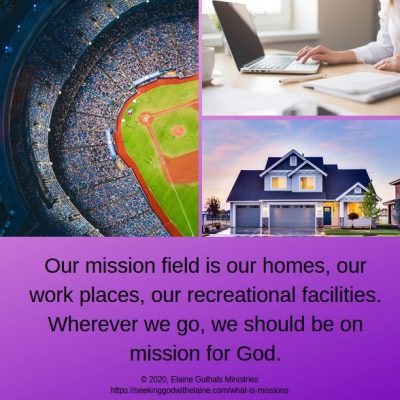
    Our mission field is our homes, our work places, our recreational facilities. Wherever we go, we should be on mission for God.

    The “Preach” Task

    “Then he said to them, ‘Go into all the world and preach the gospel to all creation’” (Mk. 16: 15 CSB)

    Paul said this about himself. “Although I am less than the least of all the Lord’s people, this grace was given me: to preach to the Gentiles the boundless riches of Christ, and to make plain to everyone the administration of this mystery, which for ages past was kept hidden in God, who created all things. His intent was that now, through the church, the manifold wisdom of God should be made known to the rulers and authorities in the heavenly realms, according to his eternal purpose that he accomplished in Christ Jesus our Lord” (Eph. 3: 8-11 NIV).

    What is preaching? According to the Holman Bible Dictionary, preaching in the Bible is the “human presentation through the Holy Spirit’s power of God’s acts of salvation through Jesus Christ.”

    It doesn’t say it has to be on a Sunday morning. It doesn’t say it has to be a Pastor Chad-type. It doesn’t say how many people are needed to constitute an audience.

    Spurgeon really expanded the definition. He wrote that preaching “… includes all church work for the spread of the gospel.”

    That could mean that it is as simple as one person talking to another person, telling how to ABCD. It is us talking about His love and His grace.

    Preaching needs that human touch. The definition of preaching in the Bible went on to say, “a sermon becomes God’s word to us only as God’s servant reconstitutes the past realities of the biblical revelation into vital present experience.”

    It is like when Philip preached to the Ethiopian (Act 8: 26-40). The Ethiopian was reading it. He needed more.

    “Then Philip ran up to the chariot and heard the man reading Isaiah the prophet. ‘Do you understand what you are reading?’ Philip asked. ‘How can I,’ he said, ‘unless someone explains it to me?’ So he invited Philip to come up and sit with him” (Ac. 8: 30-31 NIV).

    A simple explanation and practical application. That is how we preach. (Remember, it is in our disciple’s job description.)

    The Disciple’s Job Description

    Complete Job Description

    Individual Description

    Job Duty #4
    Proclaim the Gospel (Mark 16: 15)

    The “Obedience” Task

    “The word of the Lord came to Jonah a second time: ‘Get up! Go to the great city of Nineveh and preach the message that I tell you.’ Jonah got up and went to Nineveh according to the Lord’s command” (Jonah 3: 1-3 CSB)

    We can learn so much from Jonah.

    • God will give us second chances if we genuinely repent. Repentance is expressing sorrow for breaking God’s laws and commandments by making the commitment to changing ourselves through obedience so that we no longer do the wrong things.
    • We may be asked to do things that challenge our beliefs because we need to align them with God’s.
    • Obedience is the key. Obedience means to hear and carry out the instructions that God gives us.

    When we apply this to our mission, we see that God knows we are fallible, imperfect creatures. He will forgive us when we ask. He will still use us to expand His kingdom.

    Ray said there are two ways we disobey God regarding our mission. He wrote, “He may not go, may plead excuses, and refuse to try to do the work. Or he may not do what God tells him to do, may do something somewhat like it, but not it.”

    We have to perform our mission in the way that God is calling us. It is His kingdom. He is all-knowing and all-powerful. We need to listen to Him.

    The “Stay” Task

    “But I will stay in Ephesus until Pentecost, because a wide door for effective ministry has opened for me — yet many oppose me” (I Cor. 16: 8-9 CSB)”

    Have you ever wanted to move on to a next season in your life, and God was keeping you where you were? We have to listen to Him and do His Will.

    God will bless our mission when we are doing His Will. Remember He goes before, with, and after us.

    No, our mission work isn’t going to be all rainbows and unicorns. We are going to have challenged. But God will be with us every step of the way when we are genuinely serving Him.

    Our mission field is our homes, our work places, our recreational facilities. Wherever we go, we should be on mission for God.

    The “Speak” Task

    “Now go! I will help you speak and I will teach you what to say” (Ex. 4: 12 NIV).

    Unfortunately, we pull a Jonah a lot of times. We make excuses as to why we can’t do the mission God is giving us. We say we can’t speak, as Moses did. Worst case scenario, we flat outrun the other way like Jonah did.

    We said in the last devotion that God isn’t in the business of setting us up to fail. God is in the salvation business. He needs us to do our part so that His kingdom is expanded.

    We get forgetful like Moses did. Parker wrote, “He has forgotten the promise, ‘Certainly I will be with thee.’”

    It isn’t us who will be doing the talking. “For the one whom God sent speaks God’s words, since he gives the Spirit without measure” (Jn. 3: 34 NIV). God will take care of it all.

    Many times, we say we don’t know the Bible well enough. “You will be his witness to all people of what you have seen and heard” (Ac. 22: 15 NIV). God wants us to talk about Him and us. He wants us to tell about what we know. Still, we are going to want to know the Bible.

    Making the Connections

    We all have different tasks that God has called us to do in order to accomplish evangelism. “So Christ himself gave the apostles, the prophets, the evangelists, the pastors and teachers, to equip his people for works of service, so that the body of Christ may be built up until we all reach unity in the faith and in the knowledge of the Son of God and become mature, attaining to the whole measure of the fullness of Christ” (Eph. 4: 11-13 NIV).

    One isn’t better than the other. All are needed.

    Making the Connections to Self-Discipline

    Being on mission for God will cause us to want to know His Word better. We will use self-discipline to accomplish that.

    We’ve been looking at defending our beliefs when we are witnessing. That means we have to be secure enough to convince someone to accept our beliefs.

    Our questions should still serve us to determine on what we need to focus.

    • What does the Scriptures say?
    • What do I believe?
    • Why do I believe the same/differently than the Scriptures?
    • What are the talking points when witnessing to a non-believer?

    Related Links

    I have created a worksheet of the questions above. Click on the button below to access it.

    How Do We Apply This?

    Cuyler wrote, “But every living Christian is a preacher. Every prayerful, Ernest, godly life is a sermon.”

    But we can’t just rely on others seeing us live our lives and get God’s message. We have to talk with them. We have to build the relationship so that we can make an impact in their lives.

    We also rely on missionaries and mission trips to get the job done. We have to act like we are on mission every day of our lives — where ever we go and with whomever we come in contact.

    Father God. We wait for You to send us. We diligently perform the tasks You assign to us. We will go where You send us; we will stay where You plant us. Through our lives and our words, we will preach Your gospel to those who need to hear. May we always be obedient to You. Amen.

    What do you think?

    Leave me a comment below (about this or anything else) or head over to my Facebook group for some interactive discussion.

    If you don’t understand something and would like further clarification, please contact me.

    If you have not signed up for the email daily or weekly providing the link to the devotions and the newsletter, do so below.

    If God has used this devotion to speak with you, consider sharing it on social media.

  • What Is Evangelism?

    We are called to proclaim the gospel to others. That calling is referred to as evangelism. This devotion looks at why it is the duty of every disciple instead of just a preacher’s job.

    Nuggets

    • We need to share the gospel story because there is a whole lot of people who need to hear so they can make a choice to follow God.
    • God chooses us to deliver His message.
    • We also have to watch over others.
    • We have a testimony for God.
    Flowers with title What Is Evangelism?

    This year, we are looking at self-discipline. We are using Vincent’s The Lesson of Ripeness sermon to look at the need to grow in our relationship with God. We morphed learning enough to be a teacher into determining some areas we need to grow so we can be mature disciples.

    Resource

    We have been looking at solidifying what we believe. When we witness, we need to be prepared to explain what we believe and why we believe it. We have looked at the Scriptures, the Trinity (God, Jesus, and the Holy Spirit), man, salvation, grace, the church, divine ordinances, worship, God’s kingdom, and end times. Now, we are going to look at the evangelism and missions.

    One of our job duties as a disciple is to proclaim the gospel. Some may think that sounds a whole lot like preaching — and many of us do not feel qualified to do that.

    I get it. I went to a family funeral and was describing my devotions to a cousin. He said, “Oh, you are a preacher.” I said, “No, I am a teacher.”

    We are quick to make the distinctions, but does God? We generally think that evangelism is for the Pastor Chad types and missions are for the Tom, Sally, and Elaine types?

    Are they?

    Devotions in the What I Believe series

    Devotions in the Evangelism and Missions category

    What Is Evangelism?
    What Is Missions?
    What Was Jesus’ Mission?
    How Is the Mission to be Inclusive?

    Let’s Put It into Context

    According to the Holman Bible Dictionary, evangelism is “the active calling of people to respond to the message of Grace and commit oneself to God in Jesus Christ.” I really liked how Holman linked evangelism with a deep-rooted concern for people. This concept — even though evangelism isn’t mentioned anywhere is Scriptures — permeates them.

    Resource

    Evangelism is sharing, as led by the Holy-Spirit, the good news of God’s kingdom to ensure all sinners have heard of God’s love and mercy so that they may choose to accept Jesus as their Savior. Sinners are all people who have not made a genuine profession of faith — who have not sincerely ABCDed.

    The ABCDs of Salvation

    If you have not become a believer in Christ, please read through the
    Plan of Salvation and prayerfully consider what God is asking you to do.

    A – admit our sins
    B – believe His Son Jesus is our Redeemer
    C – confess God as Sovereign Lord
    D – demonstrate that commitment by making any changes needed in our lives to
    live the way in which God has called us

    On the other hand, missions, according to the Holman Bible Dictionary, is “a task on which God sends a person He has called, particularly a mission to introduce another group of people to salvation in Christ.” While — again — the term missions is not used in the Scriptures, evangelism is accomplished through missions.

    Resource

    Reason Evangelism Is Needed

    “Don’t you say, ‘There are still four more months, and then comes the harvest’? Listen to what I’m telling you: Open your eyes and look at the fields, because they are ready for harvest. The reaper is already receiving pay and gathering fruit for eternal life, so that the sower and reaper can rejoice together. For in this case the saying is true: ‘One sows and another reaps.’ I sent you to reap what you didn’t labor for; others have labored, and you have benefited from their labor” (Jn. 4: 35-38 NIV)

    We need to share the gospel story because there is a whole lot of people who need to hear so they can make a choice to follow God. Remember, anything that isn’t a conscious choice to follow God is a choice to not follow God.

    Jesus showed the urgency when He compared the mission field to a field of crops. There is always a gestation period. Seeds are planted, watered, cultivated, and allowed to grow until they bloom and produce.

    The same is true when a non-believer is presented the gospel. They must hear it, think it through, determine what questions they have, understand what they can, and make a conscious decision to put their faith and trust in God.

    People do not hear if they are not told. They are not told if disciples do not tell them.

    Luckily, we are not alone in our work. God organized us into communities. We can get help in proclaiming His Word.

    But we also have to be prepared to witness one on one. We may encounter someone who needs to hear the message right then — and we may be alone with them. We’ve got to step up and do what God calls us to do.

    Remember we said there was a gestation period. When we are sharing God‘s message, we have to be patient. It is our duty to share the message. It is the Holy Spirit that convicts the person. We have no clue how long that will take. We may want to see immediate results, but that will not always be the case.

    But then again we may may not be the planter. We may be the harvester. That may look make it and appear that the person’s decision was instantaneous.

    It Is Required

    “He commanded us to preach to the people and to testify that he is the one whom God appointed as judge of the living and the dead” (Ac. 10: 42 NIV)

    Does God need us to proclaim his message? Yes and no.

    No, God does not need us. He is Sovereign God. We are broken and far from perfect.

    Yes, God chooses us to deliver His message. He chooses for us to tell others the impact He has made in our lives.

    Thomas made a great observation. He wrote, “The feeblest honest effort to improve the world will develop encouraging symptoms to persevere.” Our beginning efforts to proclaim God’s message will be rewarded if we keep on doing what we are called to do.

    We have to take the focus off of us. The message isn’t about us.

    • It is about God knowing before He even created us that we would need a Savior.
    • It is about Him providing that Savior.
    • It is about Jesus being that Savior.
    • It is about Him coming one day to judge us to determine if we have given their lives to Him.

    It is important non-believers hear that “… he is the one whom God appointed as judge of the living and the dead” (Ac. 10: 42 NIV). He day is fast approaching when it will be judgment day.

    To read a related devotion, click the button below.

    We Have Responsibility

    “Keep watch over yourselves and all the flock of which the Holy Spirit has made you overseers. Be shepherds of the church of God, which he bought with his own blood” (Ac. 20: 28 NIV).

    There are several things for which we are instructed to watch. We have to watch out for Satan tempting us. We have to watch to make sure we are on the right sanctification road. We have to watch for Jesus’ return.

    We also have to watch over others. Simpson lists the duties of a shepherd.

    • Feed the flock
    • Water it
    • Groom and shear the sheep
    • Deliver lambs
    • Search for wandering sheep
    • Protect the flock

    We have similar duties when proclaiming God’s message to others.

    It is logical that we take care of ourselves before we take care of those God has entrusted under our care. Arnot explained that when he wrote, “The more that the teacher absorbs for himself of Christ’s love, the more benefit will others obtain from him.” The more we know and understand, the more we will be able to help others know and understand.

    Vaughan warned us that this verse does not make us rulers over the flock. He argued that the “… word ‘over’ should be rendered ‘in.’”

    Our responsibility is to serve those to whom God has called us to share His message. We are to model how we walk in the Spirit.

    To read a related devotion, click the button below.

    Our Call to Ministry

    “Now get up and stand on your feet. I have appeared to you to appoint you as a servant and as a witness of what you have seen and will see of me. I will rescue you from your own people and from the Gentiles. I am sending you to them to open their eyes and turn them from darkness to light, and from the power of Satan to God, so that they may receive forgiveness of sins and a place among those who are sanctified by faith in me” (Ac. 26: 16-18 NIV).

    The verses above are from when Paul was giving his testimony to King Agrippa. He was telling the king about how Jesus met him on the road and changed his career path.

    To read a related devotion, click the button below.

    Oh, no. We probably don’t have the Hollywood splash Paul had at his conversion.

    We still have a testimony for God. We still can — and will — be used by God because He has a specific purpose for us.

    We probably won’t have the ministry that Paul had, either. We won’t be constantly traveling to foreign lands to spread God’s Word.

    But we will have our ministry — even if it is to share God’s Word with a coworker. However great or small our ministry will be should have no bearing on us completing the ministry.

    Jesus will be with us as we travel the path on which He has set us. Yeah, we may have shipwrecks and beatings. We may even lose our lives.

    But it is very important that we share the message to whomever God has called to be our flock. What if we are the planter — and we don’t get the seed in the ground? Maybe worse yet, what if we are the harvester — and we let the grain die on the shaft?

    Making the Connections

    Reed made an interesting comment. He wrote, “An ordinary call to the ministry usually involves long processes of self-examination and observation of God’s guiding providences.”

    I think sometimes we think that God is going to call us to do something and throw us in the deep end before we know how to swim.

    Not. Going. To. Happen.

    God isn’t in the business of setting us up to fail. God is in the salvation business. He needs us to do our part so that His kingdom is expanded.

    Jeary gave us a good list of the objects of ministry.

    • Show God’s character
    • Destroy Satan’s kingdom and establish Jesus’
    • Grow disciples so that they live sanctified lives
    • “Result in the brightest manifestation of the Saviour’s glory”

    Too much is at stake for God to just throw us out on our own without preparing and equipping us for the jobs we are called to do.

    Making the Connections to Self-Discipline

    We’ve been looking at defending our beliefs when we are witnessing. That means we have to be secure enough to convince someone to accept our beliefs.

    Our questions should still serve us to determine on what we need to focus.

    • What does the Scriptures say?
    • What do I believe?
    • Why do I believe the same/differently than the Scriptures?
    • What are the talking points when witnessing to a non-believer?

    Related Links

    I have created a worksheet of the questions above. Click on the button below to access it.

    How Do We Apply This?

    God knows where He needs us to work. We have to put our faith and trust in Him. We need to grow closer to Him so that we can perform the tasks to which we are called. We do that by seeking Him.

    Searching for and Seeking God

    Hearing His Word (Rom. 10: 17).
    Reading His Word (Rev. 1: 3).
    Praying to Him (Heb. 4: 16).
    Studying His Word (Ac. 17: 11).
    Meditating on His Word (Ps. 1: 1-2).
    Memorizing His Word (Ps. 119: 11).

    Father God. We are humbled that You want to use us as ministers in Your kingdom. Show us where You want to use us. Give us a boldness to accomplish Your plan. May we always grow closer to You. Amen.

    What do you think?

    Leave me a comment below (about this or anything else) or head over to my Facebook group for some interactive discussion.

    If you don’t understand something and would like further clarification, please contact me.

    If you have not signed up for the email daily or weekly providing the link to the devotions and the newsletter, do so below.

    If God has used this devotion to speak with you, consider sharing it on social media.

  • What Is the Rapture?

    During the tribulation, where is the church going to be? Will it be raptured to begin our lives with God? Or will disciples be going through the tribulations also? This devotion looks at some verses used as evidence that the church will be raptured before the tribulation begins.

    Nuggets

    • All First Thessalonians 4: 16-17tells us is how Jesus is announced and the rapture order.
    • First Corinthians 15: 51-53 says nothing about the state of the world in which we are living at the time.
    • In First Thessalonians 5: 9, Paul is taking more about the judgment than the tribulation.
    • Saved out of could mean that they made it through the tribulation, not got yanked out of it.

    Devotions in the What I Believe series

    Devotions in the End Times category
    End Times Churchy Words Focus

    Flowers with title What Is the Rapture?

    Over the last four devotions, we’ve been looking at the tribulation. That does not sound like it is going to be an enjoyable time.

    One thing we didn’t talk about was, where is the church going to be in all of this? When will the church be raptured?

    Let’s Put It into Context

    The Holman Bible Dictionary defines rapture as “the catching up of believers by Christ at the time of His return.” The group is called the church, believers who together worship God and Jesus Christ and work to proclaim His gospel and make disciples.

    There is debate as to when the rapture will occur in relation to the tribulation.  According to Compelling Truth, the tribulation “… is the period during the end times wherein God judges Israel and the world for their unrighteousness and prepares to establish Jesus as the King of the world.”

    Resource

    The tribulation will last for seven years. It can be divided into two halves with a identifiable middle in between.

    When Do We Fly?

    One theory is that the church will be raptured before the tribulation starts. I found some verse others say are corroboration for this.

    I don’t see these verses specifically telling us that.

    “For the Lord himself will descend from heaven with a shout, with the archangel’s voice, and with the trumpet of God, and the dead in Christ will rise first. Then we who are still alive, who are left, will be caught up together with them in the clouds to meet the Lord in the air, and so we will always be with the Lord” (I Thess. 4: 16-17 CSB)

    When I think of the rapture, I think of First Thessalonians 4: 16-17. But all this verse tells us is how Jesus is announced and the rapture order.

    It says nothing about the state of the world in which we are living at the time.

    “Listen, I am telling you a mystery: We will not all fall asleep, but we will all be changed, in a moment, in the twinkling of an eye, at the last trumpet. For the trumpet will sound, and the dead will be raised incorruptible, and we will be changed. For this corruptible body must be clothed with incorruptibility, and this mortal body must be clothed with immortality” (I Cor. 15: 51-53 CSB)

    The verses in First Corinthians also are very familiar. Again, it says nothing about the state of the world in which we are living at the time.

    “For God did not appoint us to wrath, but to obtain salvation through our Lord Jesus Christ” (I Thess. 5: 9 CSB)

    Yeah, finally! Sorta.

    This verse does not talk about the rapture by name (but then no verse does). It is talking about believers experiencing God’s wrath.

    We’ve talked about God’s wrath a couple of times. God’s wrath comes out of His nature because of the need to maintain order. The tribulation is going to be about His wrath and judgment.

    I see a couple of different applications of God’s wrath. Yep, the tribulation is going to be an excellent example of God pouring out His anger on a thick-headed mankind who won’t accept His love.

    But God’s wrath is always tied up in our propensity to sin. Whatever happens in the tribulation is just leading up to the final judgment.

    God always has His eye in the prize — a restored relationship with us. The tribulation/judgment is not going to be His focus. He is going to focus on us perfected.

    Glossary

    What this verse says to me is that we, as disciples, are not going to experience God’s wrath because we have admitted our sins, believe in Jesus as our Savior and Lord, and confess God as Sovereign Lord.

    I am just not sure it is talking rapture here. Sure, Paul said, “For you yourselves know very well that the day of the Lord will come just like a thief in the night” (CSB) in First Thessalonians 5: 2.

    But in verse 9, Paul is taking more about the judgment than the tribulation. What I am reading this to mean is that God wants everyone to be saved (I Tim. 2: 4).

    Moody Bible’s The Second Coming of Christ noted the next three verses when making the statement “The Rapture will also inaugurate a period that the Bible characterizes as the ‘great day of His wrath,’ ‘the great tribulation’ and the ‘time of Jacob’s trouble.’”

    Who Gets to Reign?

    “Then I saw thrones, and people seated on them who were given authority to judge. I also saw the souls of those who had been beheaded because of their testimony about Jesus and because of the word of God, who had not worshiped the beast or his image, and who had not accepted the mark on their foreheads or their hands. They came to life and reigned with Christ for a thousand years. The rest of the dead did not come to life until the thousand years were completed. This is the first resurrection. Blessed and holy is the one who shares in the first resurrection! The second death has no power over them, but they will be priests of God and of Christ, and they will reign with him for a thousand years” (Rev. 20: 4-6 CSB).

    Ice stated that “premillennialism teaches that the Second Advent will occur before Christ’s thousand-year reign upon earth from Jerusalem (Revelation 19:11—20:6).”

    I have a couple of problems with this interpretation. One problem is that the reign happens after the battle where the beast is captured. The beast isn’t captured until after the end of the tribulation.

    Another problem is not everyone has come to life. Read this again. “… I also saw the souls of those who had been beheaded because of their testimony about Jesus and because of the word of God, who had not worshiped the beast or his image, and who had not accepted the mark on their foreheads or their hands. They came to life and reigned with Christ for a thousand years. The rest of the dead did not come to life until the thousand years were completed …” (Rev. 20: 4-5 CSB emphasis added).

    I am so confused right now.

    • Not everyone came back to life. So, they were resurrected but remained dead? That doesn’t seem right.
    • The people who will reign are those who didn’t take the mark of the beast. The mark of the beast is in the tribulation. If the rapture occurred before the tribulation, does that mean only tribulation converts will reign with Jesus for the thousand years? Then who is still asleep?

    Making the Connections

    I am stopping before I get even more confused.

    So, what does all of this tell me? We are not supposed to worry about the when. We aren’t even supposed to worry about the how. Whether God takes us before, in the middle, or at the end of the tribulation, God has this.

    Thompson put it this way. He wrote, “Salvation is sure — as sure as Omnipotence can make it in view of Christ’s death.”

    How Do We Apply This?

    We have to take it on faith that God has a plan. Pastor Chad preached on that today. We were in the end of Daniel 9.

    What I wrote down in my sermon notes was this: “Though we may not understand all things, God has a plan. It will be completed.”

    God has it figured out. He knows His timing. We don’t have to worry about it. We just have to believe in Him.

    Father. You want us to watch. You want us to learn. We are not going to learn and understand everything — and that is okay because we are not You. We have faith in You that You will do what You said. You are in control. We pray for Jesus’ return. Amen.

    What do you think?

    Leave me a comment below (about this or anything else) or head over to my Facebook group for some interactive discussion.

    If you don’t understand something and would like further clarification, please contact me.

    If you have not signed up for the email daily or weekly providing the link to the devotions and the newsletter, do so below.

    If God has used this devotion to speak with you, consider sharing it on social media.

  • How Will the Tribulation End?

    It is said that all things must end. That is true with the tribulation, also. This devotion looks at the last three and a half years of the tribulation.

    Nuggets

    • After the Antichrist is resurrected, he doubles down on his hatred of God’s followers — Jews and disciples alike.
    • The “fun” begins when God cuts loose with the seven trumpets.
    • If the trumpets are designed to inflict pain, the bowls are going to finish us off.
    • Jesus and His army will defeat the Antichrist and his army.

    Devotions in the What I Believe series

    Devotions in the End Times category
    End Times Churchy Words Focus

    Flowers with title How Will the Tribulation End?

    We’ve been looking at the tribulation. In this devotion, we are going to look at the last half, known as the great tribulation.

    Note: these four devotions give a very broad overview. There were some high points left out (like the two witnesses).

    We’ll come back sometime and pick those up. There just wasn’t room in these series.

    Let’s Put It into Context

    According to Compelling Truth, the tribulation “… is the period during the end times wherein God judges Israel and the world for their unrighteousness and prepares to establish Jesus as the King of the world.”

    Resource

    The tribulation will last for seven years. It can be divided into two halves with a identifiable middle in between.

    Second Half of the Tribulation

    Persecution Begins

    “Then they will hand you over to be persecuted, and they will kill you. You will be hated by all nations because of my name” (Mt. 24: 9 CSB)

    After the Antichrist is resurrected, he doubles down on his hatred of God’s followers — Jews and disciples alike. I guess he will figure he has made his point that he is God’s equal.

    Something that seems to get air play from time to time is the mark of the beast. Some will think the advantages of having the mark will outweigh the disadvantages. “And it makes everyone—small and great, rich and poor, free and slave — to receive a mark on his right hand or on his forehead, so that no one can buy or sell unless he has the mark: the beast’s name or the number of its name.” (Rev. 13: 16-17 CSB).

    It may be something tattooed on either our foreheads or hands. With today’s technology, it might be a microchip. It may start out as something innocuous and morph into something entirely different as technology advances.

    That may help the situation at the time, but the consequences will be paid throughout eternity. Accepting the mark of the beast is forever choosing to give our allegiance to Satan. Satan = torment in hell for eternity.

    To read a devotion in the Hell Does Have Fury series, click the appropriate button below.

    Seven Trumpets

    Then the “fun” begins. God is going to cut loose. It starts with seven trumpets.

    But the trumpets are only heralds. More fun is to follow.

    Seven Bowls

    If the trumpets are designed to inflict pain, the bowls are going to finish us off.

    When we live through the trumpets and bowls, there will be a lot of pain associated with it. Part of me wants to ask how anyone who will live through this could not believe in God. Oh, there will be some who stay with Satan.

    Praise God, He will still be in the business of salvation. “These are the ones coming out of the great tribulation. They washed their robes and made them white in the blood of the Lamb” (Rev. 7: 14 ESV). All they have to do is ABCD.

    The End

    “Night will be no more; people will not need the light of a lamp or the light of the sun, because the Lord God will give them light, and they will reign forever and ever” (Rev. 22: 5 CSB)

    Jesus and His army will defeat the Antichrist and his army (Rev. 19: 11-21). Sturgeon wrote, “Everything which sets up itself in opposition to the sacrifice of Christ is to be hurled down, and made to sink like a millstone in the flood.”

    That means judgment for those who did not ABCD. That means reward for those of us who did. We’ve already talked about judgment.

    Devotions in the What I Believe series

    End Times category
    Judgment Day Focus

    Disciples are called the bride of Christ because there will be a marriage ceremony once we are called home. In this ceremony, Christ’s church will be made perfect (Spurgeon).

    It seems logical that it is referred to as a marriage. It signifies the “… and they become one” (Gen. 2: 24 GNT) thing. It generally entails a residency change. It takes love.

    We become one with Christ. We become as He is.

    This heaven and earth dissolve. “… Earth and heaven fled from his presence, and no place was found for them” (Rev. 20: 11 CSB). New heaven, earth, and Jerusalem replace it. “Then I saw a new heaven and a new earth; for the first heaven and the first earth had passed away, and the sea was no more. I also saw the holy city, the new Jerusalem, coming down out of heaven from God, prepared like a bride adorned for her husband” (Rev. 21: 1-2 CSB).

    Then eternity begins.

    Earth

    Making the Connections

    Yes, we have been reading some scary words. No, they are not fiction. They will be fact one day.

    We need to believe them. We need to tell those around us about them.

    That is our part of our job: to proclaim the gospel and make disciples.

    The Disciple’s Job Description

    Complete Job Description

    Individual Description

    Job Duty #4
    Proclaim the Gospel (Mark 16: 15)

    Job Duty #6
    Make Disciples (Matthew 28: 19-20)

    We aren’t supposed to figure it all out. We are just supposed to have faith. Faith is the belief that the doctrines stated in God’s Word are true, even if we do not understand all aspects of them.

    Our focus should be on God because He has it figured out.

    Making the Connections to Self-Discipline

    When the tribulation begins, non-believers will see that prophecy is true. Convincing some before they see the horror will be challenging.

    But we have to witness to them. We want them to know the loving God we do.

    We’ve been looking at defending our beliefs when we are witnessing. That means we have to be secure enough to convince someone to accept our beliefs.

    Our questions should still serve us to determine on what we need to focus.

    • What does the Scriptures say?
    • What do I believe?
    • Why do I believe the same/differently than the Scriptures?
    • What are the talking points when witnessing to a non-believer?

    Related Links

    I have created a worksheet of the questions above. Click on the button below to access it.

    How Do We Apply This?

    The ABCDs of Salvation

    If you have not become a believer in Christ, please read through the
    Plan of Salvation and prayerfully consider what God is asking you to do.

    A – admit our sins
    B – believe His Son Jesus is our Redeemer
    C – confess God as Sovereign Lord

    D – demonstrate that commitment by making any changes needed in our lives to
    live the way in which God has called us

    The Disciple’s Job Description

    Father God. You are Sovereign God. You know what the end is. You know the how and the when. Lord, help us to remain faithful to You. Strengthen us so that we are not pulled into the worldview. We look forward to when we can see You face to face. Amen.

    What do you think?

    Leave me a comment below (about this or anything else) or head over to my Facebook group for some interactive discussion.

    If you don’t understand something and would like further clarification, please contact me.

    If you have not signed up for the email daily or weekly providing the link to the devotions and the newsletter, do so below.

    If God has used this devotion to speak with you, consider sharing it on social media.

  • What Happens in the Middle of the Tribulation?

    The middle of the tribulation is when the Antichrist is going strong, but what is happening? This devotion looks at the middle of the three-year period of the tribulation.

    Nuggets

    • Resurrecting the Antichrist will provide a miracle Satan will need.
    • I don’t see Satan wanting God worshiped in any way, shape, or form.
    • Everyone will be expected to worship the Antichrist – no one is going to be exempt.

    Devotions in the What I Believe series

    Devotions in the End Times category
    End Times Churchy Words Focus

    Flowers with title What Happens in the Middle of the Tribulation?

    The tribulation is a three-year period that can be divided into two halves. It has a very defined middle. Let’s take a look at the middle.

    Let’s Put It into Context

    According to Compelling Truth, the tribulation “… is the period during the end times wherein God judges Israel and the world for their unrighteousness and prepares to establish Jesus as the King of the world.”

    Resource

    The tribulation will last for seven years. It can be divided into two halves with a identifiable middle in between.

    An Assassination Attempt

    “One of its heads appeared to be fatally wounded, but its fatal wound was healed. The whole earth was amazed and followed the beast. It exercises all the authority of the first beast on its behalf and compels the earth and those who live on it to worship the first beast, whose fatal wound was healed. It also performs great signs, even causing fire to come down from heaven to earth in front of people. It deceives those who live on the earth because of the signs that it is permitted to perform in the presence of the beast, telling those who live on the earth to make an image of the beast who was wounded by the sword and yet lived” (Rev. 13: 2, 12-14 CSB)

    It is not going to be all rainbows and unicorns for the Antichrist. There will be an assassination attempt.

    Oh, the attempt will succeed — sorta. The Antichrist will die.

    He just won’t stay dead.

    I know. That kind of seems strange. Satan is finally in control, and his dictator dies.

    But then it isn’t. I am sure Satan is thinking, “Whatever God can do, I can do better.” Resurrecting the Antichrist will provide a miracle Satan will need.

    God raised Jesus from the dead. Satan will think he has to at least match that.

    Aren’t miracles what most want to see? “Then some teachers of the Law and some Pharisees spoke up. ‘Teacher,’ they said, ‘we want to see you perform a miracle’” (Mt. 12: 38 GNT). Seeing is believing, right?

    And what better miracle for Satan to perform than one dealing with death. We associate Satan with death. He would probably want to show that he can control it.

    However, Satan doesn’t. “When I saw him, I fell at his feet like a dead man. He laid his right hand on me and said, “Don’t be afraid. I am the First and the Last, and the Living One. I was dead, but look — I am alive forever and ever, and I hold the keys of death and Hades” (Rev. 1: 17-18 CSB). Jesus does.

    But it is going to look good when the Antichrist comes back to life. It will probably win a lot of people over.

    No matter how powerful the Antichrist becomes, he will always be a minion of Satan. Thomas listed some of Satan’s that the Antichrist embodies.

    • “Blasphemy
    • “Deception
    • “Destruction”

    Being aligned with Satan will only bring defeat to the Antichrist. Thomas wrote, “His mission will ultimately prove self-ruinous. In every act the devil performs, he is forming a link in that adamantine chain that shall bind him, not merely for a thousand years, but for ever.”

    No matter how high the Antichrist soars, he — and Satan — will eventually crash and burn.

    Eagle soaring

    Defiling the Temple

    “So when you see the abomination of desolation, spoken of by the prophet Daniel, standing in the holy place …” (Mt. 24: 15 CSB)

    We talked about the “… abomination of desolation …” before. We went back to what Daniel had to say. “The ruler will make a treaty with the people for a period of one set of seven, but after half this time, he will put an end to the sacrifices and offerings. And as a climax to all his terrible deeds, he will set up a sacrilegious object that causes desecration, until the fate decreed for this defiler is finally poured out on him.” (Dan. 9: 27 NLT).

    The Antichrist will “… set up a sacrilegious object that causes desecration …” (Dan. 9: 27 NLT). He is going to have to set up something somewhere. Normally, I would say this would be on the altar where the sacrifices are offered to God.

    This is just my take (which could be right or wrong). The Antichrist firsts allows us to worship the One true God, then outlaws worshiping Him all together. To me, if he stops sacrifices and offerings, he is going to try to stop all worship.

    We talked before that, if we are to be a living sacrifice, we don’t sacrifice at an altar. We sacrifice our hearts and minds. The only way that is stopped is outlawing worshiping God all together.

    To read a related devotion, click the button below.

    But if we look at the tribulation as it will focus on Israel, wouldn’t the Temple be rebuilt? Walvoord wrote, “On the basis of Matthew 24:15 with supporting Scriptures from Daniel, 2 Thessalonians 2, and Revelation 13, it may be concluded that Scriptures anticipate a future temple with a sacrificial system which will be under way at the time ‘the prince that shall come’ exercises his authority, desecrates the temple, and establishes himself as the object of worship.”

    Maybe it will be a combination of both. I don’t see Satan wanting God worshiped in any way, shape, or form. Isn’t he going to want the whole world to worship him?

    Whole World Worship

    “The beast was given a mouth to utter boasts and blasphemies. It was allowed to exercise authority for forty-two months. It began to speak blasphemies against God: to blaspheme his name and his dwelling — those who dwell in heaven. And it was permitted to wage war against the saints and to conquer them. It was also given authority over every tribe, people, language, and nation. All those who live on the earth will worship it, everyone whose name was not written from the foundation of the world in the book of life of the Lamb who was slaughtered” (Rev. 13: 5-8 CSB)

    Well, yes he is. “… authority over every tribe, people, language, and nation” (Rev. 13: 7 CSB). Everyone will be expected to worship the Antichrist – no one is going to be exempt.

    At least the Antichrist is going to try to make no one exempt. “… everyone whose name was not written from the foundation of the world in the book of life of the Lamb who was slaughtered” (Rev. 13: 8 CSB). There will be those who are God’s remnant.

    I know. This sounds like predestination again. Predestination, in a biblical sense, is being given salvation without choosing it and without repenting. Someone else has made the decision, and it can’t be prevented or changed.

    To read a related devotion, click the appropriate button below.

    Just because God is all knowing doesn’t mean He didn’t give us the free will. Free will is the ability within us to make decisions, which determine actions that produce character.

    To read a related devotion, click the button below.

    Thomas said it so much better than I did. He wrote, “ The things that are to happen in the universe in the most distant future are to God as facts already accomplished.”

    But the Christian Standard Bible has the words in a different order than other translations. It totally changes the meaning.

    Let’s look at this one. “And all that dwell upon the earth shall worship him, whose names are not written in the book of life of the Lamb slain from the foundation of the world” (Rev. 13: 8 KJV).

    The phrase from the foundation of the world was originally modified Jesus. Not us — those whose names are written in the book.

    Jesus was always going to be our Savior because sin was always going to enter the world.

    Verse 7 says the Antichrist will “… wage war against the saints and to conquer them …” (Rev. 13: 7 CSB). He is going to win.

    Sorta. Burkitt addressed that. He wrote, “A war proclaimed; the beast makes war upon the saints, by bloodshed and persecution, and by the force of those weapons overcomes them; that is to outward appearance and in the opinion of the world. But really do the saints overcome him by their patience under sufferings, and by adhering to the truth.”

    Yep, we would rather skip the persecution, but that isn’t an option. Jesus said we would be persecuted. “Then you will be handed over to be persecuted and put to death, and you will be hated by all nations because of me” (Mt. 24: 9 NLT).

    But think what we are gaining when we overcome.

    • Evidence of our obedience to the Father
    • A character that imitates His
    • A witness that shows His love for us

    Run!

    “‘So when you see the abomination of desolation, spoken of by the prophet Daniel, standing in the holy place’ (let the reader understand), ‘then those in Judea must flee to the mountains’” (Mt. 24: 15-16 CSB)

    Jesus advised us to run when we see the Antichrist has desecrated the Temple. When he thinks he has won over God, Jesus tells us not to fight for Him.

    Jesus is going to do that for Himself.

    It makes sense. We are just to put on the armor of God. God fights for us.

    To read devotions in the Armor of God series, click the appropriate button below.

    Making the Connections

    A thought that keeps running through my mind is that worldview people think that things would be so much better if they were just allowed to have their way. Basically, God is going to allow them to do that. God is going to allow Satan to have free reign — for a while.

    And things will get really bad.

    What is the saying — be careful what you wish for.

    Making the Connections to Self-Discipline

    When the tribulation begins, non-believers will see that prophecy is true. Convincing some before they see the horror will be challenging.

    But we have to witness to them. We want them to know the loving God we do.

    We’ve been looking at defending our beliefs when we are witnessing. That means we have to be secure enough to convince someone to accept our beliefs.

    Our questions should still serve us to determine on what we need to focus.

    • What does the Scriptures say?
    • What do I believe?
    • Why do I believe the same/differently than the Scriptures?
    • What are the talking points when witnessing to a non-believer?

    Related Links

    I have created a worksheet of the questions above. Click on the button below to access it.

    How Do We Apply This?

    The ABCDs of Salvation

    If you have not become a believer in Christ, please read through the
    Plan of Salvation and prayerfully consider what God is asking you to do.

    A – admit our sins
    B – believe His Son Jesus is our Redeemer
    C – confess God as Sovereign Lord

    D – demonstrate that commitment by making any changes needed in our lives to
    live the way in which God has called us

    The Disciple’s Job Description

    Father. We read about what will happen in the future. Lord, You have every right to judge us. We pray that all come to ask Your forgiveness. Unfortunately, we know that will not happen. Still, we pray that You will use us to boldly speak of Your love to those around us so that they can admit their sins, believe in Jesus as Savior and Redeemer, and confess You as Sovereign Lord. We await for Jesus’ return. Amen.

    What do you think?

    Leave me a comment below (about this or anything else) or head over to my Facebook group for some interactive discussion.

    If you don’t understand something and would like further clarification, please contact me.

    If you have not signed up for the email daily or weekly providing the link to the devotions and the newsletter, do so below.

    If God has used this devotion to speak with you, consider sharing it on social media.

  • What Is the War in Heaven?

    Revelations 12: 7-12 recounts a war in heaven, but is it part of the tribulation or not? Is it a future war or a past war? This devotion looks at why the war was fought to determine where it falls on the timeline.

    Nuggets

    • The underlying cause of the war is Satan’s desire to defeat God and rule all that God has made.
    • Satan goes in to tempting us thinking he will probably lose.
    • We should never, ever discount Satan’s anger, but we must always remember that Jesus won.

    Devotions in the What I Believe series

    Devotions in the End Times category
    End Times Churchy Words Focus

    Flowers with title What Is the War in Heaven?

    We’ve been talking about the tribulation. We’ve said that it can be broken into the first half, middle, and second half.

    In the last devotion, we looked at how the tribulation begins. I was planning to do the middle and the end in this devotion. Now, I am going to have to break the middle in two separate devotions.

    Let’s Put It into Context

    According to Compelling Truth, the tribulation “… is the period during the end times wherein God judges Israel and the world for their unrighteousness and prepares to establish Jesus as the King of the world.”

    Resource

    The tribulation will last for seven years. It can be divided into two halves with a identifiable middle in between.

    A Heavenly War

    “Then war broke out in heaven: Michael and his angels fought against the dragon. The dragon and his angels also fought, but he could not prevail, and there was no place for them in heaven any longer” (Rev. 12: 7-8 CSB)

    Part of my problem is my confusion on Revelation 12: 7-13. Is this when Satan was kicked out of heaven? Or is it a future battle?

    Past or future — the underlying cause of the war is Satan’s desire to defeat God and rule all that God has made. It all boils down to, as Hatch has said, good is fighting evil.

    But look what Melvill said. He wrote, “The battle is between those angels which have never swerved from allegiance to God, and mighty spirits that ‘kept not their first estate.’”

    We know Satan and the demons that followed him when he rebelled were cast out of heaven. “And the angels which kept not their first estate, but left their own habitation, he hath reserved in everlasting chains under darkness unto the judgment of the great day” (Jude 1: 6 KJV emphasis added).

    These demons have not. “Then war broke out in heaven: Michael and his angels fought against the dragon. The dragon and his angels also fought, but he could not prevail, and there was no place for them in heaven any longer. So the great dragon was thrown out—the ancient serpent, who is called the devil and Satan, the one who deceives the whole world. He was thrown to earth, and his angels with him” (Rev. 12: 7-9 CSB emphasis added).

    Any longer, to me, says they had been residing in heaven. Satan is not residing in heaven now, so this really can’t be a future battle.

    So, what is it doing in Revelation except confusing my wee mind?

    John documented that Michael is going to be leading the angel army. We know that Michael is an archangel (Jude 1: 9).

    However, Milligan argued that this is really Jesus leading the army. He pointed out that Michael means “Who is like God?” Jesus is like God. We aren’t told angels were made in the image of God, but we know there are some similar characteristics.

    Another argument is Daniel prophesied that Michael would be the defender of the church. “At that time shall arise Michael, the great prince who has charge of your people. And there shall be a time of trouble, such as never has been since there was a nation till that time. But at that time your people shall be delivered, everyone whose name shall be found written in the book” (Dan. 12: 1 ESV). Is that not what Jesus is?

    Banishment

    “So the great dragon was thrown out — the ancient serpent, who is called the devil and Satan, the one who deceives the whole world. He was thrown to earth, and his angels with him” (Rev. 12: 9 CSB)

    Oh, man. Didn’t Satan realize he was fighting a losing battle? There was no way he was going to defeat the Omnipotent, Omniscient, Omnipresent God.

    To read a related devotion, click the appropriate button below.

    Oh, great! Now we have to deal with Satan since he was banished to the earth.

    Was God just setting us up for failure? He knew since before He even created us that we would sin.

    I mean, Satan is a master sinner. “The one who commits sin is of the devil, for the devil has sinned from the beginning. The Son of God was revealed for this purpose: to destroy the devil’s works” (I Jn. 3: 8 CSB). How can we withstand his manipulations?

    But look at the point that Clemence made. He wrote, “His attempts are often failures.” Satan goes in to tempting us thinking he will probably lose.

    He goes in anyway.

    Satan goes in to tempting us thinking he will probably lose. He goes in anyway.

    And we think we are going to withstand sin on our own? Not going to happen. We have a foe that is not only delusional, but Satan also never gives up.

    But is Satan goes in thinking he will lose, what is that really telling us?

    Satan thinks we are stronger than we think?
    We are stronger than we think?
    Satan knows that God is going to support us enough that we can withstand him?
    Satan really is delusional in what he is trying to get us to do?

    So then, why do we hook up with Satan?

    Spurgeon believed that there was a reason Satan was called a dragon. It was a hint as to “… his mysterious power and character.” That mystery doesn’t make him any less real.

    The characteristics that Satan has that led him to be called a dragon is his cunning and ferocity. That coupled with his patience makes him a formidable foe.

    Victory in Jesus

    “Then I heard a loud voice in heaven say, The salvation and the power and the kingdom of our God and the authority of his Christ have now come, because the accuser of our brothers and sisters, who accuses them before our God day and night, has been thrown down. They conquered him by the blood of the Lamb and by the word of their testimony; for they did not love their lives to the point of death. Therefore rejoice, you heavens, and you who dwell in them! Woe to the earth and the sea, because the devil has come down to you with great fury, because he knows his time is short” (Rev. 12: 10-12 CSB)

    We should never, ever discount Satan’s anger. He didn’t take kindly to being banished. He is going to take it out on us.

    Satan became the “… accuser of our brothers and sisters …” (Rev. 12: 10 CSB). Roberts wrote, “The accuser, in this instance, is the enemy of our souls.” He is accusing us, trying to get us to feel guilty and unworthy.

    But we must always remember that Jesus has now come — He’s won! We are worthy when He has cleansed us from our sins.

    Look at verse 11 says. “They conquered him by the blood of the Lamb and by the word of their testimony; for they did not love their lives to the point of death” (Rev. 12: 11 CSB).

    It was Jesus’ blood that atoned for our sins. It wasn’t his birth. It wasn’t that He died — if He would have died but not shed His blood, the sacrifice would not have been made. It wasn’t even His resurrection. It was that His blood was shed to pay the penalty for our sins.

    Let’s roost on the testimony a second. Vaughan wrote, “The blood of the Lamb is his motive, but the Word of His testimony is his direction. Without this he might be well-intentioned, but he would neither know his enemy nor know how to cope with him. They overcame him, therefore, because of the Word of which they were witnesses.”

    In Elaine-speak, I would say that Jesus shed His blood for us — but that doesn’t do us any good until we accept the gift of salvation. If we never ABCD, it doesn’t matter to us is Jesus was the sacrifice for our sins or not. We are still sinners if we don’t believe and confess.

    We wouldn’t know Satan was our enemy — because he wouldn’t be. We would be under Satan’s control.

    We have a testimony because the blood of the Lamb was spilt and we accepted the gift of salvation. I have told you before that, when I was going through my spiritual tornado, I would say every time I felt Satan tempting me, “I am not going to deny God.” That was the word of my testimony.

    But look at that last bit. “… for they did not love their lives to the point of death” (Rev. 12: 11 CSB).

    Some love God until He asks us to give up our jobs. Or until He takes Dad through a heart attack. Or until the relationship falls apart.

    Or until I don’t get my way.

    But this says Satan was defeated by Jesus’ blood, testimony, and willingness to suffer death. We have to be totally committed to God. Totally.

    Three crosses

    Making the Connections

    I love what Congreve said. When talking about the war in heaven, he wrote, “Looking at these words from a Christian’s point of view, we are reminded by them that whatever else was meant by the war in heaven of which they speak, they, at least, mean for us that the powers of evil have done their utmost to overcome Christ and the powers of good, and have failed — that Christ has proved good to be stronger than evil, and light than darkness. And the high hope is raised that He has done this for the whole universe, for the spirits in every other world-if such there be — as well as for the spirits of us poor men struggling with evil in this. That He has done it for us, is what His gospel tells us.”

    • Evil tried.
    • Evil failed.
    • Jesus did this for us.

    Satan thought he had much to gain. Instead, he lost much.

    It is Satan’s goal to make us think we have much to gain and nothing to lose. If we punch our ticket on his train, we will lose exactly what he did — God’s favor and a place in heaven.

    Look at it from Melvill’s perspective. The battle was a battle of principle — who was going to have the say as to how things were run? Some angels got fed up with how God was running things, so they tried to convince other angels to switch allegiance.

    We may think temptation looks appealing, but it really isn’t. Once sin’s true nature is seen, it is a shock to our systems. Temptation was pictured here as a pitched battle. All things associated with a battle would be in the mix:

    • Death
    • Wounds
    • Pain
    • Fright
    • Thirst
    • Hunger
    • Unrelenting

    Making the Connections to Self-Discipline

    It might be hard for non-believers to wrap their heads around spiritual warfare. They may have trouble believing in God and even more trouble believing in Satan. We have to consider what we are going to tell them to convince them there is both.

    We’ve been looking at defending our beliefs when we are witnessing. That means we have to be secure enough to convince someone to accept our beliefs.

    Our questions should still serve us to determine on what we need to focus.

    • What does the Scriptures say?
    • What do I believe?
    • Why do I believe the same/differently than the Scriptures?
    • What are the talking points when witnessing to a non-believer?

    Related Links

    I have created a worksheet of the questions above. Click on the button below to access it.

    How Do We Apply This?

    Congreve made a good point as to why the angels were able to defeat evil — and many times we aren’t. It isn’t because the angels are so much stronger than us or different than us in that they can withstand evil. Angels are obedient and humble. Period.

    We can be obedient. That is a choice we make. Are we going to follow God’s law and commandments, or are we going to give in to evil?

    Spurgeon made an eye-opening comment. He wrote, “No door can shut him out, no height of piety can rise beyond his reach. He meets us in all our weaknesses, and assails us from every point of the compass. He comes upon us unawares, and gives us wounds which are not easily healed. But yet, powerful as this infernal spirit certainly must be, his power is defeated when we are resolved never to be at peace with him.”

    We cannot stop Satan from tempting us. Even when we diligently seek God and grow our relationships as we should, Satan is going to be right there to tempt us.

    So, what do we do?

    ABCD
    Praise God, even in the trials
    Put on the armor of God and prepare for the fights.
    Remind Satan he has already been vanquished.
    Share our testimony to any and all who will listen.
    Be willing to sacrifice whatever God asks us to sacrifice.

    To read devotions in the Armor of God series, click the appropriate button below.

    The ABCDs of Salvation

    If you have not become a believer in Christ, please read through the
    Plan of Salvation and prayerfully consider what God is asking you to do.

    A – admit our sins
    B – believe His Son Jesus is our Redeemer
    C – confess God as Sovereign Lord

    D – demonstrate that commitment by making any changes needed in our lives to
    live the way in which God has called us

    The Disciple’s Job Description

    Father. We claim the blood of Jesus for our salvation. We give our testimony for all You have done for us. We vow to serve You, even unto death. Amen.

    What do you think?

    Leave me a comment below (about this or anything else) or head over to my Facebook group for some interactive discussion.

    If you don’t understand something and would like further clarification, please contact me.

    If you have not signed up for the email daily or weekly providing the link to the devotions and the newsletter, do so below.

    If God has used this devotion to speak with you, consider sharing it on social media.