Category: Salvation

  • What Is Religious Freedom?

    A favorite Bible verse talks about Jesus setting us free. He said it during a conversation with the Pharisees, but they didn’t take that well. This devotion looks at why they didn’t know they were not free.

    Nuggets

    • Jesus was teaching something totally different from what the Jews had grown up believing.
    • We can’t just say we are disciples and not live that way.
    • Worldview people get that being moral is knowing the difference between right and wrong, just not that it means God’s right and God’s wrong.
    Flowers with title What Is Religious Freedom?

    This year, we are looking at self-discipline. We are using Vincent’s The Lesson of Ripeness sermon to look at the need to grow in our relationship with God. We morphed learning enough to be a teacher into determining some areas we need to grow so we can be mature disciples.

    Resource

    We have been looking at solidifying what we believe. When we witness, we need to be prepared to explain what we believe and why we believe it.

    We have been looking at solidifying what we believe. When we witness, we need to be prepared to explain what we believe and why we believe it. We have looked at the Scriptures; the Trinity (God, Jesus, and the Holy Spirit); man; salvation; grace; the church; divine ordinances; worship; God’s kingdom; end times; evangelism and missions; stewardship; cooperation; social order; and peace and war. Now we are going to look at religious freedom.

    Devotions in the What I Believe series

    Devotions in the Religious Freedom category

    What Is Religious Freedom?
    Acting Free
    Spiritual Bondage and Freedom

    Jesus the Liberator
    What Religious Freedom Doesn’t Mean

    We are going to start out by looking at a discussion that Jesus had with the Pharisees. Jesus accused them of being slaves, but they weren’t having anything to do with that.

    Since it covers so many verses, it is too long for one devotion. We will start it in this devotion and end it in the next devotion.

    Let’s Put It into Context #1

    Freedom is, according to the Holman Bible Dictionary, “the ability of a person or group to be and do what they want instead of being controlled by another.” It is also referred to as liberty.

    Resource

    We talked about liberty before. We said that it runs the gamut.

    • Liberty means doing what you please,
    • Liberty means freedom from arbitrary control.
    • Liberty means the ability to choose.
    • Liberty means freedom within specified limits.
    • Liberty means going beyond the normal limits.
    • Liberty means not following the rules.

    Oh, yeah. That is a worldview definition. But that gives us an idea of from where the different players are coming.

    To read a related devotion, click the button below.

    Let’s Put It into Context #2

    “As he was saying these things, many believed in him” (Jn. 8: 30 CSB)

    John 8 is a packed chapter. It kicks off with the story of the Pharisees bringing the adulterous woman to Jesus. That didn’t turn out as the Pharisees had planned. They had planned to trap Jesus but didn’t get the job done.

    The rest of the chapter recounts what Jesus was trying to teach them. It has several important points.

    • “I am the light of the world. Anyone who follows me will never walk in the darkness but will have the light of life” (Jn. 8: 12 CSB).
    • “… But you don’t know where I come from or where I’m going …” (Jn. 8: 14 CSB).
    • “… ‘You know neither me nor my Father,’ Jesus answered. ‘If you knew me, you would also know my Father’” (Jn. 8: 19 CSB).
    • “Then he said to them again, ‘I’m going away; you will look for me, and you will die in your sin. Where I’m going, you cannot come’” (Jn. 8: 21 CSB).
    • “The one who sent me is with me. He has not left me alone, because I always do what pleases him” (Jn. 8: 29 CSB).

    All interspersed in those nuggets are verses showing the Pharisees didn’t get it. Fortunately, though, verse 30 says that many of them did.

    Disciples or Descendants?

    “Then Jesus said to the Jews who had believed him, ‘If you continue in my word, you really are my disciples. You will know the truth, and the truth will set you free.’ ‘We are descendants of Abraham,’ they answered him, ‘and we have never been enslaved to anyone. How can you say, “You will become free”?’” (Jn. 8: 31-33 CSB)

    Jesus was teaching something totally different from what the Jews had grown up believing. While many believed, they couldn’t quite grasp what Jesus was getting at.

    Really, the Jews had been told for a long, long time that they were God’s people. They were His people because of the covenant with Abraham.

    Glossary

    Now, Jesus is saying, “Nope.”

    Robinson wrote that Jesus was not invalidating the covenant. He was criticizing the religion that had grown up around it. Robinson wrote, “Accepting a mere dead orthodoxy does not constitute one a genuine subject of the Kingdom of Truth.”

    Resource

    Now, Jesus is saying, “Nope.”

    Robinson wrote that Jesus was not invalidating the covenant. He was criticizing the religion that had grown up around it. Robinson wrote, “Accepting a mere dead orthodoxy does not constitute one a genuine subject of the Kingdom of Truth.”

    Resource

    What Jesus was trying to correct was their reliance on tradition and rituals instead of a relationship with God. They thought being descendants of Abraham was enough.

    Jesus told them that they would “… know the truth, and the truth will set you free” (Jn. 8: 32 CSB) if they would continue in His Word. They needed to realize that

    • “Jesus answered, ‘I am the way and the truth and the life. No one comes to the Father except through me’” (Jn. 14: 6 NIV)
    • “In the beginning was the Word, and the Word was with God, and the Word was God” (Jn. 1: 1 ESV).

    The Truth will set us free because Jesus is the Truth. He sets us free because He has redeemed us and paid the penalty for our sins. When we accept Jesus is the Word, He marks paid on our accounts. We have to continue in Him on the sanctification road so that we change our character to be like Him.

    Glossary

    We can’t just say we are disciples and not live that way. We have to obey God’s laws and commandments.

    But the Jews listening weren’t having anything to do with what Jesus was saying. Pierson wrote, “The mind, heart, will, moved, but the soul not yet made new in Christ.” They hadn’t been slaves in Egypt — they had been liberated.

    Resource

    So, the Jews were discounting what Jesus said. Not good.

    As disciples, we have to constantly put our faith and trust in God. Faith is the belief that the doctrines stated in God’s Word are true, even if we do not understand all aspects of them. Trust is assurance that the promises of God are true.

    We can’t just accept part of the gospel and reject the rest. We have to accept all of it.

    The problem is that the Jews were just thinking of political and intellectual freedom. Well, the first part was logical. They were expecting a military Messiah.

    To read a related devotion, click the button below.

    But that also kind of falls apart. Weren’t they sorta enslaved to the Romans? Hadn’t there been several instances in their history where they had been exiled and enslaved? They weren’t exactly free. (I bet Jesus shook His head at that boast.)

    What the Jews didn’t get was Jesus was talking about the spiritual. He was talking moral bondage. That had always been — and will always be — His focus.
    Two people praying

    Slave to Sin

    “Jesus responded, “Truly I tell you, everyone who commits sin is a slave of sin. A slave does not remain in the household forever, but a son does remain forever. So if the Son sets you free, you really will be free. I know you are descendants of Abraham, but you are trying to kill me because my word has no place among you. I speak what I have seen in the presence of the Father; so then, you do what you have heard from your father” (Jn. 8: 34-38 CSB)

    Worldview people get that being moral is knowing the difference between right and wrong. They just miss that it means God’s right and God’s wrong.

    When we focus on God’s wrong, we are in moral bondage. We are slaves to sin.

    Thomas brought up a good point. The Jews thought they were free because they had their religion, but they really didn’t. They didn’t have the relationship God for which was looking.

    The Jews thought they were free — even under Roman conquest. However, they were slaves to lust and greed. Thomas wrote, “Every sin a man commits forges a new link in the chain that manacles his soul.

    Resource

    Oh, isn’t that the truth? David described how bad it can get — and how wonderful it is when Jesus saves us. “He drew me up from the pit of destruction, out of the miry bog, and set my feet upon a rock, making my steps secure” (Ps. 40: 2 ESV).

    How can we be pulled out of the miry pit? We have to ABCD.

    The ABCDs of Salvation

    If you have not become a believer in Christ, please read through the
    Plan of Salvation and prayerfully consider what God is asking you to do.

    A – admit our sins
    B – believe His Son Jesus is our Redeemer
    C – confess God as Sovereign Lord

    D – demonstrate that commitment by making any changes needed in our lives to
    live the way in which God has called us

    The Disciple’s Job Description

    Because the Jews were Satan’s slaves, they didn’t recognize Jesus. The demons could (Mt. 8: 29; Lk. 4: 41; Jas. 2: 19), but His people couldn’t.

    Shedd didn’t mince any words when he wrote, “Sin is the suicidal action of the human will.” Yes, it is suicide.

    Resource

    Think about it this way. It is our choice whether we admit our sins, believe in Jesus as our Savior and Redeemer, and confess God as Sovereign Lord. It is called free will. Free will is the ability within us to make decisions, which determine actions that produce character.

    Glossary

    If we choose not to ABCD, we remain spiritually dead. Spiritual death is the separation from God that occurred as a consequence of Adam and Eve’s original sin.

    Glossary

    If we are separated from God on judgment day, we will be separated from Him for the eternity. We don’t want that because that means we will spend eternity in the torment of hell.

    To read a related devotion, click on the appropriate button below

    Wilberforce clarified that the “… everyone who commits sin …” (Jn. 8: 34 CSB) is someone who consciously commits sin. Yes, we all commit sin but only those who have not ABCDed are termed sinners.

    Resource

    In the next devotion, we will continue looking at the discussion Jesus had with the Pharisees.

    Gracious Lord. You are holy and righteous. You let us choose whether we are going to be like You or not. What You don’t do is allow us to think that, just because we have been made in Your image or are descendants of Abraham, we get a pass. You expect our submission and obedience to Your laws and commandments. You expect us to navigate the sanctification road so that we are becoming like You. May that be what we do. Amen.

    What do you think?

    Leave me a comment below (about this or anything else) or head over to my Facebook group for some interactive discussion.

    If you don’t understand something and would like further clarification, please contact me.

    If you have not signed up for the email daily or weekly providing the link to the devotions and the newsletter, do so below.

    If God has used this devotion to speak with you, consider sharing it on social media.
  • The Council Had Spoken

    How can we be cooperative when our group is splintered from the inside? This devotion looks at how the Jerusalem Council helped mend the torn group.

    Nuggets

    • We have to let people talk things through – to process.
    • Peter was also saying — without really saying it — that circumcision of the heart was much more important than circumcision of the body.
    • Those we are witnessing to want to know what a God has done lately.
    • By Gentiles doing these four things recommended, Jews may not see Gentiles as unclean.

    Devotions in the What I Believe series

    Devotions in the Cooperation category

    Flowers with title The Council Has Spoken

    It is difficult to be cooperative when we are face threats from outside our group. However, when our group is splintered, cooperation is even more difficult to maintain.

    Peter, Paul, and James handled one such time in the life of the early church. They did so by conducting what is called the Jerusalem Council.

    Let’s see what we can learn from the process.

    Let’s Put It into Context #1

    The Merriam-Webster Dictionary defines cooperation as “the actions of someone who is being helpful by doing what is wanted or asked for” and “association of persons for common benefit.”

    Resource

    Let’s Put It into Context #2

    “Some men came down from Judea and began to teach the brothers, “Unless you are circumcised according to the custom prescribed by Moses, you cannot be saved.” After Paul and Barnabas had engaged them in serious argument and debate, Paul and Barnabas and some others were appointed to go up to the apostles and elders in Jerusalem about this issue. When they had been sent on their way by the church, they passed through both Phoenicia and Samaria, describing in detail the conversion of the Gentiles, and they brought great joy to all the brothers and sisters. When they arrived at Jerusalem, they were welcomed by the church, the apostles, and the elders, and they reported all that God had done with them. But some of the believers who belonged to the party of the Pharisees stood up and said, “It is necessary to circumcise them and to command them to keep the law of Moses” (Ac. 15: 1-5 CSB)

    Don’t you hate it when outsiders come in and stir up trouble? Things are going well, but no. They have to come in and plant doubt and negativity.

    But let’s face. There is always going to be controversies.

    And controversies can be a good thing sometimes. Schaff wrote, “It is through controversy that truth is developed and error defeated.”

    So, the issue isn’t that we have controversy. The issue is how we handle it.

    The church at Antioch had controversies. Antioch was one of the first churches where the gospel was preached to the Gentiles (Ac. 11: 19-23). Up until this time, however, the congregation was unified.

    The problem was some of the Jews couldn’t — wouldn’t give up some Jewish traditions. They had a real problem with circumcision. Circumcision was the outward representation of the acceptance of God’s covenant with Abraham.

    The problem went deeper than just the physical keeping of the covenant. What the controversialists were saying is that all of the laws — including the requirements and penalties — had to be kept.

    Oh, yes. We still have to keep God’s laws and commandments — the moral laws. We do not have to keep the ceremonial laws — the sacrifices and the circumcision.

    Paul, a very vocal opponent, labeled them false teachers. He spent a lot of ink warning the converts not to fall into their line of thinking.

    Don’t skim over “… Paul and Barnabas and some others were appointed to go up to the apostles and elders in Jerusalem about this issue” in Ac. 15: 2 (CSB). Their viewpoint would have been known. They were sent to represent the “no circumcision” side of the debate.

    Where they were sent was the Jerusalem Council. They were going to the top to get the definitive answer. While Paul and Barnabas were well received, the debate on circumcision began.

    Council Established

    “The apostles and the elders gathered to consider this matter. After there had been much debate, Peter stood up and said to them, “Brothers, you are aware that in the early days God made a choice among you, that by my mouth the Gentiles would hear the gospel message and believe. And God, who knows the heart, bore witness to them by giving them the Holy Spirit, just as he also did to us. He made no distinction between us and them, cleansing their hearts by faith. Now then, why are you testing God by putting a yoke on the disciples’ necks that neither our ancestors nor we have been able to bear? On the contrary, we believe that we are saved through the grace of the Lord Jesus in the same way they are” (Ac. 15: 6-11)

    We can pull several things out of this passage. The matter was considered by the apostles and elders — the leadership.

    Fraser pointed out that we know this was now a council by the terminology used. Before, the terminology used was apostles and brethren. Now, it is apostles and elders.

    I, personally, don’t think that means they cut out the followers. We aren’t there yet, but verse 12 says, “The whole assembly became silent and listened …” (Ac. 15: 12 CSB). I don’t think it was just “the apostles and the elders gathered …” (Ac. 15: 6 CSB).

    I don’t think it was an executive session meeting. I think it was a public, open meeting. We have to let people talk things through – to process.

    But the decision was made by the higher ups.

    They talked it out. They considered all sides. This wasn’t something they entered into lightly.

    I have always been surprised that it didn’t include a line about prayer and supplication. Paul himself was the one who said, “do not be anxious about anything, but in everything by prayer and supplication with thanksgiving let your requests be made known to God” (Phil. 4: 6 ESV).

    But when Peter had enough of the debate, he got up (being the leader he had always been) and focused the discussion. He brought it down to what God had already decreed. I don’t think it is coincidence that Acts 15: 1-35 happens after Acts 10: 1-48.

    Peter’s argument contains three points — all of which are facts.

    1. God has already spoken.
    2. The law wasn’t the answer.
    3. Grace is the answer.

    Glossary

    The Gentiles no longer had to change to be what the Jews wanted them to be. They needed to change and be what God wanted them to be.

    People

    Yes, God wants us to remember the past. We always have to evaluate where we are to make sure we are navigating in the right direction on the sanctification road.

    Glossary

    God wants us to use the past to help us grow. He wants us to move on to where He is calling us.

    Thomas made an interesting point. He wrote, “On the other hand, Christianity was preeminently progressive; it made the old a mere starting point. It left Palestine for the world, the Jew for the race, the temple of Jerusalem for the temple of the universe, teaching men everywhere that ‘God is a Spirit,’ etc.”

    Peter said it loud and clear that the former rituals did not save them. Instead, he called them a yoke (Ac. 15: 10) — a hindrance.

    That is what God designed the laws to do. They show us that we cannot save ourselves.

    We all break the laws. Who among us hasn’t told the exact truth when asked if a certain article of clothing was flattering when on someone else — and it really wasn’t?

    Wasn’t that what was being debated? The application of the faith?

    The laws were something we could do to show our love for God. The laws had nothing to do with salvation itself. Salvation is deliverance from evil and the consequences of sins to replace them with eternal life and good.

    We have to make a genuine profession of faith in order to gain salvation. We can’t do anything else.

    What I think was ultimately being discussed here was truth and love. Did they believe salvation was only dependent on the truth that Jesus is our Savior? Did they love enough to accept those who were not like them into the fellowship?

    Peter was also saying — without really saying it — that circumcision of the heart was much more important than circumcision of the body. God wants us to change our character to be like Him, not just our mindset to follow His rules.

    God wants us regenerated. Regeneration is the change in us that God brings about when we go from being spiritually dead to spiritually alive.

    The President Spoke

    “The whole assembly became silent and listened to Barnabas and Paul describe all the signs and wonders God had done through them among the Gentiles. After they stopped speaking, James responded, “Brothers, listen to me. Simeon has reported how God first intervened to take from the Gentiles a people for his name. And the words of the prophets agree with this, as it is written: After these things I will return and rebuild David’s fallen tent. I will rebuild its ruins and set it up again, so that the rest of humanity may seek the Lord — even all the Gentiles who are called by my name — declares the Lord who makes these things known from long ago” (Ac. 15: 22-18 CSB)

    Peter shut the debate down. He showed what God had said.

    Barnabas and Paul silenced them. They showed what God had done. How could they argue against God?

    Don’t we need that sometimes? It is great to read the Bible stories, but those we are witnessing to want to know what a God has done lately. What has he done in our lives on a certain topic?

    James would have been considered the president of the council. Fraser pointed out that he was the best man in that position for this debate because he didn’t have a dog in the fight. Peter did; Paul did; James didn’t.

    James summarized what Peter had said. God had spoken to Peter.

    If they had any doubts after that, James took them back to the Old Testament and the words of the prophets. He quoted Amos 9: 11-12. “… and all the nations
that bear my name …” (Amos 9: 12 CSB).

    It was really important that James stressed that this was God’s Plan A from the beginning. How many times have we already talked about Paul using a lot of ink to get the Jews and the Gentiles to play nicely with each other?

    To read a related devotion, click on the appropriate button below.

    Decision Reached

    “Therefore, in my judgment, we should not cause difficulties for those among the Gentiles who turn to God, but instead we should write to them to abstain from things polluted by idols, from sexual immorality, from eating anything that has been strangled, and from blood. For since ancient times, Moses has had those who proclaim him in every city, and every Sabbath day he is read aloud in the synagogues” (Ac. 15: 19-21 CSB)

    These verses have always kind of confused me. Yes, they get to the decision that circumcision of the body is not required.

    But then James brings up some things that weren’t discussed before. Plus, to me, it seems like he is bringing up laws again. He said they should abstain from the following.

    • Eating foods presented to idols
    • Sexual immorality
    • Eating things that had been strangled
    • Eating blood

    Fraser argued that, by Gentiles doing these four things recommended, Jews may not see Gentiles as unclean. That is a pretty good compromise.

    Glossary

    Making the Connections

    It would be easy to say that there should be no controversies. There should be no division within the church.

    Ooo, baby. Not going to happen.

    We have to know how God wants us to work through the controversies. How does God want us to cooperate? To compromise?

    God does want us to work out compromises to disciples’ problems. We can’t compromise on His laws and commandments, but we can work together for peace of the fellowship.

    Parker brought up another good point. This not only addressed the issue of what was expected by God, but it also showed how new converts would be treated. Was it going to be the Jewish way or the highway?

    Making the Connections to Self-Discipline

    Worldview people may want to debate disciples, thinking they can show us as hypocrites. How can we proclaim the gospel message without sounding like we are “preaching to them” but not getting into an all-out debate?

    We’ve been looking at defending our beliefs when we are witnessing. That means we have to be secure enough to convince someone to accept our beliefs.

    Our questions should still serve us to determine on what we need to focus.

    • What does the Scriptures say?
    • What do I believe?
    • Why do I believe the same/differently than the Scriptures?
    • What are the talking points when witnessing to a non-believer?

    Related Links

    I have created a worksheet of the questions above. Click on the button below to access it.

    How Do We Apply This?

    We have to settle controversies with discussion and cooperation. Top-down edicts (while sometimes are necessary) rarely defuse the contentious situation.

    Coming together to think it through and hash it out is vital. We must always determine what God wants us to do in the situation.

    Look at the model Paul gave us. Most of the time we would think he was a stubborn, opinionated man. Parker wrote, “The man who saved the Church was Paul. There was in him a fine spirit of conciliation as to methods and usages; but when it came to the liberty of Christ, and the independence of the Church, he stiffened into inflexibility, and he ‘gave place by subjection, no, not for an hour.’” Paul knew when to be stubborn and when to be conciliatory.

    Bradford mentioned that the apostles and elders did not rely on letters to settle the issue. They conducted the discussion face to face.

    How many times these days have we gotten an email from a coworker that threw the match on a situation? There are times we need the connection to discuss the situation rather than being at an arm’s length.

    The council came to the correct decision. Only God has the authority to determine how He wants us to operate His church. God isn’t looking for ritual in religion. He is looking for relationship.

    Father. We commit to do Your Will — together as one body of Christ. Help us to do just that. Amen.

    What do you think?

    Leave me a comment below (about this or anything else) or head over to my Facebook group for some interactive discussion.

    If you don’t understand something and would like further clarification, please contact me.

    If you have not signed up for the email daily or weekly providing the link to the devotions and the newsletter, do so below.

    If God has used this devotion to speak with you, consider sharing it on social media.
  • The Way of Wisdom

    Solomon gave his son a foundation on which to live his life. It was now up to the son to decide if he was going to follow Solomon’s advice or not. This devotion looks at the choices the son – and we – have in following “… the way of wisdom …” (Prov. 4: 11 ESV).

    Nuggets

    • We need to give our kids a foundation “… in the paths of uprightness” (Prov. 4: 11 ESV) because life is hard.
    • Don’t follow a lifestyle of evil; instead, follow the Light of righteousness.
    • Solomon had imparted words of wisdom – it was up to the son to follow them.
    Flowers with title The Way of Wisdom

    Parents have an important responsibility in raising their children. Bartlett wrote, “The true aim of parents should be the culture of a God-fearing, God-obeying, God-loving character.”

    That was Solomon’s goal as he was working with his son in Proverbs. Using his advice, we can teach our kids – and ourselves.

    Even if we aren’t parents, we have others whom we can teach. We have other family members, such as nieces and nephews. We may be in a mentor relationship at work. We are witnesses for Jesus as we live out our lives.

    The Right Way

    “I have taught you the way of wisdom; I have led you in the paths of uprightness. When you walk, your step will not be hampered, and if you run, you will not stumble. Keep hold of instruction; do not let go; guard her, for she is your life” (Prov. 4: 11-13 ESV)

    Parents want what is best for their children. That is why we teach them. At some point, though, we have to let them out what we have taught into practice.

    Hopefully, we have led them “… in the paths of uprightness” (Prov. 4: 11 ESV). We should be teaching them views of life and habits that lead them to Jesus.

    We need to give our kids this foundation because — let’s face it — life is hard. They are going to run into a lot of struggles.

    We want to make sure that they can run and not be hampered (Prov. 4: 12). We want them to be able to hurdle over the obstacles.

    That is so true now that so much has changed and is continuing to change. We have to make sure our kids have sure feet.

    Still, we also have to make sure our kids have a firm foundation for when they are in the ho-hums of everyday life. When things are b-o-r-i-n-g, it is easy to slip off the narrow way.

    Solomon reminded us that this foundation is predicated on one thing: “… the way of wisdom …” (Prov. 4: 11 ESV). That way is Jesus.

    • “Jesus answered, “I am the way and the truth and the life. No one comes to the Father except through me” (Jn. 14: 6 NIV).
    • “It is from him that you are in Christ Jesus, who became wisdom from God for us — our righteousness, sanctification, and redemption” (I Cor. 1: 30 CSB).

    After Jesus redeems us and we follow Him, we are on the sanctification road, which leads to righteousness. Redemption is where something is used in exchange for something else to gain or regain something. Righteousness is the result of a solid relationship with God built by a sincere life of conscientious obedience to God’s laws and commandments. Sanctification is the transformation of mind, body, and soul beginning with regeneration and ending with perfected state of spiritual wholeness or completeness.

    It is up to our kids to hold on to the teachings. They have to have faith. Faith is the belief that the doctrines stated in God’s Word are true, even if we do not understand all aspects of them.

    We can do a lot for our kids. We cannot accept Christ for them.

    I think it is interesting here that Solomon told his son — and us — to hold on tight. Eve said she was told not to touch (Gen. 3: 3). Now, God told them they couldn’t eat from the tree (Gen. 2: 17). He didn’t say anything about touching.

    Eve should have followed the no-touch, though.

    So, of what do we take hold? We need to take a firm grasp on seeking God.

    Searching for and Seeking God

    Hearing His Word (Rom. 10: 17).
    Reading His Word (Rev. 1: 3).
    Praying to Him (Heb. 4: 16).
    Studying His Word (Ac. 17: 11).
    Meditating on His Word (Ps. 1: 1-2).
    Memorizing His Word (Ps. 119: 11).

    Holding fast isn’t just so we can get smarter. It is going to help us when we come upon the obstacles. We won’t as easily get knocked off track.

    We are told to hold fast in several different ways.

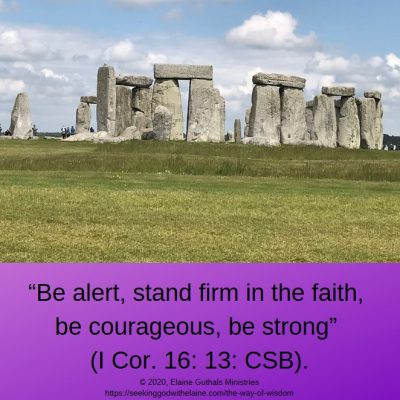
    • “Be alert, stand firm in the faith, be courageous, be strong” (I Cor. 16: 13: CSB).
    • “Be strong and courageous. Do not fear or be in dread of them, for it is the LORD your God who goes with you. He will not leave you or forsake you” (Deut. 31: 6 ESV).
    • “Wait patiently for the LORD. Be brave and courageous. Yes, wait patiently for the LORD” (Ps. 27: 14 NLT).

    I think something that isn’t taken into account there is how hard it is to withstand Satan’s temptation. We are going to sin. I would hope that Adam could learn something from my mistakes.

    We can’t just focus on teaching our children how to live in this world. Yes, that is important.

    It is more important that we prepare them for eternal life. Doing that impacts what we do in this life. This life is the preparation for the next.

    Stonehenge

    The Wrong Way

    “Do not enter the path of the wicked, and do not walk in the way of the evil. Avoid it; do not go on it; turn away from it and pass on. For they cannot sleep unless they have done wrong; they are robbed of sleep unless they have made someone stumble. For they eat the bread of wickedness and drink the wine of violence. But the path of the righteous is like the light of dawn, which shines brighter and brighter until full day. The way of the wicked is like deep darkness; they do not know over what they stumble” (Prov 4: 14-19 ESV)

    Solomon went on to tell us what not to touch — in pretty adamant terms. Don’t follow a lifestyle of evil. Instead, follow the Light of righteousness.

    Solomon is calling them paths. Jesus called it a road. “Enter through the narrow gate. For wide is the gate and broad is the road that leads to destruction, and many enter through it. But small is the gate and narrow the road that leads to life, and only a few find it” (Mt. 7: 13-14 NIV).

    A couple of chapters back, Solomon had already given advice about connecting with others. He was hitting that concept again, but I think he was expanding it.

    To read a related devotion, click the button below.

    It isn’t just people who will lead us astray. It is also the “… bread of wickedness and the drink of violence” (Prov. 4: 17 CSB).

    Do you see what that is saying? “Dudes, you can get into trouble all by yourselves. You don’t need a tour guide.”

    That is especially true when we perceive something to be as ordinary as food and drink. Hey, Sally and I are just talking about Tom. We aren’t gossiping. My pen ran out of ink on the way to work, and I have to write a check on the way home. So, I’ll just permanently borrow this pen from work.

    But how far do we have to go in avoiding the path of the wicked? If we avoid sinners, we can’t witness to them. Sinners are all people who have not made a genuine profession of faith — who have not sincerely ABCDed.

    The ABCDs of Salvation

    If you have not become a believer in Christ, please read through the
    Plan of Salvation and prayerfully consider what God is asking you to do.

    A – admit our sins
    B – believe His Son Jesus is our Redeemer
    C – confess God as Sovereign Lord

    D – demonstrate that commitment by making any changes needed in our lives to
    live the way in which God has called us

    The Disciple’s Job Description

    Jesus was concerned about this in His prayer at the Last Supper. “I am not praying that you take them out of the world but that you protect them from the evil one” (Jn. 17: 15 CSB).

    But that makes it difficult, doesn’t it? We don’t always see the line drawn in the sand. The right side is okay; the left side is really sin. When does abstinence come in, and when does moderation come in?

    We don’t want abstinence to be the opposite of works. Ephesians 2:8 tells us salvation is not by works. It does not say it is by abstinence.

    What Ephesians 2: 8 says is salvation is by grace. “For you are saved by grace through faith, and this is not from yourselves; it is God’s gift” (Eph. 2: 8 CSB).

    The Christian Observer gave us a good indication of what we should avoid. “What we are then to avoid is unnecessary familiarity with sinners and a disposition to comply with their sins.” Our disposition is our temperamental makeup.

    Hamilton explained why disciples are described as the light. He wrote, “… now he has attained to wisdom, holiness, and happiness. Light, as symbolical of the good, speaks to us of the enlightenment of the understanding, the purity of holiness, and true happiness.”

    We are not called to be complacent with where we are at the time of conversion. We have to grow in grace and knowledge (II Pet. 3: 18).

    At conversion, we start out as milk babies. Over the course of our lives, as we navigate the sanctification road, we are to grow into steak adults.

    To read a related devotion, click the button below.

    Thomas made a good point. We can compare the dark path to the light path based on this world. If we make the comparison based on what we know, it would be easy to choose dark over light.

    We have to make the comparison through the lens of eternity. This world and its life is temporary. We must make the decision based on what is lasting.

    We also have to realize that we are on the path for the long haul. That means the rest of our lives. We don’t “arrive” until we arrive in God’s presence.

    Choices

    “My son, be attentive to my words; incline your ear to my sayings. Let them not escape from your sight; keep them within your heart. For they are life to those who find them, and healing to all their flesh. Keep your heart with all vigilance, for from it flow the springs of life. Put away from you crooked speech, and put devious talk far from you. Let your eyes look directly forward, and your gaze be straight before you. Ponder the path of your feet; then all your ways will be sure. Do not swerve to the right or to the left; turn your foot away from evil” (Prov 4: 20-27 ESV)

    Solomon had imparted words of wisdom. Now, it was up to the son — and us — to follow them.

    • Choose to follow them — we find life.
    • Choose not to follow them — we find death.

    Yes, the son had to hear the words first. (Just because Solomon had been talking, didn’t mean son had been listening.) The son had to do the following:

    • Listen closely (Prov. 4: 20)
    • See them (Prov. 4: 21)
    • Take them to heart (Prov. 4: 23)

    We’ve talked before that obedience has to come from the heart. God’s Word is supposed to be a part of us. His laws and commandments are supposed to affect our character or our core – our heart level. If we are to engrave God’s laws and commandments on our hearts, we internalize them, and they change us.

    To read a related devotion, click the appropriate button below.

    Glossary

    But taking it down to the heart level isn’t the end. We have to be diligent about keeping the heart pure. We are to keep out all the inappropriate pulls that tempt us.

    Why is keeping our hearts pure so important? Waterland asserted that religious matters come from the heart. He wrote, “All things relating to religious conduct are reducible either to some matter of belief or practice.” Both are driven by the heart.

    Then we get to the body parts section. That little tongue is an important part of our bodies. We have to make sure we use it for God.

    Solomon urged his son to keep His eyes on God. He will direct our paths when we allow Him to lead.

    We just have to make sure that our feet follow God’s direction. Verse 26 says we have to “ponder the path …” (CSB). We must make a conscious decision to follow God.

    Woman

    Making the Connections

    We are to walk the path of the righteous. Maclaren called it the path of wisdom.

    Instead of accessing this wisdom, worldview people walk the path of darkness. Emmons thought it was so dark, they can’t see that they are being led to ruin.

    The problem is that it is a moral darkness. Oh, I bet worldview people would hotly contest that. They would list all the save the kids, save the animals, save the planet groups with which they are associated.

    We can’t work our way into salvation. It isn’t about what we can do. It is about what Jesus has already done for us — which we couldn’t do ourselves.

    How Do We Apply This?

    Melvill gave it to us straight. He wrote, “A man is accountable for his creed as well as for his practice — accountable inasmuch as it must be through his own fault that he believes what is false just as much as it is through his own fault that he does what is wrong.”

    If you have not admitted that your relationship is not right with God,

    have not asked Jesus to be your Lord and Savior,

    and have not confessed your sins,

    please read through the Plan of Salvation and prayerfully consider what God is asking you to do.

    Judgment day is coming. We will be held accountable if we have not ABCDed.

    There are two paths. One is a wide path that leads to the dark. In the dark is the torment of hell.

    The other is a narrow path that leads to the light. In the light is the presence of a God. “Night will be no more; people will not need the light of a lamp or the light of the sun, because the Lord God will give them light, and they will reign forever and ever” (Rev. 22: 5 CSB).

    How do we keep out those things which would tempt us out of our hearts? Burns gave us a list.

    • Watch
    • Seek God
    • Exhibit joy and confidence
    • Be productive in God’s work
    • Be ready for what lies ahead, even death

    Father God. We want to walk on the paths that lead to You. Shine Your light to show us the way. Help us to know when to witness and when to abstain. We want always to do Your will. Amen.

    What do you think?

    Leave me a comment below (about this or anything else) or head over to my Facebook group for some interactive discussion.

    If you don’t understand something and would like further clarification, please contact me.

    If you have not signed up for the email daily or weekly providing the link to the devotions and the newsletter, do so below.

    If God has used this devotion to speak with you, consider sharing it on social media.

  • Will There Be a Judgment Day?

    Are we going to be held accountable for our beliefs, thoughts, and actions? This devotion looks at what the Scriptures say about a judgment day.

    Nuggets

    • If we do not choose to follow God, there will be consequences – there will be a judgment day.
    • What God says will happen, will happen.
    • God’s wrath should not be minimized.
    • This judgment is going to fall on two types of people: “… on those who don’t know God and on those who don’t obey the gospel of our Lord Jesus” (II Thess. 1: 8 CSB).
    Flowers with title Will There Be a Judgment Day?

    This year, we are looking at self-discipline. We are using Vincent’s The Lesson of Ripeness sermon to look at the need to grow in our relationship with God. We morphed learning enough to be a teacher into determining some areas we need to grow so we can be mature disciples.

    Resource

    We have been looking at solidifying what we believe. When we witness, we need to be prepared to explain what we believe and why we believe it. We looked at the Scriptures, the Trinity (God, Jesus, and the Holy Spirit), man, salvation, grace, the church, divine ordinances, worship, and God’s kingdom. Now, we are going to look at the end times.

    I have been throwing so many things in the drafts folder for this category. So, I am a little befuddled right now about what I want to do. I think I am going to take the time now to look through some things, so we are going to roost in this category a while. I think this is really important in today’s world.

    In this group of devotions, we are going to look at judgment day.

    Devotions in the What I Believe series

    Devotions in the End Times category
    Judgment Day Focus

    God has laws and commandments that we are to follow. We know that there will be times when we disobey those.

    How is God going to handle that? Will there be a judgment day in the end? If is, what is that going to look like?

    I am not sure what I think it will look like. So, let’s take a couple of devotions to look at what Scriptures say.

    Let’s Put It into Context

    The Holman Bible Dictionary defines judgment day as “time of God’s punishment and refining of the evil in the world, especially of the final, history-ending time of eternal judgment.”

    Resource

    Apostasy means not believing in the state religion or not being a Christian

    Glossary

    When We Choose Against God

    “For if we deliberately go on sinning after receiving the knowledge of the truth, there no longer remains a sacrifice for sins, but a terrifying expectation of judgment and the fury of a fire about to consume the adversaries” (Heb. 10: 26-27 CSB)

    Look at what this says. It talks about a deliberate choice to go on sinning. This has a couple of components.

    Sin is when we disobey God and break one of His laws and commandments. God tells us what the do’s and don’ts are. He doesn’t make us guess.

    Glossary

    Neither does God allow us to choose what is a sin and what isn’t. We can’t change God’s mind as to what should and shouldn’t be a sin.

    What we get to choose is whether we are going to obey God or not. Obedience means to hear and carry out the instructions that God gives us.

    This is called free will. Free will is the ability within us to make decisions that determine actions that produce character.

    Glossary

    • We know that what we are doing goes against God’s Will.
    • We do it (or don’t do it) anyway.

    Look at it again, though. “… after receiving the knowledge of the truth …” (Heb. 10: 26 CSB). The writer of Hebrews is talking about believers. The issue here is that the believers ended up totally rejecting their profession of faith.

    The consequences are huge. “For if we deliberately go on sinning after receiving the knowledge of the truth, there no longer remains a sacrifice for sins” (Heb. 10: 26 CSB). Our admitting our sins, believing Jesus is our Savior and Redeemer, and confessing God as Sovereign Lord must be sincere.

    We just have to realize that, if we do not choose to follow God, there will be consequences. There will be a judgment day.

    We like to think that, after conversion, believers won’t be judged. Dale argues that we will if we abandon our profession of faith — if we willfully choose to disobey.

    The consequences are fearful. Those who practice apostasy will suffer “… a terrifying expectation of judgment and the fury of a fire …” (Heb. 10: 27 CSB).

    Beddome talked about conviction. The Holman Bible Dictionary defines conviction as “a sense of guilt and shame leading to repentance.” Those who practice apostasy don’t show conviction.

    We have to turn conviction into repentance. Repentance is expressing sorrow for breaking God’s laws and commandments and changing our character and actions so that we no longer live a sinful lifestyle.

    Glossary

    But look what else conviction is. The Merriam-Webster Dictionary defines conviction as “a strong persuasion or belief.”

    We have to have a strong conviction in God to deliberately choose obedience. We get that by seeking God.

    Searching for and Seeking God

    Hearing His Word (Rom. 10: 17).
    Reading His Word (Rev. 1: 3).
    Praying to Him (Heb. 4: 16).
    Studying His Word (Ac. 17: 11).
    Meditating on His Word (Ps. 1: 1-2).
    Memorizing His Word (Ps. 119: 11).

    A Consuming Fire

    “Therefore, since we are receiving a kingdom that cannot be shaken, let us be thankful. By it, we may serve God acceptably, with reverence and awe, for our God is a consuming fire.” (Heb. 12: 28-29 CSB)

    A “… terrifying expectation of judgment and the fury of a fire …” (Heb. 10: 27 CSB). “for our God is a consuming fire.” (Heb. 12: 29 CSB).

    How can anyone say hell is not real? “The devil who deceived them was thrown into the lake of fire and sulfur where the beast and the false prophet are, and they will be tormented day and night forever and ever” (Rev. 20: 10 CSB). “And anyone whose name was not found written in the book of life was thrown into the lake of fire” (Rev. 20: 15 CSB).

    To read a devotion in the Hell Does Have Fury series, click on the appropriate button below.

    Those who have not ABCDed should think long and hard about this: “Therefore, since we are receiving a kingdom that cannot be shaken, let us be thankful …” (Heb. 12: 28 CSB). God’s kingdom will not be moved.

    The ABCDs of Salvation

    If you have not become a believer in Christ, please read through the
    Plan of Salvation and prayerfully consider what God is asking you to do.

    A – admit our sins
    B – believe His Son Jesus is our Redeemer
    C – confess God as Sovereign Lord

    D – demonstrate that commitment by making any changes needed in our lives to
    live the way in which God has called us

    The Disciple’s Job Description

    What God says will happen, will happen.

    God says there will be a judgment day. It. Will. Happen.

    Melvill had this to say. He wrote, “The fact that the kingdom cannot be moved is an irresistible proof that the fire cannot be extinguished.”

    God’s wrath should not be minimized. Scriptures say that “… our God is a consuming fire.” (Heb. 12: 29 CSB). Consuming. Not a nice little candle flame. A raging fire consuming. That should make us think twice before we disrespect Him.

    To read a related devotion, click on the appropriate button below.

    Glossary

    God isn’t, some day in the future, going to just say, “I change my mind. I am not angry at sin anymore.” What was a sin will always be a sin (Will There Be a Judgment Day?).

    I see you over there, jumping up and down, and yelling, “What about grace?” Grace is a free and unmerited gift from Heavenly Father given through His Son, Jesus Christ that enables salvation and spiritual healing to believers.

    Glossary

    God’s grace does not preclude Him from requiring us to obey His laws and commandments. It doesn’t mean He just have to give us the good stuff and not require anything from us. God is not the God of entitlement (Will There Be a Judgment Day?).

    We have to seek God’s grace. All we need to do is sincerely ask God to be Lord of our lives. We have to fear and love the Lord. We have to obey Him.

    Norwood made an interesting comment. He noted that grace doesn’t just change our character. It also sustains the change.

    If we do not sustain that character change, God has the authority to judge us. He has the authority to determine the punishment.

    Consuming but Just

    “It is clear evidence of God’s righteous judgment that you will be counted worthy of God’s kingdom, for which you also are suffering, since it is just for God to repay with affliction those who afflict you and to give relief to you who are afflicted, along with us. This will take place at the revelation of the Lord Jesus from heaven with his powerful angels, when he takes vengeance with flaming fire on those who don’t know God and on those who don’t obey the gospel of our Lord Jesus. They will pay the penalty of eternal destruction from the Lord’s presence and from his glorious strength on that day when he comes to be glorified by his saints and to be marveled at by all those who have believed, because our testimony among you was believed” (II Thess. 1: 5-10 CSB)

    I debated how much of this passage to include, because I am about to my word count limit. I decided to put it all in because it shows a couple of things.

    • There is a God.
    • He is just.
    • God will reward those following His Will.
    • The date is set — “… at the revelation of the Lord Jesus from heaven with his powerful angels” (II Thess. 1: 7 CSB) — even if we don’t know what that date is.
    • Those who don’t know God will pay the consequences — i.e., the wicked will be punished.

    This judgment is going to fall on two types of people: “… on those who don’t know God and on those who don’t obey the gospel of our Lord Jesus” (II Thess. 1: 8 CSB).

    I am going to say it over and over. God isn’t into fire insurance. It isn’t enough just to know Him. It isn’t enough just to have made a profession of faith.

    We have to be obeying God. We have to show evidence of changed lives. We have to be on the sanctification road.

    Making the Connections

    God will judge us with a consuming wrath. The fire will burn eternally — but it won’t consume those cast into it. They will be sentenced to suffer the torment for all of eternity.

    Disciples have a little knowledge of that fire now. There is a big difference, though. God’s fire directed toward disciples is a refining fire. It burns it all of the impurities and leaves that of value — our perfection.

    Glossary

    I love what Meyer said. He wrote, “When we yield to God’s love, and open our hearts to Him, He enters into us, and becomes within us a consuming fire, not to ourselves, but to the evil within us. So that, in a very deep and blessed sense, we may be said to dwell with the devouring fire, and to walk amid the eternal burnings.”

    Making the Connections to Self-Discipline

    Many today feel that they should not be judged by God. Unfortunately, one day they will be.

    We’ve been asking these questions all along so we can prepare for when we are asked to defend our beliefs. Here is the worksheet again. How would you convince someone that God will judge as He says in His Word?

    • What does the Scriptures say?
    • What do I believe?
    • Why do I believe the same/differently than the Scriptures?
    • What are the talking points when witnessing to a non-believer?

    Related Links

    I have created a worksheet of the questions above. Click on the button below to access it.

    How Do We Apply This?

    First off, we need to make sure that our relationship is where God wants it to be.

    • Have we ABCDed?
    • Are we working to make our character like that of His?
    • Are we watching for Jesus’ return?

    Then, we need to be serving God by witnessing to others. Time is running out. Judgment day is coming.

    Father. We pray You find us seeking You and working to expand Your kingdom. Amen.

    What do you think?

    Leave me a comment below (about this or anything else) or head over to my Facebook group for some interactive discussion.

    If you don’t understand something and would like further clarification, please contact me.

    If you have not signed up for the email daily or weekly providing the link to the devotions and the newsletter, do so below.

    If God has used this devotion to speak with you, consider sharing it on social media.
  • How Are We Made New Creations?

    What does it mean to be made a new creation after conversion? This devotion looks at the process that accomplishes that.

    Nuggets

    • In order to become children of God, we have to believe in Jesus – be in Christ.
    • Once we are in Christ, we are made a new creation.
    • Regeneration is where the old is eliminated, and the new takes its place.
    Flowers with title How Are We Made New Creations?

    The concept of being a new creation can be confusing to some. I know it is to me. Let’s see if we can figure out what Paul was telling us.

    What Does “in Christ” Mean?

    “Therefore, if anyone is in Christ …” (II Cor. 5: 17 CSB)

    We’ve talked about being in Christ before. When he used the term in Ephesians, Paul wanted his readers to contrast their current life in Christ to the time before conversion or without Christ.

    To read a related devotion, click the button below.

    Glossary

    Being a creature of God isn’t enough to make us children of God. Nor is being made in His image. Being made children of God occurs through regeneration and adoption. In order to become children of God, we have to believe in Jesus – be in Christ.

    We have to make the decision every day to be in Christ. To me, being in Christ is synonymous with abiding in Christ. I guess, though, it just depends on from whose perspective we are looking at it. In Christ has the slant that He is within us. Abiding in Christ has more of a connotation that we are in Him.

    Either way, the focus should be in Christ. We are only saved because Jesus provided salvation from our sins. Salvation is deliverance from evil and the consequences of sins to replace them with eternal life and good. Sin is when we disobey God and break one of His laws and commandments.

    Listen to what Parry said. He wrote, “We are lost in ourselves, but are to find ourselves in Him, surrounded by His merits as with a wall of defence (sic), sheltered by them as by an all-embracing canopy.”

    We can’t earn salvation. We can’t do all the do’s and not do the don’ts. Even if we could, we would still be spiritually dead. Spiritual death is the separation from God that occurred as a consequence of Adam and Eve’s original sin.

    The foundation of our salvation is faith. Faith is the belief that the doctrines stated in God’s Word are true, even if we do not understand all aspects of them. We become in Christ in order to be saved (Robson).

    To read a related devotion, click the button below.

    The wonderful part is anyone can have faith in Jesus. Anyone can ABCD – it just has to be genuine. We aren’t “too bad” that He can’t save us.

    It is all about being unified with Christ. That happens the moment we choose to have faith. Robson wrote that it was “not one in essence, in nature, or person; but one with Christ in law — in the eye of the Divine Lawgiver.”

    That makes sense. Remember, sin is when we disobey God and break one of His laws and commandments. Salvation has to encompass bringing us into being obedient.

    New Us

    “… he is a new creation …” (II Cor. 5: 17 CSB)

    Once we are in Christ, we are made a new creation. Robson wrote, “The change is not antecedent to, but consequent on, the state of being in Christ.”

    I know that is a hard concept for some to handle. Yes, we are still in our earthly bodies. We still have our sinful nature.

    But as new creations, we receive a new disposition. Our disposition is our temperamental makeup. We develop new habits and goals.

    We receive a new character upon conversion. Then we also build our character to be more like God’s when we navigate the sanctification road.

    This change has to be a complete change — body, mind, and soul. We have new views and new affections. We have to have new boundaries.

    Clarke made an excellent point. He wrote, “It is one thing to be with Christ, and another thing to be in Him.” If we are going to be in Christ, we have to be like Christ — we have to imitate Him.

    Glossary

    We can be with Jesus without imitating Him — being in Christ. Remember what Jesus said? “Not everyone who says to me, ‘Lord, Lord,’ will enter the kingdom of heaven, but only the one who does the will of my Father in heaven” (Mt. 7: 21 CSB).

    Our heart has to be that of Jesus’. Our mind has to be His mind.

    Clarke wrote that, “To be in Christ we must love Him. But love means much more than blind affectionate instincts, or clinging attachments, or sudden emotions. Love looks up to receive a higher influence, to be inspired by a purer life. Love must elevate us, or it is not really love.”

    Becoming a new creation comes naturally when we are genuine about ABCDing. We’ve said that salvation is a three-part process.

    The ABCDs of Salvation

    If you have not become a believer in Christ, please read through the
    Plan of Salvation and prayerfully consider what God is asking you to do.

    A – admit our sins
    B – believe His Son Jesus is our Redeemer
    C – confess God as Sovereign Lord

    D – demonstrate that commitment by making any changes needed in our lives to
    live the way in which God has called us

    The Disciple’s Job Description

    We are changed from spiritually dead to spiritually alive upon conversion.
    We work out our salvation on the sanctification road.
    One day, sin will be eliminated when we reach our heavenly home (Did Election Fail?).

    Conversion is a flip of a switch. We were spiritually dead; now we are spiritually alive. We were without Christ; now we are in Christ. This is regeneration. Regeneration is the change in us that God brings about when we go from being spiritually dead to spiritually alive.

    Sanctification is a process. Sanctification is the transformation of mind, body, and soul beginning with regeneration and ending with perfected state of spiritual wholeness or completeness. Perfection means we have become holy, sanctified, and righteous.

    Glossary

    Think about it. It has to be a growth process. God has to start with us where we are and work to get our character where we need to be. This is not starting from scratch. It isn’t a instantaneous overhaul. If He did that, free will would go out the window.

    Besides, what did Jesus tell Nicodemus? God’s kingdom has a specific entrance requirement. That requirement is that we be born again.

    To read a related devotion, click the button below.

    How does man become a new creation? Watson said it was through the Holy Spirit and the Word.

    We talked before about the role of the Holy Spirit. The Spirit works individually with us — specifically with whatever issues we are dealing with at the time. The Holy Spirit is going to interpret Scriptures so that we can understand what God is telling us as well as teach us things that aren’t in the Bible.

    To read a related devotion, click the button below.

    It is imperative that we read the Scriptures. When we diligently read the Scriptures, we leave less of an opening for sin to take hold. We have to approach reading the Scriptures with faith. We can’t expect instant understanding when we read Scriptures. Instead, change has to come from our heart as God reveals His mysteries to us.

    To read a related devotion, click the button below.

    The Old Is Gone

    “… the old has passed away, and see, the new has come!” (II Cor. 5: 17 CSB)

    The old is our old physical, sinful self. The new is all about conversion and regeneration.

    Beecher reminded us that our conversion is a process, also. That is why Spurgeon says many cannot generally pinpoint the exact day. We might identify the day we go forward in a service.

    Spurgeon went on to outline the process.

    • “Everyone who believes that Jesus is the Christ has been born of God, and everyone who loves the Father also loves the one born of him” (I Jn. 5: 1 CSB).
    • “And you were dead in your trespasses and sins” (Eph. 2: 1 CSB).
    • “It doesn’t matter whether we have been circumcised or not. What counts is whether we have been transformed into a new creation” (Gal. 6: 15 NLT).
    • “He has delivered us from the domain of darkness and transferred us to the kingdom of his beloved Son” (Col. 1: 13 ESV).
    • “Truly I tell you, anyone who hears my word and believes him who sent me has eternal life and will not come under judgment but has passed from death to life” (Jn. 5: 24 CSB).
    • “Blessed be the God and Father of our Lord Jesus Christ. Because of his great mercy he has given us new birth into a living hope through the resurrection of Jesus Christ from the dead” (I Pet. 1: 3 CSB).

    We have also talked about being crucified with Christ. “For we know that our old self was crucified with him so that the body ruled by sin might be rendered powerless so that we may no longer be enslaved to sin, since a person who has died is freed from sin” (Rome 6: 6-7 CSB).

    To read a related devotion, click the button below.

    Regeneration is a change. That is where the old is eliminated, and the new takes its place.

    Making the Connections

    Most non-believers see new creation and think believers won’t sin anymore. We see new creation and think that is all there is.

    We ignore the the-past-has-no-hold-on-me part. We ignore that we aren’t who we used to be.

    We used to be separated from God. Now we aren’t. The relationship has been restored.

    How Do We Apply This?

    Faith is the foundation. However, since it is a process, we need to grow our faith. We do that by seeking God.

    Searching for and Seeking God

    Hearing His Word (Rom. 10: 17).
    Reading His Word (Rev. 1: 3).
    Praying to Him (Heb. 4: 16).
    Studying His Word (Ac. 17: 11).
    Meditating on His Word (Ps. 1: 1-2).
    Memorizing His Word (Ps. 119: 11).

    To read Has God Provided Everything We Need?, click the button below.

    As we read God’s Word, we need to make sure we are following His laws and commandments. Those are given to change our character so we are imitating Him. We need to do it.

    Yes, we become a new creation. It is going to take the rest of our lives for us to become perfect.

    Father God. We give our lives over to You. Make us a new creation, and continue perfecting us until we are like You. Amen.

    What do you think?

    Leave me a comment below (about this or anything else) or head over to my Facebook group for some interactive discussion.

    If you don’t understand something and would like further clarification, please contact me.

    If you have not signed up for the email daily or weekly providing the link to the devotions and the newsletter, do so below.

    If God has used this devotion to speak with you, consider sharing it on social media.
  • When Is It Time for Salvation after Conversion?

    Nuggets

    • Even if Jesus isn’t cruising in on His cloud tomorrow, now is the time for salvation — even after conversion.
    • We are called to change our character.
    • The fulfillment of God’s plan is nearer than it was.
    • At conversion, we are supposed to stop purposefully doing sinful activities.
    Flowers with title When Is It Time for Salvation after Conversion?

    Aren’t we good to go after conversion? Why would we need salvation after conversion? This devotion looks at what guidance Paul had to give.

    Rise and Shine

    “Besides this, since you know the time, it is already the hour for you to wake up from sleep, because now our salvation is nearer than when we first believed” (Rom. 13: 11 CSB)

    Spiritual death is described two ways. It is referred to either as death or sleep. Here Paul called it sleep.

    Paul used “… since you know the time …” (Rom. 13: 11 CSB) to convey urgency. Let’s roost on that a second because we could be suffering from a little confusion here.

    Jesus did say that no one knows when the end is going to happen. “Now concerning that day and hour no one knows — neither the angels of heaven nor the Son — except the Father alone” (Mt. 24: 36 CSB).

    But we have to remember that they were thinking Jesus was returning like tomorrow. Jesus said, “Truly I tell you, there are some standing here who will not taste death until they see the Son of Man coming in his kingdom” (Mt. 16: 28 CSB). So, they thought Jesus was going to grab His cloud and His sickle real soon and come pick them up.

    How do we reconcile these two seemingly different statements?

    We don’t know when Jesus is going to come into His kingdom. Is He already in His kingdom or does that wait until the end? Tuck gave three different scenarios as to when that could occur.

    But even if Jesus isn’t cruising in on His cloud tomorrow, now is the time for salvation. We are not guaranteed tomorrow. “Do not boast about tomorrow, for you do not know what a day may bring” (Prov. 27: 1 ESV).

    To read a related devotion, click the button below.

    James put it this way. “Come now, you who say, ‘Today or tomorrow we will travel to such and such a city and spend a year there and do business and make a profit.’ Yet you do not know what tomorrow will bring — what your life will be! For you are like vapor that appears for a little while, then vanishes” (Jas. 4: 13-14 CSB).

    Oh, yes. We set our goals and make our plans. We plan for success.

    Then God says, “Not going to happen.”

    We’ve all heard the question asked — of others, if not ourselves — “If you knew you would die tomorrow, how would you spend today?” How would you use your time? What would be of value to you?

    Hopefully, we would use that time to make sure we are right with God. God is real, and what He says in His Word will happen.

    But Melvill has another take. What if Paul was writing to disciples (which he was because he was writing to the church at Rome)? What if dead meant non-believers and sleep meant believers?

    What does this passage mean to practicing disciples when it says “… because now our salvation is nearer than when we first believed” (Rom. 13: 11 CSB)? When do we need salvation after conversion?

    Taken that way, it seems like Paul was talking to the nominal disciples. You know, nominal disciples are those boasting they loved God without even trying to imitate Him — those who dig on religion and its rituals without having a change in heart. Then again, he may have been talking about new believers.

    To read a related devotion, click the button below.

    Melvill connected this passage to the parable of the ten virgins. Previously, we talked about how the five bridesmaids who didn’t being oil for their lamps did not maintain and grow their relationship with God after conversion.

    To read a related devotion, click the button below.

    If the focus is on disciples, Paul was talking about the status of our relationships with God. Melvill thought the “… wake up from sleep …” (Rom. 13: 11 CSB) meant the disciples who were “… not developing them[selves] in the necessary degree.”

    Salvation isn’t just fire insurance. We are called to change our character. If we don’t, are we really saved? (Oh, that debate has to wait for a different devotion.)

    I think we are ill-served when we see salvation as a one-time shot. “I was saved on February 10, 1970.” Yeah, that is when Phase One happened, and I went from being spiritually dead to spiritually alive. But I am still working out my salvation in Phase Two. I won’t be totally saved and regenerated and receive our reward until Phase Three — heaven.

    We have to remember that we are to work out our salvation. “… Work hard to show the results of your salvation, obeying God with deep reverence and fear” (Phil. 2: 12 NLT).

    The Disciple’s Job Description

    Complete Job Description

    Individual Description

    Job Duty #2
    Work Out Our Salvation (Philippians 2: 12)

    Night and Day

    “The night is nearly over, and the day is near; so let us discard the deeds of darkness and put on the armor of light” (Rom. 13: 12 CSB)

    Day and night are opposites. We are told to “… discard the deeds of darkness and put on the armor of light” (Rom. 13: 12 CSB). Darkness is associated with sin.

    Darkness can bring apprehension. It can bring false fears — or false relief. We can dream in the dark because we are not running around Ichabod Chicken style. But our dreams may not be focused as God wants them to be.

    Lyth gave us a list of what we are to cast off. He wrote,

    • “Works that consisted with a time of ignorance.
    • “That will not bear the light.
    • “That spring from darkness.”

    Night is almost gone. Daylight is near. The fulfillment of God’s plan is nearer than it was. But it may be the fulfillment of His plan for us here on earth. It my be the fulfillment of our life’s work. It may be the fulfillment of His plan for all His people.

    We don’t know for sure, so we have to be ready.

    Oh, yes. We look around at society today and deduce we are in the end times. We hope Jesus is pulling His cloud out of the garage now. We want the sin and the suffering to be over. We want the reward.

    To read a related devotion, click the button below.

    Daylight Stroll

    “Let us walk with decency, as in the daytime: not in carousing and drunkenness; not in sexual impurity and promiscuity; not in quarreling and jealousy” (Rom. 13: 13 CSB)

    At conversion, we are supposed to stop purposefully doing sinful activities. Remember, Paul had just said the second greatest commandment summed up others. “The commandments, Do not commit adultery; do not murder; do not steal; do not covet; and any other commandment, are summed up by this commandment: Love your neighbor as yourself” (Rom. 13: 9 CSB).

    To read a related devotion, click the button below.

    Here, Paul gave us some things we were not to do. “… not in carousing and drunkenness; not in sexual impurity and promiscuity; not in quarreling and jealousy” (Rom. 13: 13 CSB).

    Upon conversion, we are to start on the sanctification road. That is to lead us to perfection.

    Paul said that our walk was important. We need to be sober. Sober is having the character traits of self-control and moral judgment.

    To read a related devotion, click the button below.

    I love what Parsons said about being a child of the light. He wrote, “The man acts as though he believed that the true end of life is to glorify God; and hence he seeks to obtain a change of heart and life — cultivates holy principles, practises (sic) holy actions, and has respect in all things to the recompense of the reward.” People of the light have a change of heart and life — we change our nature.

    Put on the Suit

    “But put on the Lord Jesus Christ, and make no provision for the flesh to gratify its desires” (Rom. 13: 14 CSB)

    Putting on the armor brings to mind the whole put-on-the-armor of Ephesians 6. But we talked previously that the armor is more for our protection. There is only one offensive weapon — the Scriptures.

    To read devotions in the Armor of God series, click the appropriate button below.

    We have to remember that it isn’t our armor. The armor comes from God. Therefore, it is impenetrable. Oh, yeah. Satan might bruise us, but he isn’t going to pluck us out of God’s hand.

    Bunyan gave us a really good reminder. “Religion is the best armour a man can have, but the worst cloak.” It isn’t about religion — it is about our relationship with God.

    How are we to put on Christ? We are to imitate Him. We are to have His character. He is to be our hope.

    Glossary

    Thomas has a really interesting take. He argued that sin has stripped us of our true nature/clothes. Upon salvation, we out on Christ’s clothes of moral goodness.

    Making the Connections

    Paul uses light and dark to contrast the two options we have. We can be children of the light and be children of God. Or we can be children of the dark and be children of Satan.

    That is it. There are no other options.

    Children of God will spend eternity with God in heaven. Children of Satan will spend eternity with Satan in hell.

    To read a devotion in the Hell Does Have Fury series, click on the appropriate button below.

    We shouldn’t argue about when the end is finally going to get here. We should admit our sins, believe Jesus is our Savior and Redeemer, and confess God as Sovereign Lord now.

    Oh, yeah. We could do a deathbed confession — maybe. But we want to confess now.

    Why? “For we must all appear before the judgment seat of Christ, so that each one may receive what is due for what he has done in the body, whether good or evil” (II Cor. 5: 10 ESV).

    How Do We Apply This?

    The ABCDs of Salvation

    If you have not become a believer in Christ, please read through the
    Plan of Salvation and prayerfully consider what God is asking you to do.

    A – admit our sins
    B – believe His Son Jesus is our Redeemer
    C – confess God as Sovereign Lord

    D – demonstrate that commitment by making any changes needed in our lives to
    live the way in which God has called us

    The Disciple’s Job Description

    We need to make sure our relationships with God are solid. Parry gave us a good indication of that for which we should strive. We should have a(n)

    • Deep, intense religious consciousness.
    • Active, self-denying labour.
    • The mortifying of the flesh, and a clear, unmistakable protest against the evil ways of the world.

    We talked about mortifying a while back. Mortify means to place a death penalty on our sins.

    To read a related devotion, click the button below.

    How do we complete Parry’s list? We do it by seeking God.

    Searching for and Seeking God

    Hearing His Word (Rom. 10: 17).
    Reading His Word (Rev. 1: 3).
    Praying to Him (Heb. 4: 16).
    Studying His Word (Ac. 17: 11).
    Meditating on His Word (Ps. 1: 1-2).
    Memorizing His Word (Ps. 119: 11).

    To read Has God Provided Everything We Need?, click the button below.

    We need to wake up from our sleep now. The longer we stay asleep, the harder it will be to wake up. That is because, the longer we stay in a life of sin, the harder it will be to break free from Satan.

    Don’t put waking up off until tomorrow. We might not be here tomorrow. Do it today.

    Gracious Heavenly Father. We do not want to be nominal disciples. We want to have a solid relationship with You. Help us as we seek You. We know when we seek You, we will find You. Help us to grow in grace and knowledge. Amen.

    What do you think?

    Leave me a comment below (about this or anything else) or head over to my Facebook group for some interactive discussion.

    If you don’t understand something and would like further clarification, please contact me.

    If you have not signed up for the email daily or weekly providing the link to the devotions and the newsletter, do so below.

    If God has used this devotion to speak with you, consider sharing it on social media.

  • Is Baptism a Part of Salvation?

    Some believe that baptism is a part of salvation while some don’t. What would you say when you are witnessing? This devotion looks at the role the ordinance of baptism plays in salvation.

    Nuggets

    • First, we have to repent.
    • Confession with our mouth is one thing; baptism is confession with the rest of us.
    • Jesus cleanses us from our sin, and baptism cleanses us from our guilt of our sin.
    • Belief, repentance, and obedience to the gospel cannot be separated – baptism is obedience.

    Devotions in the What I Believe series

    Devotions in the Divine Ordinance category

    Is Baptism a Part of Salvation?
    The Lord’s Supper

    Flowers with title Is Baptism a Part of Salvation?

    Some believe that baptism is a part of salvation. I have always been taught that it isn’t. The question boils down to whether baptism is a part of salvation or act of obedience.

    The goal of this series is to dig in to find the backup for what we believe. When we witness, “this is what I’ve always been taught” doesn’t go over as well as “here are the scripture references that I used to make an informed decision.”

    And face it. Bible verses can seem like they are contradictory. So what are we to believe?

    Let’s Put It into Context #1

    We are looking at divine ordinances. Ordinances are an expression of the disciples’ obedience.

    One of those ordinances is baptism. Baptism, according to the Holman Bible Dictionary, means “the immersion or dipping of a believer in water symbolizing the complete renewal and change in the believer’s life and testifying to the death, burial, and resurrection of Jesus Christ as the way of salvation.”

    Let’s Put It into Context #2

    Baptism is the sign of the acceptance of the New Testament covenant just as circumcision was sign of the acceptance the Old Testament covenant. Covenant circumcision was the physical sign the Israelites agreed with the covenant. Circumcision of the heart is where God changes our hearts.

    To read a related devotion, click the appropriate button below.

    Just as circumcision was a representation of cutting away sins, baptism is a representation of washing away the guilt of sins. Additionally, it is a representation of dying with Christ, being buried, and rising again.

    Buchanan pointed out that both actions occurred at the beginning of the covenant. He felt it was a form of a pledge of faithfulness to the covenant.

    However, some believe that regeneration doesn’t occur until baptism occurs. Regeneration is the change in us that God brings about when we go from being spiritually dead to spiritually alive. This makes baptism an element of salvation.

    Repent and Be Baptized

    “Peter replied, ‘Repent and be baptized, each of you, in the name of Jesus Christ for the forgiveness of your sins, and you will receive the gift of the Holy Spirit’” (Ac. 2: 38 CSB)

    When Peter gave his instructions on what his audience must do to be saved (Ac. 2: 37), his first instruction was to repent. We’ve said that we need to not only repentant because we have broken God’s laws and commandments, but we must also vow to change ourselves.

    Changing ourselves isn’t just keeping the laws and commandments in the future. We must change our character.

    We must change our belief system. We must now accept that Jesus is God’s Son. We must accept that He died to pay the penalty for our sins.

    I know. That is a lot of we musts in a row. But that isn’t optional. It is mandatory for salvation.

    Grammatically, the argument could be made that the conjunction and makes baptism mandatory along with repentance. It indicates it must be taken jointly. Mathematics and logic says all factors must be true.

    Is that the case with baptism and salvation? Is baptism a part of salvation?

    WeMust

    Part of Salvation

    Brownrigg argued that baptism is necessary for salvation. He felt that the cleansing of the baptism was a necessary part of salvation. Repentance doesn’t cleanse us, in his estimation; baptism does. Baptism allowed regeneration because of our contact with living water.

    Not Part of Salvation

    Abbott argued that baptism isn’t forced. He wrote, “Baptism is not a regenerating ordinance, but a sign and symbol of repentance, and a public confession of Christ.”

    We know that Romans 10: 9 says, “If you confess with your mouth, ‘Jesus is Lord,’ and believe in your heart that God raised him from the dead, you will be saved” (CSB). We can’t keep our conversion to ourselves.

    Confession with our mouth is one thing. Baptism is confession with the rest of us. This is how we articulate our faith for others to see. Confession isn’t salvation.

    Baptism Saves Us

    “Baptism, which corresponds to this, now saves you (not as the removal of dirt from the body, but the pledge of a good conscience toward God) through the resurrection of Jesus Christ” (I Pet. 3: 21 CSB)

    Part of Salvation

    If you read the verse as is, it does sorta read that baptism saves us. “Baptism, … now saves you … through the resurrection of Jesus Christ” (I Pet. 3: 21 CSB)

    However, we can’t be selective about what we read, and we can’t take it out of context.

    Not Part of Salvation

    Okay. The this in “… which corresponds to this …” (I Pet. 3: 21 CSB) refers back to First Peter 3: 18-20.

    “For Christ also suffered for sins once for all, the righteous for the unrighteous, that he might bring you to God. He was put to death in the flesh but made alive by the Spirit, in which he also went and made proclamation to the spirits in prison who in the past were disobedient, when God patiently waited in the days of Noah while the ark was being prepared. In it a few — that is, eight people — were saved through water.

    Arnot pointed out that Noah and his family were saved from physical death, not spiritual death. But that doesn’t take in the purpose of the flood. God could have taken an easier road to save them than floating them in a boat.

    But God wasn’t just saving Noah’s family. He was saving His world from sin.

    Arnot said that baptism is “… the cleansing of the conscience from its guilt, so that when God makes inquisition for blood, He finds no spot or wrinkle there; so that the conscience, when put to the question, answers peace to the challenge of the Judge.”

    Ooo, wow. Think of it this way. Jesus cleanses us from our sin, and baptism cleanses us from our guilt of our sin.

    We can’t ignore the “now saves you (not as the removal of dirt from the body, but the pledge of a good conscience toward God) …” (I Pet. 3: 21 CSB) part. The removal of dirt is removal of sin. Baptism doesn’t remove sin.

    The pledge of a good conscience toward God was, using Preece’s analogy, like a couple reciting their wedding vows. They have to say I do. The rings they exchange are the visual confirmation of those vows.

    We have to accept the gift of salvation. Baptism is the visual conformation of that acceptance. Preece wrote, “The act of baptism is an open public renunciation of sin, of sinful pleasures, of the follies of the world.”

    Saved and Condemned

    “Whoever believes and is baptized will be saved, but whoever does not believe will be condemned” (Mk. 16: 16 CSB)

    Clarke made a good point. He argued that belief, repentance, and obedience to the gospel cannot be separated. Baptism is obedience.

    Part of Salvation

    Clarke also argued that “He who believes the doctrine of the gospel when preached to him, and by baptism enters into an obligation to live suitably to that belief, and verifies that obligation by his practice, in a life of virtue, righteousness, and charity — shall be saved ….”

    That brings up another issue. Can we lose our salvation if we done live suitably to that belief? That is for another devotion.

    Not Part of Salvation

    Read the verse again. It does say “Whoever believes and is baptized will be saved …” (Mk. 16: 16 CSB emphasis added).

    But then it says “… but whoever does not believe will be condemned” (Mk. 16: 16 CSB emphasis added). It doesn’t say we will be condemned if we aren’t baptized.

    Condemned means, as it applies here, that non-believers in the final judgment will be found guilty because they have not admitted their sins, have not believed Jesus is their Savior and Redeemer, and have not confessed God as Sovereign Lord.

    Making the Connections

    So, let’s do a recap.

    Part of Salvation

    • Baptism conveys spiritual grace
    • The cleansing of the baptism is a necessary part of salvation.
    • If we selectively read First Peter 3: 21 and take it out of context, it does sorta read that baptism saves us.
    • Belief, repentance, and obedience to the gospel cannot be separated. Baptism is obedience.
    • Through baptism we agree to live a redeemed life.

    Not Part of Salvation

    • Baptism isn’t mandatory.
    • It is a symbol.
    • Baptism doesn’t remove sin.
    • Jesus cleanses us from our sin, and baptism cleanses us from our guilt of sin.
    • Baptism is the visual conformation of salvation.
    • We will not be condemned if we aren’t baptized.

    I don’t see baptism as a part of salvation. It can’t be. Repentant dude didn’t get a pass to get off the cross, be baptized, and get put back on it. Yet, Jesus told him, “… Truly I tell you, today you will be with me in paradise.” (Lk. 23: 43 NLT).

    If repentant dude wasn’t baptized and he was going with Jesus to wherever paradise is, it isn’t a requirement for salvation.

    Making the Connections to Self-Discipline

    I see it more as an act of obedience. If it is obedience, we can exercise self-discipline.

    We’ve been asking these questions all along so we can prepare for when we are asked. Here is the worksheet again. What would you say about baptism being a part of salvation?

    • What does the Scriptures say?
    • What do I believe?
    • Why do I believe the same/differently than the Scriptures?
    • What are the talking points when witnessing to a non-believer?

    Related Links

    I have created a worksheet of the questions above. Click on the button below to access it.

    How Do We Apply This?

    If we haven’t ABCDed, we need to follow God’s promptings.

    The ABCDs of Salvation

    If you have not become a believer in Christ, please read through the
    Plan of Salvation and prayerfully consider what God is asking you to do.

    A – admit our sins
    B – believe His Son Jesus is our Redeemer
    C – confess God as Sovereign Lord

    D – demonstrate that commitment by making any changes needed in our lives to
    live the way in which God has called us

    The Disciple’s Job Description

    If we have ABCDed but not been baptized, we need to find a church of like-minded believers so we can. We want to be obedient.

    Is something about baptism scaring you? Oh, it did me. Buchanan made a valid point that neither covenant circumcision or circumcision of the heart are of value without grace.

    God will give us His grace so that we can be obedient to Him. He’s got us.

    Father. We thank You for salvation. Baptism is one of the ordinances so that we can show our faith in You. Help us to faithfully follow You. Amen.

    What do you think?

    Leave me a comment below (about this or anything else) or head over to my Facebook group for some interactive discussion.

    If you don’t understand something and would like further clarification, please contact me.

    If you have not signed up for the email daily or weekly providing the link to the devotions and the newsletter, do so below.

    If God has used this devotion to speak with you, consider sharing it on social media.

  • Evidence of Election

    If election is God choosing to present the plan of salvation to us, what would the evidence of election be? This devotion looks at how we are advised to know and confirm our calling and election.

    Nuggets

    • God chose you because He loves you.
    • God brings us the plan salvation through election, and then He calls us to salvation.
    • God calls us to serve Him.
    • The plan of salvation is about turning away from sin — our sinful, physical nature — and turning toward God and our new spiritual nature.

    Devotions in the What I Believe series

    Devotions in The Purpose of Grace category

    Flowres with title Evidence of Election

    We’ve been talking about election being where God chose us because of His grace. The previous three devotions looked at specific passages that shed light on this.

    This devotion is going to look at individual verses.

    Let’s Put It into Context

    We are looking at election through the lens of grace. Grace is a free and unmerited gift from Heavenly Father given through His Son, Jesus Christ that enables salvation and spiritual healing to believers. The purpose of the gift of grace is to restore God’s relationships with man and eliminate sin.

    Glossary

    The Holman Bible Dictionary defines election as “God’s plan to bring salvation to His people and His world.”

    Knowing Our Election

    “Knowing, brethren beloved, your election of God” (I Thess. 1: 4 KJV)

    Oh, wow. Paul can be cut and dry sometimes. Take I Thessalonians 1: 4. Guys, know God chose you because He loves you.

    Well, it is as simple as that. It is nothing that we did that made God choose us. It is all about what He did.

    • God created us.
    • God designed the plan of salvation.
    • God picked the Sacrifice that was acceptable.
    • God sends the Holy Spirit to convict us.
    • God works all things out for good (Rom. 8: 28) so that we have a part in expanding His kingdom and growing us.

    Hutchison made that connection between some of Paul’s usage of the term. He wrote, “In both cases it means selection for privilege, and therefore for service.”

    God’s priority is His kingdom. Yes, He is interested in us, but His priority for us is our spiritual life — which expands His kingdom.

    When we serve God, we are working for Him. What are some duties in our job description?

    Job Duty #4 Proclaim the Gospel (Mark 16: 15)
    Job Duty #5 Love People (John 15: 12)
    Job Duty #6 Make Disciples (Matthew 28: 19-20)

    The Disciple’s Job Description

    Complete Job Description

    Individual Descriptions

    Job Duty #4
    Proclaim the Gospel (Mark 16: 15)

    Job Duty #5
    Love People (John 15: 12)

    Job Duty #6
    Make Disciples (Matthew 28: 19-20)

    Why does God use us as ministers? That way non-believers can do more than just read the words. They can see them being played out to determine what they really mean.

    Remember, we said the knowing has to be more than just head knowledge. The service proves that it is.

    Brain

    Making the Effort to Be Elect

    “Therefore, my brothers and sisters, make every effort to confirm your calling and election. For if you do these things, you will never stumble” (II Pet. 1: 10 NIV)

    Election is God’s plan to bring that salvation to His creation. We become the Elect when we accept that gift.

    Accepting doesn’t seem like it should take much effort at all. But here Peter is, saying, “… make every effort to confirm your calling and election …” (II Pet. 1: 10 NIV). Not only that, it should be a two-pronged effort.

    We can make an argument that calling and election are the same thing. However, we do use them differently also. We are going to look at election first.

    Election

    God brings us the plan salvation through election, and then He calls us to salvation. He wants us to go from being spiritually dead to spiritually alive.

    We have to work out our salvation, though. Getting us to change to be more like God isn’t flipping a switch.

    God has to show us the sin that has a stranglehold on us. Then, He has to cut it out of us.

    Calling

    God calls us to serve Him. He has a specific plan for us based on what decision He knows we will make.

    That means we have to work. We just did a whole series on diligence. Our goal there was to be persistent.

    Here the goal is to not sin. “… For if you do these things, you will never stumble” (II Pet. 1: 10 NIV).

    Look at that again. “… For if you do these things …” (II Pet. 1: 10 NIV).

    If we make the effort. If we do whatever it takes. If we confirm our calling and election. If we choose daily to follow God and obey His laws and commandments.

    Then we won’t stumble. Then we won’t sin. Then we will be the disciples God is calling us to be.

    It isn’t about head knowledge. It isn’t even about talking abut it,

    It is about doing. It is living our lives to honor God.

    Viney outlines our rewards when we accomplish the goal of confirming our election and calling. He wrote, “… you shall have these three things — assurance, stability, and an abundant entrance into heaven.”

    Adams cautioned us to not get too hung up on it looking like we should work our way to heaven. He wrote, “Does the apostle here attribute something to our works, as if the merit of our doing should preserve us from falling? No, he speaks not concerning the cause of mercy, but the way of grace. Our own works do not uphold us, but assure us by a token that we are upheld by God; they are the inseparable effects of that grace, by which we are kept from falling.”

    On what are we to be diligently working? We are to be building our character to imitate Him. Thompson wrote, “The apostle, turning our attention to the virtues and graces of the Christian life, very distinctly points to the exercises of such virtues as the source of the assurance here more immediately referred to.”

    Election Is About Repentance

    “The Lord is not slow to fulfill his promise as some count slowness, but is patient toward you, not wishing that any should perish, but that all should reach repentance” (II Pet. 3: 9 ESV)

    Election is all about one thing. It is about God “… not wishing that any should perish, but that all should reach repentance” (II Pet. 3: 9 ESV).

    Repentance is expressing sorrow for breaking God’s laws and commandments. But it is not just feeling sorry for doing those things. It is making the commitment to changing ourselves through obedience so that we no longer do the wrong things. Obedience means to hear and carry out the instructions that God gives us.

    The plan of salvation is about turning away from sin — our sinful, physical nature — and turning toward God and our new spiritual nature.

    Cross

    Making the Connections

    Peter is, in II Peter 1: 10, talking about having assurance of salvation. There are times, isn’t there, when we really question our salvation.

    That is Satan working overtime on us. He wants to keep us off balance in our relationships with God. That way he can worm his way in better and derail us.

    We can have assurance. Warren wrote, “The only way of making our calling and election sure is to live in the sincere and conscientious practice of all Christian virtues.”

    To read a devotion in the Christian Virtues series, click the appropriate button below.

    Making the Connections to Self-Discipline

    If we are to make an effort to confirm our election, that means we are to work out our salvation. Non-believers may not understand that.

    We’ve been asking these questions all along so we can prepare for when we are asked. Here is the worksheet again. What would you say about making an effort when election is God presenting the plan of salvation to us through grace?

    • What does the Scriptures say?
    • What do I believe?
    • Why do I believe the same/differently than the Scriptures?
    • What are the talking points when witnessing to a non-believer?

    Related Links

    I have created a worksheet of the questions above. Click on the button below to access it.

    How Do We Apply This?

    We do have to make an effort to grow our faith. We have to diligently work to make sure we are following God’s plan for our lives.

    We have to work on our character to ensure we are exhibiting the virtues: faith, goodness, knowledge, temperance, patience, godliness, kindness, and love. That will help us to imitate God.

    We need to walk in the Spirit. We need to live in His Will.

    God takes care of the election part. He will always convict us that we need to accept Jesus as our Savior — until we make it plan that we will not accept Him. Then, He is done with us.

    We have to make sure we become one of the Elect. We have to accept Him and submit to Him.

    Gracious Lord. We thank You, Lord, that You love us enough to forgive us. Help us to know what being one of the Elect really means. May we live for You, growing our character to be more like You. Amen.

    What do you think?

    Leave me a comment below (about this or anything else) or head over to my Facebook group for some interactive discussion.

    If you don’t understand something and would like further clarification, please contact me.

    If you have not signed up for the email daily or weekly providing the link to the devotions and the newsletter, do so below.

    If God has used this devotion to speak with you, consider sharing it on social media.

  • Is Election Really Mercy?

    Nuggets

    • The Jews thought the Gentiles were their enemies. At a minimum, they thought the Gentiles were so far beneath them.
    • Gentiles were not second-class citizens as they were also loved by the God of love.
    • God gives was a lot of gifts.
    • Election is God’s plan to bring that salvation to His creation, a gift of His grace because of His mercy.

    Devotions in the What I Believe series

    Devotions in The Purpose of Grace category

    Flowers with title Is Election Really Mercy?

    We’ve been talking about election being where God chose us because of His grace. But what part does mercy play in it? This devotion discusses God’s mercy to both the Jews and the Gentiles.

    Let’s Put It into Context #1

    We are looking at election through the lens of grace. Grace is a free and unmerited gift from Heavenly Father given through His Son, Jesus Christ that enables salvation and spiritual healing to believers. The purpose of the gift of grace is to restore God’s relationships with man and eliminate sin.

    Glossary

    The Holman Bible Dictionary defines election as “God’s plan to bring salvation to His people and His world.”

    Let’s Put It into Context #2

    “I don’t want you to be ignorant of this mystery, brothers and sisters, so that you will not be conceited: A partial hardening has come upon Israel until the fullness of the Gentiles has come in. And in this way all Israel will be saved, as it is written, The Deliverer will come from Zion; he will turn godlessness away from Jacob. And this will be my covenant with them when I take away their sins” (Rom. 11: 25-27 CSB)

    If we are going to start at Romans 11: 28, then we start with a dangling pronoun. If we back up to Romans 11: 25, then we start with a mystery.

    Part of the mystery is the wrath and mercy of God. We talked some about this when we were walking through Ephesians.

    To read a related devotion, click the button below.

    At times, it does seem like there are two different sides of God. I think it is more, though, that God is the God of love — until we get on His last nerve.

    Then, God isn’t going to put up with it.

    God is not going to tolerate our thoughts of entitlement. He is going to shut down our abusing His blessings.

    We just never forget God is Sovereign Lord. And God is love.

    The bulk of the mystery is the conversion of the Jews. “Therefore, consider God’s kindness and severity: severity toward those who have fallen but God’s kindness toward you — if you remain in his kindness. Otherwise you too will be cut off. And even they, if they do not remain in unbelief, will be grafted in, because God has the power to graft them in again. For if you were cut off from your native wild olive tree and against nature were grafted into a cultivated olive tree, how much more will these — the natural branches — be grafted into their own olive tree?” (Rom. 11: 22-24 CSB).

    Even though we fell from His grace, God still loved us enough to design the plan of salvation. We just need to believe on Him to be grafted in again (Rom. 11: 23).

    This started out with the Jew. However, when they didn’t believe, the plan of salvation was offered to the Gentiles (i.e., everyone else).

    Once those Gentiles who will be saved are, God will restore the Jews. Parr wrote, “The end of the world shall not be till the Jews are called, and how long after that none yet can tell.”

    We have to remember that the election of the Jews is permanent.

    Enemies for Your Advantage

    “Regarding the gospel, they are enemies for your advantage, but regarding election, they are loved because of the patriarchs” (Rom. 11: 28 CSB)

    Oh, yes. The Jews thought the Gentiles were their enemies. At a minimum, they thought the Gentiles were so far beneath them.

    McNeile had some good points. The early church was formed by Jews who had converted to Christianity. The Gentiles were then taken into the fellowship. The Gentiles did not start the church and incorporate the Jews.

    Paul is making the point here that, even though they were the ones incorporated in, the Gentiles were not second-class citizens. They were also loved by the God of love.

    This was because the converted Gentiles were, well, converted and different from regular Gentiles. Just as those in the Jewish remnant were converted and different from the Jewish nation.

    What was the difference? Truth be known, the difference was now a similarity. Both the converted Jews and converted Gentiles were to imitate the character of God.

    The difference was gone.

    Oh, God was still calling the Jews — His people — to be converted. Election incorporated more than them. If election was to bring salvation to His world, that included Gentiles.

    Man praying

    A Shower of Gifts

    “since God’s gracious gifts and calling are irrevocable” (Rom. 11: 29 CSB)

    God gives was a lot of gifts.

    • “For by grace you have been saved through faith. And this is not your own doing; it is the gift of God” (Eph. 2: 8 ESV emphasis added).
    • “For the wages of sin is death, but the free gift of God is eternal life in Christ Jesus our Lord” (Rom. 6: 23 ESV emphasis added).
    • “And Peter said to them, “Repent and be baptized every one of you in the name of Jesus Christ for the forgiveness of your sins, and you will receive the gift of the Holy Spirit” (Ac. 2: 38 ESV emphasis added).
    • “But the free gift is not like the trespass. For if many died through one man’s trespass, much more have the grace of God and the free gift by the grace of that one man Jesus Christ abounded for many” (Rom. 5: 15 ESV emphasis added).

    Grace, salvation, faith, eternal life, the Holy Spirit, Jesus’ sacrifice. Shouldn’t that be a draw to people?

    Satan wants to convince us that our independence of God should mean more than all of these gifts. He is wrong.

    God doesn’t give the gifts and then take them back. He doesn’t change His mind. “God is not a man, so he does not lie. He is not human, so he does not change his mind. Has he ever spoken and failed to act? Has he ever promised and not carried it through?” (Num. 23: 19 NLT).

    Gifts

    Gifts Because of God’s Mercy

    “As you once disobeyed God but now have received mercy through their disobedience, so they too have now disobeyed, resulting in mercy to you, so that they also may now receive mercy. For God has imprisoned all in disobedience so that he may have mercy on all” (Rom. 11: 30-32 CSB)

    Mercy is the unexpected way God responds in love to our needs. We sure didn’t expect Him to respond to our disobedience with designing the plan of salvation.

    We really didn’t expect God to show His mercy to us by designing the plan of salvation before He even created us — before Adam and Eve committed the original sin.

    Did you catch what Paul was saying here?

    • You/Jews disobeyed
    • You/Jews received mercy through their/Gentiles’ disobedience
    • They/Gentiles disobeyed
    • Resulting in mercy to you/Jews
    • They/Gentiles received mercy

    Hmmm. I followed until Paul threw in the you received mercy for their disobedience before they disobeyed. Yep, Paul lost me right away.

    Parr wrote, “The impiety of the Gentiles was no impediment to their mercy, neither shall the infidelity of the Jews to theirs.”

    Okay. I think I can get that. The Jews — for the most part — didn’t believe Jesus was the Messiah. Because they didn’t, the gospel spread to the Gentiles. “… They were disobedient, so God made salvation available to the Gentiles …” (Rom. 11: 11 CSB).

    Being Gentile did not preclude them from gaining God’s mercy. Instead, the world was blessed because of the Jew’s disobedience/unbelief.

    But that is going to make the Jews jealous. (Oh, yeah. That is so human — don’t want what you have until someone else wants it.)

    So, eventually, the Jews will get it. They will believe Jesus is Messiah and Savior.

    Making the Connections

    Election is God’s plan to bring that salvation to His creation. That means Jews. That means Gentiles. That means all of the Toms, Sallys , and Elaines.

    We didn’t do anything to earn this election. God is giving us the gift of grace because of His mercy.

    Making the Connections to Self-Discipline

    We can’t do anything to earn salvation, so there is no tie to self-discipline there.

    The tie is to growing in faith and knowledge so we can witness.

    We’ve been asking these questions all along so we can prepare for when we are asked. Here is the worksheet again. What would you say about election to the Jews and Gentiles?

    • What does the Scriptures say?
    • What do I believe?
    • Why do I believe the same/differently than the Scriptures?
    • What are the talking points when witnessing to a non-believer?

    Related Links

    I have created a worksheet of the questions above. Click on the button below to access it.

    How Do We Apply This?

    Robinson gave us a good list of how to apply this. His take was our past should impact our future in these ways.

    1. “Promote humility.
    2. “Awaken gratitude.
    3. “Soften our censures.
    4. “Strengthen our hopes of others.”

    But let’s apply that to election.

    1. Humility — We don’t deserve election. We get it only through God’s grace.
    2. Gratitude — If we don’t deserve it, we should be grateful God gives it to us.
    3. Censures — Everyone is provided the opportunity to gain salvation. That levels the playing field, so we shouldn’t be censorious.
    4. Hope — We should not only hope that people go from election to being one of the Elect. But we should also witness to others as God directs to help that become a reality.

    Lord. Each one of Your creation is important to You. Help make them important to us, too, so that we can tell them of Your live for them. Amen.

    What do you think?

    Leave me a comment below (about this or anything else) or head over to my Facebook group for some interactive discussion.

    If you don’t understand something and would like further clarification, please contact me.

    If you have not signed up for the email daily or weekly providing the link to the devotions and the newsletter, do so below.

    If God has used this devotion to speak with you, consider sharing it on social media.

  • Putting Feet to the Plan of Salvation

    Our accepting the plan of salvation is only the beginning. We need to do our part in extending God’s kingdom. This devotion looks at why it is important for us to witness.

    Nuggets

    • The only way we are going to gain salvation is through the grace of God; however, we can’t accept the gift if we know nothing about the gift being offered.
    • We have to do more than just read the gospel – we have to hear it preached.
    • But God is sending us — every us – to tell His message.

    Devotions in the What I Believe series

    Devotions in the Response to Salvation series

    Putting Feet to the Plan of Salvation

    Flowers with title Putting Feet to the Plan of Salvation

    The thing about salvation is we have to tell people. That is what witnessing is all about. Paul gave us some encouragement.

    Let’s Put It into Context

    “The scripture says, ‘Whoever believes in him will not be disappointed.’ This includes everyone, because there is no difference between Jews and Gentiles; God is the same Lord of all and richly blesses all who call to him. As the scripture says, ‘Everyone who calls out to the Lord for help will be saved’ (Rom. 10: 11-13 CSB)

    Paul just gave us the plan of salvation in a nutshell. He said we had to believe and confess. Then he said salvation is open to all.

    The main point was “… there is no difference between Jews and Gentiles; God is the same Lord of all and richly blesses all who call to him” (Rom. 10: 12 CSB). The Jews had this big barrier between them and the Gentiles — i.e., everyone who wasn’t Jewish.

    Paul spent several verses in Ephesians addressing that. “He made of no effect the law consisting of commands and expressed in regulations, so that he might create in himself one new man from the two, resulting in peace. He did this so that he might reconcile both to God in one body through the cross by which he put the hostility to death” (Eph. 2: 15-16 CSB).

    There is no more Jew and Gentile. Those have become one — children of God.

    To read a related devotion, click the button below.

    But look what it says. “… God is the same Lord of all and richly blesses all who call to him” (Rom. 10: 12 CSB). The stipulation is we have to call to Him.

    God isn’t going to just bless everyone because we were His creation made in His image. We have to be children of God.

    To read a related devotion, click the appropriate button below.

    Non-believers are not going to know about the plan of salvation unless we tell them. What does Paul say about that?

    Gotta Hear to Believe

    “How, then, can they call on him they have not believed in? And how can they believe without hearing about him? …” (Rom. 10: 14 CSB)

    The only way we are going to gain salvation is through the grace of God. God extended that grace when He designed the plan of salvation before the foundation of the world.

    Paul wrote in Ephesians, “For by grace you have been saved through faith. And this is not your own doing; it is the gift of God” (Eph. 2: 8 ESV). This is God’s doing.

    Our part is accepting the gift. However, we can’t accept the gift if we know nothing about the gift being offered.

    Butler told us three components must be present when presenting the plan of salvation. They are the following:

    • The voice of God
    • The hearing of man
    • The consequent belief

    Gotta Get the Ears Working

    “… And how can they hear without a preacher?” (Rom. 10: 14 CSB)

    Hitchcock made an interesting observation that I hadn’t thought of before. Christianity, Judaism, and Mohammedanism are the three well-known “book” religions. We have a book of standards. Anyone who reads the standards and believes in his heart can be saved.

    But just reading the book can’t be all there is. We didn’t put the porch swing together by just reading the instruction manual.

    We can learn by reading. We learn more by interacting.

    Let’s look at it this way. Here is a link to my favorite song at the moment. Go through and read the words.

    Then click the other link. See how hearing the song adds to how it speaks to us.

    Song

    Famous For (I Believe)
    Tauren Wells feat. Jenn Johnson

    Now, some day the video will come out where we can see them actually singing, not just seeing the words on screen while they sing it. How much of a difference did hearing make over reading the words? Now, transfer that from reading the Scriptures to being told by someone who applies them to their own life.

    No, Jesus didn’t have a blog. He didn’t even write a letter to any of the churches. (So, hearing predated reading.)

    Jesus made contact with people and talked to them. Part of me wants to say that He got in their faces. No, not in a confrontational way.

    Rather, Jesus made sure they knew they had to make a decision. He didn’t get forceful — but He didn’t back down either.

    Jesus made it personal for them.

    We have to do more than just read the gospel. We have to hear it preached. The interaction with believers is imperative.

    Priest

    Whom Shall I Send?

    “And how can they preach unless they are sent? As it is written: How beautiful are the feet of those who bring good news” (Rom. 10: 15 CSB)

    Sometimes, I think we think the sent people are the Pastor Chad-types or the missionaries. Anyone but us.

    But God is sending us — every us – to tell His message. Foster said it this way. He wrote, “All are made witnesses to all they have heard.”

    But, don’t worry. We are not on our own. God will send us. He will go before us and after us (Is 52: 12).

    All we have to do is tell what God has done for us. The Holy Spirit does the convicting, and God does the saving.

    No, God doesn’t use the best orators. He doesn’t use the beautiful and the important.

    God uses the broken. He uses the ones who have submitted to Him.

    We have to remember the focus isn’t on the messenger — us. It is on the message — Jesus.

    But, let’s get real for a second. How many of us really think feet are beautiful?

    Seriously.

    I had to laugh at what Robinson said. He wrote, “This is a picture on the canvas of the imagination.” See. He agrees with me!

    Robinson contends that the beauty is in the following:

    • “The preciousness of his message.
    • “The ardour of his zeal and love.
    • “The holy consistency of his life.”

    The focus should be on Jesus’ gospel of peace through salvation. Our goal is to bring the peace and joy we have found to those to whom we are witnessing.

    Making the Connections

    I ran across a sermon by Brady. It gave the benefits of having an established ministry.

    For years, we have been saying that church is just a building. Now in this pandemic, we have seen the church bust out of those doors.

    The church is the people — wherever we are at.

    I love what Brady said when he wrote “God is the God of order, not of confusion, and expects that His service should be performed after a regular and decent manner, free from negligence on the one hand and foppery on the other; especially He requires that acts of public adoration should be accompanied with a reverence and solemnity suitable to the majesty of such a presence.”

    Oh, yes. God is the God of order. How long did He have the plan of salvation before He put it in motion?

    So, God expects us to plan our ministry for Him. Yes, some opportunities for witnessing are going to drop into our laps.

    But we have to be ready for them. That is why we are doing the What I Believe series. We have to know what we believe and be secure in those beliefs before we can witness to someone else.

    Making the Connections to Self-Discipline

    Do you think that is one of the reasons why we have been so hesitant to witness? Because we aren’t confident in what we believe.

    I hope you are using the worksheets to solidify what you believe. At a minimum, I hope you are thinking it through.

    I know in the past I have been guilty, too. I read a devotion someone had written — and that was all the thought that goes into it.

    God wants us to study His Word. He wants us to meditate on it.

    Searching for and Seeking God

    Hearing His Word (Rom. 10: 17).
    Reading His Word (Rev. 1: 3).
    Praying to Him (Heb. 4: 16).
    Studying His Word (Ac. 17: 11).
    Meditating on His Word (Ps. 1: 1-2).
    Memorizing His Word (Ps. 119: 11).

    We’ve been asking these questions all along so we can prepare for when we are asked. Here is the worksheet again. What would you say about studying and hearing God’s Word?

    • What does the Scriptures say?
    • What do I believe?
    • Why do I believe the same/differently than the Scriptures?
    • What are the talking points when witnessing to a non-believer?

    Related Links

    I have created a worksheet of the questions above. Click on the button below to access it.

    How Do We Apply This?

    Chalmers reminded us that every creature must hear the gospel message. Remember, we talked about this before. “And this gospel of the kingdom will be preached in the whole world as a testimony to all nations, and then the end will come” (Mt. 24: 14 NLT). Everyone will hear the gospel before the end of the world. Everyone will have to make a choice.

    To read a related devotion, click the button below.

    We will have a part in witnessing. How do we do that?

    • We have to know what we are talking about.
    • We have to have faith.
    • We have to have ABCDed.
    • We have to tell others.
    • We have to encourage them to grow in faith.
    • We have to encourage them to ABCD.

    The ABCDs of Salvation

    If you have not become a believer in Christ, please read through the
    Plan of Salvation and prayerfully consider what God is asking you to do.

    A – admit our sins
    B – believe His Son Jesus is our Redeemer
    C – confess God as Sovereign Lord

    D – demonstrate that commitment by making any changes needed in our lives to
    live the way in which God has called us

    The Disciple’s Job Description

    God is the God of order. He expects us to regularly serve Him. That includes telling others of His love and forgiveness.

    We have to step up to the job.

    Loving Heavenly Father. You are so wonderful, and we are so flawed. We question how You can use us to expand Your kingdom. But You do. You have chosen us to show us Your love and Your grace. Help us to not only live the lives that show others how we imitate You, but also to boldly proclaim Your gospel to all we meet. Amen.

    What do you think?

    Leave me a comment below (about this or anything else) or head over to my Facebook group for some interactive discussion.

    If you don’t understand something and would like further clarification, please contact me.

    If you have not signed up for the email daily or weekly providing the link to the devotions and the newsletter, do so below.

    If God has used this devotion to speak with you, consider sharing it on social media.