Author: admin

  • Jacob Blessed Ephraim and Manasseh

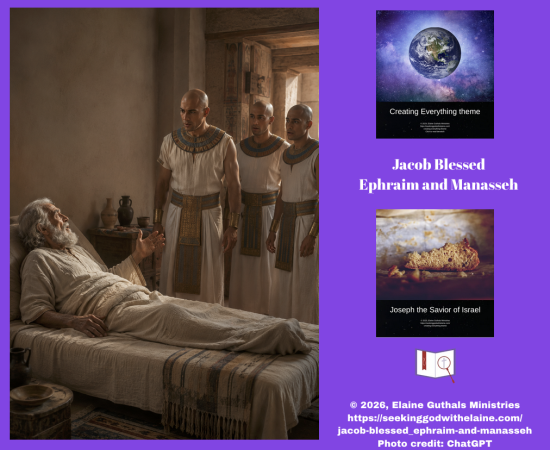
    Jacob had lived in Egypt 17 years, but now he was facing the end of his life. This devotional reading looks at how he blessed Joseph, Manasseh, and Ephraim.

    Nuggets

    • Jacob made a life in Egypt.
    • Joseph, Manasseh, and Ephraim went to see Jacob.
    • Jacob adopted two of Joseph’s sons.
    • Jacob was thinking about the covenant line.
    • If the grandsons were 23ish, what were they doing on his knees — what we would call sitting on his lap?
    • Jacob was following Hebrew tradition and transferring the blessing.
    • This is the final example of the pattern of Jehovah choosing the younger son.
    • Jacob looked back about his life at the end.
    jacob-blessed-ephraim-and-manasseh

    One thing that we’ve seen time after time is that birth order does not determine destiny. We’ve seen this several times in Genesis. Think Isaac, Jacob, and Judah. Maybe even Abraham himself, depending on who you read.

    With Jehovah, the younger son was the covenant son. Why? He saw the sons’ hearts.

    Let’s Put It into Context

    To read devotions in the Creating Everything theme, click the button below.

    Devotions in the Joseph the Savior of Israel  series

    Jacob Adopted Manasseh and Ephraim

    “Some time later Joseph was told, ‘Your father is ill.’ So he took his two sons Manasseh and Ephraim along with him. When Jacob was told, ‘Your son Joseph has come to you,’ Israel rallied his strength and sat up on the bed. Jacob said to Joseph, ‘God Almighty appeared to me at Luz in the land of Canaan, and there he blessed me and said to me, “I am going to make you fruitful and increase your numbers. I will make you a community of peoples, and I will give this land as an everlasting possession to your descendants after you.” Now then, your two sons born to you in Egypt before I came to you here will be reckoned as mine; Ephraim and Manasseh will be mine, just as Reuben and Simeon are mine. Any children born to you after them will be yours; in the territory they inherit they will be reckoned under the names of their brothers. As I was returning from Paddan, to my sorrow Rachel died in the land of Canaan while we were still on the way, a little distance from Ephrath. So I buried her there beside the road to Ephrath’ (that is, Bethlehem)” (Gen. 48: 1-7 NLT)

    Some Time Later

    Jacob made a life in Egypt.

    Jacob had 17 years with Joseph in Egypt. He probably thought any time given to him was an unexpected blessing.

    We have to recognize that the famine was over by this time. Since this would be around 1653 BC, the famine ended in 1665 BC.

    We are assuming that Jacob blessed Manasseh and Ephraim the same year that he died. But we know that Isaac blessed Jacob 43 years before he died.

    Jacob didn’t have 43 years.

    But we all must die, and it was Jacob’s time. More than likely, one of Jacob’s servants came to tell him. Maybe it was a sibling (we don’t know how many other daughters Jacob had than Dinah).

    He Took His Two Sons

    Joseph, Manasseh, and Ephraim went to see Jacob. Jacob roused himself enough to greet them.

    I am sure Joseph had heard all about the covenant God made with Abraham, Isaac, and Jacob. Based on the timeline we’ve been using, Isaac would have still been alive when Joseph was sold. Even though Joseph was gone by the time that Isaac died, the covenant would have been a frequent topic of conversation.

    It was important that Jacob mention it here because of what he was about to do.

    It was also important for Jacob to remind Joseph that their family wouldn’t always remain in Egypt. “Then the Lord said to Abram, ‘You can be sure that your descendants will be strangers in a foreign land, where they will be oppressed as slaves for 400 years’” (Gen. 15: 13 NLT).

    Your Two Sons Will be Mine

    Jacob adopted two of Joseph’s sons.

    Jacob started his remarks with a reminder of the covenant. He reminded Joseph and his sons that their family would become a great nation.

    I doubt that Joseph expected his father saying he was going to adopt his two sons. Manasseh and Ephraim were born before Jacob arrived in Egypt. We know Joseph had more – not because God’s Word gives us their names. Jacob said he had them (Gen. 48: 6).

    Leale offered three reasons for this.

    One reason Jacob did this was to save Manasseh and Ephraim from the pagan influences of Egypt. Remember, their mother was Egyptian.

    Think about it. Joseph was #2 in the country. He may have looked like an Egyptian, but he was a covenant son in the inside.

    Yet, Jacob knew that doing Jehovah’s work is the most important thing in life.

    The second reason was to give them a place in the covenant family. Leale wrote, “This would impart a dignity and meaning to their life, and an impulse and an elevation to all their thoughts Godward.”

    Resource

    Are we surprised that Jacob’s favorite son was left out of the inheritance? We can be if we just look at the surface.

    Jacob assured Joseph that they wouldn’t be treated as second-class sons. They would be treated exactly as Reuben and Simeon – and Joseph if he wasn’t being given this honor.

    Leale said that Ephraim got Reuben’s portion and Manasseh got Simeon’s portion. They had previously lost their inheritance.

    That brings the number of Israel’s sons to 13. In the future, Jehovah would call the tribe of Levi to be His own. “Look, I have chosen the Levites from among the Israelites to serve as substitutes for all the firstborn sons of the people of Israel. The Levites belong to me” (Num. 3: 12 NLT).

    That lowered the count to 12 tribes.

    The third reason was to specially honor Joseph. You see, Jacob was giving Joseph – through his sons – the double-portion blessing of the firstborn right. We’ll get into that in the next chapter.

    For right now, remember back to the tunic Jacob gave Joseph. Clothing was an indication of status. We asked when we were talking about Genesis 37 whether he was trying to make Joseph the firstborn then.

    Jacob could not end his reminiscing without mentioning the love of his life, Rachel. His death was probably weighing on his mind. He was probably sad because he wasn’t going to be buried by her.

    But shouldn’t we remember loved ones? Should we forget sad events in our lives? Yes and no.

    Jacob Blessed Manasseh and Ephraim

    “When Israel saw the sons of Joseph, he asked, ‘Who are these?’ ‘They are the sons God has given me here,’ Joseph said to his father. Then Israel said, ‘Bring them to me so I may bless them.’ Now Israel’s eyes were failing because of old age, and he could hardly see. So Joseph brought his sons close to him, and his father kissed them and embraced them. Israel said to Joseph, ‘I never expected to see your face again, and now God has allowed me to see your children too.’ Then Joseph removed them from Israel’s knees and bowed down with his face to the ground. And Joseph took both of them, Ephraim on his right toward Israel’s left hand and Manasseh on his left toward Israel’s right hand, and brought them close to him. But Israel reached out his right hand and put it on Ephraim’s head, though he was the younger, and crossing his arms, he put his left hand on Manasseh’s head, even though Manasseh was the firstborn. Then he blessed Joseph and said, ‘May the God before whom my fathers Abraham and Isaac walked faithfully, the God who has been my shepherd all my life to this day, the Angel who has delivered me from all harm — may he bless these boys. May they be called by my name and the names of my fathers Abraham and Isaac, and may they increase greatly on the earth’” (Gen. 48: 8-16 NLT)

    Who Are These?

    Jacob was thinking about the covenant line.

    I’m sorry. I always thought this was a little odd. Jacob adopted Ephraim and Manasseh, but he couldn’t recognize them.

    Cut him some slack, Chick. He could barely see.

    It may have been a rhetorical question. It may have been a setup for what was coming next.

    Was Jacob testing whether Joseph would acknowledge his sons came from Jehovah?

    But Jacob showed that family lineage and faith in Jehovah is help the greatest importance. In fact, the tribes of Ephraim and Manasseh would be significant in the history of Israel. Ephraim, especially, would  take prominence in the Northern Kingdom.

    If we think about it, Manasseh and Ephraim had to have been young adults at this point. Let’s do the math.

    • Joseph was 30 years old when he became Vizier (Gen. 41: 46).
    • Manasseh and Ephraim were born in the good years of the famine.
    • They were two years into the famine when Joseph revealed his true identity to his brothers (Gen. 45: 6). Joseph would have been 39, and the boys could have been as old as five years old.
    • Jacob told Pharaoh that he was 130 years old (Gen. 47: 9).
    • Jacob died at 147 after living in Egypt 17 years (Gen. 47: 28).

    Joseph’s kids were born during the seven-year period of the plenty before the Hebrews arrived. Let’s just use five years — one may have been a bit older; the other, younger.

    That puts the Jacob’s grandkids in their early 20s — maybe 23ish (4 years of bounty plus 2 years of famine plus 17 years of grandpa living close).

    Removed Them from Israel’s Knees

    If the grandsons were 23-ish, what were they doing on his knees — what we would call sitting on his lap?

    I think that is more than a figurative of speech. The key is that on the knees is often an adoption or blessing expression rather than a statement about age. “And she said, Behold my maid Bilhah, go in unto her; and she shall bear upon my knees, that I may also have children by her” (Gen. 30: 3 KJV).

    It symbolizes legal acknowledgement and adoption.

    We have to realize the adoption happened in verses 5 and 6. The blessing starting in verse 19.  The chain of events was probably

    • Jacob sat upright in bed.
    • Joseph brought Ephraim and Manasseh close to Jacob, and he embraces them.
    • The two young men kneel or bow before Jacob, possibly to greet him.
    • Joseph moved them and bows.
    • Joseph carefully positions Manasseh and Ephraim according to the firstborn protocol for the blessing.

    So, the adoption process was a separate “ceremony” than the blessing process.

    Bless These Boys

    Jacob was following Hebrew tradition and transferring the blessing.

    Jacob based his blessing on the following things:

    • Jehovah was also the God of his fathers – Abraham and Isaac.
    • Jehovah provided for him his entire life as his Shepherd.
    • Jehovah provided an angel  who delivered him from harm.

    We can see this as Jacob giving a snapshot of his life. He doesn’t go into a here-I-messed-up bent. He said that – through it all – even when I messed up, and I did – Jehovah was with me throughout my life.

    I believe that by saying “… May they be called by my name and the names of my fathers Abraham and Isaac …” (Gen. 48: 16 NLT) – that added them to the covenant line as a tribe.

    Not the Firstborn

    “When Joseph saw his father placing his right hand on Ephraim’s head he was displeased; so he took hold of his father’s hand to move it from Ephraim’s head to Manasseh’s head. Joseph said to him, ‘No, my father, this one is the firstborn; put your right hand on his head.’ But his father refused and said, ‘I know, my son, I know. He too will become a people, and he too will become great. Nevertheless, his younger brother will be greater than he, and his descendants will become a group of nations.’ He blessed them that day and said, ‘In your name will Israel pronounce this blessing: “May God make you like Ephraim and Manasseh.”’ So he put Ephraim ahead of Manasseh” (Gen. 48: 17-20 NLT)

    This is the final example of the pattern of Jehovah choosing the younger son.

    Joseph was concerned that Jacob’s right hand was on the youngest, not the oldest.

    The right hand was important. It is considered the hand of strength.

    Horton called it the hand of readiness. Being the dominant hand, people use it more than the left hand. That makes it the hand of success.

    Resource

    That may be why the blessing was bestowed through the right hand.

    But in Joseph’s eyes, Jacob had it backwards. The right hand was supposed to be on the oldest son, not the youngest.

    Think about it. He knew better than most how it can tear a family apart when a younger son is favored over an older one.

    Joseph probably didn’t want to have that happen in his family.

    We learned with Jacob’s blessing (Gen. 27: 28-29) and Esau’s blessing (Gen. 27: 39-40) how prophetic they can be. That is exactly what Jacob was doing here.

    End of Life

    “Then Israel said to Joseph, “I am about to die, but God will be with you and take you back to the land of your fathers. And to you I give one more ridge of land than to your brothers, the ridge I took from the Amorites with my sword and my bow’” (Gen. 48: 21-22 NLT)

    Jacob looked back about his life at the end.

    Jacob knew that Egypt was not where his family was going to end up. God had promised Abraham way back in Genesis 15 that His people would return to Canaan.

    Jacob knew his end was coming soon. Having — from one viewpoint — disinherited Joseph by choosing to adopt his children. Jacob included in the inheritance a ridge that he had purchased from the sons of Hamor, the father of Shechem (Gen. 33: 19).

    If we look at everything Jacob said over the chapter, Jacob was content. After 22 years of anguish, he hadn’t in his wildest dreams thought that he would see Joseph again – and here he was with children of his own!

    At the end of his life, Jacob looked back over it and knew he could die without averseness. He was satisfied.

    Making the Connections #1

    Ooo, baby. It doesn’t pay to be firstborn in this family! Ask Ishmael, Esau, and Reuben.

    It just goes to show that we aren’t entitled to anything. It isn’t based on status, ability, or even character.

    God chooses whom He wants.
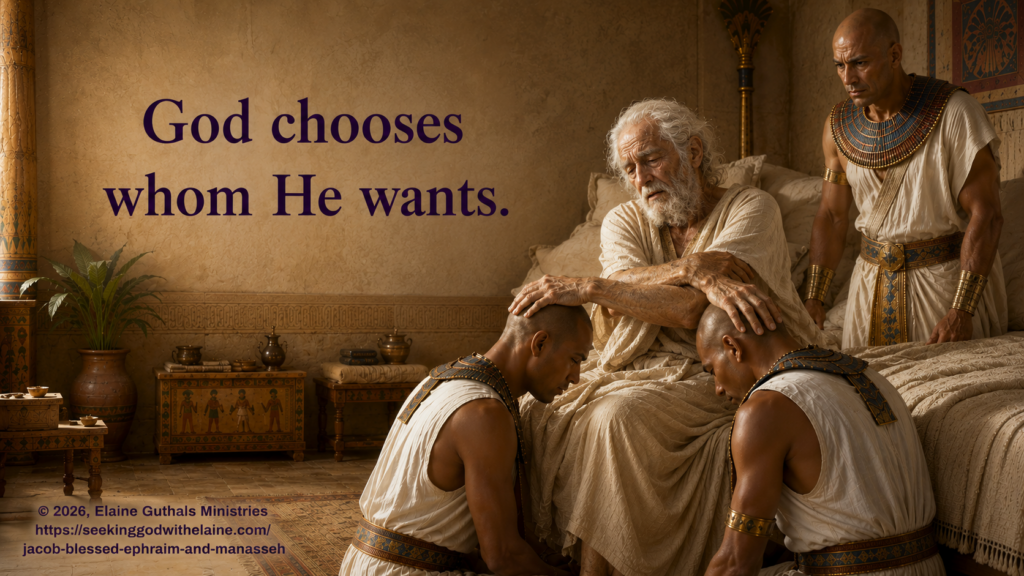
    No, we aren’t talking favoritism here. “For God does not show favoritism” (Rom. 2: 11 NLT).

    God bases His choice on our level of submission and obedience. He knows our motivations.

    • Ishmael felt entitled and was wild.
    • Esau wasn’t interested in the ruling the family part, just the wealth. Plus, he had taken Canaanite wives.
    • Reuben tried to depose Jacob as family leader. It seems that all his actions — that we know of — after that were done to get back into Jacob’s good graces, not because they were what Jehovah wanted.

    I know. Why didn’t Jehovah just make Isaac, Jacob, and Judah the firstborn sons?

    I don’t know. I started to say that it may be a worldview notion, but Jehovah told the Israelites to set apart the firstborn sons for Him. “Dedicate to me every firstborn among the Israelites. The first offspring to be born, of both humans and animals, belongs to me” (Ex. 13: 2 NLT).

    Okay, Jehovah didn’t say that until He was leading the Israelites out of Egypt. But remember, God never changes His mind. He always wanted the firstborn for His.

    So, I go back to it depends on total submission and obedience. He knows who is truly His.

    What is interesting is that the text never tells us that Manasseh objected. Joseph did. Joseph was troubled when Jacob crossed his arms and attempted to correct him. But Scripture records no complaint from Manasseh himself.

    Think about that. Manasseh was probably about 25 years old. He was old enough to understand exactly what was happening. He knew the significance of the right hand. He knew his grandfather was placing Ephraim ahead of him.

    Yet the text is silent about any protest.

    Perhaps that is fitting. Manasseh had spent his entire life watching Joseph. His father’s life testified that Jehovah’s plans do not always follow human expectations. Joseph was rejected by his brothers, sold into slavery, falsely accused, imprisoned, and then elevated by Jehovah to save nations. If anyone should have understood that Jehovah’s choices are not based on human customs, it would have been Joseph’s sons.

    The conflict in Genesis 48 is not between Manasseh and Ephraim. The conflict is between Joseph’s expectations and Jehovah’s choice.

    Jacob was effectively making Joseph the firstborn. It raises the stakes of Joseph’s objection. Joseph has already received a firstborn’s blessing through divine providence, yet he still struggles when Jehovah rearranges the order one more time.

    There’s almost a quiet irony in that. The man who benefited from Jehovah’s reversal now has to learn to accept another one.

    Making the Connections #2

    We know the outcome of the story. We know Ephraim became the dominant northern tribe.

    Making the Connections #3

    Jehovah constantly does things that do not follow earthly expectations.

    Whitfield talked about our expectations and Jehovah’s expectations. He wrote, “So bent are we upon expecting God to move in our own circle, and according to our ideas of things, that it is hard to dislodge it from the mind. It is well that this law should be reversed, to show us that.”

    Resource

    We know the verses. “‘My thoughts are nothing like your thoughts,’ says the Lord. ‘And my ways are far beyond anything you could imagine. For just as the heavens are higher than the earth, so my ways are higher than your ways and my thoughts higher than your thoughts’” (Isa. 55: 8-9 NLT).

    Sometimes, it takes a lifetime to take our hands off the reigns and allow Jehovah to have His way in our lives. But we need to surrender to Jehovah.

    Making the Connections #4

    We can look at Genesis 48 as a book of transition. It takes it from the patriarchs to the nation. We see that the promise and continuity transfer from the family to the nation.

    We see the important of faith never waivers. The nation still has the covenant responsibility of remaining faithful and obedient to Jehovah.

    Making the Connections #5

    We see that Jacob had been living in Egypt for 17 years. With Joseph as #2, he would probably have seen the better side of Egypt.

    It didn’t matter. Jacob did not compromise with the world in which he lived. He kept true to Jehovah.

    How Do We Apply This?

    • Trust Jehovah’s choices even when they differ from your expectations.
    • Submit to God’s will instead of insisting on your own plans.
    • Value the heart over status.
    • Accept God’s direction even when it overturns tradition.
    • Leave a legacy of faith.
    • Recognize that Jehovah’s purposes are greater than human customs.
    • Trust God to work through circumstances you do not understand.
    • Honor God’s plan above personal preferences.
    • Bless and encourage those who come after you.
    • Remember that Jehovah sees what others cannot see.

    Father God.

    If you don’t understand something and would like further clarification, please contact me.

    If you have not signed up for the email providing the link to the devotions and the newsletter, do so below.

    If God has used this devotion to speak with you, consider sharing it on social media.
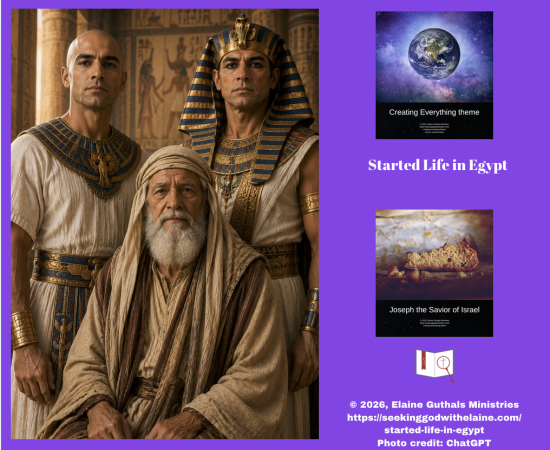
  • Started Life in Egypt

    In the last devotion, Jacob and his family had just arrived in Egypt. This devotional reading looks at Joseph’s efforts to get them settled in the land and how the famine progressed after their arrival.

    Nuggets

    • Joseph wasn’t merely saving the family from famine; he may have been protecting them from assimilation.
    • We may think it strange that Jacob blessed Pharaoh, but there was an important reason he did.
    • Jacob’s description of his life was interesting.
    • Joseph got his wish and settled his family into the land of Goshen.
    • While the covenant people and the covenant line were protected, for others the situation during the famine became dire.
    • And remember, just because Moses only lists Egypt and Canaan here, that doesn’t mean other countries were not experiencing the famine.
    • We may look at Joseph’s actions during the famine through twenty-first century lenses and question the policies that he instituted.
    • The only exemption was the land held by the priests.
    • Even the Egyptians themselves saw their survival as merciful.
    • Jehovah’s covenant was still intact.
    • Jacob made plans for his burial.
    started-life-in-egypt

    Now that Joseph’s family had relocated to Egypt, he had to get them settled. He had a plan, but he had to make sure it worked out the way he wanted it to work.

    Let’s Put It into Context

    To read devotions in the Creating Everything theme, click the button below.

    Devotions in the Joseph the Savior of Israel  series

    Joseph Presented His Family to Pharaoh

    “Then Joseph went to see Pharaoh and told him, ‘My father and my brothers have arrived from the land of Canaan. They have come with all their flocks and herds and possessions, and they are now in the region of Goshen.’ Joseph took five of his brothers with him and presented them to Pharaoh. And Pharaoh asked the brothers, ‘What is your occupation?’ They replied, ‘We, your servants, are shepherds, just like our ancestors. We have come to live here in Egypt for a while, for there is no pasture for our flocks in Canaan. The famine is very severe there. So please, we request permission to live in the region of Goshen.’ Then Pharaoh said to Joseph, ‘Now that your father and brothers have joined you here, choose any place in the entire land of Egypt for them to live. Give them the best land of Egypt. Let them live in the region of Goshen. And if any of them have special skills, put them in charge of my livestock, too’” (Gen. 47: 1-6 NLT)

    Joseph wasn’t merely saving the family from famine; he may have been protecting them from assimilation.

    Once Jacob and his family arrive in Egypt, some of the brothers were presented to Pharaoh. That was appropriate as he had invited them to move down to Egypt.

    Five of Jacob’s sons were questioned about their occupation. We aren’t told which five brothers were given the audience with Pharaoh.

    It is important we look at it beyond the surface. Usually, we say, when we don’t get a definitive answer, that shouldn’t be the focus. And that could be the case here.

    But it could also be the case that Joseph would have chosen the five brothers who were least likely to impress Pharaoh. We know Joseph has managed other encounters that his brothers were involved in.

    We may not think that, if say, Judah had impressed Pharaoh, Pharaoh would have integrated him into Egyptian administration because of his leadership qualities. Let’s say big, strapping Reuben would have been a sure candidate for military service. Then look at Benjamin, just as smart if not smarter than Joseph. If Joseph saved the nation, what could Benjamin do for them?

    Did you catch it? The brothers specifically asked for Goshen. Pharaoh said anywhere. Was he saying, “Come be a part of our society and contribute”?

    That’s why the ending comment may seem innocuous at first but have hidden meaning. “… And if any of them have special skills, put them in charge of my livestock, too” (Gen. 47: 6 NLT).

    If they weren’t interested in anything Egypt had to offer, maybe Pharaoh could hook them with what they know best. He was specificially interested in their special skills.

    If we look a little deeper, we see Joseph – probably but can’t be proved – was trying to make sure his family wasn’t assimilated into Egyptian society by ensuring control over the picture that Pharaoh saw of his family.

    They were shepherds. Shepherds were socially inferior in the Egyptians minds. “Then he said, ‘When Pharaoh calls for you and asks you about your occupation, you must tell him, “We, your servants, have raised livestock all our lives, as our ancestors have always done.” When you tell him this, he will let you live here in the region of Goshen, for the Egyptians despise shepherds’” (Gen. 36: 33-34 NLT).

    This separation is needed to maintain covenant identity.

    Jacob Blessed Pharaoh

    “Then Joseph brought in his father, Jacob, and presented him to Pharaoh. And Jacob blessed Pharaoh. ‘How old are you?’ Pharaoh asked him. Jacob replied, ‘I have traveled this earth for 130 hard years. But my life has been short compared to the lives of my ancestors.’ Then Jacob blessed Pharaoh again before leaving his court” (Gen. 47: 7-10 NLT)

    Jacob Blessed Pharaoh

    We may think it strange that Jacob blessed Pharaoh, but there was an important reason he did.

    Hmmmm. Pharaoh is the ruler of the strongest empire at that time. He was a political sovereign with much wealth.

    And here this shepherd is blessing him?

    Of course, Jacob blessed Pharaoh. Pharaoh himself had invited Jacob and his family down so that they would be provided for during the famine.

    Jacob gave Pharaoh a covenant blessing. “I will bless those who bless you and curse those who treat you with contempt …” (Gen. 12: 3 NLT).

    True, Pharaoh had the greater earthly power. Jacob had covenant standing – which will trump earthly power any day.

    Traveled This Earth for 130 Hard Years

    Jacob’s description of his life was interesting.

    Some versions translate traveled this earth as sojourned. That evaluates life through the lens of a pilgrimage.

    The patriarchs lived with the covenant in view, seeing beyond any earthly homeland.

    Wait! What????

    We thought that Old Testament people didn’t have a clue about Heaven.

    The author of Hebrews would have taken issue with that statement. “Abraham was confidently looking forward to a city with eternal foundations, a city designed and built by God” (Heb. 11: 10 NLT).

    Jacob acknowledged his hard life.

    • He had manipulated his brother into selling the birthright.
    • He had deceived his father to obtain the blessing.
    • He had family division not only when he was living in Isaac’s tents but also when he stayed with his father-in-law- and when he had his own tents for his family.
    • He had debilitating grief because his wife died and his son went away and never came back for 22 years.
    • He feared his brother, both before he left for Haran and when he was coming home and Esau was coming out to meet him.
    • Now, he was dealing with a devastating famine in a land that wasn’t the Promised Land.

    Yes, Jacob had those life experiences. He didn’t, however, experience separation from Jehovah. Hard years don’t equal absent sovereignty.

    Jacob did note that he was not going to live as long as his ancestors did. Abraham lived to be 175 years old. Isaac was 180 when he died.

    Israel Settled in Goshen

    “So Joseph assigned the best land of Egypt — the region of Rameses — to his father and his brothers, and he settled them there, just as Pharaoh had commanded. And Joseph provided food for his father and his brothers in amounts appropriate to the number of their dependents, including the smallest children” (Gen. 47: 11-12 NLT)

    Joseph got his wish and settled his family into the land of Goshen.

    This was the best land of Egypt. But it depended on your perspective if you thought that way.

    The Egyptians saw the land as undesirable because they saw shepherds as undesirable.

    Jacob and his family found it was the best land. They were allowed to continue in their occupation. It allowed them to remain distinct from Egypt. It was a place of protection which allowed them to multiply.

    Later in the story of the covenant people in a foreign land, we would see that the land of Goshen was spared some of the plagues that Jehovah subjected the Egyptians to in order for them to release His people.

    The Famine Intensified

    “Meanwhile, the famine became so severe that all the food was used up, and people were starving throughout the lands of Egypt and Canaan” (Gen. 47: 13 NLT)

    All the Food Was Used Up

    While the covenant people and the covenant line were protected, for others the situation during the famine became dire.

    Remember, when Jacob and his family arrived in Egypt, the famine had been going two years. There was five more years of it.

    As those five years progressed, the famine became more severe. Throughout Egypt and Canaan, people were starving.

    No, Joseph still had the food in his storehouses. This means something different.

    The point is that there was no food available through normal means.

    The harvests had failed. Fields weren’t producing. Private reserves had been exhausted. Livestock feed was disappearing. The population could no longer sustain itself by its own resources.

    Throughout the Lands of Egypt and Canaan

    And remember, just because Moses only lists Egypt and Canaan here, that doesn’t mean other countries were not experiencing the famine.

    We know they were.

    “Then the seven years of famine began, just as Joseph had predicted. The famine also struck all the surrounding countries, but throughout Egypt there was plenty of food. Eventually, however, the famine spread throughout the land of Egypt as well. And when the people cried out to Pharaoh for food, he told them, ‘Go to Joseph, and do whatever he tells you’” (Gen. 41: 54-55 NLT).

    The other countries were not applicable to the covenant story. So, Moses didn’t list them again.

    The People Sold Their Land and Themselves

    “By selling grain to the people, Joseph eventually collected all the money in Egypt and Canaan, and he put the money in Pharaoh’s treasury. When the people of Egypt and Canaan ran out of money, all the Egyptians came to Joseph. ‘Our money is gone!’ they cried. ‘But please give us food, or we will die before your very eyes!’ Joseph replied, ‘Since your money is gone, bring me your livestock. I will give you food in exchange for your livestock.’ So they brought their livestock to Joseph in exchange for food. In exchange for their horses, flocks of sheep and goats, herds of cattle, and donkeys, Joseph provided them with food for another year. But that year ended, and the next year they came again and said, ‘We cannot hide the truth from you, my lord. Our money is gone, and all our livestock and cattle are yours. We have nothing left to give but our bodies and our land. Why should we die before your very eyes? Buy us and our land in exchange for food; we offer our land and ourselves as slaves for Pharaoh. Just give us grain so we may live and not die, and so the land does not become empty and desolate.” So Joseph bought all the land of Egypt for Pharaoh. All the Egyptians sold him their fields because the famine was so severe, and soon all the land belonged to Pharaoh. As for the people, he made them all slaves from one end of Egypt to the other” (Gen. 47: 14-21 NLT)

    We may look at Joseph’s actions during the famine through twenty-first century lenses and question the policies that he instituted.

    That would be a wrong take.

    Would they fly in today’s society? Maybe. Maybe not.

    What we should read in this passage is the severity of the famine. Nothing was growing. If Jehovah hadn’t have given Pharaoh the dream and if Joseph wouldn’t have instituted grain management, some really nasty things would have happened:

    • Egypt would have collapsed
    • mass starvation would have occurred
    • social order would have disintegrated
    • money would have failed
    • livestock would have died
    • land would have failed
    • personal autonomy would have failed

    But then, couldn’t we make the argument that society collapsed?

    • People ran out of money buying food.
    • People exchanged their livestock for food.
    • People surrendered their land for food.
    • People became Pharaoh’s slaves for food.

    This did not make Joseph a tyrant.

    The problem was the severity of the famine. The problem was not Joseph or the fact that he sold food to starving people.

    Joseph was managing the resources that Jehovah provided so that many could be saved.

    Priestly Allotment

    “The only land he did not buy was the land belonging to the priests. They received an allotment of food directly from Pharaoh, so they didn’t need to sell their land” (Gen. 47: 22 NLT)

    The only exemption was the land held by the priests.

    In Egypt at that time, religion and politics were integrated. This created a centralized economic structure in Egypt.

    Israel weren’t sustained by Pharaoh’s priesthood. They were sustained by Jehovah according to the covenant faithfulness.

    Joseph Established a National Policy

    “Then Joseph said to the people, ‘Look, today I have bought you and your land for Pharaoh. I will provide you with seed so you can plant the fields. Then when you harvest it, one-fifth of your crop will belong to Pharaoh. You may keep the remaining four-fifths as seed for your fields and as food for you, your households, and your little ones.’ ‘You have saved our lives!’ they exclaimed. ‘May it please you, my lord, to let us be Pharaoh’s servants.’ Joseph then issued a decree still in effect in the land of Egypt, that Pharaoh should receive one-fifth of all the crops grown on his land. Only the land belonging to the priests was not given to Pharaoh” (Gen. 47: 23-26 NLT)

    Even the Egyptians themselves saw their survival as merciful.

    As Pharaoh now owned the land and the people, Joseph established a law that one-fifth of the produce grown would belong to Pharaoh. This, while it was substantial, was not what other Ancient Near Eastern taxation required.

    All saw this as preservation, reorganization, and restoration. Yes, Egypt was reorganized, and Israel was preserved.

    In fact, everyone looked at Joseph as their savior.

    Israel Multiplied in Egypt

    “Then Joseph said to the people, ‘Look, today I have bought you and your land for Pharaoh. I will provide you with seed so you can plant the fields. Then when you harvest it, one-fifth of your crop will belong to Pharaoh. You may keep the remaining four-fifths as seed for your fields and as food for you, your households, and your little ones.’ ‘You have saved our lives!’ they exclaimed. ‘May it please you, my lord, to let us be Pharaoh’s servants.’ Joseph then issued a decree still in effect in the land of Egypt, that Pharaoh should receive one-fifth of all the crops grown on his land. Only the land belonging to the priests was not given to Pharaoh” (Gen. 47: 23-26 NLT)

    “Meanwhile, the people of Israel settled in the region of Goshen in Egypt. There they acquired property, and they were fruitful, and their population grew rapidly” (Gen. 47: 27 NLT)

    Jehovah’s covenant was still intact.

    Egypt didn’t stop the covenant. Neither did famine or exile.

    Jehovah’s promises kept moving forward.

    Jacob’s Final Request

    “Jacob lived for seventeen years after his arrival in Egypt, so he lived 147 years in all. As the time of his death drew near, Jacob called for his son Joseph and said to him, ‘Please do me this favor. Put your hand under my thigh and swear that you will treat me with unfailing love by honoring this last request: Do not bury me in Egypt. When I die, please take my body out of Egypt and bury me with my ancestors.’ So Joseph promised, ‘I will do as you ask.’ ‘Swear that you will do it,’ Jacob insisted. So Joseph gave his oath, and Jacob bowed humbly at the head of his bed” (Gen. 47: 28-31 NLT)

    Jacob made plans for his burial.

    Jacob knew his death was approaching. He had Joseph promise to bury him at Hebron, in the cave already occupied by Abraham, Sara, Isaac, Rebbkah, and Leah.

    Joseph was asked to swear an oath in a way that we have seen before. Remember when Abraham was sending Eliezer off to Haran to find a wife for Isaac? He had Eliezar swear by putting his hand under Abraham’s thigh (Gen. 24: 2).

    We said that by Eliezer/Joseph putting a hand under Abraham’s/Jacob’s thigh, they would have been putting it close to the circumcised part. It is like our putting our hand over our heart to show our sincerity of our promise.

    By placing his hand as close to the covenant sign as he could, Joseph made a covenant promise to keep Jacob’s request made in covenant faith.

    Jacob would see that his bones being returned to the Promised Land would be an act of covenant faith.

    Making the Connections

    Joseph may have been rejected by his siblings, but he was not rejected by Jehovah. He used him to save the covenant people and the covenant line.

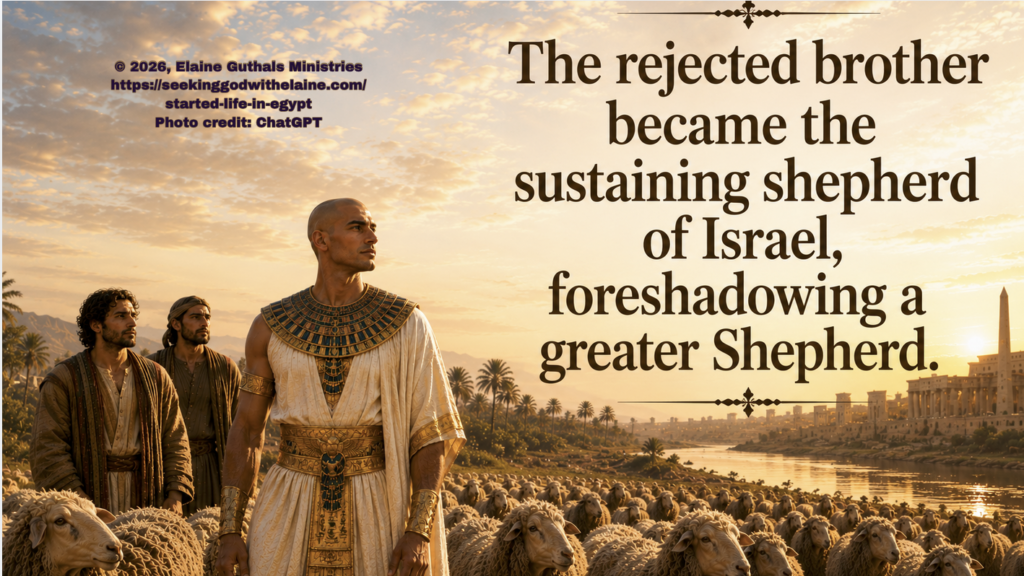
    The rejected brother became the sustaining shepherd of Israel, foreshadowing a greater Shepherd.

    Genesis 47 repeatedly portrays Joseph as the sole channel through which. Life is preserved – much the same way as there is only one channel through which eternal life is gained.

    How Do We Apply This?

    • Remember that hard years do not mean Jehovah has abandoned you.
    • Guard your covenant identity instead of being assimilated by the world around you.
    • Trust Jehovah’s long-term purposes even when you cannot see what He is doing.

    Father God. Thank You for the way that You provide for us. Lord, keep us separated from the world and its sinful pleasures. Help us to be focused totally on You. Amen.

    If you don’t understand something and would like further clarification, please contact me.

    If you have not signed up for the email providing the link to the devotions and the newsletter, do so below.

    If God has used this devotion to speak with you, consider sharing it on social media.

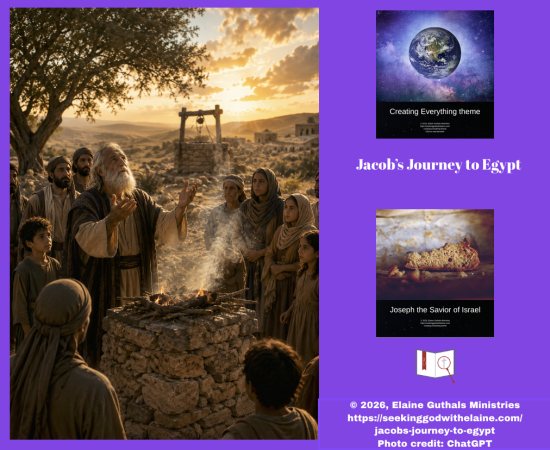
  • Jacob’s Journey to Egypt

    Joseph had asked Jacob to move with the family down to Egypt. This devotional reading looks at Jacob’s reunion with Jehovah and his reunion with Joseph.

    Nuggets

    • At the request of Joseph and by invitation of Pharaoh, Jacob began the trip to relocate to Egypt.
    • Beersheba was an important city.
    • Jehovah promised to be with Jacob in Egypt.
    • Jacob was free to leave Canaan.
    • Through this family, the nation of Israel was born.
    • Once the Hebrews got to Egypt, Jacob sent Judah ahead to work things out with Joseph.
    • Settling the family in the land of Goshen was a priority for Joseph.
    • This would have been a bittersweet reunion for Jacob.
    • Joseph felt honesty was the best policy when meeting Pharaoh.
    jacobs-journey-to-egypt

    Have you ever waited so long for an answered prayer that you stopped believing it could happen?

    Jacob had.

    For over twenty years, he believed Joseph was dead. The son he loved. The son whose coat was brought back stained with blood. The son he had mourned year after year.

    Then everything changed.

    Joseph was alive and wanting him to come to him in Egypt. Jacob was ready and willing to make the trip.

    But what would Jehovah say?

    Let’s Put It into Context

    To read devotions in the Creating Everything theme, click the button below.

    Devotions in the Joseph the Savior of Israel  series

    Jehovah’s Promise

    “So Jacob set out for Egypt with all his possessions. And when he came to Beersheba, he offered sacrifices to the God of his father, Isaac. During the night God spoke to him in a vision. ‘Jacob! Jacob!’ he called. ‘Here I am,’ Jacob replied. ‘I am God, the God of your father,’ the voice said. ‘Do not be afraid to go down to Egypt, for there I will make your family into a great nation.  I will go with you down to Egypt, and I will bring you back again. You will die in Egypt, but Joseph will be with you to close your eyes’” (Gen. 46: 1-4 NLT)

    Jacob set out for Egypt

    At the request of Joseph and by invitation of Pharaoh, Jacob began the trip to relocate to Egypt.

    If we go back to the Hebrew, we see that the name Jacob isn’t used. Israel is.

    We’ve said before that Israel is used when covenant identity is emphasized.

    This is covenant protection, not just a family relocating to Egypt.

    At this point, we’ve got to wonder if Jacob knew about God’s prophecy to Abraham. “Then the Lord said to Abram, ‘You can be sure that your descendants will be strangers in a foreign land, where they will be oppressed as slaves for 400 years. But I will punish the nation that enslaves them, and in the end they will come away with great wealth. (As for you, you will die in peace and be buried at a ripe old age.) After four generations your descendants will return here to this land, for the sins of the Amorites do not yet warrant their destruction’” (Gen. 15: 13-16 NLT).

    On one hand, we have to believe that Jacob did. If Moses wrote Genesis, he may have used oral tradition to record all that happened before him.

    Jacob probably did know. God’s covenant isn’t something Abraham would have kept secret.

    On the other hand, maybe this part Abraham did keep secret. Don’t we tend to shy away from the bad stuff?

    Even if Jacob was thinking, “Oh, this isn’t going to turn out well,” He was all in. He loaded up all his possessions.

    Israel was being obedient..

    He Came to Beersheba

    Beersheba was an important city.

    Abraham lived in Beersheba for a while. “Then they returned to the servants and traveled back to Beersheba, where Abraham continued to live” (Gen. 22: 19 NLT).

    Isaac also lived in Beersheba. “From there Isaac moved to Beersheba” (Gen. 26: 23 NLT).

    This was where Jacob left from to go to Haran when he was fleeing Esau. “From there Isaac moved to Beersheba” (Gen. 28: 10 NLT).

    Beersheba was the last city on Canaanite land. Before he took one step outside what would be the Promised Land, Jacob sacrificed to God. Through his worship, he put his faith and trust in God that He had this.

    Jacob came as far as he dared without direction from Jehovah.

    I think it is interesting that Moses put it as “… he offered sacrifices to the God of his father, Isaac” (Gen. 46: 1 NLT). We’ve been told that Jacob had encountered God himself twice. Why didn’t he say your God?

    Sometimes, it is easier to think that Abraham had the stronger faith than Isaac. Plus, the original covenant was with him.

    But then, Abraham went to Egypt during a famine – and that fell apart when Pharaoh took Sarah (Gen. 12: 10). Isaac was also going to go down to Egypt due to a famine – but Jehovah told him not to go (Gen. 26: 2).

    Regardless of his knowledge of the prophecy, Jacob had to have been having some qualms. True, this wasn’t his first move to a different place, but he’s old now.

    Was this within Jehovah’s Will?

    But the joy and excitement had to have been there. Jacob was going to be with Joseph again!

    God Spoke to Him in a Vision

    Jehovah promised to be with Jacob in Egypt.

    During the night, Jehovah came to Jacob. The call Jacob heard was, “Jacob, Jacob.” It indicates intimacy and urgency.

    Jehovah came to Jacob in a vision. He calmed his fears by telling him that He was sanctioning this relocation. (In fact, He had orchestrated it.)

    Think about it. Jacob had sent his sons down to Egypt twice to buy grain. Never once did it say that he was planning to move down there.

    Then the brothers come back with wagons. Yeah, it probably felt mind-boggling that Pharaoh himself had invited Jacob and his family there to live.

    But all throughout Scripture, Egypt is represented as being a compromise and a danger to covenant identity. They portrayed the worldview.

    Jehovah said, “Go.”

    How many times do we leave the Promised Land on our own free will? We choose to head off on our own road that Jehovah does not want us going down.

    But off we go. We need to do a better job at walking with Jehovah, not away from Him.

    Instead of, “Stay home,” Jacob got, “I will go with you down to Egypt, and I will bring you back again. You will die in Egypt, but Joseph will be with you to close your eyes’” (Gen. 46: 4 NLT).

    Jehovah told Jacob that He would walk with him.

    Also, Jehovah told Jacob the purpose for going to Egypt. “… for there I will make your family into a great nation” (Gen. 46: 3 NLT).

    Did you catch all of those promises?

    • I’ll make you into a great nation.
    • I’ll go with you.
    • I’ll bring you back again – not you, but your family.
    • When you die, the last thing you are going to feel is Joseph closing your eyes.

    What does Jacob have to fear now?

    Jacob Leaves Canaan

    “So Jacob left Beersheba, and his sons took him to Egypt. They carried him and their little ones and their wives in the wagons Pharaoh had provided for them. They also took all their livestock and all the personal belongings they had acquired in the land of Canaan. So Jacob and his entire family went to Egypt — sons and grandsons, daughters and granddaughters — all his descendants” (Gen. 46: 5-7 NLT)

    Jacob was free to leave Canaan.

    Now that Jehovah had given Jacob permission to move to Egypt, he could continue the trip.

    This must have been a big caravan. We don’t know how many wagon Pharaoh provided, but it would at least be 12 if not 13. That would be one per family (Jacob, 11 sons, and 1 daughter).

    That isn’t counting any servants or slaves that they had. Surely, they had some to help them.

    Genealogy List

    “These are the names of the descendants of Israel — the sons of Jacob — who went to Egypt: Reuben was Jacob’s oldest son.  The sons of Reuben were Hanoch, Pallu, Hezron, and Carmi. The sons of Simeon were Jemuel, Jamin, Ohad, Jakin, Zohar, and Shaul. (Shaul’s mother was a Canaanite woman.) The sons of Levi were Gershon, Kohath, and Merari. The sons of Judah were Er, Onan, Shelah, Perez, and Zerah (though Er and Onan had died in the land of Canaan). The sons of Perez were Hezron and Hamul. The sons of Issachar were Tola, Puah Jashub and Shimron. The sons of Zebulun were Sered, Elon, and Jahleel. These were the sons of Leah and Jacob who were born in Paddan-aram, in addition to their daughter, Dinah. The number of Jacob’s descendants (male and female) through Leah was thirty-three. The sons of Gad were Zephon Haggi, Shuni, Ezbon, Eri, Arodi, and Areli. The sons of Asher were Imnah, Ishvah, Ishvi, and Beriah. Their sister was Serah. Beriah’s sons were Heber and Malkiel. These were the sons of Zilpah, the servant given to Leah by her father, Laban. The number of Jacob’s descendants through Zilpah was sixteen. The sons of Jacob’s wife Rachel were Joseph and Benjamin. Joseph’s sons, born in the land of Egypt, were Manasseh and Ephraim. Their mother was Asenath, daughter of Potiphera, the priest of On. Benjamin’s sons were Bela, Beker, Ashbel, Gera, Naaman, Ehi, Rosh, Muppim, Huppim, and Ard. These were the sons of Rachel and Jacob. The number of Jacob’s descendants through Rachel was fourteen. The son of Dan was Hushim. The sons of Naphtali were Jahzeel, Guni, Jezer, and Shillem. These were the sons of Bilhah, the servant given to Rachel by her father, Laban. The number of Jacob’s descendants through Bilhah was seven. The total number of Jacob’s direct descendants who went with him to Egypt, not counting his sons’ wives, was sixty-six. In addition, Joseph had two sons who were born in Egypt. So altogether, there were seventy members of Jacob’s family in the land of Egypt” (Gen. 46: 8-27 NLT)

    Through this family, the nation of Israel was born.

    I know. Long genealogy lists make us want to skip right over them.

    Those lists were very important back when they were constructed. This wasn’t just a family list. It was covenant documentation.

    Depending on who you count, there were 66 (Gen. 46: 27), 70 (Deut. 10:22; Ex. 1:5; Gen. 46: 27), or 75 (Ac. 7: 14) Hebrews who moved to Egypt.

    There is significance in the number 70. Seven shows completeness and holiness. The entire covenant household migrated to Egypt.

    It is also significant that the family be counted now. That was the beginning of the nation of Israel.

    That 70 — if we go with the number in this passage — turned into 2.4 million. We are talking about a lot of people.

    If 2.4 million people left Egypt – and it seems like families were more than the 2.5 kids in those days – there would have been more than that. That number probably only counted the men.

    Is this list correct? Was Benjamin old enough to have kids? Or did Moses add information?

    I say that even though Dinah was included in the 66 and 70 here. That indicates that, more than likely, she remained single.

    Leale noted that Dinah was listed here as being among the founders of the house of Israel. This did much to elevate the status of women and leads to female inheritance.

    Resource

    But then, the covenant promised that Abraham’s descendants would be as numerous as the stars.

    • “… I will multiply your descendants beyond number, like the stars in the sky and the sand on the seashore …” (Gen. 22: 17 NLT).
    • “I will cause your descendants to become as numerous as the stars of the sky, and I will give them all these lands …” (Gen. 26: 4 NLT).
    • “Your descendants will be as numerous as the dust of the earth. They will spread out in all directions – to the west and the east, to the north and the south …” (Gen. 28: 14 NLT).

    It is significant that Joseph was included in this list. It does differentiate that Joseph and his family were already in Egypt.

    Why is this significant? Joseph’s inclusion in the covenant list matters. Though separated geographically, he was never separated covenantally.

    Jehovah preserved Joseph ahead of the family so that he may preserve the family and the covenant.

    Almost There

    “As they neared their destination, Jacob sent Judah ahead to meet Joseph and get directions to the region of Goshen …” (Gen. 46: 28 NLT)

    Jacob sent Judah

    Once the Hebrews got to Egypt, Jacob sent Judah ahead to work things out with Joseph.

    It was appropriate that Judah was sent. He had essentially taken over as firstborn. Reuben instituted a coup by sleeping with one of his father’s wives. Simeon and Levi had embarrassed and humiliated Jacob by killing all the men of Shechem for raping their sister Dinah.

    Gray made an interesting observation. He wrote that Judah

    “… had taken a chief part in the separating of father and son, and we now see him most active in bringing about the meeting. Those who have done wrong may not be able to undo the wrong they have done, but should, if possible, make reparation.”

    Resource

    We also remember that Judah was willing to be the substitute for Benjamin. “So please, my lord, let me stay here as a slave instead of the boy, and let the boy return with his brothers” (Gen. 44: 33 NLT).

    Judah would take over the ruling of Jacob’s family upon his death. He started now by working with Joseph to get the family settled where they were going.

    The Region of Goshen

    Settling the family in the land of Goshen was a priority for Joseph.

    Why was that so important? There probably were a couple of reasons.

    Joseph, in his tenure in Egypt, recognized the Egyptians’ dislike of foreigners. Remember— to them — a foreigner sat on their throne.

    Their Pharaoh was Hyksos. That means he was of Semitic descent — also a descendant of Shem — just as the Hebrews were.

    That connection — and certainly any favoritism —  may cause true Egyptians to look poorly on the Hebrews.

    Egyptians also looked down on shepherds.

    But then there was a chance that the Hebrews, too,  may think Pharaoh was showing too much favoritism to Joseph and Jacob.

    Joseph also probably was concerned about the Hebrews being corrupted by Egypt’s heathenism. The country was filled with idolatry, animal worship, and magicians.

    Joseph, himself, was able to keep grounded in his faith in Jehovah. He didn’t want to submit his family to the opportunity to sin, so he wanted a place that they could be separate from the Egyptians.

    Jacob and His Family Arrived in Goshen

    “… And when they finally arrived there, Joseph prepared his chariot and traveled to Goshen to meet his father, Jacob. When Joseph arrived, he embraced his father and wept, holding him for a long time. Finally, Jacob said to Joseph, ‘Now I am ready to die, since I have seen your face again and know you are still alive’” (Gen. 46: 28-30 NLT)

    This would have been a bittersweet reunion for Jacob.

    Jacob thought for years that day wasn’t possible. His hope was as dead as he thought Joseph was.

    Then, Jacob had heard Joseph was alive. But you know, seeing is believing.

    Ooo, baby. Jacob was now seeing!

    It says Joseph wept for a long time. Jacob was probably matching him tear for tear.

    Remember, covenant men do cry.

    Jacob’s joy probably knew no bounds. But the reunion may have still been bittersweet. Jacob may have thought of the 22 years of Joseph’s life that he missed.

    Still, Jacob was content. His deepest sorrow had been healed. God had given him a gift he never thought possible. He wouldn’t ask for more.

    Preparing to Meet the Pharaoh

    “And Joseph said to his brothers and to his father’s entire family, “I will go to Pharaoh and tell him, ‘My brothers and my father’s entire family have come to me from the land of Canaan. These men are shepherds, and they raise livestock. They have brought with them their flocks and herds and everything they own.’” Then he said, ‘When Pharaoh calls for you and asks you about your occupation, you must tell him, “We, your servants, have raised livestock all our lives, as our ancestors have always done.” When you tell him this, he will let you live here in the region of Goshen, for the Egyptians despise shepherds’” (Gen. 46: 31-34 NLT)

    Joseph felt honesty was the best policy when meeting Pharaoh.

    Joseph had a plan for his family. He knew where they needed to live in a place conducive to their occupation.

    Yes, being truthful about their occupation would help secure the land of Goshen for their dwelling place. More importantly, Joseph didn’t want to start their sojourn in Egypt on a lie.

    Making the Connections #1

    Are we surprised that Jehovah appeared to Jacob at Beersheba? We shouldn’t be.

    Jehovah will show up when we are in a crisis. He will especially show up when we are seeking Him.

    Making the Connections #2

    If we take a look at the genealogy lists again, we see that Leah’s line of descendants is the most extensive list.

    There may be another reason besides Leah had the most sons.

    That reason is Judah. Judah was Leah’s son. The kingship — as well as the Messiah — came through Judah and Leah.

    The rejected wife becomes central to redemptive history.

    How Do We Apply This?

    • Always pray for guidance when transitioning through stages of life.
    • Be honest in dealings with others so that God’s blessings can be given to us because of our obedience.
    • Repair what past sins have broken.
    • Live by Jehovah’s principles.

    Resource

    Father God. Thank You for ensuring that we know about Jacob and Joseph’s story. Thank you for showing us that we can depend on Your provision — even if it doesn’t happen on our timetable. You will provide for us as You have promised. Amen.

    If you don’t understand something and would like further clarification, please contact me.

    If you have not signed up for the email providing the link to the devotions and the newsletter, do so below.

    If God has used this devotion to speak with you, consider sharing it on social media.
  • Joseph Provided for His Brothers and Family

    Jacob’s 11 sons were returning home with good news. This devotional reading looks at their leaving Egypt and Jacob’s reaction to that good news.

    Nuggets

    • Everyone was happy for Joseph that his family was there.
    • Joseph began providing for his family even before they moved there.
    • If we look at the Hebrew for this passage, layers of emotion are added to what we can already see.
    • The impossible was happening.
      Joseph was a man to whom people bowed down.
    • Jacob had a much more physical reaction than being stunned.
    • But no – it was too much for Jacob to believe.
    • The brothers came clean.
    • Now – now – Jacob wasn’t just happy; he had his life back.
    joseph-provided-for-his-brothers-and-family

    Joseph had revealed who he really was to his brothers, and they had an emotional reunion.

    But it’s now time to go back to Canaan, pick up his father, and move down to Egypt. How in the world could they pull that off?

    Let’s Put It into Context

    To read devotions in the Creating Everything theme, click the button below.

    Devotions in the Joseph the Savior of Israel  series

    Pharaoh Invited Jacob to Egypt

    “The news soon reached Pharaoh’s palace: ‘Joseph’s brothers have arrived!’ Pharaoh and his officials were all delighted to hear this. Pharaoh said to Joseph, ‘Tell your brothers, “This is what you must do: Load your pack animals, and hurry back to the land of Canaan. Then get your father and all of your families, and return here to me. I will give you the very best land in Egypt, and you will eat from the best that the land produces.”’ Then Pharaoh said to Joseph, ‘Tell your brothers, “Take wagons from the land of Egypt to carry your little children and your wives, and bring your father here. Don’t worry about your personal belongings, for the best of all the land of Egypt is yours”’” (Gen. 45: 16-20 NLT)

    Everyone was happy for Joseph that his family was there.

    Sometimes, we get an engraved invitation. Pharaoh himself invited Jacob and his family to move to Egypt. In fact, he made the move easy by providing wagons. He promised to give them the best land. He even said leave your personal belongings because they would be replaced.

    Israel’s sojourn in Egypt started out on friendly terms. Remember the promise in Abraham’s covenant. “I will bless those who bless you and curse those who treat you with contempt …” (Gen. 12: 3 NLT).

    Because Egypt is participating in covenant preservation, they were blessed.

    Knowing how the story ends, we know it didn’t end well regardless of how it started out.

    But isn’t that how sin works? It looks all good and shiny at the beginning.

    That, however, is what Satan wants it to look like. We wouldn’t be tempted if it looked all hard and painful.

    There is only so long that Satan can keep up – and wants to keep up – the delusion. He wants us to get to the acknowledgment that it really is a sin.

    But this is what Jehovah wanted. He wanted Israel tucked safely in Egypt to ride out the famine.

    The Brothers Left Egypt

    “So the sons of Jacob did as they were told. Joseph provided them with wagons, as Pharaoh had commanded, and he gave them supplies for the journey. And he gave each of them new clothes — but to Benjamin he gave five changes of clothes and 300 pieces of silver. He also sent his father ten male donkeys loaded with the finest products of Egypt, and ten female donkeys loaded with grain and bread and other supplies he would need on his journey. So Joseph sent his brothers off, and as they left, he called after them, ‘Don’t quarrel about all this along the way!’” (Gen. 45: 21-24 NLT)

    Joseph began providing for his family even before they moved there.

    Along with the wagons Pharaoh had provided, Joseph took care of many other things they would need. He provided food, money, supplies, animals, and clothes.

    The brothers – this time – were not jealous when Benjamin got special treatment. They had changed.

    That last verse always slays me. “Don’t quarrel, guys.” Did Joseph know his brothers or what!?

    Well, that is human nature – especially on a road trip. Nothing is normal or routine. There were 11 personalities that were in play.

    I wonder if Joseph had a clue what the quarrel would be about – responsibility for selling Joseph.  That is human nature, too.

    It wasn’t that Joseph didn’t want them to not take responsibility for their actions. He knew each one would have to be held accountable by Jehovah for their part.

    So, it wasn’t about shirking responsibility and accountability.

    It was about transforming their relationship with each other. Yes, Joseph was going to have to build a relationship with each brother.

    But Joseph knew that they were going to have to work on their interpersonal relationships, too. True reconciliation requires more than confession.

    Arrived Home

    “And they left Egypt and returned to their father, Jacob, in the land of Canaan. ‘Joseph is still alive!’ they told him. ‘And he is governor of all the land of Egypt!’ Jacob was stunned at the news — he couldn’t believe it. But when they repeated to Jacob everything Joseph had told them, and when he saw the wagons Joseph had sent to carry him, their father’s spirits revived. Then Jacob exclaimed, ‘It must be true! My son Joseph is alive! I must go and see him before I die’” (Gen. 45: 21-28 NLT)

    Left Egypt

    If we look at the Hebrew for this passage, layers of emotion are added to what we can already see.

    It says that the brothers went up – ‘alah (עָלָה). This is true because Canaan is at a higher elevation geographically than Egypt.

    But going up also signifies a spiritual and covenant significance. Their dire circumstances were being provided for by Jehovah.

    True, Egypt would be a temporary provision. Canaan was the covenant land.

    For this trip, they were returning to the covenant patriarch.

    Joseph Is Still Alive!

    The impossible was happening.

    The wording in the Hebrew is in a little different order. They are the same words, but the different order places the emphasis elsewhere.

    The Hebrew – ʿôd yôsēp ḥay (עוֹד יוֹסֵף חַי) – says still Joseph lives. Yes, it was Joseph they were talking about.

    But for over twenty years, Jacob thought Joseph was dead. After all these years – the years that Jacob had emotionally lived through – Jacob was going to see Joseph again. He was going to get to talk to him and hold him.

    Governor of All the Land of Egypt

    Joseph was a man to whom people bowed down.

    In the Hebrew, Joseph’s title is mōshēl (מֹשֵׁל) – ruler, governor, or one exercising dominion. This word connects back to Joseph’s dreams in Genesis 37.

    Jacob would have known that the brothers were angry at Joseph for his dreams. He would also know that they had come true – in a grander fashion than any had imagined could happen.

    Jacob Was Stunned

    Jacob had a much more physical reaction than being stunned.

    The Hebrew is wayyāp̄og libbô (יָּפָג לִבּוֹ). The important word is the verb – pûg (פּוּג). This can mean grow faint, become weak, lose strength, become cold, or collapse emotionally.

    Yeah, I would say that Jacob experienced all of that. His whole emotional system essentially just shut down.

    Probably the first month, Jacob thought Joseph would come walking into camp – torn up by some animal, true – but home. Any parent would probably hope beyond hope that, since there was no body found, Joseph got away from whatever attacked him.

    Hard telling how long Jacob would have thought that. Slowly, he would recognize that Joseph wasn’t coming home.

    Acceptance does not stop grief from occurring, especially debilitating grief.

    Remember how Moses described it. “Then Jacob tore his clothes and dressed himself in burlap. He mourned deeply for his son for a long time. His family all tried to comfort him, but he refused to be comforted. ‘I will go to my grave mourning for my son, he would say, and then he would weep” (Gen. 37: 34-35 NLT).

    He Couldn’t Believe It

     But no – it was too much for Jacob to believe.

    Look at the Hebrew. It says he didn’t believe them – lōʾ-heʾĕmîn lāhem (לֹא־הֶאֱמִין לָהֶם). The verb is ʾāman (אָמַן). It means believe, trust, support, confirm, or establish.

    There are some powerful words that are in the same root family. They are Amen, faithfulness, firmness, and reliability.

    The brothers lied to their father. No, Jacob probably didn’t have any clue about what they had done. But it was a dysfunctional family – all the way back to Abraham.

    Jacob would have known the character of his sons.

    True, what they told their father wasn’t something that could be understood on first telling.

    That just shows even more how God is God of the impossible. “But Jesus looked at them and said, ‘With man this is impossible, but with God all things are possible’” (Mt. 19: 26 ESV).

    Repeated to Jacob Everything Joseph Had Told Them

    The brothers came clean.

    The brothers told them all the words of Joseph. That would have included “But don’t be upset, and don’t be angry with yourselves for selling me to this place. It was God who sent me here ahead of you to preserve your lives” (Gen. 45: 5 NLT).

    They would have told Jacob of false evidence, hidden guilt, silence, and fear. They would have told him of jealousy and anger.

    But there was visible evidence that they were now telling Jacob the truth. The wagons were real.

    If Jacob had any emotions left to feel, those words would have probably used those up.  How can a father listen to his ten sons tell him that they did what they did to Joseph?

    Forget that Joseph was the favorite for a minute. Think only about the ten sons. Jacob would have more than likely asked himself how they could have gotten to that point.

    But then Jacob would have to stop and take responsibility for his actions. His favoritism can’t be forgotten for long.

    They all – except Benjamin – had a hand in this sorry tale.

    Their Father’s Spirits Revived

    Now – now – Jacob wasn’t just happy; he had his life back.

    Moses said that the spirit of their father Jacob revived – watteḥî rûaḥ yaʿăqōb (וַתְּחִי רוּחַ יַעֲקֹב). The verb is ḥāyâ (חָיָה). It means live, revive, restore to life, or recover vitality.

    For over twenty years, Jacob had existed as a dead man. He was in mourning and deep despair. He expected his own death.

    It was more than that. His rûaḥ (רוּחַ) – spirit, inner life, or vitality – had returned.

    Had Joseph’s disappearance strained Jacob’s relationship with Jehovah? If it had, that relationship had now been restored.

    In verse 28 in the Hebrew, Jacob is called Israel. Remember, we said that occurs when we are talking covenant identity and his patriarchal role.

    It was enough. Jacob didn’t have to see Joseph. He just had to know that his son lived. He was now a father again.

    The hope of seeing Joseph was all that Jacob needed.

    Making the Connections

    Joseph’s reveal was an important, emotional time for the brothers. It might remind us of another meeting.

    Think about when Jacob reunited with Esau after 20 years. It had some similar elements to it while carrying other elements.

    Esau had threatened to kill Jacob after Jacob had deceived Isaac and received the firstborn’s blessing. The brothers had initially wanted to kill Joseph.

    Both Jacob and Joseph were away from their family for two decades. Joseph was gone a couple of more years that Jacob.

    Both worked under the supervision of someone else. Neither – until Joseph interpreted a dream – were in charge of their actions. Jacob probably had a little more say in his life than Joseph did – but probably not a whole lot.

    Both fulfilled covenant responsibilities when in exile to another land.

    A big difference was that Jacob was free. He was receiving compensation for his work – the chance to marry Rachel. Joseph was a slave and, until the king needed an interpreter, he was in prison.

    Their age difference was also significant. Jacob was 77 when he fled Canaan. Joseph was 17 when he had no choice but to go with the traders.

    What can we learn from this? Jehovah does work in patterns. He does do things in His own time. Most of all, He follows His plan, regardless of how challenging and heartbreaking it is for us.

    How Do We Apply This?

    • Trust Jehovah even when you cannot see what He is doing behind the scenes and His plans seem delayed.
    • Wait patiently for Jehovah’s timing instead of demanding your own.
    • Surrender the unanswered parts of your story to Jehovah’s care.
    • Refuse to let grief become your identity by choosing hope instead of despair when circumstances seem impossible.
    • Look for evidence of Jehovah’s faithfulness when doubt begins to overwhelm you.
    • Thank Jehovah for the ways He has carried you through past trials and demonstrated His faithfulness.
    • Allow Jehovah to restore what grief, disappointment, or loss has taken from you.
    • Believe that Jehovah can accomplish what seems impossible from a human perspective.
    • Focus on God’s promises rather than your present circumstances.

    Father God. Thank You that You are in control even when we don’t see You working. Help us to wait patiently for You to work and to remain obedient in all times. Amen.

    If you don’t understand something and would like further clarification, please contact me.

    If you have not signed up for the email providing the link to the devotions and the newsletter, do so below.

    If God has used this devotion to speak with you, consider sharing it on social media.
  • Joseph Revealed Himself to His Brothers

    The day had finally come. This devotional reading looks at the time when Joseph revealed to his brothers who he actually was.

    Nuggets

    • When Joseph became emotional and was going to reveal himself to his brothers, he didn’t want an audience.
    • Ooo, baby! Were the brothers in for the shock of their lives!
    • Joseph asked his brothers about Jacob.
    • Joseph’s reveal stopped his brothers in their tracks.
    • Joseph knew this was bigger than him.
    • Joseph explained the famine was going to be around for a while.
    • Joseph recognized that his brothers were not responsible for sending him to Egypt – but that did not erase their responsibility.
    • Joseph told his brothers to quickly bring Jacob to Egypt.
    joseph-revealed-himself-to-his-brothers

    The brothers had put Joseph through much pain and sorrow. Joseph had put his brothers through a period of testing to see if they had changed over the 22 years since they had sold him into slavery.

    Now, it was time to reveal who he really was.

    Program note: This devotion went long, so I cut it in half. I am leaving the connections and applications for the next devotion.

    Let’s Put It into Context

    To read devotions in the Creating Everything theme, click the button below.

    Devotions in the Joseph the Savior of Israel  series

    Joseph Reveals His Identity

    “Joseph could stand it no longer. There were many people in the room, and he said to his attendants, ‘Out, all of you!’ So he was alone with his brothers when he told them who he was. Then he broke down and wept. He wept so loudly the Egyptians could hear him, and word of it quickly carried to Pharaoh’s palace. ‘I am Joseph!’ he said to his brothers. ‘Is my father still alive?’ But his brothers were speechless! They were stunned to realize that Joseph was standing there in front of them” (Gen. 45: 1-3 NLT)

    Many People in the Room

    When Joseph became emotional and was going to reveal himself to his brothers, he didn’t want an audience.

    I guess it never registered before that there were so many people in the room. It does seem logical.

    Joseph was a very important person in the Egyptian government. If he is responsible for seeing all those who have come to buy grain, that would be Egyptians and other foreigners, such as his brothers were.

    There may have been people who helped the customers pay, pick up their grain, find the door out – any number of things. Then there was probably one person who was keeping an accounting record.

    There may even have been what we would call security guards.  If others from another country were there to overtake the Egyptians, it would fit that they have guards there to protect Joseph.

    Joseph became so emotional that he had to reveal himself. It sounds like he broke down and sobbed.

    I am sure that the emotion stemmed from his realization that there could be true reconciliation with his brothers.

    Think about it. Joseph had been in Egypt 22 years. There had probably been a time or two that he dreamed of this moment – especially after the brothers’ first visit. He probably yearned for a time when the family could be reunited and restored.

    That day had come.

    I Am Joseph!

    Ooo, baby! Were the brothers in for the shock of their lives!

    “Hey, I’m really Joseph.”

    They probably weren’t even thinking that this was #2 in all of Egypt. They weren’t thinking of dreams and bowing down.

    They were probably thinking, “This is who we wronged.” We’ll talk about this again in Genesis 50.

    But just think. If they were still wrestling with this after five more chapters, this was a big moment for them.

    Is My Father Still Alive?

    Joseph asked his brothers about Jacob.

    I don’t get this. Judah had just told Joseph about Jacob not wanting Benjamin to come with them on this trip. If he was dead, that wouldn’t have happened. Did Joseph think Judah had lied to him?

    Maybe Joseph was just so emotional and happy to be able to talk about it, he just asked. I think that has to be something for the UNR book – understanding not required.

    His Brothers Were Speechless

    Joseph’s reveal stopped his brothers in their tracks.

    We do have to cut the brothers some slack. The Joseph they probably had in their mind all these 22 years was the 17-year-old tattletale. They would have never imagined he would become the #2 man in Egypt.

    The brothers would never have connected that dreamer with the powerhouse that stood before them.

    But isn’t that what often happens to us? Our view of today is often colored by our perceptions of the past. “Oh, he is mean because he threw a chair at me 20 years ago when he was 5.”

    The boys knew they had sold Joseph into slavery. But I wonder if they had somewhat begun to believe Joseph had been killed by an animal — just of the two-legged variety.

    We have to let go of the past when the present is staring us in the face. Yes, hard. But necessary.

    Joseph Explained

    “‘Please, come closer,’ he said to them. So they came closer. And he said again, ‘I am Joseph, your brother, whom you sold into slavery in Egypt. But don’t be upset, and don’t be angry with yourselves for selling me to this place. It was God who sent me here ahead of you to preserve your lives. This famine that has ravaged the land for two years will last five more years, and there will be neither plowing nor harvesting. God has sent me ahead of you to keep you and your families alive and to preserve many survivors. So it was God who sent me here, not you! And he is the one who made me an adviser to Pharaoh — the manager of his entire palace and the governor of all Egypt” (Gen. 45: 4-8 NLT)

    But Don’t be Upset

    Joseph knew this was bigger than him.

    Oh, it probably took a minute to get to that realization. But Joseph got to this point.

    Joseph knew that, as bad as being sold by his brothers was, Jehovah did that for a reason. That reason was standing in front of him.

    Jacob’s family was starving, and they needed Joseph to save them. Sovereign God made sure Joseph was there to do that.

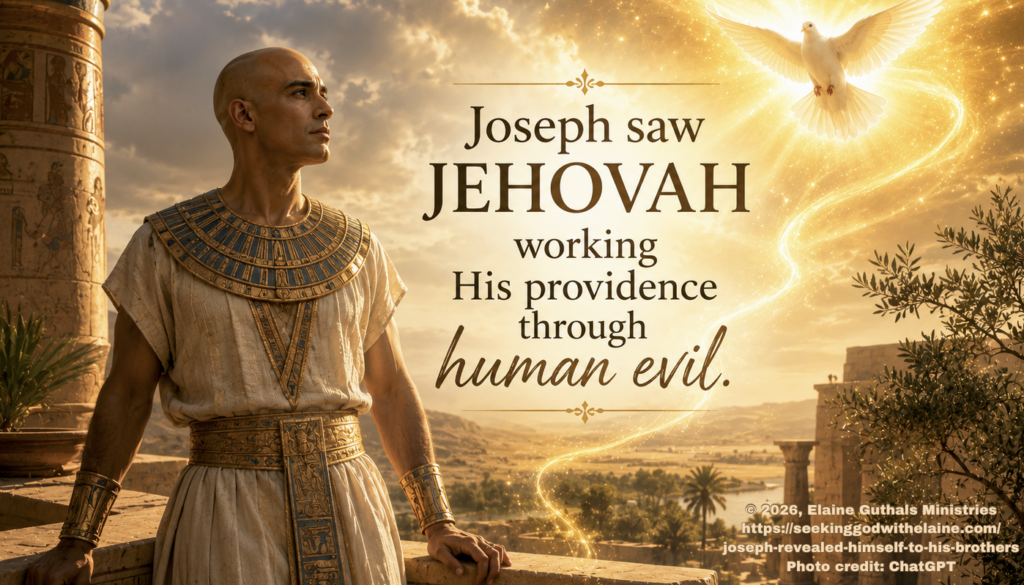
    Joseph saw Jehovah working His providence through human evil.

    We sometimes think only good things should happen to us when we are disciples of Christ. We think believing in Him should make for smooth sailing.

    That isn’t the case.

    True be known, we grow quickly in the throes of a trial. When we know we can’t rely on ourselves, we learn the lesson better that we must rely on Jehovah.

    Jehovah will use both good and bad to further His kingdom. We don’t know when the bad is the best for us.

    This Famine

    Joseph explained the famine was going to be around for a while.

    Since Jehovah had Joseph interpret Pharaoh’s dream, he knew how long the famine would last. He knew his family would have trouble in Canaan.

    Joseph got it. The covenant family must survive.

    Their family may have been small at that time; but if they didn’t survive, they wouldn’t have the opportunity to grow larger.

    Without Joseph,

    • Jacob’s family would have died in the famine.
    • Israel would have never grown into a nation.
    • The covenant line would collapse.
    • The messianic line wouldn’t have followed.

    God Sent Me Here, not You

    Joseph recognized that his brothers were not responsible for sending him to Egypt – but that did not erase their responsibility.

    Joseph saw God’s hand orchestrating every step of his journey. The brothers would not have sold him to Egypt if it would not have been part of His plan.

    Still, the brothers made the choice to sin.

    I know. We struggle with that concept.

    How can it be a sin when it was what Jehovah wanted?

    That is an easy answer. The ends do not justify the means.

    • The brothers didn’t love Joseph.
    • They didn’t follow God’s Will when he told them that they would bow to Joseph.
    • They let their pride and anger rule them instead of love and compassion.
    • They deceived Jacob.
    • They didn’t respect a person’s life.

    God’s sovereignty is above human rebellion.

    The rejected son was set up to provide for the family. He can do this because he was an advisor to Pharaoh.

    Sending the Brothers Home

    “Now hurry back to my father and tell him, ‘This is what your son Joseph says: God has made me master over all the land of Egypt. So come down to me immediately! You can live in the region of Goshen, where you can be near me with all your children and grandchildren, your flocks and herds, and everything you own. I will take care of you there, for there are still five years of famine ahead of us. Otherwise you, your household, and all your animals will starve’” (Gen. 45: 9-11 NLT)

    Joseph told his brothers to quickly bring Jacob to Egypt.

    Joseph even knew where the family could live. There was an area of Egypt called Goshen that was perfect for shepherding. A secondary bonus was that it was separated from Egyptian society.

    Sandwiched in Jacob’s speech were the words, “I will take care of you.” He could do that because he had become the master over all land of Egypt.

    Providing for the Family

    “Then Joseph added, ‘Look! You can see for yourselves, and so can my brother Benjamin, that I really am Joseph! Go tell my father of my honored position here in Egypt. Describe for him everything you have seen, and then bring my father here quickly.’ Weeping with joy, he embraced Benjamin, and Benjamin did the same. Then Joseph kissed each of his brothers and wept over them, and after that they began talking freely with him” (Gen. 45: 12-15 NLT)

    Ooo, baby, I bet the brothers didn’t know what to think at first.

    Joseph didn’t flat out say that the brothers had sold him into slavery. He did, however, imply what they had done was something terrible.

    But this reconciliation wasn’t about what they had done. It was about what needed to be done in the immediate future.

    They needed to get on their donkeys and ride back to Jacob. They needed to pack up their households and come back.

    Joseph would have seen the confusion on their faces. He knew he was basically being raised from the dead in their minds. He knew there were probably some fallout from any lingering guilt.

    The tears, embraces, and kisses put them at ease. The best words of the whole story are, “… after that they began taking freely with him” (Gen. 45: 15 NLT).

    I wonder if they were ever able to talk peacefully and freely with Joseph. Jacob’s favoritism was long-rooted and deep-seated. They would have grown up angry at Joseph.

    Sin fractured the family. Jehovah restored communication.

    Father God. We love happy endings. We thank You that You preserved the covenant line. If You hadn’t we wouldn’t be able to call You Father today. Amen.

    If you don’t understand something and would like further clarification, please contact me.

    If you have not signed up for the email providing the link to the devotions and the newsletter, do so below.

    If God has used this devotion to speak with you, consider sharing it on social media.
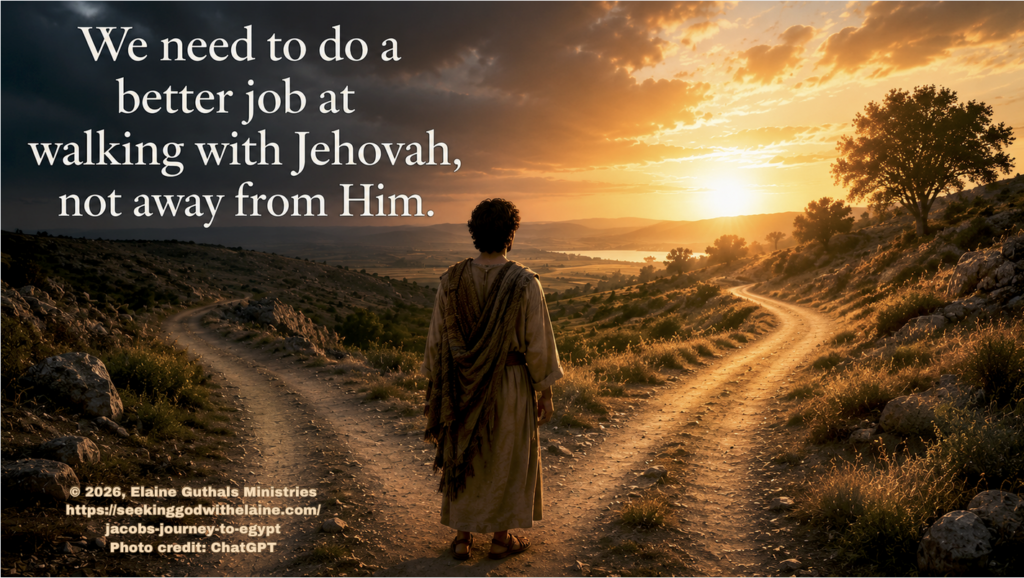
  • Joseph’s Final Test

    Joseph was attempting to reconcile with his brothers. This devotion looks at the final test Joseph had for them before he revealed himself to them.

    Nuggets

    • Joseph gave the steward specific instructions about how to handle the grain for the brothers.
    • Joseph had the steward to put a silver cup in Benjamin’s bag.
    • Joseph sent the steward to stop the brothers.
    • The steward probably blindsided the brothers with his accusation.
    • Without knowing the “culprit,” the brothers sentenced the guilty person to death.
    • And worse luck — the cup was found in Benjamin’s sack.
    • Tore their clothing is a classic way to show sorrow.
    • The brothers came back to Joseph’s palace to defend Benjamin.
    • Judah answered for the brothers.
    • Joseph reiterated that the judgment was only for Benjamin.
    • Judah laid it all out for Joseph.
    • Judah argued that making Benjamin a slave in Egypt would destroy Jacob completely.
    • Judah offered to remain as Joseph’s slave in Benjamin’s place.
    josephs-final-test

    We left Joseph and the brothers eating a meal together – sort of – at least in the same room. We don’t know what happened after that.

    We pick up the story the next morning. The brothers are getting ready to go back to Canaan. And that is when everything falls apart.

    Let’s Put It into Context

    To read devotions in the Creating Everything theme, click the button below.

    Devotions in the Joseph the Savior of Israel  series

    Setting Up the Ruse

    “When his brothers were ready to leave, Joseph gave these instructions to his palace manager: ‘Fill each of their sacks with as much grain as they can carry, and put each man’s money back into his sack. Then put my personal silver cup at the top of the youngest brother’s sack, along with the money for his grain.’ So the manager did as Joseph instructed him” (Gen. 44: 1-2 NLT)

    Joseph Gave These Instructions

    Joseph gave the steward specific instructions about how to handle the grain for the brothers.

    Okay, the steward – who sounds like he had a clue about what was going on – was probably still scratching his head. “Wine them and dine them. Give them back their money. Put a surprise gift in the sack. Accuse them.”

    But look at it this way. Even the steward knew who the youngest brother was.

    Joseph didn’t hide the fact that his family were there. What does that tell us about his relationship with his servants?

    The first thing is that Joseph confided in them. He was the second-most important person in Egypt at that time, and he shared this personal experience with at least one of his servants.

    The second thing is how much joy Joseph must have been feeling to see his family again. Yes, they treated him unfairly. They were downright mean to him.

    Joseph still loved them.

    The third thing is that it showed how much Joseph valued people and relationships. I am sure he got satisfaction from knowing Jehovah used him to save lives.

    Joseph would have had to have had an accomplice in the drama he was creating. He wouldn’t have been able to pull this off on his own. I think it would have been very difficult for him to put the money in the sack by himself.

    The reason for putting the money in the bags hadn’t changed from the last time. Since Joseph saved the whole country from starvation, surely his family could eat for free. He was going to provide for them.

    Personal Silver Cup

    Joseph had the steward to put a silver cup in Benjamin’s bag.

    The brothers had sold Joseph for 20 pieces of silver (Gen. 37: 28). Now, that sin would be revisited and cut off by Joseph’s orchestrating events to frame Benjamin.

    Later, this cup was described in helping Joseph with divination. Divination was an Ancient Near Eastern practice of determining divine will, through objects and ritual techniques. They believed the gods communicated indirectly through signs in nature, including celestial movements, animal organs, unusual, births, dreams, and historical events.

    Joseph was propagating the ruse that he used divination. We know that is not correct, but he was strengthening the brothers’ perception that he was an Egyptian.

    Going After the Brothers

    “The brothers were up at dawn and were sent on their journey with their loaded donkeys. But when they had gone only a short distance and were barely out of the city, Joseph said to his palace manager, ‘Chase after them and stop them. When you catch up with them, ask them, “Why have you repaid my kindness with such evil? Why have you stolen my master’s silver cup, which he uses to predict the future? What a wicked thing you have done!”’” (Gen. 44: 3-5 NLT)

    Joseph sent the steward to stop the brothers.

    Dawn broke, and the brothers were on their merry way back to Canaan. They would have thought of it as a win: all 11 were riding their donkeys.

    The brothers hadn’t gotten very far before Joseph implemented Step 2. They had sold their brother for silver, deceived their father, and abandoned a favorite son. How many of the activities of Genesis 27 could Joseph reproduce?

    What does Joseph was doing was building a scenario to determine whether the brothers will sacrifice Benjamin or save themselves. He was doing this through public accusation, apparent betrayal, threat of punishment, and danger centered on Benjamin.

    Accusing the Brothers

    “When the palace manager caught up with the men, he spoke to them as he had been instructed. ‘What are you talking about?’ the brothers responded. ‘We are your servants and would never do such a thing! Didn’t we return the money we found in our sacks? We brought it back all the way from the land of Canaan. Why would we steal silver or gold from your master’s house? If you find his cup with any one of us, let that man die. And all the rest of us, my lord, will be your slaves.’ ‘That’s fair,’ the man replied. ‘But only the one who stole the cup will be my slave. The rest of you may go free.’ They all quickly took their sacks from the backs of their donkeys and opened them. The palace manager searched the brothers’ sacks, from the oldest to the youngest. And the cup was found in Benjamin’s sack! When the brothers saw this, they tore their clothing in despair. Then they loaded their donkeys again and returned to the city” (Gen. 44: 6-13 NLT)

    Caught Up with the Men

    The steward probably blindsided the brothers with his accusation.

    The brothers had been upfront about the money the first time, and the steward told them, “We are all good.” They thought that should show they were trustworthy.

    They make a rash declaration that sounds familiar. “But as for your gods, see if you can find them, and let the person who has taken them die! And if you find anything else that belongs to you, identify it before all these relatives of ours, and I will give it back!” But Jacob did not know that Rachel had stolen the household idols” (Gen. 31: 32 NLT).

    If You Find His Cup with Any One of Us

    Without knowing the “culprit,” the brothers sentenced the guilty person to death.

    That is huge. They were all in on selling Joseph. They would be all in if Benjamin was found to be a thief.

    But they also said that the rest of them would become slaves. They were pronouncing judgment on themselves.

    The steward softened the sentence. Only the one who committed the crime would be a slave.

    The Cup Was Found

    And worse luck — the cup was found in Benjamin’s sack.

    But ooo, baby. Another of daddy’s favorites was in the figurative pit, but it wasn’t their doing this time. Time to pay the piper.

    They were betting death and slavery that they would be shown honest.

    Tore Their Clothing

    Tore their clothing is a classic way to show sorrow.

    We have to put this into context. Clothing, in the Ancient Near East, showed identity, dignity, social standing, stability, and public honor.

    Tearing (qāraʿ (קָרַע) — to tear, rend, and rip apart) that clothing symbolized grief, horror, mourning, repentance, outrage, and unbearable emotional collapse.

    It is a visible way to say, “I am undone.” It signifies that their world is ripping apart internally, so they rip apart what covers them externally.

    This is an obvious demonstration of the brothers’ changed characters. They had sold their brother, watched their father tear his garments, and concealed the truth.

    The brothers were suffering together rather than saving themselves.

    We can’t gloss over the fact that this applied to all brothers. They acted as one.

    All repented. Even though we aren’t told their stories in Scripture, they all acted differently.

    Joseph Was Waiting for Them

    “Joseph was still in his palace when Judah and his brothers arrived, and they fell to the ground before him. ‘What have you done?’ Joseph demanded. ‘Don’t you know that a man like me can predict the future?’ Judah answered, ‘Oh, my lord, what can we say to you? How can we explain this? How can we prove our innocence? God is punishing us for our sins. My lord, we have all returned to be your slaves — all of us, not just our brother who had your cup in his sack.’ ‘No,’ Joseph said. ‘I would never do such a thing! Only the man who stole the cup will be my slave. The rest of you may go back to your father in peace’” (Gen. 44: 14-17 NLT)

    Joseph Was Still in his Palace

    The brothers came back to Joseph’s palace to defend Benjamin.

    Of course, Joseph was waiting for the brothers at the palace. It is fitting that he asks what they have done and can’t he predict the future.

    What they had done was betray Joseph. He had predicted their future when Jehovah visited him in a dream to tell him his brothers would bow to him.

    Judah Answered

    Judah answered for the brothers.

    It is interesting to note that Reuben, the firstborn, did not speak up. Judah had already taken over the responsibility of the firstborn after Reuben’s betrayal and Simeon and Levi’s hatred and violence.

    Reuben wasn’t the leader. But then, Judah was one of the instigators in selling Joseph (Gen. 37: 26-27).

    No, Judah wasn’t the man that he was then. His failure in Genesis 38 had humbled him. He had been restored as a covenant son.

    Judah acknowledged the brothers’ guilt — no, not in stealing the cup. They understand this was happening because of their treatment of Joseph.

    Jehovah knew the brothers’ guilt (Gen. 44: 16). Hidden guilt will always surface.

    I Would Never Do Such a Thing!

    Joseph reiterated that the judgment was only for Benjamin.

    This is critical. Joseph had been the last of the baby war. (Benjamin had been born 17 years later so he wasn’t involved.)

    During those 17 years, the baby war had morphed into maternal camps. He knew how important that was to them.

    So, this was the heart of Joseph’s test. Would they leave Benjamin behind?

    Judah’s Speaks for His Brothers

    “Then Judah stepped forward and said, ‘Please, my lord, let your servant say just one word to you. Please, do not be angry with me, even though you are as powerful as Pharaoh himself. My lord, previously you asked us, your servants, “Do you have a father or a brother?” And we responded, “Yes, my lord, we have a father who is an old man, and his youngest son is a child of his old age. His full brother is dead, and he alone is left of his mother’s children, and his father loves him very much.” And you said to us, “Bring him here so I can see him with my own eyes.” But we said to you, “My lord, the boy cannot leave his father, for his father would die.” But you told us, “Unless your youngest brother comes with you, you will never see my face again.” So we returned to your servant, our father, and told him what you had said. Later, when he said, “Go back again and buy us more food,” we replied, “We can’t go unless you let our youngest brother go with us. We’ll never get to see the man’s face unless our youngest brother is with us.” Then my father said to us, “As you know, my wife had two sons, and one of them went away and never returned. Doubtless he was torn to pieces by some wild animal. I have never seen him since”’” (Gen. 44: 18-28 NLT)

    Judah laid it all out for Joseph.

    Judah respectfully approached Joseph.

    This was more than justifying why Judah had answered Jacob the way he did in Genesis 43: 3. It was more than just a “he said, we said, we did” account.

    The speech is emotional, layered, and sacrificial.

    Judah started with information Joseph knew or could figure out. Benjamin became Jacob’s favorite when Joseph was gone.

    Then Judah got to the part which would have interested Joseph. It emphasized the father-son bond.

    That bond with Joseph was what the brothers had been trying to break when they sold him. Joseph wouldn’t have known how they ignored Jacob’s grief.

    Twenty-two years after Rachel’s death, Joseph and Benjamin were still tied to her. Benjamin was the only thing Jacob had left of her.

    But Judah knows now what that grief felt like. He two had lost two sons.

    Sticking Up for Benjamin

    “Now if you take his brother away from me, and any harm comes to him, you will send this grieving, white-haired man to his grave. And now, my lord, I cannot go back to my father without the boy. Our father’s life is bound up in the boy’s life. If he sees that the boy is not with us, our father will die. We, your servants, will indeed be responsible for sending that grieving, white-haired man to his grave. My lord, I guaranteed to my father that I would take care of the boy. I told him, ‘If I don’t bring him back to you, I will bear the blame forever’” (Gen. 44: 29-32 NLT)

    Judah argued that making Benjamin a slave in Egypt would destroy Jacob completely.

    This is the turning point. Judah acknowledges they cannot leave Benjamin to whatever fate Joseph would have for him — deserved, which they doubted, or undeserved.

    But notice. It is no longer about the cup. It is about relationships.

    It was about how Jehovah uncovers deeper, hidden guilt.

    Judah stated that he had personally guaranteed Benjamin’s safety. He didn’t shift the blame. He didn’t protect himself. He didn’t seek gain.

    Judah readily admitted that he was accountable.

    The Substitution

    “So please, my lord, let me stay here as a slave instead of the boy, and let the boy return with his brothers. For how can I return to my father if the boy is not with me? I couldn’t bear to see the anguish this would cause my father!” (Gen. 44: 33-34 NLT)

    Judah offered to remain as Joseph’s slave in Benjamin’s place.

    Remember, the cup hadn’t been directly mentioned since the brothers returned to Joseph’s palace in verse 14. Joseph referred to it by saying he did divination, but he didn’t say how.

    Judah knew this had grown to something bigger than the cup. So, he said, “Pick me.”

    If someone had to stay in Egypt, Judah didn’t want it to be Benjamin. He had promised Jacob he would bring the boy home.

    Judah could take responsibility and offer to be the substitute. This is love, sacrifice, and leadership.

    Making the Connections #1

    Judah’s offer to be the substitute sets up major biblical theology later.

    • Substitution
    • Sacrificial love
    • Intercession
    • Bearing the cost himself
    • The royal line of Judah.

    Judah’s willingness to substitute himself becomes a shadow of a far greater substitution to come.

    Making the Connections #2

    Why is Judah’s transformation important here? Why did we need to see Judah’s failure, humiliation, taking responsibility, and sacrifice?

    Isn’t this about Joseph being the savior of Israel and saving them from the famine?

    No. This is a building block for Genesis 49.

    This is about Joseph saving Judah so Yeshua could be born.

    Yeshua is needed as the Savior of the world because of men and women like Judah. People who sin, have their sins exposed, repent of them, are transformed into having Jehovah’s character, and following His call need Yeshua.

    Every one of us need Yeshua.

    Making the Connections #3

    This chapter also marks another turn. Judah and Joseph emerge as leaders of the family.

    Jacob was hinting at Joseph being designated firstborn when he gave him the tunic. Judah became a leader through living the path Jehovah had for him. He was being prepared for his role in the covenant.

    All Judah needed to do was say, “I was wrong.”

    Making the Connections #4

    Why did Joseph construct this ruse? He wasn’t doing it out of revenge.

    Joseph was trying to determine if there was anything on which true reconciliation could be built.

    If the brothers were not repentant, I don’t think Joseph would have revealed himself to his brothers.

    And I think Joseph would have gotten Benjamin away from them and figured out a way to rescue Jacob.

    Here, Joseph was ensuring there was a foundation on which trust could be built.

    How Do We Apply This?

    • Show repentance by responding differently to the same kind of test.
    • Understand that buried sin is not sin removed.
    • Realize forgiveness does not require pretending nothing happened.
    • Become spiritually mature enough to move from self-preservation to sacrificial love.
    • Stop coming up with excuses so you can begin godly leadership.
    • Don’t feel disqualified from future covenant usefulness because of past failures if repentance is real.
    • Recognize that we need a substitute, not just self-improvement.

    Father God. We fail you. You are always ready to forgive our sin when we repent and turn back to You.  Thank You for sending Yeshua as a substitute for us so that we can ask Your forgiveness. Amen.

    If you don’t understand something and would like further clarification, please contact me.

    If you have not signed up for the email providing the link to the devotions and the newsletter, do so below.

    If God has used this devotion to speak with you, consider sharing it on social media.
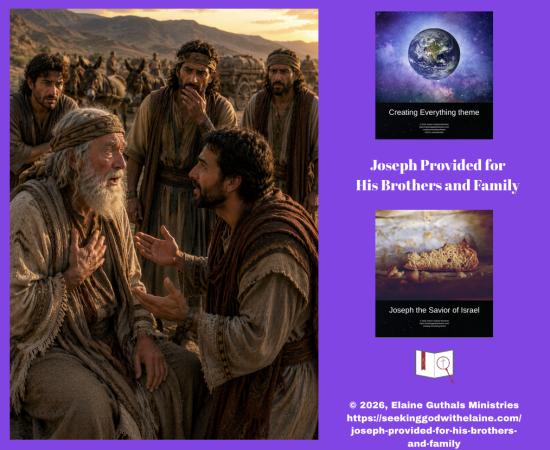
  • Joseph and the Brothers Have a Meal Together

    Jacob’s eleven sons reach Egypt to buy more grain and have Simeon released. This devotional reading looks at the beginning of reconciliation.

    Nuggets

    • Joseph had his brothers over for lunch.
    • The brothers quickly come clean about the returned money with Joseph’s servant.
    • The brothers bowed before Joseph again, further fulfilling the prophecy of the dreams.
    • Joseph probably hadn’t gotten over  the loss of his relationship with Jacob.
    • Jacob immediately blessed his brother Benjamin.
    • The fellowship meal that the brothers had was layered.
    joseph-and-the-brothers-have-a-meal-together

    When we last saw Jacob’s sons, they had just arrived at Egypt and presented themselves to Joseph. I wonder what was going through their minds.

    Their last trip to Egypt hadn’t really gone that well. They were accused of being spies. They had to leave Simeon there in prison and bring Benjamin back with them.

    How was this trip going to top that trip?

    Let’s Put It into Context

    To read devotions in the Creating Everything theme, click the button below.

    Devotions in the Joseph the Savior of Israel  series

    Responding to Unexpected Kindness

    “When Joseph saw Benjamin with them, he said to the manager of his household, ’These men will eat with me this noon. Take them inside the palace. Then go slaughter an animal, and prepare a big feast.’ So the man did as Joseph told him and took them into Joseph’s palace. The brothers were terrified when they saw that they were being taken into Joseph’s house. ‘It’s because of the money someone put in our sacks last time we were here,’ they said. “He plans to pretend that we stole it. Then he will seize us, make us slaves, and take our donkeys.’ The brothers approached the manager of Joseph’s household and spoke to him at the entrance to the palace. ‘Sir,’ they said, ‘we came to Egypt once before to buy food. But as we were returning home, we stopped for the night and opened our sacks. Then we discovered that each man’s money — the exact amount paid — was in the top of his sack! Here it is; we have brought it back with us. We also have additional money to buy more food. We have no idea who put our money in our sacks.’‘Relax. Don’t be afraid,’ the household manager told them. ‘Your God, the God of your father, must have put this treasure into your sacks. I know I received your payment.’ Then he released Simeon and brought him out to them. The manager then led the men into Joseph’s palace. He gave them water to wash their feet and provided food for their donkeys. They were told they would be eating there, so they prepared their gifts for Joseph’s arrival at noon” (Gen. 43: 16-25 NLT)

    These Men Will Eat with Me This Noon

    Joseph had his brothers over for lunch.

    It was the moment that Joseph was waiting for. Benjamin – his only full brother – was presented to him.

    We have to remember. Based on the timeline we’ve been using, Jacob left Canaan in 1692 BC. This meal occurred around 1670 BC.

    Let’s put this in ages. Joseph was 17 years old when he left Canaan. Benjamin probably wasn’t even a year old then.

    That had been 22 years ago. Benjamin would have no memories of Joseph. Joseph would have memories of Benjamin, but he was no longer that baby.

    Joseph immediately had them taken to his palace. He instructed his servants to fix a meal for them. Not just any meal – it was a huge feast.

    Knowing Joseph was their brother, that is logical. The brothers had just come from a famine-ravaged country. Hard telling when and how much their last meal was.

    Joseph cared for them. So, he took them home and fed them.

    But Joseph’s formerly confident – maybe even cocky – brothers were now fearful men. All they could think of was about the money that had appeared in their sacks of grain.

    They panicked. Their guilty consciences told themselves that Joseph’s mercy was a danger.

    Seriously, if Joseph was out to get them, wouldn’t he have them arrested on sight? He wouldn’t have them taken to his house — he would have had them taken straight to jail?!

    They thought they were going to be taken into slavery. Were they thinking an eye for an eye?

    But we do the same thing, don’t we? We see something good and look at it suspiciously – seeing good makes things looks worse.

    We focus on how we are afraid things are going to go. That may be based on reality, or it just may be based on our fear. Fear distorts kindness.

    The Brothers Approached Joseph’s Household Manager

    The brothers quickly come clean about the returned money with Joseph’s servant.

    The best defense is a good offense. The brothers laid out their side of the story to Joseph’s household manager.

    But that is the way it should be. They were being honest. True ,they didn’t want the accusation, but they wanted a situation they saw as wrong cleared up.

    So, they tell the house manager the whole story.  Well, they might have condensed part of it. They didn’t know all the money had been returned to them until they returned home.

    But their fear was leading the explanation.

    True, they had good reason to be afraid. Egyptian officials possessed enormous authority. An accusation involving royal grain could carry a severe punishment.

    The manager set their minds to ease. He even reunited them with Simeon.

    But this brings up a good point. I wonder how much Joseph had told his servants. “Hey, these are my brothers. We parted on not so good terms. I want to see if they grew up in the interim. Can you help me out with this?”

    Probably not. Joseph did have an Egyptian reputation to maintain.

    The servants probably would have known Jacob was a believer in Jehovah. If they didn’t know the story of him interpreting Pharaoh’s dreams, they would have been him daily, praying to Jehovah.

    Joseph had been an influence in his own household.

    Interacting with His Brothers

    “When Joseph came home, they gave him the gifts they had brought him, then bowed low to the ground before him. After greeting them, he asked, ‘How is your father, the old man you spoke about? Is he still alive?’ ‘Yes,’ they replied. ‘Our father, your servant, is alive and well.’ And they bowed low again. Then Joseph looked at his brother Benjamin, the son of his own mother. ‘Is this your youngest brother, the one you told me about?’ Joseph asked. ‘May God be gracious to you, my son.’ Then Joseph hurried from the room because he was overcome with emotion for his brother. He went into his private room, where he broke down and wept” (Gen. 43: 26-30 NLT)

    They Gave Him the Gifts

    The brothers bowed before Joseph again, further fulfilling the prophecy of the dreams.

    We talked about the gifts Jacob had sent with them. The interesting thing is that Jacob was allowed to send luxury or specialty products from Canaan to the “Egyptian” ruler. They followed the Ancient Near East custom of approaching powerful rulers with gifts.

    They had luxury items but not standard food items. They included “… balm, honey, gum, aromatic resin, pistachio nuts, and almonds” (Gen. 43: 11 NLT).

    Joseph probably would have known these from Jacob, not his brothers.

    The Old Man You Spoke About

    Joseph probably hadn’t gotten over  the loss of his relationship with Jacob.

    When he sees his brothers, Jacob’s thoughts immediately turn to his father.

    “Is he alright?”

    Joseph may be following Egyptian customs on the outside. Inside he is still that Hebrew boy that never gave up waiting for his Father.

    May God be Gracious to You, My Son

    Jacob immediately blessed his brother Benjamin.

    Joseph became deeply emotional. His compassion physically overwhelmed him.

    In becoming overwhelmed, Joseph cried. It showed Jacob’s grief, love, memory — and restraint.

    Contrary to today’s belief, covenant men do cry.

    Bring Out the Food

    “After washing his face, he came back out, keeping himself under control. Then he ordered, ‘Bring out the food!’ The waiters served Joseph at his own table, and his brothers were served at a separate table. The Egyptians who ate with Joseph sat at their own table, because Egyptians despise Hebrews and refuse to eat with them. Joseph told each of his brothers where to sit, and to their amazement, he seated them according to age, from oldest to youngest. And Joseph filled their plates with food from his own table, giving Benjamin five times as much as he gave the others. So they feasted and drank freely with him” (Gen. 43: 32-34 NLT)

    The fellowship meal that the brothers had was layered.

    We have to understand about meals in the Ancient Near East. On top of that, we need to understand the dynamics of an Egyptian serving Hebrews.

    Remember in the last devotion, we talked about Judah saying that an audience with a ruler indicated acceptance? Having a meal with him cemented that acceptance.

    This meal would have carried covenant and relational significance. It symbolized peace, acceptance, and restored relationship.

    Joseph was showing his brothers forgiveness – even if they didn’t know it yet.

    This has always kind of gotten me. Joseph couldn’t eat with his brothers because of customs of the day. He had to keep up the ruse.

    Even though Joseph had told them he believed in their God, he couldn’t buck Egyptian norms. Egyptians didn’t eat with Hebrews for purity concerns, ethnic separation, and cultural prejudice. They were shepherds, weren’t they — an inferior breed?

    It is a good thing that Jehovah doesn’t know cultural barriers and frequently works across them.

    But the brothers had to know something was up when he seated them by their ages.

    Didn’t they see Joseph getting all choked up? Joseph was carefully orchestrating events to culminate in his big reveal.

    Then Benjamin got special treatment.

    Even it also was another test, not just a personal feast for Joseph’s baby brother. The brothers back in around 1692 BC would have been jealous if Joseph would have gotten a significant portion over them.

    How would they react to Benjamin getting that?

    Obviously, they didn’t. I am sure Moses would have documented that if they pitched a fit.

    Making the Connections #1

    After 22 years, the brothers still feel guilty about selling Joseph into Egypt.

    No, that is a good thing in this case. Unresolved guilt reshapes perception.

    Before, there was not one drop of remorse in their bodies. Somewhere along the line, they started thinking, “Maybe we shouldn’t have …”

    Maybe it was Judah. He was taking lead of the family. He had gotten his own restoration encounter.

    Truth be told, Jehovah was probably working in all of them. They all needed restoration. They all had to acknowledge their sin.

    Making the Connections #2

    Jacob’s sons were all sitting down having a meal together. Had they ever really fellowshipped? Probably not.

    When Joseph was still in Canaan, the brothers were divided into maternal camps. They competed, envied, and deceived. Then it went from bad to worse when favoritism was weaponized.

    Did they ever truly function as covenant brothers emotionally?

    And no, this probably didn’t feel like fellowship either. But it was more than the brothers expected.

    How Do We Apply This?

    • Don’t mistake mercy for judgment.
    • Refuse to let fear distort the way you see people and situations.
    • Recognize that true fellowship requires humility and forgiveness.
    • Trust that Jehovah can restore what sin once fractured.

    Father God. This was more than a simple meal. It was a step toward reconciliation – but the brothers didn’t know that yet. You did. You were orchestrating everything. Thank You. Amen.

    If you don’t understand something and would like further clarification, please contact me.

    If you have not signed up for the email providing the link to the devotions and the newsletter, do so below.

    If God has used this devotion to speak with you, consider sharing it on social media.
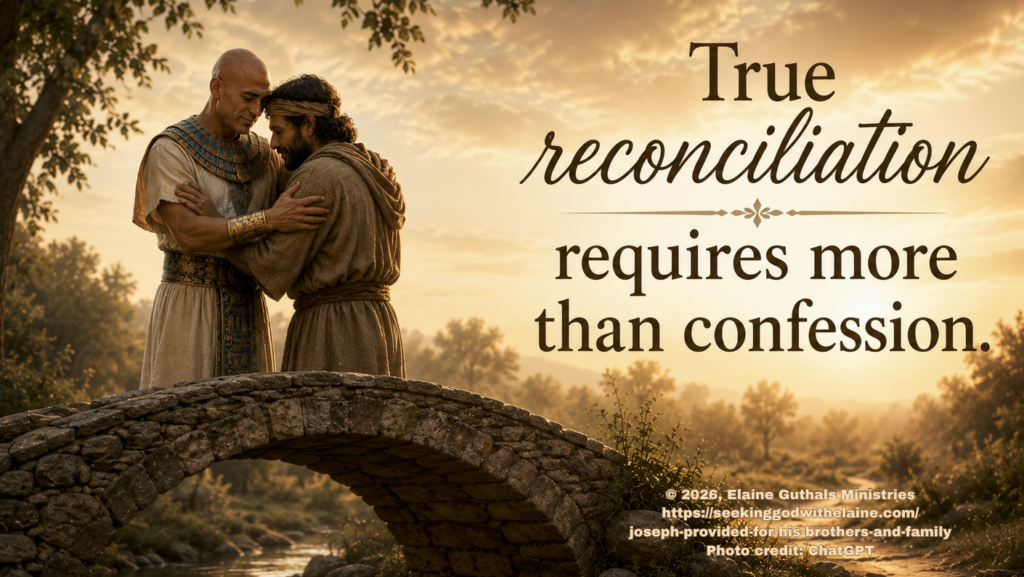
  • Deciding to Go to Egypt Again

    It was time to go to Egypt again to buy more grain. This devotional reading looks at whether the brothers will do as Jacob wants and let Benjamin stay at home or take him to Egypt as Joseph has ordered.

    Nuggets

    • We don’t know how long it took Jacob’s family to eat the grain, but Jehovah was still using the famine to further the covenant line.
    • Jacob delayed buying more food from Egypt as long as possible.
    • Judah stepped up instead of Reuben.
    • Jacob got emotional when he was forced to choose.
    • Jacob finally agreed to let Benjamin go to Egypt.
    • Jacob wanted to remove every suspicion Joseph may have had about them stealing the money.
    • Jacob finally surrendered.
    • Eleven men immediately left for Egypt. 
    deciding-to-go-to-egypt-again

    Jacob had sent ten of his sons to Egypt to buy food during the famine. The grain they bought there was now almost gone — and the famine was showing no signs of abating.

    The brothers know they have to go back to Egypt sometime because Simeon had remained there to ensure they did come back.

    Let’s see how the story unfolds.

    Let’s Put It into Context

    To read devotions in the Creating Everything theme, click the button below.

    Devotions in the Joseph the Savior of Israel  series

    The Grain Is Almost Gone

    “But the famine continued to ravage the land of Canaan. When the grain they had brought from Egypt was almost gone, Jacob said to his sons, ‘Go back and buy us a little more food.’ But Judah said, ‘The man was serious when he warned us, “You won’t see my face again unless your brother is with you.” If you send Benjamin with us, we will go down and buy more food. But if you don’t let Benjamin go, we won’t go either. Remember, the man said, ‘You won’t see my face again unless your brother is with you.’ ‘Why were you so cruel to me?’ Jacob moaned. ‘Why did you tell him you had another brother?’ ‘The man kept asking us questions about our family,’ they replied. ‘He asked, “Is your father still alive? Do you have another brother?” So we answered his questions. How could we know he would say, “Bring your brother down here”?’ Judah said to his father, ‘Send the boy with me, and we will be on our way. Otherwise we will all die of starvation — and not only we, but you and our little ones. I personally guarantee his safety. You may hold me responsible if I don’t bring him back to you. Then let me bear the blame forever. If we hadn’t wasted all this time, we could have gone and returned twice by now” (Gen. 43: 1-10 NLT)

    The Grain Was Almost Gone

    We don’t know how long it took Jacob’s family to eat the grain, but Jehovah was still using the famine to further the covenant line.

    An undisclosed amount of time had passed. The famine was still continuing. In fact, wording used in Genesis 43: 1 is almost identical to that in Genesis 42: 5.

    This is important. The brothers didn’t suddenly find their courage or righteousness. It still was either go to Egypt or starve.

    If we look at the Hebrew, we can see the severity of the famine. It says, wəhārāʿāḇ kāḇēḏ bāʾāreṣ (וְהָרָעָב כָּבֵד בָּאָרֶץ) — and the famine was heavy in the land.

    That gives the impression of being burdensome and oppressive — even grievous. In the Old Testament, it can mean oppressive conditions and severe suffering, but it can also mean hardened hearts.

    We don’t want to harden our hearts against Jehovah. We want to be submissive to His Will.

    What is interesting is the word for glory — kāḇôḏ (כָּבוֹד). It shares the same root word as severity.

    Think about it. We say trials are severely difficult. This makes them heavy for us to bear. They can cause such high anxiety and depression that we feel buried under it.

    But what is the purpose of those trials? To restore our relationship with Jehovah — to bring Him glory.

    Jehovah often moves His people through pressure before restoration arrives. Unfortunately, we resist change until the weight becomes too heavy to ignore.

    Jacob Said to His Sons

    Jacob delayed buying more food from Egypt as long as possible.

    As we said, we don’t know how long it had been since the first trip to Egypt — but all the while, Simeon had been sitting in the Egyptian prison. I doubt Joseph gave him preferential treatment, but I also doubt Simeon had been abused.

    Still, Jacob hadn’t hurried the sons on a second trip to rescue Simeon until absolutely necessary.

    Again, we can see that Joseph hasn’t lost his favoritism. He wanted to send the brothers to Egypt to buy “… a little more food” (Gen. 43: 2 NLT).

    I don’t know. Did Jacob think they could get in and out of Egypt without Joseph seeing them so he didn’t have to send Benjamin? They wouldn’t get Simeon back that way.

    Jacob was resisting sending Benjamin to Egypt.

    But — like the first trip — it was Jacob telling his sons to go to Egypt to purchase grain for them.

    Life in Canaan was at a standstill because of terms established in Egypt. Providence has cornered them.

    Doesn’t this happen frequently when we delay obedience? We just seem to get mired down. But then delayed obedience collides with reality, and we are forced to face the situation.

    The brothers blamed God for their money back — which, ultimately, was correct if we consider He worked events so that Joseph would be in that position at that time. Jacob blamed the brothers for putting him in this situation — which, really, wasn’t correct.

    But Judah Said

    Judah stepped up instead of Reuben.

    Reuben had stepped up before. The problem was his offer was to sacrifice his two sons if Benjamin didn’t return with them (Gen. 42: 37). Jacob didn’t even respond to that.

    So, Judah stepped up to be the substitute. He would pay restitution. (Do you know which brother was the great … great grandfather of Yeshua? Yep, Judah.)

    Judah doesn’t offer his children as guarantee of Benjamin’s safe return. But he does talk more responsibly, more realistically, and more sacrificially.

    One of the ways Judah talks responsibly is by reminding Jacob of Joseph’s words. But that is where some interpreting took place.

    Joseph didn’t say “…’You won’t see my face again unless your brother is with you’” (Gen. 43: 3 NLT) in so many words. He did get his point across.

    • “This is how I will test your story. I swear by the life of Pharaoh that you will never leave Egypt unless your youngest brother comes here!” (Gen. 42: 15 NLT emphasis added).
    • “But you must bring your youngest brother back to me. This will prove that you are telling the truth, and you will not die.’ To this they agreed” (Gen. 42: 18-20 NLT emphasis added).

    In essence – to me – it sounds like Joseph was threatening the brothers with what they subjected him to — forced abandonment of Canaan and possible death.

    Did Joseph ask the questions Judah said he did, and Moses just not record them. Probably. He would want to know about Jacob and Benjamin. Remember, Benjamin wasn’t even a year old when Joseph was sold.

    Let’s talk through what Judah did say. In the Ancient Near East, seeing the face of a ruler meant a person had gained access to him or secured an audience with him — in other words, was accepted by him.

    Judah was laying it our straight for Jacob. No Benjamin, no audience. No audience, no grain.

    If by chance they would get in to see Joseph, no Benjamin, no mercy.

    So, in Judah’s mind, Jacob had a choice. Keep Benjamin home with him and they would all die together or let Benjamin go so they all could live.

    That was the situation with no sugarcoating involved.

    Why Did You Tell Him

    Jacob got emotional when he was forced to choose.

    In some peoples’ minds, this would have been an easy choice. The larger number would justify the choice of allowing Benjamin to go to Egypt.

    But this is just another example of how deeply rooted Jacobs favoritism was. We will be told in another chapter or so that Jacobs family included 70 people.

    Yet, Jacob was more than willing to choose one person over the other 69 — even over himself.

    The interesting thing is that, if we look at the Hebrew, in verse 8 Moses identified Judah’s father as Israel, not Jacob. He usually only calls Jacob Israel in covenant movement and redemptive framing.

    Resource

    But isn’t that the case here? Jehovah had orchestrated this in order to save the nation of Israel.

    That does not discount Jacob’s fear. Our fears can be real and visceral.

    Jehovah allowed Jacob to make his decision.

    The sad part is Jacob believed the brothers created this problem unnecessarily by not anticipating the “Egyptian’s” questions.

    I can see it both ways. On one hand there is no way they would know that they were going to be accused of being spies.

    On the other hand, shouldn’t they have expected some questioning? They were unknown foreigners seeking to purchase something. We know there was cases of others doing the same thing who could have really been spies.

    Wouldn’t they have been asked routine questions like, “How many are you buying for?”

    Still, if the brothers were asked about who they were or anything about their family, Moses didn’t record it. The only thing Joseph asked was where they were from.

    To me, it seems logical that they used their family situation as evidence for not being spies. They were just a typical Hebrew family, not spies.

    The irony is that Jacob believed this situation was created by the “Egyptian’s” questions. The real issue began decades earlier with Jacob’s favoritism, the brothers’ deception, and unresolved sin. None of this was Joseph’s doing.

    A Feast at Joseph’s Palace

    “So their father, Jacob, finally said to them, ‘If it can’t be avoided, then at least do this. Pack your bags with the best products of this land. Take them down to the man as gifts — balm, honey, gum, aromatic resin, pistachio nuts, and almonds. Also take double the money that was put back in your sacks, as it was probably someone’s mistake. Then take your brother, and go back to the man. May God Almighty give you mercy as you go before the man, so that he will release Simeon and let Benjamin return. But if I must lose my children, so be it.’ So the men packed Jacob’s gifts and double the money and headed off with Benjamin. They finally arrived in Egypt and presented themselves to Joseph” (Gen. 43: 11-15 NLT)

    Pack Your Bags with the Best Products of This Land

    Jacob finally agreed to let Benjamin go to Egypt.

    Sometimes, you just have to step out on faith. Yes, you have to prepare and do your part. You can’t just say you are entitled to good stuff and do nothing.

    It may mean giving up something. It may mean doing something you really rather wouldn’t do.

    Bottom line — if God is asking you to do something, you just have to swallow and do it.

    The interesting things is that Jacob was allowed to send luxury or specialty products from Canaan to the “Egyptian” ruler. They followed the Ancient Near East custom of approaching powerful rulers with gifts.

    What I find interesting is they had luxury items but not standard food items. They would have starved on a diet of honey, nuts, and almonds.

    Take Double the Money

    Jacob wanted to remove every suspicion Joseph may have had about them stealing the money.

    Jacob and the brothers did the right thing. They not only took money for the grain they would buy on this trip, but they also took the money that they found in their sacks.

    This should convince the “Egyptian” that they were upright men (Gen. 42: 11). The returned money from Genesis 42 terrified the brothers because they feared being accused of theft.

    Take Your Brother

    Jacob finally surrendered.

    Jacob finally turned the situation over to Jehovah. He called on El Shaddai (אֵל שַׁדַּי). This is the covenant name used with Abraham and Isaac.

    Jacob was finally putting everything in Jehovah’s hands.

    But then Jacob said, “… But if I must lose my children, so be it” (Gen. 42: 14 NLT). Does this sound like surrender or despair?

    Maybe it was a bit of both. To me, this sounds like resignation with faith.

    So the Men Packed

    Eleven men immediately left for Egypt.

    It sounds like preparation for the second trip to Egypt didn’t take long. Emphasis, though, was on Benjamin — they left with Benjamin.

    When we are doing God’s Will, we need to prepare, get started, and follow through to the end.

    Making the Connections #1

    We rarely understand what Jehovah is doing while events are unfolding. We can be looking at events and see His hand in them, but we may not be seeing all He is doing in our lives. In fact, we may get the answers for many years.

    Sometimes, we may never get the answers.

    We just have to continue to trust Jehovah.

    Making the Connections #2

    Judah had had his own Sanctification Road event back in Genesis 38. This is the first time that we get to see who he was transforming into. Here, we see that he was transforming into the leader of the brothers, and we see foreshadows of why the royal line would eventually come through him.

    Judah wasn’t shifting blame anymore. He was carrying responsibility.

    More importantly, Judah was looking at the situation without any blinders on. “If we hadn’t wasted all this time, we could have gone and returned twice by now” (Gen. 43: 10 NLT).

    Judah knew who all had to make the trip to Egypt. He accepted Jehovah’s decree.

    Making the Connections #3

    After all this time, Jacob was still mourning for Joseph. Yes, he had seen the bloodied coat. He accepted Joseph was gone.

    Jacob just didn’t accept that Joseph wouldn’t come back. “… may he send back your other brother and Benjamin. …” (Gen. 43:14 ESV).

    We don’t know Jacob’s thought process. Maybe he just trusted in God to believe that was how it would turn out.

    There was no way Jacob would know that Joseph was in Egypt — where they were wanting to take Benjamin. Unless the brothers had talked about it over the years, and Jacob overheard them. Who knows.

    What can we learn? We have to believe all things are possible for God (Mt. 19: 26). But we can’t lop off the in-Your-Will part.

    How Do We Apply This?

    • Stop resisting the direction Jehovah is clearly pushing you toward – even if it is uncertain – and let pressure drive you toward Jehovah instead of away from Him.
    • Refuse to let fear keep your life spiritually stalled by trusting Jehovah even when obedience feels costly.
    • Stop delaying the obedience you already know Jehovah requires by surrendering the situation you keep trying to control.
    • Choose responsibility and sacrifice over self-preservation and stop shifting blame.
    • Trust that Jehovah is working even when you cannot see the full picture and stop interpreting every hardship as abandonment from God.
    • Bring your anxieties to Jehovah instead of trying to carry them alone.
    • Prepare carefully — then step out in faith.
    • Accept that sanctification often happens through uncomfortable situations.
    • Remember that Jehovah can redeem even deeply dysfunctional situations.
    • Submit to Jehovah’s providence to deepen your faith instead of fighting it by letting trials produce surrender instead of bitterness.
    • Trust Jehovah with the people and situations you cannot protect yourself.

    Father God. We know there are times when You are working in our lives, and all we do is kick and scream. Forgive us when we fight sanctification. Help us to become the disciples You want us to be. Amen.

    If you don’t understand something and would like further clarification, please contact me.

    If you have not signed up for the email providing the link to the devotions and the newsletter, do so below.

    If God has used this devotion to speak with you, consider sharing it on social media.
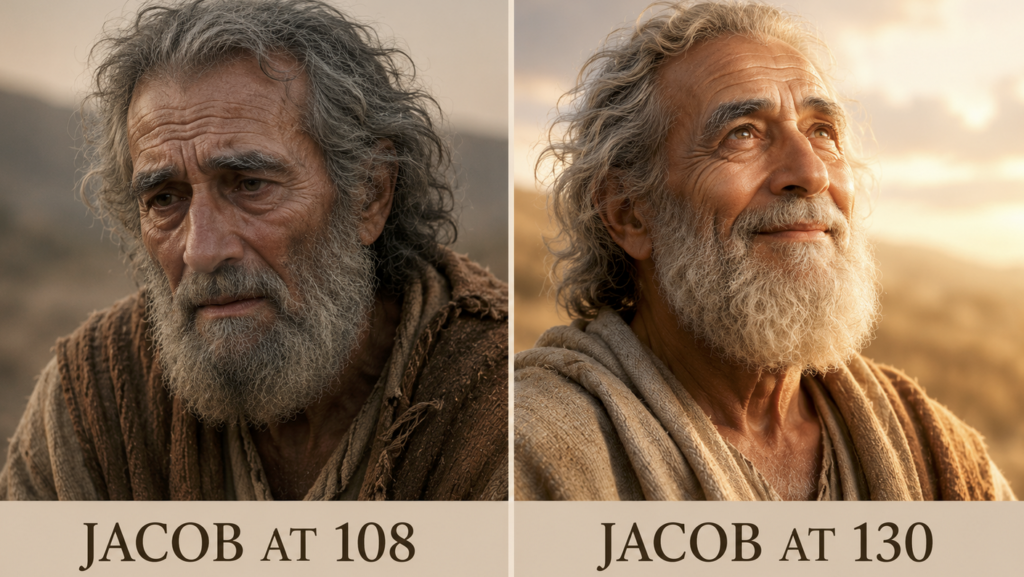
  • Arriving Back in Canaan

    Joseph’s brothers – minus one – who had left Canaan for Egypt were returning. This devotional reading looks at their trip and their return home.

    Nuggets

    • Joseph showed mercy to his brothers in giving back to them what was tied to their sin against him.
    • The brothers found the money Joseph had asked his servants to put into one of the sacks of grain.
    • The brothers came home and told Jacob the truth.
    • After the brothers returned home, they found the money used to pay for the grain in all the other sacks.
    • Jacob reacted with an emotional response.
    • Reuben made a foolish offer that would not have accomplished anything.
    • Jacob refused to allow Benjamin to journey to Egypt.
    arriving-back-in-canaan

    Jacob was concerned that the family would starve to death in the famine. He sent ten of his sons to Egypt to buy grain.

    Now they were coming home. But there was only nine of them returning.

    What was the welcome home going to look like?

    Let’s Put It into Context

    To read devotions in the Creating Everything theme, click the button below.

    Devotions in the Joseph the Savior of Israel  series

    Joseph Gave Back

    “Joseph then ordered his servants to fill the men’s sacks with grain, but he also gave secret instructions to return each brother’s payment at the top of his sack. He also gave them supplies for their journey home” (Gen. 42: 25 NLT)

    Joseph showed mercy to his brothers in giving back to them what was tied to their sin against him.

    The brothers had come to buy grain. Joseph made sure they got that grain, but he also made sure they got their money back.

    Think about it. They had sold him for 20 pieces of silver – the price of a young slave. Joseph returned their money – keseph (כֶּסֶף) – silver.

    We’ve talked several times about Jehovah mirroring things in the restoration to what occurred during the sin. This is just another example of Him doing that.

    But Joseph went beyond that. He provided provisions for their journey home.

    A Startling Discovery

    “So the brothers loaded their donkeys with the grain and headed for home. But when they stopped for the night and one of them opened his sack to get grain for his donkey, he found his money in the top of his sack. ‘Look!’ he exclaimed to his brothers. ‘My money has been returned; it’s here in my sack!’ Then their hearts sank. Trembling, they said to each other, ‘What has God done to us?’” (Gen. 42: 25-28 NLT)

    The brothers found the money Joseph had asked his servants to put into one of the sacks of grain.

    I always thought it was interesting that the brothers thought God was doing something to them. We’ve been talking about the brothers since Genesis 30, and this is the first time any of them – other than Joseph – said anything about Jehovah.

    But that meant they were now interpreting things spiritually. Why all of the sudden?

    Think about it. We aren’t told that they had any guilty feelings over the years between the sale and reunion. They could have buried their sin for 13 years – and probably did.

    But all of a sudden, during their audience with Joseph, their conscience began to trouble them. They began to feel guilty about their actions.

    They were able to leave Egypt – when for a while they didn’t know if that was ever going to happen or not. They got one day’s ride out, and they find this — money in a sack.

    The Hebrew words used are wayyetse libbam (וַיֵּצֵא לִבָּם) – their heart went out. Their courage flew out the door or their inner strength drained away. We would probably say their hearts sank.

    Joseph hadn’t exactly been nice to them. These bold, hard men were probably terrified of him.

    Bourdillon made an interesting point. He said their fear was probably of their own thoughts and their secret sin. He wrote, “Nothing makes men so fearful as an evil conscience.”

    Resource

    And now the money was back In a sack?  Ooo, baby, I bet they trembled and shook with fear – wayyeḥerdû (וַיֶּחֶרְדוּ).

    The brothers were spiritually unraveling.

    They were only one day out of Egypt, so why didn’t they go back? If they truly were upright men, wouldn’t they immediately try to make it right?

    What we don’t see here is anyone giving words of comfort. They all know that would have just made the situation worse rather than better.

    Confession

    “When the brothers came to their father, Jacob, in the land of Canaan, they told him everything that had happened to them. ‘The man who is governor of the land spoke very harshly to us,’ they told him. ‘He accused us of being spies scouting the land. But we said, ‘We are honest men, not spies. We are twelve brothers, sons of one father. One brother is no longer with us, and the youngest is at home with our father in the land of Canaan.’ ‘Then the man who is governor of the land told us, ‘This is how I will find out if you are honest men. Leave one of your brothers here with me, and take grain for your starving families and go on home. But you must bring your youngest brother back to me. Then I will know you are honest men and not spies. Then I will give you back your brother, and you may trade freely in the land’” (Gen. 42: 29-34 NLT)

    The brothers came home and told Jacob the truth.

    Knowing who the brothers had been, we may have expected them to lie to Joseph when they arrived home. They may have made up a story about why Simeon wasn’t with them. They may have not even mentioned the silver. Jacob didn’t need to know about the man who interrogated them when they bought the grain.

    But they came home and told Jacob the truth. The governor spoke harshly to them, detained Simeon, and demanded Benjamin when they returned.

    Right now, the brothers were fearful and suspicious. They feel the loss.

    If they had thought they had buried the past, it has come back — because it is Jehovah’s appointed time to deal with the sin.

    Another Starting Discovery

    “As they emptied out their sacks, there in each man’s sack was the bag of money he had paid for the grain! The brothers and their father were terrified when they saw the bags of money” (Gen. 42: 35 NLT)

    After the brothers returned home, they found the money used to pay for the grain in all the other sacks.

    Apparently the brothers hadn’t emptied all the sacks. Each had money in them.

    After how Joseph had treated them, I bet they were afraid. Whatever they had felt in Egypt and when they found the first sack of money just mushroomed.

    They had been accused of being spies, and now it looked like they were thieves.

    The same men who deceived Jacob with Joseph’s tunic now feared accusations themselves.

    But doesn’t that happen often throughout Scripture? Unrepented sin produces inner instability.

    Then they get home and there is the money. If they were perplexed when they found the money in one sack, they are probably really afraid now.

    Surely, they were wondering what all this meant. Jehovah would have been okay with that. He wants us to see Him working in our lives.

    The Hurt Talking

    “Jacob exclaimed, ‘You are robbing me of my children! Joseph is gone! Simeon is gone! And now you want to take Benjamin, too. Everything is going against me!’” (Gen. 42: 36 NLT)

    Jacob reacted with an emotional response.

    Jacob had sent the brothers to Egypt to buy grain – a quick trip to buy food. This trip was anything but that.

    The trip that was to be the salvation of the family brought more sorrow upon Jacob.  Joseph was gone. Simeon was gone. The brothers said they had to take Benjamin next time.

    Jacob’s fear exploded. Let’s look at the Hebrew first to get an exact idea of what Jacob was feeling.

    You have bereaved me (ʾōṯî shikkaltem — אֹתִי שִׁכַּלְתֶּם) of my children! Joseph is absent (ʾênennû — אֵינֶנּוּ)! Simeon is absent (ʾênennû — אֵינֶנּוּ)! And now you want to take Benjamin, too. All of them (kullānâ – כֻלָּנָה) have come (hāyû – הָיוּ) against me (ʿālai – עָלַי)!’

    Jacob was feeling stripped and deprived of his sons. He believes his accumulated loses are more than he can emotionally survive.

    I am sure Jacob went into father mode and wondered if the Egyptian leader would require Benjamin to remain with him when he found out about the “theft.”

    Now, don’t think this is way out in left field. This happened to the Egyptians by the end of the famine. “So Joseph bought all the land of Egypt for Pharaoh. All the Egyptians sold him their fields because the famine was so severe, and soon all the land belonged to Pharaoh. As for the people, he made them all slaves, from one end of Egypt to the other” (Gen. 47: 20-21 NLT).

    This sounds dire for the Egyptian people The New Living Translation does have a footnote on that. It says that the Hebrew reads “he moved them all into the towns.

    The important thing to notice here is Jacob’s despondency. He is focusing on the fear, not faith.

    Let’s do a little history lesson on Jacob.

    Remember when Jacob was at Bethel the first time. He was running from Esau, heading to Haran to find a wife. When Jehovah appeared to Jacob through the image of a ladder and angels ascending and descending, Jacob said that he would follow Jehovah.

    But Jacob made it conditional. “Then Jacob made this vow: ‘If God will indeed be with me and protect me on this journey, and if he will provide me with food and clothing, and if I return safely to my father’s home, then the Lord will certainly be my God’” (Gen. 28: 20-21 NLT).

    Basically, Jacob said that “If Jehovah will take care of me, I’ll make Him my God.” How selfish!

    • That was pre-Laban and Leah’s deception.
    • That was pre-employment issues with Laban.
    • That was pre-stolen household idols.
    • That was pre-running away from Laban.
    • That was pre-defilement of Dinah.
    • That was pre-massacre of the men of Shechem.
    • That was pre-Rachel’s death.
    • That was pre-disappearance of Joseph.

    Jacob had based his worship of Jehovah on the condition that He provide a wonderful life for him. Instead, Jehovah broke him.

    Here, Jacob doesn’t even mention Jehovah. It is like he doesn’t remember all that He has done for him since Bethel.

    Robertson cautioned us not to follow Jacob’s example in this. He wrote, “He who lives in this world for his own personal enjoyment, without God and His Christ, will by degrees find, like Jacob, that he has no rock to rest his soul upon, but that he must go down in sorrow to the grave.”

    Resource

    We should live our lives for Jehovah’s glory and honor, not our own personal gain.

    But we are seeing this knowing the outcome. We know that Jehovah is working behind the scenes — as He has been all along.

    “… Everything is going against me!’” (Gen. 42: 36 NLT) is really “Jehovah is making everything right.”

    The problem is that Jacob is focusing on the pain and can’t see the redemption. Have we ever done that?

    Jacob can’t see that Jehovah is working on him while he is walking his Sanctification Road.

    I wonder, though, if Jacob distrusted his sons enough to wonder if they had stolen the money. That would have been a sad state of affairs.

    The Foolish Offer

    “Then Reuben said to his father, ‘You may kill my two sons if I don’t bring Benjamin back to you. I’ll be responsible for him, and I promise to bring him back’” (Gen. 42: 37 NLT)

    Reuben made a foolish offer that would not have accomplished anything.

    At this point, we have to ask, “What in the world was that man thinking?” Reuben really offered his kids to Jacob for him to kill them???? Really???????

    The only thing that makes sense to me is that Reuben was trying — again — to win back his firstborn status. He thought if he offered his two sons, it would make him worthy.

    All this offer shows is that Reuben still lacks wisdom and leadership stability. He is spiritually empty.

    The Refusal

    “But Jacob replied, ‘My son will not go down with you. His brother Joseph is dead, and he is all I have left. If anything should happen to him on your journey, you would send this grieving, white-haired man to his grave” (Gen. 42: 38 NLT)

    Jacob refused to allow Benjamin to journey to Egypt.

    Jacob digs in his heels. He wasn’t going to lose Benjamin after he lost Joseph.

    No, Jacob has ten other sons standing right there in front of him. Didn’t he see them? Maybe. Maybe not.

    But Jacob’s favoritism is still blatantly obvious.

    Making the Connections #1

    How has this chapter moved the story along?

    There has been a mini reunion even if they didn’t know it yet. But things are still unresolved.

    • Simeon remained imprisoned.
    • The famine continued.
    • The brothers remained fearful.
    • Jacob remained broken.
    • Benjamin remained protected.

    From the human perspective, things have gone downhill. But we need to look at things from Jehovah’s perspective — He is working for restoration.

    Jehovah works in our lives and doesn’t always tell us the game plan. We don’t know the end result any more than we know how we are going to get there.

    Sometimes, our road to reconciliation with Jehovah is as long as it was for Joseph’s brothers. But He works for the same outcome — to turn concealed sin into a transformed heart.

    Making the Connections #2

    Newman reminded us that we shouldn’t be surprised when trials come our way. Affliction, hardship, and distress are all part of our walk with Jehovah. That is verified in Romans 8:28.

    Resource

    “And we know that God causes everything to work together for the good of those who love God and are called according to his purpose for them” (Rom. 8: 28 NLT).

    Making the Connections #3

    Rudder talked about our passing judgment on Jehovah when He sends times of trials to convict us. Isn’t that the truth?

    Resource

    Especially true when we don’t see Him convicting of us sin, we see no purpose in the trials Jehovah sends our way. We expect, as Jacob did, that our walk with Him should be a smooth easy journey.

    Our Sanctification Roads are anything but smooth. It is those trials that root out the sin in our lives that put the bricks in our Road. It is that Road that leads us to Jehovah.

    We shouldn’t judge Jehovah for the trials. We should thank Him.

    Jehovah is building our faith and transforming us to have His character.

    How Do We Apply This?

    • Submit to God’s Will, specially when He is convicting us to identify unconfessed sin.
    • Utilize prayer to sustain us on the difficult sections of our Sanctification Road.
    • Trust Jehovah’s providence even when circumstances seem to be against you.

    Father God. So many times, we think situations are going to occur one way, and they happen a totally different way. Help us to trust You in those circumstances. May our prayer life keep us connected to You as we navigate our Sanctification Road. Amen.

    If you don’t understand something and would like further clarification, please contact me.

    If you have not signed up for the email providing the link to the devotions and the newsletter, do so below.

    If God has used this devotion to speak with you, consider sharing it on social media.
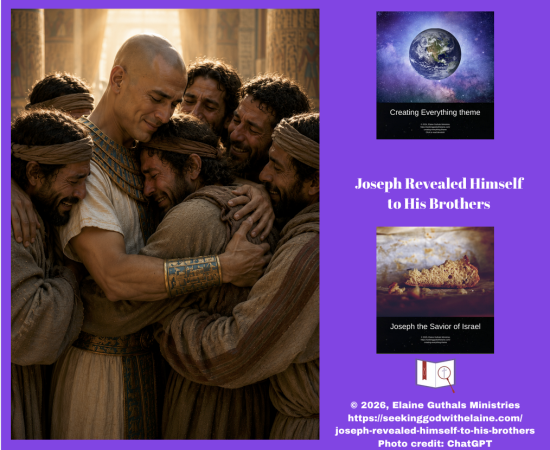
  • Testing the Brothers

    After placing his brothers in prison for three days, Joseph brings them before him again. This devotional reading looks at the audience the brothers have with Joseph before they are allowed to go home.

    Nuggets

    • Three-day periods in Scripture indicate a time of testing.
    • It may or may not have startled the brothers that Joseph said he was a God-fearing man.
    • The bottom line didn’t change in the three days – bring Benjamin back.
    • The brothers brought up their sin against Joseph, wondering if this trouble was punishment for that sin.
    • Joseph responded to their fear.
    • Joseph picked Simeon to remain while the others left.
    testing-the-brothers

    This trip to Egypt wasn’t just a quick trip to buy grain. But Jacob’s sons didn’t know that until they got there.

    The reception with the one man didn’t go well. The brothers had been accused of being spies and thrown into prison.

    Let’s Put It into Context

    To read devotions in the Creating Everything theme, click the button below.

    Devotions in the Joseph the Savior of Israel  series

    After The Brothers’ Time in Prison

    “On the third day Joseph said to them, ‘I am a God-fearing man. If you do as I say, you will live. If you really are honest men, choose one of your brothers to remain in prison. The rest of you may go home with grain for your starving families. But you must bring your youngest brother back to me. This will prove that you are telling the truth, and you will not die.’ To this they agreed” (Gen. 42: 18-20 NLT)

    Third Day

    Three-day periods in Scripture indicate a time of testing.

    We know of other times when three days occurred. The Hebrew used here was bayyôm haššĕlîšî (בַּיּוֹם הַשְּׁלִישִׁי) — on the third day.

    • Abraham and Isaac’s journey to Mt. Moriah (Gen. 22: 4)
    • Israel meeting Jehovah on Mt. Sinai (Ex. 19: 11)
    • Jonah in the whale (Jon. 1)
    • Hezekiah was healed (II Kgs. 20: 5)
    • Esther approached the king (Est. 5: 1)
    • Yeshua raising on the third day

    Third day was symbolic. It means

    • transition
    • divine intervention
    • emergence from danger/death
    • covenant movement
    • revelation
    • restoration


    I Am a God-Fearing Man

    It may or may not have startled the brothers that Joseph said he was a God-fearing man.

    I wonder if the brothers were standing when Joseph told them that he feared Jehovah. If they were, were they on the floor quickly?

    But maybe not.

    Remember, the ruler was a Hyksos Pharaoh. The Hyksos (heqa khasut or rulers of foreign lands) were a mixed-race people of primarily West Semitic origin. That means he was a possible descendant of Ishmael, Abraham’s son. If not, he may have been a descendant of Ham, Noah’s son.

    The Egyptians would have remembered Joseph as the Hebrew dream interpreter. Some may have remembered Who he said interpreted Pharaoh’s dreams.

    “‘It is beyond my power to do this,’ Joseph replied. ‘But God can tell you what it means and set you at ease’” (Gen. 41: 16 NLT).

    But the brothers wouldn’t have known that.

    This reiterates the fact that, while Joseph would change his outward appearance, he wouldn’t change his heart.

    Bring Your Youngest Brother Back

    The bottom line didn’t change in the three days – bring Benjamin back.

    We talked a little bit in the last devotion about things that wouldn’t be why Joseph asked that Benjamin be brought back. With the tunic, dreams, and sale occurring the same year as Rachel’s death – and Benjamin’s birth – happening in one year, Benjamin himself wasn’t really the central issue.

    The whole reason Joseph wanted Benjamin to come back was the brothers.

    Joseph knew his father. He knew Jacob would have become more protective of Benjamin. That would have been the exact opposite of what the brothers would have been hoping for by selling him.

    Did you notice that, in the three days the brothers were in jail, Joseph changed his mind. At first, he was going to have all stay except one who was going to go back and get Benjamin.

    “One of you must go and get your brother. I’ll keep the rest of you here in prison …” (Gen. 42: 16 NLT).

    Now, Joseph was going to allow all but one leave. But he was constant in saying they had to bring Benjamin back.

    The Brothers Gave Some Insight to That Day

    “Speaking among themselves, they said, ‘Clearly we are being punished because of what we did to Joseph long ago. We saw his anguish when he pleaded for his life, but we wouldn’t listen. That’s why we’re in this trouble.’ ‘Didn’t I tell you not to sin against the boy?” Reuben asked. ‘But you wouldn’t listen. And now we have to answer for his blood!’” (Gen. 42: 21-22 NLT)

    The brothers brought up their sin against Joseph, wondering if this trouble was punishment for that sin.

    I bet Joseph got an education listening to his brothers hash it out. First off, they acknowledged that they knew Joseph was hurting in the pit — and they didn’t care at the time.

    Wait! What????

    Joseph pled for his life? We weren’t told that in Genesis 37.

    “Then they grabbed him and threw him into the cistern. Now the cistern was empty; there was no water in it. Then, just as they were sitting down to eat, they looked up and saw a caravan of camels in the distance coming toward them. It was a group of Ishmaelite traders taking a load of gum, balm, and aromatic resin from Gilead down to Egypt” (Gen. 37: 24-25 NLT).

    True, biology doesn’t always mean family members see things the same way and get along.

    Reuben had been the only one who had wanted to return Joseph to his father (Gen. 37: 29-30). He couldn’t because the others had sold him to the Ishmaelite traders.

    But Reuben knew there would be a reckoning. We are held accountable for our actions. “Yes, each of us will give a personal account to God” (Rom. 14: 12 NLT).

    Joseph Heard Their Fear

    “Of course, they didn’t know that Joseph understood them, for he had been speaking to them through an interpreter. Now he turned away from them and began to weep. When he regained his composure, he spoke to them again. Then he chose Simeon from among them and had him tied up right before their eyes” (Gen. 42: 23-24 NLT)

    Joseph responded to their fear.

    But the bigger thing was Joseph knew they still felt guilty about what they did to him. Time had shown them the error of their ways. The guilt was still there.

    Do we think that Joseph should have made himself known to his brothers right then? Isn’t that what many want – instantaneous forgiveness?

    Joseph had probably always been Jacob’s favorite, so the brothers had 17 years of envying him.

    No, Joseph had probably already forgiven them when he saw God’s plan for his life. But they had killed his trust in them. That was going to take more than a he’s-gone-and-we’re-paying-for-it-now discussion.

    He Chose Simeon

    Joseph picked Simeon to remain while the others left.

    We would probably think Reuben — as the oldest — would have been the one to be chosen. But he had just said (Gen. 42: 22) that he had stuck up for Joseph that day 13 years ago (Gen. 37: 21). The problem was he didn’t stop his brothers; so he, too, was guilty.

    Reuben’s big sin was against Jacob (Gen. 35: 22), not Joseph.

    Were we surprised that it was Simeon who stayed behind in Egypt?

    Simeon was the next oldest. He should have been advocating for his younger brother. Instead, Simeon was one of the ones advocating to punish Joseph for his favoritism.

    Simeon also had also committed another sin. It was him and Levi who had killed all the men of Shechem for Prince Shechem defiling Dinah (Gem. 34: 25-26).

    It doesn’t say the brothers were bound when Joseph put them in prison three days ago (Gen. 42: 17).

    Making the Connections

    Did Jehovah convict people of their sins in the Old Testament?

    Well, yes. A major way in which Jehovah calls us from rebellion to holiness is by what we call conviction.

    This conviction comes from Jehovah – we know now through the Holy Spirit. The Holy Spirit worked in a different way – that we know of — before resurrection.

    There wasn’t an indwelling of the Spirit then. He came and rested on people for an undisclosed amount of time.

    But did the Holy Spirit still convict sinners as He does now?

    Maybe. Maybe not. We do know of times of conviction.

    Take, for example, Adam and Eve after the original sin. In Genesis 3: 9, Jehovah approached them with a question, “… ‘Where are you?’” (ESV).

    David’s sin with Bathsheba precipitated the writings of a couple of Psalms, detailing his feelings while under conviction (Ps. 32, Ps. 51).

    Frothingham asserted that, when the Holy Spirit first convicts us, we feel fear. This stems from a sense of awe toward an invisible presence that impresses upon one’s conscience a moral awareness.

    Resource

    Ooo, baby. We can be afraid when Sovereign God is convicting us for disobedience to Him. We can worry about the type and severity of that punishment.

    Part of the fear, too, can be because we know we have disappointed Jehovah.

    Frothingham gave us insight on the timing of these convictions. He wrote, “
    The God whom we ‘fear’ deals with us in the slow course of His appointments, through the gradual changes of time and age.”

    Conviction forces our souls to turn inward to address the musings of our conscience. This was what the brothers were doing when they were discussing whether their current situation was punishment from Jehovah for their sin.

    Yeah, 13 years after the sin, Jehovah will convict us to restore our relationships with Him.

    Conviction is a major element early on in the redemption process.

    ·      Conviction – yākhaḥ (יָכַח); elegchō (ἐλέγχω)
    ·      Return – shûb (שׁוּב)
    ·      Transformation – metanoia (μετάνοια)

    How Do We Apply This?

    • Allow Jehovah to expose sins you have tried to bury.
    • Do not mistake delayed consequences for erased guilt.
    • Respond to conviction with repentance instead of defensiveness.
    • Remember that forgiveness and restored trust are not always instantaneous.
    • Let conviction draw you toward restoration instead of shame.
    • Acknowledge the pain your actions may have caused others.
    • Understand that Jehovah may revisit old wounds in order to bring healing.
    • Do not ignore the warnings of your conscience.
    • Accept that sanctification sometimes involves uncomfortable exposure.
    • Trust that Jehovah’s testing is meant for restoration, not destruction.
    • Be willing to face difficult truths about yourself.
    • Confess not only outward sin but also hidden motives and attitudes.
    • Learn to recognize conviction as an act of covenant love.

    Father God. Thank You for families. Help us when we become dysfunctional families. Help us to confess our sins, repent, and forgive each other. Amen.

    If you don’t understand something and would like further clarification, please contact me.

    If you have not signed up for the email providing the link to the devotions and the newsletter, do so below.

    If God has used this devotion to speak with you, consider sharing it on social media.