Jacob had lived in Egypt 17 years, but now he was facing the end of his life. This devotional reading looks at how he blessed Joseph, Manasseh, and Ephraim.
Nuggets
- Jacob made a life in Egypt.
- Joseph, Manasseh, and Ephraim went to see Jacob.
- Jacob adopted two of Joseph’s sons.
- Jacob was thinking about the covenant line.
- If the grandsons were 23ish, what were they doing on his knees — what we would call sitting on his lap?
- Jacob was following Hebrew tradition and transferring the blessing.
- This is the final example of the pattern of Jehovah choosing the younger son.
- Jacob looked back about his life at the end.
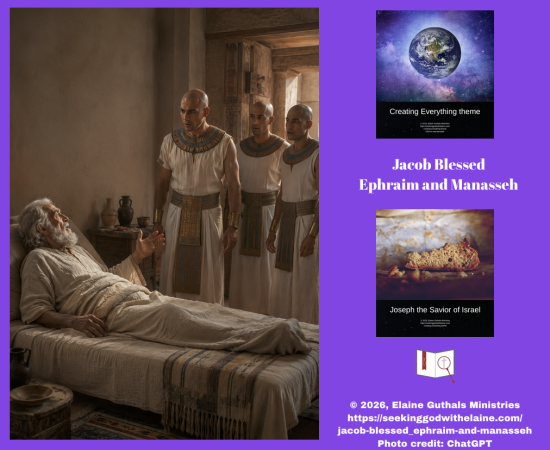
One thing that we’ve seen time after time is that birth order does not determine destiny. We’ve seen this several times in Genesis. Think Isaac, Jacob, and Judah. Maybe even Abraham himself, depending on who you read.
With Jehovah, the younger son was the covenant son. Why? He saw the sons’ hearts.
Let's Put It into Context
To read devotions in the Creating Everything theme, click the button below.
Devotions in the Joseph the Savior of Israel series
Jacob Adopted Manasseh and Ephraim
“Some time later Joseph was told, ‘Your father is ill.’ So he took his two sons Manasseh and Ephraim along with him. When Jacob was told, ‘Your son Joseph has come to you,’ Israel rallied his strength and sat up on the bed. Jacob said to Joseph, ‘God Almighty appeared to me at Luz in the land of Canaan, and there he blessed me and said to me, “I am going to make you fruitful and increase your numbers. I will make you a community of peoples, and I will give this land as an everlasting possession to your descendants after you.” Now then, your two sons born to you in Egypt before I came to you here will be reckoned as mine; Ephraim and Manasseh will be mine, just as Reuben and Simeon are mine. Any children born to you after them will be yours; in the territory they inherit they will be reckoned under the names of their brothers. As I was returning from Paddan, to my sorrow Rachel died in the land of Canaan while we were still on the way, a little distance from Ephrath. So I buried her there beside the road to Ephrath’ (that is, Bethlehem)” (Gen. 48: 1-7 NLT)
Some Time Later
Jacob made a life in Egypt.
Jacob had 17 years with Joseph in Egypt. He probably thought any time given to him was an unexpected blessing.
We have to recognize that the famine was over by this time. Since this would be around 1653 BC, the famine ended in 1665 BC.
We are assuming that Jacob blessed Manasseh and Ephraim the same year that he died. But we know that Isaac blessed Jacob 43 years before he died.
Jacob didn’t have 43 years.
But we all must die, and it was Jacob’s time. More than likely, one of Jacob’s servants came to tell him. Maybe it was a sibling (we don’t know how many other daughters Jacob had than Dinah).
He Took His Two Sons
Joseph, Manasseh, and Ephraim went to see Jacob. Jacob roused himself enough to greet them.
I am sure Joseph had heard all about the covenant God made with Abraham, Isaac, and Jacob. Based on the timeline we’ve been using, Isaac would have still been alive when Joseph was sold. Even though Joseph was gone by the time that Isaac died, the covenant would have been a frequent topic of conversation.
It was important that Jacob mention it here because of what he was about to do.
It was also important for Jacob to remind Joseph that their family wouldn’t always remain in Egypt. “Then the Lord said to Abram, ‘You can be sure that your descendants will be strangers in a foreign land, where they will be oppressed as slaves for 400 years’” (Gen. 15: 13 NLT).
Your Two Sons Will be Mine
Jacob adopted two of Joseph’s sons.
Jacob started his remarks with a reminder of the covenant. He reminded Joseph and his sons that their family would become a great nation.
I doubt that Joseph expected his father saying he was going to adopt his two sons. Manasseh and Ephraim were born before Jacob arrived in Egypt. We know Joseph had more – not because God’s Word gives us their names. Jacob said he had them (Gen. 48: 6).
Leale offered three reasons for this.
One reason Jacob did this was to save Manasseh and Ephraim from the pagan influences of Egypt. Remember, their mother was Egyptian.
Think about it. Joseph was #2 in the country. He may have looked like an Egyptian, but he was a covenant son in the inside.
Yet, Jacob knew that doing Jehovah’s work is the most important thing in life.
The second reason was to give them a place in the covenant family. Leale wrote, “This would impart a dignity and meaning to their life, and an impulse and an elevation to all their thoughts Godward.”
Resource
Are we surprised that Jacob’s favorite son was left out of the inheritance? We can be if we just look at the surface.
Jacob assured Joseph that they wouldn’t be treated as second-class sons. They would be treated exactly as Reuben and Simeon – and Joseph if he wasn’t being given this honor.
Leale said that Ephraim got Reuben’s portion and Manasseh got Simeon’s portion. They had previously lost their inheritance.
That brings the number of Israel’s sons to 13. In the future, Jehovah would call the tribe of Levi to be His own. “Look, I have chosen the Levites from among the Israelites to serve as substitutes for all the firstborn sons of the people of Israel. The Levites belong to me” (Num. 3: 12 NLT).
That lowered the count to 12 tribes.
The third reason was to specially honor Joseph. You see, Jacob was giving Joseph – through his sons – the double-portion blessing of the firstborn right. We’ll get into that in the next chapter.
For right now, remember back to the tunic Jacob gave Joseph. Clothing was an indication of status. We asked when we were talking about Genesis 37 whether he was trying to make Joseph the firstborn then.
Jacob could not end his reminiscing without mentioning the love of his life, Rachel. His death was probably weighing on his mind. He was probably sad because he wasn’t going to be buried by her.
But shouldn’t we remember loved ones? Should we forget sad events in our lives? Yes and no.
Jacob Blessed Manasseh and Ephraim
“When Israel saw the sons of Joseph, he asked, ‘Who are these?’ ‘They are the sons God has given me here,’ Joseph said to his father. Then Israel said, ‘Bring them to me so I may bless them.’ Now Israel’s eyes were failing because of old age, and he could hardly see. So Joseph brought his sons close to him, and his father kissed them and embraced them. Israel said to Joseph, ‘I never expected to see your face again, and now God has allowed me to see your children too.’ Then Joseph removed them from Israel’s knees and bowed down with his face to the ground. And Joseph took both of them, Ephraim on his right toward Israel’s left hand and Manasseh on his left toward Israel’s right hand, and brought them close to him. But Israel reached out his right hand and put it on Ephraim’s head, though he was the younger, and crossing his arms, he put his left hand on Manasseh’s head, even though Manasseh was the firstborn. Then he blessed Joseph and said, ‘May the God before whom my fathers Abraham and Isaac walked faithfully, the God who has been my shepherd all my life to this day, the Angel who has delivered me from all harm — may he bless these boys. May they be called by my name and the names of my fathers Abraham and Isaac, and may they increase greatly on the earth’” (Gen. 48: 8-16 NLT)
Who Are These?
Jacob was thinking about the covenant line.
I’m sorry. I always thought this was a little odd. Jacob adopted Ephraim and Manasseh, but he couldn’t recognize them.
Cut him some slack, Chick. He could barely see.
It may have been a rhetorical question. It may have been a setup for what was coming next.
Was Jacob testing whether Joseph would acknowledge his sons came from Jehovah?
But Jacob showed that family lineage and faith in Jehovah is help the greatest importance. In fact, the tribes of Ephraim and Manasseh would be significant in the history of Israel. Ephraim, especially, would take prominence in the Northern Kingdom.
If we think about it, Manasseh and Ephraim had to have been young adults at this point. Let’s do the math.
- Joseph was 30 years old when he became Vizier (Gen. 41: 46).
- Manasseh and Ephraim were born in the good years of the famine.
- They were two years into the famine when Joseph revealed his true identity to his brothers (Gen. 45: 6). Joseph would have been 39, and the boys could have been as old as five years old.
- Jacob told Pharaoh that he was 130 years old (Gen. 47: 9).
- Jacob died at 147 after living in Egypt 17 years (Gen. 47: 28).
Joseph’s kids were born during the seven-year period of the plenty before the Hebrews arrived. Let’s just use five years — one may have been a bit older; the other, younger.
That puts the Jacob’s grandkids in their early 20s — maybe 23ish (4 years of bounty plus 2 years of famine plus 17 years of grandpa living close).
Removed Them from Israel’s Knees
If the grandsons were 23-ish, what were they doing on his knees — what we would call sitting on his lap?
I think that is more than a figurative of speech. The key is that on the knees is often an adoption or blessing expression rather than a statement about age. “And she said, Behold my maid Bilhah, go in unto her; and she shall bear upon my knees, that I may also have children by her” (Gen. 30: 3 KJV).
It symbolizes legal acknowledgement and adoption.
We have to realize the adoption happened in verses 5 and 6. The blessing starting in verse 19. The chain of events was probably
- Jacob sat upright in bed.
- Joseph brought Ephraim and Manasseh close to Jacob, and he embraces them.
- The two young men kneel or bow before Jacob, possibly to greet him.
- Joseph moved them and bows.
- Joseph carefully positions Manasseh and Ephraim according to the firstborn protocol for the blessing.
So, the adoption process was a separate “ceremony” than the blessing process.
Bless These Boys
Jacob was following Hebrew tradition and transferring the blessing.
Jacob based his blessing on the following things:
- Jehovah was also the God of his fathers – Abraham and Isaac.
- Jehovah provided for him his entire life as his Shepherd.
- Jehovah provided an angel who delivered him from harm.
We can see this as Jacob giving a snapshot of his life. He doesn’t go into a here-I-messed-up bent. He said that – through it all – even when I messed up, and I did – Jehovah was with me throughout my life.
I believe that by saying “… May they be called by my name and the names of my fathers Abraham and Isaac …” (Gen. 48: 16 NLT) – that added them to the covenant line as a tribe.
Not the Firstborn
“When Joseph saw his father placing his right hand on Ephraim’s head he was displeased; so he took hold of his father’s hand to move it from Ephraim’s head to Manasseh’s head. Joseph said to him, ‘No, my father, this one is the firstborn; put your right hand on his head.’ But his father refused and said, ‘I know, my son, I know. He too will become a people, and he too will become great. Nevertheless, his younger brother will be greater than he, and his descendants will become a group of nations.’ He blessed them that day and said, ‘In your name will Israel pronounce this blessing: “May God make you like Ephraim and Manasseh.”’ So he put Ephraim ahead of Manasseh” (Gen. 48: 17-20 NLT)
This is the final example of the pattern of Jehovah choosing the younger son.
Joseph was concerned that Jacob’s right hand was on the youngest, not the oldest.
The right hand was important. It is considered the hand of strength.
Horton called it the hand of readiness. Being the dominant hand, people use it more than the left hand. That makes it the hand of success.
Resource
That may be why the blessing was bestowed through the right hand.
But in Joseph’s eyes, Jacob had it backwards. The right hand was supposed to be on the oldest son, not the youngest.
Think about it. He knew better than most how it can tear a family apart when a younger son is favored over an older one.
Joseph probably didn’t want to have that happen in his family.
We learned with Jacob’s blessing (Gen. 27: 28-29) and Esau’s blessing (Gen. 27: 39-40) how prophetic they can be. That is exactly what Jacob was doing here.
End of Life
“Then Israel said to Joseph, “I am about to die, but God will be with you and take you back to the land of your fathers. And to you I give one more ridge of land than to your brothers, the ridge I took from the Amorites with my sword and my bow’” (Gen. 48: 21-22 NLT)
Jacob looked back about his life at the end.
Jacob knew that Egypt was not where his family was going to end up. God had promised Abraham way back in Genesis 15 that His people would return to Canaan.
Jacob knew his end was coming soon. Having — from one viewpoint — disinherited Joseph by choosing to adopt his children. Jacob included in the inheritance a ridge that he had purchased from the sons of Hamor, the father of Shechem (Gen. 33: 19).
If we look at everything Jacob said over the chapter, Jacob was content. After 22 years of anguish, he hadn’t in his wildest dreams thought that he would see Joseph again – and here he was with children of his own!
At the end of his life, Jacob looked back over it and knew he could die without averseness. He was satisfied.
Making the Connections #1
Ooo, baby. It doesn’t pay to be firstborn in this family! Ask Ishmael, Esau, and Reuben.
It just goes to show that we aren’t entitled to anything. It isn’t based on status, ability, or even character.
God chooses whom He wants.
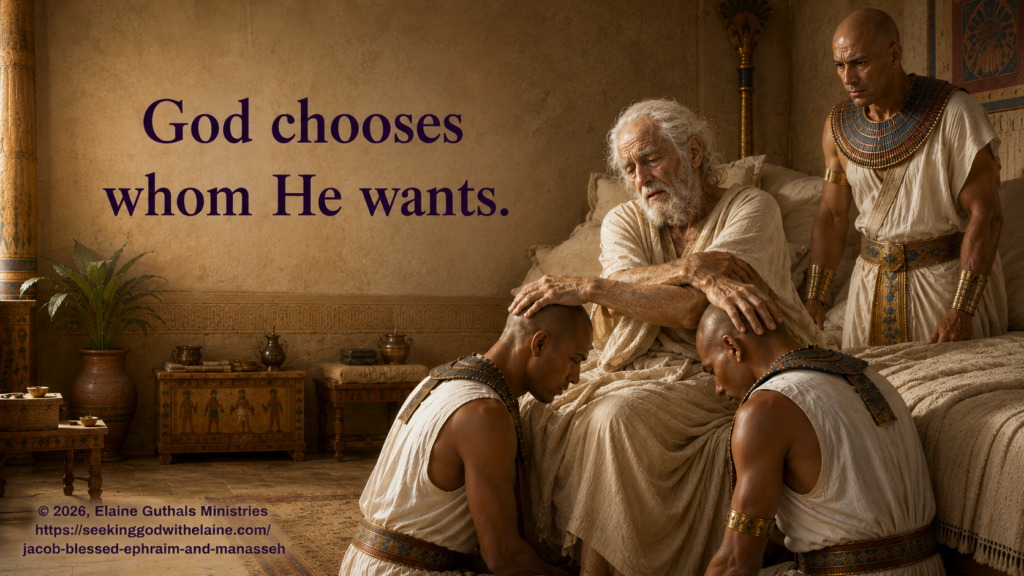
No, we aren’t talking favoritism here. “For God does not show favoritism” (Rom. 2: 11 NLT).
God bases His choice on our level of submission and obedience. He knows our motivations.
- Ishmael felt entitled and was wild.
- Esau wasn’t interested in the ruling the family part, just the wealth. Plus, he had taken Canaanite wives.
- Reuben tried to depose Jacob as family leader. It seems that all his actions — that we know of — after that were done to get back into Jacob’s good graces, not because they were what Jehovah wanted.
I know. Why didn’t Jehovah just make Isaac, Jacob, and Judah the firstborn sons?
I don’t know. I started to say that it may be a worldview notion, but Jehovah told the Israelites to set apart the firstborn sons for Him. “Dedicate to me every firstborn among the Israelites. The first offspring to be born, of both humans and animals, belongs to me” (Ex. 13: 2 NLT).
Okay, Jehovah didn’t say that until He was leading the Israelites out of Egypt. But remember, God never changes His mind. He always wanted the firstborn for His.
So, I go back to it depends on total submission and obedience. He knows who is truly His.
What is interesting is that the text never tells us that Manasseh objected. Joseph did. Joseph was troubled when Jacob crossed his arms and attempted to correct him. But Scripture records no complaint from Manasseh himself.
Think about that. Manasseh was probably about 25 years old. He was old enough to understand exactly what was happening. He knew the significance of the right hand. He knew his grandfather was placing Ephraim ahead of him.
Yet the text is silent about any protest.
Perhaps that is fitting. Manasseh had spent his entire life watching Joseph. His father’s life testified that Jehovah’s plans do not always follow human expectations. Joseph was rejected by his brothers, sold into slavery, falsely accused, imprisoned, and then elevated by Jehovah to save nations. If anyone should have understood that Jehovah’s choices are not based on human customs, it would have been Joseph’s sons.
The conflict in Genesis 48 is not between Manasseh and Ephraim. The conflict is between Joseph’s expectations and Jehovah’s choice.
Jacob was effectively making Joseph the firstborn. It raises the stakes of Joseph’s objection. Joseph has already received a firstborn’s blessing through divine providence, yet he still struggles when Jehovah rearranges the order one more time.
There’s almost a quiet irony in that. The man who benefited from Jehovah’s reversal now has to learn to accept another one.
Making the Connections #2
We know the outcome of the story. We know Ephraim became the dominant northern tribe.
Making the Connections #3
Jehovah constantly does things that do not follow earthly expectations.
Whitfield talked about our expectations and Jehovah’s expectations. He wrote, “So bent are we upon expecting God to move in our own circle, and according to our ideas of things, that it is hard to dislodge it from the mind. It is well that this law should be reversed, to show us that.”
Resource
We know the verses. “‘My thoughts are nothing like your thoughts,’ says the Lord. ‘And my ways are far beyond anything you could imagine. For just as the heavens are higher than the earth, so my ways are higher than your ways and my thoughts higher than your thoughts’” (Isa. 55: 8-9 NLT).
Sometimes, it takes a lifetime to take our hands off the reigns and allow Jehovah to have His way in our lives. But we need to surrender to Jehovah.
Making the Connections #4
We can look at Genesis 48 as a book of transition. It takes it from the patriarchs to the nation. We see that the promise and continuity transfer from the family to the nation.
We see the important of faith never waivers. The nation still has the covenant responsibility of remaining faithful and obedient to Jehovah.
Making the Connections #5
We see that Jacob had been living in Egypt for 17 years. With Joseph as #2, he would probably have seen the better side of Egypt.
It didn’t matter. Jacob did not compromise with the world in which he lived. He kept true to Jehovah.
How Do We Apply This?
- Trust Jehovah’s choices even when they differ from your expectations.
- Submit to God’s will instead of insisting on your own plans.
- Value the heart over status.
- Accept God’s direction even when it overturns tradition.
- Leave a legacy of faith.
- Recognize that Jehovah’s purposes are greater than human customs.
- Trust God to work through circumstances you do not understand.
- Honor God’s plan above personal preferences.
- Bless and encourage those who come after you.
- Remember that Jehovah sees what others cannot see.
Father God.
If you don’t understand something and would like further clarification, please contact me.
If you have not signed up for the email providing the link to the devotions and the newsletter, do so below.
If God has used this devotion to speak with you, consider sharing it on social media.