In the last devotion, Jacob and his family had just arrived in Egypt. This devotional reading looks at Joseph’s efforts to get them settled in the land and how the famine progressed after their arrival.
Nuggets
- Joseph wasn’t merely saving the family from famine; he may have been protecting them from assimilation.
- We may think it strange that Jacob blessed Pharaoh, but there was an important reason he did.
- Jacob’s description of his life was interesting.
- Joseph got his wish and settled his family into the land of Goshen.
- While the covenant people and the covenant line were protected, for others the situation during the famine became dire.
- And remember, just because Moses only lists Egypt and Canaan here, that doesn’t mean other countries were not experiencing the famine.
- We may look at Joseph’s actions during the famine through twenty-first century lenses and question the policies that he instituted.
- The only exemption was the land held by the priests.
- Even the Egyptians themselves saw their survival as merciful.
- Jehovah’s covenant was still intact.
- Jacob made plans for his burial.
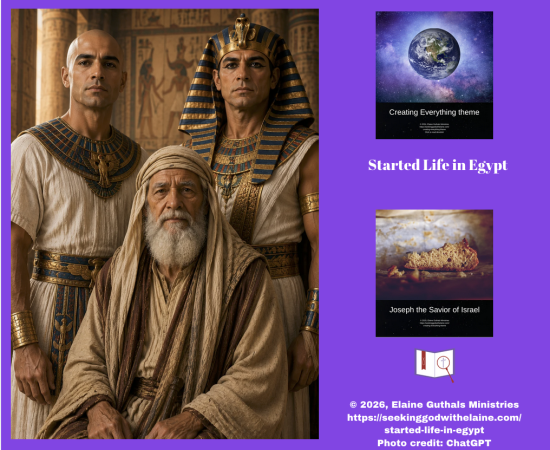
Now that Joseph’s family had relocated to Egypt, he had to get them settled. He had a plan, but he had to make sure it worked out the way he wanted it to work.
Let's Put It into Context
To read devotions in the Creating Everything theme, click the button below.
Devotions in the Joseph the Savior of Israel series
Joseph Presented His Family to Pharaoh
“Then Joseph went to see Pharaoh and told him, ‘My father and my brothers have arrived from the land of Canaan. They have come with all their flocks and herds and possessions, and they are now in the region of Goshen.’ Joseph took five of his brothers with him and presented them to Pharaoh. And Pharaoh asked the brothers, ‘What is your occupation?’ They replied, ‘We, your servants, are shepherds, just like our ancestors. We have come to live here in Egypt for a while, for there is no pasture for our flocks in Canaan. The famine is very severe there. So please, we request permission to live in the region of Goshen.’ Then Pharaoh said to Joseph, ‘Now that your father and brothers have joined you here, choose any place in the entire land of Egypt for them to live. Give them the best land of Egypt. Let them live in the region of Goshen. And if any of them have special skills, put them in charge of my livestock, too’” (Gen. 47: 1-6 NLT)
Joseph wasn’t merely saving the family from famine; he may have been protecting them from assimilation.
Once Jacob and his family arrive in Egypt, some of the brothers were presented to Pharaoh. That was appropriate as he had invited them to move down to Egypt.
Five of Jacob’s sons were questioned about their occupation. We aren’t told which five brothers were given the audience with Pharaoh.
It is important we look at it beyond the surface. Usually, we say, when we don’t get a definitive answer, that shouldn’t be the focus. And that could be the case here.
But it could also be the case that Joseph would have chosen the five brothers who were least likely to impress Pharaoh. We know Joseph has managed other encounters that his brothers were involved in.
We may not think that, if say, Judah had impressed Pharaoh, Pharaoh would have integrated him into Egyptian administration because of his leadership qualities. Let’s say big, strapping Reuben would have been a sure candidate for military service. Then look at Benjamin, just as smart if not smarter than Joseph. If Joseph saved the nation, what could Benjamin do for them?
Did you catch it? The brothers specifically asked for Goshen. Pharaoh said anywhere. Was he saying, “Come be a part of our society and contribute”?
That’s why the ending comment may seem innocuous at first but have hidden meaning. “… And if any of them have special skills, put them in charge of my livestock, too” (Gen. 47: 6 NLT).
If they weren’t interested in anything Egypt had to offer, maybe Pharaoh could hook them with what they know best. He was specificially interested in their special skills.
If we look a little deeper, we see Joseph – probably but can’t be proved – was trying to make sure his family wasn’t assimilated into Egyptian society by ensuring control over the picture that Pharaoh saw of his family.
They were shepherds. Shepherds were socially inferior in the Egyptians minds. “Then he said, ‘When Pharaoh calls for you and asks you about your occupation, you must tell him, “We, your servants, have raised livestock all our lives, as our ancestors have always done.” When you tell him this, he will let you live here in the region of Goshen, for the Egyptians despise shepherds’” (Gen. 36: 33-34 NLT).
This separation is needed to maintain covenant identity.
Jacob Blessed Pharaoh
“Then Joseph brought in his father, Jacob, and presented him to Pharaoh. And Jacob blessed Pharaoh. ‘How old are you?’ Pharaoh asked him. Jacob replied, ‘I have traveled this earth for 130 hard years. But my life has been short compared to the lives of my ancestors.’ Then Jacob blessed Pharaoh again before leaving his court” (Gen. 47: 7-10 NLT)
Jacob Blessed Pharaoh
We may think it strange that Jacob blessed Pharaoh, but there was an important reason he did.
Hmmmm. Pharaoh is the ruler of the strongest empire at that time. He was a political sovereign with much wealth.
And here this shepherd is blessing him?
Of course, Jacob blessed Pharaoh. Pharaoh himself had invited Jacob and his family down so that they would be provided for during the famine.
Jacob gave Pharaoh a covenant blessing. “I will bless those who bless you and curse those who treat you with contempt …” (Gen. 12: 3 NLT).
True, Pharaoh had the greater earthly power. Jacob had covenant standing – which will trump earthly power any day.
Traveled This Earth for 130 Hard Years
Jacob’s description of his life was interesting.
Some versions translate traveled this earth as sojourned. That evaluates life through the lens of a pilgrimage.
The patriarchs lived with the covenant in view, seeing beyond any earthly homeland.
Wait! What????
We thought that Old Testament people didn’t have a clue about Heaven.
The author of Hebrews would have taken issue with that statement. “Abraham was confidently looking forward to a city with eternal foundations, a city designed and built by God” (Heb. 11: 10 NLT).
Jacob acknowledged his hard life.
- He had manipulated his brother into selling the birthright.
- He had deceived his father to obtain the blessing.
- He had family division not only when he was living in Isaac’s tents but also when he stayed with his father-in-law- and when he had his own tents for his family.
- He had debilitating grief because his wife died and his son went away and never came back for 22 years.
- He feared his brother, both before he left for Haran and when he was coming home and Esau was coming out to meet him.
- Now, he was dealing with a devastating famine in a land that wasn’t the Promised Land.
Yes, Jacob had those life experiences. He didn’t, however, experience separation from Jehovah. Hard years don’t equal absent sovereignty.

Jacob did note that he was not going to live as long as his ancestors did. Abraham lived to be 175 years old. Isaac was 180 when he died.
Israel Settled in Goshen
“So Joseph assigned the best land of Egypt — the region of Rameses — to his father and his brothers, and he settled them there, just as Pharaoh had commanded. And Joseph provided food for his father and his brothers in amounts appropriate to the number of their dependents, including the smallest children” (Gen. 47: 11-12 NLT)
Joseph got his wish and settled his family into the land of Goshen.
This was the best land of Egypt. But it depended on your perspective if you thought that way.
The Egyptians saw the land as undesirable because they saw shepherds as undesirable.
Jacob and his family found it was the best land. They were allowed to continue in their occupation. It allowed them to remain distinct from Egypt. It was a place of protection which allowed them to multiply.
Later in the story of the covenant people in a foreign land, we would see that the land of Goshen was spared some of the plagues that Jehovah subjected the Egyptians to in order for them to release His people.
The Famine Intensified
“Meanwhile, the famine became so severe that all the food was used up, and people were starving throughout the lands of Egypt and Canaan” (Gen. 47: 13 NLT)
All the Food Was Used Up
While the covenant people and the covenant line were protected, for others the situation during the famine became dire.
Remember, when Jacob and his family arrived in Egypt, the famine had been going two years. There was five more years of it.
As those five years progressed, the famine became more severe. Throughout Egypt and Canaan, people were starving.
No, Joseph still had the food in his storehouses. This means something different.
The point is that there was no food available through normal means.
The harvests had failed. Fields weren’t producing. Private reserves had been exhausted. Livestock feed was disappearing. The population could no longer sustain itself by its own resources.
Throughout the Lands of Egypt and Canaan
And remember, just because Moses only lists Egypt and Canaan here, that doesn’t mean other countries were not experiencing the famine.
We know they were.
“Then the seven years of famine began, just as Joseph had predicted. The famine also struck all the surrounding countries, but throughout Egypt there was plenty of food. Eventually, however, the famine spread throughout the land of Egypt as well. And when the people cried out to Pharaoh for food, he told them, ‘Go to Joseph, and do whatever he tells you’” (Gen. 41: 54-55 NLT).
The other countries were not applicable to the covenant story. So, Moses didn’t list them again.
The People Sold Their Land and Themselves
“By selling grain to the people, Joseph eventually collected all the money in Egypt and Canaan, and he put the money in Pharaoh’s treasury. When the people of Egypt and Canaan ran out of money, all the Egyptians came to Joseph. ‘Our money is gone!’ they cried. ‘But please give us food, or we will die before your very eyes!’ Joseph replied, ‘Since your money is gone, bring me your livestock. I will give you food in exchange for your livestock.’ So they brought their livestock to Joseph in exchange for food. In exchange for their horses, flocks of sheep and goats, herds of cattle, and donkeys, Joseph provided them with food for another year. But that year ended, and the next year they came again and said, ‘We cannot hide the truth from you, my lord. Our money is gone, and all our livestock and cattle are yours. We have nothing left to give but our bodies and our land. Why should we die before your very eyes? Buy us and our land in exchange for food; we offer our land and ourselves as slaves for Pharaoh. Just give us grain so we may live and not die, and so the land does not become empty and desolate.” So Joseph bought all the land of Egypt for Pharaoh. All the Egyptians sold him their fields because the famine was so severe, and soon all the land belonged to Pharaoh. As for the people, he made them all slaves from one end of Egypt to the other” (Gen. 47: 14-21 NLT)
We may look at Joseph’s actions during the famine through twenty-first century lenses and question the policies that he instituted.
That would be a wrong take.
Would they fly in today’s society? Maybe. Maybe not.
What we should read in this passage is the severity of the famine. Nothing was growing. If Jehovah hadn’t have given Pharaoh the dream and if Joseph wouldn’t have instituted grain management, some really nasty things would have happened:
- Egypt would have collapsed
- mass starvation would have occurred
- social order would have disintegrated
- money would have failed
- livestock would have died
- land would have failed
- personal autonomy would have failed
But then, couldn’t we make the argument that society collapsed?
- People ran out of money buying food.
- People exchanged their livestock for food.
- People surrendered their land for food.
- People became Pharaoh’s slaves for food.
This did not make Joseph a tyrant.
The problem was the severity of the famine. The problem was not Joseph or the fact that he sold food to starving people.
Joseph was managing the resources that Jehovah provided so that many could be saved.
Priestly Allotment
“The only land he did not buy was the land belonging to the priests. They received an allotment of food directly from Pharaoh, so they didn’t need to sell their land” (Gen. 47: 22 NLT)
The only exemption was the land held by the priests.
In Egypt at that time, religion and politics were integrated. This created a centralized economic structure in Egypt.
Israel weren’t sustained by Pharaoh’s priesthood. They were sustained by Jehovah according to the covenant faithfulness.
Joseph Established a National Policy
“Then Joseph said to the people, ‘Look, today I have bought you and your land for Pharaoh. I will provide you with seed so you can plant the fields. Then when you harvest it, one-fifth of your crop will belong to Pharaoh. You may keep the remaining four-fifths as seed for your fields and as food for you, your households, and your little ones.’ ‘You have saved our lives!’ they exclaimed. ‘May it please you, my lord, to let us be Pharaoh’s servants.’ Joseph then issued a decree still in effect in the land of Egypt, that Pharaoh should receive one-fifth of all the crops grown on his land. Only the land belonging to the priests was not given to Pharaoh” (Gen. 47: 23-26 NLT)
Even the Egyptians themselves saw their survival as merciful.
As Pharaoh now owned the land and the people, Joseph established a law that one-fifth of the produce grown would belong to Pharaoh. This, while it was substantial, was not what other Ancient Near Eastern taxation required.
All saw this as preservation, reorganization, and restoration. Yes, Egypt was reorganized, and Israel was preserved.
In fact, everyone looked at Joseph as their savior.
Israel Multiplied in Egypt
“Then Joseph said to the people, ‘Look, today I have bought you and your land for Pharaoh. I will provide you with seed so you can plant the fields. Then when you harvest it, one-fifth of your crop will belong to Pharaoh. You may keep the remaining four-fifths as seed for your fields and as food for you, your households, and your little ones.’ ‘You have saved our lives!’ they exclaimed. ‘May it please you, my lord, to let us be Pharaoh’s servants.’ Joseph then issued a decree still in effect in the land of Egypt, that Pharaoh should receive one-fifth of all the crops grown on his land. Only the land belonging to the priests was not given to Pharaoh” (Gen. 47: 23-26 NLT)
“Meanwhile, the people of Israel settled in the region of Goshen in Egypt. There they acquired property, and they were fruitful, and their population grew rapidly” (Gen. 47: 27 NLT)
Jehovah’s covenant was still intact.
Egypt didn’t stop the covenant. Neither did famine or exile.
Jehovah’s promises kept moving forward.
Jacob’s Final Request
“Jacob lived for seventeen years after his arrival in Egypt, so he lived 147 years in all. As the time of his death drew near, Jacob called for his son Joseph and said to him, ‘Please do me this favor. Put your hand under my thigh and swear that you will treat me with unfailing love by honoring this last request: Do not bury me in Egypt. When I die, please take my body out of Egypt and bury me with my ancestors.’ So Joseph promised, ‘I will do as you ask.’ ‘Swear that you will do it,’ Jacob insisted. So Joseph gave his oath, and Jacob bowed humbly at the head of his bed” (Gen. 47: 28-31 NLT)
Jacob made plans for his burial.
Jacob knew his death was approaching. He had Joseph promise to bury him at Hebron, in the cave already occupied by Abraham, Sara, Isaac, Rebbkah, and Leah.
Joseph was asked to swear an oath in a way that we have seen before. Remember when Abraham was sending Eliezer off to Haran to find a wife for Isaac? He had Eliezar swear by putting his hand under Abraham’s thigh (Gen. 24: 2).
We said that by Eliezer/Joseph putting a hand under Abraham’s/Jacob’s thigh, they would have been putting it close to the circumcised part. It is like our putting our hand over our heart to show our sincerity of our promise.
By placing his hand as close to the covenant sign as he could, Joseph made a covenant promise to keep Jacob’s request made in covenant faith.
Jacob would see that his bones being returned to the Promised Land would be an act of covenant faith.
Making the Connections
Joseph may have been rejected by his siblings, but he was not rejected by Jehovah. He used him to save the covenant people and the covenant line.
The rejected brother became the sustaining shepherd of Israel, foreshadowing a greater Shepherd.
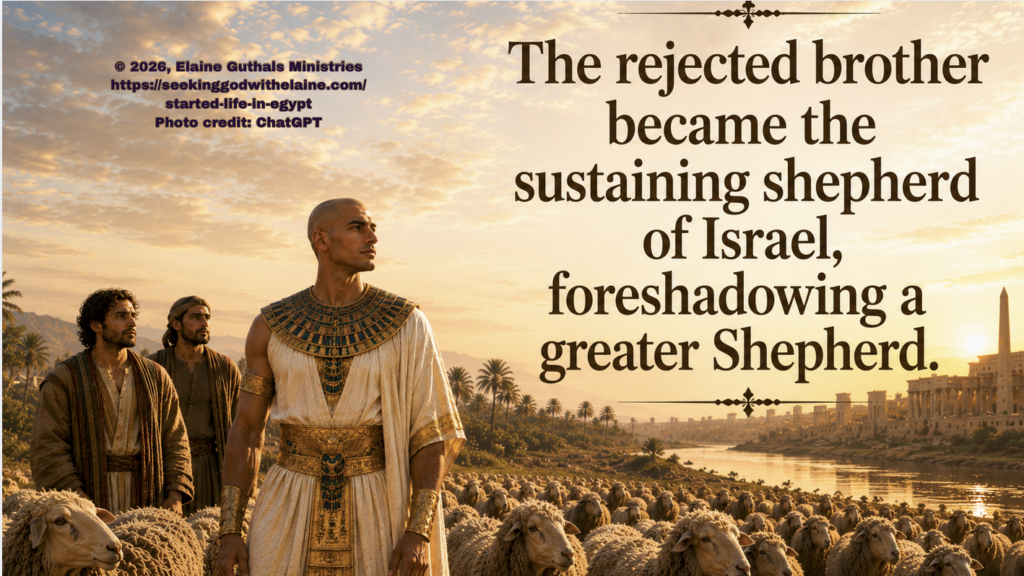
Genesis 47 repeatedly portrays Joseph as the sole channel through which. Life is preserved – much the same way as there is only one channel through which eternal life is gained.
How Do We Apply This?
- Remember that hard years do not mean Jehovah has abandoned you.
- Guard your covenant identity instead of being assimilated by the world around you.
- Trust Jehovah’s long-term purposes even when you cannot see what He is doing.
Father God. Thank You for the way that You provide for us. Lord, keep us separated from the world and its sinful pleasures. Help us to be focused totally on You. Amen.
If you don’t understand something and would like further clarification, please contact me.
If you have not signed up for the email providing the link to the devotions and the newsletter, do so below.
If God has used this devotion to speak with you, consider sharing it on social media.