After placing his brothers in prison for three days, Joseph brings them before him again. This devotional reading looks at the audience the brothers have with Joseph before they are allowed to go home.
Nuggets
- Three-day periods in Scripture indicate a time of testing.
- It may or may not have startled the brothers that Joseph said he was a God-fearing man.
- The bottom line didn’t change in the three days – bring Benjamin back.
- The brothers brought up their sin against Joseph, wondering if this trouble was punishment for that sin.
- Joseph responded to their fear.
- Joseph picked Simeon to remain while the others left.

This trip to Egypt wasn’t just a quick trip to buy grain. But Jacob’s sons didn’t know that until they got there.
The reception with the one man didn’t go well. The brothers had been accused of being spies and thrown into prison.
Let's Put It into Context
To read devotions in the Creating Everything theme, click the button below.
Devotions in the Joseph the Savior of Israel series
After The Brothers’ Time in Prison
“On the third day Joseph said to them, ‘I am a God-fearing man. If you do as I say, you will live. If you really are honest men, choose one of your brothers to remain in prison. The rest of you may go home with grain for your starving families. But you must bring your youngest brother back to me. This will prove that you are telling the truth, and you will not die.’ To this they agreed” (Gen. 42: 18-20 NLT)
Third Day
Three-day periods in Scripture indicate a time of testing.
We know of other times when three days occurred. The Hebrew used here was bayyôm haššĕlîšî (בַּיּוֹם הַשְּׁלִישִׁי) — on the third day.
- Abraham and Isaac’s journey to Mt. Moriah (Gen. 22: 4)
- Israel meeting Jehovah on Mt. Sinai (Ex. 19: 11)
- Jonah in the whale (Jon. 1)
- Hezekiah was healed (II Kgs. 20: 5)
- Esther approached the king (Est. 5: 1)
- Yeshua raising on the third day
Third day was symbolic. It means
- transition
- divine intervention
- emergence from danger/death
- covenant movement
- revelation
- restoration
I Am a God-Fearing Man
It may or may not have startled the brothers that Joseph said he was a God-fearing man.
I wonder if the brothers were standing when Joseph told them that he feared Jehovah. If they were, were they on the floor quickly?
But maybe not.
Remember, the ruler was a Hyksos Pharaoh. The Hyksos (heqa khasut or rulers of foreign lands) were a mixed-race people of primarily West Semitic origin. That means he was a possible descendant of Ishmael, Abraham’s son. If not, he may have been a descendant of Ham, Noah’s son.
The Egyptians would have remembered Joseph as the Hebrew dream interpreter. Some may have remembered Who he said interpreted Pharaoh’s dreams.
“‘It is beyond my power to do this,’ Joseph replied. ‘But God can tell you what it means and set you at ease’” (Gen. 41: 16 NLT).
But the brothers wouldn’t have known that.
This reiterates the fact that, while Joseph would change his outward appearance, he wouldn’t change his heart.
Bring Your Youngest Brother Back
The bottom line didn’t change in the three days – bring Benjamin back.
We talked a little bit in the last devotion about things that wouldn’t be why Joseph asked that Benjamin be brought back. With the tunic, dreams, and sale occurring the same year as Rachel’s death – and Benjamin’s birth – happening in one year, Benjamin himself wasn’t really the central issue.
The whole reason Joseph wanted Benjamin to come back was the brothers.
Joseph knew his father. He knew Jacob would have become more protective of Benjamin. That would have been the exact opposite of what the brothers would have been hoping for by selling him.
Did you notice that, in the three days the brothers were in jail, Joseph changed his mind. At first, he was going to have all stay except one who was going to go back and get Benjamin.
“One of you must go and get your brother. I’ll keep the rest of you here in prison …” (Gen. 42: 16 NLT).
Now, Joseph was going to allow all but one leave. But he was constant in saying they had to bring Benjamin back.
The Brothers Gave Some Insight to That Day
“Speaking among themselves, they said, ‘Clearly we are being punished because of what we did to Joseph long ago. We saw his anguish when he pleaded for his life, but we wouldn’t listen. That’s why we’re in this trouble.’ ‘Didn’t I tell you not to sin against the boy?” Reuben asked. ‘But you wouldn’t listen. And now we have to answer for his blood!’” (Gen. 42: 21-22 NLT)
The brothers brought up their sin against Joseph, wondering if this trouble was punishment for that sin.
I bet Joseph got an education listening to his brothers hash it out. First off, they acknowledged that they knew Joseph was hurting in the pit — and they didn’t care at the time.
Wait! What????
Joseph pled for his life? We weren’t told that in Genesis 37.
“Then they grabbed him and threw him into the cistern. Now the cistern was empty; there was no water in it. Then, just as they were sitting down to eat, they looked up and saw a caravan of camels in the distance coming toward them. It was a group of Ishmaelite traders taking a load of gum, balm, and aromatic resin from Gilead down to Egypt” (Gen. 37: 24-25 NLT).
True, biology doesn’t always mean family members see things the same way and get along.
Reuben had been the only one who had wanted to return Joseph to his father (Gen. 37: 29-30). He couldn’t because the others had sold him to the Ishmaelite traders.
But Reuben knew there would be a reckoning. We are held accountable for our actions. “Yes, each of us will give a personal account to God” (Rom. 14: 12 NLT).
Joseph Heard Their Fear
“Of course, they didn’t know that Joseph understood them, for he had been speaking to them through an interpreter. Now he turned away from them and began to weep. When he regained his composure, he spoke to them again. Then he chose Simeon from among them and had him tied up right before their eyes” (Gen. 42: 23-24 NLT)
Joseph responded to their fear.
But the bigger thing was Joseph knew they still felt guilty about what they did to him. Time had shown them the error of their ways. The guilt was still there.
Do we think that Joseph should have made himself known to his brothers right then? Isn’t that what many want – instantaneous forgiveness?
Joseph had probably always been Jacob’s favorite, so the brothers had 17 years of envying him.
No, Joseph had probably already forgiven them when he saw God’s plan for his life. But they had killed his trust in them. That was going to take more than a he’s-gone-and-we’re-paying-for-it-now discussion.
He Chose Simeon
Joseph picked Simeon to remain while the others left.
We would probably think Reuben — as the oldest — would have been the one to be chosen. But he had just said (Gen. 42: 22) that he had stuck up for Joseph that day 13 years ago (Gen. 37: 21). The problem was he didn’t stop his brothers; so he, too, was guilty.
Reuben’s big sin was against Jacob (Gen. 35: 22), not Joseph.
Were we surprised that it was Simeon who stayed behind in Egypt?
Simeon was the next oldest. He should have been advocating for his younger brother. Instead, Simeon was one of the ones advocating to punish Joseph for his favoritism.
Simeon also had also committed another sin. It was him and Levi who had killed all the men of Shechem for Prince Shechem defiling Dinah (Gem. 34: 25-26).
It doesn’t say the brothers were bound when Joseph put them in prison three days ago (Gen. 42: 17).
Making the Connections
Did Jehovah convict people of their sins in the Old Testament?
Well, yes. A major way in which Jehovah calls us from rebellion to holiness is by what we call conviction.
This conviction comes from Jehovah – we know now through the Holy Spirit. The Holy Spirit worked in a different way – that we know of — before resurrection.
There wasn’t an indwelling of the Spirit then. He came and rested on people for an undisclosed amount of time.
But did the Holy Spirit still convict sinners as He does now?
Maybe. Maybe not. We do know of times of conviction.
Take, for example, Adam and Eve after the original sin. In Genesis 3: 9, Jehovah approached them with a question, “… ‘Where are you?’” (ESV).
David’s sin with Bathsheba precipitated the writings of a couple of Psalms, detailing his feelings while under conviction (Ps. 32, Ps. 51).
Frothingham asserted that, when the Holy Spirit first convicts us, we feel fear. This stems from a sense of awe toward an invisible presence that impresses upon one’s conscience a moral awareness.
Resource
Ooo, baby. We can be afraid when Sovereign God is convicting us for disobedience to Him. We can worry about the type and severity of that punishment.
Part of the fear, too, can be because we know we have disappointed Jehovah.
Frothingham gave us insight on the timing of these convictions. He wrote, “
The God whom we ‘fear’ deals with us in the slow course of His appointments, through the gradual changes of time and age.”
Conviction forces our souls to turn inward to address the musings of our conscience. This was what the brothers were doing when they were discussing whether their current situation was punishment from Jehovah for their sin.
Yeah, 13 years after the sin, Jehovah will convict us to restore our relationships with Him.
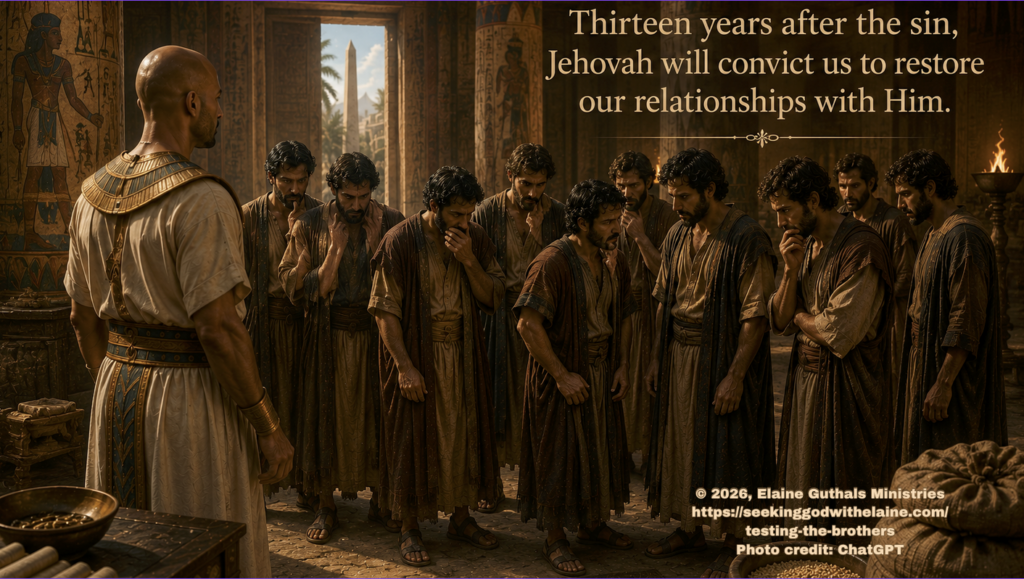
Conviction is a major element early on in the redemption process.
· Conviction – yākhaḥ (יָכַח); elegchō (ἐλέγχω)
· Return – shûb (שׁוּב)
· Transformation – metanoia (μετάνοια)
How Do We Apply This?
- Allow Jehovah to expose sins you have tried to bury.
- Do not mistake delayed consequences for erased guilt.
- Respond to conviction with repentance instead of defensiveness.
- Remember that forgiveness and restored trust are not always instantaneous.
- Let conviction draw you toward restoration instead of shame.
- Acknowledge the pain your actions may have caused others.
- Understand that Jehovah may revisit old wounds in order to bring healing.
- Do not ignore the warnings of your conscience.
- Accept that sanctification sometimes involves uncomfortable exposure.
- Trust that Jehovah’s testing is meant for restoration, not destruction.
- Be willing to face difficult truths about yourself.
- Confess not only outward sin but also hidden motives and attitudes.
- Learn to recognize conviction as an act of covenant love.
Father God. Thank You for families. Help us when we become dysfunctional families. Help us to confess our sins, repent, and forgive each other. Amen.
If you don’t understand something and would like further clarification, please contact me.
If you have not signed up for the email providing the link to the devotions and the newsletter, do so below.
If God has used this devotion to speak with you, consider sharing it on social media.