Author: admin

  • Mary Visited Elizabeth

    After she had received a visit from an angel to tell her of her pregnancy, Mary went to visit her relative, Elizabeth. This devotional reading looks at the greeting between the two women and the unique situations in which they found themselves.

    Nuggets

    • Mary chose to go visit her relative Elizabeth, who was also pregnant, to process what was happening to her.
    • Mary and Elizabeth lived in totally different places.
    • Luke didn’t record the town in which Elizabeth and Zechariah lived.
    • More than Elizabeth greeted Mary.
    • Filled with the Holy Spirit, Elizabeth began to prophecy.
    • Blessed among women was not new language about Mary.
    • Yeshua was called Lord before He was born.
    • Elizabeth affirmed Mary’s faith.

    It wasn’t every day that an angel paid a human a visit. It wasn’t every day that a virgin was told she was going to have a baby. It wasn’t every day that a virgin was told that her relative, who was beyond childbearing age, was going to have a baby.

    All that once in 2 million lifetimes meant that a road trip was needed. Mary decided to go see her relative.

    Let’s Put It into Context

    To read devotions in The Battle for the Heart theme

    Devotions in the Preparing for the Christ Child series

    Mary Visited Elizabeth

    “A few days later Mary hurried to the hill country of Judea, to the town where Zechariah lived… (Lk. 1: 39-40 NLT)

    A Few Days Later

    Mary chose to go visit her relative Elizabeth, who was also pregnant, to process what was happening to her.

    We don’t know if Mary talked to Joseph before she left town. She may have gotten out while the getting was good, but I don’t really think so.

    Stowe felt this trip highlighted Mary’s character. She wrote, “The next step taken by Mary is in accordance with the calmest practical good sense, and displays an energy and a control over other minds which must have been uncommon.”

    Resource

    Mary was a woman of integrity, so I would think she talked to Joseph first. Besides, he probably already knew about the pregnancy when the angel came to talk with him.

    Some versions say that Mary “… went into the hill country with haste …” (Lk. 1: 39 KJV). The Greek word is meta spoudēs (μετὰ σπουδῆς); it means haste, eagerness, diligence, earnestness, zeal, and promptness.

    Hebrew doesn’t have a direct word that translates to this. Several express the same idea. One is mahēr (מַהֵר), which means hasten, hurry, and make haste. Another is ḥāpaz (חָפַז), meaning to hurry or be in haste.

    That follows Mary’s faith. She immediately submitted in obedience when Gabriel said she was going to carry God’s Son.

    Everything Gabriel said was said for a reason. That means he told Mary about Elizabeth’s pregnancy for a reason.

    As she was also involved in Jehovah’s plan, Elizabeth may have been the one person most likely to have understood.

    I wonder if Mary was concerned about what Elizabeth’s reception of her would be. Would Mary’s news be accepted, or would she be seen as someone who was delusional?

    The Hill Country of Judea

    Mary and Elizabeth lived in totally different places.

    Nazareth, where Mary lived, was a small inconsequential village. Its only claim to fame was that it was where the Messiah lived during childhood and early adulthood.

    The hill country (har Yehudah – הַר יְהוּדָה) was something entirely different. It would have been considered the heartland of Judah.

    It stretched from Jerusalem to Hebron. This was the place where Abraham settled. It is where Abraham, Sarah, Isaac, Rebekah, Jacob, and Leah are buried.

    It was also home to King David while he was fleeing Saul. Also, his first capital was in the region before it was moved to Jerusalem.

    Mary would have then passed many spots where Israel history had been made. (She would make the same journey again within nine months.)

    It was the rugged mountainous region, within the land of Judah, which surrounded Jerusalem. There were fairly large mountains at 2,500 to 3,300 feet above sea level. Because of this, the area was characterized by limestone ridges, steep valleys, and terraced hillsides, and scattered villages built from local stone.

    The arid climate fostered the growth of olive groves and vineyards. The stony ground would have made their growth difficult and cause extensive cultivation.

    Because of its proximity to Jerusalem, it hosted many priestly settlements.

    Where Zechariah Lived

    Luke didn’t record the town in which Elizabeth and Zechariah lived.

    Early Christian tradition identified it as Ein Kerem, a village five miles southwest of Jerusalem. This is where a known priestly settlement  – one of many – was located in the hill country.

    Geikie felt that what was meant was Mary went to the city of Judah – or Juttah. He argued that just saying a city in Judah was too vague.

    Resource

    The journey from Nazareth to Ein Kerem would have been considerable in first-century Israel. It was approximately 80 to 100 miles. A normal trip would take four to six days to make on foot.

    No, that wasn’t a trip Mary would have taken alone. She would have traveled with a caravan of pilgrims, merchants, or other relatives heading toward Jerusalem.

    Even with other people, she was probably traveling alone – meaning no parents or siblings went with her. That took courage and determination.

    But get there, Mary did.

    Now, Mary may or may not have used the Central Ridge Route to get to the Hill Country. That went right through Samaria – and most Jews bypassed that. It would have depended on what the caravan or whoever was leading the trip decided.
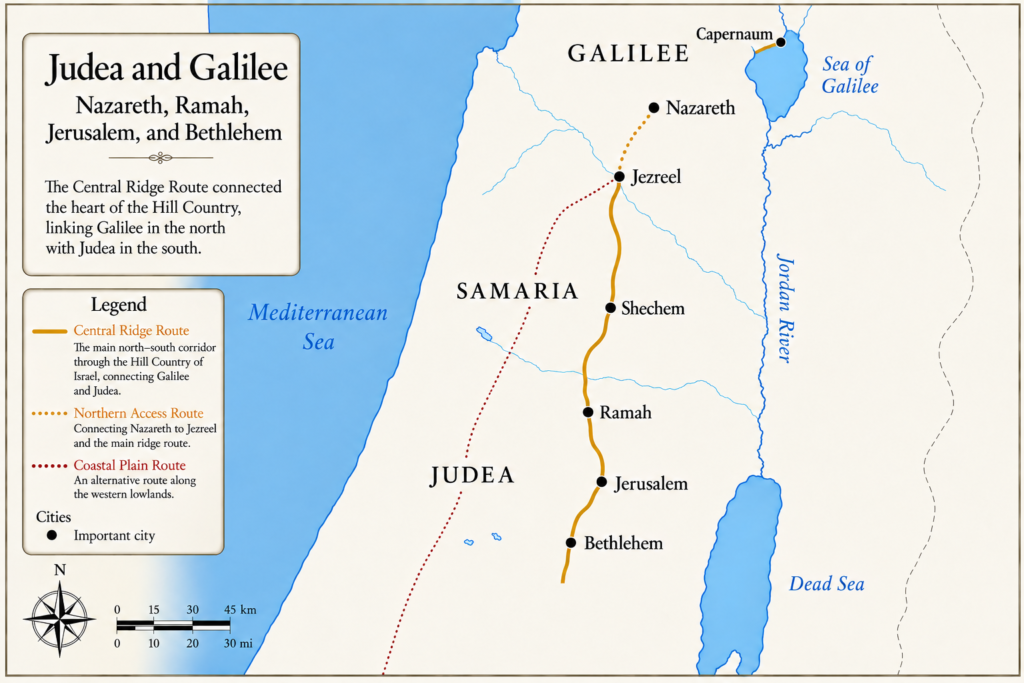
    The young virgin from an overlooked village traveled to the ancient covenant heartland, where the first public recognition of Israel’s Messiah would occur.

    Greeting

    “… She entered the house and greeted Elizabeth. At the sound of Mary’s greeting, Elizabeth’s child leaped within her, and Elizabeth was filled with the Holy Spirit” (Lk. 1: 40-41 NLT)

    More than Elizabeth greeted Mary.

    It doesn’t sound like Mary even got to tell her news. Elizabeth was told by the Holy Spirit. Mary greeted – John leaped – Elizabeth was filled with the Holy Spirit.

    John greeted Jesus’s mother. More importantly, before either were born, John was already greeting unborn Yeshua.

    We shouldn’t be surprised. Gabriel said John would be filled with the Holy Spirit in the womb (Lk. 1: 15).

    No, the first recognition of the Messiah was not Zechariah, the priest – or any priest in the Temple. It was in a faithful elderly couple’s home by the forerunner of the Messiah.

    Jehovah’s plan was known to its principal players.

    Elizabeth Was Filled with the Holy Spirit

    “Elizabeth gave a glad cry and exclaimed to Mary, ‘God has blessed you above all women, and your child is blessed. Why am I so honored, that the mother of my Lord should visit me? When I heard your greeting, the baby in my womb jumped for joy. You are blessed because you believed that the Lord would do what he said’” (Lk. 1: 42-45 NLT)

    Gave a Glad Cry

    Filled with the Holy Spirit, Elizabeth began to prophecy.

    No, Elizabeth didn’t suddenly have insight on her own. There was no way she would have known that Mary was pregnant.

    They didn’t have phones or internet in that day. The media wouldn’t have been alerted.

    Elizabeth was filled with the Holy Spirit. That is the way He worked in Old Testament times. (This occurred before Pentecost, when the Holy Spirit permanently indwelt believers.)

    The Holy Spirit landed on people for a specific purpose. He didn’t indwell in them yet.

    Mary may have been there because of Elizabeth, but Elizabeth quickly turned the focus onto Mary.

    God Has Blessed You above All Women

    Blessed among women was not new language about Mary.

    I wonder what Mary thought when Elizabeth started the blessing. “Blessed are you among women …” (Lk. 1: 42 ESV).

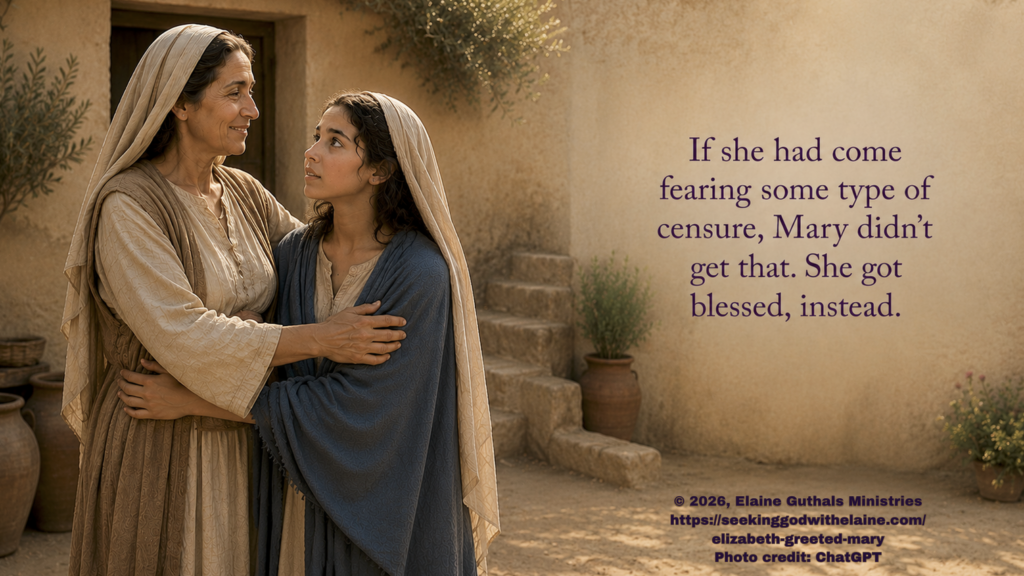
    If she had come fearing some type of censure, Mary didn’t get that. She got blessed, instead.
    Other women had been blessed in Scripture. “Most blessed among women is Jael, the wife of Heber the Kenite. May she be blessed above all women who live in tents” (Jdgs. 5: 24 NLT). In Jewish tradition, there is also Judith, in the Book of Judith, who was blessed among women.

    No, this didn’t elevate Mary above humanity in any way. It means that she had received an unparalleled privilege in Jehovah’s redemptive plan.

    The Mother of my Lord

    Yeshua was called Lord before He was born.

    It is one thing that Elizabeth recognized that Mary was pregnant without being told. But to know that her child was Krios – Lord – this she would have only gotten from the Holy Spirit.

    Elizabeth recognized the identity of Mary’s child. Before Jesus ever performed a miracle, preached a sermon, or called a disciple, He was already acknowledged as Lord.

    True, the title has an element of respect to it. Luke, however, repeatedly uses it in ways that echo the divine covenant name, especially when quoting or alluding to the Old Testament.

    Because You Believed

    Elizabeth affirmed Mary’s faith.

    Again, Elizabeth didn’t know about the conversation between Gabriel and Mary. But she could tell Mary’s obedience.

    Zechariah had been visited by Gabriel and was made speechless because of his disbelief. Mary stood before Elizabeth talking, joyful, and free. She had responded with faith and obedience.

    Just think how Mary would have felt. She was a teenager who was asked to have a baby when everything in that society would have seen that as a huge sin.

    This visit was another indication to Mary that everything was going to be okay.

    Making the Connections #1

    When we read through the whole passage, what comes flowing out of it is the joy. Both ladies approach their situations with joy.

    • Mary traveled with eager obedience.
    • Elizabeth was filed with the Holy Spirit.
    • Even John got into the action by leaping in the womb.
    • Blessings are spoken repeatedly.
    • Faith is celebrated.

    Nowhere was fear mentioned. Those who trust Jehovah do so with joy. That trust produces joyful recognition and worship.

    Making the Connections #2

    Knowing that Jehovah exists isn’t faith. It is knowledge.

    It is listening to Jehovah, trusting Him, and being obedient to His call.

    Making the Connections #3

    This was a quiet family visit. Two women, both miraculously pregnant, taking comfort from each other.

    Yes, this was a religious event.

    No priests – because we hear nothing about Zechariah being present.

    No Temple.

    But the Holy Spirit was there.

    The Holy Spirit confirmed the identity of the Messiah. The forerunner rejoiced.

    Mary and Elizabeth responded because they believed God’s Word.

    Making the Connections #4

    Did you catch that? Yeshua hasn’t been born yet. He hasn’t preached a sermon. More importantly, He hasn’t done a miracle.

    The baby was still identified as the Messiah.

    Later, how many people would only believe because of the miracles? How many would see the miracles and still not believe?

    Heart Check

    Think about the battle Yeshua is engaged in for your heart. Ask yourself the following questions.

    • Do I respond to God’s leading with eager obedience like Mary?
    • Do I rejoice when I see God working in someone else’s life?
    • Am I willing to trust God before I understand everything He is doing?
    • Does my faith produce joy, or does fear dominate my response?

    How Do We Apply This?

    • Worship Jehovah with joyful expectation.
    • Trust Jehovah’s timing even when you don’t understand His plan.
    • Keep your eyes on Jehovah instead of your circumstances.
    • Encourage someone else’s faith the way Elizabeth encouraged Mary’s.
    • Respond to God’s Word with immediate obedience.

    Father God. Thank You for families that lead us to You and encourage us when we are anxious about Your calling.  Thank You when we can go to brothers and sisters in Christ and get encouragement. Amen.

    If you don’t understand something and would like further clarification, please contact me.

    If you have not signed up for the email providing the link to the devotions and the newsletter, do so below.

    If God has used this devotion to speak with you, consider sharing it on social media.
  • The Family of Jesus

    Jesus was divine, but He was also human. This devotional reading looks at how His ancestry fulfilled covenant promises.

    Nuggets

    • Since Matthew’s Gospel is the first book of the New Testament, his wording presents a bridge between the two testaments.
    • Being placed at the beginning of Matthew’s gospel shows the importance of Yeshua being shown as a descendant of both Abraham and David.
    • There are four women – other than Yeshua’s mother – identified in the lineage.
    • Matthew would have probably used Joseph’s lineage because he would have been, by Jewish tradition, the legal father of Yeshua.
    • Taken all together, Matthew’s genealogy shows the fulfillment of the covenants with Abraham (Gen. 12, 15, and 17) and David (II Sam. 7).
    • Luke’s genealogy indicated that Yeshua was the Savior of the world.

    One of the first questions first-century Jews would have asked about anyone claiming to be the Messiah was, “Is He descended from David?” Both Mary and Joseph were descendants of David.

    This was essential to fulfill God’s promise through the prophet Jeremiah: “‘For the time is coming,’ says the Lord, ‘when I will raise up a righteous descendant from King David’s line. He will be a King who rules with wisdom. He will do what is just and right throughout the land. And this will be his name: “The Lord Is Our Righteousness.” In that day Judah will be saved, and Israel will live in safety” (Jer. 23: 5-6 NLT).

    Let’s Put It into Context

    To read devotions in The Battle for the Heart theme

    Devotions in the Preparing for the Christ Child series

    The Reason for the Genealogy

    Since Matthew’s Gospel is the first book of the New Testament, his wording presents a bridge between the two testaments.

    Even though today’s society doesn’t always put as much emphasis on family lines, first-century Jews did. It may be safe to say that Israelites in the Old Testament — stressed even more the importance of family even over character at times.

    Genealogy is translated from the Hebrew word sēfer tôlədôt (סֵפֶר תּוֹלְדֹת). These genealogies tie Yeshua to Old Testament passages.

    • “And through your [Abraham’s] descendants all the nations of the earth will be blessed — all because you have obeyed me” (Gen. 22: 18 NLT).
    • “I see him [Jehovah], but not here and now. I perceive him, but far in the distant future. A star will rise from Jacob; a scepter will emerge from Israel. It will crush the heads of Moab’s people, cracking the skulls of the people of Sheth” (Num. 24: 17 NLT).
    • “The scepter will not depart from Judah, nor the ruler’s staff from his descendants, until the coming of the one to whom it belongs, the one whom all nations will honor” (Gen. 49: 10 NLT).
    • “Out of the stump of David’s family will grow a shoot — yes, a new Branch bearing fruit from the old root” (Isa. 11: 1 NLT).
    • “For when you [David] die and are buried with your ancestors, I will raise up one of your descendants, your own offspring, and I will make his kingdom strong. He is the one who will build a house — a temple — for my name. And I will secure his royal throne forever” (II Sam. 7: 12-13 NLT).

    Matthew was giving evidence that Yeshua was a descendant of King David and Father Abraham.

    The Genealogy of Yeshua through Joseph

    “This is a record of the ancestors of Jesus the Messiah, a descendant of David and of Abraham: Abraham was the father of Isaac. Isaac was the father of Jacob. Jacob was the father of Judah and his brothers. Judah was the father of Perez and Zerah (whose mother was Tamar). Perez was the father of Hezron. Hezron was the father of Ram. Ram was the father of Amminadab. Amminadab was the father of Nahshon. Nahshon was the father of Salmon. Salmon was the father of Boaz (whose mother was Rahab). Boaz was the father of Obed (whose mother was Ruth). Obed was the father of Jesse. Jesse was the father of King David. David was the father of Solomon (whose mother was Bathsheba, the widow of Uriah). Solomon was the father of Rehoboam. Rehoboam was the father of Abijah. Abijah was the father of Asa. Asa was the father of Jehoshaphat. Jehoshaphat was the father of Jehoram. Jehoram was the father of Uzziah. Uzziah was the father of Jotham. Jotham was the father of Ahaz. Ahaz was the father of Hezekiah. Hezekiah was the father of Manasseh. Manasseh was the father of Amon. Amon was the father of Josiah. Josiah was the father of Jehoiachin and his brothers (born at the time of the exile to Babylon). After the Babylonian exile: Jehoiachin was the father of Shealtiel. Shealtiel was the father of Zerubbabel. Zerubbabel was the father of Abiud. Abiud was the father of Eliakim. Eliakim was the father of Azor. Azor was the father of Zadok. Zadok was the father of Akim. Akim was the father of Eliud. Eliud was the father of Eleazar. Eleazar was the father of Matthan. Matthan was the father of Jacob. Jacob was the father of Joseph, the husband of Mary. Mary gave birth to Jesus, who is called the Messiah. All those listed above include fourteen generations from Abraham to David, fourteen from David to the Babylonian exile, and fourteen from the Babylonian exile to the Messiah” (Mt. 1: 1-17 NLT)

    A Descendant of David and of Abraham

    Being placed at the beginning of Matthew’s gospel shows the importance of Yeshua being shown as a descendant of both Abraham and David.

    Matthew’s genealogy is interesting. The structure was built around the number seven. That signifies completion.

    Matthew is not saying God’s work of redemption was complete at Jesus’ birth. It isn’t about completion of the Plan of Salvation.

    It is the completion of waiting for salvation.

    Three groups of 14 give structure to Matthew’s list. This meant he used the sabbatical system.

    Williams helped us understand that concept. He wrote,

    “The sabbatical meaning in the Bible is deeply connected to rest, trust in God, and letting go of control. It is not just about taking a break from work, but about entering a season where people, land, and even creation itself are allowed to rest under God’s care.”

    Resource

    Aren’t those all tied up in salvation – what we gain when Yeshua wins the battle for our hearts? Matthew was announcing that the long waiting for salvation was over.

    More importantly, Matthew was signaling a new creation. That is exactly what happens when Yeshua wins the battle of the heart. We become a new creation.

    The structure is meaningful. Matthew started with Abraham because that was where the covenant identity started.

    Even though the firstborn sons were dedicated to Jehovah (Ex. 13: 1-2), Judah, Jacob, Isaac, and probably even Abraham himself were not the firstborn son of the family.

    Firstborn sons were to be consecrated to Jehovah.

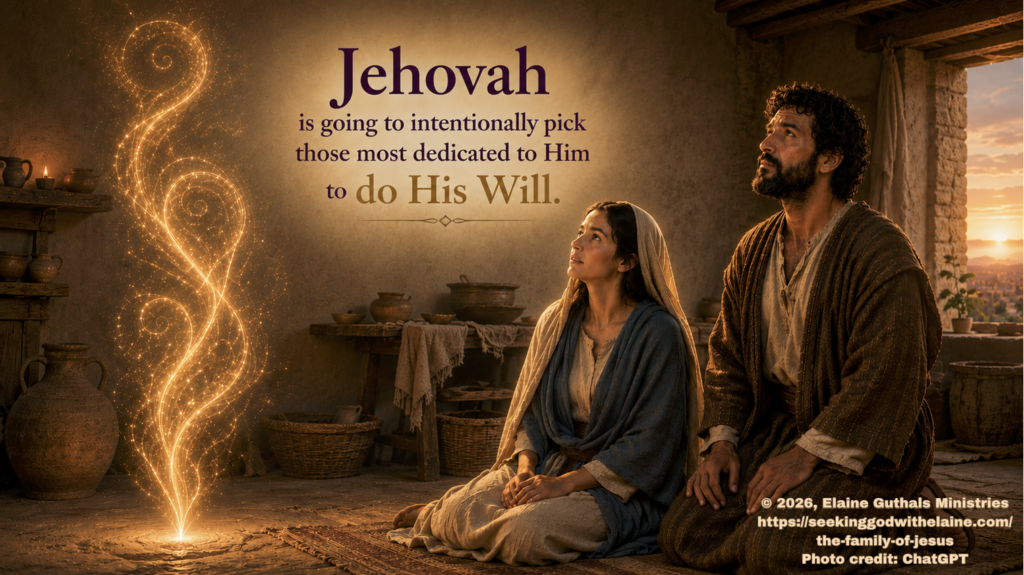
    But that didn’t necessarily indicate who would serve Jehovah. Anyone could choose to serve Him. Jehovah is going to intentionally pick those most dedicated to Him to do His Will.

    The middle section of the sabbatical system is important because it shows Yeshua’s right to the throne of David. This fulfilled a covenant promise.

    The time between David and the exile shows the history of Israel. They were the chosen people who constantly chose not to follow Jehovah.

    Because of that, Israel’s punishment included the loss of the land and Temple. Also lost was David’s throne.

    Zerubbabel

    This loss of the throne became painfully evident after the exile. This is probably when many of the Israelites began asking, “Did Jehovah’s promises fail?”

    It became even more evident when David’s descendant Zerubbabel helped lead the first wave of exiles back to Israel and played a major role in rebuilding the Second Temple. Here was a descendant of the David and a leader in Israel – yet he never was anointed king.

    Zerubbabel remained faithful to Jehovah, but David’s throne still stood empty. The uncertainty only deepened Israel’s longing for the promised Messiah.

    Yeshua’s Grandmothers

    There are four women identified in the lineage.

    The four women identified in Matthew’s genealogy are women who were important to the history of the nation of Israel. All four were believed to be Gentile women.

    • Tamar
    • Rahab
    • Ruth
    • Bathsheba

    Tamar was the wife of two of Judah’s sons, both who died. When Judah did not arrange the marriage to another of his sons, Tamar dressed as a prostitute, became pregnant by Judah, and had twin boys (Gen. 38).

    Rahab was a Canaanite prostitute. She sheltered the Israelite spies when they reconned Jericho. Because she protected them, she and her family were protected in the fall of Jericho (Josh. 2).

    Ruth was a Moabite woman who married an Israelite displaced by a famine. After her husband died and the famine ended, she remained faithful to her widowed mother-in-law when Naomi wanted to return to Israel (Ruth 1-4).

    The New Living Translation did something differently. The last woman isn’t usually named except through context. “… David was the father of Solomon by the wife of Uriah” (Mt. 1: 6 ESV).

    If we know who Solomon’s mother was, why didn’t Matthew just name her as Bathsheba?

    By naming Uriah – Bathsheba’s first husband – first-century Jews were reminded of David’s greatest sin. It included adultery, murder, and abuse of power.

    But it also included a psalm of repentance. We see this in Psalm 51.

    Writing the lineage this way highlighted not only Uriah’s innocence but also Bathsheba’s. The story highlights Jehovah’s grace over failure.

    Doesn’t that bring up a good point? The royal line also needed salvation and grace.

    These women are included even though they are Gentiles. Moreover, they are all associated with scandal.

    We see one important thread in their stories: they were given Jehovah’s unexpected grace. Jehovah’s redemptive plan advances not because of human perfection, but because of His covenant faithfulness.

    Joseph, the husband of Mary

    Matthew would have probably used Joseph’s lineage because he would have been, by Jewish tradition, the legal father of Yeshua.

    No, we don’t know how many people knew the real story of the conception. We are never told if they were allowed to broadcast it, or whether they had to keep it quiet for security purposes.

    Joseph was a righteous descendant of David who legally became Yeshua’s earthly father. Although Matthew introduces him only briefly here, his character will become central after the angel appears to him in a dream.

    But Matthew was careful in his wording. He never said that Joseph was the father of Yeshua. He just acknowledged him as the husband of the mother of Yeshua.

    All Those Listed Above

    Taken all together, Matthew’s genealogy shows the fulfillment of the covenants with Abraham (Gen. 12, 15, and 17) and David (II Sam. 7).

    Yeshua not only has a right to the throne of David, but He also fulfills the promise of blessing to the nations. Israel’s King and covenant fulfillment was coming to the earth.

    The Genealogy of Yeshua through Mary

    “Jesus was about thirty years old when he began his public ministry. Jesus was known as the son of Joseph. Joseph was the son of Heli. Heli was the son of Matthat. Matthat was the son of Levi. Levi was the son of Melki. Melki was the son of Jannai. Jannai was the son of Joseph. Joseph was the son of Mattathias. Mattathias was the son of Amos. Amos was the son of Nahum. Nahum was the son of Esli. Esli was the son of Naggai. Naggai was the son of Maath. Maath was the son of Mattathias. Mattathias was the son of Semein. Semein was the son of Josech. Josech was the son of Joda. Joda was the son of Joanan. Joanan was the son of Rhesa. Rhesa was the son of Zerubbabel. Zerubbabel was the son of Shealtiel. Shealtiel was the son of Neri. Neri was the son of Melki. Melki was the son of Addi. Addi was the son of Cosam. Cosam was the son of Elmadam. Elmadam was the son of Er. Er was the son of Joshua. Joshua was the son of Eliezer. Eliezer was the son of Jorim. Jorim was the son of Matthat. Matthat was the son of Levi. Levi was the son of Simeon. Simeon was the son of Judah. Judah was the son of Joseph. Joseph was the son of Jonam. Jonam was the son of Eliakim. Eliakim was the son of Melea. Melea was the son of Menna. Menna was the son of Mattatha. Mattatha was the son of Nathan. Nathan was the son of David. David was the son of Jesse. Jesse was the son of Obed. Obed was the son of Boaz. Boaz was the son of Salmon. Salmon was the son of Nahshon. Nahshon was the son of Amminadab. Amminadab was the son of Admin. Admin was the son of Arni. Arni was the son of Hezron. Hezron was the son of Perez. Perez was the son of Judah. Judah was the son of Jacob. Jacob was the son of Isaac. Isaac was the son of Abraham. Abraham was the son of Terah. Terah was the son of Nahor. Nahor was the son of Serug. Serug was the son of Reu. Reu was the son of Peleg. Peleg was the son of Eber. Eber was the son of Shelah. Shelah was the son of Cainan. Cainan was the son of Arphaxad. Arphaxad was the son of Shem. Shem was the son of Noah. Noah was the son of Lamech. Lamech was the son of Methuselah. Methuselah was the son of Enoch. Enoch was the son of Jared. Jared was the son of Mahalalel. Mahalalel was the son of Kenan. Kenan was the son of Enosh. Enosh was the son of Seth. Seth was the son of Adam. Adam was the son of God” (Lk. 3: 23-38 NLT)

    Luke’s genealogy indicated that Yeshua was the Savior of the world.

    Luke also included in his book a genealogy list. But when we look at it, it is different than Matthew’s list.

    Right off, we can see the names are different. Matthew’s list says that Joseph’s father’s name is Jacob (Mt. 1: 16). Luke’s list says that Joseph’s father’s name is Heli (Lk. 3: 23).

    What gives?

    The explanation is simple. Matthew’s list shows Joseph’s lineage. Luke’s list shows Mary’s lineage.

    That is understandable, too. It is believed that Matthew was writing to Jewish readers. They would have expected the father’s lineage – even though Joseph wasn’t Yeshua’s biological father. He was His legal father.

    Luke, presumably writing to Greeks, used Mary’s lineage. She was Yeshua’s biological mother. Her father was Heli.

    There is another difference in the genealogy lists. Matthew’s list started with Abraham and ended with Yeshua.

    Luke’s genealogy started with Yeshua and ended with God. It showed that He was the Savior of all.

    That makes sense to me. Yeshua came to address the sin issue that happened in the Garden of Eden with Adam and Eve. That was long before Jehovah made the covenant with Abraham and established the nation of Israel.

    One thing that we may tend to forget is that Yeshua and John the Immerser were cousins. That would mean Yeshua was also descended from Levi, the line of priests.

    Making the Connections #1

    “… Two years after the great flood, when Shem was 100 years old, he became the father of Arphaxad. After the birth of Arphaxad, Shem lived another 500 years and had other sons and daughters. When Arphaxad was 35 years old, he became the father of Shelah. After the birth of Shelah, Arphaxad lived another 403 years and had other sons and daughters. When Shelah was 30 years old, he became the father of Eber” (Gen. 11: 10-14 NLT)

    “… Eber was the son of Shelah. Shelah was the son of Cainan. Cainan was the son of Arphaxad. Arphaxad was the son of Shem …” (Lk. 3: 35-36)

    In Genesis, Cainan was skipped, making Arphaxad the grandfather of Shelah, not the father as indicated in Luke.

    But then, it really doesn’t say Shelah was Arphaxad’s son, just his descendant. A grandson would be his descendant.

    Not only that, but there are also different spellings – depending on the translation used – for the names given for his father: Arphaxad or Arpachshad.

    In other words, we don’t know who was what.

    Making the Connections #2

    We understand that the Israelites, later the Jews, put great store in their lineage. That is why there are so many genealogy lists in the Old Testament.

    What can we learn from them?

    Between the two lists, they show the humanity and divinity of Yeshua. It shows He is both Jew and Gentile. We see that He is mortal and immortal.

    We see Yeshua’s imperfect human nature with His perfect divine nature. (That doesn’t mean that He sinned. It means that He had the human nature, so He could have.)

    While He may have royal blood flowing through His veins, Yeshua was also intimately knowledgeable of poverty.

    Making the Connections #3

    Since there is an emphasis on genealogy lists, does that mean we need to know our ancestry in order to gain salvation?

    No, these two lists are the only genealogy lists in the New Testament.

    • “Don’t let them waste their time in endless discussion of myths and spiritual pedigrees. These things only lead to meaningless speculations, which don’t help people live a life of faith in God” (I Tim. 1: 4 NLT).
    • “Do not get involved in foolish discussions about spiritual pedigrees or in quarrels and fights about obedience to Jewish laws. These things are useless and a waste of time” (Ti. 3: 9 NLT).

    Paul was stressing that it doesn’t matter who our parents are – either believer or non-believer. Anyone can come to Yeshua for salvation.

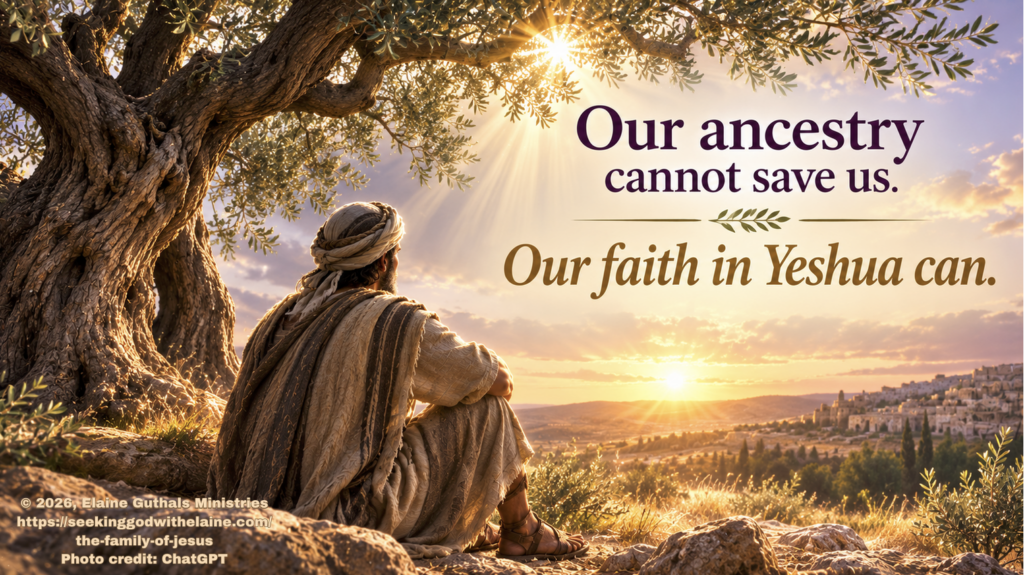
    Our ancestry cannot save us. Our faith in Yeshua can.

    It also shows us that we need to focus on the present and the future, not the past. Our past sins are forgiven when we ask Jehovah for forgiveness. Obtaining that forgiveness and walking with Him daily takes precedence over the past.

    Making the Connections #4

    To understand the greatly anticipated first-century Messiah, we have to understand their expectation was profoundly covenantal and corporate. The people were waiting for Jehovah to act on behalf of the nation of Israel. 

    They had the covenant promises. However, covenant promises were not merely about personal spirituality. They addressed national destiny, covenant inheritance, land promise, temple hope, political liberation, and divine justice. 

    So, what were they expecting? 

    By the first century, Israel’s Messianic hopes had intensified dramatically. They weren’t however, waiting for a rabbi to die at the hands of Rome. 

    They were very exact in their expectations for the Messiah. We have to realize that they got most of these expectations directly from Scripture. 

    They expected the Messiah – Mashiach (מָשִׁיחַ) meaning anointed one – to embody covenant fulfillment itself. 

    More than anything, first-century Jews wanted the Messiah to be a conquering Messiah. They wanted Him to show up and kick Rome out of their country – the Promised Land. 

    The covenant promised land, which equated to independence from Gentile domination. The Messiah was expected to remedy that.  

    When first-century Jews thought of redemption, they thought Ga’al (גָּאַל). This meant to redeem, to reclaim, or to act as a kinsmen-redeemer. 

    This redemption was not limited to spiritual forgiveness. It involved restoration of inheritance, protection of covenant family, and liberation from oppression. 

    In the United States, we look at things through the lens of separation of church and state. Originally set up as the state has no jurisdiction within the church, many worldview people have flipped that to mean the church has no jurisdiction outside its walls. 

    A major part of Messianic expectation in first-century Israel was built on the belief that politics and theology were never fully separated.  This belief was fostered by the fact that Israel was a covenant nation under divine kingship, not merely a religious community. Use of the same Hebrew term – Shuv (שׁוּב) – to refer to political restoration as well as covenantal restoration advanced this dual restoration. 

    First-century Jews believed the coming  Messiah would overthrow pagan domination and restore righteous rule. That would make the Kingdom of God visible, politically and nationally. 

    All of the political and national hopes of a conquering king centered around the judgment of Israel’s oppressors. Scripture repeatedly declared that Jehovah would eventually judge those nations that had humiliated Israel – Babylon, Assyria, Edom, and later pagan oppressors. 

    Restoration theology dominated Jewish Messianic expectation. The prophets promised  

    • a future regathering of Israel 
    • renewal of covenant blessings 
    • restoration of the land 
    • purification from sin 
    • renewed obedience to Jehovah 

    This theology was tied to the belief that exile never ended.  

    Heart Check

    Think about the battle Yeshua is engaged in for your heart. Ask yourself the following questions.

    • Have I ever placed more confidence in my family background, church heritage, or good works than in my personal faith in Yeshua?
    • Am I trusting God’s covenant faithfulness, even when His promises seem delayed like they did to Israel between the exile and the coming of the Messiah?
    • Like Tamar, Rahab, Ruth, Bathsheba, and even David, do I believe Jehovah’s grace is greater than my past failures?
    • Is my identity rooted more in whose I am than in who I come from?

    How Do We Apply This?

    • Thank Jehovah for faithfully keeping every covenant promise that led to the coming of Yeshua.
    • If you’ve been relying on your religious background or family heritage, reaffirm that your hope for salvation rests in Yeshua alone.
    • Evaluate where you’ve doubted God’s timing, and surrender it to Him
    • Trust Him to keep His promises — even when fulfillment takes more time than we think it should.

    Father God. Thank You for putting us in families that lead us to You. Thank You that this applies to our ancestors and to those who have become family to us. Help us to continue shepherding our descendants to You. Amen.

    If you don’t understand something and would like further clarification, please contact me.

    If you have not signed up for the email providing the link to the devotions and the newsletter, do so below.

    If God has used this devotion to speak with you, consider sharing it on social media.
  • Who Gabriel Said Jesus Would Be

    Gabriel told Mary that her Son would be the Son of the Most High. This devotional reading unpacks all that means.

    Nuggets

    • Mary was about to be told she was going to have a very special Baby.
    • Mary’s Son would be exalted above every other man.
    • The Messiah had several Son of titles that heightened the expectation of His mission.

    In the last devotion, Gabriel came to Nazareth to give Mary exciting news. This teen-aged virgin was going to have a baby.

    We looked at Mary and her response to the message. We didn’t look at Who the angel said her Son would be.

    Let’s dig into that now.

    Let’s Put It into Context

    To read devotions in The Battle for the Heart theme

    Devotions in the Preparing for the Christ Child series

    Who Yeshua Would Be

    “He will be very great and will be called the Son of the Most High. The Lord God will give him the throne of his ancestor David. And he will reign over Israel forever; his Kingdom will never end!” (Lk. 1: 30-33 NLT)

    He Will Be Very Great

    Mary was about to be told she was going to have a very special Baby.

    There is an interesting contrast here. Go back to Gabriel’s last visit. Zechariah was told that John would “… be great in the eyes of the Lord …” (Lk. 1: 15 NLT).

    Here, Gabriel doesn’t put any qualifier on great but rather adds an adverb that expands the definition. Yeshua would be very great.

    But great can be relative sometimes, can’t it? We may see it as boundless or abundant.

    When she heard the word great, Mary probably thought gādôl (גָּדוֹל). She would have hooked it to Scripture.

    • “Great is the Lord! He is most worthy of praise! He is to be feared above all gods” (Ps. 96: 4 NLT).
    • “‘But my name is honored by people of other nations from morning till night. All around the world they offer sweet incense and pure offerings in honor of my name. For my name is great among the nations,’ says the Lord of Heaven’s Armies” (Mal. 1: 11 NLT).
    • “Great are the works of the Lord, studied by all who delight in them” (Ps. 111: 2 ESV).
    • “And David became greater and greater, because the Lord God of Heaven’s Armies was with him” (II Sam. 5: 10 NLT).
    • “(Now the Lord had caused the Egyptians to look favorably on the people of Israel. And Moses was considered a very great man in the land of Egypt, respected by Pharaoh’s officials and the Egyptian people alike.)” (Ex. 11: 3 NLT).

    Mary would have understood great to mean exalted.

    Think about it. Here was this teenager, excitedly planning her upcoming marriage. She heard the angel tell her that she was going to have a baby. She wouldn’t have the stigma of barrenness that Elizabeth had carried for so many years.

    Son of the Most High

    Mary’s Son would be exalted above every other man.

    Yeshua’s greatness would not merely  describe His influence or reputation. It would flow from who He is – the promised Messiah, the Son of the Most High, and the eternal King.

    Mary was about to be told she was going to have a baby in an unimaginable way.

    Gabriel told Mary that she was going to have a Son – not just any son, but the Son of God. Mary’s Son would “… be called the Son of the Most High …” (Lk. 1: 32 NLT). This identified Him as fully divine. “And she will have a son, and you are to name him Jesus, for he will save his people from their sins” (Mt. 1: 21 NLT).

    Son

    The Messiah had several Son of titles that heightened the expectation of His mission.

    The Hebrew word for son is ben (בֵּן). This means more than biological ancestry. It refers to membership, character, covenant relationship, inheritance, or reputation.

    In Hebrew thought, a son was expected to represent his father’s character, authority, and mission. Thus, son often described identity and function rather than merely ancestry.

    Don’t miss the character part. We say many times that we have the character traits of our parents. But the first-century Jews would know this could designate a metaphysical relationship.

    I can understand that. I’ve spoken of my Springfield Mom several times. That relationship is and has been very important to me – even though there is nothing biological about it.

    Here, it also has the aspect of bearing another’s authority. The son represents the father and exercises his delegated authority.

    Son of God

    The title Son of God is one of the richest Messianic designations in Scripture. While we see it through the lens of modern theology, first-century Jews saw it through language of the covenant, kingship, and divine appointment.

    For Christians, the title ultimately reveals the Messiah’s eternal relationship with the Father. First-century Jews, however, would initially have understood it through the language of covenant, kingship, and divine appointment. “Then you will tell him, ‘This is what the Lord says: Israel is my firstborn son. I commanded you, “Let my son go, so he can worship me.” But since you have refused, I will now kill your firstborn son!’” (Ex. 4: 22-23 NLT).

    The Gospels, however, deepen our understanding of the title as Yeshua tried to deepen their understanding. He was the covenant heir to David’s throne and the rightful King of Israel. The kingdom, however, was the Kingdom of God — renewing covenant people and extending the blessing to all the nations.

    The Throne of His Ancestor David

    Son of David

    Mary’s Son was going to sit on the throne of David.

    The title Son of David is one of the clearest Messianic titles in first-century Judaism. It strengthened the hope that the Messiah would restore the kingdom of Israel by recalling the Davidic covenant. “Your house and your kingdom will continue before me for all time, and your throne will be secure forever” (II Sam. 7: 16 NLT).

    This Son was going to be the promised Messiah because “… His kingdom will never end” (Lk. 1: 33 NLT).

    By Yeshua’s time, centuries of theological development had intertwined with covenant, kingship, Temple, and restoration. Son of David had become virtually synonymous with Messiah.

    To call Yeshua the Son of David was not merely to identify His ancestry but to confess that He was the promised heir to David’s throne and the One through whom Jehovah would fulfill His covenant promises.

    This was how the promise came down. Messiah — King — victorious. All three things were true — just not in the way the Jews were looking for Him.

    Gabriel was talking to Mary in covenant language. What he was saying fulfilled II Samuel 7: 16. David was promised an unending dynasty when one of his Descendants would rule for eternity.

    In this section, Gabriel doesn’t go into the miraculous part of the conception. What he does talk about is a normal, run-of-the-mill pregnancy. This stresses that Jesus is going to be fully human and fully divine.

    Making the Connections #1

    “The Spirit of the Sovereign Lord is upon me, for the Lord has anointed me to bring good news to the poor. He has sent me to comfort the brokenhearted and to proclaim that captives will be released and prisoners will be freed. He has sent me to tell those who mourn that the time of the Lord’s favor has come, and with it, the day of God’s anger against their enemies. To all who mourn in Israel, he will give a crown of beauty for ashes, a joyous blessing instead of mourning, festive praise …” (Isa. 61: 1-3 NLT)

    Isaiah 61: 1-3 gives some more items on Yeshua’s job description. Let’s pick them out.

    • Bring good news to the poor
    • Comfort the brokenhearted
    • Proclaim and release the captives
    • Sent to those who mourn
    • Give a crown of beauty for ashes
    • Give joyous blessing
    • Give festive praise

    Isaiah talked about the poor and those who mourn. They are the first two Beatitudes.

    Brokenhearted doesn’t mean the common heartbreak we humans suffer. It means we have a sinful heart, but we are remorseful about that. “And the prayer of faith will save the one who is sick and the Lord will raise him up. And if he has committed sins, he will be forgiven” (Jas. 5: 15 ESV).

    Is there anything else on Yeshua’s job description – or maybe a more concise way to say it?

    • Offer salvation and eternal life through faith in Him to the captives who are poor in spirit.
    • Fulfill Old Testament prophecies as the Messiah.
    • Serve as a mediator between God and humanity.
    • Teach love, compassion, and forgiveness to all people.
    • Perform miracles to demonstrate divine power and compassion.
    • Model a life of humility, service, and sacrifice for others.

    Making the Connections #2

    “My Spirit remains among you, just as I promised when you came out of Egypt. So do not be afraid” (Hag. 2: 5 NLT)

    “Then he said to me, ‘This is what the Lord says to Zerubbabel: It is not by force nor by strength, but by my Spirit, says the Lord of Heaven’s Armies’” (Zech. 4: 6 NLT)

    These two verses represent the last time Jehovah had spoken with Israel. That was approximately 520 BC.

    The Israelites were back from exile. They were building the Second Temple.

    Then … silence. Four hundred long years of silence.

    Then Gabriel went to see Zechariah. Next, he went to see Mary.

    This time, to that sweet young girl, who welcomed Gabriel into her world for that five minutes. This time, he talked about the Holy Spirit.

    In the Old Testament, the Ruach Elohin Ruach Elohim (רוּחַ אֱלֹהִים) – Spirit of God – or the Ruach YHWH (רוּחַ יְהוָה) – Spirit of the LORD – had several duties.

    • Brought order out of chaos (Gen. 1: 2)
    • Empowered individuals for tasks (Samson, Gideon, David)
    • Prophetic inspirations
    • Moral/Spiritual renewal promised but not fulfilled (Ezek. 36: 26-27; Joel 2: 28)

    The Spirit had not yet come to permanently indwell God’s people. He was selective, temporary, and task oriented.

    Even before Yeshua said He had to go so the Spirit could be sent (Jn. 16: 7), He was in John in the womb. Elizabeth and Zechariah were filled with the Spirit, and Mary was overshadowed by it.

    What changed?

    We have to realize that the work the Spirit is doing in Luke 1 is the ignition point. It is temporary still, but He is working.

    Making the Connections #3

    Before we continue, let’s step back a moment to look at the biblical background. To understand why Gabriel’s words were so astonishing, we need to understand what Mary already knew.

    Gabriel’s announcement didn’t happen in a vacuum. He was announcing the fulfillment of promises Jehovah had been making for centuries.

    If we don’t understand those promises, we’ll miss much of what Mary would have heard in his words. This is going to be important for all of our dives into the Gospels.

    The coming of the Messiah was foretold through the covenant promises. It provided Israel with a covenant identity. Their covenant identity was the identity Jehovah gave, defined, sustained, and governed through the covenant relationship with Himself. It was corporate, covenantal, relational, and generational.

    Jehovah introduced the Messianic promises through a series of covenants.

    After the original sin – commonly called the Fall – Jehovah judged the man, the woman, and the serpent, declaring the spiritual conflict that would follow between the serpent and the woman, and between his seed and hers. This promise culminated with the declaration that the seed of the woman would crush the serpent’s head while sustaining injury Himself.

    This marked the beginning of the expectation and the hope for a Messiah.

    The covenant with Abraham dramatically expanded the scope of Messianic hope. In Genesis 12, 15, 17, and 22, Jehovah pledged a variety of promises to Abraham (then called Abram). The promise to bless all families of the earth revealed the outward reach of God’s redemptive plan.

    The covenant underscored continuity through a chosen line. Although that line traces back through Adam’s son Seth and Noah’s son Shem, it was not formally established as the covenant line until Jehovah made His covenant with Abraham.

    Jacob introduced royal and kingship imagery that profoundly shaped later Messianic expectation in his last words to his son Judah. It was through him the Messiah – the scepter – shevet (שֵׁבֶט) – would come and never depart (Gen. 49: 10).

    The people of Israel didn’t demand a human monarchy until the days of Samuel the Prophet. Jehovah’s choice of David, from the tribe of Judah, as king was significant because it moved the future hope from an abstract promise into the framework of royal history and theology.

    Making the Connections #4

    Gabriel wasn’t simply announcing a pregnancy. He was announcing the fulfillment of thousands of years of covenant promises. Mary’s Son would be the Son of God, the Son of David, Israel’s Messiah, and the eternal King whose kingdom would never end.

    Heart Check

    Think about the battle Yeshua is engaged in for your heart. Ask yourself the following questions.

    • Have you received Jesus only as a good teacher, or have you trusted Him as the Son of God and your King?
    • Is there an area of your life where you need to surrender to His authority as the eternal King?

    How Do We Apply This?

    • Thank Jehovah for His faithfulness in fulfilling His covenant promises.
    • Worship Jesus as the Son of God and rightful King.
    • Submit your life to His authority today.
    • Thank Jehovah for keeping His covenant promises through Christ.

    Father God. Your Promises last generation to generation. And regardless of how long we have waited for them to be fulfilled, You will fulfill them on Your timetable – and it will be wonderful. Thank You for sending Your Son to allow us to restore our relationships with You.

    If you don’t understand something and would like further clarification, please contact me.

    If you have not signed up for the email providing the link to the devotions and the newsletter, do so below.

    If God has used this devotion to speak with you, consider sharing it on social media.
  • Jesus’ Birth Foretold

    Gabriel was sent to a small village in Israel to announce another miraculous conception that would occur. This devotional reading looks at the response of a teenager in Nazareth.

    Nuggets

    • When Elizabeth was in the sixth month of her pregnancy, Jehovah sent the same messenger down to earth.
    • This is the second time in Luke 1 that Gabriel has been sent to humans to announce the impending miraculous birth of sons.
    • Nazareth was an insignificant town.
    • Mary’s life was already planned out because she was betrothed to Joseph.
    • We don’t know much about Joseph, either.
    • Mary didn’t know what to think when Gabriel addressed her.
    • Mary had the normal reaction to an angel.
    • Mary’s obedience to Jehovah was recognized.
    • Mary was about to be told she was going to have a baby in an unimaginable way.
    • Mary’s question was not a question of if but how.
    • Just because everyone says it can’t happen doesn’t mean it can’t happen.
    • Mary’s simple response showed her devotion to Jehovah. 

    Gabriel had already been to visit Zechariah to announce the conception of John the Immerser. He was about to make a second visit.

    If John was to prepare the way for Someone coming after him, that Someone’s birth needed announced, also.

    Let’s Put It into Context

    To read devotions in The Battle for the Heart theme

    Devotions in the Preparing for the Christ Child series

    Christ’s Birth Announced to Mary

    “In the sixth month of Elizabeth’s pregnancy, God sent the angel Gabriel to Nazareth, a village in Galilee, to a virgin named Mary. She was engaged to be married to a man named Joseph, a descendant of King David” (Lk. 1: 26-27 NLT)

    In the Sixth Month of Elizabeth’s Pregnancy

    When Elizabeth was in the sixth month of her pregnancy, Jehovah sent the same messenger down to earth.

    The message was the same but in different circumstances: you are going to have a baby. Even though the circumstances made the message a little more unbelievable, Gabriel got a little different reception this time.

    Gabriel

    This is the second time in Luke 1 that Gabriel has been sent to humans to announce the impending miraculous birth of sons.

    We talked, when Gabriel – Gavi’el (גַּבְרִיאֵל) – the mighty messenger from God –  visited Zechariah, that his visit was to bring more than birth announcements. He first visited Daniel in Daniel 8: 16 and Daniel 9: 21-23 to interpret Jehovah’s plan for redemption. Now, he was visiting earth to announce that plan was beginning to be put into motion.

    Nazareth

    Nazareth was an insignificant town.

    Nazareth was a small Galilean village in the hills of Lower Galilee. The village probably had 200 to 400 inhabitants. It was tucked into the hills, so there was no trade route associated with it.

    Mary, Engaged to be Married

    Mary’s life was already planned out because she was betrothed to Joseph.

    The woman Gabriel gave this message to was named Mary (Miryam). We learn a couple of important things about her, mainly because she is described to be betrothed.

    The betrothal process had changed from Abraham’s day. In Jewish life it was then a legal institution consisting of two stages.

    The first stage was the betrothal (Kiddushin – נִישּׂוּאִין), also called Erusin (אֵרוּסִין). It was more than our engagement. It included witnesses, a formal declaration, and a transfer of value.

    The betrothal process was formalized through the marriage contract (Ketubah – כְּתוּבָּה). This was a legally binding agreement, which could only be broken through a writ of divorce (get – גֵּט).

    The emphasis had shifted away from the bride price (mohar – מֹהַר), what the groom paid the bride’s father. Instead, it emphasized the husband’s continued financial obligation to the wife if the marriage ended through divorce or death. This protected the bride’s future security.

    It is estimated that she was a teenager. 12 and 15, although there really isn’t enough first-century documents to establish a precise age as the most common.

    Isn’t it wonderful! God uses older people, younger people, and everyone in between!

    Because she was betrothed but not married, Mary was a virgin.

    The marriage, where the union is consummated, was called the Nissuin (נִישּׂוּאִין). This usually occurred a year after the Kiddushin.

    Farningham identified four characteristics that could be associated with the mother of Yeshua.

    • Humility
    • Submission
    • Quietness
    • Fidelity

    Resource

    Mary was chosen because she was a righteous person.

    Joseph

    We don’t know much about Joseph, either.

    Joseph is described as a righteous man (Mt. 1: 19). His character certainly fits the role God entrusted to him as Yeshua’s earthly father.

    Some traditions picture Joseph as considerably older than Mary, though Scripture does not tell us his age.

    We don’t know what happened to Joseph. He just leaves the narrative. Because of that, we assume he died.

    Greetings

    “Gabriel appeared to her and said, ‘Greetings, favored woman! The Lord is with you!’ Confused and disturbed, Mary tried to think what the angel could mean” (Lk. 1: 28-29 NLT)

    Mary didn’t know what to think when Gabriel addressed her.

    Mary had to have been surprised by the appearance of the angel. Then when she heard what he first had to say, she must have been really confused.

    Shalom wouldn’t have troubled Mary as that was the standard greeting. She may or may not have been startled by “Adonai is with you!” If she was blameless (as Joseph was identified [Mt. 1: 19]), she would have known Jehovah never leaves us (Deut. 31: 6).

    What probably troubled Mary was being told of her favored status. Well, think about it. Expecting it would have been prideful – eliminating her from favored status.

    Can’t you just hear it going through her mind, “Who, me? Favored by the Lord? I know He knows my name, but seriously? Blessed?

    We may not realize it, but Gabriel was greeting her as a saint. She would have been favored because she was righteous, not because she was sinless.

    The Message

    “Don’t be afraid, Mary,’ the angel told her, ‘for you have found favor with God! You will conceive and give birth to a son, and you will name him Jesus. He will be very great and will be called the Son of the Most High. The Lord God will give him the throne of his ancestor David. And he will reign over Israel forever; his Kingdom will never end!” (Lk. 1: 30-33 NLT)

    Don’t be Afraid, Mary

    Mary had the normal reaction to an angel.

    Gabriel was smart. He let Mary get over the initial shock of seeing him. People being afraid of heavenly encounters was a normal thing (Gen. 28: 17; Ex. 3: 6; Isa. 6: 5).

    Reassurance was a good thing, Gabriel even called her by name to show he was at the right place at the right time with the right girl.

    You Have Found Favor

    Mary’s obedience to Jehovah was recognized.

    Then Gabriel repeated himself: “… you have found favor with God” (Lk. 1: 30 NLT). On the surface, this was more reassurance.

    That is good, because I am sure what Gabriel had to say next deepened the confusion.

    Bushnell observed that the angel’s words could mean either that God had shown favor to Mary or that Mary had found favor with Him. He favored the latter interpretation, connecting it to her prayers and longing for the Messiah. I’m sure He saw she did have the list Farningham made.

    Resource

    Think about it. Yes, Mary would have had to be blameless as Elizabeth. But if you look at favor as being unmerited favor, that deepens the confusion, also. Mary would probably agree that Jehovah’s favor was unmerited, but she had probably already begun asking herself, “Why me?”

    Conceive and Give Birth to a Son

    Mary was about to be told she was going to have a baby in an unimaginable way.

    A virgin birth? But think back about who is writing this book. Luke was a physician. He knew how babies came. Normally, it wasn’t this way.

    But the doctor lays it all out for everyone to read.

    What Luke wrote was an accurate account of what happened. It may seem impossible, but Luke bought into the belief that “For the word of God will never fail” (Lk. 1: 37 NLT).

    If we were to look at things through the lens of a job description this is the first responsibility. The Messiah had to be a son.

    Questioning in Faith

    “Mary asked the angel, ‘But how can this happen? I am a virgin” (Lk. 1: 34 NLT)

    Mary’s question was not a question of if but how.

    The girl was no dummy. She might have been young, but she knew enough to know how babies were made. There was one important piece of the puzzle that Gabriel was leaving out – the man.

    Mary questioned Gabriel but was submissive throughout (Lk. 1: 34, 38). Look at the second word of her question in verse 34. How, not if. She wasn’t calling God on the fact that she thought it was impossible.

    Understanding how it was going to be accomplished was beyond her. So, she asked, and God rewarded her with an answer. He didn’t have Gabriel tell her exactly how it was going to be done. But Gabriel gave her a detailed explanation of Who would accomplish this.

    Let’s take a step back and see what these verses don’t tell us but do. Yes, it was good that Mary was a virgin, but she also had to have been strong in her faith. Jehovah wasn’t going to entrust the raising of His Son to just anyone. She had to know Sovereign God as her Father.

    Mary had probably heard stories of angels showing up on people’s doorsteps. She never expected it would happen to her, but she didn’t go running. Her relationship with God was such that she knew He would take care of her.

    I don’t say that lightly. The next nine months couldn’t have been easy.

    Mary was and was supposed to be a virgin, but she was having a baby. I bet not only the women talked, but the men also talked.

    No, Mary probably didn’t have an easy life for a while. She would have needed Joseph.

    Immaculate Conception

    “The angel replied, ‘The Holy Spirit will come upon you, and the power of the Most high will overshadow you. So the baby to be born will be holy, and he will be called the Son of God. What’s more, your relative Elizabeth has become pregnant in her old age! People used to say she was barren, but she has conceived a son and is now in her sixth month. For the word of God will never fail!’” (Lk. 1: 35-37 NLT)

    Just because everyone says it can’t happen doesn’t mean it can’t happen.

    Jehovah said, “No man – Me.”

    Let’s look at Gabriel’s answer. He said the Trinity would be present at the conception. The Holy Spirit creates life through the power of Jehovah Who is Father, and they would be creating Yeshua. Yeshua would be divine.

    I love what Parker said. He wrote,

    “In the introduction of Jesus Christ to the world, it would seem as if all laws of nature were to be suspended, that He Himself might be the crowning miracle of the universe. … In the birth of Christ law was not only suspended, but treated as if it had never had any existence, showing how easy it would have been for the Almighty to have founded society upon a totally new basis.”

    Resource

    God knows we have to process things. He knows if we have questions about procedures, it will sometimes take our focus off accomplishing the task successfully. He knows the attitude with which we ask.

    Right after that, Gabriel throws Mary a lifeline. “Mary, you are a virgin, but everyone said Elizabeth was barren. She is going to have a baby, too.”

    Elizabeth was Mary’s relative. Someone she knew and was related to was also going to go through a very special pregnancy.

    We aren’t told how Mary and Elizabeth are related. “And Elisheva your krovah [close, near, female relative] also has conceived a ben in her old age, and this chodesh [month, new moon, or new moon monthly] us hasishi (the sixth) for her who is called barren” (Lk. 1: 36 OJB).

    How can this happen? “For the word of God will never fail” (Lk 1: 37 NLT). We may scratch our head, question the nuts and bolts of how it will work God is going to accomplish things according to His plan.

    Submission

    “Mary responded, ‘I am the Lord’s servant. May everything you have said about me come true.’ And then the angel left her (Lk. 1: 38 NLT)

    Mary’s simple response showed her devotion to Jehovah.

    I love this verse. Teenager though she may be, Mary’s response was, “Bring it on.”

    Mary didn’t say she had to think about it. She didn’t say that she had to run this by Joseph first. She jumped in with both feet.

    Mary accepted the risk, loss of reputation, and misunderstanding.

    Oh, if only we were that quick to accept God’s Will for our lives!

    Mary knew it was going to look bad when she ended up pregnant. She could lose Joseph as her husband, which would probably mean she would never have another shot at happily ever after.

    But Mary didn’t waver. She was ready to be the mom of a Special Baby.

    Making the Connections #1

    Burkitt noted that Mary was chosen because she was a virgin to honor virginity. She was also chosen because she was betrothed to honor marriage.

    Resource

    Since Mary ended up pregnant, it would probably be assumed that she had committed adultery. Deuteronomy 22: 23-27 tells of the punishment for those who were found guilty.

    If the young lady is somewhere that she can scream for help, she wouldn’t be punished. It was assumed there was no one around to rescue her.

    However, if the young lady was in the city, both she and the man would be stoned. It was assumed she didn’t cry out for help.

    To us this seems harsh. We want to say that society had changed, and Mary wouldn’t have been harmed physically.

    Maybe we can argue capital punishment was largely controlled by Rome. That meant the Sanhedrin would have had limited authority to execute.

    That doesn’t change the fact that Jehovah’s laws don’t change. We can’t say for sure what repercussions Mary would have endured.

    Are we saying that Jehovah allowed Mary to sin to get pregnant with His child? No. She didn’t lay with a man. The Holy Spirit impregnated her. We don’t know how that happened, so it is something for our UNR book – understanding not required.

    Making the Connections #2

    We often look at the Hebrew to check if things were translated correctly.

    In the Orthodox Jewish Bible, it shows that the baby’s name would be Yeshua.

    “And in your womb you will conceive and bear BEN [YESHAYAH 7:14] and you will call SHMO YEHOSHUA. [ZECHARYAH 6:11-12]” (Lk. 1: 32 OJB).
     “… Yosef [Ben Dovid] called him by name of Yehoshua [Ben Dovid] …” (Mt. 1: 25 OJB).

    Benner and Robbins both noted the Hebrew name given to the Child was Yehoshua – Joshua. Yeshua (יֵשׁוּעַ) is Aramaic. It means YHWH saves. It became Jesus when transliterated into Latin.

    Resource

    Does that matter? Well, as disciples, we are to do a lot of things in the name of Jesus.

    • “And whatever you do or say, do it as a representative of the Lord Jesus, giving thanks through him to God the Father” (Col. 3: 17 NLT).
    • “You can ask for anything in my name, and I will do it, so that the Son can bring glory to the Father” (Jn. 14: 13 NLT).
    • “You didn’t choose me. I chose you. I appointed you to go and produce lasting fruit, so that the Father will give you whatever you ask for, using my name” (Jn. 15: 16 NLT).
    • “Therefore, go and make disciples of all the nations, baptizing them in the name of the Father and the Son and the Holy Spirit” (Mt 28: 19 NLT).
    • “Peter replied, ‘Each of you must repent of your sins and turn to God, and be baptized in the name of Jesus Christ for the forgiveness of your sins. Then you will receive the gift of the Holy Spirit’” (Ac. 2: 38 NLT).
    • “And there is salvation in no one else, for there is no other name under heaven given among men by which we must be saved” (Ac. 4: 12 NLT).

    Who are we really serving?

    Heart Check

    Think about the battle Yeshua is engaged in for your heart. Ask yourself the following questions.

    • Do I respond to God’s calling with surrender, even when I don’t understand everything?
    • Am I treasuring God’s Word and pondering it in my heart?

    How Do We Apply This?

    • Receive God’s calling with humility, even when you don’t understand every detail.
    • Trust God’s promises instead of your own understanding when
    • He asks you to do something difficult.
    • Ask honest questions in faith, but don’t let unanswered questions keep you from obeying.
    • Remember that God’s favor is His gracious gift, not something you earn.
    • Be willing to surrender your plans when God has a greater purpose for your life.
    • Respond to God’s Word as Mary did—with a heart that says, “I am the Lord’s servant.”

    Father God. We are amazed at the faith of a teenager. We thank You for the example of her faithfulness.  Her trust in You is beautiful. Amen.

    If you don’t understand something and would like further clarification, please contact me.

    If you have not signed up for the email providing the link to the devotions and the newsletter, do so below.

    If God has used this devotion to speak with you, consider sharing it on social media.
  • A Visit from an Angel

    Zechariah was about to get his workday interrupted by a special visit. This devotional reading looks at the announcement of the conception of John the Baptist.

    Nuggets

    • Heaven and earth overlapped in the Temple with the incense and the angel.
    • The angel was direct, corrective, and enforced consequences.
    • Gabriel told Zechariah who and what his son would become.
    • Zechariah and Elizabeth’s son was going to be great in Jehovah’s eyes, but that came with some different requirements.
    • John would carry Elijah’s mission.
    • Zechariah doubted what the angel said and so paid the consequences.
    • There are consequences when we sin, and Zechariah was about to find out his.
    • All the time that Zechariah was having his discussion with Gabriel, there were people waiting for him to come out of the Holy Place.
    • What Gabriel said would happen came to pass.

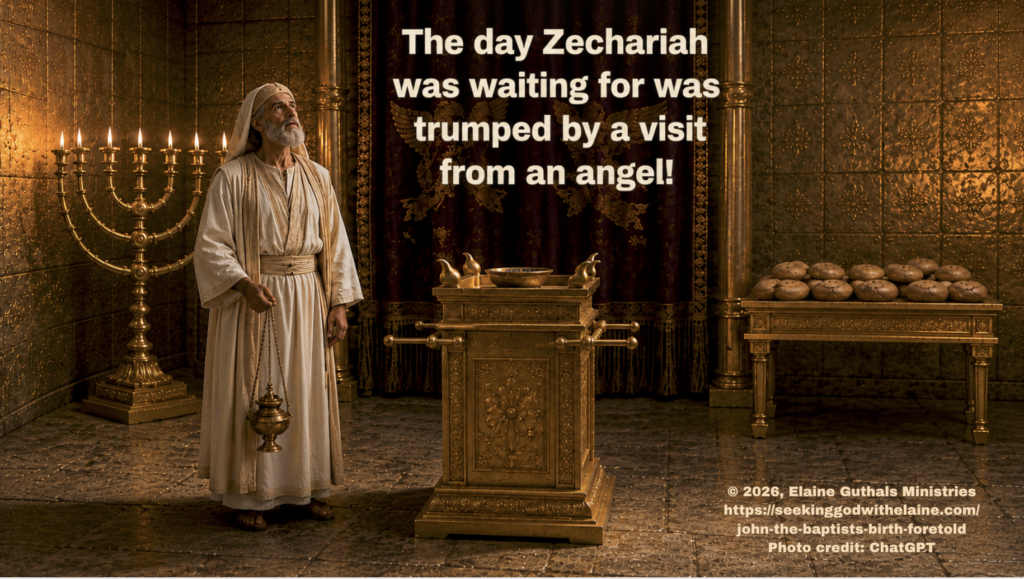
    If the lots had already been cast, Zechariah was very excited when he woke up that morning. He knew it was going to  perform a once-in-a-lifetime task.

    I wonder what Zechariah felt when the day was over?

    Let’s Put It into Context

    To read devotions in The Battle for the Heart theme

    Devotions in the Preparing for the Christ Child series

    An Angel Showed Up

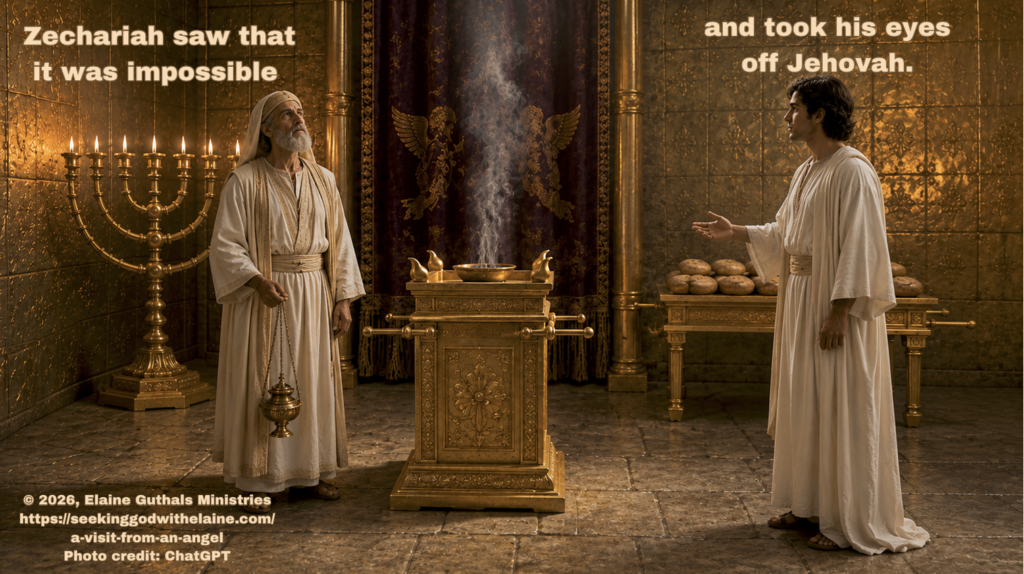
    “While Zechariah was in the sanctuary, an angel of the Lord appeared to him, standing to the right of the incense altar. Zechariah was shaken and overwhelmed with fear when he saw him. But the angel said, ‘Don’t be afraid, Zechariah! God has heard your prayer. Your wife, Elizabeth, will give you a son, and you are to name him John. You will have great joy and gladness, and many will rejoice at his birth, for he will be great in the eyes of the Lord. He must never touch wine or other alcoholic drinks. He will be filled with the Holy Spirit, even before his birth. And he will turn many Israelites to the Lord their God. He will be a man with the spirit and power of Elijah. He will prepare the people for the coming of the Lord. He will turn the hearts of the fathers to their children, and he will cause those who are rebellious to accept the wisdom of the godly’” (Lk. 1: 11-17 NLT)

    An Angel of the Lord Appeared

    Heaven and earth overlapped in the Temple with the incense and the angel.

    Ooo, baby. Did Zechariah get a surprise at work or what!?!?

    Second Temple Jewish thought recognized angels as messengers of Jehovah. Named angels, like Gabriel, were associated with messages and end-time expectation.

    We aren’t told exactly how the angel appeared. That wasn’t supposed to be the focal point.

    Put yourself in Zechariah’s sandals for a minute. Zechariah had probably longed to be chosen to perform the task of burning the incense and offering the prayer. Today was the day that dream would come true.

    Zechariah would have had his mind on his agenda. He was probably like us –concentrating real hard to do it right.

    Then – suddenly – an angel was standing beside the altar of incense.

    And the day Zechariah was waiting for was trumped by a visit from an angel! I bet he was a little thrown off his game and downright afraid.

    Maurice had an interesting – and true – comment. Zechariah didn’t enter the supernatural realm merely because an angel appeared to him. Temple worship itself presupposed an established relationship between the visible and invisible worlds.

    Resource

    Whether the angel was beautiful or frightening, Zechariah’s first reaction was fear. That seems the standard reaction to angel encounters – with everyone except Abraham and Jacob.

    God Has Heard Your Prayer

    The angel was direct, corrective, and enforced consequences.

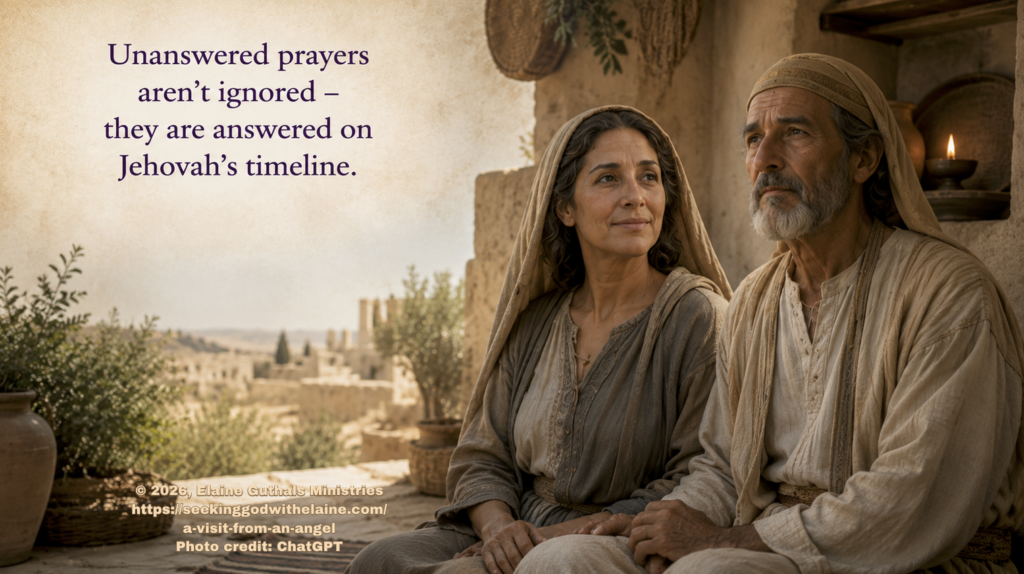
    The angel told Zechariah that his prayers had been heard. Zechariah and Elizabeth were finally going to get the baby for which they had previously prayed.

    That really was the last thing Zechariah had expected out of the day. He and Elizabeth had given up asking for a child.

    Unanswered prayers aren’t ignored – they are answered on Jehovah’s timeline.

    This is a reminder that God doesn’t always answer our prayers the first time. Or second or third or four thousand, four hundred forty-fourth time.

    Still, shouldn’t our expectation – and goal – be to connect with Jehovah every time we worship? If we don’t shoot for that, are we really worshiping?

    We may pray for years before the timing is right for God to answer our prayers. He will answer our prayer in His timing. 

    • “Confess your sins to each other and pray for each other so that you may be healed. The earnest prayer of a righteous person has great power and produces wonderful results” (Jas. 5: 16 ESV).
    • “And we are confident that he hears us whenever we ask for anything that pleases him. And since we know he hears us when we make our requests, we also know that he will give us what we ask for” (I Jn. 5: 14-15 ESV).
    • “The Lord is far from the wicked, but he hears the prayers of the righteous” (Prov. 15: 29 ESV).
    • “In those days when you pray, I will listen” (Jer. 29: 12 ESV).

    But isn’t it easy for us to tell ourselves our prayers aren’t heard? That is much easier to take than acknowledging He told us no.

    Oh, yes. Jehovah will refuse to give us what we ask — when we are asking for something that isn’t in His plan for us. His plan is best for us.

    But Zechariah was a priest. I’m sure he didn’t just pray for a son. He prayed for national redemption, too. And that prayer was going to be answered, too.

    Will Give You a Son

    Gabriel told Zechariah who and what his son would become.

    John’s name is also important. It means Yahweh has shown favor.

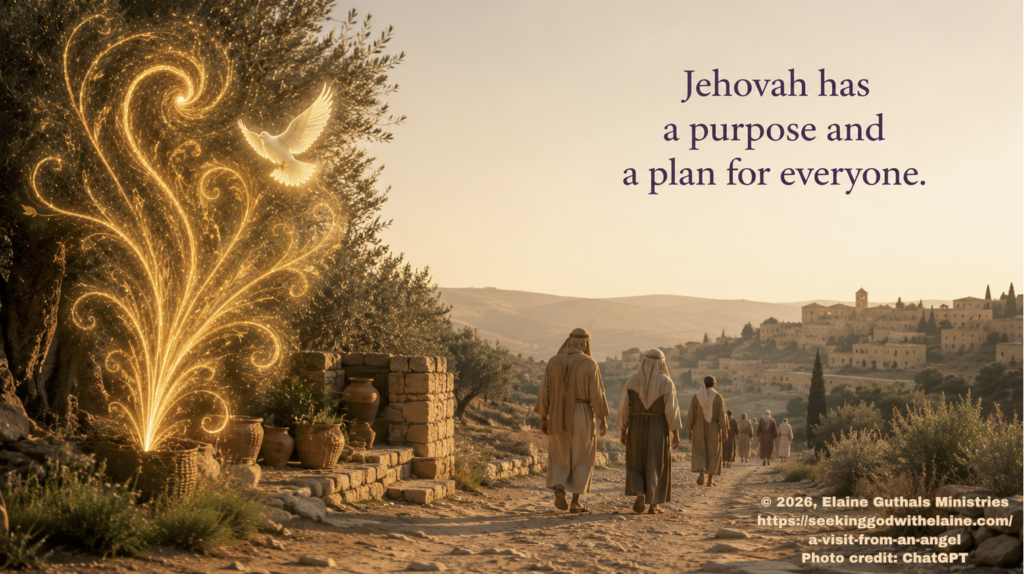
    Did you realize the significance of what Gabriel said? He said that we mere humans are known in Heaven before we even take residence in our mother’s womb. We have a purpose. He has a plan for us.

    Yes, Gabriel was talking about John the Immerser. He could have been talking about Tom. Or even Sally. Even Elaine.

    Yes, Jehovah has a purpose and a plan for everyone.

    Look what Parker said. He said, “Human life is intended to be the realization of a heavenly plan.”

    Resource

    This life is temporary. Our purpose in this life  prepares us for the next.

    Zechariah and Elizabeth had probably offered many prayers over the years for a baby. Those prayers did get to Jehovah.

    He Must

    Zechariah and Elizabeth’s son was going to be great in Jehovah’s eyes, but that came with some different requirements.

    Zechariah and Elizabeth’s son was going to have a specific mission from Jehovah. John’s role was to restore the nation’s faith, awaken a spiritually indifferent people, preach repentance, announce the coming kingdom of heaven, and introduce a new era.

    John was well suited for these tasks.

    The angel gave a very detailed explanation of what the baby could and could not do as he grew. The Nazirite Vow, as explained in Numbers 6, shares some of the restrictions given to John.

    The Nazirite Vow represents separation, dedication, and visible holiness. Some visible acts include abstaining from wine, avoiding contact with the dead, and allowing their hair to remain uncut.

    “Therefore be careful and drink no wine or strong drink, and eat nothing unclean, for behold, you shall conceive and bear a son. No razor shall come upon his head, for the child shall be a Nazirite to God from the womb, and he shall begin to save Israel from the hand of the Philistines” (Jdg. 13: 4-5 ESV).

    While most Nazirite vows were temporary, John — like Samson and Samuel — was set apart from birth for a lifelong mission. His unusual lifestyle wasn’t an end in itself; it visibly demonstrated that his entire life belonged to God.

    What the Nazirite vows to is to be consecrated or separated for God.

    Spirit of Elijah

    John would carry Elijah’s mission.

    Several times in Scripture, we see when John was asked if he were Elijah. Yeshua Himself said that John was not Elijah. He was an Elijah-type.

    It was a Messianic expectation that Elijah would return before the Messiah would come. “Look, I am sending you the prophet Elijah before the great and dreadful day of the Lord arrives. His preaching will turn the hearts of fathers to their children, and the hearts of children to their fathers. Otherwise I will come and strike the land with a curse” (Mal. 4: 5-6 NLT).

    But Gabriel said John would “… be a man with the spirit and power of Elijah …” (Lk. 1: 17 NLT). What did that mean?

    It means that John would pick up Elijah’s mission. Spirit here carries the sense of attitude, disposition, and prophetic calling. He would carry the same prophetic calling and authority.

    Further, Elijah and John called for repentance. They wanted Israelites/Jews to return to Jehovah.

    We think of John’s ministry as just that – calling the Jews to repentance for their sins. It was more than that.

    John’s ministry was calling them to covenant restoration. The Hebrew word shuv (שׁוּב) means return, turn back, and restore.

    We get the turn-back-from-our-sins part. But we focus on ourselves.

    Jehovah is calling humans to return to the Garden of Eden existence. He is calling us back to covenant faithfulness.

    Both were fearless, uncompromising, and zealous for God’s covenant.

    The Priest Doubted

    “Zechariah said to the angel, ‘How can I be sure this will happen? I’m an old man now, and my wife is also well along in years.’ Then the angel said, ‘I am Gabriel! I stand in the very presence of God. It was he who sent me to bring you this good news! But now, since you didn’t believe what I said, you will be silent and unable to speak until the child is born. For my words will certainly be fulfilled at the proper time’” (Lk 1: 18-20 NLT)

    How Can I Be Sure

    Zechariah doubted what the angel said and so paid the consequences.

    Put yourself in Zechariah’s shoes. Would we expect to get a visit from an angel? No – we may secretly hope for it, but we never in a million years think it would happen. “Why would Sovereign God take His time to send someone to specifically talk to us?”

    Then it actually does!!!! Probably our first thought would be, “What have we done wrong?”

    Then we hear that thing we have been praying about for so long was going to be answered. We immediately start feeling unworthy. “We don’t deserve that!”

    All of a sudden, we stop. This is not humanly possible. Why are they getting my hopes up for nothing.

    But think of it. Zechariah was a priest – a family calling. Here he was going to have a son – and the son wasn’t going to be a priest.

    John wouldn’t continue his father’s priestly ministry that Zechariah had given his whole life to serve in faith and obedience – remember he had kept all the commandments.

    Instead of serving as a priest who represented the people before God, John would become a prophet calling the people back to God. He would be preparing the people for something new.

    Can we spell c-h-a-n-g-e?

    If Zechariah was thinking Messianic expectations, he wouldn’t be thinking change. He would be thinking the whole nation would get an atta boy.

    Instead — in Zechariah’s eyes  — John was going to be a radical. I wonder if Zechariah was worrying he wouldn’t be able to recognize him.

    Zechariah was gutsy – and not so smart. He asked the angel for proof. How was he supposed to be sure that this would happen?

    People are always asking for signs as proof of something. The more humanly impossible it is, the greater the sign we need to convince us anything is possible with Jehovah.

    Since You Didn’t Believe

    There are consequences when we sin, and Zechariah was about to find out his.

    Unfortunately, Zechariah questioned Gabriel because he doubted God. Because of his doubt, he couldn’t speak until John was born and named (Lk. 1: 20, 63-64).  

    We learn that the angel’s name is Gabriel. He has appeared on earth one time before and will appear one time in the near future – that we are told.

    Gabriel – Gavri’el ( גַּבְרִיאֵל) – the mighty messenger from God – first visited Daniel in Daniel 8: 16 and Daniel 9: 21-23. He was there to interpret the revelation and connect heavenly plans with human understanding of when the Messiah was coming. In six months, Gabriel would visit Elizabeth’s cousin, Mary, to tell her the good news.

    Did you catch that verse? “… I stand in the very presence of God. It was he who sent me to bring you this good news!” (Lk: 1: 19 NLT). That means Gabriel is part of Jehovah’s inner court.

    Think about the messages Gabriel gave when he made his visits. He told Daniel that redemption was coming. He told Zechariah and Mary that redemption was here.

    Goodwin noted that Zechariah’s doubt was the exact opposite of Abraham’s obedience. One gained righteousness because of belief. The other earned muteness because of sin.

    Resource

    Remember how Zechariah was described earlier. “Zechariah and Elizabeth were righteous in God’s eyes, careful to obey all of the Lord’s commandments and regulations” (Lk. 1: 6 NLT).

    If Zechariah obeyed all of God’s laws and commandments, isn’t that enough? No. We have to be obedient in everything that Jehovah asks us to do.

    We each have our own individual plan of what our mission in Jehovah’s kingdom will be. We have to perform it faithfully.

    Zechariah saw that it was impossible and took his eyes off Jehovah.

    By the time the audience was over, Zechariah realized Gabriel was a high-ranking messenger in Jehovah’s court, one who told of divine plans, was a bridge between heaven and earth, and was present at key turning points in redemption history.

    Aftermath

    “Meanwhile, the people were waiting for Zechariah to come out of the sanctuary, wondering why he was taking so long. When he finally did come out, he couldn’t speak to them. Then they realized from his gestures and his silence that he must have seen a vision in the sanctuary” (Lk: 1: 21-22 NLT)

    All the time that Zechariah was having his discussion with Gabriel, there were people waiting for him to come back out of the Holy Place.

    The people had been praying while Zechariah was burning the incense. “While the incense was being burned, a great crowd stood outside, praying” (Lk. 1: 10 NLT).

    The service would have gone on even though Zechariah was taking longer than usual. There were other priests performing those tasks.

    The problem was that burning the incense shouldn’t have been taking that long. The congregation was concerned because the delay was unusual.

    They had cause to be concerned. Other priests had lost their lives as consequences for impurity or disobedience.

    • “Aaron’s sons Nadab and Abihu put coals of fire in their incense burners and sprinkled incense over them. In this way, they disobeyed the Lord by burning before him the wrong kind of fire, different than he had commanded. So fire blazed forth from the Lord’s presence and burned them up, and they died there before the Lord” (Lev. 10: 1-2 NLT).
    • “But when they arrived at the threshing floor of Nacon, the oxen stumbled, and Uzzah reached out his hand and steadied the Ark of God. Then the LORD’s anger was aroused against Uzzah, and God struck him dead because of this. So Uzzah died right there beside the Ark of God” (II Sam. 6: 6-7 NLT).

    Additionally, the congregation were expecting a blessing. It more than likely would have been like “‘May the Lord bless you and protect you. May the Lord smile on you and be gracious to you. May the Lord show you his favor and give you his peace’” (Num. 6: 24-26 NLT).

    So, the congregation was waiting for the normal conclusion of the service. They got something better.

    They got the answer to prayer – Messiah was coming.

    A Barren Woman Conceived

    “When Zechariah’s week of service in the Temple was over, he returned home. Soon afterward his wife, Elizabeth, became pregnant and went into seclusion for five months. ‘How kind the Lord is!’ she exclaimed. ‘He has taken away my disgrace of having no children’” (Lk. 1: 5-25 NLT)

    What Gabriel said would happen came to pass.

    We don’t know which day of Zechariah’s week of service that he encountered the angel. We know that when he went home, he had a fantastic tale to tell Elizabeth.

    Soon afterward, Elizabeth became pregnant. Now it has long surprised me that Elizabeth went into seclusion for the first five months of her pregnancy.

    Why?

    Think about the time. Pregnancy in the first century – especially when the mother was of an advanced age – carried risks. This was particularly true in the early months of the pregnancy, when miscarriage was common.

    We also have to remember that Elizabeth was barren for many years. What would people think if she suddenly said, “Hey, I’m pregnant” and didn’t have the baby bump to prove it?

    Consider, too, how the proud parents learned about the upcoming pregnancy. It was a divine intervention. Within Jewish religious culture, extraordinary divine acts often were followed by withdrawal, prayer, and reflection.

    It is probably safe to say all of the above was at least considered in Elizabeth’s decision to seclude herself for five months. She had to go from the heartbreak of being barren to anticipating a new life. That probably would take a month or two.

    Making the Connections #1

    Is it interesting that Luke didn’t describe Gabriel’s appearance? He didn’t say he had wings. He didn’t say he was to be worshiped. He didn’t even say he was an archangel.

    Gabriel was there for one reason – to pass on the message of forgiveness and redemption.

    Making the Connections #2

    Ryle made an interesting observation. He said the missions of John and Yeshua were similar. Both were witnesses.

    Resource

    John’s mission was to witness for Yeshua. Yeshua’s mission was to witness for Jehovah.

    Yeshua was also a witness for Himself – for the light. The Memra – Light – was already shining. A prophet had been sent to identify Him. Now, Israel must decide to accept or reject the Light.

    Heart Check

    Think about the battle Yeshua is engaged in for your heart. Ask yourself the following questions.

    • Have I invited Jehovah to transform my entire life, or am I asking Him to change only the parts I’m willing to surrender?
    • Like Zechariah, am I faithfully serving Jehovah in the ordinary moments of life, allowing Him to shape my character while I wait on His timing?

    How Do We Apply This?

    • Expect Jehovah to speak through His Word, shape your heart, or answer a prayer every time.
    • Don’t assume a delayed answer means God isn’t listening.
    • Ask Jehovah how He wants to use you where you are today.
    • Keep your eyes on Jehovah, not your circumstances.
    • Remember that His power is not limited by your circumstances – even when  God’s promises seem impossible.
    • Choose obedience rather than demanding more proof when convicted.
    • Surrender our plans and trust that His are better.

    Father God. Forgive us when we focus on circumstances more than we focus on Your revelation. Forgive us when we limit You to physical confines. Help us to grow our faith so that we can surrender the first time to Your plan. Amen.

    If you don’t understand something and would like further clarification, please contact me.

    If you have not signed up for the email providing the link to the devotions and the newsletter, do so below.

    If God has used this devotion to speak with you, consider sharing it on social media.

  • John the Baptist’s Birth Foretold

    We start Yesha’s story by relating His cousin’s story. This devotional reading begins looking at John the Baptist’s story.

    Nuggets

    • Jehovah had a plan for reconciling us to Him and sent a man to prepare the way.
    • Herod the Great was religious but ruthless, powerful but fearful, and magnificent yet miserable.
    • The priestly order of Abijah was created by David in I Chronicles 24.
    • Zechariah was an ordinary priest who had been chosen for an extraordinary task, and Elizabeth was a blameless person who was barren.
    • Even if we think Zechariah’s service was random, Jehovah didn’t.

    This is the first account of two miraculous birth. They mothers were from the same family – descendants of Aaron.

    The prophesied son would have an important role in the coming events to restore the nation to Jehovah.

    Let’s Put It into Context

    To read devotions in The Battle for the Heart theme

    Devotions in the Preparing for the Christ Child series

    John the Baptist (Yochanan) Introduced

    “God sent a man, John the Baptist, to tell about the light so that everyone might believe because of his testimony. John himself was not the light; he was simply a witness to tell about the light” (Jn. 1: 6-8 NLT)

    Jehovah had a plan for reconciling us to Him and sent a man to prepare the way.

    From the beginning, it was evident that John the Immerser was going to be a great man. In fact, he was considered a great prophet.

    John’s role was foretold by Isaiah. The total passage is Isaiah 40: 1 to Isaiah 45: 25. We are more familiar with Isaiah 40: 3.

    “Listen! It’s the voice of someone shouting, ‘Clear the way through the wilderness for the Lord! Make a straight highway through the wasteland for our God! Fill in the valleys, and level the mountains and hills. Straighten the curves, and smooth out the rough places. Then the glory of the Lord will be revealed, and all people will see it together. The Lord has spoken!’” (Isa. 40: 3-5 NLT).

    This is an important passage for two connected reasons. First, the first is John was to clear the way, calling Israel to repentance. This is critical because the second is that Someone was coming – the Messiah.

    Second, John called Israel to repentance before they encountered the Messiah. Just as worshipers prepared themselves before entering God’s presence in the Temple, John called the nation to prepare their hearts for the coming King.

    John the author made sure his audience knew that John the Immerser was not the Light (or – אוֹר). He was a witness (ed – עֵד) for the light, but he was more than just that. John came in Jehovah’s authority.

    This is huge. John not only had the knowledge of Jehovah, but he also testified to the truth, established facts, and upheld covenant realities.

    John the Immerser was tasked with increasing their faith – their emunah (אֱמוּנָה), a steadfast trust that comes from the Hebrew root ʾāman (אָמַן), meaning to believe, to trust, or to be faithful. We are to establish a firm trust in Jehovah and Yeshua.

    John’s Birth Announced to Zacharias (Zecharyah)

    “When Herod was king of Judea, there was a Jewish priest named Zechariah. He was a member of the priestly order of Abijah, and his wife, Elizabeth, was also from the priestly line of Aaron. Zechariah and Elizabeth were righteous in God’s eyes, careful to obey all of the Lord’s commandments and regulations. They had no children because Elizabeth was unable to conceive, and they were both very old” (Lk. 1: 5-7 NLT)

    Herod

    Herod the Great was religious but ruthless, powerful but fearful, and magnificent yet miserable.

    Luke put a timestamp on his gospel by acknowledging that Herod the Great was king in Jerusalem at the time. At one time, Israelites had wanted a king – they did not want this one.

    Born around 73 BC, Herod was not of Israelite descent but of Edomite descent. His family was forced to convert to Jewish years before his birth.

    In other words, he ruled the Jews but was not of the Davidic line. To make matters worse, he was chosen to be King of the Jews by Octavian Augustus and the Roman Senate around 40 BC.

    That wouldn’t have gone over well.

    Herod’s reign lasted from 37 to 4 BC. While he did maintain stability in the region, his fear of losing power made him a brutal ruler.

    The Temple that stood in Yeshua’s day had undergone a massive expansion under Herod’s rule. Yes, Herod built the stage on which Yeshua’s ministry would exist, but he entered the story only briefly — ordering the murder of the innocents when Yeshua was born. (Herod died shortly after the births of John the Immerser and Yeshua.)

    Herod tried to curry the favor of his subjects by rebuilding the Temple and funding public works. However, he alienated many by his close ties with Rome and his violent and unpredictable behavior.

    While Herod passed before Yeshua’s ministry began, he helped create the environment that had many expecting the Messiah’s arrival. He did this through political tension and religious compromise.

    Upon his death in 4 BC, Herod’s kingdom was divided between his sons. It is one of them that will take a prominent role in the life of John the Immerser and the events of Holy Week.

    Luke used a shorthand to set the stage in letting us know what the situation was that was the backdrop of the story. Rome occupied Israel, and Herod represented a compromised leader. This brought a spiritual longing to the people, increasing their Messianic expectations.

    It was in this atmosphere that Jehovah started to move.

    Priestly Order of Abijah (Aviyah)

    The priestly order of Abijah was created by David in I Chronicles 24.

    Jehovah choose Aaron’s (Aharon) line to serve Him as priests. Only his descendants could serve in this capacity.

    David (Dovid) separated Aaron’s descendants, the priests, into 24 divisions – mishmarot (מִשְׁמָרוֹת) meaning daily ministry – because the priests had become so numerous. Farrar noted that only four of the divisions returned from Babylonian exile. But Geikie reported that, in the first century, around 24,000 priests lived in Jerusalem and approximately 12,000 lived in Jericho.

    Resource

    Each division served in rotation at the Temple. They ensured order and efficiency in conducting Temple services. This rotation ensured all priestly families were allowed to serve.

    This order identity was very important. Abijah was listed as the eighth division. It had a long history of service to Jehovah.

    When the division served twice each year, their rotation lasted one week. They rotated according to the list. All divisions, however, served during the major festivals: Pesach  – פֶּסַח (Passover), Shavuot – שָׁבוּעוֹת (the Feast of Weeks), and Sukkot – סֻכּוֹת (the Feast of Tabernacles).

    True, Temple rotations were disrupted by exile and later history. But this priest was where he was scheduled to be.

    Why is it important to know the division this priest in question served? We learn that the timing of this announcement wasn’t left to random chance. It was steeped in history, structure, and legitimacy.

    That history and structure was an established covenant structure. Core responsibilities hadn’t changed since the days of Moses (Moshe) when the office of priest was set up.

    The angelic visit occurred inside the established rhythm of Temple worship. Daily temple worship had a rhythm to it, which included:

    • Offering sacrifices on behalf of the people
    • Maintaining ritual purity
    • Caring for sacred objects
    • Safeguarding the sanctity of the Temple
    • Administering the Priestly Blessing
    • Incense offering and prayer

    They were charged with distinguishing between what was holy and common, clean and unclean, and with teaching the people God’s instructions.

    The most coveted of the duties was to enter the Holy Place and offer incense on the golden altar. Many never received it even once.

    The priest offering the prayer would pray for the nation. He would additionally pray for those congregated at that time.

    What better place to announce the start of fulfilling the Messianic expectations! The old Temple became the launch for the new Temple — the Messiah.

    The Parents

    Zechariah was an ordinary priest who had been chosen for an extraordinary task, and Elizabeth was a blameless person who was barren.

    As a descendant of Aaron, Zechariah became a priest. As such, he served in the Temple only when it was time for his division to serve.

    Zachariah and Elizabeth (Elisheva) were faithful to Jehovah. Both were counted as righteous – tzaddik (צַדִּיק). They followed all of the commandments of the Sovereign God.

    Names are important. Zachariah’s name means Yahweh remembers. Elizabeth’s name means My God is faithful to His oath.

    Many versions translate this tzaddik as blameless. Paul told us how we could be blameless. “… Live clean, innocent lives as children of God, shining like bright lights in a world full of crooked and perverse people” (Phil. 2: 15 NLT).

    Both were descendants of Aaron. The marriage was easier because like-minded people married.

    It sounds like they were unified in all things. It sounds like they had a good life. 

    The only disappointment was Zachariah and Elizabeth didn’t have any children. Now that they had gotten on in years, they had probably given up hope of ever becoming parents.

    That must have weighed on Elizabeth, because Jewish women were expected to produce children. By the first century, barrenness still carried much of the same social stigma it had in the days of Sarah and Rachel.

    Although the Law never taught that childlessness was a punishment for sin, many people viewed it as a sign that God had withheld His blessing. When no children came, Elizabeth was probably very ashamed. She may have even gotten laughed at.

    Elizabeth’s joyful declaration that the Lord had “… taken away my disgrace among the people …” (Lk. 1: 25 NLT)  shows that this painful assumption still lingered in Israel.

    But they weren’t alone. Think Sarah and Isaac. Think Rebekah, Esau, and Jacob. Think Jacob, Rachel, and Joseph. Think Hannah and Samuel.

    Do we think when we are walking with Jehovah that the bad things shouldn’t happen to us? It doesn’t work that way.

    Zechariah was exactly where Jehovah wanted him to be. He was coming to Him, serving Him. Jehovah had another way Zechariah could be of service.

    A Priest Went into the Temple

    “One day Zechariah was serving God in the Temple, for his order was on duty that week. As was the custom of the priests, he was chosen by lot to enter the sanctuary of the Lord and burn incense. While the incense was being burned, a great crowd stood outside, praying” (Lk. 1: 8-10 NLT)

    Even if we think Zechariah’s service was random, Jehovah didn’t.

    Zechariah was serving in the Temple. He had been assigned to burn the incense, the most sacred daily task in the Holy Place. He was assigned that task by casting lots.

    People were in the outer courts. Priests ministered daily in the Holy Place. The Holy of Holies could only be entered by the high priest on Yōm Kippūr (יוֹם כִּפּוּר) – the Day of Atonement.

    When it was the division’s time to serve, the duties were assigned by lot. We aren’t sure what the process was for casting lots in the first century. The Mishnah does discuss how it was done later.

    It was believed that casting lots would both be fair and be a way to determine Jehovah’s Will. “We may throw the dice, but the LORD determines how they fall” (Prov. 16:33 NLT).

    • The priests would gather in a chamber in the Temple.
    • An official would choose a number larger than the number of priests present.
    • The priests would stand in a circle and each extend one or more fingers.
    • The official would then count around the circle until reaching the selected number.
    • The priest on whom the count landed received the assignment.
    • Several lots were conducted each day to assign different responsibilities.

    Zechariah drew the task with the highest honor and extraordinarily rare privilege – perform the daily incense offering. Other tasks included removing ashes from the altar, preparing sacrifices, and tending the menorah.

    The daily incense offering was a carefully prescribed ritual. First, Zechariah and assistant priests would have taken the hot coals brought in by other priests from the great altar outside (where sacrifices were made)  and placed them on the golden altar.

    After the assistant priests withdrew, Zechariah would have poured the incense on the hot coals. This would cause the incense to rise heavenward.

    This connected prayer and incense in Jewish symbolism. Burning incense represented the prayers of Israel. “Accept my prayer as incense offered to you, and my upraised hands as an evening offering” (Ps. 141: 2 NLT).

    At that point, Zechariah stood alone before the veil.

    Let’s just stop a second. There were some priests who never were assigned this task. And Zechariah was chosen.

    Zechariah was chosen that day.

    No, there was no luck of the draw about it. Jehovah had Zechariah right where He could use him.

    God interrupted normal ritual with a new act of redemption. Ritual isn’t enough for us to worship Him. Going through the motions can turn into lip service real quick.

    I thought it was very important that the congregation was praying while Zachariah was performing his duties. Jehovah was initiating His most important plan, and it was being bathed in prayer.

    This shows us that, even though God knows the outcomes of our efforts, He wants us to pray for guidance, strength, and His blessing. He wants us to let Him have His way. He will bless us beyond measure if we ask.

    Making the Connections #1

    It is easy to forget that Christianity offers various perspectives to different individuals, meaning I can’t always offer a single explanation on a given topic. That is on top of the fact that nothing I say can fully capture its intellectual and spiritual depth.

    We also forget the complexity of the message of the Gospels. Parker helped remind us. He wrote, “The facts of Christianity are few and simple, but the truths arising out of them are innumerable and profound.”

    Resource

    Each disciple creates our own interpretation of Christ’s life. Does that mean there is more than one way to salvation? No. It means that we are different people with differing life experiences and lifestyles.

    Jehovah meets us where we are at. That allows for our individual differences.

    But Jehovah sanctifies us with one goal in mind — making us as He is. Though our Sanctification Roads may take different routes, the destination is still the same.

    We have to seek the meaning of the Word for ourselves. Even listening to the Pastor Steve-types doesn’t negate the fact that we have to be students of the Word for ourselves.

    Making the Connections #2

    I have to think about this. Essex Remembrancer wrote,

    “Religion, wherever it exists, will leave its own entire impression upon the character; not one feature, but every feature of the ‘new man’ will be developed; the duties to man, as well as those we owe to God, will be conscientiously regarded.”

    Resource

    Jehovah isn’t interested in half of us. He is interested in all of us.

    Jehovah will make all of us a new creation. We will have a new character.

    That character is built through the tasks that we do for Jehovah.

    But we can’t equate blameless with sinless. We will still sin – even after we become disciples of Christ.

    Heart Check

    Think about the battle Yeshua is engaged in for your heart. Ask yourself the following questions.

    • Have I invited Jehovah to transform my entire life, or am I asking Him to change only the parts I’m willing to surrender?

    • Like Zechariah, am I faithfully serving Jehovah in the ordinary moments of life, allowing Him to shape my character while I wait on His timing?

    How Do We Apply This?

    • Thank Jehovah for the ordinary places where He has placed you today.
    • Ask Him to help you trust His timing, even when you cannot see His purpose.
    • Look for ways God may be preparing you through today’s ordinary responsibilities.
    • Choose faithfulness over recognition.
    • Spend time in confession, asking Jehovah to prepare your heart to hear His voice.
    • Pray that your heart would be ready whenever God chooses to work.
    • Remember that God often answers prayers in ways we never expect.
    • Before attending church this week, ask God to keep your worship from becoming routine.
    • Ask yourself whether your worship is flowing from your heart or simply from habit.
    • Trust that Jehovah is working even when your life feels ordinary.
    • Prepare your heart daily so you are ready when God chooses to move.
    • Serve faithfully today, knowing that no act of obedience is insignificant in God’s plan.

    Father God. You have a plan for all our lives. In those plans, you call us to certain tasks for Your benefit and ours. Thank you that You use us to expand Your kingdom. Amen.

    If you don’t understand something and would like further clarification, please contact me.

    If you have not signed up for the email providing the link to the devotions and the newsletter, do so below.

    If God has used this devotion to speak with you, consider sharing it on social media.
  • God Became a Human Being

    Since the Garden of Eden, Jehovah had not dwelt with humans. This devotional reading sets the stage for His return through Yeshua.

    Nuggets

    • When God said, “Let there be light,” He was revealing Yeshua as the Light who would enter the darkness and begin the battle for our hearts.
    • This Light is available to everyone.
    • The Architect of the universe entered that world.
    • Even though Yeshua’s coming was prophesied, first-century Jews did not recognize Him as Messiah.

    We’ve seen how Yeshua was present at the creation of the universe. In fact, He had an integral part in creation.

    Yeshua knew His part in the Plan of Salvation before anything was even created. Before the first sin had been committed – before humans had even been created – the plan for redemption was set in place.

    That plan required Yeshua to come to earth as a human being. Let’s see what that entailed.

    Let’s Put It into Context

    To read devotions in The Battle for the Heart theme

    Devotions in the Preparing for the Christ Child series

    Why Jesus Came

    “The one who is the true light, who gives light to everyone, was coming into the world. He came into the very world he created, but the world didn’t recognize him” (Jn. 1: 9-13 NLT)

    The True Light

    When God said, “Let there be light,” He was revealing Yeshua as the Light. He would enter the darkness and begin the battle for our hearts.

    John has talked a lot about light so far in his first chapter. The true Light is Yeshua, who is also the Word.

    The true Light was present in this world from creation. When Jehovah said, “Let there be light,” this wasn’t merely physical illumination but the first revelation of Yeshua in spiritual form entering creation as the true Light. Light, therefore, becomes tied to salvation from the very beginning.

    The Light Yeshua brings is not merely knowledge but spiritual life itself. Without the Word giving life, humanity remains spiritually dead. The Light enters darkness to illuminate hearts and lead people toward salvation.

    Who Gives Light to Everyone

    This Light is available to everyone.

    Throughout God’s Word, it tells how the Messiah’s mission was to be a mission of inclusion. He was first to go to Israel, the chosen people, and then go to the Gentiles — everyone who wasn’t Jewish.

    By giving all the opportunity to believe in Yeshua, the covenant promise made to Abraham would be fulfilled. “All the families on earth will be blessed through you” (Gen. 12: 3 NLT).

    While Yeshua’s mission was to go to the cross to become our Savior, He acknowledged His Gentile sheep. “I have other sheep, too, that are not in this sheepfold. I must bring them also” (Jn. 10: 16 NLT).

    Going to the Gentiles is part of our marching orders. “Therefore, go and make disciples of all the nations” (Mt. 28: 19 NLT).

    Yeshua fulfilled all of God’s promises. He came as Messiah to Israel and then all the world.

    Coming into the World

    The Architect of the universe entered that world.

    What John wrote about in the past tense, we are preparing for it to happen in this series. We are looking forward to the birth of Yeshua in the flesh.

    Yeshua’s coming was prophesied many times in the Old Testament.

    • “Abraham said, ‘God will provide for himself the lamb for a burnt offering, my son’…” (Gen. 22: 8 ESV).
    • “The scepter shall not depart from Judah, nor the ruler’s staff from between his feet, until tribute comes to him; and to him shall be the obedience of the peoples” (Gen. 49: 10 ESV).
    • “So Moses made a bronze serpent and set it on a pole. And if a serpent bit anyone, he would look at the bronze serpent and live” (Num. 21: 9 ESV).
    • “I will raise up for them a prophet like you from among their brothers. And I will put my words in his mouth, and he shall speak to them all that I command him” (Deut. 18: 18 ESV).
    • “When your days are fulfilled and you lie down with your fathers, I will raise up your offspring after you, who shall come from your body, and I will establish his kingdom. He shall build a house for my name, and I will establish the throne of his kingdom forever. I will be to him a father, and he shall be to me a son. When he commits iniquity, I will discipline him with the rod of men, with the stripes of the sons of men, but my steadfast love will not depart from him, as I took it from Saul, whom I put away from before you. And your house and your kingdom shall be made sure forever before me. Your throne shall be established forever” (II Sam. 7: 12-16 NLT).
    • “For to us a child is born, to us a son is given; and the government shall be upon his shoulder, and his name shall be called Wonderful Counselor, Mighty God, Everlasting Father, Prince of Peace. Of the increase of his government and of peace there will be no end, on the throne of David and over his kingdom, to establish it and to uphold it with justice and with righteousness from this time forth and forevermore. The zeal of the Lord of hosts will do this” (Isa. 9: 6-7 ESV).
    • “Behold, God is my salvation; I will trust, and will not be afraid; for the Lord God is my strength and my song, and he has become my salvation” (Isa. 12: 2 ESV).

    We have to watch when we want to bite on the first-century Jews for not recognizing the Messiah. We see Him through hindsight – the cross, the resurrection, justification by faith, and the theological development of the Church.

    First-century Jews didn’t possess that framework because it hadn’t been completed yet.

    Oh, first-century Jews knew the prophesy about a Messiah – in Hebrew, māšaḥ (מָשַׁח) — to anoint and, in Greek, Christos (Χριστός). But they were looking at those Scriptures through a lens of exile, covenant longing, Roman oppression, Temple expectation, and prophetic hope.  They may have been back in Israel and Jerusalem, but they were still under oppression.

    They saw Rome and thought they were no better off than when they were in Babylon. The Temple stood, but Jehovah’s Shekina (שְׁכִינָה) – His visible glory – hadn’t returned as of yet.

    However, many first-century Jews were expecting the Messiah to come. But, when Yeshua arrived, they didn’t recognize Him.

    Why? They were expecting a different type of Messiah. They saw that He was David’s son, so they saw Him as a warrior king. They believed that is what Scriptures told them. The Messiah would be Someone Who

    •       Defeated Israel’s enemies
    •       Restored righteous rule
    •       Judged the nations
    •       Purified worship
    •       Gathered the dispersed tribes
    •       Reigned from Jerusalem

    Look at these passages and see if you see that yourself.

    • “I will tell of the decree: The Lord said to me, ‘You are my Son; today I have begotten you. Ask of me, and I will make the nations your heritage, and the ends of the earth your possession. You shall break them with a rod of iron and dash them in pieces like a potter’s vessel’” (Ps. 2: 7-9 ESV).
    • “There shall come forth a shoot from the stump of Jesse, and a branch from his roots shall bear fruit. And his delight shall be in the fear of the Lord. He shall not judge by what his eyes see, or decide disputes by what his ears hear, but with righteousness he shall judge the poor, and decide with equity for the meek of the earth; and he shall strike the earth with the rod of his mouth, and with the breath of his lips he shall kill the wicked” (Isa. 11: 1, 3-4 ESV).
    • “I saw in the night visions, and behold, with the clouds of heaven there came one like a son of man, and he came to the Ancient of Days and was presented before him. And to him was given dominion and glory and a kingdom, that all peoples, nations, and languages should serve him; his dominion is an everlasting dominion, which shall not pass away, and his kingdom one that shall not be destroyed” (Dan. 7: 13-14 ESV).

    Do those passages indicate that there would be an immediate defeat of Israel’s oppressors? Well, no, but this was an agent of Sovereign God’s that was being described. Who would think that the Messiah would come under someone else’s – especially an earthly – authority?

    Beyond that, first-century Jews didn’t think they as a nation were where they were supposed to be before the Messiah was to come. They thought they had to repent and become righteous before His arrival.

    They got that out of Scriptures, also.

    • “And when all these things come upon you, the blessing and the curse, which I have set before you, and you call them to mind among all the nations where the Lord your God has driven you, and return to the Lord your God, you and your children, and obey his voice in all that I command you today, with all your heart and with all your soul, then the Lord your God will restore your fortunes and have mercy on you, and he will gather you again from all the peoples where the Lord your God has scattered you” (Deut. 30: 1-4 ESV).
    • “And a Redeemer will come to Zion, to those in Jacob who turn from transgression,” declares the Lord” (Isa. 59: 20 ESV).
    • “Seventy weeks are decreed about your people and your holy city, to finish the transgression, to put an end to sin, and to atone for iniquity, to bring in everlasting righteousness, to seal both vision and prophet, and to anoint a most holy place” (Dan. 9: 24 ESV).

    This was why John the Immerser’s message landed so hard for them. They saw that he was calling them to this repentance and coming judgment. He was calling them to covenant preparation.

    Then Yeshua came and, in their eyes, things weren’t anything like that.

    • Rome was still there.
    • He didn’t follow God’s laws because He associated with sinners.
    • He publicly forgave sins.
    • He allowed forgiveness before visible moral reform.

    In other words, Yeshua didn’t uphold covenant purity.

    What Yeshua was doing was redefining the source of that righteousness. He came to heal Israel because they couldn’t heal themselves.

    Came to His Own People

    “He came to his own people, and even they rejected him. But to all who believed him and accepted him, he gave the right to become children of God. They are reborn — not with a physical birth resulting from human passion or plan, but a birth that comes from God” (Jn. 1: 10-11 NLT)

    Even though Yeshua’s coming was prophesied, first-century Jews did not recognize Him as Messiah.

    How did all those expectations about the coming of the Messiah relate to Yeshua? They relate because the first-century Jews couldn’t look past expectations to see reality. The Messiah had come!!!!!

    And they rejected Him.

    The religious leaders said He wasn’t the Messiah because He challenged religious norms of his time. His miracles and claims of divinity provoked skepticism and disbelief, and His focus on people’s spiritual condition wasn’t welcome.

    Ultimately, his rejection fulfilled prophecies about the Messiah’s suffering.

    Doesn’t it feel like John is setting us up for something much more positive? Creator of the world. Giver of life and light. The Word.

    Expected. Longed for.

    Rejected.

    No, not totally rejected. Yeshua wasn’t rejected by the Twelve Apostles. There were also women who were traveling with them that didn’t reject Him. Surely, there were some believers in the towns and villages that He went to – like Sychar.

    It wasn’t total rejection.

    But it was enough to kill Him.

    Who was His own? This was covenant language. Remember, Yeshua’s coming was promised to David as his descendant. That tied Him to a rich history – and a covenant line dating back to Abraham.

    How did Yeshua come to His own? “Though he was God, he did not think of equality with God as something to cling to. Instead, he gave up his divine privileges; he took the humble position of a slave and was born as a human being. When he appeared in human form, he humbled himself in obedience to God and died a criminal’s death on a cross” (Phil. 2: 6-8 NLT).

    Think of it this way, though. Yeshua was instrumental in creation. Without Hi, nothing would have been created. He received authority then.

    Now, Yeshua was entering His creation – in a physical form, not a spiritual one. He was coming to His own.

    Why did the Pharisees, Sadducees, and Torah-teachers reject Yeshua as the Messiah. He was shaking their rabbinical traditions. As we would say today, “We’ve never done it that way!”

    The name Jesus derives from the Hebrew Yēshûaʿ (יֵשׁוּעַ), meaning Jehovah saves. Yet the angel specifically defines the salvation mission in terms of sin.

    That makes Matthew 1: 21 land a little differently. “You shall call His name Jesus, for He will save His people from their sins.” (Matt. 1: 21 ESV).

    Yeshua came bearing a spiritual liberation, exposing internal corruption.

    Yeshua came first to battle for our hearts.

    And His own rejected Him.

    Making the Connections #1

    While first-century Jews had the Scriptures detailing the victories the Messiah would enjoy, they also had the Scriptures spelling out the suffering, rejection, piercing, and being “cut off” that He would experience.

    We see this most graphically in Isaiah’s Suffering Servant passage in Isaiah 53.

    Under Roman domination, it was so much easier to look for the victorious Messiah than the suffering Messiah.

    That is why the cross became a stumbling block for them. A crucified Messiah appeared contradictory to Messianic victory because crucifixion represented shame, defeat, and Roman domination.

    Don’t we do that? We focus so much on the circumstances of our trials that we take our eyes off Jehovah.

    We want things the way we want them, not the way that is in Jehovah’s plan for us.

    Making the Connections #2

    We bite on the Pharisees and make them into villains, but they weren’t. They were just like us – trying to understand the words that were written.

    They had it harder than we do – at least in Scriptures. They weren’t working on the completed plan. They were seeing it unfold before their eyes.

    Only after the resurrection could the Pharisees – even the disciples – finally understand how the suffering servant and conquering King prophecies belonged to the same Messiah.

    We don’t know how many Pharisees worked through all the events in their hearts and minds and chose to accept Yeshua as their Savior. We would hope all but know that wasn’t the case. So, we can hope the majority.

    Doesn’t it take time for us to understand the trials in our own lives and how Jehovah is using those for our sanctification? It has taken years for me to understand what He was trying to teach me with Mom and Dad dying six weeks apart. Even now – over thirty years later – He can nudge my heart and say, “See why now?”

    Making the Connections #3

    What track do we want Yeshua as Messiah to take today? Do we just want Him to be a social savior? Some may want a political savior.

    Otherwise, we may place Yeshua anywhere on a continuum. Do we want a life/coach/therapist who is on speed dial when we need Him? Or do we want Him just on Sunday?

    Or do we surrender our hearts and lives to Him in submissive obedience knowing He is the only one Who can save us?

    Heart Check

    Think about the battle Yeshua is engaged in for your heart. Ask yourself the following questions.

    • Am I following the real Yeshua revealed in Scripture, or a version shaped by my own expectations?
    • If Yeshua walked into my life today in a way I wasn’t expecting, would I recognize Him — or would my expectations keep me from seeing what He is doing?

    How Do We Apply This?

    • Compare and align your expectations with Scripture.
    • Welcome Yeshua’s work in your heart.
    • Let Him expose areas needing repentance.
    • Trust Jehovah’s plan over your own.
    • Follow the Messiah He is — not the one you wish He were.

    Father God. Thank You that You sent Yeshua to become a human to pay the penalty for our sins. We are humbled that He would agree to go through what He did for us. Help us to open our hearts to Him and allow Him in. Amen.

    If you don’t understand something and would like further clarification, please contact me.

    If you have not signed up for the email providing the link to the devotions and the newsletter, do so below.

    If God has used this devotion to speak with you, consider sharing it on social media.
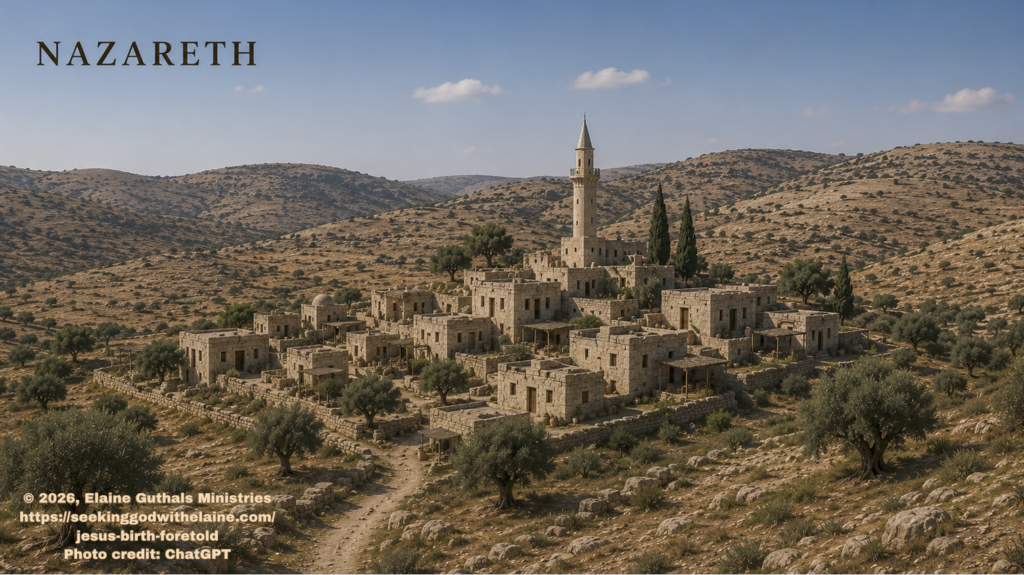
  • Light and Darkness

    John began his gospel with imagery to show how creation tied to salvation. This devotional reading looks at the the connections between the Word, Light, darkness, and life.

    Nuggets

    • Yeshua was present and working at creation.
    • The Word and Light are connected.
    • If the Word did not give life, nothing would live — and without His life, we remain spiritually dead.
    • The opposite of Light is darkness.
    • Jehovah is Sovereign God, meaning He is sovereign over Satan as well.

    In the last devotion, we saw that Yeshua was present at creation alongside Jehovah. Now John shows us what that means — that everything was created through Him, and that His life brings Light into the darkness.

    The Word has two purposes with regard to creation. The first is that it serves as a record of what occurred.

    The second purpose is to interpret creation and life. John used light and darkness to give that interpretation in the next three verses.

    John showed how the Word, through Light defeating darkness, brings life.

    Let’s Put It into Context

    To read devotions in The Battle for the Heart theme

    Devotions in the Preparing for the Christ Child series

    Created Everything Through Yeshua

    “God created everything through him, and nothing was created except through him” (Jn. 1: 3 NLT)

    Yeshua was present and working at creation.

    However it was created, Jehovah created the universe. Jehovah purposed creation, Yeshua carried it out, and the Holy Spirit was actively present in the work.

    This is highlighted more in the Hebrew than the Greek. The Greek translates to through him – just as used in the New Living Translation.

    However, the Hebrew word, al-yado (עַל־יָדוֹ), means by and through. Jehovah worked by Yeshua as Yeshua carried out Jehovah’s plan.. We would think of that more as by His hand.

    It was like my supervisor once on her performance evaluation. She included a couple of projects I had completed by myself. She put them on her evaluation to her supervisor because I had completed them at her direction.

    We just looked at several verses in Proverbs 8. Let’s look at a couple of more.

    “I was there when he established the heavens, when he drew the horizon on the oceans. I was there when he set the clouds above, when he established springs deep in the earth. I was there when he set the limits of the seas, so they would not spread beyond their boundaries. And when he marked off the earth’s foundations, I was the architect at his side. I was his constant delight, rejoicing always in his presence. And how happy I was with the world he created; how I rejoiced with the human family!” (Prov 8: 27-31 NLT emphasis added).

    In everything that Jehovah created, Yeshua was right here by His side. Yeshua not only existed, but Jehovah worked through Him to organize and actively make everything.

    Let’s take a second and look at what an architect really does.

    An architect does more than just draw the pictures of what is to be built. Before he ever puts pencil to paper, he has to understand how it will be lived in. He has to see the whole picture first:

    • What is the building for?
    • Who is going to use it?
    • How many people will move through it – and how?

    In other words, it is his job to figure out the life of the building. How are people going to experience it?

    Then, when he begins to design, he ensures it holds together and makes sense. Function has to take precedence over appearance.

    Yeshua is the perfect architect. He did not just design the place we will one day inhabit. He designed the pathway that leads us to Jehovah.

    The structure that Yeshua was building in creation was Sovereign God’s truth. We each come to it through different explanations, but the structure itself does not change. That is where the personalized aspect of salvation meets the unchanging truth of Jehovah.

    Erskine articulated the doctrine that supports that. He wrote, “That as Christ is the everlasting God, so, from all eternity, He was foreordained and set up for the great service of man’s redemption.”

    Resource

    Yeshua is the message and Messenger of the Gospel. He is the entire meaning itself, and the Gospel is how He communicates that meaning to us.

    In Elaine-speak, if Christ created everything, then nothing that He made can harm His kingdom.

    Yeshua, as Creator, is in control of creation. He is the architect and the plan.

    Yeshua as Light and Life-Giver

    “The Word gave life to everything that was created, and his life brought light to everyone” (Jn. 1: 4 NLT)

    The Word as Light

    The Word and Light are connected.

    In Yeshua’s time, Jews saw themselves as sons of the Light. They believed they were faithful and obedient to the Torah, walking a path that aligned with Jehovah’s purposes.

    First-century Jews recognized the connection of the Word, Light, and darkness. Jehovah used the Word as a form of self-disclosure.

    The Word – dvar in Hebrew and memra (מֵימְרָא) in Aramaic – describes how Jehovah creates, reveals, judges, and saves. Light – אוֹר (אוֹר) – and darkness – choshekh (חֹשֶׁךְ) – were seen as deeply theological categories.

    In other words, Jehovah reveals Himself through Yeshua as the Word and the Light – Yeshua is both.

    A Second Temple Jewish understanding was that Sovereign God spoke, appeared, or acted through the memra. Therefore, when referring to Jehovah taking some form of action, they would say, “The Memra of the Lord did such and such.”

    We know the prophets used this phrase – the word of the Lord – to identify revelations from Jehovah.

    • “Now the word of the Lord came to me, saying,” (Jer. 1: 4 ESV)
    • “The word of the Lord came to me:” (Ezek. 36: 16 ESV).

    Jehovah reveals Himself to us through the Word.

    Gave Life to Everything

    If the Word did not give life, nothing would live – and without His life, we remain spiritually dead.

    The Word is the source of life and gave life to everything.

    Everything that exists received its life from Him.

    The life the Word gives is not just physical – it is life that leads to salvation. It goes beyond mere existence to spiritual life.

    The Word shines light on humans to give them life. It enters the darkness and illuminates all who will look on it.

    The life that the Word gives is salvation.

    Life Brought Light

    As we saw before, the light Jehovah calls forth in Genesis is not merely physical – it was Yeshua, the true Light, Who entered the world.

    The first thing Jehovah introduced after He created the heavens and earth was light. His exact words were, “Then God said, ‘Let there be light,’ and there was light” (Gen. 1: 3 NLT).

    As we saw before, it was spiritual light – it was Yeshua.

    • “Again Jesus spoke to them, saying, ‘I am the light of the world …” (Jn. 8: 12 ESV).
    • “The light shines in the darkness …” (Jn. 1: 5 ESV).
    • “Your word is a lamp to my feet and a light to my path” (Ps. 119: 105 ESV).
    • “As long as I am in the world, I am the light of the world” (Jn. 9: 5 ESV).
    • “The Lord is my light and my salvation …” (Ps. 27: 1 ESV).
    • “The people who walked in darkness have seen a great light ….” (Isa. 9: 2 ESV).

    This is also seen at the end of God’s Word. “… They will need no light of lamp or sun, for the Lord God will be their light …” (Rev. 22: 5 ESV).

    Light and dark are contrasts. Light represents life, order, truth, and the presence of God. Darkness represents chaos, death, ignorance, and judgment.

    But it goes a step beyond that. Jehovah reveals Himself through the light. In this way, the hidden things will become visible.

    The Battle for the Heart

    When we think about the ongoing battle for our hearts, light and darkness describe the condition of our hearts – both morally and spiritually.

    Allen described the contrast this way. He wrote, “When Christianity is not, there are darkness and death; where Christianity is, there are light and life.”

    Resource

    Each of us is born with a part that recognizes our Creator. When sin entered the world – and our lives – it goes to the darkest spot within us – our hearts. “The human heart is the most deceitful of all things, and desperately wicked. Who really knows how bad it is?” (Jer. 17: 9 NLT)

    Jehovah created the heavens and earth, bringing the Word. The Word breaks through the darkness as Light.

    Without Light, there is darkness and death. With Light, there is light and life.

    Darkness

    “The light shines in the darkness …” (Jn. 1: 5 NLT)

    The opposite of Light is darkness.

    The Hebrew word used here for darkness is choshekh (חֹשֶׁךְ), which leads to death and destruction. It is more than just the absence of light.

    Darkness is equated to sin. It is the absence of the life that comes from being apart from the Word.

    If Satan is darkness – choshekh (חֹשֶׁךְ) – then Jesus is Light – or (אוֹר).

    Darkness takes away our ability to see. Satan does that by trying to blind us to the truth of the Gospel. He takes away the sharpness with which we hear and understand God is telling us.

    “Satan, who is the god of this world, has blinded the minds of those who don’t believe …” (II Cor. 4: 4 NLT).

    In other words, Satan tries to make us ignorant of God’s Word.

    Darkness, as we said, is more than just an absence of light. It is also a spiritual absence – an absence of goodness and virtue.

    Think about when light meets darkness. Sometimes, the light dispels the darkness. But other times, shadows are created.

    Shadows are dangerous because they don’t remove the light – they distort it.

    Depending on their strength, they can corrupt our perception of the light. They remove texture and color – the nuances. We begin to see something that looks true but is not.

    Shadows in our hearts are where we keep a place for Satan to get a toehold in our lives and sin to take root. It is where we either have compromised with the world, or we have kept our hearts closed instead of surrendering our will to Jehovah.

    We cannot make God’s Word fit our preconceived notions without distorting it.

    This is where the struggle takes place. We may not always recognize it, but there is a battle between light and darkness within us.

    We see hints of this even in everyday life. During the winter months, the absence of sunlight affects how people feel. As children, we are afraid of what we can’t see in the dark.

    Spiritually, the same is true.

    Darkness clouds, distorts, and pulls away from the truth.

    But thanks be to God – He leads us out of the darkness through the light of redemption and forgiveness.

    Never Extinguish It

    “… and the darkness can never extinguish it” (J. 1: 5 NLT)

    Jehovah is Sovereign God, meaning He is sovereign over Satan as well.

    Jehovah has plans and works His plans. “… It will all happen as I have planned. It will be as I have decided” (Isa. 14: 24 NLT).

    Satan’s defeat has already been declared. “Then the devil … was thrown into the fiery lake …” (Rev. 20: 10 NLT).

    Satan’s defeat is part of the plan.

    True. Satan currently isn’t fully defeated. He is still allowed his victories. “And I will cause hostility between you and the woman, and between your offspring and her offspring. He will strike your head, and you will strike his heel” (Gen. 3: 15 emphasis added).

    But that was never going to be the final outcome.

    The Light shines in the darkness – and the darkness can’t overcome it.

    Making the Connections #1

    Ryle was correct. These verses slammed the door shut on three heretical arguments.

    •  John showed Yeshua was not inferior to Jehovah.
    • He showed Yeshua was distinct from Jehovah.
    • He showed Yeshua was God and man.

    Resource

    These arguments are crucial to be found and won if we are going to believe in Yeshua as our Savior. If we can’t believe these, the doctrines following will be harder to believe.

    Making the Connections #2

    Remember, Jews saw themselves as sons of the light. John challenged that.

    Yeshua is Creator (v. 3), life-giver (v. 4), and Light (v. 5). We can’t be sons and daughters of light if we don’t have the Light within us.

    Light v. darkness isn’t abstract – it defines who we are.

    Yeshua has authority over us, regardless of whether we are believers or non-believers.

    Melvill called for us to be cautious. He wrote,

    “The theology of conscience, creation, tradition, type, fade away from the revelation of these last days. The true light now [shines]. How? Men are insensible to it. By placing men under a variety of dispensations God would prove that no amount of light will suffice to illuminate fallen creatures unless the Holy Spirit purge the sight.”

    Resource

    Only Yeshua through the workings of the Holy Spirit can reach those darkest places within our darkest places because He is the true Light.

    Making the Connections #3

    “The light shines in the darkness and the darkness can never extinguish it” (Jn. 1: 5 NLT)

    Satan may be the prince of this world (Jn. 12: 31), but people have not been given over to him. He must fight for us.

    Satan doesn’t want to give up those dark places in our hearts. Yeshua as the Good Shepherd (Jn. 10: 11) wants to wrestle us back into His fold.

    That makes our hearts the battlefields. This is what we call spiritual warfare. We may  know some of these battles are raging within us.

    We don’t know about all of them.

    It comes down to this question – what is the condition of our hearts? Are we sons and daughters of light, or are we sons and daughters of darkness?

    Don’t miss what verse 5 is telling us. This is a strong declaration of victory in the war against  Satan.

    Satan can’t win – unless we let him win the battle. Satan can’t win the war, but he can gain ground in the battles if we refuse to surrender to Yeshua.

    If we do not allow Yeshua to fight the battle for us, we will lose the spiritual war – but Yeshua won’t.

    What helps us allow Yeshua to battle Satan for us?

    • We can’t make God’s Word fit our preconceived notions without distorting it.
    • Before we surrender our lives to Yeshua, we are filled with darkness. When we allow Him into our hearts and lives, we are filled with Light.
    • Light and dark are contrasts. Light represents life, order, truth, and the presence of God. Darkness represents chaos, death, ignorance, and judgment.

    The choice is up to us. Choose wisely.

    Making the Connections #4

    It is true that Yeshua’s light shines on our lives, covering the good and the bad. We can try to rely on our own morality and abilities.

    Only through Yeshua can we find the way, truth, and life. Jehovah reveals Him to us through the Holy Spirit.

    I like what Allen said. In Elaine-speak, he said

    • Each word spoken and every emotion Jehovah reveals to us conveys life flawless goodness.
    • Complete holiness merges with compassion, resulting in perfection.

    Resource

    Jehovah will reveal to us Who He is.

    Even after we surrender our lives to Yeshua, disciples still sin. That doesn’t take away our moral character. It may tarnish our moral character until we repent and turn everything over to Jehovah.

    But if our hearts are aligned with Jehovah, we are still His. It isn’t because we do the do’s and don’t do the don’ts.

    We remain Jehovah’s after we commit another sin because our hearts are in the right condition.

    How Do We Apply This?

    • Trust in the Being Who is Creator of all things.
    • Step into the Light.
    • Stop reshaping Truth.
    • Stop allowing distortions to pull us away from Jehovah.

    Resource

    Father God. Thank You for being concerned about the condition of our hearts. More importantly, thank You for sending Yeshua as Light in this world to  save us from our sins — the darkness. Amen.

    If you don’t understand something and would like further clarification, please contact me.

    If you have not signed up for the email providing the link to the devotions and the newsletter, do so below.

    If God has used this devotion to speak with you, consider sharing it on social media.
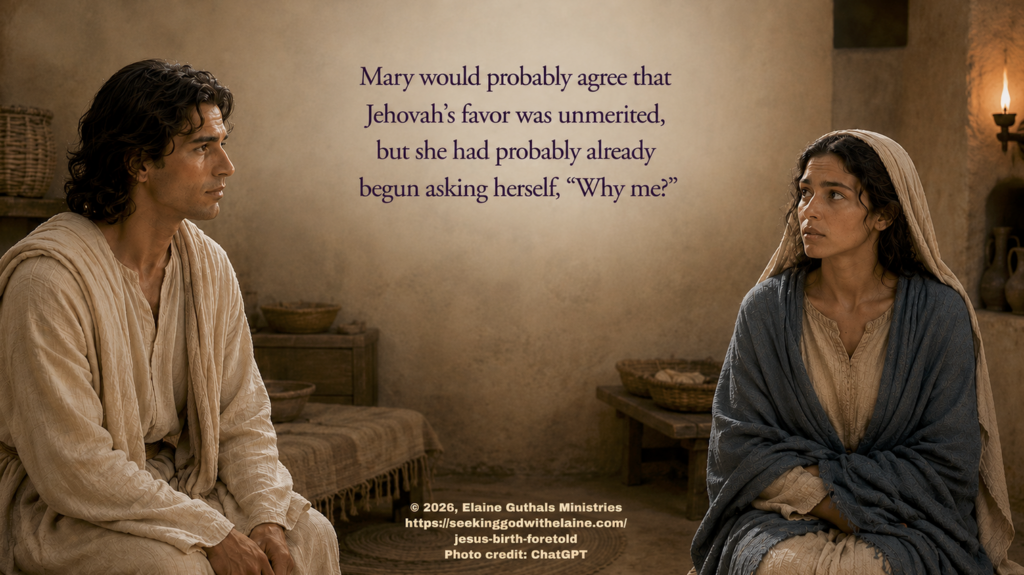
  • Christ, the Eternal Word

    Christ, like God, is eternal. This devotion looks at when the Word and Light came to earth.

    Nuggets

    • Yeshua was present in all eternity.
    • Yeshua is the Word.
    • Yeshua also existed before the foundation of the world.
    • Being with God means more than Jehovah and Yeshua being in the same room.
    • Jehovah and Yeshua are the same nature and essence.

    The first four books of the New Testament are called the Gospels. They tell the story of Yeshua.

    But Yeshua’s story didn’t begin when He walked on this earth. We can’t trace its beginning.

    What we do know is that Yeshua was the inspiration for creation of this universe. Jehovah created it to showcase Yeshua’s love.

    John began his Gospel trying to line that out for us. He explained that the Son is not a piece of God but God Himself — distinct in person yet fully sharing the same divine nature.

    What does that mean to us? If the One Who created all things is the same One Who came to save you and me, then He is not distant, and He is not uncertain. He is both the Author of our beginning and the One Who secures our end. That is the One we can trust.

    Let’s dig in.

    Let’s Put It into Context

    To read devotions in The Battle for the Heart theme

    Devotions in the Preparing for the Christ Child series

    Eternal

    “In the beginning the Word already existed. The Word was with God, and the Word was God. He existed in the beginning with God” (Jn. 1: 1-2 NLT).

    In the Beginning

    Yeshua was present in all eternity.

    John opened his Gospel in an unusual way. Instead of doing a genealogy, he hooked Yeshua back to Genesis – the creation, the origin. “In the beginning God created the heavens and the earth” (Gen. 1: 1 NLT).

    One point John wanted to get across was the team that Jehovah and Yeshua made. Both were present at creation. We’ll talk about this more in a little bit.

    Was the Word

    Yeshua is the Word.

    We get that Yeshua is divine. We also get that He divested Himself of that divinity and became human.

    “Though he was God, he did not think of equality with God as something to cling to. Instead, he gave up his divine privileges; he took the humble position of a slave and was born as a human being. When he appeared in human form, he humbled himself in obedience to God and died a criminal’s death on a cross (Phil. 2: 6-8 NLT).

    But we don’t necessarily get it right off why Yeshua was called the Word.

    I like how John 1: 1 reads in the Orthodox Jewish Bible. It can be a little confusing, but I think it will help us process all this.

    “Bereshis (in the Beginning) was the Dvar Hashem …, and the Dvar Hashem was agav (along with, etzel, …) Hashem, and the Dvar Hashem was nothing less, by nature, than Elohim! …” (Jn. 1: 1 OJB emphasis added).

    Dvar in Hebrew is Word. Hashem means God. (In the Greek, Word gives form and meaning.)

    To me, that connects Word/Yeshua and God. We would say that as the Word of God.

    The Gospel – the good news – God’s Word – is Yeshua’s story: His birth, His death, and His resurrection. His story is told because it is only through Him that we are redeemed. “There is salvation in no one else! God has given no other name under heaven by which we must be saved” (Ac. 4: 12 NLT).

    That makes Yeshua THE Word!

    Further clarification of Yeshua as the Word is given in Revelation 19: 13. “He wore a robe dipped in blood, and his title was the Word of God” (Rev. 19: 13 NLT).  That is a perfect description of Yeshua.

    We come to Yeshua – the Word and Light – by God’s Word. We’ll get into Yeshua as the Light later too.

    • “So faith comes from hearing, that is, hearing the Good News about Christ” (Rom. 10: 17 NLT).
    • “Your word is a lamp to my feet and a light to my path” (Ps. 119: 105 ESV).

    Yeshua is the Light that illuminates the path that leads us to Jehovah.

    Already Existed

    Yeshua was present in all eternity.

    Jehovah had to be here before the beginning. Otherwise, He couldn’t create it.

    Paul also talked about Jehovah and Yeshua already existing before the creation of the world. “For God saved us and called us to live a holy life. He did this not because we deserved it, but because that was his plan from before the beginning of time – to show us his grace through Christ Jesus” (II Tim. 1: 9 NLT emphasis added). That also shows His clock is different from ours.

    But Jones didn’t think John could say before the beginning. He wrote, “Had St. John said ‘before’ the beginning, he would have presented eternity under the laws of time, a mistake as grave as to describe the Infinite under the conditions of the finite. But mounting up higher than time and space, he leads us to the calm where God dwelleth.”

    Resource

    Either way, it is our way of trying to describe the before. We don’t really understand it – and we can’t because we aren’t Jehovah.

    We just have to take it by faith that – however it should be described – Jehovah and Yeshua were both there, planning for the creation of humans.

    We can be as confused about Yeshua’s origin as we are of Jehovah’s. When did They begin?

    One mission for Yeshua is to reveal Jehovah to us. Moment said it this way. He wrote, “God revealed Himself through His Son before the Incarnation.”

    Resource

    • “Blessed be the God and Father of our Lord Jesus Christ, who has blessed us in Christ with every spiritual blessing in the heavenly places, even as he chose us in him before the foundation of the world, that we should be holy and blameless before him …” (Eph. 1: 3-4 ESV).
    • “He [Yeshua] was foreknown before the foundation of the world but was made manifest in the last times for the sake of you” (I Pet. 1: 20 ESV)
    • “Father, I [Yeshua] desire that they also, whom you have given me, may be with me where I am, to see my glory that you have given me because you loved me before the foundation of the world” (Jn. 17: 24 ESV).

    If we want more of a first-person account, look at Proverbs 8.

    “The LORD formed me from the beginning, before he created anything else. I was appointed in ages past, at the very first, before the earth began. I was born before the oceans were created, before the springs bubbled forth their waters. Before the mountains were formed, before the hills, I was born — before he had made the earth and fields and the first handfuls of soil” (Prov. 8: 22-26 NLT).

    This translation says formed. Some say created. If we go back to the Hebrew, it says  “… the LORD possessed the beginning of his way…” (Prov. 8: 22 INT).

    Resource

    Possessed here means brought forth or established. So, it doesn’t mean created.

    It is pretty obvious that LORD is Jehovah, but who is me? If we go all the way back to Proverbs 8: 1, we find out. “Listen as Wisdom calls out! …” (Prov. 8: 1 NLT).

    Let’s take a look at the Hebrew.

    • “Doth not Chochmah [wisdom] cry out? …” (Prov. 8: 1 OJB).
    • “Hashem [a title used to refer to God] possessed me in the reshit [firstfruits] of His derech [way], before His works of old” (Prov. 8: 22 OJB).

    Wisdom – chochmah (חָכְמָה) – is a pure, active, and insightful form of intellect that comes from “nowhere” and serves as the initial inspiration for creation.

    Yeshua is Wisdom personified. This understanding is reflected in the Aramaic word memra (מֵימְרָא) — Word — which Jewish rabbis used to describe God’s self-revelation. Yeshua is both the Memra (Word) of Jehovah and Wisdom personified. Through Him, Jehovah expresses and reveals Himself.

    Once again, Yeshua was the inspiration for creation. Jehovah created the universe to showcase Yeshua’s love.

    • “God has united you with Christ Jesus. For our benefit God made him to be wisdom itself. Christ made us right with God; he made us pure and holy, and he freed us from sin” (I Cor. 1: 30 NLT).
    • “But in fact, Christ has been raised from the dead. He is the first of a great harvest of all who have died” (I Cor. 15: 20 NLT).
    • “But there is an order to this resurrection: Christ was raised as the first of the harvest; then all who belong to Christ will be raised when he comes back” (I Cor. 15: 23 NLT).

    Look at I Corinthians 1: 30 in the Orthodox Jewish Bible. “But you are of Hashem [a title used to refer to God] in Rebbe, Melech HaMoshiach Yehoshua who became to us chochmah (wisdom) from Hashem, our Tzidkanut (Righteousness) and our Kedushah (Holiness) and our Geulah LaOlam (Redemption to the world), [Jer 23:5,6; 33:16]” (I Cor. 1: 30 OJB).

    Go back to Proverbs 8: 22. “The LORD formed me from the beginning, before he created anything else” (Prov. 8: 22 NLT).

    Goulburn took a stab at explaining all this. He wrote, “St. John intimates that THERE WAS A PERIOD WHEN, although both blessed Persons existed, yet THE SON WAS IN THE BOSOM OF THE FATHER; when, though the Word was, yet the Word came not forth. That is like reason, with the faculty of speech latent in it, not put forth.”

    Resource

    So, when do we see Yeshua first revealed in creation? “Then God said, ‘Let there be light,’ and there was light” (Gen. 1: 3 NLT). Light came forth on Day 1 — the “… first of the works of old” (Prov. 8: 22 JPS).

    The Hebrew word used in Genesis 1 for darkness is choshekh (חֹשֶׁךְ), which leads to death and destruction. The word used for light – or (אוֹר) – means divine illumination, truth, hope, and the presence of God.

    If Satan is darkness – choshekh (חֹשֶׁךְ) – then Jesus is Light – or (אוֹר).

    Think about it. Yeshua is said to be the Light of the world. This symbolizes salvation, truth, life, and joy.

    Pochtar explained it this way. He wrote, “It’s what shattered the darkness at the very beginning when God said, ‘Let there be light’ (Genesis 1:3). And ever since, God’s light has been at the center of His plan to rescue and restore this world.”

    Resource

    The Light at the center of Jehovah’s Plan of Salvation has always been Yeshua. That Plan is told in the story of His birth, His death, and His resurrection — the Gospel, God’s Word — which is Yeshua.

    With God

    Being with God means more than Jehovah and Yeshua being in the same room.

    Remember, we just talked about Jehovah and Yeshua having the same nature. It is more than just having the same personality.

    Jehovah and Yeshua have the same purpose, the same love, the same outlook.

    Jones said it this way. “The Word was ‘with God’ in respect of personality. Omnipotence is eternally in God; Jesus Christ is eternally with God — a mode of speech signifying distinct, but not separate, personal subsistence.”

    Resource

    I know. How can They be the same but different?

    Don’t worry. We aren’t the only ones to struggle with that. The early Church did, too – that is why the concept of the Trinity took root.

    The Word was God

    Jehovah and Yeshua are the same nature and essence.

    John said here that Jehovah and Yeshua are equals. Yeshua said, “The Father and I are one” (Jn. 10: 30 NLT). Yeshua being God makes Him and Jehovah One and the same.

    We generally think this is talking about unity and equality, especially of nature. God’s Word tells us there is more to it than that.

    In today’s language, we would say they are the same all the way down to the DNA.

    • “Abraham, Isaac, and Jacob are their ancestors, and Christ himself was an Israelite as far as his human nature is concerned. And he is God, the one who rules over everything and is worthy of eternal praise! Amen” (Rom. 9: 5 NLT).
    • “But to the Son he says, ‘Your throne, O God, endures forever and ever.  You rule with a scepter of justice’” (Heb. 1: 8 NLT).
    • “And we know that the Son of God has come, and he has given us understanding so that we can know the true God. And now we live in fellowship with the true God because we live in fellowship with his Son, Jesus Christ. He is the only true God, and he is eternal life” (I Jn. 5: 20 NLT).

    This is the Savior of whom John will be discussing in the succeeding verses.

    Thomas helped us understand that Yeshua is a separate entity from Jehovah. He wrote, “‘And the Word was with God?’ The expression implies that He had a conscious existence distinct from the Absolute One.”

    Resource

    As Thomas said, that makes Yeshua Jehovah in action. This is how He expresses Himself.

    When we see Yeshua, we see Jehovah.

    Making the Connections #1

    Why would John go all the way back to creation to set up his Gospel account? It is easy.

    There is only one way in which sin can be eliminated within humans. It is through acceptance of the Savior in order to gain forgiveness from Sovereign God.

    Who better to take away the sin of the world than the Creator? Who else but Sovereign God could accomplish that?

    Why is it important to eliminate that sin? Look what Ryle said. He wrote,

    “If no one less than the Eternal God, the Creator and Preserver of all things, could take away the sin of the world, sin must be a far more abominable thing in the sight of God than most men suppose. If Christ is so great, then sin must indeed be sinful!”

    Resource

    That is why we cannot take away our own sins.

    So, John wanted to set the stage Who by giving His qualifications.

    Making the Connections #2

    There is another reason it is appropriate for John to begin his gospel by taking us back to creation. Adam, the first man, sinned and fell from grace. Yeshua, the second Man, came to restore that which was lost.

    “The Scriptures tell us, ‘The first man, Adam, became a living person.’ But the last Adam — that is, Christ — is a life-giving Spirit. What comes first is the natural body, then the spiritual body comes later. Adam, the first man, was made from the dust of the earth, while Christ, the second man, came from heaven” (I Cor. 15: 45-47 NLT).

    Culross explained. He wrote, “While the Evangelist begins with creation, he goes very far beyond, and consequently uses many words that were not needed in the book of Genesis, but are indispensable to his purpose — such as these — law, grace, truth, faith, sons of God, and so on.”

    Resource

    Genesis 1 started with no explanation of Who God is. Now, we are introduced to our Savior.

    I can see this. I am sure Moses and the Prophets were writing thinking their audience would only be Hebrews/Israelites/Jews.

    Yeshua changed that. He was battling for the hearts of all people — Jews and Gentiles.

    Making the Connections #3

    Goulburn had a great quote that fits in well with our The Battle of the Heart theme. He wrote,

    “Like the Personal Word, the Written Word rises up in meek majesty to make those who approach it with hostile intent go backward and fall to the ground; upon it descends the holy dove; over it hangs the bright cloud; it quickens human souls; it says to the stormy sea of the human heart, ‘Peace, be still’; before it the demons of lust, pride, covetousness, worldliness, quake and flee.”

    Resource

    Yeshua is the Personal Word. God’s Word is the Written Word. Both are eternal.

    Jehovah’s Word testifies about Yeshua because it carries His authority and presence.

    Look at these verses.

    • “And you know that the Scriptures cannot be altered …” (Jn. 10: 35 NLT).
    • “So the Word became human and made his home among us. He was full of unfailing love and faithfulness. And we have seen his glory, the glory of the Father’s one and only Son” (Jn. 1: 14 NLT).

    God’s Word is true and unchangeable. They reveal Yeshua and His glory to us. If it were not about Yeshua, it would be as any other book on the shelf.

    Yeshua is the Light — God’s Word is the lamp. It is the vehicle through which the Light can shine.

    We also read of Yeshua’s authority in the Garden of Gethsemane. “As Jesus said ‘I am he,’ they all drew back and fell to the ground!” (Jn. 18: 6 NLT).

    God’s Word has the same effect on some. When they approach it arrogantly, skeptically, and hostilely, they will find out its authority is true.

    The dove is a perfect image to include. Remember the dove was present at Yeshua’s baptism (Mt. 3: 16).

    This is the same Spirit that gives the Word as divine revelation to the human authors that record it. “Above all, you must realize that no prophecy in Scripture ever came from the prophet’s own understanding, or from human initiative. No, those prophets were moved by the Holy Spirit, and they spoke from God” (II Pet. 1: 20-21 NLT).

    Yeshua’s authority was also seen at the Mount of Transfiguration. “But even as he spoke, a bright cloud overshadowed them, and a voice from the cloud said, ‘This is my dearly loved Son, who brings me great joy. Listen to him’” (Mt. 17: 5 NLT).

    One purpose of God’s Word is to tell those words to us: peace, be still (Mk. 4: 39). When our hearts become the battlefield, Yeshua will calm us as well.

    It is by Yeshua’s authority that demons are driven out. When we hear the word demons, we may think of all the miracles where demons were cast out.

    But we experience demons — demons of lust, prides and covetousness. “For the world offers only a craving for physical pleasure, a craving for everything we see, and pride in our achievements and possessions. These are not from the Father, but are from this world” (I Jn. 2: 16 NLT).

    • Physical pleasure = lust
    • Craving everything we see = covetousness
    • Pride = pride

    God’s Word shows us what sin is and what is in our hearts.

    We see in the pages of God’s Word the Light that dispels darkness. When the Word enters our hearts, the war begins — and the darkness cannot stand against us.

    How Do We Apply This?

    • Trust in the One who is Creator of all things.
    • Come to Yeshua as the only way to the Father.
    • Submit to the authority of God’s Word as His revealed presence.
    • Allow His Light to expose and overcome the darkness in your heart.
    • Rest in His eternal plan, established before the foundation of the world.

    Father God. We can’t comprehend eternity, but we accept that You and Yeshua have always been. We thank You that He is Your Word and Your Light. We are humbled that the first thing You placed in creation was Yeshua as Light. You knew that we would disobey You, so You wanted our Salvation in the world even before we were created. Thank You for loving us so much. Amen.

    If you don’t understand something and would like further clarification, please contact me.

    If you have not signed up for the email providing the link to the devotions and the newsletter, do so below.

    If God has used this devotion to speak with you, consider sharing it on social media.
  • Introduction to the Battle for the Heart Theme

    Yeshua’s mission, recorded in the Gospels, had one specific purpose. Our next theme looks at how His mission to make salvation possible is really a battle for our hearts.

    We  went from studying the Book of Revelation to the Book of Genesis. Right after we started Genesis, I knew I wanted the next theme to be Harmony of the Gospels.

    That meant I have known since early 2025 that I was going to do this. I went back and forth on how to do this, so I’ve put a lot of thought into it.

    I first wanted it to be chronological. Well, I wanted it to be as chronological as we know it to be. (That is when I thought the Gospels covered all three of the years of Yeshua’s ministry.)

    But then I thought maybe the miracles might need to be taken together – look at all the healing the blind at once, etc.

    So, I am trying to make the best of both worlds. The series within the theme will be:

    • Preparing for the Christ
    • The Birth and Early Childhood of Christ
    • John the Baptist’s Ministry
    • The Temptation of Christ
    • The Early Ministry of Christ
    • Miracles of Christ
    • Jesus’ Parables
    • Jesus’ Ministry
    • Holy Week
    • Jesus’ Death and Resurrection

    I may hook the ascension on the end, even though it isn’t in the Gospels. It is an important part of Yeshua’s story.

    It is important that we study this. True, first-century Jews thought their battlefield was Rome. We see how Yeshua battled the Pharisees and the Sadducees – and think that was it.

    We’ll find out that much more was at stake.

    Before we decide if we can take the word of the men who wrote the Gospels, we have to know who they are. This matters because the battle for the heart is the central theme of what they write about.

    Authors

    I hadn’t realized this until I started my research into this, but none of the authors identified themselves. Only the Book of Luke looks like it was written as a letter, as it identifies the person to whom it was written.

    We aren’t given names, perspectives of the audience (Jewish or Gentile), or reasons why we are to take their word for it.

    Matthew

    The Book of Matthew gives the greatest evidence that it was written by a Jewish believer. It relies heavily on references to Old Testament scripture and Hebraic terms.

    There is a copy of Matthew’s gospel written in Hebrew, which some may or may not believe to be the original. There are also copies of it translated into Greek.

    Some questions exist as to whether the Book of Matthew or the Book of Mark was written first. Bradford noted the date the book was optimally written. He wrote,

    “These ancient records state unequivocally that the Gospel of Matthew was written while Peter and Paul were still alive (early 60’s A.D.), and that Matthew was a Hebrew, and that he published a Gospel in his own dialect (which could have been either Hebrew or Aramaic as they are close-cousin languages and both were spoken fluently among ordinary Jewish folk in the 1st century A.D.).”

    Resource

    That would mean that there was a copy of the Book of Matthew before Jerusalem fell in 70 AD.

    We traditionally believe that the first gospel was written by one of Yeshua’s Apostles, Matthew, the son of Alphaeus (Mk. 2: 14).

    Mark

    Some think that the Book of Mark is the oldest Gospel. Though the author is not named, it is attributed to John Mark, a contemporary of both Paul and Peter, whom both valued.

    Possibly one of the better-known character studies in the New Testament, Mark, the cousin (anepsios) of Barnabas, is known for beginning Paul’s first missionary journey but bailing. Later —after Mark had matured — he became an asset to Paul’s ministry.

    • “Aristarchus my fellow prisoner greets you, and Mark the cousin of Barnabas (concerning whom you have received instructions — if he comes to you, welcome him)” (Col. 4: 10 ESV).
    • “Luke alone is with me. Get Mark and bring him with you, for he is very useful to me for ministry” (II Tim. 4: 11 ESV).

    Possibly written mid- to late-60s AD, it is believed to have been written before the destruction of Jerusalem in 70 AD. It is thought to be a transcription of Peter’s memories, possibly compiled after his death.

    The audience is believed to be disciples living under persecution in Rome. This is another point of evidence that Mark received his information from Peter, as his ministry field was Rome. Aramaic terms are translated, indicating the audience would not be familiar with the Jewish terms.

    Mark attempted to encourage them by telling of Yeshua’s humbleness, persecution, and endurance.

    Evidence of this may be seen as Peter is featured prominently. His successes are documented — as well as his failures. It includes

    • Peter’s calling 
    • His confession at Caesarea Philippi
    • A complete account of his denial of Christ in brutal detail

    Also, the stories seem to be eyewitness accounts written from Peter’s perspective and from his preaching after the ascension. Details are included that only a witness would know. For example, Mark included the detail of Jesus sleeping on a cushion (Mk. 4: 38) and the color of the grass when feeding the five thousand (Mk. 6: 39).

    In fact, Peter called Mark his son in faith. “She who is at Babylon, who is likewise chosen, sends you greetings, and so does Mark, my son” (1 Pet. 5: 13 ESV).

    It was to Mark’s mother’s house he went to after being released from jail by the angel.
    “When he realized this, he went to the home of Mary, the mother of John Mark, where many were gathered for prayer” (Ac. 12: 12 ESV).

    Growing up in a gathering place for new believers, the family connection with Barnabas, the possible mentorship by Peter, and the work in Paul’s ministry put Mark in a unique position to pen the Gospel account.

    Luke

    “Many people have set out to write accounts about the events that have been fulfilled among us. They used the eyewitness reports circulating among us from the early disciples. Having carefully investigated everything from the beginning, I also have decided to write an accurate account for you, most honorable Theophilus, so you can be certain of the truth of everything you were taught” (Lk. 1: 1-4 NLT)

    Luke was a physician. His mind would have been logical and ordered. This is evident as he opened his Gospel as a historian would.

    Many People Have Set Out to Write Accounts

    We also know Luke’s was not the first Gospel written. He acknowledged others had been written (Lk. 1: 1). It is estimated that he wrote his Gospel anywhere between 60 and 85 AD.

    I also think Luke’s mind would be opened. He would have known that nothing he did may have saved his patients. It would have had to be God.

    Having Carefully Investigated Everything

    Luke took pains to ensure his reader don’t believe he was an eyewitness to the events he wrote about. Instead, in the following years, Luke researched happenings and reported them.

    Later, Luke was an eyewitness to happenings in the early Church. We know Luke sometimes traveled with Paul.

    Luke seems to suggest that there were many writings about the life of Christ, not just those in the Gospel. That would be logical.

    Yeshua’s impact would have been far reaching. It would have required a response.

    I know, in writing these devotions, I do this to align my thoughts and beliefs. First-century Jews may have also done that.

    They may have also, like Paul, written to others to witness to them and grow their faith. Just because those writings did not survive until today doesn’t mean they weren’t available at that time.

    From reading what Luke says, it appears that he took those accounts — probably by friends of Yeshua’s teaching though inaccurate in some way — the Gospels that were already written, and stories that he was told by eyewitnesses to compile his Gospel. He urged Theophilus to seek out eyewitnesses. That would ensure the account was factual.

    Luke knew that faith could come by hearing. For centuries, first called Hebrews, then called Israelites, now called Jews, they relied on oral tradition. This was what Moses had documented in the Torah. The Gospels document the oral teaching of Yeshua.

    Why were the Gospels written? The four men who wrote these books recognized that the teachings of Yeshua must be written down for others to know. This is critical because of man’s condition after the Fall – our hearts are damaged.

    White explained it this way. He wrote, “That man has lost himself by losing [the] knowledge of his God; and that he can recover himself, with the knowledge of his own nature and eternal destiny, only by recovering the knowledge of his Maker.”

    Resource

    This perfectly describes the purpose of the battle of our heart. We are separated from Jehovah, and there is nothing that we can do on our own to restore that relationship.

    Winning this battle is fundamental for the peace of our souls. This win is also imperative for us to have the quality of moral character required by Jehovah. Again, we can’t gain this level of character without Him.

    Theophilus

    Luke is the only one who addressed his Gospel to someone. We don’t know, however, who that person – Theophilus – was.

    Most think he was a Roman government official because of the greeting – here translated as most honorable Theophilus. This is believed because of that title was given to those who hold a high office.

    At least, this is what I grew up thinking, not knowing there were conflicting stories as to his origin.

    There are also some who think Theophilus was a high priest. Not only that, but they also put him in the line of Ananus (Annas). Yes, that would be of the Annas and Caiaphas dynasty.

    Whoever Theophilus was, Luke’s writings were not his initiation into the story of Yeshua. Maurice called Theophilus a disciple.

    Resource

    We know names meant something in first-century Israel. Theophilus meant friend of God.

    Certain of the Truth

    Luke told us we can be certain of the Gospel. What he meant was that we can be sure of the Gospel of Jehovah.

    Wait! What???? Isn’t the Gospel about Yeshua?

    Well, yes and no. The Gospels tell the story about how Yeshua came to earth to die as the sacrifice for our sins.

    But the whole Plan of Salvation is Jehovah’s. What does Yeshua’s name mean? God saves.

    Another thing Luke was certain about was that there is nothing we can do to earn salvation. Being a good person won’t work. Salvation is only gained through belief in Yeshua.

    Tradition says that Luke was hanged in Greece.

    John

    “Peter turned around and saw behind them the disciple Jesus loved — the one who had leaned over to Jesus during supper … This disciple is the one who testifies to these events and has recorded them here. And we know that his account of these things is accurate. Jesus also did many other things” (Jn. 21: 21, 24 NLT)

    The Gospel of John was written, according to early Church tradition, by the Apostle John. John, the son of Zebedee and Salome and brother to James, was the youngest apostle.

    Instead of being named, the author is referred to as the beloved disciple. As he was also identified as being at the Last Supper, it had to have been one of the Twelve Apostles. He is also credited with writing three epistles and the Book of Revelation.

    Written decades – possibly 80 to 98 AD – after the other Gospels possibly by the request of the bishop of Asia Minor, it is totally different from the others. Where the other Gospels focused on the year following the death of John the Immerser, this Gospel looked at doctrine from beginning to end.

    Doesn’t that seem logical considering the amount of time from when the other Gospels were written to this one? John would have heard the question raised, so – being the good teacher – answered them as he went along with the story.

    Continuity — or Contradiction — of the Gospels

    So, those are the men who wrote the Gospels. But each Gospel is unique and has its own stories the others don’t tell. However, there are a few things all four tell about. Other things may be told in two or three of the Gospels.

    But what happens if the accounts aren’t exactly the same? Do they contradict each other, or do they expand our knowledge?

    How can we tell which is correct so that we don’t choose wrong in the battle for our heart?

    Looking through the different passages, we see similarities and differences. How can all of them be right?

    Each author looked at the passage from a different perspective. How can that be if they are all looking at the same thing?

    Think of it this way. Four people are standing outside my house on different sides.

    • The person on the east side sees the huge front yard and trees. You see the deck, front door, and big picture window into the dining room. At night, you can clearly see the kitchen light over the stove that is on 24/7.
    • The person on the north side of the house just sees windows. Time it just right, and you will probably see a cat or two in the windows. The person sees the driveway which leads from front to back.
    • The person on the west side sees the sunroom. They see we have a basement. They don’t think we have any yard to speak of because they mostly see driveway.
    • The person on the south side sees the back porch and overhang. Most of all, you get a good look at the church to which this house used to be the parsonage.

    Can you see the church when you are on the east side of the house? Well, it depends on where you are standing. The pine trees planted right on the property line make a good curtain.

    Look how Parker described it. He wrote,

    “Mark observed a good many things that Luke never saw, or at least never recorded. Matthew also had his own way of looking at things; and as for St. John, what was he looking at? Apparently at nothing, for his inner eyes were fastened on the soul of Christ. If Luke had sharp eyes, what ears John had! for he heard whisperings of the heart, throbbings and beatings and sighings: and what a gift of expression I (sic) for he turned all that he heard into noble, sweet music for the soul’s comforting in all the cloudy days of Church time.”

    Resource

    Multiple people may be involved in a conversation, but each may focus on different aspects of it. That is because one thing is more important to them than others.

    Think about it. If we didn’t have Luke’s account, we wouldn’t have the birth. If we didn’t have Matthew, we wouldn’t have the Magi. If we didn’t have John, we wouldn’t know  Nicodemus. If we didn’t have Mark, we wouldn’t have the Parable of the Growing Seed (Mk. 4: 26-29).

    Differences may be because of the different audiences to whom they were writing. Matthew was writing to Jews, where Luke was writing to Greeks. Mark, on the other hand, was writing to Romans. John was writing to everyone.

    It also may be because of different audiences who heard the teaching of them. My opinion – Yeshua taught His parables and teachings multiple times to different audiences.

    Yes, there would be some – like the Apostles – who heard it several times. Don’t we sometimes need to hear things more than once?

    But there would be others who were specific to that recorded setting. Who is to say that Yeshua didn’t tweak them to fit the audience at the time?

    We have to remember that they didn’t have a written New Testament. This wasn’t a letter that He had written to them.

    This was their ears actually hearing it. Yeshua had to tell things multiple times to get His message across.

    That doesn’t make the passages contradictory. It make different tellings recorded.

    The Battle for the Heart

    It is easy to pick up the Gospels and do a 100-yard dash read. There is only a couple of verses on each topic, and then it quickly goes on to the next.

    That makes it surface reads. That may be okay for our schedule so we can check it off our list, but it doesn’t help our walk.

    What was the reason Yeshua came to earth? He came to pay the penalty for our sins. That restores our relationship with Jehovah.

    But that means Yeshua has to battle Satan for us. He does that by exposing several things:

    • Self-trust
    • Spiritual pride
    • Fear disguised as piety
    • Control disguised as zeal
    • Tradition elevated above truth

    The battlefield wasn’t Rome. It wasn’t the Pharisees or the Sanhedrin. It wasn’t even Satan in isolation.

    It’s inside us. Pastor Steve said, “Christianity isn’t behavior modification, it is heart transformation.”

    Resource

    Reading the Gospels correctly means that we have to take a lot of things into consideration.

    • The Old Testament
    • Messianic Expectations
    • Second Temple
    • Covenant Identity

    Knowing that puts Yeshua v. Pharisees into perspective. It deepens  the why of the miracles. It shows the dividing line of the parables. It emphasizes spiritual warfare.

    Why is that important for disciples? There are too many goats in the sheep pen.

    We are like the Pharisees. We think we are okay.

    Ooo, baby. We are so Pharisees. “We’ve never done it that way in this Church!”

    The issue is that our hearts aren’t right. Yeshua has to battle to get them right.

    We tend to think that knowledge comes before faith. In a way it does. We can’t have faith in something we don’t know.

    But just knowing something doesn’t necessarily bring us to Faith. We may choose not to pursue faith, or not to accept faith.

    James told us in his epistle that even the demons have knowledge of Christ. That isn’t enough. Faith must be present for salvation.

    Jehovah only give us an introduction in His Word. As our hearts become right with Him, He will reveal Himself to us.

    That gives us victories in the Battle for the Heart.

    Over the coming studies we won’t simply watch Jesus heal diseases or answer His critics. We’ll watch Him expose pride, dismantle false religion, confront Satan’s lies, fulfill centuries of prophecy, and call ordinary people into true discipleship. Every miracle, every parable, every confrontation asks the same question: Who will rule your heart?

    If you don’t understand something and would like further clarification, please contact me.

    If you have not signed up for the email providing the link to the devotions and the newsletter, do so below.

    If God has used this devotion to speak with you, consider sharing it on social media.