Joseph had asked Jacob to move with the family down to Egypt. This devotional reading looks at Jacob’s reunion with Jehovah and his reunion with Joseph.
Nuggets
- At the request of Joseph and by invitation of Pharaoh, Jacob began the trip to relocate to Egypt.
- Beersheba was an important city.
- Jehovah promised to be with Jacob in Egypt.
- Jacob was free to leave Canaan.
- Through this family, the nation of Israel was born.
- Once the Hebrews got to Egypt, Jacob sent Judah ahead to work things out with Joseph.
- Settling the family in the land of Goshen was a priority for Joseph.
- This would have been a bittersweet reunion for Jacob.
- Joseph felt honesty was the best policy when meeting Pharaoh.
Have you ever waited so long for an answered prayer that you stopped believing it could happen?
Jacob had.
For over twenty years, he believed Joseph was dead. The son he loved. The son whose coat was brought back stained with blood. The son he had mourned year after year.
Then everything changed.
Joseph was alive and wanting him to come to him in Egypt. Jacob was ready and willing to make the trip.
But what would Jehovah say?
Let's Put It into Context
To read devotions in the Creating Everything theme, click the button below.
Devotions in the Joseph the Savior of Israel series
Jehovah’s Promise
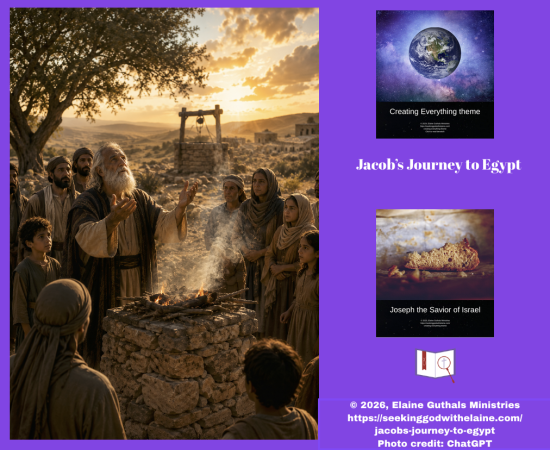
“So Jacob set out for Egypt with all his possessions. And when he came to Beersheba, he offered sacrifices to the God of his father, Isaac. During the night God spoke to him in a vision. ‘Jacob! Jacob!’ he called. ‘Here I am,’ Jacob replied. ‘I am God, the God of your father,’ the voice said. ‘Do not be afraid to go down to Egypt, for there I will make your family into a great nation. I will go with you down to Egypt, and I will bring you back again. You will die in Egypt, but Joseph will be with you to close your eyes’” (Gen. 46: 1-4 NLT)
Jacob set out for Egypt
At the request of Joseph and by invitation of Pharaoh, Jacob began the trip to relocate to Egypt.
If we go back to the Hebrew, we see that the name Jacob isn’t used. Israel is.
We’ve said before that Israel is used when covenant identity is emphasized.
This is covenant protection, not just a family relocating to Egypt.
At this point, we’ve got to wonder if Jacob knew about God’s prophecy to Abraham. “Then the Lord said to Abram, ‘You can be sure that your descendants will be strangers in a foreign land, where they will be oppressed as slaves for 400 years. But I will punish the nation that enslaves them, and in the end they will come away with great wealth. (As for you, you will die in peace and be buried at a ripe old age.) After four generations your descendants will return here to this land, for the sins of the Amorites do not yet warrant their destruction’” (Gen. 15: 13-16 NLT).
On one hand, we have to believe that Jacob did. If Moses wrote Genesis, he may have used oral tradition to record all that happened before him.
Jacob probably did know. God’s covenant isn’t something Abraham would have kept secret.
On the other hand, maybe this part Abraham did keep secret. Don’t we tend to shy away from the bad stuff?
Even if Jacob was thinking, “Oh, this isn’t going to turn out well,” He was all in. He loaded up all his possessions.
Israel was being obedient..
He Came to Beersheba
Beersheba was an important city.
Abraham lived in Beersheba for a while. “Then they returned to the servants and traveled back to Beersheba, where Abraham continued to live” (Gen. 22: 19 NLT).
Isaac also lived in Beersheba. “From there Isaac moved to Beersheba” (Gen. 26: 23 NLT).
This was where Jacob left from to go to Haran when he was fleeing Esau. “From there Isaac moved to Beersheba” (Gen. 28: 10 NLT).
Beersheba was the last city on Canaanite land. Before he took one step outside what would be the Promised Land, Jacob sacrificed to God. Through his worship, he put his faith and trust in God that He had this.
Jacob came as far as he dared without direction from Jehovah.
I think it is interesting that Moses put it as “… he offered sacrifices to the God of his father, Isaac” (Gen. 46: 1 NLT). We’ve been told that Jacob had encountered God himself twice. Why didn’t he say your God?
Sometimes, it is easier to think that Abraham had the stronger faith than Isaac. Plus, the original covenant was with him.
But then, Abraham went to Egypt during a famine – and that fell apart when Pharaoh took Sarah (Gen. 12: 10). Isaac was also going to go down to Egypt due to a famine – but Jehovah told him not to go (Gen. 26: 2).
Regardless of his knowledge of the prophecy, Jacob had to have been having some qualms. True, this wasn’t his first move to a different place, but he’s old now.
Was this within Jehovah’s Will?
But the joy and excitement had to have been there. Jacob was going to be with Joseph again!
God Spoke to Him in a Vision
Jehovah promised to be with Jacob in Egypt.
During the night, Jehovah came to Jacob. The call Jacob heard was, “Jacob, Jacob.” It indicates intimacy and urgency.
Jehovah came to Jacob in a vision. He calmed his fears by telling him that He was sanctioning this relocation. (In fact, He had orchestrated it.)
Think about it. Jacob had sent his sons down to Egypt twice to buy grain. Never once did it say that he was planning to move down there.
Then the brothers come back with wagons. Yeah, it probably felt mind-boggling that Pharaoh himself had invited Jacob and his family there to live.
But all throughout Scripture, Egypt is represented as being a compromise and a danger to covenant identity. They portrayed the worldview.
Jehovah said, “Go.”
How many times do we leave the Promised Land on our own free will? We choose to head off on our own road that Jehovah does not want us going down.
But off we go. We need to do a better job at walking with Jehovah, not away from Him.
Instead of, “Stay home,” Jacob got, “I will go with you down to Egypt, and I will bring you back again. You will die in Egypt, but Joseph will be with you to close your eyes’” (Gen. 46: 4 NLT).
Jehovah told Jacob that He would walk with him.
Also, Jehovah told Jacob the purpose for going to Egypt. “… for there I will make your family into a great nation” (Gen. 46: 3 NLT).
Did you catch all of those promises?
- I’ll make you into a great nation.
- I’ll go with you.
- I’ll bring you back again – not you, but your family.
- When you die, the last thing you are going to feel is Joseph closing your eyes.
What does Jacob have to fear now?
Jacob Leaves Canaan
“So Jacob left Beersheba, and his sons took him to Egypt. They carried him and their little ones and their wives in the wagons Pharaoh had provided for them. They also took all their livestock and all the personal belongings they had acquired in the land of Canaan. So Jacob and his entire family went to Egypt — sons and grandsons, daughters and granddaughters — all his descendants” (Gen. 46: 5-7 NLT)
Jacob was free to leave Canaan.
Now that Jehovah had given Jacob permission to move to Egypt, he could continue the trip.
This must have been a big caravan. We don’t know how many wagon Pharaoh provided, but it would at least be 12 if not 13. That would be one per family (Jacob, 11 sons, and 1 daughter).
That isn’t counting any servants or slaves that they had. Surely, they had some to help them.
Genealogy List
“These are the names of the descendants of Israel — the sons of Jacob — who went to Egypt: Reuben was Jacob’s oldest son. The sons of Reuben were Hanoch, Pallu, Hezron, and Carmi. The sons of Simeon were Jemuel, Jamin, Ohad, Jakin, Zohar, and Shaul. (Shaul’s mother was a Canaanite woman.) The sons of Levi were Gershon, Kohath, and Merari. The sons of Judah were Er, Onan, Shelah, Perez, and Zerah (though Er and Onan had died in the land of Canaan). The sons of Perez were Hezron and Hamul. The sons of Issachar were Tola, Puah Jashub and Shimron. The sons of Zebulun were Sered, Elon, and Jahleel. These were the sons of Leah and Jacob who were born in Paddan-aram, in addition to their daughter, Dinah. The number of Jacob’s descendants (male and female) through Leah was thirty-three. The sons of Gad were Zephon Haggi, Shuni, Ezbon, Eri, Arodi, and Areli. The sons of Asher were Imnah, Ishvah, Ishvi, and Beriah. Their sister was Serah. Beriah’s sons were Heber and Malkiel. These were the sons of Zilpah, the servant given to Leah by her father, Laban. The number of Jacob’s descendants through Zilpah was sixteen. The sons of Jacob’s wife Rachel were Joseph and Benjamin. Joseph’s sons, born in the land of Egypt, were Manasseh and Ephraim. Their mother was Asenath, daughter of Potiphera, the priest of On. Benjamin’s sons were Bela, Beker, Ashbel, Gera, Naaman, Ehi, Rosh, Muppim, Huppim, and Ard. These were the sons of Rachel and Jacob. The number of Jacob’s descendants through Rachel was fourteen. The son of Dan was Hushim. The sons of Naphtali were Jahzeel, Guni, Jezer, and Shillem. These were the sons of Bilhah, the servant given to Rachel by her father, Laban. The number of Jacob’s descendants through Bilhah was seven. The total number of Jacob’s direct descendants who went with him to Egypt, not counting his sons’ wives, was sixty-six. In addition, Joseph had two sons who were born in Egypt. So altogether, there were seventy members of Jacob’s family in the land of Egypt” (Gen. 46: 8-27 NLT)
Through this family, the nation of Israel was born.
I know. Long genealogy lists make us want to skip right over them.
Those lists were very important back when they were constructed. This wasn’t just a family list. It was covenant documentation.
Depending on who you count, there were 66 (Gen. 46: 27), 70 (Deut. 10:22; Ex. 1:5; Gen. 46: 27), or 75 (Ac. 7: 14) Hebrews who moved to Egypt.
There is significance in the number 70. Seven shows completeness and holiness. The entire covenant household migrated to Egypt.
It is also significant that the family be counted now. That was the beginning of the nation of Israel.
That 70 — if we go with the number in this passage — turned into 2.4 million. We are talking about a lot of people.
If 2.4 million people left Egypt – and it seems like families were more than the 2.5 kids in those days – there would have been more than that. That number probably only counted the men.
Is this list correct? Was Benjamin old enough to have kids? Or did Moses add information?
I say that even though Dinah was included in the 66 and 70 here. That indicates that, more than likely, she remained single.
Leale noted that Dinah was listed here as being among the founders of the house of Israel. This did much to elevate the status of women and leads to female inheritance.
Resource
But then, the covenant promised that Abraham’s descendants would be as numerous as the stars.
- “… I will multiply your descendants beyond number, like the stars in the sky and the sand on the seashore …” (Gen. 22: 17 NLT).
- “I will cause your descendants to become as numerous as the stars of the sky, and I will give them all these lands …” (Gen. 26: 4 NLT).
- “Your descendants will be as numerous as the dust of the earth. They will spread out in all directions – to the west and the east, to the north and the south …” (Gen. 28: 14 NLT).
It is significant that Joseph was included in this list. It does differentiate that Joseph and his family were already in Egypt.
Why is this significant? Joseph’s inclusion in the covenant list matters. Though separated geographically, he was never separated covenantally.
Jehovah preserved Joseph ahead of the family so that he may preserve the family and the covenant.
Almost There
“As they neared their destination, Jacob sent Judah ahead to meet Joseph and get directions to the region of Goshen …” (Gen. 46: 28 NLT)
Jacob sent Judah
Once the Hebrews got to Egypt, Jacob sent Judah ahead to work things out with Joseph.
It was appropriate that Judah was sent. He had essentially taken over as firstborn. Reuben instituted a coup by sleeping with one of his father’s wives. Simeon and Levi had embarrassed and humiliated Jacob by killing all the men of Shechem for raping their sister Dinah.
Gray made an interesting observation. He wrote that Judah
“… had taken a chief part in the separating of father and son, and we now see him most active in bringing about the meeting. Those who have done wrong may not be able to undo the wrong they have done, but should, if possible, make reparation.”
Resource
We also remember that Judah was willing to be the substitute for Benjamin. “So please, my lord, let me stay here as a slave instead of the boy, and let the boy return with his brothers” (Gen. 44: 33 NLT).
Judah would take over the ruling of Jacob’s family upon his death. He started now by working with Joseph to get the family settled where they were going.
The Region of Goshen
Settling the family in the land of Goshen was a priority for Joseph.
Why was that so important? There probably were a couple of reasons.
Joseph, in his tenure in Egypt, recognized the Egyptians’ dislike of foreigners. Remember— to them — a foreigner sat on their throne.
Their Pharaoh was Hyksos. That means he was of Semitic descent — also a descendant of Shem — just as the Hebrews were.
That connection — and certainly any favoritism — may cause true Egyptians to look poorly on the Hebrews.
Egyptians also looked down on shepherds.
But then there was a chance that the Hebrews, too, may think Pharaoh was showing too much favoritism to Joseph and Jacob.
Joseph also probably was concerned about the Hebrews being corrupted by Egypt’s heathenism. The country was filled with idolatry, animal worship, and magicians.
Joseph, himself, was able to keep grounded in his faith in Jehovah. He didn’t want to submit his family to the opportunity to sin, so he wanted a place that they could be separate from the Egyptians.
Jacob and His Family Arrived in Goshen
“… And when they finally arrived there, Joseph prepared his chariot and traveled to Goshen to meet his father, Jacob. When Joseph arrived, he embraced his father and wept, holding him for a long time. Finally, Jacob said to Joseph, ‘Now I am ready to die, since I have seen your face again and know you are still alive’” (Gen. 46: 28-30 NLT)
This would have been a bittersweet reunion for Jacob.
Jacob thought for years that day wasn’t possible. His hope was as dead as he thought Joseph was.
Then, Jacob had heard Joseph was alive. But you know, seeing is believing.
Ooo, baby. Jacob was now seeing!
It says Joseph wept for a long time. Jacob was probably matching him tear for tear.
Remember, covenant men do cry.
Jacob’s joy probably knew no bounds. But the reunion may have still been bittersweet. Jacob may have thought of the 22 years of Joseph’s life that he missed.
Still, Jacob was content. His deepest sorrow had been healed. God had given him a gift he never thought possible. He wouldn’t ask for more.
Preparing to Meet the Pharaoh
“And Joseph said to his brothers and to his father’s entire family, “I will go to Pharaoh and tell him, ‘My brothers and my father’s entire family have come to me from the land of Canaan. These men are shepherds, and they raise livestock. They have brought with them their flocks and herds and everything they own.’” Then he said, ‘When Pharaoh calls for you and asks you about your occupation, you must tell him, “We, your servants, have raised livestock all our lives, as our ancestors have always done.” When you tell him this, he will let you live here in the region of Goshen, for the Egyptians despise shepherds’” (Gen. 46: 31-34 NLT)
Joseph felt honesty was the best policy when meeting Pharaoh.
Joseph had a plan for his family. He knew where they needed to live in a place conducive to their occupation.
Yes, being truthful about their occupation would help secure the land of Goshen for their dwelling place. More importantly, Joseph didn’t want to start their sojourn in Egypt on a lie.
Making the Connections #1
Are we surprised that Jehovah appeared to Jacob at Beersheba? We shouldn’t be.
Jehovah will show up when we are in a crisis. He will especially show up when we are seeking Him.
Making the Connections #2
If we take a look at the genealogy lists again, we see that Leah’s line of descendants is the most extensive list.
There may be another reason besides Leah had the most sons.
That reason is Judah. Judah was Leah’s son. The kingship — as well as the Messiah — came through Judah and Leah.
The rejected wife becomes central to redemptive history.
How Do We Apply This?
- Always pray for guidance when transitioning through stages of life.
- Be honest in dealings with others so that God’s blessings can be given to us because of our obedience.
- Repair what past sins have broken.
- Live by Jehovah’s principles.
Resource
Father God. Thank You for ensuring that we know about Jacob and Joseph’s story. Thank you for showing us that we can depend on Your provision — even if it doesn’t happen on our timetable. You will provide for us as You have promised. Amen.
If you don’t understand something and would like further clarification, please contact me.
If you have not signed up for the email providing the link to the devotions and the newsletter, do so below.
If God has used this devotion to speak with you, consider sharing it on social media.