Jacob’s 11 sons were returning home with good news. This devotional reading looks at their leaving Egypt and Jacob’s reaction to that good news.
Nuggets
- Everyone was happy for Joseph that his family was there.
- Joseph began providing for his family even before they moved there.
- If we look at the Hebrew for this passage, layers of emotion are added to what we can already see.
- The impossible was happening.
Joseph was a man to whom people bowed down. - Jacob had a much more physical reaction than being stunned.
- But no – it was too much for Jacob to believe.
- The brothers came clean.
- Now – now – Jacob wasn’t just happy; he had his life back.
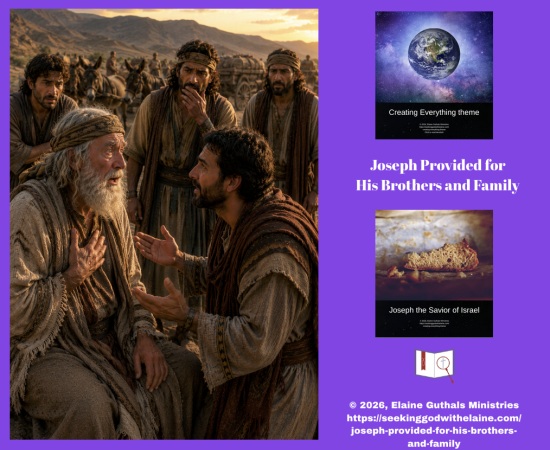
Joseph had revealed who he really was to his brothers, and they had an emotional reunion.
But it’s now time to go back to Canaan, pick up his father, and move down to Egypt. How in the world could they pull that off?
Let's Put It into Context
To read devotions in the Creating Everything theme, click the button below.
Devotions in the Joseph the Savior of Israel series
Pharaoh Invited Jacob to Egypt
“The news soon reached Pharaoh’s palace: ‘Joseph’s brothers have arrived!’ Pharaoh and his officials were all delighted to hear this. Pharaoh said to Joseph, ‘Tell your brothers, “This is what you must do: Load your pack animals, and hurry back to the land of Canaan. Then get your father and all of your families, and return here to me. I will give you the very best land in Egypt, and you will eat from the best that the land produces.”’ Then Pharaoh said to Joseph, ‘Tell your brothers, “Take wagons from the land of Egypt to carry your little children and your wives, and bring your father here. Don’t worry about your personal belongings, for the best of all the land of Egypt is yours”’” (Gen. 45: 16-20 NLT)
Everyone was happy for Joseph that his family was there.
Sometimes, we get an engraved invitation. Pharaoh himself invited Jacob and his family to move to Egypt. In fact, he made the move easy by providing wagons. He promised to give them the best land. He even said leave your personal belongings because they would be replaced.
Israel’s sojourn in Egypt started out on friendly terms. Remember the promise in Abraham’s covenant. “I will bless those who bless you and curse those who treat you with contempt …” (Gen. 12: 3 NLT).
Because Egypt is participating in covenant preservation, they were blessed.
Knowing how the story ends, we know it didn’t end well regardless of how it started out.
But isn’t that how sin works? It looks all good and shiny at the beginning.
That, however, is what Satan wants it to look like. We wouldn’t be tempted if it looked all hard and painful.
There is only so long that Satan can keep up – and wants to keep up – the delusion. He wants us to get to the acknowledgment that it really is a sin.
But this is what Jehovah wanted. He wanted Israel tucked safely in Egypt to ride out the famine.
The Brothers Left Egypt
“So the sons of Jacob did as they were told. Joseph provided them with wagons, as Pharaoh had commanded, and he gave them supplies for the journey. And he gave each of them new clothes — but to Benjamin he gave five changes of clothes and 300 pieces of silver. He also sent his father ten male donkeys loaded with the finest products of Egypt, and ten female donkeys loaded with grain and bread and other supplies he would need on his journey. So Joseph sent his brothers off, and as they left, he called after them, ‘Don’t quarrel about all this along the way!’” (Gen. 45: 21-24 NLT)
Joseph began providing for his family even before they moved there.
Along with the wagons Pharaoh had provided, Joseph took care of many other things they would need. He provided food, money, supplies, animals, and clothes.
The brothers – this time – were not jealous when Benjamin got special treatment. They had changed.
That last verse always slays me. “Don’t quarrel, guys.” Did Joseph know his brothers or what!?
Well, that is human nature – especially on a road trip. Nothing is normal or routine. There were 11 personalities that were in play.
I wonder if Joseph had a clue what the quarrel would be about – responsibility for selling Joseph. That is human nature, too.
It wasn’t that Joseph didn’t want them to not take responsibility for their actions. He knew each one would have to be held accountable by Jehovah for their part.
So, it wasn’t about shirking responsibility and accountability.
It was about transforming their relationship with each other. Yes, Joseph was going to have to build a relationship with each brother.
But Joseph knew that they were going to have to work on their interpersonal relationships, too. True reconciliation requires more than confession.

Arrived Home
“And they left Egypt and returned to their father, Jacob, in the land of Canaan. ‘Joseph is still alive!’ they told him. ‘And he is governor of all the land of Egypt!’ Jacob was stunned at the news — he couldn’t believe it. But when they repeated to Jacob everything Joseph had told them, and when he saw the wagons Joseph had sent to carry him, their father’s spirits revived. Then Jacob exclaimed, ‘It must be true! My son Joseph is alive! I must go and see him before I die’” (Gen. 45: 21-28 NLT)
Left Egypt
If we look at the Hebrew for this passage, layers of emotion are added to what we can already see.
It says that the brothers went up – ‘alah (עָלָה). This is true because Canaan is at a higher elevation geographically than Egypt.
But going up also signifies a spiritual and covenant significance. Their dire circumstances were being provided for by Jehovah.
True, Egypt would be a temporary provision. Canaan was the covenant land.
For this trip, they were returning to the covenant patriarch.
Joseph Is Still Alive!
The impossible was happening.
The wording in the Hebrew is in a little different order. They are the same words, but the different order places the emphasis elsewhere.
The Hebrew – ʿôd yôsēp ḥay (עוֹד יוֹסֵף חַי) – says still Joseph lives. Yes, it was Joseph they were talking about.
But for over twenty years, Jacob thought Joseph was dead. After all these years – the years that Jacob had emotionally lived through – Jacob was going to see Joseph again. He was going to get to talk to him and hold him.
Governor of All the Land of Egypt
Joseph was a man to whom people bowed down.
In the Hebrew, Joseph’s title is mōshēl (מֹשֵׁל) – ruler, governor, or one exercising dominion. This word connects back to Joseph’s dreams in Genesis 37.
Jacob would have known that the brothers were angry at Joseph for his dreams. He would also know that they had come true – in a grander fashion than any had imagined could happen.
Jacob Was Stunned
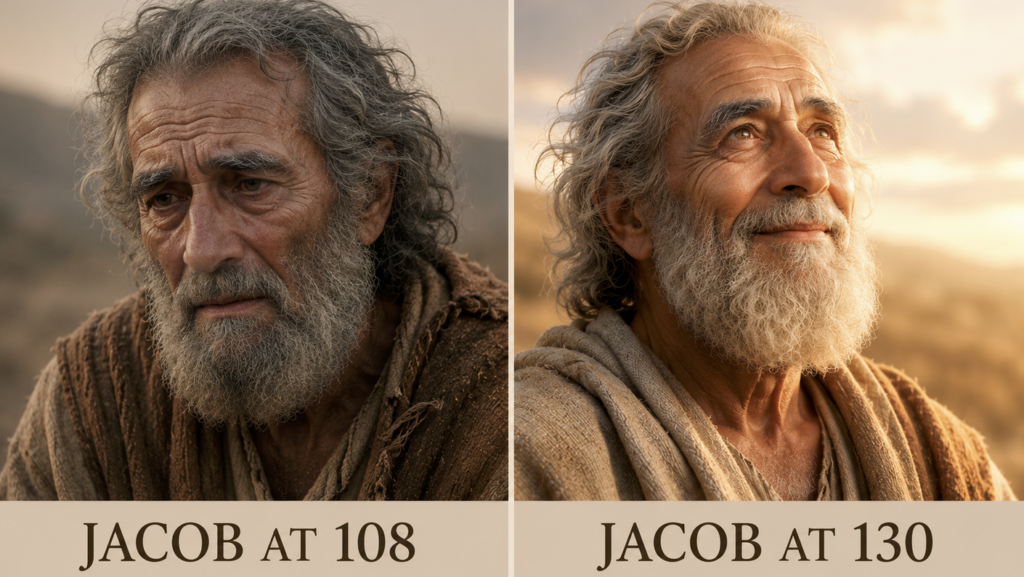
Jacob had a much more physical reaction than being stunned.
The Hebrew is wayyāp̄og libbô (יָּפָג לִבּוֹ). The important word is the verb – pûg (פּוּג). This can mean grow faint, become weak, lose strength, become cold, or collapse emotionally.
Yeah, I would say that Jacob experienced all of that. His whole emotional system essentially just shut down.
Probably the first month, Jacob thought Joseph would come walking into camp – torn up by some animal, true – but home. Any parent would probably hope beyond hope that, since there was no body found, Joseph got away from whatever attacked him.
Hard telling how long Jacob would have thought that. Slowly, he would recognize that Joseph wasn’t coming home.
Acceptance does not stop grief from occurring, especially debilitating grief.
Remember how Moses described it. “Then Jacob tore his clothes and dressed himself in burlap. He mourned deeply for his son for a long time. His family all tried to comfort him, but he refused to be comforted. ‘I will go to my grave mourning for my son, he would say, and then he would weep” (Gen. 37: 34-35 NLT).
He Couldn’t Believe It
But no – it was too much for Jacob to believe.
Look at the Hebrew. It says he didn’t believe them – lōʾ-heʾĕmîn lāhem (לֹא־הֶאֱמִין לָהֶם). The verb is ʾāman (אָמַן). It means believe, trust, support, confirm, or establish.
There are some powerful words that are in the same root family. They are Amen, faithfulness, firmness, and reliability.
The brothers lied to their father. No, Jacob probably didn’t have any clue about what they had done. But it was a dysfunctional family – all the way back to Abraham.
Jacob would have known the character of his sons.
True, what they told their father wasn’t something that could be understood on first telling.
That just shows even more how God is God of the impossible. “But Jesus looked at them and said, ‘With man this is impossible, but with God all things are possible’” (Mt. 19: 26 ESV).
Repeated to Jacob Everything Joseph Had Told Them
The brothers came clean.
The brothers told them all the words of Joseph. That would have included “But don’t be upset, and don’t be angry with yourselves for selling me to this place. It was God who sent me here ahead of you to preserve your lives” (Gen. 45: 5 NLT).
They would have told Jacob of false evidence, hidden guilt, silence, and fear. They would have told him of jealousy and anger.
But there was visible evidence that they were now telling Jacob the truth. The wagons were real.
If Jacob had any emotions left to feel, those words would have probably used those up. How can a father listen to his ten sons tell him that they did what they did to Joseph?
Forget that Joseph was the favorite for a minute. Think only about the ten sons. Jacob would have more than likely asked himself how they could have gotten to that point.
But then Jacob would have to stop and take responsibility for his actions. His favoritism can’t be forgotten for long.
They all – except Benjamin – had a hand in this sorry tale.
Their Father’s Spirits Revived
Now – now – Jacob wasn’t just happy; he had his life back.
Moses said that the spirit of their father Jacob revived – watteḥî rûaḥ yaʿăqōb (וַתְּחִי רוּחַ יַעֲקֹב). The verb is ḥāyâ (חָיָה). It means live, revive, restore to life, or recover vitality.
For over twenty years, Jacob had existed as a dead man. He was in mourning and deep despair. He expected his own death.
It was more than that. His rûaḥ (רוּחַ) – spirit, inner life, or vitality – had returned.
Had Joseph’s disappearance strained Jacob’s relationship with Jehovah? If it had, that relationship had now been restored.
In verse 28 in the Hebrew, Jacob is called Israel. Remember, we said that occurs when we are talking covenant identity and his patriarchal role.
It was enough. Jacob didn’t have to see Joseph. He just had to know that his son lived. He was now a father again.
The hope of seeing Joseph was all that Jacob needed.
Making the Connections
Joseph’s reveal was an important, emotional time for the brothers. It might remind us of another meeting.
Think about when Jacob reunited with Esau after 20 years. It had some similar elements to it while carrying other elements.
Esau had threatened to kill Jacob after Jacob had deceived Isaac and received the firstborn’s blessing. The brothers had initially wanted to kill Joseph.
Both Jacob and Joseph were away from their family for two decades. Joseph was gone a couple of more years that Jacob.
Both worked under the supervision of someone else. Neither – until Joseph interpreted a dream – were in charge of their actions. Jacob probably had a little more say in his life than Joseph did – but probably not a whole lot.
Both fulfilled covenant responsibilities when in exile to another land.
A big difference was that Jacob was free. He was receiving compensation for his work – the chance to marry Rachel. Joseph was a slave and, until the king needed an interpreter, he was in prison.
Their age difference was also significant. Jacob was 77 when he fled Canaan. Joseph was 17 when he had no choice but to go with the traders.
What can we learn from this? Jehovah does work in patterns. He does do things in His own time. Most of all, He follows His plan, regardless of how challenging and heartbreaking it is for us.
How Do We Apply This?
- Trust Jehovah even when you cannot see what He is doing behind the scenes and His plans seem delayed.
- Wait patiently for Jehovah’s timing instead of demanding your own.
- Surrender the unanswered parts of your story to Jehovah’s care.
- Refuse to let grief become your identity by choosing hope instead of despair when circumstances seem impossible.
- Look for evidence of Jehovah’s faithfulness when doubt begins to overwhelm you.
- Thank Jehovah for the ways He has carried you through past trials and demonstrated His faithfulness.
- Allow Jehovah to restore what grief, disappointment, or loss has taken from you.
- Believe that Jehovah can accomplish what seems impossible from a human perspective.
- Focus on God’s promises rather than your present circumstances.
Father God. Thank You that You are in control even when we don’t see You working. Help us to wait patiently for You to work and to remain obedient in all times. Amen.
If you don’t understand something and would like further clarification, please contact me.
If you have not signed up for the email providing the link to the devotions and the newsletter, do so below.
If God has used this devotion to speak with you, consider sharing it on social media.