Jacob’s eleven sons reach Egypt to buy more grain and have Simeon released. This devotional reading looks at the beginning of reconciliation.
Nuggets
- Joseph had his brothers over for lunch.
- The brothers quickly come clean about the returned money with Joseph’s servant.
- The brothers bowed before Joseph again, further fulfilling the prophecy of the dreams.
- Joseph probably hadn’t gotten over the loss of his relationship with Jacob.
- Jacob immediately blessed his brother Benjamin.
- The fellowship meal that the brothers had was layered.
When we last saw Jacob’s sons, they had just arrived at Egypt and presented themselves to Joseph. I wonder what was going through their minds.
Their last trip to Egypt hadn’t really gone that well. They were accused of being spies. They had to leave Simeon there in prison and bring Benjamin back with them.
How was this trip going to top that trip?
Let's Put It into Context
To read devotions in the Creating Everything theme, click the button below.
Devotions in the Joseph the Savior of Israel series
Responding to Unexpected Kindness
“When Joseph saw Benjamin with them, he said to the manager of his household, ’These men will eat with me this noon. Take them inside the palace. Then go slaughter an animal, and prepare a big feast.’ So the man did as Joseph told him and took them into Joseph’s palace. The brothers were terrified when they saw that they were being taken into Joseph’s house. ‘It’s because of the money someone put in our sacks last time we were here,’ they said. “He plans to pretend that we stole it. Then he will seize us, make us slaves, and take our donkeys.’ The brothers approached the manager of Joseph’s household and spoke to him at the entrance to the palace. ‘Sir,’ they said, ‘we came to Egypt once before to buy food. But as we were returning home, we stopped for the night and opened our sacks. Then we discovered that each man’s money — the exact amount paid — was in the top of his sack! Here it is; we have brought it back with us. We also have additional money to buy more food. We have no idea who put our money in our sacks.’‘Relax. Don’t be afraid,’ the household manager told them. ‘Your God, the God of your father, must have put this treasure into your sacks. I know I received your payment.’ Then he released Simeon and brought him out to them. The manager then led the men into Joseph’s palace. He gave them water to wash their feet and provided food for their donkeys. They were told they would be eating there, so they prepared their gifts for Joseph’s arrival at noon” (Gen. 43: 16-25 NLT)
These Men Will Eat with Me This Noon
Joseph had his brothers over for lunch.
It was the moment that Joseph was waiting for. Benjamin – his only full brother – was presented to him.
We have to remember. Based on the timeline we’ve been using, Jacob left Canaan in 1692 BC. This meal occurred around 1670 BC.
Let’s put this in ages. Joseph was 17 years old when he left Canaan. Benjamin probably wasn’t even a year old then.
That had been 22 years ago. Benjamin would have no memories of Joseph. Joseph would have memories of Benjamin, but he was no longer that baby.
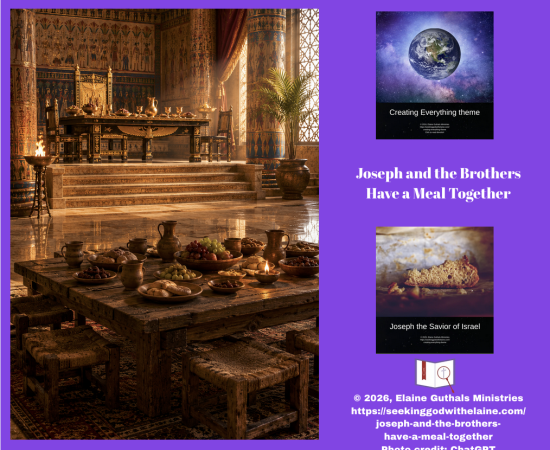
Joseph immediately had them taken to his palace. He instructed his servants to fix a meal for them. Not just any meal – it was a huge feast.
Knowing Joseph was their brother, that is logical. The brothers had just come from a famine-ravaged country. Hard telling when and how much their last meal was.
Joseph cared for them. So, he took them home and fed them.
But Joseph’s formerly confident – maybe even cocky – brothers were now fearful men. All they could think of was about the money that had appeared in their sacks of grain.
They panicked. Their guilty consciences told themselves that Joseph’s mercy was a danger.
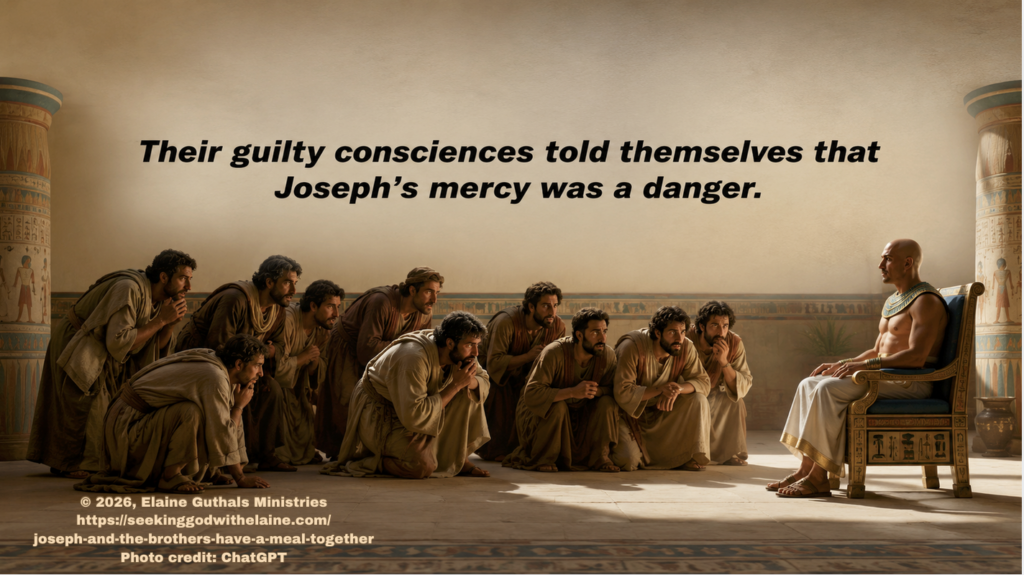
Seriously, if Joseph was out to get them, wouldn’t he have them arrested on sight? He wouldn’t have them taken to his house — he would have had them taken straight to jail?!
They thought they were going to be taken into slavery. Were they thinking an eye for an eye?
But we do the same thing, don’t we? We see something good and look at it suspiciously – seeing good makes things looks worse.
We focus on how we are afraid things are going to go. That may be based on reality, or it just may be based on our fear. Fear distorts kindness.
The Brothers Approached Joseph’s Household Manager
The brothers quickly come clean about the returned money with Joseph’s servant.
The best defense is a good offense. The brothers laid out their side of the story to Joseph’s household manager.
But that is the way it should be. They were being honest. True ,they didn’t want the accusation, but they wanted a situation they saw as wrong cleared up.
So, they tell the house manager the whole story. Well, they might have condensed part of it. They didn’t know all the money had been returned to them until they returned home.
But their fear was leading the explanation.
True, they had good reason to be afraid. Egyptian officials possessed enormous authority. An accusation involving royal grain could carry a severe punishment.
The manager set their minds to ease. He even reunited them with Simeon.
But this brings up a good point. I wonder how much Joseph had told his servants. “Hey, these are my brothers. We parted on not so good terms. I want to see if they grew up in the interim. Can you help me out with this?”
Probably not. Joseph did have an Egyptian reputation to maintain.
The servants probably would have known Jacob was a believer in Jehovah. If they didn’t know the story of him interpreting Pharaoh’s dreams, they would have been him daily, praying to Jehovah.
Joseph had been an influence in his own household.
Interacting with His Brothers
“When Joseph came home, they gave him the gifts they had brought him, then bowed low to the ground before him. After greeting them, he asked, ‘How is your father, the old man you spoke about? Is he still alive?’ ‘Yes,’ they replied. ‘Our father, your servant, is alive and well.’ And they bowed low again. Then Joseph looked at his brother Benjamin, the son of his own mother. ‘Is this your youngest brother, the one you told me about?’ Joseph asked. ‘May God be gracious to you, my son.’ Then Joseph hurried from the room because he was overcome with emotion for his brother. He went into his private room, where he broke down and wept” (Gen. 43: 26-30 NLT)
They Gave Him the Gifts
The brothers bowed before Joseph again, further fulfilling the prophecy of the dreams.
We talked about the gifts Jacob had sent with them. The interesting thing is that Jacob was allowed to send luxury or specialty products from Canaan to the “Egyptian” ruler. They followed the Ancient Near East custom of approaching powerful rulers with gifts.
They had luxury items but not standard food items. They included “… balm, honey, gum, aromatic resin, pistachio nuts, and almonds” (Gen. 43: 11 NLT).
Joseph probably would have known these from Jacob, not his brothers.
The Old Man You Spoke About
Joseph probably hadn’t gotten over the loss of his relationship with Jacob.
When he sees his brothers, Jacob’s thoughts immediately turn to his father.
“Is he alright?”
Joseph may be following Egyptian customs on the outside. Inside he is still that Hebrew boy that never gave up waiting for his Father.
May God be Gracious to You, My Son
Jacob immediately blessed his brother Benjamin.
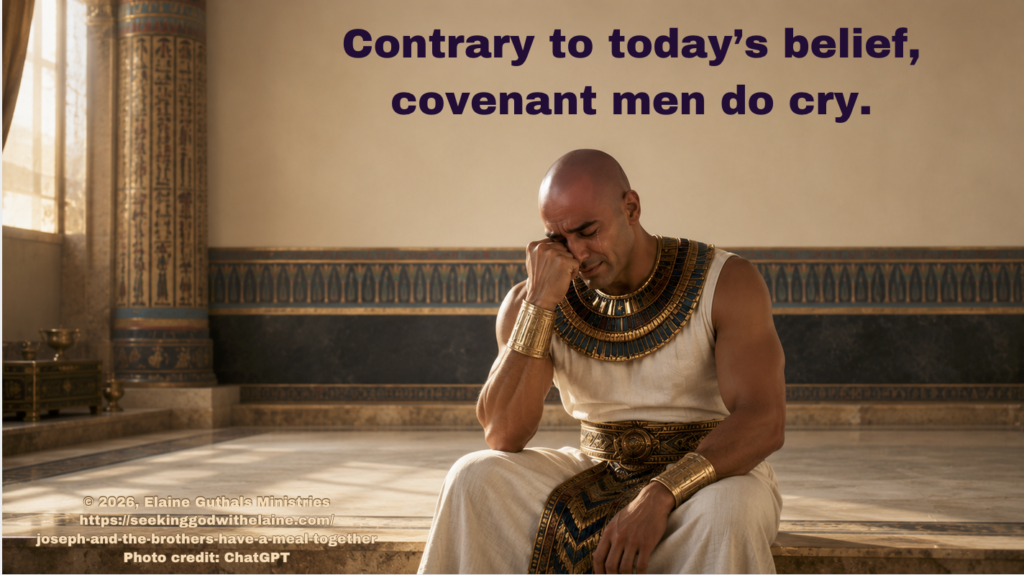
Joseph became deeply emotional. His compassion physically overwhelmed him.
In becoming overwhelmed, Joseph cried. It showed Jacob’s grief, love, memory — and restraint.
Contrary to today’s belief, covenant men do cry.
Bring Out the Food
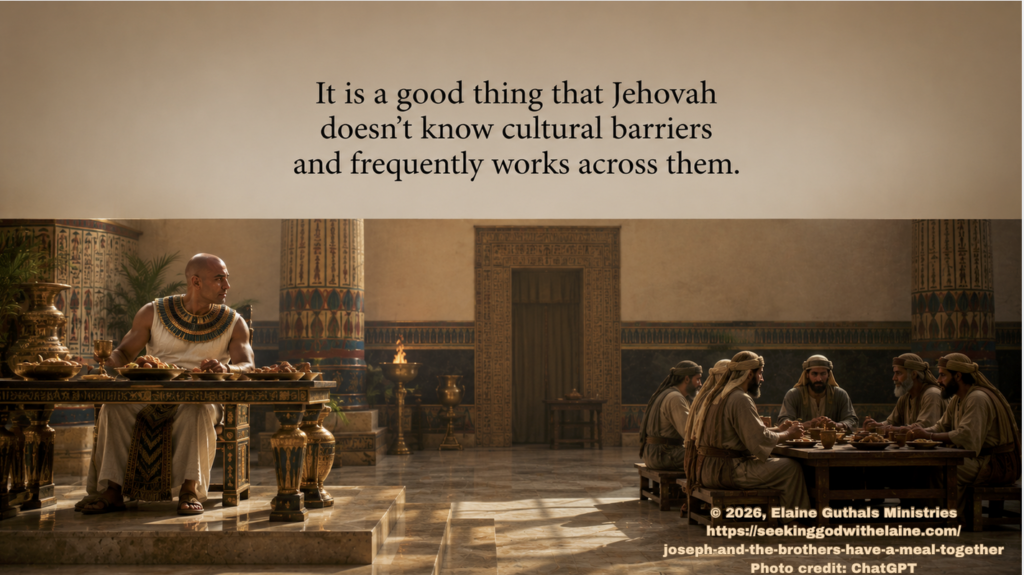
“After washing his face, he came back out, keeping himself under control. Then he ordered, ‘Bring out the food!’ The waiters served Joseph at his own table, and his brothers were served at a separate table. The Egyptians who ate with Joseph sat at their own table, because Egyptians despise Hebrews and refuse to eat with them. Joseph told each of his brothers where to sit, and to their amazement, he seated them according to age, from oldest to youngest. And Joseph filled their plates with food from his own table, giving Benjamin five times as much as he gave the others. So they feasted and drank freely with him” (Gen. 43: 32-34 NLT)
The fellowship meal that the brothers had was layered.
We have to understand about meals in the Ancient Near East. On top of that, we need to understand the dynamics of an Egyptian serving Hebrews.
Remember in the last devotion, we talked about Judah saying that an audience with a ruler indicated acceptance? Having a meal with him cemented that acceptance.
This meal would have carried covenant and relational significance. It symbolized peace, acceptance, and restored relationship.
Joseph was showing his brothers forgiveness – even if they didn’t know it yet.
This has always kind of gotten me. Joseph couldn’t eat with his brothers because of customs of the day. He had to keep up the ruse.
Even though Joseph had told them he believed in their God, he couldn’t buck Egyptian norms. Egyptians didn’t eat with Hebrews for purity concerns, ethnic separation, and cultural prejudice. They were shepherds, weren’t they — an inferior breed?
It is a good thing that Jehovah doesn’t know cultural barriers and frequently works across them.
But the brothers had to know something was up when he seated them by their ages.
Didn’t they see Joseph getting all choked up? Joseph was carefully orchestrating events to culminate in his big reveal.
Then Benjamin got special treatment.
Even it also was another test, not just a personal feast for Joseph’s baby brother. The brothers back in around 1692 BC would have been jealous if Joseph would have gotten a significant portion over them.
How would they react to Benjamin getting that?
Obviously, they didn’t. I am sure Moses would have documented that if they pitched a fit.
Making the Connections #1
After 22 years, the brothers still feel guilty about selling Joseph into Egypt.
No, that is a good thing in this case. Unresolved guilt reshapes perception.
Before, there was not one drop of remorse in their bodies. Somewhere along the line, they started thinking, “Maybe we shouldn’t have …”
Maybe it was Judah. He was taking lead of the family. He had gotten his own restoration encounter.
Truth be told, Jehovah was probably working in all of them. They all needed restoration. They all had to acknowledge their sin.
Making the Connections #2
Jacob’s sons were all sitting down having a meal together. Had they ever really fellowshipped? Probably not.
When Joseph was still in Canaan, the brothers were divided into maternal camps. They competed, envied, and deceived. Then it went from bad to worse when favoritism was weaponized.
Did they ever truly function as covenant brothers emotionally?
And no, this probably didn’t feel like fellowship either. But it was more than the brothers expected.
How Do We Apply This?
- Don’t mistake mercy for judgment.
- Refuse to let fear distort the way you see people and situations.
- Recognize that true fellowship requires humility and forgiveness.
- Trust that Jehovah can restore what sin once fractured.
Father God. This was more than a simple meal. It was a step toward reconciliation – but the brothers didn’t know that yet. You did. You were orchestrating everything. Thank You. Amen.
If you don’t understand something and would like further clarification, please contact me.
If you have not signed up for the email providing the link to the devotions and the newsletter, do so below.
If God has used this devotion to speak with you, consider sharing it on social media.