
Author: admin
-
The Shepherds and the Angel
Now that Messiah had been born, Jehovah was ready announce the birth of His Son. This devotional reading looks at how the good news was told and to whom.
Nuggets
- News of Messiah’s birth was shared first with hard-working shepherds.
- Sometimes, suddenly can be relative.
- When Jehovah called Abram (later known as Abraham) to follow Him, He knew that He was not going to stop with Israel in the restoration from the consequences of the Fall.
- The little Baby had three major titles associated with Him.
- The Anointed One was born in the city the king had been anointed.
- The sign given to the shepherds was very specific and easily recognized and verified.
Things just were not turning out as the Pharisees and Torah-teachers thought it would. The Sadducees would never have picked this way for Messiah to appear.
Messiah didn’t show up at the Temple and start the restoration process – which included kicking Rome out.
Messiah stayed in the manger. Jehovah orchestrated all other events.
Let’s Put It into Context
To read devotions in The Battle for the Heart theme
Devotions in the The Birth and Early Childhood of Christ series
The Shepherds
“That night there were shepherds staying in the fields nearby, guarding their flocks of sheep” (Lk. 2: 8 NLT)
News of Messiah’s birth was shared first with hard-working shepherds.
First off, Jehovah wanted the news taken to shepherds in the fields around Bethlehem. We don’t know who owned the fields, what the sheep were being raised for – or anything other than the fact that they were shepherds.
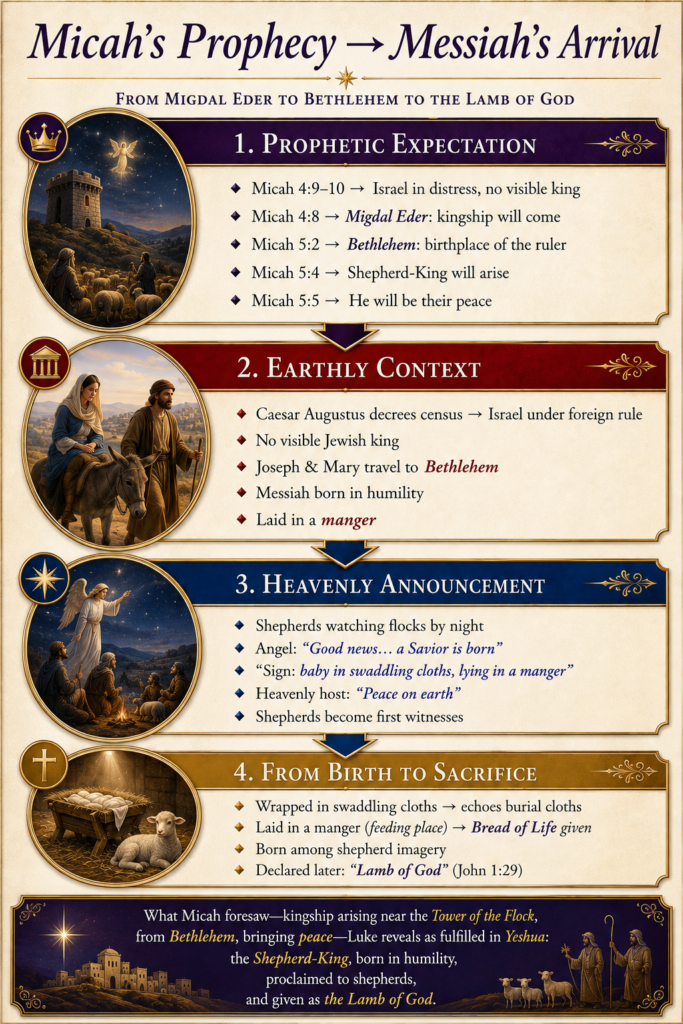
Micah gave us a clue. “And you, O Migdal-eder, Outpost of Fair Zion, It shall come to you: The former monarchy shall return — The kingship of Fair Jerusalem” (Mic. 4: 8 JPS).
Let’s piece together what we can
Migdal Eder (מִגְדַּל־עֵדֶר) – the Tower of the Flock – was a watchtower constructed to the east of Bethlehem. The tower, according to Mishna Shekalim 7:4, was part of a system for preparing and inspecting lambs for Temple sacrifice.
No, this does not mean all sheep in the fields of Bethlehem were destined for sacrifice. It does connect the Midgal Eder, which was in the Bethlehem area, with those sacrifices.
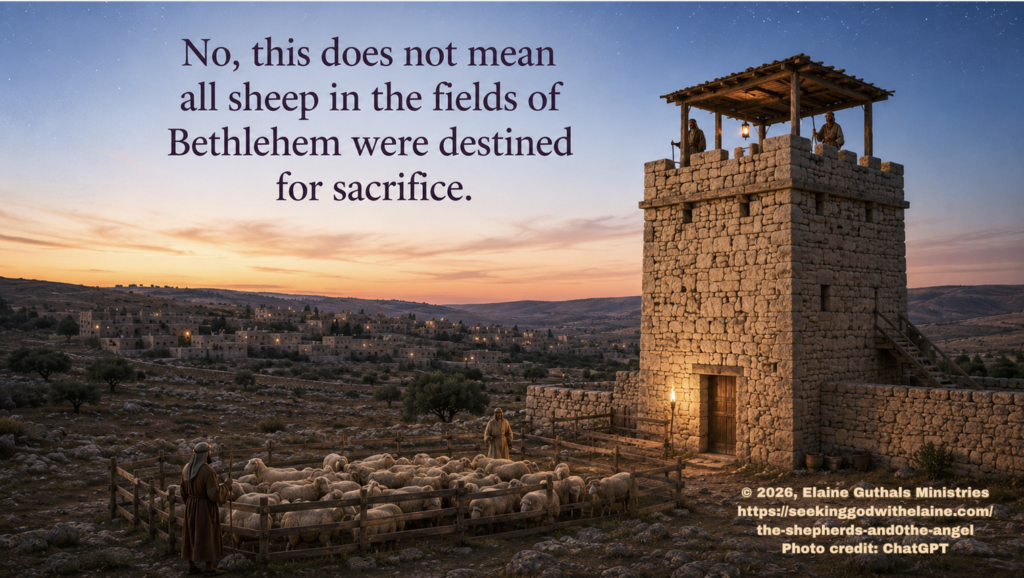
Think about the implication if they were. Jehovah chose societal outcasts who were performing an important task for the Temple – ensuring the purity of the sacrifices – to announce the birth of the Lamb of God – the Pascal Lamb.
That sounds like – to me – a connection Jehovah would make.
What Luke does tell us is important because of its specificity. They were in the Bethlehem region – Bethlehem being the city of David. It was night – an interesting nugget we really didn’t need to know but Luke told us anyway – when the shepherds were watching their flocks.
Society thought they were outcasts. Jehovah didn’t. They still had an important task to perform – and they were performing it. They were protecting the system that excluded them.
Look at the Greek a second. Luke uses ἀγραυλοῦντες (agraulountes), meaning they were staying/living in the open fields, and then φυλάσσοντες φυλακὰς τῆς νυκτός (phylassontes phylakas tēs nyktos), literally something like guarding the watches of the night.
The night was divided into watches. As watch here is plural, to me that mean all the watches were covered. They were looking and waiting for whatever to happen. They were active in their duties.
Jehovah calls us to be active in watching for Messiah’s return.
The Angel
“Suddenly, an angel of the Lord appeared among them, and the radiance of the Lord’s glory surrounded them. They were terrified, but the angel reassured them. ‘Don’t be afraid!’ he said. ‘I bring you good news that will bring great joy to all people. The Savior — yes, the Messiah, the Lord — has been born today in Bethlehem, the city of David! And you will recognize him by this sign: You will find a baby wrapped snugly in strips of cloth, lying in a manger’” (Lk. 2: 9-12 NLT)
Suddenly
Sometimes, suddenly can be relative.
Usually, we think of suddenly meaning that one minute something is true, the next something totally different is now true. That may, however, be contingent on when we notice something.
Still, what happened here was unexpected. The shepherds didn’t anticipate the angels appearing.
The angels did just that because this was where Jehovah sent them to be.
Good News of Joy to All People
When Jehovah called Abram (later known as Abraham) to follow Him, He knew that He was not going to stop with Israel in the restoration from the consequences of the Fall.
Yes, Abraham was going to have enough descendants to form a nation. But even people not his descendants were going to be blessed through him.“… All the families on earth will be blessed through you.” (Gen. 12: 3 NLT).
This blessing was going to be in the Person and mission of Yeshua – the promised Messiah in Genesis 3: 15. Through Him, sin and its originator would be defeated.
It was going to be for everyone.
- “I will give you to Israel as my personal covenant, and you will be a light to the nations.” (Isa. 42: 6 NLT).
- “The LORD has demonstrated his holy power before the eyes of all the nations. All the ends of the earth will see the salvation of our God.” (Isa. 52: 10 NLT)
- “I will also make you a light to the Gentiles, and you will bring my salvation to the ends of the earth.” (Isa. 49: 6 NLT).
Savior, Messiah, and Lord
The little Baby had three major titles associated with Him.
Savior means in Hebrew – moshiaʿ (מֹושִׁיעַ) – savior, deliverer, and one who saves/rescues. The Greek is sōtēr (σωτήρ) and means savior, deliverer, or rescuer.
This calls back to Luke’s previous discussion of salvation in Zechariah’s Benedictus. “He has sent us a mighty Savior from the royal line of his servant David” (Lk. 1: 69 NLT).
Zechariah also stated Yeshua’s mission. “And you, my little son, will be called the prophet of the Most High, because you will prepare the way for the Lord. You will tell his people how to find salvation through forgiveness of their sins” (Lk. 1: 76-77 NLT).
Fast forward to the night Yeshua was born. The same language was used.
What the angel was telling the shepherds was that Jehovah’s salvation promised under the covenant was being fulfilled in Bethlehem that night.
The title of Messiah – Mashiach (מָשִׁיחַ) – in Greek is Christos (Χριστός). Both mean anointed one.
Kings and priests were anointed. As both, Messiah would be anointed.
- “He will be very great and will be called the Son of the Most High. The Lord God will give him the throne of his ancestor David” (Lk. 1: 32 NLT).
- “and he will reign over the house of Jacob forever, and of his kingdom there will be no end.” (Lk. 1: 33 ESV).
The promised Anointed King had arrived.
Then the Baby the shepherds were being told about was called Lord – Kyrios (κύριος) in Greek and Adonai (אֲדֹנָי) in Hebrew. Luke has already set up his readers to understand that He is discussing Jehovah.
- “Then the angel said, ‘I am Gabriel! I stand in the very presence of God. It was he who sent me to bring you this good news!’” (Lk. 1: 19 NLT).
- “He will be a man with the spirit and power of Elijah. He will prepare the people for the coming of the Lord. He will turn the hearts of the fathers to their children, and he will cause those who are rebellious to accept the wisdom of the godly” (Lk. 1: 17 NLT).
- “And you, my little son, will be called the prophet of the Most High, because you will prepare the way for the Lord” (Lk. 1: 76 NLT).
The same Gospel that is preparing us for the coming of the Lord now announces that the Lord has arrived.
This is extremely telling when we read Isaiah.
- “I, yes I, am the Lord, and there is no other Savior.” (Isa. 43: 11 NLT).
- “… Was it not I, the Lord? For there is no other God but me, a righteous God and Savior. There is none but me” (Isa. 45: 21 NLT).
In Bethlehem, the city of David!
The Anointed One was born in the city the king had been anointed.
We’ve talked about Bethlehem being the city of David. That was because he was born there.
Bethlehem was also where David was anointed. Take a look.
- “Now the Lord said to Samuel, ‘You have mourned long enough for Saul. I have rejected him as king of Israel, so fill your flask with olive oil and go to Bethlehem. Find a man named Jesse who lives there, for I have selected one of his sons to be my king’” (I Sam. 16: 1 NLT).
- “So Jesse sent for him. He was dark and handsome, with beautiful eyes. And the Lord said, ‘This is the one; anoint him.’ So as David stood there among his brothers, Samuel took the flask of olive oil he had brought and anointed David with the oil. And the Spirit of the Lord came powerfully upon David from that day on. Then Samuel returned to Ramah” (I Sam. 16: 12-13 NLT).
What had David been doing when he was called in from the field to be anointed? He was being a shepherd watching a sheep.
That makes a great segue into Messiah as a Shepherd King.
Scripture is filled with men and women who were shepherds and shepherdesses. Abel, Abraham, Isaac, Jacob, Rachel, Moses, and David are the most familiar.
David saw the qualities shepherd possess with those of the Lord, Who was the Good Shepherd. “The LORD is my shepherd; I have all that I need” (Ps. 23: 1 NLT).
Shepherds – ro’eh (רֹעֶה) – protected and fed their flock. They guided them and even risked their lives for them.
The title of shepherd was given to the kings. It was their responsibility to ra’ah (רָעָה) – to pasture, to tend and to shepherd – Jehovah’s covenant people. To be more specific, the image became the symbol for covenant care, righteous leadership, and faithful guidance.
Messianic expectation saw Messiah being a Shepherd of His people. This shines through the promises given through David and the prophets while revealing the heart of Jehovah’s Kingdom.
Many saw Messiah being the One to fulfill Jehovah’s covenant promises to judge the false shepherds, gather His scattered sheep, and personally shepherd His people through David’s descendant.
Micah 5 – along with Jeremiah 23 – anticipate a righteous Shepherd-King who restores Israel and rules in peace. “And he will stand to lead his flock with the Lord’s strength, in the majesty of the name of the Lord his God. Then his people will live there undisturbed, for he will be highly honored around the world” (Mic. 5: 4 NLT).
Recognize Him by This Sign
The sign given to the shepherds was very specific and easily recognized and verified.
The angel told the shepherds three very concrete signs – semeion (σημεῖον) meaning a sign, mark, token, or identifying indication through which they could identify the Christ Child. We’ve already been told what the signs are, but Luke repeated them in the angel’s explanation of why they showed up on the hillside that night.
The first sign we may miss. The angel said that the Baby was born that day. Jehovah didn’t waste time in revealing His beloved Son’s birth to those who needed to know.
The Babe would be wrapped in swaddling clothes. That wasn’t unusual. That didn’t even indicate lack of wealth on the parents’ part.
What it did say was that the Baby was taken care of and loved.
The unusual identifying marker was that the Baby was lying in an animal feeding trough. Probably even more astounding to the shepherds was the fact that this Baby was identified as the Savior.
The enormous titles did not fit the setting.
We tend to focus on our perception that being a King in a manger makes Yeshua humble. It does show His humility.
To me, it shows from the first seconds after His arrival on earth, Yeshua was destined to be the Lamb of God, the Sacrifice Who takes away the sins of the world.
Ordinary shepherds would have been affected by the sign. Migdal Eder shepherds wouldn’t be able to miss that even with their eyes closed.
These shepherds would have known how to protect a lamb meant for sacrifice. They would have seen the Baby as entering the world the same way the other lambs did.
The Messiah existed with a Jewish sacrificial-animal framework. Because of that, the Davidic kingship would be restored. He would be the ruler who would shepherd Israel.
Making the Connections #1
The angel told the shepherds that they were being provided a sign. That is covenant language.
The most recognizable covenant sign to all is the rainbow. “Then God said, ‘I am giving you a sign of my covenant with you and with all living creatures, for all generations to come. I have placed my rainbow in the clouds. It is the sign of my covenant with you and with all the earth’” (Gen. 9: 12-13 NLT).
We are also familiar with the sign for the Abrahamic covenant. “You must cut off the flesh of your foreskin as a sign of the covenant between me and you” (Gen. 17: 11 NLT).
So, the angel starts it out by using the same language – this will be a sign to you. But then it took a turn.
Yeshua wasn’t just pointing toward Jehovah’s covenant promise. He was the covenant promise.
- “I, the Lord, have called you to demonstrate my righteousness. I will take you by the hand and guard you, and I will give you to my people, Israel, as a symbol of my covenant with them. And you will be a light to guide the nations” (Isa. 42: 6 NLT).
- “At just the right time, I will respond to you. On the day of salvation I will help you. I will protect you and give you to the people as my covenant with them. Through you I will reestablish the land of Israel and assign it to its own people again” (Isa. 49: 8 NLT).
Yeshua was the covenant. He especially showed this at the Last Supper. “After supper he took another cup of wine and said, ‘This cup is the new covenant between God and his people — an agreement confirmed with my blood, which is poured out as a sacrifice for you” (Lk. 22: 20 NLT).
Making the Connections #2
Luke is quietly foreshadowing what will happen when Yeshua finished His mission.

Making the Connections #3
What does the scene surrounding Yeshua’s birth tell us? Jehovah wasn’t interested in the way the world did things. He certainly didn’t need to ask anyone’s permission to do things His way.
Jehovah didn’t let the focus of the moment to be taken off the incarnation. Here He came to earth as flesh in the form of His Son.
Yeshua came where He needed to be.
Making the Connections #4
When we started this devotion, the shepherds were afraid. Well, that is the first thing we read in any angel encounter.
It really isn’t said here, but by the end of the devotion, they weren’t afraid anymore.
When we are open to what Jehovah is telling us, we shouldn’t be afraid. True, some things we have to experience is hard and hurts.
Experiences are meant to grow our understanding of Jehovah, bringing us closer to Him.
Heart Check
Think about the battle Yeshua is engaged in for your heart. Ask yourself the following questions.
- Am I watching for Yeshua, or am I spiritually asleep?
- Am I willing to receive what God reveals, even when it doesn’t look like what I expected?
- Do I understand that Yeshua came as Savior for all people, rather than restricting God’s grace to the people I think deserve it?
How Do We Apply This?
- Where does Yeshua need you to be?
Father God. So many times You show us that Your ways are not our ways. Thank You for using those times to show us Your love for us. Amen.
If you don’t understand something and would like further clarification, please contact me.
If you have not signed up for the email providing the link to the devotions and the newsletter, do so below.
If God has used this devotion to speak with you, consider sharing it on social media.
-
Jesus Was Born in Bethlehem
The time humans had been waiting for had finally arrived – quietly. This devotional reading looks at how the Savior of the world arrived quietly.
Nuggets
- Joseph, as Mary, lived in Nazareth.
- Part of me wonders why Mary had to have to travel while she was pregnant and perhaps close to term.
- Mary and Joseph’s marital status was important.
- The normal earthly celebration around the birth of a king didn’t occur.
- We may sometimes think the strips of cloth were more like diapers – they weren’t.
- We may think it odd to put a baby in a manger, but there was a specific reason this Baby was placed in a manger.
- Luke didn’t tell us that Mary and Joseph stayed in an inn.
Sometimes when we have been waiting a long time for the answer to a prayer, we say, “It will happen in the fullness of Jehovah’s time.”
That is true. Jehovah sometimes makes us wait for things — even good things. He isn’t being mean about not answering our prayers. He is lovingly working out things.
Then one night, a Baby was born. He was going to change the world — starting in our hearts.
Let’s Put It into Context
To read devotions in The Battle for the Heart theme
Devotions in the The Birth and Early Childhood of Christ series
Getting to Bethlehem
“… He traveled there from the village of Nazareth in Galilee. He took with him Mary, to whom he was engaged, who was now expecting a child” (Lk. 2: 4-5 NLT)
Nazareth
Joseph, as Mary, lived in Nazareth.
The two villages of Bethlehem and Nazareth couldn’t be more different. Bethlehem, which was 5 to 6 miles south of Jerusalem, was mentioned several times in the Old Testament. Still in the hill country, it was associated with kinship and covenant promise.
The surrounding fields were important for Bethlehem – and for Jerusalem. They were well-suited for grazing sheep and goats. Some flocks in the region may have been associated with sacrificial purposes, but we cannot know that for the particular flocks around Bethlehem.
So, like Nazareth, it wasn’t large. However, it had history, identity, and prophetic weight.

Nazareth, tucked in the hills of Galilee, was a rural and quiet area – and often overlooked. It wasn’t mentioned in the Old Testament at all. Archaeology indicates a modest village that was Torah-observant but poor.
Excavations verify this. Archeologists have found simple stone homes, many which are at least partly cave based.
We get a hint of Nazareth’s reputation in John 1: 46. “‘Nazareth!’ exclaimed Nathanael. ‘Can anything good come from Nazareth?’ ‘Come and see for yourself,’ Philip replied” (Jn. 1: 46 NLT).
Messiah was born to fulfill prophecy. But He was raised in a way that defied expectation.
Doesn’t that mirror Yeshua Himself? He was rejected not only by common Jews but also be the religious leaders. Yet He stayed true to Jehovah. We know He went to synagogue and celebrated the festivals.
But doesn’t that also reflect Jehovah? He stays hidden to us until He reveals Himself to us. He works in ways we don’t expect – outside of prestigious systems – even outside of religious systems.
More than anything, this shows a humility in Jehovah. We may not think of that first, but He isn’t prideful and make us choose and worship Him. He asks us to choose Him.
This is one way that the kingship was redefined. Royalty was linked with humility. Bethlehem tells us who He is while Nazareth tell us how He came.
Took with Him Mary
Part of me wonders why Mary had to have to travel while she was pregnant and perhaps close to term.
I know. Mary had to get to Bethlehem to fulfill the prophecy.
But that was a 70- to 90-mile trip. Remember, Mary had just taken that route to visit Elizabeth and Zechariah.
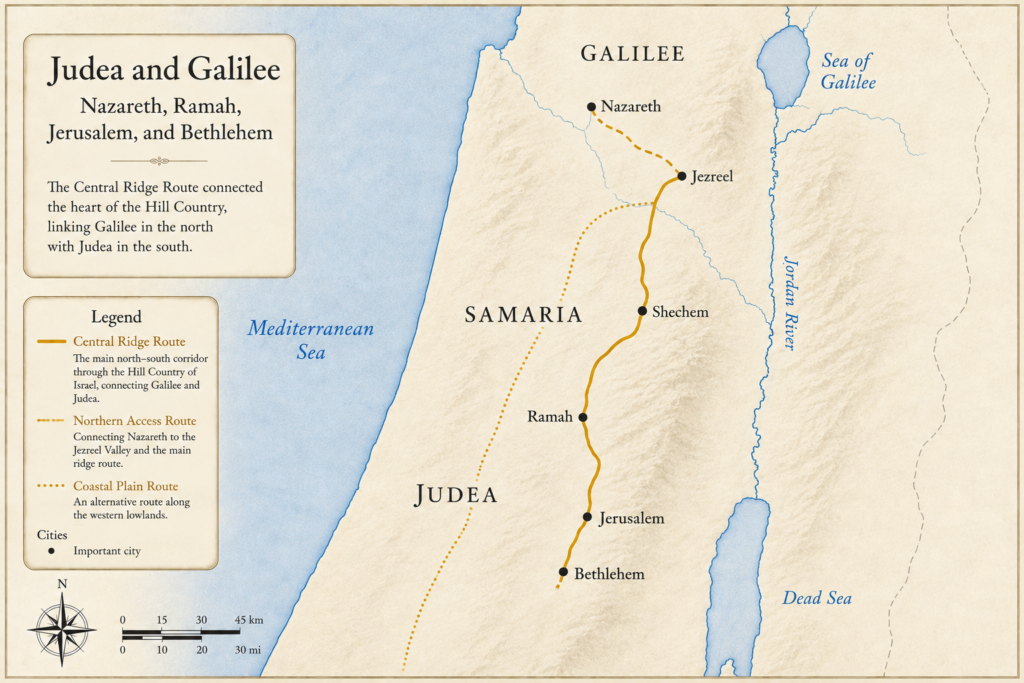
We know Mary was two to three months pregnant when she returned from visiting Elizabeth. “Mary stayed with Elizabeth about three months and then went back to her own home” (Lk. 1: 56 NLT).
We don’t know which route Mary and Joseph took. They may have avoided Samaria, but Scripture does not tell us.
Contrary to popular belief, we don’t know if Mary rode a donkey. She may have walked.
Mary and Joseph would probably have traveled with a caravan – even a family caravan. Surely, they had some family living with them in Nazareth – like Mary’s parents. Since both Mary and Joseph were descendants of David, both families would have been heading to Bethlehem. She may have gotten to ride in a family member’s cart.
To Whom He Was Engaged
Mary and Joseph’s marital status was important.
This always stops me. In the last devotion, we learned about Joseph’s initial struggle when he found that Mary was pregnant – and he wasn’t the father.
After the visit by the angel, Joseph was said to have acted immediately. “When Joseph woke up, he did as the angel of the Lord commanded and took Mary as his wife” (Mt. 1: 24 NLT).
If Joseph woke up and took Mary as his wife, why does Luke say they were still engaged? That would mean they still weren’t living together.
Well, this doesn’t contradict itself. Mary could be both.
Remember, betrothal didn’t work the same way as our engagement does. When they became betrothed Mary and Joseph were legally married. If Joseph had broken the betrothal when Mary became pregnant, he would have had to obtain a get (גֵּט) – a Jewish divorce document.
We also have to remember that Matthew made the comment that, though Joseph took Mary home as his wife, they didn’t consummate the marriage until after Yeshua was born (Mt. 1: 25).
So, the Gospel accounts are emphasizing different things. Matthew emphasized that Joseph accepted Mary as his wife. Luke emphasized that their marriage hadn’t been consummated.
The Birth of the Messiah
“And while they were there, the time came for her baby to be born. She gave birth to her firstborn son. She wrapped him snugly in strips of cloth and laid him in a manger …” (Lk. 2: 6-7 NLT)
The Time Came for Her Baby to be Born
The normal earthly celebration around the birth of a king didn’t occur.
How could it? Messiah was supposed to be a king, but Yeshua wasn’t born in a palace.
The King came without a crown. The Messiah came without a royal welcome. The Savior came without a crowd waiting outside His birthplace.
Messiah was born in Bethlehem and laid in a manger.
The One Whose coming was so greatly anticipated and frequently prayed for wasn’t recognized. What went wrong?
Well, nothing. This was the plan all along.
God had prepared the people who would play a part in His plan. He had prepared Zechariah and Elizabeth for John. He had prepared Mary to bear the Messiah. He had prepared Joseph to take Mary as his wife and protect the Child.
But God hadn’t prepared the world to recognize what He was doing. Or perhaps more accurately, the world wasn’t prepared.
People expected Messiah. They had expectations about what Messiah would look like.
They were wrong.
Yeshua came quietly — not because His arrival was insignificant, but because Jehovah’s plan was never dependent upon earthly recognition.
Jehovah’s plan to fulfill His promises didn’t bring the rejoicing Israel thought would happen. It started without them.
Why? Because Israel wasn’t needed to make the plan happen. There was nothing they could add to or subtract from the plan. They had to wait until it came to its fruition.
Mary couldn’t, Joseph couldn’t, Zechariah and Elizabeth couldn’t make the Messiah come. Even Israel couldn’t make the Messiah come.
They could only receive what Jehovah was doing.
So, when Jesus was born in Bethlehem, Israel had to wait.
The promises embedded in Jehovah’s plan which He had set in motion were beginning to come to fruition, but the nation had no part in bringing them about. Jehovah had already done what needed to be done.
Jehovah’s promises would be fulfilled according to His purpose.
And perhaps that is one of the most important things about the way Jesus entered the world: Jehovah didn’t ask humanity to accomplish His plan. He asked humanity to respond to it.
The Messiah had come – the Savior had entered the world. The promise was being fulfilled.
Israel would eventually have to decide what it would do with Him.
But for now, the plan belonged entirely to Jehovah. Nothing had gone wrong.
It had begun exactly as Jehovah intended. He fulfilled His promise in a way that looked nothing like earthly greatness.
But God was doing something deeper. He wasn’t merely sending Israel a king.
Jehovah was sending a Savior. And that Savior entered the world as an utterly dependent infant.
The Messiah had finally come — and almost no one knew it.
Snugly in Strips of Cloth
We may sometimes think the strips of cloth were more like diapers – they weren’t.
When we go back to the Greek, we see the Baby was wrapped in swaddling clothes. This was normal care for a newborn.
In other words, Mary didn’t wrap Yeshua in swaddling clothes because she was poor. Scripture verifies this. “On the day you were born, no one cared about you. Your umbilical cord was not cut, and you were never washed, rubbed with salt, and wrapped in cloth” (Ezek. 16: 4 NLT).
The purpose of the swaddling clothes was to protect the infant’s arms and legs.
We are sometimes told that the swaddling clothes are also used as burial cloth. That isn’t quite right.
The Greek word Luke uses in Luke 2: 7 is sparganoō – the verb for swaddling. However, the wording in Luke 23: 53 uses sindōn, referring to a linen cloth that could be used for burial.
The similarity comes when Luke 2’s description of Yeshua being “… wrapped … in strips of cloth and laid … in a manger …” is placed beside Luke 23’s description of his body being “… wrapped … in a long sheet of linen cloth and laid … in a new tomb …”
Being laid in the manger was part of a sign to the shepherds so they would know they had found the Christ Child. However, when He was laid in the tomb, He wasn’t there when the women came to the tomb.
This marked not only the beginning of Jesus’ earthly life but also pointed toward the mission that would lead Him to the cross and the empty tomb.
Laid Him in a Manger
We may think it odd to put a baby in a manger, but there was a specific reason this Baby was placed in a manger.
One thing we get wrong is that we see a wooden crib in the Christmas nativity scene.
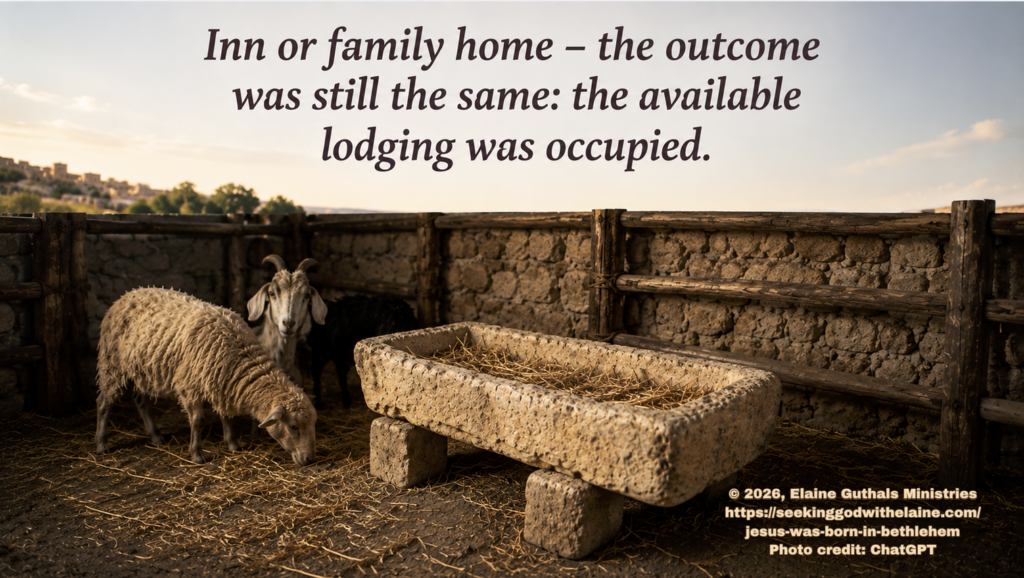
The Greek word is phatnē (φάτνη) – a feeding trough. The manger was a feeding trough located in the animal-keeping area associated with the lodging space where Mary and Joseph were staying. That animal area could have been an adjoining lower-level space, a courtyard, a stall, or potentially a cave used for animals.
Joseph’s family – if some still lived in Bethlehem – would have lived in a one- or two-room house made from field stones. It would have a flat plastered roof and packed dirt or bedrock floors. Food would have been prepared in a small courtyard.
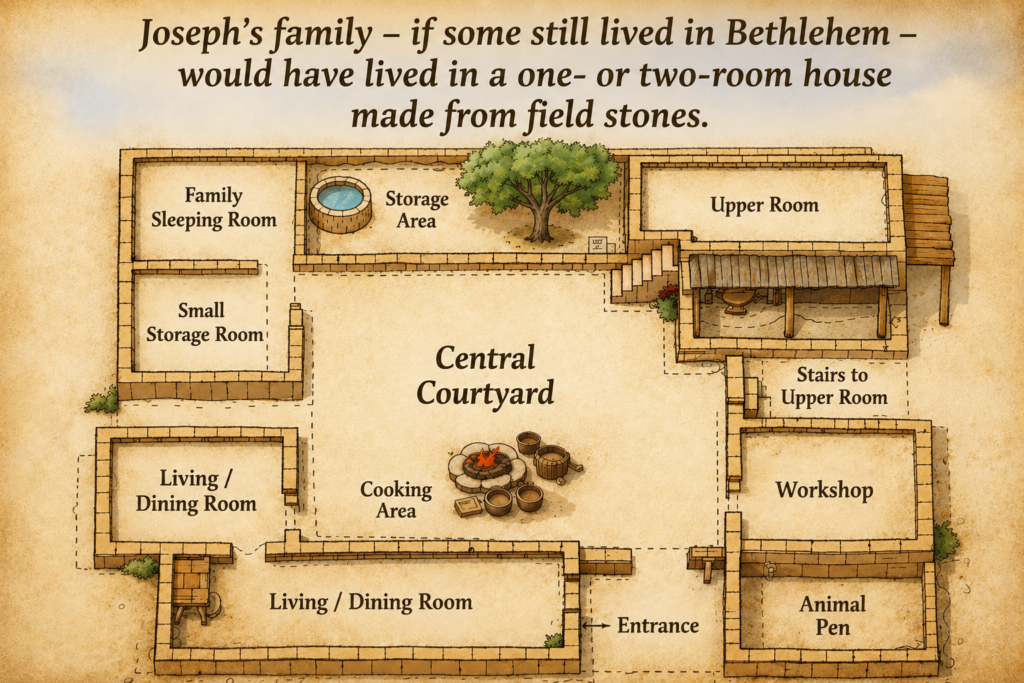
Some ancient Judaen homes had a section of the structure where the animals were housed. Keeping valuable domestic animals close offered protection, especially at night.
What kind of animals are we talking about? It seems logical to me that a family would have goats for milk and dairy products, as well as skins and hair.
Some may also have had sheep. They provided wool and milk – which represented a form of household wealth.
No, we don’t know what animals were here. We just know that animals did come to eat at the trough.
Later Christian tradition identified the place as a cave used for sheltering animals. Caves were indeed used for livestock in the Judaen countryside, but Luke doesn’t tell us exactly what kind of structure contained the manger.
In some first-century Judaen settings, mangers were a stone trough. They could be cut into or attached to rock. Think of what a cold, hard place that would have been.
That sure wasn’t where first-century Jews expected Messiah to appear!
Think about it. The Bread of Life was placed in the trough where animals ate.
Remember the Lord’s Supper. “And he took bread, and when he had given thanks, he broke it and gave it to them, saying, ‘This is my body, which is given for you. Do this in remembrance of me’” (Lk. 22: 19 ESV).
Lodging
“… because there was no lodging available for them” (Lk 2: 7 NLT)
Luke didn’t tell us that Mary and Joseph stayed in an inn.
The word Luke used was kataluma (κατάλυμα). That means a lodging place or guest room.
This could be a guest room in a family home. Think about it.
Jewish society in first-century Israel placed great value on hospitality. To them, hospitality was an important cultural and religious obligation. This is true for travelers and strangers as well as the family member.
Yes, inns did exist in the first-century Jewish world. Luke did talk about an inn in the Parable of the Good Samaritan (Lk. 10: 34). The word he used for inn was pandocheion.
However, inns didn’t have a good reputation in Jewish sources. An inn wouldn’t necessarily have been Joseph and Mary’s first or most natural lodging arrangement, particularly in Joseph’s ancestral town.
We aren’t sure what the reason was for Joseph’s family not making room for them in their house. It could simply mean that this was a crowded family home because so many people had arrived in Bethlehem for the registration that the available lodging was already occupied.
Or was there a different reason? Some first-century Jews felt they had to become righteous before Messiah came.
You have to understand the situation Mary was in. She was betrothed so she was considered Joseph’s wife, but she was betrothed not married so she wasn’t living with him.
Taking an unwed pregnant woman into their home – even one betrothed to their kinsman – would have gone against their beliefs.
We also have to realize that we don’t know what Joseph and Mary had told family members. More importantly, we don’t know if those family members believed what they were told. Yeshua’s brothers didn’t believe He was Messiah while He was alive.
Yes, we are called to love those who have sinned. No, we are not called to condone their sin.
But this wasn’t a sin. They just may not have known that.
Inn or family home – the outcome was still the same: the available lodging was occupied. They were using what space they had to accommodate those in need.
The world wasn’t prepared to recognize Him. But that doesn’t mean the people of Bethlehem were inhospitable to a pregnant Jewish woman.
Jehovah could have waited for the registration to end so that lodging was available. He didn’t. He sent His Son to be born anyway.
Making the Connections
From the beginning, Luke quietly places the beginning and the end of Jesus’ earthly life before us. He was wrapped and laid down as an infant; He would one day be wrapped and laid in a tomb as a dead man.
The story wouldn’t end there.
But we’re getting way ahead of ourselves.
Heart Check
Think about the battle Yeshua is engaged in for your heart. Ask yourself the following questions.
- Am I trying to make God’s plan happen, or am I willing to trust Him to fulfill His purposes in His way and His timing?
- Do I sometimes fail to recognize what Jehovah is doing because it doesn’t look the way I expected?
- Have my expectations of how God should work ever kept me from recognizing what He was actually doing?
- Am I more concerned with how God’s work looks to the world than with whether I am responding faithfully to Him?
- When Jehovah fulfills a promise differently than I expected, do I trust Him — or question whether something has gone wrong?
How Do We Apply This?
- Trust Jehovah’s plan even when His way doesn’t look like what you expected.
- Stop trying to accomplish what only Jehovah can accomplish.
- Pay attention to what Jehovah is doing rather than demanding that He work according to your expectations.
- Respond faithfully when Jehovah reveals His work instead of waiting until everything makes sense.
- Remember that circumstances do not determine God’s faithfulness.
- Don’t overlook what Jehovah is doing because it comes through ordinary people or ordinary circumstances.
Father God. We are humbled that a Baby – Your Son – was born thousands of years ago. Yet He is still alive and in us. May we always open our hearts to Him. Amen.If you don’t understand something and would like further clarification, please contact me.
If you have not signed up for the email providing the link to the devotions and the newsletter, do so below.
If God has used this devotion to speak with you, consider sharing it on social media.
-
An Angel Appeared to Joseph
Joseph had been considering his actions after he had found out Mary was pregnant by someone else. This devotional reading looks at how Jehovah intervened to ensure His plan was followed.
Nuggets
- Dreams were often used as a way for Jehovah to reveal himself to humans.
- Joseph was reminded of his royal lineage.
- Jehovah laid out very clearly what option Joseph should pick.
- The angel made it point-blank clear to Joseph that Mary was not unfaithful to him.
- Yeshua means God saves – which is Yeshua’s mission.
- The first-century Jews would know the context of the Messianic prophecy even if we don’t.
- The Hebrew word ʿalmāh (עַלְמָה) means young woman.
- How can Yeshua be anything but divine?!?
- Joseph obeyed immediately.
When we last left Joseph, he was in a conundrum. Mary, the teenaged girl who he was all but married to, had ended up pregnant – and he wasn’t the father.
Think of all the emotions he was probably going through. He was angry, heartbroken, and confused and probably a bit ashamed.
But Joseph was a righteous man. He wanted to obey Jehovah, but he didn’t want to disgrace Mary.
Enter Jehovah.
Let’s Put It into Context
To read devotions in The Battle for the Heart theme
Devotions in the Preparing for the Christ Child series
Jehovah Intervenes
“As he considered this, an angel of the Lord appeared to him in a dream. ‘Joseph, son of David,’ the angel said, ‘do not be afraid to take Mary as your wife. For the child within her was conceived by the Holy Spirit. And she will have a son, and you are to name him Jesus, for he will save his people from their sins’” (Mt. 1: 20-21 NLT)
An Angel Appeared to Him in a Dream
Dreams were often used as a way for Jehovah to reveal himself to humans.
Sometimes, angel of the Lord means it is an angel. However, there have been times when angel of the Lord meant Jehovah Himself.
Matthew never slides in his presentation of the angel to say, “Jehovah said.” He addresses the angel the same way throughout.
Then again, Matthew didn’t identify the angel as Luke did. It could have been Gabriel – and I would say most likely was.
But that wasn’t the focus of Matthew’s telling of this dream.
We see several times in the Book of Genesis alone where Jehovah uses dreams to reveal Himself to humans. We know of His dreams to Joseph.
We also see that Jehovah also can and will talk with Gentiles. We see that in Abimelech, Pharaoh, the cupbearer, and the baker.
We have seen, especially in the dreams in Egypt, symbolism that the dreamer must interpret – or have interpreted for them.
That is not the case in this dream.
Did Jehovah have to come to Joseph and explain? Well, not really. He is Sovereign God.
But He did. Jehovah came to Joseph, explained His purpose, and explained Joseph’s part in it.
Son of David
Joseph was reminded of his royal lineage.
The common way to identify Joseph in first-century Israel was to say that he was Joseph ben Jacob. The angel didn’t do that here – and for a very good reason.
The angel identified Joseph as Joseph ben David. And not just any David – King David.
This would not only have reminded Joseph of who he was, but he would have also been reminded of prophecy. Jeremiah had written, “‘For the time is coming,’ says the Lord, ‘when I will raise up a righteous descendant from King David’s line. He will be a King who rules with wisdom. He will do what is just and right throughout the land’” (Jer. 23: 5 NLT).
Just as Gabriel used covenant language with Mary to identify Who her Son was, so, too, did the angel in Joseph’s dream. It was important both parents realize the mission of the Son they both would raise.
Take Mary as Your Wife
Jehovah laid out very clearly what option Joseph should pick.
No, it wasn’t an option that Joseph had considered to this point – and we probably wouldn’t have either. Joseph was supposed to marry Mary as planned.
We have to remember that Mary had spent two to three months with Elizabeth (Lk. 1: 56). We assume that she told Joseph about the baby before she left.
If not, Mary may have been starting to show by the time she got back from Zechariah and Elizabeth’s house. But then the townspeople would know at the same time Joseph did.
Think about it. Mary would have left town right after telling Joseph. From what little is said here, we get the impression that he was struggling with what he knew.
And Mary isn’t there to ease his struggles. She not only can’t reassure him, but she also can’t answer many questions.
Conceived by the Holy Spirit
The angel made it point-blank clear to Joseph that Mary was not unfaithful to him.
The angel made it very clear to Joseph that Mary had not become pregnant by another man. This would have been very important.
Joseph didn’t have to begin the marriage always questioning who was the father of the child. He didn’t have to worry that Mary would be unfaithful to him again.
Being human, this may have helped Joseph accept the Baby more readily. He didn’t have to question about Him having another Father.
Name Him Jesus
Yeshua means God saves – which is Yeshua’s mission.
From the very beginning, the angel announced the mission of the Messiah. Yeshua did not come merely to teach, perform miracles, or establish an earthly kingdom. He came to save His people from their sins.
We consider Yeshua as our Savior – and He is. He willingly gave up His live for us.
Yet His saving work was never separate from the Father’s purpose. From before the foundation of the world, Jehovah planned humanity’s redemption, and through His Son He accomplished it.
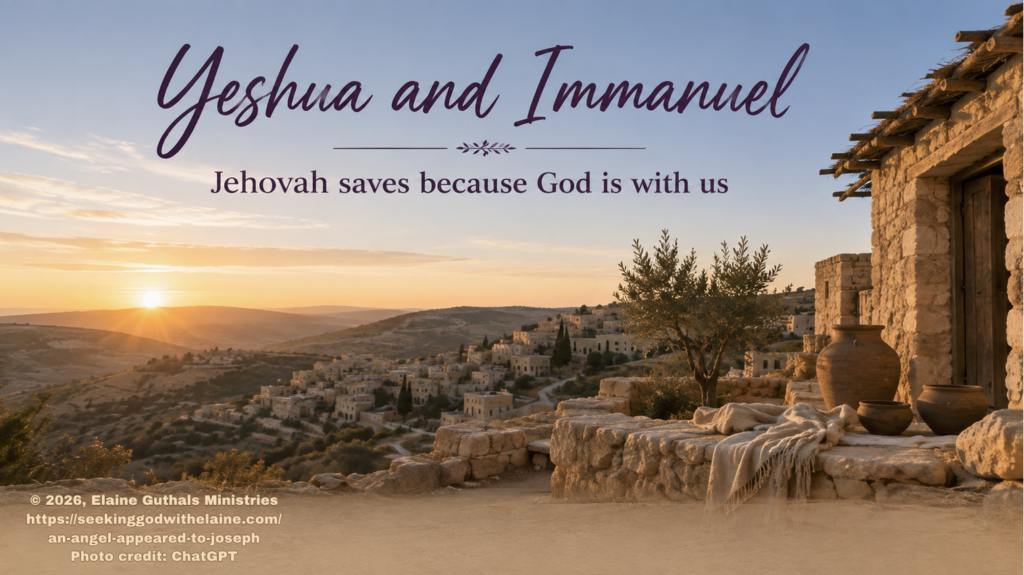
Yeshua and Immanuel – Jehovah saves because God is with us. The name Yeshua reminds us that salvation belongs to Jehovah from beginning to end.
By explaining this to Joseph, he realized why the name mattered. Every time he called His name, he would be reminded of the purpose for which this Child had come.
Joseph would have been reminded of the honor that Jehovah bestowed on him. He entrusted His Son with him to raise and nurture – to love.
Prophecy Fulfilled
“All of this occurred to fulfill the Lord’s message through his prophet: ‘Look! The virgin will conceive a child! She will give birth to a son, and they will call him Immanuel, which means “God is with us”’” (Mt. 1: 22-23 NLT)
Through His Prophet
First-century Jews familiar with the Scriptures would know the context of the Messianic prophecy even if we don’t.
Isaiah would have written those words around 734 BC. The nation of Israel was in deep trouble.
An alliance of kingdoms – Syria under King Rezin and the Northern Kingdom of Israel under King Pekah – wanted King Ahaz of Judah to join the coalition against Assyria. When he refused, Rezin and Pekah tried to invade.
Enter Isaiah on direction from Jehovah. His message was clear – don’t panic, trust Jehovah.
Ahaz said, “I won’t trust Jehovah.” In his heart he said, “I’ll trust Assyria.”
Jehovah was even going to give Ahaz a sign. When Ahaz tried to act humbly and say he wouldn’t ask Him for a sign, Jehovah gave him the sign anyway.
Now, remember, prophecy usually was for that day and for a future time.
The sign in Ahaz’s day was that, before a child was old enough to know right from wrong, the two threatening kingdoms would be gone (Isa. 7: 15-16).
Matthew quoted that verse to show that Israel was again in a crisis. A Child was once again a covenant sign. This Child would be “God with us.”
Virgin
The Hebrew word ʿalmāh (עַלְמָה) means young woman of marriageable age.
Some may believe, since the Hebrew word used means young woman, that Mary might not necessarily have been a virgin. I don’t think so.
While the word was used to identify a young woman who was of marriageable age, Matthew and Luke both state that Mary hadn’t been with a man and that conception was through the Holy Spirit.
Jehovah wouldn’t have picked a woman who was sexually active with a man. He wanted the Son to be identified as His Son, not some human’s son.
It could be possible to identify a lady of marriageable age by using that wording. A girl of marriageable age who was not yet married would have been a virgin.
The Greek word used to translate Matthew into Hebrew was hē parthenos (παρθένος), meaning the virgin.
Immanuel
How can Yeshua be anything but divine?!?
Long through the ages, people have wanted to deny that Yeshua was the Son of God, that He was divine. They would be wrong.
For one thing, Yeshua’s birth was foretold. “All right then, the Lord himself will give you the sign. Look! The virgin will conceive a child! She will give birth to a son and will call him Immanuel (which means ‘God is with us’)” (Isa. 7: 14 NLT).
Another thing, Yeshua Himself told us He was divine. “The Father and I are one” (Jn. 10: 30 NLT).
There are other verses that are evidence of Yeshua’s divinity.
- “In the beginning the Word already existed. The Word was with God and the Word was God.” (Jn. 1: 1 NLT).
- “For in Christ lives all the fullness of God in a human body” (Col. 2: 9 NLT).
- “The Son radiates God’s own glory and expresses the very character of God, and he sustains everything by the mighty power of his command. When he had cleansed us from our sins, he sat down in the place of honor at the right hand of the majestic God in heaven” (Heb. 1: 3 NLT).
- “Then the disciple who had reached the tomb first also went in, and he saw and believed —” (Jn. 20: 8 NLT).
- “What is he saying? This is blasphemy! Only God can forgive sins!”” (Mk. 2: 7 NLT).
- “So the Son of Man is Lord, even over the Sabbath!” (Mk. 2: 28 NLT).
- “Instead, he gave up his divine privileges; he took the humble position of a slave and was born as a human being. When he appeared in human form” (Phil. 2: 7 NLT).
The meaning of Immanuel is also important. It is God is with us. Jehovah had always wanted to live among us – and He had in the past.
- In the Garden of Eden
- In the Tabernacle
- In the Temple
Jehovah has always wanted us to have a relationship with Him.
Joseph Obeyed Immediately
“When Joseph woke up, he did as the angel of the Lord commanded and took Mary as his wife. But he did not have sexual relations with her until her son was born. And Joseph named him Jesus” (Mt. 1: 24-25 NLT)
Joseph obeyed immediately.
Once he had guidance from Jehovah, Joseph went through the ketubah. Mary became his wife.
But Matthew included one important aspect. The marriage was not consummated.
This is important. If Joseph would have consummated the marriage, it could have been argued that he was the father of the baby.
In other words, Joseph protected the testimony of Yeshua’s divinity. No one could honestly claim that Joseph was the child’s father. He preserved the integrity of the prophesied sign.
Was Joseph himself the Savior? No. But his actions during the pregnancy and during Yeshua’s childhood raised Him as a. human. That was an important part of Who the Messiah was.
Why did Joseph do what he did – was it just because he was a good person? No. Joseph’s actions showed his belief in the angel’s communication and faith in the One Who sent the angel and designed the Plan of Salvation.Making the Connections #1
Jay said something interesting. He said salvation was from sin. Many think we are saved in sin.
Resource
Unfortunately, after we have confessed Yeshua as our Savior and Jehovah as Sovereign God, we can – and do – still sin. It is what we have inherited from Adam and Eve.
So, if we say we are saved in sin, our lives are full of sin without Yeshua saving us from the disease of sin.
But we have to turn from sin toward Jehovah. If we keep consciously, purposefully committing sin, have we truly been saved?
Making the Connections #2
Many want to make Yeshua into a social savior. Bennet explained that this way – but then shows how He does that. He wrote, “Some would rather that He had come to save them from poverty, pains, death; not knowing that to save from sins is to save from all these.”
Resource
Those who champion the Matthew 25 to-do list as the road to salvation believe that we must address physical needs before spiritual needs.
The last point of what Bennet wrote is true. But how often do people searching for Jehovah realize that?
Being saved from our sins is the most important aspect of salvation. Is poverty still going to be a part of society? Yes.
Are we still going to have money problems? Yes – but we have a Savior and Heavenly Father Who will provide for us.
Heart Check
Think about the battle Yeshua is engaged in for your heart. Ask yourself the following questions.
- When Jehovah’s direction doesn’t make sense to me, do I trust Him enough to obey?
- Am I allowing what I think I know to keep me from hearing what Jehovah is telling me?
- Do I want Jehovah to explain everything before I am willing to obey?
- When Jehovah makes His will clear, do I obey immediately—or look for reasons to delay?
- Am I trusting Yeshua to save me from my sin, or am I trying to make peace with the sin He came to save me from?
- Have I merely learned about the Christ Child—or am I trusting Him enough to obey Him?
How Do We Apply This?
- Trust Jehovah when circumstances are confusing.
- Check your assumptions against God’s Word.
- Obey when Jehovah makes the way clear.
- Remember what Yeshua came to save you from.
- Let obedience demonstrate your faith.
Father God. Thank You for providing examples such as Joseph for us to learn from. When our lives are have been upended as his was, let us be obedient, too. Amen.
If you don’t understand something and would like further clarification, please contact me.
If you have not signed up for the email providing the link to the devotions and the newsletter, do so below.
If God has used this devotion to speak with you, consider sharing it on social media.
-
When Rome Fulfilled Prophecy
All the preparation had been completed – now was the time for Messiah to come. This devotional reading looks at how quietly the Messiah came to earth.
Nuggets
- Jesus, in His humanity, shared the human nature of those made in the image of God.
- Luke focused on Augustus to begin Luke 2 because the story wasn’t just about Judea.
- Augustus may have thought the census (apographē in Greek) would be used to control the empire but was used by Jehovah to further His plan.
- Publius Sulpicius Quirinius was a Roman official and a military commander who later became a governor.
It had taken centuries. Jehovah had worked everything out to His specifications.
Mary was pregnant and ready to give birth to the Messiah. The problem was she was in Nazareth. Prophecy said that Messiah would be born in Bethlehem.
How was a pregnant woman going to get to King David’s city?
Let’s Put It into Context
To read devotions in The Battle for the Heart theme
Devotions in the The Birth and Early Childhood of Christ series
Yeshua as Human and Divine
“So the Word became human and made his home among us. He was full of unfailing love and faithfulness. And we have seen his glory, the glory of the Father’s one and only Son” (Jn. 1: 14 NLT)
Jesus, in His humanity, shared the human nature of those made in the image of God.
Think about Yeshua being fully God and fully human. Yes, that is a little mind boggling.
Goulburn explained this. He wrote, “He assumed into union with His Godhead a human soul, a human body, and an animal nature. He hungered, thirsted, was fatigued, and had as real a need of meat, drink, and sleep as other men.”
Resource
But does that make Yeshua made in God’s image as we are while still being divine?
- “Christ is the visible image of the invisible God. He existed before anything was created and is supreme over all creation” (Col. 1: 15 NLT).
- “For in Christ lives all the fullness of God in a human body” (Col. 2: 9 NLT).
How we would be the losers if Yeshua were not human! He came not merely to appear among us but to become one of us, entering our human condition so that He could accomplish our salvation.
But how like us was Yeshua? The concept of made in God’s image includes both physical and spiritual dimensions.
We know Yeshua reflects Jehovah’s character and attributes. But then, so do we.
Yes, as a human – and as divine – Yeshua had all that.
When Yeshua emptied Himself as Paul described (Phil. 2: 6-8), He didn’t empty Himself of His divinity.
Timestamp
“At that time the Roman emperor, Augustus, decreed that a census should be taken throughout the Roman Empire. (This was the first census taken when Quirinius was governor of Syria.) All returned to their own ancestral towns to register for this census. And because Joseph was a descendant of King David, he had to go to Bethlehem in Judea, David’s ancient home …” (Lk. 2: 1-4 NLT)
Augustus
Luke focused on Augustus to begin Luke 2 because the story wasn’t just about Judea.
Luke starts Chapter 2 using Caesar Augustus to begin discussion of Yeshua’s birth. Yeshua was the Savior of the world, not just Israel.
Augustus was the adopted son of Julius Caesar. He was the first Roman emperor, called Princeps or first citizen, ruling from 27 BC to 14 AD. He is known for bringing peace – Pax Romana – to the Roman empire. He accomplished this by establishing political stability, economic order, and military control.
Some of the titles Augustus used were Savior (sōtēr), Lord (kyrios), and Son of God (because Julius Caesar was declared divine). Do you see why Augustus’ claims could create a serious problem for first-century Jews who believed Israel belonged ultimately to Jehovah and was awaiting Messiah – especially when many felt Israel had to return to righteousness in order for Messiah to come?
Luke showed the tension between Rome and first-century Jewish expectations.

Augustus wasn’t the true king. Yeshua is King of kings. That makes Micah’s prophecy about Israel’s lost kingship especially significant.
“But why are you now screaming in terror? Have you no king to lead you? Have your wise people all died? Pain has gripped you like a woman in childbirth. Writhe and groan like a woman in labor, you people of Jerusalem, for now you must leave this city to live in the open country. You will soon be sent in exile to distant Babylon. But the Lord will rescue you there; he will redeem you from the grip of your enemies” (Mic, 4: 9-10 NLT).
One of the worst consequences of the Babylonian exile — to Israel’s mind — was the loss of the Davidic monarchy. The question, ‘Have you no king?’ was serious because Israel’s king had a covenantal role. Jehovah had established the Davidic line, and the king was supposed to lead the people under God’s rule.
But they wouldn’t have taken the image of childbirth literally. Micah was describing their anguish. They weren’t expecting a Baby.
Think of it this way. There was no Davidic king ruling over the Jews — no king to lead them under the covenant and protect them as their earthly ruler.
We, like they, have to decide which “lord” we will follow: the worldly lord or the divine Lord.
Census
Augustus may have thought the census (apographē in Greek) would be used to control the empire, but it was used by Jehovah to further His plan.
Some translations say that Augustus said “… that all the world should be registered” (Lk. 2: 1 ESV). What they really meant was all the Roman Empire.
A Roman census could be deeply offensive to Jews. They would have remembered the census that David took (II Sam. 24). David’s census was a sin, in which 70,000 men were killed as punishment.
So, what does it have to do with the census in question? There are a number of possibilities.
Quirinius
Publius Sulpicius Quirinius was a Roman official and a military commander who later became a governor.
Specifically, Quirinius became legate (governor) of Syria around AD 6-12. He conducted a census in Judaea after Rome took direct control.
So, how does this apply to the census in question?
- Luke could have been saying that the census at the time Yeshua was born was before (the Greek word prōtē) the famous census in AD 6. That would place this registration before Quirinius’s well-known census as governor of Syria. This is the most likely way to understand Luke’s wording. Matthew places Yeshua’s birth during the reign of Herod the Great, who died in 4 BC. The well-known census conducted under Quirinius occurred in AD 6 — roughly a decade later. Luke therefore cannot be referring to that later census. If prōtē is understood in the sense of before, Luke is distinguishing this registration from the later census.
- Quirinius may have had military authority in Syria before AD 6. He may have overseen an earlier regional census.
- The registration for the taxation could have occurred in Herod’s time. The actual taxation census may have occurred in Quirinius’ time.
- Most of Luke’s readers would have known about the famous census in AD 6. He could either be using that one as a timestamp to this census was done earlier, or he may be including that to ensure that his readers didn’t confuse the two.
As a major Roman province, Syria’s governor may have had the authority over the whole region, including the small client kingdom of Judea, even if it was under Herod. Any census likely required oversight from Syria.
Bottom line, this wasn’t a random village story. There were links and connections across the regions. It was embedded in the history of the region.
Could Luke have presented his Gospel without Quirinius being listed? Of course.
But it shows how Jehovah was using Rome to bring His plan into fruition. Rome may have thought they were organizing their world. Jehovah was ordering history.
So, when the New Living Translation says the census occurred when Quirinius was governor, it reflects one way to read the Greek. But in light of Matthew’s chronology and the known date of the later census, I believe ‘before’ better explains Luke’s wording.
That doesn’t diminish the fact that Luke was anchoring the story of Yeshua’s birth in real political history. He was reminding his readers what happened in their world.
Returned to Their Own Ancestral Towns
The requirement to return to their ancestral home is not explained in Scripture but we learn of it in Jewish custom.
When Augustus ordered the census be conducted, it was not usual for them to require those being counted to return to the home of their fathers. Usually, people were counted in a census where they lived, owned property, or paid taxes.
The Hebrew concept of the father’s house – Beit Av (בֵּית אָב) – helps us understand the family and clan identity behind Luke’s wording. One possibility is that Roman authorities accommodated Jewish family and clan structures when conducting the registration. We cannot know that for certain, but tribal identity and family lineage remained important to the Jewish people.
It seems more logical that it was a Jewish requirement – but we don’t know that for sure. Even in the occupation, tribal identity and family lineage mattered. Genealogies were preserved because land inheritance still mattered.
To them, this was a covenant matter.
Bethlehem
But this census was not used as punishment.
Augustus unwittingly created the reason for Joseph to travel to Bethlehem – Bêṯ Leḥem (בֵּית לֶחֶם).
There were several reasons that this was to be the birthplace of the Messiah.
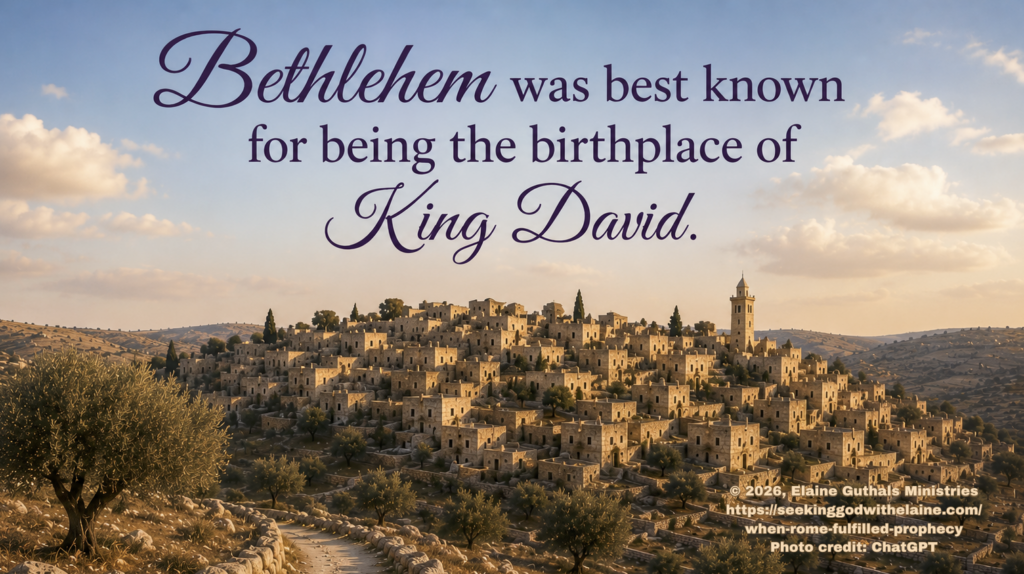
Bethlehem was best known for being the birthplace of King David. Messiah was to be of his lineage.
- “The Lord said, ‘I have made a covenant with David, my chosen servant. I have sworn this oath to him: “I will establish your descendants as kings forever; they will sit on your throne from now until eternity”’” (Ps. 89: 3-4 NLT).
- “‘For the time is coming,’ says the Lord, ‘when I will raise up a righteous descendant from King David’s line. He will be a King who rules with wisdom. He will do what is just and right throughout the land. And this will be his name: “The Lord Is Our Righteousness.” In that day Judah will be saved, and Israel will live in safety’” (Jer. 23: 5-6 NLT).
Bethlehem means house of bread. This is significant because, while the name may reflect the agricultural character of the region (see the Book of Ruth), Yeshua said He was the bread of life. “Jesus said to them, “I am the bread of life; whoever comes to me shall not hunger, and whoever believes in me shall never thirst” (Jn. 6: 35 NLT).
This fulfilled the prophecy of Micah 5: 2. “But you, O Bethlehem Ephrathah, who are too little to be among the clans of Judah, from you shall come forth for me one who is to be ruler in Israel, whose coming forth is from of old, from ancient days” (Mic. 5: 2 ESV).
It was important that the prophecy state Bethlehem Ephrathah. It distinguishes that village from Bethlehem of Zebulun. Located seven miles northwest of Nazareth, it is only mentioned once in Scripture (Josh. 19: 15 NLT).
Grey described Bethlehem Ephrathah in this way. He wrote,
“These sloping hills also contained terraced orchards of olive trees, exposed patches of limestone bedrock pocked with natural caves, and large stretches of natural brush, all of which made the countryside around Bethlehem ideal for local shepherds to graze flocks of sheep and goats.”
Resource
Bethlehem was an important city in the history of Israel. This was King David’s birthplace and Rachel’s burial place.
Descendant of King David
Joseph returned to Bethlehem because he was a descendant of David.
In Matthew 1: 6, we learn that Joseph was the great…great-grandson of David’s son, Solomon. That is why he had to return to Bethlehem.
But we can’t forget that Joseph may have still had family there. Bethlehem may have been where clan records were kept.
That kind of makes more sense. Why would they go back hundreds of years to gather families? If they said they were going back to Judah’s city, that would have been one thing,
We can gloss over this. David would have been a significant ancestor through whom the family line could be identified.
But which important ancestor identified each of the other tribes? It doesn’t really make sense if only the tribe of Judah was called out.
It was important for Luke’s narrative to emphasize that Joseph was a descendant of David. This fulfilled a Messianic expectation.
“When your days are fulfilled and you lie down with your fathers, I will raise up your offspring after you, who shall come from your body, and I will establish his kingdom. He shall build a house for my name, and I will establish the throne of his kingdom forever” (II Sam. 7: 12-13 ESV).
Making the Connections #1
When Luke began his Gospel, he set the timestamp by marking Herod the Great as being king of Judea. Herod was a part of the system.
But starting Chapter 2, Luke moves to using Caesar Augustus – who was the system.
Why didn’t Luke even mention Herod? Bethlehem was under Herod’s rule. This is especially strange since Herod was responsible for what became known as the Massacre of the Innocents.
Luke focused on the whole world. Yeshua came to be Savior of the world.
But many in the world today, like first-century Jews, don’t recognize Yeshua as the King.
Some of that has to do with the manner of Yeshua’s birth. He was born in obscurity even while being declared – and celebrated by some – Savior and Lord.
The story takes place in territory ruled by Herod under the authority of Caesar.
By doing this, Luke was setting up two kingdoms.

Why is that important? Look at what Yeshua did once His ministry began. He healed and forgave people. He confronted those in power. He redefined kingship.
Yeshua did this against the backdrop of Herod’s politics – and violence – and Rome’s control. It is a strategic setup.
So, even if Herod wasn’t mentioned in Luke 2, his presence was felt.
- Political pressure.
- Social structure
- Lack of recognition
- Tension around kingship
And here came a new King – One Who didn’t look like any king Herod had previously seen. Therefore, he didn’t recognize Him.
But wasn’t that the point?
Making the Connections #2
In the Ancient Near East, the firstborn son of the family held an important position in the family. He was the heir apparent of the birthright and the blessing.
We see in Genesis that, while society may value the firstborn son over others, Jehovah looks at their hearts and sees their obedience to Him.
- Abel was chosen over Cain.
- Abraham was chosen over his brothers.
- Isaac was chosen over Ishmael
- Jacob was chosen over Esau.
- Judah was chosen over Reuben, Simeon, and Levi.
Yeshua, however, was the supreme Firstborn. He was
- Firstborn of Mary (Lk. 2: 7)
- Firstborn over all creation (Col. 1: 15)
- Firstborn from the dead (Col. 1: 18)
Yeshua was the true Firstborn, but He did not come demanding the privileges of a firstborn. He came in humility.
The King was born in Bethlehem, not in a palace. He was laid in a manger, not placed on a throne. He came as the One who would give His life rather than demand the lives of others.
The world expected power to look like Rome. Jehovah showed us that true kingship looks like Yeshua.
Heart Check
Do I recognize that Jehovah’s plans are bigger than any earthly power?
Do I trust that Jehovah is working behind the scenes in my life?
Am I giving my allegiance to the true King?How Do We Apply This?
- Remember that God is sovereign even in world events.
- Rest in His plan, even when you don’t see the full picture.
- Worship the King Who came in humility to serve.
Father God. We know that You are in control of everything. You plan — and work Your plan for our good. Amen.
If you don’t understand something and would like further clarification, please contact me.
If you have not signed up for the email providing the link to the devotions and the newsletter, do so below.
If God has used this devotion to speak with you, consider sharing it on social media.
-
Jesus’ Earthly Father
We have mentioned Joseph in previous devotions, but we really haven’t been introduced to him. This devotional reading looks the man who was chosen to raise the Messiah as his own.
Nuggets
- Matthew used wording to describe Messiah’s birth as a new creation.
- For all practical purposes, Mary and Joseph were already married.
- Though not much is known about Joseph, what we do know is that he was a hard-working man.
- It was important Mary remain a virgin during the betrothal period.
- Matthew told us how Mary’s child was conceived.
- Because Joseph was a righteous man, he struggled with how he was going to handle the situation.
- In today’s society, there is no stigma for being pregnant out of wedlock.
- In Joseph’s mind, he probably only had two options after he had found out Mary was pregnant.
We’ve talked several times that Mary was the mother of Yeshua. We’ve mentioned that she was betrothed to Joseph, but we haven’t taken the time to focus on him.
Joseph was an important person in the life of the Messiah. Though he was not Yeshua’s biological father, he was considered His legal father.
What kind of man would Jehovah choose to raise His Son?Let’s Put It into Context
To read devotions in The Battle for the Heart theme
Devotions in the Preparing for the Christ Child series
A Baby Was Born
“This is how Jesus the Messiah was born. His mother, Mary, was engaged to be married to Joseph. But before the marriage took place, while she was still a virgin, she became pregnant through the power of the Holy Spirit (Mt. 1: 18 NLT)
Jesus the Messiah Was Born
Matthew used wording to describe Messiah’s birth as a new creation.
Matthew structured the first chapter of his book to mirror the first book of the Torah – Genesis. This is shown by the Greek words used for Matthew 1: 1 – Biblos geneseōs (Βίβλος γενέσεως) – book of Genesis.
The first-century Jew would have recognized that. They would have seen what Matthew was saying, “Here begins a new Genesis.” In other words, “Let’s begin again.”
And that was Yeshua’s mission. He was to restore what sin had broken.
We can’t overlook the Holy Spirit in both instances. The Holy Spirit that would “… come upon …” Mary (Lk. 1: 35 NLT) was the same one that “… was hovering over the surface of the waters” (Gen. 1: 2 NLT).
Mary Was Engaged
For all practical purposes, Mary and Joseph were already married.
We call it being engaged. First-century Israel would have called it being betrothed. That commitment was totally different than our commitment today.
Instead of Joseph buying Mary a ring, he may have given Mary’s father a substantial gift, called a mohar in Hebrew. In later Jewish practice, the financial provisions of the mohar became incorporated into the ketubah — the written marriage contract that outlined the husband’s obligations to his bride and provided for her financial security. This betrothal could occur when the girl was as young as three years old.
This gift was not considered a payment for the girl. It was to ensure the bride’s financial security. Its purpose was to recognize the bride’s worth.
By the time Mary and Joseph would have been in the betrothed stage, a large, upfront payment was no longer needed. It was mostly symbolic.
The betrothal process was not symbolic. It was a true contract between parties. The only way to break the betrothal was to obtain a divorce.
To Joseph
Though not much is known about Joseph, what we do know is that he was a hard-working man.
We are told that Joseph was a carpenter because Matthew 13: 55 and Mark 6: 3 refer to Yeshua as the carpenter’s son. Even though Jesus would never become a practicing carpenter, Joseph did teach Him the trade (Mt. 13: 55; Mk. 6: 3).
The Greek word that is translated is carpenter is τέκτων (téktōn). The Hebrew word is ḥārāš (חָרָשׁ). Both are broader than simply a wood carpenter.
Both words refer to craftsmen, builder, or artisans. That includes wood or stone craftsmen up to general construction.
Whatever specific skills Joseph possessed, he faithfully taught his trade to Yeshua, who would spend much of His earthly life learning under the care of an ordinary but godly father.
While She Was Still a Virgin
It was important Mary remain a virgin during the betrothal period.
While the couple was considered legally married during the betrothal period, they didn’t live together. This was a separation process — Jehovah is really good at separating those whom He has called from others.
We’ve already talked about the consequences Mary could have faced (Deut. 22: 21 NLT).
It was more important that Mary not know a man, whom people could say was the father of Mary’s child. There had to be no doubt that it was a miracle from Jehovah.
Do I think all the people believed her – if she told them – the baby was the Son of God? No. She was probably subjected to a lot of shame, even if they thought the baby was Joseph’s.
Through the Power of the Holy Spirit
Matthew told us how Mary’s child was conceived.
I know. I see the science-lovers out there jumping up and down. That is not scientifically possible.
It doesn’t matter that we don’t know exactly how it happened. In fact, it is better what we don’t know for sure. Knowing does not grow faith.
“Faith shows the reality of what we hope for; it is the evidence of things we cannot see” (Heb. 11: 1 NLT).
Faith isn’t faith if it is knowledge. It has to be experienced. Faith comes as we experience trials.
The Complete Jewish Study Bible said that it was a considered a worse sin to commit adultery during the betrothal period than it was when the couple were married.
Resource
We have to believe that Jehovah is the God of the impossible.
Joseph Struggled with the News
“Joseph, to whom she was engaged, was a righteous man and did not want to disgrace her publicly, so he decided to break the engagement quietly” (Mt. 1: 19 NLT)
A Righteous Man
Because Joseph was a righteous man, he struggled with how he was going to handle the situation.
More importantly than knowing how the Baby was conceived, we know Joseph was devout. He will work to accomplish His plans – through us but not by us. The Hebrew word used was tzaddik (צַדִּיק) – righteous.
Look at how Joseph handled his dilemma when Mary ended up pregnant. He could have automatically divorced her. He no doubt felt betrayed.
We’ll find out he was going for mercy even before the intervention came.
After the Baby was born, Joseph made sure Yeshua was circumcised on time (Lk. 2: 21-40). We know he took his family to Jerusalem when Yeshua was 12 (Lk. 2: 41-52).
Joseph was a good father to Yeshua.
Didn’t Want to Disgrace Her Publicly
In today’s society, there is no stigma for being pregnant out of wedlock.
There sure was in Mary’s day. Remember, Joseph and Mary were betrothed.
There sure was in Mary’s day. Remember, Joseph and Mary were betrothed.
Bradford said that the Mishnah (oral law) in the Tractate Sanhedrin (legal principles and procedures of the Jewish court system) could have sentenced Mary to death in four different ways: stoning, burning, beheading, and strangling.
However, the penalty for a man having relations with a betrothed woman was stoning.
Resource
Being occupied by Rome, they weren’t allowed to put someone to death. I really don’t think that would have kept them from trying to keep the law.
First-century Jews would not have had the acceptance factor we have in today’s society. Mary would have been shunned and excommunicated at best – mobbed, maybe even beaten, at worst.
Before you say I don’t know what I’m talking about, think about it. Think Messianic expectations.
First-century Jews were longing for Messiah to come. Many believed that, before that could happen, they had to repent and return to covenant faithfulness.
Return to covenant faithfulness would mean that the Jewish people would keep Jehovah’s laws. To many first-century Jews, Mary’s apparent adultery wasn’t merely a private sin. It was a threat to the nation’s hope.
If many in Israel believed covenant unfaithfulness delayed redemption, then overlooking apparent adultery wasn’t viewed as compassion — it was viewed as compromising God’s holiness.
That helps explain why Joseph’s choice of mercy was so remarkable.
Decided to Break the Engagement
In Joseph’s mind, he probably only had two options after he had found out Mary was pregnant.
The first option was a public accusation. We’re talking formal accusation before the village elders. That would have triggered an investigation.
Who would have believed her when Mary said she was having God’s child?
It would have been a public disgrace. Mary’s reputation would be in smithereens. She would have faced severe economic hardship because of the social ostracism and loss of honor.
Joseph was planning on choosing the second option. Because he was a righteous man, Joseph would show mercy to Mary and divorce her privately.
If Joseph hadn’t have gone through with the betrothal, Mary probably would have been up a creek.
Who would have married her then?
The other men in the small village probably wouldn’t have looked kindly on an unwed mother. If she couldn’t have found someone else to marry if Joseph ended the betrothal, Mary would have been in a world of hurt.
While first-century Jewish women did work outside of the home, opportunities were usually limited. That was especially true for women without a husband or supportive family. In Mary’s time, women could have been dependent on men, first her father and then her husband.
Back to Joseph. He was righteous, a person who conforms to Jehovah’s standards.
Joseph wasn’t merely outwardly religious. He looked to be obedient in every way.
Above all, Joseph knew that there was nothing that he could do to become righteous.
Mary probably still faced a hard enough time even though Joseph stayed by her side. Her reputation could have still been damaged. There would have been a lifelong stigma and shame. Probably there were many friends and family who rejected her.
Making the Connections #1
How many times have we been like Joseph? We are placed in some situation that Jehovah has allowed to happen to us and can’t comprehend His purpose.
We aren’t always called to comprehend. We are called to be obedient.
Even in cases where we see what He is asking, we can’t doubt that Jehovah is the God of the impossible. He will work to accomplish His plans – through us but not by us.
Making the Connections #2
From before Yeshua’s birth, Jehovah stated the mission of the Messiah. He was to “… save his people from their sins’” (Mt. 1: 21 NLT).
That was the restoration Jehovah was talking about. Unfortunately, it wasn’t the restoration that first-century Jews were expecting as covenant faithfulness.
Heart Check
Think about the battle Yeshua is engaged in for your heart. Ask yourself the following questions.
- Am I willing to obey Jehovah even when I don’t understand what He is doing?
- Do I trust Jehovah’s character when His plans don’t make sense to me?
- Have I ever assumed I knew the whole story before seeking Jehovah’s direction?
- Is my faith based on having all the answers, or on trusting the One Who does?
- Am I allowing Jehovah to accomplish His purposes through me, even when it requires surrendering my own plans?
How Do We Apply This?
- Trust Jehovah’s wisdom even when you cannot see the whole picture.
- Respond to difficult circumstances with mercy rather than quick judgment.
- Remember that faith grows through trusting Jehovah, not by knowing every answer.
- Choose obedience over understanding.
- Allow Jehovah to accomplish His purposes through your life, even when His plans differ from your own.
Father God. You choose us to do a variety of tasks to expand your Kingdom. Help us to do those as faithfully and obediently as Joseph did.
If you don’t understand something and would like further clarification, please contact me.
If you have not signed up for the email providing the link to the devotions and the newsletter, do so below.
If God has used this devotion to speak with you, consider sharing it on social media.
-
Zechariah’s Benedictus
More happened at the circumcision ceremony than just the circumcision and the naming of the baby. This devotion looks at Zechariah’s prophecy called the Benedictus.
Nuggets
- When Zechariah got his voice back, he immediately praised Jehovah.
- Prayers and blessings always began with the Berakhah.
- The nation of Israel had long known that redemption was part of the Messianic expectations.
- Rescue and deliverance was on its way.
- First-century Jews believed they were still under the Abrahamic and Davidic covenants, even though they had not experienced full restoration after the Babylonian exile.
- Many first-century Jews correctly longed for deliverance, but they misunderstood the enemy from whom the Messiah had primarily come to save them.
- While many believed full exile restoration hadn’t happened yet, they believed that Jehovah had not abandoned them.
- We are rescued from the condemnation of the Law, the power of sin, and the fear of death.
- We talk of salvation as a free gift from Jehovah.
- Zechariah and his audience would have seen these verses as renewal of the covenant instead of a new covenant with Yeshua.
The setting was the ceremony for John the Immerser’s circumcision. In the last devotion, we talked about the confusion of his name and how Zechariah blessed him.
But before he did, Zechariah broke out into praise about Yeshua. He prophesied as to the coming Messiah.
Let’s Put It into Context
To read devotions in The Battle for the Heart theme
Devotions in the Preparing for the Christ Child series
Zechariah’s Prophecy
“Then his father, Zechariah, was filled with the Holy Spirit and gave this prophecy” (Lk. 1: 67 NLT)
When Zechariah got his voice back, he immediately praised Jehovah.
Zechariah’s blessing of John is beautiful, but it is also inspirational. We can’t gloss over the fact that Zechariah was being more than just a proud papa. He was filled with the Holy Spirit and prophesying (Lk. 1: 67).
The main focus of the blessing wasn’t John – it was Yeshua.
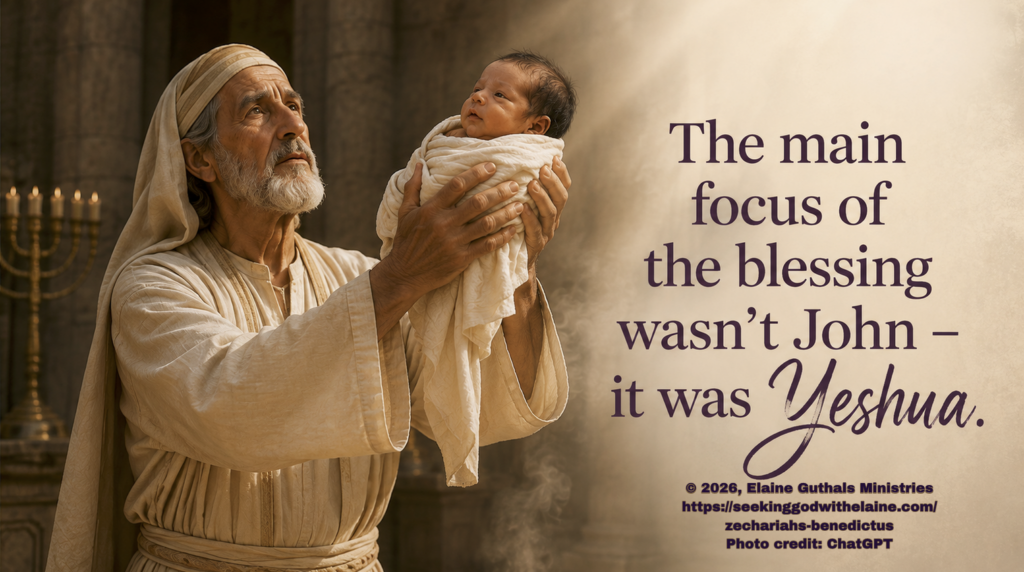
Zechariah could have just focused on his returned voice and his miracle baby. He didn’t.
Covenant faithfulness focused on national redemption.
But we have to resist going down the path that it seems Parker’s first sentence took. He then seems to straighten it out.
Parker wrote,
“The inspiration of Zacharias recognized most emphatically the preceding inspiration with which God had [favored] His Church. Zacharias seems to be standing in the midst of that summer of which Old Testament times were but the spring. And as, on the one hand, his inspiration seemed to contract the past until Abraham lived but yesterday; so, on the other, it contracts the future, and makes John already the full-grown messenger and herald of the Messiah.”
Resource
Parker uses the imagery of spring and summer to describe the progression from Old Testament promises to their fulfillment in Zechariah’s day. I agree that Zechariah stood at a significant turning point, but that did not mean Jehovah was replacing Israel with the Church. The covenant promises were being fulfilled through the Messiah.
Jehovah hasn’t replaced Israel with the church.
Zechariah’s blessing was not focused on the early church. It was a covenant blessing from start to finish.
Parker was right that Zechariah and John were on the threshold between Zechariah’s priests and John’s Holy Spirit-filled life.
We have to remember this was before the Temple was destroyed in 70 AD. Messianic expectation was high.
Those that believed in the Messiah who fulfilled those expectations wouldn’t – in one aspect – see themselves as much different as they had been. They were still Torah-observant, Temple-attending covenant believers.
In other words, they did not see the Messiah as forming a new religion. He was fulfilling the covenant promises.
Enter Zechariah with what is called the Benedictus. It would have been seen as a live covenant proclamation.
Praise to the Covenant Maker
“Praise the Lord, the God of Israel, because he has visited and redeemed his people” (Lk. 1: 68 NLT)
Praise the Lord
Prayers and blessings always began with the Berakhah.
Berakhah (בְּרָכָה) means blessing. Blessings praising Jehovah often began with a declaration of His blessedness.
Zechariah’s prophecy begins with this familiar Jewish pattern of blessing. Luke records his opening words: “Blessed be the Lord, the God of Israel” (Lk. 1:68). First-century Jewish listeners would have recognized the language as familiar, connecting his blessing with Israel’s Scriptures and covenant relationship with Jehovah.
Remember who Zechariah was. He was a righteous priest who ministered through ordained ritual.
He Has Visited and Redeemed His People
The nation of Israel had long known that redemption was part of the Messianic expectations.
Ever since the Garden of Eden, the story of redemption has been unfolding. But most first-century Jews didn’t go back that far.
Israel’s identity was rooted in faithful Abrahamic covenant relationship with God, who called, redeemed, and set them apart for His purposes. First-century Jews believed that the covenant relationship would be renewed through renewed holiness and purified worship.
The Babylonian exile rocked their covenant identity. They knew they had broken the covenant, but they wondered if Jehovah would abandon them forever.
Many first-century Jews believed that the covenant relationship would be renewed through renewed holiness and purified worship. The prophets had talked of restoration – restoration that hadn’t happened yet. Many knew they had broken the covenant and wondered if Jehovah would abandon them forever.
For many, Messiah, therefore, was expected to accomplish national redemption.
Zechariah was there to tell them that the Messiah had come. Yeshua had visited them. True, He was still growing in His mother’s womb, but He was here.
Unfortunately, many saw this as a new Exodus intervention. They saw it as liberation from Rome.
The Savior Was Sent
“He has sent us a mighty Savior from the royal line of his servant David” (Lk. 1: 69 NLT)
Rescue and deliverance was on its way.
Luke was probably writing in Greek. Verse 69 in the Greek was, “Kai ēgeiren keras sōtērias hemin en oikō Dauid paidos autou (καὶ ἤγειρεν κέρας σωτηρίας ἡμῖν ἐν οἴκῳ Δαυὶδ παιδὸς αὐτοῦ).” Literally, that reads, “He has raised up for us a horn of salvation in the house of David His servant.”
If Luke would have written it in Hebrew, it would probably have been, “Hēqîm lanu qeren yeshu’ah b’veit David avdo (הֵקִים לָנוּ קֶרֶן יְשׁוּעָה בְּבֵית דָּוִד עַבְדּוֹ).
The Hebrew literally says the same thing as the Greek. So, let’s look at the words.
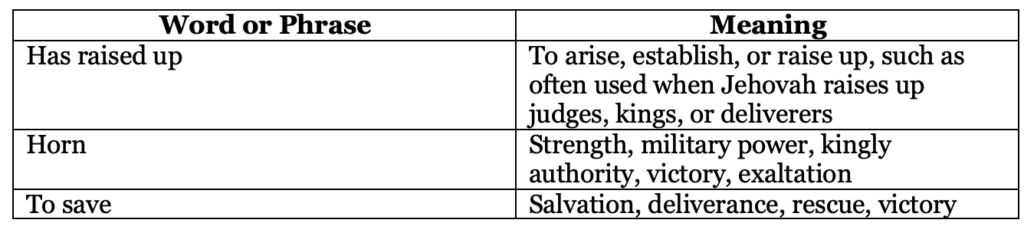
Fun fact. Yeshua comes from the same root as to save. So, Zechariah is proclaiming that Jehovah has raised up a qeren yeshu’ah – a horn of salvation – that is embodied in Yeshua Himself.
So, the horn would have been seen as strong and powerful.
This verse ties together the Davidic Covenant, royal hope, and Zechariah’s prophecy in one thread. That would have conveyed first-century Jews the understanding that the royal covenant promise was alive.
While first-century Jews would have seen this as salvation from Rome, Yeshua pointed them in the way of restoration from sin, death, and spiritual bondage.
Promised Long Ago
“just as he promised through his holy prophets long ago” (Lk. 1: 70 NLT)
First-century Jews believed they were still under the Abrahamic and Davidic covenants, even though they had not experienced full restoration after the Babylonian exile.
At the beginning of the Babylonian exile, the Israelites questioned whether Jehovah had abandoned them. They believed He still intended to fulfill His promises.
They saw the Messiah as the one to fulfill those promises. Way back in the Garden of Eden, Jehovah had promised that one of human’s seed would crush one of the serpent’s seed.
I know. Wouldn’t that have made them realize that faith in Yeshua was covenant continuity, not covenant departure?
From Abraham’s covenant, through David’s royal promises, through the pain of exile, Jehovah had never abandoned His covenant purposes. Zechariah’s prophecy announces that the long-awaited fulfillment had finally begun.
Rescue at Hand
“Now we will be saved from our enemies and from all who hate us” (Lk. 1: 71 NLT)
Many first-century Jews correctly longed for deliverance, but they misunderstood the enemy from whom the Messiah had primarily come to save them.
Remember, many were looking for a Messiah to overthrow Rome. They interpreted Scripture to say this because Jehovah had sent military saviors before.
Yeshua did save them – and us – from our worst enemy – Satan. He came to defeat sin, Satan, and death — the enemies from which humanity most desperately needed rescue.
Satan and the demons hate us. Also, those who are Satan’s hate us.
While the Messianic expectations believed by first-century Jews included renewed holiness and purified worship, they felt it was covenant renewal. They didn’t believe it was Eden renewal.
They believed that being Abraham’s descendants was the entryway to the salvation offered by the Messiah. If they would have heard “… I am the way, the truth, and the life …” (Jn. 14: 6 NLT), they would have thought their beliefs were already there.
Covenant Mercy
“He has been merciful to our ancestors by remembering his sacred covenant — the covenant he swore with an oath to our ancestor Abraham” (Lk. 1: 72-73 NLT)
While many believed full exile restoration hadn’t happened yet, they believed that Jehovah had not abandoned them.
The exile to Babylon had occurred because Israel broke its covenant with Jehovah. The consequences of that disobedience were expulsion from the Promised Land for most of the Israelites and loss of the Davidic throne.
While first-century Jews were back home in the Promised Land, the throne hadn’t been restored. Many still considered themselves under exile.
The appearance of the Messiah would have verified that Jehovah remembered the covenant that He not only made with Abraham but also with David.
“For when you die and are buried with your ancestors, I will raise up one of your descendants, your own offspring, and I will make his kingdom strong. He is the one who will build a house — a temple — for my name. And I will secure his royal throne forever. I will be his father, and he will be my son …” (II Sam 7: 12-14 NLT).Holiness and Righteousness Restored
“We have been rescued from our enemies so we can serve God without fear, in holiness and righteousness for as long as we live” (Lk. 1:74- 75 NLT)
Rescued
We are rescued from the condemnation of the Law, the power of sin, and the fear of death.
Some might consider it strange that we are rescued from God’s law. He gave it to us, didn’t He? The law shows us His character, doesn’t it?
True, but many first-century Jews – and those still today – believe those laws can save us. They can’t.
God’s laws show us our need for a Savior.
The rescue we got was redemption. It came because of the tender heart of Jehovah.
Serve Him
We talk of salvation as a free gift from Jehovah.
While salvation might be to us a free gift, Boston reminded us it wasn’t to Yeshua. He wrote, “All the benefits of the covenant, to be bestowed on His spiritual seed, are made over to Him on a valuable consideration. God gives us to serve our Redeemer, because Christ served Him perfectly in our room and stead.”
Resource
We are called to serve Jehovah. That is a covenant responsibility.
Does that mean there are strings attached to the gift? No. Boston called it a privilege and a benefit to serve Jehovah.
We accept the responsibilities of the covenant when we put our faith in Yeshua as our Savior.
That doesn’t make us slaves to Jehovah. It doesn’t even make us hired hands.
It is our honor to serve Jehovah. We are ministers – a priesthood – for Him.
The Temple was still functioning and would for a couple more decades. They would have seen holiness and righteousness prophesied in Jeremiah 31 and Ezekiel 36 as being tied with Israel’s priestly vocation.
- “‘But this is the new covenant I will make with the people of Israel after those days,’ says the Lord. ‘I will put my instructions deep within them, and I will write them on their hearts. I will be their God, and they will be my people’” (Jer. 31: 33 NLT).
- “And I will give you a new heart, and I will put a new spirit in you. I will take out your stony, stubborn heart and give you a tender, responsive heart” (Ezek. 36: 26 NLT).
Hey, new covenant, New Testament, right? Abrahamic covenant, Davidic covenant, and Messianic covenant all interconnected.
Yes, but not in the way they thought.
We have to go back to the Hebrew to understand this. What Jeremiah was talking about – and what they would have connected to Ezekiel – was berit chadashah (בְּרִית חֲדָשָׁה).
Yes, it could mean new, but it also could mean renewed or restored. That is what many first-century Jews heard – restored.
But it was only a covenant with the House of Israel and the House of Judah. “See, a time is coming — declares GOD — when I will make a new covenant with the House of Israel and the House of Judah” (Jer. 31: 31 JPS).
First-century Jews generally expected the new covenant to renew Israel, not expand her to include Gentiles; to transform hearts, not abolish Torah; and to restore covenant faithfulness, not establish a different faith. What they didn’t anticipate was that this renewal would be inaugurated through the atoning death and resurrection of the Messiah Himself.
Holiness and Righteousness
Zechariah and his audience would have seen these verses as renewal of the covenant instead of a new covenant with Yeshua.
We’ve heard about holiness and righteousness many times. Those can be confusing terms, though, to some.- Holiness is the state of being set apart to God, increasingly reflecting His character through a life devoted to Him. As we grow in holiness, holiness produces a clean heart, a steadfast will, and a life wholly dedicated to God.
- Righteousness is the inward reign of Christ that reshapes our desires before it reshapes our behavior.
The service we are called to perform is to continue the rest of our lives. We serve Jehovah because we are set apart to do it. This is a lifelong act because it is part of our Sanctification Road – which is a lifelong process.
Making the Connections #1
How many times can Satan convince us that we have gone one sin too far? He loves to tell us that we crossed the line, and Jehovah will never forgive us.
Since it was probably around 3 or 4 AD, the friends and family that came to the B’rit Milah (בְּרִית מִילָה) would have seen Zechariah’s prophecy as hopeful and anticipatory. They wouldn’t have seen Zechariah’s prophecies as a departure from Judaism.
Making the Connections #2
Look at what Boston said. He wrote,
“The first covenant required a lasting service, but secured not man from breaking the service. But the second covenant secures the perpetuity of the service, that, however fickle the believer is, yet he shall serve the Lord all the days of his life. It imports that he shall serve the Lord for ever and ever, in heaven, after death.”Resource
Satan is wrong. There is only one sin that Jehovah won’t forgive. It is called the unpardonable sin. In my opinion, it has to do with unbelief and refusal to surrender to Him even if we do believe.
That should comfort us. Once we are Jehovah’s, only we can choose to turn our back on Him. He never will turn away from us.Making the Connections #3
Zechariah praised Jehovah because He remembered His covenant. Jehovah has never failed to keep His promises. The better question for us is whether we are faithfully walking with Him each day. Have we allowed distractions, sin, or complacency to pull us away from the relationship He has graciously established through Yeshua? Covenant faithfulness begins with the daily choice to follow Him.
Heart Check
Think about the battle Yeshua is engaged in for your heart. Ask yourself the following questions.
- Am I choosing to follow Yeshua daily, or am I slowly turning away from Him?
How Do We Apply This?
- Praise Him for keeping every promise.
- Remember what He has rescued you from.
- Walk faithfully with Him daily.
- Serve Him without fear, in holiness and righteousness.
Father God. We choose You daily. Help us to grow closer to You as we walk with You. May we praise You as Zechariah did for the covenant that we have with Yeshua. Amen.
If you don’t understand something and would like further clarification, please contact me.
If you have not signed up for the email providing the link to the devotions and the newsletter, do so below.
If God has used this devotion to speak with you, consider sharing it on social media.
Lorem ipsum dolor sit amet, consectetur adipiscing elit. Ut elit tellus, luctus nec ullamcorper mattis, pulvinar dapibus leo.
-
The Birth of John the Baptist
Zechariah and Elizabeth were promised a son who would have a special mission. This devotional reading looks at the birth of the one who would prepare the way for the Messiah.
Nuggets
- Elizabeth had carried the baby that she never thought she would have for nine months.
- The circumcision ceremony was where the newborn son entered into the covenant community.
- John almost got another name.
- Jehovah was with John from conception.
- Zechariah blessed his son and acknowledged the mission Jehovah had for him.
- Second Temple Judaism saw the imagery of the light.
- John grew physically and spiritually.
We discussed in several devotions that two sons were prophesied to be born under unusual circumstances to two women who were relatives. The first couple had been praying for years for a baby – until age made that an impossibility.
Now, they were going to get their son. Jehovah Himself had sent word that it would happen.
We are going to take the verses in a little order. We are going to pull out Zechariah’s Benedtictus for the next devotion. That will leave the last couple of verses to be discussed here.
Let’s Put It into Context
To read devotions in The Battle for the Heart theme
Devotions in the Preparing for the Christ Child series
John Is Born
“When it was time for Elizabeth’s baby to be born, she gave birth to a son. And when her neighbors and relatives heard that the Lord had been very merciful to her, everyone rejoiced with her. When the baby was eight days old, they all came for the circumcision ceremony. They wanted to name him Zechariah, after his father. But Elizabeth said, ‘No! His name is John!’ ‘What?’ they exclaimed. ‘There is no one in all your family by that name.’ So they used gestures to ask the baby’s father what he wanted to name him. He motioned for a writing tablet, and to everyone’s surprise he wrote, ‘His name is John.’ Instantly Zechariah could speak again, and he began praising God. Awe fell upon the whole neighborhood, and the news of what had happened spread throughout the Judean hills. Everyone who heard about it reflected on these events and asked, ‘What will this child turn out to be?’ For the hand of the Lord was surely upon him in a special way” (Luke 1: 57-66 NLT)
When It Was Time
Elizabeth had carried the baby that she never thought she would have for nine months.
Now, it was time for the baby to be born. I wonder what was going through her head.
Logic would say that nothing would go wrong in the birth of the forerunner of the Messiah. He had a specific, special plan for His life. It was time for him to start his life.
But we aren’t guaranteed an easy road – even when we are doing Jehovah’s Will. We still feel pain and heartache. Plans fall through – especially if we are doing His Will our way.
At her age, Elizabeth must have had some trepidation for the birthing process. There was no hospital with many machines to address any problem that went wrong.
Jehovah knows we will feel anxious and experience fear and uncertainty. Those feelings are not automatically unbelief.
Some would say that anxiety is really doubt. If done the right way, doubt is really just questions so that we may know more of Jehovah and His will. We just have to question in belief – as Mary did (Lk. 1: 34).
Circumcision
The circumcision ceremony was where the newborn son entered into the covenant community.
The important circumcision ceremony is called B’rit Milah (בְּרִית מִילָה). It probably took place in the modest village in which Zechariah and Elizabeth lived in the Hill Country.
It was a religious ceremony – not just a medical procedure – that was performed on a son’s eighth day after birth. It was a covenant ceremony, a family celebration, a public declaration of identity, and the official welcoming of a son into God’s covenant people all rolled into one celebration.
Covenant celebrations such as this were celebrated by the community. That included family and friends. Many would have wanted to celebrate with the elderly couple because of their covenant blessing.
Circumcision is part of God’s covenant with Abraham. It is the Jew’s responsibility to show agreement with the covenant. It was the physical sign of the covenant that showed the child belonged to Jehovah.
“Then God said to Abraham, ‘Your responsibility is to obey the terms of the covenant. You and all your descendants have this continual responsibility. This is the covenant that you and your descendants must keep: Each male among you must be circumcised. You must cut off the flesh of your foreskin as a sign of the covenant between me and you. From generation to generation, every male child must be circumcised on the eighth day after his birth. This applies not only to members of your family but also to the servants born in your household and the foreign-born servants whom you have purchased. All must be circumcised. Your bodies will bear the mark of my everlasting covenant. Any male who fails to be circumcised will be cut off from the covenant family for breaking the covenant’” (Gen. 17: 9-14 NLT).
Since the number seven represents completion, the number eight represents a new beginning. The child is entering into covenant life and God’s promises.
Jehovah created the male body to anticipate this procedure. It produces Vitamin K and clotting factors that peak around the eighth day.
This was a celebration that included family and friends. Covenant life was seen as communal.
John’s circumcision might have been different in one aspect. Zechariah was unable to speak, but that did not prevent him from directing the ceremony. Whether he performed the circumcision himself or another person did so, Zechariah remained John’s legal father.
His Name Is John!
John almost got another name.
We don’t know if Elizabeth and Zechariah had shared the baby’s name with friends and family prior to his birth. We know they didn’t have gender reveal parties, but people may have questioned them about possible baby names.
Either way, when it got to the part where the baby was named, it reads like the crowd thought they knew what it should be. “… They wanted to name him Zechariah, after his father” (Lk. 1: 59 NLT).
Then, as now, it was common to name a child after an ancestor. It was both a way to preserve and honor the name.
I bet it was easy to imagine John growing up and being like Zechariah in many ways. We already know, from our study of Gabriel’s visit to Zechariah, that John wouldn’t continue his father’s priestly ministry that Zechariah had given his whole life to serve in faith and obedience.
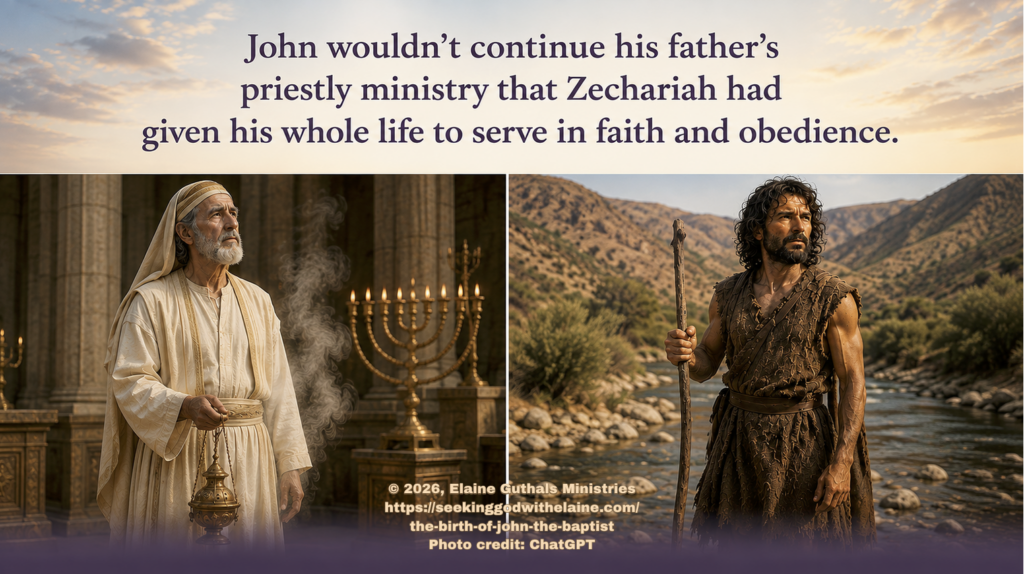
Instead of serving as a priest, John would become a prophet calling the people back to God. He would be preparing them for something new.
Parker had a great comment on what the crowd was doing. He wrote, “They would have dragged down the miraculous to the ordinary, and surrounded this speciality of Divine [favor] with all that was ancient and traditional in the family.”
Resource
We get the obedience behind calling the son John. ‘That was the name the angel Gabriel told Zechariah he was to have.
Elizabeth didn’t equivocate. She flat out said, “His name is John.”
I thought it was funny that the crowd gestured to Zechariah to see his answer. The man couldn’t speak – he wasn’t deaf.
Doubting Zechariah didn’t doubt anymore. He wrote, “His name is John.” He was publicly submitting to Jehovah’s Will.
Zechariah’s obedience was rewarded. His ability to speak returned to him right when Jehovah’s promise, John’s identity, and Zechariah’s obedience merged.
We need to do what Jehovah tells us to do what He has decided.
But there is another aspect to that. “But now, O Jacob, listen to the Lord who created you. O Israel, the one who formed you says, ‘Do not be afraid, for I have ransomed you. I have called you by name; you are mine’” (Isa. 43: 1 NLT).
Part of the reason for the name is the meaning of the names. Zechariah means Yahweh remembers. John (Yôḥānān – יוֹחָנָן) means Yahweh has shown favor.
Let’s stop right there a second to make sure this sinks in.
John was a gift from Jehovah because he was sent for a specific mission. The whole mission was Jehovah’s gift to us. It was all about Jehovah remembering His covenant promise.
Think divine providence. Jehovah provides for His children, whom He knows by name.
But if Zechariah and Elizabeth would have let the worldview hijack Jehovah’s plan before John even said a word and took a step, would His plan have been able to go ahead.
It feels like we sometimes operate on the assumption that Jehovah will forgive us when we go off plan, but He will continue to use us if we just repent. And all-knowing Jehovah may have worked that into some of our plans.
But what if He doesn’t? What if He needs total obedience and surrender for that plan?
The Hand of the Lord Was upon Him
Jehovah was with John from conception.
We know that John was filled with the Holy Spirit from conception (Lk. 1: 15). That would mean Jehovah would be protecting him throughout his life.
Fox reminded us that growth includes not only physical growth but also spiritual growth and growth of the soul.
Resource
John did grow as Jehovah required.
Zechariah’s Prophesy to His Son
“And you, my little son, will be called the prophet of the Most High, because you will prepare the way for the Lord. You will tell his people how to find salvation through forgiveness of their sins. Because of God’s tender mercy, the morning light from heaven is about to break upon us, to give light to those who sit in darkness and in the shadow of death, and to guide us to the path of peace” (Lk. 1: 76-79 NLT)
Prophet of the Most High
Zechariah blessed his son and acknowledged the mission Jehovah had for him.
Oh, what a difference nine months make!
Zechariah understood when John was born what he couldn’t understand when Gabriel gave him the message. He was going to be the forerunner of the Messiah.
Zechariah also realized that John was going to point to the way that their sins would be forgiven. He said one of John’s duties would be to “… tell his people how to find salvation through forgiveness of their sins” (Lk. 1: 77 NLT).
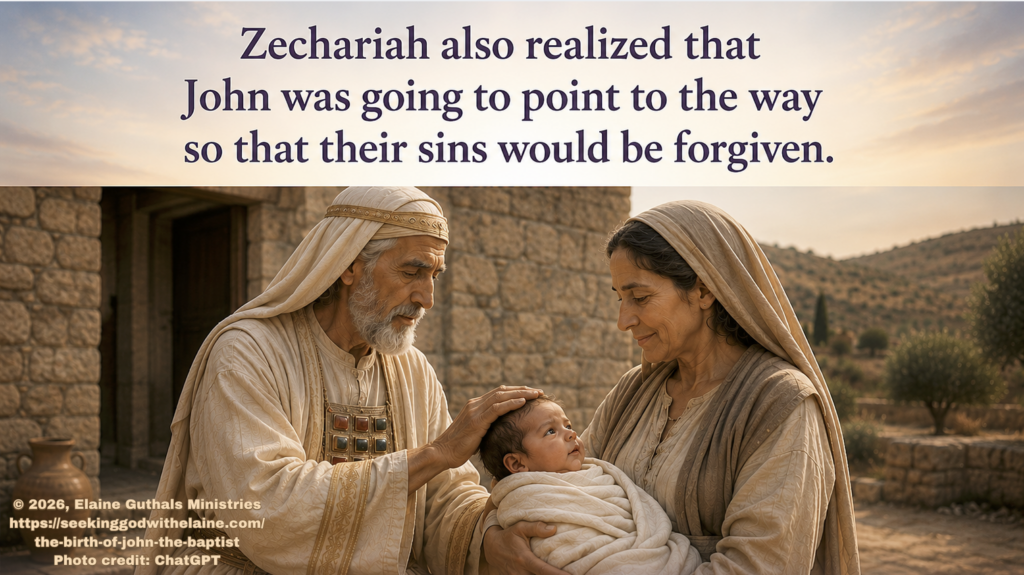
With sacrifices still being offered in the Temple, the first-century Jews either have seen Yeshua’s way as a renewal or a replacement. I am sure there were some in both camps.
The New Living Translation expresses John’s ministry as showing people how to find salvation. He was to impart the knowledge of salvation that points the people to salvation – to Yeshua.
They have to choose to be obedient to Jehovah.
That is all any Pastor Steve-type or even Elaine-type teacher can do. Those searching for Jehovah must make up their own minds to accept the gift of salvation – and all the responsibilities that goes with Yeshua’s covenant.
But then first-century Jews probably equated this with the sin that occurred that triggered the Babylonian exile. They didn’t see it as the sin that occurred in the Garden of Eden.
Morning Light from Heaven
Second Temple Judaism saw the imagery of the light.
The Greek expression translated “morning light” carries the idea of the sunrise after a long night. For generations Israel had waited through what often felt like spiritual darkness.
Prophets had spoken. The people had hoped. Yet centuries had passed without another prophetic voice.
Now Zechariah announces that the dawn is finally breaking — not because Rome is about to be defeated, but because Jehovah Himself is acting to rescue His people from their greatest enemy: sin.
This light reaches all the way back to Creation. The first recorded words of Jehovah in Scripture were, “Let there be light” (Gen. 1: 3). Before the sun, moon, and stars were created, Jehovah’s Light – Yeshua – pushed back the darkness.
Now, in Yeshua in human form, Jehovah again shines light into a world darkened by sin. John’s ministry would not be the light itself; he would point people to the Light.
That is why John later wrote, “God sent a man, John the Baptist, to tell about the light so that everyone might believe because of his testimony. John himself was not the light; he was simply a witness to tell about the light. The one who is the true light, who gives light to everyone, was coming into the world” (Jn. 1: 6-9 NLT).
John’s mission was to prepare people’s hearts so they would recognize the true Light when He appeared. John was never the destination. He was the signpost pointing everyone to Yeshua.
The prophets had also looked forward to this day. Isaiah spoke of a people walking in darkness who would see a great light (Isa. 9: 2), and Malachi described the coming Messiah as the Sun of Righteousness who would rise with healing in His wings (Mal. 4: 2). Zechariah now realized those promises were no longer distant hopes.
The dawn had begun. The Light was coming.
John in the Wilderness
“John grew up and became strong in spirit. And he lived in the wilderness until he began his public ministry to Israel” (Lk. 1: 80 NLT)
John grew physically and spiritually.
When I think of wilderness, I think of a place with lots of trees. It is a wild and natural place.
Really, a wilderness is an uncultivated and uninhabited region. Its main characteristic is being inhospitable.
Where John would have gone when it says he went to the wilderness was a harsh rocky region east of Jerusalem. It stretched from there toward the Jordan River and the Dead Sea.
Geographically, this region was defined by jagged limestone hills, steep ravines known as wadis, and dry, chalky soil. Vegetation was sparse, limited to thorn bushes and scattered scrub growth. It was not a soft desert, but a severe, broken landscape that stripped away comfort and exposed the heart.
The climate in the wilderness went from one extreme to another. The daytime heat contrasted with the cold nights.
Yet there was hope in this arid land. The wilderness, called the midbar (מִדְבָּר) in Hebrew, was a place where God spoke and revealed Himself.
Although we are not told why, we can guess at the reasons John the Immerser chose to minister the wilderness. Instead of going to the Temple, he went to a solitary place that was unfamiliar and called people to repentance and preparation. He took people away from the distractions of their lives so that they could focus on Yeshua.
Making the Connections #1
I agree with one thing Parker said. He wrote, “We shall be better prophets as we become better students. In the silent time we are gathering elements, consolidating character, and undergoing discipline, all of which will be wanted when the trumpet calls us to the battle.”
Resource
We do need to be students of God’s Word. (That is what disciple means.)
Jehovah doesn’t do a data dump into us when we trust Yeshua as our Savior. Instead, He reveals Himself to us over time – over the rest of our lives, in fact.
If we don’t study what God’s Word really says, we may not be getting it right.
More importantly, we aren’t allow Jehovah to transform our hearts if we don’t dig into His way.
Making the Connections #2
John entered into the covenant community through circumcision. But as he grew, he would learn that more than just a physical sign was needed for salvation.
“Prove by the way you live that you have repented of your sins and turned to God. Don’t just say to each other, ‘We’re safe, for we are descendants of Abraham.’ That means nothing, for I tell you, God can create children of Abraham from these very stones” (Lk. 3: 8 NLT).
This followed what both Moses and Jeremiah said.
- “Therefore, change your hearts and stop being stubborn” (Duet. 10: 16 NLT).
- “O people of Judah and Jerusalem, surrender your pride and power. Change your hearts before the Lord, or my anger will burn like an unquenchable fire because of all your sins” (Jer. 4: 4 NLT).
Heart Check
Think about the battle Yeshua is engaged in for your heart. Ask yourself the following questions.
- Am I preparing my heart daily to hear and obey Jehovah, or have I become spiritually complacent?
- Is there an area of my life where I know Jehovah’s will but am resisting it?
- Am I more concerned with following family traditions, culture, or people’s expectations than following Jehovah’s direction?
- Am I walking in the Light Yeshua has given me, or am I holding on to areas of darkness?
- If someone looked at my life, would it point them to me—or to Yeshua?
How Do We Apply This?
- Ask Jehovah to prepare your heart to recognize His work, even when it doesn’t happen the way you expect.
- Spend time in God’s Word each day so your heart stays sensitive to His voice.
- Thank Yeshua for bringing His light into the darkness of your life and revealing the areas that still need His transforming work.
- Surrender any area of resistance where you have been holding on to your own plans instead of trusting Jehovah’s.
- Ask the Holy Spirit to make your life a faithful witness that points others to Yeshua rather than to yourself.
Father God. Thank You for the fact that You call each of us to expand Your Kingdom. You don’t rely on only a few to do the work for You. Each and every one of us has tasks to do for You. These are to grow our faith and grow us closer to You. Amen.
If you don’t understand something and would like further clarification, please contact me.
If you have not signed up for the email providing the link to the devotions and the newsletter, do so below.
If God has used this devotion to speak with you, consider sharing it on social media.
-
The Great Reversal of God’s Kingdom
When Mary began to praise Jehovah, she knew this situation called for more than just praise. This devotional reading looks at the completion of the Magnificat.
Nuggets
- The mighty arm of the Lord is an Old Testament image for Jehovah’s saving power.
- Jehovah values humility over pride.
- Social station does not enter into Jehovah’s evaluation of whom is a prince.
- Yeshua’s ministry flipped the idea of greatness.
- We are to look to Jehovah and expect our lives will be satisfying.
Social status does not mean loss isn’t going to happen. - Jehovah will provide for His children.
- We were created to serve Jehovah.
- There are many times in Scripture that Jehovah has called us to remember.
- Mary’s praise came full circle as she again highlights Jehovah’s mercy.
- Jehovah was acting because He made this promise to Abraham.
After being warmly greeted by Elizabeth and her prophecy, Mary launched into her acknowledgement of Jehovah. Known as then Magnificat, it is more than merely a song of praise.
We are looking at it to determine covenant language.
Let’s Put It into Context
To read devotions in The Battle for the Heart theme
Devotions in the Preparing for the Christ Child series
Strength and Power
Mighty Arm
The mighty arm of the Lord is an Old Testament image for Jehovah’s saving power.
Mary, as a righteous person, knew her Old Testament history. She knew this term was a shorthand term used for His mighty intervention in history.
His arm was the image that represents Jehovah’s active power. To first-century Jewish listeners to Luke’s Gospel, they wouldn’t hear strong – they would have heard covenant faithfulness.
- “Therefore, say to the people of Israel: ‘I am the Lord. I will free you from your oppression and will rescue you from your slavery in Egypt. I will redeem you with a powerful arm and great acts of judgment’” (Ex. 6: 6 NLT).
- “Has any other god dared to take a nation for himself out of another nation by means of trials, miraculous signs, wonders, war, a strong hand, a powerful arm, and terrifying acts? Yet that is what the Lord your God did for you in Egypt, right before your eyes” (Deut. 4: 34 NLT).
- “Remember that you were once slaves in Egypt, but the Lord your God brought you out with his strong hand and powerful arm. That is why the Lord your God has commanded you to rest on the Sabbath day” (Deut. 5: 15 NLT).
We may question why the imagery is Jehovah’s arm, and not His hand. Well, think about it.
I can throw a baseball with my hand. It isn’t going to go very far. It needs the power supplied by my arm to get it to go farther than two feet in front of my toes.
Isaiah expanded what the Torah described. He especially developed the imagery.
- “The Lord has demonstrated his holy power before the eyes of all the nations. All the ends of the earth will see the victory of our God” (Isa. 52: 10 NLT).
- “Wake up, wake up, O Lord! Clothe yourself with strength! Flex your mighty right arm! Rouse yourself as in the days of old when you slew Egypt, the dragon of the Nile” (Isa. 51: 9 NLT).
Then Isaiah takes a 180o. “He was despised and rejected — a man of sorrows, acquainted with deepest grief. We turned our backs on him and looked the other way. He was despised, and we did not care” (Isa. 53: 3 NLT).
Wait! What??
There we were talking about strength and power. Now, we are talking about suffering.
In Isaiah 53, the Arm of the Lord is revealed in the person of Yeshua. Jehovah’s saving power is not displayed through an army but through the suffering Servant.
The Baby that Mary was carrying in her womb is the Arm of the Lord.
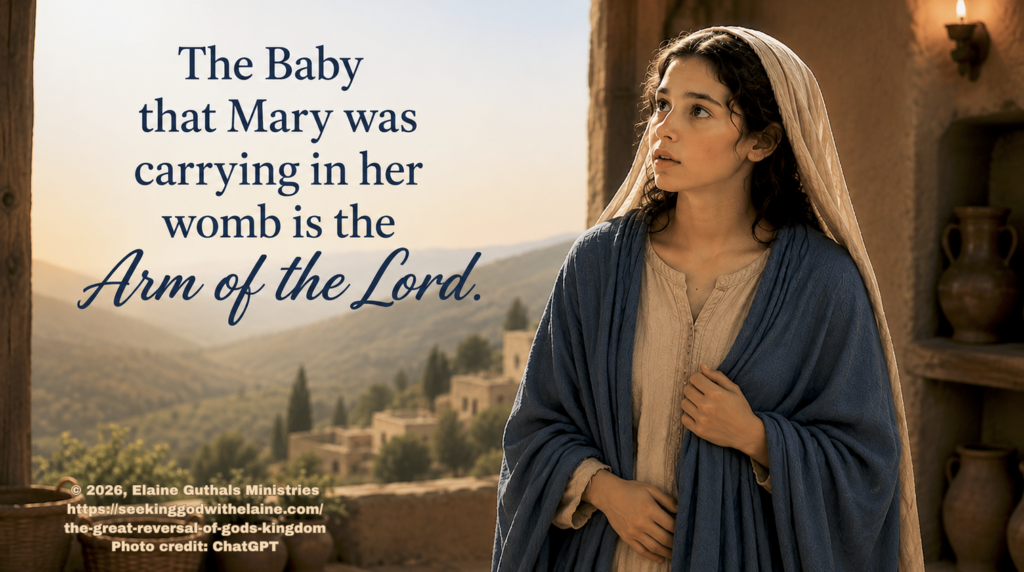
Did you catch that? The Baby hadn’t even been born yet, and He was being called the Arm of the Lord.
What if we read these verses that I have noted through the lens of Isaiah 53? Suddenly the Lord’s mighty arm points us to the One through whom His saving power is ultimately revealed – Yeshua.
Proud and Haughty Ones
Jehovah values humility over pride.
Pride makes us think we can do things on our own. We rely on some skill we possess or idea that we have.
Then we tell ourselves that we don’t need Jehovah. But we would be wrong.
Unfortunately, pride is the exact opposite of what Jehovah desires. The proud person trusts in their own righteousness, while He wants us to know they have nothing on our own.
Our relationship with Jehovah has to be genuine. We cannot simply perform righteous acts; we must live in humble dependence on Him.
The humble know that we are nothing without Jehovah. We need Him for salvation.
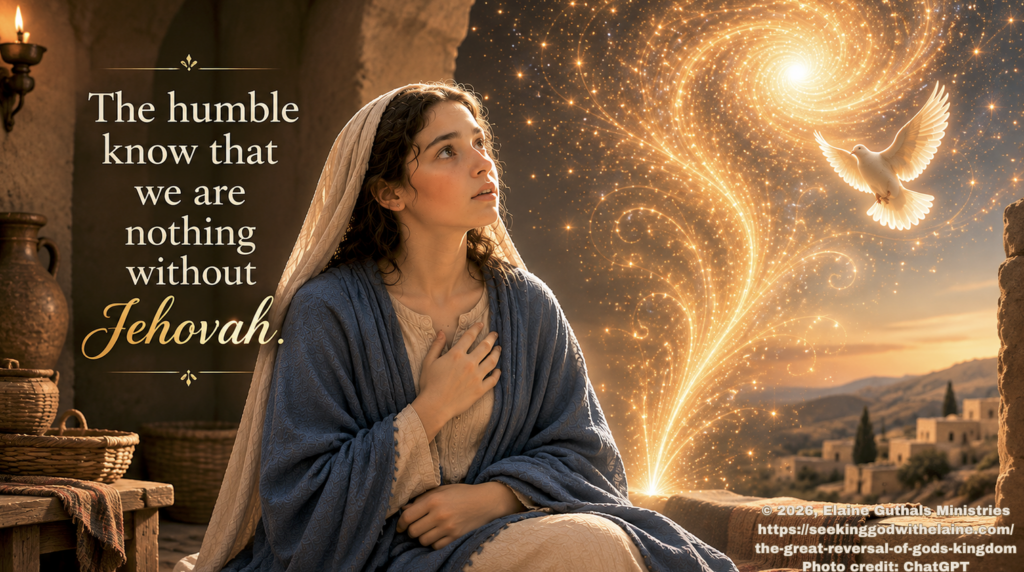
Overthrowing This World
“He has brought down princes from their thrones and exalted the humble” (Lk. 1: 52 NLT)
Princes
Social station does not enter into Jehovah’s evaluation of whom is a prince.
When we think of a prince, we think of a son of a king. The Greek word means more than that.
In first-century Israel, a prince was a powerful ruler or someone in authority. Names that we might recognize that would be princes were Herod, Caesar, and Pilate.
Those we might not consider as princes but they would were the religious elite. A prince was anyone who believed that their position made them secure.
Look at the extent of the princes’ defeat. They were brought down from their thrones. Mary said that they weren’t just removed. They were removed from their thrones – their source of confidence.
What does that tell us? Jehovah can dismantle that in which we put our confidence – when we don’t put it in Him.
- Pharaoh fell.
- Nebuchadnezzar was humbled.
- Belshazzar lost his kingdom.
- Saul lost his throne.
- Herod Agrippa died while accepting worship as a god.
What this world offers us is temporary. Jehovah offers the eternal.
Exalted the Humble
Yeshua’s ministry flipped the idea of greatness.
We usually see greatness as belonging to the successful. The person who has accumulated wealth and – therefore – social status is seen as the greatest. Greatness is also seen in those who have political influence which may or may not mean they have control of the military.
- “For those who exalt themselves will be humbled, and those who humble themselves will be exalted” (Lk. 14: 11 NLT).
- “The greatest among you must be a servant” (Mt. 23: 11 NLT).
Instead, Jehovah uses those who feel like they have nothing to offer Him. Think Moses. Think Jeremiah. Think shepherds and tax collectors.
Hungering for Jehovah
“He has filled the hungry with good things and sent the rich away with empty hands” (Lk. 1: 53 NLT).
Filled the Hungry with Good Things
We are to look to Jehovah and expect our lives will be satisfying.
When we read this verse, our minds may immediately go to the miracles of feeding the 5,000 and feeding the 4,000. Yes, Yeshua did perform those miracles that physically fed the crowds.
That was never where Jehovah’s focus was. True, He is concerned about our situations. He does provide for our physical wellbeing.
I wonder what Jehovah’s version of pumping His fist would look like. He surely would have been doing it when Yeshua gave the Sermon on the Mount.
“Blessed are those who hunger and thirst for righteousness, for they shall be satisfied” (Mt. 5: 6 ESV).
Mary wasn’t talking about a physical hunger any more than Yeshua was in His sermon. It was all about hungering for righteousness.
This is talking about those who know that they can only come to Jehovah with empty hands. They can only come when they are spiritually needy and know Yeshua is the only way that they can gain salvation.
Sent the Rich Away with Empty Hands
Social status does not mean loss isn’t going to happen.
Mary had an interesting choice of words. She didn’t say the rich were condemned. She said they were sent away empty-handed.
Let’s look at what is said without being said. How would the rich have arrived? They would have thought they were the greatest. They would have believed that their hands were already full.
Luke would go on to talk about the rich throughout his book. He would paint them as trusting in their possessions, status, and self-sufficiency. Think the rich fool in Luke 12, the rich young ruler in Luke 18, and the rich man and Lazarus in Luke 16.
Yes, those men were had a lot of money. But more importantly, they had a problem with misplaced trust.
Luke has been building his portrait of the rich and proud. They were going to be scattered (verse 51), brought down (verse 52), and left empty (verse 53).
No, this wasn’t talking social position. It was talking the attitude of the heart.
God refuses salvation to all those who refuse to be obedient to Him. Only those who know they need a Savior will receive Him.
We can draw these conclusions because we have the rest of the story. We see the completed Plan of Salvation.
Mary didn’t have that here, so that isn’t really what she was ultimately talking about. She was focusing on the coming Messiah and the Kingdom He will establish.
Being MercifulTitle
“He has helped his servant Israel and remembered to be merciful” (Lk. 1: 54 NLT)
He Has Helped
Jehovah will provide for His children.
To us, Mary’s Magnificat may seem like pieces of several different puzzles trying to be put together. It does fit.
Verse 54 stands as the theological climax of the Magnificat. All those different puzzle pieces get summed up in this verse.
The Greek verb used is antelabeto (ἀντελάβετο) literally mean to take hold of, to come to someone’s aid, or to grasp in order to help.
Picture Jehovah reaching down and taking ahold of us to rescue us when we can’t rescue ourselves.
Mary said that Jehovah has come to their aid in the past. He came in their weakness to give them aid.
What Mary is saying is that Jehovah Himself stepped in and more than rendered assistance.
Apply this to the Baby in Mary’s womb. That is Jehovah Himself stepping into the world and transforming it.
His Servant Israel
We were created to serve Jehovah.
Some today may bristle at being called Jehovah’s servant. First-century Jews didn’t. That language was repeatedly used in the Old Testament.
- “But you, Israel, my servant, Jacob, whom I have chosen, the offspring of Abraham, my friend” (Isa. 41: 8 NLT).
- “But now hear, O Jacob my servant, Israel whom I have chosen! Thus says the Lord who made you, who formed you from the womb and will help you: Fear not, O Jacob my servant, Jeshurun whom I have chosen” (Isa. 44: 1-2 NLT).
- “And now the Lord says, he who formed me from the womb to be his servant, to bring Jacob back to him; and that Israel might be gathered to him — for I am honored in the eyes of the Lord, and my God has become my strength” (Isa. 49: 5 NLT).
Mary saw herself as part of Israel’s story. Jehovah’s covenant plan was being carried out through her personal blessing.
Back in verse 50 Mary declared that Jehovah’s mercy extends from generation to generation. She remembered what was leading up to her present situation.
Remembered
There are many times in Scripture that Jehovah has called us to remember.
The Greek word used here is mnēsthēnai (μνησθῆναι). It means to remember.
No, this doesn’t mean that Jehovah forgets anything. We know He doesn’t.
- “But God remembered Noah and all the wild animals and livestock with him in the boat. He sent a wind to blow across the earth, and the floodwaters began to recede” (Gen. 8: 1 NLT).
- “Then God remembered Rachel’s plight and answered her prayers by enabling her to have children” (Gen. 30: 22 NLT).
- “The entire family got up early the next morning and went to worship the Lord once more. Then they returned home to Ramah. When Elkanah slept with Hannah, the Lord remembered her plea, and in due time she gave birth to a son. She named him Samuel, for she said, ‘I asked the Lord for him’” (I Sam. 1: 19-20 NLT).
Every time Jehovah is said to have remembered something, He immediately acts according to His covenant promises. It is a signal for Israel to watch and see Jehovah move.
Jehovah is moving mightily in Mary’s life as He fulfills the promise made back in Genesis 3: 15. A Messiah has come.
To be Merciful
Mary’s praise came full circle as she again highlights Jehovah’s mercy.
Mary showed the reality of Jehovah’s mercy. It started out in verse 50 as extending from generation to generation. We talked about that meaning it doesn’t quit.
Here, Mary said that His mercy was arriving in history. The promise was being fulfilled.
Compare this progression to Jehovah’s calling Israel out of Egypt. “God heard their groaning, and he remembered his covenant promise to Abraham, Isaac, and Jacob” (Ex. 2: 24 NLT). ”
Jehovah heard, remembered, and acted.
Humans had been in exile from Jehovah since they were driven from the Garden of Eden (Gen. 3: 23). Sin broke our relationship with Him. It must be restored so He can welcome us back into His presence in the New Jerusalem.
Now, Jehovah remembered their plight and was acting to restore the relationship humans could have with Him.
Unfortunately, first-century Jews wouldn’t have connected Mary’s praise to the first exile. They would have connected it to being called out of Egypt.
They weren’t expecting a Messiah to restore them from their sinful nature. They saw restoration after the Babylonian exile. To them, that equated to freedom from political dominance.
So, many first-century Jews missed the Messiah
Kept His Promise
“For he made this promise to our ancestors, to Abraham and his children forever” (Lk. 1: 55 NLT)
Jehovah was acting because He made this promise to Abraham.
The first-century Jews failing to recognize the Messiah didn’t stop Jehovah from acting and keeping His promise. He told Abraham He was going to do this, so He did.
Fortunately, Jehovah’s keeping His promise wasn’t dependent on human obedience. He acted because of His mercy.
Remember, we said Jehovah’s mercy is really more than us getting something we didn’t deserve. It means that love is conveyed through covenant faithfulness.
Now put this into context. There had been no prophet for 500 years. This doesn’t mean that there just wasn’t anyone for the job.
This means Jehovah had been silent for 500 years. Some may have jumped to the conclusion many today would have – Jehovah had turned His back on them.
They would be wrong.
After centuries of waiting, Jehovah remembered them, His mercy, and His promises. He was waiting for the fullness of time.
It was time to act.
Making the Connections #1
If first-century Israel may have seen the arm of the Lord as army of the Lord, they would probably have been scratching their heads.
No armies appeared. Rome was still there. David’s throne wasn’t resurrected.
But Mary was making it sound like it was a done deal. Well, it was.
No, nothing had happened yet, but what Jehovah says will happen will come to pass.
Look what Isaiah said would happen in Isaiah 51-53:
- The proud would be scattered.
- Rulers would be brought down.
- The humble would be exalted.
- The hungry would be filled.
- The rich would be sent away empty.
That doesn’t need a military campaign to be a success. It needs an overturning of human values.
That takes the focus off Rome. It gears it toward the heart. Pride is the enemy of the human heart.
Rome wasn’t the greatest problem. Pride was.
Our greatest enemy isn’t political power. It is the proud heart that refuses Jehovah’s rule.
Making the Connections #2
When some look at Luke 1: 52, some see a social revolution. Is it that, or a spiritual revolution?
Could Luke really have meant both?
Well, Jehovah does removed earthly rulers at times. History bears that out.
Instead, Jehovah’s kingdom focuses more on overturning every human hierarchy built on pride. The proud will lose what they thought made them great.
The humble are elevated.
Mary herself is a good example to illustrate that. She didn’t come from a prestigious family. She was an unknown teenager from an obscure village.
Yet the Messiah called her the Aramaic word Ima (אִמָּא) – mom.
Making the Connections #3
As Mary continued to worship Jehovah through the Magnificat, her view expanded. In verse 50 and 51. Mary started talking about her soul and her spirit. She was acknowledging what He had done for her.
Mary’s focus then expanded to others. She talked about those who fear him: the humble and hungry. She also talked about those who didn’t fear Him: the proud, the mighty, and the rich.
Finally, Mary broadened it to encompass all. She not only talked about Israel, but she also talked about the Abrahamic covenant. That is where all nationals were to be blessed – all humanity.
Making the Connections #4
Jehovah never forgets His promises. He will always do what He says.
Divine silence doesn’t mean separation. It means preparation.
Why did Jehovah wait so long? He had His reasons. He was preparing for the right moment in history – even preparing Mary herself. He may have been waiting for the expectation to reach the point where the Jews knew that He was the One saving them.
Jehovah’s reason is only known to Him. We’ll have to put that in the UNR book – understanding not required.
What we do know is we are required to keep praying for what we are requesting. It isn’t to change His mind.
It brings us into alignment with Him.
Heart Check
Think about the battle Yeshua is engaged in for your heart. Ask yourself the following questions.
- Do I truly recognize my need for Jehovah, or do I depend on my own strength, abilities, resources, or accomplishments?
- Am I willing to come to Jehovah with empty hands, admitting that I cannot save myself?
- Where do I place my confidence — in the things of this world or in Jehovah’s covenant faithfulness?
- Do I praise Jehovah for His mercy, remembering that every spiritual blessing I have is a gift of His grace?
- Am I patiently trusting Jehovah’s timing, even when He seems silent?
How Do We Apply This?
- Thank Jehovah for His covenant faithfulness and the promises He has already fulfilled.
- When you face a difficult situation this week, pause before trying to solve it yourself and ask Jehovah for His help.
- Spend time praising Jehovah for who He is, not just for what He has done for you.
- Encourage someone who is struggling by reminding them that Jehovah has not forgotten them.
Father God. Let the praise fall off our lips. May it get down to the heart level. Amen.
If you don’t understand something and would like further clarification, please contact me.
If you have not signed up for the email providing the link to the devotions and the newsletter, do so below.
If God has used this devotion to speak with you, consider sharing it on social media.
-
A Humble Heart Exalts a Holy God
Mary’s response to Elizabeth was much more than a beautiful song of praise. This devotional reading looks at the covenant themes woven throughout Mary’s song and how they reveal the character of God.
Nuggets
- Mary humbled her soul before the Lord.
- Translating the word as praises loses something important.
- Knowing she would bear the Messiah, Mary’s joy is focused on Jehovah Himself.
- Mary exalted Jehovah with her whole being.
- The soul proclaims Jehovah’s greatness while the spirit delights in His salvation.
- Jehovah chose a lowly teenage girl, not someone who others would think was more appropriate.
- All generations echoes covenant language.
- The Magnificat is all about Mary’s certainty of what Jehovah was doing.
- Mary focused on Jehovah’s might and power.
- Our definition of holy usually includes aspects of being morally pure, sinless, and righteous, but that’s not quite correct.
- Mercy was based on covenant faithfulness.
- If Jehovah is that merciful, why would He want us to fear Him?
- Jehovah’s promises aren’t random – they have a continuity.
The teenager from a small village was in a very unique position. When she was told that she was going to have a Baby Who would be the Son of God, she went to see her relative.
Elizabeth was in a very unique position, also. Although she was beyond childbearing age, she was having a baby herself.
After Elizabeth had blessed Mary, Mary broke into praise for Jehovah. But how she worded it shows us that it was much more than just praise.
It was a covenant acknowledgment.
Let’s Put It into Context
To read devotions in The Battle for the Heart theme
Devotions in the Preparing for the Christ Child series
Praise
“Mary responded, ‘Oh, how my soul praises the Lord’” (Lk. 1: 46 NLT)
How My Soul
Mary humbled her soul before the Lord.
The Greek word for soul is psychē (ψυχή), and in Luke 1:46 it translates the Hebrew idea of nephesh (נֶפֶשׁ).
We look at soul as being the immaterial part that goes to Heaven. Not necessarily.
The soul is the whole inner person – the seat of our desires, affections, will, and identity. It is who we are at the deepest level of our being.
In Hebrew thought, humans weren’t divided into body, soul, and spirit as we see it. They were a nephesh – a living being.
Think back to Genesis 2: 7. Jehovah formed our bodies from the dust. But it was an inanimate object until He gave us the breath of live or spirit. This made us a living soul – a nephesh.
Mary is saying all that is within her is declaring Jehovah’s greatness. She acknowledged His absolute supremacy, infinite majesty, and boundless nature.
Jehovah’s covenant faithfulness flows from His goodness. Every first-century Jew would have used the Abrahamic and Davidic covenants as examples of that. His covenant culminated in the promise of the Messiah. That feeds right into Messianic expectations.
That was the Baby Jehovah asked Mary to carry.
Praises the Lord
Translating the word as praises loses something important.
Hmmm. I don’t know if I have ever heard this translated as praises. It usually is magnifies the Lord.
I know. Magnifies isn’t a common word in our vocabulary – unless the form magnifying is used, and it is followed by the word glass.
The Greek word used is megalynō (μεγαλύνω). It means to make great, to magnify, to declare as great, or to exalt.
The key idea is greatness. This is much richer than simple praise.
Mary wasn’t making God greater than He is. Nothing we can do or say can make Him greater – or lessen Who He is.
Mary was proclaiming His greatness with every part of her being. She was taking her figurative glass and showcasing Who He is.
When we understand Jehovah’s greatness, we should be filled with joy.
Worship should come from who we are. Every part of us should exalt Him.
Mary would have seen it as Jehovah reversing her – and other’s – circumstances.
Jehovah would have once again been raising the lowly. Mary would have known the covenant examples of Joseph, Moses, Ruth, David, Esther.
The teenager from the back road village would have been humbled to be added to the list.
Exaltation is not supposed to just be an emotional response. It was about changing positions. It is more than a feeling – it is a conscious choice.
It is easy to see that just as a physical reversal, but that would be looking at it wrong. Jehovah is in the business of working our physical circumstances for the good of His kingdom. “He has brought down princes from their thrones and exalted the humble” (Lk. 1: 52 NLT).
That shows that Jehovah is in the business of transforming our hearts. Hearts are transformed first, causing them to praise Him.
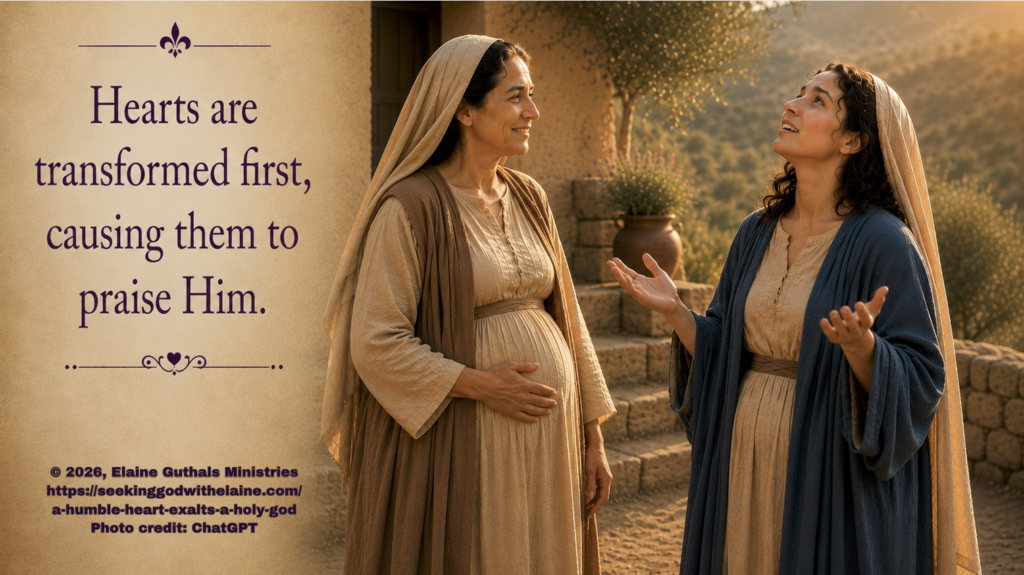
The Lord
Knowing she would bear the Messiah, Mary’s joy is focused on Jehovah Himself.
We can’t gloss over the word Lord because we think we know it. Lord is a replacement for the name YHWH – Jehovah (Ex. 3: 14-15). It means
- the eternal One
- the self-existent One
- the covenant-keeping God
- the God who redeemed Israel from Egypt
- the God who keeps His promises
It is shorthand for Israel’s entire covenant history. Mary would only have had to remember it.
Mary would have known that Jehovah created the heavens and earth so that He could dwell with His people. When sin entered humans, she knew He dwelt with them in the wilderness Tabernacle and then in Solomon’s Temple.
She knew of the second exile – this one to Babylon. Mary knew the nation had deserved the punishment they received. While she knew they were home, she knew that Jehovah didn’t currently dwell with them.
Mary would have been taught of the covenant promises. She would have grown up on stories of Abraham’s call, Isaac’s provision, and Jacob’s wrestling with Him. She well knew that Jehovah gave David of an everlasting kingdom.
Israel’s history would have been present to Mary. She learned how Jehovah had provided during the famine that sent Joseph to Egypt to store grain for its coming. She probably loved the stories of Moses being called at the burning bush. This humble leader had been used by Jehovah to part the Red Sea to bring Israel out of Egypt. Then He gave His law to him.
Mary didn’t elevate herself because of the honor she had received – and didn’t expect others to, either. She wasn’t the focus.
Jehovah is. Yeshua is, too.
But Mary’s response is all about Jehovah.
Mary would have known about the covenant promises through the synagogue, family instruction, memorization, and songs and prayers.
Acknowledging God our Savior
“How my spirit rejoices in God my Savior! ” (Lk. 1: 47 NLT)
My Spirit Rejoices
Mary exalted Jehovah with her whole being.
Verse 47 continued the thought of verse 46 through parallelism. There is overlap rather than separate parts.
The Greek word for spirit is pneuma (πνεῦμα). The Hebrew word is ruach (רוּחַ). The spirit is the part of us that relates to, responds to, and communes with God.

David understood this concept. “Bless the Lord, O my soul, and all that is within me, bless his holy name!” (Ps. 103: 1 ESV emphasis added).
In other words, the two terms are distinct but intimately connected.
God my Savior
The soul proclaims Jehovah’s greatness while the spirit delights in His salvation.
We have to be very careful not to look at “… God my Savior!” (Lk. 1: 47 NLT). We can’t see it through a twentieth-century lens. Mary wasn’t saying, “God is saving me from my sins so I can go to heaven.”
We see salvation as a personal salvation. Mary wouldn’t have.
The Greek word is sōtēr (σωτήρ), which means Savior, Deliverer, or Rescuer. The Hebrew idea behind it is often yasha (ʿיָשַׁע), to save or to deliver. It is the root from which we get Yeshua (Jesus) —Yahweh saves.
Mary would have said it through covenant overtones. In the Old Testament, Jehovah was Israel’s Savior many times.
- delivered Israel from Egypt
- rescued them from their enemies
- preserved them during famine
- restored them from exile
- kept His covenant promises
Mary’s response was saturated in the covenant.
Think of it this way. Mary knew God was fulfilling His promise for a Messiah. Their redemption had begun. Jehovah would once again dwell with His creation.
No, Mary didn’t understand the cross, substitutionary atonement, justification by faith, the inclusion of Gentiles, and the resurrection. Yeshua hadn’t been born yet, and this is the beginning of Luke and the other Gospels.
But look at how things have been revealed so far. Zechariah got the first revelation He told Elizabeth. Mary got the next revelation. Soon, we will dig deeper into Joseph, Simeon, and Anna.
They have a beginning revelation – and they get it (or will) – but it is still incomplete.
Each one of these accepted the revelation as being a true response from Jehovah.
Mary’s Circumstances
“For he took notice of his lowly servant girl, and from now on all generations will call me blessed” (Lk. 1: 48 NLT)
His Lowly Servant Girl
Jehovah chose a lowly teenage girl, not someone who others would think was more appropriate.
Hmmmm. Look at Jehovah’s lowly servant girl.
No, Mary wasn’t trying to pull attention onto herself. She was saying something totally different.
The Greek reads, ἐπέβλεψεν ἐπὶ τὴν ταπείνωσιν τῆς δούλης αὐτοῦ. It literally means He has looked upon the lowliness (or humble estate) of His servant. That is talking about a humble condition or estate. This translated to a lowliness or low social position. At times, it could be translated to mean humiliation or affliction.
It isn’t talking about Mary personally. It is talking about her condition.
Mary was from Nazareth, not Jerusalem. An insignificant village or the holy capital city.
But this teenager from an insignificant village understood more than we sometimes give her credit for. True, she still knows less than we do. But she fully embraced what was given to her.
Mary knew Jehovah had chosen her for something special – something unique. Hers wouldn’t be just another birth.
From that moment on, things would change. She knows that the long-awaited promises were being fulfilled – and that would change the world.
All Generations
All generations echoes covenant language.
That change would mean people in future generations would remember what God had done. We would call her blessed.
More than that, it fulfilled the covenant promise to Abraham. “… All the families on earth will be blessed through you” (Gen. 12: 3 NLT).
Will Call Me Blessed
The Magnificat is all about Mary’s certainty of what Jehovah was doing.
No, Mary wasn’t saying she was great – remember, she was just talking about her lowly estate.
She was focusing on the goodness of Jehovah.
Jehovah’s Holiness
“For the Mighty One is holy, and he has done great things for me” (Lk. 1: 49 NLT)
Mighty One
Mary focused on Jehovah’s might and power.
Jehovah had proved His might throughout the Old Testament. Mary only had to remember Israel’s history.
- “The Lord merely spoke, and the heavens were created. He breathed the word, and all the stars were born” (Ps. 33: 6 NLT).
- “And the Lord said, ‘I will wipe this human race I have created from the face of the earth. Yes, and I will destroy every living thing — all the people, the large animals, the small animals that scurry along the ground, and even the birds of the sky. I am sorry I ever made them’” (Gen. 6: 7 NLT).
- “Is anything too hard for the Lord? I will return about this time next year, and Sarah will have a son” (Gen. 18: 14 NLT).
- “So the people of Israel ate manna for forty years until they arrived at the land where they would settle. They ate manna until they came to the border of the land of Canaan” (Ex. 16: 35 NLT).
- “David replied to the Philistine, ‘You come to me with sword, spear, and javelin, but I come to you in the name of the Lord of Heaven’s Armies — the God of the armies of Israel, whom you have defied. Today the Lord will conquer you, and I will kill you and cut off your head. And then I will give the dead bodies of your men to the birds and wild animals, and the whole world will know that there is a God in Israel!’” (I Sam. 17: 45-46 NLT).
- “In the first year of King Cyrus of Persia, the Lord fulfilled the prophecy he had given through Jeremiah. He stirred the heart of Cyrus to put this proclamation in writing and to send it throughout his kingdom” (Ez. 1: 1 NLT).
But Mary wasn’t focusing on just a list of miracles. She was remembering how Jehovah displayed His power to advance His covenant.
Every mighty act in Israel’s history advanced His covenant purposes. We may not see it at the time, but Mary, looking through history, could see His hand in everything.
The same God who created the world, rescued Israel, overthrew Pharaoh, fed His people, fulfilled His promises to Abraham and Sarah, and preserved us through exile has now acted in a teenager’s life.
Holy
Our definition of holy usually includes aspects of being morally pure, sinless, and righteous, but that’s not quite correct.
That isn’t wrong, but they identify the results of holiness rather than define it.
Mary would have known the Old Testament word for holy: qādôš (קָדוֹשׁ). That shows the concept of separation: to be set apart, to belong to a different category, and to be distinct.
But it isn’t talking morality. It is talking more of separation such as we could find in the Temple.
The Temple didn’t behave any more than the altar, lampstands, priests’ garments behaved. Nothing they did made them holy. The Sabbath by itself wasn’t holy any more than any other day of the week was holy.
Those objects are holy because Jehovah made them holy.
Jehovah is holy because there is nothing else in existence like Him. Mary recognized His attributes. He is uncreated, self-existent, and eternal. He is perfectly righteous, faithful, loving, and just.
But all that brings up a good point. Set apart isn’t the act that makes things – or us – holy. It is utterly unique in His being. Jehovah’s holiness is what He is by nature.
We have to become like Him. “Give the following instructions to the entire community of Israel. You must be holy because I, the Lord your God, am holy” (Lev. 19: 2 NLT).
Nothing is holy until Jehovah declares it so. He sets something apart for Himself.
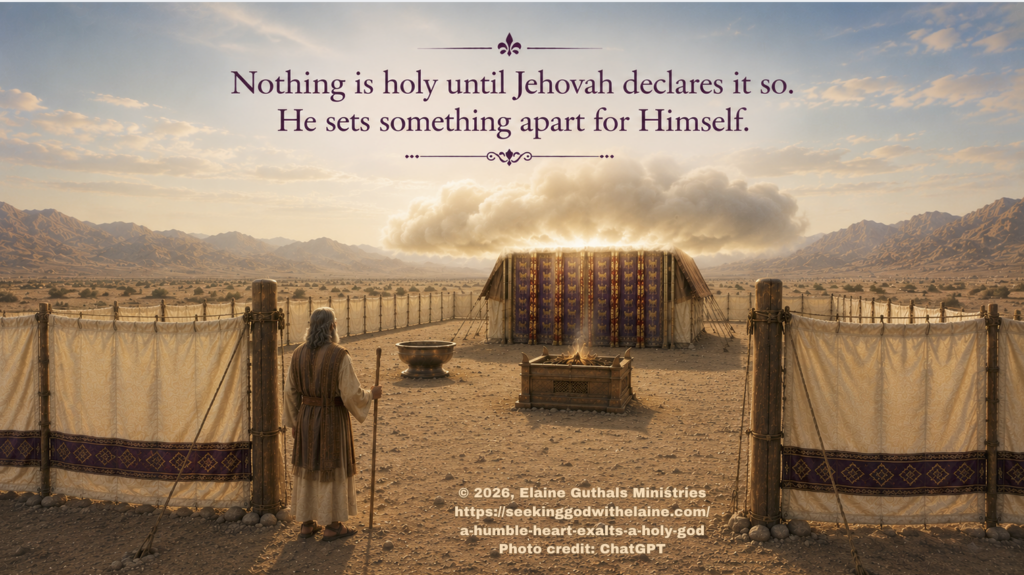
We may look at that and go, “Whoa.” We see the sin in our lives and think He can’t go that for us.
But that is what salvation is about. Being made holy comes through regeneration, sanctification, and justification.
- “he saved us, not because of the righteous things we had done, but because of his mercy. He washed away our sins, giving us a new birth and new life through the Holy Spirit” (Ti. 3: 5).
- “I am writing to God’s church in Corinth, to you who have been called by God to be his own holy people. He made you holy by means of Christ Jesus, just as he did for all people everywhere who call on the name of our Lord Jesus Christ, their Lord and ours” (I Cor. 1: 2).
- “Therefore, since we have been made right in God’s sight by faith, we have peace with God because of what Jesus Christ our Lord has done for us” (Rom. 5: 1).
That is talking heart transformation, isn’t it?
Throughout the Sermon on the Mount – the pathway to salvation – Yeshua wasn’t calling us to different actions to form a checklist. He was calling us to different attitudes – a heart change.
The Beatitudes show us the doorway to salvation and His kingdom. The rest of the sermon shows what the transformed life looks like in everyday life.
A holy life isn’t produced by keeping enough rules. It’s the fruit of a heart being conformed to God’s character. Conduct flows from character.
Jehovah’s Mercy
“He shows mercy from generation to generation to all who fear him” (Lk. 1: 50 NLT)
Mercy
Mercy was based on covenant faithfulness.
The Greek word translated as mercy is eleos (ἔλεος). They do mean mercy, compassion, and kindness.
The Hebrew word means much more than that. The word used – hesed (חֶסֶד) – encompass several of our English words.
- Steadfast love
- Lovingkindness
- Covenant love
- Faithful love
- Mercy
Hesed doesn’t mean that we simply have compassion. It means that love is conveyed through covenant faithfulness.
Applying that here, it means that God wasn’t just feeling sorry for humans. He was acting faithfully because of His covenant character.
Jehovah’s mercy flows from His holiness. He isn’t merciful because He overlooks sin. He is merciful because His holy character is full of covenant faithfulness.
Fear
If Jehovah is that merciful, why would He want us to fear Him?
No, this doesn’t mean that we have to stand there with our knees knocking in terror. It also, doesn’t mean that we don’t obtain His mercy only if we are good enough.
Someone with fear of the Lord is a person who lives in humble faith before Him. We are in awe of Him.
We have the position of the covenant believer.
From Generation to Generation
Jehovah’s promises aren’t random – they have a continuity.
We would probably translate Mary’s thought as saying Jehovah has always been kind. No, it is more than that.
What Mary was saying is that Jehovah has never stopped keeping His promises – and He never will.
Even when Israel was forced into exile, the covenant people knew that Jehovah hasn’t failed in His promises.
True, sometimes today we may think Jehovah has given up on His promises because we don’t see ourselves under His covenant. We would be wrong.
The new covenant secured through Yeshua’s sacrifice is in force today. He still hasn’t stopped keeping His promises.
That throws out our standard definition of mercy. We say that it is Jehovah not giving us what we deserve. It is more than that.
Mercy is God’s compassionate and faithful action toward His people because of His covenant love. It’s not simply pity for the miserable, nor merely withholding deserved judgment. It’s God’s steadfast commitment to act with compassion and undeserved kindness toward those who belong to Him, remaining faithful to His promises generation after generation.
Making the Connections #1
Mary’s humility comes across loud and clear.
Mary considers herself a daughter of Zion.
Making the Connections #2
We think of the Magnificat as a poem or song of worship. It isn’t.
It is an example of faith. This is obvious in the thread running through the Magnificat.
- Lord tells us who God is.
- Savior tells us what He does.
- Mighty One tells us what He is able to do.
- Holy tells us what He is like.
- Mercy tells us how He consistently relates to His covenant people.
Making the Connections #3
Look at all the titles Mary calls Jehovah.
- Lord — the covenant God
- God my Savior — the covenant Deliverer
- His servant — the covenant relationship
- The Mighty One — the covenant Warrior who acts
- Holy is His name — the covenant God’s perfect character
The connecting factor in all of that is the covenant. They aren’t just random titles. They have a history and a purpose.
Each title reveals another facet of Jehovah’s character.
Heart Check
Think about the battle Yeshua is engaged in for your heart. Ask yourself the following questions.
- Do I delight more in God’s gifts than in God Himself?
- When God blesses me, does my praise point others to Him or to me?
- Do I see my life through the lens of God’s covenant faithfulness or only through my present circumstances?
- Am I trying to become holy by my own efforts, or am I allowing God to transform my heart?
- Do I trust that Jehovah is faithfully accomplishing His purposes even when I cannot yet see them?
How Do We Apply This?
- Marvel at who Jehovah is before focusing on what He has done for you.
- Remember His covenant faithfulness when your circumstances tempt you to doubt Him.
- Allow His holiness to transform your heart instead of merely changing your behavior.
- Rest in His mercy, knowing it flows from His faithful character rather than your performance.
- Respond to God’s work with humble worship that points others to Him.
Father God. We praise and worship You in all circumstances. Transform our hearts to make us like You – holy and set apart. Amen.
If you don’t understand something and would like further clarification, please contact me.
If you have not signed up for the email providing the link to the devotions and the newsletter, do so below.
If God has used this devotion to speak with you, consider sharing it on social media.