When Mary began to praise Jehovah, she knew this situation called for more than just praise. This devotional reading looks at the completion of the Magnificat.
Nuggets
- The mighty arm of the Lord is an Old Testament image for Jehovah’s saving power.
- Jehovah values humility over pride.
- Social station does not enter into Jehovah’s evaluation of whom is a prince.
- Yeshua’s ministry flipped the idea of greatness.
- We are to look to Jehovah and expect our lives will be satisfying.
Social status does not mean loss isn’t going to happen. - Jehovah will provide for His children.
- We were created to serve Jehovah.
- There are many times in Scripture that Jehovah has called us to remember.
- Mary’s praise came full circle as she again highlights Jehovah’s mercy.
- Jehovah was acting because He made this promise to Abraham.
After being warmly greeted by Elizabeth and her prophecy, Mary launched into her acknowledgement of Jehovah. Known as then Magnificat, it is more than merely a song of praise.
We are looking at it to determine covenant language.
Let's Put It into Context
To read devotions in The Battle for the Heart theme
Devotions in the Preparing for the Christ Child series
Strength and Power
Mighty Arm
The mighty arm of the Lord is an Old Testament image for Jehovah’s saving power.
Mary, as a righteous person, knew her Old Testament history. She knew this term was a shorthand term used for His mighty intervention in history.
His arm was the image that represents Jehovah’s active power. To first-century Jewish listeners to Luke’s Gospel, they wouldn’t hear strong – they would have heard covenant faithfulness.
- “Therefore, say to the people of Israel: ‘I am the Lord. I will free you from your oppression and will rescue you from your slavery in Egypt. I will redeem you with a powerful arm and great acts of judgment’” (Ex. 6: 6 NLT).
- “Has any other god dared to take a nation for himself out of another nation by means of trials, miraculous signs, wonders, war, a strong hand, a powerful arm, and terrifying acts? Yet that is what the Lord your God did for you in Egypt, right before your eyes” (Deut. 4: 34 NLT).
- “Remember that you were once slaves in Egypt, but the Lord your God brought you out with his strong hand and powerful arm. That is why the Lord your God has commanded you to rest on the Sabbath day” (Deut. 5: 15 NLT).
We may question why the imagery is Jehovah’s arm, and not His hand. Well, think about it.
I can throw a baseball with my hand. It isn’t going to go very far. It needs the power supplied by my arm to get it to go farther than two feet in front of my toes.
Isaiah expanded what the Torah described. He especially developed the imagery.
- “The Lord has demonstrated his holy power before the eyes of all the nations. All the ends of the earth will see the victory of our God” (Isa. 52: 10 NLT).
- “Wake up, wake up, O Lord! Clothe yourself with strength! Flex your mighty right arm! Rouse yourself as in the days of old when you slew Egypt, the dragon of the Nile” (Isa. 51: 9 NLT).
Then Isaiah takes a 180o. “He was despised and rejected — a man of sorrows, acquainted with deepest grief. We turned our backs on him and looked the other way. He was despised, and we did not care” (Isa. 53: 3 NLT).
Wait! What??
There we were talking about strength and power. Now, we are talking about suffering.
In Isaiah 53, the Arm of the Lord is revealed in the person of Yeshua. Jehovah’s saving power is not displayed through an army but through the suffering Servant.
The Baby that Mary was carrying in her womb is the Arm of the Lord.
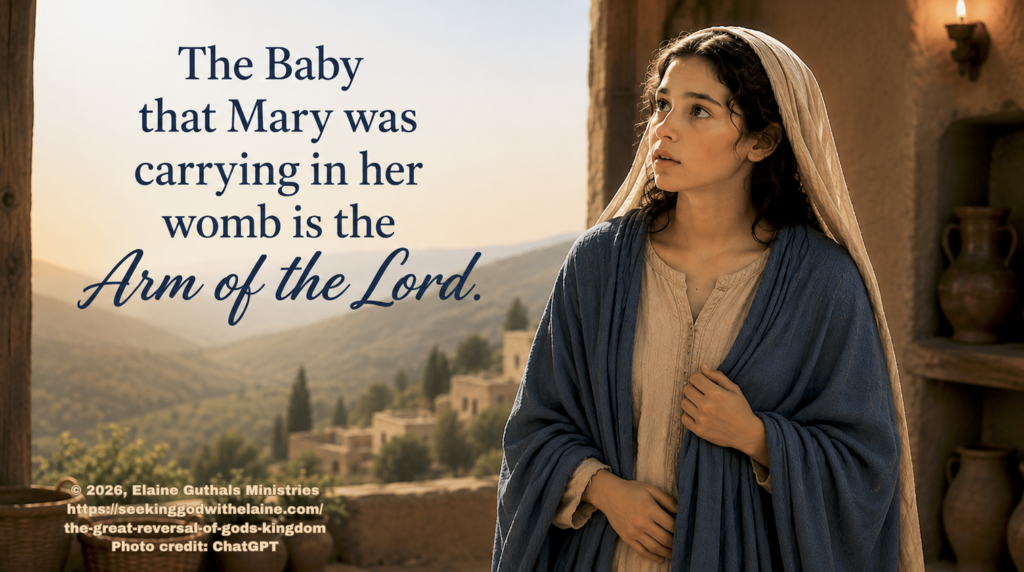
Did you catch that? The Baby hadn’t even been born yet, and He was being called the Arm of the Lord.
What if we read these verses that I have noted through the lens of Isaiah 53? Suddenly the Lord’s mighty arm points us to the One through whom His saving power is ultimately revealed – Yeshua.
Proud and Haughty Ones
Jehovah values humility over pride.
Pride makes us think we can do things on our own. We rely on some skill we possess or idea that we have.
Then we tell ourselves that we don’t need Jehovah. But we would be wrong.
Unfortunately, pride is the exact opposite of what Jehovah desires. The proud person trusts in their own righteousness, while He wants us to know they have nothing on our own.
Our relationship with Jehovah has to be genuine. We cannot simply perform righteous acts; we must live in humble dependence on Him.
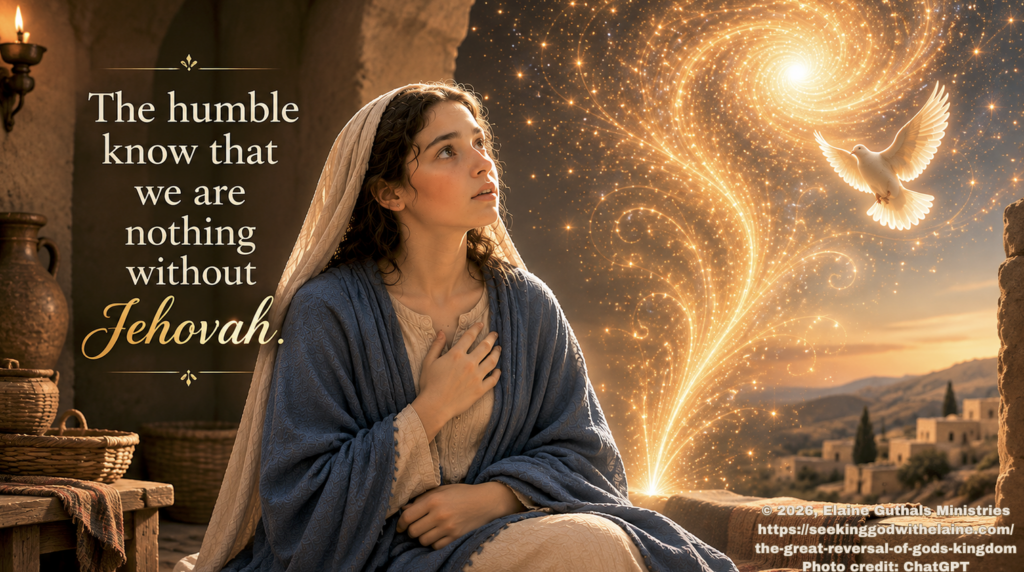
The humble know that we are nothing without Jehovah. We need Him for salvation.
Overthrowing This World
“He has brought down princes from their thrones and exalted the humble” (Lk. 1: 52 NLT)
Princes
Social station does not enter into Jehovah’s evaluation of whom is a prince.
When we think of a prince, we think of a son of a king. The Greek word means more than that.
In first-century Israel, a prince was a powerful ruler or someone in authority. Names that we might recognize that would be princes were Herod, Caesar, and Pilate.
Those we might not consider as princes but they would were the religious elite. A prince was anyone who believed that their position made them secure.
Look at the extent of the princes’ defeat. They were brought down from their thrones. Mary said that they weren’t just removed. They were removed from their thrones – their source of confidence.
What does that tell us? Jehovah can dismantle that in which we put our confidence – when we don’t put it in Him.
- Pharaoh fell.
- Nebuchadnezzar was humbled.
- Belshazzar lost his kingdom.
- Saul lost his throne.
- Herod Agrippa died while accepting worship as a god.
What this world offers us is temporary. Jehovah offers the eternal.
Exalted the Humble
Yeshua’s ministry flipped the idea of greatness.
We usually see greatness as belonging to the successful. The person who has accumulated wealth and – therefore – social status is seen as the greatest. Greatness is also seen in those who have political influence which may or may not mean they have control of the military.
- “For those who exalt themselves will be humbled, and those who humble themselves will be exalted” (Lk. 14: 11 NLT).
- “The greatest among you must be a servant” (Mt. 23: 11 NLT).
Instead, Jehovah uses those who feel like they have nothing to offer Him. Think Moses. Think Jeremiah. Think shepherds and tax collectors.
Hungering for Jehovah
“He has filled the hungry with good things and sent the rich away with empty hands” (Lk. 1: 53 NLT).
Filled the Hungry with Good Things
We are to look to Jehovah and expect our lives will be satisfying.
When we read this verse, our minds may immediately go to the miracles of feeding the 5,000 and feeding the 4,000. Yes, Yeshua did perform those miracles that physically fed the crowds.
That was never where Jehovah’s focus was. True, He is concerned about our situations. He does provide for our physical wellbeing.
I wonder what Jehovah’s version of pumping His fist would look like. He surely would have been doing it when Yeshua gave the Sermon on the Mount.
“Blessed are those who hunger and thirst for righteousness, for they shall be satisfied” (Mt. 5: 6 ESV).
Mary wasn’t talking about a physical hunger any more than Yeshua was in His sermon. It was all about hungering for righteousness.
This is talking about those who know that they can only come to Jehovah with empty hands. They can only come when they are spiritually needy and know Yeshua is the only way that they can gain salvation.
Sent the Rich Away with Empty Hands
Social status does not mean loss isn’t going to happen.
Mary had an interesting choice of words. She didn’t say the rich were condemned. She said they were sent away empty-handed.
Let’s look at what is said without being said. How would the rich have arrived? They would have thought they were the greatest. They would have believed that their hands were already full.
Luke would go on to talk about the rich throughout his book. He would paint them as trusting in their possessions, status, and self-sufficiency. Think the rich fool in Luke 12, the rich young ruler in Luke 18, and the rich man and Lazarus in Luke 16.
Yes, those men were had a lot of money. But more importantly, they had a problem with misplaced trust.
Luke has been building his portrait of the rich and proud. They were going to be scattered (verse 51), brought down (verse 52), and left empty (verse 53).
No, this wasn’t talking social position. It was talking the attitude of the heart.
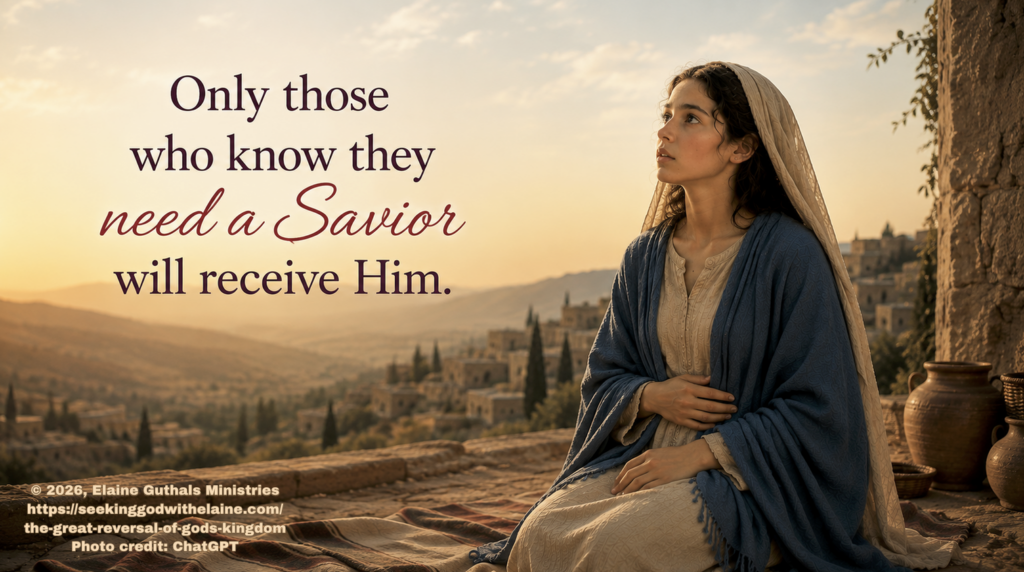
God refuses salvation to all those who refuse to be obedient to Him. Only those who know they need a Savior will receive Him.
We can draw these conclusions because we have the rest of the story. We see the completed Plan of Salvation.
Mary didn’t have that here, so that isn’t really what she was ultimately talking about. She was focusing on the coming Messiah and the Kingdom He will establish.
Being MercifulTitle
“He has helped his servant Israel and remembered to be merciful” (Lk. 1: 54 NLT)
He Has Helped
Jehovah will provide for His children.
To us, Mary’s Magnificat may seem like pieces of several different puzzles trying to be put together. It does fit.
Verse 54 stands as the theological climax of the Magnificat. All those different puzzle pieces get summed up in this verse.
The Greek verb used is antelabeto (ἀντελάβετο) literally mean to take hold of, to come to someone’s aid, or to grasp in order to help.
Picture Jehovah reaching down and taking ahold of us to rescue us when we can’t rescue ourselves.
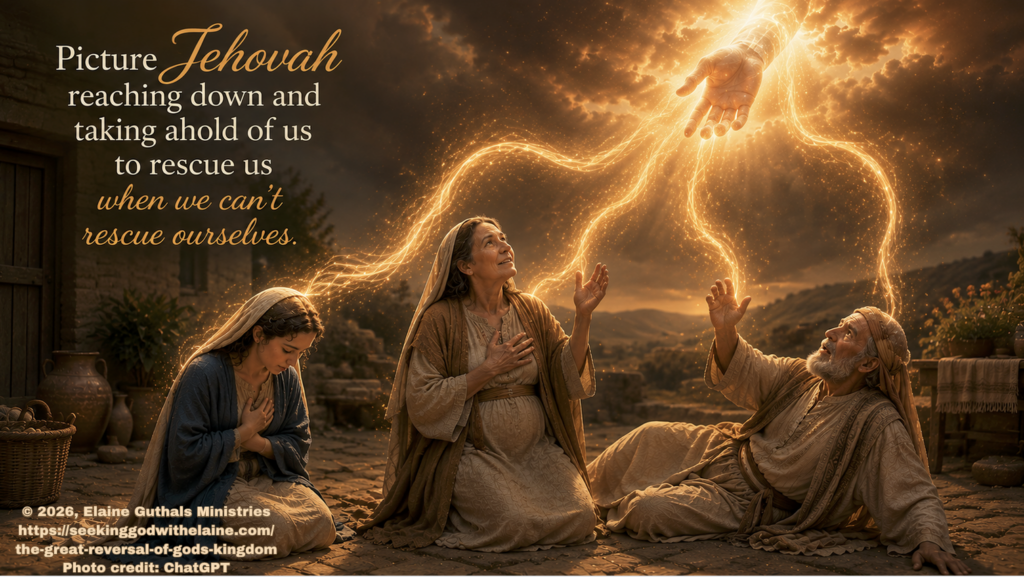
Mary said that Jehovah has come to their aid in the past. He came in their weakness to give them aid.
What Mary is saying is that Jehovah Himself stepped in and more than rendered assistance.
Apply this to the Baby in Mary’s womb. That is Jehovah Himself stepping into the world and transforming it.
His Servant Israel
We were created to serve Jehovah.
Some today may bristle at being called Jehovah’s servant. First-century Jews didn’t. That language was repeatedly used in the Old Testament.
- “But you, Israel, my servant, Jacob, whom I have chosen, the offspring of Abraham, my friend” (Isa. 41: 8 NLT).
- “But now hear, O Jacob my servant, Israel whom I have chosen! Thus says the Lord who made you, who formed you from the womb and will help you: Fear not, O Jacob my servant, Jeshurun whom I have chosen” (Isa. 44: 1-2 NLT).
- “And now the Lord says, he who formed me from the womb to be his servant, to bring Jacob back to him; and that Israel might be gathered to him — for I am honored in the eyes of the Lord, and my God has become my strength” (Isa. 49: 5 NLT).
Mary saw herself as part of Israel’s story. Jehovah’s covenant plan was being carried out through her personal blessing.
Back in verse 50 Mary declared that Jehovah’s mercy extends from generation to generation. She remembered what was leading up to her present situation.
Remembered
There are many times in Scripture that Jehovah has called us to remember.
The Greek word used here is mnēsthēnai (μνησθῆναι). It means to remember.
No, this doesn’t mean that Jehovah forgets anything. We know He doesn’t.
- “But God remembered Noah and all the wild animals and livestock with him in the boat. He sent a wind to blow across the earth, and the floodwaters began to recede” (Gen. 8: 1 NLT).
- “Then God remembered Rachel’s plight and answered her prayers by enabling her to have children” (Gen. 30: 22 NLT).
- “The entire family got up early the next morning and went to worship the Lord once more. Then they returned home to Ramah. When Elkanah slept with Hannah, the Lord remembered her plea, and in due time she gave birth to a son. She named him Samuel, for she said, ‘I asked the Lord for him’” (I Sam. 1: 19-20 NLT).
Every time Jehovah is said to have remembered something, He immediately acts according to His covenant promises. It is a signal for Israel to watch and see Jehovah move.
Jehovah is moving mightily in Mary’s life as He fulfills the promise made back in Genesis 3: 15. A Messiah has come.
To be Merciful
Mary’s praise came full circle as she again highlights Jehovah’s mercy.
Mary showed the reality of Jehovah’s mercy. It started out in verse 50 as extending from generation to generation. We talked about that meaning it doesn’t quit.
Here, Mary said that His mercy was arriving in history. The promise was being fulfilled.
Compare this progression to Jehovah’s calling Israel out of Egypt. “God heard their groaning, and he remembered his covenant promise to Abraham, Isaac, and Jacob” (Ex. 2: 24 NLT). ”
Jehovah heard, remembered, and acted.
Humans had been in exile from Jehovah since they were driven from the Garden of Eden (Gen. 3: 23). Sin broke our relationship with Him. It must be restored so He can welcome us back into His presence in the New Jerusalem.
Now, Jehovah remembered their plight and was acting to restore the relationship humans could have with Him.
Unfortunately, first-century Jews wouldn’t have connected Mary’s praise to the first exile. They would have connected it to being called out of Egypt.
They weren’t expecting a Messiah to restore them from their sinful nature. They saw restoration after the Babylonian exile. To them, that equated to freedom from political dominance.
So, many first-century Jews missed the Messiah
Kept His Promise
“For he made this promise to our ancestors, to Abraham and his children forever” (Lk. 1: 55 NLT)
Jehovah was acting because He made this promise to Abraham.
The first-century Jews failing to recognize the Messiah didn’t stop Jehovah from acting and keeping His promise. He told Abraham He was going to do this, so He did.
Fortunately, Jehovah’s keeping His promise wasn’t dependent on human obedience. He acted because of His mercy.
Remember, we said Jehovah’s mercy is really more than us getting something we didn’t deserve. It means that love is conveyed through covenant faithfulness.
Now put this into context. There had been no prophet for 500 years. This doesn’t mean that there just wasn’t anyone for the job.
This means Jehovah had been silent for 500 years. Some may have jumped to the conclusion many today would have – Jehovah had turned His back on them.
They would be wrong.
After centuries of waiting, Jehovah remembered them, His mercy, and His promises. He was waiting for the fullness of time.
It was time to act.
Making the Connections #1
If first-century Israel may have seen the arm of the Lord as army of the Lord, they would probably have been scratching their heads.
No armies appeared. Rome was still there. David’s throne wasn’t resurrected.
But Mary was making it sound like it was a done deal. Well, it was.
No, nothing had happened yet, but what Jehovah says will happen will come to pass.
Look what Isaiah said would happen in Isaiah 51-53:
- The proud would be scattered.
- Rulers would be brought down.
- The humble would be exalted.
- The hungry would be filled.
- The rich would be sent away empty.
That doesn’t need a military campaign to be a success. It needs an overturning of human values.
That takes the focus off Rome. It gears it toward the heart. Pride is the enemy of the human heart.
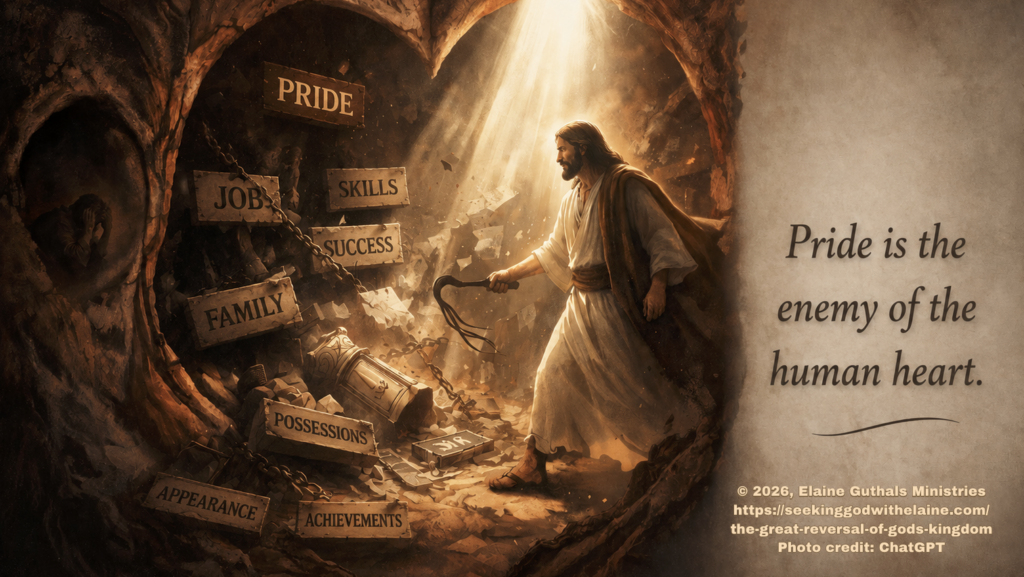
Rome wasn’t the greatest problem. Pride was.
Our greatest enemy isn’t political power. It is the proud heart that refuses Jehovah’s rule.
Making the Connections #2
When some look at Luke 1: 52, some see a social revolution. Is it that, or a spiritual revolution?
Could Luke really have meant both?
Well, Jehovah does removed earthly rulers at times. History bears that out.
Instead, Jehovah’s kingdom focuses more on overturning every human hierarchy built on pride. The proud will lose what they thought made them great.
The humble are elevated.
Mary herself is a good example to illustrate that. She didn’t come from a prestigious family. She was an unknown teenager from an obscure village.
Yet the Messiah called her the Aramaic word Ima (אִמָּא) – mom.
Making the Connections #2
When some look at Luke 1: 52, some see a social revolution. Is it that, or a spiritual revolution?
Could Luke really have meant both?
Well, Jehovah does removed earthly rulers at times. History bears that out.
Instead, Jehovah’s kingdom focuses more on overturning every human hierarchy built on pride. The proud will lose what they thought made them great.
The humble are elevated.
Mary herself is a good example to illustrate that. She didn’t come from a prestigious family. She was an unknown teenager from an obscure village.
Yet the Messiah called her the Aramaic word Ima (אִמָּא) – mom.
Making the Connections #3
As Mary continued to worship Jehovah through the Magnificat, her view expanded. In verse 50 and 51. Mary started talking about her soul and her spirit. She was acknowledging what He had done for her.
Mary’s focus then expanded to others. She talked about those who fear him: the humble and hungry. She also talked about those who didn’t fear Him: the proud, the mighty, and the rich.
Finally, Mary broadened it to encompass all. She not only talked about Israel, but she also talked about the Abrahamic covenant. That is where all nationals were to be blessed – all humanity.
Making the Connections #4
Jehovah never forgets His promises. He will always do what He says.
Divine silence doesn’t mean separation. It means preparation.
Why did Jehovah wait so long? He had His reasons. He was preparing for the right moment in history – even preparing Mary herself. He may have been waiting for the expectation to reach the point where the Jews knew that He was the One saving them.
Jehovah’s reason is only known to Him. We’ll have to put that in the UNR book – understanding not required.
What we do know is we are required to keep praying for what we are requesting. It isn’t to change His mind.
It brings us into alignment with Him.
Heart Check
Think about the battle Yeshua is engaged in for your heart. Ask yourself the following questions.
- Do I truly recognize my need for Jehovah, or do I depend on my own strength, abilities, resources, or accomplishments?
- Am I willing to come to Jehovah with empty hands, admitting that I cannot save myself?
- Where do I place my confidence — in the things of this world or in Jehovah’s covenant faithfulness?
- Do I praise Jehovah for His mercy, remembering that every spiritual blessing I have is a gift of His grace?
- Am I patiently trusting Jehovah’s timing, even when He seems silent?
How Do We Apply This?
- Thank Jehovah for His covenant faithfulness and the promises He has already fulfilled.
- When you face a difficult situation this week, pause before trying to solve it yourself and ask Jehovah for His help.
- Spend time praising Jehovah for who He is, not just for what He has done for you.
- Encourage someone who is struggling by reminding them that Jehovah has not forgotten them.
Father God. Let the praise fall off our lips. May it get down to the heart level. Amen.
If you don’t understand something and would like further clarification, please contact me.
If you have not signed up for the email providing the link to the devotions and the newsletter, do so below.
If God has used this devotion to speak with you, consider sharing it on social media.