The time humans had been waiting for had finally arrived – quietly. This devotional reading looks at how the Savior of the world arrived quietly.
Nuggets
- Joseph, as Mary, lived in Nazareth.
- Part of me wonders why Mary had to have to travel while she was pregnant and perhaps close to term.
- Mary and Joseph’s marital status was important.
- The normal earthly celebration around the birth of a king didn’t occur.
- We may sometimes think the strips of cloth were more like diapers – they weren’t.
- We may think it odd to put a baby in a manger, but there was a specific reason this Baby was placed in a manger.
- Luke didn’t tell us that Mary and Joseph stayed in an inn.
Sometimes when we have been waiting a long time for the answer to a prayer, we say, “It will happen in the fullness of Jehovah’s time.”
That is true. Jehovah sometimes makes us wait for things — even good things. He isn’t being mean about not answering our prayers. He is lovingly working out things.
Then one night, a Baby was born. He was going to change the world — starting in our hearts.
Let's Put It into Context
To read devotions in The Battle for the Heart theme
Devotions in the The Birth and Early Childhood of Christ series
Getting to Bethlehem
“… He traveled there from the village of Nazareth in Galilee. He took with him Mary, to whom he was engaged, who was now expecting a child” (Lk. 2: 4-5 NLT)
Nazareth
Joseph, as Mary, lived in Nazareth.
The two villages of Bethlehem and Nazareth couldn’t be more different. Bethlehem, which was 5 to 6 miles south of Jerusalem, was mentioned several times in the Old Testament. Still in the hill country, it was associated with kinship and covenant promise.
The surrounding fields were important for Bethlehem – and for Jerusalem. They were well-suited for grazing sheep and goats. Some flocks in the region may have been associated with sacrificial purposes, but we cannot know that for the particular flocks around Bethlehem.
So, like Nazareth, it wasn’t large. However, it had history, identity, and prophetic weight.

Nazareth, tucked in the hills of Galilee, was a rural and quiet area – and often overlooked. It wasn’t mentioned in the Old Testament at all. Archaeology indicates a modest village that was Torah-observant but poor.
Excavations verify this. Archeologists have found simple stone homes, many which are at least partly cave based.
We get a hint of Nazareth’s reputation in John 1: 46. “‘Nazareth!’ exclaimed Nathanael. ‘Can anything good come from Nazareth?’ ‘Come and see for yourself,’ Philip replied” (Jn. 1: 46 NLT).
Messiah was born to fulfill prophecy. But He was raised in a way that defied expectation.
Doesn’t that mirror Yeshua Himself? He was rejected not only by common Jews but also be the religious leaders. Yet He stayed true to Jehovah. We know He went to synagogue and celebrated the festivals.
But doesn’t that also reflect Jehovah? He stays hidden to us until He reveals Himself to us. He works in ways we don’t expect – outside of prestigious systems – even outside of religious systems.
More than anything, this shows a humility in Jehovah. We may not think of that first, but He isn’t prideful and make us choose and worship Him. He asks us to choose Him.
This is one way that the kingship was redefined. Royalty was linked with humility. Bethlehem tells us who He is while Nazareth tell us how He came.
Took with Him Mary
Part of me wonders why Mary had to have to travel while she was pregnant and perhaps close to term.
I know. Mary had to get to Bethlehem to fulfill the prophecy.
But that was a 70- to 90-mile trip. Remember, Mary had just taken that route to visit Elizabeth and Zechariah.
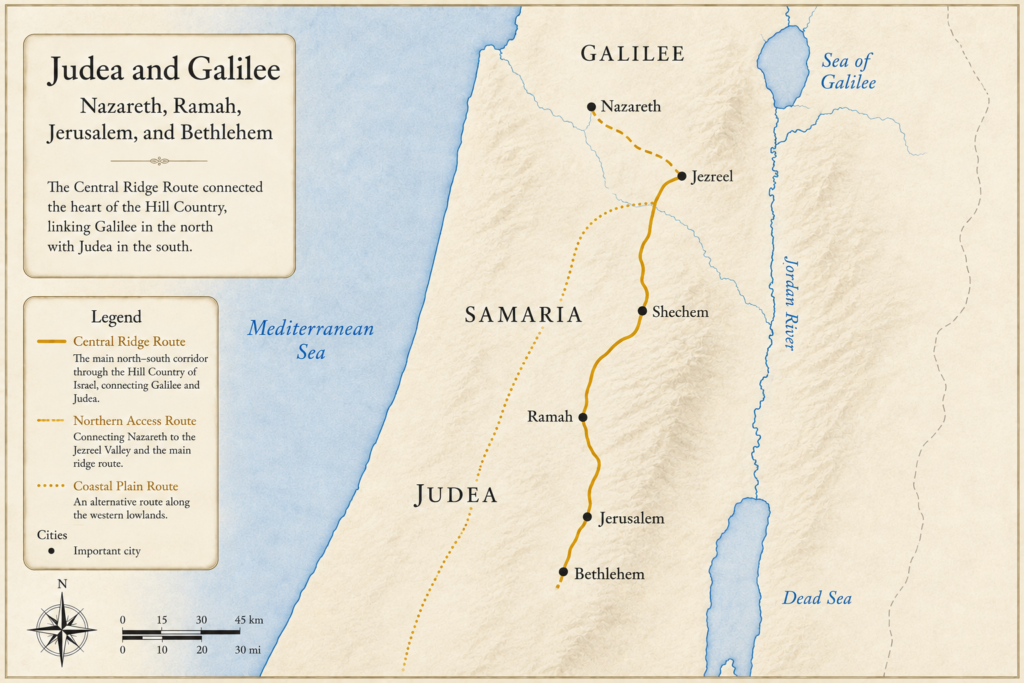
We know Mary was two to three months pregnant when she returned from visiting Elizabeth. “Mary stayed with Elizabeth about three months and then went back to her own home” (Lk. 1: 56 NLT).
We don’t know which route Mary and Joseph took. They may have avoided Samaria, but Scripture does not tell us.
Contrary to popular belief, we don’t know if Mary rode a donkey. She may have walked.
Mary and Joseph would probably have traveled with a caravan – even a family caravan. Surely, they had some family living with them in Nazareth – like Mary’s parents. Since both Mary and Joseph were descendants of David, both families would have been heading to Bethlehem. She may have gotten to ride in a family member’s cart.
To Whom He Was Engaged
Mary and Joseph’s marital status was important.
This always stops me. In the last devotion, we learned about Joseph’s initial struggle when he found that Mary was pregnant – and he wasn’t the father.
After the visit by the angel, Joseph was said to have acted immediately. “When Joseph woke up, he did as the angel of the Lord commanded and took Mary as his wife” (Mt. 1: 24 NLT).
If Joseph woke up and took Mary as his wife, why does Luke say they were still engaged? That would mean they still weren’t living together.
Well, this doesn’t contradict itself. Mary could be both.
Remember, betrothal didn’t work the same way as our engagement does. When they became betrothed Mary and Joseph were legally married. If Joseph had broken the betrothal when Mary became pregnant, he would have had to obtain a get (גֵּט) – a Jewish divorce document.
We also have to remember that Matthew made the comment that, though Joseph took Mary home as his wife, they didn’t consummate the marriage until after Yeshua was born (Mt. 1: 25).
So, the Gospel accounts are emphasizing different things. Matthew emphasized that Joseph accepted Mary as his wife. Luke emphasized that their marriage hadn’t been consummated.
The Birth of the Messiah
“And while they were there, the time came for her baby to be born. She gave birth to her firstborn son. She wrapped him snugly in strips of cloth and laid him in a manger ...” (Lk. 2: 6-7 NLT)
The Time Came for Her Baby to be Born
The normal earthly celebration around the birth of a king didn’t occur.
How could it? Messiah was supposed to be a king, but Yeshua wasn’t born in a palace.
The King came without a crown. The Messiah came without a royal welcome. The Savior came without a crowd waiting outside His birthplace.
Messiah was born in Bethlehem and laid in a manger.
The One Whose coming was so greatly anticipated and frequently prayed for wasn’t recognized. What went wrong?
Well, nothing. This was the plan all along.
God had prepared the people who would play a part in His plan. He had prepared Zechariah and Elizabeth for John. He had prepared Mary to bear the Messiah. He had prepared Joseph to take Mary as his wife and protect the Child.
But God hadn’t prepared the world to recognize what He was doing. Or perhaps more accurately, the world wasn’t prepared.
People expected Messiah. They had expectations about what Messiah would look like.
They were wrong.
Yeshua came quietly — not because His arrival was insignificant, but because Jehovah’s plan was never dependent upon earthly recognition.
Jehovah’s plan to fulfill His promises didn’t bring the rejoicing Israel thought would happen. It started without them.
Why? Because Israel wasn’t needed to make the plan happen. There was nothing they could add to or subtract from the plan. They had to wait until it came to its fruition.
Mary couldn’t, Joseph couldn’t, Zechariah and Elizabeth couldn’t make the Messiah come. Even Israel couldn’t make the Messiah come.
They could only receive what Jehovah was doing.
So, when Jesus was born in Bethlehem, Israel had to wait.
The promises embedded in Jehovah’s plan which He had set in motion were beginning to come to fruition, but the nation had no part in bringing them about. Jehovah had already done what needed to be done.
Jehovah’s promises would be fulfilled according to His purpose.
And perhaps that is one of the most important things about the way Jesus entered the world: Jehovah didn’t ask humanity to accomplish His plan. He asked humanity to respond to it.
The Messiah had come – the Savior had entered the world. The promise was being fulfilled.
Israel would eventually have to decide what it would do with Him.
But for now, the plan belonged entirely to Jehovah. Nothing had gone wrong.
It had begun exactly as Jehovah intended. He fulfilled His promise in a way that looked nothing like earthly greatness.
But God was doing something deeper. He wasn’t merely sending Israel a king.
Jehovah was sending a Savior. And that Savior entered the world as an utterly dependent infant.
The Messiah had finally come — and almost no one knew it.
Snugly in Strips of Cloth
We may sometimes think the strips of cloth were more like diapers – they weren’t.
When we go back to the Greek, we see the Baby was wrapped in swaddling clothes. This was normal care for a newborn.
In other words, Mary didn’t wrap Yeshua in swaddling clothes because she was poor. Scripture verifies this. “On the day you were born, no one cared about you. Your umbilical cord was not cut, and you were never washed, rubbed with salt, and wrapped in cloth” (Ezek. 16: 4 NLT).
The purpose of the swaddling clothes was to protect the infant’s arms and legs.
We are sometimes told that the swaddling clothes are also used as burial cloth. That isn’t quite right.
The Greek word Luke uses in Luke 2: 7 is sparganoō – the verb for swaddling. However, the wording in Luke 23: 53 uses sindōn, referring to a linen cloth that could be used for burial.
The similarity comes when Luke 2’s description of Yeshua being “… wrapped … in strips of cloth and laid … in a manger …” is placed beside Luke 23’s description of his body being “… wrapped … in a long sheet of linen cloth and laid … in a new tomb …”
Being laid in the manger was part of a sign to the shepherds so they would know they had found the Christ Child. However, when He was laid in the tomb, He wasn’t there when the women came to the tomb.
This marked not only the beginning of Jesus’ earthly life but also pointed toward the mission that would lead Him to the cross and the empty tomb.
Laid Him in a Manger
We may think it odd to put a baby in a manger, but there was a specific reason this Baby was placed in a manger.
One thing we get wrong is that we see a wooden crib in the Christmas nativity scene.
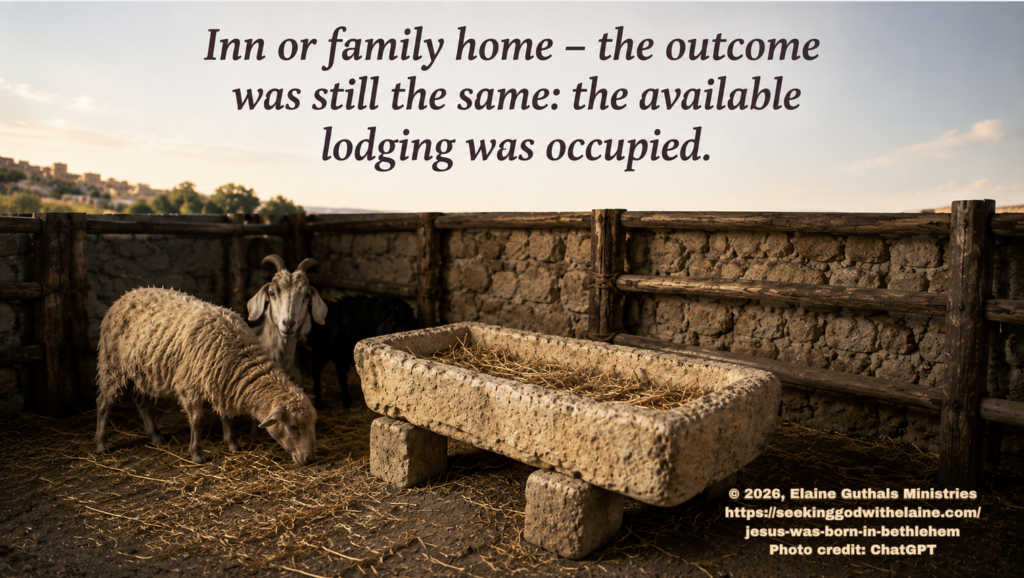
The Greek word is phatnē (φάτνη) – a feeding trough. The manger was a feeding trough located in the animal-keeping area associated with the lodging space where Mary and Joseph were staying. That animal area could have been an adjoining lower-level space, a courtyard, a stall, or potentially a cave used for animals.
Joseph’s family – if some still lived in Bethlehem – would have lived in a one- or two-room house made from field stones. It would have a flat plastered roof and packed dirt or bedrock floors. Food would have been prepared in a small courtyard.
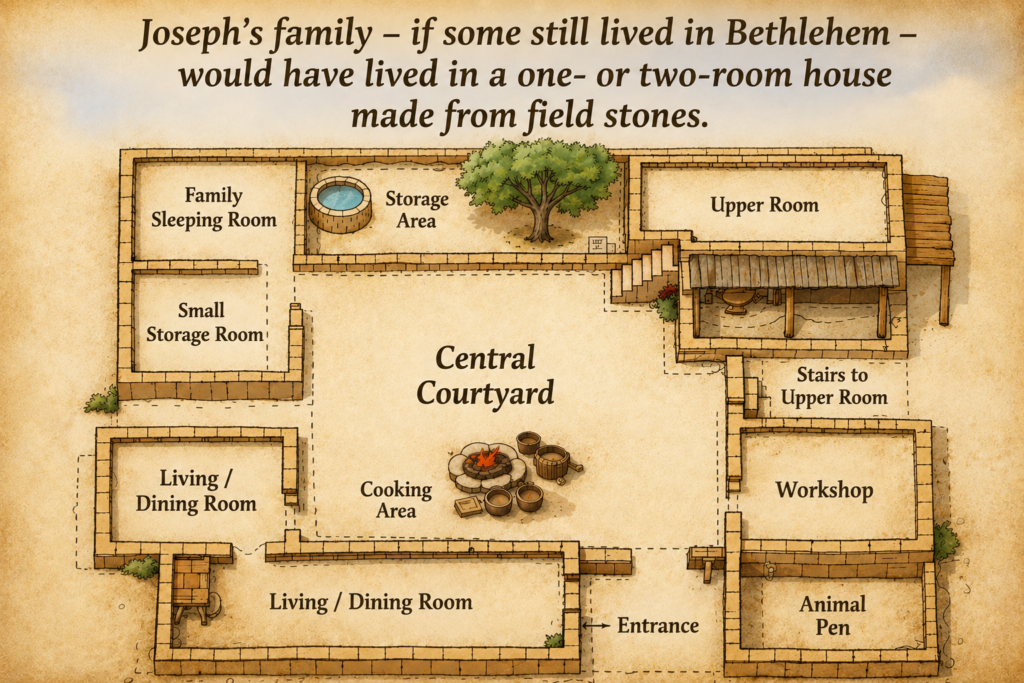
Some ancient Judaen homes had a section of the structure where the animals were housed. Keeping valuable domestic animals close offered protection, especially at night.
What kind of animals are we talking about? It seems logical to me that a family would have goats for milk and dairy products, as well as skins and hair.
Some may also have had sheep. They provided wool and milk – which represented a form of household wealth.
No, we don’t know what animals were here. We just know that animals did come to eat at the trough.
Later Christian tradition identified the place as a cave used for sheltering animals. Caves were indeed used for livestock in the Judaen countryside, but Luke doesn’t tell us exactly what kind of structure contained the manger.
In some first-century Judaen settings, mangers were a stone trough. They could be cut into or attached to rock. Think of what a cold, hard place that would have been.
That sure wasn’t where first-century Jews expected Messiah to appear!
Think about it. The Bread of Life was placed in the trough where animals ate.
Remember the Lord’s Supper. “And he took bread, and when he had given thanks, he broke it and gave it to them, saying, ‘This is my body, which is given for you. Do this in remembrance of me’” (Lk. 22: 19 ESV).
Lodging
“... because there was no lodging available for them” (Lk 2: 7 NLT)
Luke didn’t tell us that Mary and Joseph stayed in an inn.
The word Luke used was kataluma (κατάλυμα). That means a lodging place or guest room.
This could be a guest room in a family home. Think about it.
Jewish society in first-century Israel placed great value on hospitality. To them, hospitality was an important cultural and religious obligation. This is true for travelers and strangers as well as the family member.
Yes, inns did exist in the first-century Jewish world. Luke did talk about an inn in the Parable of the Good Samaritan (Lk. 10: 34). The word he used for inn was pandocheion.
However, inns didn’t have a good reputation in Jewish sources. An inn wouldn’t necessarily have been Joseph and Mary’s first or most natural lodging arrangement, particularly in Joseph’s ancestral town.
We aren’t sure what the reason was for Joseph’s family not making room for them in their house. It could simply mean that this was a crowded family home because so many people had arrived in Bethlehem for the registration that the available lodging was already occupied.
Or was there a different reason? Some first-century Jews felt they had to become righteous before Messiah came.
You have to understand the situation Mary was in. She was betrothed so she was considered Joseph’s wife, but she was betrothed not married so she wasn’t living with him.
Taking an unwed pregnant woman into their home – even one betrothed to their kinsman – would have gone against their beliefs.
We also have to realize that we don’t know what Joseph and Mary had told family members. More importantly, we don’t know if those family members believed what they were told. Yeshua’s brothers didn’t believe He was Messiah while He was alive.
Yes, we are called to love those who have sinned. No, we are not called to condone their sin.
But this wasn’t a sin. They just may not have known that.
Inn or family home – the outcome was still the same: the available lodging was occupied. They were using what space they had to accommodate those in need.
The world wasn’t prepared to recognize Him. But that doesn’t mean the people of Bethlehem were inhospitable to a pregnant Jewish woman.
Jehovah could have waited for the registration to end so that lodging was available. He didn’t. He sent His Son to be born anyway.
Making the Connections
From the beginning, Luke quietly places the beginning and the end of Jesus’ earthly life before us. He was wrapped and laid down as an infant; He would one day be wrapped and laid in a tomb as a dead man.
The story wouldn’t end there.
But we’re getting way ahead of ourselves.
Heart Check
Think about the battle Yeshua is engaged in for your heart. Ask yourself the following questions.
- Am I trying to make God’s plan happen, or am I willing to trust Him to fulfill His purposes in His way and His timing?
- Do I sometimes fail to recognize what Jehovah is doing because it doesn’t look the way I expected?
- Have my expectations of how God should work ever kept me from recognizing what He was actually doing?
- Am I more concerned with how God’s work looks to the world than with whether I am responding faithfully to Him?
- When Jehovah fulfills a promise differently than I expected, do I trust Him — or question whether something has gone wrong?
How Do We Apply This?
- Trust Jehovah’s plan even when His way doesn’t look like what you expected.
- Stop trying to accomplish what only Jehovah can accomplish.
- Pay attention to what Jehovah is doing rather than demanding that He work according to your expectations.
- Respond faithfully when Jehovah reveals His work instead of waiting until everything makes sense.
- Remember that circumstances do not determine God’s faithfulness.
- Don’t overlook what Jehovah is doing because it comes through ordinary people or ordinary circumstances.
Father God. We are humbled that a Baby – Your Son – was born thousands of years ago. Yet He is still alive and in us. May we always open our hearts to Him. Amen.
If you don’t understand something and would like further clarification, please contact me.
If you have not signed up for the email providing the link to the devotions and the newsletter, do so below.
If God has used this devotion to speak with you, consider sharing it on social media.