We have mentioned Joseph in previous devotions, but we really haven’t been introduced to him. This devotional reading looks the man who was chosen to raise the Messiah as his own.
Nuggets
- Matthew used wording to describe Messiah’s birth as a new creation.
- For all practical purposes, Mary and Joseph were already married.
- Though not much is known about Joseph, what we do know is that he was a hard-working man.
- It was important Mary remain a virgin during the betrothal period.
- Matthew told us how Mary’s child was conceived.
- Because Joseph was a righteous man, he struggled with how he was going to handle the situation.
- In today’s society, there is no stigma for being pregnant out of wedlock.
- In Joseph’s mind, he probably only had two options after he had found out Mary was pregnant.
We’ve talked several times that Mary was the mother of Yeshua. We’ve mentioned that she was betrothed to Joseph, but we haven’t taken the time to focus on him.
Joseph was an important person in the life of the Messiah. Though he was not Yeshua’s biological father, he was considered His legal father.
What kind of man would Jehovah choose to raise His Son?
Let's Put It into Context
To read devotions in The Battle for the Heart theme
Devotions in the Preparing for the Christ Child series
A Baby Was Born
“This is how Jesus the Messiah was born. His mother, Mary, was engaged to be married to Joseph. But before the marriage took place, while she was still a virgin, she became pregnant through the power of the Holy Spirit (Mt. 1: 18 NLT)
Jesus the Messiah Was Born
Matthew used wording to describe Messiah’s birth as a new creation.
Matthew structured the first chapter of his book to mirror the first book of the Torah – Genesis. This is shown by the Greek words used for Matthew 1: 1 – Biblos geneseōs (Βίβλος γενέσεως) – book of Genesis.
The first-century Jew would have recognized that. They would have seen what Matthew was saying, “Here begins a new Genesis.” In other words, “Let’s begin again.”
And that was Yeshua’s mission. He was to restore what sin had broken.
We can’t overlook the Holy Spirit in both instances. The Holy Spirit that would “… come upon …” Mary (Lk. 1: 35 NLT) was the same one that “… was hovering over the surface of the waters” (Gen. 1: 2 NLT).
Mary Was Engaged
For all practical purposes, Mary and Joseph were already married.
We call it being engaged. First-century Israel would have called it being betrothed. That commitment was totally different than our commitment today.
Instead of Joseph buying Mary a ring, he may have given Mary’s father a substantial gift, called a mohar in Hebrew. In later Jewish practice, the financial provisions of the mohar became incorporated into the ketubah — the written marriage contract that outlined the husband’s obligations to his bride and provided for her financial security. This betrothal could occur when the girl was as young as three years old.
This gift was not considered a payment for the girl. It was to ensure the bride’s financial security. Its purpose was to recognize the bride’s worth.
By the time Mary and Joseph would have been in the betrothed stage, a large, upfront payment was no longer needed. It was mostly symbolic.
The betrothal process was not symbolic. It was a true contract between parties. The only way to break the betrothal was to obtain a divorce.
To Joseph
Though not much is known about Joseph, what we do know is that he was a hard-working man.
We are told that Joseph was a carpenter because Matthew 13: 55 and Mark 6: 3 refer to Yeshua as the carpenter’s son. Even though Jesus would never become a practicing carpenter, Joseph did teach Him the trade (Mt. 13: 55; Mk. 6: 3).
The Greek word that is translated is carpenter is τέκτων (téktōn). The Hebrew word is ḥārāš (חָרָשׁ). Both are broader than simply a wood carpenter.
Both words refer to craftsmen, builder, or artisans. That includes wood or stone craftsmen up to general construction.
Whatever specific skills Joseph possessed, he faithfully taught his trade to Yeshua, who would spend much of His earthly life learning under the care of an ordinary but godly father.
While She Was Still a Virgin
It was important Mary remain a virgin during the betrothal period.
While the couple was considered legally married during the betrothal period, they didn’t live together. This was a separation process — Jehovah is really good at separating those whom He has called from others.
We’ve already talked about the consequences Mary could have faced (Deut. 22: 21 NLT).
It was more important that Mary not know a man, whom people could say was the father of Mary’s child. There had to be no doubt that it was a miracle from Jehovah.
Do I think all the people believed her – if she told them – the baby was the Son of God? No. She was probably subjected to a lot of shame, even if they thought the baby was Joseph’s.
Through the Power of the Holy Spirit
Matthew told us how Mary’s child was conceived.
I know. I see the science-lovers out there jumping up and down. That is not scientifically possible.
It doesn’t matter that we don’t know exactly how it happened. In fact, it is better what we don’t know for sure. Knowing does not grow faith.
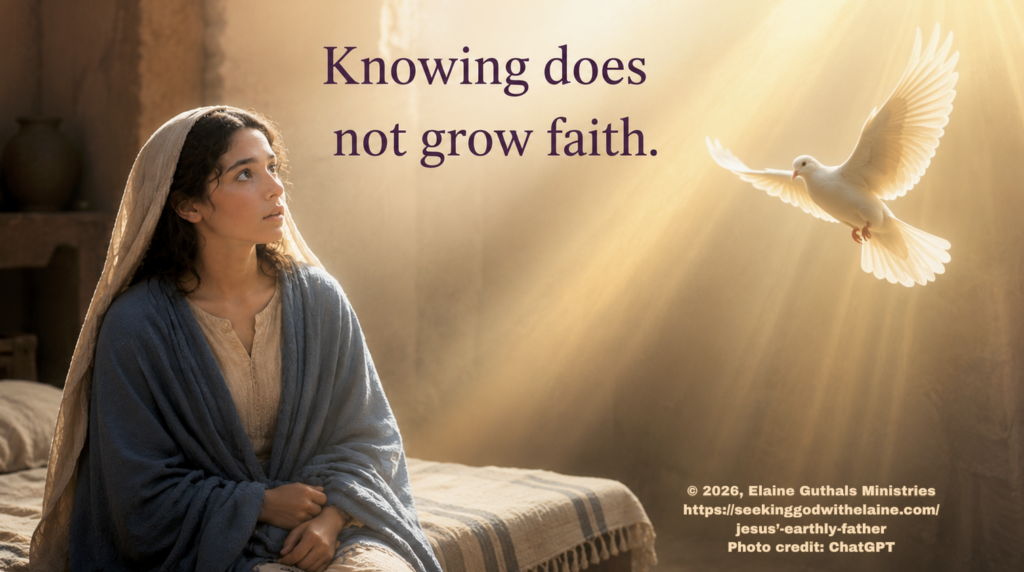
“Faith shows the reality of what we hope for; it is the evidence of things we cannot see” (Heb. 11: 1 NLT).
Faith isn’t faith if it is knowledge. It has to be experienced. Faith comes as we experience trials.
The Complete Jewish Study Bible said that it was a considered a worse sin to commit adultery during the betrothal period than it was when the couple were married.
Resource
We have to believe that Jehovah is the God of the impossible.
Joseph Struggled with the News
“Joseph, to whom she was engaged, was a righteous man and did not want to disgrace her publicly, so he decided to break the engagement quietly” (Mt. 1: 19 NLT)
A Righteous Man
Because Joseph was a righteous man, he struggled with how he was going to handle the situation.
More importantly than knowing how the Baby was conceived, we know Joseph was devout. He will work to accomplish His plans – through us but not by us. The Hebrew word used was tzaddik (צַדִּיק) – righteous.
Look at how Joseph handled his dilemma when Mary ended up pregnant. He could have automatically divorced her. He no doubt felt betrayed.
We’ll find out he was going for mercy even before the intervention came.
After the Baby was born, Joseph made sure Yeshua was circumcised on time (Lk. 2: 21-40). We know he took his family to Jerusalem when Yeshua was 12 (Lk. 2: 41-52).
Joseph was a good father to Yeshua.
Didn’t Want to Disgrace Her Publicly
In today’s society, there is no stigma for being pregnant out of wedlock.
There sure was in Mary’s day. Remember, Joseph and Mary were betrothed.
Bradford said that the Mishnah (oral law) in the Tractate Sanhedrin (legal principles and procedures of the Jewish court system) could have sentenced Mary to death in four different ways: stoning, burning, beheading, and strangling.
Resource
Being occupied by Rome, they weren’t allowed to put someone to death. I really don’t think that would have kept them from trying to keep the law.
First-century Jews would not have had the acceptance factor we have in today’s society. Mary would have been shunned and excommunicated at best – mobbed, maybe even beaten, at worst.
Before you say I don’t know what I’m talking about, think about it. Think Messianic expectations.
First-century Jews were longing for Messiah to come. Many believed that, before that could happen, they had to repent and return to covenant faithfulness.
Return to covenant faithfulness would mean that the Jewish people would keep Jehovah’s laws. To many first-century Jews, Mary’s apparent adultery wasn’t merely a private sin. It was a threat to the nation’s hope.
If Israel believed covenant unfaithfulness delayed redemption, then overlooking apparent adultery wasn’t viewed as compassion — it was viewed as compromising God’s holiness.
That helps explain why Joseph’s choice of mercy was so remarkable.
Decided to Break the Engagement
In Joseph’s mind, he probably only had two options after he had found out Mary was pregnant.
The first option was a public accusation. We’re talking formal accusation before the village elders. That would have triggered an investigation.
Who would have believed her when Mary said she was having God’s child?
It would have been a public disgrace. Mary’s reputation would be in smithereens. She would have faced severe economic hardship because of the social ostracism and loss of honor.
Joseph was planning on choosing the second option. Because he was a righteous man, Joseph would show mercy to Mary and divorce her privately.
If Joseph hadn’t have gone through with the betrothal, Mary probably would have been up a creek.
Who would have married her then?
The other men in the small village probably wouldn’t have looked kindly on an unwed mother. If she couldn’t have found someone else to marry if Joseph ended the betrothal, Mary would have been in a world of hurt.
It isn’t like today where women work outside of the home. In Mary’s time, women would always be dependent on men, first her father and then her husband. Guardianship of Mary would have passed from her father to Joseph upon their wedding night.
Back to Joseph. He was righteous, a person who conforms to Jehovah’s standards.
Joseph wasn’t merely outwardly religious. He looked to be obedient in every way.
Above all, Joseph knew that there was nothing that he could do to become righteous.
Mary probably still faced a hard enough time even though Joseph stayed by her side. Her reputation could have still been damaged. There would have been a lifelong stigma and shame. Probably there were many friends and family who rejected her.
Making the Connections #1
How many times have we been like Joseph? We are placed in some situation that Jehovah has allowed to happen to us and can’t comprehend His purpose.
We aren’t always called to comprehend. We are called to be obedient.
Even in cases where we see what He is asking, we can’t doubt that Jehovah is the God of the impossible. He will work to accomplish His plans – through us but not by us.

Making the Connections #2
From before Yeshua’s birth, Jehovah stated the mission of the Messiah. He was to “… save his people from their sins’” (Mt. 1: 21 NLT).
That was the restoration Jehovah was talking about. Unfortunately, it wasn’t the restoration that first-century Jews were expecting as covenant faithfulness.
Heart Check
Think about the battle Yeshua is engaged in for your heart. Ask yourself the following questions.
- Am I willing to obey Jehovah even when I don’t understand what He is doing?
- Do I trust Jehovah’s character when His plans don’t make sense to me?
- Have I ever assumed I knew the whole story before seeking Jehovah’s direction?
- Is my faith based on having all the answers, or on trusting the One Who does?
- Am I allowing Jehovah to accomplish His purposes through me, even when it requires surrendering my own plans?
How Do We Apply This?
- Trust Jehovah’s wisdom even when you cannot see the whole picture.
- Respond to difficult circumstances with mercy rather than quick judgment.
- Remember that faith grows through trusting Jehovah, not by knowing every answer.
- Choose obedience over understanding.
- Allow Jehovah to accomplish His purposes through your life, even when His plans differ from your own.
Father God. You choose us to do a variety of tasks to expand your Kingdom. Help us to do those as faithfully and obediently as Joseph did.
If you don’t understand something and would like further clarification, please contact me.
If you have not signed up for the email providing the link to the devotions and the newsletter, do so below.
If God has used this devotion to speak with you, consider sharing it on social media.