All the preparation had been completed – now was the time for Messiah to come. This devotional reading looks at how quietly the Messiah came to earth.
Nuggets
- Jesus, in His humanity, shared the human nature of those made in the image of God.
- Luke focused on Augustus to begin Luke 2 because the story wasn’t just about Judea.
- Augustus may have thought the census (apographē in Greek) would be used to control the empire but was used by Jehovah to further His plan.
- Publius Sulpicius Quirinius was a Roman official and a military commander who later became a governor.
It had taken centuries. Jehovah had worked everything out to His specifications.
Mary was pregnant and ready to give birth to the Messiah. The problem was she was in Nazareth. Prophecy said that Messiah would be born in Bethlehem.
How was a pregnant woman going to get to King David’s city?
Let's Put It into Context
To read devotions in The Battle for the Heart theme
Devotions in the The Birth and Early Childhood of Christ series
Yeshua as Human and Divine
“So the Word became human and made his home among us. He was full of unfailing love and faithfulness. And we have seen his glory, the glory of the Father’s one and only Son” (Jn. 1: 14 NLT)
Jesus, in His humanity, shared the human nature of those made in the image of God.
Think about Yeshua being fully God and fully human. Yes, that is a little mind boggling.
Goulburn explained this. He wrote, “He assumed into union with His Godhead a human soul, a human body, and an animal nature. He hungered, thirsted, was fatigued, and had as real a need of meat, drink, and sleep as other men.”
Resource
But does that make Yeshua made in God’s image as we are while still being divine?
- “Christ is the visible image of the invisible God. He existed before anything was created and is supreme over all creation” (Col. 1: 15 NLT).
- “For in Christ lives all the fullness of God in a human body” (Col. 2: 9 NLT).
How we would be the losers if Yeshua were not human! He came not merely to appear among us but to become one of us, entering our human condition so that He could accomplish our salvation.
But how like us was Yeshua? The concept of made in God’s image includes both physical and spiritual dimensions.
We know Yeshua reflects Jehovah’s character and attributes. But then, so do we.
Yes, as a human – and as divine – Yeshua had all that.
When Yeshua emptied Himself as Paul described (Phil. 2: 6-8), He didn’t empty Himself of His divinity.
Timestamp
“At that time the Roman emperor, Augustus, decreed that a census should be taken throughout the Roman Empire. (This was the first census taken when Quirinius was governor of Syria.) All returned to their own ancestral towns to register for this census. And because Joseph was a descendant of King David, he had to go to Bethlehem in Judea, David’s ancient home …” (Lk. 2: 1-4 NLT)
Augustus
Luke focused on Augustus to begin Luke 2 because the story wasn’t just about Judea.
Luke starts Chapter 2 using Caesar Augustus to begin discussion of Yeshua’s birth. Yeshua was the Savior of the world, not just Israel.
Augustus was the adopted son of Julius Caesar. He was the first Roman emperor, called Princeps or first citizen, ruling from 27 BC to 14 AD. He is known for bringing peace – Pax Romana – to the Roman empire. He accomplished this by establishing political stability, economic order, and military control.
Some of the titles Augustus used were Savior (sōtēr), Lord (kyrios), and Son of God (because Julius Caesar was declared divine). Do you see why Augustus’ claims could create a serious problem for first-century Jews who believed Israel belonged ultimately to Jehovah and was awaiting Messiah – especially when many felt Israel had to return to righteousness in order for Messiah to come?
Luke showed the tension between Rome and first-century Jewish expectations.

Augustus wasn’t the true king. Yeshua is King of kings. That makes Micah’s prophecy about Israel’s lost kingship especially significant.
“But why are you now screaming in terror? Have you no king to lead you? Have your wise people all died? Pain has gripped you like a woman in childbirth. Writhe and groan like a woman in labor, you people of Jerusalem, for now you must leave this city to live in the open country. You will soon be sent in exile to distant Babylon. But the Lord will rescue you there; he will redeem you from the grip of your enemies” (Mic, 4: 9-10 NLT).
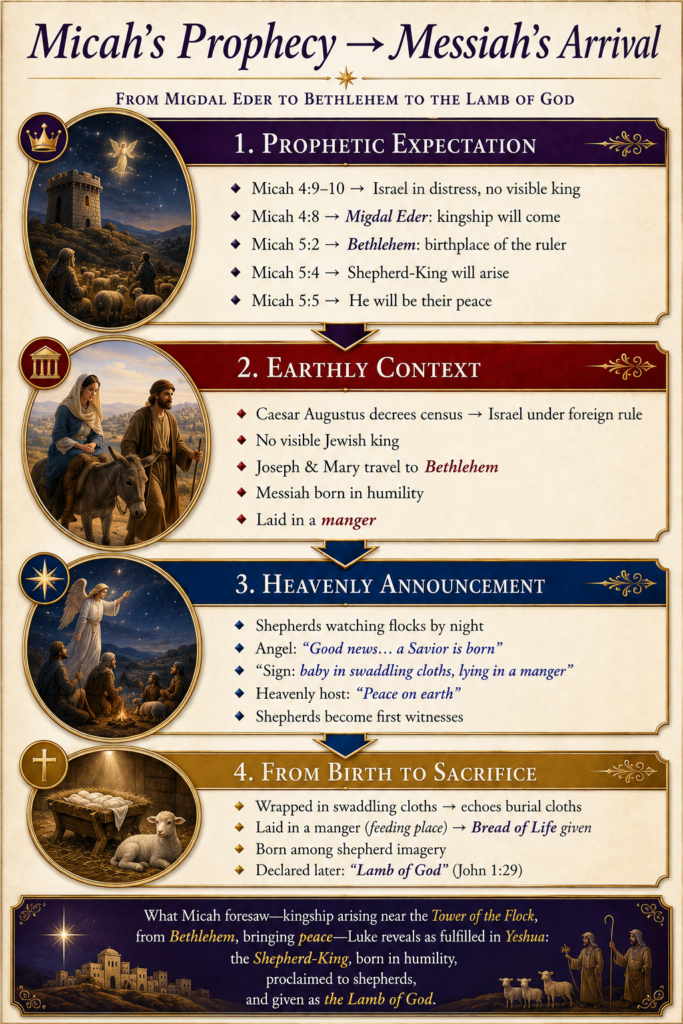
One of the worst consequences of the Babylonian exile — to Israel’s mind — was the loss of the Davidic monarchy. The question, ‘Have you no king?’ was serious because Israel’s king had a covenantal role. Jehovah had established the Davidic line, and the king was supposed to lead the people under God’s rule.
But they wouldn’t have taken the image of childbirth literally. Micah was describing their anguish. They weren’t expecting a Baby.
Think of it this way. There was no Davidic king ruling over the Jews — no king to lead them under the covenant and protect them as their earthly ruler.
We, like they, have to decide which “lord” we will follow: the worldly lord or the divine Lord.
Census
Augustus may have thought the census (apographē in Greek) would be used to control the empire, but it was used by Jehovah to further His plan.
Some translations say that Augustus said “… that all the world should be registered” (Lk. 2: 1 ESV). What they really meant was all the Roman Empire.
A Roman census could be deeply offensive to Jews. They would have remembered the census that David took (II Sam. 24). David’s census was a sin, in which 70,000 men were killed as punishment.
So, what does it have to do with the census in question? There are a number of possibilities.
Quirinius
Publius Sulpicius Quirinius was a Roman official and a military commander who later became a governor.
Specifically, Quirinius became legate (governor) of Syria around AD 6-12. He conducted a census in Judaea after Rome took direct control.
So, how does this apply to the census in question?
- Luke could have been saying that the census at the time Yeshua was born was before (the Greek word prōtē) the famous census in AD 6. That would place this registration before Quirinius’s well-known census as governor of Syria. This is the most likely way to understand Luke’s wording. Matthew places Yeshua’s birth during the reign of Herod the Great, who died in 4 BC. The well-known census conducted under Quirinius occurred in AD 6 — roughly a decade later. Luke therefore cannot be referring to that later census. If prōtē is understood in the sense of before, Luke is distinguishing this registration from the later census.
- Quirinius may have had military authority in Syria before AD 6. He may have overseen an earlier regional census.
- The registration for the taxation could have occurred in Herod’s time. The actual taxation census may have occurred in Quirinius’ time.
- Most of Luke’s readers would have known about the famous census in AD 6. He could either be using that one as a timestamp to this census was done earlier, or he may be including that to ensure that his readers didn’t confuse the two.
As a major Roman province, Syria’s governor may have had the authority over the whole region, including the small client kingdom of Judea, even if it was under Herod. Any census likely required oversight from Syria.
Bottom line, this wasn’t a random village story. There were links and connections across the regions. It was embedded in the history of the region.
Could Luke have presented his Gospel without Quirinius being listed? Of course.
But it shows how Jehovah was using Rome to bring His plan into fruition. Rome may have thought they were organizing their world. Jehovah was ordering history.
So, when the New Living Translation says the census occurred when Quirinius was governor, it reflects one way to read the Greek. But in light of Matthew’s chronology and the known date of the later census, I believe ‘before’ better explains Luke’s wording.
That doesn’t diminish the fact that Luke was anchoring the story of Yeshua’s birth in real political history. He was reminding his readers what happened in their world.
Returned to Their Own Ancestral Towns
The requirement to return to their ancestral home is not explained in Scripture but we learn of it in Jewish custom.
When Augustus ordered the census be conducted, it was not usual for them to require those being counted to return to the home of their fathers. Usually, people were counted in a census where they lived, owned property, or paid taxes.
The Hebrew concept of the father’s house – Beit Av (בֵּית אָב) – helps us understand the family and clan identity behind Luke’s wording. One possibility is that Roman authorities accommodated Jewish family and clan structures when conducting the registration. We cannot know that for certain, but tribal identity and family lineage remained important to the Jewish people.
It seems more logical that it was a Jewish requirement – but we don’t know that for sure. Even in the occupation, tribal identity and family lineage mattered. Genealogies were preserved because land inheritance still mattered.
To them, this was a covenant matter.
Bethlehem
But this census was not used as punishment.
Augustus unwittingly created the reason for Joseph to travel to Bethlehem – Bêṯ Leḥem (בֵּית לֶחֶם).
There were several reasons that this was to be the birthplace of the Messiah.
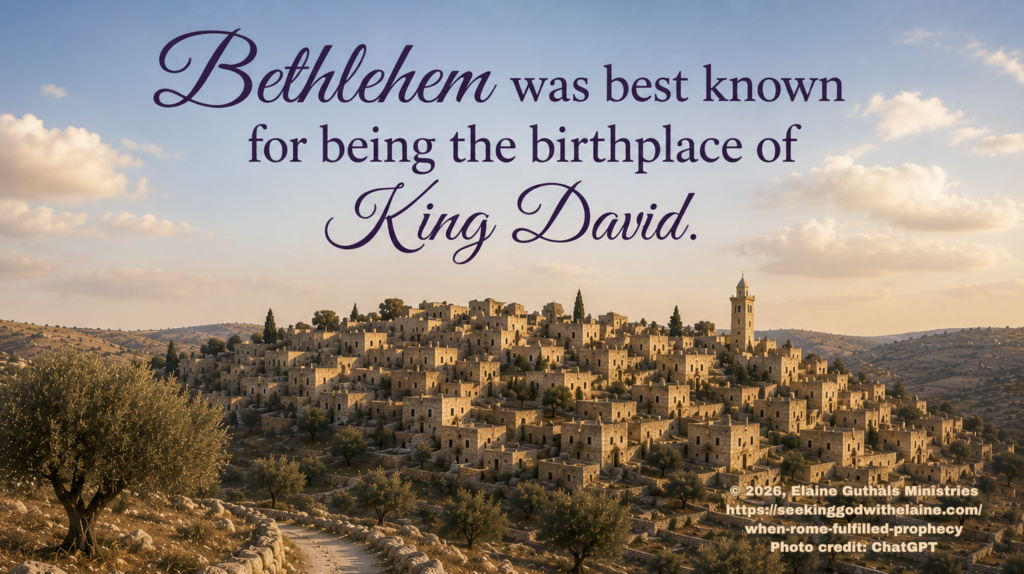
Bethlehem was best known for being the birthplace of King David. Messiah was to be of his lineage.
- “The Lord said, ‘I have made a covenant with David, my chosen servant. I have sworn this oath to him: “I will establish your descendants as kings forever; they will sit on your throne from now until eternity”’” (Ps. 89: 3-4 NLT).
- “‘For the time is coming,’ says the Lord, ‘when I will raise up a righteous descendant from King David’s line. He will be a King who rules with wisdom. He will do what is just and right throughout the land. And this will be his name: “The Lord Is Our Righteousness.” In that day Judah will be saved, and Israel will live in safety’” (Jer. 23: 5-6 NLT).
Bethlehem means house of bread. This is significant because, while the name may reflect the agricultural character of the region (see the Book of Ruth), Yeshua said He was the bread of life. “Jesus said to them, “I am the bread of life; whoever comes to me shall not hunger, and whoever believes in me shall never thirst” (Jn. 6: 35 NLT).
This fulfilled the prophecy of Micah 5: 2. “But you, O Bethlehem Ephrathah, who are too little to be among the clans of Judah, from you shall come forth for me one who is to be ruler in Israel, whose coming forth is from of old, from ancient days” (Mic. 5: 2 ESV).
It was important that the prophecy state Bethlehem Ephrathah. It distinguishes that village from Bethlehem of Zebulun. Located seven miles northwest of Nazareth, it is only mentioned once in Scripture (Josh. 19: 15 NLT).
Grey described Bethlehem Ephrathah in this way. He wrote,
“These sloping hills also contained terraced orchards of olive trees, exposed patches of limestone bedrock pocked with natural caves, and large stretches of natural brush, all of which made the countryside around Bethlehem ideal for local shepherds to graze flocks of sheep and goats.”
Resource
Bethlehem was an important city in the history of Israel. This was King David’s birthplace and Rachel’s burial place.
Descendant of King David
Joseph returned to Bethlehem because he was a descendant of David.
In Matthew 1: 6, we learn that Joseph was the great…great-grandson of David’s son, Solomon. That is why he had to return to Bethlehem.
But we can’t forget that Joseph may have still had family there. Bethlehem may have been where clan records were kept.
That kind of makes more sense. Why would they go back hundreds of years to gather families? If they said they were going back to Judah’s city, that would have been one thing,
We can gloss over this. David would have been a significant ancestor through whom the family line could be identified.
But which important ancestor identified each of the other tribes? It doesn’t really make sense if only the tribe of Judah was called out.
It was important for Luke’s narrative to emphasize that Joseph was a descendant of David. This fulfilled a Messianic expectation.
“When your days are fulfilled and you lie down with your fathers, I will raise up your offspring after you, who shall come from your body, and I will establish his kingdom. He shall build a house for my name, and I will establish the throne of his kingdom forever” (II Sam. 7: 12-13 ESV).
Making the Connections #1
When Luke began his Gospel, he set the timestamp by marking Herod the Great as being king of Judea. Herod was a part of the system.
But starting Chapter 2, Luke moves to using Caesar Augustus – who was the system.
Why didn’t Luke even mention Herod? Bethlehem was under Herod’s rule. This is especially strange since Herod was responsible for what became known as the Massacre of the Innocents.
Luke focused on the whole world. Yeshua came to be Savior of the world.
But many in the world today, like first-century Jews, don’t recognize Yeshua as the King.
Some of that has to do with the manner of Yeshua’s birth. He was born in obscurity even while being declared – and celebrated by some – Savior and Lord.
The story takes place in territory ruled by Herod under the authority of Caesar.
By doing this, Luke was setting up two kingdoms.

Why is that important? Look at what Yeshua did once His ministry began. He healed and forgave people. He confronted those in power. He redefined kingship.
Yeshua did this against the backdrop of Herod’s politics – and violence – and Rome’s control. It is a strategic setup.
So, even if Herod wasn’t mentioned in Luke 2, his presence was felt.
- Political pressure.
- Social structure
- Lack of recognition
- Tension around kingship
And here came a new King – One Who didn’t look like any king Herod had previously seen. Therefore, he didn’t recognize Him.
But wasn’t that the point?
Making the Connections #2
In the Ancient Near East, the firstborn son of the family held an important position in the family. He was the heir apparent of the birthright and the blessing.
We see in Genesis that, while society may value the firstborn son over others, Jehovah looks at their hearts and sees their obedience to Him.
- Abel was chosen over Cain.
- Abraham was chosen over his brothers.
- Isaac was chosen over Ishmael
- Jacob was chosen over Esau.
- Judah was chosen over Reuben, Simeon, and Levi.
Yeshua, however, was the supreme Firstborn. He was
- Firstborn of Mary (Lk. 2: 7)
- Firstborn over all creation (Col. 1: 15)
- Firstborn from the dead (Col. 1: 18)
Yeshua was the true Firstborn, but He did not come demanding the privileges of a firstborn. He came in humility.
The King was born in Bethlehem, not in a palace. He was laid in a manger, not placed on a throne. He came as the One who would give His life rather than demand the lives of others.
The world expected power to look like Rome. Jehovah showed us that true kingship looks like Yeshua.
Heart Check
Do I recognize that Jehovah’s plans are bigger than any earthly power?
Do I trust that Jehovah is working behind the scenes in my life?
Am I giving my allegiance to the true King?
How Do We Apply This?
- Remember that God is sovereign even in world events.
- Rest in His plan, even when you don’t see the full picture.
- Worship the King Who came in humility to serve.
Father God. We know that You are in control of everything. You plan — and work Your plan for our good. Amen.
If you don’t understand something and would like further clarification, please contact me.
If you have not signed up for the email providing the link to the devotions and the newsletter, do so below.
If God has used this devotion to speak with you, consider sharing it on social media.