Author: admin

  • The Source of Grace

    When the time was right, Jehovah sent His grace and truth to the world to redeem it. This devotional reading looks at Who the source is.

    Nuggets

    • Moses and Yeshua have similarities, but Yeshua isn’t merely another Moses.
    • Moses gave instructions while Yeshua embodies grace and truth.
    • John wasn’t saying the Law was bad while grace is good.
    • Everything Moses pointed toward comes to fulfillment in Yeshua.
    • Yeshua was the source of grace and truth.
    • Grace is finding favor is Jehovah’s eyes, and truth is reality according to God.
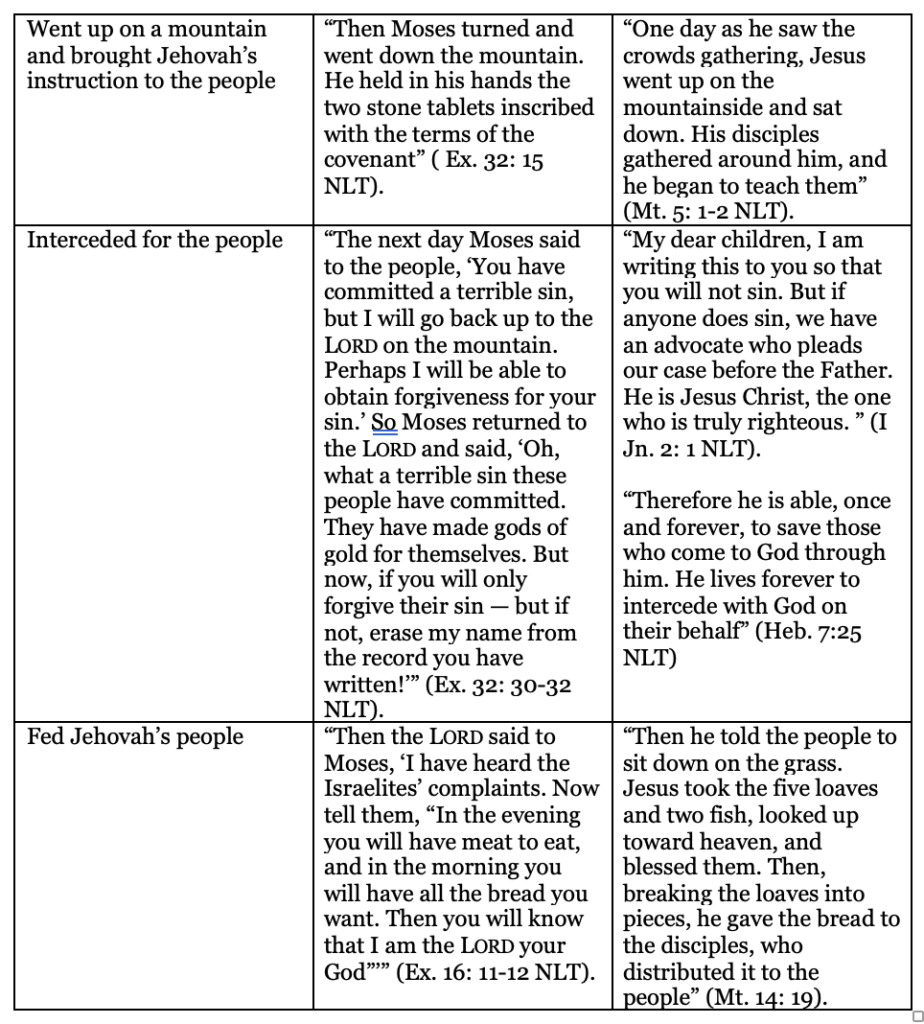
    Yeshua had a mission here on earth. His ministry was to be the Savior of the world.

    The foundation of that ministry was that, the fullness of Jehovah’s time, we received His grace and truth. Because of His unending and overflowing grace, Jehovah sent Yeshua to be the Sacrifice that we needed.

    In other words, Yeshua was the source of Jehovah’s grace.

    Let’s Put It into Context

    To read devotions in The Battle for the Heart theme

    Devotions in the The Early Ministry of the Messiah series

    The Source of Law: Moses

    “For the law was given through Moses …” (Jn. 1: 17 ESV)

    Moses and Yeshua

    “Come, I will send you to Pharaoh that you may bring my people, the children of Israel, out of Egypt” (Ex. 3: 10 ESV)

    “She will bear a son, and you shall call his name Jesus, for he will save his people from their sins” (Mt. 1: 21 ESV)

    Moses and Yeshua have similarities, but Yeshua isn’t merely another Moses.

    First-century Jews would have known all about Moses. Even to them – as covenant mediator – he would have been a Hall of Famer.

    The exodus from Egypt was an important event in Israel’s history. Their release from slavery allowed them to become the nation of Israel.

    John placed Yeshua in a recognizable Moses-shaped pattern so that first-century Jews – and us – see the continuity. That connection was deliberate.

    The differences between Moses and Yeshua are recognizable. They aren’t equals.

    Yeshua does more than just lead His people. He offers a different kind of deliverance – a new covenant.

    Yeshua came to deliver us from the bondage of sin.

    We may see the parallels of Moses and Yeshua. One thing we have to realize is that Yeshua was walking into Israel’s story.

    Yeshua never intended to start a new story. He specifically said that He came to be a part of that story.

    The plan was for Yeshua to step into a centuries-old story. It was a story of deliverance, covenant, rebellion, judgment, mercy, and Jehovah’s faithfulness to His people.

    Moses had done his part. The exodus and the covenant had been part of that story.

    Yeshua walked into that story – but it wasn’t the only story. He wasn’t merely fulfilling the covenant given to Abraham, Moses, and David. He was fulfilling the covenant given to Adam.

    All who accept Yeshua as the Savior would be delivered and redeemed. Our judgment would be taken by Yeshua because of Jehovah’s mercy and grace.

    The Giving of the Law Verses the Coming of Grace and Truth

    “Do not think that I have come to abolish the Law or the Prophets; I have not come to abolish them but to fulfill them. For truly, I say to you, until heaven and earth pass away, not an iota, not a dot, will pass from the Law until all is accomplished. Therefore whoever relaxes one of the least of these commandments and teaches others to do the same will be called least in the kingdom of heaven, but whoever does them and teaches them will be called great in the kingdom of heaven” (Mt. 5: 17-19 ESV)

    Moses gave instructions while Yeshua embodies grace and truth.

    Both Moses and Yeshua went up a mountain – but for different reasons. Moses went up Mt. Sinai to receive the Law – more importantly, the covenant terms.

    Yeshua, at the Sermon on the Mount, teaches. But really what He was teaching about was Himself.

    But Yeshua was more than just a Teacher. In order to understand that, we have to understand the difference between the Law and grace.

    What John Is and Isn’t Saying about the Law

    “For by works of the law no human being will be justified in his sight, since through the law comes knowledge of sin” (Rom. 3: 20 ESV)

    John wasn’t saying the Law was bad while grace is good.

    Some think the Law can save us. If we keep the Law, we don’t sin. Therefore, keeping the Law is supposedly what we need for eternal life.

    It doesn’t work that way.

    • “We ourselves are Jews by birth and not Gentile sinners; yet we know that a person is not justified by works of the law but through faith in Jesus Christ, so we also have believed in Christ Jesus, in order to be justified by faith in Christ and not by works of the law, because by works of the law no one will be justified” (Gal. 2: 15-16 ESV).
    • “For all who rely on works of the law are under a curse; for it is written, ‘Cursed be everyone who does not abide by all things written in the Book of the Law, and do them.’ Now it is evident that no one is justified before God by the law, for ‘The righteous shall live by faith.’ But the law is not of faith, rather ‘The one who does them shall live by them’” (Gal. 3: 10-12 ESV).
    • “You are severed from Christ, you who would be justified by the law; you have fallen away from grace.” (Gal. 5: 4 ESV).

    Let’s unpack those.

    The Law gives knowledge of sin. Basically, a sin is when we do something that disobeys Jehovah. The Laws show us Jehovah’s character.

    In other words, the Law doesn’t just tell us, “You are going 90 miles per hour in a 55-mile-per-hour zone.” It says, “Your actions aren’t being performed in a way that obeys Jehovah.”

    So, when we are breaking the Laws, we are acting outside of Jehovah’s character.

    Being a Jew didn’t justify first-century Jews – or any that came before them. Justification is where we are declared righteous before Jehovah. Our guilt is removed and we are accepted as righteous because of our faith in the Messiah.

    Some like to think justification is a New Testament concept. It really isn’t.

    Abraham was declared righteous – therefore, justified – when he believed (Gen. 15: 6). Noah was a righteous man because he walked with Jehovah (Gen. 9: 9). Job was blameless and upright (Job 1: 1).

    They weren’t justified by their actions. They were justified by their belief in Jehovah.

    No one is justified by the Law. We can keep the law, but still not be walking with Jehovah. We may be trying to do everything He says, but we may not believe that we should submit our lives to Him.

    That speaks to motivation. Are we walking with Jehovah because we want to do His will, or do we just think it is the right thing to do?

    To me, the bottom line is that the Law doesn’t help us to rectify a situation when we have broken the Law. There may be punishment associated with the Law, but the stain of the sin is still there.

    That stain is still there because the Law doesn’t provide the means of justification and final redemption for sin. It doesn’t include the Plan of Salvation.

    Only Yeshua’s mission carries that.

    Why Moses and Yeshua Are in This Relationship

    “For if you believed Moses, you would believe me; for he wrote of me. But if you do not believe his writings, how will you believe my words?” (Jn. 5: 46-47 ESV)

    Everything Moses pointed toward comes to fulfillment in Yeshua.

    Moses was considered the mediator of the covenant because Jehovah chose him to be the intermediary between Himself and the Israelites. His job was to deliver the Law, intercede for the people, and formalize the covenant on Mt. Sinai.

    The whole purpose of giving the Law was so that Jehovah would be revealed to the Israelites – and us. Moses took these revelations from Him and communicated them to the people.

    The Law could only go so far, though. Think about Moses striking the rock and, as punishment, losing the chance to enter the Promised Land. That case showed the limitations of the Law.

    The case showed that the Law could identify disobedience and establish its consequences, but it couldn’t provide the final redemption from sin.

    Yeshua made it clear that He wasn’t replacing the Law. He was fulfilling it.

    Think about it. Many see the Law as a list of do’s and don’ts. It is – but it really isn’t.

    The Law shows us Jehovah’s character. It shows us that toward which we are to strive.

    Where the Law had its limitations, grace bridged the gap between disobedience and restoration. Yeshua’s death paid the penalty for our sins.
    Yeshua’s covenant fulfills the promises of Jeremiah 31: 31-34 and Ezekiel 36: 26-27. It offers a transformed life to those who accept a personal relationship with Him. It was established in Luke 22: 20.

    • “Behold, the days are coming, declares the Lord, when I will make a new covenant with the house of Israel and the house of Judah, not like the covenant that I made with their fathers on the day when I took them by the hand to bring them out of the land of Egypt, my covenant that they broke, though I was their husband, declares the Lord. For this is the covenant that I will make with the house of Israel after those days, declares the Lord: I will put my law within them, and I will write it on their hearts. And I will be their God, and they shall be my people. And no longer shall each one teach his neighbor and each his brother, saying, ‘Know the Lord,’ for they shall all know me, from the least of them to the greatest, declares the Lord. For I will forgive their iniquity, and I will remember their sin no more” (Jer. 31: 31-34 ESV).
    • “And I will give you a new heart, and a new spirit I will put within you. And I will remove the heart of stone from your flesh and give you a heart of flesh. And I will put my Spirit within you, and cause you to walk in my statutes and be careful to obey my rules” (Ezek. 36: 26-27 ESV).
    • “And likewise the cup after they had eaten, saying, “This cup that is poured out for you is the new covenant in my blood” (Lk. 22: 20 ESV).

    Yeshua’s covenant provides forgiveness of sin.

    The Source of Grace: Yeshua

    “For the law was given through Moses; grace and truth came through Jesus Christ” (Jn. 1: 17 ESV)

    Charis and Aletheia

    Yeshua was the source of grace and truth.

    In the last devotion, we talked about grace and truth.

    • Charis (χάρις) means grace (grace, favor, graciousness, goodwill, or a gracious gift).
    • Aletheia (ἀλήθεια) means truth (what is true, genuine, real, reliable, and not concealed).

    What John is saying here is what came through Yeshua didn’t come through Moses.

    Wait! What??

    Are we trying to say that grace only appeared where Yeshua first stepped foot on earth? No, we know Jehovah was always gracious toward His people.

    • “The Lord is gracious and merciful, slow to anger and abounding in steadfast love.” (Ps. 145: 8 ESV).
    • “Gracious is the Lord, and righteous; our God is merciful” (Ps. 116: 5 ESV).
    • “‘Yet even now,’ declares the Lord, ‘return to me with all your heart, with fasting, with weeping, and with mourning; and rend your hearts and not your garments.’ Return to the Lord your God, for he is gracious and merciful, slow to anger, and abounding in steadfast love; and he relents over disaster” (Joel 2: 12-13 ESV).
    • “But the Lord was gracious to them and had compassion on them, and he turned toward them, because of his covenant with Abraham, Isaac, and Jacob, and would not destroy them, nor has he cast them from his presence until now” (II Kgs. 13: 23 ESV).

    But the fullness of Jehovah’s grace wasn’t made known until He sent Yeshua.
    Jehovah isn’t telling us, “Go and be gracious like me.” He is saying, “You can only be gracious through me.”

    Then there is truth. Yeshua didn’t just tell the truth. He was the truth.

    One isn’t given to us without the other.

    Grace and Truth

    “… and we have seen his glory, glory as of the only Son from the Father, full of grace and truth” (Jn. 1: 14 ESV).

    Grace is finding favor is Jehovah’s eyes, and truth is reality according to God.

    We looked at grace and truth in the last devotion. However, I used an incorrect Hebrew word. So, I am going to correct that here.

    The Hebrew Scriptures also describe Jehovah Himself as chanun (חַנּוּן), meaning gracious. When Jehovah reveals His character to Moses, He says that He is “… merciful and gracious, slow to anger, and abounding in steadfast love and faithfulness” (Ex. 34: 6 ESV).

    More importantly, it is finding favor in another’s eyes – namely Jehovah. The Hebrew concept is matza chen b’ene (מָצָא חֵן בְּעֵינֵי).

    John doesn’t separate grace from the person of Christ. “So the Word became human and made his home among us. He was full of unfailing love and faithfulness.” (Jn. 1: 14 NLT).

    We have to be very careful about its meaning, though. Grace doesn’t mean that Jehovah simply overlooks sin. It means that Jehovah acts toward people from His own gracious character rather than because they have established a claim upon Him.

    Grace doesn’t say: “Sin does not matter.” Grace says: “God has acted graciously toward you; therefore, live differently.”

    Truth in the Hebrew Scriptures isn’t merely information that happens to be accurate. The primary Hebrew word translated truth is ’emet (אֱמֶת’). It describes something that is dependable, trustworthy, established, and true to reality.

    The Hebrew understanding, therefore, joins two ideas that modern English can sometimes separate: truthfulness and faithfulness.

    Biblical truth is something upon which a person can stand.

    This means that when Scripture speaks about truth, it is not presenting truth as something detached from character.

    • Truth is dependable because it is firm.
    • Truth is trustworthy because it is faithful.
    • Truth can be believed because it is reliable.

    Truth is reality according to God.

    Heart Check

    Think about the battle Yeshua is engaged in for your heart. Ask yourself the following questions.

    • Am I obeying Jehovah because I love Him and want to walk with Him, or simply because I believe I should?
    • Where am I knowingly acting outside of Jehovah’s character?
    • Am I treating Jehovah’s grace as permission to continue in sin, or am I allowing His grace to lead me toward restoration and a changed life?
    • Am I trusting Yeshua as the One who provides the forgiveness and redemption the Law cannot provide?
    • Is my life being shaped by the truth of who Jehovah is?

    How Do We Apply This?

    • Recognize where you are walking outside of Jehovah’s character.
    • Receive the grace Yeshua provides.
    • Let grace lead you toward restoration.
    • Walk in the truth according to Jehovah.
    • Live differently because of the grace you have received.


    Father God. Lord, let us receive Your grace so that our relationships with You will be restored. We choose daily to walk with You. Amen.

    If you don’t understand something and would like further clarification, please contact me.

    If you have not signed up for the email providing the link to the devotions and the newsletter, do so below.

    If God has used this devotion to speak with you, consider sharing it on social media.
  • Music Day

    Today is a music day. 

    Today was a day when being a pastor’s wife took precedence. The day started with redoing the song service because of a sermon change and ended withe a Pastors/Wives Conference.

    That didn’t take into account the other things on the to-do list today.

    So, this girl is drained. When I need a lift, music does it. 

    Hope this one lifts you, also.

    Hosanna/Praise Is Rising
    Vocalist: Elaine Guthals
    Keyboard: Louise Guthals Weiss

    What do you think?

    Leave me a comment below (about this or anything else) or head over to my Facebook group for some interactive discussion.

    If you don’t understand something and would like further clarification, please contact me.

    If you have not signed up for the email daily or weekly providing the link to the devotions and the newsletter, do so below.

    If God has used this devotion to speak with you, consider sharing it on social media.

  • Grace upon Grace

    One task Yeshua had was to show us the Father. This devotional reading looks at the grace Yeshua brought from the Father.

    Nuggets

    • The source of what we receive is not our fullness.
    • Yeshua was the Word Jehovah sent to us.
    • Yeshua was instrumental in the creation of the universe.
    • Jehovah introduced Yeshua as light on Day 1 of creation.
    • More than Yeshua being the true light or the false light, it is about Him being genuine – the real deal.
    • Yeshua was totally human and totally divine.
    • The primary Hebrew word associated with grace is chen (חֵן), meaning favor, grace, acceptance, graciousness, attractiveness, or goodwill.
    • Our receiving is the consequence of what John has told us about the Word.
    • What we receive is Jehovah’s grace and truth.

    Yeshua had a mission here on earth. His ministry was to be the Savior of the world.

    The foundation of that ministry was Jehovah’s fullness of grace. Because of His unending and overflowing grace, Jehovah sent Yeshua to be the Sacrifice that we needed.

    Let’s Put It into Context

    To read devotions in The Battle for the Heart theme

    Devotions in the The Early Ministry of the Messiah series

    Jehovah’s Fullness

    “For from his fullness …” (Jn. 1: 16 ESV)

    The source of what we receive is not our fullness.

    When we think about Jehovah’s fullness, our first thoughts may tend to fall on the fullness of His time. Everything happens according to His plan. Completion.

    John may have been considering the overall plan here – the Plan of Salvation. But I think he was focused on something more specific.

    The fullness is the fullness of Jehovah’s love and grace.

    The Greek word John used is plērōma (πλήρωμα). Derived from the root plēroō (πληρόω), it means to fill, make full, complete, or bring to fullness.

    Plērōma, however, doesn’t rely on one Hebrew word to convey the thought. And the concept of fullness is a very Hebrew thought.

    Meloʾ (מְלֹא) carries the idea of fullness, that which fills, abundance, or the full measure of something. It is substantial and present.

    What if John was meaning the totality of what fills something? It doesn’t mean we stuffed ourselves at our Thanksgiving dinner and are now full.

    It means everything – the turkey, gravy, stuffing, green bean casserole, pumpkin pie, and anything else that made it to the menu – belongs to Jehovah.

    The concept is that the entirety of what belongs within something belongs to the Creator.

    We read that and think, “Everything that constitutes His fullness is overflowing toward us.” But John has already told us what is flowing: grace and truth.

    The Word Was God

    “In the beginning was the Word, and the Word was with God, and the Word was God” (Jn. 1: 1 ESV).

    Yeshua was the Word Jehovah sent to us.

    When the creation story began in Genesis 1, we aren’t told who God is – now Jehovah is introducing a new creation.

    Genesis 1 doesn’t shed any light on Who Jehovah is. We are told only that He created the heavens and earth.

    Matthew organized his Gospel as a new creation story. The setting is the same, but the purpose has changed.

    Now, the purpose is to introduce Yeshua – the Word. The Gospels and their message – in fact, the whole message of the entire Scripture – is about the Messiah, the Savior of the world.

    With this new purpose comes what seems like new words that must be used to tell the story. They include law, grace, truth, faith, sons, and sin.

    True, some of those words existed in the Old Testament – the Tanak. They were an introduction to the fullness to come.

    The Word Created Everything

    “All things were made through him, and without him was not any thing made that was made” (Jn. 1: 3 ESV).

    Yeshua was instrumental in the creation of the universe.

    In everything that Jehovah created, Yeshua was right here by His side.

    Yeshua not only existed, but Jehovah worked through Him to organize and actively make everything. He didn’t just design the place we live now and the place we will one day inhabit. He designed the pathway that leads us to Jehovah.

    Yeshua is the message and Messenger of the Gospel. He is the entire meaning itself, and the Gospel is how He communicates that meaning to us.

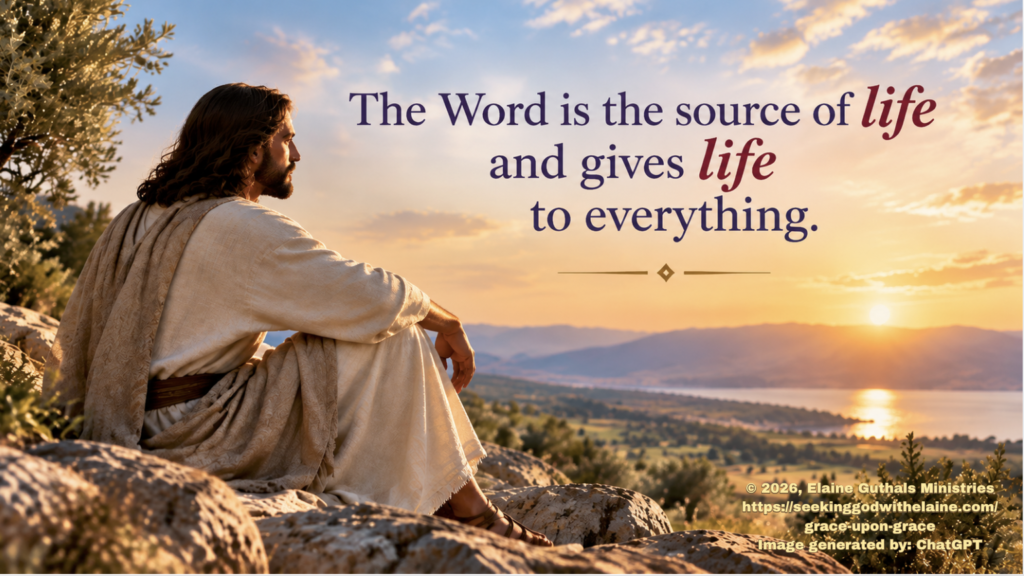
    The Word is the source of life and gives life to everything. This is more than merely physical. It is spiritual.

    The Light of Humanity

    “In him was life, and the life was the light of men” (Jn. 1: 4 ESV).

    Jehovah introduced Yeshua as light on Day 1 of creation.

    The first thing Jehovah introduced after He created the heavens and earth was light. His exact words were, “Then God said, ‘Let there be light,’ and there was light” (Gen. 1: 3 NLT).

    This spiritual light was Yeshua.

    • “Again Jesus spoke to them, saying, ‘I am the light of the world …” (Jn. 8: 12 ESV).
    • “The light shines in the darkness …” (Jn. 1: 5 ESV).
    • “Your word is a lamp to my feet and a light to my path” (Ps. 119: 105 ESV).
    • “As long as I am in the world, I am the light of the world” (Jn. 9: 5 ESV).
    • “The Lord is my light and my salvation …” (Ps. 27: 1 ESV).
    • “The people who walked in darkness have seen a great light ….” (Isa. 9: 2 ESV).
    • “… They will need no light of lamp or sun, for the Lord God will be their light …” (Rev. 22: 5 ESV).

    Jehovah reveals Himself through Yeshua as the Word and the Light – Yeshua is both.

    True Light Came into the World

    “The true light, which gives light to everyone, was coming into the world” (Jn. 1: 9 ESV).

    More than Yeshua being the true light or the false light, it is about Him being
    genuine – the real deal.

    No, we don’t all receive the Light in the same way. We are different people. We have different beliefs and experiences – foundations.

    Plus, not everyone accepts the Light. John had just told us that. “But to all who did receive him, who believed in his name, he gave the right to become children of God, who were born, not of blood nor of the will of the flesh nor of the will of man, but of God” (Jn. 1: 12-13 NLT).

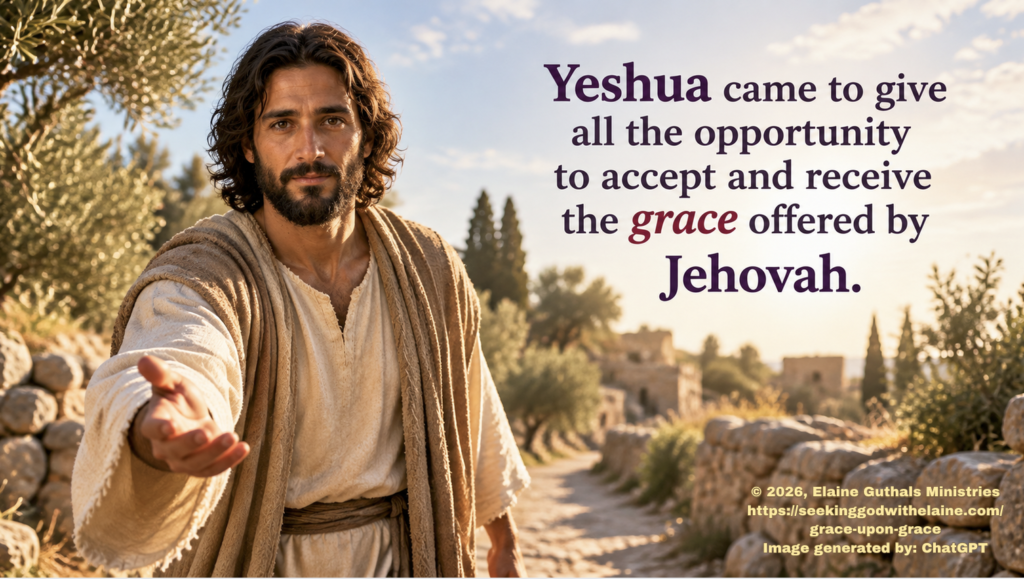
    Still, Yeshua came to give all the opportunity to accept and receive the grace offered by Jehovah. The decision is ours.

    Look closely at the wording. It didn’t say Yeshua was in the world. It says He came into it.

    Yeshua was already the Light – we saw that in Genesis 1: 3. He was coming into the world in a different form – as flesh – a human form.

    Yeshua came bearing spiritual liberation from internal corruption.

    Yeshua didn’t give up His divinity to come to earth. He couldn’t change Who and what He is.

    Instead, Yeshua gave up the privileges of His divinity. “who, though he was in the form of God, did not count equality with God a thing to be grasped, but emptied himself, by taking the form of a servant, being born in the likeness of men.” (Phil. 2: 6-7 NLT).

    He Became Flesh

    “And the Word became flesh and dwelt among us …” (Jn. 1:  14 ESV).

    Yeshua was totally human and totally divine.

    Jesus, in His humanity, shared the human nature of those made in the image of God. He got hungry and ate, got tired and slept.’’

    So, yes, Yeshua was both human and divine.

    • “Christ is the visible image of the invisible God. He existed before anything was created and is supreme over all creation” (Col. 1: 15 NLT).
    • “For in Christ lives all the fullness of God in a human body” (Col. 2: 9 NLT).

    That was why Yeshua could accomplish the Plan of Salvation.

    Full of Grace and Truth

    “… and we have seen his glory, glory as of the only Son from the Father, full of grace and truth” (Jn. 1: 14 ESV).

    The primary Hebrew word associated with grace is chen (חֵן), meaning favor, grace, acceptance, graciousness, attractiveness, or goodwill.

    More importantly, it is finding favor in another’s eyes – namely Jehovah. The Hebrew concept is matza chen b’ene (מָצָא חֵן בְּעֵינֵי).

    John doesn’t separate grace from the person of Christ. “So the Word became human and made his home among us. He was full of unfailing love and faithfulness.” (Jn. 1: 14 NLT).

    We have to be very careful about its meaning, though. Grace doesn’t mean that Jehovah simply overlooks sin. It means that Jehovah acts toward people from His own gracious character rather than because they have established a claim upon Him.

    Grace doesn’t say: “Sin does not matter.” Grace says: “God has acted graciously toward you; therefore, live differently.”

    Truth in the Hebrew Scriptures isn’t merely information that happens to be accurate. The primary Hebrew word translated truth is ’emet (אֱמֶת’). It describes something that is dependable, trustworthy, established, and true to reality.

    The Hebrew understanding, therefore, joins two ideas that modern English can sometimes separate: truthfulness and faithfulness.

    Biblical truth is something upon which a person can stand.

    This means that when Scripture speaks about truth, it is not presenting truth as something detached from character.

    • Truth is dependable because it is firm.
    • Truth is trustworthy because it is faithful.
    • Truth can be believed because it is reliable.

    Truth is reality according to God.

    Receiving Jehovah’s Fullness

    “For from his fullness we have all received …” (Jn. 1: 16 ESV)

    Our receiving is the consequence of what John has told us about the Word.

    We can admire Jehovah’s fullness all we want. If we don’t receive it, it means little to us.

    John had clearly shown us that fullness comes from Him. Our receiving has nothing to do with us: not our goodness, our religious efforts, our understanding, or even our ability to receive.

    Our receiving comes out of Jehovah’s fullness. It is because of His grace and truth that we can receive the Plan of Salvation.

    And we must receive it. We are not entitled to it. We don’t get it without accepting His fullness and agreeing upon the covenant responsibilities.

    Southern Baptists like to say salvation is free — and it is because we can’t earn it or buy it. But we do have things we have to do.

    Grace is freely given — but receiving the covenant relationship means entering into the relationship Jehovah established — and that relationship carries responsibilities. We have to

    • walk with Jehovah.
    • take up our cross daily and follow Him.
    • seek Him.
    • change our lifestyles where appropriate.
    • surrender our will to His.

    We have to receive all of Jehovah’s fullness – not a partial piece of His fullness. We can’t merely be somewhat committed to Jehovah. We have to surrender our complete lives to
    Him.

    Grace upon Grace

    “For from his fullness we have all received, grace upon grace” (Jn. 1: 16 ESV)

    What we receive is Jehovah’s grace and truth.

    We don’t merely encounter the fullness of Christ, we receive it when we allow Him to win the battle for our hearts.

    The Greek is charin anti charitos (χάριν ἀντὶ χάριτος). Literally, the words can carry the idea of grace in place of grace, or grace corresponding to grace, which is why English translations handle the phrase differently.

    Receiving Jehovah’s grace isn’t a one-time shot. It doesn’t only occur at conversion.

    We receive grace daily – again and again and again and again. Grace replaces grace. It enhances grace. Grace follows grace.

    That means there is an abundance of grace.

    Making the Connections #1

    We don’t receive grace at conversion and then move on to something more advanced. Neither do we graduate from grace. We continue to receive it.

    • Grace for the sinner who first comes to Him.
    • Grace for the disciple who fails.
    • Grace for the believer who doesn’t understand.
    • Grace for the person who has exhausted his own strength.
    • Grace for the person who thinks s/he ought to have it all figured out by now.

    Making the Connections #2

    John put grace and truth together. Grace doesn’t mean that God stops dealing with us truthfully.

    Some may think that grace allows us to continue in our sin. It doesn’t work that way.

    We must heed John the Immerser’s message. We must repent of our sins and turn back to Jehovah.

    Making the Connections #3

    There can be times when we feel like we should have used up our supply of Jehovah’s grace.

    Not going to happen. Why?

    It is Jehovah’s supply – not ours.

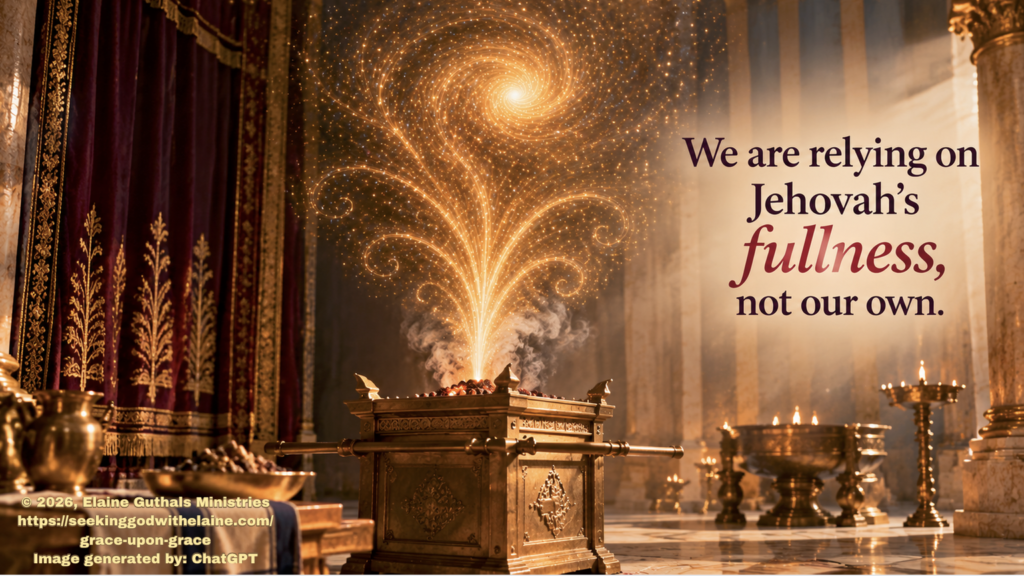
    We are relying on Jehovah’s fullness, not our own. His fullness never diminishes. It remains constant.

    Making the Connections #4

    Free grace doesn’t mean costless discipleship. Yehovah Himself told us there was a cost to following Him (Lk. 14: 25-33).

    Don’t things mean more when we have to pay for them? When we have to willingly give up one thing to get something better?

    I like what Bonhoeffer had to say. He wrote, “Cheap grace means the justification of sin without the justification of the sinner. Grace alone does every thing, they say, and so
    everything can remain as it was before.”

    Resource

    We don’t want to cheapen Jehovah’s grace by not recognizing what it truly is. We definitely don’t want to recognize what it truly is – and reject it in part or in whole.

    Justification of sin doesn’t get us salvation. Yeshua came in flesh to gain the justification of the sinner.

    Heart Check

    Think about the battle Yeshua is engaged in for your heart. Ask yourself the following questions.

    • Am I living as though Jehovah’s grace is sufficient for me, or am I trying to earn His favor through my own efforts?
    • Have I received His grace while still holding on to sins or habits He is calling me to surrender?
    • Am I allowing Jehovah’s truth to change the way I live, or am I using grace as an excuse to remain comfortable?
    • What is Jehovah asking me to surrender so that I can follow Him more completely?
    • When I fail, do I run from Jehovah because of my failure, or do I return to the One whose fullness never diminishes?

    How Do We Apply This?

    • Receive Jehovah’s grace.
    • Walk in His truth.
    • Surrender our sin.
    • Seek Jehovah daily.
    • Follow Yeshua wherever He leads.
    • Take up our cross.
    • Trust His fullness.
    • Return to Him when we stumble.
       
      Prayer

    If you don’t understand something and would like further clarification, please contact me.

    If you have not signed up for the email providing the link to the devotions and the newsletter, do so below.

    If God has used this devotion to speak with you, consider sharing it on social media.
  • The Second and Third Temptations

    In the last devotion, we discussed Yeshua’s first temptation by Satan. This devotional reading looks at the second and third temptations.

    Nuggets

    • Satan first took Yeshua to the capital city.
    • Satan took Yeshua to the highest exposed point of the Temple complex.
    • Satan’s premise was that Jehovah would not let anything bad happen to His Son.
    • Satan mostly got the Scripture quote right on the second temptation.
    • Yeshua again responded with Scripture.
    • Scripture doesn’t identify the mountain to which Satan took Yeshua – and we don’t know that they went directly from the Temple pinnacle to this mountain.
    • Satan was offering Yeshua the kingdoms of the world.
    • Satan is the prince of this world.
    • If Satan wants what Jehovah has, he would want the worship that Jehovah has.
    • We are specifically told not to worship anyone or anything other than Jehovah.
    • These are three temptations, but there were probably more temptations that Yeshua suffered than this.
    • The three temptations tell us much about Who Yeshua is and how He understands His mission.

    Scripture tells us of three times that Satan tempted Yeshua. We’ve looked at the first temptation.

    The second and third temptations have Satan digging deeper to not only undermine Jehovah but to also become His equal.

    From these temptations, we learn much of Who Yeshua is.

    Let’s Put It into Context

    To read devotions in The Battle for the Heart theme

    Devotions in the The Ministry of John the Baptist series

    Is the Messiah the Son of God?

    “Then the devil took him to the holy city, Jerusalem, to the highest point of the Temple, and said, ‘If you are the Son of God, jump off! For the Scriptures say, “He will order his angels to protect you. And they will hold you up with their hands so you won’t even hurt your foot on a stone.”’ Jesus responded, ‘The Scriptures also say, “You must not test the Lord your God”’” (Mt. 4: 5-7 NLT)

    “Then the devil took him to Jerusalem, to the highest point of the Temple, and said, ‘If you are the Son of God, jump off! For the Scriptures say, “He will order his angels to protect and guard you. And they will hold you up with their hands so you won’t even hurt your foot on a stone.”’ Jesus responded, ‘The Scriptures also say, “You must not test the Lord your God”’” (Lk. 4: 9-12 NLT)

    Took Him to Jerusalem

    Satan first took Yeshua to the capital city.

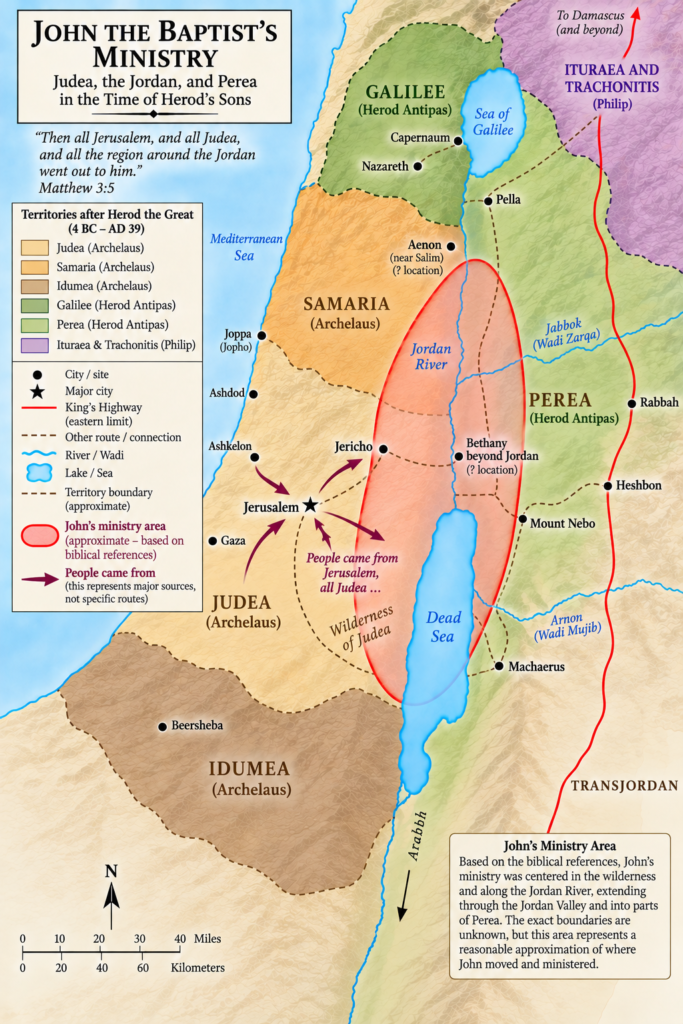
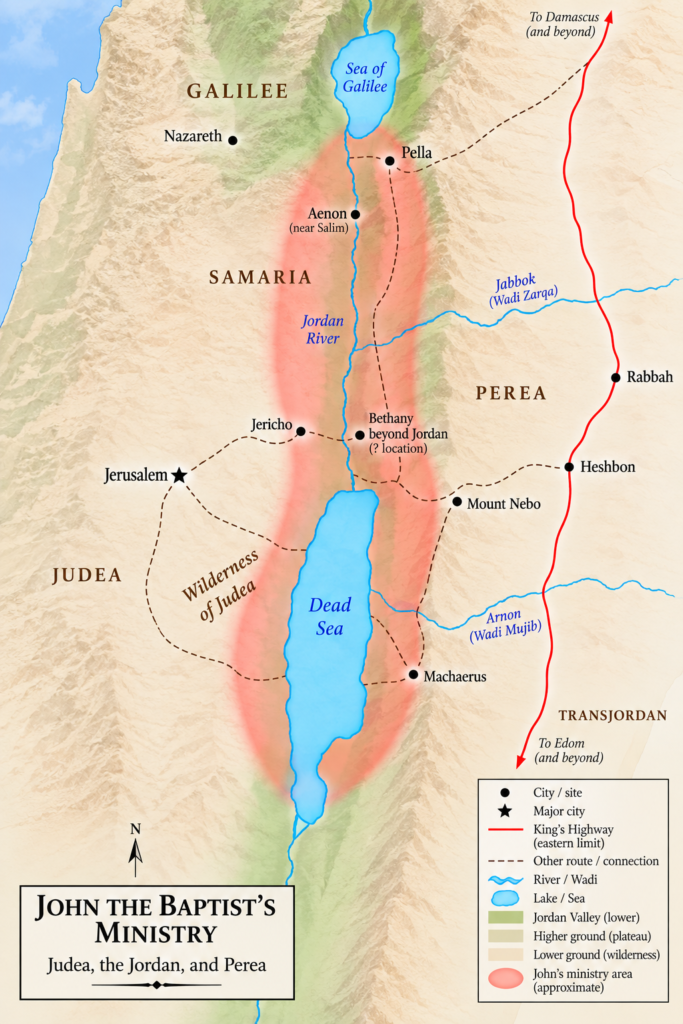
    We have to remember that Yeshua went into the Judean Wilderness after His baptism. We know that He came from Nazareth to be baptized in the Jordan.

    • “Then Jesus went from Galilee to the Jordan River …” (Mt. 3: 13 NLT).
    • “One day Jesus came from Nazareth in Galilee … baptized in the Jordan River” (Mk. 1: 10 NLT).

    We do have a clue as to where Yeshua’s baptism took place. “This encounter [John’s Someone-is-coming-after-me declaration] took place in Bethany, an area east of the Jordan River, where John was baptizing” (Jn. 1: 28 NLT).

    The next day, Yeshua came for baptism. John may or may not have migrated elsewhere after his discussion around Bethany. I don’t think he went far if he did.

    So, if Yeshua’s baptism occurred around Bethany beyond the Jordan, it was 15-20 miles as the crow flies to the Judean Wilderness, where the temptation is believed to have taken place. As the crow flies is probably appropriate because I doubt Satan and Yeshua walked to Jerusalem and back.

    The Highest Point

    Satan took Yeshua to the highest exposed point of the Temple complex.

    We don’t know for sure where exactly Satan took Yeshua. The Greek tells us that it was the pinnacle of the Temple — pterygion tou hierou.

    If they were at the southeastern corner (remember, east has a spiritual significance), the view was of the Kidron Valley.

    Also on the southeastern side was a substantial vertical drop. Herod had created several substantial vertical drops when he remodeled the Temple. He did this through retaining walls and courts.

    A fall from this point would have been spectacular and potentially fatal.

    Son of God

    Satan’s premise was that Jehovah would not let anything bad happen to His Son.

    In the last temptation, we discussed that Satan did know and believe that Yeshua was the Son of God. He wasn’t quibbling with that.

    The Complete Jewish Study Bible had some interesting meanings of Son of God. It could mean:

    • “… a godly human being;
    • “the special one sent by God;
    • “the Son of God in flesh;
    • “a human whose presence on earth required a special creative act of God, hence either Adam or Yeshua …”

    Resource

    Well – technically – all of those applied to Yeshua.

    For the Scriptures Say

    Satan mostly got the Scripture quote right on the second temptation.

    Ooo baby. Satan knows Scripture?

    Oh, I am sure Satan does. He knows it enough to twist it to make what he says sound believable.

    Isn’t it easier to believe a falsehood when it is rooted in truth? That leaves us to pick apart what is factual and what is false.

    Satan’s use of Scripture against us is a reason we need to know what God’s Word says.

    Satan was quoting from Psalms 91: 11-12. “For he will order his angels to protect you wherever you go. They will hold you up with their hands so you won’t even hurt your foot on a stone” (Ps. 91: 11-12 NLT).

    It is interesting that Satan left out the part that Jehovah would have His angels “… protect you wherever you go” (Ps. 91: 11 NLT). Why didn’t Satan add that?

    Think about it. Wouldn’t Satan want to remind Yeshua of His constant protection? “Do this, and Jehovah won’t let You get hurt.”

    Or was that a way to get Yeshua to doubt Jehovah’s protection. “You would really be crossing Him, so maybe that protection wouldn’t be there. You know You can’t trust Him.”

    This temptation isn’t just about Yeshua proving Himself to be the Son of God. It is about Him proving He trusts Jehovah.

    It is also interesting that Satan quoted the part that says “… you won’t even hurt your foot …” (Mt. 4: 6 NLT). Remember what Jehovah said in the Garden of Eden.

    “And I will cause hostility between you and the woman, and between your offspring and her offspring. He will strike your head, and you will strike his heel” (Gen. 3: 15 NLT).

    Technically, Satan was right. Jehovah didn’t say he was going to hurt Yeshua’s foot.

    Just the heel. The heel is part of the foot.

    But at the core of the temptation is determining Jehovah’s presence. Is He there protecting Yeshua like He said He would be?

    Jesus Responded

    Yeshua again responded with Scripture.

    Yeshua didn’t say, “Don’t do something stupid.” He was going deeper than that.

    Here is the full verse that Yeshua quoted. “You must not test the Lord your God as you did when you complained at Massah” (Deut. 6: 16 NLT).

    Just before saying this, Moses told the Israelites that they shouldn’t worship the false gods of the then-current nations occupying the Promised Land. After that verse, he talked about obeying Jehovah.

    The reference to Massah was Moses reminding the Israelites of their complaining during the exodus. At one point they camped at Rephidim. Since there was no water, the people complained.

    When they demanded water, Moses accused them of testing Jehovah. They equated lack of water to lack of Jehovah’s presence – even though His presence was in the cloud/pillar that led them.

    The Israelites did get their water. “The Lord said to Moses, ‘Walk out in front of the people. Take your staff, the one you used when you struck the water of the Nile, and call some of the elders of Israel to join you. I will stand before you on the rock at Mount Sinai. Strike the rock, and water will come gushing out. Then the people will be able to drink.’ So Moses struck the rock as he was told, and water gushed out as the elders looked on” (Ex. 17: 5-7 NLT).

    They wanted evidence of Jehovah’s presence. Wasn’t that what Satan was saying?

    Yeshua said that he didn’t need to force Jehovah to demonstrate His faithfulness. He was going to trust Jehovah without manipulating Him to prove Himself.

    So, Satan went from the first temptation of trying to get Yeshua to prove He was the Son of God to getting Him to prove Jehovah’ protection.

    Where would Satan go next?

    Who Will the Messiah Serve?

    “Next the devil took him to the peak of a very high mountain and showed him all the kingdoms of the world and their glory. ‘I will give it all to you,’ he said, ‘if you will kneel down and worship me.’ ‘Get out of here, Satan,’ Jesus told him. ‘For the Scriptures say, “You must worship the Lord your God and serve only him”’” (Mt. 4: 8-10 NLT)

    “Then the devil took him up and revealed to him all the kingdoms of the world in a moment of time. ‘I will give you the glory of these kingdoms and authority over them,’ the devil said, ‘because they are mine to give to anyone I please. I will give it all to you if you will worship me.’ Jesus replied, ‘The Scriptures say, “You must worship the Lord your God and serve only him”’” (Lk. 4: 5-8 NLT)

    Peak of a Very High Mountain

    Scripture doesn’t identify the mountain to which Satan took Yeshua – and we don’t know that they went directly from the Temple pinnacle to this mountain.

    If we look at the area between Jerusalem and Bethany across the Jordan, we have a couple of high mountains that would fit the bill.

    The first mountain – the one closest to Jerusalem – would be the Mount of Olives. It is immediately east of Jerusalem.

    Its central summit is 2,664-2,684 feet (812-818 meters) above sea level. This doesn’t make it the tallest mountain in the ridge. Mount Scopus is taller at 2,710 feet (826 meters).

    Well, it doesn’t say it’s the tallest mountain. It just describes it as a very high mountain.

    The Mount of Olives would be an appropriate choice. That would be a place where Yeshua would spend time during His ministry. The Garden of Gethsemane is there.

    The next highest prominent elevation in the whole Jerusalem-Jordan Valley-Bethany region was Mount Nebo. At 2,330 feet (710 meters) above sea level, it isn’t as tall as those in the ridge that contains the Mount of Olives.

    But it, too, has its significance.

    All the Kingdoms of the World

    Satan was offering Yeshua the kingdoms of the world.

    First off, we have to watch how we define the whole world. Is it everything on this planet, or just every known land at the time?

    Or was it the whole Jewish nation? Remember, this is the mountain Moses went up to view the Promised Land.

    “That very day the Lord spoke to Moses, ‘Go up this mountain of the Abarim, Mount Nebo, which is in the land of Moab, opposite Jericho, and view the land of Canaan, which I am giving to the people of Israel for a possession. And die on the mountain which you go up, and be gathered to your people …” (Deut. 32: 48-49 ESV).

    Does that mean Moses – and Yeshua if this was the mountain – see every inch of the Promised Land? No.

    But that isn’t what is meant in covenant language. Instead, it means completeness, totality, or covenant fulfillment.

    Would Satan have been talking covenant language? Maybe. Maybe not. He was an angel in the beginning.

    Because They Are Mine to Give

    Satan is the prince of this world.

    We may scratch our heads when Satan says, “Hey, these are mine to give.” Technically, he is correct.

    • “Satan, who is the god of this world, has blinded the minds of those who don’t believe. They are unable to see the glorious light of the Good News. They don’t understand this message about the glory of Christ, who is the exact likeness of God” (II Cor. 4: 4 NLT).
    • “The time for judging this world has come, when Satan, the ruler of this world, will be cast out” (Jn. 12: 31 NLT).
    • “And you were dead in the trespasses and sins in which you once walked, following the course of this world, following the prince of the power of the air, the spirit that is now at work in the sons of disobedience” (Eph. 2: 1-2 NLT)

    This verse is a good example of having head knowledge about Yeshua. Satan knew He was the Son of Jehovah.

    “You must fear the Lord your God and serve him. When you take an oath, you must use only his name” (Duet. 6: 13 NLT).

    But Satan didn’t have heart knowledge. He didn’t know that Yeshua was more interested in our spiritual condition than anything this world could offer Him. It was His already.

    If You Will Worship Me

    If Satan wants what Jehovah has, he would want the worship that Jehovah has.

    Satan isn’t Jehovah’s equal, but he thinks he is – or at least, should be. Therefore, though it doesn’t say what that worship was to be, we have a good idea.

    • Satan wants the recognition that belongs to Jehovah.
    • He wants the honor, splendor, and majesty belonging to Him.
    • He believes he has the right to rule.
    • He feels he has sovereign rule over creation.
    • Satan wants us to carry out his will rather than Jehovah’s.
    • He wants our hearts and loyalty directed to him rather than Jehovah.
    • He wants our submission by accepting his authority instead of Jehovah’s.
    • He wants to be recognized as supreme – not Jehovah.

    That makes what Satan offers Yeshua for His worship so interesting.

    Worship the Lord Your God and Serve Only Him

    We are specifically told not to worship anyone or anything other than Jehovah.

    Yeshua was quoting Deuteronomy 6: 13 to respond to Satan. “You must fear the Lord your God and serve him. When you take an oath, you must use only his name” (Deut. 6: 13 NLT).

    Some may be more familiar with the second commandment.

    “You must not make for yourself an idol of any kind or an image of anything in the heavens or on the earth or in the sea. You must not bow down to them or worship them, for I, the Lord your God, am a jealous God who will not tolerate your affection for any other gods …” (Ex. 20: 4-6 NLT).

    Jehovah doesn’t want us to worship anyone or anything other than Him. This is especially true of someone who disobeyed Him.

    The Tempter Departs

    “Then the devil went away, and angels came and took care of Jesus” (Mt. 4: 11 NLT)

    “When the devil had finished tempting Jesus, he left him until the next opportunity came” (Lk. 4: 13 NLT)

    These are three temptations, but there were probably more temptations that Yeshua suffered than this.

    I knew that Yeshua had to have been tempted by Satan more than just this one session, but I am this many years old before I realized that it actually says that in God’s Word. I didn’t see Satan giving up until Jesus was dead.

    Satan took this opportunity, I think, for a couple of reasons. One reason is because Yeshua was coming off a time of spiritual triumph. Satan may think that we have grown lax or complacent.

    The opportunity presented itself now because Yeshua was fasting. His physical condition could have put His spiritual condition in jeopardy. But it didn’t.

    For some, the significant time alone would have opened the risk of our resolve to remain obedient to Jehovah being attacked.

    What the Temptations Tell Us about Yeshua

    The three temptations tell us much about Who Yeshua is and how He understands His mission.

    Yeshua refused to use His divine identity for Himself.

    Think about it. This temptation occurred immediately after Yeshua’s baptism. At His baptism, He was identified by the voice and the dove as being the Son of God.

    Everyone who was present that day heard this identification.

    Yet, Yeshua refuses to identify Himself to Satan. He didn’t use His power to satisfy His hunger.

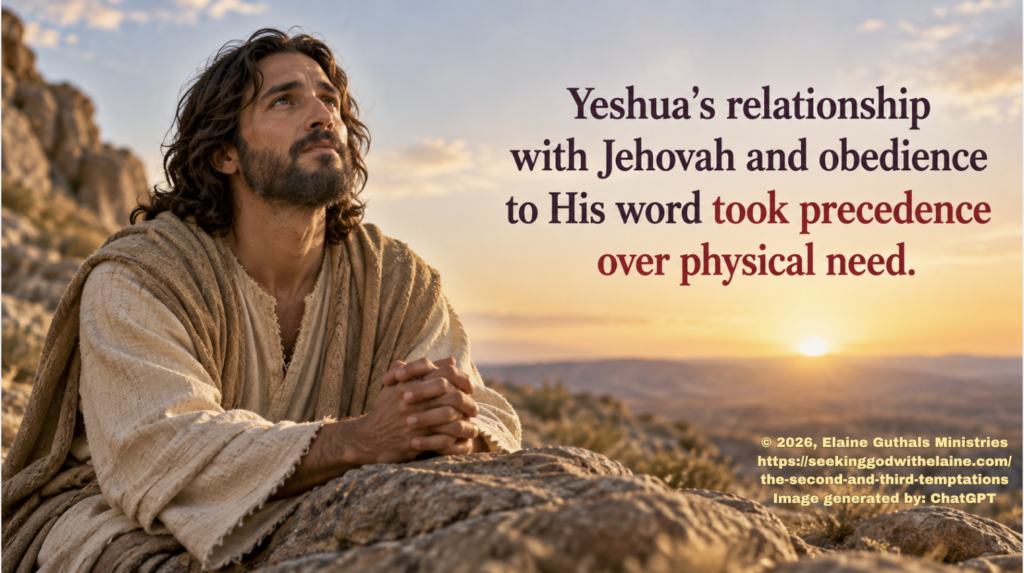
    Yeshua’s relationship with Jehovah and obedience to His word took precedence over physical need.

    Yeshua didn’t need Jehovah to prove Himself to Him. He wasn’t going to manipulate circumstances to force Jehovah to show Himself.

    It is obvious that Yeshua knew that the kingdom already belonged to Him – or at least would after the Plan of Salvation was complete. He didn’t have to take Satan’s route and receive it then.

    Yeshua could wait. He wasn’t going to shortcut the path of obedience.

    Through His answers, Yeshua showed us

    • He trusted Jehovah rather than Himself.
    • He trusted Jehovah’s Word rather than circumstances.
    • He worshiped Jehovah rather than pursuing power.

    Making the Connections #1

    We tend to think of Yeshua as, I don’t know, a superhuman. He was perfect because He could be no less.

    That is utterly false. Look what Goulburn said. He wrote, “He was as much mixed up with the manifold, humbling, petty details of daily life as any of us.”

    Resource

    Yes, Yeshua was 100% God. But He was also 100% man.

    We don’t know exactly how that can be. That is something we have to put in the UNR book — understanding not required.

    Did Yeshua get flashbacks of His time before He came to earth? Maybe. I would say probably.

    But Yeshua lived His life on earth as any other human. He woke up, ate, worked, slept, hit, repeat.

    Yeshua faced day-to-day challenges. He was tempted by Satan — more than is recorded in the Gospels.

    The life Yeshua led here required Him to not only grow physically but to also grow spiritually. Yeah, we would say that happened quickly. “… ‘Didn’t you know that I must be in my Father’s house?’” (Lk. 2: 49 NLT).

    We can’t say that Yeshua didn’t sin because He was God. If He “physically” couldn’t, then He would not be an appropriate substitute to pay the price for our sins.

    Making the Connections #2

    Jesus’ temptation is not merely a morality lesson about three things Christians should avoid. It is an encounter between the Son of God and the adversary within the larger biblical story of God’s purposes, human faithfulness, and spiritual opposition.

    Heart Check

    Think about the battle Yeshua is engaged in for your heart. Ask yourself the following questions.

    • When I have a genuine need, do I trust Jehovah to provide, or do I feel I must take matters into my own hands?
    • Do I trust Jehovah’s faithfulness, or do I sometimes demand that He prove Himself to me?
    • Have I ever deliberately stepped into a situation expecting Jehovah to rescue me rather than simply trusting Him?
    • Am I ever tempted to pursue something good in a way that bypasses obedience to Jehovah?
    • What has the greatest claim on my heart—Jehovah, or what I believe I can gain by compromising my devotion to Him?
    • Am I willing to wait for Jehovah’s purposes to unfold in His way and His time, rather than looking for a shortcut?

    How Do We Apply This?

    • Trust Jehovah with your needs.
    • Trust without demanding proof.
    • Don’t confuse faith with presumption.
    • Realize that something that looks like an opportunity can still require us to compromise obedience to Jehovah.
    • Keep worship at the center.

    Father God. We know we will be tempted as Yeshua was. May we trust Jehovah and His Word rather than ourselves and circumstances. We want to worship You instead of trying to rely on our own power. Amen.

    If you don’t understand something and would like further clarification, please contact me.

    If you have not signed up for the email providing the link to the devotions and the newsletter, do so below.

    If God has used this devotion to speak with you, consider sharing it on social media.
  • The First Temptation

    After His baptism, Yeshua was led into the wilderness by the Holy Spirit. This devotional reading looks at the first of Satan’s temptation that He endured.

    Nuggets

    • The Holy Spirit intentionally led Yeshua into the wilderness.
    • The timestamp used in this passage is ambiguous.
    • Ooo, baby, do we think we could take forty days of Messiah-level testing?
    • Yeshua fasted while in the wilderness.
    • Yeshua was protected in the wilderness – even if He didn’t know it.
    • Satan is also called the devil.
    • Did Satan not know who Yeshua was, or was he trying to get Him to doubt Himself?
    • Satan wanted Yeshua to believe that He could provide for His needs Himself.
    • Yeshua had been fasting, but Satan forgot that He was the Bread of Life.

    Yeshua just had a mountaintop experience. He obediently submitted Himself for baptism. The Father and the Holy Spirit were there as witnesses.

    Then Holy Spirit led Yeshua into the wilderness – and there it took a turn.

    Enter Satan.

    Let’s Put It into Context

    To read devotions in The Battle for the Heart theme

    Devotions in the The Temptation of Jesus series

    Led by the Spirit

    “Then Jesus was led by the Spirit into the wilderness to be tempted there by the devil. For forty days and forty nights he fasted and became very hungry. During that time …” (Mt. 4: 1-3 NLT)

    “The Spirit then compelled Jesus to go into the wilderness, where he was tempted by Satan for forty days. He was out among the wild animals, and angels took care of him” (Mk. 1: 12-13 NLT)

    “Then Jesus, full of the Holy Spirit, returned from the Jordan River. He was led by the Spirit in the wilderness, where he was tempted by the devil for forty days. Jesus ate nothing all that time and became very hungry” (Lk. 4: 1-2 NLT)

    Filled with the Holy Spirit

    The Holy Spirit intentionally led Yeshua into the wilderness.

    It is interesting to see the different Greek words used that is translated to show how the Holy Spirit got Yeshua into the wilderness. Let’s take a look.

    Do the one Gospel contradict another? Matthew just gave us a bare bones description of the task of the Holy Spirit – He was to get Yeshua to the wilderness.

    Mark presented the urgency of that leading. Does that mean Yeshua didn’t want to go? Probably not. It just means that the wilderness was exactly where Yeshua was supposed to be.

    Luke presented duration. The Holy Spirit didn’t get Yeshua to the wilderness and drop Him off. Luke describes Yeshua as being led in the Spirit during the wilderness experience.

    During that Time

    The timestamp used in this passage is ambiguous.

    I had never caught before that the verse says, “During that time …” (Mt. 4: 3 NLT). I had always assumed the temptation was at the end of the forty days.

    To me, that was logical. Yeshua would have forty days to get really hungry — for food and for company.

    Food and company are two very important elements for humans. None of us can survive without food. True, we can go for some days without eating, but not long.

    True, some of us can go much longer without physical contact with another human being. Television and streaming can help, but we were made to be social people.

    The Greek that Matthew used was ἐλθὼν ὁ πειράζων. It literally means the tempter, having come.

    That means we can’t read Matthew to say the tempting started on Day 40 and took one day. It is easy to read that since there are no timestamps within the temptations themselves.

    But why would Satan do one big temptation session?

    Luke doesn’t lock the wording down that precisely. Again, he made the tempting an ongoing event.

    To me, that is what Satan would more than likely have done.

    Part of me says non-stop – ongoing as Luke said. I can just see Satan slamming and slamming away at Yeshua’s Will to get Him to trip up.

    It is possible that Satan tempted Yeshua the whole forty days. We can’t be certain that these were the only temptations during the 40 days. These may have been the only ones recorded.

    Wait! What did Matthew say? The Holy Spirit led Yeshua to the wilderness to be tempted by Satan?

    Well, not really. Matthew grammatically separated them.

    • The Holy Spirit led Yeshua into the wilderness.
    • The devil tempted Him.

    What Matthew was giving us was the purpose of going to the wilderness. Remember, Jehovah has to allow Satan to tempt us. That doesn’t mean Jehovah is doing the tempting.

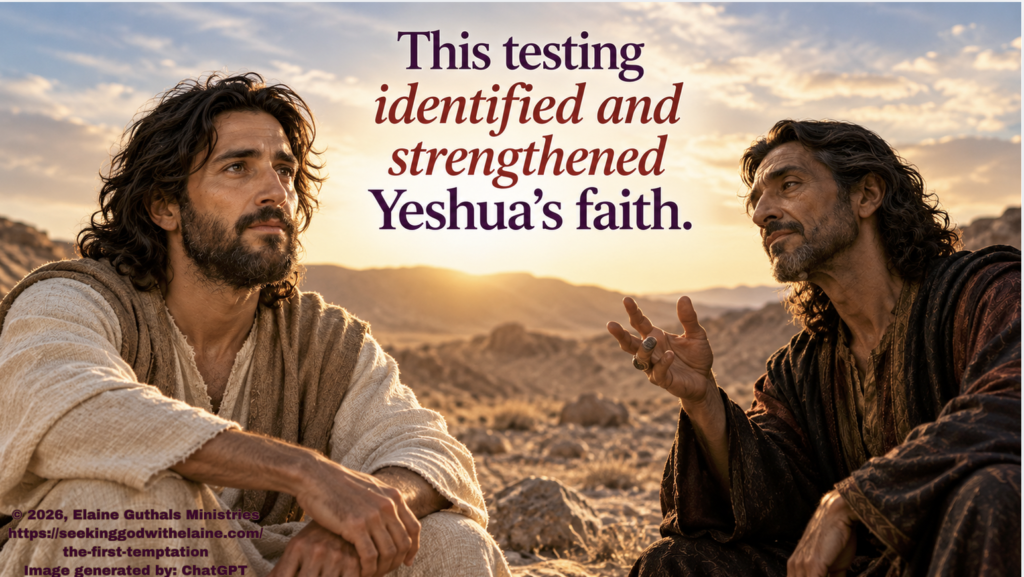
    Jehovah can and does use those same temptations as testing. The testing identifies and strengthens our faith. This testing identified and strengthened Yeshua’s faith.

    Forty Days of Testing

    Ooo, baby, do we think we could take forty days of Messiah-level testing?

    We know it would have had to be worse than anything we have ever experienced. I mean, if Satan could get Yeshua to sin, the whole plan would have to be scrapped.

    Yep, the plan that was developed before the foundation of the world — before creation — hinged on Yeshua staying blameless, staying pure and sin-free.

    We’ve talked before about the significance of 40. This was the amount of time

    • it rained during the Flood (Gen. 7: 4, 12, 17).
    • Yeshua was tempted in the wilderness (Mt. 4: 2; Mk. 1: 13; Lk. 4: 2).
    • the mountaintops were visible before Noah opened the ark’s window (Gen. 8: 6).
    • Moses remained on Sinai receiving the law (Ex. 24: 18).
    • Moses spent interceding after the golden calf (Deut. 9: 18, 25; 10: 10).
    • spies explored Canaan (Num. 13: 25).
    • Goliath challenged Israel (I Sam. 17: 16).
    • it took Elijah to travel to Horeb (I Kgs. 19: 8).
    • Jonah warned Nineveh (Jon. 3: 4).
    • a woman waited for purification after the birth of a son (Lev. 12: 1-4).
    • Yeshua remained on earth after His resurrection (Ac. 1: 3).

    There are other occasions where the number 40 is used, but these are the ones that specifically apply to 40 days. The number 40 is used in patterns.

    Fasted/Ate Nothing

    Yeshua fasted while in the wilderness.

    Biblical fasting is more than just not eating. It is not eating for a spiritual purpose.

    • Seeking Jehovah
    • Repentance
    • Grief or mourning
    • Prayer and intercession
    • Humbling ourselves
    • Preparation

    The Hebrew concept frequently expressed is through the noun tsom (צוֹם) and the verb tsum (צוּם.).

    Our motivation for fasting is important. We can’t fast as a means of forcing Jehovah to respond to us – usually some specific request.

    We should be fasting because we are humbling ourselves before Jehovah and are turning our attention toward Him.

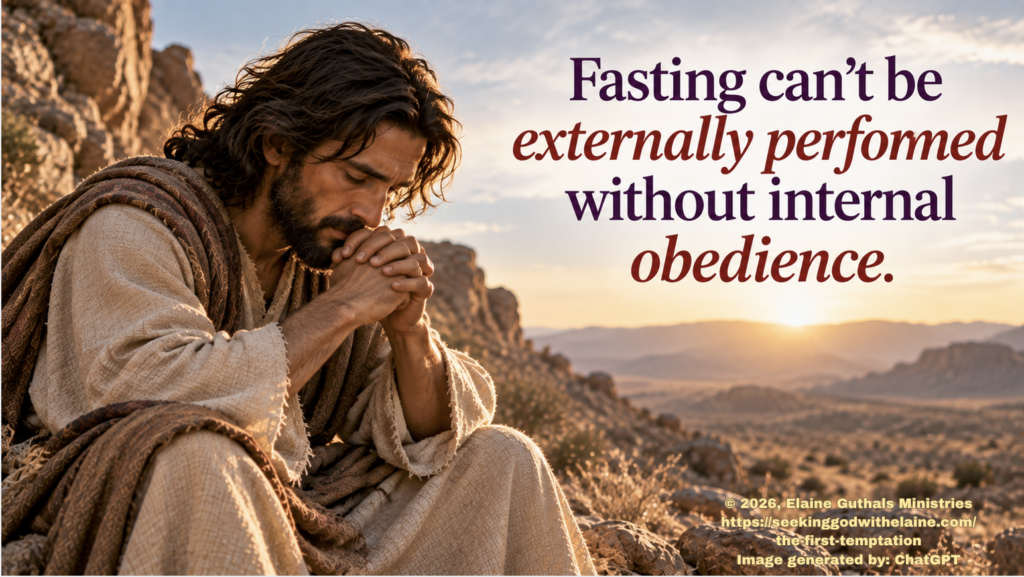
    Fasting can’t be externally performed without internal obedience.

    Matthew specifically said that Yeshua fasted. Luke, however, just said that He went without food.

    Was it a unique, Spirit-led wilderness fast? Maybe. Maybe not.

    We have to be careful reading Matthew. “For forty days and forty nights he fasted and became very hungry” (Mt. 4: 2 NLT). After one to three days, Yeshua would have been experiencing hunger. His hunger would have become very real by Day 20, let alone Day 40.

    There is something significant about the wording. Yeshua fasted → He became hungry → Satan’s first temptation concerned food.

    My opinion? Yeshua was fasting. He was preparing for the ministry He would begin.

    I don’t think that it was just food was scarce – or He just didn’t have an appetite His cousin had for locust.

    Yeshua was following several purposes for fasting.

    • Seeking Jehovah
    • Prayer and intercession
    • Humbling Himself
    • Preparation

    That communion with the Father was the whole purpose of going out into the wilderness.

    Out among the Wild Animals

    Yeshua was protected in the wilderness – even if He didn’t know it.

    Mark added an interesting nugget. He said that there were wild animals in the wilderness.

    Well, that was logical. The wilderness that Yeshua was in was the Judean Wilderness, a harsh and rocky region east of Jerusalem. It stretched toward the Jordan River and the Dead Sea.

    The Hebrew term for it is midbar (מִדְבָּר). It wasn’t only considered an empty land. It taught dependence on Jehovah. It was where God spoke and revealed Himself to people.

    This wilderness consisted of jagged limestone hills, steep ravines known as wadis, and dry, chalky soil. The vegetation was limited to thorn bushes and scattered scrub growth.

    The extreme climate ran from intense daytime heat to cold nights. Rain was limited, which limited food sources. Those living in the wilderness had to gather what the wilderness provided – locusts and wild honey.

    Many wild animals go where people aren’t. It would have been expected that some took up residence in the barren wasteland.

    But Yeshua wasn’t alone. He had angels ministering to Him.

    Does that mean the angels were with Yeshua 24/7/40? Well, yes and no.

    While the angels may have been guarding Yeshua, I doubt he could see them 24/7/40. They may not have physically made their presence known to Him.

    What Is Most Important to the Messiah?

    “… the devil came and said to him, ‘If you are the Son of God, tell these stones to become loaves of bread.’ But Jesus told him, ‘No! The Scriptures say, “People do not live by bread alone, but by every word that comes from the mouth of God”’” (Mt. 4: 3-4 NLT)

    “Then the devil said to him, ‘If you are the Son of God, tell this stone to become a loaf of bread.’ But Jesus told him, ‘No! The Scriptures say, ‘People do not live by bread alone”’” (Lk. 4: 3-4 NLT)

    The Devil

    Satan is also called the devil.

    The Hebrew word śāṭān begins with the basic idea of an adversary. Job and Zechariah place the adversary within heavenly scenes involving accusation and testing.

    Chronicles presents a more individualized Satanic figure. Genesis gives us the serpent who challenges God’s word, while Revelation later identifies the ancient serpent with Satan – and calls him the devil.

    Second Temple Jewish writings then expand reflection on evil spiritual powers, developing figures such as Mastema and Belial. There are also elaborate accounts of spirits, deception, judgment, and cosmic conflict.

    One theological boundary remains essential: the adversary is not Jehovah’s equal. Evil is real, spiritual opposition is real, and the battle reaches human beings, but God remains sovereign.

    The conflict also reaches deeper than behavior. The adversary challenges trust. He accuses. He deceives. He offers competing interpretations of God’s word. He seeks to move God’s people from dependence upon Jehovah toward some other source of security, identity, wisdom, or provision.

    If You Are the Son of God

    Satan wanted Yeshua to believe that He could provide for His needs Himself.

    Satan wasn’t saying that he could turn the stones into bread. He was wanting Yeshua to do it for Himself.

    Could Yeshua have done it? Yes.

    But that wouldn’t have been relying on Jehovah for our provision.

    If Yeshua was supposed to fast for forty days, turning stones into bread would have been a sin. It was because Yeshua was listening to and obeying Satan.

    Tell These Stones

    Did Satan not know who Yeshua was, or was he trying to get Him to doubt Himself?

    It is my opinion that Satan knew exactly Who Yeshua was. He wouldn’t have called just anyone the Son of God.

    There is evidence of this in Scripture. “Suddenly, a man in the synagogue who was possessed by an evil spirit cried out, ‘Why are you interfering with us, Jesus of Nazareth? Have you come to destroy us? I know who you are — the Holy One of God!’”

    One of Satan’s demons wouldn’t have known Yeshua if Satan himself didn’t.

    Loaves of Bread

    Yeshua had been fasting, but Satan forgot that He was the Bread of Life.

    Bread was a staple in the diets of first-century Jews. It was regularly eaten with meals. It was substantial enough the bread could function almost as a general term for food.

    Satan wasn’t offering Yeshua pie or cake. He wasn’t offering Him some luxury food item.

    Satan was offering Yeshua a basic necessity of life.

    Yeshua came back with a verse in Scripture. “Yes, he humbled you by letting you go hungry and then feeding you with manna, a food previously unknown to you and your ancestors. He did it to teach you that people do not live by bread alone; rather, we live by every word that comes from the mouth of the Lord” (Deut. 8: 3 NLT).

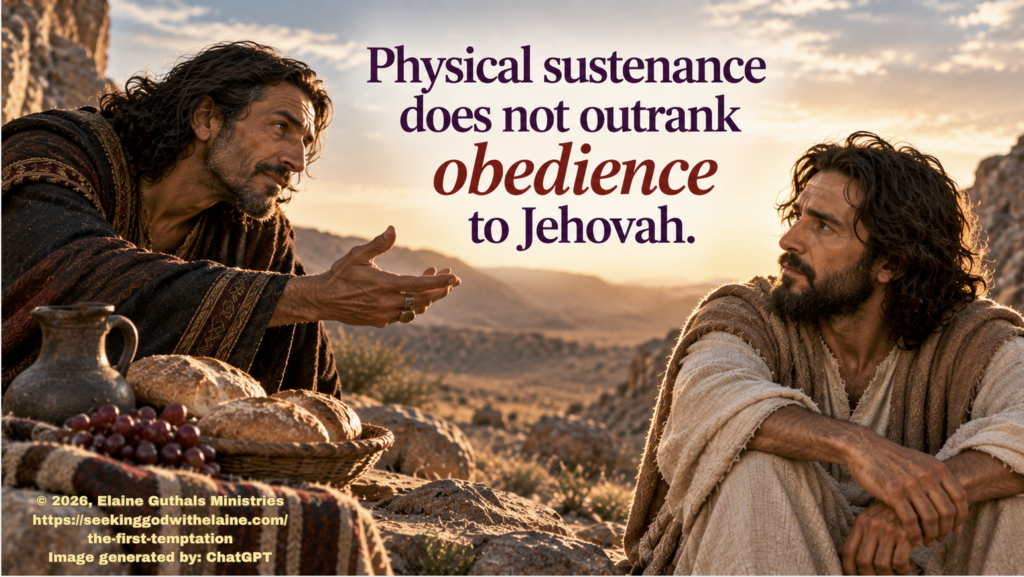
    Physical sustenance does not outrank obedience to Jehovah.

    Making the Connections

    Jesus’ temptation isn’t merely a morality lesson about three things Christians should avoid. It is an encounter between the Son of God and the adversary within the larger biblical story of God’s purposes, human faithfulness, and spiritual opposition.

    Heart Check

    Think about the battle Yeshua is engaged in for your heart. Ask yourself the following questions.

    • When I am in need, do I trust Jehovah to provide, or do I try to provide for myself?
    • When Jehovah’s answer requires waiting, do I wait obediently, or do I take matters into my own hands?
    • When I am tempted, do I look for what I can gain, or do I look for what Jehovah has commanded?
    • Do I value immediate relief, or am I willing to remain obedient when obedience costs me something?
    • When I know what Scripture says, do I obey it, or do I look for a way around it?

    How Do We Apply This?

    • Recognize the difference between a legitimate need and an excuse for disobedience.
    • Learn to trust Jehovah when obedience requires us to wait.
    • Turn to Scripture when we face temptation.
    • Remember that satisfying a legitimate need does not justify disobedience.
    • Choose Jehovah’s provision over our own solutions.
    • Remain faithful when temptation attacks our physical needs, desires, or sense of security.

    Father God. You allow Satan to tempt us. Part of that is consequences from the Fall. Part of it is that You also use that temptation to test us. Lord, may our faith prove genuine. Amen.

    If you don’t understand something and would like further clarification, please contact me.

    If you have not signed up for the email providing the link to the devotions and the newsletter, do so below.

    If God has used this devotion to speak with you, consider sharing it on social media.
  • Who Is the Tempter?

    Humans in all ages have had to resist the tempter. This  devotional reading looks at who he is and how he opposes Jehovah.

    Nuggets

    • The term the Accuser is used as a title.
    • Jehovah was the One Who brought up Job.
    • Satan didn’t dispute Job’s actions but rather his motivation.
    • Jehovah allowed the testing to take place.
    • While śāṭān (שָׂטָן) isn’t used in Genesis 3: 1, Revelation 12: 9 does identify the serpent with Satan.
    • Satan stood ready to accuse Jeshua, the High Priest, before the angel of the Lord.
    • The importance of this passage is that it doesn’t use the word the.
    • By the time Yeshua walked the earth, Jewish thought about the spiritual realm had developed beyond the earlier use of śāṭān as simply an adversary or accuser.
    • Satan can oppose God’s people, but he cannot become God’s equal.
    • We often think of the heart as the place where our emotions live.

    Before we get to the temptation of Yeshua, we need to understand a little about who His tempter was. That will help us understand who still tempts us today.

    On the surface, it appears that Satan tries to get us to not do the do’s and to do the don’ts. But bad behavior isn’t his overall motivation.

    At the core, the temptations focus on trust, allegiance, truth, and accusation. The bottom line is, will we trust Jehovah or Satan?

    Let’s Put It into Context #1

    To read devotions in The Battle for the Heart theme

    Devotions in the The Temptation of Jesus series

    Let’s Put It into Context #2

    Who is that adversary, and where did he come from?

    When we think of the Jehovah’s opponent, we call him Satan. Well, that isn’t the best translation of what the opponent is called.

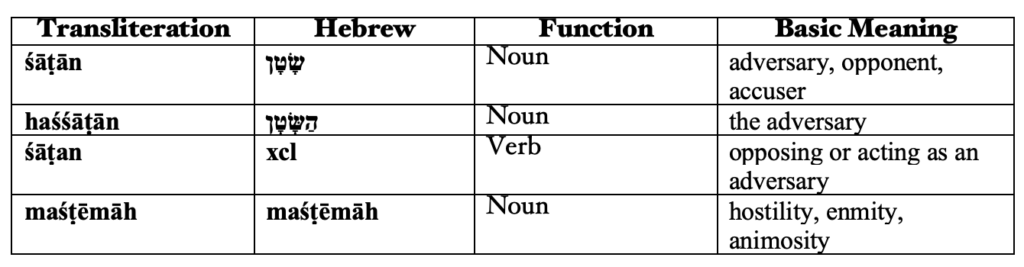
    The Hebrew word śāṭān (שָׂטָן) isn’t a proper name. It is a noun that means adversary, opponent, or accuser. It is more of a role or function.

    From there, the word seems to have taken on a life of its own. The progression has been the adversary → the heavenly accuser → an increasingly personalized adversarial figure → Satan/the Devil of the New Testament.

    Look at the following Hebrew words. Their common element is characterized as opposition.

    The Adversary Already Existed

    “One day the members of the heavenly court came to present themselves before the Lord, and the Accuser, Satan, came with them. ‘Where have you come from?’ the Lord asked Satan. Satan answered the Lord, ‘I have been patrolling the earth, watching everything that’s going on.’ Then the Lord asked Satan, ‘Have you noticed my servant Job? He is the finest man in all the earth. He is blameless — a man of complete integrity. He fears God and stays away from evil.’ Satan replied to the Lord, ‘Yes, but Job has good reason to fear God. You have always put a wall of protection around him and his home and his property. You have made him prosper in everything he does. Look how rich he is! But reach out and take away everything he has, and he will surely curse you to your face!’ ‘All right, you may test him,’ the Lord said to Satan. ‘Do whatever you want with everything he possesses, but don’t harm him physically.’ So Satan left the Lord’s presence.” (Job 1: 6-12 NLT)

    The Accuser

    The term the Accuser is used as a title.

    If we look at the Hebrew Bible, we see the word we translate as accuser is haśśāṭān (הַשָּׂטָן). It literally means accuser.

    The most important word is the ha – the accuser. Haśśāṭān is used as a title, not a proper name.

    An accuser is someone who claims another has committed an offense. This person is charging the other of doing something morally wrong.

    That is important.

    Have You Noticed

    Jehovah was the One Who brought up Job.

    We may think that Satan is the one who brought Job into the conversation. He wasn’t.

    Jehovah used Job as an example of someone who is blameless.  The root word for blameless is tām (תָּם), from the root tāmam (תָּמַם). It means being complete, whole, or possessing integrity. The central Hebrew idea behind blameless is wholeness.

    Jehovah didn’t say that Job was righteous – tzaddik (צַדִּיק). That means one who conforms to God’s standards.

    What Jehovah was talking about here was that Job had integrity. His character wasn’t compromised.

    To me, that says Job made a choice to have integrity. He easily could have chosen not to follow Jehovah, but he didn’t do that.

    Yes, But

    Satan didn’t dispute Job’s actions but rather his motivation.

    Satan wasn’t saying that Job wasn’t a man of integrity. He was saying the reason for Job’s integrity was because he liked the blessings Jehovah gave him.

    In Satan’s mind, he believed that to remove the blessings would remove the integrity.

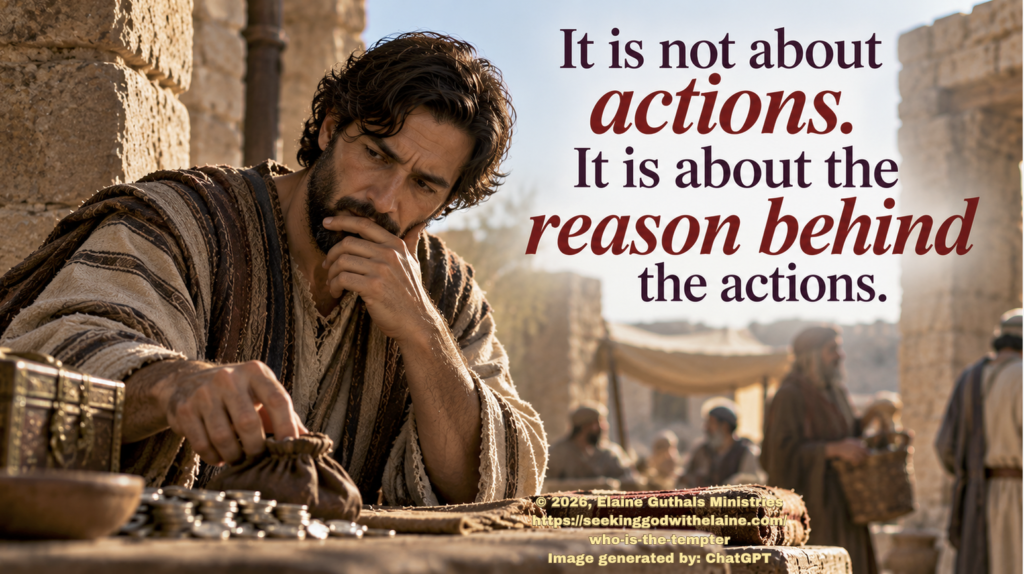
    It is not about actions. It is about the reason behind the actions.

    Why did we do what is right in Jehovah’s eyes? Are we just wanting His blessings? Or do we want a relationship with Him?

    Satan was convinced that Job wasn’t really interested in a relationship with Jehovah. He was interested in getting the good stuff.

    All Right, But

    Jehovah allowed the testing to take place.

    Jehovah didn’t say that Satan had examples of Job’s faithfulness to Him. He didn’t bring up past examples to prove His point.

    No, Jehovah said, “Okay. I’ll let you test him. But you can’t harm him physically.”

    Jehovah doesn’t send trials our way. He does, however, test us to ensure our faith is strong.

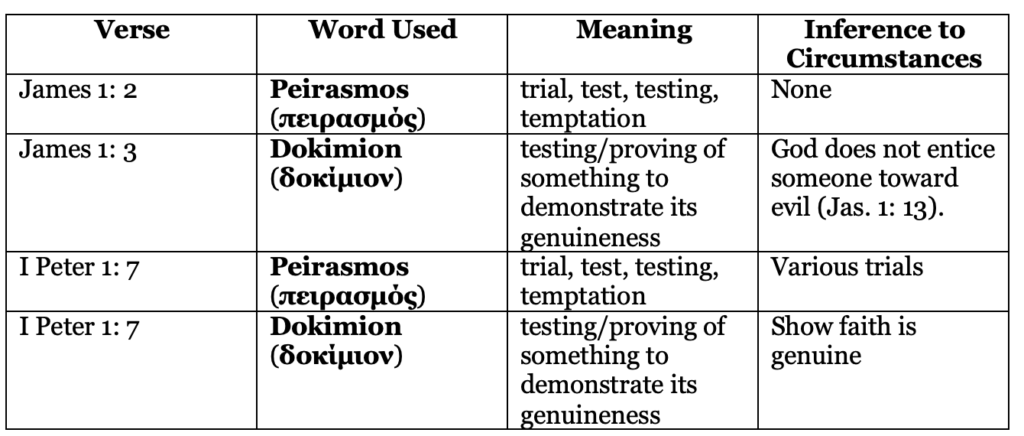
    • “Dear brothers and sisters, when troubles of any kind come your way, consider it an opportunity for great joy. For you know that when your faith is tested, your endurance has a chance to grow. So let it grow, for when your endurance is fully developed, you will be perfect and complete, needing nothing” (Jas. 1: 2-4 NLT).
    • “These trials will show that your faith is genuine. It is being tested as fire tests and purifies gold — though your faith is far more precious than mere gold. So when your faith remains strong through many trials, it will bring you much praise and glory and honor on the day when Jesus Christ is revealed to the whole world” (I Pet. 1: 7 NLT).

    I see you jumping up and down over there. Peter said trials. Testing and trials are both used for the same outcome – showing the genuineness of our faith.

    In order to figure this out, we have to look at the Greek.

    Is Satan really going to test our faith to prove that it is genuine? Highly unlikely. He is trying to get us to do that which is evil.

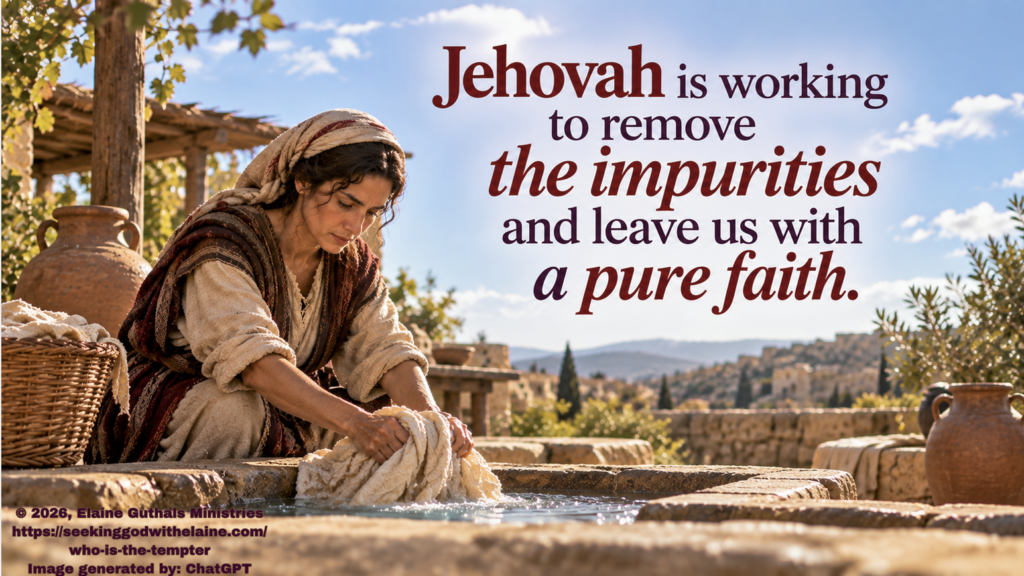
    Jehovah, on the other hand, is refining us in the fire. He is working to remove the impurities and leave us with a pure faith.

    The same Greek word – peirasmos – can encompass testing and temptation. That means the purpose and the direction are what distinguish trials from testing. 

    No, they may not look that much different to us.

    Jehovah’s sovereignty and Satan’s opposition can – and probably often do – operate in the same event, but with radically different purposes.

    The Entrance of Deception into Humanity’s Story

    “The serpent was the shrewdest of all the wild animals the Lord God had made. One day he asked the woman, ‘Did God really say you must not eat the fruit from any of the trees in the garden?’” (Gen. 3: 1 NLT)

    “This great dragon — the ancient serpent called the devil, or Satan, the one deceiving the whole world — was thrown down to the earth with all his angels” (Rev. 12: 9 NLT)

    While śāṭān (שָׂטָן) isn’t used in Genesis 3: 1, Revelation 12: 9 does identify the serpent with Satan.

    We shouldn’t focus on the outward package – the serpent – in the Fall from grace. We need to focus on the purpose.

    “… Did God really say …” (Gen. 3: 1 NLT) is a common vehicle for Satan trying to get us to sin.

    Notice what the serpent didn’t focus on. It wasn’t the fruit. It wasn’t even the act of eating. The serpent talked about rewards and consequences.

    The focus was, “Can you trust Jehovah to mean what He says? Will you believe Him or me?”

    The heart of the conflict isn’t necessarily obedience – although that does play a big role. The issue is trust.

    Can you see Satan’s pattern that he uses? God has spoken; he introduces an alternative; the human is confronted with a choice concerning trust and obedience.

    The Hebrew Bible’s Developing Picture of Satan

    The Accuser in the Heavenly Court

    “Then the angel showed me Jeshua the high priest standing before the angel of the Lord. The Accuser, Satan, was there at the angel’s right hand, making accusations against Jeshua. And the Lord said to Satan, ‘I, the Lord, reject your accusations, Satan. Yes, the Lord, who has chosen Jerusalem, rebukes you. This man is like a burning stick that has been snatched from the fire.’ Jeshua’s clothing was filthy as he stood there before the angel. So the angel said to the others standing there, ‘Take off his filthy clothes.’ And turning to Jeshua he said, ‘See, I have taken away your sins, and now I am giving you these fine new clothes. Then I said, ‘They should also place a clean turban on his head.’ So they put a clean priestly turban on his head and dressed him in new clothes while the angel of the Lord stood by. Then the angel of the Lord spoke very solemnly to Jeshua and said, ‘This is what the Lord of Heaven’s Armies says: If you follow my ways and carefully serve me, then you will be given authority over my Temple and its courtyards. I will let you walk among these others standing here’” (Zech 3: 1-7 NLT)

    Satan stood ready to accuse Jeshua, the High Priest, before the angel of the Lord.

    This passage takes on the feel of a courtroom. That is because the language Satan uses is one that a prosecutor would use. He stands in opposition and accusation. The word used is again haśśāṭān (הַשָּׂטָן) – accuser.

    Satan made his accusations against Jeshua. Jehovah’s response to Satan is interesting.

    • I reject your claim.
    • I have chosen Jerusalem.
    • Jeshua has been snatched from the fire.
    • Jeshua’s filthy clothes were removed.
    • I have taken away your sins and given you salvation.
    • You still have to walk with Me.

    God’s Word tells us that Satan is wrong.

    • “Where is another God like you, who pardons the guilt of the remnant, overlooking the sins of his special people? You will not stay angry with your people forever, because you delight in showing unfailing love. Once again you will have compassion on us. You will trample our sins under your feet and throw them into the depths of the ocean!” (Mic. 7: 18-19 NLT).
    • “This is good and pleases God our Savior, who wants everyone to be saved and to understand the truth” (I Tim. 2: 3-4 NLT).
    • “And anyone whose name was not found recorded in the Book of Life was thrown into the lake of fire” (Rev. 20: 15 NLT).
    • “I am overwhelmed with joy in the Lord my God! For he has dressed me with the clothing of salvation and draped me in a robe of righteousness. I am like a bridegroom dressed for his wedding or a bride with her jewels” (Isa. 61: 10 NLT).

    Does this say that Jeshua didn’t sin? No, it says that Jeshua’s garments were filthy (Zech. 3: 3). The angel had others replace his clothes. “… For he has dressed me with the clothing of salvation and draped me in a robe of righteousness …” (Isa. 61: 10 NLT).

    Satan may have made the accusations, but Jehovah had the final say – and He rejected them.

    Satan as a More Clearly Developed Figure

    “Satan rose up against Israel and caused David to take a census of the people of Israel” (I Chron. 21: 1 NLT)

    The importance of this passage is that it doesn’t use the word the.

    The Hebrew word used is śāṭān (שָׂטָן), meaning adversary. Here the word appears without the definite article and is presented as an individual adversarial figure. English translations differ in whether they render it Satan or an adversary.

    But this passage does something more. The terminology used moves from the broader concept of an adversary toward a more personalized adversarial figure.

    Satan is seen as an adversarial figure instead of a role or title.

    There is another verse detailing the same census that has a slightly different spin on it. “Once again the anger of the Lord burned against Israel, and he caused David to harm them by taking a census. “Go and count the people of Israel and Judah,” the Lord told him” (I Sam. 24: 1 NLT).

    Are the two versions contradictory, or can they both be accurate? I believe they both can be accurate if we look at how Satan’s role developed in Scripture.

    We’ve talked about how Satan’s role has transitions from the adversary to more of a personal description. This increasingly adversarial role surely causes Jehovah to become angry. It shows humans turning away from Him and turning to Satan.

    This raises a theological question: how do Jehovah’s sovereignty and Satan’s actions relate?

    Second Temple Understanding

    By the time Yeshua walked the earth, Jewish thought about the spiritual realm had developed beyond the earlier use of śāṭān as simply an adversary or accuser.

    Jewish writings from the Second Temple period describe a more clearly developed spiritual conflict between forces that belong to God and forces that oppose Him. The idea of an adversary who opposes Jehovah’s purposes, deceives, accuses, and seeks to turn people away from God was not foreign to His Jewish audience. The New Testament’s use of Satan and the Devil stands within this developing biblical and Jewish understanding.

    We have to be careful here. Second Temple Judaism was not one single system of belief. Jewish communities interpreted the spiritual world in different ways. But several writings from this period show an increasing interest in evil spiritual beings, their influence over humanity, and the conflict between God’s purposes and those forces.

    The Book of Jubilees, for example, introduces Mastema, a figure who functions as an adversary and leader of evil spirits. Even in this expanded picture, however, Mastema does not operate as Jehovah’s equal. His activity remains subject to Jehovah’s authority.

    The Dead Sea Scrolls give us another important window into this Jewish worldview. The community described in the Rule of the Community speaks of two spirits: the Spirit of Truth and the Spirit of Deceit. The conflict is not merely something happening somewhere in the heavens. It affects how people think, choose, live, and respond to God.

    That is important for us.

    The spiritual conflict is not simply God versus Satan somewhere outside of us. It reaches into the human person.

    The Dead Sea Scrolls describe humanity as living amid competing spiritual influences, but they do not present two equal gods fighting for control. God remains sovereign. The conflict exists under His authority and within His ultimate purposes.

    This helps us understand the world into which Yeshua came.

    Satan Is Not Jehovah’s Equal

    “Then I heard a loud voice shouting across the heavens, ‘It has come at last — salvation and power and the Kingdom of our God, and the authority of his Christ. For the accuser of our brothers and sisters has been thrown down to earth — the one who accuses them before our God day and night’” (Rev. 12: 10 NLT)

    Satan can oppose God’s people, but he cannot become God’s equal.

    We see the adversary described as the ancient serpent, the devil, and Satan.

    Go back to Job 1. Satan had to have permission to bring the trials upon Job. Just as Jehovah said, “You can’t harm Job physically,” He could have said, “You can’t do anything to Job at all.”

    Isn’t that what Satan was hinting at? “Satan replied to the Lord, ‘Yes, but Job has good reason to fear God. You have always put a wall of protection around him and his home and his property …” (Job 1: 9-10 NLT).

    The Adversary’s Work Reaches the Human Heart

    We often think of the heart as the place where our emotions live.

    But the Hebrew understanding of the heart is much bigger than that. The Hebrew words lēv (לֵב) and lēvāv (לֵבָב) can refer to the inner person — the place of thought, understanding, intention, desire, and decision. That gives us a different way to look at Satan’s work.

    Look again at Job.

    Satan didn’t dispute Job’s behavior. He questioned what was happening inside Job.

    Why did Job fear Jehovah? Was it because Job genuinely trusted Him? Or was Job faithful because Jehovah had blessed him?

    The question wasn’t simply, “Will Job do the right thing?” The question was, “What is in Job’s heart?”

    We see the same thing in the Garden. The serpent didn’t begin by telling Eve to rebel against Jehovah. He introduced another word: “Did God really say…?”

    Suddenly Eve had another voice to consider.

    Jehovah had spoken. The serpent offered an alternative.

    Now the question became: Whose word would she trust? That is where the battle reaches the heart.

    Satan can accuse us. He can tempt us. He can introduce deception. He can challenge what Jehovah has said.

    But the temptation always brings us to a place of decision.

    Will I trust Jehovah? Will I believe what He has said? Will I remain loyal to Him when another voice offers me something that appears better?

    The battle isn’t simply about whether we obey a rule. It is about who has our allegiance.

    That is why outward behavior alone cannot tell us everything about our relationship with Jehovah.

    Two people can do the same right thing for completely different reasons. One may do it because he loves Jehovah and trusts Him while the other may do it because he wants what he believes Jehovah will give him.

    And that makes this battle personal. The adversary is not merely interested in getting us to break rules.

    He wants to undermine our trust in Jehovah. He wants us to question what Jehovah has said. He wants us to listen to another voice.

    And ultimately, he wants us to choose another allegiance.

    Making the Connections #1

    “But God was angry that Balaam was going, so he sent the angel of the Lord to stand in the road to block his way. As Balaam and two servants were riding along” (Num. 22: 22 NLT)

    Numbers 22: 22 is a verse that uses the Hebrew word śāṭān (שָׂטָן) – adversary, opponent, or accuser.

    But its use is more than a role or function. In this verse, it was a behavior.

    The angel stood in the road as an adversary. The angel accused Balaam.

    Making the Connections #2

    So, what all did we learn from this?

    • The issue is more about authenticity of our relationship with Jehovah than our behavior.
    • Satan can’t work independently from Jehovah – He sets limits on him.
    • Satan sows seeds of distrust of Jehovah and His words.
    • Satan accuses as well as tempts.
    • The adversary is an adversary precisely because he opposes the One who has authority over him.

    Heart Check

    Think about the battle Yeshua is engaged in for your heart. Ask yourself the following questions.

    • Am I going to trust Jehovah when another voice tells me I shouldn’t, or am I going to let that voice pull me astray?
    • Am I going to believe what Jehovah has said or what the adversary tells me?
    • Am I going to let an accusation make me doubt Jehovah’s forgiveness, or is my faith going to remain firm in Him?
    • Am I going to remain faithful when obedience becomes difficult, or am I going to take the easy road into disobedience?
    • Am I going to guard my heart when temptation challenges my allegiance to Jehovah, or am I going to give in to temptation?

    How Do We Apply This?

    • Trust Jehovah’s Word.
    • Reject the adversary’s accusations and temptations.
    • Remember Jehovah’s forgiveness.
    • Remain faithful when tested.
    • Guard our hearts against deception.

    Father God. The adversary still tempts us today. Help us to remain faithful to You. Amen.

    If you don’t understand something and would like further clarification, please contact me.

    If you have not signed up for the email providing the link to the devotions and the newsletter, do so below.

    If God has used this devotion to speak with you, consider sharing it on social media.
  • The Death of John the Baptist

    It was time for John the Baptist’s ministry to draw to a close.. This devotional reading looks at his imprisonment and death.

    Nuggets

    • Herod Antipas was one of the sons of Herod the Great who received part of his divided kingdom.
    • Some in John’s audience thought he was the prophet Elijah.
    • The only other named prophet John was compared to was Jeremiah, though John was also compared to unnamed prophets.
    • Herod thought Yeshua was John because He could perform miracles.
    • Herod must have had a guilty conscience if he thought Yeshua was John.
    • Herodias was the daughter of Herod the Great’s son Aristobulus and Berenice.
    • John had a specific reason for calling out Herod Antipas and Herodias – their marriage was against Jehovah’s laws.
    • Herod had conflicting feelings about John.
    • Herodias took matters into her own hands.
    • The vow was important because of the audience.
    • Once the reward was established, Herod had to follow through.

    John the Baptist had a very important role to play in Jehovah’s Plan of Salvation. However, it was time for Yeshua to take center stage.

    That meant John’s ministry was over.

    Let’s Put It into Context

    To read devotions in The Battle for the Heart theme

    Devotions in the The Ministry of John the Baptist series

    Herod’s Uncertainty as to the Identity of Yeshua

    “When Herod Antipas, the ruler of Galilee, heard about Jesus, he said to his advisers, ‘This must be John the Baptist raised from the dead! That is why he can do such miracles.’” (Mt. 14: 1-2 NLT)

    “Herod Antipas, the king, soon heard about Jesus, because everyone was talking about him. Some were saying, ‘This must be John the Baptist raised from the dead. That is why he can do such miracles.’ Others said, ‘He’s the prophet Elijah.’ Still others said, ‘He’s a prophet like the other great prophets of the past.’ When Herod heard about Jesus, he said, ‘John, the man I beheaded, has come back from the dead’” (Mk. 6: 14-16 NLT)

    “When Herod Antipas, the ruler of Galilee, heard about everything Jesus was doing, he was puzzled. Some were saying that John the Baptist had been raised from the dead. Others thought Jesus was Elijah or one of the other prophets risen from the dead. ‘I beheaded John,’ Herod said, ‘so who is this man about whom I hear such stories?’ And he kept trying to see him” (Lk. 9: 7-9 NLT)

    Herod Antipas

    Herod Antipas was one of the sons of Herod the Great who received part of his divided kingdom.

    Herod Antipas became tetrarch of Galilee and Perea, including the area where John conducted his ministry. His reign lasted from 4 BC to AD 39.

    The capital of Herod’s territory was Tiberias. There was also a fortress and royal palace in Machaerus.

    Thomas noted that Herod was a Sadducee. He listed him as an “… avowed patron and protector of the sect …”

    Resource

    Herod didn’t know what to think about Yeshua. Everyone was talking about Him, so it didn’t take long for Herod to hear about Him, too.

    But Herod had no clue as to Who Yeshua was. He had to go on who others said that He was.

    Elijah

    Some in John’s audience thought he was the prophet Elijah.

    “Look, I am sending you the prophet Elijah before the great and dreadful day of the Lord arrives. His preaching will turn the hearts of fathers to their children, and the hearts of children to their fathers. Otherwise I will come and strike the land with a curse” (Mal. 4: 5-6 NLT).

    John’s and Elijah’s messages were pretty much the same: repent and turn back to Jehovah. The two men wore similar attire (II Kgs. 1: 8; Mt. 3: 4). They carried out their mission in the wilderness (Mt. 3: 1).

    What John had done was to come in the spirit of Elijah. “He will be a man with the spirit and power of Elijah. He will prepare the people for the coming of the Lord. He will turn the hearts of the fathers to their children, and he will cause those who are rebellious to accept the wisdom of the godly” (Lk. 1: 17 NLT emphasis added).

    I know. That isn’t exactly what Jesus said.

    • “And from the time John the Baptist began preaching until now, the Kingdom of Heaven has been forcefully advancing, and violent people are attacking it. For before John came, all the prophets and the law of Moses looked forward to this present time. And if you are willing to accept what I say, he is Elijah, the one the prophets said would come” (Mt. 11: 12-14 NLT).
    • “‘But I tell you, Elijah has already come, but he wasn’t recognized, and they chose to abuse him. And in the same way they will also make the Son of Man suffer.’ Then the disciples realized he was talking about John the Baptist” (Mt. 17: 12-13 NLT).

    No, Yeshua did not lie. John was a type of Elijah; however, the audience probably wouldn’t have accepted a no, but because that wasn’t the answer they wanted.

    A Prophet

    The only other named prophet John was compared to was Jeremiah, though John was also compared to unnamed prophets.

    “‘Well,” they replied, “some say John the Baptist, some say Elijah, and others say Jeremiah or one of the other prophets” (Mt. 16: 14 NLT).

    Both John and Jeremiah called for Israel to return to covenant faithfulness. Their messages were of repentance and moral change.

    Both were deeply concerned with the spiritual condition of Israel. They knew that Israel could not only rely on Abraham being their ancestor. Instead, they confronted religious hypocrisy.

    Both endured persecution. That was understandable since both confronted kings and political leaders about their behaviors.

    Both were looking forward to the new covenant that Yeshua ushered in. “‘But this is the new covenant I will make with the people of Israel after those days,’ says the Lord. ‘will put my instructions deep within them, and I will write them on their hearts. I will be their God, and they will be my people’” (Jer. 31: 33 NLT).

    John, though, was also compared to some unnamed prophets. “… other great prophets of the past’” (Mk. 6: 15 NLT).

    It is understandable that John was compared to the prophets. Both John and the prophets called Israel back to covenant faithfulness.

    Why He Can Do Such Miracles

    Herod thought Yeshua was John because He could perform miracles.

    This always puzzles me. I can’t see why Herod would think Yeshua was John because of miracles.

    We aren’t told that John performed miracles. So, why would the ability to perform miracles identify Yeshua as John?

    Maybe none of the Gospels report the miracles John performed. They couldn’t report everything he did. Besides, John wasn’t the main character of the Gospels.

    I Beheaded John

    Herod must have had a guilty conscience if he thought Yeshua was John.

    Herod thought Yeshua was John raised from the dead. John had been beheaded at Herod’s direction.

    What! What???? John was dead???????

    This is one of those oh-by-the-way moments in the Gospels. We’re told after the fact.

    John’s Imprisonment

    “For Herod had arrested and imprisoned John as a favor to his wife Herodias (the former wife of Herod’s brother Philip). John had been telling Herod, ‘It is against God’s law for you to marry her.’ Herod wanted to kill John, but he was afraid of a riot, because all the people believed John was a prophet” (Mt. 14: 3-5 NLT)

    “For Herod had sent soldiers to arrest and imprison John as a favor to Herodias. She had been his brother Philip’s wife, but Herod had married her. John had been telling Herod, ‘It is against God’s law for you to marry your brother’s wife.’ So Herodias bore a grudge against John and wanted to kill him. But without Herod’s approval she was powerless, for Herod respected John; and knowing that he was a good and holy man, he protected him. Herod was greatly disturbed whenever he talked with John, but even so, he liked to listen to him” (Mk. 6: 17-20 NLT)

    John also publicly criticized Herod Antipas, the ruler of Galilee, for marrying Herodias, his brother’s wife, and for many other wrongs he had done. So Herod put John in prison, adding this sin to his many others” (Lk. 3: 19-20 NLT)

    Herodias (the former wife of Herod’s brother Philip)

    Herodias was the daughter of Herod the Great’s son Aristobulus and Berenice.

    Herodias’ first husband is commonly identified as Herod II. He was also known as Herod Philip (not Philip the Tetrarch). It is through this union that Salome was born.

    We aren’t told why Herodias left her marriage with Herod Philip. We just know that she did.

    Herod Antipas also had a prior marriage. He had been married to the daughter of Aretas IV, the king of Nabataea. (Nabataea was a kingdom centered at Petra.) That marriage ended in divorce.

    So, in other words, Herod married his niece.

    It Is Against God’s Law

    John had a specific reason for calling out Herod Antipas and Herodias – their marriage was against Jehovah’s laws.

    When given the laws, specifics were given concerning family members. Punishment for breaking these laws was also given.

    • “Do not have sexual relations with your brother’s wife, for this would violate your brother” (Lev. 18: 16 NLT).
    • “You must keep all my decrees and regulations by putting them into practice; otherwise the land to which I am bringing you as your new home will vomit you out” (Lev. 20: 22 NLT).

    Of course, John called Herod on this. He was to call Israel back to repentance and covenant faithfulness.

    Herod was Jewish although he was not an Israelite. He was from Idumea.

    John was calling all Jews to covenant faithfulness. If Herod truly considered himself a Jew, John knew that Herod should walk with Jehovah and obey His laws.

    Herod Wanted to Kill John but Was Afraid

    Herod had conflicting feelings about John.

    So, was Herod afraid of John or fascinated by him? In one verse – Mark 6: 20 – we get the whole gamut of feelings.

    • knew he was a good and holy man
    • protected him
    • greatly disturbed
    • liked to listen to him

    Herod knew John possessed a moral authority. He wasn’t just being a troublemaker.

    John was a common Jew. Yes, both of his parents had come from a priestly line. Herod knew he was a holy man.

    But compared to the king, John was a common man. He was the common man who made Herod afraid.

    This really came out when Herod was listening to John. He didn’t want to hear what John had to say, but he knew John was a righteous man with authority.

    But Herod didn’t want to hear what John was saying. He was comfortable in his marriage with Herodias.

    Herod was protecting John from Herodias. While he had arrested John as a favor to her, it doesn’t sound like he did any other than put him in jail in Machaerus – at least at first.

    Machaerus was a heavily fortified Herodian royal complex in Perea, containing both a fortress and a magnificent palace. It was one of Herod Antipas’ important residences as it strategically sat on the frontier.

    The Greek word is aporeō (ἀπορέω), carrying the sense of being perplexed, troubled, or at a loss about what to do.

    Isn’t that a human response? We are called to Jehovah and His Word – but we just aren’t comfortable with it. We feel His call, but we resist it.

    What was Herod going to do with a man he knew was right but didn’t want him to be right?

    Herod’s Birthday Party

    “But at a birthday party for Herod, Herodias’s daughter performed a dance that greatly pleased him, so he promised with a vow to give her anything she wanted. At her mother’s urging, the girl said, ‘I want the head of John the Baptist on a tray!’ Then the king regretted what he had said; but because of the vow he had made in front of his guests, he issued the necessary orders. So John was beheaded in the prison, and his head was brought on a tray and given to the girl, who took it to her mother. Later, John’s disciples came for his body and buried it. Then they went and told Jesus what had happened” (Mt. 14: 6-12 NLT)

    “Herodias’s chance finally came on Herod’s birthday. He gave a party for his high government officials, army officers, and the leading citizens of Galilee. Then his daughter, also named Herodias, came in and performed a dance that greatly pleased Herod and his guests. ‘Ask me for anything you like,’ the king said to the girl, ‘and I will give it to you.’ He even vowed, ‘I will give you whatever you ask, up to half my kingdom!’ She went out and asked her mother, ‘What should I ask for?’ Her mother told her, ‘Ask for the head of John the Baptist!’ So the girl hurried back to the king and told him, “I want the head of John the Baptist, right now, on a tray!” Then the king deeply regretted what he had said; but because of the vows he had made in front of his guests, he couldn’t refuse her. So he immediately sent an executioner to the prison to cut off John’s head and bring it to him. The soldier beheaded John in the prison, brought his head on a tray, and gave it to the girl, who took it to her mother. When John’s disciples heard what had happened, they came to get his body and buried it in a tomb” (Mk. 6: 21-29 NLT)

    Salome Danced

    Herodias took matters into her own hands.

    Herodias must have gotten tired of Herod protecting John. I’m sure she felt it an affront to her that John was saying Herod and Herodias’ marriage was wrong.

    The perfect opportunity presented itself at Herod’s birthday party. But she had to enlist help.

    That help came from Salome, Herodias’ daughter. This same Salome was the wife of Philip the Tetrarch – but probably not at this precise moment.

    The Greek word is korasion (κοράσιον), which means young girl or young woman. What we do know is that she was old enough to participate in the banquet.

    Salome danced for Herod. We are told nothing of this dance, but many jump to the conclusion that it was erotic, provocative, or seductive.

    Maybe. Maybe not. By this time, sexually provocative dances by professional dancers – the role which Salome took for this party – were frowned on in some Jewish circles.

    I can see two holes in that. Some circles do not mean all circles. Herod was Jewish, but it doesn’t sound like he was a practicing Jew.

    But the thought that Salome danced a provocative dance in order to get Herod to reward her kind of falls apart.

    If Herodias enlisted Salome to dance to secure a reward, wouldn’t she have told her what to ask for when she asked her to dance? But she didn’t. Salome had to go back to Herodias and ask what the reward should be.

    That says nothing as to why a wife would have her daughter dance a sexual dance for her husband.

    Promised with a Vow

    The vow was important because of the audience.

    Herod obviously liked the dance. He said that Salome could ask for a reward that was up to half of his kingdom.

    Just stop right there. No, nowhere do the Gospels say it was a seductive dance. What else could it be to get this type of reward?

    What would make Herod willingly give up half his kingdom? It wasn’t because Herod was thinking of retiring and divesting himself of land. Besides, would he really give the rule to a young woman?

    But that is what Herod stipulated. The reward could be up to half his kingdom.

    Whatever triggered Herod’s response was something significant. He wouldn’t have made this offer to just any professional dancer. There had to be something in his stepdaughter’s dance that struck a chord.

    Was Herod so sure that Salome wouldn’t take his kingdom? Was he thinking jewels or money?

    Herod obviously didn’t expect the answer he got from Salome. But he couldn’t back out of it. He couldn’t lose face in front of all the dignitaries that were in attendance.

    This wasn’t just a family birthday party. The birthday of the king would have been a political and social affair. His advisors would be there. The ruling elite were present. Wealthy citizens from the area would have been there.

    Herod couldn’t say, “I know what I promised you, but this request isn’t acceptable.” He had laid no parameters around the reward – except it couldn’t be more than half his kingdom.

    His Head Was Brought on a Tray

    Once the reward was established, Herod had to follow through.

    We aren’t sure how long John was imprisoned in Herod’s fortified palace. However long it was, it wouldn’t have been comfortable for him.

    Herod followed through on his vow. He rewarded Salome for her dance by killing John the Baptist.

    We think it was gory bringing John’s head to Salome on a silver platter.  There was no mistaking that John was dead.

    Herodias was given visible proof.

    Making the Connections #1

    We could say that Herod made a foolish promise. He opened the door wide open for any reward.

    Herod had to have known Herodias’ feelings against John. He had to know the pull she had over Salome.

    Look at the progression.

    • Herod was afraid of John because he spoke God’s truth.
    • Herod protected John because of John’s righteousness.
    • Herod was affected by John’s words, so he listened to him.
    • Herod put more store in his social standing and being seen as a decisive ruler than he feared disobeying Jehovah.

    John lost his head because Herod knew John was right but lacked the courage to stand on what he knew. He died because he wouldn’t stop telling the truth.

    Making the Connections #2

    We talked about Herod having a conscience. We can’t mistake the Holy Spirit for our conscience. Everyone has one.

    Not everyone has the Holy Spirit living inside them.

    Atterbury helped us understand the difference. He wrote “That the reprehensions of conscience are not a continued, but intermitting, disease.”

    Resource

    In other words, sometimes we may be affected by our consciences. Sometimes, we may not be.

    If we are not being led by the Holy Spirit, our human consciences may sometimes be influenced by our outward actions.

    Heart Check

    Think about the battle Yeshua is engaged in for your heart. Ask yourself the following questions.

    • Do I accept something Jehovah has already shown me through His Word that I know is true, or am I resisting it? 
    • Am I listening to and applying Jehovah’s Word, or an I refusing to let it change me? 
    • Do I care more about what other people think of me, or do I care more about obeying Jehovah? 
    • Am I protecting my reputation, my relationships, my comfort, or my position, or am I standing on what I know Jehovah has said? 
    • If I know what is right, what is keeping me from doing what is right?

    How Do We Apply This?

    • Listen even more carefully when Jehovah’s Word makes us uncomfortable.
    • Don’t confuse knowing with obeying.
    • Don’t let other people determine our obedience.
    • Stand on truth before the pressure comes.
    • Remember that truth doesn’t become less true because it makes us uncomfortable.

     
    Father God. Thank You that You allow us to work for Your kingdom. Help us to see when You are calling us to move on. May we be faithful and obedient to You until You call us home. Amen.

    If you don’t understand something and would like further clarification, please contact me.

    If you have not signed up for the email providing the link to the devotions and the newsletter, do so below.

    If God has used this devotion to speak with you, consider sharing it on social media.
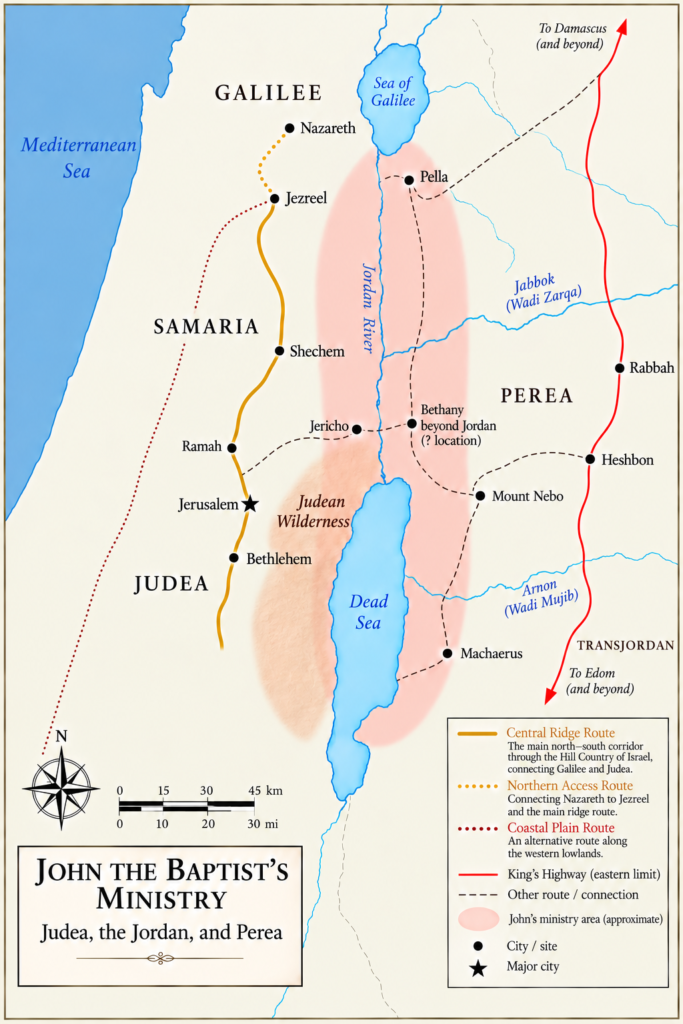
  • John Baptized Jesus

    John’s ministry was to prepare the way for the Messiah. He did this by baptizing those who repented and returned to covenant faithfulness. This devotion looks at what happened when the Messiah showed up for baptism.

    Nuggets

    • The day for the event we are studying in this devotion was when John was being  questioned by Pharisees.
    • By calling Yeshua the Lamb of God, John was pointing toward His eventual sacrifice.
    • Unlike the Paschal Lamb, the sacrifice of the Lamb of God did something about sin.
    • John verified that what he had told them the day before was true because the One he spoke of was there.
    • Jesus’ baptism occurred at the beginning of His ministry.
    • John couldn’t see the need to baptize Yeshua because it was a baptism of repentance.
    • Yeshua set the example because baptism is required – but required for what?
    • The Plan of Salvation was designed to reestablish our access to Jehovah.
    • The Voice was present to show that Jehovah was the One doing the sending, and the dove was present to identify the work of the Holy Spirit.
    • The Jews would have known Israel as Jehovah’s son.
    • John’s account of the baptism was a little different from the other Gospels because it was a testimony, not a first-hand description of the event.

    John’s ministry of preparing Israel for the coming of the Messiah occurred along the Jordan River. He used the river when baptizing those who repented and returned to covenant obedience.

    Imagine John’s surprise when the Messiah came to him for baptism.

    Let’s Put It into Context #1

    To read devotions in The Battle for the Heart theme

    Devotions in the The Ministry of John the Baptist series

    Let’s Put It into Context #2

    Some denominations believe that we must be baptized in order to be saved. Others believe it is among the first acts of obedience of a new believer – important but not essential for salvation.

    In first-century Israel, it was not seen as a requirement to become a Jew. People who were not Jewish by birth became Jewish another way.

    Strugnell helped us understand the meaning of baptism in first-century Israel. He wrote,

    “It was a rite (immersion in running water) that symbolized repentance in preparation for the coming world judgment and was to be accompanied, before and afterward, by a righteous life. It was hardly conceived as a sacrament, in the Christian sense, conveying forgiveness, or as superseding Judaism and marking off a new people, including both Jews and Gentiles, prepared for God’s final kingdom.”

    Resource

    First-century Jews would have seen it as an act of covenant faithfulness.

    John Introduced Jesus

    “John testified about him when he shouted to the crowds, ‘This is the one I was talking about when I said, “Someone is coming after me who is far greater than I am, for he existed long before me”’” (Jn. 1: 15 NLT).

    “The next day John saw Jesus coming toward him and said, ‘Look! The Lamb of God who takes away the sin of the world! He is the one I was talking about when I said, ‘A man is coming after me who is far greater than I am, for he existed long before me” (Jn. 1: 29-30 NLT)

    The Next Day

    The day for the event we are studying in this devotion was when John was being  questioned by Pharisees.

    “John told them, ‘I baptize with water, but right here in the crowd is someone you do not recognize. Though his ministry follows mine, I’m not even worthy to be his slave and untie the straps of his sandal’” (Jn. 1: 26-27 NLT).

    We can assume that John hadn’t known that Yeshua would show up for baptism the next day. If he had, he probably would have said something to the effect, “Someone is coming after me – and He is coming tomorrow.”

    But John didn’t say that.

    That leads us to believe that John knew his mission. He just didn’t know the timing of the plan.

    The Lamb of God

    By calling Yeshua the Lamb of God, John was pointing toward His eventual sacrifice.

    The Complete Jewish Study Bible explained the significance of Lamb of God. It says, “When Yochanan the Immerser speaks of Yeshua as the ‘Lamb of God’ (John 1: 29), he is invoking both the Temple and Pesach [Passover] imagery.”

    Resource

    The Greek word used was amnos (ἀμνός) — lamb, particularly in sacrificial contexts. This was crucial to the sacrificial system Jehovah had instituted.

    The Temple was built around the sacrificial system. It communicated concepts of sin, guilt, holiness, substitution, cleansing, and approaching Jehovah.

    John was very specific about the Lamb. He didn’t say ,kk lamb. He said the Lamb.

    What is the distinction? Many times, when first-century Jews offered a sacrifice, they provided a lamb.

    That wasn’t happening here. Jehovah was providing the Lamb.

    Jehovah had done that before. When He tested Abraham by telling him to sacrifice his son Isaac, He provided the lamb when Abraham had passed the test (Gen. 22: 12-14).

    Jehovah was doing the same thing here – providing the Lamb for sacrifice.

    The Passover lamb was a special lamb, called the Paschal Lamb. It represented deliverance. Its blood was associated with protection from judgment

    The Paschal Lamb was to be without defect, according to Exodus 12.

    Who Takes Away the Sin of the World!

    Unlike the Paschal Lamb, the sacrifice of the Lamb of God did something about sin.

    The Greek word used was airō (αἴρω) — to take up, remove, or carry away. The sacrificial lamb was to provide a way for them to deal with sin and restore the covenant relationship.

    By calling Yeshua the Lamb of God, John was putting Yeshua smack-dab in the middle of the sacrificial framework.

    He Is the One

     John verified that what he had told them the day before was true because the One he spoke of was there.

    There are times when we have to wait for Jehovah’s promises to come true. That day wasn’t one of those times.

    John told his listeners that the Messiah was coming soon. The next day was soon.

    John Baptized Jesus

    “Then Jesus went from Galilee to the Jordan River to be baptized by John. But John tried to talk him out of it. ‘I am the one who needs to be baptized by you,’ he said, ‘so why are you coming to me?’ But Jesus said, ‘It should be done, for we must carry out all that God requires.’ So John agreed to baptize him. After his baptism, as Jesus came up out of the water, the heavens were opened and he saw the Spirit of God descending like a dove and settling on him. And a voice from heaven said, ‘This is my dearly loved Son, who brings me great joy’” (Mt. 3: 13-17 NLT)

    “One day Jesus came from Nazareth in Galilee, and John baptized him in the Jordan River. As Jesus came up out of the water, he saw the heavens splitting apart and the Holy Spirit descending on him like a dove. And a voice from heaven said, “You are my dearly loved Son, and you bring me great joy” (Mk. 1: 9-11 NLT)

    “One day when the crowds were being baptized, Jesus himself was baptized. As he was praying, the heavens opened, and the Holy Spirit, in bodily form, descended on him like a dove. And a voice from heaven said, ‘You are my dearly loved Son, and you bring me great joy’” (Lk. 3: 21-22 NLT)

     Went from Nazareth in Galilee to the Jordan River

    Jesus’ baptism occurred at the beginning of His ministry.

    Mark was a little more specific in his details than Matthew was. He gave us more information as to where Yeshua had been and where he was going

    • “Then Jesus went from Galilee to the Jordan River …” (Mt. 3: 13 NLT).
    • “One day Jesus came from Nazareth in Galilee … baptized in the Jordan River” (Mk. 1: 10 NLT).

    Why is it important to know specifics? Sometimes, it helps put things into context.

    “When Jesus heard that John had been arrested, he left Judea and returned to Galilee. He went first to Nazareth, then left there and moved to Capernaum, beside the Sea of Galilee, in the region of Zebulun and Naphtali” (Mt. 4: 12-13 NLT).

    We know that the baptism was before the temptation (Mt. 4: 1-11). We also know that it was before Yeshua moved His base of operations to Capernaum.

    Why is that important? It reads that the first thing Yeshua did before anything else was to be obedient in baptism.

    John Tried to Talk Him Out of It

    John couldn’t see the need to baptize Yeshua because it was a baptism of repentance.

    Matthew told us that John pushed back against the need of his baptizing Yeshua. He could not see where Someone Who hadn’t sinned needed the baptism of repentance.

    Well, John wasn’t wrong. Yeshua hadn’t sinned.

    But remember, John wasn’t offering a baptism tied to salvation. He was baptizing people to restore covenant faithfulness.

    That is two different things.

    But Yeshua said it emphasized the need to fulfill all righteousness.

    Think about it. Yes, Yeshua came to fulfill covenant promises – but that wasn’t all.

    Yeshua came to be the sacrifice for our sins. He paid the penalty for what happened in the Garden of Eden on down.

    Yeshua didn’t sin, but He took on the capacity to sin when He took human form. If He hadn’t, His sacrifice would have meant nothing.

    John saw Yeshua as the spotless Lamb of God. To him, that meant no baptism was necessary.

    To Yeshua, He was setting the example.

    What God Requires

    Yeshua set the example because baptism is required – but required for what?

    Yeshua told John that baptism is required by Jehovah. But what did He mean?

    This was a way in which Yeshua identified with those He came to save. This was another way in which prophecy was fulfilled.

    “He was counted among the rebels. He bore the sins of many and interceded for rebels” (Isa. 53: 12 NLT).

    We’ve already talked about how Yeshua came in obedience. Yeshua didn’t come down here with a plan of His own.

    The plan being worked was the Plan of Salvation. It was designed totally by Jehovah. He figured out a way to reconcile us to Himself.

    Yeshua agreed to implement the plan.

    But look at it this way. John’s mission was to prepare the way by calling Israel back to obedience to Jehovah.

    Yeshua deliberately submitted to John’s baptism because John was carrying out his assignment from Jehovah.

    Nowhere else in Scripture are we told that John and Yeshua got together for anything. There was no family get-together – remember they were cousins. They didn’t strike out together for Yeshua to preach and John to baptize.

    This was the one time that their ministries collided. Yeshua wasn’t going to bypass Jehovah’s appointed way at the beginning of His ministry.

    Besides, remember what John got to say? “Here is the Guy I was talking about yesterday.”

    Up until this time, there had been no public announcement of Who Yeshua was. Now, He was identified by the man most if not all knew was on a mission from Jehovah.

    But isn’t it more than that? Yeshua said so Himself.

    “Don’t misunderstand why I have come. I did not come to abolish the law of Moses or the writings of the prophets. No, I came to accomplish their purpose:” (Mt. 5: 17 NLT).

    Yeshua wasn’t saying it was about the act. He was saying it was about the submission.

    Isn’t that true? It isn’t about us doing the do’s and not doing the don’ts. It is about our relationship with Jehovah – which is characterized by our submission to Him.

    Before the ministry, miracles, temptation, and the cross, The Lamb of God had to first submit Himself completely to His Father’s Will.

    Heavens Splitting Apart

    The Plan of Salvation was designed to reestablish our access with Jehovah.

    Matthew and Luke said that the heavens opened. The Greek word used was the verb is related to anoigō (ἀνοίγω) – to open, to unlock, or to make accessible.

    Yeshua’s mission was exactly that – to make Jehovah accessible again to His children. It also allowed those who were not yet His children an opportunity to become so.

    Mark gave more of a violent description — “… he saw the heavens splitting apart …” (Mk. 1: 10 NLT). At a minimum, it sounds dramatic.

    The Greek word here was schizō (σχίζω). It means to split, tear, or rend apart.

    But The Complete Jewish Study Bible said it was just that. The being torn apart harkend back to the creation of the universe.

    Resource

    The Hebrew thought behind this was baqaʿ (בָּקַע) – to split, cleave, break open, or tear apart. It is simply more than the opening of something.

    Baqaʿ paints the imagery that something that was closed or separated was forcefully broken  open.

    What first jumped into my mind was the splitting of the veil. “Then Jesus shouted out again, and he released his spirit. At that moment the curtain in the sanctuary of the Temple was torn in two, from top to bottom. The earth shook, rocks split apart, and tombs opened. The bodies of many godly men and women who had died were raised from the dead” (Mt. 27: 50-52 NLT).

    Put all that together. At the beginning of Yeshua’s ministry, Jehovah opened up the opportunity for people to come to believe in Yeshua. It was only at the end of His ministry – when the Lamb had been sacrificed – that the then-current sacrificial system was no longer needed because the Lamb had been sacrificed.

    Jehovah was answering Israel’s prayer. “Oh, that you would burst from the heavens and come down! How the mountains would quake in your presence!” (Isa. 64: 1 NLT).

    More importantly, Jehovah was opening up something that had been closed since the Garden of Eden. He was finally allowing access again to Himself.

    Voice and a Dove

    The Voice was present to show that Jehovah was the One doing the sending, and the dove was present to identify the work of the Holy Spirit.

    A Voice was heard, and a dove descended, meaning all Three of the Trinity were present.

    Matthew presents the words of the voice in the third person. Mark and Luke use the second person. Was it a public declaration or a direct address?

    But it was more than that.

    The Voice from Heaven would have been considered by first-century Jews as divine testimony. Jehovah Himself was weighing in on Who this Person was.

    They would have seen the dove as anointing imagery.

    Think about it. Yeshua submits Himself to Jehovah’s Will, and Jehovah immediately responds.

    And the message was very important.

    This Is My Son

     The Jews would have known Israel as Jehovah’s son.

    “The king proclaims the Lord’s decree: ‘The Lord said to me, “You are my son. Today I have become your Father”’” (Ps. 2: 7 NLT).

    The Israelites were His children. But they missed verse 6. “For the Lord declares, ‘I have placed my chosen king on the throne in Jerusalem, on my holy mountain’” (Ps. 2: 6 NLT).

    They thought this referred to David. In reality, it also referred to David’s Descendant. This was one of the Messianic expectation verses.

    Jehovah made a specific proclamation here – and He was doing it in covenant language.

    In Matthew, Jehovah introduced Yeshua to Israel. In Mark and Luke, He spoke directly to Him.

    In Whom I Delight

    The Complete Jewish Bible has the wording a little different. “then a voice came from heaven, ‘You are my Son, whom I love; I am well pleased with you’” (Mk. 1: 11 CJB).

    This is closer to the Hebrew, in my opinion. This reminds us of what Jehovah said to Abraham. “Take your son, your only son — yes, Isaac, whom you love so much …” (Gen. 22: 2 NLT).

    Your son, your only son, whom you love. My Son, whom I love, with Whom I am pleased.

    “Look at my servant, whom I strengthen. He is my chosen one, who pleases me. I have put my Spirit upon him. He will bring justice to the nations” (Isa. 42: 1 NLT).

    The Holy Spirit came down in the form of a dove and landed upon Him. He  was empowering Yeshua for His mission.

    John Recognized Jesus

    “‘I did not recognize him as the Messiah, but I have been baptizing with water so that he might be revealed to Israel.’ Then John testified, ‘I saw the Holy Spirit descending like a dove from heaven and resting upon him. I didn’t know he was the one, but when God sent me to baptize with water, he told me, “The one on whom you see the Spirit descend and rest is the one who will baptize with the Holy Spirit.” I saw this happen to Jesus, so I testify that he is the Chosen One of God’” (Jn. 1: 31-34 NLT)

    John’s account of the baptism was a little different from the other Gospels because it was a testimony, not a first-hand description of the event.

    Okay. These guys were cousins. Both moms knew from before conception who they would turn out to be.

    Elizabeth didn’t say anything to John?????? Did Yeshua know?

    John was looking to Jehovah to give him a sign. Ooo baby, did He ever!

    Remember, the dove settled on Yeshua. It didn’t just touch down and fly away.

    It came to roost on Him.

    “And the Spirit of the Lord will rest on him — the Spirit of wisdom and understanding, the Spirit of counsel and might, the Spirit of knowledge and the fear of the Lord” (Isa. 11: 2 NLT).

    Even if Mary and Elizabeth had told John what was what, he still needed to hear it from Jehovah. Jehovah had to call him personally to the ministry.

    John could have said, “Sorry. Don’t like the wilderness. Allergic to locust. Who would be caught dead in camel hair?”

    John was human – he could have come up with any number of excuses. He didn’t.

    Making the Connections

    We see Jehovah, Yeshua, and the Holy Spirit working together. Jehovah speaks. The Spirit descends. Yeshua stands.

    Jehovah created the Plan of Salvation. Yeshua implemented it and carried it out. The Holy Spirit works within us to convict us to accept the gift of salvation.

    Heart Check

    Think about the battle Yeshua is engaged in for your heart. Ask yourself the following questions.

    • Am I willing to submit to Jehovah even when I don’t fully understand what He is doing?
    • Do I sometimes focus more on doing the right things than on having a heart that is submitted to Jehovah?
    • When Jehovah asks me to do something, do I look for reasons why I shouldn’t—or do I trust Him enough to obey?
    • Am I willing to follow Jehovah’s appointed way, even when it isn’t the way I would have chosen?
    • What is Jehovah asking me to surrender to Him right now?

    Resource

    How Do We Apply This?

    • Submit before we understand.
    • Don’t confuse obedience with relationship.
    • Respect the assignment Jehovah has given others.
    • Remember that obedience may be preparation for what comes next.
    • Look for Jehovah’s work in the obedience.

    Father God. Above all, You ask us to be obedient to You and submit ourselves to Your Will. Give us clarity so that we may do that. Amen.

    If you don’t understand something and would like further clarification, please contact me.

    If you have not signed up for the email providing the link to the devotions and the newsletter, do so below.

    If God has used this devotion to speak with you, consider sharing it on social media.
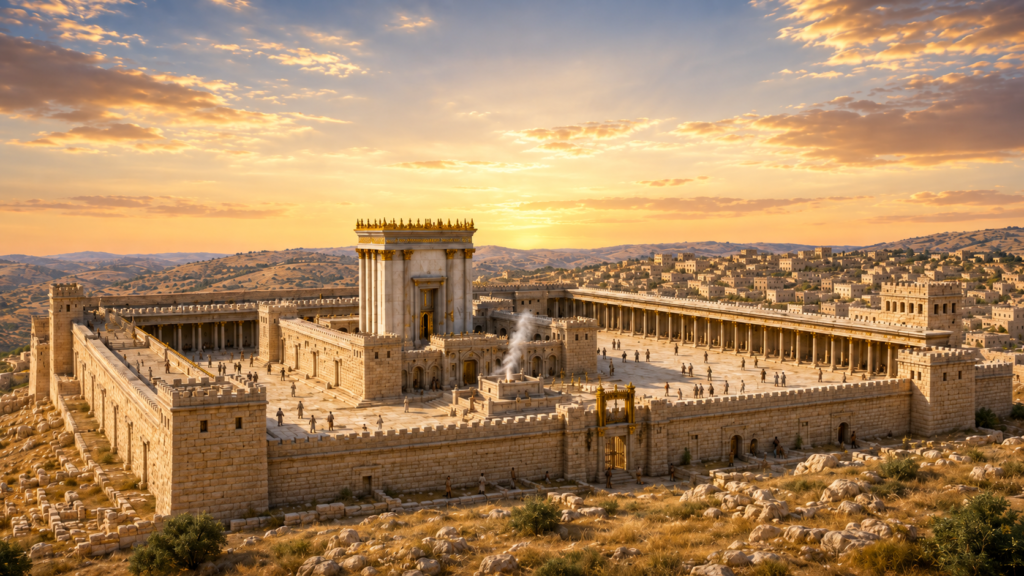
  • Someone Else Is Coming

    John understood his mission. This devotional reading looks at how John knew he was preparing the way for Someone else.

    Nuggets

    • When asking what right did John have to baptize people, the cultural expectation would be that John would provide a name of the rabbi under which he studied.
    • John knew the limitations of his baptism.
    • John was rock solid in his job of preparing the way for the Messiah.
    • In fact, John knew that his position was so far below the Messiah’s that he didn’t consider him worthy enough to be His slave.
    • The spirit signifies renewal, and the fire signifies refinement or destruction.
    • Those who are holy and righteous will be separated from those who are unholy and unrighteous.

    We are lucky. We look at things that already happened. First-century Jews didn’t have that luxury.

    John knew of his mission. Others didn’t.

    That led to John having to explain his mission to others.

    Let’s Put It into Context

    To read devotions in The Battle for the Heart theme

    Devotions in the The Ministry of John the Baptist series

    Someone Else Is Coming

    “I baptize with water those who repent of their sins and turn to God. But someone is coming soon who is greater than I am — so much greater that I’m not worthy even to be his slave and carry his sandals. He will baptize you with the Holy Spirit and with fire. He is ready to separate the chaff from the wheat with his winnowing fork. Then he will clean up the threshing area, gathering the wheat into his barn but burning the chaff with never-ending fire.”” (Mt. 3: 11-12 NLT)

    “John announced: ‘Someone is coming soon who is greater than I am — so much greater that I’m not even worthy to stoop down like a slave and untie the straps of his sandals. I baptize you with water, but he will baptize you with the Holy Spirit!’” (Mk. 1: 7-8 NLT)

    “Everyone was expecting the Messiah to come soon, and they were eager to know whether John might be the Messiah. John answered their questions by saying, ‘I baptize you with water; but someone is coming soon who is greater than I am — so much greater that I’m not even worthy to be his slave and untie the straps of his sandals. He will baptize you with the Holy Spirit and with fire. He is ready to separate the chaff from the wheat with his winnowing fork. Then he will clean up the threshing area, gathering the wheat into his barn but burning the chaff with never-ending fire’ John used many such warnings as he announced the Good News to the people” (Lk. 3: 15-18 NLT)

    “Then the Pharisees who had been sent asked him, ‘If you aren’t the Messiah or Elijah or the Prophet, what right do you have to baptize?’ John told them, ‘I baptize with water, but right here in the crowd is someone you do not recognize. Though his ministry follows mine, I’m not even worthy to be his slave and untie the straps of his sandal.” This encounter took place in Bethany, an area east of the Jordan River, where John was baptizing” (Jn. 1: 24-28 NLT)

    What Right Do You Have to Baptize?

    When asking what right did John have to baptize people, the cultural expectation would be that John would provide a name of the rabbi under which he studied.

    The Pharisees weren’t really asking John why he did what he was doing. They were asking who have him permission – who gave him authority – do baptize.

    Rabbis in first-century Israel taught disciples by interpreting Scripture and tradition. Some rabbis had more authority than others. That authority would carry forward to their students.

    No, we aren’t told that John studied under a rabbi. I would say that was because he didn’t.

    That concept would be foreign to the Pharisees. Why would John be baptizing if no one taught him?

    John answered their question truthfully. “My authority comes from the One Who comes after me. I am preparing the way for the Anointed One – the King Messiah (Melech HaMoshiach – מֶלֶךְ הַמָּשִׁיחַ).

    John’s authority came from Jehovah’s commission. He was “… the voice of someone shouting, ‘Clear the way through the wilderness for the Lord! Make a straight highway through the wasteland for our God’!” (Isa. 40: 3 NLT).

    The Gospel of John hooked this question on to the ones about whether John the Immerser was the Messiah, Elijah, or the prophet of which Moses spoke.

    I Baptize with Water

    John knew the limitations of his baptism.

    Just as John knew what his position was, he understood what his baptism did. He baptized with water. It was an outward expression.

    John knew that it was a symbol of obedience rather than a reception of inward grace.

    Some see baptism as a part of the salvation process – a completion of our asking Jehovah to forgive us of our sins. John wouldn’t have seen it that way.

    John knew he was called to prepare people. He was not completing the work.

    The call John was raising was to turn around their lives and be baptized as an outward expression of that repentance. He knew that the spiritual transformation had to come from the Messiah.

    John knew exactly where his ministry stood. He knew its scope and position in the plan Jehovah was working out.

    Someone Is Coming

    John was rock solid in his job of preparing the way for the Messiah.

    From the time Zechariah and Elizabeth were told were going to have a son, they knew he was called to have a special job in the Kingdom of God. He was going to prepare the way for the promised Messiah.

    John was sure in what he was called to do. We do not see any mention in the gospels that he doubted that calling.

    True, there was one time when John questioned Yeshua to make sure He was the Messiah (Mt. 11: 2-19). Part of those doubts could have been precipitated because of the Messianic expectation that all prisoners would be freed.

    “The Spirit of the Sovereign Lord is upon me, for the Lord has anointed me to bring good news to the poor. He has sent me to comfort the brokenhearted and to proclaim that captives will be released and prisoners will be freed” (Isa. 61: 1 NLT).

    Still, John knew his place within the plan. He was to start the discussion about the appearance of the Messiah. Then he was to back off and let Him have His ministry.

    “He must become greater and greater, and I must become less and less” (Jn. 3: 30-35 NLT).

    Not Worthy Even to be His Slave

    In fact, John knew that his position was so far below the Messiah’s that he didn’t consider him worthy enough to be His slave.

    Servants or usually the lowest slave were assigned to wash a visitor’s feet. They had to take the sandal off first.

    Draw the picture in your mind. The visitor is either standing or sitting. Either way the servant has to basically get on the floor to perform the task.

    This signifies the social significance. The servant was placing himself beneath the person whose feet was being washed.

    Think what John was saying. “I’m not worthy of completing Step 1, let alone Steps, 2, 3, and 4.”

    Yes, John was saying the Messiah was above him. But he was also saying that he was at the absolute bottom of the social hierarchy.

    Baptize You with the Holy Spirit and with Fire

    The spirit signifies renewal, and the fire signifies refinement or destruction.

    The renewal goes back to Ezekiel. “Then I will sprinkle clean water on you, and you will be clean. Your filth will be washed away, and you will no longer worship idols. And I will give you a new heart, and I will put a new spirit in you. I will take out your stony, stubborn heart and give you a tender, responsive heart. And I will put my Spirit in you so that you will follow my decrees and be careful to obey my regulations” (Ezek. 36: 25-27 NLT).

    Maclaren helped us to understand the connection between water and fire. He wrote, “Baptism with the Holy Ghost is not one thing and baptism with fire another, but the former is the reality of which the latter is the symbol.”

    Resource

    .At first glance, we may think this means baptism by immersion – like John did – and the separation at the end of the age. “And anyone whose name was not found recorded in the Book of Life was thrown into the lake of fire” (Rev. 20: 15 NLT).

    But it is more than that, isn’t it? We are refined in the fire. “So be truly glad. There is wonderful joy ahead, even though you must endure many trials for a little while. These trials will show that your faith is genuine. It is being tested as fire tests and purifies gold — though your faith is far more precious than mere gold. So when your faith remains strong through many trials, it will bring you much praise and glory and honor on the day when Jesus Christ is revealed to the whole world” (I Pet. 1: 6-7 NLT).

    Baptism by fire purifies and is part of the sanctification process. We are refined to better reproduce Jehovah’s character in our hearts.

    Sanctification, therefore, is a battle for our hearts.

    The fire also heats our hearts. It increases our enthusiasm.

    We can see how this prophecy was fulfilled on Pentecost. “On the day of Pentecost all the believers were meeting together in one place. Suddenly, there was a sound from heaven like the roaring of a mighty windstorm, and it filled the house where they were sitting. Then, what looked like flames or tongues of fire appeared and settled on each of them. And everyone present was filled with the Holy Spirit and began speaking in other languages, as the Holy Spirit gave them this ability” (Ac. 2: 1-4 NLT).

    Ready to Separate

    Those who are holy and righteous will be separated from those who are unholy and unrighteous.

    From the beginning of creation, Jehovah has been separating those who believe in His with those who don’t believe in Him. He chose Abel over Cain, Isaac over Ishmael, Jacob over Esau, David over his brothers – need we go on?

    Once Yeshua came, this separation became undeniable. We either ask Him to be a Savior and Redeemer – or we don’t.

    “There is salvation in no one else! God has given no other name under heaven by which we must be saved” (Ac. 4: 12 NLT).

    Eventually, there will come a time for judgment ad purification.

    At the end of the age, Yeshua will perform the final separation. “But when the Son of Man comes in his glory, and all the angels with him, then he will sit upon his glorious throne. All the nations will be gathered in his presence, and he will separate the people as a shepherd separates the sheep from the goats. He will place the sheep at his right hand and the goats at his left” (Mt. 25: 31-33 NLT).

    The Threshing Floor, the Winnowing Fork, and the Wheat v. Chaff

    The harvest imagery is classic prophetic judgment language.

    We may think that John was referring to three different things when he was talking about the fork, the floor, and the wheat. He really isn’t. He was talking about one process.

    In first-century Israel, grain of wheat would be cut in the field. It would be brought to the threshing floor.

    The wheat seeds were threshed to loosen them from the stalk and husk. It would then be tossed in the air with the winnowing fork to separate the wheat from the chaff.

    Gathering but Burning

    Once the wheat is separated from the chaff, the wheat is gathered and stored while the chaff is burned.

    If you know anything about wheat harvesting, you know that it is a dusty, messy process – even with machinery. It would have been worse doing it manually with oxen.

    What would have been done with the output? The wheat would have been stored, and the chaff would have been burned.

    Isn’t that a wonderful illustration of what will happen in the final judgment? Believers will live for eternity with Jehovah. Non-believers will be thrown in the lake of fire.

    Making the Connections

    Think about John’s character. Curteis helped us with this.

    • John was faithful and unselfish.
    • He was loyal.
    • He wasn’t afraid to ask for clarification when he doubted.
    • John was quick to rebuke sin.
    • He was humble.

    Resource

    This is the man who said, “I am not worthy to even take the shoes off your feet.”

    Heart Check

    Think about the battle Yeshua is engaged in for your heart. Ask yourself the following questions.

    • Am I willing to let Yeshua become greater in my life while I become less?
    • Have I confused an outward act of obedience with genuine inward transformation?
    • Am I more concerned with my position and importance than with faithfully doing the work Jehovah has given me?

    How Do We Apply This?

    • Know your assignment.
    • Let Yeshua transform your heart. .
    • Welcome the refining fire.
    • Become less so Yeshua can become greater.
    • Stay ready.

    Father God. Thank You for John, who came to prepare the way. Thank You for Yeshua, Who came as Your Light.Amen.

    If you don’t understand something and would like further clarification, please contact me.

    If you have not signed up for the email providing the link to the devotions and the newsletter, do so below.

    If God has used this devotion to speak with you, consider sharing it on social media.
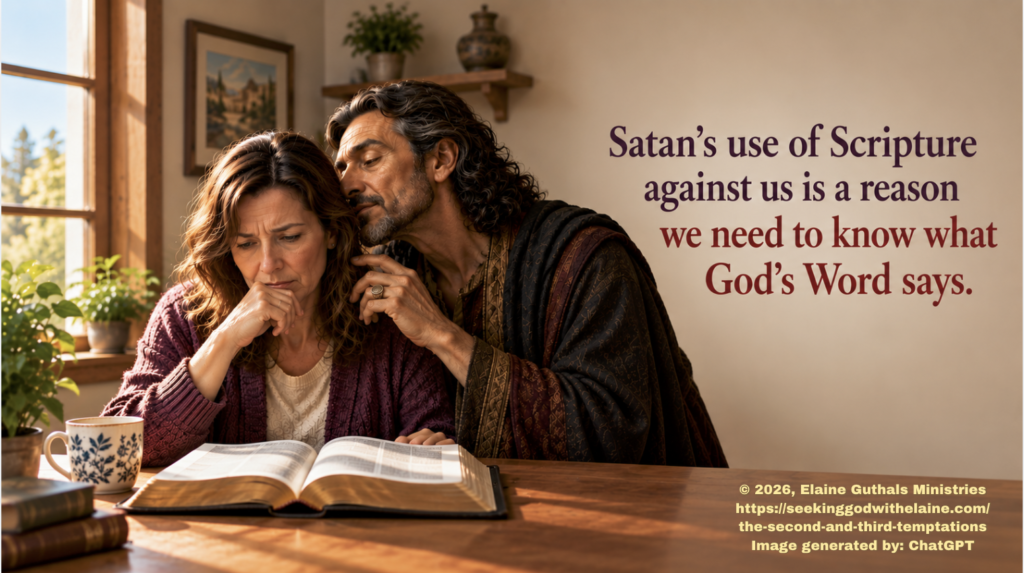
  • Questions from John the Baptist’s Audience

    John taught large audiences in the wilderness. This devotional reading looks at how he responded to some of their questions.

    Nuggets

    • John the Immerser’s testimony was clear.
    • The Jews were looking for a King Messiah (Melech HaMoshiach – מֶלֶךְ הַמָּשִׁיחַ), but not the Messiah that came.
    • Some in John’s audience thought he was the prophet Elijah come back from the dead.
    • John was questioned whether he was the prophet they were to expect.
    • The last thing we should do is read this to mean, “What should we do to be saved?”
    • We see from these verses that a diverse population came to listen to John.

    John interacted with his audience. He wanted to ensure that they understood his message.

    Let’s Put It into Context

    To read devotions in The Battle for the Heart theme

    Devotions in the The Ministry of John the Baptist series

    Identify Yourself

    “This was John’s testimony when the Jewish leaders sent priests and Temple assistants from Jerusalem to ask John, ‘Who are you?’ He came right out and said, ‘I am not the Messiah.’ ‘Well then, who are you?’ they asked. ‘Are you Elijah?’ ‘No,’ he replied. ‘Are you the Prophet we are expecting?’ ‘No.’” (Jn. 1: 19-21 NLT)

    John’s Testimony

    John the Immerser’s testimony was clear.

    The Greek word used for testimony is martyria. Along with testimony, it also means record or witness — as used in John 1: 7-8.
    But the Greek loses the Hebrew flavoring. The Hebrew word is edut (דוּת), meaning testimony, witness, or evidence.

    Think about it. The Ark of the Covenant was frequently called the Testimony. It held the tables containing the Ten Commandments – the ten words – that were a fundamental part of the covenant.

    And here was John, standing on the banks of the Jordan River. John was not only the witness who testified to what Jehovah was about to do; his coming, his message, and his ministry were themselves evidence that the Kingdom of Heaven had drawn near.

    We know that – by John’s words – he was the bridge between Jehovah’s promise and His fulfillment of that promise.

    • Repent: “Repent of your sins and turn to God, for the Kingdom of Heaven is near …” (Mt. 3: 2 NLT).
    • Baptism: “I baptize with water those who repent of their sins and turn to God” (Mt. 3: 11 NLT).
    • Coming Messiah: “… But someone is coming soon who is greater than I am—so much greater that I’m not worthy even to be his slave and carry his sandals. He will baptize you with the Holy Spirit and with fire” (Mt. 3: 11 NLT).
    • Moral living: “… turn to God …” (Mt. 3: 2 NLT).
    • Preparation: “… for the Kingdom of Heaven is near” (Mt. 3: 2 NLT).
    • Humility: “He must become greater and greater, and I must become less and less” (Jn. 3: 30 NLT).

    Who Are You?

    The Jews were looking for a King Messiah (Melech HaMoshiach – מֶלֶךְ הַמָּשִׁיחַ), but not the Messiah that came.

    We have to think about the particulars surrounding John’s ministry. He was the first prophet in 400 years to have a message to give to the nation of Israel. This covenant silence had lasted 400 years.

    It was the message for which many had been waiting and watching. They had been waiting for thousands of years.

    So, it doesn’t mean we should bite on first-century Jews for wanting to make John the Messiah. They had been waiting so long for Messiah to come, and John was telling them it wasn’t him.

    John had the message right. “… ‘Look! The Lamb of God who takes away the sin of the world!’” (Jn. 1: 29 NLT).

    The message John was giving them was the next best thing. “I’m not the Messiah, but He is here now.

    John was the witness that the hour had come for the Messiah – Yeshua – to come.

    Are You Elijah?

    Some in John’s audience thought he was the prophet Elijah come back from the dead.

    We know in the Old Testament that some people were resurrected from the dead. Elijah did it himself (I Kgs. 17: 17-24). But this is talking about reincarnation.

    The Jews of John’s day had good reason to ask the question. It was talked about in the Old Testament, what they knew of as the Tanakh.

    • “‘Look! I am sending my messenger, and he will prepare the way before me. Then the Lord you are seeking will suddenly come to his Temple. The messenger of the covenant, whom you look for so eagerly, is surely coming,’ says the Lord of Heaven’s Armies” (Mal. 3: 1 NLT).
    • “Look, I am sending you the prophet Elijah before the great and dreadful day of the Lord arrives. His preaching will turn the hearts of fathers to their children, and the hearts of children to their fathers. Otherwise I will come and strike the land with a curse” (Mal. 4: 5-6 NLT).

    Well, they got it right, and they got it wrong.

    First-century Jews wouldn’t have believed in reincarnation (but then, the Sadducees didn’t believe in resurrection, either). Besides, like Enoch, Elijah didn’t die (II Kgs. 2: 11).

    They could have been expecting the real Elijah to come back in bodily form from Heaven. John said that wasn’t so.

    I can see why they thought John was Elijah. Their messages were pretty much the same: repent and turn back to Jehovah.

    The two men wore similar attire (II Kgs. 1: 8; Mt. 3: 4). They carried out their mission in the wilderness (Mt. 3: 1).

    What John had done was to come in the spirit of Elijah. “He will be a man with the spirit and power of Elijah. He will prepare the people for the coming of the Lord. He will turn the hearts of the fathers to their children, and he will cause those who are rebellious to accept the wisdom of the godly” (Lk. 1: 17 NLT emphasis added).

    I know. That isn’t exactly what Jesus said.

    • “And from the time John the Baptist began preaching until now, the Kingdom of Heaven has been forcefully advancing, and violent people are attacking it. For before John came, all the prophets and the law of Moses looked forward to this present time. And if you are willing to accept what I say, he is Elijah, the one the prophets said would come” (Mt. 11: 12-14 NLT).
    • “‘But I tell you, Elijah has already come, but he wasn’t recognized, and they chose to abuse him. And in the same way they will also make the Son of Man suffer.’ Then the disciples realized he was talking about John the Baptist” (Mt. 17: 12-13 NLT).

    No, Yeshua did not lie. John was a type of Elijah; however, the audience probably wouldn’t have accepted a no, but because that wasn’t the answer they wanted.

    Besides, Elijah came on the Mount of Transfiguration (Mt. 17: 1-3). But most people — not even all of the Apostles — knew that.

    Are You the Prophet

    John was questioned whether he was the prophet they were to expect.

    Wait! What?? There was someone else besides Elijah that they were expecting????

    Remember, the first-century Jews knew their Torah. They knew what Moses had said.

    “Moses continued, ‘The Lord your God will raise up for you a prophet like me from among your fellow Israelites. You must listen to him’” (Deut. 18: 15 NLT).

    No, Moses didn’t name names – worse luck. He just said someone is going to come.

    The only clue Moses did give was it was going to be someone like him.

    First-century Jews were expecting the Prophet Moses had said Jehovah would raise up — the prophet like Moses. And the New Testament identifies that expectation as ultimately fulfilled in Yeshua.
    “When the people saw him do this miraculous sign, they exclaimed, ‘Surely, he is the Prophet we have been expecting’” (Jn. 6: 14 NLT).
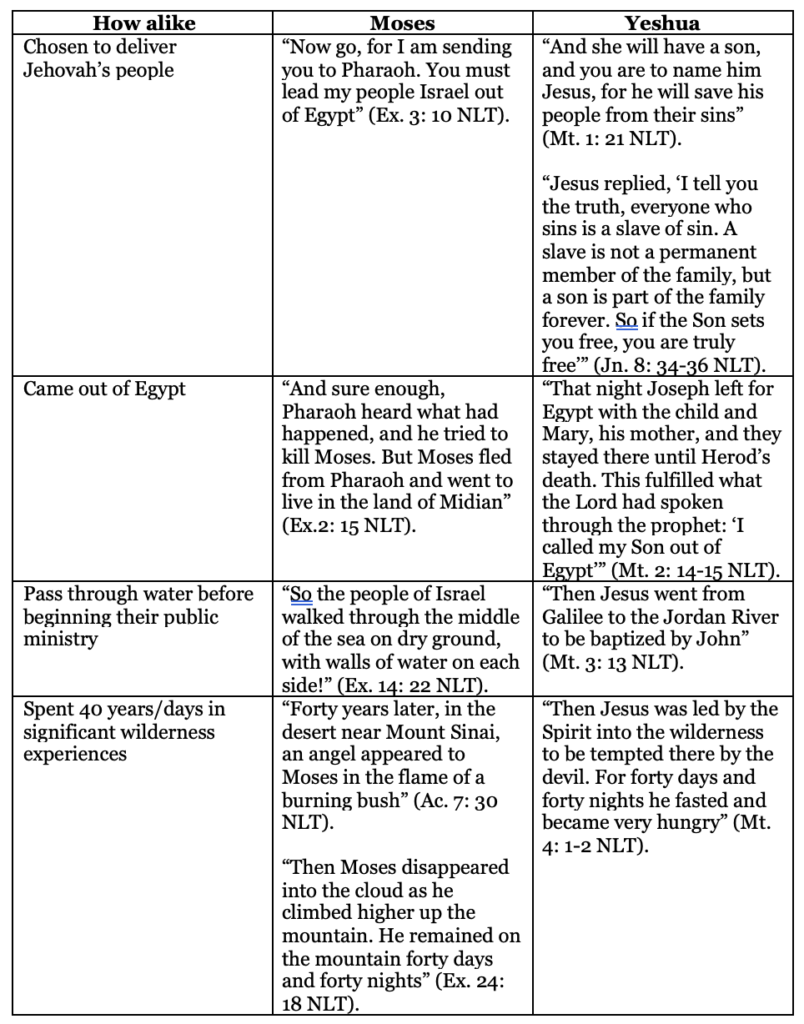
    “Then times of refreshment will come from the presence of the Lord, and he will again send you Jesus, your appointed Messiah. For he must remain in heaven until the time for the final restoration of all things, as God promised long ago through his holy prophets. Moses said, ‘The Lord your God will raise up for you a Prophet like me from among your own people. Listen carefully to everything he tells you.’ Then Moses said, ‘Anyone who will not listen to that Prophet will be completely cut off from God’s people” (Ac. 3: 20-23 NLT).

    In other words, they weren’t looking for some random prophet. They were asking about a specific prophet that Scripture told them to expect.

    They knew their prophecies. They didn’t know what the fulfillment was going to look like.

    Direction to the Crowds

    “The crowds asked, ‘What should we do?’ John replied, ‘If you have two shirts, give one to the poor. If you have food, share it with those who are hungry.’ Even corrupt tax collectors came to be baptized and asked, ‘Teacher, what should we do?’ He replied, ‘Collect no more taxes than the government requires.’ ‘What should we do?’ asked some soldiers. John replied, ‘Don’t extort money or make false accusations. And be content with your pay’” (Lk. 3: 10-14 NLT)

    What Should We Do?

    The last thing we should do is read this to mean, “What should we do to be saved?”

    John didn’t go there. He was talking covenant faithfulness, not salvation. John was talking preparation, not acceptance.

    If You Have

    We see from these verses that a diverse population came to listen to John.

    At first, Luke just mentioned people. Then, he mentioned groups.

    Luke didn’t identify his audience as Jew or Gentile. Instead, he talked about groups: specifically, tax collectors and soldiers.

    So, who exactly was Luke showing us came to John?

    If these soldiers were Roman soldiers, that would mean Gentiles were among John’s audience. That is possible.

    John wouldn’t have been in a building. Anyone walking along could have stopped to listen.

    We can’t, though, just assume these soldiers were Roman, not Jewish.

    Wait! What??? There were Jewish soldiers who jumped ship and went to Rome???

    Well, maybe.

    Let’s think this through. Luke used the word strateuomenoi (στρατευόμενοι). It simply means serving as soldiers or military personnel.

    It doesn’t give any indication of nationality.

    Rome controlled Israel. Would there still be Jewish soldiers? Would Rome have dismantled the army, or would they have merged them with their army?

    We know from historical sources that Herod the Great had Jewish soldiers in his army. He was appointed king by Rome. What kind of soldiers were serving under Herod Antipas, and could they have been Jewish?

    We also have to remember where John was. He was in territory ruled by Herod Antipas.

    Let’s just stop there a second. First-century Jews hated the tax collectors because they considered them traitors.

    How much more would they consider those who could be fighting to free them from opposition but were working for the opposition?

    In truth, we can’t say that all of them were traitors. Some were probably serving because they were forced to do so.

    There were Jews who accommodated Rome, Jews who worked within Herodian administration, Jews who opposed Rome, and Jews whose position was somewhere in between.

    Still, they more than likely would have seen soldiers working for other military units as against Jewish independence.

    Jump to Luke 3: 15 a second. “Everyone was expecting the Messiah to come soon, and they were eager to know whether John might be the Messiah” (Lk 3: 15 NLT). Roman soldiers wouldn’t have been expecting a Jewish Messiah – if that verse is talking about this group of people. We see from these verses that a diverse population came to listen to John.

    It seems like Luke hasn’t combined sermons. He went on saying, “John answered their questions by saying …” (Lk. 3: 16 NLT).

    But that is talking about them asking about John being the Messiah. Luke doesn’t go into that as John did. Matthew and Mark just noted that John prepared the way for Yeshua.

    So, the question becomes: is Luke talking about one sermon or is he using his typical form of narrative summary?

    Does it really matter? We need to focus on the passage and see what we can learn from it.

    Luke gave us three groups of people: ordinary people, tax collectors, and soldiers.

    • John told the crowd that they were to share.
    • He told the tax collectors not to exploit their authority to take more than that to which they were entitled.
    • He told the soldiers not to use their physical power to shake down – diaseiō (διασείω) – someone to frighten them into paying money.

    Looking at this notwithstanding of who he was actually talking to, it looks like John was calling all to turn back to Jehovah regardless of their station in life.

    Making the Connections #1

    There is another connection between John and Elijah. Both were preparing the way for someone greater than themselves.

    We get that with John and Yeshua. We forget about that with Elijah and Elisha.

    The significance of Elisha asking for and receiving doesn’t always sink in. “When they came to the other side, Elijah said to Elisha, ‘Tell me what I can do for you before I am taken away.’ And Elisha replied, ‘Please let me inherit a double share of your spirit and become your successor’” (II Kgs. 2: 9 NLT).

    Elisha was talking about spirit and power, just like was said about John in Luke 1: 17. It was talking about spiritual authority and power to continue Jehovah’s work.

    But John is Elijah, and Yeshua is Elisha when talking about typology/spirit and ministry, not literal identity. “He must become greater and greater, and I must become less and less” (Jn. 3: 30 NLT).

    Making the Connections #2

    Moses said that the prophet would be like him. So, how alike were Moses and Yeshua?

    Moses gave Israel bread from heaven – Yeshua identifies Himself as the true bread from heaven (Jn. 6: 32–35).

    Moses mediated the covenant at Sinai – Yeshua establishes the new covenant (Lk. 22: 20).

    Moses brought God’s instruction to Israel – Yeshua is God’s Word made flesh (Jn. 1: 1–14).

    Moses led Israel toward the Promised Land – Yeshua leads His people into the Kingdom of God.

    John’s audience wasn’t foolish for asking about “the Prophet.” They were reading their Scriptures and looking for the person Moses had said was coming. Their problem wasn’t that they were looking for fulfillment. Their problem was that they had not yet recognized what fulfillment would look like.

    Heart Check

    Think about the battle Yeshua is engaged in for your heart. Ask yourself the following questions.

    • Am I willing to let Jehovah show me what His promises actually look like, even when the fulfillment does not look the way I expected?
    • When Jehovah is doing something in my life, am I looking for Him—or am I looking for Him to do it my way?
    • If John were speaking directly to me today, what would repentance look like in my particular station in life?

    How Do We Apply This?

    • Know what Scripture says, but don’t decide in advance what fulfillment must look like.
    • Don’t become so focused on identifying the messenger that you miss the One being announced.
    • Repentance should change how we live, not merely what we believe.
    • Use whatever authority or position Jehovah has given you to serve rather than exploit others.
    • Ask what faithfulness looks like in the place where Jehovah has put you.
    • Be willing to become smaller when Yeshua must become greater.

    Father God. Thank You for showing us how John responded to his audience. Help us to evaluate ourselves so that we can respond in the way he instructed. Amen.

    If you don’t understand something and would like further clarification, please contact me.

    If you have not signed up for the email providing the link to the devotions and the newsletter, do so below.

    If God has used this devotion to speak with you, consider sharing it on social media.