Mary’s response to Elizabeth was much more than a beautiful song of praise. This devotional reading looks at the covenant themes woven throughout Mary’s song and how they reveal the character of God.
Nuggets
- Mary humbled her soul before the Lord.
- Translating the word as praises loses something important.
- Knowing she would bear the Messiah, Mary’s joy is focused on Jehovah Himself.
- Mary exalted Jehovah with her whole being.
- The soul proclaims Jehovah’s greatness while the spirit delights in His salvation.
- Jehovah chose a lowly teenage girl, not someone who others would think was more appropriate.
- All generations echoes covenant language.
- The Magnificat is all about Mary’s certainty of what Jehovah was doing.
- Mary focused on Jehovah’s might and power.
- Our definition of holy usually includes aspects of being morally pure, sinless, and righteous, but that’s not quite correct.
- Mercy was based on covenant faithfulness.
- If Jehovah is that merciful, why would He want us to fear Him?
- Jehovah’s promises aren’t random – they have a continuity.
The teenager from a small village was in a very unique position. When she was told that she was going to have a Baby Who would be the Son of God, she went to see her relative.
Elizabeth was in a very unique position, also. Although she was beyond childbearing age, she was having a baby herself.
After Elizabeth had blessed Mary, Mary broke into praise for Jehovah. But how she worded it shows us that it was much more than just praise.
It was a covenant acknowledgment.
Let's Put It into Context
To read devotions in The Battle for the Heart theme
Devotions in the Preparing for the Christ Child series
Praise
“Mary responded, ‘Oh, how my soul praises the Lord’” (Lk. 1: 46 NLT)
How My Soul
Mary humbled her soul before the Lord.
The Greek word for soul is psychē (ψυχή), and in Luke 1:46 it translates the Hebrew idea of nephesh (נֶפֶשׁ).
We look at soul as being the immaterial part that goes to Heaven. Not necessarily.
The soul is the whole inner person – the seat of our desires, affections, will, and identity. It is who we are at the deepest level of our being.
In Hebrew thought, humans weren’t divided into body, soul, and spirit as we see it. They were a nephesh – a living being.
Think back to Genesis 2: 7. Jehovah formed our bodies from the dust. But it was an inanimate object until He gave us the breath of live or spirit. This made us a living soul – a nephesh.
Mary is saying all that is within her is declaring Jehovah’s greatness. She acknowledged His absolute supremacy, infinite majesty, and boundless nature.
Jehovah’s covenant faithfulness flows from His goodness. Every first-century Jew would have used the Abrahamic and Davidic covenants as examples of that. His covenant culminated in the promise of the Messiah. That feeds right into Messianic expectations.
That was the Baby Jehovah asked Mary to carry.
Praises the Lord
Translating the word as praises loses something important.
Hmmm. I don’t know if I have ever heard this translated as praises. It usually is magnifies the Lord.
I know. Magnifies isn’t a common word in our vocabulary – unless the form magnifying is used, and it is followed by the word glass.
The Greek word used is megalynō (μεγαλύνω). It means to make great, to magnify, to declare as great, or to exalt.
The key idea is greatness. This is much richer than simple praise.
Mary wasn’t making God greater than He is. Nothing we can do or say can make Him greater – or lessen Who He is.
Mary was proclaiming His greatness with every part of her being. She was taking her figurative glass and showcasing Who He is.
When we understand Jehovah’s greatness, we should be filled with joy.
Worship should come from who we are. Every part of us should exalt Him.
Mary would have seen it as Jehovah reversing her – and other’s – circumstances.
Jehovah would have once again been raising the lowly. Mary would have known the covenant examples of Joseph, Moses, Ruth, David, Esther.
The teenager from the back road village would have been humbled to be added to the list.
Exaltation is not supposed to just be an emotional response. It was about changing positions. It is more than a feeling – it is a conscious choice.
It is easy to see that just as a physical reversal, but that would be looking at it wrong. Jehovah is in the business of working our physical circumstances for the good of His kingdom. “He has brought down princes from their thrones and exalted the humble” (Lk. 1: 52 NLT).
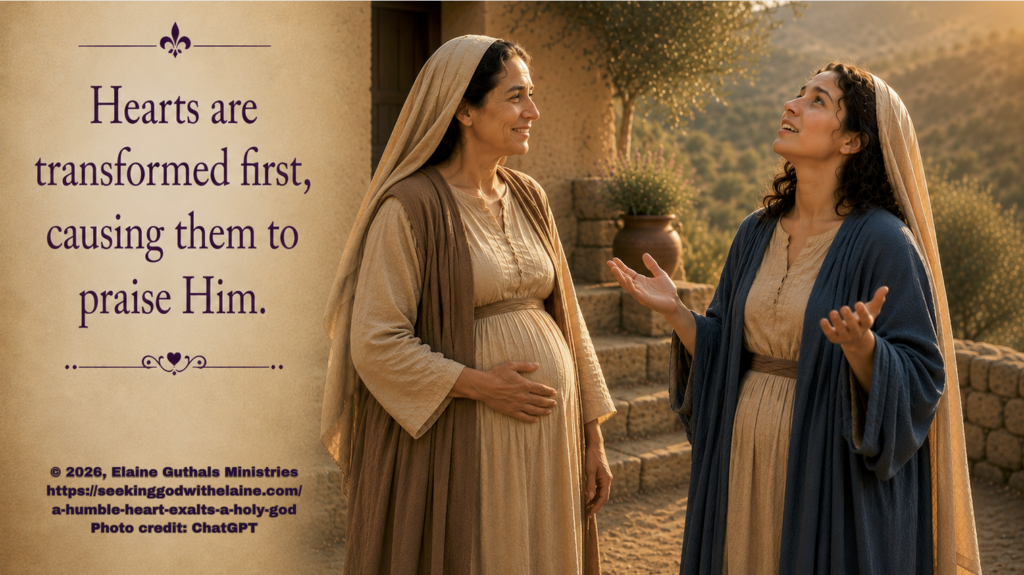
That shows that Jehovah is in the business of transforming our hearts. Hearts are transformed first, causing them to praise Him.
The Lord
Knowing she would bear the Messiah, Mary’s joy is focused on Jehovah Himself.
We can’t gloss over the word Lord because we think we know it. Lord is a replacement for the name YHWH – Jehovah (Ex. 3: 14-15). It means
- the eternal One
- the self-existent One
- the covenant-keeping God
- the God who redeemed Israel from Egypt
- the God who keeps His promises
It is shorthand for Israel’s entire covenant history. Mary would only have had to remember it.
Mary would have known that Jehovah created the heavens and earth so that He could dwell with His people. When sin entered humans, she knew He dwelt with them in the wilderness Tabernacle and then in Solomon’s Temple.
She knew of the second exile – this one to Babylon. Mary knew the nation had deserved the punishment they received. While she knew they were home, she knew that Jehovah didn’t currently dwell with them.
Mary would have been taught of the covenant promises. She would have grown up on stories of Abraham’s call, Isaac’s provision, and Jacob’s wrestling with Him. She well knew that Jehovah gave David of an everlasting kingdom.
Israel’s history would have been present to Mary. She learned how Jehovah had provided during the famine that sent Joseph to Egypt to store grain for its coming. She probably loved the stories of Moses being called at the burning bush. This humble leader had been used by Jehovah to part the Red Sea to bring Israel out of Egypt. Then He gave His law to him.
Mary didn’t elevate herself because of the honor she had received – and didn’t expect others to, either. She wasn’t the focus.
Jehovah is. Yeshua is, too.
But Mary’s response is all about Jehovah.
Mary would have known about the covenant promises through the synagogue, family instruction, memorization, and songs and prayers.
Acknowledging God our Savior
“How my spirit rejoices in God my Savior! ” (Lk. 1: 47 NLT)
My Spirit Rejoices
Mary exalted Jehovah with her whole being.
Verse 47 continued the thought of verse 46 through parallelism. There is overlap rather than separate parts.
The Greek word for spirit is pneuma (πνεῦμα). The Hebrew word is ruach (רוּחַ). The spirit is the part of us that relates to, responds to, and communes with God.

David understood this concept. “Bless the Lord, O my soul, and all that is within me, bless his holy name!” (Ps. 103: 1 ESV emphasis added).
In other words, the two terms are distinct but intimately connected.
God my Savior
The soul proclaims Jehovah’s greatness while the spirit delights in His salvation.
We have to be very careful not to look at “… God my Savior!” (Lk. 1: 47 NLT). We can’t see it through a twentieth-century lens. Mary wasn’t saying, “God is saving me from my sins so I can go to heaven.”
We see salvation as a personal salvation. Mary wouldn’t have.
The Greek word is sōtēr (σωτήρ), which means Savior, Deliverer, or Rescuer. The Hebrew idea behind it is often yasha (ʿיָשַׁע), to save or to deliver. It is the root from which we get Yeshua (Jesus) —Yahweh saves.
Mary would have said it through covenant overtones. In the Old Testament, Jehovah was Israel’s Savior many times.
- delivered Israel from Egypt
- rescued them from their enemies
- preserved them during famine
- restored them from exile
- kept His covenant promises
Mary’s response was saturated in the covenant.
Think of it this way. Mary knew God was fulfilling His promise for a Messiah. Their redemption had begun. Jehovah would once again dwell with His creation.
No, Mary didn’t understand the cross, substitutionary atonement, justification by faith, the inclusion of Gentiles, and the resurrection. Yeshua hadn’t been born yet, and this is the beginning of Luke and the other Gospels.
But look at how things have been revealed so far. Zechariah got the first revelation He told Elizabeth. Mary got the next revelation. Soon, we will dig deeper into Joseph, Simeon, and Anna.
They have a beginning revelation – and they get it (or will) – but it is still incomplete.
Each one of these accepted the revelation as being a true response from Jehovah.
Mary’s Circumstances
“For he took notice of his lowly servant girl, and from now on all generations will call me blessed” (Lk. 1: 48 NLT)
His Lowly Servant Girl
Jehovah chose a lowly teenage girl, not someone who others would think was more appropriate.
Hmmmm. Look at Jehovah’s lowly servant girl.
No, Mary wasn’t trying to pull attention onto herself. She was saying something totally different.
The Greek reads, ἐπέβλεψεν ἐπὶ τὴν ταπείνωσιν τῆς δούλης αὐτοῦ. It literally means He has looked upon the lowliness (or humble estate) of His servant. That is talking about a humble condition or estate. This translated to a lowliness or low social position. At times, it could be translated to mean humiliation or affliction.
It isn’t talking about Mary personally. It is talking about her condition.
Mary was from Nazareth, not Jerusalem. An insignificant village or the holy capital city.
But this teenager from an insignificant village understood more than we sometimes give her credit for. True, she still knows less than we do. But she fully embraced what was given to her.
Mary knew Jehovah had chosen her for something special – something unique. Hers wouldn’t be just another birth.
From that moment on, things would change. She knows that the long-awaited promises were being fulfilled – and that would change the world.
All Generations
All generations echoes covenant language.
That change would mean people in future generations would remember what God had done. We would call her blessed.
More than that, it fulfilled the covenant promise to Abraham. “… All the families on earth will be blessed through you” (Gen. 12: 3 NLT).
Will Call Me Blessed
The Magnificat is all about Mary’s certainty of what Jehovah was doing.
No, Mary wasn’t saying she was great – remember, she was just talking about her lowly estate.
She was focusing on the goodness of Jehovah.
Jehovah’s Holiness
“For the Mighty One is holy, and he has done great things for me” (Lk. 1: 49 NLT)
Mighty One
Mary focused on Jehovah’s might and power.
Jehovah had proved His might throughout the Old Testament. Mary only had to remember Israel’s history.
- “The Lord merely spoke, and the heavens were created. He breathed the word, and all the stars were born” (Ps. 33: 6 NLT).
- “And the Lord said, ‘I will wipe this human race I have created from the face of the earth. Yes, and I will destroy every living thing — all the people, the large animals, the small animals that scurry along the ground, and even the birds of the sky. I am sorry I ever made them’” (Gen. 6: 7 NLT).
- “Is anything too hard for the Lord? I will return about this time next year, and Sarah will have a son” (Gen. 18: 14 NLT).
- “So the people of Israel ate manna for forty years until they arrived at the land where they would settle. They ate manna until they came to the border of the land of Canaan” (Ex. 16: 35 NLT).
- “David replied to the Philistine, ‘You come to me with sword, spear, and javelin, but I come to you in the name of the Lord of Heaven’s Armies — the God of the armies of Israel, whom you have defied. Today the Lord will conquer you, and I will kill you and cut off your head. And then I will give the dead bodies of your men to the birds and wild animals, and the whole world will know that there is a God in Israel!’” (I Sam. 17: 45-46 NLT).
- “In the first year of King Cyrus of Persia, the Lord fulfilled the prophecy he had given through Jeremiah. He stirred the heart of Cyrus to put this proclamation in writing and to send it throughout his kingdom” (Ez. 1: 1 NLT).
But Mary wasn’t focusing on just a list of miracles. She was remembering how Jehovah displayed His power to advance His covenant.
Every mighty act in Israel’s history advanced His covenant purposes. We may not see it at the time, but Mary, looking through history, could see His hand in everything.
The same God who created the world, rescued Israel, overthrew Pharaoh, fed His people, fulfilled His promises to Abraham and Sarah, and preserved us through exile has now acted in a teenager’s life.
Holy
Our definition of holy usually includes aspects of being morally pure, sinless, and righteous, but that’s not quite correct.
That isn’t wrong, but they identify the results of holiness rather than define it.
Mary would have known the Old Testament word for holy: qādôš (קָדוֹשׁ). That shows the concept of separation: to be set apart, to belong to a different category, and to be distinct.
But it isn’t talking morality. It is talking more of separation such as we could find in the Temple.
The Temple didn’t behave any more than the altar, lampstands, priests’ garments behaved. Nothing they did made them holy. The Sabbath by itself wasn’t holy any more than any other day of the week was holy.
Those objects are holy because Jehovah made them holy.
Jehovah is holy because there is nothing else in existence like Him. Mary recognized His attributes. He is uncreated, self-existent, and eternal. He is perfectly righteous, faithful, loving, and just.
But all that brings up a good point. Set apart isn’t the act that makes things – or us – holy. It is utterly unique in His being. Jehovah’s holiness is what He is by nature.
We have to become like Him. “Give the following instructions to the entire community of Israel. You must be holy because I, the Lord your God, am holy” (Lev. 19: 2 NLT).
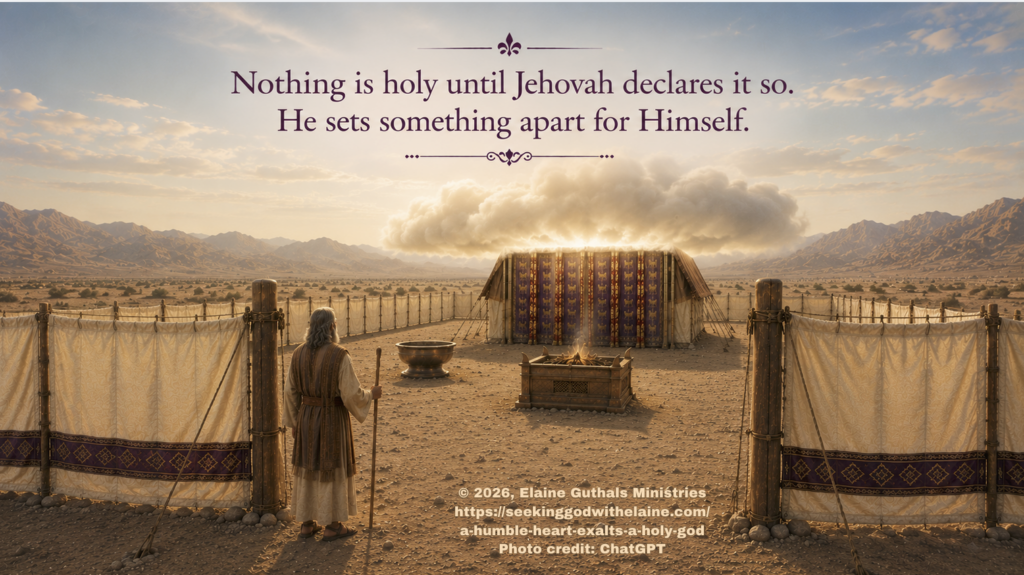
Nothing is holy until Jehovah declares it so. He sets something apart for Himself.
We may look at that and go, “Whoa.” We see the sin in our lives and think He can’t go that for us.
But that is what salvation is about. Being made holy comes through regeneration, sanctification, and justification.
- “he saved us, not because of the righteous things we had done, but because of his mercy. He washed away our sins, giving us a new birth and new life through the Holy Spirit” (Ti. 3: 5).
- “I am writing to God’s church in Corinth, to you who have been called by God to be his own holy people. He made you holy by means of Christ Jesus, just as he did for all people everywhere who call on the name of our Lord Jesus Christ, their Lord and ours” (I Cor. 1: 2).
- “Therefore, since we have been made right in God’s sight by faith, we have peace with God because of what Jesus Christ our Lord has done for us” (Rom. 5: 1).
That is talking heart transformation, isn’t it?
Throughout the Sermon on the Mount – the pathway to salvation – Yeshua wasn’t calling us to different actions to form a checklist. He was calling us to different attitudes – a heart change.
The Beatitudes show us the doorway to salvation and His kingdom. The rest of the sermon shows what the transformed life looks like in everyday life.
A holy life isn’t produced by keeping enough rules. It’s the fruit of a heart being conformed to God’s character. Conduct flows from character.
Jehovah’s Mercy
“He shows mercy from generation to generation to all who fear him” (Lk. 1: 50 NLT)
Mercy
Mercy was based on covenant faithfulness.
The Greek word translated as mercy is eleos (ἔλεος). They do mean mercy, compassion, and kindness.
The Hebrew word means much more than that. The word used – hesed (חֶסֶד) – encompass several of our English words.
- Steadfast love
- Lovingkindness
- Covenant love
- Faithful love
- Mercy
Hesed doesn’t mean that we simply have compassion. It means that love is conveyed through covenant faithfulness.
Applying that here, it means that God wasn’t just feeling sorry for humans. He was acting faithfully because of His covenant character.
Jehovah’s mercy flows from His holiness. He isn’t merciful because He overlooks sin. He is merciful because His holy character is full of covenant faithfulness.
Fear
If Jehovah is that merciful, why would He want us to fear Him?
No, this doesn’t mean that we have to stand there with our knees knocking in terror. It also, doesn’t mean that we don’t obtain His mercy only if we are good enough.
Someone with fear of the Lord is a person who lives in humble faith before Him. We are in awe of Him.
We have the position of the covenant believer.
From Generation to Generation
Jehovah’s promises aren’t random – they have a continuity.
We would probably translate Mary’s thought as saying Jehovah has always been kind. No, it is more than that.
What Mary was saying is that Jehovah has never stopped keeping His promises – and He never will.
Even when Israel was forced into exile, the covenant people knew that Jehovah hasn’t failed in His promises.
True, sometimes today we may think Jehovah has given up on His promises because we don’t see ourselves under His covenant. We would be wrong.
The new covenant secured through Yeshua’s sacrifice is in force today. He still hasn’t stopped keeping His promises.
That throws out our standard definition of mercy. We say that it is Jehovah not giving us what we deserve. It is more than that.
Mercy is God’s compassionate and faithful action toward His people because of His covenant love. It’s not simply pity for the miserable, nor merely withholding deserved judgment. It’s God’s steadfast commitment to act with compassion and undeserved kindness toward those who belong to Him, remaining faithful to His promises generation after generation.
Making the Connections #1
Mary’s humility comes across loud and clear.
Mary considers herself a daughter of Zion.
Making the Connections #2
We think of the Magnificat as a poem or song of worship. It isn’t.
It is an example of faith. This is obvious in the thread running through the Magnificat.
- Lord tells us who God is.
- Savior tells us what He does.
- Mighty One tells us what He is able to do.
- Holy tells us what He is like.
- Mercy tells us how He consistently relates to His covenant people.
Making the Connections #3
Look at all the titles Mary calls Jehovah.
- Lord — the covenant God
- God my Savior — the covenant Deliverer
- His servant — the covenant relationship
- The Mighty One — the covenant Warrior who acts
- Holy is His name — the covenant God’s perfect character
The connecting factor in all of that is the covenant. They aren’t just random titles. They have a history and a purpose.
Each title reveals another facet of Jehovah’s character.
Heart Check
Think about the battle Yeshua is engaged in for your heart. Ask yourself the following questions.
- Do I delight more in God’s gifts than in God Himself?
- When God blesses me, does my praise point others to Him or to me?
- Do I see my life through the lens of God’s covenant faithfulness or only through my present circumstances?
- Am I trying to become holy by my own efforts, or am I allowing God to transform my heart?
- Do I trust that Jehovah is faithfully accomplishing His purposes even when I cannot yet see them?
How Do We Apply This?
- Marvel at who Jehovah is before focusing on what He has done for you.
- Remember His covenant faithfulness when your circumstances tempt you to doubt Him.
- Allow His holiness to transform your heart instead of merely changing your behavior.
- Rest in His mercy, knowing it flows from His faithful character rather than your performance.
- Respond to God’s work with humble worship that points others to Him.
Father God. We praise and worship You in all circumstances. Transform our hearts to make us like You – holy and set apart. Amen.
If you don’t understand something and would like further clarification, please contact me.
If you have not signed up for the email providing the link to the devotions and the newsletter, do so below.
If God has used this devotion to speak with you, consider sharing it on social media.