Category: Witnessing

  • Who Is the Holy Spirit?

    If someone asked you Who the Holy Spirit was, what would you say? This devotion looks at several of the attributes that the Holy Spirit has.

    Nuggets

    • The Holy Spirit is involved in our total being and life, not just the areas in which we need comfort.
    • The Spirit works individually with us — specifically with whatever issues we are dealing with at the time.
    • There are things that the Holy Spirit needs to teach us that aren’t in the Bible.
    • The Holy Spirit is going to interpret Scriptures so that we can understand what God is telling us.
    • One aspect of the peace Jesus was leaving for us was the Helper.
    • The Holy Spirit is a replacement for Jesus.
    • Just because the Holy Spirit is listed last doesn’t mean that He is the weakest One of the Trinity.
    Flowers with title Who Is the Holy Spirit?

    This year, we are looking at self-discipline. We are using Vincent’s The Lesson of Ripeness sermon to look at the need to grow in our relationship with God. We morphed learning enough to be a teacher into determining some areas we need to grow so we can be mature disciples.

    Resource

    Currently, we are looking into solidifying what we believe. When we witness, we need to be prepared to explain what we believe and why we believe it.

    We’re starting to look at the category focusing on the Holy Spirit. The Holy Spirit has an important job to perform. However, many of us feel we know the least about Him.

    Devotions in the What I Believe series

    Devotions in the Holy Spirit category

    Let’s Put It into Context

    I had never heard the term Paraclete before. Well, if I did, I don’t remember. According to the Holman Bible Dictionary, Paraclete is usually translated as advocate or comforter. It carries the concept of coming alongside.

    That is one of the roles that Jesus played for His disciples, but now He was going away. So, they — and we — needed a Paraclete.

    Brown detailed what the Paraclete accomplished:

    • How to approach God.
    • How to pray
    • Defend them
    • Help and instruct them

    The disciples definitely would need a Paraclete. These ordinary men were fixing to change the world.

    But they would face persecution for that. They would need a substitute since Jesus wasn’t going to be there.

    Enter the Holy Spirit. We’ve talked about the Spirit before.

    Glossary

    We know the Holy Spirit is much more than just a comforter or an advocate. In fact, Clemance noted this: “Hence the word comes to mean — one by whose grace and love the entire case and cause of men are undertaken …” The Holy Spirit is involved in our total being and life, not just the areas in which we need comfort.

    Let’s take an overview look at who the Holy Spirit is.

    Helper

    “But the Helper, the Holy Spirit, whom the Father will send in my name, he will teach you all things and bring to your remembrance all that I have said to you” (Jn. 14: 26 ESV)

    When I see the Holy Spirit called the Helper, I usually think that is such a broad, general term. But then I think, good. Life is so complex; we need a broad Helper.

    But I don’t usually see the Holy Spirit as more than a general Helper. The Spirit works individually with us — specifically with whatever issues we are dealing with at the time.

    Dove

    Teacher

    “… he will teach you all things and bring to your remembrance all that I have said to you” (Jn. 14: 26 ESV)

    One of the things the Holy Spirit will help us with is increasing our knowledge. This is a normal step in the sanctification process.

    The Holy Spirit is instructed to teach us about God and His Will for our lives. His Will is that we submit to Him and change our lives so that we imitate Him.

    There are things that the Holy Spirit needs to teach us that aren’t in the Bible. We are just given a glimpse into the character of God in His Word. We need to get specific instructions through the Spirit.

    But that isn’t all of the Spirit’s job. He needs to help us remember.

    Yes, memorization is one of the ways we are supposed to seek God. Many people, though, struggle with that.

    Searching for and Seeking God

    Hearing His Word (Rom. 10: 17).
    Reading His Word (Rev. 1: 3).
    Praying to Him (Heb. 4: 16).
    Studying His Word (Ac. 17: 11).
    Meditating on His Word (Ps. 1: 1-2).
    Memorizing His Word (Ps. 119: 11).

    It is important we remember and that the Holy Spirit helps us to remember. Once we get in the middle of a trial, we need to fall back on those instructions so we remain faithful to God.

    We may or may not get a lot of instructions during the trial. What are we told? Teachers are usually quiet during the test.

    The Holy Spirit may be quiet because He is giving us the room to exercise our free will. We have to consciously choose to make God our Sovereign Lord.

    Staineid Glass Window

    Interpreter

    “This is what we speak, not in words taught us by human wisdom but in words taught by the Spirit, explaining spiritual realities with Spirit-taught words” (I Cor. 2: 13 NIV)

    I wonder how many of us felt our heart race when we read “… explaining spiritual realities with Spirit-taught words” (I Cor. 2: 13 NIV). I know mine did.

    My mind immediately went to, “Spiritual reality is a hard-enough concept to grasp sometimes. And You are going to teach me in something that is not my first language?” Ooo, baby. Good luck with that.

    But there is this one word buried in the sentence: “… explaining …” (I Cor. 2: 13 NIV). He is going to interpret the Scriptures for us.

    In some instances, the Holy Spirit might give us an ah-ha moment. Or an example may come to mind.

    Yes, some Bible verses are confusing and may seem to look like they contradict another verse.

    Look what Spurgeon thought. He wrote, “We can, so far as the letter goes, learn from the Scriptures the words of Jesus for ourselves; but to understand them is the gift of the Spirit of God.”

    The Holy Spirit is going to interpret Scriptures so that we can understand what God is telling us.

    Peace Giver

    “Peace I leave with you; my peace I give you. I do not give to you as the world gives. Do not let your hearts be troubled and do not be afraid” (I Jn. 14: 27 NIV)

    One aspect of the peace Jesus was leaving for us was the Helper. We can find peace in reading a book. Thinking about someone can give us peace. Those work.

    But think about the peace we get when we actually spend time talking with Someone. Being in His Presence gives us the deepest peace.

    What the Holy Spirit teaches us also gives us peace.

    • Our sins are forgiven.
    • God will never leave us.
    • Jesus is preparing for His return to take us home.

    Strengthener and Advocate

    “And I will ask the Father, and he will give you another Advocate, who will never leave you” (Jn. 14: 16 NLT)

    Did you catch that? Back in Who Is Jesus?, we said that Jesus was our Advocate. The Holy Spirit is, also.

    Well, that is logical. Maclaren reminded us that the Holy Spirit is a replacement for Jesus.

    But this Advocate is permanent — unless we evict Him from our hearts.

    As Important as Jesus

    “But in fact, it is best for you that I go away, because if I don’t, the Advocate won’t come. If I do go away, then I will send him to you” (Jn. 16: 7 NLT)

    Sometimes, I think we may have the tendency to look at the Holy Spirit as a second-class citizen of the Trinity. He isn’t.

    To read a related devotion, click the button below.

    Just because the Holy Spirit is listed last doesn’t mean that He is the weakest One of the Trinity. The opposite is the case.

    The Holy Spirit is Jesus’ equal. No, the Spirit cannot save us from our sins.

    Spurgeon put it this way. “Now, all that Jesus was, the Spirit of God is now.” This is logical. The Holy Spirit is to be Jesus’ replacement, the Spirit had to be like Jesus.

    That is why some the attributes we listed for Jesus are good to describe the Holy Spirit. The Spirit has to give through impulses the same level as Jesus did face-to-face.

    Making the Connections

    We have to realize that the Spirit wouldn’t have a mission if Jesus hadn’t completed His. The Spirit’s mission is an extension of Jesus’.

    Jesus may have done the heavy lifting in the plan of salvation by being the One to die on the cross, but the Holy Spirit is in it for the long haul. The Spirit is the One who convicts us and leads us down the road of sanctification.

    To read a related devotion, click the button below.

    But look at it this way. Jesus had The Twelve plus whoever showed up to follow Him for the day. His ministry was limited.

    The Holy Spirit has had to convict every person since then as well as help, teach, advocate, etc. with every disciple since ascension. That has been a lot of people for individual attention!

    Making the Connections to Self-Discipline

    We are also considering what we would say if a non-believer asked us. Here is the worksheet again. What would you tell someone about God forgiving and forgetting sins?

    • What does the Scriptures say?
    • What do I believe?
    • Why do I believe the same/differently than the Scriptures?
    • What are the talking points when witnessing to a non-believer?

    Related Links

    I have created a worksheet of the questions above. Click on the button below to access it.

    How Do We Apply This?

    Titus 3: 5-6 says, “He saved us, not because of works done by us in righteousness, but according to his own mercy, by the washing of regeneration and renewal of the Holy Spirit, whom he poured out on us richly through Jesus Christ our Savior” (ESV emphasis added). We need to follow the promptings of the Holy Spirit. We need to follow His instructions so that we grow in grace and knowledge.

    Did you catch that I didn’t talk about the Spirit being our Comforter? That is going to be the topic of the next devotion.

    Father God. We thank You that sent Your Son to pay the penalty for our sins. We thank You that You sent the Holy Spirit first to convict us and then to guide us. May we grow in grace and knowledge of You. Amen.

    What do you think?

    Leave me a comment below (about this or anything else) or head over to my Facebook group for some interactive discussion.

    If you don’t understand something and would like further clarification, please contact me.

    If you have not signed up for the email daily or weekly providing the link to the devotions and the newsletter, do so below.

    If God has used this devotion to speak with you, consider sharing it on social media.

  • How Do We Believe in Jesus?

    What would you tell someone if they asked you what did they need to believe if they were going to believe in Jesus? This devotion strives to help us witness to others.

    Nuggets

    • We approach Christ as Mediator and Priest when we are searching for salvation.
    • We need to admit that our relationship with God was broken when Adam and Eve chose to disobey God.
    • We need to believe we are in need of a Savior.
    • We need to acknowledge Jesus as our King.

    Devotions in the What I Believe series

    Devotions in the Jesus category

    Flowers with title How Do We Believe in Jesus?

    When I was researching for the two devotions on how we become children of God, I ran across a few sermons discussing how we receive Christ. I thought that might be a good topic to discuss — especially through the lens of witnessing.

    If you are like me, it has been a while since you have invited Jesus into your heart. The process might be a little fuzzy. So, let’s walk through this looking at it to see how we can share with others what we believe. We are going to be using Beveridge’s sermon and Huntington’s sermon to frame our discussion.

    Let’s Put It into Context

    One thing we have to keep in mind when witnessing is the person’s past experience with hearing the gospel. It might be nonexistent.

    Let’s face it. Someone who hasn’t grown up around the church is probably going to look at us funny when we start talking about this dead Guy that came back to life. There will be no prior knowledge for that little nugget to latch onto for learning purposes.

    Keep in mind these two passages.

    • “‘My thoughts are nothing like your thoughts,’ says the LORD. ‘And my ways are far beyond anything you could imagine. For just as the heavens are higher than the earth, so my ways are higher than your ways and my thoughts higher than your thoughts’” (Isa. 55: 8-9 NLT).
    • “Instead, God chose things the world considers foolish in order to shame those who think they are wise. And he chose things that are powerless to shame those who are powerful” (I Cor, 1: 25 NLT).

    God isn’t looking for us to figure everything out. He is looking for faith. Faith is the belief that the doctrines stated in God’s Word are true, even if we do not understand all aspects of them.

    How to Approach Christ

    “Because of Christ and our faith in him, we can now come boldly and confidently into God’s presence” (Eph. 3: 12 NLT)

    Beveridge explained we approach Christ as Mediator and Priest when we are searching for salvation. Jesus is standing in the gap between us and God. He is the One Who has provided salvation for our sins, so it is He who can forgive those sins.

    Salvation is the deliverance from the consequences of sin. Forgiveness is when God pardons us because we have broken His laws and commandments. It is a conscious decision to accept His forgiveness.

    It is comforting to know that Christ will receive us when we genuinely come to Him in faith. “… They will revive them, though they have been deserted for many generations” (Isa. 61: 4 NLT).

    What does it mean to have faith?

    Cross

    What We Are to Believe

    “For God made Christ, who never sinned, to be the offering for our sin, so that we could be made right with God through Christ” (II Cor. 5: 21 NLT)

    The first component in faith is believing the gospel as written. We need to admit that our relationship with God was broken when Adam and Eve chose to disobey God. Since the relationship is broken, it needs fixed. Jesus does that.

    If you have not admitted that your relationship is not right with God,

    have not asked Jesus to be your Lord and Savior,

    and have not confessed your sins,

    please read through the Plan of Salvation and prayerfully consider what God is asking you to do.

    Jesus Can Forgive Us of Our Sins

    “He is the propitiation for our sins, and not for ours only but also for the sins of the whole world” (I Jn. 2: 2 NIV)

    Component #2 is believing we are in need of a Savior. A worldview person might see sin just as doing the don’ts and not doing the do’s.

    In a way, that is true, but in a way it isn’t. Sin, in reality, is when we disobey God and break one of His laws and commandments.

    It is more than just the act or non-act. Yes, obedience means to hear and carry out the instructions that God gives us. But it is also more a mindset.

    Whether we sin or be obedient is a choice of whether or not we are going to give God the position of Sovereign God in our lives. He is Sovereign God with or without us, but we have to choose to submit to Him.

    We have to believe we need Jesus in our lives because we can’t save ourselves. We can’t make ourselves spiritually alive.

    Jesus came to earth as our substitute to atone for our sins. The only way He could do that was to shed His blood.

    Once we make the decision to put Jesus in the Master and King positions, we start giving Him control of our lives. We start living the way He wants us to live.

    The way He wants us to live is the last component: we serve Him. That is where the doing the do’s and not doing the don’ts comes into play. It is where we start doing the job description.

    The Disciple’s Job Description

    Complete Job Description

    It is more than taking care of the physical needs of others. It is proclaiming the gospel and making disciples. It is witnessing to others to expand God’s kingdom.

    Jesus Will Intercede for Us

    “He is the propitiation for our sins, and not for ours only but also for the sins of the whole world” (I Jn. 2: 2 NIV)

    “Who then will condemn us? No one — for Christ Jesus died for us and was raised to life for us, and he is sitting in the place of honor at God’s right hand, pleading for us” (Rom. 8: 34 NLT)

    Once we approach Jesus for salvation, we are to believe that Jesus intercedes for us. He is presenting us to His Father so that God can forgive us of our sins.

    No, I don’t think it is going to be hard to sell God on forgiving us — when we genuinely go to Jesus for salvation. If we aren’t genuine but are just looking for fire insurance, I don’t — in my opinion — think Jesus intercedes for us.

    Acknowledge Our King

    “This means that anyone who belongs to Christ has become a new person. The old life is gone; a new life has begun!” (II Cor. 5: 17 NLT).

    The third component is acknowledging Jesus as our King. Notice the past tense. “… I have been given …” (Mt. 28: 18 NLT).

    Jesus is our King. That isn’t waiting for when He returns. It is now.

    Oh, yes. One day “… every knee shall bow to me, and every tongue shall confess to God” (Rom. 14: 11 ESV).

    When we ask Jesus to be our King, that means we know that, when we continue to sin, God will correct us. “For the LORD disciplines those he loves, and he punishes each one he accepts as his child” (Heb. 12: 6 NLT).

    What Happens Then?

    “This means that anyone who belongs to Christ has become a new person. The old life is gone; a new life has begun!” (II Cor. 5: 17 NLT).

    Then comes all the churchy words: justification, sanctification, regeneration. Add in holiness, righteousness, and godliness.

    But other good things come, too.

    • “Peace I leave with you; my peace I give to you. Not as the world gives do I give to you. Let not your hearts be troubled, neither let them be afraid” (Jn. 14: 27 ESV).
    • “… This day is holy to our Lord. Do not grieve, for the joy of the LORD is your strength” (Neh. 8: 10 NIV).
    • “See what great love the Father has lavished on us, that we should be called children of God! And that is what we are! The reason the world does not know us is that it did not know him” (I Jn. 3: 1 NJ ).
    • “And because we are his children, God has sent the Spirit of his Son into our hearts, prompting us to call out, ‘Abba, Father’” (Gal. 4: 6 NLT).
    Sunrise

    Making the Connections

    It all boils down to faith.

    • Do we believe?
    • Do we live like we believe?

    Making the Connections to Self-Discipline

    We are also considering what we would say if a non-believer asked us. Here is the worksheet again. What would you tell someone about God forgiving and forgetting sins?

    • What does the Scriptures say?
    • What do I believe?
    • Why do I believe the same/differently than the Scriptures?
    • What are the talking points when witnessing to a non-believer?

    Related Links

    I have created a worksheet of the questions above. Click on the button below to access it.

    How Do We Apply This?

    The ABCDs of Salvation

    If you have not become a believer in Christ, please read through the
    Plan of Salvation and prayerfully consider what God is asking you to do.

    A – admit our sins
    B – believe His Son Jesus is our Redeemer
    C – confess God as Sovereign Lord

    D – demonstrate that commitment by making any changes needed in our lives to
    live the way in which God has called us

    The Disciple’s Job Description

    Father. We thank You that Jesus is our Mediator and Intercessor. More than that, He is our Savior and Redeemer. Lord, we put our faith and trust in Him and in You. Help us to share that faith with others. Amen.

    What do you think?

    Leave me a comment below (about this or anything else) or head over to my Facebook group for some interactive discussion.

    If you don’t understand something and would like further clarification, please contact me.

    If you have not signed up for the email daily or weekly providing the link to the devotions and the newsletter, do so below.

    If God has used this devotion to speak with you, consider sharing it on social media.

  • Why Jesus Became a Man

    Why would Jesus, a member of the Trinity, leave heaven to become a man? Not only did Jesus come to live as a Man, but He also died as a Man. This devotion looks at the rest of the story and why Jesus came.

    Nuggets

    • Jesus took on bodily form so that we could see God.
    • If Jesus came so that we could see God, He came to show us how God wanted us to live.
    • God wants to restore His relationship with us — mankind as a whole and individuality.
    • Jesus trampled death.

    Devotions in the What I Believe series

    Devotions in the Jesus category

    Flowers with title Why Jesus Became a Man

    Usually when I pull up research, there is a whole bunch of it. While I tend to look at the whole verse, every once in a while, there is something that kind of sticks out because it doesn’t fit with where the current devotion is heading. However, it is something I want to address in the future.

    So, I stick it in the drafts folder. This is one of those drafts.

    Maclaren’s sermon Some Reasons Why the Word Because Flesh is one that caught my eye. Oh, yeah. If we are seekers, who know all of the reasons that Jesus became our Savior.

    But remember, we are looking at this through the lens of how we tell others what we believe. So, let’s take a look at some things.

    Let’s Put It into Context

    “Instead, he gave up his divine privileges; he took the humble position of a slave and was born as a human being …” (Phil. 2: 7 NLT)

    This verse has always confused me. The translations I usually read say something like, “Instead he emptied himself by assuming the form of a servant, taking on the likeness of humanity” (Phil. 2: 7 CSB).

    If Jesus emptied Himself, how was He still 100% God?

    The “… gave up his divine privileges …” (Phil. 2: 7 NLT) makes it more understandable. But what does that mean?

    It means that the divine attributes of everlasting, sovereign, all powerful, good, holy and righteous, and love, etc. were removed from His being. Oh, yes. Jesus was still holy, righteous, and loving. It was not at divine level.

    Instead, Jesus was like any other newborn babies. The wisdom wasn’t there. The self-sufficiency wasn’t there. The majesty wasn’t there.

    Probably the biggest of the biggies was “He made the one who did not know sin to be sin for us …” (II Cor. 5: 21 CSB). Jesus was given the opportunity to sin — but He didn’t.

    I think Manton summed it up best. He wrote, “He emptied Himself of the Divine glory, not by ceasing to be what He was, but by assuming something He was not before.”

    There are a lot of great verses about what this entailed for Jesus. Some of them are Psalm 113: 6, John 14: 28, Hebrews 2: 7, Psalm 22: 6, Isaiah 53: 3, and Mark 9: 12.

    Sometimes, I think we believe there was this huge tug of war going on within Jesus — His physical nature against His divine nature. Well, there was.

    That is happening in us, too.

    It is so easy for us to say, “Oh, but Jesus didn’t sin because He could withstand because He was divine.” Didn’t work that way.

    If Jesus was supposed to be us, He couldn’t have His divineness on which to “fall back.” He had to be us so we could see us could do it.

    Remember, Jesus was the substitute — the propitiation — so that we could be redeemed. That means He had to be us — body, soul, and spirit.

    Show Us Who God Is

    “Jesus said to him, ‘Have I been among you all this time and you do not know me, Philip? The one who has seen me has seen the Father. How can you say, ‘Show us the Father’?” (Jn. 14: 9 CSB)

    Jesus took on bodily form so that we could see God. We’ve done a whole series on seeing God.

    To read a related devotion, click the appropriate button below.

    I know, we still don’t see God because Jesus lived a couple of thousand years ago. But we didn’t see Abraham Lincoln either. We didn’t see Charles Darwin.

    Oh, we have pictures of them, so we know they lived???

    We don’t see Julius Caesar. Galileo. Socrates.

    Yes, we know them because what has been written about them has survived.

    We know Jesus because what has been written about Him has survived. Through that, we see God.

    It comes down to whether we are going to believe what we read. We have eye-witness accounts. Are we going to choose to believe them?

    Be an Example

    “Then Jesus told his disciples, “If anyone would come after me, let him deny himself and take up his cross and follow me” (Mt. 16: 24 ESV)

    If Jesus came so that we could see God, He came to show us how God wanted us to live. He came to be an example. We are supposed to imitate Jesus.

    Glossary

    To read a devotion in the What Does It Mean series, click on the appropriate button below.

    I love what Maclaren said. He wrote, “Perfect manhood is dependent manhood.” If Jesus hadn’t been a Man, He couldn’t become a perfect man. We can’t be perfect if we do not submit to God. That was Jesus’ example.

    Glossary

    When we think, for the disciple, perfection is holy, sanctified, and righteous, (How Do Disciples Mourn?), we see that, not only do we need to see the example Jesus gives us, but we also need to imitate Him to pull it off.

    Oh, yes. The road to sanctification is hard. Sanctification is the transformation of mind, body, and soul beginning with regeneration and ending with perfected state of spiritual wholeness or completeness. Regeneration is the change in us that God brings about when we go from being spiritually dead to spiritually alive.

    Restore a Our Relationships with God

    “All this is from God, who through Christ reconciled us to himself and gave us the ministry of reconciliation” (II Cor. 5: 18 ESV)

    We get so caught up in God’s laws and commandments. We — and worldview people — get the mistaken notion that we have to 100% perfect in doing all the do’s and not doing any of the don’ts.

    Problem is, we can’t do that. If we were able to follow God’s law, we wouldn’t need a Savior.

    We can’t, so we do.

    That lowers the priority of obedience. No, it doesn’t take it off the table, but we don’t need law obedience for salvation.

    God wants to restore His relationship with us — mankind as a whole and individuality.

    More than that, Jesus wanted to restore our sonship with God. We just had a couple of devotions on that. Only those who have ABCDed are children of God.

    To read a related devotion, click the appropriate button below.

    Trample Sin

    “He will swallow up death forever! The Sovereign LORD will wipe away all tears. He will remove forever all insults and mockery against his land and people. The LORD has spoken!” (Isa. 25: 8 NLT)

    Sin is when we disobey God and break one of His laws and commandments. These laws and commandments not only show us what we have done wrong, but they also show us the character of God. It is an attitude that encourages us to exercise our free will and not follow God.

    When Adam and Eve disobeyed God, they allowed sin into the world.

    To read a related devotion, click on the appropriate button below.

    We’ve talked multiple times about Jesus’ blood provided the atonement that purified us. That satisfied the penalty for our sins.

    Glossary

    But that isn’t the end of the story. Jesus didn’t just bleed out and stay dead.

    “… Then the men asked, ‘Why are you looking among the dead for someone who is alive? He isn’t here! He is risen from the dead! Remember what he told you back in Galilee, that the Son of Man must be betrayed into the hands of sinful men and be crucified, and that he would rise again on the third day” (Lk. 24: 5-7 NLT).

    Jesus trampled death. Still not the end of the story.

    Sometimes, it is easy to think that is only referring to physical death. It isn’t.

    Jesus is more concerned about our spiritual health than our physical health. Remember, death has three prongs:

    • Physical death
    • Separation from God
    • Spiritual death

    Physical death is low priority because this life is short. Eternity is long. Whether we are separated from God or restored to a relationship with Him is paramount. That decides where we spend eternity.

    When Jesus paid the penalty for our sins, He set a sunset date on sin’s hold on us. Only God knows when that date is.

    Making the Connections

    Jesus became man because He chose to become man. Well, if we are supposed to have— and we do have — free will, He had to have a choice, too.

    He chose us.

    God did not force Jesus to be our Savior. He gave his life willingly. “No one can take my life from me. I sacrifice it voluntarily. For I have the authority to lay it down when I want to and also to take it up again. For this is what my Father has commanded” (Jn. 10: 18 NLT).

    He did this for us.

    In order to do this for us, Jesus has to take on our nature. “For verily he took not on him the nature of angels; but he took on him the seed of Abraham” (Heb. 2: 16 KJV).

    Don’t cross your eyes at verily. All the other versions translated took on as help. To me, took on means Jesus got a body that included a sinful nature. The help, to me, reads assist. That is not what happened.

    Jesus is the only One who could restore our relationship with God.

    Making the Connections to Self-Discipline

    We are also considering what we would say if a non-believer asked us. Here is the worksheet again. What would you tell someone about God forgiving and forgetting sins?

    • What does the Scriptures say?
    • What do I believe?
    • Why do I believe the same/differently than the Scriptures?
    • What are the talking points when witnessing to a non-believer?

    Related Links

    I have created a worksheet of the questions above. Click on the button below to access it.

    How Do We Apply This?

    Searching for and Seeking God

    Hearing His Word (Rom. 10: 17).
    Reading His Word (Rev. 1: 3).
    Praying to Him (Heb. 4: 16).
    Studying His Word (Ac. 17: 11).
    Meditating on His Word (Ps. 1: 1-2).
    Memorizing His Word (Ps. 119: 11).

    The ABCDs of Salvation

    If you have not become a believer in Christ, please read through the
    Plan of Salvation and prayerfully consider what God is asking you to do.

    A – admit our sins
    B – believe His Son Jesus is our Redeemer
    C – confess God as Sovereign Lord

    D – demonstrate that commitment by making any changes needed in our lives to
    live the way in which God has called us

    The Disciple’s Job Description

    Gracious Heavenly Father. You asked, and Jesus accepted. You designed a plan of salvation that only Jesus could accomplish. Thank You He loves us so much that He accomplished the plan at great cost to Himself. He became one of us so that He could be our example. Lord, we claim Jesus as our Savior and Redeemer. Amen.

    What do you think?

    Leave me a comment below (about this or anything else) or head over to my Facebook group for some interactive discussion.

    If you don’t understand something and would like further clarification, please contact me.

    If you have not signed up for the email daily or weekly providing the link to the devotions and the newsletter, do so below.

    If God has used this devotion to speak with you, consider sharing it on social media.

  • Jesus, the Good Shepherd

    Jesus called Himself the Good Shepherd. In doing that, He told a lot about Himself. This devotion explores how He described Himself.

    Nuggets

    • There is only one way to gain spiritual life – through Jesus.
    • Salvation is about obeying and submitting to God.
    • The Shepherd laid down His life for His sheep — us — because, well, we’re His sheep.
    • We forget about the Shepherd taking care of the individual sheep.
    • The Jews thought God would just be concerned about them because they were God’s chosen people, but He is concerned about everyone else, too.

    Devotions in the What I Believe series

    Devotions in the Jesus category

    Flowers with title Jesus, the Good Shepherd

    We are generally familiar with Jesus being called Good Shepherd. The 12 verses have a lot packed into them. Let’s take a look before we make all the connections for these three devotions.

    The Gate

    “Jesus said again, “Truly I tell you, I am the gate for the sheep. All who came before me are thieves and robbers, but the sheep didn’t listen to them. I am the gate. If anyone enters by me, he will be saved and will come in and go out and find pasture. A thief comes only to steal and kill and destroy. I have come so that they may have life and have it in abundance” (Jn. 10: 7-10 CSB)

    This wasn’t the only time Jesus used a gate to describe things. “Enter by the narrow gate. For the gate is wide and the way is easy that leads to destruction, and those who enter by it are many. For the gate is narrow and the way is hard that leads to life, and those who find it are few” (Mt. 7: 13-14 ESV).

    But think about it. A gate funnels entrances to a specific location. “Jesus said to [us], ‘I am the way, and the truth, and the life. No one comes to the Father except through me’” (Jn. 14: 6 ESV). There is only one way to gain spiritual life – through Jesus.

    No, we don’t get to choose which way we think would be the best for us. We don’t get to decide which will be the best fit with our lifestyles (that allows us to keep things as closely as possible to what they are).

    Salvation is about obeying God. It is about submitting to Him.

    Mankind messed it up before. Adam and Eve wanted to do thing their way instead of what God told them to do.

    What? Am I supposed to sugarcoat this, so it is more palatable for us to swallow?

    We are getting to the point where we have to take a stand. We have to make a decision because the time to make the decision is going to be over soon.

    So, no. I love you too much to not set it out straight.

    It is really, really important that we find the gate. The consequences of sin will be horrific.

    To read a devotion in the Hell Does Have Fury series, click on the appropriate button below.

    Instead, those who ABCD can look forward to eternal life in heaven. No, the back end of verse 10 is not evidence of a prosperity gospel — at least not here in this life.

    It is talking spiritual life. That is what God is interested in for us.

    The ABCDs of Salvation

    If you have not become a believer in Christ, please read through the
    Plan of Salvation and prayerfully consider what God is asking you to do.

    A – admit our sins
    B – believe His Son Jesus is our Redeemer
    C – confess God as Sovereign Lord

    D – demonstrate that commitment by making any changes needed in our lives to
    live the way in which God has called us

    The Disciple’s Job Description

    Shepherd

    “I am the good shepherd. The good shepherd lays down his life for the sheep. The hired hand, since he is not the shepherd and doesn’t own the sheep, leaves them and runs away when he sees a wolf coming. The wolf then snatches and scatters them. This happens because he is a hired hand and doesn’t care about the sheep” (Jn. 10: 11-13 CSB)

    It is still mind boggling at times that Jesus knew He was coming to die this horrific death — and He came and died anyway. We meant that much to Him.

    But this wasn’t something that Jesus could just have His assistant handle. It wasn’t doing research. It wasn’t setting up the meeting and getting the coffee.

    Jesus’ blood was needed. Only His blood made the perfect sacrifice to make the payment for our sins.

    The Shepherd laid down His life for His sheep — us — because, well, we’re His sheep. No one else would have our interests in mind. No one cares for us more.

    Anyone else would tuck tail and run when the rough spots came. And yes, the wolf (Satan) will come.

    We generally think about shepherds taking care of the whole flock. We forget about the Shepherd taking care of the individual sheep.

    We don’t picture the Shepherd carrying that one sheep around His neck. We forget about the Shepherd leaving the 99.

    To read a related devotion, click the appropriate button below.

    We are really good at scattering. We want to go our own way and not think about what God wants us to do.

    Expansion

    “I am the good shepherd. I know my own, and my own know me, just as the Father knows me, and I know the Father. I lay down my life for the sheep. But I have other sheep that are not from this sheep pen; I must bring them also, and they will listen to my voice. Then there will be one flock, one shepherd. This is why the Father loves me, because I lay down my life so that I may take it up again. No one takes it from me, but I lay it down on my own. I have the right to lay it down, and I have the right to take it up again. I have received this command from my Father” (Jn. 10: 14-18 CSB)

    Jesus went back and expanded on what He had just talked about.

    • Jesus is the Shepherd.
    • Those who come in through the gate are His — regardless where they come from, what they look like, and what they have done.
    • He knows His.
    • He will willingly die for His.
    • Not everyone who is His had come through the gate yet.
    • The sheep have to listen to Him.
    • This was God’s plan that was in place from before the foundation of the world.

    Jesus was such a good Shepherd. He was concerned about all of His sheep.

    The Jews thought God would just be concerned about them because they were God’s chosen people.

    Jesus shot that down. He is concerned about everyone else, too.

    Yes, God is concerned about non-believers, too. If He wasn’t, how would they become believers?

    To read a related devotion, click the button below.

    Don’t read that wrong. God’s love for non-believers will not negate the fact that they have to choose Him. In order to right what became wrong when Adam and Eve chose to disobey, we have to choose to obey. That is the only way we get through the gate.

    Gate

    Making the Connections

    Mediator, advocate, intercessor, physician, elder brother, forerunner, king, master, head, priest, Captain, bridegroom, shepherd.

    Man, Jesus has to be busy being all that for everyone! Plus, depending on the need for the moment, He is multiple things to us.

    I might need a Physician right now because can we say allergies in the spring in the Midwest? How many times a day do I need a Priest? That flips on Intercessor. I should never forget that He is always Master and King. (If I do, I need the Priest again.) But He also is always Elder Brother.

    Oh, yes. Jesus has to be busy — but He is never too busy for us to come to Him. In fact, He welcomes our coming to Him. He is waiting for us to come.

    Making the Connections to Self-Discipline

    We are also considering what we would say if a non-believer asked us. Here is the worksheet again. What would you tell someone about God forgiving and forgetting sins?

    • What does the Scriptures say?
    • What do I believe?
    • Why do I believe the same/differently than the Scriptures?
    • What are the talking points when witnessing to a non-believer?

    Related Links

    I have created a worksheet of the questions above. Click on the button below to access it.

    How Do We Apply This?

    Let’s think about this, too?

    • Which Jesus do you approach the most? (Try ranking them.)
    • Do you consider that good or bad? (Is it good to need the Priest all the time? Maybe if you worship a lot, but what if it is you need a lot of forgiveness?)
    • Is there a Jesus you are neglecting?
    • What do you need to do to become a more mature disciple?

    Related Links

    I have created a worksheet of the questions above. Click on the button below to access it.

    Does it make a difference how we approach Jesus? I would argue yes. We must approach Him as King. If we have to keep approaching Him as Priest, have we really given Him control of our lives?

    When you’ve identified an area that you want to work on (because let’s face it, we can all use some work), seek Him.

    Searching for and Seeking God

    Hearing His Word (Rom. 10: 17).
    Reading His Word (Rev. 1: 3).
    Praying to Him (Heb. 4: 16).
    Studying His Word (Ac. 17: 11).
    Meditating on His Word (Ps. 1: 1-2).
    Memorizing His Word (Ps. 119: 11).

    Here are some resources that you might find helpful.

    Father God. You are all we need. Lord, we know we need Jesus to intercede for us. Without Him, we are not even worthy to approach You. But because of His love and Your love for us — and if acceptance of Him as our Savior — we can. Thank You that Jesus doesn’t always wait for us to intercede for us. May we approach the Priest frequently to confess our sins. May we always, always approach You as King and Master. Amen.

    What do you think?

    Leave me a comment below (about this or anything else) or head over to my Facebook group for some interactive discussion.

    If you don’t understand something and would like further clarification, please contact me.

    If you have not signed up for the email daily or weekly providing the link to the devotions and the newsletter, do so below.

    If God has used this devotion to speak with you, consider sharing it on social media.

    Nuggets

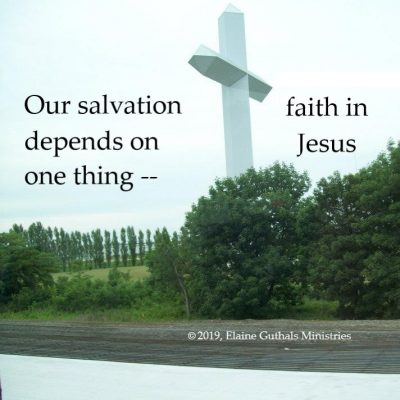
    Cross with words Our salvation depends on one thing -- faith in Jesus

    How Do We Apply This?

    Searching for and Seeking God

    Hearing His Word (Rom. 10: 17).
    Reading His Word (Rev. 1: 3).
    Praying to Him (Heb. 4: 16).
    Studying His Word (Ac. 17: 11).
    Meditating on His Word (Ps. 1: 1-2).
    Memorizing His Word (Ps. 119: 11).

    To read Has God Provided Everything We Need?, click the button below.

    If you have not admitted that your relationship is not right with God,

    have not asked Jesus to be your Lord and Savior,

    and have not confessed your sins,

    please read through the Plan of Salvation and prayerfully consider what God is asking you to do.

    Related Links

    Related Links

    Related Links

    Song

    Related Links

    I have created a worksheet of the questions above. Click on the button below to access it.

    Don’t know what your spiritual gifts are?

    Take this Spiritual Gifts Inventory

    The Disciple’s Job Description

    Complete Job Description

    Individual Description

    It Was Enough
    Vocalist: Elaine Guthals
    Keyboard: Chris Vieth

    What do you think?

    Leave me a comment below (about this or anything else) or head over to my Facebook group for some interactive discussion.

    If you don’t understand something and would like further clarification, please contact me.

    If you have not signed up for the email daily or weekly providing the link to the devotions and the newsletter, do so below.

    If God has used this devotion to speak with you, consider sharing it on social media.

  • Who Is Jesus as God?

    For some, it may be easy to just think of Jesus as a man. However, He was also divine. This devotion looks at Jesus as king, master, and priest along with some others.

    Nuggets

    • God did send Jesus to the earth to accomplish the plan of salvation.
    • Jesus is the authority in our lives.
    • When we imitate Jesus, we are brought up to His level.
    • Jesus’ payment for our sins reconciles us to God and restored our relationships with Him.
    • Jesus became the captain of our salvation through His suffering on the cross.
    • Once we change our addresses after He comes to take us home, Jesus will announce His wedding to His church.

    Devotions in the What I Believe series

    Devotions in the Jesus category

    Flowers with title Who Is Jesus as God?

    We began in the last devotion looking at attributes of Jesus. We looked at those that impact our physical selves. In this devotion, we are going to look at those that prove Jesus’ divine nature.

    King

    “God will bring this about in his own time. He is the blessed and only Sovereign, the King of kings, and the Lord of lords” (I Tim. 6: 15 CSB)

    • Sovereign: ruler of all there is
    • King: person who reigns over his subjects
    • Lord: person who wields power wisely

    If we read First Timothy 6: 13-16, it is kind of confusing Who Paul is actually talking about — God or Jesus. (Well, this is Paul we are talking about!)

    It is talking about Jesus’ return (I Tim. 6: 14). But it also says no one has ever seen Him (I Tim. 6: 16). So, it looks like a toss up as to Whom Paul is really talking about here.

    Wilkinson weighed in with his opinion. He wrote, “Jesus is a King in His own eternal and essential right. He is the Creator of all things; He is the Preserver of all things; He is the sovereign Lord and Proprietor of ell (sic) things. But, then, He is a King in another sense, and it is to that, that allusion is here made.”

    I think it is wrapped up in the Trinity thing. The Three are one, but they are still Three. So, if God is King, They all are.

    To read a related devotion, click the button below.

    But God did send Jesus to the earth to accomplish the plan of salvation. God gave Jesus power as King. He gave Him rule over all things (Ps. 8: 6; I Cor. 15: 27; Eph. 1: 22).

    Yes, Jesus rules over everything — even us. “For you granted him authority over all people that he might give eternal life to all those you have given him” (Jn. 17: 2 NIV). For now, Jesus has set up His kingdom in disciples’ hearts.

    Being a King and a Ruler, Jesus has to be a lot of different things. At times, He has to be the Provider. He has promised all these things to us.

    Sometimes, Jesus has to be the Judge. He has to correct us when we sin.

    But do you read that as I do? “For you granted him authority over all people …” (Jn. 17: 2 NIV). Yes, I know in the end, all will bow to Him (Isa. 45: 23; Rom. 14: 11).

    “For you granted him authority …” (Jn. 17: 2 NIV) is past tense and mean He has the authority now — regardless of ABCD status. It doesn’t make worldview people blessed, but it does mean they are accountable to Him.

    As well as King, Jesus is Master.

    Master

    “Ye call me Master and Lord: and ye say well; for so I am” (Jn. 13: 13 KJV)

    I thought it was interesting that the newer translations do not use master. They use teacher. To me, that totally changes the meaning, but it doesn’t to Scriptures.

    The Holman Bible Dictionary defines master in this way. “Scripture uses master in two basic senses: (1) one in authority and (2) teacher” (Holman Bible Dictionary)

    Well, Jesus was Master and Teacher to the disciples. He was also Friend to them.

    We just can’t forget that Jesus is the authority in our lives. He is Creator of the universe. We talked about the waves responding to Him because they remembered His voice.

    To read a related devotion, click the appropriate button below.

    We shouldn’t bring Jesus down to our level. We need to keep giving Him the reverence He deserves.

    Jesus

    Head

    “And God placed all things under his feet and appointed him to be head over everything for the church” (Eph. 1: 22 NIV)

    Jesus is not only Master of creation, but He is also the Head of the church. We just talked about how everything is placed under His feet. This term extends the expression of His power and authority.

    This verse adds one reason why. “… appointed him to be head over everything for the church” (Eph. 1: 22 NIV emphasis added). There is that little word for.

    Flavel noted that everything was placed under Jesus’ authority for the benefit of the church. He wrote, “It is for the Church, i.e., for the advantage, comfort, and salvation of that; chosen remnant He died for.” It is to increase the security of salvation.

    But look at it this way, and this is something I got from Harrison. The church is to imitate Jesus. So, we are to be holy and righteous. We are to be “… the realization of the highest Divine idea or thought respecting this world” (Harrison).

    When we imitate Jesus, we are brought up to His level. He and God have been planning since before the world was created to redeem the church in this way so our relationships would be restored when we ABCD.

    Since we are imitating Jesus, that strengthens our connection with Him. Part of the reason we can be close to Him is because He has already been close to us. He took on our nature, was born as we are, and lived as we do. He has suffered along side of us.

    High Priest

    “So then, since we have a great High Priest who has entered heaven, Jesus the Son of God, let us hold firmly to what we believe. This High Priest of ours understands our weaknesses, for he faced all of the same testings we do, yet he did not sin” (Heb. 4: 14-15 NLT)

    The High Priest wasn’t just any priest. This was the head honcho in charge of the Temple. While priests served as High Priest because it was a hereditary office, there was more expected from him in terms of holiness.

    It was stated in the Holman Bible Dictionary that “This meant he had to avoid defilement by contact with the dead, even in the case of his own parents and was forbidden to show any outward sign of mourning. He could not leave the sanctuary precincts. Such legislation identified the high priest as one totally dedicated to the Lord, always ritually pure and ready to serve the Lord.”

    Glossary

    But look at what Hughes reminded us what was expected of our High Priest.

    • “Every high priest is a man chosen to represent other people in their dealings with God. He presents their gifts to God and offers sacrifices for their sins” (Heb. 5: 1 NLT emphasis added).
      • Jesus is the Substitute Who bore our punishment.
      • He was the Sacrifice!
    • “He is able to deal gently with those who are ignorant and are going astray, since he is also clothed with weakness” (Heb. 5: 2 CSB emphasis added).
      • Jesus told us He did not come to condemn but to save (Jn. 3: 17).
      • Those who are “… ignorant and are going astray …” (Heb. 5: 2 CSB) are those who have not ABCD. They are ignorant because they do not have knowledge — in this case, knowledge of Him.
      • What it refers to when it says “… clothed with weakness” (Heb. 5: 2 CSB) is that Jesus became 100% man. He came in a body that could die.

    The ABCDs of Salvation

    If you have not become a believer in Christ, please read through the
    Plan of Salvation and prayerfully consider what God is asking you to do.

    A – admit our sins
    B – believe His Son Jesus is our Redeemer
    C – confess God as Sovereign Lord

    D – demonstrate that commitment by making any changes needed in our lives to
    live the way in which God has called us

    The Disciple’s Job Description

    • “And no one can become a high priest simply because he wants such an honor. He must be called by God for this work, just as Aaron was” (Heb. 5: 4  NLT).
      • We talked in the previous devotion that God chose Jesus to fulfill the plan of salvation (Eph. 1: 9).

    To read a related devotion, click the appropriate button below.

    Enter Jesus. He is our High Priest because of His greatness and goodness. His payment for our sins reconciles us to God and restored our relationships with Him.

    More than just our great High Priest, Jesus is the Son of God. Gabriel explained to Mary how that was going to come to be. “The angel replied to her: ‘The Holy Spirit will come upon you, and the power of the Most High will overshadow you. Therefore, the holy one to be born will be called the Son of God’” (Lk. 1: 35 CSB).

    To read a related devotion, click the appropriate button below.

    Take it a step further. Jesus is God. I know. Start talking Trinity, and our eyes cross. For most of us, we are just going to have to take it on faith and choose that we don’t have to fully understand that.

    To read a related devotion, click the appropriate button below.

    But look at it this way. Here is Jesus/God/High Priest who “… understands our weaknesses, for he faced all of the same testings we do, yet he did not sin” (Heb. 4: 15 NLT).

    Here is Jesus as God Who has been through the same testing so that we have. And He remained faithful to God.

    I see you jumping up and down saying Jesus never had to shelter in place. Or had to deal with the internet. Or a bunch of other things we say are unique to our society today.

    That isn’t what it says. It says testings.

    • When put into a situation of temptation, was He/are we going to obey God’s laws and commandments?
    • Was He/Are we going to submit our lives fully to God?

    We could go on.

    It is not important how we are tested. It is very important how we pass the test.

    Look at it this way. My Work Sister said, when she was constructing a test, she had four or five different scenarios to ask the same question. She would pick one to include on the test.

    What she was testing was whether the future health professional/student knew the concept enough to apply it in specific situations. The situation may change, even though the concept stayed the same.

    I think that is what we are talking here. God wants to deal with our character, not just our actions. It isn’t just about doing the do’s and not doing the don’ts. It is about the change in us to be more like Him.

    So, I see the testings being unique to us. I will be tested on pride in a different way from you because we are different people at different points on our walk of faith. But the testing will still be on pride.

    Jesus is the Priest to Whom we can go to ask forgiveness.

    Captain

    “For it became him, for whom are all things, and by whom are all things, in bringing many sons unto glory, to make the captain of their salvation perfect through sufferings” (Heb. 2: 10 KJV)

    This was a new one for me — captain of our salvation. But I do these for me to learn, so let’s learn together.

    Jesus would have been familiar with the term captain because He lived within the Roman Empire. He would see the captain as a leader. By being captain, He was in charge of other people.

    Hutchison reminded us that “as the Captain of salvation, He purchased salvation for His people, and overcame their spiritual enemies.”

    Jesus became the captain of our salvation through His suffering on the cross. That was because He was made perfect. We’ve talked about being made perfect before.

    Glossary

    Being a military term, we can see a Jesus being our captain as we encounter spiritual warfare. Luckily, we know how the wars end up — with Jesus’ victory.

    That is not the only way Jesus leads us. He leads by example.

    Bridegroom

    “Let us be glad, rejoice, and give him glory, because the marriage of the Lamb has come, and his bride has prepared herself” (Rev. 19: 7 CSB)

    On the whole other end of the spectrum, Jesus is also called the Bridegroom. Once we change our addresses after He comes to take us home, Jesus will announce His wedding to His church.

    I am going to be totally transparent here. This is something I know next to nothing about. So, I am going to do more research and revisit it another day.

    We have one more attribute to discuss, but that will have to be in the next devotion. We will look at Jesus as the Shepherd.

    Father God. For Jesus, who is King of kings and Lord of lords, to come down to earth to die for us is mind boggling. That He — and You — would love us so much He would do that is hard for us to understand. But we have faith that His sacrifice paid the penalty for our sins to restore our relationship with You. Thank You. Amen.

    What do you think?

    Leave me a comment below (about this or anything else) or head over to my Facebook group for some interactive discussion.

    If you don’t understand something and would like further clarification, please contact me.

    If you have not signed up for the email daily or weekly providing the link to the devotions and the newsletter, do so below.

    If God has used this devotion to speak with you, consider sharing it on social media.
  • Who Is Jesus?

    We hear a lot of attributes associated with Jesus – mediator, advocate, physician, etc. – but what do those mean? This devotion will look at what those attributes of His character mean for us.

    Nuggets

    • Just as Moses was the mediator of the old covenant, Jesus is a Mediator of the new covenant.
    • The Son of God, the Savior or the world, is going to be concerned enough with us individually to ask God for what we need.
    • Right now, Jesus is at the right hand of God interceding for us.
    • Jesus’ mission was healing the spiritual ills.
    • Jesus isn’t ashamed of us because we became children of God by ABCDing.
    • Jesus is a Forerunner because He is already up in heaven interceding for us.
    Flowers with title Who Is Jesus?

    This year, we are looking at self-discipline. We are using Vincent’s The Lesson of Ripeness sermon to look at the need to grow in our relationship with God. We morphed learning enough to be a teacher into determining some areas we need to grow so we can be mature disciples.

    Resource

    Currently, we are looking into solidifying what we believe. When we witness, we need to be prepared to explain what we believe and why we believe it.

    We’re starting to look at the category focusing on Jesus. It is going to take a couple of devotions to look at Who He is. Let’s take a look at a list of names associated with Jesus – mediator, advocate, physician, etc.

    Devotions in the What I Believe series

    Devotions in the Jesus category

    Mediator

    “Therefore, he is the mediator of a new covenant, so that those who are called might receive the promise of the eternal inheritance, because a death has taken place for redemption from the transgressions committed under the first covenant.” (Heb. 9: 15 CSB)

    Just as Moses was the mediator of the old covenant, Jesus is a Mediator of the new covenant. A mediator, according to the Holman Bible Dictionary, is “a person midway between two parties who establishes an agreement or relationship between the parties and may act as a guarantor of that relationship.” I see it as kind of a manager to take care of making sure the agreement is moving along as it should.

    One of the differences between the two is Moses was talking to the nation of Israel. Jesus comes to us individually.

    Another difference is Moses was presenting the law to the people. The law pointed to Jesus, showing us our need for a Savior because we can’t do all the do’s and not do all the don’ts.

    Jesus, on the other hand, wanted us to be in position to “… receive the promise of the eternal inheritance …” (Heb. 9: 15 CSB). Where the law couldn’t save us, Jesus could, changing us from spiritually dead to spiritually alive. That provides us the assurance that, when this life is over, we will spent eternity with Him.

    Talk about being in a leadership position! Jesus is this important Dude but is concerned with all the little guys — us.

    To read a related devotion, click the button below.

    It is really obvious these days that we need a Mediator. We also need an Advocate.

    Advocate

    “And I will ask the Father, and he will give you another advocate to help you and be with you forever” (Jn. 14: 16 NIV)

    I love how this verse starts out. “And I will ask the Father …” (Jn. 14: 16 NIV). Was the Holy Spirit as our Guide Jesus’ idea? Had He and God figured this out when God came to Him with the plan, and now, Jesus is just telling God it is time?

    Either way, this verse shows us that Jesus will ask for us and speak for us. He is still asking for us and speaking for us.

    Yes, the Son of God, the Savior or the world, is going to be concerned enough with us individually to ask God for what we need.

    It is going to be in God’s Will, or Jesus wouldn’t be doing the asking. Since it is in God’s Will, it will be given to us.

    Oh, yes. I do see that as two different things. In this instance, I see Him going to God and saying, “My friends and siblings are going to need help after I am gone. Can we sent the Holy Spirit as a guide after they ABCD.”

    The ABCDs of Salvation

    If you have not become a believer in Christ, please read through the
    Plan of Salvation and prayerfully consider what God is asking you to do.

    A – admit our sins
    B – believe His Son Jesus is our Redeemer
    C – confess God as Sovereign Lord

    D – demonstrate that commitment by making any changes needed in our lives to
    live the way in which God has called us

    The Disciple’s Job Description

    I can also see Jesus going to God and saying, “I am really concerned with Elaine having to do 100 meetings a month. She is going to wear herself out if this keeps up much longer. I am going to arrange it so she can put the devotions she writes online. That will help her, and it will also help Tom and Sally.”

    We also have to put this verse into context. The is one of the things Jesus told the disciples after He had washed their feet at the last Passover meal. So, He not only is saying goodbye, but He is also preparing them for life without Him.

    How caring is that? Jesus knew He was facing this horrific death, but He is thinking about the disciples — and us!

    I don’t see this being interpreted as God doesn’t care for us, so Jesus has to step up. I see this as a demonstration of how we are supposed to go to God to ask for things. Yes, He probably already has things written into the plan, but we are expected to ask anyway.

    Intercessor

    “Who is to condemn? Christ Jesus is the one who died—more than that, who was raised — who is at the right hand of God, who indeed is interceding for us.” (Rom. 8: 34 ESV)

    Right now, Jesus is at the right hand of God interceding for us. Remember we said He was the Mediator — or manager — of the established agreement? This refers to the acts that He has to do to keep the agreement rolling.

    Sometimes, Jesus (as Manager) has to step into a situation (intercede) and fight (advocate) for us. Other times, He approaches God and advocates.

    What Jesus is doing is trying to get us all on the same page. “My little children, I am writing these things to you so that you may not sin. But if anyone does sin, we have an advocate with the Father, Jesus Christ the righteous” (I Jn. 2: 1 ESV).

    Now, don’t read this as Jesus is trying to get us out of trouble for sinning. What I see Jesus doing here is advocating for us so we can grow. See, what Jesus is trying to do here is to bring us closer to a God, not Him closer to us.

    I see what Jesus is doing as discussing with God where we are at on our roads to sanctification. How is what we are doing affecting our sanctification? What do we we need to work on next? What corrections for sins we’ve committed do we need to help us grow?

    Hubbard believed that Jesus collects the “prayers of the saints on earth, to commend and present them to God, and to secure acceptance for them (1 Peter 1:5; Revelation 8:3; Hebrews 4:14-16; Hebrews 10:21, 22; Hebrews 13:15; Colossians 3:17).”

    Why does Jesus intercede for us? Ferme believed it was based on atonement.

    Well, atonement is about repayment for a wrong. Since Jesus has made the repayment, He has a vested interest in us.

    Where is Jesus at? Paul said that He was “… at the right hand of God …” (Rom. 8: 34 ESV). He is in a place of honor. He has constant access to God so that He is always available when He needs to intercede for us.

    But remember, God and Jesus aren’t as concerned about this world and life as we are. I bet Jesus is interceding that He be able to bring us home. As the song says, He doesn’t want heaven without us.

    What a Beautiful Name
    Vocalist: Elaine Guthals
    Pianist: Chris Vieth

    Physician

    “Jesus answered them, ‘Healthy people don’t need a doctor — sick people do’” (Lk. 5: 31 NLT)

    Yes, Jesus is known as the Great Physician. I wonder if He ever winces at that nickname.

    I know Jesus healed a lot of people in the three years of His ministry. I know that — and the free food — is what drew a lot of people.

    That wasn’t what Jesus was about. Remember? We talked about it once.

    To read a related devotion, click the appropriate button below.

    Remember, Jesus called the crowd out for coming to hear Him just because they wanted to be fed (Jn. 6: 22-59). Don’t we do that?

    We focus on this world, thinking God is going to fix all that is broken in our lives. We don’t always hear Jesus’ words to us because we are either focusing on physical issues or coming to him for ulterior motives.

    Jesus was okay with healing the physical — but He never fixed the world. There was poor people when He came — and when He ascended to heaven. He wasn’t a Social Savior.

    Jesus’ mission, though, was healing the spiritual ills. Adeney wrote, “Christ is most concerned with those who need Him most.” He will always remain our spiritual Redeemer and Savior.

    And Jesus is a dedicated Physician. We are promised that, if we seek God, we will find Him.

    Elder Brother

    “So now Jesus and the ones he makes holy have the same Father. That is why Jesus is not ashamed to call them his brothers and sisters” (Heb. 2: 11 NLT)

    Here is Jesus. Son of God. Savior. Redeemer.

    Our Brother.

    Jesus wants to call us brothers and sister. We mean that much to Him.

    Ooo, baby. Is Jesus going to think of me as the poor relation? I know I am going to mess up and embarrass Him.

    No, we don’t have to worry. Jesus loves us. He will love us as we are. He will love us through our sins — as long as we fear Him. Fear of the Lord means love and revere Him.

    Look at why Jesus isn’t ashamed of us. “So now Jesus and the ones he makes holy have the same Father. That is why Jesus is not ashamed to call them his brothers and sisters” (Heb. 2: 11 NLT emphasis added).

    Jesus isn’t ashamed of us because we became children of God by ABCDing. If we are children of God, we are His brothers and sisters.

    To read a related devotion, click on the appropriate button below.

    Forerunner

    “where our forerunner, Jesus, has entered on our behalf. He has become a high priest forever, in the order of Melchizedek” (Heb. 6: 20 NLT)

    Because I didn’t put Hebrews 6: 19 as the verse, we missed that the writer of Hebrews is talking about Jesus going to heaven as a forerunner. He is already up in heaven interceding for us.

    This goes along with John 14: 2. “My Father’s house has many rooms; if that were not so, would I have told you that I am going there to prepare a place for you?” (Jn. 14: 2 NIV).

    Pastor Chad preached on this Sunday. Yeah, Jesus was a carpenter, but he wasn’t talking about breaking out hammer and nails to physically build a mansion for us. Pastor Chad said, “Heaven was already ready for us. It was the going that mattered. It was His death on the cross and His resurrection that prepared for us to be in heaven with him.”

    In the next devotion, we will look at the remaining attributes associated with Jesus.

    Father God. Because of Your love, You sent Jesus to pay the price for our sins. Thank You. Help us to grow closer to You. Amen.

    What do you think?

    Leave me a comment below (about this or anything else) or head over to my Facebook group for some interactive discussion.

    If you don’t understand something and would like further clarification, please contact me.

    If you have not signed up for the email daily or weekly providing the link to the devotions and the newsletter, do so below.

    If God has used this devotion to speak with you, consider sharing it on social media.

  • Does God Really Forgive and Forget Sin?

    We generally buy into the fact that God forgives our sins. It is harder to believe that God forgets them. This devotions looks at if and why God forgives and forgets.

    Nuggets

    • God will forgive our sins if we confess them to Him as Sovereign God.
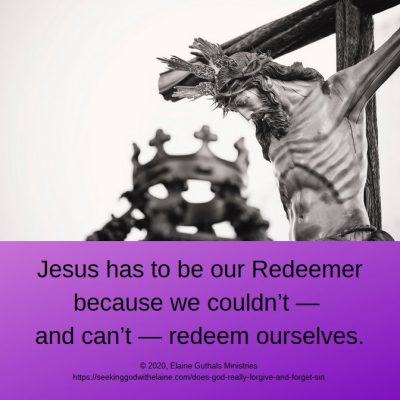
    • Jesus has to be our Redeemer because we couldn’t — and can’t — redeem ourselves.
    • God does not withdraw the results of sin – poverty, crime, disease, death just to name a few – after we are forgiven.
    • Mercy doesn’t negate or dilute God’s laws and commandments.
    • God has forgiven us and forgotten about our sins, but we haven’t forgiven ourselves.
    • We don’t have to feel guilty once we have asked God’s forgiveness.

    Devotions in the What I Believe series

    Devotions in the God category

    Flowers with title Does God Really Forgive and Forget Sin?

    We generally bite on ourselves for our sins. We know God forgives us, but can we really believe that He forgets our sins?

    We don’t. Why would He?

    Let’s Put It into Context

    “Keep your servant from deliberate sins! Don’t let them control me. Then I will be free of guilt and innocent of great sin” (Ps. 19: 13 NLT)

    Sin is when we disobey God and break one of His laws and commandments. It is an attitude that encourages us to exercise our free will and not follow God. Temptation is that period of time between conception and execution of doing what is sinful.

    When we sin, we need to repent. Repentance is expressing sorrow for breaking God’s laws and commandments. But it is not just feeling sorry for doing those things. It is making the commitment to changing ourselves through obedience so that we no longer do the wrong things. Obedience means to hear and carry out the instructions that God gives us.

    Grace is a free and unmerited gift from Heavenly Father given through His Son, Jesus Christ that enables salvation and spiritual healing to believers. Because of God’s infinite grace, He devised the plan of salvation that made Jesus our Redeemer in order to forgive us of our sins.

    Forgiveness is when God pardons us because we have broken His laws and commandments. We accept the pardon by letting go of the guilt and remorse that we feel because we have done something wrong. It is a conscious decision to accept His forgiveness.

    This pardon brings us salvation. Salvation is the deliverance from the consequences of sin. This deliverance is necessitated by the original sin committed by Adam and Eve in the Garden of Eden, which made everyone sinners.

    To read a related devotion, click on the appropriate button below.

    God Forgives Sin

    “If we confess our sins, he is faithful and just to forgive us our sins and to cleanse us from all unrighteousness” (I Jn. 1: 9 ESV)

    The Holman Bible Dictionary defines forgiveness as “an act of God’s grace to forget forever and not hold people of faith accountable for sins they confess … it is, first of all, the gracious act of God by which believers are put into a right relationship to God and transferred from spiritual death to spiritual life through the sacrifice of Jesus.”

    Look what First John 1: 9 says. “If we confess our sins …” (I Jn. 1: 9 ESV). God will forgive our sins if we confess them to Him as Sovereign God.

    Not if we clean ourselves up first. Not if we are good, kind people.

    To read a related devotion, click the button below.

    How else do we know this? “But God showed his great love for us by sending Christ to die for us while we were still sinners” (Rom. 5: 8 NLT).

    While we were still disobeying God and breaking His laws and commandments, God Sent His Son Jesus to be the Redeemer of mankind. Jesus was born of a virgin, making Him 100% God and 100% man. He gave His life on the cross for us so that His blood could pay the price for our sins. Because of God’s great might and power, Jesus rose from the grave, conquering death and paying the price for our sins.

    That brings up another point. Jesus has to be our Redeemer because we couldn’t — and can’t — redeem ourselves.

    Jesus

    We are redeemed because of Jesus’ blood. We’ve talked about the blood before.

    • Atonement is all about the blood.
    • Jesus’ blood provided the atonement – not the obedience, not the sacrifice – the blood.
    • Jesus’ blood purifies us so that we can be forgiven (Heb. 9: 22).
    • Since Jesus’ blood purifies us, it is nothing we do or don’t do – we can’t work or earn our way into heaven.

    To read a related devotion, click the appropriate button below.

    According to the Holman Bible Dictionary, expiation “emphasizes the removal of guilt through a payment of the penalty, while propitiation emphasizes the appeasement or averting of God’s wrath and justice.” If expiation is the act of atonement, the act was dying on the cross. To die, Jesus had to shed His blood.

    The removal of the sin (and guilt) makes us clean. Cleanness in the Bible refers to disciples being holy and pure. This was the original state where Adam and Eve were before the original sin. Through grace, we can again be pure – body, thoughts, and desires.

    God know our hearts are not pure because we still have sin in our lives. Human nature is not clean. Our hearts will always be wicked (sinful) because of our human nature (Jer. 17: 9) – unless ask God in our hearts to purify us. Only God can remove the sin in our lives.

    God’s notion is that purity comes from the heart. It is more who we are – our character – than what we do. It is where Jesus and the Holy Spirit live within us.

    Now, don’t think that just because God forgives us, He automatically removes the consequences of sin — spiritual death and separation from God.

    God does not withdraw the results of sin – poverty, crime, disease, death just to name a few – after we are forgiven. We are going to have to deal with those until Jesus comes back for us. We’re not going to escape the punishment.

    To read a related devotion, click the appropriate button below.

    Mercy Comes into Play

    “He has not dealt with us as our sins deserve or repaid us according to our iniquities” (Ps. 103: 10 CSB)

    Mercy is the unexpected way God responds in love to our needs. Spencer stated that it “… is the intervention of gratuitous goodness. It is benevolence, bending in pity and compassion over the very creature, whose guiltiness has deserved the everlasting abandonment of Heaven.”

    Mercy doesn’t negate or dilute God’s laws and commandments. It does not give us license to go on sinning after conversion. It does not mean there will be no penalties of sin when we do sin.

    It means that God didn’t judge us to the extent He could have. Cross called it more of a delay of punishment.

    God could have kept the consequences to sin in place. We could still be spiritually dead. We could still be separated from Him.

    Instead, God says, “I know Tom, Sally, and Elaine — and all the other humans — deserve to die because they have sinned. I love them too much to see that. So — if they say they are sorry and will submit to Me — I won’t make them suffer the consequences of their sins.”

    We are not entitled to this mercy. We do not deserve it.

    We are guilty.

    What mercies does God give us? Brown gave us a list.

    • “health
    • “food
    • “clothing
    • “home
    • “friends
    • “Bible
    • “Sabbath
    • “sanctuary
    • “means of grace
    • “hope of glory”

    God Forgets Sin

    “For I will forgive their wrongdoing, and I will never again remember their sins” (Heb. 8: 12 CSB)

    Look what else the Holman Bible Dictionary said in its definition of forgiveness. They wrote, “It is also, in this divine dimension, the ongoing gift of God without which our lives as Christians would be ‘out of joint’ and full of guilt.”

    We don’t have to feel guilty once we have asked God’s forgiveness. But that is hard to do, sometimes, isn’t it? God has forgiven us and forgotten about our sins, but we haven’t forgiven ourselves.

    Spurgeon wrote, “Even when sin is forgiven, the memory of it often makes a man go softly all his days. It is therefore a very blessed thought on the part of our God to make the covenant to bear so much ripen our sin and our sinfulness, and especially to make it open with this unconditional promise of infinite love, ‘Then will I sprinkle clean water upon you,’ etc.”

    Remember in Hell Does Have Fury, we said we may have memory on steroids in the eternal life. Things we can’t remember now will be remembered then. Memory is forever.

    To read a related devotion, click the appropriate button below.

    Smyth reminded us that “the record of our life is a line written in the book of things.” God knows everything that we have done.

    Satan tries to tell us that God will not forgive that sin — or worse — He won’t forgive us. Don’t believe Satan’s lies!

    When we confess our sins to God, He forgives and forgets. In my opinion, that sin gets erased from our book.

    Forgiveness is also when we give up the bitterness and resentment that we feel because we have been wronged.

    Making the Connections

    When we ask, God forgives us because He loves us. Spencer wrote, “Mercy is that attribute in which the Deity peculiarly delights.” Because He loves us so much, God shows that through mercy.

    The thing is, though, we are supposed to imitate God. But, as Spencer said, “God has trusted His world to demonstrate His other attributes, but not to demonstrate His mercy.” We can show God’s love, but we can’t His mercy.

    We can’t out-mercy God or even give the same amount.

    Making the Connections to Self-Discipline

    We are also considering what we would say if a non-believer asked us. Here is the worksheet again. What would you tell someone about God forgiving and forgetting sins?

    • What does the Scriptures say?
    • What do I believe?
    • Why do I believe the same/differently than the Scriptures?
    • What are the talking points when witnessing to a non-believer?

    Related Links

    I have created a worksheet of the questions above. Click on the button below to access it.

    How Do We Apply This?

    • We have to ABCD.
    • We have to forgive ourselves.
    • We have to forget.

    Father God. We know You forgive sins. It is so easy to buy into Satan’s lies that there is that one sin (other than the unpardonable sin) that You can’t forgive. Or that You won’t forgive us. You will forgive us when we humbly ask You as Sovereign God to do just that. Thank You for Your love. Amen.

    What do you think?

    Leave me a comment below (about this or anything else) or head over to my Facebook group for some interactive discussion.

    If you don’t understand something and would like further clarification, please contact me.

    If you have not signed up for the email daily or weekly providing the link to the devotions and the newsletter, do so below.

    If God has used this devotion to speak with you, consider sharing it on social media.

  • Can God See Us If We Are Sinners?

    Nuggets

    • Sin created a separation from God.
    • God, however, is right on the other side of the divide.
    • Though God is very accessible to us, He just requires one thing – submission.
    • It is about praying to worship God.
    • Some choose to not submit to and obey God.
    • When you a point where He is not going to come back and convict you anymore, you now have the unpardonable sin.

    Devotions in the What I Believe series

    Devotions in the God category

    Flowers with title Can God See Us If We Are Sinners?

    If God can’t see us because of our sins, how can He save us? How can we approach Him? This devotion looks at what Scriptures say about God seeing us.

    Let’s Put It into Context

    “So God created man in his own image; he created him in the image of God; he created them male and female” (Gen. 1: 27 CSB)

    When God created Adam and Eve, they were made in God’s image (Gen. 1: 27). But things went downhill from there.

    Everything changed when Adam and Eve sinned. Sin is when we disobey God and break one of His laws and commandments.

    God is holy. Holy means to be set apart, perfect, and pure. When applied to God, the Holman Bible Dictionary states “it means to be ‘perfect, transcendent, or spiritually pure, evoking adoration and reverence.’”

    That is how God made us (minus the adoration and reverence). Sin wrecked that. Mankind was no longer sons and daughters of God (Theological Sketch Book).

    But God didn’t want that to last through eternity. He devised the plan of salvation to restore our relationships with Him.

    When we admit our sins, believe on Jesus as Redeemer, confess God as Sovereign Lord and demonstrate that commitment by following our job description, we restore our relationships with God.

    If you have not admitted that your relationship is not right with God,

    have not asked Jesus to be your Lord and Savior,

    and have not confessed your sins,

    please read through the Plan of Salvation and prayerfully consider what God is asking you to do.

    But God Can’t See Sin???

    “But your iniquities have made a separation between you and your God, and your sins have hidden his face from you so that he does not hear” (Isa. 59: 2 ESV)

    Sin did create a separation from God. Mankind no longer had direct access to God. He could no longer hear “… the sound of the Lord God walking in the garden at the time of the evening breeze …” (Gen. 3: 8 CSB).

    We are also told of a chasm between heaven and hell. “Besides all this, a great chasm has been fixed between us and you, so that those who want to pass over from here to you cannot; neither can those from there cross over to us” (Lk. 16: 26 CSB).

    There is a definite divide.

    But what about the second part of that? “… your sins have hidden his face from you so that he does not hear” (Isa. 59: 2 ESV). How can God save us if He can’t see us in our sinful state?

    Contrast with God Is Never Far Away

    “He did this so that they might seek God, and perhaps they might reach out and find him, though he is not far from each one of us” (Ac. 17: 27 CSB)

    God, however, is right on the other side of the divide. Look at these verses.

    • “Draw near to God, and he will draw near to you. Cleanse your hands, sinners, and purify your hearts, you double-minded” (Jas. 4: 8 CSB).
    • “But if from there you seek the LORD your God, you will find him if you seek him with all your heart and with all your soul.” (Deut. 4: 29 NIV).
    • “The LORD is near the brokenhearted; He saves those crushed in spirit” (Ps. 34: 18 HCSB).
    • “Behold, I stand at the door and knock. If anyone hears My voice and opens the door, I will come in to him and dine with him, and he with Me” (Rev. 3: 20 NLT).

    All we have to do is ABC to gain access. We’ve talked about access many times.

    • God has made Himself very accessible to us. He was the one Who devised the plan of salvation to restore His relationship with mankind (What Are Heavenly Places?).
    • It is only through Jesus that we even have access to God. If Jesus hadn’t paid the price for our sins with His blood — and we hadn’t accepted the gift of salvation — we wouldn’t have access to God. We access this grace through faith (Is Thankfulness Different from Praise?).
    • We still have to access God’s grace by asking Him to forgive us. We need to do that daily (How Are Grace, Redemption, and Forgiveness Connected?)
    • Jesus also wants complete access to our hearts. He doesn’t want to leave any inch where Satan can worm his way in to derail us (The Fullness of God’s Love).
    • I like to think of it as there is no floor in heaven. If heaven doesn’t have a floor, there is no barrier between God and us. God has immediate access to us. He can see and hear all of us. He sees us, so He can shine on us (How Can God’s Face Shine on Us?).

    To read a related devotion, click the appropriate button below.

    God is very accessible to us. He just requires one thing – submission. We have to approach Him in faith and reverence. If we don’t do that, He doesn’t have to acknowledge us.

    Who Is Praying?

    “The eyes of the LORD watch over those who do right, and his ears are open to their prayers. But the LORD turns his face against those who do evil” (I Pet. 3: 12 NLT).

    But look at these verses.

    • “This is the confidence we have before him: If we ask anything according to his will, he hears us” (I Jn. 5: 14 CSB).
    • “We know that God doesn’t listen to sinners, but he is ready to hear those who worship him and do his will” (Jn. 9: 31 NLT).
    • “And if you believe, you will receive whatever you ask for in prayer” (Mt. 21: 22 CSB).

    What do we get out of these verses?

    • We have to approach God His way.
    • His way is worship.
    • When we ask something based on our intent is to honor Him, He will grant our prayers.

    No, it isn’t about what high-paying job we are going to get and soulmate we are going to find. It isn’t even about whether Tom, Sally, or Elaine is going to be healed.

    Our prayers should be about praying to worship God. It is coming to Him as Sovereign God.

    Praying hands

    Not Everyone Will Be Saved

    “This is good, and it pleases God our Savior, who wants everyone to be saved and to come to the knowledge of the truth” (I Tim. 2: 3-4 CSB)

    Let’s get down to the underlying issue — in my opinion. God wants everyone to be saved, and He sent Jesus to die while we were still sinners. “But God proves his own love for us in that while we were still sinners, Christ died for us” (Rom. 5: 8 CSB).

    But He doesn’t force salvation on us. Salvation is the deliverance from the consequences of sin.

    We have to repent. Repentance is expressing sorrow for things we’ve done wrong. But it is not just feeling sorry for doing those things. It is making the commitment to changing ourselves through obedience so that we no longer do the wrong things. Obedience means to hear and carry out the instructions that God gives us.

    The underlying issue is some choose to not submit to and obey God. We have free will to do that — or not in this case. “And if it is evil in your eyes to serve the LORD, choose this day whom you will serve, whether the gods your fathers served …, or the gods … in whose land you dwell. But as for me and my house, we will serve the LORD” (Josh. 25: 15 ESV).

    Evil is, according to the Holman Bible Dictionary, “that which is opposed to God and His purposes or that which, defined from human perspectives, is harmful and non-productive.”

    We’ve talked about this before. Disciples equate evil with sin. While all sins are not necessarily evil, all evil can generally be categorized as sin.

    If evil comes from Satan, that puts a whole new slant on the picture. Some say we shouldn’t be held accountable for what something else is making us do. But we forget about our free will.

    So, it is a choice – our choice. We are in control.

    To read a related devotion, click the button below.

    Unfortunately, there are those who will never choose God. Those are the ones from whom God has hidden His face. Remember, we talked about that, too.

    God Closes the Window

    “Seek the LORD while he may be found; call on him while he is near” (Isa. 55: 6 NIV)

    Proverbs 29: 1 says, “If you get more stubborn every time you are corrected, one day you will be crushed and never recover” (GNT). There comes a point where He is not going to come back and convict you anymore.

    But why? Every time God has come to you with salvation, you said no. Well, more than that — you said no more emphatically each time.

    When that point hits, you now have the unpardonable sin. “Therefore I tell you, every sin and blasphemy will be forgiven people, but the blasphemy against the Spirit will not be forgiven. And whoever speaks a word against the Son of Man will be forgiven, but whoever speaks against the Holy Spirit will not be forgiven, either in this age or in the age to come” (Mt. 12: 31-32 ESV).

    To read a related devotion, click the appropriate button below.

    Making the Connections

    We may not have access to God because we have not accepted His gift of salvation, but that doesn’t mean He doesn’t have access to us.

    The way I see it is we have access to the Holy Spirit first for Him to convict us. Then we have access to Jesus, so He can save us.

    Then Jesus ushers us into God’s presence. Can’t we just hear Him? “Father, I have someone I want to introduce to You. This is [Tom, Sally, Elaine, your name]. S/He has just ABCDed. I wanted to make the introduction so as now there is unlimited access to You.”

    Making the Connections to Self-Discipline

    We are also considering what we would say if a non-believer asked us. Here is the worksheet again. What would you say?

    • What does the Scriptures say?
    • What do I believe?
    • Why do I believe the same/differently than the Scriptures?
    • What are the talking points when witnessing to a non-believer?

    Related Links

    I have created a worksheet of the questions above. Click on the button below to access it.

    How Do We Apply This?

    The ABCDs of Salvation

    If you have not become a believer in Christ, please read through the
    Plan of Salvation and prayerfully consider what God is asking you to do.

    A – admit our sins
    B – believe His Son Jesus is our Redeemer
    C – confess God as Sovereign Lord

    D – demonstrate that commitment by making any changes needed in our lives to
    live the way in which God has called us

    The Disciple’s Job Description

    Father. We admit our sins, believe on Jesus as Redeemer, and confess You as Sovereign Lord. We pray that we will demonstrate that commitment by following our job description. As we continue to sin, bring those sins to our minds so that we can confess them. Amen.

    What do you think?

    Leave me a comment below (about this or anything else) or head over to my Facebook group for some interactive discussion.

    If you don’t understand something and would like further clarification, please contact me.

    If you have not signed up for the email daily or weekly providing the link to the devotions and the newsletter, do so below.

    If God has used this devotion to speak with you, consider sharing it on social media.

  • Paul’s Take on Children of God

    When thinking about aren’t we all children of God, Paul also answered that question. This devotion looks at Paul’s viewpoint.

    Nuggets

    • Neither being a creature of God nor being made in His image is enough to make us children of God.
    • Being made children of God occurs through regeneration and adoption.
    • The Holy Spirit has to testify that He is working in our lives and that we are following Him.
    • Our spirit also has to testify.
    • We become children of God only through His grace, not our worth.

    Devotions in the What I Believe series

    Devotions in the God category

    Flowers with title Paul's Take on Children of God

    We started in the last devotion with the question, “Aren’t we all children of God?” John said no; only those who believe are called children of God. Worldview people are creations of God.

    Paul addressed this topic, also. Let’s see what message God gave him.

    Let’s Put It into Context

    Let’s recap what John said. In order to become children of God, we have to believe in Jesus. No, it isn’t enough to believe that Jesus lived or that He was a prophet.

    We have to open our hearts and minds to accept Jesus as our Savior to become children of God. Then, we need to be imitators of Him. God, as Sovereign, can set expectations on our obedience to His laws and commandments.

    Being in Christ

    “So in Christ Jesus you are all children of God through faith” (Gal. 3: 26 NIV)

    Paul talked in Ephesians about being in Christ. Everybody was in the same unredeemed boat as, in the spiritual sense, we are all uncircumcised Gentiles. Paul specifically wanted his readers to remember the time before they admitted their sins, believed on Jesus as Savior and Redeemer, and confessed God as Sovereign Lord. That allowed them to contrast “without Christ” to “in Christ.” When we are “in Christ,” sin no longer has a hold on us.

    To read a related devotion, click the appropriate button below.

    Being a creature of God isn’t enough to make us children of God. Nor is being made in His image. The Theological Sketch Book stated that being made children of God occurs through regeneration and adoption.

    We’ve talked lots about regeneration. Regeneration is the change in us that God brings about when we go from being spiritually dead to spiritually alive.

    We glossed over adoption when we walked through Ephesians. The Holman Bible Dictionary states adoption “symbolized for Paul God’s love and grace in accepting believers as His children, intimate members of His family. Adoption occurs through the work of God’s Spirit, giving believers power to overcome fleshly temptations and live the life in the Spirit (Romans 8: 14-15).”

    Wow! And think, sonship is not just a title! Think about what we gain when we are sons and daughters of God.

    • “There is therefore now no condemnation for those who are in Christ Jesus” (Rom. 8: 1 ESV). Why is there no sentencing because of our sins?
    • “For God did not send his Son into the world to condemn the world, but in order that the world might be saved through him” (Jn. 3: 17 ESV).
    • “Don’t you know that your body is a temple of the Holy Spirit who is in you, whom you have from God? …” (I Cor. 9: 16 CSB).
    • “But if you are led by the Spirit, you are not under the law” (Gal. 5: 18 NIV).
    • “[Solomon] prayed, ‘O LORD, God of Israel, there is no God like you in all of heaven and earth. You keep your covenant and show unfailing love to all who walk before you in wholehearted devotion’” (II Chron. 6: 14 NLT).
    • “Not only that, but we ourselves who have the Spirit as the firstfruits — we also groan within ourselves, eagerly waiting for adoption, the redemption of our bodies” (Rom. 8: 23 CSB).
    • “And since we are his children, we are his heirs. In fact, together with Christ we are heirs of God’s glory. But if we are to share his glory, we must also share his suffering” (Rom. 8: 17 NLT).

    Wowzers!!! Who gets these privileges? Everyone? No. “But to all who did receive him, he gave them the right to be children of God, to those who believe in his name” (Jn. 1: 12 CSB emphasis added). Privileges have a price.

    Yes, Jesus paid the price that we couldn’t pay. He did all the churchy words.

    Jesus justifies us when we put our lives in His hand. Justification means the act of making something righteous before God.

    Jesus substituted — became the propitiation — for us so He could do the hard stuff, the stuff we would never be able to do. Jesus knew God’s wrath had to be appeased so He shed His blood to pay the price for our sins.

    Atonement is about repayment for a wrong. The repayment was the shedding of His blood.

    But being children of God isn’t a freebie. We have to ABCD.

    The ABCDs of Salvation

    If you have not become a believer in Christ, please read through the
    Plan of Salvation and prayerfully consider what God is asking you to do.

    A – admit our sins
    B – believe His Son Jesus is our Redeemer
    C – confess God as Sovereign Lord

    D – demonstrate that commitment by making any changes needed in our lives to
    live the way in which God has called us

    The Disciple’s Job Description

    The Spirit Testifies

    “The Spirit himself testifies with our spirit that we are God’s children” (Rom. 8: 16 CSB)

    Okay, let’s process this.

    Testify has a couple of different variations.

    • “to make a solemn declaration under oath for the purpose of establishing a fact (as in a court)
    • “to make a statement based on personal knowledge or belief
    • “to serve as evidence or proof
    • “to express a personal conviction
    • “to bear witness to” (Merriam-Webster Dictionary)

    Me being me would say “make it known loud and clear.” So who is being loud and clear? The Holy Spirit.

    We’ve talked about the Holy Spirit a lot. The Holy Spirit is part of the Trinity. It is through this Trinity that God reveals Himself to us.

    The Holy Spirit has an important job to perform. We listed some of the duties in How Do We Grieve the Holy Spirit?

    It will probably be easier to put what else we talked about in bullet points.

    • We gain access to Sovereign God by the reconciliation He devised through following the promptings of the Holy Spirit (What Are the Fruits of Righteousness?).
    • The Holy Spirit is more than just our conscience (Characteristics of Disciples’ Lives).
    • We talk to God through prayer, and He talks back through the Holy Spirit (What Is Prayer?)
    • We are to be willing to be taught by the promptings of the Holy Spirit, guidance that is given as impulses (How Do We Let the Spirit Lead?; How Do Disciples Mourn?).
    • Circumcision of the heart is accomplished by the Holy Spirit using the atoning blood of Jesus (The Nominal Disciple).
    • God teaches us His Will and wisdom through the Holy Spirit (God Teaches Us Obedience; Goodness as a Virtue; What is the Spirit of Wisdom?).
    • We have to figure out how to walk in the right way – in the Spirit (What Does It Mean to Walk in the Spirit?).
    • We sin when we give in to Satan’s promptings instead of the Holy Spirit’s promptings (What Are the Works of the Flesh?)
    • The only sin God won’t forgive is when we grieve the Holy Spirit — by not ABCDing (Sins Against God).
    • Because we believed, we were sealed with the Holy Spirit (How Do We Let the Spirit Lead?).

    To read a related devotion, click the button below.

    Hodge explained the Spirit’s role this way. The Spirit isn’t going to make us do something totally alien to our nature. Even though He can’t be distinguished from our conscious, we still have the choice of whether we are going to follow His promptings or not.

    The Holy Spirit has to testify that He is working in our lives and that we are following Him. He has to verify that, when we are being sanctified, there is evidence of the Holy Spirit working within our lives (What Is the Relationship Between Righteousness and Sanctification?).

    Our spirit also has to testify. We have to “… confess with [our mouths], “Jesus is Lord,” and believe in [our hearts] that God raised him from the dead, [we] will be saved” (Rom. 10: 9 CSB).

    Another thing former President Obama said was, “We’re all made in his image, all worthy of his love and dignity.”

    Did you catch what Paul said? “The Spirit himself testifies with our spirit …” (Rom. 8: 16 CSB). There is nothing we can do on our own to make us worthy. Only Jesus could pay the price for our sins.

    No, we are not worthy of God’s love. We should think like John the Baptist: “He is the one who comes after me, the straps of whose sandals I am not worthy to untie” (Jn. 1: 27 NIV). We become children of God only through His grace, not our worth.

    Spurgeon reminded us that not even the archangels were children of God. To think we are entitled to being children of God is arrogance, not being submissive to God.

    Making the Connections #1

    We are made children of God because God allows it. There is only one way to access the Father and obtain His adoption. “Jesus answered, ‘I am the way and the truth and the life. No one comes to the Father except through me’” (Jn. 14: 6 NIV).

    That is it. Someone else saying we are children of God doesn’t make it true. Eastmead had a nice list of things the world doesn’t know.

    • They don’t know a disciple’s life.
    • They don’t know a disciple’s struggle against sin.
    • They don’t see disciples struggling with doubts and fears.
    • They don’t know the joy that a disciple knows — or their sorrows.
    • They don’t know what the Spirit teaches disciples.

    Jesus is the Truth. Only through believing in Him can we become children of God.

    Making the Connections #2

    So, let’s add what we learned from Paul to what we learned from John.

    In order to become children of God, we have to believe in Jesus — be “in Christ.” It isn’t enough to believe that Jesus lived or to believe He was a prophet. Being a creature of God isn’t enough to make us children of God. Nor is being made in His image.

    We have to open our hearts and minds to accept Jesus as our Savior to become children of God. We become children of God through His grace, regeneration and adoption.

    Children of God need to be imitators of Him. The Holy Spirit has to testify that we are undergoing the process of sanctification. God, as Sovereign, can set expectations on our obedience to His laws and commandments.

    Making the Connections to Self-Discipline

    We are also considering what we would say if a non-believer asked us. Here is the worksheet again. What would you say?

    • What does the Scriptures say?
    • What do I believe?
    • Why do I believe the same/differently than the Scriptures?
    • What are the talking points when witnessing to a non-believer?

    Related Links

    I have created a worksheet of the questions above. Click on the button below to access it.

    How Do We Apply This?

    • ABCD
    • Go through the regeneration and adoption process by going through the sanctification process.
    • We do that by seeking God

    Why is this so important? Listen to this.

    “Whatever some have imagined and pretended about promises made to natural men’s earnest seeking and knocking, it is plain and manifest, that whatever pains a natural man takes in religion, whatever prayers he makes, till he believes in Christ, God is under no manner of obligation to keep him a moment from eternal destruction.”

    In other words, our status for eternity depends on us being true children of God — which depends on our submission to God.

    Father. We admit our sins. We believe Jesus is our Savior and Redeemer. We confess You as Sovereign God. We commit to listening to the Spirit’s promptings. Because of all of this — provided through Your grace — we claim to be children of God. Amen.

    What do you think?

    Leave me a comment below (about this or anything else) or head over to my Facebook group for some interactive discussion.

    If you don’t understand something and would like further clarification, please contact me.

    If you have not signed up for the email daily or weekly providing the link to the devotions and the newsletter, do so below.

    If God has used this devotion to speak with you, consider sharing it on social media.

  • Aren’t We All Children of God?

    Is everyone a child of God – even if they have not submitted their lives to Him? Are “creation of God” and “children of God” the same thing? This devotion looks at what the Bible has to say.

    Nuggets

    • In order to become children of God, we have to believe in Jesus.
    • No, it isn’t enough to believe that Jesus lived or to believe He was a prophet.
    • By opening our hearts and minds to accept Jesus as our Savior, we become children of God.
    • Children of God need to be imitators of Him.
    • God, as Sovereign, can set expectations on our obedience to His laws and commandments.

    Devotions in the What I Believe series

    Devotions in the God category

    Flowers with title Aren't We All Chidlren of God?

    In a speech, then President Obama once said, “We have to keep coming together across faiths to combat the ignorance and intolerance, including anti-Semitism that can lead to hatred and to violence, because we’re all children of God. We’re all made in his image, all worthy of his love and dignity. And we see what happens around the world when this kind of religious-based or tinged violence can rear its ugly head. It’s got no place in our society.”

    Well, part of that is true — part of it isn’t. Ignorance and intolerance can lead to violence.

    We are all made in the image of God, but that does not make us all children of God. Let’s look at what the Bible has to say about that.

    This is ending up being a two-parter. This devotion will feature what John had to say on the topic. The next devotion will focus on Paul’s writings.

    I should warn you. This one started swirling on me, so strap in and let’s see where God is taking us.

    Let’s Put It into Context

    “Blessed are the peacemakers for they will be called sons of God” (Mt. 5: 9 CSB)

    We have talked about this before. This is in one of the Beatitudes.

    Peacemakers work to foster peace and reconciliation with God. Their calm spirits comes from God.

    We said that we are all creatures of God, but we are not all children of God. Only those who are blessed are children of God. Blessedness means we have been perfected. Perfection means we have become holy, sanctified, and righteous. Christian perfection is achieving the two greatest commandments.

    To read a related devotion, click the appropriate button below.

    Gotta Receive Him

    “But to all who did receive him, he gave them the right to be children of God, to those who believe in his name” (Jn. 1: 12 CSB)

    First off, let’s deal with the dangling pronoun. The him referred to is Him — Jesus. “For God so loved the world that he gave his one and only Son, that whoever believes in him shall not perish but have eternal life” (Jn. 3: 16 NIV).

    In order to become children of God, we have to believe in Jesus. What do we have to believe?

    • God, the Creator of the universe, is our Father Who wants to have a relationship with His people. God Sent His Son Jesus to be the Redeemer of mankind.
    • Jesus was born of a virgin, making Him 100% God and 100% man.
    • Jesus gave His life on the cross for us so that His blood could pay the price for our sins.
    • Because of God’s great might and power, Jesus rose from the grave, conquering death and paying the price for our sins.
    • At some point, Jesus will come back to earth and take believers home with Him.

    No, it isn’t enough to believe that Jesus lived. It isn’t enough to believe He was a prophet. We have to admit our sins, believe on Jesus as Redeemer, confess God as Sovereign Lord.

    Let’s roost on Redeemer for a second. Redemption is where something is used in exchange for something else to gain or regain something. Redemption allows us to receive forgiveness for our sins. Sin is when we disobey God and break one of His laws and commandments.

    Jesus justifies us when we put give lives to Him. He became the substitute for us so He could do the hard stuff, the stuff we would never be able to do. Jesus knew God’s wrath had to be appeased so He shed His blood to pay the price for our sins.

    We have to realize that it is more than just lip service that God is expecting. We can say we believe in Jesus, but not allow Him to change our thoughts, actions, and opinions.

    Flavel wrote that we have to understand the truths of the gospel. I know, sometimes we read something, and it is confusing. We are trying to understand it based on our knowledge.

    We have to take the gospel on faith, and then God will give us the understanding. Faith is the belief that the doctrines stated in God’s Word are true, even if we do not understand all aspects of them.

    I know. It has to be a chicken-and-egg kind of thing. We have to understand enough so the faith can bloom, but we are not going to understand all. “‘For my thoughts are not your thoughts, and your ways are not my ways.’ This is the Lord’s declaration. ‘For as having is higher than earth, so my ways are higher than your ways, and my thoughts then your thoughts’” (Isa. 55: 8-9 CSB).

    We open our hearts and minds to accept Jesus as our Savior. By doing that, we become children of God.

    Bible

    Because We Are — When We Know Him

    “See what great love the Father has given us that we should be called God’s children — and we are! The reason the world does not know us is that it didn’t know him. Dear friends, we are God’s children now, and what we will be has not yet been revealed. We know that when he appears, we will be like him because we will see him as he is” (I Jn. 3: 1-2 CSB)

    No, these verses don’t contradict John 1: 12 in that we have to born of God before we are called His children. We have to look at I John 2: 29 also. “If you know that he is righteous, you know this as well: Everyone who does what is right has been born of him” (CSB emphasis added).

    Smyth called these two verses the gospel in a nutshell — and he is right.

    • God loves us.
    • God loves us just as we are (i.e., we don’t have to clean up our acts for salvation).
    • The world doesn’t know Jesus (and doesn’t want to know Him), so they don’t know us.
    • Stay tuned, because He is coming back.
    • When He comes back, we will be changed to be like Him.

    To read a related devotion, click the button below.

    There is whole continuum between salvation and us being like Him. It is called sanctification. Sanctification is the transformation of mind, body, and soul beginning with regeneration and ending with perfected state of spiritual wholeness or completeness. Regeneration is the change in us that God brings about when we go from being spiritually dead to spiritually alive.

    Children of God need to be imitators of Him. “Imitate God, therefore, in everything you do, because you are his dear children” (Eph. 5: 1 NLT). That means obeying His laws and commandments, because that is how we learn His character.

    Is obeying God’s laws and commandments important? Just look back to the Old Testament. How many times did the Israelites find themselves in hot water because they didn’t obey God? We just had a small list.

    To read a related devotion, click the appropriate button below.

    Smyth also said it was described in two words: righteousness and sonship. We just had a series on righteousness. Righteousness is the result of a solid relationship with God built by a sincere life of conscientious obedience to God’s laws and commandments. It is more the right principles under which we live.

    To read a devotion in the What Is Piety? series, click on the appropriate button below.

    Does it say it is just a religion? No, it is more a way of life. However, it isn’t just I’m-going-to-be-a-good-person way of life. It is a relationship-with-God way of life. That relationship is Him as Father and us as children.

    Look at it this way. Worldview people say we don’t love people because we don’t tolerate their desire to sin. So sometimes, they try to tell us we really aren’t disciples of God.

    Don’t listen to them! They don’t know God. They are trying to get us to love as they do, not as God does.

    We have to remember what God’s love is. Mudge told us.

    “1. Sovereign in its exercise.
    “2. Gracious in its communication.
    “3. Merciful in its regards.
    “4. Everlasting in its continuance.”

    God is Sovereign. He can set expectations on our obedience to His laws and commandments.

    You know, God could have written us off when mankind sinned against Him — but He didn’t. He set up the plan to restore our relationship. And yes, He can expect a relationship. He is God.

    God could have made us minions. He is Lord. He didn’t. “So now Jesus and the ones he makes holy have the same Father. That is why Jesus is not ashamed to call them his brothers and sisters” (Heb. 2: 11 NLT).

    Hear this loud and clear. Manton wrote, “The foundation of this relation is not our being which we have from Him as a Creator, but our new being which we have from Him as a Father in Christ.”

    I know we are tackling Paul in the next devotion, but what he said will help inform this one. “This means that anyone who belongs to Christ has become a new person. The old life is gone; a new life has begun!” (II Cor. 5: 17 NLT).

    New as in different. Opposite of the same. Opposite of unchanged.

    So, God loves us all, but only those who have been changed to a new person are called children of God.

    Being children of God brings responsibilities. Pearson wrote, “And, after all, we are sons [and daughters]. That is our confidence, our comfort, our triumph. And here I must remind you of the duties which flow from this relation to God — the duties of obedience and trust.” Trust is confidence that the promises of God are true.

    Well, those two go together, don’t they? Because we have the confidence God is Who He says He is and does what He promises, we can obey Him because we know it is all about His love for us.

    Making the Connections

    God calls us children because He loves us. Always has. Always will.

    His love will not change based on what we do. Or what we don’t do.

    That being said, God does require us to ABCD. He wants us to imitate Him. He wants us to live for Him.

    The ABCDs of Salvation

    If you have not become a believer in Christ, please read through the
    Plan of Salvation and prayerfully consider what God is asking you to do.A – admit our sins

    B – believe His Son Jesus is our Redeemer

    C – confess God as Sovereign Lord

    If you have not become a believer in Christ, please read through the Plan of Salvation and prayerfully consider what God is asking you to do.


    D – demonstrate that commitment by making any changes needed in our lives to

    live the way in which God has called us

    The Disciple’s Job Description

    First John 3: 1 shows us that there is a distinction. “… God’s children … the world does not know us is that it didn’t know him” (I Jn. 3: 1 CSB). Godview people on the right. Worldview people on the left.

    How can you be a child if you don’t know your Father? If we were discussing a human father, we would say he wasn’t in the picture.

    God wants to know us as our Father. Yes, there is restrictions — we have to truly submit our lives to Him. If we do, He has an infinite, unfailing love for us.

    Father. We want to be Your children. We want to love You and obey You. We submit our lives to You. Amen.

    What do you think?

    Leave me a comment below (about this or anything else) or head over to my Facebook group for some interactive discussion.

    If you don’t understand something and would like further clarification, please contact me.

    If you have not signed up for the email daily or weekly providing the link to the devotions and the newsletter, do so below.

    If God has used this devotion to speak with you, consider sharing it on social media.