Category: Temptation

  • The Second and Third Temptations

    In the last devotion, we discussed Yeshua’s first temptation by Satan. This devotional reading looks at the second and third temptations.

    Nuggets

    • Satan first took Yeshua to the capital city.
    • Satan took Yeshua to the highest exposed point of the Temple complex.
    • Satan’s premise was that Jehovah would not let anything bad happen to His Son.
    • Satan mostly got the Scripture quote right on the second temptation.
    • Yeshua again responded with Scripture.
    • Scripture doesn’t identify the mountain to which Satan took Yeshua – and we don’t know that they went directly from the Temple pinnacle to this mountain.
    • Satan was offering Yeshua the kingdoms of the world.
    • Satan is the prince of this world.
    • If Satan wants what Jehovah has, he would want the worship that Jehovah has.
    • We are specifically told not to worship anyone or anything other than Jehovah.
    • These are three temptations, but there were probably more temptations that Yeshua suffered than this.
    • The three temptations tell us much about Who Yeshua is and how He understands His mission.
    Scripture tells us of three times that Satan tempted Yeshua. We’ve looked at the first temptation.

    The second and third temptations have Satan digging deeper to not only undermine Jehovah but to also become His equal.

    From these temptations, we learn much of Who Yeshua is.

    Let’s Put It into Context

    To read devotions in The Battle for the Heart theme

    Devotions in the The Ministry of John the Baptist series

    Is the Messiah the Son of God?

    “Then the devil took him to the holy city, Jerusalem, to the highest point of the Temple, and said, ‘If you are the Son of God, jump off! For the Scriptures say, “He will order his angels to protect you. And they will hold you up with their hands so you won’t even hurt your foot on a stone.”’ Jesus responded, ‘The Scriptures also say, “You must not test the Lord your God”’” (Mt. 4: 5-7 NLT)

    “Then the devil took him to Jerusalem, to the highest point of the Temple, and said, ‘If you are the Son of God, jump off! For the Scriptures say, “He will order his angels to protect and guard you. And they will hold you up with their hands so you won’t even hurt your foot on a stone.”’ Jesus responded, ‘The Scriptures also say, “You must not test the Lord your God”’” (Lk. 4: 9-12 NLT)

    Took Him to Jerusalem

    Satan first took Yeshua to the capital city.

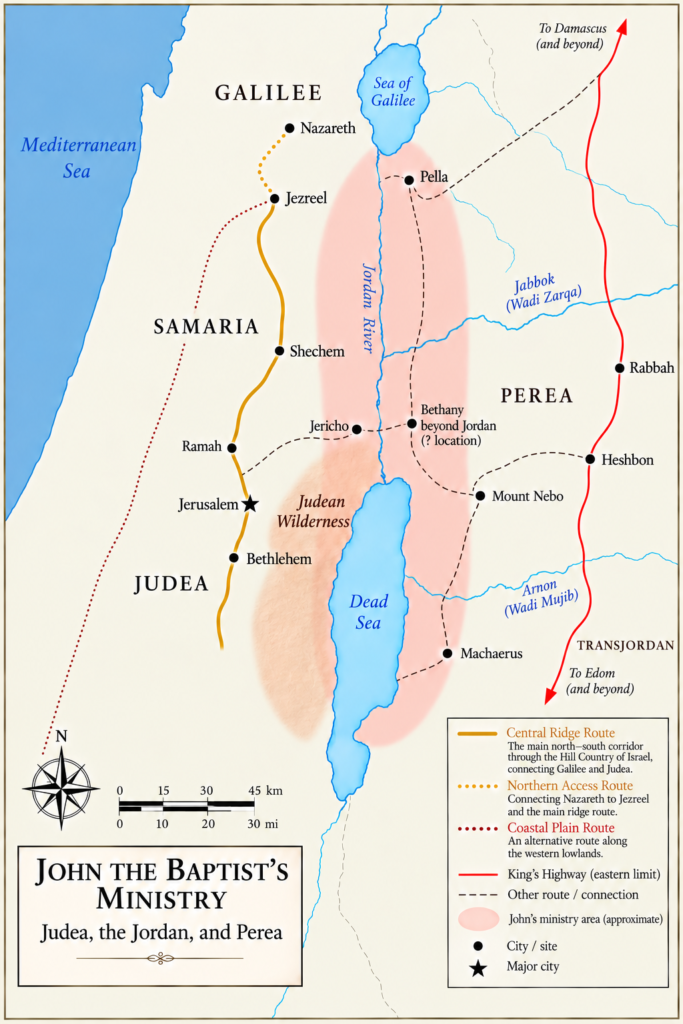
    We have to remember that Yeshua went into the Judean Wilderness after His baptism. We know that He came from Nazareth to be baptized in the Jordan.

    • “Then Jesus went from Galilee to the Jordan River …” (Mt. 3: 13 NLT).
    • “One day Jesus came from Nazareth in Galilee … baptized in the Jordan River” (Mk. 1: 10 NLT).

    We do have a clue as to where Yeshua’s baptism took place. “This encounter [John’s Someone-is-coming-after-me declaration] took place in Bethany, an area east of the Jordan River, where John was baptizing” (Jn. 1: 28 NLT).

    The next day, Yeshua came for baptism. John may or may not have migrated elsewhere after his discussion around Bethany. I don’t think he went far if he did.

    So, if Yeshua’s baptism occurred around Bethany beyond the Jordan, it was 15-20 miles as the crow flies to the Judean Wilderness, where the temptation is believed to have taken place. As the crow flies is probably appropriate because I doubt Satan and Yeshua walked to Jerusalem and back.
    The Highest Point

    Satan took Yeshua to the highest exposed point of the Temple complex.

    We don’t know for sure where exactly Satan took Yeshua. The Greek tells us that it was the pinnacle of the Temple — pterygion tou hierou.

    If they were at the southeastern corner (remember, east has a spiritual significance), the view was of the Kidron Valley.
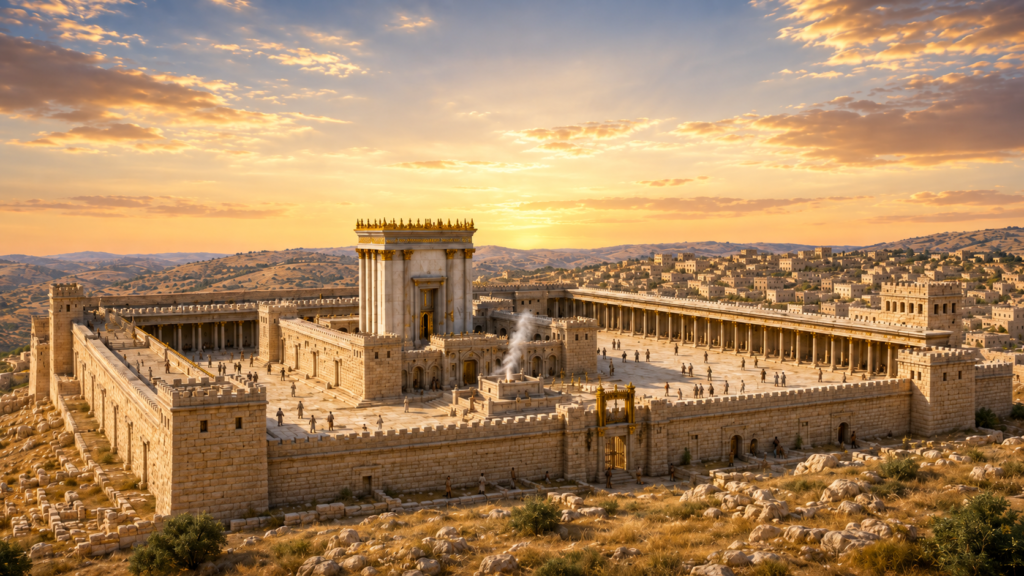
    Also on the southeastern side was a substantial vertical drop. Herod had created several substantial vertical drops when he remodeled the Temple. He did this through retaining walls and courts.

    A fall from this point would have been spectacular and potentially fatal.

    Son of God

    Satan’s premise was that Jehovah would not let anything bad happen to His Son.

    In the last temptation, we discussed that Satan did know and believe that Yeshua was the Son of God. He wasn’t quibbling with that.

    The Complete Jewish Study Bible had some interesting meanings of Son of God. It could mean:

    • “… a godly human being;
    • “the special one sent by God;
    • “the Son of God in flesh;
    • “a human whose presence on earth required a special creative act of God, hence either Adam or Yeshua …”

    Resource

    Well – technically – all of those applied to Yeshua.

    For the Scriptures Say

    Satan mostly got the Scripture quote right on the second temptation.

    Ooo baby. Satan knows Scripture?

    Oh, I am sure Satan does. He knows it enough to twist it to make what he says sound believable.

    Isn’t it easier to believe a falsehood when it is rooted in truth? That leaves us to pick apart what is factual and what is false.

    Satan’s use of Scripture against us is a reason we need to know what God’s Word says.
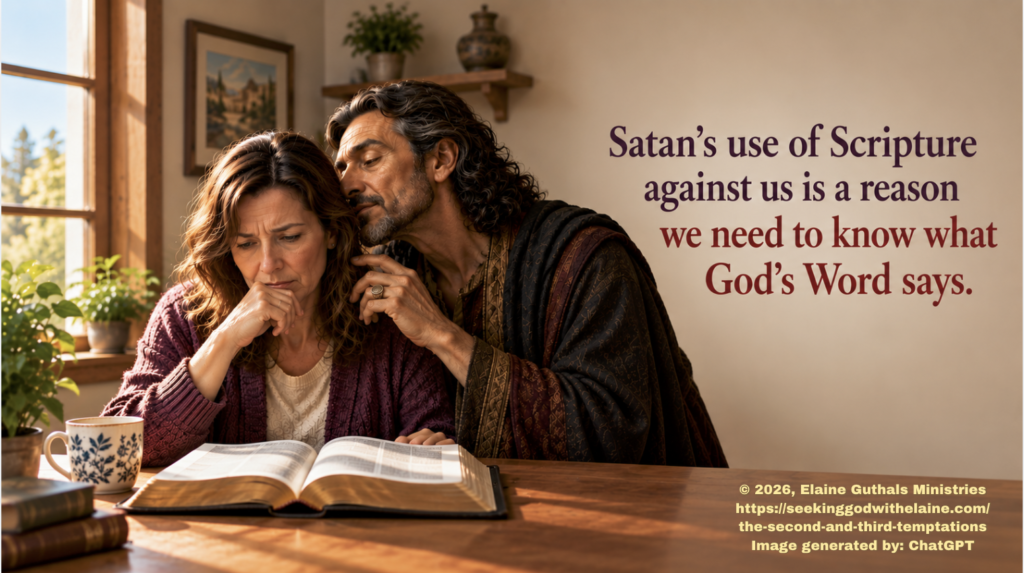
    Satan was quoting from Psalms 91: 11-12. “For he will order his angels to protect you wherever you go. They will hold you up with their hands so you won’t even hurt your foot on a stone” (Ps. 91: 11-12 NLT).

    It is interesting that Satan left out the part that Jehovah would have His angels “… protect you wherever you go” (Ps. 91: 11 NLT). Why didn’t Satan add that?

    Think about it. Wouldn’t Satan want to remind Yeshua of His constant protection? “Do this, and Jehovah won’t let You get hurt.”

    Or was that a way to get Yeshua to doubt Jehovah’s protection. “You would really be crossing Him, so maybe that protection wouldn’t be there. You know You can’t trust Him.”

    This temptation isn’t just about Yeshua proving Himself to be the Son of God. It is about Him proving He trusts Jehovah.

    It is also interesting that Satan quoted the part that says “… you won’t even hurt your foot …” (Mt. 4: 6 NLT). Remember what Jehovah said in the Garden of Eden.

    “And I will cause hostility between you and the woman, and between your offspring and her offspring. He will strike your head, and you will strike his heel” (Gen. 3: 15 NLT).

    Technically, Satan was right. Jehovah didn’t say he was going to hurt Yeshua’s foot.

    Just the heel. The heel is part of the foot.

    But at the core of the temptation is determining Jehovah’s presence. Is He there protecting Yeshua like He said He would be?

    Jesus Responded

    Yeshua again responded with Scripture.

    Yeshua didn’t say, “Don’t do something stupid.” He was going deeper than that.

    Here is the full verse that Yeshua quoted. “You must not test the Lord your God as you did when you complained at Massah” (Deut. 6: 16 NLT).

    Just before saying this, Moses told the Israelites that they shouldn’t worship the false gods of the then-current nations occupying the Promised Land. After that verse, he talked about obeying Jehovah.

    The reference to Massah was Moses reminding the Israelites of their complaining during the exodus. At one point they camped at Rephidim. Since there was no water, the people complained.

    When they demanded water, Moses accused them of testing Jehovah. They equated lack of water to lack of Jehovah’s presence – even though His presence was in the cloud/pillar that led them.

    The Israelites did get their water. “The Lord said to Moses, ‘Walk out in front of the people. Take your staff, the one you used when you struck the water of the Nile, and call some of the elders of Israel to join you. I will stand before you on the rock at Mount Sinai. Strike the rock, and water will come gushing out. Then the people will be able to drink.’ So Moses struck the rock as he was told, and water gushed out as the elders looked on” (Ex. 17: 5-7 NLT).

    They wanted evidence of Jehovah’s presence. Wasn’t that what Satan was saying?

    Yeshua said that he didn’t need to force Jehovah to demonstrate His faithfulness. He was going to trust Jehovah without manipulating Him to prove Himself.

    So, Satan went from the first temptation of trying to get Yeshua to prove He was the Son of God to getting Him to prove Jehovah’ protection.

    Where would Satan go next?

    Who Will the Messiah Serve?

    “Next the devil took him to the peak of a very high mountain and showed him all the kingdoms of the world and their glory. ‘I will give it all to you,’ he said, ‘if you will kneel down and worship me.’ ‘Get out of here, Satan,’ Jesus told him. ‘For the Scriptures say, “You must worship the Lord your God and serve only him”’” (Mt. 4: 8-10 NLT)

    “Then the devil took him up and revealed to him all the kingdoms of the world in a moment of time. ‘I will give you the glory of these kingdoms and authority over them,’ the devil said, ‘because they are mine to give to anyone I please. I will give it all to you if you will worship me.’ Jesus replied, ‘The Scriptures say, “You must worship the Lord your God and serve only him”’” (Lk. 4: 5-8 NLT)

    Peak of a Very High Mountain

    Scripture doesn’t identify the mountain to which Satan took Yeshua – and we don’t know that they went directly from the Temple pinnacle to this mountain.

    If we look at the area between Jerusalem and Bethany across the Jordan, we have a couple of high mountains that would fit the bill.

    The first mountain – the one closest to Jerusalem – would be the Mount of Olives. It is immediately east of Jerusalem.

    Its central summit is 2,664-2,684 feet (812-818 meters) above sea level. This doesn’t make it the tallest mountain in the ridge. Mount Scopus is taller at 2,710 feet (826 meters).

    Well, it doesn’t say it’s the tallest mountain. It just describes it as a very high mountain.

    The Mount of Olives would be an appropriate choice. That would be a place where Yeshua would spend time during His ministry. The Garden of Gethsemane is there.

    The next highest prominent elevation in the whole Jerusalem-Jordan Valley-Bethany region was Mount Nebo. At 2,330 feet (710 meters) above sea level, it isn’t as tall as those in the ridge that contains the Mount of Olives.

    But it, too, has its significance.

    All the Kingdoms of the World

    Satan was offering Yeshua the kingdoms of the world.

    First off, we have to watch how we define the whole world. Is it everything on this planet, or just every known land at the time?

    Or was it the whole Jewish nation? Remember, this is the mountain Moses went up to view the Promised Land.

    “That very day the Lord spoke to Moses, ‘Go up this mountain of the Abarim, Mount Nebo, which is in the land of Moab, opposite Jericho, and view the land of Canaan, which I am giving to the people of Israel for a possession. And die on the mountain which you go up, and be gathered to your people …” (Deut. 32: 48-49 ESV).

    Does that mean Moses – and Yeshua if this was the mountain – see every inch of the Promised Land? No.

    But that isn’t what is meant in covenant language. Instead, it means completeness, totality, or covenant fulfillment.

    Would Satan have been talking covenant language? Maybe. Maybe not. He was an angel in the beginning.

    Because They Are Mine to Give

    Satan is the prince of this world.

    We may scratch our heads when Satan says, “Hey, these are mine to give.” Technically, he is correct.

    • “Satan, who is the god of this world, has blinded the minds of those who don’t believe. They are unable to see the glorious light of the Good News. They don’t understand this message about the glory of Christ, who is the exact likeness of God” (II Cor. 4: 4 NLT).
    • “The time for judging this world has come, when Satan, the ruler of this world, will be cast out” (Jn. 12: 31 NLT).
    • “And you were dead in the trespasses and sins in which you once walked, following the course of this world, following the prince of the power of the air, the spirit that is now at work in the sons of disobedience” (Eph. 2: 1-2 NLT)

    This verse is a good example of having head knowledge about Yeshua. Satan knew He was the Son of Jehovah.

    “You must fear the Lord your God and serve him. When you take an oath, you must use only his name” (Duet. 6: 13 NLT).

    But Satan didn’t have heart knowledge. He didn’t know that Yeshua was more interested in our spiritual condition than anything this world could offer Him. It was His already.

    If You Will Worship Me

    If Satan wants what Jehovah has, he would want the worship that Jehovah has.

    Satan isn’t Jehovah’s equal, but he thinks he is – or at least, should be. Therefore, though it doesn’t say what that worship was to be, we have a good idea.

    • Satan wants the recognition that belongs to Jehovah.
    • He wants the honor, splendor, and majesty belonging to Him.
    • He believes he has the right to rule.
    • He feels he has sovereign rule over creation.
    • Satan wants us to carry out his will rather than Jehovah’s.
    • He wants our hearts and loyalty directed to him rather than Jehovah.
    • He wants our submission by accepting his authority instead of Jehovah’s.
    • He wants to be recognized as supreme – not Jehovah.

    That makes what Satan offers Yeshua for His worship so interesting.

    Worship the Lord Your God and Serve Only Him

    We are specifically told not to worship anyone or anything other than Jehovah.

    Yeshua was quoting Deuteronomy 6: 13 to respond to Satan. “You must fear the Lord your God and serve him. When you take an oath, you must use only his name” (Deut. 6: 13 NLT).

    Some may be more familiar with the second commandment.

    “You must not make for yourself an idol of any kind or an image of anything in the heavens or on the earth or in the sea. You must not bow down to them or worship them, for I, the Lord your God, am a jealous God who will not tolerate your affection for any other gods …” (Ex. 20: 4-6 NLT).

    Jehovah doesn’t want us to worship anyone or anything other than Him. This is especially true of someone who disobeyed Him.

    The Tempter Departs

    “Then the devil went away, and angels came and took care of Jesus” (Mt. 4: 11 NLT)

    “When the devil had finished tempting Jesus, he left him until the next opportunity came” (Lk. 4: 13 NLT)

    These are three temptations, but there were probably more temptations that Yeshua suffered than this.

    I knew that Yeshua had to have been tempted by Satan more than just this one session, but I am this many years old before I realized that it actually says that in God’s Word. I didn’t see Satan giving up until Jesus was dead.

    Satan took this opportunity, I think, for a couple of reasons. One reason is because Yeshua was coming off a time of spiritual triumph. Satan may think that we have grown lax or complacent.

    The opportunity presented itself now because Yeshua was fasting. His physical condition could have put His spiritual condition in jeopardy. But it didn’t.

    For some, the significant time alone would have opened the risk of our resolve to remain obedient to Jehovah being attacked.

    What the Temptations Tell Us about Yeshua

    The three temptations tell us much about Who Yeshua is and how He understands His mission.

    Yeshua refused to use His divine identity for Himself.

    Think about it. This temptation occurred immediately after Yeshua’s baptism. At His baptism, He was identified by the voice and the dove as being the Son of God.

    Everyone who was present that day heard this identification.

    Yet, Yeshua refuses to identify Himself to Satan. He didn’t use His power to satisfy His hunger.

    Yeshua’s relationship with Jehovah and obedience to His word took precedence over physical need.
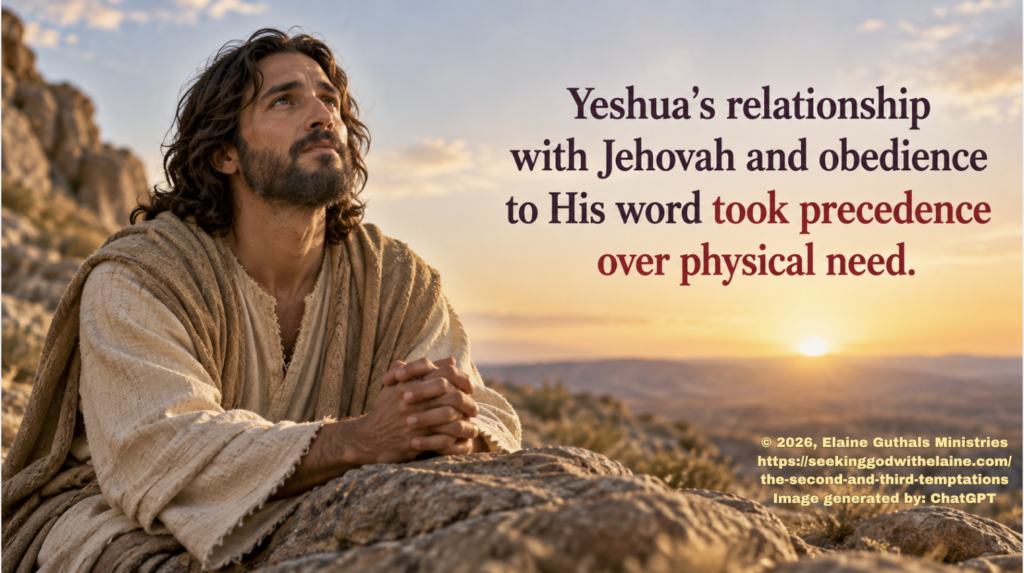
    Yeshua didn’t need Jehovah to prove Himself to Him. He wasn’t going to manipulate circumstances to force Jehovah to show Himself.

    It is obvious that Yeshua knew that the kingdom already belonged to Him – or at least would after the Plan of Salvation was complete. He didn’t have to take Satan’s route and receive it then.

    Yeshua could wait. He wasn’t going to shortcut the path of obedience.

    Through His answers, Yeshua showed us

    • He trusted Jehovah rather than Himself.
    • He trusted Jehovah’s Word rather than circumstances.
    • He worshiped Jehovah rather than pursuing power.

    Making the Connections #1

    We tend to think of Yeshua as, I don’t know, a superhuman. He was perfect because He could be no less.

    That is utterly false. Look what Goulburn said. He wrote, “He was as much mixed up with the manifold, humbling, petty details of daily life as any of us.”

    Resource

    Yes, Yeshua was 100% God. But He was also 100% man.

    We don’t know exactly how that can be. That is something we have to put in the UNR book — understanding not required.

    Did Yeshua get flashbacks of His time before He came to earth? Maybe. I would say probably.

    But Yeshua lived His life on earth as any other human. He woke up, ate, worked, slept, hit, repeat.

    Yeshua faced day-to-day challenges. He was tempted by Satan — more than is recorded in the Gospels.

    The life Yeshua led here required Him to not only grow physically but to also grow spiritually. Yeah, we would say that happened quickly. “… ‘Didn’t you know that I must be in my Father’s house?’” (Lk. 2: 49 NLT).

    We can’t say that Yeshua didn’t sin because He was God. If He “physically” couldn’t, then He would not be an appropriate substitute to pay the price for our sins.

    Making the Connections #2

    Jesus’ temptation is not merely a morality lesson about three things Christians should avoid. It is an encounter between the Son of God and the adversary within the larger biblical story of God’s purposes, human faithfulness, and spiritual opposition.

    Heart Check

    Think about the battle Yeshua is engaged in for your heart. Ask yourself the following questions.

    • When I have a genuine need, do I trust Jehovah to provide, or do I feel I must take matters into my own hands?
    • Do I trust Jehovah’s faithfulness, or do I sometimes demand that He prove Himself to me?
    • Have I ever deliberately stepped into a situation expecting Jehovah to rescue me rather than simply trusting Him?
    • Am I ever tempted to pursue something good in a way that bypasses obedience to Jehovah?
    • What has the greatest claim on my heart—Jehovah, or what I believe I can gain by compromising my devotion to Him?
    • Am I willing to wait for Jehovah’s purposes to unfold in His way and His time, rather than looking for a shortcut?

    How Do We Apply This?

    • Trust Jehovah with your needs.
    • Trust without demanding proof.
    • Don’t confuse faith with presumption.
    • Realize that something that looks like an opportunity can still require us to compromise obedience to Jehovah.
    • Keep worship at the center.

    Father God. We know we will be tempted as Yeshua was. May we trust Jehovah and His Word rather than ourselves and circumstances. We want to worship You instead of trying to rely on our own power. Amen.

    If you don’t understand something and would like further clarification, please contact me.

    If you have not signed up for the email providing the link to the devotions and the newsletter, do so below.

    If God has used this devotion to speak with you, consider sharing it on social media.
  • The First Temptation

    After His baptism, Yeshua was led into the wilderness by the Holy Spirit. This devotional reading looks at the first of Satan’s temptation that He endured.

    Nuggets

    • The Holy Spirit intentionally led Yeshua into the wilderness.
    • The timestamp used in this passage is ambiguous.
    • Ooo, baby, do we think we could take forty days of Messiah-level testing?
    • Yeshua fasted while in the wilderness.
    • Yeshua was protected in the wilderness – even if He didn’t know it.
    • Satan is also called the devil.
    • Did Satan not know who Yeshua was, or was he trying to get Him to doubt Himself?
    • Satan wanted Yeshua to believe that He could provide for His needs Himself.
    • Yeshua had been fasting, but Satan forgot that He was the Bread of Life.

    Yeshua just had a mountaintop experience. He obediently submitted Himself for baptism. The Father and the Holy Spirit were there as witnesses.

    Then Holy Spirit led Yeshua into the wilderness – and there it took a turn.

    Enter Satan.

    Let’s Put It into Context

    To read devotions in The Battle for the Heart theme

    Devotions in the The Temptation of Jesus series

    Led by the Spirit

    “Then Jesus was led by the Spirit into the wilderness to be tempted there by the devil. For forty days and forty nights he fasted and became very hungry. During that time …” (Mt. 4: 1-3 NLT)

    “The Spirit then compelled Jesus to go into the wilderness, where he was tempted by Satan for forty days. He was out among the wild animals, and angels took care of him” (Mk. 1: 12-13 NLT)

    “Then Jesus, full of the Holy Spirit, returned from the Jordan River. He was led by the Spirit in the wilderness, where he was tempted by the devil for forty days. Jesus ate nothing all that time and became very hungry” (Lk. 4: 1-2 NLT)

    Filled with the Holy Spirit

    The Holy Spirit intentionally led Yeshua into the wilderness.

    It is interesting to see the different Greek words used that is translated to show how the Holy Spirit got Yeshua into the wilderness. Let’s take a look.

    Do the one Gospel contradict another? Matthew just gave us a bare bones description of the task of the Holy Spirit – He was to get Yeshua to the wilderness.

    Mark presented the urgency of that leading. Does that mean Yeshua didn’t want to go? Probably not. It just means that the wilderness was exactly where Yeshua was supposed to be.

    Luke presented duration. The Holy Spirit didn’t get Yeshua to the wilderness and drop Him off. Luke describes Yeshua as being led in the Spirit during the wilderness experience.

    During that Time

    The timestamp used in this passage is ambiguous.

    I had never caught before that the verse says, “During that time …” (Mt. 4: 3 NLT). I had always assumed the temptation was at the end of the forty days.

    To me, that was logical. Yeshua would have forty days to get really hungry — for food and for company.

    Food and company are two very important elements for humans. None of us can survive without food. True, we can go for some days without eating, but not long.

    True, some of us can go much longer without physical contact with another human being. Television and streaming can help, but we were made to be social people.

    The Greek that Matthew used was ἐλθὼν ὁ πειράζων. It literally means the tempter, having come.

    That means we can’t read Matthew to say the tempting started on Day 40 and took one day. It is easy to read that since there are no timestamps within the temptations themselves.

    But why would Satan do one big temptation session?

    Luke doesn’t lock the wording down that precisely. Again, he made the tempting an ongoing event.

    To me, that is what Satan would more than likely have done.

    Part of me says non-stop – ongoing as Luke said. I can just see Satan slamming and slamming away at Yeshua’s Will to get Him to trip up.

    It is possible that Satan tempted Yeshua the whole forty days. We can’t be certain that these were the only temptations during the 40 days. These may have been the only ones recorded.

    Wait! What did Matthew say? The Holy Spirit led Yeshua to the wilderness to be tempted by Satan?

    Well, not really. Matthew grammatically separated them.

    • The Holy Spirit led Yeshua into the wilderness.
    • The devil tempted Him.

    What Matthew was giving us was the purpose of going to the wilderness. Remember, Jehovah has to allow Satan to tempt us. That doesn’t mean Jehovah is doing the tempting.

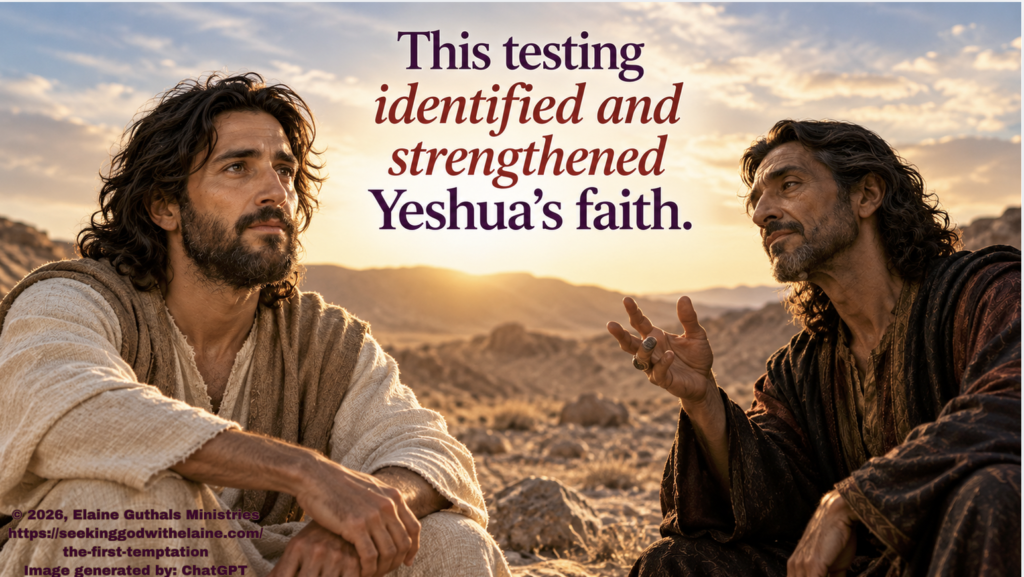
    Jehovah can and does use those same temptations as testing. The testing identifies and strengthens our faith. This testing identified and strengthened Yeshua’s faith.

    Forty Days of Testing

    Ooo, baby, do we think we could take forty days of Messiah-level testing?

    We know it would have had to be worse than anything we have ever experienced. I mean, if Satan could get Yeshua to sin, the whole plan would have to be scrapped.

    Yep, the plan that was developed before the foundation of the world — before creation — hinged on Yeshua staying blameless, staying pure and sin-free.

    We’ve talked before about the significance of 40. This was the amount of time

    • it rained during the Flood (Gen. 7: 4, 12, 17).
    • Yeshua was tempted in the wilderness (Mt. 4: 2; Mk. 1: 13; Lk. 4: 2).
    • the mountaintops were visible before Noah opened the ark’s window (Gen. 8: 6).
    • Moses remained on Sinai receiving the law (Ex. 24: 18).
    • Moses spent interceding after the golden calf (Deut. 9: 18, 25; 10: 10).
    • spies explored Canaan (Num. 13: 25).
    • Goliath challenged Israel (I Sam. 17: 16).
    • it took Elijah to travel to Horeb (I Kgs. 19: 8).
    • Jonah warned Nineveh (Jon. 3: 4).
    • a woman waited for purification after the birth of a son (Lev. 12: 1-4).
    • Yeshua remained on earth after His resurrection (Ac. 1: 3).

    There are other occasions where the number 40 is used, but these are the ones that specifically apply to 40 days. The number 40 is used in patterns.

    Fasted/Ate Nothing

    Yeshua fasted while in the wilderness.

    Biblical fasting is more than just not eating. It is not eating for a spiritual purpose.

    • Seeking Jehovah
    • Repentance
    • Grief or mourning
    • Prayer and intercession
    • Humbling ourselves
    • Preparation

    The Hebrew concept frequently expressed is through the noun tsom (צוֹם) and the verb tsum (צוּם.).

    Our motivation for fasting is important. We can’t fast as a means of forcing Jehovah to respond to us – usually some specific request.

    We should be fasting because we are humbling ourselves before Jehovah and are turning our attention toward Him.

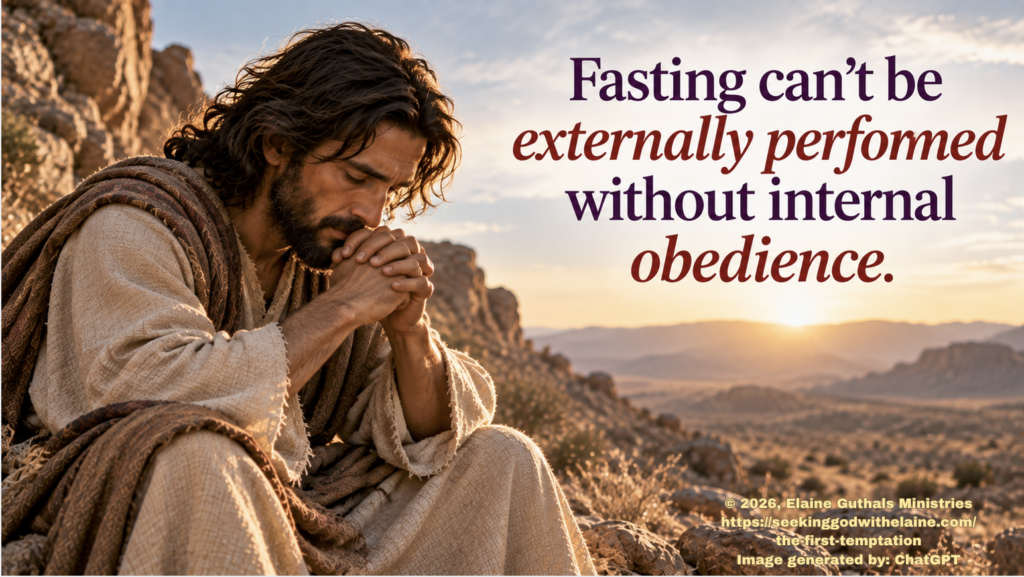
    Fasting can’t be externally performed without internal obedience.

    Matthew specifically said that Yeshua fasted. Luke, however, just said that He went without food.

    Was it a unique, Spirit-led wilderness fast? Maybe. Maybe not.

    We have to be careful reading Matthew. “For forty days and forty nights he fasted and became very hungry” (Mt. 4: 2 NLT). After one to three days, Yeshua would have been experiencing hunger. His hunger would have become very real by Day 20, let alone Day 40.

    There is something significant about the wording. Yeshua fasted → He became hungry → Satan’s first temptation concerned food.

    My opinion? Yeshua was fasting. He was preparing for the ministry He would begin.

    I don’t think that it was just food was scarce – or He just didn’t have an appetite His cousin had for locust.

    Yeshua was following several purposes for fasting.

    • Seeking Jehovah
    • Prayer and intercession
    • Humbling Himself
    • Preparation

    That communion with the Father was the whole purpose of going out into the wilderness.

    Out among the Wild Animals

    Yeshua was protected in the wilderness – even if He didn’t know it.

    Mark added an interesting nugget. He said that there were wild animals in the wilderness.

    Well, that was logical. The wilderness that Yeshua was in was the Judean Wilderness, a harsh and rocky region east of Jerusalem. It stretched toward the Jordan River and the Dead Sea.

    The Hebrew term for it is midbar (מִדְבָּר). It wasn’t only considered an empty land. It taught dependence on Jehovah. It was where God spoke and revealed Himself to people.

    This wilderness consisted of jagged limestone hills, steep ravines known as wadis, and dry, chalky soil. The vegetation was limited to thorn bushes and scattered scrub growth.

    The extreme climate ran from intense daytime heat to cold nights. Rain was limited, which limited food sources. Those living in the wilderness had to gather what the wilderness provided – locusts and wild honey.

    Many wild animals go where people aren’t. It would have been expected that some took up residence in the barren wasteland.

    But Yeshua wasn’t alone. He had angels ministering to Him.

    Does that mean the angels were with Yeshua 24/7/40? Well, yes and no.

    While the angels may have been guarding Yeshua, I doubt he could see them 24/7/40. They may not have physically made their presence known to Him.

    What Is Most Important to the Messiah?

    “… the devil came and said to him, ‘If you are the Son of God, tell these stones to become loaves of bread.’ But Jesus told him, ‘No! The Scriptures say, “People do not live by bread alone, but by every word that comes from the mouth of God”’” (Mt. 4: 3-4 NLT)

    “Then the devil said to him, ‘If you are the Son of God, tell this stone to become a loaf of bread.’ But Jesus told him, ‘No! The Scriptures say, ‘People do not live by bread alone”’” (Lk. 4: 3-4 NLT)

    The Devil

    Satan is also called the devil.

    The Hebrew word śāṭān begins with the basic idea of an adversary. Job and Zechariah place the adversary within heavenly scenes involving accusation and testing.

    Chronicles presents a more individualized Satanic figure. Genesis gives us the serpent who challenges God’s word, while Revelation later identifies the ancient serpent with Satan – and calls him the devil.

    Second Temple Jewish writings then expand reflection on evil spiritual powers, developing figures such as Mastema and Belial. There are also elaborate accounts of spirits, deception, judgment, and cosmic conflict.

    One theological boundary remains essential: the adversary is not Jehovah’s equal. Evil is real, spiritual opposition is real, and the battle reaches human beings, but God remains sovereign.

    The conflict also reaches deeper than behavior. The adversary challenges trust. He accuses. He deceives. He offers competing interpretations of God’s word. He seeks to move God’s people from dependence upon Jehovah toward some other source of security, identity, wisdom, or provision.

    If You Are the Son of God

    Satan wanted Yeshua to believe that He could provide for His needs Himself.

    Satan wasn’t saying that he could turn the stones into bread. He was wanting Yeshua to do it for Himself.

    Could Yeshua have done it? Yes.

    But that wouldn’t have been relying on Jehovah for our provision.

    If Yeshua was supposed to fast for forty days, turning stones into bread would have been a sin. It was because Yeshua was listening to and obeying Satan.

    Tell These Stones

    Did Satan not know who Yeshua was, or was he trying to get Him to doubt Himself?

    It is my opinion that Satan knew exactly Who Yeshua was. He wouldn’t have called just anyone the Son of God.

    There is evidence of this in Scripture. “Suddenly, a man in the synagogue who was possessed by an evil spirit cried out, ‘Why are you interfering with us, Jesus of Nazareth? Have you come to destroy us? I know who you are — the Holy One of God!’”

    One of Satan’s demons wouldn’t have known Yeshua if Satan himself didn’t.

    Loaves of Bread

    Yeshua had been fasting, but Satan forgot that He was the Bread of Life.

    Bread was a staple in the diets of first-century Jews. It was regularly eaten with meals. It was substantial enough the bread could function almost as a general term for food.

    Satan wasn’t offering Yeshua pie or cake. He wasn’t offering Him some luxury food item.

    Satan was offering Yeshua a basic necessity of life.

    Yeshua came back with a verse in Scripture. “Yes, he humbled you by letting you go hungry and then feeding you with manna, a food previously unknown to you and your ancestors. He did it to teach you that people do not live by bread alone; rather, we live by every word that comes from the mouth of the Lord” (Deut. 8: 3 NLT).

    Physical sustenance does not outrank obedience to Jehovah.

    Making the Connections

    Jesus’ temptation isn’t merely a morality lesson about three things Christians should avoid. It is an encounter between the Son of God and the adversary within the larger biblical story of God’s purposes, human faithfulness, and spiritual opposition.

    Heart Check

    Think about the battle Yeshua is engaged in for your heart. Ask yourself the following questions.

    • When I am in need, do I trust Jehovah to provide, or do I try to provide for myself?
    • When Jehovah’s answer requires waiting, do I wait obediently, or do I take matters into my own hands?
    • When I am tempted, do I look for what I can gain, or do I look for what Jehovah has commanded?
    • Do I value immediate relief, or am I willing to remain obedient when obedience costs me something?
    • When I know what Scripture says, do I obey it, or do I look for a way around it?

    How Do We Apply This?

    • Recognize the difference between a legitimate need and an excuse for disobedience.
    • Learn to trust Jehovah when obedience requires us to wait.
    • Turn to Scripture when we face temptation.
    • Remember that satisfying a legitimate need does not justify disobedience.
    • Choose Jehovah’s provision over our own solutions.
    • Remain faithful when temptation attacks our physical needs, desires, or sense of security.

    Father God. You allow Satan to tempt us. Part of that is consequences from the Fall. Part of it is that You also use that temptation to test us. Lord, may our faith prove genuine. Amen.

    If you don’t understand something and would like further clarification, please contact me.

    If you have not signed up for the email providing the link to the devotions and the newsletter, do so below.

    If God has used this devotion to speak with you, consider sharing it on social media.

  • Who Is the Tempter?

    Humans in all ages have had to resist the tempter. This  devotional reading looks at who he is and how he opposes Jehovah.

    Nuggets

    • The term the Accuser is used as a title.
    • Jehovah was the One Who brought up Job.
    • Satan didn’t dispute Job’s actions but rather his motivation.
    • Jehovah allowed the testing to take place.
    • While śāṭān (שָׂטָן) isn’t used in Genesis 3: 1, Revelation 12: 9 does identify the serpent with Satan.
    • Satan stood ready to accuse Jeshua, the High Priest, before the angel of the Lord.
    • The importance of this passage is that it doesn’t use the word the.
    • By the time Yeshua walked the earth, Jewish thought about the spiritual realm had developed beyond the earlier use of śāṭān as simply an adversary or accuser.
    • Satan can oppose God’s people, but he cannot become God’s equal.
    • We often think of the heart as the place where our emotions live.

    Before we get to the temptation of Yeshua, we need to understand a little about who His tempter was. That will help us understand who still tempts us today.

    On the surface, it appears that Satan tries to get us to not do the do’s and to do the don’ts. But bad behavior isn’t his overall motivation.

    At the core, the temptations focus on trust, allegiance, truth, and accusation. The bottom line is, will we trust Jehovah or Satan?

    Let’s Put It into Context #1

    To read devotions in The Battle for the Heart theme

    Devotions in the The Temptation of Jesus series

    Let’s Put It into Context #2

    Who is that adversary, and where did he come from?

    When we think of the Jehovah’s opponent, we call him Satan. Well, that isn’t the best translation of what the opponent is called.

    The Hebrew word śāṭān (שָׂטָן) isn’t a proper name. It is a noun that means adversary, opponent, or accuser. It is more of a role or function.

    From there, the word seems to have taken on a life of its own. The progression has been the adversary → the heavenly accuser → an increasingly personalized adversarial figure → Satan/the Devil of the New Testament.

    Look at the following Hebrew words. Their common element is characterized as opposition.

    The Adversary Already Existed

    “One day the members of the heavenly court came to present themselves before the Lord, and the Accuser, Satan, came with them. ‘Where have you come from?’ the Lord asked Satan. Satan answered the Lord, ‘I have been patrolling the earth, watching everything that’s going on.’ Then the Lord asked Satan, ‘Have you noticed my servant Job? He is the finest man in all the earth. He is blameless — a man of complete integrity. He fears God and stays away from evil.’ Satan replied to the Lord, ‘Yes, but Job has good reason to fear God. You have always put a wall of protection around him and his home and his property. You have made him prosper in everything he does. Look how rich he is! But reach out and take away everything he has, and he will surely curse you to your face!’ ‘All right, you may test him,’ the Lord said to Satan. ‘Do whatever you want with everything he possesses, but don’t harm him physically.’ So Satan left the Lord’s presence.” (Job 1: 6-12 NLT)

    The Accuser

    The term the Accuser is used as a title.

    If we look at the Hebrew Bible, we see the word we translate as accuser is haśśāṭān (הַשָּׂטָן). It literally means accuser.

    The most important word is the ha – the accuser. Haśśāṭān is used as a title, not a proper name.

    An accuser is someone who claims another has committed an offense. This person is charging the other of doing something morally wrong.

    That is important.

    Have You Noticed

    Jehovah was the One Who brought up Job.

    We may think that Satan is the one who brought Job into the conversation. He wasn’t.

    Jehovah used Job as an example of someone who is blameless.  The root word for blameless is tām (תָּם), from the root tāmam (תָּמַם). It means being complete, whole, or possessing integrity. The central Hebrew idea behind blameless is wholeness.

    Jehovah didn’t say that Job was righteous – tzaddik (צַדִּיק). That means one who conforms to God’s standards.

    What Jehovah was talking about here was that Job had integrity. His character wasn’t compromised.

    To me, that says Job made a choice to have integrity. He easily could have chosen not to follow Jehovah, but he didn’t do that.

    Yes, But

    Satan didn’t dispute Job’s actions but rather his motivation.

    Satan wasn’t saying that Job wasn’t a man of integrity. He was saying the reason for Job’s integrity was because he liked the blessings Jehovah gave him.

    In Satan’s mind, he believed that to remove the blessings would remove the integrity.

    It is not about actions. It is about the reason behind the actions.

    Why did we do what is right in Jehovah’s eyes? Are we just wanting His blessings? Or do we want a relationship with Him?

    Satan was convinced that Job wasn’t really interested in a relationship with Jehovah. He was interested in getting the good stuff.

    All Right, But

    Jehovah allowed the testing to take place.

    Jehovah didn’t say that Satan had examples of Job’s faithfulness to Him. He didn’t bring up past examples to prove His point.

    No, Jehovah said, “Okay. I’ll let you test him. But you can’t harm him physically.”

    Jehovah doesn’t send trials our way. He does, however, test us to ensure our faith is strong.

    • “Dear brothers and sisters, when troubles of any kind come your way, consider it an opportunity for great joy. For you know that when your faith is tested, your endurance has a chance to grow. So let it grow, for when your endurance is fully developed, you will be perfect and complete, needing nothing” (Jas. 1: 2-4 NLT).
    • “These trials will show that your faith is genuine. It is being tested as fire tests and purifies gold — though your faith is far more precious than mere gold. So when your faith remains strong through many trials, it will bring you much praise and glory and honor on the day when Jesus Christ is revealed to the whole world” (I Pet. 1: 7 NLT).

    I see you jumping up and down over there. Peter said trials. Testing and trials are both used for the same outcome – showing the genuineness of our faith.

    In order to figure this out, we have to look at the Greek.

    Is Satan really going to test our faith to prove that it is genuine? Highly unlikely. He is trying to get us to do that which is evil.

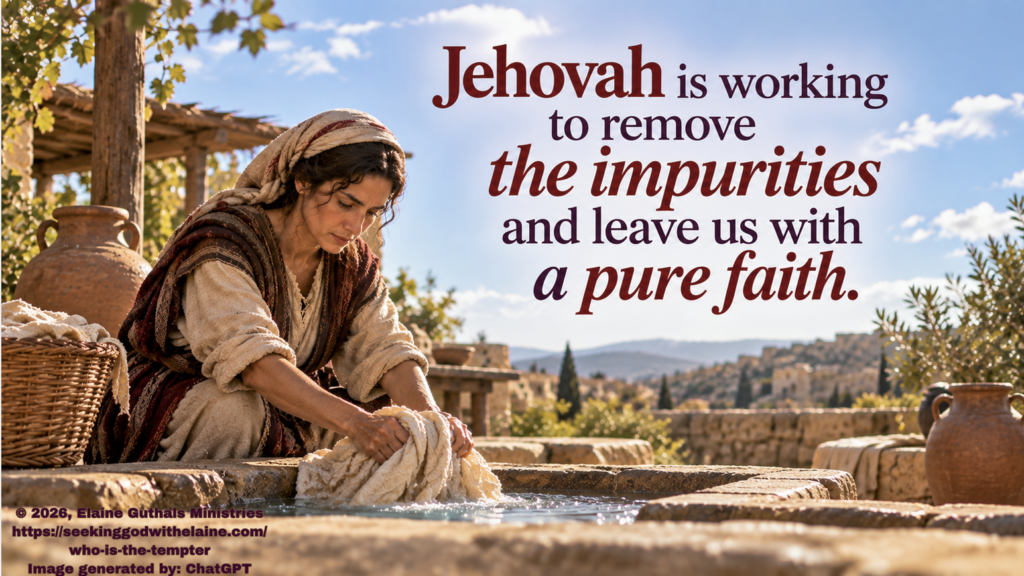
    Jehovah, on the other hand, is refining us in the fire. He is working to remove the impurities and leave us with a pure faith.

    The same Greek word – peirasmos – can encompass testing and temptation. That means the purpose and the direction are what distinguish trials from testing. 

    No, they may not look that much different to us.

    Jehovah’s sovereignty and Satan’s opposition can – and probably often do – operate in the same event, but with radically different purposes.

    The Entrance of Deception into Humanity’s Story

    “The serpent was the shrewdest of all the wild animals the Lord God had made. One day he asked the woman, ‘Did God really say you must not eat the fruit from any of the trees in the garden?’” (Gen. 3: 1 NLT)

    “This great dragon — the ancient serpent called the devil, or Satan, the one deceiving the whole world — was thrown down to the earth with all his angels” (Rev. 12: 9 NLT)

    While śāṭān (שָׂטָן) isn’t used in Genesis 3: 1, Revelation 12: 9 does identify the serpent with Satan.

    We shouldn’t focus on the outward package – the serpent – in the Fall from grace. We need to focus on the purpose.

    “… Did God really say …” (Gen. 3: 1 NLT) is a common vehicle for Satan trying to get us to sin.

    Notice what the serpent didn’t focus on. It wasn’t the fruit. It wasn’t even the act of eating. The serpent talked about rewards and consequences.

    The focus was, “Can you trust Jehovah to mean what He says? Will you believe Him or me?”

    The heart of the conflict isn’t necessarily obedience – although that does play a big role. The issue is trust.

    Can you see Satan’s pattern that he uses? God has spoken; he introduces an alternative; the human is confronted with a choice concerning trust and obedience.

    The Hebrew Bible’s Developing Picture of Satan

    The Accuser in the Heavenly Court

    “Then the angel showed me Jeshua the high priest standing before the angel of the Lord. The Accuser, Satan, was there at the angel’s right hand, making accusations against Jeshua. And the Lord said to Satan, ‘I, the Lord, reject your accusations, Satan. Yes, the Lord, who has chosen Jerusalem, rebukes you. This man is like a burning stick that has been snatched from the fire.’ Jeshua’s clothing was filthy as he stood there before the angel. So the angel said to the others standing there, ‘Take off his filthy clothes.’ And turning to Jeshua he said, ‘See, I have taken away your sins, and now I am giving you these fine new clothes. Then I said, ‘They should also place a clean turban on his head.’ So they put a clean priestly turban on his head and dressed him in new clothes while the angel of the Lord stood by. Then the angel of the Lord spoke very solemnly to Jeshua and said, ‘This is what the Lord of Heaven’s Armies says: If you follow my ways and carefully serve me, then you will be given authority over my Temple and its courtyards. I will let you walk among these others standing here’” (Zech 3: 1-7 NLT)

    Satan stood ready to accuse Jeshua, the High Priest, before the angel of the Lord.

    This passage takes on the feel of a courtroom. That is because the language Satan uses is one that a prosecutor would use. He stands in opposition and accusation. The word used is again haśśāṭān (הַשָּׂטָן) – accuser.

    Satan made his accusations against Jeshua. Jehovah’s response to Satan is interesting.

    • I reject your claim.
    • I have chosen Jerusalem.
    • Jeshua has been snatched from the fire.
    • Jeshua’s filthy clothes were removed.
    • I have taken away your sins and given you salvation.
    • You still have to walk with Me.

    God’s Word tells us that Satan is wrong.

    • “Where is another God like you, who pardons the guilt of the remnant, overlooking the sins of his special people? You will not stay angry with your people forever, because you delight in showing unfailing love. Once again you will have compassion on us. You will trample our sins under your feet and throw them into the depths of the ocean!” (Mic. 7: 18-19 NLT).
    • “This is good and pleases God our Savior, who wants everyone to be saved and to understand the truth” (I Tim. 2: 3-4 NLT).
    • “And anyone whose name was not found recorded in the Book of Life was thrown into the lake of fire” (Rev. 20: 15 NLT).
    • “I am overwhelmed with joy in the Lord my God! For he has dressed me with the clothing of salvation and draped me in a robe of righteousness. I am like a bridegroom dressed for his wedding or a bride with her jewels” (Isa. 61: 10 NLT).

    Does this say that Jeshua didn’t sin? No, it says that Jeshua’s garments were filthy (Zech. 3: 3). The angel had others replace his clothes. “… For he has dressed me with the clothing of salvation and draped me in a robe of righteousness …” (Isa. 61: 10 NLT).

    Satan may have made the accusations, but Jehovah had the final say – and He rejected them.

    Satan as a More Clearly Developed Figure

    “Satan rose up against Israel and caused David to take a census of the people of Israel” (I Chron. 21: 1 NLT)

    The importance of this passage is that it doesn’t use the word the.

    The Hebrew word used is śāṭān (שָׂטָן), meaning adversary. Here the word appears without the definite article and is presented as an individual adversarial figure. English translations differ in whether they render it Satan or an adversary.

    But this passage does something more. The terminology used moves from the broader concept of an adversary toward a more personalized adversarial figure.

    Satan is seen as an adversarial figure instead of a role or title.

    There is another verse detailing the same census that has a slightly different spin on it. “Once again the anger of the Lord burned against Israel, and he caused David to harm them by taking a census. “Go and count the people of Israel and Judah,” the Lord told him” (I Sam. 24: 1 NLT).

    Are the two versions contradictory, or can they both be accurate? I believe they both can be accurate if we look at how Satan’s role developed in Scripture.

    We’ve talked about how Satan’s role has transitions from the adversary to more of a personal description. This increasingly adversarial role surely causes Jehovah to become angry. It shows humans turning away from Him and turning to Satan.

    This raises a theological question: how do Jehovah’s sovereignty and Satan’s actions relate?

    Second Temple Understanding

    By the time Yeshua walked the earth, Jewish thought about the spiritual realm had developed beyond the earlier use of śāṭān as simply an adversary or accuser.

    Jewish writings from the Second Temple period describe a more clearly developed spiritual conflict between forces that belong to God and forces that oppose Him. The idea of an adversary who opposes Jehovah’s purposes, deceives, accuses, and seeks to turn people away from God was not foreign to His Jewish audience. The New Testament’s use of Satan and the Devil stands within this developing biblical and Jewish understanding.

    We have to be careful here. Second Temple Judaism was not one single system of belief. Jewish communities interpreted the spiritual world in different ways. But several writings from this period show an increasing interest in evil spiritual beings, their influence over humanity, and the conflict between God’s purposes and those forces.

    The Book of Jubilees, for example, introduces Mastema, a figure who functions as an adversary and leader of evil spirits. Even in this expanded picture, however, Mastema does not operate as Jehovah’s equal. His activity remains subject to Jehovah’s authority.

    The Dead Sea Scrolls give us another important window into this Jewish worldview. The community described in the Rule of the Community speaks of two spirits: the Spirit of Truth and the Spirit of Deceit. The conflict is not merely something happening somewhere in the heavens. It affects how people think, choose, live, and respond to God.

    That is important for us.

    The spiritual conflict is not simply God versus Satan somewhere outside of us. It reaches into the human person.

    The Dead Sea Scrolls describe humanity as living amid competing spiritual influences, but they do not present two equal gods fighting for control. God remains sovereign. The conflict exists under His authority and within His ultimate purposes.

    This helps us understand the world into which Yeshua came.

    Satan Is Not Jehovah’s Equal

    “Then I heard a loud voice shouting across the heavens, ‘It has come at last — salvation and power and the Kingdom of our God, and the authority of his Christ. For the accuser of our brothers and sisters has been thrown down to earth — the one who accuses them before our God day and night’” (Rev. 12: 10 NLT)

    Satan can oppose God’s people, but he cannot become God’s equal.

    We see the adversary described as the ancient serpent, the devil, and Satan.

    Go back to Job 1. Satan had to have permission to bring the trials upon Job. Just as Jehovah said, “You can’t harm Job physically,” He could have said, “You can’t do anything to Job at all.”

    Isn’t that what Satan was hinting at? “Satan replied to the Lord, ‘Yes, but Job has good reason to fear God. You have always put a wall of protection around him and his home and his property …” (Job 1: 9-10 NLT).

    The Adversary’s Work Reaches the Human Heart

    We often think of the heart as the place where our emotions live.

    But the Hebrew understanding of the heart is much bigger than that. The Hebrew words lēv (לֵב) and lēvāv (לֵבָב) can refer to the inner person — the place of thought, understanding, intention, desire, and decision. That gives us a different way to look at Satan’s work.

    Look again at Job.

    Satan didn’t dispute Job’s behavior. He questioned what was happening inside Job.

    Why did Job fear Jehovah? Was it because Job genuinely trusted Him? Or was Job faithful because Jehovah had blessed him?

    The question wasn’t simply, “Will Job do the right thing?” The question was, “What is in Job’s heart?”

    We see the same thing in the Garden. The serpent didn’t begin by telling Eve to rebel against Jehovah. He introduced another word: “Did God really say…?”

    Suddenly Eve had another voice to consider.

    Jehovah had spoken. The serpent offered an alternative.

    Now the question became: Whose word would she trust? That is where the battle reaches the heart.

    Satan can accuse us. He can tempt us. He can introduce deception. He can challenge what Jehovah has said.

    But the temptation always brings us to a place of decision.

    Will I trust Jehovah? Will I believe what He has said? Will I remain loyal to Him when another voice offers me something that appears better?

    The battle isn’t simply about whether we obey a rule. It is about who has our allegiance.

    That is why outward behavior alone cannot tell us everything about our relationship with Jehovah.

    Two people can do the same right thing for completely different reasons. One may do it because he loves Jehovah and trusts Him while the other may do it because he wants what he believes Jehovah will give him.

    And that makes this battle personal. The adversary is not merely interested in getting us to break rules.

    He wants to undermine our trust in Jehovah. He wants us to question what Jehovah has said. He wants us to listen to another voice.

    And ultimately, he wants us to choose another allegiance.

    Making the Connections #1

    “But God was angry that Balaam was going, so he sent the angel of the Lord to stand in the road to block his way. As Balaam and two servants were riding along” (Num. 22: 22 NLT)

    Numbers 22: 22 is a verse that uses the Hebrew word śāṭān (שָׂטָן) – adversary, opponent, or accuser.

    But its use is more than a role or function. In this verse, it was a behavior.

    The angel stood in the road as an adversary. The angel accused Balaam.

    Making the Connections #2

    So, what all did we learn from this?

    • The issue is more about authenticity of our relationship with Jehovah than our behavior.
    • Satan can’t work independently from Jehovah – He sets limits on him.
    • Satan sows seeds of distrust of Jehovah and His words.
    • Satan accuses as well as tempts.
    • The adversary is an adversary precisely because he opposes the One who has authority over him.

    Heart Check

    Think about the battle Yeshua is engaged in for your heart. Ask yourself the following questions.

    • Am I going to trust Jehovah when another voice tells me I shouldn’t, or am I going to let that voice pull me astray?
    • Am I going to believe what Jehovah has said or what the adversary tells me?
    • Am I going to let an accusation make me doubt Jehovah’s forgiveness, or is my faith going to remain firm in Him?
    • Am I going to remain faithful when obedience becomes difficult, or am I going to take the easy road into disobedience?
    • Am I going to guard my heart when temptation challenges my allegiance to Jehovah, or am I going to give in to temptation?

    How Do We Apply This?

    • Trust Jehovah’s Word.
    • Reject the adversary’s accusations and temptations.
    • Remember Jehovah’s forgiveness.
    • Remain faithful when tested.
    • Guard our hearts against deception.

    Father God. The adversary still tempts us today. Help us to remain faithful to You. Amen.

    If you don’t understand something and would like further clarification, please contact me.

    If you have not signed up for the email providing the link to the devotions and the newsletter, do so below.

    If God has used this devotion to speak with you, consider sharing it on social media.
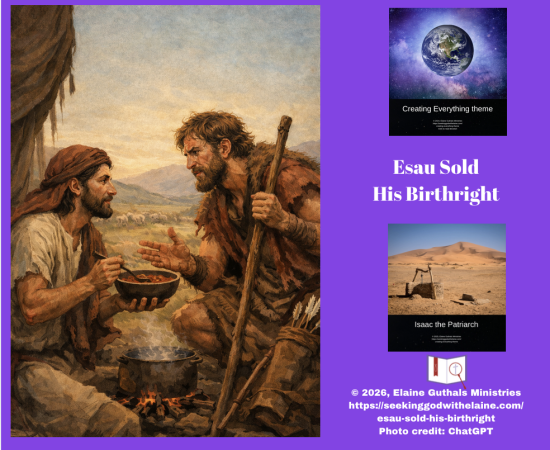
  • Esau Sold His Birthright

    Isaac and Rebekah’s twin boys grew but had different viewpoints. This devotional reading looks at their controversy over the birthright.

    Nuggets

    • Isaac had a dysfunctional family — probably because he came from one.
    • Jacob had something Esau wanted, so there had to be a means to trade.
    • Jacob seemed to be helping Jehovah along with transferring the birthright to him.
    esau-sold-his-birthright

    Let’s do a check. When Isaac was 60 years old and Rebekah was probably 33, their family expanded with the birth of Esau and Jacob.

    Even before they were born, Jehovah told Rebeka that the older would serve the younger. In other words – once again – birth order meant nothing in the covenant line. The covenant would proceed through Jacob’s line.

    We are not told that Rebekah told the others, but it is logical she did. Why would she keep that to herself when it was Jehovah that spoke?

    Unfortunately, the family didn’t proceed as if they knew that information – or some just didn’t accept it. At least that is how it looked 15 years later.

    Let’s Put It into Context

    To read devotions in the Creating Everything theme, click the button below.

    Devotions in the Isaac the Patriarch series

    Let’s Put It into Context #2

    Let’s make a timeline for Isaac.

    1860 BC — Isaac was born (Gen. 21: 2)
    c. 1858 BC — Isaac was weaned (Gen. 21: 8)
    c. 1845 – 1830 BC — God tested Abraham, at the age of 115- 130, by commanding he sacrifice his only son Isaac, making Isaac 15-30 (Gen. 22)
    c. 1823–1820 BC – Abraham sent Eliezer to Paddan-Aram to find a wife for Isaac (Gen. 24)
    1820 BC – Isaac, at age 40, married Rebekah (Gen. 25: 20)
    1800 BC – Jacob and Esau were born (Gen. 25: 24-26)
    1785 BC – Esau sold the birth right to Jacob in exchange for lentil stew Jacob was cooking while mourning for Abraham
    1723 BC – Jacob cheated Esau out of the birthright blessing given by Isaac (Gen. 29: 1-20)

    Based on Timeline from

    Let’s Put It into Context #3

    We know that a right is a basic human freedom. This encompasses several aspects that we acknowledge is inherent to all people.

    • the right to life, liberty, and security
    • freedom from slavery and torture
    • right to fair trials, expression, assembly, and religion
    • social rights to work, education, health, food, and housing

    Biblical birthright had to do with spiritual heritage. Brown gave a great definition. He said that it “… combines high [honor] with sacred duty; it confers dignity and power, but it demands self-abnegation and unselfish work.”

    Resource

    But now it isn’t just the firstborn, as it was in Jacob and Esau’s day, that has these birthrights. Every individual is inherently endowed with certain birthrights.

    • We have a duty to Jehovah.
    • We have access to His power.
    • Being His child gives us dignity.
    • It does come through submission to His Will.

    Isaac loved Esau, but Rebekah loved Jacob

    “As the boys grew up, Esau became a skillful hunter. He was an outdoorsman, but Jacob had a quiet temperament, preferring to stay at home. Isaac loved Esau because he enjoyed eating the wild game Esau brought home, but Rebekah loved Jacob” (Gen. 25: 27-28 NLT)

    Isaac had a dysfunctional family — probably because he came from one.

    In a way, it seems strange that — since Isaac was a meditative man (Gen. 24: 63) — the quiet son was not Isaac’s favorite. I guess opposites do attract.

    But then if we think about it, doesn’t Esau sound a lot like Ishmael? “And God was with the boy as he grew up in the wilderness. He became a skillful archer, and he settled in the wilderness of Paran …” (Gen. 21: 20-21 NLT).

    Where Ishmael grew up in the wilderness, Esau was similarly an outdoorsman. As an archer, Ishmael probably hunted as Esau did.

    Was Isaac wanting to be everything Ishmael was and he wasn’t? Was he wanting this to be the relationship he could never have with Ishmael?

    Jacob was more like Isaac than he was Ishmael. He comes across as more contemplative, more spiritual. Farrar described him as a harmless shepherd.

    Resource

    Many times, we look at this only as Jacob deceiving Esau for the birthright. The narrative changes slightly when we consider that the whole family knew of Jehovah’s choice all along. It makes us wonder if Rebekah had filled Jacob’s head with the notion that Esau would serve him.

    How was Jacob supposed to get the birthright? Since he was quiet, it is easy to think that Jacob wouldn’t take Esau in a test of strength.

    Cooking Some Stew

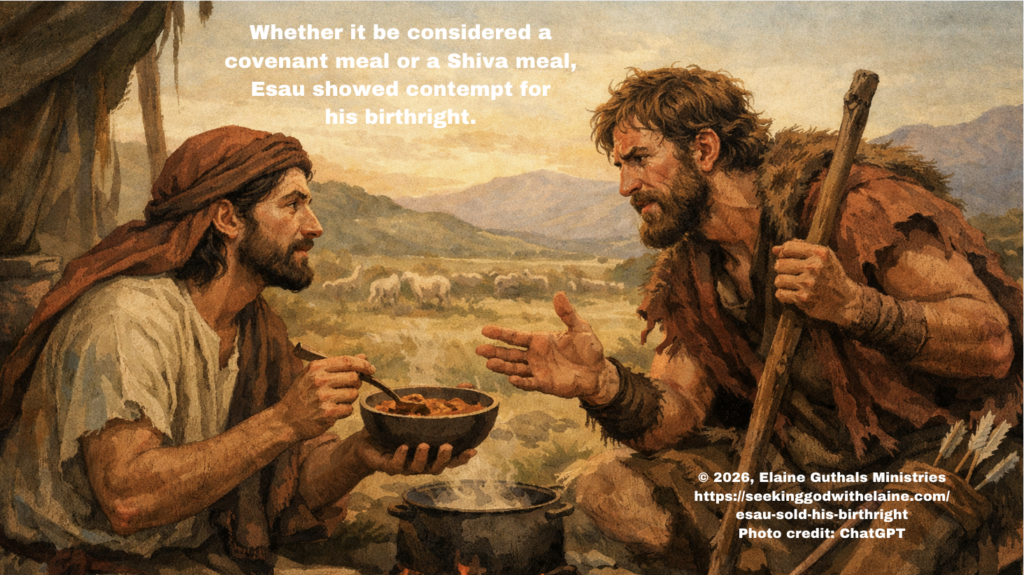
    “One day when Jacob was cooking some stew, Esau arrived home from the wilderness exhausted and hungry. Esau said to Jacob, ‘I’m starved! Give me some of that red stew!’ (This is how Esau got his other name, Edom, which means ‘red.’)” (Gen. 25: 29-30 NLT)

    Jacob had something Esau wanted, so there had to be a means to trade.

    We might consider it strange that Jacob was cooking. Remember Abraham put most of the meal together when God and His angels came down to destroy Sodom and Gomorrah (Gen. 18: 6-8).

    But still, Bradford said that the men usually did not do the cooking. He offered an explanation for Jacob cooking.

    Lentil stew, a practical, common dish for peasants, was made from what was produced from the land. Lentils were a staple food in the ancient Near East as its short growing season and long storage period were ideal for the nomads moving as their flocks required. It would have been cooked over a fire pit, as communal food was cooked during that time.

    Lentil stew, according to Bradford, was usually served while sitting Shiva. This led him to believe the family might have been in mourning for Abraham.

    Resource

    Even back then, neighbors brought food when there was a death in the family as immediate family members, such as Rebekah – the normal cook – were not supposed to cook. Jacob would not have been an immediate family member.

    Eats History also had an interesting take on the stew that Jacob was cooking. It said, “The dish itself becomes a symbol of choice — the immediate hunger of the body against the enduring inheritance of the spirit.”

    Resource

    The stew, though, also had symbolism. Bread and stew (noted in verse 34 as the menu for this meal) were used in the meal portion of a covenant. Sharing was considered an act of peace. Withholding was considered an act of power.

    That made this more of a sacred transaction. It would be easy to see Jacob thinking that, but would Esau have been?

    Adams pointed out the words that Esau used.

    • Give me what I want now.
    • I don’t care about the future – now is what is important.
    • You have to satisfy my need, or I’ll die.

    Resource

    On top of this, Esau later swore an oath. Remember, oaths were legally binding. It was like entering into a covenant agreement.

    Esau came home and all but demanded Jacob feed him. Jacob said, “Okay, but not so fast.”

    Trade Me Your Rights as the Firstborn Son

    ‘All right,’ Jacob replied, ‘but trade me your rights as the firstborn son.’ ‘Look, I’m dying of starvation!’ said Esau. ‘What good is my birthright to me now?’ But Jacob said, ‘First you must swear that your birthright is mine.’  Esau swore an oath, thereby selling all his rights as the firstborn to his brother, Jacob. Then Jacob gave Esau some bread and lentil stew. Esau ate the meal, then got up and left. He showed contempt for his rights as the firstborn” (Gen. 25: 31-34 NLT)

    Jacob seemed to be helping Jehovah along with transferring the birthright to him.

    That is what I always figured. Remember in the last devotion, we said that we have to accept Jehovah’s response to our prayer requests because they may contain temptation as well as mercy.

    Resource

    Jacob had been promised the mercy in being chosen as the covenant son. But there was precedence that the covenant son had to wait for the promise.

    • Abraham waited 25 years for Isaac to be born.
    • Isaac waited 20 years for Jacob to be born.
    • Jacob was 15 years old, and we haven’t been told that Jehovah had communicated with him yet.

    But let’s chase a rabbit for a second. If this was when Abraham died, Jacob didn’t give Jehovah time to do His work to switch the birthright to him.

    True, Jacob probably grew up with the story that Abraham didn’t wait and fathered Ishmael. But that should have been used as a wait-on-the-covenant-promises lesson.

    What was the holdup? And how long did he have to wait?

    So, Jacob succumbed to the temptation to make it happen before Jehovah kept His promise.

    It makes even more sense if we look at the lentil stew as a covenant meal.

    If we look at the lentil stew as a mourning meal, that begs the question as to why Esau was hunting. Am I the only one who thinks it is strange that, instead of being with family during a time of mourning, Esau is out having fun?

    If Abraham just died, why is Esau teasing about him starving to death? That is insensitive. Even if he was a rebellious teenager, he is making a very inappropriate statement for the situation.

    It doesn’t say Esau questioned this. It sounds like he just went along with it.

    Well, he did make the statement that he was about to starve to death (Gen. 25: 32). But Bradford thought that was more of a who cares statement.

    Bradford made a great observation. He said, “Of course, since God had long ago settled the issue, in reality Esau had no birthright to sell, for it already belong to Jacob. And, Jacob had no need to resort to treachery to obtain the birthright, because the Lord had already assigned it to him: but neither Jacob nor Esau had the faith to accept it as fact.”

    Resource

    But was Esau focusing on the common food aspect or the covenant aspect?

    Whether it be considered a covenant meal or a mourning meal, the last verse sums it up Esau’s attitude. He showed contempt for his birthright.

    Esau had already made his choice about serving Jehovah. He said no.

    It also shows a lot about Esau’s character. He was passionate, but not in a good way. He lacked integrity and goodness. He was impulsive, worldly, greedy, reckless, and I want to say shallow. He took no thought to responsibilities but rather thought only of himself.

    That was not what Jehovah was looking for in a covenant son. Esau was no more qualified for that position than Ishmael.

    But still, we can feel for Esau. Going on the assumption Rebekah did tell Esau he was born first but he wasn’t the firstborn, how would that have made him feel?

    Remember, the firstborn got the double portion of the wealth. They were made head honcho after the man in power no longer was in power.

    Esau – being a human being – would probably have always wondered if that was why Rebekah favored Jacob more. Did she see Jacob as a winner and Esau as a loser? Was she aligning herself with the future power?

    Was there anything Esau could have done to win Rebekah’s love? Did this create a bitterness within him?

    Or did he cultivate the who cares attitude as a defense mechanism? “If I don’t care, it won’t hurt me.”

    Or did Esau see the covenant responsibilities that came from Abraham through Isaac and say, “I don’t want to have anything to do with that”? That carried duties beyond the normal leader of the family responsibilities.

    If Jacob saw Esau’s attitude as wanting to not accept covenant duties and family responsibilities, he chose a good time to make his bid for the birthright.

    But does that mean Jacob went about this the right way? No.

    This isn’t how you treat a brother. He was cunning and deceitful because he took advantage of Esau.

    Worst of all, Jacob didn’t wait for Jehovah’s promise. It showed a lack of faith and irreverent.

    Jacob reduced the birthright to a business transaction.

    Making the Connections #1

    Esau was given a nickname because of the color of the stew he ate. Let that sink in a second.

    Once his in-the-moment needs were met, did Esau think what he had given up? No, “… He showed contempt for his rights as the firstborn” (Gen. 25: 31-34 NLT)

    Farrar said something interesting. He wrote, “Beware lest, in a moment of weakness and folly, you sell your birthright and barter your happy innocence for torment and fear and shame.”

    Resource

    Hmmmm. I never thought of Esau as being tormented, fearful, or full of shame.

    This choice that Esau made would follow him around for the rest of his life. It is bad enough that he had so little respect for the tradition surrounding the firstborn inheritance.

    But this nickname would mean that it would have been thrown in Esau’s face every time he would have been called that.

    Making the Connections #2

    Esau was said to have had a ruddy appearance. Another described in that manner was King David (I Sam. 16: 12).

    Making the Connections #3

    Bradford reminded us that only one other person in God’s Word is described as a hunter. That was Nimrod, who may or may not have helped build the Tower of Babel.

    Further, Bradford said that it refers to a stone-cold killer.

    Resource

    On the other hand, Jacob was described as a peaceful man, a quiet man. He was blameless or righteous.

    I would say that Esau not only didn’t value his birthright, but he also didn’t value life – where Jacob did.

    Making the Connections #4

    We hate to think about division in families. But Jehovah expects it. Yeshua even said so.

    “Do you think I have come to bring peace to the earth? No, I have come to divide people against each other! From now on families will be split apart, three in favor of me, and two against — or two in favor and three against. ‘Father will be divided against son and son against father; mother against daughter and daughter against mother; and mother-in-law against daughter-in-law and daughter-in-law against mother-in-law’” Lk. 12: 51-53).

    Making the Connections #5

    Esau and Jacob did reconcile. “Then Esau ran to meet him and embraced him, threw his arms around his neck, and kissed him. And they both wept” (Gen. 33: 4 NLT).

    I know their descendants were enemies, and Jacob still feared Esau. But Esau seemed to make peace with the fact he was not the covenant son.

    Making the Connections #6

    Remember, Esau wasn’t just giving up the earthly recognition that went along with the birthright. Until Jehovah set up the priestly system after the exodus, the firstborn was the priest of the family.

    Esau was turning his back on Sovereign God and all the covenant promises.

    • Esau gave up being the priest of the family, therefore, being the person with whom Jehovah spoke.
    • He gave up the promise of land.
    • He gave up being the ancestor of the Messiah.

    But isn’t that what Adam and Eve did? They gave up their birthright as children of Sovereign God because of the shiny, attractive object of the moment and how it satisfied earthy needs.

    Making the Connections #7

    Meyer had a great sermon reminding us of Jacob’s character. He looks a lot like the ordinary human.

    • Schemer but spiritual
    • In exile but attached to the land

    Resource

    We know Jacob was chosen from the womb. We see his many failings.

    But we also see Jacob’s unwavering faith. What did Hosea say about him?

    “Even in the womb, Jacob struggled with his brother; when he became a man, he even fought with God. Yes, he wrestled with the angel and won. He wept and pleaded for a blessing from him. There at Bethel he met God face to face, and God spoke to him — the Lord God of Heaven’s Armies, the Lord is his name!” (Hos. 12: 3-5 NLT emphasis added).

    Jacob believed wholeheartedly in Jehovah.

    Making the Connections #8

    Look at this reminder from Roberts. He wrote, “Although Jacob obtained, in virtue of his election, a certain priority over Esau, yet was Esau also, equally with Jacob, the subject of Divine sovereignty.”

    Resource

    We are all created in Jehovah’s image whether we acknowledge His as Sovereign God or not. We are all under His rule as our Creator.

    Being Jehovah’s creation does not secure our eternal destiny. Only Jehovah’s children will live with Him in eternity.

    Only those who believe in Yeshua being our Savior and submitting our lives to Him are Jehovah’s children. “But to all who believed him and accepted him, he gave the right to become children of God. They are reborn — not with a physical birth resulting from human passion or plan, but a birth that comes from God” (Jn. 1: 12-13 NLT).

    But non-believers are still creations of Jehovah.

    Roberts made another great point. Sovereign God works everything out for His good (Rom. 8: 28 NLT).

    This was also Esau’s good — even though he had to give up some things to get it.

    Making the Connections #9

    Is this a good argument for the nature/nurture debate? Maybe.

    The boys were brought up in the same household, but they were not treated equally. True, both were a favorite of a parent; but that doesn’t guarantee they were treated equally.

    To me, it comes down to both had a choice to make. Were they going to submit to Jehovah or not? They chose differently because, even though they were twins, they were different people.

    Making the Connections #10

    Fuller distilled things for us. He said that

    • Esau would have wanted the birthright if it consisted of worldly advantages.
    • Jacob, in his lifetime, gained none of the benefits of the birthright.

    Resource

    So, why did Jacob want it?

    • Spiritual privilege
    • Leadership
    • Double inheritance

    How Do We Apply This?

    • Raise our children to worship Jehovah.
    • Recognize our children’s need of love.
    • Find ways to cement a good relationship between siblings.
    • Recognize one sin leads to another.
    • Set our hearts on spiritual things.

    Resources

    Father God. Forgive us when we refuse to wait for the fullness of Your time on Your promises. Help us to keep focused solely on You. Amen.

    If you don’t understand something and would like further clarification, please contact me.

    Father God. Forgive us when we refuse to wait for the fullness of Your time on Your promises. Help us to keep focused solely on You. Amen.

    If you have not signed up for the email providing the link to the devotions and the newsletter, do so below.

    If God has used this devotion to speak with you, consider sharing it on social media.
  • How Does Sober Mindedness Promote a Balanced Life?

    God calls disciples of Christ to be even keeled. That means He wants us to be sober minded. This daily devotional looks at how God wants self-control to lead to a balanced life for Him.

    Nuggets

    • We have submitted ourselves to God’s Will and should strive to do it.
    • There are many things in this world that could be indulgences to disciples of Christ.
    • God wants disciples of Christ to be self-controlled.

    Devotions in the Christian Balance series

    How Does Sober Mindedness Promote a Balanced Life?

    Flowers with title How Does Sober Mindedness Promote A Balanced Life?

    When the chaos surrounding our lives get to be too much for us, we usually start looking for balance. It is in our best interest to look to God.

    God knows what kind of lifestyle would bring us the most balance in our lives. The foundation is sober mindedness. Let’s take a look.

    Let’s Put It into Context #1

    The definition of rest as defined by the Merriam-Webster Dictionary that is appropriate for us is “peace of mind or spirit.”

    Resource

    This is about what Vincent called a ripened faith. It means the contentment and peace in our relationship with God.

    Balance is about equilibrium and stability. It is that even keel under which God wants us to operate.

    Scriptures use the word sleep to describe three different states of humans. The first kind of sleep is the physical sleep. It is my goal to get at least four hours of sleep a night, hoping I get six.

    The second kind of sleep is death. As a result of sin, our bodies deteriorate and/or stopped from living by other means.

    The third kind of sleep is the most critical. It is talking about spiritual death. Spiritual death is the separation from God that occurred as a consequence of Adam and Eve’s original sin. This death can only be stopped by ABCDing.

    Resource

    The ABCDs of Salvation

    If you have not become a believer in Christ, please read through the
    Plan of Salvation and prayerfully consider what God is asking you to do.

    A – admit our sins
    B – believe His Son Jesus is our Redeemer
    C – confess God as Sovereign Lord

    D – demonstrate that commitment by making any changes needed in our lives to
    live the way in which God has called us

    The Disciple’s Job Description

    Glossary

    Let’s Put It into Context #2

    “For you are all children of light and children of the day. We do not belong to the night or the darkness” (I Thess. 5: 5 CSB)

    Disciples of Christ are considered children of the light. That is because Jesus said, “I am the light of the world. Whoever follows me will not walk in darkness, but will have the light of life” (Jn. 8: 12 ESV).

    Hallam felt this title was given to God’s children because of how baptism was referred. He wrote, “The ancient fathers often called baptism “illumination”; because it introduced and pledged to its recipients the enlightening influences of the Holy Spirit.”

    Resource

    Children of God are also illuminated by the Holy Spirit to the character of God. We submit our wills to God, Who then uses the promptings of the Holy Spirit to open our consciences for instruction and change.

    The opposite is children of the dark. “For we do not wrestle against flesh and blood, but against the rulers, against the authorities, against the cosmic powers over this present darkness, against the spiritual forces of evil in the heavenly places” (Eph. 6: 12 ESV).

    The darkness is equated with chaos. Satan works to create chaos so that we take our eyes off God.

    Why Should Disciples of Christ Not Sleep?

    “So then, let us not sleep, like the rest, but let us stay awake and be self-controlled” (I Thess. 5: 6 CSB) 

    It is logical that sin would be called sleep. We sleep in the darkness – usually – and are called children of darkness if we have not ABCDed. These are the goats of the world.

    Glossary

    Sleep is also equated with forgetfulness. Morris wrote, “In both spiritual and natural sleep we see not only forgetfulness as to the past and insensibility as to the present, we see, also, the entire absence of apprehension as to the future.”

    Morris made all the usual comments about the complacency and terrors of sleep. Then he talked about the unwillingness of sleepers to be awakened.

    Resource

    Have we ever run into that when we were witnessing? Not every non-believer is open to the saving grace of our Father. They may not yet have accepted that they are spiritually dead.

    Binney pointed out that this is a period of inactivity. This activity is those who are children of the dark are usually not actively seeking God.

    Resource

    Disciples of Christ are admonished to stay awake. We have submitted ourselves to God’s Will and should strive to do it. The motivation for this is thankfulness all that God has done for us.

    The Preacher’s Monthly point blank told us why it is not a good idea for disciples to sleep. It was written, “While Christians sleep the enemy is busy — sinners perish — the world rushes madly to ruin!”

    Resource

    Instead, disciples of Christ should be on guard. We’ve talked about watchfulness before. Watchfulness is a continual conscious examination of ourselves and all events so that we may follow God in all things.

    Glossary

    Swinnock told us the importance of watching. He wrote, “It is the mainstay of the soul, which, if once called off, we lie open to the shot of every enemy.”

    Resource

    That shows us that the individual disciple needs to watch for his/her own spiritual health. Let’s expand that. The church also has to watch for its spiritual health. The church does not want to be caught sleeping.

    Instead of being asleep, disciples need to be awake and sober. Sober is a character trait distinguished by self-control, genuineness, and sound moral judgment. It is a calm and temperate disposition.

    Glossary

    Disciples must be diligent in seeking God. We must consistently and persistently hear His Word, read it, study it, meditate on it, and memorize it. All through that, we need to be in prayer, asking God to provide the meaning.

    Sober has that element of self-control in it. Control comes into play when we have to use our free will to make the decisions to choose what children of light should do or to do as children of darkness do.

    It does take self-control because we do have free will. Self-control is the ability to withstand temptations by managing ourselves — our emotions, thoughts, and behaviors. Free will is the ability within us to make decisions, which determine actions that produce character.

    Glossary

    How Do Indulgences Upset the Balance of Disciples of Christ?

    “For those who sleep, sleep at night, and those who get drunk, get drunk at night” (I Thess. 5: 7 CSB)

    There are many things in this world that could be indulgences to disciples of Christ. However, these indulgences tempt disciples of Christ to sin. Those indulgences can unbalance disciples’ lives.

    Patterson gave us a list of what some of these indulgences are.

    Resource

    Physically

    One of the most commonly identified indulgences in Scriptures is the excessive use of alcohol. I think we can add drug use and sex outside of marriage to that.

    Mentally

    The worldview of success these days is an indulgence. Patterson mentioned ambition. That does lead to vanity.

    Spiritually

    This one may seem strange at first glance. Patterson explained this as, “… keeping free from wild and unregulated enthusiasm in religion.”

    We need to worship God in the appropriate way. He has specific instructions as to how we are to worship Him. We just talked about the Israelites worshiped God, but He did not accept their worship.

    To read a related devotion, click the button below.

    I think this could lead to our wanting God to condone whatever we want to give Him while keeping our pet sins. It has nothing to do with submission.

    Circumstantially

    I read this to be, sometimes, we are not content in the situation in which God places us. We just had a whole series on being content where God plopped us down.

    Devotions in the Contentment Leads to Tranquility series

    Socially

    Patterson only mentioned watching the friends that we make. I believe we can expand this to our significant other and our coworkers.

    Once we start giving in to these indulgences, the balance in our lives are thrown off. They start controlling our lives rather than God.

    It is no longer a temptation. Temptation is a suggestion in our mind that would lead us to sin rather than following God’s Will. It is also that period of time between conception and execution of doing what is sinful.

    The indulgence becomes a sin, and we are sunk.

    Disciples of Christ Are Self-Controlled

    “But since we belong to the day, let us be self-controlled and put on the armor of faith and love, and a helmet of the hope of salvation” (I Thess. 5: 8 CSB)

    God wants disciples of Christ to be self-controlled. In that way, we give Him control of our lives.

    Wait! Isn’t that contradictory?

    No, I don’t think so. We exercise self-control and make the decisions God wants us to make. That gives Him control of our lives.

    Mayo gave us some good advice. He wrote that disciples “… must keep their natural desires and appetites after the things of this world within due bounds.”

    Resource

    No, it is not going to be easy. Satan is going to do everything in his power to get us to give into the temptations.

    Luckily, God has given us the armor to help protect us. We don’t have to face Satan on our own.

    To read devotions in the Armor of God series, click the appropriate button below.

    Making the Connections

    God doesn’t want disciples of Christ to go from one extreme to another. He wants us to be even keeled.

    More importantly, God wants us living for Him and imitating Him. No, that isn’t going to be a snap.

    God is very involved in our attempts to live for Him. He has given us tools to help us. He will be with us every step of the way.

    Making the Connections to Self-Discipline

    As we are talking about living for God, that will mean we need to be self-disciplined. Keeping even keeled isn’t an easy task. We are emotional.

    How Do We Apply This?

    We need to imitate God. How do we do that?

    Searching for and Seeking God

    Hearing His Word (Rom. 10: 17).
    Reading His Word (Rev. 1: 3).
    Praying to Him (Heb. 4: 16).
    Studying His Word (Ac. 17: 11).
    Meditating on His Word (Ps. 1: 1-2).
    Memorizing His Word (Ps. 119: 11).

    Loving Heavenly Father. We want to be like You. We want Your character to be our character. We want the even keeled lives to which You have called us. In all we do, we submit our lives to You. Help us be sober and controlled so that we may give You the control. Amen.

    HowDoesSoberMindednessPromoteABalancedLifePin1

    What do you think?

    Leave me a comment below (about this or anything else) or head over to my Facebook group for some interactive discussion.

    If you don’t understand something and would like further clarification, please contact me.

    If you have not signed up for the email daily or weekly providing the link to the devotions and the newsletter, do so below.

    If God has used this devotion to speak with you, consider sharing it on social media.
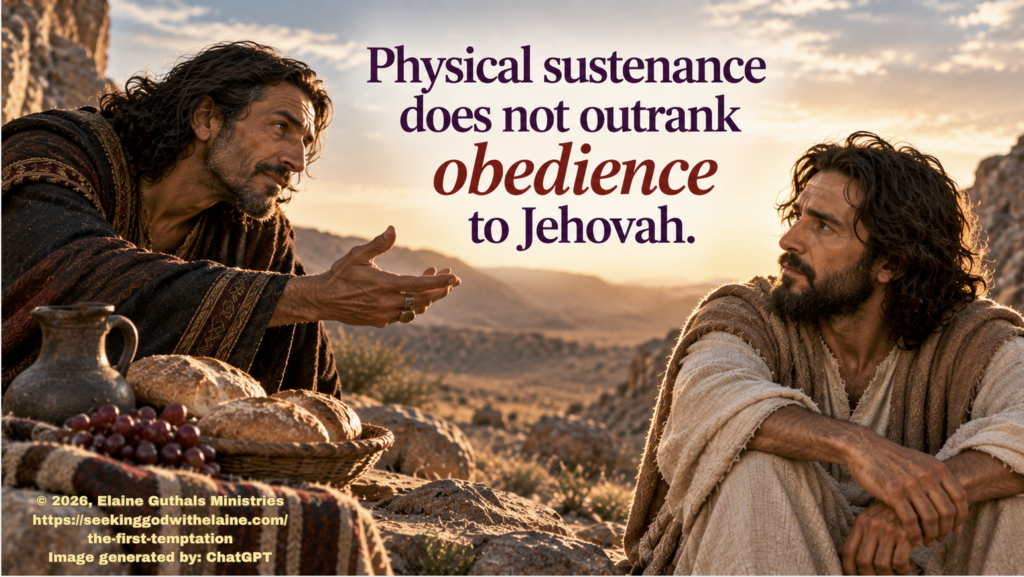
  • Peace Starts with Getting Right with God

    Worldview people might argue that peace does not start with God. This daily devotional looks at why there is no peace with Satan but there is peace of God – even though peace is not natural for us.

    Nuggets

    • Whatever peace the worldview thinkers believe they have, it is a false peace.
    • In order to gain true peace, we have to know God as He truly is.
    • Even though peace is a gift from God, we have to work attain peace.

    Devotions in the Peace Leads to Tranquility series

    Flowers with title Peace Starts with Getting Right with God

    When I was writing the last devotion, we touched on the fact that only true peace comes to God’s people. “… the LORD blesses his people with peace” (Ps. 29: 11 CSB).

    I am sure worldview people would beg to differ. I do think that is a true statement.

    I wanted us to dig in to prove – or disprove – that statement.

    Let’s Put It into Context

    We’ve talked about peace several times. Peace is an inward tranquility or composure of the mind resulting from a balanced life with spiritual order, equity, and truth.

    Glossary

    Peace isn’t just the absence of conflict. It is a positive condition.

    God wants disciples of Christ to experience peace in the midst of conflict. We can do that when we put our faith and trust in Him.

    Why Can’t Satan Give Us Peace?

    “For the secret power of lawlessness is already at work; but the one who now holds it back will continue to do so till he is taken out of the way. And then the lawless one will be revealed, whom the Lord Jesus will overthrow with the breath of his mouth and destroy by the splendor of his coming. The coming of the lawless one will be in accordance with how Satan works. He will use all sorts of displays of power through signs and wonders that serve the lie, and all the ways that wickedness deceives those who are perishing. They perish because they refused to love the truth and so be saved” (II Thess. 2: 7-10 NIV)

    Many worldview people do not see their actions as sin. If they do, they do not feel they have suffered the consequences for those sins. Instead, they see indications that there is no judgement for their beliefs and actions.

    Satan likes it better when worldview people are caught up in sensual and temporary pleasures. In that way, God doesn’t even enter their minds. They think they are good to go.

    Boy, does Satan have them snowed!

    Whatever peace the worldview thinkers believe they have, it is a false peace. Spurgeon wrote, “When a soul is borne up upon the waters of false peace, its case is hopeless until that peace is dried up, and the soul is stranded in self-despair.”

    Resource

    Satan isn’t going to give us peace because he is the father of chaos. His goal is to divide people so that they are constantly bickering — or full out fighting.

    The goal is not unity because unity fosters peace. Satan would rather see the protests, the debates, and wars so we are too busy to look for God’s peace.

    Satan is also the father of lies. That makes him feel like he is in control of us.

    One of the biggest lies is that we are not good enough. That has a lot of subsets. We aren’t pretty/handsome enough. We aren’t smart enough. We really don’t fit in with what others think is the norm.

    Those lies are not designed to give us peace. They are designed so we are unhappy with ourselves.

    They are designed to depress us. They are designed so that we are angry at God for creating us this way — if we feel we are God’s creation, which Satan hopes we don’t. (But he has to cover his bases here.)

    Satan is going to not reveal information we need to know. Oh, yeah. That makes us feel like we are not in control.

    Satan wants to domineer us. He wants the power. It is another ploy Satan has designed to keep us off balance.

    That is the main goal. If we are off balance, Satan assumes we will not be thinking of God. If we think about Him, we might go searching for Him. The next step is finding Him. Satan does not want that to happen.

    I’ve always thought it was funny how Satan tries to mimic God. Just as God sent Jesus to this earth to save it, Satan will send the antichrist to ensure its destruction. He even pulled off some miracles (as in Pharaohs’ magicians).

    Unfortunately, Satan is just a bad knock-off brand. Following him is not going to lead us to victory and peace.

    Peace Comes from Knowing God’s Character

    “Come to terms with God and be at peace; in this way good will come to you” (Job 22: 21 CSB)

    In order to gain true peace, we have to know God as He truly is. How does God reveal Himself to us to give us His peace?

    Wagner argues that many really don’t know God. He wrote, “Many persons assume that they naturally know God; but they do not feel the necessity of going to Scripture to learn the character of God.”

    Resource

    What that means is they have a head knowledge of God but not a heart knowledge. That is more practical knowledge. They haven’t delved through Scriptures to learn Who He really is.

    If we go to Scriptures, we learn that God is love (I Jn. 4: 8). God is peace (Eph. 2: 14).

    God wants us to know and believe His true character. He wants us to see His compassion. He wants us to put our trust in Him so we can obtain salvation. He wants us to know Him as He truly is.

    Resource

    But we’ve said before that just reading the Scriptures isn’t going to give us a full picture of God’s character. He has only put so much into His Word.

    We have to know the depths of God’s character. We have to experience Him.

    God is going to reveal Himself to us as we grow in His grace and knowledge (II Pet. 3: 18). That means we have to communicate with Him.

    That also means listening to God. “Tremble and do not sin; when you are on your beds, search your hearts and be silent” (Ps. 4: 4 NIV).

    That doesn’t mean we are to bring God down to our level. We have to remember that He is Sovereign Lord; we aren’t. His ways and thoughts are higher than ours (Isa. 55: 8-9).

    Bed

    Peace Doesn’t Come Naturally

    “Therefore, since we have been justified through faith, we have peace with God through our Lord Jesus Christ” (Rom. 5: 1 NIV)

    Peace isn’t natural for us. Breathing is natural.

    Even though peace is a gift from God, we have to work attain peace. It is an attitude we must realize.

    But there is also another thing of which we have to be cognizant. As God reveals His higher ways to us, we are going to realize how much more holy God is than we are. We are going to see how lacking we are.

    Ooo, baby. That will definitely take away some of our peace. When we realize how our sin has hurt him, it will definitely make us depressed.

    That really isn’t what God is about. Yes, He wants us to see the need for salvation. Salvation is deliverance from evil and the consequences of sins to replace them with eternal life and good. Sin is actions by humans that disobey God and break one of His reasonable, holy, and righteous laws and commandments, goes against a purpose He has for us, or follows Satan’s promptings.

    But we don’t have to worry. God doesn’t see us as worthless. He sees us as redeemable.

    Person and mountains

    How do we know? “But God showed his great love for us by sending Christ to die for us while we were still sinners” (Rom. 5: 8 NLT).

    All we have to do is ABCD. We have to repent of our sins. Repentance is expressing sorrow for breaking God’s laws and commandments by making the commitment to changing ourselves through obedience so that we no longer do the wrong things.

    The ABCDs of Salvation

    If you have not become a believer in Christ, please read through the
    Plan of Salvation and prayerfully consider what God is asking you to do.

    A – admit our sins
    B – believe His Son Jesus is our Redeemer
    C – confess God as Sovereign Lord

    D – demonstrate that commitment by making any changes needed in our lives to
    live the way in which God has called us

    The Disciple’s Job Description

    The most amazing thing is we no longer have to hang our heads because we have been sinners. God wants us to lift our heads and look full on His wonderful face, as the song says.

    God wants us to get over the feelings of unworthiness and inadequacy. He wants us to feel the love and joy — and peace — that He wants to give us.

    Just because we have been sinners doesn’t mean we have to stay sinners. God wants us to give our lives to Him so He can start us on the Sanctification Road. Sanctification is the transformation of mind, body, and soul beginning with regeneration and ending with perfected state of spiritual wholeness or completeness.

    God wants to transform us into people who are holy and righteous. Holy means to be set apart, perfect, and pure. Righteous means we are free from sin because we are following God’s moral laws.

    PeaceStartsWithGettingRightWithGodPin

    Making the Connections

    Satan wants us to use the wrong definition of fear of the Lord. He wants us to have the terror part.

    Nalson made an interesting comment. He wrote, “No ideal knowledge can give us either virtue or happiness.”

    I can see that. Perfect knowledge doesn’t cut it. I think that goes back to the head knowledge to the heart knowledge.

    Peace comes from not only knowing God but also embracing Him. If we embrace Him, we will try to imitate Him. That should lessen the amount of sin in our lives. It is that sin which steals our peace.

    Atterbury told us why knowing God is so important. He wrote, “This is the only way to a perfect tranquillity (sic) and rest of mind.”

    Resource

    There is no other way. But Jesus told us that. “Jesus answered, “I am the way and the truth and the life. No one comes to the Father except through me” (Jn. 14: 6 NIV).

    Making the Connections to Self-Discipline

    Yes, you read that right. We have to work to attain peace. It is a gift, but we have to accept it. We also have to prioritize it.

    That takes work. That takes self-discipline.

    How Do We Apply This?

    What I am hearing over and over again so far is that we have to search for and seek God in order to obtain His peace. This isn’t a one-time deal. It is a heartfelt endeavor.

    Searching for and Seeking God

    Hearing His Word (Rom. 10: 17).
    Reading His Word (Rev. 1: 3).
    Praying to Him (Heb. 4: 16).
    Studying His Word (Ac. 17: 11).
    Meditating on His Word (Ps. 1: 1-2).
    Memorizing His Word (Ps. 119: 11).

    Why? Natt said that “We must seek to be at peace with Him, by laying down our rebellion, asking pardon, and imploring the renewing and sanctifying influences of His Holy Spirit.”

    Resource

    Did you see that?

    • Stop sinning
    • Ask forgiveness
    • Change our character through the influences of His Holy Spirit

    Yes, we have to change our character to reflect His character. No, we don’t have to do that by ourselves.

    Peace starts with God, not Satan. Nothing in this world can give us true peace. We have to rely on our Heavenly Father to provide it for us.

    Then we have to work at it.

    Heavenly Father. You are so generous to us. Your love for us is amazing. On top of that, You want to give us Your peace. Help us to look to You for it. May we grow in Your grace and knowledge so that we can attain this peace. Amen.

    What do you think?

    Leave me a comment below (about this or anything else) or head over to my Facebook group for some interactive discussion.

    If you don’t understand something and would like further clarification, please contact me.

    If you have not signed up for the email daily or weekly providing the link to the devotions and the newsletter, do so below.

    If God has used this devotion to speak with you, consider sharing it on social media.
  • Instructing Our Children

    As parents, we try to teach our children our beliefs. However, it seems that they are increasingly rejecting those beliefs. This devotion looks at what advice Solomon gave his son.

    Nuggets

    • Worldview logic says if we are given free will, we should use it – not just believe our parents.
    • Parents got listed right after God because He knows how important being a parent is.
    • We get the garland for listening to our parents.

    Devotions in the What I Believe series

    Devotions in the Family category

    Instructing Our Children
    Who Is the Greatest in the Kingdom of Heaven?

    Flowers with title Instructing Our Children

    My Ladies were supposed to be studying Proverbs during Sunday Morning Bible Study. The lessons have been built on a parent teaching the child about God and His wisdom.

    Wisdom is knowledge, discernment, and good sense that leads to goodness and virtue, which can be applied to life.

    So far, Solomon has told us:

    • It isn’t enough to just have the wisdom — head knowledge isn’t enough.
    • Our wisdom has to align with God’s if we are going to flourish in the world.
    • We are righteous because we are free from sin by following God’s moral laws.
    • Wisdom is to be prized above religion.
    • We get to where God wants us to be by using wisdom to reason out what He is wanting us to understand as we seek Him.
    • Only God gives us lasting wealth and righteousness.
    • The results of wisdom are a closer relationship with God.
    • God judge us daily because He hates sin.

    I put this lesson in the Family folder when it came up. It is kind of a step backwards chapter wise, but it fits better in a family series than it would have in a wisdom series.

    Let’s Put It into Context

    Family is, according to the Holman Bible Dictionary, “the basic household unit which provides a person’s central relationships, nurture, and support.”

    Resource

    Ordinances are an expression of the disciples’ obedience. Marriage is an ordinance.

    Children, Follow Instructions

    “Listen, my son, to your father’s instruction, and don’t reject your mother’s teaching” (Prov. 1: 8 CSB)

    Ooo, baby. This verse is under attack these days. The worldview tells our kids to question most — if not all — of their parents’ beliefs. Why is that?

    It isn’t just because we are given free will. Free will is the ability within us to make decisions, which determine actions that produce character.

    It seems like, a lot of times, that is what our kids are told. Worldview logic says if we are given free will, we should use it – not just believe our parents.

    The underlying goal, though, is for kids to reject the Christian beliefs of their parents. They don’t want all these things their parents have called sin to remain labeled as sin. They want to be able to do what they want and not face any consequences.

    The problem is, however, that they are not just rejecting their parents. They are rejecting God.

    God is the One who labels things a sin. Sin is actions by humans that disobey God and break one of His laws and commandments, goes against a purpose He has for us, or follows Satan’s promptings.

    Okay, I have to check this out. I read that Arnot wrote, “The first and great commandment is the fear of God, and the second, which is next to it and like to it, is obedience to parents.”

    Resource

    Let me process. So, what is a Arnot really trying to say? The fear of the Lord means to love and revere God.

    Glossary

    We know Commandment #1 is “You shall have no other gods before me” (Ex. 20: 3 ESV). But we also know Commandment #2 is “You shall not make for yourself a carved image, or any likeness of anything that is in heaven above, or that is in the earth beneath, or that is in the water under the earth” (Ex. 20: 4 ESV). That has nothing to do with parents.

    Also, Jesus told us what the greatest commandments are. “And one of them, a lawyer, asked him a question to test him. ‘Teacher, which is the great commandment in the Law?’ And he said to him, ‘You shall love the Lord your God with all your heart and with all your soul and with all your mind. This is the great and first commandment. And a second is like it: You shall love your neighbor as yourself’” (Mt. 22: 35-39 ESV).

    That says love others, not obey your parents. So, let’s look at it through the Ten Commandments.

    A while back, I gave my Elaine-speak version. Starting at the top until we get to parents, they are

    • Love God first and foremost.
    • Don’t worship anything but Him.
    • Watch how you use His name.
    • Find a community of people who believe like you do and meet with them regularly.
    • Honor your parents.

    To read a related devotion, click the button below.

    If we look at the top four, they are all about how we show our love to God. We love Him, worship Him, and don’t take His name in vain.

    I can see how that can be grouped as one. Then we get to the parents.

    Oh, wow. Did you see? Parents got listed right after God. He knows how important being a parent is.

    Johnson pointed out that the duties of parents and teachers are analogous. It is the parents’ responsibility to teach their children how to be a person.

    Resource

    We also have a responsibility to teach children about God. Let’s chase a rabbit a second. Don’t think because we have reached a certain age and are no longer children, we are done learning. We can always learn, no matter what age we are.

    Also, family is not just blood. We can adopt anyone into our family. We can teach them, too.

    So, don’t think just because you have no children, you aren’t a teacher. Don’t think that just because you are a teenager or younger, you can’t learn.

    Back to children listening to their parents. They are not going to get a more loving teacher. No one will understand them like a parent does.

    God knows that we need to pass on the lessons we have learned to others. That is how we make the Scriptures real to us. What better place than within the family? That way our family members can really see our faith being lived out.

    Bible

    Head Coverings and Jewelry?

    “for they will be a garland of favor on your head and pendants around your neck” (Prov. 1: 9 CSB)

    Hmmm. Interesting.

    Kids think that having their own way will be very rewarding. Really, it isn’t. Following Satan’s way leads to chaos and hurt.

    A garland was a wreath that was worn on someone’s head. The Holman Bible Dictionary said that “garlands symbolized instruction or the benefit of wisdom.” That is why we see the gods in mythology wearing them.

    Resource

    We get the garland for listening to our parents???? Isn’t that the exact opposite of what kids think? They think the last thing they would earn was a garland for obeying their parents.

    Clarkson listed what obeying parents showed.

    • Humility
    • Their reacting to parents’ love
    • Their acknowledging that wisdom comes with age (and experience)
    • Their acceptance of a natural order.

    Resource

    Listening to our parents (or our employer or someone else) shows we are willing to acknowledge someone who is over us. We recognize that they have some authority over us.

    If we can’t listen to our parents, how are we going to obey God? But that is the premise kids go on, isn’t it? We don’t have to listen to anyone because we can make our own decisions.

    Making the Connections

    The problem with that is God does have laws and commandments. We break the laws, we suffer the consequences.

    God doesn’t want us to just know about the laws and commandments. He wants us to live them.

    Why? The laws and commandments show us God’s character. When we obey them, we become like God.

    That is the goal. God wants us to be like Him.

    How Do We Apply This?

    Raising kids is hard. I was reading a devotion today by a fellow blogger, Tabatha, that tells us six tips the Scriptures give us on how to do that.

    Resource

    I’ve been really lucky. Adam never really rebelled against me. There were other things that we had to deal with, but I didn’t have the problems other parents encounter.

    I just asked Adam why that was. After the initial, “I don’t know,” we figured a couple of things out.

    Adam knew if I told him something, I was shooting straight with him. I wasn’t lying to get him to act or think a certain way. I was giving him the best instructions that I knew.

    Another thing Adam knew was I spoke Adam. I got how he thought through things. I knew the words he used.

    I didn’t just say, “I am the Mom. You will …” unless I really had to for a very good reason. I would cringe every time one of his teachers or someone else would go into dictator mode with him.

    Oh, yes. I wasn’t a perfect parent. I know I’ve told you about the time I tried to get Adam to eat some chicken nuggets I made — Cajun chicken nuggets. It wasn’t pretty.

    My best advice is that we need to establish the relationship with our children. Yes, they have to honor us as parent. Yes, we have to honor them as human beings.

    The parent-child relationship is like any other relationship. It will need give and take. It will need patience and forgiveness.

    It is worth it.

    Father. You have made Yourself our Father. You didn’t need to make us an family when You created us. You wanted us. Even after we disobeyed You, You still wanted us. In fact, as the song says, You didn’t want Heaven without us so You brought Heaven down. Help parents and children to love each other as You do. Give us patience and forgiveness. Most of all, help us teach our children about You so that they may call You Father. Amen.

    What a Beautiful Name
    Vocalist: Elaine Guthals
    Keyboard: Chris Vieth

    What do you think?

    Leave me a comment below (about this or anything else) or head over to my Facebook group for some interactive discussion.

    If you don’t understand something and would like further clarification, please contact me.

    If you have not signed up for the email daily or weekly providing the link to the devotions and the newsletter, do so below.

    If God has used this devotion to speak with you, consider sharing it on social media.
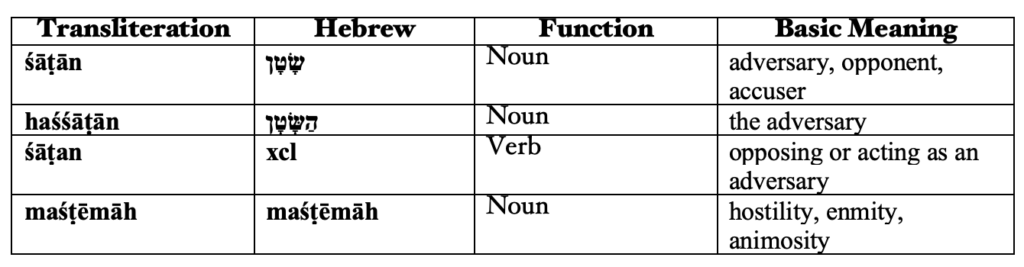
  • Spiritual Bondage

    In order to recognize and appreciate our freedom, we have to realize to what we are in bondage. This devotion looks the spiritual bondage all those who are not children of God face.

    Nuggets

    • Satan knows our weaknesses and how to use them to his advantage.
    • Death entered the world when Satan convinced Adam and Eve to sin.
    • Satan wants us to blame God.
    • A lot of times, the way Satan works our corruption is by promising us something.

    Devotions in the What I Believe series

    Devotions in the Religious Freedom category

    Spiritual Freedom
    Jesus the Liberator
    What Religious Freedom Doesn’t Mean

    Flowers with title Spiritual Bondage

    This series talks about spiritual freedom. To understand freedom, we have to understand to what we are in bondage — and to whom.

    We are in bondage to Satan and sin when we are not a child of God. “Jesus responded, “Truly I tell you, everyone who commits sin is a slave of sin” (Jn. 8: 34 CSB).

    This could be very difficult for non-believers to understand. When we are witnessing to them, we have to be clear on what we believe so that we can convey that to them.

    Luckily, we have several verses that we can use to present the concept. The foundation of this devotion was taken from the Sunday School Times’ sermon entitled Bondage and Freedom. Let’s check it out.

    Resource

    Let’s Put It into Context #1

    Freedom is, according to the Holman Bible Dictionary, “the ability of a person or group to be and do what they want instead of being controlled by another.” It is also referred to as liberty.

    Resource

    We talked about liberty before. We said that it runs the gamut, hitting all the things the worldview stresses.

    • We do what we please with no authority over us.
    • We make our own choices.
    • We don’t have to follow rules or limits.

    To read a related devotion, click the button below.

    Let’s Put It into Context #2

    Before mankind are children of God, they are sinners. Sinners are all people who have not made a genuine profession of faith — who have not sincerely ABCDed.

    Glossary

    The ABCDs of Salvation

    If you have not become a believer in Christ, please read through the
    Plan of Salvation and prayerfully consider what God is asking you to do.

    A – admit our sins
    B – believe His Son Jesus is our Redeemer
    C – confess God as Sovereign Lord

    D – demonstrate that commitment by making any changes needed in our lives to
    live the way in which God has called us

    The Disciple’s Job Description

    We are sinners because Adam and Eve committed the original sin in the Garden of Eden. Scriptures tell us that they disobeyed the express command of God — do not eat of the fruit from this one tree.

    Glossary

    Was the tree some magical tree? Maybe. Maybe not.

    I see the main issue was their disobedience. Adam and Eve did not submit their will and their lives to God. So, they did the exact opposite of what God told them to do.

    Yes, they had help. Satan was there to nudge them into disobedience.

    But the choice was all theirs. And mankind has suffered ever since. We have been in bondage ever since.

    In Bondage to Satan

    “Then they will come to their senses and escape from the devil’s trap. For they have been held captive by him to do whatever he wants” (II Tim. 2: 26 NLT)

    Satan is really sneaky. When he tempts us, it is hard for us to identify that it is him doing the talking. He makes it look like it is all our idea.

    What is worse is that Satan can use Scriptures against us. He did with Jesus.

    “Then the devil took him to Jerusalem, to the highest point of the Temple, and said, ‘If you are the Son of God, jump off! For the Scriptures say, “He will order his angels to protect and guard you. And they will hold you up with their hands so you won’t even hurt your foot on a stone”’” (Lk. 4: 9-11 NLT). If we don’t know the Scriptures and the context passage are used in, we won’t have on some of our armor to fight Satan.

    To read a related devotion, click the button below.

    Barlow explained why Satan is successful in tempting us. He wrote, “He conceives that some are apt to pride, malice, coveteousness, melancholy, mirth, silence, liberalness of speech, and according to our natural inclination he sets his gins for us.”

    Resource

    In Elaine-speak, Satan knows our weaknesses and how to use them to his advantage.

    Look at what Jesus called Satan. “… He was a murderer from the beginning and does not stand in the truth, because there is no truth in him …” (Jn. 8: 44 CSB).

    We say that we are taken captive by Satan. “… For they have been held captive by him to do whatever he wants” (II Tim. 2: 26 NLT).

    Satan may be sneaky in tempting us, but his objective is deadly. He wants us to remain spiritually dead. Spiritual death is the separation from God that occurred as a consequence of Adam and Eve’s original sin.

    Glossary

    The purpose of this captivity is so we will do anything Satan wants. What Satan wants is for us to do the exact opposite of what God wants.

    Two people fighting

    In Bondage to the Fear of Death

    “Now since the children have flesh and blood in common, Jesus also shared in these, so that through his death he might destroy the one holding the power of death —that is, the devil until we — and free those who were held in slavery all their lives by the fear of death” (Heb. 2: 14-15 CSB).

    Ooo, baby. Look what Gouge had to say. He wrote, “… the devil may be said to have the power of death,” which makes him the “… executioner of God’s just judgment …”

    Resource

    Think about it. The results of sin — poverty, crime, disease, death, etc. — are also the judgments of sin.

    Why does Satan have so much power over death? Death entered the world when Satan convinced Adam and Eve to sin. Satan brought death in, so he is considered “holding the power of death …” (Heb. 2: 14 CSB).

    Satan enslaves us by getting us to fear death. One thing that has been reinforced with Pastor Chad’s death is we have to be ready regardless of age. Being ready eliminates most of the fear.

    Oh, yeah. The mystery and leave-taking that Meyer talked about is still there. The pain may be there. However, we don’t have to fear the afterdeath.

    Resource

    Spurgeon wrote that Satan had power because he gets disciples to doubt their salvation. Or he will tell us that God really doesn’t forgive and forget the sins we have confessed. Worse yet, Satan may convince us that we will fail in heaven just as we did here.

    Resource

    But wait a second. We soft peddle fear these days, don’t we? We call it anxiety or stress.

    Oh, yeah. It can do bad things to us, but it is mostly because we aren’t handling it well.

    No. We need to fear Satan – and not in the love and reverence as we do to God. We need to steer clear of him and hold onto God’s peace.

    Glossary

    Ooo, baby. Smith got me to thinking. Why do non-believers fear death? Yeah, maybe the pain will last a little bit, but – in their opinion – then everything is over with because there is no afterlife.

    Resource

    Satan has them thinking about it backwards. The pain of death is only going to last a little bit. The sentences of judgment are going to last for eternity.

    Cemetary

    In Bondage to Sin

    “Don’t you realize that you become the slave of whatever you choose to obey? You can be a slave to sin, which leads to death, or you can choose to obey God, which leads to righteous living” (Rom. 6: 16 NLT).

    Sin. It comes down to sin. Sin is actions by humans that disobey God and break one of His laws and commandments, goes against a purpose He has for us, or follows Satan’s promptings.

    Glossary

    Melvill’s sermon talked about the effects of sin. He wrote, “Every pain to which flesh is heir, every sickness — the decay, and the dissolution of the body, are to be referred to sin as their first origin; and the temptation to sin having been of Satan, they are to be classed among the works of the devil.”

    Resource

    Yep, Adam and Eve followed Satan’s prompting. Bottom line, they were disobeying God.

    We disobey God when we don’t follow His laws and commandments. We disobey when He tells us to move somewhere, do something, or don’t do something – and we don’t, don’t, or do.

    Did you ever think about it? Adam and Eve got one chance. They had to obey, or else sin came into the world.

    We get more than one chance – even after we become disciples. God will forgive us of our sins when we repent. Repentance is expressing sorrow for breaking God’s laws and commandments by making the commitment to changing ourselves through obedience so that we no longer do the wrong things.

    Glossary

    Satan wants us to blame God. He isn’t to blame for our ills – Satan is, and we are. We are when we choose to disobey Him.

    Church

    In Bondage to Corruption

    “They promise freedom, but they themselves are slaves of sin and corruption. For you are a slave to whatever controls you” (II Pet. 2: 19 NLT).

    The Holman Bible Dictionary defines corruption as “used especially in the [King James Version] KJV to denote the transient nature of the material world —that is, the world’s bent toward change and decay …”

    Resource

    We talked before how Satan asked for Peter to be given to him. (I know, scary thought.) Jesus told Peter, “Simon, Simon, Satan has asked to sift all of you as wheat” (Lk. 22: 31 NIV).

    To read a related devotion, click the button below.

    A lot of times, the way Satan works our corruption is by promising us something. It could be through a relationship, a career, a skill – really anything that is attractive to us.

    But Satan is a liar. Adams wrote, “All sin is a servitude; and that which flatters men with the greatest opinion of liberty, makes them the most miserable vassals.”

    Resource

    In Elaine-speak, we generally get what is promised but find out we really didn’t want it at all. Usually, that is because the deceiver purposefully meant to deceive us.

    Making the Connections

    Snape showed us exactly how Satan’s treachery looks. He wrote, “… so the devil takes men’s souls alive by his subtlety: nay, more, unless they be recovered out of his snares, they must be alive for ever under his sway: lost, yet alive; hopeless, yet alive; tormented, yet alive; ever desiring to die, but never able.

    Yeah, Satan is talking out of both sides of his mouth. That makes him even sneakier.

    Johnson argued that we all do have liberty. To him, it is called free will. Free will is the ability within us to make decisions, which determine actions that produce character.

    Glossary

    Well, Johnson is correct. We all must make our own choices. We either choose to follow God or follow Satan. Not choosing to follow God is a choice for following Satan.

    Making the Connections to Self-Discipline

    Oh, man. How do we convince someone that Satan is a liar?

    We’ve been looking at defending our beliefs when we are witnessing. That means we have to be secure enough to convince someone to accept our beliefs.

    Our questions should still serve us to determine on what we need to focus.

    • What does the Scriptures say?
    • What do I believe?
    • Why do I believe the same/differently than the Scriptures?
    • What are the talking points when witnessing to a non-believer?

    Related Links

    I have created a worksheet of the questions above. Click on the button below to access it.

    How Do We Apply This?

    Barlow warned that Satan uses pleasures and suddenness to set his traps for us. He explained the pleasures this way. He wrote, “He sets a man’s affections on fire, kindles such a heat within him that for the present the object of temptation seems wonderful fair, delightful, honourable; though when he is ensnared he perceives no such thing, but the direct contrary.”

    Resource

    We have to counteract the suddenness and the intense desires with being focused on God. That focus comes when we seek God.

    Searching for and Seeking God

    Hearing His Word (Rom. 10: 17).
    Reading His Word (Rev. 1: 3).
    Praying to Him (Heb. 4: 16).
    Studying His Word (Ac. 17: 11).
    Meditating on His Word (Ps. 1: 1-2).
    Memorizing His Word (Ps. 119: 11).

    We know the steps. Yeah, that doesn’t make it any easier sometimes.

    Satan is good at what he does. He makes sin very attractive and promising. We just have to keep our eyes on Jesus.

    Father. We do not want to be in bondage to Satan. We want to follow You. Amen.

    What do you think?

    Leave me a comment below (about this or anything else) or head over to my Facebook group for some interactive discussion.

    If you don’t understand something and would like further clarification, please contact me.

    If you have not signed up for the email daily or weekly providing the link to the devotions and the newsletter, do so below.

    If God has used this devotion to speak with you, consider sharing it on social media.
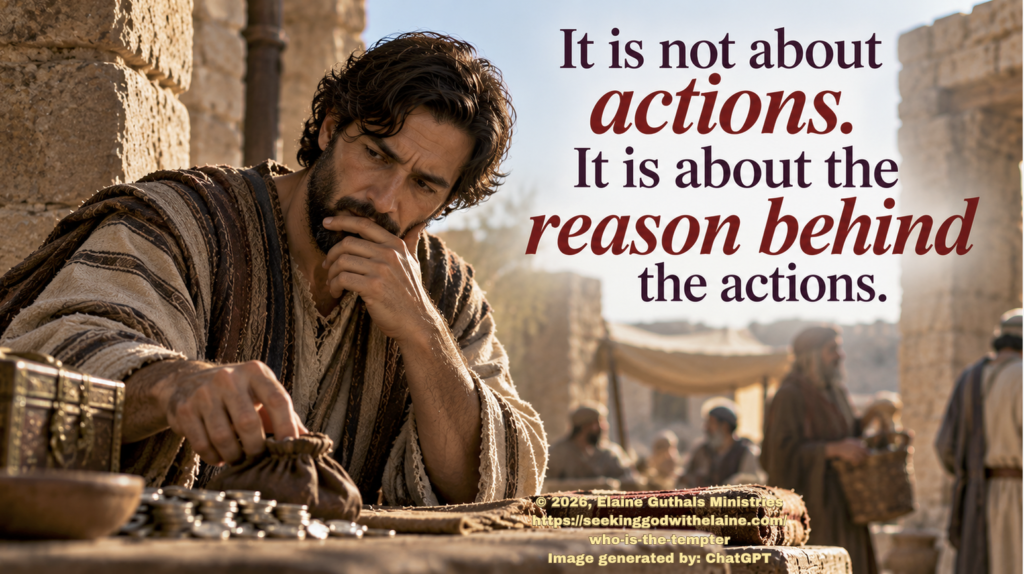
  • The Enticement of Sin

    Disciples are going to be tempted to sin after conversion. Those temptations are going to be appealing so that they entice disciples to sin. This devotion looks at advice Solomon gave to resist the temptations.

    Nuggets

    • The enticers were those people who have not made a genuine profession of faith — who have not sincerely ABCDed.
    • However the temptations come, they are going to be appealing.
    • When temptation turns into sin, it will turn from appealing to deadly.
    Flowers with title The Enticement of Sin

    Proverbs is an interesting book. My Ladies and I will be studying it this quarter (and we hopefully will get to start meeting together soon to do that!).

    We know the writer of Proverbs was Solomon. He was King David’s son. The advice he gives is addressed to someone he refers to as my son. We don’t know if the son he was addressing was his biological son Rehoboam or some other youth.

    Regardless of his intended audience, we all can find good council in the verses.

    Let’s Put It into Context

    The Holman Bible Dictionary defines sin as “actions by which humans rebel against God, miss His purpose for their life, and surrender to the power of evil rather than to God.”

    We have been defining it as when we disobey God and break one of His laws and commandments. I like the reminder that it is because if the influence of evil.

    Because of Adam and Eve’s original sin, we all begin as sinners. “For all have sinned and fall short of the glory of God” (Rom. 3: 23 CSB).

    Believers admit they are sinners, believe Jesus is our Savior and Redeemer, and confess God as our Sovereign Lord. “For by grace you have been saved through faith. And this is not your own doing; it is the gift of God” (Eph. 2: 8 ESV).

    According to the Merriam-Webster Dictionary, entice means “to attract artfully or adroitly or by arousing hope or desire.” Isn’t that an accurate definition?!

    Don’t Be Enticed

    “My son, if sinners entice you, don’t be persuaded” (Prov. 1: 10 CSB)

    The sinners Solomon is referring to, according to Newton, was “all persons who are not true Christians.” The enticers were those people who have not made a genuine profession of faith — who have not sincerely ABCDed.

    The ABCDs of Salvation

    If you have not become a believer in Christ, please read through the
    Plan of Salvation and prayerfully consider what God is asking you to do.

    A – admit our sins
    B – believe His Son Jesus is our Redeemer
    C – confess God as Sovereign Lord

    D – demonstrate that commitment by making any changes needed in our lives to
    live the way in which God has called us

    The Disciple’s Job Description

    While believers still have the capacity to sin, Solomon was addressing the temptations faced when we associate with those who are not following the laws and commandments of Sovereign God. Temptation is that period of time between conception and execution of doing what is sinful.

    To read a related devotion, click the appropriate button below.

    Newton details three reasons why disciples should resist the enticements of sinners.

    • “Because when we begin to sin it is hard to stop.
    • “Because it is dangerous.
    • “Because it is disgraceful.”

    I would add the term of devious. Sin, although black and ugly, is often hidden in something shiny and attractive. We should resist those too-good-to-be-true temptations.

    Birchan described vice or moral corruption as “the natural product of a tainted heart.” Since we originally are all sinners (Rom. 3: 23), that is the original condition of our hearts.

    Ways of Enticement

    “If they say — “Come with us! Let’s set an ambush and kill someone. Let’s attack some innocent person just for fun! Let’s swallow them alive, like Sheol, whole, like those who go down to the Pit” (Prov. 1: 11-12 CSB)

    Temptations can take several different forms, as listed in The Southern Pulpit’s The Personal Element in Temptation.

    • Personal authority.
    • Personal affection.
    • Personal attractions.
    • Personal influence.

    Think about it.

    • We can get into situations at work where our supervisors may require us to do something sinful, like portray a situation in a different manner than it happened.
    • Our friends may continue to try to talk us into doing something that breaks God’s laws and commandments.
    • We already talked about bright and shiny. Bullar also suggested that flattery could be used.
    • Status and influence and be used to tempt us.

    Why do sinners want to entice disciples? Matthew Henry wrote, “sinners love company in sin.”

    To me, sinners don’t always start a temptation in order or trip up disciples. Sinners don’t routinely say, “I am going to make that disciple do what they don’t want to do so they can sin.” Some do.

    In reality, they probably don’t see something as sin. They can see it as inconsequential. They can soft peddle it while putting our conscience at ease.

    Because they don’t see it as wrong, they aren’t purposefully trying to get us to do wrong. They just want us to do it — they want the company.

    A lot of times sinners try to get that company by ridiculing disciples. Or they give sly innuendos. Or it may be they inundate disciples with debate.

    Birchan argued that it is a natural impulse for sinners to entice disciples to sin. He, too, felt it came from sinners’ principles and habits.

    Johnstone reminded us that sinners can entice us to sin by example. How many times have we heard, “Well, everyone is doing it?” Familiarity goes a long way to whitewash a sin.

    But always, Satan’s reason for enticement is to trip us up. His goal is to get disciples to turn away from God, usually through misinterpretation. He is wanting us to break God’s laws and commandments.

    Ooo, baby. Did Arnot have to add his two cents worth? He wrote, “The sinners that entice from within are the man’s own thoughts and desires.”

    Ouch! Don’t we want to blame someone else. It’s Tom’s or Sally’s or Elaine’s fault. Anybody’s but mine!

    Some of us have so much trouble corralling our thoughts. We get to a place where we can do a lot of thinking, and off our thoughts go to the races. “I deserve …” “I should be able to …” “What would it hurt?”

    And we’re sunk. The temptation becomes a committed sin.

    The Allure of Sin

    “We’ll find all kinds of valuable property and fill our houses with plunder. Throw in your lot with us, and we’ll all share the loot” (Prov. 1: 13-14 CSB)

    However the temptations come, they are going to be appealing. Look at verse 11 again. “… Let’s attack some innocent person just for fun!” (Prov. 1: 11 CSB). Verse 13 says, “We’ll find all kinds of valuable property …” (Prov. 1: 13 CSB).

    Many times we think of temptations sneaking up on us and taking hold of us unawares. We forget that, as Taylor put it, “the nature of sin [is] to be aggressive.”

    There is going to be an allure set to hook us in. We’ve got to stand firm.

    When temptation turns into sin, it will turn from appealing to deadly.

    Taylor gave us a list of what those allures could entail.

    • Increase of knowledge
    • Pleasure
    • Love of liberty
    • Lack of discovery

    Making the Connections

    If Solomon was talking to his son, he was probably talking a young person. Temptations don’t have an age limit.

    So, young or old, we are going to be tempted. No one is going to be exempt.

    It was written in Weekly Pulpit’s Enticemerits and Enticers that this testing is necessary. They wrote, “There is no possible culture of moral character without such testing.”

    The thing we have to remember is free will. Free will is the ability within us to make decisions that determine actions that produce character.

    We have to choose to sin.

    Sin isn’t just going to happen.

    Satan isn’t going to make us sin with no input from us.

    Yep, if we sin, it is because we have chosen to disobey God. There isn’t anyone else we can blame. It is us.

    Birchan put it this way. He wrote, “… neither sin nor sinners can prevail against you without your own inclination.”

    We have to remember that the temptation itself isn’t the sin. Let’s say we were tempted to cheat on our spouse. It isn’t a sin until we actually give into the temptation.

    Reid reminded us that “temptation is mighty, but it is not almighty. No one has power over our will so that we must yield.”

    How Do We Apply This?

    • If we know something is going to be a tempting situation, don’t put ourselves in that situation.
    • Make sure we have mortified sin.

    Glossary

    • Just say no.
    • Always say yes to God — even if we would rather not — seek Him.

    Searching for and Seeking God

    Hearing His Word (Rom. 10: 17).
    Reading His Word (Rev. 1: 3).
    Praying to Him (Heb. 4: 16).
    Studying His Word (Ac. 17: 11).
    Meditating on His Word (Ps. 1: 1-2).
    Memorizing His Word (Ps. 119: 11).

    • Keep self-evaluating.
    • Watch who we let into our inner circle.
    • We have the armor of God — use it.

    To read devotions in the Armor of God series, click the appropriate button below.

    Resource

    Taylor had one other piece of advice that I didn’t want to get lost in the bullet points. If we know something is a sin, we shouldn’t be debating ourselves whether we should do it or not.

    Yes, it is the just say no and say yes to God. But focus on the don’t debate. Don’t negotiate. Don’t whine.

    Submit.

    Loving Heavenly Father. Satan will throw all he can at us to get us to disobey You. He will send the shiniest, most appealing thing to tempt us. May we daily tighten Your armor around us. May we be buried in Your Word to comfort us and strengthen us. It is our prayer that we are totally submitted and obedient to You. Amen.

    What do you think?

    Leave me a comment below (about this or anything else) or head over to my Facebook group for some interactive discussion.

    If you don’t understand something and would like further clarification, please contact me.

    If you have not signed up for the email daily or weekly providing the link to the devotions and the newsletter, do so below.

    If God has used this devotion to speak with you, consider sharing it on social media.
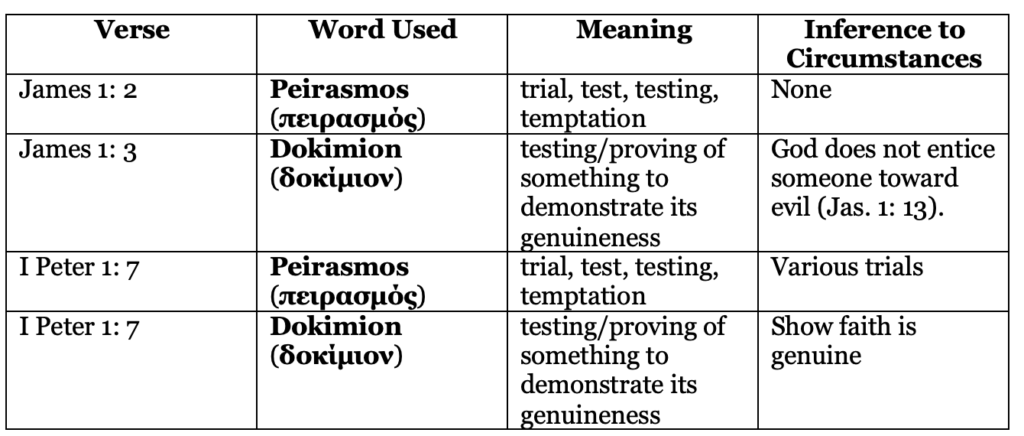
  • Who Was Balaam?

    Have you ever been on the right path but then veered off to somewhere you shouldn’t have gone? There is a really interesting story in the Bible about Balaam, who did just that. This first devotion in the A Man and His Donkey series looks at who Balaam was and how he was tempted.

    Nuggets

    • King Balak of Moab wanted to curse the Israelites.
    • Balak tried to enlist the help of Balaam, a prophet of Jehovah.
    • Balaam was a typical human, with a touch piety along with a touch apostasy.
    • God paid Balaam a visit and told him not to go with Balak’s men and not to curse them.

    To read devotions in the title series, click the appropriate button below.

    Who Was Balaam?

    Flowers with title Who Was Balaam?

    In Numbers, we take a break from the Wilderness Wanderers’ complaining to meet Balaam. Since he is not an Israeli, this story kind of comes out left field. Still, we can learn much from it.

    Let’s Put It into Context

    “Then the people of Israel traveled to the plains of Moab and camped east of the Jordan River, across from Jericho” (Num. 22: 1 NLT)

    The Wilderness Wanderers were inching ever closer to the Promised Land. They hadn’t crossed the Jordan River yet, but they had enjoyed some military victories.

    Most notable of theses victories was the Canaanites. “The Lord heard the Israelites’ request and gave them victory over the Canaanites. The Israelites completely destroyed them and their towns, and the place has been called Hormah ever since” (Num. 21: 3 NLT).

    Oh, yes. That had put the fear of God into the hearts of the surrounding nations — and this time, we don’t mean love and reverence.

    Balak Reacts

    “Balak son of Zippor, the Moabite king, had seen everything the Israelites did to the Amorites. And when the people of Moab saw how many Israelites there were, they were terrified. The king of Moab said to the elders of Midian, ‘This mob will devour everything in sight, like an ox devours grass in the field!’ So Balak, king of Moab, sent messengers to call Balaam son of Beor, who was living in his native land of Pethor near the Euphrates River. His message said: ‘Look, a vast horde of people has arrived from Egypt. They cover the face of the earth and are threatening me. Please come and curse these people for me because they are too powerful for me. Then perhaps I will be able to conquer them and drive them from the land. I know that blessings fall on any people you bless, and curses fall on people you curse.’” (Num. 22: 2-6 NLT)

    Case in point — King Balak. He was fearful, envious, suspicious, and under the influence of Satan (Babington).

    Let’s face it. After 40 years of wandering, the Israelites has to have been very seasoned people. They would have made a formidable opponent — especially since God was fighting on their side. Obviously, they took no prisoners.

    Balak wanted to curse the Israelites. Jones explained, “It was supposed that prophets and sorcerers had a power to curse persons and places so as to frustrate their counsels, enervate their strength, and fill them with dismay.” There was some merit in this statement, but men cannot curse those whom God has blessed.

    Balak tried to enlist the help of Balaam, a prophet of Jehovah. Munger noted Balak’s desire was “holding to the Oriental custom of devoting an enemy to destruction before battle, … [to] match his enemy even in this respect as nearly as possible.” Maybe he was wanting to pit one of God’s own against God’s own, thinking it would sway the situation to his favor.

    We may scratch our heads wondering how a prophet of God’s was not associated with Israel. The answer may be that Balaam resided in the land from which Abraham emigrated. Maybe Abraham’s people knew Balaam’ people and was introduced to the Sovereign God.

    Who Was Balaam?

    “Balak’s messengers, who were elders of Moab and Midian, set out with money to pay Balaam to place a curse upon Israel. They went to Balaam and delivered Balak’s message to him. ‘Stay here overnight,’ Balaam said. ‘In the morning I will tell you whatever the Lord directs me to say.’ So the officials from Moab stayed there with Balaam” (Num. 22: 7-8 NLT)

    Munger also described Balaam as a man of integrity. Kingsley called him “… a wise man, and a prophet of God. Vaughan described Balaam as “… a man who had frequent and extraordinary communications with God. Balaam was undoubtedly a man of great light; and his gifts were rare and transcendent.”

    J.J., however, noted that he is generally seen as wicked. J.J. reconciled these two polar opposite opinions by noting that Balaam’s “… conscience would not allow him to act in direct opposition to the will of God; but, at the same time, his heart was not wholly in God’s service.”

    Then again, Roberts called him a soothsayer. Why would God even acknowledge Balaam? Roberts stated, “But, as the art of divination was the highest point to which the heathen world had been able to attain in their pursuit of the unseen, so God condescended to meet Balaam, at that special point of spiritual culture, that He might lead him thenceforth to higher forms of truth and nobler modes of worship.”

    I think it all boils down to the fact that Balaam was a typical human. Unfortunately, there can be times we have a touch piety along with a touch apostasy. Apostasy means not believing in the state religion or not being a Christian. There are times that we all are lured away from God by the worldview.

    To read a related devotion, click the button below.

    If Balaam really was one of God’s own, why did he even consider Balak’s proposition? Wouldn’t he have known even before God told him that “… You are not to curse these people, for they have been blessed!’” (Num. 22: 12 NLT).

    A Visit from God

    “That night God came to Balaam and asked him, ‘Who are these men visiting you?’ Balaam said to God, ‘Balak son of Zippor, king of Moab, has sent me this message: ‘Look, a vast horde of people has arrived from Egypt, and they cover the face of the earth. Come and curse these people for me. Then perhaps I will be able to stand up to them and drive them from the land.’’ But God told Balaam, ‘Do not go with them. You are not to curse these people, for they have been blessed!’ The next morning Balaam got up and told Balak’s officials, ‘Go on home! The Lord will not let me go with you’” (Num. 22: 9-13 NLT).

    God paid Balaam a visit. Isn’t it interesting that God asked Balaam to explain the visit. God knew exactly who they were and why they had been there.

    Remember back in Genesis 3? God had asked Adam essentially the same question. “Then the Lord God called to the man, ‘Where are you?’”

    Both times Satan was there tempting the men. Both times they were required to explain themselves. “If you openly declare that Jesus is Lord and believe in your heart that God raised him from the dead, you will be saved. For it is by believing in your heart that you are made right with God, and it is by openly declaring your faith that you are saved” (Rom. 10: 9-10 NLT).

    It isn’t that we know God is God and that we are being tempted. We have to say and believe. God gives us the opportunity to confess our sins — and confirm our obedience to Him.

    Back to Balaam.

    God told him not to go with them and not to curse them. Balaam obeyed — but grudgingly — and sent the men away.

    Church

    Making the Connections

    Balaam had all these nice things said about him. But he was still tempted.

    I know. I am having kind of a hard time wrapping my head all around it. Heathen. Soothsayer. Prophet. And one that had “… frequent and extraordinary communications with God …” (Vaughn).

    “But someone who does not know, and then does something wrong, will be punished only lightly. When someone has been given much, much will be required in return; and when someone has been entrusted with much, even more will be required” (Lk. 12: 48 NLT).

    Balaam was given much. Much would have been required of him. More is required of teachers, too. “… for we who teach will be judged more strictly” (Jas. 3: 1 NLT). There is an expectation that I will serve as a good example for you.

    But then, we are all witness/teachers to those with whom we come in contact. We are witnesses without uttering a single word. Elliot said it this way: “Every life is a little Bible — a revelation of God.”

    Balaam had a lot going for him, but Balak didn’t give up. The next devotion looks at Balak’s second attempt to persuade Balaam to curse the Israelites for him.

    Father. We confess with our mouths that You are Lord. We believe Jesus is our Redeemer. Help us when Satan tempts us to follow Your Will. Amen.

    What do you think?

    Leave me a comment below (about this or anything else) or head over to my Facebook group for some interactive discussion.

    If you don’t understand something and would like further clarification, please contact me.

    If you have not signed up for the email daily or weekly providing the link to the devotions and the newsletter, do so below.

    If God has used this devotion to speak with you, consider sharing it on social media.