After His baptism, Yeshua was led into the wilderness by the Holy Spirit. This devotional reading looks at the first of Satan’s temptation that He endured.
Nuggets
- The Holy Spirit intentionally led Yeshua into the wilderness.
- The timestamp used in this passage is ambiguous.
- Ooo, baby, do we think we could take forty days of Messiah-level testing?
- Yeshua fasted while in the wilderness.
- Yeshua was protected in the wilderness – even if He didn’t know it.
- Satan is also called the devil.
- Did Satan not know who Yeshua was, or was he trying to get Him to doubt Himself?
- Satan wanted Yeshua to believe that He could provide for His needs Himself.
- Yeshua had been fasting, but Satan forgot that He was the Bread of Life.
Yeshua just had a mountaintop experience. He obediently submitted Himself for baptism. The Father and the Holy Spirit were there as witnesses.
Then Holy Spirit led Yeshua into the wilderness – and there it took a turn.
Enter Satan.
Let's Put It into Context
To read devotions in The Battle for the Heart theme
Devotions in the The Temptation of Jesus series
Led by the Spirit
“Then Jesus was led by the Spirit into the wilderness to be tempted there by the devil. For forty days and forty nights he fasted and became very hungry. During that time …” (Mt. 4: 1-3 NLT)
“The Spirit then compelled Jesus to go into the wilderness, where he was tempted by Satan for forty days. He was out among the wild animals, and angels took care of him” (Mk. 1: 12-13 NLT)
“Then Jesus, full of the Holy Spirit, returned from the Jordan River. He was led by the Spirit in the wilderness, where he was tempted by the devil for forty days. Jesus ate nothing all that time and became very hungry” (Lk. 4: 1-2 NLT)
Filled with the Holy Spirit
The Holy Spirit intentionally led Yeshua into the wilderness.
It is interesting to see the different Greek words used that is translated to show how the Holy Spirit got Yeshua into the wilderness. Let’s take a look.

Do the one Gospel contradict another? Matthew just gave us a bare bones description of the task of the Holy Spirit – He was to get Yeshua to the wilderness.
Mark presented the urgency of that leading. Does that mean Yeshua didn’t want to go? Probably not. It just means that the wilderness was exactly where Yeshua was supposed to be.
Luke presented duration. The Holy Spirit didn’t get Yeshua to the wilderness and drop Him off. Luke describes Yeshua as being led in the Spirit during the wilderness experience.
During that Time
The timestamp used in this passage is ambiguous.
I had never caught before that the verse says, “During that time …” (Mt. 4: 3 NLT). I had always assumed the temptation was at the end of the forty days.
To me, that was logical. Yeshua would have forty days to get really hungry — for food and for company.
Food and company are two very important elements for humans. None of us can survive without food. True, we can go for some days without eating, but not long.
True, some of us can go much longer without physical contact with another human being. Television and streaming can help, but we were made to be social people.
The Greek that Matthew used was ἐλθὼν ὁ πειράζων. It literally means the tempter, having come.
That means we can’t read Matthew to say the tempting started on Day 40 and took one day. It is easy to read that since there are no timestamps within the temptations themselves.
But why would Satan do one big temptation session?
Luke doesn’t lock the wording down that precisely. Again, he made the tempting an ongoing event.
To me, that is what Satan would more than likely have done.
Part of me says non-stop – ongoing as Luke said. I can just see Satan slamming and slamming away at Yeshua’s Will to get Him to trip up.
It is possible that Satan tempted Yeshua the whole forty days. We can’t be certain that these were the only temptations during the 40 days. These may have been the only ones recorded.
Wait! What did Matthew say? The Holy Spirit led Yeshua to the wilderness to be tempted by Satan?
Well, not really. Matthew grammatically separated them.
- The Holy Spirit led Yeshua into the wilderness.
- The devil tempted Him.
What Matthew was giving us was the purpose of going to the wilderness. Remember, Jehovah has to allow Satan to tempt us. That doesn’t mean Jehovah is doing the tempting.
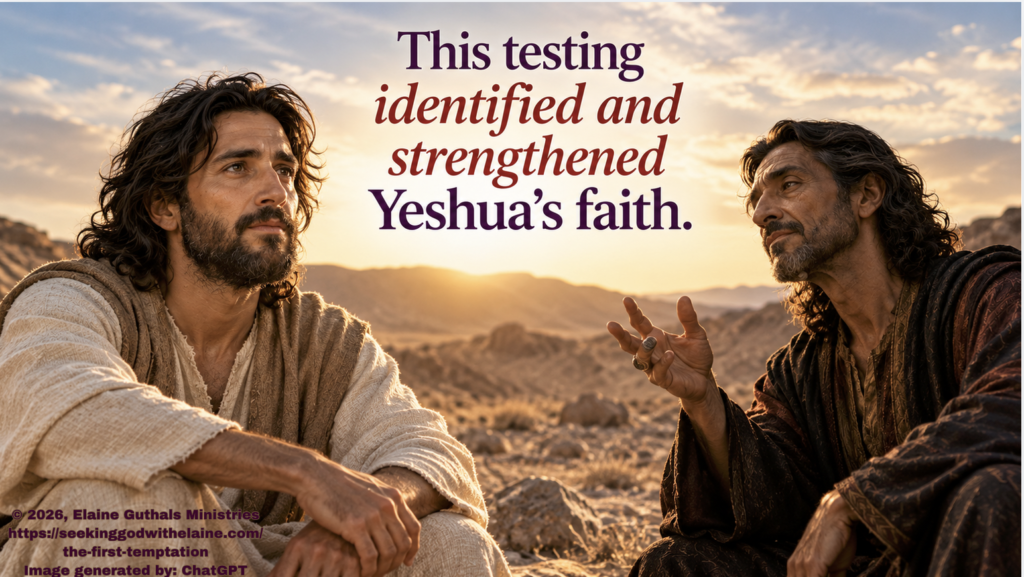
Jehovah can and does use those same temptations as testing. The testing identifies and strengthens our faith. This testing identified and strengthened Yeshua’s faith.
Forty Days of Testing
Ooo, baby, do we think we could take forty days of Messiah-level testing?
We know it would have had to be worse than anything we have ever experienced. I mean, if Satan could get Yeshua to sin, the whole plan would have to be scrapped.
Yep, the plan that was developed before the foundation of the world — before creation — hinged on Yeshua staying blameless, staying pure and sin-free.
We’ve talked before about the significance of 40. This was the amount of time
- it rained during the Flood (Gen. 7: 4, 12, 17).
- Yeshua was tempted in the wilderness (Mt. 4: 2; Mk. 1: 13; Lk. 4: 2).
- the mountaintops were visible before Noah opened the ark’s window (Gen. 8: 6).
- Moses remained on Sinai receiving the law (Ex. 24: 18).
- Moses spent interceding after the golden calf (Deut. 9: 18, 25; 10: 10).
- spies explored Canaan (Num. 13: 25).
- Goliath challenged Israel (I Sam. 17: 16).
- it took Elijah to travel to Horeb (I Kgs. 19: 8).
- Jonah warned Nineveh (Jon. 3: 4).
- a woman waited for purification after the birth of a son (Lev. 12: 1-4).
- Yeshua remained on earth after His resurrection (Ac. 1: 3).
There are other occasions where the number 40 is used, but these are the ones that specifically apply to 40 days. The number 40 is used in patterns.
Fasted/Ate Nothing
Yeshua fasted while in the wilderness.
Biblical fasting is more than just not eating. It is not eating for a spiritual purpose.
- Seeking Jehovah
- Repentance
- Grief or mourning
- Prayer and intercession
- Humbling ourselves
- Preparation
The Hebrew concept frequently expressed is through the noun tsom (צוֹם) and the verb tsum (צוּם.).
Our motivation for fasting is important. We can’t fast as a means of forcing Jehovah to respond to us – usually some specific request.
We should be fasting because we are humbling ourselves before Jehovah and are turning our attention toward Him.
Fasting can’t be externally performed without internal obedience.
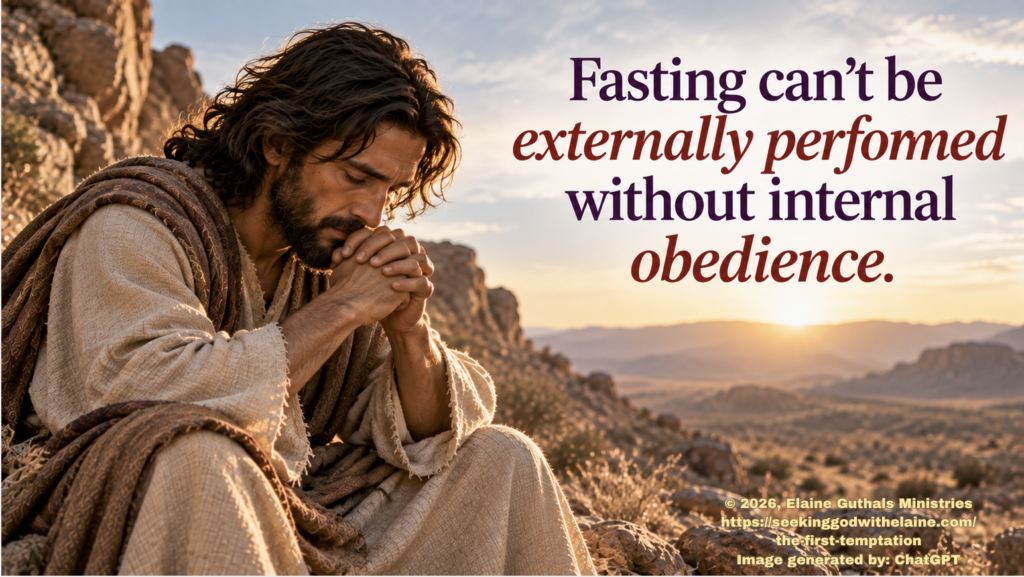
Matthew specifically said that Yeshua fasted. Luke, however, just said that He went without food.
Was it a unique, Spirit-led wilderness fast? Maybe. Maybe not.
We have to be careful reading Matthew. “For forty days and forty nights he fasted and became very hungry” (Mt. 4: 2 NLT). After one to three days, Yeshua would have been experiencing hunger. His hunger would have become very real by Day 20, let alone Day 40.
There is something significant about the wording. Yeshua fasted → He became hungry → Satan’s first temptation concerned food.
My opinion? Yeshua was fasting. He was preparing for the ministry He would begin.
I don’t think that it was just food was scarce – or He just didn’t have an appetite His cousin had for locust.
Yeshua was following several purposes for fasting.
- Seeking Jehovah
- Prayer and intercession
- Humbling Himself
- Preparation
That communion with the Father was the whole purpose of going out into the wilderness.
Out among the Wild Animals
Yeshua was protected in the wilderness – even if He didn’t know it.
Mark added an interesting nugget. He said that there were wild animals in the wilderness.
Well, that was logical. The wilderness that Yeshua was in was the Judean Wilderness, a harsh and rocky region east of Jerusalem. It stretched toward the Jordan River and the Dead Sea.
The Hebrew term for it is midbar (מִדְבָּר). It wasn’t only considered an empty land. It taught dependence on Jehovah. It was where God spoke and revealed Himself to people.
This wilderness consisted of jagged limestone hills, steep ravines known as wadis, and dry, chalky soil. The vegetation was limited to thorn bushes and scattered scrub growth.
The extreme climate ran from intense daytime heat to cold nights. Rain was limited, which limited food sources. Those living in the wilderness had to gather what the wilderness provided – locusts and wild honey.
Many wild animals go where people aren’t. It would have been expected that some took up residence in the barren wasteland.
But Yeshua wasn’t alone. He had angels ministering to Him.
Does that mean the angels were with Yeshua 24/7/40? Well, yes and no.
While the angels may have been guarding Yeshua, I doubt he could see them 24/7/40. They may not have physically made their presence known to Him.
What Is Most Important to the Messiah?
“… the devil came and said to him, ‘If you are the Son of God, tell these stones to become loaves of bread.’ But Jesus told him, ‘No! The Scriptures say, “People do not live by bread alone, but by every word that comes from the mouth of God”’” (Mt. 4: 3-4 NLT)
“Then the devil said to him, ‘If you are the Son of God, tell this stone to become a loaf of bread.’ But Jesus told him, ‘No! The Scriptures say, ‘People do not live by bread alone”’” (Lk. 4: 3-4 NLT)
The Devil
Satan is also called the devil.
The Hebrew word śāṭān begins with the basic idea of an adversary. Job and Zechariah place the adversary within heavenly scenes involving accusation and testing.
Chronicles presents a more individualized Satanic figure. Genesis gives us the serpent who challenges God’s word, while Revelation later identifies the ancient serpent with Satan – and calls him the devil.
Second Temple Jewish writings then expand reflection on evil spiritual powers, developing figures such as Mastema and Belial. There are also elaborate accounts of spirits, deception, judgment, and cosmic conflict.
One theological boundary remains essential: the adversary is not Jehovah’s equal. Evil is real, spiritual opposition is real, and the battle reaches human beings, but God remains sovereign.
The conflict also reaches deeper than behavior. The adversary challenges trust. He accuses. He deceives. He offers competing interpretations of God’s word. He seeks to move God’s people from dependence upon Jehovah toward some other source of security, identity, wisdom, or provision.
If You Are the Son of God
Satan wanted Yeshua to believe that He could provide for His needs Himself.
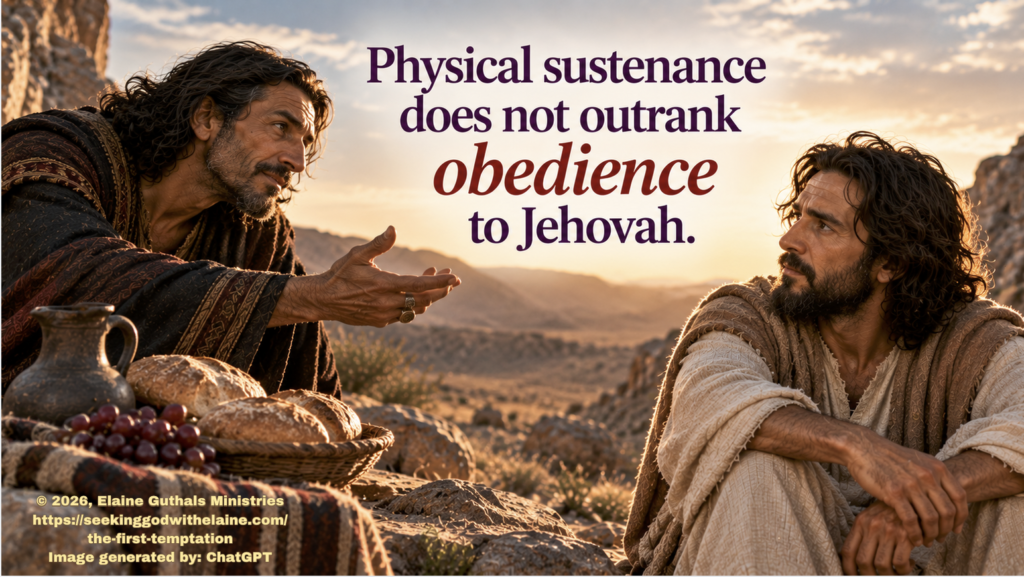
Satan wasn’t saying that he could turn the stones into bread. He was wanting Yeshua to do it for Himself.
Could Yeshua have done it? Yes.
But that wouldn’t have been relying on Jehovah for our provision.
If Yeshua was supposed to fast for forty days, turning stones into bread would have been a sin. It was because Yeshua was listening to and obeying Satan.
Tell These Stones
Did Satan not know who Yeshua was, or was he trying to get Him to doubt Himself?
It is my opinion that Satan knew exactly Who Yeshua was. He wouldn’t have called just anyone the Son of God.
There is evidence of this in Scripture. “Suddenly, a man in the synagogue who was possessed by an evil spirit cried out, ‘Why are you interfering with us, Jesus of Nazareth? Have you come to destroy us? I know who you are — the Holy One of God!’”
One of Satan’s demons wouldn’t have known Yeshua if Satan himself didn’t.
Loaves of Bread
Yeshua had been fasting, but Satan forgot that He was the Bread of Life.
Bread was a staple in the diets of first-century Jews. It was regularly eaten with meals. It was substantial enough the bread could function almost as a general term for food.
Satan wasn’t offering Yeshua pie or cake. He wasn’t offering Him some luxury food item.
Satan was offering Yeshua a basic necessity of life.
Yeshua came back with a verse in Scripture. “Yes, he humbled you by letting you go hungry and then feeding you with manna, a food previously unknown to you and your ancestors. He did it to teach you that people do not live by bread alone; rather, we live by every word that comes from the mouth of the Lord” (Deut. 8: 3 NLT).
Physical sustenance does not outrank obedience to Jehovah.
Making the Connections
Jesus’ temptation isn’t merely a morality lesson about three things Christians should avoid. It is an encounter between the Son of God and the adversary within the larger biblical story of God’s purposes, human faithfulness, and spiritual opposition.
Heart Check
Think about the battle Yeshua is engaged in for your heart. Ask yourself the following questions.
- When I am in need, do I trust Jehovah to provide, or do I try to provide for myself?
- When Jehovah’s answer requires waiting, do I wait obediently, or do I take matters into my own hands?
- When I am tempted, do I look for what I can gain, or do I look for what Jehovah has commanded?
- Do I value immediate relief, or am I willing to remain obedient when obedience costs me something?
- When I know what Scripture says, do I obey it, or do I look for a way around it?
How Do We Apply This?
- Recognize the difference between a legitimate need and an excuse for disobedience.
- Learn to trust Jehovah when obedience requires us to wait.
- Turn to Scripture when we face temptation.
- Remember that satisfying a legitimate need does not justify disobedience.
- Choose Jehovah’s provision over our own solutions.
- Remain faithful when temptation attacks our physical needs, desires, or sense of security.
Father God. You allow Satan to tempt us. Part of that is consequences from the Fall. Part of it is that You also use that temptation to test us. Lord, may our faith prove genuine. Amen.
If you don’t understand something and would like further clarification, please contact me.
If you have not signed up for the email providing the link to the devotions and the newsletter, do so below.
If God has used this devotion to speak with you, consider sharing it on social media.