Humans in all ages have had to resist the tempter. This devotional reading looks at who he is and how he opposes Jehovah.
Nuggets
- The term the Accuser is used as a title.
- Jehovah was the One Who brought up Job.
- Satan didn’t dispute Job’s actions but rather his motivation.
- Jehovah allowed the testing to take place.
- While śāṭān (שָׂטָן) isn’t used in Genesis 3: 1, Revelation 12: 9 does identify the serpent with Satan.
- Satan stood ready to accuse Jeshua, the High Priest, before the angel of the Lord.
- The importance of this passage is that it doesn’t use the word the.
- By the time Yeshua walked the earth, Jewish thought about the spiritual realm had developed beyond the earlier use of śāṭān as simply an adversary or accuser.
- Satan can oppose God’s people, but he cannot become God’s equal.
- We often think of the heart as the place where our emotions live.
Before we get to the temptation of Yeshua, we need to understand a little about who His tempter was. That will help us understand who still tempts us today.
On the surface, it appears that Satan tries to get us to not do the do’s and to do the don’ts. But bad behavior isn’t his overall motivation.
At the core, the temptations focus on trust, allegiance, truth, and accusation. The bottom line is, will we trust Jehovah or Satan?
Let's Put It into Context #1
To read devotions in The Battle for the Heart theme
Devotions in the The Temptation of Jesus series
Let's Put It into Context #2
Who is that adversary, and where did he come from?
When we think of the Jehovah’s opponent, we call him Satan. Well, that isn’t the best translation of what the opponent is called.
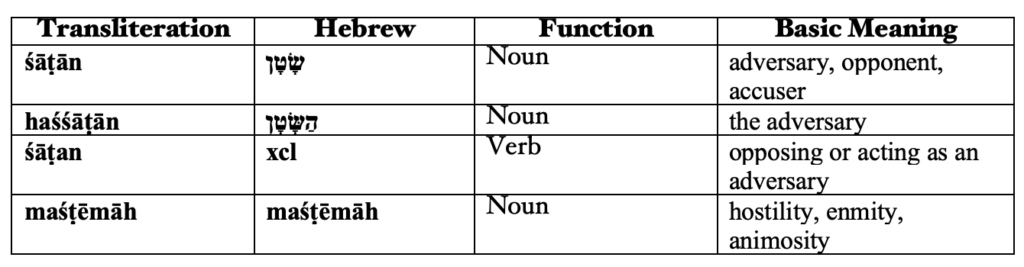
The Hebrew word śāṭān (שָׂטָן) isn’t a proper name. It is a noun that means adversary, opponent, or accuser. It is more of a role or function.
From there, the word seems to have taken on a life of its own. The progression has been the adversary → the heavenly accuser → an increasingly personalized adversarial figure → Satan/the Devil of the New Testament.
Look at the following Hebrew words. Their common element is characterized as opposition.
The Adversary Already Existed
“One day the members of the heavenly court came to present themselves before the Lord, and the Accuser, Satan, came with them. ‘Where have you come from?’ the Lord asked Satan. Satan answered the Lord, ‘I have been patrolling the earth, watching everything that’s going on.’ Then the Lord asked Satan, ‘Have you noticed my servant Job? He is the finest man in all the earth. He is blameless — a man of complete integrity. He fears God and stays away from evil.’ Satan replied to the Lord, ‘Yes, but Job has good reason to fear God. You have always put a wall of protection around him and his home and his property. You have made him prosper in everything he does. Look how rich he is! But reach out and take away everything he has, and he will surely curse you to your face!’ ‘All right, you may test him,’ the Lord said to Satan. ‘Do whatever you want with everything he possesses, but don’t harm him physically.’ So Satan left the Lord’s presence.” (Job 1: 6-12 NLT)
The Accuser
The term the Accuser is used as a title.
If we look at the Hebrew Bible, we see the word we translate as accuser is haśśāṭān (הַשָּׂטָן). It literally means accuser.
The most important word is the ha – the accuser. Haśśāṭān is used as a title, not a proper name.
An accuser is someone who claims another has committed an offense. This person is charging the other of doing something morally wrong.
That is important.
Have You Noticed
Jehovah was the One Who brought up Job.
We may think that Satan is the one who brought Job into the conversation. He wasn’t.
Jehovah used Job as an example of someone who is blameless. The root word for blameless is tām (תָּם), from the root tāmam (תָּמַם). It means being complete, whole, or possessing integrity. The central Hebrew idea behind blameless is wholeness.
Jehovah didn’t say that Job was righteous – tzaddik (צַדִּיק). That means one who conforms to God’s standards.
What Jehovah was talking about here was that Job had integrity. His character wasn’t compromised.
To me, that says Job made a choice to have integrity. He easily could have chosen not to follow Jehovah, but he didn’t do that.
Yes, But
Satan didn’t dispute Job’s actions but rather his motivation.
Satan wasn’t saying that Job wasn’t a man of integrity. He was saying the reason for Job’s integrity was because he liked the blessings Jehovah gave him.
In Satan’s mind, he believed that to remove the blessings would remove the integrity.
It is not about actions. It is about the reason behind the actions.

Why did we do what is right in Jehovah’s eyes? Are we just wanting His blessings? Or do we want a relationship with Him?
Satan was convinced that Job wasn’t really interested in a relationship with Jehovah. He was interested in getting the good stuff.
All Right, But
Jehovah allowed the testing to take place.
Jehovah didn’t say that Satan had examples of Job’s faithfulness to Him. He didn’t bring up past examples to prove His point.
No, Jehovah said, “Okay. I’ll let you test him. But you can’t harm him physically.”
Jehovah doesn’t send trials our way. He does, however, test us to ensure our faith is strong.
- “Dear brothers and sisters, when troubles of any kind come your way, consider it an opportunity for great joy. For you know that when your faith is tested, your endurance has a chance to grow. So let it grow, for when your endurance is fully developed, you will be perfect and complete, needing nothing” (Jas. 1: 2-4 NLT).
- “These trials will show that your faith is genuine. It is being tested as fire tests and purifies gold — though your faith is far more precious than mere gold. So when your faith remains strong through many trials, it will bring you much praise and glory and honor on the day when Jesus Christ is revealed to the whole world” (I Pet. 1: 7 NLT).
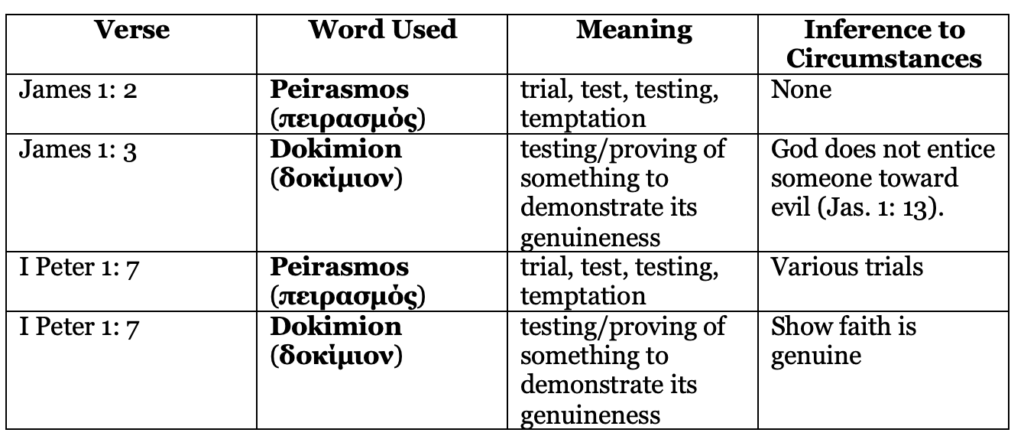
I see you jumping up and down over there. Peter said trials. Testing and trials are both used for the same outcome – showing the genuineness of our faith.
In order to figure this out, we have to look at the Greek.
Is Satan really going to test our faith to prove that it is genuine? Highly unlikely. He is trying to get us to do that which is evil.
Jehovah, on the other hand, is refining us in the fire. He is working to remove the impurities and leave us with a pure faith.

The same Greek word – peirasmos – can encompass testing and temptation. That means the purpose and the direction are what distinguish trials from testing.
No, they may not look that much different to us.
Jehovah’s sovereignty and Satan’s opposition can – and probably often do – operate in the same event, but with radically different purposes.
The Entrance of Deception into Humanity’s Story
“The serpent was the shrewdest of all the wild animals the Lord God had made. One day he asked the woman, ‘Did God really say you must not eat the fruit from any of the trees in the garden?’” (Gen. 3: 1 NLT)
“This great dragon — the ancient serpent called the devil, or Satan, the one deceiving the whole world — was thrown down to the earth with all his angels” (Rev. 12: 9 NLT)
While śāṭān (שָׂטָן) isn’t used in Genesis 3: 1, Revelation 12: 9 does identify the serpent with Satan.
We shouldn’t focus on the outward package – the serpent – in the Fall from grace. We need to focus on the purpose.
“… Did God really say …” (Gen. 3: 1 NLT) is a common vehicle for Satan trying to get us to sin.
Notice what the serpent didn’t focus on. It wasn’t the fruit. It wasn’t even the act of eating. The serpent talked about rewards and consequences.
The focus was, “Can you trust Jehovah to mean what He says? Will you believe Him or me?”
The heart of the conflict isn’t necessarily obedience – although that does play a big role. The issue is trust.
Can you see Satan’s pattern that he uses? God has spoken; he introduces an alternative; the human is confronted with a choice concerning trust and obedience.
The Hebrew Bible’s Developing Picture of Satan
The Accuser in the Heavenly Court
“Then the angel showed me Jeshua the high priest standing before the angel of the Lord. The Accuser, Satan, was there at the angel’s right hand, making accusations against Jeshua. And the Lord said to Satan, ‘I, the Lord, reject your accusations, Satan. Yes, the Lord, who has chosen Jerusalem, rebukes you. This man is like a burning stick that has been snatched from the fire.’ Jeshua’s clothing was filthy as he stood there before the angel. So the angel said to the others standing there, ‘Take off his filthy clothes.’ And turning to Jeshua he said, ‘See, I have taken away your sins, and now I am giving you these fine new clothes. Then I said, ‘They should also place a clean turban on his head.’ So they put a clean priestly turban on his head and dressed him in new clothes while the angel of the Lord stood by. Then the angel of the Lord spoke very solemnly to Jeshua and said, ‘This is what the Lord of Heaven’s Armies says: If you follow my ways and carefully serve me, then you will be given authority over my Temple and its courtyards. I will let you walk among these others standing here’” (Zech 3: 1-7 NLT)
Satan stood ready to accuse Jeshua, the High Priest, before the angel of the Lord.
This passage takes on the feel of a courtroom. That is because the language Satan uses is one that a prosecutor would use. He stands in opposition and accusation. The word used is again haśśāṭān (הַשָּׂטָן) – accuser.
Satan made his accusations against Jeshua. Jehovah’s response to Satan is interesting.
- I reject your claim.
- I have chosen Jerusalem.
- Jeshua has been snatched from the fire.
- Jeshua’s filthy clothes were removed.
- I have taken away your sins and given you salvation.
- You still have to walk with Me.
God’s Word tells us that Satan is wrong.
- “Where is another God like you, who pardons the guilt of the remnant, overlooking the sins of his special people? You will not stay angry with your people forever, because you delight in showing unfailing love. Once again you will have compassion on us. You will trample our sins under your feet and throw them into the depths of the ocean!” (Mic. 7: 18-19 NLT).
- “This is good and pleases God our Savior, who wants everyone to be saved and to understand the truth” (I Tim. 2: 3-4 NLT).
- “And anyone whose name was not found recorded in the Book of Life was thrown into the lake of fire” (Rev. 20: 15 NLT).
- “I am overwhelmed with joy in the Lord my God! For he has dressed me with the clothing of salvation and draped me in a robe of righteousness. I am like a bridegroom dressed for his wedding or a bride with her jewels” (Isa. 61: 10 NLT).
Does this say that Jeshua didn’t sin? No, it says that Jeshua’s garments were filthy (Zech. 3: 3). The angel had others replace his clothes. “… For he has dressed me with the clothing of salvation and draped me in a robe of righteousness …” (Isa. 61: 10 NLT).
Satan may have made the accusations, but Jehovah had the final say – and He rejected them.
Satan as a More Clearly Developed Figure
“Satan rose up against Israel and caused David to take a census of the people of Israel” (I Chron. 21: 1 NLT)
The importance of this passage is that it doesn’t use the word the.
The Hebrew word used is śāṭān (שָׂטָן), meaning adversary. Here the word appears without the definite article and is presented as an individual adversarial figure. English translations differ in whether they render it Satan or an adversary.
But this passage does something more. The terminology used moves from the broader concept of an adversary toward a more personalized adversarial figure.
Satan is seen as an adversarial figure instead of a role or title.
There is another verse detailing the same census that has a slightly different spin on it. “Once again the anger of the Lord burned against Israel, and he caused David to harm them by taking a census. “Go and count the people of Israel and Judah,” the Lord told him” (I Sam. 24: 1 NLT).
Are the two versions contradictory, or can they both be accurate? I believe they both can be accurate if we look at how Satan’s role developed in Scripture.
We’ve talked about how Satan’s role has transitions from the adversary to more of a personal description. This increasingly adversarial role surely causes Jehovah to become angry. It shows humans turning away from Him and turning to Satan.
This raises a theological question: how do Jehovah’s sovereignty and Satan’s actions relate?
Second Temple Understanding
By the time Yeshua walked the earth, Jewish thought about the spiritual realm had developed beyond the earlier use of śāṭān as simply an adversary or accuser.
Jewish writings from the Second Temple period describe a more clearly developed spiritual conflict between forces that belong to God and forces that oppose Him. The idea of an adversary who opposes Jehovah’s purposes, deceives, accuses, and seeks to turn people away from God was not foreign to His Jewish audience. The New Testament’s use of Satan and the Devil stands within this developing biblical and Jewish understanding.
We have to be careful here. Second Temple Judaism was not one single system of belief. Jewish communities interpreted the spiritual world in different ways. But several writings from this period show an increasing interest in evil spiritual beings, their influence over humanity, and the conflict between God’s purposes and those forces.
The Book of Jubilees, for example, introduces Mastema, a figure who functions as an adversary and leader of evil spirits. Even in this expanded picture, however, Mastema does not operate as Jehovah’s equal. His activity remains subject to Jehovah’s authority.
The Dead Sea Scrolls give us another important window into this Jewish worldview. The community described in the Rule of the Community speaks of two spirits: the Spirit of Truth and the Spirit of Deceit. The conflict is not merely something happening somewhere in the heavens. It affects how people think, choose, live, and respond to God.
That is important for us.
The spiritual conflict is not simply God versus Satan somewhere outside of us. It reaches into the human person.
The Dead Sea Scrolls describe humanity as living amid competing spiritual influences, but they do not present two equal gods fighting for control. God remains sovereign. The conflict exists under His authority and within His ultimate purposes.
This helps us understand the world into which Yeshua came.
Satan Is Not Jehovah’s Equal
“Then I heard a loud voice shouting across the heavens, ‘It has come at last — salvation and power and the Kingdom of our God, and the authority of his Christ. For the accuser of our brothers and sisters has been thrown down to earth — the one who accuses them before our God day and night’” (Rev. 12: 10 NLT)
Satan can oppose God’s people, but he cannot become God’s equal.
We see the adversary described as the ancient serpent, the devil, and Satan.
Go back to Job 1. Satan had to have permission to bring the trials upon Job. Just as Jehovah said, “You can’t harm Job physically,” He could have said, “You can’t do anything to Job at all.”
Isn’t that what Satan was hinting at? “Satan replied to the Lord, ‘Yes, but Job has good reason to fear God. You have always put a wall of protection around him and his home and his property …” (Job 1: 9-10 NLT).
The Adversary’s Work Reaches the Human Heart
We often think of the heart as the place where our emotions live.
But the Hebrew understanding of the heart is much bigger than that. The Hebrew words lēv (לֵב) and lēvāv (לֵבָב) can refer to the inner person — the place of thought, understanding, intention, desire, and decision. That gives us a different way to look at Satan’s work.
Look again at Job.
Satan didn’t dispute Job’s behavior. He questioned what was happening inside Job.
Why did Job fear Jehovah? Was it because Job genuinely trusted Him? Or was Job faithful because Jehovah had blessed him?
The question wasn’t simply, “Will Job do the right thing?” The question was, “What is in Job’s heart?”
We see the same thing in the Garden. The serpent didn’t begin by telling Eve to rebel against Jehovah. He introduced another word: “Did God really say…?”
Suddenly Eve had another voice to consider.
Jehovah had spoken. The serpent offered an alternative.
Now the question became: Whose word would she trust? That is where the battle reaches the heart.
Satan can accuse us. He can tempt us. He can introduce deception. He can challenge what Jehovah has said.
But the temptation always brings us to a place of decision.
Will I trust Jehovah? Will I believe what He has said? Will I remain loyal to Him when another voice offers me something that appears better?
The battle isn’t simply about whether we obey a rule. It is about who has our allegiance.
That is why outward behavior alone cannot tell us everything about our relationship with Jehovah.
Two people can do the same right thing for completely different reasons. One may do it because he loves Jehovah and trusts Him while the other may do it because he wants what he believes Jehovah will give him.
And that makes this battle personal. The adversary is not merely interested in getting us to break rules.
He wants to undermine our trust in Jehovah. He wants us to question what Jehovah has said. He wants us to listen to another voice.
And ultimately, he wants us to choose another allegiance.
Making the Connections #1
“But God was angry that Balaam was going, so he sent the angel of the Lord to stand in the road to block his way. As Balaam and two servants were riding along” (Num. 22: 22 NLT)
Numbers 22: 22 is a verse that uses the Hebrew word śāṭān (שָׂטָן) – adversary, opponent, or accuser.
But its use is more than a role or function. In this verse, it was a behavior.
The angel stood in the road as an adversary. The angel accused Balaam.
Making the Connections #2
So, what all did we learn from this?
- The issue is more about authenticity of our relationship with Jehovah than our behavior.
- Satan can’t work independently from Jehovah – He sets limits on him.
- Satan sows seeds of distrust of Jehovah and His words.
- Satan accuses as well as tempts.
- The adversary is an adversary precisely because he opposes the One who has authority over him.
Heart Check
Think about the battle Yeshua is engaged in for your heart. Ask yourself the following questions.
- Am I going to trust Jehovah when another voice tells me I shouldn’t, or am I going to let that voice pull me astray?
- Am I going to believe what Jehovah has said or what the adversary tells me?
- Am I going to let an accusation make me doubt Jehovah’s forgiveness, or is my faith going to remain firm in Him?
- Am I going to remain faithful when obedience becomes difficult, or am I going to take the easy road into disobedience?
- Am I going to guard my heart when temptation challenges my allegiance to Jehovah, or am I going to give in to temptation?
How Do We Apply This?
- Trust Jehovah’s Word.
- Reject the adversary’s accusations and temptations.
- Remember Jehovah’s forgiveness.
- Remain faithful when tested.
- Guard our hearts against deception.
Father God. The adversary still tempts us today. Help us to remain faithful to You. Amen.
If you don’t understand something and would like further clarification, please contact me.
If you have not signed up for the email providing the link to the devotions and the newsletter, do so below.
If God has used this devotion to speak with you, consider sharing it on social media.