Category: Obedience

  • Jacob’s Burial and the Brothers’ Fear

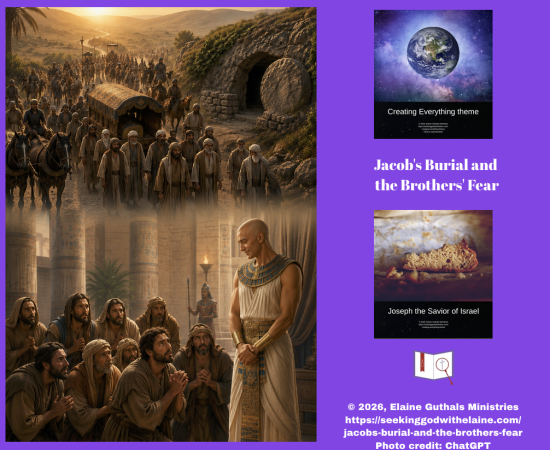
    In the last devotion, we discussed the death of Jacob. This devotional reading looks at his burial and the fear of Joseph’s brothers had after his death.

    Nuggets

    • Joseph took a minute and mourned his father.
    • The preparation for burial of Jacob’s body was different than he would have received had he stayed in Hebron.
    • Jacob remained tied – even in death – to the covenant land promised first to Abraham.
    • Joseph had to ask permission to leave the country to take Jacob’s body for burial.
    • At first glance, it seems like Joseph was not telling the exact truth about Jacob’s burial.
    • What we would call the funeral service occurred at what was renamed Abel-mizraim, meaning mourning of Egypt.
    • Jacob was buried in the cave Abraham purchased after Sarah died.
    • The covenant family still remained outside the promised inheritance.
    • Joseph’s brothers thought his kindness was offered only because of respect for their father.
    • The brothers told Joseph that Jacob, too, thought he would take vengeance on his brothers after his death.
    • Joseph reiterated that the brothers acted in Jehovah’s plan and their relationships were secure.
    • Jehovah can use our sins to forward His plan.
    jacobs-burial-and-the-brothers-fear

    Jacob was dead. Not before he blessed his sons. Not before he took the covenant blessings that came to him as patriarch and distributed them among his children.

    When we look at all the blessings together, we see the whole of Israel. We also see the whole of human nature.

    But human nature often fears when circumstances change. Joseph’s brothers did. With Jacob gone, they feared Joseph would finally take revenge for what they had done to him decades earlier.

    Joseph gave one of the most important theological statements in Genesis in response.

    Let’s Put It into Context

    To read devotions in the Creating Everything theme, click the button below.

    Devotions in the Joseph the Savior of Israel  series

    Preparing Jacob for Burial

    “Joseph threw himself on his father and wept over him and kissed him. Then Joseph told the physicians who served him to embalm his father’s body; so Jacob was embalmed. The embalming process took the usual forty days. And the Egyptians mourned his death for seventy days” (Gen. 50: 1-3 NLT)

    Joseph Wept

    Joseph took a minute and mourned his father.

    I am sure Joseph’s emotions were running deep at the death of his father. Once his brothers sold him into slavery, he probably thought he would never see him again.

    But they were reunited! They had 17 years together.

    Now, Jacob was gone – and permanently this time. We can imagine what he was feeling: gratitude for the gift of spending the last years of his life with him. Sorrow knowing this separation would be permanent until Joseph passed.

    Kalisch noted that on the day of the person’s death, “… public lamentations, in covering the head and the face with mud (or dust), girding up the garments, and beating the breasts” ensued.

    Resource

    I always thought girding up the garments was rending the garments. They are both, however, normal ways mourners showed their grief. Girding meant altering their garments, and rending meant tearing them.

    Joseph could have done either. He also could have accompanied it with any or all of the other ways grief was shown.

    • Putting dust or ashes on the head
    • Covering the face
    • Bearing the breast
    • Going barefoot
    • Wearing sackcloth

    Jacob Was Embalmed

    The preparation for burial of Jacob’s body was different than he would have received had he stayed in Hebron.

    We aren’t for sure what that preparation would entail as Genesis doesn’t say. Why would Moses tell his readers what they already knew?

    Broader ancient customs indicates when someone died, their eyes ere closed. Their body was probably washed and wrapped. It may have been anointed.

    The Israelites were not used to embalming their dead. Still, if they were going to take Jacob hundreds of miles  back to Canaan, I would think they needed to do something.

    It is interesting that Joseph asked the physicians to embalm the body instead of the priests, who were normally in charge of the embalming process. Neither Jacob or Joseph would have wanted the pagan practices, but the body would need to be prepared for the long journey to Canaan.

    To the Egyptians, it was associated with honor, preservation, and preparation for burial. The process took 40 days for Jacob. Kalisch noted that the process usually took 70 days.

    Resource

    There were three processes of embalming that the Egyptians used. The determining factors on which process was used was the person’s status, wealth, and era.

    • Removal of all organs except the kidneys and heart; spiced and rinsed the body; filled it with myrrh, cassia, and other aromatics; and steeped it in natrum for 70 days
    • Filled the body with cedar oil without removing organs and steeped it in natrum for 70 days
    • Rinsing the abdomen with symaea and steeped it in natrum for 70 days

    Resource

    The forty days that Moses described could be just the body-preparation stage.

    We have to take that description of the embalming process with a grain of salt. We don’t know the exact time period Kalisch is describing because the practices changed over time.

    Whatever the process used on Jacob, it didn’t complete the entire 70 days usually required. This could be because the body was not steeped for the usual time. In other words, the entire mummification process was not completed.

    The Egyptians Mourned

    It is a testament to the people of the time that the Egyptians did mourn Jacob.

    The mourning period was 70 days. This would have been an extraordinary national mourning period. The Egyptians mourned Jacob — and this is where we should focus — as if he were royalty, not the lowly shepherd, an occupation they despised.

    Jacob’s Burial

    “When the period of mourning was over, Joseph approached Pharaoh’s advisers and said, ‘Please do me this favor and speak to Pharaoh on my behalf.  Tell him that my father made me swear an oath. He said to me, “Listen, I am about to die. Take my body back to the land of Canaan, and bury me in the tomb I prepared for myself.” So please allow me to go and bury my father. After his burial, I will return without delay.’ Pharaoh agreed to Joseph’s request. ‘Go and bury your father, as he made you promise,’ he said. So Joseph went up to bury his father. He was accompanied by all of Pharaoh’s officials, all the senior members of Pharaoh’s household, and all the senior officers of Egypt.  Joseph also took his entire household and his brothers and their households. But they left their little children and flocks and herds in the land of Goshen. A great number of chariots and charioteers accompanied Joseph. When they arrived at the threshing floor of Atad, near the Jordan River, they held a very great and solemn memorial service, with a seven-day period of mourning for Joseph’s father. The local residents, the Canaanites, watched them mourning at the threshing floor of Atad. Then they renamed that place (which is near the Jordan) Abel-mizraim, for they said, ‘This is a place of deep mourning for these Egyptians.’  So Jacob’s sons did as he had commanded them. They carried his body to the land of Canaan and buried him in the cave in the field of Machpelah, near Mamre. This is the cave that Abraham had bought as a permanent burial site from Ephron the Hittite” (Gen. 50: 4-13 NLT)

    Take My Body Back

    Jacob remained tied – even in death – to the covenant land promised first to Abraham.

    Jacob’s insistence that his body be buried in the cave with the other patriarchs showed Jacob’s tie with the Promised Land.

    Ancient Near Easterners believed that burial location spoke to a person’s identity. It represented ancestry and observant continuity.

    Jacob insisted that his body be returned to Canaan even though – at that time – nothing was there except the cave. Jacob had brought everything else with him.

    But the burial spot was there – at Mamre – in the Promised Land. Jacob’s insistence was an act of faith. “All these people died still believing what God had promised them. They did not receive what was promised, but they saw it all from a distance and welcomed it. They agreed that they were foreigners and nomads here on earth.” (Heb. 11: 13 NLT).

    Joseph Approached Pharaoh’s Advisers

    Joseph had to ask permission to leave the country to take Jacob’s body for burial.

    Does it seem strange that Joseph would speak to Pharaoh’s household rather than to Pharaoh himself? Joseph is the second highest person in the community.

    The reason Joseph didn’t go to Pharaoh himself – with whom he has always seems to have had a good working relationship — was probably because he was in mourning.

    Pharaoh granted permission immediately.

    Think about it. This sounds like there had been a very huge caravan exiting from Egypt. It wasn’t just Jacob’s 12 sons making the journey to bury Jacob. The caravan included

    • Joseph and his entire household
    • All of Pharaoh’s officials
    • All the senior members of Pharaoh’s household
    • All the senior officers of Egypt
    • Joseph’s brothers and their households minus their little children, flocks, and herds
    • Charioteers

    That sounds like a lot of people.

    Would countries and people groups between here and there think they were coming to invade them?

    Swear an Oath

    At first glance, it seems like Joseph was not telling the exact truth about Jacob’s burial.

    Did Joseph misspeak, according to the way it is written in Hebrew. “ My father had me swear an oath. He said, ‘I am going to die. You are to bury me in my grave, which I dug for myself in the land of Kena’an.’ Therefore, I beg you, let me go up and bury my father; I will return” (Gen. 50: 5 CJB).

    Jacob was going to be buried in the tomb with Abraham, Sarah, Isaac, Rebecca, and Leah that Abraham had purchased generations earlier. He would not have done any digging. The Hebrew verb kārāh (כָּרָה) is probably being used to mean preparing, designing, or making provision for a burial place.

    Joseph wasn’t misleading Pharaoh. He was probably referring to the burial place Jacob claimed within the cave where his ancestors were buried.

    Threshing Floor of Atad, Near the Jordan River

    What we would call the funeral service occurred at what was renamed Abel-mizraim, meaning mourning of Egypt.

    I know that is two uses of what was. What it shows is the importance of Jacob.

    Was Jehovah foreshadowing when the Israelites would control the land?

    Buried Him in the Cave

    Jacob was buried in the cave Abraham purchased after Sarah died.

    Kalisch believed Jacob was buried in the tomb inside a case of wood or stone. I had thought the Israelites did something differently.

    Resource

    They did. Usually, the corpse was placed in a shelf within the cave. After decomposition, the larger bones would then be placed in an ossuary area.

    But, Jacob could have been buried in a coffin. Because he had been embalmed, his bones would have decomposed more slowly. Also, we aren’t told if his sons made a second journey in order to do place his decomposed bones in a box.

    I can see the coffin being used for protection during transport. If Jacob was buried in it is a toss-up, but I think he would have been given the honor of being buried in a coffin rather than just placed on the cave floor.

    The Egyptians had honored Jacob too much to do just that.

    Regardless of the processes and tools that were used to bury Jacob, he was buried with his ancestors. He was buried in the Promised Land.

    Joseph Reassures His Brothers

    “After burying Jacob, Joseph returned to Egypt with his brothers and all who had accompanied him to his father’s burial. But now that their father was dead, Joseph’s brothers became fearful. ‘Now Joseph will show his anger and pay us back for all the wrong we did to him,’ they said. So they sent this message to Joseph: ‘Before your father died, he instructed us to say to you: “Please forgive your brothers for the great wrong they did to you — for their sin in treating you so cruelly.” So we, the servants of the God of your father, beg you to forgive our sin.’ When Joseph received the message, he broke down and wept. Then his brothers came and threw themselves down before Joseph. ‘Look, we are your slaves!’ they said. But Joseph replied, ‘Don’t be afraid of me. Am I God, that I can punish you? You intended to harm me, but God intended it all for good. He brought me to this position so I could save the lives of many people. No, don’t be afraid. I will continue to take care of you and your children.’ So he reassured them by speaking kindly to them” (Gen. 50: 14-21 NLT)

    Joseph Returned to Egypt

    The covenant family still remained outside the promised inheritance.

    Joseph went back to Egypt.

    Joseph was there. His brothers were there. They could have brought the kids and the animals. The famine was over, Then they could have just stayed in Canaan, right?

    No, they went back to Egypt. It wasn’t in Jehovah’s plans for them to stay.

    Joseph’s Brothers Became Fearful

    Joseph’s brothers thought his kindness was offered only because of respect for their father.

    So, for 39 years, Joseph’s brothers wrangled with unfinished business. They thought for sure that, while Jacob was alive, Joseph wouldn’t take revenge on them for selling him.

    Now Jacob was dead. Everything changed.

    And the brothers panicked.

    But doesn’t that show us something very important? We may think that the guilt of sin has died, but it hasn’t.

    Look what Vaughan said. He wrote, “No sorrow, and no sin, ever quite does. No lapse of time, no length of experience, no depth of repentance, can absolutely divide the one into two, while the person is the same …”

    Resource

    Can we change? Yes, that is what we do when we become disciples — we repent of the sins we have done and choose to walk with Jehovah.

    That doesn’t mean that a wand is waved, and we no longer have committed that sin. It changed us — good or bad — into the people we are today. Nothing is going to change that.

    Could Jacob have said that? Maybe. Just because it isn’t recorded in Scripture doesn’t mean he didn’t say it.

    I just don’t see it. Jacob saw the man Joseph had become. He saw how firmly he believed that God had used that to get him where He wanted him to be.

    Joseph would not have sought revenge for them doing what was in Jehovah’s plan.

    Before Your Father Died

    The brothers told Joseph that Jacob, too, thought he would take vengeance on his brothers after his death.

    They didn’t say our father – because Jacob was all of their fathers – they just had different mothers. They said your father.

    Of course, we aren’t told the reason why they did this. It is most probably, in my opinion, that the brothers were appealing to Joseph’s special relationship with Jacob. They were trying to persuade him by invoking the wishes of the father whom Joseph deeply loved.

    Most of all, it shows how uncomfortable they still felt standing before the brother they had wronged. Even after seventeen years, they still don’t seem completely at ease around Joseph.

    All of them – again – bowed before Joseph. What is this? At least the third time.

    And don’t miss the fact that it was all of them acting as one again. All ten of them – remember Benjamin didn’t have anything to do with selling Joseph – were now shaking in their sandals.

    The brothers thought that Joseph was only biding his time until Jacob died before turning on them.

    Don’t be Afraid of Me

    Joseph reiterated that the brothers acted in Jehovah’s plan and their relationships were secure.

    Joseph gave the brothers two reasons why the matter was resolved in his eyes.

    The first reason was that the word is vengeance. The act of vengeance is to punish a certain individual or group of individuals. The punishment is seen as retribution.

    The person who is performing the act of vengeance does not feel like they are the one who “started it.” Their act is a response to an injury or a wrong.

    Joseph knew that revenge is Jehovah’s job.

    • “Do not seek revenge or bear a grudge against a fellow Israelite, but love your neighbor as yourself. I am the Lord” (Lev. 19: 18 NLT).
    • “I will take revenge; I will pay them back. In due time their feet will slip. Their day of disaster will arrive, and their destiny will overtake them” (Deut. 32: 35 NLT).

    You Intended Harm, but God Intended Good

    Jehovah can use our sins to forward His plan.

    The second reason was that it was Jehovah’s plan that it happen.

    Let’s look at the Hebrew, the transliteration, and the literal rendering.

    אַתֶּם חֲשַׁבְתֶּם עָלַי רָעָה
אֱלֹהִים חֲשָׁבָהּ לְטֹבָה

    atem chashavtem alai ra’ah
Elohim chashavah letovah

    You planned evil against me, God planned it for good.

    The key word is chashay (חשב) — plan, intend, design.  Human plan = evil. God’s plan = good.

    Bersier had a fantastic observation. “Since the Scriptures call us to be imitators of God, like Him we must [endeavor] to draw good out of evil.”

    Resource

    .Think about it. Jehovah wants to transform evil into good. We do that by witnessing to others. That is part of our marching orders.

    • “And then he told them, ‘Go into all the world and preach the Good News to everyone’” (Mk. 16: 15 NLT).
    • “Therefore, go and make disciples of all the nations, baptizing them in the name of the Father and the Son and the Holy Spirit. Teach these new disciples to obey all the commands I have given you. And be sure of this: I am with you always, even to the end of the age” (Mt. 28: 19-20 NLT).

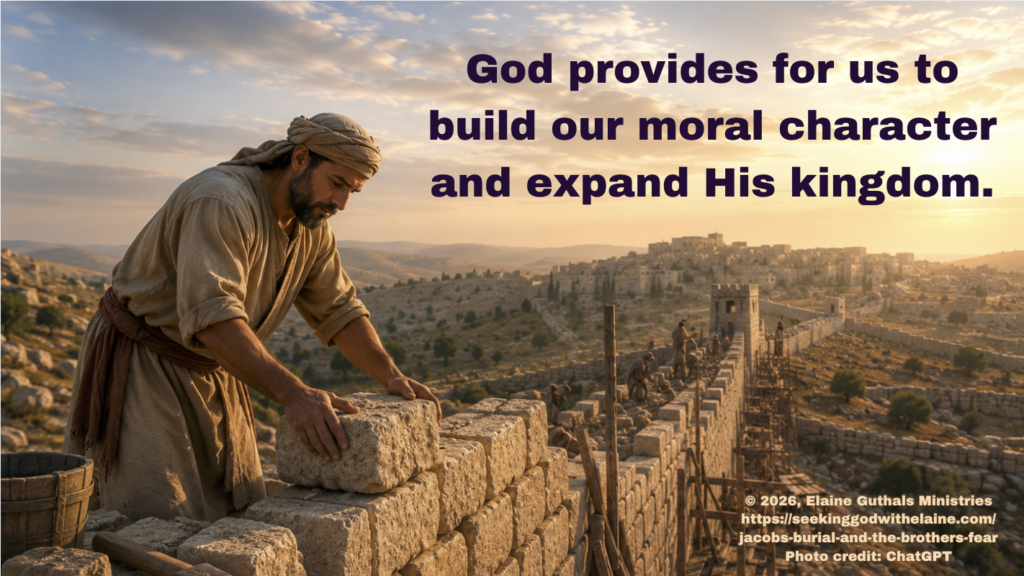
    God provides for us to build our moral character and expand His kingdom.
    Can we assume that Joseph meant that Jehovah took the evil and eventually made it into good/ No.

    Maybe Jehovah changed His plans to use their choice. No.

    Jehovah didn’t react after-the-fact to the brothers’ actions. That was in His plan all along.

    No, that didn’t take away their free will any more than it took away their guilt. They choose, and they still had to pay the consequences.

    God’s Will comes to pass every single time.

    Father God. You are with us at the moment You call us home. You are with loved ones left behind. Help us — regardless of which situation we are in — that we will focus on You. Amen.

    If you don’t understand something and would like further clarification, please contact me.

    If you have not signed up for the email providing the link to the devotions and the newsletter, do so below.

    If God has used this devotion to speak with you, consider sharing it on social media.
  • Jacob’s Last Words to His Sons: The Fruitful Branch

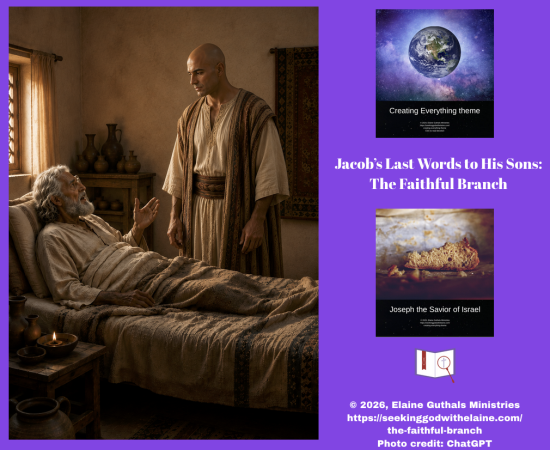
    Jacob was blessing his sons before his death. This devotional reading looks at the blessing that he gave to Joseph.

    Nuggets

    • Joseph was Jacob’s eleventh son, the firstborn by his beloved wife Rachel (Gen. 30: 23-24).
    • Joseph carried the covenant preservation and fruitfulness.
    • Fruitfulness in Joseph’s blessing was symbolized as a tree.
    • We are to remain faithful by living our lives with Christ, the living water.
    • A fruitful tree grow so vigorously that its branches extend beyond the wall.
    • The archery theme talked of Joseph’s suffering and opposition.
    • Just as Joseph was victorious over his trials, we can be victorious over ours with Jehovah’s provision.
    • Sovereign God is our Father when we submit to His Will for our lives.
    • Jacob used imagery that he and Joseph were both familiar with – shepherds – to describe Jehovah.
    • The imagery of Jehovah as a rock shows He is solid, stable, and strong.
    • Joseph’s legacy would be blessing and fruitfulness.
    • Though Joseph’s separation from his family was a tragedy, that separation may have helped Joseph become the man Jehovah wanted.
    the-fruitful-branch

    In the last devotion, we looked at the sons whose descendants would break apart the nation of Israel and form most of the Northern Kingdom. Jacob didn’t have much to say to them.

    The first four brothers — Reuben, Simeon, Levi, and Judah — got a lot from Jacob. Some was good. Some was not so good.

    Then there was Joseph. I wonder if Jacob had been silently waiting for this moment to come.

    From the moment Joseph was born, Jacob’s heart was attached to him. Not always wisely — the coat proved that.

    But the affection was real. Jacob saw:

    • Rachel’s firstborn
    • The son he though was dead twenty-plus years ago
    • The son whose bloodstained coat shattered his heart
    • The son he never stopped mourning
    • The son Jehovah gave back

    And look at this man — his Joseph — standing by his bedside

    • Alive
    • Godly
    • Reconciled
    • Faithful
    • Fruitful
    • Successful
    • Preserving the family
    • Walking with Jehovah

    In a sense, Jacob finally gets to say publicly everything he had always wanted to say.

    That’s why the tone of this blessing feels different. Joseph got the overflowing fatherly blessing.

    Joseph had become the man Jacob had hoped he would become. Jacob acknowledged that Joseph’s strength came from God.

    Jacob wasn’t merely predicting the future of the tribe. He was blessing the son whose life had become one of the greatest evidences of Jehovah’s providence that Jacob had ever seen.

    Let’s Put It into Context

    To read devotions in the Creating Everything theme, click the button below.

    Devotions in the Joseph the Savior of Israel  series

    Joseph

    Joseph was Jacob’s eleventh son, the firstborn by his beloved wife Rachel (Gen. 30: 23-24).

    His name meaning add, the double-portion of the firstborn’s inheritance was given to Joseph. Jacob went about it an interesting way.

    Years before, the brothers would have been jealous if Jacob had just given Joseph all that wealth. So, Jacob split it between Joseph’s two sons.

    It is interesting that, though Jacob adopted Manasseh and Ephraim and told him they would be treated as equal sons, they are not mentioned here. Their futures are, essentially, Joseph’s legacy.

    I wonder if Jacob was thinking that was an attempt to make up for the years he lost with Joseph. By making Joseph’s sons born in Egypt before he got there, Jacob was making it as if he were getting back a part of what he lost those 22 years.

    Fruitful

    “Joseph is the foal of a wild donkey, the foal of a wild donkey at a spring — one of the wild donkeys on the ridge” (Gen. 49: 22 NLT)


    Joseph carried the covenant preservation and fruitfulness.

    The Hebrew is difficult, and some translations render the image as a vigorous wild donkey. Most translations, however, understand Jacob to be describing Joseph as a fruitful tree or vine nourished by a spring.

    “Joseph is a fruitful bough, a fruitful bough by a spring; his branches run over the wall” (Gen. 49: 22 ESV).

    That translation seems to be more in line with the following verses. It is talking about growth and abundance.

    A Fruitful Bough

    Fruitfulness in Joseph’s blessing was symbolized as a tree.

    Joseph showed us that character is built through obedience and the desire for God’s glory. Moreover, it is based on union with Yeshua.

    This obedience must bear fruit. We sometimes have a skewed idea of what bearing fruit actually means.

    Bearing fruit is all about transformation of our hearts, not witnessing.

    To grow something the environment must be right. The right environment for spiritual growth is seeking Jehovah, trusting Him, and abiding in Him. “I said, ‘Plant the good seeds of righteousness, and you will harvest a crop of love. Plow up the hard ground of your hearts, for now is the time to seek the Lord, that he may come and shower righteousness upon you’” (Hos. 10: 12 NLT).

    The evidence that Christ is in us is the fruit of the Spirit, the fruit of righteousness, and the fruit of good works.

    • “Yes, I am the vine; you are the branches. Those who remain in me, and I in them, will produce much fruit. For apart from me you can do nothing” (Jn. 15: 5 NLT).
    • “But the Holy Spirit produces this kind of fruit in our lives: love, joy, peace, patience, kindness, goodness, faithfulness, gentleness, and self-control. There is no law against these things!” (Gal. 5: 22-23 NLT).
    • “May you always be filled with the fruit of your salvation — the righteous character produced in your life by Jesus Christ — for this will bring much glory and praise to God.
    • “Then the way you live will always honor and please the Lord, and your lives will produce every kind of good fruit. All the while, you will grow as you learn to know God better and better” (Col. 1: 10 NLT).

    We have to make the distinction. This is talking good works – good instead of evil. This isn’t talking social works. Fruit is different than works.

    We can only be fruitful when we have a union with Christ and a relationship with Jehovah.

    Burton said that we don’t want to be united with Yeshua but be dead in our hearts, or united with Yeshua in our hearts but be fruitless – not be righteous.

    Resource

    To be alive and fruitful, we have to be growing. We grow by seeking Jehovah.

    By a Spring

    We are to remain faithful by living our lives with Christ, the living water.

    Yes, Joseph had some awful things happen to him. That didn’t change how he lived his life. He remained faithful to Jehovah.

    Why?

    Whitfield told us how. He wrote, “The roots of the tree draw forth the waters from the well, and send them up into all its branches.”

    Resource

    We can’t see the roots because they are buried under the ground. We can’t see Jehovah and Yeshua because they are in Heaven. We can’t see the Holy Spirit because He is in our hearts.

    While Joseph was in Potiphar’s house when he should have still been in Hebron, while he was in prison when he hadn’t done anything wrong, what kept him faithful?

    The spring.

    When Scripture talks about living water, it is talking about the Holy Spirit. He gives us spiritual refreshment – which helps us grow – and eternal life. This living water comes from Yeshua and is given to those who believe in Him.

    The water alone is still water. The tree can only survive by obtaining the water. It must permeate the whole tree in order for the tree to live.

    Over the Wall

    A fruitful tree grow so vigorously that its branches extend beyond the wall.

    When I was a young girl, I loved my Aunt Irene’s philodendron. One day when Uncle Harry was coming on his tractor to help us bale hay, he had a start for another plant to give me. It was two little leaves in a cat planter.

    I had that plant for 30 years. It grew and grew and grew. It had long outgrown the cat planter. Eventually, it outgrew the planter I had it in and I didn’t get it replanted soon enough.

    The planter couldn’t contain the philodendron. Neither could Joseph’s blessing be contained.

    Think about Joseph’s life.

    • Jehovah had plans for Joseph that reached far beyond Hebron.
    • Cannan couldn’t even contain him.
    • Where Joseph was supposed to be was in Egypt, but he influenced many lives outside of Egypt and Canaan because he saved them from starvation.
    • Joseph even impacted people beyond his generation.

    Talk about Joseph’s branches going over the wall!

    Suffering

    “Archers attacked him savagely; they shot at him and harassed him” (Gen. 49: 23 NLT)


    The archery theme talked of Joseph’s suffering and opposition.

    Jacob addressed Joseph’s background.

    • He endured the shot – the envy, hatred, and persecution – from his brothers.
    • He endured the shot from Mrs. Potiphar when she accused him of trying to molest her.
    • He endured the shot from the cupbearer who forgot about him for two years.
    • He endured the shots that tempted to turn his back on Jehovah and assimilate into Egyptian culture.
    • He endured the shots of loneliness when he must have often felt he was neglected and the ingratitude of others.

    No, they weren’t real arrows. They were relational arrows.

    Sometimes, that is even worse.

    We, too, come under fiery arrows. “In addition to all of these, hold up the shield of faith to stop the fiery arrows of the devil” (Eph. 6: 16 NLT).

    Resource

    Obedient

    “But his bow remained taut, and his arms were strengthened by the hands of the Mighty One of Jacob, by the Shepherd, the Rock of Israel” (Gen. 49: 24 NLT)


    His Bow Remained Taunt

    Just as Joseph was victorious over his trials, we can be victorious over ours with Jehovah’s provision.

    Yes, that was a lot of arrows shot at Joseph. He endured the barrage for a long time.

    Joseph remained faithful. He didn’t rail at Jehovah for allowing this to happen to him. He didn’t refuse to do His Will. He didn’t become bitter.

    Joseph stayed faithful to the God of Abraham, Isaac, and Jacob.

    Victory is based on our moral character. Moral character is the inward formation of the heart that consistently produces choices and actions aligned with what is right by Jehovah’s standards, regardless of circumstances, visibility, or cost.

    God of Your Father

    Sovereign God is our Father when we submit to His Will for our lives.

    There is some discussion regarding whether this verse is addressed to Joseph himself or to the future of the nation. It is significant for the future of the nation — in fact, for all the biblical narrative. It talks about divine providence and family legacy.

    I can see things both ways. This was Jacob’s Joseph. He was saying all that he had wanted to for years — and thought he wouldn’t get the chance.

    But Jacob was talking to a significant portion of the future Israel. These verses are too important to not to address it to them.

    Jehovah is omnipotent, so He has the ability to provide the blessings.

    We receive many blessings that support our spiritual and material needs. We see this by by the use of the phrases Heaven above and the deep that lies below.

    The phrase the breasts and of the womb is the promise of growth and sustenance in fertility and family through  nurturing.

    What Jacob was saying was Jehovah will be our helper. He is also our source of strength.

    Think of the depth of these blessings. They are all linked with our identity and purpose.

    How do we access these blessings? We seek Jehovah’s divine assistance. When we give our lives to Him, He will bless us plentifully.

    This brings us to the point of whether we are focused on the spiritual or the material. It is our choice, one that these verses encourage us to make the right choice.

    Regardless of the choice we make, we will be judged on that choice. Choosing to walk with Jehovah brings the blessings. Choosing to rely on ourselves denies us access to those blessings.

    By the Shepherd

    Jacob used imagery that he and Joseph were both familiar with – shepherds – to describe Jehovah.

    What do shepherds do?

    • Shepherds spent many sleepless nights protecting their sheep.
    • They were alert in keeping watch over the sheep.
    • They endured all the environmental issues thrown at them.
    • They defend the sheep from all predators.

    This is a beautiful picture of how Jehovah watches over us. He is there to protect us and sustain us as we grow closer to Him.

    Long before David said, “The Lord is my shepherd; I have all that I need” (Ps. 23: 1 NLT), Jacob said it. Long before Yeshua said, “I am the good shepherd. The good shepherd sacrifices his life for the sheep” (Jn 10: 11 NLT), Jacob acknowledged His role.

    • Rock of Israel
    • The imagery of Jehovah as a rock shows He is solid, stable, and strong.
    • Canaan  was a very rocky country. Some of the rocks formed caves, such as the one David hid in (I Sam. 24).
    • Ancient Near Easterners used these rocks as building materials. They were used to build temples, walls, homes, tombs, roads, and aqueducts.

    They were well acquainted with the stone’s strength and stability. They could see these traits in Jehovah.

    • “The Lord is my rock, my fortress, and my savior; my God is my rock, in whom I find protection. He is my shield, the power that saves me, and my place of safety” (Ps. 18: 2 NLT).
    • “All of them ate the same spiritual food, and all of them drank the same spiritual water. For they drank from the spiritual rock that traveled with them, and that rock was Christ” (I Cor. 10: 3-4 NLT).
    • “Anyone who listens to my teaching and follows it is wise, like a person who builds a house on solid rock. Though the rain comes in torrents and the floodwaters rise and the winds beat against that house, it won’t collapse because it is built on bedrock” (Mt. 7: 24-25 NLT).

    We have nothing to fear when we put our trust in Jehovah. He is strong and stable.

    Joseph’s Legacy

    “May the God of your father help you; may the Almighty bless you
with the blessings of the heavens above, and blessings of the watery depths below, and blessings of the breasts and womb” (Gen. 49: 25 NLT)

    
Joseph’s legacy would be blessing and fruitfulness.

    In the Exodus, Ephraim’s tribe and Manasseh’s tribe was designated part of the West Division.

    Ephraim’s Tribe

    The tribe of Ephraim and the half tribe of Manasseh received their allotments in Joshua 16-17. They numbered 40,500 in the first census (Num. 1: 19) and had fallen to 32,500 in the second census (Num. 26: 37).

    The tribe of Ephraim became a leader of Israel. When the nation broke into two kingdoms, the Northern Kingdom was frequently called Ephraim.

    When Paul speaks of the Gentile nation, referring to Ephraim, he uses prophetic language that tell of a people who are far off and are waiting to be brought back into the people of Jehovah.

    Half of the tribe of Manasseh remained on the east side of the Jordan (Josh. 13: 8-32). Again, the half tribe of Manasseh received their allotments in Joshua 16-17.

    During the first census, they numbered 32,200 (Num. 1: 20). By the second census, they had grown to 52,700 (Num. 26: 37).

    The tribe of Ephraim and the half tribe of Manasseh received their allotments in Joshua 16-17. They numbered 40,500 in the first census (Num. 1: 19) and had fallen to 32,500 in the second census (Num. 26: 37).

    The tribe of Ephraim became a leader of Israel. When the nation broke into two kingdoms, the Northern Kingdom was frequently called Ephraim.

    When Paul speaks of the Gentile nation, referring to Ephraim, he uses prophetic language that tell of a people who are far off and are waiting to be brought back into the people of Jehovah.

    Manasseh’s Tribe

    Half of the tribe of Manasseh remained on the east side of the Jordan (Josh. 13: 8-32). Again, the half tribe of Manasseh received their allotments in Joshua 16-17.

    During the first census, they numbered 32,200 (Num. 1: 20). By the second census, they had grown to 52,700 (Num. 26: 37).

    Abundant Blessings

    “May my fatherly blessings on you surpass the blessings of my ancestors, reaching to the heights of the eternal hills. May these blessings rest on the head of Joseph, who is a prince among his brothers” (Gen. 49: 26 NLT)

    Though Joseph’s separation from his family was a tragedy, that separation may have helped Joseph become the man Jehovah wanted.

    Remember, I said I thought Joseph had an arrogance about him when he was younger. We might could see this come through his tattling on his half-brothers (Gen. 37: 2).

    We also said that, in his time at Potiphar’s house and in the prison, Jacob was learning knowledge and skills that he would need in his job as Vizier. He may not have been able to learn these in Hebron.

    The son Jacob thought he had lost forever was standing before him, faithful to Jehovah and fruitful in His service.

    Father God. Thank You for showing us how to endure our trials. Thank You for showing us how You reward that endurance. Strengthen us to be obedient to You. Amen.

    Searching for and Seeking God

    Non-believers search for God.
    Disciples seek Him.

    Hearing His Word (Rom. 10: 17)
    Reading His Word (Rev. 1: 3)
    Praying to Him (Heb. 4: 16)
    Studying His Word (Ac. 17: 11)
    Meditating on His Word (Ps. 1: 1-2)
    Memorizing His Word (Ps. 119: 11)

    If you don’t understand something and would like further clarification, please contact me.

    If you have not signed up for the email providing the link to the devotions and the newsletter, do so below.

    If God has used this devotion to speak with you, consider sharing it on social media.

  • Jacob’s Last Words to His Sons: The Northern Kingdom

    Jacob had blessed Reuben, Simeon, Levi, and Judah – the first four sons by Leah. This devotional reading looks at his blessings for Zebulun, Issachar, Dan, Gad, Asher, and Naphtali.

    Nuggets

    • Zebulun’s territory had a link to the Messiah.
    • Issachar showed up.
    • Even though Dan had an encouraging blessing, the fate of the tribe was not.
    • Sometimes, our circumstances cause us to fight.
    • The tribe of Asher grew the most between the two censuses.
    • Naphtali’s blessing was a clear picture of Christianity.
    the-northern-kingdom

    Once Jacob had given the covenant blessings to the first four sons in order, he turned to his other sons. There is the rub.

    We really haven’t heard their names — other than when they were born. Whenever they come our radar, they have acted together as one. In fact, these six along with three other tribes, made up the Northern Kingdom.

    Jacob’s sons weren’t, however, carbon copies. They each had their own peculiar characteristics.

    Jacob focused on that in their blessing. But he didn’t address them in order of their age.

    Let’s Put It into Context

    To read devotions in the Creating Everything theme, click the button below.

    Devotions in the Joseph the Savior of Israel  series

    Zebulun

    “Zebulun will settle by the seashore and will be a harbor for ships; his borders will extend to Sidon” (Gen. 49: 13 NLT)

    Zebulun’s territory had a link to the Messiah.

    Zebulun was the sixth and last son of Jacob and Leah (Gen. 30: 19-20). His name meant living together. He was Jacob’s tenth son.

    Courageous in battle, Zebulun showed up when it mattered. They were willing to risk itself for Jehovah’s purposes.

    In the Exodus, Zebulun’s tribe was designated part of the East Division. At the first census, the tribe numbered 57,400 (Num. 1: 30). By the second census, their number had grown to 60,500 (Num. 26: 47).

    Zebulun’s future did occur as Jacob prophesied — sort of. The land allotted for the tribe in Joshua 19: 10-16 wasn’t on the coast. It was in lower Galilee.

    The territory was in a strategic tradition. Not only did they have the benefits of the Sea of Galilee in the region, but they also had Mediterranean trade routes. Their border was near the city of Zidon, leading to commercial relations with the Phoenicians.

    The tribe was known for its courage in battle. They supported David when he became king. They also fought with Deborah and Barak (Jdgs. 5: 15).

    Zebulun’s linkage with Naphtali occurred frequently. Because of this, the two tribes were listed when the Messiah was prophesied. “But there will be no gloom for her who was in anguish. In the former time he brought into contempt the land of Zebulun and the land of Naphtali, but in the latter time he has made glorious the way of the sea, the land beyond the Jordan, Galilee of the nations” (Isa. 9: 1 ESV).

    Yeshua began his ministry in Galilee, in the territory formerly held by Zebulun and Naphtali.

    Issachar

    “Issachar is a sturdy donkey, resting between two saddlepacks. When he sees how good the countryside is and how pleasant the land, he will bend his shoulder to the load and submit himself to hard labor” (Gen. 49: 14-15 NLT)

    Issachar showed up.

    Issachar was Jacob’s ninth son and the fifth son born to him and Leah (Gen. 30: 17-18). His name meant reward.

     Issachar was born after Leah traded some of Reuben’s mandrakes to Rachel for a night with Jacob (Gen. 30: 17-18).

    Ummm. Is being a donkey a compliment or a dig? Is it good to be a beast of burden?

    Kind of unflattering, isn’t it? But it does sound complimentary at the same time.

    Let’s think about where their territorial allotment was. It was the Jezreel Valley, which had excellent farmland. It was pleasant, fertile land.

    We find a better report on the tribe in Judges 5: 15. “The princes of Issachar were with Deborah and Barak. They followed Barak, rushing into the valley …” (Jdgs. 5: 15 NLT).

    The tribe of Issachar showed up. If we read Judges 4, it sounds like they really weren’t in the battle.

    So, that probably means they supported Deborah and Barak, even if they didn’t fight.

    But to me, this reads like there was something wrong. What if Issachar got complacent? It sounded like the strength was there even if the ambition wasn’t.

    Taylor thought  became complacent — and that life of ease wasn’t a good thing. He wrote, “Now all this reminds us of the truth that conflict is absolutely necessary to strength[en] character.”

    Resource

    What if he was willing to compromise to keep everything good? We have to remember that, even though we are living in Canaan, we can’t be of Canaan.

    What I do see is Issachar showed up — but he doesn’t seem to be the leader. True, we all know too many leaders doesn’t work well.

    We can’t become lazy or feel entitled. We have to show up daily and walk with Jehovah.

    In the exodus, Issachar was designated as part of the East Division. During the first census, the tribe numbered 54,400 (Num. 1: 29). They were up to 64,300 by the second census (Num. 26: 25).

    The tribe received its allotment in Joshua 19: 24-31. They were set up nicely. They had fertile land to grow grain, vineyards, and livestock. Trade routes ran through the territory.

    One of the judges, Tola, did come from Issachar (Jdgs. 10: 1). He judged for 23 years. This represented a time of peace.

    The tribe of Issachar supported King David. “Of Issachar, men who had understanding of the times, to know what Israel ought to do, 200 chiefs, and all their kinsmen under their command” (I Chron. 12: 32 ESV). They possessed wisdom and discernment to know King Saul’s reign was nearing an end.

    The tribe of Issachar was steady and reliable if not a leader. They were hard workers.

    Issachar, as part of the Northern Kingdom, was conquered in 722 BC. They were scattered among the other tribes, never to become an independent tribe again.

    Dan

    “Dan will govern his people, like any other tribe in Israel. Dan will be a snake beside the road, a poisonous viper along the path that bites the horse’s hooves so its rider is thrown off. I trust in you for salvation, O Lord!” (Gen. 49: 16-18 NLT).

    Even though Dan had an encouraging blessing, the fate of the tribe was not.

    Dan was Jacob’s fifth son, the first born to him and Rachel’s servant girl Bilhah (Gen. 30: 5-6). His name meant judged.

    Dods helped us understand what the Old Testament definition of judge. He wrote,

    “This word ‘judge’ we are perhaps somewhat apt to misapprehend; it means rather to defend than to sit in judgment on; it refers to a judgment passed between one’s own people and their foes, and an execution of such judgment in the deliverance of the people and the destruction of the foe.”

    Resource

    This is probably one reason the leaders after Joshua were called judges.

    Think about it.

    At the end of the age, Yeshua will judge us – He will defend those who have asked Him to be their Savior and Lord. He will deliver us from destruction.

    Hmmm. Again, was Jacob giving Dan a compliment or slamming him?

    Yes, snakes can be wise, so Dan could use wisdom and strategy. But they can also be cunning and deceitful.

    The tribe of Dan was assigned to the North Division. The allotment for Dan was described in Joshua 19: 40-48. It is said that they didn’t like their allotment, so they wiped out a peaceful group and took their land.

    The first census showed 62,700 (Num. 1: 39) – making Dan the second largest tribe. By the second census, they had grown to 64,400 (Num. 26: 43).

    Over time, however, Dan’s distinct identity faded as the tribe was absorbed into other groups.

    Dan’s most famous descendant is probably Samson (Jdgs. 16). He was a judge who defeated enemies through strategy, surprise, and unconventional methods.

    Unfortunately, Dan became the center of idolatry (Jdgs. 18: 1-31).  He stole an idol and established a rival worship center. Idolatry became entrenched within his tribe.

    That is probably why Jeroboam put one of his golden calves in the territory trip of Dan. This happened in I Kings 12: 25-33.

    Dan frequently appeared spiritually compromised.

    Salvation

    Ooo, baby. Jacob, who had a rocky start, but he put his faith and hope in Jehovah. Then he saw this from his sons – conflict, danger, spiritual failure.

    Jacob called on the only One Who could save his son’s descendants – Snell thought it was the Messiah.

    Resource

    Think about all the trials Jacob had. He had a lot of sorrow in his life.

    He was waiting for salvation.

    Had Jacob understood what salvation meant in Jehovah’s plan? Probably not – the first-century Pharisees didn’t even understand.

    Still, Jacob looked beyond human deliverers to Jehovah’s ultimate salvation.

    I like what Vaughan said, He wrote, “These intervals of waiting must be filled up with four things: prayer, praise, fellowship, and work.”

    Resource

    We need to keep faith while waiting.

    Gad

    “Gad will be attacked by marauding bands, but he will attack them when they retreat” (Gen. 49: 19 NLT).

    Sometimes, our circumstances cause us to fight.

    Gad was Jacob’s seventh son, born to Leah’s servant girl Zilpah (Gen. 30: 9-10). His name meant good fortune.

    The first thing that popped in my mind was the serpent’s curse in the Garden of Eden. “And I will cause hostility between you and the woman, and between your offspring and her offspring. He will strike your head, and you will strike his heel” (Gen. 3: 15 NLT).

    He will overcome at last. Isn’t that what enduring is all about? Yes, we struggle, probably for a long time.

    But in the end, we are victorious because we kept at it until the end. We kept trying to do what was right.

    In the Exodus, Gad’s tribe was designated part of the South Division.

    Gad received an allotment of land on the east side of the Jordan River in Joshua 13: 8-32. The first census listed the tribe at 45,650 (Num. 1: 25). By the second census, they were down to 40,500 (Num. 26: 18).

    The history of Gad shows that it was a warlike people. This was accomplished by a marauding guerilla troop.  

    Why? They settled on the east side of the Jordan. This made them constantly exposed to raids and invasions, so they became fierce warriors.

    Asher

    “Asher will dine on rich foods and produce food fit for kings.” (Gen. 49: 20 NLT)

     The tribe of Asher grew the most between the two censuses.

    Asher was Jacob’s eighth son, the second born to Leah’s servant girl Zilpah (Gen. 30: 12-13). His name meant happy.

    The verse is a little different in the Hebrew Bible. “Asher’s bread shall be rich, And he shall yield royal dainties” (Gen. 49: 20 TSB).

    Resource

    That brings to mind another verse. “Jesus replied, ‘I am the bread of life. Whoever comes to me will never be hungry again. Whoever believes in me will never be thirsty” (Jn. 6: 35 NLT).

    Asher’s prophecy was fulfilled because his territory was fertile coastal territory. It specialized in olive oil and produced agricultural abundance. The allotment is recorded in Joshua 19: 24-31.

    In the Exodus, Asher’s tribe was designated part of the North Division. The first census found his tribe to number 41,500 (Num. 1: 41). The tribe had significantly increased by the second census, growing to 53,400 (Num. 26: 47).

    Naphtali

    “Naphtali is a doe set free that bears beautiful fawns” (Gen. 49: 21 NLT)

    Naphtali’s blessing was a clear picture of Christianity.

    Naphtali was Jacob’s sixth son, born by Rachel’s servant girl Bilhah (Gen.30: 7-8). His name meant my wrestling.

    The blessing for Naphtali is interesting.  It is talking about freedom and descendants who are right with Jehovah.

    Whitfield address this blessing this way. He wrote, “In Naphtali we have the Christian enjoying the liberty and freedom and happiness in Christ, and testifying of Christ to others.”

    Resource

    The liberty of our souls from sin is a joyous thing. Because Yeshua has paid the debt, we are no longer slaves stun sin. Our chains have been broken, and we are free.

    In the Exodus, Naphtali’s tribe was designated part of the North Division. The first census found that there were 53,400 in the tribe (Num. 1: 42). Their numbers had declined to 45,400 at the second census (Num. 45: 50).

    Joshua 19: 32-39 tells of the allotment to the tribe of Naphtali.

    Naphtali’s linkage with Zebulun occurred frequently. They fought alongside Zebulun with Deborah and Barak They also fought with Deborah and Barak (Jdgs. 5: 15).

    Because of this, the two tribes were listed when the Messiah was prophesied. “But there will be no gloom for her who was in anguish. In the former time he brought into contempt the land of Zebulun and the land of Naphtali, but in the latter time he has made glorious the way of the sea, the land beyond the Jordan, Galilee of the nations” (Isa. 9: 1 ESV).

    Making the Connections #1

    Okay. There is a list of the twelve tribes in Revelation. It is really interesting.

    • Levi is listed instead of Dan.
    • Joseph is listed instead of Ephraim (Manasseh is listed).

    Just to get this one cleared up – in Numbers 1: 32-33, the tribe of Ephraim is called the tribe of Joseph.

    Was Dan not mentioned because of the idolatry? Some think the antichrist will come from the tribe of Dan.

    • “And of Dan he said, ‘Dan is a lion’s cub that leaps from Bashan’” (Deut. 33: 22 ESV).
    • “The snorting of their horses is heard from Dan; at the sound of the neighing of their stallions the whole land quakes. They come and devour the land and all that fills it, the city and those who dwell in it” (Jer. 8: 16 NLT).

    Making the Connections #2

    Davidson also had some great questions.

    “(1) Do you know what is meant by the salvation of the Lord?
    “(2) Do you know what is meant by waiting for salvation — i.e., ardently but patiently looking forward to it?
    “(3) Do you know what is meant by preparing while you wait for the salvation of the Lord?”

    Resource

    We need to ask ourselves those.

    How Do We Apply This?

    • Show up when Jehovah calls.
    • Walk faithfully with Jehovah each day.
    • Wait patiently for Jehovah’s salvation.
    • Trust Jehovah when the path is unclear.
    • Live as one whose chains have been broken.

    Father God. We don’t have to be the Judah or Joseph who get all the attention. We want to be the other brothers who show up, keep walking, waiting, and trusting You so that we live in freedom. Amen.

    If you don’t understand something and would like further clarification, please contact me.

    If you have not signed up for the email providing the link to the devotions and the newsletter, do so below.

    If God has used this devotion to speak with you, consider sharing it on social media.

  • Jacob’s Last Words to His Sons: The Royal Line

    Jacob knew he was dying and gave a covenant blessing to Reuben, Simeon, and Levi. This devotional reading looks at the covenant blessing for Judah.

    Nuggets

    • At first, Judah didn’t praise Jehovah; but when he learned to, he earned the praise of his brothers.
    • Judah would be victorious.
    • Judah would become the leader of the family.
    • The lion symbolizes strength, authority, and royal destiny.
    • Yeshua conquered his prey — Satan, sin, death, the powers of darkness — on the cross.
    • Not only was the lion seen as a royal destiny, but it was also seen as a kind of Hebrew hero.
    • Not  all versions translate it as lioness.
    • The scepter of Judah that Jacob talked about becomes one of the most familiar Messianic passages in Scripture.
    • Also transliterated as meḥoqeq, מְחֹקֵק means one who establishes law, ruler, decree maker, and governor.
    • It is talking here of authority, succession, and dynastic continuity.
    • The Messiah would bring peace.
    • The Messiah would call all the nations to Him.
    • The reference to the grapevine and produced wine pointed toward the abundance of the Messianic age and, secondarily, the kingship.
    the-royal-line

    Judah was the fourth son of Jacob and Leah who became the covenant son, establishing the royal line.

    It is probably safe to say that Judah didn’t expect to be named firstborn. Because we can see his arc from sin to repentance to forgiveness to elevation, we can know that he made his peace with Jehovah.

    But we will see that, even as Judah was assigned as firstborn, his great…great grandson David also was chosen as king instead of his older brothers.

    Judah was given leadership of the family.

    Let’s Put It into Context

    To read devotions in the Creating Everything theme, click the button below.

    Devotions in the Joseph the Savior of Israel  series

    Let’s Put It into Context #2

    Judah had a full, visible arc. His sin was selling Joseph to slave traders (Gen. 37). We are told that Judah did impregnate his daughter-in-law after both his sons were killed by God and his wife had died. He confessed his sin in Genesis 38, when he was confronted by Tamar. 

    Visible evidence of this transformation occurred in Genesis 44, when we see the culmination of his restoration when he offers himself in Benjamin’s place (Gen. 44). Now, Judah receives a blessing (Gen. 49). That change is one reason the leadership of the family eventually shifted toward Judah.

    Judah as Firstborn

    “Judah, your brothers will praise you. You will grasp your enemies by the neck. All your relatives will bow before you” (Gen 49: 8 NLT)


    Your Brothers Will Praise You

    At first, Judah didn’t praise Jehovah; but when he learned to, he earned the praise of his brothers.

    Ooo, baby. One of Jacob’s sons being praised by the others? Seriously?

    Think about it a second. All 11 sons that were born in Haran were born in the seven years that Jacob worked for Rachel – the second time.

    During the first seven years, the wedding hadn’t taken place yet. When it did and Jacob got the wrong bride, he had to work seven more years for the right bride.

    Joseph, the youngest until Benjamin came along, was born right at the end of Jacob’s fourteenth year of work. “Soon after Rachel had given birth to Joseph, Jacob said to Laban, “Please release me so I can go home to my own country” (Gen. 30: 25 NLT).

    So, eleven young men all within six years age of each other would have provided for an interesting dynamic. It would be easy to see them always competing against each other.

    Robertson thought Judah had a meekness that disarmed his brothers. This would have been evidence by a meekness.

    Resource

    We must begin and end praising Jehovah — and yes, that praise will never end. We must praise Him in our hearts and in our actions. We praise Him for His love and pardon.

    You Will Grasp Your Enemies by the Neck

    Judah would be victorious.

    The tribe of Judah did lead the twelve tribes. It led the first assault into the Promised Land after Joshua died (Jdgs. 1: 1-7).

    Geographically, the territory allotted to Judah provided natural defenses. Still, the tribe of Judah was known for its sophisticated military strategy and weapons.

    Also, there were trade routes over which they had control.

    King David, from the tribe of Judah, was also a fierce warrior. “This was their song: ‘Saul has killed his thousands, and David his ten thousands!’” (I Sam. 18: 7 NLT).

    If we go back to the Hebrew, it says Judah’s hand — yā·ḏə·ḵā (יָדְךָ֖) will be doing the grasping. We can’t miss this because it is important.

    Whose hand was Jacob really talking about? Jehovah’s — and eventually Yeshua’s.

    This is huge.

    • “Don’t be afraid, for I am with you. Don’t be discouraged, for I am your God. I will strengthen you and help you. I will hold you up with my victorious right hand” (Isa. 41: 10 NLT).
    • “Your right hand, O Lord, is glorious in power. Your right hand, O Lord, smashes the enemy” (Ex. 15: 6 NLT).

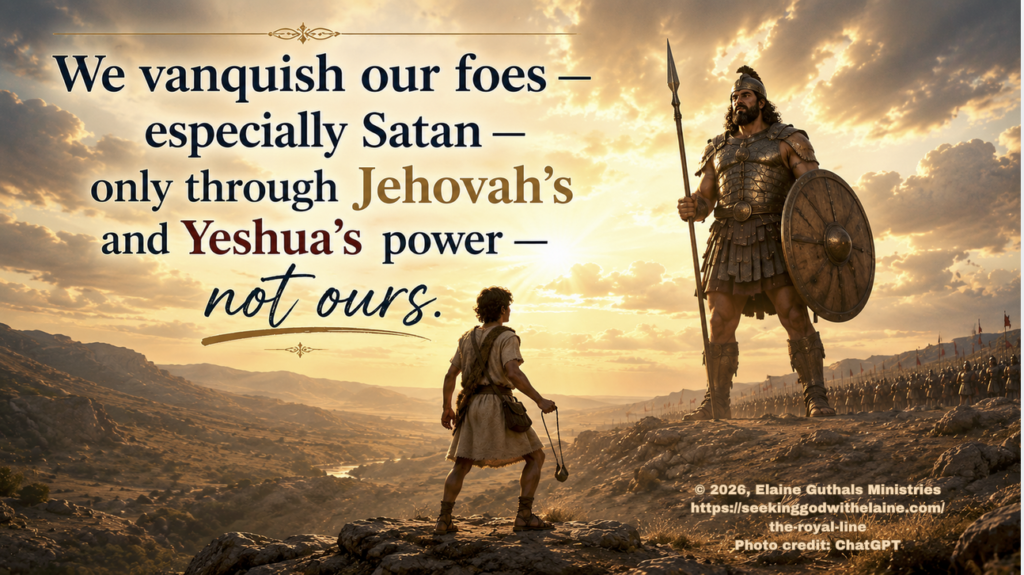
    We vanquish our foes — especially Satan — only through Jehovah’s and Yeshua’s power — not ours.

    Yeshua will grasp His enemies with His hand. He will always be victorious

    All Your Relatives Will Bow before You

    Judah would become the leader of the family.

    Well, I wonder how this terminology went over? It wasn’t well received when Joseph gave his brothers the visual of this from his dreams in Genesis 37: 5-10.

    But what Jacob was doing here was making Judah the head of the family. No, I doubt they were going to bend the knee.

    They were, though — in some cases, probably — bend their will. Judah would have the final say in the family.

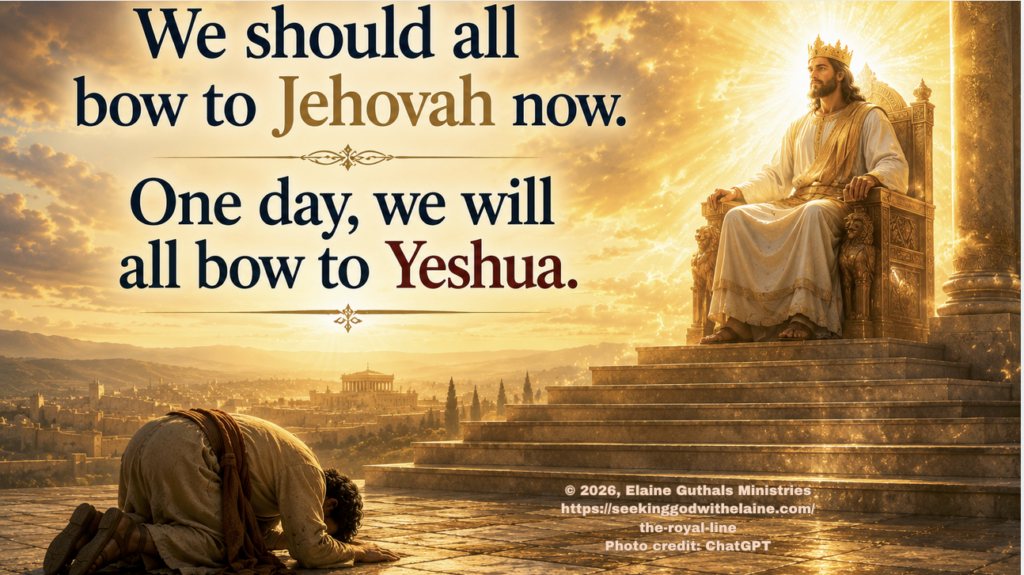
    We should all bow to Jehovah now. One day, we will all bow to Yeshua.

    “Therefore, God elevated him to the place of highest honor and gave him the name above all other names, that at the name of Jesus every knee should bow, in heaven and on earth and under the earth, and every tongue declare that Jesus Christ is Lord, to the glory of God the Father” (Phil. 2: 9-11 NLT).

    The Lion of Judah

    “Judah, my son, is a young lion that has finished eating its prey. Like a lion he crouches and lies down; like a lioness — who dares to rouse him? (Gen. 49: 9 NLT)


    A Young Lion


    The lion symbolizes strength, authority, and royal destiny.

    We know the royal implications are fulfilled. One of Judah’s descendants is King David. Another descendant is Yeshua.

    Judah and his descendants were associated with the characteristics of the lion: fearlessness, confidence, strength, and victory. Those qualities ultimately point to Yeshua, the Lion of Judah.

    The Lion of Judah gives His people courage, confidence, and strength. We stand secure not because of our power, but because He protects and fights for us.

    This section is talking about the Lion of Judah “But one of the twenty-four elders said to me, ‘Stop weeping! Look, the Lion of the tribe of Judah, the heir to David’s throne, has won the victory. He is worthy to open the scroll and its seven seals’” (Rev. 5: 5 NLT).

    Finished Eating Its Prey


    Yeshua conquered his prey — Satan, sin, death, the powers of darkness — on the cross.

    If we look at a Hebrew Bible, it says something slightly different than the New Living Translation said. “A lion’s whelp, Yehuda — from torn-prey, my son, you have gone up! …”  (Gen. 49: 9 TSB).

    Resource

    After tearing up His foe on the cross, Yeshua ascended to Heaven. He laid down His life only to victoriously take it back up.

    Whitfield had a different take. He saw this as Yeshua’s return. His prey is those who have not accepted Him as their Savior.

    Resource

    “When he comes on that day, he will receive glory from his holy people — praise from all who believe. And this includes you, for you believed what we told you about him” (II Thess. 1: 10 NLT).

    • “There is more than enough room in my Father’s home. If this were not so, would I have told you that I am going to prepare a place for you? When everything is ready, I will come and get you, so that you will always be with me where I am” (Jn. 14: 2-3 NLT).
    • “And just as each person is destined to die once and after that comes judgment, so also Christ was offered once for all time as a sacrifice to take away the sins of many people. He will come again, not to deal with our sins, but to bring salvation to all who are eagerly waiting for him” (Heb. 9: 28 NLT).

    He Crouches and Lies Down

    Not only was the lion seen as a royal destiny, but it was also seen as a kind of Hebrew hero.

    Judah would have been seen as strong against his enemies. This did come to be as the tribe of Judah had strong warriors.

    
Like a Lioness


    Not  all versions translate it as lioness.

    If we go back to the Hebrew, we see that it doesn’t say anything about this being a lioness. “… like the lion, like the king-of-beasts, who dares rouse him up?” (Gen. 49: 9 TSB).

    There should be no gender-altering surgery done here.

    The Scepter of Judah

    “ The scepter will not depart from Judah, nor the ruler’s staff from his descendants, until the coming of the one to whom it belongs, the one whom all nations will honor” (Gen. 49: 10 NLT)

    The scepter of Judah that Jacob talked about becomes one of the most familiar Messianic passages in Scripture.

    Before we do anything, we need to look at scepter as Jacob would have. Whitfield helped us there. He wrote,

    “A sceptre is the symbol of regal command, and, in its earliest form, it was a long staff which the king held in his hand when speaking in public assemblies; when he sat upon his throne he rested it ‘between his feet’ inclining towards himself.”

    Resource

    I had always read this to reference Yeshua — and it does. His reign would be everlasting.

    And that is correct. This verse forms the foundation of the royal line that leads to David and ultimately to Yeshua – the Messiah.

    Robertson had a second take. When the ten tribes disappeared, the two remaining tribes combined to for Judah – the Jews.

    That would make scepter a synonym for nationality.

    Resource

    Several Hebrew Bibles also have verse 10 saying something else. “The shevet (sceptre) shall not depart from Yehudah, nor a Mekhokek (Lawgiver) from between his raglayim, until Shiloh come; and unto him shall be the obedience of the amim (peoples, nations)” (Gen. 49: 10 OJB).

    It starts out talking about the scepter, but it takes another track after that.

    Nor a Mekhokek

    Also transliterated as meḥoqeq, מְחֹקֵק means one who establishes law, ruler, decree maker, and governor.

    As Jehovah and Yeshua are one (Jn. 10: 30), the law was given by Both. The law shows Jehovah’s character, so it also shows Yeshua’s character.

    Wood noted that lawgiver referred to judicial and authority. He wrote that it “… is intended to express the continuance of both civil and ecclesiastical power until the coming of Shiloh.”

    Resource

    We must never forget that Jehovah is still Judge over His Creation.

    From between His Raglayim

    It is talking here of authority, succession, and dynastic continuity.

    Raglayim (רַגְלַיִם) means from between his feet or a pair of feet. That is an ancient idiom associated with descendants.

    The picture that popped in my mind was kiddos sitting on the floor around a man sitting in a chair.

    What this is saying is that the royal line will continue through Judah’s descendants. Jacob wasn’t predicting one king but an ongoing royal dynasty.

    Until Shiloh Come

    The Messiah would bring peace.

    What the Hebrew says is ‘ad ki-yavo Shiloh (עַד כִּי־יָבֹא שִׁילֹה) — until Shiloh come.

    Shiloh, which means that one to whom kingship belongs, is seen as another title for the Messiah. Also, Shiloh means peace, rest, and quietness.

    • “For a child is born to us, a son is given to us. The government will rest on his shoulders. And he will be called: Wonderful Counselor, Mighty God, Everlasting Father, Prince of Peace” (Isa. 9: 6 NLT).
    • “And he will be the source of peace. When the Assyrians invade our land and break through our defenses, we will appoint seven rulers to watch over us, eight princes to lead us” (Mic. 5: 5 NLT).

    One of the most wonderful things about this is Yeshua is bringing His peace to us. He will give tranquillity to disciples.

    Unto Him Shall be the Obedience of the Amim

    The Messiah would call all the nations to Him.

    When Yeshua comes again, what will He be doing?

    “And he will send out his angels with the mighty blast of a trumpet, and they will gather his chosen ones from all over the world — from the farthest ends of the earth and heaven” (Mt. 24: 31 NLT).

    We can look at this two ways. Yeshua is the One doing the gathering.  He is gathering His people unto Himself. “And when I am lifted up from the earth, I will draw everyone to myself” (Jn. 12: 32 NLT).

    Who will be gathered to Shiloh? Those who are obedient and faithful.

    One thing we can’t gloss over is  Yeshua’s rule will be complete.

    But remember, we said that all would bow before Him. That would mean Yeshua would be drawing all men to Himself.

    The Vine and Wine

    “He ties his foal to a grapevine, the colt of his donkey to a choice vine. He washes his clothes in wine, his robes in the blood of grapes. His eyes are darker than wine, and his teeth are whiter than milk” (Gen. 49: 11-12 NLT)

    The reference to the grapevine and produced wine pointed toward the abundance of the Messianic age and, secondarily, the kingship.

    Having established the coming King, Jacob now describes the blessings of His kingdom. The imagery is intentionally extravagant.

    In the Ancient Near East, vineyards represented prosperity, peace, and abundance. Jacob described a future so prosperous that a man could tie his donkey to a choice vine without worrying about damaging one vine.

    Wine would be so plentiful that it could be treated like water. We would think that would mean just for drinking. Jacob was indicating it would be so plentiful it could be used like water for washing.

    Jacob wasn’t giving an agricultural forecast. This imagery ultimately points beyond David’s kingdom. He was describing the blessings of abundance, peace, and prosperity associated with the reign of Judah’s coming King.

    Judah’s Tribe

     The tribe of Judah’s supremacy was evident.

    In the Exodus, Judah’s tribe was designated the lead of the East Division, with 74,600 (Num 2: 4). By the second census, the tribe had grown to 76,500 (Num. 26: 22).

    After Joshua’s death, Judah led, along with the tribe of Simeon, in attacking the Canaanites. While they did chase the Canaanites out of the hill country, they weren’t able to defeat them in the plains (Jdg. 1: 14).

    Besides King David and Yeshua, other people important to the history of the nation came from the tribe of Judah. Caleb was one of the two spies that urged the Israelites to take the Promised Land (Num. 13: 6). Later, Caleb’s nephew Othniel became the first judge (Jdg. 3: 9).

    Judah got its allotment in Joshua 15. They received the largest and most important territory. Cities in their territory included Jerusalem, Bethlehem, and Hebron.

    When the nation was divided into two kingdoms after King Solomon’s death, they made up the Southern Kingdom with Benjamin and many of the Levites. By then, they had assimilated the tribe of Simeon as their own. Because of this, they retained the Temple and Levitical worship.

    They also retained the Davidic line. True, they had their bad kings, but they had Asa, Jehoshaphat, Hezekiah, and Josiah.

    When the southern kingdom was taken into exile by the Babylonians,  the tribe of Judah remained. In fact, they became the Jews.

    This name acknowledged that they were no longer just the tribe of Judah but the covenant people as a whole. The use of this name started in the time of Ezra and Nehemiah.

    The history of Judah demonstrates that Jacob’s prophecy was fulfilled both in Israel’s national history and ultimately in the Messiah.

    Making the Connections #1

    Fun fact. David wasn’t the firstborn in his family either, but Yeshua was. God didn’t do the unexpected.

    Making the Connections #2

    Wait! How can we say Judah would always have the scepter?

    • The first king was from the the tribe of Benjamin!
    • The Maccabeans were not from the tribe of Judah!!

    Doesn’t that mean this prophecy didn’t come to pass?

    No. The scepter is about authority and governing status.

    Yes, it does address the Davidic dynasty.

    We should take Genesis 49: 10 to mean, then, that it is not talking exclusively about earthly succession. It was talking about our spiritual King.

    How Do We Apply This?

    • Let repentance transform your future.
    • Stand firm in Yeshua’s strength, not your own.
    • Bow willingly to Jehovah today.
    • Find security in the Lion of Judah.
    • Look forward to Yeshua’s coming reign.

    Father God. Thank You for the testimony of Judah. Thank You for showing us how he repented of his sins and was used by You. Forgive us where we sin. Use us to expand Your kingdom. Amen.

    If you don’t understand something and would like further clarification, please contact me.

    If you have not signed up for the email providing the link to the devotions and the newsletter, do so below.

    If God has used this devotion to speak with you, consider sharing it on social media.
  • Jacob’s Last Words to His Sons: The Lost Firstborn

    Jacob knew he was dying. This devotion begins our look at the blessings and curses he gave his sons – beginning with Reuben, Simeon, and Levi.

    Nuggets

    • Jacob’s final words to his sons served several purposes.

    • Reuben, the firstborn, lost that designation because he sinned against his father.

    • Simeon was the second son and Levi the third son of Jacob and Leah.

    the-lost-firstborn

    We talked about Genesis 48 being a chapter of transition. Genesis 49 continues that transition by setting the tone for the coming tribes. It summarizes their legacy, identity, and divine purpose.

    Jacob was on his last days on this earth. Not only that, but he was also the last of the patriarchs — Abraham, Isaac, and Jacob. That part of Jehovah’s plan had come to an end.

    Programming note: We are going to save the connections and application for the end.

    Let’s Put It into Context

    To read devotions in the Creating Everything theme, click the button below.

    Devotions in the Joseph the Savior of Israel  series

    Jacob Blessed His Sons

    “Then Jacob called together all his sons and said, ‘Gather around me, and I will tell you what will happen to each of you in the days to come. Come and listen, you sons of Jacob; listen to Israel, your father’” (Gen. 49: 1-2 NLT)

    Jacob’s final words to his sons served several purposes.

    Just as Isaac blessed Jacob, Jacob blessed his children just prior to his death. True, not all would see this as a blessing but rather a curse.

    Still, this was more than a last will and testament that divided an inheritance.

    Genesis 49 functioned simultaneously as a covenant declaration, patriarchal blessing, inheritance distribution, prophetic revelation, and covenantal last will and testament all rolled into one.

    Jacob was not merely speaking as a dying father. He was speaking as the covenant patriarch of Israel.

    His words carried covenant authority tied to the promises Jehovah had made to Abraham and Isaac. Through these declarations, Jacob identified future tribal roles, inheritance identity, covenant trajectory, and even the future development of Israel itself.

    That is why these blessings were not always pleasant. Some were corrective. Some were disciplinary. Some were predictive. Some established future leadership structures within the nation. 

    These words were directed to the sons standing before Jacob, but they looked far beyond them to the tribes that would descend from them. Rather than providing a detailed photograph of the future, Jacob’s declarations provide a shadowy outline of the destiny, identity, and the role each tribe would play within Jehovah’s covenant people.

    When looking back, we see that Jacob told five sons much detail about their future. The rest were very general.

    It is through this vague style of speech that we can be assured that the inspiration and prophecy came from Jehovah.

    Reuben

    “Reuben, you are my firstborn, my strength, the child of my vigorous youth. You are first in rank and first in power. But you are as unruly as a flood, and you will be first no longer. For you went to bed with my wife; you defiled my marriage couch” (Gen. 49: 3-4 NLT)

    Reuben, the firstborn, lost that designation because he sinned against his father.

    Reuben was the first son born to Jacob and Leah and Jacob’s firstborn. This should have cemented his future.

    When we think about it, though, Reuben would have had an unusual time at being firstborn. Generally, in the Ancient Near East, there was several years difference between the firstborn and the next son.

    Not with Jacob’s sons. Reuben was the oldest, and Joseph was the youngest — until Benjamin came along 17 years later — so there was probably around six years difference in 11 of the sons’ ages.

    Still, Reuben was decidedly in his mother’s marital camp. This division rocked the family for years.

    With Jacob’s opening words, Reuben was probably heartened at Jacob’s first words. Then he heard the words he was dreading.

    Reuben had staged a coup against Jacob by sleeping with Jacob’s concubine after Rachel’s death, and Jacob had a long memory.

    Because of that, Reuben lost family leadership. “The oldest son of Israel was Reuben. But since he dishonored his father by sleeping with one of his father’s concubines, his birthright was given to the sons of his brother Joseph. For this reason, Reuben is not listed in the genealogical records as the firstborn son.” (I Chron. 5: 1 NLT).

    Jacob was concerned that Reuben’s unsoundness was the result of his sensual character. Reuben’s act stemmed from his character, not his performance. Robertson noted this act showed him to be hesitant, weak, and miserable.

    Reuben, the firstborn, lost that designation because he sinned against his father.

    Reuben was the first son born to Jacob and Leah and Jacob’s firstborn. This should have cemented his future.

    When we think about it, though, Reuben would have had an unusual time at being firstborn. Generally, in the Ancient Near East, there was several years difference between the firstborn and the next son.

    Not with Jacob’s sons. Reuben was the oldest, and Joseph was the youngest — until Benjamin came along 17 years later — so there was probably around six years difference in 11 of the sons’ ages.

    Still, Reuben was decidedly in his mother’s marital camp. This division rocked the family for years.

    With Jacob’s opening words, Reuben was probably enheartened at Jacob’s first words. Then he heard the words he was dreading.

    Reuben had staged a coup against Jacob by sleeping with Jacob’s concubine after Rachel’s death, and Jacob had a long memory.

    Because of that, Reuben lost family leadership. “The oldest son of Israel was Reuben. But since he dishonored his father by sleeping with one of his father’s concubines, his birthright was given to the sons of his brother Joseph. For this reason, Reuben is not listed in the genealogical records as the firstborn son.” (I Chron. 5: 1 NLT).

    Jacob was concerned that Reuben’s unsoundness was the result of his sensual character. Reuben’s act stemmed from his character, not his performance. Robertson noted this act showed him to be hesitant, weak, and miserable.

    Resource
    Robertson’s Jacob’s Predictions
    https://biblehub.com/sermons/auth/robertson/jacob’s_predictions.htm

    Would some say that Reuben shouldn’t be judged by one single event that happened years ago? Can’t he change?

    Yes, people do change — that is the foundation of salvation. Jehovah takes the sinful person and regenerates us into holy, righteous children.

    Sin builds our character. We must ask Jehovah to build in us His character.

    Reuben’s actions that we saw seemed only to be geared to getting back into Jacob’s affections so that he could be restored as firstborn. Jacob appears to have not seen a conscience focused on Jehovah.

    In the end, nothing Reuben did gained back his father’s favor. Joseph received the double portion, Judah became the family leader, and Levi became the family priest.

    Resource

    Would some say that Reuben shouldn’t be judged by one single event that happened years ago? Can’t he change?

    Yes, people do change — that is the foundation of salvation. Jehovah takes the sinful person and regenerates us into holy, righteous children.

    Sin builds our character — when we acknowledge it and repent. We must ask Jehovah to build in us His character.

    Reuben’s actions that we saw seemed only to be geared to getting back into Jacob’s affections so that he could be restored as firstborn. Jacob appears to have not seen a conscience focused on Jehovah.

    In the end, nothing Reuben did gained back his father’s favor. Joseph received the double portion, Judah became the family leader, and Levi became the family priest.

    Reuben’s Tribe

    In the Exodus, Reuben’s tribe was designated part of the South Division in surrounding the Tabernacle.

    The tribes of Reuben, Gad, and half of Manasseh chose to live on the east side of the Jordan. They chose the fine grazing lands they saw instead of entering the Promised Land.

    Reubenites promised — and fulfilled their promise — of helping the other tribes conquer Canaan. They supplied fighting men during Joshua’s campaigns.

    However, they were physically and spiritually separated from the center of covenant life. Not cut off, but isolated.

    This may be one reason that the tribe of Reuben never produced a judge, king, or major prophet. The tribe survived but never rose to national prominence.

    Instead, the clan’s hesitancy was evident to Deborah, one of the judges. “The princes of Issachar were with Deborah and Barak. They followed Barak, rushing into the valley.But in the tribe of Reuben there was great indecision” (Jdg. 5: 15 NLT).

    Separated from the bulk of the tribes, Reubenites were exposed and vulnerable. Their numbers fell from 46,500 (Num. 1) to 43,730 (Num. 26) when censuses were conducted.

    This separation and decreasing numbers helped to contribute to this tribe becoming the first Lost Tribe. They were carried away in exile by the Assyrians. This allowed their territory  to disappear centuries before the Southern Kingdom of Judah fell.

    Still, the tribe of Reuben retained its covenant identity. “Moses said this about the tribe of Reuben: ‘Let the tribe of Reuben live and not die out, though they are few in number’” (Deut. 33: 6 NLT).

    Preeminence, no. Covenant identity, yes.

    Simeon and Levi

    “Simeon and Levi are two of a kind; their weapons are instruments of violence. May I never join in their meetings; may I never be a party to their plans. For in their anger they murdered men, and they crippled oxen just for sport. A curse on their anger, for it is fierce; a curse on their wrath, for it is cruel. I will scatter them among the descendants of Jacob; I will disperse them throughout Israel” (Gen. 49: 5-7 NLT)

    Simeon was the second son and Levi the third son of Jacob and Leah.

    Little was initially heard about Simeon and Levi. That changed when they took center stage for avenging Dinah when she was raped by Shechem. Levi and Simeon were the two brothers to murder the men of the town of Shechem.

    Simeon and Levi both showed a cruel disposition. In other words, Jacob was not necessarily calling them out for avenging Dinah. No doubt, Jacob was angry himself at the time.

    They took vengeance on the whole city instead of on the man or family.

    This showed itself in their fierce, nomadic lives. Because of this sin, both tribes eventually were scattered in Israel.

    Because of their sin, their tribes would be scattered within the inheritance of the other tribes.

    The same prophecy was accomplished in two very different ways.

    Simeon’s Tribe

    In the Exodus, Simeon’s tribe was designated part of the South Division.

    Like the Reubenites, the Simeonites saw a great decline. Their numbers fell from 59,300 (Num. 1: 23) — making it one of the largest tribes —  to 22,200 (Num. 26: 14) when censuses were conducted.

    That is a big decline — over half of the tribe.

    Many scholars connect this with the judgment surrounding Baal-Peor in Numbers 25.

    • “Just then one of the Israelite men brought a Midianite woman into his tent, right before the eyes of Moses and all the people, as everyone was weeping at the entrance of the Tabernacle. When Phinehas son of Eleazar and grandson of Aaron the priest saw this, he jumped up and left the assembly. He took a spear  and rushed after the man into his tent. Phinehas thrust the spear all the way through the man’s body and into the woman’s stomach. So the plague against the Israelites was stopped,  but not before 24,000 people had died. (Num. 25: 6-9 NLT).
    • “The Israelite man killed with the Midianite woman was named Zimri son of Salu, the leader of a family from the tribe of Simeon” (Num. 25: 14 NLT).

    When we think about it, we may question whether or not the tribe of Simeon got land in the distribution among the tribes. Didn’t the Simeonites get something?

    Well, yes and no. The Simeonites got their distribution in Joshua 19: 1-9.

    But look at Joshua 19: 9. “Their allocation of land came from part of what had been given to Judah because Judah’s territory was too large for them. So the tribe of Simeon received an allocation within the territory of Judah” (Josh. 19: 9 NLT).

    The tribe of Simeon got cities inside the land of Judah’s allotment. Eventually, the tribe of Simeon was swallowed up by Judah.

    But again, they were not erased as the appear in the Book of Revelation’s listing of tribes.

    They did not have a turning point such as Levi had. Simeon was scattered and absorbed. Levi was scattered and elevated.

    Levi’s Tribe

    Levi had a dark history but was redeemed.

    Levi was the third son of Jacob and Leah. Little, too, was initially heard about him.

    Levi accompanied Simeon to murder the men of the town of Shechem.

    However, they began to redeem themselves during the exodus. At Mt. Sinai when Aaron made the golden calf, the tribe of Levi supported Moses in punishing the others (Ex. 32).

    Levi’s descendants became the priestly tribe. Because of that, they were scattered among the other tribes. Their ministry was to serve in the Tabernacle, later the Temple.

    They also performed another important thing. “For all the firstborn among the people of Israel are mine, both of man and of beast. On the day that I struck down all the firstborn in the land of Egypt I consecrated them for myself, and I have taken the Levites instead of all the firstborn among the people of Israel. And I have given the Levites as a gift to Aaron and his sons from among the people of Israel, to do the service for the people of Israel at the tent of meeting and to make atonement for the people of Israel, that there may be no plague among the people of Israel when the people of Israel come near the sanctuary” (Num. 8: 17-19 NLT).

    The census conducted at the beginning of the Book of Numbers told us the tribe of Levi did not see their numbers decline as the other two did.

    • “The number of firstborn sons who were one month old or older was 22,273” (Num. 3: 43 NLT).
    • “There are 273 more firstborn sons of Israel than there are Levites …” (Num. 1: 46 NLT).
    • “The men from the Levite clans who were one month old or older numbered 23,000 …” (Num. 26: 62 NLT).

    Unlike Reuben and Simeon, Levi did not experience a dramatic decline. While the other two tribes diminished, Levi remained stable and even grew slightly. The tribe that had once shared Simeon’s judgment was transformed by Jehovah into a tribe of service and blessing.

    This fulfilled Jacob’s prophecy, but in a different way than Simeon’s. The priests were not swallowed by the tribes in which they served. They were revered.

    Father God. Thank You for giving us families. Forgive us for our sins. Thank You for showing us that we, like Levi, can be restored to service to You. Amen.

    To read a related devotion, click the button below.

    Resource

    Glossary

    Making the Connections

    Post

    To read a related devotion, click the button below.

    Resource

    Glossary

    How Do We Apply This?

    Post

    To read a related devotion, click the button below.

    Resource

    Glossary

    The ABCDs of Salvation

    If you have not become a believer in Christ, please read through the
    Plan of Salvation and prayerfully consider what God is asking you to do.

    A – admit our sins
    B – believe His Son Jesus is our Redeemer
    C – confess God as Sovereign Lord

    D – demonstrate that commitment by making any changes needed in our lives to live the way in which God has called us

    The Disciple’s Job Description

    Heading

    Searching for and Seeking God

    Non-believers search for God.
    Disciples seek Him.

    Hearing His Word (Rom. 10: 17)
    Reading His Word (Rev. 1: 3)
    Praying to Him (Heb. 4: 16)
    Studying His Word (Ac. 17: 11)
    Meditating on His Word (Ps. 1: 1-2)
    Memorizing His Word (Ps. 119: 11)

    It Was Enough
    Vocalist: Elaine Guthals
    Keyboard: Chris Vieth

    Person of Interest

    Fun Fact

    Verse Commentary

    Related Links

    Artist

    Related Links

    I have created a worksheet of the questions above. Click on the button below to access it.

    Don’t know what your spiritual gifts are?

    Take this Spiritual Gifts Inventory

    The Disciple’s Job Description

    Complete Job Description

    Individual Description

    The Disciple’s Job Description

    Complete Job Description

    Individual Description

    Job Duty #4
    Proclaim the Gospel (Mark 16: 15)

    Job Duty #6
    Make Disciples (Matthew 28: 19-20)

    If you don’t understand something and would like further clarification, please contact me.

    If you have not signed up for the email providing the link to the devotions and the newsletter, do so below.

    If God has used this devotion to speak with you, consider sharing it on social media.
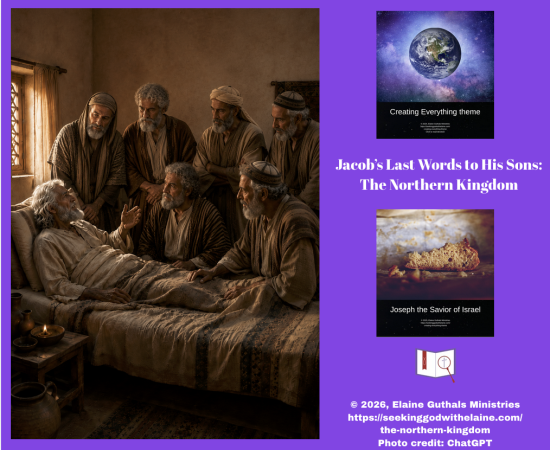
  • Abundance and Famine in Egypt

    After Joseph had been made Vizier of Egypt, the seven years of plenty came. This devotional reading looks at what occurred during the period of plenty and the beginning of the famine.

    Nuggets

    • The Hyksos Pharaoh, who had adopted Egyptian ways, got Joseph to do the same — at least in outward appearance.
    • The seven years of plenty came as Joseph prophesied.
    • While Joseph was Vizier, his family grew.
    • After seven years of plenty, the seven years of famine began.
    abundance-and-famine-in-egypt

    At the end of the last devotion, Pharaoh had just told Joseph about his dreams, and Joseph had interpreted them. What was Pharaoh’s response?

    Let’s Put It into Context

    To read devotions in the Creating Everything theme, click the button below.

    Devotions in the Joseph the Savior of Israel  series

    Joseph’s Personal Life

    “Then Pharaoh gave Joseph a new Egyptian name, Zaphenath-paneah. He also gave him a wife, whose name was Asenath. She was the daughter of Potiphera, the priest of On. So Joseph took charge of the entire land of Egypt. He was thirty years old when he began serving in the court of Pharaoh, the king of Egypt. And when Joseph left Pharaoh’s presence, he inspected the entire land of Egypt” (Gen. 41: 45-46 NLT)

    The Hyksos Pharaoh, who had adopted Egyptian ways, got Joseph to do the same — at least in outward appearance.

    Joseph received an Egyptian name as well as an Egyptian wife. Why was this important? Because he was a foreigner, it removed social barrier. He was now one of them.

    The meaning of Joseph’s name is interesting. Maclaren cited Brugsch as reporting that it meant “… ‘governor of the district of the dwelling-place of the living one,’ …” That jives with what Hilprecht noted, though he was speaking of the position — Tare or “chief of the entire administration.”

    Resource

    Wait! What????

    First, Joseph is called Vizier. Then he is called Tare.

    So, which one is it?

    Well, actually they are the same but different.

    • Vizier means second-in-command.
    • Tare is the actual Egyptian administrative title.

    I can see that. Have you ever asked a person, “What is your title?” Then you had to ask, “Okay, so tell me what you do.”

    It would be hard to put Joseph’s duties under one title.

    • Advisor
    • Administrator
    • Economic planner
    • Judge
    • Distributor
    • Overseer of labor
    • Overseer of storage
    • Pharaoh’s executive authority

    Tare has been preserved on monuments. It was usually given to a chief priest or prince. This is important to Joseph’s story because he would have been governor, judge, and treasurer.

    Now, this wife wasn’t just anyone. She was the daughter of a priest. Her father was a priest of On, who merged with another to become Amon-Re, the most powerful god in Egypt.

    Bountiful Years Came to Pass

    “As predicted, for seven years the land produced bumper crops. During those years, Joseph gathered all the crops grown in Egypt and stored the grain from the surrounding fields in the cities. He piled up huge amounts of grain like sand on the seashore. Finally, he stopped keeping records because there was too much to measure” (Gen. 41: 47-49 NLT)

    The seven years of plenty came as Joseph prophesied.

    The abundance happened just as Joseph prophesied. And Egypt was ready.

    There probably had been some storage places already built. Joseph had them build more. There was no way they had enough storage places to store seven years’ worth of grain.

    Notice, these storehouses weren’t rural. They weren’t in one city. Joseph had them built all over Egypt.

    It says that the Egyptians gathered so much that they stopped counting. It was too much to count.

    Jehovah is like that. The fulfillment of Jehovah’s promises brings us more than we imagined.

    They were able to do this because Jehovah came to Pharaoh and prepared him for this. Because He did, Joseph’s first dream came true.

    Joseph’s Sons Were Born

    “During this time, before the first of the famine years, two sons were born to Joseph and his wife, Asenath, the daughter of Potiphera, the priest of On. Joseph named his older son Manasseh, for he said, ‘God has made me forget all my troubles and everyone in my father’s family.’ Joseph named his second son Ephraim, for he said, ‘God has made me fruitful in this land of my grief’” (Gen. 41: 50-52 NLT)

    While Joseph was Vizier, his family grew.

    Jehovah was good to Joseph while he was a ruler in Egypt. He had two sons named Manasseh and Ephraim.

    Joseph acknowledged Jehovah’s intervention in his life by the names he gave his sons. That showed that he honored Jehovah in his home as well as in his work that He gave him.

    Names were very important to the Hebrews. Remember, they have to do with the child’s behavior.

    Manasseh helped restore the importance of family to Joseph. He could give up on the hurt and focus on raising a family to honor Jehovah

    By the time Ephraim was born, Joseph was content where he was living.

    Through the names he gave his children, we see Joseph’s acceptance of his situation.

    Famine Comes to Pass

    “At last the seven years of bumper crops throughout the land of Egypt came to an end. Then the seven years of famine began, just as Joseph had predicted. The famine also struck all the surrounding countries, but throughout Egypt there was plenty of food. Eventually, however, the famine spread throughout the land of Egypt as well. And when the people cried out to Pharaoh for food, he told them, ‘Go to Joseph, and do whatever he tells you.’ So with severe famine everywhere, Joseph opened up the storehouses and distributed grain to the Egyptians, for the famine was severe throughout the land of Egypt. And people from all around came to Egypt to buy grain from Joseph because the famine was severe throughout the world” (Gen. 41: 53-57 NLT)

    After seven years of plenty, the seven years of famine began.

    Ooo, baby. Then the bad came to pass. The famine was just as bad as Joseph said it would be.

    But on the other hand, it was much worse. Joseph had only talked about its effects on Egypt. This famine hit all lands.

    Of course, the hungry people went to Pharaoh. He directed them to Joseph.

    Joseph opened the storehouses and started selling grain. He didn’t want to open them too early and risk running out of food. He didn’t want to open them too late and have people dying from starvation.

    Think about this. Some may have still considered Joseph a foreigner. But they couldn’t have let that stand in their way to food.

    If they said they wouldn’t buy food from Joseph, that would have been an affront to Pharaoh. They would have been harming themselves because they would not have gotten food.

    Part of us has probably said at one time or another how horrible it was that the government sold food to its own people. It was the grain supplied by the people that was sitting in the storehouses.

    Well, no it wasn’t. Remember, there was a “… one-fifth of all the crops …” (Gen. 41: 34 NLT) on all the grain grown in the bountiful years.

    It was the government’s grain now. Governments rarely do anything for free.

    But Egypt wasn’t just feeding themselves. They also sold to people from other countries. The famine was worldwide.

    Making the Connections #1

    How does preparing for the future differ than “Don’t store up treasures here on earth…” (Mt 6: 19)?

    Lawson argued that the verse does not cancel out the preparation. It emphasizes that we should rely on divine guidance for all provision of our needs.

    Resource

    The deciding factor of preparedness is whether, by preparing, we are relying more on ourselves than Jehovah. In other words, our attitude is the deciding factor.

    Making the Connections #2

    Next, we can go to the New Testament and take a different track. Let’s compare Joseph’s elevation to Vizier to the restoration of the Prodigal Son in Luke 15.

    • Both received the best robe.
    • Both received a ring.
    • Both had a public element to it — public elevation and public feast.

    Joseph’s brothers may have captured him in private and threw him into the cistern. His restoration was anything but. There was a public declaration.

    Jehovah can sometimes give us a public restoration, but He also may do it in private.

    The pattern is always the same, though.

    • Humiliation
    • Return
    • Forgiveness
    • Restoration
    • Celebration

    Jehovah restores far more than what we have lost.

    Making the Connections #3

    It is important to note that Joseph was 30-years old now. He had been sold to Egypt in 1692 BC when he was 17. That means for close to half his life, he had been away from his God and family.

    We can’t miss the fact that, now in 1679 BC, Joseph was 30 years old when he was released from prison and began serving in the position Jehovah had prepared for him. It is the same age as Yeshua was when He started His ministry and priests when they begin serving in the Temple.

    Joseph had been in Egypt 13 years. During the whole time, he had either been a slave or in prison – causing 13 years of suffering.

    I think this is important, too. Prevailing theory at the time said each region had their own gods. They were just powerful in that region.

    Jehovah showed that He is powerful anywhere, any time

    How Do We Apply This?

    • Be faithful in hidden seasons.
    • Trust Jehovah’s provision.
    • Remain faithful in foreign places.
    • Prepare wisely for the future.

    Father God. You give us wonderful promises. When You fulfill those promises – even when You make us wait – You do so abundantly. Help us, like Joseph, accept our situation. Amen.

    If you don’t understand something and would like further clarification, please contact me.

    If you have not signed up for the email providing the link to the devotions and the newsletter, do so below.

    If God has used this devotion to speak with you, consider sharing it on social media.

  • Joseph Made Vizier of Egypt

    At the end of the last devotion, Pharaoh had just told Joseph about his dreams, and Joseph had interpreted them. This devotional reading looks at how Pharaoh reacted to the impending famine.

    Nuggets

    • After interpreting Pharaoh’s dreams, Joseph suggested how to deal with the abundance as well as the shortage.
    • Pharaoh didn’t hesitate to accept Jehovah’s interpretation of the dreams.
    joseph-made-vizier-of-egypt

    Joseph had just gotten done interpreting Pharaoh’s dreams, but he also proposed a plan to prepare for the famine that was coming. What was Pharaoh’s response?

    Let’s Put It into Context

    To read devotions in the Creating Everything theme, click the button below.

    Devotions in the Joseph the Savior of Israel  series

    Find Someone

    “Therefore, Pharaoh should find an intelligent and wise man and put him in charge of the entire land of Egypt. Then Pharaoh should appoint supervisors over the land and let them collect one-fifth of all the crops during the seven good years. Have them gather all the food produced in the good years that are just ahead and bring it to Pharaoh’s storehouses. Store it away, and guard it so there will be food in the cities. That way there will be enough to eat when the seven years of famine come to the land of Egypt. Otherwise this famine will destroy the land’” (Gen. 41: 33-36 NLT)

    After interpreting Pharaoh’s dreams, Joseph suggested how to deal with the abundance as well as the shortage.

    We might think that it was a little forward of Joseph to, immediately after interpretation of the dreams, suggest what Pharaoh should do to prepare for the years of famine. It wasn’t because he thought they wouldn’t come up with a plan.

    Joseph had the solution because Jehovah was still in control. Since it was Jehovah interpreting the dreams, He would also be the One to immediately present the plan to address the famine.

    No, it wasn’t just for the Egyptians salvation. It was for the Israelites.

    We just have to listen and follow Jehovah’s practical directions.

    If Jehovah was intent on making sure Egypt survived — because He knew that is where the Hebrews would end up — it is logical He would give chapter and verse. In that way, they would know exactly how He wanted them to survive.

    There are instances of this happening. Jehovah gave Noah specific instructions on how to build the ark (Gen. 6: 14-16). He gave Moses specific instructions on how to build the Tabernacle (Ex. 35-40).

    But most of the time, Sovereign God doesn’t micromanage. He tells us what we are to do, and we are supposed to figure out how to get it done.

    Oh, there are nudges from the Holy Spirit to keep us on path. But most of the time, we would kick and scream if He micromanaged all the time.

    Sovereign God made us in His image, so we have some intelligence. He wants us to choose Him.

    In this instance, it does seem like a no brainer. During the good years, save. During the bad years, use.

    What is interesting is the twenty percent tax. To be that specific, it appears to come from God.

    This brings up an important point. Jehovah has no problem with us saving for the future. It is when we start putting stock in that savings and forget that they are there because of Him that we get into a sinful attitude.

    We just have to listen and follow God’s directions.

    Joseph Made Ruler of Egypt

    “Joseph’s suggestions were well received by Pharaoh and his officials. So Pharaoh asked his officials, ‘Can we find anyone else like this man so obviously filled with the spirit of God?’ Then Pharaoh said to Joseph, ‘Since God has revealed the meaning of the dreams to you, clearly no one else is as intelligent or wise as you are. You will be in charge of my court, and all my people will take orders from you. Only I, sitting on my throne, will have a rank higher than yours.’ Pharaoh said to Joseph, ‘I hereby put you in charge of the entire land of Egypt.’ Then Pharaoh removed his signet ring from his hand and placed it on Joseph’s finger. He dressed him in fine linen clothing and hung a gold chain around his neck. Then he had Joseph ride in the chariot reserved for his second-in-command. And wherever Joseph went, the command was shouted, ‘Kneel down!’ So Pharaoh put Joseph in charge of all Egypt. And Pharaoh said to him, ‘I am Pharaoh, but no one will lift a hand or foot in the entire land of Egypt without your approval’” (Gen. 41: 37-44 NLT)

    Pharaoh didn’t hesitate to accept Jehovah’s interpretation of the dreams.

    Everyone liked Joseph’s proposal. But being possible cousins to the Hebrews, we would think they would be more open to acknowledging God as the Hebrew’s God.

    The Hyksos Pharaoh knew enough to know the power of Sovereign God. With all that was riding on what was soon going to happen, he didn’t want to discount this revelation.

    So, probably in the Egyptians’ minds, the Hyksos Pharaoh promoted another outsider.

    Then again, it may be that Joseph surprised Pharaoh. Here was this prisoner who was presenting noble qualities.

    It doesn’t seem like it took long for Joseph to win the room. What, maybe an hour — probably less.

    Davies addressed that. He wrote,

    “He was entrusted with supreme authority. Such was the high estimate of Joseph, created in all minds, that they felt he was worthy of the largest trust. They could trust him as they trusted the law of gravitation. A Christian will never abuse his power.”

    Resource

    But remember, this was the job for which Jehovah was preparing Joseph.

    Joseph would have had many duties in his activities under Potiphar and the prison warden. Look at this.

    At each place where Joseph was held against his will, he was given responsibilities that grew in size, complexity, and reach, preparing him for what was ahead. Through it all, his obedience remained the same.

    In today’s terms, we would probably call it an apprenticeship.

    I think the most important thing Joseph learned at Potiphar’s house and in prison was administration. It would be safe to say that Joseph had an analytical mind to root out any problems and forge a solution.

    All Jehovah’s behind-the-scenes coordination was paying off.

    We also have to think that part of what sold Pharaoh and his advisors to choose Joseph was the unshakable confidence evident as he was laying out the interpretation. That confidence comes from and in Jehovah.

    Joseph was made Vizier of Egypt. Egyptians and Hyksos alike were to bow down to him. He was second only to Pharaoh — and he put a qualifier on that. It was only when he was on the throne that he was higher than Joseph.

    Joseph was going to be a hands-on leader. Pharaoh wanted him to be recognized as leader.

    • The signet ring symbolized governmental authority.
    • The fine linens showed honor and status.
    • The gold chain indicated public recognition.
    • The second chariot exhibited power.
    • There were people to tell others to bow to him.

    In other words, Joseph was given absolute authority.

    Remember Joseph’s first dream? The grain bundles bowed down to his. We’ve always associated this with his brothers bowing to him.

    What if it meant non-family members would bow to him first?

    Look at the bottom line, though. In Dothan, Joseph was rejected by his brothers. In Egypt, Joseph is elevated among foreign rulers.

    Making the Connections #1

    Joseph was devoted to Jehovah back in Hebron. He was devoted to Jehovah at Potiphar’s house, even though he had been betrayed by his brothers. He was devoted to Jehovah in the prison, even though he was imprisoned for a crime he did not commit.

    Of course, Joseph would continue to be devoted to Jehovah as second-in-command of the nation of Egypt.

    This is an example of Jehovah wanting our obedience regardless of the circumstances we are in.

    Making the Connections #2

    Would Joseph have been elevated to Vizier if the Pharaoh had been an Egyptian? Probably not.

    This is just another example of Jehovah working behind the scenes to further His plan.

    Because the Pharaoh was Hyksos, he was not as opposed to a Semite being elevated. In fact, the Hyksos capital of Avaris had a Semitic population. In other words, Joseph wouldn’t have been the only foreigner in the city.

    Joseph rose to power in a political environment where Semitic rulers governed Egypt, making his background less a barrier and possibly even an advantage.

    How Do We Apply This?

    • Trust Jehovah’s preparation.
    • Be faithful in hidden seasons.
    • Be obedient regardless of circumstances.
    • Use the wisdom God provides.
    • Remain faithful in foreign places.

    Father God. We hear Your promises, and we wait for them. When Your fulfillment comes, it blows us away. Thank You how You love and provide for us. Amen.

    If you don’t understand something and would like further clarification, please contact me.

    If you have not signed up for the email providing the link to the devotions and the newsletter, do so below.

    If God has used this devotion to speak with you, consider sharing it on social media.

  • Joseph Interpreted Pharaoh’s Dreams

    Pharaoh had two dreams that his people could not interpret. This devotional reading looks at who he got to interpret them – Joseph.

    Nuggets

    • Pharaoh called for Joseph to be brought to him.
    • Giving credit where credit is due, Pharaoh should get points for admitting the magicians and wise men were stymied.
    • Pharaoh retold the dreams — with commentary this time.
    • Joseph interprets the dreams not based on what Pharaoh already understands and adds what Jehovah is telling him.
    • Make no mistake – the prophecy of the dreams will come true soon.
    joseph-interpreted-pharaoh-dreams

    Joseph had asked one thing of the cupbearer when he interpreted his dream, “Remember me (Gen. 40: 14). Help me get out of here.”

    The day came when the cupbearer remembered. Joseph was called upon to interpret two dreams for Pharaoh.

    Let’s Put It into Context

    To read devotions in the Creating Everything theme, click the button below.

    Devotions in the Joseph the Savior of Israel  series

    Joseph before Pharaoh

    “Pharaoh sent for Joseph at once, and he was quickly brought from the prison. After he shaved and changed his clothes, he went in and stood before Pharaoh. Then Pharaoh said to Joseph, ‘I had a dream last night, and no one here can tell me what it means. But I have heard that when you hear about a dream you can interpret it.’ ‘It is beyond my power to do this,’ Joseph replied. ‘But God can tell you what it means and set you at ease.’ So Pharaoh told Joseph his dream. ‘In my dream,’ he said, ‘I was standing on the bank of the Nile River, and I saw seven fat, healthy cows come up out of the river and begin grazing in the marsh grass. But then I saw seven sick-looking cows, scrawny and thin, come up after them. I’ve never seen such sorry-looking animals in all the land of Egypt. These thin, scrawny cows ate the seven fat cows. But afterward you wouldn’t have known it, for they were still as thin and scrawny as before! Then I woke up. In my dream I also saw seven heads of grain, full and beautiful, growing on a single stalk. Then seven more heads of grain appeared, but these were blighted, shriveled, and withered by the east wind. And the shriveled heads swallowed the seven healthy heads. I told these dreams to the magicians, but no one could tell me what they mean’” (Gen. 41: 14-24 NLT)

    Pharaoh Sent for Joseph at Once

    Pharaoh called for Joseph to be brought to him.

    We probably think Joseph was cleaned up to be presented to Pharaoh because he had been in prison for more than two years. We would expect him to be rough and unkempt looking.

    True, there was no way Joseph was going to have a royal audience looking like a prisoner!

    In reality, Joseph was shaved and clothed due to a cultural requirement. He was being made presentable for an audience with the Pharaoh.The problem was that he looked non-Egyptian — and that had to change.

    Hebrew men usually had beards because it was a sign of maturity. Egyptians didn’t — and priests even removed body hair for spiritual purity.

    Remember when Joseph got the tunic from Jacob, we said it represented status. The clothes put on Joseph also reflected purity and readiness.

    Do you get it? Joseph was being adapted to meet Egyptian expectations.

    It didn’t matter that Joseph no longer looked like a Hebrew. He was still obedient to Jehovah.

    Jehovah expects us to live righteously regardless of the circumstances we are and how the world tries to change us. He wants us to be true to Him regardless of what the world is telling us.

    From the start, Joseph gave Sovereign God the credit for the dream interpretations.

    Joseph knew that Jehovah never left him. He knew He would supply the interpretation because He was the one to send the dream.

    No One Could Tell Me What They Mean

    Giving credit where credit is due, Pharaoh should get points for admitting the magicians and wise men were stymied.

    We kind of hammered home in the last devotion the contrast between the Ancient Near East’s dream interpretation system and Joseph’s. Those who interpreted dreams were usually priests, magicians, and trained diviners.

    Pharaoh said that he had asked the magicians to interpret the dream. The Hebrew word for magician is ḥarṭummîm (חַרְטֻמִּים). These were the learned priestly class attached to the royal court. This class included elite court scholars, experts in sacred texts, dream interpreters, and practitioners of ritual and divination. In other words, this one group had multiple functions.

    Priests, as would be expected, were trained in temple knowledge. This included reading omens, interpreting dreams, performing rituals, and consulting divine will.

    Pharaoh also called the wise men – ḥăkāmîm (חֲכָמִים). They were the advisors, scholars, and counselors.

    We can’t miss this. Pharaoh asked anyone he thought could interpret the dreams to give it a shot. Their best-trained experts had no answer.

    Human wisdom (even at its highest level) could not access what Jehovah revealed. God may reveal broadly, but understanding comes through His people.

    Joseph immediately gave the glory to Jehovah. He refused any credit for the interpretations.

    We can see this by Joseph not making a huge speech. He didn’t explain how he would know the interpretation was correct.

    Instead, Joseph basically said, “Believe what I am going to tell you.”

    What stands out here is Joseph’s humility. Here he was standing — physically alone — in front of the royal court of Egypt. He didn’t swing the conversation to himself at all.

    Joseph knew the famine, the dreams, and the interpretations were all about Jehovah.

    We see Joseph remaining calm in light of Pharaoh’s disturbed mind.

    I had a dream last night

    Pharaoh retold the dreams — with commentary this time.

    When Moses recorded Pharaoh having the dream, he didn’t include anything but the basics of the dreams. Those were included when Pharaoh recounted the dreams for Joseph. He put in his feelings and his reactions.

    Pharaoh added more commentary on the version he told Joseph. The sick cows were the thinnest he had ever seen. They ate, and it didn’t change anything. The heads of grain weren’t just shriveled and withered — they were blighted.

    Let’s think about this. Sin is a disease. “He personally carried our sins in his body on the cross so that we can be dead to sin and live for what is right. By his wounds you are healed” (I Pet. 2: 24 NLT).

    Sin, like disease, takes a toll on the body. It can present itself from tiredness after excessive partying to physical changes caused by alcoholism and drug abuse.

    The added part I especially like is that the sick cows and the healthy cows. The sick cows — after they had good by them a while — ate the healthy cows — and didn’t change! We see the bright and shiny aspects of sin, get amine to it, and think it will beautify and change our lives for the better.

    In reality, sin doesn’t add beauty — it takes it away. It makes our lives worse because it separates us from You.

    The Dreams’ Interpretations

    “Joseph responded, ‘Both of Pharaoh’s dreams mean the same thing. God is telling Pharaoh in advance what he is about to do. The seven healthy cows and the seven healthy heads of grain both represent seven years of prosperity. The seven thin, scrawny cows that came up later and the seven thin heads of grain, withered by the east wind, represent seven years of famine. This will happen just as I have described it, for God has revealed to Pharaoh in advance what he is about to do. The next seven years will be a period of great prosperity throughout the land of Egypt. But afterward there will be seven years of famine so great that all the prosperity will be forgotten in Egypt. Famine will destroy the land. This famine will be so severe that even the memory of the good years will be erased. As for having two similar dreams, it means that these events have been decreed by God, and he will soon make them happen” (Gen. 41: 25-32 NLT)

    Years of Prosperity and Years of Famine

    Joseph interpreted the dreams based on what Pharaoh already understood and added what Jehovah was telling him.

    We said in the last devotion that Pharaoh would understand this was about economy and survival. What Joseph added was that Jehovah had decided this was coming.

    Pharaoh would immediately understand the seriousness of this.

    The sick cows not changing after eating the fat cows meant that the famine wouldn’t be relieved. It would consume everything.

    As for Having Two Similar Dreams

    Make no mistake – the prophecy of the dreams would come true soon.

    This isn’t the first time that we’ve seen two dreams occurring at the same time. Joseph had had two dreams in Genesis 37. There were two dreams on the same night in Genesis 40 – the cupbearer’s dream and the baker’s dream.

    This time, Pharaoh had two dreams.

    Joseph knew the reason for that. He said that the matter was established by Jehovah.

    It was going to happen exactly as Jehovah said it would.

    Making the Connections #1

    Leale made a great observation. He said that Joseph didn’t owe Pharaoh anything. When he summoned him from prison, it wasn’t to release him.

    The summons was only to get the dreams interpreted.

    Joseph wasn’t even indebted to the cupbearer. I mean, the man forgot about him for two years! If he hadn’t known about Pharaoh’s dreams, he still wouldn’t have remembered!!!!

    This was Jehovah controlling the circumstances from beginning to end.

    Resource

    It is easy to assume that this was a judgment from Jehovah. It may have been. It may not have been.

    Either way, it was Jehovah taking care of His creation.

    Making the Connections #2

    Leale talked about how Joseph was a true prophet. He was bold, direct, and entrusted with authority.

    Resource

    Joseph didn’t fear the man who held his existence in his hand. Face it, if Pharaoh hadn’t like what Joseph said, he could have had him executed.

    In spite of that, Joseph laid it all out.

    How Do We Apply This?

    • Give Jehovah the credit.
    • Be humble.
    • Speak truth without fear.
    • Trust Jehovah’s revelation.
    • Be ready when Jehovah calls.

    Father God. Thank You for reminding us that wisdom does not come from us, but from You. Help us to be like Joseph — humble in every situation and quick to give You the credit for what You do in and through us. Amen.

    If you don’t understand something and would like further clarification, please contact me.

    If you have not signed up for the email providing the link to the devotions and the newsletter, do so below.

    If God has used this devotion to speak with you, consider sharing it on social media.

  • Pharaoh Had Two Dreams

    Interpreting the dreams of the cupbearer and the baker set Joseph up for interpreting other dreams. This devotional reading looks at Pharaoh’s dreams that he will be asked to interpret.

    Nuggets

    • “Later” was long enough for the cupbearer to forget about Joseph.
    • The Pharaoh in power in the chapters from here on out in Genesis is often associated with the Hyksos.
    • The Pharaoh had two dreams.
    • One dream featured seven cows; the other had grain.
    • That the meaning of the dream alluded Pharaoh disturbed him.
    • So, Pharaoh called his magicians and wise men to interpret the dreams for him.
    • The cupbearer finally had his memory jogged.
    pharaoh-had-two-dreams

    Joseph had asked one thing of the cupbearer. Help get me out of here.

    But the cupbearer forgot about him. Until …..

    Let’s Put It into Context

    To read devotions in the Creating Everything theme, click the button below.

    Devotions in the Joseph the Savior of Israel  series

    Waiting for Dreams

    “Two full years later, Pharaoh dreamed that he was standing on the bank of the Nile River” (Gen. 41: 1 NLT)

    Two Full Years Later

    “Later” was long enough for the cupbearer to forget about Joseph.

    The Hebrew phrase used vayehi miqqēṣ shenatayim yamim (וַיְהִי מִקֵּץ שְׁנָתַיִם יָמִים) means at the completion of a fixed period or at the end two years of days.

    Wait! What???

    What does it mean by using days and years?

    When the Hebrews used years in their writing, they didn’t always mean a full 365-day cycle the way we think of it. We sometimes do something similar.

    One time when I was 45, halfway through my year I started saying I was 46. Of course, when my birthday rolled around, I said it was my 47th birthday.

    My point is that people sometimes speak of years inclusively or round them conversationally. Adding of days clarified that Joseph had been there for two complete years — a full duration.

    Joseph wasn’t forgotten because of a random delay. Jehovah worked on His timing. He waited until the fullness of time to work His plan.

    I don’t think we should gloss over the fact that Joseph wasn’t elevated until Jehovah’s work with him was completed. Did he need a couple of more bricks on his Sanctification Road? Was He working on something dealing with Joseph’s moral character?

    Was Jehovah was working on something dealing with Pharaoh’s journey or Egypt’s? We don’t know. Maybe Joseph didn’t.

    How much we do have to realize what our Sanctification Road events are? I believe that Jehovah is working within us through the Holy Spirit that we may or may not be conscious of it happening.

    Pharaoh

    The Pharaoh in power in the chapters from here on out in Genesis is often associated with the Hyksos.

    The Hyksos (heqa khasut or rulers of foreign lands) were a mixed-race people of primarily West Semitic origin. Their rule became known as the 15th Dynasty (1650 to 1550) or during the Second Intermediate Period. They probably came from what is modern-day Syria and the Levant.

    It is believed that they were a ruling elite back in their country who were driven out by an invasion in their homeland. When they prospered in Egypt, they called for others to join them.

    While Egyptian sources portray their rise as an invasion, archaeological evidence suggests a more gradual infiltration and consolidation of power rather than a sudden military conquest. Over time, they established themselves in Egypt’s Nile Delta, eventually gaining political control. They made their base in Avaris.

    The Hyksos are credited with introducing or expanding the use of key military technologies in Egypt, including horse-drawn chariots and advanced bronze weaponry. These innovations would later become central to Egyptian military strength, including the pursuit of the Israelites in the Exodus account.

    To native Egyptians living under Hyksos rule, the later rise and prosperity of the Hebrews in Egypt may have felt familiar — another Semitic people gaining influence and favor within the land. This context helps explain how Joseph, a Hebrew, could rise to such a position of authority in Egypt during this period.

    In this light, Joseph’s rise is no longer an isolated miracle of politics, but a moment where divine providence intersects with a unique window in Egyptian history.

    Pharaoh’s Dreams

    “In his dream he saw seven fat, healthy cows come up out of the river and begin grazing in the marsh grass. Then he saw seven more cows come up behind them from the Nile, but these were scrawny and thin. These cows stood beside the fat cows on the riverbank. Then the scrawny, thin cows ate the seven healthy, fat cows! At this point in the dream, Pharaoh woke up. But he fell asleep again and had a second dream. This time he saw seven heads of grain, plump and beautiful, growing on a single stalk. Then seven more heads of grain appeared, but these were shriveled and withered by the east wind. And these thin heads swallowed up the seven plump, well-formed heads! Then Pharaoh woke up again and realized it was a dream” (Gen. 41: 2-7 NLT)

    The Pharaoh had two dreams.

    We’ve talked a lot about dreams – ḥălôm (חֲלוֹם) – in the past couple of devotions. They were considered divine revelations.

    The Nile River

    In his dream, Pharaoh was standing on the bank of the Nile River. This river was very important to the region. Its flooding each year brought water and silt to the desert.

    The Nile would overflow following an established pattern.

    The growing season allowed for the planting and harvesting of crops before the next cycle of flooding.

    If the Nile didn’t overflow, nothing grew. That made it the foundation of life itself.

    • Agriculture depended on it
    • The economy ran on grain production
    • Transportation moved along it
    • Religion even centered around it (they saw the flood as divine provision)

    So, to me, it is very important that this was the location of the dream. It was like God was saying, “I can hit you in your seat of power. I control the Nile.”

    The Dreams

    One dream featured seven cows; the other had grain.

    Seven healthy cows were eaten by seven skinny cows. Then seven plump and beautiful heads of grain were swallowed up by seven shriveled and withered heads of grain appeared, carried by the east wind.

    When I was young, I had this hilarious vision of the skinny cows eating the fat cows. Living on a farm that had milk cows, I knew how big they could get.

    In my mind, it was like the skinny cows eating elephants.

    That would wake me up, too!

    We might question how familiar Pharaoh would have been with cows and grain.  In reality, he would have been very familiar.

    The entire Egyptian economy was agricultural. As king, he would have been expected to maintain order (ma’at). That would have included overseeing grain production and storage and preventing famine.

    Preventing famine? How could Pharaoh do that? Well, a large part of maintaining order would have been maintaining the Nile flood cycle.

    In other words, Pharaoh would have been very involved in crop cycles, yield expectations, and grain supply logistics.

    Grain would not only have been Egypt’s food source, but it was also used for trade and wages. Livestock – especially cattle – were economic indicators.

    So, Pharaoh might have been seeing cows and grain in his dream. He would have been thinking national prosperity and collapse.

    That isn’t even getting into the symbolism. Cattle symbolized fertility and abundance. Full grain heads would have symbolized a bountiful harvest.

    Pharaoh wouldn’t have needed anyone to interpret that part of the dreams. He would see the record yields followed by total agricultural collapse.

    Ooo, baby. Pharaoh would have been upset since he understood the imagery but not the meaning.

    The Cupbearer Remembered

    “The next morning Pharaoh was very disturbed by the dreams. So he called for all the magicians and wise men of Egypt. When Pharaoh told them his dreams, not one of them could tell him what they meant. Finally, the king’s chief cup-bearer spoke up. ‘Today I have been reminded of my failure,’ he told Pharaoh. ‘Some time ago, you were angry with the chief baker and me, and you imprisoned us in the palace of the captain of the guard. One night the chief baker and I each had a dream, and each dream had its own meaning. There was a young Hebrew man with us in the prison who was a slave of the captain of the guard. We told him our dreams, and he told us what each of our dreams meant. And everything happened just as he had predicted. I was restored to my position as cup-bearer, and the chief baker was executed and impaled on a pole’” (Gen. 41: 8-13 NLT)

    Pharaoh Was Very Disturbed by the Dream

    That the meaning of the dream alluded Pharaoh disturbed him.

    Dreams were very important to people in those days because they could tell the future. Pharaoh’s ability to understand the imagery but inability to understand the meaning would have agitated him.

    Wouldn’t that have terrified Pharaoh? He was this great ruler with an enormous army at his back.

    But this was a divine revelation. What if the god was really God — which it was!

    Called for All the Magicians and Wise Men

    So, Pharaoh called his magicians and wise men to interpret the dreams for him.

    He may have had the title Pharaoh, but he was not independent. He was dependent on advisors.

    But sorcery comes from Satan, not God. Our wisdom and knowledge are far less than God’s.

    • “For example, never sacrifice your son or daughter as a burnt offering.  And do not let your people practice fortune-telling, or use sorcery, or interpret omens, or engage in witchcraft, or cast spells, or function as mediums or psychics, or call forth the spirits of the dead. Anyone who does these things is detestable to the Lord. It is because the other nations have done these detestable things that the Lord your God will drive them out ahead of you.” (Deut. 18: 10-12 NLT).
    • “‘My thoughts are nothing like your thoughts, says the Lord. ‘And my ways are far beyond anything you could imagine. For just as the heavens are higher than the earth, so my ways are higher than your ways and my thoughts higher than your thoughts’” (Isa. 55: 8-9 NLT).

    Here, only a true believer would be able to interpret the dream. I think it was more than just Joseph giving Jehovah the credit for the interpretation. Joseph’s humble attitude played a big part, in my opinion.

    Finally, the Cupbearer Remembered

    The cupbearer finally had his memory jogged.

    Moses had warned us at the end of Genesis 40 that the cupbearer forgot the one thing Joseph had asked him to do. How many times have we mentally  all but yelled at a man who has been long dead?

    But when Pharaoh had his dreams, it all came flooding back to the cupbearer. He finally remembered.

    We would say better late than never. God would say it happened right on time because He was never early or late.

    The first thing up of the cupbearer’s mouth was, “I messed up.” His conscience began to bother him.

    It is important that we recognize and remember our faults. We all have them. God wants us to take responsibility for them and come to Him for healing.

    What made the cupbearer remember? Someone was in the position he had been in two years earlier.

    Mordecai told Esther, “… Who knows if perhaps you were made queen for just such a time as this?” (Est. 4: 14 NLT). I have long paraphrased this as, “Maybe something happened to prepare me or set me up for what is happening now.”

    The cupbearer described Joseph as the Hebrew servant. It didn’t acknowledge how he had risen in the prison hierarchy. He was still described by a low status.

    What the cupbearer said that I think Pharaoh would have gravitated to was that Joseph’s interpretations proved to be true.

    Making the Connections #1

    I wonder if Joseph had great hopes for the first day or two. Maybe he didn’t expect anything to happen for the first week.

    But then the weeks turned to months, and the months turned to years.

    Did Joseph suffer? Oh, yes. Was he content where he was? I think so.

    We have to be content in whatever situation in which Jehovah allows for us. We shouldn’t focus on situations and circumstances. Our focus must be on Jehovah.

    Making the Connections #2

    Sometimes, God’s provision for us means we have to depend on others. I know. That is a big kick in the pants to our independence.

    We want to do things for ourselves, especially our own way.

    My mom was very independent. She knew what it was like to have your life planned one way and have God say, “Nope. I’ve got something else for you.”

    When she got cancer, Mom got to the point where she couldn’t do for herself. I remember her saying, “I have to let other people do for me in order for them to get their blessing.”

    Yes, they got their blessing, but this passage shows us how the person surrendering to dependence can be blessed and be a blessing to others.

    Joseph, through his obedience during the seven years of plenty, didn’t just provide for the Egyptian people. He provided for the Hebrew people. I am sure if those in Canaan knew there was food in Egypt, people from surrounding nations and people groups found their way there also.

    Jehovah’s salvation extends to all who will believe in His Son.

    Making the Connections #3

    Are we surprised that Jehovah allowed a non-believer to have such an important role in His plan? We shouldn’t.

    Jehovah’s salvation is for anyone who believes. How is one of the best ways to convince them to believe?

    To show them firsthand. To let them have a part in seeing how He provides.

    How Do We Apply This?

    • Be faithfulness in hidden seasons.
    • Understand Jehovah will prepare us before He promotes us.
    • Wait for Jehovah’s appointed time.
    • Understand that Jehovah is working behind the scenes.

    Father God. Even when we don’t see You working, You are. When the time is right, You will work Your plan. Help us to wait on You and to focus on You so we can listen to You. Amen.

    If you don’t understand something and would like further clarification, please contact me.

    If you have not signed up for the email providing the link to the devotions and the newsletter, do so below.

    If God has used this devotion to speak with you, consider sharing it on social media.
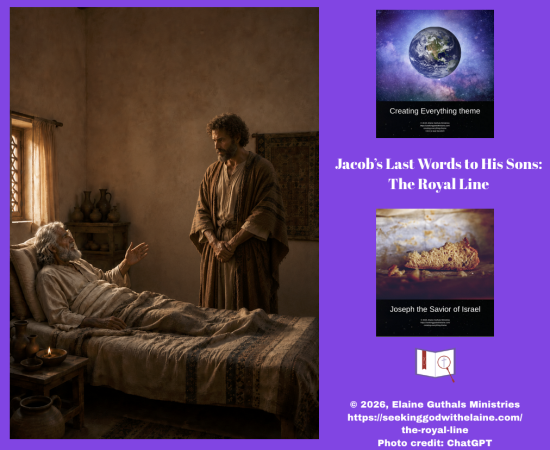
  • Joseph Interpreted Two Prisoners’ Dreams

    In the last devotion, Joseph was beginning to comfort the two other prisoners, each who had had a dream. This devotional reading looks at the interpretation of those dreams.

    Nuggets

    • The dream that the cupbearer described was one full of life, growth, and restoration.
    • Joseph interpreted the dream to mean the cupbearer would be restored by the Pharaoh in three days’ time.
    • Joseph just asked one thing for interpreting the dream.
    • Joseph remained faithful to Jehovah by honestly telling the baker the interpretation of his dream regardless of its unfavorable conclusion.
    • In the Ancient Near East, dream interpretation had one major litmus test.
    • Divine timing often includes delays that feel like neglect.
    joseph-interpreted-two-prisoners-dreams

    When we left Joseph at the end of the last devotion, he was getting ready to interpret the two royal officials; dreams.

    Yeah, this was something. Jehovah was revealing truth to Egyptians – through a Hebrew prisoner.

    Let’s Put It into Context

    To read devotions in the Creating Everything theme, click the button below.

    Devotions in the Joseph the Savior of Israel  series

    The Cupbearer’s Dream

    “So the chief cup-bearer told Joseph his dream first. ‘In my dream,’ he said, ‘I saw a grapevine in front of me. The vine had three branches that began to bud and blossom, and soon it produced clusters of ripe grapes. I was holding Pharaoh’s wine cup in my hand, so I took a cluster of grapes and squeezed the juice into the cup. Then I placed the cup in Pharaoh’s hand.’ ‘This is what the dream means,’ Joseph said. ‘The three branches represent three days. Within three days Pharaoh will lift you up and restore you to your position as his chief cup-bearer. And please remember me and do me a favor when things go well for you. Mention me to Pharaoh, so he might let me out of this place. For I was kidnapped from my homeland, the land of the Hebrews, and now I’m here in prison, but I did nothing to deserve it’” (Gen. 40: 9-15 NLT)

    In My Dream

    The dream that the cupbearer described was one full of life, growth, and restoration.

    The vivid image the cupbearer described was a growing branch that represented the growth process of a grapevine. It would bud, bloom, and produce grapes. Remove any one of those steps, and the grape would not be produced.

    The culmination of the dream was the cupbearer placing the wine from the grapes in his dream in Pharaoh’s hand.

    This Is What the Dream Means

    Joseph interpreted the dream to mean the cupbearer would be restored by the Pharaoh in three days’ time.

    We’ve talked before where some of the three-day references are really talking about the third day of the week. It isn’t here.

    The Hebrew phrase used here is bəʿôd šəlōšet yāmîm (בְּעוֹד שְׁלֹשֶׁת יָמִים). It means in yet three days or within three days. This is a count down method (like, “there are three days until Christmas).

    While Joseph didn’t utilize the established Ancient Near East symbol system to determine patterns and cultural symbolism, that doesn’t mean he didn’t have to engage the imagery. He told the cupbearer what those images meant.

    • The vine symbolized life and productivity.
    • Three branches symbolized three-days’ time.
    • Serving Pharaoh symbolized his restoration.

    So, was Joseph saying one thing and doing another? No, he wasn’t.

    The difference was Who was the source behind the dream and the interpretation. That is Jehovah.

    But look at it a little closer. Whatever Jehovah ordains – whether trial or restoration – He uses it for our sanctification.

    That means the most important thing is how Jehovah is glorified.

    The cupbearer got good news from his dream. In three days, he would be restored to his position beside the Pharaoh.

    And Please Remember

    Joseph just asked one thing for interpreting the dream.

    This was the only time recorded that Joseph expressed his own suffering. He told the cupbearer that he was kidnapped from his country and was imprisoned unjustly.

    Wait! What????

    Joseph was sold by his brothers, not kidnapped. Why wouldn’t he say that?

    What Joseph told the cupbearer was a summary of what really happened. The Hebrew expression gunnōv gunnavtî (גֻּנֹּב גֻּנַּבְתִּי) conveys the act of being stolen.

    Well, Joseph’s life as he knew it was stolen away.

    Joseph didn’t get into the loss of identity. He just presented himself as one wrongly removed.

    If we look at it in today’s terminology, we would say that he was taken against his will, trafficked, and placed into circumstances that he didn’t choose. But Joseph didn’t want to get into all of that.

    So, Joseph left it as he had been treated unjustly and didn’t belong in prison.

    And, really, that was all the cupbearer needed to know. The cupbearer had been a royal official, but it would not have been his decision to free Joseph. Joseph was not making an emotional appeal, but a measured request within his situation.

    It was, also, probably the right tone to take. Joseph wasn’t giving an emotional account. He was just stating the facts.

    Just as Joseph said that Jehovah would be the One to give him the interpretation of the dream, he is anchoring his identity in Him, not in his experiences.

    Jehovah governs both what is hidden and what is revealed. Truth belongs to Him—not only in its meaning, but also in its timing and its measure.

    This passage brings up an important theological lesson. We are to depend on Jehovah. We must put our trust in Him to provide for us.

    Sometimes, that provision will come because of some action we have taken. Jehovah will use human means to bring the restoration to fruition.

    The Baker’s Dream

    “When the chief baker saw that Joseph had given the first dream such a positive interpretation, he said to Joseph, ‘I had a dream, too. In my dream there were three baskets of white pastries stacked on my head. The top basket contained all kinds of pastries for Pharaoh, but the birds came and ate them from the basket on my head.’ ‘This is what the dream means,’ Joseph told him. ‘The three baskets also represent three days. Three days from now Pharaoh will lift you up and impale your body on a pole. Then birds will come and peck away at your flesh” (Gen. 40: 16-19 NLT)

    I Had a Dream, Too

    Joseph remained faithful to Jehovah by honestly telling the baker the interpretation of his dream regardless of its unfavorable conclusion.

    The baker’s dream was similar. It also used symbolism.

    • The three baskets symbolized three-days’ time.
    • The food symbolized provision.
    • The birds eating symbolized loss and judgment.

    The baker probably thought that it would have a similar outcomes. He shouldn’t have assumed

    The dream didn’t have as good of an outcome. Pharaoh was going to lift up the baker’s head from him.

    Joseph’s interpretation did not contain the good news that the cupbearer’s dream did. He told the baker that, in three days, he would be executed.

    That’s the thing. Jehovah doesn’t base His plans on our expectations.

    We know Jehovah has plans for us. We also know that He uses those experiences to sanctify us. “And we know that God causes everything to work together for the good of those who love God and are called according to his purpose for them” (Rom. 8: 28 NLT).

    Regardless of what Jehovah brings our way, He will use that as bricks for our Sanctification Road.

    The Dreams Fulfilled

    “Pharaoh’s birthday came three days later, and he prepared a banquet for all his officials and staff. He summoned his chief cup-bearer and chief baker to join the other officials. He then restored the chief cup-bearer to his former position, so he could again hand Pharaoh his cup. But Pharaoh impaled the chief baker, just as Joseph had predicted when he interpreted his dream” (Gen. 40: 20-22 NLT)

    In the Ancient Near East, dream interpretation had one major litmus test.

    Did the interpretation come true? The answer is yes.

    • Both interpretations happened exactly as Joseph said they would.
    • The timeline of three days was accurate.
    • The differing outcomes occurred exactly as Joseph said they would.

    Now, think back to the last devotion. We said that dreams were usually interpreted by priests, magicians, and trained diviners. Joseph was none of those things.

    And Joseph got it right. It was shown to be a revelation from Jehovah.

    Everything happened as Joseph had interpreted. The baker died, but the cupbearer was restored. Unfortunately, he didn’t remember Joseph as requested.

    Birthday celebrations were common in the Ancient Near East during that time. One usual occurrence was the rulers using these celebrations to issue rulings or pardons.

    The Hebrew used here is bayyōm haššəlîšî (בַּיּוֹם הַשְּׁלִישִׁי). It means on the third day.

    Yes, the Hebrew is different than what was in Genesis 40: 13 and 19. This is not a different timeframe, but the fulfillment point of the countdown previously given.

    So, the alarm went off and Christmas has arrived – actually a birthday in this case.

    Forgotten Again

    “Pharaoh’s chief cup-bearer, however, forgot all about Joseph, never giving him another thought” (Gen. 40: 23 NLT)

    Divine timing often includes delays that feel like neglect.

    Everything happened as Joseph had interpreted. The baker died, but the cupbearer was restored. He was faithful to Jehovah and compassionate to others.

    Unfortunately, the cupbearer didn’t remember Joseph as requested.

    How many times are we guilty of the same thing? We get so caught up in our own world that we forget — or don’t see — someone else. Jehovah doesn’t want that. He wants disciples to encourage one another.

    Making the Connections

    In this passage, Joseph interpreted two dreams – but there were two people. The impact of the interpretation focused just on those two people.

    But it was setting up the interpretation of two dreams for one person – one very influential person.

    Let’s compare the Ancient Near East practices and Joseph’s way to interpret dreams.

    What he was doing here was redefining dream interpretation. It wasn’t about divination – it was about revelation.

    It didn’t follow the normal system for dream interpretations. It was built on a relationship with Jehovah.

    It had nothing to do with Joseph and his skill. It had everything to do with depending on Jehovah and His plan.

    We look at this now because Genesis 40 is setting up Genesis 41. It was really important that Jehovah be shown as not only responsible for the dreams but also responsible for the situations within the dreams.

    Joseph’s interpretation was not the result of skill, system, or experience. It was the result of revelation. The timing, the outcomes, and the fulfillment all belonged to Jehovah. What appeared to be two isolated dreams were actually part of a larger movement that Joseph himself could not yet see. This passage reminds us that Jehovah is not only revealing meaning — He is orchestrating events. And both unfold according to His timing, not ours.

    How Do We Apply This?

    • Be attentive to others as Joseph was.
    • Recognize the limits of our control.
    • Wait for Jehovah to reveal meaning.
    • Trust Jehovah’s timing – even when it doesn’t align with our expectations.
    • Submit to Jehovah’s use of every circumstance for sanctification.

    Father God. You still come to us today. Reveal Your Will to us. Help us to obey.

    If you don’t understand something and would like further clarification, please contact me.

    If you have not signed up for the email providing the link to the devotions and the newsletter, do so below.

    If God has used this devotion to speak with you, consider sharing it on social media.