Category: Obedience

  • Jacob Proclaimed His Intention to Marry Rachel

    Jacob had come to Paddan-aram to find a wife. This devotional reading looks at who he chose for his wife and how he would pay the bride-price.

    Nuggets

    • Jacob probably started working for Laban right away, but it took a month until Laban discussed wages.
    • There is as much contrast between Leah and Rachel as there is between Esau and Jacob.
    • Jacob, there to find a wife, was the one to suggest he work seven years for Rachel’s hand in marriage.
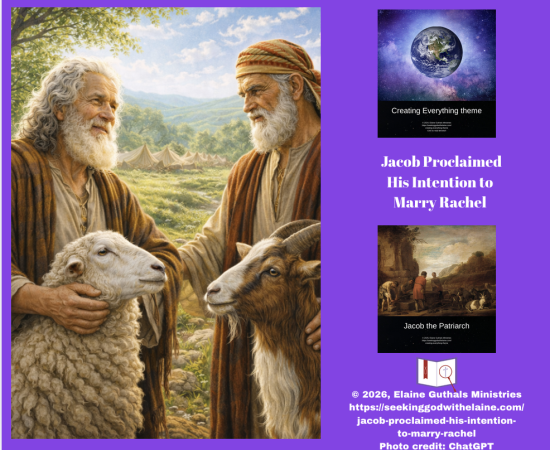
    jacob-proclaimed-his-intention-to-marry-rachel

    Jacob was welcomed by Laban with open arms. He probably told them right off that he had come looking for a wife.

    Laban, probably mourning the lost days of bride gifts, had to figure out how to make it work for him. Let’s see what he came up with.

    Let’s Put It into Context

    To read devotions in the Creating Everything theme, click the button below.

    Devotions in the Jacob the Patriarch series

    Let’s Put It into Context #2

    Let’s take a look at the betrothal process. I had thought that the whole process had changed between Abraham’s use of it and Jacob’s use of it — and the divine law hadn’t. Jacob’s circumstances, authority, and covenantal maturity had.

    The betrothal process was a negotiation between the groom’s family and the bride’s family. Negotiations revolved around the mohar — or bride-price. These gifts formed a transfer of wealth — commonly in the form of silver, livestock, or other valuables — from the groom’s household to the bride’s father.

    The mohar, provided by the groom’s father, served several functions:

    • Paid the bride’s family for the loss of her labor and presence as the family functioned as a single economic and social unit
    • Showed the bride’s family that the groom had the ability to provide
    • Formalized the marriage agreement

    Determining Jacob’s Wages

    “… After Jacob had stayed with Laban for about a month, Laban said to him, “You shouldn’t work for me without pay just because we are relatives. Tell me how much your wages should be’” (Gen. 29: 14-15 NLT)

    Jacob probably started working for Laban right away, but it took a month until Laban discussed wages.

    We have already seen where Jacob interacted with the shepherds at the well. He seemed to know about well etiquette.

    But how did Jacob get to full-time shepherd?

    Well, we don’t know.

    We hear nothing about Jacob being a shepherd with Isaac’s flocks. In fact, we really don’t hear much about Isaac’s flocks.

    The only reference we get was when Isaac and Rebekah were living in Gerar. “When Isaac planted his crops that year, he harvested a hundred times more grain than he planted, for the Lord blessed him. He became a very rich man, and his wealth continued to grow. He acquired so many flocks of sheep and goats, herds of cattle, and servants that the Philistines became jealous of him” (Gen. 26: 12-14 NLT).

    This says Isaac has flocks and herds but doesn’t say who took care of them. It doesn’t say if Isaac did or if he has herdsmen and shepherds.

    What we know about Jacob is said contrasting him with Esau. “As the boys grew up, Esau became a skillful hunter. He was an outdoorsman, but Jacob had a quiet temperament, preferring to stay at home” (Gen. 25: 27 NLT).

    We can take this stay-at-home time two ways. The first is the way the classic midrash — a Jewish interpretive method that is a running commentary on biblical verses that expands Scriptures — interprets it. “Jacob was a quiet man, dwelling in tents” is seen as meaning that he dwelled in “the tent of Shem and the tent of Eber.” The emphasis here is on Jacob as a student of wisdom/Torah rather than as a pastoral worker.

    Remember, genealogy said Noah begat Shem, who begat Arphaxad/Arpachshad, who may have begat Cainan, who begat Shelah, who begat Eber (Gen. 11; Lk. 3).

    Anyway, tent dweller, not hired shepherd.

    But Jacob did arrive in Haran knowing something about the shepherd’s role. Since he stayed close to the tent, he may have helped around the household (including with flocks) in more informal ways. This would also fit in well with his helping with family affairs as the responsible firstborn-in-character son.

    Laban probably decided that Jacob was going to stick around for a while. He probably saw Jacob’s growing attachment to Rachel.

    Laban’s Daughters

    “Now Laban had two daughters. The older daughter was named Leah, and the younger one was Rachel. There was no sparkle in Leah’s eyes, but Rachel had a beautiful figure and a lovely face” (Gen. 29: 16-17 NLT).

    There is as much contrast between Leah and Rachel as there is between Esau and Jacob.

    Part of the contrast between Leah and Rachel is the physical description. We are told that Rachel was stunning.

    Leah’s description is harder for us to understand. The New Living Translation takes a confusing definition of the Hebrew word rakkoth. Other versions translate it in a variety of ways:

    • Weak eyes (NIV, ESV, NASB, CJB, OJB)
    • Delicate (KJV)
    • Tender (CSB)
    • Ordinary (HCSB)
    • Lovely (GNT)

    The Hebrew word does mean delicate and tender. It also means soft.

    Yeah, that could be talking physical characteristic. But remember, Jehovah is more interested in the spiritual aspect of our character.

    The midrash states that Leah was supposed to marry Esau. Upset at his violent and immoral character, we would say she cried her eyes out. All this crying made her eyes soft.

    I like to think what it was getting at was that she was tenderhearted. That is a contrast to Rachel’s character.

    Let’s face it. Rachel didn’t have the most sterling character. She stole Laban’s household idols (Gen. 31: 19) but lied about it (Gen. 31: 34-35). She was envious of Leah’s ability to hear children, so like Sarah, takes matters into her own hands and offers a concubine.

    While having the physical beauty, Rachel seems to have a more worldly heart. Leah, on the other hand, persevered and trusted in Jehovah’s care.

    Isn’t that Jehovah’s goal for us? We are to trust Him in everything — the good and the bad — the easy and the hard.

    We are to content where Sovereign God places us. Leah went through those hard, bad times and always looked to Jehovah for strength — which He provided.
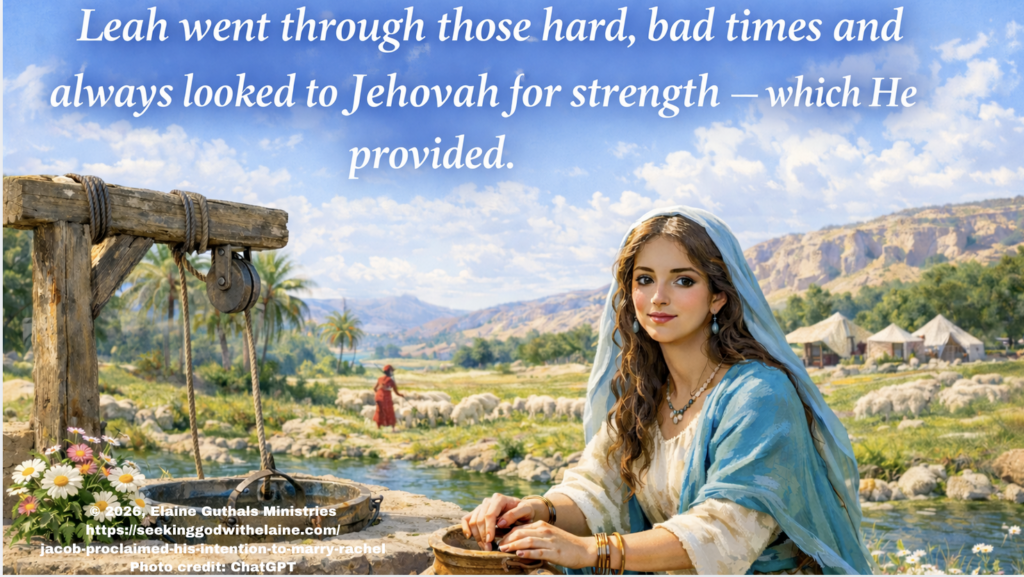
    Jehovah knows what we are facing and how we are reacting. He is there to lead us to Him.

    The Bride-Price

    “Since Jacob was in love with Rachel, he told her father, ‘I’ll work for you for seven years if you’ll give me Rachel, your younger daughter, as my wife.’ ‘Agreed!’ Laban replied. ‘I’d rather give her to you than to anyone else. Stay and work with me.’ So Jacob worked seven years to pay for Rachel. But his love for her was so strong that it seemed to him but a few days” (Gen. 29: 18-20 NLT)

    Jacob, there to find a wife, was the one to suggest he work seven years for Rachel’s hand in marriage.

    Either I have always read this wrong, or I just didn’t catch it. Jacob was the one to set the term of the wages. I always thought it was Laban.

    Part of the reason I thought this was because of what Leah and Rachel said. “Rachel and Leah responded, ‘That’s fine with us! We won’t inherit any of our father’s wealth anyway. He has reduced our rights to those of foreign women. And after he sold us, he wasted the money you paid him for us’” (Gen. 31: 14-15 NLT emphasis added).

    But we’ll dive into that when we get there. For now, let’s stick with the betrothal process.

    Remember, the process hadn’t changed since Abraham sent Eliezer to Haran to find Rebekah, but Jacob’s circumstances had. The absence of formal rituals — oaths, immediate payment, or public consent scenes — left Jacob on his own.

    Laban probably was mourning the lack of the twelve camels with bride-gifts. But here came Jacob, a displaced son instead of an established heir operating from Isaac’s estate.

    Jacob still had to provide something of value to Laban — money, livestock, or service. Since the first two were out, the bride-price (mohar) had to be service.

    Where other groom’s fathers provided the bride-price — and Isaac didn’t — Jacob had to come up with it himself.

    Why didn’t Issac provide the mohar? Possibility 1 is Isaac did, but Jacob lost access to them. Maybe Laban finagled Jacob into a position where he had to work.

    I don’t buy that. Jacob’s sole purpose for this journey was to find a wife. I don’t think conniving Laban would have been able to wheedle them out of Jacob’s possession without the bride in return.

    Possibility 2 read that Isaac purposefully did not send the bride-gifts. I can see this because Jacob not only deceived his father but “stole” the blessing from Isaac’s favorite son.

    This one hits because this whole journey has been about Sovereign God teaching Jacob about humility, endurance and dependence on Him.

    A third possibility makes sense, also. Isaac was probably thinking his life was almost over. That was why he chose to give the blessing when he did.

    But Isaac had thought that he was giving the blessing to Esau. What if he had already started transferring it to who would have been expected heir?

    Both of those land for me and don’t appear to be mutually exclusive.

    Hmmmm. Servitude was a legitimate option for paying for the bride-price, but that wasn’t selling the girls?

    But back to the agreement.

    Jacob said that he would work seven years for the privilege of taking Rachel as a wife.

    We have no way of knowing what the going wage would have been for a lowly shepherd. It could have been a modest wage. Remember, shepherding was low-status work.

    They also could have been paid in a share of the stock or grain. We know Laban eventually paid Jacob in sheep and goats (Gen. 30: 31).

    Even though seven years would not have netted a high wage, the work was hard. So in other words, the years’ work may not have equated what the bride-price would have been, but it had been worth it.

    Rachel was worth it.

    But look at who each man was talking about. Jacob said, “… if you’ll give me Rachel …” (Gen. 29: 18 NLT).

    In verse 19, Laban responded, “… I’d rather give her to you …” (Gen. 29: 19 NLT emphasis added).

    We don’t consider that a dangling pronoun because we assume, as did Jacob, that Laban was talking about Rachel. Maybe he was; maybe he wasn’t.

    Making the Connections #1

    As part of the negotiations between the groom’s and the bride’s families, the bride’s family would give a dowry (nedunyah) to the bride. This provided her economic protection as she entered a new household.

    Making the Connections #2

    Dods contrasted Jacob and Esau. He wrote,

    • “Constancy, persistence, dogged tenacity is certainly the striking feature of Jacob’s character.”
    • “In contrast with his tenacious, constant character stands Esau, led by impulse, betrayed by appetite, everything by turns and nothing long.”

    Resource

    Would Esau have worked for Laban for 7 years, let alone 14? Probably not.

    Making the Connections #3

    Jehovah knows how to smack us down, doesn’t he? Here was the covenant son agreeing to be the hired hand. The master’s son was forced to be a servant.

    Look what Leale said. He wrote, “The nation was thus taught that all its greatness and prosperity were not due to natural endowments and industry, but to the electing love of God. The strength of His grace was made perfect in weakness.”

    Resource

    Look how Yeshua put it after He had washed the Apostles’ feet. “I tell you the truth, slaves are not greater than their master. Nor is the messenger more important than the one who sends the message. Now that you know these things, God will bless you for doing them” (Jn. 13: 16-17 NLT).

    The Apostles had dealt with arguing about being the greatest. Yeshua said, “Flip that. Exhibit servant leadership. Humility is the best because it isn’t about you. It is about Him.”

    How Do We Apply This?

    • Focus on Jehovah’s plan for our lives.
    • Be a servant leader.

    Father God. Thank You for the institution of marriage. It was never Your plan that we be alone. Help us to look to You for guidance in choosing our mate. May we always focus on Your plan. Amen.

    If you don’t understand something and would like further clarification, please contact me.

    If you have not signed up for the email providing the link to the devotions and the newsletter, do so below.

    If God has used this devotion to speak with you, consider sharing it on social media.
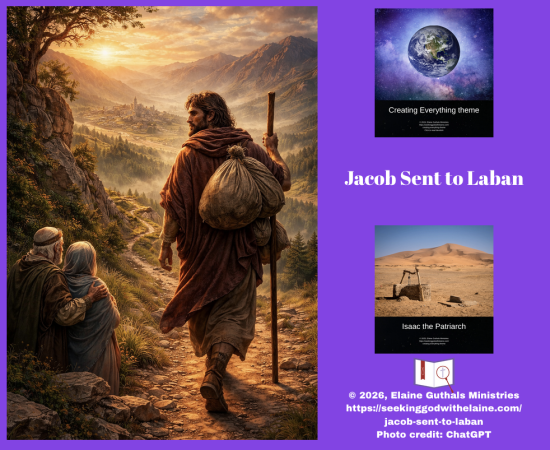
  • Jacob Sent to Laban

    In order to evade Esau’s anger, Jacob is sent to Paddan-aram to find a wife. This devotional reading looks at the blessing Isaac gives him and the newsletter for the Isaac the Patriarch series.

    Nuggets

    • Isaac finished the covenant blessing when sending Jacob off to find a wife.
    • Esau married another wife, which set up enemies for Israel.
    jacob-sent-to-laban

    This devotion is going to be totally different. I had thought I was going to do the newsletter next, but found out I needed to do the first part of Genesis 28 before that.

    But that passage is very short.

    So, I’ve decided to do the next part of our story where we, in essence finish up Isaac’s story — except for his death.

    Then I am hooking on the newsletter — which is totally different, too. It isn’t a rehash of what we’ve already read.

    It is something that has been swirling in my mind since we finished Isaac’s near sacrifice — which I have since learned was called the Akedah. I had never thought about the fallout of that testing.

    So, let’s jump in.

    When we left Isaac’s family in the last devotion, Rebekah had just approached Isaac about sending Jacob to her brother’s house to find a wife. While that was an important task for him to accomplish, getting him away from Esau’s anger was a more pressing matter.

    Esau was plotting his brother’s murder after their father’s death. Again, Rebekah stepped in. Let’s see what Isaac has to say about this.

    Let’s Put It into Context

    To read devotions in the Creating Everything theme, click the button below.

    Devotions in the Isaac the Patriarch series

    Sending Jacob Off

    “So Isaac called for Jacob, blessed him, and said, ‘You must not marry any of these Canaanite women. Instead, go at once to Paddan-aram, to the house of your grandfather Bethuel, and marry one of your uncle Laban’s daughters. May God Almighty bless you and give you many children. And may your descendants multiply and become many nations! May God pass on to you and your descendants the blessings he promised to Abraham. May you own this land where you are now living as a foreigner, for God gave this land to Abraham.’  So Isaac sent Jacob away, and he went to Paddan-aram to stay with his uncle Laban, his mother’s brother, the son of Bethuel the Aramean” (Gen. 28: 1-5 NLT)

    Isaac finished the covenant blessing when sending Jacob off to find a wife.

    Why was it so important that Jacob not take a local wife? Seeing that Abraham’s covenant would be carried out through him and not Esau, it was extremely important.

    The Canaanites were descendants of Ham’s son Canaan. Ham was cursed when he saw his father Noah’s nakedness when he was drunk (Gen. 9: 20-25).

    Since the covenant was being fulfilled by Jacob, he needed to take a wife from Abraham’s family.

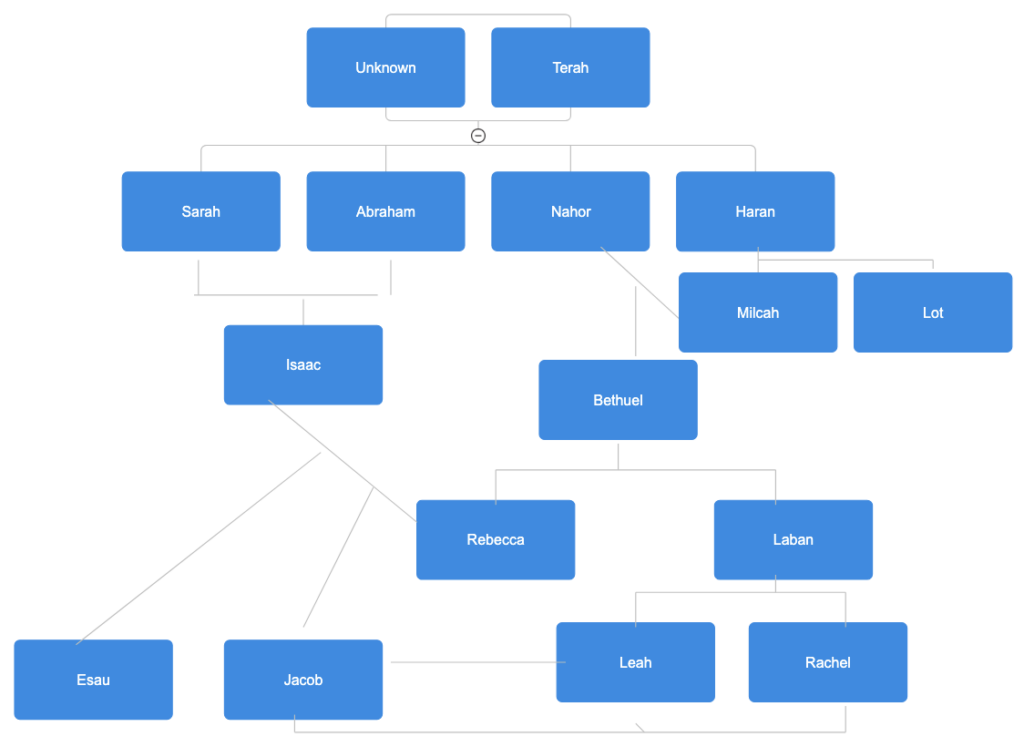
    Isaac sent Jacob to Rebekah’s family, which was Abraham’s brother’s family. He specifically sent him to Laban’s family.

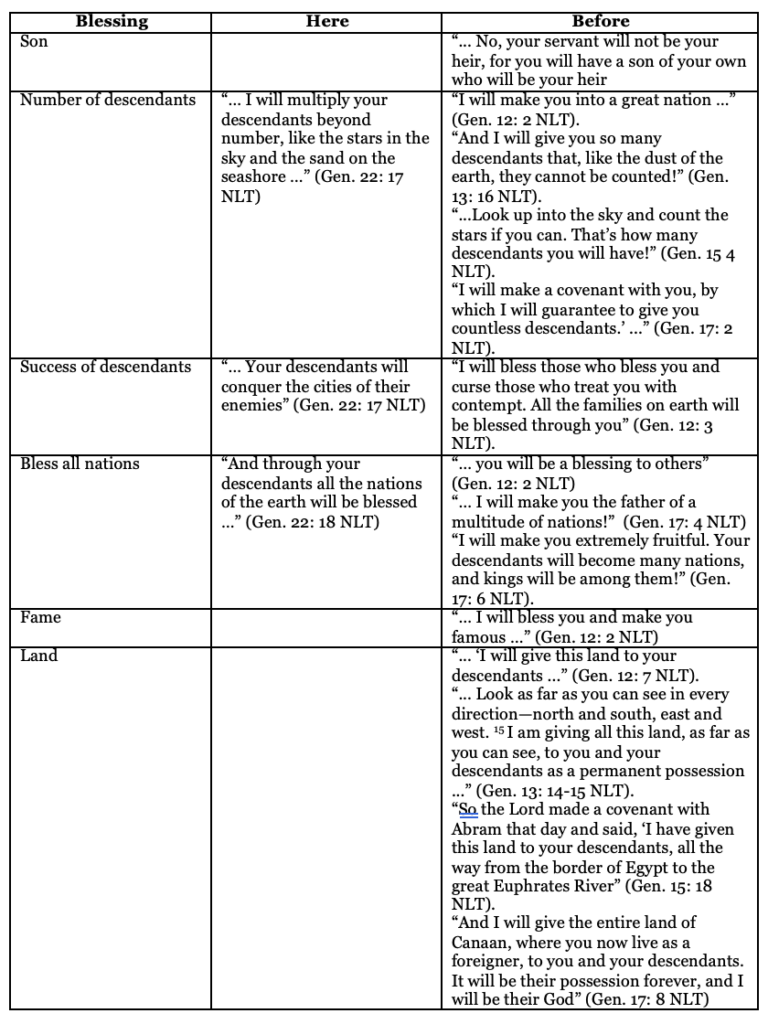
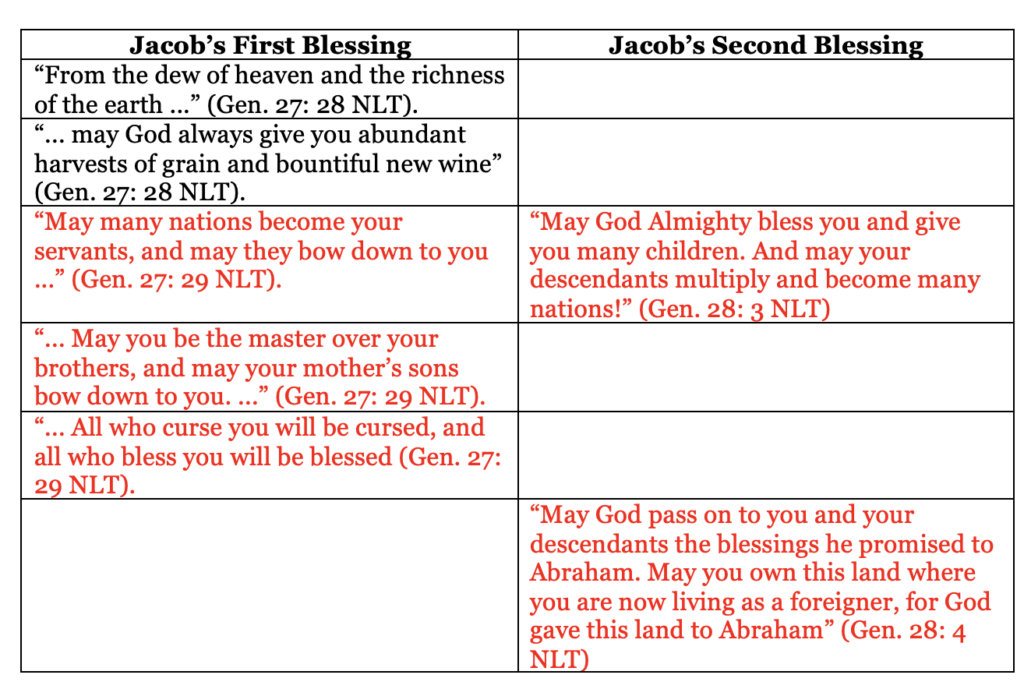
    As we discussed, there were some covenant blessings in Jacob’s first blessing. However, not all were included.

    Okay, this time, it looks like Isaac fell in line with Jehovah’s wishes. Maybe Rebekah did convince Isaac to follow Jehovah’s Will. Maybe it was Isaac’s choice to repent.

    As Pastor Steve says, the blessings are in the obedience.

    Bradford gave a possible explanation as to why the first blessing was a partial covenant blessing. He taught,

    “… Isaac was in the middle of a real battle with his faith. I think we can also safely assume that Isaac was not entirely convinced that the one he gave the blessing to was Esau (which, of course, it was NOT)……..and that he wasn’t exactly enamored with the character of either of his twin sons. So, either he gave the blessing half-heartedly, because he was unconvinced his son would actually carry it forward, or he was withholding part of it until he sensed the time was right.”

    Resource

    How were the two blessings different? (I’ve marked the covenant blessings in red.)

    Bradford reminded us of an important act. Ishmael and Esau were not Hebrews. Only Isaac and Jacob were.

    However, all of Jacob’s descendants would be Hebrews. Thant is why there is a difference in Abraham’s and Jacob’s blessings.

    Because of that Jacob’s become a nation is different than Abraham’s become a nation.

    • “I will make you into a great nation [goy] … (Gen. 12: 2 NLT).
    • “… And may your descendants multiply and become many nations [ve-hayita likhal]!” (Gen. 28; 3 NLT).

    Goy means nations. Ve-hayita likhal means assembly/peoples. Rather than promising the emergence of a nation from nothing, the blessing anticipates the formation of multiple tribes or sub-groups united by covenant.

    Abraham’s blessing initiates the covenantal project. Isaac preserves it. Jacob receives it in a form that anticipates structure, multiplicity, and continuity. By the time Genesis 28 is reached, the covenant is no longer abstract or undefined; it is focused, inherited, and internally organized.

    Esau Marries another Wife

    “Esau knew that his father, Isaac, had blessed Jacob and sent him to Paddan-aram to find a wife, and that he had warned Jacob, ‘You must not marry a Canaanite woman.’ He also knew that Jacob had obeyed his parents and gone to Paddan-aram  It was now very clear to Esau that his father did not like the local Canaanite women. So Esau visited his uncle Ishmael’s family and married one of Ishmael’s daughters, in addition to the wives he already had. His new wife’s name was Mahalath. She was the sister of Nebaioth and the daughter of Ishmael, Abraham’s son” (Gen. 6-9 NLT)

    Esau married another wife, which set up enemies for Israel.

    Esau had two Canaanite wives. We’ve already read that they did not get along with Isaac and Rebekah (Gen. 26: 35).

    That wasn’t an issue in Esau’s mind — until they sent Jacob off to find so that he wouldn’t take a Canaanite wife. He decided to choose another.

    Am I the only one questioning if that should be the foundation of a marriage? “I’m going to marry you to please my parents. I am going to marry you because it is good for my brother, so it should win me points with Jehovah.”

    No, I don’t think I am the only one shaking my head at Esau. Leale called him a mercenary. Hughes called him an imitator. Both called him a hypocrite.

    Resources

    Esau chose his third wife from family. Mahalath was Esau’s cousin. She was Isaac’s brother Ishmael’s daughter.

    We know Sarah asked Abraham to send Ishmael away because he was teasing Isaac (Gen. 21: 9-10). We also know that, even if their relationship hadn’t improved, both were present at Abraham’s burial (Gen. 25: 9).

    Would Isaac and Rebekah be any happier with that union?

    We have to be very careful. Jehovah doesn’t want us to play at religion. He doesn’t want us to imitate a disciple thinking that will get His blessing.

    Everything is dependent on our relationship with Jehovah. Marrying someone isn’t going to gain us His favor.

    Bradford said it was even worse than this. He wrote,

    “But, as matter-of-fact as this event is told, its future effect is beyond calculation. Because here an alliance through intermarriage is formed, that bonds the two dispossessed firstborns, rejected by Yahoveh as possible heirs to the covenant line of promise, Ishmael and Esau, into what will rather quickly turn into a permanent anti-Israel group of nations. It is the alliance and gene pool mixing of Ishmael and Esau who form the vast bulk of Islam in the world today, and the entire bulk of Arabs.”

    Resource

    We have to watch when we are trying to make things better.

    Newsletter

    As many times as I have read the passage about Abraham and Isaac’s near-sacrifice, I missed one important nugget. Where did Abraham live after Isaac’s Akedah?

    Akedah is a Hebrew word that means binding. It specifically refers to Abraham binding his beloved son Isaac to sacrifice him at the request of Jehovah.

    “And they came to the place which God had told him of; and Abraham built an altar there, and laid the wood in order, and bound Isaac his son, and laid him on the altar upon the wood. And Abraham stretched forth his hand, and took the knife to slay his so” (Gen. 22 9-10 NLT).

    After the Akedah, we get a verse talking about Abraham’s residence. “So Abraham returned unto his young men, and they rose up and went together to Beersheba; and Abraham dwelt at Beersheba” (Gen. 22: 19 NLT).

    Let’s do a little history lesson.

    Where Abraham Lived

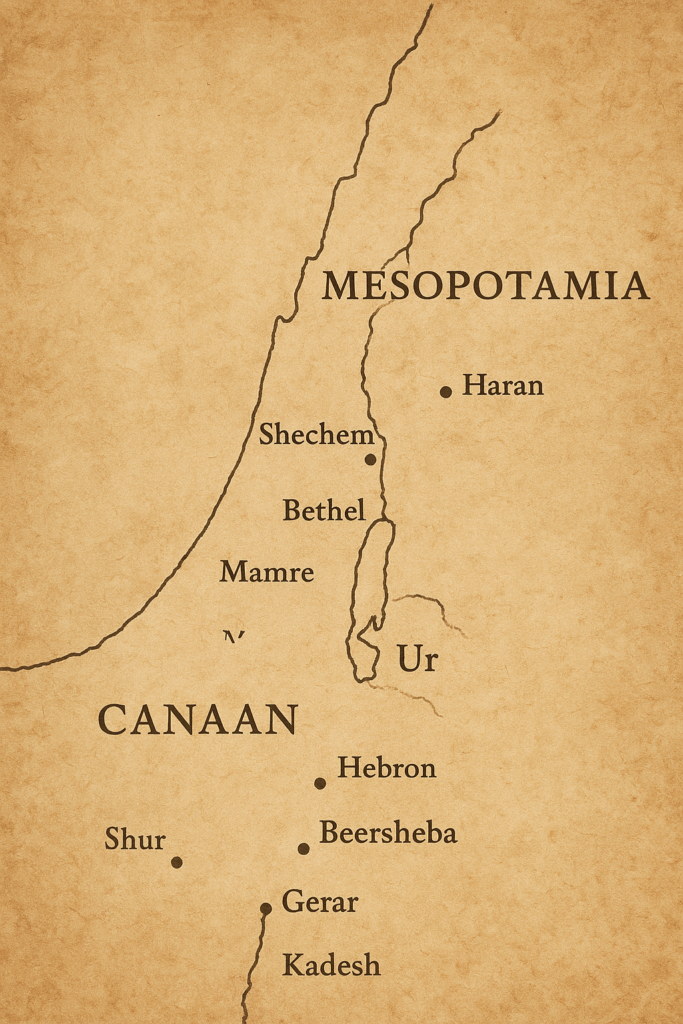
    Abraham moved from Ur to Haran with his father Terah, his wife Sarah, and his nephew Lot (Gen. 11: 31). (True, Abraham and Sarah had different names, but it was still them.)

    When Jehovah called Abraham to move to Canaan, he settled in Shechem (Gen. 12: 6). From there, Abraham moved his household between Bethel and Ai (Gen. 12: 8).

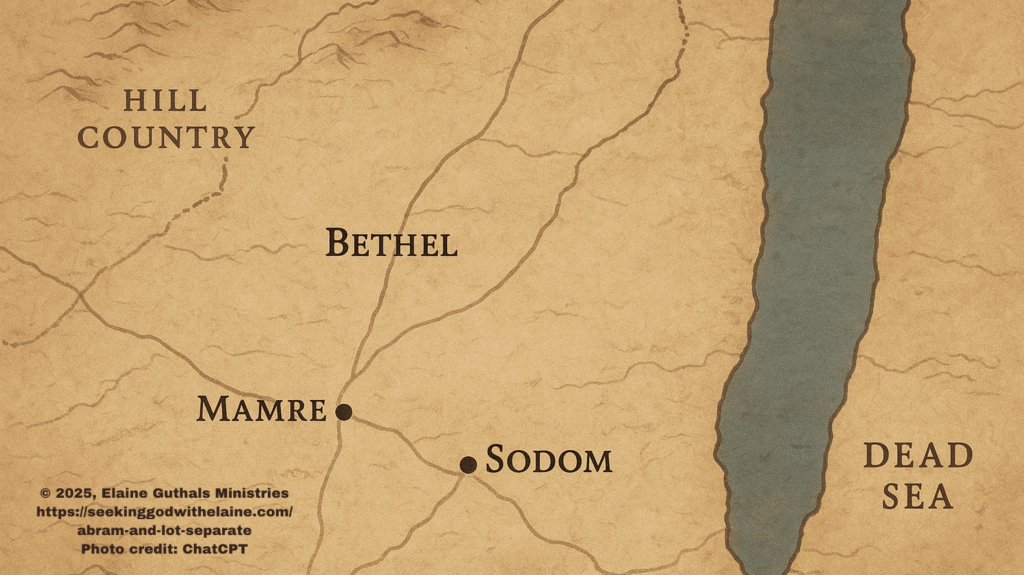
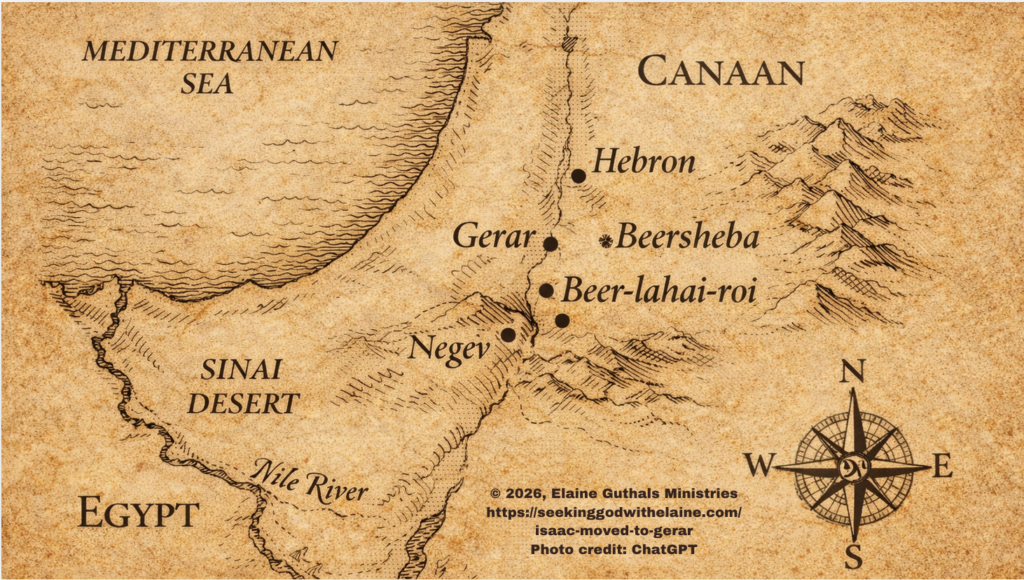
    After coming back from Egypt through the Negev, Abraham returned to Bethel (Gen. 13: 3). He moved to Hebron by the grove belonging to Mamre (Gen. 13: 18) after he separated from Lot.

    I’ve always assumed that Abraham remained at Hebron for the rest of his life. It was there that Jehovah and the two angels appeared to him before the destruction of Sodom and Gomorrah (Gen. 18: 1).

    When another famine occurred, Abraham moved between Kadesh and Shur before moving to Gerar (Gen. 20: 1). Abraham was given royal protection after a dispute between him and Abimelech. “Then Abimelech said, “Look over my land and choose any place where you would like to live.” (Gen. 21: 15 NLT).

    We are not told when Abraham moved back to Heron. That is, however, the traditional birthplace of Isaac (Gen. 21: 2).

    The next time we are given Abraham’s location is when he enters into the covenant with Abimelech. It was made at Beersheba (Gen. 21: 31-32), where Abraham secured water rights. Wells in Genesis function as legal and economic markers of land use, but they do not require permanent residence.

    It is important to note that is before the near-sacrifice if it is going in chronological order.

    Akedah

    Jehovah tested Abraham’s faith by requiring him to sacrifice his beloved son Isaac as a burnt offering (Gen. 22: 2 NLT). Abraham did not waver but journeyed to the mountain on which Jehovah told him to go.

    Abraham bound Isaac and placed him on the altar he had built (Gen. 22: 9). He had the knife in hand to complete the sacrifice (Gen. 22: 10).

    An angel of the Lord stopped Abraham from killing his son (Gen. 22: 11-12). Jehovah provided a ram to be sacrificed.

    Where Do Abraham Go from There?

    “Then they returned to the servants and traveled back to Beersheba, where Abraham continued to live” (Gen. 22: 19)

    Genesis 22: 19 is an interesting verse. It doesn’t say Abraham returned to Hebron. It says he “… continued to live” (Gen. 22: 19) in Beersheba.

    That verse opens a whole can of worms.

    • What does continued mean?
    • Where was Sarah?
    • Where was Isaac?

    Continued Living in Beersheba

    We know that God’s Word does not read as if it were a daily diary. In Genesis 21, we read where Isaac was born. The only indication we are given of the passage of time is verse 8. “When Isaac grew up and was about to be weaned, Abraham prepared a huge feast to celebrate the occasion” (Gen. 21: 8 NLT).

    Jewish children were weaned anywhere from 18 months to 5-years old. Isaac would have probably been a two- or three-year-old child.

    The next time we pick up on Isaac’s story, he is probably anywhere from 15 to 30 years old and traveling to the Akedah.

    The Hebrew word that describes Abraham’s tenure in Beersheba is yashav. While this does indicate residency, it can mean either temporary or regional dwelling.

    In other words, the nomad Abraham could have moved the flocks down there to pasture.

    Sarah’s Relationship with Abraham after the Akedah

    The last time we heard anything about Sarah was at the weaning celebration. She demanded that Abraham cast Hagar and Ishmael out for the 16-year-old’s mockery of a two- or three-year-old.

    Sarah’s name is not mentioned again until we are informed of her death. “When Sarah was 127 years old, she died at Kiriath-arba (now called Hebron) in the land of Canaan. There Abraham mourned and wept for her” (Gen. 23: 1-2 NLT).

    Some Jewish interpretive traditions believe that – after the Akedah – Abraham and Sarah lived separately. That could be one reason why Abraham is said to have “… continued to live” (Gen. 22: 19) in Beersheba.

    Let’s stop a second and talk this through.

    We aren’t told what Abraham told Sarah — if anything — about what Jehovah told him to do. I don’t see him going to her and saying, “God told me to go make a sacrifice — and that sacrifice is Isaac. See you when I get back.”

    Resource

    We know that Abraham didn’t tell Isaac. “So Abraham placed the wood for the burnt offering on Isaac’s shoulders, while he himself carried the fire and the knife. As the two of them walked on together, Isaac turned to Abraham and said, ‘Father?’ ‘Yes, my son?’ Abraham replied. ‘We have the fire and the wood,’ the boy said, ‘but where is the sheep for the burnt offering?’ ‘God will provide a sheep for the burnt offering, my son,’ Abraham answered. And they both walked on together” (Gen. 22: 6-8 NLT).

    If Abraham didn’t tell Isaac until he had to bind him, he didn’t tell Sarah. His answer to Issac shows the faith that had to have gone with him every step that the return steps would have Isaac by his side.

    With that much confidence, Abraham would not have told Sarah beforehand. But how would she have reacted when they got home and told her what Jehovah had asked? I don’t know how I would take it.

    Sarah’s trouble accepting that Abraham could even have thought about sacrificing Isaac could have eroded their marriage.

    No, God’s Word doesn’t say one way or the other what Sarah’s reaction was. What it does say is, when she died, “… Avraham came to mourn for Sarah, and to weep for her” (Gen. 23: 2 OJB emphasis added).

    If Abraham had to come, that means he wasn’t there when she died. Was he just elsewhere pasturing the flock? Was he living elsewhere?

    Isaac’s Relationship with Abraham after the Akedah

    We know that, when Eliezer returned from Paddan-aram to get a wife for Isaac, he was at where Abraham lived – but it wasn’t where Isaac lived. “Meanwhile, Isaac, whose home was in the Negev, had returned from Beer-lahai-roi” (Gen. 24: 62 NLT)

    Isaac must have been visiting Abraham. Since Moses said he returned to there, I’ve always assumed that here was Hebron. But then, it may have been Beersheba because that is the last place it stated Abraham lived.

    It seems that Isaac’s relationship with Abraham weathered the Akedah.

    Conclusion

    It threw me for a loop when I read that Abraham didn’t go back to Hebron after the Akedah. Then when I read that he and Sarah were living separately, it really jolted me.

    I hope that wasn’t the case. Ending a marriage is difficult for all those involved – parents and children.

    But we think that everything will go swimmingly when Jehovah gives us a task or a mission. We especially think that knowing the blessings are in the obedience.

    That isn’t a guarantee that others will accept Jehovah’s plan for us. Things may still fall apart when we do everything right.

    Lack of clarification and elaboration can sometimes lead us where Jehovah doesn’t want us to go. Still, I think we can learn a very important lesson from looking at this story through this lens.

    Jehovah calls us to obedience. That isn’t obedience only when it is easy. It isn’t obedience when our family allows it.

    We have to always put God first – no ifs, ands, or buts.

    Jehovah will call us to make hard sacrifices. If every choice would be between the easy and the easier, obedience wouldn’t mean anything.

    If you don’t understand something and would like further clarification, please contact me.

    If you have not signed up for the email providing the link to the devotions and the newsletter, do so below.

    If God has used this devotion to speak with you, consider sharing it on social media.
  • Understanding Why Abraham Was Tested

    Jehovah always rewards faith and obedience. This devotional reading looks at what that meant for Abraham when he passed his test – and what it can mean for us.

    understanding-why-abraham-was-tested

    Jehovah had given Abrahan a horrendous test to grow his faith. He and Isaac, the beloved son Jehovah had asked him to sacrifice, had returned home together.

    Abraham passed the test with flying colors. What can we learn from that?

    Let’s Put It into Context

    To read devotions in the Creating Everything theme, click the button below.

    Devotions in the Abraham the Patriarch series

    Making the Connections #1

    So, was Abraham’s aborted sacrifice of Isaac a farce? No!

    The purpose of the testing was to test Abraham’s heart. He nailed it.

    What lessons did Abraham learn?

    • Everyone belongs to Jehovah.
    • Regardless of what we are asked to do by Jehovah, we need to obey.
    • The only important factor in our obedience should be that He asked it of us.
    • The blessings are more abundant when the testing is more painful.
    • Jehovah requires us to walk by faith, not sight – even in the difficult.

    Resources

    Those are important aspects to remember when we start a period of testing. We – whether we are His child or His creation – belong to Him – lock, stock, and barrel. He can do with us as He wishes.

    Making the Connections #2

    I like Clark’s description of why this story is so important to all of us — especially considering the ewww factor. He wrote,

    “All the elements of piety were in this act. The voice of the Lord heard and obeyed is essential to religion. The unshaken conviction that all He requires is best, though one lose thereby all but Himself, is the substance of religion. Abraham heard and did and trusted. Thus he became our worthy example.”

    Resource

    Our faith is nothing if we do not trust Jehovah — especially if we don’t understand. If we do not obey Him in everything, we don’t have faith and trust.

    If we understood everything, we may think we don’t need Him.

    We need Jehovah to forgive us for our sins. We all sin, and no one can save themselves.

    We’re going to have testings and trials that run up against our traditions and prejudices. We are going to have common ideas about Who Jehovah is and what He really means and wants.

    Abraham showed us what it means to truly put Jehovah first.

    Making the Connections #3

    “And we know that God causes everything to work together for the good of those who love God and are called according to his purpose for them” (Rom. 8: 28 NLT)

    We would say this was the most horrible thing Jehovah could have asked of Abraham. We would be wrong.

    Everything Jehovah does in our lives is done because it is a learning process for us. We come to know Him better. We grow more dependent on Him. We see His true nature.

    The trial is worth that. God is developing our spiritual condition, not just giving us a head full of knowledge.

    Are we going to make mistakes? Oh, yeah.

    Look what Atwood said about Abraham’s testing. He wrote, “Humanly judging, the command to sacrifice Isaac was the end of Abraham’s hopes; in fact, it was the beginning of his prosperity.”

    Resource

    If Abraham would have not even considered sacrificing Isaac, I think he would have lost everything associated with his faith. Since he followed His directions, he gained everything.

    Not bad for a couple of days’ journey and total obedience.

    Making the Connections #4

    I absolutely love the way Jarman described the why of testings. He wrote,

    “His object is to open out to your own eye the book of your heart, to display before you the letters which He Himself has already seen, and to pour such a light upon them that their true meaning and character may be understood by you.”

    Resource

    Yeah, it’s a little different than Paul’s opening the eyes of our heart (Eph. 1: 18) – but it isn’t. “having the eyes of your hearts enlightened, that you may know what is the hope to which he has called you, what are the riches of his glorious inheritance in the saints” (Eph. 1: 18 ESV).

    Opening the eyes of our heart is a metaphorical way of saying we need to open our hearts to God’s power and love. It means we have to look for it. We have t be open to receiving it.

    I would say that Jarman meant the book of your heart to be the condition of our heart. It is where we are at on our faith journey – what we believe, what we’ve experienced, and what God has already revealed to us.

    We talked about Abbadie believing that we have secrets in our hearts. They are not secret from Jehovah.

    Resource

    And they won’t stay secret. “But don’t be afraid of those who threaten you. For the time is coming when everything that is covered will be revealed, and all that is secret will be made known to all. What I tell you now in the darkness, shout abroad when daybreak comes. What I whisper in your ear, shout from the housetops for all to hear!” (Mt. 10: 26-27 NLT).

    Opening the eyes of our hearts – understanding or head knowledge – is meaningless if we don’t open the book of our hearts and get that head knowledge down to the heart level.

    We don’t want the testing to have been in vain.

    Just for giggles, let’s look at Paul’s verse in the Hebrew.

    “It is my tefillah [prayer] that the eynayim [eyes meaning perception, insight, or understanding – spiritual awareness] of your levavot [hearts] may be enlightened so that you may have da’as [knowledge, understanding] of what is the tikvah [hope] of His kri’ah [to tear or rend such as your garments] (his summons from Shomayim [heavens]), what is the osher (wealth) of the kavod [honor, respect] of His nachalah (allotted inheritance [portion, heritage]) in the Kadoshim [holy ones, saints]” (Eph. 1: 18 OJB).

    That is like it is translated into English except for the rend your garments part.

    The most familiar verse about rending something is in Joel. “Rend your heart and not your garments. Return to the LORD your God, for he is gracious and compassionate, slow to anger and abounding in love, and he relents from sending calamity” (Joel 2: 13 NIV).

    Jews rend their garments as a sign of mourning upon hearing of a loved one’s death or during the funeral. This is a clean tear – on the left side for a parent or on the right side for other family members. It can be worn for the whole time of shiva.

    The verse in Joel talks about true sorrow for sin and genuine repentance of the heart. More importantly, it is talking true change.

    We won’t change if we don’t see the need for change in our hearts.

    Making the Connections #5

    Jarman reminded us that testings come to highlight a weakness or an area in us that is not being used (like some talent). He likened testing to a gym.

    I can see that. Jehovah wants us used to our fullest potential. The whole purpose is to grow that which is not into something that is.

    That is going to take work. It will take dedication and consistency. It may take planning.

    Making the Connections #6

    Okay. Can you tell I liked Jarman’s sermon?

    Jarman added to the discussion of why do we have trials. He wrote, “So long as self-denials and sacrifices are indefinitely shadowed in the dim future, so long as they are problematical, who so ready as these pseudo-Abrahams to meet them!

    Resource

    We can be procrastinators. If we think something isn’t going to happen for a long time – take retirement, for example – we see no problem in putting off planning and saving until we have more disposable income to earmark for that.

    But then it can sneak up on us. We never have that disposable income because we live paycheck to paycheck. Life goes more quickly than we hope. Our job situation changes too many times to allow us to do that.

    What do the pseudo-Abrahams do? Well, I think they give lip service. “Oh, I am going to look into starting a 401-K in a couple of months.” But never get around to it.

    How do we do that with our faith? “Oh, I want to read the Bible through.” But we never go onto the internet to look up a reading plan. We never do more than say the words.

    There are three great elements in that sentence. Warning, this is going to be chasing a rabbit.

    • Self-denials. We can convince ourselves something isn’t a sin — and it is. We can convince ourselves we didn’t do something to the extent that would make it a sin — and we did. Rationalizing sin never works. When it comes to a trial, we can deny there is a reason that we need that scrutiny — and we do because we are not following Jehovah in the way and to the extent He desires. This can be our way of putting things off until the future.
    • Sacrifices. Jehovah will accept any kind of worship, correct? No. He is very specific as to how to worship Him and what a sacrifice entails. In a way, the Eve Syndrome included a sacrifice. The law said don’t eat. Eve’s sacrifice – at least in her mind – was don’t touch. She upped the restriction to help keep her from eating — and it didn’t work. Falling into the Eve Syndrome where we add restrictions on to Jehovah’s law allows Satan to use that against us.
    • Pseudo-Abrahams. We may like to think we have the faith of Abraham; but if we don’t if we don’t take care of our relationship with Jehovah today. We have to grow steadily, not in a cram course right before we think we will need a stronger faith.

    Since Jehovah gave Abraham the promise 25 years before He fulfilled it, isn’t it logical that He would put off a trial that long? No. What if we died the next day?

    True, I don’t think having unforgiven sin in our lives is going to necessarily keep us out of Heaven, unless that unforgiving sin means we haven’t truly given our lives to Yeshua as our Savior.

    One thing Jarman was saying is we can’t give Jehovah lip service as to how we would be obedient in a testing. He puts us through the testing to see what we actually will do.

    Making the Connections #7

    I still don’t think Jehovah was trying to make sure Abraham loved Him more than Isaac. I think it was about how much was Abraham willing to give up.

    We know Abraham sacrificed animals. He loved Jehovah more than his worldly possessions. It wasn’t that he just gave up what he could easily spare.

    But then we know — at least from how Moses structured the story — Abraham was willing to give up a close relationship with Lot. Family, but not the covenant son.

    Abraham was also willing to give up living with Ishmael. Again, not the covenant son.

    It wasn’t necessarily about Isaac. Was Abraham willing to give up the blessings Jehovah promised to show his love for Jehovah for Himself?

    It reminds me of Yeshua and all the miracles he did — and His frustration at the people’s focusing on the physical healing rather than the spiritual healing. “Jesus asked, ‘Will you never believe in me unless you see miraculous signs and wonders?’” (Jn. 4: 48 NLT).

    Jehovah expects our faith and obedience in Him, not just our love for what He does for us.

    Making the Connections #8

    If Jehovah would have made Abraham follow through and sacrifice Isaac, what would have happened to his marriage? Would Sarah have understood the reason for it, or would she have tried to stop the sacrifice if she had known beforehand? Would she have ever forgiven him?

    Would Sarah have had Abraham recall Ishmael — after it was her demand to send him and Hagar away?

    Thankfully, we’ll never know.

    Abraham wouldn’t have had to just worry about Sarah if he returned without Isaac. He would have had to worry about the Canaanites.

    How can this man who, to some, would have appeared “better than us” doing exactly what they did? So much for being set apart.

    Talk about a witness killer.

    Making the Connections #9

    We like to think that blessing means joy or rewards. Murphy told us what it really means. He wrote, “Blessing is like mercy in this: that it sums up in one word the whole salvation of which the Bible is the gospel.”

    Resource

    Blessing is all about salvation. That is why the Beatitudes are all about salvation.

    Making the Connections #10

    Because of Jehovah asking Abraham to sacrifice his son, Isaac has long been compared to Yeshua. There are similarities.

    • Both have a miraculous birth, which was foretold prior to their mother becoming pregnant. Isaac was born to a mother past the childbearing age. Yeshua’s mother was betrothed but not married — therefore, a virgin — at the time of His conception.
    • This foretelling of their births included the names they were to be given. Isaac means laughter. Yeshua means to deliver, save, or rescue.
    • The foretelling also indicated when they would be born. In Genesis 18: 10, Abraham was told that Sarah would give birth the next year. The promises of a Messiah is first given in Genesis 3: 15. An angel brought the news to Mary in Luke 1: 31.
    • All the parents viewed the births with great joy. Both could be considered an only child, the covenant child, and well-loved.
    • Their fathers — Abraham and Jehovah — were both asked to intentionally sacrifice their sons.
    • Both sons agreed to be sacrificed, making them both self-sacrifices. In other words, they put Jehovah’s Will above their desires.
    • Isaac was to be the sacrificial lamb. Yeshua was the Pascal Lamb.
    • Jehovah provided the sacrifice both times.
    • Mount Moriah was the spot of sacrifice for both.
    • Both bore the wood on which they were to be sacrificed.
    • Through Isaac, Abraham would be the father of many nations. Through Yeshua, Jehovah would be the Father of all believers who have surrendered their life to Yeshua.

    Resources

    If Isaac would have been sacrificed, Yeshua would not have been born. Only through Yeshua can we gain salvation from our sins.

    There were differences

    • A substitute was given for Isaac. There was no substitute for Yeshua. The Plan of Salvation rested solely on Him.
    • Abraham only needed to offer Isaac as the sacrifice. Jehovah had to watch His Son be killed for our benefit.

    Abbadie had an interesting difference. He wrote,

    “In the sacrifice of Isaac, the fire, the knife, the sacrificer, are visible, but the victim does not at first appear; in the sacrifice of Jesus Christ, the victim appears first, but the knife, which is the sword of divine justice, and the fire, which consists in the [ardor] of his wrath and judgments, are invisible, are only seen by the eyes of faith.”

    Resource

    Remember, Jehovah is the God of the seen and unseen. The physical, outward isn’t as important to Him as the spiritual, inward is.

    How Do We Apply This?

    • Understand our personal triggers and temptations.
    • Establish boundaries to kept us out of sinful situations.
    • Keep our minds occupied with spiritual things.
    • Watch what we put into our bodies and minds (media, conversations, etc.).
    • Hate sin.
    • Find a community of like-minded believers to support us.
    • Conquer fear by choosing Jehovah’s way.
    • Focus on our transformation through kindness, gentleness, and self-sacrifice.
    • Devote ourselves to the service of Jehovah.
    • Be confident that Jehovah will do what He says.
    • Meditate on the fact that Jehovah provided the sacrifice for Himself.
    • Don’t just profess faith — be obedient.

    Resources

    Father God. Thank You that You come to us where we are. Thank You that You don’t leave us there – You grow us to be more like You. Help us navigate through the times of testing. Amen.

    If you don’t understand something and would like further clarification, please contact me.

    If you have not signed up for the email providing the link to the devotions and the newsletter, do so below.

    If God has used this devotion to speak with you, consider sharing it on social media.
  • Abraham’s Test Explained

    When Abraham was given the command to sacrifice Isaac, he was just told where to do it. This devotional reading looks at the why – after he had successfully completed the mission.

    Nuggets

    • Because Abraham showed his obedience to do whatever Jehovah asked of him, Jehovah did not require the sacrifice of Isaac.
    • The purpose of the test was to determine if Abraham feared Jehovah.
    • Abraham’s prediction that Jehovah would provide a lamb for sacrifice was correct.
    • The angel of the Lord spoke to Abraham and stopped the sacrifice.
    • Jehovah swore by Himself as that would be a binding oath.
    • Jehovah repeated and clarified some of the covenant blessings.
    • Abraham. Isaac, and the servants (and the donkey) returned home.
    abrahams-test-explained

    Jehovah always rewards faith and obedience. When Abraham passed his test, he was rewarded.

    Jehovah always rewards faith and obedience. We, like Abraham, have to walk toward trials with an attitude of worship.

    Let’s see how that turned out for Abraham.

    Programming note: This devotion ran long, so I cut it in half. Check back next time to get the connections and the application.

    Let’s Put It into Context

    To read devotions in the Creating Everything theme, click the button below.

    Devotions in the Abraham the Patriarch series

     Isaac Saved

    “At that moment the angel of the Lord called to him from heaven, ‘Abraham! Abraham!’ ‘Yes,’ Abraham replied. ‘Here I am!’ ‘Don’t lay a hand on the boy!’ the angel said. ‘Do not hurt him in any way, for now I know that you truly fear God. You have not withheld from me even your son, your only son’” (Gen. 22: 11-12 NLT)

    Don’t Lay a Hand on the Boy

    Because Abraham showed his obedience to do whatever Jehovah asked of him, Jehovah did not require the sacrifice of Isaac.

    Abraham got the order for the sacrifice and left the next morning to the mountain to which God led him. He never wavered.

    Abraham built the altar and placed Isaac upon it. Hie lifted his hand with the knife in it to kill his beloved son.

    Abbadie nailed Abraham’s dilemma. He wrote,

    “Two Abrahams combated one against the other; but divine and heavenly principles raise him far above those which are carnal and [terrestrial]. Grace triumphs over nature. Abraham makes a double sacrifice to God; an exterior sacrifice upon the mountain, and an interior sacrifice in the secret of his soul. In the one he takes his son and binds him; in the other he immolates to God the sentiments of his soul.”

    Resource

    • The issue wasn’t that Abraham’s two natures battled within him for supremacy. That battle is going to go on inside everyone.
    • Godly principles are higher than secular.
    • Grace rewards obedience – this time for true total submission to His Will.

    The angel of the Lord (Malach Hashem) took then to be the time to step in. He said, “Wait a minute. That really isn’t what Jehovah wants.”

    Isaac was obedient to his father Abraham and his Father Jehovah. When he found out who the sacrifice was going to be, He could have rebelled against his father.

    It wouldn’t have taken much. Remember, if Isaac was 15 to 30 years old, that made this 1845 to 1830. Abraham was anywhere from 115 to 130 years old.

    I’m sure Abraham had some strength left, but he may not have been a match against a young man.

    Isaac’s obedience as well as Abraham’s obedience was rewarded. Isaac got to keep his life.

    I Know that You Truly Fear God

    The purpose of the test was to determine if Abraham feared Jehovah.

    The fear of the Lord means is an Old Testament term. We are used to hearing it said as godliness.

    No, fear doesn’t mean terror. It means aw and reverence.

    How do we show that?

    • We respect Jehovah’s authority and holiness.
    • We recognize His power and justice in the world.
    • We approach Him in humility and submission to His will and commandments.
    • We live lives of moral and ethical behavior.
    • We build a relationship with Jehovah because we love and trust Him.
    • “Fear of the LORD is the foundation of wisdom. Knowledge of the Holy One results in good judgment” (Prov. 9: 10 NLT).

    I have to think about what Maclaren said. He wrote, “Not meaning that he learned the heart by the conduct, but that on occasion of the conduct He breathes into the obedient heart that calm consciousness of its service as recognized and accepted by Him, which is the highest reward that his friend can know.”

    Resource

    What we do doesn’t necessarily show what is in our hearts. Why? “The human heart is the most deceitful of all things, and desperately wicked. Who really knows how bad it is?” (Jer. 17: 9 NLT).

    That is why being a good person means nothing to Jehovah.

    Look again at what Maclaren said. In Elaine-speak — when we obey, Jehovah grants a peaceful assurance that our service is known and accepted by Him.

    This was the greatest reward for His friend Abraham. It is also our reward when we obey.

    Because Abraham obeyed and because the test found his heart to be right, he was rewarded with a more profound understanding of Jehovah’s teachings.

    Sacrifice Provided

    “Then Abraham looked up and saw a ram caught by its horns in a thicket. So he took the ram and sacrificed it as a burnt offering in place of his son. Abraham named the place Yahweh-Yireh (which means ‘the Lord will provide’). To this day, people still use that name as a proverb: ‘On the mountain of the Lord it will be provided’” (Gen. 22: 13-14 NLT)

    Abraham’s prediction that Jehovah would provide a lamb for sacrifice was correct.

    Remember, after they left the servants, Abraham told Isaac that Jehovah would provide the sacrifice (Gen. 22: 8). He had been confident that — no matter how Jehovah pulled it off — He would get it done.

    Look what Spurgeon said about this. He wrote, “True faith not only speaks the language of prophecy, but, when she sees her prophecy fulfilled, faith is always delighted to raise memorials to the God of truth.”

    Resource

    Abraham’s prediction that Jehovah would provide a lamb for sacrifice was correct.

    Jehovah is always going to provide what we need. That is a fact. It includes what we need for the body as well as spiritual needs.

    • Manna
    • Clothes
    • Protection in danger.
    • Relief in trouble.

    Jehovah will provide for our spiritual needs.

    • Counsel.
    • Instructions.
    • Strength.
    • A plan for our lives.
    • Love
    • Forgiveness
    • Salvation
    • Peace
    • Protection is temptation.

    At first I wondered about adding both counsel and instructions. But we need both.

    Instructions are the do’s and don’ts of God’s Word. Counsel is the Holy Spirit nudging us when we get in situations where we have to make schoice.

    What Jehovah provides isn’t going to be in opposition to His law and commandments. He is never going to do something halfway or leave it undone.

    Jehovah is going to do it right the first time — at the right time.

    We sometimes question how Abraham couldn’t see the ram stuck in the bushes until he was told it was the sacrifice. Well, God may have made it appear then.

     Or He clouded Abraham and Isaac’s eyes. We know God can do that.

    • “But God kept them from recognizing him” (Lk. 24: 16 NLT).
    • “And Elisha prayed, ‘Open his eyes, Lord, so that he may see.’ Then the Lord opened the servant’s eyes, and he looked and saw the hills full of horses and chariots of fire all around Elisha” (Lk. 24: 31 NLT).

    Rees reminded us that Jehovah provided much more than a ram. He provided the faith to ace the testing. I’d say He provided the grace to handle it as he did.

    Resource

    We know that Jehovah will wisely provide for us. Since He knows yesterday, today, and tomorrow, He knows much better than we do what we need.

    We also know that Jehovah is faithful to us. “God will make this happen, for he who calls you is faithful” (I Thess. 5: 24 NLT).

    We should be thankful when Jehovah does provide for us. He is revealing Himself to us. We should also be thankful when He removes the pain of the testing by offering the sacrifice Himself.

    Swearing by Himself

    “Then the angel of the Lord called again to Abraham from heaven. ‘This is what the Lord says: Because you have obeyed me and have not withheld even your son, your only son, I swear by my own name that I will certainly bless you. I will multiply your descendants beyond number, like the stars in the sky and the sand on the seashore. Your descendants will conquer the cities of their enemies. And through your descendants all the nations of the earth will be blessed — all because you have obeyed me’” (Gen. 22: 15-18 NLT)

    By Myself

    Jehovah swore by Himself as that would be a binding oath.

    The angel was the one talking, but he was probably saying God’s words verbatim. These were important words.

    Jehovah had given Abraham a lot of promises in their covenant. This was the first time He swore on Himself.

    Let’s look at this two ways. Jehovah swore by His name and He swore by Himself.

    Jehovah swore by His name. This made the promise absolute and unchangeable. He was basing it on the fact there is no higher authority to which to appeal.

    By swearing by His name, Jehovah was swearing on Himself. He did this to show Abraham could have unwavering confidence in what He promised. But what does that mean?

    • He swore on His character.
    • He swore on His power.
    • He swore on His tenderness.
    • He swore on His sympathy.
    • He swore on His authority.

    Resource

    That shows how important the promise was. It was so absolute that He would keep the promise that He could only use His name as the guarantee.

    Well, God is Truth. There is no power higher than Him.

    God didn’t need to swear anything because He cannot lie, and He cannot change His mind.

    The gut-wrenching testing becomes a spiritual treasure.

    Blessings in the Obedience

    Jehovah repeated and clarified some of the covenant blessings.

    Because Abraham was obedient, God would bless him. His descendants would rival the number of stars in the sky — an uncountable number.

    God didn’t say that all people on earth would be counted among that number. He did say that all nations would be blessed because of his obedience.

    Murphy offered a great reminder. All were going to be blessed through Abraham — even though he wasn’t the father of mankind. We know Adam was. Really, Noah was, too.

    This was more than a familial tie. But Murphy argued that he would have ties to all families.

    Resource

    We know that blessing came through Yeshua.

    Heading Home

    “Then they returned to the servants and traveled back to Beersheba, where Abraham continued to live” (Gen. 22: 19 NLT)

    Abraham. Isaac, and the servants (and the donkey) returned home.

    Abraham was able to return home knowing he had the approval of his Sovereign God. Isaac was able to return home. The servants were probably none the wiser.

    Edwards noted that Abraham’s faith matured on Mount Moriah. Hmmm.

    Well, I was thinking we didn’t mature until the end of our lives. So, let’s go to our edited timeline.

    1960 BC — Abram was born (Gen. 25: 7)
    1890 BC — Terah, Abram, Sarai, and Lot moved from Ur to Haran (Gen. 11: 31)
    1885 BC — Abram called at age 75 (Gen. 12: 1-3)
    c. 1880 – 1875 BC — Abram defeated King Chedorkiamer to rescue Lot (Gen. 14)
    1874 BC — Ishmael was born (Gen. 16: 15)
    1875 BC — God promised an 85-year-old Abram that he will have a son (Gen. 15)
    1861 BC — God reestablished His covenant with Abram; and Abraham, Ishmael, and males were circumcised (Gen. 17)
    1861 BC — Sodom and Gomorrah were destroyed one year before the birth of Isaac (Gen. 18 – 19).
    1860 BC — Isaac was born (Gen. 21: 2)
    c. 1858 BC — Isaac was weaned (Gen. 21: 8)
    c. 1845 – 1830 BC — God tested Abraham, at the age of 115- 130, by commanding he sacrifice his only son Isaac (Gen. 22).
    1785 BC — Abraham died at the age of 175 (Gen. 25: 7 – 8).

    Based From

    Ummm. Abraham lived up to 60 years after the test. That is a long time to still be human.

    Just because we don’t hear a lot about Abraham’s day-to-day life doesn’t mean he got everything right every time.

    Edwards said something interesting. He wrote, “Circumcision of the heart, in the spirit, and not of the letter, was the expression of the deep truth that man is to reflect the Divine love by self-sacrifice.”

    Resource

    • Circumcision of the heart is where God changes our hearts.·
    • In the spirit would be the intended purpose, fairness, and underlying principles.
    • Of the letter means literally.

    Yes, we want circumcision of the heart. That is what sanctifies us.

    But we have to watch when we try to put things into a spirit/letter perspective. We want to make sure we follow the divine, not worldview, interpretation.

    In other words, we cannot rewrite God’s Word because the literal doesn’t mesh with the worldview. The worldview is always wrong when it is opposite to the divine.

    We might think spirit means Holy Spirit, but it doesn’t. The purpose, fairness, and principles need to be Jehovah’s, not the worldview’s.

    Father God. Thank You for examples of those who obey Your commands. It helps us see that we can obey when we someone who was given a horrible task to complete – and was rewarded for following You. Help us to do the same. Amen.

    If you don’t understand something and would like further clarification, please contact me.

    If you have not signed up for the email providing the link to the devotions and the newsletter, do so below.

    If God has used this devotion to speak with you, consider sharing it on social media.
  • Abraham Completed Jehovah’s Test

    Abraham and Isaac arrived at Moriah to worship Jehovah through sacrificing Isaac. This devotional reading look at whether Abraham could come through on the testing or not.

    Nuggets

    • Abraham and Isaac made it to where they could see the mountain in the distance.
    • Abraham and Isaac journey on without the servants.
    • Abraham and Isaac carried what they needed to make the sacrifice.
    • The first thing that Abraham did when they arrived at the place for the sacrifice was to build an altar.
    abraham-completed-jehovahs-test

    Abraham and Isaac arrived at Moriah to worship Jehovah through sacrificing Isaac. That was the gut-wrenching test Jehovah was putting Abraham through.

    Let see if Abraham passed or failed.

    Let’s Put It into Context

    To read devotions in the Creating Everything theme, click the button below.

    Devotions in the Abraham the Patriarch series

    Journey to the Mountain

    “On the third day of their journey, Abraham looked up and saw the place in the distance. ‘Stay here with the donkey,’ Abraham told the servants. ‘The boy and I will travel a little farther. We will worship there, and then we will come right back’” (Gen. 22: 4-5 NLT)

    On the Third Day

    Abraham and Isaac made it to where they could see the mountain in the distance.

    We have to clear up something. The New Living Translation says, “On the third day of their journey, Abraham looked up and saw the place in the distance” (Gen. 22: 4 NLT).

    If we go back to the Hebrew, it says, “Then on Yom HaShlishi Avraham lifted up his eyes, and saw the place afar off. [1C 15:3]” (Gen. 22: 7 OJB).

    Yom HaShlishi does mean the third day. But it means the third day of the week — our Tuesday – not the number of days in the journey.

    Only Shabbat is the only day of the week given a name. Sunday is the first day, Monday is the second day, and Tuesday is the third day.

    In other words, we don’t know how long the journey took.

    All we know is that Abraham took the journey to worship Jehovah. “… We will worship there, and then we will come right back” (Gen. 22: 5 NLT).

    Stay Here with the Donkey

    Abraham and Isaac journey on without the servants.

    Abraham asked his servants to stay back, partially because he didn’t want them to try and stop him. He probably didn’t want any of the three to know yet who the sacrifice was going to be.

    But I can also see this as being a very private act of worship for Jehovah’s glory. It was a between Abraham and his God.

    I think another reason is that Abraham wanted that time alone with Isaac.

    Lannon talked about this was the only time in which we read Abraham traveled with servants. Maybe, but it wasn’t the only time he traveled with servants.

    When he went to Egypt and Gerar, Abraham moved his whole household with him – flocks and all. That includes servants. They didn’t need to be singled out.

    Let’s look at the Hebrew for a second on verse 5. “And Avraham said unto his servants, Abide ye here with the donkey; and I and the young man will go over there and nishtachaveh (we will worship) and we will come back again to you” (Gen. 22: 5 OJB emphasis added).

    Hmmm. Young man or boy? Kennedy thought Isaac was a man. Lannon said that Isaac could have been up to 30 years old based on the word Na’ar used (1830 BC). Gray thought he was 25 (1835 BC). The Old Testament Timeline we’ve been using says it was 1845 BC, making him 15.

    Resources

    A teenager isn’t necessarily a young man but a youth. To me that is more a young adult.

    I don’t know. Fifteen seems too young to me and thirty too old to me.

    Abraham was convinced that it would turn out okay. “… We will worship there, and then we will come right back’” (Gen. 22: 4-5 NLT).

    Heading toward the Altar

    “So Abraham placed the wood for the burnt offering on Isaac’s shoulders, while he himself carried the fire and the knife. As the two of them walked on together, Isaac turned to Abraham and said, ‘Father?’ ‘Yes, my son?’ Abraham replied. ‘We have the fire and the wood,’ the boy said, ‘but where is the sheep for the burnt offering?’ ‘God will provide a sheep for the burnt offering, my son,’ Abraham answered. And they both walked on together” (Gen. 22: 6-8 NLT)

    Abraham and Isaac carried what they needed to make the sacrifice.

    The servants weren’t the only thing left behind. The donkey was, too. Abraham and Isaac went on alone.

    Isaac carried the wood, and Abraham carried the fire and knife. But that made something very obvious to Isaac.

    Where was the animal to be sacrificed?

    Did Abraham not answer Isaac’s question fully because he didn’t want to scare the boy? Or was he wanting to help grow Isaac’s faith? Probably a bit of both.

    Because of Abraham’s strong faith, he knew that God would provide a sacrifice, or His promise would be null and void.

    What has always amazed me is how calm on the outside Abraham was. His thoughts had to be racing because Satan had to be working on him.

    What would have been our first response? Far too many, I am afraid, would have been railing against Jehovah. We would scream at Him for breaking His covenant promises. We would be furious for the anguish the testing was causing.

    Our response would be wrong.

    Remember, this was “Some time later …” (Gen. 22: 1 NLT) after Abraham had sent Ishmael away. Talk about insult to injury.

    Not one time did Abraham so much as even murmur against Jehovah. He always said, “Sir, yes Sir.”

    How was Abraham able to keep his conduct in line? Fuller told us how. He wrote, “We have here a surprising instance of the efficacy of Divine grace, in rendering every power, passion, and thought of the mind subordinate to the will of God.”

    Resource

    Abraham’s obedience — and his faith — never wavered because of grace.

    The Sacrifice of Isaac

    “When they arrived at the place where God had told him to go, Abraham built an altar and arranged the wood on it. Then he tied his son, Isaac, and laid him on the altar on top of the wood. And Abraham picked up the knife to kill his son as a sacrifice” (Gen. 22: 9-10 NLT)

    Built an Altar

    The first thing that Abraham did when they arrived at the place for the sacrifice was to build an altar.

    Building altars was Abraham’s way to worship God. It wasn’t something novel for God to ask Abraham to make a sacrifice. In fact, Abraham had sacrificed enough that Isaac knew something was missing.

    It was a novel experience that God asked Abraham to sacrifice Isaac, the son for whom he had waited so long.

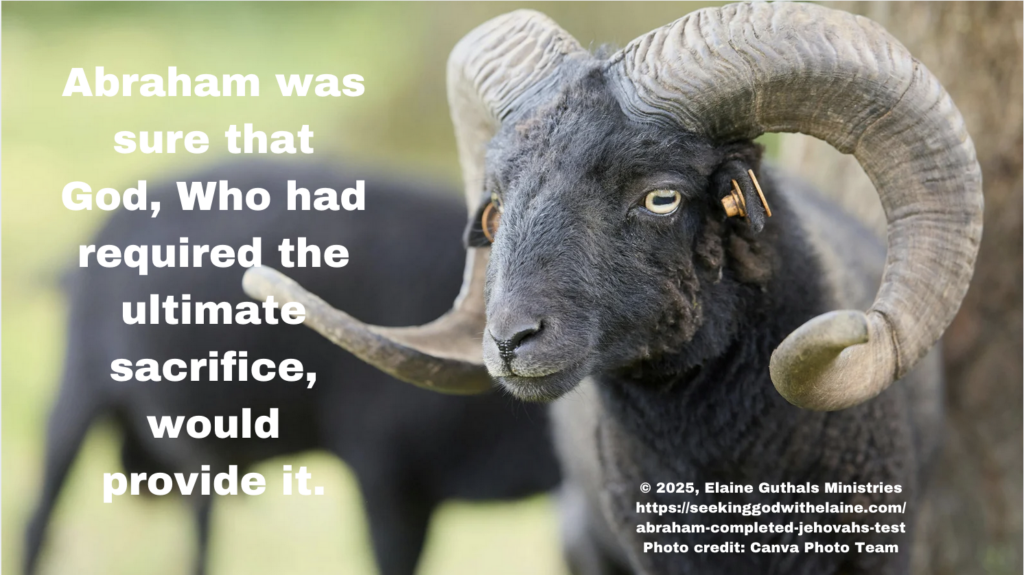
    Abraham was sure that God, Who had required the ultimate sacrifice, would provide it.

    Picked Up the Knife

    Obedience isn’t complete without an inward transformation.

    I bet there were tears running down his face as he bound Isaac. He had to be feeling a variety of thoughts.

    The faith shown was that Abraham believed — even if he had to go through with the sacrifice — Jehovah was Sovereign God above all. The covenant promise would be kept in some way.

    Abraham didn’t have to understand how that would play out. He just had to believe it would.

    But Abraham also had to be willing to go the entire way if it didn’t play out the way he thought it should.

    Robertson made a great point. We like to think that Abraham knew, even if he had to go through with the sacrifice, Jehovah would raise his Isaac back to life and return him to his loving father.

    Wrong. Robertson said, “If you make a sacrifice, expecting that God will return you your Isaac, that is a sham sacrifice, not a real one. Therefore, if you make sacrifices, let them be real.”

    Resource

    If we worship Jehovah with an expectation of some blessing, it really isn’t the kind of worship He requires.

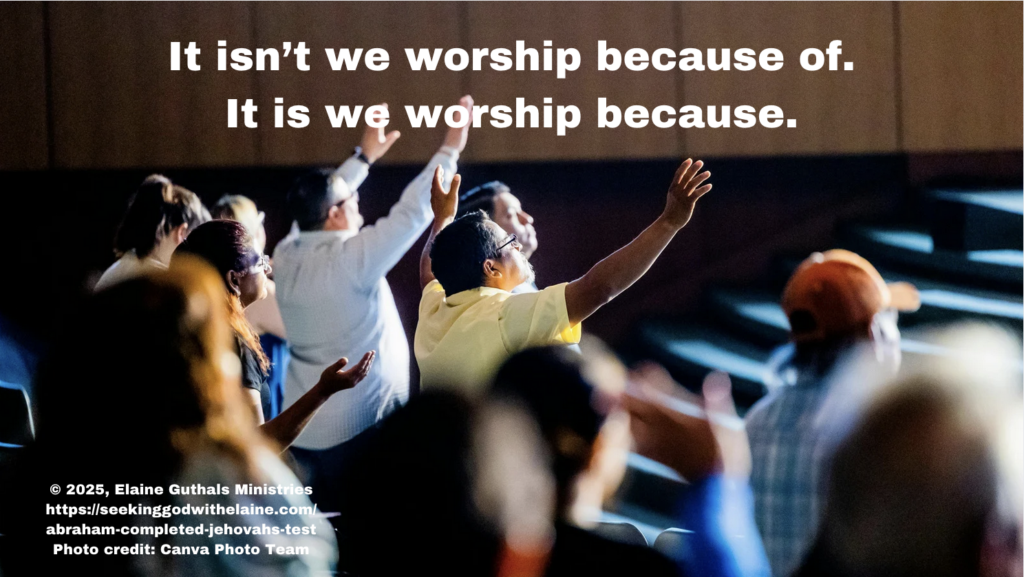
    It isn’t we worship because of. It is we worship because.

    If we worship because of receiving something in return, that isn’t true worship. We must worship Jehovah because He is Sovereign God.

    Some of us are probably asking why Jehovah had to let it go this far. That is easy.

    It didn’t mean anything until Abraham showed Jehovah that he would go all the way. Saying he would and not meaning anything proved nothing. It was just a lie.

    Abraham had to pick up the knife. He more than likely had to lift it over his head.

    I loved how Maclaren explained that. He wrote, “The outward deed is only the coarse medium through which it is made visible for men. God looks on purpose as performance.”

    Resource

    Performance equals action. But not just any action — it has to be what Jehovah requires and performed through faith.

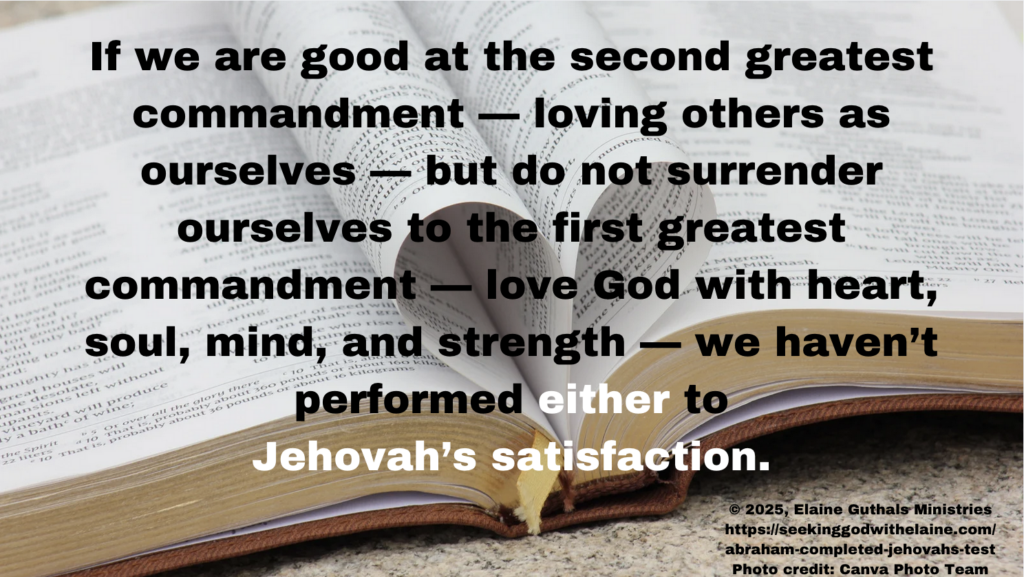
    If we are good at the second greatest commandment — loving others as ourselves (Mk. 12: 31) — but do not surrender ourselves to the first greatest commandment — love God with heart, soul, mind, and strength (Mk. 12: 30) — we haven’t performed either to Jehovah’s satisfaction.

    Kill His Son for a Sacrifice

    The purpose of the burnt offering was not to wipe clean the person’s sin but is a gift of ransom to alter Jehovah’s attuned toward that person.

    We don’t know what Abraham’s understanding of the coming Messiah was. This is a perfect example of what was coming.

    Bradford explained how. He wrote,

    “The elements are that Isaac was to be killed and burned up on an altar. And, we can see from the story that this also was not about some sin or another that either Isaac or Abraham had committed. So what was it about? As a burnt offering, an ‘olah, it was about total surrender and obedience to God on the part of the worshipper…..Abraham. It also demonstrated the principle of substitution when Isaac was replaced by a Ram that had been caught by his horns in some nearby thorn bushes. And the sacrifice displayed the idea of ransom…… that Isaac was to be a price paid, voluntarily, in order that mankind could be at peace with God.”

    Resource

    When Jehovah gave the Levitical Sacrificial System to Moses, he would have understood the concepts behind it better because of this sacrifice. We better understand the concept of Yeshua being the sacrifice because of the substitution of the ram for Isaac.

    Making the Connections #1

    When we started talking about Abraham in Genesis 12, we talked about how Abraham’s Sanctification Road being built on bricks formed by separations.

    • Left his country and kin (Gen. 11: 31).
    • Father died (Gen. 11: 32).
    • Left Haran (Gen. 12: 1)
    • Left Canaan for Egypt (Gen. 12: 10).
    • Left Egypt (Gen. 12:  20).
    • Separated from Lot (Gen. 13: 13).
    • Separated from Ishmael (Gen. 21:  14).
    • Almost separated from Isaac (Gen. 22: 10).
    • Separated from Sarah (Gen. 23:  1-2).
    • Separated from worldly possessions (Gen. 25: 5).
    • Separated from life (Gen. 25:  7-8).

    Because Abraham was marked for a great purpose, he needed to be separated from worldly things.  That usually means being separated from some people in our past.

    Making the Connections #2

    Many of us probably have thought, “Oh, no. I couldn’t do that.” Maybe. Maybe not.

    Taylor had an interesting take. He wrote,

    “The significance of the transaction is rooted in the fact that Abraham was not a mere private individual, but in a very special sense a representative man. … I would say that the whole story was meant to reveal the universal law to this effect, that what is born of God must be consecrated to God; that the children of promise are at the same time the children of consecration, and so there is no more difficulty in the command to sacrifice Isaac than there is in the injunction to cast out Ishmael.”

    Resource

    But look what Taylor was saying.

    • What is Jehovah’s is Jehovah’s — He can do what He wants with it.
    • This is even true with what He has promised. It isn’t that He changed His mind. It is about Him giving us what we need to know when we need to know it.
    • We aren’t told that Abraham ever saw Ishmael again. Sending him away would have been sending him to his death even if it wasn’t physical. He may have just been dead to Abraham.

    Making the Connections #3

    Taylor made a great observation. He wrote, “Tribulation by itself will not improve our characters.”

    Resource

    The point isn’t that we go through the hard times. The point is we go through it depending on Jehovah.

    Just like Abraham, we don’t need to know the end plan — or even the end destination.

    We only need to have a heart-knowledge of the Sovereign God calling us to walk with Him through the testing.

    Making the Connections #4

    Yeah, this was a really hard testing. One thing we tend to forget is that Abraham had a lot on the line – either way he went.

    Through it all, Jehovah was right there. Like we said, He wasn’t going for the sin in Abraham’s life. He was going for the faith.

    Of course, Jehovah is going to watch over us and help us with this trial.

    Making the Connections #5

    Okay. My mind is a little mushy tonight. I have to process Rowsell’s statement. He wrote, “In every age and in every station faith is expressed in simple dutifulness, and this faith of Abraham is, indeed, of the mind of Christ.”

    Resource

    In Elaine-speak, wherever we are at on our Sanctification Road, we just have to obey. Abraham’s faith allowed him to be willing to do the hard thing, what he deep down really didn’t want to do.

    But Abraham did it anyway.

    How Do We Apply This?

    • Walk with Sovereign God.
    • Do everything that He asks of us the way He asks of us and the first time He asks.

    Father God. Thank You for the example of Abraham completing the hard thing You asked him to do. Help us to obey You perfectly the first time. Amen.

    If you don’t understand something and would like further clarification, please contact me.

    If you have not signed up for the email providing the link to the devotions and the newsletter, do so below.

    If God has used this devotion to speak with you, consider sharing it on social media.
  • Abraham’s Faith Tested

    Jehovah chose to test Abraham to see how strong his faith was. This devotional reading looks at what that horrible test was.

    Nuggets

    • Jehovah came to Abraham just as He usually did.
    • When Jehovah said, “Hey, Abraham!”, I bet Abraham was excited to talk to his Friend again.
    • Once again, God sent Abraham off without giving him a specific destination.
    abrahams-faith-tested

    Abraham had grown in faith because the promised son had arrived. The belief that Jehovah would provide him and Sarah a son through which that great nation and many nations would come had been rewarded.

    Beyond a shadow of a doubt, Abraham knew God would keep their covenant.

    In the 25+ years since Jehovah called Abraham, Abraham had learned much — surrender and self-denial.

    But just when things were going so well, BAM! God called a – no, not a pop quiz. It was more in line with a pop final exam.

    Let’s Put It into Context

    To read devotions in the Creating Everything theme, click the button below.

    Devotions in the Abraham the Patriarch series

    Abraham’s Faith Tested

    “Some time later, God tested Abraham’s faith. ‘Abraham!’ God called. ‘Yes,’ he replied. ‘Here I am’” (Gen. 22: 1 NLT)

    Jehovah Tested Abraham

    Jehovah came to Abraham just as He usually did.

    Jehovah came to Abraham. It wasn’t a personal visit like Genesis 18. It wasn’t a dream, as He came to Abimelech (Gen. 21).
    
This sounded like it was how Jehovah usually came to Abraham. It was a voice in his spirit.

    Abraham was not told that this was a test. He had no clue what was happening.

    Most of all, Abraham didn’t know why it was happening.

    Make no mistake. Sovereign God does not have to explain Himself to the likes of us.

    Get one thing straight. Jehovah tested Abraham. He did not tempt him to sin.

    Jehovah does test us to get us to prove our faith.

    • “No one undergoing a trial should say, ‘I am being tempted by God,’ since God is not tempted by evil, and he himself doesn’t tempt anyone” (Jas. 1: 13 CSB).
    • “Fire tests the purity of silver and gold, but the LORD tests the heart” (Prov. 17: 3 NLT).

    God was not looking for the evil in Abraham — unless it is to eliminate it from his life. He was looking for the good.

    Do we understand the purpose here? Jehovah knew Abraham had faith. He was trying to figure out how strong that faith was.

    Those who have the strong faith are willing to obey understands Jehovah’s commands better, according to Emmons.

    Resource

    Just as an aside, this is the last texting of Abraham that we know of. Sarah died in the next chapter (which while some consider a trial isn’t a testing). Chapter 24 was securing a wife for Isaac. Abraham died in Genesis 25.

    We should expect testing — and trials — also. “These trials will show that your faith is genuine. It is being tested as fire tests and purifies gold — though your faith is far more precious than mere gold. So when your faith remains strong through many trials, it will bring you much praise and glory and honor on the day when Jesus Christ is revealed to the whole world” (I Pet. 1: 7 NLT).

    When we take/took tests in school, wasn’t it partly so we knew what we didn’t know? Yes, teachers want to know what we know, but the flip side is we find out what we don’t know. That way we can work on filling those holes in our knowledge.

    We do wellness checks so we can determine that physically we are well. We are also to do periodic checks on our faith.

    “Examine yourselves to see if your faith is genuine. Test yourselves. Surely you know that Jesus Christ is among you; if not, you have failed the test of genuine faith” (NLT). We have to judge ourselves by God’s standards.

    • Is our faith as deep as it could be?
    • If not, in what areas are we lacking?
    • What is God calling us to do to address that?
    • To where is He calling us?

    Here I Am

    When Jehovah said, “Hey, Abraham!”, I bet Abraham was excited to talk to his Friend again.

    “… ‘Here I am’” (Gen. 22: 1 NLT) implies both obedience on Abraham’s part and provision on Jehovah’s part. Abraham knew He could depend on Jehovah to carry him through whatever of which He was asking him.

    Jehovah came with, as Emmons said, the most extraordinary command that we find in God’s Word. But Abraham didn’t know that yet.

    Resource

    Abraham’s response showed that he was ready to obey Jehovah in whatever was asked of him.

    Your Only Son

    ‘Take your son, your only son — yes, Isaac, whom you love so much — and go to the land of Moriah. Go and sacrifice him as a burnt offering on one of the mountains, which I will show you’” (Gen. 22: 2 NLT)

    The testing Jehovah gives us usually uses that which we love most and highly value.

    Jehovah came with, as Emmons said, the most extraordinary command that we find in God’s Word. Abraham was to take his beloved son Isaac, the covenant child, and sacrifice him on an altar to worship Sovereign God.

    Resource

    Talk about having the rug pulled out from under his feet. Abraham would not have seen this one coming.

    Ooo, baby. Don’t we get all hot and bothered when we believe Jehovah promised something one way; and all the sudden, He does just the exact opposite? Don’t we forget that He knows best?

    Abraham would have never thought Jehovah would ask him to sacrifice his son. The whole covenant was contingent on Isaac’s birth and having kids of his own.

    Abraham would have been shocked down to the bottom of his sandals.

    What Abraham was told was that he was to not only kill Isaac but also burn him on an altar. It wasn’t a stick and done. It was a slay, dismember, and burn process.

    This command seems so out of character for Jehovah to ask that. Because child sacrifice was common in many countries at the time – even Abraham’s – He has several times specifically stated that children were not to be sacrificed.

    • “Do not permit any of your children to be offered as a sacrifice to Molech, for you must not bring shame on the name of your God. I am the Lord” (Lev. 18: 21 NLT).
    • “You must not worship the Lord your God the way the other nations worship their gods, for they perform for their gods every detestable act that the Lord hates. They even burn their sons and daughters as sacrifices to their gods” )Deut. 12: 31 NLT).
    • “They have built pagan shrines at Topheth, the garbage dump in the valley of Ben-Hinnom, and there they burn their sons and daughters in the fire. I have never commanded such a horrible deed; it never even crossed my mind to command such a thing!” (Jer. 7: 31 NLT).

    What happened to “thou shalt not kill” period?

    Could a father legally do this? Well, back in Abraham’s day, yes. The father had complete rule over his son.

    Rowsell made a good point. Abraham would have seen a lot of child sacrifices back in Ur. I bet it broke his heart every time he saw a parent kill his child when that was what he himself wanted the most.

    Resource

    Emmons thought Abraham was only asked to offer Isaac as a sacrifice, not kill him. Robertson agreed as, in the end, the sacrifice was not demanded.

    Resource

    That isn’t what this version says. Go and sacrifice him as a burnt offering on one of the mountains, which I will show you’” (Gen. 22: 2 NLT).

    So, let’s go back to the Hebrew. “… offer him there for a burnt offering upon one of the mountains …’” (Gen. 22: 2 OJB).

    Not sacrifice. Offer.

    But if we look at how to perform a burnt offering, we see the sacrifice is killed first.

    • “Lay your hand on the animal’s head, and the Lord will accept its death in your place to purify you, making you right with him. Then slaughter the young bull in the Lord’s presence, and Aaron’s sons, the priests, will present the animal’s blood by splattering it against all sides of the altar that stands at the entrance to the Tabernacle” (Lev. 2: 4-5 NLT).
    • “The sons of Aaron the priest will build a wood fire on the altar” (Lev. 2: 7 NLT).
    • “… Then the priest will burn the entire sacrifice on the altar as a burnt offering. It is a special gift, a pleasing aroma to the Lord” (Gen. 2: 9 NLT).

    Before it was offered to God, the sacrifice was killed.

    Can we start a sacrifice and pull out before the smoke starts? Is it really a sacrifice then? Is it even an offering? No.

    Robertson argued that Jehovah did not and could not command that which was wrong. Therefore, He must have mean offer, not sacrifice.

    What I kind of do agree with is what Emmons said. Jehovah can require one time that which He has forbidden another. Otherwise, how can He test us?

    What better way of showing us what He doesn’t want by asking for it and stopping it?

    Kennedy was right. Jehovah wasn’t asking Abraham to love Isaac any less.

    Resource

    Abraham didn’t ask Jehovah to repeat the command or clarify it. He didn’t even demand evidence that it was coming from Him. He didn’t rail about not being left with a way to shimmy out of it.

    Abraham straight up obeyed. As Ness said, it was a man performing in obedience the command given to him by the Lawgiver.

    Resource

    Don’t we try to shimmy out of sacrifices? Oh, I don’t sing well, I’ll just leave that to the Praise Team.

    Don’t we try to cut corners in worship? I don’t like reading the Bible, and I especially don’t like doing it every day. So, I’ll just worship on Sunday.

    Don’t we just plain do it our way instead of His way?

    Let’s look at this another way. Jehovah told Abraham to take his son — the one he loved — and sacrifice him. Now, last chapter we were told that Abraham was told by Him to send Ishmael away. Even though Jehovah had made it clear that he wasn’t the covenant son, Abraham might have kept in the back of his mind that Ishmael was a spare in care something happened to Isaac.

    Why would God ask Abraham to sacrifice the son that he waited for so long? Just because of that?

    Think about it. Abraham didn’t have a bunch of sons. He had two.

    I don’t think Jehovah was saying Abraham loved Isaac more than Him. Although, Tipple thought Abraham had done just that.

    Resource

    If Jehovah was doing this as punishment for the sin of putting something before Him (Ex. 20: 3), it wouldn’t be a testing. If Abraham had put Isaac before Jehovah, I would think that would have created a much bigger response than testing. God may even could have gone through with the sacrifice.

    Yes, it is sometimes easy to put something before Jehovah. We can’t put things – even family – above Sovereign God.

    Do we put more faith in the blessing than the God Who gave us the blessing? In other words, would Abram make Isaac his idol?

    What is our Isaac? What replaces Sovereign God as what/who we worship? What would we do if/when we are asked to lay down our Isaac? Would we still worship and be obedient to God as Abraham was?

    But we have to understand Jehovah can ask of us anything He wants. It is not our place to question. It is our place to obey.

    Why would Jehovah make Abraham go through all of this? He was giving a representation of Him and Yeshua.

    The First Step of Obedience

    “The next morning Abraham got up early. He saddled his donkey and took two of his servants with him, along with his son, Isaac. Then he chopped wood for a fire for a burnt offering and set out for the place God had told him about” (Gen. 22: 3 NLT)

    Once again, God sent Abraham off without giving him a specific destination.

    All Jehovah had given Abraham was the area but not the specific mountain. That didn’t slow Abraham down.

    Even though Jehovah asked what at first hearing Abraham would have recoiled from, he immediately made plans to fulfill the request.

    We aren’t told the time-of-day God gave the order. Abraham left early the next morning. He left at the first possible time.

    We aren’t told what he told Sarah — if anything. I don’t see him going to her and saying, “God told me to go make a sacrifice — and that sacrifice is Isaac. See you when I get back.”

    Abraham obviously didn’t tell Isaac.

    Gray thought Abraham didn’t tell anyone anything except they were going to worship. I go with that.

    Resource

    Whatever Abraham was feeling, he started the next morning. This is the best indication of his faith.

    We’ve talked about Abraham being disinterested before when he and Lot separated. Disinterestedness means a willingness to give up something for a greater good.

    This is the type of faith and obedience Abraham showed. He was willing to give up his beloved son’s life for whatever greater good Jehovah was working.

    It was smart to take wood with him because wood could be scarce around there.

    Tipple thought Abraham took a couple of days to stew about it, but he was wrong. “The next morning Abraham got up early …” (Gen. 22: 3 NLT emphasis added).

    Resource

    Part of me can see why Tipple thinks that. I’m sure it wasn’t like throwing a couple of clothes in the suitcase and going.

    But still with each step he took, Abraham’s mind was probably racing, and his heart was trying to sink.

    With all that, it doesn’t sound like Abraham let Isaac see his despair. He let him see his unwavering faith in a Sovereign God. He knew Jehovah would make clear to him exactly what He wanted him to do – without breaking the covenant they had together.

    Not once in the journey did he turn around or even get lost on purpose. Think about the self-control that took.

    Making the Connections #1

    How many times have we said that the bricks in our Sanctification Road are built through testing and trials? The process through which we become like Jehovah is sanctification.

    The trials come through pain and cost. Why do we think testing should be much easier?

    Jehovah gives these testing and trials to build His character.

    Look what Rowsell said. He wrote, “Each part of his character, like every part of his [armor], is put to the proof; and it is the proof that tests, after all, the strength both of resistance and [defense] and attack.”

    Resource

    It is going to take a long time to make the transformation. It will take the rest of our lives, in fact.

    Making the Connections #2

    Rowsell made another excellent point. Jehovah did not speak to Abraham in an audible voice. He talked with him in his soul.

    Resource

    I can see that. But I also know through personal experience that there are times it can seem like it is an audible voice when Jehovah speaks to us.

    Making the Connections #3

    You know, we think most about Abraham’s relationship with Isaac. Our hearts break for the dilemma in which Abraham found himself.

    Hughes discussed the possible effect that it had on Abraham’s relationship with Jehovah. He wrote, “It was a trial that put the severest possible strain upon him in the tenderest relations of his spiritual life.”

    Resource

    Did Abraham think following Jehovah for 25+ years were all for nothing? Did he think his life meant nothing?

    Satan may have stuck the thoughts in Abraham’s mind, but Abraham never once faltered. He set his course for Moriah and trusted His God to work it out.

    Abraham had faith in the God of the unseen, the unreasonable, and the unthinkable.

    Making the Connections #4

    Maclaren had an interesting take on the purpose of the testing. He asked, what if the purpose of the testing was to determine Abraham’s readiness to obey – even to something so huge and so out of left field as sacrificing his son?

    Resource

    That makes the most sense to me. No, Jehovah wasn’t really asking for Abraham to do it. He was asking if he was ready to do what He asked no matter what.

    How Do We Apply This?

    • Accept that our faith will be tested.
    • Put Jehovah first in all things, even family.
    • Understand that faith gives us strength.
    • Realize that confirmation of our faith will only be given through testing.
    • Discipline our faith to believe Jehovah has control of the unseen.
    • Be willing to lose ourselves to find ourselves in God.
    • Realize that we will never graduate from testings.
    • Sacrifice our will to Jehovah.
    • Let Jehovah determine the sacrifice, not us.

    Resources

    Father God. We know that testing is a part of our walk with You. We know that You will ask hard things of us. Help us to obey as Abraham did, and may our faith grow to the strength he had. Amen.

    If you don’t understand something and would like further clarification, please contact me.

    If you have not signed up for the email providing the link to the devotions and the newsletter, do so below.

    If God has used this devotion to speak with you, consider sharing it on social media.
  • God Told Abraham His Plan for Sodom and Gomorrah

    God started a conversation with Abraham after Abraham’s hospitality. This devotional reading looks at how He told him His plans for the cities’ destruction.

    Nuggets

    • Sodom and Gomorrah were wonderful cities.
      Jehovah said that He had heard an outcry.
    • Sin was rampant and horrific in Sodom and Gomorrah.
    • At first read, some may think that Jehovah really doesn’t know what was happening in Sodom and Gomorrah.
    • The angels leave God with Abraham to have their talk.
    • Abraham was afraid that Jehovah would wipe out the righteous as well as the unrighteous, but he knew He wouldn’t.
    god-told-abraham-his-plan-for-sodom-and-gomorrah

    We have been talking about Abraham’s hospitality for and discussion with his Friend, Jehovah. We know that God has plans that He hasn’t shared yet.

    After weighting things out, God chose to share the plan with Abraham. Let’s see how He does it.

    Let’s Put It into Context

    To read devotions in the Creating Everything theme, click the button below.

    Devotions in the Abraham the Patriarch series

    Sodom and Gomorrah’s Judgment

    “So the Lord told Abraham, ‘I have heard a great outcry from Sodom and Gomorrah, because their sin is so flagrant. I am going down to see if their actions are as wicked as I have heard. If not, I want to know’” (Gen. 18: 20-21 NLT)

    Sodom and Gomorrah were wonderful cities.

    Foster described Sodom and Gomorrah as beautiful cities. Its position on the Babylon to Egypt trade route made Sodom prosperous.

    Resources

    The problem, though, was humans. Sin had become rampant again, possibly from the abundance of idleness.

    Dykes, though, didn’t find any evidence of culture or refinement.

    Resource

    Great Outcry

    Jehovah said that He had heard an outcry.

    We know that God can hear us from Heaven. But from whom did the outcry originate?

    No, it wasn’t from Abraham, lamenting that humans had become as sinful as they had been before the flood. We really haven’t been told to this point that he was concerned whether others believed or not.

    Jehovah had personal knowledge that there was evil in Sodom and Gomorrah.

    The outcry came from the cities themselves. Creation was calling to its Maker for relief.

    Think about it. We know that Jesus calmed the storm (Mk. 4: 35-41). Creation obeyed the voice of its Creator.

    When Jesus was entering Jerusalem during the Triumphant Entry, He said the rocks would cry out. “But some of the Pharisees among the crowd said, ‘Teacher, rebuke your followers for saying things like that!’ He replied, ‘If they kept quiet, the stones along the road would burst into cheers!’” (Lk. 19: 39-40 NLT).

    Sin Is Flagrant

    Sin was rampant and horrific in Sodom and Gomorrah.

    We’ll find out one of the sins of the cities was sexual immorality. We can deduct from the fact that there was not ten righteous men in the cities that there were thousands that cursed Jehovah. There was probably a big dose of pride. Gilfillan wondered if there was child sacrifices.

    Gilfillan described the situation in Sodom and Gomorrah. He wrote,

    “Had there been but one prevalent evil practice in Sodom, there is something so disgusting, and at the same time comparatively so rare, in the sin which bears the name of the city, that it might have been as well, perhaps, to have passed it over in silence. But it is evident that the peculiar iniquity of Sodom was only the climax and consummation of the general depravity of the place.”

    Resource

    I Want to Know

    At first read, some may think that Jehovah really doesn’t know what was happening in Sodom and Gomorrah.

    Nothing is further from the truth. Jehovah wasn’t going there to make an initial evaluation. He is going to make a final evaluation.

    The purpose was to pull out the righteous.

    Trench helped us understand this. He wrote,

    “The judgments of God from time to time overtake guilty nations and guilty men; but, huge and overwhelming catastrophes as these often are, there is nothing hasty, blind, precipitate about them. He is evermore the same God who, when the cry of Sodom and Gomorrah waxed great, is described as going down to see and inquire whether they had “done altogether according to the cry of it.”

    Resource

    Jehovah wants us to evaluate our lives. First, we do it to determine if we need salvation. Then, we continue to evaluate ourselves to ensure we are navigating the Sanctification Road. We identify the areas Jehovah is working in our lives to make us more like Him.

    In other words, this evaluation gives us a clear view of our sins.

    Dunning brought up something interesting. Maybe I want to know really meant were they ripe for judgment.

    Resource

    Was God giving them one last chance to turn to Him?

    The Angels Take Their Places

    “The other men turned and headed toward Sodom, but the Lord remained with Abraham” (Gen. 18: 22 NLT)

    The angels leave God with Abraham to have their talk.

    Do we think it is strange that Jehovah came this far but didn’t go any farther? Especially since He said that He wanted to know in verse 21.

    At times, Jehovah does things Himself. He shut door of ark (Gen. 7: 16).  He was in the burning bush to commission Moses (Ex. 3: 4).

    At other times, Jehovah sends His messenger.

    We don’t know that Jehovah didn’t go with the two angels. No, He wasn’t visible, but that doesn’t mean He wasn’t there.

    But look at the two angels. They calmly left the dinner with their Master and friend and walked to Sodom and Gomorrah to carry out their assignment.

    Yes, they were going to mete out vengeance. But they didn’t go to the cities with anger or even fanfare.

    Abraham’s Response to the Plan

    “Abraham approached him and said, ‘Will you sweep away both the righteous and the wicked?’” (Gen. 18: 23 NLT)

    “Surely you wouldn’t do such a thing, destroying the righteous along with the wicked. Why, you would be treating the righteous and the wicked exactly the same! Surely you wouldn’t do that! Should not the Judge of all the earth do what is right?’” (Gen. 18: 25 NLT)

    Abraham was afraid that Jehovah would wipe out the righteous as well as the unrighteous, but he knew He wouldn’t.

    Abraham knew God. He knew that God would not execute the righteous with the unrighteous, but he had to ask.

    In fact, this question probably just came flying out of Abraham’s mouth before the brain engaged. We can see why.

    Dunning wondered if Abraham was blindsided by the judgment on the cities. This is a rather abrupt tone.

    Resource

    As we read on, we’ll find out that God did not call Abraham out on this. Maclaren told us why. He wrote, “The boldest words from a loving heart, jealous of God’s [honor], are not irreverent in His eyes.”

    Resource

    Meyer thought that, beyond his concern for Lot. Abraham was concerned how others would respond to God’s destruction of the cities. He didn’t want others to turn away from God because of this.

    Resource

    Abraham knew Jehovah as a merciful God. He wanted others to know Him as he did.

    I wonder if Abraham kind of felt like Noah stepping off the ark. He had never seen Jehovah’s judgment like this in the almost 25 years of his life as a believer. In fact, he hadn’t seen this level of destruction in his lifetime.

    Abraham now knew Jehovah’s judgment of those who habitually sinned and chose to turn away from Him.

    Think about it. Disciples are called to look different than worldview people. We aren’t supposed to have the same values and social norms they have.

    Why would we expect the same severe judgment?

    Let’s look at the Hebrew here. “And Avraham drew near, and said, Wilt Thou also destroy the tzaddik [righteous] with the rasha [morally wrong]?” (Gen. 18: 23 OJB).

    Remember, morally wrong means that they were deviating from God’s Will, law, and commandments.

    We know that Jehovah does not always save His children from trials and persecution. Disciples are not exempt from suffering the results of sin. Neither are we.

    However, we are not given the judgment of the unrighteousness.

    Think about Noah. Out of the unknown number of people present on earth at that time, eight people were saved.

    “… Noah was a righteous man, the only blameless person living on earth at the time, and he walked in close fellowship with God” (Gen. 6: 9 NLT emphasis added). Seven other people were saved because of the faith of one man.

    Jehovah will not judge the righteous with the unrighteous. Otherwise, why would we choose to submit to Him?

    So, was Abraham asking God to change His mind? Wouldn’t he have known that God is immutable?

    Mason felt it was Abraham telling God that His plan was wonderful – but could He give him a clue as to some details.

    I know. Don’t we wish God would share some plans with us once in a while? And give us a few more details!!!

    Mason said something spot on. He wrote, “The mercy which is prayed for is not an exception from righteousness, but the fruit of it.”

    Resource

    We become righteous only through a greater connection with God. Our concern for other’s salvation comes out of that connection.

    It was that connection that created the surety that God would not destroy the righteous along with the wicked that fostered Abraham’s boldness. He knew God as a Father, not just as Judge.

    Think about this. God is righteous, so that He can do no wrong. If He can’t do wrong, He won’t approve of us doing wrong.

    Making the Connections #1

    We may think Sodom and Gomorrah had no warnings to turn from their sinful ways. But Gilfillan said they did.

    Resource

    There first warning was the arrival of Lot. I know we bit pretty hard on him back in Genesis 13, but by the end we had a different picture of him.

    Remember, we talked about Lot’s Christian worldliness.

    Robinson argued that, however we may judge Lot in Genesis 13, by the time he left Sodom in Genesis 19, he was a righteous man. He was sick of the culture in which he lived.

    “But God also rescued Lot out of Sodom because he was a righteous man who was sick of the shameful immorality of the wicked people around him. Yes, Lot was a righteous man who was tormented in his soul by the wickedness he saw and heard day after day” (II Pet. 2: 7-8 NLT emphasis added).

    Okay, maybe the warning wasn’t with Lot’s arrival. It was obvious to others by Lot’s turning to/turning back to Jehovah. His friends and neighbors would have seen a difference between him and them.

    The second warning was when King Chedorlaomer and the invaders from the east arrived in Genesis 14. Oh, yeah. Defeat is a good warning.

    Surely, they would have known about Abraham, at a minimum. They may even have known about Melchizedek.

    But that didn’t deter them. They kept on sinning anyway.

    Making the Connections #2

    The first question may have come flying out of Abraham’s mouth, but he knew one thing. Jehovah devised the good and orders the evil.

    That is one reason that Jehovah is Judge.

    Another reason is all-seeing, all-knowing Jehovah is the best One for the job. “… For the LORD is a God who knows what you have done; he will judge your actions” (I Sam. 2: 3 NLT).

    Still another reason is Jehovah can do no wrong. “God’s way is perfect. All the Lord’s promises prove true. He is a shield for all who look to him for protection” (Ps. 18: 30 NLT).

    How Do We Apply This?

    • Remain obedient to Jehovah.

    Resource

    Father God. You trusted Abraham because he had faith to believe in You. Thank You when You share Your plans with us. Fortify us to discern Your Will when You do not. Amen.

    If you don’t understand something and would like further clarification, please contact me.

    If you have not signed up for the email providing the link to the devotions, do so below.

    If God has used this devotion to speak with you, consider sharing it on social media.
  • God Didn’t Hide His Plan from Abraham

    God doesn’t always tells us His plans. This devotional reading looks at God’s thought process in whether to tell Abraham about His plans or not.

    Nuggets

    • Abraham walked with them a bit when they started on their way, allowing God to tell Abraham His plans.
    • Sometimes, God shares His plans with us, though not always.
    • God chose to reveal the plan to Abraham because He did honor him.
    • Because God had honored Abraham, he inherited a great responsibility toward his family.
    god-didn’t-hide-his-plan-from-abraham

    Abraham had been host to God and two angels. As they are leaving, God wrestles with Himself whether He should share His plans with him.

    Let’s Put It into Context

    To read devotions in the Creating Everything theme, click the button below.

    Devotions in the Abraham the Patriarch series

    Leaving the Hospitality

    “Then the men got up from their meal and looked out toward Sodom. As they left, Abraham went with them to send them on their way. ‘Should I hide my plan from Abraham?’ the Lord asked. ‘For Abraham will certainly become a great and mighty nation, and all the nations of the earth will be blessed through him’” (Gen. 18: 16-18 NLT)

    Abraham walked with them a bit when they started on their way, allowing God to tell Abraham His plans.

    It looks like God is debating with Himself on whether or not He should say anything to Abraham. No, God isn’t undecided.

    I think God was just allowing us to know why He was starting this conversation.

    Hide my Plan

    Sometimes, God shares His plans with us, though not always.

    Sovereign God has plans for each of us. “For I know the plans I have for you,” says the Lord. “They are plans for good and not for disaster, to give you a future and a hope” (Jer. 29: 11 NLT).

    But God does not always tell us everything. “The LORD our God has secrets known to no one. We are not accountable for them, but we and our children are accountable forever for all that he has revealed to us, so that we may obey all the terms of these instructions” (Deut. 29: 29 NLT).

    We see this affirmed in Revelation. “The LORD our God has secrets known to no one. We are not accountable for them, but we and our children are accountable forever for all that he has revealed to us, so that we may obey all the terms of these instructions” (Rev. 10: 4 NLT).

    Don’t read over this. Abraham had never asked God why He was there. He wasn’t trying to get a glimpse into God’s secret plans.

    True, God had already given Abraham the timeline for his plan. The promised son would come in a year.

    No, I don’t think Abraham didn’t ask because he didn’t care. I think that he knew God would tell him if it was his business to know.

    Look what Candlish said. He wrote,

    “Nor in this pleading does Abraham arrogate anything to himself. He has boldness and access, with confidence, by the faith of Jesus. He has liberty to converse with God as a friend, to give utterance to his feelings and desires before Him, to represent his own case and the case of every one for whom he cares; and not for himself only, but for others, yea, indeed for all, to invoke the name of Him whose memorial to all generations is this: “The Lord, the Lord God merciful and gracious, long-suffering, and abundant in goodness and truth; keeping mercy for thousands, forgiving iniquity, transgression, and sin, and that will by no means clear the guilty” (Exodus 34:6, 7).”

    Resource

    I read that to mean that Abraham knew that anyone who had the faith he did had the same access.

    We know we have this same access. We call it seeking God.

    Searching for and Seeking God

    Non-believers search for God.
    Disciples seek Him.

    Hearing His Word (Rom. 10: 17)
    Reading His Word (Rev. 1: 3)
    Praying to Him (Heb. 4: 16)
    Studying His Word (Ac. 17: 11)
    Meditating on His Word (Ps. 1: 1-2)
    Memorizing His Word (Ps. 119: 11)

    You know, those elements are missing one thing. I don’t talk about the need to worship God.

    We access God through worshiping Him. If we can’t worship Him, are we really truly seeking Him?

    Leale said that this communication with God is a privilege of our friendship with Him. True – if we aren’t His friend, we can’t communicate with Him.

    Resource

    We keep saying that is isn’t about religion. It is about relationship. We have to communicate to have a relationship.

    Honor Already Granted to Abraham

    God chose to reveal the plan to Abraham because He did honor him.

    God didn’t have to revel His plan to Abraham. He chose to do so.

    The reason God chose to tell Abraham His plans was that He had plans for Abraham.

    • Abraham’s descendants will become a strong nation.
    • Through him, all the world will be blessed.
    • He will instruct his children to follow God.

    Fuller reminded us that God had a special interest in the nation of which the Abraham would be the father. That is why He wanted to talk with His friend about His plans.

    Resource

    Everything God has out in His Word is there for a reason – the good, the bad, and the ugly.

    Inclusion doesn’t mean God is approving of the actions. In fact, it is probably the opposite. God can also just be showing us the condition of mankind.

    Another head-scratching verse is when God said He was “… going down to see if their actions are as wicked as I have heard. If not, I want to know” (Gen. 18: 21 NLT).

    God is all-seeing. He knows.

    I read this to say that God was giving them a chance to repent.

    Aren’t we like that? We want to know how far we can go before we can’t get away with it anymore.

    We shade it to make it look like we are trying to stay obedient. Really, we just want to know how much sin we can keep.

    God Had Plans for Abraham

    “I have singled him out so that he will direct his sons and their families to keep the way of the Lord by doing what is right and just. Then I will do for Abraham all that I have promised’” (Gen. 18: 19 NLT)

    Because God had honored Abraham, he inherited a great responsibility toward his family.

    Ooo, baby. Abraham did have a great responsibility. Let’s look at what the Hebrew says.

    “For I know him, that he will command his children and his household after him, and they shall be shomer [guard] over the Derech Hashem [the Way of God], to do tzedakah [charity, righteousness] and mishpat [judgment, justice, ordinance, legal right]; that Hashem may bring upon Avraham that which He hath spoken [promised] of him” (Gen. 18: 9 OJB).

    God knows Abraham. It isn’t about having head-knowledge about Him. God knew Abraham’s heart and that His belief and love of God was at the heart-level.

    Does it seem strange that God said, “For I know him, that he will command his children and his household after him …” (Gen. 18: 9 OJB). It shouldn’t.

    Hastings had a slightly different definition of knew. He argued it wasn’t only Abraham’s knowledge, but it was also God’s approval of his conduct.

    Resource

    God knows Abraham will witness to his descendants. Bedtime stories, celebrations, everyday conversations – this was how he would command/direction his descendants about Who God is and what He wants from us.

    We do know that in some prior cultures, the father was an authoritarian. No, Abraham isn’t taking away his descendants’ free will. He was fulfilling his responsibility as a parent and as a child of God.

    What Abraham was to pass on to his family was the things that qualified him for being the father of nations. Emmons said that Abraham would be expected to dedicate, instruct, and restrain his children.

    • Knowledge
    • Piety
    • Virtue
    • Authority
    • Fidelity
    • Diligence

    Resource

    Why is family government so important? It is one way in which God’s Gospel is spread from generation to generation. Neglecting to do so makes them disobedient to God. 

    • “Direct your children onto the right path, and when they are older, they will not leave it” (Prov. 22: 6 NLT).
    • “Fathers, do not provoke your children to anger by the way you treat them. Rather, bring them up with the discipline and instruction that comes from the Lord” (Eph. 6: 4 NLT).
    • “And you must commit yourselves wholeheartedly to these commands that I am giving you today. Repeat them again and again to your children. Talk about them when you are at home and when you are on the road, when you are going to bed and when you are getting up” (Deut. 6: 6-7 NLT).

    Nothing is more important than keeping the Way of God.

    Melvill told us what this is at stake here. He wrote,

    “Such an expression seems to imply that there is no tendency in children to walk in the right way. They have to be dealt with in the way of command — as though, if left to themselves, the almost certainty is that they will walk in the wrong.”

    Resource

    That brings up an important occurrence more times than not. Grandparents went to church faithfully and took Parents. But Parents rebelled and left the Church. So, they never took Children to introduce them to God.

    Grandparents tried to keep the Way of God.  Parents and Children will be judged on Judgment Day. Their eternity is at risk if not assured.

    Making the Connections #1

    Just as we know there are plans that we need to follow, we also have to know that there are consequences for those that do not follow the plans.

    No, it isn’t every day that suffer rains from the skies and destroys two cities. However, meteorological events do happen — tornadoes, hurricanes, floods.

    How would we know the why behind the destruction of Sodom and Gomorrah if God hadn’t told Abraham?

    Making the Connections #2

    Leale made an interesting comment. He wrote, “Abraham was not only a saint, but also a representative man, through whom God intended to convey great blessings to mankind.”

    Resource

    My first thought was, “Huh.” But then I thought about it.

    “I will make you into a great nation. I will bless you and make you famous, and you will be a blessing to others. I will bless those who bless you and curse those who treat you with contempt. All the families on earth will be blessed through you” (Gen. 12: 2-3 NLT).

    I think I would have used a different word than representative. I would use foundation, instead.

    A representative means that we would look like Abraham. We do physically, but do we all spiritually? Some, yes; some, no.

    I say foundation because we should want to look like Abraham and have a faith like his.

    Thinking through this, maybe both are correct. Abraham is the foundation, but we should want to be like him, making him our representative.

    Making the Connections #3

    The Congregational Pulpit is right. God has revealed to us some of His secrets.

    • We know Jesus will return.
    • We know the world as we know it will end. This planet is scheduled for destruction.
    • We know all will be judged and rewarded or punished accordingly.

    Resource

    Making the Connections #4

    Yes, parents can teach their children the Way of God. Why doesn’t it stick?

    Melvill addressed that. He wrote,

    “When you come to think on what right training is, a system of example as well as of precept, you must assuredly see how likely it is that the best training has been defective — that even parents who have taken most pains have failed in thoroughly educating their children for God; and of course it is vain to urge that the Divine promise has not been accomplished, so long as there could be doubt as to whether the condition on which it is made has been rigidly complied with.”

    Resource

    Pastor Steve and I had this conversation the other day. We are called to witness to people. It is up to God to save them.

    Oh, yeah. We would love to be able to make the decision for them – but we can’t. They must decide on their own to follow God’s Way.

    All we can do is be obedient to the tasks God has for us.

    Making the Connections #5

    We have to remember that, at this point, the chosen son wasn’t born, but the first-born son had been. Ishmael would have just enter his teenage years.

    Abraham would also have servants and slaves to whom to witness. We don’t know how many this entailed, but we do know he was wealthy.

    This could be a significant number of people. They would have been under Abraham’s care.

    That makes it even more important for us to be an example and witness for God.

    Making the Connections #6

    It just hit me that there is only one other altar that Abraham builds after this point. It was the one to sacrifice Isaac.

    But then, Abraham stayed put at Mamre, where he had built his third of the fourth altars.

    • Shechem: Abram built his first altar upon entering the land of Canaan (Gen. 12: 7).
    • Bethel: He constructed an altar between Bethel and Ai as a place of worship (Ge. 13: 3).
    • Hebron: Abram built an altar in the region of Mamre, near Hebron (Gen. 13: 18).
    • Mount Moriah: Abraham prepared an altar for the sacrifice of Isaac, demonstrating his faith (Gen 22: 9).

    In other words, Abraham didn’t have to build more.

    That doesn’t mean Abraham didn’t pray with and intercede for his family. That is one of the main ways he would have introduced his God to his family.

    Abraham wanted his family to have what he had. Benson told us what that was. He wrote,

    “Family-blessings arise from family religion; — temperance, frugality, industry, discretion — peace, quietness, love, harmony — the [favor], protection, and care of God; His direction and aid — all necessaries (Psalm 37:25; Matthew 6:33) — prosperity, as far as will be good for us, and our families.”

    Resource

    How Do We Apply This?

    • Be friends with God so He will open up to us about His plans.
    • Be different from the world.
    • Pray for others to become God’s friends.
    • Always do that which God requires of us.
    • Worship as a family.
    • Ensure our house, habits, associates, pursuits, and recreations show the Way of God.

    Resources

    Father God. Lord, may we have faith like Abraham’s where You would feel confident in sharing Your plans with us. Help us watch and wait when You don’t. Amen.

    What do you think?

    Leave me a comment below (about this or anything else) or head over to my Facebook group for some interactive discussion.

    If you don’t understand something and would like further clarification, please contact me.

    If you have not signed up for the email providing the link to the devotions and the newsletter, do so below.

    If God has used this devotion to speak with you, consider sharing it on social media.
  • Giving Abram the Land

    Abram was starting a new chapter in his life. This devotional reading looks at the comfort God gave Abram after his separation from Lot.

    Nuggets

    • God gave the land of Canaan to Abraham as a permanent possession.
    • God gave the land to Abraham and his descendants — but Abraham didn’t have either promise yet.
    • God was already setting up His eventual blessing of the nation of Israel.
    • Abram made his home in Mamre in Hebron.
    giving-abram-the-land

    Abram’s world had been rocked. He and Lot separated.

    Since Lot’s father/Abram’s brother Haran died, uncle and nephew had been living closely, if not together. Surely since their emigration, they traveled together.

    But now both had become wealthy men. The problem was they did not own land in their new country on which to graze their flocks. This led to them separating.

    Let’s Put It into Context

    To read devotions in the Creating Everything theme, click the button below.

    Devotions in the Abraham the Emigrant series

    Land to Come

    “After Lot had gone, the Lord said to Abram, ‘Look as far as you can see in every direction — north and south, east and west. I am giving all this land, as far as you can see, to you and your descendants as a permanent possession’” (Gen. 13: 14-15 NLT)

    God gave the land of Canaan to Abraham as a permanent possession.

    Once Lot moved, God came to Abram. Yes, this is another instance of God coming to humans.

    God had a special reason for coming. He clarified what land He was giving to Abram and his descendants.

    God gave Abraham the land “… as far as you can see in every direction — north and south, east and west” (Gen. 13: 14 NLT). That is a lot of land.

    But wait a second. Where are we again?

    Bethel

    The last location reference we had was somewhere in the land of Canaan. “So Abram settled in the land of Canaan, and Lot moved his tents to a place near Sodom and settled among the cities of the plain” (Gen. 13: 12 NLT).

    In other words, Lot went east, and Abram went west toward the Mediterranean Sea.

    Can we get any closer than that? “From the Negev, they continued traveling by stages toward Bethel, and they pitched their tents between Bethel and Ai, where they had camped before” (Gen. 13: 3 NLT)

    Take a look at this map that ChatGPT created for me.

    This is important. I kept thinking, why would God tell Abram to look in all directions?

    Bethel was in the land that – in the future – would be given to the tribe of Benjamin. That was considered the middle of the Promised Land.

    It became an important place in the future.

    • It was a home for the Ark of the Covenant during the time of the Judges.
    • It was a buffer between the Northern Kingdom and the Southern Kingdom.
    • In fact, it was sanctuary city and religious center for the Northern Kingdom.

    So, yes, Abram could see all of the Promised Land from where he was standing.

    It is hard to tell it on this map, but Bethel was in the Hill Country. This area was a strategic position.

    The Covenant Extended

    We talked before about God’s covenant with Abram. We may think it is three different covenants, but it really is all part of one.

    • Covenant established (Gen. 12: 1-3)
    • Blessings of the covenant (Gen. 12: 7; Gen.13: 14-17)
    • Sign of the covenant (Gen. 15: 1-21)
    • Acceptance of the responsibilities of the covenant (Gen. 17: 1-27)
    • Promise of the covenant (Gen. 18: 9-15).

    When God initially called Abram, He didn’t say anything about land. He came back later and say, “Oh, yeah. There is land included.”

    Now, God probably blew Abram’s mind. It wasn’t, “Oh, I’ll give you and the son I am going to give you a couple of acres.”

    Ooo, baby. “Do a 360o turn. Everything you can see is yours.”

    Talk about a gift!

    What does Abram have to do for his part? He has to have faith and be obedient.

    Keep doing what you are doing!

    Children to Come

    “And I will give you so many descendants that, like the dust of the earth, they cannot be counted!” (Gen. 13: 16 NLT)

    God gave the land to Abraham and his descendants — but Abraham didn’t have either promise yet.

    Abram struggled with the promise of descendants for the next four chapters or so. Giving Abram the land meant nothing if he didn’t have descendants – and he doesn’t have any descendants at this point.

    Think about it. Abram’s Sanctification Road was about separation and faith. What is faith? “Faith shows the reality of what we hope for; it is the evidence of things we cannot see” (Heb. 11: 1 NLT). Faith that what we cannot see will come to fruition.

    At some point, Abram may have thought that Lot was going to be his descendant. But they were separated.

    Currier thought that God gave this reminder of the promise to Abram because Lot had just left. He wrote, “He gave him His own friendship in the place of Lot’s, for whose departure he sorrowed.”

    Resource

    What does Pastor Steve say? “Blessings are in the obedience” – even when the obedience is hard.

    Road Trip

    “Go and walk through the land in every direction, for I am giving it to you” (Gen. 13: 17 NLT)

    God was already setting up His eventual blessing of the nation of Israel.

    Yes, God has a plan. He doesn’t wait until the last minute to implement His plan.

    God knew that the only land Abram was going to own in his lifetime was where he was going to be buried. But He had something bigger in mind.

    God knew that, even though Abram would have a dysfunctional family, he was a family man.

    So, God made sure Abram saw the land that would be given to his descendants. “It’s not yours but look at it.”

    Isn’t that the same thing, basically, that God said to Moses (Deut. 3: 27). “You can’t go in the Promised Land, but you can see it.”

    This road trip would have made it more tangible for Abram. He could see the land on which he was walking.

    But think about it. Abram could only see that day. God could see hundreds of years into the future.

    God was already setting things up that would not be needed until those hundreds of years were past.

    Also, God was setting up things that would happen thousands of years in the future. It was all one big plan.

    Move to Mamre

    “So Abram moved his camp to Hebron and settled near the oak grove belonging to Mamre. There he built another altar to the Lord” (Gen. 13: 18 NLT)

    Abram made his home in Mamre in Hebron.

    Mamre was a village. Hood and Kalisch described it.

    • A small mountain hamlet.
    • A distance of 22 Roman miles from Jerusalem.
    • Fertile ground.
    • Closely tied to the city of Hebron.
    • Where Isaac was born.
    • Where Abraham, Sarah, Isaac, Rebekka, Jacob, and Leah were buried.

    Resource

    I like what Hood said when he compared Abram’s Mamre with Noah’s Ararat. He wrote, “If Ararat was the cradle of the races of our world, Mamre was the cradle of the Church.”

    Resource

    Because God chose to save Noah from the floodwaters, humans c0ntinued to live. Because Abram was faithful and obedient, because he was a righteous man, one of His descendants – Jesus – saved us from our sins.

    Hood had another great observation. He reminded us that Abram emigrated from the plain of Shinar where they tried to construct the Tower of Babel. He said that there were stories that have survived documenting Abram’s hatred of idolatry.

    In Mamre, Abram built another altar to worship and honor Sovereign God.  He used these altars as a place to worship God and as a visual reminder of His presence. Not only could Abram fulfill his duty toward God, but he could also pour out his gratitude toward Him on the altar.

    That devotion gave life to our faith today.

    Making the Connections #1

    We said that, after Lot left, God told Abram to keep on doing what he was doing.

    The Pharisees thought they were going to get the same thing. Jesus said, “But what you are doing is wrong.”

    Look at what I just read in Hebrew Yeshua v. Greek Jesus. Gordon wrote, “The second fundamental principle of Rabbinic/Pharisaical Judaism is the belief that the Rabbis have absolute authority to interpret Scripture, and what they say in religious matters is binding, even if it is known to be factually untrue.”

    Resource

    Even if it went against God’s commandment, the interpretation of the rabbis was law.

    Yeah, I can see why Jesus was biting on the Pharisees.

    God is not going to sanction that which goes against His laws and commandments. He makes the laws. He interprets them.

    Our opinions are not taken into consideration when God does this.

    Making the Connections 2

    Okay. Let’s say that Abram stayed in Ur. What may have happened?

    Well, Terah still would have died.

    But what else?

    • Abram may or may not have built altars because we aren’t told that he did build altars to God before he left.
    • He may or may not be promised descendants.
    • He may or may not have been promised land.

    Yeah, I said may or may not, but I really believe it was not.

    I say this because of what Meyer and Meyer said. In Elaine-speak, doing for ourselves brings us way worse results than doing it God’s way. He chooses who He will bless and what gifts they will receive.

    Resources

    We won’t get nearly as far alone as we do when we have our faith and obedience in God.

    Making the Connections #3

    No, Abram isn’t less of a person because he was faithful and obedient to God. He was not weak.

    Meek doesn’t not mean weak.

    Abram gave Sovereign God the glory that He is due. He listened to His Creator.

    Yes, God makes some choices for us. We have to determine if we are going to obey Him.

    How Do We Apply This?

    • Have a practical faith and righteousness by which we regulate our lives.
    • Live in peace with others.
    • Listen when God speaks to us so that our reverence and duty are deepened.
    • Believe in God’s promises.
    • Leave what God is calling us to leave for His honor.

    Resources

    Father God. Your promises to us are far more then we can imagine – and much more than we deserve. Grow us so that we have a faith as strong as Abram’s. May our obedience be like his. Amen.

    What do you think?

    Leave me a comment below (about this or anything else) or head over to my Facebook group for some interactive discussion.

    If you don’t understand something and would like further clarification, please contact me.

    If you have not signed up for the email providing the link to the devotions and the newsletter, do so below.

    If God has used this devotion to speak with you, consider sharing it on social media.

  • Abram and Lot

    After Abram and his family left Egypt, they wandered around, looking to find their home. This devotional reading looks at the group finding its way back to God.

    Nuggets

    • Abram wandered around heading back to Canaan from Egypt.
    • God made Abraham prosper.
    • When we sin, God calls us back to where we were with Him.
    • Lot didn’t find his way back to God because he hadn’t been with God previously.
    abram-and-lot

    We’ve talked about Abram’s Sanctification Road being built on bricks formed by separations.

    • Left his country and kin (Gen. 11: 31).
    • Father died (Gen. 11: 32).
    • Left Haran (Gen. 12: 1)
    • Left Canaan for Egypt (Gen. 12: 10).
    • Left Egypt (Gen. 12:  20). 
    • Separated from Lot (Gen. 13: 13).
    • Separated from Ishmael (Gen. 21:  14).
    • Almost separated from Isaac (Gen. 22: 10).
    • Separated from Sarah (Gen. 23:  1-2).
    • Separated from worldly possessions (Gen. 25: 5).
    • Separated from life (Gen. 25:  7-8).

    Genesis 13 lists Abram’s next bout of separation.

    Let’s Put It into Context

    To read devotions in the Creating Everything theme, click the button below.

    Devotions in the Abraham the Emigrant series

    Coming Home

    “So Abram left Egypt and traveled north into the Negev, along with his wife and Lot and all that they owned. (Abram was very rich in livestock, silver, and gold.) From the Negev, they continued traveling by stages toward Bethel, and they pitched their tents between Bethel and Ai, where they had camped before. This was the same place where Abram had built the altar, and there he worshiped the Lord again” (Gen. 13: 1-4 NLT).

    Left Egypt

    Abram wandered around heading back to Canaan from Egypt.

    When we left Abram, Sarai, and Lot at the end of Genesis 12, they were being escorted out of Egypt. “Pharaoh ordered some of his men to escort them, and he sent Abram out of the country, along with his wife and all his possessions” (Gen. 12: 20 NLT).

    Moses took up the story where Abram was heading home. Not just heading home, but Abram was heading home forgiven and favored.

    True, Abram was returning home after a failure. As Dods said, at this point, he probably wished he had never gone in the first place.

    Abram couldn’t have lived in Canaan more than a couple of years before he headed for Egypt. Was he returning because of his love for the land?

    Was Abram going back just because it was promised to him? I think it was more than that.

    Yeah, the drought probably made things very real to Abram. Just because it was promised by God doesn’t mean it would be a snap.

    I don’t think God was upset that Abram was heading there “… by stages …” (Gen. 13: 3 NLT). Our sanctification happens in stages. It is a process that occurs from conversion to the last breath of our lives.

    Dods made a good observation. These stages were retracing the steps Abram took to get to Egypt. He was wiping the slate clean.

    Resource

    What Abram was showing through his camel steps was showing Sarai, Lot, and anyone in the caravan what true repentance was. Yes, they were along with him for the journey because where he lived, they lived – at least for now.

    How many times do we want to crawl under a rock when we have sinned? We don’t want anyone – especially those closest to us – to know anything about it.

    We hate saying we were wrong or did the exact opposite of what God wanted us to do.

    But Abram had it right. He turned away from his lie and deception and went back to God. He was in a better place spiritually.

    Very Rich

    God made Abraham prosper.

    No, that didn’t make it a prosperity gospel. It made it an obedience gospel. The blessings are in the obedience, as Pastor Steve always says.

    Same Place Abram Had Built the Altar

    When we sin, God calls us back to where we were with Him.

    Abram knew a response that God wanted was worship. He was constantly building altars. He was heading back to the altar he built.

    Correction. Abram was heading back to God.

    Leale said this altar was important because it was the pace where God had first appeared to him. Yeah, sometimes we have to go all the way back to the beginning.

    Resource

    Horton reminded us that Abram was no longer self-seeking and self-dependent. His testing/trial in Egypt got him to where God wanted him to be.

    Resource

    Abram possibly hadn’t learned an important principle yet. We have to take God and our relationship with us wherever we go.

    Lot

    “Lot, who was traveling with Abram, had also become very wealthy with flocks of sheep and goats, herds of cattle, and many tents” (Gen. 13: 5 NLT)

    Lot

    Lot didn’t find his way back to God because he hadn’t been with God previously.

    We know that Lot was the son of Haran, who had died back in Ur (Gen. 11: 27-28). He went with Terah when he left Ur. “One day Terah took his son Abram, his daughter-in-law Sarai (his son Abram’s wife) and his grandson Lot (his son Haran’s child) and moved away from Ur of the Chaldeans …” (Gen. 11: 31 NLT).

    Really, we have just heard Lot’s name mentioned a couple of times in conjunction with the trip to Canaan.

    Moses didn’t give us any clue as to how old Lot was. At first glance, we may say Terah had been raising Lot after Haran died. But Moses said Terah took Abram and Sarai, who were 70 and 60 respectively, in the same breath as he said Terah took Lot.

    Still, we get some clues.

    • “That evening the two angels came to the entrance of the city of Sodom. Lot was sitting there, and when he saw them, he stood up to meet them …” (Gen. 19: 1 NLT).
    • “Look, I have two virgin daughters …” (Gen. 19: 8 NLT).
    • “… ‘Do you have any other relatives here in the city?’ They asked. ‘Get them out of this place — your sons-in-law, sons, daughters, or anyone else’ …” (Gen. 19: 12 NLT).
    • “So Lot rushed out to tell his daughters’ fiancés …” (Gen, 19: 14 NLT).

    We know Lot had two daughters who were betrothed. They had fiancés but not husbands yet. That would put them around 13 probably.

    It is easy to think that these two girls are Lot and Mrs. Lot’s only children. However, I don’t see the angels asking about other sons and daughters if they knew he didn’t have any. If they didn’t know beforehand, I am sure God would have given them a manifest when He gave them this assignment. “Go get these specific people out.”

    Wait a second. Doesn’t that mean Mrs. Lot had to come from Ur with them????

    The timeline from biblestudy.org that I am using thinks so. “Abraham’s father Terah decides to move out of Ur (Genesis 11:28). Those leaving with him include Abraham (Abram), Sarah (Sarai), Abraham’s brother Nahor and his wife, as well as Lot and his wife (Genesis 11:29 – 31).”

    Resource

    So, why isn’t Mrs. Lot on the manifest? She does play a very brief but significant role in the future.

    Let’s go at this another way. The verses we used above from Genesis 19 is when God saved Lot and family from being destroyed along with Sodom and Gomorrah.

    When God warned Abraham that he was going to destroy the cities. He also gave him a promise.” Then one of them said, “I will return to you about this time next year, and your wife, Sarah, will have a son!’” (Gen. 18: 10 NLT).

    “Abraham was 100 years old when Isaac was born” (Gen. 21: 5 NLT). That would have made Abram 99 and Sarai 89 when this conversation was taking place. That would make the year 1861 BC.

    If even the oldest daughter was 13, that would mean she was born in 1874ish. They moved out of Ur in 1890 BC. She was born post-emigration.

    Very Wealthy

    Lot had become very wealthy himself.

    God told Abram that He will bless those who bless Him. “I will bless those who bless you and curse those who treat you with contempt” (Gen. 12: 3 NLT). Lot may have been blessed with prosperity because of his faith or because he was associated with Abraham.

    Lot had become a wealthy man in his own right. His problem, as we will see, is that he was self-seeking.

    Hughes told us what that meant. He wrote the problem was “Not possession of wealth, but inordinate affection and abuse of it, is the sin.”

    Resource

    What Abraham didn’t have to do was give Lot the first choice on the land. He was the elder, not Lot.

    Abraham may have believed that God would bless him either way he went. So, he let Lot choose because, to him, it didn’t matter.

    Horton said it was more that Abram loved his nephew and showed his disinterestedness. Remember, disinterested means a willingness to give up something for a greater good.

    Resource

    Jesus gave us the greatest example of disinterestedness. “Though he was God, he did not think of equality with God as something to cling to. Instead, he gave up his divine privileges; he took the humble position of a slave and was born as a human being. When he appeared in human form, he humbled himself in obedience to God and died a criminal’s death on a cross” (Phil. 2: 6-8 NLT).

    Jesus gave up Heaven for us. He gave up His life so that we may live.

    It is interesting that this translates as rich for Abram but wealthy for Lot. Where Lot probably focused on the money, Abram focused on Who the money came from — natural resources.

    Making the Connections #1

    God never said that having of money was bad. He wouldn’t have made Abram a rich man if it was.

    What God said was money couldn’t become our master. “No one can serve two masters. For you will hate one and love the other; you will be devoted to one and despise the other. You cannot serve God and be enslaved to money” (Mt. 6: 24 NLT).

    Serve sounds like a safe word. Enslaved is more what Jesus was talking about.

    Paul addressed being what it meant to be enslaved by something. “Don’t you realize that you become the slave of whatever you choose to obey? You can be a slave to sin, which leads to death, or you can choose to obey God, which leads to righteous living” (Rom. 6: 16 NLT).

    Here, money is just an example. It could be alcohol. It could be desiring a relationship with others.

    In essence, it is putting focus on something other than God. That is something we shouldn’t do.

    God doesn’t call us to be prosperous. He calls us to be godly – holy as He is (I Pet. 1: 16).

    The practical application of this is that we cannot put something about God’s call for our lives. We have to be obedient to Him.

    Making the Connections #2

    We know God did a do-over in Noah’s time. Sometimes, we just need a do-over – an individual do-over.

    Once we have sinned – especially a big-time sin – God gives us a chance for do-over We have to repent. 

    That means we ask for forgiveness of our sin – and turn away from it so we can do what God asks of us.

    That is our do-over. God wants us to move on from our failures of testings and move toward Him.

    Making the Connections #3

    We have to think about God giving Abram the land. Look what Gray said. He wrote, “He took possession of the land, not by issuing a decree, etc., but by thus acknowledging God.”

    Resource

    Well……

    God gave Abram the promise of the land. Stephen, when he was before the Sanhedrin, explained this. “So Abraham left the land of the Chaldeans and lived in Haran until his father died. Then God brought him here to the land where you now live. But God gave him no inheritance here, not even one square foot of land. God did promise, however, that eventually the whole land would belong to Abraham and his descendants — even though he had no children yet” (Ac. 7: 4-5 NLT emphasis added).

    The only land Abram owned was the cave in which he buried Sarah (Gen. 23: 17-20) – and where he, Jacob, and Leah were buried.

    Making the Connections #4

    Gray made another great observation. He compared altars to our sanctuaries of today.

    • Both were meeting places to come into God’s presence.
    • Both were designed as a place for us to worship God.
    • Both fostered fellowship among God’s disciples.

    Resource

    That is a good way to look at it. We are living sacrifices. We have to come to the altar in God’s house and commune with Him.

    But I have to try to hook this to what God has been giving me this week.

    We had Music Day at church Sunday morning. It is a time to sing favorite hymns. They gave me a list of their favorite hymns, I compiled them, and then on a 5th Sunday of the month, I pick the top ten of what we have done so far.

    One song we sang this week was Are You Washed in the Blood. The third verse has a line, “Will your soul be ready for the mansions bright.”

    Right after we sang it, God put on my heart was that “In my Father’s house are many mansions …” (Jn. 14: 2 KJV) is translated wrong.

    “There is more than enough room in my Father’s home …” (Jn. 14: 2 NLT) probably does a better job at translating it. The emphasis is on My Father’s house — a house of prayer (Mt. 21: 13).

    God’s house — His temple — is the place we worship Him, not some mansion we think is our reward for good service.

    When we were doing Revelation last year, we talked about the wall around New Jerusalem. We said we are to be living stones that builds on the foundation given through the Apostles and prophets. We are being built into a spiritual house, a dwelling place for God.

    Some of the sermons I read last year made it sound like we disciples are going to be the wall. I wasn’t sure how I felt about that — and I don’t think that is quite right.

    It may be right, though. I remembered last night about Rahab’s house. “Then, since Rahab’s house was built into the town wall, she let them down by a rope through the window” (Josh. 2: 15 NLT).

    Well, we are living stones. I just think the structure is off a little.

    “And you are living stones that God is building into his spiritual temple. What’s more, you are his holy priests. Through the mediation of Jesus Christ, you offer spiritual sacrifices that please God” (II Pet. 2:5 NLT).

    Then tonight I thought about the Tabernacle being in the middle of the Wilderness Wanderers when they camped. The divisions formed a wall around the Tabernacle.

    That’s probably the closest we are going to figure it out here in this life.

    How Do We Apply This?

    • Be more concerned what God thinks of us than what others think of us.
    • Be poor in the spirit.
    • Come back to God after we have sinned with a humble and repentant attitude.
    • Align ourselves with godly disciples.

    Resource

    Father God. We thank You for leading us out of trials and back to You. We thank You for the gift of family. Help us to rely solely on You. Amen.

    What do you think?

    Leave me a comment below (about this or anything else) or head over to my Facebook group for some interactive discussion.

    If you don’t understand something and would like further clarification, please contact me.

    If you have not signed up for the email providing the link to the devotions and the newsletter, do so below.

    If God has used this devotion to speak with you, consider sharing it on social media.