After Joseph had been made Vizier of Egypt, the seven years of plenty came. This devotional reading looks at what occurred during the period of plenty and the beginning of the famine.
Nuggets
- The Hyksos Pharaoh, who had adopted Egyptian ways, got Joseph to do the same — at least in outward appearance.
- The seven years of plenty came as Joseph prophesied.
- While Joseph was Vizier, his family grew.
- After seven years of plenty, the seven years of famine began.
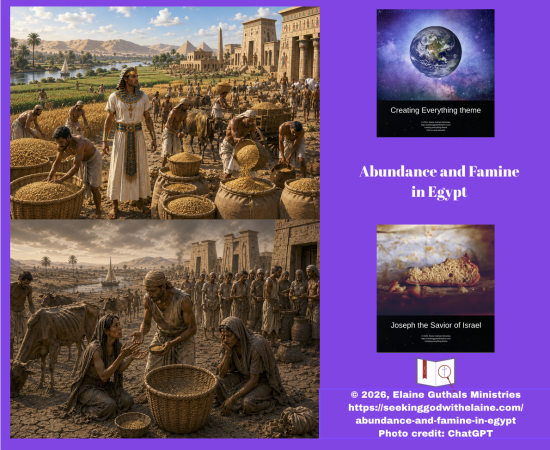
At the end of the last devotion, Pharaoh had just told Joseph about his dreams, and Joseph had interpreted them. What was Pharaoh’s response?
Let's Put It into Context
To read devotions in the Creating Everything theme, click the button below.
Devotions in the Joseph the Savior of Israel series
Joseph’s Personal Life
“Then Pharaoh gave Joseph a new Egyptian name, Zaphenath-paneah. He also gave him a wife, whose name was Asenath. She was the daughter of Potiphera, the priest of On. So Joseph took charge of the entire land of Egypt. He was thirty years old when he began serving in the court of Pharaoh, the king of Egypt. And when Joseph left Pharaoh’s presence, he inspected the entire land of Egypt” (Gen. 41: 45-46 NLT)
The Hyksos Pharaoh, who had adopted Egyptian ways, got Joseph to do the same — at least in outward appearance.
Joseph received an Egyptian name as well as an Egyptian wife. Why was this important? Because he was a foreigner, it removed social barrier. He was now one of them.
The meaning of Joseph’s name is interesting. Maclaren cited Brugsch as reporting that it meant “… ‘governor of the district of the dwelling-place of the living one,’ …” That jives with what Hilprecht noted, though he was speaking of the position — Tare or “chief of the entire administration.”
Resource
Wait! What????
First, Joseph is called Vizier. Then he is called Tare.
So, which one is it?
Well, actually they are the same but different.
- Vizier means second-in-command.
- Tare is the actual Egyptian administrative title.
I can see that. Have you ever asked a person, “What is your title?” Then you had to ask, “Okay, so tell me what you do.”
It would be hard to put Joseph’s duties under one title.
- Advisor
- Administrator
- Economic planner
- Judge
- Distributor
- Overseer of labor
- Overseer of storage
- Pharaoh’s executive authority
Tare has been preserved on monuments. It was usually given to a chief priest or prince. This is important to Joseph’s story because he would have been governor, judge, and treasurer.
Now, this wife wasn’t just anyone. She was the daughter of a priest. Her father was a priest of On, who merged with another to become Amon-Re, the most powerful god in Egypt.
Bountiful Years Came to Pass
“As predicted, for seven years the land produced bumper crops. During those years, Joseph gathered all the crops grown in Egypt and stored the grain from the surrounding fields in the cities. He piled up huge amounts of grain like sand on the seashore. Finally, he stopped keeping records because there was too much to measure” (Gen. 41: 47-49 NLT)
The seven years of plenty came as Joseph prophesied.
The abundance happened just as Joseph prophesied. And Egypt was ready.
There probably had been some storage places already built. Joseph had them build more. There was no way they had enough storage places to store seven years’ worth of grain.
Notice, these storehouses weren’t rural. They weren’t in one city. Joseph had them built all over Egypt.
It says that the Egyptians gathered so much that they stopped counting. It was too much to count.
Jehovah is like that. The fulfillment of Jehovah’s promises brings us more than we imagined.
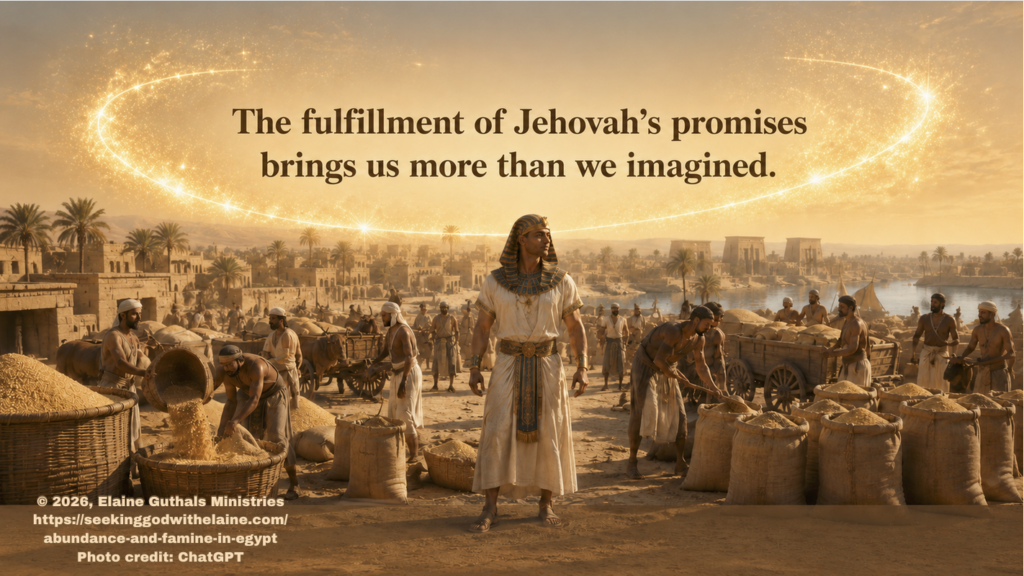
They were able to do this because Jehovah came to Pharaoh and prepared him for this. Because He did, Joseph’s first dream came true.
Joseph’s Sons Were Born
“During this time, before the first of the famine years, two sons were born to Joseph and his wife, Asenath, the daughter of Potiphera, the priest of On. Joseph named his older son Manasseh, for he said, ‘God has made me forget all my troubles and everyone in my father’s family.’ Joseph named his second son Ephraim, for he said, ‘God has made me fruitful in this land of my grief’” (Gen. 41: 50-52 NLT)
While Joseph was Vizier, his family grew.
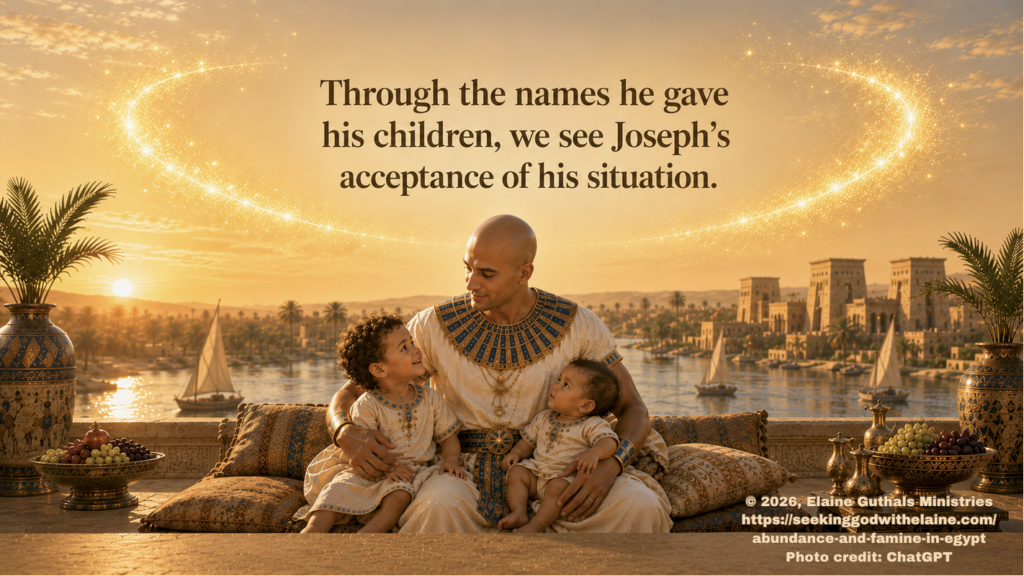
Jehovah was good to Joseph while he was a ruler in Egypt. He had two sons named Manasseh and Ephraim.
Joseph acknowledged Jehovah’s intervention in his life by the names he gave his sons. That showed that he honored Jehovah in his home as well as in his work that He gave him.
Names were very important to the Hebrews. Remember, they have to do with the child’s behavior.
Manasseh helped restore the importance of family to Joseph. He could give up on the hurt and focus on raising a family to honor Jehovah
By the time Ephraim was born, Joseph was content where he was living.
Through the names he gave his children, we see Joseph’s acceptance of his situation.
Famine Comes to Pass
“At last the seven years of bumper crops throughout the land of Egypt came to an end. Then the seven years of famine began, just as Joseph had predicted. The famine also struck all the surrounding countries, but throughout Egypt there was plenty of food. Eventually, however, the famine spread throughout the land of Egypt as well. And when the people cried out to Pharaoh for food, he told them, ‘Go to Joseph, and do whatever he tells you.’ So with severe famine everywhere, Joseph opened up the storehouses and distributed grain to the Egyptians, for the famine was severe throughout the land of Egypt. And people from all around came to Egypt to buy grain from Joseph because the famine was severe throughout the world” (Gen. 41: 53-57 NLT)
After seven years of plenty, the seven years of famine began.
Ooo, baby. Then the bad came to pass. The famine was just as bad as Joseph said it would be.
But on the other hand, it was much worse. Joseph had only talked about its effects on Egypt. This famine hit all lands.
Of course, the hungry people went to Pharaoh. He directed them to Joseph.
Joseph opened the storehouses and started selling grain. He didn’t want to open them too early and risk running out of food. He didn’t want to open them too late and have people dying from starvation.
Think about this. Some may have still considered Joseph a foreigner. But they couldn’t have let that stand in their way to food.
If they said they wouldn’t buy food from Joseph, that would have been an affront to Pharaoh. They would have been harming themselves because they would not have gotten food.
Part of us has probably said at one time or another how horrible it was that the government sold food to its own people. It was the grain supplied by the people that was sitting in the storehouses.
Well, no it wasn’t. Remember, there was a “… one-fifth of all the crops …” (Gen. 41: 34 NLT) on all the grain grown in the bountiful years.
It was the government’s grain now. Governments rarely do anything for free.
But Egypt wasn’t just feeding themselves. They also sold to people from other countries. The famine was worldwide.
Making the Connections #1
How does preparing for the future differ than “Don’t store up treasures here on earth…” (Mt 6: 19)?
Lawson argued that the verse does not cancel out the preparation. It emphasizes that we should rely on divine guidance for all provision of our needs.
Resource
The deciding factor of preparedness is whether, by preparing, we are relying more on ourselves than Jehovah. In other words, our attitude is the deciding factor.
Making the Connections #2
Next, we can go to the New Testament and take a different track. Let’s compare Joseph’s elevation to Vizier to the restoration of the Prodigal Son in Luke 15.
- Both received the best robe.
- Both received a ring.
- Both had a public element to it — public elevation and public feast.
Joseph’s brothers may have captured him in private and threw him into the cistern. His restoration was anything but. There was a public declaration.
Jehovah can sometimes give us a public restoration, but He also may do it in private.
The pattern is always the same, though.
- Humiliation
- Return
- Forgiveness
- Restoration
- Celebration
Jehovah restores far more than what we have lost.
Making the Connections #3
It is important to note that Joseph was 30-years old now. He had been sold to Egypt in 1692 BC when he was 17. That means for close to half his life, he had been away from his God and family.
We can’t miss the fact that, now in 1679 BC, Joseph was 30 years old when he was released from prison and began serving in the position Jehovah had prepared for him. It is the same age as Yeshua was when He started His ministry and priests when they begin serving in the Temple.
Joseph had been in Egypt 13 years. During the whole time, he had either been a slave or in prison – causing 13 years of suffering.
I think this is important, too. Prevailing theory at the time said each region had their own gods. They were just powerful in that region.
Jehovah showed that He is powerful anywhere, any time
How Do We Apply This?
- Be faithful in hidden seasons.
- Trust Jehovah’s provision.
- Remain faithful in foreign places.
- Prepare wisely for the future.
Father God. You give us wonderful promises. When You fulfill those promises – even when You make us wait – You do so abundantly. Help us, like Joseph, accept our situation. Amen.
If you don’t understand something and would like further clarification, please contact me.
If you have not signed up for the email providing the link to the devotions and the newsletter, do so below.
If God has used this devotion to speak with you, consider sharing it on social media.