Category: Obedience

  • Joseph and Two Other Prisoners

    Joseph, in performing his assigned duties. Comforts two other prisoners. This devotional reading looks at who those prisoners were and why they were upset.

    Nuggets

    • Joseph had been in prison long enough to have risen in the ranks.
    • The cupbearer and the baker would have been high-ranking officials.
    • Jehovah was working behind the scenes to bring about the offense of Pharaoh’s cupbearer and baker so that they would be sent to prison.
    • The two servants stood suspended between accusation and outcome, unable to determine what came next.
    • Joseph remained faithful to Jehovah by being attentive to other prisoners.
    • Jehovah was working behind the scenes so that both servants had dreams on the same night

    joseph-and-the-two-other-prisoners

    Joseph’s life was about to change. He didn’t know it yet – and it would take a long time.

    But the events of one night were going to have a huge impact on the rest of his life.

    Let’s Put It into Context

    To read devotions in the Creating Everything theme, click the button below.

    Devotions in the Joseph the Savior of Israel  series

    Two Other Prisoners

    “Some time later, Pharaoh’s chief cup-bearer and chief baker offended their royal master. Pharaoh became angry with these two officials, and he put them in the prison where Joseph was, in the palace of the captain of the guard. They remained in prison for quite some time, and the captain of the guard assigned them to Joseph, who looked after them” (Gen. 40: 1-4 NLT)

    Some Time Later

    Joseph had been in prison long enough to have risen in the ranks.

    Even if this was a prison under Potiphar’s authority, it may have taken some time for Joseph to win the warden’s trust. But then again — since Potiphar didn’t automatically have Joseph killed — he may have known of Joseph’s value and suggested the position..

    Either way, Jehovah was working behind the scenes. How can we tell? It wasn’t coincidence that the three main characters of this part of the story were in the same prison.

    Jehovah works out His plan — even if we have no clue what that plan is.

    But look at this from Joseph’s perspective. He was still smack dab in the middle of a hard situation. It looked like Jehovah is doing nothing to get him out of it.

    Or is He?

    Chief Cupbearer and Chief Baker

    The cupbearer and the baker would have been high-ranking officials.

    We would be more familiar with the baker. He oversaw food preparation.

    Less familiar to us would be the responsibilities of the cupbearer — unless we have read about it in some other stories. Important people who were afraid of being poisoned had someone taste their drink first.

    In this instance, the cupbearer was responsible for the Pharaoh’s drink. That would have made him a well-trusted servant.

    Offended Their Royal Master

    Jehovah was working behind the scenes to bring about the offense of Pharaoh’s cupbearer and baker so that they would be sent to prison.

    We don’t know the offenses that landed the two servants there because the word translated offended – ḥāṭāʾ (חָטָא) – is intentionally vague.

    The offenses could have fallen anywhere on a continuum from negligence to suspected conspiracy. We also need to remember the purpose of this prison. It was not a place for convicted criminals but a detention center for the accused while their guilt or innocence was determined.

    What is striking about the Hebrew word is that it doesn’t define the action itself. It defines responsibility. Whatever they had done, they were considered guilty in Pharaoh’s eyes.

    That means the specific offense is not the primary focus of the text. However, understanding enough about Ancient Near Eastern customs helps us grasp why these two men would be placed in such a position—while still recognizing that the ultimate reason was that Jehovah was working behind the scenes to bring them there.

    If we ignore the cultural context, we risk minimizing the seriousness of their situation. We need a clear enough understanding to recognize why their presence in the prison matters.

    To make sense of this, let’s look first at the positions they held when things went wrong for them. Both men were Egyptian elites – high-ranking officials within Pharaoh’s administration. These were positions of significant authority because both controlled the food and drink that entered Pharaoh’s body.

    Access to the Pharaoh’s food and drink meant access to his life.

    Even negligence could have led to the Pharaoh’s death. It wouldn’t have required a deliberate act of poisoning; even a failure in oversight could have created an opportunity for someone else to act. What might seem minor in a modern context could have been life-threatening in that setting.

    Such a failure could easily lead to an accusation of treason. Any breach – whether intentional or accidental – carried the weight of potential assassination.

    We also can’t overlook that the offense was severe enough to warrant imprisonment yet not established enough to result in immediate execution. This indicates that the matter was still under investigation.

    So, what can we reasonably conclude from the text?

    • A breach in protocol occurred.
    • There may have been a suspicion – whether real or perceived – of an attempt to poison Pharaoh.
    • The possibility of conspiracy can’t be dismissed, given that both men oversaw Pharaoh’s food and drink.

    Whatever the exact offense, it must be understood as a serious threat to Pharaoh’s safety.

    What we do know is this: both men — whether guilty or innocent — were under suspicion. They, like Joseph, had no control over their own outcome. They existed in a state of suspension, caught between accusation and judgment, waiting for a decision they could neither influence nor predict.

    Remained in Prison for Quite Some Time

    The two servants stood suspended between accusation and outcome, unable to determine what comes next.

    This is another clue that their offense, though not named, was not trivial. Both men remained in prison for an unspecified amount of time. We are only told that it was a long time.

    Would we have wanted out of prison like yesterday? Of course. Would we be glad that a thorough investigation was being conducted. Yes – especially if we were innocent.

    But again, we have to remember that prisons were not used to house convicted criminals. In terms we would use today, it was a temporary detention center while due process was being conducted.

    Assigned Them to Joseph

    Joseph remained faithful to Jehovah by being attentive to other prisoners.

    We said in the last devotion that one of Joseph’s responsibility was probably managing prisoners. This confirms that.

    It also gives us a little insight into how Joseph performed that responsibility. We’ll see in the next passage that he knew those under his care well enough to see when something was wrong.

    My mind went back to the passage where Joseph was tattling on his half-brothers. “… He worked for his half brothers, the sons of his father’s wives Bilhah and Zilpah. But Joseph reported to his father some of the bad things his brothers were doing” (Gen. 37: 2 NLT).

    Joseph was probably tasked with the duty of watching over the prisoners to determine if any were going to cause trouble. The warden would have wanted that information passed on.

    Think about it, though. This is the second time Joseph has been betrayed. Neither time had he done anything wrong.

    Joseph didn’t turn away from other people. He didn’t harden his heart against life.

    Joseph put his faith and trust in Jehovah.

    The Servants Are Upset by Their Dreams

    While they were in prison, Pharaoh’s cup-bearer and baker each had a dream one night, and each dream had its own meaning. When Joseph saw them the next morning, he noticed that they both looked upset. ‘Why do you look so worried today?’ he asked them. And they replied, ‘We both had dreams last night, but no one can tell us what they mean.’ ‘Interpreting dreams is God’s business,’ Joseph replied. ‘Go ahead and tell me your dreams’” (Gen. 40: 5-8 NLT)

    Each Had a Dream One Night

    Jehovah was working behind the scenes so that both servants had dreams on the same night.

    In the Ancient Near East, dreams were seen as messages from one of the gods of the region. In this case, it was — it was a message from Jehovah Himself.

    If the dreamer was lucky, they would receive a dream containing a direct message. No interpretation would be needed because the god would speak clearly in the dream.

    The people of Egypt, as well as those in Mesopotamia and Canaan, would have believed omen dreams needed interpretation through an established symbol system. These symbols had actually been collected and out into manuals. These written guides showed pattern recognition and cultural symbolism.

    Now, some of the people of the time would seek out dreams — called dream incubation. They would do anything from performing rituals to sleeping in the temple.

    Joseph Noticed They Both Looked Upset

    The two servants didn’t seek out the dreams because they thought there was no one to interpret them.

    Think about it. The servants were upset because they dreamed and there was no one to interpret the dreams.

    Those who interpreted dreams were usually priests, magicians, and trained diviners. The servants wouldn’t have seen any of those people in the prison.

    Their anxiety was cultural, not just emotional.

    Interpreting Dreams Is God’s Business

    Jehovah worked behind the scenes to have Joseph in that prison that day to point to Him.

    Here’s where Joseph’s ability to dream started to be handy. Both men had a dream they could not interpret.

    That is a very important theological concept. We can’t determine our own fate. We can’t secure it. We can’t even change it.

    When the meaning is hidden from us, we have to wait on revelation from Jehovah to enlighten us.

    But Joseph’s statement of “… ‘Interpreting dreams is God’s business,’ …” (Gen. 40: 8 NLT) would have been as foreign to them as Joseph was. Dream interpretation was a skill and a system, not a revelation — and definitely not from a single God.

    Joseph knew he couldn’t interpret the dreams, but God could use him to do so. God can use us to do the impossible when we let Him.
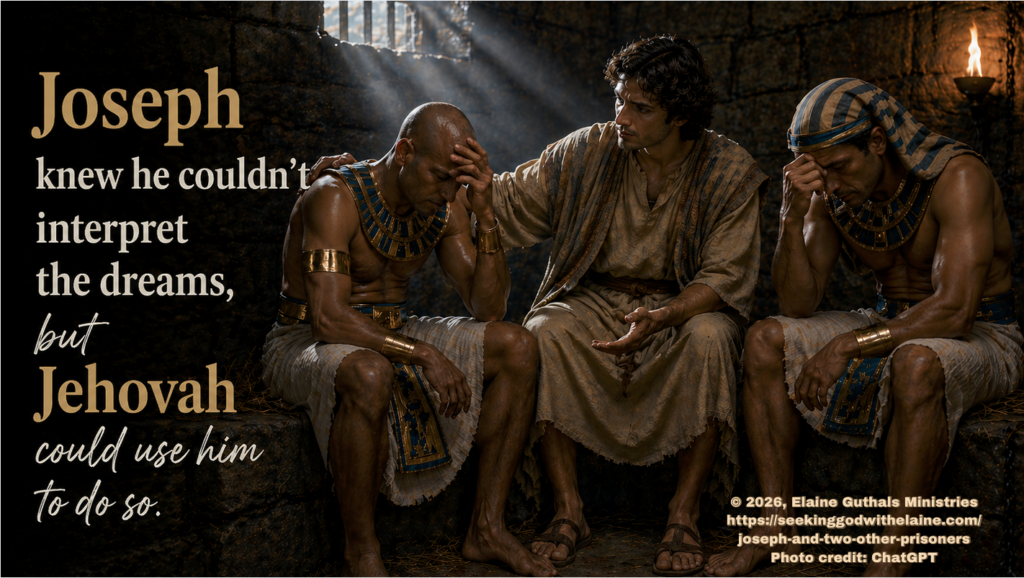
    That statement that revelation belongs to Jehovah would have been something huge for the servants to accept. Joseph was rejecting the entire Ancient Near Eastern framework. He wouldn’t be using a manual. He wouldn’t perform any rituals first.

    Joseph would immediately give them a clear interpretation.

    Making the Connections #1

    We kept saying that Jehovah was acting behind the scenes to place all the needed elements for the desired conclusion of this story. Since it was behind the scenes, no one saw it.

    But I wonder if Joseph sat there on sleepless nights pondering if this was Jehovah working. Did he put events together and ask, “Where is He going with this?”

    Yes, that is purely speculation. But isn’t that what we do – when we slow down long enough to evaluate our Sanctification Road.

    Making the Connections #2

    We kept saying that Jehovah was acting behind the scenes to place all the needed elements for the desired conclusion of this story. Since it was behind the scenes, no one saw it.

    But I wonder if Joseph sat there on sleepless nights pondering if this was Jehovah working. Did he put events together and ask, “Where is He going with this?”

    Yes, that is purely speculation. But isn’t that what we do – when we slow down long enough to evaluate our Sanctification Road.

    Making the Connections #3

    “… ‘Interpreting dreams is God’s business,’ …” (Gen. 40: 8 NLT)

    Joseph was right when he said that interpreting dreams was God’s business. The interpretation came through revelation. Revelations come from God.

    Think about it. There are just some things that we are never going to figure out. No matter how much we research, investigate, or reason, we aren’t going to know.

    God only makes Himself known through revelation. He has revealed Himself in His Word, and He continues to do so through the Holy Spirit.

    Revelation boils down to what the Hebrew calls gālah (גָּלָה). It means to uncover, expose, or lay bare.

    To be uncovered, something must first be covered – hidden. We usually use terminology such as “We can’t see …”

    If we can’t see it, we can’t uncover it.

    The same thing happens with revelations. If revelation started with. us, then knowledge of God would be built on culture, intellect, and imagination.

    That would mean our knowledge would be worldly, limited, and more than likely wrong.

    It is only when Jehovah reveals Himself that we truly learn of Him. Truth is anchored in Him, not our faulty perception of Him.

    That means we receive not invent. To know – in Hebrew yādaʿ (יָדַע) – means we have to actively accept what Jehovah is telling us about Himself.

    Joseph was talking about unraveling what was hidden – pithrōn (פִּתְרוֹן), from pāthar (פתר). He understood that true interpretation depends entirely upon revelation. Symbols do not explain themselves. Even when imagery is present, it is God who assigns its meaning.

    Jehovah reveals. We do not discover – we receive.

    How Do We Apply This?

    • Be attentive to others to determine when they are struggling.
    • Recognize when outcomes are beyond your control.
    • Wait on Jehovah to reveal what is hidden.
    • Be receptive to Jehovah’s revelation when He makes it known.
    • Trust that Jehovah is working—even when you cannot see it.

    Father God. When we are upset, You send others to comfort us. Open the eyes of our hearts to Your revelations so that we can seek the meaning which You are giving. Amen.

    If you don’t understand something and would like further clarification, please contact me.

    If you have not signed up for the email providing the link to the devotions and the newsletter, do so below.

    If God has used this devotion to speak with you, consider sharing it on social media.

  • Integrity under Authority

    Once again, Joseph found himself wrongly accused. This devotional reading looks at how Joseph stood in faith and integrity while he faced a temptation from an authority figure.

    Nuggets

    • It is not Scripturally accurate to say no one else was around.
    • We don’t know exactly what chore Joseph was attempting to perform or exactly where he went in to do it.
    • It would be logical to think that Joseph went into what was part of Mrs. Potiphar’s private rooms.
    • In her skewed recitation of what happened, Mrs. Potiphar accused Joseph of trying to make fools of them.
    integrity-under-authority

    Joseph must have thought he hit rock bottom when he was sold in slavery to Egypt. He would have been wrong.

    During the early years of his captivity (and we don’t know how long), Joseph was well provided for in Potiphar’s house. He was put into a position of authority.

    But that safe lifestyle was about to change.

    Let’s Put It into Context

    To read devotions in the Creating Everything theme, click the button below.

    Devotions in the Joseph the Savior of Israel  series

    Joseph and Mrs. Potiphar

    “One day, however, no one else was around when he went in to do his work” (Gen. 39: 12 NLT)

    No One Else Was Around

    It is not Scripturally accurate to say no one else was around.

    As a top official, Potiphar would, regardless of his wealth, have essentially had an estate. There would have been layers of servants that would have been around.

    If we go back to the Hebrew it says something different than what the New Living Translation says. Where this says no one else is around, the Hebrew says no man of the men of the house were around.

    • ’îš (אִישׁ) means a man
    • mēʾanšê (מֵאַנְשֵׁי) means from the men of

    Resource

    Who would the males have been?

    There would have been other overseers around. (Remember, Joseph was Overseer of the House.) There would have been accounts and scribes along with stewards.

    As Captain of Pharaoh’s Guard, Potiphar would have had a security detail. There would have been personal guards as well as estate security. There may even have been sentries that rotated shifts.

    That would include those men that may have been moving in and out of the house. If the estate was associated with land, there may have been field workers, transport workers, and storage and supply handlers.

    No, the lowest workers probably wouldn’t have had access to the house. Their overseers probably would have been summoned from time to time to give reports.

    Oh, yes. There would have been female servants around.

    There would have been Mrs. Potiphar’s personal attendants, domestic workers, and textile workers. There could have been assistants, runners, and even lower-level help.

    Why did Moses not mention them? Surely, Mrs. Potiphar did not want to be seen by anyone.

    What it is really saying here is there were no male witnesses around. Mrs. Potiphar picked a time that offered a moment of isolation. She didn’t want witnesses to hold her immediately accountable.

    If there were female servants around, Mrs. Potiphar either felt like they wouldn’t intervene or they would answer to her.

    As mistress of the house, wife of a high-ranking official, and a member of Egypt’s elite class, she would outrank every servant. But her authority would be real, not ultimate.

    Mrs. Potiphar would have the ability to give the male servants orders; and in practice, most would have obeyed her. But she would have taken a risk — especially in this instance.

    The order Mrs. Potiphar would have given to cover this up wouldn’t have been with regard to day-to-day household operations.

    Plus, Mrs. Potiphar would have given it to men who ultimately belonged in Potiphar’s chain of command, not hers. They were not just domestic extensions of her will.

    More than likely, Mrs. Potiphar was thinking exposure and witnesses. She was controlling the situation — because this was intentionally staged.

    Went in to Do His Work

    We don’t know exactly what chore Joseph was attempting to perform or exactly where he went in to do it.

    We were told in Genesis 39: 4 that Joseph had been made overseer of the house. This is a title that is recorded in Egyptian records that has survived.

    We’ll get into that in a little bit. Right now, we are going to say that – once again – Joseph was just going about his duties as assigned, and someone else made a bad decision. He didn’t let someone else’s actions dictate his response.

    Joseph responded the way God wanted him to respond.

    She Demanded

    “She came and grabbed him by his cloak, demanding, ‘Come on, sleep with me!’ Joseph tore himself away, but he left his cloak in her hand as he ran from the house. When she saw that she was holding his cloak and he had fled, she called out to her servants. Soon all the men came running. ‘Look!’ she said. ‘My husband has brought this Hebrew slave here to make fools of us! He came into my room to rape me, but I screamed. When he heard me scream, he ran outside and got away, but he left his cloak behind with me.’ (Gen. 39: 12-15 NLT)

    It would be logical to think that Joseph went into what was part of Mrs. Potiphar’s private rooms.

    We know that this wasn’t the first incident in which Mrs. Potiphar tried to start something with Joseph. The last time, he had appealed to Mrs. Potiphar to recognize her marriage vows as binding.

    She didn’t.

    Mrs. Potiphar commanded that Joseph lie with her. That wasn’t seduction — that was assertion.

    “I am the mistress of the house. You are a slave. You will do what I say.”

    That may or may not have been true as Joseph was most assuredly under Potiphar’s chain of command. But Joseph didn’t consider that to be under his authority.

    When his reasoning for not doing what she demanded had started with the things that affected her, Joseph ended with remaining true to Jehovah. He didn’t need her to accept that reason.

    But Joseph knew that he needed to remain true. He tore himself away.

    Well, that is a little more dramatic than what the Hebrew actually says. The Hebrew word used was vayyānas (וַיָּנָס).  It comes from the root word nûs (נוּס), which means to flee, escape, or run away.

    Tore himself away may have been more of a functional definition.

    But it takes the passage in a different direction than intended. The text does not emphasize the struggle. It emphasizes the decision — Joseph fled.

    Why did Joseph run? He knew no one would stop him – and no one would believe him or defend him.

    Remember, there were no credible witnesses around. All the men were out of the house.

    But the reason was more important. Joseph didn’t just leave her — he left the house, because sometimes obedience requires complete separation, not partial distance.

    Joseph refused to cross the same boundary Judah didn’t. Judah gave into the temptation to sleep with a prostitute. Joseph refused to fall into the temptation of the advances given his way.

    The problem was, in fleeing, Joseph left his garment behind. Mrs. Potiphar had proof that he had been there and something had come off that shouldn’t have.

    In her skewed recitation to the servants of what happened, Mrs. Potiphar accused Joseph of trying to make fools of them. She probably assumed that strengthened her case against Joseph. In reality it was another form of betrayal.

    To Fool Around with Me

    She kept the cloak with her until her husband came home. Then she told him her story. ‘That Hebrew slave you’ve brought into our house tried to come in and fool around with me,’ she said. ‘But when I screamed, he ran outside, leaving his cloak with me!’” (Gen. 39: 16-18 NLT)

    In her skewed recitation to her husband of what happened, Mrs. Potiphar changed her story from what she told the servants.

    But go back to Judah and Tamar. A garment had been used by Judah to deceive Jacob to believe Joseph was dead. A veil was used by Tamar to deceive Judah into thinking she was a prostitute.

    Now, a garment was used by Mrs. Potiphar to deceive Potiphar that Joseph had wrong intentions. She used it as physical evidence to become the victim.

    Mrs. Potiphar knew the accusation of Joseph making fools of them wouldn’t hold with Potiphar. So, she just gave him the facts.


    Making the Connections #1

    Why did we go into Joseph’s duties as steward and overseer? Yes, it was to explain Potiphar’s reaction.

    Yes, it was to show how Joseph was gaining needed knowledge and skills to be used in overseeing seven years of plenty and seven years of famine.

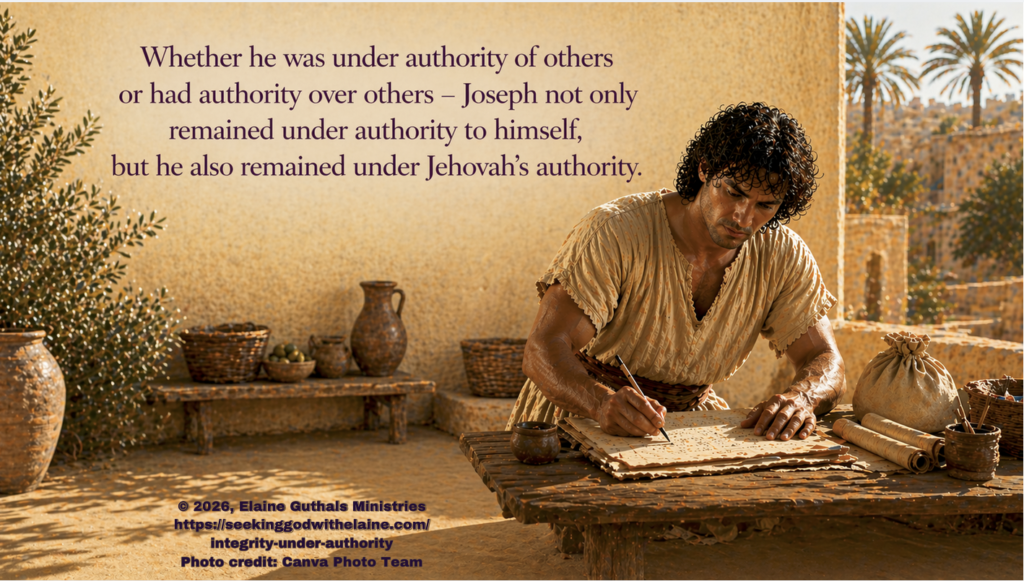
    More importantly – whether he was under authority of others and had authority over others – Joseph not only remained under authority to himself, but he also remained under Jehovah’s authority.

    What does all that mean? Joseph was faithful in tasks, with things, and with people. In short, he was faithful in everything that he was given. He faithfully managed what wasn’t his.

    Joseph’s obedience was not tied to his position, but to his perspective. He did not see himself as a victim of his circumstances, but as a steward within them – regardless of his position.

    Making the Connections #2

    Joseph lost his garment again — but this time, he lost it doing what is right. Let’s compare the two.

    Remember Jacob gave Joseph a tunic, not a coat of many colors. The Hebrew word is kĕtōnet (כְּתֹנֶת), a long garment associated with status, favor, and identity.

    What Joseph had on in Potiphar’s house was a beged (בֶּגֶד), a generic word for clothing, which could have been a tunic, outer garment, or cloak.

    Symbolic garment v. working garment.

    They aren’t the same – but the function is almost identical. Joseph loses each time.

    When his brothers stripped him of the kĕtōnet, Joseph lost identity and status. When he lost the beged, he lost position. The first time, his only crime might have been arrogance. This time, he was falsely accused.

    Both times, the garment is removed, used as false evidence, and Joseph suffered.

    Joseph lost the first garment in betrayal. He lost the second one in obedience.

    How Do We Apply This?

    • Remain faithful and obedient in all situations.
    • See His guiding hand in all our trials.

    Father God. We know trials are part of our Sanctification Road.  Help us to keep our mind set firmly on You through all that we experience in life. Amen.

    If you don’t understand something and would like further clarification, please contact me.

    If you have not signed up for the email providing the link to the devotions and the newsletter, do so below.

    If God has used this devotion to speak with you, consider sharing it on social media.
  • Joseph Arrived in Egypt

    After traveling on the caravan, Joseph arrived in Egypt. This devotional reading looks at how he fared after he was sold to an Egyptian.

    Nuggets

    • Meanwhile – while all we talked about in Genesis 38 was happening in Canaan – down in Egypt, Jehovah’s plan was going forward.
    • Joseph was sold to an Egyptian officer named Potiphar.
    • We don’t know how long Joseph had been in Egypt before Potiphar saw him, but there was a reason he did.
    • Joseph was made the Overseer of the House.
    • Mrs. Potiphar tempted Joseph to sin.
    joseph-arrived-at-egypt

    It was all part of Jehovah’s plan that Joseph go to Egypt. We might think it should have been a little easier on Joseph, but this was his Sanctification Road.

    Let’s take a look.

    Let’s Put It into Context

    To read devotions in the Creating Everything theme, click the button below.

    Devotions in the Joseph the Savior of Israel  series

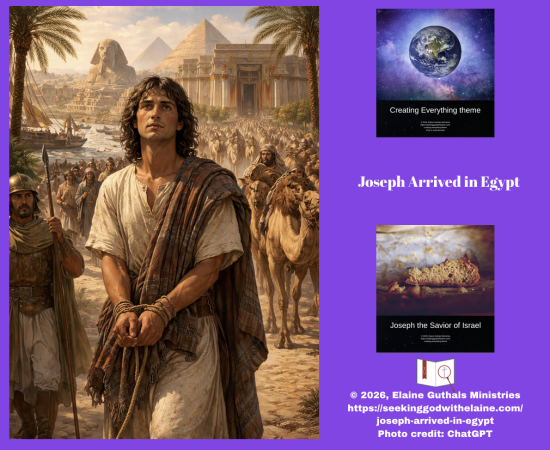
    Arrival in Egypt

    “Meanwhile, the Midianite traders arrived in Egypt, where they sold Joseph to Potiphar, an officer of Pharaoh, the king of Egypt. Potiphar was captain of the palace guard” (Gen. 37: 36 NLT)

    Meanwhile – while all talked about in Genesis 38 was happening in Canaan – down in Egypt, Jehovah’s plan was going forward.

    In the past few devotions, we have been following the fall and rise of Judah. His story of sin, repentance, forgiveness, and restoration is vital to the story of the nation of Israel. The Messiah would come from his line.

    Jehovah was multitasking. He was restoring Judah as He was watching over Joseph.

    Aren’t we so glad Jehovah can do that? He can lead Tom through his trials while Sally is going through totally different ones. That doesn’t even get into the chaos Elaine is getting herself into — and yes — He is right there with her, too.

    When we left our hero back in Genesis 37, Joseph was in a pickle. Ten of his brothers — all the ones who could walk and talk — all older (even if only up to seven years) — sold him. That was better than they were talking about – killing him.

    Joseph had been sold to distant cousins, who had taken him to Egypt. The year would have been 1692 BC. What did Joseph see when he got off the caravan?

    The Egypt Joseph first saw was at a moment when its systems were still strong. The year 1692 BC would have put it at the end of Egypt’s Middle Kingdom or just about ready to transition to the Second Intermediate Period.

    That would mean that its foundations were strong. It was structured, bureaucratic, and confident.

    But it was probably showing signs of starting to crack. Outside of the capital, the central authority was losing its power to the regional governors.

    Still, it was well oiled enough to recognize Joseph’s abilities — and open enough to make use of those abilities. He wouldn’t have been the only foreigner in the country.

    Joseph would probably have been brought to the Nile Delta in Lower Egypt. Called Lower Egypt – even though it was north of Upper Egypt – it referred primarily to the Nile Delta, the broad, fertile region where the river spread into many branches before reaching the Mediterranean Sea.

    But think back to your history classes. The Nile River – specifically its annual flooding – brought life to the region. It would have had a large agricultural component. Storage systems would have already been in place.

    But this area would have also been more cosmopolitan. It was an administrative center for the Egyptian government of the time. It would have boasted trade-heavy zones.

    There were many layers to Egyptian society.

    • Pharaoh (divine king)
    • Royal officials (like Potiphar)
    • Scribes (very important)
    • Skilled workers
    • Administrators
    • Laborers
    • Slaves (including foreigners)

    That would have put Joseph at the bottom of society’s class structure.

    Joseph in Potiphar’s House

    “When Joseph was taken to Egypt by the Ishmaelite traders, he was purchased by Potiphar, an Egyptian officer. Potiphar was captain of the guard for Pharaoh, the king of Egypt. The Lord was with Joseph, so he succeeded in everything he did as he served in the home of his Egyptian master.  Potiphar noticed this and realized that the Lord was with Joseph, giving him success in everything he did. This pleased Potiphar, so he soon made Joseph his personal attendant. He put him in charge of his entire household and everything he owned.  From the day Joseph was put in charge of his master’s household and property, the Lord began to bless Potiphar’s household for Joseph’s sake. All his household affairs ran smoothly, and his crops and livestock flourished. So Potiphar gave Joseph complete administrative responsibility over everything he owned. With Joseph there, he didn’t worry about a thing — except what kind of food to eat! …” (Gen. 39: 1-6 NLT)

    Purchased by Potiphar

    Joseph was sold to an Egyptian officer named Potiphar.

    Joseph’s brothers sold him to the Ishmaelite/Midianite traders for 20 shekels of silver. This was the price of a young slave at the time.

    The imagery of being brought down is equivalent of that to Judah’s went down. This is talking about the spiritual descent imagery.

    We’ll have to see if the outcome is the same.

    Jehovah provided that Joseph would be placed in Potiphar’s house. Through his experiences in Potiphar house, Joseph was in a position to go on to the third phase of Jehovah’s plan.

    We aren’t told how much Potiphar paid for him. Good business practice would be that the traders got paid more than that to recoup business expenses.

    But that isn’t the issue.

    The most important information in this passage is that Joseph was bought by Potiphar (Hebrew: Pôṭîfar). We aren’t given much information on who he was, but we are given enough to ground the story.

    We can tell Potiphar was fully Egyptian because of his name. Potiphar is Pa-di-pa-Ra, which means Given by Ra. Remember, Ra was the Egyptian sun god.

    Potiphar was not only an Egyptian officer, but he was also Captain of the Guard. He commanded an elite position in Pharaoh’s officers.

    It really becomes interesting when we look at Potiphar’s job title in the Hebrew. The Hebrew phrase is śar haṭṭabbāḥîm (שַׂר הַטַּבָּחִים). That literally means chief of the slaughterers.

    Ouch! But that isn’t the way that Egyptians looked at that. Potiphar was probably the head of royal security with execution authority. His job description probably included overseeing the royal prison, state executions, and protection of the Pharaoh.

    While there is no historical evidence confirming his identification, records do indicate the framework in which he lived. High-ranking officials had estate and servants. They even managed prisons.

    But this would have made Potiphar’s prison a royal prison. It would have been on the high-end scale as prisons of the day were categorized.

    Some of the literal translations label Potiphar as a eunuch. I don’t see that as there is a Mrs. Potiphar. The Hebrew word used – śārîs – can also mean high-ranking official. I go with court official.

    Whoever Potiphar was, he was an official in the elite ruling class powerful enough to buy, promote, and imprison Joseph. He couldn’t derail Jehovah’s plans for him.

    The Lord Was with Joseph

    We don’t know how long Joseph had been in Egypt before Potiphar saw him, but there was a reason he did.

    There are two very important statements in this passage.

    • “The Lord was with Joseph, so he succeeded in everything he did as he served in the home of his Egyptian master” (Gen. 39: 2 NLT).
    • “Potiphar noticed this and realized that the Lord was with Joseph, giving him success in everything he did” (Gen 39: 3 NLT).

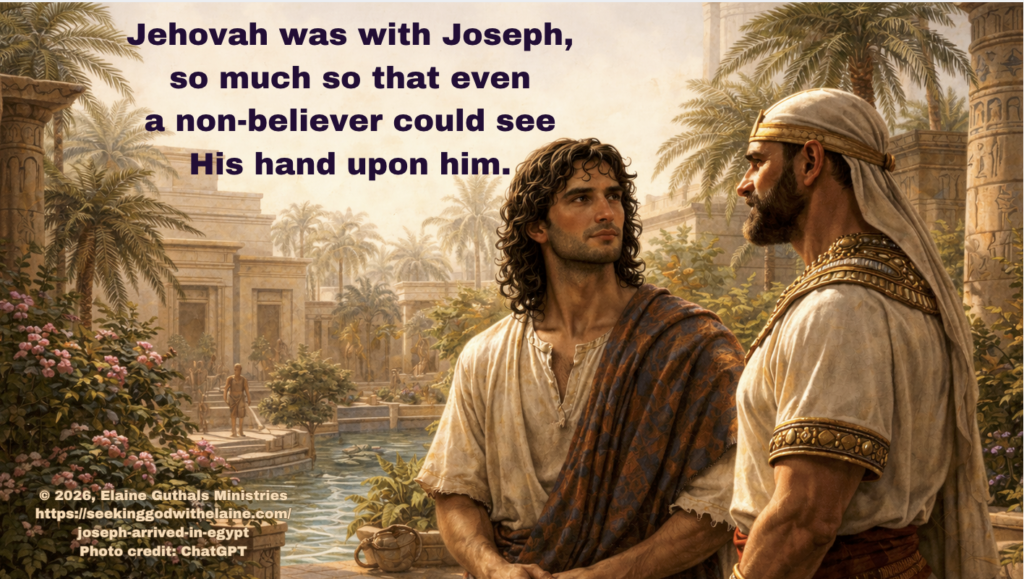
    Jehovah was with Joseph, so much so that even a non-believer could see His hand upon him.

    The Hebrew describes why. “The Lord was with Joseph …” (Gen. 39: 2 NLT) utilizes the immô (עִמּוֹ יְהוָה֙) – with Yahweh. This signifies a covenant closeness.

    This description of closeness was also strengthened by the use of favor – ḥēn (חֵן). That can be translated as grace that produces visible acceptance.

    Made Joseph His Personal Attendant

    Joseph was made the Overseer of the House.

    Joseph had experience shepherding sheep. Okay, maybe it was good training for what was coming, but the sheep didn’t talk back and interact. Joseph needed more training.

    So, Jehovah dropped Joseph into a large household. He had to deal with money as well as people. He had to learn everyday Egyptian life.

    Part of Abraham’s covenant was those who blessed Abraham and his descendants would be blessed. We have already seen this with Laban (Gen. 30: 27).

    Disaster Set Up

    “… Joseph was a very handsome and well-built young man, and Potiphar’s wife soon began to look at him lustfully. ‘Come and sleep with me,’ she demanded. But Joseph refused. ‘Look,’ he told her, ‘my master trusts me with everything in his entire household. No one here has more authority than I do. He has held back nothing from me except you, because you are his wife. How could I do such a wicked thing? It would be a great sin against God.’ She kept putting pressure on Joseph day after day, but he refused to sleep with her, and he kept out of her way as much as possible” (Gen. 39: 6-10 NLT)

    Mrs. Potiphar tempted Joseph to sin.

    Joseph was described with same description used for his mother, Rachel. In Hebrew, it is yĕpēh tō’ar wĕyĕpēh mar’eh. Remember, Rachel was described as “… but Rachel had a beautiful figure and a lovely face” (Gen. 29: 17 NLT). That information is used to set up the temptation.

    The problem came when Mrs. Potiphar began to notice Joseph.

    There was one slight problem. The boss’s wife demanded a piece of Joseph.

    Make no mistake. Mrs. Potiphar wasn’t looking for romance. She was asserting her power.

    Mrs. Potiphar didn’t see that anyone else would be hurt by the act. Joseph begged to differ. So, she kept demanding Joseph obey her.

    Joseph did the right thing. He said no thanks. He wasn’t going to disrespect Potiphar and God that way.

    The responses that Joseph gave were interesting.

    In his three reasons to Mrs. Potiphar, Joseph started with the two that affected her directly. “Your husband trusts me, and you are the only thing he hasn’t allowed me access. You have a covenant with him.”

    Then, and only then, did Joseph give his most important reason, but one she may or may not have accepted. “It is a sin against God.”

    Think about Joseph’s responses. They dealt with trust, integrity, and purity.

    Satan tries to tell us what we should do would be a victimless crime. He would be wrong.

    Joseph’s response wasn’t ultimately based on Mr. or Mrs. Potiphar. It was based on him – Joseph – being the man Jehovah required him to be.

    All sin is a crime against Jehovah. We are disobeying His command to be pure and obedient.

    Joseph didn’t need Mrs. Potiphar to accept his third reason. Our relationship with Sovereign God is our alone.

    Making the Connections #1

    Joseph didn’t rise because of Egypt, nor in spite of it. He rose to prominence as Israel’s savior because Jehovah had already determined his place within it.

    Making the Connections#2

    We are never told that Joseph went kicking and screaming to Egypt. There are no stories about him fighting back against his master.

    What we are told is that Joseph did his job. He lived his life.

    We can read into it that Joseph was what Paul called content. Yes, we’ll see the “payment” he requested of the baker and cup bearer showed he wanted to get out, but he continued to do his job.

    Joseph allowed Sovereign God to use him wherever He put him. His circumstances changed, but his obedience did not.

    How Do We Apply This?

    • Keep Jehovah’s laws and commandments.
    • Remain obedient to Him.

    Father God. Once our lives take a turn for the worse, we start kicking and screaming. Help us to be content where You put us and see You hand in all the events of our lives. Amen.

    If you don’t understand something and would like further clarification, please contact me.

    If you have not signed up for the email providing the link to the devotions and the newsletter, do so below.

    If God has used this devotion to speak with you, consider sharing it on social media.

  • The Tribes of Israel Established

    At the end of Genesis 36, the tribes of Israel were established. This devotional reading looks at closing up Jaccob’s story to prepare the way for the tribes to take over the story.

    Nuggets

    • Jacob was still Jacob, but his family and descendants were now the nation of Israel.
    • The Migdal-eder became tied to the history of Israel.
    • Reuben’s act was more than just a one-night stand with his father’s concubine.
    • Jacob heard about the coup and didn’t do anything about it!?!?!
      With the birth of Benjamin, the twelve tribes were complete.
    • There is one way, in my opinion, that we can look at it to me the statement about Benjamin’s birth being in Paddan-aram.
    the-tribes-of-israel-established

    Genesis 36 is one of those chapters that have a little bit of everything stuck all over. We talked first about Jacob and his family renewing the covenant with Jehovah. Then we started taking verses out of order to look at the three deaths addressed in the chapter: Deborah, Rachel, and Isaac.

    Now, we are going to turn to the story of Jacob’s twelve sons. Jehovah had plans for them – which we will start digging in when we get to Genesis 37.

    But let’s set it up.

    Let’s Put It into Context

    To read devotions in the Creating Everything theme, click the button below.

    Devotions in the Jacob the Patriarch series

    The Transfer from Jacob’s Story

    “Then Jacob traveled on and camped beyond Migdal-eder. While he was living there, Reuben had intercourse with Bilhah, his father’s concubine, and Jacob soon heard about it…” (Gen. 35: 21-22 NLT)

    Jacob

    Jacob was still Jacob, but his family and descendants were now the nation of Israel.

    It is interesting that the New Living Translation called him Jacob. Every other version listed in Bible Hub used the name Israel.

    Resource

    This, too, was a transition. The focus is not solely on Jacob. It is on the nation.

    Isaiah also showed this distinction between the man and the nation. “But now, O Jacob, listen to the Lord who created you. O Israel, the one who formed you says, ‘Do not be afraid, for I have ransomed you. I have called you by name; you are mine’” (Isa. 43: 1 NLT).

    This surprised me. I was thinking that nation really didn’t become a nation until they left Egypt.

    That tells me the potential was there. They just had to grow it to the level needed.

    Migdal-eder

    The Migdal-eder became tied to the history of Israel.

    The Hebrew Migdal-eder means Tower of Flock. A lot is known about this tower – and some is text. But there is also a lot of tradition and theology surrounding it.

    The Migdal-eder has long been a part of Jewish history. We know it was real because it is a landmark in Jacob’s travels shortly after Rachel died. This was the last location marker that we have before we are told that Reuben slept with his father’s concubine.

    Its function was to be used as a watchtower for the shepherd near Bethlehem. It would have been placed in an agricultural area to provide visibility to the shepherds and protection from predators – the two-legged and four-legged kind.

    Another thing we now is that David tended sheep around Bethlehem. He may or may not have frequented the Migdal-eder.

    The pastureland wouldn’t have a fence like Dad put up on the farm. David and first-century shepherds would have had boundaries – but those spaces would be fenced in by customs and tradition instead of fences. They would have been bound by tribal lands. Bethlehem was in the tribe of Benjamin.

    That is logical. This was rocky hill country. There would have been seasonal grass sprouting from thin soil. Shepherds would need the flexibility to move their flocks hunting that food and water. Think active management, not passive grazing.

    The fiction part may come in with regards to the sheep. They may or may not have been raised for Temple sacrifices. While the proximity would be a vote in favor of believing that, nothing has survived that specifically indicates that.

    Reuben

    Reuben’s act was more than just a one-night stand with his father’s concubine.

    I know. This has an ewww factor. It also was a scandal, not just a one-night stand.

    What Reuben was seeing was his mother’s arch-rival was now dead. He didn’t want the rival’s servant to be the one to whom Jacob turned. He especially didn’t want her elevated to legal wife.

    Truth be told, though, Reuben was probably mounting a coup. He was probably trying to depose Jacob by asserting leadership as firstborn.

    That is how this was usually interpreted in the Ancient Near Eastern culture. It was seen as challenging and claiming patriarchal authority.

    Remember, concubines (pilegesh) – while they were generally servants – were secondary wives, typically chosen to bear children when the primary wife was barren. Women who had the legal status of concubines, though, did not have the full privileges of the primary wife. Leah and Rachel were both primary wives, while Bilhah and Zilpah were concubines.

    That means Bilhah was in Jacob’s household and under his authority. Reuben ignored Jacob’s marital – and I would say legal – domain.

    Think Absalom rebelling against David (II Sam. 16: 21-22). Think Adonijah challenging Solomon (I Kgs. 2: 17).

    Jacob Heard about It

    Jacob heard about the coup and didn’t do anything about it!?!?!

    Well, not immediately. Babington tried to show us Jacob’s reasoning. He wrote, “Surely the reason was this, that we might thereby conceive that the grief was greater than could be expressed, to have his bed defiled by his own son.”

    Resource

    Eventually, Reuben will lose his birthright privileges. He was no longer considered the firstborn. He lost clan leadership and the double portion that went to the firstborn son.

    It is important that it is mentioned here, even if Jacob didn’t get around to doing anything about it until Genesis 49. This chapter includes the first listing of the tribes of Israel.

    Look at it this way. As the twelve tribes were about ready to be announced, Reuben lost his rights as firstborn. That prepares us for the coming change.

    Keep this power struggle in mind when we start talking about Joseph’s story.

    The Tribes of Israel Named for the First Time

    “… These are the names of the twelve sons of Jacob: The sons of Leah were Reuben (Jacob’s oldest son), Simeon, Levi, Judah, Issachar, and Zebulun. The sons of Rachel were Joseph and Benjamin. The sons of Bilhah, Rachel’s servant, were Dan and Naphtali. The sons of Zilpah, Leah’s servant, were Gad and Asher. These are the names of the sons who were born to Jacob at Paddan-aram” (Gen. 35: 22-26 NLT)

    The Tribes of Israel

    “… These are the names of the twelve sons of Jacob: The sons of Leah were Reuben (Jacob’s oldest son), Simeon, Levi, Judah, Issachar, and Zebulun. The sons of Rachel were Joseph and Benjamin. The sons of Bilhah, Rachel’s servant, were Dan and Naphtali. The sons of Zilpah, Leah’s servant, were Gad and Asher. These are the names of the sons who were born to Jacob at Paddan-aram” (Gen. 35: 22-26 NLT)

    With the birth of Benjamin, the twelve tribes were complete.

    Why is this important? Israel now existed as a full tribal family structure.

    We can’t talk about moving forward until we take a peek back. The twelve tribes of Israel can only move forward because the covenant family was purified in verses 2 through 4.

    Yes, we know Reuben was no longer purified. He just needed to ask forgiveness to be restored.

    Born in Paddan-aram

    There is one way, in my opinion, that we can look at it to me the statement about Benjamin’s birth being in Paddan-aram.

    Okay. I am confused. Rachel died in childbirth and was buried in Bethlehem. That isn’t Paddan-aram.

    That would mean that Benjamin was the only son born in the Promised Land.

    Why isn’t that highlighted? It could be that this was not meant as a strict geographic statement. Benjamin belonged to the time of wandering as Jacob had not settled in one spot yet – even though he was in Canaan.

    This may also have been considered a summary statement. I don’t know how long they had traveled, but maybe Rachel conceived in Haran.

    Some may see it as the end of the child-bearing era. We aren’t told of Jacob fathering any other children.

    I personally think that Benjamin was considered to be born in Paddan-aram because we aren’t told that Jacob had seen his father yet.

    That was part of the condition Jacob put on God the first time in Bethel. “Then Jacob made this vow: “If God will indeed be with me and protect me on this journey, and if he will provide me with food and clothing, and if I return safely to my father’s home, then the Lord will certainly be my God.” (Gen. 28: 20-21 NLT emphasis added).

    So – unless Moses didn’t put things in chronological order or skipped important details – Jacob hadn’t seen Isaac yet..

    Let’s look at it another way. All the sons but Benjamin were born under Laban’s authority. I think it is important that the last son – Rachel’s so – wasn’t.

    Stay tuned to see the important role Benjamin plays in the subsequent story.

    Making the Connections #1

    I think it is significant that Jacob returned to Mamre/Hebron. This is where Abraham eventually settled. This was where Sarah and Rebekah were buried. This is where Isaac, Leah, and Jacob himself would be buried.

    This was the ancestral home. Jacob was home.

    But then, on his way home, Jacob had hit three important locations central to the covenant story.

    First, he stopped in Shechem. This was where Abraham first entered the Promised Land (Gen. 12: 6-7). This was where Abraham built his first altar.

    Abraham entered into the promise here. Jacob and his whole family were tested — and failed.

    Then there was Bethel. Abraham did live here a while before (Gen. 12: 8) and after (Gen. 13: 3) his jaunt into Egypt. We aren’t really told Jacob actually stayed there a significant amount of time.

    Finally, there was Mamre, later named Hebron.That is where Abraham settled (Gen. 13: 18), Isaac settled (Gen. 35: 27), and Jacob settled (Gen. 35: 27).

    Through these three places, Jehovah has the family enter into the Promised Land; He reveals Himself to them; and He gives them rest and a place to call home across generations.

    Making the Connections #2

    We can argue that Jacob settled in Haran after going there to find a wife.

    We can also say that Jacob wandered for 30 years. He worked as a shepherd. He would have taken the flock wherever pastureland was available. We aren’t told that he settled in one area.

    Most importantly, Jacob wandered because he wasn’t living in the Promised Land. That has now changed. He was home.

    Jacob was not only home, but he was now the head of the covenant family. But it was more than a family.

    The nation was beginning to emerge.

    Making the Connections #3

    Ooo, baby. A lot happened in Genesis 35.

    Jacob finally arrived home and stopped wandering. The covenant was renewed after the atrocity of Shechem. The tribal formation was complete. After we check in with Esau in Genesis 36, we begin the story of Joseph.

    We went from the command to worship Jehovah to His establishing the covenant family. We went from removal of idols to the listing of the twelve tribes. We went from travel to settlement.

    Genesis 35 isn’t just diary entries. Everything in Genesis 35 moved toward God’s promises and the future of the covenant family.

    The covenant is the center of Israel’s story. Everything else is supporting narrative. Everything centers in Jehovah’s promises.

    How Do We Apply This?

    • Remember, sanctification comes in stages.

    Resource

    Father God. You have plans for each of us. Some plans take years to work out; some take centuries. Through all, thank You for being our Father. Amen.

    If you don’t understand something and would like further clarification, please contact me.

    If you have not signed up for the email providing the link to the devotions and the newsletter, do so below.

    If God has used this devotion to speak with you, consider sharing it on social media.
  • Transition and Loss

    We transition from one stage to another in life. This devotional reading looks at Jacob’s transition through the death of Deborah, Rachel, and Isaac.

    Nuggets

    • The death of Rebekah’s nurse Deborah may have stood in place of Rebekah’s death for Jacob.
    • Since childbirth in that day was hard enough, a complicated childbirth was probably almost impossible when traveling.
    • Sometimes, it feels like default mode to ask what sin was committed when someone experiences a trial.
    • Rachel was not buried in the family tomb at Machpelah.
    • Finally, finally, finally, Jacob made it home to Isaac.
    transition-and-loss

    While Jacob was heading home, tragedy struck. Three of his family members lost their lives.

    Let’s Put It into Context

    To read devotions in the Creating Everything theme, click the button below.

    Devotions in the Jacob the Patriarch series

    Death of Deborah

    “Soon after this, Rebekah’s old nurse, Deborah, died. She was buried beneath the oak tree in the valley below Bethel. Ever since, the tree has been called Allon-bacuth (which means “oak of weeping”)” (Gen. 35: 8 NLT)

    The death of Rebekah’s nurse Deborah may have stood in place of Rebekah’s death for Jacob.

    When we were introduced to Deborah, we weren’t given her name. “So they said good-bye to Rebekah and sent her away with Abraham’s servant and his men. The woman who had been Rebekah’s childhood nurse went along with her” (Gen. 24: 59 NLT).

    This is the only other place in Scriptures she is mentioned. Why is it important for us to know who she was?

    Bradford thought Deborah’s death represented a dissolving of the tie to Mesopotamia. I can see that. Jacob was the last covenant son to return “home” to Mesopotamia to find a wife.

    Resource

    I read some resources that said the tie was severed with her passing. I don’t see that. Rachel is still alive at this point as is Leah. They were born in Haran.

    Deborah’s death is a link beginning to close that generation.

    The name of burial spot – the oak of weeping – implies she was much loved. Her death (symbolizing the death of Rebekah’s household) may have also given Jacob a chance to mourn his mother’s death.

    Robertson disagreed with me. He felt Jacob hadn’t felt much for his mother in life let alone in death.

    Resource

    But why is Deborah there, and how did she get there?

    When Jacob left Canaan 30 years before, he left alone. Deborah did not return home with him.

    It is widely assumed that Rebekah has passed before these events occurred. The Midrash explained this as Deborah may have been sent to Jacob in Haran to tell him of his mother’s death and stayed with him.

    Other tradition describes Rebekah’s burial as intentionally private. Esau was known for his wickedness, and Jacob wasn’t there. The private burial was done to protect Rebekah’s honor.

    Another explanation is that not all the deaths of the matriarchs are given. Sarah’s death was recorded in Genesis 23. The next verses we will look at tell us of Rachel’s death. Rebekah’s and Leah’s deaths are not recorded.

    What we do know is that Isaac was living at Hebron (formerly called Mamre. Deborah was not living with him if she was buried in Bethel.

    But this gives us a sad bit of information. This almost certainly tells us that Rebekah died never having seen Jacob again. She would never meet the wives that she sent Jacob to find. The son she favored and schemed for had been lost to her.

    Death of Rachel

    Leaving Bethel, Jacob and his clan moved on toward Ephrath. But Rachel went into labor while they were still some distance away. Her labor pains were intense. After a very hard delivery, the midwife finally exclaimed, ‘Don’t be afraid — you have another son!’ Rachel was about to die, but with her last breath she named the baby Ben-oni (which means ‘son of my sorrow’). The baby’s father, however, called him Benjamin (which means “son of my right hand”). So Rachel died and was buried on the way to Ephrath (that is, Bethlehem). Jacob set up a stone monument over Rachel’s grave, and it can be seen there to this day” (Gen. 35: 16-20 NLT).

    Rachel Went into Labor

    Since childbirth in that day was hard enough, a complicated childbirth was probably almost impossible when traveling.

    Remember what Rachel said when Joseph was born? “And she called his name Joseph, saying, ‘May the Lord add to me another son!’” (Gen. 30: 24 ESV).

    Childbirth in the Ancient Near East was risky and precarious. This was a dangerous event in Jacob’s culture.

    Add to that the stress and struggles of a road trip. It was a recipe for disaster.

    I wonder what exactly the midwife meant when she said another son was born. Was she just informing Rachel of the gender of the child? Did she mean Rachel wouldn’t die, or Benjamin wouldn’t die? Or was it a callback to her prophecy when Joseph was born?

    Rachel wasn’t content with one child, but she died giving birth to the child for which she prayed. That was why she named him son of my sorrow.

    Newton took a stab at determining Rachel’s intent. He wrote, “She was sorry to leave her husband, her family, and her friends; and this feeling of sorrow led her to call his name Ben-oni.”

    Resource

    I can see why having a name of son of my sorrow might have comforted Ben. He could take it to mean that she was sorrowful that she couldn’t live to get to know him. (That is, if she didn’t selfishly experience the sorrow at her own death.)

    But I can see why Jacob changed the name. It was bad enough that Ben was going to grow up without Rachel, but knowing his name was wrapped up in her death could have been crushing.

    Jacob renamed the son to have a name that portrays hope.  It literally means son of my right hand. Benjamin would have been a great comfort to him.

    Fuller surmised that it probably meant that Ben was taking Rachel’s place in Jacob’s heart. I can see that, too.

    Resource

    Fuller also reminded us to look on this life as temporary.

    So Rachel Died

    Sometimes, it feels like default mode to ask what sin was committed when someone experiences a trial.

    We have to ask. Did Jacob unwittingly bring about Rachel’s death?

    Could Jacob have made a vow before Jehovah – or at least pronounced a curse? “But as for your gods, see if you can find them, and let the person who has taken them die! …” (Gen. 31: 32 NLT). At that time, he didn’t know Rachel was the one he was condemning.

    Was Rachel’s death just fallout from her taking the teraphim? Was it judgment?

    But them some may say Rachel prophesied her own death. “… She pleaded with Jacob, ‘Give me children, or I’ll die!’” (Gen. 30: 1 NLT). Yeah, children plural.

    We have to remember that Joseph was almost 17 then. Let’s look at our timeline.

    1709 BC – Joseph was born (Rachel)
    c. 1692 BC – Rachel died giving birth to Benjamin (Gen. 35: 16-20)

    Based on Timeline from

    Rachel so wanted children, but she was barren for almost seven years. Then she waited another 17 years to become pregnant with Benjamin.

    Leale made a good observation here. He wrote, “Death is here represented, not as the complete extinction of all thought and feeling, but as the separation of soul and body. It is not a sinking into nought, but only a change of state and place.”

    Resource

    Rachel was not buried in the family tomb at Machpelah.

    As Jacob’s household was traveling, Rachel was buried where she passed. Jacob’s erecting a standing stone is an expression of his grief.

    In the Complete Jewish Bible, stone pillar and stone monument are the same word — standing stone. So, what are standing stones?

    A standing stone was a large stone that was placed to commemorate sacred covenants or important events. They were used in the Bronze and Iron Ages (3150-586 BC).

    Oh, this is interesting.

    • “Jacob set up a stone pillar to mark the place where God had spoken to him …” (Gen. 35: 14 NLT).
    • “Jacob set up a stone monument over Rachel’s grave, and it can be seen there to this day” (Gen. 35: 20 NLT).

    The two standing stones were erected for different reasons. The first was erected to worship God. The second one was erected to memorialize a human, albeit the love of his life.

    This wasn’t something God instituted. This was an ancient custom.

    These were visible reminders for future generations of covenants and the significance of events.

    Rachel’s tomb played a role in future generations. “This is what the Lord says: ‘A cry is heard in Ramah — deep anguish and bitter weeping. Rachel weeps for her children, refusing to be comforted — for her children are gone’” (Jer. 31: 15 NLT).

    The children Rachel was supposedly mourning were those who had been exiled to Babylon. We know this verse was also used in conjunction with the Massacre of the Innocents in Matthew 2: 16-29.

    Death of Isaac

    “So Jacob returned to his father, Isaac, in Mamre, which is near Kiriath-arba (now called Hebron), where Abraham and Isaac had both lived as foreigners. Isaac lived for 180 years. Then he breathed his last and died at a ripe old age, joining his ancestors in death. And his sons, Esau and Jacob, buried him” (Gen. 27-29 NLT)

    Finally, finally, finally, Jacob made it home to Isaac.

    What in the world took Jacob so long to go home to his father? There might be some reasons.

    Jacob grew a lot in the way home. Yes, he grew a lot in Haran, but He went through trials and purifications I Genesis 34 and 35. He had to go through development stages.

    But that is what we do on our Sanctification Road. Jacob was no different. We don’t get a data dump from Jehovah, but rather a consistent growth.

    For better or worse, Jacob settled in Shechem. The whole debacle happened with Hamor and Shechem, but Jacob also worshiped. He built an altar and worshiped.

    Jacob and Esau had reconciled; but sometimes, reconciliation has to stabilize. The passage reads like true reconciliation, but Jacob may have it was probably tenuous at best. He may have wanted to stay in the central hull country for safety’s sake.

    We have to remember that Jacob wasn’t really a clan until he left Haran. He had always been a part of Laban’s clan. Now, he had to establish himself.

    Plus, Jacob had a large household, many animals, and servants and herdsmen. Pastoral migration may have been slow, especially if they experienced drought.

    Mainly, the passage reads like Jacob was experiencing spiritual hesitation. He wasn’t quick to fulfill his vow. That is, until he renewed his bow at Bethel.

    Jacob finally made it to Isaac. From the timeline, it looks like Isaac and Jacob were given roughly ten years to restore their relationship.

    We don’t hear anything about Isaac’s life after Jacob’s return. It seems like his life was always overshadowed by Abraham’s and Jacob’s lives. Yet he lived the longest of the three.

    We aren’t told that Abraham, Isaac, and Jacob had any concept of eternal life. So, “… he died and was gathered to his people …” (Gen. 35: 29 ESV) was probably just a way of saying he was buried.

    Just as Isaac and Ishmael had stood at Abraham’s grave, Esau and Jacob stood at Isaac’s. The twins had put their differences aside.

    Making the Connections #1

    I think it was interesting that Deborah was buried at Bethel. This was the place where Jacob first met Jehovah on his way out of Canaan. Now, he was returning with a mature faith.

    Jacob was ready to step into his role a patriarch. That meant he was taking over from the old generation, of which Deborah was numbered.

    Making the Connections #2

    We have to watch the phrase were gathered to his people or ancestors. It may have been a form of ancestor worship, a practice in the Ancient Near East.

    Got Questions gave us a good definition of what that was. They said it “… involves religious beliefs and practices consisting of prayers and offerings to the spirits of dead relatives.”

    Resource

    This was a pagan practice that championed the belief that dead ancestors lived on in spirit to influence the lives of living relatives. They were considered mediators between the living and their Creator.

    Taking that a step further, they believed a living ancestor — because of their morality — could act like gods, influencing their descendants.

    Disciples know that this is not the case. We know this because God’s Word tells us it is not.

    • “Finally, the poor man died and was carried by the angels to sit beside Abraham at the heavenly banquet. The rich man also died and was buried, and he went to the place of the dead” (Lk. 16: 22-23 NLT).
    • “So we are always confident, even though we know that as long as we live in these bodies we are not at home with the Lord” (II Cor. 5: 6eb NLT).
    • “And just as each person is destined to die once and after that comes judgment” (Heb. 9: 27 NLT).

    Yeshua is the only Mediator we have before Jehovah. Dead relatives don’t make our case for us any more than live ones do.

    God’ Word is explicitly we are to have no other gods but Jehovah. Honoring our parents — or ancestors — is one thing. Worshiping them is totally forbidden.

    Bible Hub told us how we are to treat our ancestors.

    • We want to treat them with respect.
    • We want to learn from our ancestors and follow their examples.
    • We want to be thankful for their testimony.

    Resource

    We don’t want to cross the line into worship.

    How Do We Apply This?

    • Remember that our souls do not die.
    • Don’t expect a prosperity gospel – at times it will feel like we go from one trial to another.
    • Remember, sanctification comes in stages.

    Resource

    Father God. Lord, we hurch what our family members pass. We know they are in a better place because they are with You in Paradise. Help us as we learn to live without them. Amen.

    If you don’t understand something and would like further clarification, please contact me.

    If you have not signed up for the email providing the link to the devotions and the newsletter, do so below.

    If God has used this devotion to speak with you, consider sharing it on social media.
  • Jacob Returned to Bethel

    Jacob finally made it back to Bethel. This devotional reading looks at how he worshiped Jehovah and how the covenant was reaffirmed.

    Nuggets

    • Jehovah will get us where He always wanted us to go.
    • Where Jacob had erected a standing stone before, he now built an altar.
    • God reiterated that He had changed Jacob’s name.
    • We are told in the verse that El-Shaddai means God Almighty.
    • The be fruitful and multiply promise occurs right after the name El -Shaddai.
    • Jehovah reaffirmed the covenant promises that He had given to Abraham and Isaac.
    jacob-returned-to-bethel

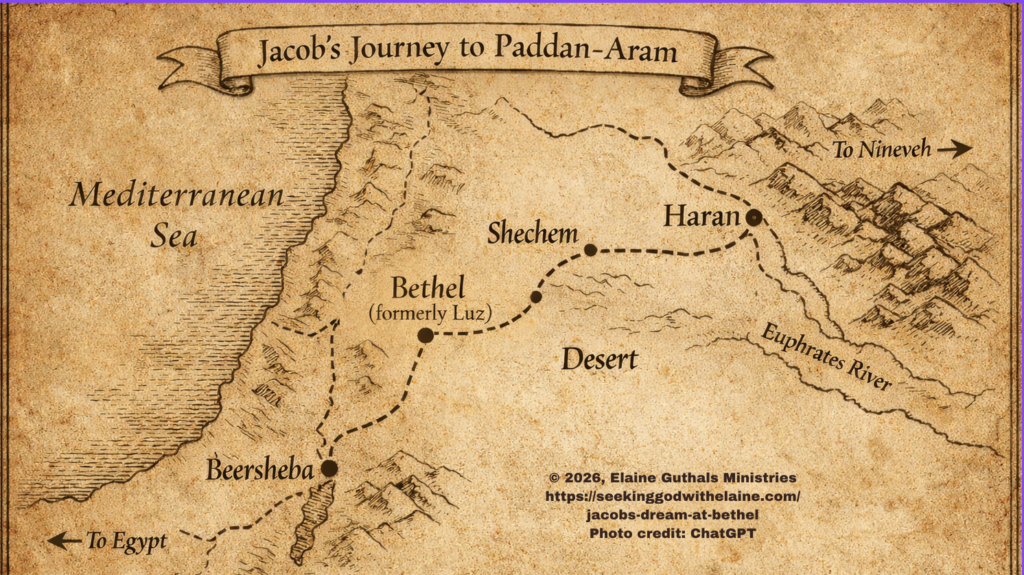
    Jacob had spent 20 years in Paddan-aram working for his wives and animals. Then, he had spent 10 years wandering around Canaan.

    Finally, finally, Jacob was going to fulfill his vow to return to Bethel. But he had some preparation to do first.

    Now, he was ready to worship.

    Let’s Put It into Context

    To read devotions in the Creating Everything theme, click the button below.

    Devotions in the Jacob the Patriarch series

    Jacob Built an Altar

    “As they set out, a terror from God spread over the people in all the towns of that area, so no one attacked Jacob’s family. Eventually, Jacob and his household arrived at Luz (also called Bethel) in Canaan. Jacob built an altar there and named the place El-bethel (which means ‘God of Bethel’), because God had appeared to him there when he was fleeing from his brother, Esau’” (Gen. 35: 5-7 NLT)

    They Set Out

    Jehovah will get us where He always wanted us to go.

    Jacob and his family set off for Bethel. I bet the people of the surrounding area did give them a wide berth. They would have heard about the massacre in the City of Shechem.

    They wouldn’t have wanted to get on Jacob’s bad side.

    But then one of the Proverbs has a good reminder. “When people’s lives please the Lord, even their enemies are at peace with them” (Prov. 16: 7 NLT).

    As Pastor Steve says, there are blessings in the obedience.

    But we can look at it another way. Jehovah goes before us and clears the path. That is a common theme throughout His Word.

    • “Do not be afraid or discouraged, for the Lord will personally go ahead of you. He will be with you; he will neither fail you nor abandon you” (Deut. 31: 8 NLT).
    • “You go before me and follow me. You place your hand of blessing on my head” (Ps. 139: 5 NLT).
    • “The Lord replied, ‘I will personally go with you, Moses, and I will give you rest — everything will be fine for you” (Ex. 33: 14 NLT).
    • “You will not leave in a hurry, running for your lives. For the Lord will go ahead of you; yes, the God of Israel will protect you from behind” (Isa. 52: 12 NLT).

    Instead of allowing neighboring clans to retaliate, Jehovah kept them safe.

    Why did Jehovah do that? He always wanted Jacob to come back to Bethel. He knew about Laban’s deception even before Laban knew he was going to switch the sisters as bride. He knew exactly how long Jacob was going to be gone.

    Everything Jacob had done was leading him back to Bethel.

    Built an Altar

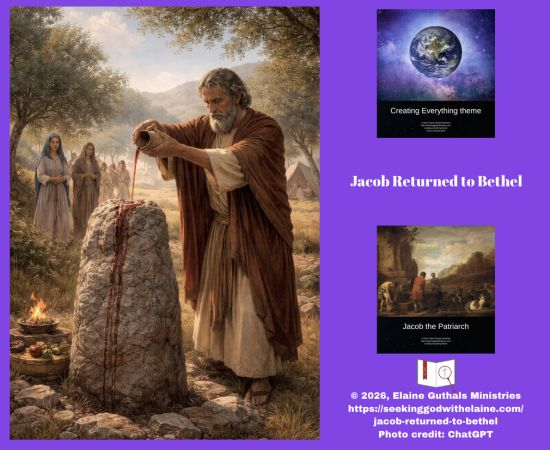
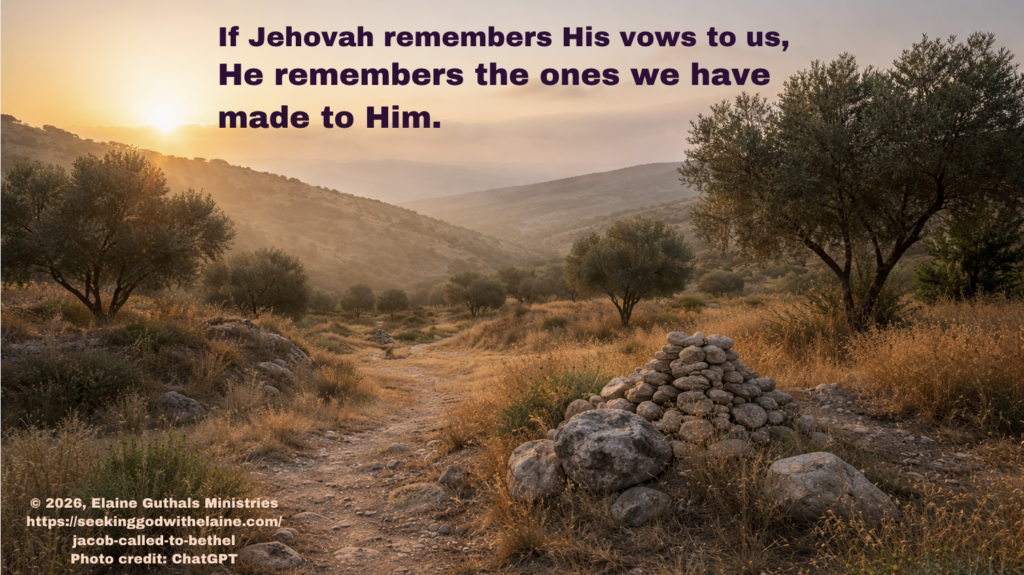
    Where Jacob had erected a standing stone before, he now built an altar.

    A lot had changed since Jacob had erected that standing stone when he left Canaan in 1723 BC. He had grown up a lot. More importantly, he had grown in his relationship with Jehovah.

    Where he had seen the area as the house of God (Gen. 28: 19), Jacob now saw Jehovah Himself. He showed that by the name of the altar – God of Bethel.

    The standing stone was a memorial to the memory of the dream. Jacob was alone and fleeing – until Jehovah appeared to him.

    Now, Jacob knew this was a mizbeach – a place for sacrifice and worship. He needed to celebrate with his Creator that the promise made decades ago had come full circle.

    Jacob knew what was expected of him. Jehovah wanted ongoing worship.

    Jacob was no longer surprised by God. He didn’t need a conditional vow anymore.

    More than that, Jacob didn’t need to just say, “God met me here.” He now chose to say, “I belong to You.”

    Jacob had left as Jacob. He came back as Israel.

    Covenant Reaffirmation

    “Now that Jacob had returned from Paddan-aram, God appeared to him again at Bethel. God blessed him, saying, ‘Your name is Jacob, but you will not be called Jacob any longer. From now on your name will be Israel.’ So God renamed him Israel. Then God said, ‘I am El-Shaddai — ‘God Almighty.’ Be fruitful and multiply. You will become a great nation, even many nations. Kings will be among your descendants! And I will give you the land I once gave to Abraham and Isaac. Yes, I will give it to you and your descendants after you.’ Then God went up from the place where he had spoken to Jacob. Jacob set up a stone pillar to mark the place where God had spoken to him. Then he poured wine over it as an offering to God and anointed the pillar with olive oil. And Jacob named the place Bethel (which means ‘house of God’), because God had spoken to him there” (Gen. 35: 9-15 NLT)

    Jehovah reaffirmed the promises to Jacob that He made to Abraham.

    Nothing interrupts the covenant promise — even deaths of key players. Not even waiting ten years to make it to Bethel.

    This is the only time where Jacob hears the complete covenant promises directly from Jehovah. He heard some in the blessing from Isaac – but that was Isaac, not Jehovah, and not all.

    Jacob heard some from Jehovah the last time he stopped at Bethel. But he was running and not in a good place spiritually.

    This affirmation is also important because it is the final time that the covenant will be confirmed to the patriarch himself. After this point, covenant responsibilities fall to Jacob’s descendants.

    Your Name Will be Israel

    God reiterated that He had changed Jacob’s name.

    When Jacob was wrestling with the man the night before he was to encountered Esau, the man changed his name to Israel.

    You know, I don’t remember Moses calling him Israel after that. I remember him still being called Jacob.

    Maybe that is the reason God felt like He had to reiterate it here.

    • You are Israel.
    • You are going to be the nation of Israel.
    • In fact, you are going to be a couple of nations.
    • You great …. grandsons will be kings.
    • I am going to give this land to your descendants.

    What is mildly mind boggling is that, when Jehovah changed Abram’s name to Abraham, he forever thereafter went by the name Abraham. Not so with Jacob. He usually was called Jacob, not Israel.

    Jewish tradition has some ideas about that. The names have two different meanings. Jacob means heel-grabber. Israel, on the other hand, means he struggled and prevailed.

    Like we said, Jacob isn’t the same person that he was when he left. He is ready to walk into the role as patriarch.

    I think it is a little more than that. It seems like Jacob is called that when it refers to his personal life. When talking about his spiritual or national role, he is called Israel.

    Yeah, Jacob may now be the father of the covenant people, but he is still a fallible man. He continued to struggle and grow his faith.

    Still, Jehovah acknowledged his transformation. He also acknowledged that this is the beginning of the family line.

    If we look, though, we will the nation referred to as both Jacob’s names. The nation is Israel, but it is also the House of Jacob.       

    But here, at this altar in this moment, Rachel is probably pregnant with Benjamin. Everything is almost in place.

    Jehovah confirmed that Jacob was a patriarch of the covenant people.

    El-Shaddai

    We are told in the verse that El-Shaddai means God Almighty.

    This isn’t the first time that this name of Jehovah was used.

    • “When Abram was ninety-nine years old, the Lord appeared to him and said, ‘I am El-Shaddai — “God Almighty.” Serve me faithfully and live a blameless life” (Gen. 17: 1 NLT).
    • “May God Almighty bless you and give you many children. And may your descendants multiply and become many nations!” (Gen. 28: 3 NLT).

    Think about it. The verse in Genesis 17 was the last recorded time that Jehovah and Abraham talked about the covenant. It was when he instituted circumcision.

    The verse in Genesis 28 was the blessing Isaac gave Jacob knowing it was Jacob, knowing he was giving the covenant son the blessing.

    This name was used during covenant discussions. Why is this name so important to the covenant?

    Well, El means God. It emphasizes power, might, and authority.

    Shaddai takes a little more explanation. That is because there are a couple of interpretations.

    The traditional translation of Shaddai is Almighty. It speaks to overwhelming power. We would see this as Jehovah being all-sufficient – that He can keep His promises.

    What are Jehovah’s promises? The wording says be fruitful and multiply, but that can only happen when He wills it to happen. And several times when He wills that to happen, the result will be the descendants will serve as King of Israel.

    A second translation of Shaddai is that Jehovah is God of the Mountain. In other words, He is God of the high place.

    Well, Jehovah is God in Heaven, the highest place there is. As Creator, He is sovereign over creation.

    But that kind of smacks of Ancient Near East pagan culture.

    The third and final translation is that Shaddai means God Who Nourishes or Sustains. It connects to the Hebrew word shad or breast.

    This translation focuses on the provision, nourishment, and life-giving power.. It would follow the Ancient Near East’s fertility ideas. It, too, goes along with be fruitful and multiply.

    Be Fruitful and Multiply

    The be fruitful and multiply promise occurs right after the name El-Shaddai.

    This is a restatement of past promises.

    • “Then God blessed them and said, ‘Be fruitful and multiply. Fill the earth and govern it …’” (Gen. 1: 28 NLT).
    • “Then God blessed Noah and his sons and told them, ‘Be fruitful and multiply. Fill the earth’” (Gen. 9: 1 NLT).

    It is like Jehovah was saying, “I am the God who has the power to bring life and sufficient enough to accomplish promises.”

    Wouldn’t that have been so comforting to Jacob at that time? Here he was struggling to deal with the chaos of Shechem. He went through the purification process and buried the idols (and maybe found out Rachel had Laban’s household gods all along).  Now, he is reestablishing covenant identity.

    And here Jehovah is saying, “Remember all those promises I gave Abraham? I am giving them to you. I have the power to pass them on to you, and nothing you will do is going to derail these promises. I have called you.”

    The original human blessing (Gen. 1) is now flowing through the covenant family (Gen 12, 35). Creation’s purpose is coming through Abraham’s line.

    A Great Nation, Kings among Descendants, and Give You the Land

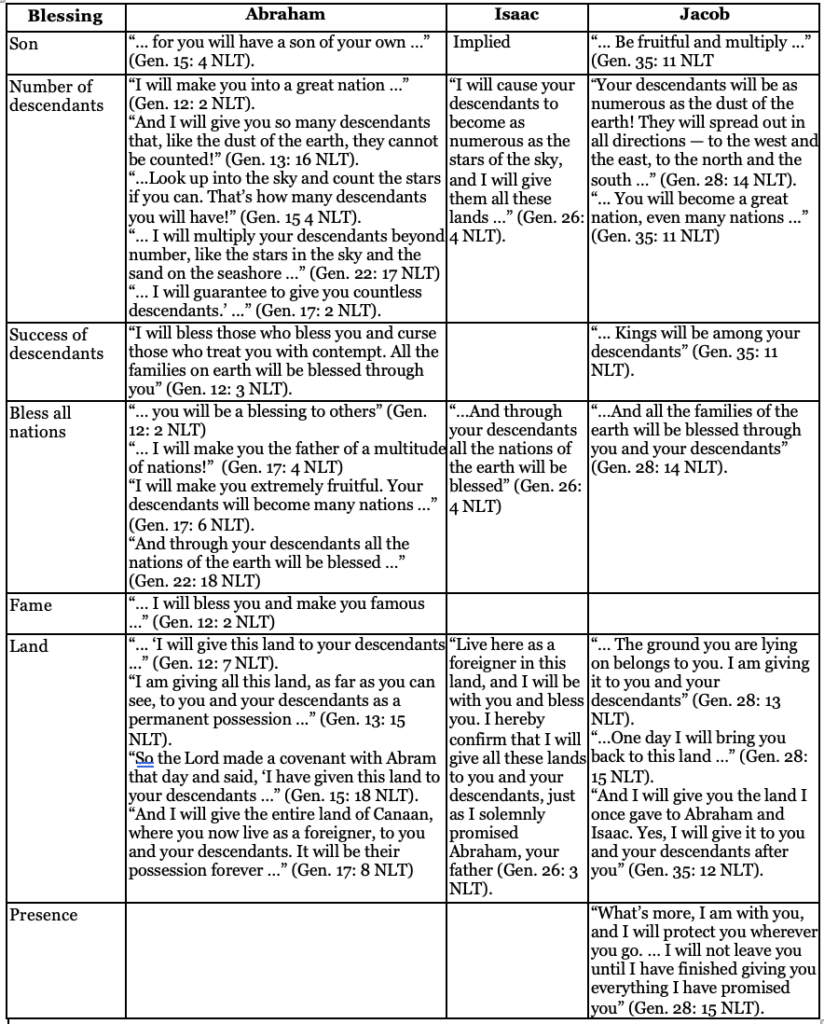
    Jehovah reaffirmed the covenant promises that He had given to Abraham and Isaac.

    The best way to look at this is to dig out the chart again and update it.

    We can’t forget that the patriarchal covenant began near Bethel in Genesis 12. Jacob did experience exile, but Jehovah brought him back to Bethel.

    A Stone Pillar

    Jacob used the standing stone in worship to Jehovah.

    We are told that Jacob offered a drink offering (nesek) and poured out oil. There is no mention of a burnt offering here where an animal was offered. That would have happened at the altar Jacob built if it did.

    A drink offering in Moses’ time (and we have no difficulty in believing this is what happened in Jacob’s time) consisted of pouring our wine before Jehovah. This symbolized complete surrender.

    It was notable that the drink offering occurred on the standing stone rather than the altar. It was all about honor because it was poured on the standing stone marking God’s presence.

    Jacob also poured oil on the standing stone. In other words, he was consecrating it by setting it apart as holy.

    True, Jacob already did this to the first standing stone he erected in Genesis 28. Now, he understands more. It means more because his relationship with Jehovah is more.

    We could look at this as a vow offering. Jacob was fulfilling his vow made in Genesis 28. It could have been a peace offering that celebrated restored relationships.

    Making the Connections #1

    Did you catch this? Jacob erected a standing stone in Genesis 28: 18. Thirty years later, he built an altar in Genesis 35: 7 and a standing stone in Genesis 35: 14.

    If Jacob used these as memorials, why did Jehovah outlaw them?

    Standing stones were a part of the Ancient Near East culture. They were religious and boundary markers as well as covenant witnesses. Sometimes, they were even symbols of deities.

    In other words, Jacob was using a cultural norm to commemorate when God revealed Himself to him.

    Jacob used them to correctly here and when it was used as a boundary between him and Laban. He didn’t set up idols, just memorial markers.

    But later, standing stones became more strongly associated with Canaanite idol worship. They were placed next to fertility shrines and Asherah poles and on Baal worship sites.

    The stones themselves didn’t change. What changed was their use in the culture. What the standing stones represented had changed.

    They had become a central feature of pagan worship. The law was made so that Israel did not compromise with the Canaanite pagan worship.

    That is a good reminder to us. What may start out as something innocuous can change into something sinful if used to represent evil or used in an evil way.

    But then, Jehovah allowed a standing stone memorial when the Israelites crossed the Jordan River into the Promised Land. The memorial was used in the correct way – as a memorial, not as a god.

    Making the Connections #2

    Robinson made a great observation. Jacob had changed – Jehovah hadn’t.

    Robinson said Jehovah still hasn’t changed. He wrote, “The same Divine Being, with all attributes and characteristics unchanged, rules to-day as then.”

    Resource

    Have you ever thought about how Jehovah makes our relationship with Him work? I mean, think about it. We are independent, free-willed creatures.

    And yes, that is we plural. He has billions of us to deal with daily.

    But Jehovah chooses us. He chose Jacob over Esau. He chose Isaac over Ishmael. He chose the ones He knew would choose Him and would endure to the end (Mt. 24: 13).

    What we can stand up and shout hallelujah at is that Jehovah is preparing us for the long haul. He is there to help us endure to the end.

    Making the Connections #3

    This gives us a good snapshot of early worship. It was simple, symbolic, and personal. It may not have been systematized, but it was already theologically rich and meaningful.

    We get more about how Jacob worshiped than we were told with Abraham. But isn’t that to be expected? It shows growth over generations.

    Jehovah remembered His vow, and now Jacob was living like he remembered his.

    How Do We Apply This?

    • Endure to the end.
    • Recognize that even when obedient, we may still suffer losses.
    • Learn more of Him while we learn more of ourselves.
    • Recognize that Jehovah is sufficient to fulfill the promises that He has given us.

    Resource

    Father God. You patiently wait for us to come back to You. Yes, You expect us to come after we have repented and been purified. But You love us so much, You wait for us. Thank You. Amen

    If you don’t understand something and would like further clarification, please contact me.

    If you have not signed up for the email providing the link to the devotions and the newsletter, do so below.

    If God has used this devotion to speak with you, consider sharing it on social media.
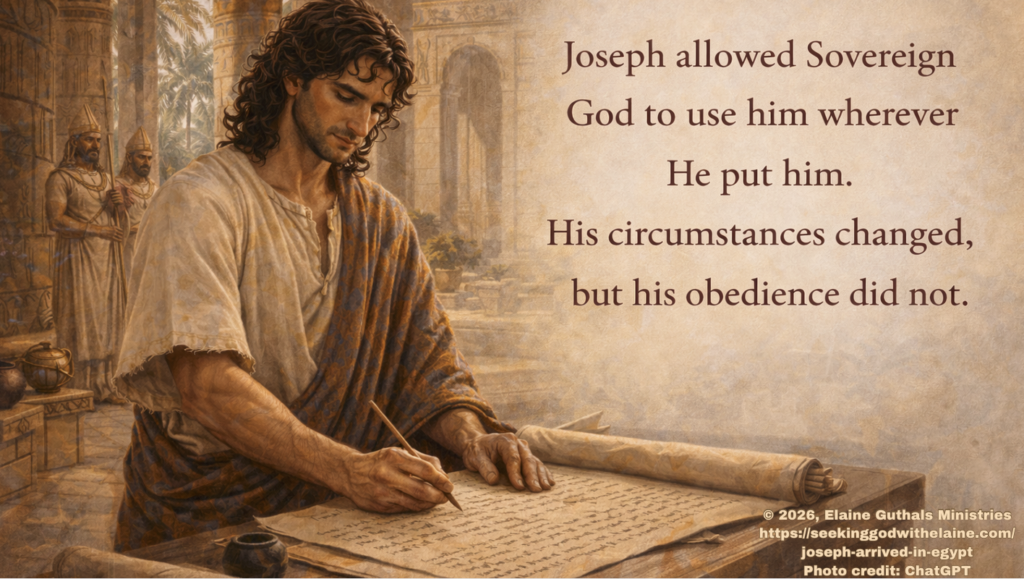
  • Jacob Called to Bethel

    After the heartbreak of Dinah’s defilement, Jacob and his family are called to Bethel to meet God. This devotional reading looks at the purification process to prepare them for that encounter.

    Nuggets

    • Jacob was finally going to fulfill the vow he made decades earlier at Bethel.
    • Before encountering Jehovah, Jacob’s household had to abandon the idols with which they compromised.
    • We cannot approach Jehovah when we allow other things to divide our focus on Him.
    • We may think it was interesting that Jacob buried the idols, not burned them.
    • Jehovah not only required them to rid themselves of idols, but He also required them to purify themselves.
    • Purification requires an outward response of change.
    • Those in Jacob’s household voluntarily gave up the idols they had in their possession.
    jacob-called-to-bethel

    Jacob was still on his way home from Paddan-aram. After being sidetracked in Shechem — and probably for several years — Jacob was finally heading for Bethel.

    But a lot of bad things had happened in Shechem. Before they got to Bethel, the whole family had to rededicate their lives to Jehovah.

    I’m going to take the verses out of order in the next couple of devotions. We have three very important deaths that I want to address together.

    But it isn’t all mourning. Stuck in the middle is the travel explanation and the formation of Israel — which (after Genesis 36) is the focus of the rest of the Book of Genesis.

    But first we have to get to Bethel.

    Let’s Put It into Context

    To read devotions in the Creating Everything theme, click the button below.

    Devotions in the Jacob the Patriarch series

    Renewal after Compromise

    “Then God said to Jacob, ‘Get ready and move to Bethel and settle there. Build an altar there to the God who appeared to you when you fled from your brother, Esau” (Gen. 35: 1 NLT)

    Jacob was finally going to fulfill the vow he made decades earlier at Bethel.

    More importantly, Jacob was going to obey this direct command from Jehovah.

    Bethel is well known to us. We have hear heard of it since the time of Abraham.

    • “After that, Abram traveled south and set up camp in the hill country, with Bethel to the west and Ai to the east. There he built another altar and dedicated it to the Lord, and he worshiped the Lord” (Gen. 12: 8 NLT).
    • “From the Negev, they continued traveling by stages toward Bethel, and they pitched their tents between Bethel and Ai, where they had camped before. This was the same place where Abram had built the altar, and there he worshiped the Lord again” (Gen. 13: 3-4 NLT).
    • “The next morning Jacob got up very early. He took the stone he had rested his head against, and he set it upright as a memorial pillar. Then he poured olive oil over it. He named that place Bethel (which means ‘house of God’), although it was previously called Luz” (Gen. 28: 18-19 NLT).
    • “I am the God who appeared to you at Bethel, the place where you anointed the pillar of stone and made your vow to me. Now get ready and leave this country and return to the land of your birth” (Gen. 31: 13 NLT).

    When Jacob first came to Bethel, Jehovah met with him there at His initiation. The promise was given to Jacob.  Unfortunately, Jacob responded imperfectly.

    What is really beautiful in Genesis 31: 13 is that Jehovah never forgot the vow Jacob first made at Bethel. He was calling him back to it.

    Now, that promise was going to be fulfilled.

    God wanted Jacob to worship Him. He gave him specific instructions as to where and how this worship should be.

    That is what Bethel was — a place of encounter, worship, return, and covenant reaffirmation.

    Robertson had an interesting comment. He wrote,

    “The third thing we mark here is the consecration of the place (ver. 1). It is not in reference to God, but for a help to our own feelings that we consecrate certain spots of earth and buildings. There are sacred places, not sacred for their own sake, but sacred to us.”

    Resource

    I get that. Only Jehovah has the right to designate a place as sacred. We each, though, have our own Bethel where we encounter Jehovah.

    Does my Bethel make it sacred for you? No. Does it make it sacred for me? Yes.

    We each need our own Bethel.

    It is very important that we don’t skip over Who was doing the calling. “… the God who appeared to you when you fled from your brother, Esau” (Gen. 35: 1 NLT).

    The God Who had been with Jacob when he left, had been with him for 20 years while he was gone, and had called him home. He was preparing Jacob and his family for the future.

    Our worship must be continual. We must always have an attitude of worship.

    Purification from Idolatry

    “So Jacob told everyone in his household, ‘Get rid of all your pagan idols, purify yourselves, and put on clean clothing. We are now going to Bethel, where I will build an altar to the God who answered my prayers when I was in distress. He has been with me wherever I have gone.’ So they gave Jacob all their pagan idols and earrings, and he buried them under the great tree near Shechem” (Gen. 35: 2-4 NLT)

    Before encountering Jehovah, Jacob’s household had to abandon the idols with which they compromised.

    Jacob’s family needed to purify themselves so that they could return to Jehovah. They had slid away from Him in varying degrees – and the way from passivity to murder.

    It was time to get right with Jehovah.

    Get Rid of All Idols

    We cannot approach Jehovah when we allow other things to divide our focus on Him.

    At this point, Isaac and Jacob and their families may have been the only ones who worshiped Jehovah. Yet Jacob had allowed idols to enter his house.

    Idols are anything that take our worship away from Jehovah.

    Hmmmmm. I wonder if Rachel had already gotten rid of the teraphim she took from Laban. Remember, when Jacob and crew left Paddan-aram. She took these and hid them her saddlebag on her camel.

    But there may have been more idols in the household than the ones Rachel took. They probably took some when they looted Shechem. This could have included idols, cult objects, and jewelry with religious significance.

    The first clue was when it says, “So they gave Jacob all their pagan idols and earrings, and he buried them under the great tree near Shechem” (Gen. 35: 4 NLT emphasis added).

    We may just see earrings as a fashion accessory. In the Ancient Near East, they also often had religious or magical significance. The all-encompassing term was amulets, an ornament or small piece of jewelry to give protection against evil, danger, or disease.

    It wasn’t just earrings. It was also rings, beads, and pendants. They had several purposes.

    • ward off evil spirits
    • invoke protection from a deity
    • bring fertility or good fortune.

    In other words, they could be used as protective charms. It was like they had their own personal portable religious objects.

    This does just say earrings here.

    All in all, there may have been more items buried than the teraphim Rachel took. Jacob was eliminating everything associated with Canaanite religion.

    He Buried Them

    We may think it was interesting that Jacob buried the idols, not burned them.

    Let me tell you. When I first read this, I was like Watkinson. Why didn’t Jacob burn the idols?

    Watkinson thought Jacob was up to his old tricks. He was double-dealing and not completely focused on Jehovah.

    Resource

    Looking into it more, I don’t think so. Part of that has to do with figuring out the culture in which Jacob lived.

    First off, we have to note that never one in God’s Word does it say that Jacob worshiped the false idols. They were Laban’s. Rachel took them. The boys looted Shechem.

    Nothing put the idols in Jacob’s possession.

    A second point of evidence shows Jacob’s immediate obedience to the call to move to Bethel. He immediately starts the purification process.

    So, what was the significance of Jacob burying the idols and Canaanite religious objects?

    Jacob was performing what we would call a ritual disposal. In the Ancient Near East, burial meant:

    • Removing it from circulation
    • Putting it “out of reach”
    • Treating it as something no longer to be used

    This meant a permanent separation.

    Jacob was symbolically removing the pagan influence. In essence, he was saying, “We are leaving this behind permanently.

    When something dies, we bury it. Idols were not living gods. They were just powerless objects.

    Jacob was following Ancient Near Eastern custom. Burial of religious objects were not casually destroyed. Hiding them was a way of decommissioning sacred objects without mishandling them.

    At this point, Jehovah had not commanded the idols be burned. He would in the Book of Deuteronomy. That is logical because, at the moment, it wasn’t a known, entrenched threat to believers.

    So, Jacob was going more by instinct in this instance than by Jehovah’s command.

    We can’t gloss over the fact that Jacob buried the idols at Shechem, where his sons had just murdered people and looted the city. In other words, he was leaving the impurity at Shechem, where it had bloomed.

    Purify Yourselves

    Jehovah not only required them to rid themselves of idols, but He also required them to purify themselves.

    The second action was to purify themselves. Jehovah wanted them to remove everything that was dividing their loyalty to Him.

    Repentance isn’t just feeling bad. It is about turning away from what is bad. It is about removing what competes with God and leaving it behind.

    Purify describes an inner ritual cleansing to remove contamination. The Hebrew word is tāhar. It means to be clean, to be pure, or to be pronounced clean.

    That means we

    • Become ritually clean.
    • Free from defilement.
    • Made pure before Jehovah.

    We can’t forget that this is more than removing spiritual contamination. Purification happens after disease and after contact with death.

    The internal and spiritual preparation shows itself in outward actions, such as washing.

    The goal is purity. Purity means possessing God’s moral character, having eliminated the stain of sin.

    But there is something else we usually don’t connect to this. We read about others who were performing the ritual purification act before meeting Jehovah.

    “Then the Lord told Moses, ‘Go down and prepare the people for my arrival. Consecrate them today and tomorrow, and have them wash their clothing. Be sure they are ready on the third day, for on that day the Lord will come down on Mount Sinai as all the people watch’” (Ex. 19: 10 NLT).

    I know. One says purify, and the other says consecrate. Purification is the preparation. Consecration is the identity. Probably more appropriate, purity is cleaning the vessel. Consecrating is dedicating the vessel.

    Jacob’s focus was on getting rid of the sin. Moses’ focus was on setting them apart to enter the covenant law.

    But both includes cleaning. We have to get rid of the sin either way.

    Put on Clean Clothing

    Purification requires an outward response of change.

    Look how else they were to prepare for worship. Purify themselves and put on clean clothes.

    True, I bet part of the purification process was for them to take a bath. A logical follow up to that would be clean clothes.

    But it doesn’t put any other qualifiers on that. It doesn’t say put on your best clothes.

    The emphasis is on exchanging and replacing that which is contaminated with that which is pure.

    Purity is the goal. Being clean is how we do that. We can’t put on anything unholy.

    We have to look at the Ancient Near East culture. Clothing at that time symbolized status, identity, or condition.

    Putting on clean clothing shows the inner purification through a changed outward appearance.

    We again see that again several times in God’s Word.

    • On Mount Sinai in Exodus 19
    • In Zechariah 3 when Joshua the High Priest appeared in filthy garments
    • Purification in Revelation 7: 14.

    It is obvious we need both purifying and changing. We need both the inward focus as well as the outward focus to remove spiritual contamination and displaying the new pure condition.

    So They Gave Jacob All Their Idols

    Those in Jacob’s household voluntarily gave up the idols they had in their possession.

    Jacob didn’t have to search the compound as Laban did. His family willingly gave them up.

    This is a family-wide preparation. Jacob was about to return where others had never been: “… Bethel (which means ‘house of God’) …” (Gen. 28: 19 NLT).

    Making the Connections #1

    So, what do we need to have a pure heart?

    • A willing heart
    • A life where the things that divide our spiritual focus removed
    • A genuine love for Jehovah and His ways

    Making the Connections #2

    Do we like it when Jehovah brings up our past? Ooo, baby. Huge emphatic NO!!!

    We don’t like to be reminded of our failures. But we must remember Jehovah’s provision to us. We have to respond with gratitude.

    Making the Connections #3

    Part of Jacob’s issue here was that he had made a vow to Jehovah when he was leaving Canaan. He had been back around nine years — and he hadn’t been to Bethel yet.

    If Jehovah remembers His vows to us, He remembers the ones we have made to Him.

    Let’s dig in.

    What was Jacob’s vow to Jehovah? “Then Jacob made this vow: ‘If God will indeed be with me and protect me on this journey, and if he will provide me with food and clothing, and if I return safely to my father’s home, then the Lord will certainly be my God.  And this memorial pillar I have set up will become a place for worshiping God, and I will present to God a tenth of everything he gives me’” (Gen. 28: 20-22 NLT).

    1723 BC – Jacob cheated Esau (both age 77) out of the birthright blessing given by Isaac age 137). He flees Canaan to Paddan-aram to Rebekah’s family. He agrees to work seven years to earn the right to marry Rachel (Gen. 29: 1-20)
    ~1709 BC — Zebulun born (Leah)
    ~1709 BC — Dinah born (Leah)
    1709 BC – Joseph was born (Rachel)
    1709 BC – Jacob, 91, finished working seven years for Rachel and agreed to continuing working for Laban to build up his personal wealth.
    1703 BC – Jacob, 97, and his family left to return to Canaan (Gen. 31: 3)
    ~1694 BC — Dinah was defiled
    c. 1692 BC – Rachel died giving birth to Benjamin (Gen. 35: 16-20)

    Based on

    It was time to go to Bethel, and Jacob was going about it in the correct way.

    Making the Connections #4

    Craig was so right. He wrote, “The religion of the Gospel, though it is a scheme of mercy, is a system of discipline.”

    Resource

    Jehovah showed us mercy by not judging us to the full extent He could have. But mercy does not cancel responsibility.

    In a covenant, both sides have obligations—and ours must be marked by discipline, purification, and obedience.

    Making the Connections #5

    How many of us have drifted from our Bethel? We haven’t realized the compromises that we have made at our Shechem. We don’t expect the covenant responsibilities to apply to us.

    But we have drifted. We are in need of purifying ourselves and putting on new garments.

    We’ve got to bury or even burn our own idols.

    How Do We Apply This?

    • Be obedient to Jehovah’s call for purification.
    • Be thankful for all Jehovah has done for us in the past and all He will do for us in the future.
    • Grow in grace to aid in obedience.
    • Depart from evil so that we can repent.
    • Avoid doing wrong and actively pursue doing right.

    Resources

    Father God. We want to restore our covenants with You. Purify us and help us to change our garments so that we may be consecrated to You.

    If you don’t understand something and would like further clarification, please contact me.

    If you have not signed up for the email providing the link to the devotions and the newsletter, do so below.

    If God has used this devotion to speak with you, consider sharing it on social media.

  • Jacob and Laban’s Covenant

    Laban caught up with Jacob after he quietly left Haran. This devotional reading looks at the covenant the two made.

    Nuggets

    • I wonder if Jacob would have sentenced the thief to death if he would have known it was Rachel.
    • Jacob unloaded because years of pent-up frustration came spewing out.
    • Laban again staked his claim but accepted defeat.
    • Jacob and Laban made a covenant and had a meal to seal the deal.
    • On the surface, it looks like Laban and Jacob are swearing by the same God, but they may not have been.
    • Jacob and Laban entered into a covenant agreement, but it doesn’t seem like their relationship was mended.
    jacob-and-labans-covenant

    Things had gone downhill between Laban and Jacob. When Jehovah had told Jacob to return to Canaan, he rounded up the flocks and herds, put his wives and children on camels, and set off.

    The problem was that Jacob set off in secret without telling Laban. What did Laban think of that?

    Let’s Put It into Context

    To read devotions in the Creating Everything theme, click the button below.

    Devotions in the Jacob the Patriarch series

    Rachel and the Teraphim

    “‘But as for your gods, see if you can find them, and let the person who has taken them die! And if you find anything else that belongs to you, identify it before all these relatives of ours, and I will give it back!’ But Jacob did not know that Rachel had stolen the household idols. Laban went first into Jacob’s tent to search there, then into Leah’s, and then the tents of the two servant wives — but he found nothing. Finally, he went into Rachel’s tent. But Rachel had taken the household idols and hidden them in her camel saddle, and now she was sitting on them. When Laban had thoroughly searched her tent without finding them, she said to her father, ‘Please, sir, forgive me if I don’t get up for you. I’m having my monthly period.’ So Laban continued his search, but he could not find the household idols” (Gen. 31: 32-35 NLT)

    I wonder if Jacob would have sentenced the thief to death if he would have known it was Rachel.

    Rachel had taken the figurines on her own. Jacob knew nothing about it.

    Because of that, Jacobs reaction to Laban was totally honest. “What are you talking about?”

    Did Jacob make a vow before sovereign God? We can look at it that way. We know the rest of the story.

    Rachel got as far as Bethlehem in Canaan. There, she died in childbirth.

    Was this because Jacob made a vow to God that the person who took the idols would die? Was this just Sovereign God punishing the thief?

    We talked about the different possible reasons why Rachel took them.

    • These figurines were connected to inheritance rights.
    • Rachel could have seen that as a transfer of clan leadership from Laban to Jacob.
    • She may have taken them for worship purposes, if she retained a mixed allegiance like Laban did.

    Moses didn’t pass judgment on Rachel’s actions either way. He did not justify them, but he did not condemn them either.

    But once we connect this to Rachel’s death in Genesis 35, the question hangs in our minds.

    Back to 1703 BC. Laban searched.

    It is interesting he saved Rachel for last. Did he think she was the last one to take the idols? Or did he think she did and saved her for last in order to increase the humiliation he would think he was heaping on Jacob?

    The Teraphim were in the camel saddle while Rachel sat on them. Was this a way to subtlety Laban’s gods? The excuse of her claiming menstrual impurity would have been symbolic humiliation.

    Remember, Rachel and Leah had felt like Laban had treated them as foreigners. They felt that they had been sold off to Jacob (Gen. 31: 14-15).

    They were not expecting to be written into dear old dad’s will.

    In Rachel’s mind, this would have been great payback. Her manipulative father would be searching, powerless, without his gods — outwitted by a woman.

    Jacob’s Defense Speech

    “Then Jacob became very angry, and he challenged Laban. ‘What’s my crime?’ he demanded. ‘What have I done wrong to make you chase after me as though I were a criminal? You have rummaged through everything I own. Now show me what you found that belongs to you! Set it out here in front of us, before our relatives, for all to see. Let them judge between us! For twenty years I have been with you, caring for your flocks. In all that time your sheep and goats never miscarried. In all those years I never used a single ram of yours for food. If any were attacked and killed by wild animals, I never showed you the carcass and asked you to reduce the count of your flock. No, I took the loss myself! You made me pay for every stolen animal, whether it was taken in broad daylight or in the dark of night. I worked for you through the scorching heat of the day and through cold and sleepless nights. Yes, for twenty years I slaved in your house! I worked for fourteen years earning your two daughters, and then six more years for your flock. And you changed my wages ten times! In fact, if the God of my father had not been on my side — the God of Abraham and the fearsome God of Isaac — you would have sent me away empty-handed. But God has seen your abuse and my hard work. That is why he appeared to you last night and rebuked you!” (Gen. 31: 36-42 NLT)

    Jacob unloaded because years of pent-up frustration came spewing out.

    Can we read that tirade and not feel sorry for Jacob?

    • 20 years of service
    • Heat by day, frost by night
    • Losses absorbed personally
    • Wages changed ten times

    This is another place that we can’t forget that this is clan business. Jacob was putting putting forth a formal legal defense.

    I think this is the only place where it does not read as some form of the “God of Abraham, God of Isaac, God of Jacob” the patriarchal line.

    This talks about the “… fear of Isaac …” (Gen. 31: 42 NLT). Remember, this was the son who Jehovah told his father to bind and sacrifice (Gen. 22: 1-19).

    Oh, yeah, some of the terror was probably there. But in the end, it was replaced by the revenant awe that he was saved. I am sure that shaped Isaac’s relationship with Jehovah as well as his outlook on life.

    Bottom line here is Jacob acknowledged Jehovah’s watch care and His provision.

    Laban’s Counterclaim

    “Then Laban replied to Jacob, ‘These women are my daughters, these children are my grandchildren, and these flocks are my flocks — in fact, everything you see is mine. But what can I do now about my daughters and their children? So come, let’s make a covenant, you and I, and it will be a witness to our commitment’” (Gen. 31: 43-44 NLT)

    Laban again staked his claim but accepted defeat.

    I am sure when Laban left Haran, he thought that he would be victorious. He would avenge the slight leveled toward his clan and, most importantly, get back his wealth.

    Even though in clan culture Laban would have been able to justify his actions, he deferred to Jehovah’s command. So, instead of violence, he and Jacob made a covenant.

    The Covenant of Mizpah

    “So Jacob took a stone and set it up as a monument. Then he told his family members, ‘Gather some stones.’ So they gathered stones and piled them in a heap. Then Jacob and Laban sat down beside the pile of stones to eat a covenant meal. To commemorate the event, Laban called the place Jegar-sahadutha (which means ‘witness pile’ in Aramaic), and Jacob called it Galeed (which means “witness pile” in Hebrew). Then Laban declared, ‘This pile of stones will stand as a witness to remind us of the covenant we have made today.’ This explains why it was called Galeed — ‘Witness Pile.’ But it was also called Mizpah (which means ‘watchtower’), for Laban said, ‘May the LORD keep watch between us to make sure that we keep this covenant when we are out of each other’s sight. If you mistreat my daughters or if you marry other wives, God will see it even if no one else does. He is a witness to this covenant between us” (Gen. 31: 45-50 NLT)

    Jacob and Laban made a covenant and had a meal to seal the deal.

    In the Complete Jewish Bible, stone pillar and stone monument are the same word — standing stone. I think that is another instance where modern translators used modern words for our ease.

    A standing stone (or Matstsebah) was an ancient custom where a large stone was placed to commemorate sacred covenants or important events. They were used in the Bronze and Iron Ages (3150-586 BC). This practice was banned in Deuteronomy 16: 22 NLT).

    In our vernacular, we would say Jacob and Laban erected a memorial. It is interesting that Jacob’s family was in charge of gathering the stones.

    We see a difference of language with Laban and Jacob. While both are Semitic languages, they were distinct languages. I won’t bore you with the grammatical similarities and differences.

    We know Hebrew was the language of ancient Israel. Most of the Scriptures were written in Hebrew.

    Aramaic began in Laban’s neck of the woods – Aram (the region of Syria) – but became the diplomatic and trade language of the Ancient Near East. So, it became an international language, much like English is today.

    In fact, by Yeshua’s time, the everyday spoken language had shifted to Aramaic.

    We see several elements of a covenant here. Covenants are agreements, contracts, or promises between two parties to perform the responsibilities listed in the covenant.

    • A bond was formed to mutually benefit both parties.
    • Both accepted the responsibilities of the covenant – not crossing the line.
    • The covenant fellowship meal was had. 
    • A sacrifice was made.
    • I don’t know if the covenants was written on stone pillar or not.

    In verse 49 when Laban said “… May the LORD keep watch between us …” (Gen. 31: 49 NLT), he called Jehovah by name. He wanted to be sure that Jehovah saw that he kept his end of the bargain.

    But that also stemmed from Laban’s distrust of Jacob. “May God keep watch over you so you don’t come back and get me.”

    Oath by Different Gods

    “‘See this pile of stones,’ Laban continued, ‘and see this monument I have set between us. They stand between us as witnesses of our vows. I will never pass this pile of stones to harm you, and you must never pass these stones or this monument to harm me. I call on the God of our ancestors—the God of your grandfather Abraham and the God of my grandfather Nahor — to serve as a judge between us’” (Gen. 31: 51-53 NLT)

    On the surface, it looks like Laban and Jacob are swearing by the same God, but they may not have been.

    Laban invokes the name of Abraham and Nahor’s God. Yes, Abraham’s God was Jehovah. We aren’t really told that Nahor worshipped the same God once they stopped worshipping the false gods in Ur.

    But Nahor’s side of the family tree produced the women (other than Sarah who was Terah’s daughter) who were the matriarchs of the covenant line. I don’t see Jehovah picking a family that did not follow Him.

    Still, Laban is calling on the broader ancestral deity. Jacob is calling on the God of the covenant.

    There is a theological divide there.

    Garris had an interesting article on this. I am just going to leave you the address, and you can read it for yourself if you are interested.

    I know there is the debate on whether Nahor went with Abraham and Terah when they first left Ur or if they came later. Either way, Nahor’s — and eventually Laban’s — walk with Jehovah was different. Different people, different experiences, different levels of faith and obedience.

    In the end, Garris wasn’t really sure what Laban meant. He wrote, “Thus, when Laban spoke of the elohim of Nahor and Terah in Genesis 31:53, he could have meant the false ‘gods’ of Nahor and Terah, or he could have meant Yahweh the ‘God’ of Nahor and Terah. The verse is ambiguous.”

    Resource

    It is safe to know that Abraham’s family knew of Jehovah. I would say probably Nahor did serve Him also. Laban always has struck me as taking a more worldview approach — which in his world would mean hedging his bets by worshiping many gods.

    Departure

    “So Jacob took an oath before the fearsome God of his father, Isaac, to respect the boundary line. Then Jacob offered a sacrifice to God there on the mountain and invited everyone to a covenant feast. After they had eaten, they spent the night on the mountain. Laban got up early the next morning, and he kissed his grandchildren and his daughters and blessed them. Then he left and returned home” (Gen. 31: 54-55 NLT)

    Jacob and Laban entered into a covenant agreement, but it doesn’t seem like their relationship was mended.

    When Jacob left Haran, he left in fear. When Laban chased Jacob, he did so in anger.

    When they separated to go their different ways, there was no warmth or reconciliation. They had just made a formal – conditional – peace.

    Jacob was now free to truly become a patriarch.

    Making the Connections

    Jacob sure wasn’t on the same spot on the Sanctification Road when he left Paddan-Aram compared to when he got there. We see a lot of spiritual growth.

    Laban — not so much. Even after he recognized the blessings came from Jehovah, he didn’t really choose to serve only Him.

    That is sad. “No one can serve two masters. For you will hate one and love the other; you will be devoted to one and despise the other. You cannot serve God and be enslaved to money” (Mt. 6: 24 NLT).

    Straddling the fence isn’t going to cut it. We have to be totally faithful to Jehovah.

    How Do We Apply This?

    • Submit totally to Jehovah.

    Father God. You watch over us and care for us through the good times and the bad times. You are there when we are pursued and when we worship. Thank You for never leaving us. Amen.

    If you don’t understand something and would like further clarification, please contact me.

    If you have not signed up for the email providing the link to the devotions and the newsletter, do so below.

    If God has used this devotion to speak with you, consider sharing it on social media.

  • Jacob and Laban’s Conflict Comes to a Head

    Jacob had taken off from Haran to return to Canaan. This devotional reading looks at what happened when Laban went after him – and caught up with him.

    Nuggets

    • After Laban learned of Jacob’s departure, he and his clansmen pursued him.
    • Laban caught up with Jacob and aired his grievances — all the while remembering his hands were tied.
    • Jacob had reason to be afraid.
    jacob-and-labans-conflict-came-to-a-head

    Things had gone downhill between Laban and Jacob. When Jehovah had told Jacob to return to Canaan, he rounded up the flocks and herds, put his wives and children on camels, and set off.

    The problem was that Jacob set off in secret without telling Laban. What did Laban think of that?

    Let’s Put It into Context

    To read devotions in the Creating Everything theme, click the button below.

    Devotions in the Jacob the Patriarch series

    Laban Pursues

    “Three days later, Laban was told that Jacob had fled. So he gathered a group of his relatives and set out in hot pursuit. He caught up with Jacob seven days later in the hill country of Gilead. But the previous night God had appeared to Laban the Aramean in a dream and told him, ‘I’m warning you — leave Jacob alone!’” (Gen. 31: 22-24 NLT)

    After Laban learned of Jacob’s departure, he and his clansmen pursued him.

    Let’s go back a little and talk about Jacob leaving. I wrestled and wrestled with where Jacob was in relation to Laban.

    Jacob’s escape wasn’t a midnight panic. It was a carefully staged withdrawal. The flocks were already three days away (Gen. 30: 35-36). What if those flocks and herds were three days to the south – i.e., on the way home?

    The Bible Hub pointed out that it would have been easy to send those in stages, led by his four older sons. The Euphrates River, 60 to 70 miles south, could have been a staging point (Gen. 31: 21).

    Resource

    Then when it was all set, Jacob could have put his family on the camels and left (Gen. 31: 17).

    The head start was built into the system. By the time Laban realized what had happened, Jacob was already moving toward the hill country — toward covenant ground.

    Laban had gone to shear sheep (Gen. 31: 19). Three days after Jacob left, Laban learned the news.  It is logical to think that it would take him three days to get back to Haran. Then he would have to gather his clansmen, which would probably take another day or two.

    Did that stealthy exit give Laban the authority to go after them? Well, yes.

    Remember, we said that the wedding ceremony was when the guardianship of the bride passed from the father to the husband. That happened about the time that the wedding couple went into the special tent.

    But remember also, nothing about Jacob’s stay in Haran had been typical. He didn’t use the bride price – mohar – hadn’t been an upfront payment. Instead, he had worked for seven years.

    The second issue was that of establishing an independent household. Jacob doesn’t do that. He is still living on Laban’s land, working within his economic system and Laban’s supervision.

    In other words, the sisters were still part of Laban’s clan. Laban still thought of the grandchildren as being part of his clan.

    The flocks and herds, while they were Jacob’s wages, were still under Laban’s authority. They were on his land.

    Jacob did not choose the normal way to sever the treaty he had with Laban. Yes, his reasoning was very sound but still wrong.

    On top of all that, something that we would consider as Laban’s personal possession was taken. And it really was a theft.

    Yes, Jehovah will speak to those who do not totally believer in Him, such as Laban. He spoke to Abimelech (Gen. 20: 3) who totally didn’t believe in Him.

    Some versions translate verse 24 to read “… Don’t say anything to Jacob, either good or bad” (Gen. 31: 24 NIV, ESV, KJV, NKJV, NASB, CSB). Good News Translation admonished Laban not to threaten Jacob. The Contemporary English Version added don’t make a promise.

    The Hebrew translates it as tov (good) and rah (bad, evil, or wicked). It is interested that this is formed in spiritual terms.

    But not really. This is the covenant son, not just some standard, run-of-the-mill shepherd.

    The Confrontation

    “Laban caught up with Jacob as he was camped in the hill country of Gilead, and he set up his camp not far from Jacob’s. ‘What do you mean by deceiving me like this?’ Laban demanded. ‘How dare you drag my daughters away like prisoners of war? Why did you slip away secretly? Why did you deceive me? And why didn’t you say you wanted to leave? I would have given you a farewell feast, with singing and music, accompanied by tambourines and harps. Why didn’t you let me kiss my daughters and grandchildren and tell them good-bye? You have acted very foolishly! I could destroy you, but the God of your father appeared to me last night and warned me, “Leave Jacob alone!” I can understand your feeling that you must go, and your intense longing for your father’s home. But why have you stolen my gods?” (Gen. 31: 25-30 NLT)

    Laban caught up with Jacob and aired his grievances — all the while remembering his hands were tied.

    First, we have to deal with travel issues. In my wee little mind, I have trouble making it connect.

    • Laban was told on the third day that Jacob had fled.
    • He pursued him seven days.
    • He overtook him in the hill country of Gilead.

    So, I had a new map drawn and formatted differently. This helped.

    I know. Part of us is saying why would Laban throw this farewell feast when he refused to let Jacob go six years before.

    Go back to verse 2. “And Jacob began to notice a change in Laban’s attitude toward him” (Gen. 31: 2 NLT).

    Jacob was no longer the favored son-in-law. Despite all of Laban’s manipulations, Jacob got wealthy off him.

    Maybe Laban was no longer seeing his wealth increase because of Jacob (Gen. 30: 27). We said that, when Jehovah is working to prepare us for a change, He uses discontent. I think — especially in this case — the discontent had to have been on both sides.

    So, in a way, Laban throwing a party seems out of character. But then, he may have said that because he wouldn’t have wanted to lose face by not giving them the expected send off.

    In a way, I am surprised Laban told Jacob that Jehovah told him to cease and desist. But then, that is probably logical, too.

    Laban would have had the stronger party. Verse 23 only says that he “… gathered a group of his relatives … (Gen. 31: 23 NLT).

    Those weren’t just any relatives. Remember, this was clan business. They would have been battle ready.

    We said that Jacob now headed a clan, but it was filled with women and children. On top of that, the children were young.

    1716 BC – Jacob, 84, was tricked into marrying Leah. He agreed to work seven more years for Rachel
    1715 BC — Reuben born (Leah)
    1714 BC — Simeon born (Leah)
    1713 BC — Levi born (Leah)
    1712 BC — Judah born (Leah)
    1712 BC — Dan born (Bilhah)
    1711 BC — Naphtali born (Bilhah)
    1711 BC — Gad born (Zilpah)
    1710 BC — Asher born (Zilpah)
    1710 BC — Issachar born (Leah)
    1709 BC — Zebulun born (Leah)
    1709 BC – Joseph was born (Rachel)
    1703 BC – Jacob, 97, and his family left to return to Canaan (Gen. 31: 3)

    Based on Timeline from

    Reuben would have been 12 the way we figured it. Joseph would have been 6. If only four sons helped as Bible Hub said, I think the years on some are wrong.

    They may or may not have added to the fighting numbers.

    I’m sure Jacob did have some fight-ready servants. He wouldn’t have gone on that long of a journey without at least some.

    Clearly, Laban led the stronger party. And Jehovah neutralized him. This was Him protecting the covenant line —protection only because He interceded.

    Roost there a second. This world said that Laban was justified in using whatever force necessary to reclaim his claim. Sovereign God overruled that.

    Sovereign God will always overrule this world. Yes, Satan rules it now. Now.

    Jacob Responded

    “‘I rushed away because I was afraid,’ Jacob answered. ‘I thought you would take your daughters from me by force’” (Gen. 31: 31 NLT)

    Jacob had reason to be afraid.

    Laban gave this whole big spiel. Jacob answered him in a sentence.

    We will never know what Laban would have done had not God restrained him. Considering he was loaded for bear, we probably have a pretty good idea.

    Jacob distilled it down to the most important thing. He was afraid Laban would have taken his wives – plural. He did not leave Leah out. We may be surprised that he didn’t include his sons and his fear.

    Who is this Jacob not trusting Sovereign God to protect him? I don’t think so.

    Jehovah knows the anxiety is going to come. That isn’t a problem.

    It is what we do with that fear that is the problem. We could say that Jacob fleeing in secret showed that he did not trust God.

    I think the most telling part is that Jacob, in spite of his fear, was obedient and left. He trusted God to get him home.

    Making the Connections #1

    This just shows how much a big deal clans were. It took this to sever the patriarchal authority that Laban had over Jacob.

    Yeah, Jacob’s situation was different because he didn’t have the bride-price.

    We can see Laban’s side a little better. No, that doesn’t excuse his behavior toward Jacob – like changing his wages many times.

    But Laban was justified in his actions.

    Making the Connections #2

    Once again, Jehovah stepped in. He did with Abraham and Abimelech. He did with Laban.

    I bet Jehovah steps in more times than we know to protect us.

    How Do We Apply This?

    • Always be obedient to Jehovah, even when we are most fearful.
    • Go when he says go.

    Father God. We know You always watch over us — especially when we are being faithful. Help. us when we struggle with those of this world. Amen.

    If you don’t understand something and would like further clarification, please contact me.

    If you have not signed up for the email providing the link to the devotions and the newsletter, do so below.

    If God has used this devotion to speak with you, consider sharing it on social media.
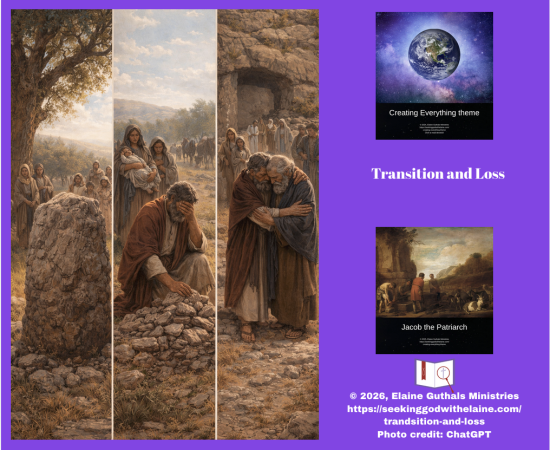
  • Jacob Fled from Laban

    God told Jacob that it was time to leave Haran. This devotional reading looks at how Jacob got that accomplished this time.

    Nuggets

    • When Jehovah is working to prepare us for a change, he uses discontent.
    • Jehovah called Jacob home.
    • Jacob explained his plans to Leah and Rachel.
    • God was working even when it looked like agricultural folklore.
    • The covenant son got the covenant call.
    • This has to have been a big undertaking.
    • I see that the sisters’ response as one highlights their own growth on their Sanctification Roads.
    • Teraphim were small figurines that were kept in the home associated with family worship and divination.
    • Jacob was finally getting away from Laban and coming into his own.
    jacob-fled-from-laban

    It was time for Jacob to return to Canaan. But remember, he tried that once already.

    What was different this time? What he going to make it?

    Let’s Put It into Context

    To read devotions in the Creating Everything theme, click the button below.

    Devotions in the Jacob the Patriarch series

    The Atmosphere Turned

    “But Jacob soon learned that Laban’s sons were grumbling about him. ‘Jacob has robbed our father of everything!’ they said. ‘He has gained all his wealth at our father’s expense,’ And Jacob began to notice a change in Laban’s attitude toward him” (Gen. 31: 1-2 NLT)

    When Jehovah is working to prepare us for a change, he uses discontent.

    Jacob knew that he would return home “… One day I will bring you back to this land. I will not leave you until I have finished giving you everything I have promised you” (Gen. 28: 15 NLT). Rebekah said a big part of his going was for Esau to settle down so he could come back.

    Now, in Jacob’s eyes, Esau seems to be the least of the two enemies. He doesn’t hold a candle to Laban.

    That tracks. Esau never did anything to Jacob. Jacob is the one who lied and stole what socially should have been Esau’s.

    But a lot changes in six years. The world around us changes, we become discontented, and God changes our mission.

    Laban’s sons basically accuse Jacob of theft. They said he “took” what was their father’s.

    Well, no. Whatever flocks Jacob received was in agreement of the wages established in Genesis 30: 32.

    We have to remember in the Ancient Near East, wealth was seen as honor and inheritance security. They felt stripped of that.

    It wasn’t just the sons. It was Laban, too. “And Ya’akov beheld the countenance of Lavan, and, hinei [behold], it was not toward him as before” (Gen. 31: 2 OJB).

    Countenance means more than just our facial expression. It means support, also.

    Jacob was no longer the favorite son-in-law. Laban now showed hostility toward him.

    Jacob was a threat to Laban because he was no longer a hired hand. He was an equal if not higher up on the pecking order than Laban.

    Think about it. Laban liked Jacob when he was a dependent son-in-law as well as an employee. Even more, he liked it when Jacob could be considered a manipulated outsider.

    Jacob wasn’t that now. He was wealthy. “As a result, Jacob became very wealthy, with large flocks of sheep and goats, female and male servants, and many camels and donkeys” (Gen. 30: 43 NLT).

    In the Ancient Near East – as in today’s society – power followed the wealth. It is just that wealth took the form of livestock and offspring.

    Jacob had his own clan now. Clans were kinship networks tied to an ancestor. It would have provided protection, economic stability, marriage alliances, legal representation, blood-avenging justice, and land inheritance continuity.

    Laban’s sons were probably getting what Laban had refused to admit. The balance of power had shifted. In that time, that felt like rebellion.

    Divine Authorization

    “Then the Lord said to Jacob, ‘Return to the land of your father and grandfather and to your relatives there, and I will be with you” (Gen. 31: 3 NLT)

    Jehovah called Jacob home.

    We aren’t told that God told Jacob to return when the 14 years were up. He was now. He had matured enough to become obedient.

    Go back to Abraham’s call. “The Lord had said to Abram, “Leave your native country, your relatives, and your father’s family, and go to the land that I will show you” (Gen. 12: 1 NLT).

    Leave. Return. The covenant was tied to the land.

    But wherever Jacob was, Jehovah promised to be with him. “What’s more, I am with you, and I will protect you wherever you go …” (Gen. 28: 15 NLT).

    Jehovah wasn’t – like the false gods of the time – only tied to the building, city, or region. Sovereign God is God of all.

    The departure is not impulsive. It is divinely sanctioned.

    Jacob could have said that he wanted to stay in his comfort zone. He could have said that he had grown so much here, he wanted to continue on that path. But God calls us to obedience, not comfort. He doesn’t want us to take the safe path. He wants us to take His path.

    Look at how much Jehovah changed Jacob in his tenure in Haran. He hadn’t run away when Laban deceived him. He stayed, negotiated for what he wanted, built a clan, and endured injustice.

    It takes a lot of Jehovah’s sanctifying work to go from an impulsive person to one who is seasoned.

    Jacob was now ready to be obedient. He was ready to move when he got the call.

    Jacob Explained the Injustice

    “So Jacob called Rachel and Leah out to the field where he was watching his flock. He said to them, ‘I have noticed that your father’s attitude toward me has changed. But the God of my father has been with me. You know how hard I have worked for your father, but he has cheated me, changing my wages ten times. But God has not allowed him to do me any harm. For if he said, ‘The speckled animals will be your wages,’ the whole flock began to produce speckled young. And when he changed his mind and said, ‘The striped animals will be your wages,’ then the whole flock produced striped young.  In this way, God has taken your father’s animals and given them to me’” (Gen. 31: 4-9 NLT)

    Jacob explained his plans to Leah and Rachel.

    Jacob doesn’t say, well, I have to check with my wives. He did take the time to explain it to them (Gen. 31: 4-16). He wanted them (and us) to know that God acts for us.

    Since back in those days, wives were considered property, Jacob didn’t have to do that. He could have just said, “We’re going,” and they would have had to fall in line.

    But Jacob respected them enough to tell them and allow them to have input.

    It is interesting that Jacob brought the sisters out to the field. He wanted to have a private conversation with them.

    We know two of Laban’s servants made it into Jacob’s household. We don’t know if more had. To whom would they have been loyal? Maybe he just didn’t want to take a chance.

    Maybe Jacob just wanted the visual representation of the contested wealth.

    Jacob lays out his argument.

    • He has served faithfully (verse 6).
    • Laban has been deceptive by changing his wages repeatedly (verse 7).
    • Jehovah didn’t allow Laban to harm Jacob (verse 7).
    • Regardless of Laban’s manipulation, the flocks designated as Jacob’s wages prospered (verse 8).

    The only conclusion Jacob could make was that Jehovah’s hand was over it all.

    Link about it. When we were talking about Laban’s divination, we said economic shifts was one of the things interpreted.

    Here, Jacob is saying those economic shifts were divine justice.

    Where was the calculating, strategic man we have seen since Rebekah’s womb?

    We can tell that Jacob grew a lot on his Sanctification Road. He doesn’t say, “Look at my animal husbandry abilities.” See what he did say.

    • “God has not allowed him to harm me.”
    • “God took away your father’s livestock and gave them to me.”
    • “The God of Bethel … said to me…”

    Jacob said, “It was all Jehovah.”

    Think about it. Bethel was a private meeting with Jehovah. Now, Jacob is testifying. He went from personal survival to shared conviction.

    I think Jacob was pretty much settled in his faith at this point. The ride back may have settled him some more, but he was talking here with a maturity about his faith when talking to his wives that we hadn’t seen to that point.

    On Jacob’s Sanctification Road, he learned that he didn’t have to scheme. He could and had to depend on Sovereign God’s faithfulness.

    We are going to be on our Sanctification Road until Jehovah calls us off it. But hopefully, we get closer to the end transformation wise than later.

    After he explained the situation and acknowledged Jehovah’s faithfulness, Jacob asked his wives to agree with his plan.

    Yeah, the deceiver and manipulator spread out his plan and let the sisters make up their own minds.

    The Dream of the Rams

    “One time during the mating season, I had a dream and saw that the male goats mating with the females were streaked, speckled, and spotted.  Then in my dream, the angel of God said to me, ‘Jacob!’ And I replied, ‘Yes, here I am.’ The angel said, ‘Look up, and you will see that only the streaked, speckled, and spotted males are mating with the females of your flock. For I have seen how Laban has treated you” (Gen. 31: 10-12 NLT)

    God was working even when it looked like agricultural folklore.

    God didn’t just leave Jacob at Bethel and never talk to him again. He showed him that He was with him in Haran by coming to him in a dream.

    Why didn’t Moses tell us this in Genesis 30? Why did he lead us to think that Jacob bought into some of the folklore prevalent in that society?

    It could have been Moses’ economic use of words. He only says what he has to in order to move the narrative.

    But then, Moses probably told it in classic biblical storytelling fashion.

    The most important thing we see now is that it wasn’t chance. It wasn’t magic.

    It was Sovereign God implementing His Will.

    Jacob’s Call

    “I am the God who appeared to you at Bethel, the place where you anointed the pillar of stone and made your vow to me. Now get ready and leave this country and return to the land of your birth’” (Gen. 31: 13 NLT)

    The covenant son got the covenant call.

    Sovereign God had kept His part of the vow. No, Jacob probably thought He had taken a night off when Leah got substituted, but he does seem to have had at the very least a minimal marriage with her. He didn’t ignore her.

    But Jacob had learned that Jehovah had never left him.

    If we go back to the Hebrew, we see that it said Jehovah was the God of Beit-El or Bethel (Gen. 31: 13 CJB). “He named that place Bethel (which means ‘house of God’), although it was previously called Luz” (Gen. 28: 19 NLT).

    When Jacob had anointed the stone, he was running, alone, and afraid. Now, he was wealthy, had his own clan, and divinely protected.

    This was all part of Jehovah’s divine plan. Was it messy? Ooo, baby, yes!!! Was it intentional? Ooo, baby, yes!!!

    Rachel and Leah Responded

    Rachel and Leah responded, ‘That’s fine with us! We won’t inherit any of our father’s wealth anyway. He has reduced our rights to those of foreign women. And after he sold us, he wasted the money you paid him for us.  All the wealth God has given you from our father legally belongs to us and our children. So go ahead and do whatever God has told you’” (Gen. 31: 14-16 NLT)

    I see that the sisters’ response as one highlights their own growth on their Sanctification Roads.

    Did we ever think we were going to see these sisters speak in one voice? From one accusing the other of husband stealing – when it was actually she who stole the husband to the baby war, it could have seemed like their relationship had no choice of being righted. This is especially true as this division probably had been occurring most of their lives.

    Now, we hear the disillusion in their words. Not only has their attitude toward each other changed, but also their attitude toward their father.

    They may have then seen their lives and were sorry for their part in the conspiracy. Even if things work out the way they are supposed to, Jehovah wants us to repent when we do wrong. Lying is wrong.

    They may have seen the consequences for their actions for what it was — consequences. Yeah, everything worked out to God’s plan, but that doesn’t give sin a pass.

    These were big consequences.

    • Sister rivalry
    • Manipulated marriages
    • Fertility wars
    • Transactional intimacy
    • Spiritual superstition
    • Paternal exploitation

    They were happy with Jacob’s decision to follow his call. They were not big fans of Laban at the moment.

    It was strange, though, that they talked of inheritance. Usually daughters didn’t, just sons.

    What daughters did receive was dowries. However, it sounded like they didn’t. Basically, they were saying, “He sold us and consumed our money.”

    Didn’t that sound like Laban? The bride-price he received from Jacob — the labor — was used to his profit. He didn’t turn around and preserve any of that wealth for their security.

    That is why they said, “All the wealth God has given you from our father legally belongs to us and our children …” (Gen. 31: 16 NLT). They saw Jehovah’s actions as justice.

    They felt exploited. Whatever they felt when the conspiracy started, they did not feel Laban treated them right in the end.

    The Departure Began

    “So Jacob put his wives and children on camels, and he drove all his livestock in front of him. He packed all the belongings he had acquired in Paddan-aram and set out for the land of Canaan, where his father, Isaac, lived” (Gen. 31: 17-18 NLT)

    This has to have been a big undertaking.

    Remember, they were going around 525 miles. It was 400 to 450 miles from Haran to Bethel, and another 75 to Beersheba.

    It would be a large caravan, especially if he could offer Esau as many animal as he did and have a lot left for himself. But they did leave without Laban’s knowledge.

    Well, sometimes you have to go and then say goodbye or you won’t be allowed to go.

    Let’s look at why leaving was such a big deal. Jacob didn’t just marry two sisters. He married into Laban’s clan.

    Jacob wasn’t just quitting his job. He was abandoning the clan. He is establishing his own.

    We can’t overlook the importance of this. Clans meant a corporate identity, a shared honor and guilt, and a shared inheritance and destiny.

    In a society of the fractured family, we may read over that.

    Rachel Stole the Teraphim

    “At the time they left, Laban was some distance away, shearing his sheep. Rachel stole her father’s household idols and took them with her” (Gen. 31: 19 NLT)

    Teraphim were small figurines that were kept in the home associated with family worship and divination.

    These figurines were also connected to inheritance rights. We know this from Ancient Near Eastern legal texts, like the Nuzi tablets.

    I’ve heard the inheritance claim before. I don’t know if I had ever heard about Laban keeping the dowry, but I can see Rachel believing entitlement. Oh, I could see her taking his authority as she took being first wife from her.

    Rachel could have seen that as a transfer of authority from Laban to Jacob. She may have been declaring Jacob’s claim to the family property.

    But I also wonder about the worship part. Since she wanted the mandrakes for folklore purposes, I had always wondered if she retained a mixed allegiance, as Laban did.

    It is hard to give up a belief that you have held all your life. Even if you don’t totally believe it is true, it is still hard to turn your back on your upbringing.

    Rachel may have seen this as a way to take back authority in the way that Leah seized first wife status. Or she may have seen this as a way to take control of her own life.

    Whatever the reason(s), I don’t see this as a random theft. I see it more as a strike against Laban.

    Rachel’s decision to take the Teraphim may contain snippets of all these reasons — and possibly some we don’t know about. Ancient people were very good at hedging spiritually.

    What is clear is that Rachel made a conscious decision to quietly take the figurines.

    Jacob Deceives Laban

    “Jacob outwitted Laban the Aramean, for they set out secretly and never told Laban they were leaving. So Jacob took all his possessions with him and crossed the Euphrates River, heading for the hill country of Gilead” (Gen. 31: 20-21 NLT)

    Jacob was finally getting away from Laban and coming into his own.

    Many see this as Jacob deceiving Laban. In other words, you have to be a trickster to deal with a trickster.

    I don’t see it as Jacob is now deceiving Laban.

    Sometimes, you just have to follow God’s Will, and His Will was for Jacob to go home.

    I don’t think Jacob ever stopped being somewhat strategic. We can submit to God, but we have to be intentional enough that we ensure we are doing what He has called us to do.

    Jacob slipped away with his complete household. It wasn’t cowardice or treachery.

    It was necessary for Jacob to get away from the oppression. Secrecy to accomplish that is not necessarily sin.

    The issue was Jacob was leaving the clan without permission from the clan leader. He had asked once (Gen. 30: 25) and ad been refused.

    But the intent of leaving was to obey Jehovah.

    Making the Connections #1

    Don’t read this passage focusing on the theft, trickery, or even family drama. Look at the faith and obedience.

    Jacob said that Jehovah knew what Laban had done with his wages. He sees, and He keeps promises.

    Making the Connections #2

    Think back to when Jacob’s married life began. Two wives in two weeks. It was began with anger, hurt, rejection, and bitterness,

    Now, it seems like there is unity. There is maturity.

    Making the Connections #3

    Jacob has grown so much in his faith. He wasn’t a patriarch when he arrived at Haran. He is now.

    Before, Jacob was looking for blessings. Now he knows he has been blessed.

    Jacob has come into his own. He is becoming the patriarch.

    This is the last time that we will see Jacob under someone else’s authority.

    Jacob never railed on Jehovah – not for 20 years. He didn’t crow about outsmarting Laban. He didn’t panic about leaving.

    Jacob just packed up his household and left. He called his wives out to the field for privacy and laid everything out clearly and concisely. He was strategic in leaving.

    Making the Connections #4

     Here Jacob was trying to make a break from Laban and his mixed worship practices, and Rachel brings it with her.

    How Do We Apply This?

    • Grow in faith in Jehovah.

    Father God. Thank You for us seeing Jacob’s growth in You. Help us to grow, also. Amen.

    If you don’t understand something and would like further clarification, please contact me.

    If you have not signed up for the email providing the link to the devotions and the newsletter, do so below.

    If God has used this devotion to speak with you, consider sharing it on social media.