Category: Obedience

  • Strength in Jesus’ Name

    In the last devotion, we started discussing strength in God’s name. This daily devotional looks at how we gain sufficient strength to do all things in Jesus’ name and by His authority.

    Nuggets

    • We gain strength through Jesus’ power as well as authority.
    • We only gain strength through Jesus’ name.
    • It is only through God’s grace can we gain the strength to withstand Satan’s pull.

    To read devotions in the At the Heart Level theme, click the button below.

    Devotions in the In Jesus’ Name series

    We talked in the last devotion that one of the ways God equips us is to give us strength. In this devotion, we are going to go back to looking at Jesus’ name. Wilkinson showed us several verses that showed the strength we get from Jesus.

    Let’s keep going in Wilkinson’s sermon entitled Doing All in the Name of Christ to see how we gain strength in Jesus’ name.

    Resource

    Let’s Put It into Context #1

    Here is a running list of nuggets for the series.

    Let’s Put It into Context #1

    Meyer helped us determine exactly what is mean in the phrase in Jesus’ name. He wrote, “Thus the Name of God, as used so frequently by the heroes and saints of sacred history, stands for those Divine attributes and qualities which combine to make Him what He is.”

    Resource

    Remember, Jesus and God are One.

    Strength in Jesus’ Power

    “Then Peter, filled with the Holy Spirit, said to them, ‘Rulers of the people and elders, if we are being examined today concerning a good deed done to a crippled man, by what means this man has been healed, let it be known to all of you and to all the people of Israel that by the name of Jesus Christ of Nazareth, whom you crucified, whom God raised from the dead — by him this man is standing before you well’” (Ac. 4: 8-10 ESV)

    We gain strength through Jesus’ power as well as authority.

    Hmmm. I don’t know if I would say the use of in Jesus’ name means strength in this passage. I would say it is more authority.

    It works if we consider it power rather than authority. Power is usually associated with the actual accomplishment of something.

    That would work in this case. Peter had healed a cripple man. He couldn’t do that under his own authority or in his own power.

    The healing had to come from the power of Jesus through His authority.

    But doesn’t the knowledge that the power is there give us strength? We gain courage to serve God as He calls us to do. We get peace.

    Side note. Tuck reminded us Peter was responding to the Sanhedrin’s question of under who’s authority did he work. He wrote, “This the Sanhedrin asked because they regarded themselves as the highest religious authority in the land, and they could approve of nothing which had not been submitted for their sanction. They had to learn that God never will allow His grace to be tied with official bonds.”

    Resource

    Mankind cannot limit God’s grace. We may think we have to put our stamp of approval on it.

    We don’t.

    Not Our Strength

    “I can do all things through him who strengthens me” (Phil. 4: 13 ESV).

    We only gain strength through Jesus’ name.

    You see, here’s the thing. We want the strength to come from us. We either think we can do things ourselves, or we think what we are okay doing them outside of God.

    We want to gain strength through our abilities. We want to be able to exercise and get stronger — whether that is a physical or mental growth.

    Not. Going. To. Happen.

    What we need to do is rely on Jesus. We can’t resist temptation on our own.

    I know. That galls us sometimes, doesn’t it? We don’t want to have to depend on someone else. This is especially true for a holy Someone we can’t see.

    I love what Forsyth said. He wrote, “Dependence is the law of our being?”

    Resource

    How can this be a law of our being? “For in him we live and move and have our being, as even some of your own poets have said, ‘For we are also his offspring’” (Ac. 17: 28 CSB).

    The Him referred to here is God. He is our Creator and Sustainer; therefore, we are dependent on Him.

    That doesn’t mean God takes away our ability to choose to follow Him or not. He gives us our free will. Free will is the ability within us to make decisions, which determine actions that produce character.

    When we choose to follow Him, God strengthens us. The last thing God wants is for us to be discouraged. We may be weak – we may find failure.

    This is all tied into humility. Christian humility is our yielding our dependence to Christ to serve Him and others.

    We’ve got to bag our pride and put our faith and trust in God. Pride is an unrealistic high opinion of oneself that is based on faulty self-esteem.

    I think our joy within is tied to our strength with God. We are more joyful — even in our trials — when we feel His strength within us.

    But go back to the beginning of the verse. “I can do all things …” (Phil. 4: 13 ESV).

    Let’s hook this to another verse. “Jesus looked at them and said, ‘With man this is impossible, but with God all things are possible’” (Mt. 19: 26 NIV).

    Jesus has the strength to do all things — even the impossible things.

    Jesus has the strength to do all things — even the impossible things.

    We tap into that strength through faith.

    Through His Grace

    “But he said to me, ‘My grace is sufficient for you, for my power is made perfect in weakness.’ Therefore I will boast all the more gladly of my weaknesses, so that the power of Christ may rest upon me” (II Cor. 12: 9 ESV).

    It is only through God’s grace can we gain the strength to withstand Satan’s pull.

    I thought it was interesting that Wilkinson included this verse in his explanation of how we accomplish all by the strength of Jesus’ name.

    Think about it. This verse is the response to Paul’s thorn in his flesh. God was telling Paul that He wasn’t going to remove it — He was going to take him through it.

    Maclaren had an interesting take on that. He wrote, “The answer is no communication of anything fresh, but it is the opening of the man’s eyes to see that already he has all that he needs.”

    Resource

    Let’s see how Wilkinson was applying it to this discussion. He was talking about strength. This would mean that we already have all the strength we need.

    We do, because it isn’t our strength. It is God’s strength.

    God is using His strength to take our imperfect lives and make them perfect through sanctification. Sanctification is the transformation of mind, body, and soul, which begins with regeneration; gradually changes our nature and morals through the promptings of the Holy Spirit; and ends with perfected state of spiritual wholeness or completeness.

    • Regeneration is being changed from spiritually dead to spiritually alive and the internal new birth and requickening that God brings about through the work of the Holy Spirit to give us new character.
      • Spiritual death is the separation from God that occurred as a consequence of Adam and Eve’s original sin.
        • The spiritually alive are those who have ABCDed, so they are no longer separated from God.
    • Perfection means we reach a state of maturity because the combination of the spiritual graces form, when all are present, spiritual wholeness or completeness — holy, sanctified, and righteous.
      • Spiritual graces are worldly morals that have been submitted to God to further His kingdom instead of enhancing this world.
      • Sanctified means to be set free from sin.
      • Righteous means we are free from sin because we are following God’s moral laws.

    The ABCDs of Salvation

    If you have not become a believer in Christ, please read through the
    Plan of Salvation and prayerfully consider what God is asking you to do.

    A – admit our sins
    B – believe His Son Jesus is our Redeemer
    C – confess God as Sovereign Lord

    D – demonstrate that commitment by making any changes needed in our lives to
    live the way in which God has called us

    The Disciple’s Job Description

    Glossary

    God knows how broken we are. He knows exactly how strong our faith is.

    Remember, God meets us where we are and takes us to where we need to be.

    Paul was going to rock his weakness. Maclaren said this was more than just being submissive. Submitting to God is actions by humans that obey God and keep His reasonable, holy, and righteous laws and commandments, follow His purpose for us, and do not follow Satan’s promptings.

    It was Paul’s total dedication to Jesus being glorified.

    Let’s roost a second on that God’s grace is sufficient. It isn’t too much. It isn’t too little.

    It is just right.

    The thing that popped into my mind was the manna that God provided the Israelites in the desert. He provided just enough for the day. The day before the Sabbath, God provided enough for both days.

    God knows just what we need. He gives us just that.

    Let’s circle back to having strength in Jesus’ name. Jesus was 100% man. That means He knows what it means to be weak.

    Jesus was also 100% God. He is back to having all of His divine attributes.

    There is no way that Jesus has forgotten what it feels like to be weak.

    Just think what it means, then, asking for strength in Jesus’ name. The One Who is providing the strength knows what we are going through.

    strength-in-jesus-nameFB

    Making the Connections

    We said in the last devotion that confidence brings strength, and strength brings confidence. We probably should have added faith.

    Faith brings confidence, which brings strength; and strength brings confidence and faith.

    Think about it. We start out with a little bit of faith. God grows it through bringing us through trials. That is where we get the confidence and strength.

    Remember, we just said God’s grace and strength are sufficient.

    What does that tell us? We don’t have to worry about tomorrow. “Therefore I tell you, do not be anxious about your life, what you will eat or what you will drink, nor about your body, what you will put on. Is not life more than food, and the body more than clothing? Look at the birds of the air: they neither sow nor reap nor gather into barns, and yet your heavenly Father feeds them. Are you not of more value than they?” (Mt. 6: 25-26 ESV).

    Our needs will be taken care of by a faithful God.

    How Do We Apply This?

    • Praise Jesus for giving us strength even in our trials.
    • Courageously face all God has in store for us.
    • Continue to pray and do God’s Will.
    • Don’t stop doing God’s work.

    Resource

    Father God. Thank You for sending Your Son Jesus to be our Savior. We pray in His name for the strength we need to resist Satan’s pull. We know You will give us strength sufficient for the day. Amen.

    What do you think?

    Leave me a comment below (about this or anything else) or head over to my Facebook group for some interactive discussion.

    If you don’t understand something and would like further clarification, please contact me.

    If you have not signed up for the email daily or weekly providing the link to the devotions and the newsletter, do so below.

    If God has used this devotion to speak with you, consider sharing it on social media.

  • Strength in God’s Name

    We’ve been talking about asking and serving in Jesus’ name. This daily devotional chases a rabbit and looks at the strength we receive when we ask and serve God.

    Nuggets

    • We have to have the faith that we can do what God calls us to do.
    • God is going to give strength to His children who faithfully serve in His name.

    To read devotions in the At the Heart Level theme, click the button below.

    Devotions in the In Jesus’ Name series

    God knows that, once we accept the gift of salvation, it is anything but smooth sailing for us. He has plans for our lives that include serving Him to expand His kingdom, but Satan does everything He can to derail us from accomplishing His Will.

    We may question our ability to do what God calls us to do. We don’t realize – or doubt – that He is going to equip us to do His Will (Eph. 4: 11-12).

    One of the ways God equips us is to give us strength. We are going to continue looking at Wilkinson’s sermon entitled Doing All in the Name of Christ to see how we gain strength in Jesus’ name.

    Resource

    Let’s Put It into Context #1

    Here is a running list of nuggets for the series.

    Let’s Put It into Context #2

    Meyer helped us determine exactly what is meant in the phrase the Name of God. He wrote, “Thus the Name of God, as used so frequently by the heroes and saints of sacred history, stands for those Divine attributes and qualities which combine to make Him what He is.”

    Resource

    Remember, Jesus and God are One.

    Strength Comes from Faith

    “Be on your guard; stand firm in the faith; be courageous; be strong” (I Cor. 16: 13 NIV)

    We have to have the faith that we can do what God calls us to do.

    Faith is a gift from God that enhances the conviction that the doctrines revealed in God’s Word are true, even if we do not understand all aspects of them, a belief which impacts our lives and distinguishes us from others. But we have to remember that He is not sending us in on our own.

    Dixon put it this way. He wrote, “Faith is submissive and humble, but full of hope and courage.”

    • Submitting to God is actions by humans that obey God and keep His reasonable, holy, and righteous laws and commandments, follow His purpose for us, and do not follow Satan’s promptings.
    • Christian humility is our yielding our dependence to Christ to serve Him and others.
    • Hope is the expectation, also called a living hope, based on the confidence that, because of our relationship with God, our names will be found in the book of life.

    Resource

    Glossary

    Faith unlocks God’s omnipotent power in our lives. Yes, the power is always there.

    It is not applied to our lives until we put our faith and trust in God.

    It isn’t just faith that is going to accomplish God’s Will. God has decided to work through us.

    That means we don’t put our confidence in ourselves. We put it in God.

    we don’t put our confidence in ourselves. We put it in God.

    Strength Comes in the Name of the Lord

    “Then David said to the Philistine, “You come to me with a sword and with a spear and with a javelin, but I come to you in the name of the LORD of hosts, the God of the armies of Israel, whom you have defied” (I Sam. 17: 45 ESV).

    God is going to give strength to His children who faithfully serve in His name.

    God knows that we will feel out of our comfort zones when we are serving Him. He doesn’t leave us alone.

    God always goes before us when we do His Will. “It is the LORD who goes before you. He will be with you; he will not leave you or forsake you. Do not fear or be dismayed” (Deut. 31: 8 ESV).

    Isn’t it wonderful that God does more than that? He also strengthens us.

    The outcome of that is strength of confidence in God. We know we can rely on His promises.

    Yeah, it is kind of a chicken-and-egg thing, isn’t it? Confidence brings strength, and strength brings confidence.

    Another outcome is action. We can and should pray. God will let us know when we are to put feet to our prayers.

    To read a related devotion, click the button below.

    Putting the feet to our prayers is very important. We don’t just have a checklist of wants and needs.

    We have to actively accomplish God’s Will.

    Think about it. Satan is a fierce opponent. If we are just sitting around, waiting for God to give us all the good stuff, we won’t be prepared to fight him.

    True, it is God fighting Satan and not us. We, however, have to do our part.

    strength-in-gods-nameFB

    Making the Connections

    We don’t know how long of a time it was between David’s anointment as king in I Samuel 16 and the battle with Goliath in I Samuel 17.

    It is safe to say that God was preparing David to be king. He was also preparing him to be the man after His own heart.

    We look at that phrase and say that isn’t us. We aren’t men and women after God’s own heart.

    Thompson disagreed. He wrote, “In one respect every Christian resembles David: he has been anointed by the Holy Ghost for an especial purpose: called and selected from the world to be ‘a member of Christ, the child of God, and an inheritor of the Kingdom of Heaven.’”

    Resource

    Person of Interest

    Yes, God has a purpose for each one of us. There is one for those strong in the faith. There is also one for those weak in the faith.

    God will prepare us, also. That is all part of His plan for us.

    We may look at David and say that God gave him an extra portion of strength in Him. If He did, it was because of his faith. We say that like we can’t have a faith like David’s.

    We think that was a once-in-a-person deal that won’t be applied to us. It can — and should.

    We just have to grow our faith.

    How Do We Apply This?

    • Strength is contingent on faith.
    • Make sure faith controls our lives, so that circumstances don’t.
    • Be prepared to act when the preparatory time is completed.
    • Have pure motives when we are asking in Jesus’ name.
    • Put God in the proper priority.
    • Remember, our enemy is Satan.
    • Know the Scriptures.

    Resource

    To read a related devotion, click the button below.

    Father God. Lord, we are weak. We need Your strength. Amen.

    What do you think?

    Leave me a comment below (about this or anything else) or head over to my Facebook group for some interactive discussion.

    If you don’t understand something and would like further clarification, please contact me.

    If you have not signed up for the email daily or weekly providing the link to the devotions and the newsletter, do so below.

    If God has used this devotion to speak with you, consider sharing it on social media.

  • Binding Things in His Name

    We’ve looked at serving and praying in Jesus’ name. This daily devotional, in a way, combines the two.

    Nuggets

    • When we ask in Jesus’ name, in His Will, and in agreement, our requests will be granted.
    • If we are gathered in Jesus’ name, we are exalting Him and seeking His Will.
    • Disciples can be mighty in small numbers when gathered in Jesus’ name.
    • Prayers are answered when they are asked in Jesus’ name.

    To read devotions in the At the Heart Level theme, click the button below.

    Devotions in the In Jesus’ Name series

    We are looking at Wilkinson’s sermon entitled Doing All in the Name of Christ. We are looking at how we are to do the different things in Jesus’ name.

    Resource

    When we think about the phrase in Jesus’ name, we generally think about praying. Our next thought might turn to service.

    When we apply that to the Church, we can see where they are combined. This is especially true when we look at a passage in Matthew 18.

    Let’s jump in.

    Let’s Put It into Context

    Here is a running list of nuggets for the series.

    Binding in Jesus’ Name

    “Truly, I say to you, whatever you bind on earth shall be bound in heaven, and whatever you loose on earth shall be loosed in heaven. Again I say to you, if two of you agree on earth about anything they ask, it will be done for them by my Father in heaven. For where two or three are gathered in my name, there am I among them.” (Mt. 18: 18-20 CSB).

    When we ask in Jesus’ name, in His Will, and in agreement, our requests will be granted.

    In reading these verses, we may interpret it to sound like a criminal court. That isn’t the intent.

    What it is trying to show is how merciful God is.

    The thing is, in my mind, all three verses are all wrapped up together. So, let’s start at the end and go backwards.

    Gathered in His Name

    “For where two or three are gathered in my name, there am I among them.” (Mt. 18: 20 CSB).

    If we are gathered in Jesus’ name, we are exalting Him and seeking His Will.

    We have to be seeking God’s Will in whatever situation we are facing. We don’t want to be asking for something that would be detrimental to our relationships with Him.

    Before we even ask, though, we have to worship God. I’ve always heard it said that we need to bring the praise before we bring the prayer requests.

    That is true. God isn’t a gum ball machine. We shouldn’t expect to put our quarter prayer in and pop out the answer we expect.

    Our prayers need to be in Jesus’ name and His Will.

    Our prayers need to be in Jesus’ name and His Will.

    We know that the only way we gain access to God is through Jesus. I wonder if sometimes we think that only pertains to salvation.

    Salvation is the gift of life through the deliverance from condemnation and sin to acceptance and holiness and changes us from being spiritually dead to spiritually alive.

    • Sins are actions by humans that disobey God and break one of His reasonable, holy, and righteous laws and commandments, goes against a purpose He has for us, or follows Satan’s promptings.
      • Holy means to be set apart — because of our devotion to God — to become perfect, and morally pure while possessing all virtues.
        • Perfection means we reach a state of maturity because the combination of the spiritual graces form, when all are present, spiritual wholeness or completeness — holy, sanctified, and righteous.
          • Spiritual graces are worldly morals that have been submitted to God to further His kingdom instead of enhancing this world.
          • Sanctified means to be set free from sin.
          • Righteous means we are free from sin because we are following God’s moral laws.
        • Pure means not being sinful or having the stain of sin. 
        • Virtues are standards of moral excellence.
    • Holiness is the transcendent excellence of His nature that includes elements of purity, dedication, and commitment that lead to being set apart.
      • Purity means possessing God’s moral character, having eliminated the stain of sin.
    • Spiritual death is the spiritual separation from God that occurred as a consequence of Adam and Eve’s original sin.
      • The spiritually alive are those who have ABCDed, so they are no longer separated from God.

    The ABCDs of Salvation

    If you have not become a believer in Christ, please read through the
    Plan of Salvation and prayerfully consider what God is asking you to do.

    A – admit our sins
    B – believe His Son Jesus is our Redeemer
    C – confess God as Sovereign Lord

    D – demonstrate that commitment by making any changes needed in our lives to
    live the way in which God has called us

    The Disciple’s Job Description

    Glossary

    We don’t have access to God while we are sinners. Sinners are all people who have not made a genuine profession of faith — who have not sincerely ABCDed. When we come in Jesus’ name and because of our belief in Him, we gain access to God.

    Do we think after salvation, we are just good to go in approaching God? Don’t we realize we must still come to Him in Jesus’ name?

    When we sidestep coming in His name, we sidestep Jesus’ authority. That means we aren’t mature disciples.

    Jesus is right there to give us what we ask in God’s Will when we ask in His name. He is there to give us direction as the Head of the Church.

    A Small Group

    “Again I say to you, if two of you agree on earth about anything they ask, it will be done for them by my Father in heaven. For where two or three are gathered in my name, there am I among them” (Mt. 18: 19-20 CSB)

    Disciples can be mighty in small numbers when gathered in Jesus’ name.

    It seems like the trend the last couple of decades has been to establish mega churches. Don’t we think there is might in numbers?

    Jesus said that there was might in small numbers, too. It isn’t because of us. It is because He is in our midst.

    What struck me was that two of the three has to agree for “it” to be done.

    No, it didn’t have to be a unanimous decision.  There was room for disagreement.

    There wasn’t room for disunity.

    When there is unity — even with differing opinions — Jesus is always present. He is faithful.

    Jesus loves the small churches as much as He loves the large churches. He will bless them though they be small.

    We can take that to the next step, then. Service isn’t dependent on size. Jesus expects small churches to serve Him, too.

    We don’t have to put on a big display. We have to be faithful.

    To me, what this is really saying is numbers don’t matter. It is relationship, faithfulness, and love. We have to believe in Jesus enough to ask in His name, regardless of the number doing the asking.

    Asking in Jesus’ Name

    “Truly, I say to you, whatever you bind on earth shall be bound in heaven, and whatever you loose on earth shall be loosed in heaven” (Mt. 18: 18 CSB).

    Prayers are answered when they are asked in Jesus’ name.

    Wow! That is a pretty bold statement. We ask on earth; it is granted in Heaven.

    But, go back a second. We are asking in God’s Will. We are asking God to do what He was going to do anyway.

    Of course, He is going to do it.

    Broken record. I think it was in the last devotion I said this.

    Prayers do not ask God to change His mind. Prayers ask God to change us so that we have His mind.

    Prayers do not ask God to change His mind. Prayers ask God to change us so that we have His mind.

    Making the Connections

    One day, Jesus will use that power and authority to defeat Satan and those who do not submit to Him. All will see that there are consequences for not choosing Him.

    binding-things-in-his-nameFB

    How Do We Apply This?

    • Foster unity within the church regardless of size.
    • Pray for our benefit.

    Father God. We as Your Church praise You for Your omnipotence. We thank You that Jesus is the Head of the Church. We pray for unity so that we may serve You in the ways You have ordained for us. Amen.

    What do you think?

    Leave me a comment below (about this or anything else) or head over to my Facebook group for some interactive discussion.

    If you don’t understand something and would like further clarification, please contact me.

    If you have not signed up for the email daily or weekly providing the link to the devotions and the newsletter, do so below.

    If God has used this devotion to speak with you, consider sharing it on social media.

  • Going in His Name by His Authority

    God has given all authority to Jesus. This daily devotional looks at how we are to use that authority to expand His kingdom.

    Nuggets

    • Jesus has authority and power that were given to Him by God.
    • We are called to go in Jesus’ name.
    • We are called to help others navigate their Sanctification Road in Jesus’s name.
    • We are called to baptize others in Jesus’ name.
    • We are called to teach His laws and commandments.

    To read devotions in the At the Heart Level theme, click the button below.

    Devotions in the In Jesus’ Name series

    We are looking at Wilkinson’s sermon entitled Doing All in the Name of Christ.

    Resource

    God calls us to expand His kingdom. We do that by teaching others about what Jesus has done.

    Let’s Put It into Context

    Here is a running list of nuggets for the series.

    Jesus’ Authority

    “And Jesus came and said to them, ‘All authority in heaven and on earth has been given to me. Go therefore and make disciples of all nations, baptizing them in the name of the Father and of the Son and of the Holy Spirit, teaching them to observe all that I have commanded you. And behold, I am with you always, to the end of the age’” (Mt. 28: 18-20 CSB)

    Jesus has authority and power that were given to Him by God.

    This isn’t a small dose of power and authority. God gave him “… all authority in heaven and on earth …” (Mt. 28: 18 ESV).

    Think about it. Jesus emptied Himself of His divine attributes (Phil. 2: 7).

    God gave them back and more.

    We can’t overlook that small word all. Nothing small about it, is it?

    Jesus was given all rightful authority. It exists in Himself. It is a part of Him.

    It is Him.

    It isn’t because Jesus has the job title of Savior. He has the power and authority because He is God.

    That power and authority will be used for our benefit. He will use it to grow the Church.

    Then Jesus gives us a commission. He sends us out in His name.

    Jesus gives us a specific message to tell. We are to tell others of the sacrifice He made for us. Only in that way, we will gain salvation.

    Salvation is the gift of life through the deliverance from condemnation and sin to acceptance and holiness and changes us from being spiritually dead to spiritually alive.

    • Sins are actions by humans that disobey God and break one of His reasonable, holy, and righteous laws and commandments, goes against a purpose He has for us, or follows Satan’s promptings.
      • Holy means to be set apart — because of our devotion to God — to become perfect, and morally pure while possessing all virtues.
        • Perfection means we reach a state of maturity because the combination of the spiritual graces form, when all are present, spiritual wholeness or completeness — holy, sanctified, and righteous.
          • Spiritual graces are worldly morals that have been submitted to God to further His kingdom instead of enhancing this world.
          • Sanctified means to be set free from sin.
          • Righteous means we are free from sin because we are following God’s moral laws.
        • Pure means not being sinful or having the stain of sin.
        • Virtues are standards of moral excellence.
    • Holiness is the transcendent excellence of His nature that includes elements of purity, dedication, and commitment that lead to being set apart.
      • Purity means possessing God’s moral character, having eliminated the stain of sin.
    • Spiritual death is the spiritual separation from God that occurred as a consequence of Adam and Eve’s original sin.
      • The spiritually alive are those who have ABCDed, so they are no longer separated from God.

    The ABCDs of Salvation

    If you have not become a believer in Christ, please read through the
    Plan of Salvation and prayerfully consider what God is asking you to do.

    A – admit our sins
    B – believe His Son Jesus is our Redeemer
    C – confess God as Sovereign Lord

    D – demonstrate that commitment by making any changes needed in our lives to
    live the way in which God has called us

    The Disciple’s Job Description

    Glossary

    Let’s break this down a little more.

    Going in Jesus’ Name

    “Go therefore …” (Mt. 28: 19 CSB)

    We are called to go in Jesus’ name.

    There is to be no room for doubt. “But let him ask in faith, with no doubting, for the one who doubts is like a wave of the sea that is driven and tossed by the wind” (Jas. 1: 6 ESV).

    Faith is a gift from God that enhances the conviction that the doctrines revealed in God’s Word are true, even if we do not understand all aspects of them, a belief which impacts our lives and distinguishes us from others.

    Glossary

    I know. We are filled with so many doubts. Sometimes, we doubt God, and sometimes, we doubt ourselves.

    Bottom line is we have our marching orders. We are to go into all the world. “… Go into all the world and proclaim the gospel to the whole creation” (Mk. 16: 15 ESV).

    That may mean the whole, wide world. That may mean our world.

    Jesus had previously told them not to go certain places. “These twelve Jesus sent out with the following instructions: “Do not go among the Gentiles or enter any town of the Samaritans” (Mt. 10: 5 NIV).

    Either way, we are to step out in confidence, proclaiming that Jesus has died to save us from our sins.

    The emphasis is on we step out. Southerns said it this way. He wrote, “It is not let them come if they will and receive the gospel, but go forth, leave all, and proclaim the gospel, etc.”

    Resource

    Ooo, baby. How many times in the past has that been SOP? If they are interested in finding God, they will come. Build it, and they will come.

    Jesus never wanted us to make them come to us. He was always about us going to them.

    Yes, that is hard when we are introverts. It is hard when we see all of these things that are wrong with us. It is hard when we feel unqualified.

    We have to ask God to grow us so we can witness for Him.

    We have to go in Jesus’ name.

    Discipleship in Jesus’ Name

    “… and make disciples of all nations” (Mt. 28: 19 CSB)

    We are called to help others navigate their Sanctification Road in Jesus’s name.

    In making disciples of others, we are to urge them to holiness. “Be holy, because I am holy” (I Pet. 1: 16 CSB).

    Dykes advised there is a certain way to do this. He wrote, “… the apostles were to be the representation to other men in other lands of that same spiritual process which had passed upon themselves.”

    Resource

    Process that. This is saying that the disciples were to model for others what they had experienced. They were to do this while imitating Jesus, Who imitated God.

    If we say we can’t make disciples of others, aren’t we saying that we haven’t become disciples ourselves?

    • We should be able to talk about our salvation process because we have gone through it. How did we ask Jesus to be our Savior and Lord?
    • We should be able to talk about the regeneration process because we have been through it. How are we different than when we were before conversion?
    • We should be able to talk about the sanctification process. What trials are we going through so God can refine us, and how are we trusting in Him?

    Regeneration is being changed from spiritually dead to spiritually alive and the internal new birth and requickening that God brings about through the work of the Holy Spirit.
    Sanctification is the transformation of mind, body, and soul, which begins with regeneration; gradually changes our nature and morals through the promptings of the Holy Spirit; and ends with perfected state of spiritual wholeness or completeness.

    Glossary

    Too many times, we let Satan convince us that we can’t help someone else on their journey. Worse yet, he convinces us we shouldn’t.

    We have a Savior Who encourages us to tell others about Him. We have the Holy Spirit Who prompts us in how we should do that.

    We can do this!

    Baptism in Jesus’ Name

    “… baptizing them in the name of the Father and of the Son and of the Holy Spirit” (Mt. 28: 19 CSB)

    We are called to baptize others in Jesus’ name.

    Baptism is the symbol of our conversion experience, providing the physical evidence that we have died and been buried to sin and have risen in a new spiritual life with Jesus. The water symbolizes washing our sins away.

    But it is more than just baptism in Jesus’ name. In is “… in the name of the Father and of the Son and of the Holy Spirit” (Mt. 28: 19 CSB).

    I can see that. All Three have a part in the salvation experience.

    • The Holy Spirit prompts us to accept the gift of salvation.
    • We can only be saved through believing in the name of Jesus.
    • God forgives us of our sins, allowing us to be saved.

    We enter into a covenant with God. It is no longer through Abraham, but through Jesus.

    Glossary

    Jortin described it this way. He wrote, “Baptism is a religious rite, which was generally practised before our Saviour instituted it; for the Gentiles, in their solemn acts of devotion, made use of sprinkling and ablutions, and the Jews baptized all proselytes to their religion.”

    Resource

    Yeah, we oftentimes forget that baptisms were a thing before Jesus came along. That was why He went to John to be baptized.

    Teaching in Jesus’ Name

    “teaching them to observe all that I have commanded you …” (Mt. 28: 20 CSB)

    We are called to teach His laws and commandments.

    We tend to think that Jesus only sends certain people out to proclaim His message. We think “… go into all the world and proclaim the gospel to the whole creation” (Mk. 16: 15 ESV) doesn’t pertain to us.

    We would be wrong.

    Every disciple is called to teach someone about Jesus. He qualifies and equips us for that service.

    Every disciple is called to teach someone about Jesus.

    Hibbs said something that got me thinking. He wrote that disciples are to “… teach, not to sacrifice.”

    Resource

    Don’t we think that, when Jesus sends us to witness for Him, we will have to give up a lot of things. Maybe we will have to give up family and a job to move somewhere else. We will have to give up our comfort zone because, let’s face it, most of us are not comfortable with witnessing.

    Hibbs told us that it is not about sacrificing. It is about walking along the path that God has put us on and interacting with others to show them the Plan of Salvation.

    going-in-his-name-by-his-authorityFB

    Making the Connections

    One day, Jesus will use that power and authority to defeat Satan and those who do not submit to Him. All will see that there are consequences for not choosing Him.

    How Do We Apply This?

    This is mainly about being obedient to God’s call. He is going to ask us to serve Him. We need to serve Him His way in His name.

    Yes, that will mean praying for Jesus to equip us. He will.

    It will mean opening up about our mountaintop experiences and our valley experiences. It will be hard but fulfilling when we are in God’s Will.

    We need to follow God into whatever area of service He calls us. We have to obediently do it in Jesus’ name.

    Father God. Jesus commissioned us to spread His gospel throughout the world. Give us boldness to speak His name to all with whom we come in contact. Amen.

    Searching for and Seeking God

    Hearing His Word (Rom. 10: 17).
    Reading His Word (Rev. 1: 3).
    Praying to Him (Heb. 4: 16).
    Studying His Word (Ac. 17: 11).
    Meditating on His Word (Ps. 1: 1-2).
    Memorizing His Word (Ps. 119: 11).

    If you have not admitted that your relationship is not right with God,

    have not asked Jesus to be your Lord and Savior,

    and have not confessed your sins,

    please read through the Plan of Salvation and prayerfully consider what God is asking you to do.

    Related Links

    Related Links

    Related Links

    Artist

    Related Links

    I have created a worksheet of the questions above. Click on the button below to access it.

    Don’t know what your spiritual gifts are?

    Take this Spiritual Gifts Inventory

    The Disciple’s Job Description

    Complete Job Description

    Individual Description

    The Disciple’s Job Description

    Complete Job Description

    Individual Description

    Job Duty #4
    Proclaim the Gospel (Mark 16: 15)

    Job Duty #6
    Make Disciples (Matthew 28: 19-20)

    It Was Enough
    Vocalist: Elaine Guthals
    Keyboard: Chris Vieth

    What do you think?

    Leave me a comment below (about this or anything else) or head over to my Facebook group for some interactive discussion.

    If you don’t understand something and would like further clarification, please contact me.

    If you have not signed up for the email daily or weekly providing the link to the devotions and the newsletter, do so below.

    If God has used this devotion to speak with you, consider sharing it on social media.

  • Asking in Jesus’ Name

    A phrase we are probably familiar with is asking in Jesus’ name. This daily devotional looks at what and how we are to pray in Jesus’ name.

    Nuggets

    • Scriptures confirm we will get answers to prayers, but we have to understand that for which we should ask.
    • We get answers to what we ask when we pray in Jesus’ name.
    • Asking in Jesus’ name by praying in faith asks Jesus to authorize our requests.
    • God expects us to think about what He is telling us so that we can make an informed decision to follow Him.

    To read devotions in the At the Heart Level theme, click the button below.

    Devotions in the In Jesus’ Name series

    We started looking at Wilkinson’s sermon in the last devotion. We are looking at being commanded to do all in Jesus’ name.

    Resource

    We ended the discussion by looking at the beginning of John 15: 16. We didn’t look at the end of it. The last part kind of goes along with today’s verses. Let’s talk about asking.

    Let’s Put It into Context

    Here is a running list of nuggets for the series.

    Asking for Whatever

    “… I appointed you to go and produce fruit and that your fruit should remain, so that whatever you ask the Father in my name, he will give you” (Jn. 15: 16 CSB).

    Scriptures confirm we will get answers to prayers, but we have to understand that for which we should ask.

    God’s Will is that we get down to the heart level in following His laws and commandments and changing to have His character. The evidence we show to not be condemned is our belief that Jesus is our Savior, that we genuinely love God and other disciples, and our obedience to His laws and commandments.

    “Beloved, if our heart does not condemn us, we have confidence before God; and whatever we ask we receive from him, because we keep his commandments and do what pleases him” (I Jn. 3: 21-22 ESV).

    We have to be sincere in our relationship in order to receive what we ask of God. This is not a we-get-what-we-ask for guarantee.

    It has everything to do with praying in God’s Will. “And whatever you ask in prayer, you will receive, if you have faith” (Mt. 21: 22 ESV).

    We have to read all the way to the faith part. Faith is a gift from God that enhances the conviction that the doctrines revealed in God’s Word are true, even if we do not understand all aspects of them, a belief which impacts our lives and distinguishes us from others.

    It isn’t about us getting what we want. Prayer is about worshiping God.

    Glossary

    It is also about growing our dependence on Him. It’s about becoming like Him.

    If we don’t have faith in God — we don’t believe in Him period, we don’t believe He can do this for us — we won’t receive the way we ask.

    We know prayer works. We have confirmation in our own lives.

    Asking to Know God

    “In that day you will not ask me anything. Truly I tell you, anything you ask the Father in my name, he will give you. Until now you have asked for nothing in my name. Ask and you will receive, so that your joy may be complete” (Jn. 16: 23-24 CSB)

    We get answers to what we ask when we pray in Jesus’ name.

    Let’s put this into context. Jesus was almost at the end of the Upper Room Discourse. John 17 is the prayer, so Jesus had already admonished them to do better.

    Now, Jesus was in the comforting part of His talk. He told them He was going to go away but then come back.

    Jesus had already told them that He couldn’t send the Comforter unless He went away. “Nevertheless, I tell you the truth: it is to your advantage that I go away, for if I do not go away, the Helper will not come to you. But if I go, I will send him to you” (Jn. 16: 7 ESV)

    So, “In that day …” (Jn. 16: 23 CSB) refers to the arrival of the Holy Spirit. After the Holy Spirit arrived, He would be the one guiding them.

    We won’t have to ask because God is going to reveal Himself to us through the Holy Spirit. It won’t be in parables where the interpretation is delayed.

    God will speak directly to us through the Holy Spirit.

    Let’s roost there a second. The disciples were a rag-tag bunch of common men. They weren’t the religious leaders. They weren’t the movers and shakers of the day.

    They were fishermen, a tax collector — common, everyday people.

    When we do have questions to ask, we can go directly to God for the answers. “And they shall not teach, each one his neighbor and each one his brother, saying, ‘Know the Lord,’ for they shall all know me, from the least of them to the greatest” (Heb. 8: 11 ESV).

    We have to make sure we are using the correct definition of ask here. This isn’t talking about asking to get goodies from God.

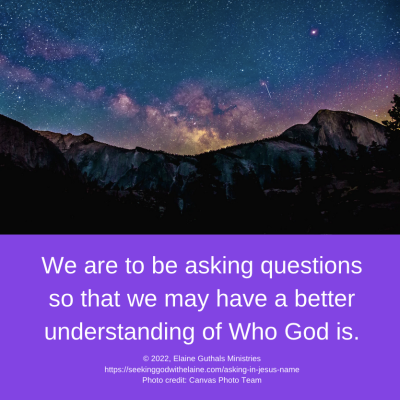
    This is about asking questions so that we may have a better understanding of Who God is.

    We are to be asking questions so that we may have a better understanding of Who God is.

    Did you see what it says? We can ask God anything about Himself.

    We can ask as long as Jesus is our Savior and Redeemer.

    I really like what Maclaren said. He wrote, “‘If ye shall ask anything in My name.’ There is the definition of Christian prayer.”

    Resource

    Let’s put some pieces together.

    First, Jesus taught the disciples the model prayer. They really hadn’t prayed before.

    Yes, they had done the sacrifices in the past. But if anyone prayed, it would have been the priests, not the common man bringing the sacrifice.

    Second, at that point in time, Jesus hadn’t completed the Plan of Salvation yet. His blood hadn’t been shed to pay the penalty for our sins.

    So, everything about Who Jesus was and what His mission was hadn’t been totally revealed yet.

    Third, in my name carries with it the connotation that we are Jesus’ ambassador or commissioner. Another concept is that we are asking in His Will.

    Whatever we are asking is not for our gain. It is so Jesus can gain.

    What would be Jesus’ gain? The opportunity to save someone else from their sins.

    God isn’t trying to spoil us with things that will lead us down a sinful path. He is trying to strengthen our relationships with Him.

    It is all about prayer and communicating with our gracious Father. He wants to supply our needs.

    Martin described prayer in an interesting way. He wrote, “Prayer is not consistent with a perfect state of being. It is the cry of infancy. You will in heaven be men. Prayer is the call of helplessness and the wail of sorrow.”

    Resource

    Prayer is needed on the Sanctification Road, but it will not be needed in Heaven. As we are growing, we need to keep in close contact with God. Once we get to Heaven, we will have that close contact.

    Remember, prayer isn’t about changing God’s mind to do and give us what we want. It is to align us with His Will.

    What we gain is joy through receiving that for which we ask. Joy only comes from God.

    Asking in His Name

    “And whatever you do, in word or deed, do everything in the name of the Lord Jesus, giving thanks to God the Father through him” (Col. 3: 17 ESV)

    Asking in Jesus’ name by praying in faith asks Jesus to authorize our requests.

    Isn’t this verse reassuring?

    It covers everything we do in Jesus’ name. It doesn’t just talk about our actions. It talks about our manners and how we conduct ourselves.

    We are to completely submit our lives to God. We can’t hold anything back.

    We are asking Jesus to approve our requests. Buxton equated it with a judge ruling on a legal document.

    Resource

    This also talks about what our motivations are. We empty ourselves of our notion of being entitled and deserving of rewards to focus on God.

    We are only worthy because Jesus has cleansed us from our sins. That means we ask through His merit and intercession.

    Hull made an interesting comment. In Elaine-speak, there are times that we are so caught up in the spiritual aspect of our faith that we experience Isaiah 55: 8-9. The thoughts become too much for mere words.

    Unfortunately, there are times when our faith is very weak. It really makes it hard to pray then.

    Hull also said something else that ties in with what I usually say (only his is a better way to say it). He wrote, “Men were not to pray because they hoped to change God’s plan, but because God’s plan was the wisest and most loving. They were not to pray with the idea of inducing God to become kind, but because He was kind.”

    Resource

    Prayer isn’t to get God to change His mind. It is to release what He already has in store for us.

    Plain Answers

    “I have spoken these things to you in figures of speech. A time is coming when I will no longer speak to you in figures, but I will tell you plainly about the Father. On that day you will ask in my name, and I am not telling you that I will ask the Father on your behalf; for the Father himself loves you, because you have loved me and have believed that I came from God” (Jn. 16: 25-27 CSB)

    God expects us to think about what He is telling us so that we can make an informed decision to follow Him.

    Jesus, many times, taught by using parables. A parable is a story that Jesus told using everyday examples to illustrate spiritual concepts.

    It isn’t that God doesn’t want us to not understand what He is trying to teach us. In fact, it is the opposite.

    God wants us to really think about what He is saying and decide do we really believe it. Will we really submit our lives to Sovereign God?

    On that day — our conversion — when we genuinely ask Jesus to be our Savior and Redeemer, Jesus said He isn’t going to have to talk God into saving us.

    God loves us, so He wants to see us saved. He wants to forgive us of our sins.

    Does that mean we automatically understand everything in Scriptures? No. There can still be difficult concepts.

    We know that God’s thoughts are higher than ours. “For my thoughts are not your thoughts, neither are your ways my ways, declares the Lord. For as the heavens are higher than the earth, so are my ways higher than your ways and my thoughts than your thoughts” (Isa. 55: 8-9 ESV).

    What is in Scriptures is the most simplistic and plainest explanation that we are going to get this side of Heaven.

    But, wait. Let’s back up a second.

    That is what happens with us. What could Jesus have been telling the disciples?

    Remember, we said that “in that day …” (Jn. 16: 23 CSB) refers to the arrival of the Holy Spirit on Pentecost. “On that day …” (Jn. 16: 26 CSB) would refer to the same day.

    By Pentecost, the disciples were probably asking for the Comforter. They were probably remembering more and more of what Jesus said. They knew they could rely on Jesus’ word.

    The Holy Spirit gives us guidance. He doesn’t talk in parables. He doesn’t give us veiled suggestions.

    But think of it this way. When Jesus was still on the earth and the disciples wanted to say something to Him, all they had to do was tap Him on His shoulder and get His attention.

    Now, the Holy Spirit was talking to them, prompting them. He is there for us 24/7/365.

    Our part of that communication turned into prayer.

    Thomas explained what was meant here. He wrote that Jesus seemed to say “that His disciples in this day will pray in His name, and therefore will not require Him to pray for them (ver. 26).”

    Resource

    But then again, it is more than just prayer. It is that conversation with our Holy Father. The outcome of that conversation is that we can fully feel God’s love.

    God is so ready for that conversation to happen! He loves us that much.

    asking-in-jesus-nameFB

    Making the Connections

    Asking and praying in Jesus’ name brings with it a freedom. We can ask God anything. Because of His love for us, He will hear our prayers.

    How Do We Apply This?

    • Choose whether you want a sinful, temporary life or an eternal, joyful life.
    • Keep praying.
    • Choose joy for the future.

    Resource

    Father God. We can come to You because we have admitted our sinful state, believed in Jesus as our Savior and Redeemer, and confess You as Sovereign Lord. An important way to demonstrate this is to pray to You. We do so in Jesus’ name, not so that He rubber stamps our prayers, but so that He approves so that we are praying in Your Will. May we always focus on You and Your plans. Amen.

    What do you think?

    Leave me a comment below (about this or anything else) or head over to my Facebook group for some interactive discussion.

    If you don’t understand something and would like further clarification, please contact me.

    If you have not signed up for the email daily or weekly providing the link to the devotions and the newsletter, do so below.

    If God has used this devotion to speak with you, consider sharing it on social media.

  • Ready to Serve in Jesus’ Name

    Disciples many times talk about doing something in Jesus’ name. This daily devotional begins looking at what that means.

    Nuggets

    • We can serve God in Jesus’ name because we have already gained salvation.
    • God chose mankind as a whole to offer salvation, but He chooses us individually to serve Him.

    To read devotions in the At the Heart Level theme, click the button below.

    Devotions in the In Jesus’ Name series

    This is one of the sermons I stuck in the drafts folder. It really struck a chord at the time, but it would have meant chasing a huge rabbit then.

    I wanted to wait and give it full focus. Now is the time.

    What hit me then was that we are to do things in Jesus’ name. If we don’t do them in His name, we haven’t gotten down to the heart level.

    Wilkinson gave an outline with associated verses. So, let’s see what he can tell us about focusing our efforts in the name of Jesus.

    Resource

    Let’s Put It into Context

    Here is a running list of nuggets for the series.

    To Go to God through Him (Wilkinson)

    “You are already clean because of the word I have spoken to you” (Jn. 15: 3 CSB)

    We can serve God in Jesus’ name because we have already gained salvation.

    There are times when I, myself, feel like I am a broken record. It does seem to me that I say the same things over and over.

    But, guys. We gain access to God through the salvation offered by Jesus Christ.

    That isn’t going to change. Salvation only comes through ABCDing in Jesus’ name.

    Salvation is the gift of life through the deliverance from condemnation and sin to acceptance and holiness and changes us from being spiritually dead to spiritually alive.

    • Sins are actions by humans that disobey God and break one of His reasonable, holy, and righteous laws and commandments, goes against a purpose He has for us, or follows Satan’s promptings.
      • Holy means to be set apart — because of our devotion to God — to become perfect, and morally pure while possessing all virtues.
        • Perfection means we reach a state of maturity because the combination of the spiritual graces form, when all are present, spiritual wholeness or completeness — holy, sanctified, and righteous.
          • Spiritual graces are worldly morals that have been submitted to God to further His kingdom instead of enhancing this world.
          • Sanctified means to be set free from sin.
          • Righteous means we are free from sin because we are following God’s moral laws.
        • Pure means not being sinful or having the stain of sin. 
        • Virtues are standards of moral excellence.
    • Holiness is the transcendent excellence of His nature that includes elements of purity, dedication, and commitment that lead to being set apart.
      • Purity means possessing God’s moral character, having eliminated the stain of sin.
    • Spiritual death is the spiritual separation from God that occurred as a consequence of Adam and Eve’s original sin.
      • The spiritually alive are those who have ABCDed, so they are no longer separated from God.

    The ABCDs of Salvation

    If you have not become a believer in Christ, please read through the
    Plan of Salvation and prayerfully consider what God is asking you to do.

    A – admit our sins
    B – believe His Son Jesus is our Redeemer
    C – confess God as Sovereign Lord

    D – demonstrate that commitment by making any changes needed in our lives to
    live the way in which God has called us

    The Disciple’s Job Description

    Glossary

    Another thing I am a broken record on is that salvation is just the beginning. It is a three-step process.

    The initial step is God cleanses us so that we are changed from being spiritually dead to spiritually alive.

    Next comes sanctification. Sanctification is the transformation of mind, body, and soul, which begins with regeneration; gradually changes our nature and morals through the promptings of the Holy Spirit; and ends with perfected state of spiritual wholeness or completeness.

    • Regeneration is being changed from spiritually dead to spiritually alive and the internal new birth and requickening that God brings about through the work of the Holy Spirit to give us new character.

    Glossary

    Sanctification is going to be the hard part. It is where God is going to cleanse us by cutting all the sin out of us.

    I know. I’ve said that a lot, but let’s unpack that to see if we can dig a little deeper into what that means.

    We gain salvation by faith. Faith is a gift from God that enhances the conviction that the doctrines revealed in God’s Word are true, even if we do not understand all aspects of them, a belief which impacts our lives and distinguishes us from others.

    Our faith is in Jesus, causing Him to justify us. Justification is the act through the merits of Christ that makes us free from sin because we are following God’s moral laws. Jesus justifies us when we put our lives in His hand.

    Glossary

    It is only when we are justified through Christ can we go to God. The justification gives us access to God.

    But we are still in fake-it-till-you-make-it mode. We have only been partially cleaned.

    We won’t be totally cleaned until we receive our new bodies — the third step in the salvation process.

    Getting there is going to take more faith and more grace. Grace is a free and unmerited gift of love from the Heavenly Father, given through His Son, Jesus Christ, that enables salvation and spiritual healing to believers by the work of the Holy Spirit.

    Yes, the cleaning process of sanctification is going to require more and more grace.  We can’t clean ourselves.

    Only God can clean us through His grace.

    God is ready and willing to do that when we ask. But we have to ask.

    The cool thing is that God already looks on us as if we are already totally sanctified. He sees us as we will be.

    God’s Choice for Our Service

    “You did not choose me, but I chose you. I appointed you to go and produce fruit and that your fruit should remain, so that whatever you ask the Father in my name, he will give you” (Jn. 15: 16 CSB)

    God chose mankind as a whole to offer salvation, but He chooses us individually to serve Him.

    We didn’t choose for God to make mankind. He made us anyway.

    We didn’t choose for God to make us individually. He made us anyway.

    We didn’t choose how we are going to serve God. He chose how.

    God chose how we would serve Him, so we can bear fruit. Fruit is both the result of producing God’s character within use as well as bringing others to Christ.

    Jesus said that we must bear fruit. “Therefore I tell you, the kingdom of God will be taken away from you and given to a nation producing its fruit” (Mt. 21: 43 CSB).

    Think about it. Disciples have to produce evidence of their salvation. We have to show that we are becoming more like Christ.

    We sometimes scratch our heads when God chooses someone to do a specific service for Him. We question why that person was chosen.

    We definitely wouldn’t have!

    We sometimes question why God chooses us to do a specific service.

    We definitely wouldn’t have! There are too many ways in which we see ourselves deficient.

    We forget that God will equip us for the tasks He has for us. “Now may the God of peace who brought again from the dead our Lord Jesus, the great shepherd of the sheep, by the blood of the eternal covenant, equip you with everything good that you may do his will, working in us that which is pleasing in his sight, through Jesus Christ, to whom be glory forever and ever. Amen” (Heb. 13: 20-21 ESV).

    God isn’t going to just throw us to the wolves. He is going to prepare us for the work we are to be doing.

    But did you catch what those verses had to say? “equip you with everything good that you may do his will …” (Heb. 13: 21 ESV).

    God is going to equip us with holy, pure, and righteous behavior. He isn’t looking for a checklist so that we can knock off the different jobs we do for Him.

    What we are to do is to plant seeds in another’s life so that they can make Christ their personal Savior.

    Paul talked about the differences between work and fruit. He cautioned against the work of the flesh (Gal. 5: 19-21). Instead, we are to enjoy the fruit of the Spirit (Gal. 5: 22-23).

    To read a related devotion, click the button below.

    We can work and work and work. God doesn’t want that. He wants the fruit of our labors.

    That means people are coming to know Jesus as their personal Savior.

    We have to make sure that we focus on God’s marching orders. We don’t want to be serving Him outside of His Will.

    ready-to-serve-in-jesus-name FB

    Making the Connections

    Why is God so concerned about the fruit? That is the only thing that is going to last.

    This world and its bright, shiny temptations is going to pass away. All of the worldly pursuits are going to lead to nothing.

    Only those things stored up in Heaven will remain. Statham wrote, “Religion is founded on the permanence of the moral nature.”

    Resource

    Jesus said it this way. “Do not lay up for yourselves treasures on earth, where moth and rust destroy and where thieves break in and steal, but lay up for yourselves treasures in heaven, where neither moth nor rust destroys and where thieves do not break in and steal. For where your treasure is, there your heart will be also” (Mt. 6: 19-21 ESV).

    How Do We Apply This?

    • Follow the promptings of the Holy Spirit so that we will be rewarded the fruit of the Spirit.
    • Evaluate our walk to ensure we are not backsliding.
    • Don’t compromise with the worldview.
    • Resist temptation.
    • Watch for Jesus’ return.
    • Live our lives to be an influence for others by our fruit.

    Resource

    Father God. We choose Jesus as our Savior and Redeemer. We choose to serve You in the ways You choose for us. Equip us to do Your Will. Amen.

    What do you think?

    Leave me a comment below (about this or anything else) or head over to my Facebook group for some interactive discussion.

    If you don’t understand something and would like further clarification, please contact me.

    If you have not signed up for the email daily or weekly providing the link to the devotions and the newsletter, do so below.

    If God has used this devotion to speak with you, consider sharing it on social media.

  • What Is God’s Will?

    Many times in our walk with God, we wonder if we are really following His Will for our lives. This daily devotional  looks at what God’s Will means and how we can discern it for our lives.

    SteppingIntoGod'sWill

    “Do not conform to the pattern of this world, but be transformed by the renewing of your mind. Then you will be able to test and approve what God’s will is — his good, pleasing and perfect will” (Rom. 12: 2 NIV)

    After we ask Jesus to be our Lord and Savior, we are to follow God’s Will for our lives. Unfortunately, finding out what God’s Will for our lives can sometimes be difficult — or so we think.

    There are so many times I have cried out to God, “Just show me what You want me to do! I don’t know what You want me to do in this situation.”

    I knew God wasn’t playing Hide and Seek with me. I was just having trouble knowing what His Will was for my life.

    God always wants us to know and do His Will. But what is that, and how can we do it?

    WhatIsGodsWill

    What Doesn’t “God’s Will” Mean?

    “Set your minds on things that are above, not on things that are on earth” (Col. 3: 2 ESV)

    I think we believe God’s Will for our lives means the plan He has for us individually. “For I know the plans I have for you, declares the LORD, plans for welfare and not for evil, to give you a future and a hope” (Jer. 29: 11 ESV).

    The questions we want answered have to do with how should we live in this life.

    • What job should I take?
    • Who should be my friends?
    • Who should I marry?

    But God doesn’t talk about everything in the His Word. He especially doesn’t get personal like that.

    There are many people in Scriptures, but we get just snippets of their lives. Usually when we are introduced to someone, it is because their actions in a certain situation serve as a model for us.

    We should either follow their lead — or do exactly the opposite.

    Our main role model is Jesus — yet, we still just got snippets of His life. Why?

    God wants to build our character to be like His. When we do that, we can take how He wants us to be and apply that in the situations in life in which we find ourselves.

    Yes, God wants us to be like Him instead of having a checklist to determine our obedience to Him.

    The reasoning behind this is important. Don’t miss this.

    God doesn’t focus on the physical world. God focuses on our spiritual condition.

    When we say we have to find God’s Will for our lives, it is more we have to find out how He wants us to live. How should we conduct our lives that falls in line with how He wants us to live?

    What Does “God’s Will” Mean?

    “Look carefully then how you walk, not as unwise but as wise, 16making the best use of the time, because the days are evil. 17Therefore do not be foolish, but understand what the will of the Lord is” (Eph. 5: 15-17 ESV)

    So, what is God looking for us to do?

    God is most concerned with our spiritual condition. Therefore, His Will would be for us to grow closer to Him.

    We already know that there are things God wants us to do, and some things God doesn’t want us to do. The Bible clearly lays out God’s Will in the do’s and don’ts.

    The Ten Commandments, given in Exodus 20: 3-7, guide us. The Book of Deuteronomy is a restatement of the law given in Exodus. Leviticus adds some things in or expands on some. Jesus clarified many of the laws in His teaching.

    Yes, it is God’s Will that we follow His do’s and don’ts. When we do, we gain His character.

    That is what God ultimately wants.

    How Well We Know God

    “But grow in the grace and knowledge of our Lord and Savior Jesus Christ. To him be the glory both now and to the day of eternity. Amen” (II Pet. 3: 18 ESV)

    Simply put, knowing God’s Will is connected to how well we know Him. The more we know Him, the easier it is going to be to discern His Will.

    We find God when we seek Him.

    We need to know what the scriptures say — all of them. We need to know how they connect.

    We have to know what God’s Word says for the times we don’t have time to think about what we are doing. The do’s and don’ts need to be so ingrained in us that we automatically react according to His Will.

    This is easier when we have the fruits-of-the-spirit pure heart. If we react in love, for example, we will react in His Will.

    Being a Living Sacrifice

    “I appeal to you therefore, brothers, by the mercies of God, to present your bodies as a living sacrifice, holy and acceptable to God, which is your spiritual worship” (Rom. 12: 1 ESV)

    We are called to be living sacrifices — to worship Him and to live the way He wants us to live so that we can witness to others.

    We are called to live different lives than those who hold to the worldview. We do this by looking to God in faith, trusting in Him, and living with joy in our hearts.

    To me all of this just screams “focus on Him, not us.” This is really Ten Commandments #1: “You must not have any other god but me” (Ex. 20: 3 NLT). Yes, God wants that to be our priority.

    Loving Heavenly Father. You want us to live for You. You want us to do Your Will. You will help us to accomplish that. We know that Your way is best. Help us to grow closer to You so that Your Will and Your ways become our norm. Forgive us when we take the focus off You and put it on us and this world. Grow us to prepare us for living with You throughout eternity. Amen.

    What do you think?

    Leave me a comment below (about this or anything else) or head over to my Facebook group for some interactive discussion.

    If you don’t understand something and would like further clarification, please contact me.

    If you have not signed up for the email daily or weekly providing the link to the devotions and the newsletter, do so below.

    If God has used this devotion to speak with you, consider sharing it on social media.

  • Practice and Belief

    We always say that we want to put our belief into practice. This daily devotional looks at why that can be hard to do.

    Nuggets

    • Belief does not necessarily make practice easier.

    To read devotions in the At the Heart Level theme, click the button below.

    Devotions in the Belief and Practice series

    In the previous devotion, we started looking at how Waterland fleshed out belief and practice in his Dependence on Our Inward Frame. We got through belief.

    Now, we are going to take a look at practice.

    Resource

    Let’s Put It into Context

    Here is a running list of nuggets for the series.

    The Issues of Practice

    “For I do not understand my own actions. For I do not do what I want, but I do the very thing I hate. Now if I do what I do not want, I agree with the law, that it is good. So now it is no longer I who do it, but sin that dwells within me. For I know that nothing good dwells in me, that is, in my flesh. For I have the desire to do what is right, but not the ability to carry it out. For I do not do the good I want, but the evil I do not want is what I keep on doing. Now if I do what I do not want, it is no longer I who do it, but sin that dwells within me” (Rom. 7: 15-20 ESV)

    Belief does not necessarily make practice easier.

    It is easy to say that, after we become disciples, our hearts should have a God-approved status. That isn’t always the case.

    Look at what Paul said in Romans 7: 15-20. He wanted to walk the straight and narrow, but he didn’t.

    Yes, the Energizer Bunny for God still sinned after his Hollywood splash conversion.

    If there was anyone who didn’t sin after conversion, consensus would probably say it would be Paul. But he is human, too. He could sin, and he did.

    Why do believers still sin after conversion? Well, we get into a situation and are ruled by our passions. Our principles don’t mean a hill of beans.

    Principles may slow us down some. But we are very good at steamrolling right on over them.

    Part of the reason why we may think we shouldn’t keep on sinning is because we now have knowledge of what sin is. We want to take the worldview standpoint and trust on knowledge.

    Too many times, we know what is right, but do what is wrong anyway. Waterland gave a good description of knowing-right-doing-wrong looks like. He wrote,

    “When some sensible good is presented to the eye or to the mind the man judges it to be agreeable or pleasant to the sense, and so far judges right. Yet this alone would not determine his choice, because other considerations, more weighty, might keep him from it. But he dwells upon the thought till his heart is inflamed: then he chooses, and not till then. The drift and bent of his soul leaning too much toward it, he cuts off all farther consideration, and is precipitately determined by it. It is the desire, the impatience, the passion of his heart that hurries him into it. Men act against principle, driven on by a prevailing passion.”

    Resource

    Knowledge is totally different than grace. Grace is a free and unmerited gift of love from the Heavenly Father, given through His Son, Jesus Christ, that enables salvation and spiritual healing to believers by the work of the Holy Spirit.

    Knowledge is just head knowledge. It doesn’t necessarily get a change to the heart level.

    Why can’t we trust knowledge and common sense? It doesn’t take into account the status of our hearts. Waterland wrote, “But our irregular actions seem rather ultimately resolvable into the false judgments which we make [them] into affection or inclination; the head is first tainted, then the heart.”

    Resource

    We can’t rely solely on worldly knowledge. It isn’t going to lead us to God. It is going to try to get us to rely on ourselves.

    Also, Waterland cautioned that the head is corrupted before the heart. Our practices still come from the amoral condition of the heart.

    When we rely on grace, we acknowledge that it isn’t anything we do or don’t do that brings us salvation. It is all about God and what Jesus has already done for us.

    practice-and-beliefFB

    Making the Connections

    Let’s go back to the knowing-right-doing-wrong concept. Why do we not follow our principles? Waterland gave us three reasons.

    • We don’t consider what they are.
    • We disregard them.
    • We don’t apply them consistently.

    Resource

    How Do We Apply This?

    • We have to stand by our principles.
    • We have to make them a part of our everyday living.
    • We have to evaluate our principles to determine if they are good or bad.
    • When we have bad principles, we have to change them to what God wants us to have.
    • We have to take our focus off the world and put it on God.

    Father God. So many times, we think it will be easy after conversion. We think we will immediately be perfect like You – and we aren’t. Help us navigate the Sanctification Road so that we do become more like You. May we hear “welcome home, my faithful servant” when we reach Your throne. Amen.

    What do you think?

    Leave me a comment below (about this or anything else) or head over to my Facebook group for some interactive discussion.

    If you don’t understand something and would like further clarification, please contact me.

    If you have not signed up for the email daily or weekly providing the link to the devotions and the newsletter, do so below.

    If God has used this devotion to speak with you, consider sharing it on social media.

  • When the Status of Our Hearts Is Double-Mindedness

    James warned us not to be double-minded. This daily devotional looks at what that means, when that applies to us, and the consequences we face when it does.

    Nuggets

    • A double-minded person may appear to have given their life to Christ, but in reality has not.
    • We become double-minded when we focus on what we don’t understand rather than just trusting God.
    • We become double-minded when we keep waffling between our belief and doubt.
    • Double-minded people are often hypocrites because they serve whoever is currently benefiting them.
    • When the bad double-mindedness really kicks in, we feel we have to go to our self-help books and fix ourselves.
    • At times, we think that our works will save us.
    • There is no double-mindedness on the good side.

    To read devotions in the At the Heart Level theme, click the button below.

    In the last devotion, we talked about our access to God depends on the condition of our hearts. God is very specific about how we are to approach Him.

    One thing God doesn’t like is people who are double-minded. That term shows up at the end of James 4: 8.

    But what was James referring to here?

    To read a related devotion, click the button below.

    The Bad Side of Being Double-Minded

    “Draw near to God, and he will draw near to you. Cleanse your hands, you sinners, and purify your hearts, you double-minded” (Jas. 4: 8 ESV)

    A double-minded person may appear to have given their life to Christ, but in reality, has not.

    So, what does a bad double-minded person look like?

    More than likely — to some — this person looks like a good person. There are some who would say this person was a bad person.

    The problem is the bad double-minded person waffles.

    Uncertain

    We become double-minded when we focus on what we don’t understand rather than just trusting God.

    We so much want to understand everything. We want to know when things happened on what timeline. We want to know why and how.

    We want to know all of that when we are following the worldview

    Glossary

    Then again, we like what God has to offer — sometimes. We like the eternity part. We like the peace and what we think Romans 8: 28 says.

    But we can’t make up our minds which view we are going to follow.

    When we follow the Godview, we trust God that He did it His way. Most of all, we trust that He did it.

    Constantly Changing

    We become double-minded when we keep waffling between our belief and doubt.

    Sometimes, we act like we believe in God and His laws and commandments. But sometimes, we don’t.

    We fluctuate between God and the worldview. I guess it depends on the day or the circumstances.

    To me, this is where the doubts come into play. We are uncertain because we want to believe, but there is just something that keeps us from totally believing.

    Or we want to believe, but we just don’t know about a God that we don’t see. Then there is this Man that lived thousands of years ago. He is said to have done all these things that are totally not possible.

    We have to have faith. Faith is a gift from God that enhances the conviction that the doctrines revealed in God’s Word are true, even if we do not understand all aspects of them, a belief which impacts our lives and distinguishes us from others.

    Hypocrite

    Double-minded people are often hypocrites because they serve whoever is currently benefiting them.

    I can see this. A double-minded person serves two masters. We are specifically told not to do this.

    “No one can serve two masters, for either he will hate the one and love the other, or he will be devoted to the one and despise the other. You cannot serve God and money” (Mt. 6: 24 ESV).

    It goes back to the uncertainty and constantly changing. Which master are we serving today? The worldview master or God? Usually, double-minded people serve whichever master they see is getting them what they presently want.

    Manton said that our hopes and opinions give us away. Our distraction and wavering show others whether we are following God or not.

    Resource

    Dependent on Ourselves

    When the bad double-mindedness really kicks in, we feel we have to go to our self-help books and fix ourselves.

    That isn’t going to happen, but non-believers think it will.

    God is the only One Who can fix us.

    But the bad side of our double-mindedness thinks we can do everything ourselves. Oh, we may make the outward us better.

    We are never going to fix the inward us — our hearts — without God.

    We are never going to fix the inward us — our hearts — without God.

    We can’t save ourselves. It is only through Jesus are we saved.

    Neither can we look for salvation with the intent to keep on sinning and plan on repentance to be given every time. God isn’t in the business of fire insurance.

    God is looking for total submission to following His laws and commandments.

    Based on Works Alone

    At times, we think that our works will save us.

    That isn’t going to be the case. Smalridge cautioned us here. He wrote that a double-minded person will see the promises tied to our obedience and think that is it.

    The double-minded person may even see the punishment attached to sins. That may help steer away from committing those sins.

    Resource

    What is missed is salvation isn’t granted if we don’t ask Jesus to be our Savior and Redeemer. He is the only way to salvation.

    To read a related devotion, click the button below.

    Overview

    Wouldn’t it be hard to really know what a double-minded person really believes? I mean, their beliefs are a moving target. Do they even know themselves?

    They waffle because they are torn between the two sides. They want both.

    • They want the peace and long-life (eternity) that God offers.
    • They want to call the shots themselves.

    But how can we be truly happy living that way? If we aren’t sure about anything, how can we stand on our convictions?

    How can they really resist temptation? In Sunday Morning Bible Study last week, we talked about how Joseph was able to resist Mrs. Potiphar’s daily seductions by being strong in His convictions.

    A double-minded person doesn’t have that strength of conviction. That is not going happen when you have the conviction of the day.

    Resource

    All of this is why the sermons I read characterized the bad double-minded person as being unstable.

    Houghton said good-minded people really don’t have a divided conduct. There are only two answers to the question, Is Jesus your Savior?

    Resource

    We either say “yes” or “no.”

    There is no “maybe.” There is no “sometimes.”

    “Jesus said to him, ‘No one who puts his hand to the plow and looks back is fit for the kingdom of God’” (Lk. 9: 62 ESV).

    The Good Side of Double-Mindedness

    There is no double-mindedness on the good side.

    Our hearts and hands — and mind— are fully focused on God. We have repented of our sins and live in submission to God’s laws and commandments.

    To me, there is a continuum. There are sinners who are not double-minded. They have chosen that they will not believe in God. On the other end is believers. They are fully committed and submitted to God.

    In my opinion, there are two groups of double-minded people. There are those who lean more toward the worldview. Then, there are those who think they are believers, but really aren’t because they can’t leave the call of the worldview.

    We each have to decide where we stand with God — and be constant in and submitted to that answer.

    when-the-status-of-our-hearts-is-double-mindednessFB

    Making the Connections

    Double-mindedness comes down to waffling between the spiritual and the worldly. Are we going to trust God completely or keep feeling the call of the world?

    Is double-mindedness a step toward salvation? It can be.

    It can also be a place in which we get stuck.

    We don’t want to stay stuck.

    Houghton talked about what guides the doubt-ridden person. He said, “… the light which guides him is not a single and steady, but a wandering and bewildering, light.”

    Resource

    But isn’t it kind of the same way with believers? In a way, it is and it isn’t.

    God gives us a steady light in His Word. We know exactly what His laws and commandments are. They show us His character.

    Does God micromanage us? Is He constantly telling us exactly what decision we should make?

    No. God tells us — then backs off so we can make our own decision.

    It is us who makes ourselves bewildered because we aren’t as versed in the Scriptures as we should be. Our inconsistency in following Him also causes this.

    We feel like God has left us, and there is no guiding light. But we’ve already had the guiding light. God is testing us to see if we will follow Him.

    How Do We Apply This?

    It seems to me that the underlying cause of double-mindedness is doubt. We doubt that God is our Sovereign Lord and that Jesus is our Savior and Redeemer.

    • Decide what we are going to believe and stick to it.
    • Fix our hearts by ABCDing
    • Don’t think we have to understand everything — we aren’t going to (Prov. 3: 5).
    • Choose wisely because we will be held accountable for our decisions.

    We know that God made us for a purpose. “For I know the plans I have for you, declares the LORD, plans for welfare and not for evil, to give you a future and a hope” (Jer. 29: 11: ESV).

    We have to figure out what that purpose is. Mason wrote, “Before we can know what ought to be our great and governing views, we must know what we are and what we are designed for.”

    Resource

    That purpose includes worshiping and serving God.

    Father God. There is only one place on the continuum that we want to be. We want to be totally submitted to You. Help us when the worldview pulls us away from You. Show us our sins so that we can confess them. We want to be single-mindedly focus on You. Amen.

    The ABCDs of Salvation

    If you have not become a believer in Christ, please read through the
    Plan of Salvation and prayerfully consider what God is asking you to do.

    A – admit our sins
    B – believe His Son Jesus is our Redeemer
    C – confess God as Sovereign Lord

    D – demonstrate that commitment by making any changes needed in our lives to
    live the way in which God has called us

    The Disciple’s Job Description

    What do you think?

    Leave me a comment below (about this or anything else) or head over to my Facebook group for some interactive discussion.

    If you don’t understand something and would like further clarification, please contact me.

    If you have not signed up for the email daily or weekly providing the link to the devotions and the newsletter, do so below.

    If God has used this devotion to speak with you, consider sharing it on social media.

  • What Is a Heart of Flesh?

    Our hearts of stone become hearts of flesh when God changes them. This daily devotional looks at how that happens.

    Nuggets

    • A heart of flesh is open to God’s calling because it has a tenderness toward sin.
    • Once we gain salvation, we want to obey God’s laws and commandments.
    • A heart of flesh convicts us when we do sin.

    To read devotions in the At the Heart Level theme, click the button below.

    Devotions in the From a Wrong Heart to a Right Heart series

    We started the From a Wrong Heart to a Right Heart series in the previous devotion. The foundation of this series is a verse in Ezekiel.

    “And I will give you a new heart, and a new spirit I will put within you. And I will remove the heart of stone from your flesh and give you a heart of flesh” (Ezek. 36: 26 ESV)

    We started off discussing the heart of stone. The heart is not only the source of our relationship with God, but it is also the original source of sin. With sin in our hearts, they became hardened.

    God wants to change that and give us hearts of flesh.

    Wait! What?

    The flesh is our human, sinful nature. So, why would God want to give us a heart of flesh?

    Let’s Put It into Context #1

    Here is a running list of what we’ve discussed previously.

    Let’s Put It into Context #2

    A heart of stone is a soul without faith in God.

    What Is a Heart of Flesh?

    “It is clear that you are Christ’s letter, produced by us, not written with ink but with the Spirit of the living God — not on stone tablets but on tablets that are hearts of flesh” (II Cor. 3: 3 HCSB)

    A heart of flesh is open to God’s calling because it has a tenderness toward sin.

    It throws us when we see Ezekiel and Paul call them hearts of flesh. When we have talked about flesh being our sinful nature, it doesn’t compute that God would give us hearts of flesh.

    But there is a different definition here. Spurgeon said, “A heart of flesh is known by its tenderness concerning sin.”

    Resource

    Tenderness? What???

    A tenderness for sin means we see sin for what it really is. We finally can see what it does to us.

    Sins are actions by humans that disobey God and break one of His reasonable, holy, and righteous laws and commandments, goes against a purpose He has for us, or follows Satan’s promptings.

    • Holy means to be set apart — because of our devotion to God — to become perfect, and morally pure while possessing all virtues.
      • Perfection means we reach a state of maturity because the combination of the spiritual graces form, when all are present, spiritual wholeness or completeness — holy, sanctified, and righteous.
        • Spiritual graces are worldly morals that have been submitted to God to further His kingdom instead of enhancing this world.
        • Sanctified means to be set free from sin.
      • Pure means not being sinful or having the stain of sin.
      • Virtues are standards of moral excellence.
    • Righteous means we are free from sin because we are following God’s moral laws.

    Glossary

    A stony heart cannot have this tenderness. Even though we all have different degrees of stoniness, we don’t worry about what sin is or isn’t.

    Upon accepting God’s Plan of Salvation, our regenerated mind has changed us so that our stony, cold heart is now a warm heart. Regeneration is being changed from spiritually dead to spiritually alive and the internal requickening in us that God brings about through the work of the Holy Spirit.

    • Spiritual death is the separation from God that occurred as a consequence of Adam and Eve’s original sin.
    • The spiritually alive are those who have ABCDed, so they are no longer separated from God.

    The ABCDs of Salvation

    If you have not become a believer in Christ, please read through the
    Plan of Salvation and prayerfully consider what God is asking you to do.

    A – admit our sins
    B – believe His Son Jesus is our Redeemer
    C – confess God as Sovereign Lord

    D – demonstrate that commitment by making any changes needed in our lives to
    live the way in which God has called us

    The Disciple’s Job Description

    Glossary

    In fact, M’Culloch said that a heart of flesh is 180 degrees from a stony heart. The stone is now flesh. It is now a living organ

    Resource

    God can now work with it.

    Wanting to Follow God’s Will

    “With my whole heart I seek you; let me not wander from your commandments!” (Ps. 119: 10 ESV)

    Once we gain salvation, we want to obey God’s laws and commandments.

    Think of it another way. Our heart has to thaw so that we are receptive to salvation. It does begin within us.

    Salvation is the gift of life through the deliverance from condemnation and sin to acceptance and holiness and changes us from being spiritually dead to spiritually alive.

    • Holiness is the transcendent excellence of His nature that includes elements of purity, dedication, and commitment that lead to being set apart.
      • Purity means possessing God’s moral character, having eliminated the stain of sin.

    Glossary

    Spurgeon wrote, “The Holy Spirit does not attempt to improve human nature into something better, but lays the axe at the root of the trees, and declares that we must become new creatures, and that by a supernatural work of the omnipotent God. True religion begins, then, with the heart, and the heart is the ruling power of manhood. The heart is more nearly the man than any other of the faculties and powers which God has bestowed upon our nature.”

    Resource

    Changing from a heart of stone to a heart of flesh isn’t done accidentally. In other words, there is never going to be an, “Oops. That heart shouldn’t have changed.”

    We are never going to change our stony hearts to hearts of flesh by doing random acts of kindness.

    We are never going to change our stony hearts to hearts of flesh by doing random acts of kindness.

    It is only through God’s grace do our stony hearts become hearts of flesh. It can only be done through salvation and God’s work through the new covenant.

    Glossary

    What we want is to follow God’s Will. We begin to fear the consequences when we we must battle God.

    Our hearts become more sensible. It starts our wanting to follow God’s Will because it has seen why that is important. We realize the priority we should put on divine things.

    Feeling It When We Don’t Follow God’s Will

    “If we say we have no sin, we deceive ourselves, and the truth is not in us. If we confess our sins, he is faithful and just to forgive us our sins and to cleanse us from all unrighteousness. If we say we have not sinned, we make him a liar, and his word is not in us” (I Jn. 1: 8-10 ESV)

    A heart of flesh convicts us when we do sin.

    There are going to be times when we don’t follow God’s laws and commandments.

    We do the exact opposite of His Will for our lives. Since our hearts are no longer stony, we know when we have sinned. It means something to us.

    With a heart of flesh, we grieve when we do sin. We grieve knowing that we still have the capacity to sin.

    We know that we want to imitate God. We see His goodness and mercy, and we want that in us.

    Glossary

    Making the Connections

    The sermons I read all said that our heart of flesh comes after conversion. I am not totally convinced of that.

    If we don’t at least have some element of it, how are we ever saved?

    With a heart of stone, we would never ask Jesus to be our Savior because we would never see the need to do so.

    I see the heart of flesh and conversion being a chicken and egg sort of thing. It is really hard to definitively say which cones first.

    How Do We Apply This?

    All we know is we need to admit that mankind was separated from God after the original sin, making us sinners; believe Jesus paid the penalty for those sins to become our Savior and Redeemer; confess God as Sovereign God; and demonstrate that commitment by submitting to living our lives following His laws and commandments confessing God as Sovereign Lord.

    We need to ABCD if we haven’t already.

    Father God. We want our hearts of stone to be changed to a heart of flesh. That means You are working on our hearts, making them more like Yours. Help us to keep Your laws and commandments and live for You. Amen.

    What do you think?

    Leave me a comment below (about this or anything else) or head over to my Facebook group for some interactive discussion.

    If you don’t understand something and would like further clarification, please contact me.

    If you have not signed up for the email daily or weekly providing the link to the devotions and the newsletter, do so below.

    If God has used this devotion to speak with you, consider sharing it on social media.