Category: Obedience

  • Love as a Fruit of the Spirit

    Fruits of the Spirit show the healthiness of our relationship with God. This daily devotional looks at how that relationship must be built on love.

    Nuggets

    • The fruits of the Spirit help us sanctify our character.
    • Since God is love (I Jn, 4: 8) and the Holy Spirit is also love, love should be a distinguishing characteristic to show we are children of God.

    To read devotions in the Redo for Godliness series, click the appropriate button below.

    Devotions in the Fruit of the Spirit from the Inside Out series

    The fruits of the Spirit, sometimes, may seem like a mystery. Oh, we all know about the emotions of them.

    But the fruit part may throw us some. We know more about sins of the flesh.

    The fruits of the Spirit, not so much. That is because, as Bayley said, “… the life of God in the soul is a hidden life: still it is a real life, producing genuine fruit; cherish therefore and cultivate it.”

    Resource

    Let’s see what God will reveal to us about the hidden life.

    Let’s Put It into Context

    “But the fruit of the Spirit is love, joy, peace, patience, kindness, goodness, faithfulness, gentleness, and self-control. The law is not against such things” (Gal. 5: 22-23 CSB)

    Here is a running list of what we’ve discussed previously.

    Fruit of the Spirit

    “But the fruit of the Spirit …” (Gal. 5: 22 CSB)

    The fruits of the Spirit help us sanctify our character.

    I never thought of this as being anything but an exhaustive list. Bayley said it isn’t.

    I don’t know why I thought that. I guess maybe because it hits the biggies.

    Manning agreed. He noted the first two — love and joy — defined our relationship to God. The rest — peace, patience, kindness, goodness, faithfulness, gentleness, and self-control — defined our relationship with others. I think I would put peace on the God list as it is an inside job from Him.

    Resource

    Washburn said the faith, gentleness, and self-control are more our conduct. I see that. The list reflects the two greatest commandments and what we are going to do about them.

    Resource

    Glossary

    Love God is righteousness + Love people is mercy = perfection/godliness

    Bayley also said that it can be classified different ways.

    • State of the Christian mind
    • State of our interaction with others
    • Principles to live by

    But what makes it a list? How and why do they go together? Bayley told us that, too.

    • They come from God.
    • They all fall under God’s law.
    • Children of God must possess them all.

    Whoa! Wait!

    We are human. How are we really going to do that?

    Bayley basically said we have to. He wrote, “Grace in the soul is the reflection of Christ’s glory (2 Corinthians 3:19); but that can be no true reflection which lacks any leading features of the moral glory of the Saviour.”

    Resource

    They should be part of our character. They promote the unity Paul kept telling us we should have.

    That being said, fruits of the spirit will present themselves differently in different people. It was written in the American Homeletic Review that “grace works on very different natures, and is subject to an endless variety of conditions and modifying influences; so that while the great change has been wrought, the seeds of the new life have taken root in the heart, the form and degree of development will greatly vary in different persons, and different conditions and surroundings. In one, faith predominates, in another, love, in another, charity, etc.”

    Resource

    Beecher, however, took a different track. He described producing fruit as our goal. If we have a peach tree that doesn’t produce peaches, we aren’t going to get a pie.

    No, Beecher didn’t say it that way. He said that fruit show the highest level of development — the perfect level.

    Resource

    That says to me that we will be working on the fruits of the Spirit all along the Sanctification Road. But we won’t reach perfection until Heaven.

    Manning made an interesting observation. He talked about the lack of things before Jesus came. There were no hospitals or orphanages. There were no Save Them from This Disease organizations.

    There was no organized charity at all.

    Resource
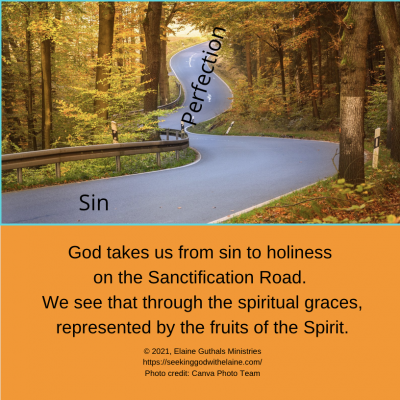
    God takes us from sin to holiness on the Sanctification Road. We see that through the spiritual graces, represented by the fruits of the Spirit.

    Okay. I have to work through what Washburn is saying.

    • God takes us from sin to holiness on the Sanctification Road. We see that through the spiritual graces, represented by the fruits of the Spirit. That is how the hidden life of God in our souls is shown.
    • That is shown through how our character changes.
    • Having a peace of conscience come over us or a feeling of forgiveness at conversion isn’t enough to identify salvation. We are really good at seeing what we expect to see. It isn’t just about feeling it.
    • Others have to see the permanent change in us.
    • Our character has to match His; when we do, we will know Him.
    • We get the character change down to the heart level.

    Resource

    Inside Out Love

    “But the fruit of the Spirit is love …” (Gal. 5: 22 CSB)

    Since God is love (I Jn, 4: 8) and the Holy Spirit is also love, love should be a distinguishing characteristic to show we are children of God.

    Manning wrote “Love is that which unites us with God …” I would take that further and say love is the only thing that unites us with God.

    Resource

    Thornton’s description of love is wonderful. He wrote, “It is by the eyes of the understanding being enlightened to see the perfections of God, the excellencies of Christ, and the unspeakable value of eternal realities, that Divine love is kindled in the soul.”

    Resource

    Love has a component of obedience to God in it. If we don’t love God, we won’t seek Him. We won’t follow His laws and commandments.

    How is love an inside to the outside emotion. Bertram helped us out there. We have to get it to heart level in order to

    • Eliminate fear and anxiety.
    • Cut out sin because is opposite to what God is.
    • Leads us toward holiness.
    • Makes obedience less challenging.
    • Helps us to be living sacrifices.
    • Makes our souls more pleasing to God.

    Resource

    We’ve said that sanctification is a process. Murray contended that love as a fruit of the Spirit isn’t. It is what we reach at the end of many processes.
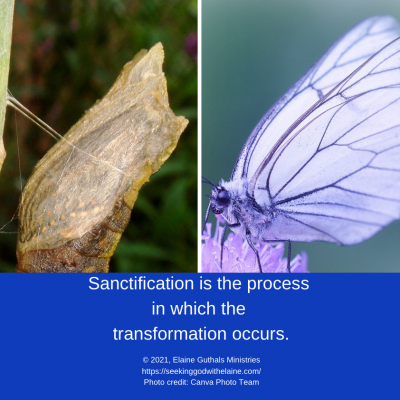
    Sanctification is the process in which the transformation occurs.

    So, let’s break down what Murray said.

    • Love doesn’t happen by accident.
    • Even though human nature is sinful, it is forceful.
    • The actions of the Holy Spirit are not solely a result of our actions.
    • Punishment can be instantaneous, where our growth takes our lifetime.
    • The Holy Spirit uses our abilities to grow us.

    Murray reminded us that we cannot think of God only as up in Heaven. We have to remember He is inside us, too.

    I was agreeing with Murray until he got to talking about power. He wrote “But, friends, he who exalteth his own power exalteth God; for is not God the maker of his power?”

    Resource

    I think I see what Murray is trying to get at. When we use our talents and strength, we are glorifying God because He made us to be able to do what we do.

    I am just tripping over “… he who exalteth his own power exalteth God …” But we only exalt Him when we do what He has called us to do His way.

    Plus, we don’t want to get big heads. We can’t think we are doing it on our own. We are nothing without God.

    To me that strikes too close to what Paul warned us about. “What should we say then? Should we continue in sin so that grace may multiply? Absolutely not! How can we who died to sin still live in it?” (Rom 6: 1-2 CSB).

    We can’t do something self-focused and think that will glorify God. That isn’t loving God.

    We can’t do something self-focused and think that will glorify God. That isn’t loving God.

    What the Holy Spirit is trying to do is to get us back to where Adam and Eve were before the original sin. Murray wrote, “The work of the Spirit is to bring back and reinstate in its original regnancy the Divine characteristic of loving.”

    Resource

    God wants us back to the level of love we had. Emmons contended that happened in regeneration.

    • Regeneration is being changed from spiritually dead to spiritually alive and the internal requickening in us that God brings about through the work of the Holy Spirit to give us new character.
    • Spiritual death is the separation from God that occurred as a consequence of Adam and Eve’s original sin. The spiritually alive are those who have ABCDed, so they are no longer separated from God.

    Glossary

    Emmons argued that Paul did not identify love as a new love. Remember, he keeps saying that we are new creations. We are changed at regeneration from our old self to our new self.

    Glossary

    There is no previous foundation on which to build this love. Emmons argued that love is the foundation, not regeneration.

    I can see that. Regeneration is the process God does to change us from spiritually dead to spiritually alive.

    Regeneration can’t happen if the love isn’t there.

    Regeneration can’t happen if the love isn’t there.

    I’ve got to process what Emmons said. He wrote, “If the Spirit of God produces nothing but love in regeneration, then there is no ground for the distinction which is often made between regeneration, conversion, and sanctification. They are, in nature and kind, precisely the same fruits of the Spirit.”

    Resource

    I can get the question about how are all these terms different. That is one reason I turned into Dictionary Chick. I needed to make the distinction among everything.

    If we look at it a certain way, I can see no difference between regeneration and sanctification. If we think regeneration is one of the three-level words, they are similar.

    We were regenerated and switched from spiritually dead to spiritually alive at conversion. That makes conversion and regeneration the same.

    If we think we are in the process of being regenerated as we live our lives, that is sanctification. Sanctification is the process by which we are regenerated.

    Regeneration/sanctification is not going to be complete until we are perfected when we reach Heaven.

    I guess, I look at conversion as the decision we make to ask Jesus to be our Savior and Redeemer and God to be Sovereign Lord of our lives. Regeneration is the result of that decision.

    Regeneration is what happens to change us to have God’s character. Sanctification is the process to do that.

    Worldview people can believe that their definition of love is God’s definition. They believe in what Thornton called a love of benevolence. In Elaine-speak, that is loving the sinner even if we don’t love the sin.

    If worldview people left it there, that would be what God wants. However, worldview people want their sin to be loved, too — or at least tolerated.

    God wants us to have a love of compliance. That means we love God and Who He is. It also means we love what looks like Him.

    Resource

    If we don’t love God, our service won’t be acceptable. Nothing we do can earn us His salvation and love.
    Nothing we do can earn us His salvation and love.

    Connecting Love to the Other Fruits

    If we don’t have the faith, the love is a secular love. That makes it useless in applying it to eternity.

    Faith is the only way to salvation. Love is not going to cover a lack of faith.

    Don’t believe me? Murray wrote this, “By faith we perceive the loveliness of this principle; by faith we are made appreciative of it and are filled with longing that we may overflow with it; by faith we are thus quickened into this new life of concord and amiability and good-will toward men, and hearty affection toward God.”

    We are quickened into the new life.

    Regeneration is being changed from spiritually dead to spiritually alive and the internal requickening in us that God brings about through the work of the Holy Spirit to give us new character.

    This quickening comes through regeneration. Regeneration comes through conversion.

    Resource

    And it all starts with love.

    love-as-a-fruit-of-the-spiritPin

    Making the Connections

    We cannot discount the influence of the Holy Spirit on our minds. We won’t be able to understand God’s love until the Holy Spirit stirs our desire to know Him.

    We are going to need help to subdue our sinful nature. We will only do that through God’s love.

    How Do We Apply This?

    • Walk with the Spirit.
    • Pray for grace.
    • Seek God to transform our character to His.

    Resource

    Searching for and Seeking God

    Hearing His Word (Rom. 10: 17).
    Reading His Word (Rev. 1: 3).
    Praying to Him (Heb. 4: 16).
    Studying His Word (Ac. 17: 11).
    Meditating on His Word (Ps. 1: 1-2).
    Memorizing His Word (Ps. 119: 11).

    To read a related devotion, click the button below.

    Father God. Love is the foundation of our salvation because You are love. Help us to grow to love You more each passing day. May we have Your character of love so that we love You and others. Amen.

    What do you think?

    Leave me a comment below (about this or anything else) or head over to my Facebook group for some interactive discussion.

    If you don’t understand something and would like further clarification, please contact me.

    If you have not signed up for the email daily or weekly providing the link to the devotions and the newsletter, do so below.

    If God has used this devotion to speak with you, consider sharing it on social media.

  • The Foundation for the Fruits of the Spirit

    Jesus said that we will be known by the fruits of the Spirit. This daily devotional looks at outward fruit and bearing the right fruit at the right time.

    Nuggets

    • The fruits of righteousness are rewards for following God’s Will.
    • Our words and works should honor God.
    • Our fruit should expand the kingdom of God.
    • We should seize every opportunity to witness to others.
    • Since the command is to bear fruit, there are consequences when we do not bear fruit.

    To read devotions in the Redo for Godliness series, click the appropriate button below.

    Devotions in the Fruit of the Spirit series

    When I decided to do a redo for godliness this year, I started throwing sermons into a folder so I could come back and write on them. I don’t feel like I have gotten through many of them.

    One thing I really wanted to do is a series on the fruits of the Spirit. I found an interesting sermon back in October 2020 that should give us a good foundation for the rest of the devotions.

    Watson’s sermon will give us a good base of what a fruit actually is. Let’s take a look.

    Let’s Put It into Context

    Watson wrote that the fruit of the Spirit comes from the Tree of Righteousness. Righteousness is the indwelling goodness that is the result of a solid relationship with God built by a sincere life of conscientious obedience to God’s laws and commandments and from which all virtues flow.

    Resource

    Fruit of Righteousness

    “Filled with the fruit of righteousness that comes through Jesus Christ, to the glory and praise of God” (Phil. 1: 11 ESV)

    The fruits of righteousness are rewards for following God’s Will.

    We just looked at fruits of righteousness in the Joy of Relationships devotion.

    To read a related devotion, click the button below.

    The fruits of righteousness are the rewards given at perfection for doing God’s Will and growing closer to Him. The rewards are eternal life, peace, access to Him, and hope.

    Glossary

    Yes, they are given at perfection. No, we don’t have to wait until we get to Heaven to get smaller versions of this. We can have this now.

    When we talk about fruit, we also talk about the products of correctly discerning God’s voice. It is the rewards of discernment. “And the fruit of righteousness is sown in peace by those who cultivate peace” (Jas. 3: 18 CSB)

    When we discern the wisdom of God, it produces fruits of righteousness. It is the fruit that is grown as we grow closer to God.

    That is the whole point of being able to discern God’s voice. We want to be able to use what He tells us to strengthen our relationship with Him, to help us imitate Him better.

    “He is like a tree planted by streams of water that yields its fruit in its season, and its leaf does not wither. In all that he does, he prospers” (Ps. 1: 3 ESV)

    The sermon entitled The Way of the Righteous by the Monday Club Sermons talked about having different classes of good and evil. It is more our motivation rather than a hierarchy of righteousness and sin. They wrote, “It is needful to discriminate with respect to the kind of delight the righteous man takes in the law.”

    Resource

    The tree takes most of its nourishments in through the roots. The Monday Club Sermons equated the roots to the inward us. We prosper when we follow God’s Will, which He shows us when we meditate in seeking for Him.

    That is logical. God wants us to get it to the heart level. That is where He is always going to meet us. He is going to abundantly provide.

    It produces an inward fruit. Hmmm. What?

    I thought the fruits were what we see. They are the visual representation of God in us.

    Okay. Let’s look at it this way. One of the ladies in my church gave me this huge poinsettia plant.

    It had been outside at her house, but at this time of the year it needs a lot of darkness. At my house, that means to the basement it goes.

    So, we are not only going through separation anxiety of Pointy being thrust into a new environment, but we are also probably messing up her routine.

    The stress on the plant has withered a couple of leaves.

    Is the plant dead or dying? No.

    What we see isn’t a complete indication of what is happening on the inside. The love, joy, peace, long suffering, gentleness, goodness, faith, meekness, and temperance have to come from the inside out.

    What if we were loving someone against our will? What if we were only doing it for show? What we see may not be a clear indication of the condition of the heart.

    I know. Jesus said, “You will recognize them by their fruits” (Mt. 7: 16 ESV). What I am saying is the outward walk without the inward faith means nothing.

    Screen Shot 2021-05-13 at 9.37.42 PM

    That makes sense, doesn’t it? If we don’t have the faith behind the love, it is just a worldview love. We aren’t loving in God’s name.

    (And yes, I named my plant.)

    Outward Fruit

    “Let your speech always be gracious, seasoned with salt, so that you may know how you ought to answer each person” (Col 4: 6 ESV)

    Our words and works should honor God.

    What we are going to talk about in the succeeding devotions is the inward fruit that people see: love, joy, peace, long suffering, gentleness, goodness, faith, meekness, and temperance.

    Watson said the outward fruit is good discourse and good works.

    Good Discourse

    Our words should reflect the righteousness that God has placed within us. “Our words ought to proceed from some grace of God in the heart, as from knowledge, faith, joy, love, sorrow, fear, etc., and in this sense, when on the tongue, they carry the name of the fountain whence they flow.

    Resource

    Hmmm. Several of the fruits were listed in that.

    We are to use our words to build up each other. I keep thinking of Hawk Nelson’s song.

    Related Links

    Hawk Nelson

    Good Works

    Airay felt the good works were what we do that came from our being righteous as God is. We glorify God by the good works performed through His righteousness in us.

    Resource

    To read a related devotion, click the button below.

    We know God calls us to do good works. Good works means that we give God our best to complete whatever tasks He assigns for us to do. “For we are his workmanship, created in Christ Jesus for good works, which God prepared ahead of time for us to do” (Eph. 2: 10 CSB).

    Verse Commentary

    It is through performing those works that we learn Who God is. So many times, we learn by doing. When we do those works, we are exhibiting His character.

    Kindly Fruit

    “A good tree cannot bring forth evil fruit, neither can a corrupt tree bring forth good fruit” (Mt. 7: 18 KJV)

    Our fruit should expand the kingdom of God.

    Most of the other versions translated this as good and bad fruit. I went with the King James Version as I use that as the standard. They were the only one that translated it good and evil.

    To me, there is a distinct difference.

    • Good, in the biblical sense, is the workings of God within His people.
    • Evil is equated with sin because it is that which goes against God and His purposes.

    Watson said that we have to bear the fruit that is meant for us to bear. I read this as God has given each of us tasks to perform. We have to do the work.

    That work means bringing people to Jesus. We’ve got to do our part.

    Pastor Joey asked a very good question. He said, “Are we endeavoring to bring people to Christ or just playing church?”

    Resource

    Think about it. Why are you going to church? Is it just to get fed — spiritually, not physically?

    Bringing people to Christ isn’t a play to up the numbers in our congregation. This is keeping people out of hell.

    Bringing people to Christ isn’t a play to up the numbers in our congregation. This is keeping people out of hell.

    The fruit we produce has to be suitable and proper. Do you know a Dr. Jekyll and Mr. Hyde disciple? The person is one way when inside the church doors, but the opposite outside of them? We have to be a child of God wherever we are.

    God has given us specific gifts to be used for specific tasks that He has given us. If I tried to run the Hospitality Committee, that wouldn’t end well. My gift is singing. I have to use my gift properly.

    Seasonable Fruit

    “So then, as we have opportunity, let us do good to everyone, and especially to those who are of the household of faith” (Gal. 6: 10 ESV)

    We should seize every opportunity to witness to others.

    Solomon said in Ecclesiastes, “For everything there is a season, and a time for every matter under heaven” (Ecc. 3: 1 ESV). We know everything happens in the fullness of God’s time.

    I love Martin’s definition of opportunity. He wrote, “‘Opportunity’ is that season in which we can minister to the benefit of others.”

    Resource

    We may only have the opportunity to witness to someone for a short time. Maybe we’ve just met them at the health club — but then their spouse gets transferred out of state, so they are gone.

    We may see an opening in a conversation to bring up how God is working in our lives. We don’t take it because we don’t feel comfortable sharing about ourselves. Then the person is killed in an auto accident.

    Fruit is fine hanging on a tree. We aren’t going to get a pie if it stays there.

    Being a disciple is great for us. Our faith doesn’t help others if we don’t share it.

    Why Is It Important?

    “Every branch in me that does not bear fruit he takes away, and every branch that does bear fruit he prunes, that it may bear more fruit” (Jn. 15: 2 ESV)

    Since the command is to bear fruit, there are consequences when we do not bear fruit.

    God expects us to expand His kingdom. Every one of us — not just the Pastor Joey-types.

    Watson wrote, “The righteousness of faith is always accompanied with the fruits of righteousness.” He also said we should never think that we have enough.

    Resource

    Read that verse one more time. “Every branch in me that does not bear fruit he takes away, and every branch that does bear fruit he prunes, that it may bear more fruit” (Jn. 15: 2 ESV).

    Every branch in me. Every branch in Christ.

    Who are in Christ? Children of God. Disciples. We are.

    Glossary

    Jesus will cut off and throw away those who do not bear fruit.

    the-foundation-for-the-fruits-of-the-spiritPin

    Making the Connections

    God wants to reward us. He wants us to be fruitful.

    God is exacting about what He requires of us.

    How Do We Apply This?

    • Make sure we are bearing fruit.
    • Cut out all of the things that are obstructing us from bearing bruit.
    • Abhor evil.
    • Hold onto God’s promises.
    • Be humble.
    • Join a witnessing program at our church.
    • Bury ourselves in the Word of God.

    Resource

    Father God. We praise You for Your love for us. We want to serve You in every opportunity that You give to us. Help us to live in Your Will. Amen.

    What do you think?

    Leave me a comment below (about this or anything else) or head over to my Facebook group for some interactive discussion.

    If you don’t understand something and would like further clarification, please contact me.

    If you have not signed up for the email daily or weekly providing the link to the devotions and the newsletter, do so below.

    If God has used this devotion to speak with you, consider sharing it on social media.

  • Repentance and Restoration

    When God and Job were talking, Job acknowledged several things. This daily devotional looks at how Job acknowledged God’s greatness, his ignorance, and his humility.

    Nuggets

    • Job acknowledged God’s superiority and greatness, including His plans for us.
    • Job acknowledged that we don’t know as much as we think we do.
    • Job acknowledged his need to repent.

    Devotions in the Job: The Ultimate Test of Character series

    When we last left Job, he and God were having a discussion. In this devotion, we are going to finish looking at their discussion.

    Let’s Put It into Context #1

    Here is a running list of what we’ve discussed previously.

    Acknowledging God’s Greatness

    “Then Job replied to the Lord: I know that you can do anything and no plan of yours can be thwarted” (Job 42: 1-2 CSB)

    Job acknowledged God’s superiority and greatness, including His plans for us.

    Job did some things right when he addressed God. We talked before about the first thing out of God’s mouth when He started the one-on-one that Job requested was questions about where-were-you-in-creation?

    Job learned his lesson. He acknowledged God’s greatness. Woodrow did say that he did do this all along. He wrote, “Throughout his speeches Job had frequently asserted the majesty of God. But now he has a new view of it, which turns awe into reverence and fear into adoration.”

    Resource

    Think of what God showed Job.

    • Majesty
    • Glory
    • Wisdom
    • Holiness

    Job didn’t see it from a human perspective. He saw it from the perspective Hod showed Him.

    Wow!

    Maybe Job didn’t consider God had a plan for His life before. Now, he knew God did.

    God has a plan for all our lives, and He will work His plan.

    This whole section on God’s response to Job shows us the power and glory of God. The Christian Observer wrote that it shows us His attribute of perfection.

    Resource

    That produces strong case for our repentance. Repentance is acknowledging our separation from God and expressing sorrow for breaking God’s laws and commandments by making the commitment to changing ourselves through obedience so that we no longer do the wrong things.

    Acknowledging His Ignorance

    “You asked, ‘Who is this who conceals my counsel with ignorance?’ Surely I spoke about things I did not understand, things too wondrous for me to know. You said, ‘Listen now, and I will speak. When I question you, you will inform me’” (Job 42: 3-4 CSB)

    Job acknowledged that we don’t know as much as we think we do.

    Job admitted that he didn’t know everything in the past. He may have thought he did, but he realized he didn’t.

    Burrell contended that Job and his friends were working on two false assumptions. The first was that we could know all there is to know about God. The second was that we did.

    Resource

    We can go two ways when we find out we don’t know as much as we think we do. We can react badly. Or we can open up and learn.

    Orr brought up a good point. We don’t know where God had gotten his knowledge of God previously.

    Think about it. Sitting in the pew learning about God is great. Hearing He is going to be with us during the trials sounds like it is going to be fantastic.

    Having God in the car when we almost get in an accident is better. God providing the money when we don’t know where it is coming from is priceless. Holding on to God’s hand when we feel like our health is slipping out the door is comforting.

    That, my friend, is knowing God. We don’t know God until we go through the trials.

    Acknowledging His Humility before God

    “I had heard reports about you, but now my eyes have seen you. Therefore, I reject my words and am sorry for them; I am dust and ashes” (Job 42: 5-6 CSB)

    Job acknowledged his need to repent.

    Think back to when this all started. For the first 31 chapters, all Job wanted was for others to realize that he hadn’t sinned. He wanted justification. Woodrow said that Job wanted to lay the responsibility at God’s feet and blame “… the strangeness and the mystery of His ways.”

    Resource

    Ooo, baby. Don’t we do that? “Well, I don’t know why I am having seizure. I am sure it is all part of His plan. He must have a reason, though it is beyond me. He works in mysterious ways. Maybe I will find out. Maybe I won’t. It is all on Him.”

    Remember when Job was a broken record when the friends were biting on him? Basically, all Job was saying was, “I don’t know why. I want to know why.”

    After Chapter 31, Job started to condemn himself.

    Job realized he had sinned. Orr wrote, “He had, further, confessed his sinfulness in the sight of God; for, though he vindicated his character against the unjust suspicions of his fellow creatures, he knew that his righteousness extended not to his Creator.”

    Resource

    Job realized that he was biting on God for the trials. He was holding God responsible for the bad stuff and was impatient with Him to get it over!

    God never told Job the why part. And Job was OK with that. He had grown in his trials.

    Burrell said that Job got a side benefit of a new state of heart. He said that “Job goes beyond humility to repentance.”

    Resource

    Orr made a great comment. He said, at the end of everything, Job wouldn’t have changed anything.

    Resource

    Every trial that God has us go through is going to do its job. That job is to bring us closer to God — give us a clearer understanding of Who He is.

    When we are humbled, God can show us our sin. Even when we think we haven’t sinned, we usually have.

    Yeah, that is hard being shown where we have broken God’s laws and commandments. But we need to know, so we can repent. Repentance is acknowledging our separation from God and expressing sorrow for breaking God’s laws and commandments by making the commitment to changing ourselves through obedience so that we no longer do the wrong things.

    I love this quote. Vaughan wrote, “But repentance is not the necessity of some; it is the necessity of all. Repentance is not an act, but a state; not a feeling, but a disposition; not a thought, but a mind. Repentance is too real a grace to live in the ideal.”

    Resource

    I think, sometimes, we think repentance is a once-and-done act. Well, the act itself is.

    What it brings isn’t. I think the best I can describe it is a condition, but I am not sure I really like that.

    RepentanceAndRestorationPin

    Making the Connections

    God wanted an inward change. True, God renewed Job’s joy. He was also able to be of service to his friends.

    More importantly, Job received greater knowledge of God, an increased relationship with Him, and a greater understanding of himself. We all need this to grow in our relationships with God.

    Taylor pointed out that this was typical of all Old Testament individuals. Had to be. It is in the nature of the way God revealed Himself to the Israelites.

    Resource

    Jesus didn’t come until the New Testament. God could give the promise of a Savior, but He couldn’t say a Savior had appeared until Jesus was born. Then, it switched to a He-was-here belief.

    But look at it this way. Our faith was going from a there-is-a-God to I-need-to-live-for-and-obey-God. It was heading to being built on inward character.

    Burrell argued that, after the trials, Job had a greater appreciation of God. He wrote, “Every revelation of God to our hearts has for its contents, above the fact of God’s existence, the facts of His character. God is never shown to us except with His attributes. This new knowledge came to Job because he suffered.”

    Resource

    The big why? God is merciful. God’s mercy is an act of sovereign will that produces an unexpected and undeserved response from God as He responds in love to our needs.

    To read a related devotion, click the button below.

    God loves us so much He forgives us for disobeying Him when we genuinely repent. That includes turning away from our sin.

    How Do We Apply This?

    Dickinson wrote, “The primary object of the Book of Job is to prove and illustrate the glory and force of a pure, unselfish religion. Job was reconciled to his sufferings, not by argument, but by a direct revelation of the character of God.”

    Resource

    Job started out blameless. He ended up complaining against God. Dickinson said he was somewhat vindictive.

    • As we seek God, prepare to be humbled and become conscience of our sin.
    • We need to understand God’s purity, holiness, justice, goodness, truth, power, wisdom, and love from His perspective. Girdlestone said we really don’t have a clue.

    Resource

    We must put our faith and trust in God regardless of what comes — prosperity or trials. We must be content with wherever our Sanctification Road takes us.

    We do that by submitting. We give everything over to God and say it is His to orchestrate. Then we praise Him for whatever He brings our way.

    Father God. You are great! You are knowledgeable, and we are not. We humbly come to You, repenting of our sins and asking Your forgiveness. Amen.

    What do you think?

    Leave me a comment below (about this or anything else) or head over to my Facebook group for some interactive discussion.

    If you don’t understand something and would like further clarification, please contact me.

    If you have not signed up for the email daily or weekly providing the link to the devotions and the newsletter, do so below.

    If God has used this devotion to speak with you, consider sharing it on social media.

  • When God Doesn’t Give Us the Answer We’re Expecting

    After forty chapters of trials, heartaches, pain, humiliation from his friends, and disillusionment, Job heard from God. This daily devotional looks at how it wasn’t the answer Job was expecting.

    Nuggets

    • When God points out our sin, we need to immediately repent.
    • God didn’t take silence for an answer.
    • We aren’t like God, but God wants us to become like Him.

    Devotions in the Job: The Ultimate Test of Character series

    Aren’t there days when we wish God would talk back to us? Oh, we know He answers our prayers. We feel the fullness when the Spirit moves within us.

    But oh, how we long just to cuddle up to Him like we did our dads, put our heads on His shoulder, and just converse. No translator.

    God talked to Job.

    Let’s Put It into Context

    We skipped some. The last time we looked at Job, we were talking about him and his three friends.

    A fourth one showed up. I know. Wasn’t three enough? Elihu gave the same soundtrack.

    But something interesting happened. “Then the Lord answered Job from the whirlwind …” (Job 38: 1 CSB). Yep. God answered.

    Elihu is talking, and God ignores him. Well, sorta. God said, “Who is this who obscures my counsel with ignorant words?” (Job 38: 2 CSB) Ouch.

    God’s focus is fixed totally on Job. Let’s look at a part of what He had to say.

    You Did Wrong, Job

    “The Lord answered Job: Will the one who contends with the Almighty correct him? Let him who argues with God give an answer. Then Job answered the Lord: I am so insignificant. How can I answer you? I place my hand over my mouth. I have spoken once, and I will not reply; twice, but now I can add nothing” (Job 40: 1-5 CSB)

    When God points out our sin, we need to immediately repent.

    Job 38 and 39 can be summed up by Job 38: 33. “Do you know the laws of heaven? Can you impose its authority on earth?” (Job 38: 33 CSB).

    God is in charge of everything. Job isn’t. We aren’t.

    But it is like God and Job are having two different conversations. That really wasn’t what Job was asking through the first forty books of Job.

    Job was asking why the things that were happening to him were happening to him. That was the difference.

    Job’s focus was him. God’s focus was Him. Bradley said He never once answered Job’s questions.

    What gives with that? We know God doesn’t have to answer our questions. He is God.

    We also know God does allow us to question Him. In some cases, how are we going to grow otherwise? We just have to ask in faith.

    Bradley gave us his opinion as to why God chose this route. He wrote, “It is as though the voice of God did not deign to repeat that He works ‘on the side of righteousness.’ He only hints at it.”

    Resource

    Nope, Job wasn’t told about Satan and his wheedling. He wasn’t reassured that he was blameless.

    Instead, God told Job Who He is.

    That should be good enough for us.

    We shouldn’t need chapter and verse so we know why things are happening. I don’t need to know why I am getting seizures at this precise moment in my life.

    I just need to trust my Maker and Redeemer that He has this.

    Oh, yeah. I like to be in control. I like to know what is coming and when. I like to know my options and pick what is in my best interest.

    But I know God leaves a lot of chapters out in the explanations and leaves it a mystery. He just wants me to trust Him. So, I will.

    God, here, comes back with “… Will the one who contends with the Almighty correct him? …” (Job 40: 2 CSB). I would say contends with means wrestle with.

    Oh, we have to be so careful. For forty chapters, I have been thinking that Job has always stayed with

    • “Throughout all this Job did not sin or blame God for anything” (Job 1: 22 CSB).
    • “But I know that my Redeemer lives, and at the end he will stand on the dust. Even after my skin has been destroyed, yet I will see God in my flesh. I will see him myself; my eyes will look at him, and not as a stranger (Job 19: 25-27 CSB).

    I don’t know how many times my Ladies and I have said don’t judge, don’t judge like the four friends did. You can’t know what is happening inside.

    There was something God didn’t like. It was something we couldn’t see because it was an attitude.

    Maybe Job’s sin was because not only the trial went on and on but also harping of his friends went on and on. Something in the on and on made Job to say something or do something that God considered a sin.

    Henry gave one explanation. He wrote, “Job had been too bold in demanding a conference with God, and thought he could make his part good with him: but now he is convinced of his error, and owns himself utterly unable to stand before God or to produce any thing worth his notice, the veriest dunghill-worm that ever crawled upon God’s ground.”

    Resource

    God really didn’t tell us what the sin was. I think God didn’t want us to focus on that. We are all going to sin — even Job.

    Job immediately repented. Elaine-speak for verses 4 and 5. I am nothing. I have already put my foot in my mouth, so this time, I am going to keep it shut.

    Henry said that “Job now vilifies himself as much as ever he had justified and magnified himself.” He went 100% one way until God turned him 100% the other way.

    Resource

    Well, as Henry says, repentance does change our opinion of ourselves.
    Barrows had an interesting paraphrase for this text. He wrote, “… Shall man, rebelling against the authority of God, assume to be wiser than the All-wise? Shall he pronounce the ways of God unequal in order to vindicate his own integrity? Is it wisdom in men, surrounded by mysteries and conscious of ill-desert, to fly in the face of heaven and lay their complaints against the God with whom they contend?”

    Resource

    I read that and thought, Adam and Eve. We want to know as much as God. Sometimes, we even think we know more than Him.

    Boy howdy, are we wrong!

    One thing of which we can be certain. God will call us on our sin. We have to be like Job when He does.

    • Be silent.
    • Repent immediately.
    • Turn from our sin.

    Jay noted that we need to practice self-examination. He wrote, “The most useful knowledge of ourselves is not that which is physical, but that which is moral; not a knowledge of our worldly affairs, but of our spiritual condition.”

    Resource

    See that. Spiritual — meaning God is involved, not just doing something because it is the right thing to do. Moral — spiritual graces.

    If our morals don't come through submission to God, they are just worldly morals, not spiritual graces. But then we have to grow the spiritual graces to holiness.

    This self-examination does bring interesting results. As we identify our sins — i.e. become wiser — we start biting on ourselves thinking we are so bad. We see the inside.

    But there is a big thing that stuck out here for me. Job didn’t know he had sinned. This blameless guy did know that he had messed up.

    If Job didn’t know, how are we going to know?

    Let’s Try That Again

    “Then the Lord answered Job from the whirlwind: Get ready to answer me like a man;When I question you, you will inform me. Would you really challenge my justice? Would you declare me guilty to justify yourself? Do you have an arm like God’s? Can you thunder with a voice like his?” (Job 40: 6-10 CSB)

    God didn’t take silence for an answer.

    God wasn’t satisfied with just one round of questioning. He started in on Job again.

    Henry thought Job wasn’t totally repentant. That is why God started this second round of the interrogation.

    Resource

    Verse 7 says “Get ready to answer me like a man …” (Job 40: 7 CSB). The King James Version says “Gird up thy loins now like a man …” (Job 40: 7 KJV). Today’s memes would say to me pull up your big girl panties.

    Verse 8 is really a condemning verse because we so many times try to challenge God’s justice and justify ourselves. We want to say what is a sin or not. We want God to take into consideration the extenuating circumstances.

    That just seems so opposite to what we were told about Job in Job 1: 22. Job did not sin but must have blamed God for something (yeah, which is a sin. I guess a lot changed in 40 chapters).

    Finney gave us some good nuggets.

    • Nothing justifies sin.
    • We are all going to sin.
    • God isn’t going to ask us to do something that He hasn’t given us the ability to do or grow to do.
    • Repentance has to be genuine, or salvation isn’t given.

    Resource

    Whenever we try to compare ourselves against God, we will come out on the losing end. God will out love us. He is more beautiful than us. He is kinder.

    God is omnipotent. That means He is all-powerful. We aren’t.

    RepentanceGenuine

    If You Think You Are Good Enough

    “Adorn yourself with majesty and splendor, and clothe yourself with honor and glory. Pour out your raging anger; look on every proud person and humiliate him. Look on every proud person and humble him; trample the wicked where they stand. Hide them together in the dust; imprison them in the grave. Then I will confess to you that your own right hand can deliver you.

    We aren’t like God, but God wants us to become like Him.

    Here is what I get from the verses.

    There is too much in this world that we could be angry about. God doesn’t want that. He isn’t.

    If we are following the worldview, we are proud. Henry said “that proud people are wicked people, and pride is at the bottom of a great deal of the wickedness that is in this world both towards God and man.”

    Resource

    God doesn’t want us following the worldview.

    What else does Henry get out of it? Here he said Job had been passionately quarreling with God and His authority.

    Am I the only one who thinks we are finding out exactly what Job’s sins are?

    Another thing Henry wrote was “Job had complained of the prosperity and power of tyrants and oppressors, and was ready to charge God with mal-administration for suffering it …” That would not have been a smart move.

    Okay, I could see Job complaining about his four “friends” and the power they thought they had over him.

    God said that if Job could accomplish all that He outlined in these verses (which of course he couldn’t), He would allow Job to save himself. None of this could happen, so Job could not save himself.

    We cannot save ourselves.

    WhenGodDoesntGiveUsTheAnswerWereExpectingPin

    Making the Connections

    We talk about the patience of Job. Monte brought up some others that are also held up as models but are not as blameless as Job.

    • David
    • Moses
    • Abraham

    Monte brought up an excellent point. This isn’t just about reward and punishment. It is about His grace. Grace is a free and unmerited gift from Heavenly Father given through His Son, Jesus Christ that enables salvation and spiritual healing to believers by the work of the Holy Spirit.

    Resource

    Monte also reminded us that character is not that which is seen. It is that which is deep within us.

    How Do We Apply This?

    “Then [we] will remember [our] evil ways and wicked deeds, and [we] will loathe [ourselves] for [our] sins and detestable practices” (Ezek. 36: 31 NIV).

    • We have to remain silent before God.
    • We can’t excuse ourselves to repentance.
    • Repentance has to be genuine.
    • We will remember that God is fair.
    • We won’t become impatient through our trials when it seems like God is allowing them to drag on.

    Resource

    God answered Job. The conversation didn’t go as Job expected, but it helped grow Job’s relationship with God.

    Father God. It scares us to think that we might be sinning without even knowing it. Forgive us, Lord. Show us where we are sinning, so that we can repent and turn from that sin. We want to live as You would have us live. Amen.

    What do you think?

    Leave me a comment below (about this or anything else) or head over to my Facebook group for some interactive discussion.

    If you don’t understand something and would like further clarification, please contact me.

    If you have not signed up for the email daily or weekly providing the link to the devotions and the newsletter, do so below.

    If God has used this devotion to speak with you, consider sharing it on social media.

  • A Hymn about Wisdom

    Job’s response to the third round of discussions included a discussion on wisdom. This daily devotional looks at the importance of knowing God.

    Nuggets

    • To be a disciple we must look for wisdom.
    • Wisdom can only be obtained through knowing God.
    • God is all-knowing; therefore, we should reverence Him.

    Devotions in the Job: The Ultimate Test of Character series

    We are in round three of the friends’ discussions with Job. We can tell they are frustrated because they throw out all sorts of false accusations.

    Eliphaz accused him of abusing others, especially widows and orphans. Bildad accused him of being a total degenerate.

    This round was different. Zophar did not join in the accusation-fest.

    This poem comes after Job’s response. Well, it may be part of it. Bible scholars are divided about if it is or not.

    Let’s go through it and see what it tells us.

    Let’s Put It into Context

    Here is a running list of what we’ve discussed previously.

    The Need for Wisdom

    “But where can wisdom be found, and where is understanding located? No one can know its value, since it cannot be found in the land of the living. The ocean depths say, ‘It’s not in me,’ while the sea declares, ‘I don’t have it.’ Gold cannot be exchanged for it, and silver cannot be weighed out for its price. Wisdom cannot be valued in the gold of Ophir, in precious onyx or lapis lazuli. Gold and glass do not compare with it, and articles of fine gold cannot be exchanged for it. Coral and quartz are not worth mentioning. The price of wisdom is beyond pearls. Topaz from Cush cannot compare with it, and it cannot be valued in pure gold” (Job 28: 12-19 CSB)

    To be a disciple we must look for wisdom.

    Bevan reminded us that it is the combination of a moral quality and a spiritual quality that makes us disciples. That is why we can’t be a disciple just by being a good person.

    Resource

    The Homilist noted that this chapter is about man’s power and weakness. We have the “… power to supply the material necessities of his nature, and his weakness to supply his mental cravings.”

    It is hard to remove moral intellectual difficulties. The Homilist said that it really isn’t something on which we can read self-help books.

    The persistent application of moral virtues to our lives because of our supreme love for God gives an answer to the removing our intellectual difficulties. In order to do that, we have to understand wisdom.

    Wisdom is an enlightened acceptance of God’s principles that leads to knowledge, discernment, and good sense that is put into practice through salvation, increasing our goodness and virtue.

    Stanley said that wisdom is the quest for knowledge. It is the desire to know.

    Resource

    We have to put this into perspective. This isn’t the quest to determine how God made the world or some other burning question we want answered. It is the quest to determine Who God is and how we can imitate Him.

    But we’ve said over and over that it isn’t head knowledge. It has to be heart knowledge. Stanley said we have to actively use what we know to distinguish between good and evil.

    • Good, in the biblical sense, is the workings of God within His people.
    • Evil is equated with sin because it is that which goes against God and His purposes.

    There is one thing we have to keep in mind, though. Stanley wrote, “No doubt wisdom is not in itself goodness.”

    Resource

    Wisdom helps us start with faith and continue in obedience.

    Bevan made an interesting statement. He wrote, “The relation of man to God includes the deep enigmas of sin and evil, the large speculation of freedom, necessity, responsibility, and law.”

    Resource

    Wisdom helps us start with faith and continue in obedience.

    We get the sin versus evil. It is the freedom, necessity, responsibility, and law that can get us.

    Sometimes, we don’t understand how freedom and responsibility mesh. We think freedom means we can do anything we want to do. Responsibility doesn’t always fit into that, because we see responsibility limiting our freedom.

    The same can be said for freedom and law. Law limits freedom even moreso, we think.

    We feel like necessity is limiting, also. Having to do something takes our freedom of choice away.

    We like to think we are really powerful. A relationship with God shows how limited our power is — and how powerful He is.

    Finding Wisdom

    “Where then does wisdom come from, and where is understanding located? It is hidden from the eyes of every living thing and concealed from the birds of the sky. Abaddon and Death say,
‘We have heard news of it with our ears’” (Job 28: 20-22 CSB)

    Wisdom can only be obtained through knowing God.

    Vaughan made the comment that science stands in the way of reconciling with God. He said that this was so — “… even more than the dogmatism of theology.”

    Resource

    Science keeps the focus on whether we can figure out what really happened or how it is. I don’t think it is trying to figure out how God did it. I think science is trying to prove that He didn’t.

    Why do I think this? I agree with Vaughan. He wrote, “The moment you come with your dogmas to measure and explain everything, that moment the mystery, the vastness, the grandeur, begin to vanish.”

    Resource

    We have to realize that worldly knowledge without spiritual knowledge is worthless. Cadman wrote, “Science may give knowledge, but cannot attain wisdom.”

    Resource

    It isn’t about what we know. It is about our knowing God. Only spiritual knowledge will help us in the end.

    It isn’t about what we know. It is about our knowing God.

    God’s Wisdom Requires Reverence

    “But God understands the way to wisdom, and he knows its location. For he looks to the ends of the earth and sees everything under the heavens. When God fixed the weight of the wind and distributed the water by measure, when he established a limit for the rain and a path for the lightning, he considered wisdom and evaluated it; he established it and examined it. He said to mankind, ‘The fear of the Lord — that is wisdom. And to turn from evil is understanding’” (Job 28: 23-28 CSB)

    God is all-knowing; therefore, we should reverence Him.

    One of God’s attributes is that He is omniscient. God’s wisdom is sufficient that it puts Him in control. He will never once say, “Ooo, baby. I did not see that coming.”

    To read a related devotion, click the button below.

    Understanding

    We will have to accept we won’t understand everything about God and work to understand what He reveals.

    Then we get to fear of the Lord. We’ve talked about that many times. In fact, that is the topic for our discussion for this year.

    Godliness, equated with the Old Testament term fear of the Lord, is reverence in thought, feeling, and conduct that is promoted by walking in His Spirit and obeying God’s laws and commandments and produces a moral likeness of God. 

    Tillotson noted fear of the Lord was one of the catch-all phrases used in Scriptures. He wrote, “To fear the Lord’ and to ‘depart from evil’ are phrases which the Scripture useth in a very great latitude to express to us the sum of religion and the whole of our duty.”

    Resource

    Why is fear of the Lord important? “The fear of the LORD is the beginning of wisdom; all who follow his precepts have good understanding. To him belongs eternal praise” (Ps. 111: 10 NIV).

    Shiels noted that, to properly fear Him, we had to properly know Him. We have to know the attributes He possesses.

    To read a devotion in the Finding Our Center

    According to Shiels, fearing God means we don’t want to disobey Him. It makes us want to know everything about Him.

    The Homiletic Magazine told us how fearing the Lord brings happiness.

    • It removes moral impediments to our happiness.
    • Restoration to purity brings happiness.
    • It infuses sober habits.
    • It provides comfort in trials.

    Resource

    AHymnAboutWisdomPin

    Making the Connections

    Pratt noted that, “to fear the Lord is wisdom; to depart from evil is ‘understanding.’” That makes sense to me.

    We have to understand enough to make the choice to turn to God. We aren’t going to know everything. To show God reverence is to acknowledge that He does know everything.

    Resource

    How Do We Apply This?

    • No matter what, trust in God.
    • Recognize that we will understand everything in eternity.
    • Get rid of the sinful feelings.
    • Follow God’s laws and commandments.
    • Be humble.

    Resource

    Father God. Lord, we want to know You. Give us the wisdom we need to understand what we need to in order to submit to You. Amen.

    What do you think?

    Leave me a comment below (about this or anything else) or head over to my Facebook group for some interactive discussion.

    If you don’t understand something and would like further clarification, please contact me.

    If you have not signed up for the email daily or weekly providing the link to the devotions and the newsletter, do so below.

    If God has used this devotion to speak with you, consider sharing it on social media.

  • The Root Builds Character

    When everything seems like they are going against us, we need to go to the root in order to grow. This daily devotional looks at how we should deal with the conflict caused by the trials.

    Nuggets

    • There are times when we need to get to total despair so that God can step in and save us.
    • Job made a bold statement that he knew who his Redeemer was.
    • We must believe in God’s root to escape judgment and sword.

    Devotions in the Job: The Ultimate Test of Character series

    Job’s friends just kept after him. They were convinced that Job had done something wrong — was doing something wrong. That caused conflict between the four friends.

    But Job wasn’t really in conflict with the others. Let’s dig in.

    Let’s Put It into Context #1

    Here is a running list of what we’ve discussed previously.

    To read a related devotion, click the button below.

    Let’s Put It into Context #2

    “Parts of his skin are eaten away; death’s firstborn consumes his limbs. He is ripped from the security of his tent and marched away to the king of terrors. Nothing he owned remains in his tent. Burning sulfur is scattered over his home. His roots below dry up, and his branches above wither away. All memory of him perishes from the earth; he has no name anywhere. He is driven from light to darkness and chased from the inhabited world. He has no children or descendants among his people, no survivor where he used to live. Those in the west are appalled at his fate, while those in the east tremble in horror. Indeed, such is the dwelling of the unjust man, and this is the place of the one who does not know God” (Job 18: 13-21 CSB)

    In Job 19, Job is responding to Bildad’s speech. Bildad gets some of it right, but he got the main point wrong.

    Job Identifies the Conflict

    “All of my best friends despise me, and those I love have turned against me. My skin and my flesh cling to my bones; I have escaped with only the skin of my teeth. Have mercy on me, my friends, have mercy, for God’s hand has struck me. Why do you persecute me as God does? Will you never get enough of my flesh?” (Job 19: 19-22 CSB)

    There are times when we need to get to total despair so that God can step in and save us.

    At this point in Job’s story, he feels like he has been beat up by all sides.

    • His wife was biting on him.
    • His three best friends were biting on him.
    • He was mourning the deaths of his children.
    • His health had taken a hit.
    • He was to the point he wanted to die.
    • Talmage said that he would have been in bankruptcy.

    Resource

    Job got to the point where he thought his trials were never going to end. We have to get that way, too, sometimes.

    It is only when we stop relying on ourselves and totally looking toward God that He can step in and save the day. We have to take the focus off of us and our problems and look to Him. We have to worship Him even when we are ready to throw in the towel.

    One of the things that is really weighing on Job, I think, is that he and his friends seem to be at opposite ends of the faith continuum. They more than anyone — as his best friends — should know what Job believed.

    The friends kept giving evidence that they didn’t get Job.

    Job Stated What the Root Is

    “I wish that my words were written down, that they were recorded on a scroll or were inscribed in stone forever by an iron stylus and lead! But I know that my Redeemer lives, and at the end he will stand on the dust. Even after my skin has been destroyed, yet I will see God in my flesh. I will see him myself; my eyes will look at him, and not as a stranger. My heart longs within me” (Job 19: 23-27 CSB)

    Job made a bold statement that he knew who his Redeemer was.

    Some think Job is talking solely of physical recovery. If Job was talking about physical recovery, I don’t think he would have said, “… I know that my Redeemer lives …” (Job 19: 25 CSB). He is expressing faith in a living Being.

    I love Job’s strong conviction. “… yet I will see God in my flesh” (Job 19: 26 CSB). I don’t think this means Job felt he was going to succumb to his illness.

    Coming described both meanings of the word redeemer. He wrote, “It means the avenger of blood, and it means the kinsman.”

    Resource

    We know the concept of the kinsman redeemer from the Book of Ruth. Boas was a kinsman redeemer.

    The rest of Scriptures talk about Jesus being our Redeemer. He shed His blood on the cross so that we could be restored to relationships with God.

    Remember, Zophar accused Job of hypocrisy — that his words were not backed up by his actions. Zophar thought this because he understood trials just to be punishment. Bildad thought the same way.

    To read a related devotion, click the button below.

    Glover said that Job’s goal was to clear his character. “I will see him myself; my eyes will look at him, and not as a stranger. My heart longs within me” (Job 19: 23-27 CSB).

    Job knew that He would not receive acceptance from the Father until he had His character. The trio was trying to tell him that he didn’t have it.

    Job’s words are strong statements of faith. Faith is the conviction that the doctrines revealed in God’s Word are true, even if we do not understand all aspects of them, a belief which impacts our lives.

    It was a personal relationship that Job had with God. “… I know that my Redeemer lives …” (Job 19: 25 CSB).

    Job may have been longing for death, but he knew death was not the end. “… at the end he will stand on the dust. Even after my skin has been destroyed …” (Job 19: 25-26 CSB).”

    We know without a shadow of a doubt that Job believed what he was saying. There was no hypocrisy here.

    God will reward those who are not only doing His Will but also seeking Him. “I will see him myself; my eyes will look at him, and not as a stranger. My heart longs within me” (Job 19: 27 CSB).

    Job Talks about Differing Roots

    “If you say, ‘How will we pursue him, since the root of the problem lies with him?’ then be afraid of the sword, because wrath brings punishment by the sword, so that you may know there is a judgment” (Job 19: 28-29 CSB)

    We must believe in God’s root to escape judgment and sword.

    Blackburn stated, “A root may be employed for any principle from which effects proceed.” Spurgeon identified the principle in this way: “This is the root of the matter, to believe in the incarnate God, to accept His headship, to claim His kinship, and to rely upon His redemption.

    Resource

    This is an important concept because Job is responding to Bildad’s accusation that, because he is going through all of the trials, Job has lost his root. That would have made Job a hypocrite.

    Evans contended that it is difficult for us to tolerate someone who does not share the same principles that we do — in the same way that we do. He wrote, to some, “According to their notions, you cannot be too intolerant, so long as you are orthodox; nor too illiberal, so long as you are correct; nor too uncharitable, so long as you are on the right side; which singularly enough, usually happens to be the strong side. Intolerance, in their eyes, is nothing but consistency.”

    Resource

    I think what Evans was trying to say is that we all see God differently. Bottom line is that, in order to become children of God, we have to

    • admit that mankind was separated from God after the original sin, making us sinners;
    • believe Jesus paid the penalty for those sins to become our Savior and Redeemer;
    • confess God as Sovereign God; and
    • demonstrate that commitment by submitting to living our lives following His laws and commandments.

    Glossary

    If we can agree on the bottom line (which Spurgeon called essential doctrines), the others are subsequent to that.

    Let’s take a run at it this way. As Blackburn said, faith is the root. Faith has many doctrines. Spurgeon explained, “But we are ever ready to confess that there are many doctrines which, though exceedingly precious, are not so essential but that a person may be in a state of grace and yet not receive them. A man with weak eyesight and imperfect vision may be able to enter into the kingdom of heaven; indeed, it is better to enter there having but one eye, than, having two eyes and being orthodox in doctrine, to be cast into hell fire. But there are some distinct truths of revelation that are essential.”

    Resource

    We don’t have to believe every non-essential doctrine in the same exact ways. We do have to believe the essential doctrines in the same way.

    This brings up a good point. We have faith. Some days, it may be stronger than other days. That is okay as long as we still have faith. We don’t want to lose the root.

    TheRootBuildsCharacterPin

    Making the Connections

    We are talking character this series (and this year). What do we have to learn from this passage?

    We have to be moved by Job’s plight. We shouldn’t see the pain of others and not feel anything.

    We should love the sufferer as the three friends loved Job. We should not judge as they did.

    We have to always remember that God corrects those He loves. “For the LORD disciplines those he loves, and he punishes each one he accepts as his child” (Heb. 12: 6 NLT).

    Resource

    We just have to realize that God’s correction isn’t always directed toward things we can see. God is correcting sin. Sins are actions by humans that disobey God and break one of His reasonable, holy, and righteous laws and commandments, goes against a purpose He has for us, or follows Satan’s promptings.

    That has to be our focus. We aren’t supporting others just so they feel better. We are preaching the gospel and making disciples of them.

    The Disciple’s Job Description

    Complete Job Description

    Individual Description

    Job Duty #4
    Proclaim the Gospel (Mark 16: 15)

    Job Duty #6
    Make Disciples (Matthew 28: 19-20)

    My Ladies and I talked last Sunday how Job even knew about God. If Job was not part of the Jewish nation, how did Job not only hear of God but decide to believe in Him?

    Job may not have gotten everything down pat, but he knew enough. Clifford wrote, “It goes without saying that Job’s most far-reaching and comprehensive declaration falls unspeakably short of that abolition of death, and bringing of life and immortality to light, accomplished by the Gospel of Christ; but what it lacks in fulness and breadth, it gains in the burning intensity and glow out of which it springs, and the sublime motives which urge and impel him, not only to speak, but also to covet a monumental and immortal pulpit for his words. His sayings form a window through which we look into his soul; a lit lamp by whose clear ray we see the workings of his mind, and enter into partnership, not only with his ideas, but with himself, as those ideas are born in his soul, and take their place in his life.”

    Resource

    We have to believe enough to ABCD.

    The ABCDs of Salvation

    If you have not become a believer in Christ, please read through the
    Plan of Salvation and prayerfully consider what God is asking you to do.

    A – admit our sins
    B – believe His Son Jesus is our Redeemer
    C – confess God as Sovereign Lord

    D – demonstrate that commitment by making any changes needed in our lives to
    live the way in which God has called us

    The Disciple’s Job Description

    How Do We Apply This?

    We must believe as Job did. Glover outlined that as believing

    • God is our deliverer.
    • God will bestow His mercies on us.
    • We will maintain our character after death.
    • We will see God.

    Resource

    We need to

    • Be better than Job’s friends. Enfield wrote, “These so-called friends, however, turned a deaf ear to his entreaties, and under the cloak of friendship continued to wound him by the most ungenerous and inhuman treatment.”
    • Be like Job in relation to his friends. Clifford called them victims. Job saw them as people to whom he should witness.

    Resource

    We need to watch how we interact with people when conflicts arise. We need to keep our focus on God and witness to them.

    Father God. Thank You that You sent Your Son to be our Redeemer. Let us have the confidence that Job did. Amen.

    What do you think?

    Leave me a comment below (about this or anything else) or head over to my Facebook group for some interactive discussion.

    If you don’t understand something and would like further clarification, please contact me.

    If you have not signed up for the email daily or weekly providing the link to the devotions and the newsletter, do so below.

    If God has used this devotion to speak with you, consider sharing it on social media.
  • The Hope of Life

    Job, in his response to his friend, got into a deep discussion of life after death. This daily devotional looks at where we go when we die and in what condition.

    Nuggets

    • After death, our souls will continue to live.
    • Scriptures really don’t tell us what happens between death and resurrection.
    • We are going to live for eternity.

    Devotions in the Job: The Ultimate Test of Character series

    Is there life after death? Or are we just worm food? Those are hard questions for some.

    They can be hard questions for disciples right after a loved one dies. Satan is trying to slip in all these doubts.

    Munger wrote, “It is a strange fact that the human mind has always held to the immortality of the soul, and yet has always doubted it; always believing, but always haunted by doubt.”

    Resource

    Satan wants us to question — and ultimately deny — God.

    God promises us that there is life after death. Let’s see how Job processed his thoughts about this.

    Let’s Put It into Context

    Here is a running list of what we’ve discussed previously.

    Where Do We Go When We Die?

    “There is hope for a tree: If it is cut down, it will sprout again, and its shoots will not die. If its roots grow old in the ground and its stump starts to die in the soil, the scent of water makes it thrive and produce twigs like a sapling. But a person dies and fades away; he breathes his last — where is he?” (Job 14: 7-10 CSB)

    After death, our souls will continue to live.

    I have several house plants. They are on a strict ice cube diet so that I don’t overwater them.

    Adam got a type of begonia from the church when his dad died. I at first thought it was fake. Then, it took a while to get the ice cube ratio right. Then I had to cut it back.

    Yep, I killed it. Sorta.

    The top part was dead. The roots were still alive. At least, I hoped. I kept watering as if they were.

    We now have a good start to a “new” plant because the roots sprouted again.

    But what about humans? We don’t have roots. What happens when we die?

    When our heart stops beating, our bodies are still here. Is that it? Nothing?

    Watt gave us a list of why we could believe death is not the end.

    • Force or energy never ends.
    • This life is not complete.
    • “The best affections which distinguish this life speak of continuance beyond this present state.”
    • Judgment still has to occur.

    Resource

    Windle was correct when he said our actions do not always reflect our belief that all men die. That means us, too, so we need to act like death is coming.

    It is easy for some to believe, after someone else is gone, that they were never here. But we know life is valuable to God.

    We must remember that Jesus conquered death. Windle wrote, “It is of the greatest importance for us all to know that through the infinite merits of our gracious Redeemer the power of death has been broken and subdued, and the sting of death which is sin has been extracted, and thus may death become not an enemy but a welcome friend to introduce us to new, to holy, to immortal life.”

    Resource

    Scriptures tells us. “One day the poor man died and was carried away by the angels to Abraham’s side. The rich man also died and was buried” (Lk. 16: 22 CSB). They died, and they went places based on their relationships with God.

    I know. An argument can be made that saying Lazarus went to be with Abraham tells us nothing. Abraham was a human just like us, so where did he go? We kind of have to piece it together.

    • “And being in torment in Hades, he [the rich guy] looked up and saw Abraham a long way off, with Lazarus at his side” (Lk. 16: 23 CSB).
    • “For then the dust will return to the earth, and the spirit will return to God who gave it” (Ecc. 12: 7 NLT).
    • “Then we who are still alive, who are left, will be caught up together with them in the clouds to meet the Lord in the air, and so we will always be with the Lord” (I Thess. 4: 17 CSB).

    So, the rich man was alive in hell/Hades and saw Lazarus and Abraham alive in the place beyond the great divide. That place was where God is. God is in Heaven.

    When we die, the angels take those who have believed to Heaven. We will live with God for eternity.

    Those who don’t believe will spend eternity in hell.

    What is being taken is our soul. Our soul is our spiritual part that is immortal. Vaughan said that because the soul is eternal, it continues to think and feel.

    The Sleep Component of Eternity

    “As water disappears from a lake and a river becomes parched and dry, so people lie down never to rise again. They will not wake up until the heavens are no more; they will not stir from their sleep” (Job 14: 11-12 CSB)

    Scriptures really don’t tell us what happens between death and resurrection.

    There are a lot of questions about what happens after death. Do we go straight to Heaven? Is there some sort of purgatory? Are we in a sort of sleep until the resurrection?

    Hallam felt Scriptures didn’t really give us a clear description of what was going to happen between death and the resurrection. He felt that, “At death we enter upon a disembodied state of being, a state of life purely spiritual and immaterial.”

    Resource

    The theory that Hallam championed was that we will be “sleeping” between death and resurrection.

    Cole argued that, while death looks like sleep, the soul is incapable of sleep. The way I read it is he thought the soul would be conscious.

    Resource

    No, we aren’t really sure what we will be changed to, but we do know it will be something spiritual.

    Woods told us not to worry about that. He wrote, “It is not so much ‘where,’ as ‘what’; for the ‘what’ determines the ‘where.’ We are ourselves determining the ‘what,’ in our acceptance or rejection of Christ.”

    Resource

    Eyre said something similar. He wrote, “Death brings a change of condition, never a change of character. Though death is a change of condition, it is not a change of companionship.”

    Resource

    Whatever character we possess when we die is what we will have throughout eternity. That character must be like God’s, or we haven’t demonstrated our desire to imitate Him.

    We have to be fit for God’s companionship at the point of death. The “… changed in a twinkling of an eye …” (I Thess. 15: 52 NIV) doesn’t mean our character and destiny will be changed after death.

    Our eternity is set at death.

    Do We Come Back to Life after Death?

    “If only you would hide me in Sheol and conceal me until your anger passes. If only you would appoint a time for me and then remember me. When a person dies, will he come back to life? If so, I would wait all the days of my struggle until my relief comes” (Job 14: 13-14 CSB)

    We are going to live for eternity.

    Job knew that God was in control. He has a plan and has an appointed time for everything.

    Hancock was cute. He said that the “When a person dies, will he come back to life? …” (Job 14: 14 CSB) question was just a form of Shakespeare’s Hamlet’s question of “To be or not to be?”

    Resource

    But don’t we all ask that at some point or another? Sometimes, several points. Sometimes, with a variety of emotions backing it.

    Hancock posited that there are three answers to the will-we-come-back-to-life question.

    The ‘No’ Answer

    Atheists probably hope this is the answer. If no one comes back to life after death — or transition from one status to the other — there won’t be any judgment.

    This life wouldn’t be the preparation for that life if everything ends at death. If that is the case, salvation would be a lie. Character wouldn’t be important.

    The Homiletic Monthly felt this choice was chosen because they are waiting for proof. They are wanting science to figure out all the answers to the questions — so they have proof that all of this was the work done by someone or something other than a Sovereign God.

    Resource

    There is another no answer. No, this world is not going to survive, and cows aren’t going to bring it down. No, our lives aren’t going to just go on for eternity as they are.

    The ‘Doesn’t Matter” Answer

    Secularists probably hope this is the answer. I guess they think it is going to be okay in the end.

    They see God — if they see Him at all — as a loving God Who will never send anyone to hell. They don’t get it that we send ourselves.

    They are in for a rude awakening.

    The ‘Yes’ Answer

    Disciples know this is the answer to the question. We are going to live for eternity. God is going to judge us on the answer to one question: Have we ABCDed or not?

    The ABCDs of Salvation

    If you have not become a believer in Christ, please read through the
    Plan of Salvation and prayerfully consider what God is asking you to do.

    A – admit our sins
    B – believe His Son Jesus is our Redeemer
    C – confess God as Sovereign Lord

    D – demonstrate that commitment by making any changes needed in our lives to
    live the way in which God has called us

    The Disciple’s Job Description

    Our answer to that determines our new residence — Heaven or hell.

    Character matters. Our purity matters.

    It leads to perfection.

    Cushman felt judgment — true judgment — cannot occur in this life. He wrote, “Vice is seldom punished as it deserves, and rarer still does virtue meet its due reward. If death is an eternal sleep, and man’s life ends with the tomb, how shall we reconcile his present condition with the justice of God?”

    Resource

    Pierson argued that our souls long for immortality. Jesus clearly said there would be a resurrection. “At the resurrection people will neither marry nor be given in marriage; they will be like the angels in heaven” (Mt. 22: 30 NIV).

    Resource

    Think about it. There has to be something more than this. Our rewards aren’t up to the level of heavenly rewards. Not all non-believers have received a judgment that is commensurate with their crimes.

    There has to be something more.

    Besides. Scriptures tell us that the worldview isn’t the same as the Godview. If the rewards and judgment occurred only here, it would be based on the worldview. As much as some would love for that to happen, it isn’t going to.

    TheHopeOfLifePin

    Making the Connections

    Pierson noted that “He [Jesus] teaches that souls in heaven live under new and unearthly conditions; and so God is the God of the living, not the dead.”

    Resource

    This doesn’t mean we are going to be under different laws and commandments than we are now. Those show us God’s character. God doesn’t change.

    Oh, we probably will do things differently than we do now. We will do them as God intended in the Garden of Eden.

    Cushman reminded us that God always has a purpose in everything He does. We have to determine His purposes.

    Resource

    How Do We Apply This?

    • Be humble.
    • Know the importance of time.
    • Vaughan wrote, “Learn the nature of sin, the infinite evil, and the awful consequences of it.”
    • Remember, God will judge in the end.

    Resource

    We just have to read the Scriptures to get the answer to Job’s questions. Yes, there is life after death. We want to make sure we are on God’s side of the equation rather than Satan’s.

    Father God. You have made us in Your image. Because of that, we will live forever. Where we live depends on our relationships with You. Bring us closer to You and being like You. Amen.

    What do you think?

    Leave me a comment below (about this or anything else) or head over to my Facebook group for some interactive discussion.

    If you don’t understand something and would like further clarification, please contact me.

    If you have not signed up for the email daily or weekly providing the link to the devotions and the newsletter, do so below.

    If God has used this devotion to speak with you, consider sharing it on social media.

  • The Meaning of Life

    After Job lost so much, his three friends tried to help him mend the errors of his way. This daily devotional looks at Job’s description of the meaning of life.

    Nuggets

    • In the whole scheme of things, this life is short.
    • This life does have its purpose — to bring us back to God.
    • While mankind cannot change his/her spiritual condition, God can.

    Devotions in the Job: The Ultimate Test of Character series

    Some people would love for us to be immortal. They would love for this life to last for eternity.

    Well, this life isn’t going to last. But we are.

    We were made in the image of God, Who is eternal. We are, too.

    Glossary

    The question becomes, where will we spend eternity? There are two choices — Heaven and hell. (Yes, they are both very real.)

    Job struggled with the concept of eternal life. Let’s take a look.

    Let’s Put It into Context #1

    Here is a running list of what we’ve discussed previously.

    Let’s Put It into Context #2

    We skipped a lot of chapters from the last Sunday Morning Bible Study devotion to this one. Satan went back to God and ask for a second testing. This one was where Satan infected Job with boils.

    Job had three “friends” who came to comfort him. They were Eliphaz the Temanite, Bildad the Shuhite, and Zophar the Naamathite.

    We like to bite on the trio, but Bradley warned us to take care doing that. He wrote, “Is it not rather true that their words, taken by themselves, are far more devout, far more fit for the lips of pious, we may even say, of Christian men, than those of Job?”

    Resource

    Bradley argues that the trio are like many disciples. They believe in God and were trying to make sense of God’s ways. What they said was, in many ways, true.

    • God is powerful and righteous.
    • God is forgiving.

    We are skipping what they actually had to say. The passage today is part of Job’s response to Zophar’s first speech. The Homilist gave us the bullet points of what he said were Job’s sins.

    • Job, you are talking too much (verse 2).
    • You are lying (verse 3).
    • You are mocking others (verse 3).
    • You are being a hypocrite (verse 4).

    But look what Zophar got right.

    • “But if only God would speak and open his lips against you! He would show you the secrets of wisdom, for true wisdom has two sides. Know then that God has chosen to overlook some of your iniquity” (Job 11: 5-6 CSB).
    • “As for you, if you redirect your heart and spread out your hands to him in prayer — if there is iniquity in your hand, remove it, and don’t allow injustice to dwell in your tents — then you will hold your head high, free from fault. You will be firmly established and unafraid” (Job 11: 13-15 CSB).


    Resource

    Our Days Are Short and Troubled

    “Anyone born of woman is short of days and full of trouble. He blossoms like a flower, then withers; he flees like a shadow and does not last” (Job 14: 1-2 CSB)

    In the whole scheme of things, this life is short.

    The saying is true that we are all born to die. But that is just talking about physical death.

    We aren’t guaranteed any number of years in this life. Some live only hours. Some live to be 100+ years old. The rest fall somewhere in between.

    We look at the life spans pre-flood and are sometimes envious. We wonder, with all of our advances in science, why we can’t relive those glory days.

    We can apply it to our spiritual condition. Yes, we were all spiritually dead when we were born. But we don’t have to stay that way.

    Not only is life short, it is difficult. We run into all varieties of trials. Those breed sorrow and distress.

    Trials help us grow, but they also help us to long for something better. That better is restoring our relationships with God.

    Taylor made an interesting statement. He said, “Trouble may, sometimes, be the consequence of virtue.” Virtues are standards of moral excellence.

    When the trials start going, some have the tendency to ignore their virtues — their character — in an attempt to just get the misery to stop. What we don’t always realize is that the trials are God’s way of building our character to be like His.

    This life is short and difficult, but we cling to it.

    But let’s put this into perspective. 100 years more or less versus eternity. Our lifetimes are not a drop in the bucket to what is going to be.

    If life is the bloom, it is gone in nothing flat compared to eternity.

    Goldie interpreted Job 14: 2 to mean that we progress through the developmental stages quickly. It shows how frail our lives really are.

    Resource

    We build our hopes that this life will get better — and be enough. As Zollikofer said, we tie our joy to fleeting things.

    Resource

    Part of the problem is misplaced focus. We see eternity as an aspect of this life. We don’t see this life is just a slice of eternity.

    Part of the problem is limited understanding. We’ve talked before that we have no concept of eternity. We have no frame of reference to which to tie it to in order to facilitate understanding.

    To read a related devotion, click the button below.

    The Purpose of Life

    “Do you really take notice of one like this? Will you bring me into judgment against you?” (Job 14: 3 CSB)

    This life does have its purpose — to bring us back to God.

    We may think that mankind should be too inconsequential for God to bother with. God never once thought that.

    God created us knowing we would sin and gave us this life so that we could choose to obey Him. We do this by ABCDing.

    Glossary

    The ABCDs of Salvation

    If you have not become a believer in Christ, please read through the
    Plan of Salvation and prayerfully consider what God is asking you to do.

    A – admit our sins
    B – believe His Son Jesus is our Redeemer
    C – confess God as Sovereign Lord

    D – demonstrate that commitment by making any changes needed in our lives to
    live the way in which God has called us

    The Disciple’s Job Description

    Between conversion and end of life, we are busy. Taylor wrote, “The business of life is to work out our salvation; and the days are few in which provision must he made for eternity. … We must use all diligence to make our ‘calling and election sure.’”

    Resource

    Glossary

    Edwards reminded us of a couple of things. God is the One who decided the length of our lives. This physical life is cut short because of sin.

    We Can’t Make Ourselves Pure

    “Who can produce something pure from what is impure? No one! Since a person’s days are determined and the number of his months depends on you, and since you have set limits he cannot pass, look away from him and let him rest so that he can enjoy his day like a hired worker” (Job 14: 4-6 CSB)

    While mankind cannot change his/her spiritual condition, God can.

    Pure means not being sinful or having the stain of sin. Because we are descendants of Adam, we are not pure when we are born. We are born with a sinful nature — and we do sin.

    There is nothing that we can do to atone for our sins. We can’t be a good enough person to make up for them.

    We have to be purified in order to restore our relationships with God. Only ABCDing can make us pure. We are only freed from our sins by the blood of Jesus.

    Taylor gave us a good reminder. Those who accept Christ as their Savior as a child has an easier time on the Sanctification Road than those who crept Him as an adult. Working out our salvation is harder when we have formed bad habits over a lifetime.

    Glossary

    TheMeaningOfLifePin

    Making the Connections

    Taylor made an interesting comment. He wrote, “Many human troubles are such as God has given man the power of alleviating.”

    Resource

    Read that again. God has given us the power of reducing many of the trials.

    Say WHAT?

    I don’t read that as we are so powerful that we can just eliminate the trials. I read that as — through God’s power — through His Presence and protection — we can withstand the trial, therefore lessening it.

    Shiels talked a lot about our being reminded almost daily of our pending deaths. He felt that there are many reminders given so we don’t forget that we need to ensure our relationships with God are as they should be.

    Resource

    How Do We Apply This?

    • We must always do good — God’s way.
    • Don’t complain that life is short. We shouldn’t long for this broken world more than we do for the beautiful, eternal home.
    • We are called to be sober — to be even keeled. This applies to our desires and pursuits.
    • Look forward to our heavenly home and eternity spent with God.
    • Persist so we can be pure.
    • Keep away from the world.
    • Be ready, because today may be our last.

    Resource

    Goldie told us how to prepare for the next life as well are preparing for the end of this one. He wrote, “We should prepare for the close of life by the exercise of faith, love, and obedience to our Saviour; by the regular discharge of all the duties of piety; by the sincere and unremitting practice of every Christian grace; and by having our conversation at all times becoming the Gospel.”

    Resource

    We have no control over this life. But we can put our faith and trust in the God who does.

    Father God. Life is short. This world is temporary. We put our faith and trust in You. Show us Your Will. Amen.

    What do you think?

    Leave me a comment below (about this or anything else) or head over to my Facebook group for some interactive discussion.

    If you don’t understand something and would like further clarification, please contact me.

    If you have not signed up for the email daily or weekly providing the link to the devotions and the newsletter, do so below.

    If God has used this devotion to speak with you, consider sharing it on social media.
  • The Ultimate Test of Character

    Job had a really bad day one day because Satan wanted to tempt him to sin. This daily devotional looks at why God may have approved of the testing and what Job’s response was.

    Nuggets

    • Satan wanted Job to sin by serving God for self-interest.
    • Satan set the stage — what he hoped — for Job to sin.
    • Job did the exact opposite of what Satan wanted him to do.

    I’ve known for a while that my Ladies and I would be studying Job after we finished with Luke. I’ve been looking forward to diving in and looking at Job’s obedience.

    I guess it really hadn’t bubbled up yet how this is going to tie into our Redo for Godliness series. It is.

    Beard wrote, “The Book of Job asks, in every variety of form, this question, Is there any connection to be traced between a man’s character and his earthly fate?”

    Resource

    Well, duh. Let’s dig in.

    The Test Approved

    “Then the Lord said to Satan, ‘Have you considered my servant Job? No one else on earth is like him, a man of perfect integrity, who fears God and turns away from evil.’ Satan answered the Lord, ‘Does Job fear God for nothing? Haven’t you placed a hedge around him, his household, and everything he owns? You have blessed the work of his hands, and his possessions have increased in the land. But stretch out your hand and strike everything he owns, and he will surely curse you to your face’” (Job 1: 8-11 CSB).

    Satan wanted Job to sin by serving God for self-interest.

    I think we sometimes forget that God was bragging on Job. Would Satan have ignored Job if God hadn’t thrown him in his face? Probably not.

    Ker said the whole point of God’s bragging was to show Satan there is goodness in mankind. I doubt that He was showing him that mankind could just be a good person. I think He was stressing that good, in the biblical sense, means God is working within His people.

    Resource

    Davies took it a step further. He thought God was actually issuing a challenge to Satan.

    Resource

    That opens up an interesting track. God set up the testing of Job.

    We know God doesn’t tempt us. He does not want us to fail. Instead, He tests us — so we can succeed.

    To read a related devotion, click the button below.

    Satan’s response was that Job had an ulterior motive for serving God. Shore identified it as Satan thought that Job was selfish. Satan thought Job wouldn’t serve God if he wasn’t rewarded.

    If we thought the sole purpose of salvation was fire insurance, the answer to Satan’s question would be no. It is more than that.

    Satan’s question also totally ignores the fact that the Plan of Salvation was built on love. How could it not be?

    If you have not admitted that your relationship is not right with God,

    have not asked Jesus to be your Lord and Savior,

    and have not confessed your sins,

    please read through the Plan of Salvation and prayerfully consider what God is asking you to do.

    God elected that mankind would receive the free and unmerited gift of grace after we had disobeyed Him. This enabled Him to offer the Plan of Salvation to us.

    God wanted to offer the salvation to us through love because He wants to get back to having a hands-on relationship with all of His creation.

    Satan missed that.

    If the answer to Satan’s question was no — Job feared God for no reason — it would’ve proven Satan’s point. That presents itself in the belief that the purpose of salvation is our individual condition.

    Well, salvation is an individual state. No one can make the decision for us. Our salvation is only for us, not for our family and friends.

    Shore wrote, “To represent the hope of reward or fear of pain as the continually abiding and sole motive of the Christian life all through, is to ignore nine-tenths of the exhortations of the New Testament — is utterly to misrepresent and pervert the teaching of our Lord — is to deny the truth of countless Christian lives which we have read of or have seen.”

    Resource

    Salvation has several purposes. It is to save us from our sins. Gabriel told Joseph that Mary would “… bear a son, and you shall call his name Jesus, for he will save his people from their sins” (Mt. 1: 21 ESV).

    We are instructed to hate sin. “Let love be genuine. Abhor what is evil; hold fast to what is good” (Rom. 12: 9 ESV). Shore said that our spiritual life doesn’t begin until we hate sin.

    It may start out that we are only looking to Jesus to save us from the bad. The Sanctification Road quickly changes that. We are all called to then witness to others (Mk. 16: 15; Mt. 28: 19-20).

    One reason Satan thought as he did, according to Noble, was that he frequently underestimated mankind. But look at it this way. Satan looks at us as he is — not as we are. He wants us to be like him, so he sees us flawed.

    Resource

    God, also, wants us to be like Him. But He sees us perfected.

    Satan took several swings at Job. When he couldn’t take away Job’s character, he tried calling him a hypocrite. He attacked Job’s motivation when that didn’t work.

    Resource

    Beard had a really interesting take on Satan’s question. He interpreted it to mean, “Can we serve God without loving Him?”

    Resource

    We could also swing that around to ask, “Can we be a good person and not love God, and still be righteous? Can we perform works in self-interest and have them credited to a righteousness account?”

    We tend to think that Satan is going after Job. But really, Satan is going after God, too.

    Bradley contended that, if disciples are only in it for what we gain, God’s attribute of love is stripped away. “For God so loved the world that he gave his one and only Son, that whoever believes in him shall not perish but have eternal life” (Jn. 3: 16 NIV) would no longer be fact. They would be just words.

    Resource

    We could also turn this around, as Davies did, and ask, “Is Job going to fear for a free gift?” Hey, good stuff for nothing. Satan wants to take the focus off of what it really is.

    It isn’t about the good things we get. It is about being saved from our sins and being made spiritually alive.

    What just popped into my head was a picture of Satan standing before God, stamping his feet, and yelling, “It’s not fair!” Satan basically is accusing God of not leveling the playing field.

    But we have to keep in mind that Job is a child of God. He doesn’t belong to Satan. God said He would protect His own, and He does.

    Glossary

    What are these hedges Satan talked about? It could be anything from good parents to good teachers to good friends. It could be the discipline we need to keep navigating the Sanctification Road.

    Satan wants us to see the hedge as a limitation, not as protection. We need protection from Satan.

    But the decision is ours. Are we going to follow God or Satan?

    Bottom line — Satan is accusing Job of performing things through self-interest.

    Satan said all God had to do was raise His hand and Will it — and all the good stuff would be gone. To me, that is an equivalent of a snap of the fingers.

    The prediction was that, so too would Job’s devotion to God be gone.

    Caryl made an interesting comment. He wrote, “Satan can only guess at the hearts of men.”

    Resource

    Satan isn’t omniscient like God is. He doesn’t know everything.

    Sometimes, we think Satan is on par with God, don’t we? Isn’t it great news that he isn’t?

    So, the purpose of the testing that is going to come in the succeeding chapters is to determine if Job is sincere. Did he make a genuine profession of faith?

    A Really Bad Fifteen Minutes

    “‘Very well,’ the Lord told Satan, ‘everything he owns is in your power. However, do not lay a hand on Job himself.’ So Satan left the Lord’s presence. One day when Job’s sons and daughters were eating and drinking wine in their oldest brother’s house, a messenger came to Job and reported: ‘While the oxen were plowing and the donkeys grazing nearby, the Sabeans swooped down and took them away. They struck down the servants with the sword, and I alone have escaped to tell you!’ He was still speaking when another messenger came and reported: ‘God’s fire fell from heaven. It burned the sheep and the servants and devoured them, and I alone have escaped to tell you!’ That messenger was still speaking when yet another came and reported: ‘The Chaldeans formed three bands, made a raid on the camels, and took them away. They struck down the servants with the sword, and I alone have escaped to tell you!’ He was still speaking when another messenger came and reported: ‘Your sons and daughters were eating and drinking wine in their oldest brother’s house. Suddenly a powerful wind swept in from the desert and struck the four corners of the house. It collapsed on the young people so that they died, and I alone have escaped to tell you!’” (Job 1: 12-19 CSB)

    Satan set the stage — what he hoped — for Job to sin.

    I love how God did not allow Satan to back Him into a corner. Satan said, “You can take everything from Job.” God said, “No, you do it.”

    Why did God allow Satan to tempt Job? Ker wrote, “One object of the Book of Job is to prove that there is something genuine in man, especially when the grace of God has entered his heart.”

    Resource

    I read that as God wanted to show that He could make a difference in our lives. We’ve said that perfection isn’t about doing; it is about being.

    Perfection is about being. It is about obtaining the character of God.

    It also isn’t about having things. It is about having God’s character.

    The Homilist brought up a good point. There is no way we are going to totally renounce this world. We still live herein these sinful bodies.

    Resource

    Besides, that isn’t what God asks of us. He instructed us to put Him first. He is our #1 priority.

    Devotions in the On Things Above series

    Verse 13 says “One day …” (Job 1: 13 CSB). We don’t know if it was the next day, the next week, or a couple of years down the road.

    I am thinking it was sooner rather than later. Satan wasn’t going to sit on the opportunity to make Job sin.

    Being limited to affecting only Job’s circumstances also meant Satan loaded up the hurt. One messenger was barely finished giving his doom and gloom message, and the next one was riding up to give his. The Homilist felt Satan was trying to shock Job’s moral nature to get him to sin.

    Doesn’t Satan still do that? We say, “When it rains, it pours.”

    I read this, and I think, “How cruel Satan is!” How can people actually think they are better off not following God and following Satan?

    God is love. Satan is hate.

    It reads in verse 16 that God was blamed for the fire from Heaven. I guess I can see that. We tend to think God is in control there.

    The Homilist noted, however, that God gave Satan the ability to control elements of nature. This not only took out the sheep and servants, but it also leveled the house Job’s kids were in at the time.

    Resource

    I can see that, too. God told Satan he had to do it. But isn’t it like Satan to work things out so God gets blamed?

    When we look at these tests, we see Satan is tempting Job by the circumstances within which he finds himself. That is a favorite temptation of Satan’s isn’t it?

    But God doesn’t want us to look at the circumstances. He wants us to look at Him — and give thanks. “In every thing give thanks: for this is the will of God in Christ Jesus concerning you” (I Thess. 5: 18 KJV).

    Ooo, baby. That can be hard! Thank God when we lose our job. Thank Him when we lose a loved one.

    Yes, there are things — even in the most trying and frightening circumstances — for which we can praise God.

    God never leaves us. He provides what we need. He is in control.

    GodNeverLeavesUsVerses

    Take a look at the order of the messages. Caryl thought there was a specific reason they were in this order. Yes, Job was probably upset with the loss of oxen, donkeys, sheep, servants, and camels.

    Resource

    But if Satan would have started with the loss of the kids, the other losses wouldn’t have been as important to him. This way, Satan kicked Job when he was down.

    Meade pointed out that all of the losses were caused by natural causes. (Back in that day it was probably natural for nations to come in and pillage from other nations.)

    Resource

    Oh, yeah. Satan knows how to chip away at our faith.

    Worship — Regardless of Circumstances

    “Then Job stood up, tore his robe, and shaved his head. He fell to the ground and worshiped, saying: Naked I came from my mother’s womb, and naked I will leave this life. The Lord gives, and the Lord takes away. Blessed be the name of the Lord. Throughout all this Job did not sin or blame God for anything” (Job 1: 20-22 CSB)

    Job did the exact opposite of what Satan wanted him to do.

    The best laid plans of mice and men — and Satan. Satan wanted Job to curse God.

    Instead, Job worshiped. Worship is our personal or corporate response of admiration (confession, thanksgiving, praise, etc.) based on our attitude to God’s presence and our imitation of His character.

    This proves that Satan doesn’t know us. I bet he was not only stomping his foot but also throwing things, having a major meltdown.

    True, Job tore his robe and shaved his head first. These were acts of mourning. We might say that was the beginning of him processing the situation.

    But Job moved quickly to worshiping God.

    All during the trials, we need to be doing both of the P words — praying and praising. We have to use the trials to draw us closer to God.

    I think verse 21 is real telling. Job had everything in the right perspective and in the right priority.

    Yes, I am sure Job was grieving deeply over the deaths of his children. That is expected. Jesus mourned over the death of Lazarus — and He knew he wasn’t going to be dead much longer!

    That was Job’s way of saying everything he had was from God and under the control of God. God could do what He would because God was Job’s priority.

    Spurgeon interpreted what Job said as, though he may have lost much, he had more than when he was born. But even what he had remaining would not go with him into the next life.

    Resource

    Job realized whatever happened to him was because God allowed it. Satan is not more powerful than Him. He can’t do something to us that God does not approve.

    We can’t expect God to just give us the good stuff and not let anything bad happen. God is all-knowing, so He knows what is best for us. Yeah, and sometimes the best hurts big time.

    Through all that Satan there at Job, Job did it right. He didn’t sin. He worshiped.

    TheUltimateTestOfCharacterPin

    Making the Connections

    Maybe salvation does start out with a selfish tint on it. It doesn’t stay that way.

    As we grow to know God, we delight in spending time with Him. Sanctification changes us to be more like Him.

    Sanctification is the process in which the transformation occurs.

    Ker made an excellent point. Even after mankind sinned, we are still made in God’s image. God does have to demolish the house to remodel us into what we are to be.

    Resource

    Okay, for some of us God does have to strip us down to the bones of our being. But what God is building back up is our character — to be like His.

    We just wish these gut-wrenching trials didn’t have to be a part of it. Cannon made the comment that, “next to the ‘man of sorrows,’ Job was perhaps the most afflicted of the servants of God.”

    We tend to ignore the benefits of trials. Yes, they can be punishment when we disobey God. But they can also show the genuineness of our faith. It can also help root out any sin we still have in our lives. We just have to realize that is just part of the Sanctification Road.

    It does help us to follow the Holy Spirit.

    Resource

    In a way, we should be thankful that God does correct us. “For the Lord disciplines the one he loves, and chastises every son whom he receives” (Heb. 12: 16 ESV).

    But look what Wilson said. He wrote, “The best of men are often exercised with the sorest troubles. Job was a perfect and upright man, fearing God and eschewing evil. Those who are nearest God’s heart may smart most under His rod.”

    Resource

    That definitely does not mesh with our view! Bad stuff is punishment, not reward for being close to God!!!!!!

    That just goes back to the belief that, if we aren’t children of God, Satan already has us. He doesn’t have to work for us.

    How Do We Apply This?

    The Homilist said that “there is a constant warfare going on between these in the universe, in the world, in the soul.”

    Resource

    We have to be prepared for that warfare. We do that by seeking God. We also have to put on God’s armor.

    Searching for and Seeking God

    Hearing His Word (Rom. 10: 17).
    Reading His Word (Rev. 1: 3).
    Praying to Him (Heb. 4: 16).
    Studying His Word (Ac. 17: 11).
    Meditating on His Word (Ps. 1: 1-2).
    Memorizing His Word (Ps. 119: 11).

    To read devotions in the Armor of God series, click the appropriate button below.

    • Remember, God has a purpose in everything He does.
    • Watch when things are on an even keel. Wilson said we should anticipate changes.
    • Watch for deliverance when the trials are in full fury.
    • Always look to God for Him carrying us.
    • Always stay humble.
    • Be careful that we don’t blame God.
    • Mourn the death of our loved ones, but use it to grow closer to God.
    • Watch when trials come because that is when it is easiest to sin.

    Resource

    Satan pulled out all the stops but didn’t get Job to sin. But this was just the start. Satan wasn’t through with Job yet.

    Father God. May we have the obedience of Job. Help us to withstand Satan’s temptations when he throws everything he has at us. Amen.

    What do you think?

    Leave me a comment below (about this or anything else) or head over to my Facebook group for some interactive discussion.

    If you don’t understand something and would like further clarification, please contact me.

    If you have not signed up for the email daily or weekly providing the link to the devotions and the newsletter, do so below.

    If God has used this devotion to speak with you, consider sharing it on social media.
  • Final Thoughts on Setting Our Affections on Things Above

    It is very important that we set our affections on things above. This daily devotional reviews the benefits of seeking things above.

    Nuggets

    • We become content in this life when we set out affections on this above.
    • When we set our priorities on things above, the value of this life decreases.
    • God rewards those who are sensitive to His Will.
    • Setting on affections on things above helps us to long for Heaven.
    • Heaven will be our reward for setting our affections on things above.

    To read devotions in the Redo for Godliness series, click the appropriate button below.

    Devotions in the On Things Above series

    We’ve been looking at Beveridge’s sermon entitled Setting the Affections on Things Above. This is the last devotion in the series.

    Resource

    In the last devotion, we started on the last section. Beveridge wanted us to get that

    • Setting our affections on this above is the best thing we can do.
    • It helps us prioritize God above worldly things.

    Let’s see what else Beveridge wants us to get. The purple headings are Beveridge’s words.

    Let’s Put It into Context #1

    Here is a running list of what we’ve discussed previously.

    Let’s Put It into Context #2

    When we look up the definition of affection in the Merriam-Webster Dictionary, it says, “the state of being affected.” Affect means “to act on and cause a change in (someone or something).”

    To read a related devotion, click the appropriate button below.

    It will keep you from grieving too much about the affairs of this life

    “I am not saying this because I am in need, for I have learned to be content whatever the circumstances. I know what it is to be in need, and I know what it is to have plenty. I have learned the secret of being content in any and every situation, whether well fed or hungry, whether living in plenty or in want” (Phil. 4: 11-12 NIV)

    We become content in this life when we set out affections on this above.

    We did a whole series on being content wherever God dropped us. We also had a devotion earlier this year about contentment and godliness.

    To read a related devotion, click the button below.

    Devotions in the Contentment Leads to Tranquility series

    If we are looking to God and His plan for our lives, we shouldn’t be totally dissatisfied. To be in God’s Will should bring out the “and we know that in all things God works for the good of those who love him, who have been called according to his purpose” (Rom. 8: 28 NIV) deal.

    No, that doesn’t mean it will always be unicorns and rainbows. A nugget from a recent sermon keeps going through my head, but I don’t remember which pastor said it. He said that God uses discontentment to change our mission.

    God grows us and opens up new opportunities for us. To get us to move where He wants us to be, He starts sowing the seeds of want more or different.

    But we can still be content because we know God is in control and will provide for us. Spencer said that “no man can be contented without hope.” Hope is a future expectation, called a living hope, based on the confidence that our names will be found in the book of life.

    Resource

    If we do not have hope in a future in Heaven, we do not have contentment. Our future will be filled with torment if we have not ABCDed.

    To read a devotion in the Hell Does Have Fury series, click on the appropriate button below.

    The Biblical Illustrator was talking about contentment — but I think we can generalize it to inform our discussion on things above. Look what Paul said.

    “… for I have learned …” (Phil. 4: 11 NIV).

    At one time, Paul wasn’t content. He was covetous.

    To read a related devotion, click the button below.

    Then, Paul was changed because he learned. He set his sights on things above, and he let that affect him — change him.

    No, it was not easy for Paul. The Biblical Illustrator wrote, “This word, ‘I have learned,’ is a word imports difficulty; IT SHOWS HOW HARDLY THE APOSTLE CAME BY CONTENTMENT OF MIND; it was not bred in nature.”

    Resource

    Barrow brought up a good point. We, at times, equate contentment with self-sufficiency. We can’t do that here.

    It helps us to believe “… when I am weak, then I am strong” (II Cor. 12: 10 NLT). We aren’t banking our our abilities to get us through the situation. We are banking on God.

    Self-sufficiency is not setting our affections on things above. It is keeping our eyes firmly on us.

    Resource

    Anderson cautioned us that the contentment only addresses our physical contentment. We are never to be content where our relationship is with God.

    God always has something more He wants us to understand. There is always some sin that we have to confess. He is always wanting us to grow in grace and knowledge (II Pet. 3: 18).

    Resource

    Lyth noted that Paul adapted himself to whatever situation in which he found himself. He relied on God whatever the season he was going through — either abundance or lack.

    Resource

    It will make you more active in all duties

    “But I consider my life of no value to myself; my purpose is to finish my course and the ministry I received from the Lord Jesus, to testify to the gospel of God’s grace” (Ac. 20: 24 CSB)

    When we set our priorities on things above, the value of this life decreases.

    This was a favorite topic of Paul’s — losing his life to gain Christ. “For to me to live is Christ, and to die is gain” (Phil. 1: 21 ESV).

    It wasn’t that Paul hated his life. I don’t get that when I read his writings. To me, it seemed like the Energizer Bunny for God was full of life and purpose.

    That is why I can see Beveridge thinking disciples become more active in all duties. What characteristics of Paul gave Beveridge this idea?

    Houchin thought that Paul was determined, steadfast, and ready to sacrifice whatever God wanted. Paul knew he was a role model to others. “Imitate me, as I also imitate Christ” (I Cor. 11: 1 CSB).

    Paul took his call to the ministry very seriously. “I have become its servant, according to God’s commission that was given to me for you, to make the word of God fully known” (Col. 1: 25 CSB). He wanted to do nothing that reflected poorly on his work.

    Nothing that happened in Paul’s life was going to change his mind regarding Who his Savior was. “I know whom I have believed and am persuaded that he is able to guard what has been entrusted to me until that day” (II Tim. 1: 12 CSB). He was going to remain steadfast until he finished the race.

    Resource

    I can just see Paul saying Harris’ words. Harris wrote, “I know the worst which can befall me, and the utmost my enemies can do; they can only kill the body, and take away my life; and I am so far from being afraid of suffering that I am not afraid of dying. My life is devoted to Christ, and ’tis the same thing to me to lay it out or lay it down for Him, to spend it in painful service or lose it by violent suffering.”

    Resource

    By so doing you will partly enjoy them

    “I know a man in Christ who fourteen years ago was caught up to the third heaven. Whether it was in the body or out of the body I do not know — God knows. And I know that this man — whether in the body or apart from the body I do not know, but God knows — was caught up to paradise and heard inexpressible things, things that no one is permitted to tell” (II Cor. 12: 2-4 NIV)

    God rewards those who are sensitive to His Will.

    Not many have written on this passage. I can’t say that I blame them.

    Paul knew a guy that either had an out-of-body experience or had a vision. Krummacher and Robertson thought Paul was talking about himself, using the third person.

    Resource

    I don’t think I am going to touch any of the who, what, and where questions. I am going to focus on the why question.

    Someone had a vision/journey to somewhere that was equated with Heaven. The reason why was because he was “… in Christ …” (II Cor. 12: 2 NIV). Robertson wrote, “For God does not reveal His mysteries to men of selfish or hard or phlegmatic temperaments, but to those of spiritual sensitiveness.”

    Glossary

    Resource

    Throughout this passage — as confusing as it is — Paul puts the glory and honor on God. That is where it always begins and ends with Paul — with God.

    This will make you willing to die

    “I am torn between the two. I long to depart and be with Christ —which is far better” (Phil. 1: 23 CSB)

    Setting on affections on things above helps us to long for Heaven.

    Paul had just said “For to me to live is Christ, and to die is gain” (Phil. 1: 21 ESV). He knew that he would be perfected in Heaven.

    • The perfected state indicates the combination of the spiritual graces which, when all are present, form spiritual wholeness or completeness. 
    • Spiritual graces are worldly morals that have been submitted to God to further His kingdom instead of enhancing this world. It means we have become as Jesus is.

    Death, for a disciple, shouldn’t be the scary proposition it is for non-believers. We know where we are going, and we know all it is promised to be.

    And fit you for the enjoyment of God after death

    Heaven will be our reward for setting our affections on things above.

    We know Heaven will be a wonderful place. “He will wipe away every tear from their eyes. Death will be no more; grief, crying, and pain will be no more, because the previous things have passed away” (Rev. 21: 4 CSB).

    FinalThoughtsOnSettingOurAffectionsOnThingsAbovePin

    Making the Connections

    Our future happiness is that we contingent on our acceptance of Jesus as our Savior. If we don’t do that, we aren’t going to set our affections on things above.

    If we ABCD but are not sincere about it, we won’t gain Heaven. If we say we are setting our affections on things above but can’t give up the things below, we won’t make it.

    The ABCDs of Salvation

    If you have not become a believer in Christ, please read through the
    Plan of Salvation and prayerfully consider what God is asking you to do.

    A – admit our sins
    B – believe His Son Jesus is our Redeemer
    C – confess God as Sovereign Lord

    D – demonstrate that commitment by making any changes needed in our lives to
    live the way in which God has called us

    The Disciple’s Job Description

    How Do We Apply This?

    We’ve got to be intentional in setting our affections on things above. The Biblical Illustrator said that this was

    • “Because spiritual things are against nature.
    • “Because spiritual things are above nature.”

    Resource

    So, how do we do that?

    • We submit to Sovereign God.
    • We need to be sober and composed.
    • We should rejoice always.
    • We should wait on God when He calls us to wait.
    • We should diligently do all He calls us to do.
    • We should be humble.
    • We should be trying to fulfill the greatest commandments.
    • We should not let our desires cause us to sin.
    • We should evaluate our walk so that we know where we stand with God.
    • We should thank God for all He has done for us.
    • We need to grow our faith.

    Glossary

    Resource

    Our focus — our priority — must always be on God. We must always be looking forward to Heaven.

    Father God. We choose You. We set our affections where You are. Help us to withstand the pull of this world. We long for the day when we see You face to face. Amen.

    What do you think?

    Leave me a comment below (about this or anything else) or head over to my Facebook group for some interactive discussion.

    If you don’t understand something and would like further clarification, please contact me.

    If you have not signed up for the email daily or weekly providing the link to the devotions and the newsletter, do so below.

    If God has used this devotion to speak with you, consider sharing it on social media.