Joseph’s life was coming to an end – as well as the book of Genesis. This devotional reading looks at the end of Joseph’s life and the impact it has on Scripture.
Nuggets
- We aren’t told how long Joseph served as Vizier.
- Joseph calmly faced his death.
- Joseph had the faith to believe Jehovah would lead them back to the Promised Land, and he wanted to go with them.
- Joseph, like Jacob, was embalmed.
In a way, it seems like all of Genesis was leading up to Joseph. Creation, the Fall, the do-over, Abraham, Isaac, and Jacob all led to Joseph.
What began so beautifully soon was devastated by corruption. While humans struggled, Jehovah called a family to show what walking with Him really meant.
The shining example of this was Joseph. Throughout his life, he stayed true to Jehovah.
But he, too, was human, and Joseph’s life came to an end.
Let's Put It into Context
To read devotions in the Creating Everything theme, click the button below.
Devotions in the Joseph the Savior of Israel series
The Death of Joseph
So Joseph and his brothers and their families continued to live in Egypt. Joseph lived to the age of 110. He lived to see three generations of descendants of his son Ephraim, and he lived to see the birth of the children of Manasseh’s son Makir, whom he claimed as his own. ‘Soon I will die,’ Joseph told his brothers, ‘but God will surely come to help you and lead you out of this land of Egypt. He will bring you back to the land he solemnly promised to give to Abraham, to Isaac, and to Jacob.’ Then Joseph made the sons of Israel swear an oath, and he said, ‘When God comes to help you and lead you back, you must take my bones with you.’ So Joseph died at the age of 110. The Egyptians embalmed him, and his body was placed in a coffin in Egypt” (Gen. 50: 22-26 NLT)
Continued to Live in Egypt
We aren’t told how long Joseph served as Vizier.
If Joseph continued to rule until his death, he ruled 80 years. However how long he did rule, Joseph not only saved Egypt from hunger, but he also led with kindness and generosity.
More importantly, Joseph’s family prospered and grew. It was interesting that Joseph adopted Manasseh’s son Makir just as Jacob had adopted Manasseh.
Soon I Will Die
Joseph calmly faced his death.
I don’t remember reading before the part of Joseph talking to his brothers. Now, he may have been talking to relatives from the tribes of his brothers.
But it could have been some of his brothers. Since Benjamin was 17 years younger than Joseph, there is a strong possibility that he was still alive.
Still, Reuben was the oldest, and Joseph was second to the youngest. Both — and all the other nine sons — were born within the second seven years that Jacob worked for Rachel.
I’ve been writing on the assumption that Reuben was six years older than Joseph. Being, basically, all the same age, there could still have been some alive.
Whoever he was talking to, Joseph spoke with the calm assurance that Jehovah still reigned.
Can we read God will surely come to help you as the Egyptian sentiment was beginning to change? Or was Joseph going on what Jehovah told Abraham nearly 300 years earlier?
“Then the Lord said to Abram, ‘ You can be sure that your descendants will be strangers in a foreign land, or they will be oppressed as slaves for 400 years. But I will punish the nation that enslaved them, and in the end they will come away with great wealth” (Gen. 15: 13-14 NLT).
Either way, Joseph prophesied the exodus. He was sure Jehovah would keep his word and return them to the Promised Land.
Take My Bones with You
Joseph had the faith to believe Jehovah would lead them back to the Promised Land, and he wanted to go with them.
Joseph didn’t ask his brothers to take him back to Canaan when he died. Did he think the Egyptians wouldn’t let them go?
Later Jewish tradition claimed something that might seem a little out of left field for us. Tradition says that Joseph’s coffin was sunk in the Nile, and Moses had to hunt for it.
It is said the Egyptians did that because they believed his presence brought blessing to the land.
No, Scripture doesn’t say that. But we can see this because this would show the high esteem in which Joseph was held in Egypt. Plus, as he had saved the nation from famine, they may have seen his body blessing their food source.
Joseph would not have agreed to this pagan thought. That may have played a small part in his request that his bones be taken back to the Promised Land.
But Joseph knew that one day, the Hebrews would leave Egypt. He wanted his bones to go with them.
Joseph didn’t want to be left behind any more than Jacob did. So much of his life in Canaan had been stolen from him. Yes, he had done well in Egypt.
Egypt had been his home for 93 years. He had risen higher than he could imagine — but not higher than he had dreamed.
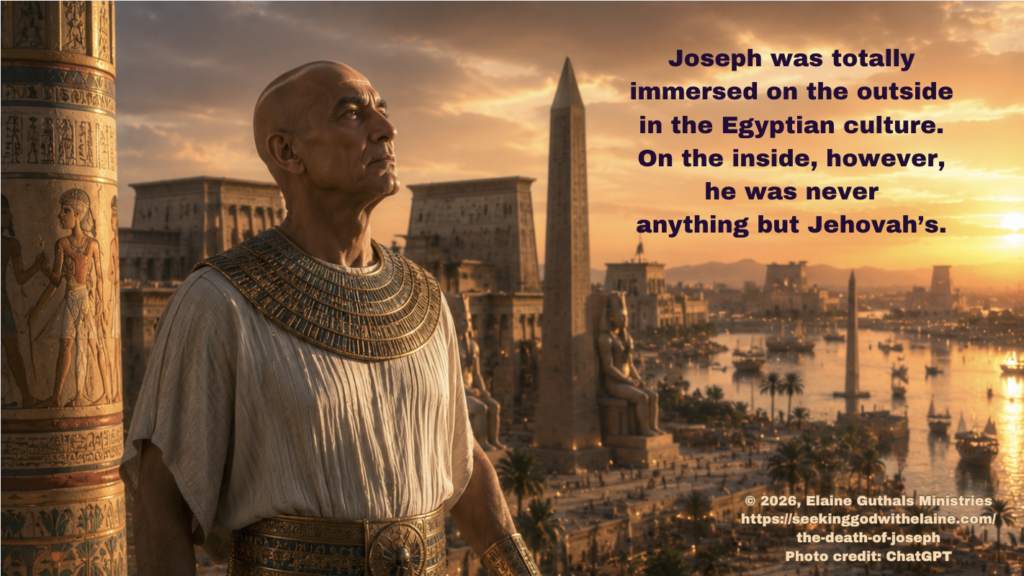
Joseph was totally immersed on the outside in the Egyptian culture. On the inside, however, he was never anything but Jehovah’s.
But Joseph knew that God’s promises lay in Canaan. That was where he wanted to be – even if he was dead.
Embalmed and Placed in a Coffin in Egypt
Joseph, like Jacob, was embalmed.
It is interesting that here Moses did mention Joseph being put in a coffin — ʾārôn (אָרוֹן). That word also means ark. Think Ark of the Covenant.
The two arks did travel with the Wilderness Wanderers. The Talmud has said that, in the exodus, Joseph’s bones were carried in their ark next to the ark of the covenant. Does that seem strange since contact with a dead person made one unclean?
Again, Scripture doesn’t say that.
But to whom did those bones belong? They were the one who was called a foreshadowing of Christ.
If the tradition was true, the symbolism would be remarkable. I have no trouble seeing Jehovah saying Joseph’s bones are holy — set apart. Whatever Jehovah calls holy is holy.
If the Ark of the Covenant contained the Law, the other ark contained the bones of one who faithfully even before the Law was given.
Joseph knew that Jehovah would call the Hebrews out of Egypt. With the two arks, they could see the promise believed and the promise fulfilled.
The Book of Joshua recorded Joseph being buried in Shechem (Josh. 24: 32). This was part of the land that Jacob bought (Gen. 33: 19) from the sons of Hamor, the father of Shechem, who raped Dinah (Gen. 34: 2).
In other words, Joseph’s story came full circle. It was to Shechem that Jacob sent Joseph to check on his brothers (Gen. 37: 13).
Joseph had found his brothers, but he had a destiny to be savior of Israel before he could come back home.
Making the Connections #1
We may think Genesis ends in a strange way. It does, and Joseph’s story.
Joseph never lost his faith. He began right. He ended right.
Think about it. Not only his brothers discounted Joseph’s dreams, but Jacob did also. Joseph’s faith didn’t waver even though all his loved ones he heaped abuse on him.
But it may seem to end on a strange note. It does leave a cliffhanger, because Joseph requested that his bones be taken with the Hebrews when they leave Egypt.
If Genesis is Season 1, it sets up, Season 2 — exodus — perfectly.
- “When you go, take my bones with you.”
- “They forgot about Joseph and enslaved the Hebrews.”
“It was by faith that Joseph, when he was about to die, said confidently that the people of Israel would leave Egypt. He even commanded them to take his bones with them when they left” (Heb. 11: 22 NLT).
Perhaps this is one reason the Book of Genesis ends with Joseph instead of Judah. Joseph prepares for the next chapter. Judah prepares for the next testament.
Making the Connections #2
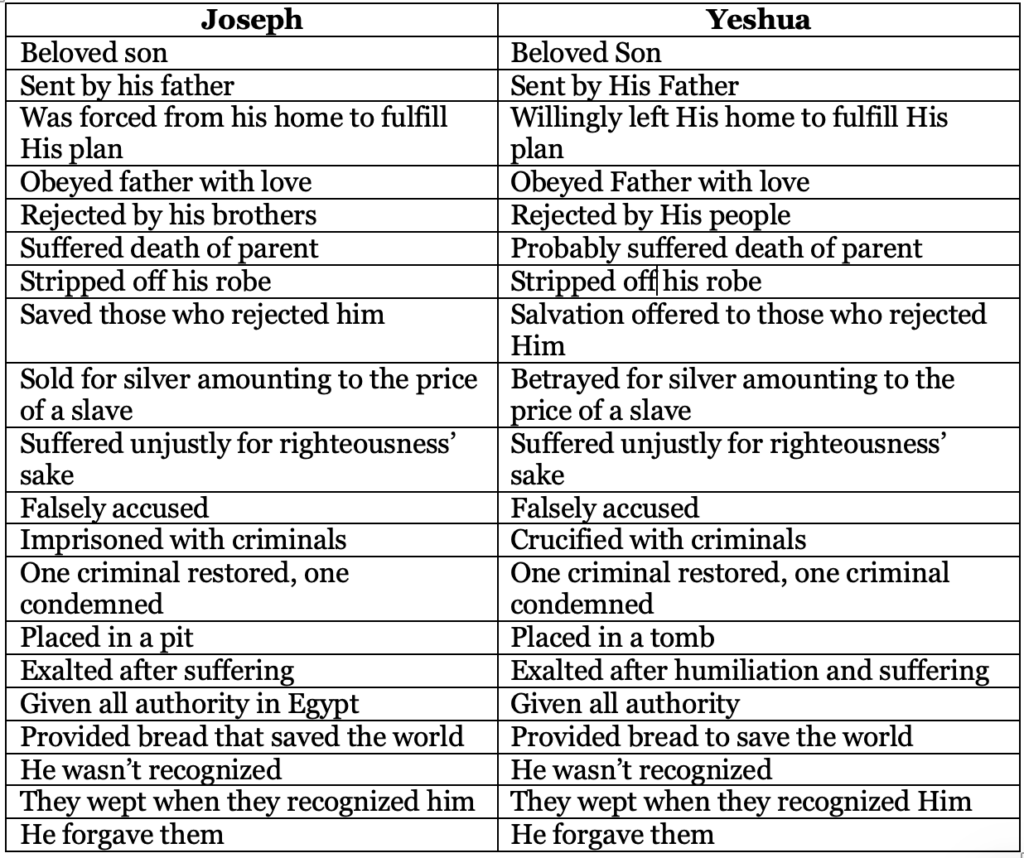
Does Scripture call Joseph a prototype of Yeshua? No.
But we can see the pattern – and we know Jehovah works through patterns.
Making the Connections #3
What can we learn from Joseph as to how we are to walk with Jehovah?
Sometimes, it feels like we can identify multiple grievances against us. We are to be forgiving.
Joseph is Vizier of Egypt, the second in command. But it also seems like he had a very simple faith. We, too, must simply believe.
Joseph was very benevolent. He showed love and tenderness to his brothers even when he wasn’t sure as to what kind of men they had grown up to be.
Making the Connections #4
We’ve seen several times where Jehovah set aside human customs and chose grace. Birth order doesn’t control Jehovah. Biology and science don’t control Jehovah.
Prominence is given to the obedient, not by worldly standards.
Jehovah makes his choice by saying who is obedient to Him.
Making the Connections #5
When we look at the Book of Genesis as a whole, we see the Plan of Salvation clearly described throughout.
• When Jehovah said, “Let there be light,” He wasn’t simply creating light — He was unleashing Yeshua, the Light who would invade the darkness and fight for the human heart.
• Not only is the need for salvation stated in Genesis 3, but the promise of salvation is also given.
• Humans don’t not have to worry about providing the sacrifice as we are unworthy because Jehovah has promised in Genesis 22 to be the provider and identifies in Genesis 49 the line through which the Sacrifice will come.
• That Sacrifice – in the form of Yeshua – will suffer as Joseph did in Genesis 37-50 and become Isaiah’s Suffering Servant.
How Do We Apply This?
Post
The ABCDs of Salvation
If you have not become a believer in Christ, please read through the
Plan of Salvation and prayerfully consider what God is asking you to do.
A – admit our sins
B – believe His Son Jesus is our Redeemer
C – confess God as Sovereign Lord
D – demonstrate that commitment by making any changes needed in our lives to live the way in which God has called us
The Disciple’s Job Description
Heading
Searching for and Seeking God
Non-believers search for God.
Disciples seek Him.
Hearing His Word (Rom. 10: 17)
Reading His Word (Rev. 1: 3)
Praying to Him (Heb. 4: 16)
Studying His Word (Ac. 17: 11)
Meditating on His Word (Ps. 1: 1-2)
Memorizing His Word (Ps. 119: 11)
It Was Enough
Vocalist: Elaine Guthals
Keyboard: Chris Vieth
Related Links
I have created a worksheet of the questions above. Click on the button below to access it.
Don’t know what your spiritual gifts are?
Take this Spiritual Gifts Inventory
The Disciple’s Job Description
Complete Job Description
Individual Description
The Disciple’s Job Description
Complete Job Description
Individual Description
Job Duty #4
Proclaim the Gospel (Mark 16: 15)
Job Duty #6
Make Disciples (Matthew 28: 19-20)
Job Duty #1
Be a Living Sacrifice (Romans 12: 1-2)
Job Duty #2
Work Out Our Salvation (Philippians 2: 12)
Job Duty #3
Bring Him Glory (Matthew 5: 16)
Job Duty #4
Proclaim the Gospel (Mark 16: 15)
Job Duty #5
Love People (John 15: 12)
Job Duty #6
Make Disciples (Matthew 28: 19-20)
Job Duty #7
Other Duties as Assigned
(Ecclesiastes 3: 1)
If you don’t understand something and would like further clarification, please contact me.
If you have not signed up for the email providing the link to the devotions and the newsletter, do so below.
If God has used this devotion to speak with you, consider sharing it on social media.