Category: Ministry

  • God’s Adopted Church

    Nuggets

    • We are the temple/church.
    • We look forward to that day when the church is called home.
    • Wherever we reside — on earth or in heaven — we are God’s.

    Devotions in the What I Believe series

    Devotions in The Church category

    God’s Adopted Church
    The Foundation of the Church

    The Perfection of the Church
    The Design of the Temple

    Flowers with title God's Adopted Church

    In the last devotion, we discussed the Gentile’s church — those that don’t believe that Jesus is the Messiah and Savior of the world. They don’t believe in the Trinity: God the Father, God the Son, and God the Holy Ghost. With this devotion, we will start discussing God’s church.

    I found a really good sermon by Baker that we are going to as the foundation of this series. It will mostly provide headings and some verses.

    Let’s Put It into Context

    Church, according to the Holman Bible Dictionary, is “the term used in the New Testament most frequently to describe a group of persons professing trust in Jesus Christ, meeting together to worship Him, and seeking to enlist others to become His followers.”

    We recently discussed being adopted by God. Paul employed this term “… to describe the status persons receive from God when they have been redeemed by Jesus Christ (Galatians 4:3-7).”

    To read a related devotion, click the button below.

    The Church Below

    “Unless the LORD builds a house, its builders labor over it in vain; unless the LORD watches over a city, the watchman stays alert in vain” (Ps. 127: 1 CSB)

    It is easy to think of the church as a building. Well, that is what we call the building.

    True, the church must be started and overseen by God. If the church is not pointing toward the One true God, it is laboring in vain.

    But look at it this way. We are changed at conversion. “They are reborn — not with a physical birth resulting from human passion or plan, but a birth that comes from God” (Jn. 1: 13 NLT).

    We are the temple/church. “Don’t you know that you yourselves are God’s temple and that God’s Spirit dwells in your midst?” (I Cor. 3: 16 NIV).

    God builds us, over time, to be more like Him. “Therefore, my beloved, as you have always obeyed, so now, not only as in my presence but much more in my absence, work out your own salvation with fear and trembling” (Phil. 2: 12 ESV).

    This is done through regeneration and sanctification. Regeneration is the change in us that God brings about when we go from being spiritually dead to spiritually alive. Sanctification is the transformation of mind, body, and soul beginning with regeneration and ending with perfected state of spiritual wholeness or completeness.

    Baker made the point that, after we are adopted by God, the church belongs to the heavenly Jerusalem. “No, you have come to Mount Zion, to the city of the living God, the heavenly Jerusalem, and to countless thousands of angels in a joyful gathering” (Heb. 12: 22 NLT). Paul wrote that we already “… have come …” (Heb. 12: 22 NLT).

    I know. That kind of threw me for a moment. I figured that was reserved to eternity. Baker argues that, since we have the promise of that and Jesus is Redeemer, we can start claiming it now.

    We do know that this is where God dwells. “Why gaze with envy, you mountain peaks, at the mountain God desired for his abode? The LORD will dwell there forever!” (Ps. 68: 16 CSB).

    The Church Above

    “But our citizenship is in heaven. And we eagerly await a Savior from there, the Lord Jesus Christ, who, by the power that enables him to bring everything under his control, will transform our lowly bodies so that they will be like his glorious body” (Phil. 3: 20-21 NIV)

    We look forward to that day when the church is called home. “For now we see in a mirror dimly, but then face to face. Now I know in part; then I shall know fully, even as I have been fully known” (I Cor. 13: 12 ESV).

    We know Jesus said that He was going back to prepare for our arrival. “In my Father’s house are many rooms. If it were not so, would I have told you that I am going to prepare a place for you? If I go away and prepare a place for you, I will come again and take you to myself, so that where I am you may be also” (Jn. 14: 2-3 CSB).

    “On that day this song will be sung in the land of Judah: We have a strong city. Salvation is established as walls and ramparts” (Isa. 26: 1 CSB).

    On that day, we will be made perfect. “For by that one offering he forever made perfect those who are being made holy” (Heb. 10: 14 NLT). Perfect means holy, sanctified, and righteous.

    Glossary

    Why is God making us perfect? “For God saved us and called us to live a holy life. He did this, not because we deserved it, but because that was his plan from before the beginning of time—to show us his grace through Christ Jesus” (II Tim. 1: 9 NLT).

    Membership to God’s church is available to all — if we accept it. “For Christ himself has brought peace to us. He united Jews and Gentiles into one people when, in his own body on the cross, he broke down the wall of hostility that separated us” (Eph. 2: 19 NLT).

    Church

    The Household of God

    “God decided in advance to adopt us into his own family by bringing us to himself through Jesus Christ. This is what he wanted to do, and it gave him great pleasure” (Eph. 1: 5 NLT)

    Wherever we reside — on earth or in heaven — we are God’s. He has adopted us as His children. We didn’t do anything to earn this privilege. We admitted our sins, believed Jesus is our Savior and Redeemer, and confessed God as Sovereign Lord. We accepted His gift of salvation He made through His grace.

    Glossary

    Because we accepted His gift, we are part of God’s family. “For this reason I bow my knees before the Father, from whom every family in heaven and on earth is named” (Eph. 3: 14-15 ESV).

    God is our Father, and Jesus is our elder brother. “For God knew his people in advance, and he chose them to become like his Son, so that his Son would be the firstborn among many brothers and sisters” (Rom. 8: 29 NLT).

    To read a related devotion, click the button below.

    Families take care of each other. “All the believers were united in heart and mind. And they felt that what they owned was not their own, so they shared everything they had” (Ac. 4: 32 NLT). To me, that means their relationships and the needs of others was more important than what they owned.

    Some believe becoming a member of God’s family is more like being a slave. The reasoning behind this is probably because we have to submit to God’s Will.

    However, that is not the case. “The Spirit you received does not make you slaves, so that you live in fear again; rather, the Spirit you received brought about your adoption to sonship. And by him we cry, ‘Abba, Father’” (Rom. 8: 15 NIV).

    In fact, the opposite is true. We have now have a freedom when we are a child of God that we don’t have when we are a member of the Gentile church. “So if the Son sets you free, you will be free indeed” (Jn. 8: 36 ESV).

    This freedom is all because God loves us and has designed a way for our relationships with Him to be restored.

    Making the Connections

    In this crazy time we are living through right now, it has become obvious that the church is more than a building. It is more the family.

    When the church doors were shuttered at the beginning of this pandemic, I bet there were a few who thought/hoped the church would just go away quietly. It didn’t.

    The church is more than a building because worship is more than five songs, a three-point sermon, passing the collection plate, and announcements.

    Does the church need to do a better job of being less judgmental? Yes. Does it have to condone others breaking God’s laws and commandments? No.

    Making the Connections to Self-Discipline

    We’ve been asking these questions all along so we can prepare for when we are asked. Here is the worksheet again. What would you say about only members of God’s church being those He has adopted?

    • What does the Scriptures say?
    • What do I believe?
    • Why do I believe the same/differently than the Scriptures?
    • What are the talking points when witnessing to a non-believer?

    Related Links

    I have created a worksheet of the questions above. Click on the button below to access it.

    How Do We Apply This?

    The ABCDs of Salvation

    If you have not become a believer in Christ, please read through the
    Plan of Salvation and prayerfully consider what God is asking you to do.

    A – admit our sins
    B – believe His Son Jesus is our Redeemer
    C – confess God as Sovereign Lord

    D – demonstrate that commitment by making any changes needed in our lives to
    live the way in which God has called us

    The Disciple’s Job Description

    Father. You are Sovereign God. Lord, we want to live for You here in this world. It is hard, Lord. Strengthen us. Help us to grow so that we will be prepared for our lives with You for eternity. Amen.

    What do you think?

    Leave me a comment below (about this or anything else) or head over to my Facebook group for some interactive discussion.

    If you don’t understand something and would like further clarification, please contact me.

    If you have not signed up for the email daily or weekly providing the link to the devotions and the newsletter, do so below.

    If God has used this devotion to speak with you, consider sharing it on social media.

  • The Unbelieving State of the Gentile Church

    In looking at things to solidify what we actually believe, we will be looking at the church for the next several devotions. This devotion looks at the opposite of God’s church – the Gentile church.

    Nuggets

    • As the church is a body of believers in Jesus Christ, the Gentile Church would be those who do not believe that Jesus is the Messiah and Savior of the world.
    • Gentile church members belong to the race of sinners.
    • The Gentile church is under the rule of Satan.
    Flowers with title The Unbelieving State of the Gentile Church

    This year, we are looking at self-discipline. We are using Vincent’s The Lesson of Ripeness sermon to look at the need to grow in our relationship with God. We morphed learning enough to be a teacher into determining some areas we need to grow so we can be mature disciples.

    Resource

    We have been looking at solidifying what we believe. When we witness, we need to be prepared to explain what we believe and why we believe it. We looked at the Scriptures, the Trinity (God, Jesus, and the Holy Spirit), man, salvation, and grace. Now, we are going to look at the church.

    Devotions in the What I Believe series

    Devotions in The Church category

    The Unbelieving State of the Gentile Church
    God’s Adopted Church
    The Foundation of the Church

    The Perfection of the Church
    The Design of the Temple

    I found a really good sermon by Baker that we are going to as the foundation of this series. It will mostly provide headings and some verses. Baker started out describing the opposite of God’s church — the Gentile church.

    Let’s Put It into Context

    Church, according to the Holman Bible Dictionary, is “the term used in the New Testament most frequently to describe a group of persons professing trust in Jesus Christ, meeting together to worship Him, and seeking to enlist others to become His followers.”

    Strangers to God

    “At that time you were without Christ, excluded from the citizenship of Israel, and foreigners to the covenants of promise, without hope and without God in the world” (Eph. 2: 12 CSB)

    As the church is a body of believers in Jesus Christ, the Gentile Church would be those who do not believe that Jesus is the Messiah and Savior of the world. They do not believe in the Trinity: God the Father, God the Son, and God the Holy Ghost.

    In this passage that starts in Ephesians 2: 11, Paul was wanting his readers to remember the time before their conversion. One of his points was we were all in the same unredeemed boat as, in the spiritual sense, we are all uncircumcised Gentiles.

    To read a related devotion, click the appropriate button below.

    Paul’s point was, if we are not “in Christ,” we are “without Christ.” The Gentile church is without Christ.

    One reason the Gentile Church is strangers to God is that they are strangers to His Word. “I have seen the disloyal and feel disgust because they do not keep your word” (Ps. 119: 158 CSB).

    Scriptures paint a good picture of Who God is. As we read the Scriptures, we learn of His character and how He wants us to live.

    Members of the Gentile Church are also strangers to God’s church. “See what great love the Father has given us that we should be called God’s children — and we are! The reason the world does not know us is that it didn’t know him” (I Jn. 3: 1 CSB). We are not a child of God just because we were made in His image.

    Determination of whether we are in the Gentile’s church or God’s church all boils down to the answer to this question: have you admitted your sins, believed in Jesus as Savior and Redeemer, and confessed God as Sovereign Lord. We must make a conscious decision to submit to God to switch churches.

    Differences of Members

    “For I was born a sinner — yes, from the moment my mother conceived me” (Ps. 51: 5 NLT)

    Baker wrote that Gentile church members are “naturally of another race.” That race is the race of sinners. Sinners are people who sin. Sin is when we disobey God and break one of His laws and commandments.

    We all have a sinful nature. “For we know that the law is spiritual, but I am of the flesh, sold as a slave under sin” (Rom. 7: 14 CSB). We are all “of the flesh.”

    The flesh is our human nature. It is considered naturally corrupt because it pursues what is pleasing, not necessarily what God commands.

    Armitage wrote that sin “is seen not with the eyes in the head, but with those of the heart.” God uses the insights that He puts in our hearts through our observations so we can use that, rather than our own understanding, to determine what He is telling us.

    To read a related devotion, click the button below.

    According to Baker, this race of sinners has its own language. “These wicked people are born sinners; even from birth they have lied and gone their own way” (Ps. 58: 3 NLT).

    We are born sinners at birth because we are born spiritually dead. For salvation, God isn’t looking at whether we didn’t do the do’s and did the don’ts. He is looking at whether is Jesus our Savior and have we submitted our lives to Him.

    Under Another’s Rule

    “Satan, who is the god of this world, has blinded the minds of those who don’t believe. They are unable to see the glorious light of the Good News. They don’t understand this message about the glory of Christ, who is the exact likeness of God” (II Cor. 4: 4 NLT)

    The Gentile church is under the rule of Satan. He is presently in control of this world.

    To read a related devotion, click the button below.

    Because they are following Satan instead of God, the Gentile church members are not seeking God’s interests. “For they all seek their own interests, not those of Jesus Christ” (Phil. 2: 21 ESV).

    Unfortunately, members of the Gentile church do not get the same benefits as members of God’s church. Gentile church members are still spiritually dead and slaves to their sin.

    Making the Connections

    “But now you have been united with Christ Jesus. Once you were far away from God, but now you have been brought near to him through the blood of Christ” (Eph. 2: 13 NLT)

    Being a member of the Gentile church puts us far away from God. Wilson described what that meant.

    Wilson wrote, “We are all naturally far from God, not as being out of His reach, or out of His sight, or out of His presence, but as differing from Him, as being out of sympathy with Him — as forgetting or not thinking about Him — as disobeying Him, and disliking Him, and thus having incurred His displeasure.”

    Making the Connections to Self-Discipline

    We’ve been asking these questions all along so we can prepare for when we are asked. Here is the worksheet again. What would you say are the detriments of being a member of the Gentile church?

    • What does the Scriptures say?
    • What do I believe?
    • Why do I believe the same/differently than the Scriptures?
    • What are the talking points when witnessing to a non-believer?

    Related Links

    I have created a worksheet of the questions above. Click on the button below to access it.

    How Do We Apply This?

    The ABCDs of Salvation

    If you have not become a believer in Christ, please read through the
    Plan of Salvation and prayerfully consider what God is asking you to do.

    A – admit our sins
    B – believe His Son Jesus is our Redeemer
    C – confess God as Sovereign Lord

    D – demonstrate that commitment by making any changes needed in our lives to
    live the way in which God has called us

    The Disciple’s Job Description

    Loving Heavenly Father. We are born far from You. Even though we are Your creations made in Your image, our nature is different from Yours. It is different — until we admit our sins, believe Jesus as our Savior, confess You as Sovereign God, and demonstrate that change in nature by obeying Your laws and commandments. Lord, help us show others Your saving love. Amen.

    What do you think?

    Leave me a comment below (about this or anything else) or head over to my Facebook group for some interactive discussion.

    If you don’t understand something and would like further clarification, please contact me.

    If you have not signed up for the email daily or weekly providing the link to the devotions and the newsletter, do so below.

    If God has used this devotion to speak with you, consider sharing it on social media.

  • Disciples and Charitableness

    How important is it that disciples exhibit charitableness? How are we supposed to accomplish that? This devotion looks at what Jesus said about doing how doing charity work.

    Nuggets

    • Jesus called charity work the way we practice our righteousness.
    • Instead of going for man’s praise, Jesus wanted us to be cultivating the fruits of the Spirit.
    • Jesus was all about two things: relationship and character.
    • As disciples, if we are being charitable for the right reasons — which is to honor God and imitate Him so others will see — we will be rewarded.

    Devotions in the What Is Charity? series

    Flowers with title Disciples and Charitableness

    We’ve been talking in the last several devotions that God calls disciples to be charitable to our fellow man. But what did Jesus actually say about this issue?

    Let’s Put It into Context

    Yes, this is a devotion in the charity series. Charity means showing others love flavored with acts of benevolence.

    To read a related devotion, click the button below.

    It could have been in the righteousness series. We have said that righteousness is the result of the process of sanctification. As we perfect our relationships with God, we grow in grace and knowledge of Him, increasing our holiness so that we are more like Him.

    So, where does our charity work fit in? What did Jesus say?

    Practice of Righteousness

    “Be careful not to practice your righteousness in front of others to be seen by them. Otherwise, you have no reward with your Father in heaven” (Mt. 6: 1 CSB)

    Jesus didn’t pull any punches, did he? He called charity work the way we practice our righteousness.

    While we are in the process of being sanctified, we use charity to become more like God. We are to conduct our charitable activities for His honor and glory.

    We are to do the charitable acts through mercy. Mercy is the unexpected way God responds in love to our needs. We are to do respond through love to them.

    Because of that, Jesus warned us about motivation. Why are we being charitable? Let’s look at a list of ways we shouldn’t be doing charitable work:

    • Looking for recognition from others.
    • Becoming puffed up

    Tuck noted that this would have been a radical viewpoint in that day and age. The norm those days was to show you were religious “… by giving alms, praying, and fasting.”

    Jesus was always more interested in our relationships with God than religion.
    But He taught character — imitation of God’s character to be exact. That takes into considering motivation and spirit.

    Instead of going for man’s praise, Jesus wanted us to be cultivating the fruits of the Spirit. You know, “… love, joy, peace, patience, kindness, goodness, faith, gentleness, self-control” (Gal. 5: 22-23 HCSB). That is how we show we have a pure heart.

    To read a related devotion, click the appropriate button below.

    Charity work hits all of those, doesn’t it?

    You may he saying, “Wait a minute. Doesn’t that contradict the whole lamp and the bushel thingy?”

    What you are asking about is Matthew 5: 15-16. “Neither do people light a lamp and put it under a bowl. Instead they put it on its stand, and it gives light to everyone in the house. In the same way, let your light shine before others, that they may see your good deeds and glorify your Father in heaven” (Mt. 5: 15-16 NIV emphasis added).

    Barker argues that this is limited to almsgiving. Let’s talk this through.

    Alms are “gifts for the poor” (Holman Bible Dictionary). Basically, what Barker said was this giving should flow it of the heart without conscious thought. I read it to mean that it should just be a natural response. We shouldn’t wait for the press conference to announce the donation. We shouldn’t be looking for the slaps on the back.

    I am not going to get into social inequality here. Macdonald did in one of his sermons. I agree with most of it. Some may be dated, but it is not enough to throw out the whole piece.

    How Does Religion Fit In?

    “So whenever you give to the poor, don’t sound a trumpet before you, as the hypocrites do in the synagogues and on the streets, to be applauded by people. Truly I tell you, they have their reward” (Mt. 6: 2 CSB)

    I am not sure we can take this literally. Oh, I know literal. When Adam was young, we could not ask him to run and get something for us because we would then be telling him not to run in the house.

    I wonder if this is where we got the expression about tooting our own horns.

    What I think the “… don’t sound a trumpet before you, …” (Mt. 6: 2 CSB) means is religion isn’t to be show.

    Oh, yes. We have a lot of rituals, traditions, and practices in our services depending on where we go. We all have something. (Just try moving when they pass the plate in the order of the service.)

    A lot of the research I uncovered talked about ostentatious religion. It talking about not just a vulgar display but also a display just to attract attention.

    Ostentatious talks theatrical. It is talking self-gratifying.

    Let’s stop a second and put this into context again. This is Matthew 6. We are in the Sermon on the Mount. We already did the Beatitudes. We are fixing to go into the Lord’s Prayer and then fasting.

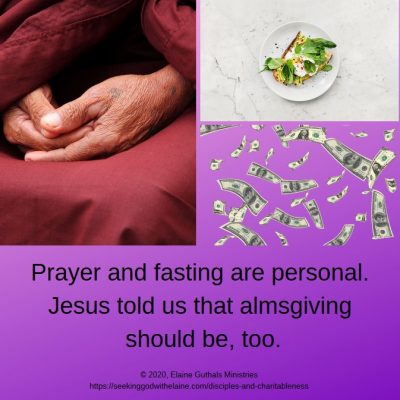
    Prayer and fasting are personal. Jesus told us that almsgiving should be, too.

    Jesus was all about two things: relationship and character. He wasn’t about the Pharisees and their brand of religion.

    What Jesus was about was true religion — how it should be. We were created to worship the Father. We were made to be like Him.

    Praying hands, food, money

    Right Reasons

    “But when you give to the poor, don’t let your left hand know what your right hand is doing” (Mt. 6: 3 CSB)

    So, instead of tooting our own horns about all the charitable things we do, we should just do them. We should focus on God and imitating Him so that others can see His love for them.

    Macdonald thought anything else would be hypocritical. And he is right.

    We have a lot of scammers these days trying to take our money. No, Jesus wasn’t saying just give it to them. He was talking about those who were legitimately poor.

    What did Thomas call it in the last devotion? The deserving poor. Tuck provided an explanation as to who those are. They are poor because of the following:

    • “by bodily disability;
    • “by unfortunate birth-associations;
    • “by exigencies of trade;
    • “by temporary distress;
    • “by the wrong-doing of others.

    Rewards

    “so that your giving may be in secret. And your Father who sees in secret will reward you” (Mt. 6: 4 CSB)

    As disciples, if we are being charitable for the right reasons — which is to honor God and imitate Him so others will see — we will be rewarded.

    Yeah, if “… your giving may be in secret …” and God “… sees in secret …” (Mt. 6: 4 CSB), the reward may be in secret. It may be out in the open. It may just depend.

    But rewarded we will be. Good thing, right? We work for rewards.

    Well, our paycheck is a reward. We play sports for the reward of winning. Have you ever heard about disciples being asked what they get out of it?

    We are so focused on having to get something at the end of a project or a season. What do we get out of this. Go back to verse 1.

    Jesus called charity work the way we practice our righteousness.

    • We get a right relationship with God, increased holiness, sanctified, and righteousness.
    • We get fruits of the Spirit.
    • We get fruits of righteousness.
    • We get heavenly rewards.

    To read a related devotion, click the button below.

    Making the Connections

    I think Jesus was doing more than just providing for those in need. He was also warning us about a threat we would face on the road to sanctification.

    Maclaren put it this way. He wrote, “He first gives the warning in general terms in verse 1, and then flashes its light into three dark corners, and shows how hankering after men’s praise corrupts the beneficence which is our duty to our neighbour, the devotion which is our duty to God, and the abstinence which is our duty to ourselves.”

    Jesus knew that we would be tempted. He knew we would have trouble dismissing the bright and shiny. So, He wanted to warn us.

    God helps those who look to Him. When the Wilderness Wanderers were at the Red Sea and walking toward it, it did not open because they were only walking toward it. It opened because they had prayed to God to save them, and He said, “Quit praying, and get moving!” (Ex. 14: 15).

    We’ve said that we can’t discipline ourselves without God. We can’t be charitable without doing it to honor God. If we do, we aren’t doing it for the right reasons.

    Making the Connections to Self-Discipline

    Macdonald said that “God helps those who help themselves.” I don’t think that is always true.


    God helps those who look to Him. When the Wilderness Wanderers were at the Red Sea and walking toward it, it did not open because they were only walking toward it. It opened because they had prayed to God to save them, and He said, “Quit praying, and get moving!” (Ex. 14: 15).

    We’ve said that we can’t discipline ourselves without God. We can’t be charitable without doing it to honor God. If we do, we are doing it for the wrong reasons.

    How Do We Apply This?

    So, how are we to do charity work?

    • Modestly
    • Sincerely
    • Honoring God
    • Promoting brotherly fellowship
    • Appropriately based on our means

    A way to worship God is to imitate Him. One way to do that is to love those He has created. When we help those who need help, we are to accomplish that in a way that honors God.

    Loving Father. You do love us. You sent Your Son to die so that the payment for our sins would be completed. When we become Your disciples, You ask us to imitate You and show Your love to those who are struggling in this world. Unfortunately, this world is not as You made it. Poverty is a result of the consequences of sin.

    What do you think?

    Leave me a comment below (about this or anything else) or head over to my Facebook group for some interactive discussion.

    If you don’t understand something and would like further clarification, please contact me.

    If you have not signed up for the email daily or weekly providing the link to the devotions and the newsletter, do so below.

    If God has used this devotion to speak with you, consider sharing it on social media.
  • Disciples’ Duty to the Poor

    How are disciples to address the poor? Do they only have responsibilities with regards to other believers? This devotion looks at several verse that detail how disciples are to regard the poor.

    Nuggets

    • We have to be concerned enough about the poor for action.
    • God has a plan for our help for others, first helping our biological family.
    • Instead of a brother being reduced to an alien, we have an alien elevated to the status of brother.
    • Every three years, there was a collection so the poor could be supported.

    Devotions in the What Is Charity? series

    Disciples' Duty to the Poor

    A while back, in response to a question from a reader, we discussed what disciples’ responsibilities are in fixing the problems of this world. I responded that it is our mission to preach the gospel and make disciples. We are not called to fix systemic problems with this world.

    To read a related devotion, click the button below.

    Still, we do interact with people who need our charity — both love and support. But what are we called — individually — to do?

    I know I use the pronoun we because — generally — more people are in the same boat than just you and me. But we are talking about self-discipline. Focus is on what do I/you need to do individually to become a more mature disciple?

    So, we can’t read the devotions in this series as a call to band together and fix the ills of the world — or at least our section — or the ills of someone we know. This is about what God is saying to you/me personally about growing our relationship with Him.

    Let’s look up some verses to see if we can get a handle on it.

    Let’s Put It into Context

    God calls disciples to care about others. We are to support each other. This includes those who are poor.

    This verse is all over the board in terms of translation. Here is a list:

    “… care about justice …” (NIV)
    “… care about the rights …” (NLT).
    “… knows the rights …” (ESV, CSB, GNT, HCSB)
    “… is concerned for the rights …” (NASB)
    “… considers the cause …” (NKJV)
    “… considereth the cause …” (KJV)

    The Contemporary English Version switches things around. It says, “The wicked don’t care about the rights of the poor, but good people do” (Prob. 29: 7 VEV).

    We can know about something — have the head knowledge — but not necessarily care or be concerned. When we care about something, that means it is important to us, but it may not be sending up red flags like being concerned about something would. To me, the jury is still out when we are considering something. Our minds haven’t been made up yet.

    Most of the versions talk about the rights of the poor. That is talking about entitlement. Justice, on the other hand, is talking more about treatment.

    To me, cause would determine why people are poor. We may need this information to be able to do to help. We would have different assistance for someone who is struggling to meet their needs if they needed a new furnace rather than someone who was struggling because they didn’t ave the skills needed to get a job over minimum wage.

    If we are concerned about justice, maybe God is calling us to be concerned about the systemic ills of our world today. The rest of the translations seem like they are focusing on what we do individually.

    So, what really is God calling us to do?

    Open Mouth for Sure

    “Speak up, judge righteously, and defend the cause of the oppressed and needy” (Prov. 31: 9 CSB)

    Every translation except the Contemporary English Version says we are to speak up. To me, that means we have to be concerned enough about the poor for action.

    But what does “… judge righteously …” mean? Righteousness is the result of the process of sanctification, where we grow in grace and knowledge to change us to increase our holiness.

    Think about it. If we are righteous, we are imitating God. That would mean we are judging the situation as He would judge it.

    The translations are about split evenly between rights and cause, with one justice thrown in for good measure.

    Hmmm. We aren’t moving forward very quickly, are we? Let’s keep going.

    Family Helps Family

    “If your brother becomes destitute and sells part of his property, his nearest relative may come and redeem what his brother has sold. If a man has no family redeemer, but he prospers and obtains enough to redeem his land, he may calculate the years since its sale, repay the balance to the man he sold it to, and return to his property” (Lev. 25: 25-27 CSB)

    Then I got into verses about who we are to help. Leviticus is the book of law. Yes, there are some in Exodus, and they get restated in Deuteronomy. But Leviticus sets out exactly the ritual and moral practices that the Israelites are to follow.

    These verses bring up an important concept — that of the redeemer. Remember when Naomi and Ruth returned as widows to Bethlehem (Ruth 1). Boaz was “… one of [Naomi’s] family redeemers” (Ruth 2: 20 CSB).

    The NLT Study Bible Blog told us that “the family redeemer had an obligation ‘to buy an object or person from indenture, slavery, or otherwise harsh circumstances.’” Family was to take care of family.

    What this tells me is that God has a plan for our help for others. First, we are to help our biological family.

    Why do I say that? Macdonald said that “… the Law has no provision for the redemption of the stranger who cannot purchase freedom for himself.”

    Family But …

    “If your brother becomes destitute and cannot sustain himself among you, you are to support him as an alien or temporary resident, so that he can continue to live among you” (Lev. 25: 35 CSB)

    Wait! What? Support our brother as an alien? But aren’t they not supposed to intermarry with them?

    Following is the advice Moses gave the Wilderness Wanderers right before they entered the Promise Land. “You must not intermarry with them, and you must not give your daughters to their sons or take their daughters for your sons, because they will turn your sons away from me to worship other gods. Then the Lord’s anger will burn against you, and he will swiftly destroy you” (Deut. 7: 3-4 CSB).

    Okay. Holman Bible Dictionary. What does it say about aliens?

    • Israel started out as aliens (Ex. 23: 9)
    • God does loves aliens (Deut. 10: 19).
    • There were special laws for aliens (Deut. 24: 19-20; Deut. 26:12).
    • Aliens had some rights (Deut. 24: 17; Deut. 27: 19).
    • They could be included in Passover and offer sacrifices (Num. 9: 14; Lev. 17: 8).
    • They had to obey some laws (Lev. 18: 26).
    • In reality, we are all people as aliens on earth (Ps. 39: 13; Ps. 119: 19).

    Macdonald’s translation read, “the stranger ‘with’ the Hebrew, and so, subject to his law, is recognized as a brother (see verses 35, 36).

    That takes it the other way. Instead of a brother being reduced to an alien, we have an alien elevated to the status of brother.

    Talk about mercy. Remember, mercy is the unexpected way God responds in love to our needs. He doesn’t judge us to the extent He could have.

    Funding

    Yep, every three years, there was a collection so the poor could be supported. Ross stated, “In Jewish law God claimed tithes and gifts for the worship of the sanctuary and the necessities of the poor.”

    Orr notes that this is good for us to know. “A lesson is taught here as to the duty of liberal, systematic, and conscientious giving for religious and charitable purposes.

    Orr also notes that God does make accommodations for some laws. For example, Mary and Joseph sacrificed the offering allowed to those who could not afford the regular offering (Lk. 2: 24).

    Don’t we have a wonderful God! He knows what we can do.

    Limitations

    “No widow is to be enrolled on the list for support unless she is at least sixty years old, has been the wife of one husband, and is well known for good works—that is, if she has brought up children, shown hospitality, washed the saints’ feet, helped the afflicted, and devoted herself to every good work” (I Tim. 5: 9-10 CSB)

    Yes, God provides for the poor. Yes, He can and will put limitations on His provision.

    No, that doesn’t make God mean. It makes Him God.

    Making the Connections

    God calls His children to support each other. No, not everyone is a child of God. Those who have not admitted their sins, believed on Jesus as Redeemer, and confessed God as Sovereign Lord are creations of God, not children of God.

    Yes, God provides for His children and some of those provisions fall on non-believers.

    We just have to remember one thing. This world isn’t God’s priority. His priority is expanding His kingdom. His priority is eternal life.

    How Do We Apply This?

    • We have to listen to God’s promptings when He is telling us how He is going to use us to support the poor.
    • We have to love others as He loves them, not as the world loves.
    • We have to grow in grace and knowledge through sanctification until we have His character.

    Father. You are love (I Jn. 4: 8). Lord, we want Your heart. Help us to love others as You do. Use us to help them. Help us to lead them to You. Amen.

    What do you think?

    Leave me a comment below (about this or anything else) or head over to my Facebook group for some interactive discussion.

    If you don’t understand something and would like further clarification, please contact me.

    If you have not signed up for the email daily or weekly providing the link to the devotions and the newsletter, do so below.

    If God has used this devotion to speak with you, consider sharing it on social media.

  • The (Un)Likely Admirers

    Have you ever wondered why the shepherds were invited to see the Christ Child? Yes, we are told it is because anyone can come to Jesus. This devotions questions whether there was more reasons than that.

    Nuggets

    • As these were fields just outside of Bethlehem, these were David’ fields where he kept sheep and possibly his descendants.
    • The angel’s message brought great joy because, only through the birth and death of this Baby could our relationship with God be restored.
    • Jesus came to heal our brokenness and deliver us back into God’s presence.
    • The shepherds had to look for Jesus.
    • The shepherds may have initially been afraid when the angels showed up, but they got over it.

    To read devotions in the People of Christmas series, click the appropriate button below.

    Flowers with title The (Un)Likely Admirers

    Have you ever had a newborn baby show up where you work? A newborn infant gets carried in the door, and everyone flocks to see it.

    I’m not talking just women here. Men may not go out of their way, but they stop to give the appropriate “what a cute baby” remarks.

    What is it about a baby that attracts people? Is it that the baby is so defenseless, we feel like we have to protect it? Is it we feel like the baby is making a fresh start — it has no history, no mistakes, no failures as baggage? So, we celebrate the baby’s arrival.

    Let’s Put It into Context

    “And while they were there, the time came for her baby to be born. She gave birth to her firstborn son. She wrapped him snugly in strips of cloth and laid him in a manger, because there was no lodging available for them” (Lk. 2: 6-7 NLT)

    The census/taxation got Mary and Joseph to Bethlehem. That happened so the prophecy would be fulfilled. “But you, O Bethlehem Ephrathah, are only a small village among all the people of Judah. Yet a ruler of Israel, whose origins are in the distant past, will come from you on my behalf” (Mic. 5: 2 NLT).

    For whatever reason, Mary and Joseph ended up in the stable. They were tucked away out of the crowd … until they got visitors.

    David’s Stomping Grounds

    “That night there were shepherds staying in the fields nearby, guarding their flocks of sheep” (Lk. 2: 8 NLT)

    Mary and Joseph had to go to Bethlehem because they had to go back to the family home. “And because Joseph was a descendant of King David, he had to go to Bethlehem in Judea, David’s ancient home …” (Lk. 2: 4 NLT).

    So, think about it. David was a shepherd. “David answered Saul: ‘Your servant has been tending his father’s sheep …’” (I Sam. 17: 34 CSB). These were David’s fields.

    Do you see what I see? God came to who were more than likely some of David’s descendants. God had promised David a descendant Who would reign forever. That descendant was here, so God sent the angels to tell other descendants. He came to family.

    Sheep

    0Being a shepherd had to be a rough life. They would have been out in the elements continuously. Caring for animals can be challenging.

    I want to say it would be a solitary life. We don’t know how many there were — it just says shepherds – plural. So, we don’t know if there were two or twenty.

    What I am trying to say is they probably didn’t have much contact with people who weren’t shepherds. Surely, they would come into town sometimes, but they were probably in the fields more times than not.

    The shepherds would have been simple men but probably not outcasts. They undoubtedly poor. Just as the fishermen Jesus chose for disciples later, the shepherds were uneducated.

    How did they angels find them? They were working. They were guarding their sheep. Geikie gave a real good description of what this entailed.

    Okay, it was nighttime, so they would have just been watching. “Therefore be alert, because you don’t know either the day or the hour” (Mt. 25: 13 CSB). Yes, that verse talks about Jesus’ second coming, but doesn’t that also apply for His first coming? Israel was supposed to be watching for Him.

    They Had Company

    “Suddenly, an angel of the Lord appeared among them, and the radiance of the Lord’s glory surrounded them. They were terrified, 10 but the angel reassured them” (Lk. 2: 9-14 NLT)

    What is it about angels? Are they scary looking or do they startle scare you? Nine times out of ten, Scriptures say “angel appeared … humans were afraid.”

    We don’t know who the head angel was. If all the visits were from Gabriel, he had been busy. After 400 years of silence, he visited Zacharias, Mary, Joseph and now shepherds.

    It could be they were afraid because “… the radiance of the Lord’s glory surrounded them …” (Lk. 2: 9 NLT). Most other translations say, “… the glory of the Lord …” (Lk. 2: 9 NIV, ESV, NASB, NKJV, KJV, CSB, GNT, HCSB).

    We’ve talked about God’s glory before. In several passages, it has been described as a cloud (Ex. 13: 21; Ex 33: 9: Ezek. 10:4; Num. 12: 5). There had to have been some light associated with the cloud to pierce the darkness of night. That is why the verse say, “… the glory of the Lord shone around them …” (Lk. 2: 9 NIV, ESV, NASB, NKJV, KJV, CSB, GNT, HCSB).

    To read a related devotion, click the button below.

    The angel performed his work admirably. One year when I was directing children’s choir, the head angel for the Christmas musical got sick. A little angel had to step up and give the message. It was easy for her because, even as young as she was, she knew the message the angel had given because the passage is that familiar to us.

    “‘Don’t be afraid!’ he said. ‘I bring you good news that will bring great joy to all people’” (Lk. 2: 10 NLT)

    The angel said that the message he was giving was going to bring great joy. “The hope of the righteous is joy …” (Prov. 10: 28 CSB). Jesus is our hope. Righteousness is the product of being holy, created by having faith and loving as Jesus does. Holy means to be set apart, perfect, and pure. The Holman Bible Dictionary says that joy is “the happy state that results from knowing and serving God.”

    How many times do we stop the definition of joy after the happy state? We get joy confused with the emotion of happiness.

    The joy comes from knowing God. It comes from the peace that only He gives us.

    Why did that message give joy? Ever since the original sin, our relationship with God was severed. Only through the birth and death of this Baby could that relationship be restored. Only when we accept the gift that this Baby brings can we go from spiritual death to spiritual life.

    “The Savior — yes, the Messiah, the Lord — has been born today in Bethlehem, the city of David!” (Lk. 2: 11 NLT)

    Oh, Israel had been waiting for the Messiah. They wanted Him to come like yesterday. They had put their hopes in the Messiah, and now, there He was.

    Jesus had not only been born, but He was born into a human family. Mary was His mother. Joseph acted as His father. He lived and walked. He ate and breathed. He grew and felt.

    Jesus was one of us. But He was One of God.

    What Jesus was, was a Savior. He came to heal our brokenness. He came to deliver us back into God’s presence.

    Jesus was right where the shepherds were. “That night there were shepherds staying in the fields nearby …” (Lk. 2: 8 NLT). They didn’t have to go halfway around the world to find Him.

    The shepherds could approach Jesus. If they asked, I bet Mary let them touch Him.

    “And you will recognize him by this sign: You will find a baby wrapped snugly in strips of cloth, lying in a manger” (Lk. 2: 12 NLT)

    But the shepherds had to look for Jesus. God didn’t try to hide Him, but He looked like an ordinary baby.

    He was hiding in plain sight. “But God chose the foolish things of the world to shame the wise; God chose the weak things of the world to shame the strong” (I Cor. 1: 27 NIV).

    Yes, it is an ordinary type of thing — a baby — but it is special — in a manger.

    Afraid but Believed

    “When the angels had returned to heaven, the shepherds said to each other, ‘Let’s go to Bethlehem! Let’s see this thing that has happened, which the Lord has told us about’” (Lk. 2: 15 NLT)

    The shepherds may have initially been afraid when the angels showed up, but they got over it. They probably said a few things more than “let’s go.”

    The main thing is that they went. They got on their little feet and sought out Jesus. Scripture doesn’t say they got a star as a guide. We don’t know how many stables they had to go to before they found the right one.

    But the shepherds strapped on their faith and set out. Just like Abraham, they really didn’t need to know their destination (Gen. 12: 1).

    Shepherd

    Making the Connections

    The announcement of Jesus’ birth did not go to government leaders or even religious leaders. It went to your average Tom, Sally, and Elaine.

    God calls us to do what He calls us to do. We have to work at it.

    We shouldn’t have the innards-are-jelly fear. We should have the reverence-and-love fear.

    To read a related devotion, click the button below.

    How Do We Apply This?

    “Suddenly, the angel was joined by a vast host of others — the armies of heaven — praising God and saying, ‘Glory to God in highest heaven, and peace on earth to those with whom God is pleased’” (Lk. 2: 13-14 NLT)

    When we search for and find the Baby, we need to shout it from the rooftops. The joy is supposed to just bubble out of us.

    “After seeing him, the shepherds told everyone what had happened and what the angel had said to them about this child” (Lk. 2: 17 NLT)

    The angels preached to the shepherds. Then the shepherds preached to anyone and everyone who would listen. We are called to share God’s message, also.

    Job description

    The Disciple’s Job Description

    Complete Job Description

    Individual Description

    Job Duty #4
    Proclaim the Gospel (Mark 16: 15)

    “The shepherds went back to their flocks, glorifying and praising God for all they had heard and seen. It was just as the angel had told them” (Lk. 2: 20 NLT)

    So, the shepherds went right back to their flock. Oh, yeah. I bet they were changed people.

    But the shepherds had their job. And they did it.

    Coming to Jesus should change us. Above, we talked about the first part of the verse in Proverbs. The last part is important, too.

    “The hope of the righteous is joy, but the expectation of the wicked will perish” (Prov. 10: 28 CSB).

    When we come to Jesus, we have a choice. Are we going to believe as the shepherds did, or deny that He is the Savior we need?

    We deny, we perish.

    To read the Hell Does Have Fury series, click on the appropriate button below.

    Choose wisely. Choose today.

    If you have not admitted that your relationship is not right with God,

    have not asked Jesus to be your Lord and Savior,

    and have not confessed your sins,

    please read through the Plan of Salvation and prayerfully consider what God is asking you to do.

    Father. You have given us good news. We are humbled that You would want to restore the relationship with us. We are in awe of the price You were willing to pay to do that. We admit our sins, believe on Jesus as Redeemer, confess God as Sovereign Lord. Help us to demonstrate that commitment by following our job description. May we, as the shepherds tell anyone and everyone of You love for us. Amen.

    What do you think?

    Leave me a comment below (about this or anything else) or head over to my Facebook group for some interactive discussion.

    If you don’t understand something and would like further clarification, please contact me.

    If you have not signed up for the email daily or weekly providing the link to the devotions and the newsletter, do so below.

    If God has used this devotion to speak with you, consider sharing it on social media.

  • Is the Old or New Covenant Better?

    Nuggets

    • God’s covenant with Abraham — which He initiated — has three parts: land, kids, and blessings.
    • The new covenant is all about Jesus.
    • We are called to expand His kingdom to include others.
    • But Jesus didn’t want the religion of the law; He wanted the relationship of the Spirit.
    • The old covenant and the law did not save the people – only Jesus can.
    Flowers with title Is the Old or New Covenant Better?

    God is calling disciples to be competent ministers of His gospel. We may not think we fit the bill. This devotion looks at why it is so important that we do our work for His ministry.

    Let’s Put It into Context

    “Are we beginning to commend ourselves again? Or do we need, like some, letters of recommendation to you or from you? You yourselves are our letter, written on our hearts, known and read by everyone. You show that you are Christ’s letter, delivered by us, not written with ink but with the Spirit of the living God — not on tablets of stone but on tablets of human hearts. Such is the confidence we have through Christ before God. It is not that we are competent in ourselves to claim anything as coming from ourselves, but our adequacy is from God” (II Cor. 3: 1-5 CSB)

    Don’t you love how Paul starts this chapter? “Do you think we are stuck on ourselves? Think that we need letters of recommendation from you? You are our living letters.”

    Paul was always quick to point out that, whatever abilities he has, he got them from God. He always, always, always gave God credit for anything he has accomplished.

    A disciple has to defer credit to God. God is the creator of all things. It is only through His gifts of grace and faith that we have spiritual life.

    Oh, yes. That goes against the worldview. We are programmed these days to be self-sufficient, to be our own god.

    Paul had the correct take on things. It isn’t us; it is Him.

    Ministers of a New Covenant

    “He has enabled us to be ministers of his new covenant …” (II Cor. 3: 6 NLT)

    Before we talk about the new covenant, we have to talk about the old covenant. To do this, we have to go all the way back to Genesis.

    The Old Covenant

    A covenant is an agreement between two parties. They may be equals, or one may have greater authority than the other.

    God’s covenant with Abraham — which He initiated — had three parts: land, kids, and blessings (Gen. 12: 1-3; 13: 14-17; 15: 1-21; 17: 1-27; 18: 9-15).

    We talked in a previous devotion how God sent Abram moving without telling him the destination until he got there. “He also said to him, ‘I am the Lord, who brought you out of Ur of the Chaldeans to give you this land to take possession of it’” (Gen. 15: 7 NIV). “This land” was Canaan, which was given to the Israelites.

    To read a related devotion, click the appropriate button below.

    God also promised Abraham that he would have kids. Abraham reminded God that there was a major problem. His heir was a slave. And he and his wife were old, so it wasn’t looking good for them (Gen. 15: 4-6). But God did the impossible, and they had a son.

    To read a related devotion, click the appropriate button below.

    God also promised Abraham that, through him, all the world would be blessed. “I will bless those who bless you, and whoever curses you I will curse; and all peoples on earth will be blessed through you” (Gen. 12: 3 NIV).

    The New Covenant

    Jesus initiated a new covenant. In a way, it is the fulfillment of the all-the-world-will-be-blessed part of Abraham’s covenant.

    The new covenant is all about Jesus. “In the same way, after the supper he took the cup, saying, ‘This cup is the new covenant in my blood, which is poured out for you’” (Lk. 22: 20 NIV).

    Even though Abraham’s covenant was sealed with the blood of sacrifices, this covenant would be sealed by the blood of Christ Himself.

    Because of that, Jesus is the mediator of the new covenant. “For this reason Christ is the mediator of a new covenant, that those who are called may receive the promised eternal inheritance — now that he has died as a ransom to set them free from the sins committed under the first covenant” (Heb. 9: 15 NIV).

    We’ve talked about why Jesus’ blood was so important for this covenant. His blood provided the atonement for our sins.

    To read a related devotion, click the button below.

    We Are Competent Ministers

    Back to Second Corinthians.

    We are competent ministers of the new covenant. Yes, we are the recipients of the covenant, but we are also administrators of it. Let me explain that.

    In previous jobs, I have worked under presidents, chief executive officers, and owners. In two out of the three cases, they did not make the decisions themselves. They carried out the vision of the board.

    Even though they were higher up on the food chain and had these powerful titles, they oversaw the daily implementation of the vision of the company/institution. It was their jobs to shepherd the employees underneath them.

    Yes, they had to have skills. They had to have knowledge.

    But they were working for someone else. Not only that, they had others working below them.

    Disciples are working for God. We have to have knowledge of God’s laws and commandments. We have to know how He wants us to live.

    More importantly, our job description says that we are to proclaim the gospel and make disciples for Him. We are called to expand His kingdom to include others.

    The problem is, we do not feel we are competent. In fact, in many cases, we feel the exact opposite.

    We have to realize that God has given us the gifts — the knowledge and skills — needed to fulfill His plan for our lives. “Now may the God of peace, who through the blood of the eternal covenant brought back from the dead our Lord Jesus, that great Shepherd of the sheep, equip you with everything good for doing his will …” (Heb. 13: 20-21 NIV). He is going to equip us for what He calls us to do.

    I’ve talked with you before about being authentic and honest with you. I have to be authentic, or you will start questioning why you should read what I write. You have to see my faith and what I believe to be true. You have to see me as a competent minister.

    To read a related devotion, click the button below.

    Law v. Spirit

    “… This is a covenant not of written laws, but of the Spirit …” (II Cor. 3: 6 CSB)

    What is the difference between the law of the Old Testament and the Spirit of the New Testament? Thomas said this: “The New Testament means God’s revelation through Christ, in contradistinction to His revelation through Moses. Though both are admitted to be “glorious,” the latter is shown to be “more glorious”; for the one is the dispensation of “righteousness,” the other of “condemnation”; the one is permanent, the other is “done away”; the one so opens the spiritual faculties that the mind can look at it “with open face,” the other through the prejudices of the Jewish people was concealed by a “veil.”

    Did you catch all of that, or did you trip over contradistinction? Contradistinction is a highfalutin way of saying we are looking for distinct differences.

    What are the differences?

    Don’t you see that? The Pharisees were good at “the letter of the law.” They were good at the religion.

    But Jesus didn’t want the religion of the law. He wanted the relationship of the Spirit. He wanted worship in spirit and truth.

    Jesus

    The Old Covenant Didn’t Save

    “… The old written covenant ends in death; but under the new covenant, the Spirit gives life” (II Cor. 3: 6 CSB)

    Why did Jesus want the Spirit and not the law?

    Jesus knew the old covenant and the law did not save the people. There is only one way that people can be saved.

    “Jesus answered, ‘I am the way and the truth and the life. No one comes to the Father except through me’” (Jn. 14: 6 NIV).

    The old way won’t bring regeneration because no one can do all the do’s and not do all the don’ts. If we could do that, Jesus would not have had to shed his blood to purchase remission of our sins.

    Since the law can’t be payment for our sins, we are still spiritually dead under it. We have to admit our sins, believe on Jesus as Redeemer, confess God as Sovereign Lord, and demonstrate that commitment by following our job description.

    The Disciple’s Job Description

    Making the Connections

    Don’t take that the wrong way. I am not saying that the law did not have its purposes and should be disregarded.

    Everything in the law points toward God. But it also points toward Jesus, Who is the fulfillment of that law.

    “Do not think that I have come to abolish the Law or the Prophets; I have not come to abolish them but to fulfill them” (Mt. 5: 17 ESV).

    The old covenant was good, too. It gave people hope. They could have faith that God was going to provide a way for salvation.

    But Jesus is the only way.

    How Do We Apply This?

    If we haven’t ABCDed yet, we need to follow God’s promptings.

    The ABCDs of Salvation

    A – admit our sins

    B – believe His Son Jesus is our Redeemer

    C – confess God as Sovereign Lord

    D – demonstrate that commitment by making any changes needed in our lives to

    live the way in which God has called us

    If you have not become a believer in Christ, please read through the Plan of Salvation and prayerfully consider what God is asking you to do.

    If we look at the laws and commandments, we will see how we will live one day for eternity. That is why we need to make them part of us now.

    God wants us to put our faith and trust in Him. He wants to save us. Let Him save you today.

    Father God. We are nothing without You. Write Your laws on our hearts so that we will always want to follow them. May we be confident ministers of Your Word so that others can come to know Your love and mercy. Amen.

    What do you think?

    Leave me a comment below (about this or anything else) or head over to my Facebook group for some interactive discussion.

    If you don’t understand something and would like further clarification, please contact me.

    If you have not signed up for the email daily or weekly providing the link to the devotions and the newsletter, do so below.

    If God has used this devotion to speak with you, consider sharing it on social media.

    Lorem ipsum dolor sit amet, consectetur adipiscing elit. Ut elit tellus, luctus nec ullamcorper mattis, pulvinar dapibus leo.

  • Are Disciples Called to Change the World?

    What responsibilities do disciples have in fixing this broken world? If God is a God of love, wouldn’t He want it fixed? This daily devotional looks at what God has called the disciples of Christ to do as we wait for Jesus’ return.

    Nuggets

    • There is tension when disciples are working out “in the world.”
    • This world is not as God wanted it to be.
    • God is less interested in our physical existence than He is is our spiritual condition.
    • Because of God’s infinite grace, He devised the Plan of Salvation that made Jesus our Redeemer in order to forgive us of our sins.
    • Jesus didn’t come down as a social savior but rather to be our spiritual Savior.
    • When Jesus comes back, judgment is going to be on one criterion: have we accepted Him as our personal Savior or not?
    • Our mission as disciples is to go and tell the world of the spiritual Savior.
    Flowers with the title Are The Disciples Called to Change the World?

    Recently, I received a question on one of the devotions. My response got so long, I decided to make it into a post.

    “Speak some to the tension between being a missional community and working for systemic change. How can you be in deep friendship with people on the margins and help them in their current situation, and also work and advocate for changing the systems that put them in this position?”

    There is tension when disciples are working out “in the world.”

    That is to be expected because we are to be different from the world. “Do not conform to the pattern of this world, but be transformed by the renewing of your mind. Then you will be able to test and approve what God’s will is — his good, pleasing and perfect will” (Rom. 12: 2 NIV).

    Jesus also talked about us being in the world but not of the world. He said that because the world is a sinful world. Disciples of Christ are to look to our eternal lives.

    To read a related devotion, click the button below.

    This world is not as God wanted it to be. But we know that.

    When Adam and Eve committed the original sin, that unleashed the results of sin into this world — poverty, crime, disease, death just to name a few.

    Sins are actions by humans that disobey God and break one of His reasonable, holy, and righteous laws and commandments, goes against a purpose He has for us, or follows Satan’s promptings.

    • Holy means to be set apart — because of our devotion to God — to become perfect, and morally pure while possessing all virtues.
      • Perfection means we reach a state of maturity because the combination of the spiritual graces form, when all are present, spiritual wholeness or completeness — holy, sanctified, and righteous.
        • Spiritual graces are worldly morals that have been submitted to God to further His kingdom instead of enhancing this world.
        • Sanctified means to be set free from sin.
        • Righteous means we are free from sin because we are following God’s moral laws.
      • Pure means not being sinful or having the stain of sin. 
      • Virtues are standards of moral excellence.

    Luckily, God doesn’t want it to stay that way. But what exactly is He wanting to change, and how will He use us?

    Glossary

    What Does God Want to Change?

    God is less interested in our physical existence than He is is our spiritual condition.

    God designed a Plan of Salvation to deliver us from the consequences of sin – spiritual death and separation from God.

    Salvation is the gift of life through the deliverance from condemnation and sin to acceptance and holiness and changes us from being spiritually dead to spiritually alive.

    • Holiness is the transcendent excellence of His nature that includes elements of purity, dedication, and commitment that lead to being set apart.
      • Purity means possessing God’s moral character, having eliminated the stain of sin.
    • Spiritual death is the spiritual separation from God that occurred as a consequence of Adam and Eve’s original sin.
      • The spiritually alive are those who have ABCDed, so they are no longer separated from God.

    The ABCDs of Salvation

    If you have not become a believer in Christ, please read through the
    Plan of Salvation and prayerfully consider what God is asking you to do.

    A – admit our sins
    B – believe His Son Jesus is our Redeemer
    C – confess God as Sovereign Lord

    D – demonstrate that commitment by making any changes needed in our lives to
    live the way in which God has called us

    The Disciple’s Job Description

    Glossary

    Because of God’s infinite grace, He devised the Plan of Salvation that made Jesus our Redeemer in order to forgive us of our sins. Grace is a free and unmerited gift from Heavenly Father given through His Son, Jesus Christ that enables salvation and spiritual healing to believers.

    God devised a plan that saved us from the consequences of sin that we experience in this world. He didn’t save us from the results of sin. That wasn’t His focus.

    • The consequences of sin are spiritual death and separation from God.
    • The results of sin are poverty, crime, disease, death just to name a few.

    God’s concern is our spiritual condition. Are we spiritually alive or spiritually dead?

    Jesus’ Mission

    Jesus didn’t come down as a social savior but rather to be our spiritual Savior.

    Jesus is our Redeemer. Redemption is where God bestows His gift of grace on us in order to deliver us from sin.

    So, how does this mesh with the worldview people wanting Jesus to be a social savior?

    Go back and look at How Should We Be Fed by Jesus?

    To read a related devotion, click the appropriate button below.

    Yes, Jesus was dealing with physical ailments of people when He performed His miracles. He fed them when they had spent a long time listening to His teaching. He dealt with the results of sin.

    But Jesus was sent to earth for one reason: “… so that everyone who believes in him will not perish but have eternal life” (Jn. 3: 16 NLT). Let’s clarify that by verse 17: “God sent his Son into the world not to judge the world, but to save the world through him” (Jn. 3: 17 NLT emphasis added).

    Why Jesus was sent to earth the first time was to pay the price for our sins. Period. End of debate.

    Jesus did not come to eliminate sin. He did not come to decide what was good or bad with this world to fix it.

    Remember, a couple of devotions ago, I used a quote about an interesting observation made by Taylor. Jesus didn’t come to wage this great battle against sin. He didn’t defeat it and smash it up into a bazillion pieces so it would just disintegrate and go away.

    Resource

    To read a related devotion, click the appropriate button below.

    Let’s look at John 3: 17 in another translation. “For God did not send his Son into the world to condemn the world, but in order that the world might be saved through him” (Jn, 3: 17 ESV).

    Jesus came to save the world, not condemn it, because it was already condemned.

    Eventually, Jesus will come back to judge. Eventually, sin and this world will go away. That means the results (poverty, crime, yada, yada, yada) will go away, also.

    But that judgment is going to be on one criterion: have we accepted Jesus as our personal Savior or not? That is why Jesus came the first time — to be our spiritual Savior.

    When He comes again, I believe it will be to take disciples home before the destruction of this world. So, what do we do until then?

    What Is Our Job in the World?

    Our mission as disciples is to go and tell the world of the spiritual Savior. “And he [Jesus] said to them, ‘Go into all the world and proclaim the gospel to the whole creation.” (Mk. 16: 15 ESV emphasis added).

    The Great Commission tells us what our mission is and where our mission field is. “And Jesus came and said to them, ‘All authority in heaven and on earth has been given to me. Go therefore and make disciples of all nations, baptizing them in the name of the Father and of the Son and of the Holy Spirit, teaching them to observe all that I have commanded you. And behold, I am with you always, to the end of the age.’ (Mt. 28: 18-20 ESV emphasis added).

    The Disciple’s Job Description

    Complete Job Description

    Individual Description

    Job Duty #4
    Proclaim the Gospel (Mark 16: 15)

    Job Duty #6
    Make Disciples (Matthew 28: 19-20)

    We are sent out to do just that. We are called to come along people as the Holy Spirit is convicting them. That way we can point the way to God. We can answer any questions they may have.

    Sometimes, that mission field is across the globe. Sometimes, it is across the room. The conditions we find on the mission field, though, vary greatly.

    are-disciples-called-to-change-the-worldFB

    Making the Connections

    This world is broken. Systemic changes do need to be made to bring them more in line with how God wants us to live.

    It is understandable that we want to help facilitate change. Usually, we are on the mission field because we are caring, compassionate people.

    We have to decide what God is calling us to do. Some may be called to work for systemic change. The bulk of disciples aren’t going to be.

    Look at it this way. The world was broken in Jesus’ day. There were many social issues to which Jesus could have directed His ministry.

    Jesus did not come as a social Savior. He did not change the systemic problems of His day.

    Jesus did heal the sick. He comforted those who mourned.

    Jesus did not fix everything. Things continued to revolve as they had before Jesus came.

    But people — those who accepted and believed — were changed. Their relationship with God was restored. They found joy even in difficult circumstances.

    In my opinion, the systems under which this world runs are not going to change because the world is under the rule of Satan. A broken system causes strife – and Satan wants to cause strife. He wants to cause division not only regarding what should be done but also whether anything should be done at all.

    Satan wants God to be blamed for the poverty, crime, disease, death, yada, yada, yada. If those things were fixed, God wouldn’t be blamed. In fact, it may even look as if God fixed them.

    This world will not be fixed. This world is scheduled for destruction.

    Should we be good stewards of this world? Absolutely!

    Should we work to change the system? Maybe – definitely if that is what God is calling us to do.

    Should we focus more on whether people have determined if they are going to be a sheep or a goat? Yes!!!!

    Glossary

    To read a related devotion, click the button below.

    Our primary job as disciples is to help others to know that they need to admit their sins, believe Jesus is their Savior and Redeemer, confess God as their Sovereign Lord, turn from their sins, and work to live the life to which God has called them.

    How Do We Apply This?

    We apply this by following God’s Will for our lives. His priorities have to be our priorities.

    I’ve said before that the save the kids, save the animals, save the planet organizations do good — and needed — work. But they are not working to expand God’s kingdom. They are working to save this temporary world.

    We just have to make sure we are following the greatest commandment first: “… love the Lord your God with all your heart and with all your soul and with all your mind” (Mt. 22: 37 ESV).

    Look at Jesus in the gospels. Yes, He taught to large crowds, but when most of the miracles came, it wasn’t for a large group.

    Jesus came to be our personal Savior. All but maybe four of His miracles were for one or two people.

    God wants us to know He is your God and my God. He wants us to come to Him individually. He wants us to focus on eternal life.

    Gracious Heavenly Father. You love us so much. You could have taken Adam and Eve’s rebellion and wrote us off then. You didn’t. Even before You created them, You designed the plan of salvation to fix our spiritual condition. That did not fix the physical condition of this world. Help us to do Your will. May we always put your priorities first. Amen.

    What do you think?

    Leave me a comment below (about this or anything else) or head over to my Facebook group for some interactive discussion.

    If you don’t understand something and would like further clarification, please contact me.

    If you have not signed up for the email daily or weekly providing the link to the devotions and the newsletter, do so below.

    If God has used this devotion to speak with you, consider sharing it on social media.

  • The Family’s Calling

    I therefore, a prisoner for the Lord, beg you to lead a life worthy of the calling to which you have been called, with all lowliness and meekness, with patience, forbearing one another in love, eager to maintain the unity of the Spirit in the bond of peace.
    Ephesians 4: 1-3 (RSV)

    Paul wanted his readers to understand the calling that they, as a member of God’s Family, have. This devotion looks at how Paul says we should humbly perform God’s work while maintaining peace and unity within the Family.

    Nuggets

    • In this chapter, Paul began by focusing on the saints’ mission or calling.
    • Since our calling isn’t about us, we need to approach it with the correct attitudes.
    • Jesus wasn’t about religion; He was about relationship, about Family.
    Flower with title The Family's Calling

    Paul began the next section of his letter to the Ephesians in Chapter 4. He began to reveal to his readers how they were to apply what he had been teaching them.

    We All Have a Calling

    “I therefore, a prisoner for the Lord, beg you to lead a life worthy of the calling to which you have been called” (Eph. 4: 1 RSV)

    This is the second time at Paul talked about being a prisoner. We mentioned in Chapter 3 how Paul rocked being a prisoner for Jesus. However, Paul didn’t consider himself just a prisoner for Christ. He was also a prisoner for the Gentiles because Jesus was also Lord for the non-Jews.

    To read What Is the Mystery of Christ?, click on the button below.

    In this chapter, Paul began by focusing on the saints’ mission or calling. God calls us to a variety of jobs that we are responsible to complete to expand His kingdom.

    God calls us because of His love and mercy. Mercy is where He didn’t judge us to the extent He could have. Instead of judging us, God wants us to grow.

    We are called to be partners in the message. “And so, dear brothers and sisters who belong to God and are partners with those called to heaven, think carefully about this Jesus whom we declare to be God’s messenger and High Priest” (Heb. 3: 1 NLT). The message is Jesus is our Lord and Savior.

    My Ladies and I talked about this today — sorta. I think we chased a little rabbit and were talking about praying. We talked about how most of our prayers focus on physical needs that we want God to fix. God, on the other hand, wants us to focus on the spiritual lives of others.

    Unfortunately, we are many times uncomfortable with sharing our faith. We see all of our weaknesses and lack of abilities. We let that stymie us.

    But look what is doesn’t say. It doesn’t say be a worthy person. It says, “… lead a life worthy of the calling …” (Eph. 4: 1 RSV)

    It isn’t about us. It is about God.

    This life is not the most important consideration for God. It may be for us, but it should not be. Our focus should be on ensuring that the eternal lives of ourselves and others are secured.

    We can’t be partners if we do not do our part. We need to share God’s love and Jesus’ sacrifice with others.

    Humble Workers

    “with all lowliness and meekness, with patience, forbearing one another in love” (Eph. 4: 2 RSV).

    Since our calling isn’t about us, we need to approach it with the correct attitudes. Look at the words used: lowly, meek, patient, and loving. Yep, Dictionary Chick needs to check things out.

    Lowly is of lower importance or humble. I like Krauszer’s definition of meekness. It says, “Meekness, according to the Bible, is being humble and gentle towards others and willingly being submissive and obedient to the Lord.” Patient means calmly enduring situations. We’ve said in a past devotion that love is an intense feeling of deep affection.

    To read Is God’s Love Unconditional?, click on the button below.

    I look at all those definitions and distill it down to chill. There is a calmness about them. The emphasis is taken off us and put on to whomever we are interacting.

    I also think there is an element of the long haul. It isn’t just for the moment or even the day. There is a consistency about it.

    United in Peace Revisited

    “eager to maintain the unity of the Spirit in the bond of peace” (Eph. 4: 3 RSV)

    Paul had talked about unity and peace in previous chapters. Unity is when the group is joined as a whole. We join God’s Family upon conversion.

    We talked about how that should unify us. That can be difficult at times because the Family is made up of individuals that, while they have similarities, have different experiences and values.

    God wants us look out for each other. One way we do this is through intercessory prayer.

    There is no more Jew and Gentile (Gal. 3: 28 NASB). Separate groups have become one — children of God. That unification should foster peace.

    One of the fruits of the spirit, peace conveys the essence of completeness and fulfillment. It has components of harmony, safety, and contentment. Peace comes from God through Jesus because God is the God of Peace (Rom. 15: 33).

    To read
    How Does Peace Help Us Tear Down Walls?,
    How Does God Build a Community?,
    and
    Pray for the Family
    click on the button below

    But let’s look at this this way. In a way, Paul was preaching to the choir here. They were already united — they were the church of Ephesus — one Family. (Yes, they had work to do.)

    Who were the religious leaders of Jesus’ day? The Pharisees.

    But Jesus didn’t want the Family to even start down the road to the Pharisee brand of religion. Jesus wasn’t about religion. He was about relationship, about Family.

    So, Jesus didn’t want the Ephesians to be saying, “Let’s be more like the Pharisees” — aka, what they knew.

    Jesus wanted them to say, “Let’s be more like Jesus” — aka, something new.

    But Jesus does add a little nugget here. He said that unity can be found through the Spirit.

    Where is the Spirit? Inside us. So, we don’t have to worry about where they were born, how much education they have, what kind of affiliations they have.

    We are Family because we are all the same inside. One of the “same” is God is inside all of us. That is what unifies us and should be based on love.

    Making the Connections

    So, what have we been talking about? We have a calling to be humble workers in a Family united in peace.

    We should be humbled because our calling comes from Sovereign God. Nothing we do is through our own abilities. It is all His doing. The work we do is for His glory and honor, not our own.

    When we are humble, it makes the interactions with the other Family members more peaceful. We do not think we our better than they are. We don’t believe our opinion are right and theirs wrong.

    It doesn’t mean that we give up our beliefs (unless God asks us to give them up because they go against what He says in His Word). We strive to live together peaceably.

    How Do We Apply This?

    When we get people gathered together — any number — we are bound to have some taking offense at something or being the ones offending others. We have to evaluate why we are doing what we are doing.

    We have to watch and make sure this contention does not get a toe hold in our interactions with other Family members. We have to work to keep the peace.

    Yes, it relationships, so they will take work. They don’t just happen.

    Fruits of the spirit help. When we interact in “… love, joy, peace, patience, kindness, goodness, faith, gentleness, self-control” (Gal. 5: 22-23 HCSB), contention has a hard time finding the toe hold.

    Paul felt strongly that God’s Family needed to present a united front to nonbelievers. While he knew that would take work, Paul knew that should, in fact, be the reality.

    Loving Father. You love us so much that You sent Your Son to die for us. You do not limit who can come searching for You. Help us to celebrate our diversity while we strive to be one cohesive group doing Your work. Amen.

    Related Links

    Krauszer’s quote was pulled from https://www.patheos.com/blogs/christiancrier/2015/10/07/what-does-the-word-meek-mean-in-the-bible-bible-definition-of-meekness/

    What do you think?

    Leave me a comment below (about this or anything else) or head over to my Facebook group for some interactive discussion.

    If you don’t understand something and would like further clarification, please contact me.

    If you have not signed up for the email daily or weekly providing the link to the devotions and the newsletter, do so below.

    If God has used this devotion to speak with you, consider sharing it on social media.

  • What Should We Do About a Career Change?

    Of this gospel I was made a minister according to the gift of God’s grace which was given me by the working of his power. To me, though I am the very least of all the saints, this grace was given, to preach to the Gentiles the unsearchable riches of Christ, and to make all men see what is the plan of the mystery hidden for ages in God who created all things.
    Ephesians 3: 7-9 (RSV)

    Paul underwent a career change. While he considered himself the least in the field, he did own his calling. This devotion looks at what we can learn from Paul in an unexpected job switch.

    Nuggets

    • It is by and through God’s grace that we live a full and enriched life.
    • We are blessed because Jesus showed His great love for us.
    • God gives each of us a job to do in His kingdom.
    • We have to step out in faith that God will equip us as He said — even if we feel we are the wrong one for the job.
    Flowers with title What Should We Do About a Career Change?

    It can be scary when God calls us to a career change. If it comes out of the blue, we may not feel ready for the change to take place.

    One day, Jesus showed up unannounced and changed Paul’s career trajectory. Paul gave us a little hint of what his career change meant. He was very cognizant of that which God was calling him to do.

    Career Change

    “Of this gospel I was made a minister according to the gift of God’s grace which was given me by the working of his power” (Eph. 3: 7 RSV).

    Paul had a definite career change. He was a tent-making Pharisee. Then he became an itinerant missionary for the movement he was trying to stamp out.

    In Paul’s mind, there is only one way this happened — the grace of God. Grace is a free and unmerited gift from Heavenly Father given through His Son, Jesus Christ that enables salvation and spiritual healing to believers. Because of God’s infinite grace, He devised the plan of salvation that made Jesus our Redeemer in order to forgive us of our sins.

    God continues to give us grace even after conversion. It is by and through His grace that we live a full and enriched life. It is by and through His grace that we minister in His name.

    Paul was very aware of this. He knew that God had a plan for His life (Jer. 29: 11). He knew he could talk until he was blue in the face and yet not change anyone’s mind. It is God and His Holy Spirit Who converts us.

    Remember Ephesians 2: 8-9? Salvation is a gift from God, not Paul.

    Still, Paul had his part in the process. He had to go from town to town. He had to get up in front of the crowd and open his mouth to say God’s words.

    Paul had to be obedient to God so He could work through him. And work through him God did — “… by the working of his power” (Eph. 3: 7 RSV).

    You see, God doesn’t just leave it up to us to be His witnesses. He goes before (Deut. 31: 8), with (Josh. 1: 9), and behind us (Ex. 14: 19).

    Highway

    The Least

    “To me, though I am the very least of all the saints, this grace was given, to preach to the Gentiles the unsearchable riches of Christ” (Eph. 3: 8 RSV).

    I think it really hurt Paul sometimes to know he had previously persecuted the church. He had participated in the murder of saints (Ac. 7: 58). But he also knew that God had forgiven him when he confessed his sins.

    Every once in a while, though, Paul let this bite on him (I Cor. 15: 9, I Tim. 1: 15). But he also used his experience to encourage others. “Hey, I supported killing saints. If God can save me and use me, He can do the same for you!”

    The thing Paul was going for here was the contrast. He had done these horrible things, but God loved Him anyway. He had sinned, but God had devised the plan of salvation while he was a sinner (Rom. 5: 8).

    Paul knew he could say this because of the “… unsearchable riches of Christ” (Eph. 3: 8 RSV). Yep, Paul’s enthusiasm is starting to take over again.

    What Paul did was own his calling. He went from being whole-hog Pharisee to whole-hog missionary. He lived this, ate this, breathed this. His passion for what God was calling him to do was his driving force.

    I am sure Paul just thought about the people to whom he was writing. He probably never imagined in a million years that we would still have his letters today — and still be reading them, learning from them, and applying them.

    What Paul did know was that, though Christ, we stood to gain unmeasurable benefits — if we believed and repented. Paul knew this because he had experienced it first hand.

    So, what are the riches if Christ? Those are the blessings that we receive through Christ.

    We are blessed because Jesus showed His great love for us. It was through this love and grace that, even though He is God, He sacrificed Himself so that our pardon could be secured. He also blessed us by teaching us who God the Father is, showing us how we are to live to glorify Him.

    The riches of Christ are the forgiveness of our sins. This restores our relationship with God. How rich is being saved from spiritual death?!

    When we do the ABCDs, we get the rich gift of His Holy Spirit. It is through the promptings of the Spirit that we are transformed into the disciples God wants us to be.

    The ABCDs of Salvation

    A – admit our sins

    B – believe His Son Jesus is our Redeemer

    C – confess God as Sovereign Lord

    D – demonstrate that commitment by making any changes needed in our lives to

    live the way in which God has called us

    If you have not become a believer in Christ, please read through the Plan of Salvation and prayerfully consider what God is asking you to do.

    We get the rich grace of strength through which to carry out our work in God’s Plan. He gives us the knowledge and tools to accomplish our tasks.

    Do you know the best part? The riches of Christ support us through our lives in this world and prepare us for eternity.

    Aren’t these blessings rich?! They are valuable beyond measure. They are riches of happiness and contentment. Joy. Beauty. Goodness. They will be supplied abundantly to us as we need them.

    The Unsearchable Mystery

    “… the unsearchable riches of Christ, and to make all men see what is the plan of the mystery hidden for ages in God who created all things” (Eph. 3: 8-9 RSV).

    Paul had just talked about the mysteries of Christ. That is what he had called the plan of salvation.

    To read What is the Mystery of Christ?, click the button below.

    The riches of Christ are unsearchable and God’s plan a mystery because we can’t decipher them through our own understanding. There is no formula that we can calculate, no experiment that we can run, to prove or disprove it.

    I know, that is what trips up some people. We can’t hunt up all the clues and deduce that, “Oh, this is the way and the why God did it.”

    People sometimes say they won’t believe until they figure it all out. They don’t realize 1) they can’t figure it out, and 2) if they figured it out, it really wouldn’t be belief. It would be knowledge.

    Don’t get me wrong. God isn’t against wisdom. In fact, “If any of you need wisdom, you should ask God, and it will be given to you. God is generous and won’t correct you for asking” (Jas. 1: 5 CEV).

    Instead, we are called to faith. “Now faith is the assurance of things hoped for, the conviction of things not seen” (Heb. 11: 1 NASB).

    “Trust in the Lord with all your heart, And lean not on your own understanding; In all your ways acknowledge Him, And He shall direct your paths” (Prov. 3: 5-6 NKJV). We just have to believe it it God’s grace and mercy.

    Sadly, some just shake their heads at the plan of salvation. They think it is just a fairy tale or an exaggeration. It was real to Paul; it is real to me; I hope it is real to you.

    Making the Connections

    God gives each of us a job to do in His kingdom. It may be in ministry or it may be ministry in our secular job.

    It may be scary sometimes, but He also gives us the power to do it. We just have to be faithful and do it.

    It is hard for us when God makes sudden changes in our plans. We just have to prayerfully listen to Him and obey.

    When we do, we will be rewarded. Yes, some of the blessings will be in this life.

    The best of the best will be in the next life. That is when we will really see the riches of Christ.

    How Do We Apply This?

    We have to faithfully do the job God assigns us. Enthusiastically, even. No matter if He calls us to a different field.

    To read When Plans Change, click the button below.

    We have to step out in faith that God will equip us as He said — even if we feel we are the wrong one for the job. Remember, God doesn’t make mistakes. He knows how the abilities He has given us and those He is waiting for us to grow.

    God wants the best for us. We just have to step up and accept His blessings. Then we have to share the good news with others.

    Father God. Your love for us is unmeasurable. Lord, it is a mystery why You would want to redeem a race that so blatantly disobeyed You. But You do. You sent Your Son to be the sacrifice needed to redeem us. Because we admit our sins, believe in Jesus as our Savior and Redeemer, and confess You as our Sovereign Lord, You bestow the riches of Christ on us. Thank You, God. We live for the day that You say, “Welcome home, good and faithful servants.” Amen.

    What do you think?

    Leave me a comment below (about this or anything else) or head over to my Facebook group for some interactive discussion.

    If you don’t understand something and would like further clarification, please contact me.

    If you have not signed up for the email daily or weekly providing the link to the devotions and the newsletter, do so below.

    If God has used this devotion to speak with you, consider sharing it on social media.
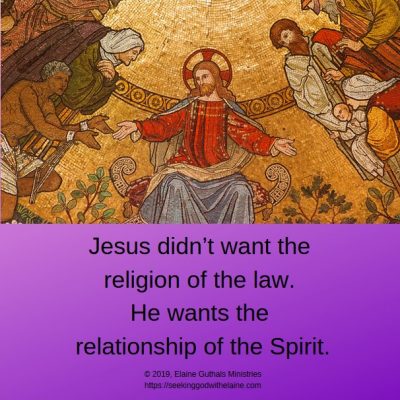
  • Why Does God Call Us?

    I chose you before I formed in you the womb, I set you apart before you were born. I appointed you a prophet to the nations.
    Jeremiah 1: 5 (HCSB)
    Scripture: Jeremiah 1: 1-10

    At times we question why God is calling us to the ministry that He is. God has a plan to use us to expand His kingdom. This devotion looks at how He will come to us and give us His message.

    Cliff Notes

    • God uses people as He chooses, regardless of their age.
    • God comes to us when He is ready for us to start our ministry.
    • We don’t have to be concerned about what we will say because it will be His message, not ours.
    • God will equip us to do what He has called us to do.
    Flowers with title Why Does God Call Us?

    This is a devotion that was in my drafts folder. I looked at what I had written and gave it the working title of How Well Does God Know Us?

    God changed my plans.

    Let’s Put It into Context

    I’ve only been putting these devotions out on the Internet for six months. I have been writing them off and on for 30 years, but they have stayed in a drawer.

    I went through a spiritual tornado a year and a half ago. I felt led to letting other people read what I wrote and to keep writing.

    See, the problem I have with that is I feel so inadequate. I have been a Bible study teacher for years, but I am just presenting other people’s words and ideas. Ninety-nine percent of them aren’t mine.

    I know what I believe, but is it really right? I am no expert in the Bible. I was in higher education, but not seminary.

    If you have read Is Depression a Lack of Faith? and God Doesn’t Try to Out Shout the Trial, you know I am not a techie. There is so much I need to learn in that area.

    To read devotions in the Elijah Was Depressed series, click the appropriate button below.

    So, I woke up this morning questioning is this really what I am supposed to be doing? Does God really think I can do this?

    Enter God. “Here is this verse/passage, but you need to forget what you thought you were going to do with it. Listen to what I want you to hear.”

    I’ll try to make this coherent through the tears. Hopefully, God can talk to you while He is talking to me.

    God Chooses Whom He Chooses

    Who was Jeremiah? He was the son of a preacher man (Jer. 1: 1) who thought he was too young for the job God had for him (Jer. 1: 6).

    We forget that God isn’t as caught up on age as we are. He had used other youngsters: Joseph (Gen. 37: 2), Samuel (I Sam. 3: 8), David (I Sam. 16: 11), and Daniel (Dan. 1: 3-6). John the Baptist (Lk. 3) and Timothy (I Tim. 4: 12) came after Jeremiah’s time.

    But then, God uses older people, too. Think about Abraham. He was 100 when Isaac was born (Gen. 21: 2). We assume Simon was older because he was told “… he should not see death before he had seen the Lord’s Christ” (Lk. 26: 2 RSV). We are told that Anna was older (Lk. 3: 36).

    Moral of the story is that, if God wants to use you, He will call you regardless of your age. So, yes, He can use us, too.

    Because Jeremiah was young, he doesn’t come off as being real bold. He seems timid and insecure. That didn’t matter to God. He said He would use him anyway.

    Why? It was God’s plan to use Jeremiah — it had been all along. Since God had decided this before Jeremiah was born (Jer. 1: 5), it didn’t have anything to do with Jeremiah. It had everything to do with God. The ministry and the timing was His. Our abilities — or lack of abilities — isn’t the deciding factor about whether God is going to use us.

    Flowers

    God Will Hunt Us Down

    Did you see that? God came to Jeremiah. “Now the word of the Lord came to me …” (Jer. 1: 4 RSV emphasis added). Jeremiah wasn’t seeking God. He wasn’t trying to process anything.

    God just showed up. Think about how He just showed up in the burning bush. “And the angel of the Lord appeared to him [Moses] in a flame of fire out of the midst of a bush; and he looked, and lo, the bush was burning, yet it was not consumed” (Ex. 3: 2 RSV).

    Think about how Jesus showed up to Paul on the Damascus Road. “Now as he [Paul] journeyed he approached Damascus, and suddenly a light from heaven flashed about him” (Ac. 9: 3 RSV).

    Part of the reason God has to hunt us down is because we don’t feel worthy. We may be seeking God to know Him better, but we may not be looking for Him to use us.

    If God has it in His plan that He is going to use us, He is going to come find us. He knows what we are capable of, even if we don’t.

    Church

    If we get discouraged (Jer. 15: 10-12), God will come after us. He is there to support us and protect us. He is not going to leave us.

    I love the bridge in Reckless Love. There is nothing that is going to get in God’s way when He is coming after us — no wall, no lie, no shadow, no mountain.

    Reckless Love
    Vocalist: Elaine Guthals
    Keyboard: Chris Vieth

    God loves us so much. Nothing is going to stand in His way.

    God’s Message, Not Ours

    I told you in the Bible study class with my ladies, I am given what to say. When I sing, I sing someone else’s words.

    So, I get a little self-conscious sometimes thinking about what I am going to write here. But it isn’t my words.

    It is God’s words. It is His message. We don’t have to be concerned about what we will say because it will be His message, not ours.

    Yeah, Jeremiah would have probably loved to have given a message of unicorns and rainbows. Instead, the message was death and destruction by the Babylonians. Can we say, not a popular message?

    What I write may not always be popular, especially since I’ve written so much on the end times. But it is God’s message, not mine. It is only through His grace that I can do this.

    Making the Connections

    God knows what He is doing. He has it all planned out. He knows our issues and challenges — and how to use them.

    We have to let God work. It’s above our pay grade to make the decisions as to how that is going to be. Don’t sweat the small stuff. Right, they may not be small to us. To God, they are.

    Flowers

    If God has called us, He will equip us. That was a prayer in Hebrews: “may he equip you with all you need for doing his will. May he produce in you, through the power of Jesus Christ, every good thing that is pleasing to him. All glory to him forever and ever! Amen” (Heb. 13: 21 NLT). Since He has known all along that this is what we would be doing, He has prepared us for this.

    How Do We Apply This?

    We have to remember that God knows what He is doing. Each of us has a purpose. Each of us has a ministry to perform for Him. We just have to figure out what He is calling us to do.

    How do we figure out what God is calling us to do? Try answering these questions:

    What are our strengths and my weaknesses? How do I think God could use these?
    What do we think God is calling us to do? How is God nudging me to make a change?
    What does it say in His Word about what we think He is calling me to do? Is it in line with His laws and commandments?
    How does this fit in with everything in out lives right now? Is it a smooth transition or is it a spiritual tornado? Just because it is a spiritual tornado does not mean it is not God calling.

    Then we have to have the confidence to do it. No, not confidence in ourselves; confidence in Him.

    We just have to listen, obey, and trust. We have to put our faith fully in God.

    Flowers

    God plans to use each and every one of us. No matter if we think He can or can’t. No matter our age or ability. God will find us, equip us, and encourage us to do His Will.

    Gracious Heavenly Father. You chose us even before we were born. Lord, we choose You. Even when it takes us out of our comfort zones, we choose You. Give us strength. Give us boldness. Give us the words to say. Amen.

    What do you think? To what ministry is God calling you? Are you fighting it? What do you need to do to listen, obey, and trust?

    Leave me a comment below (about this or anything else) or head over to my Facebook group for some interactive discussion.

    If you have not signed up for the email daily or weekly providing the link to the devotions and the newsletter, do so below.

    If God has used this devotion to speak with you, consider sharing it on social media.