Category: Ministry

  • How Is the Mission to be Inclusive?

    As you see, things still aren’t fixed. Some of my technical difficulties have straightened out, but not all. Hopefully, things will go back to normal soon. Thanks for bearing with me.

    Nuggets

    • We read about the conversion of Cornelius and think the Jews were not to associate with non-Jews, but that isn’t the case.
    • God chose the Gentiles – a.k.a. us – along with the Jews, making it evident mankind is elected – not just a certain race, ethnicity, or nationality.
    • God calls us to be holy – set apart, perfect, and pure.
    • Yes, everyone is included.
    • We are to go to all nations of the world for a very special purpose.
    • The disciples interpreted the gospel so the world could understand without changing what God had spoken.

    Devotions in the What I Believe series

    What I Believe Series

    Devotions in the Evangelism and Missions category

    What Is Evangelism?
    What Is Missions?
    What Was Jesus’ Mission? (Part 1)
    What Was Jesus’ Mission? (Part 2)
    How Is the Mission to be Inclusive?

    Discussions in society today are centering around inclusion of a diverse population. This devotion looks at diversity and inclusion in the plan of salvation — and how far that inclusion should go.

    Let’s Put It into Context

    Evangelism is sharing, as led by the Holy-Spirit, the good news of God’s kingdom to ensure all sinners have heard of God’s love and mercy so that they may choose to accept Jesus as their Savior. Sinners are all people who have not made a genuine profession of faith — who have not sincerely ABCDed.

    I really liked how the Holman Bible Dictionary linked evangelism with a deep-rooted concern for people. This concept — even though evangelism isn’t mentioned anywhere is Scriptures — permeates them.

    Resource
    Holman Bible Dictionary’s definition of evangelism
    https://www.studylight.org/dictionaries/hbd/e/evangelism.html

    On the other hand, missions, according to the Holman Bible Dictionary, is “a task on which God sends a person He has called, particularly a mission to introduce another group of people to salvation in Christ.” While — again — the term missions is not used in the Scriptures, evangelism is accomplished through missions.

    Resource
    Holman Bible Dictionary’s definition of missions
    https://www.studylight.org/dictionaries/hbd/m/missions.html

    It Is Forbidden?

    “Peter said to them, ‘You know it’s forbidden for a Jewish man to associate with or visit a foreigner, but God has shown me that I must not call any person impure or unclean’” (Ac. 10: 28 CSB)

    We read about the conversion of Cornelius and think the Jews were not to associate with non-Jews. That isn’t the case.

    Instead of being God’s law, this was man’s tradition. HaNaviy wrote “The Torah (Law) of Moses never prohibits Jews from ‘associating with’ or ‘visiting anyone of another nation.’ This statement of Peter’s reflects the ‘ethnocentric Jewish exclusivism’ baggage that the Torah communities of his day had engineered, baggage not uncommon among people groups who are marginalized. In other words, Peter was just regurgitating the standard mantra of his day. This did not excuse his error, which is why God went through all the trouble to send him the vision in the first place.” So, it was man thinking they knew what God wanted.

    Resource
    e-Bible Questions’ Why did Peter in Acts10:28 say that it is an unlawful thing for a man that is a Jew to keep company, or come unto one of another nation?
    https://ebible.com/questions/14659-why-did-peter-in-acts10-28-say-that-it-is-an-unlawful-thing-for-a-man-that-is-a-jew-to-keep-company-or-come-unto-one-of-another-nation

    We’ve talked about man-made traditions before. Pharisees were good looking at ritual – tradition. But these traditions were add-ons by the scribes. Jesus said the Pharisees were putting human traditions over God’s laws.

    To read a related devotion, click on the button below.

    What Does Charity Mean?
    How Do We Not Give Lip Service Worship?

    It seems like Peter was saying, “Hey, God elected us to be His people. We need to separate from you.”

    What Is Election?

    “Regarding the gospel, they are enemies for your advantage, but regarding election, they are loved because of the patriarchs” (Rom. 11: 28 CSB)

    We’ve talked in the past how God elected us. Election is that God chose to accomplish the plan of salvation to restore His people. But God chose the Gentiles – a.k.a. us – along with the Jews. To me, this makes it evident mankind is elected – not just a certain race, ethnicity, or nationality – we could probably list a lot of qualifiers that God doesn’t even look at.

    To read a related devotion, click on the button below.

    What Is Election?

    Where Does Separation Come into Play?

    But where would the first-century Jews get the idea of separation? God calls us to be holy. Holy means to be set apart, perfect, and pure.

    • “When the Lord your God brings you into the land you are entering to possess, and he drives out many nations before you — the Hethites, Girgashites, Amorites, Canaanites, Perizzites, Hivites and Jebusites, seven nations more numerous and powerful than you — and when the Lord your God delivers them over to you and you defeat them, you must completely destroy them. Make no treaty with them and show them no mercy. You must not intermarry with them, and you must not give your daughters to their sons or take their daughters for your sons” (Deut. 7: 1-3 CSB).
    • “Do not be yoked together with those who do not believe. For what partnership is there between righteousness and lawlessness? Or what fellowship does light have with darkness?” (II Cor. 6: 14 CSB).
    • “Do not be conformed to this age, but be transformed by the renewing of your mind, so that you may discern what is the good, pleasing, and perfect will of God” (Rom. 12: 2 CSB).
    • “But you are a chosen race, a royal priesthood, a holy nation, a people for his own possession, that you may proclaim the excellencies of him who called you out of darkness into his marvelous light” (I Pet. 2: 9 ESV).

    But then, we make the same assumption that the two shall never associate with each other.

    It seems like separation is logical when we put two and two together. But we came up with five instead of four.

    We didn’t factor in our purpose.

    • “Now the Lord said to Abram, ‘Go from your country and your kindred and your father’s house to the land that I will show you. And I will make of you a great nation, and I will bless you and make your name great, so that you will be a blessing. I will bless those who bless you, and him who dishonors you I will curse, and in you all the families of the earth shall be blessed’” (Gen. 12: 1-3 ESV emphasis added).
    • “seeing that Abraham shall surely become a great and mighty nation, and all the nations of the earth shall be blessed in him?” (Gen. 18: 18 ESV emphasis added).

    Everyone Included

    “Declare his glory among the nations, his wondrous works among all peoples” (Ps. 96: 3 CSB)

    Yes, everyone is included.

    • “For God so loved the world, that he gave his only Son, that whoever believes in him should not perish but have eternal life” (Jan. 3: 16 ESV).
    • God “… wants everyone to be saved and to understand the truth” (I Tim. 2: 4 NLT).

    Include Everyone for What Purpose?

    We are to go to all nations of the world for a very special purpose.

    • “Go, therefore, and make disciples of all nations, baptizing them in the name of the Father and of the Son and of the Holy Spirit” (Mt. 28: 19 CSB emphasis added).
    • “And it is necessary that the gospel be preached to all nations” (Mk. 13: 10 CSB emphasis added).
    • “Then he said to them, ‘Go into all the world and preach the gospel to all creation’” (Mk. 16: 15 CSB emphasis added).
    • “He also said to them, ‘This is what is written: The Messiah will suffer and rise from the dead the third day, and repentance for forgiveness of sins will be proclaimed in his name to all the nations, beginning at Jerusalem. You are witnesses of these things’” (Lk. 24: 46-48 CSB emphasis added).

    Newton reminded us that our job description came directly from God. We are to proclaim the gospel and make disciples.

    Resource
    Newton’s The Apostolic Commission
    https://biblehub.com/sermons/auth/newton/the_apostolic_commission.htm

    Job description

    Included but No Compromise

    “If you love me, you will keep my commandments” (Jn. 14: 15 ESV)

    Newton also wrote that our commission has a nature of “… adaptation to the circumstances of mankind.” Does that mean we are to compromise our beliefs and rewrite God’s laws from a worldview perspective?

    No way.

    We have to remember what Jesus said. “Do not think that I have come to abolish the Law or the Prophets; I have not come to abolish them but to fulfill them. For truly, I say to you, until heaven and earth pass away, not an iota, not a dot, will pass from the Law until all is accomplished” (Mt. 5: 17-18 ESV).

    No. That isn’t going to make witnessing easy. Roberts wrote, “To follow Christ and to take up His cause anywhere is to challenge the world, the flesh, and the devil.” We will be challenging the worldview.

    Roberts’ Missionary Conflict and Victory
    https://biblehub.com/sermons/auth/roberts/missionary_conflict_and_victory.htm

    Jenkyn described how the apostles approached the commission to preach the gospel to the world. He wrote, “They did not square their message by any human system of theology, nor measure their language to the lines of Procrustean creeds. They employed a dialect that traverses the length and breadth of the world.” The disciples interpreted the gospel so the world could understand without changing what God had spoken.

    Resource
    Jenkyn’s Universality of the message
    https://biblehub.com/sermons/auth/jenkyn/universality_of_the_message.htm

    Really Important All Included

    “This good news of the kingdom will be proclaimed in all the world as a testimony to all nations, and then the end will come” (Mt. 24: 14 CSB)

    It is really important everyone hear the plan of salvation. If they do not hear the gospel, they cannot make the decision to ABCD. Everyone needs to make the decision because one day soon the decision-making time will be over, and the decision will have been made for them.

    “Then I saw another angel flying high overhead, with the eternal gospel to announce to the inhabitants of the earth — to every nation, tribe, language, and people. He spoke with a loud voice: ‘Fear God and give him glory, because the hour of his judgment has come. Worship the one who made heaven and earth, the sea and the springs of water’” (Rev. 14: 6-7 CSB).

    Making the Connections

    Newton reminded us that there is just one plan of salvation. Regardless of our ethnicity or our culture, we are spiritually dead if we have not ABCDed. Spiritual death is the separation from God that occurred as a consequence of Adam and Eve’s original sin.

    Paul put it this way. “For all have sinned and fall short of the glory of God” (Rom. 3: 23 CSB).

    It isn’t about Tom is a murderer, Sally is a thief, and Elaine is a liar. What we have or haven’t done is not the issue. The issue is have we submitted our lives to God? Have we accepted His plan of salvation?

    We are all the same. We are all in need of God’s forgiveness.

    Newton put it this way. He wrote that there is “one and the same salvation for all and each. One common remedy for the universal disease.” As diverse as the world’s people are, we are looking for the same solution to our problems — God.

    Resource
    Newton’s The Apostolic Commission
    https://biblehub.com/sermons/auth/newton/the_apostolic_commission.htm

    Making the Connections to Self-Discipline

    We’ve been looking at defending our beliefs when we are witnessing. That means we have to be secure enough to convince someone to accept our beliefs.

    Our questions should still serve us to determine on what we need to focus.

    What does the Scriptures say?
    What do I believe?
    Why do I believe the same/differently than the Scriptures?
    What are the talking points when witnessing to a non-believer?

    Related Links
    I have created a worksheet of the questions above. Click on the button below to access it.

    How Do We Apply This?

    Some may say God was harsh when He told the Israelites “… you must completely destroy …” (Deut. 7: 2 CSB) the Canaanites. There was a good reason: “because they will turn your sons away from me to worship other gods. Then the Lord’s anger will burn against you, and he will swiftly destroy you” (Deut. 7: 4 CSB). God doesn’t want us to be led astray.

    It is only after we ABCD can we expect the society people are wanting the inclusiveness to create. Roberts wrote, “Then, too, in the gospel victories is to be included a beautiful, delightful social revolution, for ‘now is come the kingdom of our God and the authority of His Christ.’”

    Roberts’ Missionary Conflict and Victory
    https://biblehub.com/sermons/auth/roberts/missionary_conflict_and_victory.htm

    But it won’t be a social revolution to fix this world. This heaven and earth are on borrowed time. “… From his presence earth and sky fled away, and no place was found for them” (Rev. 20: 11 ESV).

    We will truly be as God intended. “There is neither Jew nor Greek, there is neither slave nor free, there is no male and female, for you are all one in Christ Jesus. And if you are Christ’s, then you are Abraham’s offspring, heirs according to promise” (Gal. 3: 28-29 ESV).

    Heavenly Father. We wait for the day when we will find unity in Your presence. Help us to find unity here in this life. May it be unity according to Your Will, and not according to the worldview. Amen.

  • What Was Jesus’ Mission? (Part 2)

    Jesus’ mission was to reveal the Father to us. More specifically, Jesus’s mission was to accomplish the plan of salvation. This devotion looks at how revealing God’s love helped reveal our need to accept the salvation God was offering.

    Nuggets

    God’s love and mercy is intrinsically connected.
    Providing mankind access to the plan of salvation was the focus of Jesus’ mission.

    Devotions in the What I Believe series

    What I Believe Series

    Devotions in the Evangelism and Missions category

    What Is Evangelism?
    What Is Missions?
    What Was Jesus’ Mission? (Part 1)
    What Was Jesus’ Mission? (Part 2)
    How Is the Mission to be Inclusive?

    As you can see, my computer issues have not been resolved yet. Thank you for your patience.

    We started discussing Jesus’ mission in the last devotion. We’re going to finish that discussion today.

    Let’s recap. We’ve said so far that Jesus’ mission was

    To reveal the Father
    To glorify the Father
    To bring God’s kingdom to earth

    Moving on. Really, Jesus’ mission centered on fulfilling God’s plan of salvation.

    To Make God’s Love and Mercy Known

    “But God, who is rich in mercy, because of his great love that he had for us, made us alive with Christ even though we were dead in trespasses. You are saved by grace!” (Eph. 2: 4-5 CSB)

    God’s love and mercy is intrinsically connected. God’s mercy is the unexpected way God responds in love to our needs.

    Bayne wrote that God’s mercy “… teaches us our duty to God and man. He has loved us first, therefore must we love Him again, His love must constrain us; and our love is a reflection of His to us (1 John 4:19; 2 Corinthians 5:14; 1 John 4:11).” Disciples’ mercy is a characteristic of compassion for the needs of others, especially those who are in distress.

    Resource
    Bayne’s The Mercy of God
    https://biblehub.com/sermons/auth/bayne/the_mercy_of_god.htm

    Rossi wrote what I have long thought. He wrote that God shows us mercy to promote His glory. But then, He is God. He deserves the glory.

    Resource
    Rossi’s God’s Mercy Towards the Sinner
    https://biblehub.com/sermons/auth/rossi/god’s_mercy_towards_the_sinner.htm

    God’s mercy is also shown by the substitution of one man’s death to redeem many. Jesus became the propitiation so that we could be restored to the Father.

    Glossary
    Propitiation

    We’ve talked before that God does not love as the world loves. His love is a constant, unchanging love, the opposite of how the world loves.

    To read a related devotion, read How Is the World’s Love Different from Jesus’ Love?

    Villiers caught a difference in “… rich in mercy …” and “… his great love …” (Eph. 2: 4 CSB). He wrote, “… mercy, in fact, refers to man in his fallen state, and that the love refers to the manner in which that mercy is manifested.”

    Resource
    Villiers’ The Mercy and Love of God
    https://biblehub.com/sermons/auth/villiers/the_mercy_and_love_of_god.htm

    Jesus, when He was here on earth, showed how that mercy is manifested through love.

    God bestows this love and mercy on us even when we are spiritually dead. “But God proves his own love for us in that while we were still sinners, Christ died for us” (Rom. 5: 8 CSB).

    Don’t take that to mean God is okay with us being spiritually dead. No. He wants us to admit our sins, believe in Jesus as Savior and Redeemer, and confess Him as Sovereign Lord.

    To Seek and Save the Lost

    “For the Son of Man has come to seek and to save the lost” (Lk. 19: 10 CSB)

    We have all sinned so that we are all lost. Sin is when we disobey God and break one of His laws and commandments.

    We need to repent of our sins. Repentance is expressing sorrow for breaking God’s laws and commandments by making the commitment to changing ourselves through obedience so that we no longer do the wrong things.

    When we repent, we exhibit the faith that God can save us. Faith is the belief that the doctrines stated in God’s Word are true, even if we do not understand all aspects of them. Salvation is deliverance from evil and the consequences of sins to replace them with eternal life and good.

    When we step out in faith and accept Jesus as our Savior, we accept God’s gift of grace. Grace is a free and unmerited gift from Heavenly Father given through His Son, Jesus Christ that enables salvation and spiritual healing to believers. This includes forgiveness of our sins.

    Forgiveness is when God pardons us because we have broken His laws and commandments. We accept the pardon by letting go of the guilt and remorse that we feel because we have done something wrong. It is a conscious decision to accept His forgiveness.

    This forgiveness starts us on the sanctification road. Sanctification is the transformation of mind, body, and soul beginning with regeneration and ending with perfected state of spiritual wholeness or completeness. Regeneration is the change in us that God brings about when we go from being spiritually dead to spiritually alive. It is where God breaks Satan’s hold on us.

    The perfected state indicates spiritual wholeness or completeness. It means we have become holy, sanctified, and righteous. Holy means to be set apart, perfect, and pure. Righteousness is the result of a solid relationship with God built by a sincere life of conscientious obedience to God’s laws and commandments.

    We are able to approach God and ask for salvation because Jesus redeemed us. Redemption is where something is used in exchange for something else to gain or regain something. Jesus substituted — became the propitiation — for us because He knew God’s wrath had to be appeased. He shed His blood to pay the price for our sins.

    Jesus is our Redeemer because He was born of a virgin, making Him 100% God and 100% man; gave His life on the cross for us so that His blood could pay the price for our sins; and because of God’s great might and power, rose from the grave, conquering death and paying the price for our sins.

    Jesus’ blood became the atonement for our sins. Atonement is about repayment for a wrong. The repayment was the shedding of His blood.

    When we accept Jesus as our Savior, we must change. We have a circumcision of the heart, where God changes our hearts.

    We gain eternal life because we are no longer spiritually dead. Eternal life is the promise of living eternally – even if we have died in this life – because we have admitted our sins, believed Jesus as Savior and Redeemer, and confessed God as Sovereign Lord. Spiritual death is the separation from God that occurred as a consequence of Adam and Eve’s original sin.

    We have to choose to accept God’s plan of salvation because He has given us free will. Free will is the ability within us to make decisions, which determine actions that produce character.

    Making the Connections

    Jesus’ mission did not end when He ascended. We are still charged to complete His mission. “… Go into all the world and preach the gospel to all creation’ (Mk. 16: 16 NIV). We are to imitate His mission.

    Making the Connections to Self-Discipline

    Ooo, baby. We are to witness, worship, show love, have mercy, and imitate. Oh, yeah. Those things don’t always come naturally to some of us. We’ll need self-discipline.

    We’ve been looking at defending our beliefs when we are witnessing. That means we have to be secure enough to convince someone to accept our beliefs.

    Our questions should still serve us to determine on what we need to focus.

    What does the Scriptures say?
    What do I believe?
    Why do I believe the same/differently than the Scriptures?
    What are the talking points when witnessing to a non-believer?

    Related Links
    I have created a worksheet of the questions above. You can access it through the library.

    How Do We Apply This?

    Hooker wrote, “As regards God, our soundest knowledge is to know that we know Him, and our safest eloquence concerning Him is silence, when we confess without confession that His glory is inexplicable, His greatness above our capacity or reach.” The only way we know Him is to seek for Him and spend time with Him.

    Resource
    Farrar and Hooker’s The Incompressibility
    https://biblehub.com/sermons/auth/farrar/the_incomprehensibility.htm

    We have to diligently work to imitate Jesus. No, we won’t be perfect. We just have to ask to be forgiven, and then do better at following Him.

    We are called to spread the gospel unto the ends of the earth. Providing mankind access to the plan of salvation was the focus of Jesus’ mission. We need to make it the focus of ours.

    Father God. Thank You that Jesus came to be the Sacrifice to pay the penalty for our sins. Thank You that we see His dedication and obedience to You. Lord, it is our prayer that we imitate Him in doing whatever You call us to do. Amen.

  • What Was Jesus’ Mission? (Part 1)

    In order to imitate Jesus, we have to make sure that we know what His mission on earth was about. This devotion begins looking at the different tasks Jesus performed in accomplishing His mission.

    Nuggets

    Jesus used His life as well as His words to reveal God to us.
    Jesus glorified God in all He did.
    When Jesus was on earth, He extended that kingdom to the physical realm.

    Note: I am having a lot of computer problems. My laptop is trying to crash. I have a new computer ordered, but it may take it a while to get here.

    Now I am having trouble with my website. So, this devotion is not going to look like it normally does. Bear with me, please.

    Let’s Get Started

    I know I am Dictionary Chick. I want to make sure we are all on the same page as to what terminology means — especially if these are read by someone who hasn’t grown up in church or has a different concept than I have of what the meaning is.

    So, when I was looking up the definition of mission in the Holman Bible Dictionary, it made the statement as to what Jesus’ mission was. Since we are to imitate Him, our missions should imitate His.

    The Holman Bible Dictionary indicated that Jesus’ mission is as follows:

    “The mission begins with Jesus who was sent to earth to reveal the Father (John 1:18; John 14:9), to glorify Him (John 13:31; John 14:13; John 17:1, John 17:1, 17:6), to bring the kingdom of God on earth (Matthew 12: 22-32), and to make God’s love and mercy known to a lost world. He came to seek and save the lost (Luke 19:10). He came to seek and save the lost (Luke 19:10).”

    Resource
    Holman Bible Dictionary’s definition of missions
    https://www.studylight.org/dictionaries/hbd/m/missions.html

    Jesus may have only been on earth for three years, but He made the most of His time. Because He had such a varied mission, we are going to have to break this devotion into two.

    Let’s Put It into Context

    Evangelism is sharing, as led by the Holy-Spirit, the good news of God’s kingdom to ensure all sinners have heard of God’s love and mercy so that they may choose to accept Jesus as their Savior. Sinners are all people who have not made a genuine profession of faith — who have not sincerely ABCDed.

    I really liked how the Holman Bible Dictionary linked evangelism with a deep-rooted concern for people. This concept — even though evangelism isn’t mentioned anywhere is Scriptures — permeates them.

    Resource
    Holman Bible Dictionary’s definition of evangelism
    https://www.studylight.org/dictionaries/hbd/e/evangelism.html

    On the other hand, missions, according to the Holman Bible Dictionary, is “a task on which God sends a person He has called, particularly a mission to introduce another group of people to salvation in Christ.” While — again — the term missions is not used in the Scriptures, evangelism is accomplished through missions.

    Resource
    Holman Bible Dictionary’s definition of missions
    https://www.studylight.org/dictionaries/hbd/m/missions.html

    To Reveal the Father

    “No one has ever seen God. The one and only Son, who is himself God and is at the Father’s side — he has revealed him” (Jn. 1: 18 CSB)

    One of the tasks of Jesus’ mission was to reveal God to us. No one had seen God face to face since Adam and Eve committed the original sin. One of the consequences of that sin was separation from God — both physically and spiritually.

    Glossary
    The Original Sin

    Since that time, a lot of people had lived and died. Satan had been ruling the earth. Therefore, many did not know — or did not correctly know — God.

    Jesus came to rectify that. Why? Mellor explained that, “without the guidance of revelation no one has ever reached any fair conception of the unity, spirituality, and moral character of God.” Knowing the character of God is important.

    Resource
    Mellor’s The Invisible and Revealed God
    https://biblehub.com/sermons/auth/mellor/the_invisible_and_revealed_god.htm

    What all did Jesus reveal to us about God?

    There is only one God.
    God is a spirit.
    God is good.
    God is love.
    The expectation of obedience to God’s laws and commandments
    God’s plan of salvation to restore mankind to Him
    An exhibit of the power of God

    Resource
    Jones’ The Revealer of God
    https://biblehub.com/sermons/auth/jones/the_revealer_of_god.htm
    Guyse’s Christ the Declarer of the Father
    https://biblehub.com/sermons/auth/guyse/christ_the_declarer_of_the_father.htm
    Benson’s The Father Manifested in the Son
    https://biblehub.com/sermons/auth/benson/the_father_manifested_in_the_son.htm

    Caird reminded us that Jesus used His life as well as His words to reveal God to us. He knew it was important to use both.

    Resource
    Caird’s Christ, the Revelation of the Invisible God
    https://biblehub.com/sermons/auth/caird/christ_the_revelation_of_the_invisible_god.htm

    It is really important that Jesus reveal the character of God to us. Imitating Him is how we become holy and righteous. Holy means to be set apart, perfect, and pure. Righteousness is the result of a solid relationship with God built by a sincere life of conscientious obedience to God’s laws and commandments. It is more the right principles under which we live.

    How can we imitate God if He is not revealed to us?

    Glossary
    Imitate

    To Glorify the Father

    “After saying all these things, Jesus looked up to heaven and said, ‘Father, the hour has come. Glorify your Son so he can give glory back to you’” (Jn. 13: 31 NLT)

    All I wanted to do was look up the definition of glory. Come take a journey with me.

    Glorify: to make glorious by bestowing honor, praise, or admiration
    Glorious: possessing or deserving glory
    Glory: worshipful praise, honor, and thanksgiving

    Merriam-Webster Dictionary’s definition of glorify
    https://www.merriam-webster.com/dictionary/glorify
    Merriam-Webster Dictionary’s definition of glorious
    https://www.merriam-webster.com/dictionary/glorious
    Merriam-Webster Dictionary’s definition of glory
    https://www.merriam-webster.com/dictionary/glory

    I would say we circled around that.

    Okay, we’ve talked about glory before. Glory is the expression of the qualities of God resulting from the authority of God.

    To read a related devotion, click on the button below.

    What Is the Foundation of Salvation?

    So, if we mash all of this together in Elaine-speak, when we glorify God, we are acknowledging God is deserving of worshipful praise, honor, and thanksgiving by bestowing honor, praise, or admiration on Him.

    Simeon stated that Jesus glorified Himself by completing the plan of salvation and all God asked Him to do. His actions redeemed mankind and restored our relationships with Him when we admit our sins, believe Jesus is our Savior and Redeemer, and confess God as Sovereign Lord.

    Resource
    Simeon’s God Glorified in His Son
    https://biblehub.com/sermons/auth/simeon/god_glorified_in_his_son.htm

    ABCD

    Jesus glorified God in all He did. He not only obeyed God’s laws and commandments, but He also taught his disciples — and us — to do so also. He did this by submitting to God’s Will, even when it cost Him His life.

    But Jesus still had to ask God to glorify Him. He didn’t think He deserved it for His obedience. He didn’t think He was entitled because He had given up His life.

    Resource
    Spence’s The Heavenly Glorification
    https://biblehub.com/sermons/auth/spence/the_heavenly_glorification.htm

    God glorified Jesus by accepting His sacrifice and highlighting and rewarding Jesus’ obedience. Maclaren reminded us that God was glorified in the death of an innocent man.

    Resource
    Maclaren’s The Cross the Glory of Christian and God
    https://biblehub.com/sermons/auth/maclaren/the_cross_the_glory_of_christ_and_god.htm

    In all Jesus did, He submitted to God’s Will. He followed God’s instructions and completed all the tasks God had for Him. That gave God the honor and glory.

    To Bring God’s Kingdom to Earth

    “If I drive out demons by the Spirit of God, then the kingdom of God has come upon you” (Mt. 12: 28 CSB)

    The kingdom of God is a spiritual kingdom that describes His sovereign reign. When Jesus was on earth, He extended that kingdom to the physical realm.

    Glossary
    Kingdom of God

    The thing is, Jesus has now told us about the kingdom of God. We can’t be neutral. We have to make a choice.

    Are we submitting to God as Sovereign Lord? Or are we following the worldview and Satan?

    We have to choose. A “no choice” is credited as a choice for Satan.

    Stewart explained how a “no choice” works. He wrote, “The human heart cannot be in a state in which neither Christ nor the world has the supremacy. Man must have a master and a God, etc.”

    Resource
    H.C.H. and Stewart’s No Neutrality in Religion
    https://biblehub.com/sermons/auth/stewart/no_neutrality_in_religion.htm

    In part, this may be seen as we have to choose one with whom to align. On the other hand, Jesus will always see it as “If you are not for me, you are against me.” He is looking for our complete allegiance.

    Our choice not only affects us. Worse, by our not choosing God, it also may be influencing someone else to not choose God.

    Father God. We thank You that we have Jesus as an example, showing us how we are to live for You. It is our desire to imitate Him, thereby imitating You. Amen.

  • What Is Missions?

    If evangelism is the sharing of the gospel with others, what is missions? This devotion looks at the tasks that are the components of missions.

    Nuggets

    • One of the tasks disciples are called to do is to live our lives for God.
    • Preaching could mean that it is as simple as one person talking to another person, telling how to ABCD.
    • We have to perform our mission in the way that God is calling us.
    • God will bless our mission when we are doing His Will.
    • It isn’t us who will be doing the talking.

    Devotions in the What I Believe series

    Devotions in the Evangelism and Missions category

    What Is Missions?
    What Was Jesus’ Mission?
    How Is the Mission to be Inclusive?

    Flowers with title What Is Missions?

    In the last devotion, we started looking at evangelism. In this devotion, we will start looking at its tie to missions.

    Let’s Put It into Context

    According to the Holman Bible Dictionary, evangelism is “the active calling of people to respond to the message of Grace and commit oneself to God in Jesus Christ.” I really liked how Holman linked evangelism with a deep-rooted concern for people. This concept — even though evangelism isn’t mentioned anywhere is Scriptures — permeates them.

    Resource

    Evangelism is sharing, as led by the Holy-Spirit, the good news of God’s kingdom to ensure all sinners have heard of God’s love and mercy so that they may choose to accept Jesus as their Savior. Sinners are all people who have not made a genuine profession of faith — who have not sincerely ABCDed.

    The ABCDs of Salvation

    If you have not become a believer in Christ, please read through the
    Plan of Salvation and prayerfully consider what God is asking you to do.

    A – admit our sins
    B – believe His Son Jesus is our Redeemer
    C – confess God as Sovereign Lord
    D – demonstrate that commitment by making any changes needed in our lives to
    live the way in which God has called us

    On the other hand, missions, according to the Holman Bible Dictionary, is “a task on which God sends a person He has called, particularly a mission to introduce another group of people to salvation in Christ.” While — again — the term missions is not used in the Scriptures, evangelism is accomplished through missions.

    Resource

    The “Go” Task

    “As you go, proclaim, ‘The kingdom of heaven has come near’” (Mt. 10: 7 NIV)

    One of the tasks disciples are called to do is to live our lives for God. “As you go …” (Mt. 10: 7 NIV) indicates that our lives should reflect Jesus’ imminent coming.

    Some may say that Jesus’ words were meant explicitly for the disciples standing in front of Him. No, He was talking to us, too. And we can take heart that Jesus is talking to us.

    Look at the disciples. We said before that four were fishermen. There was also a tax collector, a farmer, and a revolutionary. We don’t know the occupations of five of them.

    To read a related devotion, click the button below.

    What we do know is what Luke said about them. “Now when they [rulers and elders and scribes] saw the boldness of Peter and John, and perceived that they were uneducated, common men, they were astonished. And they recognized that they had been with Jesus” (Ac. 4: 13 ESV). Not a Pastor Chad-type in the bunch.

    We might could argue, as Martin did, that the disciples had special training because they spent three years in direct contact with Jesus. But then, we could say that they had a harder job than we did.

    These ordinary men were in on the ground floor of beginning of the religion. They were telling people things they had never heard before. Today, many people at a minimum know Jesus was born on earth.

    Neither were they perfect men. Jesus didn’t change them in a twinkling of an eye in order to facilitate the building of His church.

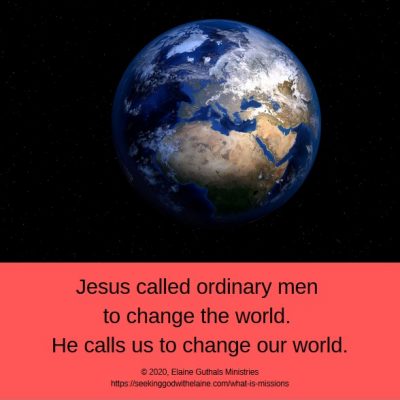
    Jesus called ordinary men to change the world. He calls us to change our world.

    World

    We are witnesses “as you go …” (Mt. 10: 7 NIV). Elliot said it this way: “Every life is a little Bible — a revelation of God.”

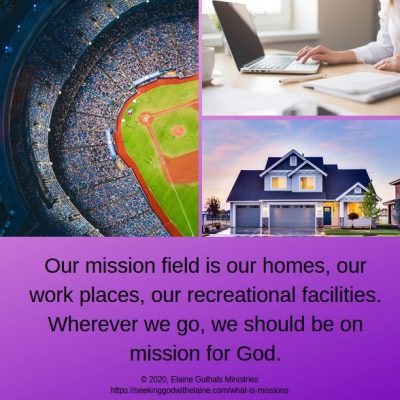
    Our mission field is our homes, our work places, our recreational facilities. Wherever we go, we should be on mission for God.

    The “Preach” Task

    “Then he said to them, ‘Go into all the world and preach the gospel to all creation’” (Mk. 16: 15 CSB)

    Paul said this about himself. “Although I am less than the least of all the Lord’s people, this grace was given me: to preach to the Gentiles the boundless riches of Christ, and to make plain to everyone the administration of this mystery, which for ages past was kept hidden in God, who created all things. His intent was that now, through the church, the manifold wisdom of God should be made known to the rulers and authorities in the heavenly realms, according to his eternal purpose that he accomplished in Christ Jesus our Lord” (Eph. 3: 8-11 NIV).

    What is preaching? According to the Holman Bible Dictionary, preaching in the Bible is the “human presentation through the Holy Spirit’s power of God’s acts of salvation through Jesus Christ.”

    It doesn’t say it has to be on a Sunday morning. It doesn’t say it has to be a Pastor Chad-type. It doesn’t say how many people are needed to constitute an audience.

    Spurgeon really expanded the definition. He wrote that preaching “… includes all church work for the spread of the gospel.”

    That could mean that it is as simple as one person talking to another person, telling how to ABCD. It is us talking about His love and His grace.

    Preaching needs that human touch. The definition of preaching in the Bible went on to say, “a sermon becomes God’s word to us only as God’s servant reconstitutes the past realities of the biblical revelation into vital present experience.”

    It is like when Philip preached to the Ethiopian (Act 8: 26-40). The Ethiopian was reading it. He needed more.

    “Then Philip ran up to the chariot and heard the man reading Isaiah the prophet. ‘Do you understand what you are reading?’ Philip asked. ‘How can I,’ he said, ‘unless someone explains it to me?’ So he invited Philip to come up and sit with him” (Ac. 8: 30-31 NIV).

    A simple explanation and practical application. That is how we preach. (Remember, it is in our disciple’s job description.)

    The Disciple’s Job Description

    Complete Job Description

    Individual Description

    Job Duty #4
    Proclaim the Gospel (Mark 16: 15)

    The “Obedience” Task

    “The word of the Lord came to Jonah a second time: ‘Get up! Go to the great city of Nineveh and preach the message that I tell you.’ Jonah got up and went to Nineveh according to the Lord’s command” (Jonah 3: 1-3 CSB)

    We can learn so much from Jonah.

    • God will give us second chances if we genuinely repent. Repentance is expressing sorrow for breaking God’s laws and commandments by making the commitment to changing ourselves through obedience so that we no longer do the wrong things.
    • We may be asked to do things that challenge our beliefs because we need to align them with God’s.
    • Obedience is the key. Obedience means to hear and carry out the instructions that God gives us.

    When we apply this to our mission, we see that God knows we are fallible, imperfect creatures. He will forgive us when we ask. He will still use us to expand His kingdom.

    Ray said there are two ways we disobey God regarding our mission. He wrote, “He may not go, may plead excuses, and refuse to try to do the work. Or he may not do what God tells him to do, may do something somewhat like it, but not it.”

    We have to perform our mission in the way that God is calling us. It is His kingdom. He is all-knowing and all-powerful. We need to listen to Him.

    The “Stay” Task

    “But I will stay in Ephesus until Pentecost, because a wide door for effective ministry has opened for me — yet many oppose me” (I Cor. 16: 8-9 CSB)”

    Have you ever wanted to move on to a next season in your life, and God was keeping you where you were? We have to listen to Him and do His Will.

    God will bless our mission when we are doing His Will. Remember He goes before, with, and after us.

    No, our mission work isn’t going to be all rainbows and unicorns. We are going to have challenged. But God will be with us every step of the way when we are genuinely serving Him.

    Our mission field is our homes, our work places, our recreational facilities. Wherever we go, we should be on mission for God.

    The “Speak” Task

    “Now go! I will help you speak and I will teach you what to say” (Ex. 4: 12 NIV).

    Unfortunately, we pull a Jonah a lot of times. We make excuses as to why we can’t do the mission God is giving us. We say we can’t speak, as Moses did. Worst case scenario, we flat outrun the other way like Jonah did.

    We said in the last devotion that God isn’t in the business of setting us up to fail. God is in the salvation business. He needs us to do our part so that His kingdom is expanded.

    We get forgetful like Moses did. Parker wrote, “He has forgotten the promise, ‘Certainly I will be with thee.’”

    It isn’t us who will be doing the talking. “For the one whom God sent speaks God’s words, since he gives the Spirit without measure” (Jn. 3: 34 NIV). God will take care of it all.

    Many times, we say we don’t know the Bible well enough. “You will be his witness to all people of what you have seen and heard” (Ac. 22: 15 NIV). God wants us to talk about Him and us. He wants us to tell about what we know. Still, we are going to want to know the Bible.

    Making the Connections

    We all have different tasks that God has called us to do in order to accomplish evangelism. “So Christ himself gave the apostles, the prophets, the evangelists, the pastors and teachers, to equip his people for works of service, so that the body of Christ may be built up until we all reach unity in the faith and in the knowledge of the Son of God and become mature, attaining to the whole measure of the fullness of Christ” (Eph. 4: 11-13 NIV).

    One isn’t better than the other. All are needed.

    Making the Connections to Self-Discipline

    Being on mission for God will cause us to want to know His Word better. We will use self-discipline to accomplish that.

    We’ve been looking at defending our beliefs when we are witnessing. That means we have to be secure enough to convince someone to accept our beliefs.

    Our questions should still serve us to determine on what we need to focus.

    • What does the Scriptures say?
    • What do I believe?
    • Why do I believe the same/differently than the Scriptures?
    • What are the talking points when witnessing to a non-believer?

    Related Links

    I have created a worksheet of the questions above. Click on the button below to access it.

    How Do We Apply This?

    Cuyler wrote, “But every living Christian is a preacher. Every prayerful, Ernest, godly life is a sermon.”

    But we can’t just rely on others seeing us live our lives and get God’s message. We have to talk with them. We have to build the relationship so that we can make an impact in their lives.

    We also rely on missionaries and mission trips to get the job done. We have to act like we are on mission every day of our lives — where ever we go and with whomever we come in contact.

    Father God. We wait for You to send us. We diligently perform the tasks You assign to us. We will go where You send us; we will stay where You plant us. Through our lives and our words, we will preach Your gospel to those who need to hear. May we always be obedient to You. Amen.

    What do you think?

    Leave me a comment below (about this or anything else) or head over to my Facebook group for some interactive discussion.

    If you don’t understand something and would like further clarification, please contact me.

    If you have not signed up for the email daily or weekly providing the link to the devotions and the newsletter, do so below.

    If God has used this devotion to speak with you, consider sharing it on social media.

  • What Is Evangelism?

    We are called to proclaim the gospel to others. That calling is referred to as evangelism. This devotion looks at why it is the duty of every disciple instead of just a preacher’s job.

    Nuggets

    • We need to share the gospel story because there is a whole lot of people who need to hear so they can make a choice to follow God.
    • God chooses us to deliver His message.
    • We also have to watch over others.
    • We have a testimony for God.
    Flowers with title What Is Evangelism?

    This year, we are looking at self-discipline. We are using Vincent’s The Lesson of Ripeness sermon to look at the need to grow in our relationship with God. We morphed learning enough to be a teacher into determining some areas we need to grow so we can be mature disciples.

    Resource

    We have been looking at solidifying what we believe. When we witness, we need to be prepared to explain what we believe and why we believe it. We have looked at the Scriptures, the Trinity (God, Jesus, and the Holy Spirit), man, salvation, grace, the church, divine ordinances, worship, God’s kingdom, and end times. Now, we are going to look at the evangelism and missions.

    One of our job duties as a disciple is to proclaim the gospel. Some may think that sounds a whole lot like preaching — and many of us do not feel qualified to do that.

    I get it. I went to a family funeral and was describing my devotions to a cousin. He said, “Oh, you are a preacher.” I said, “No, I am a teacher.”

    We are quick to make the distinctions, but does God? We generally think that evangelism is for the Pastor Chad types and missions are for the Tom, Sally, and Elaine types?

    Are they?

    Devotions in the What I Believe series

    Devotions in the Evangelism and Missions category

    What Is Evangelism?
    What Is Missions?
    What Was Jesus’ Mission?
    How Is the Mission to be Inclusive?

    Let’s Put It into Context

    According to the Holman Bible Dictionary, evangelism is “the active calling of people to respond to the message of Grace and commit oneself to God in Jesus Christ.” I really liked how Holman linked evangelism with a deep-rooted concern for people. This concept — even though evangelism isn’t mentioned anywhere is Scriptures — permeates them.

    Resource

    Evangelism is sharing, as led by the Holy-Spirit, the good news of God’s kingdom to ensure all sinners have heard of God’s love and mercy so that they may choose to accept Jesus as their Savior. Sinners are all people who have not made a genuine profession of faith — who have not sincerely ABCDed.

    The ABCDs of Salvation

    If you have not become a believer in Christ, please read through the
    Plan of Salvation and prayerfully consider what God is asking you to do.

    A – admit our sins
    B – believe His Son Jesus is our Redeemer
    C – confess God as Sovereign Lord
    D – demonstrate that commitment by making any changes needed in our lives to
    live the way in which God has called us

    On the other hand, missions, according to the Holman Bible Dictionary, is “a task on which God sends a person He has called, particularly a mission to introduce another group of people to salvation in Christ.” While — again — the term missions is not used in the Scriptures, evangelism is accomplished through missions.

    Resource

    Reason Evangelism Is Needed

    “Don’t you say, ‘There are still four more months, and then comes the harvest’? Listen to what I’m telling you: Open your eyes and look at the fields, because they are ready for harvest. The reaper is already receiving pay and gathering fruit for eternal life, so that the sower and reaper can rejoice together. For in this case the saying is true: ‘One sows and another reaps.’ I sent you to reap what you didn’t labor for; others have labored, and you have benefited from their labor” (Jn. 4: 35-38 NIV)

    We need to share the gospel story because there is a whole lot of people who need to hear so they can make a choice to follow God. Remember, anything that isn’t a conscious choice to follow God is a choice to not follow God.

    Jesus showed the urgency when He compared the mission field to a field of crops. There is always a gestation period. Seeds are planted, watered, cultivated, and allowed to grow until they bloom and produce.

    The same is true when a non-believer is presented the gospel. They must hear it, think it through, determine what questions they have, understand what they can, and make a conscious decision to put their faith and trust in God.

    People do not hear if they are not told. They are not told if disciples do not tell them.

    Luckily, we are not alone in our work. God organized us into communities. We can get help in proclaiming His Word.

    But we also have to be prepared to witness one on one. We may encounter someone who needs to hear the message right then — and we may be alone with them. We’ve got to step up and do what God calls us to do.

    Remember we said there was a gestation period. When we are sharing God‘s message, we have to be patient. It is our duty to share the message. It is the Holy Spirit that convicts the person. We have no clue how long that will take. We may want to see immediate results, but that will not always be the case.

    But then again we may may not be the planter. We may be the harvester. That may look make it and appear that the person’s decision was instantaneous.

    It Is Required

    “He commanded us to preach to the people and to testify that he is the one whom God appointed as judge of the living and the dead” (Ac. 10: 42 NIV)

    Does God need us to proclaim his message? Yes and no.

    No, God does not need us. He is Sovereign God. We are broken and far from perfect.

    Yes, God chooses us to deliver His message. He chooses for us to tell others the impact He has made in our lives.

    Thomas made a great observation. He wrote, “The feeblest honest effort to improve the world will develop encouraging symptoms to persevere.” Our beginning efforts to proclaim God’s message will be rewarded if we keep on doing what we are called to do.

    We have to take the focus off of us. The message isn’t about us.

    • It is about God knowing before He even created us that we would need a Savior.
    • It is about Him providing that Savior.
    • It is about Jesus being that Savior.
    • It is about Him coming one day to judge us to determine if we have given their lives to Him.

    It is important non-believers hear that “… he is the one whom God appointed as judge of the living and the dead” (Ac. 10: 42 NIV). He day is fast approaching when it will be judgment day.

    To read a related devotion, click the button below.

    We Have Responsibility

    “Keep watch over yourselves and all the flock of which the Holy Spirit has made you overseers. Be shepherds of the church of God, which he bought with his own blood” (Ac. 20: 28 NIV).

    There are several things for which we are instructed to watch. We have to watch out for Satan tempting us. We have to watch to make sure we are on the right sanctification road. We have to watch for Jesus’ return.

    We also have to watch over others. Simpson lists the duties of a shepherd.

    • Feed the flock
    • Water it
    • Groom and shear the sheep
    • Deliver lambs
    • Search for wandering sheep
    • Protect the flock

    We have similar duties when proclaiming God’s message to others.

    It is logical that we take care of ourselves before we take care of those God has entrusted under our care. Arnot explained that when he wrote, “The more that the teacher absorbs for himself of Christ’s love, the more benefit will others obtain from him.” The more we know and understand, the more we will be able to help others know and understand.

    Vaughan warned us that this verse does not make us rulers over the flock. He argued that the “… word ‘over’ should be rendered ‘in.’”

    Our responsibility is to serve those to whom God has called us to share His message. We are to model how we walk in the Spirit.

    To read a related devotion, click the button below.

    Our Call to Ministry

    “Now get up and stand on your feet. I have appeared to you to appoint you as a servant and as a witness of what you have seen and will see of me. I will rescue you from your own people and from the Gentiles. I am sending you to them to open their eyes and turn them from darkness to light, and from the power of Satan to God, so that they may receive forgiveness of sins and a place among those who are sanctified by faith in me” (Ac. 26: 16-18 NIV).

    The verses above are from when Paul was giving his testimony to King Agrippa. He was telling the king about how Jesus met him on the road and changed his career path.

    To read a related devotion, click the button below.

    Oh, no. We probably don’t have the Hollywood splash Paul had at his conversion.

    We still have a testimony for God. We still can — and will — be used by God because He has a specific purpose for us.

    We probably won’t have the ministry that Paul had, either. We won’t be constantly traveling to foreign lands to spread God’s Word.

    But we will have our ministry — even if it is to share God’s Word with a coworker. However great or small our ministry will be should have no bearing on us completing the ministry.

    Jesus will be with us as we travel the path on which He has set us. Yeah, we may have shipwrecks and beatings. We may even lose our lives.

    But it is very important that we share the message to whomever God has called to be our flock. What if we are the planter — and we don’t get the seed in the ground? Maybe worse yet, what if we are the harvester — and we let the grain die on the shaft?

    Making the Connections

    Reed made an interesting comment. He wrote, “An ordinary call to the ministry usually involves long processes of self-examination and observation of God’s guiding providences.”

    I think sometimes we think that God is going to call us to do something and throw us in the deep end before we know how to swim.

    Not. Going. To. Happen.

    God isn’t in the business of setting us up to fail. God is in the salvation business. He needs us to do our part so that His kingdom is expanded.

    Jeary gave us a good list of the objects of ministry.

    • Show God’s character
    • Destroy Satan’s kingdom and establish Jesus’
    • Grow disciples so that they live sanctified lives
    • “Result in the brightest manifestation of the Saviour’s glory”

    Too much is at stake for God to just throw us out on our own without preparing and equipping us for the jobs we are called to do.

    Making the Connections to Self-Discipline

    We’ve been looking at defending our beliefs when we are witnessing. That means we have to be secure enough to convince someone to accept our beliefs.

    Our questions should still serve us to determine on what we need to focus.

    • What does the Scriptures say?
    • What do I believe?
    • Why do I believe the same/differently than the Scriptures?
    • What are the talking points when witnessing to a non-believer?

    Related Links

    I have created a worksheet of the questions above. Click on the button below to access it.

    How Do We Apply This?

    God knows where He needs us to work. We have to put our faith and trust in Him. We need to grow closer to Him so that we can perform the tasks to which we are called. We do that by seeking Him.

    Searching for and Seeking God

    Hearing His Word (Rom. 10: 17).
    Reading His Word (Rev. 1: 3).
    Praying to Him (Heb. 4: 16).
    Studying His Word (Ac. 17: 11).
    Meditating on His Word (Ps. 1: 1-2).
    Memorizing His Word (Ps. 119: 11).

    Father God. We are humbled that You want to use us as ministers in Your kingdom. Show us where You want to use us. Give us a boldness to accomplish Your plan. May we always grow closer to You. Amen.

    What do you think?

    Leave me a comment below (about this or anything else) or head over to my Facebook group for some interactive discussion.

    If you don’t understand something and would like further clarification, please contact me.

    If you have not signed up for the email daily or weekly providing the link to the devotions and the newsletter, do so below.

    If God has used this devotion to speak with you, consider sharing it on social media.

  • The Ministry of Reconciliation

    The message of the gospel is about reconciliation. Man is reconciled to God and to others. This devotion looks at how we can see others as God sees them.

    Nuggets

    • Our relationship with Jesus should change how we interact with others.
    • Jesus calls us to a totally different way of life.
    • Disciples want to witness to non-believers because they are currently going to suffer the consequences of sin, which are spiritual death and separation from God.
    Flowers with title The Ministry of Reconciliation

    Paul was a man of conviction. He was driven to tell anyone who would listen about the love that Jesus has for us.

    No, Paul hadn’t always thought that way. In fact, for most of his life, he felt the opposite. He had known God — and Jesus wasn’t a part of the equation.

    Then one day, Paul met Jesus. He found out firsthand the love that Jesus has for us. He found a love for Jesus.

    For Paul, that took him out of the “me first” worldview mentality. He found a Savior he could serve.

    Let’s Put It into Context

    “For the love of Christ compels us, since we have reached this conclusion, that one died for all, and therefore all died. And he died for all so that those who live should no longer live for themselves, but for the one who died for them and was raised” (II Cor. 5: 14-15 NLT)

    Why? “… If one died for all, then all died” (II Cor. 5: 14 CSB). When we admit our sins, believe in Jesus as our Savior and Redeemer, and confess God as Sovereign Lord, we put to death our sins. The churchy word for this is mortify.

    The ABCDs of Salvation

    If you have not become a believer in Christ, please read through the
    Plan of Salvation and prayerfully consider what God is asking you to do.

    A – admit our sins
    B – believe His Son Jesus is our Redeemer
    C – confess God as Sovereign Lord

    D – demonstrate that commitment by making any changes needed in your life to
    live the way in which God has called you

    The Disciple’s Job Description

    Glossary

    This is represented through baptism. Baptism is the symbol of our conversion experience, providing the physical evidence that we have died and been buried to sin and have risen in a new spiritual life with Jesus.

    Glossary

    Jesus came to give His life for us to pay the penalty for our sins. “Even as the Son of man came not to be ministered unto, but to minister, and to give his life a ransom for many” (II Cor. 5: 14 WBT). It was never about Himself; it was always about others.

    Reconciled to Others

    “So we have stopped evaluating others from a human point of view …” (II Cor. 5: 16 NLT)

    Our relationship with Jesus should change how we interact with others. “No longer, then, do we judge anyone by human standards …” (II Cor. 5: 16 GNT).

    Oh, and we are so good at judging, aren’t we, when we are following a worldview perspective? Take a good look at comments on social media to figure out that answer.

    How do we judge others by worldview standards? Well, off the top of my head —

    • Appearance
    • Job
    • Possessions
    • Political party affiliation
    • Opinions
    • Mannerisms
    • Dietary habits
    • Punctuality

    Need I go on? We are very good at judging others because, when we find them lacking against our standards, that puffs us up.

    Jesus told us not to judge others. “Do not judge, and you will not be judged. Do not condemn, and we will not be condemned, forgive, and you will be forgiven” (Lk. 6: 37 NIV). Instead, Jesus commanded His disciplines to love.

    To read a related devotion, click the button below.

    Jesus calls us to a totally different way of life. This includes a different kind of love. We talked once about how Jesus’ love is different from the worldview’s love.

    • The world’s love is predicated on tolerance, but Jesus’ love goes straight to the heart.
    • World love says, “I’ll love you as long as …” but Jesus loved us enough to die on the cross for us.
    • While the worldview wants to give the illusion that it is inclusive, but it isn’t; Jesus truly is inclusive.
    • It seems that many world relationships do not last very long, but Jesus wants to spend eternity with us.
    • People may not love as they say, but Jesus loves us with a pure love.

    To read a related devotion, click the button below.

    Not judging others doesn’t mean we have nothing to do with them. If we look back at our list of worldview standards, they look selfish, don’t they? If we are called to the opposite, we would be called to be selfless — that definitely isn’t isolationist.

    But “not judging” doesn’t mean tolerance for sin. Sin is when we disobey God and break one of His laws and commandments.

    Witnessing to non-believers isn’t judging them. It is loving them enough that we do not want them to remain spiritually dead.

    Our job is to proclaim the gospel and make disciples. In order to do that, we have to build relationships with others.

    The Disciple’s Job Description

    Complete Job Description

    Individual Description

    Job Duty #4
    Proclaim the Gospel (Mark 16: 15)

    Job Duty #6
    Make Disciples (Matthew 28: 19-20)

    It is really important that we do our jobs. Thorpe wrote, “The cause in which, as a missionary society, we are engaged, is the salvation of the human race.” Salvation is the deliverance from evil and the consequences of sins to replace them with eternal life and good.

    Glossary

    Oh, yeah. I can see worldview people calling disciples drama queens for believing that.

    But it is true.

    • “They said, ‘Men of Galilee, why do you stand looking up into heaven? This same Jesus, who has been taken from you into heaven, will come in the same way that you have seen him going into heaven’” (Ac. 1: 11 CSB).
    Clouds
    • “God overlooked people’s ignorance about these things in earlier times, but now he commands everyone everywhere to repent of their sins and turn to him. For he has set a day for judging the world with justice by the man he has appointed, and he proved to everyone who this is by raising him from the dead” (Ac. 17: 30-31 NLT).
    • “For we must all stand before Christ to be judged. We will each receive whatever we deserve for the good or evil we have done in this earthly body” (II Cor. 5: 10 NLT).

    That shows how much value Jesus — and disciples — put on each individual person.

    Disciples want to witness to non-believers because they are currently going to suffer the consequences of sin are spiritual death and separation from God.

    What that means is, on judgment day, if they haven’t ABCDed, they will be sentenced to eternity in hell. That isn’t going to be pretty.

    To read a devotion in the Hell Does Have Fury series, click on the appropriate button below.

    So, when we ABCD, we stop judging others and start loving them. “… Love your neighbor as yourself” (Mt. 22: 39 CSB).

    Being a disciple is all about love. Robertson wrote, “Love, [is] the main principle of Christian life.”

    We’ve talked about this a lot lately. When we looked at the Beatitudes, we looked at what it meant to be blessed.

    • Blessedness means we have been perfected.
    • For the disciple, perfection is holy, sanctified, and righteous.
    • Holy means to be set apart, perfect, and pure.
    • Christian perfection is achieving the two greatest commandments.
    • If we look at perfection as the act or the process of becoming, that is sanctification.

    To read a related devotion, click the appropriate button below.

    Oh, yeah. It is going to be a process to become what God wants us to be. He wants us to imitate His character. That is totally different than worldview.

    Glossary

    Human Jesus

    “… At one time we thought of Christ merely from a human point of view …” (II Cor. 5: 16 NLT)

    This is an interesting thought. How would we see Jesus if we saw Him only from a human point of view?

    • Jesus was conceived normally.
    • Jesus sinned as we all do: He lied, stole a candy bar, didn’t revere God as He should have.
    • Jesus didn’t die to pay for our sins.
    • Jesus didn’t raise from the dead.
    • Jesus won’t live throughout eternity.
    • Jesus isn’t and won’t be king.
    • Jesus was a good teacher but wasn’t God.

    King Jesus

    “… How differently we know him now!” (II Cor. 5: 16 NLT)

    When we search for Him, we learn who Jesus truly is.

    • “‘Now listen: You will conceive and give birth to a son, and you will name him Jesus.’ … Mary asked the angel, ‘How can this be, since I have not had sexual relations with a man?’ The angel replied to her, ‘The Holy Spirit will come upon you, and the power of the Most High will overshadow you. Therefore, the holy one to be born will be called the Son of God’ (Lk. 1: 31, 34-35 CSB).
    • “God made him who had no sin to be sin for us, so that in him we might become the righteousness of God” (II Cor 5: 21 NIV).
    • “For what I received I passed on to you as of first importance: that Christ died for our sins according to the Scriptures” (I Cor. 15: 3 NIV).
    • “So the women were terrified and bowed down to the ground. ‘Why are you looking for the living among the dead?’ asked the men. ‘He is not here, but He has been resurrected!’ …” (Lk. 24: 5-6 HCSB).
    Cemetery
    • “Jesus Christ is the same yesterday and today and forever” (Heb. 13: 8 ESV).
    • “Then the seventh angel blew his trumpet, and there were loud voices shouting in heaven: ‘The world has now become the Kingdom of our Lord and of his Christ, and he will reign forever and ever’” (Rev. 11: 15 NLT).
    • “I and the Father are one” (Jn. 10:30 ESV).

    Making the Connections

    Paul’s mission in life was to reconcile people to God. We would say he lived, ate, and breathed that mission.

    In carrying out that mission, Paul also showed mankind how to be reconciled with each other. This helps us carry out our missions to proclaim the gospel and make disciples.

    Jesus paid too high of a price for us to isolate ourselves from others. We should, instead, do all we can to show His love to others.

    How Do We Apply This?

    If we are living under the consequences of sin, we need to be introduced to God’s plan of salvation.

    If you have not admitted that your relationship is not right with God,

    have not asked Jesus to be your Lord and Savior,

    and have not confessed your sins,

    please read through the Plan of Salvation and prayerfully consider what God is asking you to do.

    We should seek God in order to grow in grace and knowledge. In that way, we will be better equipped to disciple others.

    Searching for and Seeking God

    Hearing His Word (Rom. 10: 17).
    Reading His Word (Rev. 1: 3).
    Praying to Him (Heb. 4: 16).
    Studying His Word (Ac. 17: 11).
    Meditating on His Word (Ps. 1: 1-2).
    Memorizing His Word (Ps. 119: 11).

    Father God. It is humbling that we can call the Creator of the universe our Father. It is mind boggling that Jesus loved us enough to empty Himself of His divine attributes, come to earth, and die to pay the penalty for our sins. Lord, we admit that we need to be reconciled to You. Forgive us when we continue to sin. Help us to grow in grace and knowledge of You. Show us those who You want us to tell of You. Amen.

    What do you think?

    Leave me a comment below (about this or anything else) or head over to my Facebook group for some interactive discussion.

    If you don’t understand something and would like further clarification, please contact me.

    If you have not signed up for the email daily or weekly providing the link to the devotions and the newsletter, do so below.

    If God has used this devotion to speak with you, consider sharing it on social media.

  • Asking for Prayers

    Why is it so hard at times to ask others to pray for us? This devotion looks at the benefits we get when God’s family prays for each other.

    Nuggets

    • What Paul was praying for was that God’s name be glorified by His kingdom being expanded.
    • We have to be willing to work through the tough times as well as the good times.
    • Everything we do is by God’s Will.
    • He wanted his readers to know not only peace but also the God of peace.
    Flowes with title Asking for Prayers

    Sometimes, it is hard for us to ask for prayers. The reason may vary.

    If we are battling some temptation, we may not want others to know how we are battling that sin. We may not want them to think we are bad.

    We may think that it isn’t a bad enough sin for others to mess with including in their prayers. God has a whole lot more important things to worry about than this.

    Maybe we just don’t want other people sticking their prayers into our business. That would mean we would have to build a relationship with then.

    Paul wasn’t that way. He actively sought the prayers of others. Let’s take a look.

    Appeal

    “Now I appeal to you, brothers and sisters, through our Lord Jesus Christ and through the love of the Spirit, to strive together with me in prayers to God on my behalf” (Rom. 15: 30 CSB)

    We can gain a couple of things from Romans 15: 30.

    Now I appeal to you: Yes, this was God’s go-to man in growing the early church, but he wanted help. He needed help. Paul once gave us a list of trials he went through on behalf of his mission (II Cor. 11: 22-29).

    through our Lord Jesus Christ and through the love of these Spirit: The success of his mission depended on the support and intervention of Jesus and the Holy Spirit. Spurgeon wrote, “If the Spirit of God has indeed loved you and proved it by quickening and sanctifying you; if He has created a love in you, which is stronger than mere natural affection, then pray for me.” Also, whatever Paul did was meant to honor Jesus. We are to obey through love.

    to strive together: Paul knew that we were all in this together. Spreading the gospel to all people in the world (Mt. 24: 14) is going to take all of us doing our parts. Even though others might not be physically present to take part in the mission, they can join the ministry through prayer.

    with me in prayers to God on my behalf: Paul was God’s Energizer Bunny, but he was still just a man. He wanted them to pray for his protection. He knew he would be facing another one where he would loose his life. He wanted strength to stand firm.

    Paul wasn’t praying for prosperity. He wasn’t even praying for happiness.

    What Paul was praying for was that God’s name be glorified by His kingdom being expanded.

    Continents

    Rescue

    “Pray that I may be rescued from the unbelievers in Judea, that my ministry to Jerusalem may be acceptable to the saints” (Rom. 15: 31 CSB)

    Sometimes, God tells us what is going to happen to us. Sometimes, He doesn’t.

    We have to be willing to work through the tough times as well as the good times. We have to always be willing to lose our lives in His name. We should want to obey and lose our lives rather than disobey and keep it.

    That being said, God doesn’t expect us not to protect ourselves. We shouldn’t court danger and not fight back when we find it.

    We have to consider our reception by non-believers. They may ignore us. They may attack us. Plus, we know Jesus said an end-time sign would be increased persecution for the church.

    To read a related devotion, click the appropriate button below.

    We have got to listen to God and obey. He will work His plan for our lives.

    Paul said here that he was accountable not only to God but also to the saints. Our ministry should not promote division. This is added when we are praying for each other. Their prayers for us helps them play a part in our ministry, giving them a vested interest.

    God’s Will

    “and that, by God’s will, I may come to you with joy and be refreshed together with you” (Rom. 15: 32 CSB)

    Everything we do is by God’s Will. Hebditch defined God’s Will as “… that which He sees best to be done, or to be, for all creatures.”

    God may not be the cause of something happening to us, but He allows it to happen. “The LORD has made everything for his own purposes, even the wicked for a day of disaster” (Prov. 16: 4 NLT).

    Let’s face it. Sometimes, our will is going to line up with God’s Will. Sometimes, it isn’t. That is what happened to Paul.

    “Since I was so sure of your understanding and trust, I wanted to give you a double blessing by visiting you twice — first on my way to Macedonia and again when I returned from Macedonia. Then you could send me on my way to Judea. You may be asking why I changed my plan. Do you think I make my plans carelessly? Do you think I am like people of the world who say ‘Yes’ when they really mean ‘No’? As surely as God is faithful, our word to you does not waver between ‘Yes’ and ‘No’” (II Cor. 1: 15-18 NLT).

    Paul had even started the letter to the Romans saying he had long wanted to visit the church in Rome. God had other plans.

    Sometimes, we may be a little fuzzy on what God’s Will is for our lives. We may think we don’t have the pillar of cloud and fire to guide us as the Wilderness Wanderers did. “The Lord went ahead of them. He guided them during the day with a pillar of cloud, and he provided light at night with a pillar of fire. This allowed them to travel by day or by night. And the Lord did not remove the pillar of cloud or pillar of fire from its place in front of the people” (Ex. 13: 21-22 NLT).

    Hebditch argued we do have a guidance system. He wrote, “Let a man do three things — clear his heart of self-will; use his best judgment, aided by counsel; and pray.”

    Still, when we are doing God’s Will, there are times when we get overwhelmed. We feel like we could use some joy and refreshment.

    We can get that from God. Burn told us how.

    • Prayer
    • Hearing
    • Reading
    • Singing
    • Partaking of the Lord’s Supper
    • Christian fellowship

    Jesus didn’t want us to be weary. He said, “Come to me, all you who are weary and burdened, and I will give you rest” (Mt. 11: 28 NIV).

    I liked this translation. Some say those who labor (ESV, KJV, NKJV). We can get drug down by more than just work. A lot of times our minds are working overtime and make us weary.

    We can take anything to Jesus. He will give us peace.

    Lake

    Peace

    “May the God of peace be with all of you. Amen” (Rom. 15: 33 CSB)

    Paul may have been focusing on getting prayers for himself, but he ends with blessings on his readers. He wanted his readers to know not only peace but also the God of peace. “For he is our peace, who has made us both one, and has broken down the dividing wall of hostility” (Eph. 2: 14 RSV).

    To read a related devotion, click the button below.

    Isaiah also knew that God would extend that peace to us. “You will keep in perfect peace all who trust in you, all whose thoughts are fixed on you!” (Isa. 26: 3 NLT).

    To read a related devotion, click the button below.

    So, while we are laboring doing God’s Will, while we let our minds go zero to 90 in 0.3 seconds, and while we are waiting to be rescued, we can have peace. It is God’s nature and purpose.

    Support in the form of prayers from fellow disciples helps to give us peace. When Adam was young, I met a former missionary. Fast forward a couple of years, and she and I were attending the same church. She told me that she had prayed for me every day since we had met because she had seen a need in my life.

    Do you know how many times I thought of that when I was going through a particularly tough struggle? “It is going to be okay today because she is praying for me.”

    Making the Connections

    Paul knew that we have to minister out of love. We can’t do it on our own, so we must be dependent upon God. It helps when we have others praying for us.

    But doing God’s Will is exciting! We have a purpose that brings us fulfillment and peace.

    How Do We Apply This?

    I remember when Mom got cancer, one of the hardest things was letting people do for her. But she said something that always stuck with me. She said, “If I don’t let them do something for me, they won’t get their blessing.”

    We may be private individuals, but we are also part of the family of God. That means building relationships and supporting each other. What better way to show that support than for praying for each other?

    All we do should promote unity, not division. Unfortunately, human nature is in us, so the divisions do come. We have to watch how we handle those times because the worldview people are watching.

    We have to remember that God’s Will is that we obey His laws and commandments. We need to focus on our eternal life, not this life. To find how that specifically translate to our lives, we must seek God.

    Searching for and Seeking God

    Hearing His Word (Rom. 10: 17).
    Reading His Word (Rev. 1: 3).
    Praying to Him (Heb. 4: 16).
    Studying His Word (Ac. 17: 11).
    Meditating on His Word (Ps. 1: 1-2).
    Memorizing His Word (Ps. 119: 11).

    How do we find God’s peace? Isaiah told us how. “You will keep in perfect peace all who trust in you, all whose thoughts are fixed on you!” (Isa. 26: 3 NLT).

    We have to trust God. Trust is confidence that the promises of God are true.

    We have to fix our thoughts on God. If we are focusing on Him, we are not focusing on the chaos of this world.

    God wants us to be part of the family. He wants us to be familiar enough with each other that we are comfortable enough to ask for prayer from each other. That will promote peace in our lives.

    Father. You are the God of peace. Help us to find that peace in You. Help us to be a family so that we may support each other. We lift up all of our family, asking that You grow them to be more like You. We pray that You will give them Your peace in these troubled times. Most of all, we pray that the family will be expanded as new believers find life in You. Help us to minister them them in whatever way You have called. Amen.

    What do you think?

    Leave me a comment below (about this or anything else) or head over to my Facebook group for some interactive discussion.

    If you don’t understand something and would like further clarification, please contact me.

    If you have not signed up for the email daily or weekly providing the link to the devotions and the newsletter, do so below.

    If God has used this devotion to speak with you, consider sharing it on social media.

  • Design of the Temple

    Nuggets

    • We were designed to worship God, which takes faith.
    • Disciples aren’t perfect, but God uses us anyway — to great success.
    • We aren’t supposed to worship idols — we are to worship God and learn of His character.
    • When we believe in and submit to Him, God will provide for our needs.

    Devotions in the What I Believe series

    Devotions in The Church category

    Flowers with title Design of the Temple

    We like to say the church is not a building – it is a people. That is how God sees us. This devotion looks at how people of faith were designed to worship the One true God.

    We have been using a really good sermon by Baker as the foundation of this series. It will mostly provide headings and some verses.

    Baker did tie this section to the previous ones. He wrote, “Then it appears from what has been said, that God is the builder, Christ the foundation, and believers are the materials of this temple.”

    Let’s Put It into Context

    Church, according to the Holman Bible Dictionary, is “the term used in the New Testament most frequently to describe a group of persons professing trust in Jesus Christ, meeting together to worship Him, and seeking to enlist others to become His followers.”

    The door of entrance is faith in Christ (Hebrews 11:6)

    “Now without faith it is impossible to please God, since the one who draws near to him must believe that he exists and that he rewards those who seek him” (Heb. 11: 6 CSB)

    We were designed to worship God. To do that, we have to have faith. Faith is the belief that the doctrines stated in God’s Word are true, even if we do not understand all aspects of them and they are not self-evident.

    We’ve talked about this verse a couple of times. Let’s recap.

    • We’ve got to believe He exists, so He is there for us to seek (Why Should We Seek God?).
    • The foundation of salvation is belief. That has components of faith, access, and reward (Belief: The First Step in Salvation).
    • The first aspect is our comprehension of the subject. It starts with knowledge. We have to know the evidence presented and believe it to be true (Belief: The First Step in Salvation).
    • Our faith is limited to our understanding. And let’s be realistic here. There is much that is beyond our understanding (Belief: The First Step in Salvation).
    • We have to have faith to please God (Why Should We Seek God?).
    • Because our understanding is limited, the second aspect is we have to trust God in what we don’t understand (Belief: The First Step in Salvation).
    • Scriptures also give us evidence to support faith (Belief: The First Step in Salvation).
    • Because we have faith, we seek God (Belief: The First Step in Salvation).
    • We have to have faith that, as we ask in prayer, God will reward us (Belief: The First Step in Salvation).
    • He will reward those who seek Him — no qualifications – but it may not be what we are expecting (Why Should We Seek God?).

    To read a related devotion, click the button below.

    Our sinful nature makes that comprehension process harder. Noel reminded us that sin deadens our ability to identify spiritual things.

    Let’s roost on comprehension a minute. To comprehend, we have to have knowledge. To have knowledge, we have to seek God — hear His Word, read it, study it, meditate on it, and memorize it. All through that, we need to be in prayer, asking God to provide the meaning.

    Searching for and Seeking God

    Hearing His Word (Rom. 10: 17).
    Reading His Word (Rev. 1: 3).
    Praying to Him (Heb. 4: 16).
    Studying His Word (Ac. 17: 11).
    Meditating on His Word (Ps. 1: 1-2).
    Memorizing His Word (Ps. 119: 11).

    But what do we do? “Oh, I’ll read this if it only takes me a minute. Otherwise, I will skim it. I am not going to open my Bible to check anything out. I am not going to think about what is written unless something hits me. I am most definitely not going to think about how it applies to my life.”

    We want to just read what is before us so we can say we’ve spent our time with God today.

    Ministers of the gospel are pillars (Galatians 2:9)

    “When James, Cephas, and John — those recognized as pillars —acknowledged the grace that had been given to me, they gave the right hand of fellowship to me and Barnabas, agreeing that we should go to the Gentiles and they to the circumcised” (Gal. 2: 9 CSB)

    This verse doesn’t mean anything if we don’t know who James, Cephas, and John were.

    James was Jesus’ brother. Although he didn’t believe while Jesus was alive, he was converted after the resurrection. He became the leader of the Jews in Jerusalem. James was known for his cool temperament. Robinson identified James as a careful person.

    Cephas is another of Peter’s names. A fisherman by trade, Peter’s faith was so strong that Jesus called him a rock (Mt. 16:18). He was the only disciple brave enough to jump out of the boat in Matthew 14: 28-31. Peter was impulsive yet sincere. Still, Peter was the unspoken leader of the Apostles.

    To read a related devotion, click on the appropriate button below.

    Also a fisherman, John was the beloved disciple. He was the only one to not become a martyr. He wrote the Gospel of John, three letters, and Revelation. Robinson said that “John was of all the best calculated to labour for spiritual eminence in the converts.” John assumed the care of Mary after Jesus’ crucifixion.

    To read a related devotion, click the button below.

    Conybeare and Howson pointed out that John hadn’t contributed much to the discussion. Only at the end did he show his unity with Paul. They wrote that James, Peter, and John “… stand among the pillars of the Holy Temple; and the Church of God is thankful to learn how contemplation may be united with action, and faith with love in the spiritual life.”

    What we can take away from these men’s lives is they weren’t perfect. They knew their share of failures. They probably wouldn’t have been chosen by the world’s standards.

    God used them anyway — to great success.

    These men had the strength of faith to go from being obscure, unknown, common men to the leaders of the new church.

    You see, God will do that. He uses broken people so His healing power can shine through.

    To read a related devotion, click the button below.

    The ordinances are its windows (Exodus 20:24)

    “Do not make an idol for yourself, whether in the shape of anything in the heavens above or on the earth below or in the waters under the earth” (Ex. 20: 4 CSB)

    According to the Holman Bible Dictionary, an idol is a “physical or material image or form representing a reality or being considered divine and thus an object of worship.” Woods noted that the problem was the symbols became the objects of the devotion.

    Bradley wrote that idolatry is “a giving to something below God of that worship which is due to God alone. It may be outward, or inward; an act of the body, or an act of the mind.” He also cautioned us that idols can take over our lives.

    You have to remember their history. The Wilderness Wanderers has come out of Egypt. Egyptian religions utilized symbolism.

    They were going to Canaan. Canaan had many who worshiped falsely gods.

    Woods argued that, while material images were not okay, mental images based on God’s prior revelations were. The culmination of these revelations were Jesus, who took a human form.

    God wants us to submit to Him, not a representation of Him. He wants us to know His character, not a visual representation of Him.

    Church Steeple

    Boardman put it this way. He wrote, “We must worship God according to His nature; His nature is spiritual, and, therefore, we must worship Him spiritually — spirit-wise, not image-wise; for only what is spiritual in us can worship what is spiritual above us.”

    Its provisions are large and entertaining (Psalm 132:15)

    “I will abundantly bless its food; I will satisfy its needy with bread” (Ps. 132: 15 CSB)

    Okay. A couple of days ago, I shared a meme on my personal Facebook page. It said the membership qualifications for being a Baptist were believing in Jesus and owning a 9 x 13 casserole dish.

    Yes, Baptists love their pot lucks.

    But we are just sharing of the bounty that God has given us. When we believe in and submit to Him, God will provide for our needs.

    Young reminded us that God “… knows every circumstance relative to her [the church] and to every one of her members; [He] is ready to hear all the requests of His people, and to grant them without loss of time.”

    Making the Connections

    Okay. So where do we go from here? Let’s try bullets.

    We were designed to worship God, which takes faith.
    Disciples aren’t perfect, but God uses us anyway — to great success.
    We aren’t supposed to worship idols — we are to worship God and learn of His character.
    When we believe in and submit to Him, God will provide for our needs.

    God alone should be praised. God alone should be worshiped.

    Making the Connections to Self-Discipline

    Worldview people generally do not see, if there is a God that created us, why we need to submit to Him. How would you explain the faith needed to worship God, and not the idols present in this world?

    We’ve been asking these questions all along so we can prepare for when we are asked. Here is the worksheet again. What would you say about being perfect?

    • What does the Scriptures say?
    • What do I believe?
    • Why do I believe the same/differently than the Scriptures?
    • What are the talking points when witnessing to a non-believer?

    Related Links

    I have created a worksheet of the questions above. Click on the button below to access it.

    How Do We Apply This?

    If we have not believed in and submitted our lives to the One true God, we need to do so.

    The ABCDs of Salvation

    If you have not become a believer in Christ, please read through the
    Plan of Salvation and prayerfully consider what God is asking you to do.

    A – admit our sins
    B – believe His Son Jesus is our Redeemer
    C – confess God as Sovereign Lord

    D – demonstrate that commitment by making any changes needed in our lives to
    live the way in which God has called us

    The Disciple’s Job Description

    To worship God, we need to know him. To know him, we need to search for and seek him.

    Being a member of God’s church is about praising our Creator. We are to live our lives so that we imitate Him. We are to submit to His sovereignty.

    Father. We are humbled that You not only designed a way for our relationships with You to be restored, but also You use us to expand Your kingdom. Thank You for making us You church. Grow us so that we may have Your character. Amen.

    What do you think?

    Leave me a comment below (about this or anything else) or head over to my Facebook group for some interactive discussion.

    If you don’t understand something and would like further clarification, please contact me.

    If you have not signed up for the email daily or weekly providing the link to the devotions and the newsletter, do so below.

    If God has used this devotion to speak with you, consider sharing it on social media.

  • The Perfection of the Church

    Nuggets

    • Even though we are called to be perfect, we won’t accomplish that goal in this life.
    • If we could be perfect in this life, Jesus wouldn’t have had to die because we could have saved ourselves.
    • The perfect church is not focusing on our needs, desires, biases, and opinions – we focus on God.
    • When we ABCD, it is an individual choice; but then we become part of a community – the family of God.
    • But love for God alone isn’t enough; we have to love each other.
    • The unity of the church is essential.

    Devotions in the What I Believe series

    Devotions in The Church category

    Flowers with title The Perfection of the Church

    Sometimes, worldview people – and even disciples – think that disciples should be perfect. They shouldn’t break any of God’s laws and commandments. While that should be our goal, unfortunately, the church can’t be perfect here in this life. This devotion looks at how all of that works out.

    I found a really good sermon by Baker that we are going to as the foundation of this series. It will mostly provide headings and some verses.

    Let’s Put It into Context

    Church, according to the Holman Bible Dictionary, is “the term used in the New Testament most frequently to describe a group of persons professing trust in Jesus Christ, meeting together to worship Him, and seeking to enlist others to become His followers.”

    Blessedness means we have been perfected. For the disciple, perfection is holy, sanctified, and righteous.

    Glossary

    Being Perfect

    “Not that I have already reached the goal or am already perfect, but I make every effort to take hold of it because I also have been taken hold of by Christ Jesus” (Phil. 3: 12 CSB)

    We read Matthew 5: 48 and get nervous. “Be perfect, therefore, as your heavenly Father is perfect” (Mt. 5: 48 NIV). We look at ourselves and say, “No way.”

    We take some comfort from what Paul said in Philippians. If he wasn’t perfect yet, we can take heart that we aren’t either.

    So, how do we reconcile the two verses? I mean, Jesus said the words in Matthew so that is the expectation.

    Price described God as perfectly wise, good, holy, and just. He wrote, “Wisdom implies right use of knowledge, and lies in the will as well as in the understanding He acts wisely whose will is directed by right reason.”

    To me, I think that is what perfection here is this life is. We use our knowledge of God to make the decisions to we live in His Will. Our will is directed by our desire to imitate Him.

    Glossary

    Do we get it right every time, so we fit into the world’s definition of being without fault? Unfortunately, we don’t.

    But God knows we aren’t going to be perfect in this life. If Paul can’t, there is no way we can.

    I think this is an instance of the past-present-future meaning. God did make us holy upon conversion. He made us spiritual beings.

    The problem is that we are still stuck in these sinful bodies. Our human nature is going to win sometimes, and we are going to sin. Sin is when we disobey God and break one of His laws and commandments.

    We are not going to be totally perfect — holy, sanctified, and righteous — until we are called home. There is no way perfection is going to happen in this life.

    All the building — The universal Church of Christ (Acts 4:12)

    “There is salvation in no one else, for there is no other name under heaven given to people by which we must be saved” (Ac. 4: 12 CSB)

    Think about it. If we could be perfect in this life, Jesus wouldn’t have had to die because we could have saved ourselves. We can’t so He did.

    If we could be perfect in this life, that would be works-based salvation. That can’t happen. “For it is by grace you have been saved, through faith — and this is not from yourselves, it is the gift of God” (Eph. 2: 8 NIV).

    God’s plan of salvation isn’t about doing the do’s and not doing the don’ts. It is about whether we are spiritually alive or spiritually dead.

    Church steeple

    Our human nature dictates that we are spiritually dead — until we make the conscious decision to admit our sins, believe in Jesus as Savior and Redeemer, and confess God as Sovereign Lord. Only Jesus’ sacrifice could pay the penalty for our sins.

    Jesus told us He was the only way. “Jesus said to him, ‘I am the way, and the truth, and the life. No one comes to the Father except through me’” (Jn. 14: 6 ESV).

    Fitly framed — Is of a spiritual nature (Colossians 2:19)

    “He doesn’t hold on to the head, from whom the whole body, nourished and held together by its ligaments and tendons, grows with growth from God” (Col. 2: 19 CSB)

    Then we come to this verse. Paul liked using the analogy of Christ being the head and the church being the body.

    This one is just confusing. So, let’s back up and take a running start at this.

    If we go back to Colossians 2: 16, we see that Paul was talking about our Christian liberty.

    Paul was talking in these verses about applying that to certain situations. He talked about eating practices and worship practices. Maclaren clarified that the food and drink referred to “… unclean things, things offered to idols, and perhaps the Nazarite vow.”

    Spence reminded us that this reference to the dietary restrictions — and to cleanness — was a throwback to the Mosaic law.

    See, that is the point — cleanness. Cleanness in the Bible refers to disciples being holy and pure.

    When we are perfect, we are clean.

    We get this cleanness through Jesus’ atoning blood. Remember, we said He makes us spiritually alive — and perfect.

    Jesus is the Head of the church. We are the body.

    Lightfoot reminded us to keep in mind the level of knowledge is Paul’s day. We have a different understanding of the nervous system than they did.

    Paul was not talking about an exchange between the head and the body. Davenant reminded us that Jesus provides all necessities to church members. He is Lord and does not need us to be Lord.

    We should not use our current knowledge of the nervous system to try to elevate ourselves. Jesus is God; we aren’t. We need to submit; not insist we are equals.

    It consists of various parts as a building does (Romans 12:4, 5)

    “Now as we have many parts in one body, and all the parts do not have the same function, in the same way we who are many are one body in Christ and individually members of one another” (Rom. 12: 4-5 CSB)

    Expanding on his analogy of the body and the church, Paul reminded readers that there are many parts to the body. Each part has a different function.

    Yep, even the church has conflict. Satan has done a good job of dividing us.

    The perfect church is not focusing on our needs and desires. We don’t look to our biases and opinions.

    We focus on God. We need to focus on our spiritual life, not our physical life.

    That includes working to ensure the church is functioning as God intends. It just be showing worldview people what life as a disciple of God really is like.

    Why Perfect

    Fitly or closely joined to Christ by living faith (Galatians 2:20)

    “I have been crucified with Christ, and I no longer live, but Christ lives in me. The life I now live in the body, I live by faith in the Son of God, who loved me and gave himself for me” (Gal. 2: 20 CSB)

    Spurgeon pointed out how many I’s and me’s are in this verse. He brings up a good point.

    When we ABCD, it is an individual choice. It isn’t ones our parents make for us. Significant others can’t make it for us.

    It is about our faith. We deal with the condition of our spiritual lives.

    The ABCDs of Salvation

    If you have not become a believer in Christ, please read through the
    Plan of Salvation and prayerfully consider what God is asking you to do.

    A – admit our sins
    B – believe His Son Jesus is our Redeemer
    C – confess God as Sovereign Lord

    D – demonstrate that commitment by making any changes needed in our lives to
    live the way in which God has called us

    The Disciple’s Job Description

    Glossary

    Still, God never intended for us to be lone wolfs. He wanted a community, a fellowship — a family.

    To read a related devotion, click the button below.

    Banded to each other by Christian love (1 John 4:7)

    “Dear friends, let us love one another, because love is from God, and everyone who loves has been born of God and knows God” (I Jn. 4: 7 CSB)

    Beecher wrote that Christianity boils down to one word — love. We need to love God. He cautioned that “there are such loose notions of what religion is, that we cannot too urgently hold attention to the fact that in Christ’s kingdom love is a characteristic element of piety; and that when a man is converted genuinely, he must be converted to the spirit of love.” Piety has been translated fear of the Lord, reverence, righteous, and blameless.

    But love for God alone isn’t enough. We have to love each other. That is one of our job duties.

    The Disciple’s Job Description

    Complete Job Description

    Individual Description

    Job Duty #2
    Work Out Our Salvation (Philippians 2: 12)

    We’ve talked about it being more than just on our job description. It is the second greatest commandment.

    These are all set in the Church in exact symmetry and proportion (1 Corinthians 12:12-31)

    “For we were all baptized by one Spirit into one body — whether Jews or Greeks, whether slaves or free — and we were all given one Spirit to drink” (I Cor. 12: 13 CSB)

    The unity of the church is essential. Paisley wrote, “All men in their spirits are seeking this oneness, more or less conscious that it is the food of their spirits, the secret of happiness; in fact, eternal life. Without faith in Christ this oneness is not attained at all, and therefore man’s spirit, starved, stinted of its appropriate nourishment, remains unsatisfied, and is tormented.”

    Unfortunately, some of us would rather keep things as an acquaintance level. Oh, we say we love our fellow disciples but don’t always mean it. Worse yet is to love our fellow man without really loving God.

    We’ve got to love God and one another.

    Yep, we are all totally different people. We were made in God’s image but not with a cookie cutter.

    We know that Jesus’ church will be called together in the end. “After this I looked, and behold, a great multitude that no one could number, from every nation, from all tribes and peoples and languages, standing before the throne and before the Lamb, clothed in white robes, with palm branches in their hands” (Rev. 7: 9 ESV).

    Making the Connections

    “Here there is no Gentile or Jew, circumcised or uncircumcised, barbarian, Scythian, slave or free, but Christ is all, and is in all” (Col. 3: 11 NIV)

    It doesn’t matter who we are, where we live, what we look like, what job we have. If Christ is in us, we are part of the church and are perfect.

    Making the Connections to Self-Discipline

    We’ve been asking these questions all along so we can prepare for when we are asked. Here is the worksheet again. What would you say about being perfect?

    • What does the Scriptures say?
    • What do I believe?
    • Why do I believe the same/differently than the Scriptures?
    • What are the talking points when witnessing to a non-believer?

    Related Links

    I have created a worksheet of the questions above. Click on the button below to access it.

    How Do We Apply This?

    Beecher said that our godliness is determined by how obedient we are in keeping God’s law of love.
    We have to find our similarities — the Spirit of God — to help unite us.
    As with any relationship, it takes work — on all sides.

    Father. You call us to be perfect as You are. We know here in this life we will always fail. From those failures, help us to learn how to grow closer to a You. Amen.

    What do you think?

    Leave me a comment below (about this or anything else) or head over to my Facebook group for some interactive discussion.

    If you don’t understand something and would like further clarification, please contact me.

    If you have not signed up for the email daily or weekly providing the link to the devotions and the newsletter, do so below.

    If God has used this devotion to speak with you, consider sharing it on social media.

  • The Foundation of the Church

    Nuggets

    • The Trinity works together to save us.
    • Jesus was the only spotless
    • Sacrifice that could have been offered that God would accept.
    • We are described in the Scriptures as jars of clay.

    Devotions in the What I Believe series

    Devotions in The Church category

    The Perfection of the Church
    The Design of the Temple

    Flowers with title The Foundation of the Church

    If the church is people adopted into God’s kingdom, this adoption occurred because they accepted salvation. That gift was made possible by the sacrifice Jesus. This devotion looks at how that makes Jesus the foundation of the church.

    Glossary

    I found a really good sermon by Baker that we are going to as the foundation of this series. It will mostly provide headings and some verses.

    Let’s Put It into Context

    Church, according to the Holman Bible Dictionary, is “the term used in the New Testament most frequently to describe a group of persons professing trust in Jesus Christ, meeting together to worship Him, and seeking to enlist others to become His followers.”

    We’ve talked about Jesus as the cornerstone before. Everything is built on Jesus because He is the only way we get reconciled with God. Every time we move forward in our relationship with God, Satan tries harder to attack us. The Holy Spirit lives within us to accomplish the work of regeneration and sanctification.

    To read a related devotion, click the button below.

    The Work of the Trinity

    “He has saved us and called us with a holy calling, not according to our works, but according to his own purpose and grace, which was given to us in Christ Jesus before time began.” (II Tim. 1: 9 CSB)

    It takes all of the Trinity to save us. Let’s look how they work together.

    The Father saved them designedly in Christ (2 Timothy 1:9)

    The plan was God’s design. He didn’t want us to have broken relationships with Him.

    So, before He even created us — before we even disobeyed — God designed the plan of salvation. He knew we would mess up and wrote Plan A accordingly.

    God knew that there would need to be atonement for the sin. The only way that would happen is a blood sacrifice.

    Glossary

    But it couldn’t be just any sacrifice. It had to be a perfect sacrifice.

    The Son saved them positively in Himself (Hebrews 10:14)

    “For by that one offering he forever made perfect those who are being made holy” (Heb. 10: 14 NLT)

    We normally think of the sacrifice as spotless and blameless — which Jesus was. I wonder, though, how often we truly hook that to the definition of perfect. Perfect means holy, sanctified, and righteous.

    Glossary

    I think we get so caught up in what the Sacrifice wasn’t that we don’t focus on what He was. We focus on, “He wasn’t like us,” without focusing on, “We are called to be like Him.”

    We may do this without really realizing it. But how many times do we cut ourselves down when we sin? We tell ourselves we can’t because we are full of sin and He wasn’t. We don’t look at it from the what-are-we-doing-right viewpoint.

    The Spirit saves them apprehensively in Christ (Titus 3:5)

    “he saved us — not by works of righteousness that we had done, but according to his mercy — ​through the washing of regeneration and renewal by the Holy Spirit” (Ti. 3: 5 CSB)

    We’ve talked before about the work of the Holy Spirit in our lives. Two things He works on is regeneration and renewal.

    Regeneration is the change in us that God brings about when we go from being spiritually dead to spiritually alive. Unfortunately, God doesn’t zap us, and we get changed all at once. We have to work out our salvation (Phil. 2: 12). We do that through the help of the Holy Spirit.

    Renewal is similar. It also represents making something new. We many times think about Paul’s talk about renewing our minds by seeking Him. We talked about this when we looked at our disciple’s job description.

    The Disciple’s Job Description

    Complete Job Description

    Our initial confession renews our relationship with God. Then through the Holy Spirit, He renews us daily because we have to change our mindset.

    On Christ the Solid Rock

    “The Lord is my rock, my fortress, and my deliverer, my God, my rock where I seek refuge, my shield and the horn of my salvation, my stronghold” (Ps. 18: 2 CSB)

    Christ, then, is the foundation of the Church (Matthew 16:18)

    “And I also say to you that you are Peter, and on this rock I will build My church, and the gates of Hades shall not prevail against it” (Mt. 16: 18 NKJV)

    Jesus was the only spotless Sacrifice that could have been offered that God would accept. That was because He was rock solid in facing the temptations Satan threw at Him.

    We talked about Jesus telling Peter He would build His church on him in How Is Jesus Our Cornerstone?

    To read a related devotion, click the appropriate button below.

    Because Peter gave the correct answer of “… You are the Christ, the Son of the living God” (Mt. 16: 16 NKJV), he was blessed (Mt. 16: 17 NKJV).

    Blessed doesn’t mean Peter was rewarded and made the foundation of the church. Blessed means that he had been perfected: “But blessed is the one who trusts in the LORD, whose confidence is in him” (Jer. 17: 7 NIV). Scroll back if you need refreshed about what perfected means.

    Peter was given salvation because He made a clear profession of his faith in Jesus.

    Jesus remained the cornerstone on which the church was built. He was building His church on those who professed faith in Him, not on one man.

    He is the foundation of all covenant blessings (Ephesians 1:3).

    “Blessed is the God and Father of our Lord Jesus Christ, who has blessed us with every spiritual blessing in the heavens in Christ” (Eph. 1: 3 CSB)

    We’ve talked about God being blessed. Blessings begin with God, the Father. Spiritual blessings are delivered by the Holy Spirit. The reason we can receive the blessings is because Jesus died for our sins.

    To read a related devotion, click the appropriate button below.

    How does God bless us? “Every good and perfect gift is from above, coming down from the Father of the heavenly lights, who does not change like shifting shadows” (Jas. 1: 17 NIV).

    Of Faith, Hope, Peace, Joy, Comfort, and Glory

    Baker listed what some of those blessings are.

    • “I testified to both Jews and Greeks about repentance toward God and faith in our Lord Jesus” (Ac. 20: 21 CSB)
    • “For God wanted them to know that the riches and glory of Christ are for you Gentiles, too. And this is the secret: Christ lives in you. This gives you assurance of sharing his glory” (Col. 1: 27 CSB).
    • “For Christ himself has brought peace to us. He united Jews and Gentiles into one people when, in his own body on the cross, he broke down the wall of hostility that separated us” (Eph. 2: 14 NLT).
    • “More than that, we also rejoice in God through our Lord Jesus Christ, through whom we have now received reconciliation” (Rom. 5: 11 ESV).
    • “comfort your hearts and establish them in every good work and word” (II Thess. 2: 17 ESV).
    • “All glory to him who alone is God, our Savior through Jesus Christ our Lord. All glory, majesty, power, and authority are his before all time, and in the present, and beyond all time! Amen” (Jude 1: 25 NLT).

    Think of that. Our foundation is built on the blessings of faith, hope, peace, joy, comfort, and glory.

    Remember, glory is the expression of the qualities of God resulting from the authority of God.

    Courthouse dome

    Jars of Clay

    “But we have this treasure in jars of clay, to show that the surpassing power belongs to God and not to us” (II Cor. 4: 7 ESV)

    We are described in the Scriptures as jars of clay. The Holman Bible Dictionary gives an interesting description of clay.

    The clay found in Israel had to be examined to extract foreign objects from it. It then had to be soaked to gain consistency. Finally, it was shaped by the potter into its intended form.

    Oh, man. Did you see the correlations?

    • Foreign objects — sin
    • Soaked — regeneration and sanctification
    • Intended form — perfected

    Making the Connections

    Baker connected Jesus as our Cornerstone to holding the family together.

    • “For he himself is our peace, who has made the two groups one and has destroyed the barrier, the dividing wall of hostility” (Eph. 2: 14 NIV).
    • “You have come to the assembly of God’s firstborn children, whose names are written in heaven. You have come to God himself, who is the judge over all things. You have come to the spirits of the righteous ones in heaven who have now been made perfect” (Heb. 12: 23 NLT).

    Unfortunately, not everyone accepts the gift of salvation and believes Jesus is our Savior and Redeemer. “The stone that the builders rejected has now become the cornerstone” (Ps. 118: 22 NLT).

    That doesn’t diminish the plan or the One Who fulfilled the plan. “Therefore, this is what the Sovereign LORD says: ‘Look! I am placing a foundation stone in Jerusalem, a firm and tested stone. It is a precious cornerstone that is safe to build on. Whoever believes need never be shaken’” (Isa. 28: 16 NLT).

    Making the Connections to Self-Discipline

    We have to make sure we firmly believe in the foundation. “For no one can lay any foundation other than the one already laid, which is Jesus Christ” (I Cor. 3: 11 NIV). If we don’t, there is no need for self-discipline.

    We’ve been asking these questions all along so we can prepare for when we are asked. Here is the worksheet again. What would you say about Jesus being the foundation and the only way to gain salvation?

    • What does the Scriptures say?
    • What do I believe?
    • Why do I believe the same/differently than the Scriptures?
    • What are the talking points when witnessing to a non-believer?

    Related Links

    I have created a worksheet of the questions above. Click on the button below to access it.

    How Do We Apply This?

    The ABCDs of Salvation

    If you have not become a believer in Christ, please read through the
    Plan of Salvation and prayerfully consider what God is asking you to do.

    A – admit our sins
    B – believe His Son Jesus is our Redeemer
    C – confess God as Sovereign Lord

    D – demonstrate that commitment by making any changes needed in our lives to
    live the way in which God has called us

    The Disciple’s Job Description

    Father, we thank You for the gift of salvation. We thank You that Jesus chose to be the Sacrifice on our behalf. We pray that we will live for You daily, striving to become holy and sanctified. Amen.

    What do you think?

    Leave me a comment below (about this or anything else) or head over to my Facebook group for some interactive discussion.

    If you don’t understand something and would like further clarification, please contact me.

    If you have not signed up for the email daily or weekly providing the link to the devotions and the newsletter, do so below.

    If God has used this devotion to speak with you, consider sharing it on social media.