Category: Faith

  • What Is the Mystery of Jesus and the Church?

    Nuggets

    • The mystery is not only the doctrine of salvation, but it is also that it is available to anyone who believes and repents.
    • God loves the whole world (Jn. 3: 16); Jesus loved the whole world enough to die for us (I Jn. 3: 16).
    • When we are in a healthy, loving relationship, we treat others in a more loving way.
    • When we are following God’s laws and commandments, we are growing “… strong, blameless, and holy …” (I Thess. 3: 13 NLT).
    Flowers with the title What Is the Mystery of Jesus and the Church?

    Right in the middle of talking about submission, Paul throws in a verse about the mystery of Jesus and the Church. This devotion looks at how we would be if Jesus had not died for our sins and evidence of His great love for us.

    Let’s Put It into Context

    “For this reason a man will leave his father and mother and be united to his wife, and the two will become one flesh” (Eph. 5: 31 RSV)

    Ephesians 5: 21-31 talks about submission. We sometimes have troubles yielding to someone in authority. That may be because we do not feel they have to right to have authority over us. It may be that we do not agree with their beliefs or actions.

    To read devotions in the Marriage Roles series, click the appropriate button below.

    God set up biblical marriage so that it would give us a picture of our spiritual relationship with God. Paul elaborated on what he meant in verses 32.

    Where Would We Be Without Christ?

    “This is a profound mystery — but I am talking about Christ and the church” (Eph. 5: 32 RSV).

    I think this is where some get the idea that marriage is a sacrament. Maybe. Maybe not. We’re going to come at it from a different angle.

    We’ve talked about the mystery before. Back in Ephesians 3: 4-6, Paul wrote, “When you read this you can perceive my insight into the mystery of Christ, which was not made known to the sons of men in other generations as it has now been revealed to his holy apostles and prophets by the Spirit; that is, how the Gentiles are fellow heirs, members of the same body, and partakers of the promise in Christ Jesus through the gospel” (RSV).

    To read a related devotion, click the appropriate button below.

    Back in that devotion, I said that the mystery was the doctrine of salvation. Now, I think that has to be expanded a little. (Bear with me. I am learning, too.)

    The mystery is not only the doctrine of salvation, but it is also that it is available to anyone who believes and repents. “And saying, ‘The time is fulfilled, and the kingdom of God is at hand; repent and believe in the gospel’” (Mk. 1: 15 ESV).

    If Jesus had not come to earth and died, there would not have been remission of our sins. There would not have been a church. We would still be trapped within our sinful condition. We would still be spiritually dead.

    The gospel is the good news that, because of God’s infinite grace, He devised the plan of salvation that made Jesus our Redeemer in order to forgive us of our sins. Sin is when we disobey God and break one of His laws and commandments. These laws and commandments not only show us what we have done wrong, but they also show us the character of God.

    Repentance is expressing sorrow for things we’ve done wrong. But it is not just feeling sorry for doing those things. It is making the commitment to changing ourselves so that we no longer do the wrong things.

    Salvation is the deliverance from the consequences of sin. This deliverance is necessitated by the original sin committed by Adam and Eve in the Garden of Eden, which made everyone sinners. We gain salvation by admitting we are sinners, believing that Jesus is our Redeemer, and confessing God as our Sovereign Lord.

    The ABCDs of Salvation

    A – admit our sins

    B – believe His Son Jesus is our Redeemer

    C – confess God as Sovereign Lord

    D – demonstrate that commitment by making any changes needed in our lives to

    live the way in which God has called us

    If you have not become a believer in Christ, please read through the Plan of Salvation and prayerfully consider what God is asking you to do.

    One of the major themes in Ephesians is that Jews and Gentiles are to make up the church. He has spent a lot of verses describing unity.

    Here are a couple of verses that show God came for everyone.

    “But God shows his love for us in that while we were still sinners, Christ died for us” (Rom. 5: 8 ESV).

    “For God so loved the world, that he gave his only Son, that whoever believes in him should not perish but have eternal life” (Jn. 3: 16 ESV).

    God loves the world — the whole world — not just a corner of the world. It doesn’t qualify that it is one ethnic group but not another. It doesn’t qualify that is one socioeconomic status but not another.

    The whole world. E-v-e-r-y-o-n-e.

    You and I included.

    Map

    It Is All About the Love

    “We know what real love is because Jesus gave up his life for us …” (I Jn. 3: 16 NLT).

    God loves the whole world (Jn. 3: 16). Jesus loved the whole world enough to die for us (I Jn. 3: 16).

    This is a deep-seated love. Remember, we talked about God designed the plan of salvation before Adam and Eve even sinned (Eph. 1: 4).

    To read a related devotion, click the button below.

    Evidence of His Love

    “May he [Jesus], as a result, make your heart strong, blameless, and holy as you stand before God our father when our Lord Jesus comes again with all his holy people. Amen” (I Thess. 3: 13 NLT)

    Paul had written to the Thessalonians and had broken out into prayer. He prayed for Jesus to increase their love for one another. He wanted their love growing and overflowing.

    Remember, that is in line with the second greatest commandment. “And the second is like it: ‘You shall love your neighbor as yourself’” (Mt. 22: 39 NKJV).

    To read a related devotion, click the appropriate button below.

    Now some might be questioning how this is evidence of Jesus is love. I think it is.

    Think about it. When we are in a healthy, loving relationship, don’t we treat others in a more loving way?

    Paul prayed that the Thessalonians’ love “… for each other and for everyone else …” (I Thess. 3: 12 NIV) overflow from the love they have for Jesus. When Jesus lavishes His love on us, we will in turn lavish our love on other people.

    Jesus justified and redeemed us so that our relationship with God could be restored. He helps support us by giving us His Holy Spirit to dwell within us.

    Crosses

    The Effects of His Love

    “I have given them the glory you have given me, so that they may be one as we are one. I am in them and you are in me, so that they may be made completely one, that the world may know you have sent me and have loved them as you have loved me” (Jn. 17: 22-23 CSB).

    When we are following God’s laws and commandments, we are growing “… strong, blameless, and holy …” (I Thess. 3: 13 NLT). Because of that, God will bless us. “Now if you obey me fully and keep my covenant, then out of all nations you will be my treasured possession …” (Ex. 19: 15 NIV).

    We are growing closer to God and to Jesus. Remember, holy means set apart, perfect, and pure. True we are going to slip and sin while we live on this earth, But all the while we will be growing to prepare us for eternal life when we will be perfect and pure.

    We are God’s when we choose to believe and repent. One day, we will live forevermore with God in the place He will prepare for us.

    Making the Connections

    “However, each one of you also must love his wife as he loves himself, and the wife must respect her husband” (Eph. 5: 33 RSV)

    So, how does this relate to marriage? Well.

    It is all about the love and reverence. We must love and revere our spouses. What did Peter say elsewhere? “Above all, maintain an intense love for each other, since love covers a multitude of sins” (I Pet. 4: 8 HCSB).

    If the love is there, the respect is going to be there. It has to be mutual. Then wives will choose to submit because they will feel their thoughts and feelings matter.

    How Do We Apply This?

    I said it before. If I had to guess, I would say nine out of ten of us have trouble with the “… love his wife as he loves himself …” (Eph. 5: 33 RSV).

    To read a related devotion, click the button below.

    Oh, but it just isn’t the menfolk. It is the womenfolk, too. We have problems loving ourselves.

    That is another thing we can blame on the result of sin. Before sin entered the world, we were comfortable in our own skin. Adam and Eve probably didn’t give a thought to what they looked like.

    Then Satan started using that as a way to get us to focus on ourselves and not on others. He knew if he could affect us subconsciously, he would tear up our marriages – and other relationships.

    Lord. You have shown us great love. Help us to love as You do. Amen.

    Related Links

    The following article was used as the foundation for this devotion.

    What do you think?

    Leave me a comment below (about this or anything else) or head over to my Facebook group for some interactive discussion.

    If you don’t understand something and would like further clarification, please contact me.

    If you have not signed up for the email daily or weekly providing the link to the devotions and the newsletter, do so below.

    If God has used this devotion to speak with you, consider sharing it on social media.

  • Isn’t Being a Good Person Good Enough?

    We’ve talked before about whether being kind alone would get us into heaven. Proverbs 21: 21 seems to indicate the two characteristics of good and kind are enough. This daily devotional looks at how being good effects eternal life.

    Nuggets

    • Good and righteous are two different things.
    • Even though God’s wrath is tempered by His mercy and love, that doesn’t mean we get a free pass without accepting the payment for those sins.
    • God wrote His moral code within all of us by instilling a conscience within us.

    To read a related devotion, click the button below.

    Flowers with title Isn't Being a Good Person Good Enough?

    “If you try to be kind and good, you will be blessed with life and goodness and honor” (Prov. 21: 21 CEV).

    This verse taken by itself in the Contemporary English Version translation makes it appear that being good and kind are exactly what God is looking for. They are fruits of the spirit, aren’t they? “… love, joy, peace, patience, kindness, goodness, faith, gentleness, self-control” (Gal. 5: 22-23 HCSB emphasis added).

    When we add the Proverbs verse to a verse in Luke, it seems to substantiate the thought it is enough. “I didn’t come to invite good people to turn to God. I came to invite sinners” (Lk. 5: 32 CEV). That makes it sound like the good people are, well, good.

    Let’s dig in to see what it really says.

    Good and Righteous

    “He that followeth after righteousness and mercy findeth life, righteousness, and honour” (Prov. 21: 21 KJV).

    Good and righteous are two different things.

    First, let’s look at all the translations on this verse. I always go back to King James. Yes, that it is one I grew up with, but it was translated before things had to be politically correct.

    The Good News Translation is the only other version that doesn’t say righteous. “Be kind and honest and you will live a long life; others will respect you and treat you fairly” (Prov. 21: 21 GNT). Every other one on Bible Hub says righteous.

    Ooo, baby. Good and righteous are two different things.

    The Holman Bible Dictionary has something interesting to say on good. “In contrast to the Greek view of ‘the good’ as an ideal, the biblical concept focuses on concrete experiences of what God has done and is doing in the lives of God’s people.”

    Resource

    Let’s see if we can hone that definition down. Good, in the biblical sense, is the workings of God within His people through His holy, pure, and righteous behavior.

    • Holy means to be set apart — because of our devotion to God — to become perfect, and morally pure while possessing all virtues.
      • Perfection means we reach a state of maturity because the combination of the spiritual graces form, when all are present, spiritual wholeness or completeness — holy, sanctified, and righteous.
        • Spiritual graces are worldly morals that have been submitted to God to further His kingdom instead of enhancing this world.
        • Sanctified means to be set free from sin.
        • Righteous means we are free from sin because we are following God’s moral laws.
    • Pure means not being sinful or having the stain of sin. 
    • Virtues are standards of moral excellence.

    Evil is equated with sin because it is that which goes against God and His purposes.

    When we look up righteousness, Holman Bible Dictionary says, “The actions and positive results of a sound relationship within a local community or between God and a person or His people.”

    Resource

    If we think of good as just something to be approved of, it can be independent of God. If we think of good as a moral value, it is more than following rules to be kind to others.

    Oh, yeah. A thought is jumping up and down in my mind, screaming for attention.

    How can we think being good is enough when we don’t follow God’s rules? I don’t think so!

    Let’s get there by circling around it.

    Unrighteousness

    “For the wrath of God is revealed from heaven against all ungodliness and unrighteousness of men, who by their unrighteousness suppress the truth” (Rom. 1: 18 ESV)

    Even though God’s wrath is tempered by His mercy and love, that doesn’t mean we get a free pass without accepting the payment for those sins.

    We’ve talked about God’s wrath before. God’s wrath is the anger He expresses when we break His laws and commandments.

    God cannot condone sin. In fact, sin makes Him angry.

    To read a related devotion, click the button below.

    Who are the recipients of that wrath? The ungodly and unrighteous.

    What do they do? Suppress the truth.

    What is the truth? “Jesus told him, ‘I am the way, the truth, and the life. No one can come to the Father except through me’” (Jn. 14: 6 NLT).

    What is the way and life? “For God so loved the world, that he gave his only Son, that whoever believes in him should not perish but have eternal life” (Jn. 3: 16 ESV).

    In case we still haven’t gotten it — “And there is salvation in no one else, for there is no other name under heaven given among men by which we must be saved” (Ac. 4: 12 ESV).

    If we connect the dots, we see that God’s wrath is tempered by His mercy and love. God’s mercy is an act of sovereign will that produces an unexpected and undeserved response from God as He responds in love to our needs. 

    But that doesn’t mean we get a free pass without accepting the payment for those sins.

    Jesus’ taking on our guilt changed our moral existence. Some may feel that there are non-believers who are even more moral than Jesus’ disciples. Let’s address that next.

    Natural Obedience

    “For when Gentiles, who do not have the law, by nature do what the law requires, they are a law to themselves, even though they do not have the law. They show that the work of the law is written on their hearts, while their conscience also bears witness, and their conflicting thoughts accuse or even excuse them on that day when, according to my gospel, God judges the secrets of men by Christ Jesus.” (Rom. 2: 14-16 ESV)

    God wrote His moral code within all of us by instilling a conscience within us.

    I found this verse the other day when writing Is God Real? We talked about how some people innately obey God’s laws — even if they don’t prescribe to His laws.

    To read a related devotion, click the button below.

    This is because we all have a conscience. Our conscience is the part of our nature that impacts our moral decisions as it points us to what is right and gives us pain or pleasure depending on the choice.

    It is that little voice within us guiding us what is right and what is wrong.

    God wrote His moral code within all of us by instilling a conscience within us. Our conscience is God’s watermark that He created us. It is the evidence that we are His creation.

    There is a problem. “All have turned aside; together they have become worthless; no one does good, not even one” (Rom. 3: 12 ESV emphasis added).

    Yes, they may do okay by the worldview definitions. But if they haven’t given their lives to God, they are not operating under the right motives.

    And it won’t help them in the end. “I also saw the dead, the great and the small, standing before the throne, and books were opened. Another book was opened, which is the book of life, and the dead were judged according to their works by what was written in the books” (Rev. 20: 12 CSB).

    isnt-being-a-good-person-good-enoughFB

    Making the Connections

    Being a good person does not make us closer to God — unless we have made the decision to accept Jesus as our Savior and God as our Sovereign God.

    It isn’t about obedience. It is about a relationship.

    It isn’t about us and what we do or don’t do. It is about God and what He has done through Jesus’ sacrifice.

    Let’s go back to the fruits a second. “… love, joy, peace, patience, kindness, goodness, faith, gentleness, self-control” (Gal. 5: 22-23 HCSB).

    Those are the rewards we get after we have ABCDed and are obeying God’s laws and commandments.

    If we think about our lives — whether or not God is in them — aren’t we “… blessed with life and goodness and honor” (Prov. 21: 21 CEV) when the fruits are present?

    Blessed at least by the worldview definition. We talked about that in a couple of devotions recently.

    To read a related devotion, click the appropriate button below.

    The worldview has a different definition of success and love. It is going to evaluate things by these flawed definitions.

    But the worldview doesn’t really define what is “good enough.” Being good is open to a lot of different interpretations. This is critical because “for everyone has sinned; we all fall short of God’s glorious standard” (Rom. 3: 23 NLT). No one is good.

    One other thing is flawed in the worldview. It isn’t about being good or bad. It is about being spiritually dead and spiritually alive.

    “For God so loved the world, that he gave his only Son, that whoever believes in him should not perish but have eternal life” (Jn. 3: 16 ESV). End of debate.

    How Do We Apply This?

    If the only way to spiritual life is believing in Jesus, we have to search for and seek Him. Go back to the King James Version of the Proverbs verse. “He that followeth after righteousness and mercy findeth life, righteousness, and honour” (Prov. 21: 21 KJV emphasis added).

    We first have to search for God and give our lives to Him. We do that by doing our ABCDs.

    The ABCDs of Salvation

    If you have not become a believer in Christ, please read through the
    Plan of Salvation and prayerfully consider what God is asking you to do.

    A – admit our sins
    B – believe His Son Jesus is our Redeemer
    C – confess God as Sovereign Lord

    D – demonstrate that commitment by making any changes needed in our lives to
    live the way in which God has called us

    The Disciple’s Job Description

    Then we seek Him. We grow in grace and knowledge

    Searching for and Seeking God

    Hearing His Word (Rom. 10: 17).
    Reading His Word (Rev. 1: 3).
    Praying to Him (Heb. 4: 16).
    Studying His Word (Ac. 17: 11).
    Meditating on His Word (Ps. 1: 1-2).
    Memorizing His Word (Ps. 119: 11).

    Yes, God wants us to be good and kind — using His definitions. No, we won’t be fruit-of-the-spirit perfect.

    We will still be forgiven when we ask.

    Loving Father. You are Sovereign God. You have defined what is good and kind. You have decided what are sins and what aren’t. You have given us laws and commandments, so we know what Your expectations are. You know we won’t be perfect in following them. You will forgive us when we ask. We have to ask in the name of Your Son Jesus, Who You sent to restore our relationship with You. Help us to admit our sins, believe on Jesus as Redeemer, confess You as Sovereign Lord, and demonstrate that commitment by following our laws and commandments. Amen.

    What do you think?

    Leave me a comment below (about this or anything else) or head over to my Facebook group for some interactive discussion.

    If you don’t understand something and would like further clarification, please contact me.

    If you have not signed up for the email daily or weekly providing the link to the devotions and the newsletter, do so below.

    If God has used this devotion to speak with you, consider sharing it on social media.

  • Is It the Law or Faith?

    The law served a specific purpose before Jesus came to pay the price for our sins. Once He did, the purpose of the law changed. This devotion looks at how the law prepared us for faith in Jesus.

    Nuggets

    • Sin isn’t a good-bad issue.
    • It is a spiritually alive-spiritually dead issue.
    • That takes faith.
    • The law is all the do’s and don’ts of the Bible.
    • The purpose of the law was to show us we needed a Savior.
    Flowers with the title Is It the Law or Faith?

    It may be easy to question what role the law plays now that Jesus has become our Savior and Redeemer. Galatians 3: 22-25 gives us the answer to that question.

    Confined All Under Sin

    “But the Scripture has confined all under sin …” (Gal. 3: 22 NKJV)

    Do we hear today about people who think there is no sin? That could be due to the insistence that sin is a good-bad thing. So, they think they are a good person, so everything is hunky-dory.

    If it were a good-bad issue, we would be able to earn our way into heaven. That would make it about us.

    It isn’t a good-bad issue. It isn’t about us.

    Paul said, “For all have sinned, and come short of the glory of God” (Rom. 3: 23 KJV).

    The sentence has already been pronounced — there is no more debate.

    The sentence has been pronounced for all. There are no exceptions.

    Scales

    Faith in Jesus

    “… that the promise by faith in Jesus Christ might be given to those who believe …” (Gal. 3: 22 NKJV)

    It is a spiritually alive-spiritually dead issue. It is about God and Jesus.

    Yes, the sentence has been pronounced, but a Substitute has been found.

    That takes faith. Faith is the belief that the doctrines stated in God’s Word are true, even if we do not understand all aspects of them.

    It isn’t a blanket substitution, however. We need to do our part.

    “And Jesus said, ‘For judgment I have come into this world, that those who do not see may see, and that those who see may be made blind.’ Then some of the Pharisees who were with Him heard these words, and said to Him, ‘Are we blind also?’ Jesus said to them, ‘If you were blind, you would have no sin; but now you say, “We see.” Therefore your sin remains’” (Jn. 9: 39-41 NKJV).

    You see, what Jesus was saying here was that the Pharisees could not claim ignorance. Because Jesus told them that He was the Way to salvation, they had to say, “Yes, we believe,” or they would still be sinners.

    It is kind of like those who used to believe the world was flat. All they could see was their little piece of the world.

    It took someone else to tell them that the world was, in reality, round. It took someone with a bigger perspective, a bigger picture.

    Jesus had a bigger picture than the Pharisees. They just saw their little corner.

    The kicker is, now that they had been told, they had to make a decision. “They would not be guilty if I had not come and spoken to them. But now they have no excuse for their sin” (Jn. 15: 22 NLT).

    I wonder if some people read that as we would not be sinners if Jesus hadn’t come. That isn’t what He said. He said, “They would not be guilty if I had not come and spoken to them …” (Jn. 15: 22 NLT emphasis added).

    So, Jesus had to come, and people have to be told. That is why “And this gospel of the kingdom will be preached in the whole world as a testimony to all nations, and then the end will come” (Mt. 24: 14 NLT).

    To read a related devotion, click the button below.

    Did you see the last bit of the section we are looking at here? “… might be given to those who believe …” (Gal. 3: 22 NKJV).

    You have now been told. You can no longer claim ignorance. You have to act. You have to ABCD.

    The ABCDs of Salvation

    A – admit our sins

    B – believe His Son Jesus is our Redeemer

    C – confess God as Sovereign Lord

    D – demonstrate that commitment by making any changes needed in our lives to

    live the way in which God has called us

    If you have not become a believer in Christ, please read through the Plan of Salvation and prayerfully consider what God is asking you to do.

    We have to hear the message of our need for a Savior. We have to believe it. We have to turn our hearts and lives over to God. Then we have to change our lives so that we are living in the way to which He is calling us.

    It isn’t enough for us to know. We have to believe and live.

    Guarded by the Law

    “… But before faith came, we were kept under guard by the law, kept for the faith which would afterward be revealed” (Gal. 3: 23 NKJV)

    What is the law? It is all the do’s and don’ts of the Bible.

    We were given the law for several reasons. The first reason was to show us sin existed. The second reason was to set boundaries to show us the ideal. That would begin to train us in the way Christ wants us to live. The third reason was to separate those to whom the law was given.

    The problem is we can’t keep all of the laws while we are in these sinful physical bodies. There is no way we can.

    Before Jesus came, that is how they obeyed God. Deuteronomy 28: 1 says, “And if you faithfully obey the voice of the Lord your God, being careful to do all his commandments that I command you today, the Lord your God will set you high above all the nations of the earth” (ESV).

    That doesn’t say anything about gaining eternal life. That is because the law can’t bring life.

    Tutor Is Gone

    “Therefore the law was our tutor to bring us to Christ, that we might be justified by faith. But after faith has come, we are no longer under a tutor” (Gal. 3: 24-25 NKJV)

    The purpose of the law was to show us we needed a Savior. “… In fact, it was the law that showed me my sin …” (Rom. 7: 7 NLT).

    Sometimes, we get like the Pharisees — thinking that the do’s and don’ts are the end-all, be-all. We think they have to keep all the laws to live. Once they break the laws, we are dead in the water.

    Instead, we have a Savior. We have a loving Father Who will forgive us when we ask.

    Boy with Bible

    Making the Connections

    Mankind graduated from the law a long time before we ever showed up on this earth. It no longer is a good/bad issue.

    Look at it this way. The rich young ruler asked Jesus what He had to do to inherit eternal life. Jesus rattled off some of the Ten Commandments.

    Ruler Guy was thinking, “Great. I’ve nailed those.” He puffed up His chest and said that.

    Look at Jesus’ response. “…You still lack one thing. Sell all that you have and distribute to the poor, and you will have treasure in heaven; and come, follow Me” (Lk. 18: 22 NKJV).

    Ruler Guy — and some of us — get tripped up on the sell part. We don’t want to give up anything.

    But I don’t think that really was really what Jesus was saying.

    What Ruler Guy was lacking was following Jesus. For Rich Guy, the material things had priority #1, not God. Jesus wanted to switch things up.

    But it could have been Jesus was asking Rich Guy to give up what he knew. Give up the comfortable to gain the necessary.

    It doesn’t matter if we are rich or poor. What matters is what priority do we give God in our lives. God wants to be #1.

    How Do We Apply This?

    We have to have faith in Jesus. We have to ask Him to be our Savior and Redeemer. Then we have to continue to seek Him.

    We have to practice living the laws here. This is how we are going to live in heaven. There won’t be any sin, and we will have changed bodies so that we can live these out.

    How do we start living them?

    You know, the questions may change. The topics may change. However the answer never will.

    The answer is we need to work on our relationship with God. Yep, I even made this fancy graphic so I don’t have to keep retyping it.

    Searching For and Seeking God

    Hearing His Word (Rom. 10: 17 NLT).
    Reading His Word (Rev. 1: 3 ESV).
    Praying to Him (Heb. 4: 16 ESV).
    Studying His Word (Ac. 17: 11 NLT).
    Meditating on His Word (Ps. 1: 1-2).
    Memorizing His Word (Ps. 119: 11 NLT).

    To read Has God Provided Everything We Need?, click the button below.

    While we are seeking God, we have to show those changes in our lives. We do that by living out the Disciple’s Job Description.

    The Disciple’s Job Description

    To access the complete job description, click the button below.

    Too many times, I think we forget we have to crawl before we walk. We have to gibberish before we can talk. We have to have the law before we can know Jesus.

    We don’t want to stay in the crawl, gibberish, law stages. We want to have our Lord and Savior in our lives. We need Jesus.

    Father God. We are searching for You to be our Savior, Redeemer, and Sovereign Lord. We are seeking to strengthen our relationships with You. Help us to live as You would have us live. Amen.

    What do you think?

    Leave me a comment below (about this or anything else) or head over to my Facebook group for some interactive discussion.

    If you don’t understand something and would like further clarification, please contact me.

    If you have not signed up for the email daily or weekly providing the link to the devotions and the newsletter, do so below.

    If God has used this devotion to speak with you, consider sharing it on social media.

  • Should Disciples Compromise Their Beliefs?

    “Do everything they say to you,” the Lord replied, “for they are rejecting me, not you. They don’t want me to be their king any longer.”
    I Samuel 8: 7 (NLT)

    Many non-believers today believe disciples should compromise their beliefs to allow them to keep their beliefs. However, God does not want His laws and commandments compromised. This devotion looks at parallels of a Jewish nation’s compromise with that of today’s society.

    Nuggets

    • The Jewish people wanted a king like the surrounding countries had.
    • One consequence of following the worldview is the escalation of wars.
    • Disciples are going to be persecuted that their freedom of choice is going to be taken away.
    • Satan think he is equal to God, so he deserves the same amount of tithe.
    Flowers with title Should Disciples Compromise Their Beliefs?

    Have you heard the word syncretism before? I hadn’t until I had read it in a post. It means merging different religions, cultures, or beliefs into one. It is talking about assimilation.

    No, it’s not new. We’ve talked before about how Esther was assimilated into the Persian culture enough that no one in court knew that she was a Jew.

    To read Can God Use Just One Person to Accomplish His Plans?, click the button below.

    You see, that is a problem. God doesn’t want us to look like the world. “Do not conform yourselves to the standards of this world, but let God transform you inwardly by a complete change of your mind. Then you will be able to know the will of God—what is good and is pleasing to him and is perfect” (Rom. 12: 2 GNT). We said that was Disciples’ Job Description #1.

    Yes, I know that it is really hard to look and think and act differently from the worldview. The Jews struggled with it. Let’s look at the time they wanted a king that wasn’t God.

    Let’s Put It into Context

    “But they were not like their father, for they were greedy for money. They accepted bribes and perverted justice” (I Samuel 8: 3 NLT).

    Samuel had always been a good guy. His sons — not so much. Nepotism doesn’t always end up a bad thing, but this time it did.

    Remember, Samuel was the baby that his momma had prayed for because she was childless (I Sam. 1). She had promised to give him back to God. God gave her Samuel, and she gave him back.

    Samuel became a great prophet in Jewish history. He was also a judge and advisor to King Saul. He was a man of God.

    We have to remember that the rule of the Judges was a very dark time n Jewish history. The elders who came to see Samuel probably did bit want to go back to that.

    That was the problem. Samuel’s sons weren’t anything like Samuel, probably fueling the backslide concerns. The sons didn’t want to have anything to do with God. The Jewish people didn’t want to have anything to do with them.

    That sounds like a good thing until you really look at reasons why the Jewish people wanted a king. “But the people refused to listen to Samuel’s warning. ‘Even so, we still want a king,’ they said. ‘We want to be like the nations around us. Our king will judge us and lead us into battle’” (I Sam. 8: 19-20 NLT).

    It wasn’t that the people were rejecting sin. They were rejecting being different from the world. They wanted someone who could lead them in war (I Sam. 8: 20).

    We can read in the chapter how they tried to justify their actions. To them, the reasons were very logical.

    It didn’t change anything. They were rejecting God. They were exercising their free will.

    Nothing much has changed in the last several thousand years, has it?

    Samuel gave a list of things that would happen if the Jews threw in with the world instead of staying true to God. I think we can run some parallels with today’s world.

    Let me say this right off. Do I think disciples will be targeted and persecuted? Yes. “Then you will be handed over to be persecuted and put to death, and you will be hated by all nations because of me” (Mt. 24: 9 NLT).

    Do I think some of this will be limited strictly to disciples? No. I think Satan is an equal-opportunity instigator. He will deceive his followers as well as disciples.

    To read What Are End-Time Signs?, click the button below.

    There Will Be Wars

    “This is how a king will reign over you,” Samuel said. “The king will draft your sons and assign them to his chariots and his charioteers, making them run before his chariots. Some will be generals and captains in his army …” (I Sam. 8: 11-12 NLT).

    One consequence of following the worldview is the escalation of wars. “You will hear of wars and rumors of wars …” (Mt. 24: 6 NLT). That is the sign of the end times.

    To read How Will We Know Jesus Is Back?, click the button below.

    It is hoped by worldview followers that, when disciples compromise their beliefs, peace and harmony will be achieved. It is not going to happen.

    Paul listed dissensions and divisions as sins in Galatians 5: 20. Proverbs 6: 19 states that one of the things that God hates is “… one who sows discord among brothers” (ESV).

    Paul also told disciples to avoid people who cause divisions. “I appeal to you, brothers, to watch out for those who cause divisions and create obstacles contrary to the doctrine that you have been taught; avoid them” (Rom. 16: 17 ESV).

    You see, non-believers are not going to be happy until disciples see things their way. They are not going to compromise. They are not going to give up their views on something else and see it disciples’ way. They want everything their way.

    They may say they want everyone to be allowed to think whatever they want. Rest assured, they want that for everyone but disciples. We, they think, must not be allowed to believe in the One true God.

    They want God’s ways to be rejected. They want Satan’s ways to be followed.

    No, they won’t say it that way, but that is the way it is.

    Forced Labor

    “… some will be forced to plow in his fields and harvest his crops, and some will make his weapons and chariot equipment. The king will take your daughters from you and force them to cook and bake and make perfumes for him. He will take away the best of your fields and vineyards and olive groves and give them to his own officials” (I Sam. 8: 11-14 NLT).

    Samuel was trying to force the point home that burdens would be enacted. Heavy burdens. These would be the unintended consequences. Intended or not — they would still occur.

    Making disciples follow the worldview is not the only thing non-believers will do. Disciples are going to be persecuted that their freedom of choice is going to be taken away.

    Will it make it to subservient levels? I don’t know. Maybe.

    Will disciples’ freedoms be taken away? I think so.

    Okay, two things struck me when I was reading this. And remember, I think Satan is an equal-opportunity instigator. I do not believe disciples are being targeted for this. I believe mankind is the target.

    Thing one. Did you see in verse 11 that it said sons would be taken? It said the same thing in verse 13 for daughters. Relationships would be destroyed.

    How are children being taken today? I see two ways — sex trafficking and abortion. They were here one day; and the next, they were gone.

    Thing two. Verse 13 also says, “… force them to cook and bake …” (I Sam. 8: 13 NLT). Remember a court case between a Christian baker and a same-sex couple? The whole proceedings was to try to force them to bake against their beliefs.

    Don’t Take My Stuff

    “He will take a tenth of your grain and your grape harvest and distribute it among his officers and attendants. … He will demand a tenth of your flocks, and you will be his slaves” (I Sam. 8: 15, 17 NLT).

    Did you catch the significance of it being a tenth of your earnings? That is the tithe to the Lord.

    The tenth comes from Deuteronomy 14: 22 says, “Set aside a tithe—a tenth of all that your fields produce each year” (GNT). It also came from Leviticus 27: 32: “And every tithe of herds and flocks, every tenth animal of all that pass under the herdsman’s staff, shall be holy to the Lord” (ESV).

    Ooo, baby. Wouldn’t Satan think he is equal to God, so he deserves the same amount of tithe?

    Can we say taxes here? Can we say distribution of wealth? Who do people perceive the “haves” to be? The “have nots”?

    I bet the Jewish people had an idea of how they wanted that distribution to be handled. Samuel was trying to point out that there would be no guarantees.

    Making the Connections

    We have to realize that the Jews — in their minds — probably were not totally rejecting God. They still wanted to be God’s chosen people. They just wanted to compromise with the world.

    They wanted their cake and eat it, too.

    Yes, sometimes compromise can be a good thing. It isn’t when we are compromising God’s laws and commandments. He doesn’t want us to sorta follow them. He wants complete obedience.

    But let’s look at it this way. How many times did Israel sin against God, and God accommodated mankind? To the worldview, it makes God look weak. It makes it look like Satan is in control.

    Satan is in control of this world. For now.

    God knows that Satan is a master trickster. God knows Satan is a deceiver.

    God knows Satan will never deliver what he promises.

    God will. God is love (I Jn, 4: 8). God can’t lie (Num. 23: 19).

    How Do We Apply This?

    “When that day comes, you will beg for relief from this king you are demanding, but then the Lord will not help you” (I Sam. 8: 18 NLT).

    Judgment Day is coming. Non-believers are going to be surprised that they were wrong. They will find out

    • There is a God.
    • God will judge them.
    • The things they tried to pull off as perfectly acceptable really are a sin, as it says in the Bible.
    • There is a hell.
    • That torment will last for eternity.
    • It will be too late to change your mind.

    Disciples can not compromise their beliefs. We must stay true to God’s Word. Our obedience to God’s Word will be determined. We want to be found faithful.

    Father. We have Your Word to tell us how You expect us to live our lives. That puts us at odds with the worldview. Help us to remain faithful to You. Help us to not compromise Your laws and commandments. We await Judgment Day.

    If you have not admitted that your relationship is not right with God,

    have not asked Jesus to be your Lord and Savior,

    and have not confessed your sins,

    please read through the Plan of Salvation and prayerfully consider what God is asking you to do.

    What do you think?

    Leave me a comment below (about this or anything else) or head over to my Facebook group for some interactive discussion.

    If you don’t understand something and would like further clarification, please contact me.

    If you have not signed up for the email daily or weekly providing the link to the devotions and the newsletter, do so below.

    If God has used this devotion to speak with you, consider sharing it on social media.

  • How Is Jesus Our Cornerstone?

    built upon the foundation of the apostles and prophets, Christ Jesus himself being the cornerstone, in whom the whole structure is joined together and grows into a holy temple in the Lord; in whom you also are built into it for a dwelling place of God in the Spirit.
    Ephesians 2: 20-22 (RSV)

    Closing out Ephesians 2, Paul talked about Jesus being the Cornerstone of the foundation. This devotion looks at how this forms the Family as a residence is built within us.

    Nuggets

    • Everything is built on Jesus because He is the only way we get reconciled with God.
    • Every time we move forward in our relationship with God, Satan tries harder to attack us.
    • The Holy Spirit lives within us to accomplish the work of regeneration and sanctification.
    Flowers with title How Is Jesus Our Cornerstone?

    In Ephesians 2, Paul has been discussing family and unity in the church. He says that it is possible only through one way — Jesus.

    How the Family Is Formed

    “built upon the foundation of the apostles and prophets, Christ Jesus himself being the cornerstone” (Eph. 2: 19 RSV).

    We don’t hear as much these days about using a cornerstone to build a structure. When constructing a building made of stone, the cornerstone was the first stone that was laid. Every other stone was laid in relation to that stone.

    Jesus is our Cornerstone. “The stone that the builders rejected has now become the cornerstone” (Ps. 118: 22 NLT).

    Everything is built on Jesus because He is the only way we get reconciled with God (Jn. 14: 6). His blood is the only way that the price for our sins could be paid.

    We reposition our lives in relation to Him. We guide off of Him.

    No, it isn’t a quick and easy process — just like building a house isn’t easy. You have to dig and lay the foundation; erect the walls; put up the trusses; install the roof; put in the plumbing, heating and electrical wires; hang drywall …

    Yes, I am sure I missed a step or two — and there are more steps to go before it is inhabitable.

    And non-believers think that disciples are going to be fruit-of-the-spirit perfect instantaneously? Wrong!

    We’ll grow into it — as long as we keep growing on the right Foundation. As long as we guide off the Cornerstone, we’ll be fine.

    But think about it this way. Jesus is His own message. Jesus is the gospel. He is in whom we put our faith.

    Flowers

    This isn’t a case of just self-promotion. The message is Jesus substituted Himself for us. The message is what He did for us.

    To read What Does Propitiation Mean?, click the button below.

    Holy Temples

    “in whom the whole structure is joined together and grows into a holy temple in the Lord” (Eph. 2: 21 RSV).

    Let’s take the building theme one step further. We are building temples — within ourselves. We are living temples.

    How do we build them? It will take hearing His Word, reading it, studying it, meditating on it, and memorizing it. All through that, we need to be in prayer, asking God to provide the meaning.

    Hearing His Word (Rom. 10: 17 NLT).
    Reading His Word (Rev. 1: 3 ESV).
    Praying to Him (Heb. 4: 16 ESV).
    Studying His Word (Ac. 17: 11 NLT).
    Meditating on His Word (Ps. 1: 1-2).
    Memorizing His Word (Ps. 119: 11 NLT).

    To read Has God Provided Everything We Need?, click the button below.

    Every time we move forward in our relationship with God, Satan tries harder to attack us.

    We see them as trials instead of building blocks. We see trials as stumbling blocks instead of verification that we are living as we should in God.

    If we are not growing in God, we aren’t living for God. That means we are not allowing the Holy Spirit to work in our hearts.

    God will take all of us and mold us into what He would have us be. “Nor must you surrender any part of yourselves to sin to be used for wicked purposes. Instead, give yourselves to God, as those who have been brought from death to life, and surrender your whole being to him to be used for righteous purposes” (Rom. 6: 13 GNT).

    Matthew 16: 18 says, “And I also say to you that you are Peter, and on this rock I will build My church, and the gates of Hades shall not prevail against it” (NKJV). Peter had just answered the “… But who do you say that I am?” question (Mt. 16: 15 NKJV).

    Peter gave the correct answer. “… You are the Christ, the Son of the living God” (Mt. 16: 16 NKJV).

    We give the correct answer, too, when we ABC. It is on that correct answer that Jesus builds His church.

    The ABCDs of Salvation

    A – admit our sins

    B – believe His Son Jesus is our Redeemer

    C – confess God as Sovereign Lord

    D – demonstrate that commitment by making any changes needed in our lives to

    live the way in which God has called us

    If you have not become a believer in Christ, please read through the Plan of Salvation and prayerfully consider what God is asking you to do.

    Yes, Peter was blessed because of that answer. “… Blessed are you, Simon Bar-Jonah, for flesh and blood has not revealed this to you, but My Father who is in heaven” (Mt. 16: 17 NKJV).

    But look who the blessed are. Jeremiah 17: 7 says, “But I [God the Father] will bless the person who puts his trust in me” (GNT). Peter wasn’t blessed because he was Peter. He was blessed because he ABCDed.

    Peter wasn’t blessed and given an important job, a fancy house, and more money than he could shake a stick at. He was given salvation.

    We are blessed when we answer the same way.

    Jesus is the Cornerstone, but we are the rest of the foundation. We become transformed when we allow the Holy Spirit to guide us into obeying His Will.

    Internal Residence for the Spirit

    “in whom you also are built into it for a dwelling place of God in the Spirit” (Eph. 2: 22 RSV).

    The Holy Spirit lives within us to accomplish the work of regeneration and sanctification. Disciples are sealed as God’s by the presence of the Holy Spirit.

    We have to remember that God doesn’t make mistakes. Psalm 18: 30 says, “This God — his way is perfect; the word of the Lord proves true; he is a shield for all those who take refuge in him” (ESV). What He is growing us to be will be perfect — and the way we get there will be perfect.

    What do we do when our homes are under attack? We defend them, don’t we?

    If the Holy Spirit is within us, shouldn’t we expect God to defend us? “[The Lord says to you], ‘You will not need to fight in this battle. Stand firm, hold your position, and see the salvation of the Lord on your behalf, O Judah and Jerusalem.’ Do not be afraid and do not be dismayed. Tomorrow go out against them, and the Lord will be with you” (II Chron. 20: 17 ESV).

    Making the Connections

    Are you getting as much comfort out of this as I am? We don’t need to fight Satan. God and His angel army will. We just have to grow.

    We have to be open to how God is working among us. We have to listen to Him and follow His ways.

    Then we have to go tell others.

    How Do We Apply This?

    You may have noticed that, when I started putting these devotions online, I called us believers. Yes, we have to ABC.

    Then along the way, I changed it to disciples. We have to be students of the Word.

    Not to long ago, I added the D to the ABCs. I did that because we have to do more than believe and study. We have to demonstrate and do.

    Jesus changed the disciples to apostles because he sent them out. Guess what? He is sending us out, too.

    To read Who Were the Disciplines/Apostles?, click on the button below.

    No, I am not going to start calling us apostles, but I am going to keep challenging us to out feet to our faith. I am going to keep encouraging us — myself included — to be better witnesses.

    We may be part of the foundation, but we are also the builders. “Therefore encourage one another and build up one another, just as you also are doing” (I Thess. 5: 11 NASB). You see, we have to grow individually, and the church has to grow spiritually, numerically, and cohesively.

    If God is living within us, then we have to be showing that. We have to physically show searchers and other seekers how God is working in us to grow us.

    Loving, Merciful Father. You are so good to us. You love us and protect us from Satan and many of the ills of this world. Help us to seek You and find You. Help us to grow closer to You. May we always be sharing Your love and Jesus’ sacrifice with those who are searching and need to find You.

    What do you think? What skills do you need to grow in order to be a better witness?

    Leave me a comment below (about this or anything else) or head over to my Facebook group for some interactive discussion.

    If you don’t understand something and would like further clarification, please contact me.

    If you have not signed up for the email daily or weekly providing the link to the devotions and the newsletter, do so below.

    If God has used this devotion to speak with you, consider sharing it on social media.

  • So, What Are the Foundations of Salvation?

    For by grace you have been saved through faith; and this is not your own doing, it is the gift of God — not because of works, lest any man should boast.
    Ephesians 2: 8-9 (RSV)

    It is important to understand the foundations of salvation, regardless if you are someone searching to know God or seeking to grow your relationship with Him. Paul throws out several words in two verses that are crucial for understanding salvation – grace, faith, and works. This devotion ties all of those concepts together.

    Nuggets

    • Faith isn’t just knowledge and acceptance of that knowledge.
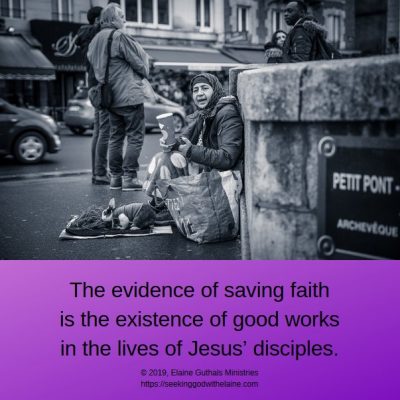
    • The evidence of saving faith is the existence of good works in the lives of Jesus’ disciples.
    • We have to have the outward and inward profession of faith.
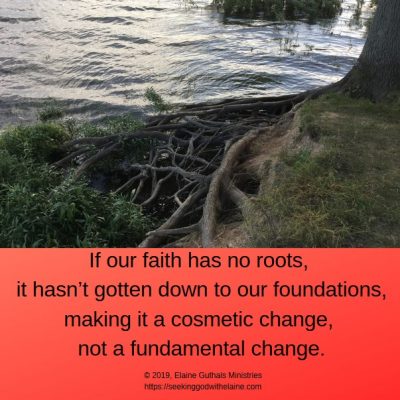
    • If our faith has no roots, it hasn’t gotten down to our foundations, making it a cosmetic change, not a fundamental change.
    • Jesus called His disciplines to be laborers.

    To read devotions in the Foundations of Salvation series, click the appropriate button below.

    Flowers with title So, What Are the Foundations of Salvation?

    In the first devotion in the series, we began discussing the foundations of salvation. We saw where Paul said that grace was the foundation on which salvation was built. In the previous devotion, we looked at faith and works.

    Paul says that “… by grace you have been saved through faith … not because of works …” (Eph. 2: 8-9 RSV). Is this telling us that we just have to say we believe and do nothing else?

    So, We Have Faith and Do Nothing?

    Well, no. Faith isn’t just knowledge and acceptance of that knowledge.

    What we do or don’t do with the do’s and don’ts is important after God has forgiven us and restored our relationship. The evidence of saving faith is the existence of good works in the lives of Jesus’ disciples: “so that you will walk in a manner worthy of the Lord, to please Him in all respects, bearing fruit in every good work and increasing in the knowledge of God” (Col. 1: 10 NASB).

    We have to show that the salvation has changed us. We have to utilize the framework God has given us as our guiding principles as a cause-and-effect in our lives. That requires obedience.

    Homeless woman

    No Works = Dead Faith

    Remember what James said. “What does it profit, my brethren, if a man says he has faith but has not works? Can his faith save him?” (Jas. 2: 14 RSV emphasis added).

    Yes, we have to have the outward profession. But we can’t just say the words, call it faith, and give it lip service.

    We also need to have the inward profession. We aren’t just supposed to sit on the porch swing and drink lemonade.

    We have to invest in our faith. We have to grow and then put it into practice. If we don’t do that, our faith really isn’t genuine.

    I think what James meant here was like the parable Jesus taught about the seeds. “Other seeds fell on rocky ground, where they had not much soil, and immediately they sprang up, since they had no depth of soil, but when the sun rose they were scorched; and since they had no root they withered away” (Mt. 13: 5-6 RSV).

    We generally think that is referring to trials. When the going gets tough, some get a one-way ticket out of here.

    Gotta Grow Our Roots

    Jesus explained it this way. “As for what was sown on rocky ground, this is he who hears the word and immediately receives it with joy; yet he has no root in himself, but endures for a while, and when tribulation or persecution arises on account of the word, immediately he falls away” (Mt. 13: 20-21 RSV).

    To me, the key words are it has no root. It hasn’t gotten down to our foundations. It is just a cosmetic change; it isn’t a fundamental change.

    Tree roots

    But what happens to those who maybe had an agenda when they made a profession of faith? What about those who find they don’t want to give up their sins?

    They don’t grow their root for whatever reason. So, they don’t have works to show for their faith — even though they weren’t undergoing trials.

    Because, let’s face it. It takes time for read your Bible, pray, worship, meditate…. And we’re supposed to do this for the long haul. If we don’t do it, we don’t grow our roots.

    Then James goes on to talk about no-root people. “Do you want to be shown, you shallow man, that faith apart from works is barren? Was not Abraham our father justified by works, when he offered his son Isaac upon the altar? You see that faith was active along with his works, and faith was completed by works, and the scripture was fulfilled which says, ‘Abraham believed God, and it was reckoned to him as righteousness’; and he was called the friend of God. You see that a man is justified by works and not by faith alone” (Jas. 2: 20-24 RSV). Our works are doing whatever God has called us to do.

    We Are Laborers

    James knew that Jesus had called on His disciplines to be laborers. “Then he said to his disciples, “The harvest is plentiful, but the laborers are few” (Mt. 9: 37 ESV). Laborers – workers – the ones who actually went out into the fields and cut the wheat, picked the corn, and gathered in the beans.

    Let’s take this agricultural discussion one step further. “You can identify them by their fruit, that is, by the way they act …” (Mt. 7: 16 NLT). Yes, Jesus was talking about false teachers here.

    But can’t this be applied to false disciples, also? Let’s look again at the fruits of the spirit. We said before that the fruits of the spirit show a pure heart: “… love, joy, peace, patience, kindness, goodness, faith, gentleness, self-control” (Gal. 5: 22-23 HCSB).

    Heart with Fruits of the Spirit

    Okay, faith is a fruit. Self-control is also an internal fruit. Peace and joy have dual expression. But look at all the rest. If you don’t show love, patience, kindness, goodness, and gentleness externally, do you really have them? Jesus said those are our identifiers.

    To read How Should We Give Thanks to God?, click the button below.

    We can do works because we think it needs to be done and that it will improve someone else’s lives. Works through faith are done because this is what God has called us to do to further His kingdom. God wants us to have a living, breathing faith.

    The way I see it is, what is our motivation? Are we doing something in response to God’s directions — either laws and commandments or through His promptings? Or are we going lone wolf and doing something of our own volition?

    I like the term that Stark used: holiness of heart and life. As James said, we can’t just say we have faith (Jas. 2: 14). We have to live it. We live it by our works.

    Paul was looking at the foundation. James was looking at how we use what we have built. Jesus never meant to allow us to keep on living our lives as we had been. He wants His disciples to change their lifestyles to better align with God’s laws and commandments. That takes work – internally and externally.

    Making the Connections

    So, what does all this we have talked about for the last three days mean?

    The riches of grace are salvation and faith. That makes a strong foundation for our relationship with God.

    Grace is the foundation for salvation, and faith is the foundation for works. We show our salvation through the works we do in faith.

    Jesus taught about building on foundations. The house built upon the rock stood firm while the house built upon the sand fell (Mt. 7: 24-27).

    But look at this. When talking about the wilderness wanderers, Paul said, “All of them also ate the same spiritual food and drank the same spiritual drink, which flowed from the spiritual rock that followed them. That rock was Christ” (I Cor. 10: 3-4 CEV emphasis added). He also said, “For no other foundation can anyone lay than that which is laid, which is Jesus Christ” (I Cor. 3: 11 NKJV emphasis added).

    Our foundation is supposed to be built on the Rock, Jesus Christ, our Lord and Savior. All we believe, all we trust, all we do is to glorify Christ, who in turn glorifies God.

    Let’s go back to Zechariah 7: 9 from the first devotion in the series. It says, This is what the LORD Almighty said: ‘Administer true justice …’” (NIV). Today’s worldview does not believe kindness has any room to include justice in it.

    Disciples of Jesus have to submit to the correcting hand of God. That is what is preparing us for our eternal life.

    How Do We Apply This?

    We have to make a choice. Are we going to step out in faith and accept God’s gift of salvation or are we going to follow the worldview?

    Once we choose to accept God’s gift of salvation, we have to choose to do that every day.

    We have to grow in our knowledge of Him (II Pet. 3: 18). God will be right there to guide us in doing that.

    Loving Father. We accept Your gift of salvation. Help us to grown in knowledge of You. Strengthen our faith in You as we read, study, and meditate on Your Word. Help us to hear You when we pray — and any time You speak to us. Help us to perform the tasks to which You have called us. Amen.

    The ABCDs of Salvation

    A – admit our sins

    B – believe His Son Jesus is our Redeemer

    C – confess God as Sovereign Lord

    D – demonstrate that commitment by making any changes needed in our lives to

    live the way in which God has called us

    If you have not become a believer in Christ, please read through the Plan of Salvation and prayerfully consider what God is asking you to do.

    What do you think?

    Leave me a comment below (about this or anything else) or head over to my Facebook group for some interactive discussion.

    If you don’t understand something and would like further clarification, please contact me.

    If you have not signed up for the email daily or weekly providing the link to the devotions and the newsletter, do so below.

    If God has used this devotion to speak with you, consider sharing it on social media.

  • God’s Eye Is on Us

    Are not two sparrows sold for a penny? Yet not one of them will fall to the ground apart from the will of Your Father. Are not two sparrows sold for a penny? Yet not one of them will fall to the ground apart from the will of Your Father.
    Matthew 10:29 (NIV)

    We know God is present with us always. However, at times, it is hard to feel that. This devotion looks at accepting through faith the knowledge that God is with us – even if we don’t feel His presence.

    Flowers with title God's Eye Is on Us

    The old hymn says, “His eye is on the sparrow, and I know he watches me.” But we don’t always feel that way.

    God, Where Are You?

    Oh, I know You watch me, but it doesn’t feel like You are watching. My head knows it; my heart just isn’t feeling it. Or maybe it is the other way around.

    I don’t feel Your presence. I don’t see evidence that You are in control of my life. I can’t even sense that You are in my life.

    That’s what scares me. I can’t handle this without You. Things are too big and too bad. I admit I can’t control them.

    Yes, that is a big admission on my part. But then again it is easy to admit that I can’t just speak and have things happen that way. Even if I work toward something, that doesn’t guarantee it isn’t going to change somewhere in the middle.

    I need some help here. I’m scared, and I’m lonely. That isn’t so easy to admit.

    Independent me doesn’t ask for help. Confident me doesn’t flinch. With-it me doesn’t depend on others.

    But I am asking. So, where are You?

    Taking Care of You

    “Who provides food for the raven when its young cry out to God and wander about for lack of food?” (Job 38: 41 NIV).

    Okay, You take care of all the animals, but You takes care of people, too. Case in point, the wilderness wanderers. You gave them manna and quail (Ex. 16: 3-15).

    “Look at the birds of the air; they do not sow or reap or store away in barns, and yet your heavenly Father feeds them. Are you not much more valuable than they?” (Matt. 6:26 NIV).

    Weren’t we the only creation that You said was very good (Gen. 1: 10, 12, 18, 25 and 31). The Bible says that You takes care of the birds, and You’ll take care of me because I am more valuable.

    Reading that it is one thing. Believing it, applying it in a situation, and seeing it is another.

    You’re Special

    “Now if you will obey me and keep my covenant, you will be my own special treasure from among all the peoples on earth; for all the earth belongs to me” (Ex 19: 5 NLT).

    You know, that is probably most of the problem. I don’t feel more valuable. I don’t feel special.

    I feel flawed and broken — even my most independent, confident, with-it self. Nothing is giving me the success and happiness I thought it would.

    “Any coldness still between us is not because of any lack of love on my part but because your love is too small and does not reach out to me and draw me in” (II Cor. 6: 12 LB).

    Okay, I get that. I am the problem.

    All I have to do is reach out and grab hold of Your promises. I have to more than just believe in You.

    I have to live for You. I have to trust You.

    Maybe the problem is I am running on feelings. I need to run on faith.

    Faith is putting my hope into things not seen (Heb. 11: 1). Feelings are more tangible to us.

    No, we can’t see feelings either, but they are something more natural to us. Okay, I’ll say it — and I’m more in control of my feelings.

    Faith seems against human nature. Maybe that is why it is so important.

    I have to give You control. I have to depend on You. I have to trust You.

    I will.

    God. We need help. We are scared and lonely. We can’t control our situations. We need You. We need to wait on You and put everything securely in Your hands. That is so hard because it is against human nature. But we love You, Lord, and depend on You. We will wait. Amen.

    What do you think? When was the last time you let feeling win over faith? What in the situation was sabotaging your faith? What do you need to work on for the next test?

    Leave me a comment below (about this or anything else) or head over to my Facebook group for some interactive discussion.

    If you don’t understand something and would like further clarification, please contact me.

    If you have not signed up for the email daily or weekly providing the link to the devotions and the newsletter, do so below.

    If God has used this devotion to speak with you, consider sharing it on social media.

  • How Is Trust Different Than Faith?

    Sovereign LORD, you are God! Your covenant is trustworthy, and you have promised these good things to your servant.
    II Samuel 7: 28 (NIV)
    Scripture: II Samuel 7: 18-29

    The last devotion began the How Is Faith Different Than Trust series by looking at faith. This devotion continues by looking at trust. It concludes by considering both terms.

    Nuggets

    • Trust is believing God will do what He says He will do.
    • We can trust Him even when we are afraid because of His unfailing love.
    • We can trust God because He is Sovereign God — our God.
    • Trusting God also has benefits.

    To read devotions in the How Is Faith Different Than Trust? series, click the button below.

    Flowers with title How Is Trust Different Than Faith

    In the previous devotion, we discussed faith. In this devotion, we will look at trust, and then compare the two terms.

    Let’s Put It into Context

    Trust is a believing that you can rely on someone or something. It is the considering that something to be true.

    Trusting Is Believing

    Trust is believing God will do what He says He will do. “Sovereign LORD, you are God! Your covenant is trustworthy, and you have promised these good things to your servant” (II Sam. 7: 28 NIV). We know God is trustworthy because He has never abandoned those seeking Him (Ps. 9: 10).

    Church

    Trust in His Unfailing Love

    God doesn’t abandon us because of His unfailing love (Ps. 13: 5; Ps. 143: 8). Putting our trust in this love is better than putting our trust in material things (Ps. 20: 7). We can trust Him even when we are afraid (Ps. 56: 3).

    Trust Because of Who He Is

    We can trust God because He is Sovereign God — our God. “But I trust in You, O LORD; I say, ‘You are my God.’” (Ps. 31: 14 ESV). We can lean on Him (Prov. 3: 5-6).

    God never abandons those who seek Him and put their trust in Him. “Everyone who honors your name can trust you, because you are faithful to all who depend on you” (Ps. 9: 10 CEV).

    Sailboat

    Those seeking God and putting their trust in Him will be blessed (Prov. 16: 20). “Oh, the joys of those who trust the LORD, who have no confidence in the proud or in those who worship idols (Ps. 40: 4 NLT).

    We should seek God rather than putting our trust in mankind. “Put not your trust in princes, and a son of man, and home there is no salvation” (Ps. 143: 3 ESV).

    Trust Also Has Benefits

    Trusting God also has benefits. God rewards those who trust Him (Ps. 37: 4-6). Because we trust Him, God will bless us (Ps. 84: 12). “Blessed is the man who trusts in the Lord, trust is the Lord. He is like a tree planted by the water, that sends out its roots by the stream, and does not fear when heat comes, for its leaves remain green, and is not anxious and the year of drought, or it does not cease to bear fruit“ (Jer. 17: 7-8 NIV). We thrive when we put our trust in Him (Prov. 11: 28).

    God gives His peace to those that trust Him (Isa. 26: 3). “May the God of hope fill you with all the joy and peace as you trust in him, so that you may overflow with hope by the power of the Holy Spirit” (Rom. 15: 13 NIV).

    Beach

    God keeps us safe when we trust in Him (Prov. 28: 26). Case in point — Daniel in the lion’s den (Dan. 6: 23). God is our strength and shield (Ps. 28: 7).

    When we trust in the Lord, we will wait for Him. “But those who trust in the Lord will find new strength. They shall soar high on wings like eagles. They will run and not grow weary. They will walk and not faint” (Isa. 40: 31 NLT).

    Making the Connections

    So, let’s have a recap of what faith is.

    • Faith is belief.
      Doubt detracts from faith.
    • Believers gain much when they have faith.
    • People who do not have faith in God suffer consequences.
    • Even though believers are called to live by faith, that does not guarantee believers will have easy journeys.

    Trust, on the other hand, is the following:

    • Trust is believing God will do what He says He will do.
    • We can trust Him even when we are afraid because of His unfailing love.
    • We can trust God because He is Sovereign God — our God.
    • Trusting God also has benefits.

    Part of me sees faith and trust as interchangeable. They both are contingent on belief. Can you have one without the other? Is this another chicken and the egg instance?

    Part of me sees them as being different. I see faith as a noun and trust as a verb. Faith is underlying foundation. Trust is how we get it and exhibit it.

    I know. I wrote that sentence and said, “Is that even possible?”

    We can’t exhibit trust until you have it. We have to have the belief before we can latch on to it.

    The belief is the faith. We say, “Yes, I am going to believe Jesus is the Son of God.” The trust ingrains it in us. It grows our faith.

    How Do We Apply This?

    I am sticking with chicken and egg. We have to believe enough to put our trust totally in God. Little faith equals little trust. Little trust calls our faith into question.

    We have to choose what we are going to believe. Then we need to go whole hog. We have to grow our faith until our trust is solid.

    I would say that we probably can’t parcel out faith and trust. God makes it abundantly clear that we are to do both. We need to grow both.

    Loving Heavenly Father. You call us to have faith in You — even when we can’t see You. You call us to put our trust in You — even when it contradicts what the world tells us. Lord, help us to seek You. Help us to grow in You. We thank You in advance for the rewards and blessing You will give us as we grow closer to You. Amen.

    What do you think? Do you think faith and trust are the chicken and the egg? Can you have one without the other?

    Leave me a comment below (about this or anything else) or head over to my Facebook group for some interactive discussion.

    If you don’t understand something and would like further clarification, please contact me.

    If you have not signed up for the email daily or weekly providing the link to the devotions and the newsletter, do so below.

    If God has used this devotion to speak with you, consider sharing it on social media.