Blog

  • Peace and Safety Are the Rewards for Morality

    God rewards disciples that imitate His character. This daily devotional looks at how disciples are rewarded with peace and safety.

    Nuggets

    • God rewards disciples with peace when they allow Him to work His good in their lives.
    • God provides for His disciples who are pursuing His good.
    • Disciples are called to live moral lives and receive peace for practicing morality.

    To read devotions in the Redo for Godliness series, click the appropriate button below.

    Devotions in the Moralities Lead to Godliness series

    Manton concluded his sermon entitled The Moralities of Christianity by telling us that morality impacts our peace and safety. I can see the peace reference. Let’s see if we can dig out what he was meaning by safety.

    Resources

    Let’s Put It into Context

    “Finally brothers and sisters, whatever is true, whatever is honorable, whatever is just, whatever is pure, whatever is lovely, whatever is commendable — if there is any moral excellence and if there is anything praiseworthy — dwell on these things” (Phil. 4: 8 CSB)

    The definition of moral, according to the Merriam-Webster Dictionary, is “of or relating to principles of right and wrong in behavior.” Morality, then, is “a doctrine or system of moral conduct.” When it is the plural form — moralities — it is a “particular moral principles or rules of conduct.”

    Resources

    Our morals determine our character. Character, according to the Merriam-Webster Dictionary, is “the complex of mental and ethical traits marking and often individualizing a person, group, or nation.”

    Resource

    Peace is a fruit of righteousness manifested in an inward tranquility resulting from a balanced life with spiritual order, equity, and truth that implies cooperation, humility, integrity, communication, and cohesiveness.

    Receiving Peace for Pursuing Good

    “Who then will harm you if you are devoted to what is good?” (I Pet. 3: 13 CSB)

    God rewards disciples with peace when they allow Him to work His good in their lives.

    Some would read this to mean that Peter implied that disciples will receive only good if they give only good. It may also be read to say no one would be able to harm a disciple who is following God’s Will.

    Boone suggested, in a way, that we have the Golden Rule in effect. He wrote, “A man’s best safeguard is benevolence; if we are ourselves inoffensive in our behaviour, others will be less likely to injure us; in proportion as we are anxious to do good, we shall be less likely to suffer evil.”

    Resource

    Verse Commentary

    I can see you jumping up and down. Yes, bad things do still happen to disciples. Peter never meant that we would have smooth sailing.

    The bad things will come, but they will not harm us. “We know that all things work together for the good of those who love God, who are called according to his purpose” (Rom. 8: 28 CSB). That makes the bad things coming from God, not man.

    We learn when we encounter the bad things. We grow closer to God that way because we get the sin cut out of us. That makes them good in the end.

    Besides, Paul went on to say what Peter was getting at. “… If God is for us, who can ever be against us?” (Rom. 8: 31 NLT).

    “… If God is for us, who can ever be against us?” (Rom. 8: 31 NLT).

    I picked this version because it has a extra word that none of the others have. (I know, I usually don’t like rewrites, but this one proves the point.)

    It says “… who can ever be against us?” (Rom. 8: 31 NLT emphasis added). Satan — and therefore man — is never going to best God. If God allows it to happen, it is part of the good.

    Doesn’t that instill peace in us?

    • Nothing is going to happen to us that God doesn’t ordain.
    • What happens to us will grow our character.
    • God blesses those who are obedient to Him.

    Ranken felt, if we treat others with respect, they will treat us with respect. This means, according to Leighton, using our meekness, patience, charity, and fidelity.

    Resource

    Glossary

    To read a related devotion, click on the appropriate button below.

    Oh? Do you come down more on Melvill’s side that our pious demeanor brings more persecution from worldview people than peace? Then there are those who see the meek demeanor of disciples as fair game for bullying.

    Melvill basically explained it as being punishment for our defective performance — when we do sin. It is hard for others — and sometimes us — to distinguish between punishment and testings.

    Resource

    But we have to remember what the definition of good is. Good, in the biblical sense, is the workings of God within His people. When we strive to be obedient and not sin, we gain God’s peace.

    Glossary

    What if we translate this as Leighton did? What harm can come to those imitating God?

    When we have ABCDed, we gain eternal life. Regardless of what happens to this body, no harm will come to us because we are under God’s protection.

    The ABCDs of Salvation

    If you have not become a believer in Christ, please read through the
    Plan of Salvation and prayerfully consider what God is asking you to do.

    A – admit our sins
    B – believe His Son Jesus is our Redeemer
    C – confess God as Sovereign Lord

    D – demonstrate that commitment by making any changes needed in our lives to
    live the way in which God has called us

    The Disciple’s Job Description

    Receiving Peace for Being Good

    “and said to David, “You are more righteous than I, for you have done what is good to me though I have done what is evil to you” (I Sam. 24: 17 CSB)

    God provides for His disciples who are pursuing His good.

    Manton must have thought as Woodhouse did: worldview people can find defeat when they attack disciples. Case in point — Saul and David.

    Resource

    Person of Interest

    Saul hunted David down relentlessly. He would have found defeat at David’s hand several times if David hadn’t possessed God’s spiritual graces.

    David showed strong moral character many times through his tenure in the Scriptures. He showed he valued the things God valued. David valued Saul as king because God had made him king. For this reason, David wouldn’t kill Saul when he had the opportunities. That showed forgiveness and forbearance.

    Because of David’s strong witness, Saul was convicted of his sin. David was a witness because of his actions.

    This verse could be used as verification of what Peter was saying. How can the wicked harm the good?

    Saul was an accomplished soldier. Yet, he wasn’t able to kill David.

    God was fighting for David. (Here is where the safety comes in.)

    Parker contended that moral superiority is more powerful than physical superiority. He also wrote, “In every life there is at least one opportunity of showing the real quality of the heart. David seized it!”

    Resource

    If God wanted to use His power and force us into serving Him, He could. He doesn’t. He isn’t a dictator.

    God calls us to Him through forgiveness and forbearance. Forbearance has been tied to both longsuffering/patience, forgiveness and meekness in past devotions. In fact, we show meekness and patience by being forgiving.

    To read a related devotion, click the button below.

    We show meekness and patience by being forgiving.

    Receiving Peace for Practicing Morality

    “Do what you have learned and received and heard from me, and seen in me, and the God of peace will be with you” (Phil. 4: 9 CSB)

    Disciples are called to live moral lives and receive peace for practicing morality.

    How do we receive God’s peace? Philippians 4: 9 gives us several action verbs. Let’s rearrange them to put them in chronological order.

    • Hear
    • Receive
    • Learn
    • Do

    We have to put ourselves into position to hear God’s Word. We can go to God’s house, find it on the internet or radio, or talk with a friend.

    We’ve talked before that hearing isn’t always listening. We must choose to listen to God when He talks to us.

    To read a related devotion, click the button below.

    Then we have to work at it so we can understand who God is and what He has done for us. Only then can we truly submit our lives to Him.

    No, it doesn’t stop there. We have to live the way He wants us to live. We have to live moral lives.

    We have to live the way He wants us to live.

    Making the Connections

    If … then.

    If we submit to God, we want to imitate Him.
    If we imitate His character, we live moral lives.
    If we live moral lives, God will provide us peace and safety.

    God fulfills His promises.

    PeaceAndSafetyAreTheRewardsForMarlityPin

    How Do We Apply This?

    I love what Leighton said. He wrote, “Study Christ much, and you will find not only the pattern in Him, but strength and skill from Him to follow it.” We get better at following Christ when we follow Him.

    Resource

    Hmmm. There is a pattern? I will have to think about that.

    I do know what the study means. That means we have to search for and seek Him.

    Searching for and Seeking God

    Hearing His Word (Rom. 10: 17).
    Reading His Word (Rev. 1: 3).
    Praying to Him (Heb. 4: 16).
    Studying His Word (Ac. 17: 11).
    Meditating on His Word (Ps. 1: 1-2).
    Memorizing His Word (Ps. 119: 11).

    It all hinges on our dedication in following Him. Are we willing to change our character to imitate Him? Will we worship Him?

    Make the commitment today to imitate His character.

    Father God. Today, we choose You. We commit to living moral lives, so that we may imitate You. Amen.

    What do you think?

    Leave me a comment below (about this or anything else) or head over to my Facebook group for some interactive discussion.

    If you don’t understand something and would like further clarification, please contact me.

    If you have not signed up for the email daily or weekly providing the link to the devotions and the newsletter, do so below.

    If God has used this devotion to speak with you, consider sharing it on social media.

  • Honoring God with Our Lives

    Disciples are to honor God with our lives. This daily devotional looks at how our morality honors the doctrine of God.

    Nuggets

    • God will reward our good faith when we accept the teaching of Jesus and imitate Him.
    • We are to be ambassadors for the gospel by showing others to see their needs for it.

    To read devotions in the Redo for Godliness series, click the appropriate button below.

    Devotions in the Moralities Lead to Godliness series

    Manton concluded his sermon entitled The Moralities of Christianity by telling us that religion should have honor. In the last devotion, we looked at aspects of dishonoring God. Here, we will look into honoring Him.

    Resources

    Let’s Put It into Context

    “Finally brothers and sisters, whatever is true, whatever is honorable, whatever is just, whatever is pure, whatever is lovely, whatever is commendable — if there is any moral excellence and if there is anything praiseworthy — dwell on these things” (Phil. 4: 8 CSB)

    The definition of moral, according to the Merriam-Webster Dictionary, is “of or relating to principles of right and wrong in behavior.” Morality, then, is “a doctrine or system of moral conduct.” When it is the plural form — moralities — it is a “particular moral principles or rules of conduct.”

    Resources

    Our morals determine our character. Character, according to the Merriam-Webster Dictionary, is “the complex of mental and ethical traits marking and often individualizing a person, group, or nation.”

    Resource

    Honor means to esteem and respect another because of a good reputation.

    What Is the Doctrine of God Our Savior?

    “not pilfering, but showing all good faith, …” (Ti. 2: 10 CSB)

    God will reward our good faith when we accept the teaching of Jesus and imitate Him.

    “Do not steal” is one of the Ten Commandments (Ex. 20: 15 NLT). Pilfering paints more of a picture that the pilferer is casually taking whatever catches the eye.

    Instead, we are to exhibit a faith that holds to “… the doctrine of God our Savior” (Ti. 2: 10 CSB). This is a fancy title for the institution of faith and manners that we call the gospel.

    Think of it this way. Watkinson noted that we are to imitate Jesus, Who is imitating God. Ultimately, it is God’s character that we should display.

    Resource

    We are to imitate Jesus, Who is imitating God.

    Lambe reminded us that our faith has to be whole. Everything we believe and do — from the largest thing to the smallest — must be governed by our faith.

    We talked once about the prayer bone has to be connected with the meditation/thought/mind bone, which is connected to the thankful/worship/heart bone. This connectedness honors God and strengthens our witness, especially if we are consistent in our faith.

    Resource

    To read a related devotion, click the button below.

    When we walk through life holding on to the teachings of Jesus, God will bless us. But it is more than just that.

    When we walk through life holding on to the teachings of Jesus, God will bless us.

    How Do We Adorn the Doctrine?

    “… so that in everything they may adorn the doctrine of God our Savior” (Ti. 2: 10 CSB)

    We are to be ambassadors for the gospel by showing others to see their needs for it.

    Lambe stated that we are “to govern and demean ourselves that we may reconcile its enemies to a good opinion of it; that we may procure and even force regard and veneration towards it.” We are to be its witnesses.

    Resource

    Really, what that is talking about is our obedience. Others need to be able to see our obedient life and be introduced to God’s love. They see this through our worldly morals being kicked up to spiritual graces.

    We can’t be begrudgingly obedient to God and think we are honoring Him. We have to be completely submitted to Him to cheerfully do His Will.

    Oh, hold the phones. Maclaren took it another way. He talked about what we add to the gospel. He said we need to look into a telescope (the Scriptures) to capture sight of the heavenly bodies and add our reflection.

    Resource

    We feel so inadequate at times. We are not pure like God. We don’t have a 100%-fruit-of-the-Spirit performance record.

    But we do have much to add to the narrative of the gospel. (No, we aren’t adding to the gospel itself. We are adding to the report of it.)

    Think about it. How did Paul add to the narrative? He showed us that we can start out totally against God and be forgiven and changed. He showed us that we can go through mega hardships to be able to use them for His glory.

    How did Peter add to the narrative? He was uneducated and impulsive — and God was still able to use him. He was strong in his faith, but that doesn’t mean he didn’t have his moments.

    Persons of Interest

    We add to the narrative when we lose our jobs and keep our faith firmly in Him. We add to it when we follow Him into a totally different occupation or location and show our obedience to Him.

    No, we are not changing the gospel. We are adding to the reports of how that plays out in our lives today.

    If we think about this, this is huge. Watkinson said this is what takes it out of the philosophy into the practical. That also takes it to a third P: proof. We know the gospel is true because it is evident in our lives — adorned for all to see.

    Resource

    It is practical because it isn’t just at the mind level. It has to get down to the heart level.

    In our own minds, we see ourselves not capable of doing the big things for God. We aren’t godly enough; we aren’t qualified; we aren’t in the right place at the right time.

    We can come up with a lot of excuses.

    We can serve God. Maclaren argued that this is done through the small things. No, we may not be able to be a missionary to some foreign land. But we can tell our family, our next door neighbor, and our coworkers.

    It doesn’t have to be a Paul’s letter to the Romans. It can be a simple statement of faith.

    That is a big way to honor God. Maclaren summed it up this way: “The best Illustrated Bible is the conduct of the people that profess to take it for their guide and law.”

    Resource

    I’ve told you before that I can be a fake-it-till-you-make-it girl. Birch reminded us that it has to be more than just wishful thinking. “To be pure and truthful in all we say or do cannot be accomplished by merely wishing; it will probably take an entire life for a man to become genuine as Jesus Christ was.”

    Resource

    That means it takes work. Some may be hardships. We will have lots of peaks and valleys. It will take our lifetime to work it out.

    It will be worth it because we adorn the gospel by fulfilling our purpose in God’s kingdom. He has a plan for each of us. When we allow ourselves to be used by Him, Birch said we get to start Heaven early.

    We adorn the gospel by fulfilling our purpose in God’s kingdom.

    Beecher put things into perspective. He wrote that “… it is on account of the intrinsic beauty of moral quality that piety and religious life, in their higher forms, are spoken of in the word of God as beautiful; and the consummation of piety in the social estate, in the Church, whether in the present or in the future, is celebrated all the way through the Bible as beautiful.”

    Resource

    Ooo, baby. I need Elaine-speak on that one. Inner beauty is tied up with our spiritual graces/enhanced morals. Those are leading us to be godly — holy and righteous.

    This inner beauty is much more important to God than outward beauty. God said so Himself. “… For the LORD sees not as man sees: man looks on the outward appearance, but the LORD looks on the heart” (I Sam. 16: 7 ESV).

    Making the Connections

    Spurgeon reminded us of all of the greats associated with the gospel.

    • Adam and Eve experienced a great fall because sin is great in so many negative ways.
    • Their ruin was great because they were forced out of paradise.
    • Their punishment was great because they had to give up face-to-face access with the Sovereign God.
    • Salvation is great because it offers complete restoration.
    • Redemption is great because it takes us from ruin back to paradise.
    • Our hope is great because it is made up of both current and future aspects: faith and hope.
      • Faith is the conviction that the doctrines revealed in God’s Word are true, even if we do not understand all aspects of them, a belief which impacts our lives.
      • Hope is a future expectation, called a living hope, based on the confidence that our names will be found in the book of life.

    Resource

    The main theme is that it is all about honoring God. Yes, there is some great lows in that list. But because of God — only because of God — can we get to the great highs.

    HonoringGodWithOurLivesPin

    How Do We Apply This?

    We need to imitate Jesus. Yes, we will fail sometimes — sometimes spectacularly. The only effect that should have on our faith is to make it grow, not diminish.

    That means evaluating and planning. Where are we falling down? What do we have to do to get right with God?

    I think a lot of times, we just coast and react to what comes our way. Birch challenged us to seek out opportunities to do good.

    Resource

    We need to be the embodiment of the gospel. Others see it through our expressions of faith. They just see our transformations (so, sometimes that means showing them the things we really rather would have kept hidden, regardless of the ouch factor).

    Resource

    We honor God by searching for Him and seeking Him. We honor Him by serving Him in the ways in which we are called.

    Father God. We give You praise and honor in all we do. Help us to be witnesses for You. Amen.

    Searching for and Seeking God

    Hearing His Word (Rom. 10: 17).
    Reading His Word (Rev. 1: 3).
    Praying to Him (Heb. 4: 16).
    Studying His Word (Ac. 17: 11).
    Meditating on His Word (Ps. 1: 1-2).
    Memorizing His Word (Ps. 119: 11).

    What do you think?

    Leave me a comment below (about this or anything else) or head over to my Facebook group for some interactive discussion.

    If you don’t understand something and would like further clarification, please contact me.

    If you have not signed up for the email daily or weekly providing the link to the devotions and the newsletter, do so below.

    If God has used this devotion to speak with you, consider sharing it on social media.

  • Morality for Honoring God

    We are to be moral disciples for more than just being good people. Through our morals, we honor God. This daily devotional, the first in a two-part miniseries, looks at how we dishonor God.

    Nuggets

    • Disciples are to honor God’s name by acknowledging His nature.
    • Dishonoring the Lord brings severe consequences.
    • We dishonor God when we let go of Jesus.

    To read devotions in the Redo for Godliness series, click the appropriate button below.

    Devotions in the Moralities Lead to Godliness series

    Manton concluded his sermon entitled The Moralities of Christianity by telling us that religion should have honor. He wrote, “The credit of religion depends much on the credit of its professors …” This went long, so I am going to have to split it.

    Resources

    When I first pulled the verses, my thought was, “Well, this is how not to honor God.” We learn that way, too. Let’s check it out.

    Let’s Put It into Context

    The definition of moral, according to the Merriam-Webster Dictionary, is “of or relating to principles of right and wrong in behavior.” Morality, then, is “a doctrine or system of moral conduct.” When it is the plural form — moralities — it is a “particular moral principles or rules of conduct.”

    Resources

    Our morals determine our character. Character, according to the Merriam-Webster Dictionary, is “the complex of mental and ethical traits marking and often individualizing a person, group, or nation.”

    Resource

    Honor means to esteem and respect another because of a good reputation.

    How Do We Honor God’s Name?

    “But when they came to the nations, wherever they came, they profaned my holy name, in that people said of them, ‘These are the people of the Lord, and yet they had to go out of his land.’ But I had concern for my holy name, which the house of Israel had profaned among the nations to which they came” (Ezek. 36: 20-21 CSB)

    Disciples are to honor God’s name by acknowledging His nature.

    Every version but the New Living Translation translates the word profane. “But when they were scattered among the nations, they brought shame on my holy name …” (Ezek. 36: 20 NLT).

    Davidson said that we do not bring shame on God when we “… recognise (sic) that which He is, or ascribe to Him His true nature.” We honor God by recognizing that He is Sovereign God.

    Resource

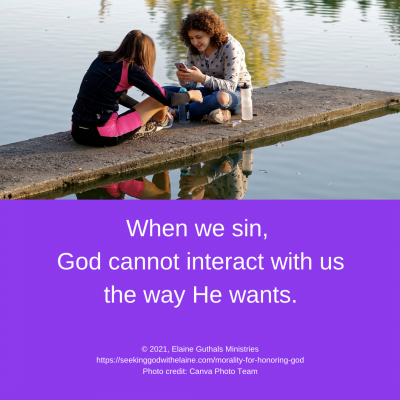
    Oh, I have to process this. Davidson wrote, “Only the other hand, when the iniquities of His people constrain Him to act in such a way as to disguise any of His great attributes, such as His power, in the eyes of the nations, so that they misinterpret His being, His holy name is ‘profaned’ …” When we sin, God cannot interact with us the way He wants. “But you are pure and cannot stand the sight of evil …” (Hab. 1: 13 NLT).

    When we sin, God cannot interact with us the way He wants.

    I get it. God interacts with us on an if…then basis. “Then if my people who are called by my name will humble themselves and pray and seek my face and turn from their wicked ways, I will hear from heaven and will forgive their sins and restore their land” (II Chron. 7: 14).

    • If we acknowledge Him as Sovereign God
    • If we accept the gift of salvation
    • If we obey His laws and commandments

    God doesn’t have anything to do with entitlement. Just because He created us doesn’t mean we can disobey Him and still expect that He is supposed to bless us right and left.

    God has expectations of us that we must fulfill. If we don’t, we, like the Israelites, bring the disasters upon ourselves.

    It is our choice, not a handout.

    Davidson brought up a good point. Our refusing to make the right choices can lead others to believe God is weak. He wrote, “Naturally, the idea of a god exercising a moral rule over his own people would not yet occur to them.”

    Resource

    The Scriptures talk a lot about honoring God’s name. We only know God’s name because He has chosen to reveal it to us. It solidifies His relationship with us.

    By knowing His name, we learn of God’s power, authority, and holiness. In essence, we learn of God Himself.

    Resource

    Disciples are told we are to live in His name. “Though all the peoples walk in the name of their own gods, we will walk in the name of the LORD our God forever and ever” (Mal. 4: 5 CSB). Walking is the term used to describe how we ulive our lives.

    Guthrie translated that to mean we are to obey God’s laws and commandments. We also are to obey His ordinances. We are to honor however God makes Himself known to us.

    Resource

    Our focus should be on God, not ourselves.

    What Happens When We Dishonor God’s Name?

    “Nevertheless, because by this deed you have utterly scorned the Lord, the child who is born to you shall die” (II Sam. 12: 14 CSB)

    Dishonoring the Lord brings severe consequences.

    God knows we are sinful creatures, right? He is going to give us a pass when we dishonor His name. Otherwise, He won’t have anyone praising His name because no one can meet His high standard? WRONG!

    Paul made it very clear that God will correct us when we sin. “Do not be deceived: God is not mocked, for whatever one sows, that will he also reap” (Gal. 6: 7 ESV).

    God will correct us when we sin.

    Look at Second Samuel. This was David being talked about. David — the man after God’s own heart. Yes, he is to be one of our role models.

    David still paid the consequences of his sins of adultery and murder. Cox said that we get forgiveness from God, not immunity. If He doesn’t punish our sins, don’t we start convincing ourselves that means they really aren’t sins?

    Resource

    We can’t soften the effects — or the consequences — of sin. We can’t work to clear ourselves of the stain of sin. The “… whatever one sows, that will he also reap” (Gal. 6: 7 ESV) part will come to fruition — either now or at judgment day.

    Lewis addressed whether our inability to stop sinning negates that salvation can come from a holy God. He said no because — even though we are still sinful creatures — we should not condone sin. He wrote, “Their sins are held up to our abhorrence, and as proceeding from the want of more of the power of godliness.”

    Resource

    We have got to see the flaws of the saints. If we don’t, we won’t identify with them. We wouldn’t be able to see ourselves receiving God’s forgiveness if they didn’t.

    Instead, we see much about God’s character. He is loving. He forgives when we ask. He has provided the way in which our sins can be forgiven.

    Okay. I have to process what Lewis said. He wrote, “Will it be objected that religion has but little power, if it leaves men to fall into such sins, and that unassisted reason can produce as pure a morality as in the Bible?”

    Elaine-speak. People will accuse God of having little power if He lets people fall into sin. He must assist us in producing the morality He requires.

    Lewis argued that God isn’t going to judge us just on our failures. He is going to look at the whole picture.

    I can see that. David loved God with all of his heart. He strived to follow God’s laws and commandments. His goal was to provide for His people.

    That is very comforting! God isn’t into once-and-done. He forgives us multiple times for the same sin — as long as we are ultimately trying to honor His name.

    God also forgives us for a variety of sins — all of them, in fact. The only sin He won’t forgive us for is the unpardonable sin, which I believe is unbelief.

    Glossary

    We have to show God that we are following His will, as the Essex Remembrancer put it, “… in the combined and duly regulated exercise of the whole range of moral perfections.” Remember, a couple of devotions ago we said that “… all goodness, righteousness, and truth” (Eph. 5: 9 CSB) is a packaged deal. We don’t get to choose the goodness and pass on the righteousness part because they are interwoven.

    Resource

    To read a related devotion, click the button below.

    That tells me God is interested in the motivation more than the execution. He is interested in the long haul. He is looking for order, commitment, and compassion.

    • Justice is order in creation.
    • Holiness is more than a character trait; it is purity, dedication, and commitment that lead to being set apart.
    • Disciples’ mercy is a characteristic of compassion for the needs of others, especially those who are in distress.

    When we genuinely repent, God will forgive us. Repentance is acknowledging our separation from God and expressing sorrow for breaking God’s laws and commandments by making the commitment to changing ourselves through obedience so that we no longer do the wrong things. Forgiveness is, when we ask, God pardons us because we have broken His laws and commandments and restores our relationship with Him.

    What Happens When We Choose the Path of Sin?

    “Even so, many will follow their immoral ways; and because of what they do, others will speak evil of the Way of truth” (II Pet. 2: 2 GNT)

    We dishonor God when we let go of Jesus.

    Adam’s contended that there are, many times, instigators who lead us to let go of Jesus. Paul describes these as those who “… [don’t] hold on to the head, from whom the whole body, nourished and held together by its ligaments and tendons, grows with growth from God” (Col. 2: 19 CSB).

    We dishonor God when we do not accept or choose to follow His Son. Jesus is the only way in which we can gain access to God (Jn. 14: 6).

    We have to acknowledge that we are sinful creatures separated from God. It is only through the birth, death, and resurrection of Jesus Christ that we can be restored to a relationship with Sovereign God.

    MoralityForHonoringGodPin

    Making the Connections

    We have to be very careful. God is Sovereign God.

    We can’t try to bring Him down to our level. When we try to understand the concepts of the gospel, we have to keep God on His throne.

    How Do We Apply This?

    • We have to evaluate our lives to determine where we are honoring God and where we aren’t.
    • Take extra caution in areas we know will be tempted.
    • Be disciples with integrity.
    • Witness to others.
    • Seek God’s blessings.

    Resource

    This devotion looked at aspects of dishonoring God. In the next devotion, we will look into honoring Him.

    Father God, we want to give You all the praise and honor that You are due. There are things we cannot understand. Help us to understand what we can. Guide us to live in step with Your Will. Amen.

    What do you think?

    Leave me a comment below (about this or anything else) or head over to my Facebook group for some interactive discussion.

    If you don’t understand something and would like further clarification, please contact me.

    If you have not signed up for the email daily or weekly providing the link to the devotions and the newsletter, do so below.

    If God has used this devotion to speak with you, consider sharing it on social media.

  • How Do Morals Refine Us?

    Looking at Manton’s closure of his sermon, he gives us a good comparison between the world’s morals and God’s graces. This daily devotional looks at what the comparison means and how disciples are refined by morals.

    Nuggets

    • The Sanctification Road takes the good within us and refines us to better reproduce God’s character.
    • There is good in each of us because we are all made in God’s image, but God takes what is good and changes the focus.
    • We need to take the morals and kick them up a notch to make them graces.

    To read devotions in the Redo for Godliness series, click the appropriate button below.

    Devotions in the Moralities Lead to Godliness series

    Manton concluded his sermon entitled The Moralities of Christianity by telling us why we need to make sure our morals are intact. He made a statement that kind of set me back at first. He wrote, “Because grace does not abolish so much of nature as is good, but refines and sublimates it, by causing us to act from higher principles and to higher ends.”

    Resources

    Wow! I have to process that.

    Let’s Put It into Context

    “Finally brothers and sisters, whatever is true, whatever is honorable, whatever is just, whatever is pure, whatever is lovely, whatever is commendable — if there is any moral excellence and if there is anything praiseworthy — dwell on these things” (Phil. 4: 8 CSB)

    The definition of moral, according to the Merriam-Webster Dictionary, is “of or relating to principles of right and wrong in behavior.” Morality, then, is “a doctrine or system of moral conduct.” When it is the plural form — moralities — it is a “particular moral principles or rules of conduct.”

    Resources

    Our morals determine our character. Character, according to the Merriam-Webster Dictionary, is “the complex of mental and ethical traits marking and often individualizing a person, group, or nation.”

    Resource

    How Do Morals Refine Us?

    “Because grace does not abolish so much of nature as is good, but refines and sublimates it, by causing us to act from higher principles and to higher ends.”

    Manton didn’t add any verses with this statement, but it is packed. Basically, I think it says that the Sanctification Road takes the good within us and refines us as we strive to focus on His principles.

    “Because grace does not abolish …”

    A couple of things ran through my mind when I read this. God is not abolishing our essence. Some worldview people may think that our submitting to God means we lose ourselves entirely. No where in the Scriptures does it say there is a complete tear down and rebuild.

    Instead, we are told to “imitate God, therefore, in everything [we] do …” (Eph. 5: 1 NLT). We are reproducing His character within us.

    That is going to be a gradual process because that is what the Sanctification Road is all about. Sanctification is the transformation of mind, body, and soul, which begins with regeneration: gradually changes our nature through the promptings of the Holy Spirit; and ends with perfected state of spiritual wholeness or completeness. Regeneration is the change in us that God brings about when we go from being spiritually dead to spiritually alive. Spiritual death is the separation from God that occurred as a consequence of Adam and Eve’s original sin. The spiritually alive are those who have ABCDed, so they are no longer separated from God. The perfected state indicates the combination of the graces which, when all are present, form spiritual wholeness or completeness.

    Glossary

    The ABCDs of Salvation

    If you have not become a believer in Christ, please read through the
    Plan of Salvation and prayerfully consider what God is asking you to do.

    A – admit our sins
    B – believe His Son Jesus is our Redeemer
    C – confess God as Sovereign Lord

    D – demonstrate that commitment by making any changes needed in our lives to
    live the way in which God has called us

    The Disciple’s Job Description

    When Jesus comes on His cloud with His sickle, the change that will happen in “… the blink of an eye … (I Cor. 15: 52 NLT) has nothing to do with changing our character. It will change our bodies because “… our physical bodies cannot inherit the Kingdom of God …” (I Cor. 15: 50 NLT).

    To read a related devotion, click the button below.

    Oh, yeah. We will need to have our sinful nature removed and our true spiritual nature restored. But it will still be us. If I pass Mom and Dad strolling hand in hand down the golden street, I will know them, and they will know me.

    Just as Jesus did not abolish the law, God does not abolish us. The law was implemented to show us God’s character and show us that we needed a Savior.

    Once this Heaven and earth flees from God’s presence (Rev. 20: 11), sin will be vanquished and no longer an option for us. The law will no longer be needed.

    But God will still have His character. “I am the Lord, and I do not change …” (Mal. 3: 6 NLT).

    God does not want to totally get rid of us. He will want us to remember how far we have come on the Sanctification Road. That is why, even after death, we have memories.

    To read a related devotion, click the button below.

    “Because grace does not abolish so much of nature as is good …”

    There is good in each of us because we are all made in God’s image. We came up with a comprehensive list last year detailing the ways each of us is like Him and how children of God are different from those just created by Him.

    • All mankind have a spirit that we get when we are given breath. Disciples also have the Holy Spirit that lives within us.
    • We all have an intelligence – we are curious and have abilities to reason. Our godliness accelerates those abilities.
    • We all have the free will to make choices for ourselves.
    • We all have moral character, but disciples will one day be perfected.
    • We all have consciences, but disciples have the Holy Spirit to guide us and remind us what is holy and righteous.
    • God has given us authority over animals but not over the earth.
    • All of mankind is going to live for eternity. However, worldview people who are spiritually dead will live in hell; disciples who are spiritually alive will live in heaven.
    • Mankind is creative, even though some may discount or diminish their talent.
    • Mankind are creatures who feel, especially love. However, the worldview definition of love is not as pure as God’s definition.

    Glossary

    God created us with a lot of good attributes. But they alone aren’t good enough to make us children of God. It isn’t about what we do or don’t do.

    It is about making a conscious decision to submit our lives to God. Like we said, God doesn’t tear down the good in us, either.

    God created us with a lot of good attributes. But they alone aren’t good enough to make us children of God.

    “… but refines and sublimates it …”

    God takes what is good and changes the focus. The refining is what the Sanctification Road is all about. It is about growing from a milk baby to a steak adult.

    Dale put it this way. He wrote, “What this higher law is, in all its applications, we have to learn, and we learn it very gradually; it is one of the great subjects about which Christian men should be always learning.”

    Resource

    But it is more than that. We go from a worldview focus of doing good to doing good to expand God’s kingdom.

    For me, it clicked when we talked about worldview morals and Christian graces. We said in How Do Morals Improve our Discipleship? that, if our morals don’t come through our submission to God, they are just worldly morals, not Christian graces.

    To read a related devotion, click the button below.

    We go from a worldview focus of doing good to doing good to expand God’s kingdom.

    “… by causing us to act from higher principles and to higher ends.”

    We need to take the morals and kick them up a notch to make them graces. By doing that, we are not performing a good deed to make this world a better place to live. That is our acting from higher principles.

    We are showing others God’s love. We are working to introduce others to our Savior and Redeemer. We are working to expand God’s kingdom.

    That is our acting to achieve higher ends.

    HowDoMoralsRefineUsPin

    Making the Connections

    To me, it is all about our purpose. Disciples want more than just having morals. We want those morals to be graces. That points to God.

    How Do We Apply This?

    Dale gave us a clue as to how we can apply this — and how hard it will be to apply this. He wrote, “Christ has not given us a complete code, but He has given us specimens of the contrast between this higher law and the common laws recognized by ordinary men. We have to work out the whole code of Christian morals in the light of this teaching.”

    Resource

    The thing that jumped out at me is that we are to contrast God’s laws with common law. Disciples know that worldview people are quick to judge us by their standards. We need to make sure we follow God’s direction, not the world’s.

    It is going to be hard, so it isn’t something we can do on our own. We know without a shadow of a doubt that it will be worth it.

    Loving Father. We look to You to complete the code we are to use as spiritual graces. We want to follow all of the laws and commandments You have given us. We will look to You instead of the world to show us expectations and to determine success. We can only kick our worldview morals to be spiritual graces when You lead us there. Amen.

    What do you think?

    Leave me a comment below (about this or anything else) or head over to my Facebook group for some interactive discussion.

    If you don’t understand something and would like further clarification, please contact me.

    If you have not signed up for the email daily or weekly providing the link to the devotions and the newsletter, do so below.

    If God has used this devotion to speak with you, consider sharing it on social media.

  • When Is Breaking the Sabbath not Breaking the Sabbath?

    The Pharisees called the disciples on harvesting on a Sabbath day. Jesus had a different take. This daily devotional looks at how Jesus’ response could seem contradictory to the law.

    Nuggets

    • Even when we go about our daily business, some may question our actions contradicting our relationship with God.
    • Jesus is Lord of all.
    • We have to do good for others regardless of the day.

    Devotions in the Luke’s Diagnosis and Prescription series

    Isn’t that the way it is? We are walking along – everything is going fine.

    Then it falls apart.

    I bet that is what the disciples thought when the Pharisees accused them of harvesting.

    The Pharisees’ Accusation of Breaking the Sabbath

    “On a Sabbath, he passed through the grainfields. His disciples were picking heads of grain, rubbing them in their hands, and eating them. But some of the Pharisees said, “Why are you doing what is not lawful on the Sabbath?” (Lk. 6: 1-2 CSB) 

    Even when we go about our daily business, some may question our actions contradicting our relationship with God.

    There is a whole big explanation of what Sabbath this was that I decided to cut because of length.

    Verse Commentary

    Whenever it occurred for whatever reason, Luke’s point was that this Sabbath day was a holy day. It wasn’t a run-of-the-mill Sabbath. In the Pharisees’ eyes, that would have made the offense that much worse.

    The setting was, according to the King James Version, a cornfield. All the modern versions translate it as a grain field.

    Jesus and the disciples were traveling from Point A to Point B within a larger group. The disciples just reached down and grabbed some grain.

    It appears that the Pharisees were part of the traveling companions. Throughout the gospels, it is evident that they kept a close eye on Jesus. It shouldn’t be too much of a shock that they stuck with Him, even in transit.

    Persons of Interest

    It is also evident that the Pharisees were out to get Jesus. They were cunning and malicious, according to Exell.

    Resource

    The problem the Pharisees had with what the disciples did was — whatever the grain was — it was protected by part of the plant. The disciples would have to get the kernel or the seed out to eat it.

    That was harvesting. That was forbidden.

    God must have felt it was very important to keep the Sabbath. Not only was it one of the Ten Commandments, but it also was the first one to have any kind of explanation (Ex. 20: 8-11).

    Jesus probably got right on the disciples for disrespecting God, right?

    Jesus’ Response to the Pharisees’ Accusation

    “Jesus answered them, “Haven’t you read what David and those who were with him did when he was hungry — how he entered the house of God and took and ate the bread of the Presence, which is not lawful for any but the priests to eat? He even gave some to those who were with him.’ Then he told them, ‘The Son of Man is Lord of the Sabbath’ (Lk. 6: 3-5 CSB)

    Jesus is Lord of all.

    Hmmmm. Jesus defended the disciples!

    Thomson described Jesus’ argument with the Pharisees. He thought His argument was unanswerable. Unanswerable? I bet the worldview people would say Jesus’ rebuttal is contradictory.

    Resource

    Laws Are Made to be Broken

    Jesus’ first point of argument was that David had broken the law, too. We’ve talked about this before. David, on the run, asked the priests for food and was given the Bread of the Presence. Unfortunately, that can only be eaten by the priests.

    To read a related devotion, click the button below.

    Thomson argued that David broke God’s law while the disciples did not. I can only assume here that God specifically earmarked the bread for the priests. The argument for the disciples is rolled up into the next argument.

    No Law Can be Kept 100% of the Time

    Jesus’ second argument, according to Thomson, was that it was impossible for all not to labor on the Sabbath. The priests were technically working when they conducted the Sabbath service. God did not hold that against them.

    If we substitute the disciples here, we would say that the disciples had to live while they were on their ministerial tour with Jesus. They were traveling and not at home, where they had readily-available food. So, God allowed them to get what they need to sustain themselves.

    God Can Pick and Choose When He Will be Merciful

    The third argument Thomson brought up was that God is a merciful God. He felt that “God prefers the duties of humanity to positive commandments, when it is impossible to observe both these.”

    Resource

    One way to interpret that is, when there is a dilemma regarding which law to follow, God will overlook some offenses. In fact, it makes it look like the do’s are more important than the don’ts.

    Jesus Is Lord of the Sabbath

    While I think Thomson’s other arguments may be implied or interpreted, the fourth one was recorded by Luke.

    Jesus informed the Pharisees that He was Lord of the Sabbath. That meant He got to say what act was or wasn’t a law breaker.

    Thomson explained it this way. He wrote, “The fourth argument was, that the Sabbath was made for man; therefore it was lawful to do good on the Sabbath.”

    Resource

    I think the operative word here is good. I don’t see Jesus telling us we can just scrap the laws. He told us point-blank that the laws wouldn’t change until they were fulfilled (Mt. 5: 18).

    Doing Good on the Sabbath Day

    “On another Sabbath he entered the synagogue and was teaching. A man was there whose right hand was shriveled. The scribes and Pharisees were watching him closely, to see if he would heal on the Sabbath, so that they could find a charge against him. But he knew their thoughts and told the man with the shriveled hand, ‘Get up and stand here.’ So he got up and stood there. Then Jesus said to them, ‘I ask you: Is it lawful to do good on the Sabbath or to do evil, to save life or to destroy it?’ After looking around at them all, he told him, ‘Stretch out your hand.’ He did, and his hand was restored. They, however, were filled with rage and started discussing with one another what they might do to Jesus” (Lk. 6: 6-11 CSB)

    We have to do good for others regardless of the day.

    Luke offered another example of Jesus healing on the Sabbath. This one was in the synagogue.

    The Significance of the Withered Hand

    According to Exell, the withered hand represents our withered souls. Our intellect as well as our morals are withered. The withered morals lead to withered compassion.

    Resource

    Goulburn got me thinking. We put a lot of stock in the saying, “seeing is believing.” But a close second is touching something and holding it in our hands.

    Resource

    This man, even if he was able to reach out, wasn’t able to touch anything.

    Jesus Can Read Our Minds

    We talked about Jesus’ ability to know what people were thinking. He knew the Pharisees wanted to catch Him in breaking their law.

    To read a related devotion, click the button below.

    Jesus was not falling into the Pharisee’s line of thinking. All they saw was that He was doing something at the wrong time. They didn’t focus on the cure, just the procedure.

    Jesus Healed the Man

    Whatever is withered within us, Jesus can heal us.

    Jesus told the man to stretch out his hand. Even if the withered hand wouldn’t allow the man to reach out, he did when Jesus told him to do so. He did, and he was healed.

    Parkhurst made a great observation. He wrote, “All Christ’s commands to you are in the present tense, which means that the command is issued without any allowance of time for comprehending the mysteries of salvation, or for acquiring power to become a saved man.”

    Resource

    Jesus doesn’t make us wait for salvation. Salvation is deliverance from evil and the consequences of sins to replace them with good and eternal life.

    All Jesus has to do is say the word — and we are restored to spiritual health.

    Yes, Jesus could have healed the man by just saying the words. He required more.

    Salvation is a free gift from God, but we have to make the decision as to whether or not we are going to accept it.

    Jesus required the man to have the faith to believe He could and would heal him. Goulburn noted that “… God demands exertion and energy on our parts before He will consent to put forth that healing power, which alone can recover us from our soul’s infirmity.”

    Resource

    I bet Satan tried to plant the but-what-good-is-that-going-to-do thought in the man’s mind. I am sure he didn’t understand how Jesus was going to pull that off.

    It didn’t matter. Parkhurst wrote, “Giving ourselves to Christ is not a matter of understanding what we are doing, but a matter of doing.”

    Resource

    That is what faith is all about — not understanding but believing anyway. Faith is the conviction that the doctrines revealed in God’s Word are true, even if we do not understand all aspects of them, a belief which impacts our lives.

    There is a lot riding on that decision. What we are actually deciding is whether or not we are going to submit our lives to the Sovereign God. If that isn’t part of our decision-making process, we aren’t making a true confession.

    Did you see how quickly the man’s hand was healed? That is how quickly we are changed from being spiritually dead to spiritually alive.

    Spiritual death is the separation from God that occurred as a consequence of Adam and Eve’s original sin. The spiritually alive are those who have ABCDed, so they are no longer separated from God.

    Glossary

    The ABCDs of Salvation

    If you have not become a believer in Christ, please read through the
    Plan of Salvation and prayerfully consider what God is asking you to do.

    A – admit our sins
    B – believe His Son Jesus is our Redeemer
    C – confess God as Sovereign Lord

    D – demonstrate that commitment by making any changes needed in our lives to
    live the way in which God has called us

    The Disciple’s Job Description

    WhenIsBreakingTheSabbathNotBreakingTheSabbathPin1

    Making the Connections

    At times, it may seem like others are out to get us, too. If we are walking in step with Jesus, we have nothing to fear.

    The Pharisees were the religious leaders of Jesus’ day. But here on the Sabbath, they were not worshiping God.

    They were doing the exact opposite. They were plotting murder.

    Exell pointed out that the Pharisees, for all their cunning and maliciousness, didn’t really put a dent in Jesus’ ministry. From day one, He was moving toward His death. Between birth and ascension, Jesus completed everything He had on His docket.

    Resource

    Robertson believed that, if we have the mind of Christ, we, too, can sort of become lord of the Sabbath. He argued that if we truly love and honor God, we can let go of the trappings. His justification of this is “… ‘Those who are well have no need of a physician, but those who are sick. I came not to call the righteous, but sinners’” (Mk. 2: 17 ESV).

    Resource

    I think that is a dangerous way of thinking. We are to worship God. He has set aside the Sabbath on which we are to do that. If we are start thinking we are the lord of the Sabbath, we may think we don’t need God.

    We do.

    How Do We Apply This?

    We need to keep our focus on God. He will tell us what is right and what is wrong. It isn’t our call. It definitely isn’t the worldview call.

    Our motivation has to be that we are pursuing godliness. We have to be pursuing fulfilling the greatest commandments.

    Glossary

    Parkhurst made one last statement that resonated with me. He wrote, “All the way through Scripture God was continually commanding men to do more than they in themselves had the means to do, exactly as in our verse.”

    Resource

    How many times did I tell myself, “I can’t write devotions for other people to read. They are good enough for me, but not for others to read.” I thought God had given me abilities to do something totally different.

    God is calling me to do more than I can do because they are His words, not mine. How is He calling you to do more?

    When God says, “stretch out your hand,” we should do it. When He says do something different, we should do it.

    Gracious Heavenly Father. We want to keep Your laws and commandments. More importantly, we want to have Your character so that, when we have a dilemma, we can choose the way You want us to choose. Amen.

    What do you think?

    Leave me a comment below (about this or anything else) or head over to my Facebook group for some interactive discussion.

    If you don’t understand something and would like further clarification, please contact me.

    If you have not signed up for the email daily or weekly providing the link to the devotions and the newsletter, do so below.

    If God has used this devotion to speak with you, consider sharing it on social media.

  • Improving Our Discipleship through Our Morality

    In the last three devotions, we have been looking at how to improve our discipleship through our morality. This daily devotional reviews what we’ve discussed and makes the connections and applications.

    To read devotions in the Redo for Godliness series, click the appropriate button below.

    Devotions in the Moralities Lead to Godliness series

    We are looking at how Manton began to tie up his sermon entitled The Moralities of Christianity. Our purpose in this devotion is to make the connections and applications for this section. We have covered a lot of ground in the last three devotions alone.

    Resources

    Let’s Put It into Context

    The definition of moral, according to the Merriam-Webster Dictionary, is “of or relating to principles of right and wrong in behavior.” Morality, then, is “a doctrine or system of moral conduct.” When it is the plural form — moralities — it is a “particular moral principles or rules of conduct.”

    Resources

    Our morals determine our character. Character, according to the Merriam-Webster Dictionary, is “the complex of mental and ethical traits marking and often individualizing a person, group, or nation.”

    Resource

    Making the Connections

    The Moral Code Given through the Law

    • God gives us definite instructions as to what is right and wrong. Our morality is contingent on the grace of God. We are moral people because grace teaches us to be holy (Improving Our Discipleship through Right and Wrong).
    • The laws show us God’s character. But they aren’t the end-all, be-all. The law won’t save us as faith is more than just a rote memorization of the laws and commandments that make up the morals. We could be a good person who follows the laws perfectly and still miss heaven. We have to expand the morals to make them graces (How Do Morals Improve our Discipleship?).
    • Our intent in coming to God should be so that we become in harmony with Him. The laws and commandments must change our character at the heart level to be like His. We can’t do this by ourselves (How Do Morals Improve our Discipleship?).
    • God through His grace encourages us and guides us to where He wants us to be. The laws are no longer threatening but instructive. He will use our Sanctification Roads to be more like Him. As we grow our character, we need to use reflection on our previous experiences (How Do Morals Improve our Discipleship?).
    God through His grace encourages us and guides us to where He wants us to be.
    • We glorify God when we have a clear moral conscience. Our consciences attest to the quality of our actions. That validates the need for us to be knowledgeable with God’s code of morals (Improving Our Discipleship through Glorifying God).
    • It is a two-step process in attesting to the quality of God’s moral code. We need to affirm that God’s law is pure. We need to confess we are far from pure (Improving Our Discipleship through Glorifying God).

    Morality Enforced through Our Walk

    • Our morality increases from the sanctification process. Morality is a system of conduct where we determine right from wrong. Isn’t that what the Sanctification Road is teaching us through the Holy Spirit? What we are learning through grace as we navigate our roads is what makes up “… all goodness, righteousness, and truth” (Eph. 5: 9 CSB) (How Do Morals Improve our Discipleship?).
    • Our outward conversations and actions are the visible aspects of our lives. God expects our relationships with Him to be visible to others. Worldview people have to be able to see what we believe. But that stems from the inside (How Do Morals Improve our Discipleship?).
    • God is love (I Jn. 4: 8). When we become like God, we love. When we focus on the greatest commandments, we go a long way to getting there. Love is the root of virtue. God is love. God is the root of virtue (How Do Morals Improve our Discipleship?).
    • We have to approach worldview people with love but realistically. We can’t approach them in ways that accentuates the divide, but we cannot tolerate sin (Improving Our Discipleship through Right and Wrong).
    • The fruit — or rewards — of our walk as children of God are that God can work within us to build a solid relationship that leads to godliness. These morals come from one thing — obedience to God through faith in Jesus. If God isn’t at the core of our morals, the only reward we will receive for doing them is here on earth (How Do Morals Improve our Discipleship?).
    • The “… all goodness, righteousness, and truth” (Eph. 5: 9 CSB) is a packaged deal. We don’t get to choose the goodness and pass on the righteousness part. If we do, we are passing on the God part. They are interwoven. Think of the foundation that builds when the three areas are braided together. The package deal has to become our character (How Do Morals Improve our Discipleship?).
    • Our entire life should be focused on glorifying God through living morally. The bottom line is our motivation. Are we choosing to follow God or not? (Improving Our Discipleship through Glorifying God).
    Our entire life should be focused on glorifying God through living morally.
    • We need to make the choices that bring glory to God. Nothing is too small or too large that it can’t be used to do that. We don’t have to keep finding the next best thing. He wants to be glorified in our everyday lives. When we glorify God through our being and our doing, we are making a big statement that He is worthy of our praise (Improving Our Discipleship through Glorifying God).
    • Worldview people just see the ceremony of religion rather than the relationship for which God is actually striving. They see morality as a man-to-man exercise, not as man-to-God (Improving Our Discipleship through Glorifying God).
    • We glorify God by the good works performed through His righteousness in us. Our being and doing should be to glorify God (Improving Our Discipleship through Glorifying God).
    • We know these works do not justify us in God’s eyes. We use them to express our respect of, tribute to, and obedience to Him (Improving Our Discipleship through Glorifying God).
    • A clear conscience can only come from fulfilling our duties as children of God — to fulfill the greatest commandments. Using them as the bow, we tie together God’s rules and our actions (Improving Our Discipleship through Glorifying God).
    A clear conscience can only come from fulfilling our duties as children of God — to fulfill the greatest commandments.
    • Even though we have a conscience, the decision is still ours. We can follow our conscience’s direction to be a moral person or we can choose not to (Improving Our Discipleship through Glorifying God).
    • Being a memory ties the conscience to our past, formed by our past experiences and past knowledge. It is shaped by the morals to which we have ascribed (Improving Our Discipleship through Glorifying God).
    • Our conscience is not stagnant and can change. It can grow to be more godly (Improving Our Discipleship through Glorifying God).
    • The outward walk without the inward faith means nothing to God. Morals have to be grounded in faith. If our morals don’t come through our submission to God, they are just worldly morals, not Christian graces (How Do Morals Improve our Discipleship?).

    Morality Enforced through Our Faith

    • Our morality is a reflection of our faith and is expressed through love (How Do Morals Improve our Discipleship?).
    • It isn’t just the knowledge of God and what Jesus has done for us. It is having the faith to believe we could never be restored on our own (How Do Morals Improve our Discipleship?).
    • We should come to God in order to become like Him as He is different from us. We want to be obedient and follow His laws and commandments. But it is more than what we do or don’t do. When we submit our will to Him, we truly become like Him (How Do Morals Improve our Discipleship?).
    • We will be forced to make a number of choices choices for or against God every single day. We need to choose what is right and good in order to combat evil (Improving Our Discipleship through Right and Wrong).
    Our morality is a reflection of our faith and is expressed through love

    Morality Is More Choosing Good over Evil than Right Over Wrong

    • In God’s Word, good is always right and evil is always wrong, so to be morally correct, we need to repay evil with good (Improving Our Discipleship through Right and Wrong).

    • Some worldview people see Matthew 25: 31-46 as believing disciples should work to eliminate the social injustices of the world. But let’s flip the narrative and redefine good as our spiritual condition (which is God’s priority), not our physical condition.

      • For I was hungry for the Word of God, and you introduced me to it and helped me understand.
      • I was thirsty, and you took me to the well of Living Water and gave me drink. 
      • I was a stranger searching for God, and you welcomed me and guided me to find Him.
      • I was naked, and you clothed me (Isa. 61: 10).
      • I was sick because sin is an illness, and you visited me with the cure.
      • I was in prison (Gal. 3: 22) because all sinners are prisoners to sin, and you came to tell me how to break out (Improving Our Discipleship through Right and Wrong).

    • Repaying evil for evil escalates the situation, not fixes anything. Repaying good for good looks okay on the surface but also doesn’t fix anything. Repaying good with evil does not show God’s love. That can only be done when repaying evil with good (Improving Our Discipleship through Right and Wrong).
    • Overcoming evil is done by mastering our morality. When we discipline our passions and make good judgments, we provide a good witness and build relationships (Improving Our Discipleship through Right and Wrong).
    Overcoming evil is done by mastering our morality.
    • Evil (a.k.a. Satan) is going to want us overwhelmed. He will want us caught up in our passions, not thinking about God or what He wants us to do. He wants us surfing the moment on a downhill wave (Improving Our Discipleship through Right and Wrong).
    • We can withstand Satan’s onslaught. We have the Sovereign God in our corner. He is greater than anything we face — even Satan himself. Now we just have to convince ourselves of that. All we see Satan coming at us from all sides (Improving Our Discipleship through Right and Wrong).
    • We have to balance the situation and determine what God is really calling us to do. We are not giving into evil and “losing” the battle when we forgive the offense and let it go. We do that when we give into the temptation and respond as a worldview person would (Improving Our Discipleship through Right and Wrong).
    • How we react to adversaries of the gospel and approach evil is important. We don’t want to condone the evil, but we don’t want to alienate the person to whom we are witnessing. We definitely don’t want to be tempted by it. We don’t want to be antagonistic. We can’t have a holier-than-thou attitude (Improving Our Discipleship through Right and Wrong).
    • Even though we may hate something that is evil, we may not necessarily have victory over it. We have to make sure that the hatred is evidenced by our not associating ourselves with it (Improving Our Discipleship through Right and Wrong).
    ImprovingOurDiscipleshipThroughOurMoralityPin

    How Do We Apply This?

    • We have to believe we could never be restored to a relationship with God on our own.
    • We have to know what God’s instructions say. We should use the packaged deal of “… all goodness, righteousness, and truth” (Eph. 5: 9 CSB) as a springboard to grow our faith and morals.
    • We have to increase our faith so that our morals are not just worldly morals, but Christian graces.
    • We need to be in harmony with God by changing our character to be like His and make the daily choices that bring glory to God and help us grow to be more godly.
    • We need to focus our entire life on glorifying God through living morally with the correct motivation.
    • We have to strive to have a clear moral conscience by keeping our outward conversations and actions consistent with what God wants.
    • We have to approach worldview people with love but realistically.
    • We perform the good works by being and doing to fulfill the greatest commandments.
    • We have to master our morality by disciplining our passions and making good judgments to overcome evil.
    • We need to focus on God when Satan tries to overwhelm us.
    • We have to watch how we approach evil and balance the situation to determine what God is really calling us to do.

    Gracious Heavenly Father. We want to be more like You. If we change our moral character, we can. We know we won’t be perfect until You call us home. Thank You for forgiving us when we fail. Amen.

    What do you think?

    Leave me a comment below (about this or anything else) or head over to my Facebook group for some interactive discussion.

    If you don’t understand something and would like further clarification, please contact me.

    If you have not signed up for the email daily or weekly providing the link to the devotions and the newsletter, do so below.

    If God has used this devotion to speak with you, consider sharing it on social media.

    What do you think?

    Leave me a comment below (about this or anything else) or head over to my Facebook group for some interactive discussion.

    If you don’t understand something and would like further clarification, please contact me.

    If you have not signed up for the email daily or weekly providing the link to the devotions and the newsletter, do so below.

    If God has used this devotion to speak with you, consider sharing it on social media.
  • Improving Our Discipleship through Glorifying God

    God created us. He sustains us and provides for us. But what duties do we have in turn? This daily devotional looks at what glorifying God means and how we are to accomplish that.

    Nuggets

    • Our entire life should be focused on glorifying God through living morally.
    • We glorify God by the good works performed through His righteousness in us.
    • We glorify God when we have a clear moral conscience.

    To read devotions in the Redo for Godliness series, click the appropriate button below.

    Devotions in the Moralities Lead to Godliness series

    We started looking into how Manton began to tie up his sermon entitled The Moralities of Christianity. We looked at morality enforced through sanctification; principles; and right and wrong.

    In this devotion, we will look at how we are to give glory to God. Remember, we will leave the connections and the application to whenever all the topics have been discussed. So, endings might be a little abrupt.

    Resources

    Let’s Put It into Context #1

    “Finally brothers and sisters, whatever is true, whatever is honorable, whatever is just, whatever is pure, whatever is lovely, whatever is commendable — if there is any moral excellence and if there is anything praiseworthy — dwell on these things” (Phil. 4: 8 CSB)

    The definition of moral, according to the Merriam-Webster Dictionary, is “of or relating to principles of right and wrong in behavior.” Morality, then, is “a doctrine or system of moral conduct.” When it is the plural form — moralities — it is a “particular moral principles or rules of conduct.”

    Resources

    Our morals determine our character. Character, according to the Merriam-Webster Dictionary, is “the complex of mental and ethical traits marking and often individualizing a person, group, or nation.”

    Resource

    Binning wrote glorifying God “… is in our souls to conceive of Him, and meditate on His name, till they receive the impression and stamp of all the letters of His glorious name, and then to express this in our words and actions, in commending of Him, and obeying of Him.”

    Resource

    Let’s Put It into Context #2

    Nuggets from the last two devotions:

    • Our morality increases from the sanctification process.
    • Our morality is a reflection of our faith.
    • Our morality is our faith expressed through love.
    • Our morality is contingent on the grace of God.
    • In God’s Word, good is always right and evil is always wrong, so to be morally correct, we need to repay evil with good.
    • We may need to redefine Matthew 25: 31-46.
    • We need to choose what is right and good in order to combat evil.
    • We need to rule our passions.

    Morality Enforced through Glorying God

    “So, whether you eat or drink, or whatever you do, do everything for the glory of God” (I Cor. 10: 31 CSB)

    Our entire life should be focused on glorifying God through living morally.

    Paul began this discussion by giving instructions on what to do about knowingly eating meat sacrificed to idols. He brought up some very good points.

    • “You cannot drink the cup of the Lord and the cup of demons. You cannot partake of the table of the Lord and the table of demons” (I Cor. 10: 21 ESV).
    • “‘All things are lawful,’ but not all things are helpful” (I Cor. 10: 23 ESV).
    • “Give no offense to Jews or to Greeks or to the church of God, just as I try to please everyone in everything I do, not seeking my own advantage, but that of many, that they may be saved” (I Cor. 10: 32-33 ESV).

    Hmmm. Sounds kind of contradictory??? Not really.

    The foundation is God wants us to be His children, not Satan’s. There are do’s and don’ts that we are expected to follow. There are also some things that are a do, but in some cases would wreck our witness.

    The bottom line is our motivation. Are we choosing to follow God or not? Are we submitting to Him, or are we making choices solely on building ourselves up?

    We need to make the choices that bring glory to God.

    We need to make the choices that bring glory to God.

    If salvation was only awarded based on our actions, our goose would be cooked. We struggle with doing it the right thing. We also struggle with consistency issues.

    But doesn’t this passage promote consistency issues? What may be offensive to one person — therefore, making it a sin — isn’t to someone else — so it isn’t a sin. What gives?

    Venn believed that worldview people “… can scarcely understand the application of [the Christian principle].” He argued that worldview people just see the ceremony of religion rather than the relationship for which God is actually striving. They see morality as a man-to-man exercise, not a man-to-God exercise.

    Case in point. When we cheerfully go about our lives, we are bringing glory to God. When we work hard to serve Him in what we are supposed to do, we are bringing glory to God. Binning summed it up by saying our being and doing should be to glorify God.

    Resource

    I see Paul telling us a couple of things here. Nothing is too small or too large that it can’t be used to glorify God. We are to see God’s hand in every aspect of our lives. Pearson wrote, “It is that daily work brings out the Christian temper, shows the Christian character and develops it.

    Resource

    We don’t have to keep finding the next best thing to glorify Him. He wants to be glorified in our everyday, common lives.

    When we glorify God through our being and our doing, we are making a big statement that He is worthy of our praise.

    When we glorify God though our being and our doing, we are making a big statement that He is worthy of our praise.

    “filled with the fruit of righteousness that comes through Jesus Christ to the glory and praise of God” (Phil. 1: 11 CSB)

    We glorify God by the good works performed through His righteousness in us.

    We’ve talked about the fruits of righteousness before. We talked about them being the rewards of a godly life.

    To read a related devotion, click the button below.

    Airay had a different take. He felt they were the good works we do that came from our being righteous as God is. Good works means that we give God our best to complete whatever tasks He assigns for us to do. We think of good works as activities we do.

    Resource

    We know we are called to do good works. “For we are his workmanship, created in Christ Jesus for good works, which God prepared ahead of time for us to do” (Eph. 2: 10 CSB).

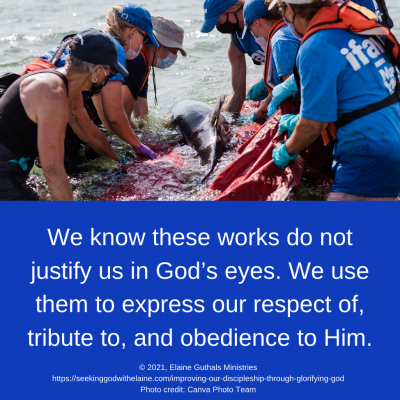
    We know these works do not justify us in God’s eyes. We use them to express our respect of, tribute to, and obedience to Him.

    We know these works do not justify us in God’s eyes. We use them to express our respect of, tribute to, and obedience to Him.

    “But I admit this to you: I worship the God of my ancestors according to the Way, which they call a sect, believing everything that is in accordance with the law and written in the prophets. I have a hope in God, which these men themselves also accept, that there will be a resurrection, both of the righteous and the unrighteous. I always strive to have a clear conscience toward God and men” (Ac. 24: 14-16 CSB)

    We glorify God when we have a clear moral conscience.

    Hmmmm. I wonder why Manton used these verses to talk about glorifying God? Paul was brought before Felix, and he had just started his defense.

    Of course, that defense started out with a declaration of what Paul believed.

    • Paul believed in the God of his ancestors.
    • What he believed is what other would consider, if they were being nice, an offshoot of that.
    • He believed in the hope of the resurrection.
    • He tried to live for God so that he could have a clear conscience.

    Maybe Manton was focusing on the conscience again. In this version, it is translated clear conscience. The King James Version translated it as “… a conscience void to offence (sic) …” (Ac. 24: 16 KJV).

    Well, First Corinthians 10: 32 talked about not causing offense. We’ll go with that.

    Niven felt that our consciences attest to the quality of our actions. That validated the need for us to be knowledgeable with God’s code of morals.

    But Niven said that it was a two-step process in attesting to the quality of God’s moral code.

    • We needed to affirm that God’s law was pure.
    • We needed to confess we are far from pure.

    Resource

    We only know that through the promptings of the Holy Spirit. It is only through the calling of God do we come to Him. Fortunately, He calls everyone to salvation; unfortunately, not everyone accepts the gift.

    Hannam presented a couple of reasons why we do not possess a clear conscience. Some are too caught up in the worldview to determine their needs of a Savior. Others just don’t see the need. Unfortunately, others refuse, resting on their flawed morals.

    Resource

    A clear conscience can only come from fulfilling our duties as children of God. Those duties are to “‘… love the Lord your God with all your heart and with all your soul and with all your mind and with all your strength.’ The second is this: ‘You shall love your neighbor as yourself’ …” (Mk. 12: 30-31 ESV).

    Using the greatest commandments as the bow, we tie together God’s rules and our actions. That sweeps the conscience.

    Glossary

    Hodge gave us a little more insight on what the conscience is. He wrote, “Conscience, therefore, is not a single faculty. It is a collective term for those exercises of our rational nature which concern moral good and evil. It includes cognition and judgment of approbation and disapprobation. And it is an impulse, as desires and affections are. It is not a mere decision as to truth.”

    Resource

    I read that to say that the decision is still ours. We can follow our conscience’s direction to be a moral person or we can choose not to.

    There were some interesting takes.

    • Vaughan called the conscience “a moral memory.”
    • Hodge said it contained “the perception of moral distinctions” and “a sense of moral obligation.”

    Resource

    Being a memory ties the conscience to our past. I would see it being formed by our past experiences and past knowledge. It is shaped by the morals to which we have ascribed in the past.

    But notice Paul said that he “… always strive[s] to have a clear conscience toward God and men” (Ac. 24: 14-16 CSB). That tells us our conscience can change in two ways.

    • It is not stagnant. It can change.
    • Since it can change, it can grow to be more godly.

    I don’t know about you, but my brain is spinning. This really went no where near where I thought it would go when I looked at Manton’s topic.

    My take is that God knows that we will have work to do after conversion. Even if we are what the worldview considers a moral person, we have to align our morals with Him.

    That is the whole purpose of the Sanctification Road. We get to change and grow to be like Him. That is the best way to bring Him glory and honor.

    Father God. It is our desire to bring You glory and honor. We want to live lives that show Your hand at work in us. May we always show Your moral compass. Amen.

    ImprovingOurDiscipleshipThroughGlorifyingGodPin

    What do you think?

    Leave me a comment below (about this or anything else) or head over to my Facebook group for some interactive discussion.

    If you don’t understand something and would like further clarification, please contact me.

    If you have not signed up for the email daily or weekly providing the link to the devotions and the newsletter, do so below.

    If God has used this devotion to speak with you, consider sharing it on social media.
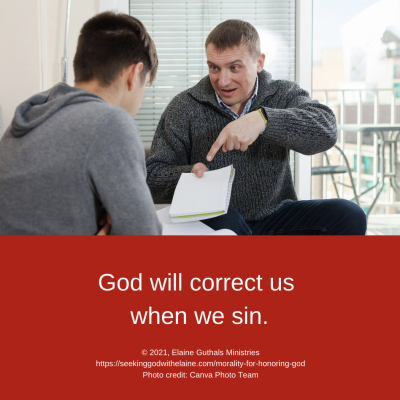
  • Improving Our Discipleship through Right and Wrong

    In the last devotion, we started to take what we discuss about morality and apply that to make us better disciples. In this devotion, we will look at how that apply to right/good and wrong/evil.

    Nuggets

    • In God’s Word, good is always right and evil is always wrong, so to be morally correct, we need to repay evil with good.
    • We may need to redefine Matthew 25: 31-46.
    • We need to choose what is right and good in order to combat evil.
    • We need to rule our passions.

    To read devotions in the Redo for Godliness series, click the appropriate button below.

    Devotions in the Moralities Lead to Godliness series

    In the last devotion, we started looking into how Manton started to tie up his sermon entitled The Moralities of Christianity. We looked at morality enforced through sanctification and principles.

    In this devotion, we will look at right and wrong. Remember, we will leave the connections and the application to whenever all the topics have been discussed. So, endings might be a little abrupt.

    Resources

    Let’s Put It into Context #1

    “Finally brothers and sisters, whatever is true, whatever is honorable, whatever is just, whatever is pure, whatever is lovely, whatever is commendable — if there is any moral excellence and if there is anything praiseworthy — dwell on these things” (Phil. 4: 8 CSB)

    The definition of moral, according to the Merriam-Webster Dictionary, is “of or relating to principles of right and wrong in behavior.” Morality, then, is “a doctrine or system of moral conduct.” When it is the plural form — moralities — it is a “particular moral principles or rules of conduct.”

    Resources

    Our morals determine our character. Character, according to the Merriam-Webster Dictionary, is “the complex of mental and ethical traits marking and often individualizing a person, group, or nation.”

    Resource

    Let’s Put It into Context #2

    Nuggets from the last devotion:

    • Our morality increases from the sanctification process.
    • Our morality is a reflection of our faith.
    • Our morality is our faith expressed through love.
    • Our morality is contingent on the grace of God.

    Morality Enforced through Right and Wrong

    “Do not be overcome by evil, but overcome evil with good” (Rom. 12: 21 ESV)

    In God’s Word, good is always right and evil is always wrong, so to be morally correct, we need to repay evil with good.

    God gives us definite instructions as to what is right and wrong. That is important to know.

    Thomas wrote “that good and evil are in this world. This fact distinguishes this from other worlds. In heaven there is good only; in hell evil only. On earth both co-exist, though both coalesce.”

    Resource

    The coalesce threw me. How do good and evil combine? No one really wants evil to come out on top.

    Redefining Good

    We may need to redefine Matthew 25: 31-46. Thomas said something that got me thinking. He said that “… if thine enemy be hungry, feed him …”

    My mind immediately went to the sheep and goats. “And he will place the sheep on his right, but the goats on the left. Then the King will say to those on his right, ‘Come, you who are blessed by my Father, inherit the kingdom prepared for you from the foundation of the world. For I was hungry and you gave me food, I was thirsty and you gave me drink, I was a stranger and you welcomed me, I was naked and you clothed me, I was sick and you visited me, I was in prison and you came to me.’”

    Glossary

    Some worldview people see this verse as believing disciples should work to eliminate the social injustices of the world. But let’s flip the narrative and redefine good.

    • For I was hungry for the Word of God and you introduced me to it and helped me understand.
    • I was thirsty, and you took me to the well of Living Water and gave me drink. 
    • I was a stranger searching for God, and you welcomed me and guided me to find Him.
    • I was naked, and you clothed me. “I rejoice greatly in the LORD, I exult in my God; for he has clothed me with the garments of salvation and wrapped me in a robe of righteousness …” (Isa. 61: 10 CSB).
    • I was sick because sin is an illness, and you visited me with the cure.
    • I was in prison (Gal. 3: 22) because all sinners are prisoners to sin, and you came to tell me how to break out.

    God’s priority is our spiritual condition, not our physical condition. He wants us to witness to others to expand His kingdom.

    Yes, we have our free will. Free will is the ability within us to make decisions, which determine actions that produce character.

    We get to choose. Paul admonished us to choose wisely.

    Oh, yes. We will be forced to make a choice for or against God. We will make a number of choices every single day.

    Choosing Right/Good

    We need to choose what is right and good in order to combat evil.

    • That means not repaying evil with evil.
    • It doesn’t even mean repaying good with good.
    • It definitely doesn’t mean repaying good with evil.
    • It means repaying evil with good.

    Resource

    Well, that is logical. Repaying evil for evil escalates the situation, not fixes anything. Repaying good for good looks good on the surface, but also doesn’t fix anything. Repaying good with evil does not show God’s love. That can only be done when repaying evil with good.

    Smedley contended overcoming evil is done by mastering our morality. When we discipline our passions and make good judgments, we provide a good witness and build relationships.

    Resource

    Let’s roost a second on the “Do not be overcome by evil …”. Evil (a.k.a. Satan) is going to want us overwhelmed. He will want us caught up in our passions, not thinking about God or what He wants us to do. He wants us surfing the moment on a downhill wave.

    Jenkins believed that we can withstand Satan’s onslaught. I can see what he is saying.

    We have the Sovereign God in our corner. He is greater than anything we face — even Satan himself.

    Resource

    I know. Now we just have to convince ourselves of that. We see Satan coming at us from all sides — and that is all we see.

    Has God ever left us? No. Has He ever let us down? No.

    Oh, yeah. God may not have answered the prayer the way we wanted and given us what we thought we had to have. But He never has not provided for us.

    Waterland argued that we are not giving into evil when we forgive the offense and let it go. We are not “losing” the battle. We do that when we give into the temptation and respond as a worldview person would.

    Combating Evil/Wrong

    Instead, we need to rule our passions. Jenkins thought that we could only use kindness as a weapon. I beg to differ. I think we have love in our arsenal, also. Otherwise, we wouldn’t be able to keep the second greatest commandment. It is the commandment of love, not kindness.

    Glossary

    Sometimes, do we feel that doing that gives them too much power? Do we feel like we are condoning their behavior?

    Waterland wrote, “The Scripture bids us be kind and generous; and yet bids us also beware of ill men, and not to deliver ourselves up thoughtlessly into their hands. Love and charity are one thing, easiness and folly another.”

    Resource

    We have to balance the situation and determine what God is really calling us to do.

    Clark reminded us disciples are called to be meek. Meekness is a personality trait exhibiting a mild or moderate disposition that places dependence on God.

    Resource

    How we react to adversaries of the gospel is important. I don’t know when Rogers wrote his sermon, but he argued that — in his time — adversaries had not increased either in numbers or strength. His argument was they had always been there, maybe not just as noticeable or active previously.

    Resource

    We have to watch how we approach evil. We don’t want to condone the evil, but we don’t want to alienate the person to whom we are witnessing. We definitely don’t want to be tempted by it.

    Rogers reminded us that we don’t want to be antagonistic. We can’t have a holier-than-thou attitude.

    We have to approach them with love but realistically. We can’t approach them in ways that accentuates the divide, but we cannot tolerate sin.

    Carpenter said that, even though we may hate something that is evil, we may not necessarily have victory over it. We have to make sure that the hatred is evidenced by our not associating ourselves with it.

    Resource

    As we grow our character, we need to do that based on our previous experiences. Reflection will play a big role in our growth.

    Father God. You, as Sovereign God, has decreed what is good and what is evil. Lord, we choose to follow Your good. Help us grow so that we can withstand the evil when Satan tries to overwhelm us. Amen.

    ImprovingOurDiscipleshipThroughRightAndWrongPin

    What do you think?

    Leave me a comment below (about this or anything else) or head over to my Facebook group for some interactive discussion.

    If you don’t understand something and would like further clarification, please contact me.

    If you have not signed up for the email daily or weekly providing the link to the devotions and the newsletter, do so below.

    If God has used this devotion to speak with you, consider sharing it on social media.

  • How Do Morals Improve Our Discipleship?

    Now that we know what we are talking about when we discuss morality, how do those make us better disciples?

    Nuggets

    • Our morality increases from the sanctification process.
    • Our morality is a reflection of our faith.
    • Our morality is our faith expressed through love.
    • Our morality is contingent on the grace of God.

    To read devotions in the Redo for Godliness series, click the appropriate button below.

    Devotions in the Moralities Lead to Godliness series

    We’ve covered a lot of ground in the devotions in this series. Being a moral person is important, but what does it mean? How do we use them to grow closer to God?

    The last devotions in this series are going to tie it up. I am not saying how many there are going to be because these two topics look intense. We will leave the connections and the application to whenever all the topics have been discussed. So, endings might be a little abrupt.

    We are back to Manton’s sermon entitled The Moralities of Christianity to give us the framework of our discussions. Let’s see what we are to do with the morality we have found.

    Resources

    Let’s Put It into Context

    “Finally brothers and sisters, whatever is true, whatever is honorable, whatever is just, whatever is pure, whatever is lovely, whatever is commendable — if there is any moral excellence and if there is anything praiseworthy — dwell on these things” (Phil. 4: 8 CSB)

    The definition of moral, according to the Merriam-Webster Dictionary, is “of or relating to principles of right and wrong in behavior.” Morality, then, is “a doctrine or system of moral conduct.” When it is the plural form — moralities — it is a “particular moral principles or rules of conduct.”

    Resources

    Our morals determine our character. Character, according to the Merriam-Webster Dictionary, is “the complex of mental and ethical traits marking and often individualizing a person, group, or nation.”

    Resource

    Morality Enforced through Sanctification

    “for the fruit of the light consists of all goodness, righteousness, and truth” (Eph. 5: 9 CSB)

    Our morality increases from the sanctification process.

    Morality is a system of conduct where we determine right from wrong. Isn’t that what the Sanctification Road is teaching us — right from wrong? Good from evil?

    The Holy Spirit is the one who is teaching us. Manton said that, according to these verses, the Spirit is teaching us to walk in the light. Walking is the term used to describe how we live our lives.

    Tillotson had a narrower definition of walking. He said it was “…a metaphor which signifies the outward conversation and actions of men.”

    I can see that. Those are the visible aspects of our lives.

    God does expect our relationships with Him to be visible to others. They have to be able to see what we believe. But that stems from the inside and touches on the how aspect.

    Resource

    Glossary

    The Sanctification Road is bathed in the light of Jesus. We are in it because we are now children of God.

    What we are learning as we navigate our roads is what makes up “… all goodness, righteousness, and truth” (Eph. 5: 9 CSB). Think about it.

    • Good, in the biblical sense, is the workings of God within His people.
    • Righteousness is the result of a solid relationship with God built by a sincere life of conscientious obedience to God’s laws and commandments.
    • God’s truth is faithfulness that leads to godliness.

    The fruit — or rewards — of our walk as children of God are that God can work within us to build a solid relationship that leads to godliness.

    That leads to Him. Remember, Jesus said He was the Truth (Jn. 14: 6).

    Glossary

    The fruit — or rewards — of our walk as children of God are that God can work within us to build a solid relationship that leads to godliness.

    Still, that isn’t an exhaustive list of fruits. We get a larger list of fruits of the Spirit in Galatians.

    These morals come from one thing — obedience to God through faith in Jesus. If God isn’t at the core of the our morals, the only reward we will receive for doing them is here on earth.

    Yes, worldview people can be what they define as good. But being a good person isn’t good enough.

    Manton put it this way. He wrote, “The world is most capable of knowing and approving these things, … for all our goodness, justice, and truth must come from love and obedience to God, and faith in Christ, as their true and proper principle, or else they are but moral virtues, not Christian graces.”

    Resource

    Note, Paul said “… all goodness, righteousness, and truth” (Eph. 5: 9 CSB). It is a packaged deal. We don’t get to choose the goodness and pass on the righteousness part. If we do, we are passing on the God part.

    The package deal has to become our character. Paul wasn’t talking only about the acts that we do. We can do something for a variety of reasons — none of which have God as the focus.

    Boston called them interwoven. I love that! Think of the foundation that builds when the three areas are braided together.

    Resource

    God wants to change us all the way down to our core — our hearts. We can’t do this by ourselves. Just as we can’t self-discipline alone, we can’t change our inner beings without God. We need God through the Holy Spirit.

    To read a related devotion, click on the appropriate button below.

    God wants to change us all the way down to our core — our hearts.

    Morality Enforced through Principles

    “Therefore, my brothers and sisters, you also were put to death in relation to the law through the body of Christ so that you may belong to another. You belong to him who was raised from the dead in order that we may bear fruit for God” (Rom. 7: 4 CSB)

    Our morality is a reflection of our faith.

    Woo, hoo. Hebrews 11: 6 showed up again. We’re going to slide right around that since we just talked about it.

    Verse Commentary

    Okay. It is cold and dreary here. My sinuses are draining, so my head is pounding. I read this verse and went, what? But I thought the laws shows us God’s character!

    Yes, they do. But they aren’t the end-all, be-all. The law won’t save us. Just being a good person who follows the rules won’t save us.

    The outward walk without the inward faith means nothing to God. Oh, it may mean something to the worldview people, but the worldview is temporary.

    The outward walk without the inward faith means nothing to God.

    Morals have to be grounded in faith. Faith is the conviction that the doctrines revealed in God’s Word are true, even if we do not understand all aspects of them, a belief which impacts our lives.

    Remember, we just said that, if our morals don’t come through our submission to God, they are just worldly morals, not Christian graces.

    “For in Christ Jesus neither circumcision nor uncircumcision accomplishes anything; what matters is faith working through love” (Gal. 5: 6 CSB)

    Our morality is our faith expressed through love.

    What I see Paul saying here is that the law does not save us. We could keep all the laws perfectly and still miss heaven. Spurgeon said that faith is more than just a rote memorization of the laws and commandments that make up the morals.

    Resource

    It isn’t about what we do or don’t do. It is about what Jesus has done for us. It is about God designing the Plan of Salvation so there would be an acceptable way for us to be restored to Him.

    It is also about the laws and commandments changing our character to be like God’s. We have to expand the morals to make them graces.

    I have to process what Maclaren said. He wrote, “Religion is the harmony of the soul with God, and the conformity of the life to His law. Obedience must be the obedience of a man, and not of his deeds only; it must include the submission of the will and the prostration of the whole nature before God. To be godly is to be godlike.”

    Resource

    Our intent of coming to God should be so that we become in harmony with Him. It shouldn’t be what we gain — or think we should gain. It isn’t just fire insurance.

    It isn’t just the knowledge of God and what Jesus has done for us. It is having the faith to believe we could never be restored on our own because it is more than who we are and what we do.

    We should come to God in order to become like Him. He is different than we are, and we need to be like Him. We want to be obedient and following His laws and commandments.

    But it is more than what we do or don’t do. When we submit our will to Him, we truly become like Him.

    God is love (I Jn. 4: 8). When we become like God, we love. How do we get there?

    When we focus on the greatest commandments, we go a long way to getting there. “‘And you shall love the Lord your God with all your heart and with all your soul and with all your mind and with all your strength.’  The second is this: ‘You shall love your neighbor as yourself.’ There is no other commandment greater than these” (Mk. 12: 30-31 ESV).

    Look at what Maclaren said. He wrote, “Love to God is no idle emotion or lazy rapture, no vague sentiment, but the root of all practical goodness, of all strenuous effort, of all virtue, of all praise.”

    Resource

    Love is the root of virtue. God is love. God is the root of virtue.

    “For the grace of God has appeared, bringing salvation  for all people, instructing us to deny godlessness and worldly lusts and to live in a sensible, righteous, and godly way in the present age” (Ti. 2: 11-12 CSB)

    Our morality is contingent on the grace of God.

    We are moral people because grace teaches us to be holy. Manton wrote, “It teaches by way of direction what duties we ought to perform, and so it makes use of the moral law as a rule of life.”

    Resource

    God through His grace encourages us. The laws are no longer threatening but instructive.

    Remember at the beginning of this devotion, we said that what we are learning as we navigate our roads is what makes up “… all goodness, righteousness, and truth” (Eph. 5: 9 CSB). We are taught that through grace.

    We are taught to live “… a sensible, righteous, and godly way in the present age” (Ti. 2: 11-12 CSB). The King James Version tells us to live a sober life, being a person of moral character. Graham wrote, “It denotes soundness of mind, as well as temperance regarding the indulgence of the appetites.”

    Resource

    God will use His grace to guide us to where He wants us to be. He will use our Sanctification Roads to grow us to be more like Him.

    Father. You want us to walk as Your children so that You can work within us to build a solid relationship that leads to godliness. That is what we want, too. Help us to live “… sensible, righteous, and godly …” (Ti. 2: 11-12 CSB) lives so that we can have Your moral character. Amen.

    HowDoMoralsImproveOurDiscipleship?Pin

    What do you think?

    Leave me a comment below (about this or anything else) or head over to my Facebook group for some interactive discussion.

    If you don’t understand something and would like further clarification, please contact me.

    If you have not signed up for the email daily or weekly providing the link to the devotions and the newsletter, do so below.

    If God has used this devotion to speak with you, consider sharing it on social media.

  • The Morality of Being Hopeful

    We think of hope being an attitude or a choice, but we generally do not think of it as a virtue. This daily devotional looks at how disciples of Christ are to grow their hope until it is part of them.

    Nuggets

    • Our hope is to build on the acknowledgement of Jesus.
    • We form hope as a virtue through obedience.
    • Our hope grows as we grow to be more holy.

    To read devotions in the Redo for Godliness series, click the appropriate button below.

    Devotions in the Moralities Lead to Godliness series

    Our last look at Bird’s sermon entitled Christian Morality before we get back to Manton’s The Moralities of Christianity looks at hope as a character trait. We’ve looked at hope before but as assurance of future expectation.

    Resources

    But think about it. Hope is to be so engrained in us that is drives who we are and how we act.

    That is deep. But what does that actually mean?

    We are going to do things a little differently today. Instead of using the verses as the foundation, we are going to use three sermons. (Each sermon, though, is tied to the same passage.)

    Hopefully, they can give us enough information to get us to the deep end. Let’s dig in.

    Let’s Put It into Context

    “Finally brothers and sisters, whatever is true, whatever is honorable, whatever is just, whatever is pure, whatever is lovely, whatever is commendable — if there is any moral excellence and if there is anything praiseworthy — dwell on these things” (Phil. 4: 8 CSB)

    The definition of moral, according to the Merriam-Webster Dictionary, is “of or relating to principles of right and wrong in behavior.” Morality, then, is “a doctrine or system of moral conduct.” When it is the plural form — moralities — it is a “particular moral principles or rules of conduct.”

    Resources

    Our morals determine our character. Character, according to the Merriam-Webster Dictionary, is “the complex of mental and ethical traits marking and often individualizing a person, group, or nation.”

    Resource

    Hope is a future expectation, called a living hope, based on the confidence that our names will be found in the book of life. Virtues are standards of moral excellence.

    Glossary

    Hope as a Product of Grace

    “Therefore, with your minds ready for action, be sober-minded and set your hope completely on the grace to be brought to you at the revelation of Jesus Christ” (I Pet. 1: 13 CSB)

    Resource

    Our hope is to build on the acknowledgement of Jesus.

    I can see what Pierson was saying. He wrote, “When we speak of the grace that is revealed we think of what is already manifested, of Golgotha with its Cross, of Gethsemane with its agony.” Grace is a free and unmerited gift from Heavenly Father given through His Son, Jesus Christ that enables salvation and spiritual healing to believers by the work of the Holy Spirit.

    Oh, yeah. We even go back further than that. We think of God’s infinite grace through which He devised the Plan of Salvation that made Jesus our Redeemer in order to forgive us of our sins.

    Occasionally, we might even acknowledge the grace God shows us as we are navigating the Sanctification Road. We need that gift to keep forgiving us as we still break God’s laws and commandments as we learn to be like Him.

    Sanctification is the transformation of mind, body, and soul, which begins with regeneration, gradually changes our nature through the promptings of the Holy Spirit, and ends with perfected state of spiritual wholeness or completeness. Regeneration is the change in us that God brings about when we go from being spiritually dead to spiritually alive. Spiritual death is the separation from God that occurred as a consequence of Adam and Eve’s original sin. The spiritually alive are those who have ABCDed, so they are no longer separated from God.

    Glossary

    The ABCDs of Salvation

    If you have not become a believer in Christ, please read through the
    Plan of Salvation and prayerfully consider what God is asking you to do.

    A – admit our sins
    B – believe His Son Jesus is our Redeemer
    C – confess God as Sovereign Lord

    D – demonstrate that commitment by making any changes needed in our lives to
    live the way in which God has called us

    The Disciple’s Job Description

    Oh, yeah. That road will wind. It definitely will not be a straight shot.

    Remember a couple of devotions ago, we equated our success in navigating the Road to the coming and going of the tides? The ebb and flow of our obedience makes our Sanctification Road as curvy as that street in San Francisco.

    But how many times does it sink in that God isn’t done yet? “… set your hope completely on the grace to be brought to you at the revelation of Jesus Christ” (I Pet. 1: 13 CSB).

    There is still grace to come. God will really show us His grace when Jesus comes back.

    God will really show us His grace when Jesus comes back.

    You know what is running through my mind? We can all picture a little kid at Christmas. The excitement, the boundless energy, the anticipation.

    What if God is that excited, has that much anticipation, at the thought of finally seeing us face to face? What if He is expending that energy to get all of the ducks in a row that need to happen before Jesus can come?

    What if God is leaning over and whispering in Jesus’ ear? “Get ready. It is going to be soon. Is Your cloud handy? Have You oiled the sickle lately?”

    Then, for the rest of eternity, God will be able to shower His grace on us firsthand. Thank You, Heavenly Father!

    But that is what hope is, right? It is a future expectation. We have living hope because our expectation is that our names are written in the Book of Life.

    Fun Fact

    Jesus riding His cloud and judgment day are future occurrences. But how is hope a virtue?

    Unlike the worldly hope, disciples can truly believe that the object of our hope is permanent. It will last throughout eternity.

    Since we can rely on God’s grace being given to us forever, that makes us a totally different person. We have the peace and confidence to calm our inner spirits.

    Pierson put it this way. He wrote, “But, blessed be God, the point at which human hopes are utterly blasted is the point at which Christian expectations only arrive at their consummation.”

    That becomes our foundation.

    Hope as a Product of Obedience

    “As obedient children, do not be conformed to the desires of your former ignorance” (I Pet. 1: 14 CSB)

    Resource

    We form hope as a virtue through obedience.

    Chaunter gave us some very good … hope. He said that hope can grow, just like faith.

    Hope is different than faith. Faith is the conviction that the doctrines revealed in God’s Word are true, even if we do not understand all aspects of them, a belief which impacts our lives.

    Hope is an expectation. Faith is a conviction, a belief.

    Hope is an expectation. Faith is a conviction, a belief.

    Chaunter described the difference this way. He wrote, “Faith relates to all things which Almighty God has revealed in Scripture, bad as well as good; whereas hope has only to do with the good things of our Heavenly Father.”

    We hope in the good things.

    I can see the difference. Faith includes a self-reflection piece so we can decide what we truly believe. Hope takes that look outside of us and focuses on what God will do for us.

    Oh, yeah. Uncertainly is an element of the hope.

    But it is countered with a big dose of assurance. Assurance is having security in our beliefs.

    Okay. I have to process this. Chaunter wrote, “You believe with full assurance, and it is a matter of faith that the righteous go to heaven. But that you individually are righteous, and shall finally go to heaven, is the subject of hope.”

    It is easy to say the righteous go to heaven. Righteous means we are free from sin because we are following God’s moral laws.

    We say God can and will forgive us of all of our sins except the unpardonable sin, which I think is unbelief. The reward for living under His moral laws is heaven.

    Glossary

    But how many times do we say to ourselves, “That doesn’t mean me.” “That doesn’t mean this sin.”

    That is where the hope comes in — the expectation. “I don’t see how or why God will forgive me for this sin, but He has promised that He would if I asked. So, I am asking. Now, I have certainty that He will do what He promised.”

    Chaunter talks about the power of that hope. Oh, yeah. We see it.

    I saw it when I lost my job. We see it when a friend is cured of cancer. We can see God navigating us through a wide variety of circumstances. He is right there, pulling us through.

    No, we may not be pulled through like we are expecting and hoping. Instead, Chaunter wrote, “He had no certainty of deliverance, but his hope was of sufficient power to make him persevere until he found the path, or was discovered by others and rescued.”

    The “… all things work together for good …” (Rom. 8: 28 ESV) does focus on the good. Good, in the biblical sense, is the workings of God within His people.

    God is working to save us and change our character to be like His.

    We have to grab onto this hope. We do that by doing anything and everything that God asks us to do. We are obedient to Him.

    Hope as a Product of Being Holy

    “But as the one who called you is holy, you also are to be holy in all your conduct; for it is written, Be holy, because I am holy” (I Pet. 1: 15-16 CSB)

    Resource

    Our hope grows as we grow to be more holy.

    What does it mean to be holy? Holy means to be set apart, perfect, and pure. Holiness is more than a character trait; it is purity, dedication, and commitment that lead to being set apart. The perfected state indicates the combination of the graces which, when all are present, form spiritual wholeness or completeness. Purity means we are without the stain of sin.

    Oh, no. God doesn’t flip a switch and conversion, and we are suddenly perfect and pure.

    This is something we grow into as we navigate the Sanctification Road.

    When talking about how a king, prince, or nobleman grows to understand his position, Howe wrote, “… as he comes to understand his quality, his spirit grows with his hopes of what he shall attain to; his very hopes greaten his spirit, ennoble him, and make him think of living like one that expects to be in such a state as that to which he is born.”

    As a child of the King, we need to grow into being His prince and princesses. We learn what all that means and how we are expected to accomplish the transformation. It makes us aspire to growing into princes and princesses.

    TheMoralityOfBeingHopefulPin

    Making the Connections

    I’ve been thinking a lot lately about the end times and the persecution that disciples will be called to endure.

    Chaunter wrote, “When the Christian soldier has taken his oath of service to Jesus Christ, and calmly considers the duties which are necessary to his reward, when he thinks of the enemies who encompass him, and of his own frailness and alienated affections, what can lead him to the contest and keep him undismayed? What but a sure and certain hope of Christ’s continued assistance?”

    We have hope through the good times and the bad times. God is in control.

    Resource

    How Do We Apply This?

    • We’ve got to grow our faith. If we grow in faith, we will grow in hope.
    • We have to make decisions based on that hope. We begin making it a habit. Eventually, it will be character.

    Gracious Heavenly Father. You have given us promises for the future. That gives us hope for future. Let this hope be so much a part of us that it is part of our character. We want to be solely, wholly focused on You. Amen.

    What do you think?

    Leave me a comment below (about this or anything else) or head over to my Facebook group for some interactive discussion.

    If you don’t understand something and would like further clarification, please contact me.

    If you have not signed up for the email daily or weekly providing the link to the devotions and the newsletter, do so below.

    If God has used this devotion to speak with you, consider sharing it on social media.