Blog

  • Transformed to being Servants of God

    God gives each of us gifts to use to expand His kingdom. This daily devotional will look at the gifts that Paul discussed.

    Nuggets

    • God gives His children a variety of gifts so that His kingdom can be expanded.

    To read devotions in the Redo for Godliness series, click the appropriate button below.

    Devotions in the Transformed to Perfection series

    In the last devotion, we looked at the first part of Romans 12: 6. We started talking about gifts.

    In this one, we are going to dig farther into the gifts that God gives us. Let’s go.

    Let’s Put It into Context

    Here is a running list of what we’ve discussed previously.

    A List of Gifts

    “According to the grace given to us, we have different gifts: If prophecy, use it according to the proportion of one’s faith; if service, use it in service; if teaching, in teaching; if exhorting, in exhortation; giving, with generosity; leading, with diligence; showing mercy, with cheerfulness” (Rom. 12: 6-8 CSB)

    God gives His children a variety of gifts so that His kingdom can be expanded.

    What is the different gifts Paul described here?

    • Prophecy
    • Service
    • Teaching
    • Exhorting
    • Giving
    • Leading
    • Merciful

    Those are some really diverse terms, too, aren’t they? Plus, they are broad terms. That way we can each find ourselves within them.

    Prophecy

    Tyson noted that we would use the term preacher today instead of prophet. Storrs defined prophet as “… one who is the interpreter of another’s thought.”

    Resource

    Vaughan brought things into perspective for me. He wrote, “If we are to understand the trust of the heart towards God, then the passage will mean, that ‘if any man prophesy,’ or preach, he must do it ‘according to the spiritual experience which God has given him.’”

    Resource

    • What is the mission of all of us? To preach.
    • What do we preach? The gospel.
    • How do we preach it? Using the experiences God has put us through to grow us to be like Him.

    We all have a story. It shows how God loves us and provides for us. We are to use them to witness to others.

    Hey! We have some similarities again.

    • “… If prophecy, use it according to the proportion of one’s faith” (Rom. 12: 6 CSB)
    • “… think soberly, according as God hath dealt to every man the measure of faith” (Rom. 12: 3 KJV).

    In a previous devotion, we said that the measure of our faith is the level of confidence in which we have both in Christ and in our ability to serve Him.

    Proportion means everything is in its appropriate place and congruent with everything else. Haven’t we just been talking about this in the On Things Above series?

    Devotions in the On Things Above series

    God’s right place is our #1 priority. We get out of whack when we put this world before God.

    But what does the congruent mean as a disciple?

    Stanley answered that. He wrote, “It is not enough to ask what is right in itself, but what is right under the circumstances.”

    Resource

    We have to watch here, though. Right doesn’t mean what the world thinks right mean. Right means righteous. Righteous means we are free from sin because we are following God’s moral laws.

    Doing something right is never going to lead to a sin. If the worldview people try to tell us that we have to tolerate sin in order to love them, that is not right.

    • “Timothy, guard what has been entrusted to you, avoiding irreverent and empty speech and contradictions from what is falsely called knowledge” (I Tim. 6: 20 CSB)
    • “The mindset of the flesh is hostile to God because it does not submit to God’s law. Indeed, it is unable to do so” (Rom. 8: 7 CSB).

    We have to do things God’s way the right way. I read about things happening in society and think of the old saying: two wrongs don’t make a right. I also think about the ends do not justify the means.

    We have to have faith in order to be a child of God’s. We can’t perform these gifts if we aren’t a member of God’s Church.

    But Vaughan reminded us that there is a lot of room on the continuum from our justification to our perfection after sanctification. Justification is the easy part because it comes once upon ABCDing. Sanctification is the bumpy road.

    Sanctification is a major component of our redo for godliness. However, it is not consistent. It has its hills and valleys.

    The way I read verse 6 is God is going to give us hints about the future in accordance to what our faith and understanding is. He is not going to try to teach us something we do not have the faith and foundation to understand.

    Service

    These gifts come from God to be used in His service. Service is an act based on belief in God that comes from a response of worship by acknowledging His power through our submission.

    I loved the title of Spurgeon’s sermon. It is Waiting on Our Ministering Needs Extra Grace.

    Resource

    We try to run ahead of God and get started in our ministry — while God is still preparing us for it. We want to do the right thing — but we are trying to do it the wrong way.

    If we want to serve God — which we should — we should want to serve Him the way He wants us to serve. Oh, yeah. He is going to stretch our comfort zones. He is going to ask us to do some things that have us scratching our heads in wonder.

    But God knows past, present, and future. He knows the perfected us. He knows our knowledge and abilities even better than we know ourselves.

    God knows past, present, and future.

    Teaching and Exhorting

    We know what teaching is. The Holman Bible Dictionary defined exhortation as giving advice and encouragement.

    Resource

    In a way, I was surprised that Chalmers combined teaching and encouraging. But then again, I am not.

    There is a connection. I like it when Chalmers said, “The one expounds truth; the other applies it, and presses it home on the case and conscience of every individual.”


    Resource

    In my opinion, every disciple should be an encourager. A kind word, a listening ear, a you-can-do-it goes a long way to uplift a struggling disciple.

    We can all do that. It shows God in us.

    But then, teachers have to uplift and encourage their struggling students. We aren’t going to get everything on first read. Sometimes, we need Scriptures explained to us. Our teachers have to encourage us to keep working it out until God flips the understanding switch.

    We talked before that, really, every one of us is a teacher. We teach without even realizing we are teaching. The whole What I Believe series was morphed from learning enough to be a teacher into determining some areas we need to grow so we can be mature disciples. We were solidifying what we believe in order to be able to witness.

    To read a related devotion, click the appropriate button below.

    When we witness, we are really teaching. This is especially true when we are witnessing to someone who has not grown up around believers. We may be talking a whole foreign language to them. (That is why I include so many definitions in my devotions.)

    To read a related devotion, click the button below.

    Giving

    I think, a lot of times, we feel God is asking for this elaborate objective. I don’t think He is. He just wants us to put Him first.

    Look at verse 8. I think the King James Version says it best. “… he that giveth, let him do it with simplicity …” (Rom. 12: 8 KJV).

    Don’t try to blow it up to this hard task. Don’t overthink it.

    Just do it.

    God wants disciples to be givers. Yes, it may be money. He also wants our time. He wants our talents. He wants our passions and concerns.

    He wants all of us. He wants us to do whatever He calls us to do.

    Leading

    We shouldn’t have ulterior motives or a hidden agenda when we are leaders. We shouldn’t be expecting a specific payoff.

    In fact, we shouldn’t be expecting anything. “But love your enemies, and do good, and lend, expecting nothing in return, and your reward will be great, and you will be sons of the Most High, for he is kind to the ungrateful and the evil” (Lk. 6: 35 ESV).

    Mould talked to those who are in a position of authority. He cautioned them to never let things just work out for themselves. Leadership takes planning and action.

    Resource

    Take Loki, for example, in Thor: Ragnarok. He disguised himself as Odin and took over ruling Asgard. But he let a lot of things slide. So, when Thor shows up, he says that the Nine Realms are in chaos.

    Things don’t just work out for themselves. Satan is the master of chaos.

    We have to be diligent in caring for our relationships with God.

    Merciful

    The last admonition Paul has for us is to be merciful but cheerfully. Disciples’ mercy is a characteristic of compassion for the needs of others, especially those who are in distress.

    What just popped into my head was that worldview people think they are merciful — sometimes even more so than disciples. They can have compassion for others.

    The problem is they are not performing the acts to glorify God or to expand His kingdom. That is why disciples are to be merciful. We are to show others that God loves us.

    TransformedToBeingServantsOfGodPin

    Making the Connections

    We have to be really careful when we run into a distortion of God’s truth. We have to know our do’s and don’ts to make sure we keep on the narrow path.

    Glossary

    Satan wants us to think one of God’s laws and commandments cancels out another. That isn’t what God says. Look what God told Joshua — and is telling us.

    “Only be strong and very courageous, being careful to do according to all the law that Moses my servant commanded you. Do not turn from it to the right hand or to the left, that you may have good success wherever you go. This Book of the Law shall not depart from your mouth, but you shall meditate on it day and night, so that you may be careful to do according to all that is written in it. For then you will make your way prosperous, and then you will have good success” (Josh. 1: 7-8 ESV emphasis added).

    God said do all. Not pick and choose. Not place one law above the other.

    God said to obey all the laws.

    How Do We Apply This?

    • Don’t be the one who’s only contribution is criticism. Serve God.
    • Align our words and actions to God’s Word.
    • Value the gifts that God gives us.
    • If we are put in any position of responsibility, we need to diligently perform our responsibilities.
    • Show mercy to all with whom we come into contact.
    • Study all of Scripture, not just our favorite passages — or just the easy ones.
    • Make it a habit to be merciful.
    • Make it a habit to be cheerful, especially around those in need of cheer.

    Resource

    No one possesses all of the gifts. For that reason, we have to work together to accomplish God’s mission.

    We have to always keep true to the tenets of our faith. Mankind disobeyed God and brought sin into the world. God sent His perfect Son to die to pay the penalty for those sins so that we could be restored to a relationship with God. We are to obey God’s laws and commandments to show our commitment to Him.

    Father God. Thank You for the gifts that You have given us. May we confidently use them to expand Your kingdom. Amen.

    The ABCDs of Salvation

    If you have not become a believer in Christ, please read through the
    Plan of Salvation and prayerfully consider what God is asking you to do.

    A – admit our sins
    B – believe His Son Jesus is our Redeemer
    C – confess God as Sovereign Lord

    D – demonstrate that commitment by making any changes needed in our lives to
    live the way in which God has called us

    The Disciple’s Job Description

    What do you think?

    Leave me a comment below (about this or anything else) or head over to my Facebook group for some interactive discussion.

    If you don’t understand something and would like further clarification, please contact me.

    If you have not signed up for the email daily or weekly providing the link to the devotions and the newsletter, do so below.

    If God has used this devotion to speak with you, consider sharing it on social media.

  • Transformed to Unity

    Even though God gives us different gifts, He wants us to be unified in serving Him. This daily devotional looks at how disciples of Christ should work together to further God’s kingdom.

    Nuggets

    • God calls us all to have a part in His ministry.
    • God has a variety of gifts that He gives to His children.

    To read devotions in the Redo for Godliness series, click the appropriate button below.

    Devotions in the Transformed to Perfection series

    The human body is an intricate, diverse organism. It is diverse because it is made up of organs, tissues, bone — and a lot, lot more.

    But it is also intricate because they all have their own functions — and they work together.

    Paul used the body to describe what the church is to be like. It was a great way to show the diversity and unity.

    Let’s Put It into Context

    Here is a running list of what we’ve discussed previously.

    One Body

    “Now as we have many parts in one body, and all the parts do not have the same function, in the same way we who are many are one body in Christ and individually members of one another” (Rom. 12: 4-5 CSB) 

    God calls us all to have a part in His ministry.

    We all have the same commission.

    • “And he said unto them, Go ye into all the world, and preach the gospel to every creature” (Mk. 16: 15 KJV).
    • “Go ye therefore, and teach all nations, baptizing them in the name of the Father, and of the Son, and of the Holy Ghost: Teaching them to observe all things whatsoever I have commanded you: and, lo, I am with you always, even unto the end of the world. Amen” (Mt. 28: 19-20 KJV).

    The Homilist reminded us that, even though the body is made of all these different parts, those parts aren’t necessarily a distinct unit. Yes, we only see through the eyes; but if they aren’t connected to the brain, it really wouldn’t be able to see.

    Aren’t we trying to do that in our churches today? We parcel ourselves out by age and gender, sometimes race and ethnicity.

    Seniors, adults, youth, and children — we can’t focus on the groups as it they were the whole. Substitute all the other groups — we can’t do that either.

    Instead, we have to look at the Church as a whole. The Homilist wrote, “… not the individuality of the member, but the oneness of the whole community, is to demonstrate the truth of Christ’s mission.”

    I am not saying do away with my Ladies’ class. I am saying that we have to always remember that it isn’t the whole.

    We can take it further than that. Baptists, Catholics, Methodist … need I go on?

    The name of the demonination or religion isn’t important. What is important is they believe in the Christ of the cross.

    To read a related devotion, click the button below.

    God never intended the divisions. His gospel is for all.

    • “For God so loved the world that he gave his one and only Son, that whoever believes in him shall not perish but have eternal life” (Jn. 3: 16 NIV).
    • “The Lord is not slow to fulfill his promise as some count slowness, but is patient toward you, not wishing that any should perish, but that all should reach repentance” (II Pet. 3: 9 ESV).

    I see this as a way of reminding us that we have to focus on God and not ourselves. We sometimes like to think it is about us — who we are and what we want.

    It isn’t. God’s Church is all about God and what He has done to restore our relationships with Him.

    God’s Church is all about God and what He has done to restore our relationships with Him.

    Many Gifts

    “According to the grace given to us, we have different gifts …” (Rom. 12: 6 CSB)

    God has a variety of gifts that He gives to His children.

    There is that phrase again — sorta. “For by the grace given to me …” (Rom. 12: 3 CSB) 

    Last time, Paul said that the grace was given to him. This time, he said the grace has been given to all of us.

    Paul is right on both counts. When we ABCD, we do get a portion of God’s grace.

    Paul is also right that ministers are given grace by God to use in His kingdom for others.

    What the church at Rome was dealing with was that God has given each of us different gifts to use to accomplish that mission. Melvill said the problem Paul was discussing here was envy. It was a case of I-want-what-you-have.

    Resource

    No, we are not all given the same gift — and not all at the same level. We don’t all use our gifts the same way.

    Harrison said that there was a form of unity here. He wrote, “There will be differences of gifts because there are differences of functions, but there must also be fitness for association, and to form a secure union all the members must be renewed by the Holy Spirit, be joined to Christ by a living faith, and exhibit the beauties of a consistent character.”

    Resource

    Elaine-speak

    • It takes a lot of people with a variety of abilities to complete God’s mission.
    • I take fitness of association to mean a couple of things.
      • We must all be children of God who have ABCDed.
      • We must have honed our skills so that they can be used to their fullest potential.
    • We take our direction from the Holy Spirit — “he saved us, not because of works done by us in righteousness, but according to his own mercy, by the washing of regeneration and renewal of the Holy Spirit” (Ti. 3: 5 ESV).
    • Doing God’s work is another way we gain His character and allows us a chance to exhibit that character to others.

    Did you see that? Once again, it says that we have to begin by ABCDing and end by having His character.

    Doing all that brings God glory and honor. That is our purpose in life.

    I love how Tyson described it. He wrote, “But every individual believer has his own proper sphere of influence and activity for the general good (Ephesians 4:15, 16).”

    Resource

    Think about it. We usually think of this as we have a job in the church. We do.

    We have an influence, however, in so many different places. Yes, I influence my Ladies when I teach my class. It could be said that I have an influence when I sing on Praise Team and do an offertory on my flute.

    But I have influence in my own home and job. I can be an influence when I am out shopping.

    We can be an influence anywhere there is people. It may be in His house, on a mission field — or on our field.

    We can be an influence anywhere there is people. It may be in His house, on a mission field — or on our field.

    I liked how Harrison said that there had to be harmony of character. We are all to have the same character — God’s.

    Resource

    Regardless of whatever qualifier we try to put on, all of Christ’s disciples must have the same character — Jesus’. We are called to imitate Him because He is imitating God.

    TransformedToUnityPin

    Making the Connections

    Harrison noted the importance of having a division of labor. We can assign tasks to those to which they are most suited. But it is more than that.

    We aren’t supposed to show up Sunday at 10:30 and expect Pastor Joey to just fill us right up. Each of us is expected to give back.

    We are expected to do something. Harrison had some really strong words. He wrote, “The member who is doing nothing is worse than useless.”

    Resource

    Each of us is needed to do God’s work. We’ve got to grow a loving relationship among all of the fellow believers.

    Stanley stressed that we have to be genuine. We can’t witness to things we really don’t believe or value. What we use in our witness has to come from our knowledge and experiences.

    This has to come from God’s truth. But Stanley warned us that “Christian truth is not of one kind only. It has lights and shades, foregrounds and distances, lessons of infinitely various significance.”

    Resource

    Sometimes, we want the do’s and don’ts of the laws and commandments to be a checklist. Have we gotten it right, or did we go off the rails somewhere?

    But God isn’t about checklists. He is about character. Checklists might not serve us in every situation. Character does.

    The prevailing determinant must be: are we sinning against God? We have to choose the option where the answer is no.

    We can’t choose to sin because the worldview people think that is what “love your neighbor” means. Goulburn wrote, “God loves me deeply, but He hates my sin, and will never consent to save me from its guilt without saving me from its power.” We won’t be saved if we allow sin to still control our lives.

    Resource

    How Do We Apply This?

    Look what Vaughan said. He wrote, “The measure of the faith is the measure of the life; and if we wish to raise the standard of our life, we must begin by elevating our faith. But we are to take ‘faith’ here rather as signifying not the belief, but the things believed — our creed — ‘the faith once delivered to the saints.’

    Resource

    That means the measure of our faith is the level of confidence in which we have both in Christ and in our ability to serve Him which can be raised through increased faith.

    Okay. So, how do we apply all of that?

    • Don’t be envious of gifts we don’t have and someone else does.
    • We need to promote unity. We all have the potential to be children of God. This causes us to try to help one another.
    • We need to try to not cause division.
    • Instead of envying someone else’s gift, we should perfect our own.
    • We should be ourselves.

    Resource

    Regardless of what gift we possess and at what level, it is a gift from God. He expects us to use it in His service.

    Father. You are the God of peace and unity. Satan is the father of chaos. That causes disunity. Help us, Lord, to be unified with our brothers and sisters in Christ. May we not be envious of the gifts of others. Help us to grow our gifts so that they may be used in Your service. Amen.

    What do you think?

    Leave me a comment below (about this or anything else) or head over to my Facebook group for some interactive discussion.

    If you don’t understand something and would like further clarification, please contact me.

    If you have not signed up for the email daily or weekly providing the link to the devotions and the newsletter, do so below.

    If God has used this devotion to speak with you, consider sharing it on social media.

  • June 2021 Newsletter

    Things haven’t gone really smoothly today. It ended up technology was down.

    So, I am using the newsletter as the post. We’ll get back to the Transformed to Perfection series in the next devotion.

    I wanted to say a couple of thanks you. Thanks for your prayers on my surgery. I had no problems at all.

    Thank you, also, for your prayers for my church after Pastor Chad died unexpectedly. We have called a new pastor, who will be starting the middle of next month. So, you will probably be hearing me say things about Pastor Joey.

    Main Nuggets

    • Salvation is not about the do’s and don’ts. Submission is. By following God’s laws and commandments — and asking for forgiveness when we break them — we are growing holiness (Growing Our Souls).
    • We set our thoughts above when we are pursuing godly perfection (How Do We Set Our Thoughts Above?).
    RedoForGodliness

    Our Relationship with God

    • The foundation of hope is grace that comes when belief is present (Renewing Our Inner Person by Being Sober).
    • God isn’t stressing over what is happening. We need to remember that He is omniscient. He is also unchanging (What Affections Are We Talking About?).
    • God’s love for us will never change. Yes, God is going to love us regardless of our actions. But we can’t use that as an excuse not to change (What Affections Are We Talking About?).
    • We are to consistently read God’s Word so that the connection formed with Him will help us corral our thoughts. We need to prayerfully read the Scriptures, asking God to increase our knowledge and submissiveness. We can’t read a couple of verses and think God is pleased with our devotional efforts. We can’t think we are going to learn all about God and Jesus with a five-minute read. We have to consistently study God’s Word and meditate on what we have read (How Else Do We Set Our Thoughts Above?).
    • There are a lot of things about God that we don’t understand. He has revealed only some to us in His Word (Renewing Our Inner Person by Being Sober).
    • Our relationships with God happen in our minds and in our hearts. That means the relationships are greatly impacted by our thoughts (How Else Do We Set Our Thoughts Above?).
    • It may be called renewing your mind, but it is the renewing of the spirit of the mind. God is working on our hearts (Growing Our Souls; How Do We Go from Milk Baby to Steak Adult?).
    • Our inner self is more important than our outer self (Renewing the Inward Person).
    • We are renewed every day. This helps us to grow because we never reach perfection here. There is always something new to learn about God. He is always working on our character to make us more like Him (Renewing the Inward Person).
    • We have to structure our thoughts so they grow our relationships with God, not hinder them. He wants us to be thoughtful about what pleases Him. We have to put the focus on Him (How Else Do We Set Our Thoughts Above?; Renewing Our Inner Person by Being Sober).
    • Yes, we can question God. We cannot doubt Him. We have to always give Him the glory and honor He is due (How Else Do We Set Our Thoughts Above?).
    • Joy from above only comes when we are seeking God as joy and pleasure are only found in the presence of God. If we aren’t in God’s presence — communicating with Him — we don’t have it (How Do We Set Our Love, Desire, Hope, and Joy Above?; More Benefits of Setting Our Affections on Things Above).
    • Faith promotes the circumstances that create joy, making joy is a product of our faith. Faith = Joy. No Faith = No Joy (How Do We Set Our Love, Desire, Hope, and Joy Above?).
    • We put off our old self through regeneration — by saying we believe in God. But there is more to it than that. If we only take off half of the old self or put on half of the new self, we still aren’t where God wants us to be. He wants us to totally submit to Him at conversion. It is to be a complete break from our old sins (Growing Our Souls).
    • We don’t get to keep old sins while we get the hang of being a disciple. We have to make a conscious decision up front as to whether we are all in for God or are we keeping with the worldview (Growing Our Souls).
    • If we do not put on our new selves, we haven’t made a genuine profession of faith (Growing Our Souls).
    • Sanctification is completing the work that grace began (Influencing the Soul).
    • We are sanctified through God’s Word and His providence (Influencing the Soul).
    • Sanctification is a surrender. We need to be obedient to His Will (Influencing the Soul).
    • God carries on His sanctifying work in our souls. If He did not, we would not be changed (Influencing the Soul).
    • If we are not changed, we cannot live with God for eternity. The disciples who have navigated the Sanctification Road and had their character changed to that of God’s will be rewarded for their obedience to God. Only those who have changed to perfection will be admitted to Heaven (What Affections Are We Talking About?; Influencing the Soul).
    • In order to grow, we need to remember the past experiences God has taken us through to know what is in our hearts (How Do We Go from Milk Baby to Steak Adult?).
    • As we focus on Him, we can see the areas in which God is working (What Affections Are We Talking About?).
    • Instead of being content in the knowledge of Jesus, we sometimes get hung up on what we don’t understand. It doesn’t matter what we know or not know. What matters is that we know the One Who is all-knowing (Reasons Why Should Not Set Affections on Earthly Things).
    • God renews our self-esteem when our baggage-wagons get too full (Renewing the Inward Person).
    • God renews us daily, so we can’t quit trying. If we give up, Satan has won this battle. We know he won’t win the war against God. We can’t let him capture our baggage-wagons, so that we take our eyes off God (Renewing the Inward Person).
    • Because we are His, we will have to be ready to fight whatever Satan throws our way (Renewing Our Inner Person by Being Sober).
    • We keep our focus on God by remaining in communication with Him. How are we supposed to combat our anxiety? By prayer, supplication, and thanksgiving. We can’t do it by ourselves. We can’t do it with worldly methods. We can’t depend on a significant other or family member. We need to go to the Source (Renewing Our Inner Person from Anxiety).
    • We do have to ask in His Will. Our petitions have to be genuine. They have to recognize God as our Creator and Ruler (Renewing Our Inner Person from Anxiety).
    • If we don’t ask, then it means we are not submitted to God. We may feel we are entitled to what God wants to give us. Asking makes the receiving of the mercies sweeter (Renewing Our Inner Person from Anxiety).
    • It is through the two-way communication that we learn Who God really is. He reveals more of Himself to us than is in the Scriptures (Renewing Our Inner Person from Anxiety).
    • We are to pray to God about everything. That means we shouldn’t keep a portion of our lives back from His control (Renewing Our Inner Person from Anxiety).
    • Instead of being fearful, we should be thankful. Even when our anxiety is at its peak, we should be thankful (Renewing Our Inner Person from Anxiety).
    • It is all about redemption. God’s #1 priority is the condition of our soul. Is it spiritually dead or spiritually alive? (More Benefits of Setting Our Affections on Things Above).
    • The condition of our soul is much more important than what is happening in this life (Renewing Our Inner Person from Anxiety).
    • It doesn’t matter if we think something is a biggy or something minuscule. It tells us about God. That makes what He reveals through His Holy Spirit infinitely more than we realize (Renewing Our Inner Person by Being Sober).
    • We need to use what God reveals to us to better our relationships with Him (Renewing Our Inner Person by Being Sober).
    • God wants us to make conscious decisions to follow Him. In order to do that, we need to know all we can about our relationships with Him (How Do We Go from Milk Baby to Steak Adult?).
    • In order to grow, we have to prove we are making a genuine profession of faith (How Do We Go from Milk Baby to Steak Adult?).
    • We have to prove that we genuinely believe in God as our Heavenly Father and Jesus as our Savior. We believe it enough to change our character to reflect Them (How Do We Go from Milk Baby to Steak Adult?).
    • We’ve got to imitate God’s character. We have to be Him, not do to earn or perfection (Jesus’ Prayer of Submission).
    • Should we be surprised that God is placing the emphasis on how we are progressing from the milk baby to steak adult? No. His concern is always our spiritual condition. Our comfort in this life is secondary to that (How Do We Go from Milk Baby to Steak Adult?).
    • God’s laws and commandments aren’t a strict checklist to determine how many of the do’s did we do — and how many of the don’ts. They are to show us God’s character. We are to use what we learn from them to aid us in determining our actions in other situations (Jesus’ Prayer of Submission).
    • The will of God is that we change our character be like His. We are to become holy and set apart so that we can be perfected. If we don’t, we will be the ones saying, “Lord, Lord” (What Affections Are We Talking About?).
    • Knowing Christ and striving to imitate Him produces His character in us. That means we see ourselves as we really are (Reasons Why Should Not Set Affections on Earthly Things).
    • We are to grow in the knowledge of God and produce good fruit (Reasons Why Should Not Set Affections on Earthly Things).
    • Living for God means that we live in a sinful world while trying to not sin (Reasons Why Should Not Set Affections on Earthly Things).
    • If we put God first, then we must put Him above the things of this world. This includes our jobs, our relationships, our hobbies, etc. (Reasons Why Should Not Set Affections on Earthly Things).
    • What we are going for here is more than just a head knowledge. We can’t just know that Jesus lived as a man. We have to know that He came to redeem us (Reasons Why Should Not Set Affections on Earthly Things).
    • We are to make God our priority. That is putting Him first in time and attention (How Do We Set Our Affections Above?).
    • We have to seek God because He is Sovereign God and loves us. We are to seek God’s righteousness because then we are truly seeking God (How Do We Set Our Affections Above?).
    • We have to seek God completely. It should be our strongest desire to be more like Him (How Do We Set Our Affections Above?).
    • When we seek God, we will find Him (How Do We Set Our Affections Above?).
    • God’s character is considered His face. We are to see that because we are to imitate His character (How Do We Set Our Affections Above?).
    • We only see God’s face through righteousness. (That is why we are to seek first His kingdom and righteousness.) (How Do We Set Our Affections Above?).
    • We should seek what God values. He values our salvation and obedience (How Do We Set Our Affections Above?)
    • God has always been and will always be our Father. In fact, God made a covenant with Jesus and us (Why Do We Set Our Affections Above?).
    • We can set our affections above because we have gained access to God once we are changed to possess Jesus’ righteousness. The good news is, because we are the bride of Christ, His righteousness becomes ours (Why Do We Set Our Affections Above?).
    • We can access God — even though we are still in these sinful bodies — because of our belief in Jesus. But that doesn’t mean God hates our sin less (Why Do We Set Our Affections Above?).
    • God always has something more He wants us to understand. There is always some sin that we have to confess. He is always wanting us to grow in grace and knowledge (II Pet. 3: 18) (Final Thoughts on Setting Our Affections on Things Above).
    • Worldliness is the opposite of what God wants for us (Prioritizing Things Above).
    • You see, worldliness isn’t about just living in this world. It is desiring the things of this world. He basically described it in three words: external, temporary, and delusional (Prioritizing Things Above).
    • We prioritize Jesus above worldly things when we truly know Him (Prioritizing Things Above).
    • We have to realize that this is all about God and Jesus. It is all about God because He didn’t turn His back on us when we disobeyed Him. It is all about Jesus because He died for us. It isn’t about what we want or need out of this life. It isn’t about what we can or should do. It is about what God has already done for us (Prioritizing Things Above).
    • We are to put nothing before God (Prioritizing Things Above).
    • Jesus wants us to put Him as our priority. God has to rank first above “… father and mother, wife and children, brothers and sisters — yes, and even his own life …” (Lk. 14: 26 CSB) (Prioritizing Things Above).
    • It isn’t that we just do things that Jesus calls us to do. We have to also lessen the pull this world has on us (Prioritizing Things Above).
    • If we do not give Jesus first priority, we are not worthy of Him. We are not worthy if we are not sincere (Prioritizing Things Above).
    • We commit sin when we don’t put Christ before other things (Prioritizing Things Above).
    • God doesn’t want us to half-heartedly follow Him. He doesn’t want us to justify sin. Our goal should be to completely erase them from our lives (Prioritizing Things Above).
    • We must live the way God wants us to live. That is putting Him above everything in this life (Prioritizing Things Above).
    • God’s priority is the condition of our souls. We must set our affections to ensure our soul is in His condition (How Do We Set Our Love, Desire, Hope, and Joy Above?).
    • Our relationship with God begins with the realization that God can be our Father. As we learn of Him, we learn of His character through His laws (How Do We Set Our Love, Desire, Hope, and Joy Above?).
    • When we are unbelievers, we can get so caught up with the expectation that we will have to give up everything we like. That isn’t true. It also doesn’t take into account what we will gain (How Do We Go from Milk Baby to Steak Adult?).
    • It is all about the submission. It isn’t about understanding. It isn’t even about feelings. It isn’t about religious affiliation. It is about letting God have His way. Even if He is calling us to do or give up something we don’t want. Even if it is going to hurt (Jesus’ Prayer of Submission).
    • Submission to God has two elements: follow God’s Will perfectly and, if something is not His Will, not making it our will (Jesus’ Prayer of Submission).
    • Even if we were able to do all of the do’s and not do any of the don’ts, we would still be sinful because we are separated from God (What Was John the Baptist’s Message?).
    • When we repent of our sins, God will forgive us and restore our relationships to Him (What Was John the Baptist’s Message?).
    • God is adamant that we have to come to salvation His way (What Was John the Baptist’s Message?).
    • Age, race, gender, social status — nothing limits to whom God’s salvation is offered. Nothing limits to whom the consequences are given (Consequences of Setting Our Affections Below).
    • True disciples produce evidence of their conversion (John the Baptist’s Tough Message).
    • When we repent, we have to change — our allegiance, our thoughts, our mindset, our actions (John the Baptist’s Tough Message).
    • We aren’t given a pass because of our ancestors’ religion. We aren’t given a pass because we are good people. We aren’t even given a pass because we believe in God. We have to believe and be fruitful. We can only be fruitful when we give our lives to Jesus (John the Baptist’s Tough Message).
    • Choosing to accept God’s gift of salvation means we commit to Him without delay (More Reasons Why We Should Not Set Affections on Earthly Things).
    • The choice is ours. Are we going to follow Satan? Sure, we might have it better in this life if we do. Eternity will be hell if we do (More Reasons Why We Should Not Set Affections on Earthly Things).
    • Our future happiness is contingent on our acceptance of Jesus as our Savior. If we don’t do that, we aren’t going to set our affections on things above (Final Thoughts on Setting Our Affections on Things Above).
    • If we ABCD but are not sincere about it, we won’t gain Heaven. If we say we are setting our affections on things above but can’t give up the things below, we won’t make it (Final Thoughts on Setting Our Affections on Things Above).
    • When we know Jesus and consider what He has done for us, we value what He has done (Prioritizing Things Above).
    • An important component of taking the Lord’s Supper is the retrospection that we do in preparation for the actual ordinance (How Else Do We Set Our Thoughts Above?).
    • We are to remember the sacrifice that Jesus made for us. Are we acknowledging that He is the Savior, the only way we could gain salvation? We are to examine our hearts and lives. Are we navigating the Sanctification Road as we should? Have we gotten our redo for godliness to the heart level? (How Else Do We Set Our Thoughts Above?).
    • We are to come acknowledging our need for Him rather than kicking ourselves that we don’t meet the standard (How Else Do We Set Our Thoughts Above?).
    • It is all about coming humbly and reverently. It is about setting our thoughts on Him and acknowledging we would be nothing without Him (How Else Do We Set Our Thoughts Above?).
    • The Plan of Salvation is all about restoration. But it is about restoration because the judging will come later (Who Was John the Baptist?).
    • The fruit of the tree of life will only be given to those who have been set apart and perfected because they are morally pure and have their names written in the book of life (What Affections Are We Talking About?).
    • Since this world is fleeting, it won’t give us the satisfaction that our eternal life will give us. We have to focus on the lasting (Reasons Why Should Not Set Affections on Earthly Things).
    • Knowing Jesus and living for Him brings us much better rewards than setting on eyes on earthly things. Heaven will be our reward for setting our affections on things above (Reasons Why Should Not Set Affections on Earthly Things; Final Thoughts on Setting Our Affections on Things Above).
    • Heaven is because Jesus is. We should want it based solely on it means our being with Christ (How Do We Set Our Love, Desire, Hope, and Joy Above?).
    • Our motives must be based on serving Christ until we are called home (How Do We Set Our Love, Desire, Hope, and Joy Above?).
    • We need to remember how He has provided for us in trials. We need to think about how God has saved us from difficult circumstances. Having those memories — and dusting them off and contemplating on them — help us to corral our thoughts. When our thoughts want to run away with us, we can simmer down when we remember how God has provided in the past (How Else Do We Set Our Thoughts Above?).

    Glossary

    Make Be holy, because I am holy (I Pet. 1: 16 CSB) our standard.

    Obeying God’s Laws and Commandments

    • Scriptures were written so that we could know the laws and commandments, they could change us, and we could receive the joy (What Affections Are We Talking About?).
    • These laws and commandments are not going to change — no matter how much the worldview people think they should. God has decreed what is a sin and what is not. That isn’t going to change (What Affections Are We Talking About?).
    • The Bible will never be a dead book in a library cemetery. It will be a living, breathing document that prophecies the future — until that prophecy is fulfilled (What Affections Are We Talking About?).
    • We are to attempt to find freedom from sin by following God’s moral laws. Attempt. That means we aren’t there yet. What is imperative is that we have to be moving in the right direction. We are to be moving away from sin and toward God’s moral laws (How Do We Set Our Affections Above?).
    • The Jews thought that, since they were God’s people, they could just sit back and let God do for them. It doesn’t work that way. We need to show remorse for disobeying God. We need to want and try to follow His laws and commandments. Repentance is our conscious decision to try to do all of that (What Was John the Baptist’s Message?).
    • We can’t write our sins off as the product of our environment or just how we were wired. We have to choose to follow God’s laws and commandments or to sin (How Do We Switch Our Affections in Our Redo for Godliness?).
    • People who give lip service devotion will suffer consequences. I think we do have trouble understanding God’s character because we evaluate it based on our understanding — not worldview understanding, but worldly understanding. We know what we think it should be (Why Do We Suffer Consequences When Setting Our Affections Below?).
    • The reward God gives us depends on our actions — not just our knowledge or thoughts. It is based on what we do with what we know. It is based on what we do for Him (How Do We Switch Our Affections in Our Redo for Godliness?).
    • We can’t delude ourselves into thinking we can do okay on a couple of the laws and commandments but fall way short on the rest — and it will be okay (How Do We Set Our Affections Above?).
    • Sometimes we think disciples have to do everything perfectly. We have to be 100% fruit-of-the-Spirit perfect without breaking any laws or commandments. Not going to happen, folks. We will still have our share of failures (Renewing the Inward Person).
    • Thy Will be done. Really, that is what God wants in a nutshell. Remember, we said it wasn’t about doing or not doing. Perfection was all about being (Jesus’ Prayer of Submission).
    • God knows how much work it is going to be to diligently follow Him. He will reward us when we succeed in obeying Him (Renewing the Inward Person).
    • Many times when we pray, we say, “God, let this happen if it is in Your Will.” James contended that sometimes God lets things that we ask for happen — even if they aren’t in His Will and aren’t for our good. When we are given what we ask for, it becomes a consequence of setting our affections below (Consequences of Setting Our Affections Below).
    • This renewal isn’t a Sunday-and-done-for-the-week thing. It is a daily renewal. It also isn’t a once-and-done renewal. It is a gradual, daily renewal (Renewing the Inward Person).
    • Do we have a little red wagon that we are carrying our guilt around in? Have we not done a mission project we were supposed to do? Did we do a sin that was really a don’t? Satan is going to just jump right on that and milk it for all it is worth. Or he will try (Renewing the Inward Person).
    • Those baggage-wagons are — many times — going to hinder us from changing our character to be like God’s. We are going to feel unworthy, like we aren’t making enough progress, or that we aren’t making any at all. We’ve got to keep our eyes on God. He will tell us if we are making enough success to please Him. We have to give our baggage-wagons to God. He will lighten them (Renewing the Inward Person).
    • We make the inward us God has turned us into visible through the outward us (Renewing the Inward Person).
    • You would think that disciples would not have anxiety. We have all of these promises from God. However, when our world starts to get shaky, the anxiety ramps up. We can’t seem to stop ourselves (Renewing Our Inner Person from Anxiety).
    • Anxiety is caused by taking our focus off of God. It is like we don’t trust Him to do what He has promised — provide for us and take care of us (Renewing Our Inner Person from Anxiety).
    • The flip side of that is when we value worldview things more than God things. That can cause anxiety as our focus is different than how we are made (Renewing Our Inner Person from Anxiety).
    • Our anxiety should be tempered by the fact that God has us in the palm of His hand. He is in control 
    • (Renewing Our Inner Person from Anxiety).
    • When we are anxious over the big things in life, then we really are doing it wrong if we don’t put it in God’s control. It is an indictment of our faith if we aren’t relying on God then (Renewing Our Inner Person from Anxiety).
    • We prepare ourselves for the trials that try to steal our confidence and our relationships with God (Renewing Our Inner Person by Being Sober).
    • We see the trial as the disease, not the cure that it is (Consequences of Setting Our Affections Below)
    • We renew our inner person by training ourselves for what comes our way. We know Satan is going to try to throw things at us. We know God is even going to test us. We have to be ready. We are not only to maintain our salvation, but we are also to grow it. We have to be prepared (Renewing Our Inner Person by Being Sober).
    • We need to remember how He has provided for us in trials. We need to think about how God has saved us from difficult circumstances. Having those memories — and dusting them off and contemplating on them — help us to corral our thoughts. When our thoughts want to run away with us, we can simmer down when we remember how God has provided in the past (How Else Do We Set Our Thoughts Above?).
    • In order to gird our minds, we need to replace vanity with humility (Renewing Our Inner Person by Being Sober).
    • Tightening our belts would help us with our sobriety. It increases our self-control (Renewing Our Inner Person by Being Sober).
    • We need to be self-controlled in each area. If we aren’t controlled by God in our opinions, affections, and speech, we damage our witness. If we aren’t self controlled in our expectations, then we could come across as arrogant and uncaring (Renewing Our Inner Person by Being Sober).
    • We are not to be going to extremes, but we should be grounded in reality. We can focus on God more when we are consistently looking at truth (Renewing Our Inner Person by Being Sober).
    • We need to switch our focus away from desiring worldly possession to focus on God (How Do We Switch Our Affections in Our Redo for Godliness?).
    • We need to switch our focus to where God is working and help there (How Do We Switch Our Affections in Our Redo for Godliness?).
    • A consequence of setting our affections below is being self-centered, instead of focusing on God (Why Do We Suffer Consequences When Setting Our Affections Below?).
    • God wants us to master our pride and focus on Him (Setting Our Affections on Things of Earth).
    • Our lives here on earth determine the treasures stored up for us in Heaven. Collecting our treasures shows the priority that we are making God in our lives. It is the evidence of our belief (Benefits of Setting Our Affections on Things Above).
    • The consistency of sobriety should foster the hope. It brings a harmony to our lives that strengthens us. It calms all the clashing factions in our minds (Renewing Our Inner Person by Being Sober).
    • Hope is only maintained by self-discipline (Renewing Our Inner Person by Being Sober).
    • Prayer strengthens us to resist temptation (Jesus’ Prayer of Submission).
    • Jesus knew that there were some temptations that we would only be able to withstand if we were constantly praying. He knew that God was in ultimately in control (Jesus’ Prayer of Submission).
    • Disciples will always have both natures (sinful and spiritual) until we get our new bodies in Heaven. Because of that, we have to be cognizant of our physical nature (Setting Our Affections on Things of Earth).
    • Our corrupt nature isn’t concerned about what is good and evil. It is only concerned about what feels good (Setting Our Affections on Things of Earth).
    • When we follow our fleshly nature, we are rebelling against God. We are refusing to submit to Him (Setting Our Affections on Things of Earth).
    • Pride is the exact opposite of what God wants. We think we don’t need God when God wants us to depend on Him (Setting Our Affections on Things of Earth).
    • God doesn’t want us to be self-sufficient. He wants us to put our trust in Him that He will provide our needs (Setting Our Affections on Things of Earth).
    • God wants us to be transformed from people seeking worldly pleasures to disciples who are seeking to live in His Will. He is looking for an inward change (Setting Our Affections on Things of Earth).
    • Satan is going to do everything he can to make our Sanctification Road as hilly and bumpy as possible. He wants to wreck our relationship with God so that he can get us back (Setting Our Affections on Things of Earth).
    • Our faith has to lead to a relationship with God. A relationship with God has to lead to a change in our character (How Do We Switch Our Affections in Our Redo for Godliness?).
    • We would say that character change has to get down to the heart level. That is the original source of our relationships with God. It has to be the original source because the heart is from where sin comes. That means that outward acts have to come from the inward faith (How Do We Switch Our Affections in Our Redo for Godliness?).
    • God grows us and opens up new opportunities for us. To get us to move where He wants us to be, He starts sowing the seeds of want more or different (Final Thoughts on Setting Our Affections on Things Above).
    • There are two paths in life. It is our choice which path we will go down. In order to make the choice, we need to know about where the two paths lead. One leads to Heaven and joy and pleasure. The other leads to hell and torment. The way to Heaven is right while the other way only seems right, but isn’t (More Benefits of Setting Our Affections on Things Above).
    • We think that environment determines who we will be. Environment does influence who we turn out to be. However, the choices are always ours. It is part of our free will (How Do We Switch Our Affections in Our Redo for Godliness?).
    • Worldview people see their ability to choose for or against God as a freedom. They don’t see it as bondage(Consequences of Setting Our Affections Below).
    • I think a good way of switching our affections back to God is seeing covetousness for what it is. It is an indulgence. It is a self-gratification where we lack moderation. It becomes a luxury and a tolerance(How Do We Switch Our Affections in Our Redo for Godliness?).
    • God will not share worship with anything we make into a god (Why Do We Suffer Consequences When Setting Our Affections Below?).
    • We need to switch to rely on God’s provision, so we don’t have to put a wrong focus on earthly things (How Do We Switch Our Affections in Our Redo for Godliness?).
    • We choose not to follow God. We choose to suffer the consequences of our choice. This is an individual choice. Our parents don’t make it for us. It isn’t made because we attend a religious organization (Consequences of Setting Our Affections Below).
    • Satan convinces worldview people that they do not need to follow God’s laws and commandments. They can choose their own morals and actions. Their self-centeredness is elevated to arrogance when they feel they should not be held accountable for their actions and thoughts (Why Do We Suffer Consequences When Setting Our Affections Below?).
    • When we set our priorities on things above, the value of this life decreases (Final Thoughts on Setting Our Affections on Things Above).
    • Satan doesn’t want us to prioritize God into the first position. That is where Satan wants to be. He will use anything he can to suffocate God’s Word (Prioritizing Things Above).
    • We need to be intentional in evaluating the priorities of our lives (Prioritizing Things Above).
    • God is the one to accomplish that change from thought to practice. We, however, have to be diligent in doing our part (How Do We Set Our Thoughts Above?).
    • We set our thoughts above by thinking of God, thereby strengthening our relationships with Him (How Do We Set Our Thoughts Above?).
    • God does hold us accountable (Why Do We Suffer Consequences When Setting Our Affections Below?).
    • There will be consequences for sins that steal our worship from the One true God (Why Do We Suffer Consequences When Setting Our Affections Below?).
    • We are rewarded when we choose God to be our Sovereign Lord (More Benefits of Setting Our Affections on Things Above)
    • We can receive the reward by supporting someone who does the work. We take our focus off what we can or can’t do and put it on where God is already working. Then we get the reward like we were actually doing the work (How Do We Switch Our Affections in Our Redo for Godliness?).
    • God rewards those who are sensitive to His Will (Final Thoughts on Setting Our Affections on Things Above).
    • We can’t wait to come to God just when we have physical and emotional needs. We need to come to God as Sovereign God first. The praise and worship has to come before the laundry list of requests. We have to come frequently (How Do We Switch Our Affections in Our Redo for Godliness?).
    • We, as His creations, are obligated to follow His laws and commandments. If we don’t, we will pay the consequences (Why Do We Suffer Consequences When Setting Our Affections Below?).
    • I think we do have trouble understanding God’s character because we evaluate it based on our understanding — not worldview understanding, but worldly understanding. We know what we think it should be (Why Do We Suffer Consequences When Setting Our Affections Below?).
    • Worldview people want us to hear what God calls sins — and ignore them. They want us to hear “… Go ye into all the world, and preach the gospel to every creature” (Mk. 16: 15 KJV) — and not do it. We have to do what God tells us to do, not what worldview people tell us. We can’t water down the gospel in order to get their stamp of approval (Why Do We Suffer Consequences When Setting Our Affections Below?).
    • God is looking for a genuine confession. He is looking for obedience to His way (Why Do We Suffer Consequences When Setting Our Affections Below?).
    • God will honor those who are obedient to Him (Benefits of Setting Our Affections on Things Above).
    • God said that He would not put up with people disobeying His laws and commandments. God isn’t in the business of giving fire insurance. He is in the business of bestowing salvation on us when we genuinely ABCD (Benefits of Setting Our Affections on Things Above).
    • We have to remember that this is an if…then situation. If we honor God, He Will honor us. We can’t have one without the other (Benefits of Setting Our Affections on Things Above).
    • Conformity to others isn’t what God wants. He wants conformity to Him (Benefits of Setting Our Affections on Things Above).
    • God directs our lives, which lead to joy and pleasure when we are in His presence (More Benefits of Setting Our Affections on Things Above).
    • The creation of us was for God’s glory and honor, not our prosperity (More Benefits of Setting Our Affections on Things Above).
    • God has a road map of how our lives are supposed to go. It is more than we are to be successful in our lives. It is that every thought God has for us are ones that promote peace (More Benefits of Setting Our Affections on Things Above).
    • God uses the believers and the non-believers to further His plans. He uses the good things and the bad things to reveal Himself to us (More Benefits of Setting Our Affections on Things Above).
    • God did not create us to be sinners. When He created us, we were made in His image. Mankind was the one who let sin into the world. We disobeyed God and brought the punishment on ourselves (More Benefits of Setting Our Affections on Things Above).
    • We need to corral our thoughts to focus on pursuing perfection. If we focus our thoughts on God, we can renounce our self-righteousness and focus on the righteousness gained through faith (How Do We Set Our Thoughts Above?).
    • Meditation is a big part of achieving sanctification. It should include evaluation that leads to accountability (How Do We Set Our Thoughts Above?).
    • If some of the spiritual graces are absent, our character is defective (How Do We Set Our Thoughts Above?).
    • We are to come acknowledging our need for Him rather than kicking ourselves that we don’t meet the standard (How Else Do We Set Our Thoughts Above?).
    • God is powerful enough to handle whatever situations in which we find ourselves. Our thoughts can chill because He’s got this (How Else Do We Set Our Thoughts Above?).
    • Yes, we can question God. We cannot doubt Him. We have to always give Him the glory and honor He is due (How Else Do We Set Our Thoughts Above?).
    • Setting our affections on things above helps us to long for Heaven (Final Thoughts on Setting Our Affections on Things Above).
    • Self-sufficiency is not setting our affections on things above. It is keeping our eyes firmly on us (Final Thoughts on Setting Our Affections on Things Above).
    • We become content in this life when we set our affections on things above (Final Thoughts on Setting Our Affections on Things Above).
    • If we are looking to God and His plan for our lives, we shouldn’t be totally dissatisfied. To be in God’s Will should bring out the “and we know that in all things God works for the good of those who love him, who have been called according to his purpose” (Rom. 8: 28 NIV) deal (Final Thoughts on Setting Our Affections on Things Above).
    • To reach Heaven, we must set our affections on things above. Focusing on this world will not gain us Heaven (How Do We Set Our Love, Desire, Hope, and Joy Above?).
    •  

    Glossary

    We must live the way God wants us to live. That is putting Him above everything in this life.

    Reflecting Him to Others

    • The focus has to be on God and on others, not us. We renew ourselves by becoming more like Him and serving others (Renewing the Inward Person).
    • As we learn, we are more concerned with others, as opposed to the selfish society. Because of our relationship with God, we act differently with others than worldview people do (More Reasons Why We Should Not Set Affections on Earthly Things).
    • God is expecting us to be different from worldview people (Setting Our Affections on Things of Earth).
    • We have to make a conscious decision to stop buying into the worldview. Their goal to be good people may sound admirable. They are, however, trying to cut God out. That isn’t going to fly. They will be judged in the end and found wanting (Growing Our Souls).
    • Jesus does not want us to have a worldly life. John told us about three components that we should avoid: lust of the flesh, lust of the eyes, and pride of life (Setting Our Affections on Things of Earth).
    • Death, for a disciple, shouldn’t be the scary proposition it is for non-believers. We know where we are going, and we know all it is promised to be (Final Thoughts on Setting Our Affections on Things Above).
    The inward has to be in step with the outward when we are transforming into what God wants us.

    To read devotions in the Redo for Godliness series, click the appropriate button below.

  • Transformed to Humility through Grace

    After talking about transformation, Paul told his readers one way in which we are to be transformed. This daily devotional looks at how grace transforms disciples from pride to humility.

    Nuggets

    • Because grace and faith are gifts from God, we should be humble.
    • It was God’s choice to extend grace to us.
    • God’s grace helps us transform from pride to humility.

    To read devotions in the Redo for Godliness series, click the appropriate button below.

    Devotions in the Transformed to Perfection series

    Well, this devotion didn’t go at all as I had planned for it to go. I changed the title a couple of times because it wasn’t following my outline.

    It was following God’s. Let me show you what He gave me.

    Let’s Put It into Context

    Here is a running list of what we’ve discussed previously.

    Grace Keeps Us Humble

    “For by the grace given to me, I tell everyone among you not to think of himself more highly than he should think. Instead, think sensibly, as God has distributed a measure of faith to each one” (Rom. 12: 3 CSB) 

    Because grace and faith are gifts from God, we should be humble.

    Okay. Let’s start out by getting Dictionary Chick out of the way first in case someone isn’t aware of what we are talking about.

    • Grace is a free and unmerited gift from Heavenly Father given through His Son, Jesus Christ that enables salvation and spiritual healing to believers by the work of the Holy Spirit.
    • Faith is the conviction that the doctrines revealed in God’s Word are true, even if we do not understand all aspects of them, a belief which impacts our lives.
    • Humility is a character trait that diminishes pride and places dependence on God while holding a modest view of our importance with respect to others.

    God Gives Us Grace

    It was God’s choice to extend grace to us.

    Mankind rebelled against God. He could have chased out Adam and Eve, locked the Garden gate, and made them go the rest of their lives alone. He didn’t do that.

    In fact, God did one better. He elected that mankind would receive the free and unmerited gift of grace. This enabled Him to offer the Plan of Salvation to us.

    If you have not admitted that your relationship is not right with God,

    have not asked Jesus to be your Lord and Savior,

    and have not confessed your sins,

    please read through the Plan of Salvation and prayerfully consider what God is asking you to do.

    We are not entitled to God’s love and forgiveness. He did not have to design the Plan of Salvation or even offer it to us.

    God wanted to because He wants to get back to having the hands-on relationship with all of His creation. But we have to accept it.

    By following God and keeping His laws and commandments, we gain salvation, eternal life, grace and mercy. That is why Paul could tell the Romans “for by the grace given to me …” (Rom. 12: 3 CSB).

    Yes, we can give grace to others. “Let no corrupting talk come out of your mouths, but only such as is good for building up, as fits the occasion, that it may give grace to those who hear” (Eph. 4: 29 ESV).

    To me, the building up means we are to assist people on their Sanctification Roads. We are to “… make disciples of all nations …” (Mt. 28: 19 CSB).

    Sanctification is the process in which the transformation occurs. It is the process of transforming our nature to be more like God’s. We complete that process when we seek God.

    Sanctification is the process in which the transformation occurs.

    Transformed to Humility

    God’s grace helps us transform from pride to humility.

    We all struggle with pride. For some, it is an off and on deal. Others, it is more of a daily struggle.

    Seed gave a good lesson on pride.

    • Our happiness comes from pleasing sensations and agreeable thoughts.
    • Humility comes when we consider our knowledge and skills are given to us by God for guardianship.
    • Pride comes when we forget God and worship ourselves instead.

    Resource

    There are many things that can elevate our pride. But really, we can do nothing except that God has given us the knowledge and skills.

    But Paul is admonishing everyone of his readers — including us — “… I tell everyone among you not to think of himself more highly than he should think …” (Rom. 12: 3 CSB) 

    Pride is an extreme on one side of the continuum. God calls us to be sober and even keeled – the other end of the continuum.

    Glossary

    But pride isn’t the only extreme to which we go. Tyson hit the nail on the head. He said gave the spectrum of responses of people not exercising sobriety.

    • Prideful people would probably be dissatisfied with the work God calls them to do because they feel it is beneath them
    • Those with low self-esteem would be terrified with the work because they feel they are inadequate.

    Resource

    We have to control our thoughts and allow God’s call to come through. “… Instead, think sensibly, as God has distributed a measure of faith to each one” (Rom. 12: 3 CSB).

    You would think that we would have a pretty good idea of who we are and what we can do. But, no. It doesn’t always work that way.

    Beecher said that we either have “… an idea shaped according to good rules and through right influences, or [one] casually left to chance feeling.”

    Resource

    Part of the think sensibly is the ability for us to evaluate ourselves and our relationship with God. We’ve talked about evaluating ourselves before.

    To read a related devotion, click the button below.

    Beecher reminded us that this evaluation can’t be based on what pleases us. Neither can we only evaluate some elements and neglect the other elements. We can’t evaluate only the good and positive aspects and ignore the negative aspects.

    Instead, Beecher wrote, “It is where the spiritual elements dwell in man, at that point where he understands and touches the divine, that you must measure him.”

    Resource

    Seed said that we have to make sure we are comparing apples with oranges. When we look only at the best of ourselves and the worst of our condition, we aren’t getting a true picture. Jortin contended that we make up qualities, magnify qualities, and misrepresent qualities.

    Resource

    We have to particularly watch when we evaluate ourselves by comparing ourselves to others. We can also make up, magnify, and misrepresent their qualities as well.

    Vaughan reminded us how difficult this evaluation is because we are so close to ourselves. We argued that we cannot see ourselves clearly.

    We have to watch when we compare ourselves to others.

    While we have to evaluate how far we have come, it is also detrimental to compare ourselves with the old us. If we are growing as we should, the evaluation will highlight areas in which we need to continue our work.

    We have to watch comparing ourselves to what others think of us. There are times, if I compared myself to what my BFF thinks I am, the real me would be the low self-esteem one.

    I told you that I am a fake-it-until-you-make-it girl. What I intend to be may not be what I should be, though. We have to follow God’s Will.

    We have to realize we have to evaluate the good and the bad. We can’t just work on the good and ignore the bad. We will always have issues that might become big issues one day.

    A faulty evaluation of ourselves may jeopardize the work God has for us to do. It can stop us in our tracks at times.

    Resource

    We can keep our pride in check when we evaluate ourselves against God’s standards. We not only don’t meet all of the standards, but we also don’t meet any of the standards.

    Oh, there are some we do okay on, but not all of them. And we are just okay.

    Jortin’s discussion also included ambition. He called ambition “… a desire to obtain the rewards, which we think to be due to us.” I think it is interesting that he tied a bit of entitlement to the concept of ambition.

    Resource

    When we think of ambition, we think of developing goals so that we can elevate our reputation and esteem. We are trying to raise our socioeconomic status while — sometimes — we are looking to gain power.

    We need to be ambitious in transforming ourselves to where God wants us to be. We need to give up worldly ambition.

    We need to be ambitious in transforming ourselves to where God wants us to be.

    Given a Measure of Faith

    Tyson defined the measure of faith as “… the confidence which a man has in Christ, and in himself by the grace of Christ, that he has competent ability for service.”

    Resource

    We are given grace and faith. That gives us the credence that we can rely on God to transform us from a prideful person to an humble one.

    TransformedToHumilityThroughGracePin

    Making the Connections

    The two major themes of this devotion were evaluation and character.

    • We need to evaluate whether we are in God’s Will or not.
    • We need to be humble.

    Lyth told us the benefits of self-knowledge.

    • Eliminates pride
    • Replaces it with humility
    • Focuses on God
    • Obtained through grace alone

    Resource

    How Do We Apply This?

    Many times, disciples wait for God to call them to work for Him. We forget that He is also calling us to “… prompt, earnest, humble service in that which is close at hand.”

    Resource

    The work is already there. We need to start at Jerusalem — wherever our Jerusalem is.

    We just talked about all the different all the different worksheets I’ve created over the last two years. Here is a link if you want to check one out.

    Worksheets

    We need to keep in mind that we are changing to imitate God’s character. We are transforming to perfection.

    Father God. We want to transform to be like You. We know that You are Sovereign God, and we are broken and sinful. We humbly come to You for salvation, regeneration, and transformation. Amen.

    What do you think?

    Leave me a comment below (about this or anything else) or head over to my Facebook group for some interactive discussion.

    If you don’t understand something and would like further clarification, please contact me.

    If you have not signed up for the email daily or weekly providing the link to the devotions and the newsletter, do so below.

    If God has used this devotion to speak with you, consider sharing it on social media.

  • Transformed to a New Mind and Person

    Paul’s phrase of renewing our minds is a well-known phrase to disciples of Christ. This daily devotional looks at what that means and to what the transformation leads.

    Nuggets

    • Renewing our minds – in fact, all of us – means changing ourselves to be more like God.
    • The transformation brought on by renewing our minds should lead to perfection.

    To read devotions in the Redo for Godliness series, click the appropriate button below.

    Devotions in the Transformed to Perfection series

    We’ve talked before how the mind plays a big part of our relationship with God. We have to make a conscious decision to submit to God.

    What comes into play is that the mind can be malleable. Irwin called it “… impressionable, pliable, [and] susceptible.”

    Resource

    One of the first things Paul said after he got off the doctrine chapters was that we need to renew our minds. Let’s dig into what that means.

    Let’s Put It into Context #1

    Here is a running list of what we’ve discussed previously.

    Let’s Put It into Context #2

    We’ve looked at Romans 12: 1-2 before — pretty extensively. We broke apart the phrases in the verses when we developed the first job duty for our Disciples’ Job Description.

    The Disciple’s Job Description

    We looked then at what we were supposed to do. Let’s look now more at the end result — perfection means being.

    Transforming Our Minds

    “Do not be conformed to this age, but be transformed by the renewing of your mind, so that you may discern what is the good, pleasing, and perfect will of God” (Rom. 12: 2 CSB)

    Renewing our minds – in fact, all of us – means changing ourselves to be more like God.

    What does renewing your mind mean? It is easy to think that is limited to our thought faculty. Maclaren felt it meant all of our inner selves. In another sermon, he clarified that to include affections and will — “… a new set of views; or … a new set of convictions.”

    Resource

    Irwin thought Paul told us how. “Therefore, if anyone is in Christ, he is a new creation; the old has passed away, and see, the new has come!” (II Cor. 5: 17 CSB).

    Candlish notes whose mind we will have. He wrote, “The renewing of your mind is your being brought to have the same mind which Christ had.”

    There were some excellent points that Candlish brought up.

    • We receive Christ’s nature but do not become mini gods.
    • Jesus became a servant so that we could become sons and daughters.
    • We become transformed by believing in His transformation.
    • We must voluntarily humble ourselves as Jesus did to do His Will.

    Resource

    Irwin put that to practical application. He wrote, “there is a new way of looking at things. Things which we once took pleasure in have no attraction for us now; duties which we once thought irksome now become our delight. This is the result of the Holy Spirit working in us, producing in us likeness to God, transforming us into his image, bringing every thought into captivity to the obedience of Jesus Christ.”

    Resource

    There is no way we are going to be able to renew our own minds on our own. “Jesus replied, ‘Truly I tell you, unless someone is born again, he cannot see the kingdom of God’” (Jn. 3: 3 CSB). This can only be done through salvation.

    • Salvation is the gift of life through the deliverance from evil and the consequences of sins to replace them with good and eternal life.
    • The consequences of sin are spiritual death and physical separation from God.
    • Spiritual death is the spiritual separation from God that occurred as a consequence of Adam and Eve’s original sin. The spiritually alive are those who have ABCDed, so they are no longer separated from God.
    • Eternal life is the promise of living eternally – even if we have died in this life – because we have admitted our sins, believed Jesus as Savior and Redeemer, and confessed God as Sovereign Lord.

    The ABCDs of Salvation

    If you have not become a believer in Christ, please read through the
    Plan of Salvation and prayerfully consider what God is asking you to do.

    A – admit our sins
    B – believe His Son Jesus is our Redeemer
    C – confess God as Sovereign Lord

    D – demonstrate that commitment by making any changes needed in our lives to
    live the way in which God has called us

    The Disciple’s Job Description

    Glossary

    Salvation starts the process. Sanctification takes over then.

    • Sanctification is the transformation of mind, body, and soul, which begins with regeneration, gradually changes our nature through the promptings of the Holy Spirit, and ends with perfected state of spiritual wholeness or completeness.
    • The perfected state indicates the combination of the spiritual graces which, when all are present, form spiritual wholeness or completeness.
    • Spiritual graces are worldly morals that have been submitted to God to further His kingdom instead of enhancing this world.

    Glossary

    Maurice made an interesting observation. He said that “the substance is not altered, but it is quickened.”

    Resource

    Well, yes. Our characters aren’t scrapped because we are already made in God’s image. But the problem is we are also made in Adam’s image. So, we need all the sinfulness cut out so all that is left is God’s character in us.

    Glossary

    To read a related devotion, click the button below.

    Since we are renewing our minds, what does that look like? Short said it means a redo of our thoughts. After conversion, disciples are to concentrate on being a new creation. We concentrate on thinking right.

    Glossary

    Maclaren stated that the renewed mind must lead to a transformed life. It is still us and our personality. We transform to be like the Perfect God.

    Resource

    To me, that means the transformation is imperative. But to what do we transform?

    Transforming to What?

    “… so that you may discern what is the good, pleasing, and perfect will of God” (Rom. 12: 2 CSB)

    The transformation brought on by renewing our minds should lead to perfection.

    I loved what Maclaren said. He wrote, “The present salvation points onwards to its own completion, and in that way becomes further a source of joy.”

    Resource

    The completion of salvation is “… the good, pleasing, and perfect will of God” (Rom. 12: 2 CSB). Well, do the math.

    Salvation + Regeneration + Sanctification = Perfection

    Perfection is what God wills for us, and it pleases Him when we achieve it. We achieve it by doing good as opposed to evil.

    GodWillsPerfection
    • Good, in the biblical sense, is the workings of God within His people.
    • Evil is equated with sin because it is that which goes against God and His purposes.

    We have an idea of what this might be like. Let’s look at Jesus on the Mount of Transfiguration.

    “And after six days Jesus took with him Peter and James, and John his brother, and led them up a high mountain by themselves. And he was transfigured before them, and his face shone like the sun, and his clothes became white as light. And behold, there appeared to them Moses and Elijah, talking with him. And Peter said to Jesus, “Lord, it is good that we are here. If you wish, I will make three tents here, one for you and one for Moses and one for Elijah.’ He was still speaking when, behold, a bright cloud overshadowed them, and a voice from the cloud said, ‘This is my beloved Son, with whom I am well pleased; listen to him.’ When the disciples heard this, they fell on their faces and were terrified. But Jesus came and touched them, saying, “Rise, and have no fear.” And when they lifted up their eyes, they saw no one but Jesus only” (Lk. 17: 1-8 ESV).”… so that you may discern what is the good, pleasing, and perfect will of God” (Rom. 12: 2 CSB)

    Candlish noted that this is Jesus’ Second Coming body. “He will transform the body of our humble condition into the likeness of his glorious body, by the power that enables him to subject everything to himself” (Phil 3: 21 CSB).

    Resource

    But what does all of that look like?

    • “Therefore, if anyone is in Christ, he is a new creation. The old has passed away; behold, the new has come” (II Cor. 5: 17 ESV).
    • “Instead, his delight is in the LORD’s instruction, and he meditates on it day and night” (Ps. 1: 2 CSB).
    • “So I always take pains to have a clear conscience toward both God and man” (Ac. 24: 16 ESV).
    • “I say, ‘The LORD is my portion, therefore I will put my hope in him’ (Lam. 3: 24 CSB).
    • “Set your minds on things that are above, not on things that are on earth” (Coll 3: 2 ESV).
    • “And he said to him, “You shall love the Lord your God with all your heart and with all your soul and with all your mind” (Mt. 22: 37 ESV)
    • “As the deer longs for streams of water, so I long for you, O God. I thirst for God, the living God. When can I go and stand before him?” (Ps. 42: 1-2 NLT).
    • “The LORD is my light and my salvation; whom shall I fear? The LORD is the stronghold of my life; of whom shall I be afraid?” (Ps. 27: 1 ESV).
    • “Take my yoke upon you, and learn from me, for I am gentle and lowly in heart, and you will find rest for your souls” (Mt. 11: 29 ESV).
    • “I tell you that on the day of judgment people will have to account for every careless word they speak” (Mt. 12: 36 CSB).
    • “But as the one who called you is holy, you also are to be holy in all your conduct; for it is written, Be holy, because I am holy” (I Pet. 1: 15-16 CSB).

    We are transformed into obedient children of God. We humbly want to serve Him.

    Resource

    TransformedToANewMindAndPersonPin

    Making the Connections

    Binney said the whole reason we do the transformation is so that we experience the Will of God. We find out what Romans 8: 28 really means.

    Resource

    Candlish noted that “the will of God needs to be proved.” We have to experience His forgiveness and provision. We have to know beyond a shadow of a doubt that He will never leave us.

    Resource

    This is where, in the midst of a trial, God shows us His nature. He wants us to understand — as much as we can — Who He is.

    We respond with obedience.

    How Do We Apply This?

    • Seek God, specifically read and hear God’s Word.
    • Meditate on His Word to apply it to our lives.
    • Be in constant communication with God.

    Resource

    Searching for and Seeking God

    Hearing His Word (Rom. 10: 17).
    Reading His Word (Rev. 1: 3).
    Praying to Him (Heb. 4: 16).
    Studying His Word (Ac. 17: 11).
    Meditating on His Word (Ps. 1: 1-2).
    Memorizing His Word (Ps. 119: 11).

    What? You say I am sounding like a broken record? Well, the answer is never going to change. We find God in His Word and by communicating with Him.

    I think a lot of times we are looking for these self-help props to organize us and encourage us. They are good, don’t get me wrong.

    But we have to be buried in Him. In His Word. In His house. There is no substitute for that.

    We just have to choose to do it.

    Father God. We can only transform to be like You when You transform us. You only transform us when we prove that we are sincere in seeking You. Change us, Lord, to be like You. Amen.

    What do you think?

    Leave me a comment below (about this or anything else) or head over to my Facebook group for some interactive discussion.

    If you don’t understand something and would like further clarification, please contact me.

    If you have not signed up for the email daily or weekly providing the link to the devotions and the newsletter, do so below.

    If God has used this devotion to speak with you, consider sharing it on social media.

  • Transformed to Unconformity

    God calls us to not conform to this world. Instead, we are to be transformed to posses His character. This daily devotional looks at what that means to disciples of Christ.

    Nuggets

    • God calls us to be different from worldview people.

    • Transformation is an opening of the mind so that we develop of it to change us to possess the character of God.

    To read devotions in the Redo for Godliness series, click the appropriate button below.

    Devotions in the Transformed to Perfection series

    When we accept God’s gift of salvation, there are some changes that needs to take place. Disciples need to stop following the world and become more like God.

    Paul talked about how to do this in Romans 12: 2. Let’s dig in.

    Let’s Put It into Context #1

    Here is a running list of what we’ve discussed previously.

    Let’s Put It into Context #2

    We’ve looked at Romans 12: 1-2 before — pretty extensively. We broke apart the phrases in the verses when we developed the first job duty for our Disciples’ Job Description.

    The Disciple’s Job Description

    We looked then at what we were supposed to do. Let’s look now more at the end result — perfection means being.

    Don’t Conform to This World

    “Do not be conformed to this age, but be transformed …” (Rom. 12: 2 CSB)

    God calls us to be different from worldview people.

    What does conformity mean? It means that, for mankind, we are imitating the world instead of God. We follow the worldview principles and practices.

    To read a related devotion, click on the appropriate button below.

    What is the world? Chaplin had an interesting take. Where we may think of the physical world, he felt that it described the spirit world. It is “… everywhere around us and within …” Rutherford said that it was anything opposite of God.

    But it is more than that. Hodge said that it is made up of people who have not been through regeneration. Regeneration is being changed from spiritually dead to spiritually alive and the internal requickening in us that God brings about through the work of the Holy Spirit to give us new character.

    Resource

    The worldview tries to insinuate that something they believe is right is because many people believe that. That is not true. God gives us laws and commandments to show us what is right and what is wrong. They stress that, instead of following God, we should not do anything that would offend someone else.

    Resource

    Disciples are called to not look like worldview people because they are following Satan. Jesus told us we were to be in the world but not of the world (Jn. 17: 16).

    Unfortunately, some disciples try to look like the world. They may think they will have more influence on the world when they have more in common with non-believers. They won’t.

    Binney argued that there was a greater separation between church and world in Paul’s day than there is in this. He acknowledged that there are things that the church and world must do together as well as the difficulty determining underlying feelings that motivate our actions.

    Instead of being regenerated, those who are conformed to the world are described by the Homilist as being selfish and following carnal policy.

    Resource

    God had instructed the Israelites to limit contact with the surrounding heathen nations when they took over the Promised Land. He knew they would be tempted to disobey Him with extended contact with non-believers.

    Now, things are a little different. We cannot witness to the world if we don’t interact with it.

    So, we have to be in the world but not of it.

    If we lower God’s standards to be more like the world, we are doing a disservice to non-believers. God will judge them on His standards, not the world’s or some combination thereof.

    Look at what Irwin said. He wrote, “The world’s idea of religion is that it is a thing of gloom, an irksome restraint, a weary bondage, something that it would be desirable to have when death is approaching, but which it would be well to live without as long as possible. Too often Christians give encouragement to this idea, Their religion has too little relation to their daily life, or a relation of routine form rather than of living and pleasant association.”

    Resource

    Ouch! But isn’t that a good representation? Worldview people focus on the negative — the submission, the don’ts.

    The sad part is where non-believers feel like a relationship with God has no application for everyday life. It does because it is talking character. It is talking who we are.

    Maurice made an interesting comment. He felt that a worldview person does not understand the world best. Because worldview people focus on the physical world, they cannot adjust to circumstances. They are too entrenched in the worldview because they have been molded by it. That makes them unwilling to oppose its customs rather than determine if something is right or wrong.

    Resource

    Living as a worldview person quenches the Holy Spirit. Therefore, it is breaking the command to “… quench not the Spirit” (I Thess. 5: 19 KJV).

    Living as a worldview person quenches the Holy Spirit.

    Conform to God’s World

    “… but be transformed …” (Rom. 12: 2 CSB)

    Transformation is an opening of the mind so that we develop it to change us to possess the character of God.

    Being transformed is more than just not sinning. When we are tempted by a sinful situation while interacting with the world, we are called to not commit the sin. But transformation is more than that.

    Binney reminded us that we are not called to abstinence alone. He wrote, “… there is to be a positive opening and development of the mind and affections towards that brighter world of Divine truth and goodness, to which it becomes us to be conformed.” The Homilist said that we are supposed to like it.

    Resource

    Wow! That would be a great definition for transformed.

    Well, think about it. What good — really — is it going to do us to abstain from something but still thinking about it constantly. That really isn’t abstaining.

    The inward has to be in step with the outward when we are transforming into what God wants us. It isn’t that we don’t do something. It is that we don’t want to do it because we now hate it.

    The inward has to be in step with the outward when we are transforming into what God wants us.

    In fact, we are going to get to this in a couple of devotions. “Let love be genuine. Abhor what is evil; hold fast to what is good” (Rom. 12: 9 ESV).

    Abhor = hate.

    What did Irwin say are we supposed to do/not do?

    UnconformityDo

    Chapin reminded us that a major component of our salvation is the Holy Spirit prompting us – persuading us – to believe. This solidifies that it is an inward process.

    Resource

    Remember we said that Maurice felt that a worldview person does not understand the world best. Transformation, according to him, allows mankind to fully appreciate the world that God has made.

    We are to transform into God’s image. “And we all, with unveiled face, beholding the glory of the Lord, are being transformed into the same image from one degree of glory to another. For this comes from the Lord who is the Spirit” (II Cor. 3: 18 ESV).

    Glossary

    Stanley argued that the transformation in this verse referred to the transformation from worldly morals to spiritual graces. I can see that.

    Resource

    If our morals don't come through submission to God, they are just worldly morals, not spiritual graces. But then we have to grow the spiritual graces to holiness.

    Making the Connections

    Binney made an interesting statement. He wrote, “THE RESULT OF THIS [TRANSFORMATION] IS THAT YOU MAY KNOW BY A POSITIVE, SUBJECTIVE EXPERIENCE THE WILL OF GOD, how beautiful, how perfect, how good it is; how it is just the thing for which man was evidently made.”

    Resource

    Binney stressed that the transformation must be genuine. Head knowledge is not enough. It must transform our hearts. When we present ourselves daily as a living sacrifice, God will reveal Himself to us as we grow and can understand more.

    TransformedToUnconformityPin

    How Do We Apply This?

    • Focus on eternal things, not temporary things.
    • Pray and study God’s Word — I would say do all the things to seek God.
    • Avoid anything that would cause us to sin.
    • Evaluate our spiritual condition instead of judging others.

    Resource

    Searching for and Seeking God

    Hearing His Word (Rom. 10: 17).
    Reading His Word (Rev. 1: 3).
    Praying to Him (Heb. 4: 16).
    Studying His Word (Ac. 17: 11).
    Meditating on His Word (Ps. 1: 1-2).
    Memorizing His Word (Ps. 119: 11).

    We’ve talked previously about salvation not being a one-and-done event. We have to be transformed into disciples who have God’s character. That transformation occurs on the Sanctification Road and will take our lifetimes.

    Father God. We want to be like You. We choose to imitate You, not worldview people. Help us to renew our minds so that it is submitted to You. Amen.

    The ABCDs of Salvation

    If you have not become a believer in Christ, please read through the
    Plan of Salvation and prayerfully consider what God is asking you to do.

    A – admit our sins
    B – believe His Son Jesus is our Redeemer
    C – confess God as Sovereign Lord

    D – demonstrate that commitment by making any changes needed in our lives to
    live the way in which God has called us

    The Disciple’s Job Description

    What do you think?

    Leave me a comment below (about this or anything else) or head over to my Facebook group for some interactive discussion.

    If you don’t understand something and would like further clarification, please contact me.

    If you have not signed up for the email daily or weekly providing the link to the devotions and the newsletter, do so below.

    If God has used this devotion to speak with you, consider sharing it on social media.

  • Transformed to Service and Worship

    God calls us to be transformed to worship and serve Him. This daily devotional looks at why we serve Him and how worship is different from service.


    Nuggets

    • God calls us to serve Him by loving and encouraging others.
    • God calls us to worship Him in faith.

    To read devotions in the Redo for Godliness series, click the appropriate button below.

    Devotions in the Transformed to Perfection series

    One thing that we have to remember is, this transformation we are going through isn’t for ourselves. We are being transformed to glorify God.

    The first verse of Romans 12 talks about two ways we glorify God. Which way depends on the version we look at. Let’s dig in.

    Let’s Put It into Context #1

    Here is a running list of what we’ve discussed previously.

    Let’s Put It into Context #2

    We’ve looked at Romans 12: 1-2 before — pretty extensively. We broke apart the phrases in the verses when we developed the first job duty for our Disciples’ Job Description.

    The Disciple’s Job Description

    We looked then at what we were supposed to do. Let’s look now more at the end result — perfection means being.

    Transformed to Reasonable Service

    “I beseech you therefore, brethren, by the mercies of God, that ye present your bodies a living sacrifice, holy, acceptable unto God, which is your reasonable service” (Rom. 12: 1 KJV).

    God calls us to serve Him by loving and encouraging others.

    The King James Version translates the last part of the verse a little differently than the Christian Standard Bible does. What was Paul talking about when he said reasonable service? Maclaren defined reasonable service as “… a service or worship rendered by the inner man, transacted by the mind or reason, and thus, as indicating the part of our nature which performs it, is reasonable.”

    Resource

    Hmmm. Clear as mud, right?

    Elaine-speak. Service is an act based on belief in God that comes from a response of worship by acknowledging His power through our submission. When we serve God, it should be at heart level. It can be by being or doing. Whichever, it shows what our character is.

    Our service is motivated by God’s mercies. Fiddes said this was “… from the consideration of those great things our good and merciful God has done for.”

    Resource

    What has God done for us?

    • He created us — even though He knew we would be disobedient.
    • He designed the Plan of Salvation to restore our relationships with Him.
    • He allows us to choose to follow Him, rather than making us worship Him.
    • He is patient when we are disobedience and forgives us when we ask.
    • He provides for us.

    Do we need to go on?

    Because He has done so much for us, Guinness said that “God always must be served, and that by all. Angels refused to serve Him in heaven and were cast down to hell. Man refused to serve Him and was driven out of Paradise.”

    Whatever way God chooses for us to serve Him must be holy. Guinness said that we can learn from the priests what is meant here.

    Sacrifices were killed then cleaned. (Yes, this meant cutting.) After it was washed, it was consumed by the fire on the altar.

    We are cleaned by the precious blood of Jesus and regenerated. As we navigate the Sanctification Road, God cuts out the sin in our lives.

    Resource

    Glossary

    Birch talked about God expecting a reasonable service from us, but that it would not be something impossible. He was right when he said that, at times, we think our relationship with God is just between God and us. We don’t think about — or don’t want to think about — showing our love to others.

    We can do little things for others that can mean lots to them. An encouraging word, showing sympathy, celebrating victories, sharing in times of sorrow — those are all reasonable services that we can do.

    Resource

    I know. My Ladies didn’t look on these as gifts from God either. But they are. They are ways we can all — regardless of age or abilities — use to engage others to show them God’s love.

    Stanley thought that reasonable should be equated with intentional. We need to choose to follow God with every fiber of our being.

    In order to be of service to God, we have to acknowledge that He is Truth. That means we can put our faith and trust in His Word as being true. Therefore, we can follow His directions.

    Resource

    To read a related devotion, click the button below.

    Bottom line, we are to serve God whatever way He calls us to serve Him. It will be best for us, and He will equip us so that we can accomplish all He has in store for us.

    transformed-to-service-and-worship

    Transformed to Worship

    “… this is your true worship” (Rom. 12: 1 CSB)

    God calls us to worship Him in faith.

    The Christian Standard Bible translated the word as worship. Well, service is a form of worship.

    But worship has a different focus. Worship is our personal or corporate response of admiration (confession, thanksgiving, praise, etc.) based on our attitude to God’s presence and our imitation of His character.

    To read a related devotion, click the button below.

    Worship is directed toward God. Service is directed toward God and others.

    Our worship has to be a product of our faith. Faith is the conviction that the doctrines revealed in God’s Word are true, even if we do not understand all aspects of them, a belief which impacts our lives.

    Howels said faith is both a duty and a privilege. It is a duty because we are all expected to worship God. It is a privilege because we are not worthy to approach God on our own. We need the precious blood of Jesus to cover our sins in order to approach God.

    We are not entitled to worship God, but we aren’t disqualified because we have committed sins for which we have asked forgiveness. Howels wrote, “In His mercy, however, He accepts the weakest offering, proceeding from a contrite heart; while, at the same time, the blessing of perfection is reserved for His family, and He will assuredly make them what He Himself would have them to be for ever and ever.”

    Resource

    See what Howels said? God will forgive us — but He also expects us to turn from our sins. That is true repentance. Repentance is acknowledging our separation from God and expressing sorrow for breaking God’s laws and commandments by making the commitment to changing ourselves through obedience so that we no longer do the wrong things.

    Back on track. Worship.

    Edwards reminded us that “… the words imply that no feeling towards God is adequate worship.” We must humbly approach God the Father and submit to Him. We know we are only justified through faith.

    Resource

    Glossary

    To read a related devotion, click the appropriate button below.

    Worship or service, the focus is on God.

    Worship or service, the focus is on God.

    Making the Connections

    Howels made a great observation. There are so many times that we feel unworthy of approaching Jesus to be our Savior. Don’t sweat it. Jesus will come to us.

    Resource

    Jesus wants us to know forgiveness of our sins so we can serve and worship God. It is about God getting the glory.

    Really, it isn’t just about our getting changed from spiritually dead to spiritually alive. Neither is it about us gaining Heaven and missing hell.

    It is about us giving glory and honor to our Creator.

    TransformedToServiceAndWorshipPin

    How Do We Apply This?

    • In order to serve God, we must have a renewed mind — we must be living in His Will and obedient to Him.
    • The spirit of devotion must be at the heart level. We can’t be performing the service because the worldview sees it as loving others.
    • God’s children need to have spiritual graces instead of worldly morals.

    Resource

    Glossary

    If our morals don't come through submission to God, they are just worldly morals, not spiritual graces. But then we have to grow the spiritual graces to holiness.

    We transform from being focused on ourselves to worshiping our Creator. Instead of serving the world, we begin to serve our Heavenly Father.

    Father God. We want to be like You. We want to be transformed from sinners into having Your character. We want to worship and serve You. Amen.

    The ABCDs of Salvation

    If you have not become a believer in Christ, please read through the
    Plan of Salvation and prayerfully consider what God is asking you to do.

    A – admit our sins
    B – believe His Son Jesus is our Redeemer
    C – confess God as Sovereign Lord

    D – demonstrate that commitment by making any changes needed in our lives to
    live the way in which God has called us

    The Disciple’s Job Description

    What do you think?

    Leave me a comment below (about this or anything else) or head over to my Facebook group for some interactive discussion.

    If you don’t understand something and would like further clarification, please contact me.

    If you have not signed up for the email daily or weekly providing the link to the devotions and the newsletter, do so below.

    If God has used this devotion to speak with you, consider sharing it on social media.
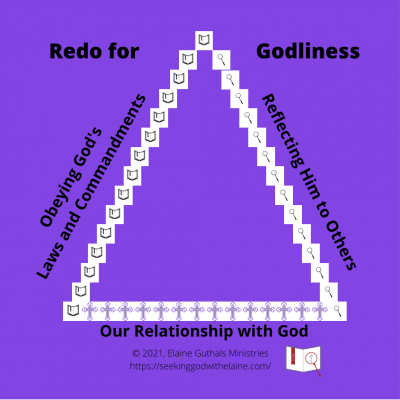
  • Transformed to Perfection

    When we think of our redo for godliness, we think of the changes – the transformation – that needs to take place. This daily devotion will begin a look at the last five chapters of the Book of Romans.

    Nuggets

    • God calls us to submit to Him.
    • God calls us to be, do, and suffer in order to achieve the perfection of being.
    • We can only be transformed through the power of the Sovereign God.
    • Transformation must include our bodies, minds, and souls.

    To read devotions in the Redo for Godliness series, click the appropriate button below.

    Devotions in the Transformed to Perfection series

    We are going to do something we haven’t done for a while. In the past, we walked through almost the whole book of Ephesians.

    For our Redo for Godliness series, we are going to look at the ending chapters of Romans. I was always told that the first 11 chapters are how you become a Christian (Romans Part I), and the last five chapters are what you do then (Romans Part II). The book ends by telling us what it means to have a personal relationship with God.

    We would have looked at this last year because my Ladies and I were supposed to look at the book of Romans for Sunday Morning Bible Study. But Covid hit, and we didn’t get to do that – which was a big bummer. I was really looking forward to our discussions.

    We are going to do the walk through the second part of Romans a little differently than we did when we did the walk through Ephesians. I am going to break it into a couple of series. We’ll handle it more like we did the Attributes of God and Silence of the Soul series. We’ll work on one series a while and then pull in some other stuff to give ourselves a break.

    So, let’s get going and see where it leads.

    Let’s Put It into Context

    We’ve looked at Romans 12: 1-2 before — pretty extensively. We broke apart the phrases in the verses when we developed the first job duty for our Disciples’ Job Description.

    The Disciple’s Job Description

    Complete Job Description

    We looked then at what we were supposed to do. Let’s look now more at the end result — perfection means being.

    Transformed into a Sacrifice

    “Therefore, brothers and sisters, in view of the mercies of God, I urge you to present your bodies as a living sacrifice, holy and pleasing to God …” (Rom. 12: 1 CSB)

    God calls us to submit to Him.

    Sacrifice has long been a part of service. With the Jewish sacrifices, they were categorized as sacrifices for reconciliation and sacrifices for celebration and worship.

    Resource

    Where Jesus was the sacrifice for sin in Romans Part I, we are the sacrifice in Romans Part II. Maclaren said that “sacrifice means giving up everything to God. That is the true sacrifice, when I think as in His sight, and will, and love, and act as in obedience to Him. Godet gave us what being a sacrifice looks like. He wrote, “… the symbol of consecration after pardon had been received … and of the communion established between Jehovah and the believer …”

    Resource

    Elaine-speak. A living sacrifice is the embodiment of becoming sanctified and giving everything to God after being forgiven of our sins.

    Hmmm. That kind of turns it on its ear, doesn’t it? Well, usually when we think of sacrifice, don’t we think of the things we are giving up or not doing because we are now a disciple? Sometimes, we consider it a sacrifice because God is asking us to do something when we would rather do something else.

    So, being a sacrifice isn’t about giving up. It is about being changed.

    Kelly’s point kind of stopped me in my tracks. When the Jews sacrificed the animals — to have any value as a sacrifice — the animals had to be dead.

    Resource

    But we know how that translates, don’t we? We have to be dead to ourselves.

    • “I have been crucified with Christ. It is no longer I who live, but Christ who lives in me. And the life I now live in the flesh I live by faith in the Son of God, who loved me and gave himself for me” (Gal. 2: 20 ESV).
    • “And he said to all, ‘If anyone would come after me, let him deny himself and take up his cross daily and follow me’” (Lk. 9: 23 ESV).

    Then Miller added to that by reminding us that the sacrifice had to be without blemish. I still have it in my folder for this year to take another peak at being perfect in this world.

    Resource

    For us, that is what without blemish means. It means no sin. It means we are to be holy. Holy means to be set apart, perfect, and morally pure while possessing all virtues.

    We can’t accomplish that while we are in these bodies. The only way we can is to be covered by the blood of Jesus. Then God sees His blood, not our blemishes.

    Wardlaw reminded us that the choice to be a living sacrifice to God is ours. We can choose to let Him have control. Or we can choose to be independent and not believe in Sovereign God.

    But when we do choose to be a living sacrifice, Wardlaw confirmed that it has to be a daily submission.

    Resource

    Transformed into the Sanctification

    God calls us to be, do, and suffer in order to achieve the perfection of being.

    Okay, we’ve been saying that perfection isn’t about doing. It is about being.

    Perfection is about being. It is about obtaining the character of God.

    Nell said, to be sanctified, it encompasses being, doing, and suffering. We deliberately have to choose to be, to do, and to suffer all that God has in store for us.

    Resource

    Sanctification

    I can see that. The three-pronged act of sanctification combines into the perfection of being.

    Let’s look at it this way. I decided what I wanted to be when I was in third grade — well, two things. I wanted to be a secretary and a singer.

    I can just hear God saying, “Elaine, it really isn’t about what you do. Either way you choose, you need to do it for Me and be like Me.”

    Think about it. If our transformation to perfection was all about what we do, what we might be doing might not necessarily be for God. We might be part of a Save the Kids, Save the Animals, Save the Planet organization that — though they do good work — aren’t working to glorify God, but the worldview.

    Instead, we are to change our character to be like that of God’s. We are to kick the world’s moralities up to spiritual graces heading toward holiness.

    If our morals don't come through submission to God, they are just worldly morals, not spiritual graces. But then we have to grow the spiritual graces to holiness.

    But we can’t just be and not do. Because God is in us, the love and joy has to bubble out of us. We can’t keep it to ourselves.

    The suffering is going to be a component, also. Once Satan knows we have thrown in with God, he is going to unleash temptations on us.

    So, we’ve got to be, do, and suffer to change into being like God.

    Transformed by the Power

    We can only be transformed through the power of the Sovereign God.

    Arnot talked about a link between doctrine and duty. Both have to be united in order to have a living relationship with God. Arnot said that the link “… unites the product to the power.”

    Resource

    How do we unite the product to power? Communication. Remember the last part of Godet’s definition? He wrote, “… the symbol of consecration after pardon had been received … and of the communion established between Jehovah and the believer …”

    Resource

    The product Arnot was talking about is the life of being a living sacrifice. By being in constant communication with Him, we are devoted to God and serve Him and others. That is the greatest commandments, right?

    Glossary

    Love God is righteousness + Love people is mercy = perfection/godliness

    Transformed Completely

    Transformation must include our bodies, minds, and souls.

    A quick word of caution. Don’t think bodies means just our physical bodies. However, Leach brought up something interesting. He wrote, “Christ had but little to say about souls, but much about bodies.”

    Resource

    Paul is telling us to present our nature and souls — in fact, all of us — to God. Taylor wrote that we can’t “… give the body apart from the soul, which would be formalism and hypocrisy.” A formalist is a person who gives the appearance of being a disciple, but in reality, isn’t.

    Resource

    Making the Connections

    Fiddes made a great point. He wrote, “When we consider that the generality of men are more governed by example than precept, or the intrinsic reason of things, we must acknowledge it adds a very great force to instructions we hear from any person when they come recommended by his own practice, and that upon two accounts.”

    Resource

    How is that evident in today’s society? We used to be a Christian nation. But now, we hear that we are supposed to be doing and believing like worldview people. We are to follow their examples instead of God’s laws and commandments.

    TransformedToPerfectionPin

    How Do We Apply This?

    Barnes said that we should exhibit the attributes of God. He wrote, “Ministers of the gospel should be gentle, tender, and affectionate. They should be kind in feeling, and courteous in manner — like a father or mother.”

    Resource

    When life turns chaotic, we have to look to the One who is steering us. That means we have to have Him in our boat instead of just being the stars that guide us. The stars do us no good if we don’t have the ability to steer the boat.

    Resource

    We are a living sacrifice by

    • Cheerfully being obedient.
    • Consistently following God.
    • Walking in the Spirit instead of allowing worldly passions rule us.
    • Prepare ourselves for service to God.
    • Be grateful to God in all things.
    • Controlling our physical desires.
    • Doing all that is “… holy and pleasing to God …” (Rom. 12: 1 CSB)
    • Making being a living sacrifice a habit.

    Resource

    After we ABCD, we have to be transformed to be like God. It is a process called sanctification. It will take our lifetimes to complete – but it is worth it.

    Father God. We thank You so much that You take us as we are for salvation. Help us to be transformed to like You are as we navigate the Sanctification Road. Amen.

    The ABCDs of Salvation

    If you have not become a believer in Christ, please read through the
    Plan of Salvation and prayerfully consider what God is asking you to do.

    A – admit our sins
    B – believe His Son Jesus is our Redeemer
    C – confess God as Sovereign Lord

    D – demonstrate that commitment by making any changes needed in our lives to
    live the way in which God has called us

    The Disciple’s Job Description

    What do you think?

    Leave me a comment below (about this or anything else) or head over to my Facebook group for some interactive discussion.

    If you don’t understand something and would like further clarification, please contact me.

    If you have not signed up for the email daily or weekly providing the link to the devotions and the newsletter, do so below.

    If God has used this devotion to speak with you, consider sharing it on social media.

  • The Expected Message

    Jesus may have unexpectedly visited His disciples, but the message He was telling was the same one He had always told. This daily devotional looks at the message and Jesus’ plan to have it broadcast.

    Nuggets

    • Jesus’ mission centered on the condition of souls.

    • The starting place for spreading the message was Jerusalem, and it was up to the disciples to do it.

    • God will equip us to do His work.

    In the last devotion, we talked about how Jesus unexpected showed up while the disciples were hiding in a room somewhere. They did not expect to see the Risen Savior.

    The message Jesus told them was the message He had been telling them all along. “Now after John was arrested, Jesus came into Galilee, proclaiming the gospel of God, and saying, ‘The time is fulfilled, and the kingdom of God is at hand; repent and believe in the gospel’” (Mk. 1: 14-15 ESV).

    Let’s take a look at the message Jesus told the disciples that night.

    Let’s Put It into Context

    “He also said to them, ‘This is what is written: The Messiah will suffer and rise from the dead the third day’” (Lk. 24: 46 CSB)

    Here are the nuggets from the last devotion.

    • Jesus unexpectedly appeared to the disciples and both encouraged and chided them while proving He was real.
    • Prophecy always indicated that the Messiah would suffer and die, though the disciples didn’t expect and understand the words.

    The Expected Message of Repentance

    “and repentance for forgiveness of sins will be proclaimed in his name to all the nations …” (Lk. 24: 47 CSB)

    Jesus’ mission centered on the condition of souls.

    Jesus was all about repentance, forgiveness, and sin. Let’s look at the last first before moving on to the other two.

    Sins are actions by humans that disobey God and break one of His reasonable, holy, and righteous laws and commandments, goes against a purpose He has for us, or follows Satan’s promptings.

    Glossary

    God always knew that mankind was going to disobey Him and let sin into the world. With sin, death, crucifixion, and resurrection all in place, He created us anyway.

    The world God created was permanent. It was a paradise that had no illness and death, no anger and hate.

    God gave man just one restriction. “… You may freely eat of every tree of the garden; but of the tree of the knowledge of good and evil you shall not eat, for in the day that you eat of it you shall die” (Gen. 2: 16-17).

    Satan convinced Eve to not believe and to disobey what God said. Satan said bite; Eve bit; and Adam bit, committing the original sin.

    To read a related devotion, click the button below.

    Adam and Eve’s sin unleashed consequences for that act. The consequences of sin are spiritual death and separation from God. The results of sin are poverty, crime, disease, and death — just to name a few.

    Our relationship with Him was broken, however, because we were no longer upright. “For the LORD is righteous, he loves justice; the upright will see his face” (Ps. 11: 7 NIV). God does not tolerate sin.

    When the relationship broke, that meant we no longer had access to the Sovereign God. So, God had to come up with a way to fix our relationships. He designed the Plan of Salvation with Jesus as the Sacrifice.

    Redemption is where something is used in exchange for something else to gain or regain something. Jesus is our Redeemer because He

    • was born of a virgin, making Him 100% God and 100% man;
    • gave His life on the cross for us so that His blood could pay the price for our sins; and
    • because of God’s great might and power, rose from the grave, conquering death and paying the price for our sins. 

    Jesus paid the price for our sins but that doesn’t mean we don’t have to do our parts. We have to repent and believe.

    Repentance is acknowledging our separation from God and expressing sorrow for breaking God’s laws and commandments by making the commitment to changing ourselves through obedience so that we no longer do the wrong things. Lynch wrote, “Repentance is a change of mind leading to a change of conduct.”

    Resource

    The Plan of Salvation was accomplished through His grace. Grace is a free and unmerited gift from the Heavenly Father given through His Son, Jesus Christ, that enables salvation for and spiritual healing of believers by the work of the Holy Spirit.

    We access this grace through faith. Faith is the conviction that the doctrines revealed in God’s Word are true, even if we do not understand all aspects of them, a belief which impacts our lives.

    Because we have faith and believe, we gain the forgiveness of our sins. Forgiveness is, when we ask, God pardons us because we have broken His laws and commandments.

    We accept the pardon by committing to changing ourselves so that we no longer do the wrong things. We let go of the guilt and remorse that we feel because we have done something wrong. It is a conscious decision to accept His forgiveness.

    But that means we have to believe that God will forgive us when we ask. If we think we have committed too big of a sin or too many sins, we may think God’s forgiveness will never apply to us.

    That is so far from the truth. God does not limit His forgiveness.

    There is only one sin that God will not forgive — the unpardonable sin. I believe that sin is not ABCDing.

    Glossary

    That was the message. It is to be preached in Jesus’ name.

    What does that mean? Spurgeon felt that this was our marching orders. He wrote, “Silence is sin when salvation is the theme.” It is by His authority that we preach.

    Resource

    The ABCDs of Salvation

    If you have not become a believer in Christ, please read through the
    Plan of Salvation and prayerfully consider what God is asking you to do.

    A – admit our sins
    B – believe His Son Jesus is our Redeemer
    C – confess God as Sovereign Lord

    D – demonstrate that commitment by making any changes needed in our lives to
    live the way in which God has called us

    The Disciple’s Job Description

    We are called to convey the message, but Jesus alone brings the salvation. Salvation is the gift of life through the deliverance from evil and the consequences of sins to replace them with good and eternal life. Spiritual death is the spiritual separation from God that occurred as a consequence of Adam and Eve’s original sin. The spiritually alive are those who have ABCDed, so they are no longer separated from God.

    We are called to convey the message, but Jesus alone brings the salvation.

    The Unexpected Witnesses

    “… beginning at Jerusalem. You are witnesses of these things” (Lk. 24: 47-48 CSB)

    The starting place for spreading the message was Jerusalem, and it was up to the disciples to do it.

    Why was the gospel message supposed to be first proclaimed in Jerusalem? Jesus was instructing them to fulfill the Scriptures.

    • “Many peoples will come and say, ‘Come, let us go up to the mountain of the LORD, to the temple of the God of Jacob. He will teach us his ways, so that we may walk in his paths.’ The law will go out from Zion, the word of the LORD from Jerusalem” (Isa. 2: 3 NIV).
    • “Then everyone who calls on the name of the LORD will be saved, for there will be an escape for those on Mount Zion and in Jerusalem, as the LORD promised, among the survivors the LORD calls” (Joel 2: 32 CSB).

    Maybe it was because of where the events occurred they started at Jerusalem. Maybe it was because, being God’s people — as they so proudly reminded everyone — they should have known what the Scriptures said and could make the connections to believe. Maybe it was the “Jews first” rule.

    Probably also, Jesus wanted the disciples to start in Jerusalem because that was where they were. Jesus always comes to us where we are. He doesn’t make us clean up our acts or change what we are doing to earn salvation.

    Salvation is not about the do’s and don’ts. Submission is. By following God’s laws and commandments — and asking for forgiveness when we break them — we are growing holiness.

    Salvation is a free gift. We just have to repent and believe.

    Jerusalem should have been the easy place to start. The Jews were waiting for the Messiah — the disciples were preaching about the Messiah. A match made in Heaven, right?

    We want our first witnessing gig to be easy, don’t we? Let’s look at it from a couple of different angles.

    The Jews thought they knew all there was to know. Jesus was constantly telling them, “No, you don’t.”

    If they didn’t believe the Son of God, were they really going to believe fishermen?

    Let’s look at it from the angle that the disciples went to the Gentiles first. What would have been their first question?

    “How successful were you at getting the Jews to believe this?” The disciples would have first been seen as one of them. If they didn’t have success with their own, why should the Gentiles believe?

    So, really. The disciples wouldn’t have an easy road whichever way they went.

    But Spurgeon suggested we start where we would find opposition.

    What? Is he out of his mind?

    Spurgeon thought Jesus suggested Jerusalem because of the opposition. He wrote, “If they began at Jerusalem, they would arouse a ferocious opposition. But nothing is much better for the gospel than opposition.”

    Resource

    In my opinion — Spurgeon meant that the two opposing sides would showcase the benefits of a relationship with God.

    That means, disciples have to be forewarned. We aren’t going to have easy.

    Oh, yeah. We would like it if the altar was filled every altar call. There are times we would settle for one conversion every time we witnessed.

    That isn’t the way it works.

    Witnessing is about building relationships. That takes time.

    Witnessing is about building relationships. That takes time.

    Making the decision to accept the gift of salvation means we have to choose to be obedient. That is a major choice for some.

    It keeps flipping through my mind that this opposition strengthens our relationship with God. We solidify what we believe and why when we are opposed.

    Landels made some good points. He said.

    • The gospel is in the business of challenging worldview beliefs.
    • It showed that Jesus came to save all — even the ones who had Him crucified.
    • God’s mercy is for all, especially the most sinful.

    Resource

    The Promised Power

    “And look, I am sending you what my Father promised. As for you, stay in the city until you are empowered from on high” (Lk. 24: 49 CSB)

    God will equip us to do His work.

    The disciples were to stay in Jerusalem until they received a gift from the Heavenly Father. That gift was the Holy Spirit.

    Glossary

    We don’t witness under our own power. It is through the promptings of the Holy Spirit that we spread God’s message.

    Jesus has given each of a gift. “And he gave the apostles, the prophets, the evangelists, the shepherds and teachers, to equip the saints for the work of ministry, for building up the body of Christ” (Eph. 4: 11-12 ESV).

    This gift was “… grace [that was] was given to each one of us according to the measure of Christ’s gift” (Eph. 4: 7 ESV).

    Muir recognized the need to prepare for our role in God’s mission. He wrote, “By their enforced tarrying the disciples were taught that no man must thrust himself into the ministry of Christ.”

    Resource

    We can’t go ahead of God. We can’t go where He is not leading.

    Vaughan reminded us that the wait was only ten days. Oh, yeah. There are times when a ten-day wait feels like a lifetime. But it is relatively short.

    Resource

    I can see why Vaughan described the waiting period as the calm before the storm.

    But isn’t this what we are supposed to do — wait on the Lord? “Wait for the LORD; be strong, and let your heart take courage; wait for the LORD!” (Ps. 27: 14 ESV).

    I know. We want to be in charge of the who, what, when, where aspect of everything.

    God wants us to depend on Him in  everything.

    I loved Rogers’ definition of power. He wrote, power “… is intensity in every part of the Christian life.” Rogers brought up faith, loyalty, courage, sympathy, grandeur, and love as examples.

    Resource

    We only get this power from God.

    Watson was right. This is amazing power. It took a ragtag group of fishermen and made them evangelists.

    Resource

    TheExpectedMessagePin

    Making the Connections

    Think of it this way. Jesus had died and had risen from the grave. The Plan of Salvation was complete.

    Jesus’ didn’t see His work as over. He had a group of men that needed to be restored, encouraged, and equipped.

    The Plan of Salvation wouldn’t mean a thing if these men did not tell others it existed. We have to know we are sinners. We have to make a conscious choice to believe in a Risen Savior.

    Jesus’ priority is always the condition of our souls.

    But Jesus was also concerned about the condition of the disciples’ souls. Had the disciples made a profession of faith before the crucifixion or after Jesus’ appearance to them that night?

    Somewhere along the line, the disciples chose to make Jesus their personal Savior. And the world was changed.

    How Do We Apply This?

    • Read Scriptures asking God to provide understanding.
    • Diligently read the Scripture.
    • Read the Scriptures with docility — being willing to be taught.
    • Start witnessing at home.
    • Join in an already-established missions project.

    Resource

    Rogers didn’t see our situation as much different than that of the disciples. We still meet with opposition when witnessing. Luckily, Rogers said, “… the promise to us is unchanged.”

    Resource

    Jesus comes to us with a very specific purpose in mind. He wants us to believe in Him. Do you?

    Father God. It amazes us that You want our relationships with You restored even after we have disobeyed You. It amazes us — and scares us — that You want us to spread the gospel. Give us courage. Help us to go only where You call us. Amen.

    What do you think?

    Leave me a comment below (about this or anything else) or head over to my Facebook group for some interactive discussion.

    If you don’t understand something and would like further clarification, please contact me.

    If you have not signed up for the email daily or weekly providing the link to the devotions and the newsletter, do so below.

    If God has used this devotion to speak with you, consider sharing it on social media.

  • When the Unexpected Happens

    Sometimes, things happen that we don’t expect. This daily devotional looks at Jesus’ first unexpected appearance to the disciples after the resurrection.

    Nuggets

    • Jesus unexpectedly appeared to the disciples and both encouraged and chided them while proving He was real.
    • Prophecy always indicated that the Messiah would suffer and die, though the disciples didn’t expect and understand the words.

    Devotions in the Luke’s Diagnosis and Prescription series

    Program note: This devotion ran long, so it was broken into two devotions. I’ll do the connections and application in the next devotion.

    The disciples were hiding in some room in the city. They were shaking in their sandals because of fear of being arrested.

    The Biblical Illustrator called it like they saw it. They wrote that the disciples weren’t believing — let alone expecting — a resurrected Jesus. It didn’t matter that this was what He had promised. They just didn’t believe His messengers.

    Resource

    Now, they didn’t just have to take the women’s word for it. Yeah, Peter and John saw the empty tomb, but Scriptures don’t say Peter went away believing. “… So he went away, amazed at what had happened” (Lk. 24: 12 CSB).

    Then they had an unexpected guest show up.

    Let’s Put It into Context

    “That very hour they got up and returned to Jerusalem. They found the Eleven and those with them gathered together, who said, “The Lord has truly been raised and has appeared to Simon!” Then they began to describe what had happened on the road and how he was made known to them in the breaking of the bread” (Lk. 24: 33-35 CSB)

    Immediately prior to the passage we are looking at is the passage about Jesus appearing to the disciples traveling to Emmaus. We looked at this in our last devotion but stopped when Jesus left.

    After the two figured out their Guest was Jesus, the men completed the seven-mile trip back to Jerusalem. They wanted to share their good news with the other disciples.

    
An Unexpected Guest

    “As they were saying these things, he himself stood in their midst. He said to them, ‘Peace to you!’ But they were startled and terrified and thought they were seeing a ghost. ‘Why are you troubled?’ he asked them. ‘And why do doubts arise in your hearts? Look at my hands and my feet, that it is I myself! Touch me and see, because a ghost does not have flesh and bones as you can see I have.” Having said this, he showed them his hands and feet. But while they still were amazed and in disbelief because of their joy, he asked them, ‘Do you have anything here to eat?’ So they gave him a piece of a broiled fish, and he took it and ate in their presence” (Lk. 24: 36-43 CSB)

    Jesus unexpectedly appeared to the disciples, and both encouraged and chided them while proving He was real.

    Just think what the two disciples from Emmaus thought when Jesus showed up in the midst of the disciples. “Hey! We were just talking about you!”

    Think about the last time that Jesus had seen the disciples. He saw John while He was hanging on the cross. He saw Peter in the courtyard after Peter had denied Him for the third time.

    For the rest, the last time Jesus saw them was when they were running away from the Garden of Gethsemane.

    Spurgeon brought up the point that the disciples really hadn’t changed in the last 72 hours or so. He wrote, “They are not carried away by enthusiasm, nor wafted aloft by fanaticism; they are not even as yet upborne by the Holy Spirit into an unusual state of mind, but they are as slow of heart and as fearful as ever they were.”

    Resource

    Spurgeon pointed out that Jesus showed up and started talking. But it was more than that.

    The first words out of Jesus’ mouth was “… Peace to you!” (Lk. 24: 36 CSB). That should have jogged their memories. “Peace I leave with you. My peace I give to you. I do not give to you as the world gives. Don’t let your heart be troubled or fearful. You have heard me tell you, ‘I am going away and I am coming to you.’ If you loved me, you would rejoice that I am going to the Father, because the Father is greater than I” (Jn. 14: 27-28 CSB).

    They needed all the peace they could get from this world’s terrors. But Jesus’ priority was never this world. His priority is the condition of our souls.

    The disciples needed restorative peace. Parsons stated that this peace would be the motivator for their coming mission.

    Resource

    Did the disciples recognize Jesus? He still had the same earthly body. That was verified by the wounds.

    Spurgeon pointed out that Jesus had already received some of His glory. Still, the disciples could recognize Him. More than that — maybe somewhat amazingly — He still wanted to associate with this ragtag group.

    I think most of their doubts stemmed from the fact that people don’t expect others to raise from the dead. Even though Jesus had told them He would die and rise again, the disciples didn’t retain that nugget.

    So, here comes Jesus, just appearing before them. Most people would be startled, if nothing else.

    Jesus didn’t start biting on the disciples. “Why are you troubled? …” (Lk. 24: 38 CSB). He did give them a mild scolding. “… And why do doubts arise in your hearts?” (Lk. 24: 38 CSB).

    Instead, Jesus did a show and tell. Look at the nail prints. Come touch me. Give me something to eat.

    The disciples hadn’t changed any since this started on Good Friday, but neither had Jesus. He was concerned for their peace. He was still tender and loving toward them. He patiently gave them time to process the difficult thing He was asking them to understand.

    Oh, yeah. Jesus didn’t gloss over their doubts. He called them on them — lovingly — with a side of encouragement. He brought them to a deeper understanding of Himself.

    Spurgeon reminded us that Jesus could have removed the wounds. He didn’t to prove that the Risen Savior is the same person as the Crucified Savior.

    Resource

    Instead of being ashamed of His wounds, Jesus considered them as ornaments or jewels. They were proof that His blood was shed to pay the price for our sins.

    We may question how the disciples could have disbelief and joy at the same time. I don’t think it is hard.

    We many times have very complex emotions. God created us with a compassionate nature.

    When trials buffet us from every side, there are many emotions — sometimes conflicting ones — that start churning within us.

    Just because they did not believe resurrection would happen doesn’t mean they didn’t want it to not happen. They wanted their Friend with them.

    But they were probably feeling guilty and unworthy. There had to be some regret and disgust with themselves mixed in.

    They had to work through all of this to make an informed, conscious decision to believe in the Christ of the cross.

    Think of it this way, too. Yes, they had seen Jesus raise people from the dead before, so they knew resurrection was a real thing. But it was always Jesus doing something to restore them.

    Jesus was dead. He wasn’t resurrecting Himself.

    One last thought before we move on. The disciples stayed together. You would think it would have been easier for those looking for them to find a group instead of men hiding throughout the city.

    But they needed the unity. They needed the fellowship.

    Payson wondered if this was the first time the church had met after the crucifixion. What better way to have Jesus bless the gathering than with His indisputable presence?

    Resource

    They may not have been the on-fire apostles they would turn into, but they had the love for their Savior.

    Unexpected Words and Understanding

    “He told them, ‘These are my words that I spoke to you while I was still with you — that everything written about me in the Law of Moses, the Prophets, and the Psalms must be fulfilled.’ Then he opened their minds to understand the Scriptures. He also said to them, ‘This is what is written: The Messiah will suffer and rise from the dead the third day’” (Lk. 24: 44-46 CSB)

    Prophecy always indicated that the Messiah would suffer and die, though the disciples didn’t expect and understand the words.

    The Old Testament was written through divine inspiration. Sometimes, the writers told of actual events that had occurred. Other times, they foretold what would occur.

    Sprinkled throughout the Old Testament is prophecy regarding the Messiah.

    • Moses: “I will bless those who bless you, and whoever curses you I will curse; and all peoples on earth will be blessed through you” (Gen. 12: 3 NIV).
    • Moses: “Then the Lord said to Moses, ‘Make a snake image and mount it on a pole. When anyone who is bitten looks at it, he will recover’” (Num. 21: 8 CSB)
    • Samuel: “When your days are over and you rest with your ancestors, I will raise up your offspring to succeed you, your own flesh and blood, and I will establish his kingdom. He is the one who will build a house for my Name, and I will establish the throne of his kingdom forever” (II Sam. 7: 12–13 NIV).
    • Isaiah: “Therefore the Lord himself will give you a sign: The virgin will conceive and give birth to a son, and will call him Immanuel” (Isa. 7: 14 NIV).

    • Psalms: “Sacrifice and offering you did not desire — but my ears you have opened — burnt offerings and sin offerings you did not require. Then I said, ‘Here I am, I have come — it is written about me in the scroll. I desire to do your will, my God; your law is within my heart’” (Ps. 40: 6–8 NIV).
    • Psalms: “My people, hear my teaching; listen to the words of my mouth. I will open my mouth with a parable; I will utter hidden things, things from of old” (Ps. 78: 1–2 NIV).

    That is just part of the prophecy. Jesus fulfilled it all.

    I was interested in the “Then he opened their minds to understand the Scriptures” (Lk. 24: 45 CSB) verse. Why was their understanding closed?

    We know that God ways and thoughts are higher than ours (Isa. 55: 8-9). We know we aren’t supposed to rely on our own understanding (Prov. 3: 5).

    But is there some switch God flips so we can begin to understand?

    • Flavel felt that mankind have an inadequacy to understand divine things. Only Christ can open the soul and open the understanding.
    • Blencowe gave a list of all the different things he felt Jesus could have done to teach the disciples. He chose to use the Scriptures.
    • Kidd felt there were many reasons why we don’t understand. He wrote, “The unlocking of the whole soul; the breaking down of all the barriers of pride, prejudice, and sin, which preclude the gospel, and prevent the cordial reception of its salutary truths.”

    Resource

    I think it boils down to the fact that, though we are made in God’s image, we have too much of Adam’s image in us. The root is sin that manifests itself in many different ways — pride and prejudice being just two.

    So, the understanding isn’t there. How many times have we read a Scripture passage and just totally did not understand it? That is the excuse we like to give for not reading our Bibles.

    I think a part of it is, too, that God wants only His children to understand some parts. He purposefully chooses the opposite of what those who really don’t want to believe in Him hold to be wise (I Cor. 1: 27).

    It isn’t that Jesus doesn’t want us to know. If He wanted to keep us in the dark, He wouldn’t have explained everything to the disciples as they were journeying to Emmaus.

    Jesus wants to guide our understanding. “… and lean not on your own understanding” (Prov. 3: 5 NIV).

    What were the disciples having trouble understanding? They couldn’t wrap their heads around the fact that the Messiah had to die — that it was prophesied that Jesus had to die.

    Harris reminded us that Jesus’ death was not an afterthought. God knew from before the foundation of the world that Jesus was destined for the tree.

    That was the plan all along.

    Resource

    Glossary

    Think about it. What would the gospel be if it was missing the suffering? What would it be if it were missing the resurrection?

    WhenTheUnexpectedHappensPin

    Father God. You come to us unexpectedly, seeking to restore our relationships with You. Help us not to doubt. Amen.

    What do you think?

    Leave me a comment below (about this or anything else) or head over to my Facebook group for some interactive discussion.

    If you don’t understand something and would like further clarification, please contact me.

    If you have not signed up for the email daily or weekly providing the link to the devotions and the newsletter, do so below.

    If God has used this devotion to speak with you, consider sharing it on social media.